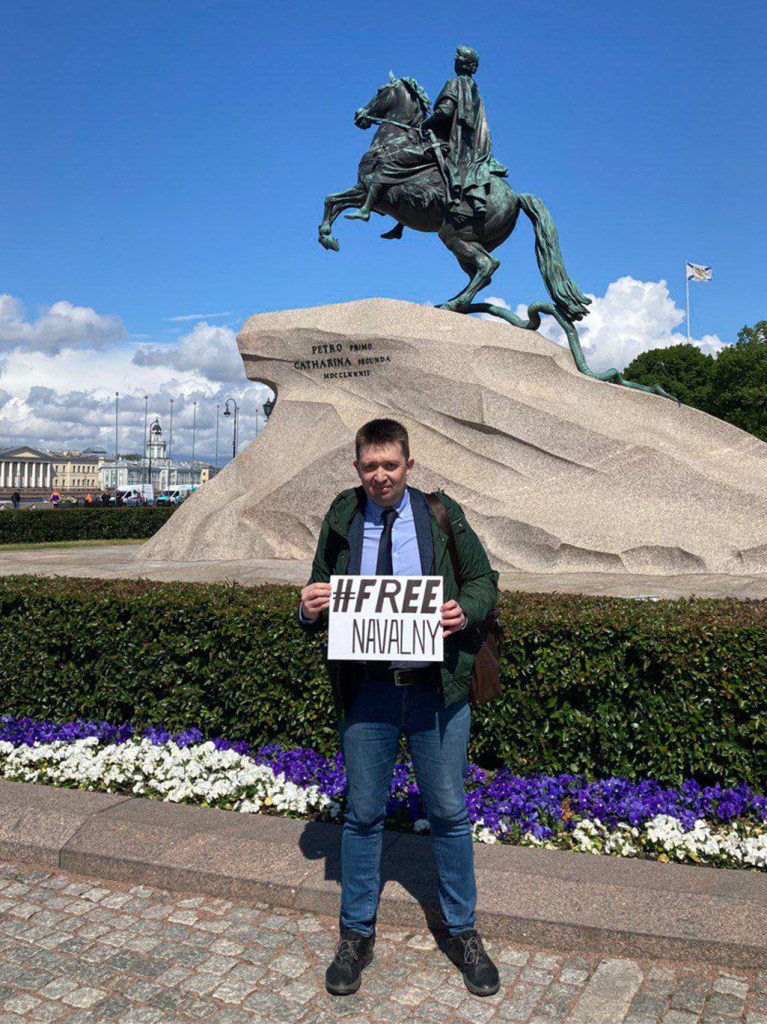
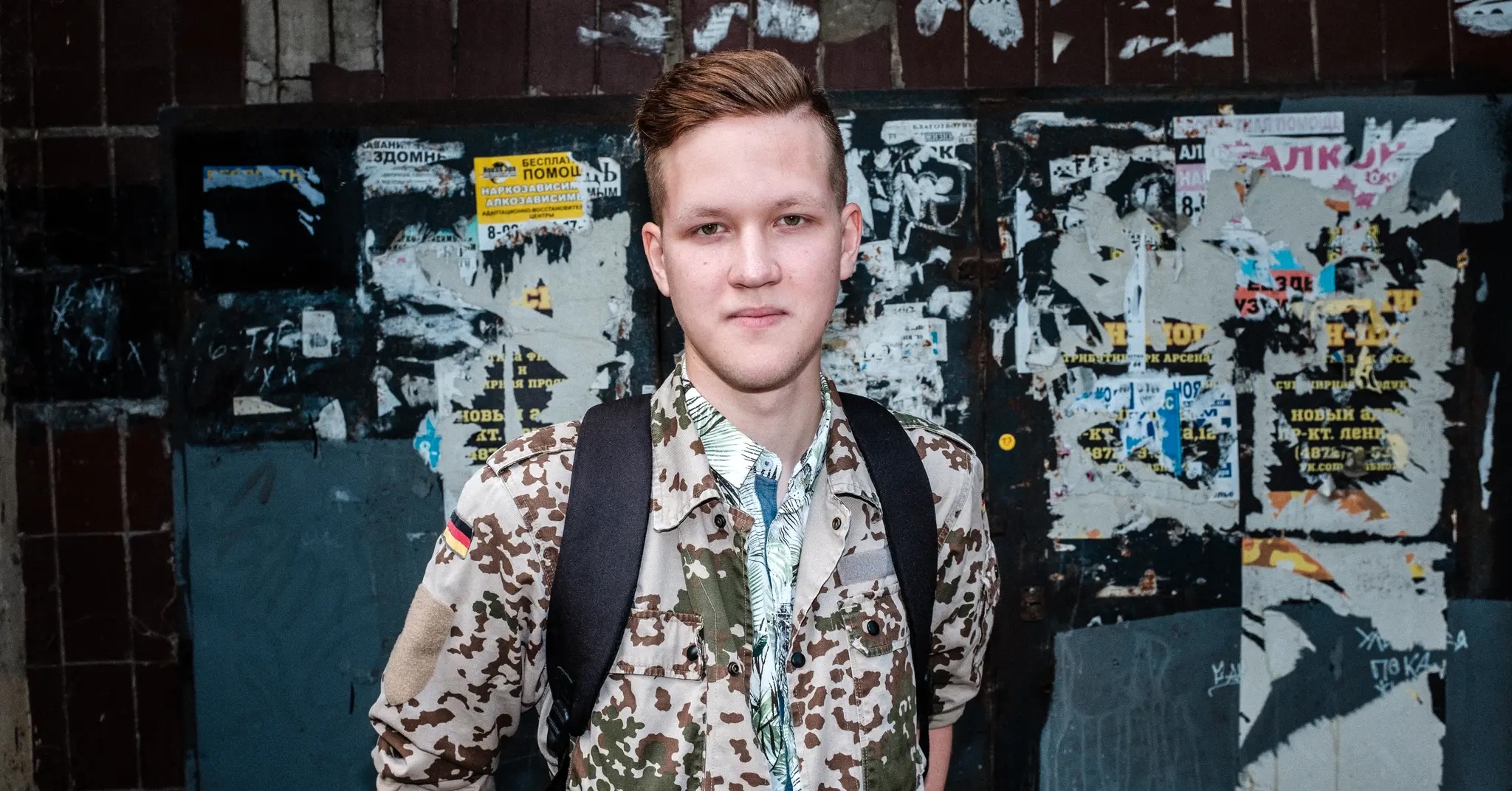
Man repeatedly detained at protest rallies in Perm deported from U.S. to Russia
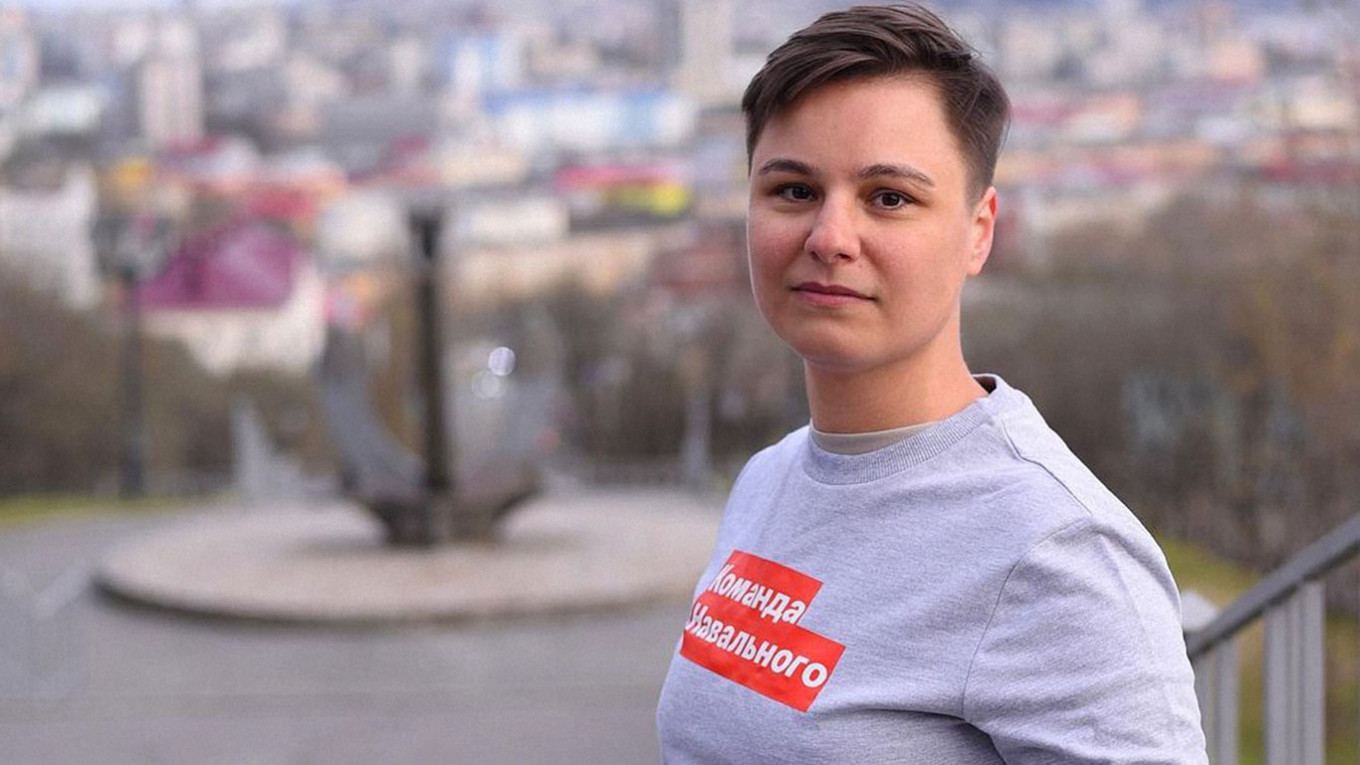
Today, 25 July, Perm activist Leonid Melekhin, who had been wanted by law enforcement authorities for several years and is on the Russian federal list of “terrorists and extremists,” was remanded to custody in a pretrial detention center, Properm.ru’s correspondent has learned. Melekhin had attempted to emigrate to the U.S. via Mexico, a process about which his friends had written extensively on social media.
Melekhin tried to cross the border between Mexico and America in August last year and spent several months in detenshen (immigration prison in the U.S.), but lost his legal bid to remain in America. This entire time he was wanted by the Russian authorities for his cooperation with the Navalny Headquarters (an organization deemed “extremist” that has been banned in Russia).
According to our correspondent, Melekhin was turned over to the Russian authorities [sic!] before being deported to Russia and detained on suspicion of “condoning terrorism.”
As their source at Perm’s Lenin District Court confirmed to our correspondent, Judge Oksana Korepanova today granted the motion filed by an FSB investigator and remanded Melekhin to a pretrial detention center until 25 September.
Before leaving Russia in late 2023, Melekhin was repeatedly detained by the police for his involvement in unauthorized protests.
“A Russia without profanity. The word mom is sacred! Speak without swearing.” Photo: Igor Stomakhin, Moscow, 2025
What can serve as the basis for new Russian post-war identity? What sort of patriotism can there be in a country which has lived through an aggressive war? Of what should the people of this country be proud? What should they associate themselves with? Republic Weekly presents a programmatic text by the sociologist Oleg Zhuravlev and the poet and activist Kirill Medvedev on how the so-called Russian nation came to 2022 and what its prospects are in 2025.
How can Russia get beyond being either an embryonic nation-state or a vestigial empire? People have been talking about this for three decades now. Does it require years and years of peaceful development? A national idea painstakingly formulated by spin doctors in political science labs? A bourgeois revolution? Or maybe just a small victorious war? The so-called special military operation in Ukraine, which has grown into a global military and political conflict, poses these questions in a new light.
In our view, large-scale social changes are happening inside Russia today, changes which could help shape a new national project.
These changes are not always so easy to spot.
According to the social critique prevalent in the independent media, wartime Russian society is organized roughly as follows. Its freedom-loving segment has been crushed and disoriented, while its loyalist segment is atomized and under the thumb of government propaganda, which preaches xenophobia, imperialism and cynicism. Society is fragmented and polarized, suspended somewhere between apathy and fascism. But these tendencies, which are certainly important — and therefore visible to the naked eye, as well as exaggerated by the liberal discourse — are nevertheless not absolute and probably are not even the most important. Society lives its own life, meaning that different groups within it live their own lives and move in their own directions. When you analyze the trajectories of that movement you get a better sense of the major pathways along which these groups might in the future coalesce into a new nation.
Despite the official rhetoric about unity during the war years, the regime has not managed to consolidate a nation, but it has laid the groundwork for its formation in the future. This has been significantly aided by the west’s anti-Putin policies and the information war waged by the new Russian emigration’s radical wing, which speaks of the collective guilt of all Russians, of their culture and language. Consequently, the only alternative to Putinism and war has seemed to be the disenfranchisement of all Russianness, and the only alternative to official government patriotism has been the “fall of the empire.” Meanwhile, there have been and continue to exist images of the country and modes of attachment to it which cannot be reduced to either of these two options.
THE NEW RUSSIAN PATRIOTISM
The idea of a new Russian identity was expressed succinctly by Boris Yeltsin on 22 August 1991, when he said that the attempted coup had targeted “Russia, her multi-ethnic people” and her “stance on democracy and reform.” The new modern Russian identity was supposed to be the result of choosing Europe, overcoming the archetypes of slavery and subjugation, and transcending the legacies of the October Revolution, interpreted as a criminal conspiracy and lumpenproletarian revolt, and of the Soviet nation as a grim community of “executioners and victims.”
Ultimately, though, it was the reforms themselves, along with the trauma of losing a powerful state, that generated Soviet nostalgia and a new version of Stalinism. [Yeltsin’s] shelling of the [Russian Supreme Soviet] in 1993 and the dubious 1996 presidential election, which many initially regarded as a triumph for the liberal project, proved to be its doom.
Despite the fact that advocates of the radical anti-liberal revanche were momentarily defeated and exited the scene, widespread disappointment and depoliticization was a barrier for further democratization through people’s involvement in politics. The story of 1991 spoke clearly about what the new Russians could take pride in: victory over the revanchists, for which they had taken to the streets and sacrificed the lives of three young men. Subsequently, amid the chaos and bloodshed of 1993, two ideological projects of Russian identity took shape which were mostly in competition with each other, splitting civil society in the period that followed.
LIBERALS VS. THE RED-BROWN COALITION
Vladimir Putin was nominated to strengthen the new capitalism and prevent a “Soviet revanche.” But his most successful project, as was quickly revealed, actually lay in the Soviet legacy’s partial rehabilitation. Putin managed to bridge the gap of 1993: he drew in part of the pro-Soviet audience (by using patriotic rhetoric, bringing back the Soviet national anthem, and taking control of the Communist Party) and drove the most intransigent liberals and democrats into the marginal opposition. The grassroots yearning for a revival of statism, which had taken shape in the early 1990s, was gradually incorporated into the mainstream. Many years later, this enabled things that would have been impossible to imagine even during the Brezhnev era, let alone during perestroika: the erecting of monuments to Stalin, the creeping de-rehabilitation of Stalinism’s victims, the normalization of political crackdowns as the state’s defense mechanism, and, consequently, a greater number of political prisoners than during the late-Soviet period.
Today’s ideal Russians, in Putin’s eyes, are those who identify themselves with all of Russian history from Rurik to the present, see that history as one of continuous statehood, and regard the periods of turmoil (the early sixteenth century, post-revolutionary Russia, the 1990s) as instances of outside meddling which should never be repeated.
The ideological struggle over Russia’s image during the Yeltsin and Putin years was thus rooted in the opposition between the liberal narrative (based on Yeltsin’s reforms) and the Stalinist great power narrative. Putinism, which is institutionally rooted in the Yeltsin legacy, acted as a kind of arbiter in the argument between the Shenderovich and Prokhanov factions, but gradually dissolved 1993’s great power Stalinist and White Russian imperial legacy into semi-official rhetoric.
But was this semi-official rhetoric part of the national identities of ordinary Russians? Or were their national identities not so thoroughly ideologized?
Did most of the country’s citizens even have national identities during early Putinism, which deliberately atomized and depoliticized society?
THE ESCALATION OF NORMALITY
Amid the relative prosperity, socio-economic progress, and apoliticality of the 2000s we see the emergence of a new, rather de-ideologized, “normal” everyday patriotism, involving a decent life, good wages, and an image of the country which made one proud rather than ashamed. Research by the sociologist Carine Clement has shown that this brand of patriotism could be socially critical and emerge from the lower classes (who criticized the authorities for the fact that far from everyone enjoyed good wages), but could also be more loyal to officialdom and come from the middle classes (who believed that the country had on the whole achieved a good standard of living, or had created conditions for those who actually wanted to achieve it).
In any case, early Putinism depoliticized and individualized society, neutralizing the civic conflict between the liberals and the “red-brown coalition,” but one outcome of this ideological neutralization was that it brought into focus something given to citizens by default: their connection to the motherland. This connection is not conceptualized through belonging to one ideological camp or another. It is grasped through one’s sense of the value possessed by a normal, decent life, a life which all the country’s citizens deserve individually and collectively.
This value was politicized after 2011. The Bolotnaya Square protests launched a peculiar mechanism: the escalation of normality. One author of this article recently decided to go back and re-analyze the interviews PS Lab did with people who protested in support of Navalny in 2021. The analysis showed something interesting: the most “radical” protesters, the people most willing to be detained and arrested, who wanted to go all the way and topple Putin, turned out to be the most “normal.” They were middle-class people whose demands were measured and respectable.
They did not dream of building utopias or radically restructuring society, but of a parliamentary republic and combating corruption. Both the Bolotnaya Square and post-Bolotnaya Square democratic movements, including the Navalny supporters, transformed the reasonable demand for a normal, bourgeois, prosperous country into the battle standard of a heroic revolutionary struggle against the Putin regime. Navalnyism, meanwhile, also integrated a measured social critique of inequality into its agenda.
The “normal patriotism” of the lower and middle classes thus became a stake in a fierce political struggle.
The new patriotic pride might have said something like this: “We can expose and vote out corrupt officials, push back against toxic waste dumps and insane development projects, vote in solidarity, and hit the streets to protest for the candidates we support whom Moscow doesn’t like. We have people who look to the west, people who miss the USSR, and people who defended the White House in 1991 and in 1993. We face Putin’s truncheons and paddy wagons together, and together we demand democratic freedoms and social justice.” This was how a civil society made up of Navalny fans, radical communists, and regional movements might have fought together for a “normal” country, how they might have shaped the political project of a vigorous nation pursuing solidarity. They might have done it, but they didn’t have time. They did manage to piss off the Kremlin, though.
In response, the regime launched its own escalation of normality. On the one hand, it responded to the protests with radically conservative counterrevolutionary propaganda and crackdowns. On the other hand, behind the façade of radical conservativism, Putinism erected its own edifice of “normality,” which would prove to be truly durable. Beginning in 2011, the Kremlin appropriated part of the Bolotnaya Square agenda not only in its slogans but also in practice by improving the quality of the bureaucracy, raising living standards, technocratically upgrading public amenities, and advancing technological progress. Sobyanin’s Moscow was the testing ground and façade of a new normalization which involved no democracy at all.
But the real escalation of normality on the Putin regime’s part occurred when the special military operation kicked off in 2022.
WAR, (AB)NORMALITY, AND PATRIOTISM
The war has been something profoundly abnormal for many people. It has meant a break with normal life and with any hopes for a normal country. This is what the war has meant for many people, but not for all of them.
PS Lab’s research has shown that a segment of the Russian populace, the middle-class economic beneficiaries of the new wartime economic policy, argue that Russia is now approaching the image of a normal country, even if they do not support the war. According to them, it is not the war per se but the concomitant economic progress (visible, for example, in the growth of wages and the creation of jobs) and the strengthening of national identity which have finally put paid to the period of crisis and launched a stage of growth.
Their argument goes like this. They do not know the reasons behind the tragic special military operation, which has taken tens of thousands, maybe hundreds of thousands of lives, but in trying to cope with this tragedy, they have strengthened the Russian economy and become more patriotic.
What matters is that the idea of growth is firmly separated, in the minds of such people, from the official “goals and objectives” of the special military operation and its ideological framework. It transpires that heavyweight official patriotism is digested by a significant part of society in a milder form. PS Lab’s respondents claim that they do not support violent methods of resolving foreign policy conflicts and are indifferent to the annexation of new territories, but that it has been a good thing that they have begun to think more about the motherland.
Wartime Putinism has two faces, in other words. On the one hand, we see war, increasing crackdowns, and spasms of neo-imperialist ideology. On the other, Russians are not overly fond of those things. They value other things more, such as economic growth and the strengthening of national identity, which unites the segment of society who feel alienated by the state’s ideological and foreign policy projects. When thinking about their own patriotism, many Russians underscore the fact that it is not defined by imperialist ideology. The country is going through a difficult moment, so would it not be better for Russia to take care of itself, rather than worry about acquiring new lands? This has been a leitmotif in many interviews done by PS Lab.
Economic nationalism in the guise of military Keynesianism and the sense of community experienced by citizens going through trials (in their everyday lives, not in terms of ideology) have thus laid the foundations less for an imperial project, and more for the formation of a “normal” nation-state.
Nor is the issue of democracy off the table: it has been missed not only by the opponents but also by the supporters of the special military operation. We welcome the growth of a sovereign economy, but if Putin strangles civil society and lowers the Iron Curtain, we will be opposed to it, say the quasi-pro-war volunteers. For them, however, Putin remains the only possible guarantor of a “normal” future. Many Russians who want an end to the war and a future life without upheaval have pinned their hopes on the president for years.
This focus on gradually developing and civilizing the country is nothing new. Since the 1990s, part of the intelligentsia and, later, the new middle class, pinned their hopes first on the reforms of the pro-market technocrats, then on the successes of a then-still-liberal Putinism, then on Kudrin’s systemic liberals, then on Sobyanin’s policies, and so on.
Something went wrong, and many of these people are now in exile, but it is quite natural that images of a normal life and a normal country, albeit in radically altered circumstances, continue to excite Russians. Normality can be politicized, however, as it was between 2011 and 2022.
The social movements and the independent opposition which emerged after the Bolotnaya Square uprising have been virtually destroyed by the regime: the last bright flashes of this tradition faded before our eyes at the 2022 anti-war rallies. Nevertheless, the tradition of democratic protest continues. As before the war, the latter can grow from the demand for normalcy.
Moreover, the demand for normalcy can sound particularly radical in wartime.
The hardships of war have given rise to movements such as The Way Home, whose activists, wives of mobilized military personnel, have evolved from human rights loyalism to collective protest as they have demanded a return to normal life. Starting with individual demands for the protection and return of their loved ones from the front, they then arrived at a national agenda of fighting for a “normal” and even “traditional” country in which every family should have the right to a dignified, happy and peaceful life.
After a period of struggle between the two versions of patriotism born in the 1990s, liberal and neo-Soviet, the time for everyday “normal” patriotism has thus dawned. Initially, it existed as a public mood which was not fully articulated, but subsequently we witnessed a mutual escalation of normality on the part of warring protesters and the Kremlin.
The “post-Bolotnaya” opposition, led by Navalny, launched a revolutionary struggle with the regime over the project for a “normal” bourgeois country, attempting to create a broad movement that would reach far beyond the former liberal crowd. In response, the Kremlin unveiled its neo-imperialist militarist project with one hand, while with the other hand it satisfied the public demand for normality on its own after the opposition had been defeated.
TWO SCENARIOS FOR A NORMAL RUSSIA
The above-mentioned contradictions of the Putinist discourse and the complex realities of wartime (and the postwar period?) allow us to imagine two scenarios for society’s growth, the realization of two images of Russian patriotism. In other words, we see two scenarios for a socio-political dynamic which could culminate in the creation of a new nation.
Military Putinism, contrary to its radically imperialist image, has in terms of realpolitik and public sentiment put down certain foundations for the formation of a nation-state in Russia.
If economic growth, redistributive policies, and the strengthening of everyday patriotism continue after the end of the war and captivate the majority or at least a significant segment of society, the project of turning Russia into a nation-state from above will have a chance.
Whether it materializes depends on many unknowns. Will the government be able to maintain economic dynamism after dismantling the wartime economy? Will everyday patriotism turn into a solid ideological edifice? Will the end of the war be followed by a liberalization of political life? (Is this possible at all?) Will the current pro-war and anti-war volunteerism serve as the basis for an industrious, widespread civil society? Will there be a change of elites?
Russia’s transformation into a nation-state under these circumstances would constitute a serious paradox. It would thus emerge not after a lost imperialist war or a war of national liberation, but in the wake of a partly successful war, which evolved from an imperialist war into a nationalist war. What would hold such a society together?
It is easiest to envision an identity based on Russia’s opposition to the west on the basis of geopolitical confrontation or economic and technological competition, especially if a fierce struggle between newly emerging geopolitical blocs lies ahead. This confrontation with the west, which we allegedly have pulled off with dignity (even if we are willing to recognize the special military operation itself as a dubious event), will be accompanied by various practices and emblems of cultural uniqueness.
But will this new nation be capable of producing a powerful culture, as in the nineteenth and twentieth centuries? Or will this future Russia be doomed to cultural and intellectual degradation as presaged by Dugin’s philosophy and pro-war poetry?
There are serious doubts that the grounds listed above would be sufficient for a multi-ethnic and multicultural entity like the Russian Federation to turn into a national community united by an understanding of a common destiny and values. The USSR as a community was based on the complex mix of the new Soviet individual and Russocentrism that took shape in the Stalinist period. The roles of this dynamic duo are currently played by the adjective rossiyskiy, which is a designation of civic membership in a multi-ethnic community, and the similar-sounding adjective russkiy, which is a grab bag of several easily manipulated meanings.
Putin is responsible for regular messages about multi-ethnicism, while numerous actors in the government and the loyalist media are charged with sending signals about Russian ethnicism. In this bizarre system, ethnic Russians, on the one hand, constitute a “single nation” with Belarusians and Ukrainians; on the other hand, they vouchsafe the coexistence of hundreds of other ethnic communities, supposedly united by “traditional values” (and, no matter how you look at it, the most important of these values is the rejection of homosexuality); while, on the third hand, they have a special message for the world either about their own humility, or about the fact that they will soon “fuck everyone over” again.
This complex edifice has been looking less and less persuasive. The zigzags and wobbles of the political top brass — Russia has swerved from alliances with North Korea and China to newfound friendship with the United States; from casting itself as a global hegemon to posing as an aggrieved victim — do nothing to help Russians understand who we are. They have, however, stimulated the growth of local, regional, ethnic narratives and identities which are much more reliable and comfortable. Ethnic brands, music and art projects involving folkloric reconstructions, the vogue for studying the languages of the peoples of the Russian Federation, and the plethora of Telegram channels about ethnic cultures and literatures are all outward signs of the new ethnic revival. Although they do not seem as provocative as the forums of radical decolonizers, they correspond less and less with a vision in which ethnic Russianness is accorded a formative role, while “multi-ethnicity” is relegated to a formal and ceremonial role.
When we draw parallels with the Soviet identity, we should remember that it was based not simply on a set of ideological apparatuses (as the current fans of censored patriotic cinema and literature imagine), but on a universal idea of the future, on the radical Enlightenment project of involving the masses and nations in history (including through “nativization” and the establishment of new territorial entities). The project had many weaknesses from the outset, and it was radically undermined by the deportation of whole ethnic groups and the anti-Semitic campaign (for which the current regime has less and less desire to apologize), but as the British historian Geoffrey Hosking has argued, the fundamental reason for the Soviet Union’s collapse was the lack of civil institutions in which the emerging inter-ethnic solidarity could find expression.
If an ethnic cultural and regional revival really awaits us amid war trauma, confusion, possible economic problems, and the deficit of a common identity, how would Moscow handle it? Would it try to control or guide the process? Or maybe it would focus on loyal nationalists and fundamentalists in a replay of the Chechen scenario? This may turn out to be a prologue to disintegration, or it may serve as the field for establishing new community. The radical democratic opposition, once it has a chance, would simply have to combine local, regional, and ethnic cultural demands with general social and democratic ones.
It is for the sake of this that we must rethink the imperial legacy, the Soviet project with its complex mix of colonialism, federalism and modernization, the way communities have lived together for centuries on this land, sometimes fighting and competing, sometimes suffering from each other and from Moscow, sometimes evolving, and sometimes coming together to fight the central government (as during the Pugachev Rebellion).
This combination of civil struggle and intellectual reflection can not only generate a fresh political counter-agenda but also reanimate the worn-out leitmotifs and narratives of Russian culture.
It can reintroduce the productive tension and contradiction, the universality inherent in a great culture, which the regime, while oppressing and exiling critical voices, has been trying to replace with an emasculated, captive patriotism.
***
We want a quiet private life without upheaval, the life which generations of Russians have dreamed of; we want to be independent, stick to our roots and remain who we are, says one group of our compatriots.
We want to overcome dictatorship, political oppression, inequality, corruption and war; we want to live in a society based on freedom and solidarity, says another group of our compatriots.
Interestingly, both of these scenarios are revolutionary. The first scenario, despite its adoration of technocracy and the petit bourgeois lifestyle, is the result of an anti-democratic revolution from above, during which the authoritarian regime has been transformed from a predominantly technocratic to a counter-revolutionary one and has challenged both the world order and the domestic political order. The abrupt transition to a redistributive military Keynesian macroeconomic policy, which was unthinkable ten years ago, and which fuels the current workaday patriotism, has emerged as part of the war. The war itself has been the decisive event of Putin’s counterrevolution, which, like any counterrevolution, always bears certain revolutionary traits.
But while the first scenario (albeit with a new, rather sinister twist) epitomizes the long-standing dream of a bourgeois life based on comfort and tradition, the second draws on a more grassroots and rebellious vision of social progress and related practices. It hearkens back to the defenders of the Russian White House in 1991 and 1993, the protesters against the monetization of benefits and the Marches of the Dissenters, the radical segment of the Bolotnaya Square movement, and the street movements in support of Navalny and Sergei Furgal. History, including Russian history, knows many such examples of new national communities emerging in radical joint struggles for democracy and justice.
Both scenarios could be generated by the current catastrophic reality, and both are fraught with fresh dangers: the first with the threat of a new descent into fascism, the second with violent civil conflicts. In our opinion, though, it is these two scenarios which shape the field for analyzing, discussing and imagining the country’s future.
“Yevgeny Zhumabekov, 96 kilograms” is how he introduces himself. Yevgeny is the person who came up with the idea of replacing Last Address plaques that had been torn down with homemade copies and who did this work incognito for almost a year. Now he can identify himself.
Bumaga has detailed the struggle that erupted over the plaques in December 2023. They began to disappear en masse, but copies subsequently appeared in place of the ones that had been torn down. These copies were also removed, after which a plaque appeared on the 14th Line on Vasilyevsky Island bearing the following message: “Plaques [memorializing] people who had been politically repressed in this place were repressed eight times.”
Here you can read Yevgeny’s own account of how the [Stalinist] crackdowns touched his family, what shaped his views, how his wife and children got involved in the fight for historical justice, why the Zhumabekovs had to leave the country, and who continues to install the plaques in their wake.
How the repressions touched Yevgeny’s family
I was born in the Sverdlovsk Region, in the town of Kushva, which has gradually been turning into a village. It’s a depressing place. Two of the industrial enterprises that supported the town have shut down. People have been leaving, while the old people are dying off.
It so happened that my history teacher at school was a good friend of my grandfather’s. He would come to my grandfather’s house, and they would drink hard alcohol together, play chess, and talk a lot. I often visited my grandmother and grandfather and heard these conversations. That’s how I learned that my grandfather came from a family of a person who had been politically repressed.
His parents had come from the Perm Region. My great-grandmother and great-grandfather were completely ordinary peasants. It was forbidden in their house to drink alcohol, [and because they were teetotalers] they harvested large crops. In 1931 or 1932, they were dekulakized and exiled far beyond the Arctic Circle, while their children were sent to orphanages. After a while great-grandmother and great-grandfather managed to escape, but great-grandmother had fallen ill in exile and died soon after returning home, while great-grandfather had to hide out in remote villages all the rest of his life.
I know that my grandfather also had a hard time as a member of a politically repressed family, but he never told me about it, although I tried to find out. It was such a profound trauma for him that he could discuss it only when he got drunk with his sole friend.
How the FSB visited Yevgeny’s workplace
In 2006, I moved to St. Petersburg, where I worked for a time in the car business. I held various positions: sales manager, head of the customer engagement department, manager of a car showroom. Then, before the war, I transferred to a construction company, where I sold real estate.
In 2021, I went to a rally in support of Alexei Navalny after he had returned from Germany. Then there was the protest action with flashlights and others. Not only did I attend these events but I also talked about them with my colleagues at work. I was just sharing my pain, not encouraging them to do anything.
Lawyer Dmitry Talantov has been sentenced to seven years in a penal colony on charges of disseminating “fake news” about the Russian army and inciting hatred in connection with several social media posts about the war. Talantov had been on the defense team of journalist Ivan Safronov, who was sentenced to twenty-two years in a penal colony for high treason. Talantov had also served for many years as the head of the Udmurtia bar association, so it is likely that both the judge who sentenced Talantov and the prosecutor who petitioned the judge to sentence the respected 64-year-old defense lawyer to twelve years in prison knew him personally.
Talantov delivered a memorable closing statement today in court.
Dmitry Talantov, sentenced to seven years’ imprisonment for antiwar social media posts:
Brodsky once said that “prison is a lack of space counterbalanced by a surplus of time.” I didn’t completely understand this phrase. I didn’t get it. I’m certain that none of you totally understands it, because it is the surplus of time which is frightening about this situation, not the lack of space. It is the time during which you suffer, and the time that tries to kill you. Every minute tries to kill you, and every minute in there [in prison] is equal to an hour.
[…]
People often ask for forgiveness during their closing statement. I also want to ask for it. I’m saying this to my wife. Forgive me, Olga. I love you. If this is overdoing it emotionally, then I’ll put it this way. Olya, if you’re ever sent to prison for twelve years for some reason, I’ll wait for you to get out. Take it easy.
Sasha Skochilenko, the Petersburg artist and musician sentenced to seven years’ imprisonment for posting antiwar price tags in a supermarket and released as part of a prisoner swap in August 2024:
Alexei Gorinov, the Moscow municipal district council member who was initially sentenced to seven years in prison for “disseminating fake news” during an argument about whether it was appropriate to hold celebrations for children during a war, and who is now on trial a second time for allegedly “condoning terrorism” in conversations with cellmates:
I was also a municipal council member during the August 1991 coup. I stood with other defenders outside the Russian Supreme Soviet, the so-called White House. We were defending our freedom, our right to live freely and, thus, to speak freely, voice our thoughts, gather information, and share it. If they had told me then that thirty years later I would be tried by a criminal court for my words, for my opinion, I wouldn’t have believed them.
Nadezhda Buyanova, a pediatrician, was sentenced to five and a half years in prison for “disseminating fake news,” after she was denounced by the widow of an army officer killed in Ukraine: the doctor had allegedly said to the woman’s seven-year-old son that his father had been a “legitimate target”:
If there used to were doctors and patients, nowadays there are providers and clients. That’s what we were told at the planning meetings: “Humiliate yourself. And us.” We medics can be slandered, we can be insulted, we can be called every name in the book. We can’t defend ourselves, our explanations are not heard by our superiors, and conflicts are not resolved.
There was no interrogation and the child had nothing to say. “At the end of the appointment, he walked out of the office.” You cannot believe such a tale. You cannot lie like that: it’s a disgrace. How can you accuse a person without evidence, on the basis of a false accusation? Where is the logic? Where is the justice? Earlier, in ancient times, there were wise men. They would have said: “Well, what do you expect from a person without proof?”
Roman Ivanov, a journalist for RusNews, was sentenced to seven years in prison for three social media posts. During his closing statement in court, he knelt down to apologize to Ukrainians:
What can we do in this situation? I honestly don’t even know anymore. But I want to ask for forgiveness from all the citizens of Ukraine, to whom our country has brought grief, whom our country has robbed of their relatives, their loved ones, and their friends, who will never come back.
And [I ask for forgiveness] not for the whole country, but for me personally, for Roman Viktorovich Ivanov, a citizen of the Russian Federation. I would like to get down on my knees before the relatives of the people who were murdered in Bucha, although I don’t know who murdered them. But they are the consequences of what our country has become.
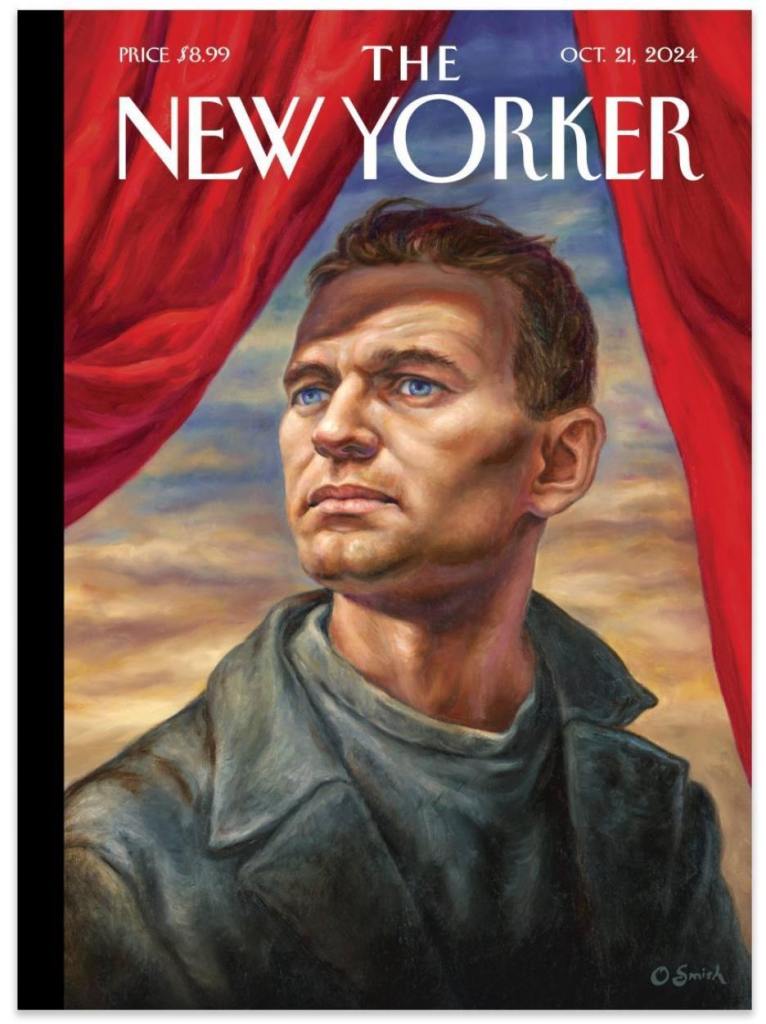
The politician Alexei Navalny was repeatedly tried on trumped-up charges before he was murdered in a penal colony on 16 February 2024. Perhaps it was Navalny, during his endless trials, who revived the closing statement in court as a literary genre. Here is an excerpt from his speech at his trial for “extremism” in July 2023:
Former Moscow politician Alexei Gorinov, the first known Russian to be imprisoned for denouncing the invasion of Ukraine, was sentenced to three more years on Friday on charges of “justifying terrorism” that he says he was framed for.
Ahead of his sentencing, he read the following statement to the court and the press:
Imprisoned Kremlin critic Alexei Gorinov, sits in a cage of the courtroom as his second trial for criticizing Russia’s actions in Ukraine swiftly nears its conclusion in Vladimir, Russia, Friday, Nov. 29, 2024. Photo: Dmitry Serebryakov/AP
“All my life I have been an opponent of aggression, violence and war, and devoted myself exclusively to peaceful activities: science, teaching, education, governance and public activities as a deputy, human rights activist, member of election commissions and controller of the electoral process. I never thought that I would live to see such a level of degradation of my country’s political system and its foreign policy, when ordinary citizens who favor peace and are against war, who number in the thousands, would be accused of slandering the Armed Forces and justifying terrorism, and would be put on trial.
“The third year of the war is coming to an end. The third year of casualties and destruction on European territory, of deprivation and suffering of millions of people on a level unprecedented since World War II. We cannot remain silent about this.
“Back in late April, our former defense minister announced the losses of the Ukrainian side in the armed conflict – 500,000 people. Think about this number! And what losses have been suffered by Russia, which, according to official information, is constantly successfully advancing along the entire front? We still do not know. And who will be responsible for this? What is all this for?
“Our authorities and those who support them in their militaristic aspirations wanted this war so much — and now it has come to our land.
“I would like to ask them: has our life become better? Is this how you understand the well-being and security of our country and its population? Or did you not envision these developments in your calculations?
“But for now we have to answer not to those who organized the war, continue to kill, propagandize the war and engage in mercenarism. Rather, we ordinary citizens of Russia, who raise our voices against war and for peace, have to answer, paying with our freedom and, for some, with our lives.
“I belong to the outgoing generation of people whose parents took part in World War II or survived it with all its hardships. The generation that has already passed away entrusted us with preserving peace with all our might as the most precious thing on Earth for all its inhabitants. But we have neglected these principles and devalued our memory of these people and the victims of that war.
“My guilt is that I, as a citizen of my country, allowed this war to happen and failed to stop it. And I ask you to note this in the verdict. But I would like my guilt and responsibility to be shared with me by the organizers, participants and supporters of the war, as well as the persecutors of those who advocate peace.
“I continue to live with the hope that someday it will be so. In the meantime, I ask the people of Ukraine and my fellow citizens affected by the war to forgive me.
“Within the framework of the case in which I was accused and tried for my opinion that we need to seek an end to the war, I have expressed my attitude fully to this abominable human endeavor. I can only say that violence and aggression breed nothing but reciprocal violence. This is the true cause of our troubles, our suffering, our senseless sacrifices, the destruction of civilian and industrial infrastructure and our homes.
“Let us stop this bloody, needless slaughter — neither for us nor the inhabitants of Ukraine. Isn’t it time to leave our neighbors alone and deal with our own snowballing domestic problems? Long ago we proved to the world how brave, resilient and peace-loving we are. So, maybe enough is enough?
“Lev Nikolaevich Tolstoy — from a letter to his son (1904): ‘For me, the madness and criminality of war is so clear that I can see nothing in it except for this madness and criminality.’
“I too join and subscribe to these words of our great compatriot.
“You can join too!”
SOTAVision reported that Judge Vladimirov interrupted Gorinov when he started to talk about losses in the war in Ukraine and called a 15-minute break so Gorinov could “think over his speech again.”
I wouldn’t want Navalny to be remembered the way he has been remembered this past year.
I haven’t read the book Patriot yet, but I was quite upset by Mikhail Zygar’s review of it. Zygar compares Navalny to Jesus and concludes that by dying, Navalny bequeathed us an idea that would rid future generations of cynicism and teach them to believe.
This is feeble sentimentalization, in my opinion. Navalny didn’t not dream up any particular ideas. He called for action, not faith. The meaning of his sacrifice, in my mind, is practical and political, not abstract and ideological. It can and should benefit the current generation, not some future generation.
Navalny didn’t dream up a new ideal. The “beautiful Russia of the future” is a feeble image, but Navalny understood better than anyone how tyranny operates on the mechanical level. I often complain that the FSB understands better how Russian society functions than do opposition politicians, sociologists and psychologists. Navalny couldn’t be accused of this shortcoming.
He was the only person in Russian politics who talked about power relations as a two-way street. He didn’t talk about the enormous resources Putin has, but about the fact that we give Putin power. It is not the security services, the army and the tanks that give Putin power. We give Putin power.
This view evolved over the course of Navalny’s career, becoming more and more central. As time went by, it separated Alexei more and more from his colleagues in the opposition. Toward the end of his life, Navalny’s writings centered on the idea that power consists in consenting to obedience, in “obeying in advance.” We say to ourselves: I cannot disobey, because if I don’t obey, they will (notice me/file administrative charges against me/fire me/banish me from my profession/send me to jail/kill me).
Only by obeying in advance can governing by unfulfilled threat be scaled up indefinitely, to a country of 140 million people, because this means of governing doesn’t require any resources. We obey without taking resources from the state. Putin’s estimates for the war in Ukraine include every dollar, euro, and pound spent on Ukraine’s defense. They are what counts against Russian budgets, not “faith in democracy” or “anti-war sentiment.” I understand Alexei’s decision to return to Russia in this sense; I see it as logical and unusually tenderhearted on the personal level. By returning to Russia, Alexei was able to provide Russians with one more example of tyranny’s limits: Putin never had power over Alexei. Had he stayed in Germany, Putin’s power would have extended to Navalny.
Navalny was concerned not with the thoughts in our heads, but with whether our deeds matched our thoughts. I appreciate Christian philosophy, but I could never accept the postulate that a second of faith can save a person, no matter their actions — “Now thou shalt be with me in paradise,” and so forth. The Russian opposition, for as long as I’ve been watching it, wants to get to democracy approximately the same way the thief gets to paradise — by believing in it. The notion that we are democrats and decent because we believe in democracy while all remaining Russians are slaves and awful because they don’t believe in it is the main obstacle to democracy in Russia, in my mind, and the Koshchei’s egg of tyranny. A “democracy” in which only “democrats” have a stake and which only they want is an oxymoron that makes democracy impossible and tyranny in Russia perennial. Democracy cannot be for Muscovites alone. It cannot be built via media outlets in which only Petersburg and Moscow have a voice. It cannot be built without equal representation of activists, issues, and interests from other regions and ethnicities.
Late in life, Navalny hated talk about the “freewheeling ’90s” and the good Chekists/bad democrats dichotomy, which doesn’t prevent his supporters from remaining stuck in this selfsame paradigm.
Alexei started his career in Russia’s faux democracy project, which was unfair from the get-go. He entered politics as a “democratic nationalist,” desiring greatness and a better elite for Russia. It was within this same paradigm that he pursued the most successful project of his life: “fighting the regime by legal means.” By the end of his life, however, he came to realize that Russian power is held by a hypocritical elite which justifies its obedience by talking about white coats, and is not willing to share power. It is not even willing to think about being the equals of other Russians, let alone the equals of Ukrainians, for example.
This, in my opinion, is what Navalny left behind. It pains me to see how the legacy he left at such a high cost is being frittered away by films about traitors, stupid speeches, and sentimental religious comparisons.
Andrei Loshak, “The Age of Dissent 2024” (in Russian, with English subtitles)
The eve of the 2018 presidential election saw the release of Andrei Loshak’s series Age of Dissent, about young supporters of Alexei Navalny who were involved in his election campaign.
The sequel to the series, filmed on the eve of the latest presidential “election,” recounts how the lives of the activists who dreamed together with Navalny of “the wonderful Russia of the future” have changed dramatically in six years. Filming was almost completed when news came Navalny’s death. The movie’s protagonists ask themselves how to live without dreams and hope.
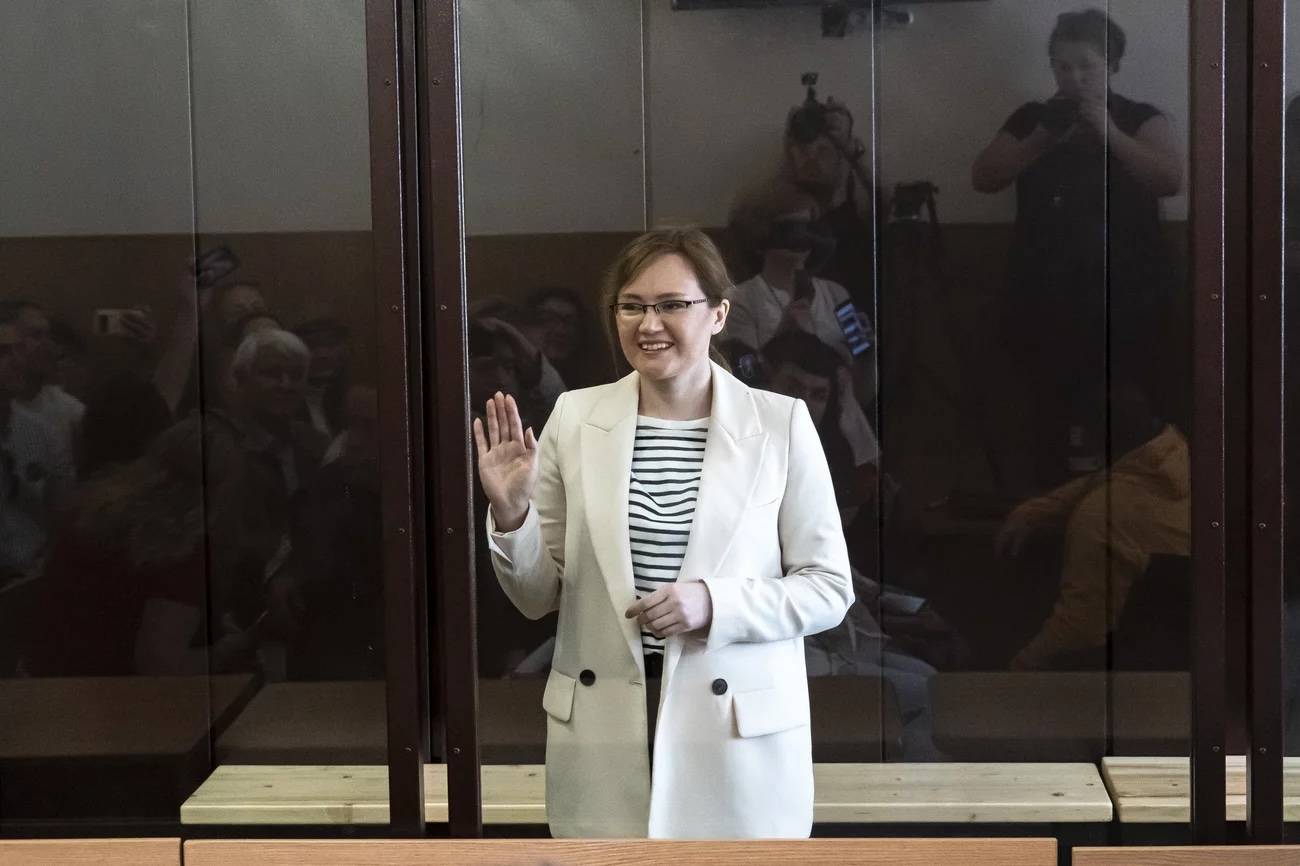
The protagonists of Andrei Loshak’s documentary film Age of Dissent 2024: (clockwise, from upper left corner) Filipp Simpkins, Lilia Chanysheva, Ksenia Fadeeva, Yegor Chernyuk, and Violetta Grudina
On June 3, Current Time hosted the premiere of Russian filmmaker Andrei Loshak’s documentary Age of Dissent 2024. It is a sequel to Age of Dissent, which was filmed on the eve of the 2018 presidential election in Russia and focused on opposition politician Aleksei Navalny and the young supporters who helped him with his unofficial campaign. He was denied registration as a candidate but campaigned as if he was on the ballot.
Fast forward six years, to 2024, and another Russian presidential election, which was held in March and won, again, by Vladimir Putin with what the state said was 87.3 percent of the vote. Loshak’s new film, commissioned by Current Time, RFE/RL’s Russian-language TV and digital network, tells how the lives of the same activists who had dreamed, together with Navalny, of a “beautiful Russia of the future” changed dramatically.
Filming was almost completed when news broke in February of Navalny’s mysterious death in a Russian Arctic prison while serving a 19-year term on charges his supporters and many Western governments considered politically motivated.
On the eve of the film’s premiere, Current Time journalist Ksenia Sokolyanskaya met with Loshak in Tel Aviv.
RFE/RL: Did you think from the very beginning that this story would have some kind of sequel? Or did something happen at a certain moment that made you want to return to these people?
Andrei Loshak: I must say that, probably, this idea was there from the very beginning. After I released the first film, I saw that it kind of took off. People began to tell me that they wondered what would happen to the subjects next. And I thought, yeah, it’s really interesting that it will be a new election cycle six years later.
I had to monitor their fates, so I asked to film some things, although I didn’t know for whom it was to be done or when. But then I realized that they had all left Russia, that their fates had changed very dramatically, and that everything that they had fought for and lived for, all of it was destroyed in these past six years.
Yes, it seemed to me that this was enough to return to them and film what had happened to them. But you have to understand that we finished filming in January and early February [of 2024]. I sat in Tbilisi and thought about what to do with all of this.
What was my idea? To draw attention to Aleksei Navalny, because for me, this was such a serious motivator. There was a moment when he was being transferred to [the Polar Wolf prison in Russia’s Arctic town of] Kharp, and he disappeared, and I was struck by how few people wrote about it. For two weeks, it was not clear whether he was alive or not.
They killed Aleksei on February 16. At that moment, I was simply lost. I didn’t understand what to do with the material.
I think it was important to record the reactions of [the film’s subjects] to the news of that day, before they had time to get used to it. Although, to be honest, I’m still not used to it. It killed me, too.
This is probably the most personal film I’ve made in a long time. Because usually you take the position of an observer and film all sorts of things, but in this film I lived with the subjects — with one dream, one hope — and Aleksei was as important a figure for me as he was for them.
RFE/RL: I read the comments under the teaser for the film, which was posted the other day. People wrote that it was painful to watch, that their hearts were broken. We live in a Russia we don’t want to live in, and Violetta in the film talks about “those traumatized by Russia.”
Loshak: Moreover, a psychotherapist gave them such a diagnosis.
RFE/RL: In the film, a separate theme is the question: How do you live when the main thing you’re living for is taken away? Do you think there is an answer?
Loshak: We are all asking this question now, and few people understand how to overcome all this. This is a recording of this moment, when our homeland rejected us. We found ourselves superfluous and unnecessary there. She needs us, but the circumstances are such that they don’t expect us there, they don’t want us there, they push us out of there.
Hope is such a straw. You still clutch at it. Of course, a few months is not enough time to understand how to live now. I am in this process, and my heroes are in this process of understanding. [In the film,] Oleg says this [phrase] from the point of view of common sense: “We need to stop this, guys.”
RFE/RL: Meaning that political activism is not a profession?
Loshak: Yes. It is possible in some historical cycles, but in others it is impossible. And when you find yourself rejected, uprooted and without a homeland, your plan must change….
That’s why I always look at this whole “opposition movement” with great skepticism. I don’t know who looks at it without skepticism. But on the other hand, I don’t deny it. It’s kind of necessary, because they’re doing the right things, but it’s virtually impossible to influence anything in Russia from [exile]. This must be understood clearly.
This feeling of helplessness with which Violetta says: “What, how, and why?” — the loss of these meanings is very painful. But we always have to say goodbye to something; everything has its own lifespan. And unfortunately, we are now at this point where we need to say goodbye to all this and start something new. The question is: What?
RFE/RL: Do you have faith? In the film people talk a lot about faith, and it ends with Aleksei’s words about the need to believe. Do you have faith that Aleksei’s story can also transform into something that people will watch, and that if they don’t know the story of Jan Palach, they will learn it from your film? (Editor’s Note: On January 16, 1969, 20-year-old university student Jan Palach set himself on fire in Prague to protest the August 1968 invasion of Czechoslovakia by Warsaw Pact troops. He died of his burns three days later.)
Loshak: I’m sure of it. I’m convinced of it. Such sacrifices, heroic deeds of such magnitude, cannot be in vain. I am absolutely sure that this is not a wasted sacrifice and that Aleksei will remain in the history of Russia forever as one of these heroic figures, which, of course, will acquire its own mythology. And in what our grandchildren and great-grandchildren will read about him, we would hardly recognize Aleksei.
There are always few such figures in history. I have never encountered anything like this in my life, such a level of self-sacrifice.
RFE/RL: The scale.
Loshak: Yes, but we also had, of course, our own Jan Palach: [Russian journalist] Irina Slavina, who set herself on fire in Nizhny Novgorod [in 2020], opposite the city police headquarters. (Editor’s Note: Before self-immolating, Slavina wrote on Facebook, “Blame the Russian Federation for my death.” A day earlier, she had written that police had searched her apartment, trying to find evidence linking her with the opposition Open Russia group and confiscated her computers and mobile phone.)
She didn’t do it in vain, either. I’m absolutely sure. Although who remembers her now? This was just a few years ago, before the war [in Ukraine]…. She will also be in this pantheon of heroic people who openly came out against evil.
Of course, Aleksei and what he did, and the way he died — all of this will later inspire people because everyone always needs bright examples, everyone needs these myths. And Aleksei has already become this myth. I can already see how people who never appreciated him during his lifetime — and, in general, I heard little good from them about Navalny — are now writing: “But Navalny would not have said that,” or, “Navalny would not have done that.”
His wings have already grown; he is already soaring over this unfortunate Russia, and he will always soar there from now on. This is actually good because you have to believe in something.
RFE/RL: After Navalny’s death, a discussion appeared in the Russian-speaking, mostly emigrant, community. It seems to me that the impetus was Shura Burtin’s manifesto on Meduza that a “beautiful Russia of the future” will not happen and that hope for some kind of good future is harmful. One of your subjects, Violetta, also talks about how she doesn’t feel joy, that she can’t say she lives, she just exists. Do you think you should actually believe such stories?
Loshak: Believe in what?
RFE/RL: You said Aleksei’s sacrifice was not in vain, but it seems to me that for a large number of people this is not true.
Loshak: That everything is in vain, that evil triumphs over good, and that this has always been the case in Russia? It has always been this way. But it seems to me that everything has its time. Even if we look at the history of Russia, evil has always defeated good, but there have also been moments when good had a chance.
There have always been thaws, rollbacks toward democratization, and liberation from the shackles with which the state always entangles people in Russia. We have always had this chance; we just never took advantage of it.
With Aleksei there was this chance; he gave us this chance throughout his political life, starting in 2017, but this liberal layer of us, so to speak, simply looked at it all with the curiosity of a TV viewer, nothing more.
Then he returned. He returned [to Russia from Germany in January 2021 after being treated for poisoning], realizing that, of course, he would most likely be imprisoned. But he gave us this chance again, and it was as if it was all staged. He returned, his documentary Putin’s Palace was released, which was watched by 100 million people. Then there was a rally, and the usual 20,000 to 40,000 people came out.
We wasted the chances that Navalny gave us.
I really believe that at some point people will understand how important it is to participate in politics, how important it is to be a citizen, and not just to be a resident of this country. One of the subjects in the first part of the documentary in 2017 said to me — I won’t say his name now, because he is in Russia, but he was on the Maidan; by accident, he ended up there — “When 10,000 people come out, it’s nothing. But when 1 million people come out, you can’t do anything about it.”
This is why I endlessly respect Navalny: for the fact that he did everything he could, and more than he could, to give us these chances. And we blew them. And I hope that someday this will become obvious. You see, what is happening to Russia now cannot last forever.
RFE/RL: Why?
Loshak: Because it’s against common sense, it’s against the passage of time. This is an attempt to turn back time, to turn it around….
In general, history is cyclical. Now there is some moment of crisis in which Western civilization finds itself. We see incredible divisions within Western countries. I don’t remember this before. This is also some kind of new sign of the times. But nevertheless, Western societies have gone through many crises, and their strength is that they are democratic, and thanks to this openness they survive them, work through them, and reach a new level.
But Russia is not doing this. Russia is simply driving us into some kind of Middle Ages with its boots. The rhetoric that is heard now is about a “holy war,” about the defense of traditional values. It all comes down to homophobia really. This is the only thing they found as a scarecrow around which they built this whole structure about the “holy war” of the Russian world with Western civilization, which is satanic, because gay people can openly hold each other’s hands and recognizes their marriages. This is complete bulls**t.
For this generation, about which I filmed in 2017, there was no issue of homophobia at all. They had already grown up in this cross-border world of the Internet. They saw that this was normal. This is how all people live, and they are happy.
I subscribe to Russian-language Iranian opposition channels. You’re amazed how much the same is there. It’s just that these grandfathers look more colorful there. Ours are in secular blue jackets, and in Iran there are bearded ones in dressing gowns. But everything is the same. People want to live freely; they want to be happy. It is impossible to be happy when everything is forbidden.
It is impossible to keep these prohibitions all your life because the reverse process is taking place all over the world. People are following the path of gaining more and more freedom, because it is more comfortable to live this way, and at the same time respect the freedom of others….
But at any moment the Russian state can invade your life and tell you how you should behave, how to dress. You have nothing. You owe them everything for some reason, but they don’t owe you anything.
This is such an old patriarchal model of the world order. If you look at all this more broadly, I see it as a rebellion against patriarchy. And what is happening in Russia is the agony of the patriarchy. In Russia, the strong are always right. To the question, “What is strength?” [I answer that] in Russia there is strength in strength. Not in any truth. This is nonsense. What is the truth? The truth was on Aleksei’s side. And where is he? I’m sure [these grandfathers] are becoming decrepit. Time will simply kill them because time is not on their side. And at some point they will simply stop being strong, and then they will be finished.
Arriving at Jan Palach’s grave [in Prague], Oleg tells the story about what happened in 1969. And in 1989, the Velvet Revolution [in Czechoslovakia] began with people coming to his grave. Yes, we had to wait 20 years for this name and this feat to become an impulse and begin to work. But now, it seems to me, time flows faster. I would like to believe that we will not have to wait another 20 years.
RFE/RL: When you invited people to the premiere in Tel Aviv on Facebook, you wrote: “I don’t wish you a pleasant viewing. That would be hypocritical on my part.” As someone who has seen the film twice, I can say it is indeed very difficult to watch. What effect do you, as an auteur, hope for?
Loshak: Due to what happened during the filming — and it was not I who wrote Navalny’s death into the script — I stopped thinking at all about who I was doing it for. It’s just a film that has a lot of my personal pain in it. I did this in order to try to part with this pain. It’s like psychotherapy: You have to work through it and live it in order to move on….
Navalny was important to so many people. This is a figure on a much larger scale than perhaps even we thought. Both importance and value. Still, his presence in Russia, even in prison, in this political landscape was completely incommensurable. We just don’t even understand yet how important. And we will understand gradually more and more. This film is probably for these people.
RFE/RL: You wrote a big post on Facebook about Aleksei and said that you miss him, and that it doesn’t go away. And in the end you say that despondency is a mortal sin, that Russia is a terrible fairy tale with a bad ending. You say that faith is an irrational thing. Do you want to return to Russia?
Loshak: Of course, I want to return to Russia now…. If Putin dies, then, of course, I will return….
Listen, this is our homeland. It’s not that we’re injured. It’s normal to want to live in your homeland with your people. They turned us into some kind of national traitors, although they are the national traitors. But we ourselves even began to get used to it, feeling that we were somehow different, which means we don’t belong there, that this is not our homeland.
But, damnit, this is our homeland, our roots are there, our everything is there. Why shouldn’t we want to go back? It’s normal to want to go back and desire to live in a different country. That is, to want changes in your country, which has simply turned into a fiend of hell, which threatens the whole world with nuclear disaster and is working to split the whole world and plunge it into some kind of abyss of chaos.
What is Western civilization? If we talk about European values, this is democracy, this is human rights, this is freedom — these are normal things. This is the norm. And they declared the norm to be evil. Who are they after that? This is some kind of madness that will end either in a nuclear apocalypse or in the fact that at some point they will simply die, as generally happens in history with villains: At some point, they simply died, and the world sighed freely until a new one was born.
RFE/RL: In an interview, you said you’d like to shoot a film in [the Ukrainian city of] Odesa, which is an important place for you. Did you have in mind a film that is less heavy than the one you have made for Current Time? Something entirely different?
Loshak: I really want to. I am very tired of politics, of Putin — of this creature, this absolutely insignificant bastard, who forces us to follow him all the time. Then we all write about it, film it, and react in horror. We are forced to because we react to abuse, to constant violence against us, because this person mocks us.
I want to film about something more metaphysical. With hope, with faith, with love. There is a lot of love missing.
Tell Gordeeva: “The Yashins: ‘His Sentence Will End When the Regime Ends'” (in Russian; no subtitles)
In February 2022, opposition politician Ilya Yashin openly spoke out against the war while declaring that he would never leave Russia. In December, he was sentenced to eight and a half years in prison on charges of “discrediting” the army. Yashin has been held in a punishment cell over a month (since 17 May 2024), a visit from his parents was canceled, and nothing is known about the state of his health. We talked to Yashin’s parents about their son, whom they are proud of.
Contents: 00:00 Why do the Yashins not keep their son’s letters at home? 2:45 “A person is jailed for 15 days and until the last minute he doesn’t know whether he’ll be released or not” 7:15 “I’ll be the first to tell you’re wrong” 10:16 “Emigrating means admitting that we lost”11:47 “Gorinov doesn’t have it better because Ilya’s in prison” 13:43 “Who will know whether you gave your consent or not?” 17:36 “I guess I’ll have to be in prison for a while. What’s a little bit?” 21:21 How the clerk at the Tushino district court fell in love with Yashin and quit her job 22:36 Does Ilya Yashin have a fiancee? 25:20 How Yashin’s ex-girlfriends attend his court hearings 27:29 “We don’t communicate with Ksenia Sobchak” 31:27 Why didn’t Yashin become an actor? 33:53 “We accidentally met Lyudmila Navalnaya at the trial” 35:31 How Lyudmila Navalnaya taught Tatyana Yashina to put together prison care packages 36:48 Why do shampoo and toothpaste have to be poured into a plastic bag? 39:08 “His sentence will end when the regime ends” 40:46 “Now nothing good will ever happen” — on Navalny’s death 42:52 “Both my friends are dead” — Yashin’s letter after Navalny’s murder 44:55 “There are people who have it worse than we do” 48:53 Yashin’s health problems 52:49 How did Yashin’s parents meet? 54:58 Who taught Ilya to box and why 56:46 “I did everything to make sure Ilya was a momma’s boy” — Valery Yashin on parenting 1:00:28 “We Spartak fans are indomitable!” 1:02:16 Yashin asked for a wash basin in prison 1:06:01 “Ilya lived in a barracks in the tenth grade” 1:11:09 “He’s serving the longest sentence in the penal colony in Smolensk” 1:13:47 How his son has changed in prison, according to his father 1:14:36 …and according to his mother 1:19:19 “It’s him doing, but I’m the one who’s ashamed” — how Yasha’s mom taught her son to be a good deputy 1:25:00 “He went to his first protest rally in the eleventh grade after school”1:28:08 “Yabloko decided to do a deal with the Kremlin”1:31:24 How did Yashin and Nemtsov become friends? 1:33:48 “Even from prison, Ilya manages to send me flowers for my birthday” 1:34:46 “Mom, I’m in a paddy wagon but I’m okay” 1:36:57 The scariest day in Tatyana Yashina’s life 1:42:52 “I don’t consider Putin my enemy” 1:47:21 “Our son really did something wrong, but your son is paying for everyone” — what relatives of other prisoners say to Yashins 1:58:20 “Absolute strangers made care packages for him” — about the prisoner transport to Izhevsk 2:01:05 How did Yashin end up in the Okrestina detention center in Belarus in 2020? 2:03:48 “If you haven’t raised a person who is smarter than you, you’ve wasted your life” 2:05:34 “This is a marathon, and I have no doubt you’ll make it to the finish line” — a three-day visit with Ilya 2:07:05 “I missed your omelettes the most” 2:08:03 Why does Ilya Yashin’s mom not want him to become president? 2:10:13 “Guys, don’t get upset!”
Russian opposition politician Ilya Yashin is currently serving an eight-and-a-half year sentence in prison for spreading “disinformation” about the Russian army after speaking out against the mass murder of civilians in Bucha, Ukraine. Journalist Katerina Gordeeva sat down with his parents, Tatyana and Valery, who still live in Russia, to learn how they’re coping with his incarceration, how they support their son in prison, and what hopes they have for the future. Meduza shares key points from the interview.
On not persuading him to leave Russia
We never pressured him on any issue — neither small ones nor something like this. It’s his life, and he has to make these decisions; we can only help. I always told him, “Ilya, no matter what happens in life, know that you have a strong support system. That doesn’t mean you’ll always be right. And if I think you’re wrong, I’ll be the first to tell you.” The decision [not to leave Russia] came in 2012, after the Bolotnaya Square case. Leaving would mean giving up, admitting that everything was in vain.
He didn’t leave then. And then Boris Nemtsov was killed, and he said, “Now, even more so, I can’t leave. Leaving would mean admitting that we lost. As long as I’m alive, I don’t believe that I’ve lost.” We didn’t try to talk him out of it because I understood how he felt, and I can’t imagine him being abroad now. I think it would have been such an ordeal that what he’s going through now is still much easier.
On an exchange
He himself doesn’t want an exchange. His main argument is: “Even if there are any exchanges, I’m far from being the first in line, and probably I’m the last, because there are people for whom it’s a matter of life and death. Secondly, I’m not ready to be exchanged for a hired killer who will then be free. Thirdly, agreeing to an exchange means leaving the country. I could have left the country right away.” I told him, “Ilya, it’s clear which way everything is going. Maybe if the opportunity arises, you shouldn’t be stubborn and should agree? After all, who will know whether you gave consent [for the exchange] or not?” He said: “I will know. That’s enough.”
On why they themselves stay in Russia
Because our son is here. We use any possible fleeting opportunity to see [him]. If there’s an appeal hearing, and he’ll be there via teleconference, maybe he’ll see us, and we’ll wave to him. And then he’ll see and make a heart. Maybe we’ll be given five minutes to exchange a few words. Letters are one thing, but it’s another when you can see him and understand by his expression, [by the way] he shuffles papers, what state he’s in, what his mood is. That’s why we attend all the court sessions.
On their son’s sentence
I was shocked when the prosecutor requested nine years for Ilya. I thought I’d misunderstood, I had misheard, because it couldn’t be true. Then, after we’d left the courtroom but before the sentence was pronounced, there was a moment when it overwhelmed me a little. But I quickly pulled myself together, and by the time of the sentencing, we took it quite calmly, philosophically: when the regime ends, the term will end. He chose this path, and we’re walking it with him. We are beside him, we are helping, and what will be, will be.
On family life
We never had any secrets. In our family, we made all our decisions collectively, so to speak. Any decisions — important or unimportant — were discussed by the whole family, and we included Ilya in this from a very young age.
On how Ilya has changed in prison
Tatyana: He’s become kinder and less rigid, paradoxical as it may sound. When he was young, he could break off relationships abruptly. Now, he’s more understanding, he doesn’t judge. Some things make him smile wryly — but without judgment.
Valery: He used to have moments where he was very categorical in his judgments. He’d listen, understand, agree, but still stick to his opinion. Now, he’s grown more tolerant. He’s developed [an open-mindedness]; he’s matured and become more resilient.
On people’s support
We were in Smolensk; the court was hearing an appeal on an administrative case for failing to fulfill the so-called duties of a “foreign agent.” And the [train] arrives just on the dot, so we had to take a taxi and rush into the building. When we got there, a journalist who’d arrived earlier called us and said, “They changed the courtroom because there are a lot of people.” And when we walked in, we saw a full hall — Smolensk residents of all ages. […]
And then these people came up to us — there were these guys, a very young man, a student, young women, and a local lawyer. They said, “Come with us, we’ll show you where you can sit, have coffee, eat, and warm up.” It was so touching. Then a charming woman, about our age, maybe a bit younger, came up to us. She said, “I live nearby too, you can always rely on me.” I’ve met a lot of people who say things like, “Hold on, everything will be fine, this will all end.” But no one has ever called my son a traitor or whispered it behind my back.
On the future
During our last visit, which lasted three days and was the first in two years, we could hug and talk about anything. We talked a lot. He said: “What can you do? It’s a marathon.” I told him, “Ilya, I might not make it to the end.” He said: “You’ll make it. I have no doubt.”
KING CITY, Calif. — A group of men in masks opened fire at an outdoor party in central California, killing four people and injuring three others Sunday evening, police said.
Police responded to a reported shooting around 6 p.m. in King City and found three men with gunshot wounds who were pronounced dead in a front yard, the King City Police Department said in a statement.
Four other people sustained gunshot wounds, including a woman who died after being transported to Mee Memorial Hospital in King City, about 106 miles (170 kilometers) south of San Jose.
The three injured men were transported to Natividad Hospital in Salinas, police said.
Several people were at the party outside a residence when three men with dark masks and clothes got out of a silver car and fired at the group. The suspects, who were not immediately identified, then fled the scene in the car.
The investigation is ongoing, police said.
On Monday French lawmakers will vote on whether to enshrine in the country’s constitution a “guarantee” of women’s “freedom” to have an abortion. They will meet at a joint session of the lower and upper houses of parliament in Versailles, a rarely convened body known as the Congress. A constitutional revision requires three-fifths of the votes.
Such cross-party support is widely expected. Last Wednesday the French senate, which is controlled by the opposition centre-right, voted overwhelmingly in favour of the bill. The revision also enjoys backing from the governing centre and the opposition left. Emmanuel Macron, the president, wants women’s freedom to have an abortion to be made “irreversible”. French politicians of all stripes have worried about the potential for a future rolling-back of such guarantees—especially since America’s [sic] Supreme Court overturned the ruling that protected abortion rights there in 2022.
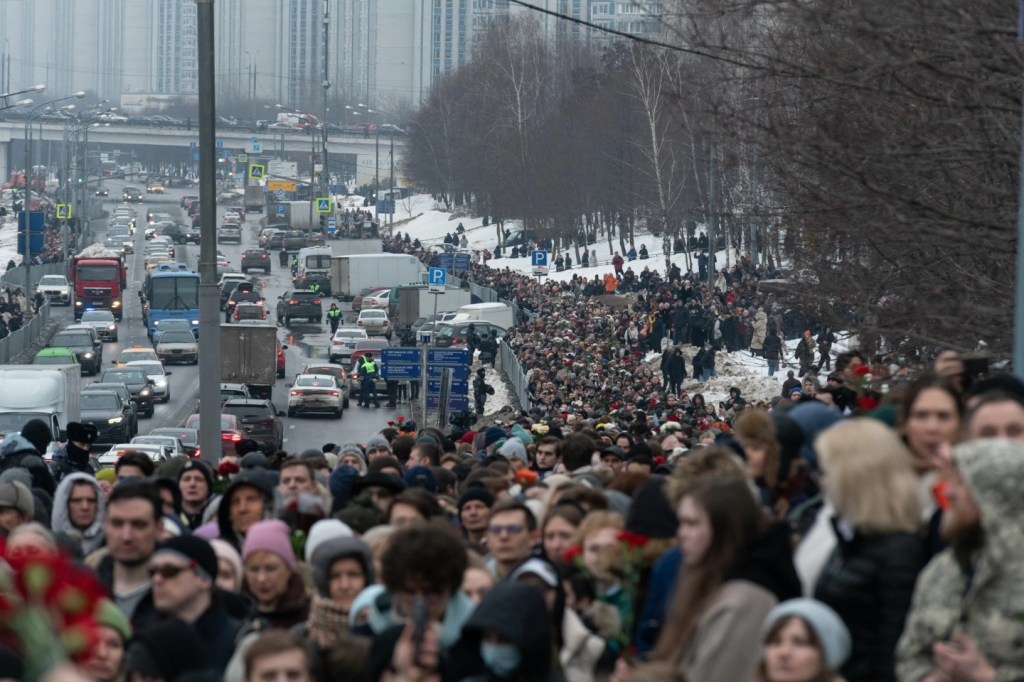
Sources: Spanishdict.com daily newsletter, 4 March 2024; Monterey Herald, 4 March 2024; Time, 4 March 2024; The Economist daily newsletter, 4 March 2024; the YouTube channels of The Insider (“Navalny’s Last Rally”) and Novaya Gazeta (“The Most Emotional Statements of People Who Came to Say Goodbye to Alexei Navalny”), with thanks to Tiina Pasanen; Andrei Bok (Facebook), 2 March 2024; Duolingo; random internet stock image.
In the wake of Alexei Navalny’s murder by the Russian fascist state, his message to the Russian people, at the end of the award-winning documentary film Navalny, has been quoted ten thousand times and turned into a meme on social media, to wit:
“If they decide to kill me, we are incredibly strong,” he said, addressing Russian citizens. “The only thing necessary for the triumph of evil, is for good people to do nothing. So don’t be inactive.”
[…]
“You’re not allowed to give up,” Navalny said in the Daniel Rohr film, adding that “we need to utilize this power to not give up, to remember we are a huge power that is being oppressed by these bad dudes.”
Based on what I’ve witnessed firsthand and secondhand over the past twenty-five years, Navalny’s assessment of Russian society’s incredible strength was wishful thinking on his part. Or, to put it more charitably, it was an incredibly hopeful political project.
To my mind, this Facebook post by longtime TRR contributor Sergey Abashin gets closer to truth about the state of affairs in Russian society, although it’s emphatically not a political project. Nor will it be righteously memed to death by Russia and the world’s well-meaning liberal masses.
Today is the day when [Boris] Nemtsov, a politician who united everyone, was despicably murdered for dissenting. And today is the day when Oleg Orlov, a man of impeccable integrity, was “awarded” two and a half years in prison for dissenting. I hate myself for being powerless. I hate society for being submissive. I hate the authorities for their fascism.
Dmitry Kuzmin in 2019. Photo courtesy of Wikipedia
“It is probably too late for the world, but for the individual man there always remains a chance.” This formulation from Joseph Brodsky’s Nobel Prize speech grew out of the two-hundred-year Russian liberal tradition of tiny, good deeds accomplished in the maw of Leviathan, and over the past two years it has inspired many. Each refugee rescued from the occupied Ukrainian territories via the Rubikus volunteer network is the best evidence of this inspiration. But we of course know that this is not true. There is not always a chance to save the individual. And the death of Alexei Navalny has reminded us of this with irrefutable clarity. Although with no greater clarity than the death a few days earlier of three children, burned alive with their parents at their home in Kharkiv as a result of a Russian rocket strike.
But empathy is only ever individual: in your head you may be on the side of all the Ukrainians and all the political prisoners, but your heart responds to concrete stories, names, and faces. And the media reality of today brings them to us. By following a couple of links, you can look into the eyes of every victim of a rocket attack. You can read the last text messages sent by Ukrainian women to their loved ones killed in this war. You can see the frontline dugout where the phenomenal poet Maksym Kryvtsov, the hope of Ukraine’s rising literary generation, slept alongside his tabby cat—just a few days before they were both killed there.
It’s a little more complicated with the victims on the other side of the frontlines, the ones whom the Kremlin regime is trying to exterminate on its own soil. Navalny’s singularity and even exceptionalism lies in the fact that even in a prison camp literally at the ends of the earth he was still able to turn his story into a gripping, if agonizing, show. Others do not have this opportunity. Where is Nikita Uvarov, the teenager sentenced to five years for talking with his friends about anarchism and for constructing an FSB building in Minecraft and planning to blow it up? Where are Salekh Magamadov and Ismail Isayev, the Chechen youths who dared to start a chat group for atheists and received eight- and six-year prison sentences, respectively? Or this thing that didn’t even get picked up in the news: where is the “transgender LGBT activist and OVD Info volunteer” who sent money to the Ukrainian army? Their name is unknown but their prison sentence, they say, is twelve years. And this is not to mention Belarus, which has practically disappeared from the Russian news, and where one of the main opposition figures, Maria Kolesnikova, is in prison and has not been heard from for over a year. Navalny, who even from the Yamal Peninsula was able to maintain Russian society’s focus and interest, was also doing this for all the above-named individuals and many more unnamed ones, even if it didn’t actually help them at all. Along with Navalny’s murder, the topic of internal crackdowns, the domestic frontline in the Putinist walking dead’s war against all the living, will inevitably exit the field of daily scrutiny. It is entirely likely that this was indeed the motivation for finishing off a reprisal that had lasted for years, and now we can expect an abrupt post-election uptick in those selfsame crackdowns.
In theory, there are people working on the other side. But they are, in typical fashion, incapable of drawing attention to themselves—and they intentionally avoid it. The prosecutors advocating for the prosecution, the judges issuing the sentences, the prison wardens carrying out their dirty work (even if we don’t take straight-up murder into account)—they all have names and faces, but no one worries about them: it seems that only the extremely scrupulous Gabriel Superfin remembered today who is nominally responsible for the tragedy on the Yamal Peninsula. After all, every rocket dropped onto Ukrainian targets was designed by someone, assembled, shipped by someone, and someone pressed the button. You can fantasize about how each of these people will eventually pay for their involvement, but we know from historical experience that at best their grandchildren and great-grandchildren will feel ashamed of them. In the stand-off between individuals and the system it is immaterial who personally represents the system. In the recent story of the rock group Bi-2’s lucky liberation from imprisonment in Thailand it was openly discussed how the Russian consul was pulling the strings in the devilish machinations—but where is this consul, who has seen him? He is probably an inventive paper-pusher—a “first-rate pupil,” in Yevgeny Schwartz’s words—but he is not meant to have any personal qualities.
Safe to say we won’t get anything out of Thailand: this country, so beloved by Russian tourists, where the king can kick his former wife out to a dilapidated shack, having first ordered his minions to destroy the shack’s toilet and to hang a sign over the waste pit saying, “I hope you are as comfortable here as in the palace,” should easily find common cause with a country where the president’s main opponent had his underpants smeared with poison. Yet a month earlier, for example, Russian national Yevgeny Gerasimenko was arrested at Russia’s request in Prague, at Vaclav Havel Airport (you can imagine what Havel would have said about this). It seems that no one had to lobby for this arrest, the system worked on its own: some Russian agency put in a request to Interpol, some international bureaucratic authority received the request, some Czech law enforcement officials carried out their routine duty. What does it matter that Gerasimenko’s application for political asylum was already being reviewed by the authorities of a different EU country: they were looking for him, the former manager of a computer school in Norilsk, a city built on the bones of political prisoners, allegedly for dangerous financial crimes… Wait, and of what crimes had Alexei Navalny been convicted, sent to a village built on the bones of political prisoners, and murdered there? Does no one remember anymore?
A long time ago there was a Soviet film about a group of teenagers who got lost in caves: they ran out of food and water, they lost their sense of time, all the underground passages led them again and again to a bunker built by the Germans in WWII, with the word Tod (“death”) written in huge letters on the wall. When they’re on their last legs one of the boys has the thought that Death, in fact, is fascist, that everything that’s bad for the Nazis has to be good, everything that the Nazis prohibit should be allowed—and he pulls the lever below the word. The wall collapses and they’re set free. And that’s what the story by Magsud Ibrahimbeyov, on which the film is based, is called: “Death to All That’s Good.”
You might think that something which was clear to Soviet teens has become unclear to many people in today’s democratic world: when you are up against an inhuman system, the whole system is inhumane. Its criminal sentences for discrediting the army and its legitimation of Nazism are legal to the same extent as its fines for traffic violations. Its special services aim to root out good and inculcate evil to exactly the same extent as its therapists who have developed “acceptance and responsibility” therapy for Russian LGBT people, or its preschool teachers who dress the little ones in camouflage and line them up to make the letter “Z.” There are no such scales that could determine which of the system’s nodes and mechanisms are more harmful or more guilty: the rabid steamroller that has decided to crush you moves all the more efficiently because its rollers, hydraulics, and electric starter are working in perfect unison.
This unison starts to fall apart when one single individual drops out of the system.
Among the various individual people scattered across the icy wasteland of Russia, for the past six months I’ve been steadily observing two perfectly ordinary schoolchildren (albeit in snatches since it’s not entirely up to me). They have no father, their wingnut mother unfailingly supports the authorities, and every week at their very average school on the outskirts of Moscow they get to listen to the “Important Conversations” lesson—a repulsive propagandist mishmash that make the Brezhnev-era political-information sessions of my youth look like ambrosia. You might think that the fate of these kids in the foreseeable future is predetermined. But here we have an interesting result. The older brother is studying Ukrainian on his own. The young one, who isn’t yet up to that task, is diligently drawing Ukrainian flags in all of his school notebooks. It seems that they haven’t even discussed this with each other.
I don’t know how to convey to these kids that they’re playing with fire. I am not sure it will be possible to save them if it comes to that. But I see in them what Daniil Kharms once promised: “Life has defeated death by means unknown to me.” And if Brodsky was wrong about the possibility of saving the individual person, then maybe he was wrong about the world as well. Although from today’s perspective how the world can be saved is entirely unclear.
I never met Alexei Navalny, although we have (or had) a number of mutual friends, as you’d expect. And while his death was not a surprise — this regime had tried to kill him before, but he survived, literally miraculously — it was still a shock when news of it came yesterday morning.
You may have heard AN referred to as “Russia’s Nelson Mandela.” Commentators here have also been invoking Martin Luther King and several other Americans (on a list to which I would add RFK) in an effort to give U.S. listeners/readers a sense of how this loss may affect several generations of Russians.
What those comparisons cannot convey is how much the shock and loss register on a personal level. I am sure that millions of Russians today feel as though they’ve lost a family member — for some immediate, for others more distant — but in any case a relative, someone who was “one of ours” …and who they can’t quite believe is really gone, never to show up again at their homes, at a peace rally or in some live link on their laptops/phones/etc. And doubtless many Russianists abroad, like me, are experiencing a version of that same feeling: an almost palpable sense of personal loss.
Over recent years I have described AN more than once as the only person who, if the nation proved very lucky, might just be able to bring the place to its senses following the prolonged and self-inflicted disaster that has defined Russia in the first quarter-century of the new millennium. But here we are: the nation has not been very lucky (it seldom is), and all of us — Russians, Russianists and the rest of the world — can only mourn the passing of a genuine Russian праведник (PRA-ved-neek; a righteous man) and regret that the country has missed the slim yet credible “Navalny chance” that he represented.
I am discouraged about the near-term future — meaning the country’s prospects overall as well as my own chances of returning to Moscow and our little family there (both wife and grandson continue OK, thanks) as long as the current President for Life remains either above ground or unincarcerated. But I am also trying to stay focused on AN’s injunction, which figures near the end of last year’s Oscar-winning Navalny documentary and is now being cited widely in various media. It goes, in paraphrase, “If they do kill me, it will be a sign of weakness, not strength. So don’t despair — that’s not allowed! — and keep up the good fight.”
AN’s daughter Dasha is, as you may know, an undergrad at Stanford. Somehow this picture cheers me up a little today.
Source: Mark Teeter, email newsletter to family and friends, 17 February 2024. Thanks to Mark for his kind permission to reproduce it here. Mark is not only a proud alumnus of Stanford University, but he also played a role in welcoming me to Russia for the first time, in 1994. He describes my own feelings about Navalny’s death to a tee. ||| TRR
ALEXEI NAVALNY (1976-2024): Покойся с миром / R.I.P.