I never met Alexei Navalny, although we have (or had) a number of mutual friends, as you’d expect. And while his death was not a surprise — this regime had tried to kill him before, but he survived, literally miraculously — it was still a shock when news of it came yesterday morning.
You may have heard AN referred to as “Russia’s Nelson Mandela.” Commentators here have also been invoking Martin Luther King and several other Americans (on a list to which I would add RFK) in an effort to give U.S. listeners/readers a sense of how this loss may affect several generations of Russians.
What those comparisons cannot convey is how much the shock and loss register on a personal level. I am sure that millions of Russians today feel as though they’ve lost a family member — for some immediate, for others more distant — but in any case a relative, someone who was “one of ours” …and who they can’t quite believe is really gone, never to show up again at their homes, at a peace rally or in some live link on their laptops/phones/etc. And doubtless many Russianists abroad, like me, are experiencing a version of that same feeling: an almost palpable sense of personal loss.
Over recent years I have described AN more than once as the only person who, if the nation proved very lucky, might just be able to bring the place to its senses following the prolonged and self-inflicted disaster that has defined Russia in the first quarter-century of the new millennium. But here we are: the nation has not been very lucky (it seldom is), and all of us — Russians, Russianists and the rest of the world — can only mourn the passing of a genuine Russian праведник (PRA-ved-neek; a righteous man) and regret that the country has missed the slim yet credible “Navalny chance” that he represented.
I am discouraged about the near-term future — meaning the country’s prospects overall as well as my own chances of returning to Moscow and our little family there (both wife and grandson continue OK, thanks) as long as the current President for Life remains either above ground or unincarcerated. But I am also trying to stay focused on AN’s injunction, which figures near the end of last year’s Oscar-winning Navalny documentary and is now being cited widely in various media. It goes, in paraphrase, “If they do kill me, it will be a sign of weakness, not strength. So don’t despair — that’s not allowed! — and keep up the good fight.”
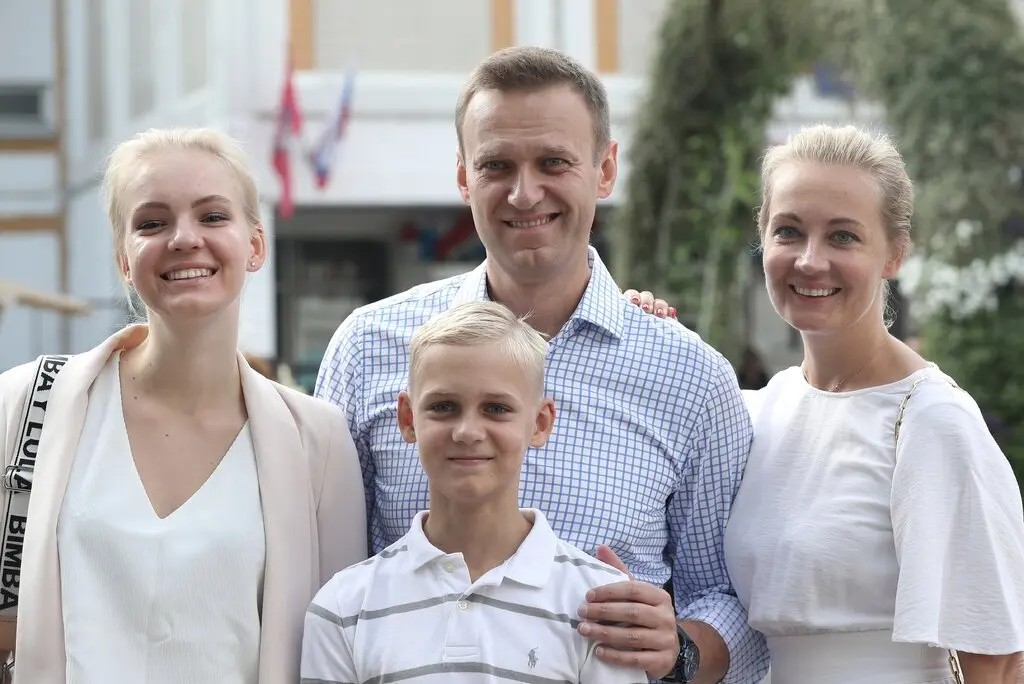
AN’s daughter Dasha is, as you may know, an undergrad at Stanford. Somehow this picture cheers me up a little today.
Source: Mark Teeter, email newsletter to family and friends, 17 February 2024. Thanks to Mark for his kind permission to reproduce it here. Mark is not only a proud alumnus of Stanford University, but he also played a role in welcoming me to Russia for the first time, in 1994. He describes my own feelings about Navalny’s death to a tee. ||| TRR
ALEXEI NAVALNY (1976-2024): Покойся с миром / R.I.P.
Old Deaf Joke
A Russian and a Cuban and an American were on a train
It quickly came to pass that the Russian took out a bottle of vodka and after a few swigs he tossed it out the window
The other two men exclaimed why throw still have vodka good waste why
The Russian opened his fur coat and showed them rows and rows of bottles and he said there Russia vodka plenty
The two men said oh and settled back in their seats
After a while the Cuban took out a cigar and after a few puffs he tossed it out the window
The other two men exclaimed why throw still have left good cigar waste why
The Cuban opened his suit and showed them rows and rows of cigars and he said there Cuba cigars plenty
The two men said oh and settled back in their seats
After a while a young man came whistling into the car from the next one
The American grabbed him by the collar and belt and tossed him out the window
The other two men exclaimed why throw still young good man waste why
The American made an expansive sweep with his hands and said here America hearing people plenty
The two other men said oh and settled back in their seats
Apart from a detailed peace plan to end Russia’s invasion of Ukraine, President Volodymyr Zelenskiy has a less conventional idea for ending geopolitical crises like these: let dogs run the world.
In the rare downtime he gets as a wartime leader, Zelenskiy, speaking to Reuters by video link on Wednesday, suggested man’s best friend might fare better when it comes to getting along on the global stage.
“Sometimes I’m … looking at all these wars or looking at all the crisis, Middle East crisis. It’s not only Ukraine, everywhere in Africa and the Middle East.
“Sometimes I’m looking at this and think that the best way (is) if this planet will be the planet of dogs,” he said at the Reuters NEXT conference in New York, responding to a question about what still makes him laugh.
The Kremlin’s war in Ukraine, now in its 21st month, has upended Europe’s security architecture and sent ripple effects through Africa and Asia, which have seen food shortages thanks to Russia’s de facto blockade of the Black Sea.
Kyiv’s Western partners have provided crucial financial and military support, but are now also dealing with the conflict in Gaza.
Along the front line, Ukrainian forces have been fighting for months to reclaim Russian-occupied territory in a counteroffensive but have made only incremental gains.
Zelenskiy, who is promoting a 10-point peace proposal, said his dogs provide much-needed relief when he spends time with his wife and children, and are “always funny”.
“Sometimes I don’t understand people, really,” Zelenskiy added with a smile.
Today we ask you to support one specific and very important project — Navalny’s Propaganda Machine. It functions very simply: volunteers telephone people in Russia and talk with them, persuading them to turn from Putin supporters into doubters, and from doubters into opponents of Putin and the war.
The more people in Russia start asking questions and stop tacitly supporting everything that the Putin regime is doing, the better for our country. The volunteers of Navalny’s Propaganda Machine are working on this right now.
You can become a volunteer by sending an email to antiwar@navalny.com or supporting the project with a donation. A one-minute call costs two cents. That is, your $10 will turn into 500 minutes of conversation. And $20 is a thousand minutes of conversation with actual residents of Russia, who, thanks to you, can learn the truth and get motivated to fight. Make your contribution at https://acf.international.
Thank you for being on our side! The Navalny Team
“Navalny has been in prison for 1,025 days”
Source: email newsletter from the Navalny Team (Anti-Corruption Foundation), 9 November 2023. Translated by the Russian Reader
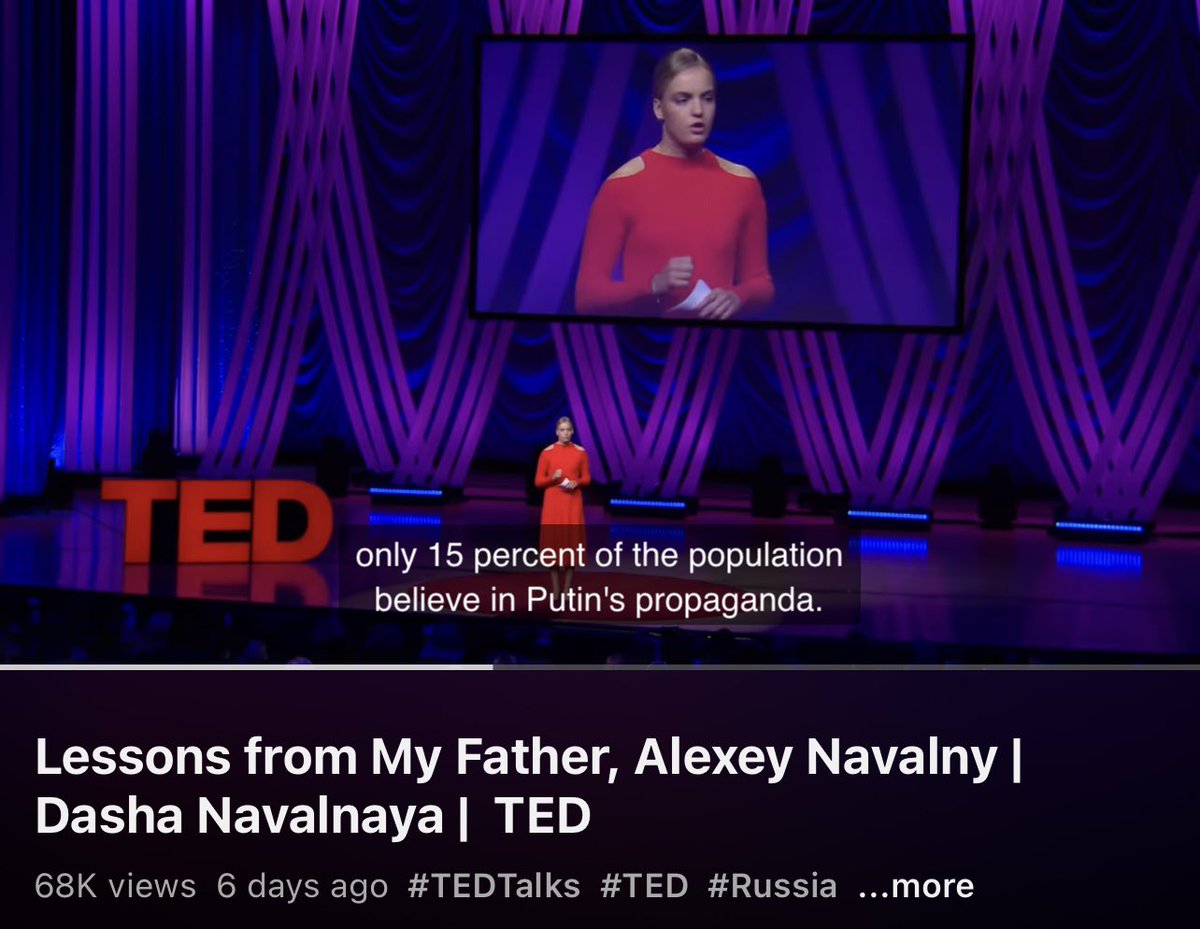
Dasha Navalnaya is the daughter of Alexey Navalny, the politician and leader of the Russian opposition to Vladimir Putin. Sharing the story of her father’s poisoning, persecution and current imprisonment, she details what it was like growing up under the watchful eye of government surveillance as her father led a decade-long investigation into the corruption of Putin’s regime — and shows why paying attention to what happens in Russia matters to everyone, everywhere.
There’s been some discussion lately on what proportion of russians actually believe russian propaganda. The presumption is that a low number gives hope for the end of the regime. There’s a lot of problems with that logic. Firstly, domestic russian propaganda is very often very open about the crimes russia is committing as an imperial aggressor. So it’s nonsensical to talk only about whether russians recognise lies. What matters is the extent to which they share this imperialist mindset and chauvinistic attitudes. It doesn’t matter whether you can recognise lies if you still think of Ukrainians as your little brother speaking a funny dialect of russian who needs to be pulled back into line. The key question is what proportion understand Ukraine is an independent nation – all the way to Crimea – and has a right to exist and do sovereign things like choose its own security alliances. It’s definitely not 85%. Not even close. When it comes to russia’s lies – like the lie it’s fighting nazis – I’d estimate the proportion of russians who understand this to be a lie at roughly 100%. On some level, to some extent, literally everyone knows this is a lie. Consider this. Have you ever heard anyone ever express any confusion as to why wagner, founded by a neo-nazi, had a leading role in ‘denazification’. It was never hidden. And it does not make any sense if you believe the lie. But no one really believes russia is fighting nazis. This would be a very, very long thread if I went through all the examples of where no one ever expresses confusion when russia openly does and says things that are completely contradictory to much of its own propaganda. No one is confused because everyone knows russia lies. But that does not translate to not supporting the regime. Lying is an endemic feature of russian society. People accept lying as easily as they lie themselves because, in this case, they know the lies are necessary to advance the imperial agenda. When Navalny’s people speak to Western audiences, they play on the assumption that western values are universal in russia and that russians are yearning for a liberal democracy yet only being held back by lies told to them. This is nonsense. Think of russia like a sports team. When diehard fans see their players fake an injury to get a free kick, the fans will shout outrage to the referee in favour of their team’s free kick with no care whether that is fair or not. Would you wade into that crowd of diehard fans to tell them “actually your side cheated” and think this would end their support for their favourite team? On some level, those fans know their side cheated, but what matters is that they just don’t care about the truth despite their feigned indignation. Similarly, convincing russians their country is an imperial aggressor committing genocide does not mean they’ll suddenly want to become a rules-based democracy that stays within its borders. They already know what they are. They support it. Note that russia’s key lies, like the denazification narrative, are used far more prominently towards international audiences in just the same way as fans shouting at a referee. In both cases, the lies are part of the game to them. But this is why international attitudes to Navalny are more positive the further away from russia you get. From afar, it’s easy to convince yourself that exposing russia’s lies will lead to the end of the regime and the start of some happy liberal era led by whoever rules next, even though so much of the russian opposition reflects these same imperial attitudes. What really matters is the end of the russian imperial mindset and its ability to conduct aggression with impunity. For that, the world must support a victory to Ukraine and a Special Tribunal for russia. Give us a TED Talk about that. More importantly, do it.
Igor Levit performing Erik Satie’s “Vexations” (short edit)
On 30 May 2020, Igor Levit performed all 840 repetitions of Vexations at the B-sharp Studio, Berlin. The performance streamed on Periscope, Twitter and other platforms, including on The New Yorker‘s website. Levit said the recital was in response to the COVID-19 pandemic, his reaction to which he characterised as a “silent scream” (stumme Schrei). The 840 sheets of music were sold individually to assist out-of-work musicians.
Finland will ban entry to passenger vehicles registered in Russia starting Saturday, the Nordic country’s top diplomat announced Friday afternoon.
“Our decision is for the ban to come into force after midnight,” Finnish Foreign Minister Elina Valtonen was quoted as saying by the state broadcaster Yle.
“We estimate the new rules will significantly reduce traffic on the border between Finland and Russia,” she added.
EU citizens and “their immediate circle,” as well as diplomats and those traveling for humanitarian reasons, would be exempt from the restrictions, according to Yle.
Lithuania, Latvia and Estonia issued no-exception entry bans this week for Russian-registered cars after the European Commission clarified that existing regulations prohibit the import or transfer of goods originating in Russia.
Estonian and Lithuanian officials later suggested that cars with Russian license plates would be confiscated if they refused to re-register or leave.
Finland’s Valtonen ruled out confiscations in her country, telling Yle that vehicles with Russian license plates would have to leave Finland by March 16, 2024.
Supporters of jailed Kremlin critic Alexei Navalny urged Baltic leaders to lift the vehicle ban on claims that they harm Russian war exiles and play into the Kremlin’s narrative of anti-Russian feelings in the West.
Moscow has accused the EU of “racism” for its ban on passenger vehicles, while former President Dmitry Medvedev called for a suspension of diplomatic relations.
Finland, a member of the European Union, joined NATO this year, thus doubling the length of the U.S.-led military alliance’s border with Russia.
Finland’s neighbor Norway, which has joined the EU’s sanctions against Russia despite not being a member of the bloc, said it was also considering banning entry to Russian-registered vehicles.
Source: “Finland Follows Baltics, Bans Entry to Russian Vehicles,” Moscow Times, 15 September 2023. The emphasis is mine. Judging by the outsized reaction to this news by “anti-war Russians” in the press and on social media, the proposed vehicle entry ban vexes them more than the endless repetitions on violent death, widespread destruction, and genocide in Ukraine, unleashed by their country’s now-572-day-long invasion of their former neighbor. ||| TRR
This how and what the former “Fennomans” from the newspaper Delovoi Peterburg write about Finland today (in their morning newsletter)—without a hint of shame, so to speak:
Finland is selling its house in St. Petersburg, and the Central Bank is struggling with the fall of the ruble. Such are the economic news in St. Petersburg this week.
How much does the “Finnish House” cost? The issue is very difficult, given Finland’s unfriendly attitude towards us and the sanctions. Basically, with the sale of the building on Bolshaya Konyushennaya, which belonged to Finland, an entire era of good neighborliness between our countries ends.
Not all attempted performances of this work have been successful. In 1970, Australian pianist Peter Evans decided to abandon a solo performance of the piece after five-hundred and ninety-five repetitions because he felt that “evil thoughts” were overtaking him and observed “strange creatures emerging from the sheet music.”
Colleagues, I may have missed something, but how do Finland, Poland, etc., make the case for the reasonableness of banning cars with Russian license plates from entering?
I mean, how does this contribute to the stated goals of combating military aggression?
Source: A “friends only” social media post by a Russian acquaintance, 16 September 2023. Translated by the Russian Reader
We demand that Western leaders end the policy of avoiding “escalation of the conflict.” It only allows Putin to blackmail the West with the very “escalation,” hoping to force him to “geopolitical capitulation.” Any international legal order is maintained only as long as its violator meets a collective rebuff. While his co-founders are ready to fight for him.
We demand a fundamental expansion of military assistance to Ukraine up to the direct participation of NATO troops in hostilities. Ukraine should receive binding security guarantees now, not after the end of the war.
We urge Western leaders to put aside fears about the possible collapse of the Russian Federation as a result of the fall of the regime. None of the “painful consequences” of this will outweigh the danger of preserving the imperial state, which will reproduce aggressiveness and revanchism. Either Russia will become confederate, democratic and “pro-Western,” returning to its European roots, or it must disappear as an integral entity.
The space between good and bad began to diminish Daughter studied botany while I analyzed the transference Over the PA someone said, And the wisdom to know the difference We integrated our sensory impressions into a coherent scene Her hair was getting long, her eyes were turning green As for wisdom, we didn’t know what to do with it
There was a time before and after thinking of death As the worst thing that could happen to a person Bodies were interred and then exhumed again Satisfactory, said Hank, which meant the opposite We had overestimated our capacity for wonder We had underestimated our capacity for pain
I’ve always liked a certain phrase from our fellow countryman, the philologist Professor Lotman. In one of his university lectures he said: “A person is always in an unforeseen situation. And here they have two legs: conscience and intellect.”
This is a very wise thought, I think. And a person must rely on both of those legs.
Relying on your conscience alone seems intuitively right. But abstract morals that fail to take into account human nature and the real world will devolve into either stupidity or evil-doing, as we’ve seen more than once in the past.
Then you have reliance on the intellect without conscience—which is exactly what lies at the foundations of the Russian state today. At first this idea seemed logical to the elites. Using petroleum, gas and other resources, we’ll build a conscience-free, but very clever, modern, rational and merciless state. We’ll become richer than the tsars of the past. And we have so much gas that even the populace will get a little something. Making use of the contradictions and vulnerability of democracy, we will become leaders and be respected. And if not, then feared.
But what happens is what happens everywhere. The intellect, unfettered by conscience, whispers: seize, steal. If you’re stronger, then your interests are always more important than the rights of others.
Not wishing to rely on the leg of conscience, my Russia made several big leaps, pushing everyone else around, but then slipped and came crashing down, destroying everything all around it. And now it is floundering in a pool of either mud or blood, its bones broken, its population destitute and robbed blind, while all around lie tens of thousands of people killed in the stupidest and most senseless war of the 21st century.
But sooner or later, of course, Russia will rise again. And it’s up to us what [leg] it will rely on in the future.
Russian prosecutors have requested a 20-year prison sentence for jailed Kremlin critic Alexei Navalny on a new string of “extremism” charges, his team reported Thursday.
Navalny, 47, has been charged with creating an extremist community and an organization that infringes on the rights of citizens; financing extremism; making calls to extremism; and involving minors in dangerous acts and the rehabilitation of Nazism.
He and his allies have denied the charges as “absurd” and politically motivated.
If convicted, the trained lawyer and Putin opponent will spend a total of 29 years in prison.
In his final word in a prison court before his sentencing, Navalny slammed the invasion of Ukraine and expressed his hope for Russia’s future.
“My Russia made several big jumps, pushing everyone around, but then slipped and with a roar, destroying everything around, collapsed,” Navalny said, according to a statement published by his team.
“And now it is floundering in a pool of either mud or blood, with broken bones, with a poor and robbed population, and around it lie tens of thousands of people killed in the most stupid and senseless war of the 21st century.
“But sooner or later, of course, it [Russia] will rise again. And it’s up to us what it will rely on in the future,” he added.
His verdict is expected to take place on August 4.
The European Union added the chief of the Russian prison camp holding Navalny to its sanctions list as prosecutors requested the 20-year sentence.
Navalny was jailed upon his January 2021 return to Russia after recovering from a near-fatal poisoning with what Western scientists determined was Novichok, a banned military-grade nerve agent developed by the Soviets.
Russian officials outlawed Navalny’s political and activist organizations as “extremist” organizations later that year, prompting nearly all of his close associates to leave the country.
“For our series of reports on relations between Finland and Russia, we head to the border area. The two neighbours were strong trading partners until the 2022 invasion of Ukraine led Helsinki to cut off business ties. Russian tourists are no longer welcome and with EU sanctions in place, Finland is on the frontline in checking goods crossing its 1300 km long border with Russia. FRANCE 24’s Julien Sauvaget and Clovis Casali report.” France 24 (YouTube), 14 June 2023.
People in Russia don’t have time to think about world events, explains a Russian young man at the Vaalimaa border crossing. There are plenty of goods in St. Petersburg, despite the sanctions. This kind of me-centric luxury does not exist for Ukrainians.
If I were an autocrat, I would provide these border crossers with a thorough guided tour of the massacres in Mariupol and Bucha. The price would include a night of experiences, i.e., a month-long air raid simulation every night. I could think of a lot of other empathy exercises, though I don’t think they’ll do any good.
This is a comment on the news report, above, by a Finnish friend of mine, living near the Finnish-Russian border, who wishes to remain anonymous. Translated, from the Finnish, by the Russian Reader
“Steak House”: a still from yesterday’s episode of the MCU, supposedly set in Moscow but clearly not filmed there.
Navalny, as a politician, is making a systemic mistake by hoping to turn people against the war in three to four months, because in a fascistic society the tools of democracy (canvassing, persuasion, solidarity campaigns ) just don’t function.
These tools presuppose democracy, and Navalny has not been a candidate standing for elections for a long time, but a political prisoner. And yet behaves as if it’s 2018 and his team will go door to door campaigning against the war.
“Let’s fantasise a little,” writes Navalny, “if every tenth of the 1.5 million who left the country since the beginning of the war […] and [the] 1 million who stayed in Russia but are not afraid, joined the campaign against candidate War, then this army of 400,000 canvassers could reach 12 million citizens per month […] Such a strong canvassing machine would dramatically change the public mood in the country in three or four months.”
To this end, Navalny wants to recruit “100 pioneer volunteer canvassers” ready to act “according to the laws and techniques of good election campaigns [b]y polling everyone, targeting hundreds of different groups, finding an approach to each and every one of them, identifying the waverers and persuading them to change their minds.”
Navalny is going to defeat the manipulators of public opinion on their own field by using a “canvassing machine” and counter-manipulation (finding an approach, targeting, and persuading), as if it were a matter of finding the right tools of influence and the right political strategies.
These are the illusions of a systemic politician who still hopes to win by following the rules for running elections and interacting with his electorate aboveground, in the open. But there is no “electorate,” no “elections,” and no conditions for “canvassing” in Russia right now. The fascist reality is completely different.
It would have been rather strange to call on “brave Germans” to go door to door canvassing against the war and the Fuehrer in 1943. Heroic people (we know their names) tried to do this in Berlin by scattering leaflets, and they were finished off by the Gestapo. They were heroes, of course, but the effectiveness of persuading people with words and leaflets in a fascizoid society is zero.
Only the regime’s defeat by outside forces, when the failure of the state is translated into “pain and suffering” for the so-called common folk, can reformat Zombieland.
History knows no other way to impact the zombified brains of the “common folk.” The task of the opposition in Russia, therefore, is to call for the destruction of the state and defeat in the war as soon as possible. We need to donate money to the Ukrainian Armed Forces and raise funds for the transfer of cutting-edge weapons to Ukraine, because crazy “Russian women” (the wives and mothers of war criminals) will not be persuaded by leaflets and conversations, but by coffins and funerals.
The losses suffered by the occupiers are the only key to peace.
And the dreams of the systemic politician (with all due respect to Navalny’s steadfastness) cannot come true. The mythical “army of canvassers” will simply end up in adjoining jail cells, like the brave picketers who protested on the streets.
In fact, Navalny proposes to his thousands of supporters the model of behavior he followed when he bet on the system’s sticking to rules of the game when he returned to Russia. By that time, however, there were no rules (as the FSB’s Novichok should have convinced him). We all remember what end his faith in the system (the ability to defend oneself in open court and hold large-scale protest rallies, and reliance on the power of aboveground regional organizing hubs) came to.
Playing at systemic politics with fascism ended with a “life” term in prison. Unfortunately, neither Navalny nor Yashin draw the right conclusions. They are free to make their own decisions for themselves, but daydreaming about “canvassers” who will go out and agitate among the common folk in keeping with the “laws of good election campaigns” is tantamount to being divorced from reality.
Unfortunately, it is clear why. The systemic opposition in Russia still clings to the illusion of “persuading” Russian society without defeating the state. But betting on the “internal forces” of the rotten imperial óchlos (which calls itself a society) is another illusion that renders the opposition’s politics toothless.
Alexei Navalny has launched a big political campaign against Putin and the war. Using modern technology we will create a real truth machine that will help us reach out to Russians.
In this video, Leonid Volkov explains how the campaign will be set up and how you can get involved.
[…]
Source: Alexei Navalny (YouTube), 20 June 2023. The video, above, includes English subtitles, which can be turned on by toggling the "CC" button on the bottom of the screen. Even more curiously, the annotation, above, is also in English.
Hi, it’s Navalny.
Today marks the beginning of yet another trial, which will greatly increase my total sentence. However, I don’t want to use this day simply to draw sympathy for myself and other political prisoners. I want to call everyone to action, and use this day to announce our new, very important project. The big propaganda machine. The truth machine. We don’t just intend to make it, we will definitely create it in order to join forces against Putin’s lies and the Kremlin’s hypocrisy. We really need you. Join us.
Why is today the right day for this announcement? Because my trial itself proves the rightness and necessity of such a project. What is the most important thing about this trial? Not lawlessness, not “phone justice”, not the obedience of unscrupulous judges and prosecutors. The main thing is its format: it is a trial inside a prison. Putin doesn’t shy away from jailing the innocent, and he’s not afraid that I might be taken back by rebellious mobs during a court session in Moscow. However, he is afraid of what I have to say. Even if they are obvious words known to all. He is afraid of the word. Not just mine, of course, which is why Kara-Murza and many others were also tried in a closed trial.
Putin is afraid of any word of truth, he hates speeches that turn into Internet memes, he is furious at the “last words” [i.e., the closing statements of defendants at political trials] that get an audience of millions. In essence, the task of strengthening and prolonging Putin’s power is accomplished by shutting up those who dare to speak the truth. This goal is the subject of almost everything that has been done in Russian politics over the last few years. And since the start of the war, the regime has not thought about anything else. People get jailed for their posts, for defamation, for spreading misinformation, there are endless arrests and blockings, everyone gets labelled as “foreign agents” or “undesirable organisations”. Why not let people talk though? When the government fights rallies that it considers dangerous, there is some logic to it, but what exactly is the problem with chatter on the Internet or even over the phone?
It may even seem that this way, discontent goes to waste. Keyboard warriors spend their time leaving likes instead of building barricades. But that’s not really how politics works.
Putin has proven to be a fool in the military sphere, a talentless military leader, but he is no fool when it comes to politics. He knows that the backbone of any political action is an idea and a word. Canvassing and persuasion. This is very evident during elections, especially those that are highly competitive. Whatever the specifics of the state, its political traditions and agenda issues, during elections it still comes down to canvassers going door-to-door, making phone calls, persuading people on social media and messengers. And during every US presidential election, with all their high technology and huge budgets, the candidates themselves volunteer at call centres to encourage their supporters to also come there and call, explain and persuade.
Because in terms of the power of persuasion, nothing has or will ever beat the most basic kind of campaigning – simply talking to people, providing them with examples and arguments.
People like to claim that they are not influenced by election campaigning, that they already know exactly what they want and that they cannot be persuaded. But this is not true. A large part of the electorate makes their choice at the polling station, so a good canvasser can sow doubt, persuade, and change their minds. This has long been proven. And we ourselves have conducted experiments in this field.
So what is there to campaign for when there is no election? There is actually plenty to campaign for, and the stakes are very high. We will campaign against the war. And against Putin. That’s right. We will conduct a long, hard, exhausting, but fundamentally important campaign to turn people against the war.
Against war and everything related to it. Against the deadlock that Putin so madly and stupidly spiralled into on February 24, 2022: deaths, casualties, mobilisation, war crimes, isolation, sanctions, tens of thousands dead and millions leaving the country. Degradation of the economy and decline in living standards, criminals fighting at the frontlines and penniless mobilised soldiers, lots of wounded and killed.
This is a very precise task, and I have no doubt that our work will be successful. Here is the most important table and the main figure from one of our surveys:
Every fifth person has relatives or acquaintances who died in this war. Sadly, these figures will only continue to grow, changing public perceptions. Tens of thousands of wounded and disabled people. Hundreds of thousands of mobilised men who have seen Putin’s war for themselves: the talentless thieving generals, the shortage of everything from socks to shells. They return home, their stories are listened to and retold. This does not at all mean that these people automatically become anti-war activists. But it certainly means that they can become them with our help. We have a good reason to talk to them about important issues, and many will be willing to talk.
We will change many people’s minds and raise doubts in almost all of them. This is a campaign against the candidates War and Putin. And we will do it according to the laws and techniques of good election campaigns. By polling everyone, targeting hundreds of different groups, finding an approach to each and every one of them, identifying the waverers and persuading them to change their minds.
I strongly doubt the huge numbers of “war support” reported by Kremlin sociologists. The main reason is that it is unclear what the term “support for the special military operation” actually means. I ask to be sent everything that Strelkov and Prigozhin write and say, I read it very thoughtfully. Are they pro-war? Of course they are. But despite all their mutual dislike, I can’t find any clearer anti-Putin and anti-Kremlin statements from anyone else. And frankly, some of their statements are already close to anti-war. Have you seen Prigozhin’s interview? As savage as it is, it’s still anti-war. Putin’s cook says expressly the war is already lost. A scenario of victory – in his words, the “optimal” scenario, in which we manage to keep what we have already grabbed – is hardly possible. The elites have stolen everything and their children are abroad. The generals are stupid thieves. Our weapons are bad, there are no shells. This is actually the style that the ACF has always spoken in, but now this comes from the main supporter of the war and one of its main commanders who is speaking.
So whenever a voter repeats all this to us, our task is to ask him ingratiatingly: well then, maybe to hell with this war? Why did we even start it? Yes, many people dislike not war itself, but a lost war, or a meaningless war. OK, any anti-war campaign relies on that too, as was the case with the Vietnam and Iraq wars.
I agitate the cops the best I can over here. Naturally, they say they are pro-war. That’s to be expected: our conversations are recorded on their body cams. It is useless to talk to them about war crimes, Bucha, aggression, and sanctions. They do not care about those suffering. But when I ask: “Where are the shells though? Where has your Putin, who has been in power for 23 years, having a ton of money, wasted all the shells, socks, bulletproof vests and quadcopters?” – they have no answer. “It wasn’t me who asked about the shells first. It was your Prigozhin, whom you were kowtowing to when he came here to recruit prisoners for the war. And if your government is so fucked up that there’s no intelligence, no commanders, no border, no air defence, no shells, no socks – then why the hell did you start this war? To bury a million people in the ground?” They don’t put me on a pedestal after such talk, but they do start thinking and having doubts.
So we are going to find a personal approach to everyone, without using the same language to talk to a programmer from Moscow, a young mother from Orel, and a retired serviceman from Chelyabinsk. This is a campaign against candidate War, and it can only be conducted successfully with the support of an army of tens, and preferably hundreds of thousands, of motivated, diligent, hard-working people who believe in success. People who don’t burn out every five minutes, who don’t faint when their interlocutor tells them to piss off, who don’t get demotivated when facing an average voter and don’t expect them to be logical, intelligent, educated, polite, and quick to change their minds. This is a smart, subtle and difficult long term job, and I encourage those who want to do some real work and make a real contribution, rather than endlessly whining on Facebook and Twitter where we try to re-convince ourselves, to join us.
We already oppose the war, there are already several million of us, we have already learned how to organise and finance our own actions. Let’s fantasise a little: if every tenth of the 1.5 million who left the country since the beginning of the war and mobilisation, 1.5 million who left after 2014 and 1 million who stayed in Russia but are not afraid, joined the campaign against candidate War, then this army of 400,000 canvassers could reach 12 million citizens per month, even if each of them only makes one contact a day, i.e. does not overwork in the slightest. Such a strong canvassing machine would dramatically change the public mood in the country in three or four months.
But let us stop imagining things now. Because this is not likely to happen in practice. People are lazy, they have their own things to do. The most vociferous of them, those who demanded “real action”, will be the first to disappear. The idlers, as always, will find excuses for themselves along the lines of “that’s no real action, I would gladly derail some trains, but this is rubbish”. And they will concentrate on criticism without ever derailing a single train. And so on. These things happen during any election campaign. Nevertheless, we do realise that there are tens of thousands of people who are prepared to devote at least one hour a day to work diligently and persistently for the common good. This is a colossal force. It will not be easy to organise such a canvassing machine – one of the largest in the world. However, all things are difficult before they are easy. I am confident that we can set ourselves the first task of reaching 10 million voters with our campaign against the war and Putin. That will already guarantee a noticeable shift in public opinion. No one can predict what effect this will have on the political situation. But our work will certainly not be in vain.
Let’s move on to specifics. What instruments of persuasion are available to us within Russia? Rallies or pickets – no. Door-to-door visits – no. Calls from one’s own phone if the caller is inside Russia – no. Call centres inside Russia – no. As you can see, the basic arsenal of traditional election campaigns is not available to us. We rationally acknowledge this.
However, there are new opportunities, new technologies. Offshore call centres, decentralised call centres. Messengers – campaigning through them can be amazingly effective, given that every granny already has WhatsApp and Telegram. Campaigning on Kremlin-controlled social networks is also possible if the risks are properly avoided. Thus, a rough description of the campaign machine that we will be building is as follows: it will be a system that will allow you (the canvassers) to join it at any convenient time, from anywhere, and (while preserving your anonymity if you wish) communicate with voters within Russia that fit the required parameters (gender, age, city, occupation, etc.) by voice or text. The system will teach you how to canvass, drawing on previous experience and suggesting a pattern of conversation, facts and phrases. In a way, it’s like creating and training artificial intelligence. We have to create and train a system of collective intelligence, convincing voters to oppose the candidates we hate – War and Putin.
«Woah!», — you might say.
Well, yes, it is an ambitious task. However, it is nothing unrealistic or previously unseen. Marketers, advertisers and political strategists have been doing this for decades. All those cold calls, warm contacts and sales funnels are well known to all. It is just that, more often than not, marketers do not go to prison for such things. Our activities, of course, will be declared illegal and subversive. All the forces of the state apparatus will be rushed to combat it. Very well, we will throw all our energy into the fight against the apparatus of war, corruption and stupidity.
There is a lot of technical work to be done. Nothing like this exists yet. The system must be very flexible and have qualities that would appear to be mutually exclusive. It should be a user-friendly database of contacts, but it must be designed in such a way that would rule out any possibility of it leaking out and causing problems for people. Anyone should be able to get involved quickly, but we need to be able to weed out the provocateurs, the crooks, the stupid, the hotheads and so on as quickly as possible. A large number of one-time accounts will have to be created, but this should not turn into a spam machine. The propaganda machine should be able to adapt instantly to blockages and any opposition, and be as creative as possible. My colleagues and I have been doing or trying to do some elements of such a thing since 2012 – old-timers may remember the Good Truth Machine project, which I announced at one of the rallies back in the day.
However, the scale of this project is such that there has always been a lack of time, knowledge, money and staffing. I think this is one of my biggest political mistakes: I did not make the Good Truth Machine a priority and we did not manage to build it after the 2013 elections, being constantly distracted by other things. And now we simply don’t have a choice. Neither political (what could be more important than stopping a war and a government living a war?) nor organisational (hundreds of thousands of the most active and literate citizens have been forced into emigration). They are ready to do something, but what? We get thousands of messages: “Guys, give us some work, useful work that can be done from abroad or in Russia, but without too much risk.”
So, we start inventing, we start building, we start hiring, we start raising money. We need you very much. First and foremost, we need those who understand the technical, logistical and organisational side of what I have described. We are collecting opinions, expertise and ideas. We will soon organise hackathons in various cities. And, of course, we need the most resilient and the most patient, the most understanding, those who will become the heart and essence of this system. A technical shell is being built, but must be filled with people.
In order to campaign successfully, we need to have conducted thousands of hours of conversations by the time we build and launch a full-fledged machine. We need to listen through them and analyse them, determine micro-targeting parameters, create, try, modify and improve hundreds of scripted conversations for different target groups.
We’re looking for 100 pioneer volunteer canvassers who are ready to tackle this awesome, but challenging, task, especially amidst the inevitable chaos and mess of the first steps.
Email antiwar@navalny.com if you are:
– an IT specialist willing to invest a lot of time into creating technology solutions for our campaign system;
– a marketer, sociologist or political scientist willing to invest a lot of time into creating conversation scripts, engagement funnels, etc.;
– a supporter willing to donate a substantial amount of money to this particular canvassing project;
– a volunteer willing to be in the first hundred people who will invest a lot of time conducting conversations, working out scripts and finding the words and approaches that take voters away from candidate Putin and candidate War.
Write about yourself in sufficient detail, stating where you are from, where you live now and how much time you have for this job. We will get back to you shortly.
This is a long-term project. Putin’s military defeat is inevitable. But no one knows what it will look like or what its consequences will be. Those at the very top of power, the ones who are ready to wage war for the sake of money and strengthening their position, are not going anywhere. They will not pack up and fly off to the moon. Their response to a lost war will be hysteria and preparation for a new war. That is what they will brainwash the citizens with. No one but us can enter this fight for the hearts and minds of our fellow citizens. So, we must enter it and win it.
While thousands of Ukrainians were fleeing their submerged homes after a catastrophic dam explosion last week, high-society Russians gathered for a glitzy restaurant festival in the Black Sea resort of Sochi, just 500 miles away from the devastating flooding.
The event, called Gastreet, saw some 5,000 citizens pay up to $2,000 dollars for the opportunity to listen to some of Russia’s top businessmen, restaurant owners, and influencers over the course of five days. The event also included concerts, lavish nightlife experiences, and gourmet dinners.
If there’s one thing that was made clear at the Sochi resort, it’s that no amount of Western sanctions, Kremlin restrictions, or spillover violence within Russia can stop the country’s rich and famous from living large—despite the raging war in neighboring Ukraine.
Take Ksenia Sobchak, Putin’s rumored goddaughter and one of the VIP Gastreet guests who spoke at the Sochi resort last week. The Russian influencer—who reportedly made over $3 million from her media holding company, Careful Media, last year—has continued to promote products on her Instagram page in the lead-up to the event, even though the app has been banned in Russia.
One of her latest marketing campaigns is for Primepark, a luxury real estate complex in the heart of Moscow.
“Just imagine, valet meets you in the parking lot, bellmen carry your shopping bags to your apartment, housekeepers help with all your routine around the house—I always said that comfort is made by details,” Sobchak wrote under photos of herself in designer outfits, wandering around luxury apartments. (The comment sections are flooded with responses blasting Sobchak with “reminders” of the countless missiles descending on Ukraine.)
“Mikhail Ivanov: ‘A million have left. 139 million stayed,'” Tell Gordeeva (YouTube), 20 June 2023. In Russian, with no English subtitles
Mikhail Ivanov is a star of the Russian book market and the subject of the new episode of Tell Gordeeva. Ten years ago, he reinvented the old Soviet bookstore Subscription Editions and made from St. Petersburg fashionable. Why write, read and sell books in a world where there seems to be no cultural values left anymore? And who needs books when a war is underway? We talk with Ivanov about why he continues to live and work in Russia and on whose behalf he does it.
Contents:
00:00 How Misha visited the store he now owns for the first time 2:48 “Books smell of danger, freedom, and freshness” 4:27 “On my fifth birthday I ran away from home to see the battleship Aurora” 5:47 “She likes it, but she didn’t believe it until the bitter end”: how Misha’s grandmother handed him control of Subscription Editions 7:27 “It was hard for me to concentrate on reading” 9:24 Harry Potter’s graphic art secret 13:46 Subscription Editions’ business model 14:59 “Here you could drink tequila from someone’s navel right at the bar”: what happened to Subscription Editions in the 2000s? 17:02 “Mom and Grandma gave me 2.5 million rubles to buy the store in 2013” 18:12 How to get round all the restrictions 20:57 “I’m Mikhail Ivanov: I work in a bookstore and publish books. I have nothing to do with it” 24:30 “I promised to stay with my employees. I can’t leave” 26:12 “We know who owns what fur coats, buildings and planes, but we were not offered an alternative”: on the opposition 28:03 “I am a citizen of Russia, I pay taxes here. But I don’t associate myself with the Russian Federation” 30:09 “How can you do public opinion polls when they can inform on you?” 32:26 “I’ve been dreaming of going to a Monatik concert for 10 years” 33:22 Top 5 books of 2022 in Russia 34:09 Why do some bookstores hide books by “foreign agents” and do they have to do this by law? 37:26 “The employees of Subscription Editions treated me like my grandmother’s grandson” 40:30 Who Katerina Alexandrovna is and why her favorite books are important to us 42:12 “4,000 people come to our store every day” 43:02 “We had our biggest earnings in March and April 2022” 44:27 “We will close the libraries and smuggle out the books” 48:02 “Where to find a haystack?”: how Subscription Editions’ unique Instagram is created 52:18 What did people do in the bookstore behind a closed grate? Yes, yes! 53:08 “We are a catalogue of the good books published in Russia” 55:05 “We are from Petersburg, and only then from Russia” 1:00:04 Installing a lift in a bookstore for 6 million rubles: what???!!!! 1:02:42 “Our growth strategy doesn’t allow us to stumble”1:04:05 “Do your job and sell books” 1:06:45 “A long strange courtyard that no one knows about”: Mikhail Ivanov gives a tour of Petersburg’s pass-through courtyards 1:08:36 “We show that you can live differently” 1:12:02 St. Petersburg’s Books Quarter 1:15:05 Why is Margarita Simonyan’s book selling so badly? 1:17:24 “I won’t say and do things I don’t believe in” 1:20:01 “How can I lose the meaning of what I am myself?”: on emigration 1:21:09 How Ivanov came up with the postcard “From Petersburg with apathy and indifference” 1:23:55 “There is a separate room with padded walls for bookmen in paradise”
A man sporting a “Made in the USSR” tattoo, Liteiny Prospect, Petersburg, May 1, 2023. Photo by Vadim F. Lurie, reproduced here with his kind permission
Victory Day is a memorable holiday for every citizen of St. Petersburg! During the celebration of the Great Victory, each of us remembers the heroic deeds of our grandfathers. In keeping with a long-established tradition, many musicians dedicate their concerts to this important date.
On May 15, the Lensovet Palace of Culture will host “Echo of Victory,” a soulful solo musical performance by Dmitry Pevtsov and the Pevtsov Orchestra.
Dmitry Pevtsov, “Echo of Victory,” 15 May, Lensovet Palace of Culture
“Echo of Victory” is a new themed concert in which poems and songs of the war years and the best songs of Soviet and modern composers will be performed. The program will feature such songs as “Airplanes First of All,” “From Dawn to Dawn,” and, of course, everyone’s favorite song, which has become a symbol of the celebration of May 9—”Victory Day”!
We invite everyone to the “Echo of Victory” concert on May 15 at the Lensovet Palace of Culture. Let’s remember the great songs of that heroic time and once again feel proud of our great nation!
Directed by Denis Isakov
Duration 1 hour 40 minutes (without intermission)
Source: Bileter.ru. Translated by the Russian Reader
The Russian authorities and Russian propagandists have been competing with each other to recreate something outwardly similar to the Soviet system in our country. The message to Russian society is simple: we are different, we have a different path, don’t look anywhere else, this is our destiny — to be unlike everyone in the world. And yet there are more and more traits of our country’s yesterday in its tomorrow.
For some reason, the speakers at the Knowledge educational forum, starting with Prime Minister Mikhail Mishustin, called directly for Russia’s self-isolation. Mishustin demanded that we achieve independence from foreign designs in the information sphere. The word “independence” has been increasingly used to mean isolation and breaking ties.
Deputies in the State Duma have proposed re-establishing the mandatory three-year “repayment through job placement” for university graduates, and prohibiting those who have not served in the army from working in the civil service.
With Ella Pamfilova, head of the Russian Central Elections Commission, on hand as a friendly observer, Uzbekistan held a referendum on April 30 to decide whether to adopt a new constitution that would grant the current president, Shavkat Mirziyoyev, the right to de facto lifelong rule by lengthening presidential terms from five to seven years and nullifying Mirziyoyev’s previous terms. The ballot, which involved digital technologies, produced a turnout of 84.54%, and according to preliminary data, 90.21% of voters said yes to the amendments, which would change two-thirds of the Constitution, while 9.35% of voters voted no, and 0.49% of the ballots were disqualified. Although democratic procedures were seemingly followed, Uzbekistan is moving away from democracy.
Something makes us see Pamfilova’s visit to Uzbekistan not only as a trip “to strengthen friendship and cooperation,” but also as a completely practical exchange of know-how in organizing such referendums. Only by adopting a new constitution can the first and second chapters of the current Russian Constitution be amended, and it is the second chapter that enshrines civil rights and freedoms, we should recall.
Alexander Bastrykin, the prominent human rights activist and chair of the Russian Investigative Committee, has proposed adopting a new Russian constitution that would enshrine a state ideology, completely eliminate international law’s precendence over domestic law, and re-envision human rights as an institution alien and hostile to Russia, as something encroaching on its sovereignty. Uzbekistan’s know-how in voting on a new constitution will come in handy for the Russian Central Election Commission.
At seven o’clock this evening live on Citizen TV, we will talk about why, exactly, the Russian authorities are so enthusiastic about Soviet political practice and the Soviet style, and where such intentions can lead our country.
Russian President Vladimir Putin agreed with the need [for Russia] to develop its own communication protocols instead of foreign TCP/IP to ensure the country’s technological sovereignty and independence.
On Thursday, the head of state held an event at the Rudnevo Industrial Park during which the specifics of the development of domestic unmanned aerial systems were discussed. In this context, Alexander Selyutin, board chair of the Technojet group, spoke about the “Internet from Russia” project.
After listening to the proposals, Putin turned to his aide Maxim Oreshkin.
“Maxim Stanislavovich, talk to your colleagues, then report back to me separately, we need to help. This is obligatory, because if you have advanced proposals, your own, of course, we need to do everything to support them. It means technological sovereignty, and better competitiveness, and independence. […] We will definitely help,” the president said.
Those wishing to take part in a virtual LDPR rally at the monument to Vladimir Zhirinovsky created in Minecraft have overloaded the server. The number of applications exceeded twelve thousand, LDPR’s press service informed us.
As Andrei Svintsov, a member of the LDPR faction [in the State Duma], noted, this is only the first such event. The Liberal Democrats plan to continue using [Minecraft] and other gaming platforms to communicate with voters and attract new supporters, becoming in fact “Russia’s first digital party.”
The MP also recalled that experts continue to work on the “Cyber Zhirinovsky” political algorithm, which was previously announced by the party’s current leader Leonid Slutsky.
In late April, Judge Yevgenia Nikolayeva closed a court hearing at which it was decided how much time to give Alexei Navalny to examine the 196 volumes of the latest criminal case against him. According to the police investigator, this was necessary in order to protect investigatory privilege.
Over the past five years, judges in Russia have increasingly closed court hearings to observers, journalists, and even relatives of defendants. Because of this, defense lawyers cannot inform the public about what happens in these proceedings. Mediazona reviewed the judicial statistics and discovered that, in 2022, judges ruled 25,587 times to hear cases in closed chambers. This was almost twice as often as in 2018, when judges decided 13,172 times to hear cases without outsiders present.
The Constitution actually guarantees that your case should be heard in open court, but there are exceptions. The principal exceptions are cases involving state secrets (which is why all treason and espionage trials are closed), cases against defendants under sixteen years of age, and cases involving sexual offenses. The statistics for all such cases have not changed much in recent years.
But there is one more exception — a trial can be closed to “ensure the safety” of the people involved in the proceedings and their loved ones. This extremely vague wording allows judges to close any court hearing. Judges make vigorous use of it, especially when hearing high-profile cases.
Here’s another example. In September, the Moscow City Court closed the hearing of an appeal against the verdict in the “fake news” trial of municipal district council deputy Alexei Gorinov, who had been sentenced to seven years in prison for an argument over a children’s drawing contest in which he had said that children were dying in the war in Ukraine The judge alleged that the court had received threats, and said that the hearing would have to be closed for the safety of the parties to the proceedings.
Russian judges may be following the lead of their Belarusian colleagues, who have learned how to conduct political trials without outside scrutiny. They cite covid regulations, or fill the gallery with persons unknown, or don’t let anyone except the relatives of the defendants in the courtroom. Russian courts have begun to use many of these methods. And the Belarusian courts can declare a hearing closed without explaining the reasons at all.
The authorities do not want people to know about political trials, to monitor these trials, or to support the accused. That is why, on the contrary, it is important for society today to talk about political prisoners and help them.
A Russian version of the song by the French left-wing chansonnier Georges Moustaki. Translation: Kirill Medvedev. Guitar: Oleg Zhuravlev. Video: Nikolay Oleynikov
Don’t ask what her name is, she’s Beloved and tender, but fickle Very spunky, she’ll wake up and go forward To a new life that shines and sings
Bullied and branded Tortured and executed Well, how much can she suffer! And she rises up and strikes, And spends many, many years in prison, Yes, we betrayed her But we only love her more and more And so we want to follow her Right to the end
What her name is, don’t ask, my friend, She’s just a mayflower and a wild fruit She sprouts anywhere, like grass Her path will take her wherever she wishes
Don’t ask what her name is, she’s Sometimes beloved, sometimes persecuted, but faithful This girl that everyone is waiting for Permanent revolution is her name
Source: 1420 by Daniil Orain (YouTube), “Do you support Putin? 100 Russians,” 28 January 2023. A huge thanks to Tiina Pasanen and Outi Salovaara for the heads-up.
My name is Daniil Orain. I’m a YouTuber from Russia, and I run the channel 1420. In my videos, I try to create a montage of everyday Russians and a transparent representation of what they believe.
Since the start of the conflict in Ukraine, people from all over the world have come to my channel to try and understand how Russians think.
Before I started the channel about 2 years ago, I had some skewed thoughts about the world.
At the time, I was working as a software engineer with a three-hour commute, and my perspectives changed when I began to watch on-the-street interviews with people in faraway cities during those rides. Those videos showed me how people from different places and cultures thought, and they played a big part in my self-education.
I started to wonder: Why isn’t there something like this on YouTube but with people from Russia, like me? That’s when my friend and I created 1420.
People often ask me for the story behind the channel’s name, but there’s no secret meaning. It’s just the name of the school we went to together. Our whole goal with the channel was to go out on the streets of Moscow and ask people questions that interested us — things like, “Do you believe in God?” or, “What do you think about Americans?”
When the conflict in Ukraine began, we suddenly saw a huge increase in viewers.
Our increase came from around the world — not just Europe and America, which had been our main audience. With the increase in viewership, I decided to double down and try to publish videos daily.
To get enough material for a full video, we have to ask a large number of people. Given the nature of our topics at the moment, a lot of people decline to participate.
When shooting the Zelenskyy video, for example, we had 124 people decline to answer. Only 28 people agreed. Even when they do agree, they often hold back from giving their full thoughts.
Making these videos is risky, but we haven’t had any problems so far.
Unlike with TikTok and Instagram, access to YouTube is still normal in Russia. In the videos, I’ve always muted certain words (but kept the subtitles) to avoid censorship.
For example, you’re not allowed to say “war” when referring to the situation in Ukraine. We have to say “secret operation” instead. So if someone does say “war,” we mute that word.
Some people in the comments have accused me of being a Russian propaganda channel, so I’ve had to find new ways to show that I’m not. For example, in one recent video, we blurred the faces and changed the voices of the people in it so that they could be honest without fear of repercussions. Also, we started showing longer continuous clips of the interviews so that the viewers didn’t think we purposely cut them to tell a certain narrative.
I have seen a change in how people view not only our channel since the war started — but also our participants.
Just recently, the comments on my YouTube videos said things like, “Russians are just like us.” But as the situation in Ukraine has progressed, they now tend to be more like: “Russians are brainwashed.”
I’m glad people are watching the videos because I know from my experience how helpful YouTube can be. We’re lucky to be able to learn online.
You’ll notice that in my videos, there’s a pretty clear divide between the answers coming from people who grew up in Soviet times and the younger people. When the older generations were growing up, they got their education only from books or teachers — they didn’t have access to the world like people my age do. The position that I’m in, running this channel, wouldn’t have even existed back then.
Today, you can learn things from websites, videos, and even comments.
Just last week, on one of my own videos, one viewer wrote: “You are not scared, not because you are fearless, but because you just haven’t been scared yet.”
That blew my mind. I know what I’m doing is risky, but maybe I don’t feel worried about it because I’ve never actually been that worried. But at the same time, I’m just the storyteller. A lot of people direct-message me asking for my opinion on various topics, but I don’t answer them.
I see my role as being the person who helps tell people’s stories, and I’ll continue to do so to show how and what Russians feel.
I was at an interview on TV Rain last week. We were supposedly going to discuss the Oscars, but suddenly we touched on what is an important topic, I think — how to behave appropriately during the war and amid everything else that is happening now.
I often read comments about how I smile all the time, but there is a war going on. About how I joke on the air, but now is not the time for jokes — Navalny is in prison. Why did I post this or that photo? It’s too glamorous and frivolous. Now is not the time for such things.
The complaints are understandable, but I totally reject the point they’re trying to make. It seems to me that the most destructive, the most incorrect thing we can do now is to don dark clothes, wring our hands and publicly suffer in front of our audience. By no means am I saying that there is no point in suffering in this situation. There is. The war is the most terrible event that has ever happened to us. It is absolutely incomprehensible how to go on living when your country has attacked and is destroying innocent people and destroying their lives forever as the scumbags on Russian national TV hoot and holler for joy. Everyone who is reading this post has experienced all this, I am sure, and of course you have been suffering. And those whom Putin came up with the idea of bombing with missiles and killing have been suffering even more.
Only one thing remains to us: to take all these terrible emotions, all these experiences, and turn them into concrete actions. Not cry on camera, not get hysterical, but to try and stop this horror as soon as possible. Today is better than tomorrow. Tomorrow is better than the day after tomorrow, etc. Each of us knows best of all what we ourselves are capable of doing and how to do it. The main thing is not to give in to despair. Despondency, despair and indifference are exactly what Putin wants from us. Don’t give him that.
I’ve attached a bit of the interview. And a frivolous photo to boot.
Source: Maria Pevchikh, Instagram, 31 January 2023. Translated by the Russian Reader
[…]
And where you find a hero, you always find tragedy. The hero is always a vehicle for suffering, pain, rupture and tragedy. There are no happy heroes: all heroes are necessarily unhappy. The hero equals misfortune.
Why? Because being both eternal and temporary, dispassionate and suffering, heavenly and earthly is the most unbearable experience for any being. It is a condition that you wouldn’t wish on your enemy.
Ascetics, martyrs, and saints took the place of heroes in Christianity. There are likewise no happy monks or happy saints. All of them are profoundly unhappy as individuals. But according to another heavenly account, they are blessed. Just as those who weep, those who are exiled, those who suffer slander, and those who hunger and thirst are blessed in the Sermon on the Mount. Blessed are the unhappy.
A person is made a hero made by an idea aimed skyward that crashes to the ground. A person is made a hero by suffering and misfortune, which tear him apart, which torment, torture, and harden him, and it has always been thus. This can happen during war or an agonizing death, but it can also happen without war, and without death.
The hero looks for his own war, and if he does not find it, he goes into a monk’s cell, to live as a hermit, and fights there with the real enemy. Because true warfare is spiritual warfare. Arthur Rimbaud wrote about this in Illuminations: “Spiritual combat is as brutal as battle between men.” (Le combat spirituel est aussi brutal que la bataille d’hommes.) He knew what he was talking about.
One hero, as the Neoplatonist Proclus says, is equal to a hundred or even thousands of ordinary souls. He is greater than a human soul because he makes every soul live vertically. This is the heroic dimension to the origins of the theater and, in fact, the ethics of our faith. It is the most important thing, which we should not lose, which we should cherish in others and nurture in ourselves.
Our job is to become deeply, fundamentally and irreversibly unhappy, no matter how scary that sounds. It is the only way we can find salvation.
Source: Alexander Dugin, “The Hero: The Metaphysics of Unhappiness,”Katehon, 3 February 2023. Translated by An Unhappy Translator. Thanks to Pavel Pryanikov for the heads-up
Maria Pevchikh: “In any puzzling situation this is what I choose and suggest that everyone else choose.” Source: Instagram
Now every employee of the Russian embassy in Germany has to think about Navalny on their way to work because they will see a replica of the solitary confinement cell where Alexei has been confined for the eleventh time.
Not only embassy employees see this solitary confinement cell. It is seen by Berlin residents, tourists and journalists. It is seen by readers of the world’s major media outlets. Millions of people see it — and thus learn about the torture chamber in which Navalny is being held. Some will tell their friends about the project, others will join the Free Navalny campaign, while still others will put pressure on local politicians contemplating compromise with Putin. Circles radiate all over the world from this one site.
It is in your power to make these circles spread even wider. Help us achieve freedom for Navalny and for the whole of Russia — support our campaign at acf.international/#donate.
Free Navalny!
Thank you for being on our side!
The Navalny Team
“Navalny has now been in prison for 745 days.”
Source: FBK (Anti-Corruption Foundation) email newsletter, 2 February 2023. Translated by the Russian Reader
Maria Pevchikh is an investigator and associate of Alexei Navalny.
0:00 Let’s go! 0:37 Why we met in London 5:13 How the film Navalny is saving Navalny’s life 9:36 Dud in the Internet’s homeland 13:03 How to turn a photo of a hallway into an investigation 16:17 What is going on with Navalny now? 20:26 The second largest house in the UK is owned by a Russian oligarch 25:30 But why can’t a Russian oligarch buy a house in London? 29:48 The UK is fighting Putin but harboring thieves: is that normal? 37:22 Who are you and where are you from? 42:31 Where did you get the money to study in London? 44:02 What’s wrong with Moscow State University’s sociology faculty 47:19 What did your father do for a living? 48:41 A crash course about British universities (eight lectures a week) 53:16 Alexander Dugin was Maria’s thesis advisor: how did that come about? 1:00:03 Does Putin listen to Dugin? 1:03:05 What Medvedev was like thirteen years ago 1:05:20 “My cat was hit by a car, please sort it out”: what British MPs do 1:08:22 Gadaffi’s son was at university with you 1:14:35 Where did you work before becoming an investigator? 1:16:32 Do you have a flat in London? 1:17:47 How did you meet Navalny? 1:22:50 Why didn’t you mention Skabeyeva and Popov’s mortgage? 1:27:28 How are drones able to fly over Putin’s and Medvedev’s residences? (A question from Nikolai Solodnikov) 1:33:14 Where did you get the conductor Gergiev’s bank statements? 1:36:32 Is it okay to pay a bribe to avoid mobilization? 1:40:54 What is your beef with Fridman? 1:48:13 Is Galitsky an accomplice of the regime? 1:57:18 Can we detest someone for being afraid? 1:58:26 Why does Popular Politics have such sensational headlines? 2:04:08 Is it okay to call a program guest a “fat beast”? 2:08:21 The rude tweet about Durov 2:10:21 Does radicalism prevent the Anti-Corruption Foundation from becoming popular? 2:16:09 Roman Abramovich is a master of reinventing himself 2:24:13 How soft power works 2:29:52 If Abramovich had ended the war would you have forgiven him? 2:31:38The “List of the 6,000”2:33:59 Why have you called for sanctions against Sobchak? 2:35:35 Why have you called for sanctions against Venediktov? 2:44:00 What did Oleg Kashin do wrong? 2:46:34 Why were the designers of a facial recognition system removed from the “List of the 6,000”? 2:51:01 Is your father an accomplice of the regime? 2:55:49 How do you do your work without Navalny? 2:57:18 Why were your supporters’ data hacked? 3:05:38 “Carry out a mission in the fight against Putin and get points”: what is that about?! 3:07:53 How do people who work for the regime change sides? 3:15:51 Do you see yourself as a politician? 3:19:44 Do you have a plan for Russia’s future? 3:25:09 Won’t the dictatorship in Russia survive without Putin? 3:30:20 Do you have a UK passport? 3:35:51 What exactly have you done over the past year to overthrow Putin? 3:41:21 “Compromisers” 3:52:07 Russia without Putin 3:56:58 What does it mean to be strong?
Source: vDud (YouTube). Annotation translated by the Russian Reader. Thanks to Tiina Pasanen for bringing this remarkable video to my attention and persuading me to watch it despite my initial misgivings. When I assembled the first part of this mash-up, a few days ago, I had no idea that Pevchikh and Dugin were so closely connected in real life. For another perspective on the sociology faculty at Moscow State University during roughly the same period as Pevchikh describes, see Oleg Zhuravlyov and Danail Kondov, “Towards a History of the Conflict in the Moscow State University Sociology Department” (2008). ||| TRR
The “underground” exhibition Continuity [Sviaz’ vremen] has been underway in Petersburg since September. The parents of Yuli Boyarshinov, who was convicted in the Network Case, were involved in organizing it.
The exhibition is dedicated to political prisoners. They produced some of the works on display themselves using improvised means while in pretrial detention centers and penal colonies. Poetry readings and art therapy sessions at which postcards for political prisoners are produced also held in the space.
Bumaga visited Continuity and shows here how the exhibition is organized.
The “underground” exhibition opened in September in a private space. The organizers have already planned to close it several times, but people keep coming. “We didn’t think it would last that long. There is even a poetry reading scheduled for Saturday,” Nikolai Boyarshinov, Yuli Boyarshinov’s father, told Bumaga.
Photo: Andrei Bok
The exhibition features works by current political prisoners, including those involved in the Network Case. Some of the works are dedicated to the victims of the Great Terror.
Photo: Andrei Bok
The living room — the main exhibition space — contains paintings by the artist Ad’u. She says that exhibition spaces are reluctant to take her work. “They say, ‘Well, you know,'” she shares with us.
Photo: Andrei Bok
A portrait of Karelian historian Yuri Dmitriev and maps of Sandarmokh hang under the ceiling. Dmitriev was convicted of “sexual violence” against his adopted daughter. He was scheduled to be released in 2020, but the court toughened his sentence from three and a half years in a medium security facility to thirteen years in a maximum security penal colony.
Photo: Andrei Bok
There are paintings dedicated to Alexei Navalny. A protest action with flashlights, which took place in Russian cities on February 14, 2021, is depicted as a flashlight shining into the sky and signaling for help.
Photo: Andrei Bok
One of the paintings alludes to a protest action by Pavel Krisevich: a man on a cross, under whose feet dossiers of political cases burn. Next to it are drawings by Krisevich himself, which he made while in a pretrial detention center, using pieces of a sheet, improvised materials and homemade paints. In October, Krisevich, who had previously spent a year in pretrial detention, was sentenced to five years in a penal colony.
Photo: Andrei Bok
On the walls of the corridor outside the living room there are portraits of the young men convicted in the Network Case and their stories. Drawings by the men themselves are also presented. Nikolai Boyarshinov says that each of the convicts “has begun to draw to one degree or another.”
Photo: Andrei Bok
In a closet in the hallway there are drawings by the artist cyanide the angry [tsianid zloi]. Since February, he has been producing one image every day about the war and political crackdown. On the closet doors and inside it there are portraits of Sasha Skochilenko and Seva Korolev, who are charged with “discrediting” the Russian army, Kansk Teenagers Case defendant Nikita Uvarov, and scenes of Navalny in a cell.
“Today, Sasha Skochilenko was remanded in custody until June 1. She replaced price tags in shops [sic] with anti-war messages. She faces 5 to 15 years in prison. #FreeSashaSkochilenko,” Photo: Andrei Bok
There are also anti-war drawings in the exhibition. They are painted in yellow and blue colors. They were created by Ad’u, who, along with other artists, was detained during a protest rally in April 2022, when she was painting riot police against the backdrop of St. Isaac’s Cathedral.
Photo: Andrei Bok
There is an art therapy group in the space, which has been led by Nikolai Boyarshinov’s wife Tatiana since May. The group’s members make postcards to fight burnout, stress and fear. They then send postcards to political prisoners.