All the Tabs Open in Chrome


Yekaterina Duntsova, who wants to run for president, said the Kremlin should end the conflict in Ukraine, free political prisoners and undertake major reform to halt the slide towards a new era of “barbed wire” division between Russia and the West.

Nearly 32 years since the 1991 fall of the Soviet Union stoked hopes that Russia would blossom into an open democracy, Duntsova, 40, said she was afraid as she spoke to Reuters in Moscow.

Source


In opinion polls, Russians voice support for the Putin regime’s action in Ukraine. And yet, many Russia would like the war to end, and the dynamics of recruiting “contract” soldiers does not demonstrate that a large number of people are ready to rise up “to fight the West in Ukraine.” What are the real sentiments of Russians? What do they think about the war and how do they justify it?

  • Lev Gudkov, deputy director, research director, Levada Center, “The war and collective identity,” (online)
  • Andrei Kolesnikov, senior researcher at the Carnegie Russia Eurasia Center in Berlin, “A semi-mobilized society in a hybrid totalitarian regime” (online)
  • Svetlana Erpyleva, Humboldt Fellow, Research Center for Eastern European Studies at the University of Bremen; researcher, Public Sociology Lab and the Centre for Independent Sociological Research, “Accepting the inevitable: how Russians justify the war in Ukraine”

Source. Annotation translated by the Russian Reader


Viktor Filinkov, convicted in the Petersburg portion of the high-profile Network Case, turned twenty-nine in early November. It was his third birthday in the penal colony, and for the first time he was not given any special “gift” there. Previously, surprises had been waiting for him that were even hard to imagine—for example, a new uniform with a piece of razor inside it. Filinkov has been imprisoned for six years total. During this time, he has seen a lot, including being threatened with dispatch to a war zone, but he quickly put a stop to such “jokes.” Now he is housed in the high-security wing along with other “repeat offenders.” And he constantly files suits against the penal colony. We talked to his girlfriend and public defender Yevgenia Kulakova, who loves him with all her heart and helps defend his rights behind bars.

Source. Excerpt translated by the Russian Reader, who looks forward to the day when he can see his friend and heroine Jenya Kulakova again and meet his hero Viktor Filinkov in person.


Putin noted that visitors from Tajikistan can stay in Russia for an extended period—fifteen days—without registering with the immigration authorities. They can also apply for a work permit that is valid for up to three years.

In addition, Putin announced the expansion of the quota for university students and postgraduates from Tajikistan—from 900 to 1,000 individuals.

The head of the Russian Federation added that the state would allocate 200 million rubles annually from this year for purchasing textbooks for Russian-speaking schools in Tajikistan.

Various regions of Russia have recently imposed restrictions on migrant labor. There have also been proposals to introduce such bans everywhere for visitors from countries where the Russian language is not recognized at the state level. In Tajikistan, Russian is enshrined in the constitution as the language of interethnic communication.

Due to the unstable financial situation, migrant workers have been leaving Russia. Up to a third of Tajik and Uzbek nationals may leave the country.

Source. Translated by the Russian Reader


As of February 24, 2022, Russian President Vladimir Putin declared the beginning of what he dubbed the “special military operation” and the Russian Armed Forces invaded Ukrainian territory. What the Russian authorities assumed would be a swift operation soon became a drawn-out, full-fledged war. Many events occurred over the course of the first year of war, keeping Russians in suspense, forcing them to detach themselves from the situation, giving them hope, and then driving them to despair. When we conducted our first interviews in spring 2022, many thought the war would not last long.

Since then, it has become clear that the war will be with us for a while. The daily life of Russian citizens has been invaded time and again by dramatic events. The Russian retreat from the occupied territories, the annexation of new regions, the bombing of Kiev, the first Crimean Bridge explosion, and the “partial mobilization”— to name just a few. Have these events changed the average Russian’s view of the war, and if so, how? How did residents of the Russian Federation perceive the “special military operation” more than half a year later? These questions are the focus of the report you see before you.

There are several research teams monitoring changes in Russian perceptions of the war through opinion polls (for example, Russian Field and Chronicles). The work they are doing is very important. However, like any research method, surveys have their drawbacks—there are some things they simply will not show. For example, surveys do not always allow us to understand a respondent’s attitude towards sensitive or hot-button topics, as sometimes people have a tendency to hide their true views. But more importantly, for Russians largely removed from the political process, perceptions of such politically-charged issues as the “special military operation,” war, and military conflict do not fit neatly into the standardized set of coherent positions that a survey is capable of capturing. These perceptions may be complex and contradictory, and in this case, in-depth interviews and long conversations with people allow us to better understand the idiosyncrasies of each viewpoint. To our knowledge, we are the only team that systematically monitors Russian perceptions of the war using qualitative (interview) rather than quantitative (survey) methods.

We released our first analytical report in September 2022. You can read it here (in Russian) and here (in English). In it, we presented the results of our qualitative study through interviews conducted over several months after the start of the war, in March, April, and May 2022. Our interviewees held a variety of opinions on the military conflict—there were those who supported the hostilities in one way or another (war supporters), those who condemned military aggression (war opposers), and those who tried to avoid giving any explicit assessment of the situation (undecided). We compared these three groups of respondents with each other: how they perceive the armed conflict, what emotions they associate with it, and how they consume information, assess the victims of the conflict, discuss the situation with loved ones, reflect on the consequences of the war, and so on. We have also published the results of this research in analytical media outlets, a few examples of which can be found herehere, and here, as well as in scientific journals, such as those found here (in Russian) and here.

The paper you are currently reading is the second analytical report we have published and a continuation of this research. It is based on qualitative sociological interviews with Russian citizens conducted in fall 2022, from 7 to 9 months after the outbreak of the war. We wanted to determine how Russian perceptions of the war had changed during this period. This time, we excluded subjects who consistently opposed the war from the sample and decided to focus our study on the specifics of perceptions held by Russian citizens who did not have an unambiguous anti-war stance.

Source


In audio intercepts from the front lines in Ukraine, Russian soldiers speak in shorthand of 200s to mean dead, 300s to mean wounded. The urge to flee has become common enough that they also talk of 500s — people who refuse to fight.

As the war grinds into its second winter, a growing number of Russian soldiers want out, as suggested in secret recordings obtained by The Associated Press of Russian soldiers calling home from the battlefields of the Kharkiv, Luhansk and Donetsk regions in Ukraine.

The calls offer a rare glimpse of the war as it looked through Russian eyes — a point of view that seldom makes its way into Western media, largely because Russia has made it a crime to speak honestly about the conflict in Ukraine. They also show clearly how the war has progressed, from the professional soldiers who initially powered Vladimir Putin’s full-scale invasion to men from all walks of life compelled to serve in grueling conditions.

“There’s no f—— ‘dying the death of the brave’ here,” one soldier told his brother from the front in Ukraine’s Kharkiv region. “You just die like a f—— earthworm.”

The prospect of another wave of mobilization lingers, even as Moscow has been trying to lure people into signing contracts with the military. Russia’s annual autumn conscription draft kicked off in October, pulling in some 130,000 fresh young men. Though Moscow says conscripts won’t be sent to Ukraine, after a year of service they automatically become reservists — prime candidates for mobilization.

Source


Twenty months ago, after Vladimir Putin had launched his full-scale invasion of Ukraine, many high-ranking Russians believed that the end was near. The economy faced disaster, as they saw it, and the Putin regime was on the brink of collapse.

Today, the mood has changed dramatically. Business leaders, officials and ordinary people tell me that the economy has stabilized, defying the Western sanctions that were once expected to have a devastating effect. Putin’s regime, they say, looks more stable than at any other time in the past two years.

Restaurants in Moscow are packed. “The restaurant market is growing, not only in Moscow, but throughout Russia, facilitated by the development of domestic tourism,” said a top Russian restaurateur. “And the quality of food is also changing for the better. Sure, panic struck the industry in early 2022, but it quickly passed.”

Source


Due to Helsinki’s decision to temporarily close the border with Russia, Finnish resident Yevgeny doesn’t know when he will be able to see his father again. He and other Russian-speaking residents of Finland are trying to get through to the authorities to convince them to open at least one border crossing.

Source. Annotation translated by the Russian Reader


Unprecedented dragnets for conscripts have been taking place in Moscow. The capital’s military enlistment offices have launched a large-scale “single-day” conscription campaign, dispatching people with serious illnesses and visitors from other regions to the army. The Russian conscripts have not yet been sent to Ukraine for full-scaled combat. But the number of lawsuits against draft commissions has tripled compared to 2022 and is approaching a thousand cases. The BBC tells how conscription is taking place in the Russian capital, which lawyers describe as lawlessness.

Source. Excerpt translated by the Russian Reader


Maria Andreeva, whose husband has been fighting in Ukraine for more than a year, is also waging a battle in Moscow: to get him home.

She is not alone.

A growing movement of Russian women is demanding the return from the front of their husbands, sons and brothers who were mobilised after a decree by President Vladimir Putin in September last year.

Initially, the movement pledged loyalty to what the Kremlin calls its “special military operation” (SVO) but what they regard as the perfunctory response they have received is hardening some of their opinions.

Source


The Udege language is so phonetically rich that linguists have devised several Cyrillic-based alphabets for it in an attempt to capture this wealth. Udege has both an inclusive and exclusive first-person plural pronoun (“we”), and the terms describing spatial relationships have parallel meanings in the home and beyond its confines. The language of the Udege people reflects their idea of the equality of time and space, and the starting point for the speaker is either a river or a hearth. Linguist Elena Perekhvalskaya acquaints us with the Udege language.

Source. Excerpt translated by the Russian Reader, who was told the other day by a prominent Udege civil rights activist that the number of native speakers of Udege is now eleven.


In reality, as the testimony of numerous witnesses shows, the armed conflicts between the Russian state and the subjugated peoples of Siberia demonstrate that Russian colonization differs little from European colonialism in Africa, Asia, and the Americas. The only apparent difference was how the colonizers treated the people they conquered. While the Spanish Conquistadors committed large-scale massacres in their pursuit of gold, the Siberian Cossacks were more interested in extracting lucrative tributes from locals. These tributes, paid in the form of furs collected by the legendary hunters of the conquered peoples, became a major source of wealth for the tsars. The legend that indigenous peoples were such expert hunters they could “shoot a squirrel in the eye” persists to this day.

Source


Irina Gurskaya, a human rights activist and volunteer, arrived in Cologne from Penza a year ago. More precisely, she did not come willingly but fled to Germany on a humanitarian visa. At the age of sixty, the pensioner had to leave her home, fearing for her life. The reason for Irina’s intimidation and harassment by the security forces in Penza was that she had helped Mariupol residents taken to Penza to return to their homeland or leave for safe countries.

Source. Excerpt translated by the Russian Reader


We don’t know whether there will be a stalemate on the battlefield moving into 2024, or more dramatic changes in the frontline like we saw in May and November 2022. It remains to be seen whether a more ambitious mobilization campaign will be attempted after the presidential elections in March 2024. It would face the same problems as those I have described here. Utter lack of capacity and resources among the commissariat, informal institutionalized ways of avoiding or undoing the will of the centre to recruit. Massive labour shortages which make industry hostile. A counter-productive administrative system of coercive command. Active and passive agency of the vast majority to avoid the draft. There are various indirect signs that the authorities collectively fear the results of having to implement further mobilization.

The botched first mobilization created an atmosphere of bitterness, fear and hostility to the state’s conduct regarding the war. It would be a mistake to say that mobilization in 2022 broke the social contract between state and people, because there was none to begin with. If the war continues, Russian society will become ‘insurgent’. Not literally, but figuratively, people will become more actively resistant to recruitment to the meatgrinder. No monetary offers, nor spreadsheet autocracy will be effective.

Source


Despite decades under Putin’s rule, it is too simplistic to assert that authoritarianism in Russia has eliminated activism, especially in relation to everyday life. Instead, we must build an awareness of diverse efforts to mobilize citizens to better understand how activism is shaped by and, in turn, shapes the regime.
 
Varieties of Russian Activism focuses on a broad range of collective actions addressing issues from labor organizing to housing renovation, religion, electoral politics, minority language rights, and urban planning. Contributors draw attention to significant forms of grassroots politics that have not received sufficient attention in scholarship or that deserve fresh examination. The volume shows that Russians find novel ways to redress everyday problems and demand new services. Together, these essays interrogate what kinds of practices can be defined as activism in a fast-changing, politically volatile society.
 
An engaging collection, Varieties of Russian Activism unites leading scholars in the common aim of approaching the embeddedness of civic activism in the conditions of everyday life, connectedness, and rising society-state expectations.

Source


The Bolshoy Kinel River flows among the forests of the Orenburg Region. Its name derives from the Bulgar word kin, meaning “wide.” When the ancient Bulgars first encountered it, they saw a wide, full-flowing river and decided to settle there. But nowadays the river is gradually disappearing: the banks have shoaled, the bottom is silted up, and the springs that feed it are clogged. And yet, the Bolshoy Kinel is only source of water for several towns. Its tributaries are also drying up. In 2021, the Turkhanovka River, which flows through the entire length of the city of Buguruslan, completely disappeared. It was a tragedy for the townspeople. The local residents joined together and together cleared the river of debris—and the water returned. It transpired that there are many people living in the town who feel a great love for their land. I spoke with them. And, as I gathered their stories, I saw how everyone’s small deeds, like rivulets, combine into one big, important cause—just as the Turkhanovka River flows into the Bolshoy Kinel, the Bolshoy Kinel into the Samara, the Samara into the Volga, and the Volga into the Caspian Sea.

Source. Excerpt translated by the Russian Reader. Photo by Darya Aslanyan for Takie Dela


There’s an idea about how children learn to read that’s held sway in schools for more than a generation — even though it was proven wrong by cognitive scientists decades ago. Teaching methods based on this idea can make it harder for children to learn how to read. In this podcast, host Emily Hanford investigates the influential authors who promote this idea and the company that sells their work. It’s an exposé of how educators came to believe in something that isn’t true and are now reckoning with the consequences — children harmed, money wasted, an education system upended.

Source


Both sides of the author’s family were remarkable. His maternal grandfather, Alfred Wiener, was a prominent German Jew who created the most extensive archives documenting the Holocaust; Alfred’s wife and daughters were deported to a concentration camp. The author’s paternal grandmother was transported to a gulag in Siberia. A tale of survival, eloquently told.

Source


A lyrical excavation of trauma and healing in the midst of early motherhood – the debut work of an endlessly inventive poet whose work ‘fizzes with energy, physicality, and the levitating openness of song’.

Source


It was snowing heavily when Yulia walked across the only open border between Ukraine and Russia last month, carrying her two cats and dragging a large suitcase behind her.

She had left her village on the edge of Russian-occupied Melitopol, a city in Ukraine’s Zaporizhzhia region, more than 24 hours earlier, paying a Russian ‘carrier’ with a minivan around $250 (nearly £200) to take her to the border-crossing in Ukraine’s northern Sumy region.

Walking across the two-kilometre no-man’s land was the final step in a long journey that is not without risk. Just two weeks earlier, a Russian volunteer who was transporting Ukrainians to the Sumy checkpoint was detained and tortured by Russian security personnel.

It was Yulia’s second attempt at the crossing. The first time, in early autumn, she was turned back at the border because she did not have a Russian passport and her name was flagged in a Russian state database as she had been questioned by the security services twice: once for tearing down Russian propaganda posters and then for arguing with a neighbour about life during the Soviet Union.

Source


If you’d like to see any of the Russian-language articles excerpted here translated in full and published on this website, make a donation in any amount to me via PayPal, indicating which article you’d like me to translate, and I’ll make it happen. ||| TRR
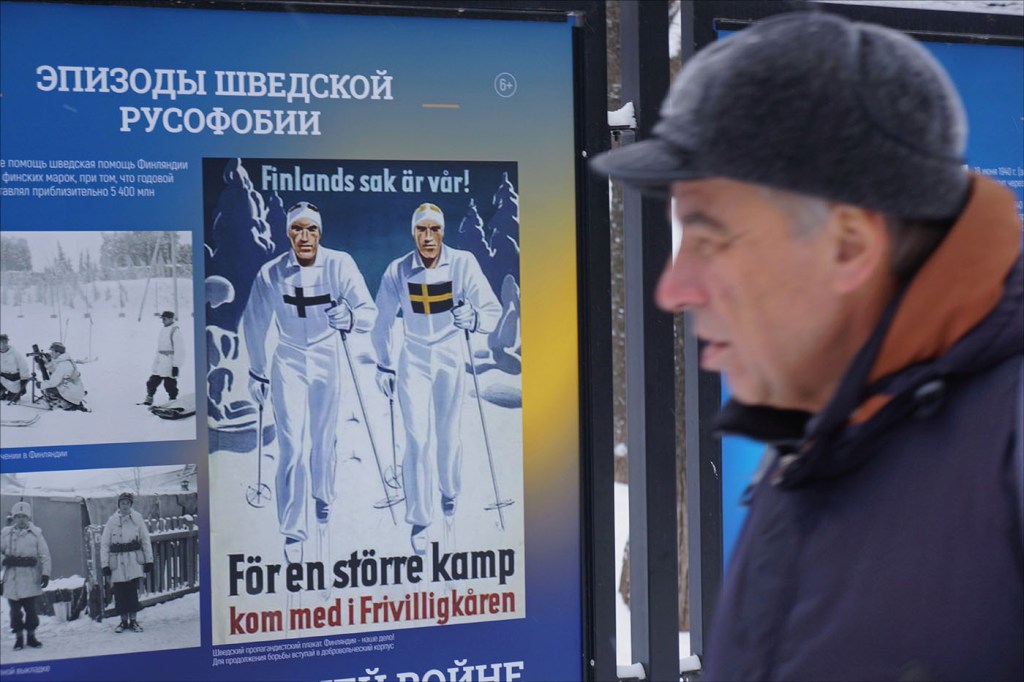
“Episodes of Swedish Russophobia”

Igor Stomakhin, “Episodes of Swedish Russophobia.” It is part of the informal series Moscow, 2023, posted on the extraordinary photographer’s essential Facebook page periodically throughout the past year

Russia’s Interior Ministry has proposed requiring foreigners who visit Russia to adhere to an “agreement of loyalty,” the state-run TASS news agency reported Wednesday, citing a draft law prepared by the ministry. 

According to the draft law, foreigners staying in Russia would be prohibited from “hindering the activities of public authorities of the Russian Federation [or] discrediting in any form the foreign and domestic state policy of the Russian Federation, public authorities and their officials.”

They would also be prohibited from “denying traditional family values ​​and distorting the contribution of the Soviet people to the victory over fascism,” according to TASS.

In addition, foreigners would need to agree that they will not “show disrespect for the diversity of regional and ethnocultural ways of life of the Russian population, traditional Russian spiritual and moral values.”

Valentina Kazakova, who heads the Interior Ministry’s migration department, said the draft proposal for an “[agreement of loyalty] was being discussed” and would “soon be sent to the [lower house] State Duma” for consideration, according to TASS. 

She did not provide a more specific timeline. 

At the same time, it was not clear from TASS’s report whether the Interior Ministry’s proposal would require foreigners to sign a physical agreement form upon entering Russia.

In 2021, the Interior Ministry suggested introducing a similar loyalty document for visiting foreigners, but the proposal never reached the State Duma, according to the Kommersant business daily.

Source: “Russian Interior Ministry Proposes Foreigners Sign ‘Agreement of Loyalty,'” Moscow Times, 29 November 2023

Russia Reads

A young man on the Nevsky Prospect in Petersburg reads a book by Friedrich Engels whilst handing out discount coupons to the nearby so-called Lego Museum. Source: Marina Varchenko (Facebook), 9 November 2023


“‘The Arab world is not just beautiful ethnic costumes, exquisite dishes, and other One Thousand and One Nights-type stuff, but also brutal dictatorships, poverty, a high tolerance of violence, and sometimes outright racism and religious fanaticism. According to my observations, however, this second facet is almost always bracketed off by Europeans when describing the countries of the “global South” or is guiltily dished up as a consequence of the traumatic colonial past.’ Essayist Andrei Sapozhnikov (“Department of Culture”) connects the abnormally high support for Hamas’s invasion of Israel in the Western world with this peculiarity.”

Source: Email newsletter from the online Russian magazine Republic, 8 November 2023. Translated by the Russian Reader

Why I Want to Give the Russian Liberal Intelligentsia a Subscription to the London Review of Books

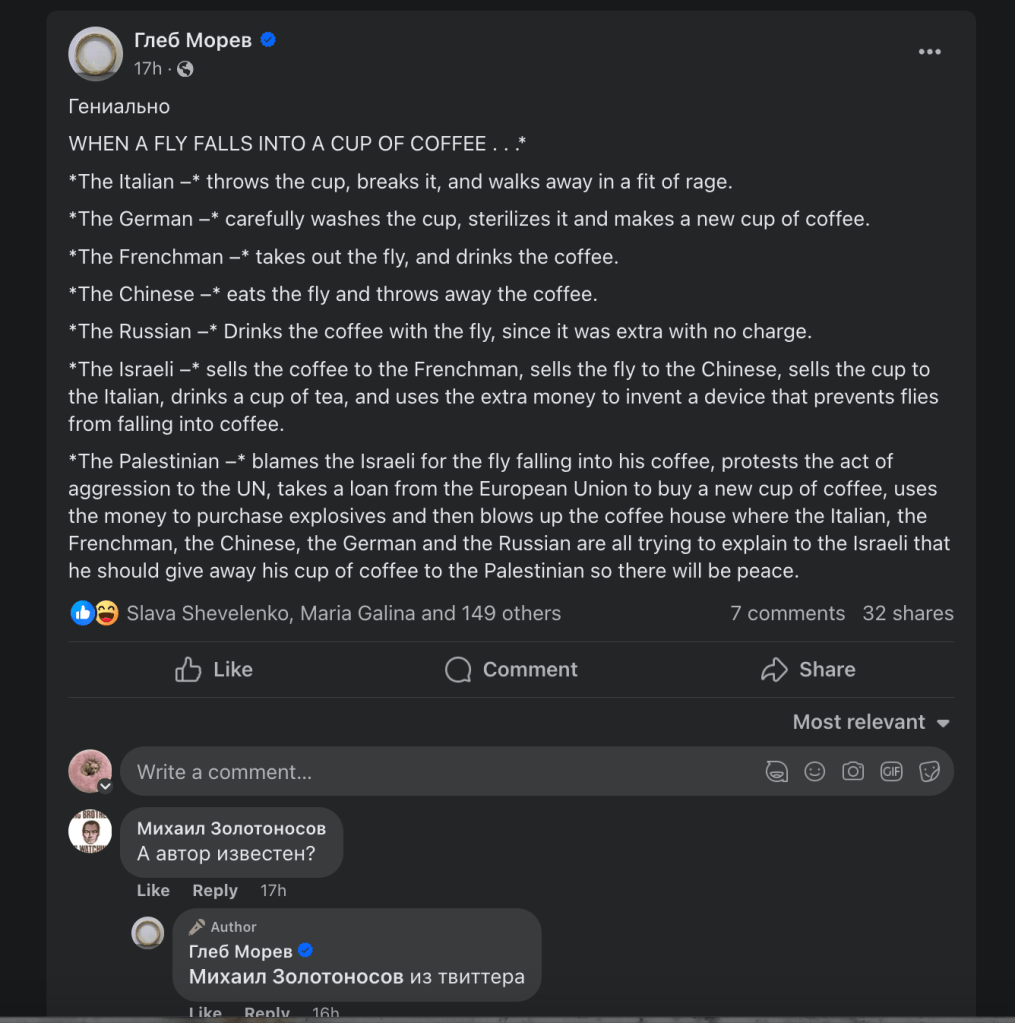
“Brilliant.” Source: Gleb Morev (Facebook), 1 November 2023

Born in 1968.

1992 — Graduated from the Faculty of Philology of the University of Tartu.

Specialist in the history of Russian literature of the XX century. He was the editor of Session (1998), the chief editor of the New Russian Book magazines (1999–2002) and Critical Mass (2002–2007), the editor-in-chief of the OpenSpace.ru section (2008–2012). Since 2012 — Chief Editor of the Literature Department of the Colta.ru website. Member of the literary academy of the Big Book Award, College of nominees of the Joseph Brodsky Memorial Scholarship Fund. Since 2016 — Chief Editor of the Open University.

Lives in Moscow.

Source: “Gleb Morev,” Open University.


The inescapable truth is that Israel cannot extinguish Palestinian resistance by violence, any more than the Palestinians can win an Algerian-style liberation war: Israeli Jews and Palestinian Arabs are stuck with each other, unless Israel, the far stronger party, drives the Palestinians into exile for good. The only thing that can save the people of Israel and Palestine, and prevent another Nakba – a real possibility, while another Holocaust remains a traumatic hallucination – is a political solution that recognises both as equal citizens, and allows them to live in peace and freedom, whether in a single democratic state, two states, or a federation. So long as this solution is avoided, a continuing degradation, and an even greater catastrophe, are all but guaranteed.

Source: Adam Shatz, “Vengeful Pathologies,” London Review of Books, 2 November 2023


In​ the spring of 1956, eight years into the Nakba, a group of Palestinian fedayeen crossed the ploughed ditch which was all that separated Gaza from the state of Israel. On one side of the ditch were 300,000 Palestinians, 200,000 of them refugees expelled from the surrounding area; on the other were a handful of new Israeli settlements. The Palestinian fighters attempted to enter the kibbutz of Nahal Oz, killing Roi Rotberg, a security officer. They took his body back with them to Gaza, but returned it after the UN intervened. Moshe Dayan, then Israel’s chief of the general staff, happened to be in the settlement for a wedding and asked to give the eulogy at Rotberg’s funeral the following evening. Speaking of the men who killed Rotberg he asked: ‘Why should we complain of their hatred for us? Eight years they sat in the refugee camps of Gaza, and saw in front of their eyes how we turned the lands and the villages in which they and their forefathers once dwelled into our homeland.’ It was a recognition of what Palestinians had lost that contemporary Israeli politicians can no longer afford to express. But Dayan wasn’t advocating the right of return: he ended his speech by arguing that Israelis had to prepare themselves for a permanent and bitter war, which would have a major role for what Israel called ‘frontier settlements’.

Source: Eyal Weizman, “Exchange Rate,” London Review of Books, 2 November 2023


Israeli leaders, spurred by a furious public, have taken the massacres of 7 October as licence to unleash havoc on the Palestinians. ‘The emphasis is on damage, not precision,’ explained one IDF official. At the time of writing, more than four thousand civilians in Gaza have been reported killed, including entire families wiped out by indiscriminate Israeli air strikes. On 13 October, the Israeli army ordered almost half the population, around 1.1 million people, to evacuate northern Gaza. Most have fled to southern cities such as Khan Younis and Rafah, but these are also under bombardment. Tents have been erected wherever space can be found, evoking memories of the first refugee camps built after the Nakba. The fear is that Israel intends not only to seize large portions of Gaza, but that it will try to force Palestinians into the Sinai desert. Gallant’s promise of a ‘new security reality’ only seemed to confirm this. Egypt has said publicly that it will not accept refugees from Gaza, but the proposal continues to circulate in diplomatic discussions under the pretext of providing a ‘humanitarian corridor’ for Palestinians – as though it were preferable to facilitate population transfer than to ask Israel for a ceasefire.

The violence is not limited to Gaza. In the West Bank, which is under an IDF-imposed lockdown, Israeli settlers and soldiers have killed more than eighty Palestinians in the last fortnight. Families have fled their homes. Moeen Dmeidi, the mayor of Huwara, which was the target of a massive settler attack in February, has spoken of ‘an unbelievable situation of collective punishment’. Palestinian citizens of Israel have been arrested and threatened for expressing their political views, even for ‘liking’ social media posts of verses from the Quran. On 20 October, Israel’s police commissioner, Yaakov Shabtai, ordered a sweeping ban on protests against Operation Iron Swords, saying: ‘Anyone who wants to identify with Gaza is welcome. I will put them on buses that will send them there.’ Politicians and pundits, already emboldened, make genocidal comments with impunity.

Source: Amjad Iraqi, “After the Flood,” London Review of Books, 2 November 2023


The dropping of warning leaflets was not done out of humanitarian concerns: for the British it was strategic, since causing excessive casualties was understood as a source of ongoing resentment and thus further trouble. It isn’t hard to see the parallels with modern military strategy. The same techniques are still, in essence, used by many modern militaries, often in the very same areas where they were originally developed. The continuous bombing of Iraq and the imposition of the no-fly zone between the first and second Gulf wars was a modification of the doctrine, and the leafleting of Iraqi cities such as Fallujah was absolutely in line with it. The ‘war on terror’ saw the return of air patrols and targeted strikes preceded by warnings to the remote valleys of Waziristan, once the redoubt of Mirza Ali Khan. Across the Islamic world, from North Africa to Pakistan, leafleting followed by bombing has been a regular feature of Western policy, the leaflets sometimes serving as a pseudo-legal device to open up free-fire zones where anyone remaining after the warning has expired is considered a legitimate target: their deaths are their own fault.

Source: Francis Gooding, “The Leaflet,” London Review of Books, 2 November 2023

Moral Equivalence

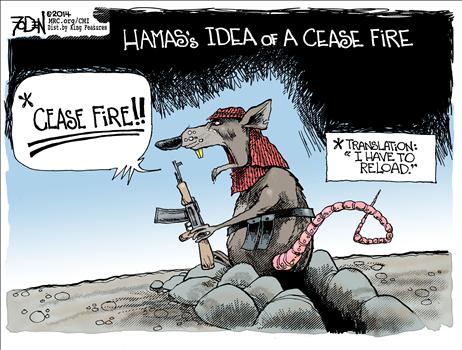
I found this “hilarious” cartoon attached to an essay entitled “No Moral Equivalence in the Middle East,” but it serves just as well as an illustration of the sadly predictable “liberal Russian” ruminations, below. ||| TRR


Hello, dear readers!

This is the Moscow Times weekly newsletter at your disposal. Let’s hope that our friends, acquaintances, relatives, and just plain Israelis survive the barbaric attack by terrorists from Hamas and Islamic Jihad with minimal losses. We’ll discuss the role the Russian Federation played in this attack below, immediately after a preview of this issue.

You will read:

  • about debt-ridden Russians;
  • about the demographic disaster in the Russian Federation;
  • about the civil war in Moscow thirty years ago.

But let’s go back to Israel. Yes, it has to be said that the Israeli special services, often called the best in the world, failed to fulfill their principal mission this time round. They were asleep at the wheel in the face of the most serious danger, and the country has paid for it with the lives of not only soldiers, but also of ordinary people. Israel has already lost at least 300 people, and many more have been seriously injured, while Palestine [sic] says there have been 250 victims [among Palestinians?], but the military [sic] operation against Hamas has only just begun.

Commentators have especially focused on the number of rockets that Hamas has managed to stockpile, and see in this the undoubted support of Iran and, possibly, Syria. Without its involvement, weapons or parts of weapons would simply not have got from Iran to Palestine [sic]. It’s geographically unlikely.

Here is what the Iranian Foreign Ministry had to say: “The protection of their land and shrines from occupation, aggression, daily crimes and terrorism on the part of the Zionist regime is the natural and legitimate right of the oppressed Palestinian nation.” And here are the words with which Vladimir Putin justified the invasion of Ukraine: “The purpose of the special operation is to protect people who have been subjected to bullying and genocide by the Kiev regime for eight years.” Putin has also repeatedly called the Ukrainian leadership “terrorists.”

Russia, unlike most European countries and the United States, does not consider Hamas a terrorist organization, and Moscow received its leader Ismail Haniyeh with all possible honors just a year ago. Now Haniyeh says that Hamas is going to seize Jerusalem—and the Russian Foreign Ministry officially agrees with him: Palestine [sic] should be returned to its 1967 borders and have its capital in East Jerusalem.

But the point, of course, is not in the verbal support that the Russian Federation has provided to Hamas. Russia, by unleashing a war in Ukraine, has shown that international law and diplomatic methods of conflict resolution can be ignored. We should also not fail to point out the consistent indecision of Western countries in response to Russian aggression. This indecision was undoubtedly noticed by Iran, which freely supplies weapons to the Russian Federation, and by Azerbaijan, which blockaded and then conquered Nagorno-Karabakh, and by Palestine [sic], which stockpiled a gigantic arsenal and has put it to use. The Russian Federation has shattered the world order with its actions, and considerable efforts will be required to return to the situation of three years ago, if at all it is possible to return to it.

Let’s finish with the statement made by the Taliban movement, who have also received a warm welcome in the Kremlin. The Taliban appealed to Iran, Jordan, and Iraq to let their troops go help Hamas conquer Jerusalem.

[…]

The Hamas attack is Israel’s Pearl Harbor for Israel, military expert Sergei Migdal argues [in his opinion piece] about the causes and consequences of the attack, written hot on its heels. If you want to read about the background of what is happening, then here is an almost academic article by Ze’ev Khanin, in which he clearly answers the question of whether it is worth negotiating with terrorists.

[…]

Source: Moscow Times Russian Service weekly email newsletter, 8 October 2023. Translated by the Russian Reader, who reminds his readers that the opinions expressed in the texts published in this almost-sixteen-year-old Russian zeitgeist chronicle may not coincide with his own. But how else would his readers find out that “liberal” Russians don’t regard Palestinians and many other Arabs (e.g., Syrians) as full-fledged human beings who can lay claim to the same rights and freedoms as “just plain Israelis” and “liberal” Russians?

French Kiss

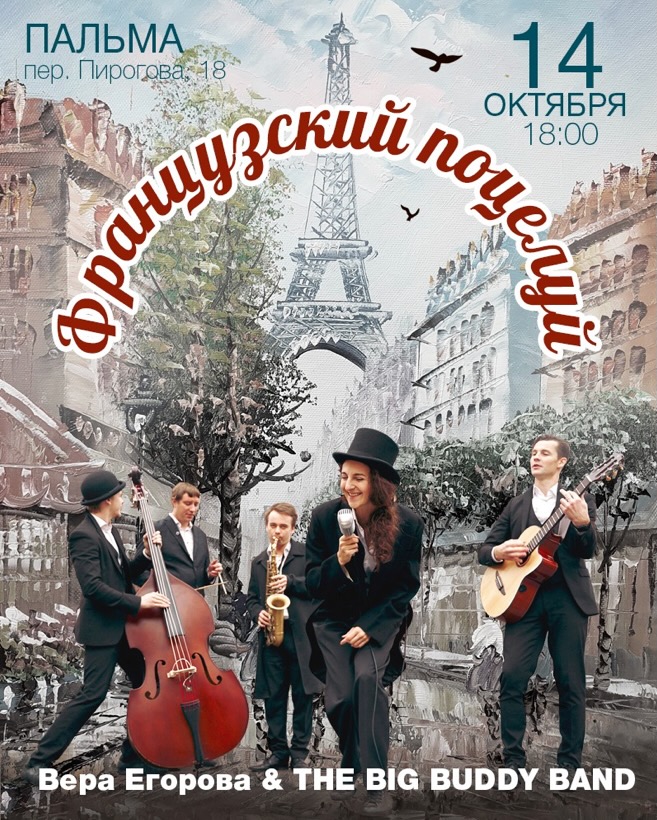
French Kiss: A Concert by Vera Egorova & The Big Buddy Band

6:00 p.m., October 14, Palma Creative Space, Pirogov Embankment, 18

Performers

Vocals – Vera Egorova, Double Bass – Anton Krasikov, Guitar – Yuri Yurov, Drums – Ivan Laptev, Saxophone – Anton Seryogin

Description

The lights of the city in evening, the music, the vibe… under a Paris sky!

Stage Magic Agency invites everyone to be inspired by the romantic motifs of France in the light of the crystal chandeliers at the Palma Mansion on October 14. The evening’s programme includes treasures of French pop and chanson as performed by the extravagant Vera Egorova & The Big Buddy Band. We will make a genuine French voyage from Zaz’s contemporary hits to such symbols of the era as Edith Piaf and Yves Montand.

Vera Egorova & The Big Buddy Band are musical hooligans from St. Petersburg and the musical project of singer and actress Vera Egorova. The band has performed more than 500 concerts in Russia and abroad and taken prizes at various international competitions and festivals. Each of their performances is a ton of drive and an endless stream of emotions.

Well, bon voyage! See you at the Palma!

Concert programme:
Zaz – Je veux
Zaz – Paris sera toujours Paris
Zaz – demain c’est toi
Edith Piaf – Padam Padam
Edith Piaf – La vie En Rose
Joe Dassin – Les Champs Elysees
Charles Aznavour  – Oublie Loulou
Paolo Conte – Via con me
Yves Montand – Sous le ciel de Paris
Patricia Kass – Mon mec a moi
Julie London – Fly me to the moon
Madeleine Peyroux – J’Ai Deux Amours
Osvaldo Farres – Quizas

Duration: 1 hour 15 minutes

Source: Bileter.ru (via the website’s 5 October 2023 email newsletter). The “concert programme” is reproduced here as it appeared in the original.


“Vera Yegorova & tBBB — Je Veux (ZAZ cover) | LIVE.

I could detect almost no actual French in this so-called cover of a French song by the “musical hooligans from St. Petersburg,” making it a perfect illustration of the cargo cult character of “world culture” as imagined and appropriated by xenophobic Putin-era Russians. ||| TRR


Dozens of people, including a 6-year-old child, were killed in a Russian attack that hit a cafe during a wake service in a village in the Kharkiv region of northeastern Ukraine on October 5, according to Ukrainian officials. RFE/RL visited the village a few hours after the deadly attack.

Source: Radio Free Europe/Radio Liberty (YouTube), 5 October 2023


[…]

— Why is the issue of colonialism nearly absent from the Russian opposition’s agenda?

— It’s an unpopular topic because it forces us to look for the root of our troubles not only in the Putin regime but in ourselves as well. It forces us to look at our behavior and change it, and that’s an unpleasant process. No one likes admitting they’re wrong. No one likes admitting that their behavior or they themselves are racist. No one likes admitting they’re a xenophobe or colonialist.

— What must we do to rid ourselves of the colonial and imperial mindset?

— First of all, we must understand that Russians have to do this work themselves. Because if someone else from the outside does the work to decolonize Russians, they won’t like it. We don’t have to agree with every position 100%, we can argue on some points.

Changing a mindset is not an instantaneous thing. Unfortunately, we just don’t have time, because if we are going to discuss for another twenty years whether it is possible or not to use slurs in reference to ethnic minorities, nothing can help us anymore. We will turn other people’s lives into hell, and our own, too. But, of course, Russian colonialism won’t let itself be deconstructed without putting up a fight.

— This begs the question about another pattern you described—complaints about Russophobia. Why do you think they are unfounded? And do you consider, for example, banning cars with Russian license plates from entering European countries to be Russophobia?

— Of course, this is a very unpleasant situation. Russian liberals support one of the most important narratives of the Putin regime and of Russian colonialism in general, which boils down to the claim that Russians are victimized. I don’t think that banning Russian cars from entering [the EU] is a manifestation of Russophobia. I think it is a manifestation of the reaction to [Russia’s] full-scale invasion [of Ukraine], which, by the way, is still ongoing. The reaction is going to affect people who themselves have not been involved in the invasion in any way. Moreover, people who are least guilty may suffer from it—for example, activists who have been fighting the Putin regime all their lives.

This will continue, because the citizens of the Russian Federation were unable to oppose what is happening in any way, and in the eyes of the world, most of them fueled this invasion economically, politically, and rhetorically. Precisely because we don’t resist, we have to pay for it somehow. For example, we are in no hurry to separate the criminals from those who have not committed crimes.

[…]

Source: Farida Kurbangaleyeva, “‘The war is a consequence of Russian colonialism and imperialism’: anthropologist Vasilina Orlova on why the opposition is also to blame for the invasion of Ukraine,” Republic, 5 October 2023. Translated by the Russian Reader

Vexations

Igor Levit performing Erik Satie’s “Vexations” (short edit)

On 30 May 2020, Igor Levit performed all 840 repetitions of Vexations at the B-sharp Studio, Berlin. The performance streamed on Periscope, Twitter and other platforms, including on The New Yorker‘s website. Levit said the recital was in response to the COVID-19 pandemic, his reaction to which he characterised as a “silent scream” (stumme Schrei). The 840 sheets of music were sold individually to assist out-of-work musicians.

Source: “Vexations” (Wikipedia)


Finland will ban entry to passenger vehicles registered in Russia starting Saturday, the Nordic country’s top diplomat announced Friday afternoon.

“Our decision is for the ban to come into force after midnight,” Finnish Foreign Minister Elina Valtonen was quoted as saying by the state broadcaster Yle.

“We estimate the new rules will significantly reduce traffic on the border between Finland and Russia,” she added.

EU citizens and “their immediate circle,” as well as diplomats and those traveling for humanitarian reasons, would be exempt from the restrictions, according to Yle.

Lithuania, Latvia and Estonia issued no-exception entry bans this week for Russian-registered cars after the European Commission clarified that existing regulations prohibit the import or transfer of goods originating in Russia.

Estonian and Lithuanian officials later suggested that cars with Russian license plates would be confiscated if they refused to re-register or leave.

Finland’s Valtonen ruled out confiscations in her country, telling Yle that vehicles with Russian license plates would have to leave Finland by March 16, 2024.

Supporters of jailed Kremlin critic Alexei Navalny urged Baltic leaders to lift the vehicle ban on claims that they harm Russian war exiles and play into the Kremlin’s narrative of anti-Russian feelings in the West.

Moscow has accused the EU of “racism” for its ban on passenger vehicles, while former President Dmitry Medvedev called for a suspension of diplomatic relations.

Finland, a member of the European Union, joined NATO this year, thus doubling the length of the U.S.-led military alliance’s border with Russia.

Finland’s neighbor Norway, which has joined the EU’s sanctions against Russia despite not being a member of the bloc, said it was also considering banning entry to Russian-registered vehicles.

Source: “Finland Follows Baltics, Bans Entry to Russian Vehicles,” Moscow Times, 15 September 2023. The emphasis is mine. Judging by the outsized reaction to this news by “anti-war Russians” in the press and on social media, the proposed vehicle entry ban vexes them more than the endless repetitions on violent death, widespread destruction, and genocide in Ukraine, unleashed by their country’s now-572-day-long invasion of their former neighbor. ||| TRR


This is an actual headline:

“Nobody is safe from Russia’s wave of re-nationalization.”


This how and what the former “Fennomans” from the newspaper Delovoi Peterburg write about Finland today (in their morning newsletter)—without a hint of shame, so to speak:

Finland is selling its house in St. Petersburg, and the Central Bank is struggling with the fall of the ruble. Such are the economic news in St. Petersburg this week.

How much does the “Finnish House” cost? The issue is very difficult, given Finland’s unfriendly attitude towards us and the sanctions. Basically, with the sale of the building on Bolshaya Konyushennaya, which belonged to Finland, an entire era of good neighborliness between our countries ends.

Source: Thomas Campbell (Facebook), 15 September 2023. Translated by the Russian Reader


Not all attempted performances of this work have been successful. In 1970, Australian pianist Peter Evans decided to abandon a solo performance of the piece after five-hundred and ninety-five repetitions because he felt that “evil thoughts” were overtaking him and observed “strange creatures emerging from the sheet music.”

Source: “Vexations” (Wikipedia)


Quiver, quaver, flutter, squirm, twitch
Shimmy, wobble, shake, convulse, twist
Tremble, jerk, shudder, vibrate, writhe
Jiggle, bobble, sway, waggle, die

Source: Annelyse Gelman, Vexations (University of Chicago Press, 2023), p. 40


Colleagues, I may have missed something, but how do Finland, Poland, etc., make the case for the reasonableness of banning cars with Russian license plates from entering?

I mean, how does this contribute to the stated goals of combating military aggression?

Source: A “friends only” social media post by a Russian acquaintance, 16 September 2023. Translated by the Russian Reader


We demand that Western leaders end the policy of avoiding “escalation of the conflict.” It only allows Putin to blackmail the West with the very “escalation,” hoping to force him to “geopolitical capitulation.” Any international legal order is maintained only as long as its violator meets a collective rebuff. While his co-founders are ready to fight for him.

We demand a fundamental expansion of military assistance to Ukraine up to the direct participation of NATO troops in hostilities. Ukraine should receive binding security guarantees now, not after the end of the war.

We urge Western leaders to put aside fears about the possible collapse of the Russian Federation as a result of the fall of the regime. None of the “painful consequences” of this will outweigh the danger of preserving the imperial state, which will reproduce aggressiveness and revanchism. Either Russia will become confederate, democratic and “pro-Western,” returning to its European roots, or it must disappear as an integral entity.

Source: Paul Goble, “‘Victory for Ukraine; Freedom for Russia’ — Four Russian Activists Call for a World without Putin and Putinism,” Window on Eurasia (New Series), 14 September 2023


The space between good and bad began to diminish
Daughter studied botany while I analyzed the transference
Over the PA someone said, And the wisdom to know the difference
We integrated our sensory impressions into a coherent scene
Her hair was getting long, her eyes were turning green
As for wisdom, we didn’t know what to do with it


There was a time before and after thinking of death
As the worst thing that could happen to a person
Bodies were interred and then exhumed again
Satisfactory, said Hank, which meant the opposite
We had overestimated our capacity for wonder
We had underestimated our capacity for pain

Source: Annelyse Gelman, Vexations (University of Chicago Press, 2023), p. 40. The book has been longlisted for the 2023 National Book Award for Poetry in the United States.

When the Taxi Driver Asked Where You’re From

Eva Morozova, “When the taxi driver asked where you’re from”

When the taxi driver asked where you’re from

(If you’re not in the mood to explain why you still haven’t ousted the president)

[Image of Russian Federation foreign travel passport briefly flashes onscreen]

1. He, he, he! Huh?

2. Could you repeat your question? [in English]

3. Sorry, I don’t speak languages. [in English]

4. Artists have no nationality.

5. My ancestors came from the lower reaches of Transnistria.

6. From here and there, brother.

7. I’m not a fan of the concept of the state per se.

8. I’m from Rio de Janeiro.

9. When God made the earth, there were no borders.

10. From Siberia.

11. Look, a flock of pigeons!

[Pigeons drop the last passenger into “neutral waters.” Image of Russian Federation foreign travel passport flashes onscreen again.]

Source: Eva Morozova (YouTube), 28 June 2023. Translated, where necessary, by the Russian Reader. Thanks to Tatiana Kosinova for the heads-up and so much more.


@george.spb wrote the following comment when Eva Morozova posted the cartoon, above, on their Instagram page:

I always say that I am from Russia, even though I am [an ethnic] Georgian. I have never got a single unfriendly look. At most, they might somehow make a good-natured joke about it. All foreigners are well aware that not all people in Russia support the military action, especially those who have left. The only thing I won’t do is demonstrate Russian symbols or sing the Russian anthem until the war is over, a correct assessment of what happened has been made, and the perpetrators have been justly punished. I can’t change anything else; I was born there. And if a person is biased about it, then it’s not my problem anymore.

@intelligent_beauty_paris wrote:

It happened once here:
– Vous êtes d’où? – Where are you from?
– De la Russie. From Russia.
– C’est pas grave! / No big deal
/ It happens/ Don’t worry about it!

Source: eva__ morozova__ (Instagram), 27 June 2023. Translated from the Russian and the French by the Russian Reader


YALTA, Crimea, Aug 29 (Reuters) – In years past, Siberian Viktor Motorin could hop on a plane and arrive in Crimea just four hours later to relax at his holiday apartment. Now he must fly first to Moscow and then spend a day and a half on the train.

The war in Ukraine, now 18 months old, is making it harder for many Russians to reach their favourite summer haunts in the Black Sea region of Crimea, which Moscow seized and annexed from Ukraine in 2014.

And safety is a factor for some, especially after two major Ukrainian attacks since last October on the 19 km (12 mile) Crimean Bridge that links Russia by road and rail to the peninsula.

But after weighing up such concerns, Motorin, from the city of Khanty-Mansiysk in western Siberia, said he decided that making his annual trip was still a risk well worth taking.

“We calculated that it was reasonably safe, especially when my colleagues had already come here in June, early July. They said it was all calm here with no problems on the Crimea Bridge. The goods, the prices, everything is like before,” he said.

[…]

Source: “Russian tourism in Crimea is down, but many still shrug off risks,” Reuters, 29 August 2023


In 2022, the year when Russia’s full-scale invasion of Ukraine began, more than 4,300 people renounced their Russian citizenship, the highest such figure for the last three years. Among them were several major Russian businessmen, including [former] Troika Dialog CEO Ruben Vardanyan, venture capitalist Yuri Milner, and Tinkoff Bank founder Oleg Tinkov. However, the Russian Foreign Ministry said that the increase in “refuseniks” was due to the pandemic that raged earlier, claiming that “there are no particular changes in the numbers of requests to withdraw from Russian citizenship from abroad.” And the Russian Interior Ministry recently proposed reviewing the cases of people who have renounced Russian citizenship, that is, theoretically, a person’s citizenship could be forcibly reinstated. Farida Kurbangaleyeva talked to people who decided not to be Russian nationals anymore and found out why it mattered to them.

“If I have the sudden urge to live in Russia I’ll get a residence permit”

Andrei Kreinin, USA, renounced his Russian citizenship

I’ve wanted to emigrate to the USA since I was fifteen, when I saw the good old American movie Short Circuit 2. Spoiler alert: it ends with a scene of the main characters taking the oath of citizenship. I went to the States many times on a tourist visa, and in 2011 my family and I won a green card and moved to Chicago. In Moscow, I worked in telecommunications and I got a job in the same field in our new home.

The decision to renounce citizenship was made on February 25, 2022—after the brutal bombing of Kharkov, when people were hiding in the subway there. Firstly, because there is such a thing as a conscience, and secondly, my mother was born in Kharkov, and it was impossible for me to remain a Russian national. My family said, “We won’t do this. If you want to, do it, but then don’t pine for Russia.” I said I understood them perfectly. I had a couple of friends from Russia who called me bad words on social media, and I had to ban them. But mostly the attitude ranged from neutral to understanding: “It’s your business, Andrei.”

To renounce your citizenship, you need to do two main things—deregister your place of residence [in Russia, where everyone is required to register their place of residence] and get a paper stating that you owe no back taxes in the Russian Federation.

They say that it can be difficult to deregister remotely, so in June 2022 I flew to Russia. I took care of transferring my real estate and deregistering from my apartment. Basically, I covered all the important bases to the max. Before the trip, I carefully monitored the situation: I understood that there would be a mobilization. I actually thought it would be announced on May 9 [celebrated as Victory Day in Russia].

When I had collected all the paperwork, I took it to the consulate in New York. It did not go smoothly. About three months later, I received a letter saying my application had not been approved, because, according to the Interior Ministry’s databases, I was still registered—although I even had a stamp in my [internal] passport stating I had been deregistered. Consequently, I spent two or three sleepless nights, due to the time difference, trying to get through to the proper authorities in Russia. They said, “Send us your application again and a photo of the discharge stamp.” I sent them, and two days later I received a reply that I had been removed from the residence register.

Andrei Kreinin
Photo courtesy of Mr. Kreinin via Republic

I forwarded the whole thing to the consulate again, hoping that they would accept the documents online. But they said, “No, you’ll have to come to New York again.” I went again, resubmitted [my application], and after another two and half months I was informed that my application had been approved. I was told to report to the consular department and hand over my [internal and foreign travel] passports, which I did.

I have heard that the [Russian] state does not like people like me, because it is one thing to renounce Russian citizenship in a country where it is a necessary condition for obtaining the local citizenship, for example in Germany or the Netherlands, and another thing when you could retain your Russian citizenship, but you renounce it of your own free will.

But I didn’t notice any particularly negative attitude on the part of the staff at the Russian consulate. They behaved absolutely normally.

When I was in Russia, I forgot to withdraw my military registration. I had to call the military enlistment office. “This is how it is, guys, I’m renouncing my citizenship,” I said. Surprisingly, they did not yell at me or call me a traitor to the motherland, although I expected it. They just said, “Theoretically, we don’t do this sort of thing, but as soon as you complete the procedure, send us your military registration card, a copy of the certificate of renunciation of citizenship, a copy of your US passport, and a written request to be removed from military registration.” There is no mail service between the US and Russia nowadays. I had to make use of different “private couriers”: there are special Facebook groups for [arranging pickups and deliveries of letters and parcels]. Three weeks later, a letter from the military enlistment office addressed to me arrived in Moscow, saying I’d been removed from the register.

I have now applied for a Russian visa, which is granted to US citizens for up to three years. Not that I was planning to go there, but, as the Ukrainians say, schob bulo [“just in case”]. Plus, my father is still in Russia. He has already sent me an invitation to me, but he says, “Just please don’t come.”

I have no plans to reinstate my Russian citizenship under any circumstances. If I have the sudden urge to live in Russia, I can easily get a residence permit. It’s more than enough for me.

As my experience in dealing with the Russian Federation shows, it is better, paradoxically, to be a foreigner—you have fewer obligations.

A residence permit grants a person the same privileges as citizenship [sic], except the right to vote. On the other hand, no one can force me to do military service. The civil service will also be closed to me, but I’ve never aspired to join it either in Russia or the US.

[…]

Source: Farida Kurbangeleyeva, “‘It is better to be a foreigner in the Russian Federation—there are fewer obligations’: seven stories of people who relinquished Russian citizenship,” Republic, 28 August 2023. Translated by the Russian Reader, who lived on a resident permit in Russia for many years and knows for a fact that Mr. Kreinin is dead wrong about the “privileges” of living there in that tenuous capacity.


The grandfather of renowned Crimean Tatar historian Shukri Seitumerov was executed during Stalin’s Terror for supposed ‘counter-revolutionary terrorist propaganda’. Eighty years later, Russia’s FSB came for Shukri’s two elder sons, Seitumer and Osman Seitumerov, as well as his wife Lilia’s brother, with the ‘terrorism’ charges they faced no less politically motivated.  Such arrests and subsequent sentences of up to 20 years are part of Russia’s ongoing attack on the Crimean Solidarity human rights movement and are also simply ‘good for FSB statistics’.  For the next round of victims, armed Russian FSB burst into the Seitumerov home yet again at 4 a.m. on 24 August, this time taking Shukri and Lilia’s last son away from them.Abdulmedzhit Seitumerov is just 23 and became a father less than 2 months ago.

Armed and masked enforcement officers carried out multiple ‘searches’ in the early hours of 25 August, with six Crimean Tatars taken away.  All are now facing the huge sentences that have become a standard part of Russa’s most cynical conveyor belt of repression in occupied Crimea.  Ruslan Asanov (b. 1975); Remzi Nimetulayev (b. 1985); Seidamet Mustafayev (b. 1995); Abdulmedzhit Seitumerov (b. 1999); Ametkhan Umerov (b. 1986) and Eldar Yakubov (b. 1980) are Crimean Solidarity activists who had previously faced administrative prosecution for peaceful acts of solidarity with other political prisoners. 

This is one of the many identical elements in these cases which have been internationally condemned as politically motivated persecution.  The ‘armed searches’ are invariably carried out without the men’s lawyers allowed to be present, and with the FSB most often bringing the so-called ‘prohibited religious literature’ that they then claim to have found.  The men are generally forced to the ground, often in front of their terrified children, and then taken away as though criminals, although none is accused of any recognizable crime. 

The charges are equally predictable with the Crimean Tatars accused solely of unproven ‘involvement’ in Hizb ut-Tahrir.  This peaceful transnational Muslim organization was declared ‘terrorist’ by Russia’s Supreme Court in 2003, with the ruling passed in secret and probably politically motivated (making it easier for Russia to send refugees back to Uzbekistan where they faced religious persecution for involvement in Hizb ut-Tahrir).  No explanation has ever been provided for why an organization not known to have committed terrorist attacks anywhere in the world should be so labelled, and the organization has always been legal in Ukraine.  

Despite the lack of any grounds and in clear violation of international law which prohibits Russia from applying its legislation on occupied Ukrainian territory, Russia has been imprisoning Crimean Tatars (and a few other Ukrainian Muslims) on these charges since 2015.  The sentences have been getting longer and longer (up to 20 years), as Russia openly targets Crimean Solidarity journalists and activists speaking out about repression in occupied Crimea.

In all such ‘cases’, at least one man is invariably charged with the more serious Article 205.5 § 1 of Russia’s criminal code (‘organizing a Hizb ut-Tahrir group’), while the others face the lesser charge of ‘involvement’ in the purported ‘group’, under Article 205.5 § 2.  There is plenty of evidence from previous ‘trials’ that the more serious charge (carrying sentences of 17-20 years at present) are often laid in reprisal, for example, against Raim Aivazov for refusing to remain silent about the torture he faced from the FSB.  The men will likely also be charged with ‘planning a violent uprising’ (Article 278).  Once again, this is purely based on the 2003 Supreme Court ruling, with none of the political prisoners having ever been accused of actions or direct plans to commit any action aimed at ‘overthrowing the Russian constitutional order.’

The ‘evidence’ is as flawed as the charges.  It hinges on FSB-loyal ‘experts’ providing ‘assessments’ of innocuous conversations about religion, Russian persecution, etc. to fit the prosecution and ‘anonymous witnesses’, whose testimony cannot be verified, and who may have never met the men. 

Six families have been ripped apart, with children left traumatized and elderly parents facing never seeing their sons again.  

Russia uses such arrests and ‘trials’ as a weapon against the Crimean Solidarity human rights movement and as an instrument of terror and propaganda against Crimean Tatars who have from the outset demonstrated so clearly their identification with Ukraine.  The FSB are known to get promotion or bonuses for providing such ‘cases’ and can boast of ‘good statistics on fighting terrorism’.

Abdulmedzhit Seitumerov (b. 1999) was just 20 when the FSB came for his brothers, Seitumer Seitumerov (b. 1988) and Osman Seitumerov (b. 1992) and their uncle, Rustem Seitmemetov (b. 1973).  For his parents, this was already a terrible blow, especially since Russia illegally imprisons the men thousands of kilometres from their homes.  Now all three sons have been taken from them, and, if Russia is not stopped, Abdulmedzhit’s son Khamza, born on 5 July this year, will spend most of his childhood without his father.   Abdulmedzhit had been active in Crimean Solidarity, speaking out in defence of his brothers and other political prisoners.

Ametkhan Umerov (b. 1986)

The 37-year-old Crimean Solidarity activist was detained and fined in July 2019 for a picket in Moscow in support of four Crimean Tatar political prisoners.  He was one of 21 Crimean Tatars detained inh November 2021 for trying to stand outside an occupation ‘court’ during the appeal hearing in the case of three other political prisoners. Then in February 2022, he was jailed for several days for trying to attend a purportedly open (but political) ‘court’) hearing.

Ametkhan has three daughters and a son, all of them very young: Zamira (b. 2015); Khatidzha (b. 2017); Ali (b. 2019) and Zainab (b. 2021).

Seidamet Mustafayev (b. 1995)

Seidamet is just 28, but has faced several administrative prosecutions since 2017, when he was jailed for 10 days for taking part in what the occupation regime called an unsanctioned meeting (in fact, people standing outside in solidarity) during an armed search of the home of (now) political prisoner Seiran Saliyev.  In 2021, he was also detained and fined for having tried to stand outside an occupation ‘court’ during a political hearing.  In February 2022, he was also jailed for several days for trying to attend a purportedly open (but political) ‘court’) hearing.

Seidamet has four small children: Suleiman (b. 2014); Salsabil (b. 2016); Latifa (b. 2020) and Osman (b. 2023).

Remzi Nimetulayev (b. 1985)

Remzi was detained for the first time on 23 November 2021 when he came to the police holding unit in occupied Simferopol to greet lawyer Edem Semedlyaev, who had been jailed for 12 days for trying to carry out his professional duties.  Remzi was  jailed for 10 days.

He has five daughters: Aishe (b. 2009); Anife (b. 2019); Adile (b. 2013); Yasmina (b. 2016) and Alime (b. 2020).

Eldar Yakubov (b. 1980)

The 43-year-old was detained and fined on 25 October 2021 outside the Crimean occupation military ‘court’ during an appeal hearing against the sentences passed on three political prisoners.  

He has four daughters and two sons: Safiye (b. 2004); Khalid (b. 2008); Meryem (b. 2013); Khamza (b. 2017); Selime (b. 2018) and Asiya (b. 2021).

Ruslan Asanov (b. 1975) is also a Crimean Solidarity activist.

Source: Halya Coynash, “Russian FSB seize Crimean Tatar family’s last son in new wave of terror against Crimean Solidarity activists,” Kharkhiv Human Rights Protection Group, 25 August 2023

Just a Smack at Auden

Just a smack at Auden:


“The summer before college, Auden meets the mysterious Eli, a fellow insomniac. While the seaside town of Colby sleeps, the two embark on nightly quests to help Auden experience the fun, carefree teen life she never knew she wanted.”


A puzzling poem discovered at the tombstone of the late Yevgeny Prigozhin, the Russian Wagner mercenary leader, has emerged, intensifying the speculation that he may still be alive.

Once recognized as “Putin’s chef,” Prigozhin met his demise alongside nine others when his Embraer Legacy 600 aircraft crashed to the earth during a recent flight connecting St Petersburg and Moscow.

Reports of a possible explosion on the plane have surfaced subsequently. Confirming the 62-year-old’s demise required genetic analysis of the fire-engulfed aircraft wreckage. An ongoing inquiry into the crash is also underway.

Despite the official verification of his passing, numerous conspiracy theorists and supposed Russian “specialists” persistently assert that he remains living in an undisclosed location abroad.

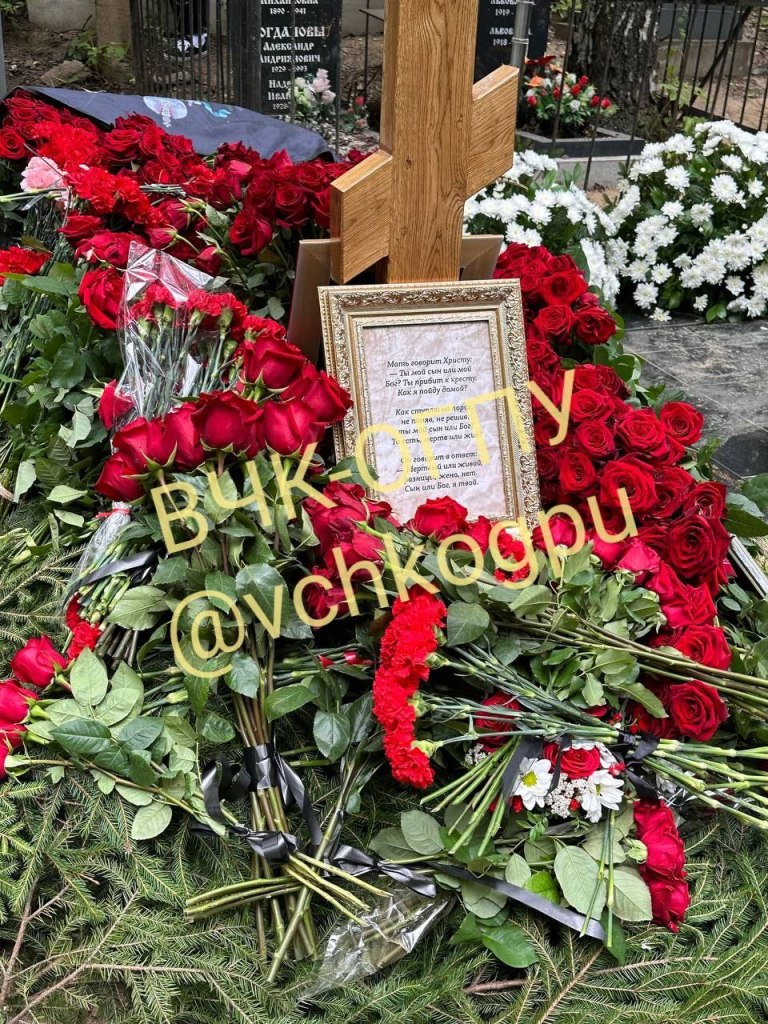
Presently, photographs from his restricted funeral—purportedly arranged by his mother, Violetta Prigozhin—exhibit armed guards, scent-tracking canines, and a peculiar poem framed and positioned on the grave marker.

Source: VChK-OGPU (Telegram), 30 August 2023

As per the state-endorsed Russian media outlet Moskovskij Komsomolets and the Telegram channels Rotunda and VChK-OGPU, the framed poem, observed during the funeral attended [by] Lyubov Prigozhina, 52, and the Wagner mercenary supremo’s elder daughter Polina, 31, comprises these verses:

‘Mother says to Christ: Are you my son or my God? You’re nailed to the cross, how will I go home?’ it read.

‘How will I step on the threshold, not understanding, not deciding: Are you my son or God? That is, dead or alive.

‘He says in response: Dead or alive, no difference, woman. Son or God, I am yours,’

The excerpt is borrowed from a composition by the Russian/Soviet Union poet Joseph Brodsky, entitled Still Life.

Earlier that day, a hearse was spotted traversing St Petersburg en route to the Porokhovskoye Cemetery.

As per Rotunda’s assertion, the Russian Ministry of Internal Affairs remained unaware of the funeral’s precise location. The ultimate lines of the poem supplement the intrigue, echoing assertions made by Russian authority Valery Solovey the previous day.

He commented, “Prigozhin himself was not aboard. His doppelgänger had taken flight in his stead—Vladimir Putin is keenly cognizant of this fact. If you… place your faith in the official declarations of the Russian administration, then what more can I add…?”

Source: Abhishek Awasthi, “Wagner chief Prigozhin alive? Poem on his grave fuels speculation,” Firstpost, 30 August 2023

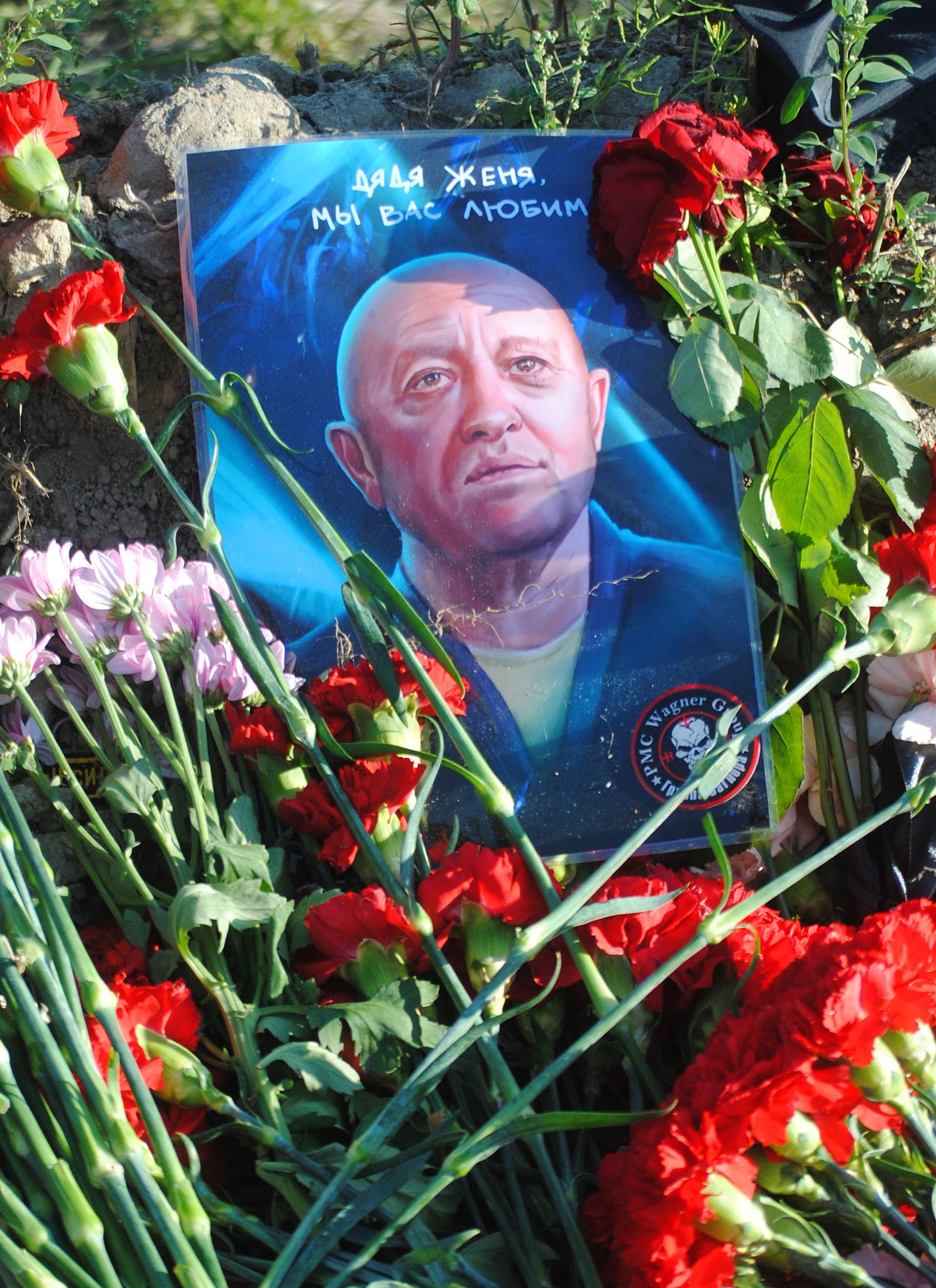
“We Love You, Uncle Zhenya”

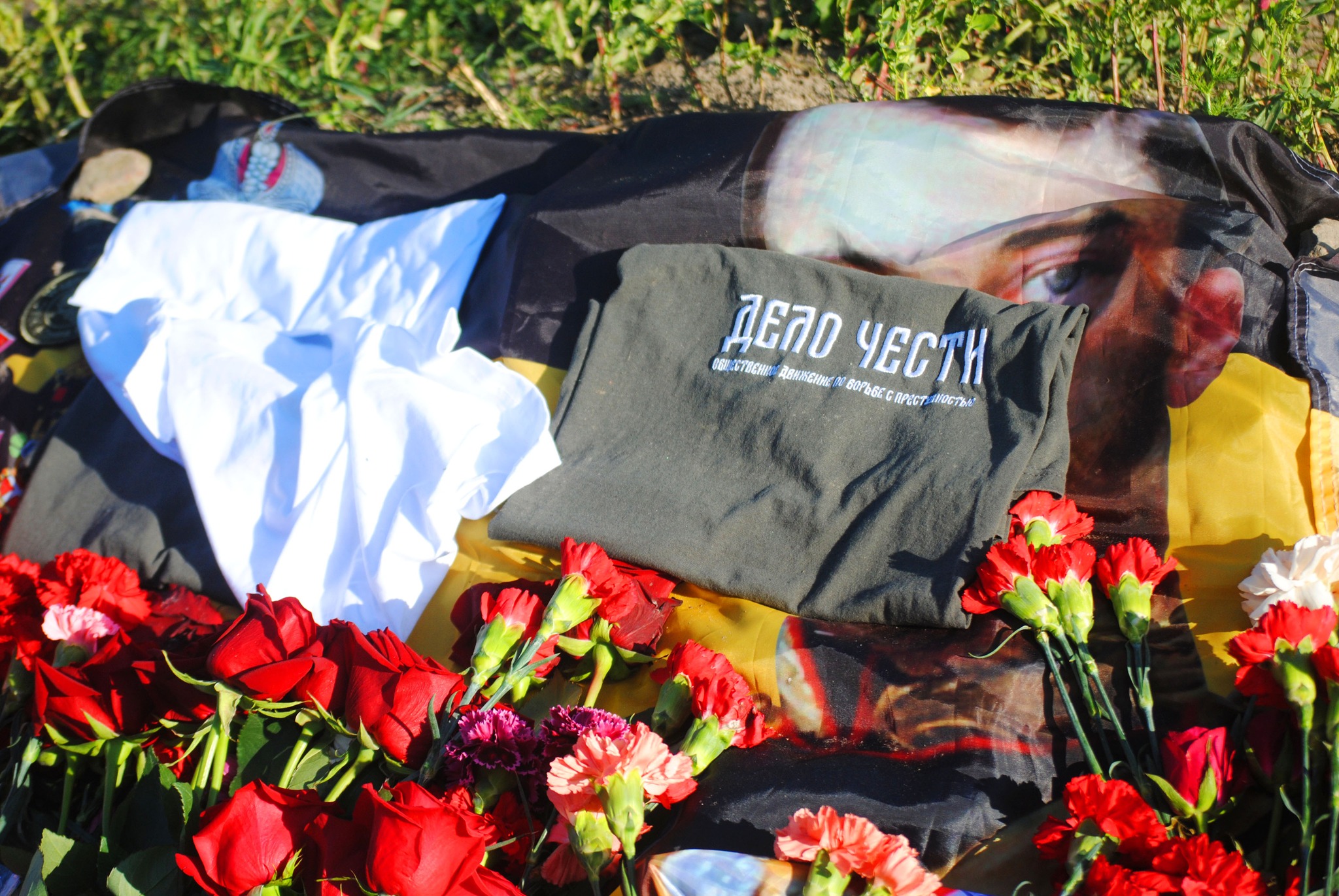
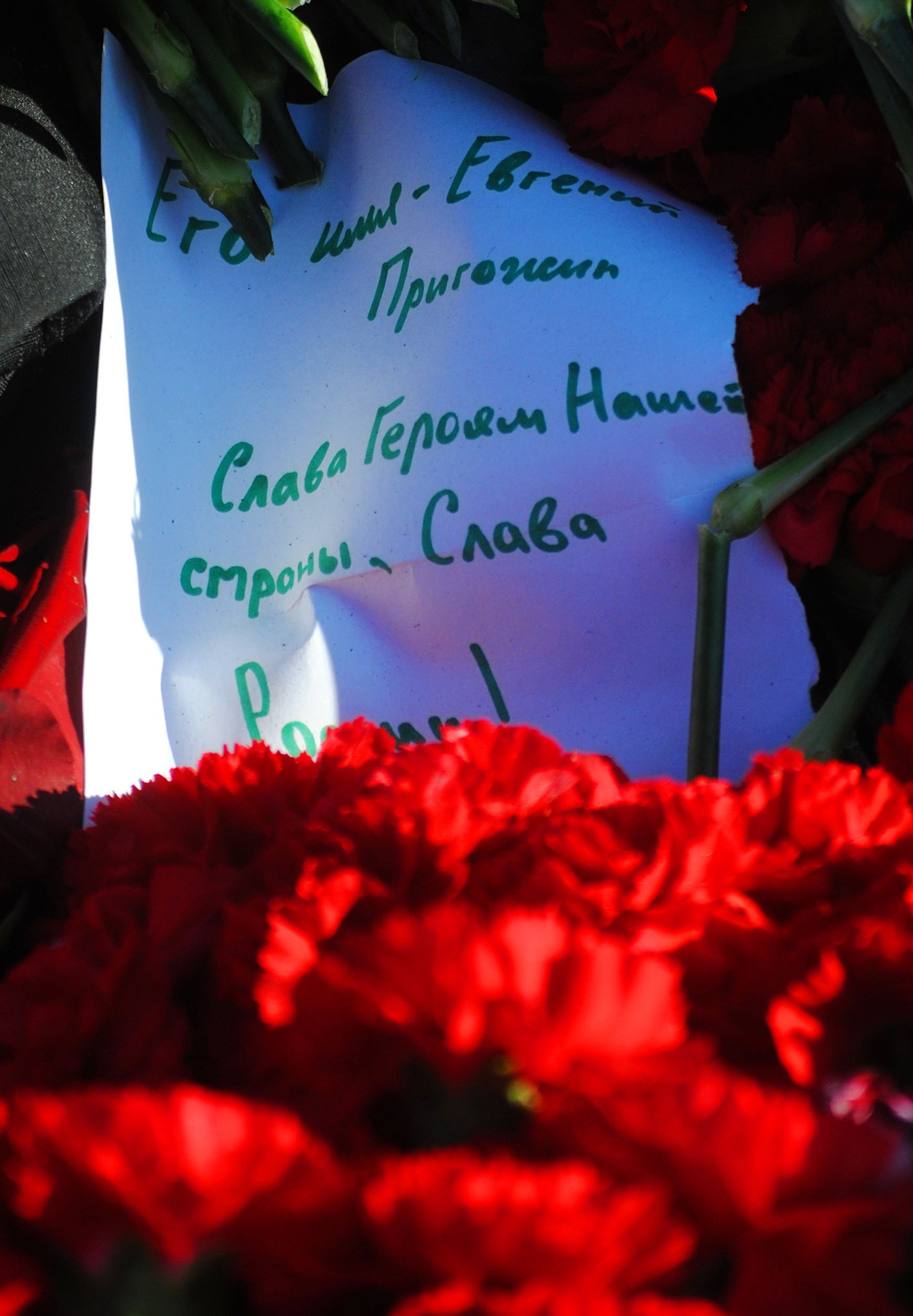
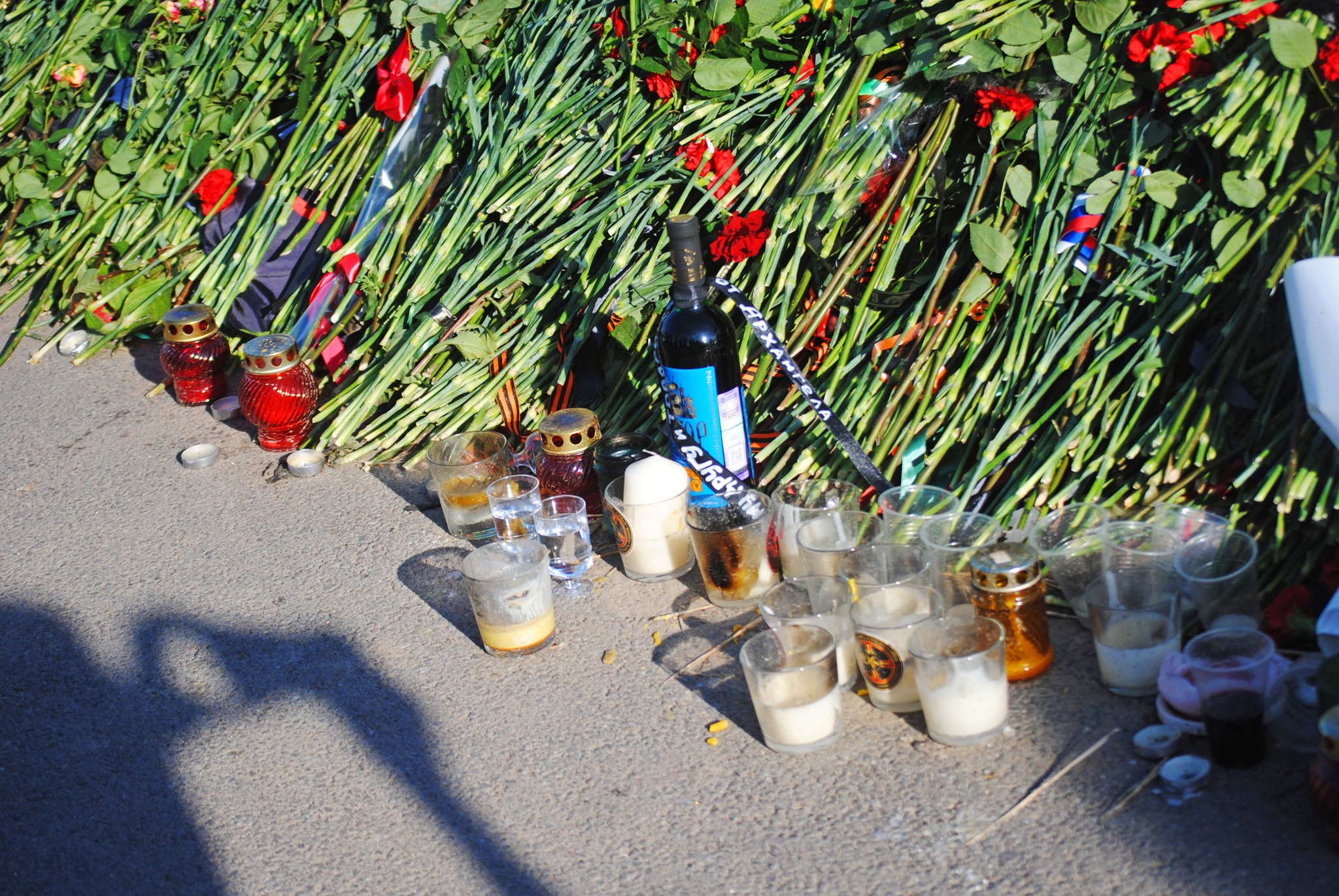
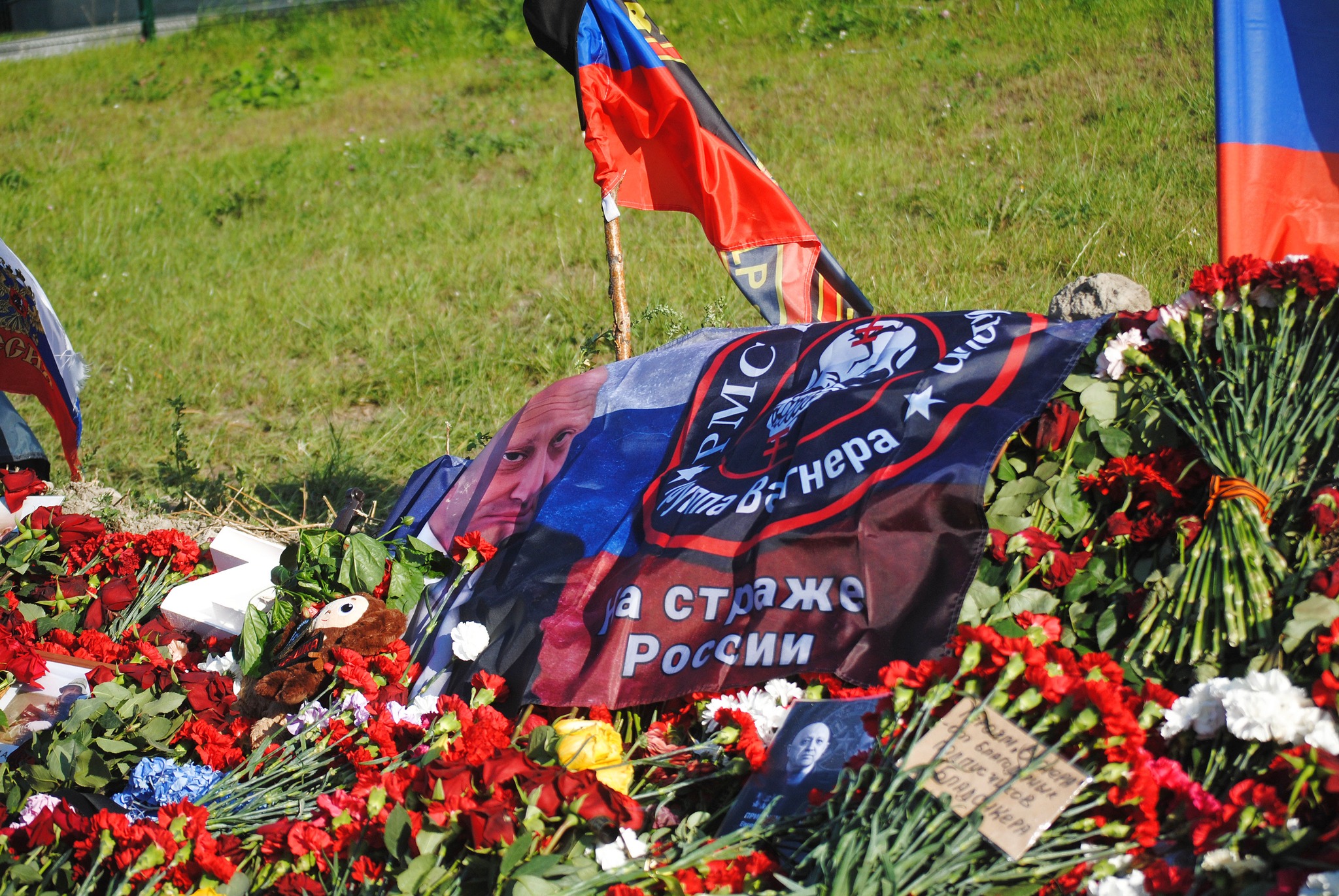
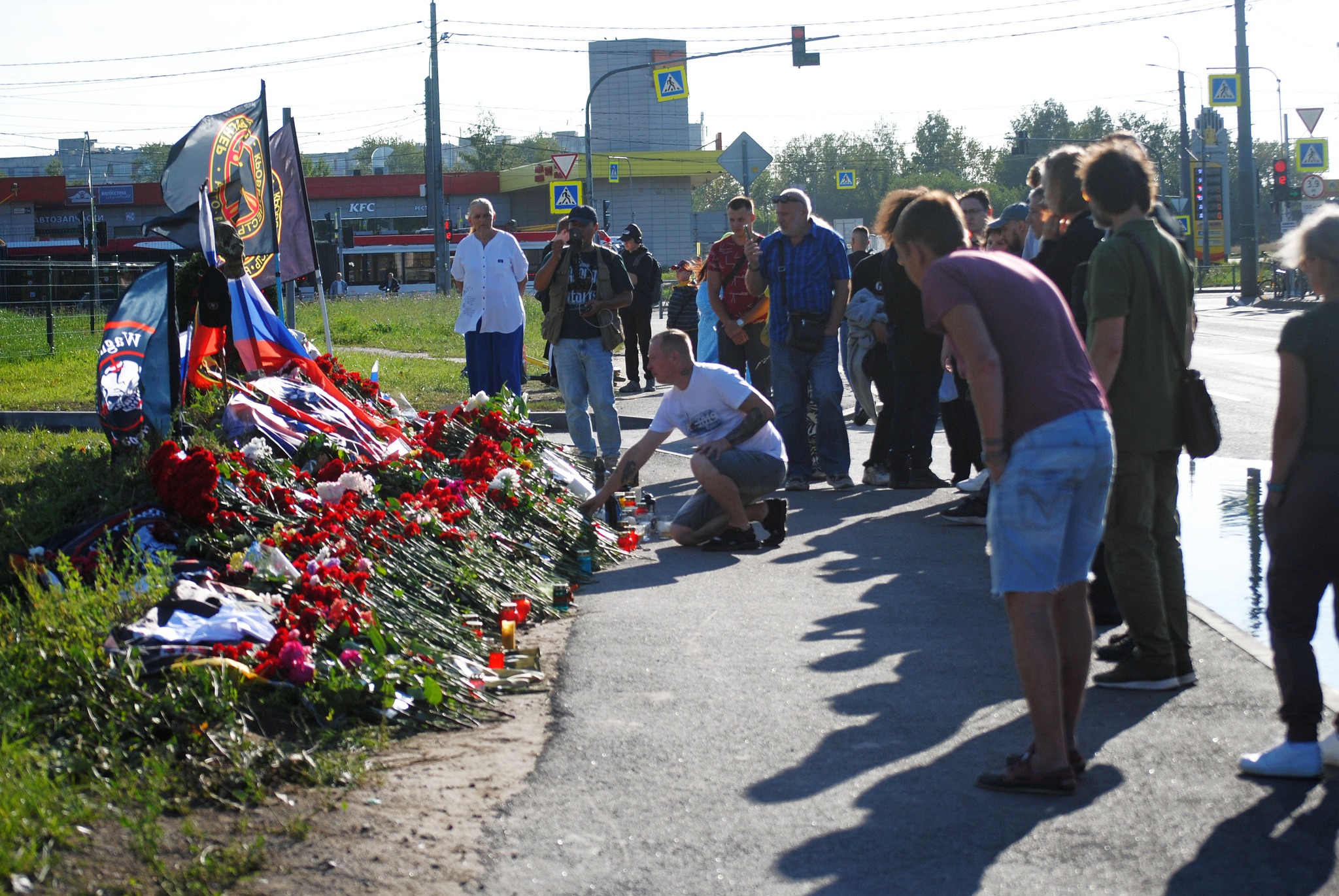
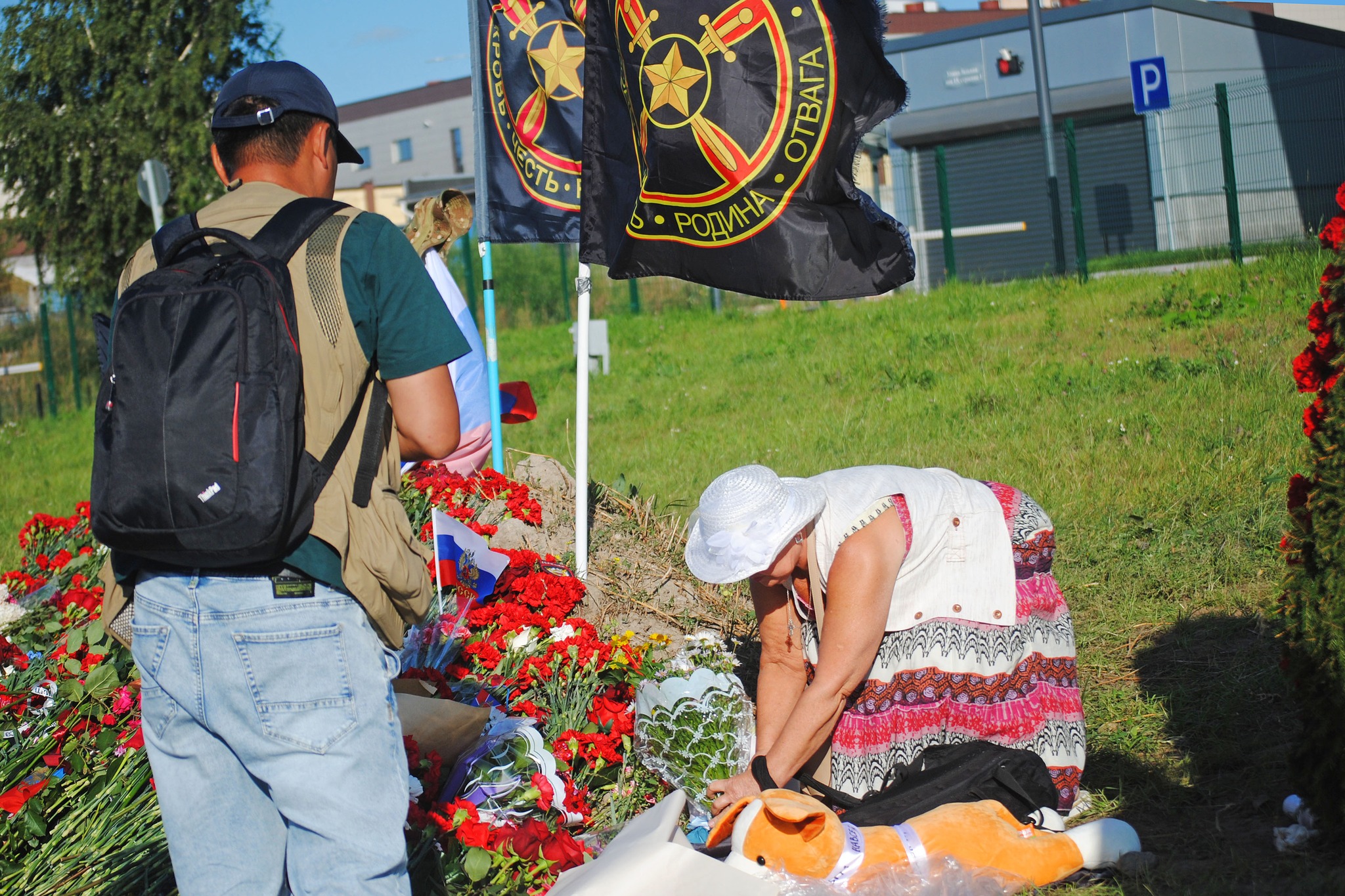
I went to see the spontaneous memorial to Prigozhin on Zolnaya [“Ashes”] Street [near the former (?) Wagner Center office building in St. Petersburg]. I have to say that what I saw impressed me. People kept coming and coming—young dudes and girls, men who were slightly older, and some people even had their kids with them. They brought flowers. They stood and looked for a long while. Some got down on their knees, and this one young dude crossed himself and genuflected. A Chinese guy was videotaping the whole scene and talking in Chinese, but it troubled no one. That’s him sporting a rucksack and filming point-blank the woman in the hat who is putting what looks like a whole bush of roses in a vase.

Source: Marina Varchenko (Facebook), 26 August 2023. Translated by the Russian Reader


Hello, dear Moscow Times readers! This is your weekly newsletter, and we’re kicking off with the (near-certain) death of Yevgeny Prigozhin, the man dubbed Vladimir Putin’s “chef.”

However, Prigozhin gained notoriety not for his culinary talents, but for his business ventures. He set up several enterprises that were extremely vital to the Russian authorities. The most well known were the private military company Wagner and the “troll factory” in Olgino, a suburb of Petersburg, which was used as a tool for influencing the information space in the Russian Federation and the world.

Trolls are fantastic creatures, and they vanished of their own accord, you might say, but apparently it was Vladimir Putin who put the kibosh on Wagner. The rowdy band of freewheeling mercenaries, who took their orders from god knows whom, has come to end.

We should recall, of course, that Prigozhin took a long time admitting that Wagner and the Olgino trolls worked for him. He acknowledged this obvious fact only in the midst of the war, and this was the first step toward the mutiny of 23 June and his (near-certain) death on 23 August. The public owner of an effective resource can either use it or give it up. Prigozhin didn’t feel like giving Wagner away—that is, transferring it to the command of the Defense Ministry (and take an oath, as Vladimir Putin has now ordered)—and so the strange mutiny that had such supremely serious political consequences happened, and, later, the Embraer jet plane crashed in the Tver Region. (It was the first time this type of plane had an accident involving fatalities.)

We interviewed people in the know about the moods among Russia’s elites to find out how they were taking the “chef’s” demise. We went further, though, asking several people who kept a close eye on Prigozhin’s rise and (alas, literal) fall to explain the meaning of the story that has unfolded before our eyes.

The first explanation comes from an observer in civil society who claims that the plane crash was caused by underlings going farther than they had been ordered to go. In fact, this observer argues, Putin did not want Prigozhin dead. Without his trolls and without Wagner, which had ceased to operate in the RF and had begun to be transferred to Defense Ministry-controlled outfits in Africa, Prigozhin was no threat to Putin. However, there were people (in the GRU, most likely) who believed that Putin would be pleased if they brought him the mutineer’s head on a plate.

The risks are the same as in the case of the late [Boris] Nemtsov [assassinated near the Kremlin in 2015]. After his untimely death, Prigozhin’s significance as a symbolic figure could increase and thus serve as a consolidating factor. We cannot rule out the possibility that Prigozhin’s memory will lead to the creation of something bigger than what emerged around the man during his lifetime.

The second explanation comes from an observer in the defense sector, who argues that we’re seeing a repeat not of Nemtsov’s murder, but of the death of Polish president Lech Kaczyński in 2010. (The official Polish Tu-154 plane carrying him and other Polish officials crashed while attempting to land in Smolensk, Russia. Many Poles believe that the plane was brought down by a bomb planted onboard by the Russian secret services.)

The hit squad didn’t go too far. On the contrary, [Prigozhin’s plane crash] was a carefully planned operation that was brought off nearly flawlessly. Although we can claim that such things don’t get done without Putin’s consent, there is no way to prove it.

The third explanation comes from a political spin doctor and frequent guest on YouTube channels. He wonders why everyone has decided that the passenger manifest and the presence of his personal effects [at the crash site] is sufficient to prove that Prigozhin was killed. We cannot rule out the possibility that Prigozhin and Putin made a deal and that Yevgeny Viktorovich will be the Kremlin’s secret weapon. I’m joking on this point, of course. But Russian realities are such that a man dies he shakes off all the bad stuff that happened in his life, and people focus on his admirable qualities. Look at Stalin: his bloodthirstiness and lack of principle have been forgotten, and no one remembers the terrible mistakes he made while running the country. He’s a winner, a victor. Stalin and Prigozhin cannot be compared, but nor can we deny that Prigozhin has been the most auspicious commander in the Ukraine war.

The fourth explanation comes from an opinion journalist and writer who asks us to the recall the Russian fairytale about the vixen and the thrush. The vixen terrorizes the thrush by threatening to kill its fledglings. First the vixen asks the thrush to give it something to drink, and then it asks the thrush to feed it, so the thrush helps it to steal food and beer. (The analogy here with the “chef” is obvious.) The sated and drunken predator then orders the thrush to make it laugh, and so the thrush alights on the heads of two peasants, father and son, who cripple (and even kill) each other whilst trying to beat the thrush. (Thus recalling the Olgino trolls and their work on the US elections, for example.) After the vixen has laughed its fill, it says to the thrush, Now scare me! The thrush raises a mutiny against the fox—oh, sorry, it gets hunting dogs to attack the vixen. Depending on which version of the fairytale you find, the vixen either gets killed or escapes the attack, but it is genuinely frightened.

Vladimir Putin wanted to have an alternative both to his own generals and to the supremely dangerous Kadyrovites. He came to count on Prigozhin to carry out sensitive missions both in Africa and the RF, but failed to take into account the man’s ambitions and got carried away. When Putin was faced with Prigozhin as an actual threat, he had to defend himself in earnest.

Source: Moscow Times Russian Service, weekly email newsletter, 27 August 2023. Translated by the Russian Reader


Russian Media Monitor, “Propagandist blames US, Ukraine and NATO for Prigozhin’s crash,” 24 August 2023
Thanks to Monique Camarra (EuroFile) for the heads-up)

Mykola Honchar lives in a crumbling stone house in what is left of a tiny hamlet of eastern Ukraine. The town was attacked by Russian forces in June of last year, as the Wagner mercenary forces were spearheading a renewed offensive.

Even before the Kremlin set Wagner loose to wreak havoc in Ukraine, the Russian campaign was notable for its brutality. But from the moment Wagner forces entered the war in April 2022, they earned a special reputation for bloodlust from civilians and soldiers alike.

To Mr. Honchar, the death this week of Wagner’s leader, Yevgeny V. Prigozhin, responsible for so much carnage in the war, would be fitting — a violent end to a violent life.

“He has blood on his hands,” said Mr. Honchar, 58. “If there is a god, god will figure out what to do with him.”

Even in a war in which civilians were shot dead in the Kyiv suburb of Bucha, and the town of Mariupol was bombed into oblivion, Wagner and Mr. Prigozhin cultivated an image of brutality.

A video was promoted across Wagner-affiliated social media of the execution of one of Mr. Prigozhin’s own soldiers with a sledgehammer after he was captured and then released by the Ukrainians in a prisoner swap. While in custody, the prisoner had taped an interview saying he did not believe in Russia’s war.

“A dog receives a dog’s death,” Mr. Prigozhin said in the video.

By the time Ukraine regained Mr. Honchar’s village of Bohorodychne, Mr. Honchar was one of only two people left living in the village, once home to around 800 people.

The other person was Nina Honchar, his 92-year-old mother. He had stayed there despite the danger to take care of her. She died earlier this month.

He does not know if Wagner fighters were among the occupiers. “I did not ask for their documents,” he said. But he recalls seeing Russian fighters, who appeared to be on drugs, wandering around town in their underwear, their bodies covered with prison tattoos.

Wagner amplified its force by recruiting prisoners. After Wagner left the battlefield in June of this year, the Russian military continued the use of convicts as part of newly formed “Storm Z” units along the most dangerous front line positions.

To Mr. Honchar, it hardly matters under what banner the soldiers fought. The legacy of Wagner and Russian forces, he said, are one and the same: death, destruction and ruin.

“My brother and his wife were torn apart by shells,” Mr. Honchar said. Before he could bury them, he had to collect their body parts. “There was no skull, his hands were scattered,” he said of his brother.

Once he collected what he could find, he wanted to bury them in the local cemetery but it was under constant attack and too dangerous. He laid their remains in a trench and covered them with dirt.

When his 80-year-old neighbor died, he buried her in the crater of the shell that killed her.

Looming over the village is the Church of the Holy Mother of God, ‘Joy of All Who Sorrow.’ With its sky blue walls visible for miles around and majestic golden domes, it was once a draw for tourists and pilgrims.

Now its walls are blasted apart, one dome has tumbled to the ground and the gold leafing blasted away from another.

[…]

Source: Marc Santora, “In a Gutted Village, No Tears For Prigozhin,” New York Times, 27 August 2023, p. 9