
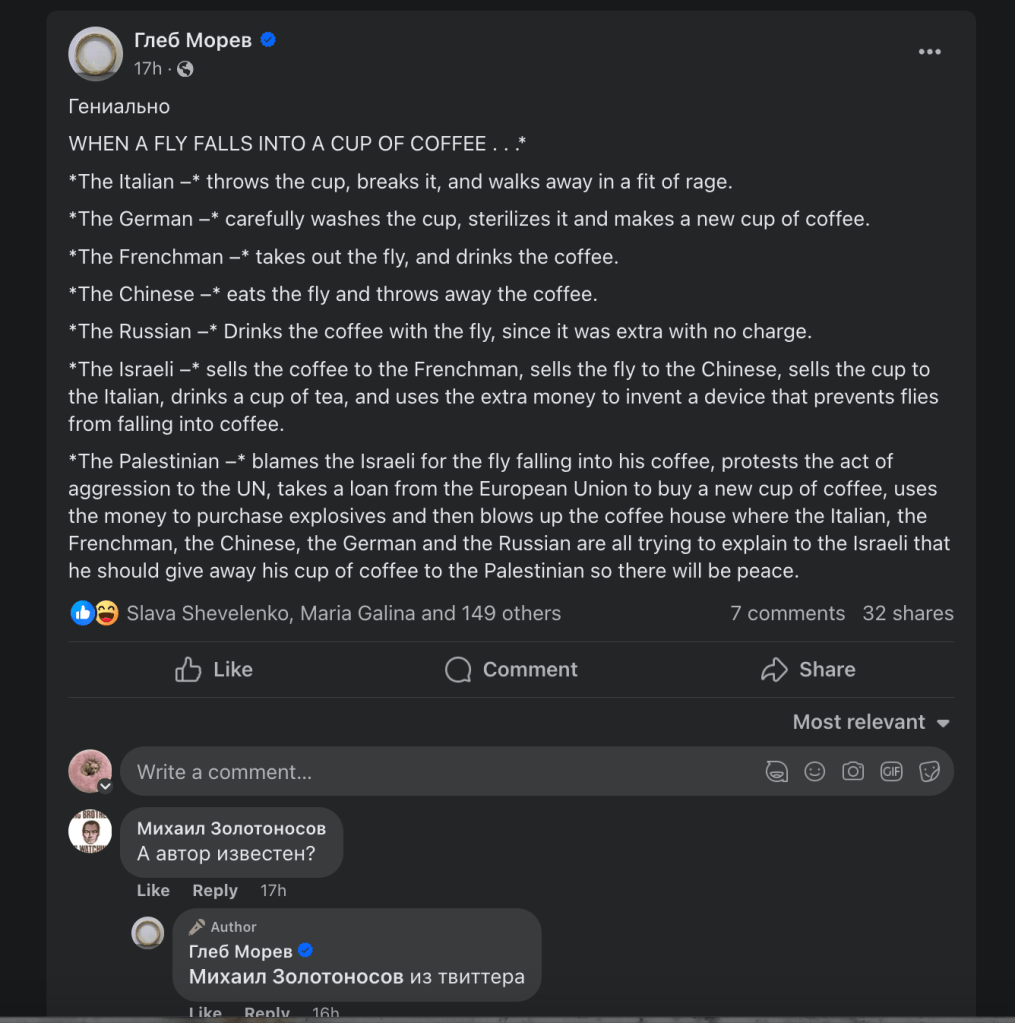
Born in 1968.
1992 — Graduated from the Faculty of Philology of the University of Tartu.
Specialist in the history of Russian literature of the XX century. He was the editor of Session (1998), the chief editor of the New Russian Book magazines (1999–2002) and Critical Mass (2002–2007), the editor-in-chief of the OpenSpace.ru section (2008–2012). Since 2012 — Chief Editor of the Literature Department of the Colta.ru website. Member of the literary academy of the Big Book Award, College of nominees of the Joseph Brodsky Memorial Scholarship Fund. Since 2016 — Chief Editor of the Open University.
Lives in Moscow.
Source: “Gleb Morev,” Open University.
The inescapable truth is that Israel cannot extinguish Palestinian resistance by violence, any more than the Palestinians can win an Algerian-style liberation war: Israeli Jews and Palestinian Arabs are stuck with each other, unless Israel, the far stronger party, drives the Palestinians into exile for good. The only thing that can save the people of Israel and Palestine, and prevent another Nakba – a real possibility, while another Holocaust remains a traumatic hallucination – is a political solution that recognises both as equal citizens, and allows them to live in peace and freedom, whether in a single democratic state, two states, or a federation. So long as this solution is avoided, a continuing degradation, and an even greater catastrophe, are all but guaranteed.
Source: Adam Shatz, “Vengeful Pathologies,” London Review of Books, 2 November 2023
In the spring of 1956, eight years into the Nakba, a group of Palestinian fedayeen crossed the ploughed ditch which was all that separated Gaza from the state of Israel. On one side of the ditch were 300,000 Palestinians, 200,000 of them refugees expelled from the surrounding area; on the other were a handful of new Israeli settlements. The Palestinian fighters attempted to enter the kibbutz of Nahal Oz, killing Roi Rotberg, a security officer. They took his body back with them to Gaza, but returned it after the UN intervened. Moshe Dayan, then Israel’s chief of the general staff, happened to be in the settlement for a wedding and asked to give the eulogy at Rotberg’s funeral the following evening. Speaking of the men who killed Rotberg he asked: ‘Why should we complain of their hatred for us? Eight years they sat in the refugee camps of Gaza, and saw in front of their eyes how we turned the lands and the villages in which they and their forefathers once dwelled into our homeland.’ It was a recognition of what Palestinians had lost that contemporary Israeli politicians can no longer afford to express. But Dayan wasn’t advocating the right of return: he ended his speech by arguing that Israelis had to prepare themselves for a permanent and bitter war, which would have a major role for what Israel called ‘frontier settlements’.
Source: Eyal Weizman, “Exchange Rate,” London Review of Books, 2 November 2023
Israeli leaders, spurred by a furious public, have taken the massacres of 7 October as licence to unleash havoc on the Palestinians. ‘The emphasis is on damage, not precision,’ explained one IDF official. At the time of writing, more than four thousand civilians in Gaza have been reported killed, including entire families wiped out by indiscriminate Israeli air strikes. On 13 October, the Israeli army ordered almost half the population, around 1.1 million people, to evacuate northern Gaza. Most have fled to southern cities such as Khan Younis and Rafah, but these are also under bombardment. Tents have been erected wherever space can be found, evoking memories of the first refugee camps built after the Nakba. The fear is that Israel intends not only to seize large portions of Gaza, but that it will try to force Palestinians into the Sinai desert. Gallant’s promise of a ‘new security reality’ only seemed to confirm this. Egypt has said publicly that it will not accept refugees from Gaza, but the proposal continues to circulate in diplomatic discussions under the pretext of providing a ‘humanitarian corridor’ for Palestinians – as though it were preferable to facilitate population transfer than to ask Israel for a ceasefire.
The violence is not limited to Gaza. In the West Bank, which is under an IDF-imposed lockdown, Israeli settlers and soldiers have killed more than eighty Palestinians in the last fortnight. Families have fled their homes. Moeen Dmeidi, the mayor of Huwara, which was the target of a massive settler attack in February, has spoken of ‘an unbelievable situation of collective punishment’. Palestinian citizens of Israel have been arrested and threatened for expressing their political views, even for ‘liking’ social media posts of verses from the Quran. On 20 October, Israel’s police commissioner, Yaakov Shabtai, ordered a sweeping ban on protests against Operation Iron Swords, saying: ‘Anyone who wants to identify with Gaza is welcome. I will put them on buses that will send them there.’ Politicians and pundits, already emboldened, make genocidal comments with impunity.
Source: Amjad Iraqi, “After the Flood,” London Review of Books, 2 November 2023
The dropping of warning leaflets was not done out of humanitarian concerns: for the British it was strategic, since causing excessive casualties was understood as a source of ongoing resentment and thus further trouble. It isn’t hard to see the parallels with modern military strategy. The same techniques are still, in essence, used by many modern militaries, often in the very same areas where they were originally developed. The continuous bombing of Iraq and the imposition of the no-fly zone between the first and second Gulf wars was a modification of the doctrine, and the leafleting of Iraqi cities such as Fallujah was absolutely in line with it. The ‘war on terror’ saw the return of air patrols and targeted strikes preceded by warnings to the remote valleys of Waziristan, once the redoubt of Mirza Ali Khan. Across the Islamic world, from North Africa to Pakistan, leafleting followed by bombing has been a regular feature of Western policy, the leaflets sometimes serving as a pseudo-legal device to open up free-fire zones where anyone remaining after the warning has expired is considered a legitimate target: their deaths are their own fault.
Source: Francis Gooding, “The Leaflet,” London Review of Books, 2 November 2023
