Today is my 55th birthday, and my friends at United 24 and my fellow ambassador Mark Hamill have prepared a special gift: the chance to help lead Safe Terrain.
This is a new campaign, starting right now, to help save Ukrainian lives during this terrible war by funding robots that can clear mines.
Mines are one of the most insidious killers in this war. Russians have strewn millions of mines on Ukrainian territory. Even in places that Ukraine has deoccupied, such as the parts of Kherson region I visited last summer, sappers and others have to risk their lives to remove these mines. Otherwise the mines will maim and kill civilians years or even decades into the future.
In Kherson I watched sappers move carefully through the fields under the hot sun. And in Kyiv I visited people in a rehabilitation center who had lost limbs.
Here technology can help. Robots can do this work. In Safe Terrain, Mark Hamill and I are enlisting you to help raise $441,000 to fund thirty demining robots. These will clear Ukrainian lands of explosive ordnance, reducing risks for sappers, and allowing people to return to their businesses, their farms, and their lives
I am spending this 55th birthday on my family’s farm. Whenever I am here, I think of the farmers in southern and eastern Ukraine who have to struggle with the aftermath of occupation: all of the mines in their fields. These are fields that, in good times, can feed half a billion people — fields on which hundreds of millions of Asians and Africans as well as tens of millions of Ukrainians depend for their food.
I won’t be asking for any other presents today: if you want to wish me well, please make a contribution today to Safe Terrain. The Safe Terrain fundraiser begins today at 11:00am Eastern on August 18th, right as I am posting this note. Thank you!
A letter from Alexander Chervov, sentenced to seventeen and a half years in prison
Alexander Chervov is a pathologist from Kemerovo. On 4 August 2023, the First Eastern District Military Court in Khabarovsk sentenced Chervov to seventeen and a half years in prison after convicting him on charges of damaging a power line and planning to set fire to a military recruitment office.
We share excerpts from Alexander’s letters, which were sent to us by a subscriber.
‘This episode in my life has actually been brief. Until 24 February 2022, I wasn’t involved in politics, partly because I was lazy, and partly because Moscow’s propaganda worked effectively on me. Just consider my age [42 years old], and you will realize that the period when political views are usually formed overlapped in my case with the beginning of a massive misinformation campaign about the hopelessness of all action and the benefits of a rigid power vertical. I had a worldview that was typical for the Russian Federation until 2019, but the covid epidemic kicked off in the summer of 2019 [sic], and that’s when I saw and felt at my workplace that my responsibility is really mine—it’s not the bosses who decide; and the second thing is how the vertical behaves in emergencies. Without going into details, it has come to the point that the very essence of propaganda is unsuitable for structuring behavior based on conscience, professional pride, and plain common sense. To make myself clearer: if you have crossed paths with Russian medicine, you can understand how it will function if it takes on the additional load of an epidemic, for example, and what the stated outcomes are—for example, (almost) the lowest percentage of mortality among the infected. In short, until it hit me personally, I did not notice obvious problems and obvious discrepancies between stated claims and reality. That’s when the reliability of almost all mass media in the Russian Federation became at least partially clear. I experienced shock (though not in the medical sense). It was not yet enough for me, though, as I still did not get involved in politics. But it was impossible to ignore the onset of open hostilities against a peaceful neighboring country: my conscience kicks into gear in extreme circumstances, and these circumstances were extreme. I don’t know what I was alleged to have done, officially, but I didn’t really commit a terrorist act, while the second part of the accusation was mostly a travesty of justice, although there are some real grounds [to it]. The result was a nearly suicidal antiwar protest. Shit happens. I freaked out. I freaked out to the tune of 17 years’ worth of maximum security, to hear the prosecutor tell it.
[…]
‘As for the news, I wonder what’s really going on, behind the scenes so to speak. There are topics that are actively hyped, that generate buzz, and I know how the [official] news spins them, as there is no other news here [in prison[. So the choice is up to you: [you can write to me] about any hyped topic, only [tell me] the real story, the actual what, where, and how of. But before you write something, I advise that you read the Criminal Code, especially Articles 205 and 280 [which criminalize “public calls for terrorism” and “public calls for extremism,” respectively]. For example, Georgia has now adopted a law on foreign agents, seemingly modeled on the Russian one. But what’s the real story? Who got their hands on Prigozhin’s companies is also interesting, as is how they were divvied up.
‘Subscriptions to newspapers and magazines from the outside won’t work—they’ve already checked that here. You don’t need to send anything: I can receive only one parcel per year, they won’t allow more. I guess that’s it.’
‘I had a court-appointed lawyer. She is practically the only one in Kemerovo in all political cases. In retrospect, I understand that she is needed to keep up appearances. For example, before the trial she didn’t even read the case file, only the indictment, and she got it from me; either she didn’t get a copy herself or she couldn’t open the electronic version. I actually came up with the talking points for her [closing?] argument.’
[…]
‘I’m curious now: what is the real situation with gas supplies from Russia to Europe? Has the percentage of these deliveries actually decreased since 2022, or has it remained the same?’
You can support Alexander by writing him a letter or sending money to his personal account in prison so that he can subscribe to newspapers, among other things.
Address for letters:
Chervov Alexander Yevgenyevich (born 27.02.1982) 11 ul. Dekabristov, T-2 Yeniseysk, Krasnoyarsk Territory 663180 Russian Federation
Source: Solidarity Zone (Facebook), 13 July 2024. Translated by the Russian Reader. Translated by the Russian Reader. People living outside of Russia will find it difficult or impossible to send letters to Russian prisons via F-Pismo, PrisonMail.Online, or regular mail. In many cases, however, you can send letters (which must be written in Russian or translated into Russian) via the free, volunteer-run service RosUznik. Mr. Chervov has not yet appeared on their list of supported addressees, however. You can write to me (avvakum@pm.me) for assistance and advice in sending letters and messages to him and other Russian political prisoners.
Report on Solidarity Zone’s Work: First Half of 2024
The first half of 2024 has passed, and we are reviewing the results of work in that time. We present figures that show the amount of support that we have given to political prisoners.
What did we do?
We successfully completed nine fundraisers for individual prisoners, amounting to €28,540. As a result, we could ensure that defendants had legal support during investigations and at court, and support appeals against conviction lodged by seven prisoners who carried out acts of anti-war resistance.
We supported lawyers who could search for prisoners, make prison visits on an emergency basis, and provide help in cases for which we had not yet organised fundraisers. These were often situations in which there was a real threat that prisoners would be tortured. On this work we spent €7930 of your donations.
We sent foodstuffs and other urgently needed supplies, items of clothing, books and newspapers to 17 prisoners who faced persecution, having been accused of carrying out, or preparing, anti-war actions. On this work we spent €6560 of your donations.
We publicised 20 cases of prisoners to whom we give support of one kind or another, and many other cases of those arrested for undertaking anti-war actions. We wrote more than 400 social media posts.
We spent dozens of hours in telephone calls with lawyers, with prisoners’ families, and with each other, to achieve everything mentioned above.
We took care of our own security and well-being, and did a great deal of other unseen work, without which our activity in support of political prisoners in Russia could not have happened.
We produced hoodies and scarves with original designs, all the proceeds from which go to support the Solidarity Zone collective.
Solidarity Zone is a self-organised, horizontal initiative, and we do not have a regular source of financing. None of this would be possible without the powerful support we received from you! We are very grateful for every single donations, repost and like!
Please support this post with a like, a repost, a comment — so that more people see it. Your comments, too, are a form of support for the Solidarity Zone team.
You can donate to support prisoners in several ways:
To make a donation in USDT via other networks, or in other cryptocurrencies, write to us at solidarity_zone@riseup.net and ask for the necessary details.
You may also subscribe to our Patreon. The money from there goes to support the Solidarity Zone collective.
Independently of whether you are able to give financial support to Solidarity Zone, you can help us by reposting this or circulating information about us in other ways.
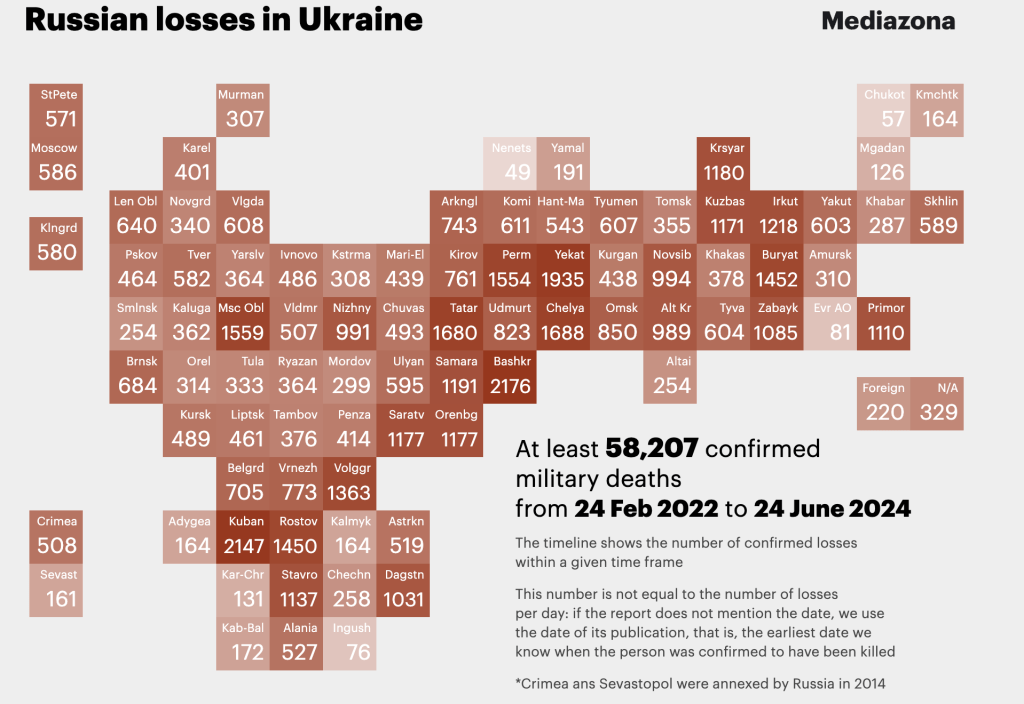
Screenshot of Mediazona infographic, as published here
Russia is losing more and more men in its war against Ukraine.
As of 5 July 2024, Mediazona and its partners in the casualty counting project have ascertained the names of more than 58,000 Russian soldiers killed in action.
The real losses are twice as many, however. Journalists have calculated the actual number of war dead based on information from the probate registry. How they did their work is described in this article by Mediazona. You can read here about how our methodology has been corroborated.
The real losses of the Russian army, including mercenaries, in the war against Ukraine, come to 120,000 dead. The Russian army’s casualties are thus already greater than both the number of US military deaths since the Second World War and all the losses of the Soviet and Russian armies since 1945. Most of the men killed were between the ages of twenty and forty. Those who were younger were usually draftees and prison inmates, while those who were older were “volunteers.”
Seventeen thousand prison inmates recruited by the Wagner Group perished at Bakhmut, according to the mercenary organization’s own documents, as examined by Mediazona. Meanwhile, journalists had estimated that Wagner had lost around sixteen thousand men, which is nearly the same number. Wagner has recruited a total of 48,366 men during the war, meaning that a third of them were killed in the so-called Bakhmut meat grinder.
Prison inmates, “volunteers,” and conscripts, if we judge only by confirmed deaths, have borne the brunt of the losses in the war. At 47.4 percent, they constitute almost half of those who have been killed.
In over two years of war, 3,700 officers of the Russian army and other security forces have been killed, 430 of them in the rank of lieutenant colonel and above.
Between 200 and 250 men are killed every day. This year, the Russian army’s losses have risen dramatically. In 2023, an average of about 120 men were killed every day.
There are two points of view on Russia during the full-scale war. The first is that Russia has turned into a fascist militaristic state in which everyone marches in step and sincerely hates Ukraine. The second is that cynicism and apathy have won the day in Russia: people don’t care about the war as long as it doesn’t affect them personally. Both of these views are mistaken, according to the authors of “We Have to Live Somehow,” a study from the Public Sociology Laboratory (PS Lab).
The researchers traveled to Krasnodar Territory, Buryatia, and the Sverdlovsk Region, living there for a month and interacting closely with the locals. What they tell us does not fit into either of the two common stereotypes about Russians and the war. Here are a few of the tendencies they observed.
The war is invisible in daily urban life. Residents in the Sverdlovsk Region town of Cheryomushkin (whose name was deliberately changed by the researchers) could not recall a single event in support of (or against) the war during the year. In Ulan-Ude, the capital of Buryatia, the pro-war agitprop consisted of a single poster on a Lenin monument. In Krasnodar, pro-war banners still hung on buildings, but people had long ago removed pro-war stickers from their cars. There is no institutional support for the war at the municipal level: such support is the bailiwick of ideological loners and small groups of pro-war volunteers.
Apolitical Russians justify the war, but arguments like “NATO soldiers” and “defending Donbas” are not of primary importance to them. Rather, they simply want to save face themselves, because they take the accusations directed at their country personally. For this reason, Russians have previously been inclined to justify the actions of the state, even when they do not understand or approve them.
The majority of the populace is not opposed to the war. They may disapprove of it in some respects, but they simultaneously defend the state. For example, in the Sverdlovsk Region, women were outraged by the deaths of young soldiers at the front (“They are sending children to fight! Why?!”) while also parroting the propagandists’ arguments about the war against the “collective West” (“Them United States are hammering civilians!”). Non-opponents of the war argue that Russia has been proactive, defending itself rather than attacking (“Now the Luhansk and Donetsk Republics are part of Russia, but our guys aren’t advancing any further—they’re defending all of it”).
Non-opponents of the war regard the residents of Donbas as Ukrainians, not Russians. They scold Ukrainians from the “Donetsk People’s Republic” and the “Luhansk People’s Republic” (“They don’t defend themselves. They’ll be coming here [to Russia], and what, I’ll have to go fight in their place? I don’t want that”) and do not regard these areas as “their own” (“They are not my blood relatives, they are not my own people”).
While opponents and supporters of the war initially had bitter conflicts, solidarity between them has emerged despite their differences of opinion. Those who generally condone the war are increasingly questioning the official version of events, while those who oppose the war are beginning to listen to their opponents (“I have to build a life and continue living with these people”).
Russians try to pretend that the war has not impacted their daily lives in any way, but its signs still permeate their everyday lives and conversations. In the Sverdlovsk Region, a woman is going to “go to great lengths” to prevent her son from serving as a contract serviceman. In Buryatia, a volunteer says mundanely, “I have eight grandchildren, all boys. And it just happened that four more died at the front.” In Krasnodar, a sociologist’s source says he is glad that the city is not being bombed and that the “Wagnerians” did not come their way, but then confesses in a low voice that the future is hazy and “let’s put it this way: things have become a bit tense.”
The big takeaway, however, is that Russians are pushing the war to the back of their minds. And this is bad news for the Kremlin: it has failed to convince the public, over the past two years, that the invasion was launched in pursuit of noble ends. Even as they justify Russia, its citizens don’t understand what good the war does for them personally.
A week ago, a Moscow court sentenced fifteen-year-old Arseny Turbin to five years in prison after convicting him on charges of “involvement in a terrorist organization.” The security forces accused the schoolboy of aiding the Free Russia Legion, which has been officially banned in Russia.
Arseny lived with his mother Irina in the small city of Livny in the Oryol Region. Although he was one of the most successful pupils at the local prep school, he was bullied by his classmates, and yet his teachers did not respond to his complaints. At the war’s outset, Turbin supported the Kremlin’s actions, but later became disillusioned with the government and took an interest in politics, even telephoning [exiled online news channel] TV Rain and telling them that the Conversations about Important Things lessons at school were “utter nonsense.”
In early June 2023, Arseny wrote an email to the Free Russia Legion (an organization we described in detail in a previous newsletter). He wanted to сampaign against the war, but they asked him for too much personal information and he did not send the application form to these strangers. Instead, he started distributing leaflets criticizing the authorities and taking pictures of himself in front of the white-blue-white flag. (The Russian authorities regard this flag as a symbol of the Legion, which has been fighting against Russian forces in Ukraine.)
Meanwhile, a strange thing happened. Turbin made the acquaintance of someone called Maxim, who immediately gave him access to the Telegram channel Occupy Slutophilia 14 (similar names have been used on the Web by the fans of the late Russian neo-Nazi activist Maxim “Tesak” Martsinkevich) and asked him to help with the channel’s content by editing videos. The channel had only a few subscribers, and it featured posts in support of Yevgeny Prigozhin and far-right content revolving around Tesak. Investigators then used Turbin’s involvement in the channel to accuse him of neo-Nazism, despite the fact that the schoolboy’s father was from the UAE, and Turbin himself had been bullied at school due to his dark skin.
At the end of the summer, FSB officers searched the Turbins’ home and summoned Arseny for questioning. It was a very strange conversation: for almost an hour and a half, in different ways, two investigators questioned the schoolboy about his connections with the Free Russia Legion. At the end of the conversation, as Mediazonadiscovered, they assured the teenager that it was “normal” and “not against the law” to send an application to the Legion, which has been declared a “terrorist organization” by the Russian authorities.
The court was not interested in this peculiar circumstance, however. It was interested in Turbin’s statement, allegedly made during the interrogation, that he had sent the application: this was the basis for the charge that he had “joined” the “terrorist organization.” The thing is that Turbin did not say this. Mediazona has in its possession a full transcript of the conversation, and it simply does not contain mention of Turbin’s sending off the application. The investigators inserted it for their own convenience.
Irina Turbina was present at the interrogation. She says that the investigators retyped the statement three times because of mistakes, and suggests that they could have discreetly amended it after lulling her into a false sense of security.
After seeing the transcript, the investigator, Trunov, had even wanted to close the case. In February 2024, however, the investigation was assigned to another investigator, Irina Simonova. She spun the line about Turbin’s alleged neo-Nazi views, obtaining testimony from the boy’s classmates, who assured her that his “idol was the so-called Tesak,” that he had advocated “exterminating the Ukrainians,” and had supported Alexei Navalny. Irina Turbina does not believe this testimony, producing correspondence in which her son called Tesak a “blockhead” and himself a “liberal.” Turbina argues that her son’s classmates testified against him in exchange for “excellent high school diplomas.”
Due to the increased harassment at school, Turbina transferred Arseny to home schooling. He managed to pass his year-nine exams before the verdict was handed down. On 21 June, the court sentenced Arseny to five years in prison, although the prosecution had requested an even longer sentence of eight years. After the sentence was read, he burst into tears, telling his mother, “Mom, I’m sorry—forgive me for letting you down. But I really didn’t know I was violating any laws.”
No one looked for the mysterious Maxim. The court was also uninterested in Turbin’s conversation with the FSB officers who openly provoked the schoolboy and falsified his statement.
PROMPT: Make an illustration on the theme of “Russia’s Fascist Meltdown”
Creating an illustration on the theme “Russia’s Fascist Meltdown” involves capturing the essence of nationalism, authoritarianism, and geopolitical tension. Here’s a description of an illustration:
The illustration features a powerful and imposing figure symbolizing the Kremlin, with a stern-faced leader resembling Vladimir Putin at the forefront. Behind him, the Russian flag waves prominently, but instead of the usual tricolor, it blends with darker hues suggestive of authoritarian control. The background is a stark urban landscape, reminiscent of Moscow’s skyline, but with ominous shadows and smoke rising in the distance.
In the foreground, there are smaller figures representing dissenters and protestors, their faces obscured in shadows or masked to symbolize anonymity and resistance. They hold signs with slogans advocating for freedom and democracy, contrasting sharply with the dominant figure of Putin. The atmosphere is tense, with a palpable sense of division and discord.
To further emphasize the theme of “meltdown,” the illustration includes elements like cracked ice or fire, symbolizing internal turmoil and instability within Russian society. The color palette leans towards shades of red, black, and grey, evoking a sense of danger and crisis.
Overall, the illustration aims to visually convey the complex and contentious dynamics surrounding Russia’s shift towards authoritarian nationalism, capturing both the gravity of the situation and the resilience of those who oppose it.
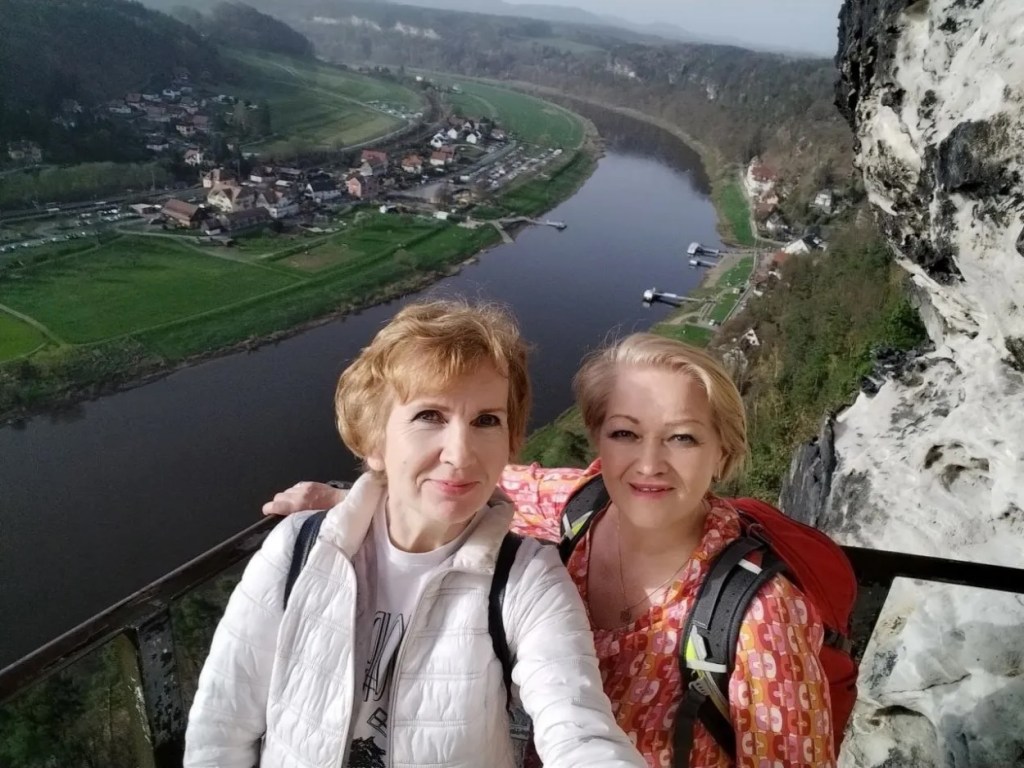
Pensioners Irina Nippolainen and Anna Trusova, friends and residents of the small Karelian town of Segezha, fled Russia in the spring of 2023 after the FSB came to search their homes. Anna and Irina were forced to make a long trek to Azerbaijan via Belarus before making their way to Germany, where they now have residence permits and social housing, and where they hope to find work. Meanwhile, back in their home country their relatives have been summoned for questioning in the criminal investigation against them. Journalists at the website Okno tell the story of the two women, who chose forced emigration over unfreedom.
ESCAPE
On 20 March 2023, 60-year-old Irina and 58-year-old Anna said goodbye after taken a stroll and went home. A few minutes later, Irina called Anna and told her that the FSB had come to see her. Anna rushed to her house after Irina’s call.
“As soon as I rang Irina’s doorbell, I immediately turned on the video on my phone to put the squeeze on them: Who the hell are you guys? The FSB guys saw that I was filming on my phone and immediately called someone, saying, ‘She’s here, come over.’ Anyway, it transpired that they had come for both of us.”
During the search, the FSB officers confiscated their phones and computers from the two pensioners. The search warrant stated that the searches were part of a criminal investigation into “public calls to engage in activity threatening state security.” Anna and Irina guessed that the case had been triggered by a denunciation. They both had written many posts on their VKontakte pages about their opposition to war, and in response had received a “barrage of hatred” from those who had read the posts.
“It was stressful. I lost eight kilograms during that time: I was so worried, I didn’t eat, and I didn’t know what would happen. I knew that people in Russia are sent to pretrial detention centers at any age even for sneezing at the authorities, and I did not know what exactly the law enforcers would find in the devices they confiscated and how they would interpret what they found. As soon as we were searched, my children immediately got involved in the problem, checking out everything they could: internet sites, their acquaintances, and then their acquaintances who had left the country. They decided how we should proceed—where and how to get asylum or other options. After analyzing everything, they decided that a humanitarian visa was the best option. We had to decide where to go, where to stay, and what to take with us,” says Irina.
They considered fleeing to two countries—Finland and Germany—but decided on the latter because it was easier to get a visa there.
But first Irina and Anna went to St. Petersburg, because they had to get papers for Anna’s dog Ramona. They stayed with an acquaintance of Anna’s, but the woman was very afraid that she would be “prosecuted for her connection” with the fugitive opposition activists, so they had to move out.
Irina, Ramona, and Anna
“Our children, who were assisting us, gave us the contact information for a man who did not know us at all but who wrote, ‘Come and stay as long as you want’. He helped us out and fed us, and we spent all that time while we were taking care of business at his house,” they explain.
Anna and Irina stayed in St. Petersburg for a week before departing for Azerbaijan.
They did not travel to Baku directly. For security reasons, they got themselves new cell phones, discussed the route, decided not to buy plane tickets in Russia, but to do it in Belarus, and went to Belarus by cab, paying 20,000 rubles [approx. 200 euros] for the fare.
“We took everything into account because we didn’t know how quickly they would come for us. In fact, we were very surprised that they didn’t nab us right away. We also chose Belarus because the dog was with us, and we felt bad about putting her in the luggage hold. Belavia is one of the few airlines that allow passengers to transport small animals in a carrier on a seat in the passenger cabin,” says Irina.
Irina and Anna flying from Minsk to Baku
After taking a cab to Minsk, they immediately went to the airport, bought tickets, and flew to Azerbaijan at night. In Baku, Irina and Anna initially settled in a small hotel.
“I was in such a state that my hair stood on end. For Anna, it was like an adventure, but for me it was like a misfortune, because I had left my home, my husband, and my pets. I didn’t want to leave my home or my country. That’s why I was very anxious. I even reached out to a psychologist from an aid organization, but she didn’t help me much,” Irina says.
Anna’s mood was a little different.
“I’m generally a traveler, but I hadn’t been able to travel lately. First there was the pandemic, then this whole thing happened. Not that I was freaking out about it, of course; I was freaking out for other reasons. But when it happened, I put three bathing suits in my suitcase—Ira makes fun of me—and went to the airport. I assumed I might have difficulties in Russia due to my intemperate tongue: I supposed that I would have to leave. I have a daughter in the Czech Republic, but the Czech Republic has a very bad attitude towards Russians, and they wouldn’t give me a visa. I thought that I would go to India, it’s quiet and peaceful there. My suitcase was initially packed with summer clothes. Of course, I was a bit nervous about the dangers. But basically, I always try to stay positive and hope for the best,” says Anna.
Anna, Ramona and Irina on the beach in Baku
Irina and Anna ultimately stayed in Baku for four months. They submitted the paperwork for humanitarian visas to Germany quite quickly, and had been approved by early June. But due to the local and the German bureaucracies they had to wait a long time for their papers. During this time, the pensioners already had their own circle of contacts—their landlady, their neighbors, and other refugees from Russia.
“And while there was uncertainty as to whether we would be granted a visa or not, we were already considering Azerbaijan as a place to live, because we could have lived there on our pensions. We had already found some channels for cashing money there, because our bank cards didn’t work there anyway. But still, we didn’t consider ourselves safe there,” Irina explains.
“GOD, HOW DID YOU BEAR IT ALL?”
In July, all their papers were in hand, so Irina and Anna began packing for Germany. They decided to make their way to Georgia first, since it was cheaper to fly to Germany from Tbilisi than from Baku. They went to Georgio by bus, stayed in Tbilisi for a couple of days before flying to Germany.
“When we arrived in Germany, I was already on VKontakte recounting all our adventures. And people wrote, “God, how did you bear it all?” Because there were a lot of hard moments. Personally, I was constantly stressed out, but it had become a way of life, you know. Anya is fine, she’s easygoing, but I can’t improvise when it comes to serious matters, I have to prepare and think things over. If I hadn’t followed all those rules, maybe we could have flown to Germany more easily, who knows. I’m a thorough person, I don’t want to lose money and end up stranded at the airport not knowing what to do. That is, I was preparing, I was checking out all the chat rooms and websites, seeing what papers we needed to get and where to go. There was a lot of preparation just for the dog. Without the dog, we would have done it all ten times easier, if not more. Because in different countries there are particular papers and certain vaccinations you have to have, and the airlines have certain requirements for the carrier. Ramona is a basically a ‘homeowner’—she had three portable houses,” Irina says.
“The atmosphere is cool”
“For the first time in her life, probably, when leaving Baku, Irina took sedatives because the dog in its carrier had to be placed in the trunk of the bus. And I was so worked up that even I took them too,” Anna remarks.
Anna and Irina flew to Frankfurt, where they were met by a friend of Irina’s who had lived in Germany for a long time. They had to get to their initial placement site, the town of Suhl in Thuringia, which is a three-hour drive from Frankfurt.
“But when we arrived there, we were told that pets were not permitted. Ukrainians used to bring pets there with them, but since now there are few Ukrainians in this camp and mostly Muslims, who have a bad attitude to dogs and are afraid of them, it is prohibited. So we urgently began looking for help on the chat rooms. A Ukrainian family agreed to take Ramona in for a while. They lived right next to the camp, and so we would go to their house to walk the dog. But then this young woman found out she had allergies, so Ana’s daughter quickly came from the Czech Republic and took Ramona away,” Irina explains.
A room in a German dormitory for refugees
The refugee camp where the pensioners were initially placed was a complex of five buildings, mostly inhabited by people from Arab countries.
“It was a bit scary to live in such an unfamiliar environment, given that the doors to the room in which we were put were unlocked. The police even came once because of a conflict in the building. We also had our passports taken from us and there was a risk that we would be processed in a different status—as refugees, even though we had ‘humanitarian visa’ stamped on our papers. We wrote everywhere, because they said that if we were registered as refugees, we could change this status only through the courts, and the courts could take years. That was scary. I said that we could not even return to Russia without a passport. Basically, it was a massive problem. I’d only recently been released, and I had put on two or three kilograms, because one thing or another was causing stress, but there was no getting around it,” Irina recounts.
Everything worked out well, ultimately. After a week, they were moved to the town of Greiz, a two-hour drive from Suhl. There they were allocated a social apartment, started to receive an allowance, were insured, and were issued social security numbers. By October, Anna and Irina had received residence permits for three years. During all this time, however, the pensioners had to confront the famous German bureaucracy more than once.
“They have an algorithm, as it were. But the human factor often gets in the way. People who work in this system, they do not know all the laws, or often they do things just to check off the boxes. But our case was quite peculiar for them: we are Russian pensioners, we have humanitarian visas, and they probably have a million other refugees here. Things were difficult, but when you look back, you think, What was there to worry about?” said Anna and Irina.
After the paperwork was completed, the friends moved again, but not far—to the city of Gera, thirty kilometers from Greiz. Each of them found rented accommodation there, which is paid for by the municipality. The apartments there are rented empty, with no furniture or appliances.
“When we moved from one place to another, they stopped paying us in the old place, but here they hadn’t started paying us yet, and it took two months to process the registration. So for two months we were without money or furniture,” Irina explains.
Since she had not yet been discharged from social housing, they could still live there together legally for some time and work on furnishing their new homes.
“The Ukrainians who live here have set up a help chat room and chat rooms for selling different things. I bought a bed and a chest of drawers from Ukrainians. I got some things for free. Germans often sell things they don’t need for very cheap. For example, I bought a complete kitchen set for only 100 euros, which is practically nothing. Now I’m looking for a bigger refrigerator,” Irina says.
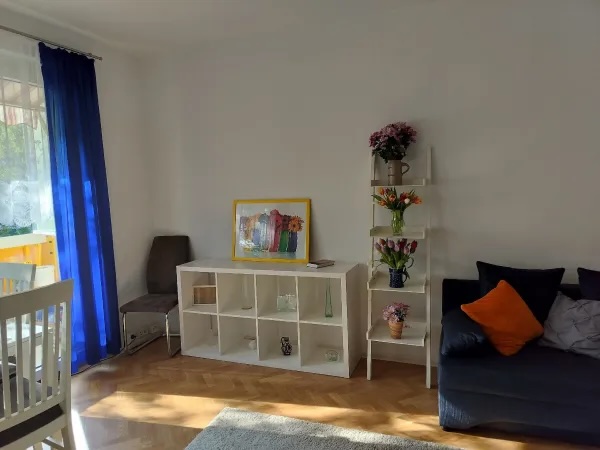
Irina’s apartment after she furnished it
Anna, on the other hand, found an app similar to the Russian website Avito, where used furniture was sold, and bought almost everything she needed at wholesale prices.
“The only thing I was left without was a kitchen. I didn’t have a stove, but I got a microwave, and I could survive with a microwave. I bought a kettle. And that’s how I lived for the first few months,” she said.
The pensioners were at pains to point out that no one refused to help them. People who had also immigrated to Germany, some twenty years earlier and others two years earlier, offered them bedding, dishes, and household supplies. When Irina and Anna had settled in, they passed some of these things on to a family from Ukraine.
Expiring products are given to immigrants for next to nothing
People who have been granted humanitarian visas in Germany can choose not to work and live on benefits. But they can try to find a job if they want. Before they retired, Anna was involved in marketing cosmetics, while Irina helped animals. After ten years at the official municipal animal shelter, she ran a mini-shelter for five dogs, one of which she ultimately adopted. Finding a job in Germany is still difficult for them.
“We don’t speak German, so the opportunities to find work are few and far between for the time being. I am registered at the job center, while Irina is now registered with the Sozialamt, and she can live on her pension in peace, but I will only go on 31 July to test the level of my German. God willing, I will test out at A1, since I almost got A’s in German back in school. After taking this test, I do not know when I will be able to take German-language classes. Many emigrants take these courses two or three times. Then again, I’m old, so things don’t stick in my head nowadays. Of course, I would like somehow to learn the language faster and integrate faster,” Anna says, laughing.
Irina says that she has not been assigned to an integration course, so for the time being she is also living without knowledge of the German language and therefore jobless. While she was still living in Greiz, she worked a two-hour trial day as a seamstress in a local factory . Irina liked it very much. When she moved to Gera, she also wrote to one of the factories there, but was told that German was required. Getting a job is likewise important to Irina because she wants to invite her husband, who stayed behind Russia, to join her in Germany, which is impossible to do if she is unemployed. Irina’s husband would also need to know German, but how and where he can learn it and pass the test for the simplest level is still unclear. Irina herself attends German language courses, but they are run by volunteers and thus unofficial.
Anna and Irina say that even without jobs they have enough to do—they have traveled all over the area.
“We have been traveling a lot since day one. While we didn’t have papers, we used to walk, and then we got the chance to buy transit passes that enable us to travel by rail, buses, trams, and subways,” says Irina, who has also been to travel to Finland to visit her children, and to Stockholm and Copenhagen to meet friends.
Anna has bought a sewing machine and begun sewing.
“I used to do needlework, but in recent years things had not been coming together. Now I have started knitting curtains, and I will start weaving; I want to do a lot of things. I knitted myself a sweater. I bought brushes and paints and started drawing a bit, but have given it up for the time being. Mostly, I want to walk more. We are from Karelia and have a tradition of walking as the first thing one needs to do. And I had a dog then. Here I bought a bicycle as soon as I got the furniture: I jumped on the bike and went riding. You have to see everything around you. It takes a lot of time to see everything, to photograph it, to edit it, to upload it to the internet. So there is not enough time,” she explains.
By the way, both pensioners are each on their third VKontakte page: their previous pages had been blocked by the Russian authorities.
“DID THEY WRITE ABOUT BUCHA?”
Karelian law enforcement never forgot Irina and Anna.
In April 2024, it transpired that a criminal case had been opened against the two émigrés on charges of disseminating “fake news” about the Russian army. They found out about it because Irina’s husband was summoned to testify, for some reason, in the criminal investigation against Anna. Only when he met with the investigator, it transpired that Irina was also being prosecuted on the same charge. The husband refused to answer the investigator’s questions, invoking Article 51 of the Constitution (which permits an individual not to testify against themself or their spouse). Anna’s sister was then summoned for questioning in the same investigation. A little later, it transpired that both Anna and Irina had been put on the federal wanted list. And shortly before this interview, a person unknoiwn, who introduced himself as a policeman, wrote to Anna via WhatsApp and asked her where she was.
How many criminal “fake news” cases have been launched in Russia
In March 2022, after invading Ukraine, Russia adopted laws that criminalized disseminating “fake news” about the Russian army and “discrediting:” its actions. As of February 2024, 402 such cases had been brought. Dozens of Russians have been sentenced to lengthy prison terms for allegedly violating the law. According to human rights activists, this is tantamount to military censorship.
It is still unknown why the criminal case was launched. The relatives were asked during questioning what Irina and Anna had written on their first VKontakte pages. They made a special point of asking, “Did they write about Bucha?”
“It’s no fun feeling like a criminal. Although we all know what it means now in this [sic] country. In short, the crackdown continues: you are on the right side, and they are on the wrong side. They have to do something: there’s probably no one left in Karelia to sink their claws into anymore, but they need fulfill quotas. It’s a crackdown for its own sake. I feared for my relatives, because way back in 1938 there were so-called enemies of the people, and children, wives, and husbands of enemies of the people. I’m afraid lest it come to this,” Irina says.
The human rights activists consulted by Anna and Irina have advised them not to return to Russia before the regime changes, otherwise they will be sentenced to hard time in prison.
“FOR THREE DAYS I BAWLED LIKE A BELUGA”
Both émigrés follow the news from Russia closely. They argue that the country is “hurtling into an abyss.”
“What is happening is simply absurd. It feels like the country exists in a kind of distorted reality in which good is evil, and black is white. They are engaged in such insanity, frankly, and you don’t understand how it is possible to support all of this. And then there are the people who have gone crazy on a nationwide scale and who think everything is fine there, that it’s the way it should be. I worked at a polling place for many years and I used to say all the time that when we socialize only with our own kind, we don’t see what the rest of the people are like, but I saw all kinds of people at the polling station. I know that might sound kind of arrogant, but I saw how massively ignorant people were. I’ve always been skeptical of the claim that the Soviet Union had the best education system. I don’t know how it was the best if it didn’t teach people to think, and if people blindly trust the authorities. The authorities are king and god to them, as this whole situation has shown. Basically, you get the feeling that all people have come down with insanity, and some are immune. The analogy with Hitler’s Germany immediately comes to mind, where the people were fooled in the same way, gulled by propaganda. Maybe there is still hope that if the regime changes and they tell folks on TV how it really was, then…. We are now like spectators looking at Russia from the outside, and it’s scary to watch what is happening there,” Irina says.
When asked how they reacted to the news of politician Alexei Navalny’s death, Anna is unable to reply. She immediately starts crying.
“That’s how we reacted,” Irina explains, crying too.
“It’s good that my daughter was here that day: we went to Munich with her. I spent the whole day with them. But in the evening they went to a concert, and I got on the Munich chat rooms and found out that there would be a rally on Freedom Square and went there,” says Anna.
Alexei Navalny’s Death
The news of Alexei Navalny’s death came on 16 February 2024. He had been serving a nineteen-year sentence for “extremism,” after being convicted on seven criminal charges, including “creating an extremist community.” During his imprisonment, he was sent to a punishment cell twenty-seven times, spending almost 300 days there. After the politician’s death, pickets to mourn his passing were held in Russian cities, and the picketers were detained by the police en masse. The authorities refused to hand over his body to his relatives for a long time, demanding that they bury him in secret. Navalny’s associates argue that he was murdered and blame President Vladimir Putin for his death.
“I bawled like a beluga for three days. I still can’t even look at the photos of him calmly,” Irina adds.
“In the past, Ira, you used to say, ‘Navalny will be released and I’ll go home,'” her friend remarks.
Irina doesn’t make any predictions now that she has emigrated.
“I don’t make any predictions and I don’t listen to them. My motto now is: do what must be done and what will be will be. And I would also add: do what you have to do and what you are able to do. What matters most is saving yourself and your loved ones. We don’t know how long this will last. Analyzing things even as they stand now, I can confidently say that nothing good is going to happen…. Well, how should I put it? Nothing good is going to happen quickly. But I’m not ruling out either possibility: that I’ll stay here, or that I’ll go back there. I’ll go home as soon as I can. If nothing changes there, I’ll stay here.”
Anna, however, says that she has almost no one left in Russia: her daughter emigrated to the Czech Republic back in 2016, and she hardly communicates with her relatives who stayed behind in Russia.
“I will be better off here anyway. As long as they don’t kick me out, I’ll stay here,” she adds.
The pensioners nevertheless try to keep involved in Russian politics. They traveled to Leipzig to sign a petition supporting Boris Nadezhdin’s presidential candidacy and then to Berlin to vote in the presidential election.
Irina signing a petition in support of Boris Nadezhdin’s presidential bid
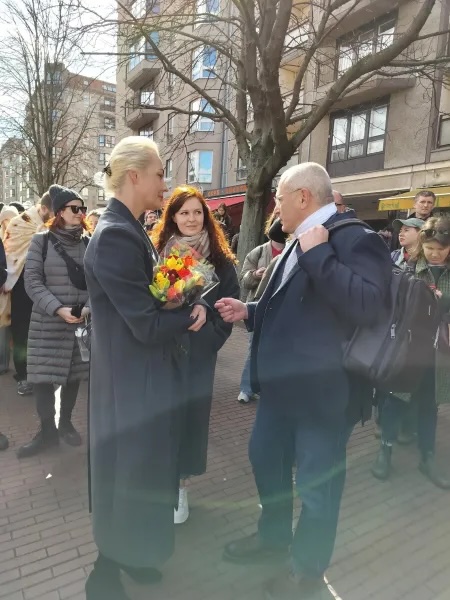
“There was such a huge queue. Because we were afraid of missing the train, we cut the queue a bit. A lot of people could not vote because, I think, only two polling stations were open in Germany—in Berlin and in Bonn. There were a lot of people who wanted to vote. We stood in line there with Yulia Navalnaya. And I talked to Mikhail Khodorkovsky, and we had our pictures taken with Ekaterina Schulmann. There were so many celebrities, and the queue itself was very cool. There were a lot of young people, all chanting “Russia without Putin.” But there were also a few pro-Putin people who have lived in Germany for twenty years and go vote for Putin, and we trolled them a little bit. But this is life, this is reality,” says Irina.
Irina Navalnaya, Kira Yarmysh, and Mikhail Khodorkovsky
What do Anna and Irina dream of?
“Grandchildren!” Anna answers immediately. “And first of all, of course, that the war end!”
“The first thing I wish for is that the war end. And the second is for me to go home,” says Irina.
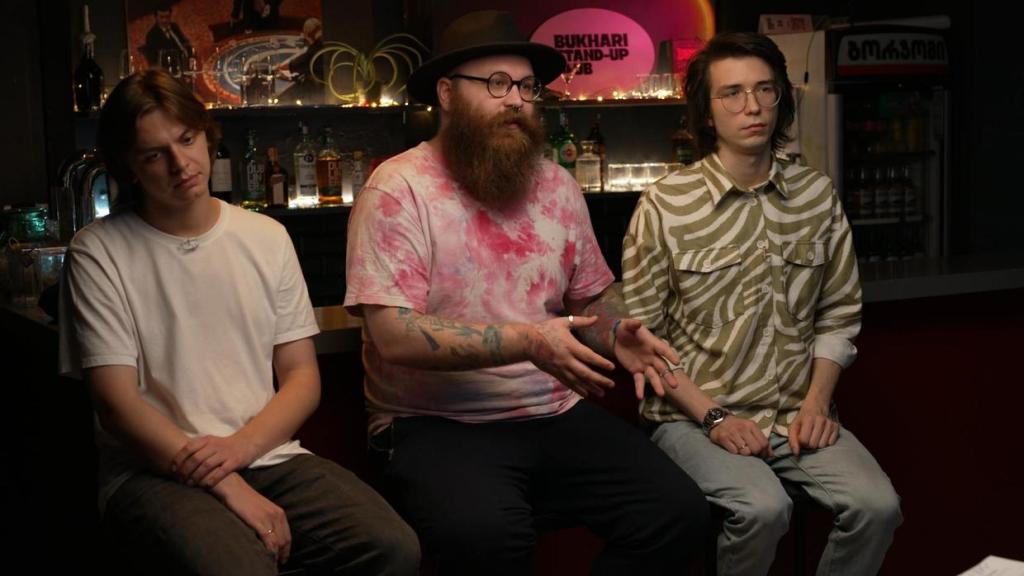
Ana Tavadze and Dachi Imedadze, members of Georgia’s Shame Movement. Photo: 60 MINUTES
Ana Tavadze: We’re going in with a government that’s completely corrupt, a government that’s pro-Russian, clearly anti-Western, clearly does not really care about what the majority of the population wants and needs.
Ana Tavadze and Dachi Imedadze are members of the Shame Movement – a group with thousands of young followers working towards Georgia’s entry into the European Union.
Ana Tavadze: If Russia wins, it means loss of freedom, loss of everything that we fought for in the past 30 years basically. It’s a fight for values, it’s a fight for where you want to stand in this big fight for democracy.
Dachi Imedadze: As soon as the West in any form, be it the U.S. partnership, be it the European Union, is not represented in this country, Russia will fill the void right away.
They say the influx of Russians is already changing the face of Georgia.
Ana Tavadze: What are they doing, if we look at it? They’re buying apartments. They’re buying private property. They are opening up businesses. Their actions changed — Georgian economy.
Dachi Imedadze: The Russians are buying apartments here in every 33 minutes. They’re purchasing a piece of land in every 27 minutes. And they’re registering a business in every 26 minutes. So, I think we are on the brink of very dangerous situation here in Georgia.
According to public records, Russians have registered more than 20,000 businesses in Georgia over the last two years. And launched five new Russian-only schools, none of which are licensed by Georgia’s department of education.
Russians have driven rent up nearly 130%, prices for everything from food to cars have gone up 7%. over 100,000 Georgians have left the country because many of them can’t afford to live here anymore.
Sharyn Alfonsi: I’ve heard this described as a quiet invasion.
Dachi Imedadze: Quiet invasion, yeah. There is a risk of the economic diversions. There is a risk of military intervention. And there’s a risk of — Georgia’s statehood being destroyed.
Emmanuil Lisnif, George Smorgulenko and Pavel Bakhadov don’t look like much of a threat.
All Russians in their twenties, they fled their country for fear of being drafted or imprisoned for speaking out against Putin.
George Smorgulenko, Emmanuil Lisnif and Pavel Bakhadov are all Russians living in Georgia. Photo: 60 MINUTES
They now live in Georgia and work at this Russian-owned comedy club in Tbilisi.
Emmanuil Lisnif: I try and said ‘I’m against the war in Russia. I was beaten. and after that going to prison three times.’
Sharyn Alfonsi: So three times you went to jail?
Emmanuil Lisnif: Yes, yes three times.
Pavel Bakhadov: I believe and I know that Russians actually against the war.
Sharyn Alfonsi: You think that most Russians are against the war?
Emmanuil Lisnif: Yeah, just scared, really scared.
Sharyn Alfonsi: Have any of you had any aggression towards you because you’re Russian?
Pavel Bakhadov: Actually I have a big writing on the wall. It’s the biggest thing I see from my window, just big ‘Russians go home.’
There is no subtlety in spray paint… anti-Russian graffiti blankets the city along with support for Ukraine.
This text is based on interviews I did as part of the Hidden Opinions public opinion polling project, which I launched in 2022 and continued in 2023 and 2024. I spoke with dissenting Russians — with those who oppose the current regime and its military actions against Ukraine, both those who have stayed in Russia and those who have left the country. My youngest respondent at the time of the [first] survey was sixteen years old, while the oldest was seventy-two years old. These people hail from a wide range of professions and walks of life, but what they have in common is their categorical opposition to the actions of the Russian authorities. In just two years, I have interviewed 154 people for this project, some of whom I have spoken with two or three times.
In 2022, all of my respondents — both those who had left the country and those who stayed — espoused anti-war views and expressed a negative attitude toward the Kremlin’s policies. However, in 2023, about a year and a half after the war’s outbreak, a group amongst my sources in Russia emerged. Small at first, but constantly growing, it consisted of people who had changed their negative attitudes toward the war and/or the government.
This does not mean that such changes are impossible among those Russians who have left the country. Amidst a full-scale war, research based on representative samples is hampered by the fact that the most accessible respondents are those who have agreed to be interviewed as a result of self-selection. This is a significant limitation to the project.
My research is qualitative, not quantitative, meaning that it would be wrong to speak of a particular percentage of anti-war Russians who have become pro-war. I think it is important to study and understand how views are transformed and what triggers them to change. It is the subject of this text.
***
The sociologist and philosopher Zygmunt Bauman, experimenting with means of gauging the conservatism–to–radicalism spectrum, asked his students to do the following exercise. They were shown twenty drawings, the first one depicting a dog, the last one depicting a cat; in between, the dog gradually shed its canine features and turned into the cat. It was vital that the researcher record the moment when the test subjects had doubts about what exactly was depicted in the picture, when they realized that the dog had mutated irreversibly. In a sense, I have been doing something similar, trying to record the moment at which anti-war or anti-Putin views have been transformed into pro-war or pro-government views.
I have observed that such a change in views depends on a number of extrinsic factors, and the more such factors that are combined, the more likely it is that the person’s stance will change. In addition, a great deal is determined by an individual’s (psychological, social, etc.) resources. Finally, inconsistent views play an important role in transformation and adaptation. In recent years, sociologists have increasingly noted that people often pursue mutually exclusive goals simultaneously without noticing the contradictions in their own behavior.
New rationalizations, disillusionment and loneliness
The gradual realization that the war is a long-term affair, combined with Alexei Navalny’s sudden death in a penal colony, has had a considerable impact on those resisting the regime within Russia. One can swim against the current, but it requires a considerable amount of strength, something not everyone possesses. It is difficult to be amongst the minority for years on end, to conceal one’s views and live in fear of being reported to the authorities. Respondents have thus begun reformatting [sic] their attitude to reality, explaining events in a new light and providing new rationalizations.
Failing to receive the expected support from the outside world or the possibility of a dignified workaround, some of my respondents eventually chose non-resistance to the regime, which in some cases has transmogrified into full-fledged loyalty.
“I don’t want to go to prison, I don’t want to play the rebel. I just want to live. If they send me to listen to ‘Exorcist TV,’ I’ll go without question. If they tell me to go to a [pro-war] concert, I’ll go. I’m not trying to convince anyone of anything anymore. I’m tired. I can only accept it and live the life I have.”
This stance is not directly bound up with support for the war or the regime. Rather, it indicates fatigue and the lack of strength to resist. If the circumstances shift in a direction more in keeping with their own values, these people will gladly slough off the “burden of adaptation.”
It is worth noting that, over the last year, many of my respondents have stopped following the news and focused on their daily lives. There are respondents who, despite the troubling times, have decided to have children. This is also a way of disconnecting from current events.
Another important factor influencing the change of respondents’ views is the narrowing of their circles of trust. Fearing denunciation, dissenters avoid making new contacts. Afraid of being alone and unwilling to live in fear, uncertainty and/or exile, they then join the majority.
The distance between Russians who have left Russia and those who have stayed in Russia has grown greater with every passing year. In 2022–2023, when I asked my respondents about opposition members who had left Russia, they most often would say nothing or would limit themselves to brief remarks along the lines of “We still watch them on YouTube, but they have less and less sense of what’s happening at home.”
Expressions of resentment and frustration have become more frequent in my interviews in 2024. My sources have said that the opposition often engages in wishful thinking and plays fast and loose with the facts, and that the west does not always act logically and decently.
Consequently, previously opposition-minded people have chosen to abandon painful and exhausting self-reflection in favor of loyalty to the regime. This helps them to get on with their lives, normalizing both the war and the political crackdowns. As one respondent put it, “Since the opposition and the west cannot be trusted, we will make friends with Putin. He is an ogre, but he is our own ogre.”
“Western countries seem to be doing everything to help Putin’s propaganda machine. I was quite surprised when I heard Angela Merkel say that all our negotiations were just a smokescreen: we wanted to let Ukraine catch its breath, and the negotiations were just a deception. That is, the leader of one of the largest countries in Europe openly says: a) we can’t be trusted in any negotiations, and b) we have conspired to deceive you. […] Putin’s propaganda machine skillfully makes use of this. But the point is not that the propaganda machine is using it, it’s that it is reality. As a normal person, a question occurs to me: if they treat us this way, [then] we are their enemies. After such statements, the ‘west’ is regarded as the enemy of Russians, and, accordingly, their enemy — Putin — is our friend.”
Those respondents who have changed their views on the war emphasize that when the west blocked their bank cards and accounts, when they heard what Ukrainians (including their relatives and friends) were saying about Russians and how they called for killing them, they decided that the current regime, whatever it was like, was less hostile to them on balance.
Tired of guilt, shame, disappointment and indignation, they have essentially chosen peace by joining the majority and accepting the existing rules: don’t discuss politics, don’t speak out publicly, swear to the values that the government declares. This choice seems reasonable to them in a situation in which no political activism is possible anyway, and the political crackdown machine is only picking up steam.
This strategy ensured material well-being and career success for some of my respondents. For example, some mid-level specialists in the IT sector received good positions and salaries, while for other people the involvement of their relatives in the war has been a means of social mobility and a source of access to material goods. Still others have benefited from the war by arranging parallel imports, etc.
Another factor contributing to the shift in sentiment from anti-Putin to pro-government has been the radicalization and polarization of society.
“A sharp delineation between ‘black and white’ leads to the opposite outcome. Any attempts to express doubts about the actions of the Ukrainian or western side are automatically regarded both inside and outside [Russia] as pro-Putin behavior, the outcome of brainwashing, etc. The other side appears infallible and beyond criticism.
“If you criticize the west’s actions in any way, you are automatically pigeonholed as a ‘Putinist.’ It makes me feel like saying: if that’s how you treat me, well, to hell with you, chalk me up as a Putin supporter.”
The state of rejection and isolation provokes protests amongst some people: since the west condemns them for staying in Russia, they “will go the full mile and become real orcs.”
The mechanisms by which feelings of rejection are transformed into collective pride have been described by researchers and are not unique to Russia. These feelings reinforce nationalist sentiments and contribute to the strengthening of authoritarian regimes.
Emotional dilemma
Speaking about the change in their views from anti-war to pro-war, my respondents noted that in one way or another they were surrounded by people who had suffered in the war: classmates or school friends who had been drafted to the front or had volunteered for combat, their children, colleagues, and mere acquaintances. Telling them straight to their face that their sacrifices were in vain had become both emotionally more difficult and more dangerous. To maintain relationships and friendships, my sources generally had to listen in silence to their acquaintances’ stories about what they had experienced and seen at the front. And if they were people who mattered to them, it was impossible not to sympathize with them.
We should understand that Russians who initially opposed the war and the regime but remained in Russia feel definitely closer to those who went to the front or delivered humanitarian aid there than to those who have left the country. They are “in the same boat” as their relatives, friends, and colleagues. They feel compassion for them.
“When we were teenagers, all sorts of things happened. If the guys were caught [by the authorities], I would perjure myself and lie in all sorts of ways. Later I could tell them what I actually thought of them, but I wouldn’t abandon them. That’s not the way that blokes do things. Now I realize with my head that they are wrong a hundred times over, but they are my boys, I am on their side. And even if I am against the war, I cannot be against them.”
Propaganda equates anti-war sentiment with betrayal, and it paints people who espouse such views as accomplices of Russia’s enemies, who want to kill as many Russians as possible. This causes a very heavy feeling, my respondents note.
Meanwhile, the state softens such emotional blows by offering loyal citizens new benefits and additional material and social goods, free concerts, and beautiful and comfortable urban environments, demonstrating concern for people in general and for those returning from war in particular. “People-centeredness” has become the buzzword in the PR strategies of many employers and officials throughout Russia.
Russians who are concerned about their neighbors also respond to calls for help front-line soldiers, because amidst war and external isolation it is these people with whom, they say, they “share a common plight.” One of my respondents, overwhelmed by such sentimental feelings, volunteered for the army.
As a religious man, he hoped he would not face the need to kill others, but would be able to help “his boys” without bearing arms, because he “could not stand on the sidelines any longer.” If the need to kill arose, he would desert, my source had decided, explaining that he was emotionally prepared to be beaten up and go to prison.
Another type of people whom I have encountered more and more often are those whom researchers Maria Lipman and Michael Kimmage have characterized as anti-anti-war: these people do not necessarily support the war, but they strongly condemn or resent “unpatriotic” fellow citizens who do not support the Russian army or who even take the side of Ukraine.
Seeing soldiers returning from the front and watching the growing number of Russians killed in combat, my sources now often place the blame not on Putin or the Russian military, but on their compatriots who oppose continuing the war until Russia achieves total victory.
Ressentiment and the “demons” of propaganda
Propaganda has awakened ressentiment in some of my respondents. They have come to believe that this war is really about maintaining Russia’s status as a great power, which its enemies are trying to flout and rob. Such people believe it vital that Russia maintain its status as a victor, and they accept the state-imposed version of Russian history that asserts Russia’s greatness in all periods.
War, as happens under autocracies and dictatorships, is seen as the ultimate manifestation of the nation’s strength and vitality and a guarantee that its culture and traditions will be maintained. In conversations with me, my sources have repeatedly used the phrase “releasing demons,” referring to the fact that the current situation helps their acquaintances and themselves experience a sense of unity and superiority over the rest of the world, a sense of their own righteousness and chosenness.
Some respondents noted that the official rhetoric, concrete and catchy, seemed more acceptable to them than the verbose arguments and meaningless self-reflections of the opposition.
Meanwhile, according to my respondents, the number of anti-war-minded Russians today is decreasing. Since Navalny’s death, I have often heard in interviews that every second or third person in the orbit of my sources has changed their views.
It is difficult to say how strong this trend really is. I would estimate that a third of those who unequivocally opposed the war and the regime when I spoke to them [initially] have changed their views, but of course these numbers are in need of supplemental verification, which is not easy to accomplish today. There are probably also people who have switched their pro-war patriotic views to oppositional ones, but I assume that we hear the voices of these people even less frequently.
Respondents who are in a state of uncertainty and/or in the course of switching their views feel the need for support, at least informational support. They need arguments explaining that anti-war sentiments are not a betrayal and that the current war is destroying Russia, not restoring its greatness. But they also acknowledge that such an argument would hardly convince them under the current circumstances. For now, the only thing they think they can do is to maintain their sanity and adapt to reality in order to live to see better days.
***
The Russian regime has proven to be “smarter” and more adaptive than Russian opposition activists and western democracies thought, but this does not mean there is no point or possibility of supporting by any means possible those who have remained in Russia and are still resisting the regime or straddling the fence. One way or another, positive change in Russia is impossible without their involvement.
UK General Election 2024: help Ukraine win (Ukraine Solidarity Campaign, 31 May)
Upcoming solidarity events:
Tuesday 11 June, 7.0pm: Discussion meeting: “From Ukraine to Palestine, occupation is a crime” – Tuesday 11 June, 7.00 pm. Marchmont Community Centre, 62 Marchmont Street, London WC1N 1AB, and on line. Register to attend on eventbrite here or register to participate on line here. Organised by the Ukraine Information Group.
This bulletin is put together by labour movement activists in solidarity with Ukrainian resistance. Please subscribe and tell friends. If people email us at 2022ukrainesolidarity@gmail.com, we’ll send them the bulletin direct every Monday. More information at https://ukraine-solidarity.org/. We are also on twitter, Facebook and Substack, and the bulletin is stored on line here. To stop the bulletin, reply with the word “STOP” in the subject field.
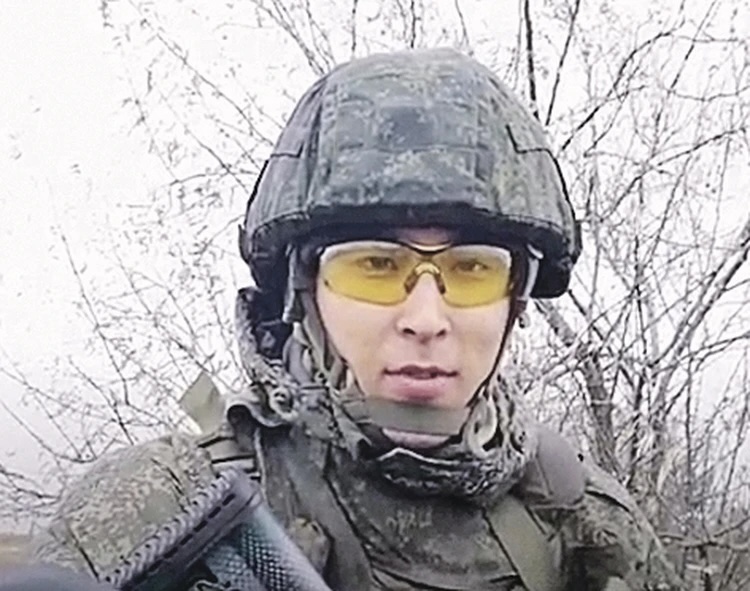
Aydyn Zhamidulov. Photo: Russian Defense Ministry via Kommersant
Kommersant has learned that a military court has begun hearing the criminal case against Senior Lieutenant Aydyn Zhamidulov, a platoon commander in the Airborne Troops, and his subordinate, Private Alexei Dorozhkin. The Russian Investigative Committee alleges that the men kidnapped a young woman who had threatened the officer that she would tell his wife about their relationship and took her to their unit’s temporary deployment point as a Ukrainian spy. There, they stabbed the victim to death and blew up her body in an attempt to conceal their crime. Zhamidulov gained renown for writing patriotic poems during his combat training and was shown reciting them on Telegram channels.
The criminal case against Senior Lieutenant Zhamidulov and Private Dorozhkin was submitted to the Southern District Military Court, sitting in Rostov-on-Don. The men are accused of the kidnapping and brutal murder of a resident of the Luhansk People’s Republic per articles 126.1, 105.2, 30.3, 33.4, and 244.2 of the Russian Criminal Code.
In the file of the case, as investigated by military investigation units at the Russian Investigative Committee, it is reported that Zhamidulov is twenty-eight years old, a native of Kazakhstan, and lived in the Pskov Region. He has a higher education, is married, and was raising two daughters.
In January 2022, Zhamidulov signed a contract with the Defense Ministry and, in the rank of senior lieutenant, served as commander of a parachute platoon in an airborne assault regiment of the famous 76th Airborne Division.
In late 2022, a video was widely circulated in social networks and the media in which Lieutenant Zhamidulov recited a poem of his own about the those involved in the special military operation. At the end of the recital, the officer stated that his family was proud of him and was waiting for him to come home.
Dorozhkin was mobilized on 1 January 2023. Ranked as a private, he served as a senior scout in the Airborne Troops.
According to investigators, at about eight p.m. on 13 January 2023, Zhamidulov and other military men, including Dorozhkin, were drinking hard alcoholic beverages at the Rainbow Cafe in Luhansk. About half an hour later, local resident Valentina Davronova, with whom Zhamidulov had previously been in an intimate relationship, entered the cafe.
A row broke out between the senior lieutenant and the twenty-three-year-old woman. Fearing that Ms. Davronova would report their relationship to his wife, Zhamidulov decided to deal with the young woman, the case file says. He told his subordinates that he would take Ms. Davronova to her current boyfriend.
The young woman was put in the back of a KamAZ truck, and when the truck arrived at the unit, Zhamidulov tied her hands with duct tape. Dorozhkin, who went with them, was ordered by the senior lieutenant to tape Valentina’s eyes, which he did.
To avoid questions from his subordinates and make his actions look legitimate, the investigators note, Zhamidulov told them that Ms. Davronova had served in the Ukrainian army from 2018 to 2021 and had tattoos featuring Ukrainian symbols on her body. He also alleged that she was engaged in intelligence on behalf of the Ukrainian armed forces.
The young woman was taken to a soldier’s bathhouse, where Zhamidulov stabbed her about two dozen times in different parts of her body. At that time, the commander of a reconnaissance platoon combat vehicle, Sergeant Roman Pleshcheyev, entered the bathhouse (his case will be tried separately). Zhamidulov ordered him to finish off the victim. Not wanting to kill her, but fearing negative consequences on the part of the senior lieutenant, Plescheyev stabbed Ms. Davronova with his knife in the area of her left shoulder and right leg.
At 12:20 a.m., Dorozhkin entered the bathhouse, and Zhamidulov instructed him to finish what he had started. Pleshcheyev left the room and Dorozhkin killed the victim by stabbing her in the area of her heart.
Having made sure that the young woman was dead, Zhamidulov ordered his subordinates to take the body outside the temporary deployment point and detonate it with three F-1 grenades so that the deceased could not be identified and the cause of her death could not be determined.
Nevertheless, the crime was solved literally while the trail was still hot. All three defendants were detained and then remanded in custday by a military court.
The case is now in preliminary hearings, and is expected to be considered on the merits this summer. Zhamidulov’s lawyer Natalia Kokhan refused to comment on the case without vetting her answers with her client.
Aydyn Zhamidulov was mobilized from the Orenburg Region. As a civilian he worked as a welder, but now he serves in an Airborne Troops reconnaissance unit. He has a wife, two daughters, and his parents waiting for him at home.
“I was retrained in my specialty. In the short period of mobilization combat training, everything — camouflage, identifying the enemy, working with topographic maps, artillery fire — is very easy to learn,” Zhamidulov said.
All of the things he saw and his interactions with his fellow soldiers inspired Aydyn to write poems. They are plain but honest and poignant, straight from the heart.
Always our ancestors fought evil. They wrote history with blood, with the pen. They weren’t afraid to go all the way. They removed shackles, they united hearts. Now, our brothers, it’s our turn To defend our country, our home, and our people. To do justice, to open their eyes. The enemy is in deep, like a needle under the skin. Let us strike down the puppeteers, the servants of evil, Who pull the strings Of bewildered people, Of gray-haired mothers shedding tears For them, the lives of people are just a game. We must put a stop to this once and for all!
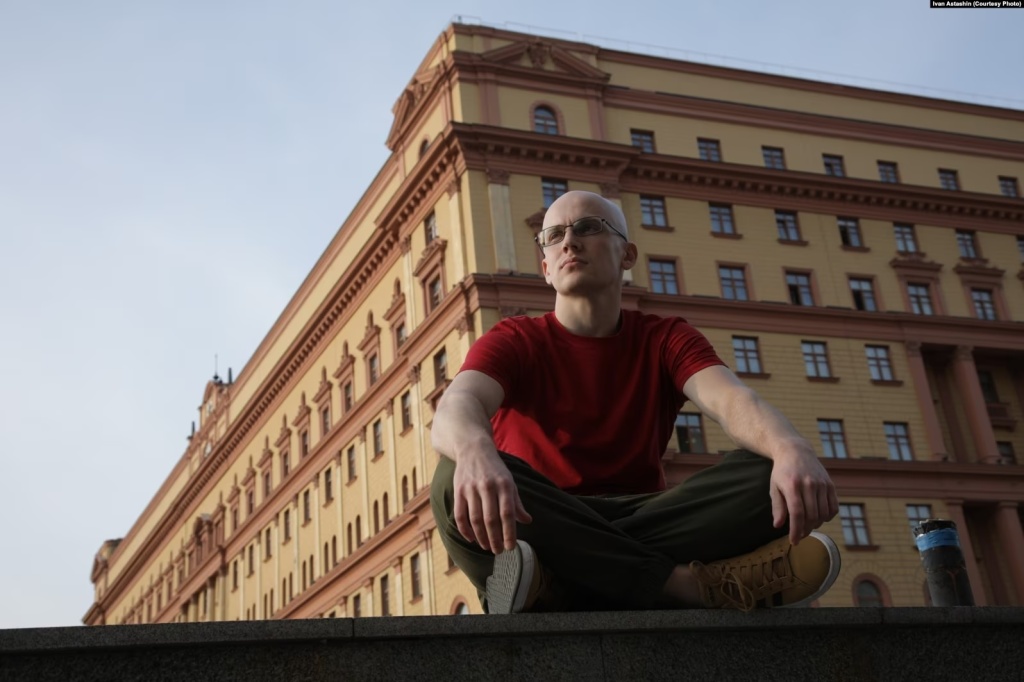
Muscovite Ivan Astashin knows firsthand what human rights activism, Russian prisons, and terrorism and arson charges look like. As a young man, he was close to Eduard Limonov’s National Bolsheviks and was arrested as part of the high-profile Autonomous Combat Terrorist Organization (ABTO) case, in which a group of young men were charged with a series of arson and terrorist attacks.
At the turn of the 2000s and 2010s, this story was widely discussed in the media, sparking debates over whether the arson attacks were justified. Astashin was convicted of torching an FSB district office in 2012 and spent over nine years behind bars.
Upon his release, Astashin worked for Andrei Babushkin’s Committee for Civil Rights and was involved in defending the rights of prison inmates. In February 2022, Astashin joined the protests against the invasion of Ukraine and was soon forced to leave Russia.
Astashin is now involved in the campaign Solidarity Zone, which aids Russians who have been arrested for radical anti-war protests.
How did the “Solidarity Zone” come into being?
When full-scale war broke out, large protests took place in many Russian cities, and criminal charges were filed against protesters, both charges of “violence against police officers,” which have been routine at protest rallies (police officers themselves use violence, but they don’t pay for it), and charges that were newish for Russia.
There was Anastasia Levashova, who threw a Molotov cocktail at police officers. There was the case against Anton Zhuchkov and Vladimir Sergeyev: they were detained near Pushkin Square in Moscow on 6 March 2022 on their way to an anti-war rally. A Molotov cocktail was found in Sergeyev’s backpack. The police did not know what they guys were planning, so they were able to accomplish part of what they’d planned. Zhuchkov and Sergeyev had planned to commit suicide publicly at an anti-war rally as a sign of protest—they were so desperate. As they were being detained, they took lethal doses of methadone. The police failed to notice this. They put them in a paddy wagon and beat them up there, but on the way to the station the police realized that their detainees were quite sick and took them to hospital. They were saved in the intensive care unit at the Sklifosovsky Institute.
Zhuchkov and Sergeyev were sent from the intensive care unit to a pretrial detention center after being charged with “attempted disorderly conduct.” According to police investigators, the men had been planning to set fire to empty paddy wagons. When detained, Sergeyev said that they “wanted to torch a couple of paddy wagons,” emphasizing that it was empty vehicles they had intended to target. At first, we wanted to find out the address where we could write to Zhuchkov and Sergeyev at the pretrial detention center, so we asked OVD Info, but we also learned that OVD Info would not defend them, as theirs was not a peaceful protest.
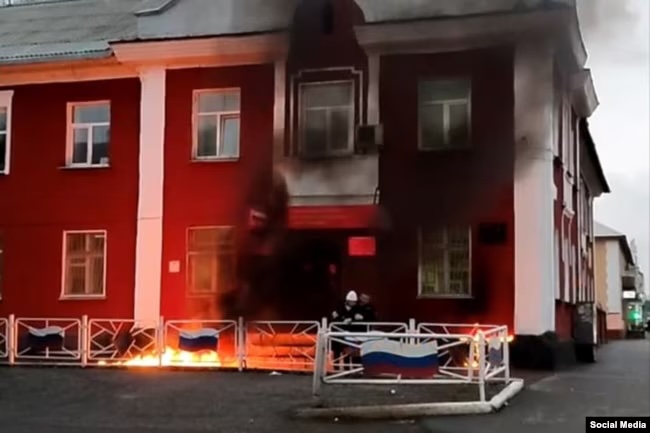
We realized that none of the existing human rights organizations was willing to take on such cases. We decided to take on Zhuchkov and Sergeyev’s case: we published the address to which people could send them letters and found them a lawyer. A little later, the authorities started charging people with arson attacks on military recruitment centers, and so we decided that we should also aid such people. By September 2022, we had launched Solidarity Zone’s social media accounts and expanded our work.
Do I understand correctly that the attitude of OVD Info, Memorial, and other human rights organizations to people engaging in “non-peaceful” anti-war protests has changed? Have their motives become clearer to these human rights organizations?
Yes, their attitude has changed. As I see it, it changed after the military mobilization, when people began setting fire to military recruitment offices en masse in protest. Now it is easier to get announcements of fundraisers for such detainees reposted. But the position of human rights organizations has remained the same.
We had a public discussion with Sergei Davidis, head of Memorial’s Support for Political Prisoners project. He said these people should certainly be supported, that in most cases they have been wrongfully charged with violating Article 205 of the Russian Criminal Code (“terrorism”), but that whereas the criminal code articles on “discrediting” the army and “disseminating fake news” about the army clearly contradict Russian law and international conventions, and people charged with violating these laws can be designated political prisoners without a detailed examination of their cases, then with regard to people who attempt to torch military recruitment centers, Memorial examines the cases in detail and is guided by international criteria. They have designated twenty such people political prisoners, but the number of these cases is many times greater.
All human rights organizations have their own focus. OVD Info deals with cases related to peaceful protest; First Department, with high treason cases; and the Net Freedoms Project, with freedom of expression cases. Our cases do not fit these criteria. Before we started, there was no organization which was willing to support such people.
Is your campaign volunteer-driven? How many people are you assisting now? How do you define the people you support?
We support people who have been arrested for anti-war protests, for radical anti-war actions, although nowadays virtually all anti-war protests are radical. We handle cases where people actually set fire to a military recruitment center or a railroad signal relay box, and cases where they were merely planning to do such things.
Or they weren’t even planning to do such things, but the security services have fabricated a case against them, alleging that they were planning to torch a military recruitment center, as happened to Ivan Kudryashov.
We are currently supporting nineteen political prisoners. In almost all cases we pay their defense lawyers and organize fundraisers to this end, and in many cases we are also involved in arranging for parcels and care packages to be sent to the prisoners and replenishing their personal commissary accounts at their detention facilities. We talk publicly about their cases and similar criminal cases. We did a count in September 2023, and at that time there were around three hundred people in Russia facing criminal charges over radical anti-war protests. There was no further info on half of these people: we could not find out whether they were under arrest or wanted by the police.
We try to cover such cases as much as we can because we are a volunteer organization: we don’t get paid or have permanent funding, although we would certainly like to have such things. We raise money for political prisoners through cryptocurrency and PayPal donations. We also do personal ruble-denominated fundraisers to pay lawyers through the platform Zaodno (“In Cahoots”).
In the first quarter of 2024, we spent 900 thousand rubles (approx. 9,100 euros) paying for care packages and one-off visits by defense lawyers. When lawyers defend our prisoners in court, we organize personal fundraisers. Sometimes we hold events in Europe to raise money, and sometimes other campaigns hold events to raise money for us.
Let’s imagine that a programmer in Tver has been arrested for attempting to set fire to a military recruitment center. His relatives are scared: they are unlikely to want to do business with a volunteer campaign based in Europe. How do you reach out to those accused of anti-war protest?
Actually, we are increasingly being approached by relatives of arrestees as we are becoming famous. We are recommended in various chat rooms dealing with support for political prisoners. Often people contact OVD Info, and they suggest contacting us.
Aftermath of an arson attack on a military recruitment center in Kemerovo
We also search for information on detainees ourselves. If you have at least a first name and a surname, you can find the rest of the information in the public domain. But sometimes you cannot find out which thirty-year-old native of Voronezh has been detained. There are such case, unfortunately. Information can be obtained when a person is added to the list of “terrorists and extremists” via court filing. When a person is in the database, the locale of the pretrial detention center where they are held is identified as well. In many cities there is only one pretrial detention center, so we can dispatch a lawyer there to offer assistance to the arrestee and get their take on the case.
Some argue that publicity is not always beneficial to defendants in political criminal cases given the current conditions. Does Solidarity Zone not take this approach?
Our opinion is that publicity is beneficial in most cases. Despite everything, the security services still don’t like their lawlessness to become public. This still entails inspections, which, although they are formal procedures, are still unpleasant for them.
Publicity is a defense against torture and coercion. Also, you cannot raise money to pay a lawyer if there is no publicity. Without publicity, a person will not receive letters from supporters and well-wishers, but letters are very important. Publicity has practically no effect on the sentence nowadays, neither positively nor negatively.
So the lawyer is the prisoner’s link with the outside world? If a person ends up in this situation, they will still get a brutal sentence of ten, fifteen or twenty years or more, won’t they?
The lawyer is the only person who can visit someone in pretrial detention centers and penal colonies without limits on the number and length of visits. During the investigation phase of a case, relatives usually do not have visitation rights, especially if the individual has not pleaded guilty. So the support of a lawyer is very important.
As time goes on, this is less and less the case, but what the lawyer does can still affect the sentence. If a person has a court-appointed defense lawyer, they often tell them to agree to every deal offered by the prosecution and to sign every paper they ask them to sign, so the sentence will be shorter. Ultimately, however, the investigators and prosecutors add new charges, and the sentence is huge. But if there is a lawyer who really defends their client, they at least make sure that no new charges are filed.
A lawyer can go after the gross violations on the part of the state. Take Ivan Kudryashov: there was no evidence in his case, and so he should have been acquitted. But there are no acquittals in Russia, so he was sentenced to six years for “planning a terrorist act.” This is a short sentence by today’s standards, but his lawyer got it reduced on appeal to four years and ten months.
Although Ilya Baburin was just sentenced to twenty-five years in prison for violating six articles of the Criminal Code. For one incident—planning to torch a military recruitment center—he was charged with violating four different articles, for one and the same thing! And the lawyer could do nothing.
Ilya Baburin in court
There are news stories of phone scammers conning people into torching military enlistment office, of people being offered money on Telegram to torch railway signal relay boxes. Do you handle these cases?
We have been approached about such cases. Those people shouldn’t be in jail, of course. It is doubly cynical that the pensioners who were conned have also been charged with terrorism, although in terrorism cases what matters most is the person’s intent. We have limited resources, however, so we only assist people who take an anti-war stance, which is an important criterion for us.
You also have the criterion that the defendant not testify against anyone else. Whether they pleaded guilty or not doesn’t matter.
What matters is that they didn’t willingly testify against others. Anything can happen under torture.
The number of people who go down the road of torching military recruitment centers and railway relay boxes has not been decreasing, has it? Not all those who oppose the war and Putin have left the country or gone to jail, have they?
On the contrary. Whereas previously we tried to write about all arrests on such charges, we now realize that our small team cannot cover all the arrests because they occur almost daily. Often little is known about the detainees, but the news reports say that the person was on a mission for the Free Russia Legion, meaning that the person has an anti-war stance.
When a person engages in such actions, they seemingly first of all undergo an existential crisis because they live in a quasi-fascist empire that has also attacked its neighbors. Does this person want to do something even though they realize that their life may be in danger?
Yeah, that’s right. In the cases that are well known, the defendants say they wanted to do something, to take radical action by way of protesting.
In 2022, Navalny supporters were often detained for such actions, such as Igor Paskar, who threw a Molotov cocktail at an FSB building, or Vladimir Zolotarev, who set fire to a Russian National Guard building in Komsomolsk-on-Amur. People used to go to protest rallies, but then there were no more protest rallies. Another motive we can observe among such people (Zolotarev and the anarchist Alexei Rozhkov, who set fire to a military recruitment center in March 2022, spoke of it) is that they couldn’t tear themselves away from the news about Ukraine. At some point it was impossible for them to just read all of it: they had to do something as well.
When the military mobilization began, people realized that all of this was not happening somewhere far away, but could affect them. Many people realized that they would go to jail, but they went to commit arson because they thought it was better to go to jail than to go fight a criminal war. Roman Nasryev and Alexei Nuriyev were sentenced to nineteen years each for attempting to set fire to a military registration office in the Chelyabinsk Region. This phrase in Nasryev’s correspondence jumps out: “It’s time to start—or we’ll die as slaves.”
There are now people who are primed for a long-term confrontation with the military machine, for guerrilla actions, and for greater degrees of security. And if you look at the reports of sabotage, not every one leads to the capture of the perpetrators.
It is clear what could have prompted radical action in February 2022. In the autumn of 2022, it was the mobilization. But how can it be that someone tolerated the war for a long time and decides to act only now? Or are these just “guerrillas” who have avoided capture for a long time?
That is a good question, to which I have no answer. We know generally about those detained for radical protests in 2022, but there is still little data even for 2023. We can assume that some people went abroad in 2022, but had to return to Russia because they could not settle down here. Some people may not have resisted in 2022 because they hoped that everything would end quickly, but now they see that nothing ends by itself.
The case of Sergei Okrushko can be cited as an example. He is Ukrainian but has a Russian passport. In 2022, he went to Moldova, whence he wanted to enter Ukraine and work on humanitarian projects. But he was not allowed to enter Ukraine because of his Russian passport. He was forced to return to Russia. He got a job at an oil refinery (as an electrician) and set off an explosion there.
Are you also a wanted man in Russia? What are the charges?
The authorities have not yet responded to inquiries about what the criminal charges are, although my lawyer submitted a request over a month ago.
After this interview was recorded, Moscow’s Cheremushkinsky District Court published information that it had been petitioned to arrest Ivan Astashin in absentia on charges of “condoning terrorism.” Other details of the case are still unknown.
After talking to relatives in Kharkiv, once again shelled by Russia, and hearing news of the missile strike on one of Ukraine’s largest printing plants, I touch the bindings of the books on my shelves. I think about how many of them were printed in that same city, now very much on the frontlines again. This time it was not only transport and urban infrastructure that were targeted but books as well.
Factor Druk is one of the largest full-cycle printing plants in Europe. It is part of the large Factor holding, which includes, among other companies, Vivat, one of the top Ukrainian publishing houses, which has its own network of bookstores. Factor’s customers include not only Ukrainian publishers but also such global publishers as Penguin Random House, Simon & Schuster, Hachette, and Macmillan.
I look at the kaleidoscope of photos—the burnt-out shop floors, the waves of pages, the scattered covers (one—oh, the bitter irony!—bears the title “The Club of the Rescued”)—and wonder how much a Russian missile costs. The internet, for example, reports that an Iskander runs for around three million dollars. Instead of “liberating” us from twenty thousand books a week before Book Arsenal, Ukraine’s most important book fair, the aggressors could, say, print themselves a few more copies of books by their own classic authors. This is not the first such strike, by the way. On 20 March of this year, Russian forces hit another printing plant in Kharkiv where many Ukrainian publishers also had their books printed.
The Factor Druk printing plant, damaged by a Russian missile strike on Kharkiv. Photo: Nicolas Cleuet/Le Pictorium/MAXPPP/dpa/picture alliance
Solidarity in response to terror
But the further away they are from Ukraine, the less people in the rest of the world understand the symbolism of these events. As the well-known Ukrainian journalist Kristina Berdynskykhwrote on her Facebook page, “Three days ago, I bought the diary of Volodymyr Vakulenko, as published by Vivat. [Vakulenko’s] shot corpse was found in a grave in a forest outside Izium in autumn 2022. The diary was found by Ukrainian writer Victoria Amelina, who unearthed it in a courtyard near the house where he lived during the occupation. Amelina died [from the wounds she suffered during] the missile strike on Kramatorsk in 2023. The plant where this book was printed was destroyed by a Russian missile strike today, in 2024. ‘Volodymyr Vakulenko kept a diary during the occupation, hoping that you, the world, might be able to hear him. If you are holding this book in your hands, the writer Vakulenko has won,’ Victoria writes in the foreword. Hold books printed in Ukraine in your hands. The world will never understand all the way anyway.”
Ukrainian social networks have been overflowing with solidarity and sympathy. Thousands of people have simply gone and ordered books by their favorite publisher, Vivat, and so for a while, due to the number of orders, the publisher’s website was down, and long queues formed in some bookstores. This is probably the least that can be done now. It is the constructive fact that gathers us every day, in the midst of worries and threats, when just being is a victory in itself.
Bookshops opening in Ukraine during the war against all odds
Against all the odds, new bookshops have been opening in Ukraine amidst the war. Literary events, festivals and book fairs have been taking place. In Kyiv, one major book fair ended a month ago, another is due to start in a week, and two more are planned for the next few months. There are many reports about the growing demand for books. The other day, a bookshop manager I know commented, “People are just jumping on books. This not only furthers the culture but also helps to maintain some level of normality.”
I take one of my favorite Vivat books from the shelf—Lazarus, a novel by Svitlana Taratorina, a Ukrainian author originally from Crimea. It’s a contemporary fantasy set in an alternative magical Kyiv in the early twentieth century. The city is inhabited by both ordinary people and various “impure” creatures such as water sprites, ghouls, and werewolves. Although the book presents an interesting, intriguing and self-contained world of magical adventure, it is not hard to see its political aspect. The human beings in Lazarus come to Kyiv from the Empire. They try to impose their centralized way of life on the city, seeking to neutralizing its peculiarities and nuances, to level anything outside the imperial framework, anything “impure,” that is. This clampdown eventually and inevitably leads to an explosion. Sounds familiar, doesn’t it?
Everything can be restored but people cannot be brought back to life
It is a day of mourning in Kharkiv. Ukrainian President Volodymyr Zelensky has visited the site of the attack.
“The production facility was destroyed, and tens of thousands of books were burned by this strike. A lot of children’s literature, manuals, and textbooks…. Russian terror should never go unpunished,” he said.
Seven workers were killed at the printing plant: five women and two men who were printing children’s books that day. Twenty-one people were injured. As Elena Rybka, editor-in-chief of the publishing house, wrote, “Everything can be restored. It is impossible to bring people back to life. We sympathize with the families of the victims. We pray for the wounded. We support Ukrainian culture, because it will never be beyond politics.”
Julia Stakhivska is a Ukrainian writer who has published books of poetry and fantasy stories for children and co-edited anthologies of Ukrainian poetry.
Russia’s strike on the Factor Druk printing house killed seven workers and left 16 wounded, according to Suspilne. The company estimates that 20,000 books were destroyed, of which 40 percent were schoolbooks.
Factor Druk printed around half of Ukraine’s schoolbooks, CEO Serhii Polituchniy said in an interview with Radio Liberty.
“I don’t know how we will print tomorrow,” he added. The strike on the company’s printing facilities stands to reduce the volume of Ukraine’s publishing industry by 40 percent, according to Polituchniy’s estimates.
Three out of 10 leading publishing companies in Ukraine are located in Kharkiv which is constantly under Russian missile assault. Factor Druk did not evacuate its facilities from its location, around 40 kilometers from Russia’s border, due to the complexities and costs involved.
Polituchniy stated that most publishing professionals have chosen to stay in Kharkiv rather than move westward, where the right skills and knowledge are believed to be harder to find. “One should teach a professional for 4-5 years minimum,” Polituchniy said.
Industry leader
Factor Druk became a founder of Vivat Publishing House, one of the most prominent and popular book brands in the country, printing non-fiction and fiction books in the Ukrainian language. In 2023, Vivat became the seventh largest in Ukraine’s book publishing industry, with Hr. 191 million in revenue (almost $5 million), according to Pro-Consulting estimates provided to Kyiv Post.
Ukraine’s honey exports amounted to almost a third of the commodity’s imports to the EU in the last year, with China taking the leading position.
Vivat’s two bestsellers include Winston Churchill’s biography written by ex-UK prime minister Boris Johnson (50,000 books sold) and “Stus’s Case” – a novel about how the KGB arrested and tried Vasyl Stus, Ukraine’s poet, translator, literary critic, journalist, and an active member of the Ukrainian dissident movement. Around 120,000 copies of the book have been sold.
In addition to books, Factor Druk prints newspapers and magazines, booklets, catalogs, as well as stationery products such as calendars, notebooks and school diaries according to the company’s website.
The company also prints for other publishers, including:
Industry leaders KSD and Folio (both also Kharkiv-based)
Schoolbooks publishing company Ranok
Faith books publishing house Svichado
Children’s publishing house Zelenyy Pes
Vivat forms the majority of Factor Druk’s revenues. Overall, between 2017 and 2023, Factor Druk generated Hr. 230 million ($5.7 million) as an annual average, according to the company’s financial statements on Vkursi big data platform. The enterprise did not generate losses even during the first year of Russia’s full-scale invasion of Ukraine.
Ukraine’s publishing industry includes 385 publishing enterprises of different sizes, 200 of them each generating more than Hr. 1 million (£25,000) in revenues in 2023, according to Pro-Consulting’s data provided to Kyiv Post.
Well I turned around in time to see the clouds fade Running back could only make them stay Forward now I run down a winding road Try to pay back everything that I have ever owed
And when your money runs, will you buy a friend? And when your guns don’t fire, will that be the end? With no land left to burn, and nowhere left to run Where then can we stand when it’s all said and done?
Well I hear the thunder roll, I feel the cold winds blowing But you won’t find me there, ’cause I won’t go back again While you’re on smoky roads, I’ll be out in the sun Where the trees still grow, where they count by one?
Well you take from our schools to build a bigger bomb You tell us fiery lies about the course we’re on And you’ll kill all the world, and you’ll reverse the sun And which would you sell first, your soul or your gun?
But I hear the thunder roll, I feel the cold wind blowing But you won’t find me there, ’cause I won’t go back again While you’re on smoky roads I’ll be out in the sun Where the trees still grow, where they count by one?
Alexander Skobov. Photo courtesy of V. Izotov/Deutsche Welle
A new criminal case, on charges of “involvement in a terrorist community,” has been opened against former Soviet dissident and Russian political journalist Alexander Skobov, who has been detained for over a month on charges of “condoning terrorism.” This news was reported on Saturday, 18 May, on Skobov’s official Facebook account by his wife, Olga Shcheglova.
Shcheglova said that she visited her husband on 14 May in the pretrial detention center in Syktyvkar, where he had been transferred from St. Petersburg. During a conversation with him, his lawyer and local police investigators, she learned that Skobov has also been charged with “condoning terrorism” and “involvement in a terrorist community.” The dissident’s wife is convinced that these two charges stem from her husband’s affiliation with the Free Russia Forum.
According to Shcheglova, on 21 May, Skobov will be sent to the regional psychiatric hospital in Komi for a forensic psychiatric examination. Skobov himself has stated that he would not participate in the investigation and forensic expertise, and he would appear in court only if his mother were present at the hearings. Skobov’s defense has filed an appeal, which will be heard by the court on 22 May.
Skobov’s Persecution in the USSR and Russia
On 22 March 2024, Russian authorities designated Skobov a “foreign agent.” According to the Justice Ministry, he had “disseminated unreliable information” about the decisions of public officials, opposed the war, “identified the Russian Federation with a terrorist organization,” been involved in the work of an “undesirable organization,” and produced and distributed “foreign agent materials” [sic], the human rights project OVD Info reports.
In 1978, Skobov was arrested over his active involvement in the Left Opposition group and the samizdat publication of an anti-government magazine. He was later sentenced by the court to undergo treatment at a psychiatric hospital, from which he was released in the summer of 1987.
This time around, the political journalist was arrested on charges of “condoning terrorism.” Skobov was detained in St. Petersburg on 2 April 2024. In protest, the dissident refused to take with him to jail his diabetes medication and his glasses, despite his poor eyesight. According to the Telegram channel Memorial Support for Political Prisoners, the real reason for his arrest was “a [social media] post condoning the bombing of the Crimean Bridge.”
In early April, 66-year-old dissident Alexander Skobov was arrested for allegedly “justifying terrorism” in his posts online. For his friends and family members, the arrest came as no surprise.
Skobov, a long-time dissident who was made to spend seven years in a psychiatric ward after taking part in protests against the Soviet authorities in the 1970s, had published multiple posts condemning Russia’s actions in Ukraine since 2014. In March he was named a “foreign agent”, and since then people close to him said his arrest had seemed inevitable.
“He and I talked a hundred times about the fact that he would be arrested — if not today then tomorrow,” said Skobov’s friend Yuly Rybakov, a human rights activist and former deputy in the State Duma, Russia’s lower house of parliament. “People have been imprisoned for much less.”
Skobov’s 90-year-old mother, whom he lives with and cares for, said she had been having nightmares about his arrest for months before it happened, and Rybakov recalled that Skobov himself said he “didn’t understand” why the authorities hadn’t come for him yet.
Skobov’s children, who moved abroad long before Russia’s invasion of Ukraine, urged their father to flee the country when they saw him in Istanbul in early March. Other friends have also tried to convince him to leave and avoid arrest, citing his many health issues, including severe diabetes, hepatitis C, chronic obstructive pulmonary disease and near blindness.
But, Rybakov said, Skobov was resolute, telling him that he “wanted to be part of his own judicial process” when he was inevitably arrested.
Rybakov said that Skobov had been “driven to despair” by what had been happening in Russia in recent years and “felt that someone had to be radical”.
Another friend, Mikhail Sedunov, said that trying to convince Skobov to change his course of action was like “grabbing the wing of a plane that was already accelerating down the runway”.
On 2 April, masked policemen arrived at Rybakov’s flat, where Skobov had been staying. When Rybakov left to take the dog for a walk, the police reportedly entered the property, threw Skobov to the ground, twisted his arms and handcuffed him. According to Rybakov, Skobov “defiantly” refused to take either warm clothing, his diabetes medication, or his glasses with him, intending these gestures as an “act of protest”.
Skobov’s wife, Olga Shcheglova, managed to buy him replacement medication and glasses, which she brought to him ahead of his interrogation by Russia’s Investigative Committee. But Skobov refused to accept them — a reaction Shcheglova said she had “expected” from her husband.
Resistance to the authorities and a fight for justice had defined Skobov’s life for more than four decades. His first foray into political activism was in 1976, when he and other university students in St. Petersburg scattered leaflets calling for the “establishment of true humane socialism” and the “overthrow of the tyranny of officials” ahead of a meeting of the Communist Party of the Soviet Union. The students were expelled from university and brought before a court, and some, like Skobov, were then sentenced to compulsory treatment in psychiatric hospitals because, according to Rybakov, it was believed that “only crazy people could dislike the Soviet regime”.
Skobov’s radical spirit remained unquelled when he was finally released from hospital in 1981, however, and he immediately joined the Free Inter-Professional Association of Workers, a dissident group that led the first attempt to create an independent trade union in the USSR. In 1982 he was arrested for his involvement with the group and sent back to hospital, where he spent another three years.
In the early 1990s Skobov taught history at a secondary school for gifted students, writing and publishing his own award-winning textbooks. But later in the decade political activism again became the focal point of his life as he took part in protests against the Chechen wars.
When Russia annexed Ukraine in 2014, Skobov took to social media to rail against the regime, openly supporting Ukraine and condemning Russia’s military action. The same year, two unidentified men armed with knives attacked him outside his home in what his friends and family members say they are sure was retribution for his criticism of the regime.
Even this did not deter him, however, and his friends said his statements opposing Putin’s rule became “even sharper, more unrestrained, and more radical”. Speaking last year at the Free Russia Forum, an opposition conference held biannually in the Lithuanian capital Vilnius, Skobov condemned the regime more harshly than any of the other attendees, despite being one of the only participants still living in Russia.
Another friend of Skobov, Nikita Yeliseyev, said he doubted Skobov would survive the 7.5-year sentence that he is almost certain to receive.
“He is an old man,” Yeliseyev said. “And he has a number of very serious illnesses.”
Sedunov said all of Skobov’s actions stemmed from a desire to “struggle, as vigorously as possible, against the obvious evil represented by the current Russian government”.
“This is the way he was brought up: he wanted to fight evil any way he could. And this was the only way left,” Sedunov said.
Aleksandr Skobov has been a thorn in the side of authoritarian governments for more than four decades, from the Soviet era to President Vladimir Putin’s long rule. And now, in pretrial detention in St. Petersburg and facing prison, he is in no mood for compromise.
“On principle I refuse to comply with fascist laws,” he told RFE/RL late last month, shortly after the Russian government designated him a “foreign agent” on March 22. “I don’t intend to get into debates with the government. I will not try to prove my innocence. I will not label my writings, and I will not write any financial reports for them.”
“A criminal case could be launched at any moment,” he concluded.
He was right: On April 3, the 66-year-old was arrested and charged with “justifying terrorism” for a social-media post about the Ukrainian attacks that damaged the Crimea Bridge that links Russia with the Ukrainian region of Crimea, which Moscow occupied in 2014. The following day, a St. Petersburg court ordered Skobov held in pretrial detention for at least two months.
“If you take any of my articles or YouTube videos, you can find a whole bouquet of possible charges,” Skobov said in the March 31 interview. “Discrediting the army. Inciting hatred and enmity. Justifying terrorism. The rehabilitation of Nazism. I directly equate the actions of the Stalin regime with those of Hitler’s during World War II.”
Another reason for Skobov’s prosecution, his supporters believe, is his leadership role in the Free Russia Forum, a group of mostly exiled opposition figures founded by former world chess champion Garry Kasparov and activist Ivan Tyutrin in 2016 that has been declared “undesirable” in Russia. If he is charged with participation in an “undesirable” organization, he could face up to six years in prison.
“I am a member of the forum’s council, and I regularly participate in its broadcasts,” Skobov told RFE/RL. “I help write its statements and official pronouncements. Several of them I have written myself. I am actively involved, and I do not intend to stop.”
Skobov said he was drawn to the group because “it was the only opposition organization that categorically rejected the idea of the peaceful transformation of Putin’s dictatorship toward democracy using the procedure established by that dictatorship.”
“It was the only organization that, beginning with the annexation of Crimea, unambiguously stood by Ukraine as a victim of aggression,” he added. “We try to help the Ukrainian Army and the Russian volunteer formations that are fighting with them.”
Writing on Facebook after Skobov’s arrest, writer and critic Mikhail Berg said Skobov suffered from “an unbearable fear of being afraid.”
“And that is why he chooses the most painful forms of criticizing the authorities,” he wrote. “He shouts even though the authorities have long been destroying people for whispering or even for just opening their mouths.”
Parallel Lives
Born in Leningrad, as St. Petersburg was called then, in 1957, Skobov participated in his first anti-government protest when he was 19. He and other members of an underground organization threw about 100 flyers calling for “humanistic socialism” from the roof of a downtown building on the eve of the 25th congress of the Soviet Communist Party. Several of the protesters were kicked out of their universities, but Skobov — a first-year history student at Leningrad State University — got off with a disciplinary meeting of the Komsomol youth group.
In October 1978, he was arrested for publishing an underground, anti-government magazine called Perspectives. He spent half a year in a KGB prison before being sentenced to forced psychiatric treatment.
“In the late 1970s and early 1980s, political prisoners in Soviet psychiatric hospitals were rarely forcibly medicated, although there were such cases, of course,” Skobov said. “But I was treated more or less OK. Most of the doctors that I encountered tried to avoid playing the role of executioners or stranglers.”
He spent three years in confinement.
In 1982, he was again sentenced to psychiatric treatment, this time for a samizdat article he wrote defending Chile’s former socialist president, Salvador Allende, who died in unclear circumstances in 1973, and criticizing the rightist dictator General Augusto Pinochet. That article was deemed “anti-Soviet propaganda.”
This time, Skobov spent five years in the hospital before being released in the summer of 1987 during the initial phase of Soviet leader Mikhail Gorbachev’s liberalization campaign.
In many ways, Skobov and Putin led parallel lives during this period. Putin was born in Leningrad almost exactly five years before Skobov and studied at Leningrad State University just before him. But as Skobov became drawn into a life of opposition to authoritarianism, Putin joined the KGB secret police.
The president’s official biography insists that Putin always worked for the KGB’s First Directorate, which carried out counterintelligence operations. However, rumors have persisted for years that he worked for some time in the Fifth Directorate, which was responsible for suppressing internal dissent and prosecuting political dissidents. At the time, a senior figure in that department was Viktor Cherkesov, a longtime member of Putin’s inner circle who served as his deputy when he headed the Federal Security Service — the KGB successor organization — in the 1990s and who died in 2022.
In 2022, journalist and researcher Konstantin Sholmov published a photograph of a KGB archival document from 1976 that he said was on display at the Political History Museum in St. Petersburg. The document, a protocol of a search of the residence of Leningrad artist and dissident Oleg Volkov, named “Lieutenant Putin” as one of the officers carrying out the search.
In 2013, a series of photographs emerged showing a 1989 Leningrad protest during which KGB operatives roughly detained dissident Valery Terekhov. One of the men in the photograph resembles Putin. The Kremlin later denied that the man was Putin, saying the future president had already been sent to East Germany by 1989.
Prominent human rights activist Aleksandr Cherkasov of the banned rights group Memorial told the news outlet Agentstvo earlier this month that he believes Putin was involved in the investigation of Skobov. He said Skobov had told him Putin staked out his Leningrad apartment in November 1982 when prominent dissidents gathered to celebrate Skobov’s birthday.
Despite the danger growing around him after he was designated a “foreign agent,” Skobov refused to consider emigration.
“I’m not going to quit,” he said.
“Today anyone in Russia who disagrees with Putin’s Nazi regime is taking a risk,” he added, “even if he doesn’t really stick out or act publicly. Since the regime has already made the transformation from ‘hybrid totalitarian’ to totalitarian, it demands not just silence from its loyal subjects, but active participation. And even avoidance can be dangerous.”
Opposition leader Aleksei Navalny’s suspicious death in prison on February 16 was “to be expected,” Skobov said.
“Navalny constantly laughed in [Putin’s] face, and a dictator cannot stand that,” he added. “Unfortunately, I don’t think it will be the last death of a political prisoner in Putin’s Russia.”


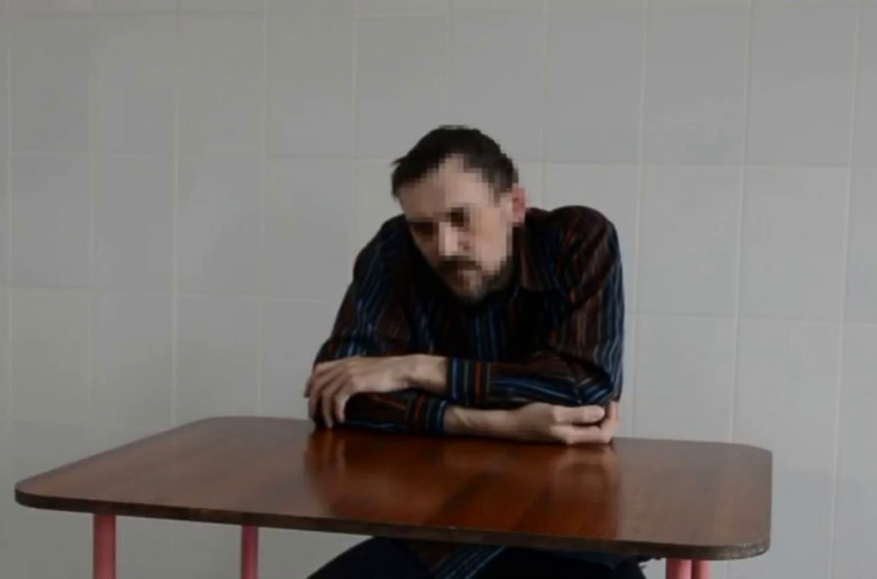
 You can support Alexander by writing him a letter or sending money to his personal account in prison so that he can subscribe to newspapers, among other things.
 Address for letters:
 It is possible to send letters via
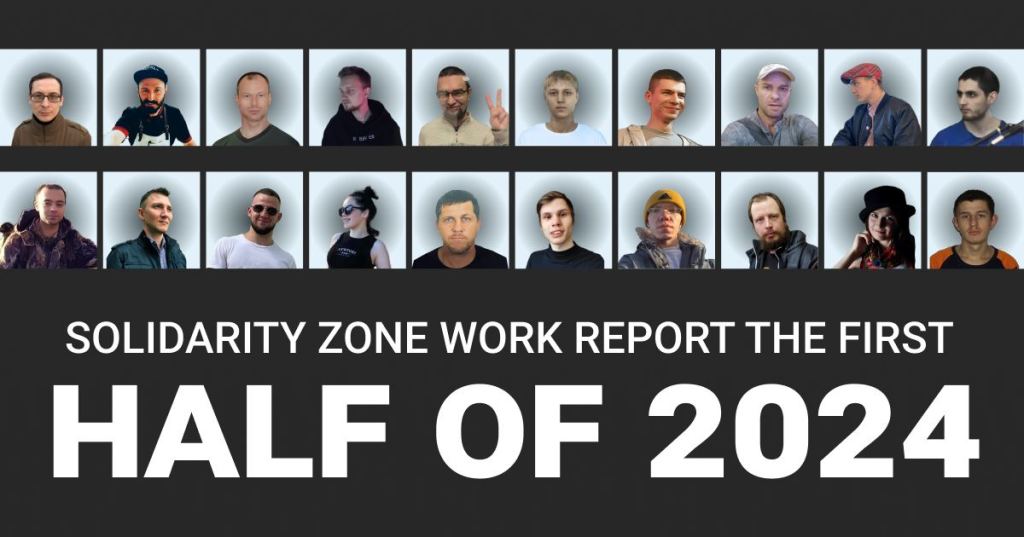
 We successfully completed nine fundraisers for individual prisoners, amounting to €28,540. As a result, we could ensure that defendants had legal support during investigations and at court, and support appeals against conviction lodged by seven prisoners who carried out acts of anti-war resistance.
 Independently of whether you are able to give financial support to Solidarity Zone, you can help us by reposting this or circulating information about us in other ways.