My Motherland

Yuri Korolev, My Motherland, 1972. Smalt mosaic. Photo: Vadim F. Lurie. Used with his permission

Vadim F. Lurie
Facebook
April 26, 2021

It’s a little strange to write about something positive these days, but I saw that, as part of the complete reconstruction of the Central Bus Station in Moscow, they preserved its old mosaic, which is now behind glass. Buses start from the 6th floor of the station, which is located under the same roof as the Shchelkovsky Shopping Center. On the other hand, I wasn’t able to find in my collection photos of the historic Toksovo station, which was demolished, and from which I departed for the dacha half my life.

Translated by the Russian Reader

Kronstadt as Revolutionary Utopia: 1921-2021 and Beyond

Kronstadt as Revolutionary Utopia: 1921-2021 and Beyond

March 20-21, 2021

Conference to be streamed on Twitch, including discussion/questions and answers

Saturday, March 20, 2021
1) Welcome and opening event – 9:30am Pacific/12:30am Eastern/4:30pm GMT/7:30pm Moscow

2) Historians’ panel – 10:00am Pacific/1:00pm Eastern/5:00pm GMT/8:00pm Moscow

  • Konstantin Tarasov, “Kronstadt self-government in 1917”
  • Simon Pirani, “Kronstadt and the workers’ movements in Moscow and Petrograd, 1921”
  • Dmitriy Ivanov, “Kronstadt 1921 uprising, political identities, and information flows”
  • Alexei Gusev, “Kronstadt Uprising of 1921 as a part of the Great Russian Revolution”

Lara Green moderating

3) Panel: “Disinformation and Counter-Revolution, 1921-2021” – 11:30am Pacific/2:30pm Eastern/6:30pm GMT/9:30pm Moscow

  • Ramah Kudaimi, “The People Want: Syria’s Uprising”
  • Lara el-Kateb, “Disinformation in the age of social media: The case for the Syrian revolution”
  • Omar Sabbour, “On the continuities between imperialism and vacuous anti-imperialism”
  • Javier Sethness, “Marx/Plekhanov vs. Bakunin; from Kronstadt to Neo-Stalinism”

Shon Meckfessel moderating

4) Film screening: The Russian Revolution in Color (2005) – 1:00pm Pacific/4:00pm Eastern/8:00pm GMT/11:00pm Moscow

Sunday, March 21
1) Welcome and opening event: recap of day 1, and agenda for day 2 – 9:30am Pacific/4:30pm GMT/7:30pm Moscow

2) Panel: “The After-Lives of Kronstadt” – 9:45am Pacific/12:45pm Eastern/4:45pm GMT/7:45pm Moscow

  • Mike Harris, “In the Spirit of Kronstadt”
  • Danny Evans, “A Spanish Kronstadt? The Barcelona May Days of 1937”
  • George Katsiaficas, “Enduring Problems of Communist Parties’ Suppression of Popular Movements”
  • Dmitriy Buchenkow, “The problem of power in the anarchist worldview”

Laurence Davis moderating; Irina Sisseikina interpreting

6) Film screening: Maggots and Men (2013) – 11:30am Pacific/2:30pm Eastern/6:30pm GMT/9:30pm Moscow

  • Q&A with Cary Cronenwett, Ilona Berger, and Zeph Fishlyn afterward

7) Kronstadt 1921 and the Social Crises of 2021 – 1:00pm Pacific/4:00pm Eastern/8:00pm GMT/11:00pm Moscow

  • Lynne Thorndycraft, “Kronstadt: Why It Matters”
  • Tom Wetzel, “Worker Congresses as a Form of Working Class Political Power”
  • Bill Weinberg, “Syria: Lessons from Kronstadt 1921”

Javier Sethness moderating

8) Closing event with words from cosponsors – 2:30pm Pacific/5:30pm Eastern/9:30pm GMT/12:30am Moscow

Night over Chile

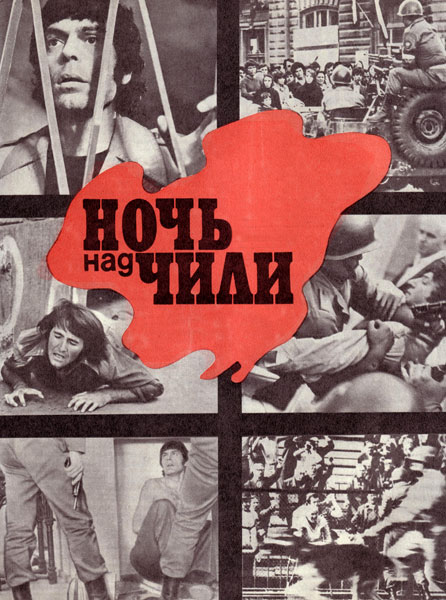
Poster for the 1977 Soviet film Night Over Chile

George Losev
Facebook
March 13, 2021

I watched the old Soviet movie Night over Chile on the TV at work. Despite a certain theatricality that was slightly inappropriate for a Soviet mockumentary (yes, yes), it does a very good job of conveying the atmosphere of fear and hopelessness that we are experiencing now, when faced with the Russian state.

And perhaps that was why the film didn’t cause the average Soviet person to feel anything. They knew what it was about, but they didn’t feel it.

Night over Chile is a film by Chilean film director Sebastián Alarcón and Soviet film director Alexander Kosarev, shot at Mosfilm Studios (USSR) in 1977. The historical drama recounts realistic accuracy the 1973 military coup in Chile and the subsequent crackdown, as seen through the eyes of the young architect Manuel, who is at the center of the events. The 10th Moscow Film Festival celebrated the work of the directors by awarding them a special prize for their directorial debut.

Young architect Manuel’s (Grigore Grigoriu) life purpose is to construct new beautiful houses. He is not interested in politics, showing everyone around him complete neutrality. However the events of 11 September 1973 shatter his perfect little world. The murder of lawful President Allende, arrests without charges and court decisions fundamentally change Manuel’s outlook on what is happening. Because a leftist activist escaped from a raid through his apartment, the architect gets thrown into jail, goes through torture and abuse, and witnesses mass executions (at the infamous National Stadium). Manuel understands that the only way for an honest man is the path of the political struggle, the national resistance.

The film was shot on location in Baku, but the recreation of the events at the National Stadium was filmed at the Luzhniki Stadium in Moscow.

Cast:
Grigore Gregoriu — Manuel Valdiva
Baadur Tsuladze — Maria’s Husband
Giuli Chokhonelidze — Juan Gonzalez
Islam Kaziyev – Junta Officer
Sadykh Huseynov — Rolando Machuc
Vytautas Kancleris — Don Carlos
Roman Khomyatov — Junta Officer
Victor Soțchi-Voinicescu — Domingo
Mircea Soțchi-Voinicescu — Roberto
Vsevolod Gavrilov — Padre
Nartai Begalin — Soldier
Maria Sagaidak — Esperanza
Bakhrom Akramov
Leon Kukulyan — Orlando
Oleg Fedorov — Reporter
Sebastián Alarcón
Mayak Kerimov
Nina Pushkova — Pamela

Source: articles on the film published in the Russian and English versions of Wikipedia. Translated by the Russian Reader

Montage of Attractions

Kirill Rein
Facebook
March 5, 2021

I finally came across this photo. I practically grew up next to this monstrosity, a talking map of the October Revolution, located in the Smolny Garden between Smolny Prospect, 6, and School No. 157. Every hour, I think, it turned on and loudly, in a well-modulated voice, read out the chronology of the October uprising. Lights flashed on, clearly marking the places captured by the Bolsheviks, and at the end it played something rousing that was audible throughout the garden, something like “Hostile Whirlwinds” or the Internationale. From the side, you could sneak up top on iron stairs designed for maintenance work: smoking there was an unalloyed, incomparable pleasure in the fourth grade. I remember that when I couldn’t find the thing there, I was totally surprised.

Thanks to the Five Corners community page for the heads-up. Photo courtesy of Kirill Rein, photographer unknown. Translated by the Russian Reader

Zinaida Pozdnyakova, “Kalinin Prospekt”

Zinaida Pozdnyakova, Kalinin Prospekt (from the series New Arbat), 1977. Color autolithograph, 33 x 50 cm. Reprinted with the artist’s kind permission. All rights reserved. Originally published on her Facebook page

Ms. Podzdnyakova comments: “I was commissioned to do this series for an exhibition in Moscow. Traffic had then just opened on Kalinin Prospekt, and everyone rushed there to look at the skyscrapers. And I decided to portray all of it. This is my tribute to social realism. I was happy to draw houses in Zaraysk, and peasant houses and interiors in Ukraine, etc., but then I had to depict Kalinin Prospekt. It was difficult for me, but I found workarounds. I drew it almost as soon as Kalinin Prospekt was opened after construction. It was new, and everyone went there to walk and eat; the weather was great. I was looking for something that I myself found interesting and unusual. I even went to a restaurant [there] with a friend, something I had never done before.”

What workarounds! | | TRR

Copyleft

Alexander Blok

[Response to a questionnaire]*

I have no objections to the abolition of literary estate rights.

In a person who is really alive, that is, who is moving forward, not backward, any sense of ownership should of course weaken over the years; all the more should it weaken in the intellectual laborer, and especially in the artist, who is absorbed in finding forms capable of withstanding the pressure of incoming creative energy rather than in scraping together capital, finding support in this endeavor from his loved ones, if they are indeed his loved ones.

When I die, may only hands that can best convey the products of my labor to those who need them be found.

1 January 1918

* Originally published in Novyi vechernii chas, 3 January 1918. The questionnaire was prompted by a December 1917 decree of the Central Executive Committee of the Soviets of Workers’, Soldiers’ and Peasants’ Deputies, ceding to the state the exclusive rights to the literary estates of writers after they died. In addition to Blok’s, Novyi vechernii chas published the responses of Fyodor Sologub and Dmitry Merezhkovsky in the same issue: arguing that the decree was “gibberish” and “inadvisable,” they called on writers to unite in protest. The responses of Vasily Nemirovich-Danchenko, Teffi, Anastasia Chebotarevskaya, Alexander Kuprin, Alexander Amfiteatrov, and Mikhail Prishvin were published in subsequent issues of the newspaper.

Source: Sergeyev’s Theater Library. Photo of the ramp in the constructivist tower of Laboratory Building “E” at the Moscow Power Engineering Institute (MEI) courtesy of Elena Krizhevskya/porusski.me. Thanks to Alexandra Vorobyova for the heads-up. Translated by the Russian Reader

Vera Ermolaeva

Until recently, a plaque memorializing the Leningrad artist Vera Ermolaeva, executed in the Gulag during the Great Terror,  hung here. Photo: MR7.ru

Last Address Plaque for Artist Vera Ermolaeva Removed in Petersburg
Galina Artemenko
MR7.ru
December 8, 2020

The Last Address plaque memorializing artist Vera Ermolaeva has been removed in Petersburg. The news was broken by the Moscow publisher Kirill Zakharov on his social media page after visiting the city.

“[This is] the house on whose first floor Vera Ermolaeva lived. A couple of years ago, a memorial plaque was installed here, but now it has been conveniently removed,” he wrote.

The initiator of the Last Address project, Sergei Parkhomenko, is already aware of the incident and is waiting for information from his colleagues in Petersburg.

“Sometimes it happens that [the plaques] are removed for repairs, then returned. Sometimes it’s different,” he said.

МR7.ru wrote on March 25, 2018, about the installation of a Last Address plaque in memory of Vera Ermolaeva at house no. 13 on the 10th Line of Vasilyevsky Island in Petersburg.

Ermolaeva was arrested on December 25, 1934, as part of the so-called Kirov cohort. As an “anti-Soviet element,” she was sentenced to three years in the camps and sent to Karlag in Kazakhstan. On September 20, 1937, three months before her scheduled release, an NKVD troika sentenced the 43-year-old Ermolaeva to death. She was executed on September 27, 1937 [sic]. She has no grave. We know only the place where the prisoners who died or were murdered in the camp were buried: the village of Dolinka in the Karaganda Region. Ermolaeva had no relatives, so when the 20th Party Congress was held, there was no one who could apply to have her exonerated. She was finally exonerated 1989, due to “lack of evidence of a crime.”

Now you can find everything or almost everything on the internet, including the weather report for December 25, 1934. It was a frosty and clear day in Leningrad— minus 12 degrees centigrade—and the night was cold, too. Ermolaeva’s apartment was probably heated when she left the warm house forever. She lived on the first floor, in apartment number two. She had always lived on ground floors, including at her previous apartment in Baskov Lane, which her father, a landowner and liberal publisher, had bought for her before the revolution. Ermolaeva fell off a horse as a child and could only walk on crutches, so the apartment was purchased because it was next door to her high school and on the first floor. For many years, Ermolaeva lived abroad, studying and getting medical treatment there.

Ermolaeva was a brilliant artist. A member of the Futurist group Bloodless Murder in 1915-16, she was interested in history and graduated from the Archaeological Institute. She was a pioneer of the genre now known as the artist’s book: she designed children’s books as cohesive entities. Her illustrations for the works of Daniil Kharms and Yevgeny Schwartz, and Ivan Krylov’s fables are admired and studied. The famous book written and illustrated by Ermolaeva in 1929—Dogs—has recently been published as a reprint.

The cover of Ermolaeva’s 1929 book Dogs. Courtesy of MR7.ru

Antonina Zainchkovskaya, Ermolaeva’s biographer and the author of a dissertation about her, said during the plaque installation ceremony that it was very important for Russians not to forget about the Last Address plaques. She said that when she was writing her dissertation and studying the relevant NKVD documents, she became psychologically ill. It is impossible to imagine the last three years of Ermolaeva’s life (in the camp, on crutches), nor the last six days, between her verdict and her execution.

Vera Ermolaeva’s Last Address plaque in 2018. Photo: Galina Artemenko/MR7.ru

The person who initiated the installation of the Last Address plaque on the house where Ermolaeva lieved was Ekaterina Yevseyeva, art historian, granddaughter of the collector and Great Terror victim Iosif Rybakov, and wife of the artist Alexei Gostintsev, who was a student of Vladimir Sterligov. Sterligov and Ermolaeva were part of a group of artists pursuing “pictorial and plastic realism.” It was in Ermolaeva’s apartment on Vasilevsky that they met, talked, drank tea, and organized exhibitions. Someone denounced them, and they became part of the Kirov cohort. Sterligov, a student of Malevich, was also arrested, but survived his sentence Karlag and lived until 1975. Gostintsev recalls that it was at the apartment of Sterligov and his wife, the artist Tatyana Glebova, in Peterhof, that he heard from Glebova that Anna Akhmatova had informed her about Ermolaeva’s arrest the very next day.

In mid-October, a property management company decided to remove fifteen Last Address plaques from the wall of a residential building on Rubinstein street. The plaques were found by Petersburg legislator Boris Vishnevsky at the management company’s offices. He was promised that the plaques would be reinstalled after the wall was repaired, but they were not put back in place when the wall was painted.

Thanks to Galina Artemenko for the heads-up. Translated by the Russian Reader

__________________


Vera Ermolaeva

1989 saw the publication of the well-known art album and anthology of articles An Avant-Garde Stopped on the Run. The book’s dustcover bore the caption “A book about how the artist Vera Ermolaeva went missing on the shores of the Aral Sea, and then the sea disappeared, too.” If Kazakhstan has been currently tackling the problem of restoring the Aral Sea, along with its salty waves, a truth that was hushed for many years has been reemerging in society, albeit little by little, a truth that should be openly accessible in the history of all countries that have gone through dictatorships and are seeking to go forward democratically, a truth, however, that should include the actual story of what happened to Ermolaeva. The truth is often not as intriguing and mysterious as the caption on a book’s dustcover.

Researchers at the Karaganda Regional Fine Arts Museum established in the same year, 1989, that Ermolaeva, a colleague and comrade of Marc Chagall and Kazimir Malevich, co-founder of UNOVIS (Champions of the New Art), and Ginkhuk faculty member, had been shot on September 26, 1937, in a labor camp in the village of Dolinka, the headquarters of the Karlag (Karaganda Corrective Labor Camp). How did Ermolaeva end up in Kazakhstan? Why was she shot?

The Karaganda Corrective Labor Camp was established in the Kazakh steppes. It was the largest camp in the NKVD’s Gulag. It was based on the Giant State Farm, and its mission was rural and industrial development. Large-scale arrests in the Soviet Union and forced deportation of whole peoples to Kazakhstan were underway. To this end, the indigenous Kazakh population was driven from their native lands, which caused a famine in 1932–1933 that killed fifty percent of the Kazakh people. Only camp staff, their families, and inmates—an unpaid labor force—lived in the camp. The first inmates were peasant families, accused of being kulaks in Russia, and clergymen. They built the first barracks and railways. They were followed by political prisoners, people convicted of “counterrevolutionary” crimes.

People were left to live in the Karlag in perpetuity, stripped of their right to move elsewhere, which was tantamount to exile, and it was they who built the first labor settlements in the Karlag. The flow of political prisoners and exiles was so overwhelming that so-called troikas—groups of three officials who decided in lieu of the courts whether prisoners would live or die—were set up nationwide.

The murder of the popular Communist Party leader Sergei Kirov, in 1934, sparked a huge wave of arrests. Artists were caught up in this wave, including Ermolaeva, who hosted exhibitions and gatherings of artists in her flat, a fact noted by the NKVD. Everything about Ermolaeva worked against her: her aristocratic pedigree, her education and free thinking, her trips to Paris and Berlin, and her links to Malevich, who had been arrested twice, jailed a year for “espionage,” and was dying of cancer. By order of the Leningrad NKVD, on December 25, 1934, Ermolaeva was denounced as a purveyor of anti-Soviet propaganda and member of a counterrevolutionary group that had tried to establish illegal communications channels with foreigners. She was charged under Articles 58-10 (“anti-Soviet agitation”) and 58-11 (“organizing anti-Soviet activity”) of the Soviet Criminal Code. Article 58 had a total of fourteen clauses, and the first of these dealt with crimes punishable by death. On March 29, 1935, Ermolaeva was convicted by an NKVD Special Council as a “socially dangerous element.” Although her exact crime was not specified, she was sentenced to three years in a labor camp and dispatched to the Karlag. Her sentence went into effect on March 27, 1935, rather than retroactively on the day she was arrested. She was arrested, convicted, and transported to Dolinka along with Vladimir Sterligov, who later founded a painterly system derived from Suprematism, and several other of Malevich’s disciples.

During interrogations, the NKVD staged one-on-one confrontations between Ermolaeva and Sterligov. When they were sent to Kazakhstan, they were assigned to the same train car. Disabled since childhood and paralyzed in both legs, Ermolaeva walked on crutches. She found the trip to Kazakhstan quite agonizing, especially when the guards ordered the convicts to lie down and get up during stops and when exiting the train in the steppes. Emaciated after his spell in prison, Sterligov would help Ermolaeva get up from the ground, scarcely able to lift the tall, stout, heavy woman.

After arriving in Dolinka in April, Ermolaeva was immediately assigned to work as an artist in the Karlag’s agitprop and cultural education unit. Ermolaeva worked a great deal, designed posters, and showed her work at exhibitions in the camp. Her pieces were even sent to a show in Moscow. In Dolinka, she lived among the exiles at 56 First Street. She was noted for her politeness, discipline, and ability to get things done. She attended political education classes, was generally enthusiastic about everything and interested in everything, and was involved in clubs, amateur art activities, and theatrical productions, which she staged along with Sterligov and fellow avant-gardist Pyotr Sokolov, productions in which other convicts performed. She worked overtime, earning the title of “shock worker,” which meant that more workdays were added to her record and, consequently, were supposed to lead to her early release.

The reasons why Ermolaeva was shot and the circumstances of her final days in the camp have been ascertained. On September 14, 1937, Ermolaeva was issued a release warrant, but on the evening of the same day she was indicted under Criminal Code Articles 58-10 and 58-11. She was interrogated, searched, and accused of associating with four counterrevolutionaries, members of anti-Soviet political parties who were convicts in the camp. She had, allegedly, allowed them to use her apartment for secret meetings and sent illegal letters to other sections of the Karlag. Ermolaeva made a huge mistake by pleading partly guilty to the charges, claiming she was merely acquainted with the convicts in question and had conversed with them only about literature, art, and their families. Although her partial conviction was sufficient, eyewitness testimony was also included in the case against her. Thus, on September 17, 1937, Ermolaeva was indicted along with eight other people.

On September 18, due to a bureaucratic mix-up, Ermolaeva was told her release papers were being drafted, and she would be sent under armed escort to Karabas, where her case file (No. 3744/37) was being processed. On September 20, Ermolaeva successfully applied for release from Dolinka and left for Karabas. The very same day, she was retried in absentia by a NKVD troika and sentenced to death. Meanwhile, her case file did not turn up in Karabas, and her name was not on the lists of convicts scheduled for release. Ermolaeva was held in a remand prison in Karabas until September 25, when she was sent back to Dolinka. Upon arrival, she submitted a written explanation of where she had been the past several days. The next day, September 26, 1937, she was shot.

Ermolaeva was exonerated posthumously, due to a lack of evidence, by the Karaganda Regional Prosecutor on November 21, 1989.

Ermolaeva’s life came to a tragic end during the height of the Great Terror of 1937–1938. During this period, Stalin’s totalitarian regime destroyed the pride of the Soviet people, mainly members of the intelligentsia—scholars, educators, artists, and cultural workers—sparing neither women nor children.

Excerpted from Aigul Omarova, “The Tragic Lives of the Artists in Karlag,” Bread & Roses: Four Generations of Kazakh Women Artists (Berlin: Momentum, 2018), pp. 34-43. Translated by Thomas H. Campbell. Photo of Vera Ermolaeva courtesy of MR7.ru

Come Out for a Walk

Come out, come out for a walk with me
Come out for a walk with me
Come out, come out for a walk with me
Come out for a walk with me

We gather freely and walk where we will
Come out for a walk, just come out for a walk
We gather freely, though we’re a little scared shitless
Come out for a walk, just come out for a walk
We’ll write the word “Enough!” on the pavement in white chalk
You can take your little sister, my little brother is coming with me
Don’t take toys with you, there are tanks and soldiers
More interesting than walking, there are no more important classes

We gather freely and walk where we will
Come out for a walk, just come out for a walk
We gather freely, though we’re a little scared shitless
Come out for a walk, just come out for a walk
Let them point a finger at us. So what if we get punished?
So what if we get wet and shiver and get goosebumps?
Don’t be afraid, there won’t be enough zelyonka or poop for everyone
Of course, stay at home if you’re younger

Come out, come out for a walk with me
Come out for a walk with me
Come out, come out for a walk with me
Come out for a walk with me

Squirt guns, nerf blasters and spitball shooters
Don’t take anything, just come out for a walk
Smoke bombs and slingshots, sticks and jump ropes
Don’t take anything, just come out for a walk
There are cops and robbers, cowboys and Indians
Come out for a walk. Why you sitting on the windowsill?
You can do it on roller skates, but we’ll be shooting videos
There are helmets, elbow pads. In noughts and crosses
We play noughts, don’t put a cross on the noughts
If you want to give them a kick in the ass, you’ll get three years in the pen

They will cut us, they will beat us, be patient and calm
You still need to drive, get out of the house
On the golden porch sat the tsar, the tsarevich, the king’s son
They twist and turn the carousel, and you won’t change anything
One, two, three, four, five, here they come looking for me
I didn’t hide—it wasn’t my fault

Come out, come out for a walk with me
Come out for a walk with me
Come out, come out for a walk with me
Come out for a walk with me
Come out

Source: Musixmatch
Songwriter: Andrei Pasechny


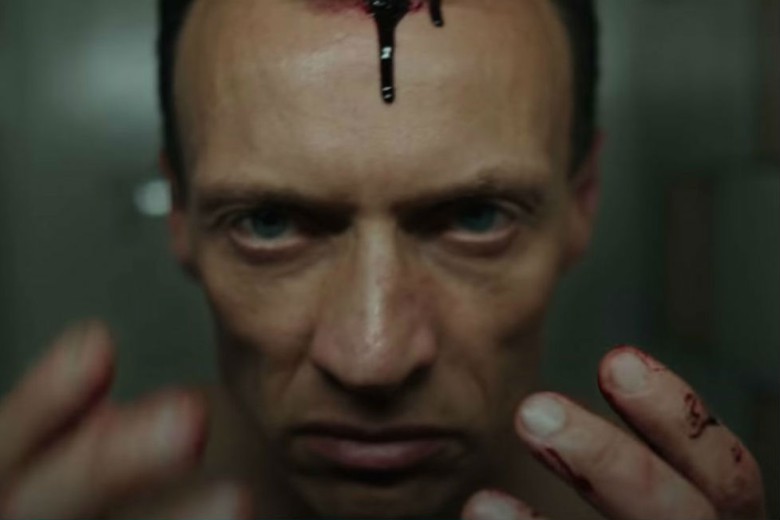
A still from the Kasta video “Come Out for a Walk.” Courtesy of YouTube

Red Red Blood: Kasta’s Video and the End of Post-Soviet Pop Culture
Andrei Arkhangelsky
Republic
December 1, 2020

Kasta’s new video “Come Out for a Walk”—about a riot policeman whose body and even clothes bleed, like the people he beats—has already garnered two and a half million views and tens of thousands of comments. Although the song was written a long time ago, the plot of the video, according to Kasta member Shym, was inspired by the police beatings of peaceful protesters in Belarus.

The idea of the video is painfully simple: everything hidden will be revealed sooner or later. In our hyper-speed age, “sooner or later” means in a couple of hours, days, or weeks, at most. But pop culture artists, as we know, always tell us more than they mean to say. The video’s release says several symbolic things that are vital for all of post-Soviet culture.

In this video, it is not people, but blood that plays the starring role. Blood is a silent substance, but as an image it acts magically on us, because it requires no explanation. It captures our attention, fascinating and hypnotizing us. It is like fire or water in this sense: we can’t get away from it.

This is surprising to hear, of course, if you remember how many liters of fake blood are shed every day, for example, in “patriotic” movies. The blood there, however, does not make such an impression, because in its own context it is “normal,” meaning that it is shed “for a just cause.” Violence in peacetime is something fundamentally different: propaganda tries to hide this, instilling in us the need to live in peacetime under military law. Violence in peacetime makes personable poses, primps and preens, dresses in different guises, including white, and sometimes it pulls it off. The idea that for the sake of the country’s “stability” we can shed a couple of “non–fatal” liters of blood, precisely for educational purposes, was until recently considered an unspoken norm in our country. Now, in the public view, it is wrong. Kasta’s video captures this sea change in the public mood, cancelling the previous unspoken agreements between state and society.

In a broad sense, this ubiquitous, oozing, flowing blood is an even more global metaphor for all Russian popular entertainment of the past twenty years. In fact, this entertainment, starting with the historical series of the noughties (the TV adaptations of Rybakov’s Children of the Arbat and even Solzhenitsyn’s The First Circle) was a story about the tons of blood spilled by the Stalinist state. However, on screen, this blood was, figuratively speaking, packed in sealed, leak-proof containers and sold to the post-Soviet audience in the form of little hearts—stuffed with love, friendship, loyalty, and so on.

“There was violence, but there were also good things”: this, approximately, is the golden formula of reconciliation (reconciliation with violence, simply put) that worked and still works in popular entertainment. State violence in movies and TV shows is always balanced by a sacrifice made in the name of the common good (the Chekist who committed injustices goes to war and washes away the sin with his own blood) or in the form of a deus ex machina (“the Party sorted the matter out and released the man, who was roughed up but alive”).

All Russian serials about the Soviet era are made with the acceptance of “history as it is,” and with the simultaneous understanding that “this is your motherland,” as former culture minister and current presidential aide Vladimir Medinsky recently suggested. Evoking Kasta’s metaphor, we can say that the blood flows moderately in Stalinist TV series: the Chekist bends over the innocent prisoner and hits him a couple of times, or even kicks him, but he does not beat the man to death. All these series are made exactly in this way: nothing is done “to death.” And so the viewer who watches them gets the feeling that while it is not easy to live with shedding a little blood, it is basically permissible.

Consequently, post-Soviet society has not had a conversation about violence as the vicious underpinning of the former ruling ideology. In contemporary cinema, police and secret service officers are presented as reflective intellectuals, as in the recent TV series Dyatlov Pass. They are tormented by life’s unsolvable problems, not to mention the fact that they are generally positive characters. We should admit that the conversation about violence has been swept under the rug over the past twenty years through targeted ideological work involving popular entertainment.

But the social trauma itself has not disappeared. The habit of violence has remained, and now it has literally leaked out in the form of the real sadism at the jail on Okrestin Street in Minsk, which can be considered a universal symbol for many post-Soviet countries. This sadism is now running down, soaking “through the gold of uniforms”: this is how it could be formulated in a broader context, not only in Belarus.

On the other hand, there is protest. In western culture, it has long been established as a social norm, nor are artists necessarily on the side of the protesters. Pasolini has a poem about police officers who beat up students at a demonstration. It includes the lines, “When you were at the Valle Giulia yesterday you brawled with the police, I sympathized with the policemen!” Then Pasolini explains why:

I know well,
I know how they were as little kids and young men,
the precious penny, the father who never grew up,
because poverty does not bestow authority.
The mother calloused like a porter, or tender,
because of some disease, like a little bird.

The conflict between police and students (protestors) is always unresolvable in some sense, but it is also normal. This paradox is typical of democracy, where, as we know, everything that is not forbidden is allowed. A free society constantly tests the authorities as to what is acceptable and unacceptable, but the very essence of democracy manifests itself in this “qual,” to borrow a term from rap culture.

Popular culture’s natural instinct again, is to discuss and reflect on protest. In Russian movies, however, the topic is taboo or ridiculed. Protest is imagined as a testosterone-fueled fad, something for people with nothing better to do, or as a form of manipulation, but most often protests are not depicted in Russian cinema at all. When we are told that popular entertainment is not to blame and owes nothing to anyone, we should respond by recalling that the silencing of socially important topics today is a way to encourage evil. When we try to answer the question of where this sadism comes from, we can mull over it for a long time in the same old lofty terms: unarticulated trauma, the post-Soviet syndrome.

But there is a simpler explanation. The same riot police officer who beats people because circumstances allow him to do it “does not know,” broadly speaking, that it is wrong precisely because popular culture has never, in the last twenty years, transmitted this simple idea to him. It has not told him that protesting is normal and shedding blood is wrong. What is worse, popular entertainment in Russia has been looking for various sophisticated ways to justify the shedding of innocent blood in the name of higher causes. And since Belarusian and Russian riot policemen have consumed this pop culture in equal measure, the outcome is roughly the same.

Just as the red substance in the video flows from helmets and riot batons, so reality itself today reminds us of its existence despite all the attempts to hide it. While you are controlling the big screen, the truth will leak out on the small screen: this is the video’s symbolic sense. When the time comes, what has been hidden will pour from the screens just as uncompromisingly. It will again be a shock to the audience, like, say, the articles about Stalinism in the perestroika-era press were to readers back then. The blood in the video is a metaphor for truth (or reality) itself, a truth that cannot be canceled in any way. This hidden thing will sooner or later burst the dam, and it will not be subdued, just as it is impossible to stanch the blood flowing in Kasta’s video.

Translated by the Russian Reader

Tushonka

In 1941, before the United States officially joined the Allied war effort, the Lend-Lease Act passed by Congress offered assistance to any nation fighting aggression (which effectively meant any nation but Germany and Japan) and pushed for the rapid expansion of meat production. The government called on the nation’s meatpackers to provide 4 million, then 8 million, then 15 million cans of tinned meat weekly for shipment abroad. The John Morrell and Company plant in Sioux Falls—drawing much of its meat supply from southwestern Minnesota farms—specialized in tushonka, or canned pork with onions and spices [sic], for the Russians.
—Annette Atkins, Creating Minnesota: A History from the Inside Out (St. Paul: Minnesota Historical Society Press, 2007), pp. 193–194

Navy-Style Pasta with Tushonka

Ingredients
Pasta – 250-500 g
Tushonka – 1 can (500 g)
Onion – 1
Vegetable oil – 2-3 tbsp
Salt to taste
Ground black pepper to taste
Sugar – 1 tsp
Red wine vinegar – 1 tbsp
Garlic – 2 cloves
Tomato paste – 2 tbsp
Spices to taste
Water (from cooking pasta) – 100-300 ml
Fresh herbs – 4-5 sprigs (optional)


Prepare the ingredients.

Bring the water to a boil, season generously with salt and add the pasta.

Mix thoroughly and cook until tender, following the instructions on the package. During the cooking process, periodically try the pasta to prevent it from overcooking.

Heat 1-2 tablespoons of vegetable oil over high heat in a frying pan. Add the chopped onion, a pinch of salt and a teaspoon of sugar. Stir-fry the onion for about 5 minutes, until golden brown.

Meanwhile, mash the tushonka until it is almost a homogeneous mush.

Peel and chop 1-2 cloves of garlic. Add the garlic to the sauteed onion, stir and fry for another 1-2 minutes.

Pour in 1 tbsp red wine vinegar. In the hot pan, the vinegar will immediately evaporate, but the fried vegetables will have a pleasant sweet and sour taste.

Add the tomato paste to the fried garlic and onion. Stir-fry the tomato paste for about 1-2 minutes.

Then add the tushonka, stir and bring to a boil over low heat.

When the pasta is ready, do not rush to drain all the water. Pour off about 1 cup of water and save it for making a sauce.

Drain the remaining water. Add 1 tablespoon of vegetable oil (to prevent the pasta from sticking together) and mix thoroughly.

Add spices to the boiling sauce. I add some Mediterranean herbs, paprika, ground coriander and also salt and ground black pepper.

Gradually pour in the water left over from cooking the pasta until the sauce is the desired thickness. Bring the sauce to a boil and simmer for another 3-4 minutes.

Add the pasta and mix thoroughly. Turn off the heat, add some herbs, cover the pan with a lid and let the dish stand for a few minutes.

Sprinkle a portion of navy-style pasta with a pinch of fresh herbs and serve.

mak po flot s tush

Translated by the Russian Reader

Igor Yakovenko: The Execution of Yuri Dmitriev

The Public Execution of the Historian Dmitriev
Igor Yakovenko’s Blog
September 30, 2020

Three days before the Karelian Supreme Court handed down its ruling in the “case” of the historian Yuri Dmitriev, the program “Vesti” on state TV channel Rossiya 24 ran a segment in which “shocking pictures” of Dmitriev’s foster daughter were aired. The voice of reporter Olga Zhurenkova shook with anger as she said that “hundreds of Internet users were shocked by these terrible pictures that appeared on the Internet on the morning of September 26,” that “the Internet is boiling with indignation” at this monster who “ruined a child’s life.” The security services got into Dmitriev’s computer and pulled out photos of his foster daughter. Then the security services leaked these photos to the Internet for thousands to see. After that, Rossiya 24 showed them on TV to millions. And they also showed a video in which the foster daughter hugs Dmitriev: the girl can clearly be identified in the video, and just to make sure, Rossiya 24’s reporters called her by name.

This goes to the question of who actually ruined the child’s life and why they did it.

Rossiya 24’s handiwork lasts 4 minutes, 48 seconds. The state channel’s reporters managed to pack into this amount of time all the hatred that the ideological heirs of Stalin’s executioners feel towards the man who for many years studied and presented to the public the traces of the latter’s crimes. In all his previous trials, Dmitriev and his defense team managed to fully prove his innocence. And the prosecutors were well aware that he was innocent, so to concoct and pass a monstrous sentence on him, they recreated the ambiance of the show trials during the Great Terror. Back then, the “people’s anger” was fueled by newspaper articles, demonstrations outside the courtroom, and meetings at factories where shockworkers demanded that the Trotskyite-fascist Judases be shot like mad dogs. Now, in the third decade of the 21st century, the Internet and TV organize the “people’s anger.”

The appeals hearing in Dmitriev’s case was orchestrated like a special military operation whose goal was to prevent the human rights defender from getting out of prison alive. To accomplish this, in addition to organizing the “people’s anger,” the authorities virtually deprived Dmitriev of legal counsel. His lead defense attorney, Viktor Anufriev, was quarantined on suspicion of having the coronavirus, while the court-appointed lawyer said that it was a mockery to expect him to review the nineteen volumes of the case file in three days. Despite the fact that Anufriev petitioned to postpone the hearing for a specific period after his release from quarantine, and Dmitriev declined the services of the court-appointed lawyers, the court, contrary to normal practice, refused to postpone the hearing, and so Dmitriev was left virtually with no legal representation.

Yuri Dmitriev’s work touched a very sensitive chord in the collective soul of Russia’s current bosses, who see themselves as the direct heirs of those who organized the Great Terror, which, they are firmly convinced, is a purely internal matter of the “new nobility.” It is virtually a family secret. They believe that Dmitriev—who not only investigated the mass murders at the Sandarmokh killing field, but also invited foreign journalists there and published lists of those who were killed—is a traitor who deserves to die.

Moreover, the Dmitriev case has come to embody one of the most important amendments to the Constitution of the Russian Federation adopted this past summer. Namely, the new Article 67.1, which establishes a completely monstrous norm: “The Russian Federation honors the memory of the defenders of the Fatherland [and] ensures the protection of historical truth.” In other words, the task of protecting the “historical truth” is assumed not by historians, but by the state, that is, by the apparatus of violence and coercion.

In fact, the Dmitriev case has been a demonstrative act of “historical truth enforcement.”

The fact is that on the eve of Dmitriev’s trial, members of the Russian Military History Society attempted to write a “correct history” of the killing field in Sandarmokh. They dug up mass graves and hauled away bags of the remains for “forensic examination,” subsequently that they were Soviet soldiers who had been shot by the Finnish invaders.

There should be no blank or black spots in the history of the Fatherland: everything should shine with cleanliness, resound with military exploits and feats of labor, and smell of patriotism. To this end, MP Alexei Zhuravlyov—the man who recently told Russian TV viewers that Europe has brothels for zoophiles where you can rape a turtle—introduced a bill under which you could get three years in prison for “distorting history.” To Zhuravlyov’s great disappointment, his legislative initiative was not appreciated.

And really, why send someone down for three years for promoting “incorrect history,” when you can send them to a maximum security penal colony for thirteen years, which for the 64-year-old human rights activist is tantamount to a death sentence. It was this verdict that was issued by the Karelian Supreme Court by order of the heirs of those who organized the Great Terror.

Translated by the Russian Reader

Yuri Dmitriev. Photo by Igor Podgorny/TASS. Courtesy of the Moscow Times

Prominent Gulag Historian’s 3.5-Year Prison Sentence Lengthened to 13 Years
Moscow Times
September 29, 2020

A Russian court has lengthened the term prominent Gulag historian Yuri Dmitriev must serve in prison to 13 years, the Mediazona news website reported Tuesday, a surprise increase of a lenient sentence for charges his allies say were trumped up to silence him.

Dmitriev was sentenced to 3.5 years in prison in July after a city court in northwestern Russia found him guilty of sexually assaulting his adopted [sic] daughter, a ruling his supporters viewed as a victory given the 15 years requested by prosecutors.

The Supreme Court of the Republic of Karelia overturned that ruling and sentenced him to 13 years in a maximum-security penal colony, Mediazona reported, citing the lawyer of Dmitriev’s adopted [sic] daughter.

Under his previous sentence, Dmitriev, 64, would have been released in November as his time already served in pre-trial detention counted toward his sentence.

Human rights advocates condemned the Karelia Supreme Court’s ruling, calling it a “shame.”

Dmitriev has vehemently denied the charges against him.

The head of the Memorial human rights group’s Karelia branch, Dmitriev is known for helping open the Sandarmokh memorial to the thousands of victims murdered there during Stalin-era political repressions in 1937 and 1938.