Red Flag

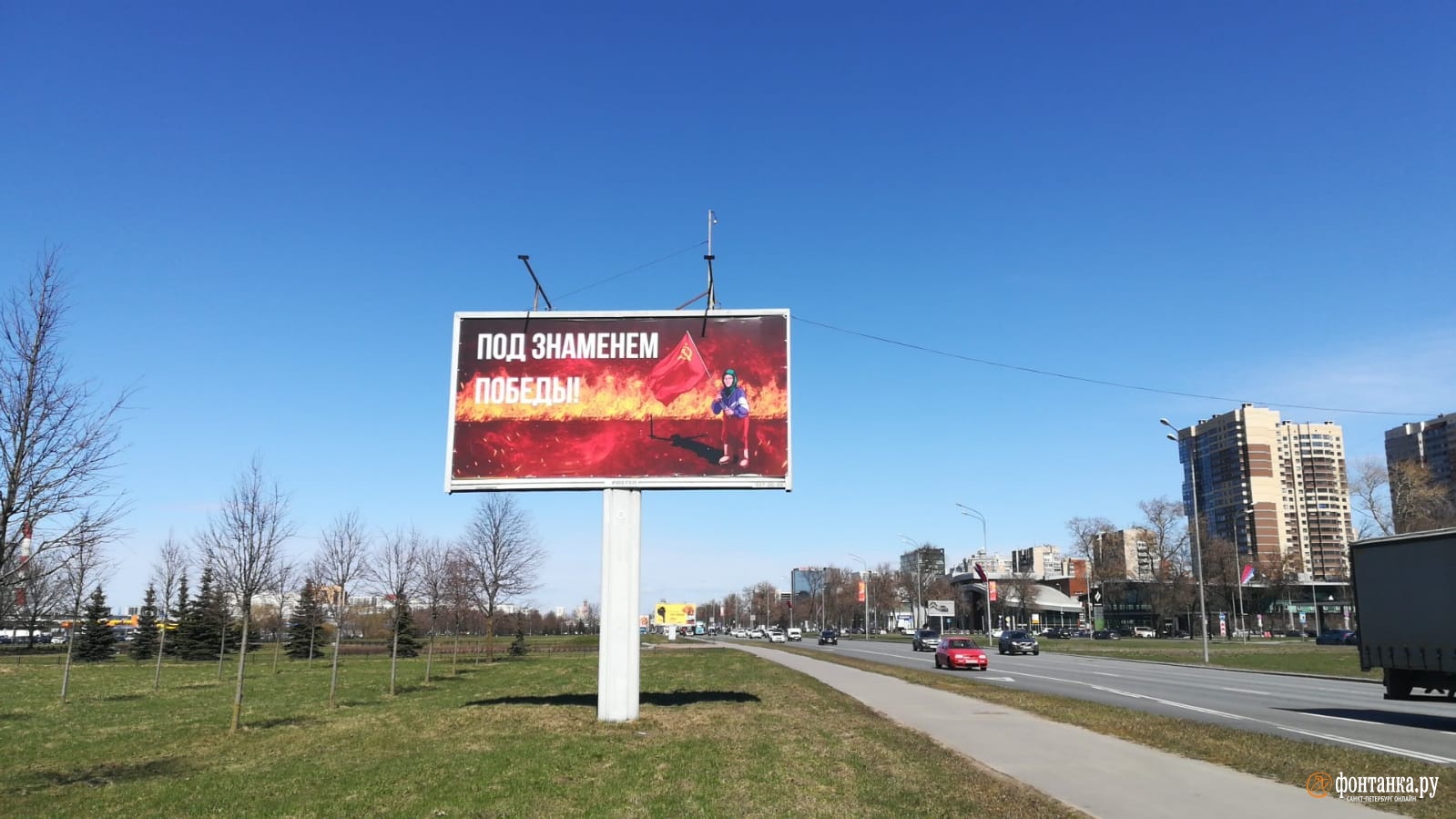
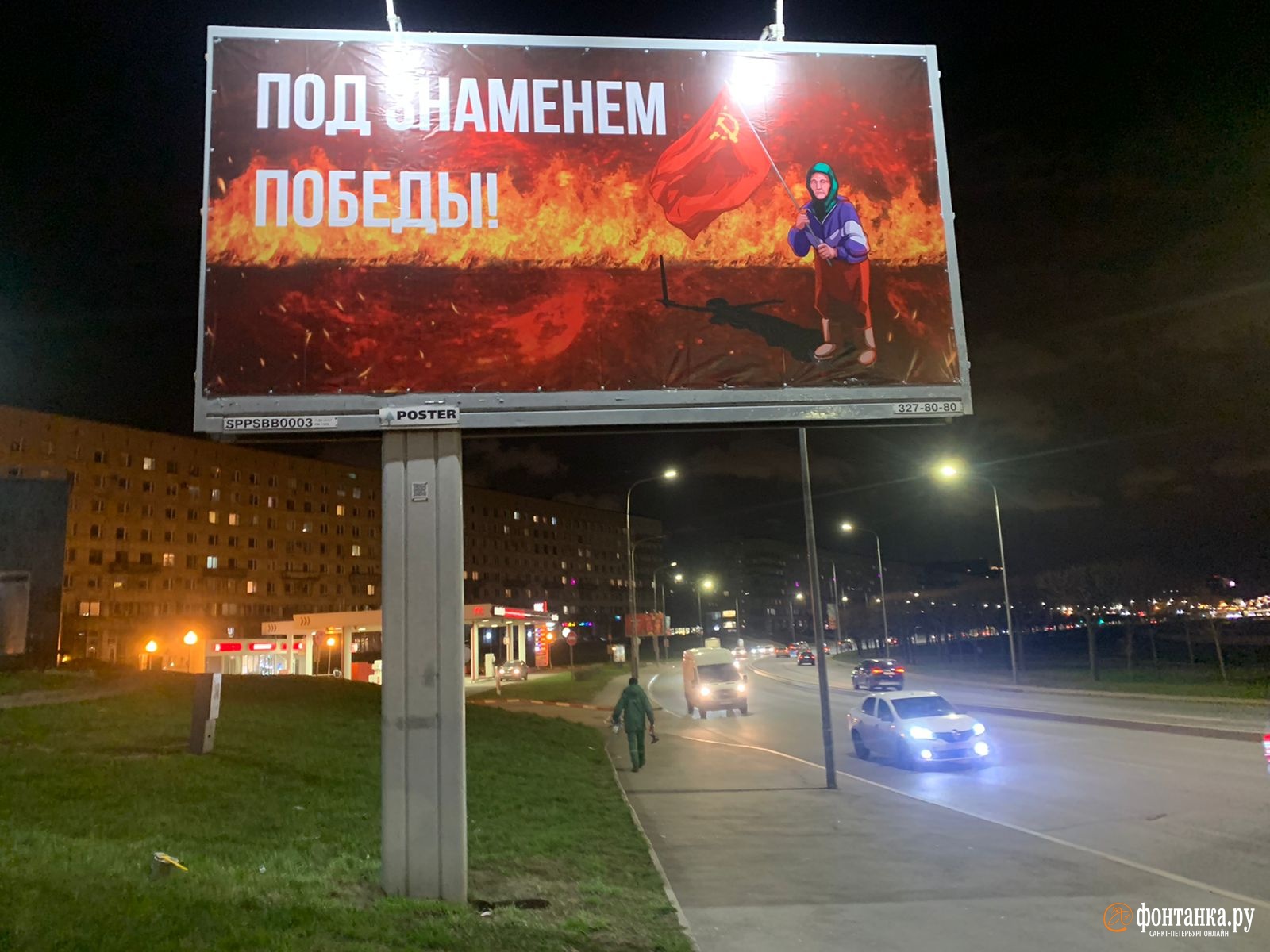
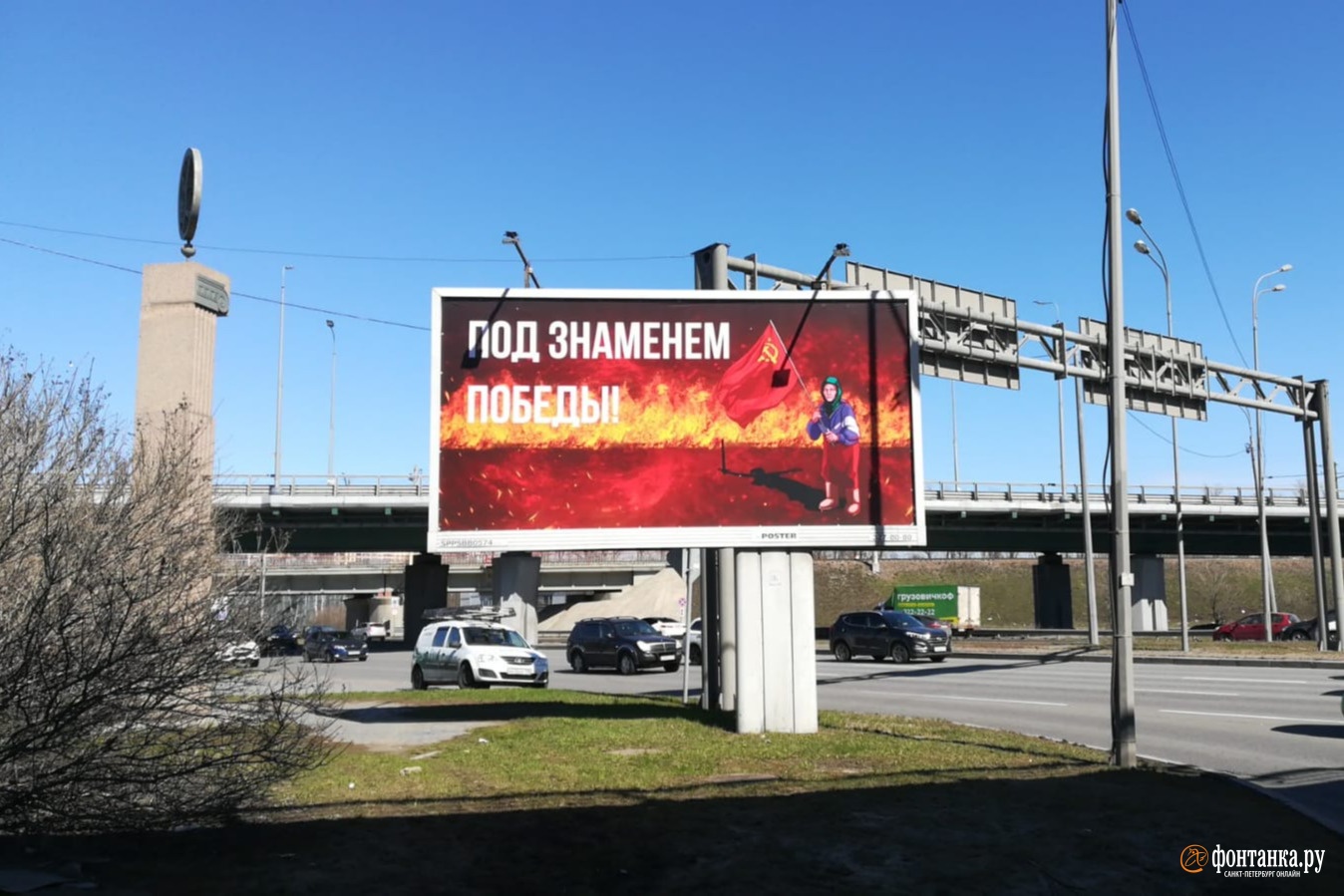
As of the morning of May 1, around a hundred billboards featuring the image of the iconic pensioner who gained famed after the events in Ukraine [sic] had been installed in different districts in Petersburg. Fontanka.ru has analyzed the scale of this visual statement. The news-related intrigue lies in the fact that state agencies have nothing to do with the campaign.
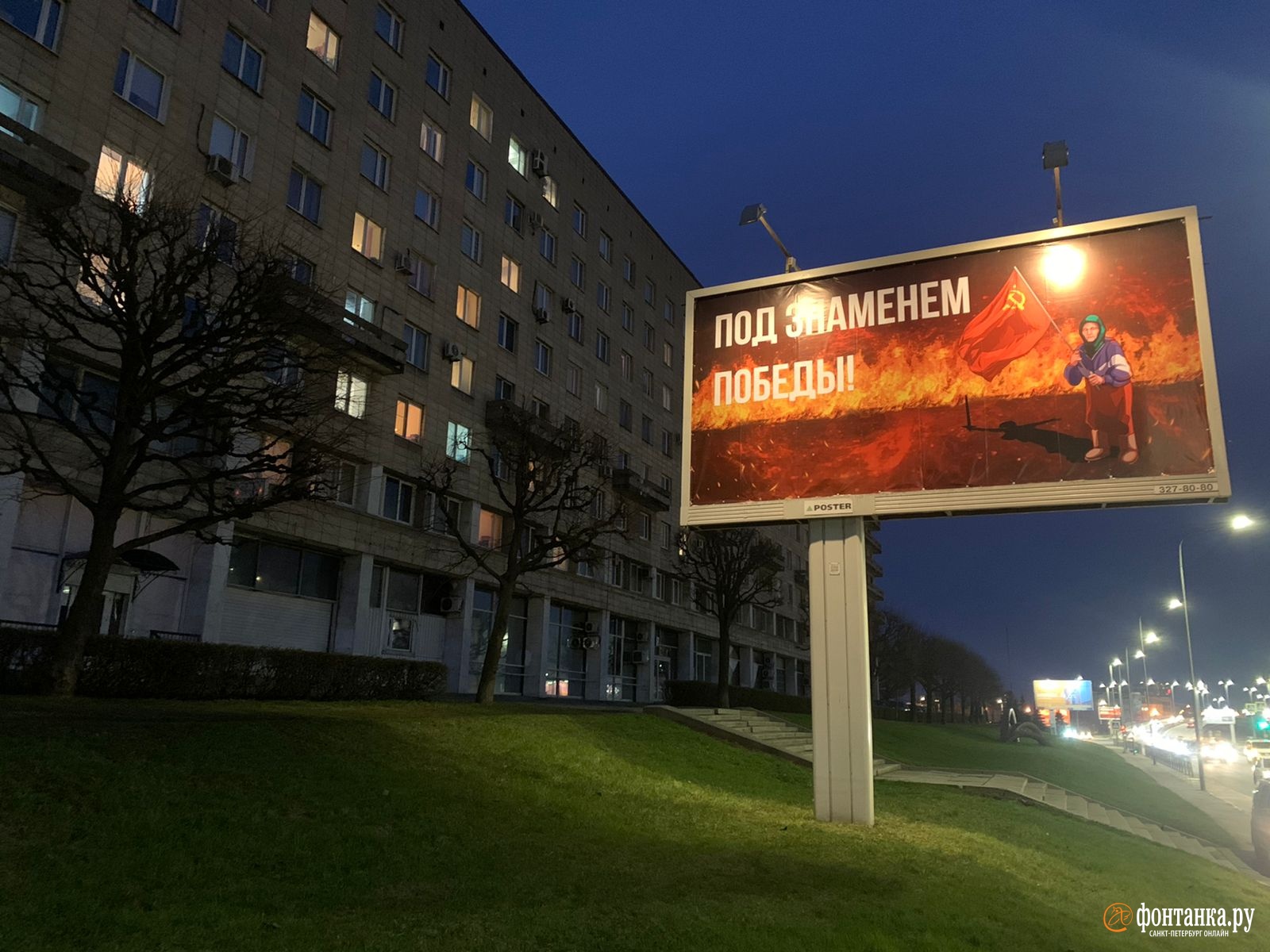
“Under the banner of victory!” All images courtesy of Fontanka.ru

In the early hours of May 1, identical posters bearing the image of the famous pensioner holding a Soviet banner were officially installed in about one hundred outdoor media displays in Petersburg.
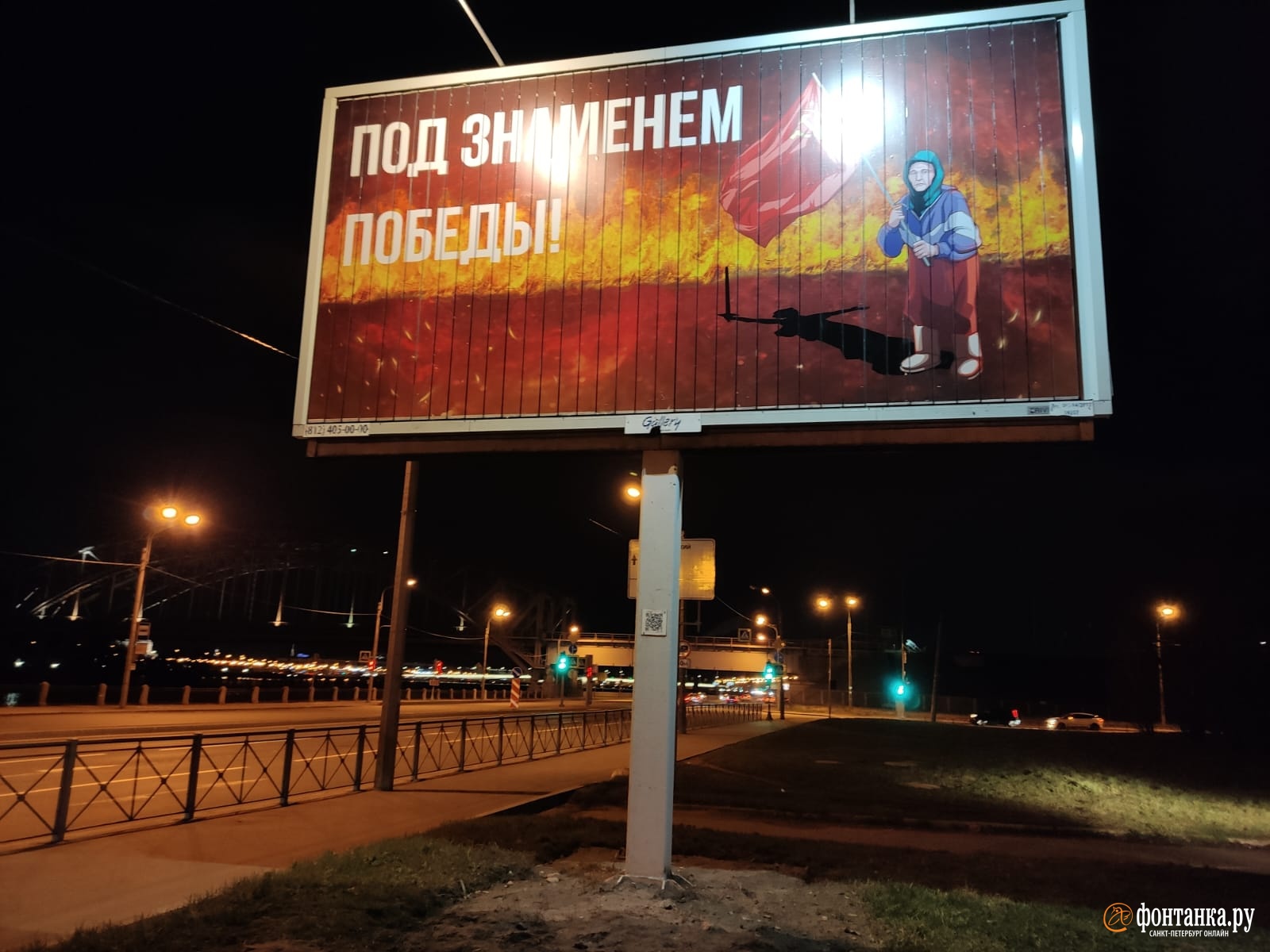
News about the woman broke out back in April, when she went out with a red banner to greet servicemen in Ukraine, confusing them with Russian soldiers. Her age, her deed, the reaction of the Ukrainian soldiers, and the video that went viral on the Net immediately turned her into a symbol of victory. The old woman’s face has appeared on DPR postage stamps, graffiti artists began to draw her in different cities in Russia, and so on. Even the Russian Federation’s delegate at the UN Security Council talked about her.

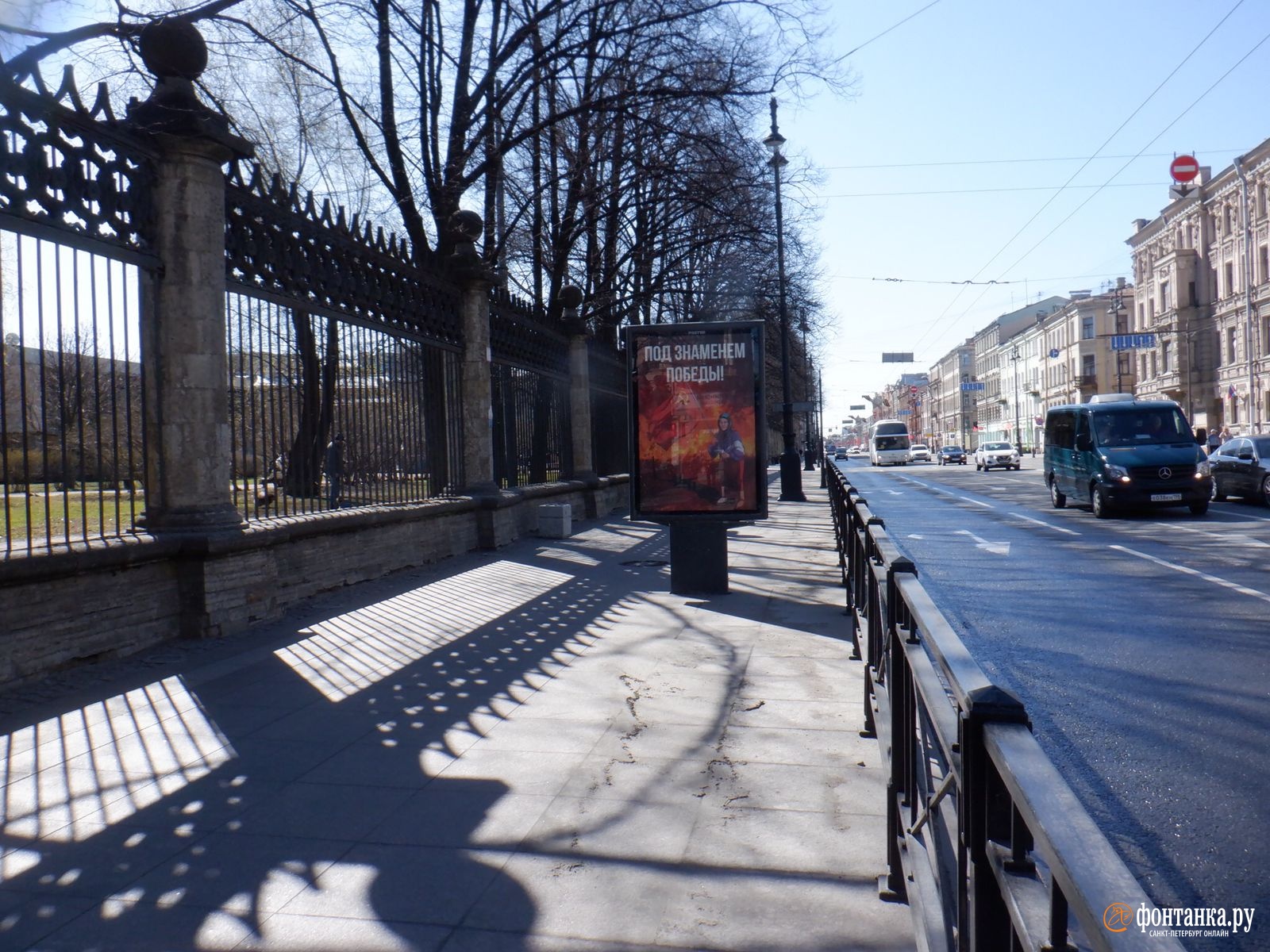
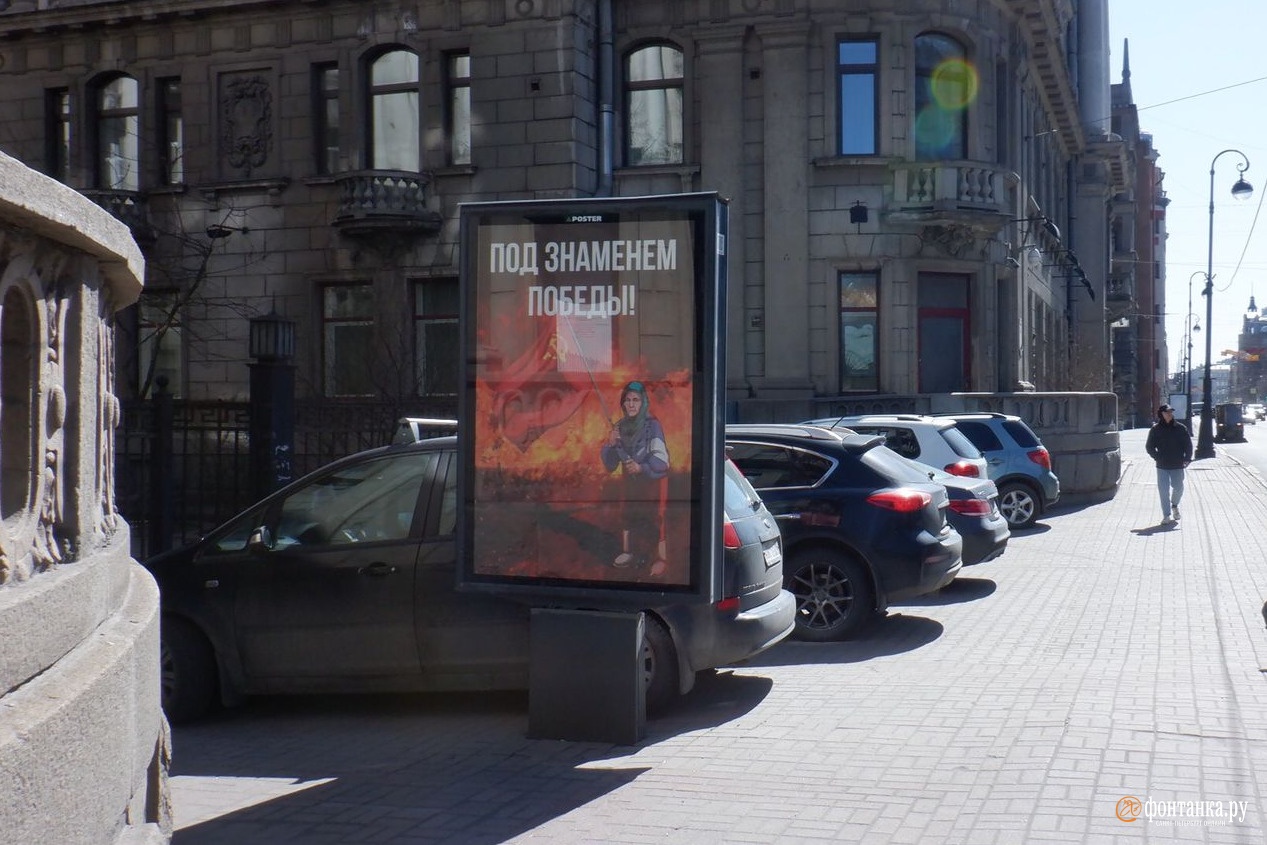
Currently, the images of the heroic old woman have been installed in the Central, Admiralty, Petrograd, Vyborg, Maritime, Kalinin, and Moscow districts. These include both large billboards and typical demonstrative surfaces [sic] along the roadways.
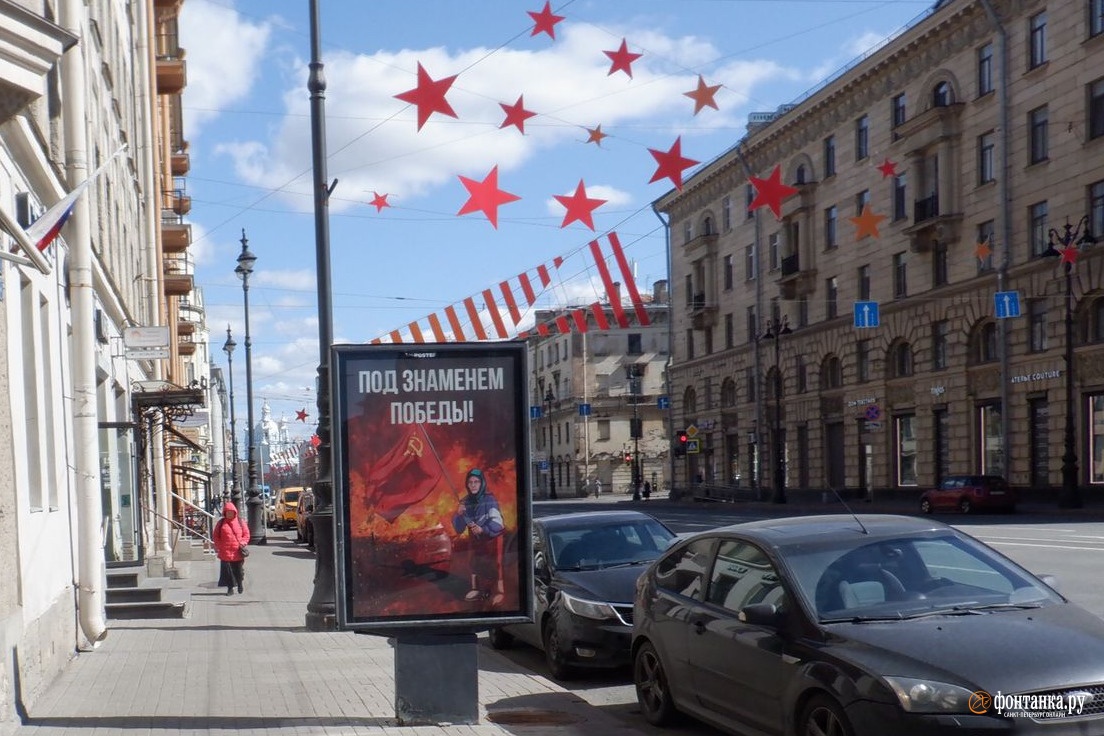
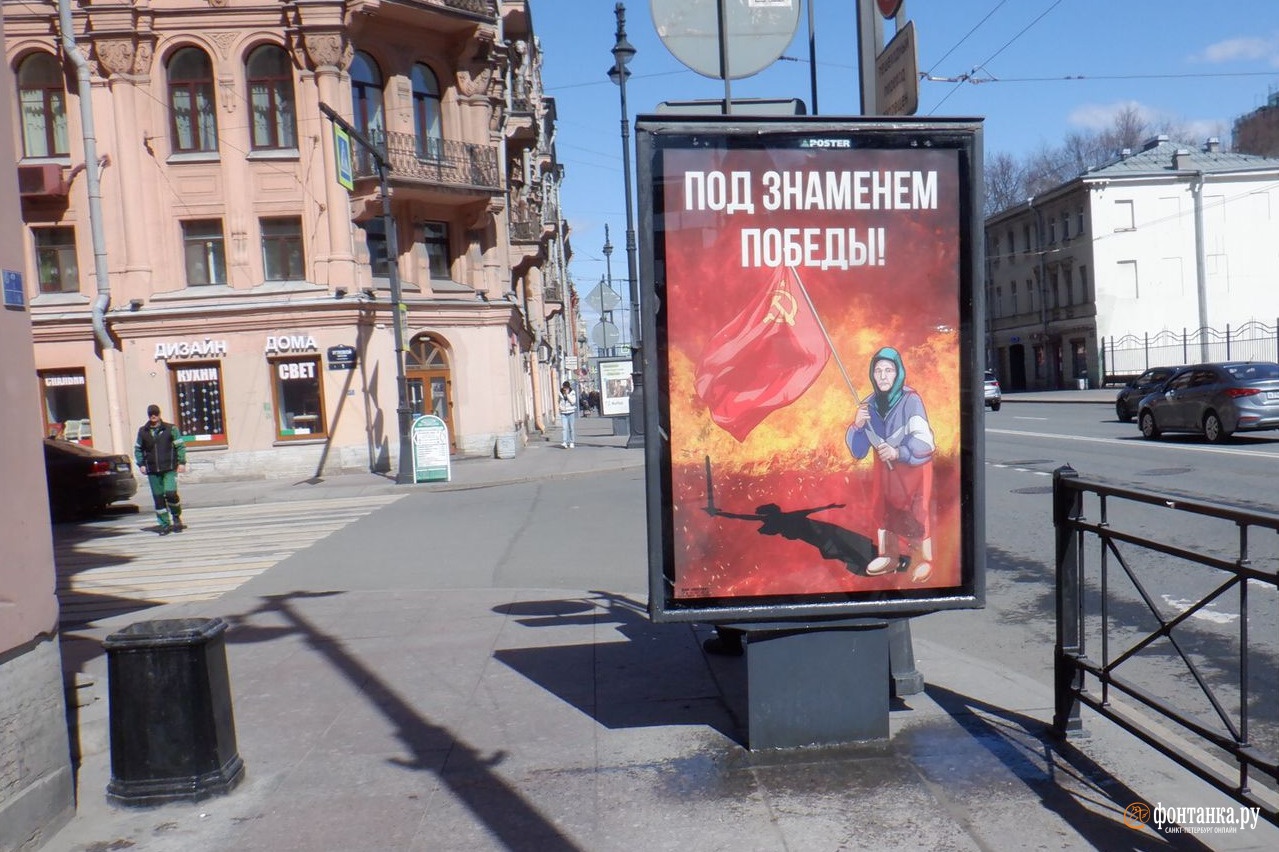
The urban spaces chosen for this campaign can be analyzed. The images have been installed near places of authority: on Suvorov Prospekt, next to the Smolny [Petersburg city hall], the seat of the Leningrad Region government, and the Interior Ministry building; on Tapestry Street, near the FSB building; on Horse Guards Boulevard, near St. Isaac’s Cathedral; and around the monument to Alexander Nevsky, outside the Alexander Nevsky Lavra.

However, many similar phenomena [sic] have popped up on Moscow Prospekt, Pulkovo Highway, and the October and Vyborg embankments.

Fontanka.ru has learned that state (regional or federal) agencies did not pay for the campaign. Petersburg advertising market insiders, on terms of confidentiality, informed our correspondent that they had heard about the proposal from representatives of a private individual in mid-April. “It’s definitely a businessman. We are sure of this at least, since we called each other when we began receiving preliminary inquiries,” one of the insiders said.

As for the scale, according to the information we have obtained, the order received was for the placement of one hundred billboards at an approximate cost of around ten million rubles [approx. 139,000 euros]. “And that’s if they got a discount,” one source added. Several of our experts more or less agreed with this figure.

If someone in the advertising market has more accurate information, Fontanka.ru is ready to listen to it with a full guarantee of anonymity.

Source: Fontanka.ru, 1 May 2022. Translated by the Russian Reader


A Cult of Dementia

Putin’s red-brown ideology has taken the worst of Nazism and Bolshevism and mixed it with the cartoonish oligarchy from Dunno on the Moon. The final product has no equals anywhere in the world.

Just think about it. For several months now, Russian propaganda has been chewing over the image of a traitorous old Ukrainian woman who was waiting for the invaders with a Soviet flag. Compassionate Ukrainian soldiers gave her food, but took away her flag. That’s the whole story.

But no, the story didn’t end there. In Russia, the crazy old woman was made a real hero, and her image began to appear on buildings. But the occupiers have driven themselves into an ideological trap: no one except such “young Komsomol women” was looking forward to seeing them in Ukraine. The invaders were not greeted with flowers and bread, but were treated to Molotov cocktails and poisoned pies.

If you think about this story more deeply, the old lady with the Soviet flag perfectly reflects the main watchword of Putin’s Russia, its underlying doctrine, and the true purpose of invading Ukraine: our lives have sucked and we won’t let anyone else live either.

She is thus undoubtedly a hero to Russia, as is Pavlik Morozov. Russia has nothing to offer the world. It offers a rollback to the past and endless attempts to cash in on lost “greatness” instead of progress, old age instead of youth, betrayal instead of loyalty, and humiliation instead of pride. So, an old woman holding a Soviet flag is the most accurate symbolic depiction of modern Russia.

It’s funny, because the propagandists don’t care about Russian pensioners or about veterans of the Second World War. Old people in Russia live out their days (they live them out, they don’t live) in want and humiliation, in terrible conditions and hopelessness.

Source: Andrey Churakov, Facebook, 2 May 2022. Translated by the Russian Reader
Broken Glass Cake

At the request of the Comintern, a smaller counter-exhibition entitled The Truth on the Colonies, organized by the Communist Party and the CGTU, attracted very few visitors (5000 in 8 months). The first section was dedicated to abuses committed during the colonial conquests, and quoted Albert Londres and André Gide’s criticisms of forced labour in the colonies while the second one made a comparison of Soviet “nationalities policy” to “imperialist colonialism.”

Source: “Paris Colonial Exposition,” Wikipedia


Broken Glass Cake

Ingredients:
▫ sour cream 400 g
▫ condensed milk 300 g
▫gelatin 25 g + water 150 ml

For the jello:
▫ different flavors of gelatin
▫ hot water

DIRECTIONS:
1️⃣ Prepare the jello per the directions on the packet. Pour into a dish, add hot water, mix until cool and leave in the refrigerator for ~ 3 hours. You can already pull the condensed milk and sour cream from the icebox so they will be at room temperature.
2️⃣ When the jello has set up, cut it into cubes right in the dish.
3️⃣ Dissolve 25 g of gelatin in 150 ml of water.
4️⃣ Mix the sour cream, condensed milk and gelatin.
And then just assemble the parts as in the video. Dispatch it to the refrigerator for about 4 hours. I put a layer of cookies on the bottom, but you don’t have to add them if you don’t want to. Yes, it’s quick to prepare, but you will definitely like it :)

Translated by the Russian Reader


It is likely that in the autumn, or already in the summer, there will be tension in the country over a significant downturn in the incomes of people employed in production, in particular, due to layoffs (in some places, massive layoffs). There is the potential for protests here. [The authorities] won’t be able to contain them, as [they did] in the nineties. I think, however, that it will be difficult to translate this potential into political change. Apart from the fact that it has been organizationally routed, the liberal and democratic opposition has an agenda that is far removed from the problems of this social stratum. The left is mainly interested in theoretical discussions and, frankly speaking, they are not merely absent as a political factor in Russia, but represent something like a negative quantity. There is no Russian [Lech] Wałęsa even visible on the horizon. But might it not happen that, if and when he appears, he will turn out to be a nationalist, blaming the authorities not for what they did, but for what they failed to do?

Source: Grigorii Golosov, Facebook, 28 April 2022. Translated by the Russian Reader


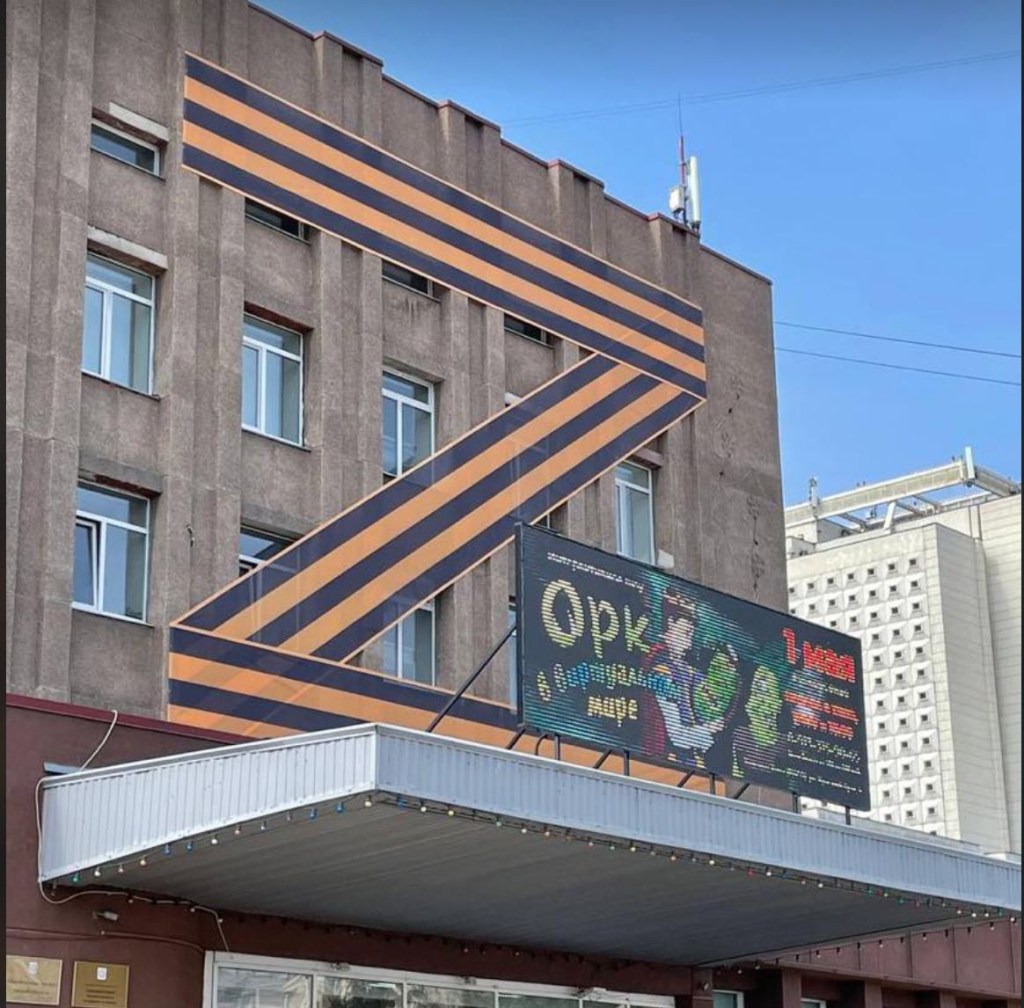
A huge St. George ribbon in the shape of the letter Z has been hung on the building housing the Omsk Public Chamber.

It serves as the backdrop for an announcement of the show “An Orc in the Virtual World.”

Source: Kholod, Facebook, 28 April 2022. Translated by the Russian Reader


Russia and the people who live in Russia are becoming more reactionary not by the day, but by the hour. The problem is that almost no one notices this. Every day Putin and his gang remain in power sends Russian society backwards another year in terms of how people think about politics, justice, religion, ethnicity, culture, industrial relations, war and peace, and the rest of the world.

At this rate, if and when the Putin regime does disappear from view, nearly everyone who lives in Russia will have to be reprogrammed to deal more or less ably with the world the rest of us inhabit.

This is not an endorsement of our world’s virtues. But you simply cannot imagine the depths and breadth of the black political reaction that has engulfed Russia until you have lived there a long time (preferably, starting well before the reaction ensued) and thus have the eyes to see and the ears to hear a country that it is well on its way to utterly rejecting progress in all its forms.

This is especially true of the so-called intelligentsia, even those of its members who imagine themselves to be liberals, leftists, scholars, artists or professionals.

Try explaining to them one little thing — for example, why the Putin regime’s crazed, full-fledged persecution of Russia’s Jehovah’s Witnesses, now involving hard prison time, torture, and early morning raids on the homes of these extraordinarily peaceable “extremists” — is a symptom of a fascist or proto-fascist state.

They won’t understand what you’re saying. At best, your discussion will end with them making a joke about the whole thing, as if being waterboarded for the “crime” of being a Jehovah’s Witness were a laughing matter.

That this Russian fascism has started to spill out into other parts of the world, and most educated Russians continue to have nothing to say about it, is alarming. ||| 28 April 2019, TRR

The Denounced and Their Denouncers

This is my detailed summary — for the Russian-impaired — of Proekt’s grim but poignant short new documentary about Russians denounced to the police for their anti-war actions and statements in the last month and the people who denounced them (neighbors, relatives, pupils, etc.). It’s worth watching and reading, I think, especially because it humanizes the whole ugly business in a very moving, personal and easy to grasp way. While I wouldn’t say that it gives me hope, it is inspiring to see how such seemingly different people in terms of their backgrounds (businessman, artist, university student and blogger, district council deputy, ex-policeman and teacher) behave bravely in harrowing circumstances that have silenced many other people, or worse. It’s also to Proekt’s credit that in the case of several of the film’s protagonists they interviewed them where they live, including in public (which leads in two cases to run-ins with the powers that be). It goes to show that however frightening things have become, Russia is not yet “North Korea.”  ||| TRR

Proekt, “How the war in Ukraine has triggered a wave of denunciations in Russia,” 24 April 2022.
Published on Proekt’s website on 25 April 2022 under the title “Your denunciation is very important to us”

  1. Mikhail Zheltonozhsky, a businessman and “extreme travel” enthusiast from Bryansk, was denounced by a neighbor lady for flying Ukrainian pennants from his window. His denouncer, Elena Ruchkina, a midwife at a local outpatient clinic, wrote in her complaint to police, “[The pennants] seemed suspicious in light of recent events.” That was grounds for sending three police cruisers and a high-ranking police colonel to their apartment building to detain Zheltonozhsky.
  2. Elmira Khalitova, a university student and political blogger from Moscow, was denounced by her father, Timur, who telephoned police and demanded that they bust down the door to her flat to detain her. He claimed that his daughter had been urging her readers to “murder Russians.” His denunciation was captured on tape. Elmira claims that her father has extreme pro-Putinist views. Among them are his view that Ukraine is “one big fiction” and that it should be merged with Russia. A heavy drinker, Timur is a fan of the rabid pro-Putin TV talk show host Vladimir Solovyov. Fortunately, Elmira was able to convince police (for the time being?) that she had not urged anyone to “murder Russians.”
  3. Sasha Skochilenko, an artist from Petersburg, was arrested and remanded in custody for replacing price tags with anti-war messages at a Perekrestok chain supermarket in Petersburg. Her friend Alexei shows Proekt’s film crew around the store as he talks about the circumstances of her arrest. They are confronted by a store employee, who angrily orders them to leave the premises, explaining that she doesn’t want to be “imprisoned and murdered” like Skochilenko. Alexei explains that the Perekrestok customer who reported Sasha was a woman from the neighborhood born in 1947, whom the voice-over narrator claims is the target audience of this particular anti-war campaign because, supposedly, they peruse supermarket price tags more intently than younger shoppers.
  4. Alexandra Arkhipova is an anthropologist. She explains that the authorities have three methods for ferreting out anti-war dissidents. First, so-called Center “E” (the federal “anti-extremism” police, established by the “liberal” Dmitry Medvedev during his term as president) monitor social media for “extremism” posts. Second, the authorities cook up such charges against well-known activists who are in their sights, such as Vladimir Kara-Murza, recently arrested in Moscow on the same criminal charges as Skochilenko. Third, “alert” citizens among the general public report such dissidents to the police. This segment features clips from a recent speech made on TV by President Putin in which he warned the Russian public that a “fifth column” and “national traitors,” as puppets of the west, would oppose his invasion of Ukraine.
  5. Sonya is Sasha Skochilenko’s live-in girlfriend in Petersburg. She explains that they met two and a half years on a dating website and fell in love almost immediately. They live together in Parnas, a neighborhood in Petersburg’s far north, on the border with the Leningrad Region. The voice-over narrator explains that Sonya and her friends are now focused on making sure Skochilenko survives her ordeal in remand prison, where she will be held at least until the end of May. Sonya explains that since Skochilenko is her “family” and closest friend she now feels lost and desperate. We see Sonya on an escalator in the Petersburg subway, which is festooned with Zwastikas. Sonya says that it’s strange that people pretend not to notice them, although the city is covered with them. The voice-over narrator cites the human rights organization Agora, which has recorded one hundred anti-war-related criminal cases launched by the Russian authorities between February 24 and April 20. He goes on to explain that the number of administrative cases filed during this same period would be hard to tally since over 15,000 people have been arrested at anti-war demonstrations since the war began on February 24. The anthropologist Arkhipova returns to explain that denunciations played a role in the prosecution of dissidents and demonstrators in previous years, but now the practice was been gaining more notice because everyone is paying attention.
  6. Andrei Shestakov is an ex-police officer and, now, ex-history teacher in the town of Neryungri (Sakha Republic). Shestakov was forced to quit the police after he publicly supported Alexei Navalny’s “smart voting” campaign. Now he has been forced to quit his teaching position for having “anti-war conversations” during class with his pupils. He was denounced to the authorities either by one or more of them or their parents. Shestakov says that he doesn’t even want to know who informed on him. 
  7. Elena Kotenochkina is a deputy on the Krasnoselsky District Council in Moscow. Kotenochkina called Russia a “fascist state” during a recent council meeting, which was videotaped and posted on YouTube. The video came to the attention of Russian State Duma deputy Oleg Leonov, who denounced Kotenochkina to the authorities. The security forces have also included in her case file a video for draft-age young men that she made in her capacity as district council chair and co-chair of the district’s draft board. In the video, she explained that conscripts were being sent into combat in Ukraine, but by law they were not required to sign the contracts that made their combat deployment there possible. Although she has not been formally charged with any crime (an official “inquiry” into her actions is underway), loyalist politicians like Leonov are making a fuss that might be lead to her being charged, especially as she is well-known opposition politician in Moscow. The nationally known opposition stalwart Ilya Yashin, shown in the footage, is a deputy of the same district council and her ally. He has pointedly chosen to stay in Russia and speak out publicly against the war.
  8. Zheltonozhsky compares the top-down campaign of support in Russia for Putin’s invasion of Ukraine to a “general psychosis.” The voice-over narrator explains that Zheltonozhsky has had trouble with the authorities since Soviet times, when he refused to join the (Communist) Party. The business he started in the nineties — a network of kiosks — was destroyed in the 2010s when Bryansk city hall carried out a “beautification” campaign that outlawed such commercial outlets. As he is explaining how one of his kiosks was torched as part of this municipal campaign, police officers approach him and Proekt’s film crew and ask him to go with them to a nearby police box (in the Bryansk city center). On their way, they pass a banner, featuring the Zwastika as its key graphic element, that reads, “For peace! For Russia! For the president!” At the police box, the officers ask Zheltonozhsky why his (blue and yellow) clothes are that color (he claims he ordered orange pants, but was sent yellow instead), and they ask to see his cellphone. The voice-over narrator explains that the authorities have placed Bryansk and other Russian cities near the Ukrainian border on high-level terrorism alert. The narrator then talks on the phone with Elena Ruchkina, the midwife and neighbor lady who denounced Zheltonozhsky to the police, asking her why she did it. She responds by asking whether the narrator thinks that Zheltonozhsky’s actions were “normal.”
  9. Khalitova says that while she had always been aware of the danger of being persecuted for her political outspokenness, she was now acutely aware of the threat. She has broken off all contact with her family after her father turned her in. She says he did it because he wanted to feel “important.” In a recorded phone conversation, Timur Khalitov claims to the narrator that he panicked when he got an “anonymous” phone call about his daughter’s alleged extremist activities. Walking through a park, Elmira tells Proekt that she has been thoroughly disappointed by the Russian public’s reaction to the invasion because she had been convinced that the widespread notion that there was a “Putinist majority” in Russia who supported the president was a “myth.” Now, she says, she understands that most people are willing to let young men die in battle as long as nothing else changes in their lives.
  10. Sonya reads aloud the first letter that Sasha Skochilenko wrote from remand prison. In the letter she says that while her accuser might get a “miserable reward” for denouncing her, Skochilenko herself will gain “immortality.” Sonya claims that none of the letters that she and other friends have sent to the remand prison have been delivered to Sasha, nor has she received the food care packages that she needs as someone who suffers from celiac disease. Her friend Alexei explains that patients with this diagnosis must not eat bread and pasta, but since the disease is not officially recognized by the authorities as a “serious” ailment, they are not obliged to meet her dietary requirements. Sonya explains that, when celiac disease is not managed properly, it can lead to cancer, osteoporosis and other life-threatening ailments. 
  11. Arkhipova argues that the practice of denunciation that has now come to the fore in Russia is “for art’s sake” in the sense that it is motivated neither by the need to protect oneself nor by the prospect of monetary gain. On the contrary, Russia’s new-model denouncers are “exercising their civic muscles” because they feel “needed.” The narrator says that the number of denunciations in wartime “civil society” will only grow, citing the United Russia party’s launching of a special bot for filing denunciations, which Rostelecom has promised to support by passing the denunciations on to the authorities. Elmira Khalitova says that she feels she is surrounded by people who, although they behave normal in everyday life, are quite willing to “condone a crime.” She says that because of this new sense of what her society has become, she feels “empty inside” and that the country has no future. Shestakov says that he has become more careful about what he says to whom. Zheltonozhsky says that he also no longer talks about political topics to certain people. Sonya says that everything has been changed by the war, but that this wasn’t clear at first. She says that Skochilenko loves Russia, is a “genuine Russian patriot,” and had hoped that things could be changed for the better. Kotenochkina says that although people are afraid, such a war in the twenty-first century is so wrong that they have no choice but to act. As she begins crying, the screen fades to black and the message “No war” appears on the screen.
“‘Your denunciation is very important to us.’ A film about how the war in Ukraine has revived the fashion of denouncing people in Russia.” A screenshot of the documentary film’s page on the Proekt website.

Love and Vodka

I was seven years old when a distant relative, the brother of my great-aunt’s husband, showed up at our dacha. He was stuck there for the whole summer. We called him Uncle Misha. He was decidedly unlike my parents and their acquaintances. Having him around caused me grief at the time, but now I am grateful to fate, because in the person of Uncle Misha, Russia (from whose sight my relatives had erratically shielded me) came into my life.

Like Russia, Uncle Misha was extremely stupid. The first thing he did was dig up a huge boulder sticking out of the ground in the garden, and spend a whole month chiseling an inscription on it. The inscription was long: “On April 22, 1870, Vladimir Ilyich Lenin, the leader of the world proletariat, was born.” Uncle Misha painted each embossed letter white.

Besides, he liked to drink, and that addiction laid waste to his dreams. The fact was that Uncle Misha wanted a bicycle most of all and saved up for one for a long time. When he had purchased a bike, Uncle Misha went to Solnechnoye to celebrate the occasion. He fell asleep at a beer stall, and the bike was immediately filched.

Like Russia, however, Uncle Misha had amazing skills. I remember how he picked a basketful of pine cones, took out our decorative, Nicholas I-era samovar, filled it with the cones, soldered the leaky spigot, stoked the pipe almost with his boot, and brewed some extremely tasteless tea.

Then he disappeared, and a couple of years later he died of cancer. It was all a long time ago, and I would have forgotten Uncle Misha, but now he has suddenly risen from the grave. I constantly see and hear (mostly at a safe distance, thank God) the people who surrounded me as a child. There are the old women crushing each other whilst queueing for sugar, officious Auntie Motyas with serious hairdos, exact replicas of my teachers and head teachers, the peasants wearing baggy-kneed trousers, the gopniks with herring eyes — they are the grandsons and granddaughters of the Soviet people who so spoiled my childhood. They have been cloned whole, already dressed and sporting mohair hats and berets from the get-go.

I spent a whole month this past winter in Petersburg and saw them at every turn. While I was it, I went to a Chris Marker retrospective that friends of mine put on. There were about twenty people in the large auditorium, and I knew almost all of them personally — five organizers, five foreigners, and ten university students.

After getting any eyeful of this, I was persuaded that it was impossible to improve this country. It keeps churning out people on the same old conveyor belt, but no cataclysm is capable of stopping it. And right now I’m even more convinced that this is the case.

Source: Dmitry Volchek, Facebook, 10 April 2022. Photo and translation by the Russian Reader


If a Russian loves Russia, he’s a patriot. If a Ukrainian loves Ukraine, he’s a “Bandera nationalist.”

If a Russian says “khokol,” he’s merely joking. If a Ukrainian says “moskal,” he’s a “Russophobe.”

If pro-Russian slogans are bandied about in Russia, it’s normal. If pro-Ukrainian slogans are bandied about in Ukraine, it’s “Nazism.”

If the Russian president talks to the American president, he’s forging better relations between their two countries. If the Ukrainian president talks to the American president, they’re “hatching a plot” against Russia.

If a Russian national speaks Russian, it is par for the course. If a Ukrainian speaks Ukrainian, he is “persecuting” Russophones.

Source: Rodica Rusu Gramma, Facebook, 8 April 2022. Thanks to Andreas Umland for the link. Translated by the Russian Reader


When you see footage from protest rallies in the Russian Federation, all that ring-around-the rosy, or watch broadcasts made by the Russian emigration in Tbilisi, you immediately recall one of Jünger’s journal entries in Strahlungen. Although, admittedly, some Russians, a few, have already caught sight of the abyss out of the corner of their eyes.

PARIS, 14 JUNE 1942
Went to Bagatelle in the afternoon. There Charmille told me that students had recently been arrested for wearing yellow stars with different mottoes, such as “idealist,” and then walking along the Champs-Ėlysées as a demonstration.

Such individuals do not yet realize that the time for discussion is past. They also attribute a sense of humor to their adversary. In so doing, they are like children who wave flags while swimming in shark-infested waters: they draw attention to themselves.

[Ernst Jünger, A German Officer in Occupied Paris: The War Journals, 1941–1945, trans. Thomas S. Hansen and Abby J. Hansen (Columbia University Press, 2019)]

Source: Mitya Raevsky, Facebook, 15 April 2022. Translated by the Russian Reader 

We have to admit that our generation of Russian anti-authoritarian leftists drew the short straw when it comes to the people [narod]. I want to emphasize, though, that they are not the way they are “genetically.” They have been raised to be this way. Yes, there was a seed of imperial mindedness, but without soil and fertilizers, that godawful hogweed would not have grown.

The “cultural code” of the people, that is, this selfsame soil, has been shaped by three subprograms:

– Brutal capitalism and maximum competition multiplied by the cult of success, causing universal brutalization and an inability to communicate.

– The survival tactic that follows from the first subprogram: identifying with the powerful aka blaming the victim. If you want to foster a nation of stern warriors, you foster a nation of toadies. Hence our servility and respect for ranks.

– A regime based on a twenty-year-long counter-terrorism operation.

Are these remarks a balm to anyone? Of course not. I don’t believe that this regime is capable of changing anything from the inside. It will be destroyed from the outside, and lessons will be learned, I hope.

Source: George Losev, Facebook, 15 April 2022. Translated by the Russian Reader


“I need love and vodka,” says one young woman to another. Everyone is so joyful.

T-shirts sporting the Z symbol are sold in the pedestrian underpass near Gostiny Dvor. Near the the exit from Gribanal [Griboyedov Canal subway station], a woman sells willow branches [for Palm Sunday, which is this Sunday in the Russian Orthodox calendar], the Soviet flag flying above her. A jeep adorned with a huge [Russian] tricolor cruises near Kazan Cathedral. A car branded with the letter Z is parked in Bankovsky Lane.

I don’t know whether I will ever be able to love this city again. Or at least not feel sick. I walk around it looking for niches, corners, secret places where I can hide, pretend to be a shadow cast by the caryatids, so that I won’t be found, pried out, and forced to be part of universal vileness.

Source: Comrade JG, Facebook, 16 April 2022. Translated by the Russian Reader with the kind permission of the author, who wishes to remain anonymous.

How to Stop Yelling

(how to stop yelling)

I see that Andrey [Loshak] and some other folks possessed of nice faces want Russians to begin distinguishing between breeds. We are elves, they are Orcs. We are professors, they are Sharikovs. “I do not want and cannot live in a country where medals are awarded and salaries are paid for killing civilians,” writes Andrey as is leaving the country (possibly forever). There are nice Russian faces at [anti-war] rallies in Tbilisi, just like in Moscow.

Dear Andrey Loshak! I’m younger than you and so it’s strange for me to remind you that our country has been through the First Chechen War, the Second Chechen War, a five-day war with Georgia, Donbas, and Syria. Nord-Ost happened, Beslan happened, and Chechnya is still happening. In our country, 177 thousand people with disabilities live in psycho-neurological residential treatment facilities (concentration camps). In our country, LGBT people have been “socially unequal” since 2013. Jehovah’s Witnesses are imprisoned for their religion. In our country, people are tortured and killed while being tortured in police stations, penal colonies, and prisons. We have a president for life, a cult of personality, a church that has fused with the state, political terror, and state propaganda. There is fascism in our country — and it didn’t happen a month ago.

Did you not know that Russia was fascist? The world says it didn’t know. Maybe you didn’t know either?

You are bashful about saying the word “intelligentsia,” so I’ll say it. Some people are doubly lucky at birth: they are born a little smarter than average and to families in which it is appreciated. Life gives them the opportunity and motivation to read books, study, and think. While our peers in Rubtsovsk, Altai Krai, are cutting nonferrous metals, working at gas stations, or adapting to society as it is for the sake of survival, we are learning, learning, and learning. They go to the army, we go to universities. Do you know why society affords us this opportunity? So that we look back and forth, paving the way, and if the way turns out to be wrong, we pull our country back from the edge of the abyss.

How did we fight fascism? Oh, we described its advent and progress.

(no, if fascism has dawned, it’s not enough just to do your job. and peaceful rallies against fascism, it turns out, do not work either)

But now, when the monster has grown and begun eating so much that the whole world has noticed, you can just leave, disavowing the murderers who send parcels of loot back home to their poor villages, and isolating them into another, separate breed — “not-us.”

They will be held accountable. But what about you? What about me?

Source: Elena Kostyuchenko, Facebook, 6 April 2022. Ms. Kostyuchenko and Mr. Loshak are well-known liberal Russian journalists. See the social media post by Mr. Loshak that occasioned Ms. Kostyuchenko’s philippic, below. Translated by the Russian Reader


18+. The video contains a description of murder scenes and footage of the war’s effects and is not recommended for viewing by persons with fragile mental health.

Elena Kostyuchenko traveled to Ukraine as a correspondent for Novaya Gazeta. Her reports from Kherson and Mykolaiv were published in the newspaper with censorship restrictions.

Despite complying with Russian federal law, the articles were deleted at the request of the Prosecutor General’s Office and Roskomnadzor, and Novaya Gazeta was forced to suspend operations.

Specially for the channel Novaya Gazeta Europe, Kostyuchenko talked about what she saw in the war in Ukraine.

Novaya Gazeta Europe will tell the world about what is happening in Russia in several languages. It will cover world and Russian news for people who read Russian and espouse European values.

Please subscribe to our channel!

Translated by the Russian Reader

I look at the footage and think about the stiffened bodies of the residents of Bucha, shot at point-blank range near their homes. I do not want and cannot live in a country where they award medals and pay salaries for murdering and robbing civilians. When I was leaving Moscow, perhaps forever, I was amazed at the faces of the passengers heading to Yerevan, clearly not out of a suddenly awakened interest in ancient Armenian culture. I would call those faces refined [intelligentnymi], but for several centuries a lot of rubbish has stuck to this word, so let’s just call them intelligent [osmyslennymi]. I saw the same faces at rallies in Moscow, and now I continue to encounter them in Tbilisi; there are probably no other Russians here now. But now look at the degenerates who piled into the Belarusian office of [the Russian express delivery service] CDEK. They’re really orcs. Led by their president, they have declared war on civilization and are marching in tight ranks into a new barbarism. Should these lowlifes be considered heroes now? Will the same degenerate teachers make our children proud of Bucha and Mariupol? It is not difficult to guess to what condition this gang of Sharikovs will reduce Russia in the shortest possible time. And nothing will stop them in this frenzy of self-destruction.

Source: Andrey Loshak, Facebook, 5 April 2022. Translated by the Russian Reader
The Asch Conformity Experiments

Back in the 1950s, experiments were conducted that purported to demonstrate how difficult it is for one person to resist the opinion of a group. These were [Solomon] Asch’s famous [conformity] experiments.

The subjects were asked to compare the length of lines. The correct answer was obvious, but it was “decoys” in the group who answered first, and they all pointed to another line as the right one. Consequently, most people conformed with group’s opinion and answered the question incorrectly. But if at least one of the decoys had been instructed to answer differently than the others (although not necessarily correctly), most of the subjects were able to assert their own opinion.

A friend told me how she had unwittingly found herself inside an Asch experiment. She was an independent observer on an elections commission in which all the other members were attempting to falsify the results. They put the ballots for one candidate into a stack with the other candidate’s ballots. My acquaintance tried in vain to protest. She said that her principal emotion was not indignation, but the terrible thought that, maybe, there was something wrong with her. It seemed to her that she was going crazy: it could not be that all these people were doing “wrong” so calmly and confidently.

That is why the authorities are going after pro-peace posters and anti-war quotes by Leo Tolstoy, and that is why draconian fines and criminal penalties have been introduced for voicing opinions other than the official ones. That is why all the opposition media have been shuttered. Because the existence of even one public voice contradicting the “unanimous choir” enables thousands of other people to maintain their own common sense. (For those of you who do not like the opposition and opposition politicians, remember that this holds true even if the contradictory voice is “wrong.”)

Many people are now afraid to speak out publicly, not only because of the possible punishments, but also because of the effect demonstrated by Asch’s experiments. It’s scary to stand alone against everyone. That is why it is so important to support each other (“a like is also a help” :) and, at least, voice one’s opinion in private conversations with each other, if not publicly. It will help someone not to go crazy.

Source: Natalia Vvedenskaya, Facebook, 8 April 2022. Image courtesy of Wikipedia Translated by the Russian Reader


Marina Dubrova, an English teacher on the Russian island of Sakhalin in the Pacific, showed an uplifting YouTube video to her eighth-grade class last month in which children, in Russian and Ukrainian, sing about a “world without war.”

After she played it, a group of girls stayed behind during recess and quizzed her on her views.

“Ukraine is a separate country, a separate one,” Ms. Dubrova, 57, told them.

“No longer,” one of the girls shot back.

A few days later, the police came to her school in the port town of Korsakov. In court, she heard a recording of that conversation, apparently made by one of the students. The judge handed down a $400 fine for “publicly discrediting” Russia’s Armed Forces. The school fired her, she said, for “amoral behavior.”

“It’s as though they’ve all plunged into some kind of madness,” Ms. Dubrova said in a phone interview, reflecting on the pro-war mood around her.

With President Vladimir V. Putin’s direct encouragement, Russians who support the war against Ukraine are starting to turn on the enemy within.

The episodes are not yet a mass phenomenon, but they illustrate the building paranoia and polarization in Russian society. Citizens are denouncing one another in an eerie echo of Stalin’s terror, spurred on by vicious official rhetoric from the state and enabled by far-reaching new laws that criminalize dissent.

Source: Anton Troianovski, New York Times, 9 April 2022. Read the rest of this disturbing article by clicking on the link. Thanks to Comrade SG for the timely heads-up.

Ivan Astashin: Violence Is the Norm

I’m not surprised by the violence. I am not surprised because I know about the violence that occurs in Russia every day. Senseless cruelty is seemingly the norm for some Russians. I don’t have a ready answer to why this is the case. It’s worth asking sociologists, anthropologists, and psychologists for an explanation.

Those of you who were born in the early 1990s or earlier probably know about the brutal executions, tortures, and rapes of the Chechen population by Russian soldiers. Some of you will say that the Chechen militants were cruel too. Yes, they were. But it is always worth remembering that it was the Russian troops who invaded Chechnya, and not vice versa. Another big question is who was the first to employ torture and execute the so-called enemy using elaborate methods. To refresh your memory of those events, I would remind you of several well-known cases. The bombing of Katyr-Yurt. The murder of six dozen civilians in Novy Aldy by the Petersburg riot police. The abduction, rape, and murder of the 18-year-old Chechen girl Elza Kungayeva by Colonel Yuri Budanov. In addition, human rights defenders, journalists, and the European Court of Human Rights have reliably verified a huge number of abductions and the cruelest tortures of Chechens by Russian forces.

I remember the first time I found out about these tortures at school. A classmate told me that his brother had “fought” in Chechnya and brought back a videotape showing the torture of local residents. I didn’t watch the tape: what my classmate told me sufficed. A few years later, in the ninth grade, I met a Chechen boy my age, who told me about similar tortures to which his relatives had been subjected. I was told the same thing about men who had been involved in the Chechen campaign whom I met in prison. Only Chechens themselves do not like talking about the torture and rapes; therefore, the information found in open sources details only a small portion of the crimes committed by the Russian security forces in Chechnya.

‘Post-Soviet visual. An unknown activist’s protest performance titled “Bucha-Moscow” against the war crimes of the Russian army in Ukraine. Images via Холод.’ Courtesy of Soviet Visuals. Thanks as well to OG for the heads-up.

In addition to war, there is also quite enough cruelty (sadism, I would even say) both in the army and outside it. By the way, it is quite logical that since Russian soldiers bully and actually torture their fellow soldiers, they would not have any moral barriers vis-a-vis the enemy and the “enemy” civilian population. The infamous story of Private Andrei Sychev, who was tortured by his mates on the occasion of the New Year, is an eloquent illustration of relations within the army.

As probably everyone knows now, there are whole torture “conveyor belts” in the Russian penitentiary system. In such places, prisoners are tortured with extreme cruelty. And, it seems, with a particular relish. They are tortured both by Federal Penitentiary Service employees and by other prisoners who have signed contracts with the wardens. They torture and rape prisoners, and sometimes they kill them. Moreover, this goes on in both adult and juvenile penitentiaries.

And the cops? They also enjoy torturing, beating, and, on occasion, raping detainees in police departments.

However, cruelty is found not only among the security forces. Due to the fact that I was reputed to be a “lawyer” in the penal colony, many prisoners brought their verdicts to me to “have a look.” I wish I hadn’t seen them. Out of greed, in a drunken stupor or out of fear, these seemingly utterly ordinary people had done terrible things.

I also remember the stories of some of my inmate friends about how their fathers had “raised” them. “My dad beat me with a stick.” “Mine whacked the fucking hell out of me with a hose.”

As for these last arguments, you might counter me by saying that they are criminals from difficult backgrounds. Perhaps.

What about domestic violence? According to the Consortium of Women’s Non-Governmental Associations, at least five thousand women were killed as a result of domestic violence [in Russia] in 2018 alone.

Once in power (whether as conferred by epaulettes or as the “head of the family”) and believing in their impunity, many, many people in Russia become executioners, sadists, and rapists. And if this is also bolstered by xenophobic propaganda and strong alcohol, the monsters begin doing the unimaginable. Since the regime in Russia gives some people the authority to inflict whatever they want on those in their jurisdictions, and forces others to go along and not to rebel, violence becomes commonplace.

Now it has spilled out of Russia. The whole world has now seen what had been happening on the sly during “counter-terrorist operations,” in police departments, in secret prisons and the Federal Penitentiary Service’s unclassified institutions, and in the army, as well as on the streets and in home. [Bucha] is undoubtedly a terrible tragedy and a huge grief for the victims and all decent people. But I hope that over time it will lead to society’s re-examining the policy of giving people uncontrolled power. Ridding the world of violence seems to be an almost unmanageable task, but I think that when Russia doesn’t have policemen who “Putin told to beat the holy fuck” out of someone, when it doesn’t have military men whose crimes will be “written off by the war,” when it doesn’t have security officers who “defend the motherland,” and when there is no support in society for patriarchy, racism, and xenophobia, there will be much less violence.

Source: Ivan Astashin, Facebook, 5 April 2022. Mr. Astashin is a former political prisoner. Translated by the Russian Reader

The Theory of Small Deeds: The Case of Chulpan Khamatova

Yigal Levin
Facebook
March 21, 2022

Mitya is infinitely right. All these years I have been constantly saying that all people of good will should leave the Russian Federation. How can one imagine a “theory of small deeds,” say, in the Third Reich? All conscientious Germans left Germany in the 30s, and to one degree or another joined various resistance forces. Such regimes are not destroyed from the inside, but only by blows from outside —military, economic, political and cultural.

Russia delenda est

Mitya Raevsky
Facebook
March 21, 2022

Until recently, a segment of the Russian intelligentsia and the upper middle class had a favorite toy — the “theory of small deeds.” In practice, it meant that they said: yes, we cannot defeat the dictatorship, which means we need to do something useful in spite of that — save sick children, create foundations, hold cultural events, publish literature, defend human rights wherever possible. They had the hope that everyone would be able to influence the state and society as a whole doing what they do best, and these little drops would come together to make a sea, so to speak. Well, in the process, of course, they would have to cooperate with the state.

It all turned out to be baloney. Here is another historical lesson — do not collaborate with tyrants. Never. Under any circumstances. Don’t lend them legitimacy. Even for the sake of sick children.

Because you will never turn that debit into a debit. You will save 10 thousand children who have cancer only for the dictatorship to kill 100 thousand children sooner or later. It’s already killing them, and not only Ukrainian children. It’s killing Russian children, too, whom it will now be impossible to save without western drugs and equipment.

In a dictatorship, small deeds happen only in the toilet.

________________


Chulpan Khamatova. Kirill Zykov/Moskva News Agency. Courtesy of the Moscow Times

Actress and Activist Chulpan Khamatova Has Left Russia
She joins dozens of Russian cultural figures who have left the country.
Moscow Times
March 21, 2022

The Russian stage and screen actress Chulpan Khamatova told Ekaterina Gordeyeva in an interview released on Monday that she would not be going back to Russia.

Khamatova, who heads the Gift of Life charity foundation, was abroad when Russia began its attack on Ukraine. “For the first few days I didn’t know what to do,” she said in the interview. At first I just wanted to stay some place and wait for it to end, but then I was led to believe that it might not be safe for me to return. I’m in Riga for now. I am certainly not a traitor. I love my homeland very much,” she said.

Khamatova is one of Russia’s most celebrated actresses who has acted in dozens of films and television series — most recently playing the lead role in the screen version of Guzel Yakhina’s novel “Zuleikha.” She also plays Raisa Gorbachev in the hit play “Gorbachev” at the Moscow Theater of Nations.

She is just one of dozens of Russian cultural figures who have left the country since the war began.

Earlier this month the music director of the Bolshoi Theater, Turgan Sokhiev, resigned his post in Moscow and in Toulouse, France. He wrote that he felt he was being forced “to choose between my beloved Russian and beloved French musicians” and so “decided to resign from my positions at both the Bolshoi in Moscow and Orchestre National du Capitole de Toulouse.”

At the same time two foreign ballet dancers at the Bolshoi, Jacopo Tissi and David Motta Soares, put in their resignations.

This was followed by the announcement that Bolshoi prima ballerina Olga Smirnova left for the Dutch National ballet.

Russian television has also lost several of its best-known on-screen personalities: Channel One colleague Zhanna Agalakova quit her job as Europe correspondent for Channel One, and both Lilia Gildeyeva and Vadim Glusker quite NTV. Gildeyeva had worked at the channel since 2006, and Glusker had been there almost from the start, for 30 years.

Dmitry Linkin, the head designer for Channel One for 24 years, also quit. “I was taught that human life is invaluable,” he said.

________________


In an interview with Ksenia Sobchak, broadcast on TV Rain in June 2012, Chulpan Khamatova said that she would rather live in “North Korea” than have her own country go through another revolution.

No Political Harmony Among Cultural Elite
Alexander Bratersky
Moscow Times
February 19, 2012

As Prime Minister Vladimir Putin enters the home stretch of his campaign to return to the Kremlin, he is relying on the support not only of the blue-collar electorate, but also members of the cultural elite, who are helping to market his bid for the presidency.

Putin’s extended campaign team has about 500 participants, including famous musicians, actors and writers who appear in pro-Putin commercials and at rallies. But political analysts and experts said their participation has divided the cultural elite itself.

Several dozen prominent celebrities, among them world-famous piano player Denis Matsuyev, St. Petersburg Mariinsky conductor Valery Gergiev, jazz musician Igor Butman and opera star Anna Netrebko have thrown their lot in with Putin.

When contacted to explain the reasons behind their choice of candidate, most have declined to comment. The situation has even split families: in one case a well-known rock musician sided with Putin, while his brother, also a rock star, is for the opposition.

Supporting Putin, who is seen by his opponents as an authoritarian leader, might damage a performer’s reputation and can become a source of controversy. The liberal media has attacked prominent actress Chulpan Khamatova for appearing in a Putin commercial, in which she thanks the prime minister for supporting her charity that aids children with cancer. Although Putin’s spokesman Dmitry Peskov told reporters that Khamatova appeared in the commercial voluntarily, sources at the charity said she was forced into the recording.

The public response against the video was so negative that even liberal Novaya Gazeta had to defend Khamatova in one of its latest articles. Khamatova has declined to discuss her endorsement for Putin. “Let everyone stick to his own vision,” she said, RIA Novosti reported.

Iosif Prigozhin, a prominent music producer and show business insider has also defended the actress.

“Khamatova is an absolutely sincere person. But imagine that I had helped you. Would you do the same for me?” he told The Moscow Times.

Continue reading “The Theory of Small Deeds: The Case of Chulpan Khamatova”

Z Is for Zombie Box

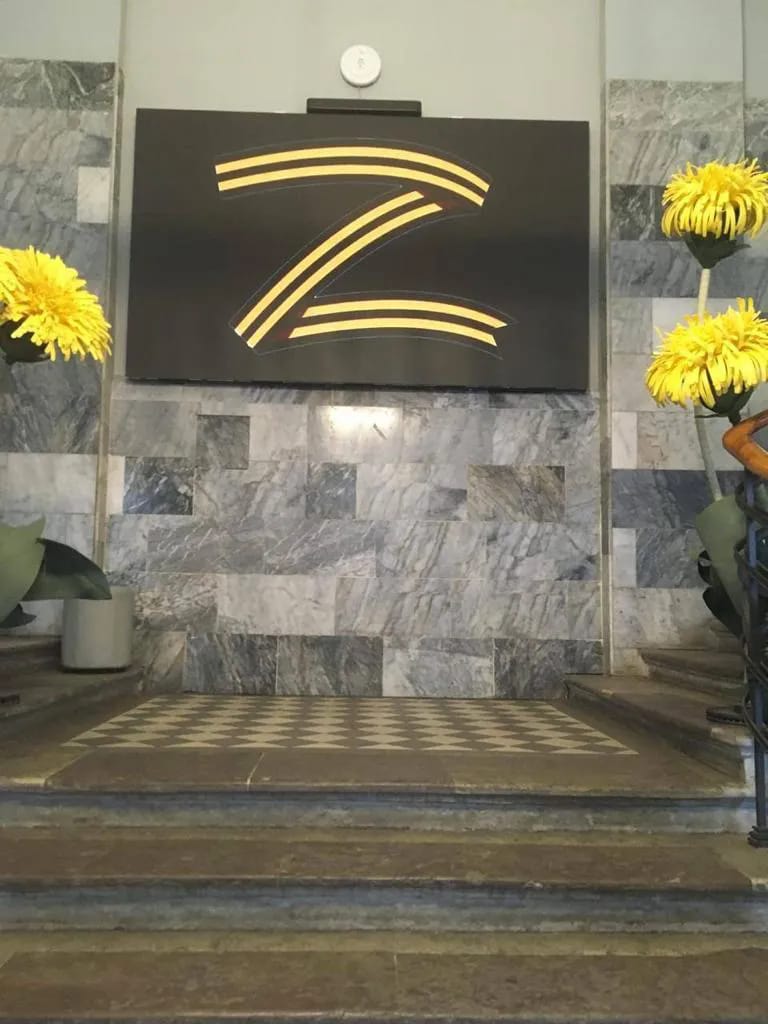
The Putinist Zwastika now graces the halls of Petersburg’s renowned physics and maths magnet School No. 239, writes Alexander Rodin, an alumnus who says that he will now try and get his alma mater excluded from all international projects including the school Olympics in maths and physics, and that he is sure that all his fellow alumni (some of whom I know) share his sense of shame at this turn of events. Thanks to PZ for the link.

The Zombie box. Smart people have been trying to persuade me that it is not a matter of propaganda at all, but that it has to do with the peculiarities of Russian culture and history, or with the psychology of the Russian populace, with complexes and resentments. As for the latter, I don’t really understand how one can deduce a particular reaction to current political events from such general categories as “culture,” which consists of many different things, nor do I really understand how so many complexes and resentments about Russia and the world naturally arise in the head of a specific person who mainly thinks about their own everyday problems. But as for the former — that is, propaganda — there is no theory for me here. Instead, there is the daily practice of observing my nearest and dearest: how this dark force literally enchains them, how this poison contaminates their minds, how these people repeat verbatim all the stock propaganda phrases and figures of speech, passing them off as information and arguments, and how they lose the ability to hear objections. Perhaps it isn’t the Zombie box that is the matter, but just in case, I advise you to turn it off and try to expel Saruman from your brains.

Source: Sergey Abashin, Facebook, 21 March 2022. Translated by the Russian Reader

_______________

Vladimir Putin’s speech at the concert and rally in Luzhniki Stadium, Moscow, 18 March 2022

Putin Marks Crimea Anniversary, Defends ‘Special Operation’ in Ukraine in Stadium Rally
Moscow Times
March 18, 2022

Russian President Vladimir Putin led a pro-government rally that was beset by “technical difficulties” and reports of people being forced to attend.

The event marking the eighth anniversary of Russia’s annexation of Crimea, which is not recognized by most countries, came three weeks into Moscow’s full-scale invasion of Ukraine that has sparked fierce international condemnation.

“We have not had such unity for a long time,” Putin said, referring to the “special military operation” in Ukraine as he addressed the crowd of about 95,000 and another 100,000 outside the stadium, according to the state-run RIA Novosti news agency.

Moscow’s Luzhniki Stadium was awash with Russian tricolor flags as snippets from Russia’s military insurgency in Crimea flickered across the stadium’s screens, accompanied by songs that celebrated the success of Russia’s military.

A number of guest speakers, including RT editor-in-chief Margarita Simonyan and Foreign Ministry spokeswoman Maria Zakharova, spoke from a stage emblazoned with the phrases “For Russia” and “For a world without Nazism.”

Many guest speakers were wearing orange-and-black St. George’s ribbons in the shape of a Z, a new symbol of support for Russia’s Armed Forces in the wake of the invasion.

Putin’s impassioned speech defended Russia’s military operation in Ukraine, citing the need to protect those in eastern Ukraine’s Donbas region from a so-called “genocide.”

“This really was genocide. Stopping that was the goal of the special operation,” said Putin, who was wearing what has been identified as a $15,000 parka.

But the broadcast of his speech came to an abrupt end as Russia 24, the channel broadcasting the event, switched to footage of a military band playing on the same stage.

Russian state television is tightly controlled and such interruptions are highly unusual.

The Kremlin later said that the broadcast was “interrupted due to technical problems on the server.”

Reports prior to the event stated that many of those in attendance had been forced to attend, with state employees used to bolster the annual celebration’s numbers.

“They stuck us in a bus and drove us here,” one woman told the Sota news outlet outside the stadium.

Meanwhile, a photo shared by the Avtozak Live news channel suggested that event-goers were offered 500 rubles to show up to the event.

Videos circulating on social media showed streams of people leaving the stadium some 20 minutes after the event had started.

Crowds were subject to rigorous security checks when entering the stadium, as the atmosphere in Moscow remains tense amid the Kremlin’s decision to launch a military operation in neighboring Ukraine that many Russians have voiced opposition to.

The event’s strict guidelines also banned any symbols associated with Ukraine or the West, according to an unconfirmed report by the Baza Telegram channel.

Despite what appeared to be a festive mood in the crowd, a number of independent journalists were detained near the stadium, according to Sota, all of whom were later released.

In addition to referencing the Bible, Putin closed his address by invoking naval commander Fyodor Ushakov, who is now the patron saint of Russia’s nuclear bomber fleet.

“What a coincidence that the special military operation should fall on [the commander’s] birthday,” the Russian president said, as onlookers whooped in agreement.

He Didn’t Look like a Gopnik

Natalia Vvedenskaya, an amazing grassroots activist acquaintance of mine in Petersburg who teaches Russian to immigrant kids, writing about what happened her and “No to the war” pin today in the subway:

I got my pin torn off today. It was a man, over thirty. He demanded that I take it off, then he tore it off himself. He didn’t look at all like a gopnik, by the way, although he behaved accordingly.

Source: Natalia Vvedenskaya, Facebook, 19 March 2022