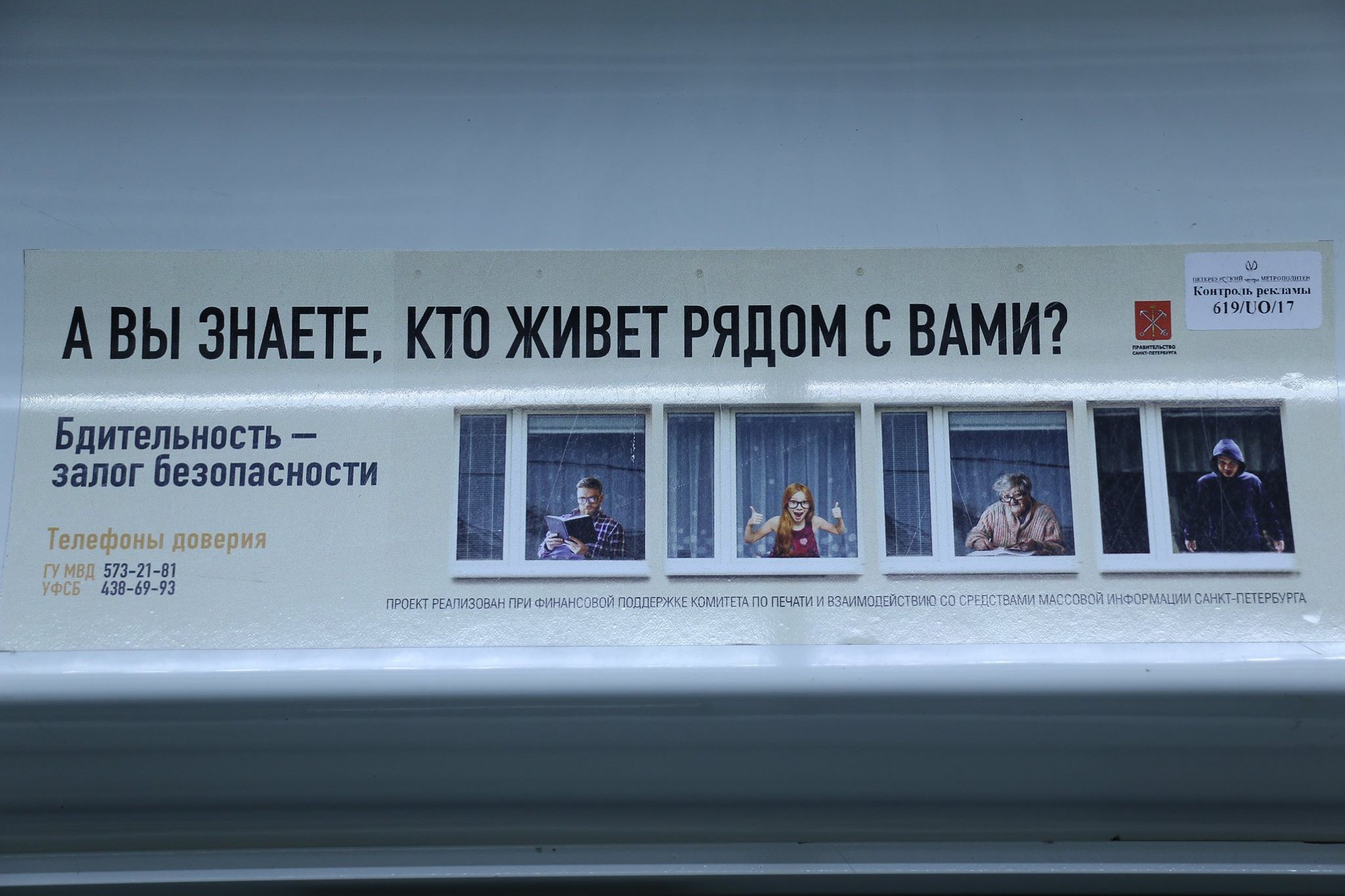
“Do you know who lives next door? Vigilance is the key to security.”
I admit that I sometimes try and get people talking to understand what’s going on in their heads. Today, however, I had no such plan. I only permitted myself to go outside for ten minutes to drink a cup of coffee and to look at the sun as seen from somewhere other than the window of my office. I went to my favorite coffee shop, a two-seater, without any ulterior motives. And without wanting to hobnob with anyone. I sometimes have a nice chat with the barista, because it was simply impossible to have an unpleasant chat with him before [the war]: he has no interest in politics whatsoever. He’s an exemplary sweet summer child, a vegan, the antipode of universal evil. But then he tried to get me talking, on the contrary, taking me by surprise. He suddenly started discussing Ukraine. For some reason I assumed that the hellishness going on there would disgust him, but far from it! When I said that civilians were being killed there, he was genuinely surprised. “Who’s killing them? What civilians?” In a nutshell, he has a girlfriend in Kharkiv. She stays at home, doesn’t go out, and hears gunshots, but she hasn’t mentioned anything to him about casualties. “There, in Kharkiv, you know, everything is fine, you just shouldn’t go outside.” Then he started complaining to me that, in Ukraine, they name streets in honor of [Stepan] Bandera. Tall and blond, the guy looks to be about twenty-five. Bandera is the bane of his existence, but otherwise everything is cool. Something tells me he’ll never want to learn the truth.
This feuilleton was posted friends-only on social media earlier today by an experienced and thoughtful Moscow-based journalist and activist. They have kindly permitted me to translate and publish it here. Photo by the author. (It was taken on another occasion several years ago, but seemed to fit this story.) Translated by the Russian Reader
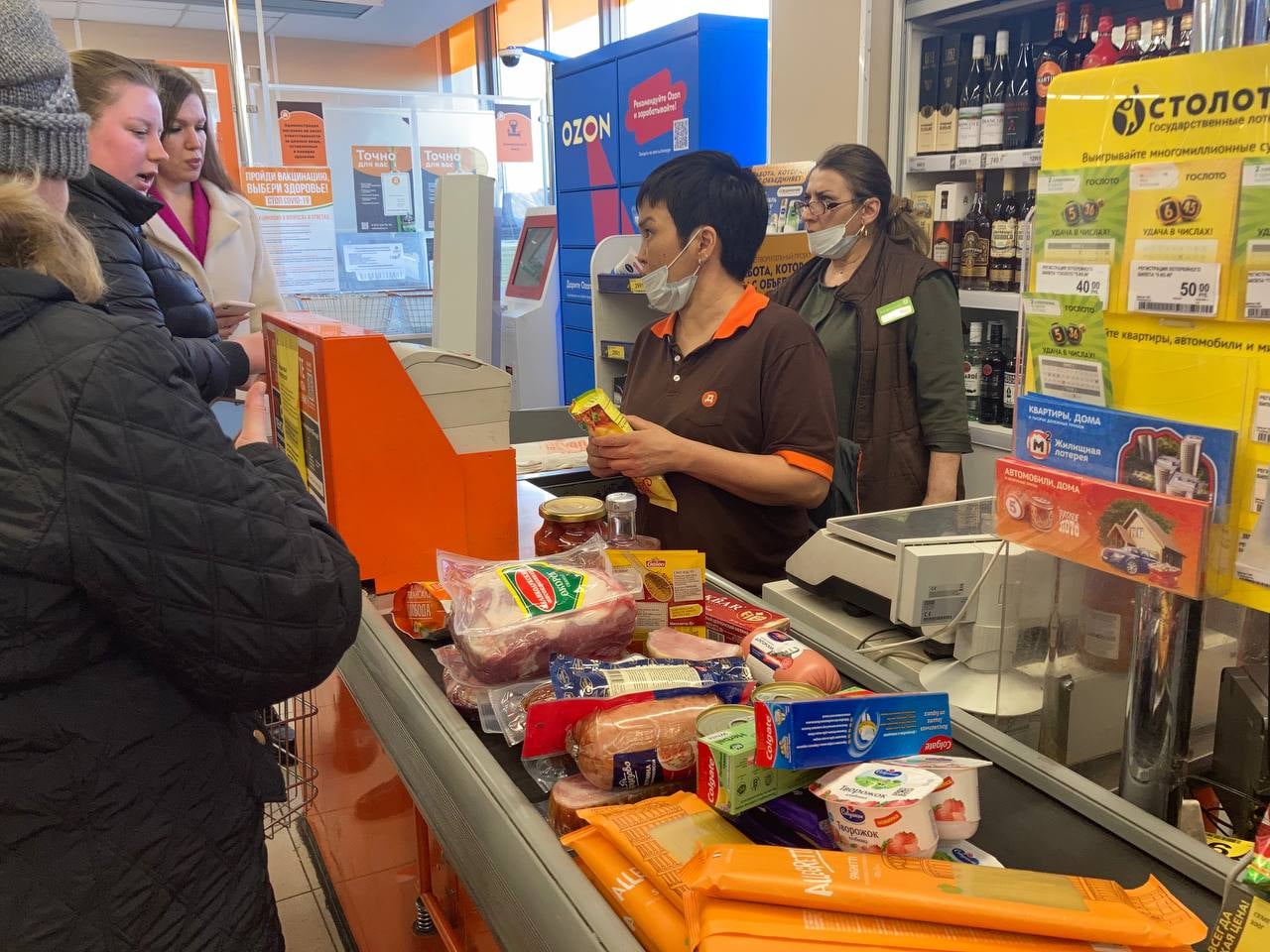
Spoiled by grocery delivery services, I am rarely in supermarkets these days and don’t see all of life’s nitty-gritty.
Today I went into the Dixie [a Russian discount supermarket chain] near my house. Everything seemed pretty normal. I went along the shelves, but I really like buckwheat groats [a staple cereal grain in Russia] and wanted to buy some, and there was no buckwheat. I didn’t need sugar but when I saw there was no buckwheat I looked at the sugar shelf — no sugar. Also there were no Always pads, and I needed some. Probably there was lots of other stuff missing too, but I didn’t have time to make a thorough study. I put some of what was there into my basket and got into line for the register. I never remember prices, alas, so I didn’t particularly notice whether anything had gotten more expensive over the last month. But this would be cleared up shortly.
A woman and her friend come running into the store, right up to the register, and she starts complaining loudly that she bought ketchup for 146 rubles [$1.33 today (3/15/22) — trans.] as per the shelf tag, but at the register they charged her 194 rubles [$1.77], which she only noticed when she got home and checked the receipt.
“Why would I want ketchup for 194 rubles! You have to sell it for the price that’s written on the tag. Give me my 48 rubles back!”
“We’re not giving you anything back: our prices don’t match the shelf tags. You can return the ketchup and we’ll give you your money back.”
“What do you mean, the prices don’t match? You are obliged to show them!”
“On your website it still says that ketchup costs 146 rubles,” the woman’s friend interjects.
“The prices are changing every other day here, you think we’re going to go around pasting up the new ones all the time?! Don’t you know what’s going on?” screams the cash register lady.
“We’re not the ones setting the prices. They change by themselves in the system. They don’t even send us shelf tags: we just scan everything here at the register!” adds another cashier supportively.
“Why is the store management suddenly changing the prices?” I ask.
The line, the cashiers, and the woman with her friend all look at me with stern incomprehension and even an element of disapproval.
“What, you don’t know,” someone mutters angrily, and everyone again looks away, down at the floor or at the checkout conveyer belt.
Everyone knits their brows in silence. The older cashier quietly tells the younger one how to do a return, take cash and calculate the correct change, because many people’s bank cards aren’t working.
No one says out loud that President Putin is waging war in Ukraine or that “NATO-the Americans-who knows who” is to blame. No one discusses why the prices are higher and why there’s no buckwheat. No one says anything at all and everyone looks at the floor.
Only the man who was standing behind me went back to the shelves and grabbed a third bottle of vodka.
Source: Alexandra Polivanova, Facebook, 14 March 2022. Translated by the Fabulous AM with the author’s permission. Photo by the author
Alexander Kynev: “A moment of patriotic joy. I don’t know if there is anything more bogus. Even the Young Pioneer line-ups of my childhood were more natural.”
The video Mr. Kynev has embedded on his Facebook page is entitled “Zapolarye Za Mir” — “The Arctic for Peace.” The activists identify themselves as “residents of the Murmansk Region” (and, indeed, are standing on a hill overlooking Murmansk itself.) In addition to the newfangled Russian “Z” swastika, the hoodies sported by the lead troika of “activists” are also emblazoned with the “We Don’t Abandon Our Own” slogan that featured heavily in Russia’s first invasion of Ukraine in 2014 and has been revived for the new invasion. ||| TRR
__________
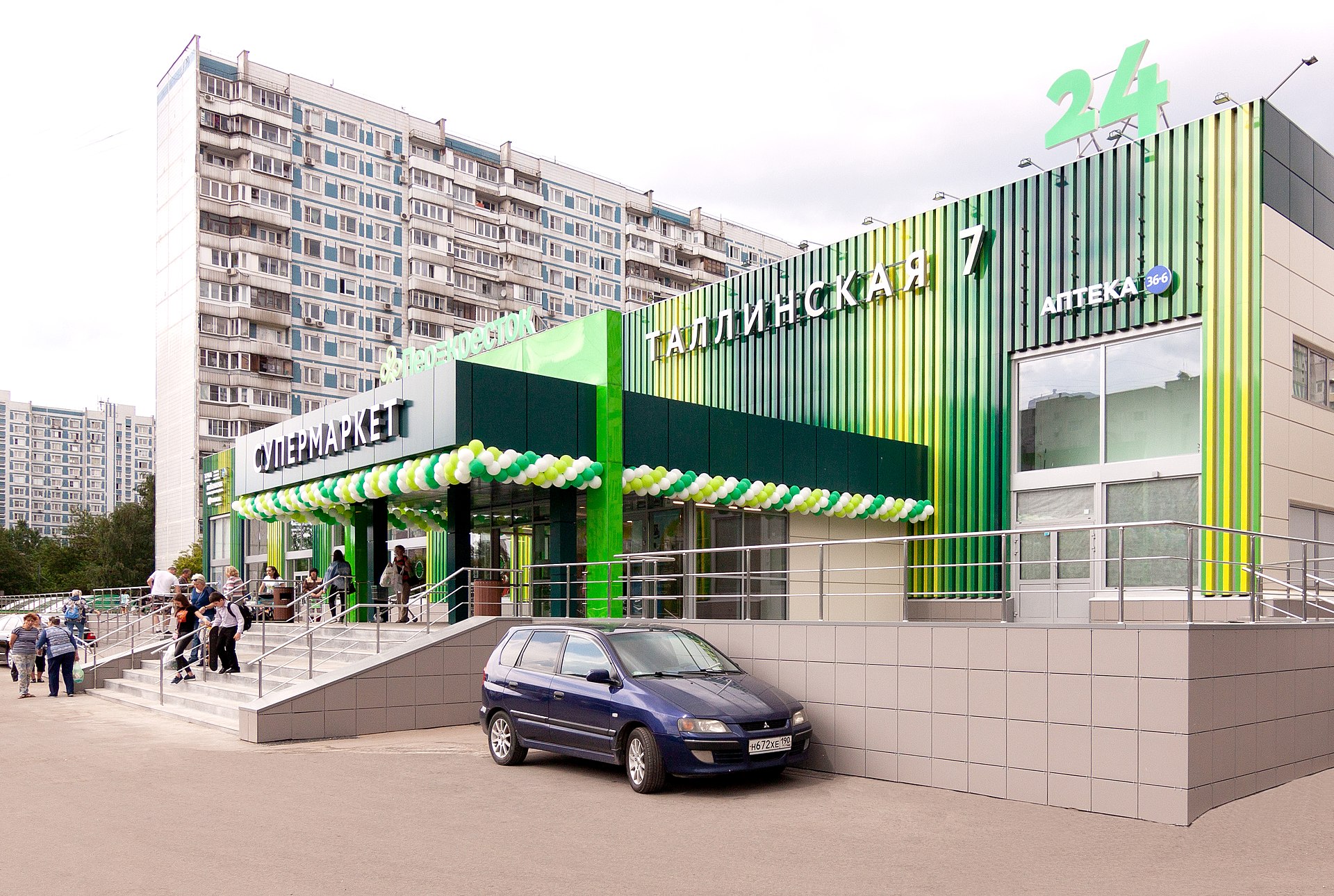
A Perekrestok chain supermarket in Moscow. Photo courtesy of Wikipedia
“People are to blame…”
I stopped by Perekrestok and was blown away. Bananas were 140 rubles a kilo, pre-washed carrots were 100 rubles a kilo.
The hypermarket itself is open until eleven p.m. nowadays, not around the clock.
“Prices have really gone up. Is this all because of the w*r?” I say to the middle-aged woman at the checkout.
“No, it’s not just because they’ve attacked the neighbors. It’s because of the people.”
“The people who unleashed it all? I hope they will be held responsible…”
“No, because of the people, all of us, who allowed this gang to take over Russia. And each of us will bear our share of responsibility for this. And bananas at 140 a kilo are still just icing on the cake… We are to blame for what happened. Everyone who let this happen. Everyone who ‘wasn’t interested in politics.'”
It is very difficult for me to write this letter. I don’t want to say goodbye at all. To my great regret, I was forced to leave Russia and resign as the director of Nochlezhka. Of course, I will help my colleagues remotely as much as I can, but it would be strange to try and run everything from afar. Danya Kramorov, our longtime volunteer, coordinator, and until recently the head of fundraising and PR, will replace me as head of our organization.
Twenty years ago, I came to Nochlezhka myself as a volunteer, and in 2010 I became an employee. Back then it was a lovely and proud little organization. That hasn’t changed, but the scale of our work has. Currently, we are helping 480-490 people in Petersburg and Moscow every day. Together we have opened free showers, laundries, warming-up spots, and rehabilitation shelters. In our approach to helping people in need, we have grown into providing psychological assistance, employment programs, training in new professions, and a dedicated rehabilitation shelter for homeless people suffering from alcohol addiction. Just as twenty years ago, everyone who comes to us for help or provides assistance in any of our current projects is treated like a human being. I’m confident that things will always be like this at Nochlezhka. It is a huge effort by many people, and if you are reading this, you are one of them. I would very much like to list everyone by name, but only last year Nochlezhka was supported by donations from over 20,000 people. Thank you very much!
Nochlezhka’s 2013 This Side of Life campaign hasn’t lost its relevance. Photo courtesy of Nochlezhka
Nochlezhka is much bigger than Grisha Sverdlin. Nochlezhka is my colleagues, a wonderful, professional team of eighty people. Nochlezhka is the hundreds of volunteers from all over the world who respond to our call. Nochlezhka is the thousands of people who donate money and medicines, food and clothes to us, who read our news and don’t believe the stereotypes [about homeless people and homelessness]. Nochlezhka is the companies that provide their services for free. Nochlezhka is you.
With the help of this huge cool team, just last year we helped 8,165 people in need. No matter what happens, this year we will definitely keep all our projects running so that anyone who turns to us can keep their health and dignity and return to a normal life. Moreover, this summer we will be opening a shelter for elderly homeless people in the Leningrad Region, and in late March we will launch the long-awaited restaurant Street Entrance, where the residents of our rehabilitation shelters will master new trades that will enable them to continue getting their lives back together.
I’m terribly sorry that I won’t be at the grand opening. I had planned to spend most of my salary at our restaurant. It’s incredibly cozy and the food is very, very tasty. But enjoy yourselves there for me, please! And I will wait for the day when we can meet at the bar and discuss the good news.
Nochlezhka will continue to operate even if the earth crashes into the celestial axis. And I will continue to classify myself as a Nochlezhkin, remaining a volunteer and donor of this organization so dear to my heart. Unfortunately, more and more people will need our help in the coming months. And since that is the case, we will continue to help them, of course.
Yours,
Grisha Sverdlin
Source: Nochlezhka email newsletter, 15 March 2022. Translated by the Russian Reader. I was a volunteer at Nochlezhka and its (now defunct) “street newspaper” Na Dne (The Depths) in the mid-nineties. Although I included the original link in Mr. Sverdlin’s letter to Nochlezhka’s donations page, it would seem that people outside Russia can no longer donate money to the organization, as they could only a short time ago. I tried just now to donate 1,000 rubles using a European-issued MasterCard, but the transaction was declined. However, I immediately got a message from Nochlezhka saying that they could see that I had tried to donate but that something had gone wrong on their bank’s end. I write this not by way of soliciting donations for Nochlezhka but to illustrate the difficulties charitable organizations in Russia now find themselves in. And, although he doesn’t mention this in his letter, Mr. Sverdlin has written on social media that he left the country because several reliable sources told him that he was in danger of arrest. ||| TRR
UPDATE (3.15.22) Nochlezhka’s project coordinator has written to me to confirm that, indeed, it is no longer possible to make donations to them using non-Russian bank cards and non-Russian payment systems. She cited the advice to donors that Nochlezhka published on its website earlier today. The last two paragraphs of that advice read as follows:
Payment via Google Pay, Samsung Pay and Apple Pay has been blocked for Visa and Mastercard cardholders. This means that one-time and regular donations that were issued in this way are no longer valid. Please re-register your donation if it has been made using one of the methods listed. You can manually sign up for a new donation payment using the form on our website.
Currently, bank cards from foreign banks cannot be used to donate money for our work. We are no longer receiving money transferred through Global Giving and PayPal. We will look for new ways [to donate] for anyone who does not have a Russian bank card, and we will definitely inform you as soon as we find them.
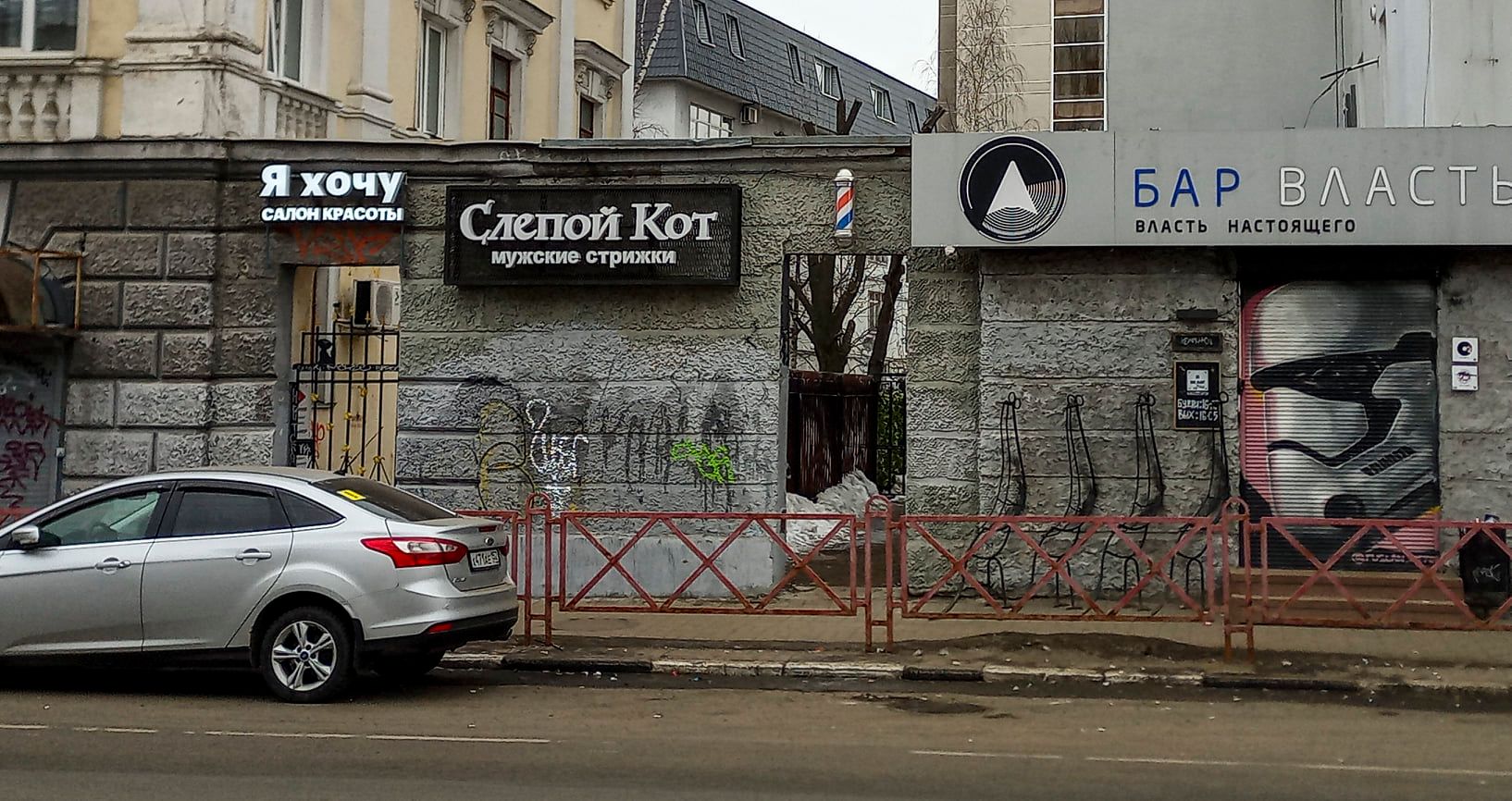
Vadim F. Lurie, Yaroslavl, 13 March 2022. From left to right, the shop signs read, “I Want It Beauty Salon,” “Blind Tomcat Men’s Haircuts,” and “Power Bar: The Power of the Present.” Reprinted with the photographer’s kind permission
The biggest surprise for me (and my biggest miscalculation) has been the number of people supporting Putin.
I had expected something else after two years of idiotic measures against the pandemic (measures that caused the deaths of more than a million people), after the [economic] crisis and the pension reforms.
This support cannot be explained solely in terms of propaganda. The regime’s propaganda is eclectic: it doesn’t supply people with a holistic worldview or logical arguments. It supplies them with mind-numbing slogans. The Russian Federation still has a fairly educated population, with a relatively broad outlook inherited from the Soviet education system. Over the years, I have learned from my own experience as an activist how difficult it is to convince such people using slogans alone.
In all the conversations [about the war] that I have had with people, it was they who initiated the conversations, vigorously advanced their positions, and went on the attack. This is completely atypical. Usually, it’s the other way around.
In all cases, the conversations boiled down to “we don’t know the whole picture” and “there must be good reasons,” segueing to “we don’t decide anything” and “it’s all completely pointless anyway.” A friend said that mothers refusing to look for their sons killed in combat have been saying, “There is no point, [the authorities] won’t give us anything.” A colleague at work ended our conversation [about the war] by saying, “Over in Khabarovsk they protested in defense of [Sergei] Furgal for three months and what of it? It’s completely useless.”
Now I have the feeling that people are very alarmed. They expect the worst and manifest the “social instinct” typical of post-Soviet society — siding with the strongman and rallying round “our guys” whoever they are.
That is, it is not propaganda that encourages them to support [the war], but “instinct.” Propaganda, on the other hand, only satisfies the demand for an explanation after the fact, the need for an indulgence and an analgesic.
Probably we should have expected something like this because the Russian Federation has been living in “counter-terrorist operation” mode for twenty years with berserk cops and crazed lawmakers. Nevertheless, I expected something different.
I don’t see any positive prospects yet. To do something, you need an organization, resources, intelligence, bases of support, media, and experience in underground work, finally. None of this exists. We are now in circumstances resembling those faced by the White Rose — only the authorities are not killing us yet, they can only send us to prison for ten years. And we don’t have the slightest preparation for working in such conditions.
The worse the situation in the country, the more people will consolidate. No introspection or arguments will break through the barrier generated by fear, guilt, and the imperial complex. Partisans [guerrillas] must have the support of the populace, but we don’t have it. One-off heroic actions would simply send crowds armed with pitchforks and torches to the houses where the heroes’ relatives live.
On the other hand, there are admirable examples of protesters mobilizing. They have also been consolidating and learning self-organization and mutual support. (Their leaders have all been jailed.) Theirs is not a left-wing mobilization, nor is likely to become one.
The left had a mobilization two years ago and we wasted it on another round of party-building projects.
These reflections were posted friends-only on social media by an experienced and extraordinarily thoughtful Russian grassroots activist whose day job as a tradesperson brings them into contact with Russians from all walks of life on a daily basis. They have kindly permitted me to translate their remarks and publish them here. Translated by the Russian Reader
I’m a translator, an academic, and a US citizen. Over the past week I have received many dozens of emails from people all over Russia who are desperate to leave and looking for any way out of Russia and into a stable academic or arts-related position.
The one I’ve translated here (with permission from the author, whose personal information has been removed) is both characteristic and particularly exhaustive, and reveals a lot about the situation in Russia now. Just as the prospect of a “war in Europe” and “World War III” has activated memories of the Second World War, in Russia the new crackdown on free media and civic protest has dredged up a lot of cultural trauma around Stalin-era repressions, particularly among the intelligentsia. Postmodern apocalypse rules, with totalitarian concentration camps and 1984 rubbing shoulders (see also Nadia Plungian’s piece analyzing the 20th-century’s death-grip on the modern-day cultural imagination in Russia).
The specters of the twentieth century are additionally deleterious in the way they constantly bring back and elevate specifically Russian suffering. While this suffering is linked to real, undeniable and still largely unprocessed trauma, it feeds into the self-absorption and political passivity that underpins the state of things in Russia today (I don’t have to point out certain parallels with the US and mainstream American culture). It’s not my place to blame Russian citizens for what their insane government is fomenting in Ukraine; there is just clearly much work to be done to build civic consciousness and a functioning society.
Hello.
Although I was born and have spent my whole life in Russia, I am, ethnically speaking, half Russian and half Ukrainian: my grandparents are from Ukraine, and even quite recently I was thinking about applying for Ukrainian citizenship in order to move to a normal, free country, all the more so since I have roots there, but I took too long to decide and now the war has canceled all of those plans. What’s happening right now in Ukraine puts me literally into a state of shock, and what’s happening in Russia makes my hair stand up on end from horror and the realization that this is not a bad dream or nightmare that one might at least eventually wake up from.
This inhumane and senseless war that Putin is waging against Ukraine, which the Russian governmental media insist on calling a “special operation” (while using the word “war” carries the threat of criminal charges), this is only half of the hell, the other half is happening inside Russia. In downtown [city’s name redacted; it is not a capital city], I witnessed the police arresting he small number of people protesting the war. The police used truncheons to shove a grandma holding a “NO WAR!” sign into a paddy wagon. I can’t get my head around the fact that being pro-peace is a crime now. But there are very few protests, the people capable of thinking, the ones who understand how absurd what’s happening is, they’re spooked and scared of protesting lest they end up crippled or have fabricated criminal charges pinned on them.
But the worst thing is that many people, including my former colleagues from the theater, absolutely support this hell that Putin is creating right now in Ukraine, this totally unprovoked and unjustifiable, senseless and bloody slaughter. A huge majority of people has been zombified by the propaganda on TV and are openly welcoming this war, thoughtlessly reproducing the TV propagandists’ fascist, misanthropic slogans. And it’s impossible to convince them otherwise, they brand any rational argument a “fake” and hate the people who argue with them. Today, near my building, I saw that my neighbors had painted the “Z” symbol on their cars, this new swastika that marks the Russian military equipment going to attack Ukraine. They’re all in favor of the hellishness, the blood and death, the war. It’s so scary.
The most absolute insane and absurd madness is being fomented, madness that has no sense and virtually no grounds. Besides this bloody war, besides the sanctions that the entire civilized world has imposed on Russia, here inside the country right now the most severe censorship is being implemented, the last free media outlets that covered the last alternative points of view are shutting down. This is the end. They have been destroyed simply because they called the war a war. There are new laws being passed that threaten fifteen years in prison for telling the truth, and who knows how long it will take before they bring back the firing squad for any kind of freethinking. The prime minister already voiced his support for [restoring] the death penalty. Every day things get worse and worse, and the end is nowhere in sight.
This is a surreal nightmare! Reality just all of the sudden lost its mind. In the blink of an eye everything turned from a vague sort of dictatorship into a totalitarian concentration camp along the lines of Orwell’s 1984, and this is no exaggeration. Soon nothing will be left here besides crowds of insane, poverty-stricken people, completely turned to morons by fascist propaganda, their last bit of reason lost, roaring bloodthirsty slogans, and they will simply destroy anyone who allows themselves to think differently.
I just don’t know how to go on living in this concentration camp that Putin is building here in Russia. Before the start of the war, one could at least try to live one’s life, to be free, to make a living through one’s art and not engage with the universal vector of militarization and dumbing down, to have some kind of hope and plans for the future, but now that’s over, there is no hope left. Navalny is in prison, the opposition has been totally crushed, and the state media, radio and TV, all without exception just repeat one and the same lies, lies, lies and nothing but lies, while the non-governmental sources of information are either already closed or are being destroyed and persecuted. The state is mercilessly rooting out even the weakest rudiments of free speech and of rational thinking in general. It’s terrifying to be here amidst this hell.
While I was writing this I got the news that PayPal and Payoneer announced that they would not be doing business in Russia anymore, and that means I will literally be left without any source of income for my creative projects, while working as an actor in this country involves propaganda in one way or another, because free creative activity has not been possible here for a long time. I became convinced of this myself when I left a theater whose management literally threatened the acting troupe to get us to vote for the candidate they wanted.
I’d like to just live peacefully, make art, learn new things, create beauty, and work to build a bright and joyful future. But now wanting peace will just get you beaten up and thrown in prison. I don’t know what to do and how to go on living.
Translated and prefaced by the Fabulous AM. Photo by the Russian Reader
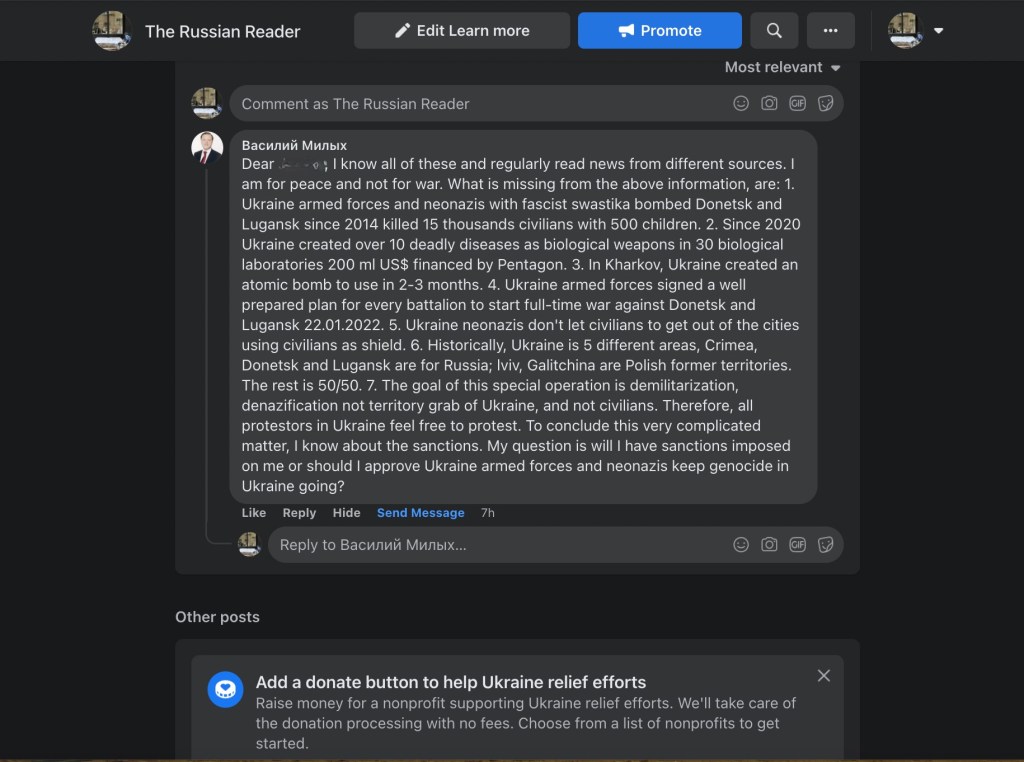
This comment, addressed to a friend of mine who had liked the original post (a link to this dispatch from Petersburg), was made last night by a Vasily Milykh on The Russian Reader Facebook page. My friend confirmed that Mr. Milykh is a real person, whom they had met many years ago while raising money for a very worthy charitable cause in Russia.This is a snapshot of Mr. Milykh’s Facebook page. He is a former vice president at Alfa Bank, a former analyst at CSIS (Center for Strategic & International Studies), and was educated at Harvard and the University of Wyoming, among other places. I hope this gives the lie to the common prejudice that Putin’s “base” is the unwashed, uneducated provincial hoi polloi. ||| TRR
Sergey Abashin, who teaches anthropology at the European University in St. Petersburg: Another reflection on “Russophobia.” Many people are now exercised about external criticism [of Russia], which is often emotional and indiscriminate. For us [in Russia], however, it is more important not to retreat into resentment. Instead, we should think hard and long on what in our public reflections proved to be wrong, why what has happened did happen, and where we made mistakes. Why the Chechen war with its thousands of victims and refugees did not teach us anything. Why we were unable to comprehend all the consequences of the war in Georgia. Why we completely failed to notice the bombing of the civilian population in Syria. Why the disputes over who Crimea belonged to caused us to miss the emergence of a new imperial project with its now terrifying consequences. That’s the task that awaits us after it’s all over.
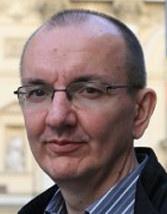
Source: Sergey Abashin, Facebook, 7 March 2022. Photo courtesy of Central Asia Program. Translated by the Russian Reader
_________
I watched this serious conversation between bestselling Russian writer and popular historian Boris Akunin and Russian vlogger and interviewer extraordinaire Yuri Dud last night before I went to sleep. Despite the overall grimness of their discussion, it left me feeling upbeat, oddly. Unfortunately, it hasn’t been subtitled in English, but I have translated the annotation and section headings, as published on YouTube on March 4, 2022. In any case, over 13 million (Russophone) viewers can’t be wrong. ||| TRR
vDud
9.92M subscribers
Everyone is blocking everything, so sign up to our Telegram channel https://t.me/yurydud
0:00 What is this episode about?
1:41 Why did Putin start the war?
5:44 Putin = Nicholas I?
7:47 The Crimean War
11:27 An important announcement
11:36 “Russia has never attacked first.” Really?
12:17 Why is Putin so interested in history?
13:20 Is being an empire bad?
16:09 Why do so many people in Russia support the war?
19:35 WHERE HAVE YOU BEEN ALL THESE PAST 8 YEARS?
21:17 Crackdowns
23:13 Was your grandfather a Chekist?
25:57 “You never need to listen to what a secret service agent tells you”
27.34 Can a KGB officer be president?
28:36 How did Mikhalkov influence the finale of “The State Councilor”?
31:35 Is the West to blame for the war?
34:54 Who breaks promises?
35:36 The bombing of Belgrade, the invasion of Iraq and Syria – is this normal?
37:27 Is America an empire of lies?
38:46 Is the death penalty good or bad?
41:58 Propaganda in Soviet schools
44:16 The (dubious) benefits of censorship
46:44 Opening up of Siberia = colonization of America?
50:42 Does another collapse await Russia due to this war?
55:15 The best period in the history of Russia
56:19 Why does Russia have a special path?
1:01:39 The worst period in the history of Russia
1:04:07 How does Stalin influence Russia today?
1:06:13 Will there be a nuclear war?
1:10:16 Should people flee Russia?
1:11:41 In 1945, the United States dropped an atomic bomb on Japan. How do those two countries get along now?
1:13:40 Will Russians and Ukrainians be able to mend their relationship?
1:16:20 Is it right to claim collective responsibility for the war?
1:17:36 What will happen to Russia next?
_________
A policeman in Krasynoyarsk (Siberia) erases a “No war!” message written in the snow. Igor Averkiev writes: “People who are losing their minds never realize they’re losing their minds.” When I reposted this on my Facebook page and erroneously attributed the footage to Averkiev’s hometown of Perm, he wrote to me: “No, it’s not in Perm. It’s in Krasnoyarsk. But such ‘everyday madness’ is possible everywhere in Russia today. Of course, this hassle will pass. The question is when and at what human cost.” ||| TRR
– And why is everyone pouncing on this Novaya Gazeta and snatching it up?
– Nothing surprising about that. It’s the last honest newspaper in Russia.
– Honest? Can Jews honestly write about Russia?! It’s a Jewish newspaper!
– What do you mean, Jewish? It’s not Jewish.
– It’s Jewish! They are enemies of Russia!
– Then why are you selling it?
– I am not selling it [as she hands over the paper in exchange for money]. I am… [Pauses to think.] I am… blocking it! [Carefully straightens out the two remaining copies.]
– You just sold it to me. But okay, I’ll be going to another kiosk from now on.
– [Hysterically, segueing into a scream and spraying saliva] You’re the enemy!!!
– Why the familiarity? What’s your proof?
– You’re an enemy of Russia!!!
– Stick your filthy tongue up your ass.
Instead of answering, the saleswoman slams the kiosk’s glass window shut. The window frame rattles and jingles threateningly. At least it’s not caused by an explosion. Not yet.
Communication breakdown.
Alphabet:
А is for anti-Semitism.
W and P are for wave of patriotism.
S is for schizophrenia, as was said.
I.B.
p.s.
Grazhdanskaya Oborona (Civil Defense), “Wave of Patriotism”:
“Rock and roll is an enemy of the people”
Source: Volja, Telegram, 4 March 2022. Thanks to Anatrr Ra for the link. Translated by the Russian Reader
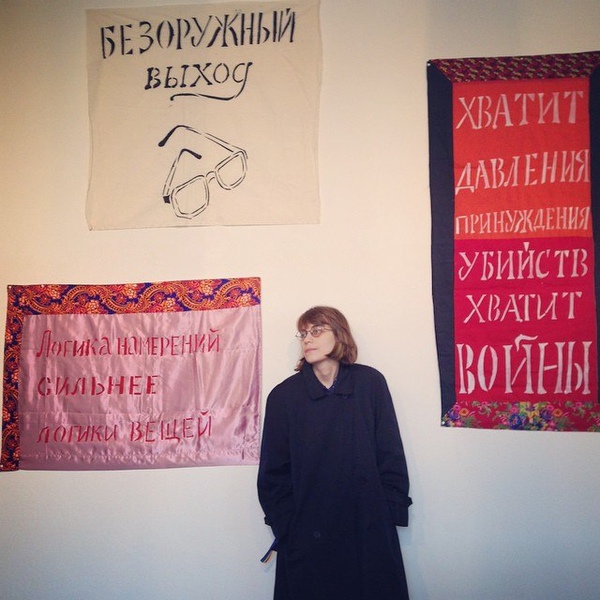
Nadia Plungian with her textile works at the exhibition “Post-Soviet Cassandras,” 2015
A Letter to Russia
Nadia Plungian writes to Russia from Russia
The more horrifying the images from the news, the more clearly do I realize that there is a profound significance to the fact that I stayed in Russia and repeatedly turned down opportunities to leave up until now. I am also thinking about friends and colleagues from Belarus, who are in a similar situation. Our countries have completely shut down, we have no illusions of a future whatsoever. There are no outside forces responsible for making a new era dawn. It is time to say something from within this space.
Many people are writing about political suicide. But which political reality is killing itself right now? Without a doubt, it’s the Soviet Union and its successor—Soviet post-Soviet statehood. We all saw the Soviet-era apartment buildings blowing up in Kyiv and Kharkiv. In the terrible light cast by these fires, it becomes especially obvious how closely the 2000s and the 2010s followed the Soviet epoch.
This is not just about “peacekeeping missions” but about a specific type of hybrid censorship, of visible and invisible pressure. The possibility for major changes in cultural, academic, and public life has been suspended for many years now. This happened with the nearly unanimous tacit support of the older generation, who seemed to have gotten stuck in the late 1980s and demanded that we, their children, not go beyond these historical confines under any circumstances.
People my age who wanted to change something have over the past fifteen years gone through a series of political and existential conflicts which can be summed up by the phrase “do not live.” There is no sphere in which we have not had to listen to rebukes about our lack of qualifications or threats to throw us out of the profession. Science, culture, technology, art, politics, the family. New methodologies? Irrelevant. Questions of domestic violence, violence toward women and children, generational conflicts? Laughable, those problems don’t exist. National, postcolonial, gender, religious identities? Prohibited, irrelevant, incomprehensible, nonexistent. You want to prevent historical monuments from being demolished, or, say, entire historical neighborhoods? Who do you think you are? We’re bringing out the bulldozers! You want to work at a school or hospital? Go on, we’ll see how you like living hand to mouth. And the respectable people who held respectable positions in society back in the 90s have been broadly supported when they call attempts to talk about all this “a revival of Party committees,” “leveling,” and “hysterics.”
The focus on suppressing the new, on ignoring progress—generally, the focus on a defeatist rhetoric laced with threats—is hardly a new phenomenon. For fifteen years we’ve been hearing from absolutely every corner that we have no prospects. That if you’ve got a head on your shoulders you should leave for Europe right away. That only morons and idealists would want to live in “this country,” would want to deal with the dynamics of Russian society, to write textbooks here, to reform museums, schools, or universities here, to open functional academic institutions, to form some kind of decent societal platform capable of describing the past and projecting a future.
The stance taken by the older generation was formally divided into two parts, which were fueled by two late-Soviet ideologemes. Substantively, however, they were entirely united, and they were taught to us at university. One part of society declared: you are nobody because you didn’t live in the USSR; we will take away your pensions, social security, and place in society; we will force you to pay insane mortgages, we will send you to jail for comments on social media, shame you for your personal life, and not give you even the slightest access to political life. The other part of society insisted: don’t flatter yourself, take your modest little spot—after all, you will never have money and possibilities anywhere near what they have in the West; nothing you do can ever be compared to what happens in enormous Western museums or with famous Western curators; you must memorize Western philosophers and theorists by heart because you are not philosophers or theorists, you have to imitate Western artists because you are not artists; holding out hope for anything bigger is deluding yourself; and remember, if you don’t want to play by the rules of the twentieth century, the nineteenth century will come.
I don’t know why my generation was so methodically deprived of opportunities, but I think that now the final act of this show has commenced. Because there’s nothing left to trample us with. Will all the leading thirty- and forty-something specialists in our countries be fired and deprived of income, sent to prison? And what fuel will you use to move forward then? This is not the Brezhnev era. The Soviet ideology has been destroyed; postmodernism is grown over with mold. You don’t have any writers, poets, politicians, or scientists. Who will force us to re-integrate into this meaningless, self-devouring loop, and how will they do it? Most importantly, how will you fill the empty cultural centers that you’ve been building all these years in all Russian cities? How exactly will the twenty- and fourteen-year-olds, under orders from the old folks, conceptualize and glorify military strikes against neighboring countries and the choice of complete cultural isolation? By what methods? On what terms? To what end?
I’ll add one more thing. Only now am I realizing the significance of my professional choices as a historian and art historian. Back in 2002, I rejected the possibility of working with “neutral themes,” choosing instead to deal with Stalin-era Soviet art—that is, pretty much the most depressing and censored material around. It is a field in which there are no reliable answers and no readymade narratives, and in which the big methodological steps have only been taken halfway.
My work is connected with what exists here in Russia. It is based on private archives and personal testimonies that come together to form an unwritten history of the country. It brings back the cultural and intellectual presence of people who, like us, found themselves here and stayed here at a most difficult time of transition, without any hope or any right to be heard.
The path that many of my friends and have chosen brought us face to face with a hard fact: the desire to work professionally in Russia and come up with something new in the civic, academic, and cultural sense meant operating under double pressure: without support from the older generation or from Western researchers. But we had faith in other thirty-somethings. We formed our own intellectual networks in various directions within Russia and in the territories known as post-Soviet space. We went deep into our countries and studied museums, archives, architecture, and the cities themselves, to see with our own eyes and independently analyze our history without having recourse to cliches and stereotypes.
I would not have become what I am if I had not maintained contact for the past fifteen years with independent millennials from Ukraine, Belarus, Kyrgyzstan, Kazakhstan, and Uzbekistan; with the scholars, human rights activists, artists, and philosophers who lived in these countries and with those who were forced to leave them, along with many like-minded people in Russia. We all encountered censorship and stigmatization and taught each other how to remain thoughtful people under these conditions. We welcomed each other into our homes, using the last of our money to put together conferences, roundtables, and exhibitions, taking every opportunity to see one another and exchange know-how. Because besides us there was no one to create the foundations for a future for our free countries. There is no one now either. There is no West offering us a readymade scenario. There is not a single Soviet institution that might have solutions.
We are alone.
This war is being waged without our consent and against us, physically destroying the fruits and prospects of friendship, cooperation, and solidarity for our generation.
Nuclear threats, attacks on neighbors, closed borders—this is the crazed twentieth century, screaming at us to heel.
But history will not grant it this authority. There is no such thing as the past dictating the rules for the future, or the past dragging the future into its old coffin.
Twentieth century, you tossed us out of your cubicles and deprived us of places in politics a long time ago. But this has had only one result—we are now free to choose our own places in politics and culture.
Nadia Plungian is a Moscow-based art historian, curator, and feminist activist. Source: Colta.ru, 1 March 2022. Translated by the Fabulous AM



 Sergey Abashin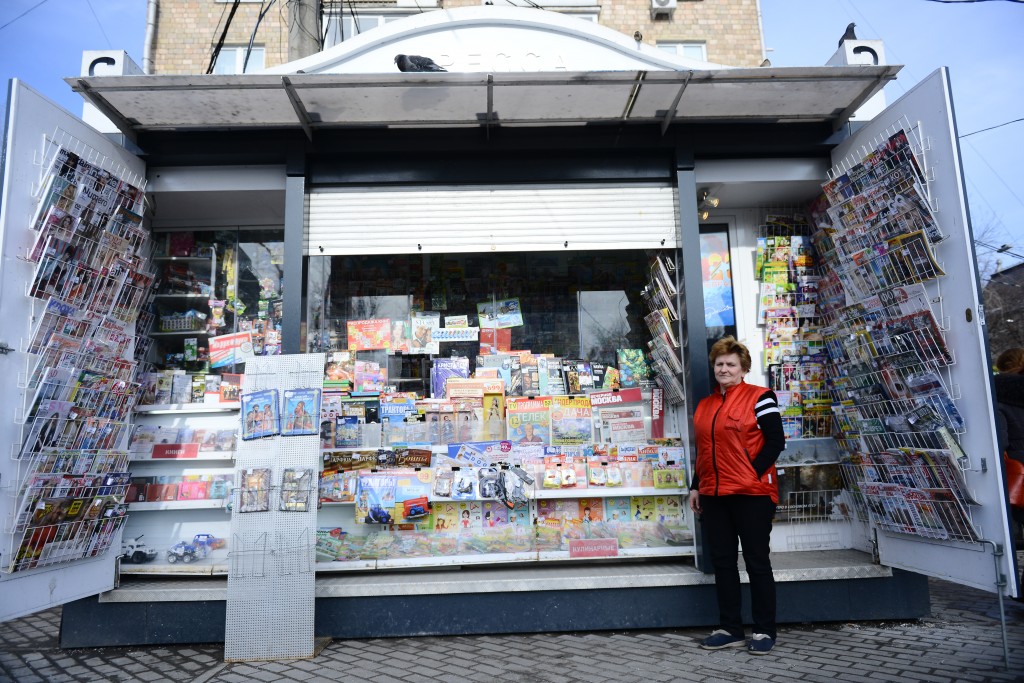
#/media/File:Perekrestok_new_concept_2020_Moscow.jpg)