Vyacheslav Luthor: A “Wallflower” Sentenced to Ten Years in Prison for “High Treason”

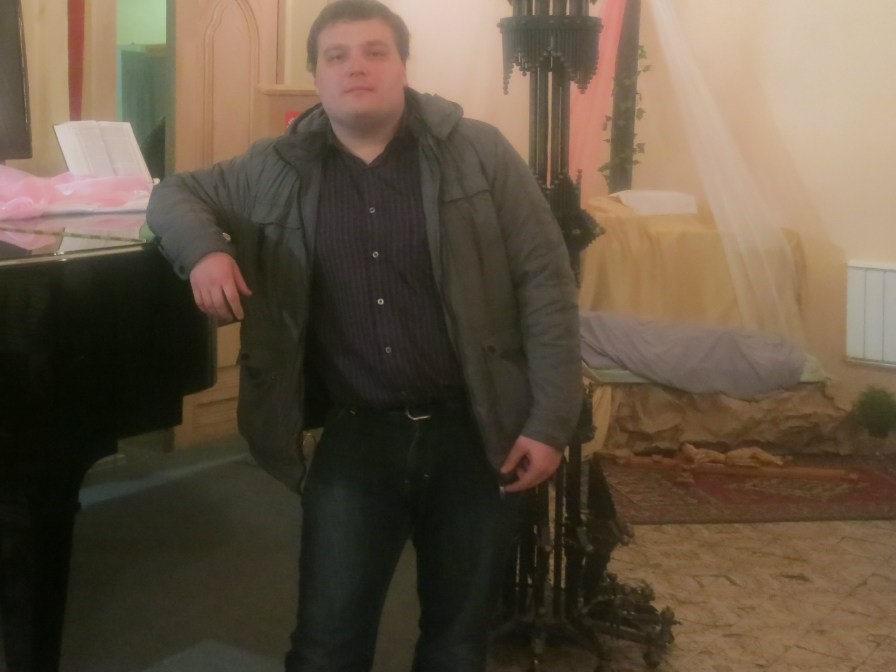
Vyacheslav Luthor, as seen in his online CV at Careerist.ru

The Second Western District Military Court in Moscow sentenced Vyacheslav Luthor, a bank clerk from St. Petersburg, to ten years in prison after finding him guilty of charges of high treason, secret collaboration with the representative of a foreign power, and involvement in a terrorist organisation, over his alleged attempt to join the [pro-Ukrainian] Free Russia Legion. Despite the fact that the courts usually hear such cases in closed chambers, our correspondent was able to attend one of the hearings. Thus, it transpired that last summer Luthor had been contacted by a recruiter who promised him a new job, a high salary, and assistance moving abroad.

Born and raised in Krasnoyarsk, Vyacheslav Luthor is thirty-three years old. According to his CV, he graduated from the local affiliate of the Moscow State University of Economics, Statistics and Informatics (MESI) in 2014, before working as an accountant in the local state statistics bureau and as a manager in real estate and trading companies. After moving to Petersburg, he took a job at Bank Saint Petersburg, which is also listed as Luthor’s place of work on his hidden VKontakte page.

The case against the bank clerk came to light last summer. On 29 July 2023, Mediazona found a record of his arrest on the website of Moscow’s Lefortovo District Court. At that time the charges of high treason and involvement in a terrorist organisation were listed there. Apparently, the charges were updated during the investigation, and so the Second Western District Military Court was asked to try Luthor on three charges: attempted high treason, confidential cooperation with the representative of a foreign power, and involvement in a terrorist organisation.

Previously, “high treason,” as defined by Article 275 of the Russian Criminal Code, was rarely charged, but after the outbreak of the full-scale war, involvement in combat on the Ukrainian side (or an attempts to go there to fight) and donations to the Armed Forces of Ukraine were equated with “high treason.” Also, a new article on “confidential collaboration” with foreigners—Article 275.1—was inserted into the Criminal Code.
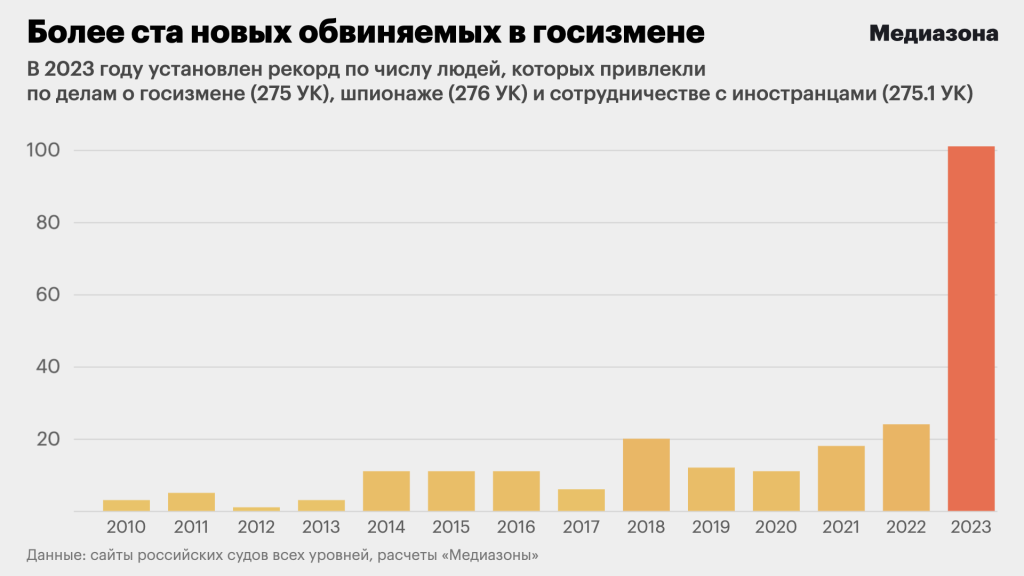
2023 was a banner year in Russia for charges of “high treason,” according to Mediazona.

Last year, as Mediazona has discovered, at least 107 people were accused of high treason (Article 275), espionage (Article 276), or collaboration with foreign powers or organisations (Article 275.1). Many such cases are classified, so the actual number of people charged with these crimes may be higher.

The human rights project Department One wrote that sixty-three high treason cases and seven cases of collaborating with foreigneers were submitted to lower trial courts. Verdicts have already been handed down in thirty-seven cases. All of them were guilty verdicts.

Unlike the high treason cases of previous years, which were mainly transferred to Moscow, courts in the regions began hearing these cases in 2023, human rights activists note. According to our calculations, more than seventy percent of such cases are now being heard outside Moscow, in the places where the crimes were allegedly committed, but the arrests and indictments are usually made in the capital.

This is what happened to Vyacheslav Luthor. Before he was placed in a pretrial detention centre, he had been jailed twice on administrative charges: on 11 July 2023, for minor disorderly conduct (Luthor was accused of “using foul language, shouting loudly, and waving his hands” at the airport) and on 14 July 2023, for disobeying police officers (Lutor was jailed for fifteen days for allegedly refusing to show his passport to law enforcers). He was to be released from the special detention centre on the day he was sent to the pretrial detention centre on the criminal charges.

“He asked me to keep my fingers crossed for him”: the testimony of coworkers

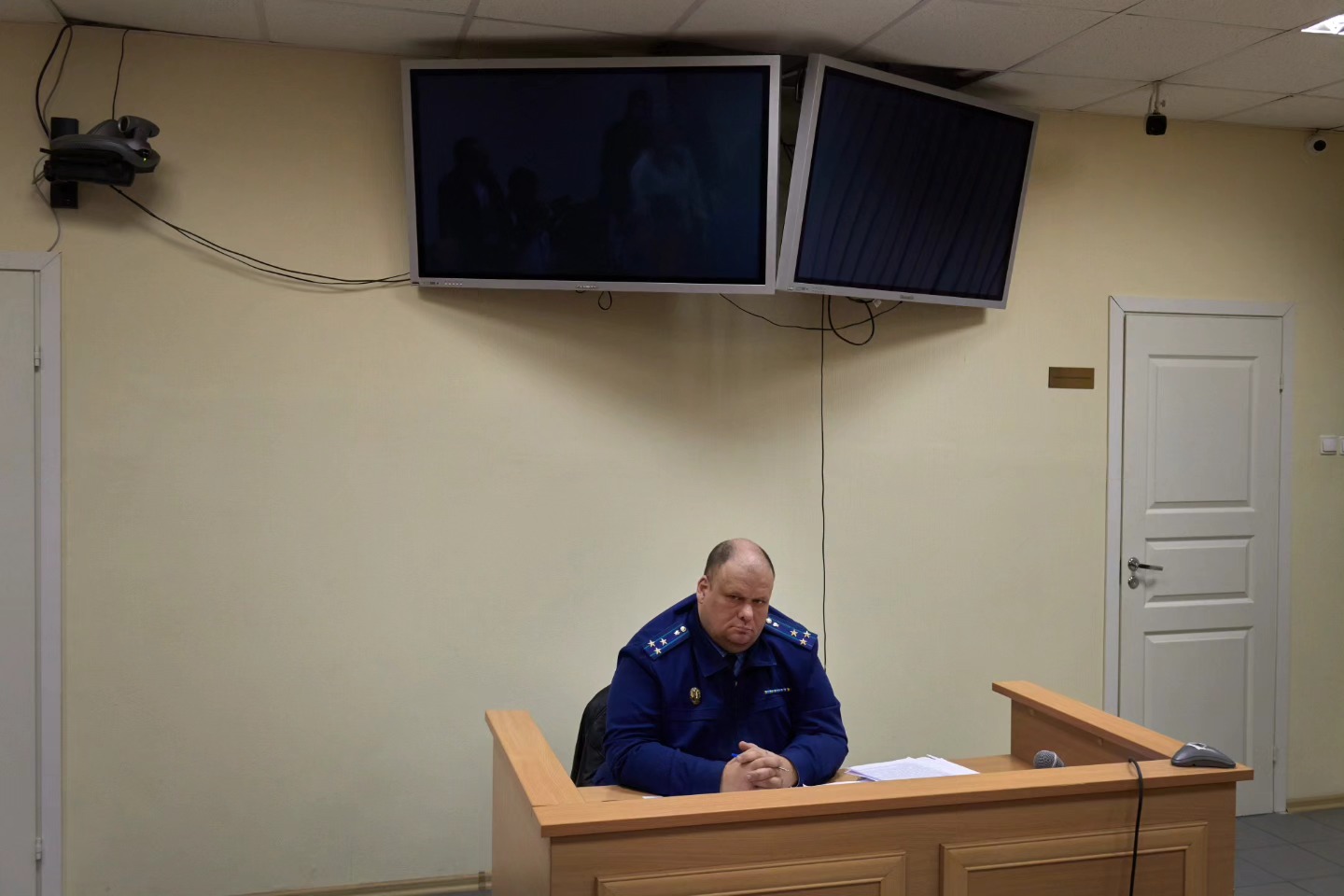
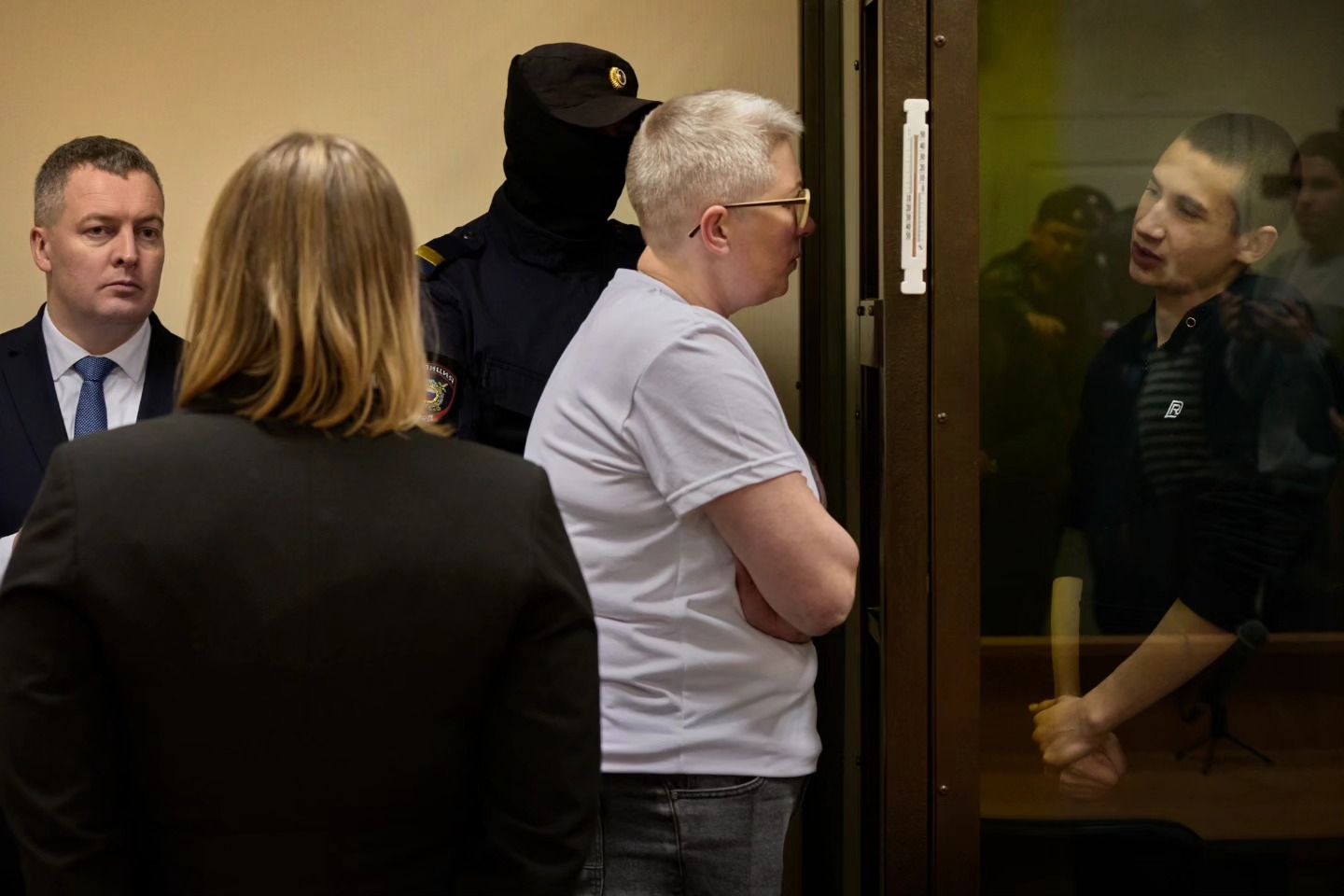
The Second Western District Military Court began hearing the case against Vyacheslav Luthor on 5 February. The state’s case was made by prosecutors Igor Potapov and Dmitry Nadysyev.

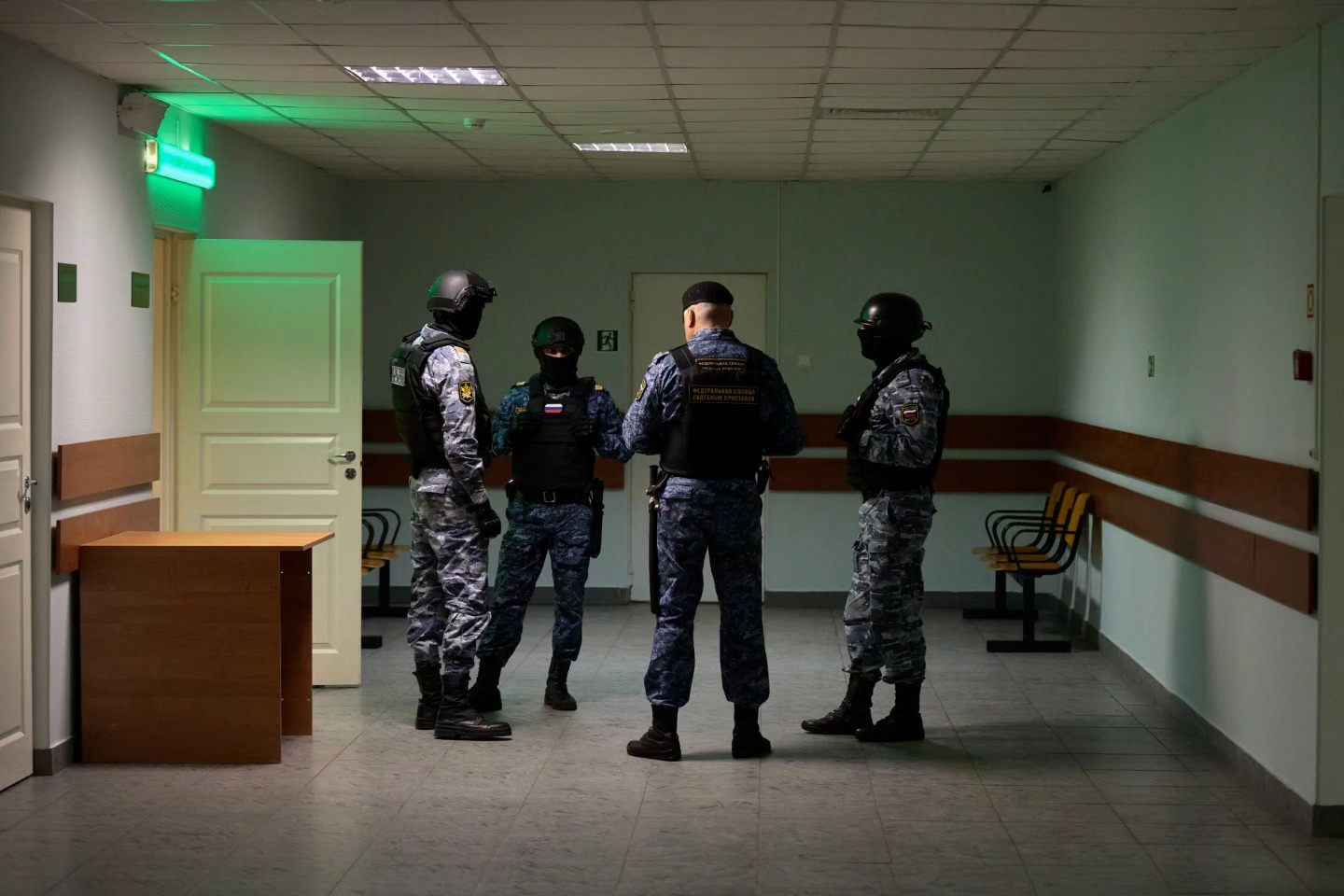
Trials on charges of treason are held in closed chambers and members of the public are not allowed to attend them, but our correspondent was able to get inside the courtroom at the only open hearing. That day, the court questioned the prosecution witnesses’s from Petersburg via video conference, and it was from these interrogations of Luthor’s former colleagues that it transpired that the bank clerk was accused of having ties with the Free Russia Legion and attempting to leave the country to fight on the Ukrainian side. Luthor himself has denied his guilt.

Luthor’s boss described her attitude to her former employee as “neutral.” She said that last summer Luthor had asked for time off from 10 July to 19 July in order to fly to his hometown of Krasnoyarsk to deal with “family problems.” According to the investigation, Luthor had probably planned to leave Russia on these dates.

Responding to a question from Prosecutor Nadysyev, the defendant’s former supervisor said that she had never spoken to Luthor about politics or the war in Ukraine.

“Tell me, did Luthor ever come to work dressed in military-style clothing?” the prosecutor asked.

The supervisor replied that he came to the bank in regular clothes — a shirt and trousers. When asked by defence lawyer Yulia Kuznetsova whether Luthor had talked about the Free Russia Legion and his desire to leave to fight in Ukraine, she also answered in the negative.

“I didn’t know what this organisation was doing and didn’t pay much attention to it,” the witness said.

“Did Vyacheslav Alexandrovich inform you that he was going to be involved in combat?” the defence counsel clarified.

“No,” the witness replied, and then she added that the word “legion” made her suspicious, as it could be associated with military action.

A female colleague of the defendant said that Luthor had asked her to come with him, but she had turned him down. The woman noted that she had advised him to refrain from the trip, although she did not completely believe that he would dare to go, as she regarded Luthor as a “wallflower.” The prosecutors then petitioned the court to have the testimony given by the same witness during the investigation read aloud due to “significant discrepancies.” The defence counsel objected. Luthor himself, a large man with short hair and dressed in a warm jacket, supported all of his defence lawyer’s motions and answered the court’s questions briefly.

The court granted the prosecutors’ testimony. In her [original] testimony to investigators, the witness had described her correspondence with Luthor in more detail. In it, he said that he had been contacted by a representative of the Free Russia Legion, who had offered him a high salary, and explained his offer to her to go with him by the fact that the recruiter needed two people. In addition, Luthor had specified to her that he would be working in the “frontline zone.” Then he asked if she had acquaintances at the Almaz-Antey military plant [he probably had in mind the company’s Obukhov Plant in St. Petersburg], and afterwards advised her to stay away from it. Luthor himself confirmed in court that he had written this to the witness.

Another colleague of Luthor’s who was questioned in court could not remember what exactly he wrote to her, apart from the fact that he had been invited to work for the Free Russia Legion. Consequently, her [original] testimony during the investigation was also read out in court. When questioned, she had said that in late June 2023, Luthor wrote to her that while he was on sick leave, he had been contacted by “a certain organisation” that offered him a job in Poland. He later clarified that his contact in the “legion” told him that he needed to leave Russia, where a “civil war was about to kick off.” He explained that he was being “actively recruited” and had been asked to “go work in reconnaissance.”

On 5 July, he asked her to “keep [her] fingers crossed for him so that he comes back safe and sound.” The witness said that she “disliked” Luthor. She did not take what he said seriously, thinking he was making things up. Luthor once again confirmed that he had sent the messages.

Human rights activists from Department One have written that people accused of high treason are often “provoked” by Russian law enforcers themselves.

“FSB officers and field agents find those who are subscribed to the Legion’s social media channels (not only the real ones, but also fake ones), and [ask them to] send them messages via bot or fill out a questionnaire to join.”

The provocateurs then introduce themselves as members of the Free Russia Legion, the Russian Volunteer Corps, or the SBU [Security Service of Ukraine], and ask the victim to do something: to take pictures of a military recruitment centre or an FSB building, to paste up [anti-war] leaflets, to set fire to a military recruitment centre or buy equipment, and then to fly to Turkey via a particular airport.

“The FSB denies they are involved in these provocations,” wrote Department One. “The[ir] official position in the courts is that it was allegedly done by the Ukrainian special services.”

The human rights activists also noted that the provocateurs sometimes write even to random people who have not voiced their opinions about the war on social networks. They “initiate friendly chats, introduce themselves as people who work on behalf of Ukraine, and ask [their correspondents] to do something.”

“He was constantly being provoked”: the mother’s testimony

“I’m alarmed — I haven’t seen my son for eight months,” was the first thing the defendant’s mother said when the judge asked how she was feeling.

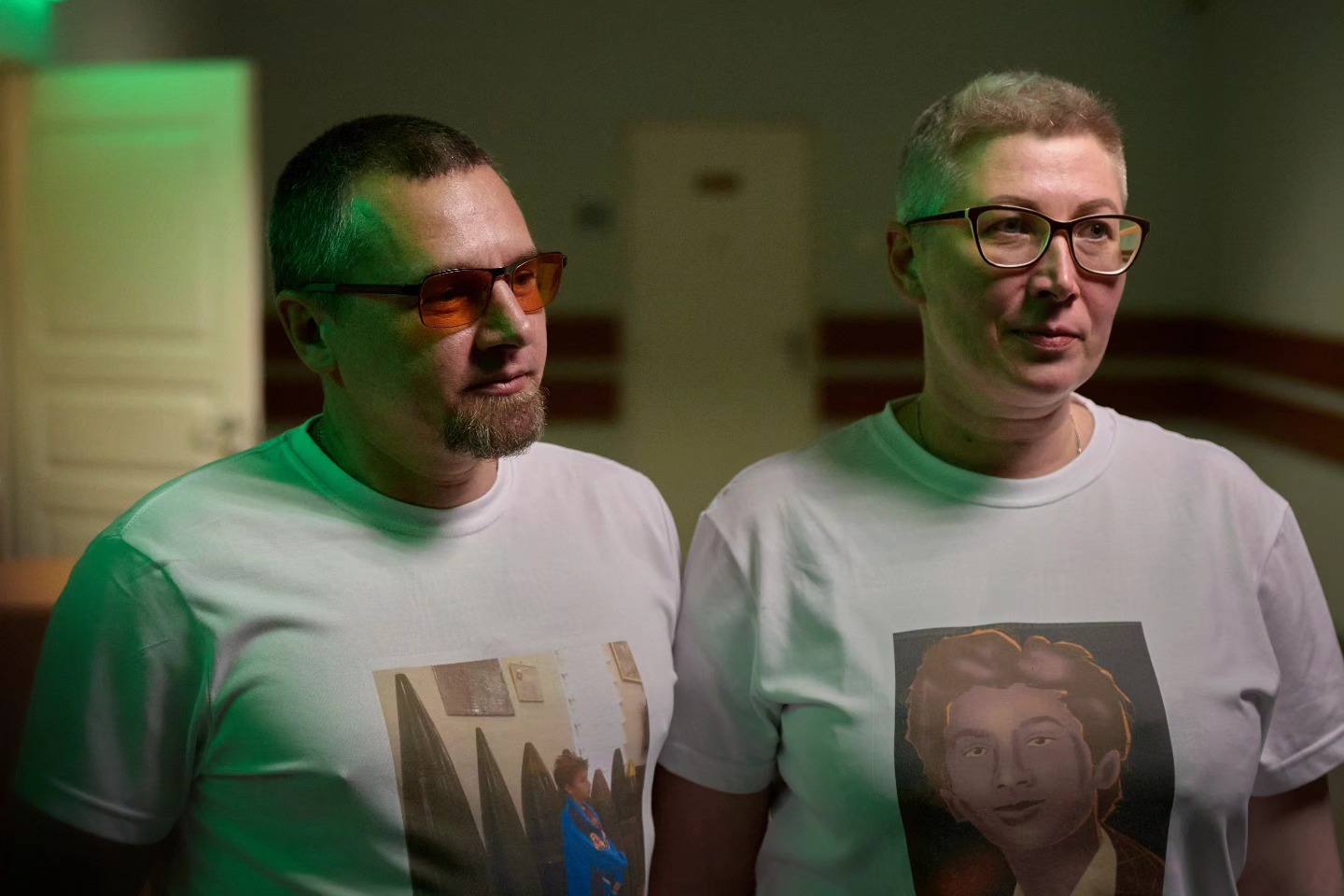
Luthor’s mother, an energetic red-haired woman, had flown to Moscow from Krasnoyarsk to testify in the first hearing. In court, despite the fact that she had a hard time hearing the questions posed to her, she described Luthor’s childhood and their home life in detail. Even the prosecutor’s provocative question about her attitude to the “special operation” did not trip her up. Clearly understanding where Prosecutor Potapov was going, she said that she and her son considered what had occurred inevitable, but both of them were in favour of a peaceful end to the conflict between the two countries.

“What is your relationship with your son like?” the judge asked.

“It’s very good,” the woman assured him.

According to Luthor’s mother, her son has “a total aversion to violence, so there were problems with that at school.”

“He was constantly being provoked, and he asked his father to help him with it, but [he] has a father who believed that he had to defend himself,” the witness said.

According to his mother, Luthor did not serve in the army due to illnesses, and was not interested in military affairs or martial arts.

“We tried to send him to wrestling as a child, but after two classes he was kicked out for skipping. He just can’t hit [another] human being,” she said.

“My son never wanted to fight, he was afraid of it. He dreamed of travelling around the country and the world, even buying a trailer and driving it,” the witness said.

She said her son has hypertension, “a high degree of vascular and cardiac complications,” a stomach ulcer, and occasional panic attacks. Both she and Luthor’s father had medical conditions “galore”: [the father] had his knee joint replaced with an implant and was scheduled to have the other one replaced soon, but due to his small pension he still had to work despite his aching knees.

“He’s very nice,” the witness continued her account of her son. “He and I are close, and in terms of our views as well. He and I are not of this century: we are very trusting. He couldn’t pass a single beggar by.”

She added that Luthor had been afraid of [the military] mobilisation, although “there were no grounds [for this fear],” and he was not against leaving [Russia] if he had the opportunity.

She said that around the beginning of July he had stopped answering her calls, although they usually contacted each other every day. The mother went to the police and was told that Luthor had been detained for using foul language at the airport, although, according to her, Luthor did not swear as a matter of principle.

The witness said that her son liked his job at the bank and was very fond of Petersburg, where he had gone on her advice. She said that she did not know about his plans to travel abroad and that she was even going to visit him in August.

The prosecutor’s questions made it clear that at some point Luthor had asked his parents to help him pay off a debt.

“Tell me, what was the story when fraudsters allegedly stole money from your son’s [bank] card and you had to sell your property to cover the debts?” asked the prosecutor.

“‘Property’ is too strong a word, but we had to [sell] part of it. It was at MTS Bank,” Luthor’s mother replied. “We sold the garage and just part of that sum—”

“Well, what was the amount? Was it large?” asked the judge, interrupting her.

“Approximately two hundred [thousand rubles],” she replied.

“And did you discourage your son from filing a law suit or going to law enforcement [to tell them] a fraud had been committed?” the judge asked.

“Well, yes, I said it was useless,” she replied.

After the judge sighed heavily, the witness repeated that they were very gullible and she herself had fallen victim to fraudsters.

“Did you contact law enforcement?”

“Yes. They managed to recover part [of the money].”

“You see,” added the prosecutor.

“The rest is being earned back by my husband,” the witness said in conclusion. She was dismissed from the stand, and the journalists were asked to leave the courtroom.

Luthor’s trial took only five hearings, four of which were held in closed chambers. On 28 February, the prosecution asked the court to sentence Luthor to fifteen years in a high-security penal colony. The very same day, the court handed down the sentence: ten years of imprisonment, of which Luthor will spend the first two years in a closed prison, serving out the remaining eight years in a high-security penal colony.

Source: Anna Pavlova, “10 years for correspondence: how attempting to join the Ukrainian armed forces is prosecuted as high treason—the case of a bank clerk from St. Petersburg,” Mediazona, 28 February 2024. Translated by the Russian Reader
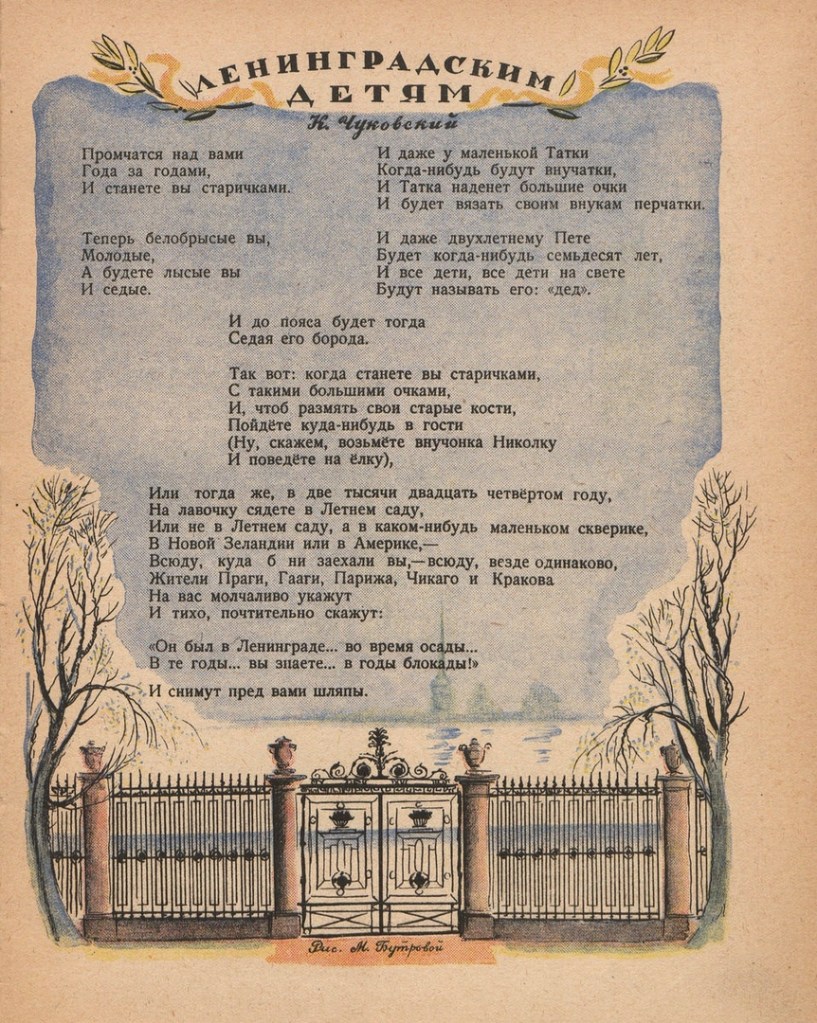
To the Children of Leningrad in the Year 2024

Kornei Chukovsky’s poem “To the Children of Leningrad” (1944), as published in the children’s magazine Murzilka in 1945. Source: dinasovkova (LiveJournal)


Kornei Chukovsky
To the Children of Leningrad

The years will speed past you,
Year after year after year,
And you’ll become old women and men.

Now you are towheaded,
Now you are young,
But then you shall be bald
And grey.

And even little Tatka
Shall someday have grandkids,
And Tatka will put on big glasses
And knit mittens for her grandchildren.

And even two-year-old Petya
Will someday be seventy years old,
And all the children, all the children in the world
Will call him “old man.”

And his grey beard will
Hang down to his waist.

Now, when you’re old women and men,
Wearing those big glasses,
To stretch your old bones
You’ll go on an outing.
(You’ll pick up your grandson Nikolka, say,
And take him to a New Year’s party.)

Or, in that very same year, two thousand twenty-four,
You’ll sit on a bench in the Summer Garden.
Or not in the Summer Garden, but in some little square
In New Zealand or America.
It will be the same everywhere, wherever you go —
Prague, The Hague, Paris, Chicago, Krakow.
The residents will silently point at you
And quietly, respectfully say:

“They were in Leningrad during the Blockade,
Back in those days, you know, in the years of the Siege.”

And they’ll doff their hats to you.

1944

Translated by the Russian Reader. Thanks to Alexander Voitsekhovsky and Svetlana Voskoboinikova for the heads-up.


Actor Alexander Sushchik recites Kornei Chukovsky’s “To the Children of Leningrad”


Few people in Russia see the March 2024 presidential election as a real opportunity to change the country’s leadership. Voting in Russian elections has not been free and fair in recent times, and since the invasion Ukraine, the Russian regime has tightened the screws dramatically. There is no freedom of speech, people are persecuted for making anti-war statements, many opposition leaders and activists are in prison, and hundreds of thousands of people have fled Russia.

In January [2024], however, thousands of people unexpectedly showed up to sign petitions supporting the presidential candidacy of Boris Nadezhdin, a former State Duma deputy who entered politics in the 1990s. Nadezhdin is running under the slogan “End the special military operation.” Many people view endorsing Nadezhdin as a legal opportunity to voice their anti-war sentiments. Standing in long queues at signature collection points, people said they had come to see other people who thought like they did and voiced hope for change.

Their conversations are featured in Nadezhdin’s Queue, a film in Radio Svoboda’s documentary project “Signs of Life.”

Source: “Nadezhdin’s Queue,” Signs of Life (Radio Svoboda), YouTube, 27 January 2024 (in Russian). Thanks to Comrade Koganzon for the heads-up. Annotation translated by the Russian Reader


Beglov: Russia Fighting in Ukraine to Eliminate Gender-Neutral Toilets

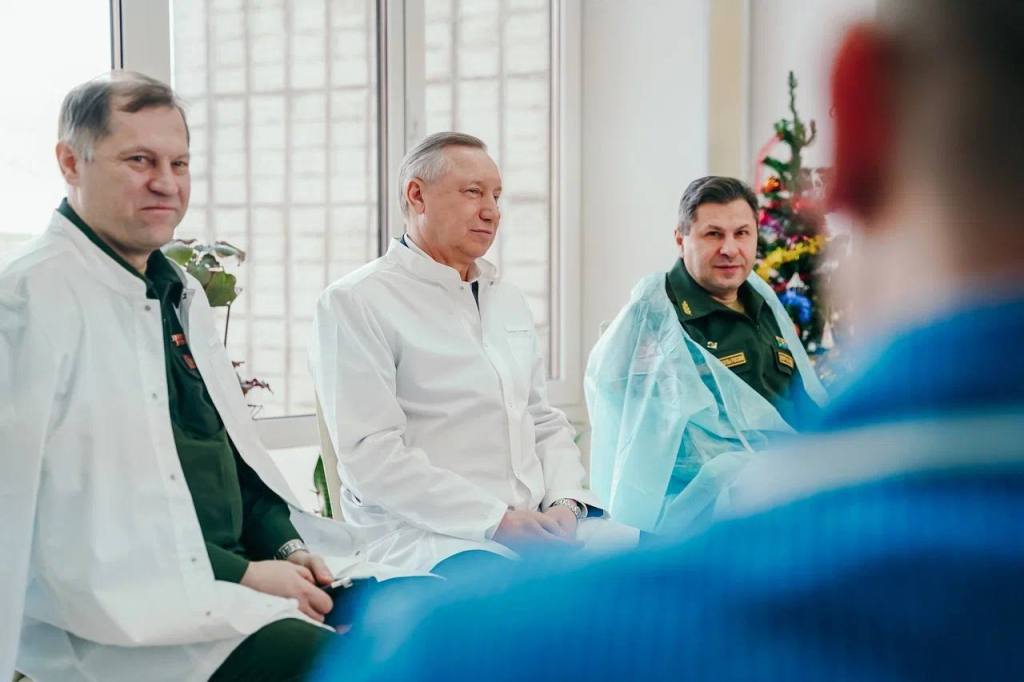
Governor Alexander Beglov (center), visiting wounded Russian soldiers at a military hospital in Petersburg. Source: Telegram

The Russian military understand well what they are fighting for in Ukraine because they have seen gender-neutral toilets in the local schools there, Petersburg Governor Alexander Beglov wrote on his Telegram channel after meeting with wounded soldiers at a hospital.

“It is easiest to talk politics with servicemen. Those who marched through the Ukrainianized version of Donbass carrying a machine gun understand well what we are fighting for,” Beglov wrote.

According to Beglov, the combatants saw bathrooms in Ukraine “in which instead of two spaces—for girls and for boys—there are three spaces: for girls, boys, and gender-neutrals.” That is why, the Petersburg governor argues, “these guys […] don’t need it explained to them what values we stand for.”

In response to Beglov’s statement, Boris Vishnevsky, a member of the St. Petersburg Legislative Assembly, reminded Beglov of the problems with Russia’s infrastructure: “According to Rosstat, a quarter of Russians do not have centralized sewerage.” He suggested redirecting the efforts aimed at fighting the West and NATO to more pressing problems. “And basically, it is hard to imagine something more gender-neutral than a backyard ‘latrine’-style toilet,” the local lawmaker concluded.

The need to protect children from western influence and fortify “traditional values” is regularly mentioned in statements by Russian politicians and officials as justification for the invasion of Ukraine. Earlier, President Vladimir Putin accused western countries of trying to “impose perversions” on children. “Do we want to have ‘parent number 1, number 2, number 3’ instead of ‘mom’ and ‘dad’ here in our country, in Russia? Have they completely lost their minds?” Putin claimed in 2022 at a ceremony to annex parts of Ukraine. In December 2022, Foreign Minister Sergei Lavrov complained about gender-neutral toilets in Sweden: “You have no idea how inhumane-it is, just inhumane.”

Source: “Petersburg governor calls fight against gender-neutral toilets goal of war in Ukraine,” Moscow Times Russian Service, 14 January 2024. Translated by the Russian Reader


I paid a visit to our guys at a military hospital and wished them a happy Old New Year.

The conversation warmed my heart: we were finishing each other’s sentences.

It is easiest to talk politics with servicemen.

Those who marched through the Ukrainianized version of Donbass carrying a machine gun understand well what we are fighting for.

These guys—who saw in the [local] schools bathrooms in which instead of two spaces—for girls and for boys—there are three spaces: for girls, boys, and gender-neutrals—don’t need it explained to them what values we stand for.

We talked a bit about the future, about [their] prospects. I wrote down a few requests. I promised to bring Paralympic athletes to the hospital so that the servicemen could discuss starting sports careers with them if they wished. I am sure that if these guys—with their energy, endurance and team spirit—join our national teams, it will be impossible to defeat us.

Source: Alexander Beglov (Telegram), 13 January 2024. Translated by the Russian Reader

The Grinch Who Stole New Year

The colossal immersive 3D show The Grinch and the New Year Factory

Palma Mansion (18 Pirogov Lane)
Dates: 2.01.2024, 3.01.2024, 4.01.2024, 5.01.2024, 7.01.2024
Time: 11:00, 14:00, 17:00 (daily)
We recommend arriving 30 minutes before the start of the event.

New Year is a magical time of miracles and fairy tales! StageMagic Agency has produced a colossal immersive 3D show, The Grinch and the New Year’s Factory, that will entertain children of all ages and even adults! The show can be seen only from January 2 to 7 in the old Palma Mansion!

This New Year’s week will be full of magic, and even the walls of the mansion will come to life as if by magic! No, no, we’re not kidding! Thanks to cutting-edge 3D mapping technologies we will create a Petersburg Disneyland in an old mansion featuring enchanting sets, an incredibly colorful light show, and an exciting performance, including musical numbers performed by the city’s best artists!

Little viewers can look forward to becoming full-fledged participants in a exciting journey through Cartoonland and along with their favorite Disney characters saving the New Year from the insidious Grinch, who decided to spoil the children’s holiday and stole all the gifts from the elves’ magic factory! Elsa, Jack Sparrow, a wizard on a real magic carpet, and many more will come to the aid of the good elves! Will the cartoon characters manage to save the New Year? Will goodness prevail? Come and find out at the main New Year’s celebration in Petersburg, The Grinch and the New Year Factory.

Before the show starts, children will enjoy an exciting welcome program including interactive games with their favorite cartoon characters, a TikTok show, a beauty bar, a magician’s show, and even a photo shoot with adorable husky dogs.

But that’s not all! Every child will receive a 3D gift from Santa Claus, and every adult will receive a welcome cocktail from the owner of the mansion!

All categories of children’s tickets entitle them to receive a gift.

RECOMMENDED FOR CHILDREN BETWEEN 4 AND 10 YEARS OLD
ADMISSION WITH PARENTS
CHILDREN ARE SEATED IN THE FRONT ROWS BY AGE (YOUNGER CHILDREN IN THE FRONT ROWS, OLDER CHILDREN BEHIND THEM, AND PARENTS BEHIND ALL THE CHILDREN)

There is no such thing as too much magic, StageMagic knows that for sure! See you in the fairy tale!

Duration: 1 hour and 20 minutes
We recommend bringing a change of shoes.

Source: Bileter.ru. Translated by the Russian Reader

Dima Zitser. Photo courtesy of Deutsche Welle

Dima Zitser, the well-known educator, writer, and presenter of the weekly program Love Cannot Be Educated, gave a lecture in Berlin in mid-December. Before his “pedagogical standup routine,” as he himself dubs his encounters with audiences, Zitser granted an interview to DW. With Russian schools becoming obedient tools of propaganda, the renowned educator increasingly has to explain to worried parents how to protect their children from the monstrous influence of the government’s lies and manipulation. Zitser told DW how to talk to children about the war, how to teach them to resist propaganda, and how to help them adapt to a new country when they have been forced to move.

DW: Russian parents today often do not know how to talk to their children about the war. They want to protect their children from trauma, but prefer to create an information bubble for them and pretend that nothing is happening. How do you feel about this stance?

Dima Zitser: You cannot avoid talking about the war with your child. You’re forbidden not to talk about it! First of all, it’s tantamount to deception: children are always aware of and know much more about the world around them than we would like them to. If Mom doesn’t talk to it, the child will take its questions to everyone else but Mom. It won’t want to traumatize its mom. It will imagine that this is a painful topic for Mom, that it is not the done thing to talk about it in adult society.

Russian children live in a country that has unleashed a bloodbath. Clearly, we must protect children, and we must choose our words carefully when we talk to them about the subject. But we cannot conceal from them the kind of world they live in. Imagine the level of disenchantment that awaits it when a child bumps its head on this reality. There are no secrets that don’t surface in the end. What do we want our child to grow up to be? A person who doesn’t care about the troubles happening in its midst? It is vital for a person to experience emotional strife.

— Sometimes a child has a hard time coping with the war and even feels ashamed because he or she is Russian. What can parents do in such cases?

You have to explain that it has nothing to do with a people or a nation. Tell your child about the history of Germany, say, which went through its own horror. Tell it about Thomas Mann and Bertolt Brecht, about people who found the strength to stand out. It was hard for them, but if they hadn’t done what they did, the German people would have been finished.

My eldest daughter lives in New York. She does a lot of projects, including ones on behalf of Ukrainians. Her son Yasha is nine years old. [Ukrainians] refused to speak Russian with them in one place. So Yasha asked, “If this language is so hated and it has to do with this war, why do we even speak it?” There is no short answer in this case. Your conversation with your child should start with the fact that the feelings and emotions of people from Ukraine who cannot stand to hear Russian are understandable.

A close friend of mine from Kyiv refused to communicated me after the Russian invasion started, even though I’ve never been a Russian citizen. But later I wrote to her in Ukrainian (my mom and dad are from Ukraine), and we had the most painful conversation for an hour and a half. We met in Europe a month and a half after the war started, and she explained to me that she couldn’t bear to hear Russian being spoke. Although my friend understands that Russian-speaking people may have nothing to do with the war, she feels physically sick and her body hurts when she hears Russian.

I think we need to talk about it. This is what is meant by empathy. We try to understand, albeit incompletely, what is going on with other people.


Dima Zitser, ”Freedom from Education” (TEDx Sadovoe Ring, June 2016, Moscow). With English subtitles

— Suppose a child goes to a Russian school where there is aggressive ideological training, where the war is glorified in “Lessons About What Matters.” Is it enough for the family to talk to the child about what is going on?

I take a very rigid stance in this sense. If people who read DW have these things going on at their child’s school, they have to get the child out of there. There is no other option. If we’re talking about a person around six or seven years old, it believes what adults say without a second thought. It has no sense whatsoever that adults could want to harm it. This, by the way, is the basis of many crimes. The impact of school, propaganda, and indoctrination on this person is enormous! There are absolutely horrible studies on this subject in connection with the Second World War and Nazism.

Get the child out of there! In the Russian law on education, there are different forms of education—for example, homeschooling. Right off the bat tomorrow morning, any family can take their child out of school and start homeschooling it. After that, the technical stuff starts. It will be difficult, but did these people assume that they could live during a war and pretend that there was no war? That they could say things to their child at home, and the child would go to its quasi-Nazi school and everything would be fine? It won’t be fine. It’s a war, guys! It’s a matter of saving our loved ones!

We can’t live in a time of war as if it isn’t happening. We have to make decisions. For example, we can form a study group: parents agree amongst themselves, pool their money, and hire a teacher. This is legal, and there is such a trend in Russia.

If a person is fifteen or sixteen years old, it’s no big deal. Well, they will live amidst doublethink, just as we did when we were growing up. True, it did us no good. There is such an argument amongst adults: “We survived after all.” Like hell we survived! We learned to lie, to be mistrustful, to look for a hidden agenda in everything, to expect the worst. I would prefer to live in a world where people are open and frank.

— Suppose a child has been removed from a Russian school, but other sources of aggressive propaganda continue to harass it. Should children be taught to recognize and combat propaganda?

This is like asking whether a person should be taught critical thinking. Yes, of course they should! We should teach them to seek out alternative sources of information and ask follow-up questions. If someone speaks on behalf of the state, one should immediately question what they say. We must teach children that the phrases “everyone knows,” “anyone would say,” and “there is no doubt” are forms of manipulation.

— In addition to children who have remained in the Motherland, there are thousands of children who have left Russia with their parents. The problems faced by emigrants are often discussed, but what happens to the children is forgotten. How should parents behave so that emigration is less painful for their children?

The most common mistake is to try to maintain the routine you had in place before you left the country. Did you study music? You’ll go to music school here too! Were you studying English? You’ll keep learning English! We played chess on Tuesdays? We’ll do the same thing here!

Not even the best parents are immune to this mistake. They instinctively try to maintain stability at such moments, but they are accomplishing just the opposite. The frame of reference has changed! You can’t live in Berlin as if you were still living in Ryazan! People here are different—they speak differently, look different, behave differently. When we try to stop time, we keep the child from growing.

When we keep a child “packed and ready to go,” it has no chance to grow into the country in which it has arrived. What should it do, pretend it’s in Moscow? Not start speaking a new language? Not make new friends? Not go to the German theater? We are suggesting that these years be excised from its life. It’s a grave mistake.

Children are quite protective of adults, often more protective than adults are of them. They understand that Mom has it rough, and Dad has it rough, so I’ll try not to whine. I’m not very good at it—I get prickly and rude—but I try. Adults are really tempted to say, “What do you know about trauma? You’re only nine years old! What we [adults] are going through, now that’s trauma!” But for all its short nine years, it had lived its little life in familiar conditions, from which it was yanked at the snap of someone’s fingers.

You have to find things to keep yourselves afloat. You have to give yourselves the opportunity to learn things, to be interested in things, to like things. There is a beautiful tree here, a comfortable bench here, a nice store here. You have to establish a new routine: going out to eat delicious ice cream after school, inventing new traditions, having new conversations. Yes, it’s going to be hard, and that’s okay. But we’re together, we’re having lots of experiences, we’re recreating our family bonds. If mom (or dad) doesn’t tell the child that she (or he) is having a hard time, then the child is sure that it doesn’t have the right to say that it is having a hard time either. This is an important point! Sometimes, you have to hug each other and cry on each other’s shoulders. This doesn’t lead to neurosis. It’s a way for the child to realize: I’m normal.

Source: Maria Konstantinova, “Dima Zitser: You cannot avoid talking about the war with your child,” Deutsche Welle Russian Service, 20 December 2023. Translated by the Russian Reader
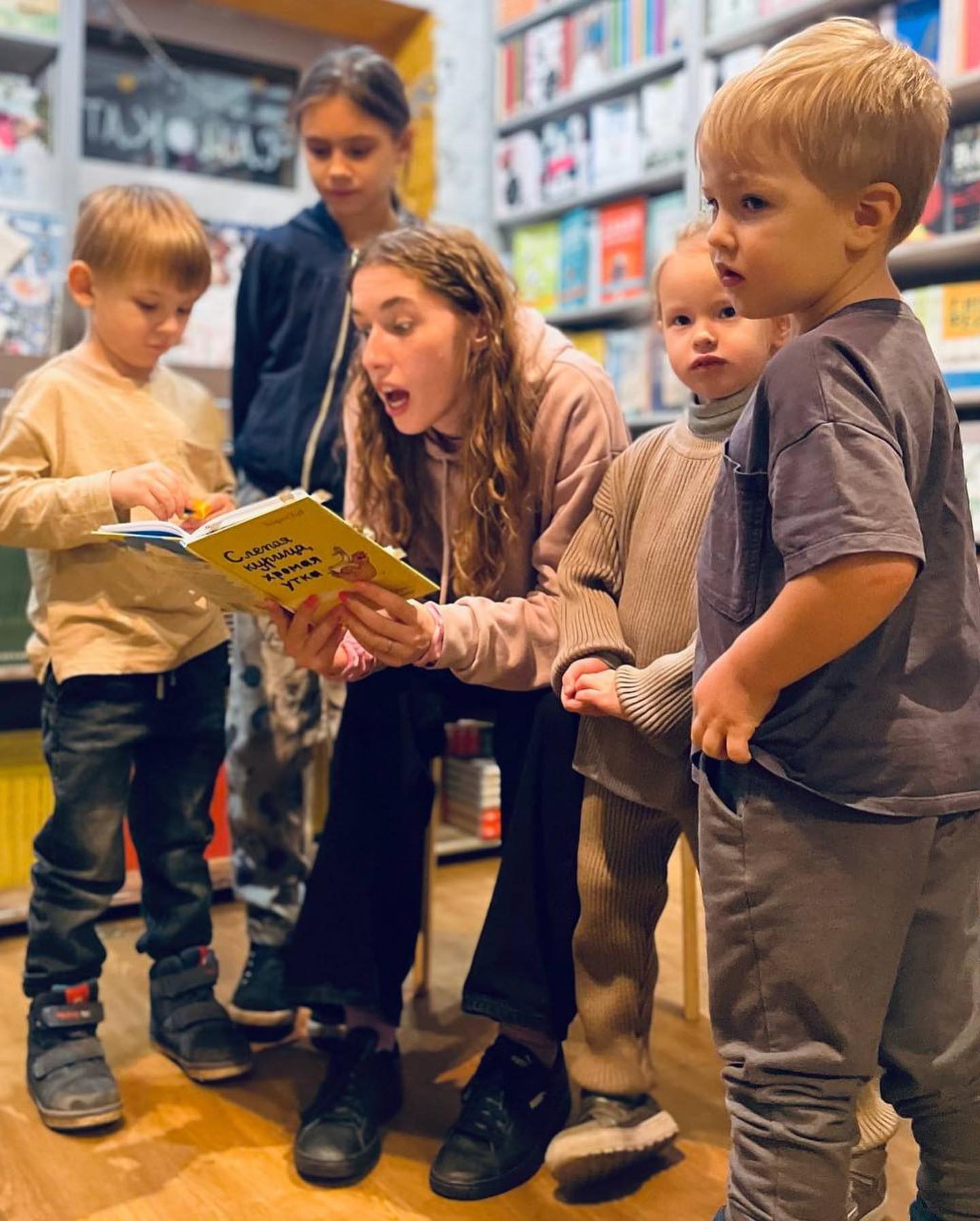

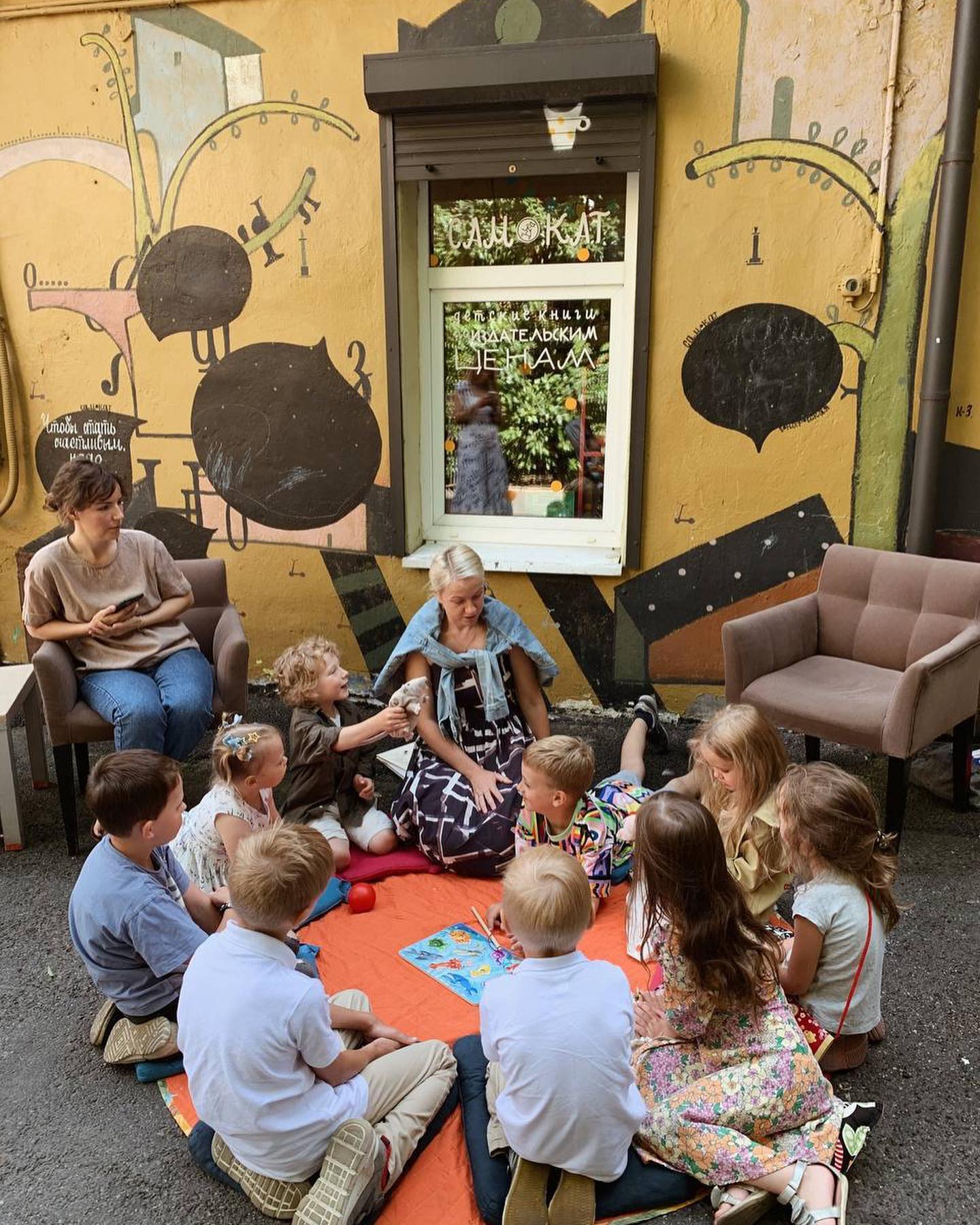
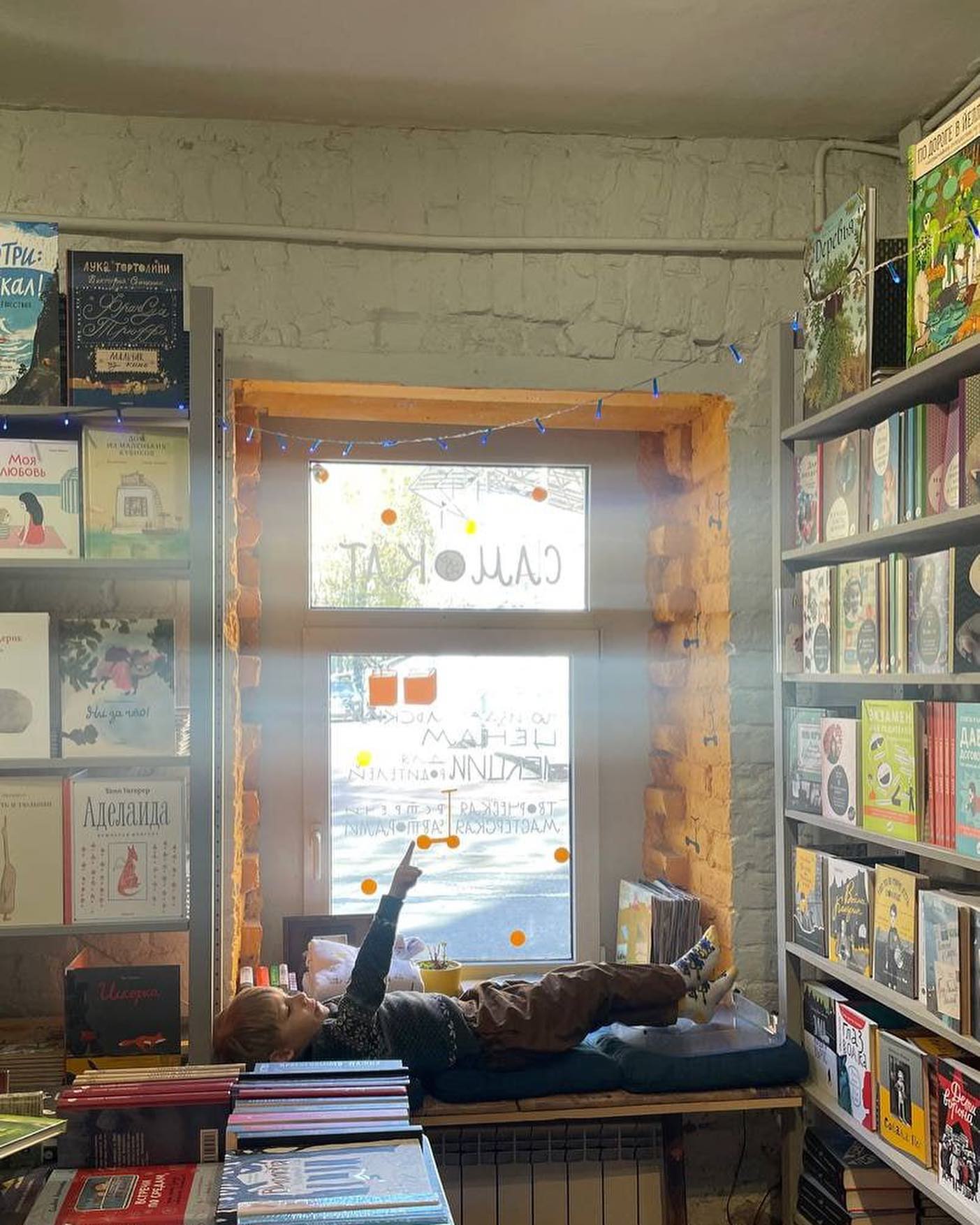
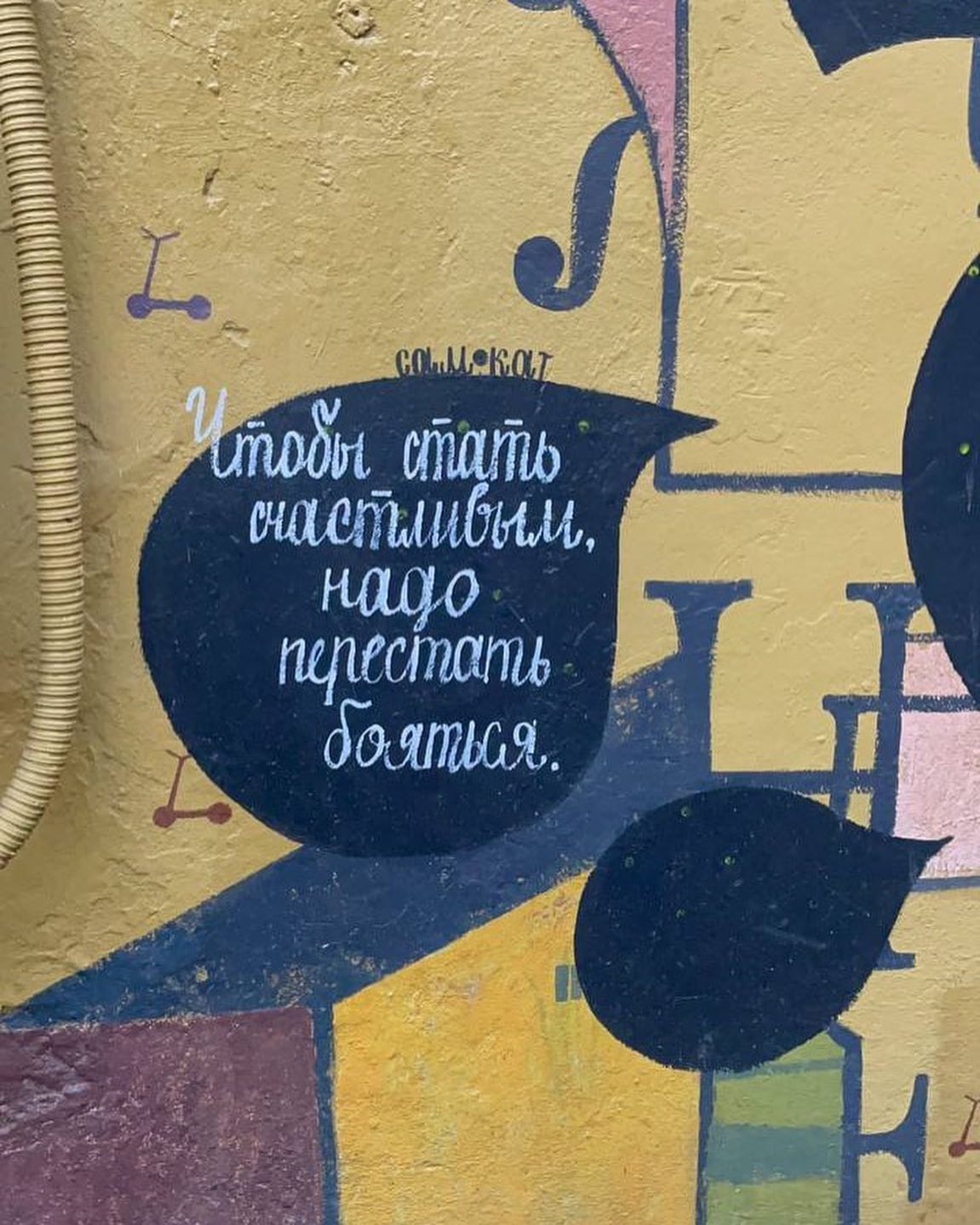
Today, everyone at Samokat is talking about only one thing.

Samokat has been notified that we are being evicted from our little home on Monchegorsk Street in Petersburg. While everyone else is busy with pleasant pre-New Year’s chores, we are being kicked out on the street along with our favorite books and holiday plans. We have just one day to move: tomorrow.

❗️First of all, we appeal to the leadership of St. Petersburg and the Committee for City Property Management. And we hope that the cultural capital is not indifferent to the plight of one of the best bookstores in the city by one of the primary independent children’s publishers in Russia.

Just yesterday we shared a Christmas greeting from Natasha, celebrated our publishing house’s anniversary, showed off our cozy annex, and invited you to our New Year’s workshops. Yes, we share all the news with you. Today, unfortunately, there will be no good news.

Samokat’s annex has become a magnet for our dear readers, a place chockablock with warmth and coziness, and we believe that this warmth amounts to much more than four walls (even if they are the four walls dearest to our hearts). Now we need your help very much.

❗️Tomorrow, our little home at Monchegorsk 8B will be open from 9:00 a.m., and we will be giving away all our books at a thirty-percent discount. Now we basically have nowhere to move the books, and any purchases you make will be a huge support to us. Also, if possible, please pick up confirmed internet orders.

❗️ We are looking for volunteers to help us get our little home ready to move. There are only two young women taking care of our little home, Natasha and Polina, and we are confident that you will not leave them in the lurch. If you are willing to help, come to Monchegorsk from 1:00 p.m.

❗️We are urgently looking for a suitable storage facility to temporarily store our books, we have somewhere around 250 boxes of books, furniture and equipment.

❗️ And of course, we are looking for a new shelter for our books. We need upwards of 25 square meters for retail space and book events, plus a utility room, in the historical/cultural center of Petersburg.

✉️ If you have suggestions and options, please write via Telegram at +7 (921) 809-8519, and Natasha and Polina will be in touch.

Source: Samokat Publishing House (Facebook), 26 December 2023. Translated by the Russian Reader. Thanks to Natalia Vvedenskaya for the heads-up.

In the Woods

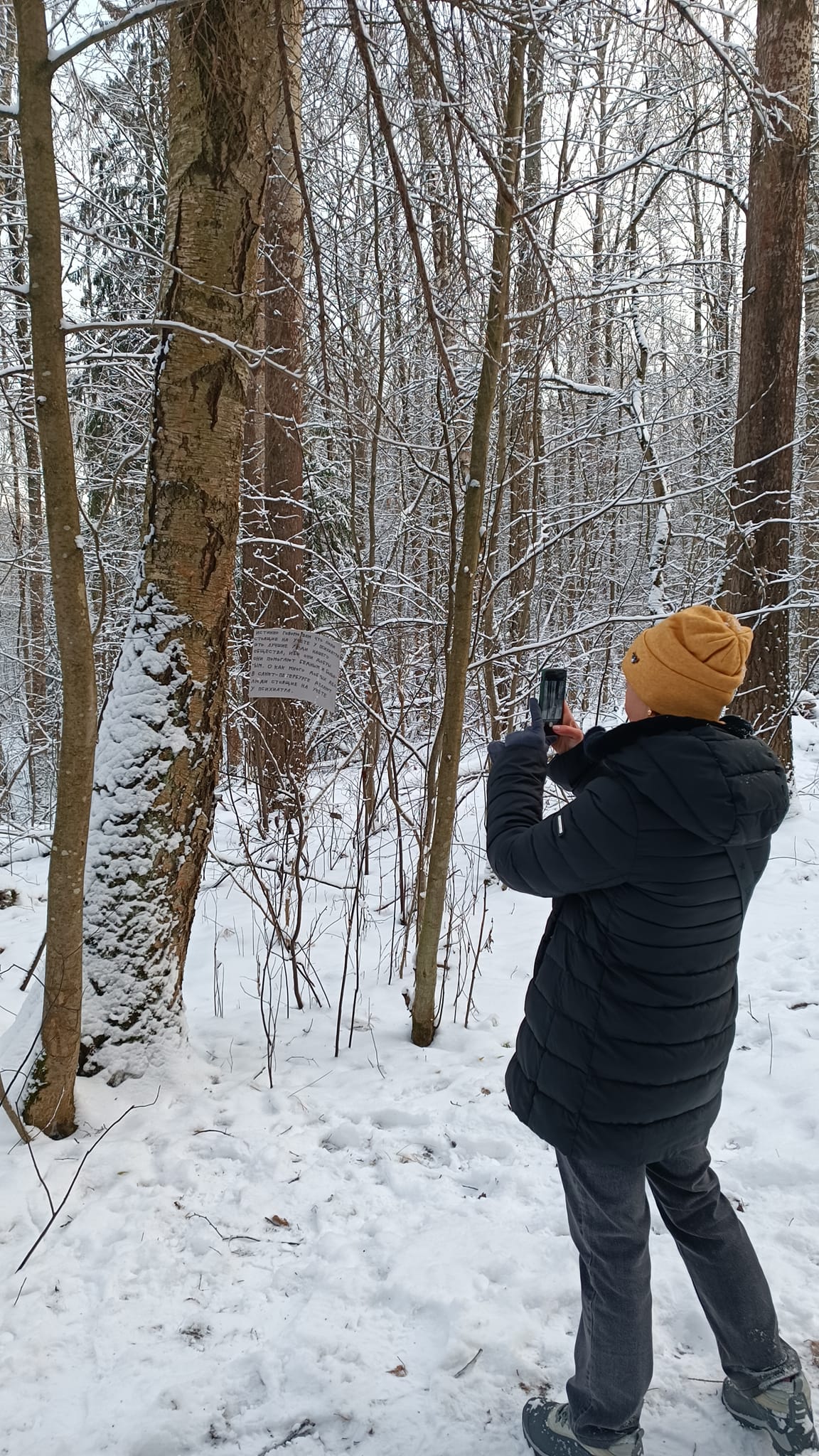
Petersburg human rights attorney extraordinaire Vitaly Cherkasov found this placard in the woods southeast of the city whilst hiking there: “Verily I say unto you that people diagnosed with psychiatric conditions are the finest people in our society, for they are good, they help the poor and the sick. O how many good deeds are done in St. Petersburg by people diagnosed with psychiatric conditions.”


Today we walked in Nevsky Forest Park, where we unexpectedly found this message on a tree branch.

I’ll tell you one thing: the person acted wisely. Nowadays it is safer to express your opinion publicly in the woods.

Source: Vitaly Cherkasov (Facebook), 25 November 2023. Translated by the Russian Reader

There is an apocryphal story that Berwick is (or recently has been) officially at war with Russia. According to a story by George Hawthorne in The Guardian of 28 December 1966, the London correspondent of Pravda visited the Mayor of Berwick, Councillor Robert Knox, and the two made a mutual declaration of peace. Knox said, “Please tell the Russian people through your newspaper that they can sleep peacefully in their beds.” The same story, cited to the Associated Press, appeared in The Baltimore Sun of 17 December 1966; The Washington Post of 18 December 1966; and The Christian Science Monitor of 22 December 1966. At some point in time, the real events seem to have been turned into a story of a “Soviet official” having signed a “peace treaty” with Mayor Knox; Knox’s remark to the Pravda correspondent was preserved in this version.

The basis for such status was the claim that Berwick had changed hands several times, was traditionally regarded as a special, separate entity, and some proclamations referred to “England, Scotland and the town of Berwick-upon-Tweed”. One such was the declaration of the Crimean War against Russia in 1853, which Queen Victoria supposedly signed as “Victoria, Queen of Great Britain, Ireland, Berwick-upon-Tweed and all British Dominions”. When the Treaty of Paris was signed to conclude the war, “Berwick-upon-Tweed” was left out. This meant that, supposedly, one of Britain’s smallest towns was officially at war with one of the world’s largest powers – and the conflict extended by the lack of a peace treaty for over a century. In reality, Berwick-upon-Tweed was not mentioned in either the declaration of war or the final peace treaty and was legally part of the United Kingdom for both.

Source: “Berwick-upon-Tweed,” Wikipedia

Yegor Balazeikin: Six Years in Prison for “Attempted Terrorism”

“The 2nd Western District Military Court found Yegor Balazeikin guilty of attempted terrorist and sentenced him to six years in prison.”

Source: Andrei Bok (Facebook), 22 November 2023


On Wednesday, November 22, 17-year-old Yegor Balazeikin was sentenced by a St. Petersburg military court to a harsh six-year prison term. The high school student, profiled by Le Monde in September, was found guilty of “attempting a terrorist act with the aim of destabilizing state institutions.”

He was arrested in February, at the age of 16, when he threw a Molotov cocktail at the gates of the military recruitment office in Kirov, near his village in the St. Petersburg region. According to the prosecution, he had committed a similar act a few weeks earlier in St. Petersburg.

Yegor Balazeikin has never denied responsibility for the first of these two acts. He explained that it was because of his opposition to the war in Ukraine. Since his arrest, he has not relented in the face of the investigators’ attempts to coax him, nor in the face of threats. In a letter to his mother, his sole ambition was to “remain a man,” both in Russia at war and in prison.

The prosecutor had requested a six-year prison sentence, relatively lenient in view of the verdicts handed down by the Russian justice system in recent months. On November 14, for example, a resident of Tolyatti received the same sentence for defacing posters showing “heroes” of the “special military operation” in Ukraine. Three days later, Alexandra Skochilenko, an artist from St. Petersburg, was sentenced to seven years in prison for pasting anti-war tags in a supermarket.

The court considered Yegor Balazeikin’s health status as a mitigating circumstance. The young man, who is passionate about history and karate, has been suffering since the age of eight from autoimmune hepatitis. It is an incurable and serious disease that has worsened since his detention in February.

Another mitigating circumstance is that he has always acknowledged the facts. On Wednesday, he once again explained his actions at the hearing. “I came to the conclusion that I could never approve of the presence of Russian armed forces on Ukrainian territory. I tried to talk about it to those around me, to help people realize this. But I realized that discussions were useless and I wanted to act differently.”

‘I don’t expect to be understood or acquitted here’

In the defiant posture that he has taken throughout the hearings, standing with clenched fists, he pronounced his last words to the court in front of a prosecutor who had fallen asleep, the press reported. “The person closest to me, my mother, would like me to be acquitted,” he said. But I’m not asking for acquittal – my conscience will judge me. Six years, eight years, it doesn’t matter… We’ll settle scores in the after world. […] I’m told to be patient and that everything will be alright in our country. But is that really the case? Two years have gone by and I still don’t see the link between bombed Mariupol and what’s happening in my little house [Egor’s family live in a wooden house that’s close to insalubrity]. And even if all this were to enable us to renovate our towns and open sports halls, would the price be acceptable? Lives… The date of February 24 [2022, the start of the war] has become more important to me than my birthday. I know I’m going to jail, but if I’m guilty of anything, it’s of being indifferent… At first, I didn’t care about any of this, which is the same as supporting [the war].”

Although he never denied his actions, the young man stressed that he had never meant to harm anyone, waiting until evening to throw his projectile against a metal door. It did not catch fire. The public prosecutor, for his part, felt that an agent from the recruitment office could have died.

His parents supported their son from the moment of his arrest. They respected his willingness to take responsibility for his actions and they acted as his spokespeople. His mother took an active part in the trial, doing her utmost to make it as transparent as possible, with publications on a support group on social media. At the hearing, she also pointed out that her son had been affected by the death of his uncle in June 2022. The uncle had been a volunteer on the Ukrainian front. “He betrayed him,” said the prosecutor.

Yegor Balazeikin, who was expecting a long sentence, wants to continue his studies in prison. His mother hopes he will be able to receive treatment there.

Source: Benoit Vitkine, “In Russia, Yegor Balazeikin, a 17-year-old ‘terrorist,’ sentenced to six years in prison,” Le Monde, 23 November 2023

Small Acts of Defiance

Image courtesy of Civic Council

The town’s coroner and mortician, Dr. Ivan Malinin, a Russian immigrant who barely spoke English, performed the autopsy on Williams at the Tyree Funeral House. Malinin found hemorrhages in the heart and neck and pronounced the cause of death as “insufficiency of [the] right ventricle of [the] heart.” Malinin also found that, apparently unrelated to his death, Williams had also been severely kicked in the groin during a fight in a Montgomery bar a few days earlier in which he had also injured his left arm, which had been subsequently bandaged. That evening, when the announcer at Canton announced Williams’s death to the gathered crowd, they started laughing, thinking that it was just another excuse. After Hawkshaw Hawkins and other performers started singing “I Saw the Light” as a tribute to Williams, the crowd, now realizing that he was indeed dead, followed them.

Source: “Death of Hank Williams,” Wikipedia


Hyvästi Suomi!

This can be translated as “Goodbye, Finland,” or it can be translated as “Adieu, Finland.” The correct translation will depend on our neighbors.

Source: “News Roundup” email newsletter (Delovoi Peterburg), 24 November 2023. Translated by the Russian Reader


Finland has temporarily closed all but one of its eight passenger crossings to Russia in response to an unusually high inflow of migrants for which the Nordic country accuses Moscow.More than 700 migrants from nations such as Yemen, Afghanistan, Kenya, Morocco, Pakistan, Somalia and Syria, have in the past couple of weeks entered Finland via Russia. Helsinki says Russia is funneling migrants to the border, a charge the Kremlin has denied.

Having last week closed four border stations, Finland overnight closed all remaining passenger crossings except its northernmost one, Raja-Jooseppi located high north in the Arctic region, for a month.

Raja-Jooseppi opened its gates for traffic this morning and will continue to accept asylum applications during its four daily opening hours, the Finnish Border Guard said.

No migrants arrived overnight outside opening hours, it added.

The Border Guard is stepping up patrolling along the length of its 833-mile frontier with Russia.

It will get additional resources for the task from the European Union’s border agency Frontex, which said on Thursday it would deploy 50 border guard officers and other staff to Finland along with equipment such as patrol cars to bolster control activities.

Source: “Finland closes passenger border crossings with Russia,” NBC News, 24 November 2023


What are the benefits for Russia?

HS: Russia wants to create an image of a hostile West that is of benefit to the Russian leadership. Finland has not fit this image in the past, but now they are trying to build it. Relations between Finland and Russia are at a turning point. The Russians have realised that they do not know Finland after all. They want to see who Finland cooperates with and at the same time try to stir up discord within Finnish society. Building a new relationship will be a long-term process.

JS: Russia can create a fortress mindset due to a perceived ‘threat’ from the West. Finland’s eastern border is becoming a useful confrontational narrative for the Kremlin. When the same narrative is repeated, a kind of protection mechanism kicks in and even sceptics will start to believe it.

Source: “What is Russia hoping to achieve with hybrid tactics on the Finnish border?” Yle News, 21 November 2023


The Front Lawn, “Claude Rains” (1989)


Claude Rains in Casablanca

He was the French Police Inspector

A functionary through and through

A small man

Remember at the end out on the airstrip

He could have tried to stop them

Ingrid Bergman and her friend from the French Resistance

But he pretended not to see

It was a small act of defiance

As the storm broke in the distance

He was on their side after all.

Claude Rains gave the order to collect the usual suspects

And the camera came in close up on his face

He watched as the plane left the airstrip

Like hope leaves a dying man

But he hung on to the choice he’d made

Claude Rains

Claude Rains

Claude Rains

Claude Rains

I saw a new film the other day

And it was set at the start of a nuclear war

The actors weren’t as good as Claude Rains

But then there was nothing that they could do

All of their small acts could count for nothing

As the storm broke in the distance

Not much to make a film about

Source: “Claude Rains,” The Front Lawn: Lyrics


Civic Council named “undesirable organization” in the Russian Federation

The Prosecutor General’s Office added us to this list on November 3, exactly one year after we announced the creation of our Mobilization Center. We have openly stated that we are working to ensure that the Russian Federation in its current form, with its current government and all that this government calls the state, ceases to exist.

Today it is the Russian state that is criminal, and armed struggle against it is legitimate and necessary. So the Prosecutor’s Office and the Justice Ministry are formally correct: we are their enemies.

In fact, our status as an undesirable organization has not changed anything. Supporting the Civic Council within Russia was also a criminal offense before we were give this status, just like all other independent political and civic activities. The Russian authorities hand down approximately the same prison sentences for making [anti-war] comments on social media and engaging in armed resistance. So, we propose fighting effectively, rather than commenting in vain.

We have to resist intelligently, so we suggest that our supporters inside Russia observe the rules of information security and be vigilant.

We do not accept donations payable to Russian bank cards and do not have accounts in Russian banks.

We are not urging you to attend protest rallies right now. The time to go to the public squares will come later.

We invite those who are ready to take up arms to fight, fully aware of the consequences.

For those who do not want to stay on the sidelines but cannot fight for various reasons, there are other ways to support our cause:

  • donating money, including anonymously through crypto wallets (including Monero)
  • providing information to our OSINT service
  • disseminating information about the opportunity to volunteer

To volunteer for the Siberian Battalion, fill out this form.

Anyone who wants to make a donation should go here. All options are a help to us.

Anyone who wants to help with information or other work inside the Russian Federation should write to us at civic_council@proton.me.

Sincerely yours,

Civic Council, an undesirable organization in the Russian Federation

@obserwujący

P.S. We suggesting giving us the special status of “an organization readying the overthrow of the Putin regime.”

Source: Civic Council (Facebook), 23 November 2023. Translated by the Russian Reader


Foreign luxury brands are closing their flagship stores on Nevsky Prospect, but they could be replaced by Russian fashion retailers, say market participants.

Analysts expect a reduction in rental rates on Nevsky Prospect.

According to sources cited by Kommersant-SPb and NF Group, Breitling, Fendi, Omega, Rolex, and Salvatore Ferragamo have already vacated their spaces in downtown Petersburg. Louis Vuitton has the same plans. Market participants ascribed the mass exodus of luxury sellers to political pressure in the brands’ home countries and logistical and supply chain challenges.

“Luxury retailers initially took a wait-and-see attitude, but now it has become clear that there are no prospects for stabilizing the economic situation in the medium term,” said a source who spoke to Kommersant-SPb.

KNRU development director Polina Fiofilova noted that western brands that have been operating in the fashionable part of Nevsky Prospect for years have driven rents “sky-high” and inflated the expectations of landlords.

In the first half of 2023, the rates per square meter in this locale ranged from 2,600 to 6,700 rubles per month (VAT included), while in the adjacent Telezhny Lane they amounted to 2,500 to 5,200 rubles per square meter per month. Local fashion retailers simply would not be able to afford such rents, analysts said.

Nevsky Prospect is still empty. Despite a reduction in vacancies compared to the peak period, their level remains quite high, thus generating pressure on rental costs, added Mikhail Burmistrov, CEO of the agency Infoline Analytics.

As Delovoi Peterburg wrote earlier, despite the departure of a number of foreign brands, fashion retail sales increased by nine percent, a nineteen percent increase compared to the same period last year. But the average receipt remained at the level of last year or even decreased.

In period from July to September, ten international brand stores opened in Petersburg shopping centers. Most of the new boutiques belong to the fashion segment.

Three new Turkish clothing brand stores opened in Petersburg, along with Quiksilver (Australia), Mark Formelle (Belorussia), Woolrich (USA), Yamaguchi (Japan), Liu Jo (Italy) and two Stockmann’s stores (Finland).

We reported in October that the Italian clothing brand OVS would return to Petersburg after a ten-year hiatus.

Source: “Western luxury brands close Nevsky Prospekt boutiques en masse,” Delovoi Peterburg, 20 November 2023. Translated by the Russian Reader


Rosstat reports that the retail price of bananas increased to 143 rubles per kilo for the first time since it has been tracking their price. Compared to October last year, the cost of bananas increased by 47 percent, which was the biggest single-month increase since 2000. Oranges led the price growth among fruits: in October, they rose in price to 209 rubles per kilo, or by almost 80% year on year. Fruit prices were affected by the weakening of the ruble, which led to an increase in suppliers’ purchase prices and a rise in the cost of logistics, according to market participants. Albina Koryagina, a partner at NEO, a consulting company, says that last year the Russian authorities controlled the growth of retail prices for socially significant products, including bananas (aka “the poor people’s fruit”), as much as they were able, but this year retailers can no longer afford to hold down prices “even when pressured.”

Source: Moscow Times Russian Service, daily news roundup, 24 November 2023. Translated by the Russian Reader


4,121 criminal absence without leave [AWOL] cases have been delivered to Russia’s military courts since the start of the military mobilization in September 2022, as reported on Friday, November 24, by Mediazona, which studied information available on the websites of the military courts.

The courts have already made rulings in 3,470 of the cases. “Most AWOL cases result in suspended sentences. The percentage of such rulings is sixty-three for volunteer soldiers, while for mobilized [conscripted] soldiers, it is slightly lower—fifty-six percent,” the article says. A suspended sentence, it notes, makes it possible to return a serviceman to the front.

In addition to criminal AWOL cases, Mediazona found 317 cases of disobeying orders, 96 cases of desertion, 54 cases of assaulting a commanding officer, and 42 cases for other offenses on which the authorities have doubled down during the mobilization.

According to the infographic published by Mediazona, the most cases were launched in the Moscow Region (309), the Rostov Region (224), and the Maritime Territory (181). 123 cases were launched in Moscow, and 116 in St. Petersburg.

Source: Jan Roffe, “More than 4,000 criminal AWOL cases launched in Russia,” Deutsche Welle, 24 November 2023. Translated by the Russian Reader

Timur Kacharava Was Murdered in Petersburg by Russian Neo-Nazis 18 Years Ago Today

“Timur, we will always remember you”: a memorial to the Russian anarchist, anti-fascist, punk rock musician and university philosophy major Timur Kacharava at the site of his murder by Russian neo-Nazis in downtown Petersburg

Eighteen years ago today the anarchist Timur Kacharava was murdered outside the Bukvoyed bookstore on Vosstania. I haven’t seen any announcements anywhere, but I’m sure that today, as every year, people will come there to remember him. It seems that Timur’s parents usually arrive early, around five o’clock, and everyone else makes their way there during the evening. I’m planning to be there at six o’clock.

Source: Jenya Kulakova (Facebook), 13 November 2023. Translated by Thomas Campbell


“Timur Kacharava was murdered by nationalists on 13 November 2005”

A recent philosophy major at St. Petersburg State University, where Timur studied, came to Bukvoyed. She said that not so long ago in class she drew the lecturer’s attention to a logical error (it had something to do with Descartes), for which he praised her and said that previously his student Timur Kacharava had noticed the same error—and he told her about him. That’s how she found out about him. Timur was murdered eighteen years ago. And today this young woman was scrolling through her news feed and saw something on Bumaga about the event in memory of Timur. She was able to come, find Timur’s mother here, and tell her this story about the logical error. Timur’s mom was smiling.

Irina (Timur’s mother) says that every year she goes to Bukvoyed thinking that no one will come this year for sure. And she is mistaken: the photos, flowers, and candles are already there. She said, “Today, boys came who are not even eighteen. They were born after the murder, and yet they still come!”

Source: Jenya Kulakova (Facebook), 13 November 2023. Translated by Thomas Campbell

Russia Reads

A young man on the Nevsky Prospect in Petersburg reads a book by Friedrich Engels whilst handing out discount coupons to the nearby so-called Lego Museum. Source: Marina Varchenko (Facebook), 9 November 2023


“‘The Arab world is not just beautiful ethnic costumes, exquisite dishes, and other One Thousand and One Nights-type stuff, but also brutal dictatorships, poverty, a high tolerance of violence, and sometimes outright racism and religious fanaticism. According to my observations, however, this second facet is almost always bracketed off by Europeans when describing the countries of the “global South” or is guiltily dished up as a consequence of the traumatic colonial past.’ Essayist Andrei Sapozhnikov (“Department of Culture”) connects the abnormally high support for Hamas’s invasion of Israel in the Western world with this peculiarity.”

Source: Email newsletter from the online Russian magazine Republic, 8 November 2023. Translated by the Russian Reader

The Keeper of Antiquities (Arkady Ippolitov, 1958–2023)

Arkady Ippolitov

In memory of an aesthete and an ethicist

“Such are the times now that if you are not in jail you cannot be considered a decent person.”

—Arkady Ippolitov, in conversation with theater critic and writer Sergei Nikolayevich, quoted with the latter’s consent

Oh, that argument sounds so much like Arkady. Although he dealt in the luxury of bygone times, sometimes he felt himself to be a proletarian of intellectual labor, and even more so, a person caught up in contemporary history. He wrote twenty-nine books and upwards of six hundred pieces of art criticism. The most well known to the general reading public are his trilogy Images of Italy (an homage to Pavel Muratov’s classic book): Especially Lombardy, Only Venice, and Just Rome.

The art critic, curator, essayist, lecturer, and writer Arkady Ippolitov was not at all a “keeper of antiquities,” as was suggested by his official position as curator of the Hermitage’s Italian prints. Like the protagonist of Yuri Dombrovsky’s eponymous novel, he sought to combine old and modern art, Robert Mapplethorpe and Jacopo Pontormo, Peter Paul Rubens and Peter Greenaway, the Italian Mannerists and Andy Warhol in his mind, in his articles, and in his exhibition projects.

In the late eighties, Ippolitov’s work appeared in Dekorativnoe iskusstvo (Decorative Art), one of the first respectable journals. There he published uncensored articles about European culture, not about decorative art (which then occupied a modest place in official Soviet art criticism). He expounded the theories of Jacob Burkhardt and Erwin Panofsky vis-a-vis the imaginary space of the local aesthetic, as if this location had a hope for ethical salvation. He explicated the optics of the complex masses and graphic art of Piranesi, with his theory of prisons and torture. (This article would later grow into an exhibition of Piranesi’s work along with the catalogue to it.) From a historical perspective, I dare say that Ippolitov’s work in the nineteen-nineties and noughties embodied some of the naivety of the Russian post-perestroika enlightenment, whose adherents believed that Russia would evolve along a European trajectory. He curated over twenty exhibitions of contemporary Russian art. (His list of exhibitions of “classical” art is much longer.) The list of his articles in Kommersant and other democratically minded newspapers and magazines of the noughties and twenty-teens is more than impressive. In the Russian artistic milieu, he sought and found direct parallels between Russia and Europe: see, for example, his project Palladio in Russia, or his last major curatorial works, Roma Aeterna: Masterpieces of the Vatican Pinacotheca, at the Tretyakov Gallery in Moscow, and Pilgrimage of Russian Art: From Dionysius to Malevich, at the Vatican Museums in Rome.

He was a successful international curator who lived an extremely modest everyday life. His wealth сonsisted of a small flat near the Hermitage and a view of the Neva River from his office at the museum. He dressed like a dandy and behaved sometimes like an aristocrat, sometimes like a bully. He loved his mother and his son very much. He had few close friends. It was not easy to make friends with him, but he was a quite loyal friend. He had two vivacious wives, an Italian and a Russian, and tons of fans and admirers of both sexes.

I have two memories of working with Arkady. The first memory is of him escorting me through the Hermitage’s staff entrance to see his exhibition Hogarth, Hockney and Stravinsky: The Rake’s Progress. It was like seeing a theater’s secret underbelly. We were kicked out by the docents for illegal entry: Arkady’s authority as a curator did not fly with them. Arkady did not get angry, though; instead, he laughed. The second memory is our strolling around Petersburg and talking about his plans for an exhibition dealing Xenia of Saint Petersburg, about how she dressed in her husband’s clothes after his death and performed miracles under his name. It was a secret conversation about transgression and transvestism in the light of metanoia.

Ippolitov was a quite Petersburgian person. The city’s coldness, melancholy and depression are reflected in his striking prose. Melancholy was one of his recurring themes both as an individual and as a curator. The capital of the former empire and its inhabitants are bound to be melancholic, in keeping with the story of Rome’s fall. In his gloomy text about the city’s Summer Gardens in November [published in 2013], in which he predicted his own death, there are, however, incredibly caustic passages about the taste and manners of the powers that be, both the Soviet regime and the current authorities. It contains this passage about [Andrei] Tarkovsky’s The Mirror, which expressed [Ippolitov’s] unfulfilled ideal: “The little boy leafing through a book about Leonardo in the autumnal gardens is what makes us who we are. He is the symbol of Russia. He is its principal value—the encounter between past and future, between child and titan, between tradition and modernity.”

Arkady’s metaphysical features shone through his earthly guise. He was a genuine angel, but one with a damaged wing as it were. In person, he was, alternately, a pure angel and a perfect demon. When polemicizing about culture and time, about beauty and truth, his severity knew no bounds. For those interested in the historical background, he had no wish to discuss the latest public statements by the director of the Hermitage, considering it beneath his dignity. I hear his peculiar intonation when I read this phrase in a 2016 interview: “Everything my director says is true a priori.” It cannot be ruled out that the Hermitage’s leadership reciprocated by ignoring him: from the mid-twenty-teens on, Arkady’s principal curatorial projects were based in Moscow.

He was so handsome, simultaneously so physically powerful (very tall, beautifully built) and so fragile, that I was amazed why he had been gifted to this fallen world at all, even before the hell into which Putin turned Russia in February 2022. Arkady meant so much to the metaphysics of beauty that I would not be surprised if he were now in the Paradise of the Renaissance artists, and not even in Limbo, in keeping with Dante’s logic.

Source: Elena Fanailova, “The Keeper of Antiquities: Arkady Ippolitov’s Angels and Demons,” Radio Svoboda, 7 November 2023. Thanks to Comrade Koganzon for the heads-up. For several years not so many years ago, it seemed as if I was constantly in the midst of translating an essay, article, or exhibition catalogue by Mr. Ippolitov. It was unfailingly a pleasure to work on these projects with him. It goes without saying that I gained much more from these collaborations than he did, but he always made me feel that the opposite was the case. \\\ TRR