
Petersburg human rights attorney extraordinaire Vitaly Cherkasov found this placard in the woods southeast of the city whilst hiking there: “Verily I say unto you that people diagnosed with psychiatric conditions are the finest people in our society, for they are good, they help the poor and the sick. O how many good deeds are done in St. Petersburg by people diagnosed with psychiatric conditions.”

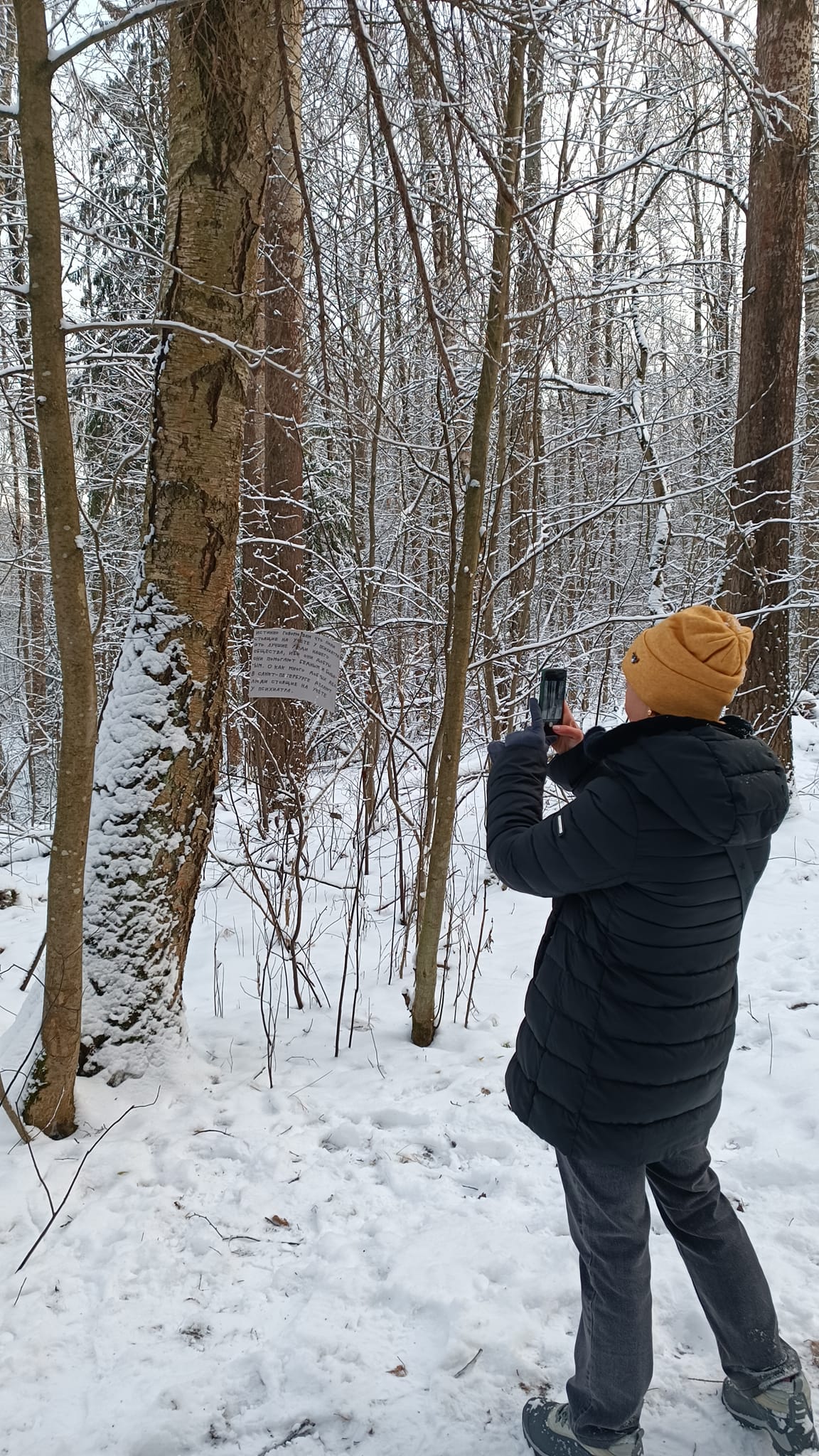
Today we walked in Nevsky Forest Park, where we unexpectedly found this message on a tree branch.
I’ll tell you one thing: the person acted wisely. Nowadays it is safer to express your opinion publicly in the woods.
Source: Vitaly Cherkasov (Facebook), 25 November 2023. Translated by the Russian Reader
There is an apocryphal story that Berwick is (or recently has been) officially at war with Russia. According to a story by George Hawthorne in The Guardian of 28 December 1966, the London correspondent of Pravda visited the Mayor of Berwick, Councillor Robert Knox, and the two made a mutual declaration of peace. Knox said, “Please tell the Russian people through your newspaper that they can sleep peacefully in their beds.” The same story, cited to the Associated Press, appeared in The Baltimore Sun of 17 December 1966; The Washington Post of 18 December 1966; and The Christian Science Monitor of 22 December 1966. At some point in time, the real events seem to have been turned into a story of a “Soviet official” having signed a “peace treaty” with Mayor Knox; Knox’s remark to the Pravda correspondent was preserved in this version.
The basis for such status was the claim that Berwick had changed hands several times, was traditionally regarded as a special, separate entity, and some proclamations referred to “England, Scotland and the town of Berwick-upon-Tweed”. One such was the declaration of the Crimean War against Russia in 1853, which Queen Victoria supposedly signed as “Victoria, Queen of Great Britain, Ireland, Berwick-upon-Tweed and all British Dominions”. When the Treaty of Paris was signed to conclude the war, “Berwick-upon-Tweed” was left out. This meant that, supposedly, one of Britain’s smallest towns was officially at war with one of the world’s largest powers – and the conflict extended by the lack of a peace treaty for over a century. In reality, Berwick-upon-Tweed was not mentioned in either the declaration of war or the final peace treaty and was legally part of the United Kingdom for both.
Source: “Berwick-upon-Tweed,” Wikipedia
