The Gated Community. Photo: Tom Smouse (via Americana UK)
In the face of violence in the streets and unlawful detention what can a musician do, really? They can document what’s going on, make their point and try and raise awareness (and maybe the odd dollar) of the organisations that are protecting citizens from their own law enforcement. Read that sentence, and notice just how screwed up it is to describe daily life in the “shining city on a hill”.
Which brings us to today’s song from The Gated Community. It’s a new recording of a very recently written song, written in response to events in Minneapolis, as singer and songwriter Sumanth Gopinath explains: “After Renee Nicole Good’s murder by ICE agent Jonathan Ross here in Minneapolis on January 7, 2026, I began writing songs that more explicitly address the situation we’re in. I find the ‘protest song’ challenging, as it requires a directness that I tend to avoid in my songwriting. This is my third serious attempt as of late and the one with the most rousing, energizing chorus of the bunch. I am so moved and inspired by the bravery, intelligence, and steadfastness of my fellow Minnesotans in the Twin Cities who, against the odds, are acting tirelessly on behalf of our most vulnerable community members. This song is for them.”
The song is available on Bandcamp, it has a price and there’s an option to add a little more to support the people organising for decency: everyone involed in the recording donated their time and all of its proceeds will be donated to local aid organizations including Minnesota Immigrant Rights Action Committee (MIRAC) — an organization supporting individuals and families impacted by unjust immigration laws and deportations.
And who are The Gated Community? Well, this band that has been described as a Marxist Bluegrass band (you don’t get a lot of them to the pound) was originally a vehicle for Sumanth’s political songs, but has evolved over nineteen years, expanding in size and scope to include many roots music styles and more personal songwriting. It was formed when Sumanth moved from New Haven to Minneapolis to begin working as a professor of music theory at the University of Minnesota, and now features six singers, with the band combining professors like Sumanth (vocals, acoustic guitar, keyboards) and Beth Hartman (vocals, percussion), and artists from various parts of the Twin Cities scene like Rosie Harris (vocals, banjo, cello), Paul Hatlelid (vocals, drums, acoustic guitar), Cody Johnson (vocals, bass), and Nate Knutson (vocals, guitars, mandolin).
thanks and much love to our families, friends, and fans
All proceeds from this recording will go to one or more organizations resisting the occupation of our cities by ICE and providing aid to our community. Everyone involved generously volunteered their time and resources to this project.
Thank you to Tom Campbell, Eva Cohen, Carl and Ina Elliott, Jim and Sara Harris, Marcus dePaula, Michael Gallope, Gabrielle Gopinath, John Miller, Mark Nye, Daniel Owens, Matt Rahaim, Ian Rans, Ellen Stanley, Ryan Stokes, Dean Von Bank, and our families, friends, and neighbors.
Source: The Gated Community (Bandcamp). I would strongly encourage you to buy this digital record (paying as much as you wish) in support of the embattled people of Minnesota, my home state. ||| TRR
Both the pot (Iran) and the kettle (the U.S.) are “rounding up” their detractors.
Trump’s White House website welcomes visitors with a pop-up that reads: “WELCOME TO THE GOLDEN AGE!” But on this heavy news day a year into Trump’s second term, it is increasingly clear that as his regime focuses on committing the United States to white Christian nationalism, the country is becoming increasingly isolated from the rest of the world, and its own economy is weakening.
At the Munich Security Conference over the weekend, Secretary of State Marco Rubio’s endorsement of white Christian nationalism does not appear to have swayed European countries to abandon their defense of democracy and join the U.S.’s slide toward authoritarianism. Instead, as retired lieutenant general and former commander of U.S. Army Europe Mark Hertling wrote, it squandered the strategic advantage its partnership with Europe has given the U.S.
Foreign affairs journalist Anne Applebaum noted that the word in Munich was that “Europe needs to emancipate itself from the U.S. as fast as possible.” In Germany, Der Spiegel reports plans to bring Ukrainian veterans to teach German armed forces drone use and counter-drone practices the Ukrainians are perfecting in their war against Russian occupation. Canada’s prime minister Mark Carney is working to reduce Canada’s defense dependence on the U.S., ramping up domestic defense production.
Carney has advanced a foreign policy that centers “middle powers” and operates without the U.S. That global reorientation has profound consequences for the U.S. economy, as well. Canada is leading discussions between the European Union and a 12-nation Indo-Pacific bloc to form one of the globe’s largest economic alliances. A new agreement would enable the countries to share supply chains and to share a low-tariff system. Canada also announced it is renewing its partnership with China. As of this week, Canadians can travel to China without a visa.
Today France’s president Emmanuel Macron and India’s prime minister Narendra Modi upgraded Indian-French relations to a “Special Strategic Partnership” during a three-day visit of Macron to Mumbai. They have promised to increase cooperation between the two countries in defense, trade, and critical materials.
Trump insisted that abandoning the free trade principles under which the U.S. economy had boomed since World War II would enable the U.S. to leverage its extraordinary economic might through tariffs, but it appears, as economist Scott Lincicome of the Cato Institute wrote today for Bloomberg, that the rest of the world is simply moving on without the U.S.
While Trump boasts about the U.S. stock market, which is indeed up, U.S. markets have underperformed markets in other countries. Today, Carl Quintanilla of CNBC reported that the S&P 500, which measures 500 of the largest publicly traded companies in the U.S., is off to its worst year of performance since 1995 when compared to the All Country World Index (ACWI), an index that measures global stocks.
In May 2023 the Florida legislature passed a law requiring employers with 25 or more employees to confirm that their workers are in the U.S. legally. The new law prompted foreign farmworkers and construction workers to leave the state. Now, the Wall Street Journal reported in a February 6 editorial, employers “are struggling to find workers they can employ legally.”
The newspaper continued: “There’s little evidence that undocumented migrants are taking jobs from Americans. The reality is that employers can’t find enough Americans willing to work in the fields or hang drywall, even at attractive wages. Farm hands in Florida who work year-round earn roughly $47,000, which is more than what some young college graduates earn.” “The lesson for President Trump is that businesses can’t grow if government takes away their workers,” the Wall Street Journal Editorial Board concluded.
Today Florida attorney general James Uthmeier reacted to the Wall Street Journal editorial, explaining on Fox Business that the Republican Party expects to replace undocumented workers with young Americans: “We need to focus on our state college program, our trade schools, getting people into the workforce even earlier. We passed legislation last year to help high school students get their hands dirty and get on job sites more quickly. So I think there’s a lot more we can do with apprenticeships, rolling out, beefing up our workforce, and trying to address the demand that is undoubtedly here in the state.”
Steve Kopack of NBC News reported on February 11 that while the U.S. added 1.46 million jobs in 2024, the last year of former president Joe Biden’s administration, it added just 181,000 jobs in 2025. That makes 2025 the worst year for hiring since 2003, aside from the worst year of the coronavirus pandemic. Manufacturing lost 108,000 jobs in 2025.
Peter Grant of the Wall Street Journal reported today that banks that have loaned money to finance the purchase of commercial real estate are requiring borrowers to pay back tens of billions of dollars as the delinquency rate for such loans has climbed to a high not seen since just after the 2008 financial crisis. About $100 billion in commercial real estate loans that have been packaged into securities will come due this year and probably won’t repay when they should. More than half of the loans are likely headed for foreclosure or liquidation.
Trump vowed that he would cut “waste, fraud, and abuse” out of the country’s government programs, but cuts to social programs have been overwhelmed by spending on federal arrest, detention, and deportation programs, as well as Trump’s expansion of military strikes and threats against other countries. In his first year back in office, Trump launched at least 658 air and drone strikes against Iraq, Somalia, Iran, Yemen, Syria, Nigeria, and Venezuela.
Just today, U.S. Southern Command announced it struck three boats in the eastern Pacific and the Caribbean yesterday and killed 11 people it claims were smuggling drugs, bringing the total of such strikes to more than 40 and the number of dead to more than 130. Now Trump is moving American forces toward Iran, threatening to target the regime there.
The administration is simply tacking the cost of these military adventures onto government expenditures, apparently still maintaining that the tax cuts for the wealthy and corporations Republicans extended in their July “One Big Beautiful Bill Act” and tariffs will address the growing deficit and national debt by increasing economic growth.
The nonpartisan Congressional Budget Office (CBO) last week projected that the deficit for the fiscal year ending September 30, 2026, will be $1.85 trillion. Richard Rubin of the Wall Street Journal notes that for every dollar the U.S. collects this year, it will spend $1.33. The CBO explained that the Republican tax cuts will increase budget deficits by $4.7 trillion through 2035.
If the American people have suffered from Trump’s reign, the Trump family continues to cash in. Today Trump’s chair of the Commodity Futures Trading Commission, Michael Selig, announced he will try to block states from regulating prediction markets, saying they “provide useful functions for society by allowing everyday Americans to hedge commercial risks like increases in temperature and energy price spikes.”
Republicans insist that prediction markets are more like stock trading than like betting, but a group of over 20 Democratic senators warned last week in a letter to Selig that prediction market platforms, where hundreds of millions of dollars are wagered every week, “are offering contracts that mirror sportsbook wagers and, in some cases, contracts tied to war and armed conflict.” They added that the platforms “evade state and tribal consumer protections, generate no public revenue, and undermine sovereign regulatory regimes,” and urged Selig to support regulations Congress has already put into law.
Prediction markets also cover the actions of President Trump, whose son Don Jr. is both an advisor to and an investor in Polymarket and a paid advisor to Kalshi. Polymarket and Kalshi are the two biggest prediction markets, and both are less regulated than betting sites. The Trump family has announced it is starting its own “Truth Predict.”
David Uberti of the Wall Street Journal reported that Eric Trump is investing heavily in drones, particularly in Israeli drone maker Xtend, which has a $1.5 billion deal to merge with a small Florida construction company to take the company public. The Defense Department has invited Xtend to be part of its drone expansion program.
And yet it is clear the administration fears the American people. The Minnesota Bureau of Criminal Apprehension (BCA), a statewide program that specializes in police shootings, said yesterday that it has received formal notice that the Federal Bureau of Investigation (FBI) will not allow it any “access to information or evidence that it has collected” related to the shooting death of Minneapolis intensive care nurse Alex Pretti. The BCA says it will continue to investigate and to pursue legal avenues to get access to the FBI files.
Fury at ICE continues to mount, with voices from inside the government complaining about Homeland Security Secretary Kristi Noem. Gordon Lubold, Courtney Kube, Jonathan Allen, and Julia Ainsley of NBC News reported today on her alienation of senior officials at the Coast Guard as she has shifted their primary mission of search and rescue to flying deportation flights. Noem’s abrupt removal of Coast Guard commandant Linda Fagan only to move into her vacated housing at Joint Base Anacostia-Bolling herself also rankled, along with Noem’s lavish use of expensive Coast Guard planes.
Daniel Lippman and Adam Wren of Politico reported today that Noem’s spokesperson, Tricia McLaughlin, is resigning.
Marissa Payne of the Des Moines Register reported today that in Iowa, Republican state lawmakers are working to rein in the power of the state governor before the 2026 elections, a sure sign that they are worried that a Democrat is going to win the election.
That fear appears to be part of a larger concern that the American people have turned against the Republicans more generally. Last night, late-night talk show host Stephen Colbert told viewers he had been unable to air an interview he did with a Democratic candidate for the U.S. Senate from Texas, James Talarico. “I was told…that not only could I not have him on, I could not mention me not having him on,” Colbert said. “And because my network clearly doesn’t want us to talk about this, let’s talk about this.”
Talarico is a Texas state lawmaker studying to be a minister, who criticizes the Republican use of Christianity as a political weapon. Such politicization of Christianity both distorts politics and cheapens faith, he says. The true way to practice Christianity is simple but not easy, he says: it is to love your neighbor. Political positions should grow out of that to feed the hungry, welcome the stranger, and heal the sick. “[T]here is nothing Christian about Christian nationalism,” he told Colbert. “It is the worship of power in the name of Christ, and it is a betrayal of Jesus of Nazareth.”
Although Talarico is locked in a tight primary battle with Representative Jasmine Crockett, his message offers a powerful off-ramp for evangelicals uncomfortable with the administration, especially its cover-up of the Epstein files. Without evangelical support, MAGA Republicans cannot win elections.
Talarico has the administration nervous enough that Federal Communications Commission (FCC) chair Brendan Carr opened an investigation of the morning talk show The View after Talarico appeared on the show earlier this month. Lawyer Adam Bonin explained that Carr changed the FCC’s enforcement of the Equal Time Rule (which is not the Fairness Doctrine). It says that when broadcast networks (not cable) give air time to someone running for office, they have to give the same time to any other candidate for that office. The obvious exception is when a candidate does something newsworthy outside the race, in which case a network can interview that person without interviewing everyone else.
For 20 years, that rule has applied to talk shows, but Carr announced last month that if a non-news talk show seems to be “motivated by partisan purposes,” then it will not be exempt. For Colbert’s show, it would have meant that after interviewing Talarico, the network would have had to give equal time to all other Democrats and Republicans running for the Senate seat. CBS could have challenged the rule but chose not to.
Why is the administration worried about Talarico in a state Trump won in 2024 by 14%? “I think that Donald Trump is worried that we’re about to flip Texas,” Talarico said. “Across the state there is a backlash growing to the extremism and the corruption in our politics…. It’s a people-powered movement to take back our state and take back our country.”
As of 10:00 tonight, Colbert’s 15-minute interview with Talarico has been viewed on YouTube 3.8 million times. Forbes says it is Colbert’s most watched interview in months.
The Late Show with Stephen Colbert, “Rep. James Talarico On Confronting Christian Nationalism, And Strange Days In The Texas Legislature”
Stephen Colbert hosts Texas State Rep. James Talarico for an online-exclusive interview that touches on the issues raised in Talarico’s campaign for the Democratic nomination for Senate including the separation of church and state, the dangers of consolidated corporate-owned media, and the fabricated culture wars pushed by Republicans in states like Texas.
The Department of Homeland Security is expanding its efforts to identify Americans who oppose Immigration and Customs Enforcement by sending tech companies legal requests for the names, email addresses, telephone numbers and other identifying data behind social media accounts that track or criticize the agency.
In recent months, Google, Reddit, Discord and Meta, which owns Facebook and Instagram, have received hundreds of administrative subpoenas from the Department of Homeland Security, according to four government officials and tech employees privy to the requests. They spoke on the condition of anonymity because they were not authorized to speak publicly.
Google, Meta and Reddit complied with some of the requests, the government officials said. In the subpoenas, the department asked the companies for identifying details of accounts that do not have a real person’s name attached and that have criticized ICE or pointed to the locations of ICE agents. The New York Times saw two subpoenas that were sent to Meta over the last six months.
The tech companies, which can choose whether or not to provide the information, have said they review government requests before complying. Some of the companies notified the people whom the government had requested data on and gave them 10 to 14 days to fight the subpoena in court.
“The government is taking more liberties than they used to,” said Steve Loney, a senior supervising attorney with the American Civil Liberties Union of Pennsylvania. “It’s a whole other level of frequency and lack of accountability.” Over the last six months, Mr. Loney has represented people whose social media account information was sought by the Department of Homeland Security.
The department said it had “broad administrative subpoena authority” but did not address questions about its requests. In court, its lawyers have argued that they are seeking information to help keep ICE agents in the field safe.
Meta, Reddit and Discord declined to comment.
“When we receive a subpoena, our review process is designed to protect user privacy while meeting our legal obligations,” a Google spokeswoman said in a statement. “We inform users when their accounts have been subpoenaed, unless under legal order not to or in an exceptional circumstance. We review every legal demand and push back against those that are overbroad.”
The Trump administration has aggressively tried tamping down criticism of ICE, partly by identifying Americans who have demonstrated against the agency. ICE agents told protesters in Minneapolis and Chicago that they were being recorded and identified with facial recognition technology. Last month, Tom Homan, the White House border czar, also said on Fox News that he was pushing to “create a database” of people who were “arrested for interference, impeding and assault.”
Silicon Valley has long had an uneasy relationship with the federal government and how much user information to provide it. Transparency reports published by tech companies show that the number of requests for user information from different governments around the world has climbed over the years, with the United States and India among those submitting the most.
Some social media companies previously fought government requests for user information. In 2017, Twitter (now X) sued the federal government to stop an administrative subpoena that asked it to unmask an account critical of the first Trump administration. The subpoena was later withdrawn.
Unlike arrest warrants, which require a judge’s approval, administrative subpoenas are issued by the Department of Homeland Security. They were only sparingly used in the past, primarily to uncover the people behind social media accounts engaged in serious crimes such as child trafficking, said tech employees familiar with the legal tool. But last year, the department ramped up its use of the subpoenas to unmask anonymous social media accounts.
In September, for example, it sent Meta administrative subpoenas to identify the people behind Instagram accounts that posted about ICE raids in California, according to the A.C.L.U. The subpoenas were challenged in court, and the Department of Homeland Security withdrew the requests for information before a judge could rule.
Mr. Loney of the A.C.L.U. said avoiding a judge’s ruling was important for the department to keep issuing the subpoenas without a legal order to stop. “The pressure is on the end user, the private individual, to go to court,” he said.
The Department of Homeland Security also sought more information on the Facebook and Instagram accounts dedicated to tracking ICE activity in Montgomery County, Pa., outside Philadelphia. The accounts, called Montco Community Watch, began posting in Spanish and English about ICE sightings in June and, over the next six months, solicited tips from their roughly 10,000 followers to alert people to the locations of agents on specific streets or in front of local landmarks.
On Sept. 11, the Department of Homeland Security sent Meta a request for the name, email address, post code and other identifying information of the person or people behind the accounts. Meta informed the two Instagram and Facebook accounts of the request on Oct. 3.
“We have received legal process from law enforcement seeking information about your Facebook account,” the notification said, according to court records. “If we do not receive a copy of documentation that you have filed in court challenging this legal process within ten (10) days, we will respond to the requesting agency with information.”
The account owner alerted the A.C.L.U., which filed a motion on Oct. 16 to quash the government’s request. In a hearing on Jan. 14 in U.S. District Court for the Northern District of California, the A.C.L.U. argued that the government was using administrative subpoenas to target people whose speech it did not agree with.
Sarah Balkissoon, a Department of Justice lawyer representing the government, said the Department of Homeland Security’s position was that it was “within their power to investigate threats to its own officers or impediments to their officers,” according to a court transcript viewed by The Times.
Two days later, the subpoena was withdrawn.
The Montco Community Watch accounts continue to post almost every day. The Times emailed a request for comment to the address associated with the accounts but did not receive a reply.
On Monday, the Instagram account posted an alert for ICE activity in the Eagleville area of Montgomery County. “Montco ICE alert,” the post said. “This is confirmed ICE activity.”
On Friday, the account posted a video of students at Norristown Area High School protesting against ICE. “We stand with you and are proud you made your voices heard!” the post said.
It’s one of the saddest hit songs to grace American music: “Deportee (Plane Wreck at Los Gatos).”
The 1948 Woody Guthrie composition documented a plane crash that killed all 32 people on board in Los Gatos Canyon near the Central Valley town of Coalinga on Jan. 28 of that year. Twenty-eight of the victims were Mexicans being forced back home — some entered the country without papers, some were guest workers whose stints were over — accompanied by the immigration agent charged with making sure they got there, much like the deportation flights of today.
The Associated Press reported that newspapers published across the country the following day — including The Times — listed the names of the Southern California crew on board and the migra man, Frank E. Chaffin of Berkeley.
The Mexicans? The story deemed them “deportees.” They were buried in a mass grave at Holy Cross Cemetery in Fresno under a bronze marker that read: “28 Mexican citizens who died in an airplane accident.” The American government never even bothered to tell their family members. Many wondered what happened to their loved ones for decades.
Guthrie heard the AP report over the radio and was so angered by how the press and government dismissed the deceased that he penned “Deportee.” With mournful chords and vivid lyrics, the working class troubadour attacked an American society that that simultaneously let crops rot “in their creosote dumps” and treated the migrants who picked them “like rustlers, like outlaws, like thieves.”
It’s been covered by some of this country’s greatest musicians — I’m talking Dolly Parton, Bruce Springsteen, Johnny Cash and Willie Nelson (my favorite version is by folk-rock heroes The Byrds).
The Byrds, “Deportee (Plane Wreck at Los Gatos)” (1969)
Even with “Deportee,” this story had fallen out of public consciousness over the decades. Until January, when ICE dredged it up to once again insult the memory of the lost Mexican immigrants.
ICE’s inexplicable recap
On Jan. 28, the social media accounts of Immigration and Customs Enforcement commemorated Chaffin’s death and only his. The caption alongside a grainy black and white photo of him read: “The plane he was on to deport 28 illegal Mexican aliens caught fire and crashed killing all onboard.”
ICE’s unnecessarily inflammatory language not only was ahistorical, but also it didn’t even match up with its own official account. The agency’s Wall of Honor, which commemorates the lives of employees who died in the line of duty, described the migrants who died alongside Chaffin as “Mexican nationals.”
Such warping of the past isn’t accidental but rather part of a long con by the Trump administration to justify its agenda. In an administration that knows no lows, dismissing the Mexican victims of the Los Gatos Canyon disaster as “illegal Mexican aliens” was particularly egregious.
‘It’s disrespectful, it’s dehumanizing, it’s ICE’
I called up Mike Rodriguez, an ethnic studies teacher in Santa Ana who found out in 2015 that his paternal aunt, María Rodríguez Santana, was on that doomed plane.
“First thing I thought was, ‘Well that’s the United States,’” Rodriguez said of ICE’s social media post. “They’re doing the same thing that the government tried to do in 1948 by erasing them.”
He added that la migra didn’t even bother to list the names of the American crew that died, either. “It’s disrespectful, it’s dehumanizing, it’s ICE,” he said.
But Rodriguez takes solace in knowing he and others are doing their part to make sure people know the full story. He regularly speaks about the tragedy and visited both the site of the crash and Holy Cross Cemetery, where a plaque with all of the victims’ names was erected in 2013.
Tim Z. Hernandez, a University of Texas El Paso professor who has spent much of his career trying to track down descendants, interviewed Rodriguez and his uncle for a forthcoming documentary and also featured their story in the 2024 book”They Call You Back: A Lost History, A Search, A Memoir.” The two appeared at an event last year at the Untold Story bookstore in Anaheim, where Rodriguez sung “Deportee” while his son played guitar. He added extra lyrics to honor his Tía María and Hernandez.
“Thankfully, we have truth tellers like Woody Guthrie and Tim,” Rodriguez said. “And I remember what Woody sang — ‘All you fascists bound to lose.’ And that’s the way this is administration is, trying to strip away our constitutional rights. But their day will come.”
Kazakh authorities have granted Russia’s request to extradite activist Yulia Yemelyanova, a former employee of the late Alexei Navalny’s Petersburg office. According to the Russian opposition-in-exile’s Anti-War Committee, Kazakhstan violated its own protocols in making the decision to extradite Yemelyanova, as the Russian activist’s application for asylum is still under review in the country.
This past October, Kazakhstan’s Prosecutor General’s Office had guaranteed that extradition requests would not be considered until all administrative procedures related to obtaining asylum were completed. Yemelyanova’s defense intends to appeal the extradition decision to the country’s Supreme Court.
Yemelyanova was detained on Aug. 31, 2025, at Almaty airport while in transit to a third country. She has been held in pretrial detention ever since. In Russia, she is being prosecuted for theft (Part 2, Article 158 of the Criminal Code) in connection with a 2021 incident in which she allegedly stole a mobile phone from a taxi driver. Yemelyanova’s defense calls the case fabricated. It was sent to court in July 2022, by which time the activist had already left Russia.
Yemelyanova is the fourth Russian asylum seeker since late January to be handed a deportation decision from Kazakh officials. The others are Chechen Mansur Movlaev, an open critic of Ramzan Kadyrov; Crimean resident Oleksandr Kachkurkin, who is facing treason charges in Russia; and Yevgeny Korobov, an officer who deserted from the Russian army.
Dmytro Kulyk with his wife Oksana and daughter Elina. Source: Daily Beast
A Ukrainian dad escaped Vladimir Putin’s drone and missile attacks back home only to be grabbed by a band of ICE stooges in a Walmart parking lot in Minneapolis.
“I hoped I would find peace in America. I’ve done everything the government required, I don’t understand why I am behind bars,” Dmytro Kulyk told the Daily Beast from the Kandiyohi County Jail in Willmar, Minnesota.
The 39-year-old father was getting a pickup order at a Walmart in Maple Grove when he found himself surrounded by immigration agents last month. He’d been working as a delivery driver to make ends meet, while also supporting his family by doing roofing work.
Kulyk legally entered the U.S. in late 2023 along with his wife, 38, and daughter, who’s now 5. The family was sponsored by U.S. citizens as part of the Uniting 4 Ukraine program, a humanitarian program set up in April 2022 to allow Ukrainians fleeing Russia’s war to live and work in the U.S. on “parole.”
Once the initial two-year parole period expires, entrants can file for re-parole to remain in the country longer. That’s exactly what Kulyk says he did. His wife and daughter’s applications were approved. But his remained pending.
He said he was putting groceries in his car on Jan. 1 when he was approached by three ICE agents.
“I explained to the ICE officers that the war was killing people, that my wife had a disability, that it was violence, terrorism which we had escaped from but one of them began to laugh,” Kulyk told The Daily Beast. “I asked why he was laughing and I was told that he was pro-Russian, wanted Russia to win the war.”
DHS and ICE did not immediately respond to a request for comment.
He can’t understand why he’s been treated like a criminal. He did everything by the book, he says–paying taxes and filing his immigration paperwork on time, working multiple jobs to take care of his family. He had no criminal record to speak of.
His immigration attorney, Julia Bikbova, suggested his re-parole application may have intentionally been stalled to provide immigration authorities with a pretext to deport him.
“Our government, our Homeland Security, promised Ukrainians to protect them during the war. There are approximately 280,000 Ukrainians on U4U, Uniting for Ukraine program in the United States, including the Kulyk family,” she told the Daily Beast.
“My client did everything the government required him to do: on June 5 he applied for the re-parole and his wife paid $2,040 of fees for her and child’s granted applications. His wife and daughter have recently received their re-paroles but he has not, his application is pending.
“ICE detained him as ‘illegal’ and began deportation proceedings: This is a sick way of forcing a man with a clean criminal record to become unlawful in the U.S. by delaying the review of his application, which the very same authority had requested to file.”
Kulyk is now terrified he’ll be sent to the frontlines to fight Vladimir Putin’s troops if he is deported back home. He and his family endured relentless Russian attacks before finally deciding to flee their home in the Odesa region in 2023. When they saw ruins on their own street in Chornomorsk, they called their friends in Texas and asked for help, leading to their enrollment in the U4U program thanks to having U.S. citizens as sponsors.
Kulyk now can’t stop worrying about his wife, Oksana, and daughter, Elina.
“I am worried they can drag my wife and kid out of our home,” he told The Daily Beast, adding that he wanted to appeal directly to American authorities to make them understand he’d done nothing wrong.
“Please hear me: I came to America to escape the war, to pray in church and work hard. But now my heartbroken and sick wife has lost over 10 pounds since ICE arrested me on January 1. She’s been panicking, and my little daughter has been crying without me every night – this is unjust,” he said.
Oksana says she’s been too “terrified and lost” to leave home while her husband is locked up, afraid that immigration agents might return for the rest of the family.
“I am too scared to drive my 5-year-old daughter to school in my husband’s car. I’m terrified ICE will detain me and our daughter will end up alone,” she told The Daily Beast. “This is just as scary as the war in Ukraine, except now we don’t have Dmytro with us. Our daughter Elina cries herself to sleep with her cat plushie. She says the toy is daddy.”
Most Ukrainian refugees are women and children but some men have also left the country for various reasons. Kulyk was granted a permit to leave in order to care for a family member with a medical condition.
But Kulyk is not the only Ukrainian refugee to be swept up in the Trump administration’s controversial immigration crackdown.
Nearly 1,000 miles away, in Philadelphia, Zhanna was poring over messages in a group chat of 349 other refugees called “Ukrainians in Detention.” She joined the group last month, when her friends Andrii and Yaroslav ended up in detention. Although Bartosh has legal Temporary Protected Status, she stopped going to the office and now works from home.
“ICE rounds up men who buy tools or work in construction, so every day I call my husband, a construction worker, to check if he is OK. Even when the war started in Ukraine and we had to escape abroad, the same morning I wasn’t as stressed as I am now,” she told the Daily Beast. “In our chat I read that all arrestees are men, that at least five of them have signed up for self-deportation… but where is there to go now? Europe is also deporting Ukrainians. Our TPS is good until October but we want to understand, are we really legal in the United States, or is it time to pack up our suitcases again?”
Immigration attorneys count about 300 cases of detained Ukrainians across the United States and up to 150 refugees deported to Ukraine, Bikbova said.
“Most of the arrested Ukrainians are men, the majority of them have a clean criminal record but as we see in Kulyk’s case, they are equated to people who jumped the border, broke the law,” attorney Bikbova told the Daily Beast. “Behind every deported man, there are crying women and children, left without support. For some mysterious reason, we see male Ukrainian refugees being arrested and put on airplanes. If he gets deported, my client Kulyk will most certainly go to the front.”
Trump’s administration has also been deporting Russian asylum seekers. According to a report by Current Times, more than 50,000 Russians have fled the war and political repression to the U.S. since February 2022. Journalist Ilya Azar has been covering the deportations for Novaya Gazeta.
“They send out 40-60 people on each plane. There have been five airplanes,” Azar told the Daily Beast on Tuesday. The deportation planes transit to Russia through Egypt, and Russian security services meet the deported citizens. Azar’s report noted that “all men received draft notices” upon their arrival in December.
German authorities last week denied asylum to 47-year-old engineer Georgy Avaliani, who deserted from the front line in 2022. His wife and two children were rejected alongside him.
“There is no reason to believe that, upon returning to the Russian Federation, they would face a high probability of persecution or serious harm,” wrote an official from the Federal Office for Migration and Refugees (BAMF), despite Avaliani’s account of being tortured after fleeing the front.
Mediazona has reviewed BAMF decisions in Avaliani’s case and those of other deserters, discovering that officials are producing boilerplate documents that repeat one another almost word for word. In justifying the refusals, the German agency argues, for instance, that mobilisation in Russia was intended to “strengthen the armed forces” rather than repress dissent, and therefore cannot be considered political persecution. They further say that mobilisation has effectively ended because Vladimir Putin announced it—verbally.
When describing potential punishments for deserters, officials cite not the criminal code but an administrative article regarding failure to comply with military registration duties. They even specify that the maximum penalty is a fine of €302.
Most notably, in every decision examined, BAMF cites Mediazona’s own article from 2023, “Evading > refusing > fleeing. A year of mobilization in Russia through trials and verdicts”, as evidence that mobilised men face little more than a fine. That article noted that, at the time of publication, failing to respond to a summons did not yet carry a heavy penalty. While the situation has since changed—an eventuality the original article warned about—the original reference remains in the German files.
Relying on information from that article is also fundamentally flawed because BAMF applies it to people already wanted under serious criminal charges for desertion or abandoning their unit. In its rulings, the agency ignores the severity of these consequences, lumping deserters in with those who simply left Russia when mobilisation was first announced. This is exactly what happened to Georgy Avaliani.
A year in a refugee camp
Avaliani, an engineer, arrived in Germany with his wife, Oksana, and their two children on January 26, 2025. By then Georgy, who was drafted shortly after mobilisation began and later deserted, had been on a federal wanted list for over six months.
The family was granted asylum-seeker status without an initial investigation into the specifics of their escape. Like other applicants, they were placed in temporary housing: a small portacabin with two bunk beds at the former Tempelhof airport site. Their journey to Germany had been arduous. On January 18, Georgy, who had managed to leave Russia before his name appeared on the wanted list, met his wife and children in Bosnia. From there, they travelled to the Croatian border and requested asylum.
In Croatia, the asylum process is largely a formality; in practice, obtaining protection there is nearly impossible. Consequently, many migrants use it only as an entry point into the EU before heading to countries with functioning reception systems. The Avalianis did the same. After a preliminary registration in Croatia, they spent a week travelling to Berlin.
For nearly a year, the family was cramped in a camp with 2,000 other applicants. Finally, just before the start of 2026, they were moved to a hostel in western Berlin. But Georgy’s hopes of integration (he had been diligently learning German and hoped to return to engineering) were soon shuttered. On January 16, just two weeks after their move, BAMF rejected the entire family’s asylum claim.
Avaliani intends to appeal. If he fails, the family must leave Germany within 30 days or face deportation to Russia, where Georgy faces up to 10 years in prison for abandoning his unit during a period of mobilisation. Despite having clear evidence of persecution, the German authorities have ignored his claims.
The two escapes of Private Avaliani
Before the war, Georgy Avaliani was a well-paid engineer at the Moscow water utility, Mosvodokanal. He had no plans to leave Russia. Shortly before the full-scale invasion of Ukraine, he even enrolled in a seminary to pursue a religious education.
Georgy had never served in the army due to a heart condition. However, following the “partial mobilisation” announcement, he received a summons on October 6, 2022. At the time, his three children were minors; by law, as the father of a large family, he should have been exempt. The couple tried to contest the draft through the military enlistment office and the prosecutor’s office but failed. Georgy chose not to go into hiding, unwilling to abandon his family.
After a medical commission in November, he was sent to a training camp in the Moscow region and then to the occupied Svatove district of the Luhansk region. His unit was stationed in the village of Novoselivske, 20 km from the front line. After a few days, noticing the chaos within the unit, Avaliani decided to slip away, gambling that no one would notice his absence. He reached a nearby road and hitched a ride to the village of Troitske, a gathering point for mobilised men.
Part of a local hospital had been turned into a shelter for soldiers with nowhere else to go—some had lost their units, others were waiting to withdraw their pay, and some were recovering from wounds.
While staying there, Georgy met another mobilised soldier. They shared the same grim impression of the front and a desperate desire to return home. They found three others who felt the same and hired a taxi driver to take them to a spot where they could cross the border on foot.
After the driver dropped them off, the group split up. Along the way, Avaliani and his companion heard a helicopter. Georgy later told journalists and BAMF officials that the second group had been gunned down from the air. While there is no independent confirmation of this, Avaliani and the other man survived only to be detained in an abandoned village.
There is little doubt Georgy made this journey on foot; “Goodbye to Arms”, a project that assists deserters, thoroughly verified his route. Alexei Alshansky, a coordinator for the organisation, says the helicopter story is the only detail rights activists have been unable to confirm.
Following his capture, Avaliani was thrown into “a basement” for 10 days. He says he was beaten repeatedly and subjected to mock executions. Mediazona has previously reported on this location, known as the Zaitsevo Centre for the Detention of Servicemen, based on the testimony of another deserter, Sergei Savchenko. Volunteers from “Goodbye to Arms” identified the site in the occupied village of Rassypne by comparing testimonies with video footage.
From the basement, Georgy was sent to an assault unit. Two days later, an ammunition dump near their position exploded. Avaliani suffered a concussion and a heart attack. He was sent to a distribution point where he befriended the doctor issuing referrals. The medic sent him to a hospital inside Russia, hinting that he could just as easily head straight for Moscow instead of the ward.
Avaliani did exactly that. After reuniting with his family, he hid at a dacha in the Tula region. Occasionally, he ventured to Lyubertsy for medical treatment. As time passed he grew less cautious, but in mid-February 2024 military police arrested him outside his home.
He was sent to Kaliningrad in western Russia, the permanent base of his unit, to await his fate. When a commander learned of Georgy’s engineering background, he set him to work renovating his private dacha. Meanwhile, Georgy pushed for a formal medical commission. When it finally took place, the results were surprising: he was not only declared fit for service but his category was upgraded from “partially fit” to “fit with minor restrictions”.
In May, he was told to report for questioning regarding a criminal case. Georgy fled again. On the way to the commander’s dacha, he got a taxi and flew to St Petersburg. His wife met him there to hand over his passport. From there he flew to Belarus, then Uzbekistan, Georgia and finally Montenegro, where he was taken in by a Swedish artist for whom he helped build a swimming pool.
Oksana remained in Lyubertsy with the children. Weeks after her husband left, an investigator began calling her. Georgy was placed on a federal wanted list.
In September 2024, security forces raided the family home. They confiscated phones from Oksana and the children, returning them only two weeks later. The stress caused Oksana to suffer a nervous breakdown, leading to a month-long stay in a psychiatric clinic. The visits from military police continued; the last raid occurred on January 7, 2025. After that, Oksana finally agreed to leave Russia.
Georgy has spoken openly to the press about his escape. In Montenegro, he was interviewed by Current Time TV. The family crossed the German border accompanied by a journalist from Die Welt, which later published a detailed account. A report for the Franco-German channel Artewas also filmed by Russian journalist in exile Masha Borzunova.
The first six months in Germany were particularly precarious. Under EU law, the migration service could have deported the family back to Croatia, their first point of entry. To prevent this, Georgy sought help from the church.
The tradition of Kirchenasyl, or church asylum, began in 1983 after Cemal Kemal Altun, a 23-year-old Turkish activist, took his own life in a West Berlin court while facing extradition. His death moved church communities to unite to protect refugees from deportation. Every year, hundreds of people receive a reprieve through this practice. The Avalianis were among them.
“It is a semi-legal, more like a cultural phenomenon that works differently in different states,” explains Alshansky. “The church gives the applicant a document stating they are under their care, and the authorities leave them alone.”
Thanks to this intervention, BAMF could not reject the family simply because they entered via Croatia. They were forced to consider the case on its merits. They rejected it anyway.
BAMF’s motivation
During his personal hearing, Georgy Avaliani detailed his service and desertion. When asked what he feared if returned to Russia, he replied: “I fear for my life. Legally, I could be imprisoned for up to 20 years. But more likely, I will be killed before trial or in prison… I know for certain that if they find me, a subhuman death awaits me.”
His wife, Oksana, tried to explain the psychological toll the military police raids had taken on her and the children. The family provided lots of evidence: the mobilisation order, the wanted notice from the interior ministry’s website, a letter from a German humanitarian organisation, medical records and Georgy’s military ID.
In its rejection, the agency claimed the Avalianis were “apolitical people”, making it unclear why they believed the Russian state would view them as opponents. BAMF argued that if they were truly targeted, Georgy would never have been able to leave Russia so easily.
Having erroneously stated that Avaliani faced only an administrative fine, the official added that it was “not evident that in the applicants’ case, due to specific circumstances, a different [punishment] should apply”.
The document also asserted that officials found no evidence that mobilisation continued after Putin’s verbal announcement. Even if it were to resume, BAMF argued, it was not certain Avaliani would be called up again, given Russia’s 25 million reservists.
“Even taking into account that the applicant evaded mobilisation, it is not to be expected that… he would be subjected to the inhuman or degrading treatment required to grant asylum,” the decision stated.
The agency concluded the family could lead a dignified life in Russia. Despite the economic crisis, the official noted that people in Russia are still provided with food, social benefits and pensions. “It is not seen that… they would find themselves in a completely hopeless situation,” the ruling said. Their physical and mental health was also deemed insufficient to require treatment specifically in Germany.
A template for rejection
Alshansky attributes the BAMF decision to the wave of draft evaders who fled to Europe after 2022.
“A crowd of people rushed to claim asylum over mobilisation, some without even a summons,” he says. “I think they have exhausted the Germans to the point where, as soon as they see a Russian applicant and the word ‘mobilisation’, they just churn out this rejection.” Artyom Klyga, from the rights organisation Connection E. V., confirms that around 1,000 Russians have requested asylum in Germany due to mobilisation.
Alshansky points out that the rejection text clearly treats Avaliani as a mere draft dodger rather than a man who fled the front and is now a fugitive. He believes BAMF compiled the document from fragments of other cases without truly studying Georgy’s story. “I have compared this rejection with others. It is a template; paragraph after paragraph is identical. They just changed the personal details in a Word file,” Klyga agrees.
Mediazona compared several BAMF decisions regarding Russians who fled mobilisation. The similarities are striking. In the case of a young man who left after an attempt to serve him a summons, the agency also cited Putin’s words on the end of mobilisation. The description of the economic situation in Russia—including the detail that 15% of Russians live below the poverty line—is identical in both his and Avaliani’s files.
In another case involving a reservist who left on a tourist visa, the agency used the same argument: that mobilisation is about military strength, not political vengeance. That document also cited the same €302 fine.
The same arguments were used against Anton Sh., a deserter from Ufa whose story was covered by Sever.Realii. He had been tortured in the same Zaitsevo cellar, where guards pulled out almost all of his teeth. Despite his ordeal and the fact he is wanted in Russia, BAMF ruled he faced no danger because he had been able to leave the country freely.
Georgy Avaliani is now consulting with lawyers to appeal. “From my interview, it is perfectly clear that my situation is different [from other cases BAMF cited in the rejection]. This rejection shows that these people either cannot read or didn’t bother to try,” he said.
Even if his appeal fails, Georgy has no intention of returning. “I didn’t come here for tastier sausage, but to avoid dying in prison,” he says. “I had a good job in Russia. I will never reach that standard of living here; I’m not 20 or even 30 years old anymore. I didn’t travel far for a better life. I left solely because of persecution. Pity they don’t understand that.”
“Goodbye to Arms” estimates there are currently about 100 Russian deserters in Germany. For others planning to follow Avaliani’s route through Croatia, Alshansky recommends heading to other countries, such as Spain, where he says the bureaucratic logic remains more straightforward than in Germany.
Yevgeny Korobov, a former officer of the Russian army, stands in the middle of the room dressed casually in a black shirt and light pants. The 30-year-old has been living in Astana, the capital of Kazakhstan, for almost three years.
He says that during this time seven or eight other deserters have stayed in his apartment.
“I try as best I can to help people like me. You don’t need to pay me, just live here, that’s all,” he says. “Who else will help them? After all, there is something that binds us. We are all deserters. We all ran.”
Just four years previously, Korobov was fighting in Ukraine from February to May 2022.
‘The war has begun’
Korobov had always wanted to be in the military, although his parents were postal workers. He studied at a military college in his native Krasnoyarsk, before joining the Russian army as “a young officer full of enthusiasm to serve”. His contract was to last until 2023.
His enthusiasm soon soured, however.
“During service in the army you encounter injustice and madness, and you begin to become completely disillusioned with everything, with how things are in Russia,” he says.
In early 2022, Korobov was sent to military exercises in the Kursk region, near the Ukrainian border. “I didn’t believe there would be a war, but we went there with anxiety,” he recalls.
He describes what he saw after crossing the border into Ukraine: “We drove through populated areas. People were living their lives, someone was refueling a car, someone was drinking coffee, someone smoking. And we’re driving. The war has begun.”
His brigade moved towards the capital Kyiv, stopping in the Brovary district east of the city.
This is the area where the Ukrainian prosecutor’s office says that Russian soldiers had carried out war crimes. [Investigations by the] outlets Meduza and Radio Liberty allege that soldiers of the 15th Brigade, where Korobov was based, had set up a torture chamber in a post office in the Kyiv region. Journalists also reported on the execution of at least five civilians by the same brigade.
Korobov claims that he personally did not witness war crimes, but heard about them from others. He says that his job was to escort rear columns, navigation and route reconnaissance during the war, and that therefore he was constantly on the move.
His brigade was near Kyiv until the end of March, after which he left the region when Russian forces retreated following the failed attempt to encircle the Ukrainian capital.As he retreated, Korobov saw destroyed Ukrainian towns. He says this caused him “horror and disappointment”.
Korobov says that the columns ran into ambushes by several Ukrainian forces.
“We had to fire back,” he recalls. “What else could we do? Die? Am I a good person if I died? I also wanted to live and wanted all my soldiers to return. What were we fighting for? For our lives. The Ukrainians had an enemy — us. We had two enemies — the Ukrainians and our own commanders.”
The ‘war hero’
At the end of 2022, just before he finally deserted and left Russia for Kazakhstan, Korobov was ordered by his commander in Moscow to appear on Russian television.
The show painted him as a war hero who had been injured in battle.
“Senior Lieutenant Yevgeny Korobov, together with his group, was escorting a rear column,” said the host of a popular evening talk show on Channel One. “They ran into an ambush. They fought superior enemy forces. They destroyed at least 15 militants and enemy equipment. They themselves had no losses.”
Korobov calls the story, first reported by the Russian defence ministry, fabricated. He says his unit did run into an ambush at the beginning of March 2022 in the Chernihiv region, but that the extent of the ordeal was greatly exaggerated.
A still of “war hero” Yevgeny Korobov’s appearance on Russian TV. Source: smotrim.ru/BBC News Russian
“Fell into an ambush — yes. ‘Carefully prepared’ — hardly. Whether the enemy’s numbers were superior, I don’t know how many people were there or who was firing,” retorts Korobov.
After appearing in the media, he received a medal for courage for which Korobov says he “couldn’t care less”. “For an invented feat? For a war I didn’t want to take part in? I already didn’t want to serve in the army at all — I was just enduring until my contract ended.”
What Korobov does not dispute is that he was injured in Ukraine. During the course of the television interview, he is noticeably limping.
‘No way back’
Korobov was wounded in the leg in Donetsk in May 2022 after which he was evacuated and returned to Russia.
At the time, the command was issued to assault the village of Ozerne, near Lyman. “Only once were we able to get close to it; we were hit with everything possible, and during all the following assaults we couldn’t even approach,” says Korobov.
“At that point I already understood that there was no chance we would be allowed to go home. And that the only way to leave there was as dead or wounded.”
One day, their unit accidentally landed a drone on Ukrainian positions. Korobov says his unit of four people was sent to retrieve it and told by his commanding officer not to return without it — a mission that he describes as impossible.
“I understood that that was it, there was no way back,” he says. “And I opened fire on my own soldiers. I fired a burst into the ground. I wounded my guys. Then I wounded myself, shot myself. I provided first aid, and we crawled towards evacuation.”
This suggests that the injury that was reported and celebrated on the television program Let Them Talk was one Korobov inflicted on himself.
The BBC cannot independently verify Korobov’s account, although he provided photographs of his wounded leg.
Korobov and the remnants of his platoon were then evacuated from the frontline. He spent a month and a half in a hospital, then underwent rehabilitation.
Korobov wanted to serve out his contract in Russia until 2023, without returning to Ukraine. However, after the announcement of further mobilisation in September 2022, all contracts became indefinite. At the end of that year, he was informed that he would be sent back to Ukraine.
Looking for asylum
Korobov says that before leaving Russia he contacted the Go By The Forest project, which helps former Russian soldiers like himself who fear returning to the war in Ukraine. Activists then drew up a route for him to escape to Kazakhstan.
Soon he had packed a bag and left Russia.
A criminal case for desertion has since been opened against Korobov, and he faces up to 15 years in prison. Because of this, for the first months of life in Astana he hardly left the house.
Later, he found a job at a bar — illegally, because, as an asylum-seeker, he wasn’t permitted to work there.
“Kazakhstan has not granted asylum to a single Russian citizen yet, and I think it won’t,” says Korobov.
“We are waiting for a decision from European countries, especially from France, because at the moment it is the only country that has accepted Russian deserters,” he says.
Korobov understands the reluctance of Western countries to accept Russian deserters, but believes that this is one of the “effective ways of resolving the conflict: not only supplying weapons and imposing sanctions, but also giving Russians the opportunity to refuse to carry weapons, to refuse to fight.”
The BBC spoke to Artur Alkhastov, a lawyer from the Kazakhstan Bureau for Human Rights, who has been helping Russian deserters who fled to the country during the past three years. Part of the process is to verify the former soldiers, in order to prevent agents of the Russian security services from infiltrating the group.
He says verifying Korobov’s story was difficult and took time.
In his view, a Russian deserter today is in even greater danger than many other opponents of the war or political dissidents, because the Russian authorities see these former soldiers as traitors.
This puts Russian deserters in Kazakhstan and Armenia in a vulnerable position, because both countries host Russian military bases.
Korobov and other deserters can currently be protected from extradition to Russia because they hold the status of asylum seekers, but this does not protect them from the threat of abduction, Alkhastov explains.
Kenyan job seekers were lured to Russia, then sent to die in Ukraine. Source: msn.com
Hundreds of Kenyans have been recruited by the Russian military to serve on the front lines in Ukraine, according to former recruits and their families. Many have never returned.
Most men said they were tricked — offered civilian or “safe” security jobs in Russia, only to be handed a weapon and sent to the battlefield. Others were current or former soldiers who joined up as mercenaries, lured by promises of higher wages. The survivors described inhumane treatment by Russian commanders and harrowing scenes of slaughter.
While there have been isolated reports of Africans conscripted by Moscow to fight, The Washington Post uncovered an extensive clandestine pipeline stretching from Nairobi to the forests of eastern Ukraine. Russian recruitment in Kenya is more widespread, and more deadly, than previously reported, and the effort extends across the continent. The Post spoke to recruits or their family members in South Africa, Botswana, Tanzania and Nigeria, and it heard anecdotal accounts of fighters in Ukraine from eight other African countries, including Ghana, Zimbabwe and Cameroon — hidden victims of the largest European conflict since World War II.
The phenomenon is driven by two converging forces: economic desperation in Kenya, pushing young men to pursue vague promises of work thousands of miles from home, and the Russian military’s boundless appetite for fresh bodies, as it seeks to press its advantage in Ukraine without sending more of its own to die. In the middle are African recruiters, operating with direct or implicit help from political connections. Kenyan authorities have repeatedly urged young men to immigrate to Russia despite evidence that employment agencies are steering job seekers into combat.
This account is based on interviews with four Kenyans who fought in Ukraine — three of whom were wounded — and family members of nine other Kenyan recruits, including active-duty soldiers who traveled to Russia to join the military. Some came from specialized units run by military intelligence, or from the elite SPEAR team that guards the U.S. Embassy in Nairobi. The Post reviewed corroborating documents from the men sent to fight, as well as messages between recruiters and family members desperate for news of their loved ones.
Two of the injured Kenyans, neither of whom had military experience, said they were sent to fight in Ukraine with only a few days of training in a language they did not speak.
“They said: ‘Learn fast. We are taking you to the war,’” said the first man, whose hands were lacerated by shrapnel from a drone strike. He crossed rivers full of bodies on his first day, he said, and saw most of his party killed.
“I didn’t even see any people,” said the second Kenyan, who suffered burns to his head and hands in a separate incident. “It was just robots — drones — shooting at us.” Like others in this story, the men spoke on the condition of anonymity, fearing for their safety and for their fellow Africans still in the line of fire.
In November, Ukraine’s foreign minister said his government had identified 1,436 citizens from 36 African countries fighting for Russia.
“They are treated as second-rate, expendable human material,” Andrii Sybiha said in a post on X. Most, he added, “do not survive more than a month.”
Those who aren’t killed are often captured and imprisoned, survivors said, or wounded and prevented from returning home. Former recruits said those who refused to go to the front lines were threatened with arrest in Russia; others were deployed to deadly positions after their families talked to the media.
The Russian Defense Ministry did not respond to requests for comment.
The Kenyan government told The Post that it had learned of the recruitment schemes only through media reports three or four months ago, and that it was constrained by diplomatic norms. “Our ambassador [in Moscow] doesn’t have jurisdiction to leave his office and go into morgues,” said Hellen Gichuhi, Kenya’s secretary for diaspora welfare and partnerships. She declined to say how many Kenyans had asked the government about the fate of relatives in Russia, or how many Kenyans had been killed in Ukraine. “They are being recruited by rogue agencies,” she said.
Although some conscripts reported receiving salaries, most said their bank accounts were raided or frozen by recruiters. Many families said their loved ones simply went silent. A single WhatsApp group for relatives of missing Kenyans has nearly 100 members. Some have already had their worst fears confirmed.
Kenyan Grace Gathoni, 38, said her husband and the father of their four children, Martin Macharia, left for Russia on Oct. 21 after being promised a job as a driver or a cleaner. He was forced to sign a contract he didn’t understand, she said, and deployed to Ukraine.
When they last spoke on Nov. 19, she said, Macharia asked for her prayers. A week later, she saw his body on a Kenyan news bulletin.
Her 4-year-old keeps asking when he will return home, she said. The older ones know he’s not coming back.
The recruiters
Kenya, a longtime U.S. security partner in East Africa, is not growing fast enough to provide jobs for its population of 53 million. Young people struggle to find steady work; underfunded public schools and hospitals often lack staff and resources. Political graft is rampant.
President WilliamRuto has made exporting labor a central plank of his economic strategy, promising to send a million people abroad to work. Labor Minister Alfred Mutua visited Russia in June to highlight Kenyans who had found jobs there through an agency. Kenya’s prime cabinet secretary, Musalia Mudavadi, said in December that the two countries are discussing a labor treaty.
But The Post identified five Kenyan companies ostensibly recruiting for civilian jobs in Russia that instead funneled men to the front lines in Ukraine. Most prominent among them was Global Face, run by businessman Festus Omwamba, whom multiple families identified by name. Gichuhi, the diaspora welfare secretary, said most recruiters had been arrested and Global Face de-registered, although Omwamba was still at large.
Families also pointed to Edward Gituku, an associate of Omwamba who was arrested on human trafficking charges in September after 22 Kenyan men were detained while preparing to travel to Russia. Lawyer Danstan Omari, who initially represented Gituku, told The Post that his former client had admitted to sending more than 1,000 men to Russia, many of whom subsequently served in the military.
Eight Kenyans said they or their relatives had gone to Russia through Global Face, providing phone numbers registered to Omwamba, Gituku or other agency employees — and, in many cases, proof of payment to the recruiters. All said they were lured by the promise of civilian jobs, except for one man, a former Kenyan military recruit who said he knew he was being sent to fight.
The Post attempted to contact Gituku and Omwamba using numbers shared by families but was unable to reach them for comment. Global Face did not respond to emails seeking comment and appeared to have no physical offices in Kenya.
In April, Omwamba arranged for Oscar Khagola Mutoka, a 39-year-old veteran of Kenya’s U.S.-trained Ranger unit, and another local man to leave for Russia, according to Peter Shitanda Malalu, Mutoka’s cousin. Mutoka’s family last heard from him in June but kept sending messages; in January, they finally received a response from his phone. It was in Russian, from his former commander, saying he had been killed in August.
The message said “if we wanted the body, we can find it at the morgue in Rostov,” Malalu said. “We do not know if he was ever paid, but our family never received anything.”
The family shared that and other messages from the commander, including one in which he said that “compensation for the death of a soldier is granted to relatives who have citizenship of the Russian Federation” and in which he offered to bring Oscar’s body to Moscow’s airport. From there, he said, the family would be responsible for transportation costs.
In September, as Mutoka’s sister tried to trace him, she contacted a number registered to Omwamba. She received a reply saying he was in Russia and would follow up on Mutoka’s whereabouts, according to a voice note she shared with The Post. The last message from Omwamba’s number in January brushed off the family’s increasingly urgent pleas: “I do not want to be involved in your gossip,” he wrote on WhatsApp.
Another Kenyan woman, Risper Aoko Ouma, said her 39-year-old husband had flown to Russia in July on a flight arranged by Omwamba. A military veteran of 14 years, Duncan Otieno Juma was wounded almost immediately that month in a Ukrainian drone attack that killed another Kenyan and many other Africans, she said. He was then sent back to the front lines. She said she has not heard from him since August. When she asked a Global Face employee for news of her husband, she received a demand for money.
“How much are you ready to pay me?” the employee asked in a text message viewed by The Post.
More than a dozen African men were killed in October in the Kupyansk area of eastern Ukraine, Volodymyr Dehtyarov, a Ukrainian military public affairs officer, told The Post. Among the dead was a Kenyan man, whose passport he provided. The man’s family confirmed he had gone to Russia in September. They never heard from him again.
Kenyans are still making the journey, despite a growing awareness of their likely fate. A man who considered going to Russia but ultimately decided against it said two of his friends left on Dec. 27; immigration agents are watching out for men traveling to Moscow, he said, but it only means you have to pay an extra bribe.
The contract
One of the Kenyan recruits who made it back from Ukraine, a 32-year-old whose silver tooth flashed in a confident smile, now wears black gloves to hide the burns on his hands and a wool hat pulled low over burn scars on the back of his head. He said he paid Omwamba’s company and his employees a total of $390 for a civilian job in Russia.
Before he left, he said, he underwent a physical and met a man who identified himself as a member of the Russian Embassy in Nairobi. They gave him a contract in Russian to sign but refused to give him a copy, he said. He was told he’d be paid $2,650 per month for frontline work, $2,150 for a rear position away from the fighting and $885 for working back in Russia — still a small fortune in Kenya.
In August, he flew to St. Petersburg with three other civilians, all of whom were told they would work as security guards, and three former Kenyan soldiers. Despite having tourist visas, he said, they were taken by handlers to open accounts at Bank Saint-Petersburg, which is subject to U.S. sanctions. Then they were presented with new contracts — all offering frontline rates. None of them, he said, were given the option to stay in Russia.
“We said we need to translate this document, and we will sign it when we are satisfied,” the man recalled telling the Russian agent, but he was told there was no time. The men could either sign the frontline contract, the agent said, or repay the money they had spent to travel there.
“That’s what forced us to sign,” the recruit said.
A former member of Kenya’s armed forces now employed in the security sector said Omwamba’s company has recruited more than 50 military veterans whom he knew personally, including at least two who were working for a security company in the Middle East. Many had been killed, he said, citing accounts from his Kenyan contacts in Russia.
One recruit’s mother said he was a former military police officer who was working as a guard at the U.S. Embassy in Iraq when he was recruited by Russia. “He was my only son,” she said, showing a picture of a muscular man smiling on a beach. She paid nearly $3,900 to the recruiters to try to get him back, she said, but they took the money and he never came home. She doesn’t know if he’s alive.
Another person in the Kenyan security industry said he knew at least 32 active members of the military who had deserted to head to Russia. A woman said her 37-year-old brother, previously an inspector in the general service unit of the Kenyan police, had also made the trip, not realizing he was being recruited by the army. He sent an email upon arriving asking her to download a secure app so they could speak.
“He was in hiding,” she said. He was trying to escape, he told her. She never heard another word from him.
Michael Muchiri, a spokesman for Kenya’s police, told The Post that a key recruiter was arrested last year and that no serving officers had gone to Russia. The Kenyan militarydid not respond to requests for comment.
Sent to die
The 32-year-old recruit, along with 16 other Kenyans, a Guinean and several Cameroonians, undertook two weeks of training in shooting, navigation and fitness in Russian-occupied Ukraine, he said.
“We were told: ‘You are our machinery; you have to work like machines. … You must fight,’” he said. A fellow Kenyan nicknamed Mwas told him new conscripts all went in the same direction — “to the front line.” Mwas was killed shortly after they spoke, he said.
The man was among six Kenyans sent to fight; another six refused but eventually relented after they were threatened with arrest, he said.
On Sept. 16, his first day in combat, the 32-year-old, another Kenyan and three Russians were ordered to run across open ground to a forest. The area was mined, he said, and there were explosions. Their Russian guide shot at drones overhead and showed them how to navigate from dugout to dugout, he recalled, but the Kenyan began to lose his nerve when they came across a couple of Russian soldiers bleeding badly.
During their last sprint, he said, a drone fired explosives and bullets at them. The blast knocked him over and his backpack, stuck over his head, caught fire. One of the Russian soldiers was killed.
He was taken to a field hospital packed with wounded men, where he stayed for a week before being transferred by train to a hospital near St. Petersburg, he said. When doctors told him he was well enough to return to the front lines, he said, he hatched an escape plan. He asked that details not be divulged, as other injured soldiers might need similar contacts to get out, but he shared documents — including his medical report, Russian visa and a Russian military ID — to support his account. Before leaving the country, he managed to access his new bank account and withdraw about $5,000 from his promised signing bonus of $25,000.
At least, he said, he hadn’t come home empty-handed.
A 27-year-old Kenyan relayed a similar story: payments to Global Face staff, the offer of a civilian job and being taken by an agent to open a bank account after arriving in Russia. He had to sign a standing order giving the agency access to his account, he said. Later, when he tried to withdraw his money after being wounded, he was told his account was blocked. He provided a bank card, Russian military ID, medical records, photographs and other papers to support his account.
“The commanders said: ‘We have paid 1.5 million rubles to bring you here, so you’re in our hands,’” he said.
During his training in Rostov, he met about 30 other Kenyans, including a police officer from a paramilitary unit and a former soldier from the elite U.S.-trained long-range surveillance squad, he said — as well as men from Togo, Nigeria and Malawi.
“The trainers didn’t speak English. They just showed you how to shoot a gun,” he said.
In Ukraine, his group of 27 included five Kenyans, he said. They were ordered to sprint across open ground and cross two rivers, one swollen with bodies. Only he and another Kenyan survived the onslaught of Ukrainian drones, he said.
The recruit had injuries to his hands; the other man was wounded in the leg. They came across an injured radio operator, who messaged for help. None came. They spent another two days limping back to a Russian base.
The man said he was hospitalized with eight other wounded Kenyans, some South Africans and a Cameroonian. One had lost part of an arm; two had lost their legs.
“One man with no legs asked if he could go home,” he said, “and was told, ‘When your contract ends.’”
He escaped from the hospital, and then from Russia, he said. Since returning home, he has struggled to find work.
A third man who traveled to Russia in August said he and another Kenyan were given weapons but no training and ordered to carry heavy backpacks of rations to frontline positions in a Ukrainian forest.
When they reached the forward operating base, they were told to rest, the man said, then abandoned by the Russian soldiers they had resupplied. With no water, they drank from a river filled with corpses.
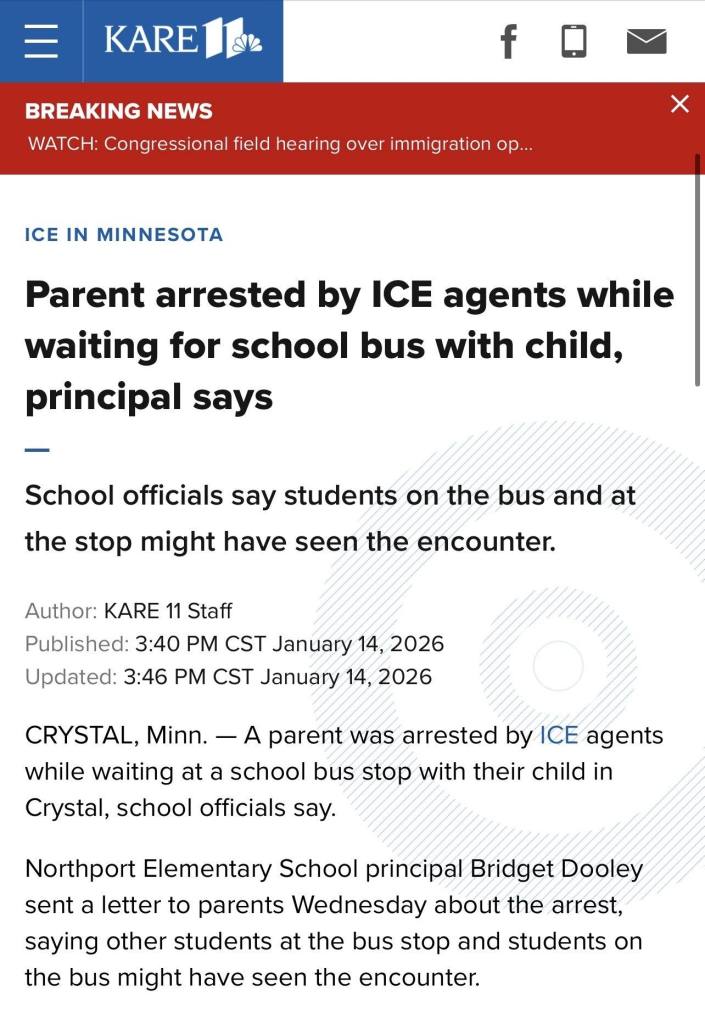
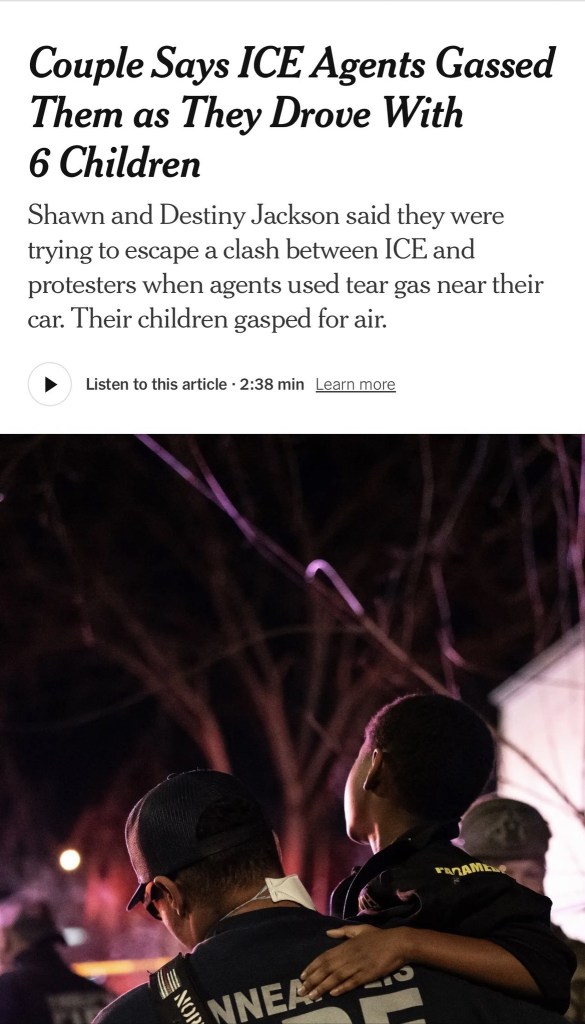
I want to try and describe what it is like in Minnesota right now for my friends in other states. As a reminder, Alyse and I live in the suburbs — Apple Valley — not Minneapolis. This federal invasion and occupation is occurring all across the state, not just in Minneapolis.
ICE is not looking for specific people. They don’t have a sheet of paper with specific names, specific addresses, that they are arriving in communities to get. They drive around looking for kidnappings of opportunity.
So they will sit and idle in their car, waiting for a Black, brown or Asian person who is walking into the gas station, taking out their trash, walking their dog, or working at their job and then swarm and grab them.
ICE drives around *incredibly recklessly* and uses license plate readers to find people with mostly-Hispanic sounding last names, pulls them over, and kidnaps them. Again, these aren’t specific people ICE has been tasked with finding. Most of the people who are kidnapped are U.S. citizens, lawful permanent residents, or have legal status of some sort (work permit, a social security number, or are a refugee or asylee) (picture 1). These are documented immigrants or citizens who have broken no laws — including not having broken laws entering the country. These are people just going about their daily life who get stopped and snatched because they’re Black, brown or Asian.
Just going about OUR daily life, we see abandoned cars in the middle of highways, on neighborhood streets, in front of doctors offices. Sometimes the doors are still open and the car is still running. We could be in line to get Burger King and watch ICE snatch a teenager on his way into work (picture 2). We could be taking out the trash, walking kids to the bus stop, going for a walk outside, and there will all of a sudden be a swarm of anonymous, masked, violent men ripping a family from their home or out of the booth at a restaurant. Picture 3 is a neighborhood, one mile from my house, at 8:30AM this past Wednesday. It was school bus pick up time and also trash day in that neighborhood. This is just in the middle of the neighborhood.
This can happen any where at any time. There is no place we can go and be assured we won’t see someone be violently taken. Target. The grocery store. A restaurant. Driving Hattie to swim lessons. Driving to church. Going to the doctor (picture 4). Multiple times a day, we get texts from co-workers, neighbors, friends, family members about a person they know (or are related to, or work with, or are their kids’ friends parents) who was taken.
ICE sets up checkpoints in neighborhoods and make everyone leaving or entering show their papers (note: very few people can prove their citizenship at a moments notice. A majority of Minnesotans don’t have passports. Citizens don’t just carry their birth certificate around). They go door-to-door in apartment buildings and neighborhoods, just hoping a Black, brown or Asian person will open their door (because they have no judicial warrant to take a specific person(s), just kidnapping whoever accidentally opens their door).
Schools have had to close. ICE has shown up to schools and just pepper sprayed kids and parents (picture 5). Districts are calling families and advising that their kids switch to online school. ICE circles and targets Spanish-immersion programs, forcing moms and dads to sit watch over their kids’ school to keep their kids and teachers safe (picture 6). Kids come home from school to empty houses, their parents having been stolen sometime during the day. When parents are kidnapped in front of others, they will yell out their full names and the name of their kids’ school(s) so someone can call the school and alert the administration, hoping their kids can be put with a safe adult instead of coming home to no one. There are people who signed delegation of parental authority (DOPA) forms — agreeing to take a neighbor or friend’s kids in the event of an emergency — who now have multiple children from multiple families.
ICE is ubiquitous. They are everywhere. We see them 3, 5, 7 times a day just going through our normal routine. There are more federal agents in Minnesota than there are local law enforcement from the ten largest metro police departments COMBINED (picture 7).
This is going to come to other states and I want people to be prepared, because I cannot overstate how many people have (had to) come together to respond.
Regular Minnesotans — people who have never once gone to a protest, called their elective representatives, participated in an economic strike, people who rarely even vote — have been activated. Grandparents carry whistles in their cars in case they come across ICE while living their lives and need to warn the surrounding area. Parents of kids in K-12 organize to ensure there’s parents at bus stops and the area around schools, because ICE stakes out bus stops and school properties — taking parents who are waiting at the bus stop or in the carpool line (picture . We’ve set up massive food donation and delivery infrastructure. We organize rides to school and work. People are literally taking in families.
SO many kids aren’t going to school right now (picture 9). So many businesses are closed or have lost their customer base entirely. So many families are facing eviction because they can’t go to work and won’t be able to pay their rent.
Minnesotans are being collectively punished and traumatized. 6 month old babies have been teargassed because their parents are just driving in their own neighborhood (picture 10). We are coming together in the most beautiful ways — I don’t want to understate that. But I want everyone outside of Minnesota to understand: we are under a federal invasion and occupation of armed, masked, paramilitary that roam our streets, brutalizing, harassing and murdering with impunity.
There may be people who might think that when this comes to your state, being white or being a U.S. citizen or living in a suburb or rural area or living in a neighborhood with few or no immigrant neighbors means you won’t see or experience this kind of daily assault of an invasion and occupation. I want to dispel that idea.
There are things I’m forgetting, certainly, but I wanted to try and paint the picture because this isn’t ending in Minnesota. We are the test case before expanding to other states in the country.
Help us now to stop this before it spreads. Organize in your communities now.
On January 7 U.S. Immigration and Customs Enforcement (ICE) agent Jonathan Ross shot and killed Renee Good, a thirty-seven-year-old woman who had been observing ICE raids from her car in her Minneapolis neighborhood. In videos of the incident, we can see Ross firing through Good’s windshield and open window as she begins to drive away. The horrific footage of the killing felt like a stark symbol of today’s authoritarian moment—but at the same time, I knew that anyone involved in the struggle against police violence would find it tragically familiar.
To put Good’s killing in context, I spoke with historian and Boston Review contributing editor Robin D. G. Kelley, whose forthcoming book, Making a Killing: Capitalism, Cops, and the War on Black Life, covers the history of county, state, and municipal police violence—as well as the activism against it. In an email exchange, we discussed the pitfalls of the “perfect-victim narrative,” policing’s terror tactics, why agents don’t need more training, and where we go from here.
Deborah Chasman: Good’s killing shocked Americans. But much about it reflects violence that’s very familiar to you. Can you put the murder in the context of your research?
Robin D. G. Kelley: Despite having spent more than thirty years studying and writing about police violence, I am still shocked by every death—even when the outcome is predictable. But the killing of Good shocked even the most seasoned organizers. She was a white woman and a mother—two things you’re not supposed to be when armed agents of the state put you in a body bag. (That she was queer and a poet, not so much.)
Of course, the very idea that certain people, by virtue of their characteristics, don’t deserve to be brutalized, caged, or killed by police is the problem. Mariame Kaba warns against “perfect-victim narratives,” which reinforce what Ruth Wilson Gilmore calls “the problem of innocence.” Centering someone’s innocence clouds the case for abolition, which seeks to create a world where no one is caged or gunned down even if they broke the law. No matter who she was, what she looked like, her marital or citizenship status, or what she might have done in the past or even in the moment, Good had the absolute right not to be shot for driving away.
What doesn’t surprise me is why and how Jonathan Ross shot her and the federal government’s efforts to cover up what happened. Researching Making a Killing, I found too many incidents to count where police fatally shot people for attempting to drive away. These were not high-speed chases, by the way—sometimes it was just a car lurching forward or an engine revving up that prompted a shooting. They all have one thing in common: police justify the shootings as acts of self-defense. The alleged “suspect,” the story goes, intended to ram the officer, who opened fire because he feared for his life. After these shootings, cops rarely argue they were simply trying to stop a fleeing suspect, because it opens them up to two objections: that firing at a driver puts others in harm’s way, and that they could have taken down the license plate and pursued the person later. Fearing for one’s life is always used to absolve cops from having to explain why they didn’t act differently.
This is why, in videos of the moments before the shooting, we can hear Good’s wife Rebecca saying, “We don’t change our plates every morning, just so you know. It will be the same plate when you come talk to us later.” And this is also why, for many years and in different cities, movements fighting police misconduct demanded that officers be banned from using lethal force against fleeing suspects who do not pose an imminent threat, whether on foot or in a car.
I’m also not shocked by the utter refusal of the federal government to investigate or consider bringing charges against Ross. I’ve lived through and documented so many cases of officers whose egregious acts of violence led to no indictments and no investigations; so many cases of police and even prosecutors destroying incriminating evidence. The question is, why are so many people surprised and indignant about the feds’ unqualified defense of Ross? Maybe because we’ve fallen into the trap of distinguishing ICE and CBP (bad) from local police (good). Maybe it’s a residual effect of the January 6 insurrection, in which some police officers had been victims of right-wing mobs (which themselves included a disproportionate number of cops and soldiers). In any case, the narrative has taken hold that ICE agents are rogue cops or cops on steroids, trained to terrorize or simply untrained. Strangest of all in this story is the liberal pipe dream that local police will stand up against ICE and CBP, when police have collaborated with ICE and been deployed to protect agents from protesters, even in so-called sanctuary cities.
I’m not sure if it’s amnesia or just wishful thinking, but it seems like the well-documented terror tactics of municipal, county, and state police have just disappeared from people’s memory. Chicago and Los Angeles, where resistance to ICE has been extraordinary and well-organized, have histories of police violence that rival anything ICE agents are doing. Indeed, it is precisely the long experience of organizing against this violence that prepared activists in these cities to resist ICE.
Chicago, which takes up a very long chapter in my book, is known for police torture, the maintenance of secret “black sites,” assassinations and executions, and prosecutors who have consistently protected police even to the point of hiding evidence. This is the city where the second Black police superintendent, LeRoy Martin, bragged in 1987, “When you talk about gangs, I’ve got the toughest gang in town: the Chicago Police Department.” And it is the same city that has been a model of resistance to police repression for more than half a century, culminating in the collective struggles for justice for Rekia Boyd, Laquan McDonald, and victims of torture that brought down the ruling regime of Rahm Emanuel.
This is not to diminish ICE and CBP’s violent tactics. These outright abductions are terrifying, though again, not without precedent. Police have abducted Black men standing on a street corner or a stoop and tossed them into unmarked vans just for looking suspicious, and there are numerous cases of young Black women abducted off the streets and sexually assaulted by police. But there is a fundamental difference between these abductions and ICE’s: the former were intended to be secret, the latter publicized. ICE and CBP agents are either filming these acts of terror themselves (Ross had one hand on his gun and the other holding his cell phone to film!), or they are arriving with a film crew. The point is to create fear, to terrorize people into submission, to create a state of emergency.
Finally, let’s try not to make these attacks about Trump or even Stephen Miller. Both ICE and CBP have histories of violence dating back to well before 2016. My colleague Kelly Lytle Hernandez has written on the history of the Border Patrol, which has been terrorizing people since 1924.
DC: Republicans and right-wing pundits have been relentless in blaming Good for her murder, or calling her a domestic terrorist and warning that any activism will put you in harm’s way. Clearly there’s a legal element to blaming Good—it’s meant to exonerate the agent. But how do those narratives function politically?
RK: Anyone organizing against state power will be a target, whether their protest abides by the law or involves civil disobedience. Either way, nothing justifies the harm, which is what these narratives attempt to do. Just last night, after ICE shot another person in Minnesota and protesters were in the streets battling federal agents, there was a lot of talk—including from Governor Tim Walz and Minneapolis Mayor Jacob Frey—about the need for peaceful protest: code for candlelight vigils and silent prayer. Militant civil disobedience, aggressively confronting a phalanx of masked agents in riot gear, or blocking traffic is nonviolent, but these tactics are not considered by the political class to count as “peaceful protest.” And by now, it should be clear that peaceful protest, whatever form it takes, will not get ICE or CBP out of your city; it will not stop the terror or the abductions.
And yet, when we return to Good’s death, we must remember that she actually wasn’t protesting. She was a legal observer doing her job, and when told to leave she was complying. Unsurprisingly, J. D. Vance and all the right-wingers who blame Good for her death are simply lying. Calling her a domestic terrorist—it’s the oldest trick in the book. The subtext to which we ought to pay attention is how her gender and sexuality constituted the real threat to Ross, his fellow agents, Vance, Stephen Miller, and MAGA. One must imagine what it meant to Ross for a smiling queer woman to tell him, “I’m not mad at you.” After shooting her three times, Ross or an agent near him mutters, “Fucking bitch!” That says it all.
Nearly every victim of an ICE or CBP shooting is blamed for being either a fugitive or domestic terrorist. When ICE agents fatally shot Silverio Villegas-González, a thirty-eight-year-old immigrant from Mexico, as he tried to drive away from what amounted to an ambush in Chicago, DHS released a brazenly false statement claiming that he “refused to follow law enforcement officers’ commands” and used his car as a weapon, hitting and dragging one of the officers. And so the same old story goes: “Fearing for his own life and broader public safety, the officer fired his weapon.” We know now that no officer was hit or dragged, and the one officer allegedly hurt suffered minor cuts from breaking Villegas-González’s window.
Likewise, when CBP agents shot Marimar Martinez, a thirty-year-old schoolteacher and U.S. citizen—also in Chicago—they labeled her a domestic terrorist and charged her with ramming a federal law enforcement officer. We know now that the agent, Charles Exum, rammed her vehicle, jumped out with his gun drawn, and said “Do something bitch” before shooting her five times. The DHS lies were so egregious (and Exum didn’t help their case by bragging about it in text messages) that the prosecution had no choice but to drop all the charges.
DC: In the wake of Good’s murder, many have called for better training for ICE officers—a response that activist Kelly Hayes, among others, has forcefully rejected. I know you agree. Can you explain why?
RK: Jonathan Ross wasn’t one of those cats recruited with a $50,000 bonus and handed a gun. Besides being a veteran of the Iraq war, he had spent a decade as a member of the special response team of ICE’s enforcement and removal operation. He got more training than most of the other masked goons running the streets of the Twin Cities. The argument for more and better training was thoroughly discredited after George Floyd’s murder in 2020. As it turned out, Derek Chauvin had lots of training: he had taken the crisis intervention training, use-of-force training, de-escalation vs. restraint training, and even training in implicit bias, which became mandatory for Minneapolis police officers beginning in 2018. The result? Chauvin racked up seventeen misconduct complaints over nineteen years on the force. And after 2018, cases of police brutality and excessive force complaints increased across the city.
But if training hasn’t worked, why does it continue? Why is it always trotted out, alongside new technologies, as the solution? Because training and technologies (body cams, Tasers, so-called less-than-lethal weapons, predictive policing software) are a boondoggle for corporate interests. Training costs money, which increases police budgets, which are paid for through taxes and bonds—a hidden source of revenue for financial institutions that administer the bonds. The money for training flows to private companies, usually run by former police chiefs and so-called criminal justice experts—not community organizations that have been fighting for accountability. Sometimes the investment in new technologies and training comes from corporate-funded private police foundations, whose donations enable departments to purchase equipment, such as surveillance technology, guns, ballistic helmets, cameras, and drones, and assist officers with bonuses or legal fees, with no oversight or public input. But corporations like Amazon and Google get a great return on their investment since law enforcement agencies adopt technologies of surveillance, data mining and management, etc., coming from these companies.
To understand what “training” produces, let’s focus on one company: 21st Century Policing Solutions, LLC (21CP), which grew directly out of an Obama-era task force formed in late 2014 after the killing of Michael Brown. 21CP is made up of law enforcement officials, lawyers, and academics, and it’s paid by municipalities and university public safety forces to train police in a host of areas: gaining community trust, racial equity, changing use-of-force policies, communication, transparency, strategic management, and community policing. Usually, this work entails producing reports that ultimately just repeat boilerplate recommendations. Oklahoma City paid 21CP $193,000 for a report many Black residents found to be useless—nothing changed. Aurora, Colorado, paid 21CP $340,000 to “investigate” the police missteps that resulted in the death of Elijah McClain, a young Black man who had been injected with ketamine under police custody and died. 21CP produced a 161-page report that primarily described the operations of the Aurora Police Department, compared it with other departments in similar-sized cities, repeated what we all know about the death of McClain, and offered obvious and fairly innocuous recommendations: prohibiting chokeholds, retaliatory violence, using force on people who are handcuffed—in other words, prohibiting behavior that is already prohibited. And worse, these reports often suggest recruiting and training more officers. I want to suggest that when we talk about training and technology, we need to follow the money. And in the case of CBP and ICE, the last thing we should be doing is proposing reforms that give them more money.
As the coercive arm of the state, the police—including CBP and ICE—are the primary instruments of state violence within the borders of the United States. They function as an occupying force in America’s impoverished ghettos, barrios, reservations, on the Southwest border, and in any territory with high concentrations of subjugated communities. For people who reside in these communities, keeping us safe is not the objective. Instead, the modern police force—whether local, state, or federal—wages domestic war. Whether we call it a war on crime, a war on militants, or a war on drugs, law enforcement at every level has turned many Black working-class neighborhoods in particular into killing fields and open-air prisons, stripping vulnerable residents of equal protection, habeas corpus, freedom of movement, and even protection from torture. The attack on non-white immigrants is just another front in a war the police have waged since their inception.
And despite the handwringing and outrage over the Trump administration’s flagrant violation of the Posse Comitatus Act of 1878 limiting the use of the military in domestic matters, the police have long functioned as an army against dissident social movements. The police are the first line of defense against strikes and left-wing protests, while often serving as a cordon to protect Klansman, Nazis, and the alt-right.
DC: What are the chances that Ross will be held accountable? How does this end?
RK: Simply put, Ross will not be held accountable, nor will anyone else responsible for the death or injury of victims of ICE or CBP attacks. As I document in my book, we can’t get accountability from the “regular” police, whatever that means: after decades, we haven’t been able to achieve something as basic as an honest civilian review board with subpoena powers and the ability to hire and fire officers! Since Trump’s second term, things have gotten even worse. Guided by the Heritage Foundation’s Project 2025, the Trump administration rescinded Biden-era police and criminal justice reforms; shuttered the National Law Enforcement Accountability Database (NLEAD) created in 2023 to allow prospective employers to access the records of federal law enforcement officers in order to check their backgrounds for misconduct; halted all open federal investigations into law enforcement, notably in Jackson, Mississippi, and New York City; ended federal consent decrees mandating reforms of Louisville and Minneapolis police departments; made the extraordinary offer of free private-sector legal services for officers accused of misconduct.
It is not enough to abolish ICE. We need to abolish the police and cages and build other institutions and relationships that can bring us genuine safety. Abolition is less an act of demolition than a construction project. It is creative creation, the boundless, boundary-less struggle to make our collective lives better, what Ruth Wilson Gilmore calls “life in rehearsal.”
Ironically, the federal government’s escalation of violence and its spillover into other communities have actually forced people to find their own strategies to keep each other safe, through communication, patrols, whistles, trainings in nonviolent resistance, and old-fashioned organizing. It’s not just about keeping ICE out, but making sure that the medical and child care needs of neighbors are being met, that people who can’t leave their homes out of fear are fed, and that some homes can become designated safe houses.
I’m reminded of a 2009 statement issued by the abolitionist organization Critical Resistance. Instead of police, the statement asks,
What if we got together with members of our communities and created systems of support for each other?. . . . Relying on and deploying policing denies our ability to do this, to create real safety in our communities.
We’re seeing this in action now in the mobilizations against ICE. The question is whether it can be sustained and turned into something that can replace our dependence on armed agents of the state to solve human problems.
Independent and nonprofit, Boston Review relies on reader funding. To support work like this, please donate here. Robin D. G. Kelley is Distinguished Professor and Gary B. Nash Endowed Chair of U.S. History at UCLA and a contributing editor at Boston Review. His many books include Freedom Dreams: The Black Radical Imagination. Deborah Chasman is publisher and coeditor of Boston Review. Her writing has also appeared in New York magazine and the Chronicle of Higher Education.
Federal immigration agents detained three people and deployed chemical agents at multiple locations around E. 34th Street and Park Avenue in Minneapolis’ Powderhorn neighborhood Tuesday morning. At least two were observers and not the target of immigration enforcement operations.
Around 9:40 a.m., community response networks began sending alerts about Immigration and Customs Enforcement (ICE) door-knocking at E. 34th Street and Park Avenue. By 10 a.m., a crowd of over 100 observers had gathered, confronting agents at multiple intersections.
Among the detainees was a woman who was forcibly removed from her vehicle after agents smashed her passenger-side window.
In a video taken by Sahan Journal, the woman can be seen arguing with agents prior to being grabbed by multiple agents and carried to agents’ vehicle. The woman can be heard shouting that she is disabled and on her way to a doctor’s appointment that ICE was obstructing. Prior to the detention agents had instructed her to drive away.
After being pulled out of a car, a women screams as she’s being arrested by immigrations agents at 34th and Park in Minneapolis on Jan 13, 2026. Credit: Chris Juhn for Sahan Journal
Shortly after, another observer on site was tackled and forcibly put in agents’ vehicle as well. According to state Rep. Aisha Gomez, DFL-Minneapolis, who was present at the scene, agents pushed the man’s head into the concrete prior to carrying him away. Gomez also said that agents were physical with her as well.
“These officers have obviously not had the basic law enforcement training,” Gomez said. “I was shoved with no verbal communication whatsoever.”
Andy Larson, a south Minneapolis resident who was out observing ICE activity Tuesday, told Sahan Journal that one protester kicked out the taillight of an ICE vehicle and was tackled to the ground up the road on Park Avenue and E. 36th Street.
“It was a really good kick,” Larson said.
The protester managed to escape ICE agents, Larson said. ICE deployed chemical irritants and shot pepper balls into the crowd and fled the scene.
According to Sahan Journal photojournalist Chris Juhn, a Hispanic man was also visible in the back of one vehicle. It is unclear whether the man was an observer or target of federal operations. ICE did not respond to Sahan’s request for comment on the operations.
At multiple points during the operation, agents deployed chemical agents at observers. Agents fired pepper balls at observers’ feet and threw canisters of tear gas at the corner of 34th Street and both Park and Oakland avenues prior to leaving the scene. Eyewitness Moses Wolf said there was no singular precipitating event that led to tear gas being deployed on Park Avenue.
“There was a crowd confronting each other telling ICE to get out,” Wolf said. “I didn’t really see any physical altercation happening.” He said it appeared to be a tactic by ICE agents to exit the scene.
Wolf said the confrontation prior to the deployment of tear gas had not escalated beyond what had already been happening.
“It wasn’t anything crazy,” Wolf said. “I turned around for one second and there was this whole entire cloud of it, and pepper spray came with that.”
Eyewitness Neph Sudduth said at Oakland Avenue agents used tear gas as they were leaving.
“They were finally leaving, it was the last car of the convoy,” Sudduth said. “They just threw two or three canisters out at us as they left.”
Both Sudduth and Wolf said they witnessed agents using pepper spray out of the windows of their vehicles as they drove off.
“They just wanted to hurt us cause we told them how we felt, and they didn’t like it,” Sudduth said.
The operation in Powderhorn is part of a flood of federal immigration activity in Minnesota. As many as 2,000 federal agents are present in the state according to reporting from the New York Times, with an additional 1,000 set to be deployed.
For Gomez, the clash with ICE is the new reality of life in the Twin Cities with federal agents present.
“This is what our streets are like,” Gomez said. “We have these masked, unaccountable unknown to us federal agents, and it’s like they’re the secret police.”
Despite the difficulties, Gomez believes observers should and will continue to show up to meet federal agents in the streets.
“Our community is undeterred,” she said. “We’re not going to just lay down. You can gas us and mace us all you want, we’re not going to just lay down.”
Sahan Journal reporter Andrew Hazzard contributed to this story.
During the 2024 campaign, Donald Trump promised to deport every illegal immigrant who was a rapist, murderer, or thief. He also promised to deport 20 million immigrants. Some voters believed the first promise; other voters believed the second.
Because people are stupid, that first group of voters believed that there were 20 million undocumented immigrants who have committed felonies. This is not possible. The total number of people in jail in America today—this includes federal, state, local, and tribal land prisons—is just under 2 million. The number of undocumented immigrants who have committed serious crimes cannot be 10x the entire prison population of the United States. If it were, then daily life in America would look like Escape from New York.
So some Trump voters were duped owing to their general ignorance and/or innumeracy.
But others were not. Others signed up for Trump because of his second promise (the 20 million deportations) and viewed the first promise (about deporting only criminals) as the pap necessary to get the suckers onboard.
There are two crucial questions about these two groups. The first is:
What is their relative size? What percentage of Republican voters were tricked into voting for Trump’s immigration policies versus what percentage are getting exactly what they wanted?
Would you like to guess? Go ahead. I promise that whatever you’re thinking, it isn’t dark enough.
Here’s a survey tracking Republican approval of Trump’s immigration policies (the top line, in red) over most of 2025:
That’s a consistent level of support around 80 percent. Now here is the first poll conducted after the killing of Renee Good:
Even after the killing of an unarmed American citizen, a total of 80 percent of Republicans approve of what ICE is doing and 53 percent of Republicans strongly approve.
It seems pretty clear that, at best, one in five Trump voters were duped. The majority of them are getting exactly what they wanted.
Now if Trump were to lose the support of 20 percent of Republicans voters—or even 14 percent—it would be meaningful for Republican electoral prospects. Which is nice.
The problem is that having 80 percent of Republican voters actively supporting a fascist race war is meaningful for our societal prospects.
Which brings us to the second question: How are these groups distributed through the elite positions of power in government? And here it seems that many of the Republicans most invested in a race war have a great deal of power. Like, for instance, Vice President JD Vance, Deputy Chief of Staff Stephen Miller, and Secretary of Homeland Security Kristi Noem.
At the elite levels, even the idea of 20 million deportations is too little. Here’s a tweet from the Department of Homeland Security on New Year’s Eve:
100 million deportations?
There are 43 million foreign-born Americans. Most of them are legal immigrants. In order to perform 100 million deportations, DHS would have to round up every immigrant of any status—even naturalized citizens—and then also snatch 57 million American who are citizens by birth and deport them, too.
Want to guess who those other 57 million Americans might be?
This week the Department of Labor published this:
Of course, the slogan sounds better in the original German.
Oh, and don’t forget the Department of Labor’s heroic propaganda posters depicting the American worker in a very specific way.
On the one hand, it feels weird to say that the U.S. government is attempting some low-key ethnic cleansing.
On the other hand, the reality is that we have a masked secret police force going door-to-door attempting to kidnap brown people; one government agency publicly daydreaming about deporting 100 million people; and another government agency saying that the ideal worker is a 20-year-old white guy.
2. Demographics
Another tell: This administration is obsessed with America’s falling fertility rate. From the NYT:
Vice President JD Vance last week called falling marriage rates “a big problem.” The deputy secretary of Health and Human Services in December urged his agency to “make America fertile again.” And at a recent conference for young conservatives, Sean Duffy, the transportation secretary, doubled down on the importance of marriage and children, holding out his nine kids as a model for others to follow.
Full disclosure: I am also obsessed with America’s falling fertility rate. Enough that I wrote a book about it.
The problem here is that nearly all of the declines in total fertility rate (TFR) over the last decade have been the result of declining Hispanic fertility.
Here’s the deal: The TFR—the total number of kids the average woman has over the course of her life—has been below the replacement level, but relatively stable, among white and black Americans for the last generation or so. But America’s TFR kept declining anyway. Why?
Because Hispanic Americans—many of whom were recent immigrants—had TFR’s higher than the U.S. average. And their baby-making propped up the nationwide number. The problem is that, as recent immigrants spent time in America, their reproductive behavior began regressing to the mean. The shift has been dramatic:
If you were concerned about the fertility rate in America, would you be trying to (a) halt all immigration—since immigrants usually bring with them fertility rates higher than native-born Americans—and (b) deport 100 million people from the ethnic group that has the highest fertility rate?
No.
The only reasonable conclusion is that the concern of people in the Trump administration isn’t about the total fertility rate. It’s about the white fertility rate.
I don’t know how much clearer the regime could be.
So tell me: What does the pie chart look like on Republican voters and race war? What is the percentage of Trump voters in each of these categories:
Group A: Sees and understands the administration’s intent and supports it.
Group B: Sees and understands, but oppose it.
Group C: Do not understand that the regime views its program as part of a race war and thinks it’s all business as usual?
And follow-up question: How big can Group A be for us to retain a functional, liberal society?
“Mr. Speaker, I rise today to announce I will be impeaching Homeland Security Secretary Kristi Noem,” announced Rep. Robin Kelly of Illinois.
“Secretary Noem has violated the Constitution and she needs to be held accountable for terrorizing our communities. Operation Midway Blitz has torn apart the Chicagoland area. President Trump declared war on Chicago and then he brought violence and destruction to our city and our suburbs in the form of immigration enforcement.”
Rep. Kelly then broke down some of the outrageous violence that ICE has visited upon her district.
“In my district, federal agents repelled down from Black Hawk helicopters and burst into an apartment building in the South Shore area. They dragged US citizens and non-citizens alike out of their beds in the middle of the night. They claimed the apartment was infiltrated by members of a Venezuelan gang. I don’t understand this president’s obsession with Venezuela, but they did not arrest a single member from that gang.”
“I visited that apartment building and saw firsthand the destruction those agents left. Doors to people’s homes or apartments were kicked down. Belongings, including little kids’ toys, were strewn about in the hallway. That raid and so many others shook our community, not just immigrants, but everyone. Now, Secretary Noem has brought her reign of terror to Minneapolis after she left Charlotte and Raleigh. We have all seen what happened.”
“ICE officers shot and killed Renee Nicole Good in cold blood. Without knowing any of the facts or an investigation, Secretary Noem lied about what happened. She called [a] beloved 37-year-old mom a domestic terrorist. Secretary Noem and her rogue agents are the ones terrorizing our communities, and she is breaking the law to do so. I will hold her accountable.”
“I’m filing three articles of impeachment against Secretary Noem. Number one, obstruction of Congress. Secretary Noem has denied me and other members of Congress oversight of ICE detention facilities. It is our constitutional duty to find out what’s happening in these centers where people are reportedly being treated like less than animals. Two, violation of public trust.”
“Secretary Noem directed ICE agents to arrest people without warrants, use tear gas against citizens, and ignore due process. She claims she’s taken murderers and rapists off our streets, but none of the 614 people arrested during Operation Midway Blitz has been charged or convicted of murder or rape.”
“Three, self-dealing. Secretary Noem has abused her power for personal benefit. She steered a federal contract to a new firm run by a friend, her friend. Her propaganda campaign to recruit ICE agents cost taxpayers $200 million. She made a video that turned the South Shore raid into something that looked more like a movie trailer. But make no mistake, this is not a movie. This is real life and real people are being hurt and killed. I really have to wonder who are the people behind the mask. These DHS agents have no identifying factor.”
“From all their botched raids and officer-involved shootings, I have to ask, what is their training like? What is the vetting? Is Secretary Noem recruiting January 6th insurrectionists? I was one of the last members of Congress to escape the House Gallery on January 6th. I remember hiding on my hands and knees and running through the hallways to a safe room. Insurrectionists are not fit to serve as law enforcement. I realize that impeachment of Secretary Noem does not bring Renee back.”
“True justice would be Renee alive today at home with her family. Impeachment doesn’t bring back the four other people killed by immigration officers this year, including a man in Chicago. We could not bring them back to their loved ones. What we can do, though, is impeach Secretary Noem. Hold her accountable. Let her know the public is watching. In this country, we do not kill people in cold blood without consequences. These are not policy disagreements.”
“These are violations of her oath of office and she must answer for her impeachable actions.”
Audience members at the all-ages Minneapolis rock venue Pilllar Forum tussled with ICE agents on the street outside the club on Sunday — prompting that night’s show to be canceled.
The owner of Pilllar Forum, Corey Bracken, said several of his customers and musicians were pepper-sprayed by ICE agents and at least two were hit with batons on the street outside the venue, at 2300 Central Av. NE., where other ICE detainments and community protests have happened in recent days.
“My staff doesn’t feel safe after this, and our artists and customers don’t feel safe,” said Bracken, a dad who expanded his skateboarding store into a music venue and coffee shop in 2023 to bring more live music and art to underage fans.
He is leaving it up to his staff and the bands themselves to decide whether to proceed with upcoming concerts, including several more scheduled this week.
The ruckus started shortly after the 6:30 p.m. showtime for a four-band bill headlined by Pilllar Forum regular Anita Velveeta, a popular trans/queer punk act. Audience members saw ICE agents pull up and detain two individuals outside the neighboring Supermercado Latino market, prompting the club’s young music fans to quickly exit onto the street and protest the agents’ actions.
The Department of Homeland Security didn’t respond to a Star Tribune request for comment. An employee at Supermercado Latino also declined to comment on the incident.
Antonio Carvale, singer/guitarist in one of Sunday’s opening bands, BlueDriver, said he was one of five people at the venue who had to be treated with water and saline solution after being hit with pepper spray. He said agents fired the spray after they pushed a protester who pushed back.
“Honestly, the pain felt brutal, but fortunately the community was prepared and helped treat our eyes,” Carvale said, but he commiserated with a bandmate who was also struck by a baton and “banged up pretty bad.”
The band was disappointed Sunday’s gig then was canceled, but he added, “It would’ve been hard to play when I couldn’t even see the frets.”
One of the audience members who was pepper-sprayed, Jess Roberts of Minneapolis, said she had to go to an urgent care clinic because she was sprayed in the ear, which led to an infection.
The run-in with ICE followed a viral Instagram post by Pilllar Forum that went up Friday and landed 25,000 likes. It showed a peaceful but loud crowd of protesters shouting down ICE agents on Central Avenue, with the message, “And that is how you get it done.”
Minneapolis City Council President Elliott Payne and the new Minnesota state senator representing northeast Minneapolis, Doron Clark, joined Bracken in another social media video posted late Sunday denouncing the incident. Clark called Pilllar Forum “an institution here on Central.”
Payne urged residents, “Stay safe and stay vigilant.”
Twin Cities musicians and music fans offered online support for Pilllar Forum after Sunday’s mayhem.
“Thank you for supporting the community!” veteran rocker Tim Ritter of the band Muun Bato wrote on the venue’s Facebook page.
Bracken did offer refunds to paid attendees of Sunday’s canceled show, proceeds of which were to be donated to families affected by ICE detainments, per headliner Anita Velveeta’s request.
“So far, I haven’t heard from anyone who wants their money back,” Bracken said.
Tajikistan has condemned what it called an “ethnic hatred” attack in Russia after a 10-year-old boy from a Tajik family was stabbed to death at a school near Moscow, in a rare public rebuke aimed at a key partner for labor migration and security ties. The killing happened on December 16 in the village of Gorki-2 in the Odintsovo district of the Moscow region, according to Russia’s Investigative Committee, which said a minor attacked people at an educational institution, killing one child and injuring a school security guard.
A video of the attack circulated on Russian social media after the incident. According to reporting by Asia-Plus, footage published by the Telegram channel Mash shows the teenage assailant approaching a group of students while holding a knife and asking them about their nationality. The video then shows a school security guard attempting to intervene before the attacker sprays him with pepper spray and stabs him. The assailant subsequently turns the knife on the children, fatally wounding the 10-year-old boy.
A statement released by Tajikistan’s interior ministry said it feared the case could “serve as a pretext for incitement and provocation by certain radical nationalist groups to commit similar crimes.” Tajikistan’s response also drew attention after the foreign ministry said the attack was “motivated by ethnic hatred.” Dushanbe subsequently summoned the Russian ambassador to protest the attack, handing him a missive “demanding that Russia conduct an immediate, objective, and impartial investigation into this tragic incident.”
The condemnation is particularly notable as Tajikistan rarely issues public criticism of Russia, which remains its main destination for migrant labor and a key security partner.
According to Russian media, the attacker, who has admitted their guilt, subscribed to neo-Nazi channels and had sent his classmates a racist manifesto entitled “My Rage,” in which he expressed hostility toward Jews, Muslims, anti-fascists, and liberals, a few days before the incident.
Tajik migrants form one of the largest foreign labor communities in Russia and across Central Asia. Millions of Tajik citizens work abroad each year, most of them in Russia, sending remittances that are a critical source of income for families at home. According to the World Bank, remittances account for roughly half of Tajikistan’s gross domestic product in some years, making labor migration a cornerstone of the country’s economy. Many Tajik migrants work in construction, services, and transport, often in precarious conditions and with limited legal protections. The killing comes as Central Asian migrants in Russia face growing pressure to enlist in the war in Ukraine, with coercion through detention, deportation threats, and promises of legal status having been reported.
The killing has also renewed scrutiny of rising xenophobia in Russia, particularly toward migrants from Central Asia. The Times of Central Asia has previously reported an increase in hate speech, harassment, and violent attacks targeting migrants, especially following major security incidents. Human Rights Watch has warned that Central Asian migrants in Russia face growing discrimination, arbitrary police checks, and racially motivated abuse, trends that have intensified in recent years amid heightened nationalist rhetoric.
It’s curious. I looked through some of the [social media] pages of Russia’s [most prominent] political émigrés—[Ilya] Yashin, [Vladimir] Kara-Murza, [Ekaterina] Schulmann, [Leonid] Volkov, [Elena] Lukyanova, [Dmitry] Bykov, [Marat] Gelman, [Boris] Zimin, [Boris] Akunin—but I couldn’t find a word about the violent death of a Tajik boy in a school near Moscow. They have expressed no sympathy, voiced no criticism of racism and xenophobia. It seemingly should be their direct obligation to speak out on this issue. But for some reason, mum’s the word. I also looked at the Telegram channels of the leading official anthropologists, and there is a mysterious muteness among them too. Surely it is their professional duty not to remain silent on such a matter. They even published a book called Tajiks and themselves speak everywhere of interethnic harmony. But in this case, it’s as if they’ve dummied up.
Source: S.A. (Facebook), 18 December 2025. Translated by the Russian Reader
As FB is reminding, there were times I believed I could protect my non-Slavic looking friends, lovers, relatives, foreign students and migrant workers from the nazis marching in the streets, from the nazis working as policemen, from the general xenophobia and unsensibility by magic tricks of art.
Thomas Campbell just translated our migrant labor board game Russia – The Land of Opportunity!!!
Russia – The Land of Opportunity board game is a means of talking about the possible ways that the destinies of the millions of immigrants who come annually to the Russian Federation from the former Soviet Central Asian republics to earn money play out.
Our goal is to give players the chance to live in the shoes of a foreign worker, to feel all the risks and opportunities, to understand the play between luck and personal responsibility, and thus answer the accusatory questions often addressed to immigrants – for example, “Why do they work illegally? Why do they agree to such conditions?”
On the other hand, only by describing the labyrinth of rules, deceptions, bureaucratic obstacles and traps that constitute immigration in today’s Russia can we get an overall picture of how one can operate within this scheme and what in it needs to be changed. We would like most of all for this game to become a historical document.
Life for migrant workers is Russia is becoming increasingly difficult after stringent new controls introduced over the past year. These include a registry of “illegal” migrants, restrictions on enrolling migrant children in schools, new police powers to deport people without a court order, and a compulsory app for all new migrants in Moscow and the surrounding region to track their movements.
Working in Russia was already less appealing because of the war in Ukraine and the weakening rouble. Now, with these new restrictions, a growing number of young people from Central Asia are starting to look elsewhere — including to countries in Europe — in search of better opportunities.
Dreaming of Europe in Moscow
Like 89% of young Kyrgyzstanis, 25-year-old Bilal* had always dreamed of working abroad.
Young people in Kyrgyzstan grow up in an environment where leaving the country to find work is common, widespread, economically essential, and socially accepted — and where the domestic economy still cannot offer comparable opportunities.
The average monthly salary in the country is about 42,000 soms (around $480), while in Russia, for example, wages in manufacturing can reach 150,000 rubles (nearly $2,000). Unlike most of his peers, Bilal never planned to work in Russia. “Because many of our people face racism there,” he explains.
Europe was his dream, but without connections getting a job offer from an EU employer seemed nearly impossible. So Bilal turned to “intermediaries” — fellow Kyrgyzstanis who had established ties with European companies that were constantly seeking workers. They advised him to travel to St. Petersburg, where, they said, it would be easier to prepare the paperwork and apply for a visa.
But it was the height of the COVID-19 pandemic. Many Schengen countries had stopped issuing visas and temporarily shuttered their consulates. Bilal didn’t want to return home empty-handed, so he decided to stay in Russia — “not by choice,” as he puts it.
“At first I worked illegally at a ski resort. Mostly we chopped firewood and cleared snow around the cabins. They paid us in cash,” he says.
Two months later, Bilal moved to Moscow and obtained a patent — the work permit that allows citizens of visa-free countries to be legally employed in Russia. He found a job as a courier for Yandex.
Bilal speaks excellent Russian — something he says explains why, unlike many of his friends, he didn’t encounter xenophobia all that often. But conflicts still happened. “You’d run into people who’d say, ‘Migrants, coming here in droves…’ Especially when a customer had put down the wrong address and the delivery got messed up — somehow it was always the migrant’s fault.”
Bilal left Russia two months before the full-scale invasion of Ukraine. “Back then it wasn’t like it is now,” he recalls. “Yes, the police would stop you on the street, but they’d take some money and let you go. Now my friends talk about Amina (a Russian mobile app for monitoring migrants), about police rounding people up, and about being sent to the war.”
He decided to set his sights on Europe instead.
Watched and bullied
In Russia, the path to legal employment for migrant workers runs through a processing centre known as Sakharovo — located about 60 kilometres from Moscow and notorious for its massive queues, where people often wait for hours. The perimeter is guarded by armed security forces, and inside migrants undergo procedures such as blood and urine tests to screen for “socially significant diseases”. Those who manage to obtain their documents can work legally, but that doesn’t protect them from future problems.
Russians often refuse to rent apartments to migrants. Schools and kindergartens decline to accept migrant children, citing “lack of space,” while the adults themselves face workplace “raids” or frequent “document checks” on the street or on public transport. Even Russia’s war in Ukraine has become a tool for pressuring them: many migrants are pushed to join the military in exchange for various “bonuses,” such as fast-tracked citizenship.
After the attack on Crocus City Hall — which authorities say was carried out by four Tajik citizens —the security services launched large-scale raids. Tajikistan’s government, fearing a surge in xenophobic incidents, even advised its citizens not to leave their homes.
Lawmakers soon joined in. Over the past year, they have restricted the ability to obtain residency through marriage, granted the Interior Ministry the power to deport migrants without a court ruling, required migrant children to pass a Russian-language exam before being admitted to school, and created the Registry of Monitored Persons — a database of foreign nationals who supposedly lack legal grounds to stay in Russia. There are already known cases of people being added to the list by mistake, and effectively losing the right to move freely around the country after their bank accounts were frozen, and their driving permits revoked.
Officials have justified all these measures as necessary to fight illegal migration and prevent crime. In July, the Interior Ministry reported a rise in crimes committed by migrants, but migrants still make up only a small fraction of overall crime statistics. A study by the “To Be Exact” project found that adult Russian men are statistically more likely to commit crimes than migrant workers.
On September 1, a new pilot project went into effect: migrants from Uzbekistan, Tajikistan, Kyrgyzstan, Armenia, Kazakhstan, Georgia, Azerbaijan, Moldova, and Ukraine who are living in Moscow or the Moscow region must install a mobile app called “Amina.” Authorities openly acknowledge that the app’s main purpose is to continuously track users’ locations.
The app that doesn’t work
If a phone fails to transmit location data to Amina for more than three working days, the participant is automatically removed from the system. If the migrant cannot fix the issue quickly, they risk being added to the “monitored persons” registry — which can lead to frozen bank accounts, job loss, or even expulsion from university.
Imran, a 27-year-old Tajik citizen, is worried: “Location services on my phone are on, and Amina shows that everything is being transmitted, but several times a day I get notifications saying the app isn’t receiving my location. The app works terribly. And I have no idea what consequences this could have for me.”
Users report constant problems with Amina. Some can’t get past the first screen; others say the app won’t accept their photo; still others receive alerts that their data failed verification. But the most common issues are related to location tracking.
In comments on RuStore (Russia’s internal apps store), representatives of the developer respond that “specialists are constantly working to improve the app’s stability” and advise users to contact technical support. But migrants complain about waiting on the line for hours.
Anton Ignatov, the director of the Sakharovo centre, claims the programme will improve public safety and help “prevent violations by unscrupulous individuals”. He cites situations in which migrants buy a work patent — a permit to work — for a short period and then disappear “into the shadows,” “vanishing somewhere in the industrial zones of Moscow and the region”.
Such cases do happen, and the most obvious reason is money. Since January 1, the monthly payment for a work patent in Moscow and the Moscow region has been 8,900 roubles (about $115). For many migrants working in low-paid jobs — for example, in construction or warehouse work — this is a significant share of their income, pushing some into the informal economy.
Another factor is wage delays in the sectors where migrants from Central Asian countries most often work. Mukhammadjon from Uzbekistan, works on a construction site outside Moscow, hasn’t been paid in two and a half months. A month ago, he stopped paying for his patent — simply because he had no money left. He sees no tools to defend himself.
Employers, meanwhile, benefit from hiring such vulnerable workers: they can avoid paying social contributions, hand out wages in cash, and rely on employees who are willing to work overtime for low pay.
Getting a job is becoming harder
Kudaibergen, 32, from Kyrgyzstan, worked at a warehouse on the outskirts of Moscow — “to support my family”, he says. His employer provided hostel-style housing for migrant warehouse workers.
“OMON came to our building. They treated us like they were arresting dangerous terrorists. They showed up with batons and tasers, as if storming the place. They drove us all outside. We stood by the door with our hands behind our backs for about two hours while they checked everyone’s documents,” he recalls. “Some guys didn’t understand Russian well — it was very hard for them. If they didn’t understand something, they were beaten. […] Thank God, my documents were in order.”
Russian authorities typically insist that such inspections are carried out strictly within the law and that no unlawful actions are taken against migrants. As evidence, the Interior Ministry points out that migrants rarely file complaints with the police afterward.
As the new year approached — 2025 — the checks intensified, Kudaibergen says. Because of all the new rules and the overall treatment of migrants, he realized that working in Russia had become too difficult, so he returned home.
“But I still have to provide for my family,” he adds. “I’m thinking about Europe now. I ask friends and acquaintances how to leave. But I don’t know if it will work out. They say getting a visa is very hard.”
Gulnura, 35, a mother of three, had lived in Russia with her husband for more than ten years. In the spring of 2025, she flew with her children to her native Kyrgyzstan for a short break. Only after arriving did she learn about the new requirement obliging migrant children to pass a Russian-language exam in order to enroll in school. Her children speak Russian fluently, yet even before the rule change they hadn’t been admitted — schools said there were “no available places”.
“We originally planned to return to Moscow. But my friends who are still there complain that they can’t get their kids into school,” Gulnura says. “One friend has been collecting documents since April, but the school won’t accept them. Another managed to get her child to the test, but after the exam they sent a rejection: ‘Your child doesn’t know Russian well enough.’ Her daughter was born and raised in Moscow, speaks Russian fluently, went to kindergarten and prep classes, reads and writes.”
“Requiring language proficiency provides a pretext for an already widespread practice of arbitrarily refusing to admit migrant children to schools across Russia,” says Sainat Sultanaliyeva of Human Rights Watch. “By depriving migrant children of access to education, Russian authorities are effectively taking away the life opportunities schooling provides. Banning them from school undermines long-term social integration, increases the risk of harmful child labour, and heightens the danger of early marriage.”
Gulnura decided not to return to Russia with her children. “My husband is still in Moscow for now. He’ll come when everything is ready here, when he has work. But we — me and the kids — we’ve come back for good. It’s become impossible to live there.”
A chance to get into Europe
Despite numerous accounts of migrants becoming disillusioned with Russia, it’s impossible to say definitively whether labour migration has decreased in recent years: the available statistics are fragmented, and data from different government agencies often contradict one another.
The picture is further complicated by the Interior Ministry’s decision to stop publishing key data, as well as several changes to the methodology of migration accounting, which make year-to-year comparisons unreliable.
In 2024, researchers at the Higher School of Economics concluded that labour migration to Russia had fallen to its lowest level in a decade.
Since then, the number of entries into the country has grown, but the average annual presence of legal labour migrants has remained stable at around 3–3.5 million — noticeably lower than in previous years.
Rossiyskaya Gazetawrites that foreign workers are less willing to come to Russia for two reasons: tougher migration policies and declining incomes. With the rouble’s depreciation, earnings in dollar terms have fallen by roughly a third.
Yet Russia still remains the most popular destination for labour migrants from nearly all Central Asian countries.
In second place for migrants from Uzbekistan, Tajikistan, and Kyrgyzstan is Kazakhstan, where most work in construction, wholesale and retail trade, and various service industries.
Third is Turkey, where Central Asian migrants are employed in manufacturing — especially textiles and clothing — as well as construction, hospitality, and seasonal agriculture.
South Korea recruits migrant labor for factories, agriculture, construction, and the fishing and seafood-processing industries.
But for many — like Bilal, who left Russia behind — the dream is still to secure a job offer in Europe. In the end, he managed to do so through the same intermediaries he had relied on earlier, paying them $2,000, he says. They helped arrange an invitation from a logistics company.
“If you don’t have work experience in Europe, it’s hard at first to get a job with a good trucking company. There are bad employers who take advantage of newcomers not knowing their rights. They might underpay you or force you to work overtime. At the same time, the police keep a very close eye on work-and-rest rules and can fine you, so nobody wants to break the law. By law, if your driving time is up, you have to stop and rest,” Bilal says, recalling his first job at a Slovak company.
After gaining some experience, he moved to another company, where he now earns around €2,500 a month.
According to the International Road Transport Union (IRU), more than half of European transport companies cannot expand their business because of a shortage of qualified drivers. Across the EU, Norway, and the UK, more than 233,000 truck drivers are currently required. The crisis is deepened by the fact that the profession is aging rapidly, and young people are not drawn to it, despite decent pay.
Ukrainian citizens once made up a significant share of long-haul drivers in the EU, but because of the war many had to return home for military service. In addition, some European employers terminated contracts with Russian and Belarusian citizens (or their visas weren’t renewed), forcing them to return home as well.
In Slovakia, where Bilal is officially employed, the shortage reached 12,000 drivers last year. As a result, the country simplified visa procedures for several nations — including Kyrgyzstan, Tajikistan, Kazakhstan, Turkmenistan, and Ukraine — for applicants willing to work in freight transport.
Poland actively issues work permits to citizens of Uzbekistan and Kazakhstan; the Czech Republic attracts workers from Uzbekistan and Kyrgyzstan by fast-tracking work visas; Lithuania also issues visas to those seeking jobs as drivers.
In 2023, the number of first-time work permits issued in the EU to citizens of Kazakhstan, Uzbekistan, Kyrgyzstan, and Tajikistan rose by 30%, 39%, 50%, and 63% respectively compared to the previous year.
But Bilal believes that even with the current labour shortages, getting into Europe from Central Asia is still far from easy. “If you don’t have people here who can recommend you to a company, it’s a difficult process for ordinary working people,” he says.
All the more so because public frustration over migration has been growing across Europe in recent years, pushing some governments to tighten rules for third-country nationals — even in sectors suffering from labour shortages.
Bilal likes living in Europe. He’s satisfied with the good pay and the way people treat him — especially Italians and the French.
He describes his job as demanding. “We spend more time away from home than at home. Years go by, and people hardly see their families,” he says.
Bilal himself doesn’t yet have a wife or children. In a few years, he’ll be eligible to apply for permanent residency in Slovakia, but he hasn’t decided whether he’s ready to spend his whole life driving long-haul trucks across Europe.
*The protagonist’s name has been changed at his request.With contributions from Almira Abidinova and Aisymbat Tokoeva.Read this story in Russian here.English version edited by Jenny Norton.
Following the shooting that claimed the life of a National Guard member last Wednesday in Washington, the Trump administration has announced it will be halting all asylum decisions and paused issuing visas for people travelling on Afghan passports. The suspect in Wednesday’s shooting that killed Specialist Sarah Beckstrom, 20, and critically wounded Staff Sgt. Andrew Wolfe, 24, is Rahmanullah Lakanwal, a 29-year-old Afghan national who worked with the CIA during the Afghanistan War and had been living in the U.S. since 2021. He applied for asylum during the Biden administration under a program that resettled Afghans after the U.S. withdrawal from the country, and was granted it this year under President Trump.
As seen in our infographic, based on data released by the U.S. Department of Justice, Afghanistan was not one of the 10 most common countries of origin for people who received asylum in the U.S. in the fiscal year 2024. Only 508 Afghans were granted asylum in the country that year, while 61 were refused. By comparison, the U.S. granted asylum to 3,605 Russian nationals, making Russia the most common nationality to get asylum in the country during that time period. This was followed by China, with 2,998 Chinese nationals receiving asylum, and Venezuela, with 2,656 successful asylum applications.
As racial boundaries are constantly negotiated in Europe and across the globe, this book explores how Russian migrant workers navigate racial capitalism in the Nordic region.
Challenging the idea of a ‘race-neutral’ Eastern Europe, the book reveals how Russian migrants actively claim whiteness, often finding themselves on the margins of acceptability. Uniquely combining postsocialist and postcolonial perspectives, the author examines how these migrants, seeking recognition as European, reinforce economic and racial divides shaped by global capitalism.
This timely work offers fresh insights into race, migration and the boundaries of whiteness across Europe’s borders.
Before the age of budget airlines and Instagram wanderlust, Russians journeyed west not for leisure but for enlightenment. In March 1697 Peter the Great set off from Moscow to take in the sights of Amsterdam, London and Vienna, among others. Travelling under a pseudonym, but much recognised thanks to his towering height and posse of over 200 hangers-on, the tsar’s odyssey included the expected museum visits and posh balls. But the point of the trip was to experience something that could not be found in 17th-century Russia: modernity. The incognito emperor spent time working as a ship’s carpenter in Holland, took stock of the latest naval warfare tactics in Portsmouth, then studied democracy in action in Westminster. Alas, news of insurrection back home brought the escapade to a close after a mere 18 months. Having experienced modernity on his sojourn, Peter sought to impose it on his people. He promptly decreed facial hair to be “superfluous” and imposed a tax on beards. On the rest of Europe he soon imposed a grimmer fate: the Great Northern war, which embroiled bits of Scandinavia and the Baltics for two decades.
Three centuries after Peter’s odyssey, and three years after his wannabe successor Vladimir Putin launched his own protracted war in Ukraine, Russian tourism is still alive and well in Europe. What it lacks in ambition—the grand tour of yesteryear has been replaced by the more modest Mykonos beach jaunt, Milan shopping spree or week’s skiing in Courchevel—it makes up for in numbers. Over 500,000 Russians were granted visas to the European Union’s Schengen zone in 2024, nearly half of which allow for multiple entry over many years. The visitor numbers are down by 90% compared with 2019. But that is still far too many for those Europeans who wonder how citizens from a country whose army is raining missiles on Ukrainian cities can cavort in its beaches and boutiques. On November 7th the EU announced Russians would no longer be granted multiple-entry visas in a bid to get the number nearer to zero. What seems commonsensical to some is decried as deeply misguided by others—including Mr Putin’s foes.
The ostensible cause for the tightening is security. Beyond invading Ukraine, Russia is needling Europe with subtler forms of aggression. Drones circling airports, Baltic ships dredging cables, cyber-attacks and other forms of mischief have set nerves jangling in Europe. Even if security services there struggle to pin such “grey zone” attacks on Russian operators, to them it makes sense to view every visitor from there as a potential spy, saboteur or propagandist. Ending multiple-entry visas is a way to ensure vetting happens before each visit, a sensible precaution.
But the driving force for the visa ban is moral outrage. “Starting a war and expecting to move freely in Europe is hard to justify,” said Kaja Kallas, the hawkish Estonian who serves as the EU’s foreign-policy chief. Along with others hailing from the bloc’s eastern fringe, she has long lobbied for Europeans to equate all Russians with the regime they live under. Whether oligarchs or mere members of the upper-middle classes, those Muscovites who can afford a jolly in Ibiza are tacitly propping up Putinism. They are our enemy, too, unless proved otherwise. Exemptions to the visa ban will be made for relatives of EU citizens, as well as dissidents and others who can prove their “integrity”.
The security argument seems hard to quibble with, even if GRU goons have plenty of fake Western passports in their double-bottomed attaché cases (and are said to hire locals to do their dirty work, often via social-media platforms). But the all-Russians-are-Putinists argument is trickier. Your columnist has felt the discomfiting “ick” of sharing a Parisian café terrace or Alpine chairlift with Russian visitors, enjoying a carefree interlude before (probably) returning to well-paid jobs back home that will generate tax revenue for Mr Putin’s war. Is this wretched invasion not, at least in part, theirs as well? How dare they enjoy themselves?
But just as discomfiting is to apply the sins of a dictatorship to all 144m citizens who live in it—some of the first victims of Putinism. Not so long ago, Europe promoted the idea that everyday Russians should be separated from the regime that patently does not represent them. Oligarchs and those close to the regime were to be sanctioned, but ordinary Russians were potential allies againstMr Putin. Why not welcome them to Europe? Every rouble spaffed in Milan boutiques drains Russia of resources.
From Russia with visas
With the war in Ukraine dragging on, a more hawkish line has prevailed. In EU circles it is now expected that Russia’s middle class should somehow “do more” to unseat Mr Putin, and that failure to do so amounts to collaboration. Yet for ordinary Russians to be held collectively responsible for “their” leader’s actions is to assume they have the agency to turf him out. Tell that to the thousands languishing in gulags for even the merest of protests. Indeed, some with intimate experience of gulagdom have opposed the EU’s move. Yulia Navalnaya, whose husband Alexei Navalny died in an Arctic penal colony, has argued the visa ban would isolate Russia from Europe in precisely the way Mr Putin has in mind.
As with sanctions designed to target the regime and not the people, it may be that anti-Putinists end up as collateral damage of an otherwise sensible policy. How could it be otherwise? Europeans are being told to expect a frontal confrontation with Russia, perhaps soon. It is one thing to feel no animus towards ordinary Russians, another to host them for a mini-break just as defence spending in Europe is surging to take on a threat from their backyard. To curtail Russians visiting Europe may be to lump the oppressed with their oppressor. But with apologies to (some) Russians, any other outcome would make Europeans appear hopelessly naive. Let’s have you all over when the war ends.
Join us for a discussion of Ambicoloniality and War: The Ukrainian–Russian Case with author Svitlana Biedarieva, in conversation with two prominent thinkers on issues of coloniality and Ukraine/Russia, Oksana Yakushko and Mykola Riabchuk.
Biedarieva’s book introduces the concept of “ambicoloniality” to describe the complex relationship between Ukraine and Russia, one in which Russia’s imperial desire to dominate Ukraine has paradoxically placed it under Ukraine’s symbolic influence. The work offers a fresh framework for understanding how colonial and decolonial dynamics have unfolded across shared borders rather than distant colonies, exploring the intertwined histories and cultural hybridities that continue to shape both nations.
Together, the author and discussants will examine how this new model redefines understandings of power, identity, and resistance in the post-Soviet space.
To force deserters back to war, Russia’s military tortures their families (Meduza, 12 November)
“Thou shalt not idolize your motherland”: Russian Orthodox priests on the war in Ukraine and the degradation of their church (The Insider, November 10th)
Tracked down, coerced, threatened: How Russia hunts down deserters and forces them back to the front lines in Ukraine (The Insider, November 10th)
The August sun was already warming Westlake Village when Anton Perevalov dressed in athletic shorts and decided to take an early morning stroll with his miniature pinscher, Ben, while his wife slept.
As he turned right onto Hillcrest Drive — a route he’d taken so many mornings before — an unmarked car stopped in front of him and a man he’d never met emerged and peppered him with questions: “Are you Anton Perevalov?” “Are you a citizen of Russia?”
When Perevalov, 43, answered in the affirmative, two other men exited the car and approached him. One took his phone and the other slapped handcuffs on him, ushering him and Ben into the car. As they drove toward his home, they instructed Perevalov to call his wife so she could come out and get the dog.
Perevalov pleaded with the men, saying that there had to be a mistake. He had documents proving he was legal to live and work in the United States. It didn’t matter, one of the men told him.
“You overstayed your visa,” he said. “You are under arrest and coming with us.”
Tatiana Zaiko sprinted out of the house in her pajamas and slippers, telling her 17-year-old son that his dad had been arrested and to lock the door. She’d be right back, she recalled telling him.
She wasn’t. Friends would later find the boy huddled under his parents’ bed, fearful that immigration agents may return for him too.
“I never imagined that something like this could happen in this country,” Zaiko, 43, said.
For years, Russian nationals and others seeking asylum in the United States were allowed to live and work here while their cases were being decided. That began to change in 2024 under the Biden administration and has been completely upended in the wake of President Trump’s efforts to boost deportation numbers, experts say.
Under Trump, those with a pending asylum claim aren’t exempt from being detained and deported. In fact, targeting asylum seekers in the United States makes it easier for immigration agents to carry out Trump’s stated plans of deporting at least 1 million people annually because they’re known to the government and easier to find, said Dara Lind, a senior fellow with the American Immigration Council.
“People who have done everything right are arguably easier for this administration to go after and more of a target than people who are actively trying to evade the law,” Lind said.
After Russia invaded Ukraine in 2022, the Kremlin introduced war censorship laws to make criticism of the war an offense punishable by significant jail time. Those who have been critical of the war and sought asylum in the United States are at risk of having property seized, being fined and spending significant time in prison if they were to return to Russia.
It was for this reason that Perevalov and Zaiko sought protection in the United States.
The couple applied for asylum in 2023 during what was initially a family vacation to New York City over Christmas. The trip was a longtime dream of their son’s, who grew up watching the movie “Home Alone 2: Lost in New York”, and wanted to spend the season taking in the sights of the Big Apple just like Kevin McCallister, the film’s lead character. Trump makes a brief cameo in the movie as himself.
But during the trip, the family received word from back home that the Russian police were looking to interrogate Perevalov about his opposition to the war in Ukraine. Perevalov hadn’t been shy about sharing his disapproval and had donated funds in support of Ukraine.
In schools, Perevalov said, they had introduced lessons of “military-patriotic education,” teaching children that Western countries wanted to take over Russia. At one point, their son’s teacher brought an AK-47 rifle to class and forced students to disassemble and reassemble it. The couple voiced their disapproval.
More than a week after arriving, the family decided returning to Russia would be too dangerous, so they contacted an attorney to help them apply for political asylum in the U.S. They filled out the application, Form I-589, and three weeks later received confirmation that their form had been accepted and they were scheduled for fingerprinting.
The document they received stated they were authorized to remain in the United States while their application was pending. They got work permits, settled in the San Fernando Valley and found jobs — Perevalov at a detailing studio and Zaiko as a house manager. They paid taxes and settled into the rhythm of life in America.
When immigration raids began ramping up across Southern California over the summer, the couple figured they had nothing to worry about since the Trump administration had emphasized it sought to deport dangerous criminals.
“We don’t understand,” Zaiko said. “We did everything right. We’re not criminals. We have documents. I thought it was a mistake, but it’s not a mistake.”
The Department of Homeland Security did not answer questions from The Times about the status of the couple’s immigration case.
“Perevalov and Zaiko will receive full due process and all their claims will be heard by an immigration judge,” Homeland Security Assistant Secretary Tricia McLaughlin said in an email. “For the record: a pending asylum claim does NOT protect illegal aliens from arrest or detention.”
The couple’s arrest — along with examples of others in similar circumstances being detained by federal officials — has spread fear through the Russian immigrant community in Southern California.
A Russian national living in Southern California who declined to provide his name for fear he could be targeted for deportation said he rarely goes out anymore. When he does leave his house, he scrutinizes every car that passes, wondering if it’s agents looking to detain him and his family.
His child has spent most of her life in the United States and doesn’t know what it was like in their home country. A return to Russia for him would probably mean death, he said.
“America was like a lighthouse of liberty for us,” the man said. “But it doesn’t feel that way right now.”
Despite the federal government’s assertion that it is targeting dangerous criminals, many of the Russian asylum seekers who have been placed in detention have no criminal records. Some have been victims of crimes, said Dmitry Valuev, president of the nonprofit group Russian America for Democracy in Russia.
Russian asylum applications to the United States rose sharply in the years since the country invaded Ukraine, as many Russians seek to leave for fear of political persecution or being conscripted into the military. This contributed to a growing backlog in immigration courts.
As of 2024 — the most recent data available — more than 14,600 asylum cases from Russia were pending in California, up from 1,771 in 2021, according to the Transactional Records Access Clearinghouse, which publishes immigration data.
In 2024, asylum applicants began landing in long-term detention while their cases were pending, a change that Valuev attributes to concerns about spies from post-Soviet countries infiltrating the United States and creating a national security risk.
After Trump’s inauguration, he declared a state of emergency at the southern border, where many asylum seekers including Russians showed up, allowing the federal government to deny them asylum and deport them back to their country of origin.
“Now they use any excuse, any reason to detain an individual whose immigration situation is pending,” Valuev said.
In June and August, two flights out of the United States involved the transfer of detained Russian nationals to Egyptian government custody. Those individuals were forcibly returned to Russia, including people who had been detained in the United States for more than a year after seeking asylum, according to Human Rights First, which tracks immigration flights out of the United States.
When they arrived at an Immigration and Customs Enforcement facility in downtown Los Angeles, Perevalov and Zaiko were again fingerprinted, had their belongings confiscated and were taken to roughly 1,000-square-foot holding cells separated by gender. On the men’s side, about 50 men were packed into the windowless cell. It felt like the air conditioning was always on and the concrete floor detainees slept on was freezing, the couple said.
They were given foil emergency blankets, which did little to warm them. Zaiko was given a thin mat to sleep on, a luxury not afforded to the men. The lights never went off. They dimmed only slightly at midnight, which was the only way to tell a new day had begun.
Meals were given at random times, sometimes at 1 a.m. or 2 a.m. When Perevalov asked for a toothbrush or other basic hygiene items, an officer told him it wasn’t “a hotel.” Zaiko, who takes medicine daily, had to have friends bring her pills from her home to the facility.
When the men flushed the toilet, the waste would back up into the women’s plumbing, creating a stench that Zaiko said was “unbearable.”
They were both questioned and given deportation documents, which they didn’t fully understand and refused to sign. They said their requests for translators were ignored.
After five days, they were shackled and transferred to separate detention centers — Zaiko to Adelanto and Perevalov to a center in San Diego — where they spent nearly a month before their attorney could get them released on bond.
Perevalov and Zaiko shared their story during a Los Angeles City Council meeting last month, a decision they made so that people could better understand the risks even asylum seekers face as immigration sweeps continue in Southern California, they said.
Standing at the lectern, Zaiko broke down in tears describing being handcuffed by immigration officers, then retreated into her husband’s arms.
Los Angeles City Councilmember Bob Blumenfield called the immigration raids a “crisis” for America during the meeting.
“There are many Russian couples who are here who would potentially be killed if they were sent back to Russia and they’re in this situation,” he said. “This administration is harming our communities and seem to be throwing our constitutional rights out of the window. This is America. This is not Russia.”
As of Friday, Perevalov and Zaiko were still waiting to hear what’s next for them in the immigration process.
In the meantime, they’re focusing on their son, who is still struggling with what happened even after his parents returned home. Zaiko will never forget the first thing he said to her when she arrived from detention — a simple plea that said so much.
The European Union has added new restrictions on issuing multi-entry visas to Russians who live in Russia as a response to the continuing war in Ukraine. Most will now only be able to obtain a single-entry Schengen visa. The decision is not only reasonable, but also a very mild measure considering that there are many exceptions, including family members of EU citizens and Russians residing in the EU, transport workers, and “persons whose reliability and integrity is without doubt,” including dissidents, independent journalists, human rights defenders and representatives of civil society organisations. Nevertheless, prominent Russian opposition activists have responded by condemning the move, which only casts doubt on their claims to genuinely care about the crimes their country is committing.
“You can’t blame a whole country for the actions of its government,” exiled Russian activist Ilya Yashin told the UK’s Guardian newspaper. Meanwhile exiled Russian journalist Sergei Parkhomenko called the EU decision “extraordinary in its idiocy, ineffectiveness and demonstrative helplessness”. Former US ambassador to Russia Michael McFaul posted on X “Progress” in response to the news of the visa restrictions, to which exiled Russian journalist Leonid Ragozin responded, “The man who is trying to make even most pro-Western Russians hate the West because this half-witted policy results in thousands of personal tragedies, ruined families and relationships, people unable to see their elderly parents as well as additional risks and headaches for opposition activists. Not even because he means it, but because he is a vain, unreflective, incompetent ignoramus, a typical representative of the community that handled Russian affairs for the US government over the last 30 years.”
The noise the exiled Russians are making about visas for frequent trips to the EU contrasts starkly with their silence about Russia’s latest attacks on Ukrainian civilians. Last night Russia launched a massive attack on Kyiv, striking blocks of flats with missiles and drones, killing at least six people and injuring 35 others. The Azerbaijani embassy in the Ukrainian capital was also damaged by Iskander missile fragments, which may or may not have been coincidental considering the poor relations between Russia and Azerbaijan in recent months.
“This was the bedroom. If we had been sleeping here we would have been crushed. All of this would have fallen onto the bed,” a young woman in Kyiv told a reporter, pointing to a pile of rubble and broken windows in the bedroom of her flat. “Everything will be fine, because despair is a sin,” her mother said. “Everyone is alive. But we hate Russians.” Last Friday night Russia also struck a block of flat in Dnipro with a drone, killing two people and injuring 12 others.
“Ukraine is responding to these strikes with long-range strength, and the world must stop these attacks on life with sanctions,” Volodymyr Zelensky posted on X in response to the latest attacks. “Russia is still able to sell oil and build its schemes. All of this must end. A great deal of work is underway with partners to strengthen our air defense, but it is not enough. We need reinforcement with additional systems and interceptor missiles. Europe and the United States can help. We are counting on real decisions. Thank you to everyone who helps.”
It is very hard to see why the EU or any other democratic countries should welcome Russians for holidays when so many of them are participating in the war against Ukraine. In the case of Russia, the whole country really can be blamed. And the EU has gone out of its way to help the Russian complainers who are living in freedom while demanding greater leniency and sympathy for their compatriots. If anything, more countries should follow the EU’s example, and the measures taken should be even stricter.
Two sentenced for murder of Kherson Oblast man who criticised war
A court in occupied Kherson Oblast has sentenced two Ukrainians for the murder of a man who criticised the war and Russia. 58-year-old Petr Martynchuk was abducted and strangled in March 2023 because he openly supported Ukraine and spoke out against the occupation of his village. Oleksiy Yansevich and Mikola Antonenkov, described as Ukrainian collaborators, were arrested for the murder, along with Russian citizen Andrei Timchenko. After drinking alcohol the three got into an argument with Martynchuk about the war, took him to a field and strangled him with a wire. When the wire broke they finished the job with a shoelace. Yansevich was sentenced to 16 years in a maximum-security prison and Antonenkov to 12 years. Timchenko, who watched the murder, helped to hide the body and burned the victim’s Ukrainian passport, was given no sentence due to the “statute of limitations”.
Stoptime buskers jailed for third time
Singer from the group Stoptime Naoko (Diana Loginova) and her fiancé Alexander Orlov, the group’s guitarist, were arrested for a third time on Tuesday after serving their second consecutive jail sentences and given third sentences of 13 days for performing the banned music of “foreign agents” in front of a crowd on the streets of St. Petersburg. The group’s drummer, Vladislav Leontyev, was released after serving two consecutive jail sentences. Meanwhile in Perm musician Katya Romanova, who performed in solidarity with Stoptime, was given a seven-day sentence followed by a 15-day sentence. Courts have used the excuse that the musicians organised an unlawful gathering.
More people sentenced for anti-regime activities
A military court has sentenced 56-year-old IT specialist Sergei Pravdeyuk from Irkutsk Oblast to 6 ½ years in prison for justifying terrorism for Telegram posts that supported Ukraine and criticised the Russian government. The same military court sentenced Mark Orlan from Irkutsk Oblast to five years in prison for justifying terrorism for a WhatsApp status that the FSB considered supportive of the ISIS attack on Moscow’s Crocus City Hall in March last year in which 149 people were killed.
A court in Kostroma Oblast has upheld an appeal by prosecutors and changed a suspended sentence to a real five-year prison sentence for bookshop owner Yan Kulikov from Soligalich for “spreading fakes about the army”. Kulikov was not in court for the sentencing because he was taking care of his sick mother, but the court ordered his immediate arrest. He was given the five-year suspended sentence in September, having been sentenced to six months of correctional work in 2023 for two VKontakte posts about the Russian army shelling Ukrainian cities. Kulikov’s lawyer argued that the defendant was not aware that anything he had posted was false. A photograph of Kulikov showed him with handmade signs saying “Turn off the zombiebox” and “War is evil, we know,” highlighting the Z symbol for the invasion of Ukraine.
“When I had decided to study Russia’s history and literature in college, my father warned me that our homeland was a country without a future,” Ioffe recalls. She returned to the United States in 2012 and is now convinced that he was right. She points out that Putin has deployed “traditional values” to consolidate control. Her conclusion is unsparingly bleak. “A new Russia had dawned, and it was a lot like the old one,” she writes. If there’s one change she notices, it’s this: Like the brief efflorescence of emancipation, all the people she loved there are gone.
In exile, Bakunina will be free to speak and write what she likes. It is a long and honourable tradition. But it seems unlikely to bother Putin. He calls it “a natural and necessary self-cleansing of society [that] will only strengthen our country.” He could scarcely be further from the truth. The ones who are leaving are the Good Russians.
ICE agents in the U.S. have detained Alexander (“Sasha”) Bolokhoev, a cofounder of the movement Tusgaar Buryad-Mongolia, which advocates for Buryatia’s independence [from the Russian Federation].
Sasha left Russia in 2021—that is, before Russia’s full-scale invasion of Ukraine. In April 2022, he arrived in the U.S. and claimed political asylum. Unlike many of our compatriots, however, Sasha did not lie low and do nothing, pointing to the fact that he had been persecuted on ethnic grounds in Russia. He immediately joined the fight. He and Marina Khankhalaeva founded the Tusgaar movement, which has already been added to Russia’s official list of “extremists and terrorists.” He also spearheaded a congress of Buryat political organizations in New York.
Sasha’s detention by ICE was in no wise connected to his activism. He was detained in the state of Oklahoma during one of the anti-immigrant dragnets which have become a daily fact of life under Trump. Sasha was stopped on the highway and taken directly from his vehicle, which was left standing there.
Sasha is in the US completely legally. He has all the necessary papers, including a work permit. In the current reality, though, this may not matter much. Even green card holders and U.S. citizens have been detained and deported from the country.
Sasha is currently in custody in a deportation detention center in Oklahoma. He is held there along with a Chechen man who was also detained during a similar raid. The worst possible outcome for both of them would be deportation to Russia. I agree with Marina that torture and death would await Sasha in a Russian prison.
The Trump administration has instituted the systematic deportation of Russians on standalone flights to Moscow. As of October, at least three known charter flights have deported over a hundred people from the U.S. back to Russia. Upon landing in Moscow, all of these people are screened by the FSB (Federal Security Service) and they are often sent straight to a detention center.
Source: Julia Khazagaeva (Facebook), 21 October 2025. Translated by the Russian Reader. A special thanks to Ms. Khazagaeva for sending me the subtitled video interview with Sasha Bolokhoev, above.
The full interview with Buryat activist in exile Alexander Bolokhoev (in Russian and Buryat, with no subtitles)
Alexander Bolokhoev is a Buryat Mongol who immigrated to the United States and is a nationalist. He graduated from school with straight A’s, but soon left to work in Korea and then in the United States, where he currently is employed as a truck driver. In his featured spot “Saashyn Zam” (“Sasha’s Path”), Bolokhoev will talk about everyday life in the United States and his journey in life. You can join the discussion and ask questions every Wednesday at 8:30 p.m. (Ulaanbaatar time) on the channel @MiniiMongolGer.
Source: Buryadmongol (YouTube), 12 June 2024. You can watch a subtitled six-minute excerpt from this same interview in my translation of Ms. Khazagaeva’s Facebook post, above.
Buryat Emigrant Detained in US: Faces Deportation and Criminal Prosecution in Russia US
Immigration and Customs Enforcement (ICE) has detained Alexander Bolokhoev, an activist for the Buryat independence movement who has been living in the country since 2022 and seeking political asylum. The news was reported by Lyudi Baikala (People of Baikal).
According to the publication, Bolokhoev moved to the US in the spring of 2022, where he worked as a truck driver and participated in anti-war protests. He is an activist for the movement “Tusgaar Buryaad–Mongolia,” which is recognized as “terrorist and extremist” in Russia. In 2023, Bolokhoev participated in a congress of Buryat political organizations in New York, signed a declaration of Buryat independence, and joined the Buryat Independence Committee.
The movement’s leader, Marina Khankhalaeva, stated that if Bolokhoev is deported to Russia, he could face imprisonment or death due to his outspoken position and participation in the activities of the banned organization. The activist is currently being held in a detention center, and his status and a possible court decision on deportation are not yet known.
The movement “Tusgaar Buryaad–Mongolia” (“Independent Buryat-Mongolia”) was founded in the US by former opera singer and current homemaker Marina Khankhalaeva, and historian and professor Vladimir Khamutaev. The initiative advocates for “the self-determination of the Buryat people and the creation of an independent national state.”
Both founders have lived in the US for over ten years. Khankhalaeva was not previously involved in politics and stated she turned to activism after the start of the war in Ukraine. Khamutaev is known for his research on the annexation of Buryat lands to Russia and has been a proponent of Buryat autonomy since the 1980s.
The movement gained notoriety after Khankhalaeva spoke at the European Parliament during the Forum of Free Peoples of Russia, where decolonization issues were discussed. In 2023, the organization “Tusgaar Buryaad–Mongolia” was designated as terrorist and extremist in Russia.
According to Sota sources, the movement actively sought Buryat emigrants, suggesting they build their asylum cases through anti-war and “decolonization” speeches. However, after Trump came to power and mass migration acceptance was halted, such actions ceased to be beneficial for the emigrants but created a threat for them in Russia.
On a rainy evening in March, a Russian man named Dimitry stumbled through the dark, looking for a hole in a fence. In a former life, Dimitry worked as a fitness trainer for cops and bureaucrats in St. Petersburg, so he figured he could jump the barrier — “Honestly, with the shape I’m in, it wouldn’t be a problem.” But he was less confident about landing cleanly on the jungle terrain on the other side. Better, he thought, to look for a break in the chain-link.
The fence enclosed CATEM, a de facto immigrant detention center in Costa Rica where Dimitry, his wife, and their 6-year-old son were sent in February, along with 200 other asylum-seekers from Armenia, Afghanistan, Iran, Turkey, and Russia, among others. They were part of the first wave of migrants and asylum-seekers to be deported by the Trump administration to third countries — places other than their country of origin where, generally, the migrants had never been.
Dimitry’s plan, quickly formed a year earlier in an attempt to evade Russian authorities, had seemed straightforward. The family would fly to Tijuana, where they would download the U.S. Customs and Border Protection’s app, file a claim for political asylum, and wait to be given an appointment. But on January 20, 2025, after eight months of waiting, their appointment was canceled. They drove to the Tecate border crossing and restated their political-asylum claim. After being handcuffed and fingerprinted, the family was placed in a holding facility at the Otay Mesa border crossing. They spent a month there, separated, before they were put on a military plane to Arizona. In Arizona, they were led to a bus. One of the migrants asked the driver where they were being taken next.
“Costa Rica,” the driver replied.
Costa Rica, Dimitry thought. Is that a city or a country?

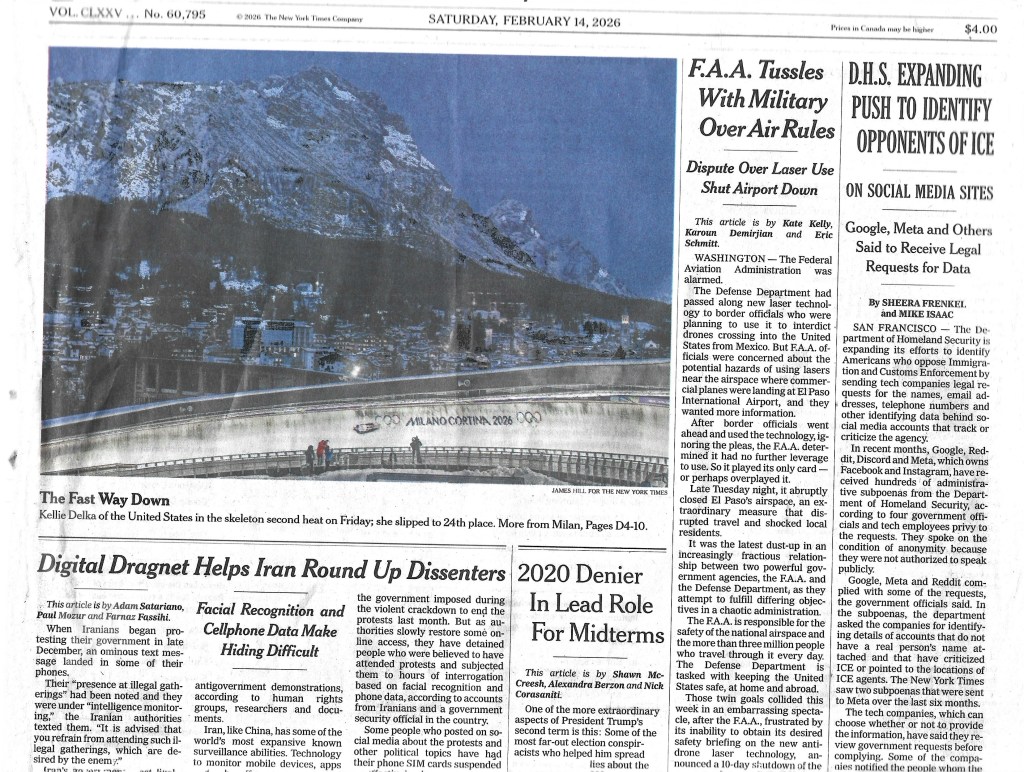


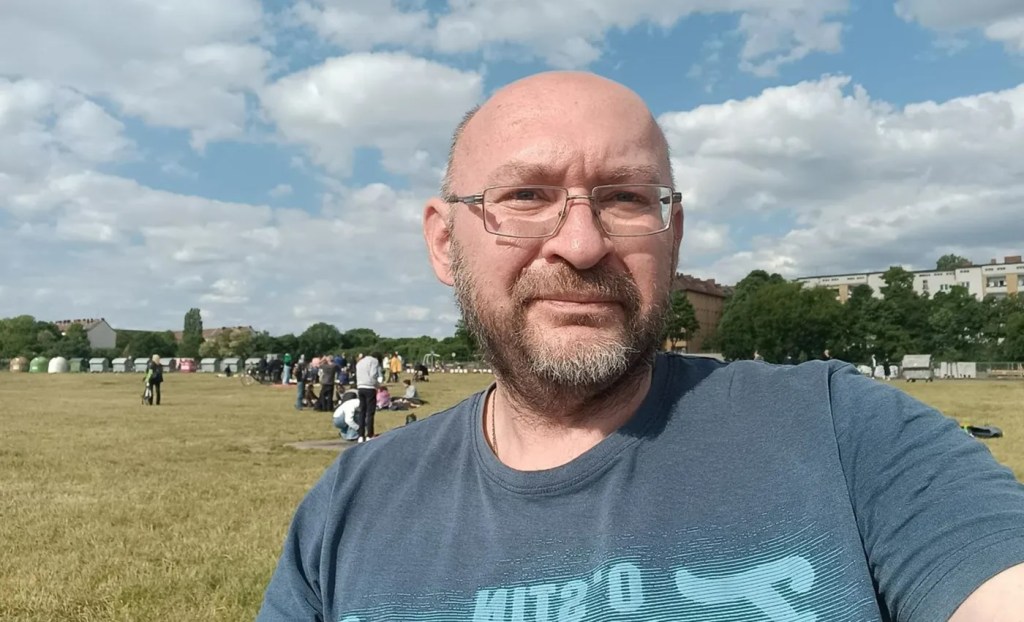

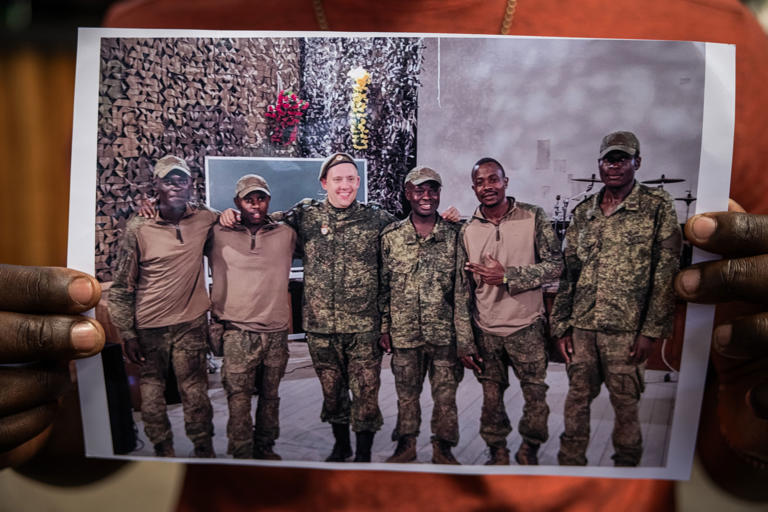


 . We’ve set up massive food donation and delivery infrastructure. We organize rides to school and work. People are literally taking in families.