The restaurant chain Dodo Pizza has decided to open its doors to pets after an incident involving a delivery driver who was fired for covering a stray dog with a branded blanket.
The stray dog nicknamed “Dodobonya” by staff at a Dodo Pizza location in Chelyabinsk. Source: Social media, via Moscow Times
The incident took place in Chelyabinsk. A dog named Dodobonya had been living at the local Dodo Pizza outlet for a year and a half. After a change in management, employees were forbidden from feeding the dog. A delivery man named Mikhail covered the animal with a blanket in the cold and was fired, officially for multiple instances of tardiness.
When the story went public, Dodo Pizza’s social media accounts were flooded with indignant comments and calls to boycott the company. Consequently, the chain’s founder, Fyodor Ovchinnikov, wrote on his Telegram channel that Dodo Pizza would take responsibility for Dodobonya’s care at a shelter, and that the chain’s restaurants would become pet-friendly [sic, in English], meaning that customers would be allowed to bring their pets with them.
“We know that our former delivery man Mikhail had a trusting relationship with the dog. We will not stand in the way of this and are willing to help where appropriate. On behalf of the brand, I would like to publicly apologize to delivery man Mikhail for the rude and inappropriate communication from the pizzeria manager. Quite frankly, this is unacceptable and intolerable for our chain. We will never condone such behavior,” wrote Ovchinnikov.
In addition, Ovchinnikov suggested that delivery man Mikhail return to work at the company, not necessarily as a delivery man, but perhaps to develop programs related to animal welfare.
Manager Yulia, who fired Mikhail, has now been suspended from work, although Ovchinnikov called for an end to the harassment against the woman, who was overwhelmed by a difficult management task [sic].
There can be different reasons for bizarre dismissals. A police officer lost his job for rapping, a teacher for reading anti-Soviet poems, and a Rutube employee for subscribing to a dubious website. Courts sometimes order the reinstatement of dismissed employees—for example, of those made redundant by AI.
From a small restaurant with only one oven in the basement of Syktyvkar in Russia’s far north, Dodo has become the fastest-growing pizza chain in the world. On this week’s Vietnam Innovators podcast, we will join host Hao Tran and Fyodor Ovchinnikov, the founder of Dodo Brands, who is dubbed the “Steve Jobs” of pizza. With over 900 stores worldwide and the ambition to open 1000 more stores in the next 5 years, the success of the Dodo Pizza chain revolves around three core principles. So what are they? What’s the interesting story behind this brand’s success?
I have to admit that we won’t become an abstract global company. I’ve come to the conclusion that pure global companies simply don’t exist. American global companies exist. British, French, or Japanese global companies exist. And we also have only one possible way forward—to become a Russian global company. What do I mean by that? All global companies are based upon the culture, values, and human potential of a certain country. McDonald’s is an American company, despite the fact they operate in almost every country on Earth. Starbucks is an American company as well, despite the fact they have almost as many coffee shops in China as they do in the US. And I’ve realized that our only solution is becoming a global company from Russia.
We have to be flexible and multicultural, but our company has to get its talents, first and foremost, in Russia. Here, we’re superstars. We can get the best people, the best engineers, and managers, to advance globally making a cool product. Our goals inspire people to do wonders. In Russia, we’re not just pizza, not just a franchise, and not merely a company. We’re an idea. We live in a large country with strong education and cultural traits that are good for business (enthusiasm, creativity, and energy), and for those that are not so good, we compensate by understanding them precisely (with systemic approach and discipline) and by taking in people from other cultures. Building a Russian global company is also a very inspirational goal.
What does it all mean? Accepting that our HQ, our base of operations, will be in Russia, just like the Pizza Hut’s HQ is in Texas. And we will have strong international offices.
This year’s Berlin Film Festival is showing only one film from Ukraine: the documentary film Traces was tapped to represent the country. Traces tells the stories of women who survived rape and violence during the war in Donbas and Russia’s full-fledged invasion of Ukraine.
The Traces team on the stage of the Haus der Berliner Festspiele, 16 February 2026. Source: Berlinale
“I always wished one thing for my pupils: that they would never be forced to take up arms,” Liudmyla Mefodiivna, a teacher of Ukrainian language and literature, says in an interview with Deutsche Welle.
The elderly woman, who taught school for forty-five years, was tortured and raped by a soldier after pro-Russian militias arrived in her village. As he was leaving, her tormentor left a bullet on the table as a warning and a threat: “I’ll come back and kill you if you so much as peep.” The teacher’s story, along with [five] other stories of violence and horror, is recounted in the documentary film.
“The occupiers came, and the majority of my pupils rose to Ukraine’s defense. Many of them have been killed, while others have been taken captive or returned from the front severely wounded. It’s terribly painful to witness and survive this. Ukraine is now flowing with blood, and mothers weep over the bodies of their sons, husbands, and family members. Four men have been killed in our family alone, leaving behind young children,” says Mefodiivna.
She recalls that she was unable to talk about her experience for a long time. Her family insisted, though, that her testimony of the atrocity must be heard.
“They beat me, choked me, cut me, knocked out my teeth, and broke my ribs,” Mefodiivna says. “They robbed me of my health. Thanks to the support of these wonderful women I met, I was finally able to start talking. I began to tell my story. I want the whole world to know about the crimes Russia has been committing, about how it has tortured and abused Ukrainians.”
Directors Alisa Kovalenko and Marysia Nikitiuk, along with six of the film’s protagonists, have traveled to the Berlinale to present the film, a testament to their pain. All of them are members of SEMA Ukraine, an organization which helps women who have survived violence. As they sit down for interviews, it is particularly noticeable how nervous they are: their hands are shaking.
Olga from Kherson spent one hundred days in captivity with her son and her husband.
“I was ashamed to talk about [the Russians] did to me. Getting to know the organization was like a breath of fresh air for me,” Olga says. “Now we help other women, and men too. Because men have also been victims of sexualized torture, and yet this is hardly ever discussed.”
Seventy-two-year-old Nina is the most emotional during the interview. She almost immediately begins to weep as she recalls how the war first destroyed her home, and then her life.
“I thought I would have a quiet life in the village, planting trees and waiting for grandchildren. But then the tanks came and the earth burned. And then the monsters came. . . .”
Nina’s face is wracked by sobbing, shame, and grief.
The voice as a weapon
It is shame that prevents victims of violence from testifying against their aggressors, meaning that wartime victims of sexual violence are effectively ignored in the official statistics. When talking about civilian casualties, the focus is usually on those who have been killed, wounded, or taken prisoner.
“Those who have survived sexual assault, including in captivity, often go unnoticed and do not receive housing, medical, or mental health assistance from the state. Many suffer from stigmatization, and some cannot cope with what they have experienced,” says the SEMA Ukraine booklet.
The women are fighting to be heard.
“Our voices are the weapons that will punish the perpetrators,” the organization tells victims of violence.
“When I started talking about what I’d survived (this was before the full-scale invasion), I often encountered people seemingly switching off. When I would try to tell them about the most terrible things which had happened to me, their eyes would go blank. They would stop hearing what I was saying. It was like an internal defense mechanism, when what you’re listening to is too painful and unpleasant that you just don’t take on board what’s being said. I believe that this film can break down this barrier, and that after seeing it, people will no longer be able to shut their ears again,’ says SEMA Ukraine founder Iryna Dovhan.
The film opens with Dovhan’s story. In 2014, she was captured by pro-Russian armed groups in Donbas for aiding Ukrainian soldiers. After torturing and abusing her for several days, the pro-Russian militiamen tied her to a pole in downtown Donetsk, wrapped her in an Ukrainian flag, and hung a sign on her that read, “She is murdering our children.” The city’s residents visited the captive to hit, spit on, and insult her.
Dovhan was lucky in some sense: a picture of the helpless woman tied to a pole was taken by a western photographer covering the conflict in Donbas. The photograph was picked up by international media outlets, and Dovhan’s captors were forced to release her.
“I hope that the world will stand with us. I hope that the world will understand that we don’t need sympathy—‘oh, those poor women’—but a joint campaign to make sure this does not happen again in the future and the perpetrators are punished. Otherwise, evil will return again and again,” says Dovhan.
After what she survived, she found the strength to unite and support other women who had suffered.
How the film Traces came to be
The film’s co-director Alisa Kovalenko was also tortured and raped, but she found help at SEMA Ukraine.
“My journey to this film took twelve years. In 2014, I was captured in Donbas and suffered violence. For a long time, I couldn’t talk about it. When I first gave my testimony to human rights activists from the Helsinki Group, I asked, ‘Have you heard many stories like this before?’ They replied, ‘No. You are the first’. It was a shock. I knew there were many more of us, the people whom I had seen with my own eyes in captivity—both men and women.”
The filmmaker describes meeting other women who had gone through the same ordeal as a turning point.
“We sat down together for the first time and started talking. We experienced healing. We felt that we were not alone. And we began to break down the wall of silence step by step.”
It became clear that the traces of the atrocities had to be preserved, but for the filmmakers—Alisa Kovalenko was soon joined by Marysia Nikitiuk—it was extremely important to settle on the right narrative form to preserve the dignity of the victims and not traumatize viewers. Many things in the hours-long filmed accounts of torture, rape, and humiliation did not make it into the final cut.
“We wanted to shove all the worst things in the audience’s faces and shout, ‘Look what they’ve been doing to us!’ But we tried to strike a balance. This film is not meant to shock the viewer. It’s about dignity, about the light that is born in spite of evil. We learned to talk about it the right way, without retraumatizing either the protagonists or the audience. It’s a victim-centered approach,” says Kovalenko. “Some stories were left out due to limited running time—for example, how women in captivity were starved and would share one dumpling a day between four of them, or were forced to sing the Russian national anthem to be allowed to go to the toilet. But these testimonies exist—in books, in human rights reports, in memory.”
Laying the foundations for memory was the goal of the filmmakers. That is why, in Berlin, the women come onstage and recount their experiences once again to the audience, thus overcoming their pain.
“The war gradually fades into the background. Tragedy turns into statistics, and statistics become routine, and that is terrifying,” the filmmakers note. “Traces resurrects the names. They are no longer numbers, but flesh-and-blood women who look the viewer in the eye and speak. A tragedy should have names, not be turned into statistics.”
Alexander Lukashenko, the former Soviet state farm director turned Belarus strongman, once said that a woman could never run his country. Then three of them challenged him.
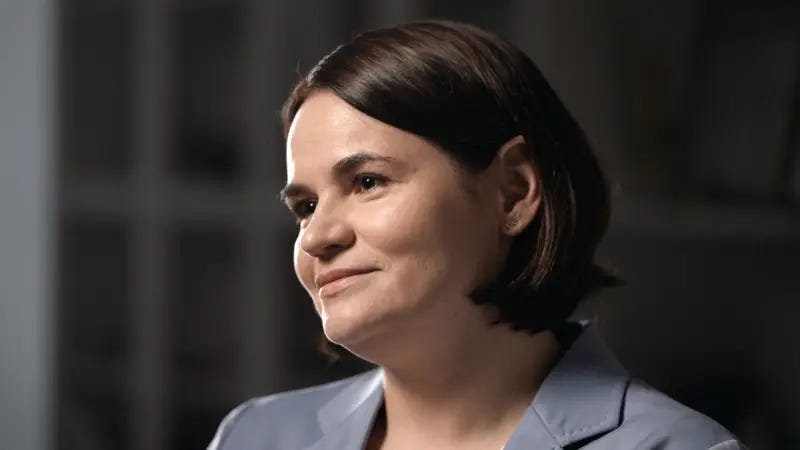
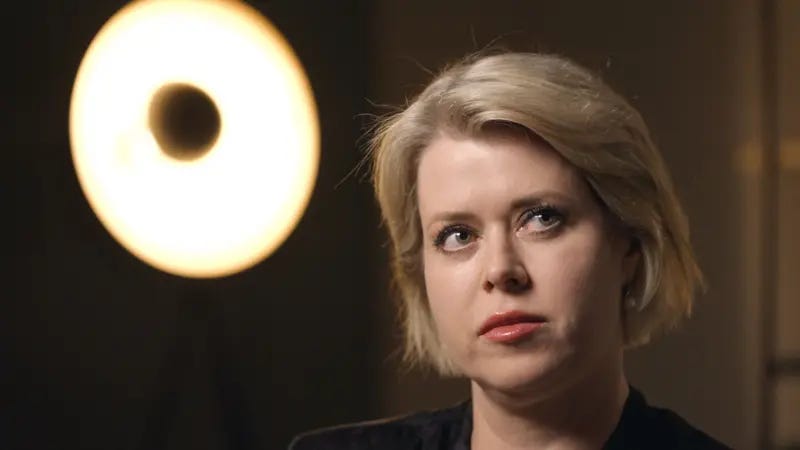
Five years on from the biggest protests in Belarusian history, Svetlana Tikhanovskaya and Veronika Tsepkalo, both now in exile, have been speaking to the BBC about the price they paid for inspiring hundreds of thousands of Belarusians to take to the streets to call for change.
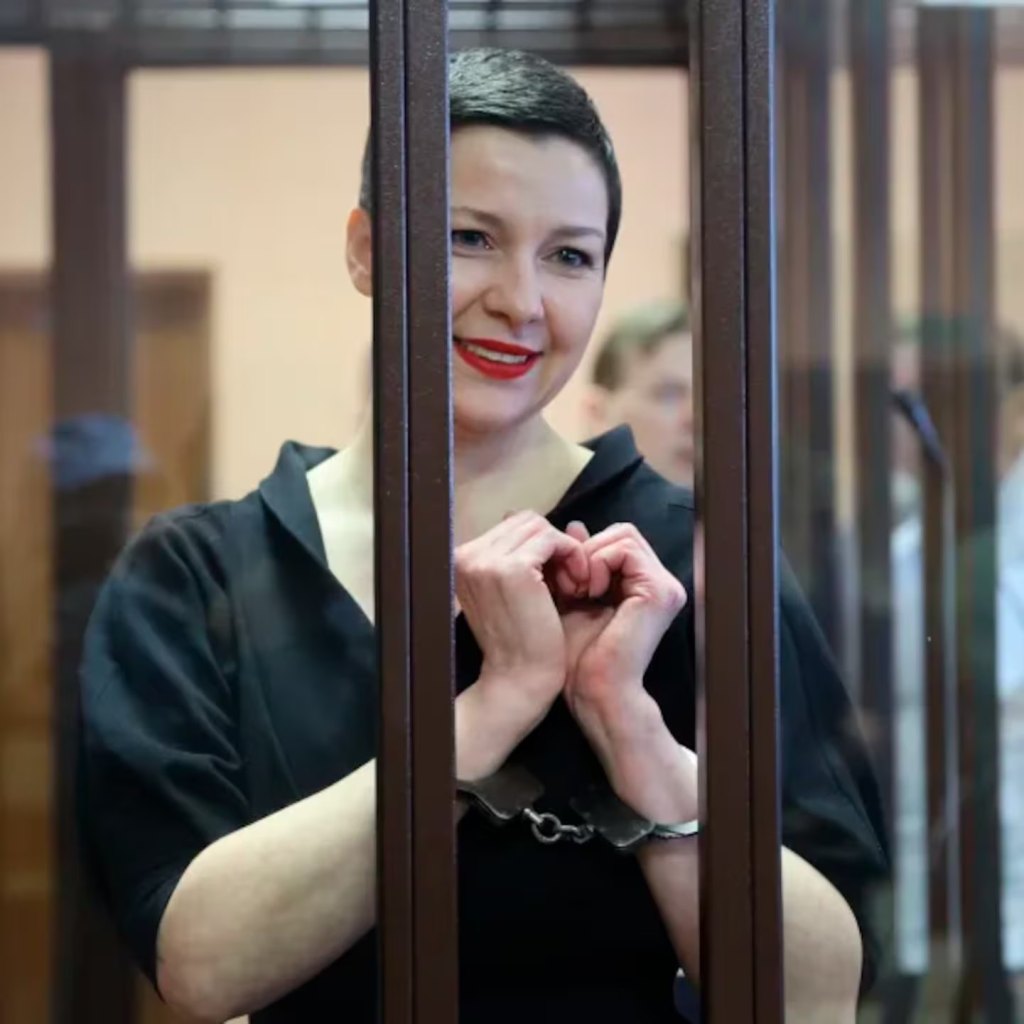
Their former teammate, Maria Kolesnikova, is now in a Belarusian prison, sentenced in 2021 to 11 years for extremism and plotting to overthrow the government.
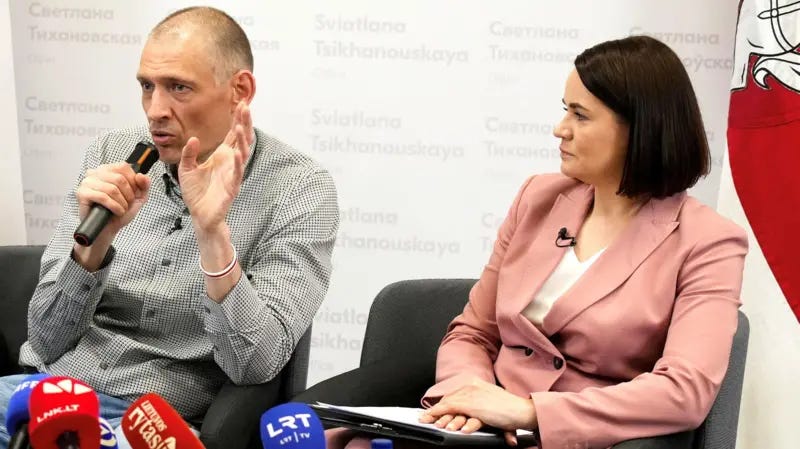
Her sister Tatsiana Khomich tells the BBC the family haven’t heard from her since last year.
The three women joined forces in August 2020, when the opposition candidates they were supporting were all forced to end their presidential bids.
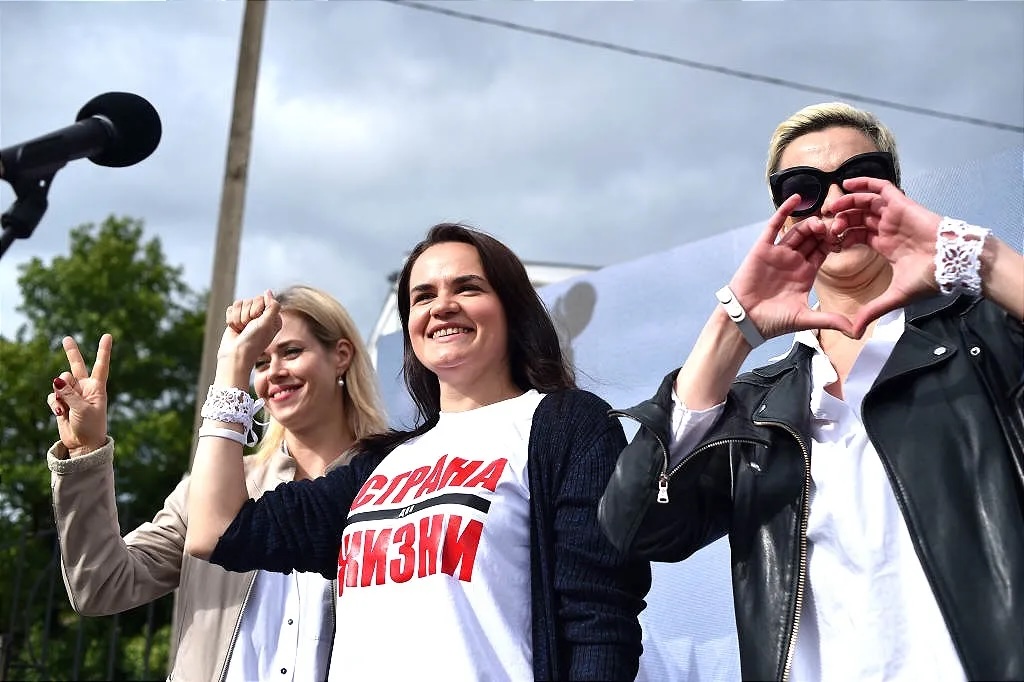
Their short-lived alliance made global headlines with pictures of them showing a heart, a fist, and a victory sign with their hands.
They claimed it took them 15 minutes to agree to join forces against Lukashenko, who has been in charge of Belarus since 1994.
“Far quicker than it would take men to do it,” said Veronika Tsepkalo, at the time.
She was left in charge of her husband Valery Tsepkalo’s campaign after the former Belarusian ambassador to the US was barred from registering as a candidate and fled the country fearing arrest.
Maria Kolesnikova campaigned for banker Viktor Babaryko, who was also prevented from standing and arrested ahead of the election.
But it was Svetlana Tikhanovskaya who ended up on the ballot, stepping in for her husband, the activist and popular video blogger Sergei Tikhanovsky, after he too was thrown in jail.
Together the three women travelled around the country, drawing big crowds of supporters eager for change. Their promise was simple: release all political prisoners, then hold a free and fair election.
In 2025, Svetlana Tikhanovskaya speaks about the “emotional uplift” all of them felt during those days.
“We managed to unite Belarusians”, she tells the BBC.
When election day came on 9 August, people flocked to the polls. Svetlana’s supporters were convinced she had won the vote, but Alexander Lukashenko claimed a landslide victory.
This sparked unprecedented mass demonstrations across the country, which lasted for several months. The authorities responded with a brutal crackdown. At least four people were killed – their deaths blamed on the security forces.
But none of the three women who had electrified the campaign, were there to lead the protestors.
Tsepkalo left Belarus just before the election. Tikhanovskaya was detained by the KGB a day after the vote and forced out of the country under threat of being jailed and losing her children to state care.
Maria Kolesnikova stayed behind. She was arrested in September, after tearing up her passport at the border with Ukraine to prevent a forceful expulsion.
Along with her former boss Viktor Babaryko, she is one of more than a thousand political prisoners still held in Belarus, according to a human rights group Viasna.
Since 2020 tens of thousands of people have been arrested for opposing the regime, many say they have suffered torture and mistreatment while in detention.
Today, any public dissent in Belarus is crushed.
“I sincerely believed that Lukashenko’s regime would fall”, Veronika Tsepkalo tells the BBC.
Like hundreds of thousands of Belarusians who are estimated to have left the county after 2020, she now lives abroad with her family, working at a big tech company in the UK.
“It was this all-or-nothing approach”, says Tatsiana Khomich, Kolesnikova’s sister who is now campaigning for release of Belarusian political prisoners. “We overestimated ourselves and underestimated what the authorities are capable of.”
Svetlana Tikhanovskaya says she now understands they had no plan and “weren’t ready for any radical change”.
Once a stay-at-home mum who admitted to being shy and lacking her husband’s charisma, she is now recognised as leader of the democratic opposition in exile, and regularly meets heads of state and lobbies for sanctions against Lukashenko’s government.
“If I could transfer my present knowledge, my experience to myself five years ago, I would definitely have felt more confident,” Tikhanovskaya says. “I’ve learned a bit of diplomacy, how to talk to politicians, how to be comfortable around powerful people”.
Less than two months ago Svetlana unexpectedly got her husband back: Sergei Tikhanovsky was released along with 13 other political prisoners and sent to Lithuania to his family.
It is thought that Donald Trump’s administration was key in securing their release.
Having said in the past that she went into politics “out of love” for her husband, Tikhanovskaya now admits she’s since also fallen in love with Belarus and the vision for her country.
“We’re not going to compete with Sergei about who’s more important, who has more followers et cetera. Sergei will be a natural fit for our movement,” she says.
Tikhanovskaya rarely speaks to Veronika Tsepkalo and in the interview with the BBC doesn’t want to go into details of what happened to their relationship.
Tsepkalo is more candid: she accuses her former “sister-in-arms” of hijacking their movement and pushing her out.
“The trio has broken up”, states Tatsiana Khomich.
Khomich, who is still part of her sister’s team, says all of them now have their own projects.
Svetlana Tikhanovskaya says her priority is working towards the release of political prisoners and lists helping Belarusians abroad and keeping Belarus on the international agenda as her achievements.
Veronika Tsepkalo is sceptical of these successes, calling them “action for action’s sake”.
Back in her husband’s team, she has been campaigning to bring Alexander Lukashenko to international justice.
Tatsiana Khomich thinks that trying to force regime change from abroad is “meaningless”.
“In reality, we’re now much further away from it than we were five years ago”, she says.
Both Tikhanovskaya and Tsepkalo believe at some point in the future there will be a free and democratic Belarus.
When asked to respond to criticism that she had put her own ambitions before her team, Tikhanovskaya says:
“Maybe that’s the kind of thing people who don’t really know me would say. I’d like us to finally hold new and fair elections but I certainly won’t be taking part in them.”
Kapela (ensemble) Rej is a group performing traditional Belarusian music. Their main instruments are the duda (Belarusian bagpipe) and the violin.
The ensemble on the recording: Vital Voranaŭ: duda Ursula Oleksiak: violin, vocals featuring Sergi Llena (Spain): frame drum, gaita de boto
The recordings were made in Serbia during the Rog Banata festival in the towns of Zrenjanin (2024, tracks 1-9) and Bečej (2023, tracks 10-13). The album cover photo was taken at the performance in Belgrade in 2024 by Sandra Crepulja.
Maria Kalesnikava, musician, activist, and political prisoner, was detained on this day in 2020. She was kidnapped on the Minsk street by the Belarusian authorities and the next day taken to the Belarusian-Ukrainian border to be thrown out of the country. But she tore up her passport and thus could not cross the border. In 2021, together with Maksim Znak, she was sentenced to 11 years of imprisonment (Maksim got 10 years). Now she is kept in Homiel women’s colony.
Kalesnikava is of my age, and five years of her life she has already spent in jail. Since February 2025, Maria and her family have exchanged no letters or calls… At least, she is not in solitary confinement but kept together with other female prisoners.
I’ve not been writing about the political situation in Belarus for a while, but that is not because there is some improvement. No, every day we read about new detentions. This week human rights defenders have recognized 14 new political prisoners, and the authorities have added 68 names to the so-called “extremist list”. All in all, we now know about 1197 political prisoners, 32 foreign citizens among them. A recent case: a 52-year old British citizen (she also has the Belarusian citizenship) was arrested while crossing the Belarusian border and sentenced to 7 years of prison (https://spring96.org/en/news/118604).
But still hundreds stay unrecognized because of different reasons. Without free Belarus, you won’t have peace in Europe.
Yesterday, I wrote about the five years Maria Kalesnikava had already spent in jail and about 1197 political prisoners in Belarus. And today, we’ve learned about another death.
Political prisoner Andrei Padniabenny, a 36-year-old Russian citizen, has died in Mahiloŭ penal colony No. 15. He was tried twice on criminal charges and sentenced to 16 years and eight months in a medium-security penal colony. He had been behind bars for nearly four years. The exact cause of his death is unknown.
His mother Valiantsina, reported on Facebook:
“My precious grandchildren are left without a father… The only consolation is that no one will be able to torture my son anymore, either physically or psychologically… I believe that God’s justice will reach the guilty, and no crime will go unpunished….”
According to the publication, Andrei died on September 3. This is the ninth death of a political prisoner in Belarus and the second death of a Russian citizen behind bars.
Vladimir Putin speaking with a group of Russian war widows. English subtitles by Julia Khazagaeva
Death as the national idea. Look at the faces of these women who lost their men in the war against Ukraine. They glow with newfound meaning. “I am a mom of four children and, recently, a widow…. Thank you, Vladimir Vladimirovich,” ”I lost my brother in the SVO [special military operation], but my three sons are growing up to be future defenders. Thank you,” they say to the killer of their kin. The Russian existential vacuum has finally been filled. Life has a purpose that redeems existence’s meaninglessness. Losing your life in war confers valor and honor. Nothing in the old life, in peacetime, guaranteed it. A contract [to serve in the army] turns a man into a hero. He is no longer a bastard in the eyes of the women who matter to him.
So the million lives taken by the war do not particularly faze anyone [in Russia]. All the sacrifices and victims are worthwhile as long as they are converted into national pride in the minds of Russians. They won’t spare three million people or more if it comes to it. And it doesn’t matter who they kill, whether they are Ukrainians, Estonians, or Poles. War is a drug. As long as war is underway, the harsh comedown is postponed. This is bad news for the world, especially for those who imagine that it is Putin who is waging the war, while Russians themselves want peace.
P.S. I made English subtitles for the video. You can download it from my Telegram channel. Show it to everyone seeking to understand l’âme russe mystérieuse.
“Tatiana Sokolova will never hear her son call her ‘mom’ again. He heroically fell in the special military operation zone,” began a news broadcast in the Chelyabinsk region about International Women’s Day celebrations for the mothers of Russian soldiers.
This event, which saw flowers handed to soldiers’ mothers, was organized by the United Russia Women’s Movement, a group affiliated with the ruling party.
It was just one of many celebrations focusing on the mothers and wives of soldiers fighting in Ukraine — as well as the widows and families of those killed — ahead of International Women’s Day this year.
International Women’s Day is one of Russia’s most significant holidays, celebrating women’s contributions to society, science and the workforce. It has deep roots in Soviet history, when it was promoted as a symbol of gender equality.
But since the full-scale invasion of Ukraine, Russian officials and state media have upheld a different ideal: being the wife or mother of a soldier.
“With the militarization of society, the education system and the economy, and with the ‘ideal citizen’ — the male soldier — being placed at the center, authorities are actively promoting the image of the soldier’s wife as his counterpart,” gender researcher Sasha Talaver told the Moscow Times.
“The portrayal of women in times of war and state crisis always emerges as a key point for political imagination,” Talaver said.
This Women’s Day, members of the United Russia party and pro-Kremlin activists have been delivering flowers, organizing literary events and visiting military families with gifts and food.
“We are proud of the women who raised the heroes of the special operation and the young men who have signed up as contract soldiers,” Senator Daria Lantratova, co-chair of the United Russia Women’s Movement, said this week.
The movement this week launched the “Flowers for the Mothers of Heroes” campaign to deliver presents and flowers to soldiers’ relatives, which has spread to 40 regions.
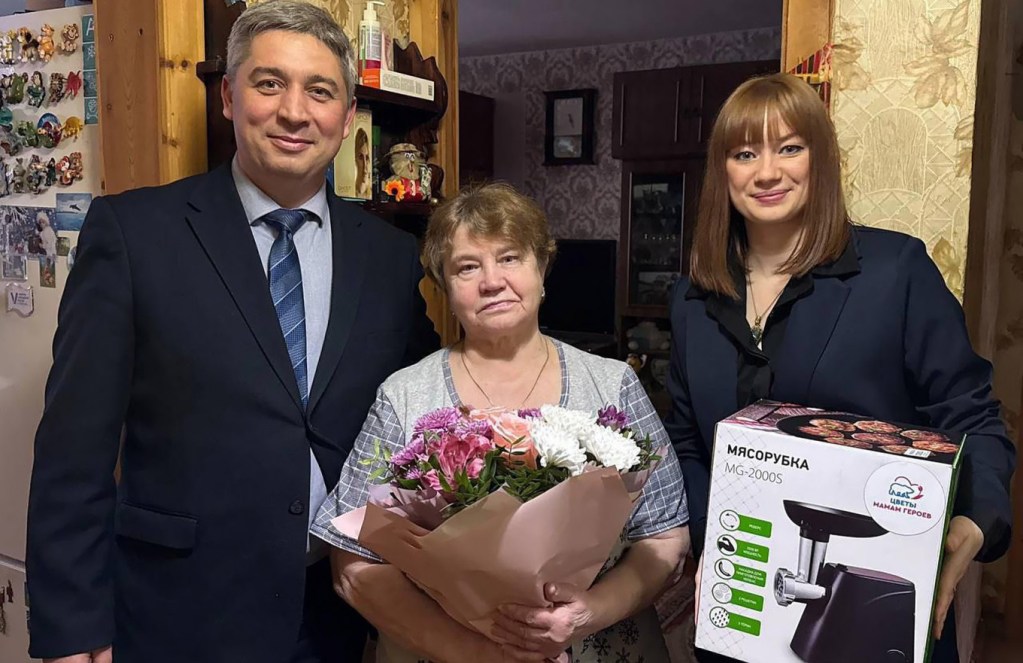
A resident of the Murmansk region who lost her son in the war was given a meat grinder for March 8 by the United Russia party. Photo: social media
In perhaps the most shocking Women’s Day event, mothers of fallen soldiers were gifted meat grinders from local United Russia officials in the Murmansk region.
The news sparked a wave of criticism, as the kitchen appliance has become a grim symbol of the Russian military’s high-casualty assaults in Ukraine.
After the story went viral in Russian and Ukrainian media, one mother of a deceased soldier recorded a video statement in which she said she had been planning to buy a meat grinder herself, but United Russia “gifted it to her just in time.”
“I actually asked you for it,” the elderly woman said.
In Cheboksary, a city in the republic of Chuvashia, officials organized an event exclusively for the widows and mothers of fallen soldiers.
“May grief soon turn into pride!” declared local deputy Yevgeny Kadyshev. The women were given bouquets and gift bags labeled “Happiness and Joy.”
Russian authorities, including the United Russia party, promote the image of a military wife or mother as the ideal of femininity, gender studies researcher Ella Rossman told the Moscow Times.
The United Russia Women’s Movement was founded in the months following the invasion of Ukraine in 2022 “as a clear response to feminist anti-war activism,” Rossman said, referring to groups like Feminist Anti-War Resistance and movements of mobilized soldiers’ wives and mothers.
“Right now, the most visible female archetype in the public sphere is the woman waiting for her soldier to return from the front,” Rossman said. “But this is not the only image. There are completely opposing narratives, like that of military women themselves.”
Rossman pointed to an article in a pro-Kremlin tabloid about a woman from Rostov who signed a military contract and went to war.
“She is a mother who left her daughter to fight, has already lost a leg in combat and tells journalists that as soon as she recovers, she will go back to the battlefield,” Rossman said.
Local television stations have been covering Women’s Day events for soldiers’ mothers and wives, while also highlighting women assisting the war effort or fighting on the front lines.
After these official celebrations, politicians sometimes invite the women for tea. In Stavropol, a table was set for the mothers and wives of soldiers following a concert at a veterans’ hospital.
“Some of them are waiting for their sons to return home. Others, unfortunately, have lost their defenders who gave their lives for the Motherland,” Senator Daria Lantratova, representing occupied Luhansk, wrote on social media.
United Russia activists also delivered flowers to soldiers’ mothers in occupied Donetsk.
“Your son is a hero. We congratulate you on this holiday and wish you well. We hope this war will end and peace will come,” a United Russia Women’s Movement activist told an elderly woman. After hearing the word “hero,” the woman teared up.
“Don’t cry,” the United Russia activist told the older woman as they parted.
Russian soldiers fighting in Ukraine also sent video messages to military mothers and widows ahead of the holiday.
“Heroes are born in families. Women give birth to us. Women raise us in kindergartens and schools. The making of any hero is thanks to the great women in his life,” Leonid Lapin, a soldier who fought as a sniper platoon commander in Ukraine, said in a video message.
Putin meets with Olga Chebnyova, widow of ‘Hero of Russia’ Sergei Chebnyov. Photo: kremlin.ru
United Russia has even involved children with disabilities in the celebrations. In the Yamalo-Nenets autonomous district, mothers from a center for parents of children with mental and physical disabilities — along with their children — made greeting cards for soldiers’ relatives.
“This is not just a good initiative. Seeing how children with special needs get involved, how their eyes light up, you realize we are on the right path,” said United Russia member Alexei Komarevtsev.
In an interview with a local news channel, he described the craft project as “socialization” for children with disabilities. Some of the cards, he added, will be sent to the front lines, “because there are also girls serving there.”
In some regions, such as Tula, soldiers’ wives and mothers received a one-time payment of 10,000 rubles (about $100) for Women’s Day. Elsewhere, gifts included makeup sets or tickets to the philharmonic.
In the Moscow region, United Russia organized a makeup seminar for soldiers’ wives, saying such initiatives “help strengthen family values and improve quality of life in society.”
“War disrupts social norms and the way of life,” Rossman said. “But war also imposes constraints on the very possibility of a rigid binary between male and female roles, even though war seems to fit that binary perfectly.”
That is likely why the authorities have been working overtime to reinforce the Kremlin’s idea of “traditional” values since the start of the war, she said.
“Russian authorities are forced to declare and reinforce traditional values [because] many families that were once intact before the war have now lost their fathers,” Rossman said. “There are also military women — doctors, for example — and women who have voluntarily gone to war. Ignoring these women is impossible. They, too, are a target audience from a propaganda standpoint.”
As the war drags on and Russia’s battlefield losses mount, authorities are forced to balance different ideals of femininity in their propaganda messaging, Rossman said.
“They are constantly having to create different female archetypes for different audiences,” she said.
Today, we woke up to a rocket blast. The sound was so loud that it seemed to come from our building’s entryway. The windows shook, the parrot screeched, and the Doberman dashed into the bathroom. Good morning.
The blast had thundered in absolute silence: there had been no warnings on the online message boards. I even wrote to the neighborhood chat, asking whether this was the consequence of the U.S. refusing to provide us with intelligence or not. People suggested that there had been an alert, it had just lasted over eleven hours.
I got the engraved collar out of the closet. I don’t use it much: the color is too bright and it soils easily. But it has Hector’s name and my phone number printed on it in very big letters and numbers. I put it on him during heavy shelling. If there’s a blast nearby and the dog runs away from me in fear, I have a better chance of finding him.
We went outside. In the middle of the courtyard stood a young woman holding a baby in her arms. The baby was wrapped in a warm blanket, while the mother was wearing a robe and slippers. It was cold.
Having seemingly sized up my silent question, she made excuses in a recitative.
“He was frightened by the explosions, I couldn’t calm him down, he falls asleep better in the fresh air, I was scared to go out on the balcony because of the windows, so we ran out here.”
I offered to hold her baby while she went inside to get dressed.
The woman became anxious and clutched her bundle even more tightly, her hands reddened from the cold.
“No, no, God forbid!”
The maternal instinct is the strongest. That’s the way the world works.
I often remember a terrible story that happened in Kharkov. A gas cylinder exploded in an ordinary block of flats. It was December 2012. A man had brought the cylinder into his family’s flat, where he lived with his wife, three daughters, and tiny grandson. The cylinder exploded, the fire was fierce, and only one of the girls survived by some miracle.
I was working as a field journalist at the time. We were shooting a routine report nearby, and after our editor called, we rushed to the scene. We were the first to arrive, before the ambulances.
I won’t describe the horror we saw. Charred toys scattered around a yard were not a familiar sight in Kharkov thirteen years ago.
I will always remember what the eldest daughter did. Her name was Luba, and she was barely in her twenties. She was able to escape a room engulfed in flames onto the balcony. She was holding her seven-year-old sister Sasha with one hand, while with the other she clutched her ten-month-old son Klim to her chest.
Yes, I do remember their names.
Luba was screaming. People heard her and saw her, but they had no time to do anything. That young woman and very young mom jumped from the tenth floor — on her back. That was how she had tried to save her baby.
God, how strong her maternal instinct must have been to have stepped into the abyss like that, trying to save her baby.
I think about it often.
My daughter and I were chatting on the phone the other day as she was going home from work. She’s in Israel now, and we usually call each other when she’s on the bus home. Right as we were talking, Sashka read aloud the news that terrorists had planted bombs on buses in Tel Aviv.
“Get off the bus now!” I shouted into the phone.
It was another three minutes to the next stop.
In those three minutes, in those one hundred and eighty seconds, I didn’t just turn gray, age, and die. I killed and dismembered every terrorist on the planet, and I torched their homes, their cities, and their families.
Yes, it was maternal instinct.
Tomorrow is the eighth of March. The world has different ways of marking this day. In some places, the day is about gender equality and emancipation, while in other places it’s about the arrival of spring, a new hairdryer, and a teddy bear. But either way, it’s about women. There will be lots of flowers and lots of cards.
I also want to send a card to all the women of the world. With flowers, from Ukraine.
There’s nothing more monstrous than the “picture” on card. It shows Anya, my neighbor, and her only child, Artyom.
P.S. Whoever can, please pass my card on to the women in the American Congress who applauded their leader yesterday. Tell them that after their tumultuous applause and cheering about “billions of dollars saved,” a young woman stands in the middle of a courtyard in the Ukrainian city of Kharkov. Wearing a robe and slippers, she rocks her baby in the cold. He was frightened by the Russian missile which struck the neighboring courtyard.
Source: Anna Gin (Facebook), 7 March 2025. Translated, from the Russian, by the Russian Reader. Anna Gin is a blogger, writer, and journalist who lives in Kharkov (Kharkiv). You can also follow her on Telegram. Thanks to Alya Legeyda for the heads-up.
Late Monday evening, President Donald Trump signed an executive order that effectively lays the groundwork for a sweeping ban on the 15,000 transgender troops currently serving in the United States military. The order, delegating much of its implementation to Defense Secretary Pete Hegseth, declares that being transgender is “incompatible with service.” It further mandates that all transgender personnel must be misgendered in official military communication and policy. Most notably, the order frames transgender identity as inherently at odds with “a soldier’s commitment to an honorable, truthful, and disciplined lifestyle, even in one’s personal life.”
The executive order, titled “Prioritizing Military Excellence and Readiness,” claims its purpose is to “protect unit cohesion” from “ideologies harmful” to it—explicitly targeting the service of transgender troops. It asserts that the medical needs of transgender individuals are incompatible with military service, despite evidence that treatments like hormone therapy result in no operational downtime. Aware of this contradiction, the order offers an additional justification for the ban, framing transgender individuals as inherently “selfish” and “false.”
See the rationale given by the order here:
Consistent with the military mission and longstanding DoD policy, expressing a false “gender identity” divergent from an individual’s sex cannot satisfy the rigorous standards necessary for military service. Beyond the hormonal and surgical medical interventions involved, adoption of a gender identity inconsistent with an individual’s sex conflicts with a soldier’s commitment to an honorable, truthful, and disciplined lifestyle, even in one’s personal life. A man’s assertion that he is a woman, and his requirement that others honor this falsehood, is not consistent with the humility and selflessness required of a service member.
While the order itself is vague on the specifics of implementation, its intent is clear: to serve as a ban on transgender service members. It declares that being transgender is “inconsistent with service” and mandates that pronouns used by the military must “accurately reflect an individual’s sex.” The order gives Defense Secretary Pete Hegseth 60 days to implement these directives, including ending “invented and identification-based pronoun usage” and prohibiting transgender service members from bunking with others of their gender.
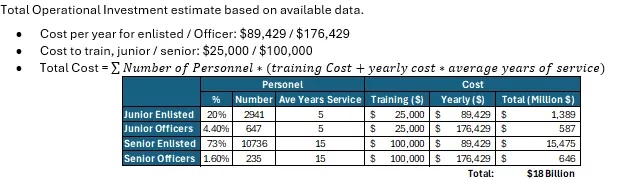
If implemented broadly, the ban will have immediate and damaging consequences for both transgender service members and military readiness across the United States. SPARTA, a leading transgender military advocacy organization, estimates that removing 15,000 transgender service members would result in the loss of an $18 billion capital investment, with the Palm Center projecting an additional $1 billion cost to recruit and train replacements. Notably, up to 73% of these service members are senior enlisted personnel with 12-21 years of experience—expertise that cannot be easily replaced by the U.S. government.
You can see SPARTA’s figures here:
When asked about the potential for a ban when it was first floated in November, Emily Shilling, President of SPARTA, stated, “The most immediate impact is that transgender people serve in every theater of the world. If it were a fairly fast-moving ban, you would be pulling these individuals out of their units, leaving critical gaps in skill sets, experience, and leadership positions that you’re just not going to be able to fill with equivalent people anytime soon, especially given the shortfalls in recruiting,”
A transgender officer with years of military experience, speaking anonymously about the rumors of an impending transgender military ban, shared that she had recently spoken with several transgender service members deeply concerned about the possibility. When asked about claims that transgender people are a liability to the military, she dismissed the notion outright, stating, “Every trans service member that I have observed performing their job excels at their job, and that’s because we have to… Every trans sailor, every trans soldier, every trans Marine, and airman that I have known has excelled at their job.”
It remains unclear how swiftly or extensively Defense Secretary Hegseth will implement these changes, how many transgender service members will face discharge, or whether the administration will revert to a “don’t ask, don’t tell” approach—forcing transgender personnel back into the closet or demanding their detransition. What is clear, however, is the administration’s framing of being transgender not as an inherent aspect of human diversity but as a dishonorable and incompatible choice. This rhetoric signals a chilling disregard for the thousands of transgender service members who have served with distinction for decades, suggesting the administration feels no obligation to temper its actions with respect or restraint.
Within hours of his inauguration, President Trump signed an executive order titled “Defending women from gender ideology extremism and restoring biological truth to the federal government”, following a whipping up of anti-trans feeling during the US election.
The order states that Trump’s administration will make it “the policy of the United States to recognise two sexes, male and female. These sexes are not changeable and are grounded in fundamental and incontrovertible reality.”
The response from LGBTQ+ groups was dismay and fear. Quoted in the Detroit Free Press, trans woman Rachel Crannell-Crocker remarked that Trump “wants to say we are not real,” while Bobbie Hirsch said “I’m scared, I’m really scared for my future.” Kimberly Frost, co-director of ILGA World, said Trump was “emboldened by anti-gender movements” to “use the lives of trans people as tools to sow divisions in society. Our communities deserve better.”
Trump’s move is not unexpected. During a fraught and divisive election campaign, Republicans spent nearly $215m alone on network TV ads that vilified transgender people, according to recent data from AdImpact. The past few years have seen a rush of anti-trans bills in red states, such as banning changes to birth certificates or defining sex as immutably set at birth. Books featuring LGBTQ+ content have been banned, and drag shows have faced protests and been subject to lurid conspiracy theories by Trump’s far right supporters.
Having spent nearly a decade reporting on far right threats to gender rights, the order’s purpose is clear to me: it sits squarely within the attack on so-called “gender ideology” with the ultimate aim to restore a “natural order” of white male supremacy. And while the target is trans people, the threat goes much wider, potentially laying the groundwork for further attacks on the US’s already degraded abortion rights.
What is gender ideology?
Originating in the mid-1990s in Catholic and other conservative Christian circles, the term “gender ideology” sprung up in response to feminists seeking to place “gender” into a United Nations report on its 1994 women’s conference. Initially the term focused on abortion rights, but quickly expanded to criticise any rights related to gender and sexuality, including LGBTQ+ and trans rights.
As the term gathered momentum, it became framed as a threat to ‘traditional’ – see conservative and Christian nationalist – values. LGBTQ+ activists and feminists were accused of imposing “gender ideology” on everything from schools to families and government, determined to “indoctrinate” children and young people with the “transgender agenda.”
Attacks on “gender ideology” were amplified by conservative writers such as Dale O’Leary who popularised the term in her book Gender Agenda, and picked up by the Vatican, as well as the anti-abortion, anti-LGBTQ+ ‘religious freedom’ organisations such as Alliance Defending Freedom and the Heritage Foundation. The right-wing think tank is behind the controversial Project 2025, with ADF on the project’s advisory board.
The project – which brings “together … over 100 respected organizations from across the conservative movement, to take down the Deep State and return the government to the people” – is key to understanding Trump’s move.
Project 2025 published a “Mandate for Leadership”, providing an anti-rights blueprint for the incoming administration. It offered policy ideas to demolish so-called “gender ideology”, demanding that “enforcement of civil rights should be based on a proper understanding of those laws, rejecting gender ideology.” It demanded that “gender ideology” be removed from school curricula and, in language echoed in Trump’s order, warned “radical gender ideology is having a devastating effect on … young girls.”
The project also called on the government to “reverse the DEI [diversity, equality, inclusion] revolution in Labor policy”. Trump’s order did so willingly, revoking previous executive orders that protected against discrimination and stating that government agencies must “take immediate steps to end Federal implementation of unlawful and radical DEI ideology.”
A threat to abortion?
While the executive order is first and foremost a frightening attack on trans people, its wording sets alarm bells ringing for abortion rights, too. It will be no surprise that curtailing abortion rights is a key focus of Project 2025 – the mandate mentions “abortion” 199 times.
Trump’s previous administration created a conservative-majority Supreme Court that overruled Roe vs Wade, opening the door for individual states to implement deadly and devastating abortion bans across the US. Now, the executive order’s wording suggests a wider attack on reproductive rights.
The order defines “female” as meaning “a person belonging, at conception, to the sex that produces the large reproductive cell”, while male is defined as “a person belonging, at conception, to the sex that produces the small reproductive cell.”
As well as being troubling for trans identity, the wording defines male and female foetal personhood from conception. If the foetus is recognised as a person at conception, then that foetus legally has the same rights as a born person, with catastrophic consequences for pregnant women and people. Foetal personhood means a woman can be prosecuted for murder if she has an abortion, as it violates the right to life. She can face manslaughter charges if she has a miscarriage for which she is blamed.
Bethany Van Kampen Saravia, senior legal and policy adviser at the gender rights NGO Ipas, told openDemocracy that “the language used in this cruel and dehumanising executive order is undoubtedly deliberate and deeply flawed on several counts. Simply put, it is outside of the executive authority to declare a fertilized egg a ‘person’ who has constitutionally protected rights.”
This is not a new threat. So far, 24 US states have included foetal personhood language in laws regulating or banning abortion, while 17 states have foetal personhood by law or judicial decision that applies to either criminal or civil law, or both. There have already been multiple cases where women in the States have been criminalised for miscarriage.
“Personhood arguments have long been used by anti-rights actors in attempts to fully ban and criminalize abortion and to punish pregnant people,” warned Van Kampen Saravia. “This language can also ban some forms of birth control and fertility treatments like IVF. This is a clear and deliberate signal of what is to come from this Administration.”
“It is outside of the executive authority of the President to instate a nationwide abortion ban, yet there is much that he can do to limit access to medication abortion and those threats need to be taken seriously,” she added. “Ipas US condemns these egregious acts of hate and bigotry. These executive orders are nothing shy of human rights violations and the world should be paying very close attention now to what is being feigned as ‘defending women’ and who is actually being targeted and criminalized.”
The ideology behind the ‘natural order’
The attacks on abortion and LGBTQ+ rights are often interlinked, as both pose a threat to the far right idea of a ‘natural order’ which has been undermined by feminism and human rights, and must be returned to through reversing social progress and protections.
The idea that there is a ‘natural order’ which needs to be re-established has its roots in fascist ideology, and its intent is found in almost all attacks on gender rights including from Trump, Putin, and anti-gender ideologues in Europe. It valorises male supremacy, female subordination, and declares the non-existence of LGBTQ+ people.
As I write in my book, the existence of trans people is a grave threat to the natural order and its advocates who want to reassert male supremacy and abolish the rights of LGBTQ+ people. The goal of male supremacist, anti-gender movements is to ‘naturalise’ gendered stereotypes about men’s and women’s behaviour and status: they want to naturalise male supremacy and female inferiority.
The far right wants to tie women’s inferiority to biology, and to claim that harmful gendered stereotypes are biologically innate in order to pin women to specific roles in society. These same stereotypes are used to justify women’s oppression: women are just more nurturing, or they are bad at leadership, for example, they should stay in the domestic sphere and leave the public sphere to the boys. The anti-gender movement wants to claim that women’s oppression is natural, rooted in women’s biology, and therefore cannot be challenged.
But biology is not destiny, as the famous feminist slogan states. The ‘natural order’ of female inferiority and male supremacy is disrupted by feminists saying women can have control over their fertility, or LGBTQ+ people saying one can express their gender identity as they choose. They therefore have to be stopped.
This order has nothing to do with “defending women” from “extreme gender ideology.” The extreme gender ideology is the one that tries to push women into oppressive boxes, ban abortion, and seek to abolish the existence of trans people and the LGBTQ+ community more widely.
The extreme gender ideology is the movement that elects a President after a judge in New York found a rape allegation made against him to be “substantially true”. It is the movement that celebrates his election with the slogan “your body, my choice.”
Donald Trump’s stunning political comeback has created an opening for Russia to shatter Western unity on Ukraine and redraw the global power map, according to several influential members of the Russian elite.
In the corridors of power in Moscow, the win for Trump’s populist argument that America should focus on domestic woes over aiding countries like Ukraine was being hailed as a potential victory for Russia’s efforts to carve out its own sphere of influence in the world.
In even broader terms, it was seen as a victory for conservative, isolationist forces supported by Russia against a liberal, Western-dominated global order that the Kremlin (and its allies) have been seeking to undermine.
In his first remarks since the election, President Vladimir Putin said Thursday that the West’s post-Cold War monopoly on global power was “irrevocably disappearing,” before going on to praise Trump for behaving “courageously” during an attempt on his life this summer.
“His words about his desire to restore relations with the Russian Federation and to help resolve the Ukrainian crisis, in my opinion, deserve attention,” he said during his annual speech at the Valdai Forum in Sochi.
Members of Russia’s elite were more blunt in their response to Trump’s victory.
“We have won,” said Alexander Dugin, the Russian ideologue who has long pushed an imperialist agenda for Moscow and supported disinformation efforts against Kamala Harris’s campaign. “The world will be never ever like before. Globalists have lost their final combat,” he wrote on X.
Impact of Discrimination on Integration of Emigrants From the Aggressor Country (with Ivetta Sergeeva)
Following the full-scale invasion of Ukraine in 2022, up to one million Russians fled their homeland, marking the most significant brain drain since the Soviet Union’s collapse. While some host countries view the highly educated and politically active migrants as an asset, integrating nationals of the aggressor state has presented challenges. Many migrants face institutional restrictions aimed at sanctioning Russia, alongside varied experiences of discrimination from local populations. This study delves into the effect of discrimination on the assimilation intentions of Russian migrants, focusing on language learning as a key indicator. Laitin’s model of identity building suggests that migrants’ willingness to assimilate depends on the perceived benefits, including acceptance by the host society. Following the model, Sergeeva assumes that discrimination signals to migrants that the host country’s society does not accept them, making learning the local language a less rational choice.
Utilizing a cross-sectional panel survey, the study establishes a link between discrimination and integration, differentiating between the effects of discrimination experienced from local citizens and local institutions on language acquisition. Findings reveal that societal discrimination significantly dampens migrants’ willingness to learn local languages and diminishes their trust in and attachment to host societies, unlike institutional discrimination, which shows no such effect on language learning. These insights contribute to an understanding of the impact of nationality-based discrimination, highlighting the role of societal acceptance in the successful integration of political migrants.
This event will be hosted in person and virtually on Zoom. Register for the Zoom meeting here. Non-NYU affiliates must RSVP for in-person campus access.
Ivetta Sergeeva is a PhD candidate at the European University Institute in Florence. She specializes in political behavior, civil society, and Russian emigration. She is a co-founder and co-principal investigator of OutRush and ViolenceMonitor (a series of surveys on intimate partner violence in Russia). She also has eight years of experience supervising projects in civil society and human rights organizations in Russia. Website: www.ivettasergeeva.com. Email: ivetta.sergeeva@eui.eu.
Date: 29 April 2024 4:00 PM – 5:30 PM
Speaker: Ivetta Sergeeva
Location: Jordan Center, 19 University Place, New York
Professoressa on the Pole* is the result of Polina Kanis’ investigation into the perceptual transformation of the female body in Russia following the onset of the full-scale invasion of Ukraine and subsequent ideological shift within Russian society. As part of this investigation the artist trained as a pole dancer and worked at a strip club.
The exhibit includes photographs documenting Kanis’ three-month stint at a strip club, the club’s rules of conduct for strippers, and a video re-enactment of the artist’s stage performance. The project marks the latest chapter in Kanis’ ongoing research into the changing role of a female teacher in Soviet and post-Soviet Russia, where limitations imposed by the state can only be counter-balanced by imagination.
*Professoressa (Italian: female teacher) refers to the 1967 manifesto Letter to a Teacher (Letters a una Professoressa), which harshly criticizes the power structure and classism of the educational system in 1960s Italy.
location: Expo
price: €5, tickets for a performance of the CARTA ’24 festival give free admission
duration: 5h
extra info: wed – sun: 14:00 – 19:00, evening performances until 22:00
Nadya Tolokonnikova, an artist who is founder of the feminist collective Pussy Riot, has long been persecuted in Russia for her conceptual performances and artistic protest against the Putin regime. Her performance Punk Prayer in the Christ the Savior Cathedral in Moscow, recognized by The Guardian as one of the most important artworks of the twenty-first century, ended for her and her colleagues with imprisonment for “hooliganism motivated by religious hatred.”
OK LINZ is bringing Nadya Tolokonnikova’s art to the museum, presenting her haunting works dealing with resistance, repression, and patriarchy for the first time to the European public.
Tolokonnikova’s oeuvre encompasses objects, installations, and performative works in which she processes her traumatic experiences during her life under Putin. Out of a state of repression, she has developed a visual language that rebels against aesthetical and political realities: anarchic and radical, yet also moving and witty.
“Being from Russia brings me pain. Most of my life, even after 2 years imprisonment following my art protest, I chose to stay in Russia, even though I had plenty of opportunities to immigrate, I tried to change Russia, make it a country that I would be proud of—peaceful, prosperous, friendly, democratic, loving, a country that values human life, art and happiness. First with Voina Group, later with Pussy Riot, I’ve been in performance art since 2007, for 17 long years—years filled with joy of protest and comradery, harassment, arrests. I watched my friends being murdered and revolutions suffocating under Putin’s boot.“ —Nadya Tolokonnikova
An oversized blade hangs like a sword of Damocles over visitors to the OK. “Shiv” is the title, American prison slang for an improvised knife. It stands for the precarious situation of artists and activists in Russia who, like Tolokonnikova herself, live in constant fear of persecution by the Russian judiciary. The exhibition will spotlight a selection of Situatioinist actions by Pussy Riot. At the center is Tolokonnikova’s 2022 performance Putin’s Ashes in which she joined forces with twelve women from Ukraine, Belarus, and Russia who experienced repression and aggression at the hands of the Russian president to burn a portrait of Vladimir Putin in a desert, collecting the ashes in small bottles.
“This art is a weapon,” says Tolokonnikova of her works, analyzing and exploring in this way the role that her art and she herself can play in the context of international power structures.
Curators: Michaela Seiser / Julia Staudach
Source: e-flux mailing list, 22 April 2024
Akhmatova’s Orphans International conference Princeton University 3-5 May 2024
May 3
4:00 pm–5:00 pm. Location: Firestone Library
The Anatoly Naiman Papers. Visit to the Special Collections
Presentation by Thomas Keenan-Dormany, Slavic Librarian
5:00 pm–6:30 pm. Location: McCosh 50
Rock. Paper. Scissors (2023)
Documentary film screening
Q&A with the co-author Anna Narinskaya
7:00 pm
Reception at the Levings’ residence (Shuttle provided)
May 4
Location for all talks: 245 East Pyne
9:30 am
Breakfast at East Pyne
Session 1
10:00 am–12:00 pm
Veniamin Gushchin, Columbia University
Late Akhmatova and Philology: Intertextuality, Interpretive Communities, and Effective History
Evgeny Soshkin, Free University / Brīvā Universitāte (Latvia)
Akhmatova’s Dead Orphans: Toward the History of a Paradox
Gleb Morev, Independent researcher
Akhmatova and Brodsky
12:00 pm–1:00 pm
Lunch
1:00 pm–1:40 pm
Keynote speech
Roman Timenchik, The Hebrew University of Jerusalem / PrincetonUniversity
Akhmatova’s Orphans and the Literary Orbit of the 1960s
Session 2
2:00 pm–4:00 pm
Dmitry Bobyshev, University of Illinois Urbana-Champaign [via Zoom]
On the so-called ‘Akhmatova’s Orphans’
Emily Lygo, University of Exeter
Dmitry Bobyshev’s Poetry of the Turn of the Century
Marco Sabbatini, University of Pisa
“Out of the Magic Choir”: Viktor Krivulin and the Leningrad Underground Poetry on Akhmatova and her Orphans
4:00 pm–4:30 pm
Coffee break
4:30–5:50 pm
Sofia Guerra, Princeton University
Anatoly Naiman’s Translations from Giacomo Leopardi
Benjamin Musachio, Princeton University
Estrada as a Fault Line: Akhmatova and Company vs. Evtushenko
6:00 pm–7:30 pm
Location: East Pyne 010
Akhmatova’s Orphans. Disassembly (2024)
Documentary film screening
Q&A with the director Yuri Leving
7:30 pm
Dinner
May 5
Location for all talks: 245 East Pyne
9:30 am
Breakfast at East Pyne
Session 1
10:00 am–12:00 pm
Maya Kucherskaya, Jordan Center, New York
Solo in a ‘Magic Choir’: The Case of Joseph Brodsky
Michael Meylac, StrasbourgUniversity [via Zoom]
An Enchanting (!) Chorus (?): Different Poets of Dissimilar Fortunes
Alexander Dolinin, University of Wisconsin-Madison
Brodsky’s Poem “Darling, I left the house today…” in the Context of Poetic Tradition
12–1 pm
Lunch
1:00 pm–1:40 pm
Leningrad Poetic Circles of the 1960s Through the Camera Viewfinder
Roundtable devoted to photography of Boris Shwartzman, Mikhail Lemkhin and Lev Poliakov
Session 2
2:00 pm–4:00 pm
Polina Barskova, Berkeley University [sic!]
Depiction of Links and Ruptures of Time in Evgeny Rein’s Poetry
Oleg Lekmanov, Princeton University
On Evgeny Rein’s Poem “In the Pavlovsky Park”
Anna Narinskaya, Independent researcher, Berlin
The Orphans and Jews
4:00 pm–4:30 pm
Coffee break
Session 3
4:30 pm–6:45 pm
Translating Poetry of “Akhmatova’s Orphans” into English
An Open Workshop: Kathleen Mitchell-Fox, Emma George and Ilya Kaminsky, Princeton University
Lev Oborin, Berkeley University
Anatoly Naiman’s “Vegetation”: Towards Poetology of Branching
Maria Rubins, University College London
Is Brodsky a Poet for Our Time?
6:45 pm
Dinner
Organizing Committee:
Yuri Leving, Chair
Ekaterina Pravilova, Ilya Vinitsky and Michael Wachtel
Sponsored by REEES, PIIRS, and Department of Slavic Languages and Literatures, Princeton University
KING CITY, Calif. — A group of men in masks opened fire at an outdoor party in central California, killing four people and injuring three others Sunday evening, police said.
Police responded to a reported shooting around 6 p.m. in King City and found three men with gunshot wounds who were pronounced dead in a front yard, the King City Police Department said in a statement.
Four other people sustained gunshot wounds, including a woman who died after being transported to Mee Memorial Hospital in King City, about 106 miles (170 kilometers) south of San Jose.
The three injured men were transported to Natividad Hospital in Salinas, police said.
Several people were at the party outside a residence when three men with dark masks and clothes got out of a silver car and fired at the group. The suspects, who were not immediately identified, then fled the scene in the car.
The investigation is ongoing, police said.
On Monday French lawmakers will vote on whether to enshrine in the country’s constitution a “guarantee” of women’s “freedom” to have an abortion. They will meet at a joint session of the lower and upper houses of parliament in Versailles, a rarely convened body known as the Congress. A constitutional revision requires three-fifths of the votes.
Such cross-party support is widely expected. Last Wednesday the French senate, which is controlled by the opposition centre-right, voted overwhelmingly in favour of the bill. The revision also enjoys backing from the governing centre and the opposition left. Emmanuel Macron, the president, wants women’s freedom to have an abortion to be made “irreversible”. French politicians of all stripes have worried about the potential for a future rolling-back of such guarantees—especially since America’s [sic] Supreme Court overturned the ruling that protected abortion rights there in 2022.
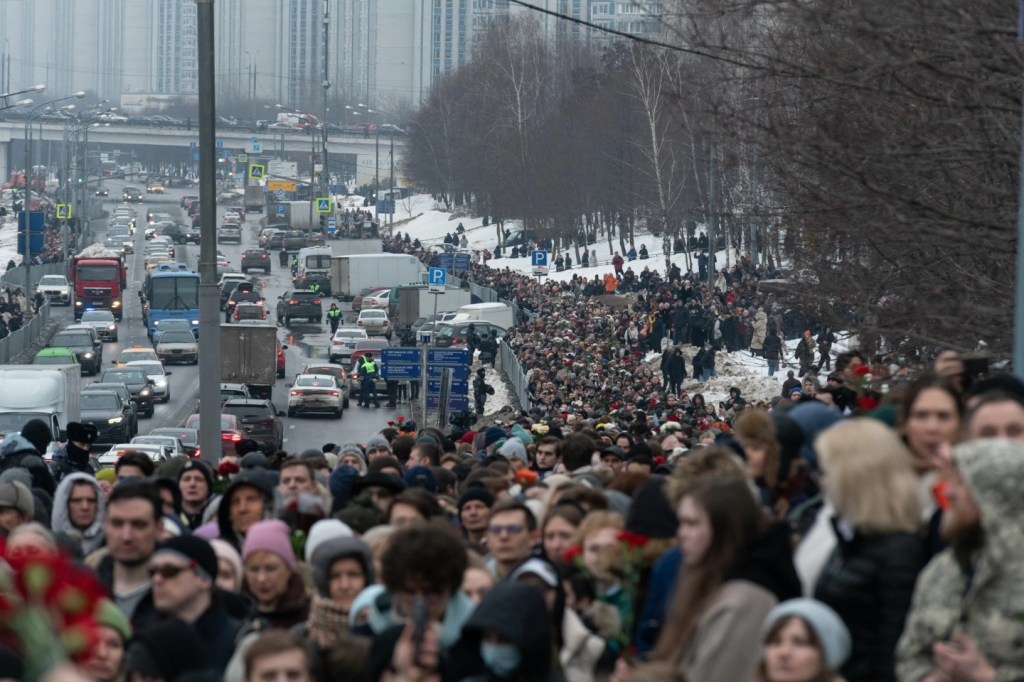
Sources: Spanishdict.com daily newsletter, 4 March 2024; Monterey Herald, 4 March 2024; Time, 4 March 2024; The Economist daily newsletter, 4 March 2024; the YouTube channels of The Insider (“Navalny’s Last Rally”) and Novaya Gazeta (“The Most Emotional Statements of People Who Came to Say Goodbye to Alexei Navalny”), with thanks to Tiina Pasanen; Andrei Bok (Facebook), 2 March 2024; Duolingo; random internet stock image.
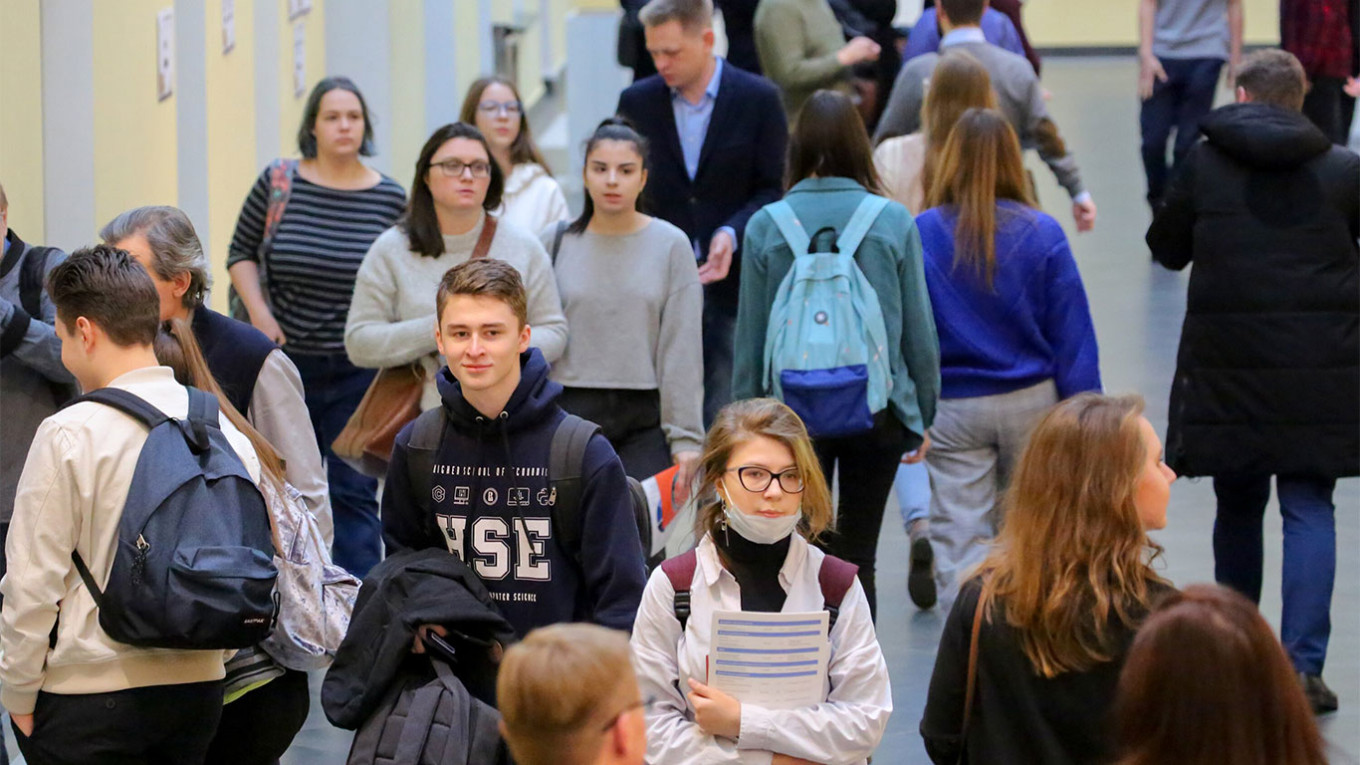
Once regarded as one of Russia’s liberal universities, the Higher School of Economics (HSE) has become a reactionary hellhole in recent years. Photo: Sofia Sandurskaya/Moskva Agency/Moscow Times
The Higher School of Economics (HSE) has forbidden applicants applying to its journalism program from quoting “foreign agents.” Any mention of people with this status or their publications will cause the results of admissions exams or interviews to be annulled, the university’s regulations say.
Applicants are also obliged to comply with the law “On Protecting Children from Information Harmful to their Health and Development.” They are thus not permitted to use materials “promoting” LGBT, “gender reassignment” and “denying family values” in their admissions applications.
A screenshot of the anti-“LGBT” and anti-“foreign agents” clause in HSE’s regulations for the oral interview taken by applicants to its bachelor’s program in journalism.
The application to HSE’s bachelor’s program in journalism involves undergoing a “creative test”: applicants [discuss] a “literary or sociopolitical” topic. The regulations state that the future journalists must demonstrate “an original position and awareness of current events and problems.”
Russian laws do not prohibit using and disseminating materials published by “foreign agents,” and only registered media outlets are obliged to flag individuals and organizations who have been designated as such.
Journalist Renat Davletgildeyev, who once served on HSE’s admissions committee, explained that in years past, applicants were, on the contrary, encouraged to mention the media outlets now designated “foreign agents.”
“I remember when we used to administer these exams at Vyshka [HSE’s nickname in Russian] and would give applicants the maximum score if they quoted the cool journalists and the media outlets who today make up the bulk of ‘foreign agents’ (in other words, the list of honest and cool journalists and media). I feel sorry for my alma mater. But it’s long been clear where things were headed,” he wrote.
[Last week], it transpired that the Higher School of Economics in St. Petersburg had announced that the use of feminitives by students was unacceptable. The leaders of student organizations were warned that the presence of such words even in conversations on social networks would be tantamount to involvement in the “international LGBT movement,” which has been deemed an “extremist” organization by the Russian authorities.
Previously, the HSE fired several lecturers for their anti-war stance, banned the remaining instructors from talking about political topics, and installed surveillance to monitor them, said Igor Lipsits, doctor of economics, who resigned his post at the university. According to him, cameras were installed even in classrooms under the pretext of “quality control,” but in reality they were meant to censor and purge instructors who did not agree with the Kremlin’s policy.