a Map of the Kyzylsu catchment. The names of the main glaciers are indicated in black. The elevation information is taken from the AW3D Digital Elevation Model (DEM), while the hillshade was derived from high-resolution Pleiades DEMs acquired in 2022 and 2023. Glacier outlines and debris extents are from the RGI 6.0 inventory. Lakes were manually delineated from a Pléiades 2022 ortho-image. The inset maps show the location of the study site in Central Asia with a base map from Esri, along with glaciers shown as blue areas and sub-regions outlines from the RGI 6.0 inventory. b Picture taken by Jason Klimatsas in September 2023 of the on-glacier automatic weather station, located on the debris-covered portion of Kyzylsu Glacier. Maidakul Lake can be seen in the background,as indicated by an arrow. c Pluviometer station photographed by a time-lapse camera in March 2022, with the snow-covered terminus of Kyzylsu Glacier visible in the background.
This week’s episode of the CAPS Unlock podcast opens with a discussion about a show of diplomatic unity in Central Asia. Following Israel’s strike on Qatar, all five governments of the region quickly issued statements of condemnation. Some went as far as calling the strike an act of aggression. We examine why these unusually swift and aligned reactions matter, how they highlight the region’s growing ties with Gulf states, and what they reveal about Central Asia’s selective application of principles such as territorial integrity.
Our interview segment features Achille Jouberton, visiting scientist at the Swiss Federal Institute for Forest, Snow and Landscape Research, and lead author of a major new study on the glaciers of Tajikistan’s Pamirs. Long thought relatively stable compared to the shrinking ice fields of the Himalayas and Tien Shan, the Pamirs are now losing mass at troubling rates. Jouberton explains how declining snowfall since 2018, measured through field stations, pressure sensors, and climate reanalysis, is reshaping water availability in the region. He discusses the role of large-scale climate systems, the combination of less snow and hotter summers, and the downstream implications for agriculture and hydropower.
We close by looking at President Kassym-Jomart Tokayev’s State of the Nation address in Kazakhstan. Among an eclectic mix of themes, including long passages on artificial intelligence, Tokayev floated the possibility of transforming Kazakhstan’s bicameral parliament into a single chamber. Though short on detail, the proposal hints at possible institutional re-engineering ahead of 2029, when Tokayev’s presidential mandate ends. We assess what this might mean for Kazakhstan’s political system and why even seemingly technical reforms can reshape the balance of power.
For years, the Pamir-Karakoram anomaly stood as a rare outlier in global climate trends: a region where glaciers remained relatively stable despite accelerating global warming. Now, new research from the Institute of Science and Technology Austria (ISTA) confirms that even these “last strongholds” have begun to lose mass at an alarming rate.
Snow Deficit and Rising Heat
Data collected from a climate monitoring station on the Kyzylsu glacier in the northwestern Pamirs, active from 1999 to 2023, reveals a sharp shift. According to an international research team led by Francesca Pelliccotti, the tipping point came in 2018, when a significant decline in snow cover and precipitation irreversibly altered the glaciers’ mass balance.
Once past this “point of no return,” glaciers began rapidly depleting their own reserves to compensate for the lack of new snowfall, a process accelerating their melt.
Since 2018, the region has experienced a persistent snow deficit. Snow depth has fallen by approximately 40 cm, and annual precipitation has declined by 328 mm, about one-third of the historical average. Seasonal snow melts earlier, is less stable in spring, and is no longer sufficient to replenish glacier mass.
July 2022 was the hottest month on record, and during this period, the Kyzylsu glacier recorded unprecedented mass loss, melting at a rate eight times faster than the 1999-2018 average. Scientists identify increasingly hot summers and a lack of precipitation as the primary causes.
Even the intensified ice melt has not made up for reduced snowfall: water inflow into rivers dropped by roughly 189 mm in water equivalent. The contribution of glacial runoff to total river flow rose from 19% to 31%, but this increase was still insufficient to offset the overall decline in water volume.
The situation is most severe at altitudes above 4,000 meters, where solid precipitation has declined sharply. Snow from avalanches, which previously helped sustain the glaciers, has dropped nearly threefold from 0.21 to 0.08 m per year.
Implications for Central Asia
Experts warn that this is not a localized issue. The Pamir and Karakoram glaciers feed the Amu Darya and Syr Darya rivers, lifelines for millions across Central Asia. Diminishing glacial mass threatens freshwater availability, agriculture, hydropower generation, and overall socio-economic stability.
“Due to the lack of accurate forecasts, we cannot yet say definitively whether the Pamir glaciers have passed the point of no return. However, since 2018, the processes have changed dramatically, and the reduction in precipitation has had a critical impact on their stability,” said ISTA researcher Achille Joubert.
Data Gaps and New Monitoring Efforts
Following the collapse of the Soviet Union, glacier monitoring in the region was largely suspended for nearly two decades. Systematic observations resumed only in 2021, when international researchers reinstalled instruments on the Kyzylsu glacier, one of the Vakhsh River’s primary sources.
These new measurements confirmed a drastic drop in precipitation and snow thickness starting in 2018, with consistently unfavorable conditions persisting since.
Compared to the late 1990s, spring and summer snow now melts much faster, and the “cold reserves” that once preserved glacier stability are disappearing rapidly.
The study’s findings were published in Communications Earth & Environment, reinforcing that even the most resilient glaciers in Central Asia are succumbing to climate change.
“The disappearance of glaciers means not only a shortage of water, but also a threat to climate stability,” the researchers warn.
The loss of these natural freshwater reserves could trigger cascading effects from reduced electricity generation to ecosystem degradation.
The end of the Pamir-Karakoram anomaly is not just a regional alarm bell. It signals the urgency of coordinated international climate action. Without it, scientists say, the process may already be beyond reversal.
For Central Asia, this carries profound geopolitical and economic implications. Water stress is already a driver of tension between upstream and downstream states, and shrinking glaciers will exacerbate disputes over allocation and dam construction. Governments are under pressure to accelerate adaptation strategies – modernizing irrigation, investing in alternative energy, and expanding regional cooperation on water-sharing agreements.
Researchers also stress the importance of filling data gaps with sustained monitoring. Long-term, high-resolution observations are critical for forecasting river flow and planning infrastructure. International support, they argue, could help countries like Tajikistan and Kyrgyzstan upgrade their hydrological networks, while linking local data into global climate models.
Ultimately, the fate of the Pamir and Karakoram glaciers will not be decided in the mountains alone. Their survival, or disappearance, depends on global emissions trajectories and the political will to implement serious mitigation measures. What happens here, at the heart of Asia’s water towers, will ripple far downstream into the lives of millions.
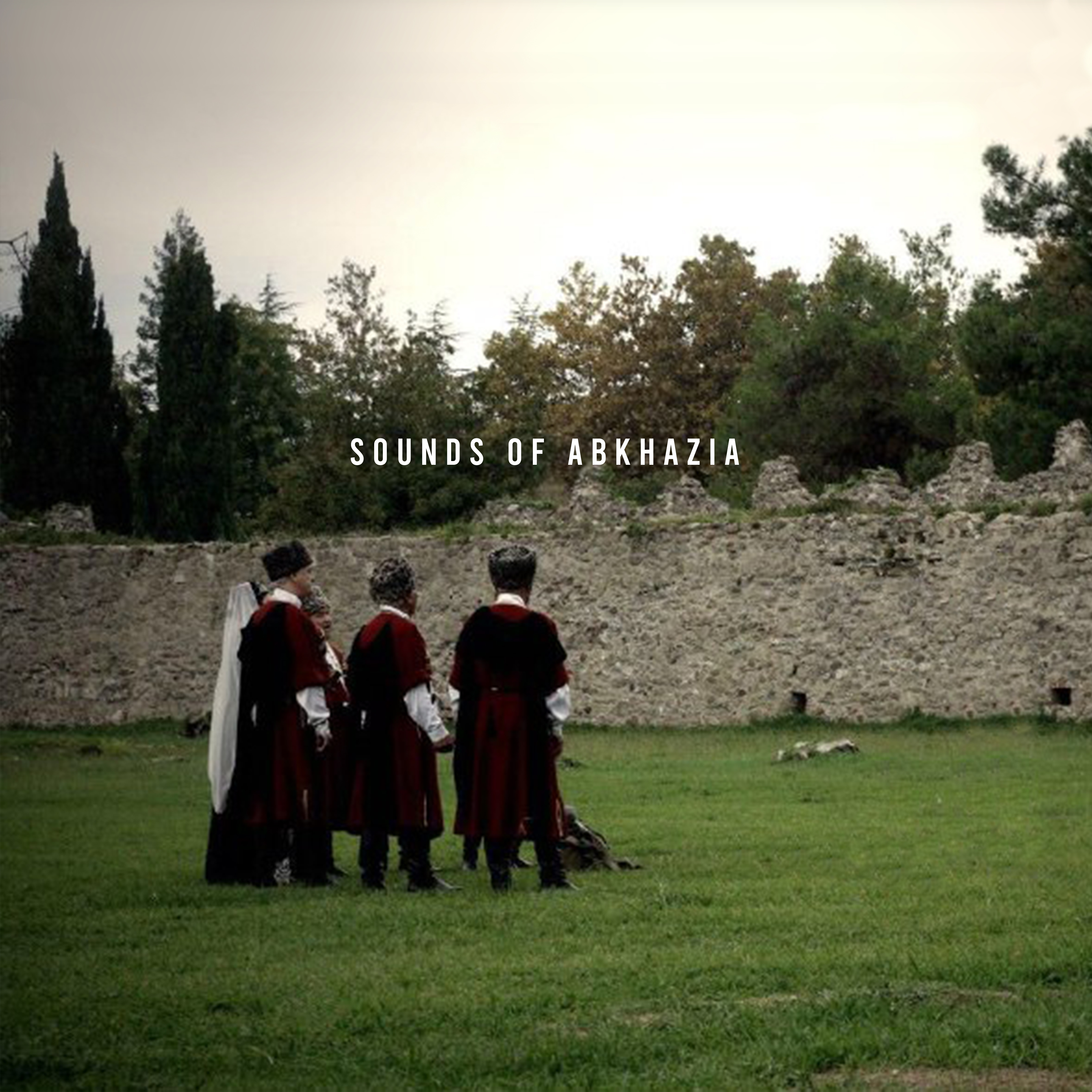
Abkhazia is a country (some would argue an occupied region) with which it is impossible to work without ignoring the political context. It is an unrecognized state that in the 90s separated from Georgia, wanting to gain independence. Independence that came at the cost of war, brutality on both sides, historical trauma and nationalist myths. Most of the international community calls those events the Georgian-Abkhazian conflict, while Abkhazians themselves believe that it was the Patriotic War, singing about the victory in traditional music. Unrecognized, but actual separation from Georgia became possible due to participation of North Caucasian volunteers, and after that, assistance from Russia. Today there are Russian military bases in Abkhazia, so Georgia perceives Abkhazia as an occupied region, although similar thoughts can be voiced on the other side of the Georgian-Abkhazian border.
Given the painful past, ambiguous present and shaky future of Abkhazia, any project with its culture can be perceived as a political statement. Especially if the project is made by a North Caucasian label with residence in Germany and an independent nomadic director. That is why we are happy that we are releasing films 12 years after they were recorded: we had time to think and choose our words.
While filming on Gagra beach, a local TV station caught him for a story titled “Wow, a French filmmaker came in search of a unique culture,” quite typical of regional media in the Caucasus. The journalist then asked Vincent if Abkhazians have well preserved their musical heritage.
[Vincent laid it on thick.]
“It is very bad. You have the most beautiful music, but it is very difficult to talk about its preservation and development. If everything goes on like this, you will lose everything. You need more work.”
This was a very important and thoughtful reaction for us. European attention to Caucasian cultures sometimes perpetuates oriental clichés and deceptively reassures locals: “Europeans are coming to us in search of lost antiquity, so everything is fine. We are still ancient and unique.” In this sense, Vincent’s response was both sobering and provocative. And even total disagreement with the brash Frenchman is also a good option. It’s either work or don’t listen to those who learned about your culture yesterday.
In addition, in interviews, and in general during the course of the project, we said a lot that it was important to document the diversity of Abkhazian music. While we were trying to find the most ancient and ‘authentic’ forms of folklore, Vincent insisted on recording everything from state choirs to late patriotic songs.
Today it seems to us that this is the political and social meaning of the project: to start a living archive with different music from Abkhazia. Music that is not limited to the war for independence and the defense of political freedom before a new ally. Before the 90s, Abkhazians had bright moments in history and battles sung in songs.
Besides, in 2013 we could only meet folklorists, bearers of tradition and rare indifferent officials who were interested in working on the project. Today we are releasing this release with the support of the cultural center SKLAD in Sukhum. It is not enough for young curators and artists to preserve culture and revel in nostalgia. Instead, they are creating a new context. 12 years ago such initiatives were hard to find. Now they are a visible voice of contemporary Abkhazia. Our films and recordings are intended, among other things, to make such voices audible.
A collection of ten short films recorded in Abkhazia, an independent republic bordering the Black Sea. Filmed by Vincent Moon and produced by Petites Planètes in collaboration with Ored Recordings. Listen to the album on https://oredrecordings.bandcamp.com/album/sounds-of-abkhazia
“When an empire falls, does it make a sound? And who is there to hear it?” – so read the opening line of the call for papers for this issue in October 2021. Looking back at that text from the vantage point of 2025, that sounds far too optimistic and premature. Shortly after that call was published, the empire in question made a whole lot of noise about its unwillingness to stay fallen. The shadow of Russia’s brutal war of conquest in Ukraine hangs over this issue – as it has over any project that deals with the post-Soviet since February 2022 – determining both its shortcomings and, in a perverse way, its urgency.
That the full-scale invasion came to many of us as a shock is the result of complacency and unwillingness to listen to the comparatively quieter rumblings that have been shaking the region over the past two decades. To the fact that the invasion commenced already in 2014 with the occupation of Crimea and Russian military support for separatist forces in Donetsk and Lugansk. To the 2008 week-long war with Georgia that concluded with Russian occupation of the disputed territories of Abkhazia and South Ossetia. To the forceful integration of Belarus into Russia that began as soon as the Belarusian dictator Lukashenka came to power in 1994 and intensified with the establishing of the so-called “Union State” in 1999. Not even to mention the Russian imperial ventures in Africa and the Middle East.
The world refused to listen until the noise became impossible to ignore – the noise of bombs and artillery shells falling on Kyiv, Kharkiv, Mariupol, Odesa, Dnipro, Zaporizhzhia and many more. Yet even these sounds fall on deaf ears far too often: many among the anti-imperialist left, enamored by the platonic ideal of a multi-polar world, seem to prefer listening to Putin’s propaganda, just as many left-leaning intellectuals were similarly entranced by Soviet propaganda during the Cold War. And many across the political spectrum – including the sitting US president – who campaign against military aid to Ukraine seem to prefer the comfortable silence of subjugation to the noisy cacophony of resistance.
What, then, can a niche academic publication on sound(s) from the post-Soviet realm – in itself a controversial designation tinged with colonial history – hope to achieve? Especially one edited by a Russian-Jewish academic based in Western Europe, with all the problematic positionality this brings? Perhaps nothing. Or perhaps, the promise of a sonic epistemology long held as a keystone of sound studies – that of attuning and entangling oneself with the object of listening as opposed to holding it in a distancing gaze – could be fulfilled at least to some extent here, opening some ears and minds to the politics of the region.
In the video installation Repeat after Me by the Ukrainian artist collective Open Group – arguably the most important sound artwork of this decade and the centerpiece of the last Venice biennale – Ukrainian war refugees recount their experiences of the invasion while recreating its soundscape with their voices: the sounds of shelling, explosions, war planes and drones, air raid sirens, etc. A row of microphones in front of the screen and onomatopoeic subtitles in the video invite the public to join in and voice those sounds in karaoke fashion as a “gesture of togetherness” (Keylin 2023: 128). The playful format allows participants to empathize with the refugees’ traumatic experiences from the safe distance of Verfremdung (estrangement), while making them acutely aware of the very safety and distance that they enjoy. In this way, Repeat after Me attunes the audience both to the (sonic) reality of the war and to their own positionality.
Hence, the aspiration of this issue: to make the post-Soviet realm audible – not as a continuous, homogenous soundscape far too often conflated with Russia, but as a cacophony – decidedly not a symphony – of diverse cultures, identities, aesthetics, and political programs; to sound out both the connections that gave the Second World its identity against the First and Third ones and the contradictions that made it fall apart. In the hope that listening – from a safe distance – to the sounds of the post-Soviet realm can attune the reader’s ear to the voices coming from it.
A multitude of limitations – some fundamental, some situational – work against this aspiration. First, the diversity of sound cultures and the complexity of political relationships within the post-Soviet space are far too vast to address comprehensively in any single publication. Second, the discipline of sound studies has only begun to establish itself in the region over the past decade, often lacking institutional support and publication venues. Moreover, much of this emerging discourse, especially in Russia, orients itself more towards Western academic scholarship than towards the post-Soviet realm and its own sound practices (e.g., the History of Sound book series at the New Literary Observer press, which in large part consists of translations of key anglophone works). One important exception that has to be mentioned here is the 2018 multilingual special issue of the Topos journal, P.S. Soundscapes,edited by Benjamin Cope and Pavel Niakhayeuand dedicated to sound and music in contemporary Eastern Europe. All of this greatly limits the pool of potential authors for this issue, to the extent that half of the texts included here are written by Western scholars. Finally, the war itself had an obvious impact, delaying this issue by over two years and leading several prospective authors, particularly those hailing from the post-Soviet realm itself, to withdraw their texts. Not a perfect issue, then, but hopefully still capable of opening the space for a dialogue.
Listening to the Subaltern Empire
Despite recent post- and decolonial turns in sound studies that shift focus away from Eurocentrism and acknowledge the global diversity of sounding and listening practices, the post-Soviet space remains largely a sonic terra incognita. The few exceptions that prove the rule include the sound experiments of the Soviet avantgarde – owing to Andrey Smirnov’s monumental study Sound in Z (the title’s correspondence to the current Russian military symbol is an unfortunate prophetic coincidence) – and the overtone singing traditions of the Far East. However, the academic attention that both these phenomena received does not stem from any specific interest in the region, but from their attachment to more famous “brands”: the historical avantgarde and Tibetan spirituality respectively.
The post-Soviet world falls into the cracks between the Global North and the Global South, persistently absent from the sonic maps of either realm. It tests the limits of post- and decolonial frameworks, which were largely developed to address the relationships between European empires and their overseas colonies. Political scientist Viatcheslav Morozov describes Russia’s peculiar position in this coordinate system as a “subaltern empire” that, “while remaining a sovereign state,” has “colonized the country on behalf of the global capitalist core” (Morozov 2015: 32) into which it was integrated on unequal, subordinate terms. As a result, Russian political consciousness is built on an unsolvable paradox of holding in suspension Eurocentrism and Euroscepticism: the aspiration to be an equal part of the Global North and the resistance to its cultural influence. In a twist of fate that the academic community still struggles to wrap their heads around, Morozov was arrested in January 2024 in Estonia and later plead guilty to spying for Russia. Although this fact may cast a shadow on Morozov’s academic work, the notion of the subaltern empire has been crucial to the postcolonial discourse on the post-Soviet realm.
In his influential – if controversial – book Internal Colonization, cultural historian Alexander Etkind similarly approaches the Russian imperial project as one of self-colonization that inevitably results in self-othering. “The state was engaged in the colonization of foreign territories and it was also concerned with colonizing the heartlands,” he argues, leading “peoples of the Empire, including the Russians” to develop “anti-imperial, nationalist ideas in response” (Etkind 2011: 2). Etkind’s work was rightfully criticized (as I will discuss below) for sidestepping Russia’s actual colonial conquests – its subjugation of Siberia, Caucasus, East Asia, or Belarus and Ukraine – and its colonial subjects. It is, however, notable for pointing out the “reversed, internal orientalism” (Etkind 2011: 16) suffusing modern Russian culture – one that simultaneously construes Russia itself as a colonial other to the enlightened West and conceives a colonial other within Russia in the form of its uneducated and uncivilized narod (a word that literally means “people”, but more often than not is used to denote peasants and commoners).
Two articles in this issue demonstrate how this contradictory mentality unfolded in the experimental music and sound art scene in 1980s Saint Petersburg, a city originally designed as a flagship for the Europeanization of Russia, but which came to be known in the twenty-first century as a hub of Russian nationalism and fascism. Giada Dalla Bonta’s article “Sounding the dissolution from a Cosmic Space” introduces the universalist trend typified by the electronic music duo New Composers, Valeriy Alakhov and Igor Verichev. Bridging avantgarde legacies and rave culture, the pair’s work was informed, on the one hand, by the avantgarde concept of vsyochestvo (from the root vsyo – “all, everything” – and the suffix combination -chestvo that typically refers to “practice”), of an inter- and postmedia approach to art taken to extremes. On the other hand, their work was rooted, in the holistic worldview of Russian Cosmist philosophy, rhymed with the everyday mythology of the Soviet space program. Dalla Bonta’s article pursues two lines of inquiry: first, it reassesses the role and influence of sonic practices on the late Soviet underground art. Second, it examines the New Composers’ idiosyncratic blend of aesthetics and philosophies through the lens of Kodwo Eshun’s notion of sonic fiction (1999) and Jean-Luc Nancy’s relational theory of sound (2007), revealing how they expressed a politics of togetherness characteristic of late Soviet underground culture.
New Composers, “Exactly Today and Exactly Now” (1989)
Dalla Bonta acknowledges an ostensibly paradoxical ideological shift towards conservatism and nationalism in the underground art scene following the dissolution of the Soviet Union but purposefully limits the timeframe of her account to the 1980s to focus on liberatory impulses in the New Composers’ early work. Conversely, Sam Riley’s article “A Butterfly Akin to a Bird: Imagining New Jazz in Leningrad” examines how the roots of this shift can be found already in the late Soviet period. The text focuses on two other emblematic figures of underground sonic experimentalism: composer and pianist Sergey Kuryokhin and critic Efim Barban. Through a reading of Barban’s book Black Music, White Freedom, which initially circulated in Samizdat and laid the theoretical foundations for the late Soviet experimental music scene, Riley explicates the racism inherent in Barban’s theory and Kuryokhin’s practice as they strived to disentangle jazz from its Black American origins, formulating a purportedly superior Soviet-Eurocentric “new jazz” idiom. The late Soviet sonic underground thus aligned with progressive and conservative trends simultaneously: both emancipatory – in resisting the authoritarian state and its ideology – and reactionary – in reinforcing the Eurocentric cultural hegemony under the guise of Enlightenment-style universalism.
Belliphonic Relationalities
The principal critique of the theory of Russia’s self-colonization, as presented in Etkind’s work, addresses two fundamental issues. The first concerns how its focus on internal colonization obscures the external conquests of the Russian Empire. The second, more insidious issue relates to what exactly is construed as the internal territory being self-colonized. As literary scholar Vitaly Chernetsky points out, “in his argument about Russia’s internal colonization, […] Etkind’s frame of reference is constituted by the events that took place and the phenomena that existed in Ukrainian and Belarusian territory. Thereby Etkind perpetuates the aspects of Russian colonialist ideology that he apparently internalized to an extent that makes them invisible to him” (Chernetsky 2007: 43). Etkind’s blind spot is indicative of a key characteristic of the Russian imperialist mentality: an unselfconscious refusal to see Ukrainians and Belarusians as anything other than inferior Russians. The lack of racial difference between these peoples is weaponized to conceal the reality of colonial difference. This denial of self-determination undoubtedly drives much of Russia’s expansionist politics: the forceful integration of Belarus and the violent invasion in Ukraine – clear attempts to replay the history of the not-so-internal colonization. In this context, it would hardly be controversial to say that the three texts dedicated to the current political soundscapes of these two countries, as they are conditioned by Russian aggression, form the core of this special issue.
In “Warbound: Collective Audio Streaming from Ukraine,” Olya Zikrata directly addresses the sonic dimension of the ongoing Russian invasion in Ukraine and the Ukrainian resistance. Her article revolves around the 2022 project Listen Live consisting of five online broadcasts by sound artists from different parts of Ukraine that together weave a multifaceted soundscape of living in the middle of a violent invasion. Building on – but also challenging – J. Martin Daughtry’s notion of “belliphonic” as the agglomeration of war-related sounds (2015), Zikrata argues that the sonic experience of the war in Ukraine is not reducible to a catalogue of explosions and sirens but rather includes the totality of acoustic environments affected and effected by the invasion. In stark contrast to the sound design of war movies, the streams of Listen Live focus on the quieter aspects of war: the digging of trenches, the life in frontline cities in between bombings, the refugee experience in western Ukraine. Zikrata approaches them as acts of acoustic witnessing, a “collectively developed sonic intelligence,” revealing the situated relationalities that bind together the land and its human and non-human inhabitants living through the invasion.
The themes of witnessing, testimony, and acoustic relationality also suffuse my interview with Sashko Protyah, an independent filmmaker from war-torn Mariupol, as he reflects on the past 15 years of his career. His early influences, including experimental music and sound poetry, shaped his affinity for sound as compositional material rather than mere accompaniment to visuals, which has resulted in a number of collaborations with experimental musicians, sound artists, and beatboxers. The evolution of Protyah’s artistic trajectory took him from playful absurdism to politicized documentary storytelling, underscoring an approach to sound and cinema as tools for reflection and resistance, gaining a particular urgency under the condition of war.
Finally, Pavel Niakhayeu’s article (bordering on a short monograph in its breadth and detail) “Voices, Noises, and Silence in the Political Soundscape of Belarus” is a meticulous sonic ethnography of Belarusian political life, covering the period from 2020 to 2023. The 2020 election, in which the dictator Alyaxandr Lukashenka once again fraudulently declared himself the winner, catalyzed a peaceful protest movement. It quickly became the largest protest in modern Belarusian history before being violently quelled with Russian backing, forcing protesters into hiding or emigration. Combining field recordings and soundwalks, sociological interviews and media analysis, Niakhayeu’s article documents how these phases unfolded in the acoustic dimension: from the political soundscapes of the protest itself – suffused by poetry, folk songs, and the sound of Belarusian language – to the “sonic violence continuum” of the authoritarian state’s reaction and the silence(s) that followed. These soundscapes may also be called belliphonic – both in the sense of Putin using Belarus as a launching site for his attack on Ukraine, and in the sense of Belarus itself being the object of a hybrid warfare of sorts.
Soundscapes of the “South of the Poor North”
Whereas Russian imperialism in Ukraine and Belarus was (and is) driven by the ostensible non-distinction of their peoples, other forms of Russian colonial conquest relied on familiar constructions of the racialized colonial other. One of the critiques levied at Etkind by the decolonial theorist Madina Tlostanova is that, in his focus on the internal, self-othering Orientalism of the Russian elites, he fails to notice the more obvious, outward Orientalism “directed against Russia’s South – the Caucasus, and its Orient – Central Asia” (Tlostanova 2014: n.p.). A linguistic quirk that would be amusing if not for the oppression that it represents: While in English, the term “Caucasian” connotes “white,” in (post-)Soviet vernacular Russian, “Caucasian” (kavkazets – formed from the bureaucratese “person of Caucasian ethnicity”) is a term of racialization and othering, coding the members (or presumed members) of any of the diverse Caucasian nations as decidedly non-white.
Tlostanova’s own theory proposes that the post-Soviet realm neither fits within nor breaks off from the colonial North-South dichotomy, but rather mirrors and complicates it. She conceptualizes Russia as “the poor North,” separated from the global (rich) North by imperial difference, as well as from its own “South of the poor North,” by colonial difference (Tlostanova 2011). The “imperial difference […] refers to various losers that failed to succeed in or were prevented by different circumstances and powers from fulfilling their imperial mission in modernity. These losers took second-class places and became intellectually, epistemically or culturally colonized by the winners” (Tlostanova 2011: 71). Consequently,
Russia projected its own inferiority complexes onto its non-European colonies in the Caucasus and Central Asia through its self-proclaimed modernizer and civilizer role. The Russian colonies either felt the double dictate of coloniality of knowledge in its modern Western and Russian/Soviet versions, or, regarding themselves as standing higher on the human scale (within the same Western modern epistemic system, grounded in taxonomizing people into those who have the right and the ability to produce knowledge and those who are doomed to act as objects of study and consumers of theories produced in the West) than the Russian subaltern empire, have refused its dictate and negated its epistemic authority, choosing a direct European influence instead and dreaming to become at some point fully integrated. (Tlostanova 2015: 47)
Brian Fairley addresses the sonic experience of such a paradoxical positionality through the example of Georgian Orthodox chant in his article “Singing at Your Own Funeral: Overdubbed Intimacy and the Persistence of Tradition in Soviet Georgia.” Counted among the oldest Christian denominations in the world, the Georgian Orthodox Church was first subordinated to the Moscow Patriarchate following the integration of Georgia into the Russian Empire, then persecuted and all but banned (along with all other religious practices) under Soviet rule. Fairley discusses amateur tape recordings of Georgian requiem chants made in the 1960s by the singer Artem Erkomaishvili, which were later played at his own funeral. The article weaves together the sonic history of Georgian indigenous musical culture under colonial rule and the media history of anti-Soviet dissent. Fairley likens Erkomaishvili’s recordings to magnitizdat, a dissident practice by which censored music – most often rock music bootlegged from the West – found unofficial circulation in amateur tape recordings. This case study thus exemplifies the complex entanglement of contradictory indigenous, Soviet, and Western vectors characteristic of the sound cultures in “the South of the poor North.”
Tlostanova does not make a principal distinction between the imperial projects of tsarist Russia and the Soviet Union. This position, however, is not universally shared, particularly among historians of Central Asia. Adeeb Khalid, for example, argues that the Soviet project consisted in “homogeniz[ing] populations in order to attain universal goals” (Khalid 2006: 233), a strategy associated with the modern state rather than a colonial one, which would conventionally be built on perpetuating difference. Historian Botakoz Kassymbekova, on the other hand, points to the futility of classifying the USSR as either a modern state or a colonial empire, as its “cultural policies […] were contradictory and entailed elements of both modern(izing) and colonial rule […] Blurring boundaries between imperialism and socialism, colonialism and state building, the Soviet political design combined ideas and mechanisms of liberation and oppression, universalism and difference” (Kassymbekova 2016: 15, 17). Pointing out that most Central Asian societies have never thought of themselves as colonized or postcolonial, ethnographer Sergei Abashin similarly suggests that the culture and politics of the region are better described as a complex and site-specific entanglement of local and metropolitan forces that act at times in accord and at times in conflict with each other (Abashin 2015: 44).
In my interview with the Kazakhstani “imaginary art institution” Krëlex zentre, its members Ruthia Jenrbekova and Maria Vilkovisky discuss how such localities facilitate highly idiosyncratic sonic idioms that can be described as a kind of creole. The duo lists among their influences Soviet radio, Western classical and experimental music, punk, electronica and techno, and the soundscapes of Almaty’s industrial suburbs, all of which coalesce into an equally eclectic practice incorporating sound poetry, experimental theatre, and installation art, among many other things. They describe themselves as pirates, plundering the global cultural archive in order to challenge the ethnicization and genderization of artistic identities.
Finally, Phoebe Robertson’s article “The Chanting Flute: Uncovering Russian Orthodox and Shamanic Sounds in Sofia Gubaidulina’s …The Deceitful Face of Hope and of Despair (2005)” traces a similar creole-esque aesthetic in the works of the late Sofia Gubaidulina. Of Tatar ancestry and Russian Orthodox faith, working in the European New Music paradigm, and hailed as the most important Russian composer of the past century, Gubaidulina exemplifies the contradictions that permeate the sound cultures of the post-Soviet realm. Robertson examines how the composer brings together musical references from Russian Orthodox and Siberian shamanic chants within the European concerto genre – an act that in other contexts could amount to cultural appropriation. In the post-Soviet context, however, both the eastward and westward cultural vectors point to a shared history of repression and dissent, one that Gubaidulina’s work highlights.
The eight diverse texts collected in this special issue throw into sharp relief a point I made in passing in the opening section: that the (post-)Soviet is emphatically not a symphony. The region’s political and cultural history is one of contradictions, holding many familiar dichotomies – of the East and the West, the progressive and the reactionary, the colonial and the emancipatory – in a superposition, a dissonant cluster defying harmonic resolution. (Post-)Soviet sound thus demands a mode of listening that is attuned to these contradictions and that attends to the region not as a monolithic soundscape but as a collection of idiosyncratic localities, each resonating their own sets of frequencies.
References
Abashin, Sergey (2015). The Soviet Kishlak: Between Colonialism and Modernization [Советский кишлак: между колониализмом и модернизацией]. Moscow: New Literary Observer.
Chernetsky, Vitaly (2007). Mapping Postcommunist Cultures: Russia and Ukraine in the Context of Globalization. Montreal: McGill-Queen’s Press.
This is a single release of the song “Hand in the Air,” which is the first track on our forthcoming sixth album, Goodbye Work (2025).
This song is an ode to the nerdy child who raises their hand when the teacher asks a question in class. An impressionistic, autobiographical song about the awkward years in junior high.
The picture in the window Lights up from behind The richer is the meadow That we seek but fail to find
chorus: Was it you Was it you Was it you On the landing? (Too demanding?)
Was it you Was it you Was it you With your hand in the air?
The poster isn’t yellow Maybe orange, maybe green When a man starts to bellow One makes sure not to be seen
A chair in the corner To pretend to try to hide A face getting warmer So it turns to the other side ______________________
Rosie Harris: lead vocals Sumanth Gopinath: backing vocals, acoustic guitar, Hammond organ Beth Hartman: backing vocals, egg shaker Cody Johnson: bass guitar Nate Knutson: electric guitars Paul Hatlelid: drums
music by The Gated Community, lyrics by Sumanth Gopinath
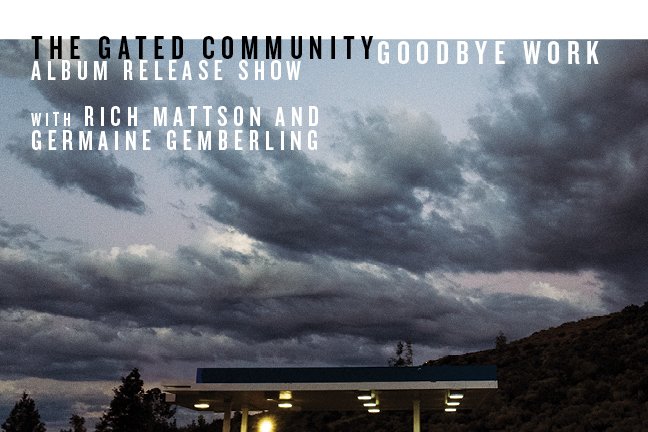
Much beloved Minnesota Americana band The Gated Community celebrate the release of their sixth full-length studio album, Goodbye Work! Special guests acclaimed musicians Rich Mattson and Germaine Gemberling (aka “Rich and Germaine”) of Rich Mattson and the Northstars open the night.
The Gated Community is an Americana band with a nearly twenty-year history. Formed in 2006 in Minneapolis’s storied West Bank neighborhood, the band is known for its gripping original songs, beautiful vocal harmonies, and multiple lead singers. Led by South Asian American singer/songwriter Sumanth Gopinath (aka Sonny), the band’s music is eclectic in style, encompassing country, folk, bluegrass, and rock. Born in Chicago and raised in Louisiana, Gopinath relocated to the Twin Cities in 2005, after stints in Texas and Connecticut.
Current members have been in the band for a decade or more. Their lineup includes Sumanth Gopinath (acoustic guitar), Rosie Harris (banjo), Beth Hartman (percussion), Paul Hatlelid (drums), Cody Johnson (bass), and Nate Knutson (electric guitar). Everyone in the band sings lead and plays multiple instruments. They perform in a range of configurations, including as small as a duo or trio.
The Gated Community is thrilled to hold this album release show at The Parkway Theater. After placing in the venue’s first-ever “Battle of the Bluegrass Bands” in 2019, the band later headlined The Parkway that same year. Six years and a global pandemic later, the band returns again to the theater with renewed energy and purpose amid the chaos of the present.
The Holy Bible (1994) was a remarkably coherent and thoughtful, if violent and unreasonable protest against the ‘end of history’ that had been declared a couple of years earlier – theirs was the 1994 of Srebrenica and Rwanda, not of Fukuyama or Anthony Giddens. Musically, while hardly avantgarde, The Holy Bible had a newly acquired postpunk angularity and a disdain for the American marketplace. Subjects were political (‘Revol’, a bizarre song speculating on the sex lives of Soviet leaders), historical (two songs about the Holocaust, hugely ill-advised in theory but surprisingly tactful in practice), or concerned different forms of personal collapse, told in the first-person, as in the staccato, self-undermining assertions of ‘Faster’, or ventriloquised through female narrators, such as the depressive sex worker of ‘Yes’ and the anorexic teenager of the exceptionally disturbing ‘4st 7lb’.
Manic Street Preachers, The Holy Bible (1994)
These songs asserted physical and intellectual self-control to the point of psychosis, as a means of armouring the self against a terrifying and repugnant outside world. The Holy Bible is striking not just for Jones’s and, especially, Edwards’s punishingly moralistic and sometimes surreal lyrics, but for the fact that Bradfield and Moore were able to crowbar them into rock anthems, of a sort. The results can still send shivers up the spine, as when the brutal, unforgiving words of the disgust-filled, misanthropic ‘Of Walking Abortion’, or ‘Archives of Pain’, a Foucault-inverting paean to the guillotine, are bellowed as stadium rock choruses. In these songs Bradfield didn’t sing so much as ‘bark phonemes’, as Tom Ewing put it of the breathtaking ‘Faster’. Bradfield had managed to turn the amusicality of his two lyricists into a virtue, and ‘I am an architect; they call me a butcher’ into my personal favourite first line of a rock single.
It was an incredible performance, bearing no apparent resemblance to what the Manics had originally aimed to do – this wasn’t selling sixteen million copies in any lifetime – but there was no failure, now. The Manics had set out, to quote a Ballard interview sampled midway through the album, to ‘rub the human face in its own vomit, and then force it to look in the mirror’, and that’s what they did. There is still nothing in rock music quite like it, and it was practically impossible to follow.
Aotearoa singer/songwriter Marlon Williams (Kāi Tahu, Ngāi Tai) performs an intimate concert to a small group of fans at the RNZ studio to celebrating 20 years of NZ Live on RNZ National. Marlon performs five tracks and chats to RNZ’s Jesse Mulligan about making his fourth solo album, ‘Te Whare Tīwekaweka’ and the process of songwriting in te reo Māori. […] Tracks as they appear in the session:
Watch Ambika Mod read from Heart Lamp, the #InternationalBooker2025-shortlisted novel written by Banu Mushtaq and translated by Deepa Bhasthi. In twelve stories, Heart Lamp exquisitely captures the everyday lives of women and girls in Muslim communities in southern India. In the titular story, Mehrun, a young mother, despairs at the way her life has unfolded.
Filmación de los históricos conciertos en el Estadio Nacional que marcaron el retorno triunfal de Los Prisioneros después de casi 10 años de separación. Grabado los días 30 de noviembre y 1 de diciembre de 2001.
A recording of birdsong made in the late afternoon of 30 April 2025 at George Washington Park in Pacific Grove, California, by Comrade Koganzon using the Merlin Bird ID app. The following birds can be heard on this recording: Hutton’s vireo, oak titmouse, yellow-rumped warbler, American crow, lesser goldfinch, acorn woodpecker, bushtit, American robin, dark-eyed junco, California towhee, Anna’s hummingbird, chestnut-backed chickadee, house finch, spotted towhee, and song sparrow. ||| TRR
Future History of Earth’s Birds
Amie Whittemore
—after Alexander Lumans and Jennifer Ackerman
Among them, a common language of alarm.
Also, rapture.
Know that when zebra finches felt the first pinch of climate change, they chirped to their offspring, still shelled, to warn, to insist, they hatch smaller and fiercer. Dawn’s chorus is a peace-making operation. The birds with the biggest eyes sing first. Thus light is the first part of song.
Some birds create barriers of pinging notes—golden bells dangling
in the air, alarms and warnings. Does it matter
what kind of birds did this? They’re all dead now.
In bird language, there’s a call for mobbing, a call for fleeing.
To avoid danger, sometimes you must approach it.
In the shell, a bird recognizes its parents’ voices. In love, mates sing duets they invent together. On death, the survivor must learn a new tune.
There are such things as universal truths.
Some kites drop fire onto the earth to scare up dinner. Some kites,
dropping fire, taught humans their first warm meal.
Neither ice nor snow lived long enough to hear the last bird sing—just wind,
which carried those notes as far as it could before they slipped from its palms—
There is a common language of alarm.
Source: poets.org. Originally published in Poem-a-Day on May 11, 2025, by the Academy of American Poets.
On 15 December 2024, two oil tankers — Volgoneft-212 and Volgoneft-239 — were involved in an accident in the Kerch Strait during a storm, and three thousand tons of oil was spilled into the waters of the strait. A day later, the oil washed up on the shores of Krasnodar Territory. Dozens of kilometers of the Black Sea coast were contaminated with mazut (fuel oil), and fish, birds and dolphins were poisoned and died. Environmentalists have already pronounced the incident a major catastrophe. Local residents, without waiting for marching orders from the authorities, started cleaning up the fuel oil and saving birds and animals from day one. Thousands of people have been going out daily to clean the coastline. Every one of them has their own motivations and their own story connected with the sea.
“We have to do something!”: Marina, Nastya, and the Captain on Jamaica Beach
“It’s really black now! Our poor sea! What have they done to you?!”
Marina leans over a huge jellyfish stuck in an island of oil, and from the way her shoulders are shaking, I can guess that she is crying. Then she pulls back her mask and inhales a breath of the oil vapor-infused cloud. She wipes her tears away and says that she and her husband moved here from Belgorod a few years ago for a quiet life on the warm coast. Before the accident, her heart ached only for her relatives living back home amid the shelling. What is happening here now makes her heart ache as well.
“A friend from Tuapse wrote, ‘Will you put me up? Can I come there to help you too?'” Marina smiles sadly. “They’ve been coming from all over Russia, and many people are hosting the volunteers for free. Many people are feeding them. This is normal.”
A volunteer going out on a mission.
The sun sinking into the sea at her back, Marina looks like the heroine of an apocalypse movie — alone, in a protective suit, on a islet of sand surrounded by huge black stains.
They’re black oil slicks. It’s best not to step in them: they will ruin any kind of footwear. But it is impossible not to step into them, because although earlier, when the weather was colder, the fuel oil froze, now, with the temperature at +12 ℃, it has begun to flow. People armed with shovels are trying to dispose of these spreading stains by bagging them as soon as possible. As will transpire later, plastic bags cannot be used for this job: the fuel oil eats through the plastic and leaks back out. You need special bags — and you need special clothes, respirators, and goggles. They are clumsy to work in, so many people can’t stand it and clean the shore in their street clothes. They regret it later: by the evening their head starts to ache, and when they exhale, it smells like they have a petrol station inside them.
Elkhorn Slough, as seen from the Carneros Creek watershed. The Western Flyer is moored in the marina at Moss Landing, where the slough flows into Monterey Bay (near the smokestacks on the center right). Photo by the Russian Reader
I have never directly acknowledged the fact that, since May 2021, this weblog has come to you from Monterey-by-the-Sea, California, where I have happily found many things to do that have nothing to do with Russia and the heavy, steady flow of bad news from there. I want to share that happiness with you by way of saying goodbye to 2024 and thanking you for sticking with the Russian Reader this past year.
The distinctly Monterey story, told below in four short but fascinating videos, is a fascinating, inspiring, and happy one. I hope you enjoy it as much I did. See you next year! ||| The Russian Reader
Western Flyer Foundation Channel, “The Western Flyer with Nick Offerman”
The Western Flyer sails again! Come aboard with Emmy-award-winning actor and comedian Nick Offerman for a fun new look at the life, near-death, and resurrection of the famous old fishing boat in John Steinbeck’s The Log from the Sea of Cortez (1951). From the coast to the deep sea and from the tide pool to the stars, the nonprofit Western Flyer Foundation stirs curiosity using a blend of science and art inspired by John Steinbeck, Ed Ricketts, and their 1940 journey on the Western Flyer.
Learn more about the vessel’s history, adventures, and exciting future or marine science and education at http://www.westernflyer.org.
CBS Mornings, “John Steinbeck’s ‘Western Flyer’ gets brought back to life”
After writing “The Grapes of Wrath,” author John Steinbeck explored the Gulf of California in a famous boat called the Western Flyer. Since then, the boat has inspired adventurers and scientists for generations, but the original ship was nearly lost. CBS News’s Jeff Glor reports on the person determined to give it new life.
Western Flyer Foundation Channel, “The boat John Steinbeck and Ed Ricketts made famous. Western Flyer: The Next Chapter”
Almost lost forever, the iconic vessel that carried the acclaimed novelist John Steinbeck (who penned Of Mice and Men, Grapes of Wrath and more) and marine biologist Ed Ricketts to the Sea of Cortez on an epic scientific mission gets new life and a new mission.
Andrei Khristoforov aka Drevarkh the Enlightened. Photo courtesy of Mr. Khristoforov’s social media page via Mediazona
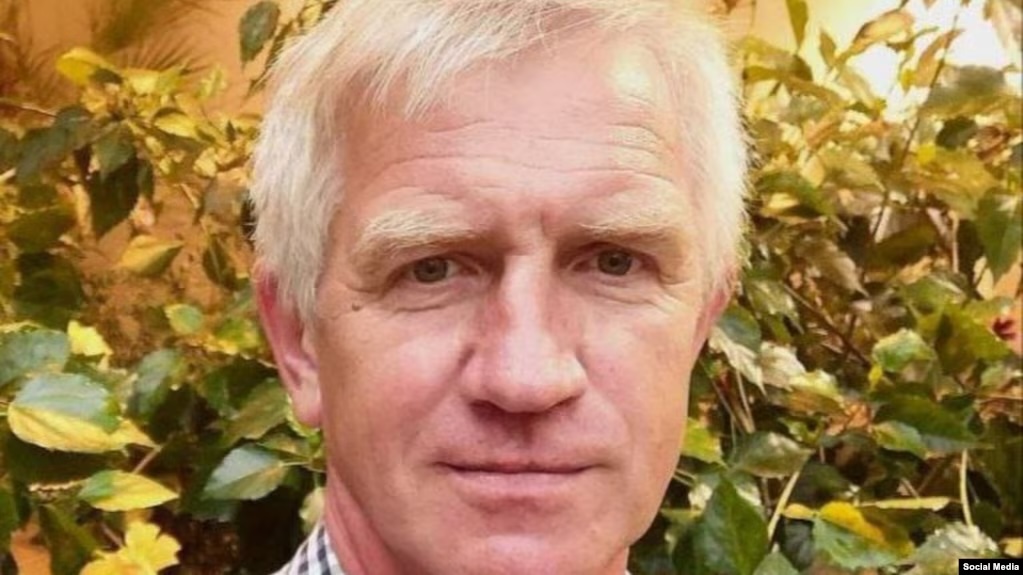
Fifty-nine-year-old environmental activist and Shiyes defender Andrei Khristoforov, also known as Drevarkh the Enlightened, has died in Arkhangelsk. The news was reported on his page on the Russian social media network VKontakte.
In late April, Khristoforov said that he had been admitted to hospital with severe cirrhosis of the liver.
In Arkhangelsk, Drevarkh was involved in environmentalism and was the leader of the Plant Your Own Tree movement. He wore white wings and a tree-shaped cap during his protest actions.
In 2022, the Ust-Vymsky District Court in the Komi Republic sentenced Khristoforov to a year of probation on charges of “violence against a law enforcer” (per Article 318.1 of the Criminal Code). Police investigators claimed that, in the summer of 2019, Drevarkh had attacked a policeman who was filing a report on him because he had, allegedly, pulled the emergency stop of a train at the Shiyes railway station, where protests against the construction of a landfill were underway.
Drevarkh said that the police officers had themselves beaten him during the arrest. Video footage of the arrest was posted online by other Shiyes activists: it shows police officers shocking Khristoforov several times with a stun gun.
Video footage of police detaining and electrocuting Drevarkh the Enlightened in 2019
After charges were filed against him, Drevarh was sent to a psychiatric hospital in Arkhangelsk for a forensic medical examination. The psychiatrists concluded that Khristoforov suffered from borderline personality disorder, but during the scuffle on the train he “would have been aware of the danger posed by his actions” and did not need compulsory medical treatment. Drevarkh then hurriedly left for Ukraine, where, according to him, he also planted trees. In the summer of 2021, however, he decided to return to Russia.
Upon arrival, the activist was placed under house arrest, and then released on his own recognizance. “The Creator thus sent me feedback via the Russian Investigative Committee, for which I am grateful to the former and the latter,” explained Drevarkh. Police investigators had written to Drevarkh via social media, after which he bought tickets home.
In May 2019, Drevarkh was fined for taking part in a protest march against the Shiyes landfill. He was later detained for ripping the epaulettes off a policeman’s uniform during one of the rallies. “When the brothers started pushing me back, the epaulettes flew off them. But they blamed me for the whole thing, saying that I was the one who had conjured it up. It’s like leaves falling off a poplar tree, that’s how the epaulettes fell off,” the activist said at the time.
That same month, “after firing several warning shots in the air,” Khristoforov shot his own urine at private security guards using a toy automatic rifle and smeared feces on the porch of a temporary police station. After he was detained by police, the activist dubbed the contents of his toy gun a “Drevarhh cocktail” and complained that “the [gun’s] clip was too small.”
In June 2020, Arkhangelsk Regional authorities announced the closure of the project, promising to terminate the agreement with Technopark. The investor announced the final abandonment of construction only in October 2020, promising to return the land where the works took place to its original state.
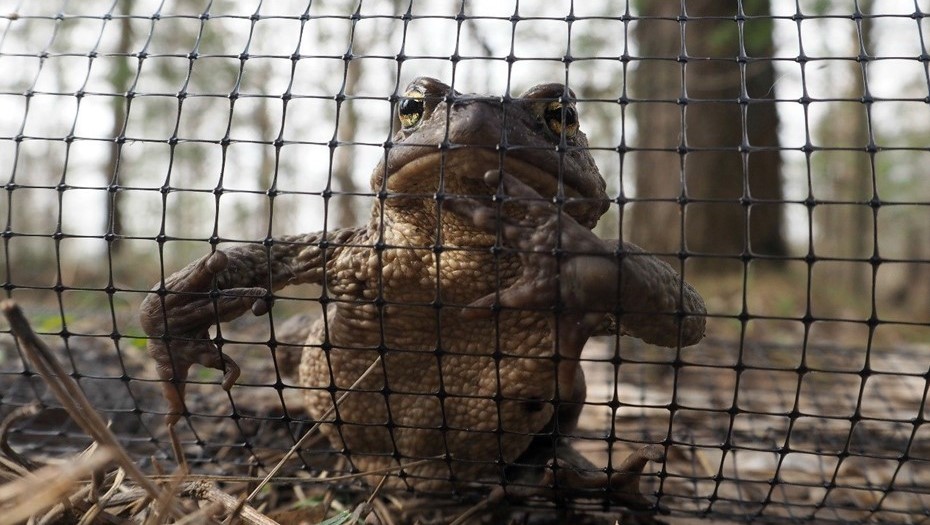
The St. Petersburg Natural Resources Management Committee has stopped signing up volunteers willing to carry gray toads across the road at the Sestroretsk Wetlands Wildlife Preserve. The committee was able to recruit the number of volunteers it needed in a single day.
The committee itself reported the end of the volunteer enrollment, thanking all those who had responded to the call to help the amphibians.
“Registration has been temporarily suspended, as enough volunteers have been recruited for the coming weeks,” the committee stated in its message.
Delovoi Peterburg learned that officials received an unprecedented number of calls and appeals during the day. Six hundred volunteers signed up to save the gray toads.
The largest population of gray toads in St. Petersburg and the Leningrad Region lives in the Sestroretsk Wetlands. Annually in early spring, they migrate en masse to the eastern shore of the Sestroretsk Reservoir to lay their eggs before returning to the forest [sic]. They cross the highway during their migration and can be hit by passing cars.
The Sestroretsk Wetlands Wildlife Reserve announced on April 8 that it was recruiting volunteers to ferry the amphibians over the road. Volunteers are allowed to carry amphibians across the highway after special training. Passersby who have not been trained are asked not to touch the toads, as improper actions can traumatize the amphibians and even cause their death.
Specialists consider toads to be particularly useful amphibians. According to scientists, toads consume about three times more pests than do frogs.
Russian volunteer Alexander Demidenko, who helped Ukrainian refugees [cross the border with Russia], has died in a pretrial detention center in the Belgorod Region, report Vot Tak and iStories, citing sources. It is claimed that Demidenko died on April 5, but news of his death was made public only today, after his lawyer had informed the deceased man’s wife and son.
The cause of death has not been reported, and there have been no official comments from the authorities yet.
Alexander Demidenko had been in custody since mid-October [2023] on charges of illegal arms trafficking. According to iStories, the authorities were planning to transfer Demidenko to St. Petersburg, where he was to have been charged with more serious crimes.
Since the beginning of Russia’s full-scale invasion of Ukraine, the 61-year-old Demidenko had attended anti-war pickets and helped Ukrainian refugees return to their homeland, driving them to the border and hosting them at his home. As many as 900 people who needed a place to sleep stayed in his home, as the border checkpoint was often closed due to shelling, Mediazona writes.
Demidenko disappeared at the Kolotilovka border checkpoint in the Belgorod Region on 17 October [2023]. According to volunteers, he had driven an elderly woman to the checkpoint, but in the parking lot he was stopped by two members of the the territorial defense forces. Subsequently, communication with Demidenko was lost.
Three days later, police officers brought Demidenko home and conducted a search, during which they allegedly found a grenade and detonator fuses from the 1940s. There were numerous bruises on Demidenko’s body.
On 20 October, Alexander Demidenko was jailed for ten days on administrative charges of drinking alcoholic beverages. He was released on 31 October, but the next day he was detained again and jailed for thirty days. During the second administrative arrest, he was arraigned on charges of illegal weapons trafficking and remanded in custody in the pretrial detention center.
In November, it was reported that Demidenko had also been charged with high treason. His lawyer, however, denied these reports. The volunteer’s stay at the pretrial detention center was extended several times on the original weapons charges.
Yekaterina Duntsova, who wants to run for president, said the Kremlin should end the conflict in Ukraine, free political prisoners and undertake major reform to halt the slide towards a new era of “barbed wire” division between Russia and the West.
Nearly 32 years since the 1991 fall of the Soviet Union stoked hopes that Russia would blossom into an open democracy, Duntsova, 40, said she was afraid as she spoke to Reuters in Moscow.
In opinion polls, Russians voice support for the Putin regime’s action in Ukraine. And yet, many Russia would like the war to end, and the dynamics of recruiting “contract” soldiers does not demonstrate that a large number of people are ready to rise up “to fight the West in Ukraine.” What are the real sentiments of Russians? What do they think about the war and how do they justify it?
Lev Gudkov, deputy director, research director, Levada Center, “The war and collective identity,” (online)
Andrei Kolesnikov, senior researcher at the Carnegie Russia Eurasia Center in Berlin, “A semi-mobilized society in a hybrid totalitarian regime” (online)
Svetlana Erpyleva, Humboldt Fellow, Research Center for Eastern European Studies at the University of Bremen; researcher, Public Sociology Lab and the Centre for Independent Sociological Research, “Accepting the inevitable: how Russians justify the war in Ukraine”
Source. Annotation translated by the Russian Reader
Viktor Filinkov, convicted in the Petersburg portion of the high-profile Network Case, turned twenty-nine in early November. It was his third birthday in the penal colony, and for the first time he was not given any special “gift” there. Previously, surprises had been waiting for him that were even hard to imagine—for example, a new uniform with a piece of razor inside it. Filinkov has been imprisoned for six years total. During this time, he has seen a lot, including being threatened with dispatch to a war zone, but he quickly put a stop to such “jokes.” Now he is housed in the high-security wing along with other “repeat offenders.” And he constantly files suits against the penal colony. We talked to his girlfriend and public defender Yevgenia Kulakova, who loves him with all her heart and helps defend his rights behind bars.
Source. Excerpt translated by the Russian Reader, who looks forward to the day when he can see his friend and heroine Jenya Kulakova again and meet his hero Viktor Filinkov in person.
Putin noted that visitors from Tajikistan can stay in Russia for an extended period—fifteen days—without registering with the immigration authorities. They can also apply for a work permit that is valid for up to three years.
In addition, Putin announced the expansion of the quota for university students and postgraduates from Tajikistan—from 900 to 1,000 individuals.
The head of the Russian Federation added that the state would allocate 200 million rubles annually from this year for purchasing textbooks for Russian-speaking schools in Tajikistan.
Various regions of Russia have recently imposed restrictions on migrant labor. There have also been proposals to introduce such bans everywhere for visitors from countries where the Russian language is not recognized at the state level. In Tajikistan, Russian is enshrined in the constitution as the language of interethnic communication.
Due to the unstable financial situation, migrant workers have been leaving Russia. Up to a third of Tajik and Uzbek nationals may leave the country.
As of February 24, 2022, Russian President Vladimir Putin declared the beginning of what he dubbed the “special military operation” and the Russian Armed Forces invaded Ukrainian territory. What the Russian authorities assumed would be a swift operation soon became a drawn-out, full-fledged war. Many events occurred over the course of the first year of war, keeping Russians in suspense, forcing them to detach themselves from the situation, giving them hope, and then driving them to despair. When we conducted our first interviews in spring 2022, many thought the war would not last long.
Since then, it has become clear that the war will be with us for a while. The daily life of Russian citizens has been invaded time and again by dramatic events. The Russian retreat from the occupied territories, the annexation of new regions, the bombing of Kiev, the first Crimean Bridge explosion, and the “partial mobilization”— to name just a few. Have these events changed the average Russian’s view of the war, and if so, how? How did residents of the Russian Federation perceive the “special military operation” more than half a year later? These questions are the focus of the report you see before you.
There are several research teams monitoring changes in Russian perceptions of the war through opinion polls (for example, Russian Field and Chronicles). The work they are doing is very important. However, like any research method, surveys have their drawbacks—there are some things they simply will not show. For example, surveys do not always allow us to understand a respondent’s attitude towards sensitive or hot-button topics, as sometimes people have a tendency to hide their true views. But more importantly, for Russians largely removed from the political process, perceptions of such politically-charged issues as the “special military operation,” war, and military conflict do not fit neatly into the standardized set of coherent positions that a survey is capable of capturing. These perceptions may be complex and contradictory, and in this case, in-depth interviews and long conversations with people allow us to better understand the idiosyncrasies of each viewpoint. To our knowledge, we are the only team that systematically monitors Russian perceptions of the war using qualitative (interview) rather than quantitative (survey) methods.
We released our first analytical report in September 2022. You can read it here (in Russian) and here (in English). In it, we presented the results of our qualitative study through interviews conducted over several months after the start of the war, in March, April, and May 2022. Our interviewees held a variety of opinions on the military conflict—there were those who supported the hostilities in one way or another (war supporters), those who condemned military aggression (war opposers), and those who tried to avoid giving any explicit assessment of the situation (undecided). We compared these three groups of respondents with each other: how they perceive the armed conflict, what emotions they associate with it, and how they consume information, assess the victims of the conflict, discuss the situation with loved ones, reflect on the consequences of the war, and so on. We have also published the results of this research in analytical media outlets, a few examples of which can be found here, here, and here, as well as in scientific journals, such as those found here (in Russian) and here.
The paper you are currently reading is the second analytical report we have published and a continuation of this research. It is based on qualitative sociological interviews with Russian citizens conducted in fall 2022, from 7 to 9 months after the outbreak of the war. We wanted to determine how Russian perceptions of the war had changed during this period. This time, we excluded subjects who consistently opposed the war from the sample and decided to focus our study on the specifics of perceptions held by Russian citizens who did not have an unambiguous anti-war stance.
In audio intercepts from the front lines in Ukraine, Russian soldiers speak in shorthand of 200s to mean dead, 300s to mean wounded. The urge to flee has become common enough that they also talk of 500s — people who refuse to fight.
As the war grinds into its second winter, a growing number of Russian soldiers want out, as suggested in secret recordings obtained by The Associated Press of Russian soldiers calling home from the battlefields of the Kharkiv, Luhansk and Donetsk regions in Ukraine.
The calls offer a rare glimpse of the war as it looked through Russian eyes — a point of view that seldom makes its way into Western media, largely because Russia has made it a crime to speak honestly about the conflict in Ukraine. They also show clearly how the war has progressed, from the professional soldiers who initially powered Vladimir Putin’s full-scale invasion to men from all walks of life compelled to serve in grueling conditions.
“There’s no f—— ‘dying the death of the brave’ here,” one soldier told his brother from the front in Ukraine’s Kharkiv region. “You just die like a f—— earthworm.”
The prospect of another wave of mobilization lingers, even as Moscow has been trying to lure people into signing contracts with the military. Russia’s annual autumn conscription draft kicked off in October, pulling in some 130,000 fresh young men. Though Moscow says conscripts won’t be sent to Ukraine, after a year of service they automatically become reservists — prime candidates for mobilization.
Twenty months ago, after Vladimir Putin had launched his full-scale invasion of Ukraine, many high-ranking Russians believed that the end was near. The economy faced disaster, as they saw it, and the Putin regime was on the brink of collapse.
Today, the mood has changed dramatically. Business leaders, officials and ordinary people tell me that the economy has stabilized, defying the Western sanctions that were once expected to have a devastating effect. Putin’s regime, they say, looks more stable than at any other time in the past two years.
Restaurants in Moscow are packed. “The restaurant market is growing, not only in Moscow, but throughout Russia, facilitated by the development of domestic tourism,” said a top Russian restaurateur. “And the quality of food is also changing for the better. Sure, panic struck the industry in early 2022, but it quickly passed.”
Due to Helsinki’s decision to temporarily close the border with Russia, Finnish resident Yevgeny doesn’t know when he will be able to see his father again. He and other Russian-speaking residents of Finland are trying to get through to the authorities to convince them to open at least one border crossing.
Source. Annotation translated by the Russian Reader
Unprecedented dragnets for conscripts have been taking place in Moscow. The capital’s military enlistment offices have launched a large-scale “single-day” conscription campaign, dispatching people with serious illnesses and visitors from other regions to the army. The Russian conscripts have not yet been sent to Ukraine for full-scaled combat. But the number of lawsuits against draft commissions has tripled compared to 2022 and is approaching a thousand cases. The BBC tells how conscription is taking place in the Russian capital, which lawyers describe as lawlessness.
Maria Andreeva, whose husband has been fighting in Ukraine for more than a year, is also waging a battle in Moscow: to get him home.
She is not alone.
A growing movement of Russian women is demanding the return from the front of their husbands, sons and brothers who were mobilised after a decree by President Vladimir Putin in September last year.
Initially, the movement pledged loyalty to what the Kremlin calls its “special military operation” (SVO) but what they regard as the perfunctory response they have received is hardening some of their opinions.
The Udege language is so phonetically rich that linguists have devised several Cyrillic-based alphabets for it in an attempt to capture this wealth. Udege has both an inclusive and exclusive first-person plural pronoun (“we”), and the terms describing spatial relationships have parallel meanings in the home and beyond its confines. The language of the Udege people reflects their idea of the equality of time and space, and the starting point for the speaker is either a river or a hearth. Linguist Elena Perekhvalskaya acquaints us with the Udege language.
Source. Excerpt translated by the Russian Reader, who was told the other day by a prominent Udege civil rights activist that the number of native speakers of Udege is now eleven.
In reality, as the testimony of numerous witnesses shows, the armed conflicts between the Russian state and the subjugated peoples of Siberia demonstrate that Russian colonization differs little from European colonialism in Africa, Asia, and the Americas. The only apparent difference was how the colonizers treated the people they conquered. While the Spanish Conquistadors committed large-scale massacres in their pursuit of gold, the Siberian Cossacks were more interested in extracting lucrative tributes from locals. These tributes, paid in the form of furs collected by the legendary hunters of the conquered peoples, became a major source of wealth for the tsars. The legend that indigenous peoples were such expert hunters they could “shoot a squirrel in the eye” persists to this day.
Irina Gurskaya, a human rights activist and volunteer, arrived in Cologne from Penza a year ago. More precisely, she did not come willingly but fled to Germany on a humanitarian visa. At the age of sixty, the pensioner had to leave her home, fearing for her life. The reason for Irina’s intimidation and harassment by the security forces in Penza was that she had helped Mariupol residents taken to Penza to return to their homeland or leave for safe countries.
We don’t know whether there will be a stalemate on the battlefield moving into 2024, or more dramatic changes in the frontline like we saw in May and November 2022. It remains to be seen whether a more ambitious mobilization campaign will be attempted after the presidential elections in March 2024. It would face the same problems as those I have described here. Utter lack of capacity and resources among the commissariat, informal institutionalized ways of avoiding or undoing the will of the centre to recruit. Massive labour shortages which make industry hostile. A counter-productive administrative system of coercive command. Active and passive agency of the vast majority to avoid the draft. There are various indirect signs that the authorities collectively fear the results of having to implement further mobilization.
The botched first mobilization created an atmosphere of bitterness, fear and hostility to the state’s conduct regarding the war. It would be a mistake to say that mobilization in 2022 broke the social contract between state and people, because there was none to begin with. If the war continues, Russian society will become ‘insurgent’. Not literally, but figuratively, people will become more actively resistant to recruitment to the meatgrinder. No monetary offers, nor spreadsheet autocracy will be effective.
Despite decades under Putin’s rule, it is too simplistic to assert that authoritarianism in Russia has eliminated activism, especially in relation to everyday life. Instead, we must build an awareness of diverse efforts to mobilize citizens to better understand how activism is shaped by and, in turn, shapes the regime.
Varieties of Russian Activism focuses on a broad range of collective actions addressing issues from labor organizing to housing renovation, religion, electoral politics, minority language rights, and urban planning. Contributors draw attention to significant forms of grassroots politics that have not received sufficient attention in scholarship or that deserve fresh examination. The volume shows that Russians find novel ways to redress everyday problems and demand new services. Together, these essays interrogate what kinds of practices can be defined as activism in a fast-changing, politically volatile society.
An engaging collection, Varieties of Russian Activism unites leading scholars in the common aim of approaching the embeddedness of civic activism in the conditions of everyday life, connectedness, and rising society-state expectations.
The Bolshoy Kinel River flows among the forests of the Orenburg Region. Its name derives from the Bulgar word kin, meaning “wide.” When the ancient Bulgars first encountered it, they saw a wide, full-flowing river and decided to settle there. But nowadays the river is gradually disappearing: the banks have shoaled, the bottom is silted up, and the springs that feed it are clogged. And yet, the Bolshoy Kinel is only source of water for several towns. Its tributaries are also drying up. In 2021, the Turkhanovka River, which flows through the entire length of the city of Buguruslan, completely disappeared. It was a tragedy for the townspeople. The local residents joined together and together cleared the river of debris—and the water returned. It transpired that there are many people living in the town who feel a great love for their land. I spoke with them. And, as I gathered their stories, I saw how everyone’s small deeds, like rivulets, combine into one big, important cause—just as the Turkhanovka River flows into the Bolshoy Kinel, the Bolshoy Kinel into the Samara, the Samara into the Volga, and the Volga into the Caspian Sea.
Source. Excerpt translated by the Russian Reader. Photo by Darya Aslanyan for Takie Dela
There’s an idea about how children learn to read that’s held sway in schools for more than a generation — even though it was proven wrong by cognitive scientists decades ago. Teaching methods based on this idea can make it harder for children to learn how to read. In this podcast, host Emily Hanford investigates the influential authors who promote this idea and the company that sells their work. It’s an exposé of how educators came to believe in something that isn’t true and are now reckoning with the consequences — children harmed, money wasted, an education system upended.
Both sides of the author’s family were remarkable. His maternal grandfather, Alfred Wiener, was a prominent German Jew who created the most extensive archives documenting the Holocaust; Alfred’s wife and daughters were deported to a concentration camp. The author’s paternal grandmother was transported to a gulag in Siberia. A tale of survival, eloquently told.
A lyrical excavation of trauma and healing in the midst of early motherhood – the debut work of an endlessly inventive poet whose work ‘fizzes with energy, physicality, and the levitating openness of song’.
It was snowing heavily when Yulia walked across the only open border between Ukraine and Russia last month, carrying her two cats and dragging a large suitcase behind her.
She had left her village on the edge of Russian-occupied Melitopol, a city in Ukraine’s Zaporizhzhia region, more than 24 hours earlier, paying a Russian ‘carrier’ with a minivan around $250 (nearly £200) to take her to the border-crossing in Ukraine’s northern Sumy region.
Walking across the two-kilometre no-man’s land was the final step in a long journey that is not without risk. Just two weeks earlier, a Russian volunteer who was transporting Ukrainians to the Sumy checkpoint was detained and tortured by Russian security personnel.
It was Yulia’s second attempt at the crossing. The first time, in early autumn, she was turned back at the border because she did not have a Russian passport and her name was flagged in a Russian state database as she had been questioned by the security services twice: once for tearing down Russian propaganda posters and then for arguing with a neighbour about life during the Soviet Union.
If you’d like to see any of the Russian-language articles excerpted here translated in full and published on this website, make a donation in any amount to me via PayPal, indicating which article you’d like me to translate, and I’ll make it happen. ||| TRR
Asilomar State Beach, 21 July 2023. Photo by the Russian Reader
Who is Girkin?
Igor Girkin (Strelkov) is an ethno-fascist FSB officer and the warlord who prepared the ground and then launched the war in Donbas in 2014. He stated that without him, “there wouldn’t be any war”. He is also responsible for ordering the execution of numerous civilians, for which he still face justice. He was sentenced to life imprisonment in absentia by the International Criminal Court on November 17, 2022 as perpetrator of the downing of Malaysian Airlines 17 and the murder of 298 people—a war criminal.
Stunning drone footage has revealed details of the Batagaika crater, a one-kilometer-long gash in Russia’s Far East that forms the world’s biggest permafrost crater.
In the video two explorers clamber across uneven terrain at the base of the depression, marked by irregular surfaces and small hummocks, which began to form after the surrounding forest was cleared in the 1960s and the permafrost underground began to melt, causing the land to sink.
“We locals call it ‘the cave-in,'” local resident and crater explorer Erel Struchkov told Reuters as he stood on the crater’s rim. “It developed in the 1970s, first as a ravine. Then by thawing in the heat of sunny days, it started to expand.”
Scientists say Russia is warming at least 2.5 times faster than the rest of the world, melting the long-frozen tundra that covers about 65% of the country’s landmass and releasing greenhouse gases stored in the thawed soil.
After the court hearing [in his criminal case], Oleg Orlov read out a long list of names of people convicted of “disseminating fake news” or “discrediting the army.” He mentioned Alexei Gorinov, Dmitry Ivanov, Samiel Vedel (aka Sergei Klokov), Vladimir Kara-Murza, Ilya Yashin, Maxim Lypkan, and many others.
“I am not imprisoned, and I can say what I deem necessary. I can answer your questions. But how many of my and your kindred spirits are deprived of this opportunity,” Orlov reminded. “I consider it my duty to read out the list. These are only some of the people who have been imprisoned for their anti-war stance.”
After reading out the names, Orlov cited data from OVD Info. “634 people from 78 regions [of Russia] have faced criminal charges for anti-war protests, for words and statements,” the human rights activist said. “And 200 of them have already been incarcerated. Let’s remember these people.”
Orlov stressed that he was fighting not only for his own sake. “Both my lawyer Katerina Tertukhina and my public defender Dmitry Muratov — we are fighting like this and trying to prove the nullity of the charges [against him], the nullity of the [prosecution’s] expert witness analysis, because we are trying to fight for all people.”
Crimean Tatar-led underground movement is already active behind Russian lines and hundreds of young Tatar men are ready to take up arms to liberate the occupied peninsula, a veteran community leader has said.
Mustafa Dzemilev, widely seen as the godfather of the Crimean Tatar rights movement, pointed to operations by the Atesh guerrilla group, comprising Crimean Tatars, Ukrainians and Russians, in Crimea and other occupied Ukrainian regions.
Atesh, which means “fire” in Crimean Tatar, was created in September last year, primarily to carry out acts of sabotage from within the ranks of the Russian army. It claims more than 4,000 Russian soldiers have already enrolled in an online course on how to “survive the war” by wrecking their own equipment.
There is no evidence linking the group to the latest attack on the Kerch Bridge, early on Monday morning, but the group has claimed a string of smaller-scale attacks, blowing up Russian checkpoints, assassinating Russian officers, setting fire to barracks and feeding sensitive information to Ukrainian intelligence. It recently accused Russian sappers of laying mines in the Krymskyi Titan chemical works in Armiansk, northern Crimea. An explosion there could spread an ammonia cloud across the land bridge between the peninsula and mainland Ukraine.
“Atesh is very deep underground,” Dzhemilev, 79, told the Guardian in an interview in Kyiv. “There was not a single arrest among Atesh members, but they are working inside Crimea territory blowing up targets.”
Hello! This is Alexandra Prokopenko with your weekly guide to the Russian economy — brought to you by The Bell. In this newsletter we focus on the Kremlin’s decision to seize the Russian assets of two major foreign companies and what it means for the business climate and the other Western businesses who cannot — or will not — leave Russia. We also look at Friday’s interest rate hike and new Western sanctions on Russia.
Nationalization of Western assets heralds broader property redistribution
Finland’s Fortum and Germany’s Uniper saw their Russian assets seized by the Kremlin earlier this year. This week was the turn of France’s Danone and Denmark’s Carlsberg. It feels like we are witnessing the final chapter in the history of Western business in post-Soviet Russia. If the transfer of Fortum and Uniper’s energy assets to external management was explained as a response to the European Union’s treatment of Russian energy companies, there is no such obvious reason for the behavior toward Carlsberg and Danone and it likely reveals the Kremlin’s real intentions. This is direct nationalization — and opens the door to a new distribution of property in Russia.
The Arkhangelsk Region has allocated 800 million rubles to the occupied Ukrainian city of Melitopol, which will be used to repair the city, which has suffered from Russia’s invasion. However, the region itself does not have enough money to repair its own housing. Arkhangelsk is considered the capital of the Russian North, but has been informally dubbed the “capital of dilapidated housing.” Many people live in substandard housing: the city is chockablock with barracks and crumbling wooden houses. Watch Valeria Ratnikova’s report on how the region copes with a budget deficit while its money is spent on the war.
00:00 Opening 02:15 Ruins, barracks, and crumbling houses 06:00 Brevennik Island: expensive prices and derelict housing 10:56 Natalia Zubarevich about the lack of money in the region 12:04 The campaign against waste haulage to the region 16:18 The authorities are taking revenge on opposition activists opposed to landfills 31:35 Denunciations and criminal cases for statements about the war 33:22 One of the protesters went to the war 36:15 What residents say about the war 38:26 Getting fired for criticizing the war 39:40 A female student fled to Lithuania — the authorities wanted to jail her for talking about the war 46:25 The region’s environmental problems 49:10 Journalists detained during Putin’s visit 51:11 How the war has affected life in the region
Here we should recall Bruno Latour’s last public statement. He left us in October 2022, but managed to formulate in his final text, “Is Europe’s soil changing beneath our feet?” that this war is not only political, but also energy-related, and therefore environmental. I’ll drop the link in the comments below.
It is clear that this is not the war’s main cause of the war. It has many causes, and it is difficult to say whether there is a main cause among them.
Did the war start because the Russian leadership, fed up with earthly pleasures, wants to go down in history? Yes.
Is it a continuation of Russia’s imperialist policies as whole? Yes.
Is it a continuation of the Cold War? Yes.
Is it a consequence of the excessive buildup of aggression, resentment, and indignation in Russia itself? Yes.
But is it also a campaign against the modern world, not only in a cultural sense, but also in the sense of a fight on behalf of the old energy world, on behalf of coal and oil and gas? Yes again. And it is a fight against those “made-up” environmental and climate problems of ours.
This does not mean that the Russians who blew up the Kakhovka hydroelectric power plant had such motives, that they thought, “Fuck you, environmentalists! Suck on this, Greta Thunberg!”as they did what they did. I think they had the simplest of motives — to hold back the Ukrainian army offensive in this area.
But it is the effect wrought by a savage who shows up in a reputable joint and doesn’t understand why he should use a fork, cannot blow his nose on the curtain, and has to wipe his ass. That is, it is the effect wrought by a subject who completely fails to grasp the entire problem of modernity. He does not even try and is unable to understand it, and thus doesn’t regard his actions and their consequences in this way as a matter of principle. He just doesn’t give a fuck. Such a thing as caring for nature has never occurred to him: the savage is hopelessly behind the times.
And Latour writes in his essay that, unfortunately, the problem of savages with dirty asses (well, he doesn’t put that way: the man was cultured after all; I’m conveying the gist of his remarks) is not confined to Russia.
“In order to convince ourselves of this, we only have to identify those we would have to learn to fight if we were serious about getting rid of Putin’s gas and oil. Perhaps they reside on our street, fill the tank of our car, or increase our stock portfolio…”
Source: Dmytro Rayevsky (Facebook), 8 June 2023. Mr. Rayevsky is an editor at Babel.ua, a Ukrainian news and analysis website that ceased publishing its Russian edition after Russia’s February 2022 invasion of Ukraine. It has continued, however, to publish stories in Ukrainian and English translation. Translated, from the Russian, by the Russian Reader
Friends,
After Russia’s destruction of the dam at Nova Kakhovka, Ukrainians face a manmade catastrophe in the Kherson region, amidst all the other horrors of Russia’s invasion. Ukrainians are hard at work, essentially by themselves, rescuing their fellow citizens from the high waters, often braving Russian artillery and sniper fire. We can help those volunteers. Here are ten ways.
1. Ukraïner have a small group on the scene who have been evacuating people right from the beginning. Your donation would mean a lot to them. You can support them on Paypal from abroad via tymoshenkoyulia99@gmail.com or follow this link.
2. Rescue Now UA is a Ukrainian evacuation organization founded when this invasion began now active in Kherson. They are constituted as a US 501(c)3 so donations by Americans are tax-deductible. You can send money by PayPal here or consult the donation link here.
Ukrainian volunteers just doing what needs to be done. But they could use our support.
3. The Ukrainian Firefighters Foundation is raising money to buy pumps for the Kherson Emergency Services. You can help via Paypal via bimbirayte@gmail.com or by going to this page and hitting the Paypal button.
4. Vostok SOS is a Ukrainian evacuation organization working in the flooded Kherson region now to move people with limited mobility, children, and animals. You can support them through Paypal on nfo@vostok-sos.org or use this donation link.
5. The Prytula Foundation is an established Ukrainian NGO specializing in matching equipment to local needs. They are already delivering boats and other gear. You can support them via Paypal on serhiy.prytula.kyiv@gmail.com (specify goal) or follow this donation link.
6. UAnimals has been evacuating and caring for animals throughout the war and is raising funds to do so now in Kherson region. As you might have noticed Ukraine is a country that cares for its land and its animals. Donation link is here.
7. Razom is an American NGO that cooperates with local Ukrainian NGOs. If you donate to Razom, they will make sure your support is appropriately directed. It is a US 501(c)3. You can donate here.
8. World Central Kitchen is an international NGO that has done extraordinary work in Ukraine during this war. They are providing excellent nutritious food in Kherson region right now. You can support them here.
9. United24 is President Volodymyr Zelens’kyi’s official fundraising platform (I am an ambassador). Their “Lifeboat Ukraine” project is raising money for gear for rescue operations. Follow this link and look for the Help button.
10. ComeBackAlive is a trusted NGO that supports Ukrainian soldiers. Ukrainian soldiers are now evacuating disabled people and the elderly. They are also using their drones to deliver water to people stranded on rooftops. Beyond that: rescue operations are hindered by Russian artillery and snipers. Only Ukrainian soldiers can get them out of range. Here’s a link.
Please help. A catastrophic manmade flood as part of a war of atrocity is no everyday calamity. Ukrainians are on the scene doing what they can with remarkable calm. We should so what we can to support them. A few moments at a keyboard right now can save lives, and help good people feel like they are not alone.
Russia’s war on Ukraine has also been another war of fossil fuel capitalism on the environment, but June 6 marked a new turning point in ecocide when the Kakhovka Hydroelectric Power Plant was blown up in an act of horrifying brutality, an egregious violation of international humanitarian law, and a war crime that shakes the very pillars of global food and environmental security.
While Tucker Carlson dedicates the pilot episode of his new show on his sociopathic accomplice Elon Musk(ovich)’s platform to conspiracy theories as to how Ukraine is to blame for the destruction of the dam (and essentially everything, up to phantasmagoric “persecution of Christians”), and his far-right minions readily spread them, the reality is that the Kakhovka HPP was controlled by the Russian occupation troops, that the Z-propagandists (including that infamous “Tatarsky” guy who was blown up by a statuette of himself) had repeatedly called to destroy the dam, and that their first reaction was boasting about its destruction. (In addition, the Russian government had just canceled investigations of accidents and terrorist attacks at hydraulic structures until 2028).
As a result of the dam’s destruction, countless lives and homes have been devastated. Dozens of settlements, home to tens of thousands of people, are now in peril from catastrophic flooding. The evacuation process has commenced, but the harm inflicted extends far beyond human suffering. In the Kazkova Dibrova Zoo alone, hundreds of animals have perished, and thousands more, both domestic and wild, face a similar destiny in the affected areas. The environmental impact is alarming. Vast stretches of agricultural land have been damaged, and the loss of the Kakhovka Reservoir puts the water supply of numerous regions, cities, and villages (as well as the Zaporizhzhia Nuclear Power Plant’s cooling system) in jeopardy. The potential for outbreaks of botulism looms, following the dumping of large amounts of fish onto the land. Far-reaching ecological consequences would be even worse, with the aridification and desertification of the nearby steppes haunting future generations.
The Social Movement argues that while Russian occupation forces remain in Ukraine, the safety of its residents is perpetually at risk, living under the constant shadow of potential terror attacks. At this moment, the most effective aid we can offer is supporting local volunteers and organizations directly involved in disaster response. We implore local activists and trade unions to rally together, harnessing every possible resource to aid those impacted by this tragedy.
This devastating situation again underscores the vital importance of a welfare-oriented approach to the needs of Ukrainian citizens, one that enables a systemic response to such significant challenges. To overcome the catastrophe with the current neoliberal practices that only exacerbate such crises makes the task of overcoming these disaster impacts an even greater challenge for our nation’s future.
The first time I spoke with Olga Shpak, I made the mistake of beginning as I often do when interviewing researchers: by asking for some basic biographical information. “I used to be a scientist,” she said, not sounding bitter, only a bit nostalgic. Now, she clarified, she’s a war volunteer.
Shpak built a storied career studying Arctic and sub-Arctic marine mammals as a researcher at Moscow’s prestigious A.N. Severtsov Institute of Ecology and Evolution of the Russian Academy of Sciences. Her work inspired some of Russia’s most significant whale conservation measures over the last decade, including protections for bowheads in the Sea of Okhotsk, an Alaska-sized body of water on the country’s Pacific coast. But in February last year, just as Vladimir Putin prepared to invade her home country of Ukraine, Shpak abruptly left, ultimately saying goodbye to her life in Russia—and the whales.
“There were relatively very few projects in Russia aimed at actually protecting marine mammals, rather than exploiting them,” Phil Clapham, a retired biologist and a leading expert on large whales, told me. “And with Olga’s loss to the war, they lost one of the absolute—probably the best one of all.”
Today, Shpak is working near the front lines of the war, helping nonprofit aid groups supply civilians and soldiers with everything from underwear and tourniquets to drones, wood-burning stoves, and pickup trucks. When we spoke, bomb sirens blared in the background, a numbingly routine occurrence for Shpak, who told me her focus had been entirely consumed by the war effort. “To do science you have to concentrate,” she said. “You have to kind of put your brain in a certain mode. And that switch is broken.”
[…]
As for Shpak, she’s not sure she’ll ever return to studying marine mammals. People are her priority now. “I became a biologist thinking that ‘I hate people, so I will work with animals,’” she told me. “But now I understand how it’s important and satisfying to help the community survive—I understand the importance of the word ‘community.’”
The destruction of Ukraine’s Kakhovska dam, likely to have been the work of Russian forces, highlights a problem with capitalist society: not being able to see the whole picture.
Capitalism fragments information and knowledge into separate categories: climate breakdown, Russia’s war on Ukraine, legacies of colonialism.
These categories compartmentalise different acts of violence, making them separate. Take a look at the “climate” sections of major news outlets and you can see that Russia’s invasion of Ukraine is not part of these conversations.
But in reality, the global climate emergency and Russian imperialism are deeply entangled – and it’s time to see them as such.
In the past year, major environmental organisations such as Greenpeace have taken a stance against fossil fuel extraction and petrocapitalism, which have allowed Russia to maintain and expand its empire for years. But that’s not enough today.
The destruction of the Kakhovska dam has caused massive damage, flooding homes and habitats, killing animals, plants and insects en masse. It has contaminated water, washed away landmines and other explosive weapons, and posed a new threat to the Zaporizhzhia nuclear power plant. So far, evidence points strongly in favour of an explosion conducted by Russia.
This will severely damage biodiversity in Ukraine and contribute to the sixth mass extinction of species globally.
Russia is guilty of ecocide
The destruction in the Kherson region joins a growing number of incidents of deliberate or negligent environmental destruction by Russian forces, which are currently under investigation by Ukrainian prosecutors under the charge of ecocide.
The Rome Statute of the International Criminal Court does not list ecocide as an international crime, but it is part of Ukraine’s criminal code – and Ukraine can set an international precedent by holding Russia accountable for environmental harm.
Other examples of ecocide include another incident in the Kherson region: in March 2002, almost four million birds died at a poultry farm in Chornobayivka that came under massive Russian shelling. That same month, there was a Russian missile attack on an oil depot in the Rivne region.
Beyond the environmental destruction at Kakhovska, Russia has prevented or obstructed the evacuation of civilians from the Russian-occupied southern bank of the Dnipro river (Ukraine controls the northern bank). Ukraine-controlled territory has been attacked by Russian missiles, as rescue teams and volunteers try to evacuate people and animals from the flood zone. Some rescuers have been attacked and killed.
Repeated warnings
Ukraine previously warned the international community about the risk of the destruction of the Kakhovska dam. On 20 October 2022, president Volodymyr Zelenskyi addressed the European Council. “If Russian terrorists blow up this dam,” he said, “more than 80 settlements, including Kherson, will be in the zone of rapid flooding. Hundreds, hundreds of thousands of people may be affected.”
Ukraine has also sent repeated warnings about the risk of an explosion at the Zaporizhzhia nuclear plant, which has been under Russian occupation since March 2022. Last month, the head of the International Atomic Energy Agency, the UN’s nuclear watchdog, warned that the plant’s situation is “potentially dangerous”.
Russia continues to target hazardous infrastructure. Just last week, it repeatedly shelled an ammonia pipeline (the world’s longest), which would cause severe environmental damage if any ammonia was released.
It is important that the world listens to these warnings and takes them seriously. Ukrainians are not speaking from a space of abstraction. These warnings come from lived experience, including the memory of the Chornobyl nuclear disaster in 1986.
Russia has clearly indicated its intention to kill Ukrainians and destroy Ukrainian habitats by any means, including ecocide.
Environmental organisations globally must take urgent action in support of Ukraine and against Russian colonial violence. It is not enough to just lobby against fossil fuel extraction; we must recognise that the end of Russian imperialism is key to the struggle for climate justice. Ukrainian environmental activists have spoken about the increase in CO2 emissions caused by the Russian invasion.
If climate emergency initiatives only remember Ukraine in relation to the global food crisis and crop shortages (the destruction of the Kakhovska dam has further damaged the country’s agricultural sector) or the impact the war has had on the global fossil fuel economy, but remain silent and inactive when Ukrainians are killed by flooding and shelling, they are complicit in Russia’s invasion.
Environmental organisations should be more proactive. They should stand in solidarity with Ukraine by protesting, demanding full support from their governments and international organisations, demanding that rescue teams are sent, and organising donation drives. Today is already too late; there is really no time left.
On the first episode of his Twitter show, Tucker Carlson concluded that Ukraine was most likely the culprit.
“If this was intentional, it was not a military tactic. It was an act of terrorism,” he said. The dam was “built by the Russian government, and it currently sits in Russian-controlled territory. The dam’s reservoir supplies water to Crimea which has been, for the last 240 years, home of the Russian Black Sea fleet. Blowing up the dam may be bad for Ukraine, but it hurts Russia more. And for precisely that reason, the Ukrainian government has considered destroying it. In December, The Washington Post quoted a Ukrainian general saying his men had fired American-made rockets at the dam’s floodgate as a test strike.”
“So really, once the facts start coming, it becomes much less of a mystery what might have happened to the dam,” Carlson said. “Any fair person would conclude that the Ukrainians probably blew it up. Just as you would assume they blew up Nord Stream… and in fact, they did do that. As we now know.” But the American media has wasted no time “in accusing the Russians of sabotaging their own infrastructure.”
“Villages flooded as Moscow, Kyiv trade blame.” A screenshot of the front page of the 7 June 2023 Monterey Herald, as sent to this subscriber
The Nova Kakhovka Dam in Ukraine, controlled by Russia, has been destroyed. One consequence is a humanitarian disaster that, had it not taken place within a war zone, would already have drawn enormous international assistance. Thousands of houses are flooded and tens of thousands of people are in flight or waiting for rescue. Another consequence is ecological mayhem, among other things the loss of wetland and other habitats. A third is the destruction of Ukrainian farmland and other elements of the Ukrainian economy. So much is happening at once that the story is hard to follow. Here are a few thoughts about writing responsibly about the event.
1. Avoid the temptation to begin the story of this manmade humanitarian and ecological catastrophe by bothsidesing it. That’s not journalism.
2. Russian spokespersons claiming that Ukraine did something (in this case, blow a dam) is not part of a story of an actual event in the real world. It is part of different story: one about all the outrageous claims Russia has made about Ukraine since the first invasion, in 2014. If Russian claims about Ukrainian actions are to be mentioned, it has to be in that context.
3. Citing Russian claims next to Ukrainian claims is unfair to the Ukrainians. In this war, what Russian spokespersons have said has almost always been untrue, whereas what Ukrainian spokespersons have said has largely been reliable. The juxtaposition suggests an equality that makes it impossible for the reader to understand that important difference.
4. If a Russian spokesman (e.g. Dmitri Peskov) must be cited, it must be mentioned that this specific figure has lied about every aspect of this war since it began. This is context. Readers picking up the story in the middle need to know such background.
5. If Russian propaganda for external consumption is cited, it can help to also cite Russian propaganda for internal consumption. It is interesting that Russian propagandists have been long arguing that Ukrainian dams should be blown, and that a Russian parliamentarian takes for granted that Russia blew the dam and rejoices in the death and destruction that followed.
6. When a story begins with bothsidesing, readers are being implicitly instructed that an object in the physical world (like a dam) is really just an element of narrative. They are being guided into the wrong genre (literature) right at the moment when analysis is needed. This does their minds a disservice.
7. Dams are physical objects. Whether or how they can be destroyed is a subject for people who know what they are talking about. Although this valuable NYT story exhibits the above flaws, it has the great merit of treating dams as physical rather than narrative objects. When this exercise is performed, it seems clear that the dam could only have been destroyed by an explosion from the inside.
8. Russia was in control of the relevant part of the dam when it exploded. This is an elemental part of the context. It comes before what anyone says. When a murder is investigated, detectives think about means. Russia had the means. Ukraine did not.
9. The story doesn’t start at the moment the dam explodes. Readers need to know that for the last fifteen months Russia has been killing Ukrainian civilians and destroying Ukrainian civilian infrastructure, whereas Ukraine has been trying to protect its people and the structures that keep them alive.
10. The setting also includes history. Military history offers an elemental point. Armies that are attacking do not blow dams to block their own path of advance. Armies that are retreating do blow dams to slow the advance of the other side. At the relevant moment, Ukraine was advancing, and Russia was retreating.
The pursuit of objectivity does not mean treating every event as a coin flip, a fifty-fifty chance between two different public statements. Objectivity demands thinking about all the objects — physical objects, physical placement of people — that must be in the story, as well as all of the settings — contemporary and historical — that a reader would need in order to come away from the story with greater understanding.
Vladimir Slivyak (far left and on screen), speaking at the European Parliament earlier this week. Mikhail Khodorkhovsky, who made his fortune selling oil and gas, is seated the second to Mr. Slivyak’s left. Photo courtesy of his Facebook page
At the beginning of the week, an important conference, “The Day After,” was held at the European Parliament. I would not call it a “congress” of the Russian opposition, but rather something like a big meeting of Russian civil society. Some of the participants were those who are termed “opposition politicians” and their support groups. There were also human rights activists, women’s rights activists, LGBT+ rights activists, and many others. Environmentalists were extremely poorly represented (three out of the approximately 250 people in attendance). At the dozen or so panel discussions, in which more than fifty people took part, only one person addressed environmental issues—me.
Despite the fact that, as I observed, there were fewer politicians in attendance than non-politicians, the panel discussions were dominated by the topics that only the politicians talk about. Very rarely did anything different get talked about, but when it did the audience was usually quite supportive. I have no quarrel with the gist of what the opposition politicians said. Almost everyone spoke about supporting Ukraine, democratizing Russia, and the horror of the war, which must be stopped and all Russian troops withdrawn. There was a lot of discussion about what the political system of the new Russia should be, how to prevent a repeat of the dictatorship. This is all well and good, and I don’t think anyone in the audience disagreed with the main arguments. The big problem was something else. The vast majority of the speeches seemed to merge into a single digested mass: it was difficult to distinguish among people who, one after another, talked about the same thing in similar terms. If the audience expected just this, then that’s fine. But the audience were definitely expecting more. And they didn’t get it.
On the second day, the wonderful Karina Moskalenko organized a protest for women’s rights, threatening to leave the auditorium if the middle-aged white men in suits continued to dominate the panel discussions. Periodically, women did appear among the participants of the discussions, but not always. I fully supported the protest because the gripe was warranted: those who dominated the discussions (who had been involved in organizing the conference, of course) objectively had no desire to take into account the interests of other groups. This was the reaction of only one of the movements represented at the conference, but similar emotions (about the ignoring of all other interests) were also manifested by representatives of the other groups. Often one had the impression that there were the bearers of the truth, whose important cause everyone else should follow, while all other interests would be dealt with later (maybe). Someone said, How does this differ from Putin? No one else’s interests matter to him either.
There is no doubt that the opposition talked about important things, and I don’t think anyone at the conference questioned this. The topic of unifying the opposition was broached repeatedly. But it’s just that uniting people who don’t feel that their interests are taken into account won’t work. This is the answer to those who are always wondering why the opposition is fragmented. If you want someone to stand beside you, you have to make room for them.
On the morning of the second day, I spoke on the same panel with Mikhail Khodorkovsky, Sergei Aleksashenko, Mark Feygin, Fyodor Krashennikov, and one of the European MPs. It was all per usual until my turn came. Briefly put, I argued that climate policy and the transition to green energy were extremely important, and that it was necessary to deal with this now if you were thinking about how to set up a new democratic Russia: you couldn’t get by without it, because for any civilized country today it was one of the priorities and its importance would only grow. No one would ever take Russia seriously if it was run by politicians who did not understand climate issues. The demand for fossil fuels would decline, and this would become a big economic problem; it would not be possible to employ the previous economic model (which enabled Putin to save money for the war). Also, the opposition needed the support of voters and, most importantly, young people, because it was they who would have to vouchsafe democracy in the future and prevent a new dictatorship. It was young people who would have to face much more terrible manifestations of climate change than those we were witnessing today. So, young people needed politicians to understand the climate agenda and work on it. If you wanted young people to vote for you in the future, you wouldn’t get anywhere with them without it. Nothing would ever happen if you put it off for later. In the USSR and post-Soviet Russia, dealing with environmental issues was always postponed.
Despite the fact that the audience applauded my remarks loudly and more than once, the moderator, Feygin, could not hold himself in check no way no how. He made a brief comment to the effect that of course it’s important, but it’s not important. He went out of his way to show his disrespect for the opinion of the people in the audience who obviously supported my arguments, let alone the climate and environmental agenda. Well, okay, we’ve seen worse things in our lives. But what really struck me was how many people (not a few, but dozens) came up to me during the day to thank me for my speech and say that it was important. About half of those who approached me mentioned how the reaction from the other panelists (I think they meant Feygin) had been ugly.
My conclusion in the light of all this is simple: there is nothing wrong with people, but there is something wrong with the leadership. It is vital to learn to feel what your target audience wants. If you are a politician who, albeit sometime in the future, not now, wants to build a democratic Russia and get people’s support, you not only have to talk about what you stand for. You also need to hear people and respect their interests. It’s not a one-way street. And this is not only my opinion (among the participants of the conference). Within Russian civil society there is an enormous desire to work to change Russia and a huge potential for unification. We can’t let this moment slip.
The offices of a subsidiary of Russian oil giant Lukoil on Kurfürstendamm in Berlin, 7 June 2019 Photo by the Russian Reader
There is a phenomenon that, by the way, unites us Ukrainians with Russians—a burning irrational hatred for Greta Thunberg. I can’t understand this phenomenon. Basically, she’s never wronged anyone. But yesterday, social media was just bursting at the seams with hatred for her, including from people who went to her Twitter account to tell her that she was a “juvenile slut.” The conservative momma’s boys at Tyzhden (The Ukrainian Week) even knocked off a column about it.
They don’t hate Tucker Carlson, who yesterday released a video claiming that Ukraine bombed the hydroelectric power station itself. They don’t hate Elon Musk, who reposted it. They don’t hate fucking Ben Shapiro or the Trumpists, who have been stumping against Ukraine from the get-go and at the same time are readily published here in Ukraine, in translation by Our Format, because “we must respect different opinions.” No, for some reason, the hatred is reserved for Greta Thunberg.
The irony here is also that the RePlanet movement, which she represents, just yesterday quite promptly condemned Russia for the situation with the hydroelectric power plant and once again called for the withdrawal of Russian troops from Ukraine’s sovereign territory. But who cares? Greta Thunberg, bitch, you’re going to answer for everything.