“People to people. Let’s come together to help victims in the Kursk Region. 500 ₽. 500 ₽. Ozon Electronic Certificate of Assistance (500). Buy.”
OZON
Let’s come together to help the people of the Kursk Region
Hello, Thomas!
We have issued an Ozon electronic certificate in the amount of 500 rubles [slightly less than 5 euros, at current exchange rates] to help victims from the Kursk Region.
By buying this certificate, you help residents of the Kursk Region: we will send it to one of those who are now in difficult straits.
After paying, you will receive an email confirming that the certificate has been issued and sent to a victim.
Only the recipient will have access to the certificate’s activation code — no one else will be able to use it. If the certificate is not activated in 21 days, we will refund the money to your card.
Next month, post purchase, we will write about the results of the campaign to everyone who took part: we will tell you how many people were helped and how much money was sent.
Source: Personal(ized) email from Ozon, 25 August 2024. Translated by the Russian Reader. (UPDATED, 26 August 2024) The email also included the following visual inducements (all linked to Ozon’s website) to buy goods and use the company’s other paid services.
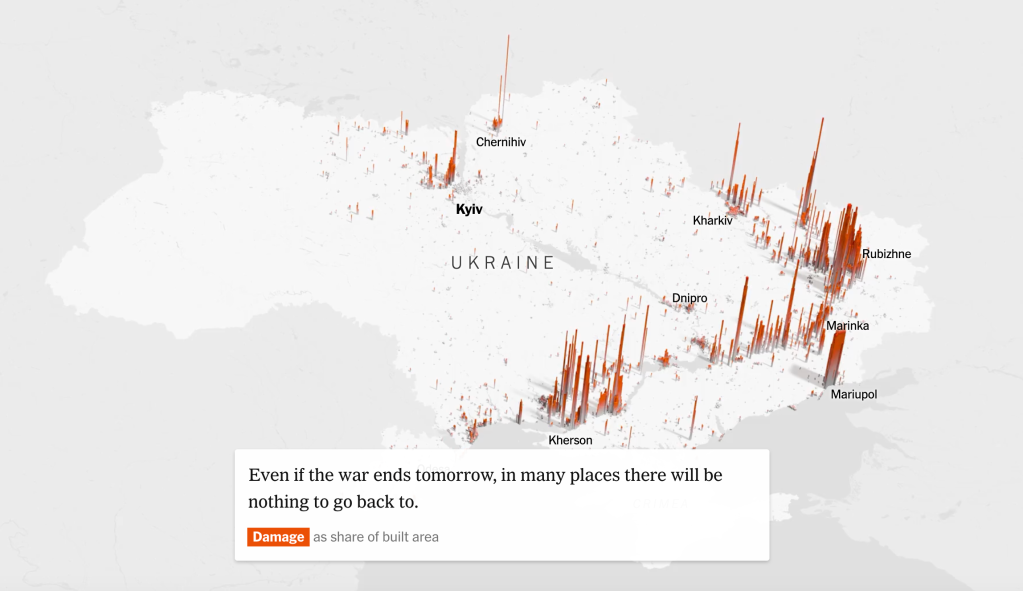
KYIV, Aug 26 (Reuters) – Russia launched about 200 missiles and drones at Ukraine on Monday, killing five people and striking energy facilities nationwide, Kyiv said, while neighbouring NATO member Poland reported a drone had probably entered its airspace.
Power cuts and water supply outages were reported in many areas, including parts of Kyiv, as officials said the attack – 2-1/2 years into Russia’s full-scale invasion – targeted power or other critical infrastructure in at least 10 regions.
Russia dramatically stepped up its strikes on the Ukrainian power grid in March in what Kyiv has said looked like a concerted effort to degrade the system ahead of next winter when people need electricity and heating most.
Monday’s missile and drone salvo was Russia’s most intense in weeks, coming as Ukraine is claiming new ground in a major cross-border incursion into Russia’s southern Kursk region while Russian forces steadily inch forward in Ukraine’s east, closing in on the transport hub of Pokrovsk.
“It was one of the biggest combined strikes. More than a hundred missiles of various types and about a hundred Shahed drones. And like most previous Russian strikes, this one is just as sneaky, targeting critical civilian infrastructure,” President Volodymyr Zelenskiy said on Telegram.
Memorial for actor Joachim Gottschalk. When his Jewish wife Meta and son Michael were to be deported, the whole family decided to commit suicide on November 6, 1941. The bronze figure, which was created by Theo Balden in 1967, resembles the actor. It was initially located in a park but had to be moved due to the building of the local Sparkasse in the 1990s. Its new place is a memorial wall in the Joachim-Gottschalk-Straße 35.
The Impact of the Gold Rush on Native Americans of California
This inquiry lesson provides primary sources, maps, images, and background history to offer teachers and students insight into a little-known but vitally important aspect of one of the most iconic events in American history—the California gold rush. Students will analyze sources to answer the question: Do American actions against California Native Americans during the gold rush meet the United Nations definition of genocide?
The attitude of César Chávez and the UFW towards the undocumented changed over time and can be divided into three periods: 1962 to 1975; 1975 to 1993; and 1993 to the present. A look at these changes reveals much about Chávez, the union, and the times. Frank Bardacke is the author of Trampling Out the Vintage: César Chávez and the Two Souls of the UFW.
Whenever an infant heads to nursery, it can feel like an enormous step. Things are changing for everyone. There are all sorts of feelings flying around – relief, sadness, doubt, fear. But what’s going on behind the doors of nurseries and childcare settings in England? India speaks to Joeli Brearley from Pregnant Then Screwed about the current childcare crisis, child development psychotherapist Graham Music about how childcare impacts children, as well as economist Emily Oster on our choices around childcare. India then meets artists Conway and Young who have found a way to make the invisible labour of childcare pay.
Presented by: India Rakusen. Producer: Georgia Arundell. Series producer: Ellie Sans. Executive producer: Suzy Grant. Commissioning Editor: Rhian Roberts. Original music composed and performed by The Big Moon. Mix and Mastering by Charlie Brandon-King.
Childbirth is deadlier in the United States than in any other high-income nation, according to a study released Tuesday by the Commonwealth Fund that underscores the persistence of maternal mortality.
More than 80 percent of pregnancy-related deaths in the United States are preventable, but factors including a shortage of maternity care providers, limited access to after-birth home visits and lack of guaranteed paid parental leave have increased the risk of maternal mortality, especially for Black people, researchers have found.
In 2022, about 22 maternal deaths happened for every 100,000 live births in the United States. For Black people, that number rose sharply to 49.5 deaths per 100,000, according to the report from the Commonwealth Fund, which conducts independent research on health-care issues. Two out of three maternal deaths occur up to 42 days after birth, highlighting the importance of postpartum care, which only some state Medicaid programs and private health insurers cover.
The study compared 14 high-income countries. It used data from the Organization for Economic Co-operation and Development — known as the OECD — which tracks health system metrics across 38 high-income countries, and from the Centers for Disease Control and Prevention Maternal Mortality Review Committees in 36 states.
Although OECD data is widely regarded as the gold standard for international comparisons, the authors note that discrepancies in how countries gather health data may affect the findings.
“We can’t just think of reproductive health at the time of pregnancy because a lot happens after the baby is born. If we’re not supporting women during this crucial time period, we’re never going to solve this problem,” said Munira Z. Gunja, the study’s lead author and a senior researcher at the Commonwealth Fund.
Ten of the countries listed in the report had a death rate of fewer than 10 per 100,000 live births; in 2022, Norway’s maternal death rate was zero.
Laurie C. Zephyrin, senior vice president for advancing health equity at the Commonwealth Fund, said these numbers paint a stark picture of health care in the United States. She called for more focus on community-led investments, including birth centers and health-care teams working with patients in the weeks before and after delivery. She also said health systems should have incentives and accountability involving equitable quality of care, particularly for communities of color.
With 65 percent of maternal deaths occurring after birth, many health experts emphasize the need for not only more prenatal care but an increase in comprehensive postpartum care.
“We want this to be the cultural norm. We want this to be federal policy. We want there to be a big change because we know that we can completely minimize the rate of maternal deaths in this country,” Gunja said.
Health disparities are not unique to the United States. In Australia, Aboriginal people are twice as likely to die of maternal complications compared with other people giving birth, according to the report. Still, experts are hopeful that policy changes and awareness will help bridge the divide and decrease the overall maternal mortality rate in the United States.
The report highlighted the importance of access to midwives, whose work has been described as an important factor in countries with the lowest maternal mortality rates, the report found. Teams involving midwivescould deliver 80 percent of essential maternal care and potentially prevent 41 percent of maternal deaths, 39 percent of neonatal deaths and 26 percent of stillbirths, the report said.
Some studies have found that teams led by midwives offer care comparable, or superior, to care provided by obstetrician-gynecologists. In the United States, Canada and South Korea, OB-GYNs outnumber midwives, but in most other high-income nations, midwives are more prevalent.
The United States and Canada face a shortage of midwives and OB/GYNs. Almost 7 million people in the United States live in areas without hospitals or birth centers offering obstetric care or any obstetric providers. The shortage is expected to worsen.
“We are setting ourselves up for an absolute reproductive health provider shortage, and contributing to that is this interference into the patient-provider relationship and the restrictions that are being placed on us,” said Tamika C. Auguste, a D.C. OB/GYN and chair of the American College of Obstetricians and Gynecologists Foundation Board who was not involved with the study.
The United States is the only high-income nation without a federally mandated paid parental leave policy and universal health care. Only 13 states and D.C. have paid family and medical leave laws; these policies have been shown to improve health outcomes for pregnant people.
“We are in a dire time in our country, where we’re seeing firsthand the impact of these policy changes at the state level and how they are impacting people’s lives,” Zephyrin said.
In recent years, abortion restrictions have sparked debates and legal battles. State legislatures have been enacting increasingly stringent laws aimed at limiting access to abortion services, such as mandatory waiting periods, ultrasound requirements and bans on certain procedures.
The current wave of abortion restrictions has significantly affected broader health-care services, particularly obstetric care. States that have imposed abortion restrictions often face closure of clinics offering a variety of health-care services, such as cancer screenings, contraceptive services and general reproductive health care. As a result, people in these states encounter greater challenges that exacerbate existing health disparities.
“Women’s health-care providers are being driven out of areas due to the restrictions on practicing full-scope reproductive health care,” Auguste said. “This creates areas where there are no health women’s providers for women.”
The factors that led into the creation of their newest album aligns perfectly with the discussions this podcast is about. Just blocks away from the 3rd Police Precinct that burned down during the protests, Twin Cities country-folk band The Gated Community saw many of their recordings lost due a power outage. But being in the center of burning buildings, gunshots, and neighborly concern, Sumanth Gopinath was compelled to write about it. The result: songs about that tumultuous era that culminated in a new album filled with important issues and topics, which fit perfectly with their existing songs and socially conscious perspective as a band. Sitting around one table, I got to hear about the evolution of a band without egos, which is part of what makes The Gated Community so special.
In his new book, Barons: Money, Power, and the Corruption of America’s Food Industry (Island Press, 2024), Austin Frerick identifies contemporary “barons” in seven different corporations—such as Cargill, Inc., the Driscoll’s and the conglomerate JAB Holding Company—who have taken over food systems and re-shaped communities. Frerick writes in the introduction, “I refer to these people as ‘barons’ to hearken back to Gilded Age robber barons such as John D. Rockefeller and J. P. Morgan because I believe that we are living in a parallel moment when a few titans have the power to shape industries.”
A fellow at theThurman Arnold Project at Yale University and former Treasury Department official, Frerick has been among the leading experts and researchers in competition policy and antitrust examining food industry consolidation. As co-chair of the Biden campaign’s Agriculture Antitrust Policy Committee, he helped advise several of the leading Democratic presidential candidates on agricultural policy leading up to the 2020 election.
Frerick’s interest in the barons of today’s food-industry is also personal. As a seventh-generation Iowan, Frerick’s interest in antitrust policy began as an undergraduate at Grinnell College where he researched corporate power in Iowa’s slaughterhouse communities.
Barn Raiser spoke with Frerick about how agricultural consolidation has changed the landscape of rural America, and how to bring rural people out from their local Walmart and back onto “Main Street.”
What is it like writing about your home?
It started off as angry and it changed into profound sadness. I think that’s because the origin of the book is in Iowa. “The Hog Barons” chapter is what started this whole thing. This book came about because I published that article in Vox on the hog barons at Iowa Select Farms in Iowa, and I got a book deal from that. I noticed that I changed the tone from when I wrote it as a magazine article and made it into a book chapter. It now reads to me as profoundly sad, like it all kind of fell apart in Iowa. It’s grappling with the Iowa I grew up in and what it’s become, from the anger that’s everywhere to just how industrial the landscape has become.
You wrote that “as farms consolidate, more and more of the wealth leaves rural communities and flows to the Cargills of the world.” You also describe how your hog barons live in a gated community in Des Moines — far from the pollution and working conditions they are creating. A few weeks after your book came out, Jeff and Deb Hansen of Iowa Select Farms, the hog barons you highlight in chapter one, published an op-ed in the Des Moines Register, where they called themselves “stewards of [their] land and communities.” What was your reaction to that op-ed?
They employ their own spokesperson, like someone’s job is to do this for a living, and I just thought it was so poorly written. It reinforced in my head that no one’s ever the villain in their own story. And they’re just delusional. They’re living in a delusional world. They’re just not living in the same world we’re living, and I think the op-ed reflected that. To call themselves stewards of the land with a straight face, it’s just like, no one in Iowa thinks that. That’s an accepted reality at this point.
You hosted a book event in Iowa Falls, where the hog barons are from. What was the reception to your book like there?
Honestly that one shocked me the most. I was actually nervous for that event. I really haven’t been nervous at all during this whole book process. That was the one time I was a little worried for my safety. I turned that tracking thing on my phone so my husband could follow me. It’s a little scary, it’s like you’re going into the heart of the beast. At every book event someone asked me am I worried about my safety, which was, you know, an unnerving question to get all the time. But I had a completely different reaction when I got there. I was shocked. Not only at the turnout—I mean, like 45-50 people—but that there was not one dissenting voice. It was among the most incredible after-talk experiences I’ve had because it felt like a third or half of the room came up and talked to me afterwards, because they all know Jeff and Deb, the hog barons.
They all told me a different story of how Iowa Select Farms bamboozled the community from promises they made and didn’t keep for Des Moines and the intimidation tactics they used to build their empire. Iowa Falls is a beautiful town. It was the epitome of the American Dream for a lot of people and then Jeff and Deb just come in and kind of destroy things to their own personal benefit, and then they hightail it out of there. That’s one thing I kept hearing from people, how they did all this stuff, and then they just left.
In the conclusion of your book, you discuss how “a sense of a distinct regional and local identity” disappears when local businesses disappear. “Unlike the barons, the owners of local businesses live in the communities they serve and are stakeholders in their success. Losing them means losing the glue that binds communities together.” What would need to change for the “Main Street” in rural communities to be revitalized?
This culture of efficiency we live in has stripped us of our community. It views everything as an Excel sheet. There are no coffee beans native to Iowa, you can get coffee anywhere. So much of what you’re buying into is interaction with another human, a sense of being. People bought coffee from my mom because of the human connection and Excel can’t capture that. I was really determined to make that point. Because I saw my mom, who used to work for her own coffee store, and later worked at a corporate Starbucks in Target.
These communities thrive when middle class family farms are around. The biggest way to do that is by putting animals back on the land. These confinements have just destroyed rural communities in every way possible. We also need old fashioned trust busting and antitrust enforcement.
Could you explain how CAFOs are connected to Main Street? How are confinements impacting Main Street?
Denise O’Brien in southwest Iowa really drove home this point to me. She’s a longtime activist, and she talked about how much her street has changed in her lifetime. First of all, one human being can only watch so many cows on pasture—you can’t do robotics for that. Family farms pay local taxes, send their kids to local schools and spend their money locally in town. When that consolidates to one person who owns a big metal shed stuffed full of animals, and the owner of the asset lives in an urban rich community, and then has a low wage worker pop by and take care of things, that’s a very different occupation. It’s the difference between watching a cow on pasture to hauling out dead pig bodies, which is what a lot of that work entails. There’s a whole undercurrent of trauma a lot of these low wage workers experience from basically being surrounded by this incredibly cruel production model that is full of death and destruction.
You write that to change the current system and to “build a more balanced food system” we need to “challenge power directly.” How are you hoping your book will mobilize others to build a more just food system?
That’s my nice Iowa way of rejecting the whole change the food system with your fork mentality that’s been the theory of change the last few decades. To me, it just bifurcated the food system between those that go to the New Pioneer Co-op in Iowa City and those go to Walmart. No one’s ever going to get you a seat at the table. So you have to fight for it.
Mariameno Kapa-Kingi, Te Pāti Māori Member of Parliament for Te Tai Tokerau, raised eyebrows recently when she claimed in parliament that the government of had a “mission to exterminate Māori.”
Kapa-Kingi was speaking on a proposed change to the processes under which children forcibly removed from their parents by the child welfare agency Oranga Tamariki are placed in foster care.
“The theory of the Minister is that Oranga Tamariki’s governing principles should be colour-blind, which is just another word for white supremacy, because to say we are all one people is really to say we should all be white people,” she explained.
Mariameno Kapa-Kingi, Te Pāti Māori Member of Parliament for Te Tai Tokerau. Photo: Tania Whyte
Prime Minister Christopher Luxon described the speech as ‘completely out of line’ and ‘unhelpful.’ Opposition leader Chris Hipkins agreed that it was unhelpful, adding “It’s certainly not language that I agree with.”
Te Pāti Māori co-leaders backed up their MP, however. Rawiri Waititi called it a brilliant speech. “This is how we feel and we will not be told how to feel,” Waititi said. “Many of the policy changes that this Government absolutely makes us feel like there [are] huge extermination processes and policies [aimed at] the very existence of tangata whenua in this country, so it was absolutely the right wording.”
When the facts don’t stack up, you can always appeal to feelings.
Co-leader Debbie Ngarewa-Packer concurred. She could hardly do otherwise, since she herself had used similar language in respect of another of the government’s reforms. Her own response last November to the incoming government’s move to roll back some recent restrictions on sales of cigarettes was equally immoderate: “There is absolute deliberate intention of this government, as I said, to create systemic genocide,” she said on that occasion.
Te Pāti Māori Co-leaders Rawiri Waititi and Debbie Ngarewa-Packer
The question, however, is not how Rawiri Waititi or anyone else feels about anything, but whether the claim is true. And as everyone who has not completely lost their head knows, such claims are preposterous. Genocide is not just cultural assimilation, but the physical extermination of a people. It is inconceivable without mass violence and ethnic killings.
The closest thing to ethnic violence against Māori on such a scale in New Zealand history was during the land wars of the 19th century. And even that was not a war of genocide, but a war of dispossession. As soon as the colonial authorities had their hands securely on the land, the fate of the dispossessed Māori became a matter of relative indifference to them.
A repeal of anti-smoking legislation, or of child welfare legislation – irrespective of one’s attitude to that repeal – does not constitute mass violence. To use such terms to describe what is happening in New Zealand today only debases the language and renders the terms themselves meaningless. And in doing so, it disorients anyone who takes the term for good coin, concealing the true nature of the problem, and disarming anyone who seeks to address it.
What drives Te Pāti Māori to resort to such histrionics and attention-seeking language?
The answer to that question lies in what Te Pāti Māori is. It is an electoral formation and nothing more. It has no existence outside of Parliament and its associated vote-gathering machinery. It is a parliamentary voice without a movement, like a head without a body, and is therefore powerless, despite its presence in parliament, to affect the course of politics in any significant way.
This powerlessness was exposed in the immediate aftermath of last year’s election, when, buoyed by its electoral gains and alarmed by the new government’s right-leaning course, it called for a National Day of Action to coincide with the opening of the new Parliament in early December. The declared kaupapa was to demonstrate the “beginning of a unified Aotearoa approach to the government’s assault on Tangata Whenua and Te Tiriti o Waitangi”. Their hype included the prediction that “The movement that we’re seeing from Māori will make the foreshore and seabed hīkoi look like something extremely small.” This was a reference to the protest of twenty years ago, in which 15,000 Māori and others converged on Parliament, and which triggered the Labour Party’s Māori MPs to quit to form Te Pāti Māori.
Nothing remotely comparable to this occurred in the December 2023 Day of Action, despite generous support of the action by the liberal news media, which publicised the assembly points in advance. A few hundred marched in Wellington, and groups of a few dozen rallied in various other towns and cities. In the largest working class concentration, Auckland, a handful of car drivers attempted to disrupt traffic on the motorways, with little effect. It was a rather stark revelation of the narrowness of support for Te Pāti Māori, especially among workers.
When its fighting talk in parliament produces zero effect, the party therefore has few options except to open their mouth wider, shout louder, and use more extreme language in order to win the ear of the ruling class. Not just ‘racism’, but ‘white supremacy’ becomes the order of the day. Not just ‘discrimination’ but ‘extermination’. Not just ‘extermination’, but ‘systemic genocide.’
Don’t be fooled by the truculent posturing and coarseness of tone: these appeals are directed to the rulers, asking “please, listen to us!” They hope to frighten the ruling layers into adjusting their course.
(On his side, Winston Peters of New Zealand First, the counterpart of Te Pāti Māori on the right wing of capitalist politics, uses equally hyperbolic language in his denunciations of Te Pāti Māori, accusing them of “cultural Marxism” and of wanting “anarchy – headed by their Māori elitist cronies turning this country into something akin to apartheid.” Believe me, Winston, nothing could be more alien to Marxism than the politics of feelings!)
But neither the government nor the broader ruling class will listen to Te Pāti Māori. They defend above all else the dictatorship of profit, and the rate of profit has now fallen to the point where it is incompatible with some of the most basic social rights and needs, such as affordable housing, equitable access to health care, basic infrastructure like water and roads, and more. Their ability to grant even small concessions is strictly limited: on the contrary, their present focus is to restore their profits by making even deeper inroads against our wages and social rights.
And among the things capitalist society today is incapable of delivering is the protection of children from violence. The child welfare ministry Oranga Tamariki has been in a permanent state of turmoil for many years, over the question of uplifting children from their parents. It is no closer to resolving this than it was five years ago, when a shockingNewsroom documentary by reporter Melanie Reid exposed the brutality of child ‘uplifts’.
On the one hand, Oranga Tamariki is rightly excoriated for the tearing apart of Māori families in circumstances where it is not justified, such as the case documented in the 2019 documentary, causing long-term trauma. On the other hand, it gets criticised – again with full justification, at least in some cases – for failing to protect the lives of children, who suffer violent deaths at the hands of their family members at a high rate in New Zealand.
Coming under fire from both these opposite directions, the institution lurches from one policy to the opposite, according to the nature of the most recent scandal. At the time of the 2019 documentary, Oranga Tamariki was uplifting hundreds of babies each year, in response to criticism for failing to prevent the violent deaths of babies at the hands of family members. About 70% of these uplifted infants were Māori. (Māori make up about 20% of the population). Oranga Tamariki was under pressure to act pre-emptively in many of these cases, before there was any clear evidence of danger to the child – and therefore these decisions were inevitably based on rumour, prejudice, and racial profiling of Māori as ‘bad parents’. In many cases, the decision to uplift was taken in secret, without any prior discussion with the family concerned.
An intense public outcry followed the documentary. Protests outside Parliament demanded an end to the unjustified snatching of babies, especially Māori babies, from their parents’ arms. The protests denounced the lasting trauma inflicted on the affected Māori families, and the damage to the social fabric caused by the high rate of children being taken into state care. A petition called Hands off Our Tamariki (children) gained 17,377 signatures.
Protest at Parliament demands “Hands off Tamariki forever” Photo: Lynn Grieveson
These protests prompted a switch to the opposite policy. Following multiple inquiries into the functioning of Oranga Tamariki, an amendment to the governing principles of Oranga Tamariki was introduced in 2019, called Section 7AA, which bound the institution to uphold the principles of the Treaty of Waitangi in matters concerning Māori children. In practice this meant placing uplifted babies with members of their own whānau, or with their wider iwi, wherever possible. Labour Party Minister for Children Kelvin Davis proclaimed “This report will end uplifts as we have known them. While there will always be a need for some children to be taken into care, this should only happen after all avenues with community and whanau have been exhausted.” The rate of uplifts fell steadily, from 963 uplifts in 2018 to 251 in 2022.
This was a small but significant gain for the whole working class. It pushed back state interference in Māori families and strengthened the bonds of solidarity within our class.
The death of another young child at the hands of his family has halted that momentum, and now the pendulum is poised to swing all the way back again. Wellington toddler Ruthless-Empire Wall was beaten to death by family members unknown, just shy of his second birthday, in October 2023 – after the boy’s uncle had alerted Oranga Tamariki to the dangerous environment he was living in, and requested them to place the boy in his care.
Now the government, at the behest of its Act Party component, seeks to restore the policy of wholesale uplifts. Act campaigned on the issue in last year’s election, and repeal of Section 7AA was part of the coalition agreement between the three parties that formed the new government in November 2023. The campaign is headed by Act’s Karen Chhour, the incoming Minister for Children and for the Prevention of Family and Sexual Violence. Chhour, who is Māori herself and was raised in state care, presented her own petition to repeal Section 7AA, which received more than 13,400 signatures.
Chhour claims that Section 7AA has led to Māori children being removed from safe and loving homes because their caregivers weren’t of Māori descent. “I consider that section 7AA allows the treatment of children and young people as an identity group first, and a person second, it creates a divisive system that has had a negative impact on caregivers. This repeal will make sure that Oranga Tamariki is entirely child-centric and is making decisions that ensure a child’s wellbeing and best interest. Over successive years, Oranga Tamariki has failed our most vulnerable children, and in part that has been because of Section7AA,” she said.
Karen Chhour Photo: Doug Mountain
Chhour presents no evidence to back these assertions, a point noted by the Waitangi Tribunal which entered the debate. If children are actually being torn from existing foster homes where they have already bonded with their caregivers, simply because their caregivers were not of Māori descent, that could be a matter of legitimate concern. But it is incumbent on Chhour to prove that this is in fact happening. Since she does not do so – beyond claiming to have seen it herself – this appears to be a spurious claim.
Nor does she make any attempt to explain why or how adherence to the Treaty of Waitangi should lead to Oranga Tamariki making decisions that are not in the child’s best interest. Her unsupported assertion hints at an unspoken racist explanation: that Māori parents and foster parents are less than competent caregivers. This is a debate with high stakes.
Thus, the issue Mariameno Kapa-Kingi was attempting to address is a real one, and the repeal of Section 7AA should be opposed. It is the ability to recognise a real problem, combined with the inability to do anything about it, that generates the flailing of arms in Parliament, and the politics of middle class hysteria in general.
Even if the repeal of 7AA is defeated, the social scourge of violence against children can only be expected to worsen in the short term. It is a consequence of, among other things, the divided, weakened state of the working class, which is increasingly being torn apart by the ordinary workings of the capitalist economy, exacerbated by the actions of its government and state.
Such violence against children is connected with massively increased economic and other pressures on families: the inflation eroding our wages, the growing insecurity of employment, the cuts to social services like health care, including mental health care, the breakdown of attendance at school, and above all, the housing shortage, which hurls ever-wider layers of workers down into the horrors of drug-riddled and gang-infested ‘emergency housing.’
Violence against children is closely connected with the scourge of violence against women, in which New Zealand ranks so shamefully high in the world. It is worth noting that Te Pāti Māori, along with the Labour, National and Green parties, supported legislation that undermined women’s single-sex spaces, including women’s refuges from domestic violence, by requiring them to open their doors to males. They took an active part in the attack which shut down a women’s rally in Auckland in March 2023 by force and violence. This fact alone should nullify their claim to speak in defence of children.
As long as these social conditions continue, there will continue to be situations in which children have to be removed from their parents’ care in the interests of their own safety. But such removals can also provide an opening for hostile class interests to drive in a wedge that tears apart working class families. This has been done disproportionately, though not exclusively, against Māori, who make up a substantial component of the working class. It is the built-in tendency of intervention by the capitalist state and its agencies like Oranga Tamariki.
It falls to a revived movement of the whole working class to oversee such situations and to ensure that the ties between children and their whānau are maintained as far as possible during their removal, and that they are returned to their parents’ custody as quickly as possible. Strengthening solidarity within the working class, along with raising the social status of women, is the road to ending the violence against children in a more permanent way.
This is not a new problem for the working class worldwide. Farrell Dobbs, a leader of the historic Teamsters Union strikes which organised truck drivers in the US Midwest in the 1930s, once described how these strikes took on the character of the mass social movement. The Teamsters Union Local 574 ‘flying squads’, which had been organised to shut down strike-breaking trucking operations across the city, expanded their operations to intervene when the union got news of unemployed workers being evicted from their homes for non-payment of rent. The arrival of the union flying squad quickly ended the attempts by landlords and their deputy sheriffs to evict the worker.
Farrell Dobbs, (with images from the 1934 strikes behind him)
“In a few instances, the union even adopted children,” Dobbs said.
He explained that at the time it was common for bourgeois charities to identify working-class families that in their view were unable to adequately provide for their children, and the charities would then arrange to have the children adopted out, against the wishes of their parents. The union organisation stepped in to prevent this happening, finding foster parents from among the union ranks to care for the children temporarily, so that they could be returned to their parents at the earliest opportunity. (The talks where Dobbs tells the story of the Minneapolis strikes are available on YouTube, and are very inspiring to listen to in full. Dobbs describes the adoption of children in the third talk, beginning about the 24th minute.)
Children demonstrate in support of their unionist parents
At this point there is little outward sign of such a revived fighting labour movement in New Zealand, so this political course is far from obvious to see.
What is abundantly clear, however, is that Te Pāti Māori, and all those like them who pursue the opposite course – of appealing to the capitalist rulers and relying on their parliamentary apparatus and state institutions – quickly find themselves in a blind alley.
Errollyn Wallen’s memoir Becoming a Composer is a look into the mind of the composer as well as the life of one. Born in Belize but now based in the far-flung north of Scotland, where she sometimes inhabits a lighthouse, she works at a brisk pace, composing prolifically for orchestra, chamber ensemble, choir, and over twenty operas. Her major public commissions have included music for The Last Night of the Proms, the Paralympic Opening Ceremony, and the Queen’s Diamond Jubilee, and she joins us from her home in the Orkney Islands to talk about Becoming a Composer, and becoming a composer.
Music heard in the show:
Title: Horseplay i. Dark and mysterious Artist: The Continuum Ensemble/Philip Headlam Composer: Errollyn Wallen Album: The Girl In My Alphabet Label: Avie AV0006
Title: Dervish Artist: Matthew Sharp (cello), Dominic Harlan (piano) Composer: Errollyn Wallen Album: The Girl In My Alphabet Label: Avie AV0006
This ad for a “big stadium concert” by the Russian nationalist pop singer Shaman, scheduled for 7 p.m., September 9, at Petersburg’s Gazprom Arena, showed up this morning (for the second or third time in the last mont) in the weekly email newsletter I get from Bileter.ru, a Russian online retail ticket vendor. The aesthetic here is both strikingly fascistic/nationalistic and pointedly un-Russian. I would say it’s almost American in its inspiration, if I didn’t know better. ||| TRR
This showed up in my mailbox today too:
За последние две недели в редакции произошли изменения. У нас теперь новый руководитель редакции, а потому скоро вы ощутите изменения, которые make Inc. great again.
Here’s my translation:
There have been changes to [our] editorial board over the past two weeks. We have a new editorial director now, and so you will soon feel the changes that [will?] make Inc. great again.
These days, all “progressive” Russians are fluent in English, supposedly, and this is often how they signal their “progressive” values to each other: by shouting out their true reactionary colors in Rusglish.
In this case, the progressive reactionaries hale from Inc. Russia, “a magazine for entrepreneurs [that] focuses on small and medium-sized businesses, advanced technologies, and the people behind it all.” Founded in the US in 1979, the Russian edition has been in existence since 2016.
The passage that I quoted and translated, above, led off Inc. Russia‘s weekly email newsletter.
Immediately after Russia’s brutal, unprovoked invasion of Ukraine, the Russian Inc.ers were openly dismayed by the sudden turn of events in their otherwise entrepreneurially progressive country—without, however, ever going so far as to oppose the war explicitly. This dismay and confusion gradually and visibly diminished as the war continued. Now, apparently, Inc. Russia has come full circle: they are determined to show that they and their readers live in nearly the best of all possible entrepreneurial worlds. They’ve definitively stopped paying any mind to their country’s breakneck plunge into fascism, much less to the war itself.
And yet the new realities occasionally puncture Russian Inc.‘s otherwise now-placid surface, as in this news item published on their website earlier today:
English to become optional in the subway
It may become option to duplicate information in subways in English. The Transport Ministry has published a law bill addressing the matter. The Moscow subway stopped duplicating [station] names back in 2021, while Nizhny Novgorod and Kazan do not plan to give up English until instructions are received.
As reported by Kommersant, the Transport Ministry has published a draft law on amendments to the orders regulating the “standard rules” for the use of subways, monorails, funiculars, and suspended cable cars.
Carriers are currently required to duplicate all information on diagrams, signs, inscriptions, and station announcements in English. The Transport Ministry proposes doing away with this obligation, leaving the decision to the regions.
The proposal was prompted by “numerous appeals from citizens and [regional governments], due to the considerable informational burden on passengers and taking into account the socio-political situation.”
Moscow’s Metro, Central Circle, and Monorail stopped announcing stations in English back in 2021, after a drop in the number of tourists due to the pandemic and “passenger complaints about additional information.”
Oleg Yaushev, director of the Nizhny Novgorod Metro, said that none of the city’s residents had complained about the English dubbing in the city’s subway, so the company does not plan to remove it.
“We installed this information system relatively recently and spent a lot of money on it. Why remove it now? Tourists who are native English speakers travel to the city. The language is widely spoken, and we welcome them. Of course, if there is a directive to remove everything and leave it only in Russian, we will comply. But it’s not worth freaking out about it,” he said.
Kazan’s Metroelectrotrans also expressed its willingness to execute the order, “if it is issued.” However, local residents there have also not petitioned the company to cancel the dubbing of station names in English.
Russian streaming service Amediateka (thanks to the good offices of sanctions busters HBO) keeps its viewers comfortably ensconced in an alternate reality dominated by the Great Satan’s pop culture:
The second season of the sports series “Winning Time: The Rise of the Lakers Dynasty” recounts the period between 1980 and 1984. It deals with the rivalry with the Boston Celtics, as well as with the personal lives of the players, which prove no less emotional and striking than their play on the court. Jerry Buss wants to get his sons involved in working with the Lakers, Magic Johnson learns to be a good father, and Larry Bird plunges into family squabbles. Won’t this prevent the lads from becoming NBA champions?
Source: Amediateka email newsletter, 14 August 2023. Translated by the Russian Reader
Finally, here is yet another reflection of the Russian petite bourgeoisie’s (and, hence, Russian officialdom’s) peculiar love-hate, cargo-cultish relationship with the “collective west” (i.e., the United States) and the English language.
Pacific Grove, California, 10 June 2023. Photo by the Russian Reader
Jose Martinez has lived and worked in the United States since he was 14 years old. Now 67, he drives around the Yakima Valley in Washington state checking on fellow workers.
“When it’s hot, do you have a place to protect yourself from the sun and heat?” he calls out to some workers on the side of an apple orchard on a sunny June morning.
Martinez worked in agriculture across the fields of California and, most recently, Washington state. Irrigation, grapes, apples, mushrooms, dairies and now cherries. He’s done a little bit of everything.
“I love the fields because you’re in the open air,” he told NPR in his native Spanish, sitting on the lawn outside his home in Sunnyside, Wash. “It’s beautiful. I am proud to do it, to be a farmworker. Why not?”
When people think of farmworkers, often they think of migrant workers and labor organizers like Cesar Chavez and Dolores Huerta. Now, they may add another name to those creating major changes in the farming workplace: Jose Martinez.
Over the past decade, Martinez has been central to two flagship lawsuits creating policy changes in the state — making Washington one of the leaders in providing overtime to farmworkers and settling acivil rights case in favor of workers. And recently, he has taken his fight to Washington, D.C., where he has pushed for an expansion of legal status and protections for farmworkers.
Federally, farmworkers are largely excluded from many federal workplace safety regulations. They don’t have a right to overtime pay or to unionize, and children as young as 12 can legally work in the fields. As a result, some states, like Washington, have extended additional rights and regulations.
The Nottingham Starbucks voted to join Starbucks Workers United in June 2022 — and Ms. Torregoza and her colleagues stepped into a world of trouble.
The corporate dirty war that ensued — in Nottingham and at newly unionized Starbucks cafes across the country — draws a sobering picture of employee rights casually crushed and labor laws too weak to help. Starbucks continues to fight and appeal the many labor complaints pending against it and maintains that the company has done nothing wrong.
But these professions of innocence are countered by piles of testimony from workers and National Labor Relations Board findings suggesting that Starbucks has indeed illegally repressed employees’ rights. The company has so far racked up a staggering number of complaints from the agency. In 100 cases, many of which consolidate a number of incidents, regional N.L.R.B. offices have decided there is sufficient evidence to pursue litigation against Starbucks. That includes a nationwide complaint, consolidating 32 charges across 28 states, alleging that Starbucks failed or refused to bargain with union representatives from 163 cafes.
Starbucks lacks the glamour of Hollywood and the indispensability of UPS, but as strikes and union drives erupt across the economy, the coffee workers’ struggle illuminates the stark and sometimes insurmountable challenges confronted by ordinary American workers who try to exercise their right to organize.
That Starbucks is carrying on this campaign in plain sight may be the most damning aspect: Union busting is illegal, but consequences are inconsequential. The Starbucks case demonstrates that a large corporation can effectively bust a union with time, by dithering over details and exhausting legal appeals. According to national labor laws, an employer “must bargain in good faith.” But that is a squishy and essentially unenforceable rule. Starbucks may yet succeed in smothering one of the most energized labor movements of our time.
The striking miners were 10,000 strong on the first day of September 1921 as they charged up the slope of Blair Mountain, propelled by a radical faith in the American dream. According to an Associated Press reporter who crouched behind a log and watched through field glasses, each time they pressed forward, a “veritable wall” of machine gun fire drove them back. As the barrage echoed through the hollows, reminding some of the action they had just seen in the forests of France, the advancing miners soon heard a different sound: deeper, earthshaking explosions. From biplanes above, tear gas, explosive powder and metal bolts rained down. “My God,” screamed one miner fighting his way up Crooked Creek Gap. “They’re bombing us!”
“They” were Sheriff Don Chafin and his deputies, who terrorized the citizens of Logan County, W.Va., by the authority of the coal companies. The miners vastly outnumbered their opponents, but Chafin had the superior position and weapons. “ACTUAL WAR IS RAGING IN LOGAN,” one local paper declared the day before.
The miners were fighting for the right to unionize, and to end the reviled “mine guard system,” a private force of armed guards who brutally enforced the company’s control in the coal fields. Unless the mine guard system was removed, John L. Lewis, president of the United Mine Workers of America, had warned, “the dove of peace” would “never make permanent abode in this stricken territory.”
On Sept. 4, federal troops arrived at Blair Mountain. The miners cheered, thinking Uncle Sam had come to liberate them from King Coal. Uncle Sam had no such plans. In 1921, about three million Americans were unemployed, and Washington was concerned that the industrial war raging in southern West Virginia could spread to other states. The troops told miners to stand down, and they did. “We wouldn’t revolt against the national government,” one of them said.
The miners were roundly defeated, but their struggle was not in vain: Years later, as part of the New Deal, the rights they were fighting for — including the right to collectively bargain — were written into law. Black, white and immigrant, the “Red Neck Army” (so named for the red bandannas they wore) had mounted the largest working-class uprising in U.S. history and the largest armed insurrection since the Civil War.
Today, Blair Mountain is just that: a mountain. While many battlefields are the object of exhaustive study and veneration — places and times when power wobbled and blood was shed — Blair Mountain is still largely unexplored. No statue or roadside attraction commemorates it; no tour buses roll up and disgorge visitors. Despite a burst of recent interest, for most West Virginians, the story of Blair Mountain barely even exists.
Despite its declared war on “satanic” western values, Putinist Russia continues to slavishly imitate all the worst the mythical west has to offer, including “Black Friday,” as exemplified by this image from an email flyer sent to me earlier today by the major online retailer Ozon, featuring the pop singer Dmitry Malikov. Nor has Putin’s “proxy war” with the west stopped the pidginization of the Russian language, as seen in the second-to-last piece in this grim holiday collage. ||| TRR
The expected tourist flow from Iran may amount to approximately two thousand people a week starting in the spring of 2023, director of the municipal tourist information bureau Yuri Bogdanov said on November 24. According to him, relevant negotiations are underway with air carriers.
“We are negotiating with airlines that want to provide direct flights between Iranian cities and St. Petersburg. We hope that there will be six flights per week with an average number of around 300 seats on board. This is already about two thousand people a week. We expect that, beginning in the spring, these airlines will supply their airplanes,” TASS quoted Bogdanov as saying.
The expert clarified that there were more flights before the pandemic and six thousand tourists used to arrive from Iran every week.
According to Bogdanov, the flow of tourists may return to its pre-covid levels in St. Petersburg by about 2026, but at the same time primarily due to guests from Russia, and not from foreign countries. According to the figures he cited, in 2019, about five million Russians and 5.5 million foreigners visited the Northern Capital, while 6.4 million Russians and 150–200 thousand foreigners visited the city in the first nine months of 2022.
“We have reformatted the priorities for domestic tourism — we want to reach the same 10.5 million tourists a year. There is every ground for this to happen,” Bogdanov opined.
Earlier, the State Duma Budget and Taxes Committee recommended that St. Petersburg be included in the list of regions that charge tourists a resort fee.
At least 58 children, some reportedly as young as eight, have been killed in Iran since anti-regime protests broke out in the country two months ago.
According to Human Rights Activists in Iran (HRA), 46 boys and 12 girls under 18 have been killed since the protests began on 16 September, sparked by the death of the 22-year-old Mahsa Amini while in police custody.
In the past week alone, five children were reportedly killed by security forces as violence continued across the country.
Speaking at Kian’s funeral on Friday, his family said security services had opened fire on the family car, where Kian was sitting next to his father. Iranian security services have denied responsibility for his death, blaming the shooting on “terrorists”.
Iran’s mounting child death toll comes amid escalating violence in cities across the country, with protests showing no sign of abating.
[…]
Young people have been at the forefront of anti-regime protests, which started after Mahsa Amini died in the custody of Iran’s morality police. She had been arrested for not wearing her hijab correctly.
The deaths of two teenage girls, Nika Shakamari and Sarina Esmailzadeh, both allegedly beaten to death by security forces for protesting, provoked further outrage.
Videos of schoolgirls across the country protesting against their killing by removing their hijabs and taking down pictures of Iran’s supreme leaders went viral on social media, leading to raids on schools where children were beaten and detained. According to Iran’s teachers union, another 16-year-old girl, Asra Panahi, died after she was attacked by security forces in her classroom in the north-western town of Ardabil on 18 October.
The attacks on children in schools is continuing, according to Hengaw, which said a 16-year-old girl from Kurdistan is on life support after throwing herself from a school van, having been arrested at her school last week.
HRA says more than 380 protesters have been killed since the protests began and more than 16,000 people have been detained, including children. The figure is disputed by the authorities.
A view of Vokzal 1853 on opening day. Photo: Sergei Yermokhin/Delovoi Peterburg
On November 21, the opening of the food hall [fud-kholl] Vokzal 1853 took place in the building of the former Warsaw railway station.
It is the largest gastronomic space in St. Petersburg and, so its creators claim, in Europe.
So far, not all the establishments in the eater have opened — the launch . The event zone [event-zona] is designed for to accommodate 2.5 thousand guests and have 4 thousand seats, while the entrance to the second floor is still closed.
The cost of renovating the former railway station exceeded 1.5 billion rubles. The Vokzal 1853 food hall [fud-kholl] is a project of the Adamant holding company and restaurateur Alexei Vasilchuk. In total, as stated earlier, more than 90 restaurant concepts [restorannykh konseptsii] will await visitors, and the total area of the food hall will be about 34 thousand square meter.
The company plans to open a concert venue, craft [kraftovye] shops, and a coworking [kovorking — sic] in the space.
Earlier, DP reported that its creators had conceived the decoration of the premises to suggest the atmosphere of nineteenth-century railways stations, and visitors would find themselves in the “epicenter of a bustling creative life.”
Ukraine continued to reckon with the fallout from Russia’s air strikes on its energy infrastructure, with much of the country still struggling with blackouts. Residents in Kyiv, the capital, were told to prepare for more attacks. Russian missiles damaged a hospital on the outskirts of Zaporizhia, a Ukrainian-held city not far from Europe’s largest nuclear power plant, controlled by Russia. Meanwhile, Ukraine’s president, Volodymyr Zelensky, said Russia was heavily shelling Kherson, the southern city recaptured by Ukrainian forces in early November. Local officials said that strikes killed seven people in the city on Thursday.
Source: The Economist, “The World in Brief” email newsletter, 25 November 2022
This is a wildly disappointing exercise in sophism and self-deception by the usually much more lucid Maxim Katz. Russia has arrived at its present murderous and self-destructive bad end not through rigorous and ruthless totalitarian indoctrination and psychological manipulation, as suggested by Katz’s invocation of Ron Jones’s 1967 Third Wave experiment in a California high school, but through a chaotic, consistent indulgence of opportunism, consumerism, escapism, ressentiment, hipsterism, “westernism,” capitalism, cynicism, nihilism, and thuggery by the elites and the much of the so-called intelligentsia, thus almost completely overwhelming the decent, democratic, and egalitarian impulses and undertakings of differently minded and empowered “other Russians” from all walks of life and all parts of the country. It has been one of the missions of this website to bear witness to both these tendencies in their extreme and trite manifestations. You’ll find vanishingly little of what Katz describes in my chronicles of the last fifteen years here and on The Russian Reader‘s sister blog Chtodelat News. You will find, however, plenty of stories of brave grassroots resistance and movement building blunted and, ultimately, murdered by a police state whose PR wing has urged Russians to trade their freedom for food courts. ||| TRR
This newsletter from the Russian streaming service Amediateka showed up in my inbox a few minutes ago.
Game of Thrones: House of the Dragon. Premieres August 22
See “House of the Dragon” on Amediateka. We don’t want you to miss the biggest and most interesting premieres (“House of the Dragon,” the prequel to the great and mighty “Game of Thrones” is coming soon!), so we’re reminding you that we have a very useful newsletter. From which, however, you can unsubscribe. What you can definitely keep are the subscription promo codes*: a treasury of international TV series is now closer!
What is Amediateka? What does it have to do with HBO?
Russian streamer Amediateka has struck an exclusive deal that allows it to offer all series from WarnerMedia’s HBO Max, in addition to library content from the US studio.
The agreement, which is effective immediately, hands Amediateka shows including the reboot of cult TV series Gossip Girl, Steven Soderbergh’s film No Sudden Move, sci-fi series Raised By Wolves, Israeli war drama Valley Of Tears and teenage drama Genera+ion.
HBO Max hit The Flight Attendant is also available, along with Sex And The City sequel And Just Like That…, with shows accessible on the streamer in Russia and the CIS.
Animal Kingdom, 11.22.63 and Person Of Interest are among library series available, along with documentaries including 15 Minutes Of Shame, Persona: The Dark Truth Behind Personality Tests and docuseries Generation Hustle and the upcoming One Perfect Shot.
Tatyana Kalita, CEO of Amediateka parent Amedia TV, said the deal would provide “resonant and highly sought-after” shows to its audiences, adding that the streamer had enjoyed “stunning success” with the recent special episode Friends: The Reunion, which Amediateka exclusively released in Russia and CIS in May.
But didn’t HBO’s parent company WarnerMedia stop doing business in Russia this spring to protest Russia’s brutal unprovoked invasion of Ukraine?
Major media companies continue to join the exodus from Russia, with Discovery and WarnerMedia making announcements on Wednesday about halting all programming in the country.
WarnerMedia, CNN’s parent company, previously paused the release of “The Batman” in Russia, citing the “humanitarian crisis in Ukraine.”
As of Wednesday the company is now “pausing all new business in Russia,” CEO Jason Kilar said in an internal memo. “This includes ceasing broadcast of our channels, halting all new content licensing with Russian entities, and pausing our planned theatrical and games releases.”
WarnerMedia had been broadcasting CNN and Cartoon Network in the country. CNN said on Tuesday that the network is not shutting down its Moscow bureau, “but we have ceased reporting from there until we have assessed the impact of this new law.” The law makes it a crime to disseminate what Russian authorities consider to be “fake” information about the invasion of Ukraine.
Discovery, which has 15 channels in the country, said Wednesday that the channels are going dark as well. “Discovery has decided to suspend the broadcast of all its channels and services in Russia,” the company said.
Discovery and WarnerMedia are preparing to merge this spring.
The statements are part of a much broader corporate shunning of Russia that has escalated in the two weeks since the Russian invasion of Ukraine began.
Amediateka is currently offering a 12-month subscription to its streaming service at the bargain basement price of 2,499 rubles — or 41 dollars and some change. That’s for an entire year. In the US, WarnerMedia is currently offering a yearly, prepaid subscription to HBO Max for $69.99 with ads or $104.99 with no ads. ||| TRR
A view of Nevsky Prospect, Petersburg’s main thoroughfare, with the Russian National Library (the so-called Publichka), Gostiny Dvor shopping center, the tower of the former City Duma building, the cupola of Kazan Cathedral, and the cupola of St. Isaac’s Cathedral visible on the left in ascending. This picture-perfect cityscape was used by the Facebook page I Love St. Petersburg to illustrate the bizarre, banal, pseudo-historical sentiment that I’ve translated, below. Petersburg was built on the land of the Ingrian people and the captured Swedish fortress of Nyenskans. Or rather, that’s a no less valid way of putting it.
St. Petersburg is the only European capital that has not been captured by the enemy in any period of history.
Source: I Love St. Petersburg (@spb.love.you), Facebook, 13 August 2022. Translated by the Russian Reader
(Upper left, in Russian) “Kiev is the mother of Russian cities.” (Lower right, in Ukrainian) “If I had known, I would have had an abortion.”
Source: Petya Pyatochkin, Facebook, 12 August 2022. Thanks to Volodya Y. for the heads-up. Translated by the Russian Reader
The tables covered in beer Showbiz whines, minute detail (2) Hand on the shoulder in Leicester Square (3) It’s vaudeville pub back room dusty pictures of White frocked girls and music teachers The beds too clean Water’s poisonous for the system (4)
And you know in your brain Leave the capitol! (5) Exit this Roman Shell! (6) Then you know you must leave the capitol
Straight home, straight home, straight home One room, one room (7)
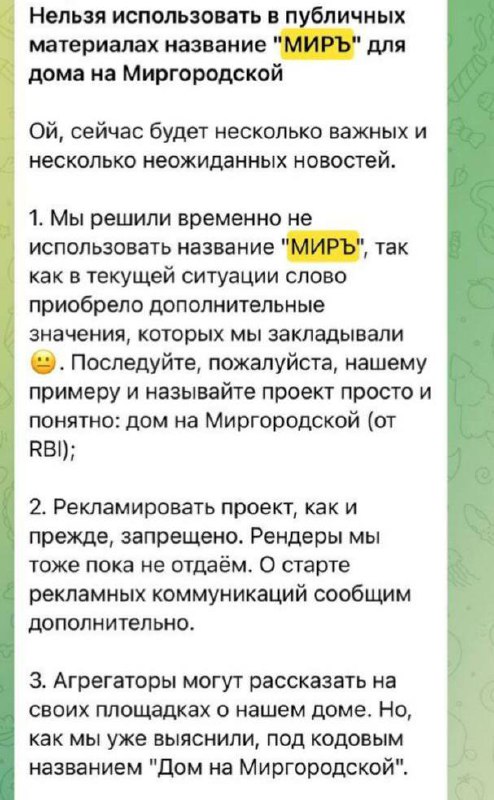
A Petersburg developer asked not to use the name “Mir” (“Peace”) in advertising its [new] residential complex. The company decided to refrain from using the word, which had “taken on additional meanings.”
The screenshot of RBI’s request to shutter the name “Mir” (“Peace”) for its new residential complex on Mirgorodskaya Street (Mirgorod Street) in central Petersburg. Ironically, the street itself is named for the city of Myrhorod in Ukraine. Several other streets in the same neighborhood are named after Ukrainian cities, including Poltava, Kharkiv, and Kremenchuk. It should be pointed out that “mir,” in Russian, also means “world” and “peasant commune.”
RBI’s official website still identifies the residential complex as “Mir,” and this is the case on some other real estate resources as well. And yet, for example, one of the largest industry websites, TsIAN, already refers to it as the residential complex “On Mirgorodskaya, 1.”
Our source at the company told Rotunda that the advertising campaign for the complex had not yet been launched. And that was why they asked their partners — i.e., real estate agencies — “to refrain from directly advertising the sites before the official start of sales.”
Officially, RBI had only the following to say about the meanings implied by the word “Mir”: “As for the word itself, ‘MIR’ in this case refers to the location of the house, as well as to the World of Art [Mir iskusstva] art group.”
Source: Rotunda, 8 August 2022. Translated by the Russian Reader
MIR Club House is a world for connoisseurs of beauty in the very heart of St. Petersburg, a striking house featuring original, artistic architecture.
Compositionally, the complex consists of two buildings: a building of varying heights (six, seven, eight and nine floors) containing 243 apartments, and a small six-story building containing 20 apartments. They are united by a street-facing arch and form a closed courtyard.
The apartments offer picturesque views of Feodorovsky Cathedral, the famous “Kremlin wall of Petersburg,” the historical center, and the new business-class quarter.
Finlandization 3.0, apparently, involves joining NATO to keep the Russian imperialists at bay while simultaneously issuing as many Schengen visas as possible to Russian shopping tourists, who are totally clueless, of course, as they make their triumphant return to the hypermarkets of Lappeenranta, the setting of the hit Nordic noir series Bordertown. Its on-the-spectrum protagonist can barely keep his head above the bloodbath routinely unleashed in the town, which in real life is utterly peaceful and lovely. What is not lovely is the utter cynicism of Lappeenranta’s political and commercial elite, who are, strangely, much more like their fictional counterparts than the real town is like its lush but murderous onscreen double. ||| TRR
Russian shopping tourists are now coming by the busload to a border town in Finland, waiting weeks to make the trip: “It’s about time”
The effects of the border’s [re]opening are already visible in Lappeenranta. The number of Russians is nowhere near the record years, but they seem to have purchasing power.
Russian shopping tourists returned to Lappeenranta shops.
A Sovavto bus from Russia turns in front of the Lappeenranta bus station.
There’s a full load of people exiting the vehicle. One of them is Andrei Kolomytsev of Petersburg. For him, a trip to Finland is a dream come true after a long wait.
“Two and a half years of waiting. It’s about time, ” he sighs.
Last Friday, Russia lifted travel restrictions that it had imposed in response to the coronavirus outbreak last Friday.
Kolomytsev had been one of the first to arrive in Finland in his own car. However, his trip was halted at the Russian border in the morning, because Russia unexpectedly opened the border only at 1 p.m. Kolomytsev had already turned around and headed back home.
Now he’s happy to step off the bus.
“I’ll go to a cafe, and buy cheese and other high-quality food. I’ll have a look around after a long time,” Kolomytsev outlines his plans.
Andrei Kolomytsev is pleased to finally be in Finland. Photo: Kalle Purhonen/Yle
He also plans to visit a local car dealership specializing in Volvos to ask about maintenance prices. This is because it is now difficult to get car spare parts in Russia due to Western sanctions. As a result, car maintenance has also become more expensive.
Buses full Buses to Finland from Petersburg are now fully booked. For example, the Ecolines booking portal has no tickets available from Petersburg to Lappeenranta until August 16.
Another bus company, Sovavto, has no seats available until July 26.
The return of Russian shopping tourists to the shops is already visible in Lappeenranta. There are clearly more Russian cars with long plates on the streets and in parking lots.
The number of Russian customers has also increased, for example, at Lappeenranta’s branches of [Finnish hypermarket chains] Citymarket and Prisma.
“The number of Russians has increased since Friday. While it used to be a matter of lone customers, now we are talking about numbers in the dozens,” says Antti Punkkinen, Prisma’s director in Lappeenranta.
According to Antti Punkkinen, Prisma’s Lappeenranta director, the number of Russian shopping tourists has increased. Photo: Kalle Purhonen/Yle
Ari Piiroinen, the storekeeper at Lappeenranta’s Citymarket, has a similar message.
“The number of Russians has increased steadily since the weekend, ” he says.
But there is still a long way to go to return to the state of affairs before the coronavirus pandemic.
“It is absolutely not possible to talk about numbers like they were in 2019 or earlier,” Punkkinen says.
He stresses that it has only been a few days since the border opened, so it is still too early to draw conclusions about the future number of Russians.
The arrival of Russians is limited by, among other things, the number of valid visas. Russian media have reported long waits for visas in Petersburg, for example.
They’re not visible everywhere However, the increase in Russian shopping tourists is not visible everywhere in Lappeenranta.
For example, the opening of the border has not been felt in terms of shoppers at the IsoKristiina shopping center in the downtown.
“I haven’t noticed any significant change. The number of shoppers is about the same,” says Matti Sinkko, IsoKristiina’s manager.
They’re buying what they used to, and they seem to have money According Antti Punkkinen at Prisma, the contents of the Russian shopping basket appear to have remained more or less unchanged.
“They’re mainly buying foods: cheese, coffee, and baby foods, as well as certain detergents. As far as home and speciality goods are concerned, Russians have been interested in clothes during these few days,” Punkkinen says.
The contents of the shopping bags of Vladimir Vapilov of Petersburg, strolling the aisles at Prisma, seem to bear out Punkkinen’s words.
“I bought jeans and sneakers and cheese and chocolate,” he says.
According to Punkkinen, the Russians also seem to have enough money.
“The Russians seem ready to buy,” he says.
Source: Kalle Schönberg, Yle, 21 July 2022. Thanks to Tiina Pasanen for the link. Translated, from the Finnish, by the Russian Reader, who wonders why the residents of Bordertown were not out in droves picketing Russian shoppers.
“Our everything: a huge selection of goods from Russia! Even more goods from Russia – look! [1.] Zarina hoodie, 1,689 rubles [approx. 21 euros]. [2.] Vasilisa Botanika bedding set, 1,571 rubles. [3.] Tech Team Comfort urban scooter, 3,990 rubles.” Source: Ozon email advertising circular, 2 May 2022. Ozon is a major Russian online retailer and is sometimes referred to as “the Amazon of Russia.” When I still lived in Russia, I regularly ordered books from them. In the first weeks of the war, they were pushing the imported western goods they still had in stock. ||| TRR