Black Friday

“Black Friday”

Source: Ozon email advertising circular, 14 November 2025


An American World War II cemetery in the Netherlands removed displays focused on Black American soldiers, sparking outrage and compelling Dutch politicians to appeal to U.S. officials this week to restore the information.

The two displays were added to the Netherlands American Cemetery’s visitor center in September 2024 after some historians and relatives of service members criticized the site for not mentioning the unique experiences of Black troops. One plaque featured the story of George H. Pruitt, a Black soldier in the 43rd Signal Construction Battalion, who died trying to save a comrade. The other highlighted how Black American service members were “fighting on two fronts” — for freedom overseas and for their civil rights at home.

The displays’ removal, American and Dutch critics of the move say, signifies an erasure of Black Americans’ contributions in the war and their work to liberate the Netherlands from the Nazis. It also represents an overstep in the Trump administration’s campaign to curb what it deems diversity, equity and inclusion efforts, the critics said.

It’s unclear exactly when the plaques were removed.

The American Battle Monuments Commission, a U.S. government agency that oversees the cemetery, did not respond to requests for comment from The Washington Post. The commission told Dutch news outlets that one panel is “off display, though not out of rotation,” and a second panel was retired. The commission did not elaborate on either decision.

Janice Wiggins, the widow of Jefferson Wiggins, a Black WWII soldier who was quoted in one of the displays, said she had “a gut-wrenching feeling” when she learned the panels had been removed.

“Not only reading about, but actually experiencing, how history and those who shaped it can be so easily and casually erased,” she said. “It was very personal.”

“The removal of the displays is disrespectful to the Black American soldiers who served and to the legacies their families cherish,” Wiggins added.

More than 8,000 U.S. troops who fought in World War II are buried at the Netherlands American Cemetery, a solemn site in the village of Margraten in the southern part of the country. Just over 170 of these service members are Black Americans, a slice of the more than 1 million Black Americans who fought during World War II in segregated forces.

The cemetery is special to the local community, according to the American Battle Monument Commission’s website. Residents have adopted the grave sites, bringing flowers to the cemetery for decades.

The 6,450-square-foot visitor center, where the displays about Black service members were, tells the stories of the thousands of Americans commemorated at the cemetery.

One of the removed plaques described the “horrors of war” that Black service members faced while serving primarily in labor and support positions. In fall 1944, the U.S. Army’s 960th Quartermaster Service Company, a mostly Black unit, arrived in Margraten “to dig graves at the newly created cemetery,” the display read, according to a photo provided to The Post.

Jefferson Wiggins, a first lieutenant, recounted seeing service members under his command crying as they dug the graves.

“They were just completely traumatized,” the display said.

Now there is no textual information provided about Black troops at the cemetery, said Kees Ribbens, a senior researcher at the NIOD Institute for War, Holocaust and Genocide Studies in Amsterdam. Although it’s unclear why the displays were removed, Ribbens said it’s notable that it happened during the Trump administration’s crackdown on diversity efforts.

President Donald Trump signed executive orders on his first day in office banning government diversity, equity and inclusion efforts. The impact has been widespread: Arlington National Cemetery scrubbed information from its website about prominent Black, Hispanic and female service members and topics such as the Civil War. Exhibits related to slavery were removed at multiple national parks. The White House accused the Smithsonian of promoting “race-centered ideology.”

“Given the emphasis the current administration puts on DEI, it doesn’t make it that difficult to start wondering if the disappearance of Black history [at the cemetery] has to do with the current winds blowing in D.C.,” Ribbens said.

In the Netherlands, the public has been baffled that anyone would see a reason to remove the panels, Ribbens said.

Dutch politicians have demanded that the displays be reinstated, appealing to the American Battle Monuments Commission and the U.S. ambassador to the Netherlands.

Alain Krijnen, the mayor of Eijsden-Margraten, where the cemetery is, sent a letter Monday to the commission: “We greatly value the story of the Black Liberators in relation to the past, present and future. In that context, we would greatly appreciate it if the story of the Black Liberators — like the 172 Black Liberators buried in Margraten — could be given permanent attention in the visitor center, and therefore reconsider the removal of the displays.”

The office of the governor of Limburg, the Dutch province containing the cemetery, said it also has “serious concerns.”

“The displayed panels depicted a history we must never forget, and from which we can learn a great deal — especially now, as global divisions are being increasingly magnified,” Bas Alberson, a spokesman for the governor’s office, said in a statement to The Post.

The mayor’s office and the Limburg governor’s office said they had not heard from American officials as of Wednesday.

Janice Wiggins, the 77-year-old widow of Jefferson Wiggins, said she learned the displays had been removed after her friends visited the cemetery in October and noticed the absence. The removal chips away at some of her life’s work, she said.

“Along with [former] US Ambassador to the Netherlands Shefali Razdan Duggal and Dutch author Mieke Kirkels, I lobbied for the inclusion of Black American soldiers in the exhibits at the Netherlands American Cemetery Visitors Center. The original exhibits included only White soldiers,” Wiggins, who lives in New Fairfield, Connecticut, wrote in an email.

Those who have family buried at the cemetery also feel the loss.

Julius Morris is a Black WWII soldier who is buried there. His nephew, Raphael Morris, who lives in St. Louis, felt resigned when he heard the news.

“Business as usual by this administration,” said Morris, 73. “Color me concerned, disappointed, but not surprised.”

Source: Anamita Kaur, “U.S. WWII cemetery in the Netherlands removes displays about Black troops,” Washington Post, 13 November 2025


“Culture Black Friday, 14–24 November. Up to 60% discounts on tickets.”

Source: Bileter.ru email advertising circular, 14 November 2025

Surviving the Siege

“I Only Want to Take a Bath, Nothing More”
Alexander Kalinin
Rosbalt
May 15, 2017

Anna Yegorova is ninety-eight years old. She defended Leningrad all nine hundred days of the Nazi siege of the city during the Second World War. On the seventy-second anniversary of Victory Day, the combatant did not even get postcards from the government. But there was a time when she wrote to Brezhnev—and got a reply. 

Anna Yegorova. Photo courtesy of Alexander Kalinin and Rosbalt

Anna Yegorova was born in 1918 in the Kholm-Zhirkovsky District of Smolensk Region. When she was ten, her parents decided to set out in search of a better life and moved to Leningrad with their daughter. They settled in a wooden house near the Narva Gates on New Sivkov Street, now known as Ivan Chernykh Street. Yegorova finished a seven-year primary school and enrolled in the Factory Apprenticeship School, where she graduated as a men’s barber.

“Oh, what beards didn’t I trim in my time,” the Siege survivor recalls.

After acquiring a vocation, the 19-year-old woman married Alexander Vesyolov, a worker at the Kirov Factory. As soon as the war broke out, her husband volunteered for the first division of the people’s militia. Nearly the entire division fell in battle during July–September 1941 on the southern approaches to Leningrad. Vesyolov is still officially listed as missing in action.

Yegorova was drafted into the air defense brigades at the war’s outset. The young woman served in a basement, equipped with seven cots, in one wing of the Kirov Factory. It was the headquarters of the local air defense brigade.

Yegorova still remembers the war’s outbreak, her military service in the besieged Leningrad, and victory in May 1945.

Фото ИА «Росбалт», Александр Калинин
Anna Yegorova as a young woman. Photo courtesy of Alexander Kalinin and Rosbalt

“How did the war begin? We were going to the cinema, but my mother told me I should go to the factory instead. Then I got a notice stating I had been drafted to serve in the headquarters of the local air defense brigade at the Kirov Factory. I spent all nine hundred days there. I was able to come home only once a month. My parents starved to death. Dad passed away on February 3, 1942. He was a first-class carpenter. His comrades made him a wooden coffin: they could not bury a carpenter without a coffin. Mom died a month later. They just carried her off to the Volodarsky Hospital in a blanket. I don’t even know where she is buried. Maybe at the Piskaryovskoye Memorial Cemetery, maybe in Moskovsky Victory Park,” says Yegorova.

Her duties included running to other parts of the city to deliver dispatches, carrying the wounded, and standing on guard at the factory, armed with a rifle. The young woman would look into the sky and watch what planes were flying overhead: planes emblazoned with red stars or planes bearing black crosses. Once, during a heavy bombardment, she was shell-shocked.

“I still remember how we chopped up houses in the Kirov District. Once, a girlfriend and I were dismantling a house near a railroad bridge, and a woman called out to us, ‘Girls, girl, come here, come.’ We didn’t go: we were scared. There were all kinds of people back then, you know. Once, this girl stole my food ration cards, and my mom’s earrings were also stolen,” recalls Yegorova.

Фото ИА «Росбалт», Александр Калинин
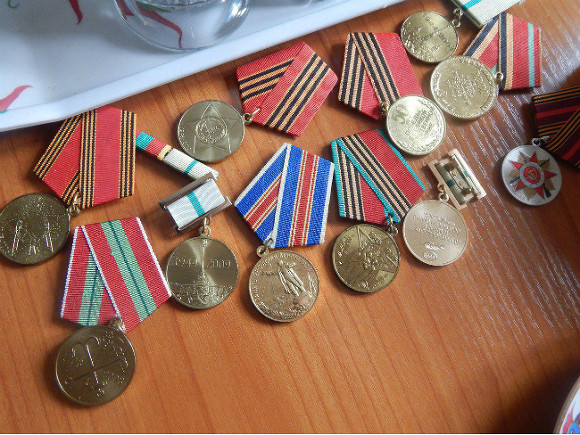
Yegorova’s collection of war medals. Photo courtesy of Alexander Kalinin and Rosbalt

The Siege survivor recounts how she would travel to the Krasnoarmeysky Market to buy linseed cakes and oilseed meal.

“The oilseed meal was like sawdust. Oh, how I gagged on that oilseed meal! But we had nothing to sell. We were poor.”

When Victory Day arrived, her house was nearly totally destroyed. Only an ottoman was rescued from the ruins.

Yegorova remarried after the war. Her new husband was a military officer, Nikolai Yegorov, who had fought not only in the Great Patriotic War (Second World War) but also the Finnish War (Winter War). In peacetime, Yevgorov became a first-class instrumentation specialist. In 1946, the Yegorovs gave birth to a daughter, Lydia. Yegorova worked as a secretary at the Kirov Factory, latter becoming head of a bread and confectionery department at a store.

In the late 1960s, Anna Yegorova wrote a letter to Leonid Brezhnev, secretary of the Central Committee of the Soviet Communist Party. The essence of the message was as follows.

“Leonid Ilyich, no one is forgotten, nothing is forgotten. But it has so happened that I, a survivor of the Siege of Leningrad, awarded the medal For the Defense of Leningrad, and my husband, a veteran of the Great Patriotic War, have to huddle with our daughter in a sixteen-square-meter room on Lublin Alley.”

Image courtesy of slideshare.net

Yegorova does not believe her letter reached Brezhnev personally, but she does think it wound up in the hands of a “kindly” secretary who helped the family move into a one-room flat in the far southern district of Ulyanka. She lived in the neighborhood for around thirty years. She was civically engaged, working with Great Patriotic War veterans. She says she even worked as an aide to Sergei Nikeshin, currently an MP in the St. Petersburg Legislative Assembly, who was then quite young. Nikeshin and she inspected the fields then surrounding Ulyanka.

The certificate accompanying Anna Yegorova’s medal For the Defense of Leningrad. Photo courtesy of Alexander Kalinin and Rosbalt

In 1996, Yegorova took seriously ill. She was struck down by deep vein thrombosis. Her left leg “was like a wooden peg.” Her husband Nikolai died in 1999.

“After that, Mom stayed at home. I took care of her. This is my cross. We would take her to the dacha only in the summer. Otherwise, she would move about only in the apartment. She would get up in the morning and make her bed, come into the kitchen and sit down on the couch. She would turn on  and call the station to request a song. She loved Boris Shtokolov’s “Dove.” Or she would request “A White Birch Weeps,” or something by Nikolai Baskov. But a month ago she took to her bed. Now all she does is lie in bed,” recounts her daughter Lydia Kolpashnikova.

Boris Shtolokov, “Dove” (a Russian adaptation of “La Paloma”)

Kolpashnikova is herself a pensioner. She has a third-degree disability. According to her, Petersburg authorities have practically forgotten her mother. True, three years ago, the Moscow District Administration called and said she could get a wheelchair. The women’s joy was short-lived. It transpired that the wheelchairs were used: they had been brought to Petersburg from Holland. To make use of the chair, they would have had to pay to have it repaired. The women decided to turn the gift down the gift.

Фото ИА «Росбалт», Александр Калинин
Congratulatory cards and other memorabilia sent to Anna Yegorova over the years as a Siege survivor. Photo courtesy of Alexander Kalinin and Rosbalt

Yegorova has received no substantial help from the local Siege survivors society. The organization can only offer trips to museums and theater tickets. This is not an option for Anna Yegorova, who is in no condition to leave her apartment. On memorial days—the Day of the Lifting of the Siege and Victory Day—however, cakes used to be brought to her. But this time around, however, she was completely neglected. According to the pensioner, the city did not even congratulate her.

Yegorova’s daughter Lydia decided to remind the authorities of her mother’s existence after hearing President Putin’s speech on TV. The president demanded that the heads of the country’s regions do a better job of caring for Great Patriotic War veterans.

Фото ИА «Росбалт», Александр Калинин

“I clung to Putin’s words that veterans needed help, for example, if they needed help with home repairs. I called the district administration and asked them to repair our bathroom,” says Kolpashnikova. “Mom is completely ill. She is almost completely out of it. She has gallstones, heart failure, and atrial fibrillation. She is classified as a first-class disabled person. She survives only on sheer willpower. But now she cannot make it to the bathroom. I wipe her off in bed. She talks to me about the bathroom all the time, however. She wants to take a bath, but wants the bathroom repaired. The tile has crumbled in there. I called the Moscow District Administration and asked them to repair the bathroom, but I was told that ‘sponsors’ deal with these issues. Now, however, there is a crisis, and there are no sponsors. What sponsors were they talking about? Mom also needs medicines and diapers. There are social workers willing to run from one office to the next to get hold of diapers for free, but they also need to be paid to run around. The local Siege survivors organizations cannot do anything: they are the weakest link. I have no complaints against them.”

Фото ИА «Росбалт», Александр Калинин

Anna Yegorova gets gifts from the authorities only on round dates. When she turned ninety, they gave her a towel, and they presented her with bed linens when she turned ninety-five.

“I called them in the autumn. I said that Mom would be turning ninety-eight on November 25. I suggested they come and congratulate her. They said to me, ‘We don’t have the right. When she turns one hundred, we’ll congratulate her,” recounts the Siege survivor’s daughter.

Anna Yegorova does not want to ask the authorities for anything.

“I have no strength. What should I do? I cannot stand up straight. I fall. I just want them to fix the bathroom. I want to take a bath. That’s it.”

All photos courtesy of Alexander Kalinin and Rosbalt. Translated by the Russian Reader. Thanks to Comrade Koganzon for the heads-up