Barnaul: Living under the Threat of Demolition

Living under the Threat of Demolition
Andrei Bespalov
Takie Dela
September 20, 2017

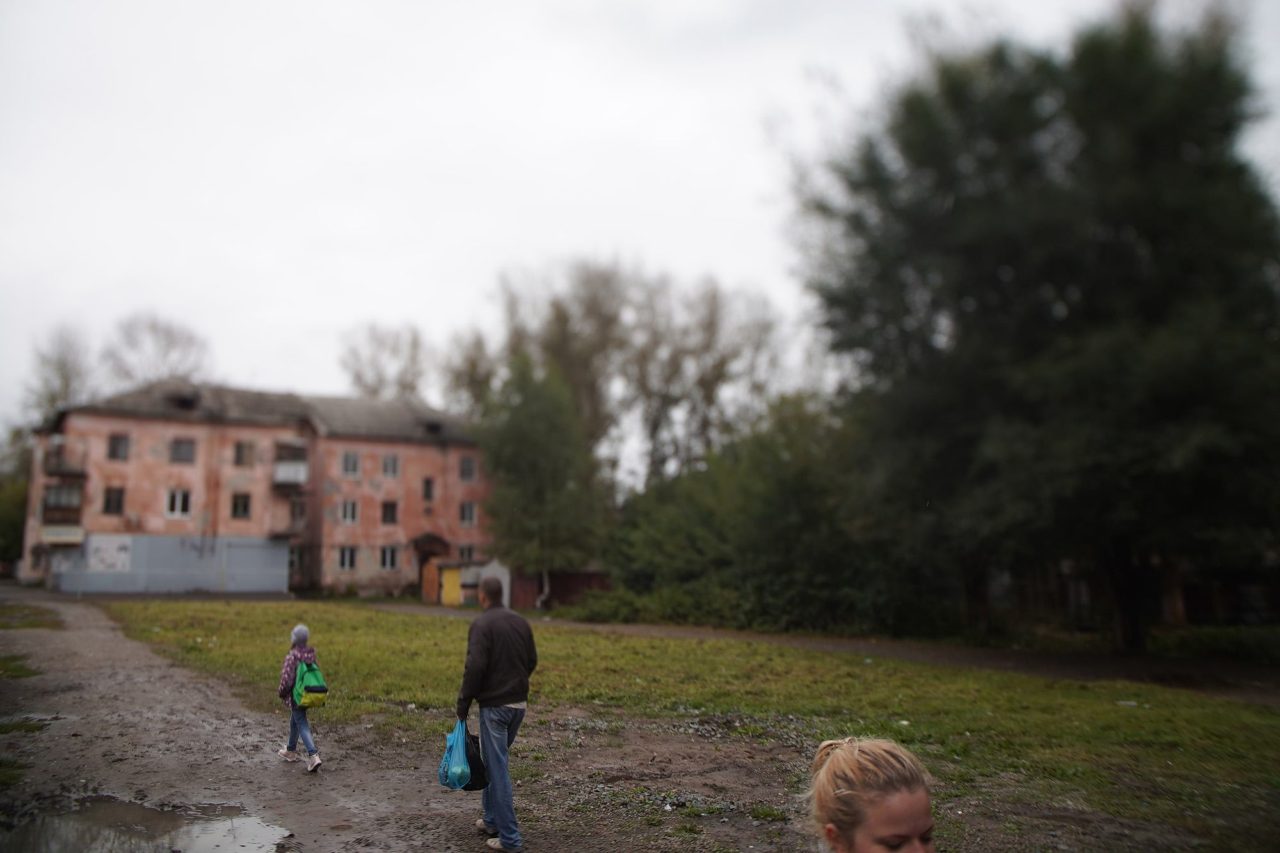
Around 200 residential buildings have been deemed unfit for habitation in Barnaul. But people have gone on living in them for many years. 

Four years ago, in July 2013, an apartment building collapsed in broad daylight. A 64-year-old woman and 60-year-old man died under the rubble. The other residents were “only” deprived of their papers and property, left without a roof over their heads. The neighboring houses are still standing, although they are much more dilapidated.

Currently, Barnaul, the capital of Altai Territory, has officially deemed around 200 apartment houses dilapidated or unfit for habitation. No one can tell you the exact number of buildings that could collapse at any minute. It would be a huge exaggeration to say that officials at the mayor’s office are worried about preventing another tragedy.

In 2013, the ruins of the house on Emilia Alexeyeva Street were hurriedly demolished, and now the local boys play football on the empty lot. A criminal investigation into “official negligence” was opened, but quickly closed.

“We were unable to find anyone at fault or evidence of a crime,” Yevgeny Dolgayev, head of the investigative department in the Russian Investigative Committee’s Altai Territory office said at the time.
Пустырь на месте рухнувшего дома в 2013 годуEmpty lot where the house collapsed in 2013. Photo courtesy of Anton Unitsyn/TD

But people live in their collapsing houses, afraid of the spreading cracks in the walls and accustomed to picking up chunks of façade that have crumbled and fell to the ground. Residents of the dilapidated buildings see no way out of their circumstances.

Quite Tolerable
A huge number of houses have been condemned in Barnaul’s Potok microdistrict. They are primarily two-storey buildings, with one or two staircases, built after 1945 in the 1950s, mainly by Japanese POWs. The city grew rapidly in the postwar years. It was built quickly as well, and the builders did not especially bother to observe construction standards.

People have fought for years to have their homes declared dilapidated. Those who have succeeded are far and few between.

As late as last year, the residential building at Timurovskya Street, 44, was in excellent condition, according to inspectors. This year, on the contrary, it was declared 86% dilapidated.

You would imagine the building should be demolished, its residents moved out, and a tragedy avoided, but that means looking for funding and building new housing.

It is much simpler to feign, year after year, that these houses and people do not exist. However, sometimes, the so-called populace is made vague promises so they will stop pestering officials for a while.

At first glance, nothing has changed on Timurovskaya Street over the last four years. The dilapidated houses with missing chunks of plaster that has fallen off still stand where they stood then. They are not ruins. But if you look a little closer you will notice the foundation has crumbled in one part of the house, while the brickwork has disintegrated in another, and a crack runs from the sidewall through the entire building.

“That’s nothing! The juicy parts are inside,” says an elderly man who looks like a local. We introduce ourselves. Alexei Oleynik is 76 years old, a retired electrician who worked for nearly fifty years in the trade. He was allocated a flat at Timurovskaya, 44, in the early 1970s when his son was born.

Алексей ОлейникRetired electrician Alexei Oleynik. Photo courtesy of Anton Unitsyn/TD

It really is “juicier” inside the building.  A piece of fiberboard has been glued to the ceiling in the entryway.

“The ceiling beams here collapsed in winter,” explains Oleynik. “Workers cleaning the snow from the roof were careless and caused the accident.”

According to Oleynik, they were not all that much to blame: the ceiling beams had rotted long ago. The management got a dressing-down from city bosses and sent over other workers, who patched up the hole with fiberboard and left the site with a clean conscience.

Oleynik’s neighbor Olga Pautova is indignant.

“Well, of course, it’s no one’s fault! The heating system had burst in the attic again. The ceiling beams sagged for three months or so, gradually swelling, until they collapsed. People from the management company and city hall would come and look at this bubble. They would say, ‘What can we do? You all don’t have it bad. It’s much worse in other buildings.’ That was really comforting, of course.”

Pautova bought a flat in the building ten years earlier. The house had seemed quite tolerable. But soon it crumbled right before her eyes. First, there were small cracks, then the cracks became more serious.

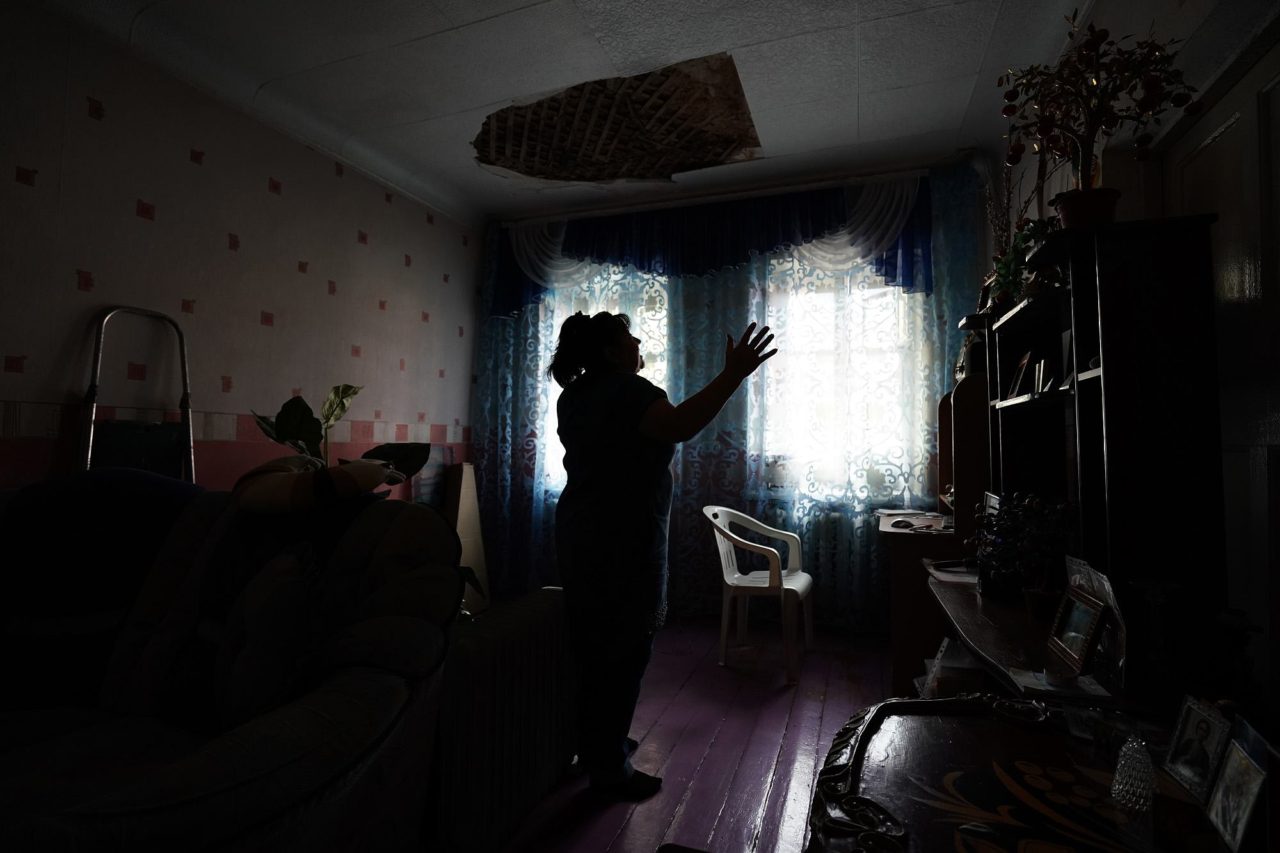
“I have no light in either room,” says Pautova. “The wiring short-circuited and burnt out. It was a good thing I was home. I turned off the power and called an electrician. He went up into the attic. He said there were moisture and leaks everywhere up there, so it was pointless to install new wiring. It would also short-circuit and burn, and it would be a good thing if that was all that happened. A year and a half ago, large chunks of the ceiling collapsed in the living room, right on the sofa, where my brother, who was visiting me at the time, had been sleeping. It’s a good thing it didn’t happen at night. My brother had already got up.”
Ольга ПаутоваOlga Pautova. Photo courtesy of Anton Unitsyn/TD

“I patched up the hole. It didn’t last for long. The ceiling collapsed again. The management company offered to cover the hole with a piece of fiberboard, as they had in the entryway. I rejected their offer. It’s utter rubbish. I have been up in the attic. Everything up there really has rotted. The ceiling beams have been fastened to something with wire. There’s still a hole in the living room ceiling. Rubbish and leaks are constantly pouring through it. I sweep and wash it all up every day, but what is the point? There are mushrooms [sic] growing there,” says Olga.

As a rule, old residential buildings have a single-pipe heating system installed in the attic rather than the basement. The pipes are old and rusty, and they burst often, leaving the ceiling sagging in five minutes and flooding the flats with boiling water. It is a good thing if someone is at home. They can run up to the attic and switch off the water.

Will It Collapse or Not?
People are eager to discuss the topic of when the house will collapse. They say the building at Emilia Alexeyeva Street, 33 (a mere two minutes’ walk from their house) looked better, but it collapsed anyway.

A year ago, the residents of Timurovskaya Street, 44, chipped in and commissioned a private inspection of their building, hoping it would be declared dilapidated and they could count on resettlement. They got the results of the inspection back quickly, but they were just the opposite of what they had hoped for. According to residents, the inspector hastily examined the house and issued a finding it was in “excellent” condition.

Olga Pautova decided to fight till the bitter end and paid Tercet, a design and engineering company, for another inspection out of her own pocket. Their analyst took three months carrying out his inspection. He measured the size of the crack running through the entire building and recorded its growth. According to his calculation, the house was 86% dilapidated. 65% dilapidation is enough for a house to be deemed dilapidated and unfit for habitation.

Дом № 44 по улице ТимуровскойTimurovskaya Street, 44. Photo courtesy of Anton Unitsyn/TD

According to Pautova, the municipal interdepartmental commission for housing assessment, at which the outcome of Tercet’s inspection were presented, was dead set against granting Timurovskaya, 44, the status of dilapidated building. However, Tercet’s analyst had fight in him.

“According to my calculations,” he insisted, “it is dangerous to live in this building. I’ve done my job. It’s up to you to react to the outcome of my evaluation, to declare the house dilapidated or not. But you will be responsible for what happens.”

The commission’s members had no desire to take on that kind of responsibility, and in June of this year the house was declared dilapidated. Residents have been receiving “letters of happiness,” signed by Barnaul’s Deputy Mayor Alexander Alexeyenko, in which he demands the house should be demolished no later than June 21, 2018.

Galina Buloychik is skeptical about the news from the mayor’s office.

“I don’t believe they will demolish the house and issue us new flats. It’s useless. The house will collapse with me in it, and that will be the end of it. That is what is meant to be,” says the 69-year-old woman, who shares a flat with two of her children and her grandchildren.

“I do give a damn,” says her daughter Anna, interrupting. “I have children, and the building is crumbling right before our eyes. You always hear a creaking sound, as if the house were not standing still. My brother installed a PVC window. It would close at first, just like it should have, but now have a look. You cannot close the sash. That means the building has sagged, but somehow crookedly. Don’t pay any mind to the fact the walls in the rooms are even. We covered them with gypsum plasterboard, as if we were doing real repairs. But there is a nightmare underneath them. I saw you taking a picture of the crack that runs from the sidewall of the house. It’s hidden beanth the plasterboard, as if it weren’t there.”

When we were saying goodbye, a photo fell from a chest of drawers. I picked it up and put it back.

“That was me when I was young,” Buloychik explained. “Was I beautiful?”

“You were.”

“Really?”

The Sky in Diamonds
House No. 38, also on Timurovskaya Street, is even famous in a way. In April, the roof beams collapsed and you could see the sky through the hole that formed, as if the building had its own planetarium. Reporters came, TV channels shot footage, the city bosses made calls, all to gaze through the hole. It was also patched up with fiberboard, but not in one piece. Several overlapping pieces were used. When it rains, you do not leave your flat and go into the stairwell without an umbrella.

But to get such minimal care the house’s tenants had to bow and scrape to the management company and city officials. They could have done nothing at all. So, the verdict of the officials in the mayor’s office was that the collapse of the roof beams in the stairwell occurred, most likely, not because the house was dilapidated, but due to repairs: the beams in the attic were being replaced. Since, at the time, the building had not been officially deemed dilapidated, it was the responsibility of residents who owned their flats to fix the problem or the management company’s, seeing as how residents pay them for the building’s maintenance. Only how much money can you make off a two-storey house inhabited primarily by pensioners? Besides, the companies responsible for the maintenance in their building change so rapidly you don’t have time to remember what they are called.

Svetlana Balchis, a resident of Timurovskaya, 38, recounts the accident.

“I got a call at work. I came running home. Horror of horrors! The stairway was piled up to the railings with chunks of slate, broken brick, mangled boards, slag, and shingles. I live on the second floor, and I barely made my way through the wreckage. My youngest daughter was supposed to come home from school at the time. I nearly lost my mind until I got home.”

Fortunately, her daughter arrived home later. Subsequently, Balchis learned that shortly before the beams collapsed, two young mothers had agreed to take their toddlers out for a walk together. One of them, Balchis’s next-door neighbor, was held up at home for five minutes or so. If she had left earlier, the ceiling would have fallen on her and her toddler in his stroller.

Жилец одного из домов в БарнаулеResident of a house in Barnaul. Photo courtesy of Anton Unitsyn/TD

“Before that, I don’t know many times we called the management company and the mayor’s office: the roof leaked as if there were no roof. In winter, it was still okay, but the snow began to melt in February. There was a lot of it on the roofs: it had been a quite snowy winter. The day before, the Emergencies Ministry guys had done a drive-through inspection, and they ordered the management companies to clean the snow off the roofs right away. The workers fell through the roof! Everything up there had rotted, after all. We have been fighting to get it fixed since 2001,” recounts Balchis.

Balchis has lived in the building since birth. She was brought there from the maternity hospital in 1959. She grew up there, then had three kids, two of whom are grown-ups and live on their own. It was her father who was allocated the flat as an employee of  Central Heating and Power Plant No. 2, which, in the 1950s, built several houses for employees. Balchis says it was a fine house as long as the power plant’s own maintenance office took care of it. The dilapidation began when the building was turned over to the city.

“Do you know how the furniture in our flat stands? At an angle to the floor. That’s the only way to keep the doors shut, because the floor slopes, although it used to be as even as could be. If we put something under one edge, the doors don’t jam. It doesn’t last for long, though, and then we have to put something else under it, something bigger,” says Balchis.

Some tenants of Timurovskaya, 38, decided to replace their old windows with PVC windows. Measurers came to have a look.

“You don’t need to replace your windows,” they said. “If we touch the wall now, it will collapse.”

Elena Romanova has joined the conversation.

“Until the roof started to collapse, and the boiler rusted, it was tolerable. But, in the winter, boiling water poured into the basement, sent off steam, and the walls would freeze. All that needed to be done was change the boiler valve. But we were told they didn’t have the money to do it. So the foundation burst. The building literally came unravelled. I have a crack in the wall in my hallway. I could run my hand through it. They covered it with plasterboard, but what’s the use?” she says.

“I have the same trouble,” says Balchis.  “Between my flat and the neighbor’s flat you could suddenly hear everything perfectly. I removed the rug from the wall, and there I found a crack as wide as the palm of my hand.”

It’s Your Problem, So You Demolish It 
The tenats of Timurovskaya, 38, also received notifications their building had been deemed dilapidated and should, therefore, be resettled. But hardly anyone believes it will happen. They doubt they will get new housing a year from now. They say that other buildings that received similar letters have been waiting years for demolition.

“The building next door has also been declared dilapidated, but hasn’t been resettled. And in that one, too, and that one, and that one. The tenants in that building way over then have been evicted, but I don’t where they went, since they were not allocated flats and are waiting for them,” Balchis says as she points in different directions.

“But we must do it ourselves!” says Romanova. “We have to find a developer ourselves who would buy the land plot under the house.”
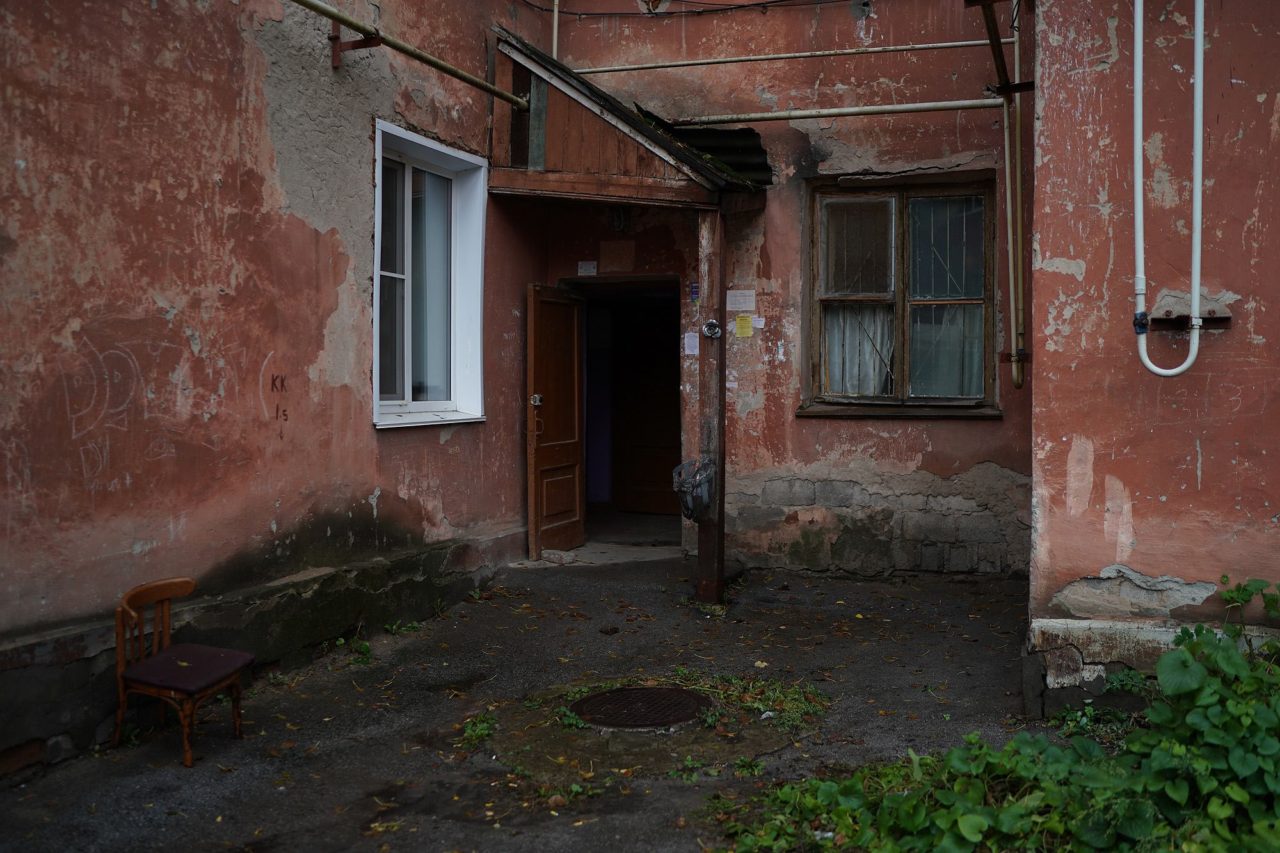
Дом № 38 по улице ТимуровскойTimurovskaya Street, 38. Photo courtesy of Anton Unitsyn/TD

It is true that, in the letter from the mayor’s offices, it says in black and white, “Dear Housing Owner Elena Pavlovna! In accordance with Article 32, Paragraph 10, of the Russian Federal Housing Code, we demand that the dilapidated house be demolished before June 21, 2018.”

“Meaning, the city demands that I demolish my own building. Should I make my own arrangements with a construction company? Hire an excavator? Where should I move all my neighbors? If they sent a letter like that, it’s pointless to expect help from the mayor’s office,” Romanova argues.

No one here counts on help from the federal program for overhauling apartment buildings, either. They do not believe such happiness will shine on them. Several years, when the federal program had just been launched, the tenants of Timurovskaya, 38, were told they had been slotted into the program for 2018.  That is, they should have only a year left to wait. Recently, however, they decided to check up on the program’s progress. They called the mayor’s office and were told they had been rescheduled for 2025. The overhaul of Timurovskaya, 44, had also been postponed (to 2022), although right after the collapse of Emilia Alexeyeva, 33, the mayor’s office had promised to resettle the tenants of the building next door, Emilia Alexeyeva, 31, and the tenants of Timurovskaya, 44.

Take the Old Woman Outside at Least Once in a While
Every weekend, Lydia Kostomarova is a hostage. The building is empty: all her neighbors are at their dachas, everyone in Timurovskaya, 38. Kostomarova is ninety. She lives alone. She has been living in the building since it was built in 1957.

“I haven’t complained to anyone my whole life or asked for help. My husband died when he was forty-eight: cancer consumed. I have loved only one man in my life. Then Mom passed away. She lay paralyzed on that bed over there for seven years. She forgot how to talk. I bought her an alphabet and taught her to talk again using letters and pictures.
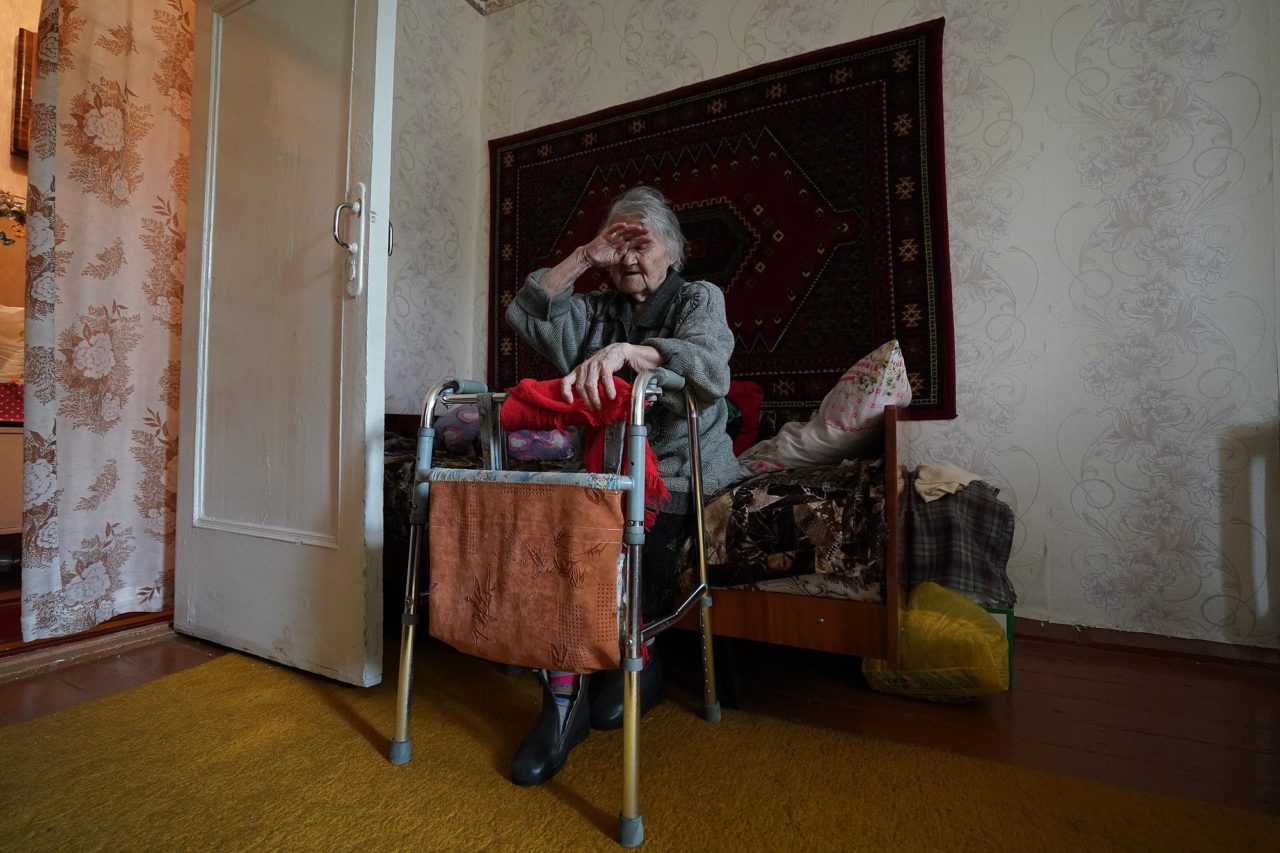
Лидия КостомароваLydia Kostomarova. Photo courtesy of Anton Unitsyn/TD

“I looked after her, worked, and raised the kids. It was tolerable: it was all part of life. But then I had an accident. I went to the shop when the ground was covered in black ice. I fell and broke my hip in three places. The doctors said I couldn’t have an operation, because my heart couldn’t take it. Lord, why, oh why did you not take me away then? Now I am shut in here. I haven’t been outside for two years. But I can’t die just yet. I cannot afford it. Of course, I had been saving up for my funeral, but I spent it all on a caregiver. I paid her five thousand rubles a week. That’s more than my pension. Now I’m saving up again. Renovations? No, I’m not going to repair anything. What’s the point? The ceiling leaks, but you can’t patch it up anymore. The tank in the toilet should be changed. It’s quite old. They don’t make them like that anymore. It’s the kind that hangs on the wall over the toilet. A repairman came to look at it and said to install a new toilet he would have to pound holes in the floor and ceiling, but since the house was old, it couldn’t withstand it and would collapse.”

Kostomarova walks around the flat very slowly, leaning on her walker. Although it is painful, she walks. I ask whether the local social workers come to visit her. Maybe they bring groceries and help with the cleaning?

“Good Lord, what good am I to the social workers? Although no, that’s not true. They inquired about me once. They called from the medical clinic. They said, ‘Get a chest X-ray done, grandma.'”

“Are you making fun of me?” I said to them. “How can I go to the hospital when I can’t leave my flat and get downstairs from the second floor? And what will I take to get to this X-ray of yours?

“They were stubborn. They told me they wouldn’t give me orthopedic shoes if I didn’t do it. But it was so very painful to walk. Did I really need those shoes? Oh, those shoes came at a hefty price. I had to rent a special Italian device to get downstairs. It cost me two and half thousand rubles. But they did give me the shoes. Then I would daydream all the time about renting the device again so I could at least putter around the entryway, touch the flowers and the earth. But where would I get the money?”

“But when that building collapsed, why didn’t you move to your daughter’s place? She lives nearby. You really are like a hostage here.”

“How can I put it to you? It’s hard with her. She’s already sixty-eight, and she gets angry with me all the time, saying I love my son more. She’s stupid. How could I love him more? They’re both my kids. I’m just not used to people helping me. I’ve always counted only on myself. Dad was shot in 1938. Mom, my sister, and I lived in a bathhouse after we were kicked out of our house. Then we built a byre. Things got better and we didn’t starve. I raised kids. I used to ask the Lord to take me away, but now I think that no, I have to wait until my daughter’s house is resettled. They have it worse than we do. It’s like a barracks over there. Nine-storey buildings have been plopped down on either side, and their house is like an eyesore. When they give them new housing, I’ll die in peace. But for now I’ll go on living, because I have to. I also have grandchildren. They work in Moscow and Petersburg as managers? Did I get that right? I’m hanging in there. What else can I do if the Lord won’t take me. Look what cucumbers have grown on the balcony? I love the earth so much, and flowers, but you see I’ve been locked up inside four walls.”

I left. Kostomarova was already out on the balcony, standing and smiling amid the lush thickets of her cucumbers. It was a mere three meters, no more, from the front garden under her windows, with its luxurious golden balls of gladioli, to Kostomarova’s flat. Three meters to happiness. You would imagine social services could have helped. All she needed to get downstairs was that same Italian wheelchair. They could take the old woman outside at least once in a while.
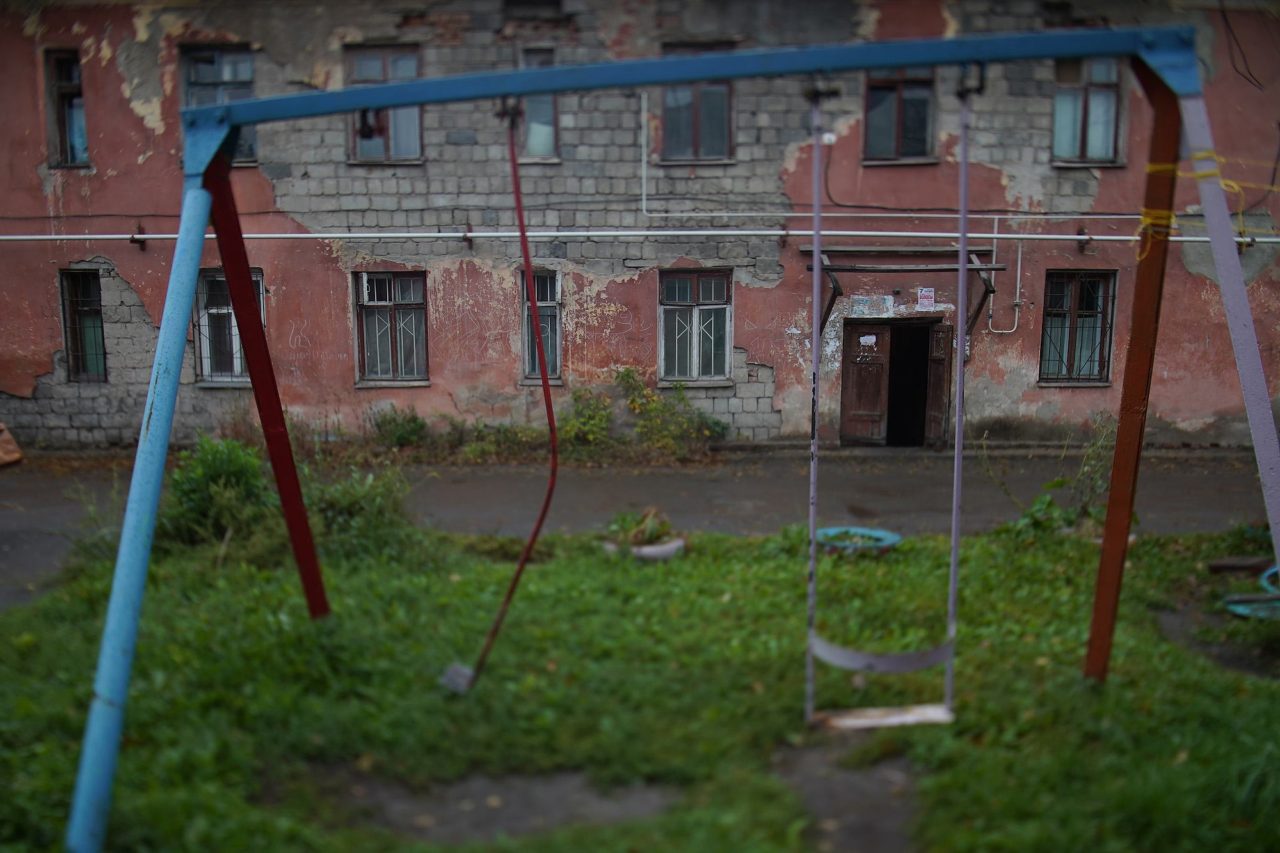
Двор в БарнаулеA yard in Barnaul. Photo courtesy of Anton Unitsyn/TD

An old woman in a colorful flannel dressing gown calls to me.

“Did you go see Kostomarova? The whole neighborhood knows you. You want to help resettle us? Oh, you’re so young and naive. Here is what I have to say to you. Those guys from the mayor’s office are only waiting for everything here to fall to pieces. You saw that building over there collapsed? The people who died there were young: a man and woman who were in their early sixties. They had years ahead of them. It’s terrible to remember how the children crawled in the ruins and howled. I think that if all our buildings, these ones here, built after the war, were to collapse the same day, and we all died under the ruins, those guys from the mayor’s office would only rejoice. The excavators would have the bricks and us cleaned up in a jiffy, and they could build nine-storey buildings to their heart’s content. People are moving to the city: they need a place to live. But we are a burden to them: we old people and our old houses. What is my name? I don’t want to tell you. I don’t need the trouble. But I’m not the only one who thinks this way. Every time we get together, everyone says in unison, ‘If we and our houses vanished, they would be so glad.'”

Blame It on the Snow
According to official data, 319 residential buildings have been declared dilapidated in Altai Territory, 183 of them in Barnaul. All of them are subject to demolition, since they are unfit for habitation. Most of these buildings are in the Potok and VRZ districts, the old city center, and Soviet Army Street. There are also many dilapidated houses in Biysk and Rubtsovsk.

In 2017, there were particularly many emergencies in February and March, when a lot of snow had amassed on the roofs, snow packed down by above-freezing temperatures. The old housing stock cracked at the seams. In Barnaul, the roof of the two-storey building on Telephone Street, 30, collapsed under the weight of snow. In Biysk, part of the wall of Leningrad Street, 22, collapsed, while part of the wall and facade of Socialist Street, 34, collapsed. These are only a few examples of the houses that were destroyed.

“After we got the letters, we called the mayor’s office,” says Svetlana Balchis. “We were told that if Putin extended the program, they would begin resettling.”

Translated by the Russian Reader

Remembering Beslan

The Memory of Beslan
Takie Dela
September 1, 2017

On the anniversary of the tragedy, Takie Dela remembers the principal witnesses to the events in School No. 1.

On September 1, 2004, terrorists seized School No. 1 in Beslan. The gunmen herded over a thousand hostages, including small children, into the school’s gym. For three days, the hostages were forcibly held in the building without food and water. The security services assaulted the school to free the hostages.

A total of 334 people were killed in the terrorist attack, including 186 children. 126 of the former hostages were crippled. During the assault, the FSB killed 28 terrorists. The only terrorist taken alive, Nurpashi Kalayev, was arrested. A court later sentenced him to life in prison.

Many articles, investigative reports, and special projects have been written about the Beslan tragedy, and several documentary films and books have been released. Takie Dela recalls the primary witnesses to the events in School No. 1.

Novaya Gazeta

Novaya Gazeta reporter Elena Milashina was in Beslan during the terrorist attack. The first article she filed about the tragedy, “Lies Provoked Terrorists’ Aggression,” was published in the newspaper’s September 6, 2004, issue.

“According to the police officers and special forces soldiers with whom we have spoken, the preparations for the assault were vigorous. That the authorities were learning toward this option is borne out by one other fact. They did not, in fact, negotiate with the gunmen. No one intended to meet even their formal demands. They explained to us, ‘It’s not clear what they want.'”

In 2014, on the tenth anniversary of the tragedy, Milashina recalled how events had unfolded before and after the terrorist attack .

“The Beslan terrorist attack will go down in Russian history as an instance when the populace was disinformed on an unprecendented level. Up until the assault of the school, officials concealed the scale of the tragedy (the number of hostages). They also concealed negotiations with Chechen separatist leader Aslan Maskhadov, who was ready to ask the gunmen to put down their weapons. Akhmed Zakayev, Maskhadov’s emissary, was ready to fly straight to Beslan and take part in negotiations with the terrorists.”

In 2006, Novaya Gazeta published a special issue on the outcome of its investigation, featuring forensic evidence, annotated maps, official reports, and eyewitness testimony. The newspaper came to several conclusions. Reliable information about the upcoming terrorist attack was known to the authorities at least three hours before the school was seized, and Alexander Dzasokhov, president of North Ossetia, offered to replace the children with 800 officials and local MPs, but Moscow forbade him under pain of arrest from entering into negotiations. The biggest public outcry was caused by the newspaper’s claims that the school was fired upon by grenade launchers, flamethrowers, tanks, and helicopters on several occasions when the hostages were still in the building. According to the newspaper, the official inquiry, while it was in full possession of these facts, found no wrongdgoing in the actions of those in charge of the operation to free the hostages.

Twelve years later, Novaya Gazeta special correspondent Elena Kostyuchenko wrote down the dreams of surviving hostages.

“Vladimir’s dream: “I want to pick a plum. “Now,” I say, “I want a ladder to the plum and to pick the plum.” A young girl below me says, “I’m not your little girl.” I say, “And where is my little girl?” She says, “She is not here. I am another girl here.” After all, she was lying with my wife in the grave. “I’m not your daughter,” she says, “Don’t pick me plums.” I say, “Where is my little girl?” She says, “I don’t know. Look for her.”‘”

Kommersant

Kommersant reporter Olga Allenova was returning from Grozny, when her editors called her and told her about the terrorist attack in Beslan. She went to North Ossetia to write a story.

“‘Don’t let the hostages’ relatives on the air. Don’t cite any number of hostages except the official figure. Don’t use the word “storm.” The terrorists should not be called gunmen, only criminals, because terrorists are people you negotiate with.’ This was what several national TV channel reporters, located in Beslan, heard immediately from the top brass. We were all side by side, and I saw how hard it was for those guys to carry out the orders of the top brass. And I saw one of them crying in the evening after the school had been stormed.”

On October 17, 2004, the newspaper published an article entitled “How Did We Help Them?” The story dealt with the fortieth day after the terrorist attack. [In Orthodox culture, the fortieth day after a person’s death is usually remembered and marked by a ritual.]

“In Moscow, we say that forty days have passed since the school in Beslan was seized. Here those days did not exist. In their place is a black hole, like the hole made by a grenade in the floor of the assembly hall. And every day is a day of mourning.

“The entire city of Beslan is dressed in black. There are houses here in which not a single child is left, and entryways through which three caskets a day are carried out.”

In 2011, an infographic was posted on the newspaper’s website: it features a map of the school on which the main locations where the events took place are illustrated by short excerpts from archival video footage.

Esquire

In 2006, the Russian edition of Esquire published an article [in Russian] by New York Times reporter C.J. Chivers, in which he retraced the events in Beslan School No. 1 hour by hour: from the beginning of the ceremonial, first-day-of-school lineup at nine in the morning of September 1 to the medical care administered to the victims in the Vladikavkaz Hospital on September 4. Chivers had written the article [in English] o understand who the hostages had felt the whole time.

“Like many people who have been to Beslan, I subsequently thought a lot about what had happened. Like the people of Beslan, I was infuriated by the endless contradictory statements, the lack of information about many important episodes in the hostage crisis and the actions of the Russian authorities.”

Radio Svoboda

Ten years after the tragedy, Tom Balmforth and Diana Markosian published a story on the Radio Svoboda website about the lives of the surviving schoolchildren. The former hostages talked about their memories, features, and thoughts of the future.

“The children behaved heroically. We all grew up immediately. We really supported each other. In fact, we came together like a family there. Even many of the adults did not behave with as much dignity as the children. Apparently, the adults understand everything in terms of their being grown-up and wise, while we children saw it all through rose-tinted glasses, maybe. I know for a fact that, after those three days, we became completely different people,” recalls Zarina Tsirikhova. She was fourteen when the terrorist attack occurred.

Takie Dela

Takie Dela published Diana Khachatrian’s story about how, in September 2016, the memorial events in Beslan ended in arrests. During the ceremonial school lineup at School No. 1, five women staged a protest. They removed their jackets, under which they were wearing t-shirts that bore accusations against the regime.

Voice of Beslan activists in the gym of School No. 1. Their t-shirts are emblazoned with the slogan, “Putin is the execution of Beslan.” Photo courtesy of Diana Khachartian and Takie Dela

“The female activists of Voice of Beslan stand apart in the gym. The five women are wearing handmade t-shirts on which the inscription “Putin is the executioner of Beslan” has been written in marker pen. This is not a hysterical slogan. Based on their own impressions and evidence from the investigations, the women argue that on September 3, 2004, Vladimir Putin or a member of his entourage gave the orders to storm the school in order to expedite events and prevent negotiations with Aslan Maskhadov. They argue the hostages could have been saved.”

Photography

Photographer Oksana Yushko has for many years produced unique photograph projects on the aftermath of the Beslan tragedy. Yushko takes pictures of the children who were taken hostage in September 2004 at different stages in their school careers, both in everyday life and during graduation from school.

Amina Kachmazova, left, and Fariza Mitdzieva hugging each other in the old school No. 1 in Beslan. Fariza, 18: ‘Here we are, such heroes, living after the attack. And somehow we are able to find happiness in life. Life just goes on and we cannot change what already happened to us. Just the opposite: now it is more pleasant to look at how we laugh, have fun and enjoy life.’ Beslan, North Ossetia, 2013. Photo courtesy of Oksana Yushko

Documentary Films

In 2005, some of the relatives of those who were killed during the terrorist attack established the grassroots organization Mothers of Beslan. That same year, due to friction within the group, a number of committee members left the group and founded another organization, Voice of Beslan.

Rodion Chepel’s The Committee, released on the tenth anniversary of the tragedy, focuses on Beslan’s female activists.

Chepel discussed how the film was made in an interview with Rusbase.

“We have never met such people. They are such uncompromisingly honest people, it was if they would be shot for lying. From a distance it seems that Beslan is god knows what, part of Moscow’s war with terrorism. But when you go there, you understand it is just human grief that has made them so tough and very honest. It’s not a matter of politics. They’re in touch with their humanity. You talk to them and you realize you simply have not met such people. This was what we wanted to show in the film: what these ten years have done with these people is incredible. They just want someone to explain to them what happened, for someone to say, “Forgive me. It was my fault.” Instead, they have been threatened and slandered. People have tried to sick them on each other, drive a wedge through them, and present them as insane.”

Filmmaker Vadim Tsalikov has shot four documentary films about the terrorist attack in Beslan. One of them is Beslan: Memory.

Foreign filmmakers have also shot films about the tragedy in North Ossetia. For example, Joe Halderman shot the film Beslan: Three Days in September for Showtime. The picture was screened at the Tribeca Film Festival in 2006.

Personal Diary

In 2012, one of the hostages, 14-year-old Agunda Vatayeva, decided to publish her memoir of the terrorist attack. The young woman launched a diary on LiveJournal and wrote three posts in which told from beginning to end the story of the three days she spent in captivity.

“If you deliberately searched for my diary, you probably want to read my memoir of the terrorist attack in Beslan: Day One, Day Two, and Day Three. It is unlikely that you will find my LiveJournal exciting or at least positive reading. It was started once upon a time for quite different purposes. It was a kind of psychotherapy for me.”

***

In April 2017, the European Court of Human Rights award three million euros to the relatives of the victims. There were over 400 plaintiffs in the case. The court ruled that the Russian authorities had not taken sufficient measures to prevent the terrorist attack and had violated Article 2 of the European Convention for the Protection of Human Rights and Fundamental Freedoms: the right to life. In addition, Russia had not prevented a threat to people’s lives and had not planned the assault on the school properly. The European Court of Human Rights likewise deemed that the Russian authorities had not properly investigated all circumstances of the terrorist attack and the causes of the hostages’ deaths.

The Kremlin reacted to the ECtHR’s ruling by saying that “an emotional assessment is hardly appropriate.”

“Of course, we cannot agree with this formulation. In a country that has been repeatedly attacked by terrorists, and the list of such countries has been growing, unfortunately, these formulations and purely hypothetic arguments are hardly acceptable. An emotional assessment is hardly appropriate.

“All the necessary legal actions related to this decision will be taken,” said Dmitry Peskov, the president’s spokesman.

Translated by the Russian Reader

Report to UN on Racial Discrimination in Russia Banned

Report to UN on Racial Discrimination in Russia Banned
Takie Dela
August 17, 2017

Russian federal media watchdog Roskomnadzor has placed a report to the UN on racial discrimation in Russia on its list of banned information, reports the SOVA Center.

The alternative report in question is entitled “The Russian Federation’s Observance of the International Convention on the Elimination of All Forms of Racial Discrimination” and covers the period 1996–2001. The report has been published on several websites, including the Kharkov-based human rights website Human Rights in Ukraine.

doklad screen shotScreenshot from Roskomnadzor website

In June 2015, the Yelniki District Court in Mordovia ruled the report information prohibited for dissemination. On August 11, the page on the Human Rights in Ukraine website containing the report was registered on Roskomnadzor’s list of banned materials, reports SOVA.

“The ruling itself has not been published, and we are unaware of the court’s arguments. In order for a court to rule information prohibited for dissemination in Russia, it must contain matter previously deemed extremist by a court.  Of course, the report on racial discrimination contained no such matter, so it is completely unclear in this case what triggered the lawsuit and the court’s ruling,” SOVA’s press service commented.

The report was compiled by the Memorial Human Rights Center with the assistance of twenty-five Russian NGOs involved in counteracting racism and discrimination. It was submitted to the UN Committee on the Elimination of Racial Discrimination.

The report discusses the discrimination or promotion of discrimination against Meskhetian Turks, Chechens, and Romani. It also criticizes Russian authorities for insufficient efforts to counteract discrimination and creating appropriate mechanisms for counteracting discrimination.

In 2016, the Russian Federal Justice Ministry declared SOVA Center a “foreign agent.” SOVA Center staff do not consider their work political, the alleged determining criterion for ruling a Russian NGO receiving foreign funding a “foreign agent.”

Thanks to Maria Turovets and Mari Davtyan for the heads-up. Translated by the Russian Reader

Perm Man Who Earlier Avoided Criminal Charges Due to Decriminalization of Domestic Violence Beats Mother to Death

636375316707884635-AFP-AFP-R90GQ
Russian President Vladimir Putin on vacation

Perm Man Who Earlier Avoided Criminal Charges Due to Decriminalization of Domestic Violence Beats Mother to Death
Takie Dela
August 3, 2017

A court in Perm has sentenced a 38-year-old man to ten years in prison for beating his mother to death. The old-age pensioner had complained to the police on several occasions that he was beating her, but law enforcement agencies were unable to defend, according to the prosecutor’s statement, as reported by Rifei TV.

Police investigators determined that the man, who was unemployed, had repeated beaten up his elderly mother to take money from her. During a quarrel over two thousand rubles remaining from the woman’s pension, her son beat her to death.

As reported by the TV channel, citing information that had come to light during the investigation, the pensioner had asked the district police precinct for protection from her son. A month before her death, she had gone to hospital due to injuries caused by her son. The police, however, did not qualify his actions as criminal.

Anton Abitov, assistant prosecutor in the Industrial District, said criminal charges of negligence had been filed.

“If the case does go to court, it will not be one or two people who will stand trial, but probably the district commissioner and someone from the police top brass,” Abitov explained

In turn, the police explained that they had gone to speak with the woman every time she had complained and questioned her. After one such inspection, the son was charged with battery, but the case was dropped because the law decriminalizing domestic violence entered into force.

“In one instance, the files from the inspection were sent to a justice of the peace to make a decision on the merits, while Police Investigative Department No. 2 of Russian Interior Ministry’s Perm office filed charges under Article 116 (“Battery”) of the Russian Federal Criminal Code. The justice of the peace ruled that criminal prosecution of the victim’s son be ceased due to the entry into force of Federal Law No. 8-FZ, dated February 7, 2017, “On Amendments to Russian Federal Criminal Code Article 116,” the Interior Ministry wrote in a press release.

On February 7, Russian President Vladimir Putin signed a law decriminalizing battery within families. The law makes battery against family members an administrative offense.

In May, an Ufa man beat his 68-year-old adoptive mother to death. The disabled woman had repeatedly complained to police about the assaults, but she had been ignored.

Translated by the Russian Reader. Thanks to Gabriel Levy for the heads-up. Photo courtesy of Alexey Nikolsky, AFP/Getty Images, and USA Today

Don’t Recite “Hamlet” in Public, or, The Moscow Police Always Get Their Man

bad kid
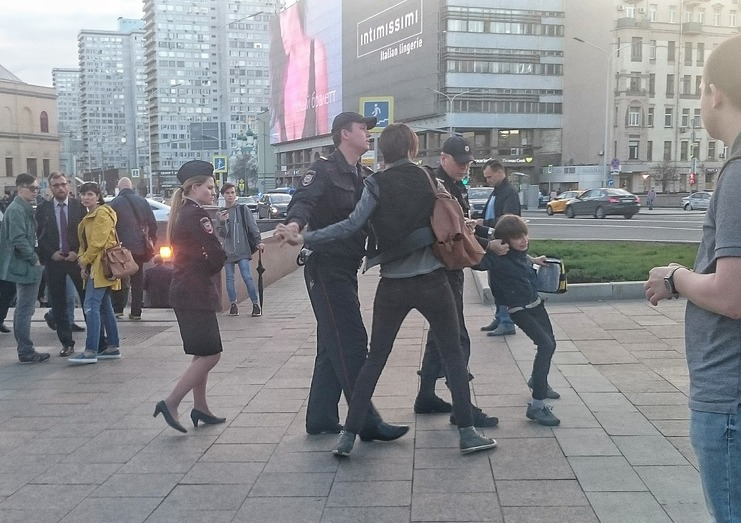
Eyewitness photo of incident. Courtesy of Mediazona

Moscow Police Detain Child Reciting Poetry
Takie Dela
May 26, 2017

Police detained a child reading poetry aloud on Moscow’s Vozdvizhenka Street. Takie Dela was informed about the incident by the website OVD Info‘s person on duty.

The child, reportedly ten years old, and his mother were relaxing near Arbatskaya subway station. The mother was sitting on a bench and reading, while the boy recited poetry a little ways away from her. A police patrol stopped near the boy, and police officers forced the boy into their car. They refused to let the mother talk to her son, explaining he would be charged with begging.  In addition, the police pushed the woman, causing her to drop and smash her tablet computer.

The boy was taken to Arbat Police Precinct. He was transported there without his parents. Later, his mother was brought to the same precinct. The child’s father arrived at Arbat Police Precinct later.

According to unconfirmed reports, the father could be charged with the administrative offense of insulting a police officer. He refused to sign a charge sheet accusing the parents of not fulfilling their parental duties, since he did not agree with the charges. The child is currently at the police precinct. As of this writing, Arbat Police Precinct is refusing to answer their telephone.

An eyewitness has posted a video showing the child screaming inside the police car.

Update, 10:10 p.m. The boy’s father, Ilya Skavronski, has told Mediazona that the boy goes to a theater workshop and was reciting Hamlet. The police officers in question conversed with the boy for a time at a distance of twenty to twenty-give meters from his mother, who approached them only when the boy had been forced into their car. According to Skavronski, the policemen cursed and behaved rudely while detaining his son. He added that the precinct’s deputy head had threatened to detain the boy’s mother on charges of resisting law enforcement officers.

Update, 12:00 a.m. The Moscow Police’s Information Response Department explained that the boy had been detained because he was alone and had been going up to “one car after another.” According to OVD Info, he has been released from the police precinct. Skavronski has been charged with violating Article 5.35 of the Administrative Offenses Code (non-fulfillment by parents of their child-raising duties of minors). Earlier, attorneys had arrived at the precinct, as well as Anatoly Kucherena, chair of the Interior Ministry’s Public Council. The lawyers are filing complaints against the actions of the police.

Translated by the Russian Reader. Image courtesy of Mediazona

Life on the Installment Plan

“Sovcombank. Are you a pensioner? Your loan is approved!”

Half of Russians in Arrears Take Out New Loans to Repay Old Loans
Takie Dela
April 18, 2017

In 2016, according to the statistics of the United Credit Bureau (UCB), 45 million Russians with current loans took new loans from banks. More than half of these people intended to use the money to pay off outstanding loans.

The bureau’s analysis showed that 53% of borrowers took a new cash loan that was used to fully or partly repay existing loans. 27% spent more than half of the new loans to pay their debts.

On average, Russians borrow between 101 and 126 thousand rubles [between 1,650 euros and 2,080 euros, approx.] to repay debts. According to statistics, around half of the borrowers (56%) take the money to repay debts of 50 thousand rubles or less or debts over 500 thousand rubles (47%).

33% of those who take new loans before repaying old loans have a debt of 100 thousand rubles. Nearly a fifth of all borrowers (18%) have three outstanding loans and a total debt of 278 thousand rubles, while every tenth borrower has five or more outstanding loans and a total debt of 575 thousand rubles.

71% of those who have five or more outstanding loans have taken a new loan to repay the interest on the existing debt. 65% of those with four outstanding loans and 60% of those with three outstanding loans have done the same thing. Those who have only one outstanding loan are the least likely (42%) to use a new loan to make interest payments.

“The trend may indicate the growing popularity of loan refinancing programs, which many Russian banks have vigorously brought on line in the past year,” commented UCB’s director general Daniel Zelensky. “Borrowers who took out loans at high interest rates in 2015 naturally have wanted to refinance them on more favorable terms.”

He added that many borrowers have realized that now it is “irrational to service several loans in different banks at the same time.”

In May of last year, the National Credit History Bureau analyzed 3,700,00 Russian creditors and reported that the most indebted Russians were schoolteachers and physicians. Employees of the social sector and education sector spend 33.39% and 33.3%, respectively, of their income paying back loans. The highest ratio of monthly loan payments to income (33.56%) was recorded amongst pharmaceutical and medical workers.

According to UCB’s report, no fewer than 600,000 Russians are currently bankrupt. That is, they owe more than half a million rubles and have not made payments on their debts for three months.

Translation and photograph by the Russian Reader. If you found this article interesting, you might want to read “Kotlas: Russia’s Bankruptcy Capital,” posted here in December 2016.

“We Are Treated like Schmucks”: Why Volga Region Pensioners Have Rebelled against the Regime

“We Are Treated like Schmucks”: How and Why Volga Region Pensioners Have Rebelled against the Regime
Yeveniya Volunkova
Takie Dela
April 4, 2017

What Happened?
Certain benefits for pensioners, disabled people, and other beneficiaries were cut in Samara at the beginning of 2017. Monthly payments for housing services and utilities were replaced by compensation for actual expenses. People now have to pay their bills first, then show the authorities the receipts, and only after that, if they have no debts, are they compensated for their expenses. The system has not been put through its paces and does not function, so there have been problems with assembling documents and getting compensation. In addition, a charge for major renovations has been added to the housing maintenance bill, a charge that many people do not pay as a matter of principle. Also, free public transportation for working pensioners has been abolished, and the number of free rides on the subsidized transport pass has been limited to fifty. This lasts many people two weeks; moreover, people complain the “rides” disappear more quickly. The frosting on the cake was the cancellation of monthly cash payments for working pensioners, who number 175,000 in Samara Region. People have lost their supplementary pensions, which ranged from 600 to 1,200 rubles. Non-working pensioners, whose pensions are over 19,500 rubles, have also been stripped of supplementary payments. The Samara administration did not give permission to hold a protest rally on the city’s central square, allowing it only in a remote neighborhood. Despite these precautions, the protesters packed the square.

The fourth large-scale protest by pensioners took place in Samara on April 2. The old folks first rebelled against Samara Region Governor Nikolai Merkushin in early February, when around 300 people attended a protest rally. The number of protesters has grown each time, and yesterday, according to unofficial statistics, around 4,000 people gathered on the square near the Athletics Palace. The protesters told our correspondent Yevegniya Volunkova what they were protesting and how they had succeeded in coming together when the rallies have not been mentioned on television at all.

***

Nina Dmitrievna and Tamara Petrovna

Both women are seventy-nine years old. They heard about the rally from flyers and the internet. Their main complaints are Mordovian produce in the city and a fountain during the plague.

We’re upset about our poverty, the judicial system, and very many other things. But first of all, we want to see Merkushkin replaced. He squanders money and imports everything from Mordovia, including crushed stone, paving tile, and cement. Whatever shop you go to, the produce is all Mordovian. It’s no wonder his nickname is the Mordvin Pasha. During these hard times for the region, he wants to build the best fountain in Europe on the river embankment. Is now the time for it? Replace the pavement and benches, sure, but why the heck do we need a fountain right now? My friends and two children live in poverty, and it’s hard to buy bread. But this stadium [Samara is one of the host cities for the 2018 World Cup — TD], good God, how much money they’ve embezzled, and it’s not clear whether they’ll finish it or not. They took their kickbacks, but there’s no money left to build the thing. If we could see that everything was being done on behalf of the people, we would put up with it, but they have been stealing. Merkhushkin pumped three million into the wall on Samara Square [the Wall of Honor on Glory Square, which cut off a beautiful view of the Volga and Zhiguli Mountains, popularly known as the Wailing Wall — TD). It’s in terribly bad taste! And so much money was spent.

Mikhail Viktorovich

Seventy years old, he heard about the rally from friends. His main complaint: how can he survive on his pension?

How the mean regime deals with veterans! Yesterday, villagers told me their family had a monthly pension of 8,000 rubles [approx. 133 euros] or so. What is that? How can a person survive? Today, I went to get milk and bread. I also bought some biscuits and something to put in a soup. 600 rubles [approx. 10 euros] was gone just like that. Is the governor here? He didn’t show up? Shame on him! He stole kopecks from pensioners. Down with our government! They have not made a single effective move to improve the well-being of veterans.

Irina Olegovna

Sixty years old, she heard about the rally from a girlfriend. Her main complaint is that she has been forced to work to survive.

My monthly pension is 7,700 rubles, and I used to get a veteran’s bonus. I worked as an educator my whole life. Merkushkin took way the 621 rubles I got as a veteran’s bonus. I have no husband and no support. I’m forced to work to survive, but I have a whole passle of ailments. Should I approve his policies? He can go back to his native Mordovia. Besides, he lies and lies and lies. He shamelessly lies that he gives us a pension. I wrote a letter to him asking him to help me find work. Do you think he helped me? He didn’t do a damn thing for me.

Valentina Andreyevna

Sixty-three years old, she found out about the rally from the internet. Her main complaint is shamefully low pensions.

I came out of a sense of solidarity. I don’t receive any discount benefits: my length of service was too short. There should other slogans here: “Decent pensions!” Give us a decent pension and we wouldn’t need discounts. We’ll pay for public transport passes, for apartment maintenance costs, and so on. But it’s impossible to live on our miserly pensions.

Valery Remizov

Twenty-two years old, he found out about the rally from the internet. His main complaint is bad roads.

I came to the rally to voice my dissatisfaction with Nikolai Merkushkin’s social policies. It’s a pity our pensioners have to stand in the cold, demanding a few miserable kopecks. I’m sick of the state of the roads in this country. I’m tired of the fact the regime treats me hypocritically not only as a disabled person but also as an individual. It treats everything as a resource that can be sent off to war, god knows where. And yet it cannot organize a decent urban infrastructure, a decent life. I think the government needs to revise its policy of restricting the number of rides on public transport one can take if you have a discounted travel pass. I ride public transport all the time and I travel around town more than the authorities think I do.

Emma Viktorovna

Seventy years old, she heard about the rally on the internet. Her main complaint is that the governor was decorated “for his contribution to cosmonautics.”

Merkushkin is impudent. He’s an outsider in Samara. My colleagues, who have worked all their lives at the cosmodrome, were decorated for their service. But why the hell did they did stick an honorary pin on him for his contribution to cosmonautics? He has made no contribution whatsoever to cosmonautics. A persons should be more modest. Yet our colleagues where shown on TV standing off to the side, while he was shown in close-up. How did Samara manage without Merkushkina? Probably, it didn’t manage. But little Nikolai showed up, and it has been once achievement after another since then.

“Roads are Samara’s second misery. The fools in power are the first.” Roads are one of Samara’s worst problems. Photo courtesy of Yevgeniya Volunkova/Takie Dela

Roman

Sixty-five years old, he heard about the rally from his grandson. His main complaint is that the restricted number of trips on the discounted public transport travel pass make it hard for him to travel to the Volga.

Can you deceive people like that? They compare us with Penza, where forty-eight rides is more than enough, supposedly. Samara is a huge city: fifty trips a month is not enough here. When I’m traveling, all my rides get eaten up by he transfers. It’s a huge city. In the summer, I want to go to the Volga to swim. How many transfers is that? Fifty trips runs out in two weeks. Then there are housing services and utilities. We are forced to pay for utilities, but the discounts come later, after we’ve paid. Yet officials have included a fee for major house renovations in our bills. I don’t want to pay it. What am I paying for? I’ve lived half my life in the same building, which is falling apart at the seams. Major renovations have never once been carried out in that building.

samara-metro-28
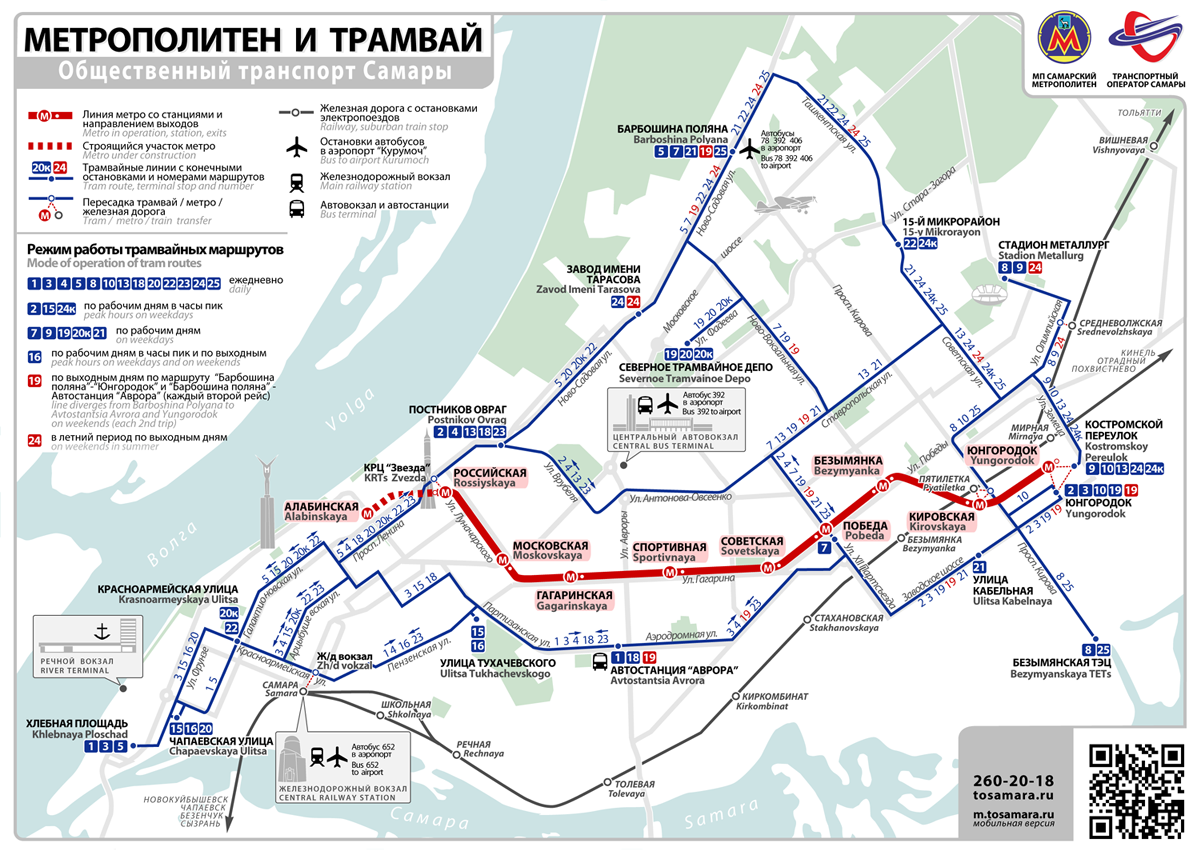
Samara Subway and Tram Map. Courtesy of CartoTalk

Nadezha Fyodorovna

Sixty-nine years old, she heard about the rally from reading flyers. Her main complaint is how the money owed to pensioners has been used to pay for the governor’s palaces and the World Cup.

That scumbag Merkushkin took away all our benefits. How did he dare? He built himself palaces on Rublyovka, four palaces at three hundred million each. Does he have a conscience? Today, he was on Channel Two saying he built all the roads for us. The roads are all good, and everything in Samara is good. Only our pensions will have to pay for the World Cup. He’s a real bastard, a scumbag. We should send him packing back to Mordovia, where he can choke on his sons and relatives. Let’s keep coming out for protest rallies and demanding he resign.

Irina Olegovna and Lyubov Andreyevna

Forty-six and seventy-seven, they heard about the rally on the internet. Their main complaint is that the regime embezzles money and treats people like schmucks.

Irina Olegovna: I’m not a pensioner, but I came to stick up for them. I’m outraged by the injustice that flourishes in our country. The authorities have found the right people to rip off: pensioners. They holler about being a super power, that they defeated the fascists. Who beat whom? What’s the standard of living in Germany and the standard of living in Russia? Who did they defeat? Pensioners and sick children?

Young people attended the rally this time to support the pensioners. Photo courtesy of Yevgeniya Volunkova/Takie Dela

Lyubov Andreyevna: We’ve been spat on from all sides. You cannot get in anywhere to talk to anyone, whether it’s housing services and utilities or healthcare. Everywhere they could not care less about us. I’m seventy-seven. I use the internet and I know everything. I was a decision-maker when I was employed, but now I’ve been utterly humiliated. Thank you, Navalny, that you exposed Medvedev. We must send him packing

IO: It’s absolutely clear to everyone that regime embezzles money, and the fact they are silent is additional proof that thievery is going on. What happened to Serdyukov and Vasilyeva are proven facts. There was a trial, and they were let go. They sold off the property of the defense industry and lined their pockets. I don’t understand who needed this demonstrative flogging. They pulled out their dirty underwear, showed it to everyone, and put it away. I’ll be damned!

LA: Because they consider us idiots.

IO: Stupid schmucks!

LA: Stupid schmucks, cows, that’s who we are!

IO:  I agree with you completely. But ultimately they have to understand a point of no return will be reached, when it all goes to hell. What, are they waiting until people come after them with pitchforks? The country has already reached the boiling point. What the heck do we need Crimea for when our country is poor? I used to support Putin. He inherited a heavy burden, the country was in ruins. He seemed decent. I believed he’d put the country in shape. But then I realized what was what.

LA: Putin works for the oligarchs, not for himself. And we cows will all die off.

Vasily Petrovich

Eighty-two years old, he found out about the rally from a flyer. His main complaint is that payments have not been made to people who went through the war as children.

Look, I’ve brought a newspaper from 2014. Merkushkin promised to make monthly payments of 1,000 rubles to people who went through the war as children. But he didn’t give us fuck-all. We spent the war on a collective farm. Cold and hungry, we supplied the front and the cities with produce, while we ourselves ate grass and dirt. We survived, we were victorious, and now what? Now we are dying in poverty.

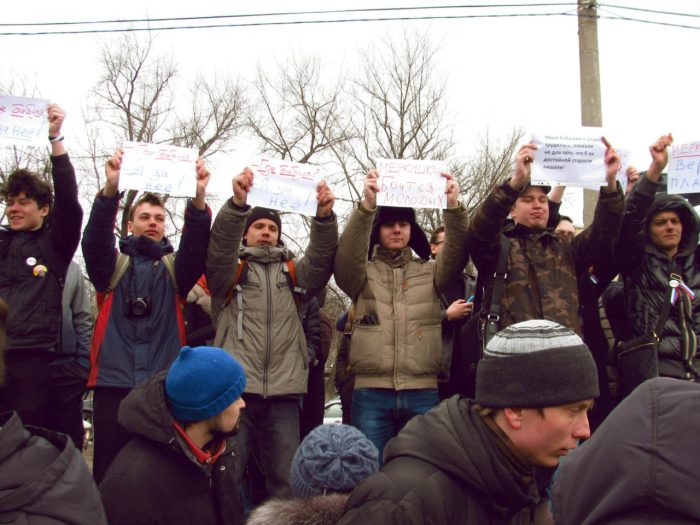
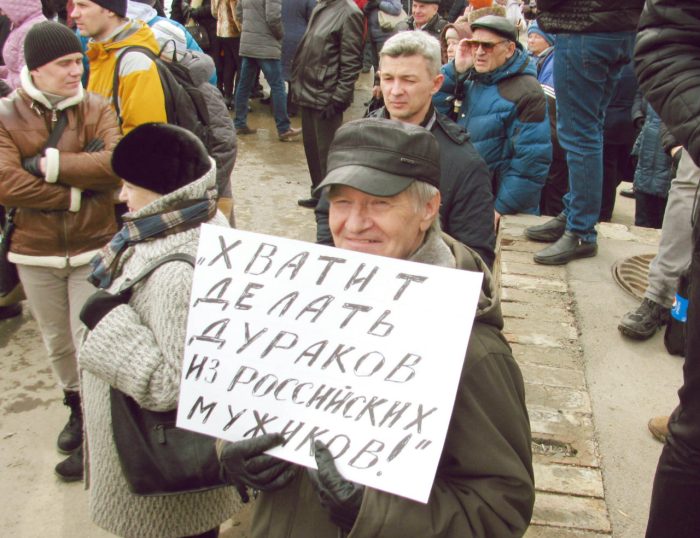
“Stop Making Fools of Russian Dudes!” Protest rally in Samara. Photo courtesy of Yevgeniya Volunkova/Takie Dela

Lydia Nikolayevna

Sixty-eight years old, she heard about the rally on the internet. Her main complaint is that her family has been stripped of all benefits, and that the regime takes people for idiots.

I’m a history teacher, I worked my whole life. Three years ago, my daughter died, leaving me to take care of my granddaughter Lada. She’s thirteen and in the sixth grade. By order of the city administration, the city paid the difference in the housing services and utilities bills for her as an orphan for the whole of 2016. The payment was small, but it made a difference. I’m a veteran of pedagogical work and disabled. We were supposedly divided into two groups: “rich” pensioners, who got 19,000 rubles a month, and poor pensioners. Money was taken away from us under the pretext of giving it to the poor. Money was taken from 175,000 people and then returned, allegedly, but we still haven’t got the money back. I don’t think they took the money in order to give it back. I take my granddaughter to school. I have to transfer, and I use four rides on my discounted travel pass. When they limited the number of trips to fifty, they took us for idiots. They also sucker us out of rides. My friends recorded every trip and noticed that they were shorting us by ten rides. They run out before the month ends, and they kick us off public transport. They’re secretly stealing even from these crumbs, from the fifty rides, as if we couldn’t check how many rides we were getting. I feel ashamed of this regime. We worked honestly our whole lives, and now they’re punishing us, punishing orphaned children and disabled people. It’s disgusting.

Nadezhda

Sixty-one years old, she heard about the rally on the internet. Her main complaint is the thieves in the government.

I have been denied the chance to travel by public transport. I need to drop off and pick up my granddaughter nearly every day. Of course, the number of rides on the travel pass is not enough. It’s just digusting. Why did they decide to limit us? What made them think fifty rides was enough for us? Merkushkin says that somebody made a thousand trips in a month on a seasonal pass. That’s utter rubbish. Even if it’s true, does that mean everyone has to have their benefits slashed? How many crooks and thieves are in the government? How many cases of corruption have been proven? In keeping with Merkushkin’s line of reasoning, all governors should be hauled into the Investigative Committee, no?

Organizing People through Their Wallets

“Let’s Reforge Medvedev’s Palaces into Unlimited Rides for Veterans.” The fifty rides they get on their free transport passes is not enough for residents. Photo courtesy of Yevgeniya Volunkova/Takie Dela

The main organizer of the rallies, Mikhail Matveev, a Communist MP in the Samara Regional Duma, is certain that his best organizer, the person who gets people out to the protest rallies, is Governor Merkushkin himself, the man whose decisions have driven people to the edge.

“Our old ladies don’t just read newspapers and watch TV. They’re not as backwards as they seem. They read social networks and blogs. Young people tell them things. Plus, we leaflet mailboxes and residential building entryways. We printed around 15,000 leaflets for the March 19 rally. The printing was paid for by the party and by ordinary people. It’s not a lot of money, but we don’t have anymore. Residents help us by leafletting for free and printing the leaflets at home on their printers. But the main organizing factor is people’s wallets, and the main organizer is Merkushkin. It used to be that pensioners weren’t aware that the number of trips on public transport was limited, but suddenly they were kicked off buses. The pension checks arrived, they were 700 rubles less, and so on. Dissatisfaction has been growing. We are grateful to Governor Merkushkin for the fact that his blunt propaganda pisses people off. There are all the phrases he tosses off at meetings with constituents, like, ‘It was you who did it so that we did nothing for you,’ and so on. They make the rounds. There will be more protest rallies until we get the pensioners their benefits back and send the governor packing.”

Translated by the Russian Reader

Russia’s Independent Truckers Battle for Their Livelihood

The Truckers’ Battle
Milana Mazayeva
Takie Dela
April 10, 2017

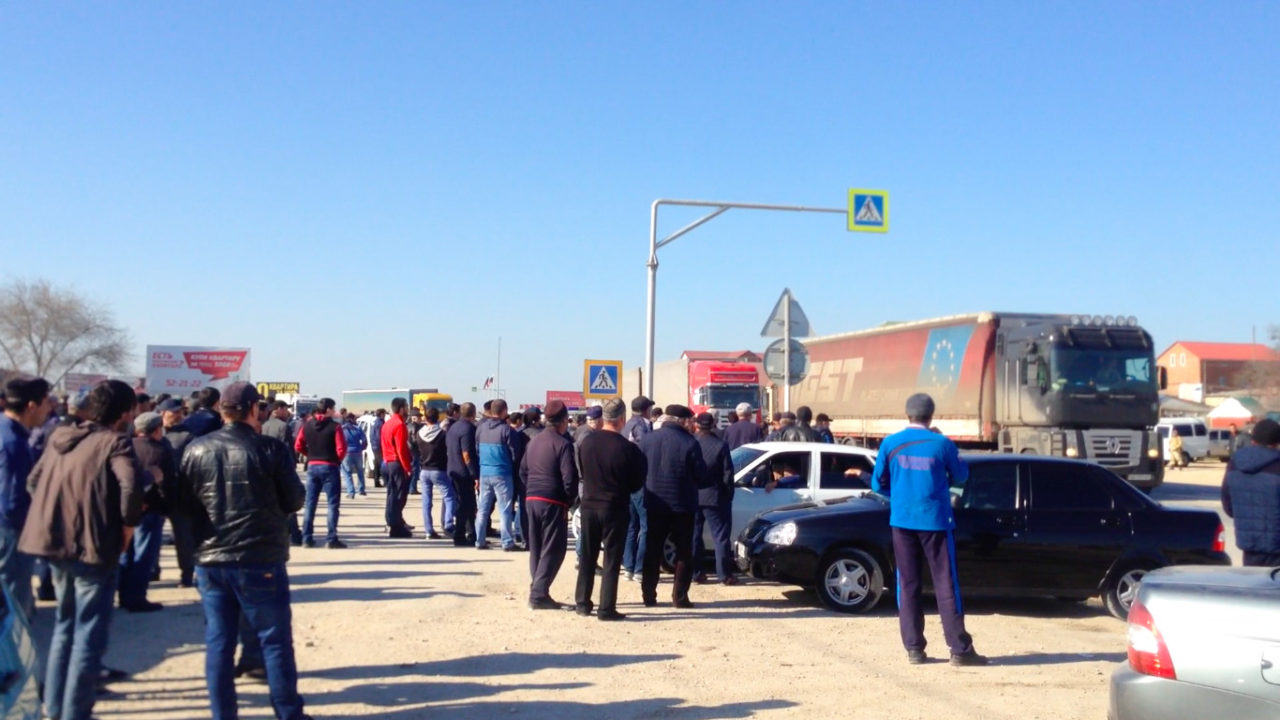
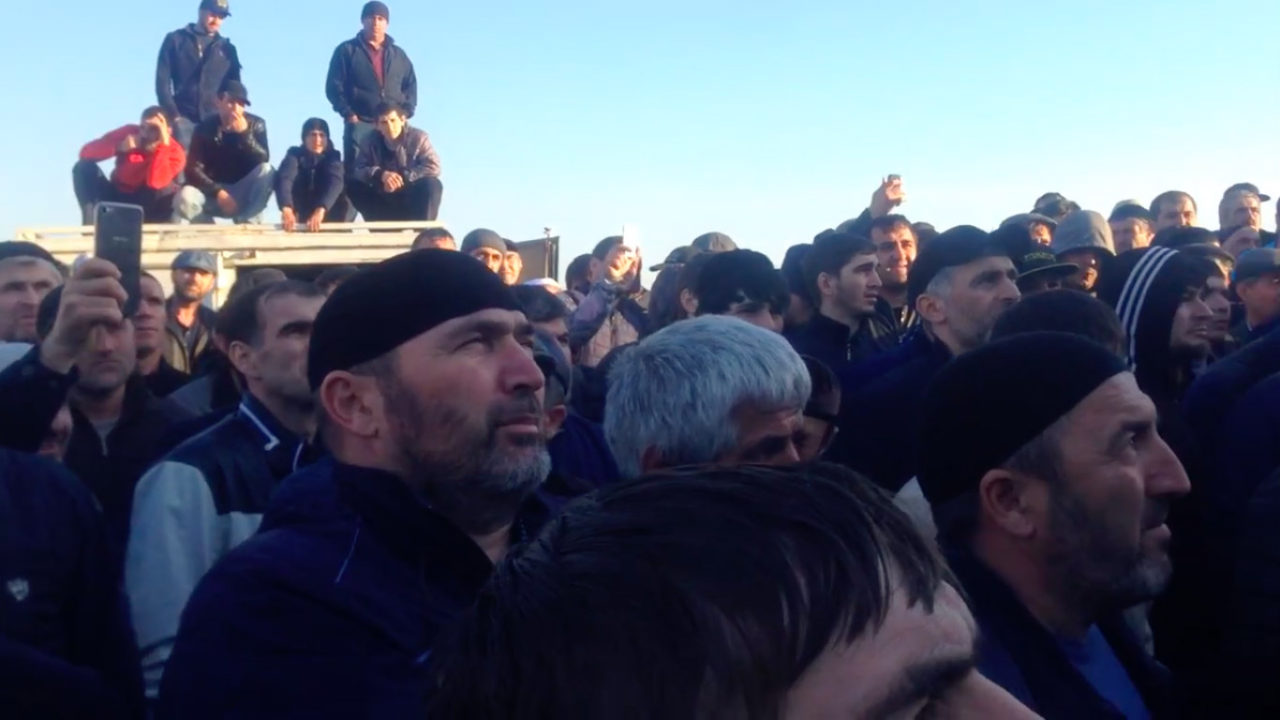
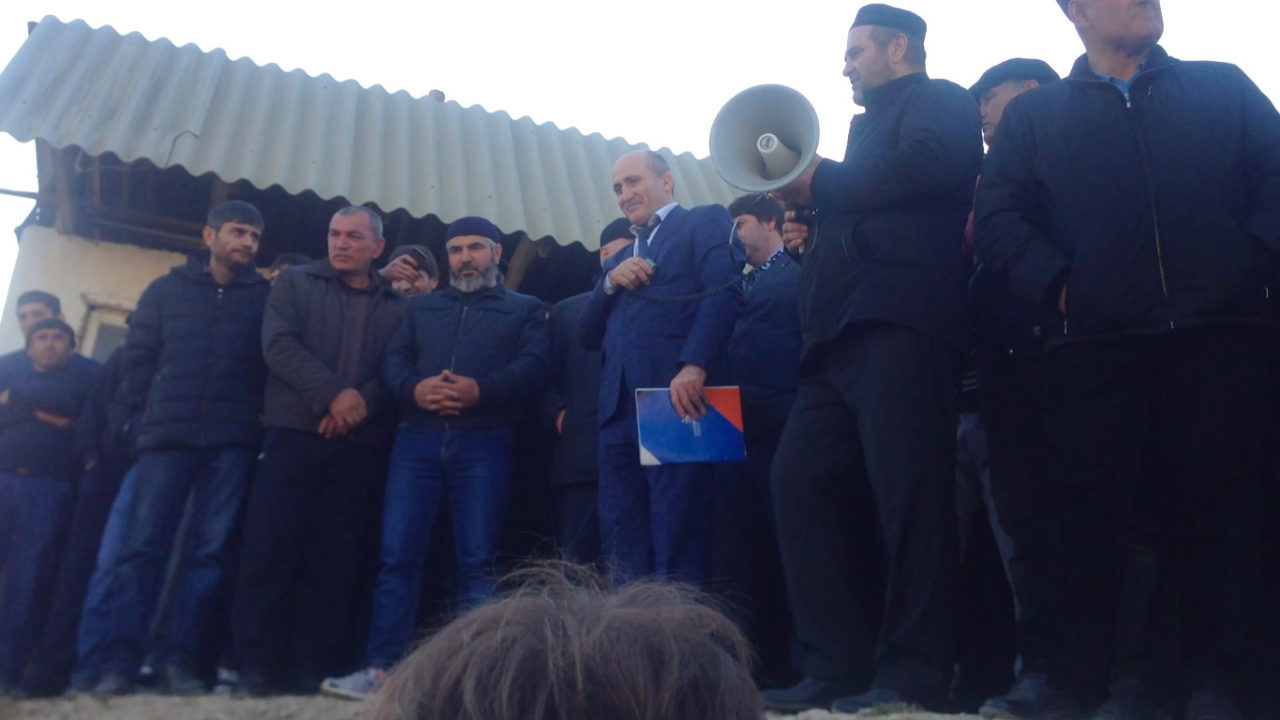
Our correspondent spent time with striking truckers in Dagestan and listened to their grievances against the regime.

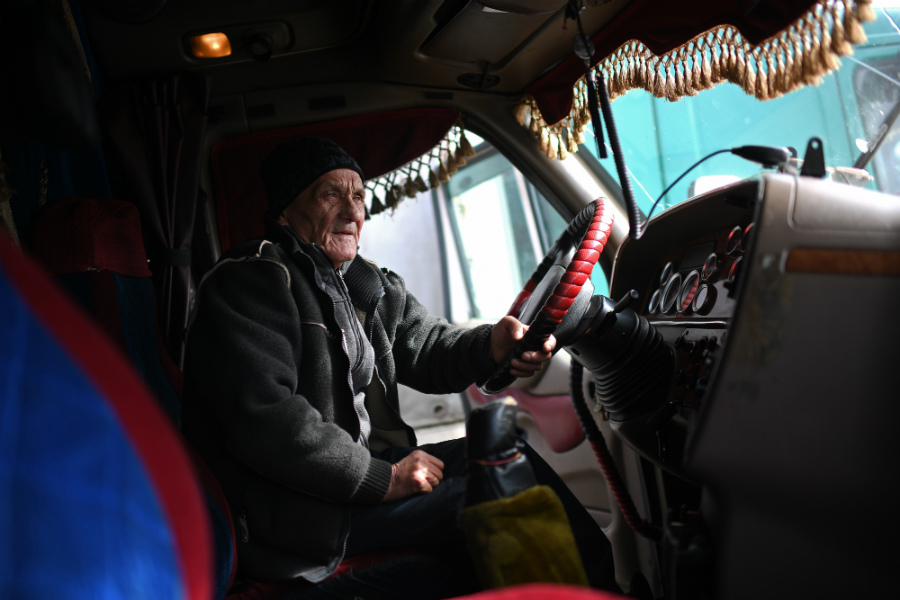
Ali goes to the Dagestani truckers’ strike every morning. He has four children at home, two of them underage. No one in the family earns money besides Ali.

“If I don’t work, the only thing I can count on is the child support benefit my wife gets, which is 120 rubles [approx. 2 euros] a month. But the powers that be are not going to use that on me to force me to leave. I’m in it till the end.”

***

A nationwide truckers’ strike kicked off on March 27 in several regions of Russia. The authorities were quick to react. Petersburg traffic police detained Andrei Bazhutin, chair of the Association of Russian Carriers (OPR), accusing him of driving without a license. The incident occurred on the strike’s first day. Bazhutin was taken to a district court and placed under arrest for fourteen days. The sentence was later reduced to five days, and Bazhutin got out of jail on April 1.

The difference between this strike and other protests is that none of the strikers intends to give up, despite the arrests, intimidation, and blandishments meted out by the authorities.

“The arrest took five days from life and upset my family,” says Bazhutin. “Otherwise, nothing has changed about the strike. We said we were going to shut down cargo haulage, and that is what we have been doing. We said we would set up camps outside major cities, and that is what we have been doing. Next, we’re going to be holding rallies and recruiting grassroots organizations and political parties to our cause. Dagestan has been shut down, Siberia has been shut down. Central Russia is also on our side.”

“Officials Rake in the Dough, While We Eke out a Living”: What the Strikers in Dagestan Are Saying

Vakhid: Who the heck are you? What channel are you with? We don’t believe you. You won’t change anything with your articles. We need Channel One out here. Lots of folks have been here. They’ve walked around and taken pictures, and there was no point to it.

Magomed: I’m striking with my dad and our neighbor. The three of us run a rig together. We chipped in and bought it. It fed three families, but now we cannot manage. Over half the money we earn goes to paying taxes, buying diesel fuel, and maintaining the truck, and now on top of that there’s this Plato. We’re in the red. We’re staying out on strike until we win.

Ramazan: Plato has forced us to raise the prices for freight haulage. This triggers a rise in prices in grocery stores. So we’re the villains who take money from the common people and hand it over to Rotenberg? No, I disagree with this. I don’t want that sin on my conscience.

Haji: I don’t have an eighteen-wheeler. I’m a taxi driver. I came here the first day to support my brothers and then left. But then I saw on the web the riot cops had been sent in, and I decided to join the truckers and strike with them. Are they enemies of the people who should be surrounded by men armed to the teeth? Are the riot cops planning to shoot at them? What for?

The strike in Dagestan. Photo courtesy of Milana Mazayeva/Takie Dela

Umar: I pay Plato 14,000 rubles [approx. 230 euros] for a single run to Moscow and back. It doesn’t matter whether I have a load or I’m running empty. If this goes on, I’ll have to sell the truck. I don’t really believe they’ll abolish Plato, but I have a bit of hope. If I lose my job, my eldest son will have to quit school and support the family. He’s in his fourth year at the police academy.

Anonymous: We don’t have any watch or shift method here. We gave up on the idea because the people whose toes we’re stepping on are just waiting for us to do something that would enable them to charge us with conspiracy and a group crime. We made the decision that everyone would be striking on his own behalf. We have no leaders or chairmen. In 2016, we made a mistake: we elected one person to speak on our behalf. And what happened to him? After the first meeting, he was put on the wanted list and accused of extremism.

Isa: I’m not a long-haul trucker. I have a dump truck, but I decided to take part in the strike, too, because now I have to buy a pass that costs 2,000 rubles a month. What for? I live in town, and I never drive the truck out of town. I’m not causing damage to federal roads, why am I obliged to pay more than what I pay by law? I have four children to support.

Who Started it, or, The Damage Caused by Damage Compensation 

The strike was triggered by an increase in the toll rates for vehicles weighing twelve tons or more under the Plato road tolls payment system. The system was set up, allegedly, to offset the damage big rigs cause to Russia’s highways.

When Plato was launched in 2015, the rate was 1.53 rubles per kilometer. The truckers got the rate lowered to this rate through a series of protests, forcing the government to introduce discounted rates.

The second wave of protests kicked off because the rate was supposed to double to 3.06 rubles per kilometer as of April 15, 2017. After Prime Minister Dmitry Medvedev met with members of the business community on March 23, 2017, the decision was taken to raise the rates by 25% instead of 50%, but the truckers did not give up on the idea of striking. According to Rustam Mallamagomedov, a representative of Dagestan’s truckers, they prepared for the strike in advance.

“I’ve been in the freight business since 2003. There were things in the past that outraged us, like rising prices and changing tariffs, but Plato has been beyond the pale.

As soon as we learned the rates would go up on April 15, we got ourselves coordinated and went out on strike. We wanted to strike on March 10, but recalling what happened in 2015, we decided to get the regions up to snuff, get in touch with everyone, and go on strike together. Before Plato was launched, we hadn’t even heard of it. We were just confronted with a done deal. Yeah, there had been articles about it on the web, but most truckers aren’t interested in news and politics. We went out on strike as soon as we realized what the deal was.”

The Truckers’ Demands: Abolishing Plato and Firing Medvedev

It is difficult to count the number of strikers. We know there are 39,000 heavy cargo vehicle drivers registered in Dagestan, and the truckers claim that nearly all of them have gone on strike. The strikers’ demands also differ from one region to the next. Only one demand is common to all regions, however: dismantling the Plato system.

“It affects each and every one of us, because prices of products will go up for end users,” Bazhutin explains. “The Plato system will be introduced for passenger vehicles, similar to Germany. Next, we have a number of professional demands, since the industry is on its knees. They include reforming work schedules, making sense of the weight and seize requirements, and generally reforming the transport sector. Our fourth point is forcing the government to resign and expressing no confidence in the president. This lack of confidence has been there and will remain in light of the fact that we have a Constititution, but the Constitution is honored in the breach. People’s rights are violated, and since the president has sworn to protect the Constitution, we have expressed our lack of confidence in him. We believe we have to do things step by step. There must be meetings, there must be dialogue.”

Andrei Bazhutin. Photo courtesy of Alexander Zemlianichenko/AP/TASS

The Dagestani drivers’ list of demands includes access to central TV channels.

“We want to be heard,” insists Mallamagomedov. “The mainstream media are silent, although Dagestan is now on the verge of a revolution. Our guys categorically demand that reporters from the main TV channels be sent here. Only after that would they agree to communicate with the authorities.”

Timur, a member of the Makhachkala Jamaat of Truck Drivers (as they call themselves), lists, among other demand, deferred payment of loans during the strike, thus recognizing it as a force majeure circumstance. In addition, the drivers in Dagestan’s capital have demanded an end to the persecution of strikers and the release of jailed activists.

Platonic Dislike, or, Who Needs Plato?

Yuri, from St. Petersburg, has been driving an eighteen-wheeler since 1977. He has been involved in the strike since day one, going home only to shower and change his clothes. Yuri has calculations, made by a professor at the Vyatsk State Agriculture Academy, according to which the passage of one truck over a stretch of highway corresponds to that of three passengers cars, rather than sixty, as was claimed in a government report on the benefits of the Plato payment system.

When he voices his grievances against Plato, Yuri resorts to the Constitution, which stipulates that vehicles and goods should move unhindered on the roads, and forbids erecting barriers and charging fees. [I honestly could find no such clause in the Russian Constitution, but maybe I was looking in the wrong place — TRR.]

Dagestan has also prepared for the eventuality the regime will try and play on the driver’s political illiteracy. The truckers now can safely converse with officials from the Transport Ministry and defend their case by citing calculations and the constitutions of their country and regions.

“We pay the transport tax and the fuel excise tax. The average truck travels 100,000 kilometers annually,” explains Mallamagomedov. “If Plato were to charge the originally announced toll of 3.73 rubles per kilometer, that would have amounted to 373,000 rubles [approx. 6,150 euros] per year for one truck alone. The fuel excise tax amounts to ten rubles per kilometer. That’s another 400,000 rubles a year.”

“In 2013, Putin clearly said during his annual press conference there was money to build roads. What was lacking was the facilities to build them. At the time, the regional authorities even wanted to refocus these funds on other needs. What happened in two years? Why did the money suddenly dry up? We are willing to pay if necessary. No one has a greater stake in road construction than we do. The roads damage our trucks and send the depreciation through the roof. We suggested adding one or two rubles to the fuel excise tax, rather than enrichening a private company. But what ultimately happened?

“During the past two years, four rubles have been added to the fuel excise tax and Plato has been launched. The government makes five trillion rubles [approx. 82 billion euros] a year from the excise tax alone, although one and a half trillion rubles would suffice for road construction and maintenance. But all the roads are still the same.”

Akhmat lives in the Dagestani city of Manas. It has the largest number of striking drivers, two thousand, and just as many big rigs have been shut down. Akhmat readily admits he has never paid a kopeck to Plato.

“I get fines in the mail, but I don’t pay them and I don’t intend to pay them. The money we pay through the fuel excise tax should be more than enough to fund everything. When we fuel up with diesel, we should have already paid enough to build roads.”

According to intelligence gathered by the strikers themselves, only large companies with a stake in maintaining relations with the authorities are not on strike. All the independent drivers have been striking.

“We’ve been getting information that large retail chains are already experiencing problems supplying certain food products, that cheap products have begun to vanish from the shelves, and that fruits and vegetables, which are shipped through Dagestan, have also vanished,” says Sergei Vladimirov from St. Petersburg. “I’m not going to predict how far this will go.

“What matters is that it not lead to revolution or civil war, because the people’s bitterness can come out in different ways. As citizens and fathers, we wouldn’t want this to happen. But if there is no dialogue, there will be no peace.”

Milana Mazayeva interviews a striking trucker in Dagestan (in Russian)

The possibility of losing one’s livelihood is regarded especially acutely in the North Caucasus.

“In my homeland of Dagestan, around 70% of the men earn their living behind the wheel. It is their only income,” says trucker Ali. “If a man is deprived of the means to feed his family, he’ll be ready for anything. The factories have been shut down: there is no employment in the region. Then they’ll say we’re all thieves and bandits. I’m not saying we’ll go stealing, but this system robs us of our last chance to make an honest living. What should we do? Retreat into the forests?”

Ali has been in the Manas camp for four days. During this time, he has not only failed to change his mind but he has become firmer in his intention not to back down.

“Our guys are camped out in Manas, Khasavyurt, Kizlyar, and Makhachkala.

“We stop everyone who drives by and is not involved in the strike. We ask them to join us, to show solidarity. We are certain the consequences will affect everyone. Someone cited the example of a bottle of milk. He said that, on average, the price of a carton rises by one to three kopecks. The guys who made those calculations didn’t factor in that, before the milk hits the stands in the stores, you have to feed the cow, milk it, process the milk, and produce containers. They ignored the entire logistical chain that gets the milk to the stores, talking instead about a price rise of one kopeck.

The strike in Dagestan, April 4. Photo courtesy of Milana Mazayeva/Takie Dela

“If the authorities do not respond to our demands, people will abandon their TV sets. Television is now saying that everything is fine, and that our only problems are Ukraine and Syria. Meanwhile, the country is impoverished.”

Plato’s branch office in Makhachkala claims the strike has in no way affected its operation. There were few drivers willing to pay in the first place. Most truckers look for ways to outwit the system.

“You cannot say that registration has stopped due to the strike. But we have the smallest percentage of registration in Dagestan,” says Ramazan Akhmedov, head of Plato’s Dagestan office. “Only one to two percent of truckers out of a total of 30,000 are in our system. Everyone else claims they didn’t get the fines. The system doesn’t work if a fine isn’t received, so it means they’re not going to pay.”

“Dagestan also lacks cameras that would record violations and issue fines. They are supposed to be installed before the end of the year. Most drivers travel within Dagestan, where there are no monitoring cameras, and when it is necessary to travel outside the region, they resort to tricks: they buy a temporary package or hide their license plates.”

What the Neighbours Say: Other Countries’ Know-How

Systems similar to Plato are used in many countries around the world, but not all of them have proved their worth, argue the Russian truckers. An OPR delegation visited Germany to learn the advantages and disadvantages of their system.

“The Germans blew it all when they agreed to pay tolls via a similar system,” recounts Sergei Vladimirov. “Three big companies pushed private carriers out of their livelihoods. Then they hired them to work for them and cut their pay in half. Germany is a total nightmare at the moment. A similar system for passenger vehicles is going online as of March 24. We can look forward to the same thing.”

But the carriers said there was no comparison between the quality of the roads in Russian and the west. Obviously, such factors as geography and the condition of roads when repairs are undertaken are quite significant.

“We were told about a similar scheme for collecting tolls in Germany,” says Timur Ramazanov. “I traveled around Germany with a local carrier. Along the way, we came across repairs of a new stretch of road. When I asked him why they were repairing a new road, the driver put a full cup of water on the dashboard and sped the truck up to 160 kilometers per hour. The water in the cup was shaking. That was the reason they were repairing that section of road. It would be unpatriotic, but we should hire the Germans to build our roads.”

Ramazan Akhmedov, head of Plato’s Dagestan branch, defends the system.

“When the system was just going online, we chatted with drivers from Belarus. They told us that, at first, their system wasn’t accepted by drivers. They tried to drive around the cameras, but now everyone pays. The system has proven its worth.”

“The Regime Is Out in Left Field”: The Authorities React to the Strike

The reaction of regional authorities to the strike has been mixed. There are regions where officials attend protest rallies on a daily basis, and there are others where they have been totally ignoring the strike.

Bazhutin argues that the closer you get to the capital, the less dialogue there is.

“The authorities at home in Petersburg have reacted quite languidly for some reason. They don’t want to talk with us. But the heck with them, we’ll wait them out.”

Yuri Yashukov is not surprised by the lack of a reaction on the part of federal authorities.

“How did the regime react to the anti-corruption rallies, organized by Alexei Navalny, which took place in all the big cities? Were they shown on television? Maybe in passing. But everyone is connected to the internet, and there you can see how many people came out for them. The only thing you can show on television is what villains the Ukrainians are, what rascals there are in Syria, and talk shows where people applaud the politicians.”

The only thing the regions have common in terms of how local authorities have reacted to the strike are arrests. There have been several dozen arrests. After Bazhutin was detained and later released, three truckers in Dagestan were jailed for ten to fifteen days. According to reports shared by the strikers on the social networks, there have been further arrests in Surgut, Volgograd, Chita, and Ulan-Ude.

Speaking to strikers on April 4, Yakub Khujayev, Dagestan’s deputy transport minister, asked everyone to disperse for three months and give the government time to draft proposals for abolishing Plato. The strikers immediately booed Khujayev, grabbed the megaphone, and took turns speaking. They urged each other not to succumb to the regime’s blandishments.

“The sons of our officials ride around in Mercedes Geländewagen Td cars, but I can’t afford to buy a Lada 14. Why? Did God make them better than me? How are they better than me?”

“Take the highway patrol in Dagestan. What is the highway patrol? They’re just the highway patrol, but they act like generals. I find it ten times easier to talk to Russian highway patrolmen than with our non-Russian highway patrolmen. They’re quicker on the uptake.”

“Look, brothers, they surrounded us with troops and try to frighten us with weapons. Are we going to let them scare us this way?”

“No!”

Yakub Khujayev,  Dagestan’s deputy transport minister (holding folder), with striking truckers on April 4. Photo courtesy of Milana Mazayeva/Takie Dela

Khujayev claims that Russian National Guardsmen did not encircle the truckers, as was reported by various media outlets.

“It was reported on a Friday that the riot cops had kettled the truckers. Every Friday, the mosques are packed to the gills with folks who park their cars on the road. Near the spot where the truckers have their camp, there is a federal highway, as well as a fork in the road and a mosque. Every Friday, law enforcement officers work to prevent a traffic jam. They go there and ask people not to park their cars on the road, and they help the highway patrol clear it. The exact same thing happened on the Friday when there was the outcry about the Russian National Guard.”

The strikers argue that Prime Minister Medvedev’s meeting with businessmen, at which truckers were present, allegedly, was a fake.

“When we found out who represented us at such a high level. It transpired that one of them was a United Russia party member who didn’t even own a truck, and the other guy travels the country telling everyone what a good system Plato is. How could they represent us if they didn’t even mention the strike at the meeting?” asks Timur Ramazanov, outraged.

Mobilization by Mobile Phone: How the Truckers Use Social Networks

During the strike, the truckers have cottoned to social networks accessible on smartphones, although previously most drivers had ordinary push-button mobile phones. The most popular mobile app is the Zello walkie-talkie app.*  The OPR has its own channel on Zello, on which around 400 people are chatting at any one time. There are around 3,000 strikers signed onto the channel.

The app lets you use your smartphone like a walkie-talkie, albeit a walkie-talkie that operates through the internet. On the truckers’ channel, users not only share news from the regions, do rollcalls, and encourage each other but also advise each other about what to do in certain circumstances.

MAXMAX: Guys, under Article 31 of the Russian Federal Constitution, we have the right to assemble peaceably, but [the authorities] are citing Federal Law FZ-54 on rallies and demonstrations. I advise everyone to read it. All the details are there.

BRATUHA86: Guys, Surgut on the line. Vasily’s court hearing just ended. They charged him with holding an illegal assembly of activists and fined him 20,000 rubles [approx. 330 euros]. That’s how it goes. Tyumen, I heard it’s kicking off in your parts, too. They’re going to identify the most active strikers and fine them like Vasily.

VIRUSID: Fellows, let’s help out by crowdfunding the fine. Everyone chips in 100 rubles each. We’ll raise 20,000 in a jiffy.

ALEKSEYVADIMOVICH: Of course we’ll help out. There are over 300 users online right now and we’ll put the money together quickly.

KAMAZ222: Dagestan supports you. Tell me where to send the money.

A long-haul trucker during a protest rally against the Plato system. Gorki Highway, Noginsk District, Moscow Region. Photo courtesy of Ramil Sitdikov/RIA Novosti

1111: Fellows, what’s happening with you all in Dagestan? Is it true the riot cops want to put the squeeze on you? If that’s the way it is, I suggest humping it down there to support the guys.

FRTD: We could do that, but they won’t let us through if we drive in a convoy. We need to think about what to do without setting ourselves up.

Virtually no outside talk is permitted on the Zello channel. Anyone who is suspected of being a provocateur is immediately blocked. The strikers also use the social networks WhatsApp and Facebook.

“Within a year and a half, we have managed to rally an insane number of people around our flag. By and large, the alliance jelled on a professional basis,” says Bazhutin. “Communicating through social networks has really helped us. The guys even knew better than I did what was happened when I arrested. I didn’t know the police were going to release me, but they already knew.”

“Guys from other regions called me today. They had heard the riot cops in Dagestan were planning to disperse the strikers. They promised me that, if this were true, they would come and support them and prevent a clash,” says Mallamagomedov, echoing Bazhutin. “The strikers have been getting vigorous support from taxi drivers and van drivers. They don’t picket all day, but they show up often, bring us food and drinks, and give us pep talks. The talk on the social networks is that now they’re testing the system on large vehicles. Small-tonnage vehicles will be the next step, and then passenger vehicles.”

Digging Ditches and Dismantling Rails: Means of Combating the Strikers

The strike has been hindered not only by the arrests of activists. In one village, the authorities were especially creative. The truckers named the day when they would leave the village and head off to the strike camp. They would have to drive over a railway crossing to do this. In the morning, the eighteen-wheelers arrived at the crossing, and the drivers discovered the rails had been dismantled overnight, cutting off their only way out of the village.

In Rostov Region, the authorities dug a deep ditch around the parking lot where the strikers had gathered, referring to it as “emergency repairs.”

Mallamagomedov has been detained by law enforcement several times. In January 2016, Dagestan’s truckers met to discuss their common problems.

“We decided to establish our own association in the Republic of Dagestan. I was elected leader. After the meeting, I was put on the wanted list, although I wasn’t informed of this. On the Dagestan-Kalmykia border, I was forced to get off a bus and had to hitchhike home. Since then, I haven’t been able to visit Dagestan safely. I was placed on the list of extremists. When I call the police and tell them to take me off the list of extremists, because they know it’s not true, they promise they’ll take me off the list, but I’m still wanted.”

Authorized protest rally of truckers against the Plato system, 27 March 2017, Chelyabinsk. Photo courtesy of Vadim Akhmetov/Ura.ru/TASS

On April 5, Mallamagomedov was immediately picked up by police after a press conference in Moscow. Two men in plain clothes, who introduced themselves as criminal investigators, put Mallamagomedov in a car without plates and took him to an unknown destination. According to him, a case against him was cooked up in August 2016, when he was involved in a farmers’ tractor convoy in Rostov Region. The court order handed to Mallamagomedov on April 5 says he should have been jailed for ten days for an administrative offense, but he was released the evening of the same day. He doesn’t know why he was released, but says his attorney would be appealing to the court’s decision to sentence him to ten days in jail.

“My entire family—my two brothers and my father—are truckers,” says Mallamagomedov. “Several days ago, people came to my father’s house and demanded he sign a paper saying he would not be involved in the strike. ‘I undertake to attend all protests and rallies organized in support of the people,’ my father wrote on that paper.”

* On Monday, RBC reported that Russian federal communications and media watchdog Roskomnadzor would block the free walkie-talkie app Zello within twenty-four hours.

Translated by the Russian Reader

Blind Valery Remizov versus The Brainwashers of Samara

Valery Remizov. Photo courtesy of Nikolai Khizhnyak/Drugoi Gorod

Blind Student Interrupts No Extremism Forum in Samara by Singing Ditties to Officials about Potholes
Takie Dela
March 30, 2017

Valery Remizov, a student at the law faculty of Samara State University, interrupted a speech by Governor Nikolai Merkushkin at the No Extremism Forum, held on March 30 at the MTL Arena sports complex, and sang ditties about the poor state of the city’s roads. Remizov related the incident to Takie Dela himself.

Local officials, legislators, and police were involved in the No Extremism Forum, writes Volga News. The audience included university and high school students, schoolteachers, and university lecturers. One of the people present in the auditorium broadcast a live feed on Periscope entitled “Brainwashing Students in Samara.”

At the nineteen-minute mark in the taped broadcast, as Samara Region Governor Nikolai Merkushin is speaking, we see an audience member get up and sing ditties, accompanying himself on the guitar. A woman approaches him and tries to confiscate the guitar, and she is joined thirty seconds later by police officers. The audience applauds. Merkushin suggests the young man go to the microphone and explain his complaints, but the police have already removed the man from the auditorium.

The blind man with the guitar was Samara State University student Valery Remizov. He told Takie Dela he went to the forum to voice his disagreement with the regional authorities. He explained that, several months ago, had tried to get an appointment with the governor, but he had been turned down.

“I don’t agree with the restrictions on the number of rides you can take if you use the free public transportation pass. I’m outraged by the condition of the sidewalks and roads, which are chockablock with potholes. I’m sick and tired of falling into a cold puddle in a pothole and catching cold. So I showed up and sang about it,” said Remizov.

He said the police showed him to the door of the sports complex and checked his ID.

“The minister for social policy came up to me. We chatted and exchanged phone numbers,” Remizov added. After that, the police released him, and he left the forum.

Volga News, which published a short item on the forum without mentioning Remizov’s performance, described a film show to the students at the beginning of the meeting.

“Carefully staged by spin doctors, mass events undermine society from within and break down national consciousness. Ultimately, this leads to tragic consequences and even people’s deaths.”

On February 1, 2017, Samara Region authorities limited the number of rides passengers could take on the free public transportation pass to fifty. A protest rally took place on February 18 in Samara. Protesters demanded the restoration of social benefits and called for the resignation of Governor Nikolai Merkushin. Approximately a thousand people took part in the rally.

The Samara news website Drugoi Gorod published a profile of Valery Remizov in late January. The young man is passionate about music and politics, and is studying to be a lawyer.

“It seems to me that if you really want to improve the city, it has to be comfortable for everyone right away. We are all people. We all want to walk on decent sidewalks and drive on good roads. But when you’re walking on broken pavement, it doesn’t matter whether you’re sighted or not. Everyone breaks their legs,” Remizov said in the interview.

Translated by the Russian Reader. Thanks to Comrade VZ for the heads-up.

_________________________

By the way, that was my 1500th blog post since I began telling stories about “other Russians” on October 23, 2007, which was when I launched the Russian Reader.
Then for five years, from 2008 to 2013, I told more such stories at Chtodelat News, with a slightly different twist, before returning full-time to the Russian Reader, where I’ve been translating and scribbling like a bat of out hell since 2013.
During that time, I’ve had nearly 468,000 views on both blogs combined.
I know that hardly compares with the megastars of blogging and tweeting and facebooking. I hope, however, I’ve managed to persuade some of you there is much more to modern Russia than the vicious nonentity VVP and his ruling clique, and that you should be much more interested in all those other Russians than in the nonentity and his allegedly wild but basically useless (and, perhaps, altogether fictitious) “popularity” and its elusive (nonexistent) “sources.”
The Russian Reader is a completely unfunded, unaffiliated, all-volunteer, almost entirely solo effort, so there’s a lot I haven’t been able to do, stories that I’ve missed entirely, and an inevitable subjectivity to what I chose to write about and how I write about it.
Nevertheless, I hope it’s still worth my doing, but I won’t know that unless I get real feedback in the form of better readership numbers and comments, letters, and even offers of help from you, my actual Russian readers. TRR

Roots

Страницы из учебника 5 класса по предмету "Истоки"
“The Plough and the Ax”: pages from the fifth-form textbook “Roots.” Photo courtesy of Anton Carliner/SCHSCHI and Takie Dela


“What Can We Learn from the Plough and the Ax?”
Alexandra Koksharova
Takie Dela
December 13, 2016

Parents of pupils at a Moscow school have complained to the Prosecutor General’s Office that their children are being indoctrinated with a religious ideology. Takie Dela spoke with Inna Gerasimova, who was behind the complaint.

***

After coming home from school at the start of the school year, Inna’s 11-year-old son Yegor asked, “Mom, do we really have to have icons at home?”

“No, where did you get that idea?”

Yegor took the textbook Roots (Istoki), which he had just been issued, from his backpack.

The textbook’s author addresses schoolchildren as follows.

“You do know, of course, that icons guide the Russian individual on weekdays and holidays, on long journeys and in times of war. People turn to them in joy and in sorrow, and miraculous icons are especially revered.”

“I can’t remember our ever having taken icons on a journey,” chuckled Yegor.

Inna is an atheist, and there were no icons in their home. She tried to explain to Yegor that all this was not obligatory, of course, although he was well aware of it himself.

Yegor Gerasimov is a fifth former at School No. 2065 in New Moscow. Nearly half of his classmates are from Muslim families, and there are also children from Jewish and Catholic families. In September 2015, a subject entitled “Fundamentals of the Spiritual and Moral Culture of the Peoples of Russia” (abbreviated ODNKNR in Russian) was introduced to the mandatory school curriculum. The Roots textbook is used in sixty-two Russian regions. According to Hieromonk Gennady (Voitishko), head of the information service of the Russian Orthodox Church’s Synodal Department for Religious Education and Catechesis, the Roots program is “a kind of prototype of secular ethics that takes regional specifics and traditions into account.” Officials argue that ODNKNR is not an attempt to indoctrinate children religiously, but the parents at School No. 2065 have formed a quite different impression.

***

It was at a parents’ assembly in August that Inna found out her son would have a new subject at school beginning this year. The head teacher was then unable to explain what exactly fifth formers would be learning during this class, but the subject’s name, Roots, did not arouse suspicion amongst the parents. They were amazed only when they saw the textbook for the subject. Initially, they tried to find out from the head teacher how such a thing could have got into the school. The head teacher promised to get to the bottom of it. Then they sent letters to the school’s headmaster, complaining about religious indoctrination and asking that the textbook be changed. The headmaster responded to all of the letters by explaining that there had been no choice: the education department had issued the program, and there was nothing to be done. The school could not switch textbooks.

Inna decided that her complaint that the textbook was not secular had be to well founded, and so she undertook a painstaking analysis of Roots. She collated its content with laws and regulations.  She counted the number of times such words and phrases as “God” (60), “miracles” (66), “evil spirits,” and so on were mentioned in the book. Among other things, although the textbook has a total of 126 pages, a third of those pages are taken up by illustrations.

The parents’ main complaint against Roots is that the textbook lacks any academic component whatsoever. Alexander Kamkin, the book’s author, does not cite specific sources, and historical events and cultural landmarks are described by evoking either infernal or divine forces. For example, in a chapter dealing with Solovki, the construction of the Solovki Special Purpose Camp (SLON) and the destruction of the monastery are characterized as the advent of a “great evil.”

“Disaster struck in 1920. […] The monastery was closed, its shrines were descecrated and destroyed, and its churches were defiled.”

Kamkin does not specify who exactly desecrated and defiled the shrines. The only historical personage in this chapter is Moscow Patriarch Alexy II, who visited Solovki in 1992.

If that were not enough, Kamkin suggests that fifth formers take a new look at the Moscow Kremlin.

“Look carefully, not only with your eyes but also feel with your heart, with your soul.  Don’t you think that the Kremlin’s Cathedral Square resembles a gigantic all-Russian candleholder?”

The textbook opens with the topic of “The Plough and the Ax,” which takes up five lessons.

“The children took a quiz on the topic ‘What can we learn from the plough and the ax?’ After lessons in programming, chemistry, and biology, how can you talk for five lessons in a row about the plough and the ax? Every other sentence in the textbook says that only God makes all things possible, only with his help do things get done, that ‘prayer and effort make all things right.’ This ‘proverb’ is quoted in the textbook,” says Inna.

At the next parents’ assembly, the head teacher suggested that disgruntled parents turn in the textbooks, but the remaining children could continue using Roots in class. It was then that the parents of all twenty-four children in the class wrote formal requests, addressed to the school’s headmaster, asking that the class be exempted from studying the subject. The textbooks were then confiscated from the fifth formers, but they kept studying the subject all the same. This incident took place in only one class of fifth formers, but the other four fifth-form classes at the school kept using the textbook. There was no difference, however. Inna knows the course curriculum by heart and says that the assignments the teacher now gives her son are the same as in the textbook.

“The instructor cannot do nothing about it. He is 100% dependent on the system, on the education department, like everyone else,” says Inna.

Inna sent a complaint, signed by all the parents whose children are in the class, to the prosecutor’s office. There was no response for one and a half months. Then the complaint was first sent down to the education department before being sent back to the headmaster.

***

“We don’t mind our children learning something new about Orthodoxy,” explains Inna, “but not from this textbook, because one cannot speak only of Orthodoxy while saying nothing about the fact that paganism once existed, and that nowadays Islam exists alongside Christianity, and that basically we live in a multi-ethnic country. It’s wrong to present one religion so onesidedly while engaging in manipulation when it comes to a textbook for children. We aren’t against religion. We’re against pitching the subject matter in this way, in which Orthodoxy is discussed as the only possible religion.”

Translated by the Russian Reader