Andrei Kolesnikov: Hooked on Militarism?

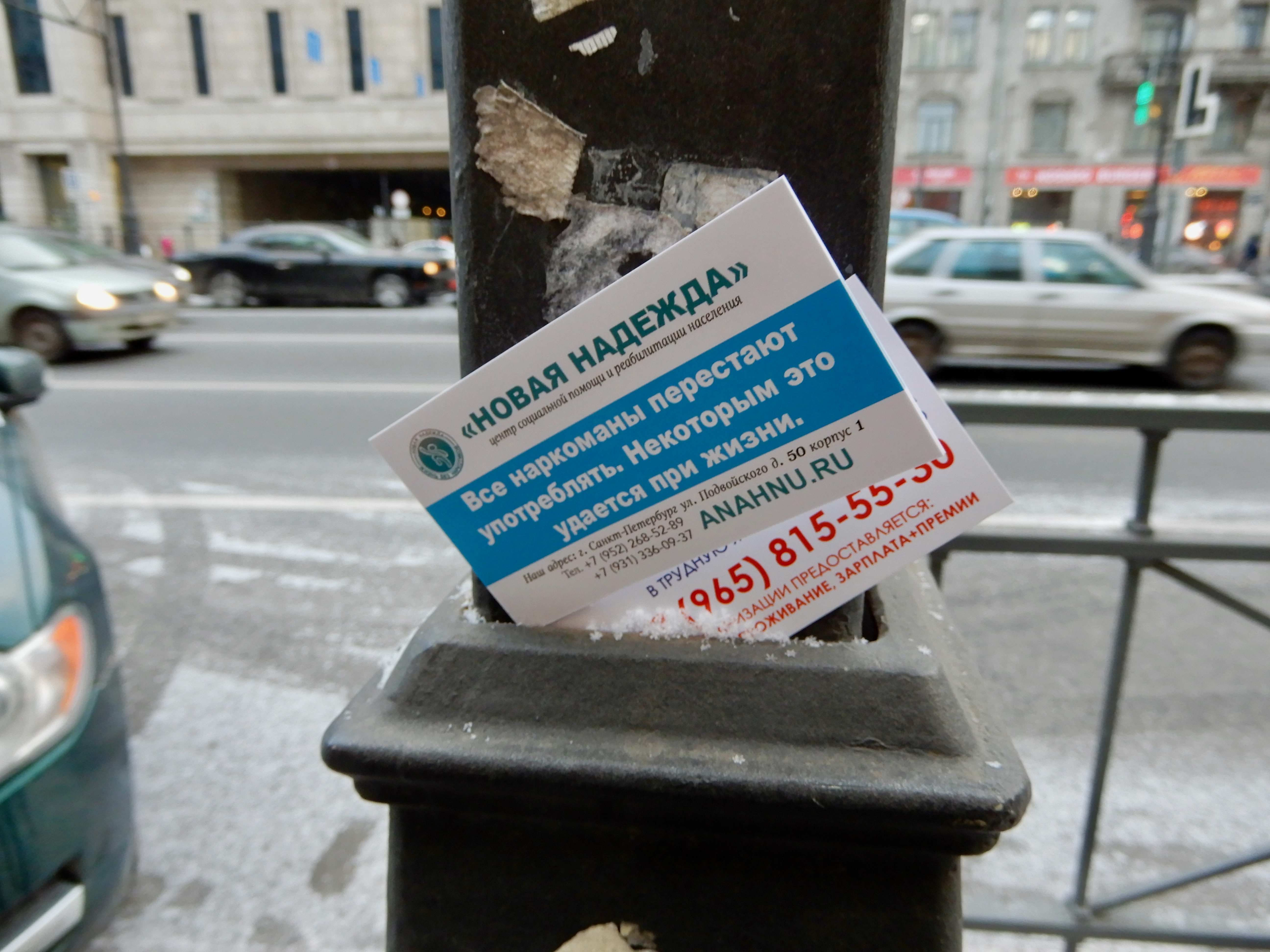
new hope“New Hope. All drug addicts quit using. Some manage to do it while alive.” Photo by the Russian Reader

Where Militaristic Infantilism Leads
Society’s Losing Its Fear of War Is More Dangerous Than What Happens in the Absence of an Anti-War Movement
Andrei Kolesnikov
Vedomosti
November 28, 2018

The “polite people” in the Russian military have taken to ramming ships, shedding their politesse. A military coming out has happened. Either so-called hybrid war has become more hybridized in terms of the variety of its methods or it has become more like good old-fashioned war, involving actual armed clashes. Politically, Russia has become not merely toxic but hypertoxic. A premonition of war prevails among more timid folks, although the footage of the ramming at sea, as painless and triumphal as a military parade on Red Square or a football match (“Crush him!”), still make military operations appear unscary and toylike. We will carry the day in any case, sans victims and blood (ours, that is), as in a cartoon by Putin.

This militaristic infantilism—the loss of the fear of war, the loss of the idea that war is terrible—is the worst outcome of our country’s daily intoxication with the thought of its own greatness for several years running. The army is greatly respected nowadays. People need to trust someone, and the armed forces have bypassed another institution, the presidency, in trustworthiness ratings.

Does this mean Russians are ready for a real war? To put it more plainly, are Russian parents willing to let their eighteen-year-old boys be called up to fight Ukrainian boys just like them? Does anyone understand what they would be fighting for? Is it really all about cementing the nation, “Crimea is ours!” and the personal ambitions of several high-ranking figures in the Russian establishment?

Since 2012, Russia’s collective identity has been built on negative foundations, on awakened resentment, which had been dozing, but had no thought of waking up. The plan has worked quite well. This resentment, however, is verbal and fictitous. Public opinion supported “coal miners” and “tractor drivers” verbally. In Syria, the official army and private military companies fought, or so Russians imagined, at their own risk. The proxy war with the US has gone very far at times, but in the summer of 2018 it did not stop the majority of Russians from abruptly improving their attitude [sic] to the States and the west in general.

But suddenly there is the threat of a real war. On the other side of the border, in the country [i.e., Ukraine] that the Russian imperialist mind never really considered sovereign, a mobilization is underway and martial law has been declared. Is this reality capable of changing popular opinion and rousing Russian civil society, which has a lot going for it except an anti-war movement? No, because so far the war has not been regarded as real.

Identification with the military is the last bullet in the Russian regime’s gun, but it is a blank or, rather, a prop. Exploiting what Russians regard as sacred—i.e., privatization of the memory of the Great Patriotic War [WWII] by a particular group—is a tool that is still in play, but militarism as such has lost its power to mobilize and consolidate Russians. If “German POWs” are marched around Novgorod on January 20, 2019, in an absurd attempt to reenact the NKVD’s Operation Grand Waltz, and on January 29, a military parade is held in St. Petersburg to mark the latest anniversary of the lifting of the Siege of Leningrad, it will not raise Putin’s approval rating from 66% to 80%. Those days are gone. So, the props have been dropped in favor of direct action in the Kerch Strait, but its power to mobilize people is not at all obvious.

You can cynically throw the ashes of those who perished in the Siege of Leningrad to stoke the furnace of fading ratings as much as you want. You can march people dressed up as German POWs round Novgorod as much as you like. When, however, pollsters ask Russians between the ages of eighteen and twenty-four what countries they regard as role models, they list Germany, China, and the US. This is not because young Russians are unpatriotic, but because not everything comes to down to the top brass feeding on the poisonous corpse of the Stalinist past. The present day, progress, and visions for the future matter, too.

Can we do it again? We cannot. Nor is there any reason to do it. Infantilized by the regime, Russian society’s maturation will be measured by the numbers of people who are convinced that we cannot and should not do it again.

Andrei Kolesnikov is program director at the Moscow Carnegie Center. Translated by the Russian Reader

Solomon Yudovin at the St. Petersburg Jewish Community Center

The Three Yudovins and Yet Another One
Valery Dymshits
lechaim.ru
December 17, 2017

An artist is defined by the context in which people find him interesting and appreciate his work. This is not a new idea, but it is no less true for all that.

A native of the Belarusian shtetl Beshenkovichi, Leningrad graphic artist Solomon Yudovin (1892–1954) has not been forgotten, exactly, but nor is he widely known, and all because his oeure occupies several nonoverlapping contexts.


Solomon Yudovin, Beshenkovichi, 1933. Courtesy of Boris Faizullin

One of the most successful Soviet graphic artists, an acknowledged master of woodcuts and linocuts, and illustrator of editions of works by numerous Jewish writers, Yudovin showed his work nearly annually and was the subject of two monographs during his lifetime. After he died, he was exhibited and mentioned, but less often. The last major show of Yudovin’s work took place in 1956 in Leningrad.

Then he was remembered anew.

He was primarily recalled in Israel and, later, in Russia, in connection with his relative and mentor S. An-sky (Shloyme Rappoport), a writer and the father of Jewish ethnography. Yudovin was involved, as a photographer and artist, in An-sky’s renowned Jewish folk ethnography expeditions of 1912–1914, and they defined his artistic career over the next quarter century. Yudov’s engravings turned up again in various periodicals and books dealing with Eastern European Jews.  Yudovin was rightly seen as one of the principal artists of the old shetls, as an artist who had depicted their synagogues, old people, artisans, and, most important, the lush decorations on carved tombstones in their cemeteries. Yudovin was essentially the neoacademic alternative to the non-realist expressionist Marc Chagall, regarded as post-Soviet Russia’s primary Jewish artist. Yudovin and Chagall, who had been at loggerheads in Vitebsk during their lifetimes, were once again competitors, so to speak. Yudovin has even stole the limelight from Chagall (a seemingly impossible task) in terms of reproductions and collages on the covers of Jewish-themed books.

From the series Jewish Popular Ornamental Design, 1940. Courtesy of the Petersburg Judaica Center

Regardless of the so-called Jewish revival, Yudovin is remembered by those who write about the Nazi Siege of Leningrad or curate show dealing with the subject. Thanks to the series of linocuts Leningrad during the Great Fatherland War, Yudovin has come to be regarded as one of the most important Siege artists. His black-and-white, intolerably contrasty works from the war years and first postwar years produce a fascinating image of the dead city, whose horrifying beauty was so often described in diaries by people who witnessed the Siege firsthand. Yudovin’s self-portrait—of an artist doggedly laboring in an unheated studio—has become a primary visual symbol of the Siege.

Those who remember the Jewish Yudovin rarely remember the Siege Yudovin, and vice versa, despite the fact they had a lot in common. We could argue that Yudovin, with his skill in producing moribund, balanced compositions, and his powers of concentration, which was at odds with the empirical commotion of impressionism, was best equipped to deal with the topic of death. His famous engraving Burial in a Shtetl anticipated his images of Leningraders, carrying their dead on sledges.

In recent years, yet another, previously unknown aspect of Yudovin’s talent has been discovered. Due to the efforts of the Petersburg Judaica Center (where I have the honor to work), hundreds of photographs taken by Yudovin during the An-sky expeditions have been unearthed and published. These photographs have proven not only highly informative works, but also and primarily works of high art. Solomon Yudovin the pictoriailist has taken an honorary place alongside Alter Kacyzne and Roman Vishnyak, the principal photo portraitists of the vanished world of Eastern European Jewry.  Our only regret is that Yudovin, who produced brilliant photographs in his youth, never again took up a camera. Perhaps he deemed his work as a graphic artist superior to the craft of the photographer. Maybe Yudovin was brought up short by the fact that pictorialism, so attractive to him in his youth, had gone out of fashion and, moreover, was persecuted in the 1920s. Whatever the case, photography was a brief albeit vivid episode in his artistic career. Now, however, the photographs have also occupied a prominent place in numerous Jewish publications of recent years.

Having become a graphic artist, Yudovin ceased being a photographer. However, the photographs he took in the early twentieth century were to play a hidden but significant role in the history of Jewish art. They were a source of motifs and compositions for the graphic works of Yudovin himself (until he gave up Jewish subjects), and then were the basis of illustrations of the works of Sholom Aleichem by the much more famous artist Nathan Altman.

Solomon Yudovin is remembered in his guises as Jewish artist, Siege artist, and art photographer. It turns out, however, that Yudovin had a fourth guise, a most unexpected on.

One of the last Jewish institutions in prewar Leningrad was the Yakov Sverdlov Jewish House of Education (Yevdomprosvet), which survived until 1938 along with similar institutions for other ethnic minorities in the building at 10 Nekrasov Street, the current home of the city’s Bolshoi Puppet Theater. The Yevdomprosvet operated a theater studio in which amateur actors, guided by professional director Lev Mursky, staged plays in Yiddish. Yudovin was the stage and costume designer for two productions by this group: Draftees (1934) and The Call-Up (1936), based on the play by Mendele Mocher Sforim. Mursky’s papers, stored in the archives of the St. Petersburg Jewish Community Center, yielded a set of costume and scenery sketches done by Yudovin. This new, seemingly unrecognizable Yudovin is cheerful, quite lively and, most surprisingly, polychromatic, and there is a touch of the grotesque and satirical in his work. In a word, this is a fourth, hitherto unknown Yudovin.

Tailor, Costume Sketch for Staging of the Play “Draftees,” 1934. Courtesy of the St. Petersburg Jewish Community Center
These four incarnations of Solomon Yudovin are on diplay at the exhibition From Beshenkovichi to Leningrad, which opened on the 125th anniversary of the artist’s birth at the St. Petersburg Jewish Community Center at 3 Rubinstein Street. The Petersburg Judaica Center loaned photographs from the An-sky expeditions and woodcuts from the series Jewish Popular Ornamental Design. Petersburg collector Boris Faizullin supplied drawings and engravings from different periods, including the Siege, while the St. Petersburg Jewish Community Center has exhibited the works for the theater. The show has necessarily taken the shape of a sketch of sorts, but at the same time it is representative. All four Yudovins have finally met. Perhaps someday the Russian Museum, the Tretyakov Gallery or one of Moscow’s Jewish museums will remember the work of the classic Soviet graphic artist, but until that happens, hurry over to Rubinstein Street. From Beshenkovichi to Leningrad runs until mid January.

Translated by the Russian Reader

P.S. If you liked this article and found it informative and thought provoking, please share it with friends and colleagues on social networks. Robust readership numbers are the only feedback I get for a job I do in my spare time for free.

This Is Russia

DSCN0810

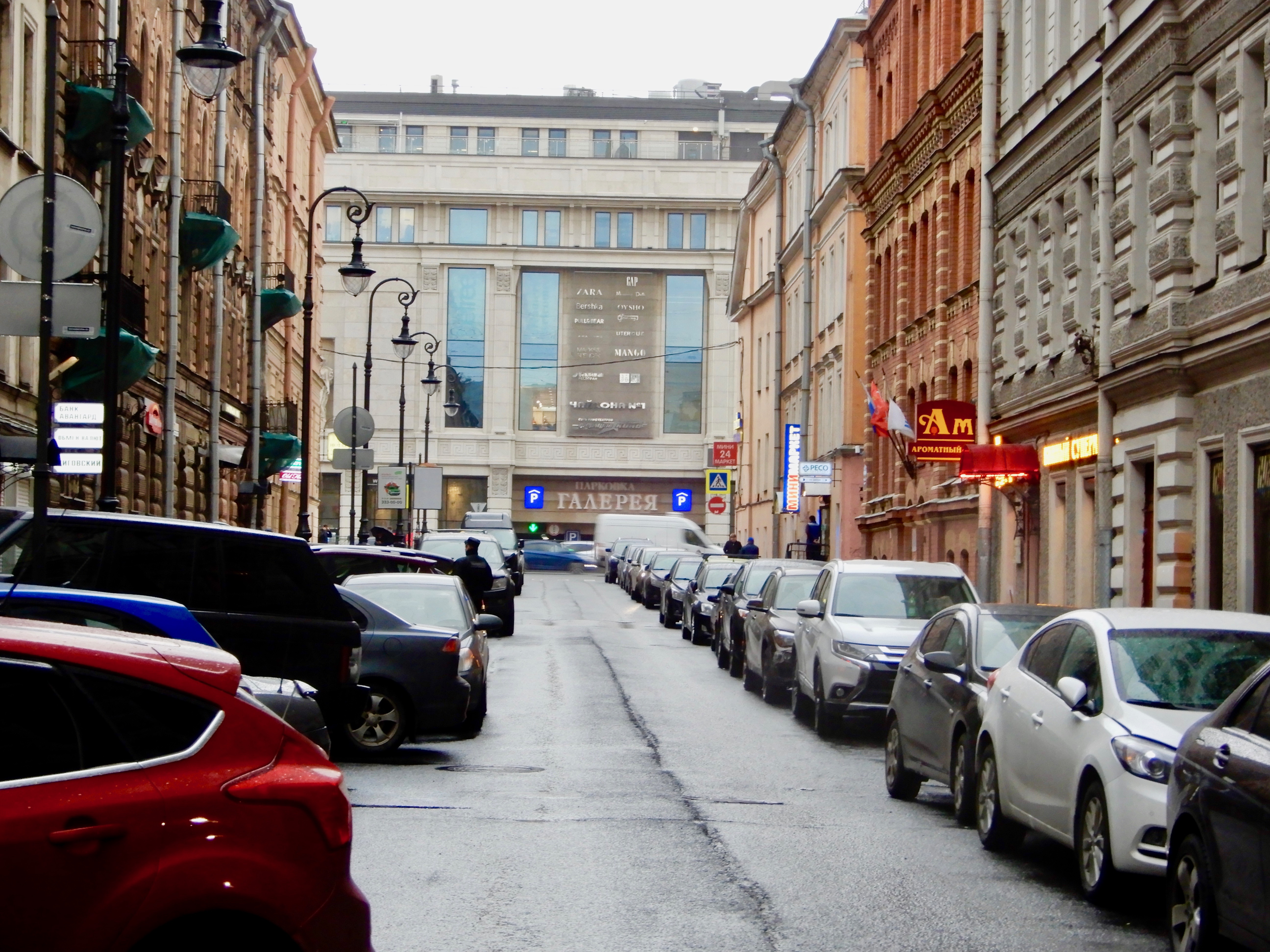
“This is Russia. This is the Russia that Americans are so scared of.”

In the background of this photo, you can make out the Galeriya Shopping Center, located in downtown Petersburg. It’s gigantic, covering the land once occupied by five or six graceful tenement buildings and a cultural center and cinema. They were demolished in the mid 1990s, not to make way for the shopping mall, but so a new train station could be built there, cheek by jowl with the existing Moscow Station, because federal and regional officials wanted to build a high-speed train line between Petersburg and Moscow. Millions of dollars were allocated for the project, but ultimately, the train line was never built nor was the new station erected. No one knows what happened to the millions of dollars allocated for the project. They simply vanished into thin air.

The site of the former-future high-speed train station sat vacant for many years behind a tall, ugly construction-site fence. No one could figure out what do to with all that wasteland, which was in the very heart of the city, not in some forgotten outskirts. However, before the money had vanished, and the project was abandoned, construction workers had managed not only to demolish all the tenement buildings on the site but had also dug a foundation pit. Over the long years, this pit filled up with water. Some time after Google Maps had become all the rage, I took a look at our neighborhood via satellite, as it were, and discovered to my great surprise it now had a small lake in it. It was the foundation pit of the former-future high-speed train station, filled to the brim with water.

Good times came to Petersburg in the 2000s, when the country was flush with cash, generated by high oil prices, a flat tax rate of 13%, and runaway corruption. It was then the city’s mothers and fathers (I’m not being ironic: most of Petersburg’s “revival” was presided over by Governor Valentina Matviyenko, a former Communist Youth League functionary who had converted to the gospel of what she herself called “aggressive development”) decided that Petersburg, one of the world’s most beautiful, haunting, enchanting cities, should be extensively redeveloped, despite its status as a UNESCO World Heritage Site, into a mecca of consumerism that would give pride of place to cars and new highways, since cars had become the new status symbol among the city’s rich and poor alike. They also decided that, since other big cities in the world had lots of high-rise buildings, their city, which did not have almost any high-rise buildings, should have lots of them, too.

Basically, they decided to demolish as much of the inner and outer city as they could get away with—and they could get away with a lot, because they had nearly unlimited political power and lots of the country’s money at their disposal—and redevelop it with high-rise apartment buildings, superhighways, big box stores, and shopping and entertainment centers, each one uglier and bigger than the last. Thanks to their efforts, in a mere fifteen years or so they have gone a long way toward turning a Unesco World Heritage Site into an impossible, unsightly mess.

But let’s get back to our miniature inner-city lake. Finally, developers came up with a plan to convert the site into a giant shopping mall. Even better, the architects who designed the mall were clearly inspired by Albert Speer, Hitler’s favorite architect and a leading Nazi Party member, to turn a rather oversized mall into a celebration of kitsch faux-neoclassicism, precisely the sort of thing Speer had championed in his projects. This, indeed, was a bit ironic, because Petersburg, then known as Leningrad, had survived a 900-day siege by the German army during the Second World War. Considered the longest and most destructive siege in history, it killed at least 800,000 civilians, that is, it killed the grandparents and great-grandparents of many of the people who now enjoy visiting this mall, with its distinctly neo-fascist aesthetic.

Along the sides of the street running down towards the photographer from the Albert Speer Memorial Shopping Center, you see lots of shiny new, fairly expensive cars, parked bumper to bumper. In fact, the Albert Speer has a huge underground car park where you can park your car relatively inexpensively (our neighbor lady, a sensible woman, does it), but most Petersburg car owners actually think parking their cars wherever they want—especially either right next to their residential buildings or, worse, in the tiny, labyrinthine, incredibly charming inner courtyards of these eighteenth- and nineteenth-century buildings—is their legal right. It isn’t, but they don’t know it or don’t want to know it. I know they think this way because many Petersburg car owners have told me so.

To my mind, the precipitous rise in personal car ownership in Petersburg has done more to degrade the city’s beauty than all the underinspired colossal high-rises put together, because the city was purposely designed by its original builders, beginning with Peter the Great, to have a good number of intersecting and radiating, awe-inspiring, long and clear sightlines or “perspectives.” Hence, many of the city’s longest avenues are called “prospects,” such as Nevsky Prospect (the title of one of Nikolai Gogol’s best stories) and Moskovsky Prospect. Nowadays, however, you gaze down these “perspectives” only to see traffic jams and hectares of other visual pollution in the shape of signs, billboards, banners, and marquees. It’s not a pretty sight.

On the right of the picture, somewhere near the middle, you should be able to spot a small shop sign with the letters “AM” emblazoned on it. It’s one of the dozens of liquor stores that have popped up in our neighborhood after the Kremlin introduced its countersanctions against US and EU sanctions, which were instituted in response to Russia’s occupation of Crimea and invasion of Eastern Ukraine. The US and EU sanctions targeted individuals and companies closely allied with the regime. Putin’s countersanctions, in a manner that has come to seem typical of how the Russian president for life’s mind works, were targeted against Russian consumers by banning the import of most western produce into the country. An exception was made for western alcoholic beverages, especially wines and beers, and this meant it was suddenly profitable again to get into the liquor business. The upshot has been that you can exit our house, walk in any direction, even putting on a blindfold if you like, and you will find yourself in a liquor store in a matter of minutes, if not seconds.

Last summer, I tried painting a little verbal and photographic sketch of the effect this massive re-alcoholization has had on our neighborhood, along with other, mostly negative trends in the use and abuse of commercial space in the city.

Finally, there is one other thing you should know about all those new, mostly oversized cars parked on the street. Since the average monthly salary in Russia barely crawls above 600 or 700 euros a month, even in a seemingly wealthy city like Petersburg, most of those gas-guzzling, air-polluting status symbols were bought with borrowed money.

Just the other day, in fact, I translated and posted a tiny article, originally published in the business daily Kommersant, about how people in the Voronezh Region currently owed banks approximately two billion euros in outstanding loans. In 2015, the region’s estimated population was around 2,300,000, so, theoretically, each resident of Voronezh Region now owes the banks 870 euros, which I am sure is more than most people there earn in two or three months. Of course, not every single resident of Voronezh Region has taken out a loan, so the real damage incurred by real individual borrowers is a lot worse.

I could be wrong, but I think what I have just written gives you a rough idea of how you go about reading photographs of today’s Russian cities, their visible aspect in general, turning a snapshot into something meaningful, rather than assuming its meaning is obvious, right there on the surface. You don’t just tweet a photo of a new football stadium or fancy restaurant or street jammed with expensive cars and make that stand for progress, when progress, whether political, economic or social, has not occurred yet in Russia, despite all the money that has been sloshing around here the last fifteen years. Instead, you talk about the real economic, political, and social relations, which are often quite oppressive, murky, and criminal, that have produced the visible reality you want to highlight.

Doing anything less is tantamount to engaging in boosterism, whataboutism, Russian Worldism, and crypto-Putinism, but certainly not in journalism. That so many journalists, western and Russian, have abandoned real journalism for one or all of the isms I have listed is the really scary thing. ||| TRR

Photograph by the Russian Reader

Granddad’s Hut

Granddad’s Hut
Alexei Yerofeyev
June 9, 2017
Sankt-Peterburgskie Vedomosti

Дедова будка | Внучка Игнатия Малаховича Ерофеева Вера Дмитриевна возле дедовой будки. Фото 2016 г. ФОТО из семейного архива
Ignaty Yerofeyev’s granddaughter, Vera, next to her grandfather’s hut in central Petersburg, 2016. Photo courtesy of Yerofeyev family archive/Sankt-Petersburgskie Vedomosti 

Our city contains many details, sometimes curious trifles that impart a homeyness and simplicity to its “austere, comely look,” to a city that is sometimes uptight and business-like. Among them was the tiny wooden house that stood for over sixty year at Lomonosov Street, 9, behind the fence next to the old entrance to the Refrigeration Industry Institute.

This unpretentious hut, which resembled the huts you see nowadays on garden plots in the countryside outside the city, was partly a matter of pride to me, since it was a rare specimen of wooden construction in the heart of the city, and its designer was my granddad Ignaty Malakhovich Yerofeyev. Neither an architect nor even a carpenter, Ignaty was an ordinary caretaker.

Ignaty and his family arrived in Leningrad in 1929 from the village of Gogolevka, Smolensk Region, having left behind the house he had built there. Physically strong, thrifty, and intelligent, he had got his family away from the collectivization campaign. In Leningrad, he took a job as a caretaker. At first, the family had to live in a basement.

The family survived the Siege of Leningrad. Granddad remained at his job, while my father, who was fourteen years old in 1941, worked in a factory. Their peasant skills came in handy in the spring of 1942, when all the land in the institute’s yard was repurposed into vegetable gardens.

Only after the war did the family get permission to move into an apartment on Lomonosov Street, 9, to which its former occupants had not returned. This house was my home, just like the yard, in which there were three whole gardens. The poplars growing in them were also planted by my granddad and his friend Grandpa Kostya, who had also arrived from Gogolevka during the year of the so-called Great Break (velikii perelom).

Built by Ignaty Malakhovich in the early post-war years, the little house by the gate was the caretaker’s hut, which housed his scant collection of equipment. When I was born, Granddad was already retired, but he still really enjoyed relaxing on the bench he had placed next to the hut.

In 1968, the institute’s residential building was resettled and enlarged, and the little garden were practically destroyed. The hut, which was all we ever called it, was vacant for several years. Later, it was turned into a gatehouse, before becoming a security checkpoint in the 1990s. It was slightly rebuilt. The porch was removed, and it was repainted from green to brown.

Walking down Lomonosov Street, I always enjoyed looked at our family relic. The last time I passed through this familiar place, in April of this year, I was disappointed to see the old gatehouse was gone, replaced by a cheap-looking construction trailer.

I entered my old yard. A security guard immediately emerged from the depths of the yard and demanded I leave the premises. When I asked him where the hut had gone, he replied, “It was taken away for restoration.” I didn’t believe it. Soon I repeated the same route and stopped by the yard again. The run-in with the guard was repeated, although another man was on duty. Surprisingly, he also said the hut had been taken away for restoration.

“Can’t you see this is a temporary shed?” the security guard exclaimed angrily.

His angry question was music to my ears. Oh, how wonderful it would be if Granddad’s hut were returned to its place.

Alexei Yerofeyev is a board member of the Petersburg Union of Amateur Local Historians. Translated by the Russian Reader. Thanks to Comrade Koganzon for the heads-up

Surviving the Siege

“I Only Want to Take a Bath, Nothing More”
Alexander Kalinin
Rosbalt
May 15, 2017

Anna Yegorova is ninety-eight years old. She defended Leningrad all nine hundred days of the Nazi siege of the city during the Second World War. On the seventy-second anniversary of Victory Day, the combatant did not even get postcards from the government. But there was a time when she wrote to Brezhnev—and got a reply. 

Anna Yegorova. Photo courtesy of Alexander Kalinin and Rosbalt

Anna Yegorova was born in 1918 in the Kholm-Zhirkovsky District of Smolensk Region. When she was ten, her parents decided to set out in search of a better life and moved to Leningrad with their daughter. They settled in a wooden house near the Narva Gates on New Sivkov Street, now known as Ivan Chernykh Street. Yegorova finished a seven-year primary school and enrolled in the Factory Apprenticeship School, where she graduated as a men’s barber.

“Oh, what beards didn’t I trim in my time,” the Siege survivor recalls.

After acquiring a vocation, the 19-year-old woman married Alexander Vesyolov, a worker at the Kirov Factory. As soon as the war broke out, her husband volunteered for the first division of the people’s militia. Nearly the entire division fell in battle during July–September 1941 on the southern approaches to Leningrad. Vesyolov is still officially listed as missing in action.

Yegorova was drafted into the air defense brigades at the war’s outset. The young woman served in a basement, equipped with seven cots, in one wing of the Kirov Factory. It was the headquarters of the local air defense brigade.

Yegorova still remembers the war’s outbreak, her military service in the besieged Leningrad, and victory in May 1945.

Фото ИА «Росбалт», Александр Калинин
Anna Yegorova as a young woman. Photo courtesy of Alexander Kalinin and Rosbalt

“How did the war begin? We were going to the cinema, but my mother told me I should go to the factory instead. Then I got a notice stating I had been drafted to serve in the headquarters of the local air defense brigade at the Kirov Factory. I spent all nine hundred days there. I was able to come home only once a month. My parents starved to death. Dad passed away on February 3, 1942. He was a first-class carpenter. His comrades made him a wooden coffin: they could not bury a carpenter without a coffin. Mom died a month later. They just carried her off to the Volodarsky Hospital in a blanket. I don’t even know where she is buried. Maybe at the Piskaryovskoye Memorial Cemetery, maybe in Moskovsky Victory Park,” says Yegorova.

Her duties included running to other parts of the city to deliver dispatches, carrying the wounded, and standing on guard at the factory, armed with a rifle. The young woman would look into the sky and watch what planes were flying overhead: planes emblazoned with red stars or planes bearing black crosses. Once, during a heavy bombardment, she was shell-shocked.

“I still remember how we chopped up houses in the Kirov District. Once, a girlfriend and I were dismantling a house near a railroad bridge, and a woman called out to us, ‘Girls, girl, come here, come.’ We didn’t go: we were scared. There were all kinds of people back then, you know. Once, this girl stole my food ration cards, and my mom’s earrings were also stolen,” recalls Yegorova.

Фото ИА «Росбалт», Александр Калинин
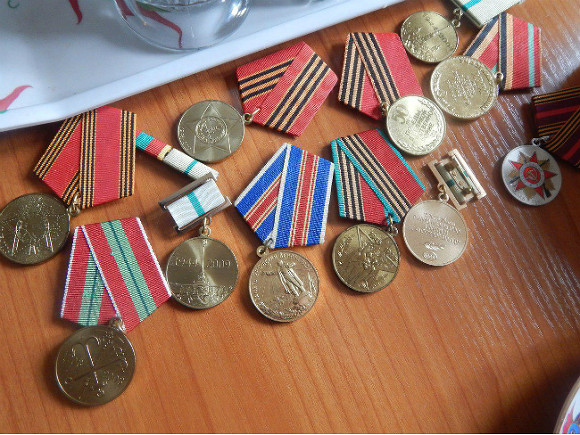
Yegorova’s collection of war medals. Photo courtesy of Alexander Kalinin and Rosbalt

The Siege survivor recounts how she would travel to the Krasnoarmeysky Market to buy linseed cakes and oilseed meal.

“The oilseed meal was like sawdust. Oh, how I gagged on that oilseed meal! But we had nothing to sell. We were poor.”

When Victory Day arrived, her house was nearly totally destroyed. Only an ottoman was rescued from the ruins.

Yegorova remarried after the war. Her new husband was a military officer, Nikolai Yegorov, who had fought not only in the Great Patriotic War (Second World War) but also the Finnish War (Winter War). In peacetime, Yevgorov became a first-class instrumentation specialist. In 1946, the Yegorovs gave birth to a daughter, Lydia. Yegorova worked as a secretary at the Kirov Factory, latter becoming head of a bread and confectionery department at a store.

In the late 1960s, Anna Yegorova wrote a letter to Leonid Brezhnev, secretary of the Central Committee of the Soviet Communist Party. The essence of the message was as follows.

“Leonid Ilyich, no one is forgotten, nothing is forgotten. But it has so happened that I, a survivor of the Siege of Leningrad, awarded the medal For the Defense of Leningrad, and my husband, a veteran of the Great Patriotic War, have to huddle with our daughter in a sixteen-square-meter room on Lublin Alley.”

Image courtesy of slideshare.net

Yegorova does not believe her letter reached Brezhnev personally, but she does think it wound up in the hands of a “kindly” secretary who helped the family move into a one-room flat in the far southern district of Ulyanka. She lived in the neighborhood for around thirty years. She was civically engaged, working with Great Patriotic War veterans. She says she even worked as an aide to Sergei Nikeshin, currently an MP in the St. Petersburg Legislative Assembly, who was then quite young. Nikeshin and she inspected the fields then surrounding Ulyanka.

The certificate accompanying Anna Yegorova’s medal For the Defense of Leningrad. Photo courtesy of Alexander Kalinin and Rosbalt

In 1996, Yegorova took seriously ill. She was struck down by deep vein thrombosis. Her left leg “was like a wooden peg.” Her husband Nikolai died in 1999.

“After that, Mom stayed at home. I took care of her. This is my cross. We would take her to the dacha only in the summer. Otherwise, she would move about only in the apartment. She would get up in the morning and make her bed, come into the kitchen and sit down on the couch. She would turn on  and call the station to request a song. She loved Boris Shtokolov’s “Dove.” Or she would request “A White Birch Weeps,” or something by Nikolai Baskov. But a month ago she took to her bed. Now all she does is lie in bed,” recounts her daughter Lydia Kolpashnikova.

Boris Shtolokov, “Dove” (a Russian adaptation of “La Paloma”)

Kolpashnikova is herself a pensioner. She has a third-degree disability. According to her, Petersburg authorities have practically forgotten her mother. True, three years ago, the Moscow District Administration called and said she could get a wheelchair. The women’s joy was short-lived. It transpired that the wheelchairs were used: they had been brought to Petersburg from Holland. To make use of the chair, they would have had to pay to have it repaired. The women decided to turn the gift down the gift.

Фото ИА «Росбалт», Александр Калинин
Congratulatory cards and other memorabilia sent to Anna Yegorova over the years as a Siege survivor. Photo courtesy of Alexander Kalinin and Rosbalt

Yegorova has received no substantial help from the local Siege survivors society. The organization can only offer trips to museums and theater tickets. This is not an option for Anna Yegorova, who is in no condition to leave her apartment. On memorial days—the Day of the Lifting of the Siege and Victory Day—however, cakes used to be brought to her. But this time around, however, she was completely neglected. According to the pensioner, the city did not even congratulate her.

Yegorova’s daughter Lydia decided to remind the authorities of her mother’s existence after hearing President Putin’s speech on TV. The president demanded that the heads of the country’s regions do a better job of caring for Great Patriotic War veterans.

Фото ИА «Росбалт», Александр Калинин

“I clung to Putin’s words that veterans needed help, for example, if they needed help with home repairs. I called the district administration and asked them to repair our bathroom,” says Kolpashnikova. “Mom is completely ill. She is almost completely out of it. She has gallstones, heart failure, and atrial fibrillation. She is classified as a first-class disabled person. She survives only on sheer willpower. But now she cannot make it to the bathroom. I wipe her off in bed. She talks to me about the bathroom all the time, however. She wants to take a bath, but wants the bathroom repaired. The tile has crumbled in there. I called the Moscow District Administration and asked them to repair the bathroom, but I was told that ‘sponsors’ deal with these issues. Now, however, there is a crisis, and there are no sponsors. What sponsors were they talking about? Mom also needs medicines and diapers. There are social workers willing to run from one office to the next to get hold of diapers for free, but they also need to be paid to run around. The local Siege survivors organizations cannot do anything: they are the weakest link. I have no complaints against them.”

Фото ИА «Росбалт», Александр Калинин

Anna Yegorova gets gifts from the authorities only on round dates. When she turned ninety, they gave her a towel, and they presented her with bed linens when she turned ninety-five.

“I called them in the autumn. I said that Mom would be turning ninety-eight on November 25. I suggested they come and congratulate her. They said to me, ‘We don’t have the right. When she turns one hundred, we’ll congratulate her,” recounts the Siege survivor’s daughter.

Anna Yegorova does not want to ask the authorities for anything.

“I have no strength. What should I do? I cannot stand up straight. I fall. I just want them to fix the bathroom. I want to take a bath. That’s it.”

All photos courtesy of Alexander Kalinin and Rosbalt. Translated by the Russian Reader. Thanks to Comrade Koganzon for the heads-up