Russia Is Not a Land of Opportunity for Central Asians

Tajikistan has condemned what it called an “ethnic hatred” attack in Russia after a 10-year-old boy from a Tajik family was stabbed to death at a school near Moscow, in a rare public rebuke aimed at a key partner for labor migration and security ties. The killing happened on December 16 in the village of Gorki-2 in the Odintsovo district of the Moscow region, according to Russia’s Investigative Committee, which said a minor attacked people at an educational institution, killing one child and injuring a school security guard.

A video of the attack circulated on Russian social media after the incident. According to reporting by Asia-Plus, footage published by the Telegram channel Mash shows the teenage assailant approaching a group of students while holding a knife and asking them about their nationality. The video then shows a school security guard attempting to intervene before the attacker sprays him with pepper spray and stabs him. The assailant subsequently turns the knife on the children, fatally wounding the 10-year-old boy.

statement released by Tajikistan’s interior ministry said it feared the case could “serve as a pretext for incitement and provocation by certain radical nationalist groups to commit similar crimes.” Tajikistan’s response also drew attention after the foreign ministry said the attack was “motivated by ethnic hatred.” Dushanbe subsequently summoned the Russian ambassador to protest the attack, handing him a missive “demanding that Russia conduct an immediate, objective, and impartial investigation into this tragic incident.”

The condemnation is particularly notable as Tajikistan rarely issues public criticism of Russia, which remains its main destination for migrant labor and a key security partner.

According to Russian media, the attacker, who has admitted their guilt, subscribed to neo-Nazi channels and had sent his classmates a racist manifesto entitled “My Rage,” in which he expressed hostility toward Jews, Muslims, anti-fascists, and liberals, a few days before the incident.

Tajik migrants form one of the largest foreign labor communities in Russia and across Central Asia. Millions of Tajik citizens work abroad each year, most of them in Russia, sending remittances that are a critical source of income for families at home. According to the World Bank, remittances account for roughly half of Tajikistan’s gross domestic product in some years, making labor migration a cornerstone of the country’s economy. Many Tajik migrants work in construction, services, and transport, often in precarious conditions and with limited legal protections. The killing comes as Central Asian migrants in Russia face growing pressure to enlist in the war in Ukraine, with coercion through detention, deportation threats, and promises of legal status having been reported.

The killing has also renewed scrutiny of rising xenophobia in Russia, particularly toward migrants from Central Asia. The Times of Central Asia has previously reported an increase in hate speech, harassment, and violent attacks targeting migrants, especially following major security incidents. Human Rights Watch has warned that Central Asian migrants in Russia face growing discrimination, arbitrary police checks, and racially motivated abuse, trends that have intensified in recent years amid heightened nationalist rhetoric.

Source: Stephen M. Bland, “Tajikistan Condemns Fatal Stabbing of Boy in Russia Citing Ethnic Hatred,” Times of Central Asia, 17 December 2025


It’s curious. I looked through some of the [social media] pages of Russia’s [most prominent] political émigrés—[Ilya] Yashin, [Vladimir] Kara-Murza, [Ekaterina] Schulmann, [Leonid] Volkov, [Elena] Lukyanova, [Dmitry] Bykov, [Marat] Gelman, [Boris] Zimin, [Boris] Akunin—but I couldn’t find a word about the violent death of a Tajik boy in a school near Moscow. They have expressed no sympathy, voiced no criticism of racism and xenophobia. It seemingly should be their direct obligation to speak out on this issue. But for some reason, mum’s the word. I also looked at the Telegram channels of the leading official anthropologists, and there is a mysterious muteness among them too. Surely it is their professional duty not to remain silent on such a matter. They even published a book called Tajiks and themselves speak everywhere of interethnic harmony. But in this case, it’s as if they’ve dummied up.

Source: S.A. (Facebook), 18 December 2025. Translated by the Russian Reader


As FB is reminding, there were times I believed I could protect my non-Slavic looking friends, lovers, relatives, foreign students and migrant workers from the nazis marching in the streets, from the nazis working as policemen, from the general xenophobia and unsensibility by magic tricks of art.

Source: Olga Jitlina (Facebook), 18 December 2025
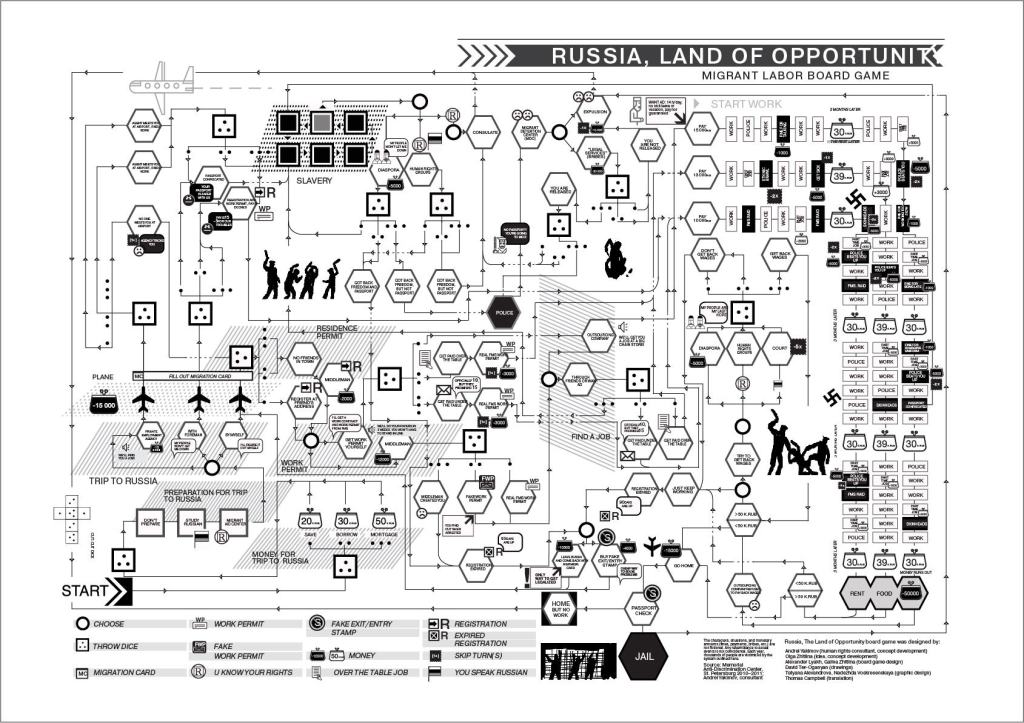

Thomas Campbell just translated our migrant labor board game Russia – The Land of Opportunity!!!

Russia – The Land of Opportunity board game is a means of talking about the possible ways that the destinies of the millions of immigrants who come annually to the Russian Federation from the former Soviet Central Asian republics to earn money play out.

Our goal is to give players the chance to live in the shoes of a foreign worker, to feel all the risks and opportunities, to understand the play between luck and personal responsibility, and thus answer the accusatory questions often addressed to immigrants – for example, “Why do they work illegally? Why do they agree to such conditions?”

On the other hand, only by describing the labyrinth of rules, deceptions, bureaucratic obstacles and traps that constitute immigration in today’s Russia can we get an overall picture of how one can operate within this scheme and what in it needs to be changed. We would like most of all for this game to become a historical document.

Source: Olga Jitlina (Facebook), 17 December 2011


Life for migrant workers is Russia is becoming increasingly difficult after stringent new controls introduced over the past year. These include a registry of “illegal” migrants, restrictions on enrolling migrant children in schools, new police powers to deport people without a court order, and a compulsory app for all new migrants in Moscow and the surrounding region to track their movements.

Working in Russia was already less appealing because of the war in Ukraine and the weakening rouble. Now, with these new restrictions, a growing number of young people from Central Asia are starting to look elsewhere — including to countries in Europe — in search of better opportunities.

Dreaming of Europe in Moscow

Like 89% of young Kyrgyzstanis, 25-year-old Bilal* had always dreamed of working abroad.

Young people in Kyrgyzstan grow up in an environment where leaving the country to find work is common, widespread, economically essential, and socially accepted — and where the domestic economy still cannot offer comparable opportunities.

The average monthly salary in the country is about 42,000 soms (around $480), while in Russia, for example, wages in manufacturing can reach 150,000 rubles (nearly $2,000). Unlike most of his peers, Bilal never planned to work in Russia. “Because many of our people face racism there,” he explains.

Europe was his dream, but without connections getting a job offer from an EU employer seemed nearly impossible. So Bilal turned to “intermediaries” — fellow Kyrgyzstanis who had established ties with European companies that were constantly seeking workers. They advised him to travel to St. Petersburg, where, they said, it would be easier to prepare the paperwork and apply for a visa.

But it was the height of the COVID-19 pandemic. Many Schengen countries had stopped issuing visas and temporarily shuttered their consulates. Bilal didn’t want to return home empty-handed, so he decided to stay in Russia — “not by choice,” as he puts it.

“At first I worked illegally at a ski resort. Mostly we chopped firewood and cleared snow around the cabins. They paid us in cash,” he says.

Two months later, Bilal moved to Moscow and obtained a patent — the work permit that allows citizens of visa-free countries to be legally employed in Russia. He found a job as a courier for Yandex.

Bilal speaks excellent Russian — something he says explains why, unlike many of his friends, he didn’t encounter xenophobia all that often. But conflicts still happened. “You’d run into people who’d say, ‘Migrants, coming here in droves…’ Especially when a customer had put down the wrong address and the delivery got messed up — somehow it was always the migrant’s fault.”

Bilal left Russia two months before the full-scale invasion of Ukraine. “Back then it wasn’t like it is now,” he recalls. “Yes, the police would stop you on the street, but they’d take some money and let you go. Now my friends talk about Amina (a Russian mobile app for monitoring migrants), about police rounding people up, and about being sent to the war.”

He decided to set his sights on Europe instead.

Watched and bullied

In Russia, the path to legal employment for migrant workers runs through a processing centre known as Sakharovo — located about 60 kilometres from Moscow and notorious for its massive queues, where people often wait for hours. The perimeter is guarded by armed security forces, and inside migrants undergo procedures such as blood and urine tests to screen for “socially significant diseases”. Those who manage to obtain their documents can work legally, but that doesn’t protect them from future problems.

Russians often refuse to rent apartments to migrants. Schools and kindergartens decline to accept migrant children, citing “lack of space,” while the adults themselves face workplace “raids” or frequent “document checks” on the street or on public transport. Even Russia’s war in Ukraine has become a tool for pressuring them: many migrants are pushed to join the military in exchange for various “bonuses,” such as fast-tracked citizenship.

After the attack on Crocus City Hall — which authorities say was carried out by four Tajik citizens —the security services launched large-scale raids. Tajikistan’s government, fearing a surge in xenophobic incidents, even advised its citizens not to leave their homes.

Lawmakers soon joined in. Over the past year, they have restricted the ability to obtain residency through marriage, granted the Interior Ministry the power to deport migrants without a court ruling, required migrant children to pass a Russian-language exam before being admitted to school, and created the Registry of Monitored Persons — a database of foreign nationals who supposedly lack legal grounds to stay in Russia. There are already known cases of people being added to the list by mistake, and effectively losing the right to move freely around the country after their bank accounts were frozen, and their driving permits revoked.

Officials have justified all these measures as necessary to fight illegal migration and prevent crime. In July, the Interior Ministry reported a rise in crimes committed by migrants, but migrants still make up only a small fraction of overall crime statistics. A study by the “To Be Exact” project found that adult Russian men are statistically more likely to commit crimes than migrant workers.

On September 1, a new pilot project went into effect: migrants from Uzbekistan, Tajikistan, Kyrgyzstan, Armenia, Kazakhstan, Georgia, Azerbaijan, Moldova, and Ukraine who are living in Moscow or the Moscow region must install a mobile app called “Amina.” Authorities openly acknowledge that the app’s main purpose is to continuously track users’ locations.

The app that doesn’t work

If a phone fails to transmit location data to Amina for more than three working days, the participant is automatically removed from the system. If the migrant cannot fix the issue quickly, they risk being added to the “monitored persons” registry — which can lead to frozen bank accounts, job loss, or even expulsion from university.

Imran, a 27-year-old Tajik citizen, is worried: “Location services on my phone are on, and Amina shows that everything is being transmitted, but several times a day I get notifications saying the app isn’t receiving my location. The app works terribly. And I have no idea what consequences this could have for me.”

Users report constant problems with Amina. Some can’t get past the first screen; others say the app won’t accept their photo; still others receive alerts that their data failed verification. But the most common issues are related to location tracking.

In comments on RuStore (Russia’s internal apps store), representatives of the developer respond that “specialists are constantly working to improve the app’s stability” and advise users to contact technical support. But migrants complain about waiting on the line for hours.

Anton Ignatov, the director of the Sakharovo centre, claims the programme will improve public safety and help “prevent violations by unscrupulous individuals”. He cites situations in which migrants buy a work patent — a permit to work — for a short period and then disappear “into the shadows,” “vanishing somewhere in the industrial zones of Moscow and the region”.

Such cases do happen, and the most obvious reason is money. Since January 1, the monthly payment for a work patent in Moscow and the Moscow region has been 8,900 roubles (about $115). For many migrants working in low-paid jobs — for example, in construction or warehouse work — this is a significant share of their income, pushing some into the informal economy.

Another factor is wage delays in the sectors where migrants from Central Asian countries most often work. Mukhammadjon from Uzbekistan, works on a construction site outside Moscow, hasn’t been paid in two and a half months. A month ago, he stopped paying for his patent — simply because he had no money left. He sees no tools to defend himself.

Employers, meanwhile, benefit from hiring such vulnerable workers: they can avoid paying social contributions, hand out wages in cash, and rely on employees who are willing to work overtime for low pay.

Getting a job is becoming harder

Kudaibergen, 32, from Kyrgyzstan, worked at a warehouse on the outskirts of Moscow — “to support my family”, he says. His employer provided hostel-style housing for migrant warehouse workers.

“OMON came to our building. They treated us like they were arresting dangerous terrorists. They showed up with batons and tasers, as if storming the place. They drove us all outside. We stood by the door with our hands behind our backs for about two hours while they checked everyone’s documents,” he recalls. “Some guys didn’t understand Russian well — it was very hard for them. If they didn’t understand something, they were beaten. […] Thank God, my documents were in order.”

Russian authorities typically insist that such inspections are carried out strictly within the law and that no unlawful actions are taken against migrants. As evidence, the Interior Ministry points out that migrants rarely file complaints with the police afterward.

As the new year approached — 2025 — the checks intensified, Kudaibergen says. Because of all the new rules and the overall treatment of migrants, he realized that working in Russia had become too difficult, so he returned home.

“But I still have to provide for my family,” he adds. “I’m thinking about Europe now. I ask friends and acquaintances how to leave. But I don’t know if it will work out. They say getting a visa is very hard.”

Gulnura, 35, a mother of three, had lived in Russia with her husband for more than ten years. In the spring of 2025, she flew with her children to her native Kyrgyzstan for a short break. Only after arriving did she learn about the new requirement obliging migrant children to pass a Russian-language exam in order to enroll in school. Her children speak Russian fluently, yet even before the rule change they hadn’t been admitted — schools said there were “no available places”.

“We originally planned to return to Moscow. But my friends who are still there complain that they can’t get their kids into school,” Gulnura says. “One friend has been collecting documents since April, but the school won’t accept them. Another managed to get her child to the test, but after the exam they sent a rejection: ‘Your child doesn’t know Russian well enough.’ Her daughter was born and raised in Moscow, speaks Russian fluently, went to kindergarten and prep classes, reads and writes.”

“Requiring language proficiency provides a pretext for an already widespread practice of arbitrarily refusing to admit migrant children to schools across Russia,” says Sainat Sultanaliyeva of Human Rights Watch. “By depriving migrant children of access to education, Russian authorities are effectively taking away the life opportunities schooling provides. Banning them from school undermines long-term social integration, increases the risk of harmful child labour, and heightens the danger of early marriage.”

Gulnura decided not to return to Russia with her children. “My husband is still in Moscow for now. He’ll come when everything is ready here, when he has work. But we — me and the kids — we’ve come back for good. It’s become impossible to live there.”

A chance to get into Europe

Despite numerous accounts of migrants becoming disillusioned with Russia, it’s impossible to say definitively whether labour migration has decreased in recent years: the available statistics are fragmented, and data from different government agencies often contradict one another.

The picture is further complicated by the Interior Ministry’s decision to stop publishing key data, as well as several changes to the methodology of migration accounting, which make year-to-year comparisons unreliable.

In 2024, researchers at the Higher School of Economics concluded that labour migration to Russia had fallen to its lowest level in a decade.

Since then, the number of entries into the country has grown, but the average annual presence of legal labour migrants has remained stable at around 3–3.5 million — noticeably lower than in previous years.

Rossiyskaya Gazeta writes that foreign workers are less willing to come to Russia for two reasons: tougher migration policies and declining incomes. With the rouble’s depreciation, earnings in dollar terms have fallen by roughly a third.

Yet Russia still remains the most popular destination for labour migrants from nearly all Central Asian countries.

In second place for migrants from Uzbekistan, Tajikistan, and Kyrgyzstan is Kazakhstan, where most work in construction, wholesale and retail trade, and various service industries.

Third is Turkey, where Central Asian migrants are employed in manufacturing — especially textiles and clothing — as well as construction, hospitality, and seasonal agriculture.

South Korea recruits migrant labor for factories, agriculture, construction, and the fishing and seafood-processing industries.

But for many — like Bilal, who left Russia behind — the dream is still to secure a job offer in Europe. In the end, he managed to do so through the same intermediaries he had relied on earlier, paying them $2,000, he says. They helped arrange an invitation from a logistics company.

“If you don’t have work experience in Europe, it’s hard at first to get a job with a good trucking company. There are bad employers who take advantage of newcomers not knowing their rights. They might underpay you or force you to work overtime. At the same time, the police keep a very close eye on work-and-rest rules and can fine you, so nobody wants to break the law. By law, if your driving time is up, you have to stop and rest,” Bilal says, recalling his first job at a Slovak company.

After gaining some experience, he moved to another company, where he now earns around €2,500 a month.

According to the International Road Transport Union (IRU), more than half of European transport companies cannot expand their business because of a shortage of qualified drivers. Across the EU, Norway, and the UK, more than 233,000 truck drivers are currently required. The crisis is deepened by the fact that the profession is aging rapidly, and young people are not drawn to it, despite decent pay.

Ukrainian citizens once made up a significant share of long-haul drivers in the EU, but because of the war many had to return home for military service. In addition, some European employers terminated contracts with Russian and Belarusian citizens (or their visas weren’t renewed), forcing them to return home as well.

In Slovakia, where Bilal is officially employed, the shortage reached 12,000 drivers last year. As a result, the country simplified visa procedures for several nations — including Kyrgyzstan, Tajikistan, Kazakhstan, Turkmenistan, and Ukraine — for applicants willing to work in freight transport.

Poland actively issues work permits to citizens of Uzbekistan and Kazakhstan; the Czech Republic attracts workers from Uzbekistan and Kyrgyzstan by fast-tracking work visas; Lithuania also issues visas to those seeking jobs as drivers.

In 2023, the number of first-time work permits issued in the EU to citizens of Kazakhstan, Uzbekistan, Kyrgyzstan, and Tajikistan rose by 30%, 39%, 50%, and 63% respectively compared to the previous year.

But Bilal believes that even with the current labour shortages, getting into Europe from Central Asia is still far from easy. “If you don’t have people here who can recommend you to a company, it’s a difficult process for ordinary working people,” he says.

All the more so because public frustration over migration has been growing across Europe in recent years, pushing some governments to tighten rules for third-country nationals — even in sectors suffering from labour shortages.

Bilal likes living in Europe. He’s satisfied with the good pay and the way people treat him — especially Italians and the French.

He describes his job as demanding. “We spend more time away from home than at home. Years go by, and people hardly see their families,” he says.

Bilal himself doesn’t yet have a wife or children. In a few years, he’ll be eligible to apply for permanent residency in Slovakia, but he hasn’t decided whether he’s ready to spend his whole life driving long-haul trucks across Europe.

*The protagonist’s name has been changed at his request. With contributions from Almira Abidinova and Aisymbat Tokoeva. Read this story in Russian here. English version edited by Jenny Norton.

Source: “Why Central Asian migrant workers are giving up on Russia,” BBC News Russian (Substack), 18 December 2025.

2 Russia Problem

Boris Akunin

I think that most of us have not yet understood that the world of Russia has once again, like a century ago, split in two, like an iceberg, and its two halves, the bigger and the smaller, are rapidly drifting apart. It’s just that the split happened less dramatically, without the crowding onto the last steamship, without the “we departed from Crimea amidst smoke and fire” [lines from a poem by White émigré Nikolai Turoverov]. The split has been dragged out in time, and the crack wasn’t so wide at the beginning. Some people are still hopping from one iceberg to the other. 

“Endless War”

And yet—that’s it. There are two Russias again. Many people—in both halves—cannot or are afraid to recognize this. It’s time to stop hopping, otherwise you’ll leap to one side and won’t be able to hop back again. 

Hopes for the swift fall of the rotten regime (also just like one hundred years ago) have been disappointed. It’s plenty rotten but rot, as everyone knows, spreads.

Last time it took seventy years to root it out. This time it probably won’t take as much time; time moves more quickly in the twenty-first century, but you still have to unpack the suitcases and settle in for a long wait. 

“Anticipation of White Nights”

What will happen with the ‘little’ Russia, scattered across different countries, is pretty clear. [Russians] who are younger or more active or more professionally cosmopolitan will assimilate with varying degrees of success. [Russians] who are older and professionally tied to the language and culture will sadly sing “while the light has not gone out, while the candle burns” [a line from a famous Mashina vremeni song] and will support that little flame as long as they have the life and strength for it. This work of theirs is not pointless or in vain, because in ‘big’ Russia there are still a great many people for whom that light will be precious and necessary.

In the mother country—goddamn déjà-vu—things will soon be utterly unbearable. In the longstanding two-hundred-year struggle between the Asiatic state and European culture the Horde has triumphed once again, now zealously working to asiatize the culture. (There is nothing malign about Asia and its culture, which of all people I, a specialist in Asian studies, should know; I am talking about political Asia, in which the state is everything and the individual is nothing.)   

The culture of the mother country will be censored, hollowed out, thrust onto all fours and taught to wag its tail. We’ve seen it, we remember. Later, of course, a counterculture will take shape, [yielding] virtuosos of Aesopian language and furtive rude gestures. We remember that too: we had plenty of it. The emigres will coo condescendingly over any vivid manifestations of censored culture—like Nabokov did over Okudzhava. Those in Russia will secretly pass around tamizdat editions. And publish in the West using pseudonyms.  

How dreadful and boring this all is, ladies and gentlemen. Russia’s national anthem: “We sowed and sowed the grain, we will stomp and stomp the grain” [lines from a Russian folk song].

And the number-one national poem: “Everyone chooses for themselves.”

It’s time to choose again: shield and armor, walking stick and patches, a religion, a road, to serve the devil, a measure of final reckoning—and so on down the list.

For some the price will be their profession, for others poverty or emigration. The most noble will give up their freedom. And even their lives. The higher quality the person, the greater the cost. 

And it is all worth it. This is what I’ve been thinking and why I wrote this text, not at all because I wanted to drive you into even greater despondency. 

More so than all of us together, each of us individually is facing a big test. We can’t flunk.

“To the Barricades”

Sergey Abashin

Stop referring to “Asia” and “the Horde.” Why insult millions of people in the world and in Russia itself? You are not helping the “little” Russia” in any way.

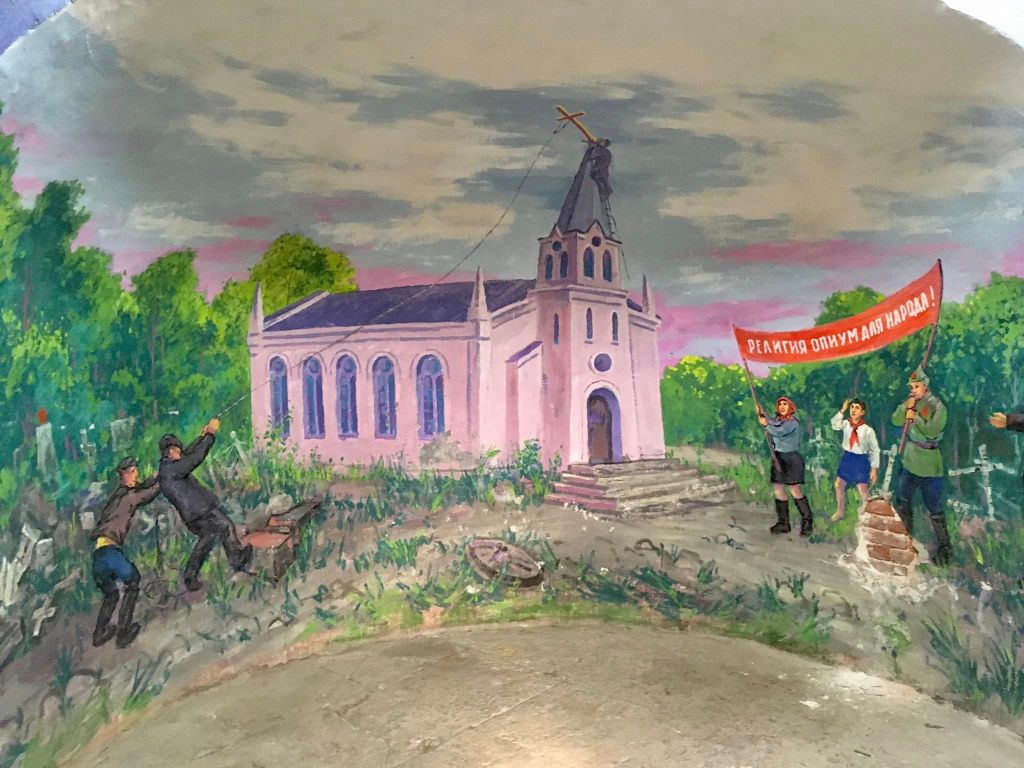
“Religion is the opium of the people!”

Ivan Babitski

I see that Akunin has again written something about Asia (where “the state is everything and the individual is nothing”) defeating European values in one particular country.

The point is that Russian intellectuals are, historically, not so fond of anything as repeating German vulgarities. And “Asian” metaphors are the favorites of Germans, and there is no degree of blatant idiocy at which they would stop.

For example, Adenauer explicitly claimed that the “Asian steppes” begin east of the Elbe. (He considered Prussia to be Asian, and so Bismarck’s triumph was an Asian conquest of Germany. Adenauer added the steppe by association.)

No matter how many decades have passed, the pre-war German spirit cannot be taken out of the Russian pamphleteer, and the fear of appearing ridiculous is as alien to them as it was to their mentors.

Pavel Sulyandziga

Quite correct thoughts in general, but there is one big catch.

How does Akunin (Chkhartishvili) differ from those Sieg Heiling in Russia when he starts using “Asia” in such a context, in such a comparison, even with a caveat? Maybe someone will say that I am wrong to try and compare him with the Sieg Heilers. Let me put it another way, then. How does a very good writer differ from those who are called white supremacists in the west?

I recently listened to a very interesting lecture on racism. The lecturer made a rather loose, but interesting ranking, singling out the racism of Soviet people as a separate species.

For some reason, some Europeans, when speaking about Asianness, “forget” about the Inquisition, concentration camps, and many other terrible events in history. Or are these also manifestations of Asianness?

We should also not forget that the current world order is also largely a product of European civilization with all its pros and cons.

One last thing, about why I decided to react in this way to Akunin’s statement, which are quite congenial to my own thoughts. It seems to me that a respected public figure should always think about the consequences of their words and deeds.

[…]

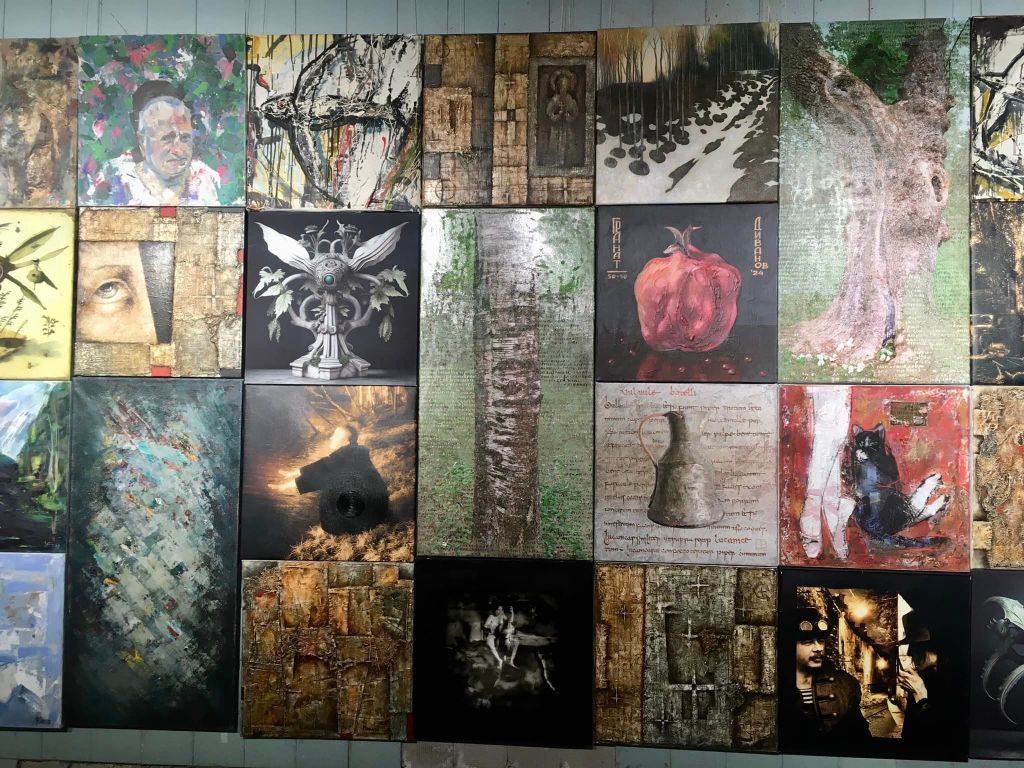
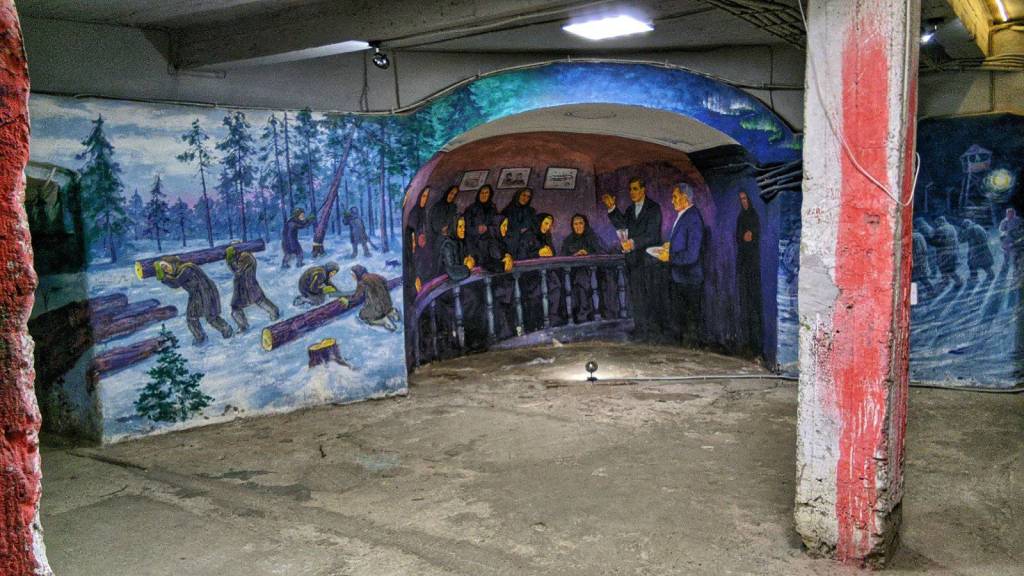
Source: Asya Rudina, “‘The world has split in two:’ the Runet discusses Akunin’s post about the two Russias,” Radio Svoboda, 1 April 2024. Translated by the Fabulous AM and the Russian Reader. The reactions, above, to Akunin’s outburst were not typical. Most of the best-selling author’s fans echoed his sentiments. The photos, above, by our friends V and M, were taken today at an exhibition currently on view in the former swimming pool and catacombs in the so-called Petrikirche on Nevsky Prospekt in downtown Petersburg. They suggest, I think, that the reality on the ground in “big Russia” (and “little Russia” as well) is slightly more complicated than Akunin would have us believe. ||| TRR

In Plain Sight

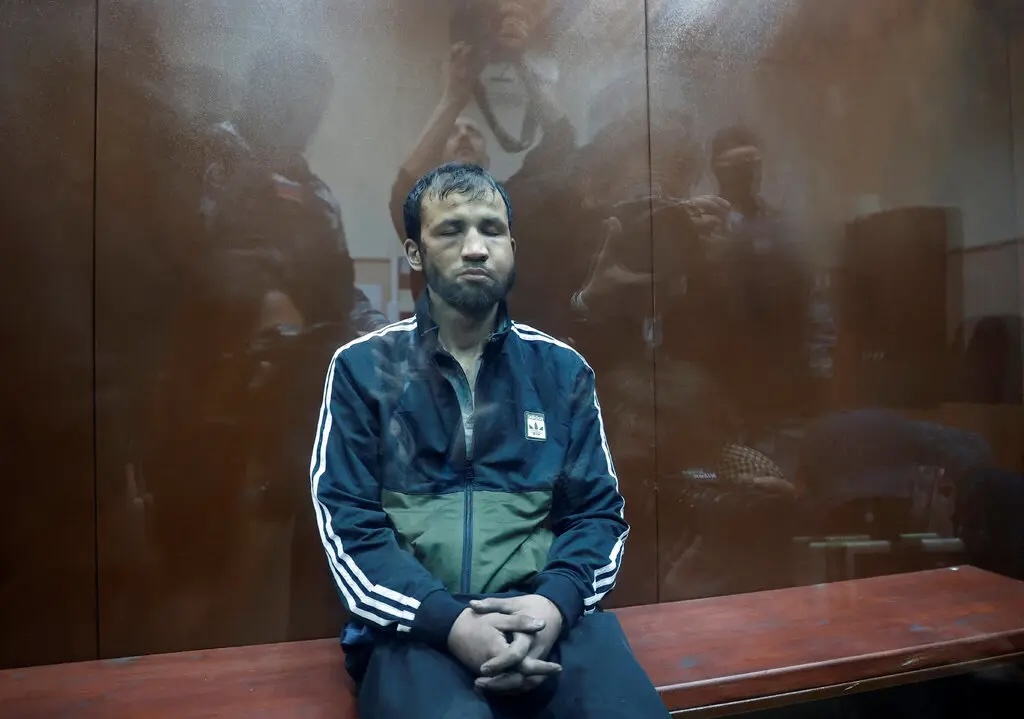
Accused terrorist Shamsidin Fariduni, with bruising on his face, inside a Moscow courtroom.
Photo: Yulia Morozova/Reuters via the New York Times

It seems that one of the consequences of this tragedy [i.e., the terrorist attack on the concert hall in suburban Moscow] has been the legalization, or legitimization, of torture. Torture existed before, but it was concealed and formally condemned. Now torture is openly praised and flaunted, and state institutions, including courts, do not react in any way. Another step towards fascization.

Source: Sergey Abashin (Facebook), 25 March 2024. Translated by the Russian Reader


Warning: this newsletter contains numerous descriptions of violence and torture.

People are tortured every day in Russia. For a long time we have been hearing about torture in penal colonies and police departments from victims and human rights activists. Mops and electric shockers have been mentioned in reports in the independent media and in the accounts of people who were subjected to violence, but the Federal Penitentiary Service (FSIN) and the police themselves have usually denied the accusations. Even in today’s Russia, however, the courts have periodically tried to imprison law enforcers who have tortured people, such as those implicated in the Karelian penal colony case, the Yaroslavl case, and the Saratov prison hospital case.

The terrorist attack in suburban Moscow has changed everything.

On 22 March, gunmen killed at least 137 people at the Crocus City Hall concert venue outside Moscow. They set fire to the building and left before the police arrived. Law enforcers have already detained suspects, and the Z bloggers have been salivating over the photos and videos of their abuse at the hands of the authorities. Never before have we had such flagrant acknowledgement of torture.

“The law enforcers have often covered their tracks by sweeping stories of torture under the rug, and we were told that there was no torture, that the reports were nonsense,” Sergei Babinets, head of the Crew Against Torture, said in an interview with Mediazona. “But since yesterday it seems as if there is a path to making torture a little more public.”

Dalerdzhon Mirzoyev (whom propagandist Margarita Simonyan dubbed the “ringleader” of the terrorists) was brought to his arraignment hearing with bruises on his face and remnants of a bag around his neck. He had no bruises at the time of his arrest, and the bag could have been used by law enforcers to strangle Mirzoyev. When the judge announced the pretrial restraint measures (Mirzoyev was remanded in custody to a pretrial detention center) Mirzoyev could not stand up. Instead, he leaned against the wall of the “fish tank” in the courtroom.

Saidakrami Murodali Rachabalizoda was brought to the hearing with his head bandaged. A law enforcer had cut off his ear when he was detained and tried to make him eat it. Neo-Nazi Yevgeny “TopaZ” Rasskazov of the nationalist subversive group Rusich announced an auction for the knife that was allegedly used to cut off Rachabalizoda’s ear.

The third detainee, Shamsidin Fariduni, was also apparently tortured. Telegram channels associated with law enforcement circulated a photo of Fariduni lying on the ground with his pants pulled down and law enforcement officers standing over him. There are wires from a field telephone attached to his groin. Such wires are used to electrocute detainees. (They have been used, for example, on detained Ukrainians in the occupied territories.) And someone is also stepping on Fariduni with a foot shod in an army tactical boot. Fariduni arrived in court with a swollen and beaten face.

Muhammadsobir Faizov. Photo: Alexandra Astakhova/Mediazona

Finally, the fourth detainee, Muhammadsobir Faizov, came to the court from the intensive care unit in a wheelchair. He could barely speak, and was hooked up to a catheter and a urinal. One of his eyes was injured. For the duration of the hearing, his doctors—two women in ambulance corps uniforms who had arrived with Faizov—were asked to leave the courtroom.

Why is this happening? Sergei Babinets argues that law enforcers could have been affected by the absence of major terrorist attacks in recent years.

“Many people were simply not ready for it—not ready emotionally, not ready psychologically, not ready on various fronts. And people may have started to lose their nerve due to this. That’s why there have been calls to reinstate the death penalty, to locate all the guilty parties and execute them, for example,” he said.

Аccording to Babinеts, Russian aggression in Ukraine has also played a role.

“The normalization of violence may have aggravated the situation with torture. We can see that law enforcement officers are really starting to let themselves go more,” he said.

Babinets adds, however, that there is no point to this violence.

“Torture most often leads to the torturer obtaining the information he wanted to obtain initially,” he said. “If they want a person to confess that they had been working, for example, for the Ukrainian army, they can be tortured until they confess. It is impossible to effectively investigate crimes in this way.”

Source: “Torture has gone public,” WTF? newsletter (Mediazona), 25 March 2024. Translated by the Russian Reader


It’s more than two decades since I read the late Stanley Cohen’s ground-breaking States of Denial: Knowing About Atrocities and Suffering (2001). In the introduction, Cohen recalls his own experiences growing up in apartheid South Africa, when he asked himself why his own outrage at the injustice he observed all around was not reflected in the society around him:

Why did others, even those raised in similar families, school and neighbourhoods, who read the same papers, walked the same streets, apparently not “see” what we saw. Could they be living in another perceptual universe — where the horrors of apartheid were invisible and the physical presence of black people often slipped from awareness? Or perhaps they saw exactly what we saw, but just didn’t care or didn’t see anything wrong.

Cohen went on to become a sociologist and a lifelong human rights activist. States of Denial was a valiant attempt to bring his discipline to bear on the subject of why people become become ‘everyday bystanders’ of atrocities who ‘block out, shut off or repress’ troubling or disturbing information to the point when they ‘react as if they do not know what they know.’

Some of these observations related to Israel, where Cohen moved in 1980. A Zionist in his youth, Cohen opposed the military occupation of the West Bank and Gaza, and became a strong critic of Israeli repression of the Palestinians. In his book, he describes his work with the Israeli human rights group B’Ttselem on the torture of Palestinian detainees and the obstacles it encountered:

Our evidence of the routine use of violent and illegal methods of interrogation was to be confirmed by numerous other sources. But we were immediately thrown into the politics of denial. The official and mainstream response was venomous: outright denial (it doesn’t happen); discrediting (the organization was biased, manipulated or gullible); renaming (yes, something does happen, but it is not torture); and justification (anyway ‘it’ was morally justified). Liberals were uneasy and concerned. Yet there was no outrage.

Cohen returned to the UK in 1996, and died in 2013, but were he alive today, I suspect he would have recognized the ongoing devastation of Gaza as a textbook example of the ‘politics of denial’. According to the latest figures from the United Nations Office for the Coordination of Humanitarian Affairs, the IDF has killed more than 31,988 people, most of whom are women and children, with another 7,000 buried in the rubble, and wounded 74,188. To put these figures in perspective, this February civilian casualties in Ukraine were estimated at 10,582 dead and 19,875 injured since the Russian invasion began on 24 February 2022.

So in just under six months, Israel has killed more civilians in Gaza than Russia has killed in two years. It has destroyed or damaged more than 60 percent of Gaza’s housing stock, 3 churches, 224 mosques, 155 health centres, 126 ambulances. Nearly 2.3 million Palestinians have been displaced, and 1.1 million people are facing ‘catastrophic levels of food insecurity,’ which threatens to become a famine.

All this has been done with the indirect support or direct collusion of the United States government, the European Union, and the British government. Despite the outpouring of rage and horror on the streets of so many cities across the world, liberal democracies that claim to uphold an international order based on human rights and universal moral norms have ‘known and not known’ what has been taking place in front of their eyes.

Many of these governments once railed against ‘dictators killing their own people’, and used atrocities and human rights abuses as a moral lubricant for liberal ‘interventions’ and ‘ humanitarian’ wars to prevent ‘massacres’ and ‘bloodbaths.’ Apart from a few tepid words of condemnation, when the obscenity of what is unfolding became too much to ignore, these same governments have enabled Israel to inflict incredible carnage on a mostly unarmed and defenceless population.

None of is taking place in secret. In February, Amnesty claimed that ‘Fresh evidence of deadly unlawful attacks in the occupied Gaza Strip…demonstrates how Israeli forces continue to flout international humanitarian law, obliterating entire families with total impunity.’ Israeli soldiers routinely post tweets and TikTok videos of themselves gleefully blowing up Palestinian homes, wearing Palestinian lingerie and women’s dresses, humiliating Palestinian prisoners made to strip down to their underwear, and generally exulting in the destruction.

[…]

Source: Matt Carr, “In Plain Sight: Atrocity Denialism and the Destruction of Gaza,” Matt Carr’s Infernal Machine, 26 March 2024

Incredibly Weak

In the wake of Alexei Navalny’s murder by the Russian fascist state, his message to the Russian people, at the end of the award-winning documentary film Navalny, has been quoted ten thousand times and turned into a meme on social media, to wit:

“If they decide to kill me, we are incredibly strong,” he said, addressing Russian citizens. “The only thing necessary for the triumph of evil, is for good people to do nothing. So don’t be inactive.”

[…]

“You’re not allowed to give up,” Navalny said in the Daniel Rohr film, adding that “we need to utilize this power to not give up, to remember we are a huge power that is being oppressed by these bad dudes.”

Based on what I’ve witnessed firsthand and secondhand over the past twenty-five years, Navalny’s assessment of Russian society’s incredible strength was wishful thinking on his part. Or, to put it more charitably, it was an incredibly hopeful political project.

To my mind, this Facebook post by longtime TRR contributor Sergey Abashin gets closer to truth about the state of affairs in Russian society, although it’s emphatically not a political project. Nor will it be righteously memed to death by Russia and the world’s well-meaning liberal masses.

Today is the day when [Boris] Nemtsov, a politician who united everyone, was despicably murdered for dissenting. And today is the day when Oleg Orlov, a man of impeccable integrity, was “awarded” two and a half years in prison for dissenting. I hate myself for being powerless. I hate society for being submissive. I hate the authorities for their fascism.

“Our characters find themselves trapped in confined spaces where both physical and emotional tensions escalate.”

“The Cop Party,” an early edition of The Russian Reader, which started life as a series of happenings.
Pushkinskaya 10 artists’ squat, Petersburg, circa 1995

What’s the point of this flash mob? The nostalgia of aging people for their own youth? The illusion of normality in a situation of growing abnormality? The illusion of solidarity in a situation where all sociability is disintegrating?

Source: Sergey Abashin (Facebook), 6 February 2024. Translated by 21 Jump Street


Hundreds of thousands of Instagram users responded to a recent prompt asking them to post pictures of their younger selves. Photo quality varies.

Most of the photos are slightly faded. The hairlines fuller. Some feature braces. Old friends. Sorority squats and college sweethearts. Caps and gowns. Laments about skinny jeans and other long lost trends.

This week, Instagram stories the world over have been awash with nostalgic snapshots of youthful idealism — there have been at least 3.6 million shares, according a representative for Meta — as people post photos of themselves based on the prompt: “Everyone tap in. Let’s see you at 21.”

The first post came from Damian Ruff, a 43-year-old Whole Foods employee in Mesa, Ariz. On Jan. 23, Mr. Ruff shared an image from a family trip to Mexico, wearing a tiny sombrero and drinking a Dos Equis. His mother sent him the photo, Mr. Ruff said in an interview. It was the first time they shared a beer together after he turned 21.

“Not much has changed other than my gray hair,” he said. “I see that person and go, ‘Ugh, you are such a child and have no idea.’”

Mr. Ruff created the shareable story template with the picture — a feature that Instagram introduced in 2021 but expanded in December — and watched it take off.

“The amount of people that have been messaging me and adding me on Instagram out of nowhere, like people from around the world, has been crazy,” Mr. Ruff said.

[…]

Source: Sopan Deb, “‘Let’s See You at 21’ Puts Fun Spin on the Unrelenting March of Time,” New York Times, 1 February 2024


Maybe it’s not all so bad, and millions of people just wanted someone to see them as young and hot 21-year-old guys and girls who had everything ahead of them, all doors were open, and there were no obstacles to achievement. It’s good if these photos amuse them, rather than drive them to despair, if the person in the photo hasn’t achieved what he or she dreamed of at 21.

On the other hand, by scrolling through their Facebook feed with the “I am 21” flash mob, users see hundreds and thousands of photos of unknown people in foreign cities that mean nothing to them. What is the practiccal point of this flash mob? For users of Facebook, who have been posting numerous photos for years, there is no point.

Psychologists have long ago explained why people dump so many photos, including selfies, onto social networks: they have a need for constant approval and a desire to escape from unpleasant reality into a beautiful and easy virtual world where everything is fine. They’re also a means of communicating, showing off, and flirting. And if the “retro,” “things used to be better,” or “how young we were” option is enabled, nostalgic group sobs, likes, and reposts are guaranteed.

“We don’t think about artificial intelligence when we post our photos on social media, simply because the vast majority of us have no idea how neural networks are trained, or how algorithms work. We just wonder why topical ads jump out at us immediately when we think of something, but then we forget about it. Artificial intelligence isn’t Skynet from the Terminator movies at this point, but it’s something we’re going to be dealing with more and more. And protecting our personal information should worry us more than before,” says data science expert Yevgeny Galin. “Putting personal photos in the public domain is no toy or form of entertainment. We don’t know who could use them and for what purposes. I have no doubt that those purposes are illegal. And I wouldn’t count on social networks being conscientious about privacy policies. There’s nothing private on the internet. Facebook is already pretty good at recognizing faces and tagging people in photos.”

Training AI to recognize faces even in poor-quality black-and-white photos from the last century is proceeding by leaps and bounds. In many countries, identifying individuals with street surveillance cameras is already almost permitted by the constitution. And artificial intelligence is dependably replenishing the database of inhabitants of cities, countries, and continents. After all, it is so easy, especially if people post info about themselves on the World Wide Web.

Public figures who post their photos may well be involved in some kind of scam using deepfake technology.

Yes, we may be once bitten, twice shy, but caution in this case can’t hurt.

Source: Dina Vishnevski, “I’m 21: Facebook’s nostalgic flash mob is just a simulator for AI,” kp.ua, 7 February 2024. Translated by 21 Jump Street

The Ad Campaign

Sergey Abashin writes: “All of Petersburg is covered with ads like this.”

This ad says that on the day you sign a contract to serve in the Russian army you’ll be issued a plot of land (for building your own house) near Petersburg whose market value is around two million rubles. You’ll also (?) get a one-time payment of 500,000 rubles. Your monthly pay in the army (if you serve in the “special military operation zone,” says the fine print) starts at 200,000 rubles.

According to the municipal statistics agency Petrostat (as cited by business daily Delovoi Peterburg), the average monthly wage in the city was 101,155 rubles in August. At current exchange rates, that amounts to around 1,056 USD. ||| TRR

Clearance Sale

“From August 15. There’ll be bargains galore at the clearance sale!” Source: Email flyer from Russian e-commerce giant Ozon. In the original, the nouns meaning, roughly, “bargains galore” and “clearance sale” are written, unaccountably, with the Italian endings -ggio and -issimo.

Let’s think about who the beneficiaries are and what their profit is: this should explain why the regime is stable. The beneficiaries include not only the supreme leader, who of course wants to be “mistress of the seas” and has been trying consolidate the regime for himself and his entourage. The beneficiaries also include different groups among the elites, the security forces, officialdom, businessmen, and “intellectuals” at all levels. Material and symbolic resources are now funneled to these groups, and they are granted new powers to cause mayhem in their own bailiwicks. Many of them have taken advantage of this opportunity to quash rivals and take up new positions in their respective economic, political, and cultural markets. The beneficiaries also include different sectors of the populace—for example, people employed in the defense industry, people employed by law enforcement agencies, people who volunteer for the army as contract soldiers, and people engaged in producing different kinds of propaganda. They amount to millions of people, and the streams of financing that nourish them flow far and wide. In addition to power and material gain, there is a psychological benefit: one can now openly be proud of one’s country and hate its “enemies.” How many of the insulted and injured now feel joy and have made their own complexes the norm. This satisfaction also costs money, and it means millions more in new profits.

Source: Sergey Abashin (Facebook), 2 August 2023. Translated by the Russian Reader


“These amendments are written for a big war and general mobilisation. And the smell of this big war can already be scented,” Andrei Kartapolov, the head of the Duma’s defence committee, said this week as the Russian parliament rushed to adopt a new law. The legislation enabling the Kremlin to send hundreds of thousands more men into combat reveals a sad truth: that far from seeking an off-ramp from his disastrous war in Ukraine, Vladimir Putin is preparing for an even bigger war.

It is understandable that many in Ukraine and the west want to believe that Russia’s president is cornered. The Ukrainian army is gradually reconquering lands occupied by the Russians and has shown itself capable of striking deep into enemy territory — even into the Kremlin itself. The sanctions pressure on Russia is mounting.

For now, the west remains united in support of Kyiv, and streams of modern weaponry and money sustain the Ukrainian war effort. Finally, the mutiny staged by the Wagner mercenary boss Yevgeny Prigozhin and visible conflicts among senior Russian military commanders add to hopes that the Kremlin’s war machine will break down.

Things likely look very different to the Kremlin, which believes that it can afford a long war. The Russian economy is forecast to record modest growth this year, mostly thanks to military factories working around the clock. Critical components such as microchips needed for the defence industry are arriving from China and other sources.

Despite sanctions, the Kremlin’s war chest is still overflowing with cash, thanks to windfall energy profits last year and also to the adaptability of Russian commodities exporters, who have found new customers and who settle payments mostly in yuan. If budgetary pressures were to become more acute, Russia’s central bank could further devalue the rouble, making it easier to pay soldiers, defence industry workers and the internal security forces who keep the Russian elite and public repressed and largely in line with Putin’s disastrous course. 

When it comes to the war itself, the Kremlin still seems unperturbed by the Ukrainian counteroffensive. Even if Kyiv makes more advances, the Kremlin may brush them off as temporary. Putin is banking on the fact that the Russian manpower that can potentially be mobilised is three to four times bigger than Ukraine’s, and the only pressing task is to be able to tap into that resource at will: to mobilise many more men, arm them, train them and send them to fight. This is precisely the purpose of the new law, which should help the Kremlin to avoid another official mobilisation.

From now on, the government can quietly send draft notices to as many men as it deems necessary. The upper age limit for performing mandatory service will be increased from 27 to 30, and could be raised again in future. Once an electronic draft notice is issued, Russia’s borders will be immediately closed to its recipient in order to prevent a massive exodus of military-age men like the one Russia witnessed last autumn. The punishments for refusing to serve have also been ramped up. These moves, combined with massive state investment in expanding arms production, should help Putin to build a bigger and better equipped army.

A parallel tactic is the strangulation of Ukraine’s economy. Knowing that the Ukrainian budget is on life support provided by its western allies, the Kremlin wants to deny Kyiv all sources of revenue. Moscow has therefore not only pulled out of the grain deal that had enabled Ukrainian agricultural exports via the Black Sea, it has also launched massive air strikes against Ukrainian ports to destroy any possibility of reviving the agreement. The same logic underpins Russia’s air strikes against civilian infrastructure: they are aimed at making Ukrainian cities uninhabitable and preventing reconstruction efforts.

The Kremlin hopes that the rapid rebuilding of the Russian army and gradual decimation of the Ukrainian economy and armed forces will result in growing western frustration and a decline in material support for Kyiv. To speed up this process and break the west’s will, Moscow is using threats of escalation, including expansion of the conflict towards Nato territory via Belarus with the help of Wagner mercenaries based there. 

Putin has made plenty of fatal mistakes. But as long as he is in charge, Moscow will dedicate its still vast resources to achieving his obsession with destroying and subordinating Ukraine. As western leaders think about policies to support Ukraine into the third year of this ugly war, any long-term strategy must take this reality into account. 

Source: Alexander Gabuev, “Putin is looking for a bigger war, not an off-ramp, in Ukraine,” Financial Times, 30 July 2023. Thanks to Monique Camarra (EuroFile) for the heads-up.


Things like this also get written: “Is it just Putin’s war or a war on the part of all Russians? Perhaps neither one nor the other. Another sociological hypothesis is that the cynical elite has provided the real support for the military aggression, rather than a grassroots gone bad.” (This is a headline: you can google it.). Further, the authors define “the cynical elite” as “the mid-level and low-level officials who ensure the functioning of the Kremlin’s military-political machine; the para-state businesses engaged in import substitution and circumventing sanctions; the upper middle class and the leadership of so-called public sector entities, compelled in one way or another to demonstrate loyalty to the war”—that is, only a few million people. In other words, the Russian ruling class supports the foreign policy that the Russian state pursues in the interests of the Russian ruling class. This argument is tautological in the Marxist manner (although, as the authors of the article rightly point out, it occurs to very few people) and is not entirely true, because there are groups within the ruling class who do not benefit at all from this policy. But it certainly sounds more convincing than the theory of a “grassroots gone bad.”

Source: Grigorii Golosov (Facebook), 2 August 2023. Translated by the Russian Reader


I reread our interview with Dima Spirin [leader of the recently dissolved veteran Russian punk rock band Tarakany!], and one phrase cut me to the quick: “Our attempt to be free in an unfree country has failed.” An ordinary argument, seemingly, and it’s been made a hundred times. There were oases of freedom in Russia, but then they were destroyed and everything collapsed.

Such things are usually spoken of with regret, as of disappointed hopes. But oases of freedom in a poor dying country are not terribly moral, by and large. Do you know who was free in ancient Greece? That’s right, slaveholders. All the others were slaves.

Does this mean it isn’t worth fighting for freedom in an unfree country? It doesn’t mean that at all. But what’s worth fighting for is everyone’s freedom, not just one’s own. There is no separate freedom for fifteen percent of the population. That is called colonialism.

Some have it good, while others have it bad. Some are free, while others are slaves. Some are rich, while others are poor. There is no other way. Or rather, there is another way, but it ends exactly as it has now—in enormous bloodshed.

It’s either everyone or no one: freedom is not achieved piecemeal.

This is our collective fault. Our guilt is terrible and bloody. I don’t excuse myself either.

And the inner freedom that is the talk of the town nowadays is a lame excuse, like inner emigration. The madman and the drunkard are truly free. But neither meditation, nor reading Borges, nor listening to psychedelic rock will save you from hunger, cold, or getting smacked with a billy club. And they won’t cancel the fact that your neighbor has it bad.

A woman falls on the street, breaks her leg, and lies on the ground screaming. But you’re listening to Pink Floyd on your headphones: you’re free.

Source: Yan Shenkman (Facebook), 3 August 2023. Translated by the Russian Reader

Em Uyaya’am (Things I Saw, Read and Watched This Week)

Asilomar State Beach, 21 July 2023. Photo by the Russian Reader

Who is Girkin?

Igor Girkin (Strelkov) is an ethno-fascist FSB officer and the warlord who prepared the ground and then launched the war in Donbas in 2014. He stated that without him, “there wouldn’t be any war”. He is also responsible for ordering the execution of numerous civilians, for which he still face justice. He was sentenced to life imprisonment in absentia by the International Criminal Court on November 17, 2022 as perpetrator of the downing of Malaysian Airlines 17 and the murder of 298 people—a war criminal.

[…]

Source: Monique Camarra, “Igor Girkin arrested in Moscow: the Kremlin is clamping down,” EuroFile, 22 July 2023


“The all-clear hasn’t sounded, the fight continues.”

Source: Sergey Abashin (Facebook), 21 July 2023


Stunning drone footage has revealed details of the Batagaika crater, a one-kilometer-long gash in Russia’s Far East that forms the world’s biggest permafrost crater.

In the video two explorers clamber across uneven terrain at the base of the depression, marked by irregular surfaces and small hummocks, which began to form after the surrounding forest was cleared in the 1960s and the permafrost underground began to melt, causing the land to sink.

“We locals call it ‘the cave-in,'” local resident and crater explorer Erel Struchkov told Reuters as he stood on the crater’s rim. “It developed in the 1970s, first as a ravine. Then by thawing in the heat of sunny days, it started to expand.”

Scientists say Russia is warming at least 2.5 times faster than the rest of the world, melting the long-frozen tundra that covers about 65% of the country’s landmass and releasing greenhouse gases stored in the thawed soil.

[…]

Source: “World’s biggest permafrost crater in Russia’s Far East thaws as planet warms,” Reuters, 21 July 2023


“Let’s remember these people”

After the court hearing [in his criminal case], Oleg Orlov read out a long list of names of people convicted of “disseminating fake news” or “discrediting the army.” He mentioned Alexei Gorinov, Dmitry Ivanov, Samiel Vedel (aka Sergei Klokov), Vladimir Kara-Murza, Ilya Yashin, Maxim Lypkan, and many others.

“I am not imprisoned, and I can say what I deem necessary. I can answer your questions. But how many of my and your kindred spirits are deprived of this opportunity,” Orlov reminded. “I consider it my duty to read out the list. These are only some of the people who have been imprisoned for their anti-war stance.”

After reading out the names, Orlov cited data from OVD Info. “634 people from 78 regions [of Russia] have faced criminal charges for anti-war protests, for words and statements,” the human rights activist said. “And 200 of them have already been incarcerated. Let’s remember these people.”

Orlov stressed that he was fighting not only for his own sake. “Both my lawyer Katerina Tertukhina and my public defender Dmitry Muratov — we are fighting like this and trying to prove the nullity of the charges [against him], the nullity of the [prosecution’s] expert witness analysis, because we are trying to fight for all people.”

Video courtesy of SOTA

Source: memorial.hrc (Instagram), 21 July 2023. Translated by the Russian Reader


Crimean Tatar-led underground movement is already active behind Russian lines and hundreds of young Tatar men are ready to take up arms to liberate the occupied peninsula, a veteran community leader has said.

Mustafa Dzemilev, widely seen as the godfather of the Crimean Tatar rights movement, pointed to operations by the Atesh guerrilla group, comprising Crimean Tatars, Ukrainians and Russians, in Crimea and other occupied Ukrainian regions.

Atesh, which means “fire” in Crimean Tatar, was created in September last year, primarily to carry out acts of sabotage from within the ranks of the Russian army. It claims more than 4,000 Russian soldiers have already enrolled in an online course on how to “survive the war” by wrecking their own equipment.

There is no evidence linking the group to the latest attack on the Kerch Bridge, early on Monday morning, but the group has claimed a string of smaller-scale attacks, blowing up Russian checkpoints, assassinating Russian officers, setting fire to barracks and feeding sensitive information to Ukrainian intelligence. It recently accused Russian sappers of laying mines in the Krymskyi Titan chemical works in Armiansk, northern Crimea. An explosion there could spread an ammonia cloud across the land bridge between the peninsula and mainland Ukraine.

“Atesh is very deep underground,” Dzhemilev, 79, told the Guardian in an interview in Kyiv. “There was not a single arrest among Atesh members, but they are working inside Crimea territory blowing up targets.”

[…]

Source: Julian Borger, “The underground Crimean Tatar group taking up arms against Russia,” Guardian, 17 July 2023


Hello! This is Alexandra Prokopenko with your weekly guide to the Russian economy — brought to you by The Bell. In this newsletter we focus on the Kremlin’s decision to seize the Russian assets of two major foreign companies and what it means for the business climate and the other Western businesses who cannot — or will not — leave Russia. We also look at Friday’s interest rate hike and new Western sanctions on Russia.

Nationalization of Western assets heralds broader property redistribution

Finland’s Fortum and Germany’s Uniper saw their Russian assets seized by the Kremlin earlier this year. This week was the turn of France’s Danone and Denmark’s Carlsberg. It feels like we are witnessing the final chapter in the history of Western business in post-Soviet Russia. If the transfer of Fortum and Uniper’s energy assets to external management was explained as a response to the European Union’s treatment of Russian energy companies, there is no such obvious reason for the behavior toward Carlsberg and Danone and it likely reveals the Kremlin’s real intentions. This is direct nationalization — and opens the door to a new distribution of property in Russia.

[…]

Source: Alexandra Prokopenko, “Kremlin asset seizures the new normal,” The Bell, 21 July 2023


This image has an empty alt attribute; its file name is 360096182_6574069839310211_6569062695868766924_n.jpg

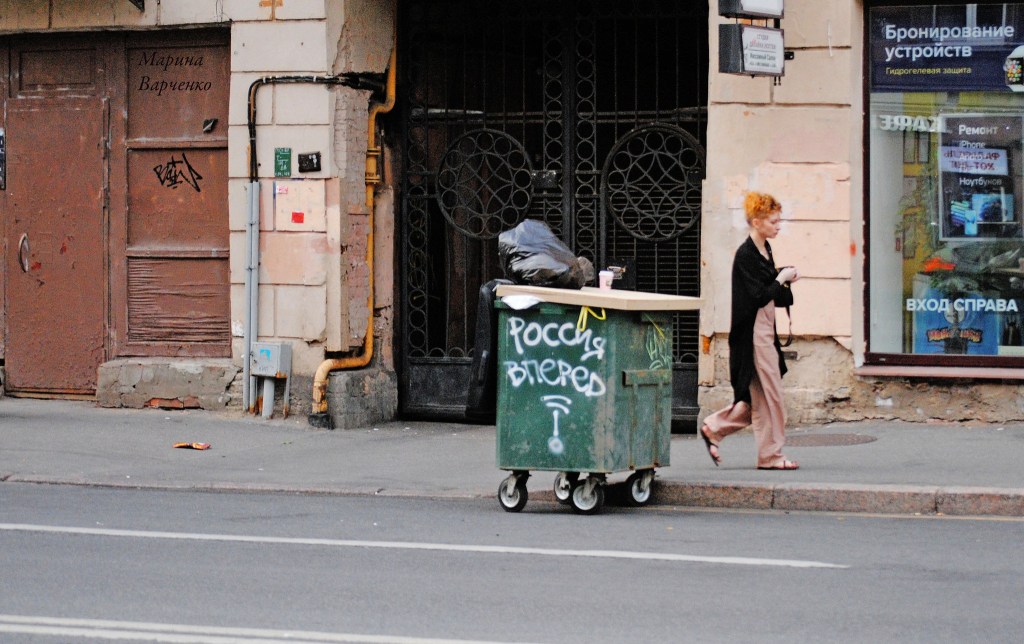
“Russia, forward!”

Source: Marina Varchenko (Facebook), 14 July 2023. She writes: “In our hood) Petersburg, Razyezzhaya Street.


The Arkhangelsk Region has allocated 800 million rubles to the occupied Ukrainian city of Melitopol, which will be used to repair the city, which has suffered from Russia’s invasion. However, the region itself does not have enough money to repair its own housing. Arkhangelsk is considered the capital of the Russian North, but has been informally dubbed the “capital of dilapidated housing.” Many people live in substandard housing: the city is chockablock with barracks and crumbling wooden houses. Watch Valeria Ratnikova’s report on how the region copes with a budget deficit while its money is spent on the war.

00:00 Opening 02:15 Ruins, barracks, and crumbling houses 06:00 Brevennik Island: expensive prices and derelict housing 10:56 Natalia Zubarevich about the lack of money in the region 12:04 The campaign against waste haulage to the region 16:18 The authorities are taking revenge on opposition activists opposed to landfills 31:35 Denunciations and criminal cases for statements about the war 33:22 One of the protesters went to the war 36:15 What residents say about the war 38:26 Getting fired for criticizing the war 39:40 A female student fled to Lithuania — the authorities wanted to jail her for talking about the war 46:25 The region’s environmental problems 49:10 Journalists detained during Putin’s visit 51:11 How the war has affected life in the region

Source: “The ruins of Arkhangelsk: how people whose money was given to occupied city live,” TV Rain (YouTube), 16 July 2023. Annotation translated by the Russian Reader

How Russians Are Forcibly Conscripted


The Russian security forces have been increasingly organizing dragnets to sweep up potential army recruits. This is occurring amidst a full-scale war with Ukraine in which the Russian army has suffered heavy losses.

There are more and more accounts of these roundups. Mediazona, for example, details how a 25-year-old Muscovite, employed in the IT business in Moscow City, was lured to a meeting with police officers and military enlistment officers through the classified ads website Avito, on which the young man was selling headphones. He was quickly sent to serve in the Moscow Region, despite being diagnosed with bronchial asthma.

The Movement of Conscientious Objectors recounts how the police simply broke into the apartment of conscripts Yevgeny Komarov and Ivan Dubenko and sent them to the assembly point. Dubenko was first strangled, and then, threatened with rape, forced to sign his military service card, as required for conscription.

Another story relayed by the Movement involves a young man with hypertension and anxiety-depressive disorder who went to the military enlistment office to undergo a medical examination and get a postponement, but instead was sent to the assembly point the very same day. Mahmudjon Nurov, on the contrary, was simply detained at the Izmailovskaya metro station and immediately sent to the military enlistment office. In the Kursk Region, the military commissars took an even simpler approach: they allegedly assembled everyone whom the medical commission had declared unfit for service, confiscated their telephones, and sent them off to serve in the army.

The Russian army needs conscripts: during this draft, which lasts until July 15, the authorities have been charged with drafting 150,000 thousand men, and so the military enlistment officers have teamed up with the police to go out and catch potential recruits. The practice is, in fact, illegal, and the prosecutor’s office has repeatedly confirmed this, but the law has not prevented police officers from going to factories and shops in search of young men allegedly fit for service. Fortunately, so far no one has received electronic draft notices through Gosuslugi [the Russian state services website]: they should begin to be issued during the next conscription campaign.

Here is how you can protect yourself as much as possible in the current circumstances:

• Do not go to the military enlistment office in person. Everything you need to learn from them can be done by mail or by an acquaintance with a power of attorney.

• If you are served a draft summons in person (military enlistment offices retain this right), refuse to take it.

• Don’t sign anything and seek legal assistance. You can file a lawsuit appealing mobilization and conscription orders through the bot “I’m Not Going!” While the court is considering your suit, you cannot be inducted into the army.

• Fill out an application for alternative civilian service in advance. Both those who have been served with draft notices and those who have been mobilized have such an opportunity.

Source: “How are Russians forcibly enlisted in the army? What should you do if they try to enlist you?” I Don’t Get It newsletter (Mediazona), 29 June 2023. Translated by the Russian Reader


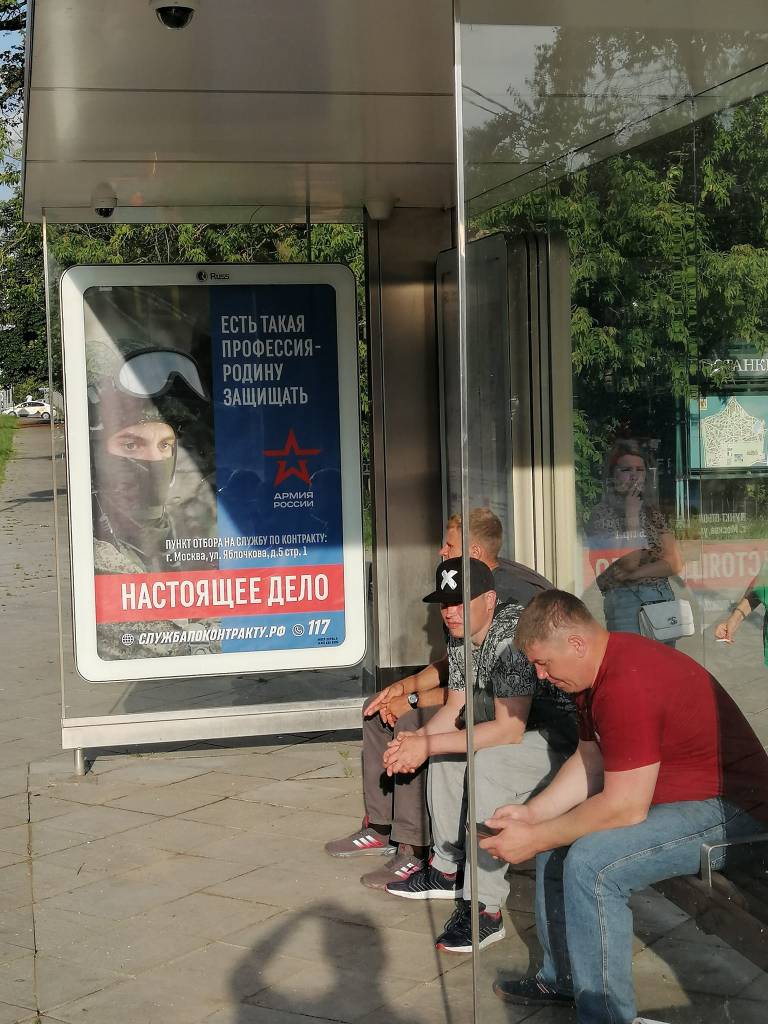
“Defending the Motherland is a profession — a real job.” Frequent TRR contributor Sergey Abashin photographed this Russian army recruiting poster (and several others) in Moscow earlier today.

Victimhood

The second explanation that also immediately arises is the persistent sense of victimhood, which is embedded in the language: “we are victims of the West”; “we are victims of the Horde“; “we are victims of the authorities and the regime”; “we are victims of immigrants”; “we are victims of the capitalists”; “we are victims of circumstance”; “we are victims of revolution and war”; “we are victims of the Soviet era”, “we are victims of the 1990s”; and so on and so on. Again, this wide range of culprits who have victimized us enables us to integrate the image of victim into any ideological matrix. But all of these versions of victimhood are united by a sense of resentment, a sense of mediocrity, a sense of lacking something, and these feelings are constantly reproduced and cultivated. This language has no room, of course, for a critique of our own history and culture’s imperialism. We are not to blame: we are victims ourselves, our history is a victim, our culture is a victim. How can our sense of victimhood be squared with the fact that we ourselves have victimized others? The perception of ourselves as victims is one of our privileges, one of our special rights; it is our manifest destiny. However, the criticism of imperialism, the emergence of voices who declare themselves our victims, who want to discern our history and culture’s violence, subjugation, and injustice towards them, undermines this language’s entire foundation and our image of ourselves as victims. It undermines the foundation on which we stand, our privilege of being unique. And this triggers pushback and resistance, of course.

Source: Sergey Abashin (Facebook), 23 June 2023. Translation and photo, above, by the Russian Reader


[…]

The generation of scholars who started studying the Soviet Union in the late 1980s and early 1990s were also shaped by their firsthand experience of the country. When they travelled as foreign students to Moscow, they found impoverished people. Empty shelves and pervasive poverty made Russians look like victims of the Soviet regime, and financially, Soviet Moscow seemed more like a European periphery than an imperial metropole, which they associated with material affluence.

The wave of decolonisation in Africa, the Middle East, South and Southeast Asia, which started after World War II, was accompanied by rigorous academic discussions and scholarship of colonial legacies and tools of violence.

By contrast, the 1991 dissolution of the Soviet Union did not result in similar scrutiny of the Russian imperial legacy.

For metropolitan Western Europe and the United States, Europe stood for metropolitanism – a place from which the world was colonised, not a place of colonisation. Accepting colonial history within Europe made little sense, so the colonial nature of Russia remained unchallenged.

In Russia itself, the dominant narrative was one of victimhood. Russians learned to see themselves as a special nation that sacrificed its own wellbeing for the sake of non-Russians in the Soviet Union. “Let us stop feeding them” was the slogan Russians used to explain Moscow’s decision to let the colonies go in 1991.

[…]

Source: Botakoz Kassymbekova, “How Western scholars overlooked Russian imperialism,” Al Jazeera, 24 January 2023


A recent article from the American Political Science Association (APSA) examined how the words used to describe Central Asia sometimes reinforce the region’s image as being part of Russia or the Soviet Union. Amid growing awareness of Central Asia’s colonial history, some argue it is time to move beyond terms such as “post-Soviet,” “near abroad,” or “Russia’s backyard” when referring to Central Asia today. Join host Bruce Pannier for a thought-provoking conversation on decolonizing Central Asian discourse with the co-authors of the APSA article: Botakoz Kassymbekova, a lecturer and assistant professor of modern history at the University of Basel; and Erica Marat, a professor at the National Defense University’s College of International Security Affairs.

Source: Majlis: Talking Central Asia: “How Colonialism Shapes Our Discussion About Central Asia,” RFE/RL, 18 June 2023


[…]

Putin’s propaganda builds on seeing Russia as both victimized by the West and entitled to regional dominance over Ukraine, Belarus, Central Asia, and the South Caucasus. Russia’s sense of its lost greatness in 1991 after the demise of the Soviet Union fuels a sense that it is the innocent victim of outside powers. Its shrunken geography and collapsing economy made post-Soviet Russia economically poor compared to the wealth accumulated by Western colonial metropoles. Soviet socialism as a global anti-capitalist force had failed to bring the same level of prosperity. Russian intellectuals became preoccupied with their own imagined marginal position vis-à-vis the West fueling the denial of the true colonial nature of the Soviet regime. 

At the same time, Russian political elites expect loyalty from former Russian colonies that includes knowledge of the Russian language and political loyalty, and unity in opposition to Western influence. According to such an imperial view, Russian rule over non-Russian populations is not colonialism but a gift of modernity. It is a deeply altruistic act for the sake of backward people. Rejection of Russian cultural dominance, including building independent foreign policy and contesting the Russian view of Soviet history, is an act of political disloyalty. In Central Asia, for instance, Russian ambassadors routinely condemn states’ prioritization of indigenous languages as attempts to limit the rights of the ethnic Russian population. Such search for independence triggers a sense of victimhood in Russia, as if disagreement with the Russian imperial self-image is an attack on Russian cultural greatness.

Putin coupled Russia’s innocent victim narrative with a historical self-image of a civilizing power against former Soviet republics that sought closer ties with the West. The Russian imperial myth allows identity mobilization around militant patriotism while also helping the state keep the public passive and uncritical. Putin recently spoke about Russia’s imperial identity when announcing the military attack on Ukraine: “It was necessary to immediately stop this nightmare—the genocide against the millions of people living there, who rely only on Russia, hope only on us.” Western leaders’ naming atrocities in Bucha a genocide further deepened the Russian regime’s sense of victimhood. The Russian Defense Ministry stated that the West is collectively attacking Russia. Feeling humiliated by the West, the Russian public was simultaneously supporting Russian aggression in former Soviet territories. Economic hardships can be reframed as a burden unjustly borne by a victim-savior or as an imperial duty of those who humanely seek to liberate the world from evil.

[…]

Source: Botakoz Kassymbekova and Erica Marat, “Time to Question Russia’s Imperial Innocence,” PONARS Russia, 27 April 2022