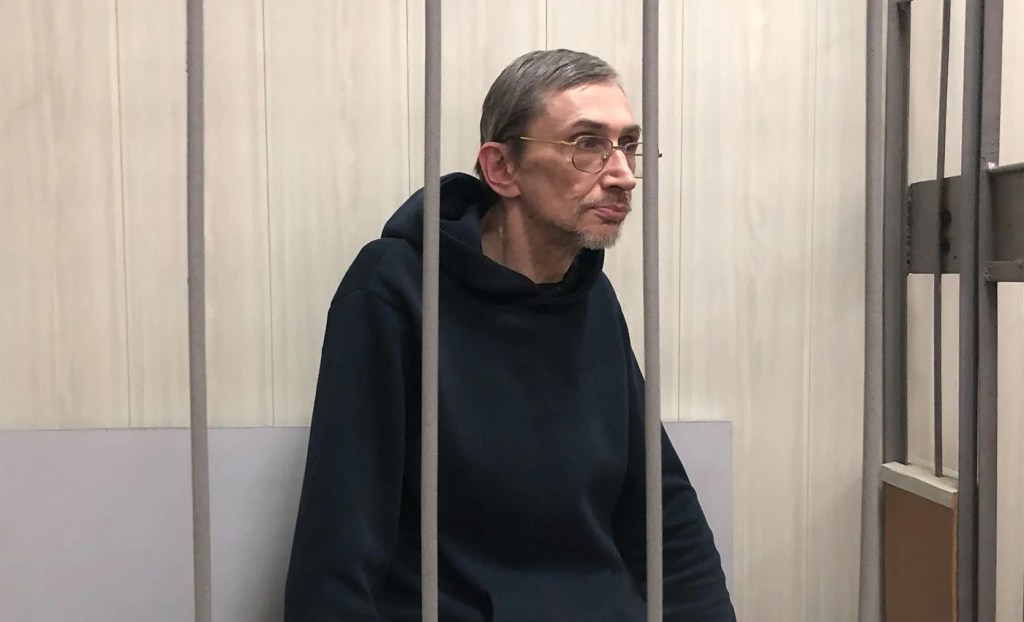
In September 2024, Alexander Krichevsky, a 58-year-old resident of Izhevsk, posted a lengthy comment on a Chechen opposition blogger’s Telegram channel. In the comment, Krichevsky compared Putin and the “FSB clique” to a “darkness” which must be destroyed. The security forces deemed this statement incitement to murder the president and FSB officers. They monitored the man and intercepted his internet traffic. Last December, Krichevsky was detained and remanded in custody to a pretrial detention center despite his ailments and the fact that he is confined to a wheelchair. His ailing mother was placed in a care home, where she died a month later. Today, at the Central District Military Court in Yekaterinburg, where Krichevsky’s case is being heard, the prosecutor requested that he be given the maximum sentence of six years in prison.
“That is why we listen to him, because he is not afraid—he’s a ray of freedom in a kingdom of darkness! And only together will we destroy this darkness, only when we understand that we have only one enemy—Putin and his FSB clique. . . . Both you and we must destroy this enemy to continue living as peaceful neighbors,” 58-year-old Izhevsk resident Alexander Krichevsky wrote in a chat on the channel of opposition Chechen blogger Tumso Abdurakhmanov aka Abu Saddam Shishani, on 11 September 2024.
This was Krichevsky’s response to a user who had asked Abdurakhmanov himself in a chat: “Tumso, aren’t you afraid that Kadyrov’s people might find you?”
When questioned in court, Krichevsky said that he was sure he was responding to the user personally, not writing in a public chat. He repeated many times that he had only figurative “destruction” in mind and had been trying to “reconcile” Abdurakhmanov’s readership by pointing out that they had only one enemy.
“Of course, I wasn’t even thinking about physically destroying such a large number of people and didn’t understand how [what I wrote] would even look. Apparently, my love for pretty words—all those rays of light and other nonsense—let me down. I was thinking in terms of games: when a person plays checkers or chess, they destroy their opponent’s pieces. Roughly speaking, that was the image I had in my head,” Krichevsky said in court.
The FSB operative who discovered Krichevsky’s comment saw it not as criticism alone, but also as a “public call to murder the president of the Russian Federation and officers of the Federal Security Service.”
The same conclusion was reached by Polina Komova, a philologist and expert at the Ministry of Internal Affairs Forensic Center in Udmurtia. She acknowledged in court that the word “destroy” could have other meanings “depending on the context,” but in her opinion it could be understood only in its literal meaning—that is, “to end [someone’s] existence, to exterminate”—in Krichevsky’s comment.
“He was planning a terrorist attack involving self-detonation”: wiretapping and arrest
The security forces began monitoring Krichevsky in early December 2024. It emerged in court that the FSB had requested data on his calls and connections from Rostelecom and learned that on 11 September, when he wrote the comment, he had accessed Telegram from home. Megafon provided the security forces with information about the base stations in the area where Krichevsky’s phone number pinged that day.
On 5 December 2024, the Supreme Court of Udmurtia gave the FSB permission to tap Krichevsky’s phones, and a few days later it approved “gathering information from technical communication channels and acquiring computer information.” A few days before Krichevsky’s arrest, operatives monitored his apartment to “document illegal activities.” The report states that Krichevsky did not leave his home.
On 19 December 2024, Krichevsky was detained and sent to a pretrial detention center. He described his arrest to journalists.
“There was a knock on the door at seven in the morning, and seven people came into [our] small flat: five FSB officers and two eyewitnesses. I opened the door myself. They immediately sat me down on a chair in the hallway. My ailing mother was lying there, barely alive. They said, ‘Can you hand over [your phone]?’ They tried to intimidate me once: ‘If you refuse, we’ll take you away and charge you with additional offenses.’ I realized that resistance was futile. I gave them the phone, and they looked at it and took what they needed.”
The social media comment charges against Krichevsky were accompanied by an FSB report containing much more serious, but in effect unproven, allegations. The document states that, according to “intelligence,” Krichevsky, who opposes the “state’s political course” and the conduct of the “special military operation,” supported radical Islamists fighting for Ukraine and was planning to convert to Islam and carry out a terrorist attack in Udmurtia “by blowing himself up with cooking gas.” The court never did hear what this report was based on.

“None of my comments or my own thoughts bear this out. When I heard this business about blowing myself up . . . In this case, everything that the prosecutor has just read aloud is pure speculation on the part of the investigators. None of my quotes corroborates it,” Krichevsky said in court.
Judge Alexander Raitsky simply reminded Krichevsky that the case centered on a single [social media] comment, which the defendant himself did not disput, and that the court would evaluate the evidence in the deliberation room.
The case file also contains another comment by Krichevsky from the same written exchange: “Many empires have collapsed in this world. I myself foresee the end of the Russkies [rusnya]. I don’t feel sorry for them: let them collapse with a bang. That’s where they belong. I myself hate these FSBniks, pigs [cops], and other scum who suck the blood of our homeland and shit on our neighbors.”
The security forces deemed this “a statement containing a negative assessment of the group of persons sharing the profession of Federal Security Service officers and police officers,” but it was not included in the indictment.
Responding to the judge’s question about this comment, Krichevsky said that he sometimes tried to “adapt” to the rude tone of the conversation [on the Telegram channel’s chat].
“My mother died four weeks after my arrest”: wheelchair-bound in a detention center
Krichevsky had worked as a systems administrator in Izhevsk before his arrest.
As a child, Krichevsky had moved with his family from Udmurtia to Rostov-on-Don. After high school, he enrolled in medical school, but in 1989 he broke his spine and had to drop out because his left leg was paralyzed and he had lost feeling in his right leg. After a long period of rehabilitation, he was able to walk again, but was unable to recover fully: he had a severe limp and had difficulty going up stairs.
Krichevsky said in court that his father had committed suicide on 11 September 2008.
“He had terminal cancer. He was in serious pain and turned to me because I was in medical school. He wanted me to tell him what poison he could use to commit suicide. I refused to do it. Then, two days before his death, I noticed he was sharpening a knife in an odd way. He died in a rather original way, if that word is appropriate in this situation—he stabbed himself in the heart with a knife,” Krichevsky told the court.
In early 2010, during a trip to Thailand, Krichevsky broke his left leg, which had been paralyzed since his [accident in 1989]. He underwent surgery at a local hospital, but he could not stay in hospital for long because his visa had expired. Krichevsky returned to his hometown of Izhevsk, where he underwent a second operation, but his condition only worsened.
“My knee wouldn’t straighten. They tried to do something about it, but because I had spinal injuries, my knee spasmed, and it remained crooked and they couldn’t do anything about it. And my hip didn’t recover either; I also had a fractured hip,” Krichevsky told the court.
Since then, Krichevsky has been confined to a wheelchair. Other ailments have also emerged: kidney problems, emphysema, and head tremors.
“I don’t know whether it’s early Parkinson’s combined with Alzheimer’s, or something else,” Krichevsky said.
Krichevsky had been living with his elderly mother and caring for her since 2016. Last year, she was hospitalized with a complex fracture. After she was discharged, she was unable to walk, and Krichevsky would help her to sit up and do breathing exercises in order to prevent pulmonary edema and bedsores. After Krichevsky was arrested, the woman was sent to a care home. She died of a pulmonary edema a month later.
“They apparently left her lying in bed at the care home. When a person lies in a horizontal position for a long time, they develop a pulmonary edema. That’s what my mother died of,” he said in court.
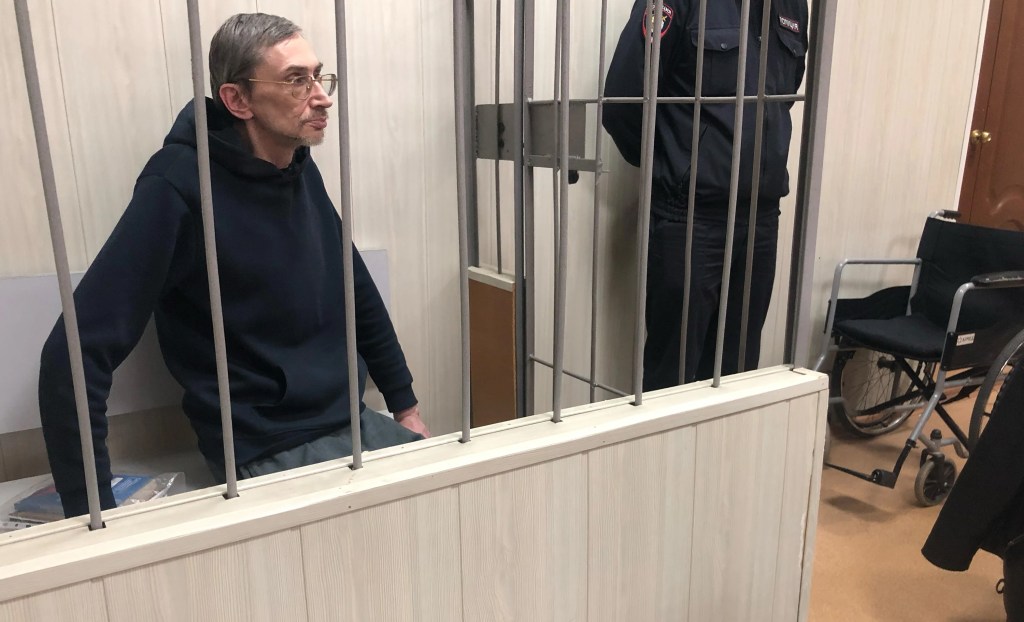
While in pretrial detention, Krichevsky formally lost his Group I disability status, which he had prior to his arrest, and so he was unable to obtain a medical examination.
According to Krichevsky, a neurologist at the Izhevsk detention center promised to send him to a hospital, but instead Krichevsky was transferred to another pretrial detention center. “I thought they were taking me to a hospital, but they took me first to Perm and then to Yekaterinburg. They basically lied to me when they said they were taking me to a hospital,” he said on the stand.
Krichevskny never did get any medical attention: “We’ll only help you if you’re dying, [they said.] Otherwise, just sit there and suffer.”
“Radical views and hostility toward the current government”: trial and pleadings
Krichevsky’s trial was postponed five times in a row: it took a long time to bring him in his wheelchair, first to Detention Center No. 1 in Yekaterinburg, and then to the court. He was brought to the hearings late, and had to spend four to five hours in the police van, where, according to Krichevsky, the temperature was the same as outside.
At the beginning of the trial, Krichevsky filed a motion requesting that he be assigned an inpatient forensic examination and treatment. He said that he had never been examined by a neurologist at the Yekaterinburg detention center, only by a GP. He was taken for examination to the local medical unit, which was not equipped for people with disabilities: there was a “big step” in front of the toilet and sink which he could not get over. As a result, the doctors only checked his reflexes and sent him back.
In their medical report, the doctors at the detention center stated that Krichevsky had no disability and that his overall health was satisfactory, meaning that he was able to take part in the court hearings.
Before the proceedings, Krichevsky again requested to be sent for treatment, “in accordance with the neurologist’s recommendation” in Izhevsk, but Judge Raitsky denied the request, seeing no need for it. Prosecutor Artem Terentyev also asked that the request be denied, as it went “beyond the scope of the criminal case under consideration.”
During the trial, the prosecutor asked that Krichevsky be imprisoned for six years in a medium-security penal colony. The prosecutor stressed that the defendant had “radical views” and was “hostile toward the current government of the Russian Federation and its officials,” and that he had written the offending comment at a time when the mobilization had not yet been completed. The prosecutor considered these to be aggravating circumstances.
The prosecutor cited Krichevsky’s “poor health” as a mitigating circumstance.
You can support Alexander by writing him a letter.
Address:
Russian Federation 620019 FKU SIZO-1, GUFSIN of Russia for the Sverdlovsk Region
Sverdlovsk Region, Yekaterinburg, Repin Street, 4
Alexander Anatolyevich Krichevsky, born 1967
You can also send letters through the online service Zonatelecom.
Source: Vasily Besspalyi, “Wheelchair user from Izhevsk sentenced to six years in prison for comment about Putin; his mother, sent to nursing home after his arrest, dies a month later,” Mediazona, 22 December 2025. Translated by the Russian Reader. Since letters to Russian prisoners are vetted by prison censors, they must be written in Russian or translated into Russian, something that can done more or less handily using an online machine translator like Google Translate. Please write to me if you need help or advice. ||||| TRR
 Write to Gordey at the following address:
 You can also send letters through the online services