Russian President Vladimir Putin has always been a paranoid man. We know, for example, that he has long eschewed the use of a personal cellphone, all too aware of how easily they can be tracked.
Yet a Kremlin document recently leaked to the press by a European intelligence service lays bare a whole new level of suspicion. Visitors can only approach him after they’ve gone through two layers of screening. His bodyguards now exercise full control over his schedule of appearances; they’ve essentially eliminated visits to any location that has to do with the military. And as for mobile phones: No one who works near Putin is now allowed to have one—they can only carry devices that aren’t connected to the internet. Surveillance systems have been placed in the homes of the cooks, drivers, and cleaners who work for him; they are prohibited from using public transportation. Most revealingly, he and his family members no longer live in their customary residences. Instead, they are sticking to secret locations with extra layers of protection. The document claims that Putin now works only in bunkers dispersed around southern Russia.
It is possible, of course, that the spies who passed this document along to the media are playing a game of their own—perhaps using disinformation to sow dissension and mistrust within the Kremlin. But the details revealed by the leak make perfect sense given the constraints that Putin suddenly finds himself facing.
In January, U.S. forces succeeded in snatching Venezuelan President Nicolás Maduro out of his compound without suffering a single fatality. At the end of February, the Israelis killed Iranian Supreme Leader Ali Khamenei on the first day of the war against Iran—and a host of other top Iranian leaders as well. Nor was it the first time that they were able to finger individual targets in Tehran. The Americans and Israelis have pulled off these operations through a combination of carefully cultivated human sources and signals intelligence, tracking the cellphone calls and internet use not just of the people targeted but also of their aides, guards, and support staffs. All this means that dictators can no longer sleep as easily as they used to.
The former head of Ukrainian military intelligence, Kyrylo Budanov—now chief of staff to President Volodymyr Zelensky—is known to be a student of Israeli targeted killings. His studies have paid off: The Ukrainians have assassinated a string of Russian military officers, politicians, and propagandists—some of them in the heart of Moscow.
In December, a car bomb in the capital took out Lt. Gen. Fanil Sarvarov. That particular hit seems to have sent a collective shiver through Russia’s power elite, allegedly—according to that leaked document—prompting a meeting of top security officials that had them blaming each other for lapses real and imagined. Given that Russia has repeatedly attempted to assassinate Zelensky, Putin has every reason to believe that he, too, has a target on his back.
Putin may well fear internal enemies as much as he does the Ukrainians; rumors of coup plots are rampant in Moscow. But the Russian president’s problems are actually bigger than that. He’s managed to stay in power for 26 years by always keeping a few steps ahead of his enemies. Now he may be running out of room to maneuver.
A Russian offensive planned for this spring has been derailed before it’s gotten off the ground. The Ukrainians claim to have inflicted 35,000 casualties on the Russians in March alone—the fifth straight month, according to Kyiv, that the number of Russians killed and seriously wounded has exceeded the Kremlin’s rate of recruiting fresh soldiers. Perhaps more importantly, the sacrifices of those soldiers were entirely in vain; no major objectives were achieved. “Ukraine is not just doing better than expected,” said Michael Kofman, a senior fellow at the Carnegie Endowment for International Peace. “Time is not on Russia’s side in this war.”
Indeed, the Ukrainians have now actually pushed the Russians back along several stretches of the front. Putin’s military leaders appear to have no new ideas on how to alter the fundamental dynamic on the battlefield. Unless they can change that, throwing fresh manpower into the fight will prove equally fruitless.
The Ukrainians, by contrast, seem to have an endless supply of new ideas. Every day brings the unveiling of some startling new piece of technology or creative use of an old one. Every day also brings news of another audacious strike deep in the Russian heartland. On April 25, for example, Ukrainian drones hit a Russian airfield in the southern Urals city of Chelyabinsk—a little more than 1,100 miles away from Ukraine.
Kyiv’s forces have devoted considerable resources to eliminating Russian air defenses, which now simply aren’t sufficient to protect every strategic target. At one point a few weeks ago, the threat of Ukrainian attacks closed all four of Moscow’s international airports at the same time. Indeed, the growing range of Ukrainian strikes appears to have influenced the Kremlin’s decision to exclude military equipment from taking part in Victory Day celebrations on May 9. Humiliatingly, Putin even felt compelled to ask U.S. President Donald Trump to dissuade the Ukrainians from attacking during the parade. The Russians are clearly rattled.
Yet Kyiv is not staging such strikes for the sake of psychological impact. The evidence suggests that Ukrainian planners are thinking harder than ever about how to maximize the impact of their attacks. At the end of April, a Ukrainian long-range drone attack on an oil refinery in Perm, more than 900 miles away from the border, targeted distillation columns—the systems that enable the separation of crude oil into gasoline and other petroleum products. Hitting storage tanks provides spectacular footage of fires, but they are relatively easy to repair; core infrastructure like these columns is a different matter altogether. “The Ukrainians have developed a theory of victory which involves the destruction of Russia’s oil and gas infrastructure,” said Ben Hodges, a former commander of the U.S. Army in Europe. “Without that, it becomes very difficult for Russia to sustain what they’re doing.”
At the end of March, a Reuters analysis concluded that the strike campaign had succeeded in cutting Russia’s oil export capacity by 40 percent. Admittedly, this may not be enough to fully offset the windfall that Moscow has gained from the sharp rise in global oil prices unleashed by the U.S.-Israeli war against Iran. Even so, in the first quarter of this year, Russia’s budget deficit already exceeded its full-year target. Financial officials cited a 45 percent drop in oil and gas revenues.
This pattern of smart targeting repeats itself across industries. In their attacks on chemical plants, semiconductor fabrication facilities, and steel factories, the Ukrainians keep hitting core components of the industrial processes that feed Russia’s military machine. Strikingly, the Russians seem incapable of paying back Ukraine in the same coin.
The decentralization of Ukraine’s military production—scattered across myriad small factories in inconspicuous locations—is making it extremely hard for the Russians to find effective targets. So they keep attacking power plants and civilians, cruel tactics that may actually serve to stiffen Ukrainian spines.
That the momentum has shifted in Ukraine’s favor is also demonstrated by Zelensky’s increasingly confident tone toward the United States. “In my view, Russia played the Americans again—played the president of the United States,” he said recently, commenting on Trump’s policy of allowing Russia to skirt sanctions on oil sales. The days of flattery and appeasement are over.
Even so, Kyiv is enjoying a boost in its international standing even as Moscow faces new headwinds. The war in Iran has given new diplomatic openings to the Ukrainians, who have been leveraging their anti-drone expertise to find new friends among the monarchies of the Persian Gulf. Trump seems so sufficiently preoccupied with his own war that he is finding fewer opportunities to pressure Kyiv into unfavorable peace deals.
And the recent electoral defeat of Hungarian Prime Minister Viktor Orban has robbed Putin of his most trustworthy friend in the European Union. Orban’s exit has finally enabled the EU to break the deadlock over a long-anticipated $106 billion assistance package to Kyiv. That’s enough to keep the Ukrainians in weaponry for a long time to come—entirely apart from the variety of joint ventures for arms production that they have created with partners across the world.
Just to add insult to injury, Moscow is also in the process of losing one of its vaunted new allies in Africa: The Moscow-supported military government in Mali is losing its fight against Islamist rebels.
Losing Mali won’t be enough to cost Putin his throne. But losing the war in Ukraine certainly could—especially when combined with a stagnant economy, restless oligarchs, and a population riled by the Kremlin’s recent crackdown on the internet. Even Russia’s military bloggers, long the most enthusiastic supporters of the war, are starting to lose faith. “Little by little, the advantage is going to our enemies,” one of them recently wrote. “[T]he enemy is counterattacking, and he is succeeding.” Other Russians may well be coming to the same conclusion.
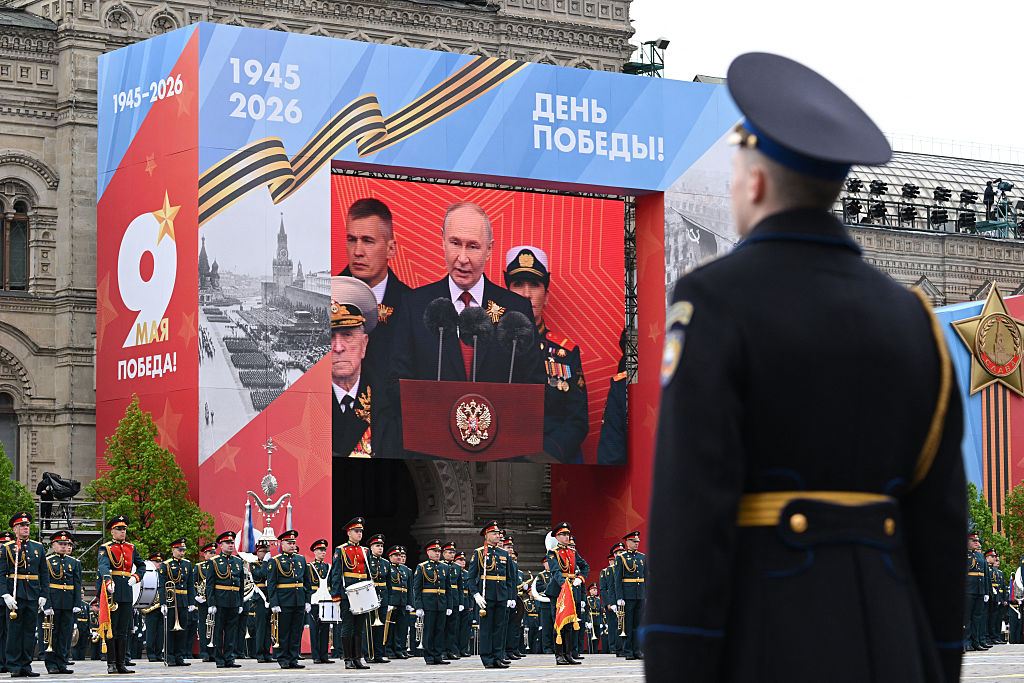
Members of a military band stand next to a screen broadcasting Russia’s President Vladimir Putin’s address during the Victory Day military parade in Moscow on May 9, 2026. Photo: Igor Ivanko/AFP via Getty Images
Just days after Vladimir Putin secured a ceasefire from U.S. President Donald Trump to hold his Victory Day parade, Russia launched a massive air assault on Ukraine, killing at least 16 people in Kyiv and injuring dozens more.
Hi, my name is Oleksiy Sorokin, deputy chief editor at the Kyiv Independent, and this is the latest issue of our newsletter about Russia.
Today, let’s once again talk about why attempting to reach a peace settlement with Putin is a waste of everyone’s time.
Russian President Putin held his parade. Normally, the event is designed as a grand demonstration of military strength and imperial confidence.
This year, it lasted just 45 minutes.
There were no tanks. No heavy equipment. The atmosphere felt restrained, almost uneasy — less a celebration of victory than an attempt to preserve the illusion of power.
After securing Trump’s support for a ceasefire that would effectively ensure Ukraine would not exploit Russia’s weakened air defenses on a day of deep symbolic importance, Putin adopted a different tone regarding the war in Ukraine.
“I think (the war in Ukraine) is coming to an end,” Putin said on May 9. He steered clear of many of the triumphalist themes that have long dominated his public rhetoric. In a somewhat amusing shift, Putin referred to Ukrainian President Volodymyr Zelensky as “Mr. Zelensky” for what may have been the first time in years.
Putin had typically resorted to labeling Ukrainian leadership “Nazi sympathizers” or “drug addicts.”
Yet, the three-day-long ceasefire ended, and Russia once again pummeled Ukraine with missiles and drones. The partly collapsed residential building in one of Kyiv’s neighborhoods, with bodies being pulled from under the rubble, became the glaring illustration of Russia’s intent for peace.
What this episode demonstrated, once again, is that Putin treats negotiations not as a path to peace, but as a weapon of war.
Every pause is used to regroup. Every phone call with Western leaders is presented domestically as proof that Russia cannot be isolated. Every public discussion about concessions reinforces the Kremlin’s core belief that time remains on its side.
This is why attempts to “bring Russia to the table” under current conditions do not bring the war closer to an end — rather, they prolong it.
The logic in the White House still seems to be that if Russia is offered enough diplomatic offramps, enough recognition, enough patience, it may eventually choose compromise over continued aggression. But the past four years have shown the opposite. Russia escalates when it senses hesitation. It hardens its demands when it sees fear of escalation on the other side. And it interprets calls for immediate negotiations not as signs of strength or pragmatism, but as exhaustion.
For Putin, the war has never been only about territory. It is about restoring Russian dominance over Ukraine. Russian demands have remained maximalist. Despite mounting military and economic strain, Putin hasn’t moved one inch.
Negotiations, when offered before Russia faces undeniable military, economic, or political pressure, only invite the Russian leader to repeat his maximalist wants.
Ukraine did secure something in return for agreeing to a three-day ceasefire: If everything goes according to plan, a 1,000-for-1,000 prisoner exchange between Ukraine and Russia will take place on May 15.
That alone justifies allowing Putin to hold his parade. If the price of letting Putin stage a carefully choreographed 45-minute parade was bringing 1,000 Ukrainian prisoners home, that is a trade most Ukrainians would take every time.
But it would be a mistake to confuse this with progress toward peace, or a hint that Russia’s attitude toward Ukraine or the West has changed.
Putin’s comments about the war’s nearing end are domestic messaging to assure the public that everything is going according to plan. It does not, but Putin won’t budge.
At this point, negotiations with the Kremlin often resemble a very specific genre of political theater.
And yet, much of the international discussion continues to revolve around finding the right formula, the right incentive, the right “off-ramp” that will finally persuade Putin to stop the war he chose to start.
There is no indication that the Kremlin is currently prepared to accept a settlement that falls short of its broader wartime objectives. Until Russia faces costs that outweigh those ambitions, negotiations are more likely to drag out the war than bring it to an end.
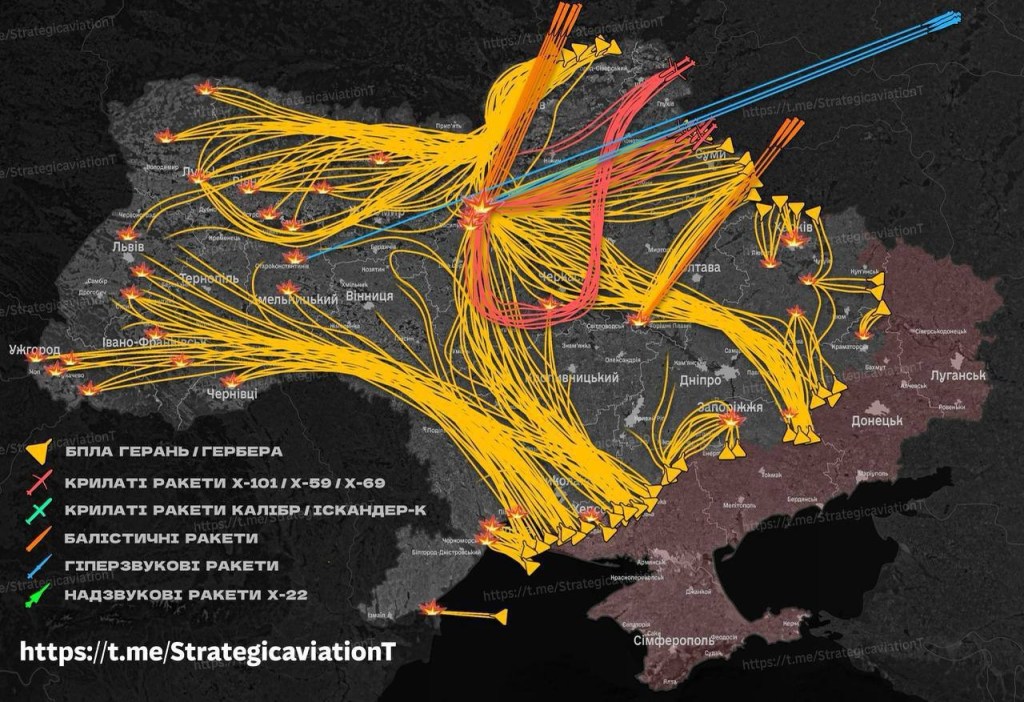
Russia launched one of the longest and most massive air attacks since the start of its full-scale invasion just days after the recent ceasefire expired.
Over the course of 30 hours, Russia launched more than 1,500 drones at Ukrainian cities, along with over 50 ballistic and cruise missiles, Zelenskyy said.
An approximate map of the May 13–14 Russian strikes on Ukraine, from the Telegram monitoring channel @StrategicaviationT.
After a drone strike on the capital, part of a high-rise apartment building collapsed in Kyiv, and rescuers recovered the body of a 12-year-old girl from the rubble.
“We live in a building across the road,” said Olesia Holub-Korba, a Kyiv resident who was just meters from the high-rise last night.
Olesia typically does not go to the shelter during air raids because she [has] to keep running up and down from the 20th floor at night with her young son.
“I always go and lie down in bed with my child so that if there are any falling fragments, I can cover them with my body, and if it’s a missile, then either we survive together, or we…[die],” she told The Counteroffensive.
Olesia and her family had just gone to bed, not yet asleep, when a very loud explosion sounded. Lying on the floor, she literally felt the building shaking.
“Fuck,” she said to her husband, “it’s a direct hit on us.” Olesia’s husband reassured her that it nothing had hit their building, at least not yet.
Fortunately, her family is safe.
However, twenty people from the damaged residential building are still considered missing from the building, which has a completely destroyed entrance, which prevents survivors inside from escaping. Emergency services continue search operations under the debris, which will apparently last into the night.
On the first day of last week’s ceasefire, Putin told reporters that he thinks the war is “coming to an end.”
Zelenskyy responded: “These are certainly not the actions of those who believe the war is coming to an end.”
Government-funded Ukrainian news organization United24 reported that this was the longest and largest aerial attack since the start of the full-scale invasion, though that superlative could not be independently verified by The Counteroffensive. The assault ended on the morning of May 14.
97 percent of the drones launched toward Ukraine were neutralized, according to a report from the Ukrainian Air Force, as were 73 percent of missiles.
Although the vast majority of air targets were successfully downed, Russia damaged around 180 buildings, including 50 residential buildings across Ukraine. In Kyiv, at least five people were killed and dozens more injured. Over 100 people have been injured across the country.
Russia has changed its tactics and is now deliberately trying to stretch out attacks in order to exhaust Ukraine’s air defenses. During the day, Russia sent hundreds of attack drones mainly to the west of Ukraine to exhaust the air defense. In the late evening, there was a second wave of strikes, followed by missiles, targeting the capital.
Russia’s Defense Ministry described the strike as a “massive retaliatory attack” for recent Ukrainian long-range strikes inside Russia.
Zelenskyy stated that there will be a “fair” response to that.
The massive attacks come just days after a decree from Zelenskyy effectively ‘allowed’ Putin to host his WWII Victory Day Parade in Moscow’s Red Square, though the celebration was scaled down, likely due to fear of Ukraine’s long-range strike capabilities. Putin’s anxiety over the annual event signaled a shift in Moscow’s projection of power.
On May 8, Trump announced the 3-day ceasefire, and both Putin and Zelenskyy agreed to its terms, which included a 1,000 for 1,000 prisoner swap.
That ceasefire, though fragile as ever on the front lines with both sides alleging a breach, technically expired on Tuesday, May 12, marked by a mutual exchange of fire.
Over the course of the past week, Putin and Trump — the latter of whom campaigned on a promise to end this war in 24 hours — both said they think the war will end soon during the days leading up to last night’s attacks.
Also, for the first time ever, Putin said he is prepared to meet with Zelenskyy in a third country, outside of Moscow, but only in pursuit of a final agreement that ends the war.
Russia is readying for Victory Day — a major state holiday that the Kremlin has elevated into something of a sacred ritual — in far-from-perfect condition. For several weeks, Ukraine has been systematically and successfully attacking oil infrastructure across the country, with ecological consequences that local authorities are struggling to contain. The aftermath of the strikes, largely unreported in national media, is even visible from space. The attacks have only added to public discontent with Putin’s policies — but it is unlikely to have any serious consequences for the Kremlin.
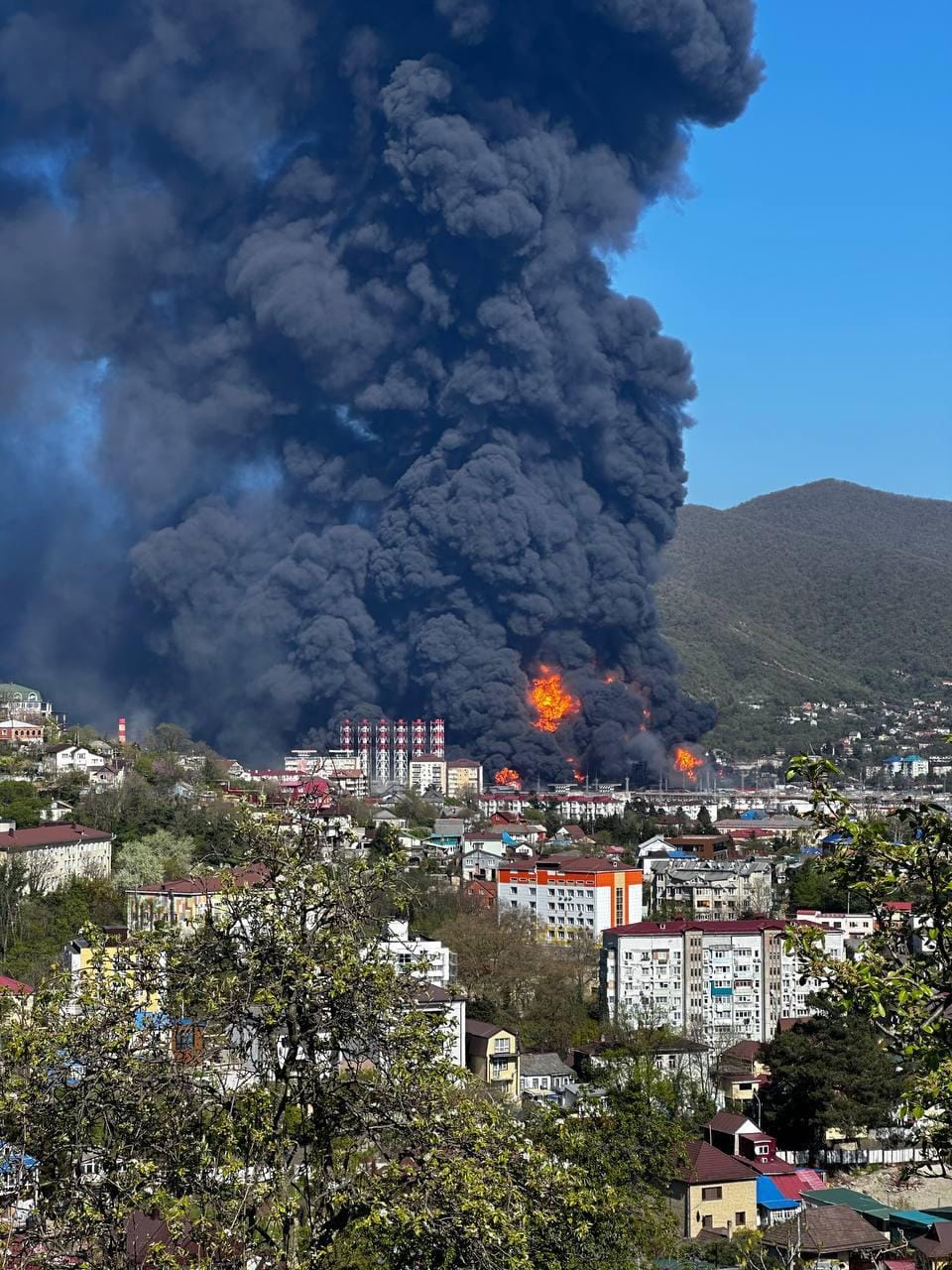
Throughout the second half of April, Ukraine made the Black Sea resort of Tuapse its primary target. Tuapse is a sprawling oil city — home to a Rosneft oil refinery, one of Russia’s oldest, which operates alongside an export terminal that ships petroleum products overseas. From April 16 to May 1, Ukraine hit the town four times, damaging both the terminal and the refinery.
The drone strikes led to a genuine ecological catastrophe. Fires at the refinery caused plumes of smoke visible from orbit. Burning petroleum poured down one of the city’s streets. What became known as “oil rain” — thick black toxic precipitation — fell across the city, leaving stains on plants and animals. In several districts, air quality data showed an unsafe concentration of dangerous chemicals, specifically carcinogenic benzene and xylene, as well as choking soot. Residents living close to the terminal reported vomiting and nausea.
Some of the spilled oil entered the Tuapse River and, after heavy rain, flowed into the Black Sea. Ecologists from the Transparent World project studied satellite images from April 25 and concluded that the size of the spillage covered up to 3.8 square kilometers. The spill near the resort’s central beach was more than half a kilometer long. There is a shortage of workers and equipment to clear up the mess, an operation which has been complicated because the oil soaks deep into the pebble beaches, and the sea continually washes new pollutants ashore. In addition, residents keep finding dead dolphins on the beaches.
Local authorities declared a state of emergency — a special legal status allowing the immediate deployment of resources and a coordinated disaster relief effort. They recommended locals avoid going outside for long periods, keep windows closed, wear masks, and rinse their eyes, noses and throats. However, there was no official stay-at-home order. For many days, Tuapse’s schools did not cancel classes (before eventually being ordered to close only after one of the last attacks), even as air pollution significantly exceeded safe norms. Employers were similarly reluctant to allow staff to work remotely. “At the same time, you have to stay home but also go to work as usual. Choose for yourself which rule to break,” said one Tuapse resident who first had to take her children to school through a town blanketed in acrid smoke, before driving to work.
Vladimir Putin’s response has been muted. “Drone strikes on civilian infrastructure are becoming more frequent. The latest example is the attacks on energy facilities in Tuapse, which could have serious environmental consequences,” he said almost two weeks after the first attack. He then added: “However, the governor merely reported that there don’t seem to be any serious threats and people are coping with the challenges they face.” Residents were not impressed, judging by one report from the Black Sea resort. “People are coping. But where’s the government? They seem to be on some other planet. You can feel the anger: some people are doing something, while others are scratching their asses,” a local resident told the Ostorozhno Novosti publication.
National TV channels did not devote much time to the ecological catastrophe: the weekly news review, Vesti Nedeli, presented by leading propagandist Dmitry Kiselev, ran a five-minute segment on Tuapse in the second half of the show. In it, Governor Venyamin Kondratyev said that he would do everything “to ensure the resort season goes ahead.” Ecologists consider this unrealistic.
Tuapse is not the only place that has been hit by Ukrainian drones. On April 29 and 30, Ukraine attacked a refinery and pumping station in Perm, a city of one million people in the Urals, about 1,500 km from the front line. Ecologists told Agentstvo that an environmental catastrophe could unfold along similar lines there. The skies over Perm were shrouded by smoke, oil fell like rain and carcinogens entered the air. Meanwhile, the local authorities did nothing: the mayor’s page on vKontakte (the Russian version of Facebook) posted nothing about the attacks on the refinery.
Overnight into May 3, Ukraine attacked Primorsk, Russia’s biggest oil terminal on the Baltic Sea — the latest time in a string of long-range strikes on the site. The port typically handles about 40% of oil Russia’s maritime oil exports. The Leningrad Region’s governor reported a fire had broken out, but no oil leak. The next night, a Ukrainian drone attacked an elite residential complex in the western part of central Moscow — a protected area, home to foreign embassies and where ex-president Dmitry Medvedev owns expensive real estate.
Amid the ongoing Ukrainian attacks, the Kremlin has taken a previously unthinkable step and scaled back the full-scale military parade to celebrate May 9 (for more on how this sacred day in Russia’s calendar became a way to glorify the current war, read here). Military hardware has trundled through Red Square every year since 2008, although following the invasion of Ukraine the parade has gotten smaller and smaller. This year, there will be no display of military equipment. Only infantry soldiers will march in the parade. “Amid … terrorist threats, of course, we are taking all measures to minimize risk,” said Putin’s press secretary Dmitry Peskov, explaining the decision. In addition, Muscovites living in one of the most digital cities on Earth, again face a mobile internet shutdown from May 5-9. Operators are blocking access to the network “for security reasons.”
Increased taxes for business, rising prices for customers, regular mobile internet outages, the blocking of Telegram (Russia’s most popular online messenger) and general war fatigue among the population have seen Putin’s approval rating continue to fall for a second month. According to the latest survey by state pollster VTsIOM, 71% of Russians back the president — the lowest level since the invasion of Ukraine. FOM, another pollster that works with the presidential administration, recorded a drop in support to 73% — also its lowest reading since the opening days of the invasion in 2022. The decline in approval will not lead to any protests in Russia, an expert studying Russian public opinion told The Bell.
Why the world should care
Ukraine’s systematic and increasingly successful drone strikes against Russian cities clearly cast a shadow over Putin’s plans for May 9, arguably the most important day of the year for the Russian leader. The Kremlin uses the event not only to celebrate Soviet victory over Nazi Germany, but increasingly to justify the current war and lionize the Russians fighting at the front. In previous years, Kyiv has refrained from attacks on this date. Regardless of whether that remains the case this time, the key point remains: Russian society is not just tired of the war, but is starting to feel its full impact: constant restrictions, lockdowns, and dim economic prospects. In the fifth year of fighting, growth rates that were once trumpeted by Kremlin economists are already out of reach.
This is the 7×7 newsletter, which tells the tale of two journalists, Alisa and Yelisei, who have set out on a voyage around Russia’s cities and towns to find out what life is like in the country’s regions. Care to join them?
The Ulysses have arrived in Tuapse. On the night of 1 May, the local marine terminal here caught fire once again following a drone attack. As a result of the incident, petroleum byproducts spilled into the river and the sea, polluting approximately sixty kilometers of coastline. Volunteers immediately rushed to the scene. Many of them already have experience in combating fuel oil pollution on the coast: they worked on the 2025 oil spill in Anapa.
The volunteers have been sadly convinced that the authorities had not learned from the previous disaster, and that they were once again left to deal with the oil alone. Officials, meanwhile, did nothing but issue directives on how not to tackle the spill’s aftermath. For instance, they proposed barring women from being involved in the cleanup efforts. You can find out how they justified this stance—and how the female volunteers responded—in the newsletter below.
“There is only one solution: once there are enough men available for this work, there will no longer be any need for women to do it,” the female volunteers in Tuapse remarked wryly as they head back to the beach. They had a busy May Day holiday digging up oil-contaminated pebbles on beaches, washing oil off dogs, cats, and birds, and recording videos appealing for help. They also could not help but notice that there were more women than men out on the beach.
Meanwhile, a correspondent for Kommersant reported that Tuapse city hall and the regional department of the Emergency Situations Ministry had not permitted female volunteers to clean up the oil due to “concerns” for their reproductive health. The conversation took place during a meeting with volunteers. Several women present at the meeting said that they would take care of their own reproductive choices themselves.
City hall issued no formal legal ban on women’s involvement in the cleanup effort, limiting itself instead to a verbal recommendation. Yet even these suggestions sparked considerable controversy.
Ecologist Roman Pukalov urged women to refrain from working directly on the beaches. According to him, after spending forty years studying the effects of petroleum products on humans, he has concluded that “the fairer sex constitutes the primary risk group.” He asked female volunteers to focus on other forms of assistance (aside from beach cleanup) such as organizing meals, overseeing the delivery of humanitarian aid, and coordinating targeted fundraising efforts.
“We members of the fairer sex make up the majority,” Anastasia, a volunteer from the Anapa-based volunteer squad Ghosts, reminded Pukalov in the comments section. She herself requires medical attention after being involved in the cleanup of fuel oil in Veselovka. She urged her fellow female volunteers to take care of themselves and undergo all necessary medical checkups following their time in the field.
Other volunteers noted in the comments that fuel oil is not only dangerous to reproductive health. It can also lead to anemia, to which women are more susceptible than men. The women should therefore undergo a medical checkup before the cleanup begins so they are aware of the risks involved, and volunteer coordinators should explain the potential harm of petroleum byproducts and discourage those at high risk of harm to their health from taking part in the cleanup.
What has upset the female volunteers most was that no one has been carrying out medical checks or providing any information at all about the dangers of fuel oil. The officials simply impose bans, and do so under the guise of concern for reproductive health. Yet the women working to clean the beaches may not even want to have children.
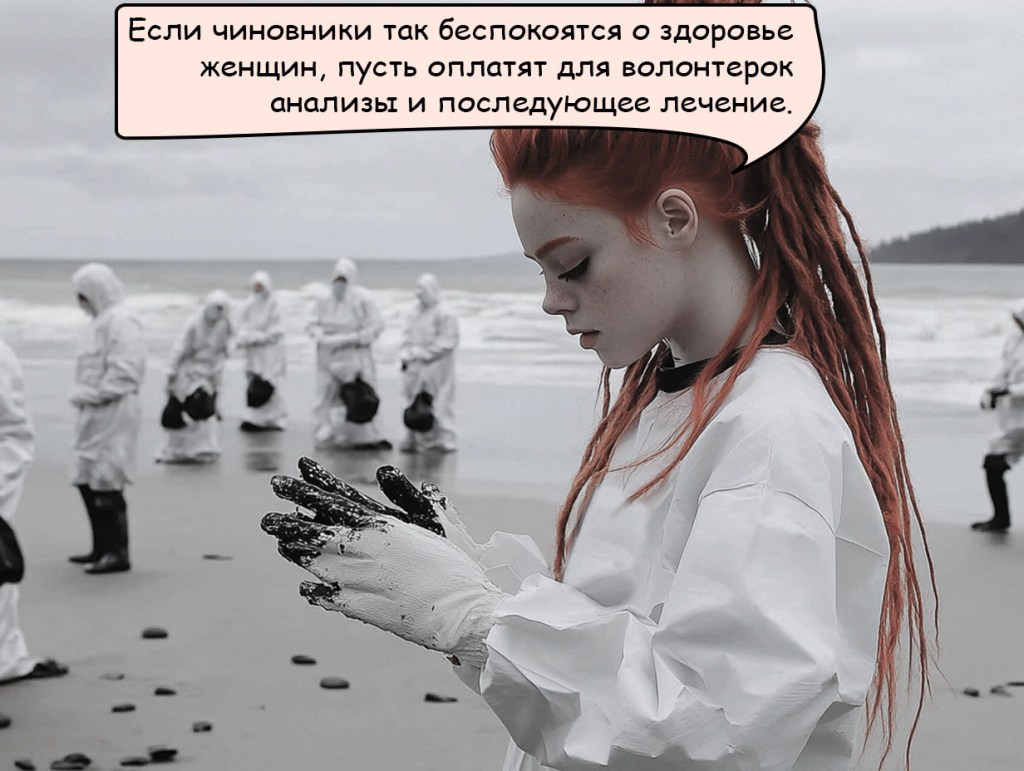
Alisa: “If officials were so worried about the women’s health, they should pay to have them tested and treated, if necessary.”*
Petroleum products can in fact cause a range of health problems in women: disturbances in the menstrual cycle, complications during pregnancy and fetal abnormalities, and the onset of anemia.
Women are more vulnerable to the effects of petroleum products: their dangerous components accumulate in fatty tissue, which women have more of, and affect the endocrine system. In some cases, these components are eliminated more slowly than in men, due to the effect of sex hormones on the liver.
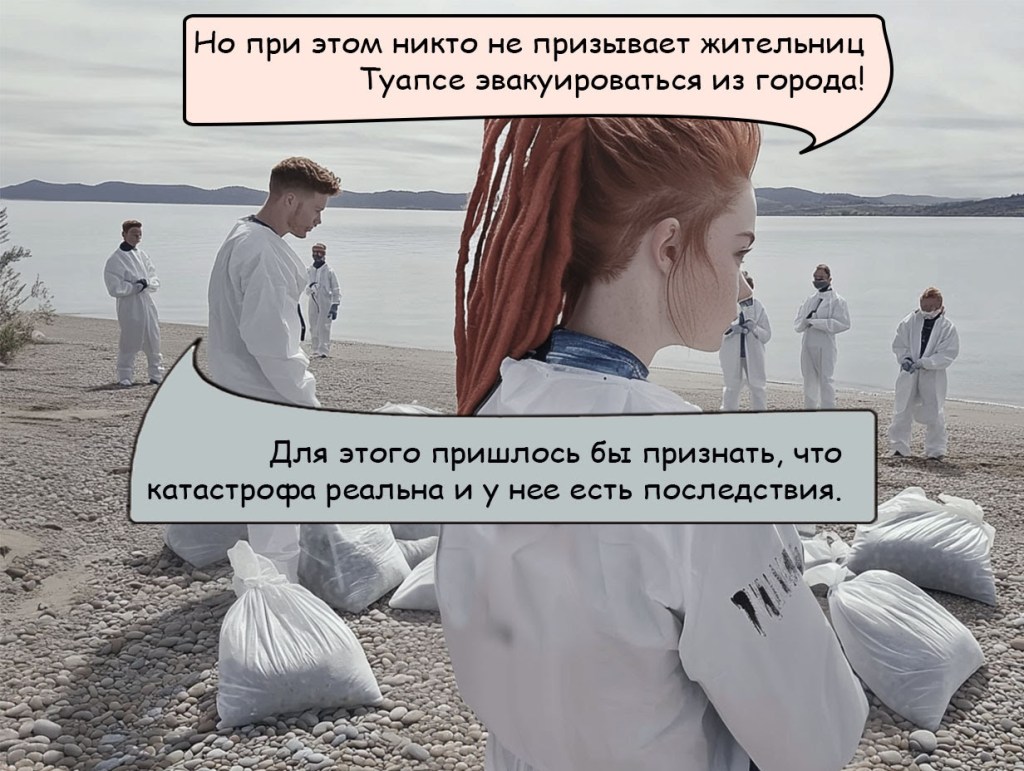
Alisa (right): “And yet no one has been calling on the women of Tuapse to evacuate the city!” Yelisei (left): “For that to happen, the authorities would have to admit that the disaster is real and that it has consequences.”
The volunteers themselves complain that they are short of hands. The authorities, meanwhile, have promised to have the beaches completely cleared of oil by 1 June. But environmentalists doubt that the clean-up crews will manage to meet the deadline: the area affected by the spill is simply too vast.
What is more, the city is experiencing “oil rain”: petroleum byproducts are released into the air and settling on the ground in the guise black droplets along with the rainfall. They then seep into the soil, poisoning plants, animals, and the drinking water.
The oil rain poses a particular risk to pregnant women living in the city, rather than those directly involved in the cleanup.
“In this sense, now is the worst possible time to try to have children. There is a high probability that these children will suffer from developmental abnormalities. Pregnant women need to keep their windows closed, wash the floors at home twice a day, wear a mask (even indoors), change their clothes daily, and take every possible precaution to avoid exposure to this filth. And the same goes for those who aren’t pregnant, too,” ecologist Igor Shkradyuk told 7×7.
The authorities did in fact evacuate residents from one district—not due to the risk of oil poisoning, however, but rather due to the aftermath of the drone strikes. Residents of private homes destroyed by fire were among those who left. Yet the authorities have been making strenuous efforts to conceal the true magnitude of the pollution. For instance, Sergei Boyko, head of the Krasnodar Territory’s Tuapse Municipal District, said on Solovyov Livethat Tuapse would be ready to welcome tourists during the resort season, arguing that “what happened on one beach will in no way affect the other beaches.”
The Emergency Situations Ministry’s Tuapse office eventually explained to Kommersant that volunteers are barred only from the most heavily polluted (and, therefore, most dangerous) beaches. Nevertheless, the women have been going on with their work despite these “recommendations”: they have not only being cleaning the beaches but also washing animals, removing polluted sand, coordinating volunteers, sending out appeals for assistance, and recording videos documenting the situation.
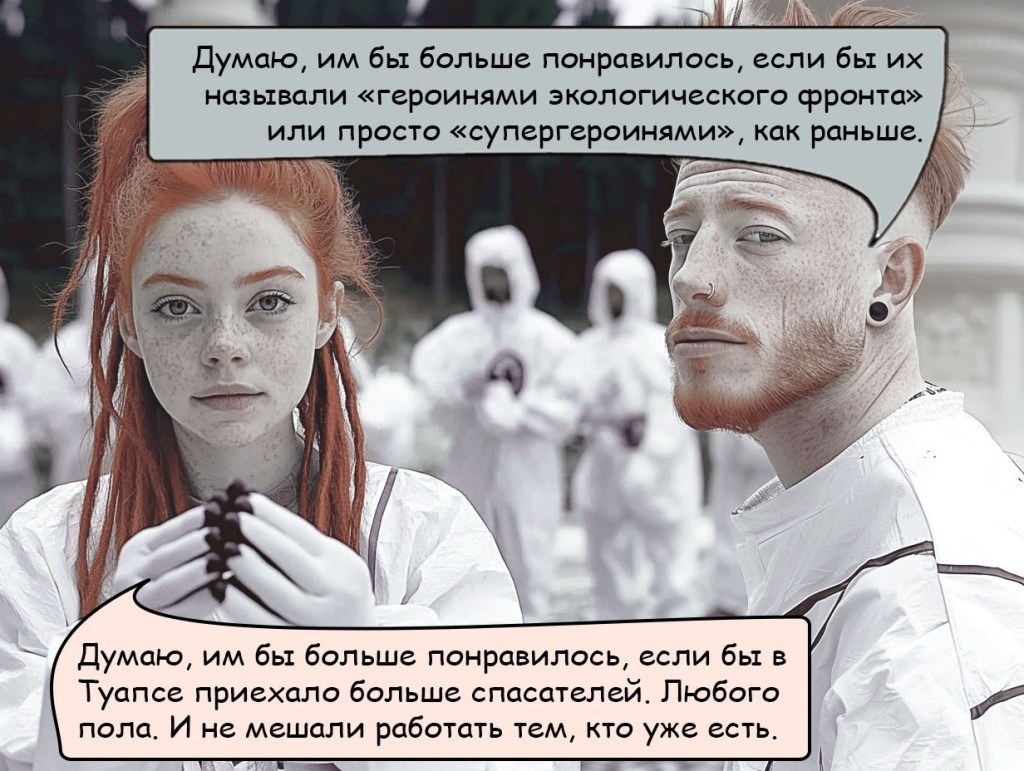
Yelisei (right): “I think they would like it if they were called environmental superheroines, or just superheroines, like earlier.” Alisa (left): “I think they’d like it more if more rescuers came to Tuapse, whatever their sex, and if the rescuers who are already here stopped being pestered.”
If you have read about the risks of poisoning and are still willing to help, check out the volunteers’ channels on Telegram and VKontakte. Volunteers are urgently needed right now to catch birds, wash animals, and clean up the fuel oil. Before setting out, be sure to contact the coordinators, as particular jobs, locations, and needs for supplies may change during the course of the day. A bot set up by the volunteers provides their contact details. You can also help remotely: fundraising efforts support washing operations, the bird-catching team, and the equipment warehouse are ongoing.
* AI tools were used to produce the images in this article.
Source: 7 x 7 weekly email newsletter, 5 May 2026. Translated by the Russian Reader
No sooner had local officials declared that they had finally brought under control a fire that raged for days at an oil refinery in Tuapse, a port town on Russia’s Black Sea coast, than it flared up again.
The blaze is visible from as far away as Sochi — and even from space. Satellite images show vast oil slicks spreading across the sea. Online, volunteers are posting videos of dead marine life, including dolphins, their bodies coated in crude.
How much oil has already been spilled: hundreds of tons, or thousands? No one seems to know.
President Vladimir Putin said Tuesday that there were “no serious threats in Tuapse, and people are managing to cope with the challenges they face on the ground.” Governor Venyamin Kondratyev told him so, he said.
Putin is no stranger to calamity, or to minimizing it. But it is worth taking a look at what is actually happening.
The inferno first erupted last week. Storage tanks filled with petroleum products burned, sending columns of black smoke visible more than 100 kilometers away.
The volume of combustion byproducts released into the air was so large that Tuapse experienced what residents called “oil rain,” because it felt like the city had been doused with oil. A film resembling an oil slick settled on streets, plants, people and any pets or stray animals that happened to be outside at the wrong time.
That film contains a toxic mix of pollutants, including carcinogens such as benzene. Because the fire is still burning, dangerous concentrations of these substances persist in the air. Black rain may well continue.
Officials say levels of harmful substances are two to three times above what is considered safe.
To paraphrase a Russian proverb, lying is nothing compared to lifting sacks. Talk is cheap.
There is no reliable independent data, but it is hard to imagine that concentrations near the fire are merely double or triple permissible limits. More likely, they are dozens, perhaps hundreds, of times higher.
Last week, roughly 60% of the facility’s storage capacity was on fire. Now the rest is burning.
The resulting clouds of soot and carcinogens are especially dangerous for children, the elderly and those with cardiovascular or respiratory conditions. People with fragile health are already feeling the effects. The rise in cancer rates will come later; that is how such exposures work.
And when the fire finally burns out, the disaster will not end. Toxic residues left behind by the fires and the oily rains will remain in the environment, re-entering human bodies again and again.
Nor is the damage confined to the air. At least several hundred tons of petroleum products have spilled into the Tuapse River and the Black Sea. Satellite imagery showed large slicks as early as last week; the leakage continued this week. The impact on marine ecosystems and the coastline will be severe. Drinking water contamination is a real risk.
To understand what may come next, one need only recall the spill in the Black Sea at the end of 2024, which saw thousands of tons of oil products released. Fish, mollusks, dolphins and birds died in large numbers.
As then, volunteers are now desperately scrambling to respond while Putin and Governor Kondratyev tell the country that there are no serious problems.
Remember those videos where they’re cleaning oil off the birds? Well, most of them die anyway. I don’t mean to say that washing the birds is pointless — some of them will survive. Just not many.
Even if the visible oil is removed from beaches, the problem will linger for years. Each storm will dredge buried petroleum products back up to the surface. Effective, repeated cleanup requires sustained resources and political will, both of which are in short supply given the war in Ukraine and the crisis in the global oil market.
In my more than 35 years of environmental work, I cannot recall a single instance in which the Russian authorities were prepared for an emergency. They always take a long time to decide what to do at the outset of a crisis, when time is of the essence.
A proper response to a major refinery fire would begin with clear public guidance: stay indoors, close windows, limit exposure. It would include the distribution of effective protective equipment — not surgical masks, but respirators capable of filtering fine particles — and, crucially, early evacuation to areas with clean air.
Reports of evacuations suddenly appeared on Tuesday. In reality, residents of a few streets were moved to a nearby school, still within the zone of contamination, rather than taken somewhere where the air isn’t polluted with carcinogens.
This catastrophe is part of the broader consequences of the senseless and bloody war Putin unleashed more than four years ago. He isn’t bothered by the hundreds of thousands of Russian and Ukrainian military deaths for which he bears direct responsibility, so it’s naive to expect him to care about burning oil tanks and poisoned seas.
And things will only get worse.
Vladimir Slivyak is co-chairman of Russian environmental group Ecodefense and laureate of the Right Livelihood Award 2021.
TRY ME FOR TREASON is a 50-minute film, in English, featuring speeches made by anti-war protesters in Russian courts. It has been made by a group of actors to draw English-speaking audiences’ attention to the stand taken by Ukrainians, and Russians, against the Russian invasion of Ukraine.
The YouTube premiere of the film will be broadcast on Sunday 17 May at 20.00 UK time. To participate, go to this link and hit “Notify me”:
□ Since Russia invaded Ukraine in 2022, thousands of people have been arrested for protesting against the war. Many appear in court, facing years of imprisonment. What do they say to the judges? What would any of us say? This 50-minute film, in English, features some of their speeches in court.
□ The speeches are from the book Voices Against Putin’s War: protesters’ defiant speeches in Russian courts (Resistance books, 2025). You can buy a copy, or download a free PDF, via this page.
□ Readings by John Graham Davies, Leila Mimmack, Gareth Brierley, Maya Willcox and Nick Evans. Script by Simon Pirani and John Graham Davies. Videography by Anthony Aldis
□ From Sunday 17 May the film will be free to view, or download, on YouTube, under a Creative Commons licence.
And here is a trailer to share:
There will be an in-person film premiere in London at 6.30pm on Sunday 17 May, just before the YouTube premiere – all welcome! – details below.
Source: Ukraine Information Group. Thanks to Simon Pirani for the heads-up and all the invaluable hard work. ||||| TRR
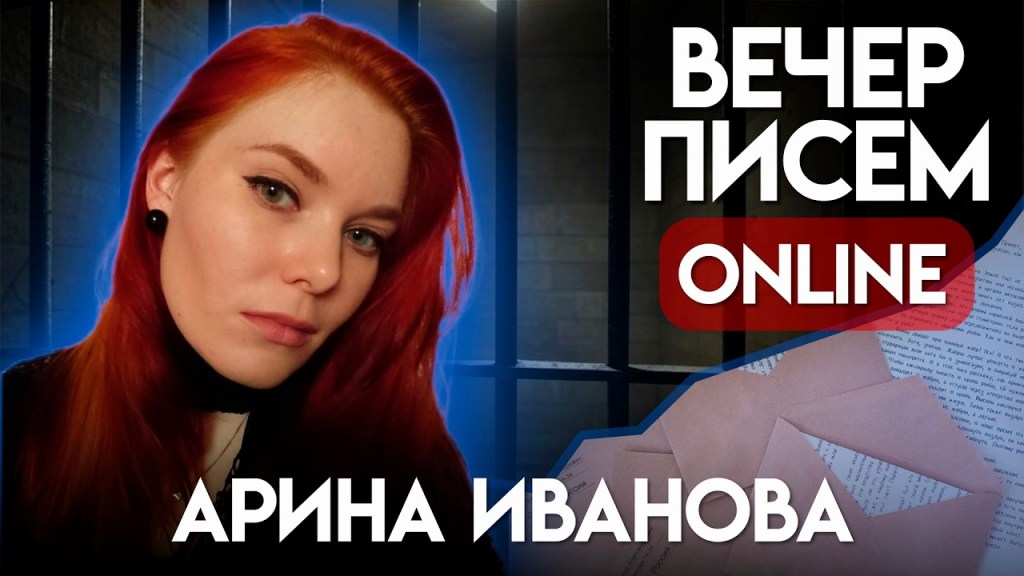
In the autumn of 2024, Arina Ivanova packed a tracksuit, socks, a change of underwear, soap, a toothbrush, and a few dishes into a bag. Once she was ready, she made her way to a friend’s place and waited. In August 2025, Ivanova was sentenced to five years in a penal colony for disseminating “fake news” about the Russian army. In January, she was transferred to a penal colony, and there has been no contact with her since.
Thirty-eight-year-old Ivanova was born and raised in Novokuznetsk, a coal and iron ore mining town in the southern Kuzbass (Kemerovo) Region of Siberia. On 13 August 2025, three days after Arina’s birthday, local media outlets reported on inspections of local schools in the runup to the new academic year, a military recruiting officer caught taking bribes, and the sale of an “elite three-bedroom apartment.”
Arina was sentenced to five years in a penal colony the same day, but there was no mention of it in the city’s media. Neither journalists nor human rights activists knew about Arina until Darya, who was working as a news editor at OVD Info, accidently discovered her in a Novokuznetsk pretrial detention center.
“Some colleagues of mine noticed on a court website that an Arina Sergeyevna Ivanova had been sentenced in Novokuznetsk for violating the law on ‘fake news.’ They sent them an official request for information,” recounts Darya. “The reply came back that the defendant had been sentenced to five years in prison. I took an interest, partly because I’m from Novokuznetsk myself. We turned up several administrative charges for various antiwar statements, and we sensed that this person had a firm stance, that she had convictions, which made us even more determined to locate and help her. Then I googled something like ‘Novokuznetsk woman fined for discrediting army” and found a news item about her on “Kuzbass without Extremism,” a [Telegram channel] for Center “E” [anti-extremism police] officers.
A post there dated 13 October of last year reports that an administrative offenses case had been launched against “Citizen Arina I.” for displaying Nazi symbols (per Article 20.3.1 of the Administrative Offenses Code), specifically for posting the slogan “Glory to Ukraine.” It further alleges that Ivanova “deliberately committed this offense with the aim of obtaining political asylum.”
Further down in the post are a few seconds of audio labeled “Arina I. Conversation with a Girlfriend.” The voices have been altered, and the words are barely decipherable: “Well, yes, I deliberately posted those comments so I could get political asylum.” “Do you realize that’s dangerous? They could even put you in jail for that.”
“They could show up any day now”
On the morning of 24 December 2024, a man identifying himself as a police investigator called Karina, a childhood friend of Arina’s, on her mobile phone. He told her they needed to meet to talk about Arina.
She immediately told Arina about the call, as Arina had been staying at Karina’s home since the autumn. Arina went to the door. Standing on the other side of it were men in uniform.
Ivanova was first summoned to the police in October 2023. The grounds for the summons, as stated in the case file, was an antiwar post of hers on [the Russian social media network] VKontakte, featuring a video titled “StopRussianfascism” and “an image of human figures arranged in the shape of a Nazi swastika.” Arina was fined 1,500 rubles under the Administrative Offenses Code article prohibiting the public display of banned symbols (Article 20.3.1). She was handed a second fine, in the same amount, for violating the same article, over a message posted on Telegram containing a “slogan used by Ukrainian nationalists.”
“She said she was having endless panic attacks,” Karina recalls. “The walls felt like they were closing in. She knew that any day now they could show up and take her away, and she, a ordinary, law-abiding person, would end up in prison for things she had said.”
In the autumn of 2024, Arina once again confided in her friend that she was having a hard time, and Karina suggested she come stay with her, just as before. Arina moved in with Karina four months prior to her arrest.
Karina says that her friend didn’t try to leave the country, even after being slapped with several administrative citations.
“People react to stress in different ways: some are proactive, while Arina just freezes up and takes a ‘come what may’ attitude,” Karina recounts. “We talked about the possibility of her leaving and seeking political asylum. I tried to urge her to go, but when I got home from work, she would just be lying there watching TV. That’s just how her psyche responded: she retreated into her shell and couldn’t find her way back out. Arina didn’t do anything at all, because she was scared, I think.”
On the morning of 24 December, three men entered Karina’s apartment.
“I didn’t want to let them in at all at first,” she recalls. “They asked whether I knew that Arina was on the wanted list. I didn’t. They went downstairs, brought back an arrest warrant, and said that if I didn’t let them in, they would break down the door and come in without asking me.”
“They don’t give a damn how many cats you have”
“She used to say, ‘They won’t take me away because I have so many cats,'” recounts Karina. “She’s a kind, naive gal, and telling her the truth felt like twisting the knife, but I had to snap her out of it and bring her back down to earth, because she was completely living in a fantasy world. I told her, ‘Arina, it makes absolutely no difference to them how many cats you have; they don’t give a damn. They’ll just show up, take you away, open the door, let the cats out, and that will be the end of it.'”
It wasn’t just her loved ones who noticed her bewilderment. Through mutual acquaintances, Arina got in touch with Yevgeny, a lawyer in Novokuznetsk. According to him, it was already clear at the time that things wouldn’t stop at just an administrative offenses case.
“Arina came to my office,” recalls Yevgeny. “She seemed lost and didn’t fully grasp what was happening. She had no clear plan: all her actions appeared chaotic and disjointed. I drafted a formal complaint regarding the administrative offense case free of charge, but it was never filed. Nor did Arina go to see the lawyer I had advised her to consult. I got the impression that she didn’t understand the gravity of the situation—specifically, how the mechanism for prosecution and imprisonment actually works.”
Realizing that arrest was imminent, Arina entrusted her cats to Svetlana, a volunteer. Arina had previously brought animals to Svetlana for spaying and neutering, and had sought her advice on their medical treatment and care. Svetlana, by her own account, runs a temporary foster facility located within a veterinary clinic.
When she was already in pretrial detention, Arina learned that the volunteer had demanded that the animals be retrieved, threatening to euthanize them otherwise.
“In my opinion, [Svetlana] isn’t a terribly rational woman. She wrote to me saying that ‘winter is coming’ and that she would have to euthanize these [cats] in order to take others in from the streets,” says Karina. “I don’t know what became of them…. I asked that woman to stop doing this work and to stop ‘rescuing’ animals.”
“My childish love for animals grew into something bigger”
“Like many others, I couldn’t decide what I wanted to be early on in life,” Arina writes in a letter from the detention center. “Everything was decided by chance. When I was seventeen, I was looking for a summer job, and I stumbled upon a job posting for a small flower shop. I’ve always loved flowers, so I decided it was a good opportunity to learn something new.”
After graduating from a technical college specializing in construction, Arina worked as a florist for about fifteen years. When she realized that arranging bouquets no longer brought her the joy it once had, she decided to turn her hobby—cooking—into a career.
During the ten years previous to 2024, Arina and Karina had little contact with each other. Their paths began to diverge when Karina started a relationship and had a son.
“Arina mostly stayed at home,” recalls Karina. “We lost touch for a time. I would try to get us back in touch and would invite her over. It’s not like she turned me down exactly, but she was seemingly avoiding spending time with me, and so finally we settled on merely congratulating each other on holidays and birthdays. Then she took up volunteering, and she and her mom started taking in stray cats from everywhere. Then her mom emigrated and she stayed behind [in Russia] with the cats.”
Arina writes that she had been surrounded by animals since childhood. She would drag every stray cat and dog home, and spend all her pocket money on their medical care.
“I thank Mom for supporting me in this,” she writes in the letter. “My childhood love of animals grew into something bigger. Volunteering became not only a hobby but an important part of my life. Thanks precisely to the animals who acted as my lifeline, I stayed afloat in the wake of the events of February [2022].”
Arina’s mother Tatyana, born in the town of Perevalsk in [Ukraine’s] Luhansk Region, also had a tough time when the war broke out. She has been living for the past ten years in South Korea and, according to her, had been writing antiwar social media posts intended for Russian immigrants to South Korea who “support the whole thing.”
“I’m from Ukraine myself, and Arina and I traveled there so many times,” says Tatyana. “[The war’s outbreak] was a tragedy for me and sent me into a depression. I would scroll through my news feed to see what was happening there, and it was unthinkable. Arina naturally couldn’t help thinking about it either.”
“I relied on her like she was an adult”
Tatyana is sixty years old. In South Korea, she works as a hotel housekeeper. She had worked as a train conductor in the 1990s in Russia. She got the job when “salaries at some workplaces were delayed for a year, but there was a stable income on the railway.” But even there, the screws began to tighten: wages dropped, while responsibilities increased. When Arina was twenty-five, her mother moved to South Korea.
“We would have an ancient railcar, yet it had to look brand-new for the federal inspection commission,” Tatiana recalls. “Sometimes we would buy paints and varnishes—even a toilet seat—with our own money. My gut told me that things in Russia were only going to get worse, and that I needed to escape this hopelessness.”
According to Tatyana, Arina became independent at an early age. Her mother would leave for long stints working on the railroad, and the girl would be left alone in their apartment: there was simply no other way to feed the family, since unemployment was rampant throughout the country. Tatyana and Arina’s father had separated long ago, and Tatyana had no other relatives, so mother and daughter relied entirely on one another.
“It would happen that I’d travel to Simferopol or Kislovodsk, where fruit was cheap. I’d buy several bucketfuls, bring them home, hand them over to my daughter, and leave the same evening. When I came back home, there would be the jars of jam that my ten-year-old child had made. I relied on her like she was an adult.”
When Tatyana tried to find common ground with the investigator in Arina’s case, she described her daughter as a “Turgenev girl” and underscored that Arina had never had a boyfriend.
Since childhood, Arina had described herself as a “bookworm.” She tried to spend as little time in public as possible and avoided big groups. Even going to the supermarket was stressful for her, and so, according to Tatyana, she had the groceries delivered more often.
Karina has her own views of Arina’s relationship with her mother. The girls became friends when Karina was thirteen and Arina eleven. Karina says that Tatyana often manipulated Arina by suggesting that she couldn’t live without her, “that if Arina left, she would drop dead on the spot.”
“Arina would often leave home and live at our place,” says Karina. “One time her mom came and got her only after [she had been gone for] two weeks. To me as an outsider, it seemed that her mom used her like her own personal Cinderella. She did all the chores and had no personal life.”
Karina argues that this upbringing made Arina eager to please. Once, when Arina was staying with her, Karina had fancied “a particular kind of belyash,” and so Arina had brought her these belyash every single day, recalls Karina.
“Sad to say, I didn’t grow up in the happiest family, so I know firsthand what domestic violence is,” Arina writes from Pretrial Detention Center No. 2 in Novokuznetsk. “My parents got divorced when I was around five years old. When I turned nine, the man who would become my stepfather appeared in our lives. The problems started almost immediately: my stepfather turned out to be a maniacally cruel man. There were rows nearly every day at home, rows that would end with him beating up my mom. When I would try to defend her, he would beat me as well. […] [Once] my stepfather came home at night and woke us up. He sat me on the bed, put a knife to Mom’s neck, sat down opposite me, and said that if I tried to get up he would slice her throat. And so I sat there till morning.”
Arina writes that calls to the police were of no help. To get away from her mother’s live-in partner, they moved frequently, but the man always learned where they were.
“He was a terrible man,” Tatyana recounts. “He drank a lot and suffered from a maniacal persecution complex. I would rent [other] apartments to hide from him. I would ask the police to intervene and then write to the prosecutor’s office because the police would take no action. But like a cunning worm, he would go to ground and vanish—and then it would all begin over again. That hell lasted nine years.”
Arina says that she left home at thirteen due to the situation there, “because it was unbearable, but after a month or so I came back since I was worried about Mom.”
Tatyana recalls this story differently. As she tells it, Arina had got mixed up with a bad crowd that used hard drugs, and it was during this time that she left home.
“Arina means everything to me: she’s my air, my sunshine, my life,” says Tatyana. “When I realized I couldn’t bring her back, I went to the hairdresser’s and got my hair done, bought a bottle of sleeping pills, and got ready to end my life. I was sitting in an armchair, the pills and a glass of water in front of me on a stand. I thought that I’d watch a TV program and that would be it. I was watching the TV, without seeing or understanding anything, when suddenly the phone rang. I picked up the telephone, and it was Arina.”
“I’m in outer space without her”
Karina telephoned Arina’s mom after her arrest and told her everything. They are now in constant contact and trying support each other.
“I’m only just coming to my senses, thanks to the antidepressants,” says Tatyana. “Until April, I was going out in my winter clothing and didn’t even realize that summer was round the corner: I was still living back in December, when they arrested her. You can’t even imagine how difficult it is for her and me that we’re separated. I have the feeling that I’m in outer space without her.”
On 13 August of last year, Novokuznetsk’s Kuibyshev District Court sentenced Arina Ivanova to five years in a medium-security penal colony for antiwar social media posts and comments on the law criminalizing the dissemination of “fake news.”
“I heard those comments in court,” says Karina. “I realize that she’s partly in the wrong: you shouldn’t speak out against your country at such a time. There are people who try to hold protest rallies against their country, and that’s a criminal offense because such people can cause trouble for the country. But I can say for certain that if Russia were picking a bone with Kazakhstan, Arina would be worried about the civilians there as well. I don’t get why the people who are baying for blood and writing ‘let’s nuke them’ on social media don’t get in trouble for it, while a person calling for peace is in the wrong.”
Pretrial Detention Center No. 2 in Novokuznetsk is an elongated brick building. Karina headed there on 30 December, bearing a care package with which she hoped to cheer up her friend on the eve of the New Year’s holiday. Karina had never been in a place like that before.
“It’s a majorly depressing place,” she says. “There are nasty women who bark at you like dogs and treat you like an inmate. The first time I left that place, I felt so horrible that I cried all day and didn’t want to talk to anyone. That kept happening until I saw [Arina] in court, where she kept her chin up.”
Karina is also taking antidepressants now. She says that over the past year the overwhelming sense of injustice she feels had caused her to cry “a ton of tears.”
“I’m finally starting to get a grip on reality,” adds Tatyana. “Previously, I felt total apathy. I could think only about her. I worked like a robot, not even realizing I was working. The pills have kicked in now, but I’m having a hard time all the same. Why did they arrest my child and hand her such a long sentence? Because she loves people? Because she’s warm and compassionate? I just can’t wrap my head around it.”
In mid-November 2025, the appellate court upheld Arina’s sentence.
“Although I knew this would be the outcome, I was upset anyway,” Arina wrote. “In the near future, I have to get ready for the transfer to the penal colony. It is terrifying for me.”
I managed to speak with Svetlana, the volunteer to whom Arina entrusted her cats. According to her, she had seen Arina’s antiwar posts and advised her to delete them.
“I said to her, ‘Do you remember Solzhenitsyn’s The Oak and the Calf? You won’t be able to change things. Think about the animals. You need to be thinking about them.'”
She says that the animals are alive (only three elderly cats have died, of natural causes) and that she had blurted out the remark about euthanasia to Karina “in the heat of the moment,” simply because Karina had not responded to her calls and messages.
According to Svetlana, she is currently fostering around forty cats. Some of the fourteen cats handed over to her by Arina have already been placed in new homes. Others remain in her care to live out their days, and “none have been euthanized.”
“I’m feeling so many emotions that I’m at a loss for words,” Arina wrote in reply to my letter recounting the plight of her kitties. “I spent the whole year feeling guilty for the animals’ death. Not a day went by when I didn’t remember them. And then, on Christmas Eve, I get such a letter. I don’t know any other word for it but a miracle!”
Arina was transported to the penal colony in the town of Yurga in January. There has been no contact with her since then. She has not answered letters from her mom, Darya, or me.
“There was a short prayer in the last letter I sent her. Later, she wrote that she’d been labeled a ‘religious extremist’ in the pretrial detention center and was threatened that such people were treated differently in the penal colonies. It was after that that she was sent to the penal colony, and there’s been no word of her for three months now. I don’t know what to think,” says Tatyana.
As this article goes to press (on 24 April 2026), we have still had no contact with Arina.
“Russia’s Pride! Captain Sergei Korniyenko. RealHeroes.rf,” Moscow, 2026. Photo: Igor Stomakhin
KYIV, Ukraine — In the early 2000s, I was still a kid. Every summer, my grandma and I would travel to visit her relatives in Tuapse, a city in southern Russia on the Black Sea’s coast.
We took the ‘platzkart,’ the cheapest sleeper train where strangers shared one open space with no compartments, and always brought our own bed linen because it cost us less that way. The train stopped at what felt like every small town along the way. With a border crossing, the journey stretched well past twenty-four hours.
My grandma Lilia looked forward to every summer, as the children had a holiday from school. She skimped on everything just to save up for this trip. Soon, she would see her sister, and they would spend the whole summer together, just like they used to when they were kids.
I had no idea that twenty years later, I would watch that same city burn and feel nothing but satisfaction.
Today I woke up to news that Ukrainian long-range drones had attacked Russian oil refineries in Tuapse for the third time in the past two weeks — the latest in a campaign that has shut down the plant, destroyed the majority of its storage tanks, and left Russia’s only Black Sea refinery incapacitated with no signs of recovering
Volodymyr Zelenskyy has already said that Ukraine’s partners asked him to halt strikes on Russian oil refineries during the war in the Middle East. In their view, these strikes could further drive up the prices of oil and other energy resources, which have already reached record highs in recent months. The Ukrainian side, however, believes the impact on prices is limited because Russia still has restricted capacity to export its oil. So it will continue striking Russian oil, as this is one of the most effective ways to put pressure on Moscow.
At first glance, mockery and gloating over destruction deep inside Russia may seem cruel to many. But for me, it is the logical conclusion of a shattered identity — and a story about how war destroys not only homes but the very possibility of remembering anything good about the enemy.
Until my teenage years, I would spend the entire summer in a village called Nebug in Russia. It was just 17 kilometers from Tuapse, where our relatives owned a huge plot of land with several small houses, some of which they rented out to vacationers. From there, we often made trips to Tuapse, wandering between the nearby towns and soaking up every bit of the coast.
My relatives’ property in Nebug was massive. The house was located at the foot of a mountain, and if you headed down the stone steps, you would find yourself right by the river, which led you straight to the Black Sea. My distant cousin and I would come back inside at lunchtime to eat and then head right back to the water. Sunburned, skinny, and exhausted.
The best part was escaping to the wild beach to snorkel and explore the underwater world. When you’re ten, there’s nothing more captivating than that. Or we’d tie bits of sausage to a stick to bait crabs. The kittens living under the bridge got a share of that sausage, too. We had to smuggle it out in our mouths at breakfast so the grandmas wouldn’t scold us.
I still remember when Putin was elected president for the first time in 2000.
My relatives were overjoyed, and my grandma celebrated along with them. I was still too young to understand much, but from their conversations, I gathered that Russia was a “better” country than Ukraine. For the first time in my life, I felt ashamed of where I was from.
I was still holding on to those memories. They were my happy place. But in 2014, when Russia annexed Crimea, the last thread connecting me to my grandmother was gone, and communication with our relatives dwindled to almost nothing.
In 2022, they called and told us not to worry, promising that “Russia will save you very soon.” They were sincerely convinced that we were trapped in the clutches of ‘Ukro-Nazis.’
We’ve never picked up the phone since then.
Over the past two weeks, black smoke has stretched for dozens of kilometers from Tuapse. The city has seen ‘oil rains,’ coating it in black soot and ash. Russian authorities asked residents not to leave their homes and even announced an evacuation on several streets near oil refineries.
Ukraine has struck this facility multiple times. The recent strikes were the most devastating — waves of drones, fires that burned for days, 28 out of 47 storage tanks destroyed or seriously damaged. The port stopped functioning.
The consequences are felt across Russia. Production cuts, refineries shutting down one after another, gasoline prices up over 20 percent. Russia is losing around $100 million every single day, which means $100 million that will not be spent on shells, missiles, or soldiers killing Ukrainians.
The Tuapse refinery is the region’s main oil export hub. When it functioned properly, it processed 240,000 barrels a day, most of it shipped to China, Malaysia, Singapore, and Turkey. With Middle Eastern oil supplies disrupted, major buyers like China and India dramatically increased their imports from Russia, thereby massively boosting Russia’s fossil fuel revenues. In the first quarter of 2026, 90 percent of Russia’s crude exports went to China and India alone.
Russia found its window of opportunity in the chaos of the Hormuz crisis — oil prices up, buyers desperate, and sanctions suddenly weakened. But Ukraine is closing that window.
When I saw the news about Tuapse burning, I felt nothing for the people there. No grief, no worry about my relatives there. Just satisfaction.
I found a term — ‘schadenfreude.’ It’s a German word made up of two parts: Schaden — ‘damage’ and Freude — ‘joy.’ Literally, pleasure from someone else’s misfortune. Researchers at Emory University identify three forms of this emotion. Aggression-based is the satisfaction of seeing someone you actively hate suffer. Rivalry-based is the pleasure of watching a competitor fail. And justice-based, where a person feels that someone’s misfortune is a deserved consequence of their own actions.
What I feel is the third one.
Living in circumstances you can’t control, like war, people often feel a deep sense of powerlessness. But when Ukrainians see Russians also facing the consequences of their country’s actions, it creates a sense of reclaiming at least some control over the situation. It feels well-deserved, like finally, Russians are experiencing at least a fraction of what Ukrainians go through every day.
For twelve years — since the occupation of Crimea — my relatives chose not to notice the war in Ukraine, posting Russiaʼs propaganda on their social media. Not the war in Donbas, not the missile strikes, not the mass graves.
They went to the beach. They drank beer. They posed for photos in occupied Crimea.
The environmental disaster unfolding in Tuapse, with water, soil, and air polluted, seems to go unnoticed by Russian officials. Neither Putin nor other high-ranking officials have reacted to the catastrophe.
The only ones I pity are the animals. They have no part in this war. They are being widely contaminated by fuel oil from the ‘oil rains.’ Water from puddles or troughs, where stray cats and dogs might drink, can be dangerous for animals.
So, do I have the right to feel joy when my family i[n] Russia suffers? I think I do. Not because I hate them for who they are. But because for twelve years they chose not to see.
I can remember the smell of the sea in my childhood, and still know exactly what is on fire: the war machine that kills my people.
26-year-old Ukrainian sentenced to 22 years for alleged ‘plan to kill’ a Russian occupation prison chief (Kharkiv Human Rights Protection Group, April 24th)
Russian occupation court sentences 66-year-old doctor to 14 years for supporting Ukraine through war bonds (Kharkiv Human Rights Protection Group, April 24th)
Mission Discusses the Situation of Women’s Rights in Temporarily Occupied Crimea (Crimea Platform, April 24th)
Russia stages fourth ‘trial’ of 67-year-old Crimean political prisoner to ensure he dies in captivity (Kharkiv Human Rights Protection Group, April 23rd)
Russia abducts Crimean Tatar trying to see dying aunt and accuses her of ‘treason’ for donations to Ukrainian Army (Kharkiv Human Rights Protection Group, April 22nd)
Ukrainian ex-military man sentenced to 18 years in Russian-occupied Crimea on surreal ‘treason’ charges (Kharkiv Human Rights Protection Group, April 21st)
Sunday 17 May: premiere of Try Me For Treason, the film. In-person premiere in London: 6.30pm, Upstairs room, the Lucas Arms, 245a Grays Inn Road, London WC1X 8QY (arrive for drinks from 6.0pm). Youtube premiere at 8.0pm. Information at trymefortreason.org.
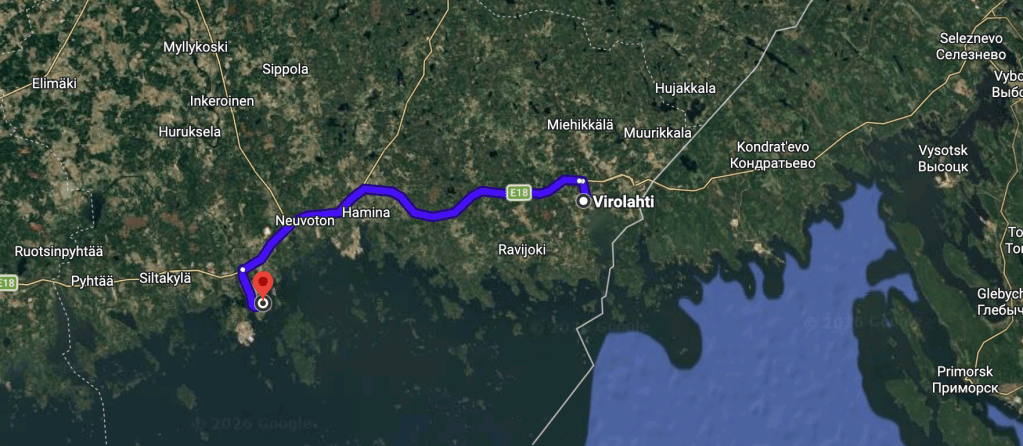
The combat posts will be erected during May exercises of the Finnish Coast Guard, the Finnish Navy’s press office announced on Wednesday, 29 April.
“The fortifications built will remain in place after the exercises. Due to the construction work and the exercises, construction equipment will be present in and around the port of Klamila, checkpoints will be set up, and public access will be restricted,” the statement said.
The exercises will take place across a vast area of the Finnish coastline, including Kotka, Hamina, and Virolahhti.
The “vast” area in question can be traveled by car in 45 minutes. Snapshot of Google Maps by the Russian Reader
The exact locations of the combat positions have not been disclosed.
It is understood that they will be constructed from reinforced concrete modules, and some of the fortifications will consist of underground bunkers.
Finland has been building a fence along its border with Russia and plans to complete the bulk of the work by early autumn this year.
Estonia is fortifying its border with Russia with bunkers. The country’s Ministry of Defense has announced plans to construct 600 concrete structures by the end of 2027. They are modular structures that are buried underground.
In April, the Estonians began digging a twenty-kilometer-long anti-tank trench in Setomaa Parish, which borders the Pskov Region’s Pechora District.
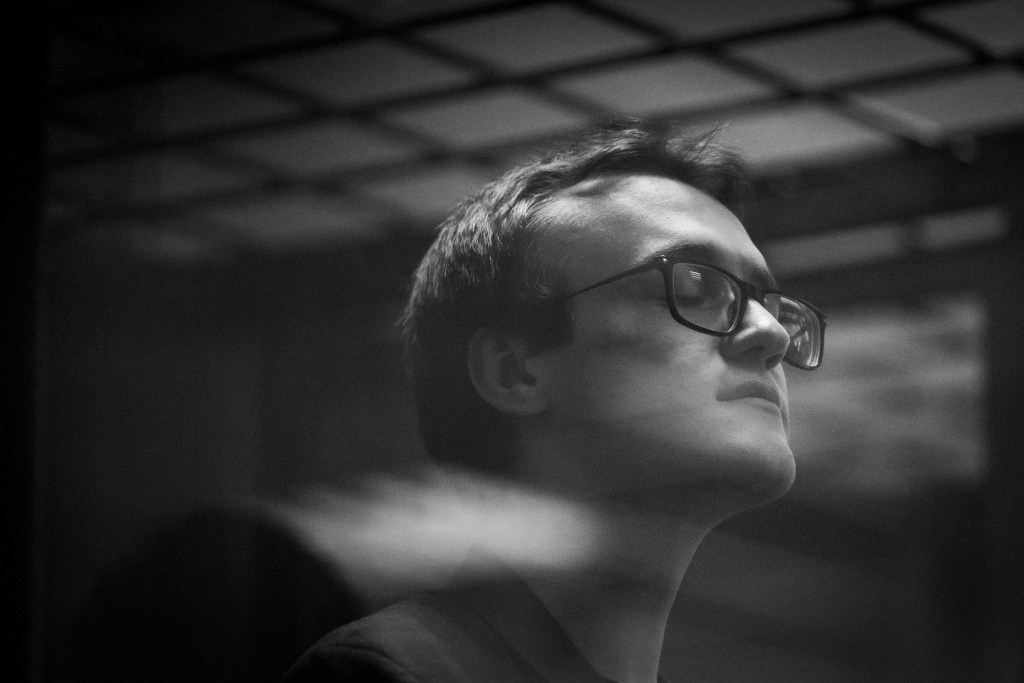
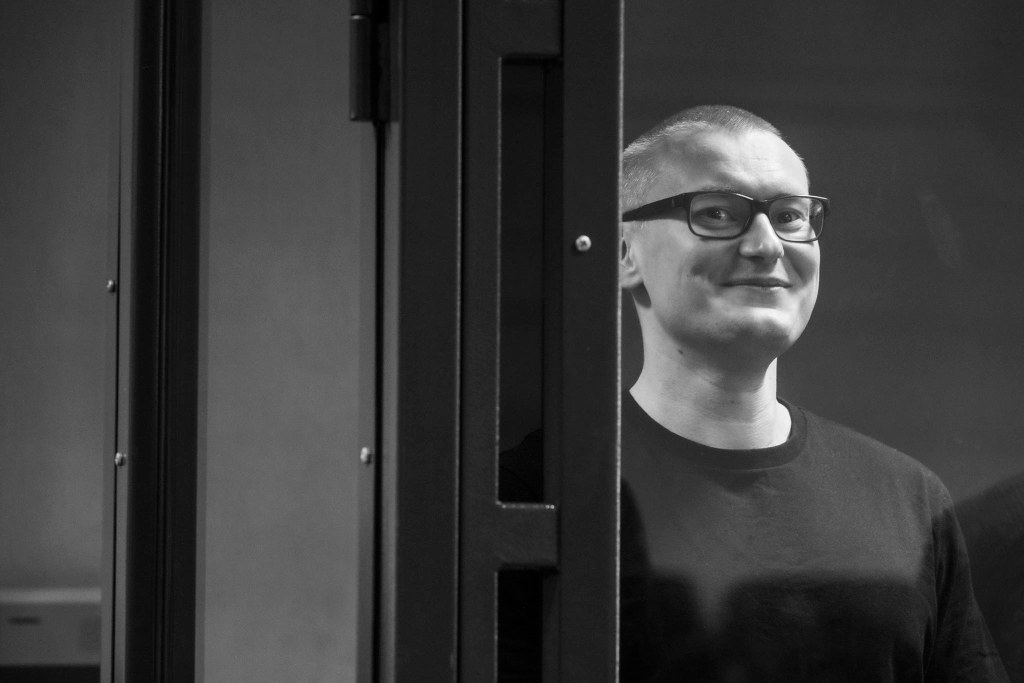
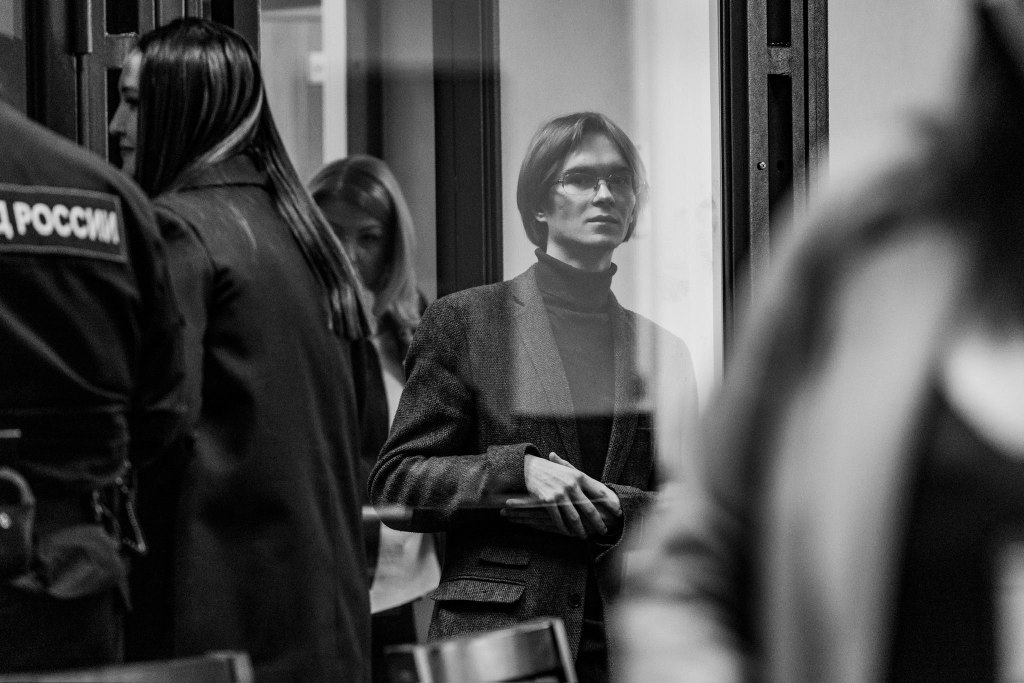
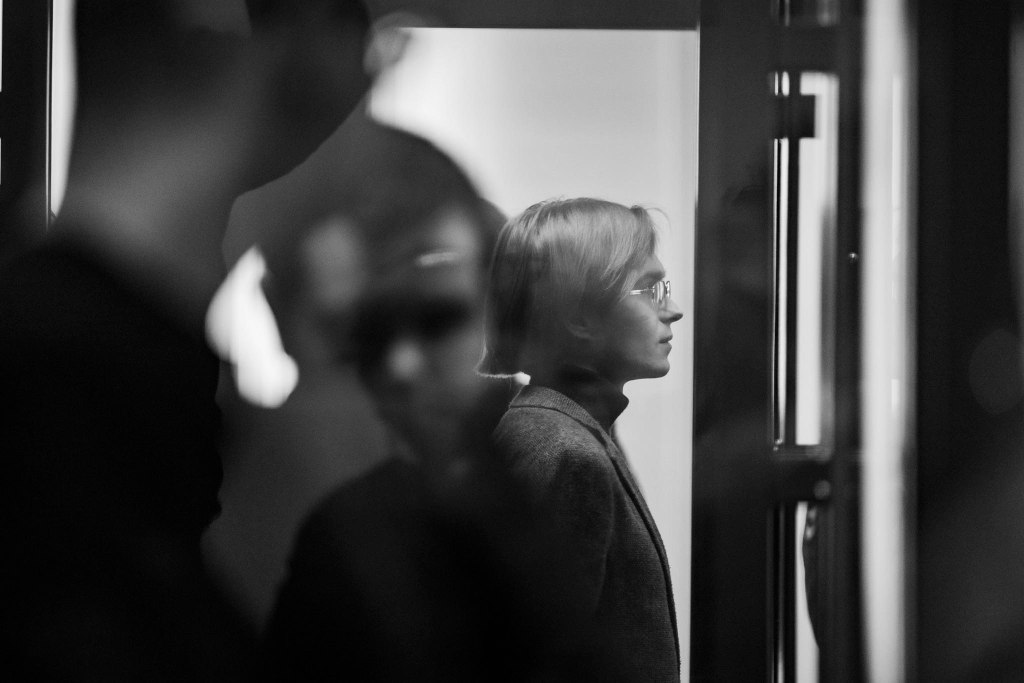
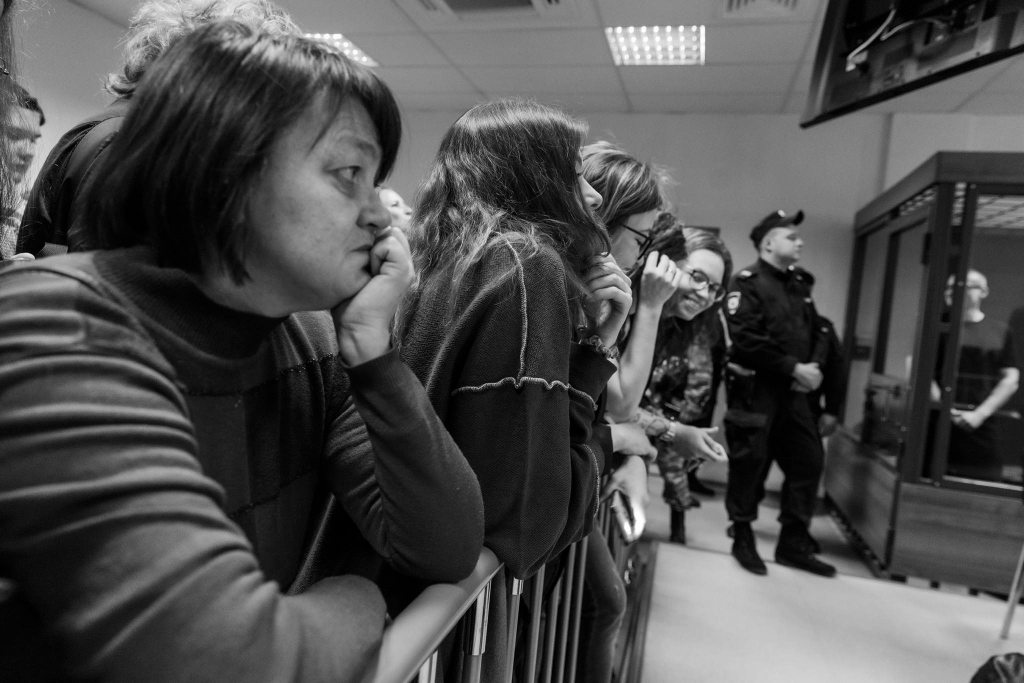
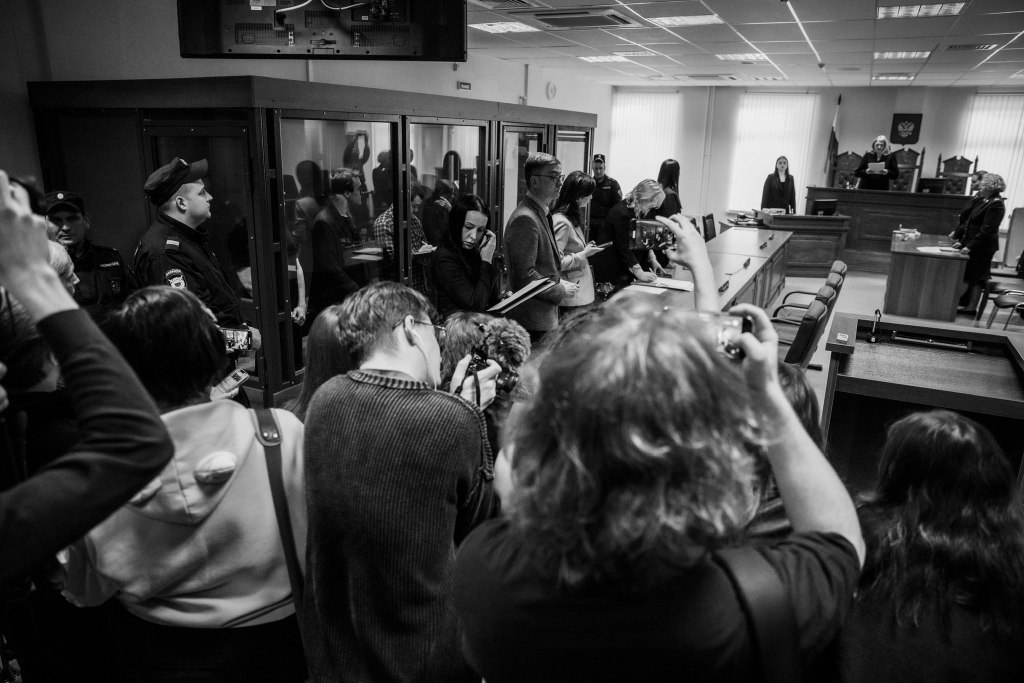
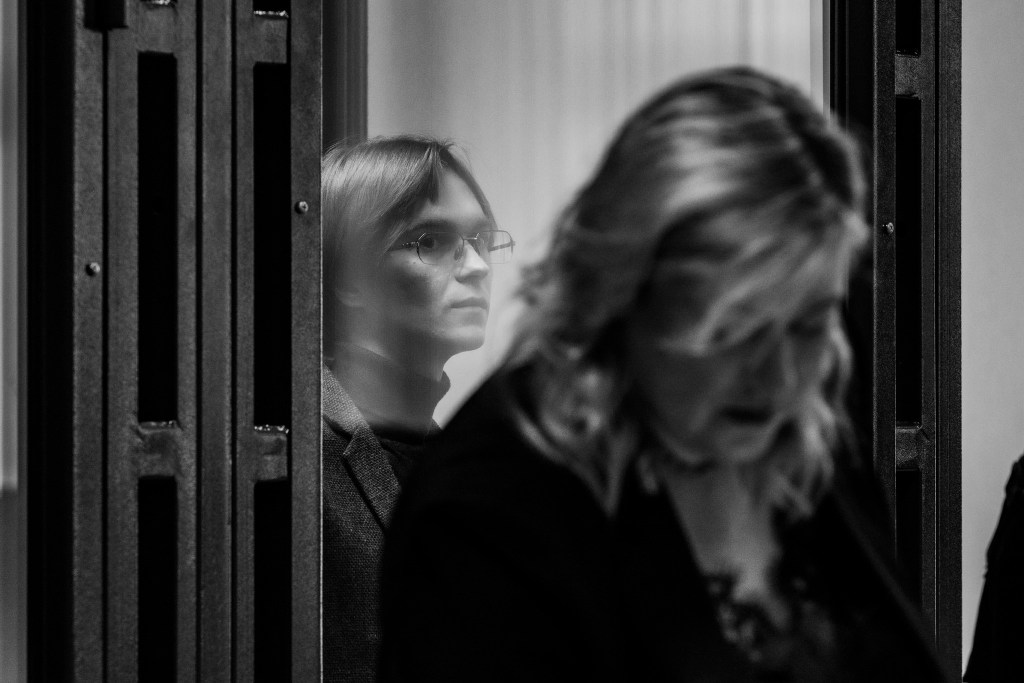
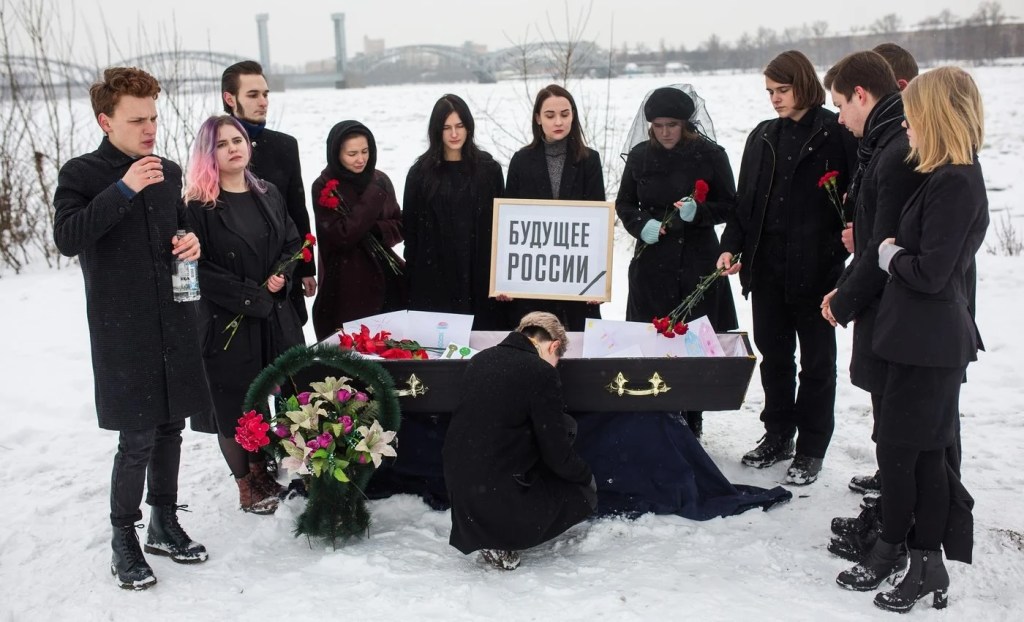
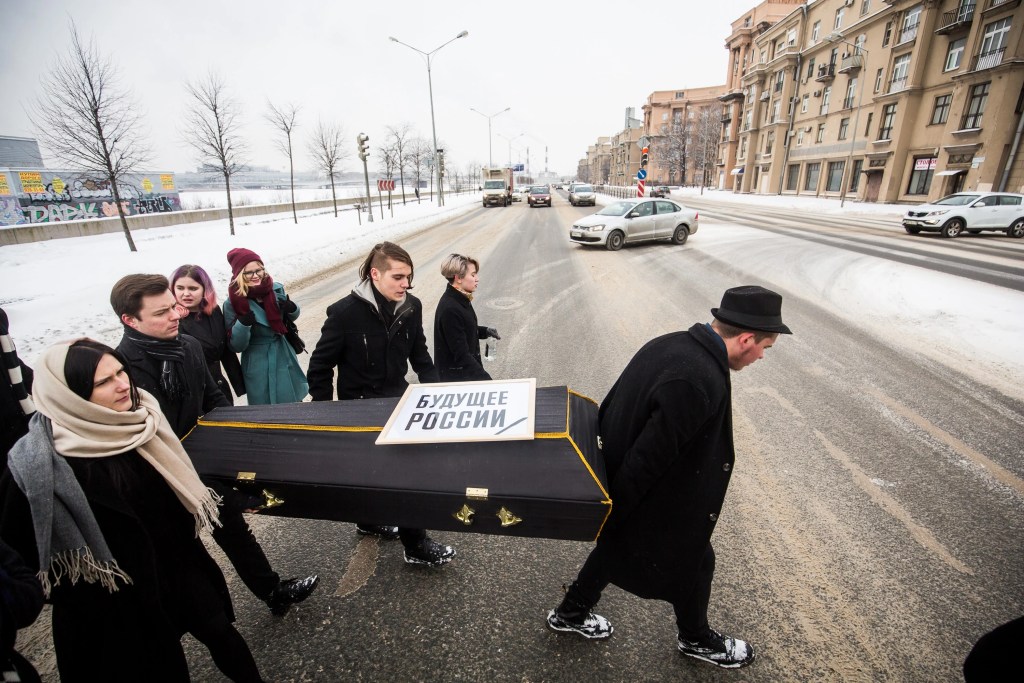
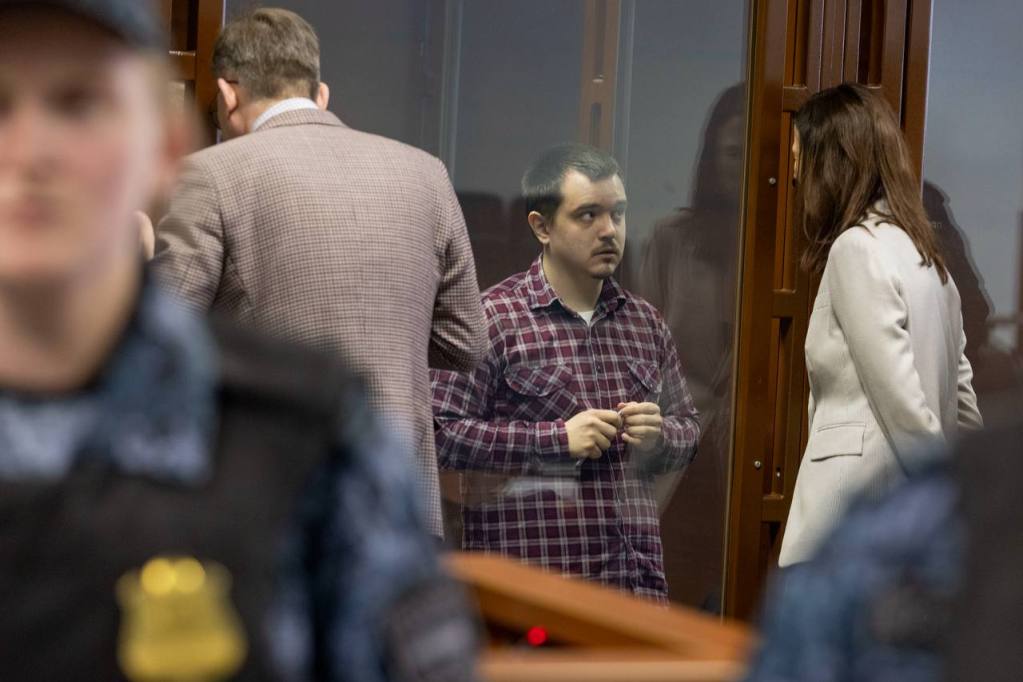
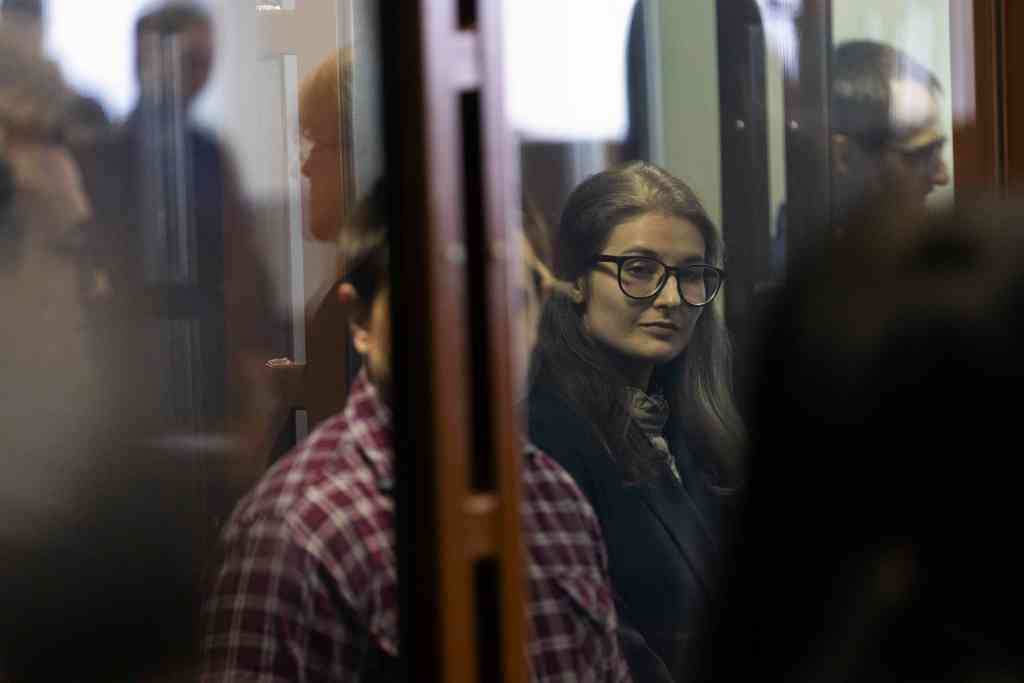
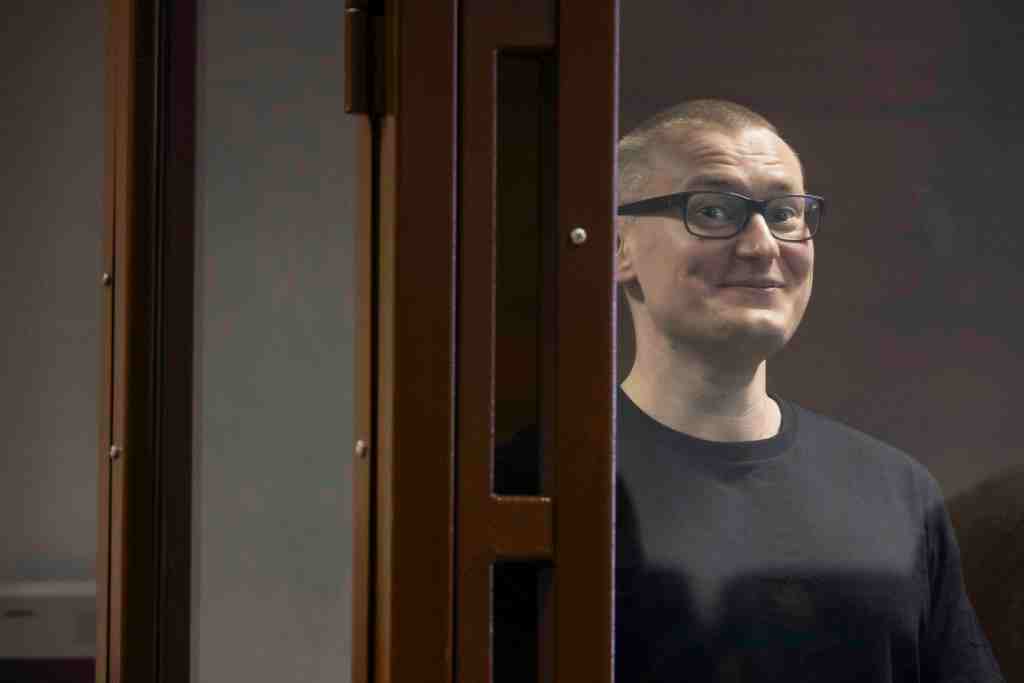
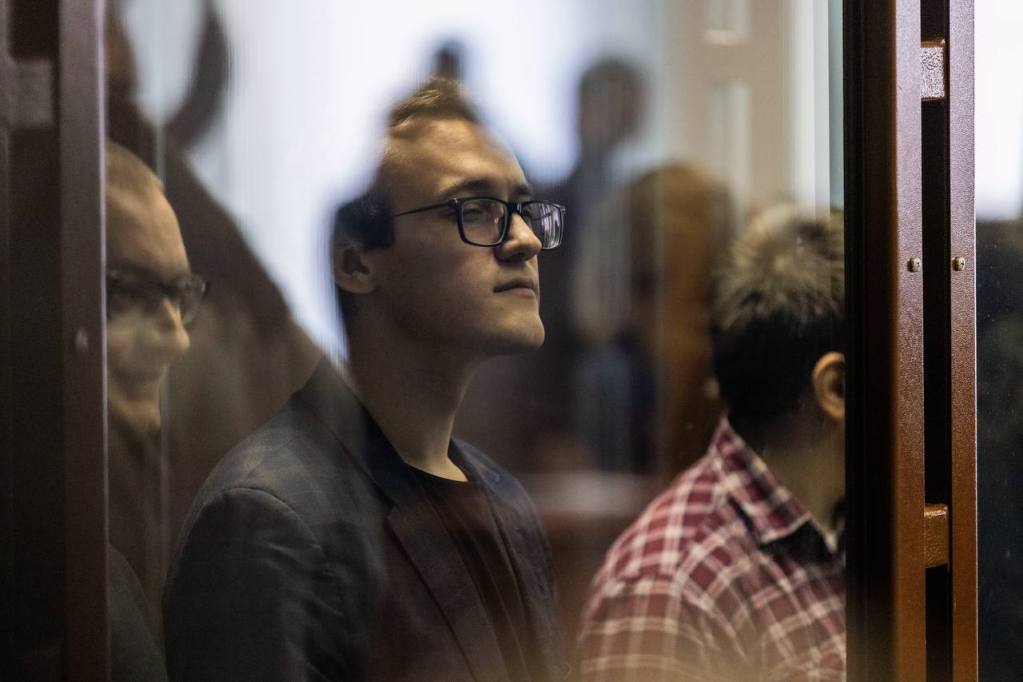
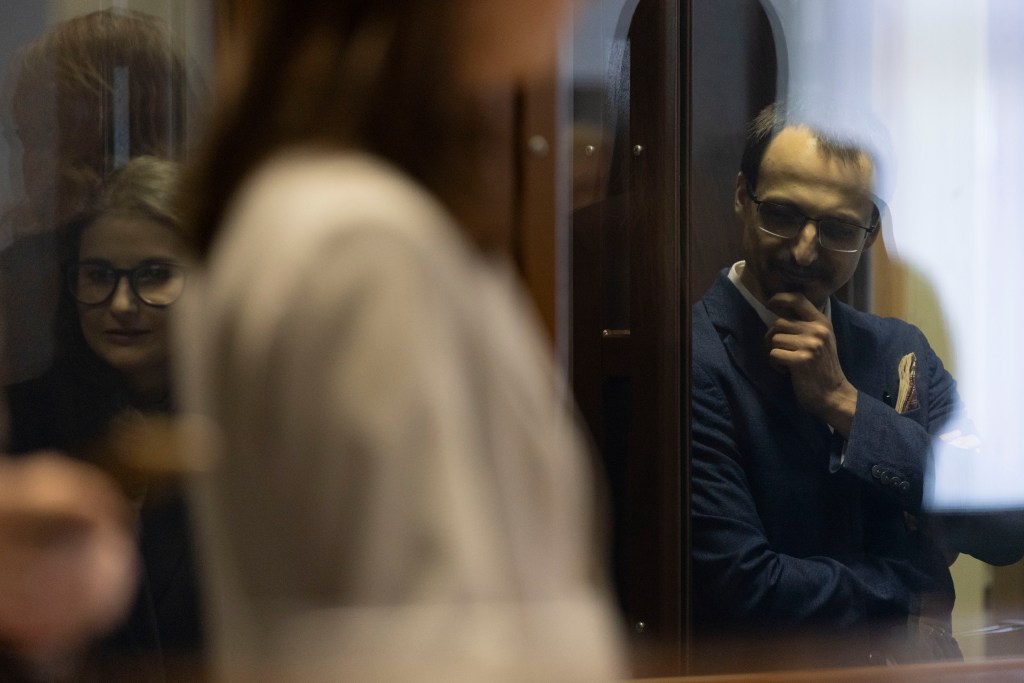
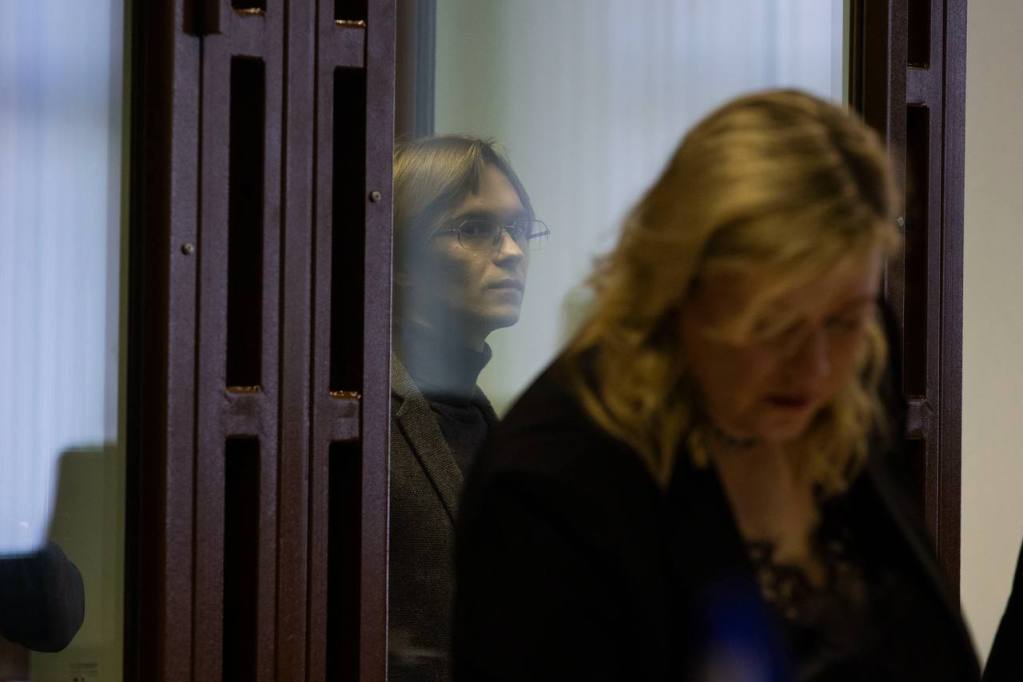
A verdict was handed down in the Vesna case in Petersburg today. In 2018, members of this movement, which Russia designated “extremist” and “hostile” (or something along those lines, “undesirable,” etc.), held a protest: a funeral for Russia’s future. It turned out to be a long process: burying the future, imprisoning spring… Today is a bad day. The activists were convicted and sentenced to extremely long prison terms! The only female defendant, Anna Arkhipova, was sentenced to twelve years in prison; Yan Ksenzhepolsky, to eleven years; Vasily Neustroyev, to ten years; Pavel Sinelnikov, to seven and a half years; Yevgeny Zateyev, to six years and two months. Valentin Khoroshenin was also sentenced to six years and two months in prison despite the fact that he had testified against his comrades while in jail. It didn’t do him any good…. Look at his face today. He is the only one who looks lost to me. The other defendants were calm and dignified.
I may be naive, but I still believe that the future isn’t buried, that spring will come, that the gloom and the cold will simply fade away. It will happen naturally because that’s how the world works, and I believe this especially during Holy Week. “Wind and weather [will] change direction,” and spring will arrive.
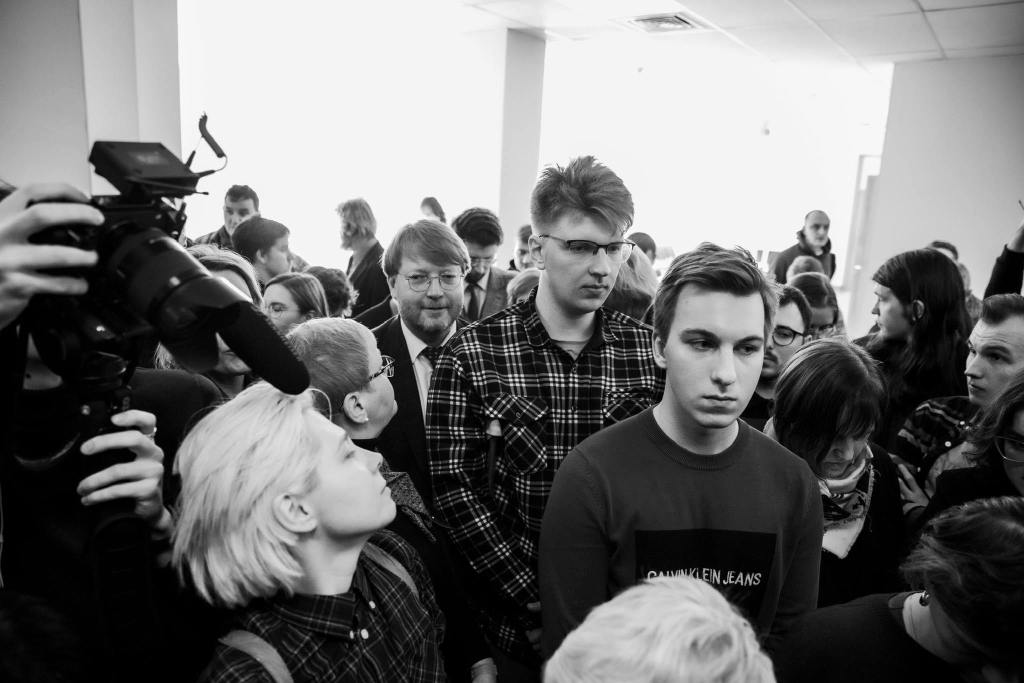
I hadn’t taken photos in a courtroom for nearly nine months. Today was tough. I can recall only one case which dragged on longer than the Vesna case—the trial of the twenty-four fighters from the Azov Regiment. My sister Lizka has provided a detailed account of the Vesna case and the young people sentenced today. Give it a listen and/or a read! [See the embedded YouTube video and translation of the Mediazona article below—TRR.]
The natural flow of life suffices to make spring come, but to ensure that the earth hasn’t been depopulated by the time it does come—so that there is someone other than the beasties left to welcome that spring—we must remain human beings: we must know what is going on, empathize, and help out.
A judge in St. Petersburg on Wednesday sentenced six former members of the democratic youth organization Vesna to prison sentences of varying lengths after they were found guilty of charges including extremism and spreading “war fakes.”
The activists, including one woman and five men, were no longer members of Vesna at the time of their arrests in June 2023.
Vesna, which means spring in Russian, was founded in St. Petersburg in 2013. After the full-scale invasion of Ukraine, it staged anti-war rallies in Russian cities, shortly after which it was designated as an “extremist” organization.
The human rights group Memorial recognized the six former members sentenced to jail on Wednesday as political prisoners.
St. Petersburg’s City Court found all six guilty of organizing an extremist group, mass unrest, disseminating “fakes” about the Russian army, calling for actions that undermine national security and rehabilitating [sic] Nazism.
The longest prison sentence of 12 years was handed to Anna Arkhipova, followed by 11 years for Yan Ksenzhepolsky and 10 years for Vasily Neustroyev.
Pavel Sinelnikov was sentenced to 7.5 years in prison, while Yevgeny Zateyev and Valentin Khoroshenin each received six years and two months.
State prosecutors had requested prison sentences between eight years and 13 years.
The former activists initially pleaded not guilty in October 2024, but last July, Khoroshenin provided a “full confession” and testified against his co-defendants.
Arkhipova later said that Khoroshenin had told her after giving his confession that “what really matters isn’t what actually happened, but how the investigator wrote it up.”
Vesna declined a request for comment when contacted by the Moscow Times.
“Russia’s Future”: a 2018 protest action by Vesna. Photo: David Frenkel/Mediazona
Saint Petersburg City Court has handed down sentences to six former activists in the Vesna movement: Yevgeny Zateyev, Vasily Neustroyev, and Valentin Khoroshenin, of Petersburg; Yan Ksenzhepolsky, of Tver; Anna Arkhipova, of Novosibirsk; and Pavel Sinelnikov, of Barnaul. They were sentenced to stints in prison ranging from six to twelve years. In total, the case involves twenty-one suspects from thirteen regions. One of the defendants unexpectedly testified against his comrades in court. Mediazona offers its readers this brief overview of one of the most wide-ranging and dramatic trials against dissidents in recent years.
The democratic youth movement Vesna came to life with spirited, theatrical street protests in Petersburg over a dozen years ago. It came to an end in 2022 when it was banned, followed by the launching of a criminal case against it, leading to the arrests of some activists, and the exile of others.
“They made up their minds that [Vesna] was something along the lines of [Alexei Navalny’s] Anti-Corruption Foundation, I suppose,” muses one former Vesna member. The young woman asked not to be named, even though she had stepped away from politics before the movement was officially deemed “extremist.” She continues to live in Russia and hopes that the security services will “continue to overlook her.”
The playbooks for dismantling the Anti-Corruption Foundation and Vesna are indeed broadly similar:
The prosecution of Vesna activists began with searches warranted under an obscure criminal law statute concerning the creation of NGOs which infringe on people’s personal and civil rights. Charges of violating this very same statute had also formed the core of the case against the Anti-Corruption Foundation.
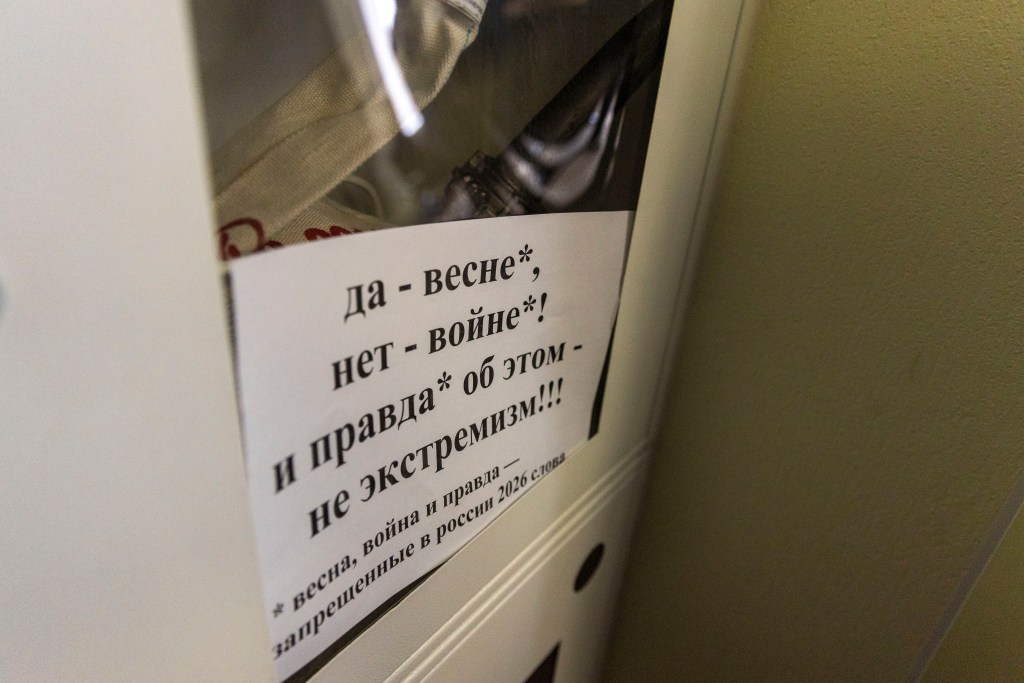
As happened with the Anti-Corruption Foundation, the security forces got Vesna designated an “extremist” organization. Following this, any public activity that police investigators deemed as “continuing” the movement’s work, such as posting on its social media, was regarded as a punishable offense.
In both cases, a wave of police searches of activists’ homes swept across various regions of Russia, and this was followed by a series of arrests.
Vesna’s most prominent figures were designated “foreign agents.” Many of them fled Russia and were placed on the wanted list. The security forces then took their revenge on those who remained behind.
The trial of the six Vesna activists in Petersburg had dragged on since the summer of 2024 and been one of the most high-profile political trials in wartime Russia, owing both to the steadfast stance taken by some of the defendants and to the dramatic about-face by others.
Vesna was founded in February 2013. The new movement consisted of approximately fifty activists, many of whom hailed from the Petersburg branch of Youth Yabloko, which had dissolved a short time earlier. The goals Vesna voiced at the time were far removed from radicalism: “increasing the level of political engagement among young people” and “participating in Petersburg’s legislature and local government through elections.”
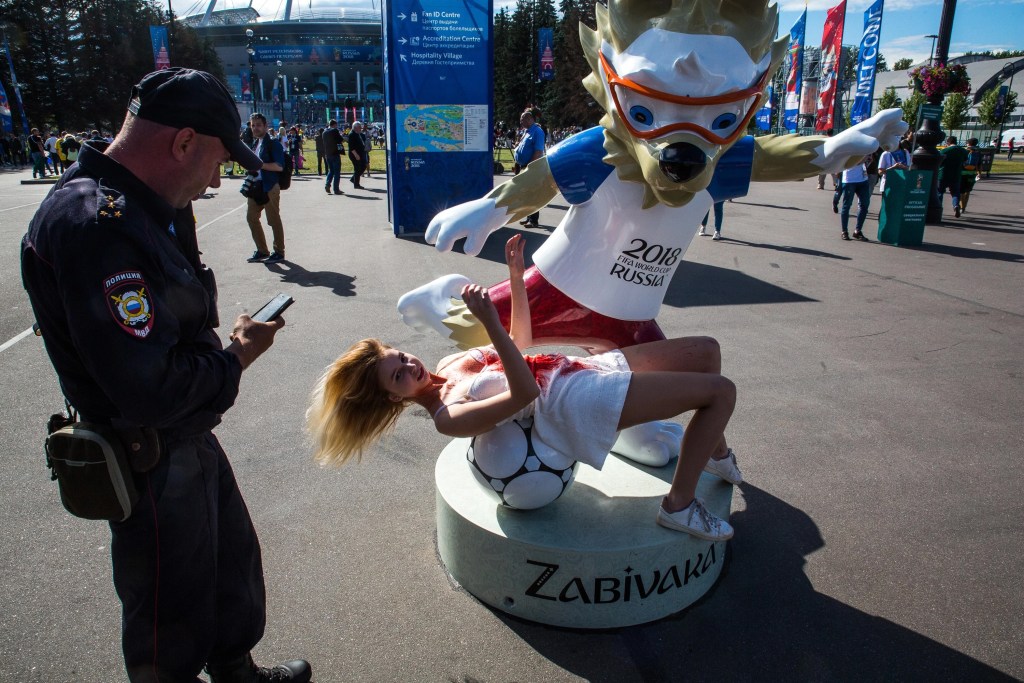
In their hometown, Vesna’s theatricalized processions and pickets quickly became a familiar fixture on the cultural and political scenes.
In the summer of 2015, Vesna held an anti-war protest on Nevsky Prospekt, [Petersburg’s main thoroughfare]. Five activists stood holding signs that read “Write kind words to Ukraine” and a box where anyone could drop a postcard with words of support for the Ukrainian people.
In May 2016, Vesna marched through the city holding a banner reading “Circus, go away!” Opposition activists had not been permitted to hold May Day marches on Nevsky Prospekt, even though the country’s ruling United Russia party had been granted permission to march down the same route without any issues. In protest, Vesna activists staged an alternative procession in guise of a carnival: a young woman in church vestments with a fake belly demanded a ban on abortions, while another waved a censer by way of blessing a silver “Rogozin 1” rocket. Behind them walked a man with a TV set instead of a head. Someone carried a huge saw with the slogan “I support embezzlement!” Another carried a cello case stuffed with banknotes.
“Russia’s Future”: a 2018 protest action by Vesna. Photo: David Frenkel/Mediazona
In January 2018, Vesna staged a mock funeral for Russia’s future: people dressed in mourning attire and with sorrowful expressions on their faces carried a coffin through the streets, adorned with children’s drawings that symbolized hopes for life in a free, democratic country.
Photo: David Frenkel/Mediazona
In the summer of 2018, when Russia was hosting the FIFA World Cup, Vesna activists unfurled a banner reading “This World Cup Is Filled with Blood” on Palace Bridge in Petersburg. Vesna timed another protest against [torture in police custody] to coincide with the World Cup—a young woman, doused in red paint, lay down on a pedestal beneath a replica of the tournament’s official mascot, the wolf Zabivaka.
Photo: David Frenkel/Mediazona
The movement grew rapidly. Regional chapters emerged, and by 2018 there were already around a dozen of them. By the late 2010s, Vesna was the most prominent youth organization in the Russian opposition’s ecosystem. No major protest took place without its activists being present. And yet, Vesna activists emphasized their commitment to legal methods of campaigning, as stated in their charter: “The movement pursues its work in accordance with the current laws of the Russian Federation.”
Vesna during the war: the first raids and interrogations
After Russia invaded Ukraine, the price of political dissent in Russia skyrocketed for all opponents of the government, and Vesna activists were no exception. On 3 May 2022, the movement announced the campaign “They Didn’t Fight for This,” calling on dissenters to attend the Immortal Regiment marches on 9 May (WWII Victory Day) but to carry anti-war placards at them.
A few days later, Vesna activists Yevgeny Zateyev and Valentin Khoroshenin, of Petersburg, and Roman Maximov, of Veliky Novgorod, who had already quit the movement, were targeted with searches of their homes. All three men were taken to Moscow for questioning and held in a temporary detention center pending trial.
These were the first steps in the investigation against Vesna activists. It was then that law enforcement authorities launched a criminal case into the setting up of an NGO that infringes on the personal rights of citizens.
The same day, search warrants were executed in Petersburg at the homes of the parents of Bogdan Litvin, Vesna’s federal coordinator, who had already left Russia, and activist Polina Barabash, as well as at the homes of former movement members Alexei Bezrukov and Artem Uimanen. In Moscow, searches were conducted at the homes of Timofei Vaskin, Angelina Roshchupko, Daria Pak, and Ivan Drobotov.
On 10 and 11 May 2022, the court issued restraining orders against Vaskin, Drobotov, Angelina Roshchupko, Maximov, Zateyev, and Khoroshenin, prohibiting them from certain actions. Soon after, Litvin and Drobotov were placed on the wanted list, as they had managed to leave Russia.
This did not stop Vesna, however. In September 2022, the youth activists announced protests against the military mobilization across Russia. Less than a month later, the Justice Ministry added the movement to its list of “foreign agents,” and the Saint Petersburg City Court ruled Vesna an “extremist” organization on 6 December 2022.
The charges and the trial
On 5 June 2023, the Investigative Committee opened a new criminal case, which later came to be known simply as the “big Vesna case.”
Searches were carried out the following day in Barnaul, Novosibirsk, Petersburg, and Tver. Six people were detained and taken to Moscow: Zateyev, Pavel Sinelnikov, Anna Arkhipova, Vasily Neustroyev, Yan Ksenzhepolsky, and Khoroshenin. On 8 June, a Moscow court remanded them to pretrial detention.
During the same pretrial detention hearing, the prosecution listed five charges: organizing and participating in an extremist group, desecrating the memory of defenders of the Fatherland, spreading “fake news” about the army, and calling for actions contrary to national security.
A year later, when the Saint Petersburg City Court began hearing the case against the six activists on its merits, there were seven charges. Incitement to mass unrest and the creation of an NGO infringing on citizens’ rights (the very same charge under which the activists’ homes had initially been searched in 2022) had been added to the bill of particulars.
The investigation assigned the role of leader and ideological instigator to Vesna’s federal coordinator Bogdan Litvin, who had managed to flee the country. According to law enforcement officials, it was Litvin who had driven the movement toward “extremism.”
Most of the charges were related to posts on Vesna’s social media accounts. Entered into the recorded were ninety posts made in Vesna’s name at various times on various platforms. When presenting evidence in court, the prosecution primarily read these posts aloud, listed the names of Telegram channels, cited viewer statistics, and read out the comments.
The indictment placed particular emphasis on a comment posted by a user known as “Kanoki Nagato,” on 1 May 2022. On one of Vesna’s Telegram channels, he suggested that Russians would one day start “killing the pigs, just like the Ukrainians did at Maidan.” According to the prosecution, the appearance of such a comment proved that Vesna was inciting dangerous actions. None of the defendants knows who “Kanoki Nagato” is, and law enforcement officials have not been able to identify this person either.
They did examine the personal accounts of the six defendants, however. Some of their Instagram accounts were found to be private. Speaking in court, the prosecutor called this “an attempt to conceal information from the investigation.”
When the prosecution presented its evidence in court, some of the hearings were held in closed session at the prosecutor’s office’s request, and members of the public and journalists were not allowed in the courtroom. Those involved in the proceedings are not permitted to disclose what they heard behind closed doors, but it is known that during at least some of these sessions, the court examined the results of intelligence operations—a term used in the Code of Criminal Procedure to refer, among other things, to wiretapping, undercover operations, and the interception and vetting of correspondence.
When it was the defense attorneys’ turn to present evidence, Arkhipova’s support group issued a public appeal: “The defense now urgently needs witnesses—people who actually took part in peaceful anti-war protests between February and May 2022 and have already suffered administrative penalties for doing so.”
Witnesses who responded to this post testified in court.
“To my mind, every citizen took to the streets out of a sense of duty and conscience. It was an entirely peaceful demonstration,” said one of them.
Another witness recounted that she was detained at an Immortal Regiment rally while holding up a portrait of her great-grandfather, and an administrative charge was filed against her for “discrediting” the army.
“I came out of my own free will. I’d participated in Immortal Regiment rallies before as well. At the time I made my decision, I hadn’t seen any notices on Telegram channels,” she explained.
A placard hung in the courthouse on the day the verdict in the Vesna trial was read out: “Yes to Vesna,* / No to war*! / And the truth* about them / is not extremism. / *Vesna, war, and truth are words forbidden in Russia in 2026.” Photo: Mediazona
At nearly every hearing in the trial, the defense insisted that the prosecution had no evidence that the accused activists were involved in posting most of the messages mentioned in the case file. Moreover, some of the defendants not only did not know each other prior to their arrest, but were also not members of Vesna at the time it was classified as an “extremist” organization.
Who’s who in the Vesna case
Yevgeny Zateyev. Photo: Mediazona
Yevgeny Zateyev, 24 years old
A resident of Petersburg, Zateyev was charged with violating Article 354.1.4 (“condoning Nazism”) and Article 282.1.1 (“establishing an extremist community”) of the Russian Federal Criminal Code. The charge that he had violated Article 239.2 (“organizing an association that infringes on the personhood and rights of citizens”) was dropped due to the statute of limitations. The prosecutor asked the court to sentence Zateyev to ten years in a penal colony. The actual sentence was six years and two months.
Zateyev served as the press secretary for the Vesna movement’s Petersburg branch. In court, he insisted that his duties were limited to local topics: news about life in Petersburg, announcements of lectures, and film screenings.
He viewed the outbreak of the war as a “personal tragedy.”
“Vesna tried to prevent further destruction and loss of life on both sides of the border—among both civilians and military personnel—through peaceful means. I still regard this goal in an entirely positive light,” Zateyev said in court.
He was one of the first Vesna activists to face criminal charges in the spring of 2022. Some of his comrades left Russia, but Zateyev stayed behind and wound up in a pretrial detention center a year later.
In the summer of 2023, Zateyev wrote a letter from jail explaining why he had decided against fleeing the country.
“I made a very difficult and very painful choice. Was it a painful choice? Of course it was. I find it hard to imagine, though, how I could have left everything behind, gone away, and watched as my friends and acquaintances were imprisoned. This choice was easy for some, but I don’t judge them.”
In the same letter, Zateyev asked that his family not be judged for failing to “change [his] mind.”
In November 2023, Zateyev partially admitted his guilt in the hope of having his pretrial detention conditions eased. He was concerned about his family, especially his grandmother, who was seventy-seven years old at the time of his arrest. Zateyev was not released from pretrial detention, and so he withdrew his confession.
In January 2024, Zateyev’s grandmother died. Four months later, his mother also died, from cirrhosis of the liver.
Zateyev’s pretrial detention was extended once again shortly thereafter. Addressing the court, he mentioned the deaths of his loved ones. Judge Irina Furmanova interrupted him.
“Please do not try to pressure the court by bringing up the deaths of your relatives.”
“I am not putting any pressure on the court. I am simply stating the facts of my life.”
“We are familiar with them. You can merely note what you’ve been through. There’s no need to pressure us like that.”
“Your Honor, pressure—”
“Everyone has, or some people no longer have, a mother. There’s no need to pressure us in that regard. I’ll say it again. Let’s continue.”
In his closing statement, Zateyev said that he was forgiving the investigators, prosecutors, and judges.
“I caution against the false belief that forgiveness absolves one of responsibility. It does not. I do believe, however, that through forgiveness, we can understand the reasons behind what is happening—why and for what purpose. By ridding ourselves of an age-old evil, learning to treat one another with understanding, we can finally find love. I believe that this is possible and even inevitable in Russia. Spring [vesna] is inevitable. The season, of course. What did you think I meant?”
Mailing address for letters:
Russia 196655 St. Petersburg, Kolpino Kolpinskaya St., d. 9, str. 1 Pretrial Detention Center No. 1 Federal Penitentiary Service of Russia for St. Petersburg and the Leningrad Region Yevgeny Artemovich Zateyev, born 2001
Bank card number for donations: 2200 7009 1119 8470
Anna Arkhipova. Photo: Mediazona
Anna Arkhipova, 28 years old
A resident of Novosibirsk, Arkhipova was charged with violating Articles 282.1.1 and 282.1.2 (“organizing an extremist community”), Article 354.1.4 (“condoning Nazism”), Article 280.4.3 (“discrediting the Russian armed forces”), Article 212.1.1 (“repeatedly violating the law on public assemblies”), and Articles 207.3.2.b and 207.3.2.e (“disseminating knowingly false information about the Russian armed forces”) of the Russian Federal Criminal Code. The charge that she had violated Article 239.3 (“organizing an association that infringes on the personhood and rights of citizens”) was dropped due to the statute of limitations. The prosecutor asked the court to sentence Arkhipova to thirteen years in prison. The judge sentenced her to twelve years in prison instead.
Arkhipova joined Vesna in February 2021 to “take a civic stand, engage in publicly vital work, and meet new people.” She wrote posts for the movement’s social media accounts but quickly grew tired of “conflicts within the group” and left in May 2022.
Once the war in Ukraine had kicked off, Vesna’s work became “random and certainly not organized,” according to Arkhipova.
“Everything happened naturally,” Arkhipova said in court. “I felt the need to protest the war, as I regarded it and continue to regard it as a great catastrophe and tragedy. That is why I took part in a street protest in Novosibirsk on 24 February 2022.”
Of the ninety posts listed in the criminal indictment, she wrote one.
“I was involved in the publication dated 29 April 2022, [as charged] under Article 207.3, but I find it difficult to say exactly what role I played. [The text] was discussed at great length, and I didn’t really want to have anything to do with it at all. Either I acted as the author, after which it was heavily edited, or another person was the author, after which I heavily edited it,” the young woman explained in court.
Arkhipova’s support group runs a Telegram channel where her letters to the outside world are posted sometimes. In the “Cell Librarian” section, she talks about the books she has read in pretrial detention.
She also writes about the health problems typically experienced by prisoners. Due to poor nutrition, all women in the detention center lose their hair, and even a simple cold is dangerous.
“The worst part is that you’re not permitted to make your bed during the day, so you’re freezing and shivering, and all you have to cover yourself with is a towel. Illnesses are illnesses, but we still have to follow the prison rules!”
Arkhipova is a vegan. It is difficult to follow this diet in pretrial detention. She is very dependent on care packages, which arrive with considerable delays. Her support group secured permission to send her plant-based milk substitutes, but the detention center declined to accept them, stating, “We don’t even allow dairy products for mothers with children.”
“My motivation is simple: I oppose the war. I want a better future for Russia. I have tried to act on my conscience all my life, even though I haven’t always succeeded. When the war began, it was my conscience that wouldn’t let me stand idly by. People on both sides of the border deserve peace: soldiers should be with their families, not in foxholes, and those who were killed should have lived. I feel the same pain for everyone, regardless of their uniform,” said Arkhipova in her closing statement.
Mailing address for letters:
Russia 195009 St. Petersburg 11 Arsenalnaya St. Pretrial Detention Center No. 5 Federal Penitentiary Service of Russia for St. Petersburg and the Leningrad Region Anna Nikolayevna Arkhipova, born 1997
Bank account numbers for donations: 2200 7008 6021 1167 (T-Bank) • 2202 2071 9921 3904 (Sberbank)
You can follow the latest news on the Telegram channel of Arkhipova’s support group.
Vasily Neustroyev. Photo: Mediazona
Vasily Neustroyev, 30 years old
A resident of Petersburg, Vasily Neustroyev was charged with violating Article 280.4.3 (“publicly threatening national security”), Article 212.1.1 (“repeatedly violating the law on public assemblies”), Article 354.1.4 (“condoning Nazism”), Article 282.1.1 (“organizing an extremist community”) and Articles 207.3.2.b and 207.3.2.e (“disseminating knowingly false information about the Russian armed forces”) of the Russian Federal Criminal Code. The charge that Neustroyev had violated Article 239.2 (“organizing an association that infringes on the personhood and rights of citizens”) was dropped due to the statute of limitations. The prosecution asked the court to sentence Neustroyev to twelve years in prison, but the judge sentenced him to ten years instead.
According to the prosecution, Neustroyev was on Vesna’s federal audit commission and was one of its leaders. Neustroyev himself stated in court that he did not make any decisions within the movement. He did not even have access to social media and could not have published any of the posts ascribed to him. He met most of his “accomplices” only after his arrest. Before his arrest, he was acquainted only with Khoroshenin and Maximov, and knew Zateyev only by sight.
When asked about Litvin—whom investigators consider the leader of Vesna and under whose influence the movement allegedly turned into an “extremist organization”—Neustroyev laughed and said that the main topic of their conversations had been cats.
“Since the autumn of 2018, we’ve been the owners of cats—brothers from the same litter, which we got from the same source,” Neustroyev explained. “Since then, Bogdan Gennadyevich has left his cat with me to look after two or three times. You could say that we became something like in-laws through the cats. The cats were the main topic of our conversations in the years leading up to my arrest.”
The Petersburger did not renounce his anti-war views in court.
“I consider the actions of Vladimir Vladimirovich Putin not only a crime against both Ukraine and Russia in equal measure, but also a great folly.”
And yet, Neustroyev “remained skeptical of mass street protests.” He was a member of Petersburg Yabloko’s council and was heavily involved in elections work for a long time. He coordinated election monitoring, and since 2020 had been a voting member of one of the city’s Territorial Election Commissions.
In a letter from the detention center, Neustroev voiced deep regret that he had not yet managed to finish his university education. He had just resumed his studies before his arrest, and if not for the criminal case, he might already have a degree.
“Nevertheless, I still plan to eventually obtain a formal tertiary degree and put this source of anxiety behind me.”
He spoke about Russia in his closing statement.
“Russia is strong. Russia will survive all tyrants and dictators, just as it has done before. I know that Russia will be peaceful, Russia will be happy, Russia will be free. And all of us will be peaceful, happy, and free along with her.”
Mailing address for letters:
Russia 196655 St. Petersburg, Kolpino Kolpinskaya St., d. 9, str. 1 Pretrial Detention Center No. 1 Federal Penitentiary Service of Russia for St. Petersburg and the Leningrad Region Vasily Petrovich Neustroyev, born 1995
You can follow the latest news on the Telegram channel of Neustroyev’s support group.
Pavel Sinelnikov. Photo: Mediazona
Pavel Sinelnikov, 24 years old
A resident of Barnaul, Pavel Sinelnikov was charged with violating Articles 282.1.1 and 282.1.2 (“organizing and participating in an extremist community”) of the Russian Federal Criminal Code. The prosecution had asked the court to send him down for ten years, but instead the judge sentenced to him to seven and a half years in prison.
Sinelnikov served as Vesna’s executive secretary for several months but left the movement in 2021, long before it had been designated “extremist.”
“The work isn’t hard: you just sit there and write. But taking all those minutes is time-consuming and quite boring. So I really feel for the court clerk,” Sinelnikov explained in court.
He was baffled how the same person could be accused of both establishing an “extremist community” and participating in it, and he made no secret of the fact that the arrest had come as a shock to him.
“I didn’t expect at all that some police investigators would actually fly all the way from Moscow to Barnaul just to get me. As far as I’m concerned, the police search itself is a form of intense coercion, especially the way it’s done. They force their way into your life while yelling and shouting, don’t even let you get dressed, push you face-down on the floor, and then turn everything upside down while cracking high-school-level jokes,” Sinelnikov recalled.
He confessed immediately after his arrest, but later recanted his testimony.
“You can’t take away people’s opinions, but it’s easy to take away their freedom of speech. That’s what happened to me, even though I’m just a binnocent eyestander.”
In court, Sinelnikov explained that he had been fascinated by science and maths at school. He often traveled to academic competitions, and became interested in politics during one such trip to Moscow. He described himself as an introvert and a loner, and his mother even called her son a “slacker” in court.
“Well, Mom knows best,” Sinelnikov replied.
Sinelnikov began his closing statement by admitting that he didn’t really have much to say. But then he called the charges politically motivated and the trial “abhorrent.”
“There was no criminal extremist group. No one planned any crimes, no socially dangerous actions were committed, and there were no socially dangerous consequences either. No harm was done either to society or the public interest. We didn’t even have any motives for or intentions of doing so. Do I deserve ten years in prison for that?”
Mailing address for letters:
Russia 196655 St. Petersburg, Kolpino Kolpinskaya St., d. 9, str. 1 Pretrial Detention Center No. 1 Federal Penitentiary Service of Russia for St. Petersburg and the Leningrad Region Pavel Nikolayevich Sinelnikov, born 2001
Bank account number for donations: 2200 7019 7373 4749
You can follow the latest news on the Telegram channel of Sinelnikov’s support group.
Yan Ksenzhepolsky. Photo: Mediazona
Yan Ksenzhepolsky, 25 years old
A resident of Tver, Yan Ksenzhepolsky was charged with violating Article 280.4.3 (“discrediting the Russian armed forces”), Article 212.1.1 (“repeatedly violating the law on public assemblies”), Article 354.1.4 (“condoning Nazism”), Article 282.1.1 (“organizing an extremist community”), and Articles 207.3.2.b and 207.3.2.e (“disseminating knowingly false information about the Russian armed forces”) of the Russian Federal Criminal Code. The charge that he had violated Article 239.2 (“organizing an association that infringes on the personhood and rights of citizens”) was dropped due to the statute of limitations. The prosecution had asked the court to send him down for twelve years, but instead the judge sentenced to him to eleven years in prison.
Ksenzhepolsky joined Vesna’s federal coordinating council in August 2021. According to him, by October–November of that year his involvement in the council had become “nominal” due to his work commitments. He was employed as a welding production specialist at the National Welding Control Agency and served as an aide to a deputy in the Tver Regional Legislative Assembly.
“I realized that the Vesna movement made a lot of noise but didn’t accomplish anything tangible,” Ksenzhepolsky said in court. “Meanwhile, I was involved in real institutional politics at the Legislative Assembly and could actually influence things—or at least try to.”
On paper, however, Ksenzhepolsky remained a member of Vesna until the summer of 2022.
Ksenzhepolsky is accused of posting on the movement’s Telegram channels, although, according to him, he had access to only one of them, “Tver Vesna,” which had sixteen subscribers. He handed over the password to the new administrator in November 2021, when he left the organization.
In court, Ksenzepolsky reiterated that he believes street protests in Russia are ineffective.
“I believe these actions are completely pointless and do more harm than good.”
In September 2022, when Russia announced a military mobilization, Ksenzhepolsky, according to his own testimony, was on holiday in Georgia but returned home—after Vesna had been declared an “extremist” organization.
“In any case, I know that we will ultimately be vindicated in the eyes of society, history, and the Last Judgment. After all, everything was forever, until it was no more. This regime will come to an end too, and within our lifetimes, something tells me. If not, then the Kingdom of Heaven is not a bad consolation prize,” said Ksenzhepolsky in his closing statement.
Mailing address for letters:
Russia 196655 St. Petersburg, Kolpino Kolpinskaya St., d. 9, str. 1 Pretrial Detention Center No. 1 Federal Penitentiary Service of Russia for St. Petersburg and the Leningrad Region Yan Alexandrovich Ksenzhepolsky, born 2000
Bank account number for donations: 2200 2479 5715 1401
You can follow the latest news on the Telegram channel of Ksenzhepolsky’s support group.
Valentin Khoroshenin. Photo: Mediazona
Valentin Khoroshenin, 24 years old
A resident of Petersburg, Khoroshenin was charged with violating Article 212.1.1 (“repeatedly violating the law on public assemblies”) and Article 354.1.4 (“condoning Nazism”) of the Russian Federal Criminal Code. The charge that he had violated Article 239.2 of the Criminal Code was dropped due to the statute of limitations. The prosecution asked the court to send Khoroshenin to prison for eight years, but he was sentenced to six years and two months behind bars.
A co-founder of the now-shuttered Fogel lecture bar in Petersburg, Khoroshenin was the sole defendant who not only pleaded guilty to the charges but also testified against the other defendants in the case and many other Vesna activists.
The names mentioned by Valentin Khoroshenin in his testimony: Vladimir Arzhanov, Yekaterina Alexandrova, Makar Andreyev, Nikolai Artemenko, Anna Arkhipova, Yekaterina Bushkova, Alexander Vereshchagin, Yekaterina Goncharova, Timofei Gorodilov, Anastasia Gof, Lev Gyammer, Semyon Yerkin, Yevgeny Zateyev, Semyon Zakhariev, Anastasia Kadetova, Vladimir Kazachenko, Alexander Kashevarov, Gleb Kondratyev, Semyon Kochkin, Yan Ksenzhepolsky, Ilya Kursov, Maria Lakhina, Nikita Levkin, Bogdan Litvin, Andrei Lozitsky, Alexandra Lukyanenko, Yelizaveta Lyubavina (Sofya Manevich), Ilya Lyubimov, Timofei Martynchenko, Daria Mernenko, Anzhelika Mustafina, Anna Nazarova, Vasily Neustroyev, Maxim Potemkin, Konstantin Pokhilchuk, Kira Pushkareva, Lilia Safronova, Pavel Sinelnikov, Yevgenia Fedotova, Anastasia Filippova, Artur Kharitonov, Alexei Shvarts
Khoroshenin’s testimony came as a surprise to everyone in court. He requested that the testimony be heard in closed session and asked that the public and the press be removed from the courtroom, but the judge turned down his request.
Khoroshenin did not merely agree with the charge of “extremism.” He called Vesna “a sort of incubator for Navalny.” His testimony suggested that the movement’s branches were directly linked to the opposition politician’s field offices, where distinguished young activists would then “move up the ranks.” Khoroshenin mentioned the “grant support” that Vesna received, including from “undesirable organizations,” and complained that rank-and-file activists “spent the night in a back room, while Litvin bought himself a new apartment.”
“We systematically violated the law. We held protests and placed ourselves above the law. There were also slogans about undermining the country’s defense capabilities and justifying the use of violence. We organized events that violated existing laws but looked good on the surface,” Khoroshenin said in court.
“I have always believed that everything I am involved in should bring something positive to people. The Vesna movement was perhaps the only exception to this rule,” he argued, adding that he no longer supports any of the points in Vesna’s platform except for the one regarding support for “family and motherhood.”
Toward the end of his court testimony, Khoroshenin urged the other defendants to plead guilty—“to change their stance on the charges against them and set aside ideological pretense.”
“Don’t dig your own graves, colleagues!” he said.
In a letter from the detention center, Anna Arkhipova later quoted the words Khoroshenin had spoken after the hearing: “What really matters isn’t what actually happened, but how the investigator wrote it up.”
In his final statement, Khoroshenin lamented that his former comrades in Vesna had made him look like “some kind of Luntik,” once again acknowledged his guilt, asked for forgiveness “from society and especially from his family,” and voiced his hope that the court would allow him “to return to a normal life for constructive self-realization for the benefit of society.”
Mailing address for letters:
Russia 196655 St. Petersburg, Kolpino Kolpinskaya St., d. 9, str. 1 Pretrial Detention Center No. 1 Federal Penitentiary Service of Russia for St. Petersburg and the Leningrad Region Valentin Alexeyevich Khoroshenin, born 2001
Bank account number for donations: 4476 2461 7307 7443
You can follow the latest news on the Telegram channel of Khoroshenin’s support group.
Svetlana Savelyeva. Photo courtesy of Mediazona via Sever.Realii and the Savelyeva family
A translator from the Irkutsk Region wanted to visit her boyfriend in Ukraine. She was detained, tortured, and sentenced to fifteen years in prison.
A court in Kursk has found Svetlana Savelyeva guilty of attempted treason and conspiring to cross the border illegally.
Savelyeva was detained in October 2024 in the Kursk Region and then held under administrative arrest until mid-December on the pretext that she had disobeyed the police’s orders. In December, she was remanded in custody to a pretrial detention center on criminal charges.
According to the FSB investigators, Savelyeva had undergone “military training” in Kazakhstan, after which she planned to join the Ukrainian army during its partial occupation of the Kursk Region.
The translator herself said that she wanted to travel to Ukraine to reunite with her boyfriend, a Ukrainian army soldier named Alexander.
“We tried many ways to get her here to where I was. When Ukrainian troops entered the Kursk Region, Sveta was in Armenia, if I’m not mistaken. And then suddenly she says, Here I am, I’ll try to get into the area controlled by Ukraine. The biggest mistake was that I did, after all, let her go to Kursk,” the Ukrainian soldier told reporters.
FSB officers tortured Savelyeva to obtain a confession: they kept her naked in a cold room, beat and choked her, subjected her to electric shocks, and threatened her with murder and sexual violence.
In addition to Savelyeva, criminal charges were filed against driver Igor Sandulyak, who agreed to drive her to the front line. The regional court fined him 150,000 rubles [approx. 1,600 euros].
Source: Mediazona (Facebook), 2 April 2026. Translated by Thomas Campbell, who asks our fellow translators, wherever they are, to share this post in solidarity with Ms. Savelyeva.
Russian films don’t win Oscars every time out, so I finally made up my mind to watch the movie Mr. Nobody Against Putin. It turned out that the film wasn’t about a school, the war, Russia, or Putin—it’s Pavel Talankin’s film about himself. The film begins with him and ends with him. He’s in almost every scene in between. And it goes on like that for ninety minutes.
I don’t know if you can call a film a documentary when the vast majority of its scenes are staged. I suppose you can, but the Academy’s members know best. I’m not a film critic, and my opinions are purely those of an amateur. I’m a mere viewer.
I was amazed by how tacky the self-promotion was. I mean, it is just off the charts. Here comes the protagonist, taking what he calls a “super risk”: he tapes the letter X on the school’s windows over the letter Z. He claims that the X is a symbol of protection for Ukrainian refugees. (?) And here he is, secretly but on camera, ripping the Russian flag from the school’s roof, as witnessed by a cameraman* and Talankin himself. And there he is getting a haircut—a charming, intimate detail, certainly vital for understanding the current state of affairs Russia’s regions. When the toilets in the school’s bathroom flashed on screen, I feared that Talankin would be in the starring role there too, but that didn’t happen, thank God.
It’s funny that Talankin has arranged the books in his home by the color of their spines, and it’s even funnier that, while looking every bit the diehard undergrounder and following the orders of a mysterious overseas handler, he messes around with hard drives that must be smuggled out of the country. We’re living in the twenty-first century, so what prevents Talankin from uploading at least a few gigabytes of video footage to the cloud or transferring it via FTP, instead of lugging the hardware through customs? But I get it: that would not be cinematic, and the documentary would have suffered.
Whether the documentary suffered because Talankin filmed children and adults without informing them of his objective is a question for the Academy’s members. Perhaps this is acceptable in the American cinema, but journalists are obliged to honestly tell interviewees on whose behalf they are interviewing them and to what end.
I’m not arguing with the fact that Talankin’s film won an Oscar. If Barack Obama got a Nobel Peace Prize for the color of his skin, and Bob Dylan got a Nobel Prize in Literature for his songs, then why shouldn’t Pavel Talankin get an Oscar for a docudrama about Pavel Talankin? It’s all good.
Something else makes my blood boil. It’s not even the profanity that is liberally sprinkled throughout the film. That’s just how the characters express their folksiness. I get that. What makes my blood boil is the extraordinary ease with which Talankin switches from serving the regime as a propagandist to a new job on a new project. Before he was hired to make the film, he faithfully played the despicable role of a Putin propagandist, organizing and filming pseudo-patriotic productions on orders from his superiors. He sends reports to the Ministry of Education. He reshoots when the first take doesn’t turn out. He corrects the teacher who repeatedly fails to pronounce the word “denazification”—and again, he does take after take. Everything has to look perfect. That’s the job. He gets paid for it.
It would be fine if Talakin didn’t get it, like the moronic history teacher who garners so much screen time in the film. But no, Talankin gets it all. He films what he himself calls “show lessons.” He admits that he works in propaganda: “It wears me out.” While filming a pro-war car rally he laments, “I have to play by their rules.” Why does he have to play by their rules? Is there no other way for him to make a living? He cannot fail to realize that he’s just as much an obedient cog in the propaganda machine as the history teacher. Only Talankin’s caliber is smaller, and his threads are thinner. He doesn’t explain why he has to play by their rules. But it’s obvious anyway, and there’s a universal explanation for it: honest work pays less and demands a heavier workload. The entire propaganda machine in an authoritarian regime is based on this. There’s always a way out if you want out.
But then something clicked, Talankin’s fortunes changed, and now all the video footage he had painstakingly compiled was put to a new use. Up until that point, he had worked in the field of pro-government propaganda; now he would work to expose it. Why not kill two birds with one stone? Everything must be put to use, not a single frame should be wasted.
People sometimes do suddenly acknowledge the harmfulness of their work and make a complete U-turn. Such things do happen, thank God. But if they do it sincerely, and not for opportunistic reasons, their conscience torments them over their past deeds; they suffer, and they seek to atone for the past through their new endeavors. They don’t gloss over the mistakes they have made in life. Such people are instantly recognizable: they do not flaunt their rewards, they take no delight in newfound fame, and they often pay a heavy price for the new path they have gone down. Talankin’s is a different case entirely. His is merely an elegant segue from one cushy job to another. In that sense, we can certainly congratulate Mr. Nobody on his success.
* Podrabinek’s is the only review of Mr. Nobody Against Putin which I’ve read that mentions the mysterious second cameraman (who is clearly a consummate professional), although they were apparently on location in Karabash for months on end. In the film’s credits, they are identified only as “Anonymous,” but their palpable presence is not otherwise mentioned or explained, not even in the film itself. ||||| TRR
Many years ago, as a graduate student at UMICH in Ann Arbor, I took two semesters on Nabokov with the late Omri Ronen – one of the most extraordinary intellectual experiences I had there, and that’s saying something.
We spent a great deal of time on Lolita, especially its dialogue with Dostoevsky’s “cult of feelings,” and on Humbert Humbert as a “romantic” yet profoundly unreliable narrator. Ronen often emphasized that while it is natural to sympathize with a narrator who claims to be in love, Nabokov refuses to do the reader’s ethical work for them. Humbert Humbert is a criminal who destroys Lolita’s life – something she herself makes clear by the end (“He broke my heart. You merely broke my life.”) The reader’s task is not to be disarmed by his rhetoric, but to remain morally alert and to imagine the experience of his victim.
Watching Mr. Nobody Against Putin and reading its reception, I could not help but think just how thoroughly this lesson seems to be missed by those celebrating the film and its narrator, who is every bit part and parcel of the phenomenon he set out to document.
The film centers overwhelmingly on Pavel Talankin’s feeeeeelings, granting them disproportionate narrative space, something not uncommon in Russian films about Russia. His attachment to Karabash and its people, to the textures of Russian life (the ugly Soviet prefab panel blocks that have gained a somewhat romantic vibe among the younger Russians, the harsh winters, etc.) is rendered with great sympathy. So too is the school environment. But Talankin’s commitment to “loving” the bleak, the outwardly ugly, and the brutal is not just an aesthetic quirk — it’s a moral stance. What is strikingly absent in all of it is Ukraine and its people, which is only briefly mentioned as a destination, not a society under attack. Russian children are not just being indoctrinated to volunteer, to be mobilized, and to die, they are being prepared to kill and that is what they do in Ukraine — something, which is not even once mentioned.
There is also an obvious schism between the reality Talankin documents and the way he interprets it. In his account, he appears to be the only figure with agency — the only one capable of making meaningful choices — while everyone else is stripped of agency and reduced to a passive recipient of propaganda. Even the sinister history teacher, the school’s most zealous and vicious propagandist, is described as “brainwashed.” But if that is the case, who, exactly, is doing the brainwashing? These are the very people who inculcate cynicism, cowardice, and doublethink in their students, they are actors in this process, not victims, and they do have moral choices, just like everybody else. (It is also worth noting that the community is neither visibly poor nor destitute — undercutting the familiar explanation that people volunteer to kill because poverty leaves them no choice.)
Again, this is not just an aesthetic imbalance, but also a moral one, with the focus remaining on “our” suffering, “our” losses, “our” children, not what we and these children have done to others. As a result — just as Omri Ronen warned his sophomore Nabokov students — the aggressor is sentimentalized, and his perspective eclipses that of his victims.
P.S. I also watched Ksenia Sobchak’s documentary about so-called “black widows” — women who marry Russian soldiers, often under dubious circumstances (with grooms heavily intoxicated), and later claim substantial compensation after their deaths. In contrast to Pavel Talankin’s film, it’s really hard to sympathize with any of the people on the screen. Sobchak’s role within the Kremlin’s propaganda ecosystem is well documented; what is worth briefly noting here is how thoroughly this story (and Russian “society” at large) is framed as a story about women: as caregivers, opportunists, con-artists, bereaved wives, or negligent, alcoholic mothers and grandmothers who affect the fates of men, entirely at their disposal.
Men, by contrast, are consistently infantilized, cast as troublemakers, drifters, habitual drinkers, and absent fathers with no clear purpose in life. But invariably “nice”: women say (posthumously) that they are sorry for them (again, barely a reference to what these men did to Ukrainians). In this framing, war supplies these men what their civilian lives lack: purpose, agency, a “heroic”, manly identity, a sense of belonging, and a handsome income – leaving behind, in the end, something for the women to remember them by.
Hello! This week we cover how Oscar-winning documentary, Mr. Nobody Against Putin, went down inside Russia, and why it’s caused a stir among both the Kremlin’s backers and its critics.
Russians fight over Mr. Nobody
Earlier this month, Russia won the Best Documentary Oscar for the first time in more than 80 years. Well, sort of. The statuette went to Mr. Nobody Against Putin, a Danish-Czech production directed by Pavel Talankin, a young teacher from a small town in the Urals, who documented pro-war propaganda inside Russia’s school system. Western critics were enthusiastic about its take on the militarization of schools amid the invasion of Ukraine. Russian officials and propaganda outlets were, unsurprisingly, not so keen on the film. But interestingly, even some anti-war campaigners have criticized the movie, accusing Talankin of making a shallow diatribe that did not advance our understanding of Russia’s wartime propaganda machine.
The documentary tells the story of educator and school videographer Talankin and his school in Karabash, a small industrial town of about 10,000 people in the Urals region of Chelyabinsk. Talankin, now 35, was a highly respected teacher in his hometown. In 2018, he won the regional “Leader of the 21st Century” competition, his students won an award at a local festival for a movie shot under his direction, and in 2021 the town’s mayor praised a virtual model of Karabash that Talankin’s students had created in Minecraft.
After Russia’s invasion of Ukraine, Talankin was assigned to film propaganda lessons in which children were taught Kremlin talking points about the war’s supposedly noble aims, and the unfairness of the West towards Russia. Talankin and US documentary filmmaker David Borenstein got in touch via an online advert in Russia seeking people whose lives had been changed by the invasion. The videographer offered to use the footage he was obtaining as part of a joint documentary. Talankin carried on working and then eventually smuggled hard drives containing two-and-a-half years of footage out of Russia.
The clips from the propaganda lessons — called “Conversations about Important Things” in Russia — were the centerpiece of the film. In one scene, a teacher, reading a propaganda script, struggles to pronounce the words “denazification” and “demilitarization”, two of the official reasons the Kremlin gave for its war. In another, a history teacher (the film’s main antagonist) tells children how in the near future France and Britain will soon face economic collapse as people there are already starving due to sanctions on Russia. Another scene shows mercenaries from the now defunct private Wagner militia advising children how to throw grenades.
What Talankin showed from one school in a provincial town is the same as what’s happening in thousands throughout Russia. After the invasion of Ukraine in 2022, the state embraced mass propaganda in education. Lessons with war veterans were already commonplace, as were issuing Kremlin-approved justifications for the 2014 annexation of Crimea and the seizure of Ukrainian territory. Watching the film, it’s easy to imagine how the exact same “Conversations about Important Things” are happening right across Russia on a daily basis from Moscow to Vladivostok.
The award was [a] surprise, with US film The Perfect Neighbor going into the Oscars as the favourite. According to renowned Ukrainian producer Alexander Rodnyansky, Mr. Nobody Against Putin won out for its portrayal of a “dumbing down mechanism” that could be applied in multiple countries.
However, despite winning the most prestigious documentary prize on offer, there are many who are openly critical of the film — and they are by no means limited to supporters of the war and Putin’s regime. Several recurring complaints crop up. They include that Borenstein compiled the movie “for export” — targeting foreign audiences and festival juries — and that its success closed the door for any chance of a more powerful study of what is happening in Russian schools. In Russia, everybody knows about propaganda in educational institutions (for example, we wrote about it here) and, to them, this film does not offer anything new or go deeper than what has been widely reported. Doubters also say the film suffers from artificiality — especially in Talankin’s monologues. Some scenes, such as the tearing down of a Russian flag or the posting of the “Z” symbol backing the invasion in school windows — seemed staged to many critics.
Respected fact-checker Ilya Ber published a detailed analysis with several complaints that was widely shared on Russian-language Facebook groups. The claim that UNESCO described heavily polluted Karabash as the “dirtiest town on Earth” is not backed up by any documents and is simply an urban myth circulated in the Russian press. The film portrays children being checked with metal detectors as a symbol of a military dictatorship when, in fact, it’s standard procedure in Russian schools ahead of final exams and has nothing to do with the war. Finally, Ber questioned the underlying narrative that Talankin was in danger. He worked in a school where everyone knew his views, nobody denounced him and after the Oscars, pirated copies of the movie are widely available on VK, Russia’s equivalent of Facebook that is closely watched and de facto controlled by the authorities.
The filming of children without parental consent for use in the documentary is another sore point — and the one that Russia has officially latched on to. From an ethical point of view, all subjects should provide documented consent to take part in filming, and minors cannot be filmed without the permission of their parents or guardians. This is precisely the argument the Russian authorities are using and the Presidential Human Rights Council filed a complaint with the Oscars organizers alleging violation of children’s rights.
On the other hand, Talankin was not filming secretly. Children and parents knew they were being filmed for both the local education ministry and for his own projects. “It’s funny that all these years he would come around, film us, and say we would be on the BBC. We laughed at him like he was an idiot. And now he’s going to the Oscars. I don’t think he really believed it himself,” said one graduate of the school, speaking before the awards ceremony. “I knew they were filming me because we often had conversations on camera and it was some kind of lifestyle thing. I didn’t see anything wrong with it,” said another.
Of course, the film has many fans. Movie critic Ekaterina Barabash (who fled Russia while under house arrest for criticism of the authorities) noted that it was well made and gave a unique view inside the regime. Fellow critic Anton Dolin wrote that nobody had ever depicted the workings of propaganda with such chilling clarity. Political analyst Alexander Baunov felt that the fact Talankin filmed in the town where he was born, raised and had been living and working made his testimony especially valuable.
In Karabash, they prefer not to mention the film. According to Talankin himself, “a year ago, when the film came out, FSB officers came to the school and said: ‘This man wasn’t here, this film never existed. You don’t comment on the film, you don’t talk to this man,’”. He said that he’s considered a traitor in the town — a view shared by some propaganda outfits (1,2).
Most national pro-government media outlets have simply ignored the film, which was Russia’s first documentary Oscar for more than 80 years (in 1943 the award went to Moscow Strikes Back). Russian online movie service Kinopoisk, operated by IT giant Yandex, chose not to translate the film’s title into Russian in its live coverage of the Oscars ceremony.
Why the world should care
Despite all the criticism, Talankin managed to show Western audiences something that they had not seen before: exactly how brainwashing works in Russian schools. To Russian viewers, this was no surprise. Reports of propaganda lessons still frequently appear on school social media pages and in news roundups.
Source: Denis Kasyanchuk, “Everybody Against Mr Nobody,” The Bell, 24 March 2026. Translated by Andy Potts.The Bell‘s always informative and sometimes thought-provoking biweekly newsletters used to be free and were delivered to my inbox in whole. Last year, though, they went behind an extravagantly expensive paywall ($189 for a yearly subscription), and I have ignored them. But I was already prepping this omnibus post when a sneak preview of this week’s first newsletter popped into my email, and I couldn’t resist spending one dollar on a one-month trial subscription (which will revert to $18.90 monthly at trial’s end).
The Russian Reader will never be paywalled over, although it does bleed money like a sieve and is in need of your financial support. I have exactly one active donor, NK, who has faithfully and encouragingly sent me twenty dollars every month for the last three years. Why should they keep doing all the heavy lifting on their own? ||||| TRR
Ukrainian political prisoner faces new ‘trial’ and life sentence for opposing Russia’s occupation of Crimea (Kharkiv Human Rights Protection Group, March 11th)
Occupiers are blackmailing the families of prisoners of war by demanding they register Starlink terminals in their names (Kharkiv Human Rights Protection Group, March 10th)
10-year sentence for love of Ukraine against 71-year-old pensioner under Russian occupation (Kharkiv Human Rights Protection Group, March 10th)
Crimean Tatar political prisoner with a malignant brain tumour forced to sign a fake ‘clean bill of health’ (Kharkiv Human Rights Protection Group, March 9th)
“Change is inevitable” and Free Iryna Danylovych: the ZMINA team joined the Women’s March to become the voice of women prisoners held by the Kremlin (Zmina, March 8th)
‘We work to gather coal’: Ukraine’s mines are war’s second frontline (Sianushka writes, March 7th)
Wednesday 15 April, 6.0-7:30 pm. Try Me for Treason: Voices Against Putin’s War – Part of the Think Human Festival 2026 Actors will perform extracts from speeches made from the dock by Russian oppositionists who have been tried for sabotage for actions taken against the Russo-Ukrainian war Clerici Building, Clerici Learning Studio, Oxford Brookes University, Headington Campus, Oxford.
This bulletin is put together by labour movement activists in solidarity with Ukrainian resistance. To receive it by email each Monday, email us at 2022ukrainesolidarity@gmail.com. More information at https://ukraine-solidarity.org/. We are also on Twitter, Bluesky, Facebook and Substack, and the bulletin is stored online here.
In the labour movement and civil society organisations in the UK, support for Ukrainian resistance to Russian imperialism is countered by those who argued that Ukraine is only a proxy of western powers.
The underlying idea, that the only “real” imperialism is western – and that resistance to Russian or Chinese imperialism, or their puppets in e.g. Syria or Iran, is therefore illegitimate – has its roots in twentieth-century Stalinism. But it retains its hold, in part, because the western empire’s crimes are so horrific. It is Gaza, and climate change, that angers young people in the UK above all.
This “campism” (division of the world into a US-centred “camp” and other, not-so-bad camps) transmits itself, in part, through activists who seek simple principles on which to build social movements.
It has reared its ugly head again during the US-Israeli war on Iran this month, treating the theocratic, authoritarian regime as the victim rather than the Iranian people caught between that regime and the murderous US-Israeli onslaught.
This article is a plea to avoid such simplicity. It has grown out of an email, written last year to one such activist, who told me I was wrong to support the provision of arms to Ukrainians resisting Russian aggression. I asked him these five questions, and I still hope he will reply.
1. What is the character of Russian imperialism, and what is its relationship to Ukraine?
We often hear, or read, on the “left” that the war in Ukraine is an “inter-imperialist war”. I don’t agree. There’s certainly an inter-imperialist conflict that forms the context, but the actual war is between Russia (an essentially imperialist country) and Ukraine (clearly not an imperialist country). I’ll come back to the character of the war below (question 2). But I think we agree that Russia is essentially imperialist. What sort of imperialism?
For all socialists in the 19th and early 20th centuries, Russia was the most fearsome empire and Ukraine was its oldest, and largest, colony. Throughout the Soviet period, as far as I know, none of the versions of socialism or communism, however exotic, argued that Ukraine and the other 13 non-Russian republics had somehow disappeared or lost their right to self-determination.
As far as extreme Stalinists were concerned, that right was guaranteed by the Soviet constitution and all was fine. There were plenty of arguments about the extent to which the speaking of Ukrainian in Ukraine, Kazakh in Kazakhstan, Azeri in Azerbaijan etc should be implemented. But as far as I’m aware, not even when Stalinist nationalities policy zig-zagged into extreme insanities, did anyone suggest that these were not nations with their own language and culture.
Russia emerged from the Soviet period as a severely weakened empire, or a would-be empire, but still an empire. The large stock of nukes and gigantic army made up for what Russia lacked in terms of its economy.
A large part of Putin’s project is to strengthen the Russian empire. That was what the incredibly brutal wars in Chechnya in the 1990s and early 2000s were about, and a large part of what the Russian intervention in Syria was about. In my view, this is essentially what the war in Ukraine is about too.
What about Ukraine? The friend I was arguing with wrote to me: “we’re not talking about an ‘oppressed people’ in the sense we may talk of resistance in Palestine, we’re talking about an advanced capitalist state’s army, which is supported by NATO powers and in a war with another state’s army, with all the consequences that brings”.
Let’s unpack this. Of course there’s no comparison, in Ukraine or anywhere else, to the long-running history of violent ethnic cleansing in Palestine, let alone the genocide now being carried out. It would be analytically meaningless, and I’d say morally dubious, to try to make a comparison. So let’s not try.
I would not compare Ireland’s situation to Palestine either, but I would say that Ireland – which also has an “advanced capitalist state”, right? – and Ukraine are both examples of countries that have historically been subject, by Britain and Russia respectively, to long-term forms of imperial domination.
Some people think that in the post-Soviet period, Russian domination of Ukraine has been fading away. I myself thought that in the early 2000s, and how wrong I turned out to be.
Certainly the Ukrainian bourgeoisie tried to carve out for itself an independent economic path (or rather, a path towards closer economic integration with Europe), with some success. Other republics took distance, economically, from Russia: Azerbaijan towards Turkey, some of the central Asian states towards China. But Ukraine’s aspirations took a crushing blow from the 2008-09 financial crisis. Russia attempted to reassert control through local politicians, but found itself in a cul-de-sac in 2014. The Kremlin then opted for military subversion.
2. What caused the war (which is relevant to how it might be stopped)?
The standard explanation of the 2014 invasion by campists and “realists” is that Putin’s hand was forced by NATO. To my mind (i) that’s a heap of happy horse manure, and (ii) while there was strand of thinking (albeit not consistent or dominant) in the NATO powers that Putin should be more tightly controlled, it is just deceptive to present this as the cause of the invasion. Actually, Yanukovich was forced out by a popular movement – extremely politically heterogenous, but a movement all the same – and Putin felt forced to act.
I remember going to Kyiv literally the day after Yanukovich left. I met a friend. She said: “the Russians are going to invade”. I said: “no they won’t. That would be madness, it would ruin all they have been trying to do with the economy for years”. It was madness, it did ruin Russia’s economic strategy, but they did it anyway.
Why? I was then working at the Oxford Institute for Energy Studies, in which context I had to interact with Russian business people and researchers. I spent several years asking them: why did they think the Kremlin did it? The best answer I got was: “Because they could, given the confusion in Ukraine at that moment. And because if they had not taken the opportunity, they would have had to answer to the military, and to the nationalists, as to why they had not done it.” (A forthcoming book by Alexandra Prokopenko answers a slightly different question, i.e. why didn’t the Russian elite, most of whom saw the war as a disaster, do more in 2022 to stop it.)
What was the social reality of the initial invasion in 2014? What were Russian troops and the Russian-supported forces in Donetsk and Luhansk up to in 2014-21? The “campists” and “realists” have little or nothing to say about this. The answer is that they were terrorising people who disputed their right to set up tinpot dictatorships, jailing trade unionists, putting in place an arbitrary, dictatorial legal system, attempting to stop people speaking or teaching kids the Ukrainian language, and so on.
It’s estimated that as well as wrecking the economy, these bastards managed to reduce the population by half between 2014 and 2018 or so. Many people who were young and able to leave, left.
Surely this was not an inter-imperialist war? And without understanding this, it’s impossible to claim seriously that the conflict post-2022 is an inter-imperialist war. Militarily, it’s a war between Russia and Ukraine, and grew out of the 2014-21 war. No matter how much support is being given to Ukraine by the western powers – and it’s actually pretty small scale by historical standards – this is not a conflict between two imperialist armies.
3. Are there circumstances in which, against a background of inter-imperialist conflict, socialists would take the side of one state against another?
Of course there are – which is another hole, or a crater, more like – in “campist” and “realist” arguments.
Sure, there’s an inter-imperialist conflict going on. But I would say socialists are justified in supporting Ukraine because we stand for nations’ right to self-determination, free of imperialist bullying.
An example of this is Iran, which is surely as much an “advanced capitalist state” as Ukraine, and also surely close geopolitically to Russia and China. Does that mean that as socialists we are indifferent to the attack on Iran by the US and Israel? Of course not. Neither were we indifferent to the attack on Iraq in 2003.
In fact I can think of examples of socialists actually supporting a capitalist, perhaps would-be imperialist, power invading another country. One such is the Indian invasion of Bangladesh in 1971, when Pakistan was threatening to crush the Bangladeshi independence movement militarily. I wrote to an Indian socialist friend to ask about this, and she replied:
I am not sure if it’s correct to refer to India at that time as a “would-be imperialist power”, although it certainly was the dominant power in South Asia. But you are right in thinking that Indian socialists, including the Communist Party of India and the Communist Party of India (Marxist), with the exception of the Maoists, supported the Indian intervention to halt what I would subsequently call a genocidal assault on East Bengal, with an especially horrifying number of rapes. No doubt [the Indian prime minister] Indira Gandhi was being opportunistic, and, as I found later when I visited Bangladesh, workers there had no illusions in her or in India. But the rapes and killings had to be stopped, and she did it.
If we go back to the 1930s and 40s there are numerous examples of socialists supporting the supply of weapons to states, and quasi-state formations, by imperialist countries. Socialists in the UK and across Europe supported the supply of weapons by British and American imperialism to the French resistance, which was led by a bunch of reactionary bourgeois politicians, who after the war led reactionary bourgeois governments. I do not know what Irish socialists thought of the supply of weapons to the IRA by Nazi Germany, but certainly they made no vocal demands that the arms be sent back.
Of course there are political reasons to be cautious about focusing on the supply of weapons, to do with our larger attitude to militarism and our attitude to the state. (I have mentioned these in this related article.)
But let’s again consider Ukraine specifically. In his email, my friend contrasted Palestinians (an “oppressed people”) to Ukrainians (who have “an advanced capitalist state’s army”). What difference does this make?
In my view, the absence of a Palestinian capitalist state with weapons is a key factor that has allowed the genocide to proceed in Gaza. It’s no accident that the Israeli right has spent the last quarter of a century making sure that no steps are taken in the direction of the formation of such a state (the “two state solution”).
If only Palestinians had had that advanced state with an army, that Ukrainians have!
To see what happens to people attacked by Russia without a fully-fledged state and army to protect them, we have only to look to Chechnya, which was subject to a war of mass extermination as a result.
4. Is there a difference between the manner of social control in Russia on one side, and Ukraine, Poland and other eastern European countries on the other? And does this make any difference?
Last year, I picked a polemical argument with people who talk about the war in Ukraine being a confrontation between authoritarianism and democracy, because I think that that folds too easily into the western imperialist powers’ narratives. But the issue of bourgeois democracy is not irrelevant.
In Ukraine, however dire the situation, it is still possible – as we saw, dramatically, with the “anti-corruption” demonstrations last summer – for people to demonstrate, to criticise the government in the media, etc, in other words to exercise the rights of free speech and assembly – with a risk of repression that I suppose is comparable to the UK, i.e. low.
In Russia, this is obviously not the case. We have seen no movements involving street demos since 2022, and the standard punishment for criticising the war on social media is seven or eight years in prison. Numerous people have been killed for opposing the government. Our socialist and anarchist friends and comrades are either in jail, or have left the country, or, if they can not do so, have stopped doing any public political activity or organising.
Does this difference matter? Does it mean that some of the considerations that were discussed in the 1940s – that the axis powers, i.e. not only Germany which was fully Nazi but also fascist Italy and fascist Spain – represented a threat to democracy that was qualitatively different from the threat posed by the British, French and American bourgeoisies? I think it matters, and I think that again has implications for whether socialists favour the Ukrainian side in the war.
5. Can we make clear that we favour the use of weapons by the capitalist state for one thing (defending Ukrainian people) but not another (general rearmament)?
In his email, my friend said he would find it difficult to justifying arms deliveries to working-class Brits who are faced with monstrous spending cuts. We need to discuss this seriously, analytically.
I think it’s obvious that there are some uses of force by the state that we favour, and some we don’t. If we were on a counter-demo against a bunch of fascists outside a hotel being used to house migrants, and were significantly outnumbered, and all that was protecting the hotel was a line of cops, we would not be urging the cops to go away, would we? We would not lambast their defence of the hotel in the same terms that we lambast many other things that police officers do, would we?
Obviously we would hope not to be in that situation, and we would put all the emphasis on mobilising to ensure that the counter-demos were bigger.
But working-class Ukrainians never hoped to be in the situation they are in either.
This argument can easily be extended to examples of military force. I asked some Argentine comrades about the Malvinas war of 1982. Many in the largely-underground labour movement urged the military dictatorship, which had killed, tortured and imprisoned many thousands of their friends and comrades, to divert its resources to fight the armed forces sent by Margaret Thatcher to the islands. One comrade wrote to me that the Argentine Trotskyist organisations
held a critical position, differentiating the Malvinas cause (which they supported) from the military leadership of the military junta, which they considered a genocidal dictatorship that used the war to remain in power.
Sections of the left proposed the nationalisation of British-owned properties, the confiscation of British assets, and the non-payment of the external debt to Great Britain, seeking to make the war “popular” and not directed by the military junta.
The Argentine left maintained a position of national sovereignty over the islands, denouncing the British occupation since 1833. It criticised the dictatorship’s handling of the war, viewing the conflict as a way in which the military junta sought to perpetuate its power. The general approach is sovereigntist and anti-imperialist, differentiating it from the positions of the center-right or liberal sectors.
Were the Argentine socialists right to support the war, and to call for it to be “made popular”, even in the face of a brutal, inhuman dictatorship?
Why, now, should we not put demands on the racist, anti-working-class, genocide-supporting Starmer government to step up UK arms shipments to Ukraine?
My friend said in his email that he “simply could not face [working class people in dire circumstances], or the people I work with around [climate impacts] and defend the absurd amount of money which has gone to continuing this bloody stalemate”.
I would suggest to him that he could say to his comrades: the state can fund this stuff if it has the will to do so. The state can tax the rich, or whatever. It’s not an either/or. It’s a matter of principle.
Conclusion
The damage done by western “leftists”’ cynical attempts to delegitimise Ukrainian resistance has already been done. At least since 2014, and rising to a crescendo in 2022. Always wrapped up in earnest-sounding, empty words about “anti imperialism”. The damage is not to Ukrainian people – that is done by Russian bombs, and by the gangsters and torturers that the Kremlin has put in charge of Donbas – but rather damage to socialism, damage to its development as a movement.
Russia spent approximately 10.9 trillion rubles [approx. 118 billion euros] on military operations against Ukraine in 2025: this is five times the combined income of all Russians living below the poverty line. This estimation is based on Rosstat’s data (as of Saturday, March 14) on the country’s GDP (213.5 trillion rubles), as well as on a statement by Defense Minister Andrei Belousov, who reported at a Defense Ministry meeting that expenditures “directly related to the special military operation” (as the Russian Federation refers to its armed aggression against its neighbor) amounted to 5.1% of GDP. The combined income of all Russians living below the poverty line was less than two trillion rubles.
According to Rosstat, 9.8 million Russians lived below the poverty line in 2025; this is the first time the figure has fallen below ten million. Their percentage of the country’s total population thus decreased from 7.1% to 6.7%. The poverty line, as calculated by Russia’s federal statistics agency, stood at 16,903 rubles [approx. 183 euros] per month.
One-fifth of the cost of the war against Ukraine would thus technically suffice to completely eradicate poverty in Russia—simply by raising the incomes of the poorest Russians to the official poverty line.
Inflation for the poor
The methodology used to define the poverty line raises questions among experts. The index is based on the minimum subsistence level for the fourth quarter of 2020, adjusted for official inflation. For low-income citizens, however, real inflation is generally higher than the average.
TsMAKP (Center for Macroeconomic Analysis and Short-Term Forecasting), a think tank with close ties to the Russian government, calculates a separate metric,“inflation for the poor.” It is based on a simplified consumer goods basket which includes a minimal assortment of food, medicines, cleaning products, and housing and utility services, but excludes hotels and transportation. This metric regularly exceeds the average inflation rate for Russia.
TsMAKP calculates that that last year’s actual poverty line stood at 18,311 rubles per month for working-age Russians, 16,621 rubles per month for children, and 13,947 rubles per month for pensioners—which is sixty percent lower than last year’s average pension of 23,425 rubles per month.
Income inequality in Russia has reached its highest level in more than a decade, according to an analysis by the independent research group Yesli Byt Tochnim.
The state statistics agency Rosstat initially published and later removed the inequality measure known as the Gini Index from its January 2026 social and economic report, Yesli Byt Tochnim said.
The group said it was able to reconstruct the indicator using other publicly available data on income distribution.
According to its analysis, Russia’s Gini Index rose 2.2% over the past year, from 0.410 in 2024 to 0.419 in 2025, the highest level since 2012. On the scale, 0 represents perfect equality while 1 represents maximum inequality.
Income inequality in Russia has risen for four consecutive years and is now approaching the record highs of 0.421-0.422 recorded between 2007 and 2010, Yesli Byt Tochnim said.
President Vladimir Putin has set targets to reduce Russia’s Gini Index to 0.37 by 2030 and to 0.33 by 2036 — the final year he could remain in power under constitutional changes that reset presidential term limits.
Other data in Rosstat’s report also point to a widening wealth gap.
The share of total income going to the richest 20% of Russians rose from 46.9% to 47.6% over the past year, while the share earned by the poorest 20% fell from 5.3% to 5.2%.
The average income of the wealthiest 10% of Russians is now 15.8 times higher than that of the poorest 10%, up from 15.5 times a year earlier.
This week, Forbes included a record 155 Russians in its annual ranking of the world’s billionaires, marking the fourth straight year that the number of Russians on the list has increased. Their combined net worth was estimated at $695.5 billion.