Impact of Discrimination on Integration of Emigrants From the Aggressor Country (with Ivetta Sergeeva)
Following the full-scale invasion of Ukraine in 2022, up to one million Russians fled their homeland, marking the most significant brain drain since the Soviet Union’s collapse. While some host countries view the highly educated and politically active migrants as an asset, integrating nationals of the aggressor state has presented challenges. Many migrants face institutional restrictions aimed at sanctioning Russia, alongside varied experiences of discrimination from local populations. This study delves into the effect of discrimination on the assimilation intentions of Russian migrants, focusing on language learning as a key indicator. Laitin’s model of identity building suggests that migrants’ willingness to assimilate depends on the perceived benefits, including acceptance by the host society. Following the model, Sergeeva assumes that discrimination signals to migrants that the host country’s society does not accept them, making learning the local language a less rational choice.
Utilizing a cross-sectional panel survey, the study establishes a link between discrimination and integration, differentiating between the effects of discrimination experienced from local citizens and local institutions on language acquisition. Findings reveal that societal discrimination significantly dampens migrants’ willingness to learn local languages and diminishes their trust in and attachment to host societies, unlike institutional discrimination, which shows no such effect on language learning. These insights contribute to an understanding of the impact of nationality-based discrimination, highlighting the role of societal acceptance in the successful integration of political migrants.
This event will be hosted in person and virtually on Zoom. Register for the Zoom meeting here. Non-NYU affiliates must RSVP for in-person campus access.
Ivetta Sergeeva is a PhD candidate at the European University Institute in Florence. She specializes in political behavior, civil society, and Russian emigration. She is a co-founder and co-principal investigator of OutRush and ViolenceMonitor (a series of surveys on intimate partner violence in Russia). She also has eight years of experience supervising projects in civil society and human rights organizations in Russia. Website: www.ivettasergeeva.com. Email: ivetta.sergeeva@eui.eu.
Date: 29 April 2024 4:00 PM – 5:30 PM
Speaker: Ivetta Sergeeva
Location: Jordan Center, 19 University Place, New York
Professoressa on the Pole* is the result of Polina Kanis’ investigation into the perceptual transformation of the female body in Russia following the onset of the full-scale invasion of Ukraine and subsequent ideological shift within Russian society. As part of this investigation the artist trained as a pole dancer and worked at a strip club.
The exhibit includes photographs documenting Kanis’ three-month stint at a strip club, the club’s rules of conduct for strippers, and a video re-enactment of the artist’s stage performance. The project marks the latest chapter in Kanis’ ongoing research into the changing role of a female teacher in Soviet and post-Soviet Russia, where limitations imposed by the state can only be counter-balanced by imagination.
*Professoressa (Italian: female teacher) refers to the 1967 manifesto Letter to a Teacher (Letters a una Professoressa), which harshly criticizes the power structure and classism of the educational system in 1960s Italy.
location: Expo
price: €5, tickets for a performance of the CARTA ’24 festival give free admission
duration: 5h
extra info: wed – sun: 14:00 – 19:00, evening performances until 22:00
Nadya Tolokonnikova, an artist who is founder of the feminist collective Pussy Riot, has long been persecuted in Russia for her conceptual performances and artistic protest against the Putin regime. Her performance Punk Prayer in the Christ the Savior Cathedral in Moscow, recognized by The Guardian as one of the most important artworks of the twenty-first century, ended for her and her colleagues with imprisonment for “hooliganism motivated by religious hatred.”
OK LINZ is bringing Nadya Tolokonnikova’s art to the museum, presenting her haunting works dealing with resistance, repression, and patriarchy for the first time to the European public.
Tolokonnikova’s oeuvre encompasses objects, installations, and performative works in which she processes her traumatic experiences during her life under Putin. Out of a state of repression, she has developed a visual language that rebels against aesthetical and political realities: anarchic and radical, yet also moving and witty.
“Being from Russia brings me pain. Most of my life, even after 2 years imprisonment following my art protest, I chose to stay in Russia, even though I had plenty of opportunities to immigrate, I tried to change Russia, make it a country that I would be proud of—peaceful, prosperous, friendly, democratic, loving, a country that values human life, art and happiness. First with Voina Group, later with Pussy Riot, I’ve been in performance art since 2007, for 17 long years—years filled with joy of protest and comradery, harassment, arrests. I watched my friends being murdered and revolutions suffocating under Putin’s boot.“ —Nadya Tolokonnikova
An oversized blade hangs like a sword of Damocles over visitors to the OK. “Shiv” is the title, American prison slang for an improvised knife. It stands for the precarious situation of artists and activists in Russia who, like Tolokonnikova herself, live in constant fear of persecution by the Russian judiciary. The exhibition will spotlight a selection of Situatioinist actions by Pussy Riot. At the center is Tolokonnikova’s 2022 performance Putin’s Ashes in which she joined forces with twelve women from Ukraine, Belarus, and Russia who experienced repression and aggression at the hands of the Russian president to burn a portrait of Vladimir Putin in a desert, collecting the ashes in small bottles.
“This art is a weapon,” says Tolokonnikova of her works, analyzing and exploring in this way the role that her art and she herself can play in the context of international power structures.
Curators: Michaela Seiser / Julia Staudach
Source: e-flux mailing list, 22 April 2024
Akhmatova’s Orphans International conference Princeton University 3-5 May 2024
May 3
4:00 pm–5:00 pm. Location: Firestone Library
The Anatoly Naiman Papers. Visit to the Special Collections
Presentation by Thomas Keenan-Dormany, Slavic Librarian
5:00 pm–6:30 pm. Location: McCosh 50
Rock. Paper. Scissors (2023)
Documentary film screening
Q&A with the co-author Anna Narinskaya
7:00 pm
Reception at the Levings’ residence (Shuttle provided)
May 4
Location for all talks: 245 East Pyne
9:30 am
Breakfast at East Pyne
Session 1
10:00 am–12:00 pm
Veniamin Gushchin, Columbia University
Late Akhmatova and Philology: Intertextuality, Interpretive Communities, and Effective History
Evgeny Soshkin, Free University / Brīvā Universitāte (Latvia)
Akhmatova’s Dead Orphans: Toward the History of a Paradox
Gleb Morev, Independent researcher
Akhmatova and Brodsky
12:00 pm–1:00 pm
Lunch
1:00 pm–1:40 pm
Keynote speech
Roman Timenchik, The Hebrew University of Jerusalem / PrincetonUniversity
Akhmatova’s Orphans and the Literary Orbit of the 1960s
Session 2
2:00 pm–4:00 pm
Dmitry Bobyshev, University of Illinois Urbana-Champaign [via Zoom]
On the so-called ‘Akhmatova’s Orphans’
Emily Lygo, University of Exeter
Dmitry Bobyshev’s Poetry of the Turn of the Century
Marco Sabbatini, University of Pisa
“Out of the Magic Choir”: Viktor Krivulin and the Leningrad Underground Poetry on Akhmatova and her Orphans
4:00 pm–4:30 pm
Coffee break
4:30–5:50 pm
Sofia Guerra, Princeton University
Anatoly Naiman’s Translations from Giacomo Leopardi
Benjamin Musachio, Princeton University
Estrada as a Fault Line: Akhmatova and Company vs. Evtushenko
6:00 pm–7:30 pm
Location: East Pyne 010
Akhmatova’s Orphans. Disassembly (2024)
Documentary film screening
Q&A with the director Yuri Leving
7:30 pm
Dinner
May 5
Location for all talks: 245 East Pyne
9:30 am
Breakfast at East Pyne
Session 1
10:00 am–12:00 pm
Maya Kucherskaya, Jordan Center, New York
Solo in a ‘Magic Choir’: The Case of Joseph Brodsky
Michael Meylac, StrasbourgUniversity [via Zoom]
An Enchanting (!) Chorus (?): Different Poets of Dissimilar Fortunes
Alexander Dolinin, University of Wisconsin-Madison
Brodsky’s Poem “Darling, I left the house today…” in the Context of Poetic Tradition
12–1 pm
Lunch
1:00 pm–1:40 pm
Leningrad Poetic Circles of the 1960s Through the Camera Viewfinder
Roundtable devoted to photography of Boris Shwartzman, Mikhail Lemkhin and Lev Poliakov
Session 2
2:00 pm–4:00 pm
Polina Barskova, Berkeley University [sic!]
Depiction of Links and Ruptures of Time in Evgeny Rein’s Poetry
Oleg Lekmanov, Princeton University
On Evgeny Rein’s Poem “In the Pavlovsky Park”
Anna Narinskaya, Independent researcher, Berlin
The Orphans and Jews
4:00 pm–4:30 pm
Coffee break
Session 3
4:30 pm–6:45 pm
Translating Poetry of “Akhmatova’s Orphans” into English
An Open Workshop: Kathleen Mitchell-Fox, Emma George and Ilya Kaminsky, Princeton University
Lev Oborin, Berkeley University
Anatoly Naiman’s “Vegetation”: Towards Poetology of Branching
Maria Rubins, University College London
Is Brodsky a Poet for Our Time?
6:45 pm
Dinner
Organizing Committee:
Yuri Leving, Chair
Ekaterina Pravilova, Ilya Vinitsky and Michael Wachtel
Sponsored by REEES, PIIRS, and Department of Slavic Languages and Literatures, Princeton University
Academic freedom in the Putinist dictatorship is the freedom to criticize the enemy:
MARCH 17, 2020 | The media center at the Alexandrinsky Theater’s New Stage (Fontanka Embankment, 49A, St. Petersburg) will host the first event in a series of conversations between the outstanding scholars of our time, on the occasion of the European University in St. Petersburg’s 25th birthday. A conversation between historical sociologist and NYU Abu Dhabi professor Georgi Derlugian and Russian international affairs journalist, political scientist, and editor-in-chief of the magazine Russia in Global Politics Fyodor Lukyanov will open the series of encounter. The topic of their discussion is “TRUMP AND HIS DOCTRINE: HOW THE US PRESIDENT TREATS THE WORLD ORDER WITH SHOCK THERAPY.”
The freedom to imagine that a dictatorship is actually a hipster’s paradise:
MARCH 14, 2023 | The Open Living Room at the Lermontov Library (Liteiny Prospect., 17–19) will host a lecture by Yevgenia Kuziner, a graduate student at the HSE Center for Youth Studies, “POINT OF ATTRACTION: HOW, BY WHOM AND FOR WHOM ARE CREATIVE SPACES CREATED IN THE CITY?” | Starts at 6:30 p.m. | Registration required | Detailed information at https://otkrytaya-gostinaya.timepad.ru/event/2331631/
And the freedom to pretend that real sociology is possible in dictatorships:
APRIL 13, 2023 is the deadline to apply to the 19th Russian-Chinese Sociological Conference, “CONTEMPORARY CITIES AND SOCIAL GOVERNANCE IN RUSSIA AND CHINA,” which will take place April 21–22, 2023. The conference will be held in an online format and hosted by St. Petersburg State University, Russia. The languages of the conference are Russian, Chinese and English. Detailed information at https://soc.spbu.ru/images/nauka/inffo-letter_21-22.04.2023_3.pdf
Source: Excerpts from the emailed newsletter of the Center for Independent Sociological Research (CISR) in St. Petersburg, recently revamped as “The MILIEU” [sic], March 2020 and March 2023. Translated by the Russian Reader
The Forty-First is a completely original production.
It is chockablock with irony and actorly improvisation.
There will be loads of laughter, convulsive choking back of tears, fond embraces, and love gushing down the throat during this play. As it wafts into the theater’s low flies, the powerful actorly energy is instantly transmitted to the audience.
This is a restoration of Vlad Furman’s legendary production The Forty-First, based on the novel [sic] of the same name by Boris Lavrenyov.
The love story of the Red Army sniper Maria Basova (aka Maryutka), picking off “enemies” one by one (the thirty-first, the thirty-second… the forty-first!), and the White Army officer Govorukha-Otrok (who was to be her forty-first victim, but survives) is known to audiences from Grigory Chukhrai’s eponymous film version, starring Izolda Izvitskaya and Oleg Strizhenov.
Vlad Furman staged The Forty-First at the Mironov Theater in 2000. It was one of the best theatrical productions in Petersburg, and its director and performers were nominated for Petersburg’s highest theatrical honor, the Golden Spotlight.
Boris Lavrenyov’s story is incredibly timely today.
Love is severely tested by the Civil War and differences in political views.
A new generation of actors takes to the stage in this new production of The Forty-First.
Twenty years later, the production features very young artists who have been working with Vlad Furman for several years in stagings of The Merchant of Venice and Medea. The older generation of artists at the Andrei Mironov Theater joins them in this production.
Source: Bileter.ru. Still from the play The Forty-First courtesy of the Andrei Mironov Theater (St. Petersburg). Translated by the Russian Reader
In March 1942, Pierre Matisse, an art dealer and son of the artist Henri Matisse, opened the show Artists in Exile at his gallery in New York’s Fuller Building. It featured one work each by fourteen artists who had fled the rising tide of fascism and totalitarianism in Europe. Max Ernst, Marc Chagall, Fernand Léger, André Breton , Piet Mondrian, Jacques Lipschitz, Ossip Zadkine, and the other men (not a single woman was shown at exhibition) came from different countries and strata of society and represented different modernist trends in art: Dadaism, Surrealism, Cubism, and De Stijl. Since the late 1930s, these trends had been vilified and condemned, and in many cases their works had been destroyed by the Nazis as so-called degenerate art.
Many of these artists were aided by art dealers and patrons such as Pierre Matisse, and collectors such as Peggy Guggenheim. Museums also played a vital role in helping artists and their immediate families. The first director of the Museum of Modern Art Alfred Barr and his wife, the art historian Margaret Scolari Barr, worked with the Emergency Rescue Committee (ERC). The artistic community, founded as it was on humanist principles and nonviolence, generally did what it should have done: it sought to render mutual aid and fight evil.
[These two opening paragraphs seem to have been plagiarized, in translation, from this article, originally published on the website of the WWII National Museum in New Orleans, to which I have already linked above — TRR.]
Eighty-one years later, the director of the seemingly progressive Multimedia Art Museum, Olga Sviblova, appeared at the Knowledge Society Awards in the Kremlin — along with Yana Churikova, Fyodor Bondarchuk, and Polina Gagarina. Immediately after the war started, a year ago, the Garage Museum issued a high-profile essentially anti-war statement and halted all exhibitions. It could have served as an example and an impetus for other institutions to stop the widespread normalization of the war, but this has not happened. A year later, we find that museum’s statement has itself disappeared* from all official sources.
*UPD: We were mistaken. The announcement on the suspension of exhibitions remains on the museum’s website, but doesn’t appear on the main page anymore. The museum also currently shows archive-based artists projects.
Alas, we can safely say that the art community in Russia passively supports the war, living it up in the public space at venues somehow associated with contemporary art. Why is this happening? Shouldn’t the artistic community be grounded in humanist principles and nonviolence? How did it happen that (with rare exceptions) the Russian art scene, which survives mainly on government money but aspires to be part of the global community, has been silent in the midst of war? Juliet Sarkisyan, an art critic who blogs at the Telegram channel Juliet has a gun, answers these questions.
Since the war’s outbreak members of the culture community have been leaving Russia because they do not agree with the state’s current repressive and imperialist policies. They do not see any prospects here at home: they do not want to merge with the masses and have anything to do with the official agenda. They generally leave for the opportunity to speak freely and make art. But some do not see the point in producing the latter at all (at least while the war is going on), since this can free up resources and time for helping Ukrainians, as well as showing solidarity through their silence.
A narrow stratum of the artistic community underwent a reorientation — instead of the usual artistic practices, they have preferred to engage in activism, and art criticism became homogeneous. Some continue to do it anonymously in Russia, while others have been forced to leave the Russian Federation for this reason (and many others). In any case, for reasons of security, I cannot give anyone’s surnames and first names as examples. The other part of the artistic community — apparently, the prevailing one — continues to engage in the production of art, come hell or high water, within Russia’s current system. Putin recently issued a decree on the “Fundamentals of State Cultural Policy,” which is designed to reaffirm traditional values and introduce censorship for cultural events. I would like to take the liberty to criticize cultural workers (opposed to the war) who blindly continue their artistic endeavor inside Russia, while also taking into account all the difficulties and, as it were, the impossibility of choice they face. But first we need to figure out who cultural figures are and what their mission is.
What exactly is this “artistic community” face to face with this war? Are they intellectuals or an intelligentsia? In the modern use of the terms “intelligentsia” and “intellectuals,” there are two markedly pronounced trends. The first is typified by the synonymous use of terms, implying, in fact, the merging of the concepts. The second trend involves preserving and consistently distinguishing both the terminology and the concepts themselves.
Michel Foucault identifies intellectuals “in the political, not the sociological sense of the word, in other words the person who utilizes his knowledge, his competence and his relation to truth in the field of political struggles.” [This passage is not in quotation marks in the original article, although it is a direct quotation.] In the first part of the book Intellectuals and Power [a three-volume 2002 Russian-language compendium of his articles and interviews] Foucault writes: “What we call today ‘the intellectual’ […] was, I think, an offspring of the jurist, or at any rate of the man who invoked the universality of a just law, if necessary against the legal professions themselves (Voltaire, in France, is the prototype of such intellectuals). […] [T]he intellectual has a three-fold specificity: that of his class position (whether as petty-bourgeois in the service of capitalism or ‘organic’ intellectual of the proletariat); that of his conditions of life and work, linked to his condition as an intellectual (his field of research, his place in a laboratory, the political and economic demands to which he submits or against which he rebels, in the university, the hospital, etc.); lastly, the specificity of the politics of truth in our societies” [Michel Foucault, Power/Knowledge: Selected Interviews and Other Writings, 1972–1977, ed. Colin Gordon (1980), pp. 128–132].
Antonio Gramsci also spoke about the organic intellectuals mentioned by Foucault. The Italian [sic] believed that there was not one, but many different types of intellectuals. Intellectual activity does not necessarily imply devotion to the ideas of socialism. Most intellectuals, Gramsci noted, were reluctant to change or saw themselves not as conservatives or liberators, but rather as technical thinkers. Gramsci offers a convenient series of distinctions among organic intellectuals, traditional intellectuals, and intellectuals of the new type.
Organic intellectuals form a completely different type of social stratum. Their activity consists “in active participation in practical life, as constructor, organiser, ‘permanent persuader’ and not just a simple orator” (Gramsci, 1971: 10) [sic: Antonio Gramsci, Selections from the Prison Notebooks, ed. and trans. Quentin Hoare and Geoffrey Nowell Smith (1971), p. 10]. “Organic intellectuals” [quotation marks — sic] not only have special knowledge, but also become legislators of meanings: they have a special understanding of what is happening and are actively involved in politics.
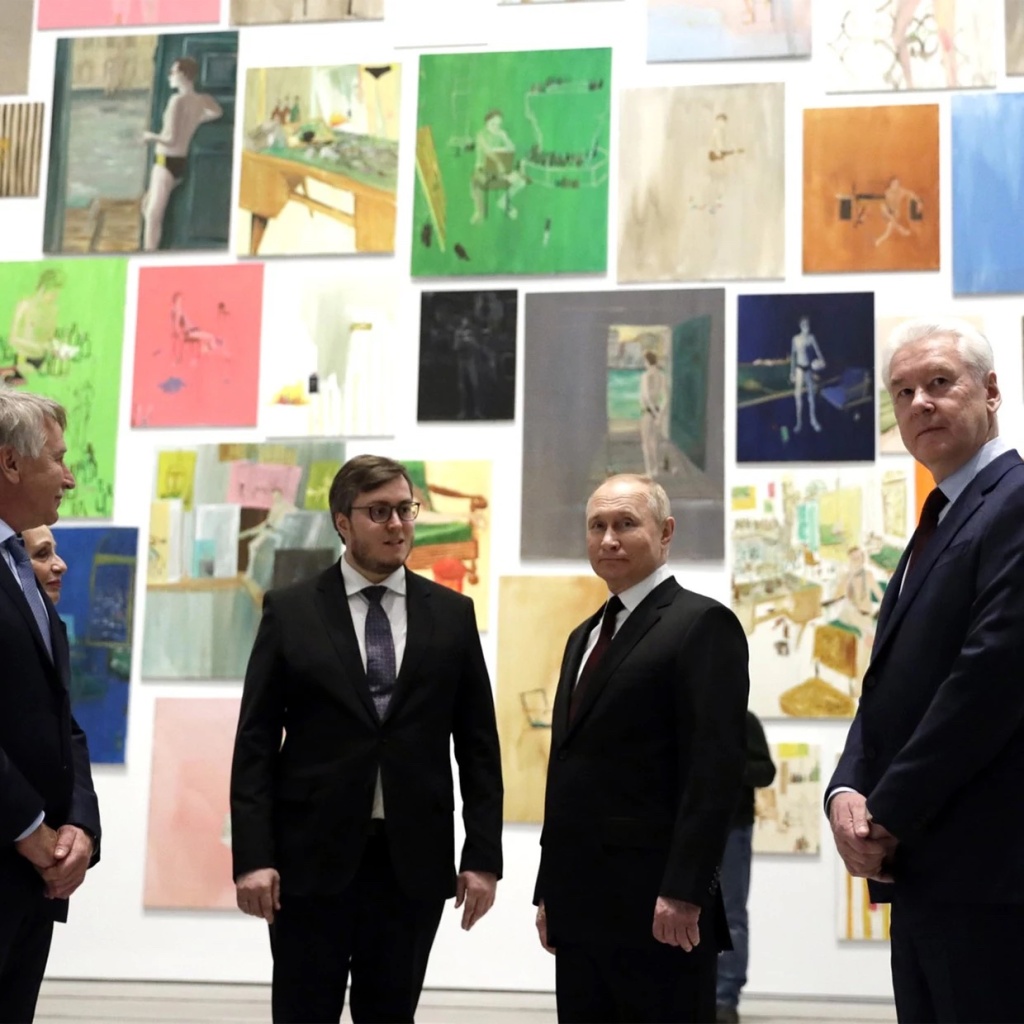
(Left to right) Russian businessman Leonid Mikhelson, founder and funder of the arts organization the V-A-C Foundation; V-A-C publishing programs director Grigory Cheredov [full disclosure: Mr. Cheredov has commissioned me many times in the past several years to translate texts for V-A-C, which I happily did because he and his colleagues were easily among the most decent and professional of my Russian art world clients, at least until the war broke out and they failed to pay me for the last two jobs I had done for them before the war — TRR]; Russian president Vladimir Putin; and Moscow mayor Sergei Sobyanin, at the V-A-C Foundation’s newly opened art and culture space, GES-2 House of Culture, December 1, 2021
No matter how intellectuals are defined — as bearers of culture or as critically thinking people — it is obvious that in the twentieth century there were significant changes in the organization and nature of intellectual life. The most widespread meaning of the word “intellectual” is even narrower and includes a political dimension. Real intellectuals are those who go beyond their immediate area of expertise to intervene in public policy issues, usually in a spirit of disagreement with the authorities. This concept was first popularized by the archetypal intellectual Jean-Paul Sartre.
And Jürgen Habermas, a major theorist of the Frankfurt School of social philosophy, who has paid serious attention to the theory and practice of politics, was convinced by his own experience of the effectiveness of such an approach to political life. He has argued that “philosophers, along with writers, historians and other experts, should act in the public sphere as intellectuals and least of all as interpreters and elucidators of any one doctrine.” [This is a quotation from an 1989 interview of Habermas by Yuri Senokosov, as published, in Russian translation, in Jürgen Habermas, Democracy, Reason, Morality: Moscow Lectures and Interviews (Moscow: Academia: 1995), pp. 109–110. Judging by the peculiarly specific way it is introduced here by Ms. Sarkisyan, the wording was discovered by her in Elena Iosifovna Kukushkina, “The Intelligentsia in the Political Life of Society,”Vestnik Moskovskogo Universiteta, Series 12: Political Science, 4 (2012): 21, where the passage in question is incorrectly indicated as being on page `113 of the book —TRR.] In 1953, he took on Martin Heidegger in the wake of the latter’s newly discovered Nazi sympathies in a review of Heidegger’s book Introduction to Metaphysics. In the late fifties and early eighties, Habermas was involved in pan-European anti-nuclear movements, and in the sixties he was one of the leading theorists of the student movement in Germany, although in 1967 he actually broke with the radical core of this movement when he warned about the possibility of “leftist fascism.” In 1977 he protested against the restriction of civil liberties posed by domestic anti-terrorist legislation, and in 1985–1987 he was involved in the so-called historians’ debate on the nature and extent of Germany’s guilt in the war, condemning what he considered historical revisionism of Germany’s Nazi past. He also warned about the dangers of German nationalism in connection with the unification of Germany in 1989–1990.
Intellectuals from different countries — the scientists, writers, artists and humanists of the twentieth century — amassed a wealth of experience in solving problems on a global scale. In the period between the two world wars, they led anti-fascist movements and fought to prevent interethnic conflicts and liberate countries from colonial dependence. By initiating and being actively involved in these campaigns, the world cultural elite demonstrated the intelligentsia’s truly inexhaustible possibilities of the intelligentsia as a force capable of having a tangible impact on political processes at different levels. [This paragraph has been copied almost verbatim from page 22 of Elena Kukushkina’s scholarly article, as cited above — TRR.]
The cultural and artistic community — whether it consists of intellectuals or not — has the weight, influence, and social capital to make the fight against the current regime effective. As for their responsibility, they are capable of exposing the lies of governments and analyzing their actions in terms of causes, motives, and often hidden intentions. Privilege confers opportunity, and opportunity imposes responsibility. For me, the urgent question today is what responsibility should Russian society, in particular the intelligentsia (of which the artistic community is a part), bear when it comes to horrors of the full-scale war in Ukraine. And of course, this question (about the responsibility borne by people of the aggressor nation for the war it has launched) is not new at all.
The philosopher Noam Chomsky, for example, criticized the American government and the Vietnam War in the book [sic]The Responsibility of Intellectuals. Privilege, he argues, entails the responsibility to tell the truth and expose lies. But our intellectual culture supports this ideal only nominally. Yes, it is forbidden in Russia to publicly voice an opinion that differs from the government’s rhetoric. Otherwise, one risks criminal prosecution, which can even lead to imprisonment. What other options are left if a basic human need — freedom of speech — is taken away from us? Are there niches in which we can preserve our humanity while also avoiding tentacles of the state? It seems that during a war it is difficult to engage in aesthetics. It takes us down the path to escapism and the opportunity to close our eyes to everything that is happening around you us. In peacetime, there are trends that establish a certain regime for artists.
But since the beginning of the war, Russian public cultural activity has not undergone any structural changes or even hints of them. New galleries and cultural centers have been opening (e.g., the Zotov Center, Nakovalnya Gallery, and Seréne Gallery), and the old ones continue to operate as if nothing has happened.
Only a few such venues have curtailed their public programs (and not all of them due to political convictions): Typography Contemporary Art Center, Kerka Gallery, the space It’s Not Herе, the Sphere Foundation (the former Smirnov and Sorokin Foundation), Fragment Gallery, and the Garage Museum. Where does normalization come from? The government has been sparing no efort to hide the war crimes that it commits every day, not only with the help of propaganda, but also through attempts to preserve the normal life that existed before the war. Tomorrow will be the same as today. This illusion of normality also occurs in everyday life. The cultural realm has also played a considerable role in generating it. All the existing cultural institutions and people involved to one degree or another in the production of public life are this totalitarian regime’s witting or unwitting opportunists.
Russian curator Olga Sviblova at the Knowledge Society’s awards ceremony at the Kremlin, December 13, 2022. The society has adopted a suggestively Roman (i.e., not Cyrillic) and thus pro-war “Z” as its logo, as seen behind Sviblova.
The Russian intelligentsia, as represented by the artistic community (if it can be called that at all), is against the war in Ukraine. But even if it verbally opposes war crimes and imperialism, it supports the existing state of things in its actions, thus contradicting itself. Collaboration with institutions (especially those directly dependent on the Russian federal culture ministry, whose head in an interview called for killing Ukrainians) and the absence of discussion about rethinking the cultural field within the country suggest that the cultural community refuses to react at all to the events taking place this minute in Ukraine. It refuses to accept any responsibility for what is happening.
Fairs, exhibitions, public educational outreach, and the production of uncritical art only perpetuate the status quo and play along with the official agenda. To understand what I am talking about, look at the list of exhibitors at the Cosmoscow Art Fair in September 2022. The fair, to which Putin’s spokesman Dmitry Peskov was invited, imposed strict censorship on its participants.
This familiar pre-war environment is exactly what the government wants to see. We have seemingly begun to forget that we live in a totalitarian state, and everything we produce on its territory is part of it and monitored thanks to the presence of a single comprehensive ideology. What kind of art production can we talk about when there is strict censorship of all legal channels of information? Censorship is usually exercised in the name of so-called national security interests or as part of larger-scale campaigns to protect morality. (In our case, this is the policy to preserve and strengthen “traditional Russian spiritual and moral values.”)
Regimes try to monopolize artistic production either by co-opting artists to the point that they become mouthpieces and servants of the state, or by restricting the access of independent artists to places for displaying and implementing artistic expression. What kind of independent public art can we talk about? The usual strategies of artistic activity no longer work. It’s time to admit it.
We have begun to forget that no uncritical culture is possible at a time when the mass killings of civilians, violence, and torture are taking place daily, and the integrity of a sovereign neighboring state is being destroyed. What kind of art production in the Russian Federation is there to talk about when you are a member of the aggressor nation? Even if you adhere to an anti-war stance, how can art in state-controlled institutional venues be perceived from the outside as anything other than serving this regime?
Russian culture should be held accountable for the war in Ukraine. But people often downplay the importance of culture in political and public life, regarding it as a separate part of the personal realm rather than as a fusion of the forms of social interaction. We need to recognize that the current regime did not suddenly emerge on February 24, 2022. It had to be built up and supported for many years to officially establish itself once and for all and launch a full-scale war in Ukraine. All these years we ignored this build-up, living in a world of illusions. Unfortunately, this illusion is still maintained. In many ways, it is created by part of the cultural and artistic communities.
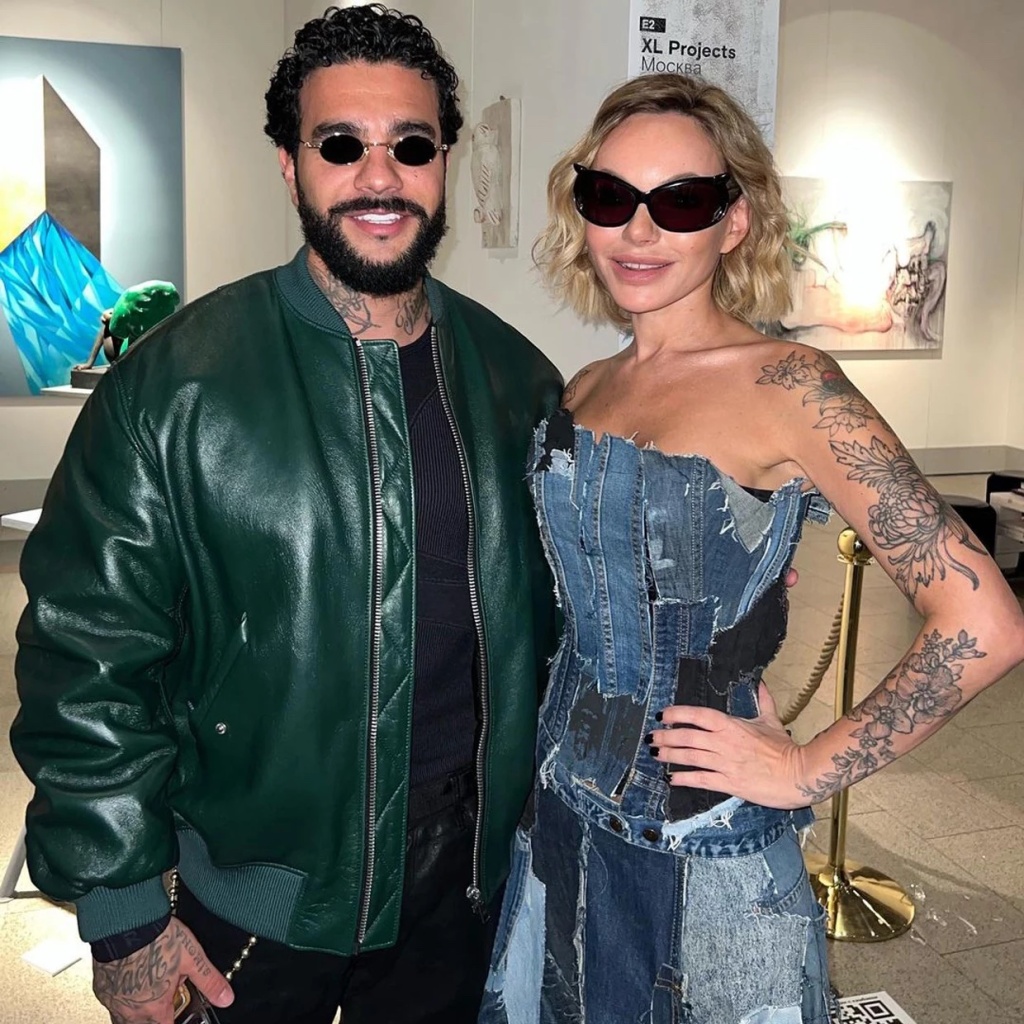
Russian rapper Timati and fashion designer Masha Tsigal at Cosmoscow Art Fair, September 2022
Many people who have remained in Russia might not agree with me. How can artists earn money without resorting to public utterance and without cooperating with institutions? How can galleries stop working? After all, this is their source of income (although it often does not bring in money, but vice versa). How can we just come to a standstill and not produce anything?
But does everyone really continue to work because of economic dependence, and not out of social necessity — that is, because they belong to a scene where there is a fear of losing the context that gives a person meaning? It boils down either to staying, accepting the state of things, and leading your normal life (as far as it is possible to do that at all now) or giving up on it and leaving. Of course, this dichotomy is not the only one: there are many other ways of living this war. None of us, including me, has answers to these questions. The question, rather, is whether we are aware of what kind of force and political dimension our position can have and what responsibility we should have to Ukraine. Time will pass and the question will arise: how did the Russian intellectual community behave during the war? Silence is also an answer, however.
The ruins of the Arch of Triumph (also called the Monumental Arch) in Palymra, 2010. Photo courtesy of Wikipedia
In April, the project for restoring the Arch of Triumph, the most famous structure of the Syrian city of Palmyra, should be ready and presented to the public, according to our sources involved with restoring the ancient city.
The Petersburg organizations involved in the project have been doing their design work remotely. They considered it safer because, according to the restorers, not all the terrorists in Syria have been “pacified” yet.
The restoration is coordinated by the Institute of the History of Material Culture (IIMC RAS), which signed an agreement on the restoring the arch with the Syrian Department of Antiquities in March of last year. The details of the agreement are unknown. In November of last year, the archaeological excavations were completed. The project also involves the State Hermitage Museum and the architectural firms of Maxim Atayants and Studio 44. Atayants, as a connoisseur of antiquity, is more responsible for the “theoretical” part, that is, for the choice of approach. Five specialists from Studio 44, including Nikita Yavein, the head of the firm, are involved, and they are working on technical issues. According to sources, other firms are also involved — for example, the restoration company Agio.
The Arch of Triumph itself was built during the reign of Roman Emperor Septimius Severus (193–211 CE) and, apparently, glorifies his victories. It underwent restoration involving reinforced concrete elements in the 1930s. The arch was partially destroyed in 2015, during the Syrian civil war. The central span and one of the pylons collapsed.
More alive than Buddha
Until recently, it had not been decided exactly how to restore the arch — to its state at the time when terrorists attempted to blow it up (which means reproducing the version produced by the restorers in the 1930s), or in some other way. The Venice Charter on the Conservation and Restoration of Monuments and Sites stipulates that monuments should be preserved in the form in which they have come down to our time. According to established practice, reconstruction by means of anastylosis, as the most sparing method, is permitted for ancient ruins. In this approach, the surviving stones are put back in place. But experts do not want to limit themselves only to anastylosis in the case of Palmyra.
First, it would look uninteresting: the edifice would not make the proper impression, and it is probably not worth the effort. Second, much of the stone in the lower part of the arch has been lost or compromised and would still have to be reinforced or recreated. According to the IIMC RAS, about 40% of the structure remains standing. Another 30% of the stone blocks are not in their place, but they can be used in the restoration. The remaining sections are partly or completely destroyed. That is, there is slightly less genuine material than is usually required for a restoration (i.e., 80-90% of authentic stone). UNESCO has long refused to restore the statues of Buddha blown up by the Taliban in Afghanistan (they have not yet been restored) precisely on the grounds that a significant part of the stone was lost.
Archaeological diplomacy
Meanwhile, the project for the arch must also be vetted by UNESCO since Palmyra is a World Heritage Site. Moreover, not everything is cut and dried when it comes to UNESCO, as shown, for example, by the rather critical report issued by its monitoring mission that visited Russia in 2019.
Two arguments have been drawn up to justify the design decisions to high-level international institutions. First, that the recreation would be reversible. That is, sometime in the future the arch could be disassembled again if so desired and the new inclusions (such as the “crowns” on the stone blocks) removed, and it would look more or less as it looked before it was blown up. The second argument is that the arch is a symbol of both Palmyra and all of Syria. And in the case of symbols, recreation seems to be permitted.
The issue turns out to be largely legal. Perhaps that is why Alexei Mikhailov, the deputy chair of the city’s Landmarks Use and Preservation Committee (KGIOP), known, in particular, for his work designed historical preservation zones in central Petersburg, has been appointed to the team of restorers. In a comment to the TV channel Saint Petersburg, Mikhailov drew an analogy with Notre Dame Cathedral. Located in Paris, like UNESCO’s headquarters, the cathedral is currently undergoing reconstruction after a fire in 2019.
“We are now drawing the parallel that the arch of Palmyra is as much of a symbol as Notre Dame is for Paris. And it is a reconstruction that is underway there. This is very important and must be conveyed to our international colleagues. It will determine which form of restoration will be employed,” Mikhailov said.
Our sources say that negotiations were held with Petersburg restorers about restoring other sites in Palmyra and Syria. Apparently, they intensified after the devastating earthquake that hit Syria about a month ago. (According to the Syrian Arab News Agency (SANA), aftershocks from that quake continue to occur.) Last week, Vedomosti reported, citing a diplomatic source, that Syrian President Bashar al-Assad is scheduled to visit Russia. As one of that newspaper’s sources suggests, he may ask for Moscow’s help in recovery work.
Scholars without borders
Petersburg experts agree that it is necessary to maintain world heritage. They disagree only about whether such aid is a burden or not.
“I don’t think it’s a lot of money compared to other government spending,” Alexander Kitsula, vice president of the St. Petersburg Union of Architects, told DP. At the same time, he noted that, with all due respect to the history of Petersburg, the antiquities of Palmyra “are incomparably more important than the excavations at Okhta Point.”
“It is wrong to let world culture be lost in any case, and if our country has reserves that can be sent there, it is probably the right thing to do. But, of course, our country also has huge holes in this area,” he believes. The expert emphasizes that Russia’s antiquities are no less in need of attention than foreign ones.
“My personal opinion is that we still have tons of work to do here at home. And this is far from a first-degree problem for the Russian Federation in general. But if someone has decided that it has to be done, then it has to be done,” Pasechnik added.
Alexei Kovalyov, a researcher at the Institute of Archaeology of the Russian Academy of Sciences, sees no problems in the fact that our scholars are also at work in Palmyra.
“St. Petersburg has been one of the world’s major centers for archaeology. Our expeditions are working in the South Caucasus and Central Asia, and our expedition in Iraq has just been resumed. Such projects are part of our international policy: they are usually funded per intergovernmental agreements. In the case of Palmyra, this means the Syrian side,” Kovalev explained. He also added that there are many specialists in ancient monuments working in Petersburg who know the peculiarities of the architecture of the period to which Palmyra belongs.
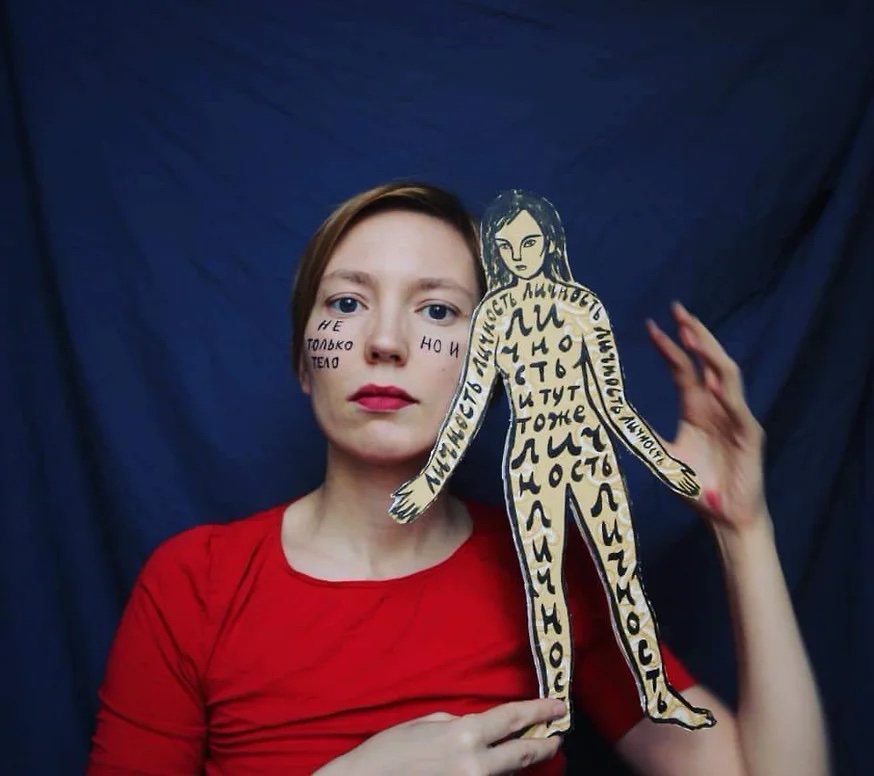
Darya Apahonchich. The inscription reads: “Not only a body, but also a person.” Courtesy of Kommersant via Ms. Apahonchich’s Facebook page
Аn “agent” due to wages: foreign agent status threatens teachers
Oleg Dilimbetov and Marina Litvinova Kommersant
April 7, 2021
A job at a foreign institute of higher education or a salary from a foreign employer can be grounds for obtaining the status of a so-called foreign agent. This transpired during the the hearing of a lawsuit brought against the Justice Ministry by Petersburg teacher and activist Darya Apahonchich. She had requested that the ministry specify the reasons it had forcibly registered her as a “private individual acting as a foreign mass media outlet functioning as a foreign agent.” The ministry provided the court with written proof of her employment at a French college [in Petersburg] and the Russian branch of the International Red Cross. The ministry confirmed that the “foreign funding” received by a potential “foreign agent” does not necessarily have to have anything to do with subsequent “dissemination of information” or “political activity.”
Ms. Apahonchich was placed on the register of so-called individual media foreign agents on December 28, 2020, along with three journalists and the human rights activist Lev Ponomaryov. At the time, the Justice Ministry did not explain what specific reasons had caused them to assign her this status. In March, Ms. Apahonchich filed a lawsuit in Petersburg’s Lenin District Court, claiming that the obligations imposed on her by the Justice Ministry due to the new status violated her rights under the Russian Constitution and the provisions of the European Convention on Human Rights (ECHR). On April 5, during a preliminary hearing of the lawsuit, Ms. Apahonchich was informed of the Justice Ministry’s objections to her claims and finally learned the reasons she had been entered into the register.
The ministry told the court that the woman [sic] had received foreign money transfers from Sweden, Germany, France and Finland. As Ms. Apahonchich explained, these were official fees for participation in festivals and exhibitions and her work as a teacher.
Thus, she was paid 35 thousand rubles by the Finnish Museum of Photography. She received Another 112 thousand rubles from the French college [in Petersburg], where she taught Russian. She received about 60 thousand rubles from friends via the PayPal transfer system, and these transfers were expedited by Deutsche Bank (Germany). [That is, Ms. Apahonchich had received the fantastic sum of approximately 2,220 euros at current exchange rates — TRR.] In addition, Ms. Apahonchich was imputed with having received bank transfers from her employer, the Russian branch of the International Red Cross. The Justice Ministry stated that the source of these funds was Norway, and the intermediary was Sweden. The activist herself claims that she performed work at the Red Cross under a [Russian] presidential grant.
As for “dissemination of information,” the Justice Ministry pointed out that Ms. Apahonchich had reposted on social networks the article “Feminist Fairy Tales: Princesses Fighting the Patriarchy,” published by Radio Liberty (which has been deemed a so-called foreign agent media outlet by the Russian authorities). The ministry also told the court about the YouTube channel “Feminists Explain,” where Ms. Apahonchich has discussed the topic of gender equality, and her article about domestic violence, published on the website Colta.ru. In addition, the woman [sic] had appealed on social networks for solidarity with the defendants in the case of the Network (deemed a terrorist organization in the Russian Federation and banned) and LGBT activist Yulia Tsvetkova.
“The list of my sins is long but honorable: I taught Russian as a foreign language, participated in international festivals, and voiced solidarity with the regime’s victims. Yes, I also accepted financial assistance from friends from abroad,” Ms. Apahonchich said when asked to comment on the Justice Ministry’s position. “It is clear that they brought the house down on me for solidarity: for solidarity pickets, for public discussions with friends. The situation was not what it is now: everyone seems to have gone off the rails. We’re in trouble, we need help.”
Her lawyer Alexander Peredruk noted that the Justice Ministry had not even tried to prove to the court that there was a connection between the foreign funds received by his client and her activism.
“Based on the Justice Ministry’s position, if you publish something on social networks, it does not matter whether you receive foreign funds directly or indirectly. And it is very difficult to independently monitor the matter: when collaborating with an LLC, you cannot know for certain whether it receives foreign money,” the lawyer said. “The Justice Ministry argues that the separately existing evidence of receiving funds from abroad and publishing on social networks is enough. They have not tried to establish a direct connection between them.”
The Justice Ministry told Kommersant that the law sets quite clear criteria for inclusion in the register. In the case of “individual media foreign agents,” it is sufficient to “distribute news reports and materials intended for an unlimited number of persons,” as well as to receive “money and (or) other property” from foreign states, organizations and nationals, or “from Russian legal entities receiving money from these sources.” To obtain the status of an “individual foreign agent,” it is enough to receive “foreign” money and “distribute news reports and materials” created by a “foreign agent media outlet” or “participate in the creation” of such “news reports and materials.”
“The legislation specifies neither the need for an obligatory link between the receipt of foreign funds and the dissemination of news reports and materials, nor evidence of the individual’s political activity,” the Justice Ministry confirmed to Kommersant.
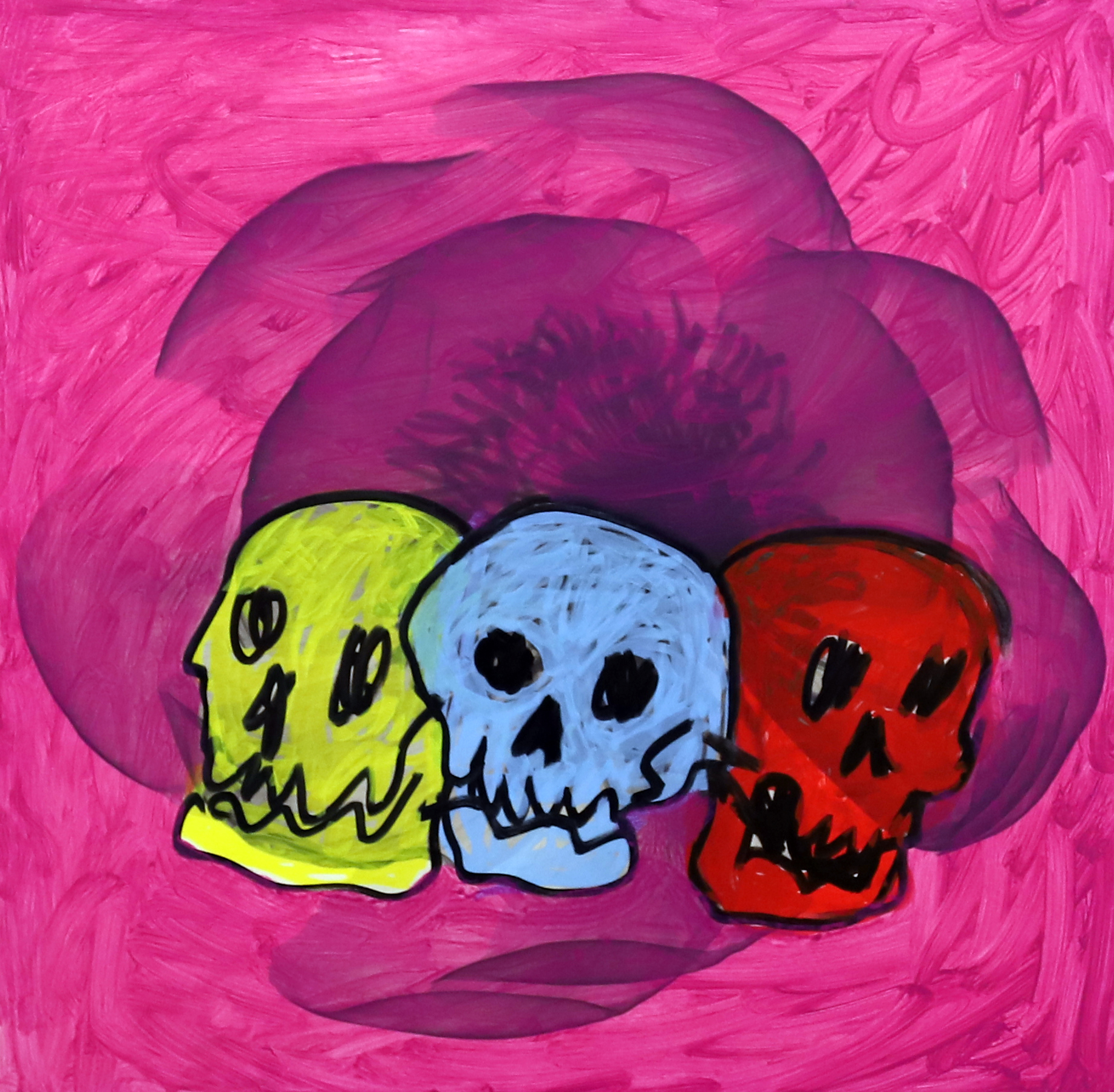
Oleg Kotelnikov, La mort en rose, 2020. 90 x 90 cm, oil on canvas
Oleg Kotelnikov, La mort en rose
23 October 2020 – 5 December 2020
Curated by Marina Alvitr and Katya Kabalina
Oleg Kotelnikov (b.1958) gained fame in the 1980s as a member of the New Artists, a group founded in 1982 by Timur Novikov.
The show features fifty graphic works, produced in 2020, which continue the upbeat Petersburg necrorealist tradition. “When we are born, we start dancing, and it is the dance of death.” For the artist, a work of art is the movement of life, a set of accidents and overwrites, a “punk scream” here and now.
Oleg says, “Art is contemporary (with time), it reflects time. Art that does not reflect its time is not contemporary.”
To contextualize the era and tell about the culture that Oleg and his friends shaped when a new world was emerged, the show will also feature videos and documentary archives. Buratinovka, an installation produced in collaboration with Irina Venskaya, attempts to interpret these archives creatively.
In addition to Kotelnikov’s works and the collaboration with Venskaya, the exhibition features Kotelnikov’s collaborations with Yevgeny Yufit.
АRТ4 Museum
Khlynovskii tupik, 4, Moscow
Subway stations: Arbatskaya, Tverskaya and Pushkinskaya
Open Tuesday to Saturday, 12 to 8 pm
Tickets cost 300 rubles https://www.art4.ru/
Oleg Kotelnikov, La Mort en Rose. ART4 Museum, Moscow. Exhibition view
♠ ♠ ♠ ♠ ♠ ♠ ♠
Seven Poems by Oleg Kotelnikov
1.
the page
of history
is blank
the growth
of a plant
is plain
the sides
of each
scene
scratched
and starred
Oleg Kotelnikov, La mort en rose, 2020. 86 x 61 cm, acrylic, tempera, paper
2.
the devil walks the line
upright
wash your hands before you dine
at night
Oleg Kotelnikov, La mort en rose, 2020. 86 x 61 cm, acrylic, tempera, paper
3.
thunder over the field no rain
the crowbar burns in the chief’s hand
blood curdles in blue veins
a carrot is stuck in dear loins
the enemy won’t get their screws
into the junk food stew
Oleg Kotelnikov, La mort en rose, 2020. 86 x 61 cm, acrylic, tempera, paper
4.
the happiest minutes
happen before and after riots
Oleg Kotelnikov, La mort en rose, 2020. 86 x 61 cm, acrylic, tempera, paper
5.
nature, not the tokens of power,
nourishes water and partly
inspires with thoughts of liberty
the people living in it
in times of turmoil and bad weather
Oleg Kotelnikov, La mort en rose, 2020. 86 x 61 cm, acrylic, tempera, paper
6.
in the temple of the Lord
in the temple of the arts
a virgin in underwear
indulged her whims insensibly
two for one
one in three
dimensions
God
Oleg Kotelnikov, La mort en rose, 2020. 86 x 61 cm, acrylic, tempera, paper
7.
like circles of hell on the water
the traces of people disperse
a ship is going down
it is judgment day on board
there is only one direction
up towards chiaroscuro
All images courtesy of Art4 Museum. Poems selected and translated by the Russian Reader




 Oleg Kotelnikov, La mort en rose, 2020. 90 x 90 cm, oil on canvas
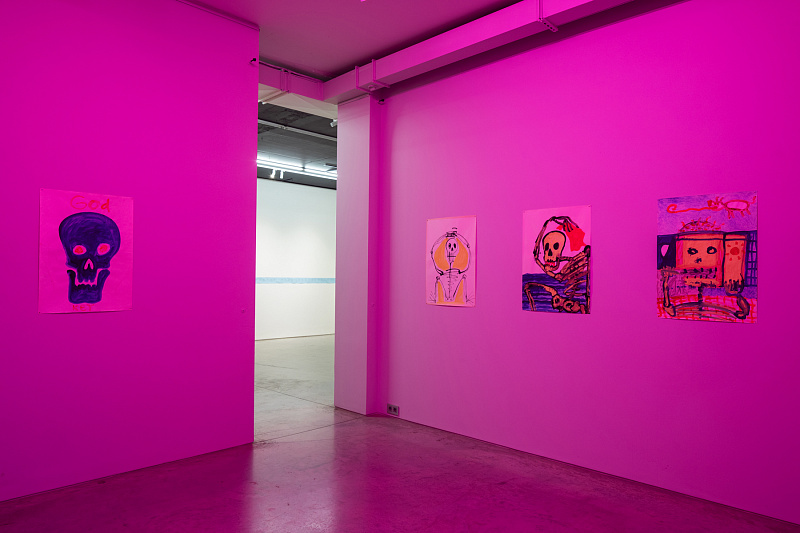 Oleg Kotelnikov, La Mort en Rose. ART4 Museum, Moscow. Exhibition view
 Oleg Kotelnikov, La mort en rose, 2020. 86 x 61 cm, acrylic, tempera, paper
 Oleg Kotelnikov, La mort en rose, 2020. 86 x 61 cm, acrylic, tempera, paper
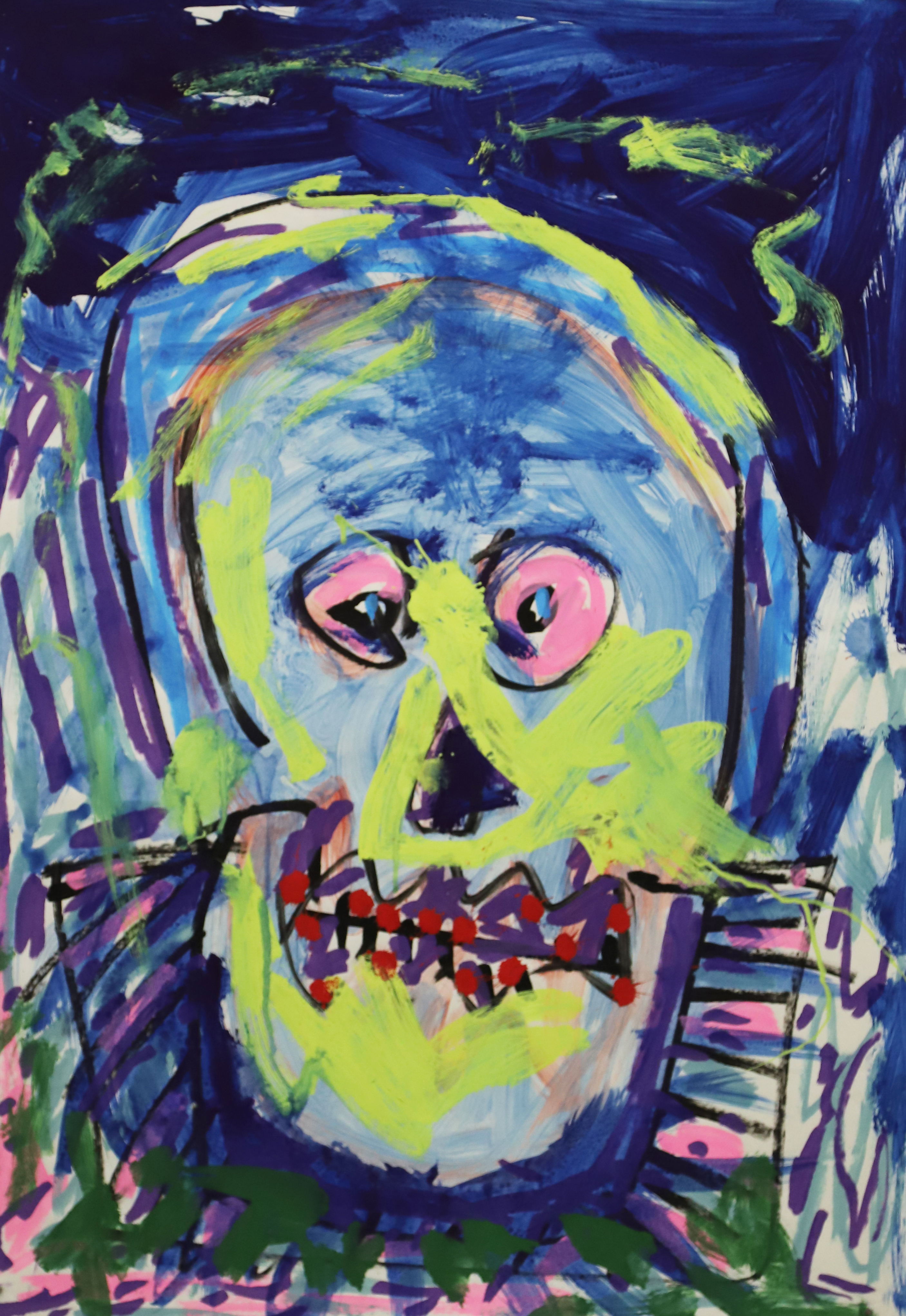 Oleg Kotelnikov, La mort en rose, 2020. 86 x 61 cm, acrylic, tempera, paper
 Oleg Kotelnikov, La mort en rose, 2020. 86 x 61 cm, acrylic, tempera, paper
 Oleg Kotelnikov, La mort en rose, 2020. 86 x 61 cm, acrylic, tempera, paper
 Oleg Kotelnikov, La mort en rose, 2020. 86 x 61 cm, acrylic, tempera, paper