“Rotenberg Is Worse than ISIS!”: Russian Truckers on Strike in Dagestan and Elsewhere

“On November 30, we will go to Moscow and shut down the Moscow Ring Road!”: Major protests by truckers in the Caucasus
Irina Gordiyenko | Dagestan
November 22, 2015
Novaya Gazeta

A major protest by truckers is taking place in the Caucasus. Officials are trying to ignore it, and in response truckers are threatening to move on Moscow 

“No to Platon! On November 30 We Block the Moscow Ring Road.” Photo: Irina Gordiyenko/Novaya Gazeta

Strikes by truckers against the introduction of a new road tax have swept across Russia. The biggest of them is still underway in Dagestan. Hundreds of truckers have lined up along dozens of kilometers of highway. Manas, Khasavyurt, Kizlyar, and Kayakent are the spots where people have been striking for a week. The protests have been ignored. Officials have avoided contacting the strikers, while television has refused to cover the strike. Amateur videos posted on the web are immediately removed and their users blocked.

The strikers are determined. If their demands are not heard, they intend to move on Moscow on November 30.

The roadside of the Rostov-Baku M29 highway near Khasavyurt looks gaudy at the moment. Trucks with yellow, red, blue, and green cabs are parked in two tight rows next to each other. The trailers are hung with enormous posters reading, “Hands off long-haul trucking!” and “Stop robbing the people!” The chain of trucks stretches for dozens of kilometers, and at any moment the annoyed truckers could block this federal highway.

“We don’t want to do it,” says Dibir, a trucker from a small village nearby. “We know it will be violently dispersed. But they don’t want to hear us. We went to the city administration, to the Ministry of Transportation, and to Rosavtodor (Russian Federal Road Agency). They wouldn’t even let us in the door. We called the TV channels: they have refused to come cover us. Instead, they sent in trucks of riot police.”

An excited crowd of around two hundred people stands around an improvised stage. From time to time, someone mounts the stage to appeal to the truckers not to give up and stand their ground.

They have been here for five days. They sleep in their cabs, cook their own food, and during the daytime they welcome the growing number of colleagues who have been joining the strike. They are no strangers to hardship. They have been tempered by runs on rough roads lasting many days.

As of November 15, vehicles weighing over twelve tons are charged an additional fee for each kilometer of federal highway they travel. The government issued a decree setting the fee at three rubles six kopecks per kilometer. The new system of taxation has been dubbed Plato. In effect, truckers (or trucking companies) are obliged to register with Plato and choose one of two methods of payment. They can either buy a special onboard device that counts the kilometers of federal highway they travel and then calculates the fee, or before each run, they can buy a detailed route map from the company running Plato.

If they refuse to pay, individual entrepreneurs can be fined 40,000 rubles [approx. 580 euros]; legal entities, 450,000 rubles [approx. 6,500 euros].

In the best case scenario, you can make forty to fifty thousand rubles per run,” says Dibir. “The [new] tax adds an additional fifteen thousand rubles in costs. What are we going to live on?! We are not on the Forbes list.”

All Russian truckers now know about the Forbes magazine list of Russia’s wealthiest people and the spot occupied on the list by Arkady Rotenberg.

The surname Rotenberg is now quite popular in Dagestan. Posters bearing it can be seen all along the the M29, for example, “Rotenberg is worse than ISIS” (a terrorist organization banned in Russia) and “Russia without the Rotenbergs.” Every trucker now knows that billionaire Arkady Rotenberg is a friend and supporter of President Putin, that Arkady Rotenberg has a son named Igor Rotenberg, and that Igor Rotenberg owns a little company that mysteriously signed a contract with the government farming the new federal transportation tax out to this private company.

Truckers are not only the people who haul loads from their own regions to other regions, for example, Dagestani cabbage. (There are several districts in Dagestan that traditionally cultivate green cabbage on an industrial scale and then supply it to other parts of Russia during the winter.) Truckers are one of the foundations of the Russian produce economy.

Watermelons, tomatoes, onions, aubergines, pomegranates, and oranges: all this produce is brought from Iran and Azerbaijan, and the geography of further transshipments covers the entire country. For example, Dagestani truckers literally “pick up” and transport the entire harvest of Krasnodar Krai, Stavropol Krai, Astrakhan Region, and Volgograd Region to other parts of the country. They supply the major markets of Moscow and Saint Petersburg with produce.

“We are in the fifth day of our strike. Around three hundred train carloads of persimmons have piled up on the Azerbaijani border, right in the middle of the fruit’s season,” one of the strikers explains to me. “Three hundred train carloads is nine hundred truckloads that we should have delivered to Russian markets. Instead, the produce is spoiling. Take a look at how much persimmon prices skyrocket now.”

“Rotenberg is worse than ISIS.” Photo: Irina Gordiyenko/Novaya Gazeta

There are over two million heavy trucks officially registered in Russia. Around half of these are registered in the south of Russia. Cargo transportation is now in the truest sense one of the most important sources of income in Dagestan, a republic of three million people.

Take, for example, the large village of Gudben. Its population is around fifteen thousand people, and it has two thousand registered trucks. The average family in Gudben consists of five people, so at least ten thousand residents of Gudben survive on the money earned from cargo runs.

“We would love to find other work,” says Guben resident Tahir, “but there is just no other work in Dagestan. This is the only way we can feed our families.”

The second major site of the trucker protests is the federal highway near the small village of Manas. Several days ago, outraged truckers blocked the highway, demanding that authorities come meet with them. The authorities did come, but incognito. They threw up their hands and left. Then they sent in truckloads of riot police, who dispersed the protest.

So far the truckers have agreed not to block the highway. They are waiting. But riot police are on duty there. Every day they detain dozens of people, charge them with misdemeanors and send them to jail for ten days, videotape the truck drivers, and rip the license plates from their trucks.

The truckers are philosophical about such methods of coercion. We will not succumb to provocations. We want to be heard, they say.

The Dagestanis have been joined in their protests by truckers from other regions.

“I cannot imagine how we will go on living. This is going to be a big blow to our wallets,” says Vladimir from Saratov.

A couple days ago, Vladimir unloaded a cargo of Sakhalin fish in Krasnodar. Hearing that a big strike was underway in Dagestan, he decided to join it.

“In other parts of Russia, the protest actions have quickly come to an end. They have been quickly dispersed. But the folks here are stubborn,” says Vladimir.

And Vladimir is not alone. Many truckers from other regions who made runs to the south over the past week have joined the Dagestanis, including Chechens. In Chechnya itself, there is a strict taboo on any protest, so they are forced to travel to neighboring regions to strike against the injustice.

“A liter of diesel costs thirty-three rubles. For example, you need half a ton [of fuel] to get to Moscow,” continues trucker Tahir. “Under Medvedev, the price of diesel went up by seven rubles and we were promised a decrease in the transportation tax. We believed them. But the tax never was decreased. And now a new tax has been introduced to boot.”

In addition to fuel, every trucker has to pay the transportation tax (around forty thousand rubles a year), insurance (around fifteen thousand rubles per run), and customs duties (if the produce hails from Iran or Azerbaijan), plus license fees and a ton of other related formalities. We should also consider that any breakdown is the driver’s responsibility. Spare parts for all trucks, whether they are Volvos or KamAZes, are expensive.

“I ran into a pothole on a dark highway in Volgograd Region. I was stuck there for a week. I paid twenty thousand rubles [for repairs]: that is about half of what I earned from the run. You cannot imagine how awful the roads are around Volgograd and Samara! And for this we have to pay more?!” relates one trucker.

But there is yet another nuance. The new road tax will inevitably lead to higher rates for cargo transportation. The truckers will be forced to include them in the cost of their services, and so prices for the goods they transport will increase nationwide.

“We do not want to do it. People here live very poorly as it is,” says the trucker Dibir. “Price have gone up at the markets in Khasavyurt. We will fight to the last. And if they do not want to hear us, we will drive to Moscow and set up camp on the Moscow Ring Road. We are used to living in field conditions.”

“Peace to the world. No to Plato!” Photo: Irina Gordiyenko/Novaya Gazeta
Translated by the Russian Reader


Further reading (in Russian):


UPDATE (?) Carl Schreck, “Road Warriors: Russia Yields On New Transport Tax After Long-Haul Trucker Protests,” RFE/RL, November 20, 2015. Thanks to Comrade SC for the heads-up

Alexei Polikhovich: “I Had Begun to Feel I Was Born in Prison”

“I had begun to feel I was born in prison and just had been released for a short time”
Alexei Polikhovich talks about spending three years behind bars for the right to think freely 
Ekaterina Fomina
November 5, 2015
Novaya Gazeta

Alexei Polikhovich after his release from prison. Photo: Ekaterina Fomina/Novaya Gazeta

Alexei Polikhovich, one of the few defendants in the Bolotnaya Square case who had actually been politically active before the ill-fated protest rally of May 6, 2012, has been released from prison. (We now understand this was the reason people were jailed: on suspicion of having vigorous civic stances.) Before Bolotnaya Square, Polikhovich, for example, had defended the Tsagovsky Forest and been involved in the antifascist movement. Some of those now spending their fourth year in prison after being convicted in the case had ended up on Bolotnaya Square by accident, but Polikhovich had chosen this way of life, a life of open struggle, consciously. It is a dangerous way of life to lead in our country, even if the way you fight your cause is ten times within the law. But Polikhovich consciously chose this way of thinking, and marched to Bolotnaya Square in the antifascist column.

However, on Bolotnaya Square on May 6, 2012, Polikhovich caught hell just as randomly as other protesters. Police pulled them from the crowd in the heat of the moment without looking .

Polikhovich insisted on his innocence at his court hearings. He knew he was being tried for his convictions.

Three years in prison were supposed to reform what? Polikhovich’s beliefs? He remained, however, true to his beliefs throughout his imprisonment. If reform meant betraying them, then Polikhovich has not been reformed, as he himself says. But he still learned something.

After his release, Polikhovich talked about the lessons he learned in prison.

__________

I have not seen people in color for three years. I have forgotten what it was like to have women and children around. Simple things seem new right now. After being in the penal colony, I think Moscow is quite beautiful.

When I got to Petrovka [38, Moscow police HQ], I did not understand how serious things were. I took everything as an excursion, a rough excursion, but an excursion nonetheless.

The wording “actively involved in destructive youth organizations” was included in my arrest sheet. The Center “E” officers [“anti-extremist” police] did not have a clear opinion about me, whether I was a rightist or leftist. What group should they assign me to? What mattered was that it should sound terrible.

The police investigators found us interesting. They had been used to dealing with Islamists and neo-Nazis. But leftists, social democrats, and liberals, everyone who had been arrested on trumped-up political charges, were something unfamiliar to them. The investigators enjoyed chatting with us. I remember one such conversation. A crowd of investigators was standing before me, and I was telling them why I was in jail. I explained I had not wanted to hit anyone, that had not been the objective. Well, I expressed it simply.

They immediately tensed.

“What was the objective? Who set the objective?” they asked. They think crudely.

Other inmates knew about our case, and I never encountered flagrantly negative attitudes towards us in this connection. On the contrary, sometimes they would see articles about us and come running with the newspaper: “Oh, it’s about our rock star.” I also encountered not very well-educated people who thought that since I had been jailed for a protest rally that meant I was a nationalist. Several times, I quite seriously cussed people out for saying this: it offended me.

I had expected remand prison would involve total isolation, but it was like a rural village in there: everyone was connected with everyone else. It was its own society. In Butyrka remand prison, they explained to me how to “spur the horses.” In prison, “the horses” is the rope that connects cells and works like an intercom. Books were soaked with narcotics and passed on to those who needed them. Because of this, by the way, the flow of regular books into the prison slowed down. According to the internal code of inmates, formal channels for getting groceries and cigarettes into the prison should not be compromised.

The penal colony, where you are not locked up in eight square meters, seems like the regular world compared to the remand prison. You can see the sky. You can spot newcomers to the colony immediately: we all arrived looking pale. We had almost turned into mushrooms after two years of hearings and trials. I drank up the sunshine with my skin. I got a dark tan right away.

At one point, I even thought I had been born in prison. It was just that I had been let out. I had quickly found myself friends, a wife, and parents. I had screwed up somehow and gone back to prison.

Alexei Polikhovich and his parents. Photo from family archive

In the colony, you can learn to be a tailor, a lathe operator, an electrician or an auto mechanic. The phrase “Labor liberates” is written on the gates of the manufacturing zone. I studied sewing for six months, then I studied to be a lathe operator while also working as a sewing machine operator. Convicts sew sheets, pillowcases, suits, blankets, and bags.  In anticipation of my release, I sewed a rucksack for myself and Tanya, my wife. I had also sent her an apron and some bags.

In prison, people have no way of filtering incoming information. They mainly read bad newspapers. They also would take out the [philosophical and] literary journal Logos, which has no pictures, have a gander at it and be amazed. If you put convicts on a diet of [the national newspapers] Novaya Gazeta, Vedomosti and even Moskovsky Komsomolets for a month, they would catch on to something. But they would watch TV constantly, then would come to me and dump on me about how bad things were in Ukraine and what a trooper Putin was. They particularly liked all the trash on REN TV about reptilians and conspiracy theories.

Few people read good books in prison. They mainly read fluffy stuff, detective novels and bad sci-fi. Books from the outside are rarely “reeled in.” Falanster bookstore and I organized a book fair of sorts: beginning with my time in the remand prison, they sent me an endless stream of books. They sent so many books I would have had to serve another sentence just to finish reading them! When I was released, I took only a single rucksack with me, containing only books and letters. When you leave prison, you have to leave as much behind as possible. Not everyone in there has two pairs of warm socks. I took the books I was certain would interest no one: William Zinsser’s On Writing Well and [Ditmar] Rosenthal’s Russian language textbook. I thought I should finally learn Russian properly, so I would not be ashamed to print what I wrote. I also brought out an anthology of lectures from the Priamukhino Readings.

These three years have happened. I cannot cut them off or cross them out. I probably would not have wanted to spend them in prison, but I spent them there. This foundation, this experience on which I now stand, I cannot push it out from under my own feet. Not because I would fall, but because I just cannot do it physically. It is difficult. It is a rock.

Am I angry at anyone? I did not suffer catastrophically over these three years. I can be angry at the system on behalf of my loved ones. They certainly did not deserve it and are not guilty of anything.

I probably have become angrier over the last three years. And a little weary.

Translated by the Russian Reader. Thanks to Gabriel Levy for the suggestion

Do Tajik Lives Matter in Petersburg?

The Explanation Remains the Same: “No One Is to Blame
Nina Petlyanova
November 9, 2015
Novaya Gazeta Saint Petersburg

Forensic experts have identified the cause of death of five-month-old Umarali Nazarov, who died at Tsimbalin Children’s Hospital in the early hours of October 14

The two initial hypotheses advanced by physicians—upper respiratory tract infection (URTI) and sudden infant death syndrome (SIDS)—have been rejected. Now a third hypothesis emerged: the infant was laid low by Cytomegalovirus (CMV) infection. Allegedly, it could have developed while the baby was still in his mother’s womb. The parents and their attorneys have nothing to say to this for the time being. They have been officially recognized as injured parties in the case of the baby’s death, but at the same time they are the only ones who have not been apprised of the outcome of the forensic examination.

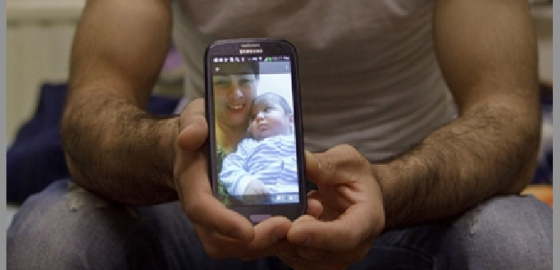
Rustam Nazarov displays a photo of his late son Umarali on the screen of his telephone. Photo: Elena Lukyanova

Two news agencies, TASS and Fontanka.Ru, announced the cause of Umarali Nazarov’s death on the evening of November 6. How and why journalists were informed before his mother, father, and their defense attorneys is a question for police investigators. The reporters quoted finding reaches by experts from the Petersburg Bureau of Forensic Medicine (BSME), but did not identify where they had received the information. Sources at the BSME told Novaya Gazeta they had not leaked any documents to the media.

“No one besides certain journalists has seen the conclusions of the forensic experts,” Olga Tseitlina, an attorney for the injured parties, told Novaya Gazeta in an interview. “We have not formally reviewed them, but we have announced that this is another violation of the rights of the injured parties. At the same time, on both November 5 and November 6, Zarina Yunusova (Umarali’s mother), Rustam Nazarov (his father), and their defense attorneys were at the investigative department for a long time, but investigators said not a word about the fact the findings of the forensic examination were ready. Until we have the official report of the experts, we cannot even petition the court to conduct an independent investigation. We have not been apprised not only of the findings but also of the official decision to order a forensic examination, meaning that we were deprived of the opportunity to ask additional questions and propose our own forensic experts.”

On the morning of October 13, 2015, the Federal Migration Service raided a rented flat at Lermontov Prospect, 5. They detained Zarina Yunusova, a 21-year-old citizen of Tajikistan and her young son, who were both taken to Police Precinct No. 1. There, Yunusova was separated from the infant, transported to court, and released only in the evening. The child was handed over to ambulance brigade medics and sent to Tsimbalin Children’s Hospital, where he died in the early hours of October 14.

At first, doctors said the preliminary cause of death was URTI. Later, members of the Human Rights Council (HRC), who conducted their own inquiry into the infant’s death in Petersburg from October 26 to October 31, said the cause of death was SIDS. According to the findings of forensic experts, as reported on November 6, the boy died from a CMV infection.

The news agencies published the following quotation from the report: “The cause of Umarali Nazarov’s death was a disease, a generalized (CMV) infection. The infection was complicated by the onset of cardiopulmonary disease. No traces of ethyl alcohol, narcotics or powerful medicaments were found in the child’s internal organs.”

As sources at the Petersburg BSME explained to Novaya Gazeta, a generalized (CMV) infection attacks nearly all the vital organs. According to the tests carried out, the virus did not incubate in Umarali overnight. It had already managed to attack his respiratory, cardiac, and gastrointestinal systems. The baby was diagnosed postmortem with pneumonia, dystrophy of the liver, dystrophy of the pancreas, stomach dysfunction, alterations of the adrenal gland, chronic inflammation of the small intestine (enteritis), cerebral edema, and spinal edema. The pathologists stressed that the child could have contracted the CMV infection even in his mother’s womb.

Umarali’s parents do not believe the findings as reported. They assure us their son was never ill and had no health problems. Nazarov’s medical chart shows that he had received all the necessary vaccinations for a five-month-old child. There is also written confirmation that until the moment of his death the baby looked healthy: the entries in his medical chart, in the report filed by the ambulance medics, and in the logbook at Tsimbalin Children’s Hospital.

Doctors from Tsimbalin Children’s Hospital have now been making mutually exclusive claims in the media, for example, that CMV infection is not amenable to visual diagnosis, that it can be diagnosed only after a comprehensive examination, and that outwardly CMV infection can manifest as URTI. So was it possible to notice the symptoms of the disease or not? Why, then, did none of the doctors notice anything for ten hours, that is, until the baby died?

“I want to remind everyone,” says Ilya Shablinsky, a member of the HRC commission that investigated Umarali Nazarov’s death, “that we have the intermediate results of several examinations of the children, by the paramedics from the ambulance brigade when the boy was hospitalized and twice by doctors at the hospital, at 2 p.m. and 4 p.m. Everywhere they write that the baby is healthy, his temperature is normal, and he has a good appetite. The parents have every reason not to trust [doctors and police] and be afraid. What happened to their son between 2 p.m. and midnight, after which time he died? Regardless of what gets written now in the autopsy report, this has no impact on the accountability of police officers. The main conclusion that the HRC commission reached was that police officers exceeded their authority by removing the child from his mother and should be brought to justice. Umarali died not in his mother’s arms, but twelve hours after he was separated from her. This is a crime, and it is mentioned in the HRC’s report, which will be sent to President Vladimir Putin in the coming days.”

Petersburgers expressed their condolences to Umarali Nazarov's family by bringing flowers to the Tajikistan Consulate on Fonarnyi Pereulok in Petersburg. Photo by the Russian Reader, October 30, 2015
Petersburgers expressed their condolences to Umarali Nazarov’s family by bringing flowers to the Tajikistan Consulate on Fonarnyi Pereulok in Petersburg. Photo by the Russian Reader, October 30, 2015

“There still has been no procedural decision on the actions of the police officers who removed the child from the mother, although all the deadlines for this have come and gone long ago,” continues Olga Tseitlina. “Aside from their own standing orders, the police officers at the very least violated the Family Code and the European Convention, which prohibit separating parents and children in such cases. We have never stated that the police killed the child, but we do claim that it removed him illegally and that this certainly caused harm. If the child had been with his mother, we do not know whether he would have died or not. And even if he was infected with a deadly virus, the question remains as to how long he would have lived. The state failed to protect the infant’s life, and now it is not investigating [his death]. The investigation is not looking for the perpetrators but attempting to establish the parents’ guilt. First, they attempted to prove that the child was poorly looked after, that he lived in poor conditions, and had caught cold. When that hypothesis did not pan out, they said the child died of a virus. All the efforts of the investigators we have seen so far have been directed towards finding an explanation that suits everyone involved in the tragedy. The reported findings of the cause of death completely jibe with the original position adopted by the police, the FMS, and the doctors: no one is to blame. I do not know whether the true causes of Umarali Nazarov’s death will ever be established, but I am ready to go to the European Court of Human Rights to prove that the investigation has been improper.”

Police investigators have failed to inform the parents not only of the findings of the forensic medical examination but also of the outcome of the autopsy done at the city morgue in October. Because of this and many other actions taken by investigators, the Tajikistan Honorary Consulate in Petersburg sent a note of protest to the city prosecutor’s office and the Main Investigative Department of the Petersburg Office of the Russian Federal Investigative Committee. The Tajikistan Consulate voiced its dissatisfaction with the lack of transparency in the criminal investigation of five-month-old Umarali Nazarov’s death.

Direct Quotation

Rustam Nazarov, Umarali’s father:

We do not believe the child had this disease. There was nothing that would indicate [he had] any disease all his life. Umarali was never ill. We understand why this is happening. The authorities cannot take responsibility for the child’s death, but they torment us. They shift the blame on us: we have a bad apartment; we have bad blood. But I do not think those are their problems. They have one problem: to find out how and why our child died. And we want only one thing: to find out how and why our son died. We do not believe that anyone will be punished for this. We just want to know.

________

Parents of deceased Tajik boy forcibly taken to hospital
November 10, 2015
Fontanka.Ru

Parents of the five-month-old Tajik boy who died in St. Petersburg [in October] were forcibly taken to the Botkin Memorial Hospital for Infectious Diseases.

Tajik diaspora lawyer Uktam Ahmedov has informed Fontanka.Ru that today the police forcibly took the parents of the deceased Tajik infant Umarali Nazarov, Rustam Nazarov and Zarina Yunusova, from [their flat] on Lermontov Prospect to the Botkin Hospital for tests. Ahmedov said that police wanted to check them for the presence of the her

Ahmedov said the virus is present in ninety percent of the population, but police want to use this alleged piece of evidence to blame the parents for infecting the boy.

According to Akhmedov, no charges have been filed under Article No. 156 of the Russian Federal Criminal Code (dereliction of duty in the upbringing of a minor).

Tatyana Maleva: People and Oil Don’t Mix

Demolishing the Population’s Income Is a Big Mistake by the Authorities
Yevgeny Andreyev
Special to Novaya Gazeta
October 17, 2015
Novaya Gazeta

Why the government prefers oil to people, why poverty could touch half the population, and why social services are losing out to defense spending

Tatyana Maleva. Photo: TASS

In previous years, when it submitted the latest draft budget to the Duma for consideration, the government repeatedly emphasized its social focus: it was all about people, they would say. Now, as the 2016 budget is being worked out, the authorities prefer not to think about this. Spending on the most people-focused items—education and health care—will be significantly reduced. Despite annual inflation’s soaring to nearly 16%, public sector wages will not be indexed at all, while old-age pensions will be indexed only by 4%. Tatyana Maleva, director of the Institute of Social Analysis and Forecasting at the Russian Academy of National Economy and Public Administration (RANEPA) told us how the social sector would cope with all these blows.

Based on your analysis of the projections for the 2016 budget now being submitted to the Duma, which of the social sector issues do you see as most acute?

Those caused by the insufficient indexation of old-age pensions. The government has chosen the most economical solution to this problem.

A 4% indexation does not correlate at all with the expected outlook for inflation. Thus, the budget risks reducing the real value of pensions.

The acuteness of the problem is amplified by the fact that, if we look at the history of incomes in post-reform Russia over the past twenty-five years, we see that pensions have fallen lower than all other sources of income such as wages and benefits. Only in 2010, thanks to the valorization of pension rights [a one-time increase in the monetary value of the pension rights of citizens with time in employment before 2002Y.A.] and pulling the minimum pension up to the subsistence level, we pushed the real value of pensions to where it had been at the outset of reforms in the nineties. It had taken twenty years to restore the purchasing power of pensions. But now, during a crisis, they are being demolished again by the budget under consideration. This is a big mistake by the authorities.

But why? After all, budget cuts are not the government’s whim, but hard necessity dictated by the economic crisis.

As events of the last two years have shown, there are basically only two kinds of resources in this country, oil and people. The price of oil has collapsed, but the people are still here.

It is people who are, in fact, the most reliable of all resources. Sooner or later, investment in people produces economic growth. Oil, on the contrary, is impacted by circumstances unconnected with the Russian economy; we cannot influence the market price of oil. It turns out that one key resource makes us hostage to the situation, while we are voluntarily refusing to support the other resource. So I would argue that during the crisis we should look for ways to support people and even risk a larger budget deficit if necessary. Most economists, including me, are forecasting a long crisis. It is only beginning, and demolishing people’s real incomes right at the outset of the crisis is fundamentally wrong.

How painful will the decision to partially index pensions be?

The government thinks that indexing pensions by 4% will affect only the 38 million pensioners. This is misleading. Models of consumption and survival are based not on individual strategies, but on the strategies of households, meaning families. Around 40– 45% of Russian families include pensioners. The experience of the nineties tells us that even miserly pensions, when they were paid, served as a safety cushion against poverty in families when their younger member lost their jobs or faced nonpayment of wages. Because, in this case, pensions support the household’s minimum consumer budget and act as social insurance. Consequently, the forthcoming partial indexation of pensions will reduce the budgets of 40–45% of Russian households. Meaning that the real impact of this decision will be the growing risk of poverty not among pensioners but among nearly half the country’s population.

The government contends that real incomes have fallen by 2–3%, and real wages by 9–10%. Do you agree with these figures?

At one time, incomes showed a more moderate decline, but now they are rushing [downwards] hot on the heels of wages. Because the factors that were propping up incomes, including pensions, have ceased functioning, and incomes are going to fall, maybe even lower than wages. Over the last year, we have experienced a huge reduction in incomes. Basically, the entire growth they had achieved over the previous three or four years has imploded. And there is no reason to expect the growth will be restored. The decline might simply slow down due to arithmetic: the base for comparison will decrease from month to month, and therefore the rate of decline in real wages may turn out to be 7–8%, not 9–10%. But this does not alter the fact the population’s income is likely to be reduced.

How hard is inflation hitting people’s wallets?

Apparently, by year’s end we will be seeing 13–15% inflation. It is inflation that has a total effect on all incomes by devaluing them, regardless of social classes and age groups. But the risks that emerge among different social group because of high inflation are different. For examples, employees face the risk of job losses and cuts in nominal wages. This is already happening. We see cuts in benefits, reductions in allowances, and the axing of bonuses around the country. Moreover, while individuals are capable of combating other causes of income reduction such as job loss or reduction in wages by looking for a new job or retraining, they can do nothing to withstand inflation.

The number of poor people in Russia increased sharply over the past year—by three million people. Are the authorities capable of dealing with this scourge, or does everyone just have to wait for a rise in oil prices?

It is appropriate to recall how poverty has evolved in Russia. In the nineties, over 30% of the population was poor, but this was shallow poverty. When economic growth began in the nineties, poverty was significantly reduced. Many poor Russians moved into the so-called sub-middle class, rather than sinking into outright poverty. Economic growth reduced poverty levels relatively easily all by itself, without a restructuring of social benefits, without support for various social groups. But as soon as the country shifted from growth to recession, this seemingly happy trajectory turned into a disaster for us. Since, during the “fat” years, a reasonable system of targeted social support for the poor was not established, we are now reaping the consequences of its lack. Very many types of social support were eliminated in 2015, and certain “visionary” regions gutted many social benefits as far back as late 2014. Therefore, poverty will grow, and in this sense, indeed, the only hope is a hypothetical rise in the price of oil.

If the price goes up, there will be more money in the budget, and maybe benefits will return. But I am not so certain of this. It is absolutely not a fact that federal revenues are converted into institutions of social support. I think that in this case there will be a serious struggle with a high probability of the social sector’s losing to the military-industrial complex.

The country made this choice long ago, and it is clearly not going to be revisited.

The official unemployment rate in Russia has not exceeded 6%, which is quite a favorable figure by international standards. At the same time, there is lot of evidence that hidden unemployment has grown. What is your overall assessment of the employment sector?

Indeed, 6% is not a high figure at all. Actually, a low unemployment rate has been traditional in Russia in all phases of the economic cycle, whether the economy has been in growth, crisis, boom or recession. Over the quarter century that Russia has been living in the market economy, it has not really experienced unemployment. But economic laws still apply, and during crises, pressure on the market increases. Ultimately, the market extends possibilities for part-time employment, and this can be interpreted as hidden unemployment. People are willing to work a full workweek, but employers offer them part-time work, either half a day or two or three days a week.

The labor market has formed a kind of social contract under which employers save on costs by not dismissing employees, because the Labor Code forces them to bear exorbitant costs when letting employees go. Employees remain employed, which gives them the chance to earn seniority. And the state pretends not to notice any of this, because it also has a stake in the situation. It saves on unemployment benefits and thereby reduces its financial obligations.

Overall, how has the current economic crisis aggravated social problems in the country? Are there factors capable of causing society to protest and take political action?

It is not just the matter of the crisis. Long-term factors are also capable of impacting the social sector. Even during phases of economic growth, many social processes in Russia were not entirely favorable. Take demographics: the long-term trend has been determined by previous generations, and it cannot be changed. Nothing can be done about the fact that each successive generation in Russia will be smaller than the previous generation.

Furthermore, if we look at a longer trend, we have to admit that wages and other types of income have fallen undeservedly much lower than GDP has sunk. This has predetermined very many processes in the economy. Low-wage labor and a low-income population cannot be effective. We have repeatedly been taught this lesson over the last twenty-five years. Coming to terms now with a drop in incomes and wages means recognizing the inefficiency of our human resources. Yes, of course, no one gets rich during a crisis. But it is not a worsening of social tensions in the country due to a sharp collapse in incomes that we should be afraid of. We should be afraid of social apathy, of the population’s withdrawing into itself and washing its hands of the situation. From the socioeconomic viewpoint, this is a step backwards. This apathy can hold us back for many decades. And even if drivers of economic growth do emerge in Russia, and we expect that people will respond quickly, this might not happen.

But what is the source of this apathy?

In the nineties, the population really lent a helping hand to economic reforms by a creating a strong platform for the informal economy. Everyone predicted that society would explode, but it did not happen. The population thus gave an advance to the government that was carrying out reforms. The country managed to make this incredibly difficult transition from one type of economy to another. The people’s patience was rewarded. We are seemingly now in the same situation. However, our vector is pointing down, not up. The current patience of Russians might pull the country down. The population has not been integrated into this economy; it has not become its subject. It has elaborated its own behavioral trajectories, tactics, and strategies, which do not correspond in any way to state policy. The state and the populace lead separate lives.

Are you not idealizing the nineties? After all, even now, during a crisis, people’s living standards and incomes are much higher than they were then.

What saved people from hunger and many people from death in the nineties? First, grassroots unorganized trading, whose symbol was the famous shuttle traders. A huge informal trading sector was formed, flea markets emerged, and so on. But this sector ultimately disappeared, losing out to powerful commercial chains. Second, a powerful sector of private household plots formed in small towns and villages in the nineties. Even if they provided no cash income, people lived off the land. During the years of economic growth, this sector has turned into dacha villages with lawns, and has also ceased to exist as a source of subsistence for households. Third, a small business sector took shape in some form, albeit a specific form with many negative traits. Nevertheless, there was entrepreneurial freedom. Now, all attempts to get small business on its feet have led to nothing. The administrative obstacles erected in recent years have shut the door to the big economy for small business. Fourth, by the early noughties, a small but noticeable nonprofit and NGO sector had been established in Russia. Now, many of these organizations have been labeled “foreign agents.” Formally, [many of] the NGOs continue to operate, but they do not have the ability to act freely as they see fit.

These are the four legs that have been sawed off the Russian market economy stool, and it will not be able to stand up without them. The set of factors that prevented social catastrophe in the nineties is no longer functioning.

Maybe other mechanisms will be developed, but so far I do not see them. So everything is going to depend on the speed, depth, and duration of the crisis. But if we proceed from the most probable assumption, that the crisis will shift into a protracted, sticky recession, the quality of services will fall, despite the fact that, purely superficially, universities, schools, and clinics will continue to function. We do not know yet how the population will respond economically to these challenges. It has very few options. In fact, its only option is to wait for mercy from the state. People have been prevented from taking care of themselves.

Translated by the Russian Reader. Thanks to Ilya Matveev for the suggestion.

Soldiers Who Refused to Go to Donbass Sentenced to Prison

Maykop Contract Soldiers Who Refused to Go to Donbass Sentenced to Prison
Yevgeny Titov
October 13, 2015
Novaya Gazeta

Contract solders from Military Unit No. 22179, located in Maykop, have been sentenced to prison terms. Anatoly Kudrin has been sentenced to six months in an open penal settlement, while Alexander Yevenko, Ivan Shevkunov, Alexander Yenenko, and Pavel Tynchenko received one year each. Alexander Yenenko, who communicated most actively with the press, got the longest sentence [sic].

“It is disgusting,” says Svetlana Kimnatnaya, Ivan Shevkunov’s mother. “All the character references were positive, tons of peoples vouched for my son, and many people from the unit supported him. We had been hoping for probation.”

In autumn 2014, soldiers from Military Unit No. 22179 in Maykop were transferred to the Kadamovsky Firing Range in Rostov Region [eighty kilometers from the Ukrainian border]. Subsequently, contract soldiers left the range in large numbers. Many filed letters of resignation, which were not given due consideration by the unit’s commanding officers. The contract soldiers complained of poor living conditions and feared they would be sent to fight in Ukraine.

Regarding the conditions of their military service, the contract soldiers said they had been forced to sleep on boards, and there had often been no electricity and proper food. The topic of Ukraine had surfaced because separatists from the Donetsk People’s Republic were encamped near the Kadamovsky Firing Range. According to the soldiers’ parents, the separatists had agitated among the soldiers, offering them money to go fight in Donbass.

Subsequently, a group of soldiers was charged under Article 337.4 of the Russian Federal Criminal Code (absence without leave for over a month). It later transpired that among other things they had not been paid the money due to them for temporary duty travel. One of the men, Alexander Yevenko, a veteran of the conflict in Chechnya, was ultimately paid thirty thousand rubles.

Alexander Yevenko
Alexander Yevenko

During the course of the investigation, another soldier, Alexander Yenenko, repeatedly informed Novaya Gazeta about illegal investigative methods, the use of psychological coercion, and threats. To verify this information, Novaya Gazeta sent a request to the Chief Military Investigation Department of the Russian Federal Investigative Committee. According to their reply, they cannot comment on the matter.

Alexander Yanenko
Alexander Yanenko

Alexander Yevenko (not to be confused with Alexander Yenenko) has said he intends to appeal the decision of the Maykop Garrison Military Court. The appeals hearing in his case will take place October 22 in the North Caucasus District Military Court in Rostov-on-Don.

Translated by the Russian Reader. Photos by Yevgeny Titov. See his previous article on this conflict, “Why Are Maykop Contract Soldiers Resigning?” from the July 15, 2015, issue of Novaya Gazeta (in Russian). See also “Prison terms for Russian contract soldiers who refused to fight in Donbas,” Belsat TV, October 14, 2015 (in English).

To Remember: Last Address Returns to Petersburg

Чтобы помнили

To Remember
Natalya Shkurenok
June 27, 2015
Novaya Gazeta Saint Petersburg

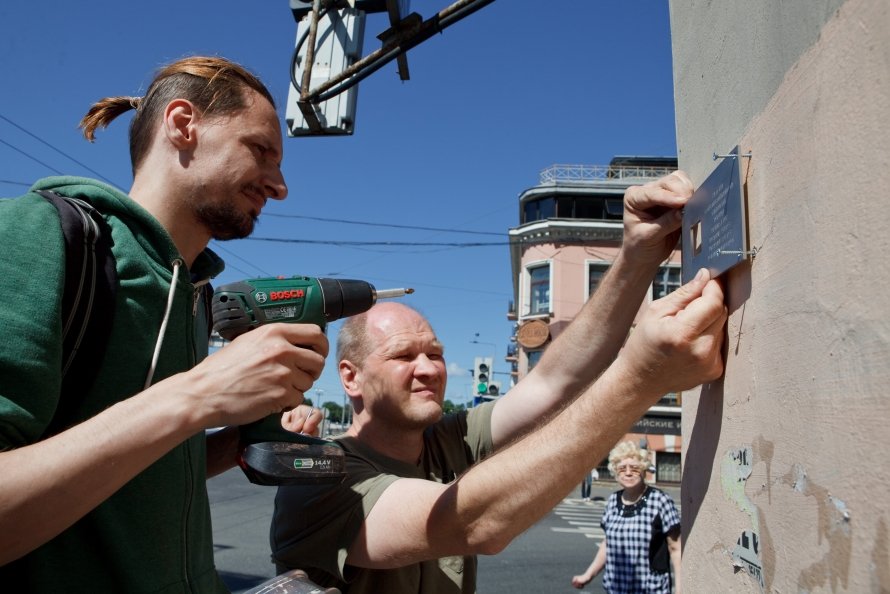
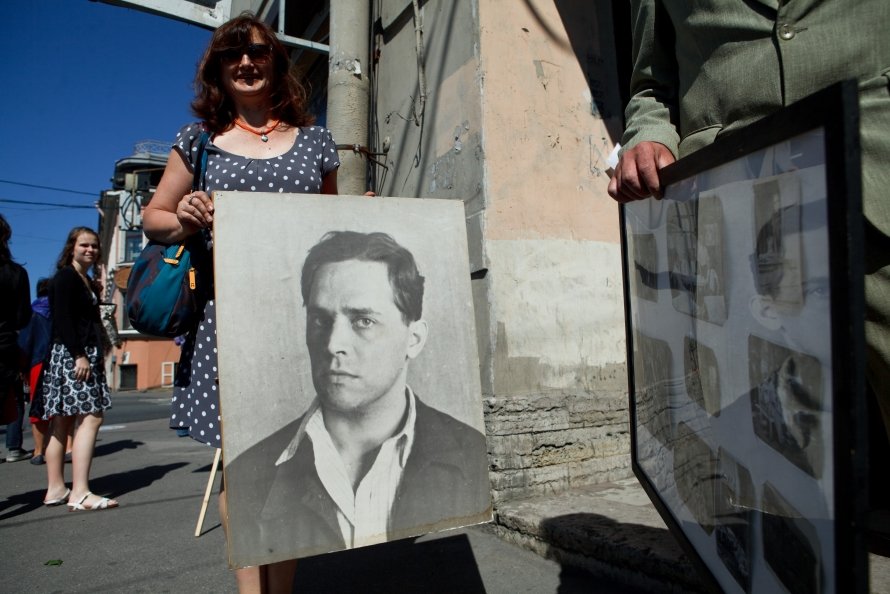
Last Address’s installation of memorial plaques brings us back to real history, to understanding the past and the present, without which the future is impossible.

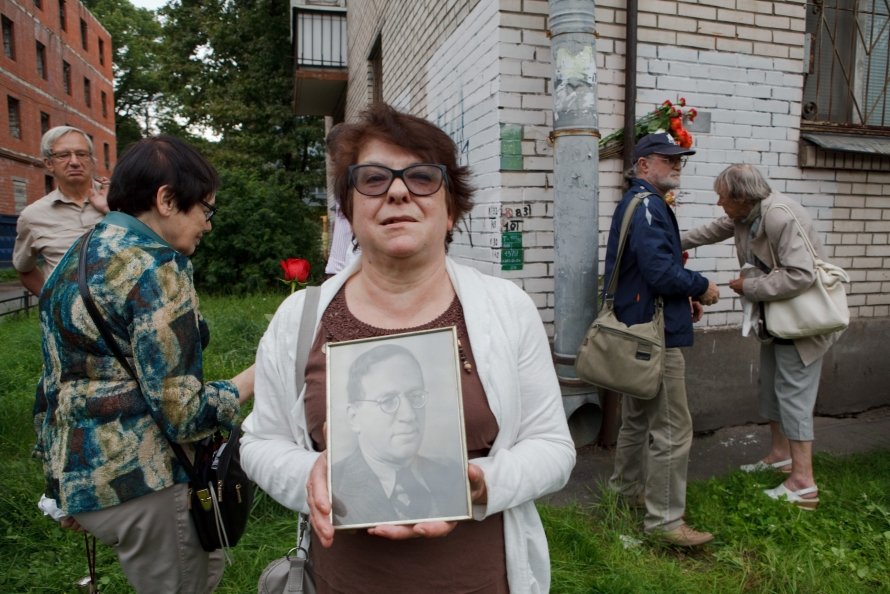
In Petersburg this past weekend, memorial plaques appeared on six more houses, memorializing nine more people and reminding the living about the terrible turns Russian history has taken. It would be no exaggeration to call these people the cream of the crop, the salt of the earth: academics, engineers, artists, teachers, and physicians. Without people like them, no society can survive, but these people do not even have graves.  But there are relatives, friends, and kindred spirits whose hearts are moved by the ashes of the innocent victims.

On the Basis of Ethnicity

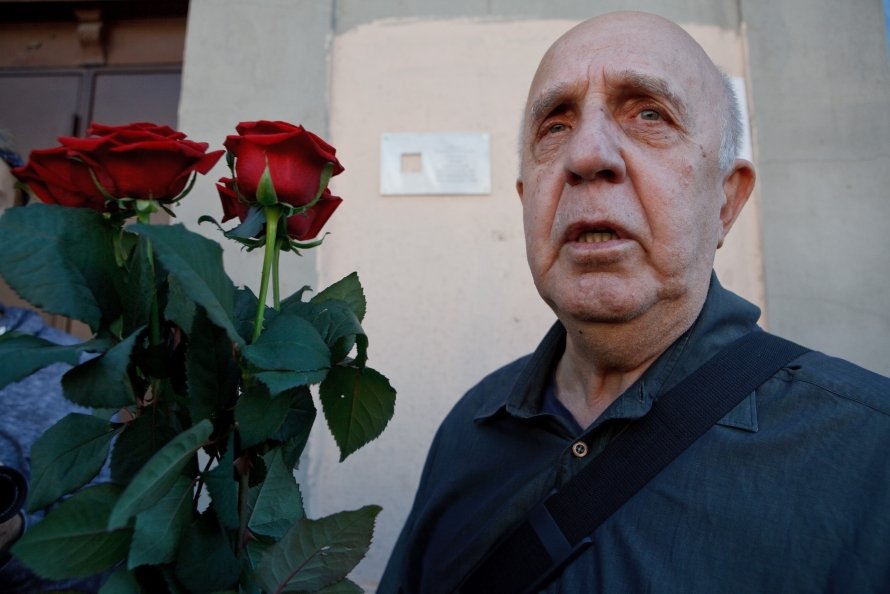
“I am attending my father’s funeral after seventy-eight years,” says a tall elderly man holding a bouquet of red roses and barely hold backing his tears.

Then he falls silent, places the flowers on the pavement next to the wall of house No. 1 on Maly Prospect, Petrograd Side, and steps away, covering his face with his hands.

When Stanislaw Kozlowski, an engineer at the Plastics Factory, was arrested in the summer of 1937, his son had been born only a month earlier. Two weeks later, his father was shot. His mother’s sister, who took him in, saved little Henryk from life in the camps. His mother was released only in 1947, followed by the 101st kilometer, a ban on living in Leningrad, and a life in Volkhov, an industrial town 122 kilometers east of Leningrad. During Khrushchev’s Thaw, as former victims of political repression, they were given a room in Leningrad, but by that time Henryk had already graduated from the Polytechnic Institute, and sharing a room with his mother was uncomfortable. He first worked at Krasnoyarsk, Bratsk, and Ust-Ilim hydroelectric stations, then in Syria.

“My father was a Pole. He went to the Polish school at Saint Catherine’s Church on Nevsky,” Henryk Kozlowski told Novaya Gazeta. “Eight of them were shot dead all at once. They had gone to school together and maintained relations. They were declared spies, just like everyone else then. But if it had only been them! Do you see that stadium over there? Imagine that in just two years, 1937 and 1938, two such stadiums of people were shot, nearly 42,000 people.”

Before the war, the well-known Leningrad artist Bronislaw Malachowski had lived in the same building. He was the same Malachowski who conceived and drew Smart Masha, the heroine of very popular children’s comics strip. The prototype of Smart Masha was the artist’s own daughter Katya. Malachowski also modeled Malvina and Buratino, for Alexei Tolstoy’s new book, on his own children, Katya and Dima.

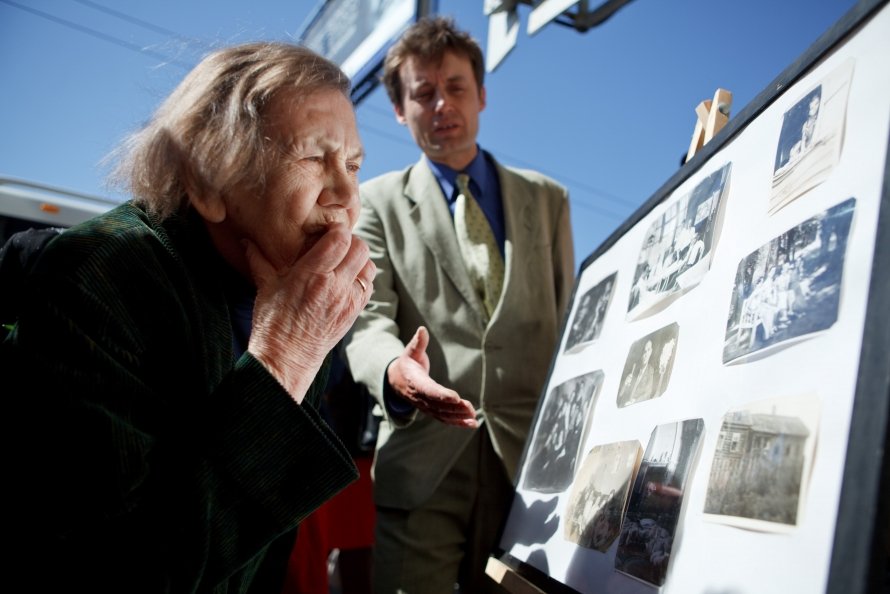
On Saturday, the corner house, Maly Prospect, Petrograd Side, 1/3 (at the intersection with Zhdanovka Embankment), looked like a street exhibition on opening day, complete with stands containing photos, original graphic works on easels or simply propped against the wall, and a dense ring of viewers, perusing photos and works that few of them had seen before.

“That is my grandpa, and that is Nappelbaum, and here is my grandmother,” says Vasily Malachowski, Bronislaw’s grandson, pointing to the photographs. “Leningrad artists, actors, and writers often gathered at their house, and Grandpa was friends with Alexei Tolstoy.”

In the summer of 1937, when parents and children were vacationing in the Pushkin Hills, Bronislaw was taken, never to be seen again by his family.  His wife, Maria, and son and daughter were deported from Leningrad, first to Kazakhstan. Later, they moved to the Perm Region. Soon Malachowski was shot. His descendants never returned to the apartment on the Petrograd Side. The NKVD confiscated the artist’s entire archive, including his artworks, sketches, and architectural designs. What happened to the archive is still unknown. Maria died in 1948. She was back in prison again for violating passport regulations.

The children were adopted by the famous artist Natan Altman and his wife, who was the aunt of the Malachowski children. Katya studied at a ballet school in Moscow, while Dima stayed with the Altmans. A graduate of the geography department, he defended his doctoral dissertation. His son, Vasily, the artist’s grandson, studied at the Leningrad State University geology department. But his daughter Stanislava has followed in her great-grandfather’s footsteps. A graduate of the Stieglitz Art and Industry Academy, she has collected a huge amount of material on her family’s history and its Polish roots.

“Grandfather and grandmother were innocent victims,” argues Vasily. “Unfortunately, their lives were short and tragic. But now people who never knew them have taken an interest in them and begun to love them, and this is an instance of immortality. If the soul is kind and good, it always manifests itself and will go on living in kind hearts.”

Science? Kill It!

Perhaps only a few people now remember the name of Arkady Borodin, a professor of history and law. Scant records of his life have been preserved in the archives of the Library of the Academy of Sciences (BAN), where he worked in his final years, and in the case files of the so-called Academic Affair, a tragic page in the history of Russian scholarship. Between 1929 and 1931, the OGPU fabricated a criminal case against a group of scholars in Leningrad. In 1924, Borodin was dismissed from the university as a hereditary nobleman, and from 1925 to 1929 he was in charge of the alphabetical card catalogue at the BAN. In 1931, Borodin was sentenced to ten years in prison. He served part of his sentence in the Solovki prison camp before being transferred to construction of the White Sea Canal. He died near Medvezhyegorsk in 1932. Borodin’s last address was Bolshaya Pushkarskaya, 1. Now, at the behest of his granddaughter, a memorial plaque has been erected there.

A memorial plaque has also appeared on the 11th Line of Vasilyevsky Island, No. 44, whence the famous mathematician and meteorologist Boris Izvekov set out on his final journey.

“I saw my father for the last time from way over there, on the 10th Line,” says Tatyana Bulakh-Izvekova, the scientist’s daughter, pointing. “We left the house, and Dad saw us off, gazing out the window. We never saw each other again. This was his last address. He was arrested here. The two windows on the third floor were his study.”

Case No. 555 is a terrible testimony to the destruction of scientists in Leningrad at the very beginning of the war. This story began in the late 1930s, however. In the mid 1990s, the famous Russian writer Yaroslav Golovanov published an article entitled “Executioners and Victims: Case No. 555” in the magazine Ogonyok. The article discusses NKVD staff informant Yevgeny Merkulov, also known as TV. In the late 1930s, his insinuations led to the arrests and imprisonment of over thirty scientists. But at the beginning of the war, in late 1941, the Leningrad NKVD launched a massive case against the “counterrevolutionary activity” of corresponding member of the Academy of Sciences Ignatovsky and his “group” in order to prove its need to stay in the rear. Based on TV’s denunciations, between the fall of 1941 and the winter of 1942, over 130 scientists, professors, and lecturers (physicists, mathematicians, and geophysicists) were arrested, shot, tortured, and sent to labor camps.

“I don’t know where father died. Golovanov wrote that it happened during transportation to the camps, but I never have found out where and when,” says Tatyana. “Most likely, he died in an internal NKVD prison. I am so glad that I have at least some memorial in place of a grave.”

Rereading Him Again

Grigory Gukovsky, a prominent Soviet literary scholar, university lecturer, and Pushkin House fellow also has no grave. Gukovsky was arrested twice: in 1941, for “counterrevolutionary propaganda” (but was soon released for lack of evidence), and in July 1949, as part of the fight against “cosmopolitanism.”

“There was an arrest and search,” recounts Gukovsky’s great-granddaughter Kira Dolinina, a well-known Petersburg art historian, critic, and lecturer at the European University. “The case was closed due to his death. All this papers were destroyed, including manuscripts of articles and books he was working on. Our family doesn’t have a single document about the family. The man was left to rot, the documents went missing.”

Dolinina and her mother read Gukovsky’s case file in the FSB archives. The telling interrogation reports produced a terrible impression: the interrogation lasted eight hours, but the minutes take up only two pages.

“What were they doing the rest of the time? Torturing him, beating him?” asks Dolinina. “What we were able to read confirmed our guess: my great-grandfather and his brother Matvei Gukovsky were arrested as part of the Leningrad Affair. Hence the investigator for special affairs, and the fact the case was investigated in Moscow. All the case material makes it clear the NKVD was interested in Alexander Voznesensky, rector of the university. So it was not a matter of ‘combating cosmopolitanism.’”

Yuri Lotman, Georgy Makogonenko, and Grigory Byaly were Gukovsky’s students. When information spread on the internet that a memorial plaque to Gukovsky would appear on the house that now stands at 13th Line, 56, his relatives began receiving poignant letters.

“Hello, Kira! My name is Nelly Venskaya. I am eighty-seven years old and studied with your renowned great-grandfather. […] It was not easy to get into Gukovsky’s lectures in 1949. Places in the auditorium were occupied in advance, because, in addition to Leningrad University students, students from all the institutes of higher learning tried to cram in, students from the construction institute, the medical schools, the pedagogical institute, and the polytechnic. They sat on the windowsills, the floor, and the piano, under the piano. The lectures were broadcast in the corridors and the lobby. […] The last cycle that we were lucky enough to hear were his brilliant lectures on Pushkin. The next subject was Gogol, and we were looking forward to the explosion of wit, unexpected comparisons, and profound revelations. […] But no one ever heard that cycle.”

“In Russian literature studies Gukovsky was the principal researcher of eighteenth-century literature,” says Andrei Kostin, academic secretary at Pushkin House. “He got the collected works of Radishchev published, and was a brilliant researcher. Gukovsky shaped the Soviet view of the entire eighteenth century. His death and the loss of his manuscripts are an enormous tragedy for Russian scholarship.”

Family Saves the World

The Belenky-Bogdanov family has preserved the memory of their forebears, who lived at Bolshaya Pushkarskaya, 39, on the Petrograd Side, in the late 1930s. One summer morning in 1937, first the father, Pavel Belenky, a bookkeeper, was taken away from their small room in a communal flat, then the mother, Lydia Bogdanova, a housewife. Their son Vladimir survived. He is is now eighty-five years and lives in Moscow. Because of poor health Vladimir was unable to attend the installation of the commerorative plaque. Instead, his grandson Arseny, great-grandson of the murdered Lydia Bogdanov and Pavel Belenky, came to Petersburg for the ceremony.

“I remember this. I think it is impossible to forget,” said Arseny Belenky during the installation ceremony. “I have a son, whom I will definitely bring to Petersburg and show him the house where his ancestors once lived.”

Almost the entire Dauman family gathered in Petersburg for the first time since 1937 for the installation of a plaque commemorating their forebears. Abram Dauman, who received his education as a surgeon in Germany, operated on the wounded on the front during the First World War. For this he received personal nobility and personal arms, and was awarded the Orders of Saint Stanislaus and Saint George. Learning about the awards, his colleagues commissioned the orders from respected jewelers at their own expense and presented them to Dauman as a token of their profound respect.

Ilya Dauman practiced shorthand. He had his own technique on which he wrote a textbook.

The Dauman brothers moved to Nekrasov Street, 6, in 1924. The whirlwinds of the revolution had brought them from Harbin.

“From my father’s stories I know that when they came to arrest grandfather, my father, who was still little, was told, ‘And you, boy, go to sleep,’” recounts Alexei, grandson of the murdered Abram Dauman. “My dad was taken in by his aunt’s family, although her husband was also arrested, interrogated, and tortured. They cut off four of his fingers, but he did not confess to anything, signed no papers, and was ultimately released.”

First, the older brother, Abram, was arrested. The younger brother, Ilya, was on a business trip in Yekaterinburg at the time.

“His relatives wrote to him not to come back, that his brother had been arrested,” recounts William Rozenson, nephew of the murdered men. “But he replied that he hadn’t done anything and he came back. He was arrested immediately. His wife, although she had divorced him, did not abandon her husband and was also exiled.”

Descendants of the family live in different Russian cities and different countries. One of them could not make the trip to Petersburg from Brazil. But for all of them this house on Nekrasov Street is one of the most important places on earth.

Photos by Yelena Lukyanova

Translated by The Russian Reader. You can read about the Last Address project’s first visit to Petersburg, in the spring of this year, here.

The Russian State of Mind in Stormy Weather

A State of Mind in Windy Weather
Galina Mursaliyeva
October 1, 2014
Novaya Gazeta

A conversation with psychologists about hatred, aggression, the Russian mentality, cognitive breakdown, the loss of social sensitivity, and society’s lack of self-confidence

The side mirror showed that the cars in the next lane were a safe distance from me. I switched on my turn signal and merged. I realized right away the mirror had deceived me. My car was almost a millimeter away from the front bumper of a black jeep: I had rudely cut off this “stealth” car. It was clear in a situation like this that no one would try and figure out whether this had been done purposely or accidentally. I was ready, or so I thought, for anything. I knew the other driver might deliberately overtake me and brake abruptly right in front of me. And yet, I wasn’t expecting what happened next. When the person in the car I had cut off drove his jeep in front of me for the second time, I deftly avoided a collision by moving into the far left lane, meaning he simply had no way to pursue me. But he found a way: he drove down the oncoming lane and once again put his jeep in front of me. This time I turned on the emergency lights and stopped. He walked up to my car.

“Well?”

“Well what? Yes, I made a mistake. Yes, I could have caused an accident. But do you realize that after this you did something that could have got us killed?”

“So what? Maybe I would have kicked the bucket, but I would have taken you down with me.”

article-2209927-154136D1000005DC-491_634x360

There was not a shadow of doubt in his eyes, whitened with anger: one could “kick the bucket” for the sake of punishing one’s offender.

It is not that I recall this incident often, but that I have never forgotten it. Because I saw in a highly condensed form what has been happening with people everywhere—on roads, in supermarkets, on social networks.

“She was the godmother of my son, who is now twenty years old. I was very fond of her, and we were very close, but now that she supports all these Makareviches, I am forced to unfriend her. She has turned into a reptile,” writes a woman on a social network.

Those who call themselves liberals are no better. There is a new photo of a famous person who has more or less spoken out in favor of “Crimea is ours” posted several times a day on Facebook. People batter and pelt the photo with words like stones. “Another one has caved in.” “Creep.” “He used to be my favorite actor. Burn in hell.”

There is an amazing trait that unites everyone these days—their means of expressing hatred. “Fascists,” “traitors”: that is what everyone calls each other. And the verbs are also the same: everyone has “sold out,” either to the Americans or Putin.

You have to kill someone and eat them to take their power. Well, or poison yourself.

Dmitry Leontiev (head of the International Laboratory of Positive Psychology of Motivation and Personality at the Higher School of Economics, doctor of psychology, professor in the psychology department at Moscow State University, and Viktor Frankl Prize winner): It reminds me of an essay by Hegel, published two hundred years ago, “Who Thinks Abstractly?” He gives an example: you go to the market, and a market woman tries to sell you apples. You try them and say, No, I won’t buy them; they’re a bit sour. The market woman says something like the following to you. It is my apples that are sour? You are sour yourself, and you have a sour mug. And who the hell are you to give my apples a bum rap? I remember your parents: they were layabouts! So she begins to generalize: you were only talking about the taste of the apples, but in response she—

Attacks you personally?

Leontiev: The personal attack is only a detail. But here everything is brought into play, the broadest contexts. Hegel calls this generalization “abstract thinking.” According to him, it is the market woman, rather than the philosopher or scientist, who thinks the most abstractly, because she cannot focus on anything specific and generalizes everything. From my point of view, this is what is happening in our society. The great philosopher Merab Mamardashvili, who for me is quite comparable with Hegel, said, “The devil plays with us when we do not think precisely.”

And the devil is playing with us now: we have stopped thinking precisely. Say, neither the Ukrainians themselves nor we understand clearly what is really happening in Ukraine. But the huge number of people who never for a moment doubt they know exactly not only what is happening now but also what will happen next horrifies me. The number of clairvoyants and seers has gone off the scales. And the farther they are from the scene of events, the more accurately they know everything.

What is the cause of this epidemic?

Leontiev: It is a symptom of cognitive breakdown. Criticalness—the ability to filter incoming information, separate fact from fiction, and soberly assess the limits of one’s own knowledge—is considered one of the main mechanisms of the mature mind. Now it would appear that all the natural filters have come undone. The mind ceases to function: it just swallows readymade packaged texts and spits them back out. As soon as you try in a debate to clarify or specify something, your opponent, like Hegel’s market woman, responds by expanding the topic of the conversation to infinity, entwining anything whatsoever into it. This is the most important method of the usually unconscious manipulation now being used: lumping everything together. The topic of the conversation becomes fuzzy, and a lot of details irrelevant to it are entwined in the conversation.

The meaning of the word “opinion” has been devalued in our country. Any nonsense that occurs to someone is labeled an opinion. This assumption that all opinions are equal is a product of so-called postmodernism. Earlier, when experts were asked for their opinions, it was assumed they were the products of intellectual work in the fields in which the experts were professionally employed. It is then that real discussion can unfold, and we can find someone who can be trusted.”

Nowadays, on the contrary, there is often no trace of analytical and intellectual work in what are commonly referred to as opinions. A person gets some “kind of, like” bit of information from somewhere in left field. These “opinions” are not rooted: they can easily switch to their direct opposites. So I am very skeptical about the figure of eighty-five percent of the population who, according to pollsters, now support everything the Russian president does in Ukraine. This is largely a weather phenomenon. The wind has inflated this degree of support, but when it blows in the other direction, it will fall below zero.

You mean the majority of Russians have a heightened psychological “meteodependency” on the political climate? On the stance of the authorities?

Leontiev: What is the “Russian mentality”? Everything said about the peculiarities of the Russian psychology wholly conforms to the psychology of a normal child. This includes a rich mental and emotional life, but a spontaneous one. Hence the inability to control oneself, to keep promises. Small children can be quite cruel: they do not know what pain is, and do not value life. Our country has had a prolonged childhood; we have not succeeded in growing up. Life, both one’s own and that of others, has a low value.

Many things are caused by the inability to link cause and effect. There is no sense of time, of the dynamics of change: Russia is worried about territories, about not giving an inch. We have virtually no social institutions. The State Duma is like a kindergarten during naptime, when the minder has left the room. Everyone is bawling about his or her own thing.

Maybe it is time to replace the concept of “state of mind” with the concept of an “instinctual state”?”

Leontiev: I would rather speak about a state of mind in windy weather. Thinking is energy consuming, and people who have failed to grow up find it easier to throw words around. The fundamentals of humanity’s survival are simple and sound. They unite rather than divide people, despite all their differences. For example, it is good when people live, and bad when they die and kill, even under the most plausible pretexts. But we have a divided society, and in this situation it is important not to contribute to the polarization. It is a virus that has infected the country

Olga Makhovskaya (fellow at the Institute of Psychology of the Russian Academy of Sciences, Ph.D. in psychology, and writer): I would say that what is happening today is a reflection of the country’s biggest fault: we have frittered away our values. When they answer any question—whether to fight or not fight with Ukraine or the whole world, whether they are for or against Putin—people are guided by their fears rather than values. And I can say that there, at Maidan, even before the war the protest was not as encapsulated as it is in our country. Encapsulation is when everything happens in cliques: I go to a protest rally with my friends, but as for everyone else, I do not really know or understand how they live. When there is no overall consolidation, you are among a circle of friends but in a society of strangers. It is extremely difficult to get past the bouncers at the door. In Ukraine, there is definitely not this stark opposition between the intelligentsia and people of the land, for example. There, the latter are in fact the most respected, because the land will always feed you, whatever the regime. And these are grounds for personal dignity. They have greater reserves of values there than we do. There is a Russian proverb that says money cannot buy you love. But there is no comprehension that money cannot buy you anything valuable at all—neither freedom, life, talent nor friendship. It is these things that have failed in Russia today.

I think it is not just a matter of events in Ukraine. This segment of people who think alike, a whopping eighty-five percent, is also encapsulated. A person who is willing to kill someone else and himself in the process is not trying to clarify your stances on these issues. He is just ready to kill.

Makhovskaya: From my point of view, the figure of eighty-five percent is rather an indicator of society’s extreme lack of self-confidence than of public opinion. When a survey on happiness, for example, is conducted, and the vast majority says it is insanely happy, politicians see this as a lovely figure. But any psychologist will tell you that such uniformity indicates a state of helplessness. This is a society of old people and little children—of old people, who suffer from diminished intellect and have no future, and of children, who because of their age cannot be independent.

What is happening in our country today—the intolerance and hatred—is directly linked to the state of being in an axiological and normative vacuum. The social psychologist Durkheim called this condition “anomie.” It happens when old institutions, functions, and norms have been destroyed, and new ones have not yet formed. The main conditions for the emergence of a new set of values are the consolidation of society and an optimistic view of the future. But in Russia, values are promoted that divide people and narrow their horizons: money, power, and pleasure. Transient values camouflage the lack of eternal values—“Thou shalt not kill,” for example—of the old conservative attitudes to work, education, patience, love, and mercy.

Perhaps the Soviet legacy could also be making itself felt in this case. At school, we were made to memorize Nekrasov’s lines “The heart grown weary of hating / Will never learn to love.” But no one told us about the saying of Confucius: “If you hate, it means you have been defeated.”

Makhovskaya: What we remember in childhood is quite important, because we pass it on to our own children as a cultural code. If you cannot love because you cannot hate, it means you must hate: it is a terrible thing, of course, to send this message to schoolchildren. But nowadays there are no less alarming signals, first and foremost, the loss of sensitivity among most citizens. Social sensitivity is a sympathetic attitude to the problems of groups of people to which the individual himself or herself does not belong. Television has “scorched” its viewers by constantly raising the sensitivity threshold.

Why does everyone call each other fascists nowadays? What is the cause of this?

Makhovskaya: It is similar to the children’s game of good guys and fascists [i.e., something like the Anglophone games cowboys and Indians or cops and robbers]. Psychologists believe that the unbearable fear of death is overcome in such children’s games. Given the depth of the trauma caused by World War Two, a trauma passed from generation to generation in Russia, the power of post-traumatic stress syndrome and the relief a small victorious war gives to “inflamed” consciousness are understandable. Despite the fact we won World War Two, psychologically we have been left unappeased, inconsolable, and uncertain that it will never happen again. On the contrary, we have always been reminded that the enemy never slumbers, that we have to be prepared. We live with the convulsive readiness to attack or flee. Sooner or later, individuals cannot contain themselves and enter into conflict; an insignificant occasion can serve as the trigger. The abusive fascist phraseology comes from this same source.

There is another factor that affects how events are perceived—group favoritism. Members of one’s own group are perceived as better, more educated, smarter, prettier, and broader-shouldered.

I will illustrate what you are talking about with a quotation from writer Zakhar Prilepin: “[U]krainian POWs and Russian POWs differ even physiognomically. The Russians are whiter; their eyes are more bewildered and kinder. [The Ukrainians] are darker. They do not look you in the eye; there is something hunted and angry about them at the same time. Almost all of them are shorter than me.”

Makhovskaya: It is a classic example. When we at the Institute of Psychology of the Russian Academy of Sciences studied how Soviet viewers perceived Americans during the first spacebridges with the US, we discovered that a couple weeks after the programs people could not recall either the faces of the “enemies” or what they had said. But as they tried to recall what they had seen, they confidently insisted the Americans were “reptiles.” They recalled the “good guys” in detail, with a tendency to add height, texture, and beauty: the people who had gone out to do battle with the ugly dwarfs from the US were simply cartoonish epic heroes.

Sadly, the level of our psychological culture is such that we do not cope with these cognitive distortions. Even more frightening is that this is the level of the politicians and their servants who induce hatred and broadcast negative stereotypes to the whole country.

__________

Editor’s Note. I usually do not have much truck with psychologistic explanations of political and social phenomenon, especially when it comes to Russia, where even before the onset of Putinism 3.0, the popular, public and academic discourses, both liberal and nationalist, were lousy with all-encompassing exegeses of Russian society’s ills (or virtues) based on a supposedly unique, perennial or horribly mutated (as a result of Stalinism, serfdom or perestroika—take your pick) mindset or mentality shared by most Russians or certain classes in Russia. The article translated above certainly possesses many of this approach’s defects, but in its own clumsy way it gives some insights into the zeitgeist in the country right now, details usually ignored or dismissed by, say, local leftist commentators, eager to inscribe everything going on into a more palatable, boilerplate “anti-capitalist” narrative. Whether we like it or not, the sheer hysteria of recent months and its effects on people’s sense of their possibilities, responsibilities, and limitations becomes a factor in political and public life every bit as material and potent as the Putin oligarchy’s need to bolster its financial fortunes or generate new venues for state-sponsored highway robbery.

Photo courtesy of The Daily Mail