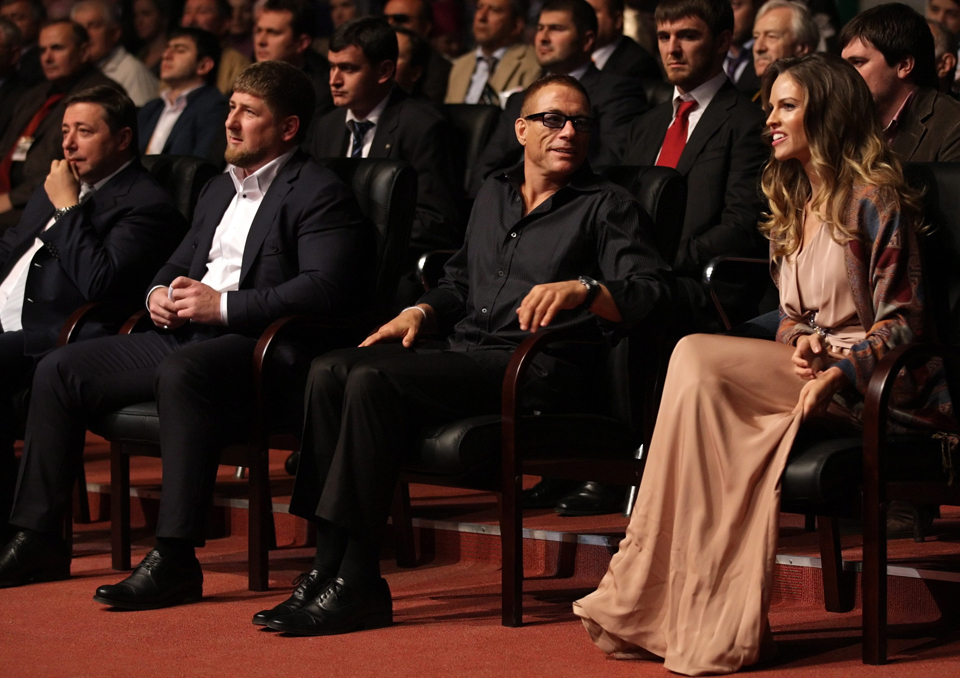
Chechen leader Ramzan Kadyrov, Belgian actor Jean-Claude Van Damme, and American actress Hilary Swank look on during a ceremony to mark Chechen leader Ramzan Kadyrov’s 35th birthday and City Day celebrations in Grozny, Chechnya, October 5, 2011. Photo by Maxim Shipenkov/EPA
ECtHR Rules in Case of Zarema Gaisanova, Who Disappeared without a Trace in Chechnya Mediazona
May 12, 2016
Gaisanova disappeared in 2009 after a special security operation personally led by Chechen leader Ramzan Kadyrov. According to human rights activists, Gaisanova, an employee of the Danish Refugee Council, was abducted and probably murdered.
Her interests were represented at the ECtHR by the Memorial Human Rights Centre and the European Human Rights Advocacy Centre (EHRAC, London). In Russia, the case was handled by lawyers from the Joint Mobile Group of human rights activists in Chechnya.
The ECtHR ruled that the Russian authorities were responsible for Gaisanova’s abduction and probable death. The court found that Article 2 (right to life), Article 3 (prohibition of torture and inhuman or degrading treatment), and Article 5 (right to liberty and security) of the European Convention on Human Rights had been violated.
Translated by the Russian Reader. Photo courtesy ofGigapica
Manmade Savagery
Tatiana Kosinova
April 7, 2016 Cogita.ru
Tonight, police detectives in Petersburg arrested student Sergei Kosyrev, who confessed to the murder of journalist Dmitry Tsilikin. Kosyrev has dubbed himself the Cleaner and claims his motive for committing the murder was hatred.
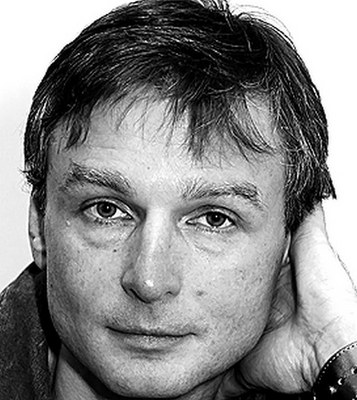
Slain Petersburg journalist Dmitry Tsilikin. Photo courtesy of Cogita.ru
On the morning of April 7, 2016, the website of the Russian Federal Investigative Committee’s Petersburg office reported that the office had detained a suspect in the murder of journalist Dmitry Tsilikin.
Tsilikin’s death was discovered on March 31, 2016. Relatives founded his body, covered with multiple stab wounds, in his own apartment. Investigators opened a case under Article 105.1 (murder) of the Russian Federal Criminal Code.
Fontanka.ru’s Yevgeny Vyshenkov chronicled the search for Sergei Kosyrev in the early hours of April 7, 2017. Vyshenkov writes that after studying billing recordings of the journalist’s mobile telephone, investigators intercepted the 21-year-old Kosyrev, who had called Tsilikin on the morning of March 27. Investigators had established that the journalist bled to death at five p.m. on March 27, 2016.
According to an article published today by Fontanka.ru, the murder suspect “called himself the Cleaner during questioning, and his life a crusade. Sergei Kosyrev, a 21-year-old student at the Hydrometeorological University, explained that the crime was a mission […] a crusade against a particular social group, […] and the feeling he had when he, allegedly, killed Tsilikin, was not dislike, as written in the arrest report, but hatred.”
Investigators have informed the media that Kosyrev holds right-wing views and is a fan of the Norwegian black metal band Emperor, whose “drummer stabbed a man to death in Lillehammer in for ideological reasons” in 1992.* Komsomolskaya Pravda writes that Kosyrev might turn out to be a “serial killer of gays.”
The gloomy stories involving the unsolved deaths and injuries of gays in recent years cry out to be seen as symptomatic.
As Masha Gessen wrote in The New York Times yesterday, “What no one has written in response to any of these deaths is that the Kremlin’s antigay campaign, which simultaneously pushes people underground and communicates to the public that homophobic violence will go unpunished, ensures that these shameful killings continue.”
Like the rest of the country, Sergei Kosyrev, a student at the Hydrometeorological University, has lived for the last four years in an atmosphere of increasing hatred for LGBT, “fifth columns,” “foreign agents,” and a whole list of official aliens and others compiled by official propagandists and state media. The security services do not see their actions as incitement of hatred and enmity, because they are busy searching for “extremists” among opposition-minded journalists, politicians, and lone picketers. However, the atmosphere of hatred and savagery is manmade, and sooner or later culpability will catch up with the people who have generated it in the shape of a war of all against all.
Translated by the Russian Reader
Correction. When this post was originally published, it contained a link to a different article on Fontanka.ru, not the article containing the passage cited by Tatyana Kosinova, in which it is alleged that suspected killer Sergei Kosyrev referred to himself as “the Cleaner,” etc., during question by police. I apologize for my error. May 18, 2016. TRR
* On 21 August 1992,[Bård “Faust” Eithun] stabbed Magne Andreassen, a gay man, to death in a forest just outside Lillehammer. Eithun was visiting his family there. He went to a pub and had a drink, but “the atmosphere didn’t suit him, so he decided to head home.”According to Eithun, while walking in the Olympic park, “this man approached me – he was obviously drunk and obviously a faggot […] it was obvious that he wanted to have some contact. Then he asked me if we could […] go up to the woods. So I agreed, because already then I had decided that I wanted to kill him, which was very weird because I’m not like this.” Eithun carried a knife because, as he explained: “It’s better to have a knife you don’t need than to not have one when you need it.” Once in the woods, Eithun stabbed Andreassen 37 times and then kicked him in the head repeatedly as he lay on the ground.
Eithun claimed that he felt no remorse at the time. In the late 1990s, he said of the murder: “I was outside, just waiting to get out some aggression. It’s not easy to describe why it happened. It was meant to happen, and if it was this man or another man, that’s not really important.”Ihsahn, his bandmate in Emperor, said that Eithun “had been very fascinated by serial killers for a long time, and I guess he wanted to know what it’s like to kill a person.”
The media has linked the murder to black metal and speculated that Eithun was motivated by Satanism or fascism, but in a 2008 interview he explained: “I was never a Satanist or fascist in any way, but I put behind me the hatred and negativity. Those feelings just eat you up from inside.” In a 1993 interview he had said “I am not a Satanist, but I praise the evil.” In an interview for the book Lords of Chaos he explained he had been “interested in Satanism but there are other things as well. Basically, I don’t give a shit.”Jørn Tunsberg of the band Hades Almighty said that the murder was “an impulse killing” and that “it had nothing to do with black metal.”
Boris Nemtsov was murdered exactly a year ago. Some of the men who organized and carried out his murder have been caught, but the name of the person who ordered the killing remains a mystery.
On February 27, at least 20,000 people in Moscow took part in a march in memory of the opposition politician, who was murdered right outside the walls of the Kremlin. Apparently, the march’s organizers did not expect such a large number of attendees, counting, apparently, on a more intimate event for Nemtsov’s friends and supporters. There was, accordingly, almost no political rhetoric on display except for ritualistic slogans such as “We remember,” “Russia will be free,” and “Free the political prisoners” (inescapable in the current circumstances).
However, the anti-crisis march Nemtsov himself had planned for March 1, 2015, consequently did not take place, and no one from his entourage contemplated doing anything like it during the year that followed his death.
For the second year in a row, the event was a memorial. The slogan on one placard, “I’m speechless,” was the apotheosis of this helplessness. The crowd was mostly silent. Only here and there did marchers sing the Marseillaise or shout anti-Putin slogans, but almost no one among their fellow marchers repeated the slogans. The homemade placards were even fewer than usual, although the sunny pre-spring weather clearly lifted people’s spirits.
The demonstrators, however, had not come to downtown Moscow just for a stroll but to express their mutual disagreement with something that, alas, no one bothered to articulate. Today’s Nemtsov memorial march resembled a political rally without a political agenda.
—anatrrra
___________
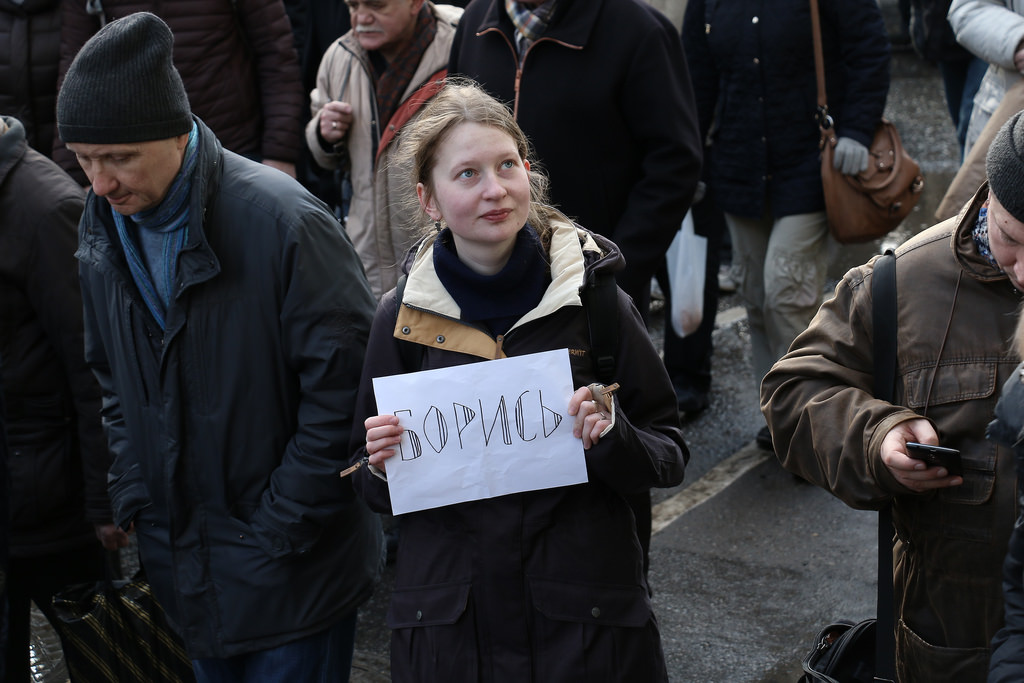
“Fight Back.” In Russian, the phrase (Boris’) is a play on Nemtsov’s first name (Boris). Photo by and courtesy of anatrra
Putin Proclaims National Idea Fontanka.ru
February 3, 2016
In Russia, there can be no other unifying idea than patriotism, argues President Vladimir Putin, as reported by TASS.
“This is, in fact, the national idea,” the head of state announced during a meeting with the Leaders Club, which brings together entrepreneurs from forty of the country’s regions.
According to Putin, this idea is not ideologized and is not linked to the work of a particular party, reports RIA Novosti.
“It is a common rallying point. If we want to live better, the country has to be more attractive to all citizens and more effective,” the president stressed.
_________
Who Killed a Transsexual in Ufa and Why? Ufa1.ru
February 2, 2016
On Monday, February 1, Angela Likina was stabbed in the chest and killed in Ufa. The Ufa resident had gained notoriety in 2014, when a video recorded on a traffic police dashcam entitled “Ufa Traffic Cops Stop a Transvestite” [sic] went viral on the Web. Ufa1.ru found out who killed Oleg Vorobyov, who had changed his sex and become Angela Likina, and why.
Angela Likina. Photo courtesy of Ufa1.ru
The controversial video from the traffic police car dashcam recorded an inspector checking the papers of a female motorist. It transpired, however, that the motorist’s name, according to his internal passport, was Oleg Vorobyov. The inspector was very surprised by this. The motorist was a transsexual who had been preparing for a sex change operation for several years, becoming Angela Likina. The restricted video was leaked to the Web.
Later, the State Auto Inspectorate conducted a review of the incident, because the restricted footage should have not ended up on the Web. Angela Likina also commented on the video herself. She was surprised the incident had provoked so much interest among Web users.
“People die in accidents, children get hurt, cars are stolen, blood is needed to save someone’s life. Gentlemen, why are you setting records for likes and reposts about me? I honestly don’t understand,” said Likina, adding, “I don’t care how you live, what you do, and so on, so long as you are alive, healthy, and happy. But my life does not concern you in absolutely any way.”
How Did Oleg Live?
Ufa1.ru spoke with friends and acquaintances of Angela Likina, who talked about the life of the murdered woman. We found out this sad ending had emerged from a number of factors. Before becoming Angela Likina, Oleg Vorobyov had been married. Acquaintances confess that, outwardly, the couple were seemingly happy. They were raising two daughters, now aged fourteen and nine. The family lived in a private house, which also housed Oleg’s auto repair garage. Many of the people with whom we spoke said automobile owners were satisfied with Oleg’s work, that he had a magic touch.
Over five years ago, Oleg realized he was living in someone else’s body. He understood he wanted to change his sex and become the person he thought he was. Oleg began calling himself Angela Likina and started the complicated process of preparing to change his sex. He took hormone pills and began dressing like a woman. According to his internal passport, however, he remained Oleg Vorobyov. He could only change his name after finally changing his sex.
Five years ago, the Vorobyovs divorced, but the former husband and wife and their two children kept living under the same roof. The house was the wife’s property, and her former husband had an established business there. Several of the family’s acquaintances believe that Angela did not want to lose her income from the auto repair garage and spend money on renting a place to live. After all, she had to save up a large sum of money for the operation, and the medicines she took to prepare for the procedure were expensive. Close friends emphasize that Angela worked a lot, sometimes seven days a week.
At the same time, Ufa1.ru’s sources noted the Ufa resident simply had no choice.
“He once tried to rent a flat, but was kicked out. A neighbor had said, ‘I don’t want my children to see this!’ Consequently, he was evicted and didn’t even get his money back,” said one of our sources.
Friends of the family noted that those who have lived under the same roof with ex-spouses can imagine the atmosphere that prevailed in the Vorobyov house. Some say that the rows over living arrangements caused the Vorobyovs to come to blows. Things were aggravated by the fact that the head of the family had become a woman. Their children also became the targets of reproaches and ridicule at school.
“They would come home in tears, and sometimes refuse to go to school, but Angela loved her daughters and gave them a lot of time,” acquaintances noted.
Who Killed Angela?
According to friends, a boyfriend came to visit Oleg’s ex-wife on the ill-fated evening. The criminal investigation will shed more light on what exactly happened in the house. For now, the family’s acquaintances have their own hypotheses. Perhaps the man intervened in yet another family row. Maybe he stood up for his girlfriend and wanted to intimidate Angela by demanding she pack her things and leave. The row, however, escalated into something bigger.
“She was stabbed in the chest near the heart. She did not die immediately. She made it to a neighbor’s house, told him what had happened and who had done it, and an ambulance was summoned. Then Angela died in the neighbor’s arms. It was apparently too late to help her. I don’t know what was happening in the family. Angela was a good person, but strangers often beat her up. Her neighbors respected her choice. It is a bad thing when a person steals, kills or rapes, but everything else is a private matter,” said an acquaintance of Angela’s.
“The best human qualities—kindness, fairness, compassion, and unselfishness—were powerfully manifested in her. Unfortunately, that is a rarity nowadays. And she really never held a grudge against anyone, although there were a fairly large number of people who wished her ill. Most of them, it is true, were people who did not know her at all. They insulted and mocked her. You could say she was understanding about it: far from everyone in our city, or even our country, is ready to comprehend the decision to have a sex change. And that is another reason I have endless respect for her: the determination to go her own way to the end, to change her life fundamentally, the willingness to take one and overcome all the difficulties,” another girlfriend of Angela’s confided to Ufa1.ru.
“Apparently, Angela sensed her impending death. Not long before this she had asked forgiveness from her wife for all the rows that had happened between them,” said another family acquaintance.
__________
Fire at Moscow workshop kills 12 people, including 3 children Boston Globe
January 31, 2016
ASSOCIATED PRESS, JANUARY 31, 2016, MOSCOW — A fire at a textile workshop in Moscow has killed 12 people, including three children, officials said.
The victims were not identified but were reportedly immigrants.
The Investigative Committee, the top state investigative agency, said the fire broke out late Saturday in northeastern Moscow, damaging more than 32,000 square feet of the structure.
Investigators said they are looking at negligence or arson as possible causes.
Russia’s children’s rights ombudsman, Pavel Astakhov, said Sunday on his Twitter account that three children were among those who died, including a baby. He said the victims were migrant workers who lived next to their workplace.
Several dozen fire engines responded to the blaze, and it took firefighters about five hours to extinguish the blaze.
Investigators continued to sift through the rubble Sunday for evidence.
Many immigrants work in Russian factories, some of which have been investigated for hazardous working conditions. In April, a blaze on the outskirts of Moscow killed 17 migrant workers.
__________
The death toll of Kyrgyz citizens (according to the Embassy of the Kyrgyz Republic in the Russian Federation):
1. Sajida Masaliyeva, born 1988. Home address: Village of Kyzyl-Bel, Batken District, Batken Region.
2. Toktokan Saliyeva, born 1983. Home address: Village of Tayan, Batken District, Batken Region.
3. Uulkan Saliyeva, born 1997, sister of Toktokan Saliyeva.
4. Isa kizi Aizat, born 1995. According to available information, Isa was a native of the Village of Kaiyndy, Batken Region.
5. Milikajdar uulu Koshonbay, born 1990.
6. Tologon Kozuyev, born 1991.
7. Manas, born 1995; brother of Tologon Kozuyev; no other details.
8. Daniel, 4-5 years old, son of Ergeshbay Japarov, a Russian national who perished in the fire; born in the village of Rout, Batken District, Batken Region; according to the victims, Daniel was a citizen of the Kyrgyz Republic.
[Elena Bobrova:] You are something of a patriot yourself?
[Nikolai Kolyada:] How else should I relate to Russia? I love her whatever she be like. Like Gogol I can tell the whole unvarnished truth about her. And Nikolai Vasilyevich said such awful things about Russia. He sobbed bloody tears when thinking about the country. But not because he hated it. On the contrary, because he loved it. When foreigners start speaking badly about Russia, I begin to boil: “Shut up, it is none of your business. I have the right to say anything about her, but you do not.” Well, it is okay when Europeans or Americans sling mud at us: they have a hard time coping with the fact we are different, unpredictable, and freer than they are. But when our own people hate their own country, that is terrible. This morning, I was reading Facebook and I thought, “Why do you live here if you hate Russia so much?”
[Bobrova:] But you just said yourself we have a right to chew out Russia because we live here.
[Kolyada:] Chew out but not hate. But Facebook is just seething with hatred.
—Excerpted from “20% of the Petersburg audience are loonies,” Gorod 812 (print edition), February 1, 2016, page 34
Items one, two, four, and six translated by the Russian Reader
When Will We Hear “Shoot Them like Mad Dogs”?
Boris Vishnevsky echo.msk.ru
January 13, 2016
“Enemies of the people,” “traitors,” “nothing is sacred,” “dancing to tune of western intelligence services,” “tried, with maximum severity, for sabotage.”
These are not snippets from a 1937 edition of Pravda or a speech made at a Party meeting during the same period.
This is how Ramzan Kadyrov, head of the Republic of Chechnya, speaks of the opposition to Vladimir Putin and his regime.
For a complete resemblance to Stalin’s time all we are lacking are references to “monsters,” “humanity’s garbage,” and a “despicable bunch of scoundrels,” and demands to “wipe them off the face of the earth” and “shoot them like mad dogs.”
But never say never. We might hear these phrases soon as well.
Equating the opposition with a hostile force is a key feature of a totalitarian regime, which Russia is building at an accelerated pace.
In a normal country, after making such statements, Kadyrov, Jr., would be booted out of office overnight, at least.
In a normal country, however, he never would have been able to take office.
Boris Vishnevsky (Yabloko Party) is a deputy in the Saint Petersburg Legislative Assembly.
Putin ally says opposition should be tried as enemies of the people
Andrew Osborn Reuters
January 13, 2016
MOSCOW (Reuters) – One of Russian leader Vladimir Putin’s most high-profile allies has accused the opposition of trying to exploit the economic crisis to destabilize the country, using Stalin-era rhetoric to suggest unnamed individuals be put on trial for sabotage.
Ramzan Kadyrov, the Kremlin-backed leader of Chechnya, called the liberal opposition, which has only one lawmaker in the 450-seat parliament, enemies of the people, a phrase recalling language used during the reign of terror unleashed by Soviet leader Josef Stalin in the 1930s.
“Representatives of the so-called … opposition are trying to profit from the difficult economic situation,” Kadyrov told reporters, according to a statement issued by his office late on Tuesday.
“Such people need to be regarded as enemies of the people and traitors. They should be put on trial, with maximum severity, for sabotage.”
Opposition figures and rights activists said they were alarmed by his words with some suggesting the police should look into them.
Mikhail Kasyanov, one of the opposition’s leaders and a former prime minister, said: “There is no such concept in our constitution, but from Soviet history it is widely known that in Stalin’s time that is what they called anyone who thought differently … and that such people were liquidated.”
Battered by low oil prices, Western sanctions and a falling ruble, real incomes are on the slide in Russia for the first time in Putin’s 15 years in power, presenting the Kremlin with a challenge of how to stop discontent bubbling over.
Kadyrov made his remarks ahead of a Russia-wide parliamentary election in September amid so far only limited signs of social discontent.
Sergei Ivanov, Putin’s chief-of-staff, said on Tuesday “radicals and extremists” must be prevented from getting into parliament in that vote, raising fears among the opposition that they will find it harder to contest such elections.
Kadyrov, leader of Chechnya since 2007 and Putin’s most high-profile ally in the mostly Muslim North Caucasus area of southern Russia, did not name the opposition figures he thought should be put on trial.
Starved of access to state media and restricted by strict laws on protests, Russia’s liberal opposition is still reeling from the murder last year of Boris Nemtsov, one of its leaders.
One of the suspects awaiting trial for carrying out Nemtsov’s murder, Zaur Dadayev, used to serve in Chechnya’s police and was described by Kadyrov after the killing as a “true patriot of Russia.”
Nemtsov’s daughter has said she wants police to question Kadyrov in connection with the case. Kadyrov told a Russian radio station in October the idea he was a suspect was “total nonsense.”
Remembering Timur Kacharava Ten Years Later David Frenkel
Special to the Russian Reader
November 17, 2015
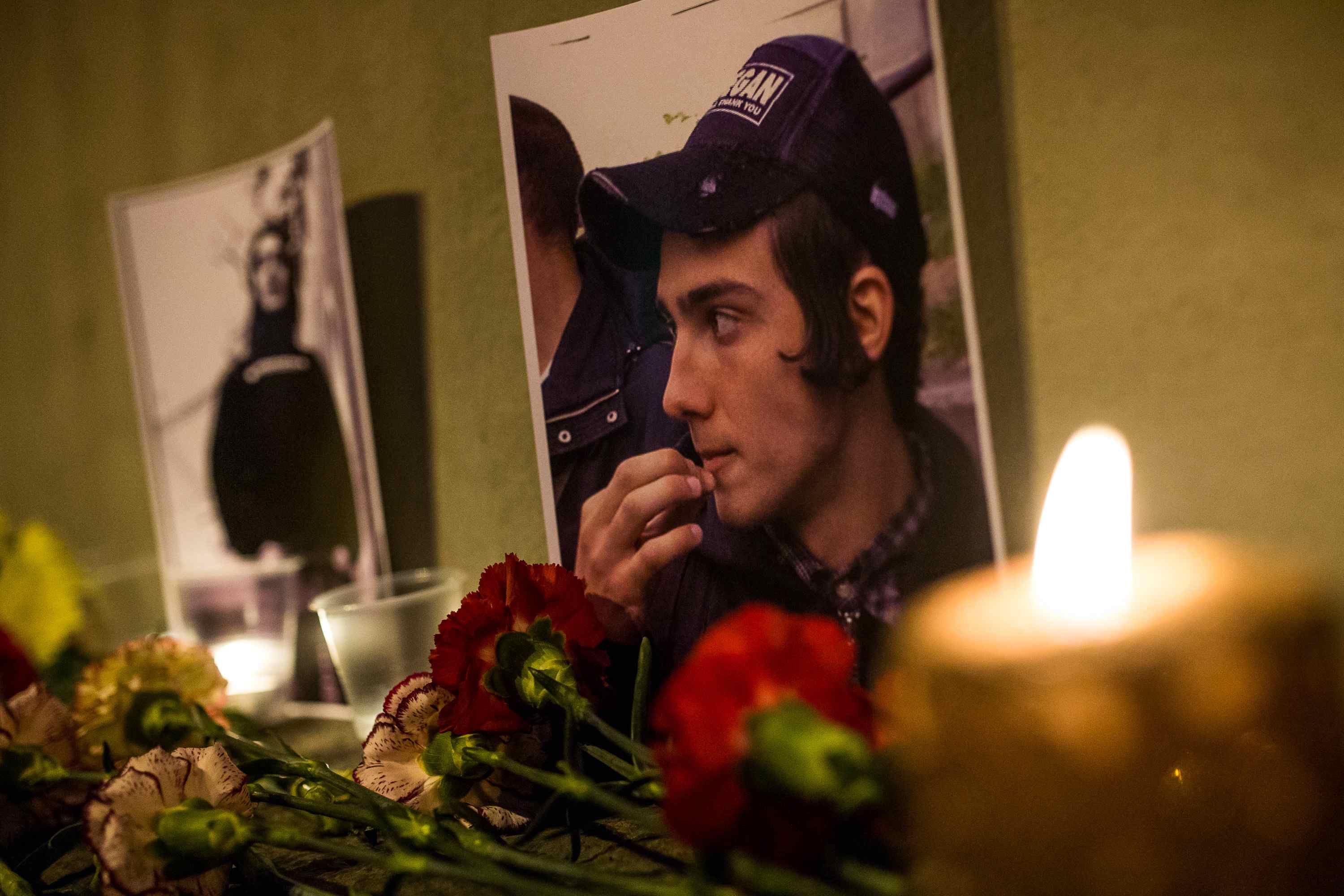
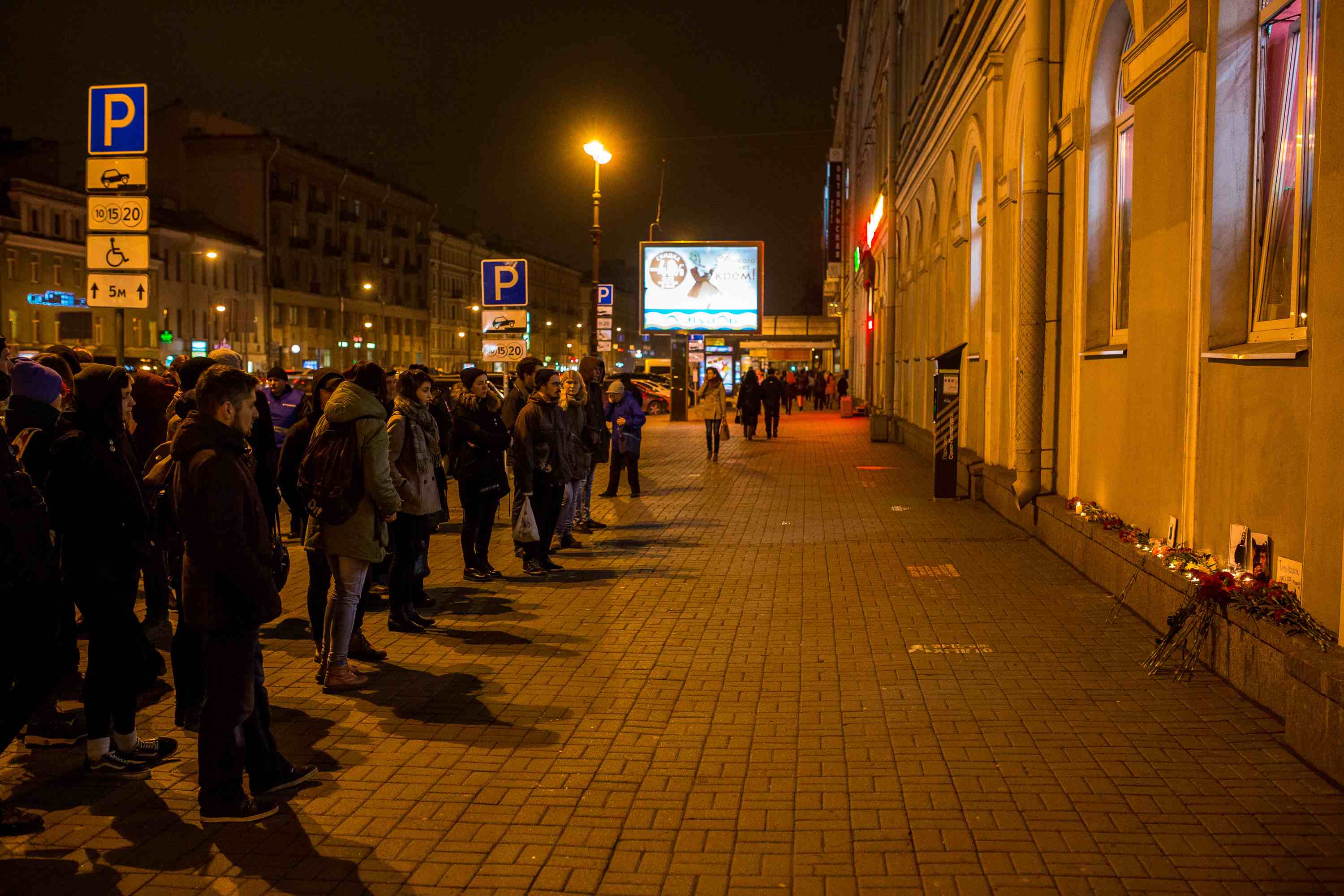
On the evening of November 13, 2015, more than fifty people gathered near the Bukvoyed bookstore on Ligovsky Prospect in the Vosstaniya Square area of downtown Petersburg to mourn anti-fascist and hardcore punk musician Timur Kacharava, who was murdered at the spot ten years earlier by Russian neo-Nazis.
Mourners gathered at the site of Kacharava’s murder on Ligovsky Prospect
In 2005, Kacharava and a friend were attacked by a group of young men after participating in a Food Not Bombs action in another part of the downtown. Kacharava was stabbed in the neck five times and died at the scene.
Kacharava’s murder alarmed certain segments of Russian society. Over three thousand students at Saint Petersburg State University, where Kacharava had been majoring in philosophy at the time of his slaying, petitioned President Putin to find and punish the murderers.
In December 2005, police arrested seven suspects who eventually confessed to the crime. In 2007, Alexander Shabalin was sentenced to twelve years in prison on charges of murder and incitement to ethnic or racial hatred. The other suspects were charged with inciting social hatred and sentenced to two or three years in prison. (Three of them were released on parole).
Since 2005, people have come to the crime scene every year on November 13 with flowers, candles, and pictures of Timur.
This year, police did not interfere with the mourners, although they asked them to remove pictures from the parapet and not to shout out any slogans.