Torture (The Case of Pavel Zlomnov)

mediazona-van
Illustration for Mediazona by Maria Tolstova. Courtesy of Mediazona

Man Who Said He Was Tortured by FSB Released from Remand Prison and Immediately Rearrested on New Charges 
Mediazona
January 31, 2019

Petersburg resident Pavel Zlomnov, who claimed he had been tortured by FSB officers, was released on his own recognizance on charges of arms trafficking (Article 222 of the Russian Criminal Code) and immediately detained on new charges, his brother Mikhail has informed Mediazona.

Zlomnov is suspected of having violated Article 205.1 Part 1 of the Russian Criminal Code: “public calls for terrorism, vindication or promotion of terrorism.”

“Today, he was released on his own recognizance in the old case that kept him in Remand Prison No. 6 for a year and was immediately detained as part of a new case,” said Mikhail Zlomnov.

According to the written order to institute legal proceedings, a copy of which Mediazona has in its possession, on October 31, 2018, Zlomnov, who was in Remand Prison No. 6, called the person who caused the explosion in the FSB’s Arkhangelsk office [sic] a “real hero of the people.” According to investigators, he also “publicly made appeals recognizing the ideology of violence, including appeals that were poetic in terms of their rhetorical structure [sic].”

The case is being investigated by the FSB.

Mikhail Zlomnov said that investigators have once again requested that his brother be remanded in custody. His custody hearing will take place on January 31.

Zlmonov was initially detained on January 31, 2018, on charges of arms trafficking. Zlomnov’s family reported that, when he was detained, FSB officers “jumped up and down on him, injuring his kidneys, head, and arm.”

Roman Grozdov, another defendant in the case, also reported being tortured.

Mediazona published a detailed account of the case in August 2018.

In late January of this year, Pavel Zlomnov’s brother Mikhail and their father Andrei, who are lawyers, were charged with insulting FSB investigator Dmitry Sablin, per Article 319 of the Russian Criminal Code, which makes publicly insulting officials a criminal offense.

Translated by the Russian Reader

Leonid Volkov: Hocus Pocus

sberbankThe homepage of Sberbank of Russia’s online banking service looks reassuring at first glance, although a warning in the bottom right-hand corner reads, “Safety rules: If you are asked to enter your Sberbank Online password to cancel a transaction, don’t do it. These are con men.” Screenshot by the Russian Reader

Leonid Volkov
Facebook
January 30, 2019

Watch for the sleight of hands.

1. On January 25, the long-forgotten and abandoned Registry of Information Distributors or the ORI, a list of websites obliged to supply information about the activities and correspondence of their users to the FSB via SORM, suddenly added a few sites. From the perspective of the laws governing the ORI, the new additions were odd, ranging from stihi.ru, a poetry website, to such major services as Sberbank Online.

2. On January 29, Kommersant newspaper published a story, corroborated by many other media outlets, about a new, large-scale cyber confidence scheme targeting Sberbank clients. The criminals telephone clients from what appears to be Sberbank’s number (an easy enough spoof). They mislead them by providing them with loads of detailed information about their accounts, including their correct current balance. This last bit would very much appear to be a leak from Sberbank Online or an intercept of the SMS messages the banks sends to its clients.

Is it a coincidence?

Maybe.

But it’s definitely a vital occasion to reflect on the actual consequences of all the laws on internet surveillance. Not about the virtual fight against virtual terrorism, but the very real transfer of huge amounts of sensitive data to the FSB, whose officers are corrupt and subject to absolutely no oversight.

Translated by the Russian Reader

Out of Sight, Out of Mind

DSCN1726Goodbye to all that. Exchange rates for the US dollar and the euro, as displayed electronically on the door of Zauber Bank, Ligovsky Prospect, September 19, 2018. Photo by the Russian Reader

Putin Signs Law Banning Outdoor Currency Exchange Rate Electronic Display Boards
Delovoi Peterburg
December 18, 2018

President Putin has signed a law banning outdoor foreign currency exchange rate electronic display boards. The document was published on the Legal Information Website on Tuesday, December 18.

The document amends the law on foreign currency regulation. The Russian Central Bank now has the right to regulate how commercial banks post information about foreign currency exchange rates.

In Febrary 2018, the Central Bank proposed banning foreign currency exchange rate electronic display boards outside the premises of banks. The regulator explained the idea was prompted by the need to combat illegal exchange offices.

“As practice shows, information about foreign currency exchange rates is most often displayed outdoors by so-called illegal currency exchange points, which are camouflaged as limited service branches of authorized banks,” the Central Bank’s press service explained.

In December, a law bill that would grant the regulator the right to establish requirements for display of such information was adopted by the State Duma and approved by the Federation Council.

The Central Bank’s draft instructions explain that information about foreign currecy exchange rates can be placed only within the premises of an authorized bank and in such a way that the information is visible only inside the facility itself.

Translated by the Russian Reader

Blood on the Tracks

nachinkin-3.jpgPetersburg activist Dmitry Nachinkin after he was assaulted by thugs. Photo courtesy of Activatica.org

Activist Who Sought Audit of Budget Beaten in Petersburg Suburb
Activatica.org
November 19, 2018

Persons unknown have assaulted and severely beaten activist Dmitry Nachinkin in the village of Pesochny in Petersburg’s Resort District.

Nachinkin closely monitored public procurements by the local council, often questioning their legality. In particular, his interest was provoked by the question of why most contracts were awarded to the same company.

The day before the assault, Nachinkin had been collecting signatures on a petition calling for mandatory public hearings on Pesochny’s budget.

The assault took place at six in the evening on November 18 in the activist’s yard. The assailants beat Nachinkin over the head with rebars, and then punctured the tires on his car. Despite his serious injuries, Nachinkin managed to get to a police station, where he was given first aid before being sent to hospital.

Nachinkin sent his own photos of the aftermath, writing, “Thanks, friends! It’s not as bad as it looks. My eyes and teeth were unharmed. Only my maxillary arch was fractured.”

Translated by the Russian Reader. Thanks to Yevgenia Litvinova for the heads-up.

Lilia Shevtsova: Gutting Russia

1535459018_stena-1The Wall, one of the Russian National Guard’s new toys for crushing popular unrest. Photo courtesy of Voennoe obozrenie

Lilia Shevtsova
Facebook
September 27, 2018

Gutting the State
“They are crazy!” we wail as we gaze at the regime’s latest stunts.

“What stupidity!” the commentators exclaim in horror as they compile the Kremlin’s list of shame: raising the retirement age; a high-ranking silovik threatening to kill Navalny in a duel; the fiasco of the so-called Salisbury tourists; vote rigging in the Maritime Territory; the Russian fighter plane shot down by the Syrians with our own rocket; the hole in our spaceship, patched up with epoxy; threats to ban use of the US dollar in Russia; more lies about Malaysian Airlines Flight 17; and Navalny’s latest arrest.

The regime’s attempts to rectify its blunders only exacerbate the circumstances, turning them into farces. Did annulling the election in Vladivostok restore people’s faith in elections? Were the elections in Vladimir Region and Khabarovsk Territory not turned into farces when the winners did their level best not to win? And what about the televised interview with the Salisbury tourists? What should we make of attempts to blame Israel for downing the Russian warplane, and the Americans for punching a hole in the Soyuz capsule? The latest act of shooting ourselves in the foot was supplying the Syrians with a S-300 surface-to-air missile system, which is a threat to Israel and, of course, the US. (The Israelis will most certainly respond.)

If we regard all these topsy-turvy achievements as the outcomes of stupidity, the hope emerges that we can fix the stupidity by purging the ranks of officialdom, which is exactly what the Kremlin, in fact, sunk its teeth into today. Actually, what we regard as failure and stupidity have long become the new normal. What we see are the outcomes of a monopoly on political power, which has turned its own replication into an end in itself, and of a negative selection of members of the political elite based on the loyalty principle. In short, a duelist in charge of the Russian National Guard, and poisoners disguised as tourists are the new Russian normal. They are logical and inevitable consequences.

The wailing about a crisis at the top is, therefore, groundless. Russia skipped over the crisis stage. A crisis is a natural turn of events that compels society to look for new solutions and new people to implement them. When this does not happen, society and its superstructures rot. This stinky viscous goo is our current location. Decay prevents collapse: what is rotting cannot collapse. But decay also prevents our country from finding the strength to change.

The ruling class can seemingly take it easy, for the system somehow hobbles along. There are no large-scale protests, and the protests that do occur can either be ignored or quashed, especially since the National Guard has special new crowd-control armored vehicles at its disposal like the Shield, the Storm, the Wall, and so on.

In reality, things have taken a serious turn for Russia. By seeking to ensure its endlessness, the regime has been destroying the Russian state. That is a whole other ballgame. We have reached the point at which the ruling class has been rocking the pillars of statehood, destroying its own guarantee of survival in the bargain.

By outsourcing violence to volunteer oprichniki, the regime has deprived the state of one of its vital attributes: a monopoly on violence. By making Russia a global scarecrow, the regime has undermined the country’s international status and the external habitat in which it dwells. By rejecting strategic planning in favor of tactical maneuvers, the regime has stripped the country of the capacity for progress. By making the Russian state a tool of clan domination, the regime has destabilized the country, since society has been forced to defend its own interests by protesting on the streets.

Finally, by destroying institutions and making the rules of the game relative (there is more than one way to “get things done: in Russia), the regime has plunged the country into a state of lawlessness. When lawlessness ensues, no one is safe from it.

Do the guys in the Kremlin not realize how things will end? Apparently, they do understand, but they are incapable of stopping.

The autocracy survived in 1991 by scrapping the Soviet state. The autocracy has now been trying to survive by turning the post-Soviet Russian state into a lip-synched song about superpowerdom.

Lilia Shevtsova is a well-known Russian political scientist. Translated by the Russian Reader

A History of Violence

autumn colors.jpgSpontaneous car park amidst the rubble on the corner of Kirochnaya and Novgorodskaya Streets, Petersburg, 12 October 2018. Photo by the Russian Reader

Since I had made nearly a dozen trips to and from the Interior Ministry’s Amalgamated Happiness Center this past summer to get my papers in order, I must have passed through the nearby intersection of Kirochnaya and Novgorodskaya Streets just as many times. So, when I happened on the bizarre autumnal scene, picture above, at the same corner yesterday evening, I was befuddled. What had happened here? I could not recall its having looked like this, as if a bomb had been dropped on it a month or two ago.

Fortunately, my friend AC came to the rescue, sending me the following, all-too-typical journalistic account of what happened on the corner of Kirochnaya and Novgorodskaya this past summer.

This is only a single episode in a much larger history of violence, the story of how Petersburg’s bureaucrats-cum-capitalist sharks-cum-property developers have demolished large parts of its historic center, a Unesco World Heritage Site, to satisfy their greed, and how the city has been turned ugly by their lawless exertions in so many spots that all of us who love Petersburg have long ago lost count of the dead and wounded. {TRR}

_____________________

Demolition of Garages near Nevsky Town Hall: As If a Mongol Horde Had Swept Through Petersburg 
Have Officials of the Smolny Trashed a Car Park for War Veterans That Existed 60 Years on Behalf of Oligarch Samvel Karapetyan?
Nikolai Pechernikov
Interessant
August 31, 2018

A conflict over the car park on the corner of Kirochnaya and Novgorodskaya Streets that had lasted for years ended recently in a total victory of officials over ordinary citizens. The garages in the car park, allocated to World War Two veterans in the 1960s by the Smolny District Party Council, were not merely demolished. They were swept from the face of the earth, as if they had been located on enemy territory, in a fortified area that was finally mopped up by friendly forces.

Garage Owners? Get the Hell Out of Here!
In photos taken by an Interessant correspondent from a neighboring block of flats, the pogrom unleashed in the car park by the tough guys from the St. Petersburg Center for More Effective Use of State Property is apparent. A quiet corner in downtown Petersburg has been turned into gigantic rubbish heap. The pavement is chockablock with pieces of wrecked garage roofs, tires, car parts, and broken furniture.

The garage owners, who had not wished to exit their car park meekly, but had filed lawsuits, have been punished with all severity. Their belongings have been tossed out of the garages, broken, and dumped in heaps. The people who carried out this mopping-up operation had probably wanted it to be demonstrative: this is what happens to anyone in Petersburg who gets it in their head to take the moral high ground and try and defend their rights.

The rubbish heap that residents of Kirochnaya and Novgorodskaya Streets can see from their windows is a distressing sight. It looks as if Mamai and the Golden Horde had swept through Petersburg. Most important, over the last few days, it has occurred to none of the responsible parties to clean up the area they mopped up. Apparently, the rubbish heaps will now lie there for several more months.

This barbaric, shameful rubbish heap, the aftermath of a car park’s demolition, testifies to the fact that Petersburg city officials care not a whit for the city’s reputation or their own reputations. Photo courtesy of Interessant

There had been several previous attempts to squeeze out the war veterans and their heirs from the land plot on which the now-demolished garages had stood. In 2016, for example, a tractor demolished the entrance gate to the car park. When the gate was lying on the ground, the tractor drove back and forth over it, flattening the gate ever more convincingly, as if it were doing a victory lap. But the special op ended in mid-sentence as it were. Now, however, it has finally been completed.

Samvel Karapetyan? Welcome!
On whose behalf have officials of the Smolny [Petersburg city hall] been making such efforts? Who means more to them than the people who built garages on the plot back in the day on completely legal grounds?

Allegedly, the plot will be ceded to companies belonging to Samvel Karapetyan, president and founder of the Tashir Group, one of the largest property developers in Russia. Unlike the mopped-up veterans and their heirs, Mr. Karapetyan is quite wealthy. As of late 2017, according to Forbes, he had an estimated net worth of $4.5 billion. Bloomberg recently included him in its index of the world’s five hundred wealthiest people.

Petersburg officials cannot directly gift the plot on the corner of Kirochnaya and Novgorodskaya to Mr. Karapetyan, of course. According to our information, it will probably be transferred to Dargov Cultural Center LLC or Slovak House LLC, companies linked to a network of commercial organizations directly connected to RIO, a chain of shopping malls owned by Mr. Karapetyan’s business empire.

What Will Be Built on the Lot? A Shopping Center? Or a Huge Block of Flats?
The lot at the corner of Kirochnaya and Novgorodskaya would be a quite attractive site for yet another shopping center. It is literally a stone’s throw from Nevsky Town Hall [Nevskaya ratusha], where a considerable number of officials from Petersburg city hall will soon be moving. The entire neighborhood now consists of luxury blocks of flats in which only very wealthy people can afford to live. Thus, a RIO Shopping Center on Kirochnaya (if Mr. Karapetyan actually plans to build one) would not only be located close to city officials but would also be a kind of tool for influencing them.

According to other sources, the plot could be redeveloped into a huge block of flats. Officials, businessmen, and lobbyists no doubt would like to move in next door to Nevsky Town Hall. It would be a question of prestige to many of them.

Either project would be highly profitable to the people who implement it, and experienced officials are also probably eagerly poised to pounce on it. They have a nose for such deals.

When so much moolah is at stake, no one has the time of day for the rubbish heap left in the aftermath of the car park’s destruction, a sight that brings shame on Petersburg.

Translated by the Russian Reader

Russia: Great Cops, Wicked People

police vs youthThe Russian Justice Ministry insists there have been no violations by Russian law enforcers at protest rallies, but that complainants broke the law themselves. Photo by Yevgeny Razumny. Courtesy of Vedomosti 
Russian Authorities See No Laws Broken in Large-Scale Detentions at Protest Rallies: Justice Ministry Explains to Strasbourg That Detainees Broke the Law Themselves
Anastasia Kornya
Vedomosti
October 8, 2018

Last week, the Russian Justice Ministry’s press reported the ministry had sent a legal opinion to the European Court of Human Rights (ECHR), explaining the position of the Russian authorities on the merits of twenty formal complaints made to the court concerning administrative convictions handed down by Russian courts for alleged violations of the law on protest rallies during public events in Moscow, St. Petersburg, and Barnaul in 2016–2017.

The Justice Ministry’s opinion is encapsulated in the following argument: “The termination of public events held by the complainants and their prosecution under the law do not violate international norms and [were] aimed at maintaining public order, security, and the rights of other persons. The corresponding charges of administrative offenses were ajudicated by [Russian] courts in full compliance with the requirements of procedural laws, and in compliance with the adversarial principle and the equality of arms.”

The Russian Justice Ministry insists there have been no violations by Russian law enforcers at protest rallies, but that complainants broke the law themselves.

“Although they had the opportunity to hold their events in compliance with the law, the complainants knowingly neglected their obligation to coordinate them with the proper authorities,” the Justice Ministry argued.

The Justice Ministry reminded the court that, in the past, the ECHR has acknowledged the right of states to establish requirements for the organization and conduct of public events, as well as the right to impose penalties on persons who do not comply with these demands. The Justice Ministry referred to the ECHR’s rulings in Berladir and Others v. Russia (10 July 2012) and Éva Molnár v. Hungary (7 October 2008).

Last year, complaints to the ECHR regarding violations of the freedom of assembly were second in popularity only to complaints about conditions of detention, and they may come in first place this year. Since the beginning of 2018, the ECHR has fast-tracked its consideration of these cases in keeping with established practice.

Alexei Glukhov, head of the legal service Defending Protest (Apologiya protesta), which specializes in helping people detained at public events, says that, despite fast tracking, the Russian authorities respond at length to each complaint. (In the cases that Defending Protest has handled, there have been over fifty official communiqués alone.) The responses are almost always the same, however. There were no violations of constitutional rights, the Russian authorities explain: law enforcement agencies acted according to the letter of the law, while it was the demonstrators themselves who violated it, even if the authorities sent them deep into the woods to hold their protest rally.

Glukhov argues the Justice Ministry’s current legal opinion is intended for internal use. Law enforcers and ordinary Russians alike should understand it is pointless to invoke Article 11 of the European Convention, which protects the right to freedom of assembly and association, including the right to form trade unions.

Actually, the Justice Ministry is in a pickle, argues civil rights attorney Dmitry Agranovsky. It must export the image of a democratic country abroad, but this correlates poorly with de facto feudalism at home, where all efforts have been made to reduce the numbers of protests and protesters, says Agranovsky. According to him, not only administrative but also criminal punishments are clearly out of synch with the violations that occur and are meant to have a chilling effect on the populace.

Translated by the Russian Reader

Varya Mikhaylova: After the Protest Rally

varyaVarya Mikhaylova and her defendants. Photo courtesy of Ms. Mikhaylova’s Facebook page
Varya Mikhaylova
Facebook
September 10, 2018

Yesterday, after the protest rally, for several hours I made the rounds of different police precincts where detainees had been taken: Lenin Square, Prospekt Bolshevikov, Rybatskoye, and General Khrulov Street. It was night when I got home.

Today, I defended people who were involved in the rally and people who weren’t involved in the rally at the Primorsky District Court. I have just left the court building.

Total legal nihilism prevailed in the court. People were tried not individually, but in bunches. The judge said outright to the defendants that if they refrained from making any appeals she would go easier on them. Many defendants were not allowed to go to the bathroom all day. A police officer ate the food intended for the detainees from the 25th Police Precinct. Most of my defendants were convicted and sent off to jail for four to seven days.

But there were a number of important victories.

  1. I managed to get one defendant’s charge changed from Article 20.2 Part 8 of the Administrative Offenses Code (“repeated violation”) to Article 20.2 Part 6.1 (“involvement in an unauthorized assembly, rally, demonstration,  march or picket”). We were able to convinced the judge there were was nothing in the case file proving the repeated violation charge. Instead of fifteen to thirty days in jail or a fine of 150,000 to 300,000 rubles, he was sentenced to five days in jail.
  2. The case of another defendant was completely dismissed. However, since I was removed from the hearing, it was hardly my doing. But the defendant thinks it was crucial I told him to tell the judge about his chronic illness.
  3. The judge wrote in the sentence she handed down to ten guys that the length of their jail terms took effect today, not yesterday, when they were detained, but I convinced her to correct this mistake, and consequently they got back one day of freedom lawfully owed to them.

It went something like that. I wish all of you would go to the court hearings the day after a big protest rally at least once. Your world would never be the same again.

And the detainees are all amazing.

Translated by the Russian Reader

Moscow City Court Affirms Anna Pavlikova’s Remand in Custody

DjB2VnWWwAAuNc9A man picketing outside Moscow City Court, July 26, 2018. His placard reads, “Anna Pavlikova and Maria Dubovik are captives of the cult Putin’s Witnesses. Free the children!” Photo courtesy of Mediazona and Denis Styazhkin
Moscow City Court Affirms Remand in Custody of New Greatness Suspect Anna Pavlikova
OVD Info
July 26, 2018

Moscow City Court rejected an appeal of a lower court’s decision to remand in custody Anna Pavlikova, charged in the New Greatness case, It extended her remand in custody to August 13, writes Mediazona.

Moscow City Court thus shortened the young woman’s term in custody. Previously, the Dorogomilovo District Court had extended Pavlikova’s remand in custody until September 13.

Mediazona reports Pavlikova took part in today’s appeals hearing via video link from the remand prison. In her appeal, defense attorney Olga Karlova had asked the court to rescind the extension of her client’s remand in custody and impose a noncustodial pretrial restraint.

The defense attorney also drew the court’s attention to the fact that four of the people charged in the case are under house arrest, thus violating the principle of equality before the law. Karlova also claimed Pavlikova was not a flight risk, because both her domestic and foreign travel passports had been confiscated.

In May, Karlova had told the lower court her client’s heart problems had worsened in the remand prison. Pavlikova had developed severe tachycardia and cramps in her legs. In June, it transpired she had been transferred to the remand prison’s hospital. In July, Pavlikova was admitted to a civilian hospital for a day to undergo tests.

In May, a hearing to decide whether to extend Pavlikova’s remand in custody took place at the Dorogomilovo District Court. Pavlikova was not taken to the court, but was driven around in a paddy wagon. During the hearing, the judge read aloud parts of the case file  and retired to chambers to make her decision without hearing arguments from the parties to the case. In addition, Pavlikova was not informed of the court hearing. Her lawyer later informed her it had taken place.

In June, the Moscow City Court ruled this was a violation of the procedures for organizing court hearings and returned the case to the lower court.

Ten people have been charged in the New Greatness case. Judging by the case files, New Greatness was an organization established by undercover secret service agents. Six of the suspects are currently in remand prison, while the other four are under house arrest.

All ten suspects have been charged with organizing an “extremist” community (a violation of Russian Criminal Code Article 282.1). However, the prosecution’s case is based on the testimony of three men, none of whom has been arrested. One of them has said he infiltrated the group on the orders of his superiors. The interrogation transcripts of these individuals have mostly been excised from the case files. One of the three individuals drafted the group’s charter, collected money, and rented rooms for meetings.

Law enforcement officers threatened Pavlikova, who was seventeen at the time of her arrest, with violence.

Translated by the Russian Reader

Sisters Have to Do It for Themselves

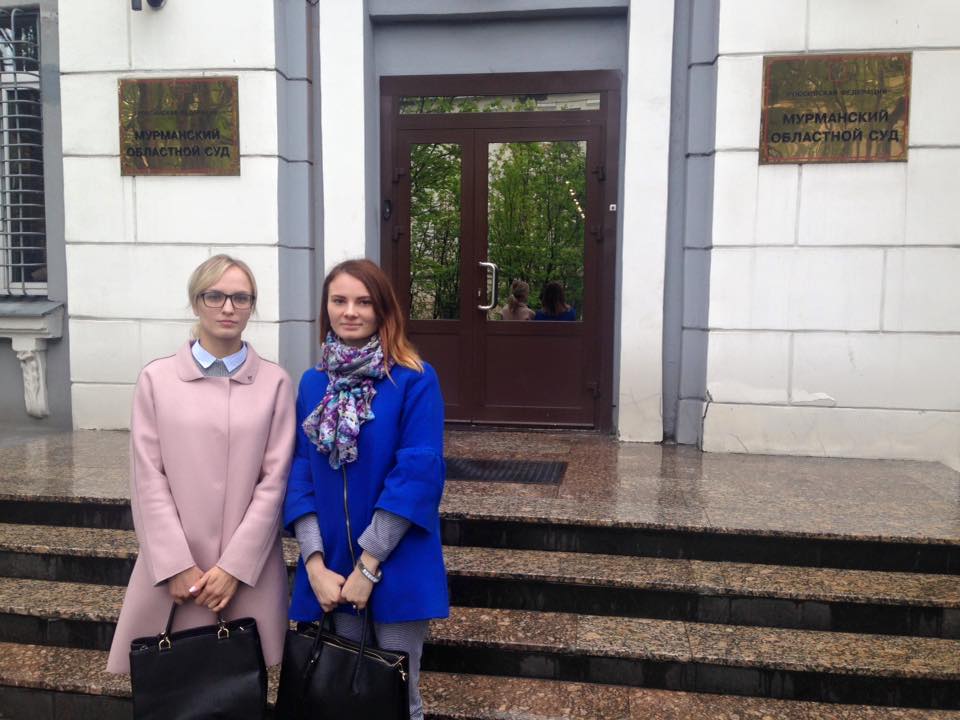
37045808_10209682377334711_3615467989047967744_nIrina Kovalenko and Ksenia Mikhaylichenko, outside of Murmansk Regional Court. Photo courtesy of Ms. Mikhaylichenko’s Facebook page

Ksenia Mikhaylichenko
Facebook
July 11, 2018

It’s great to talk about cases in which you walloped the opposing counsel, the judges gave you a standing applause, and you galloped off on your steed to deliver more justice and do more good. Today, though, I would like to tell a different sory, a story in which you and your client are obviously in the right, but the system tells you, “Hang on, guys. We have our own way of doing things here. Goodbye.”

[…]

Irina graduated from the mechanics and mathematics department at the Peoples’ Friendship University (RUDN) and worked for a major company in Moscow. Then, for family reasons, she moved to Murmansk, where she faced a problem. No one wanted to hire her, explaining she was too well educated, had done internships abroad, and had experience working at a major company, which was way too cool for the folks in Murmansk.

Ultimately, Irina got a job at the Murmansk Regional Information Technology Center, a government-funded agency. Everything would have been great if the head of the place had not hit on Irina big time. When she rejected his advances, she faced harassment in the literal sense of the word: humiliation, insults, daily rants, and charges of incompetence. At the same time, this guy held drinking bouts at work. (Here is the proof.) I would remind you all this took place in a government-funded agency, paid for by our taxes.

Finally, the boss fired Irina. She filed complaints with the State Labor Inspectorate, the prosecutor’s office, and the Murmansk Regional Committee for Information Technology and Communications, which had founded the agency. They promised they would get to the bottom of the matter and get her her job back. Seven months went by, seven months during which Irina received medical treatment in Moscow for terrible headaches and panic attacks. She was prescribed heavy antidepressants.

Seven months later, her ex-boss was fired after five millions rubles went missing from the agency’s books. No one faced criminal charges, of course. On the contrary, the agency’s wonderful head was given severance pay.

Irina had been forgotten, however. She was told to take her case to court and seek justice there. Irina did go to court. At the preliminary hearing, the judge refused to hear the case, citing the statute of limitations.

I came on board during the appeal, but the case file from the hearing in the lower court immediately amazed me. Irina had filed for an adjournment, since the clinic in Moscow where she had been treated was slow in putting together the papers she needed, and so she had to fly to Moscow to retrieve the originals, meaning she needed at least a couple of days. But the judge would not have any of it.

At the appeals hearing, we tried to get all these papers admitted into evidence while thoroughly explaining all the circumstances of the case and Irina’s terrible state of health over the past seven months. Irina was still suffering from pneumonia and pyelonephritis, which we had also documented medically. The stone-faced judges rejected our motion, however.

The prosecutor at the appeals hearing made the biggest impression on me. Foaming at the mouth and raising her voice, she argued Irina had made everything up about the harassment and her health.

“She wasn’t a disabled person, so she could have gone to court.”

This is a direct quotation.

We lost our appeal. It has made me feel terrible. Our system could not care less what happens to women who suffer harassment at work. It is simply impossible to prove either that harassment took place or that it had something to do with a woman being fired.

There are only prosecutors screaming, “You’re pretending to be the victim in this case” so loudly everyone in the courtroom can hear it.

I feel terrible when female friends tell me how their bosses molest them at work more or less arrogantly. Complete strangers write to me with enviable regularity, asking me to advise them what to do if their boss asks them to go to his office after everyone leaves, or they will have to tender their resignations. I don’t know how to reply to them, because it would be a blatant lie to tell them that there are effective legal defenses and the Russian state will defend them.

Thanks to Alena Popova, who introduced me to Irina and had also been helping her all she can. Together we will definitely think of a way to win the case.

Everything is definitely going to be fine for Irina. It cannot be otherwise for fighters for justice like her[.]

Thanks to Elena Konte for the heads-up. Translated by the Russian Reader