Alexander Krichevsky of Izhevsk: Six Years in Prison for a Comment

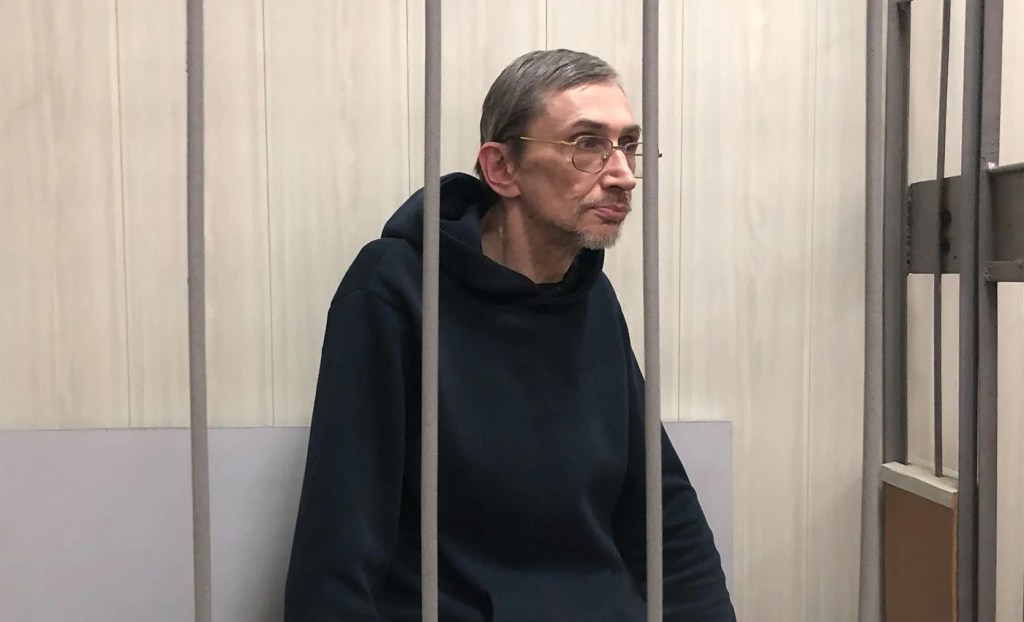
Alexander Krichevsky. Photo: Mediazona

In September 2024, Alexander Krichevsky, a 58-year-old resident of Izhevsk, posted a lengthy comment on a Chechen opposition blogger’s Telegram channel. In the comment, Krichevsky compared Putin and the “FSB clique” to a “darkness” which must be destroyed. The security forces deemed this statement incitement to murder the president and FSB officers. They monitored the man and intercepted his internet traffic. Last December, Krichevsky was detained and remanded in custody to a pretrial detention center despite his ailments and the fact that he is confined to a wheelchair. His ailing mother was placed in a care home, where she died a month later. Today, at the Central District Military Court in Yekaterinburg, where Krichevsky’s case is being heard, the prosecutor requested that he be given the maximum sentence of six years in prison.

“That is why we listen to him, because he is not afraid—he’s a ray of freedom in a kingdom of darkness! And only together will we destroy this darkness, only when we understand that we have only one enemy—Putin and his FSB clique. . . . Both you and we must destroy this enemy to continue living as peaceful neighbors,” 58-year-old Izhevsk resident Alexander Krichevsky wrote in a chat on the channel of opposition Chechen blogger Tumso Abdurakhmanov aka Abu Saddam Shishani, on 11 September 2024.

This was Krichevsky’s response to a user who had asked Abdurakhmanov himself in a chat: “Tumso, aren’t you afraid that Kadyrov’s people might find you?”

When questioned in court, Krichevsky said that he was sure he was responding to the user personally, not writing in a public chat. He repeated many times that he had only figurative “destruction” in mind and had been trying to “reconcile” Abdurakhmanov’s readership by pointing out that they had only one enemy.

“Of course, I wasn’t even thinking about physically destroying such a large number of people and didn’t understand how [what I wrote] would even look. Apparently, my love for pretty words—all those rays of light and other nonsense—let me down. I was thinking in terms of games: when a person plays checkers or chess, they destroy their opponent’s pieces. Roughly speaking, that was the image I had in my head,” Krichevsky said in court.

The FSB operative who discovered Krichevsky’s comment saw it not as criticism alone, but also as a “public call to murder the president of the Russian Federation and officers of the Federal Security Service.”

The same conclusion was reached by Polina Komova, a philologist and expert at the Ministry of Internal Affairs Forensic Center in Udmurtia. She acknowledged in court that the word “destroy” could have other meanings “depending on the context,” but in her opinion it could be understood only in its literal meaning—that is, “to end [someone’s] existence, to exterminate”—in Krichevsky’s comment.

“He was planning a terrorist attack involving self-detonation”: wiretapping and arrest

The security forces began monitoring Krichevsky in early December 2024. It emerged in court that the FSB had requested data on his calls and connections from Rostelecom and learned that on 11 September, when he wrote the comment, he had accessed Telegram from home. Megafon provided the security forces with information about the base stations in the area where Krichevsky’s phone number pinged that day.

On 5 December 2024, the Supreme Court of Udmurtia gave the FSB permission to tap Krichevsky’s phones, and a few days later it approved “gathering information from technical communication channels and acquiring computer information.” A few days before Krichevsky’s arrest, operatives monitored his apartment to “document illegal activities.” The report states that Krichevsky did not leave his home.

On 19 December 2024, Krichevsky was detained and sent to a pretrial detention center. He described his arrest to journalists.

“There was a knock on the door at seven in the morning, and seven people came into [our] small flat: five FSB officers and two eyewitnesses. I opened the door myself. They immediately sat me down on a chair in the hallway. My ailing mother was lying there, barely alive. They said, ‘Can you hand over [your phone]?’ They tried to intimidate me once: ‘If you refuse, we’ll take you away and charge you with additional offenses.’ I realized that resistance was futile. I gave them the phone, and they looked at it and took what they needed.”

The social media comment charges against Krichevsky were accompanied by an FSB report containing much more serious, but in effect unproven, allegations. The document states that, according to “intelligence,” Krichevsky, who opposes the “state’s political course” and the conduct of the “special military operation,” supported radical Islamists fighting for Ukraine and was planning to convert to Islam and carry out a terrorist attack in Udmurtia “by blowing himself up with cooking gas.” The court never did hear what this report was based on.

Photo: Mediazona

“None of my comments or my own thoughts bear this out. When I heard this business about blowing myself up . . . In this case, everything that the prosecutor has just read aloud is pure speculation on the part of the investigators. None of my quotes corroborates it,” Krichevsky said in court.

Judge Alexander Raitsky simply reminded Krichevsky that the case centered on a single [social media] comment, which the defendant himself did not disput, and that the court would evaluate the evidence in the deliberation room.

The case file also contains another comment by Krichevsky from the same written exchange: “Many empires have collapsed in this world. I myself foresee the end of the Russkies [rusnya]. I don’t feel sorry for them: let them collapse with a bang. That’s where they belong. I myself hate these FSBniks, pigs [cops], and other scum who suck the blood of our homeland and shit on our neighbors.”

The security forces deemed this “a statement containing a negative assessment of the group of persons sharing the profession of Federal Security Service officers and police officers,” but it was not included in the indictment.

Responding to the judge’s question about this comment, Krichevsky said that he sometimes tried to “adapt” to the rude tone of the conversation [on the Telegram channel’s chat].

“My mother died four weeks after my arrest”: wheelchair-bound in a detention center

Krichevsky had worked as a systems administrator in Izhevsk before his arrest.

As a child, Krichevsky had moved with his family from Udmurtia to Rostov-on-Don. After high school, he enrolled in medical school, but in 1989 he broke his spine and had to drop out because his left leg was paralyzed and he had lost feeling in his right leg. After a long period of rehabilitation, he was able to walk again, but was unable to recover fully: he had a severe limp and had difficulty going up stairs.

Krichevsky said in court that his father had committed suicide on 11 September 2008.

“He had terminal cancer. He was in serious pain and turned to me because I was in medical school. He wanted me to tell him what poison he could use to commit suicide. I refused to do it. Then, two days before his death, I noticed he was sharpening a knife in an odd way. He died in a rather original way, if that word is appropriate in this situation—he stabbed himself in the heart with a knife,” Krichevsky told the court.

In early 2010, during a trip to Thailand, Krichevsky broke his left leg, which had been paralyzed since his [accident in 1989]. He underwent surgery at a local hospital, but he could not stay in hospital for long because his visa had expired. Krichevsky returned to his hometown of Izhevsk, where he underwent a second operation, but his condition only worsened.

“My knee wouldn’t straighten. They tried to do something about it, but because I had spinal injuries, my knee spasmed, and it remained crooked and they couldn’t do anything about it. And my hip didn’t recover either; I also had a fractured hip,” Krichevsky told the court.

Since then, Krichevsky has been confined to a wheelchair. Other ailments have also emerged: kidney problems, emphysema, and head tremors.

“I don’t know whether it’s early Parkinson’s combined with Alzheimer’s, or something else,” Krichevsky said.

Krichevsky had been living with his elderly mother and caring for her since 2016. Last year, she was hospitalized with a complex fracture. After she was discharged, she was unable to walk, and Krichevsky would help her to sit up and do breathing exercises in order to prevent pulmonary edema and bedsores. After Krichevsky was arrested, the woman was sent to a care home. She died of a pulmonary edema a month later.

“They apparently left her lying in bed at the care home. When a person lies in a horizontal position for a long time, they develop a pulmonary edema. That’s what my mother died of,” he said in court.
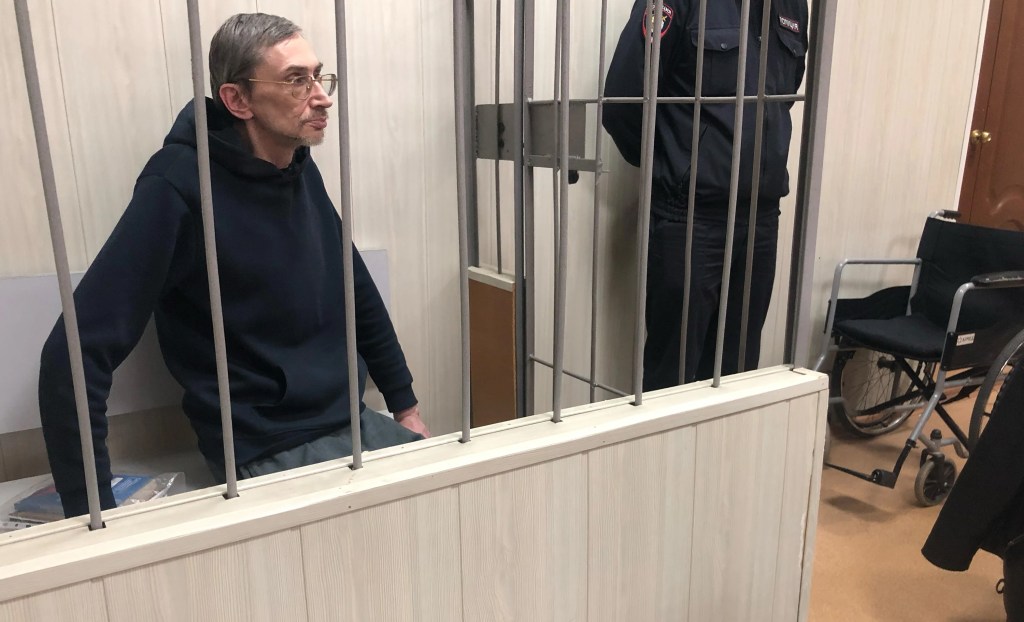
Photo: Mediazona

While in pretrial detention, Krichevsky formally lost his Group I disability status, which he had prior to his arrest, and so he was unable to obtain a medical examination.

According to Krichevsky, a neurologist at the Izhevsk detention center promised to send him to a hospital, but instead Krichevsky was transferred to another pretrial detention center. “I thought they were taking me to a hospital, but they took me first to Perm and then to Yekaterinburg. They basically lied to me when they said they were taking me to a hospital,” he said on the stand.

Krichevskny never did get any medical attention: “We’ll only help you if you’re dying, [they said.] Otherwise, just sit there and suffer.”

“Radical views and hostility toward the current government”: trial and pleadings

Krichevsky’s trial was postponed five times in a row: it took a long time to bring him in his wheelchair, first to Detention Center No. 1 in Yekaterinburg, and then to the court. He was brought to the hearings late, and had to spend four to five hours in the police van, where, according to Krichevsky, the temperature was the same as outside.

At the beginning of the trial, Krichevsky filed a motion requesting that he be assigned an inpatient forensic examination and treatment. He said that he had never been examined by a neurologist at the Yekaterinburg detention center, only by a GP. He was taken for examination to the local medical unit, which was not equipped for people with disabilities: there was a “big step” in front of the toilet and sink which he could not get over. As a result, the doctors only checked his reflexes and sent him back.

In their medical report, the doctors at the detention center stated that Krichevsky had no disability and that his overall health was satisfactory, meaning that he was able to take part in the court hearings.

Before the proceedings, Krichevsky again requested to be sent for treatment, “in accordance with the neurologist’s recommendation” in Izhevsk, but Judge Raitsky denied the request, seeing no need for it. Prosecutor Artem Terentyev also asked that the request be denied, as it went “beyond the scope of the criminal case under consideration.”

During the trial, the prosecutor asked that Krichevsky be imprisoned for six years in a medium-security penal colony. The prosecutor stressed that the defendant had “radical views” and was “hostile toward the current government of the Russian Federation and its officials,” and that he had written the offending comment at a time when the mobilization had not yet been completed. The prosecutor considered these to be aggravating circumstances.

The prosecutor cited Krichevsky’s “poor health” as a mitigating circumstance.

You can support Alexander by writing him a letter.

Address:
Russian Federation 620019 FKU SIZO-1, GUFSIN of Russia for the Sverdlovsk Region • Sverdlovsk Region, Yekaterinburg, Repin Street, 4 • Alexander Anatolyevich Krichevsky, born 1967

You can also send letters through the online service Zonatelecom.

Source: Vasily Besspalyi, “Wheelchair user from Izhevsk sentenced to six years in prison for comment about Putin; his mother, sent to nursing home after his arrest, dies a month later,” Mediazona, 22 December 2025. Translated by the Russian Reader. Since letters to Russian prisoners are vetted by prison censors, they must be written in Russian or translated into Russian, something that can done more or less handily using an online machine translator like Google Translate. Please write to me if you need help or advice. ||||| TRR

Sunday Reader No. 3: Languages

Haku, “奥二重で見る” 

Source: Haku (YouTube)


As a Kyrgyz woman born in the last years of the Soviet Union, I never thought twice about whether my usage of the Russian language was problematic or not — until recently when I reached out to my Ukrainian friend in Russian, and she responded to me in Ukrainian.

I have been thinking about the political aspects of language since then.

Last week I was invited to a podcast to talk about de-colonial feminism in Central Asia by a research group that does memory studies in Kyrgyzstan. There we sat in a warmly lit Bishkek studio in comfortable canary-yellow armchairs — two women of clearly Central Asian descent, with names that mean ‘honey’ and ‘worship’ in our native language, discussing whether the Soviet Union was a colonial empire, and how a more than 100-years history of Russian presence in the region has disrupted and affected the lives of peoples of Central Asia. I am making smart jokes and incisive observations, we laugh, we debate, we lament — all in Russian.

Although this language was not the main subject of our discussion, we comment in passing on it — noting how intangible colonial legacies can sometimes have a constructive element to them.

It is, of course, possible for all of us to drop the language of the colonizer, whether it’s English, French, Spanish, Russian, or Chinese — and speak our own languages, but the ease and comfort of using these when trying to communicate with people outside our cultures is just so tempting! And so then the question is whether to take offense towards the language because it happens to have been “originated” by the ‘big bad’ or to ignore that and make it our own?

Russian was the language of books that took me on journeys across galaxies, of Soviet-era films that fanned the fire of idealism in me, of finding community with other post-Soviet teenagers that, like me, had traveled to the United States as exchange students. We spent the year yell-singing Kino’s songs, making the olivier salad for a New Year’s celebration, and rooting for Evgeni Plushenko in the 2001 Winter Olympic Games in Salt Lake City.

It was the language of the early science fiction stories I wrote when I was twelve, of expressing my first heartbreak in broken poetry form, and of clumsily flirting, building alliances, or of standing up to bullies.

It is also the language of differentiation — a tool of categorizing people into social strata, both inside Russia and in the non-Russian republics during Soviet times. My own mother had been ridiculed for not speaking Russian well, considered ‘dark’ and uneducated, uncultured. To this day she gets offended when my Russian-schooled siblings sometimes laugh at the little mistakes she makes when attempting to speak it because it reminds her of how she was treated when she was younger.

Not to worry though — this is a very rare occurrence, because our mom is so strong-minded that she’s bent everyone to her will, forcing everyone to speak Kyrgyz if they wanted to be understood by her. Even our dad, who was a Russian speaker with a beautifully reverberating voice, had mastered the Kyrgyz language for our mother’s sake. My siblings too, although their attempts at translating their jokes and anecdotes from Russian into Kyrgyz for our mom sometimes backfire because they do not take into account the semantic nuances of the two languages. And despite her lack of Russian, she made a successful career in the 90s as a kommersantka — just like thousands of other women who picked up the baton when the system that was oppressing them fell — traveling by bus and train to Moscow, Minsk, Tallinn, and later by plane to Meshhed, ensuring we were never hungry or dependent on anyone.

Maybe that’s a good example of how language does not have to be a cornerstone of someone’s lived experience. Some people choose to speak the oppressor’s language, some people choose not to. As long as there’s a way of making each other understood, even by mixing words or even using gestures, it’s all good.

My Ukrainian friend was so kind and gracious when I apologized for using Russian when I reached out to her, and she sent me a beautiful voice message back in Russian. I could hear she struggled a little speaking it because, as she explained, she had not spoken it in a while. She said she didn’t mind using it to communicate with me, and that she was sorry she hadn’t learned some Kyrgyz by now because she has other Kyrgyz friends too. And I was sorry I hadn’t learned Ukrainian by now. But eventually it was Russian we exchanged these lamentations in, and the question remains open to me — whose language is it anyway?

Syinat Sultanalieva is a human rights activist and researcher from Kyrgyzstan, who writes science fiction on the side when she’s not busy dissecting power structures and dynamics in the region and the world.

Source: Syinat Sultanalieva, “Whose language is it anyway?” Two Old Grumpy Men on Ukraine, 30 March 2025


Lӓysӓn Ensemble of Yafarovo Village
Let’s Get Together Tonight: Mishar Tatar Songs from Orenburg Region

The Mishars are an ethnic subgroup of Tatars. They have their own dialect and their own culture. The main part of the Mishars live in the Middle Volga region and the Urals.

Yafarovo is a Mishar village located in the Aleksandrovsky district of the Orenburg region.

Lӓysӓn Ensemble members: Alfiya Asyaeva, Ramilya Adigamova, Alfinur Dibaeva, Elmira Mishina, Lira Salikhova, Laysen Fatkulina, Fairuza Shabaeva, Nurshida Yusupova, Gulsina Yusupova, Liliya Yakshigulova, Rishat Asyaev (button accordion player).

The ensemble’s leader is Alfinur Dibaeva.

Recorded in the House of Culture of the village of Aleksandrovka on November 18, 2024.

Released February 22, 2025

Source: Antonovka Records (Bandcamp)


Izhevsk long ago nabbed Tula’s de facto title as Russia’s arms manufacturing capital: the Kalashnikov Concern is headquartered there, producing shells, assembling drones, and making rifles. But in a seemingly parallel reality amid the rumble of the factories, young Izhevskers have opened an independent bookstore, and they have also been translating the Udmurt avant-garde of the twenties into Russian and publishing literary magazines. Who are these young people? And how was all of it possible?

“We’ll be having a children’s New Year’s party in there”

Five years ago, Albert Razin, an Udmurt activist and patriot, set himself on fire in the capital of Udmurtia, on the square outside the republic’s State Council building. Razin held a placard featuring a quotation from Rasul Gamzatov: “And if tomorrow my language disappears, I am willing to die today.”

In late 2024, I lived in Izhevsk a stone’s throw away from the spot where Razin had burned on behalf of the Udmurt language. It is the very heart of the city: the Eternal Flame, the republic’s government house, the opera house, a Rostic’s fast-food restaurant, the residence of the head of Udmurtia, and the Kuzebay Gerd National Museum are nearby.

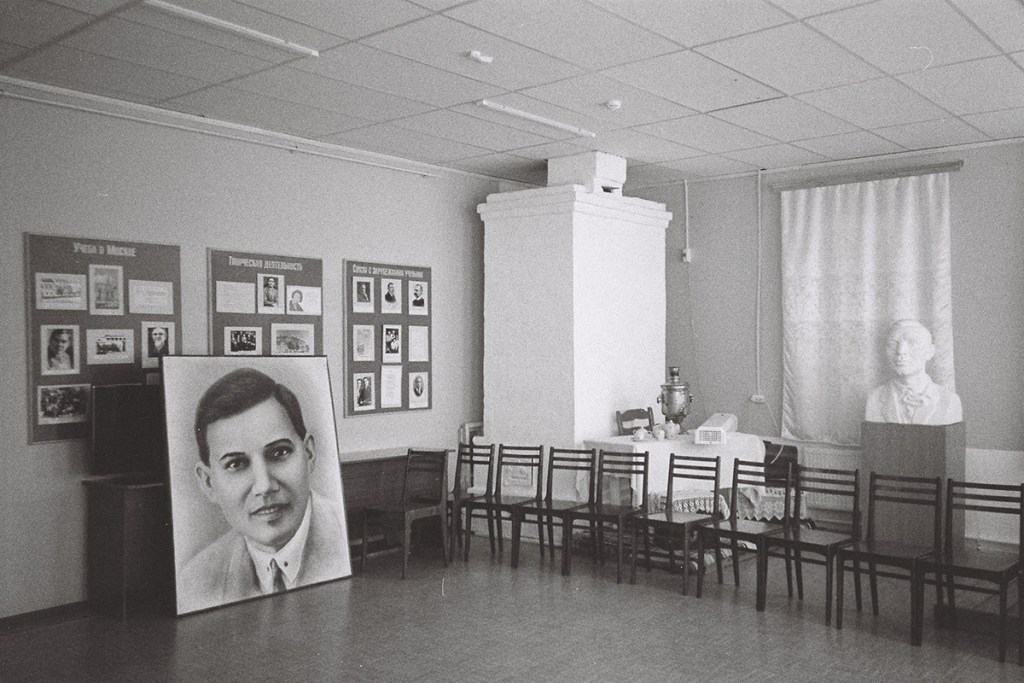
Gerd (a pseudonym meaning “knot” in Udmurt; Gerd’s birth name was Kuzma Chaynikov) was a poet, folklorist, and probably the most important Udmurt of the twentieth century. In 1932, he was arrested along with other prominent members of Soviet Finno-Ugric ethnic groups as part of the fabricated SOFIN Case. [SOFIN was the acronym of the fictitious “Union for the Liberation of Finnish Peoples” — TRR.] The poet was accused of plotting to get Udmurtia and other autonomies to secede from the Soviet Union and establish a Finno-Ugric federation under the protectorate of Finland. Kuzebay was shot in 1937 at Sandarmokh in Karelia. He was exonerated in 1958.

The Gerd Museum’s website advertises a separate exhibition dedicated to the Udmurt national poet. The museum is located in the building of the former arsenal. The entrance to the main exhibit is on Kuzebay Gerd Square, where twenty years ago a monument to the poet was erected. Perched on a rock, a quite youthful Gerd gazes thoughtfully at the former military warehouse. He is writing a poem, apparently.

I am all alone at first, but schoolchildren wearing blue ties later come running into the museum. A museum worker, dressed in a traditional costume adorned with a monisto necklace, greets the children in Udmurt — Chyrtkemesi! — but she immediately switches to Russian and talks about the pre-Petrine history of Udmurtia, that is, before Izhevsksy Zavod (the name of the settlement which preceded city) arose in these parts. Count Peter Shuvalov built an ironworks there with the permission of the Empress Elizabeth. A little later, Izhevsk became the Russian Empire’s virtual arms capital (no offense to Tula).

The rooms I have visited recount this history as well as a little bit of Soviet history (artisanal carpets are intermingled with IZh motorcycles and cars — a total delight!), but I cannot go any further.

“But where is the Kuzebay Gerd section?” I wonder aloud.

“Ah, you wanted to see it?” responds the docent. “Unfortunately, it is impossible at the moment. It was in the room next to the ticket office, but it has been temporarily moved to the warehouse. We’ll be having a children’s New Year’s party in there.”

“Nobody the whole day”

Kuzebay Gerd is to Udmurtia what Pushkin is to Russia. One of the creators of the modern Udmurt language, Gerd also lived a very short life, thirty-nine years (five of them in Stalin’s camps). But over those years he wrote hundreds of articles, poems, plays, and prose works which became the foundation of the living Udmurt language.

The writer gained genuine recognition only during perestroika, and it is only recently that streets and museums have been named in Gerd’s honor and his legacy has been studied anew.

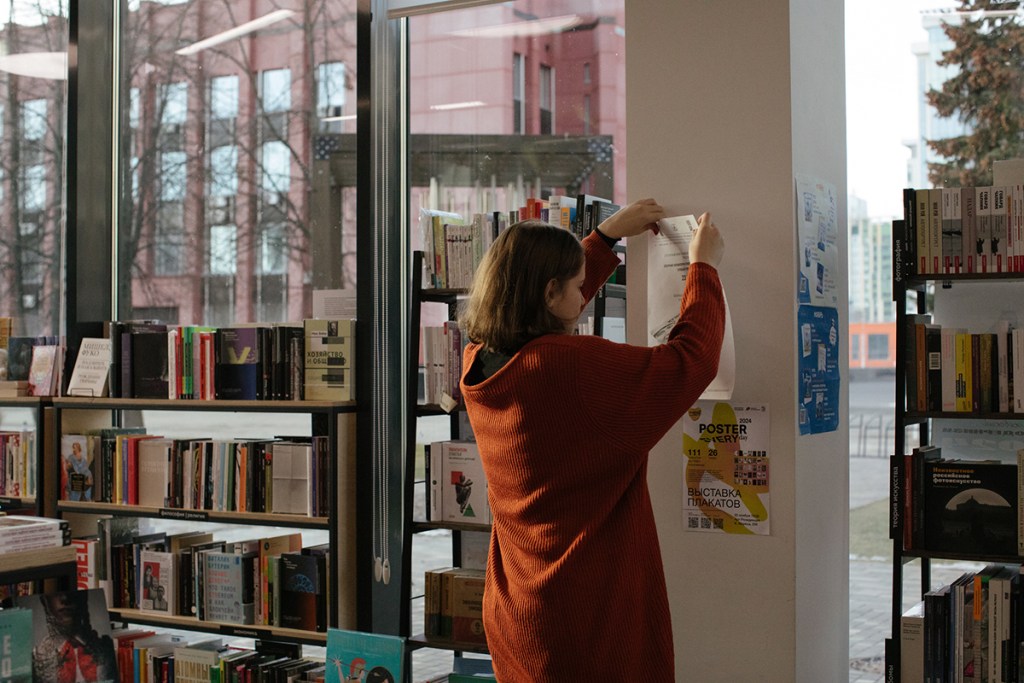
Sonya, a clerk at Kuzebay Bookstore, puts up an event flyer.

Kuzebay’s cheerful face can now be seen on posters, lapel pins, and even as an emoji on Telegram. The only independent bookstore in Izhevsk, and maybe in the whole of Udmurtia, bears his name — Kuzebay Bookstore.

Like its spiritual forebear, Kuzebay Bookstore thrives in spite of its circumstances. Today, it is an absolutely metropolitan store that is no shabbier than Vse Svobodny in Petersburg or Falanster in Moscow: Kuzebay stocks the same books on its shelves, and it has the same friendly vibe. But Kuzebay opened a year before the quarantine. Back then, it occupied a small corner at the Center for Contemporary Dramaturgy and Directing. Les Partisans Theater, in which the store’s co-founders, German and Ksenia Suslov acted, was also based there. Kuzebay achieve relative stability in early 2022, after moving to its current location.

The Kuzebay Gerd Museum in the village of Bolshaya Gurez-Pudga, Udmurtia. The museum is located in a hut next door to the local school.

“We were a quite small operation during the covid, so we didn’t give a shit whether we shut down or not,” recounts German Suslov. “We were open for deliveries. Back then, the state still paid me twelve thousand [rubles a month] for the fact that I was my own sole employee. I was like, Great, money’s coming in, cool beans. Things have somehow been growing ever since.”

German even now regularly works as a salesclerk and is awfully good at cleverly persuading people who stop by for the latest detective novel by Darya Dontsova to buy family sagas from House of Stories publishers. But the first person I meet in the store is Gosha, a tall thin salesclerk who looks like a Viking sporting a tiny cap. He sits in a cozy swing chair, playing chess on his phone. He is the only soul in the store.

German Suslov, co-owner of Kuzebay Bookstore and editor-in-chief of Luch magazine, at work.

“Is it so empty often?” I ask as I peruse Mushroom Kingdom, a wacky book by local artist Andrei Kostylev, better known as Bi-jo.

“Not nowadays, but it used to happen,” says Gosha. “This one [female salesclerk] and I even had a competition to see who had fewer people stop by the store in a day. It was a draw: zero.”

“No one at all for an entire day?”

“Yeah, it was winter, so not a single person came in. But there are always people coming in now. And even if there are no sales at the store, there are sales on Ozon almost every day.”

“The worst thing is poetry readings”

German shows up at Kuzebay about half an hour late for our interview. He is in a terrible rush, as always. The Moscow Non/Fiction Book Fair is coming up: Kuzebay is supposed to represent the publishing house and the store, and we have to send the books out in time. We pull a few boxes out of the car together, while Gosha sits down to check the books and put stickers on them. Like the many-armed Shiva, German simultaneously supervises the process, does the interview, eats a flatbread from the Tatar bazaar, pours tea for everyone, and chats with the customers who do come in.

German Suslov and Andrei Gogolev in the storage room of Kuzebay Bookstore

German has always been an energetic multi-tasker. Although he is not yet thirty, he has been a prominent figure in Izhevsk’s cultural scene for nearly ten years. He used to be an actor at the local independent theater Les Partisans, which exists to this day. But his restless nature needed something else besides theater and the history program at Udmurt State University.

“And so, I thought: the craving for theater, music, cinema was instilled in me by older comrades,” says German simply. “But what were my interests before the theater? I wrote poetry. So, I had to get into the business of poetry. And I quickly realized that no one here was doing poetry seriously.”

According to German, the literary scene in Izhevsk was rather fragmented ten years ago. There were no decent places for young people to publish and perform their work. After graduating from college, many people left for the big cities.

In St. Petersburg, a whole generation of young poets from Izhevsk emerged all at once in the early twenty-teens, including Tatiana Repina, Pyotr Bersh, Ilya Voznyakov, and Grigory Starovoitov, all of whom I know personally. Most of the members of that scene gave up writing poetry a long time ago, although Tanya Repina has achieved some fame, and my friend Petya Bersh continues to write and perform.

“When I left in the early teens, nothing was happening in Izhevsk at all. There were no prospects,” Petya, who returned to his homeland in 2022, told me. “Everything has changed now, of course, and Kuzebay has played no small role in that.”

There was no Kuzebay Bookstore at first, though. In 2016, five actors from Les Partisans dreamed up the PoetUP Contemporary Poetry HQ to consolidate Udmurtia’s most interesting poets, give them a venue, and relaunch the literary scene in Izhevsk.

“The worst thing you can imagine is an open mic poetry reading. It’s hell on earth,” says German, laughing. “And even worse is an open mic poetry reading in Izhevsk with no prescreening at all. So, what did we do in 2016? We started selecting and inviting people. Yes, we would have embarrassing events too, but far fewer. What mattered was what we were striving for. We did not want it to happen that one person would read and all his friends would get up and leave when he finished.”

[…]

Excerpted from: Ilya Semyonov (text) and Natalya Madilyan (photos), “Why does a star gurgle?” Takie Dela, 23 January 2025. Translated by the Russian Reader. I would like to finish translating this fascinating long article (this is the first quarter of it) and publish it in its entirety on this website, but that would take a lot of time and hard work. In the real world, where I have worked as professional freelance translator for nearly thirty years, I would charge 600 to 850 euros to translate this article if someone commissioned me to do it. If you would like to support my work in general and read this article in full, please donate to me via PayPal (avvakum@gmail.com) or Venmo (@avvakum). If you cannot afford to donate money right now, you can help my cause by sharing my work on social media and with friends. Thank you!


Haku, Cover企画】MONO NO AWARE “かむかもしかもにどもかも!”

Source: Haku (YouTube)

In Izhevsk

A [billboard] advertising the delivery of “Cargo 200” has gone up in Izhevsk.

It’s a timely service with good prospects.

Source: Andrei Pivovarov, Facebook, 28 December 2022. Earlier this years, Mr. Pivovarov, a well-known Russian opposition politician, was sentenced to four years in prison for “leading an undesirable organization,” i.e., Open Russia.


Prominent opposition politician Ilya Yashin has been transferred to a detention facility some 1,000 kilometers from Moscow even though his sentence must still be approved by an upper court, his lawyer said Tuesday.

A Moscow court sentenced Yashin, 39, to [eight and a half years in a penal colony] earlier in December after he was charged with spreading “false” information about the Russian military for comments he made during a YouTube stream about the civilian massacre carried out by the Russian army in the Kyiv suburb of Bucha this spring.

The Moscow city councilor’s whereabouts were unknown when the city’s prison monitoring commission reported on Monday that Yashin had been moved to “a different region.”

Lawyer Maria Eismont said that Yashin was transferred to a pre-trial detention facility in the city of Izhevsk, the capital of the republic of Udmurtia, some 1,000 kilometers east of Moscow.

Yashin’s prison sentence has not yet taken effect, as an upper court must still reject his appeal and confirm his sentence, which means he must remain in pre-trial detention rather than being sent to a penal colony.

Eismont ironically called Yashin’s transfer an “early New Year’s gift” from the authorities, noting that his mother had been scheduled to visit him in Moscow later this week.

Source: “Jailed Kremlin Critic Yashin Transferred to Prison Outside [sic] Moscow,” Moscow Times, 28 December 2022

Tear of a Komsomol Girl

Tear of a Komsomol Girl [cocktail recipe]

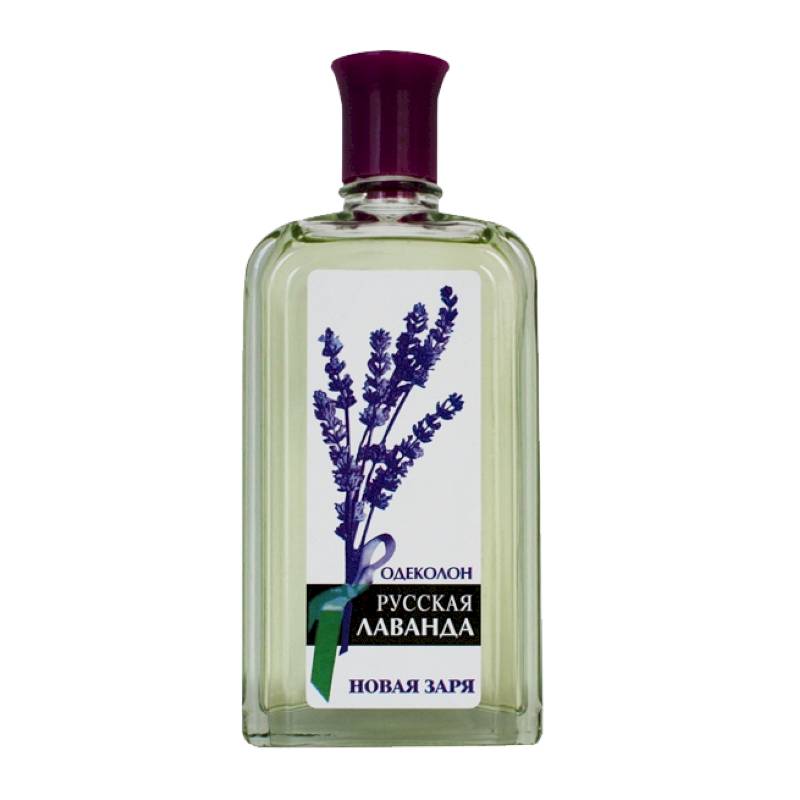
Lavender Toilet Water 15 g.
Verbena 15 g.
Herbal Lotion 30 g.
Nail Polish 2 g.
Mouthwash 150 g.
Lemon Soda 150 g.

—Venedikt Erofeev, Moscow to the End of the Line, trans. H.W. Tjalsma (New York: Taplinger, 1980), pp. 6970


Government to Introduce Excise Taxes on Medicinal Tinctures to Combat Alcoholism
Polina Zvezdina
RBC
December 13, 2016

The government has proposed imposing excise taxes on medicinal tinctures, household chemicals, and cosmetics containing alcohol. The reason is that the populace consumes them instead of the expensive liquour sold in shops. As RBC has previously reported, approximately 10% of Russians suffer from drugstore alcoholism.

Prescribe and Report
The Finance Ministry has drafted amendments to existing laws and the Tax Code that would impose excise taxes on alcohol-based pharmaceutical products, except for vital and essential drugs (VEDs). The ministry was ordered to do this by Deputy Prime Minister Alexander Khloponin, who oversees the alcohol market. In late October, he reported on the matter to Prime Minister Dmitry Medvedev. RBC has a copy of his letter. A spokesperson for Khloponin refused to comment on the document’s authenticity or its contents.

Due to a drop in incomes and an increase in prices for strong alcoholic beverages, Russians have been increasingly been drinking alcohol-based liquids not intended for consumption, Khloponin argues in his proposal. Among such liquids, he lists Cucumber Lotion, Boyara (a tincture of hawthorn and rose hips), and Bread and Wheat, two alcohol-based additives. The sales of such products have recently increased in Tatarstan, Ufa, Samara, Cheboksary, Saransk, and Kaluga, according to the document.

If the deputy prime minister’s undertaking is implemented, it will affect drugs used by the public for their intended purpose, such as Corvalol and Valocordin.

Currently, the Tax Code does not deem alcohol-based medicines, veterinary drugs, food products, and cosmetics sold in packages containing 100 milliliters or less as excisable products.

Vadim Drobiz, former head of the Research Center for the Federal and Regional Alchohol Markets (TsIFFRA), told RBC that between twelve and fifteen million [i.e., approximately 10% of the Russian population] regularly consumes medical tinctures and cosmetic lotions not intended for consumption. The “parallel” alcohol market’s capacity already accounts for around 20% of the official market’s turnover, as RBC reported in an investigation published on November 24.

Specific Proposals
Khloponin has proposed labeling all alcohol-based non-food products as excisable and abolishing the zero-rate excise tax for certain brands of cosmetics and household chemicals. The rate of the excise duty should be the same as that imposed on strong alcoholic beverages. Currently, the excise rate on strong spirits is 500 rubles per one liter of pure alcohol.

The excise taxes should be extended to all alcohol-based medicines, except for medicines included in the VEDs list, writes Khloponin. In addition, the pharmaceutical market should apply the Unified State Automated Information System (EGAIS) for accounting for the production and turnover of alcohol to the distribution of ethanol intended for the production of medicines. According to current laws, the EGAIS will be introduced to the pharmaceutical market from 2017, but it will record only ethanol production.

Khloponin argues that retail sales of the flavor additives Bread and Wheat should be banned altogether. The regions also need to have the authority to independently monitor sales of alcohol-based non-food products.

The Finance Ministry did not respond to RBC’s inquiry. The Health Ministry informed us that as part of the fight against “drugstore alcoholism,” the ministry had drafted a federal law bill banning the sale of alcoholic pharmaceutical products from vending machines [see article, below].

Hospital Budgets and Pensions
If the Finance Ministry finalizes its undertaking, the public will suffer, Elena Nevolina, executive director of the National Pharmaceutical Chamber, noted in an interview with RBC. Many popular tinctures, such as valerian, Corvalol, Valocordin, and Votchal drops, are not included in the VEDs list. After excise taxes are imposed, their prices will skyrocket or they will simply vanish from the market, she argues. This might indirectly impact the work of ambulance brigades, since pensioners, accustomed to consuming certain medicines, will be more likely to summon ambulance crews if the medicines are unavailable, Nevolina believes.

aseptol-model
Aseptol handwipes. Image courtesy of Reviso

Another alcohol-based medication not included in the VEDs list is Aseptol, a topical solution widely used by medical personnel to disinfect their hands. The retail price for 100 ml of the solution is currently around 35 rubles. After the excise duty is imposed, its price could double, believes Nevolina.

Although hospitals purchase Aseptol in large quantities, it amounts to less than 1% of all sales. According to research by the DSM Group, purchases of Aseptol amounted to 179 million rubles in 2014, 195 million rubles in 2015, and 171 million rubles in the first nine months of 2016. The public procurement market for Aseptol accounted only for 549,000 rubles, 820,000 bules, and 936,000 rubles of these total sales, respectively.

Based on an excise tax rate of 500 rubles per 1 liter of pure alcohol, the price of Corvalol would increase by one and half times, and the price of Carniland (Votchal’s drops) and Valocardin, by a few percent.

The measures proposed by the government will enable better monitoring of the pharmaceutical alcohol market, said Dmitry Dobrov, board chair of the Union of Alcohol Producers.

“EGAIS and excise taxes have proven effective in the alcohol market. Sales and tax revenue have been growing, and illegal production has practically disappeared,” he said.

Major Pharmaceutical Manufacturers of Alcohol-Based Drugs
The Industry and Trade Ministry supplied RBC with a list of the major manufacturers of alcohol-based medicinal products. The leaders in terms of sales and production are Gippokrat from Samara (whose 2015 revenue was 980 million rubles and overall production, 51.8 million units); Flora Kavkaza from Karachay-Cherkessia (230.9 million rubles; 13.4 million units); Begrif from Novosibirsk Region (211.7 million rubles; 10.9 million units), the Tula Pharmaceutical Factory (251.5 million rubles; 9.6 million units); and the Ivanovo Pharmaceutical Factory (138.1 million rubles; 7.5 million units).

The market for alcohol-based drugs has been growing from year to year. According to DSM Group, it amounted to 3 billion rubles in 2014, almost 4 billion rubles in 2015, and 3.1 billions rubles in the first nine months of 2016.

Hawthorn lotion dispenser in Izhevsk. Photo courtesy of susanin.udm.ru
Hawthorn “lotion” dispenser in Izhevsk. Photo courtesy of susanin.udm.ru

Boyara 24 Alcodispenser Shows Up at New Location in Izhevsk
Argumenty v Izhevske
October 15, 2016

Yet another dispenser for selling the alcohol-based Hawthorn (Boyaryshnik) liquid has been installed in Izhevsk. As Susanin News Agency reports, the 24-hour sales point, where even a child could shop, has been installed on January 9th Street.

For 20 rubles, the Boyara 24 machine dispenses a bottle of liquid containing 75% ethyl alcohol. Hawthorn Lotion for Oily Skin, as indicated on the label, is designed to cleanse and tone the skin.

But few locals used the alcohol-based liquid as it was intended. The dispenser’s target market is society’s drunken stratum. To obtain a bottle of Hawthorn, you merely have to drop money into a coin slot and turn a handle. The dispenser imposes no limits on the times when the liquid is sold or the age of purchasers. It does not even need electricity to run round the clock.

During an experiment conducted by a Susanin News Agency film crew and concerned citizens, it transpired that the alcodispenser did not work properly. Four attempts were made to purchase Hawthorn Lotion, but the machine dispensed bottles only in two instances. Empirically, therefore, we established that the dispenser sells the alcohol-based liquid for 40 rubles rather than 20.

The first such dispenser showed up in Mechanical Engineers Village approximately two weeks ago. It was successfully dismantled, most likely by penniless alcohol enthusiasts.

Translated by the Russian Reader. Photo of lavender toilet water courtesy of knigi-janzen.de