Western free society is seriously sick too. The symptoms pop up here and there, but one of the most disgusting is the massive support for the alleged “people of Palestine”—that is, Hamas—in this whole monstrous story. I really don’t understand HOW it has been possible, after the atrocities of October 7, after the taking of hostages, including children, to pretend that this was a minor trifle? That the ruthless Jews suddenly out of the blue started tormenting the unfortunate residents of the Gaza Strip?
After all, bolstered by this wave of international support, Hamas thinks it has won. This will lead to fresh terrorist attacks, of course.
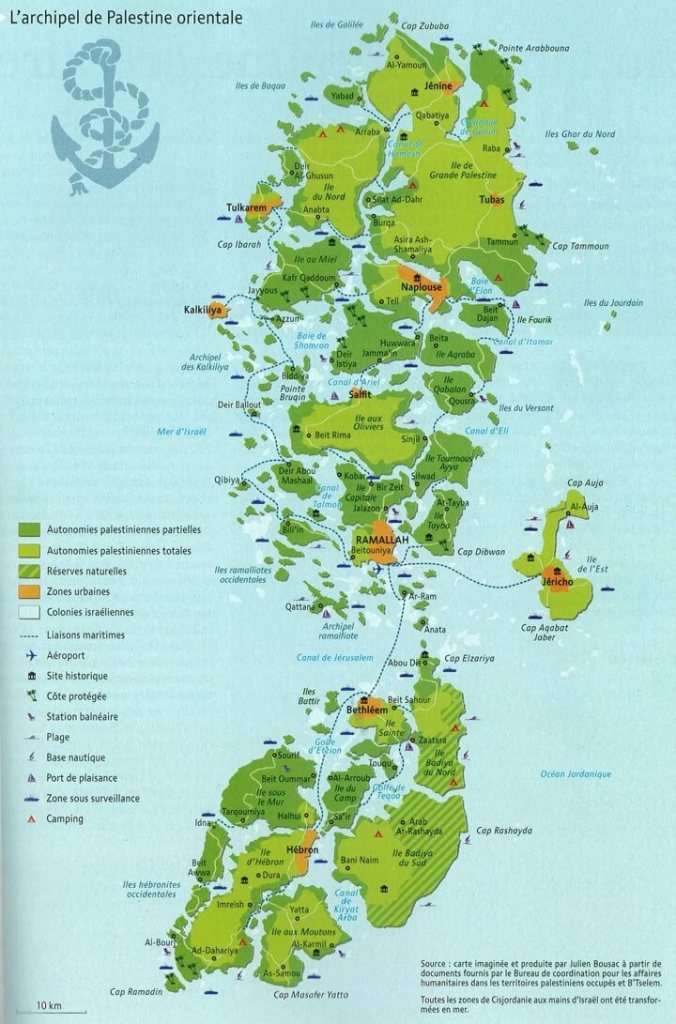
The map above shows what Palestine’s West Bank would look like if all non-Palestinian land suddenly turned into water.
All that would remain would be an archipelago of small islands with the sea of Israel to the west and the Jordanian ocean to the east.
The map is designed to show just how broken up Palestinian land in the West Bank really is. And while originally published in French, it is quite clear in the main point it’s trying to make.
Here are some key points about the map:
Regions of Palestinian Authority:
The map shows areas of partial and total Palestinian autonomy, marked in different shades of green. The darker green areas represent total autonomy, while the lighter green areas represent partial autonomy.
Israeli Settlements:
Areas in blue indicate Israeli settlements.
Urban Zones:
Orange areas represent urban zones.
Protected and Historical Sites:
Natural reserves and protected coasts are marked, along with historical sites.
Geographical Representation:
The map depicts the West Bank as a series of islands, which illustrates the fragmented nature of Palestinian territories due to the division created by Israeli settlements, roads, and checkpoints.
Symbols:
Various symbols denote airports, historical sites, protected coasts, beaches, and camping areas. There are also symbols indicating maritime connections, which, in the context of the map, seem to suggest metaphorical “water” crossings between different areas of Palestinian control.
Geographic Features:
Names of regions and cities such as Ramallah, Nablus, Hebron, Bethlehem, and Jericho are mentioned, providing a sense of the location and distribution of these areas.
The map’s creation by Julien Bousac aims to highlight the challenges faced by Palestinians due to the fragmentation of their territories. The fictional archipelago metaphorically represents how the West Bank is divided and isolated, illustrating the complex political and social landscape of the region.
Red America and Blue America have become two different and mutually antagonistic countries sharing the same geographic space. They barely talk to each other, don’t understand one another — and while Blue America happens to be aware that both itself and Red America exist in a larger, infinitely complex world that needs both of them to be one whole for its survival, just as both of them need that larger world for theirs, Red America is not interested in and indeed is hostile to anything and anyone that is not itself and, while generally tending to be poor and perennially gripped by bitterness and resentment, derives its existential satisfaction almost exclusively from making Blue America feel bad — “owning the libs,” as Red America calls it.
A really good series. I don’t know to what degree it straight up deserves а rating of eight, but it has interesting and fairly unique ideas, and the lead actress is pretty and acts well. We’ll see what the next episodes are like, but on the basis of the first one we can say [that the show] has fine potential. If it develops in a good direction, it could turn out to be decent.
Source: Ororo.TV. Translated by the Russian Reader
Crimea’s Tatars: “They drive us from our homes, just as they did to our grandparents 80 years ago”
By Katya Aleksander, who interviewed activists supporting more than 100 Crimean Tatar political prisoners. First published in Russian by Important Stories (Vazhnye Istorii)on 18 May, the 80th anniversary of the deportation of the Crimean Tatars.
On 18 May 1944, eighty years ago, the Soviet government accused an entire people of “collaboration with the Nazis” and “betraying the fatherland” – and deported the Tatars from the Crimean peninsula. It took the Crimean Tatars more than forty years of constant struggle to return to Crimea. But in 2014 the peninsula was annexed by Russia. The war began, and, with it, repression by the new authorities on a massive scale.
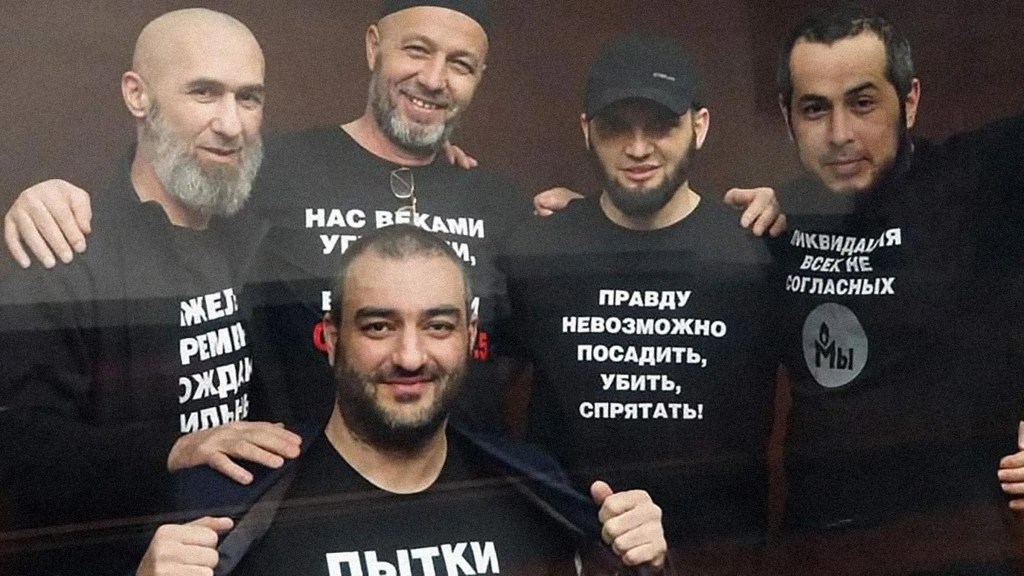
Political prisoners Tofik Abdulgaziev, Vladlen Abdelkadyrov, Izzet Abdullaev, Medzhit Abdurakhmanov and Bilial Adilov, among those falsely accused of “terrorism” and “preparation to seize state power” in 2019, and sentenced to 12-14 years’ imprisonment. Abdullaev’s T-shirt says, “the truth can not be imprisoned, killed or hidden”. Photo by Crimea Solidarity
On the anniversary of that tragedy, which Ukraine demands be categorised as genocide, Important Stories spoke with Crimean Tatars who continue the struggle to live freely in their historic homeland.
Every Crimean Tatar family has its stories of deportation. They all start in the same way. On 18 May 1944, at five o’clock in the morning, soldiers burst in to the house and gave people 5-10 minutes to collect their belongings and go to the nearest train station. No explanations. At dawn, everyone was forced into cattle wagons and taken away.
It was all over by 4:00 pm on 20 May: one of the fastest deportations in world history. All the deportees’ property passed to the Soviet state.
“Many people thought they were being taken away to be shot. The Soviet Union was an atheist regime, and many Crimean Tatars were of Islamic faith”, said Azime (her name has been changed), the wife of a present-day Crimean Tatar political prisoner. Her family were deported to Uzbekistan.
“They put everyone in cattle wagons, with no windows and locked doors. There was no sanitation. No water, no food. People died from hunger, thirst and dysentery. The soldiers just threw their bodies out at the train stations. Some people were able to hide their relatives’ bodies: those families hoped that they would soon arrive somewhere and be able to bury their loved ones like human beings.”
The transport took 2-3 weeks. About 80 per cent were taken to Uzbekistan, and the rest were sent to special places of exile in other parts of the Soviet Union.
“Part of my family was deported to Uzbekistan, part perished in those cattle wagons, and my grandfather was taken to the Urals”, said Ismail (his name has been changed), who today acts as a defence lawyer for Crimean Tatars. “Grandad said that, while he and his mother tried to find accommodation, they could not go to work for two days. And so [for breaking the labour laws] his mother was sent to prison for five years.”
Soviet propaganda prepared local people to receive the deportees. Uzbeks were advised to keep well away from the newcomers, who were “cyclops” and “cannibals”. In exile, Crimean Tatars faced hunger, dangerously unsanitary conditions and an absence of health services. Between 18 May 1944 and January 1946, about 200,000 Crimean Tatars lost their lives, according to estimates by the National movement.
The struggle to return home
People could not return to Crimea. Until 1956 the Crimean Tatars had the status of “special settlers” with limited civil rights. They had to report regularly to police commandant’s offices. They were permitted to move to a different region only by invitation from close relatives. Attempts to leave without permission were punished by up to ten years’ imprisonment.
Although their language was banned, the Crimean Tatars preserved their culture and traditions. Parents told children what their home looked like, and how to get there, so that they could find their way to it when they returned.
“Everyone lived with thoughts of going back”, Ismail said, telling his family’s story. “My uncle somehow found a way to travel to Crimea. My grandmother asked him to bring a bottle of water from home: she wanted to drink Crimean water. When my uncle got back from his trip, he realised that he had forgotten about the water. He took a bottle, filled it from the tap, and took it to Grandma [telling her it was from Crimea]. She cried. For her, that bottle was almost sacred. She kept it, and never drank a drop.”
In the 1960s, the Crimean Tatars began independently to collect information about the victims of the deportation. They demanded that the Soviet authorities revoke the slander that they were traitors, and allow them to return home. That is how the Crimean Tatar national movement was born.
On 5 September 1967, after many attempts to secure justice, came a decree of the Presidium of the Supreme Soviet of the Union of Soviet Socialist Republics (USSR), which revoked all accusations against the Crimean Tatars and allowed them to live in any part of the country. But to return to Crimea, they had to secure a residence permit, and find work. [Residence permits, linked to employment, were used to discipline labour in the Soviet Union.]
By the end of September 1967, about 2000 Crimean Tatars had already returned to the peninsula. But the majority of them could neither get a residence permit, nor any chance of work, from Crimea’s new inhabitants. Many were deported again, and brought to court for breaches of the internal passport regulations.
Azime’s family was one of the first that returned to Crimea and found a way to stay there. “My grandfather, an activist of the national movement, left behind all that he had worked for in Uzbekistan, took his four children, and went home. We are not even talking about returning to his own village, where his grandparents were buried – only returning to somewhere on the peninsula where the family would be allowed to stay. They found a place in Dzhankoi district, where several other [Crimean Tatar] families also moved in. The street was named International Street, because we, the non-Russians, lived there.”
Azime was born at the end of the 1980s, already back in Crimea. Among people of her age, that is very unusual, she said. “I know literally two other people [of her age] who were born back there [on the peninsula].”
[In the 1970s and 80s] the Crimean Tatars had to build their homes all over again. The homes from which their families had been deported now belonged to other people. The work they could find was always the hardest. The attitude of the new local population was hostile: they continued to accuse them of treachery.
“Our grandparents were often dismissed from work”, Azime remembers. “They were constantly searching for new jobs, in order not to be deported again. My mum went to school in Crimea: when the family returned, she was eleven years old. She was admitted to university only on the fourth or fifth attempt. The dean of Simferopol medical school told her father outright that he would not accept Crimean Tatar students, not for any amount of money.
“My mum was the only Crimean Tatar woman in her university. [When her fellow students and teachers learned that she was a Crimean Tatar], she was told to her face that she had no business being there. Many teachers simply marked her work down. Our people felt everywhere that Crimean Tatars were strangers in their own land.”
The Crimean Tatar national movement had already taken shape, and its activists fought for the right to live in Crimea and for the freedom of those imprisoned for breaches of the internal passport regulations. They monitored attacks on human rights, and took part in hunger strikes and other forms of protest. In 1978 the activist Musa Mamut burned himself to death as an act of protest: this became one of the symbols of Crimean Tatar resistance.
But even twenty years after the decree of 5 September 1967, the situation had hardly changed. “The mechanisms to obstruct the Crimean Tatars’ return had been so finely tuned by the Crimean authorities, that I never heard of a single instance of a new Crimean Tatar family buying a house”, the Crimean Tatar activist Bekir Umerov wrote in his memoirs. His family was also prevented from returning to Crimea: in the 1980s they moved to the Krasnodar region [of southern Russia], to be nearer to home.
After the beginning of perestroika [the reform of the Soviet system started under Mikhail Gorbachev, from 1986] in the spring of 1987, the Crimean Tatars gathered in Tashkent [in Uzbekistan] for their first All-Union Assembly. They agreed on a document that called on Mikhail Gorbachev, then the general secretary [of the Communist Party of the Soviet Union] to meet a delegation. This call went unanswered, and so on 18 May, the anniversary of the Crimean Tatars’ deportation, the activist Bekir Umerov announced a hunger strike in protest.
This met with a powerful response, and not only among Crimean Tatars. The scientist and human rights defender Andrei Sakharov mentioned the action in his call to Gorbachev to resolve the problem of Crimean Tatars being able to return home. Umerov ended his protest a month later, when the Second All-Union Assembly of Crimean Tatars elected him to a delegation that travelled to Moscow. But the Kremlin refused to meet the Crimean Tatars, as it had done before.
The activists then began protests at the Lenin mausoleum [on Red Square], at the building of the CPSU Central Committee, at the Kremlin. Each day the number of participants grew. One of the biggest rallies was held on Red Square in the middle of July 1987. The Crimean Tatars staged a peaceful sit-down protest, and the police held back from using force. A week later, on 26 July, more than 1000 Crimean Tatars took part. This time the police blocked the way to Red Square and so the demonstrators went along Vasilevsky Spusk, sat on the ground, raised their placards and shouted: “Crimea! Our homeland!” The action went on for 26 hours.
Many of the participants were arrested and deported from Moscow to the places where they lived. No official documents sanctioning a return to Crimea were issued by the authorities – but there were fewer obstructions.
The Crimean Tatar protests continued through the whole perestroika period.
Occupation of the peninsula
Many families could return to their homeland only after the collapse of the USSR. The move was difficult, even without the authorities interfering. “For more than 20 years, the Crimean Tatars had been finding their feet in the places to which they were deported. They had settled down. And now they had to leave everything again, return home empty-handed, and again start to get on their feet”, Azime explained.
“After all that had happened to our people [as a result of deportation], we stuck closer together and helped each other. My parents told me about how someone had got land in Crimea, gathered 30-40 families and built a house on it together. And then they built another. We are not just a people, we are one big family”, Ismail, the human rights defender, said.
“In general the Crimean Tatars are Muslims. This means a sense of collectivism, which means brotherhood, giving moral support to each other, good neighbourliness. These are traditions going back to the [Crimean] khanate [of the 15th-18th centuries]. The Prophet says, ‘if you laid down to sleep well-fed, and your neighbour was hungry, you will not sense the scent of paradise’. And it makes no difference whether your neighbour is Muslim or not.”
The Crimean Tatars were only able to live a relatively quiet life in their historical homeland for a little more than twenty years.
“It turned out that my generation was the only one, in the past century, who could spend their early years at home, living in peace”, Azime said. “I just recently said to my children that I could not now myself imagine how carefree those years were. We just lived, and did not think that things could be different.”
That life changed at the beginning of 2014. “I was then pregnant with my third child”, Azime recalled. “I was already preparing for the birth when I heard on the news that the Russian [armed forces] were coming. I knew that for decades Russia had imprisoned Muslims simply for professing their faith. I can not tell you how terrified I was, for my child, for my husband, for all of us. Then tanks appeared on the streets, and men in uniform, and the occupation began.”
Some Crimean Tatars decided to move to Ukrainian-controlled territory. Azime and her husband also discussed that, but decided to stay. “We both agreed that here is our home, our land, for which our parents had fought. Why should we leave? It was they who came to us, no-one asked the Russians to come here. We decided that we would not allow Russia to drive us from our homes a second time.”
Most of the Crimean Tatars were against the occupation, and boycotted the “referendum” [of March 2014, on joining the Russian Federation]. Consequently, after the annexation, the Russian authorities took repressive measures: Crimean Tatars were arrested, kidnapped, and accusations under the laws on terrorism were fabricated en masse. People were accused of membership of [the transnational Muslim organisation] Hizb ut-Tahrir, which is banned in Russia. As proof, “secret witnesses” were produced, together with the fact that the accused professed the Islamic faith.
“We did not know what to do”, Ismail remembers. “We did not know the new legal code, or what to do when three brothers by faith were falsely accused of terrorism. From the start, the new ‘authorities’ were determined to show that they would liquidate anyone who opposed Russia. They only wanted people loyal to them in Crimea.”
Ismail himself suffered intimidation and harassment. In 2015 an officer of the Federal Security Service (FSB) planted drugs on him [and he was arrested]. When being questioned, he was asked about Crimean Tatar affairs. They tried to convince him to work for the security services. Thanks to the prominent Crimean Tatar lawyer Emil Kuberdinov, the case did not go any further than the prosecutor’s office.
“At that time the Russians were still trying to work out the extent to which their hands were tied in Crimea”, Ismail said. “But I already understood what was on its way. Crimean Tatar lawyers came on the scene, not only helping people who were arrested, but also support political prisoners’ families, explaining how to send parcels to prison, what to do on prison visits and so on.”
In 2016, Crimean Tatar activists, together with lawyers, formed the Crimea Solidarity organisation.
In 2017, about one hundred Crimean Tatars across peninsula simultaneously staged one-person pickets against Russian repression. About 60 people were served with administrative summonses, for breaching the regulations on picketing (Article 20.2 Part 5 of the code on administrative offences [similar to civil law]). The hearings were all arranged on the same day, in different districts. As well as Crimea Solidarity’s lawyers, the interests of the accused were represented by civil society activists. One of these was Ismail. “People began to offer support to Crimea Solidarity. I did so myself. We had no legal education, but the lawyers helped us to prepare. So the Crimean Tatars continue to help each other.”
Repression under occupation
Criminal cases under terrorism laws have become the main instrument of repression against Crimean Tatars. Military courts deal with these cases in closed hearings that even close relatives can not attend. The sentences under these laws are 10-20 years’ imprisonment.
The Russian security forces have conducted searches at mosques, arrested clerics, cases have been put together alleging failure to inform on “terrorist groups”. Family members of political prisoners have also been subject to surveillance and harassment.
Every arrest and raid becomes a matter for the whole community. People gather at any time of day or night, often bringing children along, to support families who have been singled out for searches. Azime, along with her elder sons, has often gone to support her neighbours. She tells her children not to fear people in uniform, that those people’s fear is even greater.
Azime also prepared the family for the fact that they might be raided at home. Her husband Rinat (his name has been changed) is an activist in the national movement, has written a great deal about the repression of the Crimean Tatars, and has spoken out openly against repression and against the occupation. He had been arrested on administrative charges several times, and the family understood that sooner or later he could face criminal charges. Some time ago Azime started to sleep wearing her clothes and a hijab [expecting a raid].
The security forces came for Rinat at 6:00 in the morning, but he was not at home.
“Before sunrise every day we read prayers. My mother asked me in Tatar (in the family we use our native language) how she would be able to perform ablutions. I told her not to be afraid and to stay calm. The armed men told us that we could not speak in Tatar. That was offensive to me, as a woman and as a mother. They insulted our faith: they said that instead of ‘beating the floor’ five times a day, which should behave like normal people.”
Protesters and Russian armed forces in Crimea, 2014. Photo by Krym.Realii/RFE-RL
During the raid, Azime’s three children were much calmer than she had expected them to be. “I tried to stay confident and not to fear these men and their automatic weapons, hoping that that would also help the children to stay calm. Only my daughter was crying, at the start when she first saw the guns, she is the youngest.
“When I woke up, the room was dark, but I could see floodlights being shone from the street directly into our windows. The shadows were dancing around the courtyard. I understood that it had started. Then wild knocking at the door”, Azime recalled. “I asked my mum to dress and open the door. A big crowd of armed men in masks ran in, shouting. They turned the shelves upside down, everything from outer clothes to underwear. They paid closest attention to the books.
“My sons are still in primary school, I don’t think they understood exactly what was going on. For them it was like something out of a fairy tale, where we needed to defy evil. They did not sit in the corner like mice, but walked between these people with the automatic rifles, as though everything was OK. The men did not touch them. Just once, they tried to find out [from the children] the password for my phone, which I refused to unblock. I did not want them to see photographs of me unveiled.”
It only became clear later how stressful the children had found the raid. “For years afterward, my elder son started to fear the whole world that surrounds him. He thought that the FSB was everywhere, he saw all people as a threat. When we went into town, he would stick close by me and say, ‘I am afraid that they are going to take me away’. For a year or two, my daughter developed a nervous tic. She works with a psychotherapist, but still fears me falling asleep before her, fears being alone.
“At least the children didn’t see how their father was set upon and thrown to the ground with an automatic pointed at his temple. That’s a rare thing for a Crimean Tatar family nowadays. I have talked with the children many times, I saw to them that the Almighty is with us, and that his wisdom also oversees what is happening with their dad”, Azime said.
Wives of Crimean Tatar political prisoners
Azime’s husband was beaten, and arrested, when he travelled to Rostov to deliver parcels to other Crimean Tatar political prisoners being held there. While Rinat’s case was in court, Azime could at least see him at the hearings. But when the sentence was announced, neither Rinat’s wife nor other Crimean Tatars were admitted to court. Rinat was sentenced to nearly 20 years in a maximum security facility, under two Articles of the criminal code: “organisation of the activity of a terrorist group” and “preparation for a violent seizure of power”.
Azime said: “My husband is big, kindly man, like a bear in a cartoon. He went out to work, went to court hearings [of other arrestees], publicised the repression of our people, and always found time for our family. I lived like a princess. And now all that has finished. A new life has begun: I have to survive, and to try to understand what comes next.
“At night I cry into the pillow, so that the children can not hear. I have to learn to do things in the household that were previously done by my husband: what documents have to go where, how to pay for the electricity, how to read the meters. I have had to give up studying and my teaching work. Before all this, I had more time for the children: now I often have to leave them to look after each other.”
Azime’s health has suffered as a result of all that has happened, and she has had two operations. She is supported not only by her family but by the community. “There was a knock at the door, and a woman I don’t know was standing there, offering me eggs and cheese. She said: ‘That’s for you, my dear. You don’t know me, but your husband gave court support to my son.’ Around here there are already many women with the same, bitter experience. I turn to them for advice, about where to buy things for prison parcels, where to send documents for this and that. I am walking along a well-trodden road.”
It is now five years since Rinat’s conviction. In that time, Azime has not been able to meet her husband once. Her only contact with him is through letters, that are passed on by his lawyer. In prison, Rinat has continued to write about the repression against the Crimean Tatars. Azime receives his articles, retypes them electronically, publishes them and sends them out. “My husband constantly writes to me, thanking the Almighty for the fact that his wife is here. He says, ‘when my book comes out, that will be your doing – you are my censor, editor, proof-reader and publisher!’
“Like the wives of other Crimean Tatars, I have chosen to continue the fight taken up by my husband. Up until 2022, we used to travel, to explain what is happening to our people. We were in Kyiv, Kherson and Mariupol. We continue to campaign now, but we can not travel anywhere. Our husbands have been deprived of free speech. Who, if not us, will speak about their cases and convey their arguments? They, also, became activists not by choice. And now we stand in their place.
“In our letters to our husbands, we sound very strong, like stone, their bastion. I always write to my husband, ‘this is your challenge from the Almighty. If you meet it, you will earn yourself a place in paradise’. It’s at night-time that I cry in my pillow. I feel sorry for my husband, and it is hard for me too. I have to be both mother and father to my children; I have to support my husband; and be an activist. But you cry, and you keep going – and that’s how I earn a place in paradise too.”
The all-out war
With the Russian army’s all-out invasion of Ukraine in Feburary 2022], many Crimean Tatars were again forced to leave their homes. The biggest exodus took place when military mobilisation was announced. According to the Mejlis of the Crimean Tatar people [the national representative council, now based outside Crimea], since September 2022 between six and eight thousand Crimean Tatars have left the peninsula. Azime said that Crimean Tatar families that have sons of conscription age try to leave Crimea. “Everyone fears that their sons will be taken by force to the war.”
Ismail said: “Many people have left because they do not want to fight on Russia’s side – although the mobilisation turned out to be more a moral pressure than a physical one. Of those who have been sent to the front from Crimea, only about 5 per cent are Tatars. I reckon that, of those who did go to the front in autumn of 2022, 60-70 per cent have already returned.”
Those who have moved to territory controlled by Ukraine can not return to Crimea, due to the risk of repressive action. In 2023 the Crimean Tatar Leniye Umerova tried to get to Crimea to see her father, who was very ill. She travelled from Ukraine via Georgia. She was arrested at the border on suspicion of spying. Umerova has already spent a year behind bars in Russia. The case will be heard in secret and she is threatened with 20 years’ imprisonment.
Since 2022, repression against Crimean Tatars has been stepped up. The Russian authorities have conducted at least 71 searches, and there have been at least 110 convictions – more than in the preceding eight years. In the autumn of 2022 a second pre-trial detention centre (SIZO) was opened in Crimea: Crimean Tatars, and Ukrainians kidnapped in the occupied territories, are sent there. Since the all-out war began, there have been a much greater number of cases, compared to the previous eight years, related to the “voluntary Noman Chelebidzhikhan battalion of Crimean Tatars”, that has been fighting on the Ukrainian side since 2014.
There was also a wave of repressive measures against Crimean Tatars when parts of Kherson and Zaporizhzhya regions were occupied: about 100 people have been arrested there. Some cases have been initiated by informers who write on the Krymsky SMERSH telegram channel that was set up in 2022.
“Informing has become a big thing in Crimea”, Ismail says. “Someone says something at the market, and that’s it, you get a knock on the door. The regional authorities have acquired an extra repressive tool against the peninsula’s citizens: the Article [in the code on administrative offences] on discrediting the army. There have been many administrative cases as a result, some for people writing comments on social media.”
Azime said: “Today, deportation of Crimean Tatar people takes a hybrid form. Now it’s not in cattle wagons: people are taken away in prison transport vans. From many families they have taken all the menfolk: for example they will take the husband, son and father. I have a neighbour who is 75, they have taken both her sons. Every time I see her she says, ‘my dream is just to be able to hug them once more in this life’.”
Azime has decided to stay on the peninsula, as long as possible. “In our lives we have seen hundreds, perhaps thousands, of families that have been broken up, which fought for so long to be able to return home. I have decided for myself that I will never leave our homeland. We understand that the repression will intensify, that whatever has to happen, will happen.
“What’s the point of cowering like a mouse, of living in fear? If they succeed in shutting our mouths, that would be a betrayal of our people who have suffered so much. We must not stay silent. As long as our husbands are imprisoned, and as long as they continue to try to destroy the Crimean Tatar people, we won’t stop fighting.”
Ismail, too, has no intention of leaving the peninsula. He continues to support Crimean Tatars in court. “I have decided for myself to take this position. I see how the families of my close friends are punished and repressed, how people are imprisoned. As a Crimean Tatar and a Muslim, how should I react? Do I sit here and say, ‘it’s nothing to do with me’ – or give some help. For me, this is a test from God.
“The best example to me in this situation is the Prophet Muhammad. Yasir’s family was taken to the desert and tortured by infidels for their religion. What did the Prophet do? He did not sit at home saying a prayer; he did not stand to one side. He went there, where Yasir’s family was under attack, and gave his support. That shows how we, today, faced with this repressive machine, need to react.
“It does not depend on us, whether they imprison a person or not. But it depends on us what we do, what support we give. Can we help the defence in court? Then we’ll go to court. Can we help the family? Then we will visit their home, bring things that they need, and money, and help with the children.
“For the Crimean Tatars it is very important to preserve our spirit of unity. We have faced many trials. When a person is left to face a problem on their own, that is very hard to bear. If someone just sits down for coffee with that person, and says, ‘you are not alone, we will help you, we are right alongside you’, this helps to deal with tragedy.
“I was recently in touch with the mother, and aunt, of a Crimean Tatar who was sentenced to ten years, in a case related to the ‘voluntary Noman Chelebidzhikhan battalion of Crimean Tatars’. They kept telling me how people had come to visit them, to help and support them, how they felt the support of our people. Without this, they said, they would have been broken.
“Russia is trying to give the appearance that everything is fine in Crimea, and now they don’t lay a finger on anybody. That is a lie. We can show the world that we have already had ten years of this. We understand, of course, that the repressive machine pays little heed to laws, let alone to moral and humanitarian values. If an instruction comes down to lock someone up, they do it, no matter what defence is presented in court.
“But we continue to go to court, to record videos showing how Crimean Tatars face harassment and intimidation. We continue to fight. We don’t keep quiet or swallow all this silently. We will take a stand and say, ‘we are not guilty’. I think that if we had not done this, if we had sat quiet, then Crimea would already have been turned into another Chechnya.”
The links in the article are from the original Russian version, to sources in Ukrainian and Russian. Web sites in English include the Mejlis of the Crimean Tatar people; Crimea Platform, recently launched by the Ukrainian government; the Crimea Human Rights Group; and Crimea SOS. Reports on human rights abuses have been published this year and last by the UN and the Council of Europe. A history of the Crimean Tatars, ‘A Seditious and Sinister Tribe’: the Crimean Tatars and their Khanate, by Donald Rayfield, has just been published, and reviewed. There are more than 100 political prisoners listed (Russian only) on the Crimea Solidarity web site currently detained.
Source: People and Nature, 16 August 2024. Thanks to Simon Pirani for translating this important overview of the Crimean Tatars’ struggle and for permitting me to reprint his translation here.
A court in Moscow has remanded the theater director Zhenya Berkovich to custody in a pretrial detention center and almost inevitably will render the same decision about the playwright Svetlana Petriichuk (whose pretrial restrictions hearing is still underway). This is the first criminal case in Russia against the authors of a work over its content. Both are accused of “condoning terrorism” in the play Finist the Brave Falcon, which recounts how Islamists recruited Russian women as wives. Last year, the production was awarded the state-sponsored Golden Mask theater prize in two nominations.
Before the court hearing, it transpired that the case was based on a forensic examination conducted by Roman Silantyev, head of Moscow State Linguistic University’s Destructology Laboratory, and his colleagues.
“Destructology” is a science invented by Silantyev himself. He claims that the new discipline “comprehensively examines extremist and terrorist organizations; psychotic cults and non-religious sects; totalitarian sects and the magical services sector; suicidal games and hobbies; deadly youth subcultures (Columbine, AUE, etc.) and medical dissidence.”
There are many experts in Russia whose findings are used by the security forces to imprison people for what they say and write. Often such experts are ignorant, their conclusions are unscientific, and their public statements are frankly obscurantist.
But Roman Silantyev stands out even in this crowd.
A former employee of the Moscow Patriarchate’s Department of External Ecclesiastical Relations (the church’s equivalent of the Ministry of Foreign Affairs), at the outset of his expert career, Silantyev presented himself as a specialist in Islam. In 2005, the publication of his book “The Modern History of the Russian Islamic Community” triggered a scandal: Russia’s Council of Muftis wrote that the author’s stance was at odds “with the most elementary norms of universal ethics and morality.”
To understand the outrage of the muftis, we should take a look at Silantyev’s statements. For example, he said that in order to fight the Wahhabis, “physical force—destruction and gouging—is maximally effective” and dreamed that “law enforcement agencies would finally realize that in this case it is better to cross the line than to come up short.”
Over time, Silantyev felt that he had outgrown his narrow remit as a scholar specializing in Islam and since then he has been commenting on everything. He has opposed Star Wars (callingJediism an “anti-Christian multifunctional propaganda project”), claimed that Ukrainians profess the “religion of Ukrainianism,” and called for a legislative ban on Satanism in Russia, accusing Ukraine of spreading it.
In 2020, Silantyev traveled around Russia giving lectures on “extremism prevention.” He boasts that he has taught classes to officers and staffers at the Federal Security Service (FSB), the Federal Penitentiary Service (FSIN), and the Interior Ministry. And they seem to actually pay heed to him, or at least to successfully use him for their own purposes. It seems that Silantyev has already helped to send dozens (if not hundreds) of people to prison, including Muslims and Jehovah’s Witnesses.
And now he has helped send artists to jail. In their expert report, Silantyev and his fellow destructologists write that Berkovich and Petriichuk’s play contains “traces of the ISIS ideology, as well as the subculture of Russian Muslim neophytes.” In addition, the experts detected the “ideology of radical feminism” in the play.
“The ideology of radical feminism, based on the idea of women’s immanent humiliation, is far from harmless. Destructological science has recorded cases in which adoption of this ideology led to the deliberate planning and execution of a terrorist act,” the self-styled experts teach us. And the court, by sending artists to jail, seems to share this opinion.
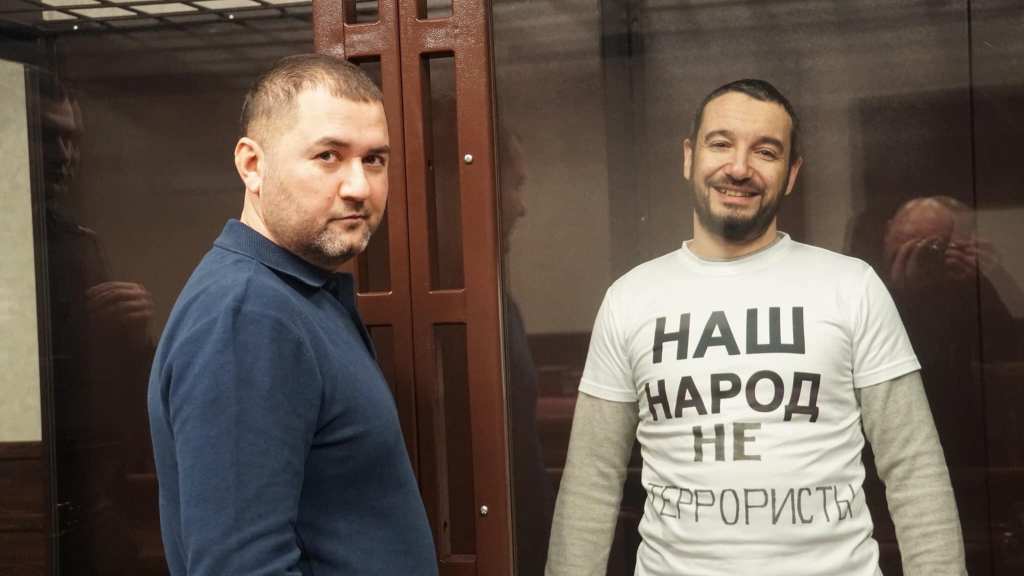
Defense attorney Edem Semedlyaev and Crimean Tatar political prisoner Raif Fevziev, Rostov-on-Don, Russia, 12 January 2023. Imam Fevziev’s t-shirt reads, “Our people are not terrorists.” Photo courtesy of Imam Fevziev and Crimean Solidarity via Mumine Saliyeva
In one of his interviews from the dungeons of the Rostov pretrial detention center, Dagestani journalist Abdulmumin Hajiyev commented on the everyday lives of inmates: “Lately, I’ve been thinking about taking cooking lessons. For some reason, there has been a skilled cook in every cell I’ve inhabited since Makhachkala. Sirazhutdin (Kumyk), Magomed (Avar), Rutem and Alim (Crimean Tatars) — I always admired the enthusiasm and care with which those guys spent several hours every day cooking something delicious for their cellmates with only a bucket and an immersion hot-water boiler to hand. Hajiyev also mentions Alim Karimov, a defendant in the Crimean Hizb ut-Tahrir case, with whom he has shared a cell for a over year a year. Over this time, Alim has learned Arabic.
Yesterday, a Russian court sentenced Karimov and four other defendants, among whom there are pensioners with disabilities, to thirteen years in prison each. The two years it took to try the case on the merits were memorable in several ways. There was an ambulance present at the hearings, but its crew did not provide qualified medical care to the defendants, who were forbidden to speak Crimean Tatar during the proceedings. Putting old men in the dock for talking about Islam had nothing to do with the letter of the law. Instead, it speaks to Islamophobia cloaking itself in the law’s guise, and to the disgrace of the foot soldiers who executed this drama.
A few days ago, my fellow journalist had the opportunity to hand over to me his new articles, one of which tells the story of Ernes Ametov, a cellmate from Crimea, who was sentenced to eleven years in prison by a military court in late December because he would not do a deal with a lie.
Today, Russia’s Southern District Military Court again handed down a verdict to a Crimean Tatar religious figure. Imam Raif Fevziev was sentenced to seventeen years in a high-security penal colony (with the first three years to be served in an ordinary prison) for having a seventy-minute conversation about religion. His trial took place at the same time as the trial of Crimean defendants in another criminal case. Friends and colleagues of Fevziev’s — the religious figures Ismet Ibragimov, Vadim Bektemirov, Aider Dzhapparov, and Lenur Khalilov — had earlier been sentenced to brutal terms of imprisonment by the very same court. These are textbook political persecutions: the NKVD used the same methods, in the past, to eradicate and destroy religious and public figures who had influence among the people.
It is quite difficult to cope with such a merciless chronicle of crackdowns. But when you see and feel what kind of regime you have come face to face with, and how the political prisoners, their families, and a whole people wisely and peacefully oppose it, you have no choice but to recharge your batteries, be more resilient, and go on working, while believing ever more fiercely that change will come.
I read in a book that a system based on segregation and tyranny is a large-scale manmade disaster. The people involved in perpetuating it may well understand that the breakdown of such a “juggernaut” is inevitable, and that they themselves, collectively, are causing the breakdown. But each of them assumes that it’s not their own personal fault, but everyone else’s. Each of them, on the contrary, believes that they are trying to save it — through cruelty, by cracking down on those dubbed “enemies” and “undesirables.” Ultimately, however, they fail to save it.
Source: Mumine Saliyeva, Facebook, 12 January 2023. Translated by Hecksinductionhour
Ioann Kurmoyarov in court. Photo by and courtesy of SOTA
Today in St. Petersburg, the trial in the case of the defrocked Orthodox priest Ioann Kurmoyarov on charges of disseminating “fake news” about the army continued. Kurmoyarov had claimed that those who invaded Ukraine would go to hell.
A theological discussion unfolded in court. Imam Fayzulla Karimov, who barely speaks Russian but was revealed to be the “expert linguist” who had assessed Kurmoyarov’s theological videos, testified as a witness for the prosecution.
It transpired that a specialist of his profile was required by the investigation to evaluate Kurmoyarov’s statement that “those who consider themselves Christians and support this war should change their religion and convert to Islam,” thus, allegedly, “inciting interfaith discord.”
From the questions posed to the “expert witness,” it transpired that he, as a native of Tajikistan, had not formally studied Russian, but had graduated from the Faculty of Philology in Dushanbe in 2004 and the Islamic University in 2014.
Kurmoyarov had been bringing the imam round to the idea that Islam, unlike Christianity, has a concept of holy war in the literal sense of the word, but the judge struck down his questions.
Here is an example of the dialogue between the judge and imam, demonstrating the latter’s level of knowledge of the Russian language (although he travels to Russia for short visits, he lives permanently in Tajikistan):
Judge: Are you acquainted with Kurmoyarov? Imam: I am acquainted. Judge (forcefully): Are you acquainted with Kurmoyarov? Imam: I am not acquainted.
Caucasian Knot reports that a court in Sochi has extended the remand in custody of Jehovah’s Witness Danil Suvorov until June 13. Suvorov’s defense counsel Sergei Yanovsky said that he had appealed the decision.
Danil Suvorov has been charged with involvement in an extremist organization (punishable under Part 2 of Article 282.2 of the Criminal Code), as well as recruiting for an extremist organization (punishable under Part 1.1 of Article 282.2 of the Criminal Code). According to criminal investigators, Suvorov attempted to recruit people to join the Jehovah’s Witnesses, “using his authority as a spiritual leader.”
The accused man’s mother, Gulnara Suvorova, was able to communicate with her son in the courtroom for the first time in over nine months.
“My son has been languishing in prison for nine months running for nothing. Or rather, for the fact that he read the Bible aloud to a person who had asked him about it. But, of course, it was just an easy excuse for law enforcement officers to catch a ‘criminal’ and earn a promotion for such a serious charge as extremism,” she told Caucasian Knot.
Suvorov’s defense moved to have the case dismissed, because, according to an expert witness, there was no extremism in the believer’s actions.
Suvorov was detained on 18 August 2021, the same day that his home and the homes of other Jehovah’s Witnesses in the Krasnodar Territory were searched. Electronic devices, personal diaries, postcards, and literature were seized from believers.
In 2017, the Russian Supreme Court ruled that the Administrative Center of Jehovah’s Witnesses in Russia was an extremist organization. It dissolved the Center and banned it from operating in Russia. Later, all Jehovah’s Witnesses branches in Russia were added to the list of banned organizations. Subsequently, a flood of criminal prosecutions against members of the confession began.
Source: OVD Info, 14 May 2022. Translated by the Russian Reader
The Mahal Mosque in Nizhny Tagil. Photo: IslamTsentr
On 12 May 2022, it transpired that in April, the Tagilstroyevsky District Court of Nizhny Tagil fined Fanis Galeyev (spelled “Galiyev” in some sources), the imam at the Mahal Mosque, under Article 20.29 of the Russian Federal Administrative Code (“distribution of extremist materials”).
An inspection conducted by the prosecutor’s office found twenty-books books included in the Federal List of Extremist Materials in the imam’s possession.
According to Galeyev, he had collected the books only to study and later destroy them.
“There is a fine line. Today these are not extremist books, but tomorrow they will be extremist. This can be determined by a spiritual person, not a secular one. These books that have been discovered cannot simply be thrown away. They must either be buried or burned.”
The imam is a member of the Nizhny Tagil Council for Combating Extremism.
There is no information about the books in question, but we should note that we consider many cases of banning Islamic literature to be unlawful.
Sources:
“Case Card No. 5-512/2022,” website of the Tagilstroievsky District Court of Nizhny Tagil, Sverdlovsk Region, May 2022 [the embedded link was inaccessible from my IP]
“Nizhny Tagil imam fighting extremism is convicted of distributing extremist literature,” 66.ru, 12 May 2022
“Nizhny Tagil imam punished for extremist literature,” Vse novosti, 12 May 2022
Source: SOVA Center, 13 May 2022. Thanks to OVD Info for the heads-up. Translated by the Russian Reader
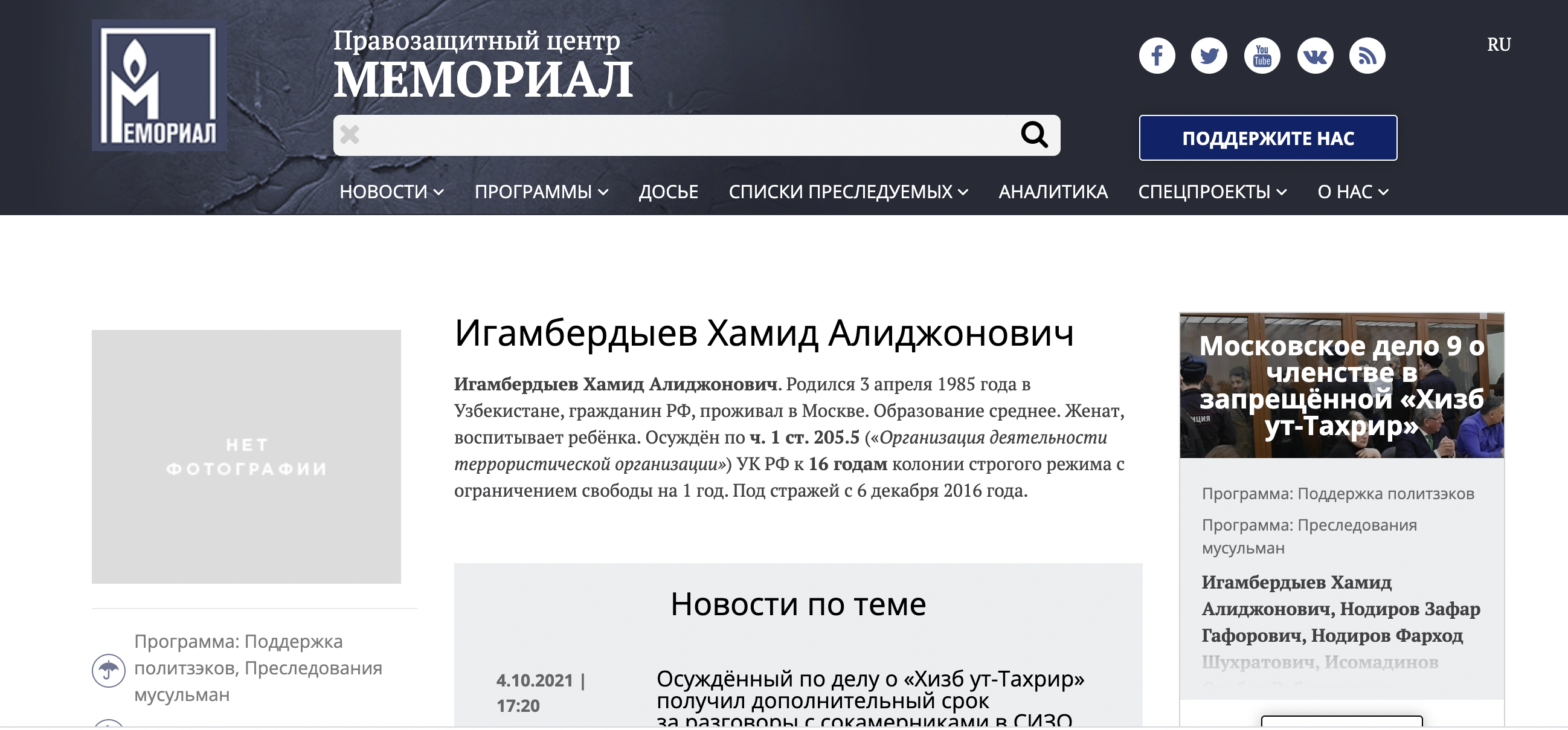
Although I am certain that the Memorial Human Rights Center knows what Hamid Igamberdyev looks like, there is no photograph in his “case file” on their website. Igamberdyev might be one of the men captured in the photo, originally published in Kommersant, that I posted along with my translation of OVD Info‘s report on the original verdict in the case, in February 2019. ||| TRR
Man convicted in Moscow Hizb ut-Tahrir case receives additional sentence for talking to fellow inmates in jail Memorial Human Rights Center
October 4, 2021
On September 28, 2021, a panel of judges with the 2nd Western District Military Court issued a verdict in the case of the 36-year-old stateless person Hamid Igamberdyev, finding him guilty of “condoning terrorism” (punishable under Article 205.2.1 of the Russian Federal Criminal Code).
Igamberdyev was detained in Moscow in December 2016. In February 2019, he was found guilty under Article 205.5.1 of the Russian Federal Criminal Code of involvement in the activities of Hizb ut-Tahrir, an organization banned in Russia, and sentenced to 16 years in prison. In 2020, a new criminal investigation was opened into Igamberdyev on suspicion of “condoning terrorism,” based on an interpretation of his conversations with cellmates in Moscow Pre-Trial Detention Center No. 2 (Butyrka) in 2017.
The court sentenced Igamberdyev to three years in prison. Taking into account his earlier sentence, he will serve a total of seventeen and a half years in a high-security penal colony.
On the day the verdict was announced, the defendant delivered a twenty-minute closing statement, the written text of which the court entered into the case file.
Below are some key points of this speech, revealing important elements of the practice of fabricating charges (so-called hyping) against people previously convicted under the Criminal Code’s anti-extremist provisions.
Memorial Human Rights Center has published reports on the previous hearings in the trial (part 1, part 2).
In his closing statement, Igamberdyev noted that the testimony of witnesses during the investigation and in court was confused and contradictory concerning both the events themselves and the circumstances of how their testimony was taken during the preliminary investigation.
Thus, witness L., contrary to the interrogation record, testified in court that he had spoken only about life and everyday matters with the defendant. Religion was not discussed, since “we have different faiths.” He had not read through the entire interrogation record, signing it on the advice of a lawyer, and could not remember how he had testified. Igamberdyev also noted that L.’s testimony during the preliminary investigation was not corroborated by video footage, recorded around the clock in the pre-trial detention center.
Witness K. also gave testimony in court that seriously differed from the official interrogation record. In particular, he spoke only about a single nighttime conversation with the defendant in which the topic of Hizb ut-Tahrir was discussed, but there is no evidence of such a conversation either in the case file or the video footage. Regarding his testimony during the preliminary investigation, K. made contradictory claims in court, saying a) that he had written his statement himself, b) that he had dictated it, and c) that he does not remember under what circumstances he gave the statement.
Witness B. stated in court that he had not given any evidence at all during the preliminary investigation, and that he had neither read nor signed the statement allegedly written by him personally. Despite his own negative attitude towards Hizb ut-Tahrir, B. testified that the defendant had never condoned terrorism in conversations with him.
Igamberdiyev argued that finding him guilty on the basis of such contradictory and confused eyewitness testimony violated the principle of presumption of innocence.
Igamberdyev also noted that the name “Hizb ut-Tahrir Al-Islami” is mentioned in the interrogation records, while the shorter wording “Hizb ut-Tahrir” is used in the organization’s printed materials and by the defendant himself. Igamberdyev argued that, despite what was written in the interrogation records, the witnesses could not have heard him use the first, longer, name, which appears only in official state documents.
Regarding the expert testimony, the defendant noted that the invited experts had admitted that there had been no attempts to recruit or call for terrorism in his statements, but there had been “condoning of terrorism,” consisting in his alleged denial of the terrorist nature of Hizb ut-Tahrir, of which he still considers himself a member. Igamberdiyev drew the court’s attention to his statements in the submitted video footage, such as “there is no terrorism in our actions,” and “my attitude towards terrorist organizations is negative.” In his opinion, the expert witnesses had incorrectly and subjectively assessed his words of support for the methods of the organization, which is banned in Russia.
Igamberdyev said that he “never condoned terrorism,” and in his conversations with cellmates he had only tried to explain his position while answering their questions.
He also noted the inconsistency of the state prosecutor’s claim of “recidivism,” since at the time when he allegedly committed the actions for which he was charged he was in jail as a suspect in the Hizb ut-Tahrir case.
Concluding his speech, Igamberdiyev asked the court to find him not guilty of publicly condoning terrorism.
After the verdict was read, the presiding judge asked a question.
“Defendant, do you understand the verdict?”
“I still didn’t understand why I was convicted,” Igamberdyev replied.
“You were convicted of committing a crime under Part 1 of Article 205.5 of the Criminal Code of the Russian Federation,” the presiding judge explained.
As long as charges of involvement in certain manifestations of terrorism (or extremism) are based not on specific evidence, as established in court, but on declaratory judgments, conclusions or statements not based on reliable and clear sources of information, such verbal exchanges will be an inevitability in the Russian legal space.
Defendant from Kazan Sentenced to 16 Years in Maximum Security Prison in Hizb ut-Tahrir Case OVD Info
March 6, 2021
Ildar Ibragimov in court. Photo: Parents Solidarity
Parents Solidarity reports that a court in Yekaterinburg has sentenced Ildar Ibragimov, a defendant in the Hizb ut-Tahrir case, to 16 years in a maximum security penal colony.
The ruling on March 5 was rendered by the Central District Military Court. Ibragimov was accused of organizing the activities of a terrorist organization [sic], punishable under Article 205.5.1 of the Criminal Code.
Ibragimov lived in Kazan, where he was detained on December 18, 2019. After the preliminary investigation, the man was taken to Yekaterinburg for trial. No weapons or explosives were found in his possession during a search of his home. According to Parents Solidarity, the case materials also do not indicate any violent actions on Ibragimov’s part or calls for violent actions.
The Islamist party Hizb ut-Tahrir has been declared a terrorist organization by the Russian Supreme Court. However, a number of experts of human rights organizations argue that there is no reason for this, since members of Hizb ut-Tahrir have not been seen to be involved in the commission or preparation of terrorist attacks. Members of the party are accused of terrorism solely on the basis of party activities, i.e., meetings and reading literature.
According to the Memorial Human Rights, as of February 18, 2021, at least 322 people have been under prosecution for alleged involvement in Hizb ut-Tahrir. 208 of them have already been convicted. More than 140 of those convicted were sentenced to imprisonment for a period of 10 years.
Translated by the Russian Reader
Masha Gessen recently admitted, in the New Yorker, that the (fabricated) charges against Karelian historian and human rights activists Yuri Dmitriev were so “heinous” that she had never written about the case. Last year, a rising wave of support for the young men charged in the Network Case was reduced to nought when the Riga-based online newspaper Meduza published an utterly rickety “investigative report” dubiously suggesting that some of the defendants had been involved in a murder.
But at least fairly substantial numbers of people, both in Russia and outside of it, still agitate on behalf of Dmitriev and the Network boys, no matter the harsh verdict of Masha Gessen and wildly fickle Russian public opinion.
If, on the other hand, you’re a Crimean Tatar (in Russian-occupied Crimea) or a plain old Tatar or Bashkir or a member of any of Russia’s several dozen Muslim minorities, all the powers that be have to do to make you “heinous” is say the words “Muslim” and “terrorism,” and you’re toast. There will be no massive domestic or international solidarity campaigns to support you, nor will people take to the streets in their tens of thousands demanding your release. Much worse, none of these democratically minded folks will even hear about what happened to you.
So the news that Ildar Ibragimov, a resident of Kazan, was sentenced on Friday by a court in Yekaterinburg to 16 years in a maximum security prison for “organizing the activities of a terrorist organization” will not ignite a storm of indignation in Ibragimov’s own country.
The recent furore over Alexei Navalny’s alleged “racist nationalism” was misplaced. If anything, Navalny gave that tack up as a political dead end several years ago. But millions of his countrymen live and breathe “racist nationalism” every single day, if only by omission, and no one is losing sleep over it. Blatant Islamophobia can never be a crime in a country where so many people believe that “political correctness” is the world’s biggest problem. || TRR
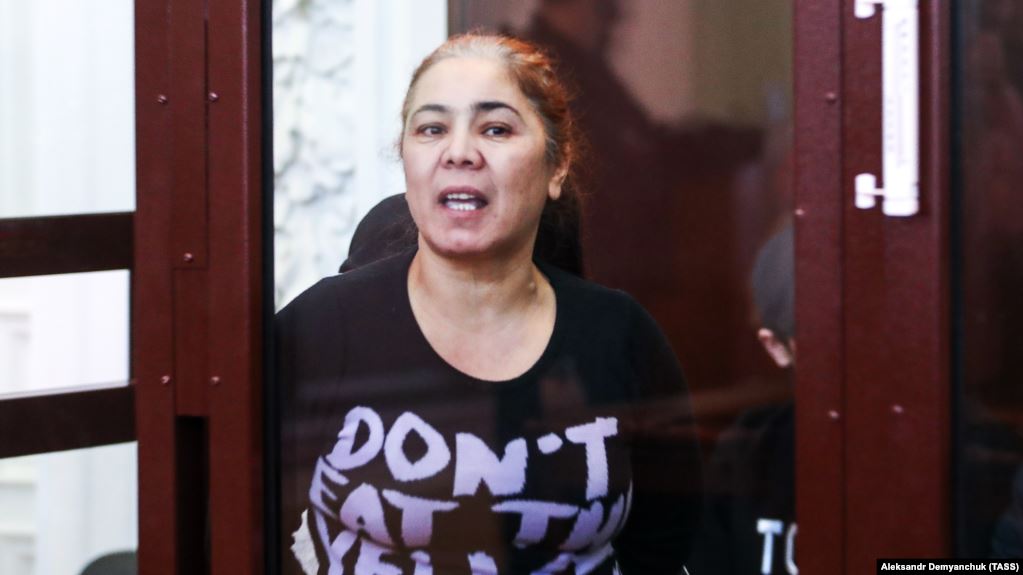
Shohista Karimova: Convicted of Someone Else’s Crime Natalia Sivohina Zanovo
December 6, 2020
Tomorrow, December 7, a court hearing will be held in the Moscow suburb of Vlasikha on the appeal of the verdict against of Shohista Karimova. The name of this middle-aged woman from Uzbekistan, who worked as a food prep worker in the Moscow Region, surfaced in the media in connection with the criminal case into the 3 April 2017 terrorist attack in the Petersburg subway—and, most likely, it was immediately forgotten. Journalist Natalia Sivohina recalls Karimova’s story.
On 3 April 2017, an explosion occurred in the Petersburg subway on a train traveling between the stations Sennaya Ploshchad and Tekhnologichesky Institut, killing 16 passengers and injuring about a hundred.
The security forces voiced several conflicting explanations of the tragedy, but soon reported that the perpetrators had been found.
In the dock were eleven people, migrant workers from Tajikistan, Kyrgyzstan, and Uzbekistan. According to investigators, they were members of an Islamist organization.
On 5 April 2017, relatives of one of the future defendants in the case of the Petersburg Eleven, Muhamadusup Ermatov, reported him missing. As he later told human rights activists and journalists, he had been kidnapped. The kidnappers (presumably FSB officers) put a plastic bag over Ermatov’s head, beat him up, intimidated him verbally, tasered him, and demanded that he give the testimony they wanted to hear.
Other defendants in the subway bombing case also claimed they had been subjected to the same “investigative methods.” The evidence obtained under torture was the basis of the sentences the defendants received on charges of terrorism. Karimova, the only woman among the defendants, was sentenced to 20 years in prison.
Karimova worked as a food prep worker in a café near Moscow. According to the case file, she “provided the [terrorist group] with means of communication.” As she said later, she lent a phone to her coworker and, later, co-defendant Abror Azimov. That was the extent of her alleged involvement in the bombing.
When FSB officers came to her house, the Uzbek national meekly complied with all their demands: she held the detonator in her hands, leaving her fingerprints on it, and let them take DNA swabs of her mouth and scalp.
Karimova trusted the authorities and hoped to the last that the truth would out. In the end, however, she was found guilty of possessing a bomb on Tovarishchesky Lane in Petersburg, a city to which she had never been before she was arrested.
Karimova had come to Russia to help her daughter. She worked for 25 thousand rubles a month [approx. 400 euros a month in 2017] and sent money home to her family. The verdict sent her into shock: her terrible screaming during the reading of the verdict was included in journalistic accounts of that day. But few journalists wrote anything about Karimova’s own story.
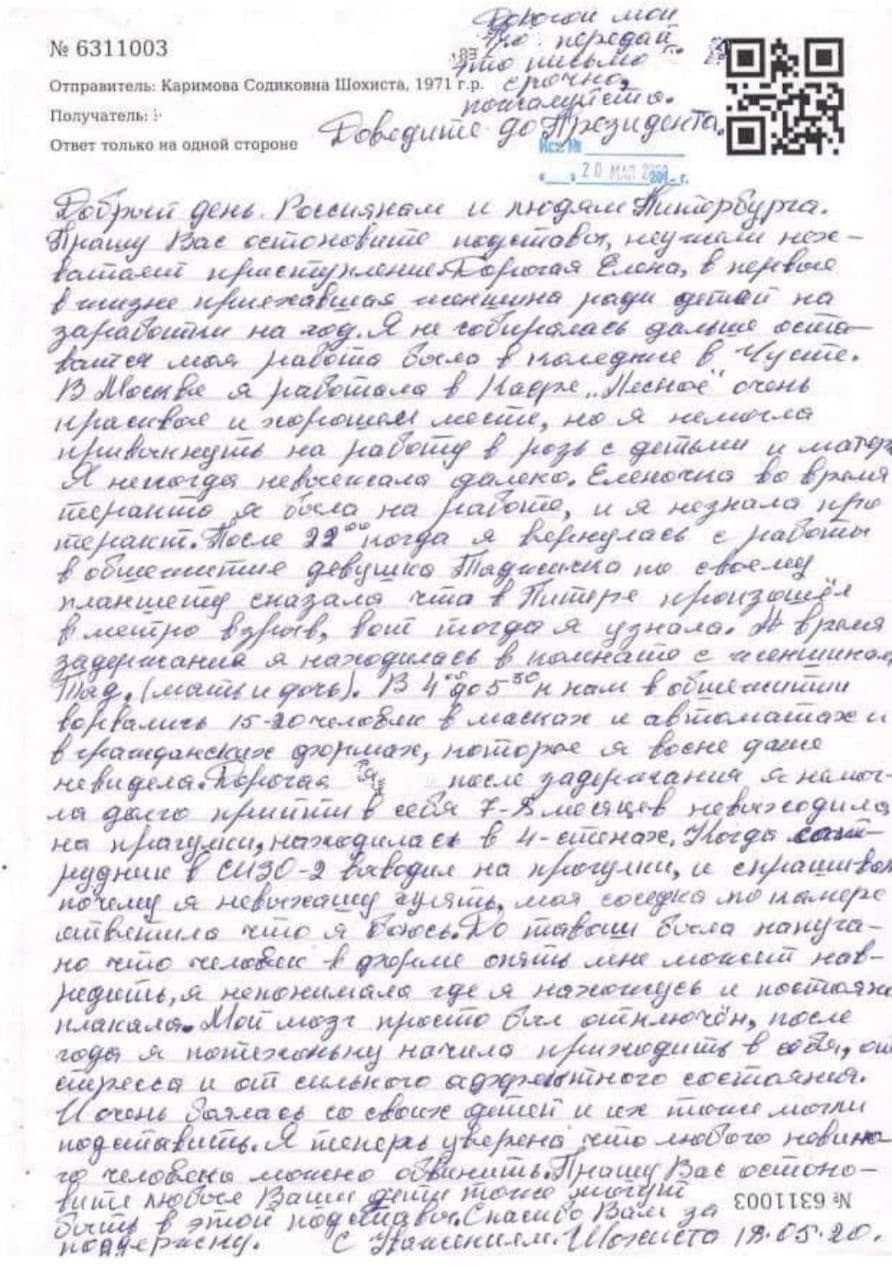
Screenshot of a letter, quoted below, sent by Shohista Karimova from prison, dated 18 May 2020
“When a guard at Pre-Trial Detention Center No. 2 asked why I didn’t go out for a walk, my cellmate replied that I was afraid. I was so afraid that a man in the uniform might hurt me—I was scared and cried constantly. My brain was just turned off. After a year, I started to recover from the stress and the extreme emotional state. And I was very afraid for my loved ones: they could have been framed as well,” Karimova wrote in a letter to a friend, adding, “I now believe that any innocent person can be charged [with a crime they did not commit].”
What the Defense Says
I spoke with Karimova’s lawyer, Viktor Drozdov.
How did you end up taking Shohista’s case? How did it all begin?
I received a call from a person who had previously been in prison and knew the law enforcement system firsthand, and then from other human rights defenders. They asked me to work pro bono on the case, whose defendants were initially represented by court-appointed lawyers. We met and talked, and I agreed to serve as Shohista’s defense counsel.
The tragedy in April 2017 and the media coverage that followed it had attracted my attention. I followed the case quite closely, comparing various reports. It raised a lot of questions, and I decided to find answers to them. I found them.
You have appealed the apparently wrongful verdict. Why do you think it is important to go all the way in this trial?
The defense lawyer’s job is to debunk the prosecution (during trial) and the illegality of the sentence (as now, on appeal), and always be ready to defend their client in subsequent phases in the process. What does “going all the way” mean? The real end came long ago: the justice system was completely “bankrupted” by this trial. It has neither been willing nor able to respond to any of the defense’s arguments.
Does Shohista believe in the possibility of getting justice? What does she think about the upcoming appeal?
Until recently, she had great faith in Putin. She wrote him letters to which she received no response. I don’t ask her that question now. Shohista is painfully aware of the circumstances that caused her to end up in prison completely unexpectedly and absurdly. She knows perfectly well and shares my position on her defense, which is that by defending her, I am defending the Russian justice system, first of all, and her future depends on it.
Shohista is a hostage to the political interests of people who are now quite powerful.
I have started naming these people on my little Telegram channel. They all were involved or somehow complicit in the #Metro17 case.
After the verdict, Shokhista wrote a letter to Judge Andrei Morozov, congratulating him on finally pacifying Russian society by “finding the terrorists” and wishing him health and happiness.
How many lawyers are currently defending Karimova?
Two: the lawyer Sergei Shostak, who joined the defense at my request, also pro bono, and fully shares my position, and me.
Despite the obvious inconsistencies in the trial of the Petersburg Eleven and the defendants’ complaints of torture, the case did not fall apart in court, and the defendants received huge sentences. Why do you think this happened?
The answer, perhaps, can be found in the verdict itself and in the way the trial was run. The text of the verdict does not cite any of the arguments the defense made, nor does it analyze the events of 3 April 2017 themselves. The court point-blank refused (sic!) to examine the [bombed] subway car as material evidence or the improvised explosive devices, entered into evidence by the prosecution, nor did it uphold any significant defense motion on the merits of the charge. And it allowed the illegal presence of unidentified and unmarked masked persons armed with firearms in the courtroom.
The court was neither independent nor fair. I personally feel very sorry for the judges. They did something vile.
Can ordinary people help defendants in political cases?
“Ordinary people” cannot do anything. But I believe in the capabilities of my fellow citizens—caring, thoughtful, and ready to tell the truth. The internet, petitions, collective appeals, and publicity can help—especially publicity.
* * *
The obvious inconsistencies in the case and testimony by the defendants that they had been subjected to hours of torture during the investigation did not prevent the trial court from finding them guilty and sentencing them to long terms in prison.
So far, there has been no massive grassroots campaign demanding a normal investigation of the case of the Petersburg Eleven. The medieval division into “friends” and “foes” has been firmly established in Russian society. Actually, this is nothing new: this is what usually happens amidst the wreckage of social institutions that have become obsolete.
First, people are evaluated by skin color, then people from the “wrong” ethnic groups are imprisoned: all this happened relatively recently by the standards of history. The country that conquered fascism interrogates hundred-year-old veterans who sacrificed their health and strength in that long-ago war with fascism. The so-called prosecution throws random people behind bars—disempowered construction workers, maintenance men, and kitchen workers from the former fraternal republics. So-called public opinion equates the concepts of “immigrant” and “terrorist.” The so-called state turns into a madman fleeing from its own shadow.
Zanovo Media will keep you updated about the plight of Shohista Karimova and the other defendants in the trial of the Petersburg Eleven.
_____________________
Earlier today, Natalia Sivohina posted the following on her Facebook page by way of prefacing her article: “Recently, I posted a link to the website Zanovo, and today I published my first article there. The article is about Shohista Karimova, who worked as kitchen prep in the Moscow Region and was a defendant in the case of the terrorist attack in Petersburg. This ordinary, very nice woman visited our city for the first time after her arrest. No one knows the current whereabouts of the people actually involved in the crime committed in April 2017. But it is now quite clear to me that the defendants in the case of the Petersburg Eleven are random people who incriminated themselves under torture. Alas, this is the case in today’s Russia, which likes to rant about the ‘fight against fascism.’ Knowing about this case makes me uneasy. I felt quite scared when I wrote this article and talked to Shohista’s lawyer. But, you know, there are things that you can’t keep quiet about, because they concern everyone. Please, if you haven’t heard anything about Karimova, read this article about her. The hearing of the appeal against her verdict is scheduled for tomorrow. I really want to hope for the best.”
Translated by the Russian Reader. Please read my previous posts on the presumed terrorist attack in the Petersburg subway, the case against its alleged “financers and planners,” its roots in the Islamophobia that has infected Russia under Putin, and the shocking lack of local and international solidarity with the eleven Central Asian migrant workers scapegoated and convicted in the case:
Thanks to my wonderful British “cousin” AC for bringing my attention to this lovely, sweet, humane and profoundly democratic 2019 BBC TV documentary about a now-defunct photo portrait studio in Bradford and its incredible archive of the city’s changing human face. It’s welcome tonic to my soul as the leading liberal lights in my adopted former “homeland” of Russia indulge in yet another orgy of Islamophobia over horrible crimes committed in completely different countries.
I wish they would watch this documentary and take its message to heart. It might surprise them to learn that not all “westerners” are rabid racists, xenophobes, and Islamophobes. People can learn to live together, learn “conviviality” and unlearn “post-imperial melancholia,” as the great Paul Gilroy (a world-famous contemporary scholar whose works are totally absent in Russian translation, unsurprisingly) has called them. |||| TRR
Thirty years ago, thousands of portraits from a small studio in Bradford were saved from a skip. They form a unique collection of photographs that records the changing face of a British industrial city in the middle of the 20th century. Many of the people in the portraits were new arrivals from the Asian subcontinent, eastern Europe and the Caribbean, attracted by the offer of work in wool mills. The names of these people are a mystery – only their faces survive.
A small studio, Belle Vue, in the middle of Bradford, built a business on taking portraits of the newly-arrived migrants. Photographer Tony Walker used a battered Victorian camera to take images of his customers, which were often sent back to relatives in the countries they’d left behind.
Working alongside staff from museums in Bradford, presenter Shanaz Gulzar identifies and tracks down the people in the portraits, and uncovers dramatic social change and the hidden stories behind the portraits.





 Although I am certain that the Memorial Human Rights Center knows what Hamid Igamberdyev looks like, there is no photograph in his “case file” on their website. Igamberdyev might be one of the men captured in the photo, originally published in Kommersant, that I posted along with
  Ildar Ibragimov in court. Photo: Parents Solidarity
  Shohista Karimova. Photo courtesy of
  Screenshot of a letter, quoted below, sent by Shohista Karimova from prison, dated 18 May 2020