The Gated Community. Photo: Tom Smouse (via Americana UK)
In the face of violence in the streets and unlawful detention what can a musician do, really? They can document what’s going on, make their point and try and raise awareness (and maybe the odd dollar) of the organisations that are protecting citizens from their own law enforcement. Read that sentence, and notice just how screwed up it is to describe daily life in the “shining city on a hill”.
Which brings us to today’s song from The Gated Community. It’s a new recording of a very recently written song, written in response to events in Minneapolis, as singer and songwriter Sumanth Gopinath explains: “After Renee Nicole Good’s murder by ICE agent Jonathan Ross here in Minneapolis on January 7, 2026, I began writing songs that more explicitly address the situation we’re in. I find the ‘protest song’ challenging, as it requires a directness that I tend to avoid in my songwriting. This is my third serious attempt as of late and the one with the most rousing, energizing chorus of the bunch. I am so moved and inspired by the bravery, intelligence, and steadfastness of my fellow Minnesotans in the Twin Cities who, against the odds, are acting tirelessly on behalf of our most vulnerable community members. This song is for them.”
The song is available on Bandcamp, it has a price and there’s an option to add a little more to support the people organising for decency: everyone involed in the recording donated their time and all of its proceeds will be donated to local aid organizations including Minnesota Immigrant Rights Action Committee (MIRAC) — an organization supporting individuals and families impacted by unjust immigration laws and deportations.
And who are The Gated Community? Well, this band that has been described as a Marxist Bluegrass band (you don’t get a lot of them to the pound) was originally a vehicle for Sumanth’s political songs, but has evolved over nineteen years, expanding in size and scope to include many roots music styles and more personal songwriting. It was formed when Sumanth moved from New Haven to Minneapolis to begin working as a professor of music theory at the University of Minnesota, and now features six singers, with the band combining professors like Sumanth (vocals, acoustic guitar, keyboards) and Beth Hartman (vocals, percussion), and artists from various parts of the Twin Cities scene like Rosie Harris (vocals, banjo, cello), Paul Hatlelid (vocals, drums, acoustic guitar), Cody Johnson (vocals, bass), and Nate Knutson (vocals, guitars, mandolin).
thanks and much love to our families, friends, and fans
All proceeds from this recording will go to one or more organizations resisting the occupation of our cities by ICE and providing aid to our community. Everyone involved generously volunteered their time and resources to this project.
Thank you to Tom Campbell, Eva Cohen, Carl and Ina Elliott, Jim and Sara Harris, Marcus dePaula, Michael Gallope, Gabrielle Gopinath, John Miller, Mark Nye, Daniel Owens, Matt Rahaim, Ian Rans, Ellen Stanley, Ryan Stokes, Dean Von Bank, and our families, friends, and neighbors.
Source: The Gated Community (Bandcamp). I would strongly encourage you to buy this digital record (paying as much as you wish) in support of the embattled people of Minnesota, my home state. ||| TRR
Both the pot (Iran) and the kettle (the U.S.) are “rounding up” their detractors.
Trump’s White House website welcomes visitors with a pop-up that reads: “WELCOME TO THE GOLDEN AGE!” But on this heavy news day a year into Trump’s second term, it is increasingly clear that as his regime focuses on committing the United States to white Christian nationalism, the country is becoming increasingly isolated from the rest of the world, and its own economy is weakening.
At the Munich Security Conference over the weekend, Secretary of State Marco Rubio’s endorsement of white Christian nationalism does not appear to have swayed European countries to abandon their defense of democracy and join the U.S.’s slide toward authoritarianism. Instead, as retired lieutenant general and former commander of U.S. Army Europe Mark Hertling wrote, it squandered the strategic advantage its partnership with Europe has given the U.S.
Foreign affairs journalist Anne Applebaum noted that the word in Munich was that “Europe needs to emancipate itself from the U.S. as fast as possible.” In Germany, Der Spiegel reports plans to bring Ukrainian veterans to teach German armed forces drone use and counter-drone practices the Ukrainians are perfecting in their war against Russian occupation. Canada’s prime minister Mark Carney is working to reduce Canada’s defense dependence on the U.S., ramping up domestic defense production.
Carney has advanced a foreign policy that centers “middle powers” and operates without the U.S. That global reorientation has profound consequences for the U.S. economy, as well. Canada is leading discussions between the European Union and a 12-nation Indo-Pacific bloc to form one of the globe’s largest economic alliances. A new agreement would enable the countries to share supply chains and to share a low-tariff system. Canada also announced it is renewing its partnership with China. As of this week, Canadians can travel to China without a visa.
Today France’s president Emmanuel Macron and India’s prime minister Narendra Modi upgraded Indian-French relations to a “Special Strategic Partnership” during a three-day visit of Macron to Mumbai. They have promised to increase cooperation between the two countries in defense, trade, and critical materials.
Trump insisted that abandoning the free trade principles under which the U.S. economy had boomed since World War II would enable the U.S. to leverage its extraordinary economic might through tariffs, but it appears, as economist Scott Lincicome of the Cato Institute wrote today for Bloomberg, that the rest of the world is simply moving on without the U.S.
While Trump boasts about the U.S. stock market, which is indeed up, U.S. markets have underperformed markets in other countries. Today, Carl Quintanilla of CNBC reported that the S&P 500, which measures 500 of the largest publicly traded companies in the U.S., is off to its worst year of performance since 1995 when compared to the All Country World Index (ACWI), an index that measures global stocks.
In May 2023 the Florida legislature passed a law requiring employers with 25 or more employees to confirm that their workers are in the U.S. legally. The new law prompted foreign farmworkers and construction workers to leave the state. Now, the Wall Street Journal reported in a February 6 editorial, employers “are struggling to find workers they can employ legally.”
The newspaper continued: “There’s little evidence that undocumented migrants are taking jobs from Americans. The reality is that employers can’t find enough Americans willing to work in the fields or hang drywall, even at attractive wages. Farm hands in Florida who work year-round earn roughly $47,000, which is more than what some young college graduates earn.” “The lesson for President Trump is that businesses can’t grow if government takes away their workers,” the Wall Street Journal Editorial Board concluded.
Today Florida attorney general James Uthmeier reacted to the Wall Street Journal editorial, explaining on Fox Business that the Republican Party expects to replace undocumented workers with young Americans: “We need to focus on our state college program, our trade schools, getting people into the workforce even earlier. We passed legislation last year to help high school students get their hands dirty and get on job sites more quickly. So I think there’s a lot more we can do with apprenticeships, rolling out, beefing up our workforce, and trying to address the demand that is undoubtedly here in the state.”
Steve Kopack of NBC News reported on February 11 that while the U.S. added 1.46 million jobs in 2024, the last year of former president Joe Biden’s administration, it added just 181,000 jobs in 2025. That makes 2025 the worst year for hiring since 2003, aside from the worst year of the coronavirus pandemic. Manufacturing lost 108,000 jobs in 2025.
Peter Grant of the Wall Street Journal reported today that banks that have loaned money to finance the purchase of commercial real estate are requiring borrowers to pay back tens of billions of dollars as the delinquency rate for such loans has climbed to a high not seen since just after the 2008 financial crisis. About $100 billion in commercial real estate loans that have been packaged into securities will come due this year and probably won’t repay when they should. More than half of the loans are likely headed for foreclosure or liquidation.
Trump vowed that he would cut “waste, fraud, and abuse” out of the country’s government programs, but cuts to social programs have been overwhelmed by spending on federal arrest, detention, and deportation programs, as well as Trump’s expansion of military strikes and threats against other countries. In his first year back in office, Trump launched at least 658 air and drone strikes against Iraq, Somalia, Iran, Yemen, Syria, Nigeria, and Venezuela.
Just today, U.S. Southern Command announced it struck three boats in the eastern Pacific and the Caribbean yesterday and killed 11 people it claims were smuggling drugs, bringing the total of such strikes to more than 40 and the number of dead to more than 130. Now Trump is moving American forces toward Iran, threatening to target the regime there.
The administration is simply tacking the cost of these military adventures onto government expenditures, apparently still maintaining that the tax cuts for the wealthy and corporations Republicans extended in their July “One Big Beautiful Bill Act” and tariffs will address the growing deficit and national debt by increasing economic growth.
The nonpartisan Congressional Budget Office (CBO) last week projected that the deficit for the fiscal year ending September 30, 2026, will be $1.85 trillion. Richard Rubin of the Wall Street Journal notes that for every dollar the U.S. collects this year, it will spend $1.33. The CBO explained that the Republican tax cuts will increase budget deficits by $4.7 trillion through 2035.
If the American people have suffered from Trump’s reign, the Trump family continues to cash in. Today Trump’s chair of the Commodity Futures Trading Commission, Michael Selig, announced he will try to block states from regulating prediction markets, saying they “provide useful functions for society by allowing everyday Americans to hedge commercial risks like increases in temperature and energy price spikes.”
Republicans insist that prediction markets are more like stock trading than like betting, but a group of over 20 Democratic senators warned last week in a letter to Selig that prediction market platforms, where hundreds of millions of dollars are wagered every week, “are offering contracts that mirror sportsbook wagers and, in some cases, contracts tied to war and armed conflict.” They added that the platforms “evade state and tribal consumer protections, generate no public revenue, and undermine sovereign regulatory regimes,” and urged Selig to support regulations Congress has already put into law.
Prediction markets also cover the actions of President Trump, whose son Don Jr. is both an advisor to and an investor in Polymarket and a paid advisor to Kalshi. Polymarket and Kalshi are the two biggest prediction markets, and both are less regulated than betting sites. The Trump family has announced it is starting its own “Truth Predict.”
David Uberti of the Wall Street Journal reported that Eric Trump is investing heavily in drones, particularly in Israeli drone maker Xtend, which has a $1.5 billion deal to merge with a small Florida construction company to take the company public. The Defense Department has invited Xtend to be part of its drone expansion program.
And yet it is clear the administration fears the American people. The Minnesota Bureau of Criminal Apprehension (BCA), a statewide program that specializes in police shootings, said yesterday that it has received formal notice that the Federal Bureau of Investigation (FBI) will not allow it any “access to information or evidence that it has collected” related to the shooting death of Minneapolis intensive care nurse Alex Pretti. The BCA says it will continue to investigate and to pursue legal avenues to get access to the FBI files.
Fury at ICE continues to mount, with voices from inside the government complaining about Homeland Security Secretary Kristi Noem. Gordon Lubold, Courtney Kube, Jonathan Allen, and Julia Ainsley of NBC News reported today on her alienation of senior officials at the Coast Guard as she has shifted their primary mission of search and rescue to flying deportation flights. Noem’s abrupt removal of Coast Guard commandant Linda Fagan only to move into her vacated housing at Joint Base Anacostia-Bolling herself also rankled, along with Noem’s lavish use of expensive Coast Guard planes.
Daniel Lippman and Adam Wren of Politico reported today that Noem’s spokesperson, Tricia McLaughlin, is resigning.
Marissa Payne of the Des Moines Register reported today that in Iowa, Republican state lawmakers are working to rein in the power of the state governor before the 2026 elections, a sure sign that they are worried that a Democrat is going to win the election.
That fear appears to be part of a larger concern that the American people have turned against the Republicans more generally. Last night, late-night talk show host Stephen Colbert told viewers he had been unable to air an interview he did with a Democratic candidate for the U.S. Senate from Texas, James Talarico. “I was told…that not only could I not have him on, I could not mention me not having him on,” Colbert said. “And because my network clearly doesn’t want us to talk about this, let’s talk about this.”
Talarico is a Texas state lawmaker studying to be a minister, who criticizes the Republican use of Christianity as a political weapon. Such politicization of Christianity both distorts politics and cheapens faith, he says. The true way to practice Christianity is simple but not easy, he says: it is to love your neighbor. Political positions should grow out of that to feed the hungry, welcome the stranger, and heal the sick. “[T]here is nothing Christian about Christian nationalism,” he told Colbert. “It is the worship of power in the name of Christ, and it is a betrayal of Jesus of Nazareth.”
Although Talarico is locked in a tight primary battle with Representative Jasmine Crockett, his message offers a powerful off-ramp for evangelicals uncomfortable with the administration, especially its cover-up of the Epstein files. Without evangelical support, MAGA Republicans cannot win elections.
Talarico has the administration nervous enough that Federal Communications Commission (FCC) chair Brendan Carr opened an investigation of the morning talk show The View after Talarico appeared on the show earlier this month. Lawyer Adam Bonin explained that Carr changed the FCC’s enforcement of the Equal Time Rule (which is not the Fairness Doctrine). It says that when broadcast networks (not cable) give air time to someone running for office, they have to give the same time to any other candidate for that office. The obvious exception is when a candidate does something newsworthy outside the race, in which case a network can interview that person without interviewing everyone else.
For 20 years, that rule has applied to talk shows, but Carr announced last month that if a non-news talk show seems to be “motivated by partisan purposes,” then it will not be exempt. For Colbert’s show, it would have meant that after interviewing Talarico, the network would have had to give equal time to all other Democrats and Republicans running for the Senate seat. CBS could have challenged the rule but chose not to.
Why is the administration worried about Talarico in a state Trump won in 2024 by 14%? “I think that Donald Trump is worried that we’re about to flip Texas,” Talarico said. “Across the state there is a backlash growing to the extremism and the corruption in our politics…. It’s a people-powered movement to take back our state and take back our country.”
As of 10:00 tonight, Colbert’s 15-minute interview with Talarico has been viewed on YouTube 3.8 million times. Forbes says it is Colbert’s most watched interview in months.
The Late Show with Stephen Colbert, “Rep. James Talarico On Confronting Christian Nationalism, And Strange Days In The Texas Legislature”
Stephen Colbert hosts Texas State Rep. James Talarico for an online-exclusive interview that touches on the issues raised in Talarico’s campaign for the Democratic nomination for Senate including the separation of church and state, the dangers of consolidated corporate-owned media, and the fabricated culture wars pushed by Republicans in states like Texas.
The Department of Homeland Security is expanding its efforts to identify Americans who oppose Immigration and Customs Enforcement by sending tech companies legal requests for the names, email addresses, telephone numbers and other identifying data behind social media accounts that track or criticize the agency.
In recent months, Google, Reddit, Discord and Meta, which owns Facebook and Instagram, have received hundreds of administrative subpoenas from the Department of Homeland Security, according to four government officials and tech employees privy to the requests. They spoke on the condition of anonymity because they were not authorized to speak publicly.
Google, Meta and Reddit complied with some of the requests, the government officials said. In the subpoenas, the department asked the companies for identifying details of accounts that do not have a real person’s name attached and that have criticized ICE or pointed to the locations of ICE agents. The New York Times saw two subpoenas that were sent to Meta over the last six months.
The tech companies, which can choose whether or not to provide the information, have said they review government requests before complying. Some of the companies notified the people whom the government had requested data on and gave them 10 to 14 days to fight the subpoena in court.
“The government is taking more liberties than they used to,” said Steve Loney, a senior supervising attorney with the American Civil Liberties Union of Pennsylvania. “It’s a whole other level of frequency and lack of accountability.” Over the last six months, Mr. Loney has represented people whose social media account information was sought by the Department of Homeland Security.
The department said it had “broad administrative subpoena authority” but did not address questions about its requests. In court, its lawyers have argued that they are seeking information to help keep ICE agents in the field safe.
Meta, Reddit and Discord declined to comment.
“When we receive a subpoena, our review process is designed to protect user privacy while meeting our legal obligations,” a Google spokeswoman said in a statement. “We inform users when their accounts have been subpoenaed, unless under legal order not to or in an exceptional circumstance. We review every legal demand and push back against those that are overbroad.”
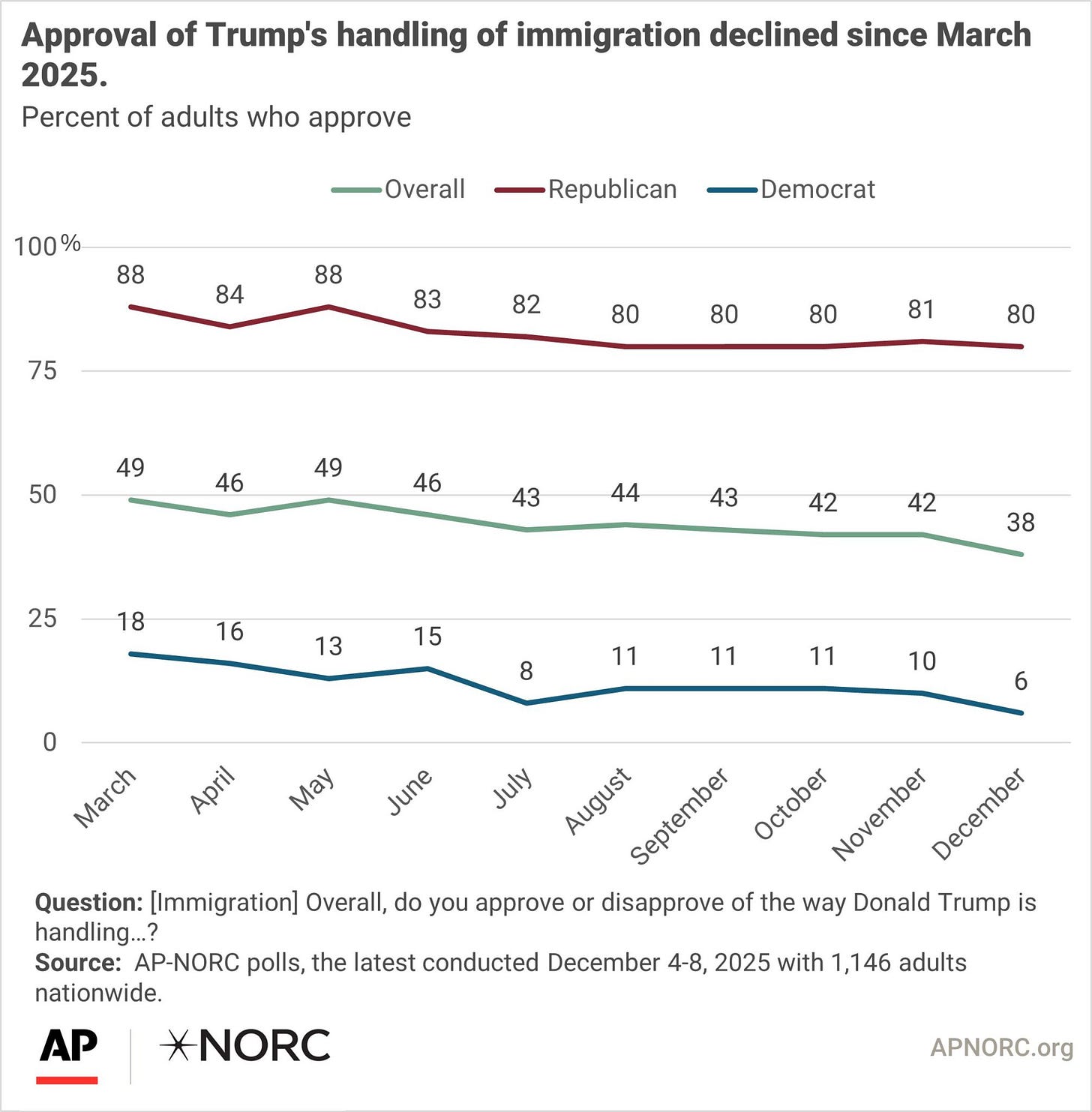
The Trump administration has aggressively tried tamping down criticism of ICE, partly by identifying Americans who have demonstrated against the agency. ICE agents told protesters in Minneapolis and Chicago that they were being recorded and identified with facial recognition technology. Last month, Tom Homan, the White House border czar, also said on Fox News that he was pushing to “create a database” of people who were “arrested for interference, impeding and assault.”
Silicon Valley has long had an uneasy relationship with the federal government and how much user information to provide it. Transparency reports published by tech companies show that the number of requests for user information from different governments around the world has climbed over the years, with the United States and India among those submitting the most.
Some social media companies previously fought government requests for user information. In 2017, Twitter (now X) sued the federal government to stop an administrative subpoena that asked it to unmask an account critical of the first Trump administration. The subpoena was later withdrawn.
Unlike arrest warrants, which require a judge’s approval, administrative subpoenas are issued by the Department of Homeland Security. They were only sparingly used in the past, primarily to uncover the people behind social media accounts engaged in serious crimes such as child trafficking, said tech employees familiar with the legal tool. But last year, the department ramped up its use of the subpoenas to unmask anonymous social media accounts.
In September, for example, it sent Meta administrative subpoenas to identify the people behind Instagram accounts that posted about ICE raids in California, according to the A.C.L.U. The subpoenas were challenged in court, and the Department of Homeland Security withdrew the requests for information before a judge could rule.
Mr. Loney of the A.C.L.U. said avoiding a judge’s ruling was important for the department to keep issuing the subpoenas without a legal order to stop. “The pressure is on the end user, the private individual, to go to court,” he said.
The Department of Homeland Security also sought more information on the Facebook and Instagram accounts dedicated to tracking ICE activity in Montgomery County, Pa., outside Philadelphia. The accounts, called Montco Community Watch, began posting in Spanish and English about ICE sightings in June and, over the next six months, solicited tips from their roughly 10,000 followers to alert people to the locations of agents on specific streets or in front of local landmarks.
On Sept. 11, the Department of Homeland Security sent Meta a request for the name, email address, post code and other identifying information of the person or people behind the accounts. Meta informed the two Instagram and Facebook accounts of the request on Oct. 3.
“We have received legal process from law enforcement seeking information about your Facebook account,” the notification said, according to court records. “If we do not receive a copy of documentation that you have filed in court challenging this legal process within ten (10) days, we will respond to the requesting agency with information.”
The account owner alerted the A.C.L.U., which filed a motion on Oct. 16 to quash the government’s request. In a hearing on Jan. 14 in U.S. District Court for the Northern District of California, the A.C.L.U. argued that the government was using administrative subpoenas to target people whose speech it did not agree with.
Sarah Balkissoon, a Department of Justice lawyer representing the government, said the Department of Homeland Security’s position was that it was “within their power to investigate threats to its own officers or impediments to their officers,” according to a court transcript viewed by The Times.
Two days later, the subpoena was withdrawn.
The Montco Community Watch accounts continue to post almost every day. The Times emailed a request for comment to the address associated with the accounts but did not receive a reply.
On Monday, the Instagram account posted an alert for ICE activity in the Eagleville area of Montgomery County. “Montco ICE alert,” the post said. “This is confirmed ICE activity.”
On Friday, the account posted a video of students at Norristown Area High School protesting against ICE. “We stand with you and are proud you made your voices heard!” the post said.
It’s one of the saddest hit songs to grace American music: “Deportee (Plane Wreck at Los Gatos).”
The 1948 Woody Guthrie composition documented a plane crash that killed all 32 people on board in Los Gatos Canyon near the Central Valley town of Coalinga on Jan. 28 of that year. Twenty-eight of the victims were Mexicans being forced back home — some entered the country without papers, some were guest workers whose stints were over — accompanied by the immigration agent charged with making sure they got there, much like the deportation flights of today.
The Associated Press reported that newspapers published across the country the following day — including The Times — listed the names of the Southern California crew on board and the migra man, Frank E. Chaffin of Berkeley.
The Mexicans? The story deemed them “deportees.” They were buried in a mass grave at Holy Cross Cemetery in Fresno under a bronze marker that read: “28 Mexican citizens who died in an airplane accident.” The American government never even bothered to tell their family members. Many wondered what happened to their loved ones for decades.
Guthrie heard the AP report over the radio and was so angered by how the press and government dismissed the deceased that he penned “Deportee.” With mournful chords and vivid lyrics, the working class troubadour attacked an American society that that simultaneously let crops rot “in their creosote dumps” and treated the migrants who picked them “like rustlers, like outlaws, like thieves.”
It’s been covered by some of this country’s greatest musicians — I’m talking Dolly Parton, Bruce Springsteen, Johnny Cash and Willie Nelson (my favorite version is by folk-rock heroes The Byrds).
The Byrds, “Deportee (Plane Wreck at Los Gatos)” (1969)
Even with “Deportee,” this story had fallen out of public consciousness over the decades. Until January, when ICE dredged it up to once again insult the memory of the lost Mexican immigrants.
ICE’s inexplicable recap
On Jan. 28, the social media accounts of Immigration and Customs Enforcement commemorated Chaffin’s death and only his. The caption alongside a grainy black and white photo of him read: “The plane he was on to deport 28 illegal Mexican aliens caught fire and crashed killing all onboard.”
ICE’s unnecessarily inflammatory language not only was ahistorical, but also it didn’t even match up with its own official account. The agency’s Wall of Honor, which commemorates the lives of employees who died in the line of duty, described the migrants who died alongside Chaffin as “Mexican nationals.”
Such warping of the past isn’t accidental but rather part of a long con by the Trump administration to justify its agenda. In an administration that knows no lows, dismissing the Mexican victims of the Los Gatos Canyon disaster as “illegal Mexican aliens” was particularly egregious.
‘It’s disrespectful, it’s dehumanizing, it’s ICE’
I called up Mike Rodriguez, an ethnic studies teacher in Santa Ana who found out in 2015 that his paternal aunt, María Rodríguez Santana, was on that doomed plane.
“First thing I thought was, ‘Well that’s the United States,’” Rodriguez said of ICE’s social media post. “They’re doing the same thing that the government tried to do in 1948 by erasing them.”
He added that la migra didn’t even bother to list the names of the American crew that died, either. “It’s disrespectful, it’s dehumanizing, it’s ICE,” he said.
But Rodriguez takes solace in knowing he and others are doing their part to make sure people know the full story. He regularly speaks about the tragedy and visited both the site of the crash and Holy Cross Cemetery, where a plaque with all of the victims’ names was erected in 2013.
Tim Z. Hernandez, a University of Texas El Paso professor who has spent much of his career trying to track down descendants, interviewed Rodriguez and his uncle for a forthcoming documentary and also featured their story in the 2024 book”They Call You Back: A Lost History, A Search, A Memoir.” The two appeared at an event last year at the Untold Story bookstore in Anaheim, where Rodriguez sung “Deportee” while his son played guitar. He added extra lyrics to honor his Tía María and Hernandez.
“Thankfully, we have truth tellers like Woody Guthrie and Tim,” Rodriguez said. “And I remember what Woody sang — ‘All you fascists bound to lose.’ And that’s the way this is administration is, trying to strip away our constitutional rights. But their day will come.”
Kazakh authorities have granted Russia’s request to extradite activist Yulia Yemelyanova, a former employee of the late Alexei Navalny’s Petersburg office. According to the Russian opposition-in-exile’s Anti-War Committee, Kazakhstan violated its own protocols in making the decision to extradite Yemelyanova, as the Russian activist’s application for asylum is still under review in the country.
This past October, Kazakhstan’s Prosecutor General’s Office had guaranteed that extradition requests would not be considered until all administrative procedures related to obtaining asylum were completed. Yemelyanova’s defense intends to appeal the extradition decision to the country’s Supreme Court.
Yemelyanova was detained on Aug. 31, 2025, at Almaty airport while in transit to a third country. She has been held in pretrial detention ever since. In Russia, she is being prosecuted for theft (Part 2, Article 158 of the Criminal Code) in connection with a 2021 incident in which she allegedly stole a mobile phone from a taxi driver. Yemelyanova’s defense calls the case fabricated. It was sent to court in July 2022, by which time the activist had already left Russia.
Yemelyanova is the fourth Russian asylum seeker since late January to be handed a deportation decision from Kazakh officials. The others are Chechen Mansur Movlaev, an open critic of Ramzan Kadyrov; Crimean resident Oleksandr Kachkurkin, who is facing treason charges in Russia; and Yevgeny Korobov, an officer who deserted from the Russian army.
Dmytro Kulyk with his wife Oksana and daughter Elina. Source: Daily Beast
A Ukrainian dad escaped Vladimir Putin’s drone and missile attacks back home only to be grabbed by a band of ICE stooges in a Walmart parking lot in Minneapolis.
“I hoped I would find peace in America. I’ve done everything the government required, I don’t understand why I am behind bars,” Dmytro Kulyk told the Daily Beast from the Kandiyohi County Jail in Willmar, Minnesota.
The 39-year-old father was getting a pickup order at a Walmart in Maple Grove when he found himself surrounded by immigration agents last month. He’d been working as a delivery driver to make ends meet, while also supporting his family by doing roofing work.
Kulyk legally entered the U.S. in late 2023 along with his wife, 38, and daughter, who’s now 5. The family was sponsored by U.S. citizens as part of the Uniting 4 Ukraine program, a humanitarian program set up in April 2022 to allow Ukrainians fleeing Russia’s war to live and work in the U.S. on “parole.”
Once the initial two-year parole period expires, entrants can file for re-parole to remain in the country longer. That’s exactly what Kulyk says he did. His wife and daughter’s applications were approved. But his remained pending.
He said he was putting groceries in his car on Jan. 1 when he was approached by three ICE agents.
“I explained to the ICE officers that the war was killing people, that my wife had a disability, that it was violence, terrorism which we had escaped from but one of them began to laugh,” Kulyk told The Daily Beast. “I asked why he was laughing and I was told that he was pro-Russian, wanted Russia to win the war.”
DHS and ICE did not immediately respond to a request for comment.
He can’t understand why he’s been treated like a criminal. He did everything by the book, he says–paying taxes and filing his immigration paperwork on time, working multiple jobs to take care of his family. He had no criminal record to speak of.
His immigration attorney, Julia Bikbova, suggested his re-parole application may have intentionally been stalled to provide immigration authorities with a pretext to deport him.
“Our government, our Homeland Security, promised Ukrainians to protect them during the war. There are approximately 280,000 Ukrainians on U4U, Uniting for Ukraine program in the United States, including the Kulyk family,” she told the Daily Beast.
“My client did everything the government required him to do: on June 5 he applied for the re-parole and his wife paid $2,040 of fees for her and child’s granted applications. His wife and daughter have recently received their re-paroles but he has not, his application is pending.
“ICE detained him as ‘illegal’ and began deportation proceedings: This is a sick way of forcing a man with a clean criminal record to become unlawful in the U.S. by delaying the review of his application, which the very same authority had requested to file.”
Kulyk is now terrified he’ll be sent to the frontlines to fight Vladimir Putin’s troops if he is deported back home. He and his family endured relentless Russian attacks before finally deciding to flee their home in the Odesa region in 2023. When they saw ruins on their own street in Chornomorsk, they called their friends in Texas and asked for help, leading to their enrollment in the U4U program thanks to having U.S. citizens as sponsors.
Kulyk now can’t stop worrying about his wife, Oksana, and daughter, Elina.
“I am worried they can drag my wife and kid out of our home,” he told The Daily Beast, adding that he wanted to appeal directly to American authorities to make them understand he’d done nothing wrong.
“Please hear me: I came to America to escape the war, to pray in church and work hard. But now my heartbroken and sick wife has lost over 10 pounds since ICE arrested me on January 1. She’s been panicking, and my little daughter has been crying without me every night – this is unjust,” he said.
Oksana says she’s been too “terrified and lost” to leave home while her husband is locked up, afraid that immigration agents might return for the rest of the family.
“I am too scared to drive my 5-year-old daughter to school in my husband’s car. I’m terrified ICE will detain me and our daughter will end up alone,” she told The Daily Beast. “This is just as scary as the war in Ukraine, except now we don’t have Dmytro with us. Our daughter Elina cries herself to sleep with her cat plushie. She says the toy is daddy.”
Most Ukrainian refugees are women and children but some men have also left the country for various reasons. Kulyk was granted a permit to leave in order to care for a family member with a medical condition.
But Kulyk is not the only Ukrainian refugee to be swept up in the Trump administration’s controversial immigration crackdown.
Nearly 1,000 miles away, in Philadelphia, Zhanna was poring over messages in a group chat of 349 other refugees called “Ukrainians in Detention.” She joined the group last month, when her friends Andrii and Yaroslav ended up in detention. Although Bartosh has legal Temporary Protected Status, she stopped going to the office and now works from home.
“ICE rounds up men who buy tools or work in construction, so every day I call my husband, a construction worker, to check if he is OK. Even when the war started in Ukraine and we had to escape abroad, the same morning I wasn’t as stressed as I am now,” she told the Daily Beast. “In our chat I read that all arrestees are men, that at least five of them have signed up for self-deportation… but where is there to go now? Europe is also deporting Ukrainians. Our TPS is good until October but we want to understand, are we really legal in the United States, or is it time to pack up our suitcases again?”
Immigration attorneys count about 300 cases of detained Ukrainians across the United States and up to 150 refugees deported to Ukraine, Bikbova said.
“Most of the arrested Ukrainians are men, the majority of them have a clean criminal record but as we see in Kulyk’s case, they are equated to people who jumped the border, broke the law,” attorney Bikbova told the Daily Beast. “Behind every deported man, there are crying women and children, left without support. For some mysterious reason, we see male Ukrainian refugees being arrested and put on airplanes. If he gets deported, my client Kulyk will most certainly go to the front.”
Trump’s administration has also been deporting Russian asylum seekers. According to a report by Current Times, more than 50,000 Russians have fled the war and political repression to the U.S. since February 2022. Journalist Ilya Azar has been covering the deportations for Novaya Gazeta.
“They send out 40-60 people on each plane. There have been five airplanes,” Azar told the Daily Beast on Tuesday. The deportation planes transit to Russia through Egypt, and Russian security services meet the deported citizens. Azar’s report noted that “all men received draft notices” upon their arrival in December.
German authorities last week denied asylum to 47-year-old engineer Georgy Avaliani, who deserted from the front line in 2022. His wife and two children were rejected alongside him.
“There is no reason to believe that, upon returning to the Russian Federation, they would face a high probability of persecution or serious harm,” wrote an official from the Federal Office for Migration and Refugees (BAMF), despite Avaliani’s account of being tortured after fleeing the front.
Mediazona has reviewed BAMF decisions in Avaliani’s case and those of other deserters, discovering that officials are producing boilerplate documents that repeat one another almost word for word. In justifying the refusals, the German agency argues, for instance, that mobilisation in Russia was intended to “strengthen the armed forces” rather than repress dissent, and therefore cannot be considered political persecution. They further say that mobilisation has effectively ended because Vladimir Putin announced it—verbally.
When describing potential punishments for deserters, officials cite not the criminal code but an administrative article regarding failure to comply with military registration duties. They even specify that the maximum penalty is a fine of €302.
Most notably, in every decision examined, BAMF cites Mediazona’s own article from 2023, “Evading > refusing > fleeing. A year of mobilization in Russia through trials and verdicts”, as evidence that mobilised men face little more than a fine. That article noted that, at the time of publication, failing to respond to a summons did not yet carry a heavy penalty. While the situation has since changed—an eventuality the original article warned about—the original reference remains in the German files.
Relying on information from that article is also fundamentally flawed because BAMF applies it to people already wanted under serious criminal charges for desertion or abandoning their unit. In its rulings, the agency ignores the severity of these consequences, lumping deserters in with those who simply left Russia when mobilisation was first announced. This is exactly what happened to Georgy Avaliani.
A year in a refugee camp
Avaliani, an engineer, arrived in Germany with his wife, Oksana, and their two children on January 26, 2025. By then Georgy, who was drafted shortly after mobilisation began and later deserted, had been on a federal wanted list for over six months.
The family was granted asylum-seeker status without an initial investigation into the specifics of their escape. Like other applicants, they were placed in temporary housing: a small portacabin with two bunk beds at the former Tempelhof airport site. Their journey to Germany had been arduous. On January 18, Georgy, who had managed to leave Russia before his name appeared on the wanted list, met his wife and children in Bosnia. From there, they travelled to the Croatian border and requested asylum.
In Croatia, the asylum process is largely a formality; in practice, obtaining protection there is nearly impossible. Consequently, many migrants use it only as an entry point into the EU before heading to countries with functioning reception systems. The Avalianis did the same. After a preliminary registration in Croatia, they spent a week travelling to Berlin.
For nearly a year, the family was cramped in a camp with 2,000 other applicants. Finally, just before the start of 2026, they were moved to a hostel in western Berlin. But Georgy’s hopes of integration (he had been diligently learning German and hoped to return to engineering) were soon shuttered. On January 16, just two weeks after their move, BAMF rejected the entire family’s asylum claim.
Avaliani intends to appeal. If he fails, the family must leave Germany within 30 days or face deportation to Russia, where Georgy faces up to 10 years in prison for abandoning his unit during a period of mobilisation. Despite having clear evidence of persecution, the German authorities have ignored his claims.
The two escapes of Private Avaliani
Before the war, Georgy Avaliani was a well-paid engineer at the Moscow water utility, Mosvodokanal. He had no plans to leave Russia. Shortly before the full-scale invasion of Ukraine, he even enrolled in a seminary to pursue a religious education.
Georgy had never served in the army due to a heart condition. However, following the “partial mobilisation” announcement, he received a summons on October 6, 2022. At the time, his three children were minors; by law, as the father of a large family, he should have been exempt. The couple tried to contest the draft through the military enlistment office and the prosecutor’s office but failed. Georgy chose not to go into hiding, unwilling to abandon his family.
After a medical commission in November, he was sent to a training camp in the Moscow region and then to the occupied Svatove district of the Luhansk region. His unit was stationed in the village of Novoselivske, 20 km from the front line. After a few days, noticing the chaos within the unit, Avaliani decided to slip away, gambling that no one would notice his absence. He reached a nearby road and hitched a ride to the village of Troitske, a gathering point for mobilised men.
Part of a local hospital had been turned into a shelter for soldiers with nowhere else to go—some had lost their units, others were waiting to withdraw their pay, and some were recovering from wounds.
While staying there, Georgy met another mobilised soldier. They shared the same grim impression of the front and a desperate desire to return home. They found three others who felt the same and hired a taxi driver to take them to a spot where they could cross the border on foot.
After the driver dropped them off, the group split up. Along the way, Avaliani and his companion heard a helicopter. Georgy later told journalists and BAMF officials that the second group had been gunned down from the air. While there is no independent confirmation of this, Avaliani and the other man survived only to be detained in an abandoned village.
There is little doubt Georgy made this journey on foot; “Goodbye to Arms”, a project that assists deserters, thoroughly verified his route. Alexei Alshansky, a coordinator for the organisation, says the helicopter story is the only detail rights activists have been unable to confirm.
Following his capture, Avaliani was thrown into “a basement” for 10 days. He says he was beaten repeatedly and subjected to mock executions. Mediazona has previously reported on this location, known as the Zaitsevo Centre for the Detention of Servicemen, based on the testimony of another deserter, Sergei Savchenko. Volunteers from “Goodbye to Arms” identified the site in the occupied village of Rassypne by comparing testimonies with video footage.
From the basement, Georgy was sent to an assault unit. Two days later, an ammunition dump near their position exploded. Avaliani suffered a concussion and a heart attack. He was sent to a distribution point where he befriended the doctor issuing referrals. The medic sent him to a hospital inside Russia, hinting that he could just as easily head straight for Moscow instead of the ward.
Avaliani did exactly that. After reuniting with his family, he hid at a dacha in the Tula region. Occasionally, he ventured to Lyubertsy for medical treatment. As time passed he grew less cautious, but in mid-February 2024 military police arrested him outside his home.
He was sent to Kaliningrad in western Russia, the permanent base of his unit, to await his fate. When a commander learned of Georgy’s engineering background, he set him to work renovating his private dacha. Meanwhile, Georgy pushed for a formal medical commission. When it finally took place, the results were surprising: he was not only declared fit for service but his category was upgraded from “partially fit” to “fit with minor restrictions”.
In May, he was told to report for questioning regarding a criminal case. Georgy fled again. On the way to the commander’s dacha, he got a taxi and flew to St Petersburg. His wife met him there to hand over his passport. From there he flew to Belarus, then Uzbekistan, Georgia and finally Montenegro, where he was taken in by a Swedish artist for whom he helped build a swimming pool.
Oksana remained in Lyubertsy with the children. Weeks after her husband left, an investigator began calling her. Georgy was placed on a federal wanted list.
In September 2024, security forces raided the family home. They confiscated phones from Oksana and the children, returning them only two weeks later. The stress caused Oksana to suffer a nervous breakdown, leading to a month-long stay in a psychiatric clinic. The visits from military police continued; the last raid occurred on January 7, 2025. After that, Oksana finally agreed to leave Russia.
Georgy has spoken openly to the press about his escape. In Montenegro, he was interviewed by Current Time TV. The family crossed the German border accompanied by a journalist from Die Welt, which later published a detailed account. A report for the Franco-German channel Artewas also filmed by Russian journalist in exile Masha Borzunova.
The first six months in Germany were particularly precarious. Under EU law, the migration service could have deported the family back to Croatia, their first point of entry. To prevent this, Georgy sought help from the church.
The tradition of Kirchenasyl, or church asylum, began in 1983 after Cemal Kemal Altun, a 23-year-old Turkish activist, took his own life in a West Berlin court while facing extradition. His death moved church communities to unite to protect refugees from deportation. Every year, hundreds of people receive a reprieve through this practice. The Avalianis were among them.
“It is a semi-legal, more like a cultural phenomenon that works differently in different states,” explains Alshansky. “The church gives the applicant a document stating they are under their care, and the authorities leave them alone.”
Thanks to this intervention, BAMF could not reject the family simply because they entered via Croatia. They were forced to consider the case on its merits. They rejected it anyway.
BAMF’s motivation
During his personal hearing, Georgy Avaliani detailed his service and desertion. When asked what he feared if returned to Russia, he replied: “I fear for my life. Legally, I could be imprisoned for up to 20 years. But more likely, I will be killed before trial or in prison… I know for certain that if they find me, a subhuman death awaits me.”
His wife, Oksana, tried to explain the psychological toll the military police raids had taken on her and the children. The family provided lots of evidence: the mobilisation order, the wanted notice from the interior ministry’s website, a letter from a German humanitarian organisation, medical records and Georgy’s military ID.
In its rejection, the agency claimed the Avalianis were “apolitical people”, making it unclear why they believed the Russian state would view them as opponents. BAMF argued that if they were truly targeted, Georgy would never have been able to leave Russia so easily.
Having erroneously stated that Avaliani faced only an administrative fine, the official added that it was “not evident that in the applicants’ case, due to specific circumstances, a different [punishment] should apply”.
The document also asserted that officials found no evidence that mobilisation continued after Putin’s verbal announcement. Even if it were to resume, BAMF argued, it was not certain Avaliani would be called up again, given Russia’s 25 million reservists.
“Even taking into account that the applicant evaded mobilisation, it is not to be expected that… he would be subjected to the inhuman or degrading treatment required to grant asylum,” the decision stated.
The agency concluded the family could lead a dignified life in Russia. Despite the economic crisis, the official noted that people in Russia are still provided with food, social benefits and pensions. “It is not seen that… they would find themselves in a completely hopeless situation,” the ruling said. Their physical and mental health was also deemed insufficient to require treatment specifically in Germany.
A template for rejection
Alshansky attributes the BAMF decision to the wave of draft evaders who fled to Europe after 2022.
“A crowd of people rushed to claim asylum over mobilisation, some without even a summons,” he says. “I think they have exhausted the Germans to the point where, as soon as they see a Russian applicant and the word ‘mobilisation’, they just churn out this rejection.” Artyom Klyga, from the rights organisation Connection E. V., confirms that around 1,000 Russians have requested asylum in Germany due to mobilisation.
Alshansky points out that the rejection text clearly treats Avaliani as a mere draft dodger rather than a man who fled the front and is now a fugitive. He believes BAMF compiled the document from fragments of other cases without truly studying Georgy’s story. “I have compared this rejection with others. It is a template; paragraph after paragraph is identical. They just changed the personal details in a Word file,” Klyga agrees.
Mediazona compared several BAMF decisions regarding Russians who fled mobilisation. The similarities are striking. In the case of a young man who left after an attempt to serve him a summons, the agency also cited Putin’s words on the end of mobilisation. The description of the economic situation in Russia—including the detail that 15% of Russians live below the poverty line—is identical in both his and Avaliani’s files.
In another case involving a reservist who left on a tourist visa, the agency used the same argument: that mobilisation is about military strength, not political vengeance. That document also cited the same €302 fine.
The same arguments were used against Anton Sh., a deserter from Ufa whose story was covered by Sever.Realii. He had been tortured in the same Zaitsevo cellar, where guards pulled out almost all of his teeth. Despite his ordeal and the fact he is wanted in Russia, BAMF ruled he faced no danger because he had been able to leave the country freely.
Georgy Avaliani is now consulting with lawyers to appeal. “From my interview, it is perfectly clear that my situation is different [from other cases BAMF cited in the rejection]. This rejection shows that these people either cannot read or didn’t bother to try,” he said.
Even if his appeal fails, Georgy has no intention of returning. “I didn’t come here for tastier sausage, but to avoid dying in prison,” he says. “I had a good job in Russia. I will never reach that standard of living here; I’m not 20 or even 30 years old anymore. I didn’t travel far for a better life. I left solely because of persecution. Pity they don’t understand that.”
“Goodbye to Arms” estimates there are currently about 100 Russian deserters in Germany. For others planning to follow Avaliani’s route through Croatia, Alshansky recommends heading to other countries, such as Spain, where he says the bureaucratic logic remains more straightforward than in Germany.
Contemporary listeners of Kino’s hit album Blood Type (1988) would have had no trouble identifying the war alluded to in the title track: the Soviet-Afghan War was still ongoing. The war was one of the causes of the Soviet Union’s sudden collapse in 1991. Unless it is stopped in short order, the Trump regime’s just-as-needless war against U.S. cities will lead to the collapse of the United States. ||||| TRR
The Soviet–Afghan War took place in Afghanistan from December 1979 to February 1989. Marking the beginning of the 47-year-long Afghan conflict, it saw the Soviet Union and the Afghan military fight against the rebelling Afghan mujahideen, aided by Pakistan. While they were backed by various countries and organizations, the majority of the mujahideen’s support came from Pakistan, the United States (as part of Operation Cyclone), the United Kingdom, China, Iran, and the Arab states of the Persian Gulf, in addition to a large influx of foreign fighters known as the Afghan Arabs. American and British involvement on the side of the mujahideen escalated the Cold War, ending a short period of relaxed Soviet Union–United States relations.
Combat took place throughout the 1980s, mostly in the Afghan countryside, as most of the country’s cities remained under Soviet control. The conflict resulted in the deaths of one to three million Afghans, while millions more fled from the country as refugees; most externally displaced Afghans sought refuge in Pakistan and in Iran. Between 6.5 and 11.5% of Afghanistan’s population of 13.5 million people (per the 1979 census) is estimated to have been killed over the course of the Soviet–Afghan War. The decade-long confrontation between the mujahideen and the Soviet and Afghan militaries inflicted grave destruction throughout Afghanistan, and has been cited by scholars as a significant factor contributing to the dissolution of the Soviet Union in 1991; it is for this reason that the conflict is sometimes referred to as “the Soviet Union’s Vietnam”.
Source: Wikipedia. The emphasis, in the last paragraph, is mine. ||||| TRR
[…]
The pretext for this war, of course, has always been a bogus premise. Yet federal agents treat it with the dogma of settled fact. But I keep wondering: How does the average CBP or ICE agent convince themselves of this? Even now, I can’t help shake the absurdity of anyone—Trump, Gregory Bovino, whomever—hoping to convince a thinking person, even themselves, to believe that places like Minneapolis have ever required an armed occupation. It’s against this genuine perplexity that I keep coming back to how these officers look and what mirrors might reflect back to them when they dress up for war.
“Anybody who’s had a fun evening on Halloween can understand what happens when somebody fully dresses up in paramilitary gear with flash-bang grenades hanging off of them,” said Peter Kraska, a justice studies professor at Eastern Kentucky University. “They’re going to walk out in public and say to themselves, ‘I am different from all these people.’ They become the enforcer. And when they look out and see the other, they see an enemy. The [paramilitary gear] gets them to react differently and think differently than they normally would.”
The role of military-style uniforms in helping the Trump administration create a theater of war where none exists cannot be overstated. It marks a stark evolution from the early days of Trump’s mass deportation plans, when plainclothed agents looked a lot like your best friend’s worst boyfriend—the guy who moved to rural Pennsylvania and discovered the basement levels of gun culture. Now, agents march into town in the costume of a foreign invasion.
Consider the camouflage now ubiquitous across the cities ICE occupies. At first, the pattern’s technical science might seem like a natural extension of the Trump administration’s increasingly illegal efforts to shield the identities of the men carrying out its vision of cruelty. But the theory breaks down when you look at the urban landscapes where ICE hunts down immigrants. Simply put, wearing camo in places like Lake Street or Hyde Park defies its central aim. If camo’s built-in purpose is to avoid detection, ICE’s embrace of it is the opposite: They want maximum visibility. They want to show they are soldiers. And they want to do so to make it seem reasonable, if only to themselves, to act like an invading army.
When I reached out to the Department of Homeland Security about the use of military gear among ICE agents, spokesperson Tricia McLaughlin responded with her own question: “Why do ICE agents wear tactical gear when they are facing rampant assaults and vehicular attacks? Is that the question you’re asking?” No, not really. But the snark with which McLaughlin replied was enough to grasp that questioning why DHS employs camo when lush woodlands do not exist in the cities its agents invade was irrelevant. They are dressing for the war they want.
What other way was there to interpret the coat of the former envoy of terror, Bovino? The commentariat spent much time deliberating its lineage, whether or not Bovino’s hulking olive garb was in fact true Nazi wear. (It turns out it was not.) But in roaming around Minneapolis in the fashions of Hugo Boss circa 1933, Bovino, who reportedly travels with his own film crew, succeeded in pushing the optics of war where it does not exist.
“What you’re seeing is the functionality of gear for legitimate, militarized purposes versus a type of postmodern, performative imagery,” Kraska said. “It makes them feel a particular way, to tap into those warrior fantasies and masculine drive of, ‘I’m a real man, I’m a real badass.’”
Federal agents stand outside the Whipple Federal Building in Saint Paul, Minnesota, on 8 January 2026. Photo: Octavio Jones/AFP/Getty/Mother Jones
The same holds for the men under Bovino. These are federal agents who wear hats intended for jungle warfare—again, in Minneapolis, where no such jungle exists—as well as blood-type patches, despite little evidence that they would ever be needed. After all, they are in Minneapolis, an American city with American hospitals, where doctors provide blood transfusions without the help of uniform instructions, the way a soldier on a remote battlefield might actually need. Furthermore, ICE’s own data strongly undercuts the notion that the job of an ICE officer is even uniquely dangerous work. In the absence of peril, federal agents turn to costume to legitimize their presence.
I am heating water for my coffee on a gas burner because there is no electricity.
Kyiv, the Kyiv region, Odesa region, and the Dnipropetrovsk region are in a total blackout — the result of Russia systematically destroying Ukraine’s energy system over the past months.
The Kyiv metro has stopped. There is no water anywhere.
At the same time, Russia’s State Duma Speaker Volodin, speaking on behalf of Russian deputies, openly calls for genocide — urging new strikes on Ukraine’s already devastated energy and heating infrastructure in order to cause mass civilian deaths.
This weekend the temperature drops sharply. Next week, it is expected to reach –30°C.
Meanwhile, ordinary Russians are celebrating on social media that Ukrainians are freezing.
We know this logic well. Their aspiration is simple: to make life here “like it is for them.”
In Russia, even without war, power outages in entire regions are normal.
In a gas-rich country, it is normal for many regions to have no gas at all.
This is exactly what the so-called Russian world aims for — to make us like them, if not through conquest, then through the destruction of our critical infrastructure and the physical extermination of Ukrainians.
The number of children in Immigration and Customs Enforcement detention on a given day has skyrocketed, jumping more than sixfold since the start of the second Trump administration. The Marshall Project analyzed data obtained by the Deportation Data Project and found that ICE held around 170 children on an average day under Trump. During the last 16 months of the Biden administration, ICE held around 25 children a day.
The Marshall Project’s analysis found that on some days, ICE held 400 children or more. The data covers September 2023 to mid-October 2025, meaning it does not include the surge of arrests from recent immigration enforcement operations in Minnesota. Nor does the data include children in the custody of the Border Patrol or the Office of Refugee Resettlement, where children are held without a guardian.
The Dilley Immigration Processing Center in Texas is the main facility for family detention. U.S. Rep. Joaquin Castro spent two-and-a-half hours inside Dilley on Wednesday, visiting parents and children. He said that the 1,100 detainees housed at the facility included a 2-month-old infant. “They are literally being treated as prisoners,” said Castro, a Democrat from San Antonio, in a live-streamed video. “This is a monstrous machine.”
In 2021, Biden largely halted the practice of family detention, and the Dilley facility, which had mostly housed families, closed in 2024. But the Trump administration revived the practice last year, and the facility, which is located about 75 miles outside of San Antonio, reopened.
The detainment of children by ICE has led to protests in recent weeks, both inside and outside Dilley. On Wednesday, state police used pepper spray on people protesting outside.
Immigration attorney Eric Lee was visiting clients at the facility on Saturday when staff abruptly told him to leave. Outside, he could hear a large group of children and women detained inside chanting, “Let us out.” Lee said he later learned that families inside the detention center had gotten news that people across the country were protesting the detainment of 5-year-old Liam Conejo Ramos, whose story went viral amid the backlash against the Trump administration’s recent immigration enforcement surge in Minnesota.
Javier Hidalgo, legal director at the Texas-based immigration advocacy group RAICES said he’s seen many young children like Liam in Dilley. “That’s very much the norm,” Hidalgo said. “That’s what the government is spending taxpayer money on.”
“Every single day that a kid is in a place like this, they deteriorate,” Hidalgo said. “I’ve seen [them] withdraw. They lose weight; they just get physically worse.”
Children being detained with their families as part of immigration raids has become a common occurrence across the country. According to school officials in Columbia Heights, Minnesota, four children, including Liam, have been detained from their district during recent raids.
A 7-year-old in Portland, Oregon, was taken from a hospital parking lot in January with her family, after her parents took her to the emergency room, according to Oregon Live. As ProPublica reported, a 6-year-old boy in Chicago was detained with his mother in a large apartment raid during “Operation Midway Blitz.”
The Marshall Project spoke with three different lawyers representing children who were held with their families at Dilley. They said their clients were often taken into detention during in-person check-ins and had pending cases that could result in them remaining in the country legally. The lawyers believe their clients were detained not because of any danger they posed, but because the Trump administration is trying to deport as many people as possible.
“They’re probably the easiest catch for a lot of immigration officials,” said Veronica Franco Salazar, a Houston-based immigration lawyer.
In court documents, families have described horrific conditions while detained with their children in Dilley. They reported moldy, worm-filled food and foul-tasting, undrinkable water. With little for children to do, some resorted to playing with rocks. Parents worried about the psychological toll of detention, describing children hitting themselves in their faces or wetting themselves despite being potty-trained.
During his visit, Castro said that he heard many families talk about the psychological toll of detention. He spent half an hour with Liam, and said Liam’s father, Adrian Conejo Arias, told him Liam has been depressed and sleeping a lot. Liam remained asleep in his father’s arms during the visit with Castro. Arias said Liam had been asking about his classmates and the bunny hat he was wearing when detained. The congressman said he told the father that children at Liam’s school were still saving a spot for him at his desk.
CoreCivic, the private company running the Dilley facility, declined to answer a detailed list of questions. “Our responsibility is to care for each person respectfully and humanely while they receive the legal due process that they are entitled to,” Brian Todd, a public affairs employee at CoreCivic, told The Marshall Project in an emailed statement. Todd referred all questions to ICE, which did not respond to emails.
Kristin Kumpf, coordinator for the National Coalition to End Family and Child Detention, explained that the public may see videos or photos of the moments people are taken from their homes or snatched off the street, but there is less attention to the conditions children endure in the black box of detention.
“It’s only a matter of time before we see a child die within Dilley or another facility,” Kumpf said.
Hayam El-Gamal and her five children, including 5-year-old twins, have been locked inside Dilley for eight grueling months. Lee, who represents the family, said they’ve received poor medical care and are suffering from psychological stress.
“They’re calling me crying every day,” Lee said. “It’s an unmitigated horror show, and there’s no other way to put it.”
El-Gamal’s husband, Mohamed Sabry Soliman, is facing charges for attacking people at an event in Colorado supporting Israeli hostages in Gaza. At least 13 people were injured in the attack, and one person died, according to prosecutors. Soliman told detectives his family knew nothing of the attack, according to court documents, and an FBI agent testified they were not involved. The family’s lawyer said they are being unfairly punished for crimes they had no part in.
Lee recounted how one of El-Gamal’s children had appendicitis while in detention and “was left writhing on the floor of the facility screaming and in pain.” Lee said facility staff just gave him Tylenol, and it was only when he started vomiting that the child was taken to urgent care.
“Why is this happening to us?” El-Gamal’s eldest daughter, 18-year-old Habiba Soliman, asked in a handwritten statement provided to The Marshall Project by Lee. “It’s very easy to see the truth about this place and about us. The people need to be truthful to themselves and follow the facts.”
Lee said he believes ICE is retaliating against Habiba Soliman for speaking out about her family’s long detention. She was recently moved to a different area of the facility. Lee said the timing of the move, many months after her 18th birthday, but shortly after she spoke to the press about her long detainment, suggested it was punishment. ICE did not respond to questions about the reason for the separation. Lee said she has faced threats of being moved to a different facility altogether if she didn’t behave.
“I will never forget the look of fear and helplessness on my mother’s face as she watched me being taken away and couldn’t do anything to prevent it,” Habiba Soliman wrote in her statement. “We need everyone to step up and say that detaining families for indefinitely long periods should be illegal.”
I want to try and describe what it is like in Minnesota right now for my friends in other states. As a reminder, Alyse and I live in the suburbs — Apple Valley — not Minneapolis. This federal invasion and occupation is occurring all across the state, not just in Minneapolis.
ICE is not looking for specific people. They don’t have a sheet of paper with specific names, specific addresses, that they are arriving in communities to get. They drive around looking for kidnappings of opportunity.
So they will sit and idle in their car, waiting for a Black, brown or Asian person who is walking into the gas station, taking out their trash, walking their dog, or working at their job and then swarm and grab them.
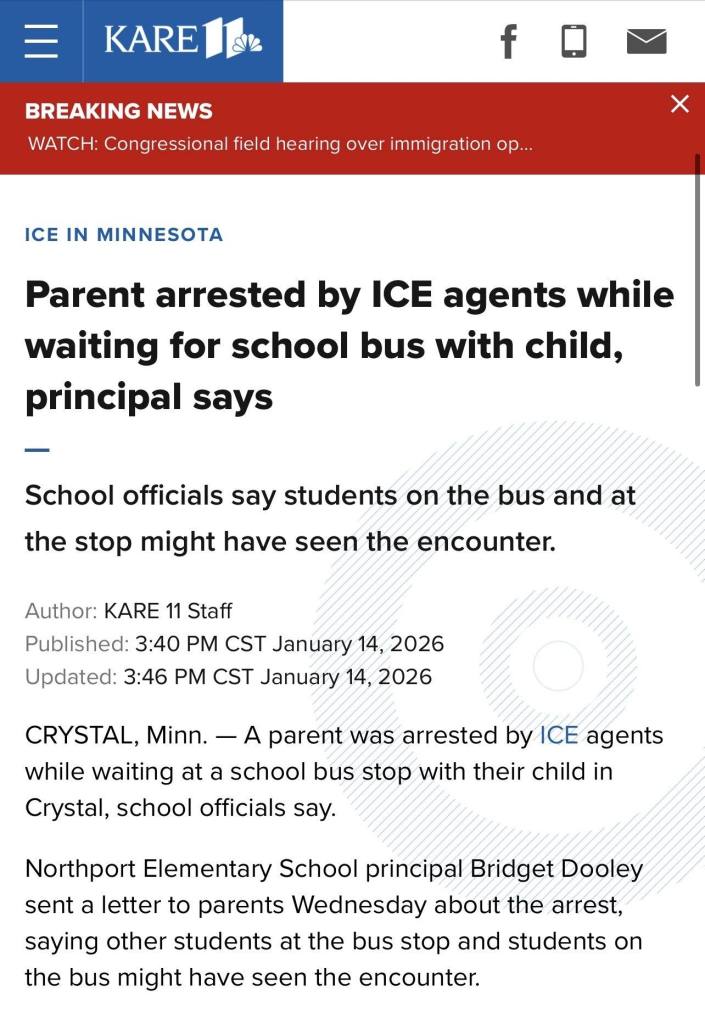
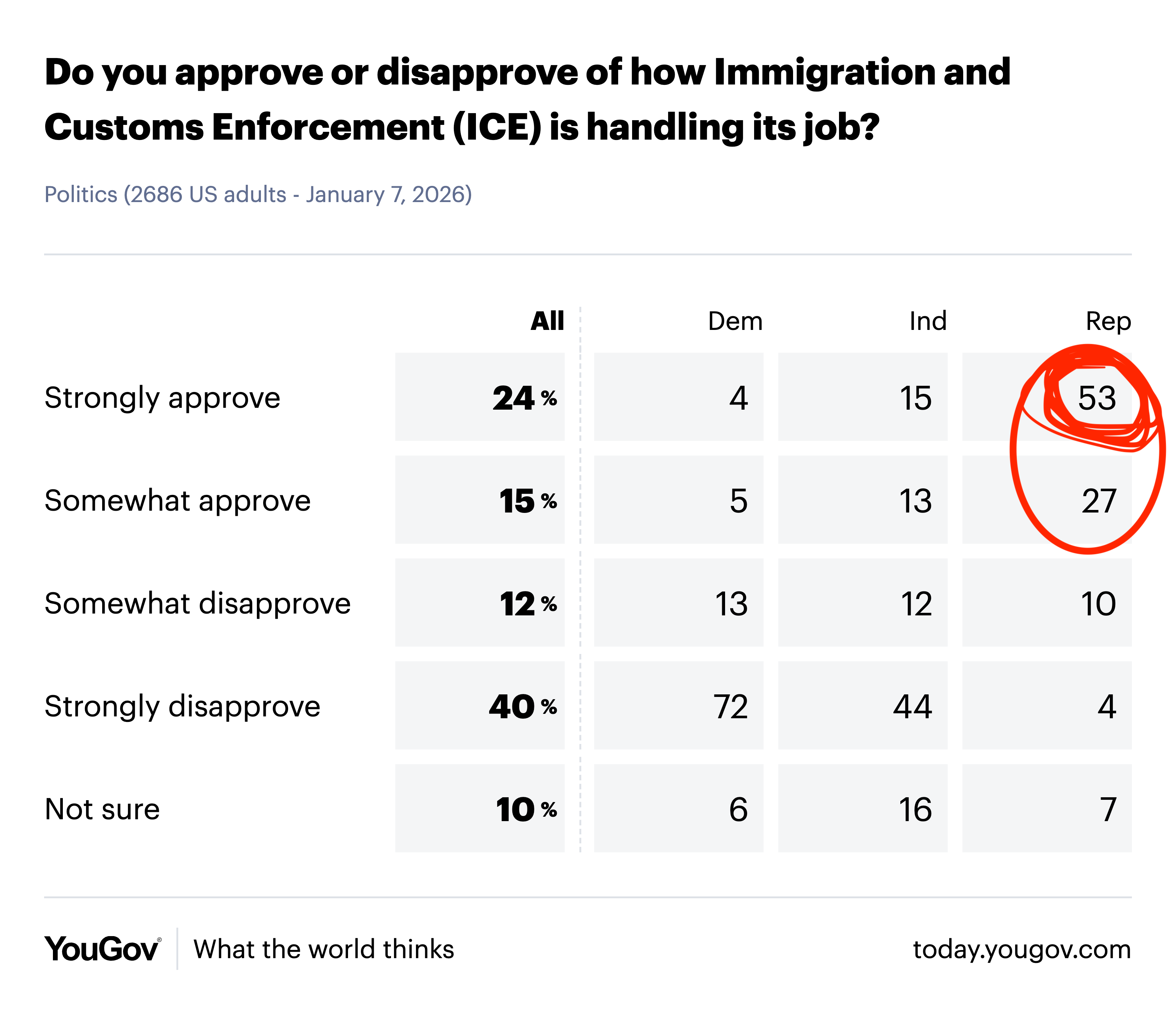
ICE drives around *incredibly recklessly* and uses license plate readers to find people with mostly-Hispanic sounding last names, pulls them over, and kidnaps them. Again, these aren’t specific people ICE has been tasked with finding. Most of the people who are kidnapped are U.S. citizens, lawful permanent residents, or have legal status of some sort (work permit, a social security number, or are a refugee or asylee) (picture 1). These are documented immigrants or citizens who have broken no laws — including not having broken laws entering the country. These are people just going about their daily life who get stopped and snatched because they’re Black, brown or Asian.
Just going about OUR daily life, we see abandoned cars in the middle of highways, on neighborhood streets, in front of doctors offices. Sometimes the doors are still open and the car is still running. We could be in line to get Burger King and watch ICE snatch a teenager on his way into work (picture 2). We could be taking out the trash, walking kids to the bus stop, going for a walk outside, and there will all of a sudden be a swarm of anonymous, masked, violent men ripping a family from their home or out of the booth at a restaurant. Picture 3 is a neighborhood, one mile from my house, at 8:30AM this past Wednesday. It was school bus pick up time and also trash day in that neighborhood. This is just in the middle of the neighborhood.
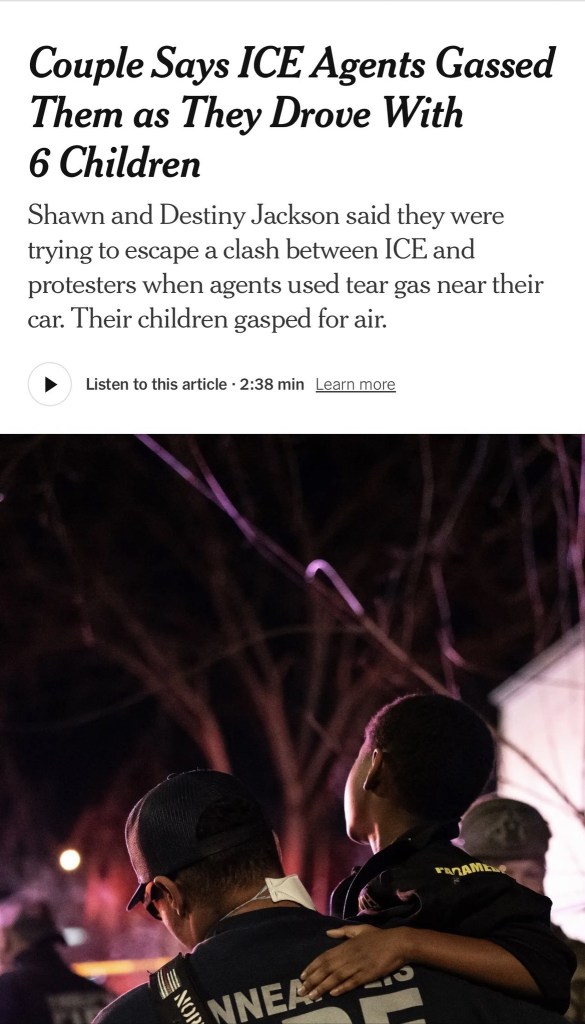
This can happen any where at any time. There is no place we can go and be assured we won’t see someone be violently taken. Target. The grocery store. A restaurant. Driving Hattie to swim lessons. Driving to church. Going to the doctor (picture 4). Multiple times a day, we get texts from co-workers, neighbors, friends, family members about a person they know (or are related to, or work with, or are their kids’ friends parents) who was taken.
ICE sets up checkpoints in neighborhoods and make everyone leaving or entering show their papers (note: very few people can prove their citizenship at a moments notice. A majority of Minnesotans don’t have passports. Citizens don’t just carry their birth certificate around). They go door-to-door in apartment buildings and neighborhoods, just hoping a Black, brown or Asian person will open their door (because they have no judicial warrant to take a specific person(s), just kidnapping whoever accidentally opens their door).
Schools have had to close. ICE has shown up to schools and just pepper sprayed kids and parents (picture 5). Districts are calling families and advising that their kids switch to online school. ICE circles and targets Spanish-immersion programs, forcing moms and dads to sit watch over their kids’ school to keep their kids and teachers safe (picture 6). Kids come home from school to empty houses, their parents having been stolen sometime during the day. When parents are kidnapped in front of others, they will yell out their full names and the name of their kids’ school(s) so someone can call the school and alert the administration, hoping their kids can be put with a safe adult instead of coming home to no one. There are people who signed delegation of parental authority (DOPA) forms — agreeing to take a neighbor or friend’s kids in the event of an emergency — who now have multiple children from multiple families.
ICE is ubiquitous. They are everywhere. We see them 3, 5, 7 times a day just going through our normal routine. There are more federal agents in Minnesota than there are local law enforcement from the ten largest metro police departments COMBINED (picture 7).
This is going to come to other states and I want people to be prepared, because I cannot overstate how many people have (had to) come together to respond.
Regular Minnesotans — people who have never once gone to a protest, called their elective representatives, participated in an economic strike, people who rarely even vote — have been activated. Grandparents carry whistles in their cars in case they come across ICE while living their lives and need to warn the surrounding area. Parents of kids in K-12 organize to ensure there’s parents at bus stops and the area around schools, because ICE stakes out bus stops and school properties — taking parents who are waiting at the bus stop or in the carpool line (picture . We’ve set up massive food donation and delivery infrastructure. We organize rides to school and work. People are literally taking in families.
SO many kids aren’t going to school right now (picture 9). So many businesses are closed or have lost their customer base entirely. So many families are facing eviction because they can’t go to work and won’t be able to pay their rent.
Minnesotans are being collectively punished and traumatized. 6 month old babies have been teargassed because their parents are just driving in their own neighborhood (picture 10). We are coming together in the most beautiful ways — I don’t want to understate that. But I want everyone outside of Minnesota to understand: we are under a federal invasion and occupation of armed, masked, paramilitary that roam our streets, brutalizing, harassing and murdering with impunity.
There may be people who might think that when this comes to your state, being white or being a U.S. citizen or living in a suburb or rural area or living in a neighborhood with few or no immigrant neighbors means you won’t see or experience this kind of daily assault of an invasion and occupation. I want to dispel that idea.
There are things I’m forgetting, certainly, but I wanted to try and paint the picture because this isn’t ending in Minnesota. We are the test case before expanding to other states in the country.
Help us now to stop this before it spreads. Organize in your communities now.
On January 7 U.S. Immigration and Customs Enforcement (ICE) agent Jonathan Ross shot and killed Renee Good, a thirty-seven-year-old woman who had been observing ICE raids from her car in her Minneapolis neighborhood. In videos of the incident, we can see Ross firing through Good’s windshield and open window as she begins to drive away. The horrific footage of the killing felt like a stark symbol of today’s authoritarian moment—but at the same time, I knew that anyone involved in the struggle against police violence would find it tragically familiar.
To put Good’s killing in context, I spoke with historian and Boston Review contributing editor Robin D. G. Kelley, whose forthcoming book, Making a Killing: Capitalism, Cops, and the War on Black Life, covers the history of county, state, and municipal police violence—as well as the activism against it. In an email exchange, we discussed the pitfalls of the “perfect-victim narrative,” policing’s terror tactics, why agents don’t need more training, and where we go from here.
Deborah Chasman: Good’s killing shocked Americans. But much about it reflects violence that’s very familiar to you. Can you put the murder in the context of your research?
Robin D. G. Kelley: Despite having spent more than thirty years studying and writing about police violence, I am still shocked by every death—even when the outcome is predictable. But the killing of Good shocked even the most seasoned organizers. She was a white woman and a mother—two things you’re not supposed to be when armed agents of the state put you in a body bag. (That she was queer and a poet, not so much.)
Of course, the very idea that certain people, by virtue of their characteristics, don’t deserve to be brutalized, caged, or killed by police is the problem. Mariame Kaba warns against “perfect-victim narratives,” which reinforce what Ruth Wilson Gilmore calls “the problem of innocence.” Centering someone’s innocence clouds the case for abolition, which seeks to create a world where no one is caged or gunned down even if they broke the law. No matter who she was, what she looked like, her marital or citizenship status, or what she might have done in the past or even in the moment, Good had the absolute right not to be shot for driving away.
What doesn’t surprise me is why and how Jonathan Ross shot her and the federal government’s efforts to cover up what happened. Researching Making a Killing, I found too many incidents to count where police fatally shot people for attempting to drive away. These were not high-speed chases, by the way—sometimes it was just a car lurching forward or an engine revving up that prompted a shooting. They all have one thing in common: police justify the shootings as acts of self-defense. The alleged “suspect,” the story goes, intended to ram the officer, who opened fire because he feared for his life. After these shootings, cops rarely argue they were simply trying to stop a fleeing suspect, because it opens them up to two objections: that firing at a driver puts others in harm’s way, and that they could have taken down the license plate and pursued the person later. Fearing for one’s life is always used to absolve cops from having to explain why they didn’t act differently.
This is why, in videos of the moments before the shooting, we can hear Good’s wife Rebecca saying, “We don’t change our plates every morning, just so you know. It will be the same plate when you come talk to us later.” And this is also why, for many years and in different cities, movements fighting police misconduct demanded that officers be banned from using lethal force against fleeing suspects who do not pose an imminent threat, whether on foot or in a car.
I’m also not shocked by the utter refusal of the federal government to investigate or consider bringing charges against Ross. I’ve lived through and documented so many cases of officers whose egregious acts of violence led to no indictments and no investigations; so many cases of police and even prosecutors destroying incriminating evidence. The question is, why are so many people surprised and indignant about the feds’ unqualified defense of Ross? Maybe because we’ve fallen into the trap of distinguishing ICE and CBP (bad) from local police (good). Maybe it’s a residual effect of the January 6 insurrection, in which some police officers had been victims of right-wing mobs (which themselves included a disproportionate number of cops and soldiers). In any case, the narrative has taken hold that ICE agents are rogue cops or cops on steroids, trained to terrorize or simply untrained. Strangest of all in this story is the liberal pipe dream that local police will stand up against ICE and CBP, when police have collaborated with ICE and been deployed to protect agents from protesters, even in so-called sanctuary cities.
I’m not sure if it’s amnesia or just wishful thinking, but it seems like the well-documented terror tactics of municipal, county, and state police have just disappeared from people’s memory. Chicago and Los Angeles, where resistance to ICE has been extraordinary and well-organized, have histories of police violence that rival anything ICE agents are doing. Indeed, it is precisely the long experience of organizing against this violence that prepared activists in these cities to resist ICE.
Chicago, which takes up a very long chapter in my book, is known for police torture, the maintenance of secret “black sites,” assassinations and executions, and prosecutors who have consistently protected police even to the point of hiding evidence. This is the city where the second Black police superintendent, LeRoy Martin, bragged in 1987, “When you talk about gangs, I’ve got the toughest gang in town: the Chicago Police Department.” And it is the same city that has been a model of resistance to police repression for more than half a century, culminating in the collective struggles for justice for Rekia Boyd, Laquan McDonald, and victims of torture that brought down the ruling regime of Rahm Emanuel.
This is not to diminish ICE and CBP’s violent tactics. These outright abductions are terrifying, though again, not without precedent. Police have abducted Black men standing on a street corner or a stoop and tossed them into unmarked vans just for looking suspicious, and there are numerous cases of young Black women abducted off the streets and sexually assaulted by police. But there is a fundamental difference between these abductions and ICE’s: the former were intended to be secret, the latter publicized. ICE and CBP agents are either filming these acts of terror themselves (Ross had one hand on his gun and the other holding his cell phone to film!), or they are arriving with a film crew. The point is to create fear, to terrorize people into submission, to create a state of emergency.
Finally, let’s try not to make these attacks about Trump or even Stephen Miller. Both ICE and CBP have histories of violence dating back to well before 2016. My colleague Kelly Lytle Hernandez has written on the history of the Border Patrol, which has been terrorizing people since 1924.
DC: Republicans and right-wing pundits have been relentless in blaming Good for her murder, or calling her a domestic terrorist and warning that any activism will put you in harm’s way. Clearly there’s a legal element to blaming Good—it’s meant to exonerate the agent. But how do those narratives function politically?
RK: Anyone organizing against state power will be a target, whether their protest abides by the law or involves civil disobedience. Either way, nothing justifies the harm, which is what these narratives attempt to do. Just last night, after ICE shot another person in Minnesota and protesters were in the streets battling federal agents, there was a lot of talk—including from Governor Tim Walz and Minneapolis Mayor Jacob Frey—about the need for peaceful protest: code for candlelight vigils and silent prayer. Militant civil disobedience, aggressively confronting a phalanx of masked agents in riot gear, or blocking traffic is nonviolent, but these tactics are not considered by the political class to count as “peaceful protest.” And by now, it should be clear that peaceful protest, whatever form it takes, will not get ICE or CBP out of your city; it will not stop the terror or the abductions.
And yet, when we return to Good’s death, we must remember that she actually wasn’t protesting. She was a legal observer doing her job, and when told to leave she was complying. Unsurprisingly, J. D. Vance and all the right-wingers who blame Good for her death are simply lying. Calling her a domestic terrorist—it’s the oldest trick in the book. The subtext to which we ought to pay attention is how her gender and sexuality constituted the real threat to Ross, his fellow agents, Vance, Stephen Miller, and MAGA. One must imagine what it meant to Ross for a smiling queer woman to tell him, “I’m not mad at you.” After shooting her three times, Ross or an agent near him mutters, “Fucking bitch!” That says it all.
Nearly every victim of an ICE or CBP shooting is blamed for being either a fugitive or domestic terrorist. When ICE agents fatally shot Silverio Villegas-González, a thirty-eight-year-old immigrant from Mexico, as he tried to drive away from what amounted to an ambush in Chicago, DHS released a brazenly false statement claiming that he “refused to follow law enforcement officers’ commands” and used his car as a weapon, hitting and dragging one of the officers. And so the same old story goes: “Fearing for his own life and broader public safety, the officer fired his weapon.” We know now that no officer was hit or dragged, and the one officer allegedly hurt suffered minor cuts from breaking Villegas-González’s window.
Likewise, when CBP agents shot Marimar Martinez, a thirty-year-old schoolteacher and U.S. citizen—also in Chicago—they labeled her a domestic terrorist and charged her with ramming a federal law enforcement officer. We know now that the agent, Charles Exum, rammed her vehicle, jumped out with his gun drawn, and said “Do something bitch” before shooting her five times. The DHS lies were so egregious (and Exum didn’t help their case by bragging about it in text messages) that the prosecution had no choice but to drop all the charges.
DC: In the wake of Good’s murder, many have called for better training for ICE officers—a response that activist Kelly Hayes, among others, has forcefully rejected. I know you agree. Can you explain why?
RK: Jonathan Ross wasn’t one of those cats recruited with a $50,000 bonus and handed a gun. Besides being a veteran of the Iraq war, he had spent a decade as a member of the special response team of ICE’s enforcement and removal operation. He got more training than most of the other masked goons running the streets of the Twin Cities. The argument for more and better training was thoroughly discredited after George Floyd’s murder in 2020. As it turned out, Derek Chauvin had lots of training: he had taken the crisis intervention training, use-of-force training, de-escalation vs. restraint training, and even training in implicit bias, which became mandatory for Minneapolis police officers beginning in 2018. The result? Chauvin racked up seventeen misconduct complaints over nineteen years on the force. And after 2018, cases of police brutality and excessive force complaints increased across the city.
But if training hasn’t worked, why does it continue? Why is it always trotted out, alongside new technologies, as the solution? Because training and technologies (body cams, Tasers, so-called less-than-lethal weapons, predictive policing software) are a boondoggle for corporate interests. Training costs money, which increases police budgets, which are paid for through taxes and bonds—a hidden source of revenue for financial institutions that administer the bonds. The money for training flows to private companies, usually run by former police chiefs and so-called criminal justice experts—not community organizations that have been fighting for accountability. Sometimes the investment in new technologies and training comes from corporate-funded private police foundations, whose donations enable departments to purchase equipment, such as surveillance technology, guns, ballistic helmets, cameras, and drones, and assist officers with bonuses or legal fees, with no oversight or public input. But corporations like Amazon and Google get a great return on their investment since law enforcement agencies adopt technologies of surveillance, data mining and management, etc., coming from these companies.
To understand what “training” produces, let’s focus on one company: 21st Century Policing Solutions, LLC (21CP), which grew directly out of an Obama-era task force formed in late 2014 after the killing of Michael Brown. 21CP is made up of law enforcement officials, lawyers, and academics, and it’s paid by municipalities and university public safety forces to train police in a host of areas: gaining community trust, racial equity, changing use-of-force policies, communication, transparency, strategic management, and community policing. Usually, this work entails producing reports that ultimately just repeat boilerplate recommendations. Oklahoma City paid 21CP $193,000 for a report many Black residents found to be useless—nothing changed. Aurora, Colorado, paid 21CP $340,000 to “investigate” the police missteps that resulted in the death of Elijah McClain, a young Black man who had been injected with ketamine under police custody and died. 21CP produced a 161-page report that primarily described the operations of the Aurora Police Department, compared it with other departments in similar-sized cities, repeated what we all know about the death of McClain, and offered obvious and fairly innocuous recommendations: prohibiting chokeholds, retaliatory violence, using force on people who are handcuffed—in other words, prohibiting behavior that is already prohibited. And worse, these reports often suggest recruiting and training more officers. I want to suggest that when we talk about training and technology, we need to follow the money. And in the case of CBP and ICE, the last thing we should be doing is proposing reforms that give them more money.
As the coercive arm of the state, the police—including CBP and ICE—are the primary instruments of state violence within the borders of the United States. They function as an occupying force in America’s impoverished ghettos, barrios, reservations, on the Southwest border, and in any territory with high concentrations of subjugated communities. For people who reside in these communities, keeping us safe is not the objective. Instead, the modern police force—whether local, state, or federal—wages domestic war. Whether we call it a war on crime, a war on militants, or a war on drugs, law enforcement at every level has turned many Black working-class neighborhoods in particular into killing fields and open-air prisons, stripping vulnerable residents of equal protection, habeas corpus, freedom of movement, and even protection from torture. The attack on non-white immigrants is just another front in a war the police have waged since their inception.
And despite the handwringing and outrage over the Trump administration’s flagrant violation of the Posse Comitatus Act of 1878 limiting the use of the military in domestic matters, the police have long functioned as an army against dissident social movements. The police are the first line of defense against strikes and left-wing protests, while often serving as a cordon to protect Klansman, Nazis, and the alt-right.
DC: What are the chances that Ross will be held accountable? How does this end?
RK: Simply put, Ross will not be held accountable, nor will anyone else responsible for the death or injury of victims of ICE or CBP attacks. As I document in my book, we can’t get accountability from the “regular” police, whatever that means: after decades, we haven’t been able to achieve something as basic as an honest civilian review board with subpoena powers and the ability to hire and fire officers! Since Trump’s second term, things have gotten even worse. Guided by the Heritage Foundation’s Project 2025, the Trump administration rescinded Biden-era police and criminal justice reforms; shuttered the National Law Enforcement Accountability Database (NLEAD) created in 2023 to allow prospective employers to access the records of federal law enforcement officers in order to check their backgrounds for misconduct; halted all open federal investigations into law enforcement, notably in Jackson, Mississippi, and New York City; ended federal consent decrees mandating reforms of Louisville and Minneapolis police departments; made the extraordinary offer of free private-sector legal services for officers accused of misconduct.
It is not enough to abolish ICE. We need to abolish the police and cages and build other institutions and relationships that can bring us genuine safety. Abolition is less an act of demolition than a construction project. It is creative creation, the boundless, boundary-less struggle to make our collective lives better, what Ruth Wilson Gilmore calls “life in rehearsal.”
Ironically, the federal government’s escalation of violence and its spillover into other communities have actually forced people to find their own strategies to keep each other safe, through communication, patrols, whistles, trainings in nonviolent resistance, and old-fashioned organizing. It’s not just about keeping ICE out, but making sure that the medical and child care needs of neighbors are being met, that people who can’t leave their homes out of fear are fed, and that some homes can become designated safe houses.
I’m reminded of a 2009 statement issued by the abolitionist organization Critical Resistance. Instead of police, the statement asks,
What if we got together with members of our communities and created systems of support for each other?. . . . Relying on and deploying policing denies our ability to do this, to create real safety in our communities.
We’re seeing this in action now in the mobilizations against ICE. The question is whether it can be sustained and turned into something that can replace our dependence on armed agents of the state to solve human problems.
Independent and nonprofit, Boston Review relies on reader funding. To support work like this, please donate here. Robin D. G. Kelley is Distinguished Professor and Gary B. Nash Endowed Chair of U.S. History at UCLA and a contributing editor at Boston Review. His many books include Freedom Dreams: The Black Radical Imagination. Deborah Chasman is publisher and coeditor of Boston Review. Her writing has also appeared in New York magazine and the Chronicle of Higher Education.
Federal immigration agents detained three people and deployed chemical agents at multiple locations around E. 34th Street and Park Avenue in Minneapolis’ Powderhorn neighborhood Tuesday morning. At least two were observers and not the target of immigration enforcement operations.
Around 9:40 a.m., community response networks began sending alerts about Immigration and Customs Enforcement (ICE) door-knocking at E. 34th Street and Park Avenue. By 10 a.m., a crowd of over 100 observers had gathered, confronting agents at multiple intersections.
Among the detainees was a woman who was forcibly removed from her vehicle after agents smashed her passenger-side window.
In a video taken by Sahan Journal, the woman can be seen arguing with agents prior to being grabbed by multiple agents and carried to agents’ vehicle. The woman can be heard shouting that she is disabled and on her way to a doctor’s appointment that ICE was obstructing. Prior to the detention agents had instructed her to drive away.
After being pulled out of a car, a women screams as she’s being arrested by immigrations agents at 34th and Park in Minneapolis on Jan 13, 2026. Credit: Chris Juhn for Sahan Journal
Shortly after, another observer on site was tackled and forcibly put in agents’ vehicle as well. According to state Rep. Aisha Gomez, DFL-Minneapolis, who was present at the scene, agents pushed the man’s head into the concrete prior to carrying him away. Gomez also said that agents were physical with her as well.
“These officers have obviously not had the basic law enforcement training,” Gomez said. “I was shoved with no verbal communication whatsoever.”
Andy Larson, a south Minneapolis resident who was out observing ICE activity Tuesday, told Sahan Journal that one protester kicked out the taillight of an ICE vehicle and was tackled to the ground up the road on Park Avenue and E. 36th Street.
“It was a really good kick,” Larson said.
The protester managed to escape ICE agents, Larson said. ICE deployed chemical irritants and shot pepper balls into the crowd and fled the scene.
According to Sahan Journal photojournalist Chris Juhn, a Hispanic man was also visible in the back of one vehicle. It is unclear whether the man was an observer or target of federal operations. ICE did not respond to Sahan’s request for comment on the operations.
At multiple points during the operation, agents deployed chemical agents at observers. Agents fired pepper balls at observers’ feet and threw canisters of tear gas at the corner of 34th Street and both Park and Oakland avenues prior to leaving the scene. Eyewitness Moses Wolf said there was no singular precipitating event that led to tear gas being deployed on Park Avenue.
“There was a crowd confronting each other telling ICE to get out,” Wolf said. “I didn’t really see any physical altercation happening.” He said it appeared to be a tactic by ICE agents to exit the scene.
Wolf said the confrontation prior to the deployment of tear gas had not escalated beyond what had already been happening.
“It wasn’t anything crazy,” Wolf said. “I turned around for one second and there was this whole entire cloud of it, and pepper spray came with that.”
Eyewitness Neph Sudduth said at Oakland Avenue agents used tear gas as they were leaving.
“They were finally leaving, it was the last car of the convoy,” Sudduth said. “They just threw two or three canisters out at us as they left.”
Both Sudduth and Wolf said they witnessed agents using pepper spray out of the windows of their vehicles as they drove off.
“They just wanted to hurt us cause we told them how we felt, and they didn’t like it,” Sudduth said.
The operation in Powderhorn is part of a flood of federal immigration activity in Minnesota. As many as 2,000 federal agents are present in the state according to reporting from the New York Times, with an additional 1,000 set to be deployed.
For Gomez, the clash with ICE is the new reality of life in the Twin Cities with federal agents present.
“This is what our streets are like,” Gomez said. “We have these masked, unaccountable unknown to us federal agents, and it’s like they’re the secret police.”
Despite the difficulties, Gomez believes observers should and will continue to show up to meet federal agents in the streets.
“Our community is undeterred,” she said. “We’re not going to just lay down. You can gas us and mace us all you want, we’re not going to just lay down.”
Sahan Journal reporter Andrew Hazzard contributed to this story.
During the 2024 campaign, Donald Trump promised to deport every illegal immigrant who was a rapist, murderer, or thief. He also promised to deport 20 million immigrants. Some voters believed the first promise; other voters believed the second.
Because people are stupid, that first group of voters believed that there were 20 million undocumented immigrants who have committed felonies. This is not possible. The total number of people in jail in America today—this includes federal, state, local, and tribal land prisons—is just under 2 million. The number of undocumented immigrants who have committed serious crimes cannot be 10x the entire prison population of the United States. If it were, then daily life in America would look like Escape from New York.
So some Trump voters were duped owing to their general ignorance and/or innumeracy.
But others were not. Others signed up for Trump because of his second promise (the 20 million deportations) and viewed the first promise (about deporting only criminals) as the pap necessary to get the suckers onboard.
There are two crucial questions about these two groups. The first is:
What is their relative size? What percentage of Republican voters were tricked into voting for Trump’s immigration policies versus what percentage are getting exactly what they wanted?
Would you like to guess? Go ahead. I promise that whatever you’re thinking, it isn’t dark enough.
Here’s a survey tracking Republican approval of Trump’s immigration policies (the top line, in red) over most of 2025:
That’s a consistent level of support around 80 percent. Now here is the first poll conducted after the killing of Renee Good:
Even after the killing of an unarmed American citizen, a total of 80 percent of Republicans approve of what ICE is doing and 53 percent of Republicans strongly approve.
It seems pretty clear that, at best, one in five Trump voters were duped. The majority of them are getting exactly what they wanted.
Now if Trump were to lose the support of 20 percent of Republicans voters—or even 14 percent—it would be meaningful for Republican electoral prospects. Which is nice.
The problem is that having 80 percent of Republican voters actively supporting a fascist race war is meaningful for our societal prospects.
Which brings us to the second question: How are these groups distributed through the elite positions of power in government? And here it seems that many of the Republicans most invested in a race war have a great deal of power. Like, for instance, Vice President JD Vance, Deputy Chief of Staff Stephen Miller, and Secretary of Homeland Security Kristi Noem.
At the elite levels, even the idea of 20 million deportations is too little. Here’s a tweet from the Department of Homeland Security on New Year’s Eve:
100 million deportations?
There are 43 million foreign-born Americans. Most of them are legal immigrants. In order to perform 100 million deportations, DHS would have to round up every immigrant of any status—even naturalized citizens—and then also snatch 57 million American who are citizens by birth and deport them, too.
Want to guess who those other 57 million Americans might be?
This week the Department of Labor published this:
Of course, the slogan sounds better in the original German.
Oh, and don’t forget the Department of Labor’s heroic propaganda posters depicting the American worker in a very specific way.
On the one hand, it feels weird to say that the U.S. government is attempting some low-key ethnic cleansing.
On the other hand, the reality is that we have a masked secret police force going door-to-door attempting to kidnap brown people; one government agency publicly daydreaming about deporting 100 million people; and another government agency saying that the ideal worker is a 20-year-old white guy.
2. Demographics
Another tell: This administration is obsessed with America’s falling fertility rate. From the NYT:
Vice President JD Vance last week called falling marriage rates “a big problem.” The deputy secretary of Health and Human Services in December urged his agency to “make America fertile again.” And at a recent conference for young conservatives, Sean Duffy, the transportation secretary, doubled down on the importance of marriage and children, holding out his nine kids as a model for others to follow.
Full disclosure: I am also obsessed with America’s falling fertility rate. Enough that I wrote a book about it.
The problem here is that nearly all of the declines in total fertility rate (TFR) over the last decade have been the result of declining Hispanic fertility.
Here’s the deal: The TFR—the total number of kids the average woman has over the course of her life—has been below the replacement level, but relatively stable, among white and black Americans for the last generation or so. But America’s TFR kept declining anyway. Why?
Because Hispanic Americans—many of whom were recent immigrants—had TFR’s higher than the U.S. average. And their baby-making propped up the nationwide number. The problem is that, as recent immigrants spent time in America, their reproductive behavior began regressing to the mean. The shift has been dramatic:
If you were concerned about the fertility rate in America, would you be trying to (a) halt all immigration—since immigrants usually bring with them fertility rates higher than native-born Americans—and (b) deport 100 million people from the ethnic group that has the highest fertility rate?
No.
The only reasonable conclusion is that the concern of people in the Trump administration isn’t about the total fertility rate. It’s about the white fertility rate.
I don’t know how much clearer the regime could be.
So tell me: What does the pie chart look like on Republican voters and race war? What is the percentage of Trump voters in each of these categories:
Group A: Sees and understands the administration’s intent and supports it.
Group B: Sees and understands, but oppose it.
Group C: Do not understand that the regime views its program as part of a race war and thinks it’s all business as usual?
And follow-up question: How big can Group A be for us to retain a functional, liberal society?
“Mr. Speaker, I rise today to announce I will be impeaching Homeland Security Secretary Kristi Noem,” announced Rep. Robin Kelly of Illinois.
“Secretary Noem has violated the Constitution and she needs to be held accountable for terrorizing our communities. Operation Midway Blitz has torn apart the Chicagoland area. President Trump declared war on Chicago and then he brought violence and destruction to our city and our suburbs in the form of immigration enforcement.”
Rep. Kelly then broke down some of the outrageous violence that ICE has visited upon her district.
“In my district, federal agents repelled down from Black Hawk helicopters and burst into an apartment building in the South Shore area. They dragged US citizens and non-citizens alike out of their beds in the middle of the night. They claimed the apartment was infiltrated by members of a Venezuelan gang. I don’t understand this president’s obsession with Venezuela, but they did not arrest a single member from that gang.”
“I visited that apartment building and saw firsthand the destruction those agents left. Doors to people’s homes or apartments were kicked down. Belongings, including little kids’ toys, were strewn about in the hallway. That raid and so many others shook our community, not just immigrants, but everyone. Now, Secretary Noem has brought her reign of terror to Minneapolis after she left Charlotte and Raleigh. We have all seen what happened.”
“ICE officers shot and killed Renee Nicole Good in cold blood. Without knowing any of the facts or an investigation, Secretary Noem lied about what happened. She called [a] beloved 37-year-old mom a domestic terrorist. Secretary Noem and her rogue agents are the ones terrorizing our communities, and she is breaking the law to do so. I will hold her accountable.”
“I’m filing three articles of impeachment against Secretary Noem. Number one, obstruction of Congress. Secretary Noem has denied me and other members of Congress oversight of ICE detention facilities. It is our constitutional duty to find out what’s happening in these centers where people are reportedly being treated like less than animals. Two, violation of public trust.”
“Secretary Noem directed ICE agents to arrest people without warrants, use tear gas against citizens, and ignore due process. She claims she’s taken murderers and rapists off our streets, but none of the 614 people arrested during Operation Midway Blitz has been charged or convicted of murder or rape.”
“Three, self-dealing. Secretary Noem has abused her power for personal benefit. She steered a federal contract to a new firm run by a friend, her friend. Her propaganda campaign to recruit ICE agents cost taxpayers $200 million. She made a video that turned the South Shore raid into something that looked more like a movie trailer. But make no mistake, this is not a movie. This is real life and real people are being hurt and killed. I really have to wonder who are the people behind the mask. These DHS agents have no identifying factor.”
“From all their botched raids and officer-involved shootings, I have to ask, what is their training like? What is the vetting? Is Secretary Noem recruiting January 6th insurrectionists? I was one of the last members of Congress to escape the House Gallery on January 6th. I remember hiding on my hands and knees and running through the hallways to a safe room. Insurrectionists are not fit to serve as law enforcement. I realize that impeachment of Secretary Noem does not bring Renee back.”
“True justice would be Renee alive today at home with her family. Impeachment doesn’t bring back the four other people killed by immigration officers this year, including a man in Chicago. We could not bring them back to their loved ones. What we can do, though, is impeach Secretary Noem. Hold her accountable. Let her know the public is watching. In this country, we do not kill people in cold blood without consequences. These are not policy disagreements.”
“These are violations of her oath of office and she must answer for her impeachable actions.”
Audience members at the all-ages Minneapolis rock venue Pilllar Forum tussled with ICE agents on the street outside the club on Sunday — prompting that night’s show to be canceled.
The owner of Pilllar Forum, Corey Bracken, said several of his customers and musicians were pepper-sprayed by ICE agents and at least two were hit with batons on the street outside the venue, at 2300 Central Av. NE., where other ICE detainments and community protests have happened in recent days.
“My staff doesn’t feel safe after this, and our artists and customers don’t feel safe,” said Bracken, a dad who expanded his skateboarding store into a music venue and coffee shop in 2023 to bring more live music and art to underage fans.
He is leaving it up to his staff and the bands themselves to decide whether to proceed with upcoming concerts, including several more scheduled this week.
The ruckus started shortly after the 6:30 p.m. showtime for a four-band bill headlined by Pilllar Forum regular Anita Velveeta, a popular trans/queer punk act. Audience members saw ICE agents pull up and detain two individuals outside the neighboring Supermercado Latino market, prompting the club’s young music fans to quickly exit onto the street and protest the agents’ actions.
The Department of Homeland Security didn’t respond to a Star Tribune request for comment. An employee at Supermercado Latino also declined to comment on the incident.
Antonio Carvale, singer/guitarist in one of Sunday’s opening bands, BlueDriver, said he was one of five people at the venue who had to be treated with water and saline solution after being hit with pepper spray. He said agents fired the spray after they pushed a protester who pushed back.
“Honestly, the pain felt brutal, but fortunately the community was prepared and helped treat our eyes,” Carvale said, but he commiserated with a bandmate who was also struck by a baton and “banged up pretty bad.”
The band was disappointed Sunday’s gig then was canceled, but he added, “It would’ve been hard to play when I couldn’t even see the frets.”
One of the audience members who was pepper-sprayed, Jess Roberts of Minneapolis, said she had to go to an urgent care clinic because she was sprayed in the ear, which led to an infection.
The run-in with ICE followed a viral Instagram post by Pilllar Forum that went up Friday and landed 25,000 likes. It showed a peaceful but loud crowd of protesters shouting down ICE agents on Central Avenue, with the message, “And that is how you get it done.”
Minneapolis City Council President Elliott Payne and the new Minnesota state senator representing northeast Minneapolis, Doron Clark, joined Bracken in another social media video posted late Sunday denouncing the incident. Clark called Pilllar Forum “an institution here on Central.”
Payne urged residents, “Stay safe and stay vigilant.”
Twin Cities musicians and music fans offered online support for Pilllar Forum after Sunday’s mayhem.
“Thank you for supporting the community!” veteran rocker Tim Ritter of the band Muun Bato wrote on the venue’s Facebook page.
Bracken did offer refunds to paid attendees of Sunday’s canceled show, proceeds of which were to be donated to families affected by ICE detainments, per headliner Anita Velveeta’s request.
“So far, I haven’t heard from anyone who wants their money back,” Bracken said.
Brandon Siguenza (center) and his wife, Julia Rose (left) in happier times. Source: Facebook
Good morning,
My name is Brandon Siguenza, and I am a US citizen from Minneapolis. Yesterday, while doing legal observation, ICE stopped their cars to harass my friend and me. They sprayed pepper spray into the vent of our vehicle. We held our hands in the air and told them we were not obstructing, that the car was in park and they were free to drive forward and away. There was no active immigration raid. They returned to their cars, and drove forward a bit, then decided to stop again. They surrounded us, smashed the windows of our car, opened the doors (they were unlocked), ripped my friend and I out of the car and arrested us on charges of obstruction.
I was put in an unmarked SUV, separated from my friend. As I was put in the back seat an ICE agent tore the whistle off my neck and said “I’ll be taking this, I might need it later.” My phone was knocked out of my hand while being arrested. As we drove away I asked the driver and the passenger if they wouldn’t mind buckling my seatbelt, as they were driving erratically. I was ignored. I asked them if I could have the handcuffs loosened, as I was losing circulation, and was told no. At one point the passenger realized his own driver’s license was in the backseat next to mine, and tried to surreptitiously grab it without me seeing it.
We were taken to the Whipple federal building, where I saw dozens of brown people being processed in an unheated garage. I was frisked, told of my charges, and saw buses and vans being prepped. I later learned that these were being filled with detainees and driven to the airport for deportation. As we were led in, I noticed that the building was very busy. I got the impression that one of the 2 agents bringing me around was being trained. At multiple points throughout my stay, government agents were unable to open doors, not sure where they were meant to be going, and overall confused and overwhelmed. They couldn’t figure out how to use the building phones, or complained about a lack of cell service preventing them from checking the internet or making calls.
The people in the cells were extremely scared. We heard people screaming “let me out!”, crying, wailing and terrified screams. There were cells with as many as 8 people. I have no way of knowing how long they have been there, if they were allowed any contact with the outside world, or if they were being brought food or water. Most people were staring at the ground with almost no energy. I was not allowed to talk to anyone imprisoned. I distinctly remember seeing a desperate woman. She was staring at the ground with her head in her hands crying, hopeless, while her friend or family member sat on a bathroom seat observed by 3 men.
My friend and I were put in an area for “USCs,” which we eventually learned meant US citizens, separated by gender. We were imprisoned for 8 hours, during which my friend was never allowed a phone call. I was allowed to call my wife and tell her where I was. During my interview with Special Agent William and Special Agent Garcia, they asked me to empty my pockets. When I pulled out gloves, Agent William said those were meant to be taken when I was processed, and complained about having to fill out the form again. He frisked me once more, where he found glass in my pocket from when our car window was shattered. He filled out the form listing my personal items again, but put the wrong date. I was read my rights, I pleaded the fifth and was led back to my cell.
Food, water, and bathroom breaks were extremely difficult to acquire. I would ask over the intercom provided in the cell for a bathroom break, be told someone was on their way, then ask again 20 minutes later, be told someone was on their way, wait another 20 minutes, etc. Eventually they either turned off the intercom or it stopped working, because no one would respond. I could get water and bathroom breaks by pounding on the glass when someone happened to walk by and beg them directly. Hours would go by without anyone checking on us. I am vegan and the only food they offered were turkey sandwiches, fruit snacks with gelatin, and granola bars with honey. I eventually ate a granola bar out of hunger.
I was in the cell alone for between 1 and 2 hours, then another man was put into my cell, whose shirt was ripped open from his arrest, and an injured toe, who was carried aggressively into an unmarked car during his arrest. After about 4-5 hours, another man was brought in who had a cut on his head from his arrest. He told me he was tackled by 4 or 5 agents during his arrest. At no point was he offered medical assistance.
Later I was told that a lawyer was here to see me, and I was able to speak with him in a visitation room. The special agent told me that the door could not be closed all the way, so it was cracked during my interaction with my lawyer. I got the impression that they were not used to having lawyers present, and were trying to follow procedure as best they could. I asked an agent if the other detainees were allowed lawyers and was not answered.
At one point, 3 men from the department of Homeland Security Investigations brought me into a cell. They insinuated that they could help me out. After inquiring several times what exactly they meant they finally told me that they could offer undocumented family members of mine legal protection if I have any (I don’t), or money, in exchange for giving them the names of protest organizers, or undocumented persons. I was shocked, and told them no.
Finally, after hours of detention, I was told to follow an agent. At no point was I told whether or not I was being charged, or where I was going, but I was led out of the building. I asked if I could use a phone to call my wife to pick me up, and was told I could not. After pleading for several minutes eventually Special Agent William let me use his phone to call my wife. As I was escorted off the property by government agents, I was told to turn right. I was escorted to the protest area, where 5 minutes later, tear gas was deployed and I was struck by a paint ball gun. I was not protesting, I was simply being released without charges after an 8 hour detention. I was on the other side of the street, as instructed by the agents that released me and the agents shouting orders over a bullhorn. A passerby who was tear gassed was panicking and having an asthma attack, so I helped her find a medic to get her an inhaler. I used a stranger’s phone to co-ordinate pickup, and was picked up by my wife.
During my detention I knew that I was being released. I knew that as a citizen of the United States I have legal protection. The hundred or so other people being detained had no such protection. At this time I don’t need your help, it is the families that are being separated, abused, terrorized, harassed and killed that need your help. If this is happening to me, an American citizen born in the United States, then what is happening to the people in here that have no one calling lawyers on their behalf? That have no constitutional rights to due process? What is happening to the people that they will never be released to see their families, go to their jobs, or walk through their city ever again?
Please take care of yourselves, your family, and your community. I am safe and healthy, if you feel compelled to help, please offer your help to the Immigrant Defense Network at https://immigrantdefensenetwork.org/. If you know someone detained by ICE, call or text CAIR-MN at 612-206-3360 for 24/7 legal intake.
KARE 11, “Taken by ICE & Detained | Breaking the News Plus”
What is it like in the Minneapolis ICE Detention Center? Patty O’Keefe & Brandon Siguenza join Jana to discuss their experience being detained for over 9 hours.
Ukrainian, abducted as a teenager from occupied Donbas in 2019, sentenced by Russian court to 22 years (Kharkiv Human Rights Protection Group, January 9th)
‘Russian world’ in occupied Luhansk oblast: no heating and deliberately cut off from mobile telephones and Internet (Kharkiv Human Rights Protection Group, January 8th)
Desperate plea from Russian prison: Ukrainian political prisoners need to be freed now, not after ‘peace deal’ (Kharkiv Human Rights Protection Group, January 7th)
Even Putin supporter debunks Russia’s lies about a ‘Ukrainian drone attack on civilians’ in occupied Khorly (Kharkiv Human Rights Protection Group, January 5th)
No answers & questions to Red Cross after Russia holds 64-year-old Melitopol journalist prisoner for third year (Kharkiv Human Rights Protection Group, January 5th)
Ukrainian leaders in UK call for Kemi Badenoch to sack David Wolfson, Russian assets to be used to aid Ukraine (USC, January 8th)
Upcoming events:
Thursday 15th January, at 7pm, Russia’s War On Ukraine, Us Strategy Review – Stopping The Authoritarians, organised by Ukraine Solidarity Campaign Scotland, register here.
Thursday 5th February, at 6.30pm. Try Me For Treason reading and discussion event at Clore Lecture Theatre, Birkbeck College Clore Management Centre, Torrington Square, London WC1E 7JL. Details here.
This bulletin is put together by labour movement activists in solidarity with Ukrainian resistance. To receive it by email each Monday, email us at 2022ukrainesolidarity@gmail.com.
Beginning in 1943, the War Department published a series of pamphlets for U.S. Army personnel in the European theater of World War II. Titled Army Talks, the series was designed “to help [the personnel] become better-informed men and women and therefore better soldiers.”
On March 24, 1945, the topic for the week was “FASCISM!”
“You are away from home, separated from your families, no longer at a civilian job or at school and many of you are risking your very lives,” the pamphlet explained, “because of a thing called fascism.” But, the publication asked, what is fascism? “Fascism is not the easiest thing to identify and analyze,” it said, “nor, once in power, is it easy to destroy. It is important for our future and that of the world that as many of us as possible understand the causes and practices of fascism, in order to combat it.”
Fascism, the U.S. government document explained, “is government by the few and for the few. The objective is seizure and control of the economic, political, social, and cultural life of the state.” “The people run democratic governments, but fascist governments run the people.”
“The basic principles of democracy stand in the way of their desires; hence—democracy must go! Anyone who is not a member of their inner gang has to do what he’s told. They permit no civil liberties, no equality before the law.” “Fascism treats women as mere breeders. ‘Children, kitchen, and the church,’ was the Nazi slogan for women,” the pamphlet said.
Fascists “make their own rules and change them when they choose…. They maintain themselves in power by use of force combined with propaganda based on primitive ideas of ‘blood’ and ‘race,’ by skillful manipulation of fear and hate, and by false promise of security. The propaganda glorifies war and insists it is smart and ‘realistic’ to be pitiless and violent.”
Fascists understood that “the fundamental principle of democracy—faith in the common sense of the common people—was the direct opposite of the fascist principle of rule by the elite few,” it explained, “[s]o they fought democracy…. They played political, religious, social, and economic groups against each other and seized power while these groups struggled.”
Americans should not be fooled into thinking that fascism could not come to America, the pamphlet warned; after all, “[w]e once laughed Hitler off as a harmless little clown with a funny mustache.” And indeed, the U.S. had experienced “sorry instances of mob sadism, lynchings, vigilantism, terror, and suppression of civil liberties. We have had our hooded gangs, Black Legions, Silver Shirts, and racial and religious bigots. All of them, in the name of Americanism, have used undemocratic methods and doctrines which…can be properly identified as ‘fascist.’”
The War Department thought it was important for Americans to understand the tactics fascists would use to take power in the United States. They would try to gain power “under the guise of ‘super-patriotism’ and ‘super-Americanism.’” And they would use three techniques:
First, they would pit religious, racial, and economic groups against one another to break down national unity. Part of that effort to divide and conquer would be a “well-planned ‘hate campaign’ against minority races, religions, and other groups.”
Second, they would deny any need for international cooperation, because that would fly in the face of their insistence that their supporters were better than everyone else. “In place of international cooperation, the fascists seek to substitute a perverted sort of ultra-nationalism which tells their people that they are the only people in the world who count. With this goes hatred and suspicion toward the people of all other nations.”
Third, fascists would insist that “the world has but two choices—either fascism or communism, and they label as ‘communists’ everyone who refuses to support them.”
It is “vitally important” to learn to spot native fascists, the government said, “even though they adopt names and slogans with popular appeal, drape themselves with the American flag, and attempt to carry out their program in the name of the democracy they are trying to destroy.”
The only way to stop the rise of fascism in the United States, the document said, “is by making our democracy work and by actively cooperating to preserve world peace and security.” In the midst of the insecurity of the modern world, the hatred at the root of fascism “fulfills a triple mission.” By dividing people, it weakens democracy. “By getting men to hate rather than to think,” it prevents them “from seeking the real cause and a democratic solution to the problem.” By falsely promising prosperity, it lures people to embrace its security.
“Fascism thrives on indifference and ignorance,” it warned. Freedom requires “being alert and on guard against the infringement not only of our own freedom but the freedom of every American. If we permit discrimination, prejudice, or hate to rob anyone of his democratic rights, our own freedom and all democracy is threatened.”
ICE agents in the U.S. have detained Alexander (“Sasha”) Bolokhoev, a cofounder of the movement Tusgaar Buryad-Mongolia, which advocates for Buryatia’s independence [from the Russian Federation].
Sasha left Russia in 2021—that is, before Russia’s full-scale invasion of Ukraine. In April 2022, he arrived in the U.S. and claimed political asylum. Unlike many of our compatriots, however, Sasha did not lie low and do nothing, pointing to the fact that he had been persecuted on ethnic grounds in Russia. He immediately joined the fight. He and Marina Khankhalaeva founded the Tusgaar movement, which has already been added to Russia’s official list of “extremists and terrorists.” He also spearheaded a congress of Buryat political organizations in New York.
Sasha’s detention by ICE was in no wise connected to his activism. He was detained in the state of Oklahoma during one of the anti-immigrant dragnets which have become a daily fact of life under Trump. Sasha was stopped on the highway and taken directly from his vehicle, which was left standing there.
Sasha is in the US completely legally. He has all the necessary papers, including a work permit. In the current reality, though, this may not matter much. Even green card holders and U.S. citizens have been detained and deported from the country.
Sasha is currently in custody in a deportation detention center in Oklahoma. He is held there along with a Chechen man who was also detained during a similar raid. The worst possible outcome for both of them would be deportation to Russia. I agree with Marina that torture and death would await Sasha in a Russian prison.
The Trump administration has instituted the systematic deportation of Russians on standalone flights to Moscow. As of October, at least three known charter flights have deported over a hundred people from the U.S. back to Russia. Upon landing in Moscow, all of these people are screened by the FSB (Federal Security Service) and they are often sent straight to a detention center.
Source: Julia Khazagaeva (Facebook), 21 October 2025. Translated by the Russian Reader. A special thanks to Ms. Khazagaeva for sending me the subtitled video interview with Sasha Bolokhoev, above.
The full interview with Buryat activist in exile Alexander Bolokhoev (in Russian and Buryat, with no subtitles)
Alexander Bolokhoev is a Buryat Mongol who immigrated to the United States and is a nationalist. He graduated from school with straight A’s, but soon left to work in Korea and then in the United States, where he currently is employed as a truck driver. In his featured spot “Saashyn Zam” (“Sasha’s Path”), Bolokhoev will talk about everyday life in the United States and his journey in life. You can join the discussion and ask questions every Wednesday at 8:30 p.m. (Ulaanbaatar time) on the channel @MiniiMongolGer.
Source: Buryadmongol (YouTube), 12 June 2024. You can watch a subtitled six-minute excerpt from this same interview in my translation of Ms. Khazagaeva’s Facebook post, above.
Buryat Emigrant Detained in US: Faces Deportation and Criminal Prosecution in Russia US
Immigration and Customs Enforcement (ICE) has detained Alexander Bolokhoev, an activist for the Buryat independence movement who has been living in the country since 2022 and seeking political asylum. The news was reported by Lyudi Baikala (People of Baikal).
According to the publication, Bolokhoev moved to the US in the spring of 2022, where he worked as a truck driver and participated in anti-war protests. He is an activist for the movement “Tusgaar Buryaad–Mongolia,” which is recognized as “terrorist and extremist” in Russia. In 2023, Bolokhoev participated in a congress of Buryat political organizations in New York, signed a declaration of Buryat independence, and joined the Buryat Independence Committee.
The movement’s leader, Marina Khankhalaeva, stated that if Bolokhoev is deported to Russia, he could face imprisonment or death due to his outspoken position and participation in the activities of the banned organization. The activist is currently being held in a detention center, and his status and a possible court decision on deportation are not yet known.
The movement “Tusgaar Buryaad–Mongolia” (“Independent Buryat-Mongolia”) was founded in the US by former opera singer and current homemaker Marina Khankhalaeva, and historian and professor Vladimir Khamutaev. The initiative advocates for “the self-determination of the Buryat people and the creation of an independent national state.”
Both founders have lived in the US for over ten years. Khankhalaeva was not previously involved in politics and stated she turned to activism after the start of the war in Ukraine. Khamutaev is known for his research on the annexation of Buryat lands to Russia and has been a proponent of Buryat autonomy since the 1980s.
The movement gained notoriety after Khankhalaeva spoke at the European Parliament during the Forum of Free Peoples of Russia, where decolonization issues were discussed. In 2023, the organization “Tusgaar Buryaad–Mongolia” was designated as terrorist and extremist in Russia.
According to Sota sources, the movement actively sought Buryat emigrants, suggesting they build their asylum cases through anti-war and “decolonization” speeches. However, after Trump came to power and mass migration acceptance was halted, such actions ceased to be beneficial for the emigrants but created a threat for them in Russia.
On a rainy evening in March, a Russian man named Dimitry stumbled through the dark, looking for a hole in a fence. In a former life, Dimitry worked as a fitness trainer for cops and bureaucrats in St. Petersburg, so he figured he could jump the barrier — “Honestly, with the shape I’m in, it wouldn’t be a problem.” But he was less confident about landing cleanly on the jungle terrain on the other side. Better, he thought, to look for a break in the chain-link.
The fence enclosed CATEM, a de facto immigrant detention center in Costa Rica where Dimitry, his wife, and their 6-year-old son were sent in February, along with 200 other asylum-seekers from Armenia, Afghanistan, Iran, Turkey, and Russia, among others. They were part of the first wave of migrants and asylum-seekers to be deported by the Trump administration to third countries — places other than their country of origin where, generally, the migrants had never been.
Dimitry’s plan, quickly formed a year earlier in an attempt to evade Russian authorities, had seemed straightforward. The family would fly to Tijuana, where they would download the U.S. Customs and Border Protection’s app, file a claim for political asylum, and wait to be given an appointment. But on January 20, 2025, after eight months of waiting, their appointment was canceled. They drove to the Tecate border crossing and restated their political-asylum claim. After being handcuffed and fingerprinted, the family was placed in a holding facility at the Otay Mesa border crossing. They spent a month there, separated, before they were put on a military plane to Arizona. In Arizona, they were led to a bus. One of the migrants asked the driver where they were being taken next.
“Costa Rica,” the driver replied.
Costa Rica, Dimitry thought. Is that a city or a country?
“I’m terrified at the moral apathy, the death of the heart, which is happening in my country. These people have deluded themselves for so long, they really don’t think I’m human. I base this on their conduct, not on what they say. And this means that they have become, in themselves, moral monsters.” –James Baldwin
LET’S GET THIS OUT OF THE WAY: When it comes to the recent deaths of immigrants being held in detention, it would be wrong to describe the situation as wholly unprecedented. Detainees died under Bush, Obama, and Biden. But detainee deaths have accelerated during President Donald Trump’s second term, with 17 already since his inauguration. During the Biden administration, there were 26 deaths in 48 months—roughly one death every two months. During Trump’s term, that rate has nearly quadrupled. And ICE, now one of the best-funded operations of the federal government, is planning to double detention space before the end of the year.
“It’s absolutely horrific,” Rep. Pramila Jayapal (D-Wash.), the ranking member of the immigration subcommittee, told me before jumping into the numbers above. In July, ICE was awarded $45 billion to expand its operations—its budget is now significantly larger than that of the federal prison system. And now, Jayapal points out, a little-known LLC has been awarded a $1.2 billion contract to build a facility in Texas despite never having previously won a federal contract for more than $16 million. Meanwhile, another $2.25 million contract was given to a Republican donor who received a presidential pardon from Bill Clinton in 2000 after having pleaded guilty to mail fraud.
“Contracts are being distributed to Trump’s buddies and people with no experience running detention centers, many of these contracts are no-bid,” Rep. Jayapal said. “They’re incarcerating people and allowing them to die, not providing medical facilities. There are no standards. It’s horrific.”
Most ICE and border patrol agents will continue working during the government shutdown; their status as “essential” will shield them from the layoffs OMB director Russell Vought has requested in lieu of furloughs from most agencies and departments. But the nature of immigration officers’ “essential” work has significantly changed over the past eight months to become something far more brutal than procedural; in some cases, it has come to appear simply heartless. We have entered a period in which it is becoming important to ask: What happens when our leaders and the people who work for them see immigrants not as human beings but as scum? And what happens when that way of thinking about people starts also to be applied to others, like journalists and political opponents?


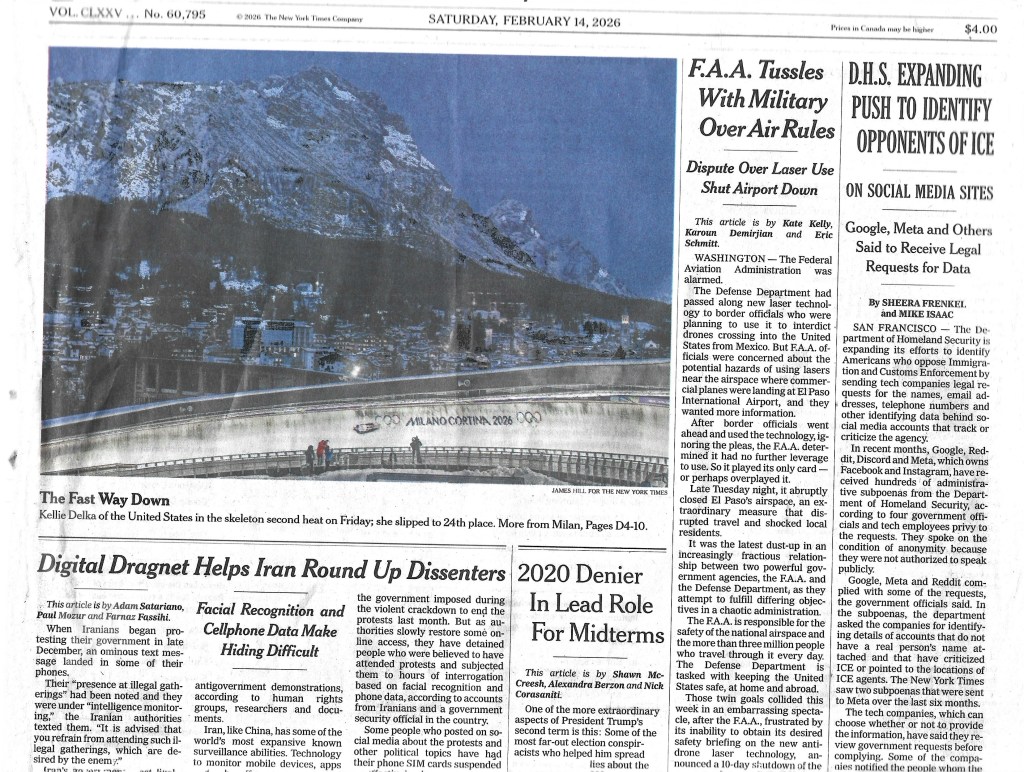




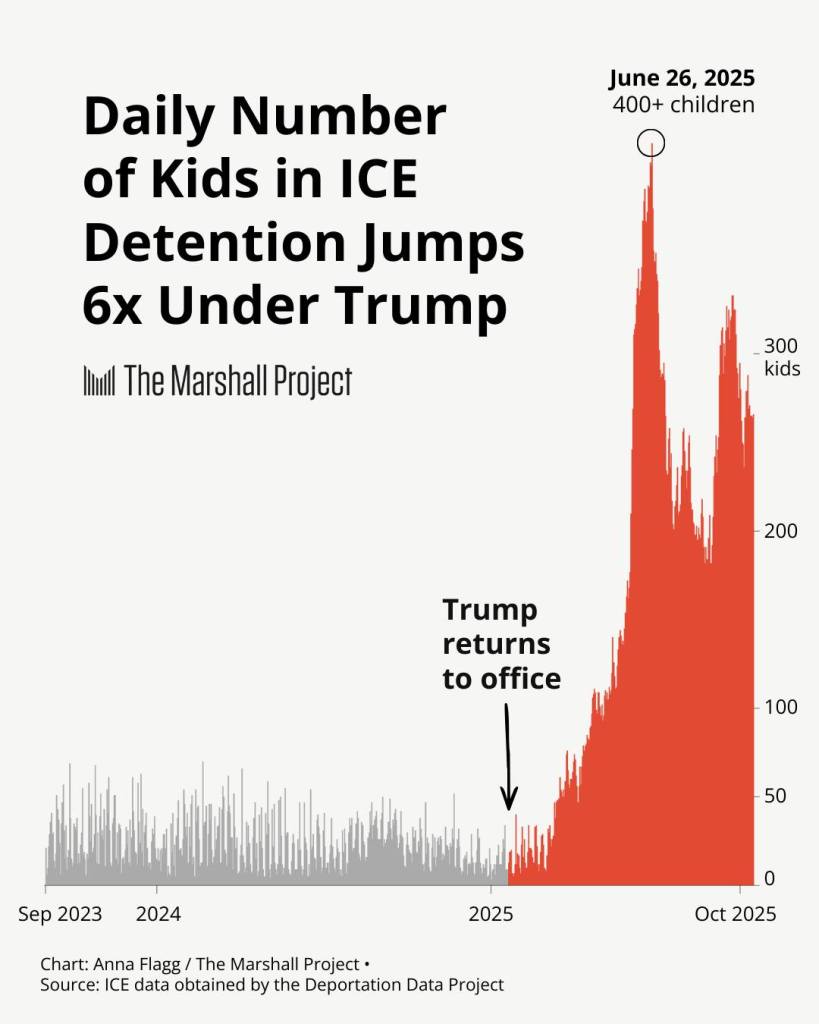


 . We’ve set up massive food donation and delivery infrastructure. We organize rides to school and work. People are literally taking in families.