Maria Kuvshinova: What Sentsov Could Die For

What Sentsov Could Die For
Maria Kuvshinova
Colta.Ru
May 25, 2018
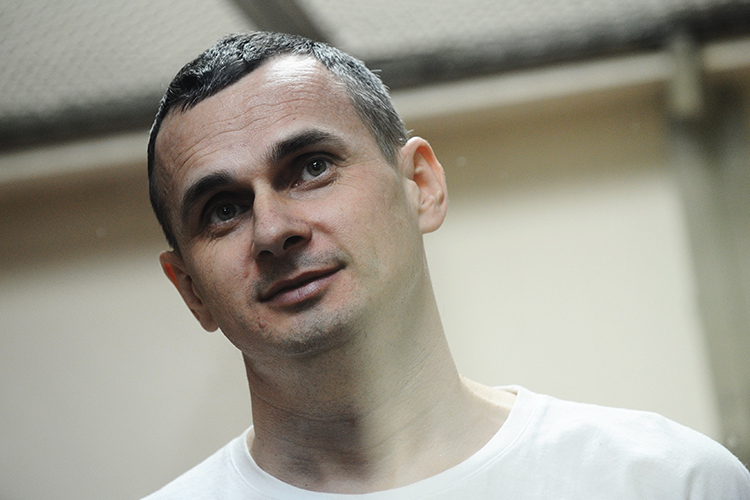
Detailed_pictureOleg Sentsov. Photo by Sergei Pivovarov. Courtesy of RIA Novosti and Colta.Ru 

On May 14, 2018, Oleg Sentsov went on an indefinite hunger strike in a penal colony located north of the Arctic Circle. His only demand is the release of all Ukrainian political prisoners in Russia. According to Memorial’s list, there are twenty-four such prisoners.

In August 2015, Sentsov was sentenced to twenty years for organizing a terrorist community and planning terrorist attacks. The second defendant in the case, Alexander Kolchenko, was sentenced to ten years in prison. Mediazona has published transcripts of the hearings in their trial. Around three hundred people have read them over the last three years. The transcripts make it plain the only evidence of the alleged terrorist organization’s existence was the testimony of Alexei Chirniy, who was not personally acquainted with Sentsov. It is police footage of Chirniy’s arrest while he was carrying a rucksack containing a fake explosive device that propagandists often pass off as police footage of Sentsov’s arrest.

Before his arrest, Sentsov was an Automaidan activist. In the spring of 2014, he organized peaceful protests against Crimea’s annexation by Russia.

“Yesterday’s ‘suicide bomber auto rally’ took place in Simferopol yesterday, but in quite abridged form,” Sentsov wrote on Facebook on March 12, 2014. “Only eight cars, six reporters with cameras, and twenty-five activists/passengers assembled at the starting point. I would have liked to have seen more. Unfortunately, most of the armchair revolutionaries who were invited were afraid to go. The traffic cops and regular police also showed up at the starting line, insisting we not leave for our own safety. We told them our protest was peaceful. We had no plans of breaking the rules, so we suggested they escort us to keep the peace for everyone’s sake.”

The second defendant, Kolchenko, admitted involvement in the arson of an office that was listed in the case file as belonging to the United Russia Party, but which in April 2014 was an office of Ukraine’s Party of Regions. The arson took place at night. It was meant to cause physical damage while avoiding injuring anyone.

The Russian authorities tried to prove both Sentsov and Kolchenko were linked with Right Sector, a charge that was unsubstantiated in Sentsov’s case and absurd in the latter case due to Kolchenko’s well-known leftist and anarchist convictions. Gennady Afanasyev, the second witness on whose testimony the charges against the two men were based, claimed he had been tortured and coerced into testifying against them.

Sentsov and Kolchenko’s show trial, like the show trials in the Bolotnaya Square Case, were supposed to show that only a handful of terrorists opposed the referendum on Crimea’s annexation and thus intimidate people who planned to resist assimilation. The Russian authorities wanted to stage a quick, one-off event to intimidate and crack down on anti-Russian forces. But two circumstances prevented the repressive apparatus from working smoothly. The first was that the defendants did not make a deal with prosecutors and refused to acknowledge the trial’s legitimacy. The second was that Automaidan activist Oleg Sentsov unexpectedly turned out to be a filmmaker, provoking a series of public reactions ranging from protests by the European Film Academy to questions about whether cultural producers would be capable of blowing up cultural landmarks. Segments of the Russian film community reacted to the situation with cold irritation. According to them, Sentsov was a Ukrainian filmmaker, not a Russian filmmaker, and he was not a major filmmaker. The owner of a computer club in Simferopol, his semi-amateur debut film, Gamer, had been screened at the festivals in Rotterdam and Khanty-Mansiysk, while release of his second picture, Rhino, had been postponed due to Euromaidan.

The Ukrainian intelligentsia have equated Sentsov with other political prisoners of the empire, such as the poet Vasyl Stus, who spent most of his life in Soviet prisons and died in Perm-36 in the autumn of 1985, a week after he had gone on yet another hunger strike. The Ukrainian authorities see Sentsov, a Crimean who was made a Russian national against his will and is thus not eligible for prisoner exchanges, as inconvenient, since he smashes the stereotype of the treacherous peninsula, a part of Ukraine bereft of righteous patriots. Sentsov’s death on the eve of the 2018 FIFA World Cup would be a vexing, extremely annoying nuisance to the Russian authorities.

Sentsov is an annoyance to nearly everyone, but he is a particular annoyance to those people who, while part of the Russian establishment, have openly defended him, although they have tried with all their might to avoid noticing what an inconvenient figure he has been. Although he was not a terrorist when he was arrested, he has become a terrorist of sorts in prison, because his trial and his hunger strike have been a slowly ticking time bomb planted under the entire four-year-long post-Crimean consensus, during which some have been on cloud nine, others have put down stakes, and still others have kept their mouths shut. Yet everyone reports on the success of their new endeavors on Facebook while ignoring wars abroad and torture on the home front. Sentsov represents a rebellion against hybrid reality and utter compromise, a world in which Google Maps tells you Crimea is Russian and Ukrainian depending on your preferences. To what count does “bloodlessly” annexed Crimea belong, if, four years later, a man is willing to die to say he does not recognize the annexation?

The success of Gamer on the film festival circuit, which made Sentsov part of the international film world, and his current address in a prison north of the Arctic Circle beg three questions. What is culture? Who produces culture? What stances do cultural producers take when they produce culture? There are several possible answers. Culture is a tool for reflection, a means for individuals and societies to achieve self-awareness and define themselves. It is not necessarily a matter of high culture. In this case, we could also be talking about pop music, fashion, and rap. (See, for example, the recent documentary film Fonko, which shows how spontaneous music making has gradually been transformed into a political force in post-colonial Africa.) On the contrary, culture can be a means of spending leisure time for people with sufficient income, short work days, and long weekends.

Obviously, the culture produced in Russia today under the patronage of Vladimir Medinsky’s Culture Ministry is not the first type of culture, with the exception of documentary theater and documentary cinema, but the founders of Theater.Doc have both recently died, while Artdocfest has finally been forced to relocate to Riga. The compromised, censored “cultural production” in which all the arts have been engaged has no way of addressing any of the questions currently facing Russia and the world, from shifts in how we view gender and the family (for which you can be charged with the misdemeanor of “promoting homosexualism”) to the relationship between the capitals and regions (for which you can charged with the felony of “calling for separatism”). Crimea is an enormous blank spot in Russian culture. Donbass and the rest of Ukraine, with which Russia still enjoyed vast and all-pervasive ties only five years ago, are blank spots. But cultural producers have to keep on making culture, and it is easier to say no one is interested in painful subjects and shoot a film about the complicated family life of a doctor with a drinking problem and a teetotalling nurse.

When we speak of the second type of culture—culture as leisure—we primarily have in mind Moscow, which is brimming over with premieres, lectures, and exhibitions, and, to a much lesser extent, Russia’s other major cities. So, in a country whose population is approaching 150 million people, there is a single international film festival staged by a local team for its hometown, Pacific Meridian in Vladivostok. All the rest are produced by Moscow’s itinerant three-ring circus on the paternalist model to the delight of enlightened regional governors. It matters not a whit that one of them ordered a brutal assault on a journalist, nor that another was in cahoots with the companies responsible for safety at the Sayano-Shushenskaya Dam, where 75 people perished in 2009. What matters is that the festival movement should go on. There is no room in this model for local cultural progress. There can be no free discussion generated by works of art when everyone is engaged in total self-censorship. After I went to Festival 86 in Slavutych, whose curators have been conceptually reassessing the post-Soviet individual and the post-Soviet space, I found it painful to think about Russian film festivals. This sort of focused conceptualization is impossible in Russia. It is of no interest to anyone.

There are two more possible answers to the question of what culture is. Culture is propaganda. Or, finally, culture is only the marquee on a commercial enterprise profiting at the taxpayer’s expense. It is not a big choice, and the kicker is that by agreeing today to be involved in churning out propaganda, milking taxpayers, supplying optional leisure time activities, producing censored works, and colonizing one’s own countrymen for the sake of money, status, and membership in a professional community, the people involved in these processes automatically stop making sense. It is naïve to think the audience has not noticed this forfeiture. It is no wonder the public has an increasingly hostile reaction to cultural producers and their work.

No one has the guts to exit this vicious circle even in protest at the slow suicide of a colleague convicted on trumped-up charges, because it would not be “practical.” The events of recent months and years, however, should have transported us beyond dread, since everyone without exception is now threatened with being sent down, the innocent and the guilty alike.

Post-Soviet infantilism is total. It affects the so-called intelligentsia no less than the so-called ordinary folk. Infantilism means being unable to empathize, being unable to put yourself in another person’s shoes, even if that person is President Putin, a man with a quite distinct sense of ethics, a man who has been studied backwards and forwards for twenty years. Apparently, the message sent to the creative communities through the arrest of Kirill Serebrennikov was not registered. If you want to be a dissident, start down the hard road of doing jail time for misdemeanor charges, facing insuperable difficulties in renting performance and exhibition spaces, becoming an outsider, and experiencing despair. If you want a big theater in downtown Moscow, play by the rules. Like your average late-Soviet philistine, Putin regarded the creative intelligentsia with respect at the outset of his presidential career. (See, for example, footage from his visit to Mosfilm Studios in 2003.) However, a few years later, he was convinced the creative intelligentsia was a rampantly conformist social group who would never move even a millimeter out of its comfort zone and would make one concession after another. A lack of self-respect always generates disrespect in counterparts.

By signing open letters while remaining inside the system and not backing their words with any actions whatsoever, the cultural figures currently protesting the arrests of colleagues are viewed by the authorities as part of the prison’s gen pop, while people who live outside Moscow see them as accomplices in looting and genocide. No one takes seriously the words of people who lack agency. Agency is acquired only by taking action, including voluntarily turning down benefits for the sake of loftier goals. The acquisition of agency is practical, because it is the only thing that compels other people to pay heed to someone’s words. I will say it again: the acquisition of agency is always practical. At very least, it generates different stances from which to negotiate.

Sentsov has made the choice between sixteen years of slow decay in a penal colony and defiant suicide in order to draw attention not to his own plight, but to the plight of other political prisoners. Regardless of his hunger strike’s outcome, he has generated a new scale for measuring human and professional dignity. It is an personal matter whether we apply the scale or not, but now it is impossible to ignore.

Thanks to Valery Dymshits for the heads-up. Translated by the Russian Reader
Comrade to Comrade

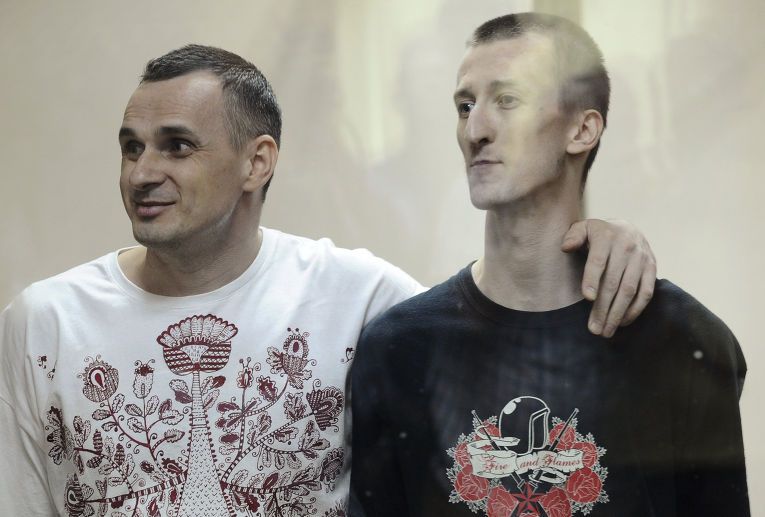
1465990524-5252Crimean political prisoners Oleg Sentsov and Alexander Kolchenko during their so-called trial by a Russian kangaroo court. Photo courtesy of Unian Information Agency

Alexander Kolchenko, Convicted in the Case of the “Crimean Terrorists,” Writes a Letter to Oleg Sentsov
Mediazona
May 22, 2018

Antifascist Alexander Kolchenko, convicted in the Case of the “Crimean Terrorists,” has written a letter to filmmaker Oleg Sentsov, who is in the ninth day of a hunger strike meant to force the Russian authorities to release all Ukrainian political prisoners from the country’s prisons. Mediazona was told about the letter by attorney Svetlana Sidorkina.

According to Sidorkina, Kolchenko was afraid the censor would not pass the letter on to Sentsov, so he gave her a detailed acount of its contents when she visited Kolchenko at Corrective Colony No. 6 in the town of Kopeysk.

“In the letter he wrote that, in his opinion, a hunger strike was an effective means of defense only in cases in which a country valued its reputation. Alexander believes that, in Oleg’s case, Russia could ignore his hunger strike, but not let him die by forcibly feeding and sending him off for a psychiatric examination. Sergei Magnitsky’s death changed nothing in Russia. Instead, the Dima Yaklovev Law was adopted. He did not try and dissuade Oleg, since he knows Oleg is stubborn and does not change his mind. He is quite concerned for his health, since he knows what the climate and living conditions are like in Labytnangi from prisoners he met when he and Oleg were in transit to the prisons where they would serve their sentences. Although Alexander doesn’t agree with Oleg’s method, he respects his stance on freeing Ukrainian political prisoners from Russian prisons and is ready to support Oleg if he needs to,” said Sidorkina.

Sidorkina tried to dissuade Kolchenko from a possible hunger strike by pointing to his health problems and the fact he is underweight. Because of this, he is on a special diet.

Aside from the letter to Sentsov, Kolchenko wrote a letter to Vladimir Putin demanding he intervene in the situation and release Sentsova. Kolchenko, however, was afraid the censor would also prevent the letter from reaching its addressee.

Kolchenko added he had no complaints about conditions in the penal colony. According to Sidorkin, he looked cheerful, but was quite worried about Sentsova. Sidorkina had wanted to show him articles about the Ukrainian filmmaker’s hunger strike, but penal colony staff stopped her from doing so.

In 2015, a court sentenced Kolchenko and Sentsov to ten years and twenty years, respectively, in maximum security penal colonies. According to police investigators, in 2014, Sentsov established a “terrorist community” (illegal under Article 205.4 Part 1 of the Russian Criminal Code). Members of the alleged community supposedly set fire to the doors of the Russian Community of Crimea and the windows of a United Russia Party office. These actions were deemed terrorist attacks, punishable under Article 205 Part 2 Paragraph A of the Criminal Code.

In addition, police investigators insisted members of the alleged “terrorist community” were planning to blow up a monument to Lenin and the Eternal Flame, punishable under Article 30 Part 1 and Article 205 Part 2 Paragraph A. Sentsov was also charged with trafficking in arms and explosives as part of a group, punishable by Article 222 Part 3. Kolchenko was found guilty of involvement in the alleged terrorist community and planning terrorist attacks on the Crimean Peninsula. Both men have denied their guilt.

In the spring of 2016, Sentsov was transported to a penal colony in Yakutia, but in 2017 he was transferred to the White Bear Colony in Labytnangi. In the winter of 2017, the Ukrainian authorities announced they were prepared to exchange Russian prisoners for Sentsov and Kolchenko. On May 14 of this year, Sentsov announced he was going on an indefinite hunger strike to secure the release of all Ukrainian political prisoners in Russia.

Translated by the Russian Reader

Vladimir Balukh: Rough Justice in Russian-Occupied Crimea

The Balukh Trial: Testimony of Prosecution’s Witnesses Diverges
Grani.Ru
May 15, 2018

The testimony of the prosecution’s witnesses diverged during the latest hearing in the third trial of the Crimean Ukrainian political activist Vladimir Balukh, who allegedly assaulted Valery Tkachenko, warden of the Interior Ministry’s Temporary Detention Facility in the Razdolnoye District, reports the news website Krym.Realii.

93616

Duty officer Mikhail Shubin claimed Balukh wanted to attack Tkachenko, but the guards holding the political prisoner stopped him from doing it. At the same time, Shubin claimed Balukh had “taunted” the warden.

Meanwhile, the facility’s deputy warden, Dmitry Karpunov, testified he did not see the conflict itself. He could only report Tkachenko had entered Balukh’s cell, whence an “intense conversation” was audible, and then the warden exited the cell stained with some kind of liquid.

Karpunov said there had been no attack. Balukh had not committted any violations of prison regulations, not counting his refusal to put his hands behind his back.

The Crimean Human Rights Group reports a total of five witnesses were questioned during Tuesday’s hearing. Aside from Shubin and Karpunov, they included temporary detention facility staffers Seyran Mambetov, duty officer Sergei Tishin, and technician Alexander Konovalov, who extracted the recordings from the CCTV cameras. The Crimean Solidarity Facebook page identifies Konovalov as Balukh’s aquaintance.

Our correspondent reports that, during his testimony, Major Mambetov said, “We are not the Gestapo. We don’t assault people. We police officers do not offend anyone, and we treat all convicts the same.”

The next hearing was scheduled for Wednesday, March 16.

Balukh went on hunger strike on March 19, 2018. May 15 was thus the fifty-eighth day of his protest against the unjust verdict in his previous trial, in which he was convicted of illegally possessing ammunition. On Tuesday, the Crimean Human Rights Group published a letter from Baluch, in which the political prisoner wrote that, on the twenty-fifth day of his hunger strike, his social defender, Archbishop Kliment of the Simferopol and Crimean Ukrainian Orthodox Church of the Kyiv Patriarchate, urged him to moderate his hunger strike. Whereas earlier Balukh had consumed only water and tea, after his conversation with Kliment he drank two glasses of oatmeal kissel and ate fifty to seventy grams of dried breadcrumbs everyday, and added honey to his tea.

Balukh made the decision, he wrote, “To rule out the possibility of forced feeding and the use of medical means of life support I have not authorized, and also to avoid causing irreparable grief to my loved ones.”

Earlier, Balukh’s common-law wife Natalya had pointed out her husband suffered from liver disease, and it was unacceptable for him to go on hunger strike.

93614.jpgVladimir Balukh and his attorneys Olga Dinze and Taras Omelchenko, May 15, 2018. Photo by Alexandra Yefimenko. Courtesy of Grani.Ru

The hearing on the merits of Baluch’s third trial began April 2. Tatyana Pyrkalo, chair of the Razdolnoye District Court, which is controlled by Russia, has presided over the trial. Aside from Archbishop Kliment, Balukh is defended by three professional lawyers, Dmitry Dinze, Olga Dinze, and Taras Omelchenko. Ms. Dinze and Mr. Omelchenko were present at Tuesday’s hearing.

The 47-year-old Balukh, a farmer from the village of Serebryanka in the Razdolnoye District, has beeen charged under Article 321 Part 2 of the Russian Criminal Code (non-threatening violence against a penitentiary officer during performance of his duties), which is punishable by a maximum of five years in a penal colony. According to the prosecution, on August 11, 2017, during morning rounds of the cells at the Razdolnoye Temporary Detention Facility, where Balukh had been transferred from a remand prison while he attended his second trial, Balukh struck Warden Tkachenko in the stomach with his elbow while they were in the hallway, after which he went into his cell, grabbed a bottle of detergent, and struck the policeman on the arm.

Actually, Tkachenko himself assaulted Balukh, insulted his ethnicity, and swore at him. Moreover, these actions were captured by CCTV cameras. We also know the warden had verbally assaulted Balukh prior to the incident. Balukh was framed on the new charges after his defense lawyers filed a complaint against Warden Tkachenko with the police.

During the pretrial investigation, conducted by N. Bondarenko, an official with the Razdolnoye Interregional Department of the Russian Investigative Committee, Warden Tkachenko refused to report to a face-to-face confrontation with Balukh, although Russian law does not provide this right to victims.

Until today, only two hearings had been held in the case. Warden Tkachenko took the witness stand at the second hearing, on April 11.

As defense lawyer Dmitry Dinze noted after the hearing, “The funniest thing about the whole case is that the so-called victim has not evinced any get-up-and-go. The criminal charges did not interest him at all. He was ordered to file a report and draw up all the papers in order to get the case opened. Personally, he has no material and emotional gripes against my client. It transpires the Razdolnoye District Police Department had a stake in cooking up more criminal charges against Balukh.”

In December 2013, during the early weeks of the Revolution of Dignity, Balukh hung the red and black flag of the Ukrainian Insurgent Army (UPA) above his home in the village of Serebryanka. After awhile, the flag was surreptitiously torn down at night, and the farmer replaced it with the Ukrainian national flag. After Crimea was occupied, Balukh did not apply for Russian citizenship.

Balukh was convicted for the first time in 2016 and sentenced to 320 hours of community service for, allegedly, offending a government official, as stipulated by Article 319 of the Russian Criminal Code. The “victim” in this case was Lieutenant Yevgeny Baranov, a field officer with the Center for Extremism Prevention (Center “E”), who was involved in searching Balukh’s home in November 2015.

Balukh faced trumped-up charges for the second time after he attached a sign inscribed “Heaven’s Hundred Heroes Street, 18″ on his house. He was jailed in a remand prison, where he was imprisoned for nearly a year before he was transferred to house arrest. He was returned to the remand prison after his conviction on the second set of charges. Balukh was charged under Article 222 Part 1 (illegal trafficking of ammunitition) and Article 222.1 Part 1 (illegal trafficking of explosives) after police planted gunshells and TNT blocks in his home during a routine search. Earlier this year, Balukh was sentenced to three years and five months in an open penal colony.

Translated by the Russian Reader

The Annals of PreCrime: “An Absolute Nightmare”

precriminals.jpegUnder legislation currently tabled in the Russian parliament, these up-and-coming Russian businesswomen could do hard time in a penal colony for the wholly fanciful crime of “complying” with western sanctions against target businesses and individuals. Image courtesy of Credit Bank of Moscow
Sanctions Victims Refuse the Russian State’s Protection
Big Business Categorically Rejects Adopting Law on Anti-Sanctions
Yelizaveta Bazanova, Anna Kholyavko and Yekaterina Burlakova
Vedomosti
May 16, 2018

“An absolute nightmare”: that was the phrase used by the majority of lawyers and executives of Russian and foreign companies whom we asked to comment on plans to imprison people who “implemented” foreign sanctions. On Monday, a law bill to this effect, tabled by State Duma Speaker Vyacheslav Volodin, Federation Council Speaker Valentina Matviyenko, and leaders of all four parliamentary factions was passed in its first reading. The second reading has been scheduled for Thursday.

Under the law bill, if a company refuses to sign a public contract with an entity on the sanctions list, the company and its executives would be threatened with a maximum fine of ₽600,000 [approx. €8,200] and a maximum prison term of four years.

The board of the Russian Union of Industrialists and Entrepreneurs (RSPP) has decided passage of the law would be completely unacceptable. Companies would find themselves between the frying pan and the fire: violations of sanctions would threaten them with secondary sanctions, while complying with sanctions would make them criminally prosecutable in Russia.

The RSPP’s resolution was supported even by board members who had themselves been sanctioned.

“We believe it would cause further damage to the Russian economy, including business with foreign and Russian companies, and both Comrade Vekselberg [Renova Group Chair Viktor Vekselberg] and I voted for the resolution,” Interfax has quoted VTB Bank president Andrei Kostin as saying.

A spokesperson for Vekselberg did not respond to our questions. We were also unable to contact a spokesperson for Oleg Deripaska, another target of western sanctions, yesterday evening.

If passed, the law would be unlikely to have a considerable impact on how businesses operate, but it could be a means of threatening and pressuring them, the entrepreneurs we surveyed said unanimously. The wording of the law bill is harsh. Nearly anyone could be prosecuted on the flimsiest of pretexts, complained an executive at a transnational food producer.

The key risk is the absence of clear criteria for defining what would constitute a violation of the proposed law, our sources all agreed. Even the Russian Finance Ministry could be prosecuted. In its Eurobonds prospectus, it pledged not to use the funds raised to support entities targeted by western sanctions. In January, Alfa Bank warned Russian defense companies it would not handle their accounts due to sanctions. Spokespeople for the Finance Ministry and Alfa Bank did not respond to our inquiries.

The Kremlin has also been unhappy with the law bill, said a federal official close to the presidential administration.

The law bill, if passed, would also generate risks for those companies who refuse to do business in Crimea due to sanctions, said Alexei Panich, a partner at Herbert Smith Freehills. These include the state banks Sberbank and VTB, as well as mobile telecom operators. Andrei Isayev, deputy head of the State Duma’s United Russia faction, claimed  companies who do not open branches in Crimea would not be affected by the law. What was at stake, he said, were the ordinary deals and transactions companies perform almost automatically. However, refusal to do business with counterparts in Crimea could be considered a criminal offense under the terms of the law, said an attorney at a major international law firm. The law could complicate public offerings, the issuing of loans, and contracts and transactions, he specified.

An employee at a major international firm explained it would be hard to determine whether a company refused a deal with a counterpart due to their bad reputation or the threat of sanctions. An auto dealer agreed the threat of criminal prosecution would be powerful leverage. To encourage its partners to agree to a deal, a business could threaten to report them to law enforcement agencies, argued Panich.

The proposed measures were excessive, agreed a spokesperson for an agricultural commodities trader. Some companies have in-house rules restricting such deals. Our source said the law bill appeared to be means of coercing such companies. Theoretically, it could be used as leverage. A company or person on the Specially Designated Nationals And Blocked Persons List (SDN) could show up and demand another company do business with them, agreed the head of major private bank. It was difficult to imagine how banks would solve such dilemmas, he said.

“There are many ambiguities in how the law would be interpreted, and what specific actions or inactions would be punishable,” he concluded.

Foreign businesses could interpret the law bill as a signal it was time to wrap up their operations in Russia, said the vice-president of a major foreign company that produces popular consumer products. No one has any intention of sacrificing their top executives to the Russian law enforcement and judicial system.

All issuers of bonds include in their covenants the refusal to do business with entities targeted by sanctions. Perhaps expatriates who do not want to take risks would leave the country, argued an employee at a large foreign company.

Passing the bill into law would be a mistake, said political scientist Yevgeny Minchenko. The law would have to be seriously amended over time.

“Knowing how this could affect both Russian companies and foreign business operating in Russia, this is very risky decision in my opinion,” Minchenko told us.

Spokespeople for Sberbank and Credit Bank of Moscow declined to comment.

With additional reporting by Vladimir Shtanov, Darya Borisyak, Alexandra Astapenko, and Svetlana Bocharova

Translated by the Russian Reader

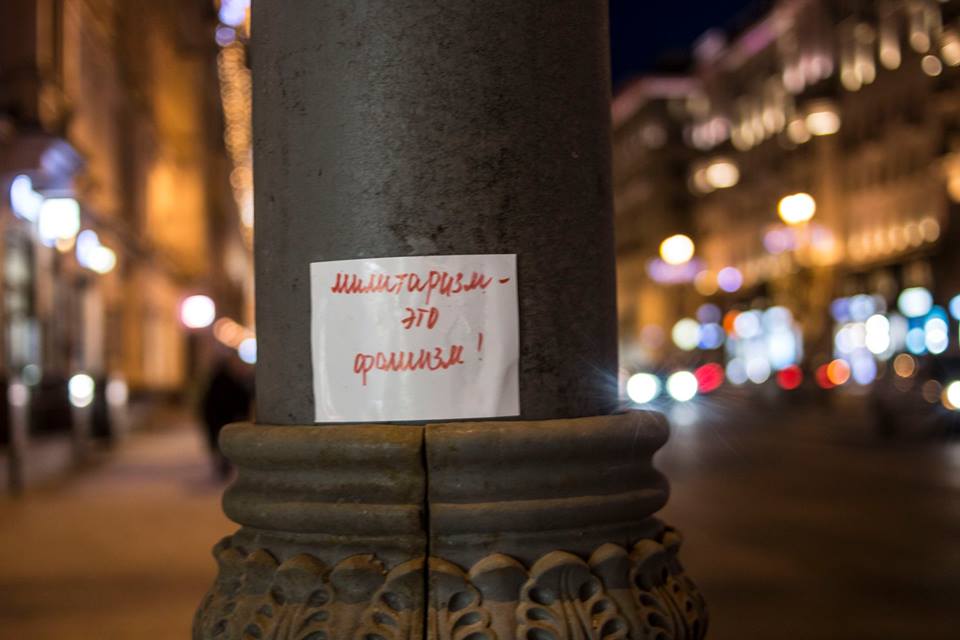
Militarism Is Fascism

Vadim F. Lurie
Facebook
March 19, 2018

An endless stream of Muscovites and out-of-town visitors headed to the concert marking the anniversary of Crimea’s “annexation.” And only the lonely voice of a man, heard by a few and jotted on a piece of paper on Tverskaya, quietly resisted the general hysteria.

Photograph by Vadim F. Lurie. Thanks for his kind permission to reproduce it here and translate his annotation. Translated by the Russian Reader

All in a Day’s Work

sdy_bxm7qd8Denis Mikhailov. Photo courtesy of the Navalny team’s VK page and OVD Info

Well-known Moscow activist Mark Galperin has been sentenced to two years probation for two videos. The videos, in which Galperin discusses a possible revolution, were deemed calls to extremism. The court forbade the activist frominvolvement in grassroots organizations for three years.

In Crimea, left-wing activist Alexei Shestakovich was transported after a police search with a plastic bag over his head. During the search, he lay on the floor in his underwear and handcuffs. Ultimately, Shestakovich was jailed for ten days.

At the same time, Crimean trade union activist Ivan Markov was detained and then jailed for ten days, but he was released ahead of schedule, as the appellate court overturned the decision to remand him in custody.

Denis Mikhailov was arrested twice for the same “crime.” The coordinator of Alexei Navalny’s presidential election boycott headquarters in Petersburg had just left the special detention center where he had spent thirty days for the January 28 Voters Strike protest rally, when he was detained, taken to court, and jailed for another twenty-five days, once again for the January 28 Voters Strike protest rally. Only in the first case, Mikhailov was tried as an organizer, while the second time he was tried as a participant.

An activist in Yekaterinburg was jailed for fifteen days after he was detained carrying a placard criticizing Putin. The placard was emblazoned with the slogan, “If you want another six years of lies and stealing, vote for Putin.” Sergei Tiunov was accused of a repeat violation of the rules for public events. He has gone on a dry hunger strike.

Source: OVD Info. The Week That Was, No. 45 (email newsletter). Translated by the Russian Reader

“The Presidency Is a Monarchist Atavism”: Sevastopol Security Forces Crack Down on Local Anarchists

Balaklava Bay, Sevastopol

Sevastopol Security Services Search Homes of Leftist Activists Planning Rally Calling for Presidential Election Boycott
Mediazona
1 March 2018

Security services showed up at the flat of the Vorobyov family in Sevastopol, members of the VK community group Anarchists of Sevestapol, activist Alyona Vorobyova has reported to OVD Info. According to Vorobyova, she and Artyom Vorobyov were not home when the search took place. Only their seven-year-old child and relatives were at the flat. It is not known which Russian security service conducted the search and in connection with what case.

Another Sevastopol activist told Mediazona a search was also probably underway at the home of anarchist Alexei Shestakovich: a large number of police officers had gathered outside his house. The activist surmised searches could also be underway at the homes of the Anarchists of Sevastopol group’s admin, Alexei Prisyazhnyuk, and leftist activist Igor Panyuta. The two men were currently incommunicado.

Shestakovich, Prisyazhnyuk, and Panyuta had planned today to submit a notification for a protest rally calling for a boycott of the March 18 Russian presidential election. The rally was to be entitled “The Presidency Is a Monarchist Atavism,” said Mediazona‘s source.

Shestakovich announced plans to submit the notification on the Anarchists of Sevastopol VK page.

“The event’s aim is to remind people of their constitutional right not to take part in election, to inform the populace about the rules for conducting a robust boycott, and to have a public discussion of self-government in society,” he wrote.

In addition, the local online news website Krymskie Novosti reported that Republic of Crimea Center “E” and FSB officers carried out a “mopping up of the republic’s anarchist cell.” As the website’s sources reported, searches had been carried out today at the homes of the cell’s leaders and members both in the Republic of Crimea and and the Federal City of Sevastopol.

“According to available information, this group of people planned provocations during the Russian federal presidential election, scheduled for 18 March 2018,” wrote Crimean news website Informer.

Informer claimed the Crimean cell had “kept in touch” with other radical leftist groups operating in Russia. Without identifying its sources, Informer also claimed the Crimean anarchists were financed by persons residing in Ukraine.

Update. OVD Info writes that masked men armed with machine guns came to the home of Anarchists of Sevastopol admin Alexei Prisyazhnyuk, confiscated his computer equipment, and took him to a police station. Mediazona has also been informed of a police search at the home of activist Ivan Markov.

Translated by the Russian Reader. This article has been lightly edited to eliminate several minor errors regarding local media sources. Thanks to Egor Skovoroda for the heads-up. Photo courtesy of Wikipedia

Ayder Muzhdabaev: We Are Not Going to Take a Deep Breath

F321BB93-DD92-4B4D-B358-8B059E399E60_w1023_r1_s
Ayder Muzhdabaev

15 Minutes
Facebook
October 14, 2017

Crimean Tatar Journalist Ayder Muzhdabaev to Russian Rock Musician Andrei Makarevich: “It Hasn’t Passed, It Hasn’t Stopped Hurting, We’re Not Going to Take a Deep Breath”

Before arriving in Ukraine to clean up at the box office yet again, Russian TV presenter and showman Misha Kozyrev advises Ukrainians not to let the war into their hearts. By the way, he will again be arriving in the country real soon. Someone has to tell the “embittered” younger brothers what to think and how to live. We are clueless on our own.

And when Russian musician Andrei Makarevich was asked why he wanted to drag his band Time Machine’s keyboardist Andrei Derzhavin, who signed an open letter to Putin supporting the annexation of Crimea and the war, along with him to Ukraine, he wrote on Facebook it was time to stop discussing events that had happened four years ago. “Learn to take a deep breath,” he wrote. As if everything had passed and stopped hurting. No, it has not passed, and it has not stopped hurting. If someone thinks we have forgotten everything, he or she probably should not come to Ukraine.

If your keyboard player, Mr. Makarevich, still slips into the country under your skirt, so to speak, we will drag him from his dressing room and send him home packing. If you are incapable of understanding such a simple, normal thought, then so be it: we will explain it to you. We have not taken a deep breath, and we are not going to, because we had our homeland stolen from us—or at least part of it. We remember that and we cannot forgive what happened, not only the war and annexation but also the indifference to us.

We are not aquarium fish or serfs who remember nothing and have no right to rage. We do not need any Russians here except those who are wholeheartedly against the Putin Reich, support the return of Crimea and Donbas to Ukraine, and support Ukraine unconditionally, without any provisos. If you are incapable of understanding us, if you lack the humanity to put yourself in our shoes, to feel and share our pain, you had better stay home, in the so-called Russian world.

I hope the so-called Russian world will take it easy on you, Mr. Makarevich. I hope it treats you more gently than it has treated the Ukrainians and Crimean Tatars. Although I do not think it will happen. Life is set up in such a way that right after the Jews were massacred, trouble came for the Germans. But who knows. If you continue to sit still and choose your words carefully, maybe you will be luck personally.

Translated by the Russian Reader. Thanks to Sergey Abashin for the heads-up. Photo courtesy of Radio Europe/Radio Free Liberty

“The Trial: The State of Russia vs Oleg Sentsov” (Panel Discussion, Berlinale 2017)

Panelists: Agnieszka Holland (Director), Askold Kurov (Director), Mike Downey (Producer), Dmitry Dinze (Lawyer of Oleg Sentsov), Natalya Kaplan (Cousin of Oleg Sentsov), Sylvia Schreiber (Translator)

Thanks to Alexei Markov for the heads-up

___________________________

oleg-sentsov
Oleg Sentsov. Courtesy of Berlin Film Festival

Berlin Film Review: ‘The Trial: The State of Russia vs Oleg Sentsov’
Owen Gleiberman
Variety
February 11, 2017

A documentary about the Ukranian filmmaker imprisoned for his support of Crimean independence is a scrappy testament to the true nature of the Vladimir Putin regime.

It has to rank as one of Donald Trump’s most shocking statements — which is really saying something. Asked by the Fox News host Bill O’Reilly how he could respect Russian President Vladimir Putin, whom O’Reilly characterized as a “killer,” Trump replied, “There are a lot of killers. Boy, you think our country’s so innocent?” Over the last year, Trump has presented himself as a racist, a bully, a manhandler of women, a mocker of the disabled, and a loony-tunes conspiracy theorist. But whoever thought he’d come off sounding like the second coming of Noam Chomsky? The notion that the United States government routinely engages in “killer” behavior commensurate with that of what Russia does is, of course, a left-wing idea. (Just ask Oliver Stone, another Putin apologist who should know better.) But Trump put a new spin on it: Whatever the motivation (his desire to tilt the axis of global power against China? Burying those rumored water-sports videos?), he was so intent to claim that his new BFF Vladimir is, you know…not so bad that he was willing to hijack 50 years of radical academic moral relativism by reducing it to a Trump sound bite.

All of which makes me wish that Trump would sit down and watch “The Trial: The State of Russia vs Oleg Sentsov,” a documentary that just premiered at the Berlin Film Festival. It’s a peek into how the Russian state actually operates, and though it raises more questions than it answers, it leaves you with a shuddering chill. The central figure, Oleg Sentsov, is a Ukrainian writer and filmmaker known for his 2011 movie “Gamer.” In Russia, it made him a directorial star, but during the 2014 Crimean crisis he became part of the AutoMaidan movement, devoted to keeping Ukraine — and, specifically, Crimea — independent of Russia. He delivered food and supplies to Ukrainian servicemen, but on May 11, 2014, he was arrested and charged with organizing a terrorist cell, plotting terrorist attacks, and trafficking in illegal arms. He was held indefinitely and is now serving a 34-year prison sentence in Siberia. (The movie ends with clips of that Siberian prison. Have you ever seen Siberia? It looks like … Siberia.)

We’re shown footage of Sentsov in TV interviews during his moment of indie-film fame and then, a few years later, speaking from behind bars in the courtroom (yes, there’s a jail cell in court). Tall and husky, with dark cropped hair, popping eyes, and a grin of goofy optimism, he’s the father of two teenagers, and if you were looking for someone to play him in a movie, it might be Bradley Cooper; he has that kind of rubbery resilience. A number of noted directors — Wim Wenders, Agnieszka Holland — show up to testify to his status as a filmmaker.

In “The Trial,” Sentsov embraces his role as a political prisoner, yet the movie reveals what the stakes are: When he talks to his daughter on the phone, we see the price paid by any dissident — not just the personal agony of incarceration, but the ripped bonds of family. Sentsov was subjected to torture in prison, all to produce a confession to activities that never happened. (He didn’t confess.) The reason “The Trial” is a valuable document, even though it’s not an especially good movie, goes right back to Putin. It was Sentsov’s status as an art-house celebrity that made him a target in Russia. The regime arrested many “terrorists,” but he was held up as an example to the elite, intellectual class. The message was: If we can do this to him, we can do it you. The real terrorism came from the government, a way of driving fear into those who might speak out.

Russia swims in a daily ice bath of fake news (and real-news clampdown), which is why documentaries have been some of the only vehicles for revealing Vladimir Putin’s thug tactics. Ten years ago, the barely seen film “Poisoned by Polonium: The Litvinenko File” was the first inquiry to amass serious data suggesting that what Bill O’Reilly said about Putin is true. In “The Trial,” we see extended clips of Putin addressing the Sentsov case (a member of the Russian Parliament bows and scrapes before Putin so nervously it’s like seeing an outtake from “The Godfather, Part II”), but Putin, in public, is no glowering fascist. He comes off as impeccably civilized and almost geekishly seductive. He makes you want to be his friend. That, of course, is his version of smoke and mirrors.

Directed and shot by Askold Kurov, a Russian filmmaker as brave as his subject, “The Trial” is a thrown-together movie that doesn’t have much of an arc. It’s 75 minutes long, and to be brutally honest, I would have been just as happy watching Sentsov’s story compressed into a “60 Minutes” segment. Yet whatever its flaws, a movie like this one is necessary. It speaks the truth about the Russian regime — the truth that’s buried by Putin, and now buried by our own president, who only dreams that he could do the same thing to his enemies. More than ever, global film culture needs every documentary that lets you stare into the face of oppression with eyes wide open.

Berlin Film Review: ‘The Trial: The State of Russia vs Oleg Sentsov’
Reviewed at Cinemaxx (Berlin Film Festival), February 10, 2017. Running time: 75 min.

Production
A Ceská televise, Prag production in cooperation with the Polish Film Institute.

Crew
Producers: Max Tuula, Maria Gavrilova, Dariusz Jablonski, Izabela Wójcik, Violetta Kaminska.

Crew
Director: Askold Kurov. Oren Moverman. Camera (color, widescreen): Kurov. Editor: Michal Leszczylowski.

With
Oleg Sentsov, Vladimir Putin, Agnieszka Holland, Wim Wenders.

Alexei Gaskarov: What Politics?

Alexei Gaskarov: Many People Ask Whether I Am Going to Take up Politics. But What Politics Are There Nowadays?
Olesya Gerasimenko
Snob
November 1, 2016

Anti-fascist Alexei Gaskarov has been released from prison after serving three and a half years in prison for alleged involvement in the Bolotyana Square riot in Moscow in 2012. Snob asked Kommersant special correspondent Olesya Gerasimenko to meet with Gaskarov to discuss the Bolotnaya Square case, life and education in the penal colony, and the death of the protest movement. 

Alexei Gaskarov. Photo courtesy of Tanya Hesso/Snob
“Why would they ask me about organizing a riot if they knew no one organized it?”

Was your trial fair?

I regret we agreed to be involved in it. Like Soviet political prisoners, we should have stood with our backs turned and kept our mouths shut, and not treated it as an attempt to get at the truth. I had illusions after Khimki. [In 2010, Gaskarov was arrested and charged with attacking the Khimki town hall during a protest in defense of Khimki Forest, but the court acquitted him. — Snob] Several videos showed clearly that the incidents involving me happened before the riot kicked off, according to police investigators themselves. In the end, I ticked off the evidence, the judge nodded her head, but there was no reaction. The entire trial looked as if the decision had already been made, the sentence written out, and let’s get this over as quickly as possible.

So did you push a policeman and pull a soldier out of the police cordon?

I never denied it from the get-go. A year had passed since the rally on Bolotnaya Square. I was working on an important project. I had a week to go, and it was uncool to have to go to jail. I had to go to work on the Sunday the cops came for me. I had gone to the shop to buy food for the cat, and the whole clown show was waiting outside my building: two jeeps and a van. Young dudes half dressed like boneheads stepped out of the van. I decided they were from BORN [a group of radical right-wing nationalists who carried out a series of murders and assaults — Snob]. I was pondering what moves to make, but they produced their IDs.

Did you feel relieved?

No, just the opposite. I could have run from BORN or done something else. So they detained me and kept mum about what the charges were for a long while. They made me lie face down in the van and  the whole works. There were lots of things they could have detained me for. We had been defending the tenants of the Moscow Silk (Mosshyolk) dormitories from eviction and the Tsagov Forest in Zhukovsky from logging by developers. And shortly before my arrest, people who are now serving in the Azov Battalion attempted to assault my wife and me. I tussled with them, and it ended up on camera. So there were different possibilities. I was not thinking about Bolotnaya at all. When it finally became clear why I had been detained, I stared at them.  It was total rubbish. I told them I agreed to admit what I had done. We had been walking amid the crowd, when a riot cop attacked this dude. A dogpile ensued, and people pulled them apart. I was accused of pulling a policeman’s leg. The evidence was a poor quality video and a forensic report that concluded it was not me. But I knew it was me. So I told them right away, Guys, let’s do this the right way. But they could not have cared less whether I admitted my guilt or not. It would have been a different story if I had confessed to violating Article 212 of the Criminal Code (organizing a riot) or testified against someone else.

Were you asked?

They didn’t even mention it. Why would they ask me about organizing a riot if they know no one had organized it, including from their own wiretaps? They kept the charges to the incident with the leg pulling. Then they found a second incident. A stampede started in front of the police line. People were falling on the ground, and I tugged one policeman by the shoulder to make room. The indictment said I had broken the police line so that everyone could get to the riot. But this line had been at the passage in the other direction.

OIesya Gerasimenko and Alexei Gaskarov. Photo courtesy of Tanya Hesso/Snob

Did you expect such a sentence?

They had already told me at the Investigative Committee they were going send me down. I said, Well, of course. Later, the Center “E” guys showed up and threatened me with ten years in prison, but I know that could not happen. The rules of the game are still followed, and punishment for a particular crime is usually consistent with ordinary practice.

How do you feel about the case of Udaltsov and his associates?

I have very negative feelings about it, of course. I ran into [Leonid] Razvozzhayev in the pre-trial detention facility, but I wasn’t really able to chat with him, because he was always in very bad shape. Udaltsov and his associates operated like real con men. Before May 6, 2012, they had no clue how the march would go, and there is no mention of sitdown strikes and rushing police lines in the wiretaps. But after everything had happened on Bolotnaya, they began acting in their meetings with Targamadze as if everything had gone according to their plans. Their initial excuse, that they had traveled to Georgia to talk about wine and mineral water, was pure idiocy. Naturally, it is not against the law to have meetings and discuss business. But there is a political ethic that does not let you behave this way. You go meet dudes from the government of another country, a country with whom [your country] recently had a conflict. You ask for money, and you take money. If these meetings had not taken place, the Kremlin would have failed to generate the image of the Bolotnaya Square case that it did. We should not have had to answer for things over which we had no control. The benefits to Udaltsov were personal, but everyone shared the risks.

So you received no money from Givi Targamadze?

Are you kidding? What money?

Who was the anonymous anarchist informer who testifed against you?

I didn’t even find out. I have had nothing to do with them for many years. The guys still have their little movement. Like Tolkien fans, they attend meetings and discuss for hours on end how they should make a revolution. They have been doing this for the last twenty years. It was of no interest to anyone. The FSB sent its people in. They went and had a look at it and said, Well okay, you have a cool club. When Center “E” was established, they went after them big time to push up their arrest stats. All anarchist meetings are open, anyone can come. So they are known to the authorities. The teenager from this scene who went to Bolotnaya and was involved in breaking through police lines was identified in this way. They put the squeeze on him: either we send you down or you tell us what we want to hear. I have no idea why this was necessary, because he just said I was a bad dude and the leader of the anti-fascists and anarchists. But nobody charged me with that.

“The rules of survival are simple: don’t do anyone harm”
Alexei Gaskarov. Photo courtesy of Tanya Hesso/Snob


Tell me about life in prison. Everyone is interested in that. You know, reveille at six, lights out at ten.

Yeah. As you understand, people who are drug addicts, people going through withdrawal, basically live at night. After lights out, they either smoke or brew chifir [a super strong tea brewed in Russian prisons]. You just set that aside. You have your routine, and basically it is good for you. No one limits the amount of exercise you do: there is a horizontal bar, parallel bars, and a few weights. You are either working or busy with your own things. I got into shape there like I never have before. The point is to come up with as many things to do as possible so you have no spare time at all.

What did you read?

The library there was okay, because everyone who does time gets books and then leaves them behind. They see who has been nominated for the Booker Prize and order their books. It’s not hard to find new releases in prison. I also subscribed to several pro-Kremlin publications, and I read lots of your articles, too. And I read The New Times and Novaya Gazeta. I wanted different viewpoints. Plus, there is a legal video link in there. It is limited to fifteen minutes a day, but in fact nobody keeps track of the time.

Who were your cellmates? 

I spent half my sentence in a pre-trial detention facility. The dudes in there had been charged under Article 228 of the Criminal Code [purchase, storage, production, and sale of narcotics — Snob]. Their stories were horrible. One group of teenagers had gotten hash in the mail from Holland, and they had been sentenced to fifteen years in prison. Or there were the dudes who decided to cook amphetamine using a recipe they found on the Internet. They got nineteen years in prison. I was even ashamed to explain what my case was about, because I was surrounded by people facing over ten years in prison.  When the trial began, we were kept in Butyrka Prison. They were thieves, crazies, teenagers, street kids, and Dagestanis in there. I also met defendants in the Rosoboronexport case, the APEC Summit case, and the Sochi Olympics case, and I went to the gym with Alexander Emelianenko.

The general population at the penal colony consisted of three hundred men. Eighty percent of them were local dudes from Tula Region who had attacked somebody while drunk, stolen things from dachas, and committed petty robberies. But what is the catch about the general population? That a homeless man who broke into someone else’s dacha to spend the winter got sent down to the penal colony, and his life there is better than on the outside, and he is in the same place as a big-shot businessman who has lost a billion rubles and used to go sailing on his yacht on the outside.

Does this lead to lots of conflicts?

There are lots of conflicts, but the instigator always takes the rap for a fight. That doesn’t mean there are no fights. They are criminals, after all, and they tend to take risks. But the rules of survival are simple: don’t do anyone harm. If you watch TV after lights out, turn down the sound. Don’t drag in dirt. It’s all basic.

Alexei Gaskarov. Photo courtesy of Tanya Hesso/Snob

Was it easy for you to understand them?

Yeah. In 2010, I was in a pre-trial detention facility with repeat offenders and learned the tricks. And during my early days in the penal colony I read Shalamov and Solzhenitsyn’s stories about the prison camps.

Like a set of rules?

Yes. The Center “E” officer who led the investigation in my case told me a lot and advised me what books to read. When I was on the inside, people asked my advice on how to behave.

When you got out you said the main thing had been to maintain contact with reality and your health. How did you maintain your health? Was the food there okay?

Due to the fact that support from the outside was good, I almost never ate in the cafeteria.

But what about hot meals?

There is a microwave there. The Federal Penitentiary Service (FSIN) now has taken the approach of not keeping you from improving your living conditions. They need to implement their strategy for improving conditions in the penal colonies, but their budget has been trimmed. When you arrive, everything is crappy. Water is dripping from the ceilings, and there is mold. But they don’t mind if you want to invest your own resources. You write everything up as humanitarian aid, and you get electric kettles and microwaves. We had a projector hanging in our cell for watching films.

Now everyone will want to roll back two years to read books and watch films on a projector.

We also purchased a bunch of armchairs from IKEA. So when the head office comes to make an inspection, they show them how cool everything is in their colony.

I think you wanted to get another degree in prison.

Unfortunately, it turned out the university with which the colony collaborates is just a degree mill that sells them for money. I did something else there. At work, I would often teach the basics of entrepreneurship and planning. There were people doing time in the colony with whom it was interesting to talk, bank chairmen and ministry officials. There was a space, an evening school. I brought around fifty people together and asked the wardens permission to run something like seminars. Everyone had to come up with his own project, and over eight months (my sentence was coming to an end) we would try and whip it into shape, with a business plan as the outcome. At first, they turned me down outright, saying I was in for the Bolotnaya Square case and would lead political discussions. But then there was a change in management at the penal colony, and they met us halfway. It was like a little piece of the outside world.

Generally, of course, the colony’s disciplinary and educational function has been tapped out. There are no resources. The majority of guys in there do not have the most basic skills. They cannot write a letter, but there is no one there at all to educate them. There is this option of watching films on the weekends. They show this rubbish, total nonsense. I went to the wardens and said, Let’s make a selection of good films; we can watch ordinary films in our cells. But they could not even decide to do that. They get their action plans from the head office, where the theorists work. They say, Let’s hold a sports day, even though athletic clothing is prohibited in the general population.

“They aren’t winning this game by turning to crackdowns”
Olesya Gerasimenko and Alexei Gaskarov. Photo courtesy of Tanya Hesso/Snob

While you were away, the Khimki Forest was cut down. The Moscow Silk tenants were evicted. Anti-fascists fell out over Ukraine. Many of the people who rallied on Bolotnaya have emigrated. When you all; were being arrested one by one, everyone said it would be the case of the century, that everyone would close ranks because of you and for your sake, but ultimately you have got out of prison, the Bolotnaya Square case is still underway, and there is no longer any interest in it. Maybe you went to prison for nothing?

What does that mean, “nothing”? I had no choice. It’s good that the anti-fascist thing is no longer on the front burner. Nowadays, there are no more clashes with neo-Nazis, who were killing people in the early 2000s. Back then, they really needed a counterweight. Our job was to point out the problem and make things decent on the streets. We succeeded in doing this. But the anti-fascist movement cannot defeat xenophobia in society.

What do you think about the split among anti-fascists, that one group went to Kiev, while the other went to Donbass? They were at each other’s throats.

I always assumed that very different people joined the anti-fascist movement, and that was fine. There were aspects that just did not make sense to me. For example, why were European leftists strutting their stuff in Donbass? It looks as if they were totally conned.

As for Bolotnaya, choosing to be involved in this movement was fraught with risks. If we draw an analogy with Ukraine (although many people don’t like to do this), I don’t think that if the events on Bolotnaya had gone further those people would have balked at shooting the crowd. A bunch of people were killed in Kiev, while here in Moscow we were supposed to be scared off by prison sentences. They randomly picked a group of people and put them in prison. The rationale is clear. Whoever you are, if you oppose the tsar, you will suffer. How can we respond to this? We have to debunk the myth that such crackdowns are effective.

But that is what happened. Everyone really was afraid of being hit once with a truncheon, to say nothing of prison. Many members of the opposition have said the fight against the regime is not a worth a centimeter of their personal comfort. You are practically the only who does not think this way. Don’t you feel lonely?

Most people haven’t been to prison, and they really imagine it is the end of world. If I go to prison, I can kiss my life goodbye, they think. I just dealt with it more or less normally. But this is how I see it. When the authorities crack down on dissent, people lower their level of activism. They lose the desire to invest themselves in something. Ultimately, the system falls apart, rather than becoming more stable, as the authorities imagine. The country becomes less competitive. In prison, I saw many people who were doing time for economic crimes, and they all said approximately the same thing. People who have satisfied their material needs develop political demands, and that is fine. Everyone wants to be involved in changing things. When this desire for change is blocked, they are blocking the segment of society that generates the most added value. They aren’t winning this game by turning to crackdowns. Especially because the system is not as terrible as it makes itself out to be.

But people need to remain minimally active. It is too bad that many people have chosen the passive way. I have just got out, and it really seems to me that a lot has changed, even in Moscow itself. Although, theoretically, I saw it all ten years ago, only in Europe. We can live this way a long time. Hence the complexity of the political arguments around Bolotnaya. Given the resources we have have, we could live better, but the way things are also suits lots of people. In this case, the system can survive for a long while. We should not get involved in direct confrontations. This was clear to me on Bolotnaya Square as well. We wanted to get the hell out of there, because it was obvious the sitdown strikes and so on were just what the authorities wanted. But there are other ways of doing things. We don’t have to limit ourselves to demonstrations and rallies.

Alexei Gaskarov. Photo courtesy of Tanya Hesso/Snob

What ways?

There are the demands made at Bolotnaya—fair elections and the transfer of power—but there is the option of engaging in specific targeted campaigns in order to develop one’s ideas under the existing regime.

You mean the theory of small deeds?

Among other things. For example, I read that many Bolotnaya activists have gone into charity work. In fact, that is not so bad. What matters is maintaining the energy. Or there is the successful fight against corruption, all those publications that impact the system, whatever you say. Or there are people in the leftist milieu who think there should be progressive taxation: they can also advance their arguments. Or form an anti-war movement given all the conflicts underway.

In prison, I realized how strongly the regime affects people’s brains. There are people who show up there who are not inclined to heavy discussions. Real peasants. All the myths that exist are in their heads. But when you are around them, you don’t even have to argue. Even the most impenetrable guys would change their minds just as a result of conversation. So any work aimed at disseminating information and minimal education is vital.

What did you change their minds about?

A variety of things, including their overall attitude to the opposition. In the beginning, it was even convenient for me, like there were only drug addicts at Bolotnaya, that they all had gone there to score heroin, and everybody would leave me alone [after I would say that]. But over time people see what you read, what films you watch on the Culture channel, that you can help draft a court appeal, and they understand you are not an idiot and would not have gone to a protest rally for a dose of heroin. There were lots of conflicts over Ukraine, especially because there were many people doing time who had managed to fight in Donbas, come back to Russia, and get sent to prison.

Olesya Gerasimenko and Alexei Gaskarov. Photo courtesy of Tanya Hesso/Snob

For what?

Disorderly conduct, theft, and armed robbery. They were typical soldiers of fortune. We even managed to talk about this most difficult issue and iron out our differences.

Is Crimea ours?

I have a simple position on this issue. People went out on the Maidan because they did not like the current regime. I think what happened to Crimea was Putin’s attempt to punish them for this. The Ukrainian people made their choice, Putin didn’t like it, and [Russia] acted like the interventionists during the Russian Civil War. It is not a matter of what the inhabitants of Crimea wanted. It was an action directed against all the values we tried to defend on Bolotnaya.

So it’s not ours?

I consider it a real violation of international law. It was unethical and wrong. Clearly they did this to stick an example in everyone’s face: see what protests have done to the country. But I don’t have an opinion about what should happen next.

To return it or not?

Well yes. Because it is clear that most people who live there want to be part of Russia.

You went to prison in one country, but came out of prison in another country. What was it like finding out on the news about the historic events that were happening on the outside? Did you feel sorry you were observing them from afar? Or, on the contrary, was it easier?

To be honest, the latter. It was often difficult to make up my mind. For example, when refugees left Ukraine en masse, they would come work in the penal colony. You communicate with them and realize there is ideology, and then there are people’s stories, and it was hard to make up one’s mind. I actually thought it was cool this was going on in the background.

Alexei Gaskarov. Photo courtesy of Tanya Hesso/Snob

What is your work situation? What are you planning to do?

Of course, I would like to do the work I was educated to do, as a financial systems analyst, as it says in my diploma. My old job did not survive the crisis. I will have problems, of course.  I have even asked acquaintances at several companies, but I was told no way, especially in offices that work on state commissions or state projects. So things are rough. I will have to start everything from scratch. But I am sure that the fourteen percent have some businesses. [Gaskarov has in mind VTsIOM’s polling data, showing that 86% of Russians support Putin — Snob.]

Earning money is my priority now. Many people have asked me whether I am going to take up politics. Everyone has so many expectations, but what politics are there nowadays? It is impossible to be involved in politics without having your own resources. Of course, I say you shouldn’t be afraid of prison, but it is a serious setback all the same: three and a half years. A lot of missed opportunities and a backlog of problems.

Translated by the Russian Reader. Thanks to Gabriel Levy for the heads-up