“We Are Going to Die of Hunger in October”

“We Are Going to Die of Hunger in October”: A Fruits and Vegetables Vendor on What Is Happening at Moscow’s Markets
Sasha Shevelyova and Asya Yemelyanova
August 12, 2015
The Village

A year ago, Russia imposed a ban on the import of produce in response to economic sanctions by the US, EU, Canada, Australia, and Norway. Meat and dairy products, fish, fruits, and vegetables from these countries were embargoed. As conceived by legislators, it was simultaneously supposed to deprive western producers of a significant market, and also to give an additional opportunity for domestic producers to develop.

The Village decided to find out whether the fruits and vegetables now sold in Moscow’s markets are really grown in Russia, and what market vendors think about the anti-sanctions and the destruction of contraband food. Unfortunately, the majority of vendors we asked for commentary refused to speak to the press, so we are publishing the monologue of a female vendor who asked not to be named.
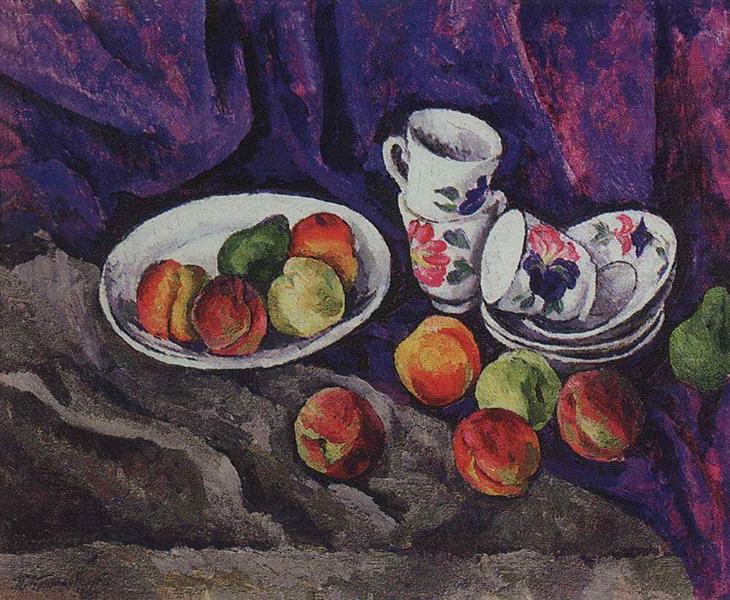
still-life-peaches-1916.jpg!LargePyotr Konchalovsky, Peaches (1916)

I have been selling fruits and vegetables for seven years running. I sold baked goods before, and a girlfriend of mine who sold vegetables said to me, “You work sixteen hours a day. Why do you need that? Come work with us!” I worked in a pedestrian underpass, and the hours there were seven in the morning to eleven at night. Now they are eight in the morning to eight at night. The work here is also hard. Everything has to be sorted by hand and dragged around.

Our market has its own laboratory, and we submit produce for testing every three days. It is not cheap, a test costs from 300 to 800 rubles [approx. 4 to 11 euros, as of this writing], and we pay for it ourselves. If the tests come back negative, the produce itself and what was lying next to it are discarded.

On the Fad for Domestic Products
There is now a fad for everything domestic. There were good strawberries from Poland or Greece, but no one was buying them. But if you say they are Russian, they get bought up. But where in the heck does our produce come from? On the other hand, I have to make sales and make my wage, and so I have begun saying they are from Krasnodar or Crimea, and people buy them. They come back, saying, “Oh, they were so delicious!” and buy them again. You get asked, “Whose peaches are these?” and you say, “They’re Crimean.” But can you imagine how they would get here from Crimea? There is no way you could ship them here. They would spoil and get crushed. It is impossible to ship them.

No one knows where fruits and vegetables are imported from today. “Turkey” is printed on all the crates, but such large quantities do not grow in Turkey.

It works like this. You go to the warehouse, and a semi-trailer truck with, say, Belarusian plates is parked there. Crates from “forbidden” countries are removed from the truck and poured into others crates with no coding. Ultimately, they write, “Grown in Russia.” I really like it when they say it was grown in the Moscow Region. Are you serious? The entire Moscow Region is built up with the dachas of oligarchs, who is going to grow produce there, and where? Take Moscow’s near suburbs. Go there and see how much is being grown. You won’t find much of anything. Either you will find what gets sold in really expensive shops or what gets grown for reference, for show.

The onions, potatoes, carrots, and beets are mostly from China. We try and buy high-quality produce, and we press the wholesalers to tell us where things are from, but no one knows. You watch as cherries are poured into other boxes, and peaches are put into different crates.

The tomatoes are transferred to Russian boxes, and vendors say they are from Krasnodar, but I know I am eating a Ukrainian tomato. But I don’t know how it got here.

The tomatoes, say, have been grown in Ukraine. They were shipped to Belarus, transferred to a truck with Moscow plates, and driven further down the road.

We do not sell Polish apples. They were banned back in March. But then unmarked boxes started showing up, and no one would be able to prove they are Polish. Of course it is illegal. It is even worse in the grocery stores. They ship produce illegally directly from Belarus. Moscow has eaten Ukrainian produce its whole life, and then it suddenly became bad.

On the Destruction of Peaches
My personal opinion is that we are going to die of hunger in October, because, two weeks ago, I bought these tomatoes wholesale for 45 rubles [approx. 60 euro cents]. I am not lying. Now we bought the same tomatoes wholesale for 110 rubles [approx. 1.5 euros]. Previously, it would cost 10,000 dollars for a truck to clear customs. The truck would drive up, ten grand would be placed on the custom officers’ desk, and the truck would head on down the road. But we, the consumers, ate normally.

Now it is twenty-five grand just to clear customs. And the drivers said they have been quoted a price of 50,000 dollars just to fly through customs. But then they will be bringing fresh, high-quality, beautiful produce. Meaning, how much are they going to be selling it for? At sky-high prices, so the poor will just disappear. If they continue to let through trucks from “banned” countries, we will survive. If not, it is not clear what will happen.

We have children in the Kursk Region who have seen peaches only in pictures. How many truckloads of peaches have been destroyed now? Would it not have been simpler to distribute them to orphanages? Everything is buried in taxes. As they say, “Russia has allocated so much money.” Do you know the right way to say it? “We have the taxpayers’ money, which we can dispose of in this way.” Because this is our money, after all. It is we who are paying for everything.

On the Market
We pay vendors a wage for their services. For the tax inspectorate, we write 10,000 rubles a month [approx. 138 euros], the minimum wage, but she [sic] gets 1,500 rubles a day [approx. 20 euros]. She works for us on the books, but many people want to work off the books. No one here has believed in pensions for a long time. They are grateful for this wage, because no one can give them more. We are all people and treat each other like people. Holidays and weekends are granted on request. No one tries to kill anyone for anything; everything is negotiable. 1,500 rubles is the stable daily wage, but there are also bonuses and gifts for the New Year.

The ethnic dynasties are still relevant at the market. Everything has been divvied up long ago, things settled down way back in the 1990s. They have their pens there, but they are all in the other hall. (The market has two halls—Editor’s note.) They sort things out among themselves. And they sell their produce for twice as much, of course. The second hall is not our competition. Potatoes cost 80 rubles a kilo there [approx. 1.10 euros], while in our hall they cost 40 rubles. The customers there are loaded. The oligarchs send their drivers and housekeepers there, and they immediately pack them up with everything. That is how they live. We are focused on the middle class; we have a different audience. Now a food fair is opening here as well. We will have zero receipts.

Sometimes, the police organize raids. Half of them need to do these checks for show, half of them, for the money. But raids are unproductive at this market. Everyone has residence permits and vendor cards: market management monitors all that. In the past, it was more frightening at the open markets.

On Price Hikes
What will happen next is unclear; the prices are crazy. It would better for us to close the stall than to listen to what people are going to be saying to us. The prices are such that people simply don’t have the money to buy these things. Either you want it and you will buy it at an exorbitant price (provided you have the money) or there will be no way for you to buy it. But I always think about the elderly and children. How will they manage? A mother who has just given birth doesn’t go back to work. She has to stay home with the child for two or three years. Her husband, working alone, will not be able to manage to pay for all this. So what are they going to do? Steal? People are still surviving in Moscow, but it is terrible to think what is happening in the hinterlands, just scary.

A crate gets more expensive by an average of 100 rubles a day [approx. 1.40 euros], and there are five to six kilos of produce in a crate. For the time being, we are keeping our prices stable, more or less. But what will happen come winter? There are products like pumpkin, zucchini, broccoli, and cauliflower that a child needs to eat up to the age of one. But young families are poor, only the husband works. Prices are not falling, but the child still has to be fed. I pity them the most. And I feel sorry for the elderly, who have monthly pensions of 15,000 rubles [approx. 207 euros] and spend 13,000 rubles [approx. 180 euros] at the pharmacy.

This is how we do it. If people say they are buying produce to make compote, we give them the smaller, less expensive fruit. If they say they are making jam, we give them average-size fruit. If they are saying taking it to their daughter or someone in hospital, we give them more expensive fruit, but really good fruit. We do reorders every day, most fruits do not stay fresh longer than that. We sort everything by hand daily.

Translated by The Russian Reader. Image courtesy of WikiArt. Thanks to Comrade Nastya for the heads-up.
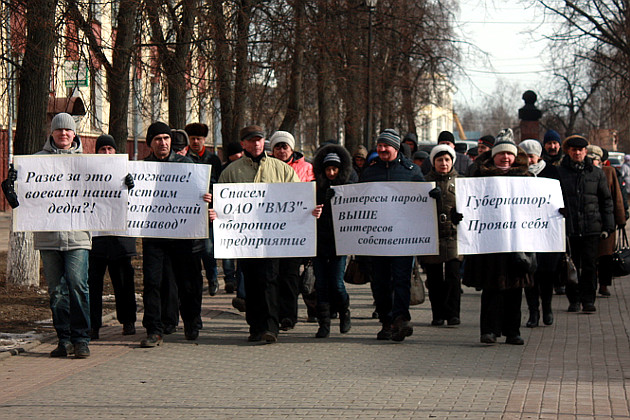
Vologda Machine Plant Workers Rally against Layoffs

In Vologda, Machine Plant Workers Stage Rally against New Layoffs
March 23, 2015
newsvo.ru

Today at 10 a.m., workers from the Vologda Machine Plant (VMP) staged a rally on Revolution Square. The occasion was a new round of layoffs.

meeting_in_vologdaVMP workers on the march in Vologda. The first placard from the left reads, “Is this what our grandfathers fought for?” The second placard from the right reads, “The people’s interests outweigh the owner’s interests.” Photo courtesy of By24.org

As protesters told a Radio Premier correspondent, lists of workers slated for firing had recently been published. It is planned that at least fifty more people will be fired. Given that the company now has about ninety employees, a new round of layoffs might simply kill the plant, according to protesters. In addition, workers claimed that management had stopped paying them back wages.

The demonstration moved from Revolution Square to Drygin Square. Originally, protesters had planned to block traffic. Ultimately, however, they took the decision not to spoil the morning for commuters. They rallied briefly on the porch of the regional legislative assembly building before heading towards the “white house.”

VMP workers are now rallying outside the regional government house.

After a series of strikes in February, the plant was subjected to several checks by law enforcement agencies. The regional government announced it was monitoring the situation at the plant, and last week it promised to monitor the payment of wage arrears. Criminal charges have been filed against VMP management. According to the regional prosecutor’s officer, money was “siphoned” from the company.

_______________

Workers Rebel in Vologda, Russia
March 23, 2015
by24.org

The huge cost of the undeclared war in the Donetsk and Lugansk regions of Ukraine, Western economic sanctions, the slump in oil prices, and the concomitant economic crisis in Russia have had an immediate impact on the country’s ordinary citizens. Today, March 23, workers from the local machine plant in the city of Vologda came to the residence of the region’s governor and almost stormed the building. Authorities had to urgently summon police and Interior Ministry troops in full combat gear, reports local publication newsvo.ru.***

The boiling point for workers at the Vologda Machine Plant, who as it was had not been paid for eight months, was the company’s decision to undertake mass layoffs. A list of fifty names of employees who would be fired was posted at the plant entrance. Given that only ninety workers had remained employed at the plant, such a layoff would be tantamount to the plant’s death.

At first the indignant workers, bearing placards, went to the regional legislative assembly. However, realizing that the local deputies were of little use to them, they moved to the “white house,” the regional administration building.

After numerous threats from police to file criminal charges against the protesters for an unauthorized mass rally, the workers nevertheless succeeded in meeting with Vologda Region Deputy Governor Alexei Kozhevnikov. He sincerely sympathized with the VMP workforce. He assured them the situation at the plant was being constantly monitored and promised to solve all their problem—after, however, bankruptcy proceedings and a change of ownership. A court hearing on the matter is scheduled for May 6.

According to the Vologda regional prosecutor’s office, corruption had flourished at VMP in recent years, and money had simply been “siphoned” from the company. The management at the plant, which handles defense orders, had recently been completely replaced, and criminal charges filed against the previous management. The company’s assets, including manufacturing equipment, had been seized by court bailiffs in lieu of the company’s debts, and heating had been turned off on the shop floors for nonpayment. Even under these conditions, VMP workers, who had not seen a paycheck for eight months, had continued to fill orders, most of them defense-related.

*** Editor’s note. This detail does not seem borne out by the article linked to, which I have translated, above, although the videos posted there do show some kind of (mostly verbal) confrontation with police. But there is definitely no mention of “Interior Ministry troops in full combat gear” in the first article, as claimed by the authors of the second article.

Thanks to Comrade DR for help with finding source materials and the initial heads-up.

Welcome to Sochi

An unexpurgated cri de coeur from the Russian internets:

 1374301_722474414433900_1287996479_n

Вот эту фотографию из подмосковной больницы я бы сделал символом современной России, особенно в свете приближения самой дорогой в истории человечества Олимпиады в Сочи. ( – English translation is below).

Дорогие френды, особенно забугорные – пошлите ее своим друзьям. Пусть расходится по сети. И пусть ухмыляющемуся главарю криминального государства, чье личное воровское состояние оценивается в несколько десятков миллиардов долларов, будет неуютно стоять на трибуне в феврале – оттого, что все уважающие себя политики и знаменитости побрезговали стоять с ним рядом.

Here’s a photo of the local hospital in Boyarkino village not far from Moscow. This is a typical picture, not some extreme one. There are thousands of hospitals, schools and public offices like this in Russia, not only in province, but in major cities as well. I would have made this picture the symbol of modern Russia, especially today, while the most expensive Olympics in the history of mankind are approaching in Sochi.

Dear friends, please, share this with your friends. Let it go over the whole network, so for the world’s most corrupt leader of the most criminal state, whose personal fortune is estimated at tens of billions of dollars, it would not be so comfortable to host this Olympics. Let it be uncomfortable for him to stand on the podium in February, because any self-respecting politician or celebrity would be ashamed to stay next to him.

Meanwhile, back in the fascist fairyland, the locals were getting worked up about the upcoming corporate slugfest down south.
IMG_6258

Anti-Immigrant Pogrom on the Obvodny Canal

http://www.colta.ru/docs/29793
Migrants: “Come out, children, and brush your teeth”
Daniil Dugum
19 August 2013

Morning Visitors

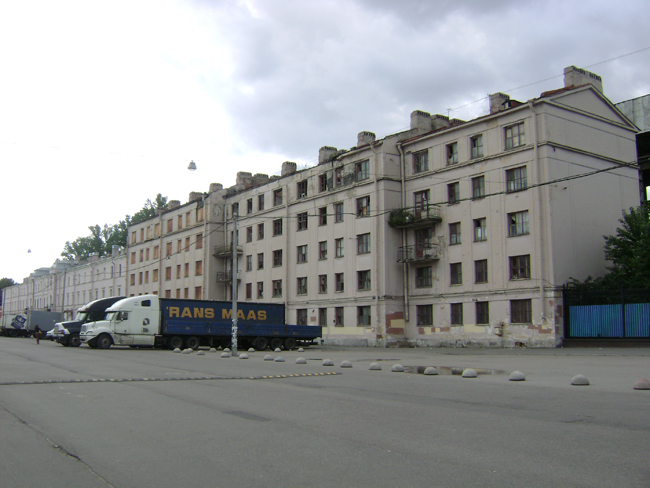
The windows of the pricey Finnish supermarket Prisma, in Saint Petersburg’s former Warsaw Station, look out onto a structure with a half-collapsed roof and scruffy walls. People live there, however. They pay rent to the mysterious “proprietor” of the resettled residential building. He probably managed to “come to terms” with local “law enforcement” for a time, but the building is slated for demolition.

Early in the morning of August 13, uniformed OMON riot police and plainclothes officers raided the homes of migrant workers in this building on the city’s Obvodny Canal.

DSC05079

Human rights activist and sociologist Andrei Yakimov, from the Memorial Anti-Discrimination Center, recounts what happened.

“At around 6:30 a.m., the ‘police’ arrived—about nineteen uniformed men and five or six plainclothes officers. After the riot policemen kicked everyone out of the building (they were not stingy in dishing out insults and shoves, nor did they give pregnant women and mothers with infants any break), they checked everyone’s papers and began ransacking the rooms where people lived, breaking down doors and searching for valuables. The migrants claim that jewelry was pilfered, money was snatched from wallets, and video cameras, tablet computers and laptops were stolen: many of the workers were preparing to leave the country and had bought presents for loved ones in Uzbekistan. Some had taken out small loans to buy tickets home. A pregnant women had the ninety thousand rubles [approx. two thousand euros] she had borrowed for medical treatment (maternity ward expenses) confiscated. The riot policemen handed all these things over to the plainclothes officers, who loaded them into cars. The total loot came to about six large plastic bags. The uniformed thieves made several trips there and back to get everything.”

Three days before the pogrom, the Federal Migration Service and regular police had done a check at the building. After looking at their papers for the umpteenth time and warning the migrants that the building would be boarded up and all tenants must vacate it by August 20, the authorities had then left. They knew that most of the workers were soon returning to their homelands. The robbery thus appears to have been carried out with a suspicious punctuality.

In the Building

Ibrahim, an Uzbek worker, meets me at the threshold of the house on the Obvodny.  Limping, he leads me through a maze of dilapidated walls. In some places, oilcloth covers the leaks in the ceiling and the gaps in the windows. Surrounded by total poverty, people have managed to create some sort of living environment in several rooms. An elderly woman sits in one of these rooms: she is Ibrahim’s wife, Mavlyuda. Next to her is a pregnant woman, the one from whom police confiscated the money she had borrowed to give birth. Mavlyuda tells me that during the raid she lost everything she had earned. The riot policemen had told the plainclothes officers, “Go in and take what you want.” Not only did they steal rings, jewelry, money and new shoes, they even stole an unopened bottle of shampoo. (“What, they have no shampoo? And yet they stole it!”) A twelve-year-old boy had his new tracksuit confiscated. Police messed with the residents’ food supplies. They sprinkled laundry detergent into cooking pots, and tossed food out windows that they had smashed with the same pots. They poured cooking oil and flour onto rugs, clothes and beds. They took special pleasure in disposing of religious objects. Ibrahim holds a board in a broken frame—engraved verses from the Quran. Muslims hang such boards over the door. The riot policemen had trampled and spit on this board.

Ghalib, a construction worker from Uzbekistan, was beaten in the hallway of his refuge while attempting to prevent the robbery. Police confiscated his ticket home and tore it up in front of him. The women say that Ghalib is ashamed to tell where he was beaten. Police beat him in the kidneys and the groin so badly he urinated blood.

On the second floor, a girl of twelve or thirteen recounts how, first, stones were thrown at the windows, then men came and dragged the adults outside, saying to the children, “Come out, children, and brush your teeth.” Then the men began tossing televisions and household utensils out the windows.

His wife had warned Azamat, a truck driver, about the danger that day, and so he watched the pogrom from a hiding place. Later, he discovered that his money and a present (a watch) for his father, who has cancer, were missing. Azamat tells me how three of the policemen beat up a teenager whom he did not know. Non-Slavic in appearance, the boy did not live in the building (none of the residents had seen him before), he was just in the wrong place at the wrong time. “He got scared and ran, but they caught up with them and kicked him around like he was a football. When they picked him off the ground, he was limp like a rag,” Azamat says. He lifts a sweatshirt from a chair and shows me how the boy’s body fell.

After the pogrom, Pyotr Krasnov, a lawyer at the Memorial Anti-Discrimination Center, tried to help the victims.

“We filled out seven police complaint statements at the scene and left around sixty complaint forms in the resettled building in the hope that residents would submit them to the police precinct themselves. In the end, three of the seven people who filled out complaints came to the precinct with us, which I think is a huge success in itself,” says Krasnov.

Ghalib, the man who was beaten, took his complaint to the police. The first thing he was asked was, “Why do you live there?” He then sought medical attention. When the doctors found out it was the riot police who had beaten him, they refused to issue him any documents detailing his injuries.

DSC05084

“Illegals”: How Is That?

After conversing with the tenants of the abandoned building on Obvodny Canal, I got the impression they do not realize they inhabit the premises illegally, and that the “proprietor” to whom they pay rent has no real claim on this “residential space.” “My papers are in order” is the main code in a migrant’s life, and the residents of the building on the Obvodny repeat it like a mantra. Their lives are lived outside the law, and even outside any notion that somewhere it exists and functions. The migrants, especially the young people, believe that buying the necessary documents (it doesn’t matter where) is in fact the correct, legal way of doing things. Many are surprised to learn that a “work permit” that has to be purchased is a fake.

Pyotr Prinyov, from the trade union Novoprof, opens a newspaper and reads a want ad aloud.

“Look here. ‘Wanted: Uzbek nationals with work permits . . .’ But it is the employer who is required to obtain a work permit. That is, it is issued with the employer’s involvement. But if someone shows up with a readymade work permit, then it is 99% certain it has been purchased. There are tons of want ads like this. It is clear that employers are at fault, and that migrant workers are forced to play by these rules.”

But people in the house on the Obvodny do not understand this. It was only the robbery that angered the residents. Document checks and arrests are routine. Regular extortions by police on the streets, and getting ripped off at hard jobs with long hours are things to be endured for the sake of families. But where is the reward now?

We talk with another woman, whose husband is being deported. With tears in her eyes, she speaks about three children in Uzbekistan, how they will have to go back, and that her husband will be unable to re-enter the Russian Federation for five years. At one point, she says something that applies not only to herself.

“Tell the Russians we are honest workers. Tell them we aren’t criminals. My boss at the kitchen [where she works], a Russian woman, almost started crying with me when she found out I was leaving: ‘Where will I find someone like you?’ She’s satisfied with me! Why do you say on television that an Uzbek killed someone? We’re not all like that. Tell them that Uzbeks are honest workers. We’ll leave, but will a Russian woman go clean the streets and stairwells like we do?”

Contrary to the popular myth of the total criminality of migrants, according to official statistics from the Prosecutor General’s Office (a body that checks the police and thus has no interest in fudging the numbers), the majority of crimes are committed not by migrants and guest workers, but by Russian citizens (22.57% versus 77.43%). And Moscow’s judicial department informs us that, in 2012, immigrants from the Commonwealth of Independent States (i.e., the former Soviet republics) had 17% of the crimes committed in the city on their conscience, but a quarter of these involved faked migration papers and work permits.

DSC05087

Andrei Yakimov debunks another myth.

“In fact, most of the migrants in Russia would like to forget they are migrants. They would adapt quite quickly were they allowed to. The older generation remembers the Soviet Union as a golden age, when they had it all. The younger generation of immigrants believes that dissolving into Russian society is better than going home. And that fabled Islamic solidarity is actually a fiction. Look at the mood in Tatarstan: Tatars experience the same xenophobia towards immigrants as Russians do.”

For now, though, everything goes on as before and will continue to go on this way. According to Memorial’s calculations, a so-called native Petersburg is twenty-six times less likely to fall victim to police violence than a person of “non-Slavic” appearance.

As you leave these robbed and humiliated people in their ruined shelter, you inadvertently catch myself thinking about what Alexander Herzen once said about the pacification of Poland: “I am ashamed to be Russian.”

Photos © Memorial Anti-Discrimination Center