“Try me for treason. I betrayed your deranged state”, the Russian anti-war protester Andrei Trofimov told the Second Western District Military Court in May.
In 2023, Trofimov was sentenced to ten years’ imprisonment, for opposing Russia’s war in Ukraine in social media posts, and trying to join the Free Russia Legion that fights on Ukraine’s side. At that hearing, Trofimov said he hoped for Ukraine’s victory, and called president Putin “a dickhead”.
On the basis of that statement alone, he was further accused of “justifying terrorism” and defaming the Russian army. For those “crimes”, the judge at the hearing in May this year, Vadim Krasnov, added three years to Trofimov’s sentence.
Before sentencing, Trofimov told the court that he had not justified terrorism, but supported the Ukrainian armed forces’ legitimate military actions against aggression, and had not defamed the Russian army whose actions were unconstitutional and illegal. He told the court that he considered himself guilty of a much more serious crime: treason – taking the enemy’s side in war.
And there will be another chance to hear these powerful readings in London – on Thursday 5 February 2026, 6:30 p.m., at Birkbeck College. Here are the details.
You can order copies of Voices Against Putin’s War, or download a free pdf, here.
We published the book against the background of repeated claims that a peace agreement is about to be signed between Russia and Ukraine. These are louder than ever after this week’s talks in Berlin. At the time of writing this, it is not clear to me that the Kremlin is really interested in stopping the war, or what the “security guarantees” being offered to Ukraine actually mean.
I would recommend following the excellent arguments made about the peace process by Oleksandr Kyselov (most recently here, also here and here), Hanna Perekhoda (who writes on Facebook here), and other Ukrainian socialist writers.
If you want to know why the 20% of Donbas that Ukraine still controls matters so much, this comment by the Institute for the Study of War is worth reading. This speech by Valery Zaluzhny helps us understand what the Ukrainian political elite thinks.
Whatever the outcome of the talks now in progress, if any, the defence of victims of Russia’s military occupation of Ukrainian territory, and domestic political repression, will remain a central issue for our movement, right across Europe.
At the heart of Voices Against Putin’s War are ten speeches made in court by people who opposed Russia’s war of aggression in Ukraine, and were arrested and tried for doing so. Most of them are now serving long jail sentences, for “crimes” fabricated by Vladimir Putin’s repressive machine.
Along with the speeches, we include other public declarations – social media posts, letters and interviews – in which the protagonists made their case; statements by two more persecuted activists, made outside court; and a summary of 17 other anti-war speeches in court. We hope that, by publishing these translations in English, these resisters’ motivations will become known to a wider audience.
Chapters 1-10 are each devoted to one protester, arranged chronologically by the date of the protester’s first conviction. United in their opposition to the Kremlin’s war, they divide roughly into four groups.
First is Bohdan Ziza (chapter 3), who lived not in Russia but in Ukraine – in Crimea, which has been occupied by Russian forces since 2014. In 2022 Ziza filmed himself splashing paint in the colours of the Ukrainian flag on to a municipal administration building. He was tried in a Russian military court and is serving a 15-year sentence.
Second are two young women from St Petersburg, Sasha Skochilenko (chapter 6) and Darya Kozyreva (chapter 8), prosecuted for the most peaceful imaginable protests against the war. Skochilenko, who posted anti-war messages on labels in a supermarket, was freed after more than two years behind bars, in August 2024, as part of a prisoner swap between Russia, Belarus and several Western countries. Kozyreva is serving a two-and-a-half year sentence, essentially for quoting Taras Shevchenko, Ukraine’s national poet, in public.
Third are three young men who deliberately damaged property, but not persons, to draw their fellow Russians’ attention to the anti-war cause. Igor Paskar (chapter 2) firebombed an office of the Federal Security Service (FSB). Alexei Rozhkov (chapter 9) firebombed a military recruitment centre – a form of protest used dozens of times across Russia in 2022. He fled to Kyrgyzstan, was kidnapped, presumably by the Russian security forces, and returned to Russia for trial. Ruslan Siddiqi (chapter 10), a Russian and Italian citizen, derailed a train carrying munitions to the Ukrainian front. He has been sentenced to 29 years, and has said that he can be seen as a “partisan”, and “classified as a prisoner of war”, rather than a political prisoner.
The fourth group of protagonists, jailed for what they said rather than anything they did, have records of activism for social justice and democratic rights stretching back decades: Alexei Gorinov (chapter 1), a municipal councillor in Moscow who dared to refer to Russia’s war as a “war” in public; Mikhail Kriger, an outspoken opponent of Russia’s war on Ukraine since 2014 (chapter 4); Andrei Trofimov (chapter 5); and Aleksandr Skobov (chapter 7), who was first jailed for political dissent in 1978, in the Soviet Union, and who 47 years later in 2025 told the court: “Death to the Russian fascist invaders! Glory to Ukraine!”
Two activists prosecuted for anti-war action, who made their statements outside court, are featured in chapters 11 and 12. Kirill Butylin (chapter 11) was the first person arrested for firebombing a military recruitment office, in March 2022. No record of his court appearance is available, but his defiant message on social media is: “I will not go to kill my brothers!” Savelii Morozov (chapter 12) was fined for denouncing the war to a military recruitment commission in Stavropol, when applying to do alternative (non-military) service.
The ten anti-war speeches in court recorded in this book are by no means the only ones. Another 17 are summarised in chapter 13. These speeches, along with others by defendants who railed against the annihilation of free speech, or protested against grotesque frame-ups, have been collected and published by the “Poslednee Slovo” (“Last Word”) website.
High-profile Russian politicians jailed for standing up to the Kremlin also made anti-war speeches in court, including Ilya Yashin of the People’s Freedom Party, sentenced to eight-and-a-half years in December 2022 for denouncing the massacres of Ukrainian civilians at Bucha and Irpin, and Vladimir Kara-Murza, sentenced in April 2023 to 25 years for treason. Both of them were freed, along with Sasha Skochilenko, in the prisoner exchange of August 2024. Other prominent political figures remain in detention for opposing the war, including Boris Kagarlitsky, a sociologist and Marxist writer, sentenced in February 2024 to five years for “justifying terrorism”, and Grigory Melkonyants, co-chair of the Golos election monitoring group, sentenced in May 2025 to five years for working with an “undesirable organisation”. Dozens of journalists and bloggers are behind bars too.
These better-known, politically motivated people are only a fraction of the thousands persecuted by the Kremlin.
The cases recorded by human rights organisations include thousands of Ukrainians detained in the occupied territories. In many cases their fate, and whereabouts, is unknown: they may be dead or imprisoned.
Thousands more Russians who have spoken out against the war, or been caught in the merciless dragnet by accident, are behind bars. So are “railway partisans” who sabotaged military supply trains, and others who denounced their regime’s support for Putin’s war, in Belarus.
In Chapter 14, we outline the resistance to the Kremlin’s war, the repression mobilised in response to it, and the scale of the twenty-first-century gulag that has been brought into being. Notes, giving sources for all the material in the book, are at the end.
People resisting injustice have for centuries, in many countries, made use of the courts as a public platform. Irish rebels against British colonial violence began doing so at the end of the eighteenth century. In Russia, the tradition goes back at least to the 1870s, when Narodniki (Populists), speaking to judges trying them for violent protests, denounced the autocratic dictatorship. The workers’ movements that culminated in the 1917 revolutions used courtroom propaganda widely. When Stalinist repression reached its peak in the 1930s, the major purge trials were designed to eliminate it: their format was prearranged, with abject, false confessions. The practice reappeared after the post-Stalinist “thaw”, in the 1965 trial of the dissident writers Andrei Siniavsky and Yulii Daniel.[1]
Courtroom speeches have again become a powerful weapon under Putin – and the Kremlin dictatorship is finding ways to get its revenge.[2] It added three years to Andrei Trofimov’s sentence (chapter 5) – for the fantastical, false “offences” of disseminating false information about the army and “condoning terrorism” – based solely on what he said at his first trial. Other anti-war prisoners, including Alexei Gorinov (chapter 1) have had years added on to their sentences, on the basis of false “evidence” provided by prison officers, or prisoners terrorised by those officers.
Why did they do it? Why did our protagonists make protests that carried the risk of many years in the hell of the Russian prison system? Why, when brought to court, did they choose to make these statements that carried further risk? They have weighed their words and spoken for themselves; no attempt will be made here to summarise. However it is noteworthy that all of them addressed their speeches to their fellow citizens, not to the government.
Andrei Trofimov told the court in his second trial that “Ukraine is my audience”, because “Russian society is dead and it is useless to try to talk to it” – but nevertheless went to extraordinary lengths to make sure that his short, sharp message from his first trial, ending “Putin is a dickhead”, was widely circulated in Russian media.
The others had greater hopes in Russian society, including the Ukrainian Bohdan Ziza, who, in the video for which he was jailed, underlined that: “I address myself, above all, to Crimeans and Russians.” In court he said his action was “a cry from the heart” to “those who were and are afraid – just as I was afraid” to speak out, but who did not want the war.
Alexei Rozhkov had no doubt that “millions of my fellow citizens, women and men, young and old, take an anti-war position”, but were deprived of any means to express it. Kirill Butylin appealed to others to make similar protests so that “Ukrainians will know, that people in Russia are fighting for them – that not everyone is scared and not everyone is indifferent.” As for the government, “let those fuckers know that their own people hate them”.
Aleksandr Skobov, now 67 and in failing health, explicitly addressed younger generations. In an open letter from jail, he recalled how as a socialist he had been a “black sheep” among Soviet-era dissidents, most of whom had now passed away. “The blows are falling on other people, most of them much younger.” While “sceptical about ‘pompous declarations about the passing-on of traditions and experience’”, nevertheless, “I want the young people who are taking the blows now to know: those few remaining Soviet dissidents stood side-by-side with them, have stayed with them and shared their journey.”
Given this unity of purpose, of seeking however unsuccessfully to connect with the population at large, we might see the protagonists as practising the “propaganda of the deed” – not in the sense that phrase was given in the early twentieth century by politicians and policemen, as acts of violence, but in its original, broader sense: as any action, violent or not, that stirred one’s fellow citizens to a just cause. For, while some of those whose words are in this book used violence against property, and some specifically justified Ukrainian military violence against Russian aggression, none used violence against people.
Here are two further observations. First: while all the anti-war resisters shared a common purpose, they started with a diverse range of world views. A profound moral sense of duty runs through some of their statements. “Do I regret what has happened?” Igor Paskar asked his judges. “Yes, perhaps I’d wanted my life to turn out differently – but I acted according to my conscience, and my conscience remains clear.” Or, as Alexei Rozhkov put it: “I have a conscience, and I preferred to hold on to it.”
Andrei Trofimov, in a similar vein, said at his second trial that “writ large, it is a matter of self-preservation” – not “the preservation of the body per se, of its physical health” but the preservation of conscience in this difficult situation, “my ability to tell black from white, and lies from truth, and, quite importantly, my ability to say out loud what I believe to be true”.
Ruslan Siddiqi voiced his motivation differently, in terms of political ideas about changing society. In letters to Mediazona, an opposition media outlet, he described his path towards anarchism. Expressing dislike for the “rigidity” of some anarchists and communists, he nevertheless envisaged a transition “from a totalitarian state to other forms of government with greater freedoms and further evolution into communities with self-government”.
The invasion of Ukraine changed things: anyone who opposed it was declared a traitor by the government. “In such a situation, it is not surprising that some would prefer to leave the country, whereas others would take up explosives. Realising that the war was going to be a long one, at the end of 2022 I decided to act militarily.”
By contrast, Alexei Gorinov founded his defence on pacifist principles, and quoted Lev Tolstoy on the “madness and criminality of war”. Being tried “for my opinion that we need to seek an end to the war”, he could “only say that violence and aggression breed nothing but reciprocal violence. This is the true cause of our troubles, our suffering, our senseless sacrifices, the destruction of civilian and industrial infrastructure and our homes.”
Sasha Skochilenko was still more explicit: “Yes, I am a pacifist” she told the court. Pacifists “believe life to be the highest value of all”; they “believe that every conflict can be resolved by peaceful means. I can’t kill even a spider – I am scared to imagine that it is possible to take someone’s life. […] Wars don’t end thanks to warriors – they end thanks to pacifists. And when you imprison pacifists, you move the long-awaited day of the peace further away.”
Savelii Morozov told the military recruitment commission that he would not refuse to fight in all wars, but in this particular, unjust war. A war in defence of one’s homeland could be justified, but not the “crime” being perpetrated in Ukraine.
For Darya Kozyreva, the central issue is Ukraine’s right to self-determination, asserted by force of arms. The war is a “criminal intrusion on Ukraine’s sovereignty”, she told the court. While identifying herself in an interview as a Russian patriot – “a patriot in the real sense, not in the sense that the propagandists give that word” – Kozyreva justified Ukrainian military resistance. Ukraine does not need a “big brother”; it will fight anyone who tries to invade, she said. In Russia, even some of Putin’s political opponents “do not always realise that Ukraine, having paid for its sovereignty in blood, will determine its own future”. She wants to believe in “a beautiful future where Russia lets go of all imperial ambition”.
Aleksandr Skobov expressed the hope that Russia will be defeated militarily in still more categorical terms. He spelled out in court three principles of his political organisation, the Free Russia Forum: the “unconditional return to Ukraine of all its internationally recognised territories occupied by Russia, including Crimea”; support for all those fighting for this goal, including Russian citizens who joined the Ukrainian armed forces; and support for “any form of war against Putin’s tyranny inside Russia, including armed resistance”, but excluding “disgusting” terrorist attacks on civilians.
Second: these anti-war speeches have much to tell us not only about Russia and Ukraine, but about the increasingly dangerous world we live in, in which Putin’s slide to authoritarianism has been succeeded by right-wing, authoritarian turns in the USA and some European countries. Russia’s imperial war of aggression has been followed by Israel’s genocidal offensive in Gaza, in which multiple war crimes – mass murder of civilians, the use of starvation as a weapon, deliberate blocking of aid, and the targeting of journalists, aid workers and international agencies – have been facilitated by the same Western powers that offer lip service to Ukraine’s national rights.
The two aggressor nations, Israel and Russia, aligned with different geopolitical camps, are subject to analogous driving forces. Nationalist ideology supercedes rational economic management; expansionist violence supercedes democracy; the decline of Western neoliberal hegemony paves the way for militarist thuggery. Capital’s need for social control underpins near-fascist methods of rule. Readers may recognise, in the Russian state’s dystopian efforts of 2022-23 to punish its dissenting citizens as “terrorists” and “traitors”, patterns that are retraced in the unhinged witch-hunts of 2024-25 in the USA and western Europe, against opponents of the Gaza slaughter.
The powers on both sides of the geopolitical divide are frightened of similar things: the defiance and resilience of the opponents of Putin’s war, and the anger that has brought millions of people on to the streets of north American and European cities, in protest at the Gaza genocide. They are frightened of beliefs that are taking shape, in varying forms, that humanity can and should strive for a better, richer life than that offered by the warmongers and dictators. Some of these beliefs are expressed in the chapters of this book.
□ Thursday 20 November 2025, 7:00 pm. TRY ME FOR TREASON. Readings from anti-war protesters’ speeches in Russian courts, and book launch for Voices Against Putin’s War. Pelican House, 144 Cambridge Heath Road, Bethnal Green London E1 5QJ. Register free on Eventbrite here. Flyer attached.
[1] T.D. Sullivan, Speeches from the dock, or, Protests of Irish patriotism (P.J. Kennedy, New York, 1904); Franco Venturi, Roots of Revolution: a history of the populist and socialist movements in 19th century Russia (Phoenix Press, 2001), Marshall Shatz, Soviet Dissent in Historical Perspective (Cambridge University Press, 1980).
Convicted Russian anti-war activist Andrei Trofimov. Photo: Mr. Trofimov’s Vkontakte page, via Mediazona
In 2023, Andrey Trofimov, an anti-war activist from Tver, was sentenced to ten years in a maximum security penal colony on several charges [to wit, disseminating “fake news” about the Russian army, calling for “extremism,” and attempting to join the Free Russia Legion]. In his closing statement at trial, he called Vladimir Putin a “dickhead” [khuilo] and “heartily endorsed” Ukraine’s attacks on the Crimean Bridge and the Kremlin. This statement was the grounds for the second criminal case against Trofimov, this time on charges of “condoning terrorism” and “defaming the army.”
Today [6 May 2025], Judge Vadim Krasnov of the Second Western District Military Court lengthened Trofimov’s sentence to thirteen years. Prosecutor Andrei Lopata had petitioned the judge to impose a longer sentence of fifteen years.
Before the verdict in his first trial was read out, Trofimov had petitioned the court to impose the maximum penalty. Now he has suggested that he be charged with the more serious offense of high treason, claiming that he has been involved in the information war on the Ukrainian side.
Below, Mediazona has published a slightly abridged version of Trofimov’s statement during oral arguments at the [second] trial.
* * * * *
Your honor, the factual circumstances of my actions, which the investigation has categorized as crimes, are correctly stated in the indictment and have been fully investigated during the court hearing.
In my statement I would like to dwell on the reasons for these actions, on my goals, to review in detail, charge by charge, my response to the allegations—that is, to explain my motives for not pleading guilty. And, in my conclusion, I would like to petition the court as to what to do with me next.
I was living quietly at the dacha with my cats and was a bother to no one. My life changed drastically on 24 February 2022. The reason for both the first criminal case and the current criminal case [against me] was Russia’s invasion of Ukraine. I will further explain why I regarded this event in this way.
I am in prison for what I have said, after all. I took no action in either the first case or the second. But this has been my way of being involved in the events, because it was physically impossible for me to leave the country, and I had no desire to stay silent in this situation. I mean, it is my life.
Why have I done this? I must respond to your remarks yesterday to the effect that my statements, including in court, could harm my own interests. Your honor, I have no interest in a shorter sentence. I am already imprisoned.
What is the purpose of what I am doing? Writ large, it is a matter of self-preservation. It is just that I understand the instinct of self-preservation not as the preservation of the body per se, of its physical health, because I am not my body alone. I want to preserve my conscience in this difficult situation, my ability to tell black from white, and lies from truth, and, quite importantly, my ability to say out loud what I believe to be true.
This thing of mine did not start in 2022. I have always tried to live this way. It is just that my desire to preserve this ability in such situations—meaning, the ability to tell the truth, to maintain my conscience— is what causes such actions.
What actions have we observed? We have witnessed concrete evidence of crimes with which I have not been charged, evidence of the violation of Article 278 of the Russian Federal Criminal Code—that is, the forcible seizure or the forcible retention of power. I am referring to Vladimir Putin, who has held the highest official post in the Russian Federation for exactly a quarter of a century. During this entire time, the Constitution of the Russian Federation has contained the principle of succession of power, set out in the guise of the two-term rule [for Russian presidents]. We have witnessed a direct violation of this rule—that is, the forcible retention of power.
In what has occurred since 24 February, we see concrete evidence of a violation of Criminal Code Article 353—that is, the planning, preparation, unleashing, and waging of a war of aggression.
What have I done in this situation? Publicly, in the mode of a solo picket (just a protracteed one), I have demonstrated the Russian state’s insanity. Look, the prosecution is asking for fifteen years in total—the sentence given for murder, but even for murder, sentences are often shorter. And yet my deeds harmed no one nor caused any damage.
I am not just talking about the period covered by these criminal cases. I have never laid a finger on anyone, never stolen a penny, in my entire life. Nevertheless, [the prosecutor wants to send me down for] fifteen years. I believe that this is a demonstration of the state’s insanity. The state happily displays this quality using me as an example.
What have I done in response? I have shown fortitude. This is vital, because I hope that what I have been doing is seen by Ukrainians. Look at this: they arrested him. He was convicted and given a dozen years of maximum security. Judge the effect in terms of the second case. Did you do a good job of convincing me [of the error of my ways]? That is, have I stopped doing what I was doing? Has my voice become less audible? No, it has not.
We have witnessed the same thing on the military front. For four years running, the Russian state has been spilling blood in a neighboring country. Ukraine has not surrendered and will not surrender.
Among the things that I have not exactly been charged with, but which have been repeated in the indictments and in the evidence presented at trial is my insulting Vladimir Vladimirovich Putin by using the foul word “dickhead.” What have I done? It is called desacralization.
Because the sacredness of supreme power is one of the foundations of the Golden Horde method of governance. When I publicly, repeatedly, and daily, at the first trial, at the second trial, in the pretrial detention center, perform this trick, I am desacralizing Vladimir Putin. This is important, because this regime will end all the same, and I very much want to hasten its end. I hate this man. And what the prosecution says about the “motive of political hatred” is the sacred truth. I can confirm that.
The audience I am addressing by these actions is not in Russia, because Russian society is dead and it is useless to try and talk to it. Ukraine is my audience.
As for the charges against me, I do not plead guilty to either count of violating Criminal Code Article 205.2. At issue is one and the same text, simply posted on the internet and spoken aloud in the pretrial detention center. Because I do not consider the incidents which I chose to include in my closing statement at trial to be “terrorist acts.” I chose them on purpose.
What is at issue are the two attacks on the Crimean Bridge. The Crimean Bridge is a vital transport artery which supplies the Russian federal armed forces in Crimea. An attack on a military installation is an instance of armed hostilities. The attack was carried out by the armed forces of Ukraine.
Why was it categorized as a “terrorist attack”? I know perfectly well why. This was done in order, first, to use it in Russian propaganda to dehumanize the enemy. In other words, the Russian Federation is at war not with the armed forces of Ukraine, which are stipulated under Ukrainian law and are doing their constitutional duty, but with terrorist gangs of “Banderites” and “Ukronazis.” To support this agenda, decisions are made to launch criminal proceedings on charges of “terrorism” over instances of armed conflict.
As for the second incident I mentioned, the attack on the Kremlin on 3 May 2023, what do we know? The communique from the Investigative Committee, which the prosecutor quoted yesterday, states outright that the attack was carried out against the residence of the President of the Russian Federation, who is the commander-in-chief of the Russian federal armed forces. Moreover, the Ukrainians also hit the building of the Senate, which is in the section of the Kremlin closed to tourists and where one of Putin’s offices is actually located. Excuse me, but this was not a terrorist attack. It was a Ukrainian combat operation, and a failed one at that.
I must say loudly and out loud that I do not condone or support terrorism, and that I have never condoned terrorism, nor do I intend to condone terrorism. I have a categorically negative attitude to the ideology and practice of terrorism.
Let us move on to [the charges under] Article 280.3 of the Criminal Code. This article is brand-new: it was adopted after the start of what we call the “special operation.”
This is a pure example of persecution for telling the truth. Because a situation has arisen where it has been necessary to shut the mouths of the war’s opponents, but it is impossible to charge them with violating, say, my beloved Criminal Code Article 207.3. How can you charge a person with “disseminating fake news” if they simply voice their attitude to current events? This is how Article 280.3 and the notion of “defamation” emerged, which is quite poorly conceptualized legally.
I have been told that my phrase “Ukraine is a victim of aggression on the part of the country of Russia” defames the Russian federal armed forces. What do we have? We have the UN General Assembly’s 2014 resolution saying that Russia “annexed” Ukraine. Those are not my words. This is a General Assembly resolution: there is no veto power there [as there is on the UN Security Council], so it was passed by a decent majority [of member states]. This is the position of international law.
Similarly, we have a March 2022 UN General Assembly resolution, in which the events of February 24 are labeled an “aggression.” And we have a UN General Assembly resolution on Russia’s incorporation of the Ukrainian regions of Donetsk, Luhansk, Zaporizhzhya and Kherson which labels these actions “annexation.”
I should note that the statements of, say, Foreign Ministry spokesperson Masha Zakharova are not a source of international law. Statements by Russian Foreign Minister Lavrov are not a source of international law. UN General Assembly resolutions are, on the contrary, a source of international law, and so my assessments are based on international legal documents.
But my phrase about “Putin’s scumbags” is also part of the “defamation” charge against me, of course. First, from your viewpoint, “Putin’s” cannot be defamatory, because as you see it, Putin is good. As for the second word [in the phrase], yes, this is my personal opinion, and it does not apply solely to Russian servicemen who carry out unlawful orders. Yes, there are also people in the Russian armed forces who do not carry out unlawful orders, but they are not the only ones fighting there.
Excuse me for characterizing in this way people who murder the soldiers of a neighboring country for money. This is my personal judgment, and it is based on [their] actions.
I will summarize this part of my statement. The Russian federal constitution contains Article 29, [which guarantees] the right to free speech, including the right to gather and disseminate information. This is what I have actually been doing. That is, I have not overstepped Article 29 of the Constitution by a single millimeter. But at the same time I certainly have violated these two current articles of the Criminal Code.
How can this be the case? It can be the cacse because the articles under which I have been charged are unconstitutional. If Russia had a real Constitutional Court, these articles would have ceased to exist long ago.
I cannot fail to mention my report to Prosecutor Zhuk, which was not part of the charges against me, but nevertheless we heard witnesses talk about it yesterday. It does not contain the text of [my] closing statement [at the first trial]. It makes no mention of terrorism or any violent acts at all. I did not say a word about the armed forces either.
The point is that this second case is the result of my statement to the prosecutor’s commission. Because the case file contains two resolutions by FSB investigator Lieutenant Colonel Sergey Vyacheslavovich Yerofeev to dismiss the case—that is, by the investigator in my [first] case, with whom I have a very good level of mutual understanding and who understands exactly what I have been doing and what I have been trying to achieve. He tried to dismiss this case twice.
In the final part of my statement, I turn to the correct characterization of my actions. I am involved in the war on the Ukrainian side. It just that this involvement takes place without weapons, because war is such an extraordinarily multidimensional event. Apart from the fighting in the steppes of Donbas, in the Black Sea, and in the skies above Ukraine, it is fiercely fought in the information space by state entities, by Russian bodies. On the Ukrainian side, for example, interesting entities are also involved.
I am an information warrior. In what sense? On 9 October 2022, I wrote and sent an email to Ukrainian President Volodymyr Oleksandrovych Zelensky asking him to grant me Ukrainian citizenship. I am entitled to it because of my ancestry. All my grandparents hailed from Ukraine. Ukrainian law says that I have the right to [Ukrainian] citizenship.
I was able to enter a screenshot from Kasparov.ru into the record and have it examined in court. What does it confirm? The fact that, apart from publishing my closing statement at trial, Kasparov.ru has published me on a regular basis. What does this confirm? That what I am being tried for now was, in fact, just an instance of my work, which I have not ceased.
I will also mention, of course, Novaya Gazeta, whose website also published my letters. And my latest achievement in this wise is that I have been officially designated a political prisoner, because that is what I call myself at the pretrial detention center, and that is how I sign my petitions to this honorable court. But it was still a kind of self-designation as it were.
On 14 April of this year, the Council on Political Prisoners of the Memorial International Human Rights Defense Center published a decision[designating me a political prisoner]. As part of my work, I have used the criminal cases [against me], the first and the second case, as publicity opportunities.
The information war is a real thing. I am involved in it, and I am trying to prove this now. Informationally, I support Ukraine and the armed forces of Ukraine. In fact, I have defected to the enemy side in an armed conflict involving the Russian Federation. This is the essence of the crime defined in Article 275 of the Russian Federal Criminal Code—high treason.
I ask the court to send my criminal case back to the prosecutor, as the factual circumstances indicate that there are grounds for charging me with a more serious crime. Try me for treason: I betrayed your deranged state.
* * * * *
Address for letters:
Trofimov Andrei Nikolayevich (born 1966)
141 ul. Bagzhanova, FKU SIZO-1 UFSIN po Tverskoi oblasti
Tver,  Tver Oblast 127081 Russian Federation
You can send letters to Mr. Trofimov and other Russian political prisoners via ZT, F-Pismo, and PrisonMail.online. (The last of these services accepts payments made with non-Russian bank cards.)
Olga Menshikh. Photo: Alexandra Astakhova/Mediazona
A panel of three Moscow City Court judges, chaired by Irina Vasina, upheld the verdict in the criminal case against anesthesia nurse Olga Menshikh on charges of disseminating “fake news” about the Russian army: eight years in prison for two posts on the Russian social media network VKontakte, per Article 207.3.2.e of the Criminal Code. This is the longest sentence on these charges handed down to a woman. The following is an abridged version of Menshikh’s statement at today’s court hearing.
You and I understand everything quite well: we are all adults here. You shall say that this is not a frame-up, that it’s the norm. Nevertheless, we understand that there is a more serious organisation* which has ordered this [verdict], and they do things as they see fit regardless of these frame-ups.
Here, for example, is a quotation from my case file: “Olga Sergeyevna Menshikh causes her fellow citizens to feel anxious, afraid and worried, to feel undefended by the state’. I cause that!? I am an absolute loner with a mum who is eighty-six years old, and I have no other interests in life. What can I say? These words in no way apply to me. I completely deny them and consider them slander.
But these words perfectly describe the well-known organisation, known as the FSB, which I have just outlined for you. […] Back in the day, serious conclusions were not drawn about the architecture of the seventy-year utopia, which murdered millions of its own citizens and citizens of other countries and collapsed during an attempt to repair it, but then suddenly rose up and went at it again. Crush what was not crushed earlier! ‘Crush them!’ is the watchword of the day.
Who should be crushed, I want to ask you, your honours? The peasants, whom you destroyed long ago? The hegemon [i.e., the proletariat], whom you long ago turned into a drunkard? Do you want to crush the intelligentsia? Do you want to crush business? How do you plan to live? What have I been observing in Detention Centre No. 6 right now? I just sat for four hours with the nicest businesswoman. You have been clamping down on businesspeople of all stripes.
I have seen all kinds of people here. Lawyers and doctors serving long sentences, mothers with many children, with three or four children, incarcerated here without verdicts. And just now I came in from the corridor, where a disabled woman in a wheelchair was being sent off to a penal colony. Pensioners and young people are held here on completely trumped-up charges. Do you want to crush them, to trample on their lives so as to make others afraid? Is that what you want to do? You want to crush them so that everyone is afraid because you were ordered to do it? Have them be afraid, have them sit in prison.
Well, this is what I want to tell you calmly. A society sick with fear cannot create, cannot be happy, cannot live, cannot love to the fullest, cannot reproduce. You consider it quite necessary for us to reproduce. But [society] cannot reproduce amid this fear. A wild goose never laid a tame egg. This fig tree will die out, you shall kill it off.
This entire fear machine has only one aim: destroying all of us. So many people, so many civilised people were destroyed, that I cannot list their names. I will only quote a great novel. Having worked in the medical field myself, as someone who took patients quite seriously, I will quote the great novel Doctor Zhivago, about Doctor Yuri Andreyevich Zhivago. By the way, he dies before he reaches the age of forty.
Here is what the great diagnostician Yuri Zhivago says: “Microscopic forms of cardiac hemorrhages have become very frequent in recent years. […] It’s a typical modern disease. I think its causes are of a moral order. The great majority of us are required to live a life of constant, systematic duplicity. Your health is bound to be affected if, day after day, you say the opposite of what you feel, if you grovel before what you dislike and rejoice at what brings you nothing but misfortune.”**
Yuri Andreyevich uttered these words exactly a hundred years ago. And so, concerning this organisation, which we all know quite well: a dead man coming back to life cannot make anyone happy. Even when he was alive, he brought happiness to no one. He turned a lot of folk into dead people, and now he is raising another generation suffering from PTSD, post-traumatic stress disorder, which is quite hard to treat.
What can I say? I am sorry. I feel sorry for you, I feel sorry for me. I feel sorry for the people in this detention centre. I feel sorry for the women, for the children. Dear honourable judges and prosecutors, we are all in the same boat. I rest my case.
* In the first part of her statement, Menshikh talks about how she believes the FSB was behind her criminal case from the beginning — Mediazona.
** Translated by Max Hayward and Manya Harari — TRR.
A court in Moscow on Thursday sentenced a 59-year-old nurse to eight years in prison for social media posts opposing Russia’s invasion of Ukraine.
Olga Menshikh was accused of spreading “fake” information about the military with two VKontakte posts that condemned Russian strikes on Vinnytsia, Ukraine, that killed 28 people in July 2022 and Russian troops’ mass atrocities against civilians in the Kyiv suburb of Bucha.
Menshikh denied her guilt, with Mediazona reporting she had 15 followers and that her account may have been breached.
Moscow’s Dorogimolovsky District Court found Menshikh guilty of spreading “fake news” about the Russian military’s actions abroad and handed her an eight-year sentence in a prison colony.
Menshikh was an anesthetic nurse at the Pirogov National and Medical Surgical Center, where Mediazona said she had treated Russian soldiers wounded in Ukraine.
The outlet said Menshikh had faced several administrative arrests and fines for anti-war social media posts and her support for the late Kremlin critic Alexei Navalny.
Russia has cracked down on anti-war protests, the independent press and social media platforms since launching what it calls its “special military operation” in Ukraine in 2022.
Today, the 1st Western District Military Court sentenced 67-year-old dissident Alexander Skobov to 16 years in prison and fined him 300,000 rubles (just over $3,500). Skobov, who first faced criminal prosecution in the USSR, was convicted under charges of “participation in the activities of a terrorist community” (for his involvement with the Free Russia Forum, a Russian opposition conference abroad) and “justification of terrorism” (for his social media posts and articles). Mediazona publishes Skobov’s closing statement from today’s trial—a passionate speech in which he continues to openly support Ukraine, defies persecution and denounces judges as accomplices of Putin’s war crimes.
I will not dwell on the fact that the investigation has branded the organisation I have the honour of belonging to, the Free Russia Forum, as a terrorist community. There has been no official ruling from any government body recognising the Free Russia Forum as such. For now, it is merely an “undesirable organization.”
But I have little interest in all this petty mumbling. I prefer to speak about what truly matters. What matters here is the platform of the Free Russia Forum, a platform I was directly involved in shaping, and one that distinguishes the Free Russia Forum from most other opposition organisations.
Let me remind you that this platform is built on three principles. First: we stand for the unconditional return to Ukraine of all its internationally recognised territories occupied by Russia, including Crimea. Yes, Крим це Україна. [Crimea is (part of) Ukraine — TRR.]
Second. We support all those who are fighting to achieve these goals—including citizens of the Russian Federation who have voluntarily joined the Armed Forces of Ukraine.
And third. We recognise any form of war against Putin’s tyranny inside Russia, including armed resistance. Of course, we are deeply disgusted by the methods of ISIS, when innocent people are targeted, as was the case in Crocus City.
But are the Kremlin’s war propagandists a legitimate target? The Free Russia Forum has not formally debated this issue or adopted any resolutions on it, so what I say next reflects my personal position alone.
I believe that propagandists such as TV host Vladimir Solovyov deserve the same fate as Hitler’s chief propagandist Julius Streicher, who was hanged by the Nuremberg Tribunal. Until these outcasts of the human race are brought before a new Nuremberg Tribunal—and as long as this war continues—they remain legitimate military targets.
For me, the comparison between Putin’s and Hitler’s propagandists is not mere rhetoric. Much of my public writings has been devoted to proving the inherently Nazi nature of Putin’s regime—a regime with which peaceful coexistence is fundamentally impossible.
I appeal now, as I have before, first and foremost to Europe, which should remember the origins of the current European system. Since 1945, Europe has been building a world in which predators no longer prevailed, a world based on the principles of law, justice, freedom, and humanity. Europe had achieved much on this path and seemed to have rid itself of massacres and territorial redistributions forever.
Europe once believed that this safe and prosperous world was securely protected by a great powerful ally across the ocean. Today, this world is being torn to splinters by two scoundrels on both sides: the Kremlin and Washington. People with pro-fascist values have come to power in the United States.
We are witnessing a disgusting attempt at a purely imperialist collusion between two predators. An even more despicable collusion than the Munich Betrayal of 1938. If Putin’s annexations are legalised, it will spell disaster for civilization. Europe, you have been betrayed. Wake up and go fight for your world!
Death to the Russian fascist invaders! Death to Putin, the new Hitler, murderer and scoundrel! Glory to Ukraine! Glory to the heroes!
I usually end my speeches with these words. But today I will be further asked whether I plead guilty.
Well, I am the accuser here.
I accuse Putin’s corpse-stinking clique of planning, unleashing, and waging an aggressive war. Of committing war crimes in Ukraine. Of orchestrating political terror in Russia. Of corrupting my people.
And now, I ask the servants of Putin’s regime present here, mere cogs in the repressive machine: do you find yourselves guilty of complicity in Putin’s crimes? Do you repent?
A Russian military court sentenced Soviet-era dissident Alexander Skobov to 16 years in prison on charges of justifying terrorism and being a member of a terrorist organization, the exiled news outlet Mediazona reported Friday.
Skobov, 67, was arrested in April on allegations that he justified an attack on the Russian-built Crimea Bridge in an online post and was a member of the Lithuania-based liberal opposition platform Free Russia Forum, which Russian authorities have outlawed as “undesirable.”
A military court in St. Petersburg convicted Skobov on both charges and sentenced him to serve his time in a maximum-security prison.
Prosecutors had requested an 18-year sentence for Skobov, whose health had deteriorated significantly during pre-trial detention.news
In a defiant last statement in court, Skobov condemned both Russian and U.S. leaders as “predators” engaged in an “imperialist conspiracy” in Ukraine.
“Death to the Russian fascist invaders! Death to Putin, the new Hitler, the murderer and scoundrel! Glory to Ukraine!” Mediazona quoted Skobov as saying.
“I’m the one blaming you here. I accuse Putin’s ruling clique, which stinks of corpses, of preparing, unleashing and waging an aggressive war,” Skobov added.
Russia’s Justice Ministry designated Skobov as a “foreign agent” in March 2024. He is among the few outspoken critics of Russia’s full-scale invasion of Ukraine to remain inside the country despite the risk of facing criminal charges under wartime censorship laws.
A dissident since the late 1970s, Skobov was convicted twice and subjected to punitive psychiatric treatment for “anti-Soviet propaganda.”
The complete text of Alexander Skobov’s speech during closing arguments at his trial today (18 March 2025). Video: SOTAvision
Those who have been following my trial will certainly have noticed that the position of my lawyers and my position are not quite the same. We have emphasized different things, and we have slightly different objectives. My lawyers have sought to draw attention to a problem that is identified in the reports of international organizations as the abuse of anti-terrorist legislation to restrict the freedom of expression, the freedom of speech.
This problem does exist, and in some quite decent countries, particularly the European countries. The European approach to this problem has differed from the American one. The United States of America has the First Amendment of the Constitution, which expressly prohibits any limitations on freedom of speech. In the wake of the severe trauma wrought by the Second World War, the European countries took a somewhat different path. They introduced measures to restrict the dissemination of ethnic hatred, ethnic superiority, and ethnic inferiority — all the ideas associated with Nazism. A whole system of restricting freedom of speech has arisen out of this. Europe has sought a reasonable balance between freedom of speech and its restriction.
I do not regard this experiment as successful. Freedom of speech either exists or it doesn’t exist. Any restrictions on it will always lead to abuse, no matter how well intentioned. The very idea of prohibiting people from condoning anything or anyone is flawed in principle. It means forbidding people from thinking and feeling. Lawyers have the inalienable right to seek to condone their client any way they can, but so does any human being.
Only this whole story has nothing to do with us. There is no abuse of anti-terrorist legislation in Putin’s Nazi Russia. There is legislation explicitly aimed at quashing all expression of disagreement with the authorities. Under this legislation, a theatrical production about the horrible fate of women who were tricked by ISIS fighters into joining their war as their wives is deemed “condoning terrorism.” Those complicit in the guilty verdict against Yevgenia Berkovich and Svetlana Petriichuk have no souls, they are undead, but the law itself is worded in such a way that it can be interpreted this way. Can we speak the language of law with a state which has adopted a law like this and deploys it in this way? Of course we cannot.
My case is fundamentally different from the case against Berkovich and Petriichuk, as well as from the numerous cases against people who limited themselves to voicing moral condemnation of Russia’s aggression against Ukraine. My case is not about freedom of speech, its limitations, and the abuses of these limitations. My case is about the right of a citizen in a country waging an unjust war of aggression to utterly and completely take the side of the victims of the aggression. It is about the right and duty of a citizen in a country waging such a war.
This right is covered by the category of natural law because it cannot, in principle, be regulated by legal norms. All warring states regard going over to the side of their armed enemy as treason. And the aggressor never recognizes himself as the aggressor and calls the robbery and plunder in which they engage “self-defense.” Can we prove legally to the aggressor that they are the aggressor? Of course not.
But Putin’s Nazi dictatorship is an aggressor of a special kind. Having legislatively declared a war a “non-war,” it regards all armed opposition to its aggression as “terrorism.” It does not recognize the existence of a legitimate armed opponent at all. The obligatory reports of the Russian high command persistently refer to the Ukrainian army as “militants.” Does this have anything to do with law? Of course not. But war, in principle, is not compatible with law. By its very nature, the law is a constraint on violence, while war is violence without restraint. When the guns talk, the law is silent.
My case has to do with my involvement in the armed resistance to Russian aggression, even if only as a propagandist. The goal of all my public statements has been to achieve a radical expansion of military assistance to Ukraine, up to and including the direct involvement of the armed forces of NATO countries in combat operations against the Russian army. For the sake of this goal I refused to emigrate and deliberately went to prison. What I say carries more weight and resounds more loudly when I say it here.
Borrowing the wording of the so-called Criminal Code of the so-called Russian Federation, all these actions constitute assistance to a unfriendly foreign power in generating threats to the national security of the Russian Federation, as described in the current Criminal Code’s article on high treason. Why was I not charged with violating this article, nor with violating the many other political articles in the current Criminal Code, charges which should have been brought against me for my publications? The most important of my publications were never included in the indictment, although I had the opportunity to make sure that the investigation was acquainted with them. In addition, the investigation was aware that I had made personal donations to purchase lethal weapons for the Ukrainian army and publicly encouraged others to follow my example. This is the kind of thing for which the authorities now automatically charge people with high treason.
Why didn’t they do it? I think that they didn’t do it not only due to the overloaded repressive apparatus, human laziness, and the typical aversion of Russian authorities to legal norms in general, including their own legal norms. They are our legal norms, they would say. We do what we want with them, we enforce them when and if we want to enforce them. We call the shots.
But there is another reason. Even among the people who have morally condemned the Russian aggression and risked going to prison for it, there are not many who have dared to take the side of the victims of the aggression. The dictatorship is afraid that there will be more such people, and it is afraid of “bad” examples. So it has had a stake in not amplifying my voice too much and not mentioning the specifics of my case, which I have just mentioned. I have tried to focus the public’s attention on these selfsame peculiarities.
Unlike my lawyers, I really have not tried to prove to the aggressor that they are an aggressor who has violated all internationally recognized legal norms. It makes as much sense as discussing human rights with Hitler’s regime or with Stalin’s similar regime. By the way, maybe the judge can recall which article of the Criminal Code criminalizes equating Stalin’s regime with Hitler’s.
But my lawyers and I are unanimous that my case cannot be considered outside the context of the ongoing war. It is a part of this war. And my lawyers’ attempts to speak the language of law with the aggressor’s authorities only illustrate once more that when the guns do the talking, the law is silent.
Free speech is not the issue in my case. In this war, speech is also a weapon that also kills. The Ukrainians write my name on the shells annihilating Putin’s lowlife who have invaded their land. Death to the Russian fascist invaders, death to Putin, the new Hitler, a murderer and scoundrel! Glory to Ukraine, glory to the heroes! I rest my case.
Prosecutors have requested an 18-year prison sentence for Russian dissident Alexander Skobov, whose trial on charges of justifying terrorism over a social media post he wrote about the Ukrainian bombing of the Crimean Bridge is coming to an end in St. Petersburg, independent news outlet Bumaga reported on Tuesday.
Requesting Skobov be given a six-year sentence for justifying terrorism, as well as a 12-year sentence for “involvement with a terrorist community”, prosecutors also asked the court to ban Skobov from administering websites or Telegram channels for four years and to fine him 400,000 rubles (€4,500). Having openly criticised the regime of Vladimir Putin and opposed both Russia’s 2014 annexation of Crimea and its 2022 full-scale invasion of Ukraine, Skobov was arrested in April over a social media post he wrote about the Ukrainian bombing of the Crimean Bridge, which connects Russia to the annexed peninsula.
Skobov had previously said that the destruction of the bridge was “extremely important from a military-political standpoint” and called a failed Ukrainian attempt to destroy it a “shame”. He had also been fined for his links to the pro-democracy Free Russia Forum, an organisation deemed “undesirable” and thus effectively outlawed in Russia. The Free Russia Forum condemned his detention, calling it “arbitrary”, and demanding his immediate release.
Now 68, Skobov is a well known Soviet-era dissident who was part of the New Leftists opposition movement in the late 1970s. He was forced to spend two three-year stints in a psychiatric hospital, a common fate for political dissidents at the time, for publishing the anti-government magazine Perspectives and for participating in protest actions.
Having been deemed a “foreign agent” by the authorities, Skobov nevertheless refused to leave Russia, despite pleas from his family to leave. While in pretrial detention, Skobov’s health in general, and eyesight in particular, have deteriorated rapidly.
I was brought up in the Soviet Union to believe that when a malicious, cruel aggressor attacks civilians, you have to take up arms and go do battle with him, and that if you cannot bear arms, you help the people who are doing battle and call on others to do the same.
All my work as a political commentator has been about calling on people to go do battle with the aggressor which has attacked Ukraine, to assist Ukraine with weapons and ammunition.
No one had attacked or threatened Russia.
It was Putin’s Nazi regime which attacked Ukraine, only because of the megalomania of the regime’s ringleaders, because of their inhuman thirst for power over all they survey.
Murdering hundreds of thousands of people is their way of bolstering their self-esteem. They are degenerates, scum, and Nazi riffraff.
The guilt of Putin’s Nazi dictatorship in plotting, unleashing, and waging a war of aggression is obvious and does not need to be proven. We also do not need to prove our right to offer armed resistance to this aggression on the battlefield and in the aggressor’s rear. It would be laughable to expect this right to be acknowledged by a regime which tosses people in prison for morally condemning its aggression out loud. All legal means of protesting Putinist Russia’s aggression have been eliminated.
My calls to resist the aggressor’s regime with armed force have caused me to be charged with terrorism.* I won’t deign to argue with the aggressor’s officials even if they claim my actions constitute pedophilia. Russia’s courts have long ago shown themselves to be appendages of the Nazi tyranny and seeking justice from them is pointless. I will never stand up before these people, who are the lackeys of murderers and scoundrels.
I see no point in arguing with puppets of the dictatorship about how conscientiously they execute their own laws. In any case, these laws are the laws of a totalitarian state and their aim is to stifle dissent. I do not recognize these laws and I will not obey them.
I also have no intention of appealing any rulings made by or actions taken by representatives of the Nazi regime.
The Putinist dictatorship may murder me, but it cannot force me to stop fighting against it. Wherever I find myself, I will keep calling on honest Russians to join the Ukrainian Armed Forces. I will keep calling for airstrikes on military facilities deep in Russian territory. I will keep calling on the civilized world to inflict a strategic defeat on Nazi Russia. I will keep trying to prove that the new Hitler’s regime must be routed militarily.
Putin is the new Hitler, a vampire driven insane by impunity and drunk on blood. I shall never grow tired of saying, “Crush the viper!”
Death to the murder, tyrant and scoundrel Putin!
Death to the Russian fascist invaders!
Glory to Ukraine!
[Grani.Ru:] Thanks to Alexander Valeryevich’s dedicated wife Olga Shcheglova (pictured above). Thanks to SotaVision for filming at the Petersburg military court (Skobov is participating in the trial via video link from Syktyvkar). Thanks to those who didn’t unsubscribe from Grani.Ru after it closed. It’s as if Skobov timed his brave deed to coincide with the final moral collapse of numerous media brands. And yet he will be heard by a handful of his contemporaries. But he has already gone down in history.
* Skobov has been charged with “publicly calling for terrorism,” “publicly condoning terrorism or promoting terrorism using the mass media, including the internet” and “organizing a terrorist community and participating in it.” If Skobov is convicted on these charges, he faces a maximum penalty of ten to fifteen years in prison and fines of up to one million rubles (approx. 9,500 euros)— TRR.
Lawyer Dmitry Talantov has been sentenced to seven years in a penal colony on charges of disseminating “fake news” about the Russian army and inciting hatred in connection with several social media posts about the war. Talantov had been on the defense team of journalist Ivan Safronov, who was sentenced to twenty-two years in a penal colony for high treason. Talantov had also served for many years as the head of the Udmurtia bar association, so it is likely that both the judge who sentenced Talantov and the prosecutor who petitioned the judge to sentence the respected 64-year-old defense lawyer to twelve years in prison knew him personally.
Talantov delivered a memorable closing statement today in court.
Dmitry Talantov, sentenced to seven years’ imprisonment for antiwar social media posts:
Brodsky once said that “prison is a lack of space counterbalanced by a surplus of time.” I didn’t completely understand this phrase. I didn’t get it. I’m certain that none of you totally understands it, because it is the surplus of time which is frightening about this situation, not the lack of space. It is the time during which you suffer, and the time that tries to kill you. Every minute tries to kill you, and every minute in there [in prison] is equal to an hour.
[…]
People often ask for forgiveness during their closing statement. I also want to ask for it. I’m saying this to my wife. Forgive me, Olga. I love you. If this is overdoing it emotionally, then I’ll put it this way. Olya, if you’re ever sent to prison for twelve years for some reason, I’ll wait for you to get out. Take it easy.
Sasha Skochilenko, the Petersburg artist and musician sentenced to seven years’ imprisonment for posting antiwar price tags in a supermarket and released as part of a prisoner swap in August 2024:
Alexei Gorinov, the Moscow municipal district council member who was initially sentenced to seven years in prison for “disseminating fake news” during an argument about whether it was appropriate to hold celebrations for children during a war, and who is now on trial a second time for allegedly “condoning terrorism” in conversations with cellmates:
I was also a municipal council member during the August 1991 coup. I stood with other defenders outside the Russian Supreme Soviet, the so-called White House. We were defending our freedom, our right to live freely and, thus, to speak freely, voice our thoughts, gather information, and share it. If they had told me then that thirty years later I would be tried by a criminal court for my words, for my opinion, I wouldn’t have believed them.
Nadezhda Buyanova, a pediatrician, was sentenced to five and a half years in prison for “disseminating fake news,” after she was denounced by the widow of an army officer killed in Ukraine: the doctor had allegedly said to the woman’s seven-year-old son that his father had been a “legitimate target”:
If there used to were doctors and patients, nowadays there are providers and clients. That’s what we were told at the planning meetings: “Humiliate yourself. And us.” We medics can be slandered, we can be insulted, we can be called every name in the book. We can’t defend ourselves, our explanations are not heard by our superiors, and conflicts are not resolved.
There was no interrogation and the child had nothing to say. “At the end of the appointment, he walked out of the office.” You cannot believe such a tale. You cannot lie like that: it’s a disgrace. How can you accuse a person without evidence, on the basis of a false accusation? Where is the logic? Where is the justice? Earlier, in ancient times, there were wise men. They would have said: “Well, what do you expect from a person without proof?”
Roman Ivanov, a journalist for RusNews, was sentenced to seven years in prison for three social media posts. During his closing statement in court, he knelt down to apologize to Ukrainians:
What can we do in this situation? I honestly don’t even know anymore. But I want to ask for forgiveness from all the citizens of Ukraine, to whom our country has brought grief, whom our country has robbed of their relatives, their loved ones, and their friends, who will never come back.
And [I ask for forgiveness] not for the whole country, but for me personally, for Roman Viktorovich Ivanov, a citizen of the Russian Federation. I would like to get down on my knees before the relatives of the people who were murdered in Bucha, although I don’t know who murdered them. But they are the consequences of what our country has become.
The politician Alexei Navalny was repeatedly tried on trumped-up charges before he was murdered in a penal colony on 16 February 2024. Perhaps it was Navalny, during his endless trials, who revived the closing statement in court as a literary genre. Here is an excerpt from his speech at his trial for “extremism” in July 2023:
Former Moscow politician Alexei Gorinov, the first known Russian to be imprisoned for denouncing the invasion of Ukraine, was sentenced to three more years on Friday on charges of “justifying terrorism” that he says he was framed for.
Ahead of his sentencing, he read the following statement to the court and the press:
Imprisoned Kremlin critic Alexei Gorinov, sits in a cage of the courtroom as his second trial for criticizing Russia’s actions in Ukraine swiftly nears its conclusion in Vladimir, Russia, Friday, Nov. 29, 2024. Photo: Dmitry Serebryakov/AP
“All my life I have been an opponent of aggression, violence and war, and devoted myself exclusively to peaceful activities: science, teaching, education, governance and public activities as a deputy, human rights activist, member of election commissions and controller of the electoral process. I never thought that I would live to see such a level of degradation of my country’s political system and its foreign policy, when ordinary citizens who favor peace and are against war, who number in the thousands, would be accused of slandering the Armed Forces and justifying terrorism, and would be put on trial.
“The third year of the war is coming to an end. The third year of casualties and destruction on European territory, of deprivation and suffering of millions of people on a level unprecedented since World War II. We cannot remain silent about this.
“Back in late April, our former defense minister announced the losses of the Ukrainian side in the armed conflict – 500,000 people. Think about this number! And what losses have been suffered by Russia, which, according to official information, is constantly successfully advancing along the entire front? We still do not know. And who will be responsible for this? What is all this for?
“Our authorities and those who support them in their militaristic aspirations wanted this war so much — and now it has come to our land.
“I would like to ask them: has our life become better? Is this how you understand the well-being and security of our country and its population? Or did you not envision these developments in your calculations?
“But for now we have to answer not to those who organized the war, continue to kill, propagandize the war and engage in mercenarism. Rather, we ordinary citizens of Russia, who raise our voices against war and for peace, have to answer, paying with our freedom and, for some, with our lives.
“I belong to the outgoing generation of people whose parents took part in World War II or survived it with all its hardships. The generation that has already passed away entrusted us with preserving peace with all our might as the most precious thing on Earth for all its inhabitants. But we have neglected these principles and devalued our memory of these people and the victims of that war.
“My guilt is that I, as a citizen of my country, allowed this war to happen and failed to stop it. And I ask you to note this in the verdict. But I would like my guilt and responsibility to be shared with me by the organizers, participants and supporters of the war, as well as the persecutors of those who advocate peace.
“I continue to live with the hope that someday it will be so. In the meantime, I ask the people of Ukraine and my fellow citizens affected by the war to forgive me.
“Within the framework of the case in which I was accused and tried for my opinion that we need to seek an end to the war, I have expressed my attitude fully to this abominable human endeavor. I can only say that violence and aggression breed nothing but reciprocal violence. This is the true cause of our troubles, our suffering, our senseless sacrifices, the destruction of civilian and industrial infrastructure and our homes.
“Let us stop this bloody, needless slaughter — neither for us nor the inhabitants of Ukraine. Isn’t it time to leave our neighbors alone and deal with our own snowballing domestic problems? Long ago we proved to the world how brave, resilient and peace-loving we are. So, maybe enough is enough?
“Lev Nikolaevich Tolstoy — from a letter to his son (1904): ‘For me, the madness and criminality of war is so clear that I can see nothing in it except for this madness and criminality.’
“I too join and subscribe to these words of our great compatriot.
“You can join too!”
SOTAVision reported that Judge Vladimirov interrupted Gorinov when he started to talk about losses in the war in Ukraine and called a 15-minute break so Gorinov could “think over his speech again.”
Anarchist and mathematician Azat Miftakhov has been sentenced to four years in a maximum security facility on criminal charges of “condoning terrorism.” The young man will spend the first two and a half years of his sentence in a closed prison. Miftakhov was detained in September 2023 as he was leaving the penal colony from which he had been released after completing his sentence on charges related to the breaking of a window at a United Russia party office. The next day he was remanded in custody in a pretrial detention center. According to the security forces, while watching TV with other inmates Miftakhov had spoken approvingly of the actions of Mikhail Zhlobitsky, who bombed the FSB’s Arkhangelsk offices [in 2018].
Why do I need to know this? Miftakhov’s wife, Yelena Gorban, argues that this criminal case was launched by members of the security forces who wanted to “extend Azat’s sentence for his past political activity.” In her statement to the court, she said that her husband was aware of the dangers of wiretapping in the penal colony, and so he had avoided discussing political topics in the company of inmates. “The conspicuousness and brazenness with which they fake evidence doesn’t embarrass them. It even plays into their hands. It’s like they’re telling us, ‘It’s no trouble for us to put anyone away,'” the anarchist himself said in [his closing statement at the trial].
Source: It’s Been That Kind of Week newsletter (OVD Info), 30 March 2024. Translated by the Russian Reader
A video and audio recording of Azat Miftakhov’s closing statement at his trial and his sentencing, 28 March 2024, Yekaterinburg. Source: FreeAzat (Telegram), 31 March 2024
During the years I was imprisoned on the charges in previous criminal case, I failed to fall head over heels in love with the state, and now I again find myself in the dock. I am now on trial for what the security forces have deigned to call “condoning terrorism” by faking the evidence, as they did five years ago. The conspicuousness and brazenness with which they fake evidence doesn’t embarrass them. It even plays into their hands. It’s like they’re telling us, “It’s no trouble for us to put anyone away.”
We see the same brazenness in the numerous incidents of barbarous torture perpetrated by the regime’s guardians, the FSB. These guardians don’t care that their shameful deeds are made public. On the contrary, these deeds are flaunted as a source of pride. In this way, the state shows its terrorist nature, as anarchists pointed out before the previous presidential election by taking to the streets with the slogan “The FSB are the main terrorists.”
What we were saying back then has now become obvious not only in our country but all over the world. We how see how the [Russian] state’s entire foreign and domestic policy has become a conveyor belt of murder and intimidation. While fake witnesses attempt to prove the charges that I “condoned terrorism,” national TV channels broadcast calls for the mass murder of people who disagree with state policy. We see that the state, while paying lip service to combating terrorism, in fact seeks to maintain its monopoly on terror.
No matter how the Chekists try to intimidate civil society, we see even in these dark times people who find the courage to resist the terror that has spilled over the state’s borders. Risking their freedom and their lives, their actions awaken our society’s conscience, whose lack we now feel so acutely, and their steadfastness to the bitter end stands as an example for us all.
One such example for me was my friend and comrade Dmitry Petrov (aka Dima the Ecologist), who died defending Bakhmut from soldiers who had become tools of imperialism. I knew him as a fiery anarchist who, amidst a dictatorship, did everything he could to lead us to a society based on the principles of mutual aid and direct democracy.
As a graduate of the history program at Moscow State University and a PhD in history, he was well versed in the structure of society and was able to argue his position well, something I had always lacked. And yet he was not limited to theorizing but was also heavily involved in organizing the guerrilla movement, which did not escape the FSB’s notice. Because of this, he was forced to continue his work as an anarchist in Ukraine.
When the grim events of the last two years kicked off, he could not stay on the sidelines. An enterprising comrade, he sought to create an association of libertarian-minded people who would fight for the freedom of the peoples of Ukraine and Russia. Unfortunately, no war is without casualties, and Dima was one of them. It would be unjustifiably selfish of me to admire the selflessness of strangers alone and not to acknowledge the sacrifice of those who are personally dear to me. I am well aware of this, despite my regret that all my fellowship with him is now irrevocably a thing of the past.
And yet I find it hard to accept this loss. Knowing that he was one of the best of us, and wanting to do my best to ensure his sacrifice was not in vain, I have to recognize that my contribution will be insignificant compared to what he was capable of.
What I’ve just said was perhaps unexpected for some people. I cannot rule out that some of my supporters could be disappointed, as I find it difficult, to my own regret, to speak out publicly. Perhaps someone will disagree with my beliefs, which are at odds with pacifism.
Striving to be rational about everything, however, I reject a belief in things whose existence has not been proven. Among other things, I do not believe in the world’s justice. I do not believe that all evil will be punished as a matter of course. That’s why I support vigorously resisting evil and fighting for a better world for all of us.
But even if some of my supporters do not share all of my beliefs, I am still grateful for all of their help.
I am grateful to everyone who has written me letters full of warmth and good wishes. Even amidst the desolation of the penal colony, I received stacks of them almost every week. I am certain that such great attention to me was borne in mind by the people who set out to make me submissive. I find it quite pleasant and touching that people share a part of their lives with me, whether the experiences are joyful or sad. Every letter is very dear to my heart, and I read every single one of them.
Many thanks to all those who have supported me financially. Thanks to them I have never lacked anything during all the years of my imprisonment. There have been times when I have run out of money to support me, but as soon as I put out a call for help, within a few days people who cared about me brought my budget back to a comfortable level. This is very pleasant and impossible to forget. Special thanks to Vladimir Akimenkov, who for more than ten years has been organizing fundraisers to support political prisoners, including me.
I am extremely grateful to the activists in the FreeAzat and Solidarité FreeAzat collectives, who have organized campaigns and events in solidarity with me on a scale which boggles my mind. Your recent “1001 Letters” campaign was one of them. After reading all those letters, I was pleasantly surprised to find out that people in dozens of different countries are concerned about me. Thank you very much to everyone who was involved in this campaign, thus showing me how much you support me.
I am extremely grateful to mathematicians all over the world, and specifically to the Azat Miftakhov Committee, for supporting me on behalf of the mathematical community. I am very touched that people to whom I look up, whose scholarly prowess I dream of achieving someday, know about me and voice their solidarity.
Thank you very much to everyone who has spoken publicly about me. And special thanks to Mikhail Lobanov, who was forced to emigrate to France for vigorously supporting me. But even there, despite all the difficulties of exile, his solidarity with me has been as strong as ever.
Many thanks to the Russian activists, including those who don’t belong to collectives mentioned above, who have risked their comfort by showing solidarity with me while living under a dictatorship. I am very grateful to all who came to support me with their presence by attending the trial. Some of you traveled hundreds of kilometers for this purpose, and some of you did it more than once and more than twice. I was once again pleasantly surprised by such a huge attention to me.
Many thanks to all the honest members of the press who, through their work, have been helping the public to follow my trial.
I thank my defense counsel, Svetlana Sidorkina, for her dedication in defending me at my trials. I never cease to admire her professionalism and I am convinced that I am very lucky to have her. Finally, I would like to thank Lena, my main support in my tribulations. She has helped me through her dedication to overcoming all the difficulties of my imprisonment. On top of that, I am blessed to be in love with her.
As I finish my acknowledgements, I am left with the feeling that someone may have been overlooked. This is a consequence of the tremendous, steady support I have received since the moment of my arrest. I am pleased to see I am not the only one who has been the object of your support—that, despite the dark events of recent years, your solidarity knows no territorial boundaries. This is what gives me hope for a bright future for all of us.
During his closing statement in court today the documentary filmmaker Vsevolod Korolev read a poem by Grigori Dashevsky:
1.
Across the river they’re making chocolate.
Out there the river-ice is breaking up.
And upriver we’re waiting, but for now
no bus comes, only its vacant ghost,
a desolate fleshless light flying ahead
to the engine’s howl
and the clatter of
the ad-slates changing.
We’re not cold, we bide our time.
The sky a deeper blue, the burning streetlights.
2.
To wait for each new minute as for a ghost,
to put on stage-paint for him alone,
to powder your face with light––and poorly it sticks,
but without it there’s nothing
to tell you apart: not from the many
faces—multitudes—
but from the lived-through years
which, like a star, are distant and weightless as smoke.
3.
But from the sweet smoke, the glory of heaven,
look up for a moment,
tear your eyes away as from a book:
As much as a star has its shining
or a factory its smoke,
all things have
their limit: a book’s gilded edges
or a band of cloud.
4.
And turned from weddings not my own, and graves,
not waiting for the end, I rose
and saw an enormous room, a hall,
walls, walls, Moscow, and I asked:
where is the light that lit these pages,
where is the wind that rustled them like leaves?
5.
It’s late to be asking: each person is lit bright,
thrown open to the right dream
for the minutes, like pupils widened,
unscathed, like smoke or sleep:
they fly in, gleam, collect a promise:
Remember, remember (take leave of) me.
“I don’t intend to speak for very long. Your Honor, I am in some sense a colleague of yours, since I’ve worked as a third-tier soccer referee; I understand that you’re in a tough situation, it’s hard to envy someone stuck in the middle of this whole business. But nevertheless I have always believed in people and will continue to do so, even when it makes absolutely no sense. In any case I know this is really hard for you, but I think you’ll figure it out.” (Vsevolod Korolev)
“To ask for ten years when the maximum is ten and given the absence of aggravating circumstances and the evidence of mitigating ones—this goes against the fundamental norms of the criminal code. And this demonstrates for the umpteenth time the invalidity and baselessness of the prosecution’s case.” ([Korolev’s defense] lawyer Maria Zyrianova)
Discourse journalist and documentary filmmaker Vsevolod Korolev has been sentenced to a three-year prison term on charges of “disseminating fake news” about the army.
During the trial on March 18 defense lawyer Maria Zyrianova noted that the case file did not indicate what information in Korolev’s posts had been determined to be knowingly false. Korolev is accused of making two posts on [the Russian social media network] Vkontakte about the mass murders of civilians in the Ukrainian cities of Bucha and Borodianka, as well as about the shelling of Donetsk.
The prosecution requested a nine-year prison sentence for Korolev. This, notedDiscourse, was the longest prison term ever requested by state prosecutors for the charge of disseminating “fake news” about the Russian army.
During the court hearing on March 20, bailiffs at St. Petersburg’s Vyborg District Court recorded the names of those who came to support Korolev, SOTA reports. Earlier, SOTA published a recording of a telephone conversation between the bailiffs, in which they announced their intention to provide the lists of those who came to the trial to Center “E” [the “counter-extremism” police].
The Case of Vsevolod Korolev
Vsevolod Korolev is a documentary filmmaker and poet. He worked as a correspondent for the culture magazine Discourse and made films on social themes — about children with disabilities and political prisoners.
Korolev was detained in July 2022. During the search, his electronic devices were confiscated.
The prosecutors argued that Korolev’s documentaries about the political prisoners Maria Ponomarenko and Alexandra Skochilenko should be deemed an aggravating circumstance.
Linguistic expertise in the case was provided by linguist Alla Teplyashina and political scientist Olga Safonova from the Center for Expertise at St. Petersburg State University.
One of the prosecution’s witnesses later recanted their testimony.
In his closing statement at the trial, Korolev quoted a poem by Grigori Dashevsky: “It’s late to be asking: each person is lit bright, / thrown open to the right dream / for the minutes, like pupils widened, / unscathed, like smoke or sleep: / they fly in, gleam, collect a promise: / Remember, remember (take leave of) me.“
Memorial has designated Korolev a political prisoner.
You can support Vsevolod Korolev by sending him a letter to the following address:
196655 St. Petersburg, Kolpino, Kolpinskaya Street, 9, FKU SIZO-1, Vsevolod Anatolyevich Korolev (born 1987)
Source: “Discourse journalist Vsevolod Korolev sentenced to three years for ‘fakes’ about the army,” DOXA, 20 March 2024. Translated by the Fabulous AM and the Russian Reader. People living outside of Russia will find it difficult or impossible to send letters to Russian prisons via regular mail or using online prison correspondence services such as FSIN-Pismo. In many cases, however, you can send letters (which must be written in Russian or translated into Russian) to Russian political prisoners via the free, volunteer-run service RosUznik. You can also write to me (avvakum@pm.me) for assistance and advice in sending such letters.||| TRR

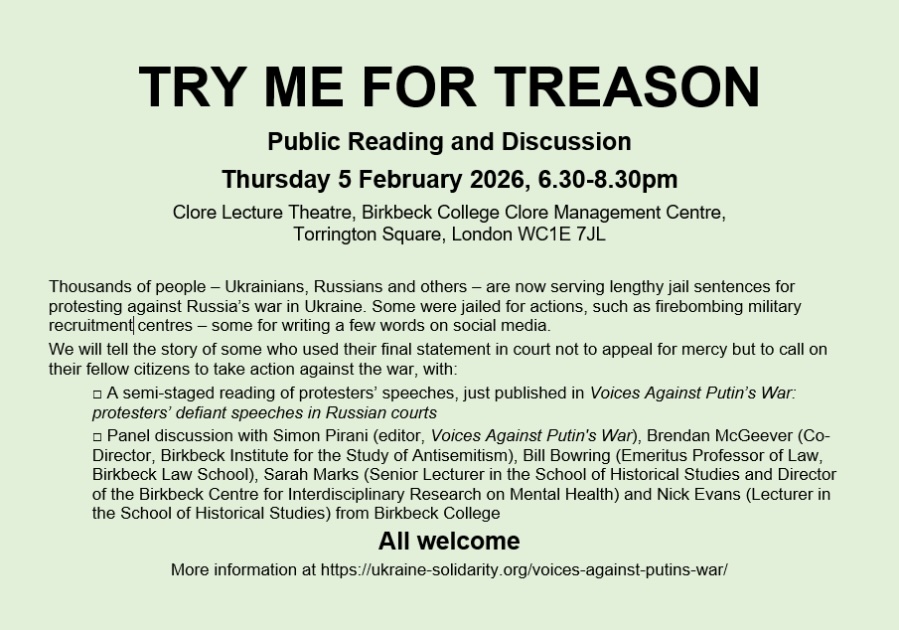


 Vsevolod Korolev