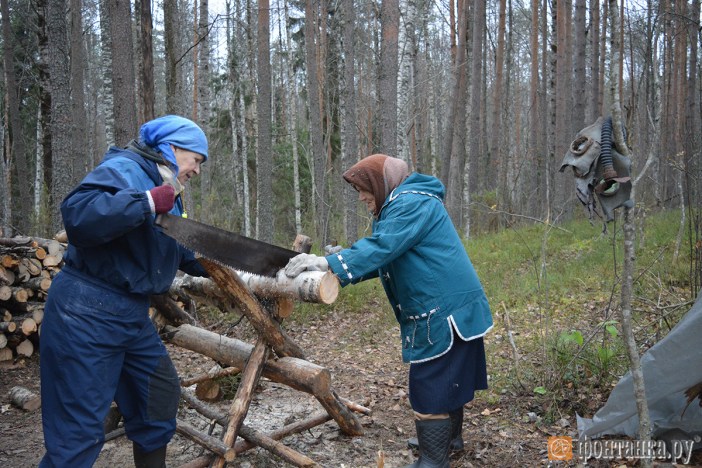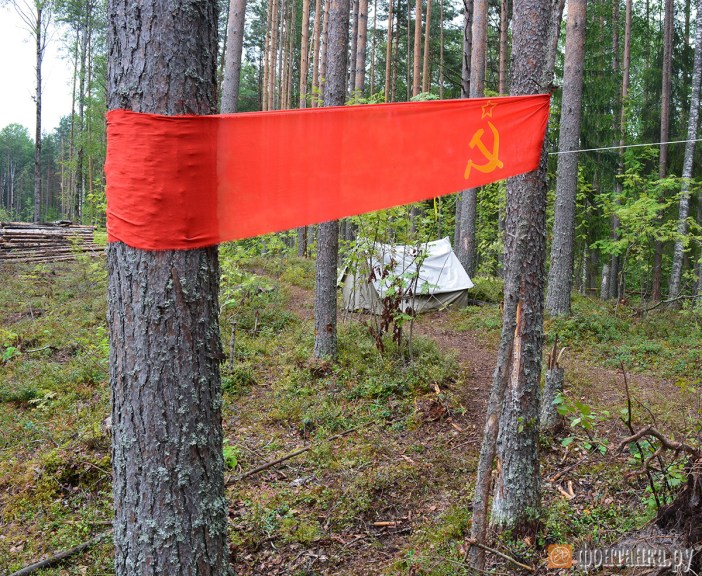
They Jump on Anything That Moves, Part 3: The Case of the New Greatness Movement

Arrests Made in the New Greatness Case in Moscow
Grani.ru
March 15, 2018

Arrests and searches have been made in Moscow in the investigation of the New Greatness movement. The first source to report the news was Kremlin Washerwoman, a Telegram channel associated with the security services. More detailed information was soon published by OVD Info.

The detainees included the movement’s leader, Ruslan Kostylenkov, and two female activists, Maria Lapina and a juvenile whose name has not been disclosed. They were taken to the Kuntsevo Interdistrict Office of the Russian Investigative Committee. The female juvenile detainee was escorted by her father.

It is reported that during one of the searches a list containing the names of ten members of the movement was confiscated. According to uncorroborated reports, FSB investigators were present during the search.

There is information the juvenile detainee had earlier been subjected to pressure from Center “E” (Center for Extremism Prevention), after which her employer demanded she quit her job.

Photos of the search, as published on Kremlin Washerwoman, show campaign material for the so-called Voters’ Strike, a leaflet printed with New Greatness’s platform, and a t-shirt emblazoned with anarchist symbols.

Screenshot from the Telegram channel Kremlin Washerwomen. “Searches taking place at the home of supports of an obscure organization by the name of New Greatness. The guys drink a lot and cannot pin down their views.”

After lunch, Kremlin Washerwoman posted a video showing Kostylenkov’s confession. Out of breath, Kostylenkov recites a memorized text, mentioning in particular plans for “organizing a tribunal for members of the ruling elite” and “practice in shooting and throwing Molotov cocktails.”

Screenshot of Ruslan Kostylenkov’s alleged confession. Courtesy of Grani.ru’s Twitter account

The movement’s website contains only a home page featuring a notification that the site would be launched on March 15, that is, today. It also contains a brief, two-paragraph description of the movement’s objectives.

“We are the ones who will awake a sense of their own self-worth in people and help the nations of Russian acquire the energy for reviving the spirit of victors,” reads the text. “Only together can we build a strong country the rest of the world will respect and take into account.”

At the same time, both “pro-regime” and “opposition” forces are criticized for “divvying up spheres of influence,” while “ordinary people vegetate in poverty and dishonor, having forgotten the plight of the Motherland in which they live is in their hands.”

Screenshot of the homepage of New Greatness’s website

New Greatness began posting on its VK page on December 30 of last year. In late January, the movement encouraged people to take part in a rally demanding the preservation of trolleybus service in Moscow. The capital’s mayor has gradually been replacing trolleybus lines with bus line, which has sparked protests by environmentalists.

In February, New Greatness launched a large-scale campaign to paste anti-Putin leaflets around Moscow. The movement signaled it was in favor of boycotting the presidental election. On February 25, its activists were involved in the Boris Nemtsov Memorial March in Moscow.

On February 26, a pinned post was published on the movement’s VK page that read as follows: “Our young, ambitious, and quickly growing organization needs your help. If you are finally ready for the fight and willing to sacrifice your time and strength for the sake of our Motherland’s future by working in strong team led by an energetic leader, then join us. To do that, you must live in Moscow or Moscow Region and write to the message inbox on this page. If you cannnot help out physically, help us financially!”

The message is followed by an electronic address for transferring money.

On the evening of March 14, the Telegram canal A Copper Spills posted a message that opened as follows: “Evidence that an extremist organization has been established has been uncovered.”

The post’s author claimed Center “E” investigators in Moscow’s Southeastern District had discovered that “unidentified persons” had established “a group accessible to all [VK] users, which posted information about the creation of an informal political association whose main activity is involvement in popular insurrections, revolutionary actions, and clashes with the authorities.”

“The evidence is there, but for now we’ll keep quiet about everything else. When the times comes, we will tell all,” the author of the post concludes.

Kuntsevo is located in Moscow’s Western District, not in the Southeastern District. Besides, none of New Greatness’s posts contain calls for clashes with the authorities. In this connection, it is difficult to give an unequivocal answer to the question of whether the post on A Copper Spills had anything to do with the recent searches.

Thanks to Comrade Sammakko for the heads-up. Translated by the Russian Reader

P.S. Not that anyone much cares (I’m not trying to be smug: I really don’t get the sense there are huge numbers of people either in my reading audience, Russia or the great wide world who genuinely care about any of this), but I think we can extract three takeway lessons rom the war the Russian security services and police have unleased against grassroots activists in recent months.

1. When the director of the FSB or Putin (I forget who) said the other day the FSB had “prevented” fifty or a hundred or six thousand “terrorist attacks” last year, what they really had in mind is juvenile operations and investigations like the one described in the article above. That is, perfectly harmless young people with “funny ideas” and “informal” lifestyles are turned into “terrorist groups” with a little ultraviolence from the so-called security services.

The key is to scare, threaten or torture the harmless non-terrorists into confessing their non-guilt and signing confessions before letting them see a lawyer. Then their gooses are cooked for good, because cases concerning “terrorism” and “public safety” more generally have been removed from the remit of jurors in Russia, meaning they are tried by judges who know in advance what verdicts they are supposed to hand down.

A jury of more or less intelligent people would look at the flimsy evidence and the forced confessions and be tempted to acquit the defendants. If the Bolotnaya Square defendants, for example, had been tried by juries of their peers, I have no doubt most if not all of them would have been acquitted.

2. It has become extraordinarily dangerous to call for a boycott of the March 18 presidential election. Activists who have been calling for a boycott have painted big targets on their backs, and the authorities have spent the last few months shooting at them with increasing ferociousness. Depending on their ideological leanings, the activists have been sentenced to more or less long jail sentences or branded “terrorists,” as seems to be the case with the unfortunates described in the Grani.ru article, above.

I could be wrong, but this “minor terror” alone should be enough to discredit the election in the eyes of anyone with a conscience. By voting on Sunday, you will be saying to the authorities they can terrorize with impunity anyone who criticizes elections in Russia too vigorously and loudly, although that is exactly what needs to happen.

3. The only way to beat this racket is broad-based solidarity, but as we have seen with the accused in the Penza-Petersburg “terrorism” case and even with many of Navalny’s nominal supporters sent off to jail or beaten up for god knows what reason, people occupying different political camps are not too eager to show their solidarity.

The poor folks from the utterly harmless and helpless New Greatness movement, I am nearly certain, will elicit no solidarity or support from anyone whatsoever, except maybe the lawyers from Agora or Public Verdict, if they are lucky.

This points up the biggest flaw in the Russian grassroots democratic movement (if such a thing exists): its clannish, extremely partisan notions of solidarity. There are very few political activists who cross party lines to show their solidarity with their nominal opponents, and this is a huge, crippling problem for the anti-Putin, pro-democracy movement if it wants ever to move forward for real.

When it comes to folks like the New Greatness movement, it likely means they will be railroaded and sent off to a penal colony for ten years or twenty years without so much as anyone but their loved ones even noticing it happened.

After all, even silly, harmless people have human rights, such as the right to an attorney, the right to a proper investigation, and the right to a fair trial. TRR

“The Presidency Is a Monarchist Atavism”: Sevastopol Security Forces Crack Down on Local Anarchists

Balaklava Bay, Sevastopol

Sevastopol Security Services Search Homes of Leftist Activists Planning Rally Calling for Presidential Election Boycott
Mediazona
1 March 2018

Security services showed up at the flat of the Vorobyov family in Sevastopol, members of the VK community group Anarchists of Sevestapol, activist Alyona Vorobyova has reported to OVD Info. According to Vorobyova, she and Artyom Vorobyov were not home when the search took place. Only their seven-year-old child and relatives were at the flat. It is not known which Russian security service conducted the search and in connection with what case.

Another Sevastopol activist told Mediazona a search was also probably underway at the home of anarchist Alexei Shestakovich: a large number of police officers had gathered outside his house. The activist surmised searches could also be underway at the homes of the Anarchists of Sevastopol group’s admin, Alexei Prisyazhnyuk, and leftist activist Igor Panyuta. The two men were currently incommunicado.

Shestakovich, Prisyazhnyuk, and Panyuta had planned today to submit a notification for a protest rally calling for a boycott of the March 18 Russian presidential election. The rally was to be entitled “The Presidency Is a Monarchist Atavism,” said Mediazona‘s source.

Shestakovich announced plans to submit the notification on the Anarchists of Sevastopol VK page.

“The event’s aim is to remind people of their constitutional right not to take part in election, to inform the populace about the rules for conducting a robust boycott, and to have a public discussion of self-government in society,” he wrote.

In addition, the local online news website Krymskie Novosti reported that Republic of Crimea Center “E” and FSB officers carried out a “mopping up of the republic’s anarchist cell.” As the website’s sources reported, searches had been carried out today at the homes of the cell’s leaders and members both in the Republic of Crimea and and the Federal City of Sevastopol.

“According to available information, this group of people planned provocations during the Russian federal presidential election, scheduled for 18 March 2018,” wrote Crimean news website Informer.

Informer claimed the Crimean cell had “kept in touch” with other radical leftist groups operating in Russia. Without identifying its sources, Informer also claimed the Crimean anarchists were financed by persons residing in Ukraine.

Update. OVD Info writes that masked men armed with machine guns came to the home of Anarchists of Sevastopol admin Alexei Prisyazhnyuk, confiscated his computer equipment, and took him to a police station. Mediazona has also been informed of a police search at the home of activist Ivan Markov.

Translated by the Russian Reader. This article has been lightly edited to eliminate several minor errors regarding local media sources. Thanks to Egor Skovoroda for the heads-up. Photo courtesy of Wikipedia

Xenophobia and Corruption Making Russia Less Attractive to Central Asian Migrant Workers

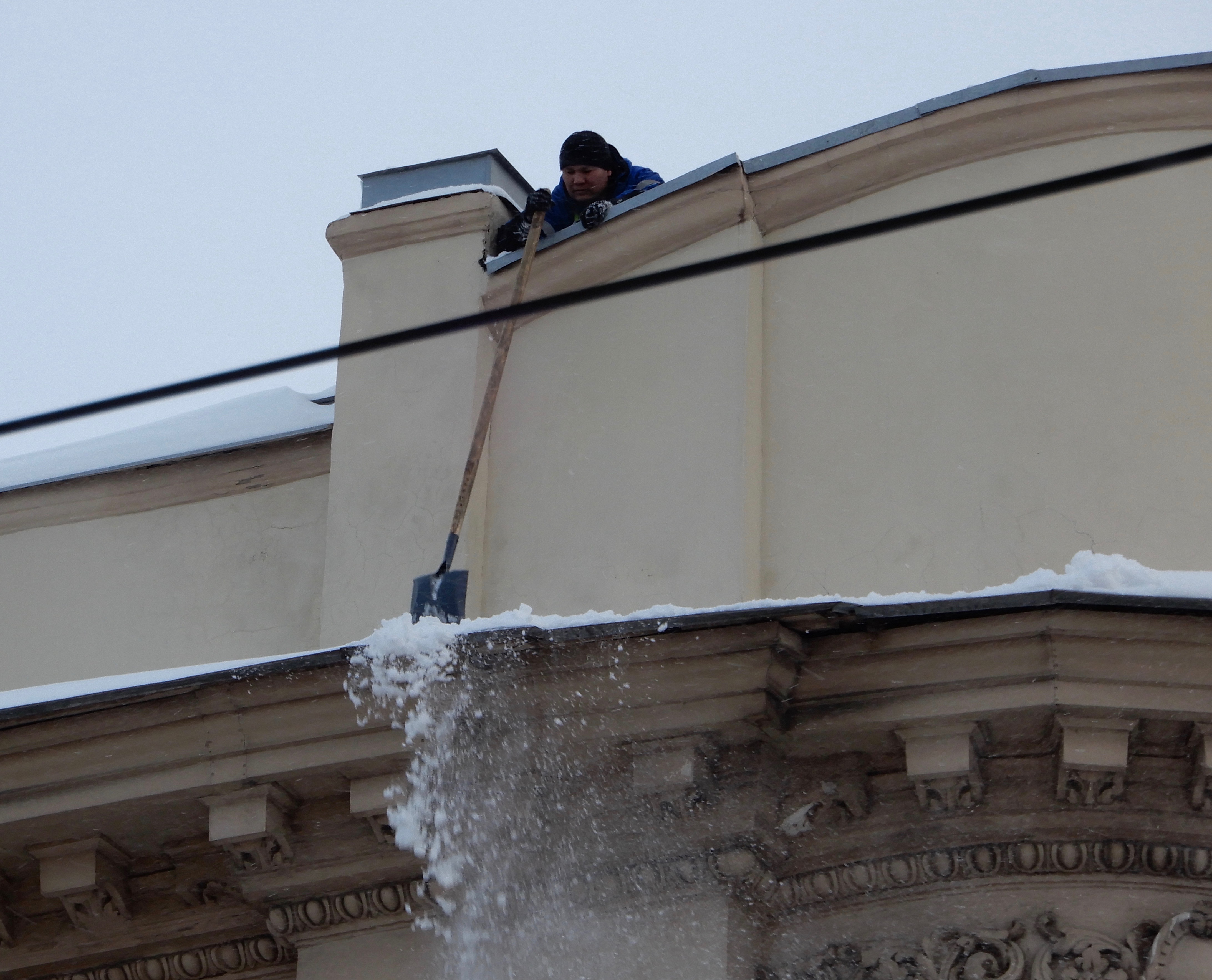
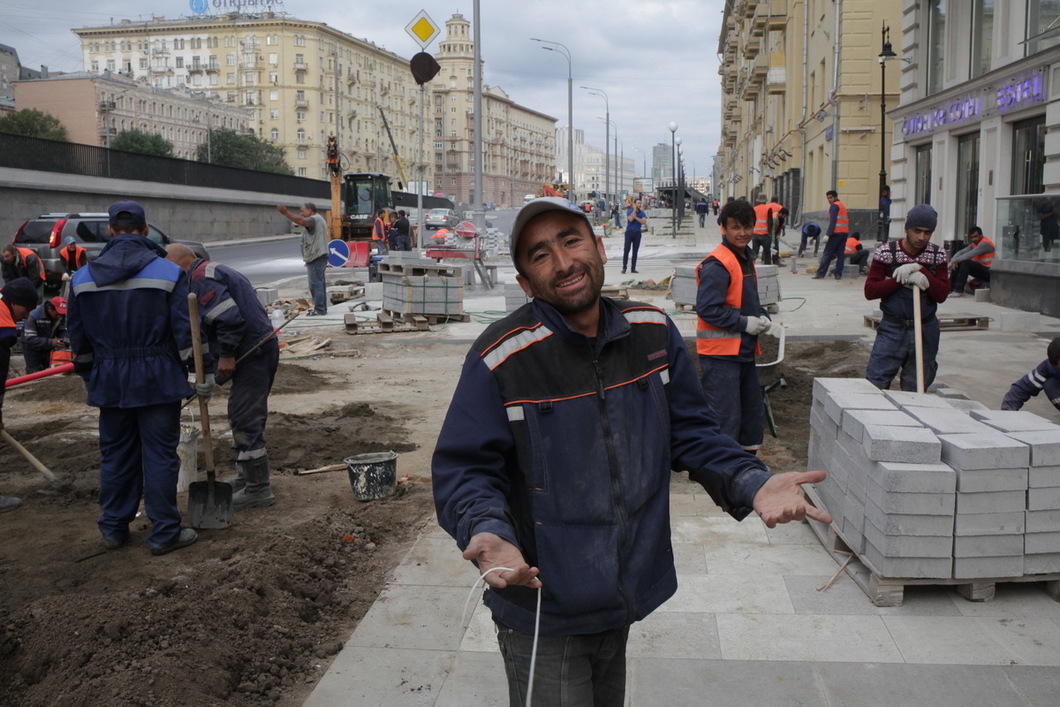
DSCN3525To give only one of a thousand examples, without Central Asian migrant workers, there would be almost no one left to do the heavy and, sometimes, dangerous work of clearing freshly fallen snow from rooftops and pavements during the winter. February 5, 2018, Petersburg. Photo by the Russian Reader

Fists and Epaulettes: Xenophobia and Corruption Making Russia Less Attractive to Central Asian Migrant Workers
Vyacheslav Polovinko and Yulia Reprintseva, with Madina Kuanova
Novaya Gazeta
February 5, 2018

Novaya Gazeta continues to investigate the lives of migrant laborers in Russia. In our last issue, we discussed the magnitude of the corruption faced by immigrants when they apply for resident permits and work permits (“Luck and Labor,” February 2, 2018). However, even when migrant workers finally obtain these papers, their lives in Russia are not made any easier.

Police, Open Up!
In the run-up to New Year’s 2018, detectives from the Perovo and Kuntsevo police precincts in Moscow detained 520 migrant workers. All of them were taken to a police station, where they were forced to stand outside in the cold from six in the evening to two in the morning. According to Valentina Chupik, head of the human rights organization Tong Jahoni (Morning of the World), only those who gave the police 10,000 rubles [approx. 140 euros] each were released. The police said they were collecting money “for celebrating the holiday.”

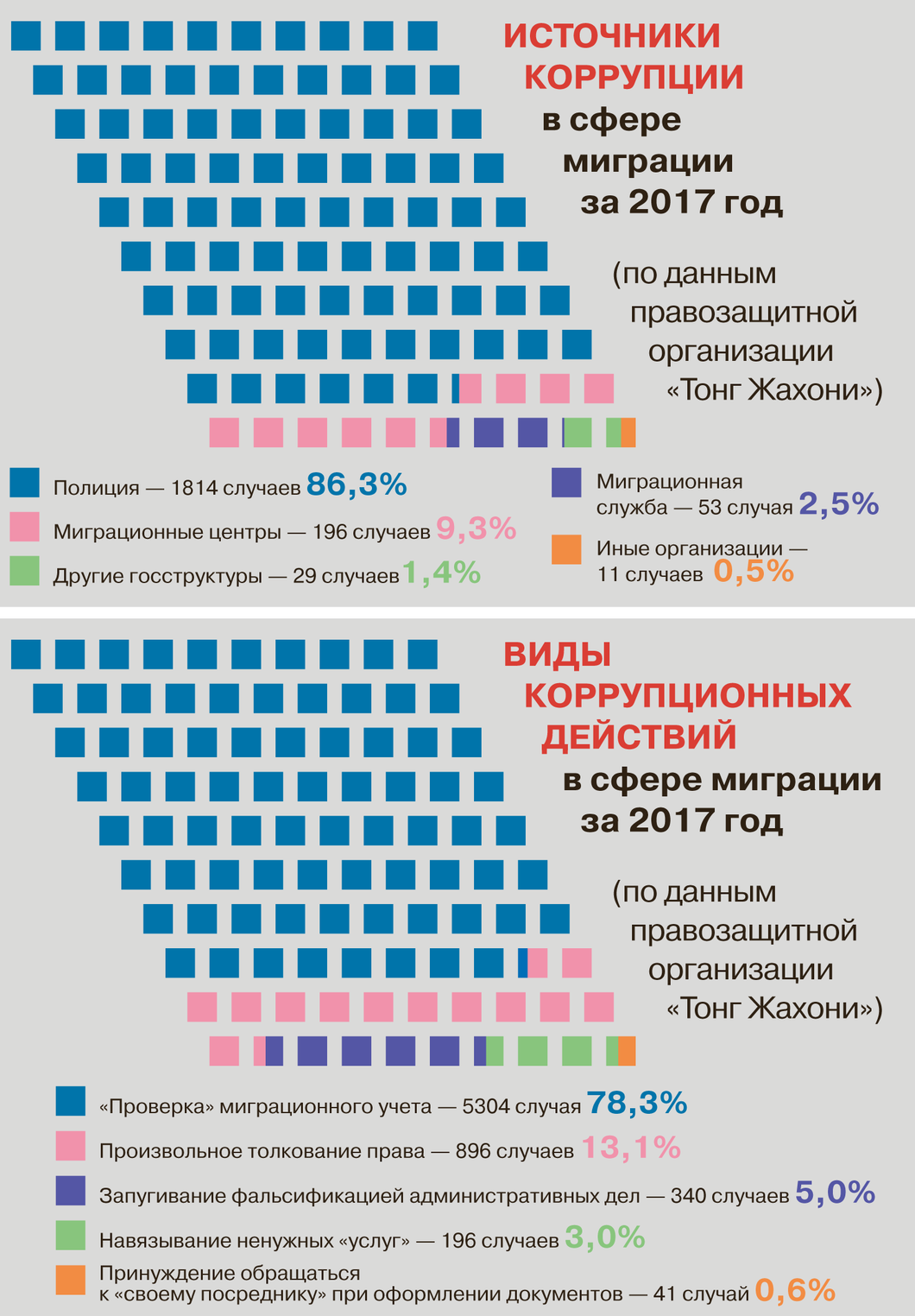
The police regularly hold such “celebrations” for migrant workers. In a ranking of offenses against immigrants, the police take first place with a large margin (86% of all complaints). Most often, the police extort money during groundless document checks.

“In Russia, the attitude is he is an Asian, so he’ll give us money,” claims Chupik.

In police stations, up to twelve migrant workers are held in seven-meter-square cells for forty-eight hours and not allowed to go to the toilet. Police sometimes assault them. In October 2017, according to human rights activists, the officers at Perovo and Novogireevo precincts in Moscow beat up 39 people.  It was a tough month, apparently.

“Volunteer work days” are another police practice. According to human rights activists, migrant workers were forced to repair a police station in the Moscow suburb of Mytishchi on April 21, 2017.

The migrant workers complain, but to little effect. In 2016, Valentina Chupik filed 6,232 complaints with various police internal affairs departments in Moscow and Moscow Region, but only four of them were passed up the command chain for further review. Meanwhile, the system for expelling migrants on the basis of police complaints operates without fail. In 2016 (there is no data for 2017), Moscow courts expelled over 14,000 migrant workers from Russia for living somewhere other than their registered domicile. They expelled almost 12,000 migrant workers for being in public without their papers on them.

“The main problem is the right the police have accorded themselves to check the papers of migrant workers for any reason,” says Chupik.

“Yes, they do have this obligation, but only when a migrant worker is involved in a criminal case,” she says.

According the Interior Ministry’s latest orders, even a neighborhood police inspector can check someone’s immigration status. He can write the person up for a nonexistent violation, which is immediately entered into a special data base. Two violations are sufficient cause for deportation from hospitable Russia, explains Chupik.

Curiously, at the same time, migrant workers are far from the most dangerous social group in Russia, formally speaking. Moreover, the number of crimes committed by migrant workers has been steadily declining, which has been noted even by the Russian Prosecutor General’s Office. As reported by Kommersant, according to the Prosecutor General, foreign nationals and stateless persons committed 41,047 crimes in Russia in 2017, which was 6.6% fewer than in 2016. In November of last year, Interior Minister Vladimir Kolokoltsev mentioned an even earlier nine-percent drop in crimes committed by migrant workers when presenting the new immigration policy. But what the top brass has said is not digested fully and immediately by rank-and-file police officers.

Commentary
Valentina Chupik, head of Tong Jahoni
State agencies and the police do not hate migrant workers because they are so despicable. The authorities pretend to hate them so it is less shameful when they rob them for their own profit. When you talk to on-duty cops, they claim eighty percent of crimes are committed by migrant workers. When you ask them to go to the Interior Ministry’s own website and take a gander at the stats, they switch to saying most crimes are committed by North Caucasians. Then they say, “Well, it’s just our policy.” When you tell them they should not implement a criminal policy because they are law enforcement officers, they get it. But they complain they have arrest quotas to fill. 
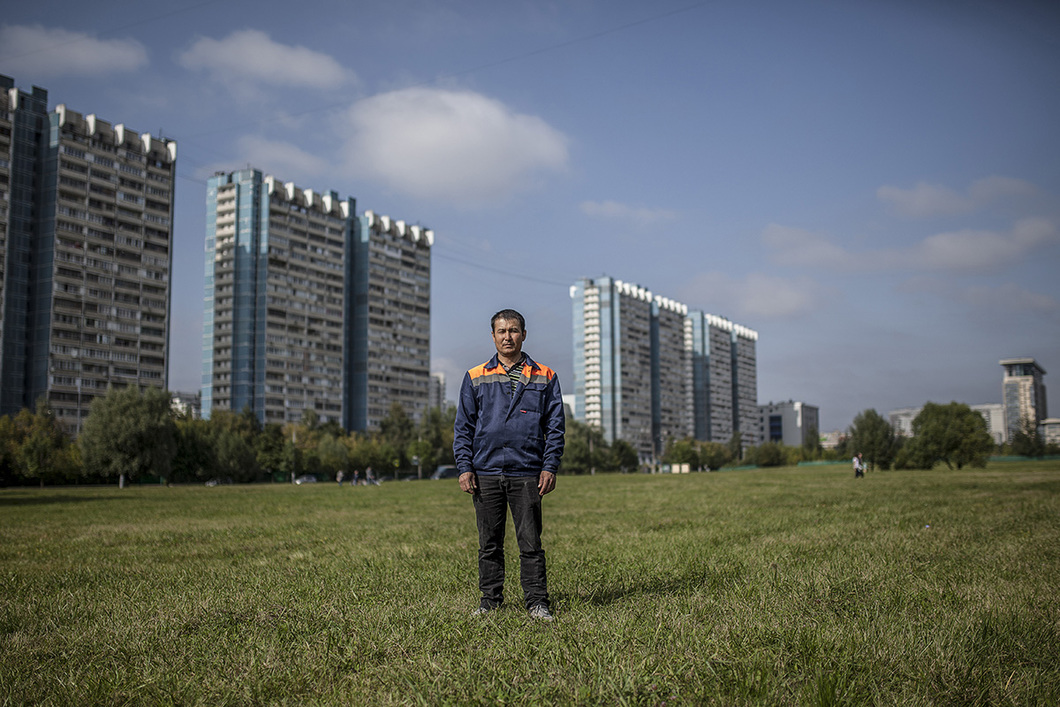
content_09
Muhiddin, a janitor. Photo by Vlad Dokshin. See Muhiddin’s story in Novaya Gazeta′s special project Muscovites

Xenophobia Has Momentum
On January 12, the body of 41-year-old Tahirjan Hamrayev was found in Noginsk, Moscow Region. Hamrayev had been stabbed over twenty times. Hamrayev left Kyrgyzstan as a migrant worker in May 2017 and got a job on the construction site of a multi-storey residential building. As reported by Kyrgyzstani media, the dead man’s mother, Hairins Hamrayeva, said her son was supposed to have come home for the New Year’s holidays, but decided to stay in Noginsk since his employers, impressed by his work, had offered him extra jobs. On the fateful day, Hamrayev went into a shop and fell into the hands of at least ten neo-Nazis, local law enforcement official claim, citing an eyewitness’s testimony.

In the various ultra-right groups on social media where the incident is discussed, commentators occasionally write languidly that Hamrayev got what was coming to him. Generally, after the security services were pressured by the Kremlin into mopping up the sector, nationalism and neo-Nazism have died out as phenomena [sic], and nowadays assaults on migrant workers have gradually become something out of the ordinary,although in Petersburg on January 31, for example, a Tajikistani national was attacked with a knife in the subway.

No one, however, has abolished xenophobia, which, although it has displayed a downward trend [sic], is still firmly entrenched in the minds of Russians.

In early 2017, Tong Jahoni published the findings of a study on nearly 50,000 housing rental ads in Russian media. Only one out of every twelve ads was free of xenophobic  insinuations. Most of the people who placed the ads wanted to rent their flats or rooms to “Russian citizens” (50%), “Slavs” (28%), and “ethnic Russians” (7%). The picture presented by help wanted ads was even more distressing. Only one in twenty ads among the 20,000 vacancies examined did not contain xenophobic allusions. Fifty-six percent of employers were seeking “Slavs” to fill the jobs, while 35% were eager to see “Russian citizens” in the positions.

Human rights activists say the situation is typical, and no one wants to change it for the most part. In turn, the media fuel the fire. In 2016, there were approximately 120,000 news reports involving migrant workers. News search websites focused mostly on crime reports, which constituted nearly 98,000 of the news reports filed.

However, the attitude to migrant workers on the part of the rank-and-file population is often quite neutral when they encounter each other face to face. Moreover, human rights activists can cite instances in which the police have helped migrant workers. But in terms of society at large, although xenophobia decreased by 10% last year, according to the official estimates produced by the Russian Federal Public Chamber, it still remains a serious problem. According to pollsters VTsIOM [sic], two thirds of the people they surveyed believed migrant workers took jobs away from Russian citizens.

Commentary
Alexander Verkhovsky, director, Sova Center for Information and Analysis 
There is xenophobia as a mass phenomenon: people’s attitudes and emotions. In this case, we can track changes through public opinon polls [sic]. I am quite glad that there is a growing number of people who, when asked about the feelings they have towards migrant workers (e.g., fear, apprehension, hatred, love), respond that they feel nothing, that they could not care less. The perfect relationship is precisely this, when people do not see a group as something that provokes emotions. They are just other people.

There is xenophobia as discrimination, when seeking employment, for example. Unfortunately, practical discrimination has been underresearched. What matters most is that people do not even perceive some forms of it as discrimination. For example, people are not ashamed to write in an ad that they will rent a flat only to a Slavic family. It is useless to fight this. It is a matter of the social atmosphere [sic].

Finally, the most aggressive form of xenophobia is physical violence. In recent years, the figures have been steadily declining. Just the other day, Sova Center published a new report based on the figures for last year. I would note there is not necessarily a meaningful connection with the decline of popular xenophobia, because assaults are not committed by the masses, but by ideologically motivated young people, who might have completely different opinions from the masses. This is more likely the consequence of a depression amongst radically minded young people. They are scared. They don’t really want to commit assaults [sic]. In the previous decade, they did not know the fear of God at all, as the saying goes, but then Center “E” [Russia’s “anti-extremism” police, established from disbanded anti-organized crime squads during Dmitry Medvedev’s presidency] went after them. Many street fighters went to prison, and this changed the situation.
content_Krasavchik_01
Shirinsho “Handsome” Vohidov, from Tajikistan. Photo by Anna Artemieva. See Shirinsho’s story in Novaya Gazeta′s special project Muscovites

Medical Disenfranchisement
When migrant workers take ill in Russia, it is no simple matter for them to recover.

“To enroll at a district outpatient clinic, you need to have a temporary residence permit or residence permit, permanent registration,” says Daniil Kashnitsky, a junior researcher at the Higher School of Economics. “However, a poor command of information and the Russian language, as well as a lack of legal knowledge, means that when migrant workers are yelled at by employees at the intake desk, they leave and do not come back. There are many such instances.”

There is the option of going to a private clinic, but sometimes only a state clinic can help, for example, when tuberculosis is diagnosed. It can help, but it is not obliged.

“Tuberculosis has a dangerous phase when it is communicable through airborne droplets. Patients must be hospitalized during this phase. They should stay in hospital until the tuberculosis bacterium goes away, and they are no longer a danger to others. This usually takes two or three months,” explains Kashnitsky.

If migrant workers are hospitalized due to an accident, the treatment is free, of course, but the attitude towards them will be correspondingly shabby. Last year, when a busload of migrant workers was hit by a train near Vladimir, killing seventeen people, the local hospitals treated several severely injured people.

“I asked that an injured child be sent to Moscow. Two days later, he died in our regional hospital. I remember the child. He was a year and a half old, from an Uzbek family. I said, ‘Why did you send him to our hospital? Call a helicopter and take him to Moscow: he’ll get better help there.’ I was told the decision had been made by the health department,” recounts Alla Boyarova, director of an employment agency for migrant workers. On the morning of the tragedy, her husband had rushed to help the affected immigrants.

Zoyir Karimov, Boyarova’s husband, is deputy chair of the Tajik diaspora in Vladimir. He recalls that the adult victims had huge problems.

“Two of them did not make full recoveries in hospital. They were not operated on and were sent back in this shape to Uzbekistan. They were told they could buy special plates, but they had no money. One broke his shoulder, the other, his leg,” says Karimov.
content_4
Infographic No. 1: Sources of corruption in the migrant labor sector, 2017, per information gathered by the human rights organization Tong Jahoni. Police — 1,814 incidents (86.3%); immigration centers — 196 incidents (9.3%); migration service — 53 incidents (2.5%); other state agencies — 29 incidents (1.4%); other organizations — 11 incidents (0.5%). Infographic No. 2: Forms of corruption in the migrant labor sector, 2017, according to the human rights organization Tong Jahoni. “Verification” of registration status — 5,304 incidents (78.3%); arbitrary interpretation of the law — 896 incidents (13.1%); threats by police to file trumped-up administrative charges — 340 incidents (5.0%); high-pressure selling of unnecessary “services” — 196 incidents (3.0%); forcing migrant workers to use a particular middleman when filing papers — 41 incidents (0.6%). Infographics courtesy of Veronika Tsotsko and Novaya Gazeta

Blockchain to the Rescue
It is tempting to dub what is happening in the Russian migrant labor sector a mess. In fact, however, it is more likely a restructuring of the system after the Federal Migration Service (FMS) was incorporated into the Interior Ministry in 2016. The relationship with migrant workers has changed because what the Interior Ministry does most of all is punish people. Many of the organizations that dealt with drawing up papers for migrant workers have been turned into limited liability companies, meaning it has become nearly impossible to monitor their policies, and human rights activists have huge gripes with the new state-run immigration centers. New law bills that have been tabled will only aggravate the circumstances, reducing migrant workers to semi-slave status in Russia.

The question is simple: what to do? At a January 29 meeting of human rights activists to discuss the issue of immigration (a meeting not attended by diaspora leaders) various proposals were voiced. Vladimir Khomyakov, co-chair of the grassroots movement People’s Assembly (Narodnyi Sobor), made the most radical and regressive proposal at the round table.

“We need the strictest possible oversight of each person’s stay in Russia, not just this buying a work permit and hanging out wherever you want,” said Khomyakov. “We need a system of mutual obligations. We need a single government agency that would deal with immigration and use a single database.”

People who intend to travel to Russia should obtain all the papers they need at Russian consulates in their own countries, and each migrant worker should be assigned an ID number under which all information about him or her would stored, argued Khomyakov.

Totalitarian oversight in return for peace and quiet.

But Khomyakov’s idea was not met with unanimous approval by round table participants, just like the proposal, made Vyacheslav Postavnin, former deputy head of the FMS and president of the 21st Century Immigration Foundation [sic], to move immigration registration online or, at least, make it obligatory for immigrants to check in with the migration service by telephone. Some human rights activists were outraged by the fact this would make it easier for terrorists to hide [sic].

“Terrorists never violate immigration laws. Terrorist acts are complicated operations. What, they are going to put themselves at risk of being stopped by police for failing to reregister on time?” Postavnin countered crossly.

He was told that hackers could erase or damage the entiere online database, to which the former deputy head of the FMS showed off his knowledge of the word “blockchain.”

“Even if you wanted to, you couldn’t erase it,” he said.

Tatyana Dmitrieva, deputy head of the Department for Coordinating Local Immigration Offices and Accountable Forms in the Immigration Directorate of the Russian Interior Ministry’s Moscow Office, did not like any of these proposals. She only remarked that the ministry wholly supported a new law bill that would punish legal entities for providing fictitious registration, and that a consensua had to be reached with regard to thorny issues.

The discussion’s moderator, Fyodor Dragoi, chair of the Committee for Safety, Public Diplomacy and Public Oversight at the Council for Ethnic Affairs in the Moscow City Govermnent, suggested drawing up a list of proposals after the discusssion, since “this tumor [could] burst any minute,” and the problem had to be solved.

Another, autonomous proposal has been made by the Center for Strategic Research (CSR), which has published its report on immigration. Recognizing a decline in migration flows from the CIS countries in recent years—2017 saw an increase the numbers of migrant workers from many countries, but the numbers have not returned to pre-crisis levels—the report’s authors propose their own measures for maintaining a migration flow of 250,000 people to 300,000 people annually, which they claim is a necessary number for modern Russia. In particular, they propose introducing something like a green card for highly qualified immigrants in order to stimulate the influx, as well as work cards that would make it easier to obtain a residence permit.

Something has to be done, since Russia will have lost thirteen million able-bodied people by 2030, but internal resources for population growth have been exhausted.
content_4
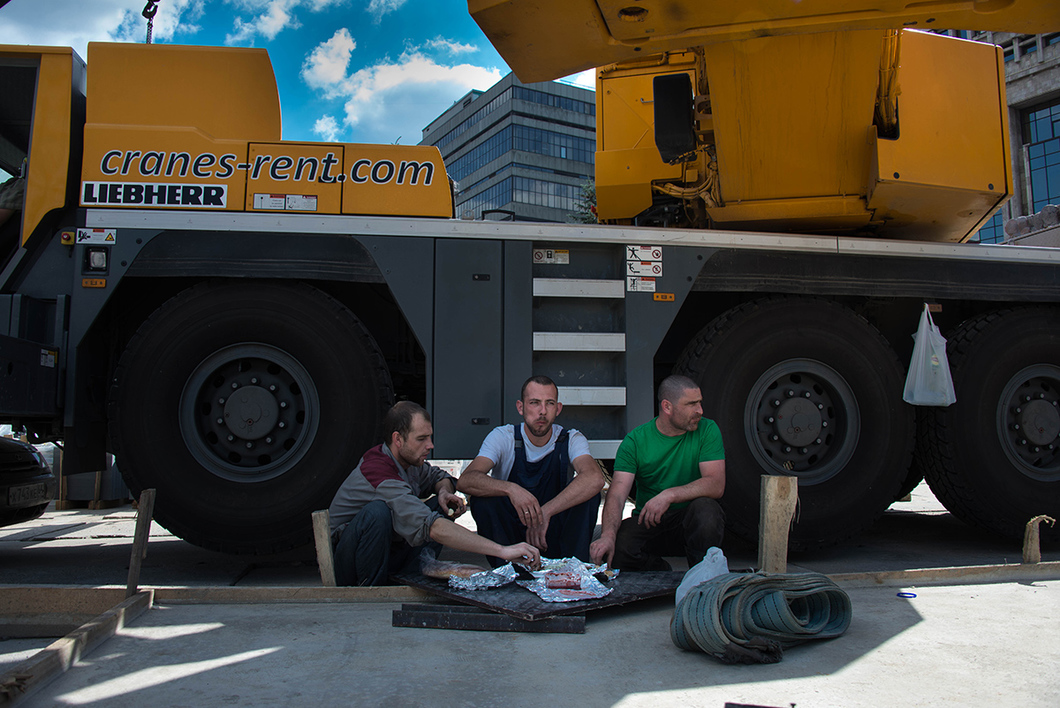
Viorel, a Moldovan, on a lunchbreak with his workmates. Photo by Viktoria Odissonova. See Viorel’s story in Novaya Gazeta′s special project Muscovites

The problem is that there are not unlimited numbers of highly qualified immigrants, and the ones there are drift in other directions. To take one example, the number of migrant workers from Moldova has decreased over the last two years by more than one and a half times, from 250,000 to 157,000. They have begun looking towards the European Union.  The number of migrant workers from the Eurasian Union has been growing, but their numbers are also limited, especially because Kazakhstani workers, for example, are needed in Kazakhstan itself, a country that, due to geographical proximity, grabs Kyrgyzstani workers away from Russia. The number of immigrants from Tajikistan have been growing steadily. On the other hand, while the number of Uzbekistanis coming to Moscow has grown over the past year, to a million and a half registered nationals, it would seem the numbers will eventually decline, since more convenient job markets have opened up to them.

“Turkey and the Emirates are currently very interesting and attractive to migrant workers from Asia,” says attorney Yulduz Ataniyazova. “The economy there is civilized, and there is a niche in the economy for unskilled workers. At the same time, the workers are provided with normal working conditions. For example, I know that in the Emirates migrant workers who clean houses and work in restaurants note that the cleaning liquids there are less harsh [sic]. This has now become important to them.”

However, the wages there are less than in Moscow, generally, but it depends on how you look at it.

“Uzbeks start doing the maths, and it turns out that here they will pay out more in bribes, whereas in Turkey a policeman would never approach them for no reason at all,” explains Chupik.

Workers from the CIS will keep coming to Russia for some time, of course. But if Russia toughens the rules for migrant workers, even the most desperate adventurers from the CIS countries will prefer, in time, to go somewhere else, to a place where they can work without risking their lives, health, and human dignity, not to mention their wallets.

Translated by the Russian Reader

NB. Perhaps I should have a three [sic]s and you’re out rule on this website, but despite the number of dubious or simply odd claims made by the article’s authors and the experts they quote, I thought there was enough important information and nontrivial viewpoints in the article to make it worth my while to translate and your while to read.

However, on one point—the claim that nationalists and neo-Nazis have come to naught in Russia, and hence the number of assaults on migrant workers has precipitously decreased—I was so bothered I turned to my friend W., a person who has been involved with immigrant rights in Russia both professionally and personally for many years. Here is their response.

“They are engaging in wishful thinking. Nationalism and neo-Nazism have not gone away. It has become very difficult to keep track of attacks. Officially, such reports are not welcome and are rarely discussed in the media. This is the current trend. None of this exists anymore in Russia, allegedly, while in Ukraine, for example, there has been a serious increase in anti-Semitism. According to the official interpretation, there is almost no anti-Semitism in Russia, although there were several egregious incidents in January. Basically, nobody cares about this business, and Jewish organizations mainly smooth over the potentially negative consequences of vociferous discussions.” 

I should also point out the folly of relying on public opinion polling data in an authoritarian country like Russia, where respondents can be expected to give what they think is the “right” answer out of a fear bred into the society in Soviet times.

Nevertheless, in the absence of free elections and other real political freedoms, the Putin years have been a boom time for the country’s main pollsters, VTsIOM (mentioned in this article), FOM, and the supposedly independent Levada Center. They have polled away with merry abandon, and Russian and international journalists, many of them too lazy or lacking the time to do real reporting, have become increasingly dependent on the utterly falsified portrait of “average Russians” the country’s troika of loyalist pollsters has been painting over the last eighteen years. I have dubbed the phenomenon “pollocracy” and discussed it many times on this website. TRR

Extremists (The Serial)
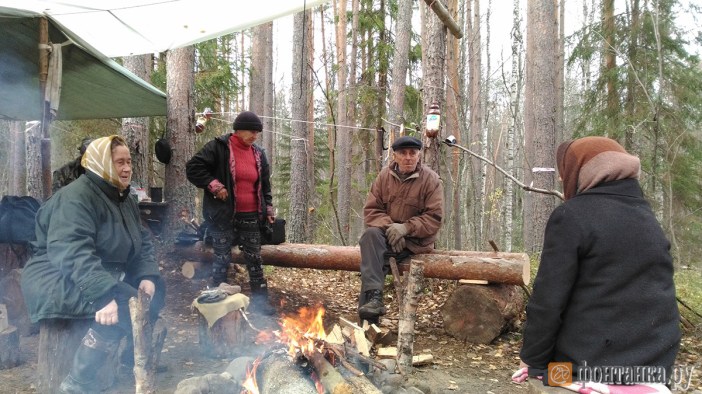
Extremists (The Serial)
Grani.Ru
December 29, 2017

92073Extremists

Hundreds of people throughout Russia are being prosecuted or have already been convicted for voicing their own thoughts, which the current regime does not like. The campaign against dissent has been masked as a campaign against “extremism.” Our video project’s goal is to acquaint you more closely with several so-called extremists. The FSB and the Interor Ministry have spared neither time nor effort in combating them.

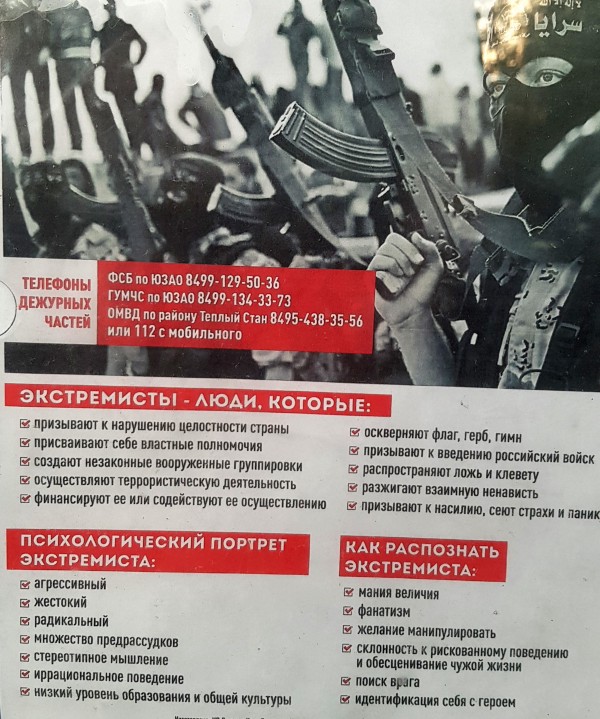
Propaganda represents extremists as dangerous people, ready at the drop of a hat to segue to terrorism. Posters hung on billboards in Moscow call on citizens to identify “extremists” on grounds such as the desire to manipulate, megalomania, identification with a hero, a low level of education and culture, and a tendency to risky behavior and devaluing the lives of others.

92070

“Extremists are people ¶ who call for destruction of the country’s integrity, ¶ try and seize power, ¶ organize illegal armed bands, ¶ engaged in terrorist activity, ¶ finance or facilitate terrorist activity, ¶ besmirch the flag, seal, and anthem; ¶ call for the introduction of Russian troops [sic], ¶ spread lies and slander, ¶ incite mutual hatred, ¶ call for violent, sow fear and panic. Psychological portrait of an extremist: aggressive, cruel, radical, many prejudices, stereotypical thinking, irration behavior; low level of education and culture. How to identify an extremist: megalomania, fanaticism, desire to manipulate, tendency to risky behavior and devaluing the lives of others, the search for enemies, self-identification with a hero.” The poster also includes local telephone numbers for the FSB, police, and Emergency Situations Ministry.

Do the subjects of our video project fit the propaganda portrait?

Krasnoyarsk resident Semyon Negretskulov really likes Scandinavia. His blog on the social network VK mainly dealt with Finnish history and modern life in Finland. When he posted a few texts about the Greater Finland project and historical photographs of Vybog (Viipuri) that was enough for the FSB to charge him with promoting Finnish greatness. His call to help political prisoners was also deemed extremism.

Danila Buzanov had to spend a year and a half in prison for an ordinary brawl at the VDNKh in Moscow. “Anti-extremism” police officers from Center “E” turned a fight with a vendor selling Donetsk People’s Republic paraphernalia into charges under Article 282 of the Russian Criminal Code: inciting hatred and enmity towards the social group “ethnic Russians/Russian citizens who support the Donetsk People’s Republic and Lugansk People’s Republic.”

Boris Yakovlev, a musician from the town of Dno, believes that sooner or later a revolution will happen in Russia. People are poor, the authorities are thieves. When Prime Minister Dmitry Medvedev said Russia had exhausted its limit of revolutions, Yakovlev reacted like this, “Hey,  Medevedev, who exhausted it? You, the Rotenbergs, the Putins, the Chaykas? We haven’t exhausted our limit, Medvedev. He doesn’t want revolutions. Kiss my ass, Medvedev! He doesn’t want revolutions. But we want them to get rid of you Medvedevs and all the rest. What part of his body does this guy think with, huh?”

The FSB regarded this and similar posts as calls to extremism. Yakovlev would have been sentenced to five years in prison, but he did not wait around to hear the verdict and requested asylum in Finland.

Darya Polyudova decided to troll the authorities, who in 2014 demanded the federalization of Ukraine. Polyudova organized a March for the Federalization of the Krasnodar Region. As a result, she was the first person in the Russian Federation to be convicted of calling for federalism.

Alexander Byvshev, a teacher of German in the village of Kroma in Oryol Region has gone to court to face a third set of charges for poems he wrote in support of Ukraine, and a fourth criminal case is in the works. More frightening than the revenge of law enforcement agencies has been the reaction of his fellow villagers.

These are just a few of the many hundreds of cases of Russians who have been prosecuted for words, opinions, and reposts. You can find a collection of banned “extremist” content at  zapretno.info.

Translated by the Russian Reader


The Poster Maker

“I’ll Go All Out to Ensure Putin Loses”
Yelizaveta Mayetnaya
Radio Svoboda
December 5, 2017

“Citizen Putin! If there is a clampdown on public liberties under the pretext of terrorists attacks, it will be clear to everyone who is behind them!”

“Putin is war. Say no to war!”

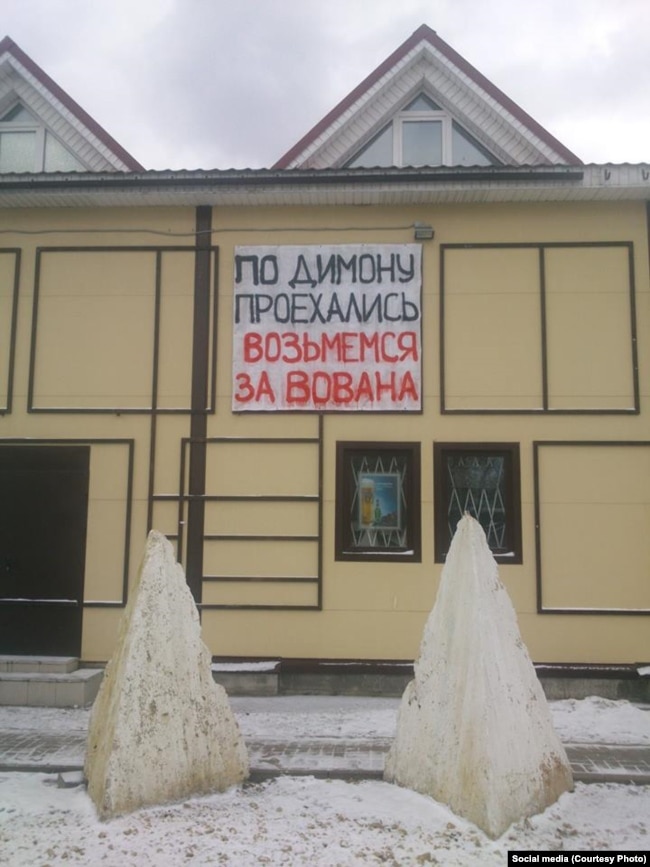
“Dimon got what was coming to him. Let’s go after Vovan.”

“We live the way we vote.”

Dmitry Skurikhin, owner of a store in the village of Russko-Vysotskoye, near Petersburg, reacts immediately and visually to every political event in Russia.

Skurikhin immediately hangs each new poster on the front of the store, a small, two-storey building, so it is readily visible from the nearby bus stop. They usually do not stay up for long, however. The record is held by the slogan “Peace to Ukraine,” which stayed up for two weeks.

На митинге Навального

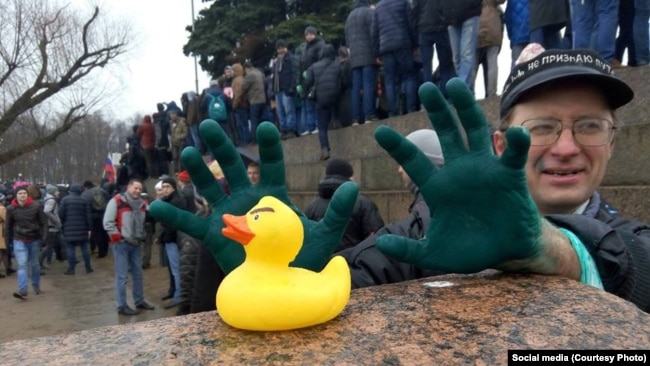
Skurikhin at a pro-Navalvy rally on the Field of Mars in Petersburg

43-year-old Dmitry Skurikhin is a local businessman, whose family owns three village shops. By local standards, he is well off. His family owns several cars, and they have everything they need. However, Skurikhin says the incomes of villagers have taken a nosedive in the past year: “They buy almost nothing, because they barely have enough for food.” Around six thousand people live in Russko-Vysotskoye. Very few of them are holiday cottage dwellers. The majority commute to work in Petersburg. Skirukhin was the first businessman in the village to open self-service stores, but “then the Pyatyorochka and Magnit chains moved in, and we croaked, of course.” He now sells toys, newspapers, clothings, and sundries.

He has been hanging political posters on his store, situated along a road, for almost four years. Before that, he pasted homemade bumper stickers on his car. Skirukhin recalls that the first bumper sticker read, “No new taxes!” The year was 2005.

Skurikhin: They had decided to raise taxes on us local businessmen then. It was one of those taxes you couldn’t avoid paying. Either you worked and paid the tax or you didn’t work and didn’t pay the tax. We businessmen realized they were clamping down on us. We joined forces and beat back the tax. It made such an impression on me that since then I haven’t been able to stop going. There are at least some improvements in our lives, specifically in our village. I’m a local grassroots activist, not even a region-wide activist, but a village-level activist. I was born here, and I live and work here. My kids go to school and kindergarten here. I think I have helped improve life in our village.

Radio Svoboda: How exactly have you improved life in the village?

Skurikhin: As they call it now, I was a municipal district council member from 2009 to 2014. At the time, our district authorities were running this interesting scam. They were “milking” the villages. They would buy heat from the producer and sell it to residents. They marked up the price one hundred percent. When the situation had reached a deadlock, it transpired they were charging residents, but not paying the producer anything. They were getting heat for free. The chair of the district council was mixed up in the scam. Thanks in part to my efforts, the gentleman was conveyed directly from the district chairman’s office to prison. That was in May 2012. Since then we haven’t had any disasters with our supply of heat and water.

We still have problems sometimes, but we are now longer in that disastrous state when a group of people affiliated with district officials were just robbing people by latching onto the flow of payments for housing and utilities. Then we had problems with the road. I organized a decent protest rally. A lot of folks turned out for it: 165 people, which is a huge number for our village. We demanded the road be repaired. The road was repaired. So, by starting with small changes like that, stirring people up, I have been trying to bring them round to the idea that fair elections, free speech, and democracy mean improving the welfare of society. On May 1, we had a rally that wasn’t about the roads (we’ve had the roads fixed), but was about healthcare, fair elections, and responsible authorities. Those were the topics of our rally. 45 people showed up. The rally was authorized. I always try and authorize events with the authorities, but we rallied at the skating rink on the edge of the forest.

Кто будет следующим

“Dimon got run over. Let’s go after Vovan.” This is a reference to Alexei Navalny’s film documentary exposé of Prime Minister Dmitry Medvedev and his untold riches, Don’t Call Him Dimon. “Vovan” is a humorous reference to Vladimir Putin.

In 2014, my time as district council member ended for a simple reason: our team doesn’t pay for votes. If you don’t buy yourself votes, meaning if you don’t pay off the right people during early voting, then you’re out of the race, because your opponents do pay for votes. United Russia paid 1,500 rubles per vote! All the other candidates lost.

Radio Svoboda: Did you prove in court they paid for votes?

Skurikhin: It’s impossible to prove in court, because the scam is quite competently organized. They don’t buy votes, but pay for the services of fake campaign workers, meaning they contract out their campaign. United Russia has a team of between ten and fifteen people, depending on the number of seats that are up for grabs in a specific municipal district, and they hire canvassers. But the canvassers don’t have to canvass. They just need to show up and vote ahead of time, for which they are paid 1,500 rubles a pop. That’s it. It’s perfectly legal. All the evidence is circumstantial. When I tried to get hired as a canvasser in a neighboring village, I was told I would not do, because I wasn’t registered in that precinct.

“How’s that?!” I said. “I’m a local resident. I have a store here. I know everyone in the village, and they all know me. I’ll canvass for you like nobody’s business.”

“No, no, you don’t fit us.”

“What’s the deal?”

“You’re registered somewhere else.”

It’s all clear, guys! You don’t need canvassers: you need voters, whom you buy off for 1,500 rubles apiece. I dubbed the technique “bribing a voter under the guise of paying a canvasser.” It works like a charm in all the villages, where the populace is not too savvy. The populace in general is not very savvy, but in the countryside it’s just unbelievable. The salary in these places is commonly 1,000 rubles a day [approx. 14 euros a day]. People who get a 1,000 rubles a day don’t suffer. I ran a counter-campaign against this.

When the villagers were going to vote, I would say to them, “Guys, are you really unaware that when they get seats on the council, they’ll shake a hundred times more out of your pockets?”

“I toss manure on a farm with a pitchfork for a 1,000 rubles a day. But here I’m getting 1,500 rubles for five minutes of my time. Maybe you’d like to go and pitch manure for me?” one guy told me.

That’s their whole rationale! There’s nothing more to say.

Radio Svoboda: When did you hang the first political banner on your store? How long did it stay up?

Skurikhin: It was the spring of 2014. My fifth daugther was born then. I decided to give my wife a present by building a politicized bus stop opposite the store. I fashioned the frame and the foundation. We didn’t have a stop there. People would always stand outside there, and the buses would stop to pick them up. I built a bus stop and draped it with posters. This was when the annexation of Crimea was happening. We had a couple of posters about Crimea: I demanded an end to the disgrace. Then there were posters demaning pay rises for ordinary doctors and school teachers. I was still a council member. I gathered information on how much doctors were paid in Russia. President Putin had literally just claimed that there were no doctors in Russia who were paid less than the average monthly salary in their regions. That was an outright lie. I wrote it on my poster, because I knew how much our doctors were paid. I had gathered the information in my capacity as a municipal district council member.

Radio Svoboda: How much did doctors really make then?

Skurikhin: The ophthalmologist in our village was paid 14,000 rubles, while the average monthly wage in Leningrad Region was 35,000 rubles. I think this as an absolutely proven lie. I hung it up on the bus stop. The local authorities were completely shocked by it. The stop had been turned into a shelter and was hung with banners and pasted with posters. They didn’t know what to do, so the posters stayed up for three weeks or so, I think. Then a major from Center “E” [the so-called anti-extremism police] in Petersburg came and had a long chat with me. That was April 1, 2014. I remembered the date, because it was the day the Russian State Duma issued a resolution condemning restrictions on freedom of speech in Ukraine. And I was sitting there chatting with this little vampire who was directly threatening me and my business.

“We will shut you down if you don’t stop it!” he told me.

The bus stop stood for a month, and then it had to be demolished. All that’s left is the concrete slab, where locals still wait to catch the bus.

Radio Svoboda: Who demolished it?

Skurikhin: I did, on orders from the local authorities. They told me either I had to demolish it and haul it away or they would do it themselves. Since then I have been hanging posters on the store.

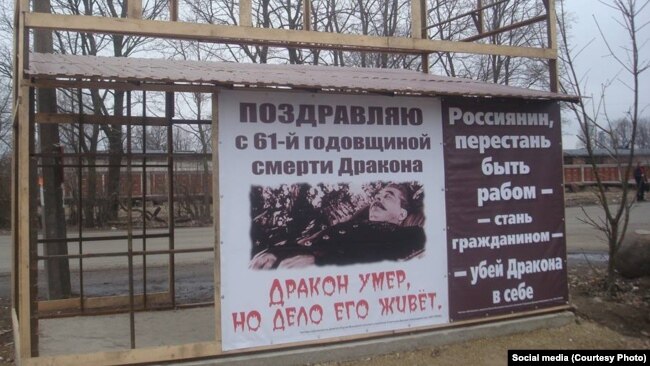
I hung up the poster “I congratulate you on the 61st anniversary of the Dragon’s death. The Dragon is dead, but his cause lives on. // Russian citizens, stop being slaves. Become citizens. Kill the dragon inside you.” The poster, which showed Stalin in his casket, used to be coupled with the second part, about citizens, which was swiped by the polizei. The poster “Peace to Ukraine” broke all the records: it hung for two weeks.

Вторую часть плаката

The second part of this poster, featuring a dead Stalin and a call to “kill the dragon inside you” and “become citizens” was “swiped by the polizei.”

The local authorities, by the way, didn’t know how to react. The poster was hanging on my building. It’s my property and my land, and the poster belongs to me. It hung there for quite a long time. Other events took place, for example, the 2014 elections. I hung my campaign posters there. As a municipal district council member, I was competing for votes. I would hang up a poster. It would become stale, and I would hang up a new one. And then, when I clearly campaigned against Putin. . . For example, I had posted a banner reading, “Putin should resign.” It was 9.4 meters by 2 meters. The banner caught everyone’s eye: my store stands next to the road. Well, they just came and swiped the banner. I decided to hang up another banner. Since it was forbidden to demand Putin’s resignation, I demanded Putin be freed. Since he considered himself a galley slave, I wrote, “Free Vladimir Putin! Let’s free this galley slave. Otherwise, he and his pals will row [rake in] too much.” This banner was also 9.4 meters by 2 meters.

Radio Svoboda: It was probably removed immediately, no? 

Skurikhin: I don’t know why, but it stayed up for nearly two weeks. I saw policemen come and look at it. Maybe they didn’t get it? I can’t say how the authorities make decisions. But then they removed it anyway. I have been doing this on purpose. My goal is to ensure President Putin loses this election. During the last election, in 2012, I printed flyers and ensured that Putin got the least number of votes in our district in our precincts, although he won anyway, of course. Our precinct was among the ten worst precincts in Leningrad Region. Numbers decide everything in a democracy. I worked on the electorate the best I could.

Radio Svoboda: Do the security services often summon your for talks and try to reason with you?

Skurikhin: Earlier they did, but recently they have left me alone for some reason. I think they just realized, probably, that they should be talking to me in handcuffs, whereas talking to me just for the heck of it, what’s the point? Besides my chat with the major from Center “E,” a major from the FSB, a colonel from the FSO (Federal Protective Service), and the Investigative Committee summoned me. Each of my posters has been sent off for a forensic examination. Policemen photograph them, and the photos are sent to Center “E” and Saint Petersburg State University for analysis: they have this forensics examination center there. Their forensics experts study my posters and render their findings. If the findings are neutral, the posters are returned to me, accompanied by an official ruling refusing to file criminal charges against me. I’ve had around a hundred such posters. Each one is also accompanied by a description. The police also try to do everything by the book. In Nazi Germany, they incinerated Jews by the book. Here in Russia, they have been trying to shut me up by the book, to put it crudely.

Radio Svoboda: What grounds do the police have for removing posters from private property? How does it usually happen?

Skurikhin: First, they get a complaint either from the local council or from a resident: someone is unhappy with the poster hanging on my store. The police arrive and write me up for violating the regional law that all posters must be vetted with the local council. This little law was invented in Leningrad Region. I disagree with it, so I simply say it wasn’t so. They write me up, then they bring a slave from the local housing authority, whom they force to climb up and remove my poster. Then they leave. After which the situation proceeds as I’ve described it. Unfortunately, the forensics experts have concluded that two of my posters insulted the honor and dignity of the president and incited social discord. I try not to insult anyone. I think through all my posters and make sure that they are worded as properly as possible, because you don’t help things by insulting people. I want to persuade people to vote against Putin, persuade them we need democratic values, freedom, and liberalism. Yet two of my posters have been deemed insulting to Putin. They were the reason I was summoned to the Investigative Committee to talk with an investigator.

Radio Svoboda: Have criminal charges been filed in connection with the two posters?

Skurikhin: You know, I haven’t asked the police about it. But they did get me summoned to the Investigative Committee, where I was asked for an explanation. I was shown the findings of the forensics experts. The poster in question was “Putin is war. Say no to war.” As you remember, it was Anna Politkovskaya who said, “Putin is war.” The slogan was written with bloody smudges, so there was nothing in particular to interpret. It was clear as clear could be. The poster was deemed to have insulted Putin’s honor and dignity. I don’t think I insulted him, but the Investigative Committee does.

Radio Svoboda: What war did you have in mind when when you wrote the slogan?

Skurikhin: Any war. Because Putin is, in fact, war. We were flattening Ukraine at the time.

Radio Svoboda: Have they threatened to close your business?

Skurikhin: The major from Center “E” threatened me, but no one else has. It’s just I’ve been in business for twenty-one years, and all the agencies they could sick on me, I’ve been working with them for a long time. I have a good relationship with them. Most important, all of them are on my side. As they’re tearing down the posters, the policemen say to me, “Damn, what you write is true.” But they’ve taken an oath, they have their orders, they would immediately get hell from their commander, so they can’t say it that way. I can because I don’t have a commander. Firefighters, the guys at Health Inspection Services, they all understand what is happening in Russia. Most of them are smart people.

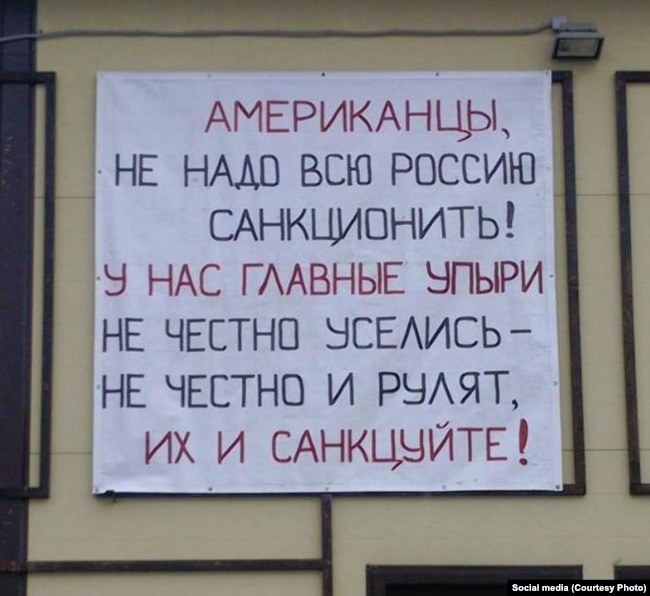
Против кого на самом деле надо сакции вводить

“Americans, don’t sanction all of Russia. Our head vampires got their jobs dishonestly and run things dishonestly. Sanction them!”

Radio Svoboda: Does your family support you?

Skurikhin: Yes, of course. Sure, they worry about me. The situation in Russia is such that the most active dissenters are shot down. My kids are aged nineteen, fourteen, seven, and four. All of them are girls: I live in a flower garden. If I’m arrested, my wife will feed the family: she’ll be like Vassa Zheleznova. I hope it doesn’t come to that, but we’ve talked it all throgh, of course. So that’s why I try and write slogans that are legal. I have studied a ton of material on the subject. What is an insult? It’s when you compare someone with an animal. The rest can be offensive and unpleasant, but it is not insulting in the criminal sense. You can say, “Skurikhin, you’re an idiot.” Yes, it’s possible for you to have this opinion. But I think differently. But if you say, “Skurikhin, you’re a jackass,” that is an insult.

Radio Svoboda: Have other businessmen put up similar posters?

Skurikhin: There were elections to the State Duma in 2016. As a member of Parnas (People’s Freedom Party), I ran in them in my own electoral district, the southwest  district of Leningrad Region. Sergey Naryshkin, now our top spy, ran in the same district. I made the rounds of all my businessmen friends and asked them to support me. I made banners that read, “Skurikhin and Parnas are your only worthy choice.” In our part of the world, most of the shops are village shops, and they are on private property, so I was able to hang them up for free. No other candidate got that kind of support. The rest had to pay for billboards. I spent 150,000 rubles on my election campaign. My wife later gave me a piece of her mind about that. I took second place in the elections in my own village. Only Naryshkin got more votes. I got support for my posters and ideas, for saying “Putin should resign.” My fellow villagers gave me the number two spot. In my native Lomonosov District, I took sixth place, and I took eighth place in the entire electoral district, which has a population of 500,000. What does that tell you? I would argue the outcome shows that liberal and democratic ideas are popular in society, but they simply never get conveyed to the voters, since the media are totally blocked. I have no other way of telling people Putin should have been dismissed from the Kremlin long ago. I only have my posters. But, generally speaking, it’s very hard for a Parnas member to get around United Russia on the first try.

Radio Svoboda: Do you attend all protest rallies?

Skurikhin: Yes, I try to go to all of them. At the last pro-Navalny rally, in June, I was wearing a “Sick of Him” t-shirt and carrying a flag. I was taken to a police station, but I escaped. This year there were also primary elections—Naryshkin gave up his seat in the Duma when he was appointed head of the SVR (Foreign Intelligence Service) in October 2016—and this year there were reelections. We also held events that, in my opinion, were meaningful to our district. I couldn’t let my people down, so I had to hightail it from the police station.

Radio Svoboda: Are you following the presidential campaign?

Skurikhin: Yes, of course. I’ll go all out to ensure Mr. Putin loses the election, at least in my precinct. I support Navalny’s registration as a candidate and Ksenia Sobchak’s candidacy, because we need as many candidates as possible in the first round just to take votes away from Putin and get a second round. If there is a second round, that will be a significant victory in itself.

Thanks to Comrade Uvarova for the heads-up. Translated by the Russian Reader

“Are You Freezing?”: Police Crack Down on Protesting Russian Truckers Again

Protesting Truckers Make Political Demands
On Anniversary of Anti-Plato Protests, Police Were Lying in Wait for Activists at Famous Parking Lot in Khimki and Quickly Detained Them; Ambulance Summoned to Courtroom
Dmitry Rebrov
Novaya Gazeta
November 12, 2016

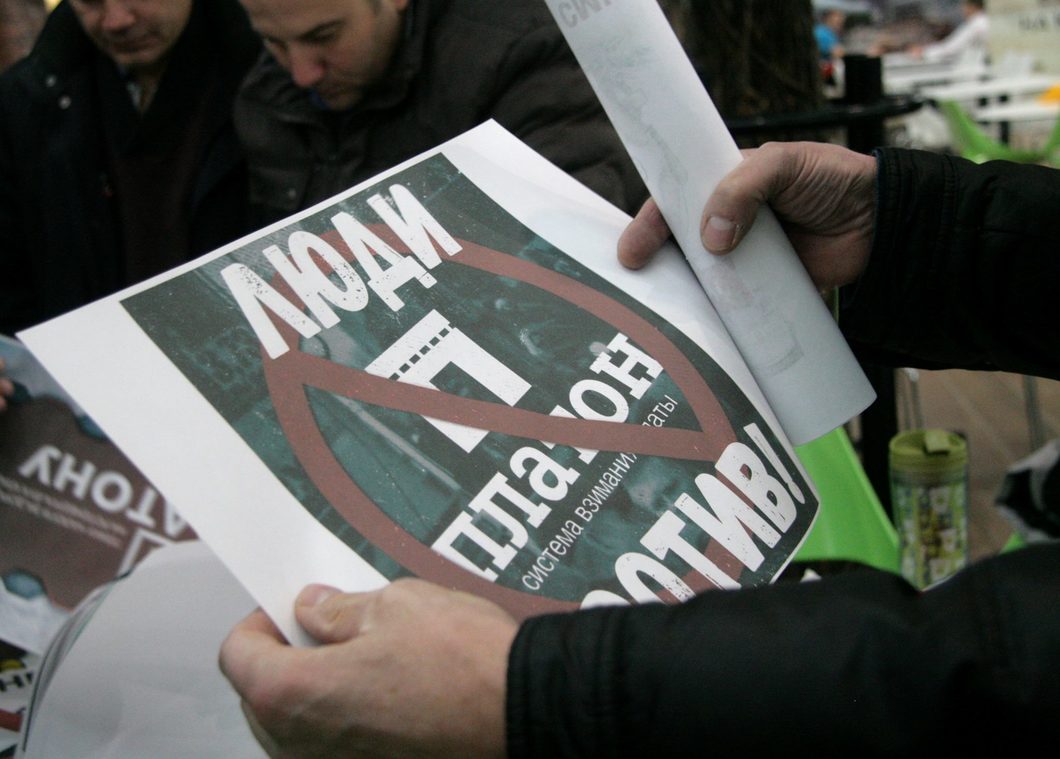
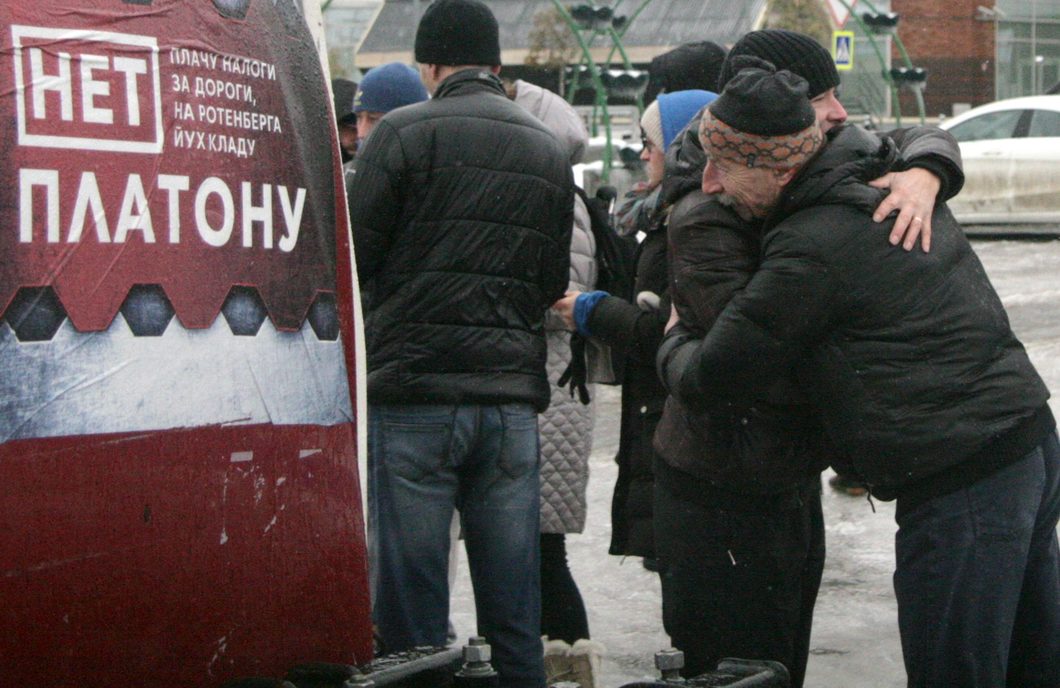
The problems with the “anniversary”—it was exactly a year ago, on November 11, 2015, that Russian truckers kicked off their protest against the newly introduced Plato road tolls system—started long before the D-Day designated by the Association of Russian Carriers (OPR). On November 9, it transpired that the Khimki mayor’s office would not permit them to gather at their old spot under the MEGA sign, the place where trucks had stood parked for nearly six months.

The truckers responded by decided to replace the rally with a series of solo pickets, but problems arose in this case as well. First, the truckers, who had been going to the parking lot and checking it out over the course of the year, were not admitted to the site of their former camp. Arriving twenty-four hours before the start of the pickets, Mikhail Kurbatov, one of the movement’s leaders, discovered signs saying, “Truck traffic prohibited,” and a police squad who forcibly removed him from the parking lot. A video showing the police twisting his arms has already been posted on the web. And on the morning of the eleventh, it was discovered that maintenance services had managed to pile the spot itself with snow, given that the weather was forthcoming.

However, a genuinely cold reception lay in store for the activists.

“People versus Plato!” Photo courtesy of Dmitry Rebrov/Novaya Gazeta

“There will be protest rallies today in twenty-two regions, so there aren’t so many people here. All the activists have gone to their home regions to rock the boat. But Muscovites have bitten the bullet and installed Plato, because it costs to protest, and we are not a united group,” said activist Igor Melnikov, standing next to a blue truck emblazoned with the OPR logo.

He was trying to explain why no more than a dozen people had assembled for the rally.

Melnikov is a Muscovite himself, just like the five regular volunteers who have been helping the Khimki protesters since last winter.

“Not everyone would choose to travel to Khimki in this weather,” Melnikov continued. “That is partly why, in place of the banned rally, it was decided to hold a big rally on Suvorov Square in Moscow on November 12, and restrict ourselves to a small detachment here in Khimki.”

The rally in Moscow has been supported by the Communists.

“What of it? I know who the Communists are, that they destroyed my country. I grew up under them. But that is okay. They can hold the microphone. We’ll live through it!” Yekaterina Bolotova, a perky brunette, put in her five kopecks.

Bolotova, a private entrepreneur, lives in Lyubertsy. She has been in business since the 1990s.

While we were chatting, a grader kept shoveling dirty snow towards the MEGA sign as freezing rain fell.

“There is already more than three of you. What are you doing here?”

A delegation from the Moscow Regional Criminal Investigative Department had arrived to test the waters. Two gloomy figures, both dressed in black, approached us, obviously reluctantly. The larger of the two men showed us his ID: “Oleg Nikolayevich Kuznetsov.” The second man did not show us his badge, but explained the reason for the visit.

“The bosses sent us.”

“Speaking frankly, we’re expecting certain people,” the cops said in a roundabout way. “The people who are going to protest Plato.”

“We are those people. What else do you want?” the truckers unceremoniously informed them.

“No to Plato. I pay taxes for roads. I could give a flying fuck about Rotenberg.” Photo courtesy of Dmitry Rebrov/Novaya Gazeta

The police then withdrew, asking us not to photograph their faces.

“I’m a secret agent. My face cannot be published!” said “Oleg Nikolayevich Kuznetsov” self-importantly.

“Well, if you’re so secret, why don’t you stay at home, since we can’t look at you?” a trucker retorted.

Meanwhile, a paddy wagon and reinforcements were pulling up at the impromptu checkpoint behind them.

“We now have political demands. In addition to abolishing the Plato system, we want transport minister Maxim Sokolov to resign, Prime Minister Medvedev to resign, and the repeal of Article 20.2 of the Russian Federal Administrative Offenses Code, which covers violations at political rallies, because it is insanity. People are no longer able to voice their opinions,” said Kurbatov.

According to the OPR’s official website, the truckers propose leaving only the fuel excise tax intact and scrapping the transport tax. They support judicial reform, including the recertification of all judges. And they want “all embezzlers to face criminal charges.”

Some of these demands are a natural response to the endless jail terms and arrests the once apolitical truckers have faced.  Other demands have emerged in the aftermath of discussions with political activists who regularly visited the protest camp last winter.

Looking for the “Core” Activists

“Are they making arrests?”

“He raised flags on his trucks!”

We dashed through the snowdrifts to the other end of the parking lot, where a dozen cops were packing Sergei Einbinder, an activist with the Interregional Trade Union of Professional Drivers, into a car.

Led by Alexander Kotov, the Khimki protesters had managed to come to an agreement with police spokespeople about joint actions for the first time in a long time. Kotov had once led the resistance, but quickly surrendered, as the Khimki protesters explained, causing general annoyance among the striking truckers. Instead of blocking the Moscow Ring Road and driving a convoy into downtown Moscow, under Kotov’s leadership the protest had bogged down in attempts to slow down the “radicals” and in endless negotiations with federal MPs. Now, apparently, the irritation with Kotov had passed.

“The security forces had pressured Kotov back then,” explained Bolotova,  a Kotov supporter.

She had come to Khimki to establish contacts, but unlike Eibinder, she had immediately gone over to her colleagues.

Bolotova had also been dragged in for interrogations by the Lyubertsy police and Center “E.”

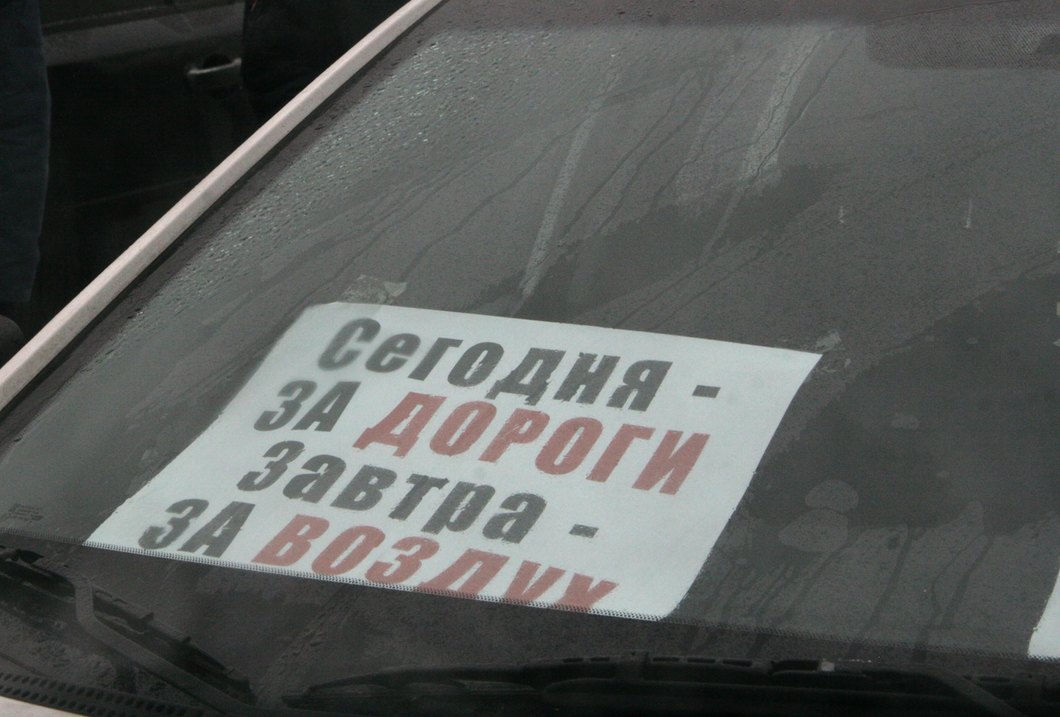
“Today [they’re making us pay] for the roads. Tomorrow, it will be for the air.” Photo courtesy of Dmitry Rebrov/Novaya Gazeta

Similar coercion had led to a break with the group of activists who had fought the Rotenbergs most fiercely, the Dagestanis. None of their members was present at Friday’s rally.

“At the moment, we have lost contact with Dagestan,” admitted Kurbatov. “All our work there was tied to Rustam Mallamagomedov, but after he was beaten up while we were waiting for the [Krasnodar] farmers in a camp near Rostov and then sentenced to administrative arrest in absentia, he was basically forced to give up the cause and go to ground. Currently, we are not even in contact with him.”

Kurbatov added that security forces coerced and terrorized the Dagestani truckers the most harshly.

“Are You Freezing?”

When, an hour later, the truckers emerged from the MEGA mall, where they had gone to get out harm’s way and discuss strategy, to take up their solo pickets, the police amassed in the parking lot reacted almost instantly.

The first to be sent to the precinct were Yekaterina Bolotova and Igor Melnikov. By midday, the security forces had managed to cram all the truckers, all their volunteer helpers from Khimki, and even the journalists, including a crew from TV Rain, into the paddy wagon.

“What we predicted last year has happened. As soon as [parliamentary] elections had taken place, the moratorium on raising rates was lifted. In fact, the government did not even keep its own promise of freezing prices until July 2017. So we decided there was no time to lose, and we have hit the streets, although we were not very well prepared,” said Kurbatov.

By six in the evening on Friday, all the detainees had been delivered to Police Precinct No. 1 in Khimki. But it proved difficult to find out what the truckers had been charged with.

In the morning, the truckers’ attorneys informed us that Sergei Einbinder, who had been detained first, had cut his hands and face to protest the police’s actions.

“After twenty hours at the precinct, they hadn’t even allowed me to see a lawyer or explain what I was being charged with, so I decided to take extreme measures,” Einbinder told Novaya Gazeta by phone.

Earlier, Einbinder had tried to leave the police station on his own after surrendering his internal passport, but police responded by detaining two lawyers that had been provided for him by the Anti-Corruption Foundation (FBK). The two lawyers, Vitaly Serukanov and Artyom Khemelevsky, have already been released. The journalists taken down to the precinct with the truckers were released the same day. No arrest reports were filed against them nor were they subjected to additional questioning.

By Saturday, it had transpired the truckers involved in the protest had been charged with disobeying the police (Article 19.3 of the Administrative Offenses Code) rather than for violating the rules of public rallies (Article 20.2).

Elena Filippova, press secretary for the truckers, who was detained along with them, related what conditions have been like for the activists at the police station. According to her, the female activists who have been helping the truckers and the truckers themselves slept in separate cells.

“In the women’s cells, the three of us were given one dry mattress, which we could sleep on, and two wet mattresses. We have now just thrown out the wet mattresses. Apparently, they had long been waiting their turn, and such an occasion had presented itself. Girls had shown up at the station: why not torment them a bit? In the morning, one of the cops gleefully asked, ‘Are you freezing?’ We have been allowed to use the toilet only twice in twenty hours, and we had to demand to be given food, which was brought only six hours later.”

Court hearings commenced only at two in the afternoon, and they looked likely to run until Saturday evening.

After numerous requests, Sergei Einbinder was transported from the courthouse by an ambulance crew.

Currently, truckers Mikhail Kurbatov, Vladimir Sinitsyn, Dmitry Lazar, and Igor Melnikov, their assistants Ivan Gushchin and OPR press secretary Elena Filippova, and activist Olga Reznikova, who also was involved in Friday’s protest, are still in police custody.

Translated by the Russian Reader

Alexei Gaskarov: What Politics?

Alexei Gaskarov: Many People Ask Whether I Am Going to Take up Politics. But What Politics Are There Nowadays?
Olesya Gerasimenko
Snob
November 1, 2016

Anti-fascist Alexei Gaskarov has been released from prison after serving three and a half years in prison for alleged involvement in the Bolotyana Square riot in Moscow in 2012. Snob asked Kommersant special correspondent Olesya Gerasimenko to meet with Gaskarov to discuss the Bolotnaya Square case, life and education in the penal colony, and the death of the protest movement. 

Alexei Gaskarov. Photo courtesy of Tanya Hesso/Snob
“Why would they ask me about organizing a riot if they knew no one organized it?”

Was your trial fair?

I regret we agreed to be involved in it. Like Soviet political prisoners, we should have stood with our backs turned and kept our mouths shut, and not treated it as an attempt to get at the truth. I had illusions after Khimki. [In 2010, Gaskarov was arrested and charged with attacking the Khimki town hall during a protest in defense of Khimki Forest, but the court acquitted him. — Snob] Several videos showed clearly that the incidents involving me happened before the riot kicked off, according to police investigators themselves. In the end, I ticked off the evidence, the judge nodded her head, but there was no reaction. The entire trial looked as if the decision had already been made, the sentence written out, and let’s get this over as quickly as possible.

So did you push a policeman and pull a soldier out of the police cordon?

I never denied it from the get-go. A year had passed since the rally on Bolotnaya Square. I was working on an important project. I had a week to go, and it was uncool to have to go to jail. I had to go to work on the Sunday the cops came for me. I had gone to the shop to buy food for the cat, and the whole clown show was waiting outside my building: two jeeps and a van. Young dudes half dressed like boneheads stepped out of the van. I decided they were from BORN [a group of radical right-wing nationalists who carried out a series of murders and assaults — Snob]. I was pondering what moves to make, but they produced their IDs.

Did you feel relieved?

No, just the opposite. I could have run from BORN or done something else. So they detained me and kept mum about what the charges were for a long while. They made me lie face down in the van and  the whole works. There were lots of things they could have detained me for. We had been defending the tenants of the Moscow Silk (Mosshyolk) dormitories from eviction and the Tsagov Forest in Zhukovsky from logging by developers. And shortly before my arrest, people who are now serving in the Azov Battalion attempted to assault my wife and me. I tussled with them, and it ended up on camera. So there were different possibilities. I was not thinking about Bolotnaya at all. When it finally became clear why I had been detained, I stared at them.  It was total rubbish. I told them I agreed to admit what I had done. We had been walking amid the crowd, when a riot cop attacked this dude. A dogpile ensued, and people pulled them apart. I was accused of pulling a policeman’s leg. The evidence was a poor quality video and a forensic report that concluded it was not me. But I knew it was me. So I told them right away, Guys, let’s do this the right way. But they could not have cared less whether I admitted my guilt or not. It would have been a different story if I had confessed to violating Article 212 of the Criminal Code (organizing a riot) or testified against someone else.

Were you asked?

They didn’t even mention it. Why would they ask me about organizing a riot if they know no one had organized it, including from their own wiretaps? They kept the charges to the incident with the leg pulling. Then they found a second incident. A stampede started in front of the police line. People were falling on the ground, and I tugged one policeman by the shoulder to make room. The indictment said I had broken the police line so that everyone could get to the riot. But this line had been at the passage in the other direction.

OIesya Gerasimenko and Alexei Gaskarov. Photo courtesy of Tanya Hesso/Snob

Did you expect such a sentence?

They had already told me at the Investigative Committee they were going send me down. I said, Well, of course. Later, the Center “E” guys showed up and threatened me with ten years in prison, but I know that could not happen. The rules of the game are still followed, and punishment for a particular crime is usually consistent with ordinary practice.

How do you feel about the case of Udaltsov and his associates?

I have very negative feelings about it, of course. I ran into [Leonid] Razvozzhayev in the pre-trial detention facility, but I wasn’t really able to chat with him, because he was always in very bad shape. Udaltsov and his associates operated like real con men. Before May 6, 2012, they had no clue how the march would go, and there is no mention of sitdown strikes and rushing police lines in the wiretaps. But after everything had happened on Bolotnaya, they began acting in their meetings with Targamadze as if everything had gone according to their plans. Their initial excuse, that they had traveled to Georgia to talk about wine and mineral water, was pure idiocy. Naturally, it is not against the law to have meetings and discuss business. But there is a political ethic that does not let you behave this way. You go meet dudes from the government of another country, a country with whom [your country] recently had a conflict. You ask for money, and you take money. If these meetings had not taken place, the Kremlin would have failed to generate the image of the Bolotnaya Square case that it did. We should not have had to answer for things over which we had no control. The benefits to Udaltsov were personal, but everyone shared the risks.

So you received no money from Givi Targamadze?

Are you kidding? What money?

Who was the anonymous anarchist informer who testifed against you?

I didn’t even find out. I have had nothing to do with them for many years. The guys still have their little movement. Like Tolkien fans, they attend meetings and discuss for hours on end how they should make a revolution. They have been doing this for the last twenty years. It was of no interest to anyone. The FSB sent its people in. They went and had a look at it and said, Well okay, you have a cool club. When Center “E” was established, they went after them big time to push up their arrest stats. All anarchist meetings are open, anyone can come. So they are known to the authorities. The teenager from this scene who went to Bolotnaya and was involved in breaking through police lines was identified in this way. They put the squeeze on him: either we send you down or you tell us what we want to hear. I have no idea why this was necessary, because he just said I was a bad dude and the leader of the anti-fascists and anarchists. But nobody charged me with that.

“The rules of survival are simple: don’t do anyone harm”
Alexei Gaskarov. Photo courtesy of Tanya Hesso/Snob


Tell me about life in prison. Everyone is interested in that. You know, reveille at six, lights out at ten.

Yeah. As you understand, people who are drug addicts, people going through withdrawal, basically live at night. After lights out, they either smoke or brew chifir [a super strong tea brewed in Russian prisons]. You just set that aside. You have your routine, and basically it is good for you. No one limits the amount of exercise you do: there is a horizontal bar, parallel bars, and a few weights. You are either working or busy with your own things. I got into shape there like I never have before. The point is to come up with as many things to do as possible so you have no spare time at all.

What did you read?

The library there was okay, because everyone who does time gets books and then leaves them behind. They see who has been nominated for the Booker Prize and order their books. It’s not hard to find new releases in prison. I also subscribed to several pro-Kremlin publications, and I read lots of your articles, too. And I read The New Times and Novaya Gazeta. I wanted different viewpoints. Plus, there is a legal video link in there. It is limited to fifteen minutes a day, but in fact nobody keeps track of the time.

Who were your cellmates? 

I spent half my sentence in a pre-trial detention facility. The dudes in there had been charged under Article 228 of the Criminal Code [purchase, storage, production, and sale of narcotics — Snob]. Their stories were horrible. One group of teenagers had gotten hash in the mail from Holland, and they had been sentenced to fifteen years in prison. Or there were the dudes who decided to cook amphetamine using a recipe they found on the Internet. They got nineteen years in prison. I was even ashamed to explain what my case was about, because I was surrounded by people facing over ten years in prison.  When the trial began, we were kept in Butyrka Prison. They were thieves, crazies, teenagers, street kids, and Dagestanis in there. I also met defendants in the Rosoboronexport case, the APEC Summit case, and the Sochi Olympics case, and I went to the gym with Alexander Emelianenko.

The general population at the penal colony consisted of three hundred men. Eighty percent of them were local dudes from Tula Region who had attacked somebody while drunk, stolen things from dachas, and committed petty robberies. But what is the catch about the general population? That a homeless man who broke into someone else’s dacha to spend the winter got sent down to the penal colony, and his life there is better than on the outside, and he is in the same place as a big-shot businessman who has lost a billion rubles and used to go sailing on his yacht on the outside.

Does this lead to lots of conflicts?

There are lots of conflicts, but the instigator always takes the rap for a fight. That doesn’t mean there are no fights. They are criminals, after all, and they tend to take risks. But the rules of survival are simple: don’t do anyone harm. If you watch TV after lights out, turn down the sound. Don’t drag in dirt. It’s all basic.

Alexei Gaskarov. Photo courtesy of Tanya Hesso/Snob

Was it easy for you to understand them?

Yeah. In 2010, I was in a pre-trial detention facility with repeat offenders and learned the tricks. And during my early days in the penal colony I read Shalamov and Solzhenitsyn’s stories about the prison camps.

Like a set of rules?

Yes. The Center “E” officer who led the investigation in my case told me a lot and advised me what books to read. When I was on the inside, people asked my advice on how to behave.

When you got out you said the main thing had been to maintain contact with reality and your health. How did you maintain your health? Was the food there okay?

Due to the fact that support from the outside was good, I almost never ate in the cafeteria.

But what about hot meals?

There is a microwave there. The Federal Penitentiary Service (FSIN) now has taken the approach of not keeping you from improving your living conditions. They need to implement their strategy for improving conditions in the penal colonies, but their budget has been trimmed. When you arrive, everything is crappy. Water is dripping from the ceilings, and there is mold. But they don’t mind if you want to invest your own resources. You write everything up as humanitarian aid, and you get electric kettles and microwaves. We had a projector hanging in our cell for watching films.

Now everyone will want to roll back two years to read books and watch films on a projector.

We also purchased a bunch of armchairs from IKEA. So when the head office comes to make an inspection, they show them how cool everything is in their colony.

I think you wanted to get another degree in prison.

Unfortunately, it turned out the university with which the colony collaborates is just a degree mill that sells them for money. I did something else there. At work, I would often teach the basics of entrepreneurship and planning. There were people doing time in the colony with whom it was interesting to talk, bank chairmen and ministry officials. There was a space, an evening school. I brought around fifty people together and asked the wardens permission to run something like seminars. Everyone had to come up with his own project, and over eight months (my sentence was coming to an end) we would try and whip it into shape, with a business plan as the outcome. At first, they turned me down outright, saying I was in for the Bolotnaya Square case and would lead political discussions. But then there was a change in management at the penal colony, and they met us halfway. It was like a little piece of the outside world.

Generally, of course, the colony’s disciplinary and educational function has been tapped out. There are no resources. The majority of guys in there do not have the most basic skills. They cannot write a letter, but there is no one there at all to educate them. There is this option of watching films on the weekends. They show this rubbish, total nonsense. I went to the wardens and said, Let’s make a selection of good films; we can watch ordinary films in our cells. But they could not even decide to do that. They get their action plans from the head office, where the theorists work. They say, Let’s hold a sports day, even though athletic clothing is prohibited in the general population.

“They aren’t winning this game by turning to crackdowns”
Olesya Gerasimenko and Alexei Gaskarov. Photo courtesy of Tanya Hesso/Snob

While you were away, the Khimki Forest was cut down. The Moscow Silk tenants were evicted. Anti-fascists fell out over Ukraine. Many of the people who rallied on Bolotnaya have emigrated. When you all; were being arrested one by one, everyone said it would be the case of the century, that everyone would close ranks because of you and for your sake, but ultimately you have got out of prison, the Bolotnaya Square case is still underway, and there is no longer any interest in it. Maybe you went to prison for nothing?

What does that mean, “nothing”? I had no choice. It’s good that the anti-fascist thing is no longer on the front burner. Nowadays, there are no more clashes with neo-Nazis, who were killing people in the early 2000s. Back then, they really needed a counterweight. Our job was to point out the problem and make things decent on the streets. We succeeded in doing this. But the anti-fascist movement cannot defeat xenophobia in society.

What do you think about the split among anti-fascists, that one group went to Kiev, while the other went to Donbass? They were at each other’s throats.

I always assumed that very different people joined the anti-fascist movement, and that was fine. There were aspects that just did not make sense to me. For example, why were European leftists strutting their stuff in Donbass? It looks as if they were totally conned.

As for Bolotnaya, choosing to be involved in this movement was fraught with risks. If we draw an analogy with Ukraine (although many people don’t like to do this), I don’t think that if the events on Bolotnaya had gone further those people would have balked at shooting the crowd. A bunch of people were killed in Kiev, while here in Moscow we were supposed to be scared off by prison sentences. They randomly picked a group of people and put them in prison. The rationale is clear. Whoever you are, if you oppose the tsar, you will suffer. How can we respond to this? We have to debunk the myth that such crackdowns are effective.

But that is what happened. Everyone really was afraid of being hit once with a truncheon, to say nothing of prison. Many members of the opposition have said the fight against the regime is not a worth a centimeter of their personal comfort. You are practically the only who does not think this way. Don’t you feel lonely?

Most people haven’t been to prison, and they really imagine it is the end of world. If I go to prison, I can kiss my life goodbye, they think. I just dealt with it more or less normally. But this is how I see it. When the authorities crack down on dissent, people lower their level of activism. They lose the desire to invest themselves in something. Ultimately, the system falls apart, rather than becoming more stable, as the authorities imagine. The country becomes less competitive. In prison, I saw many people who were doing time for economic crimes, and they all said approximately the same thing. People who have satisfied their material needs develop political demands, and that is fine. Everyone wants to be involved in changing things. When this desire for change is blocked, they are blocking the segment of society that generates the most added value. They aren’t winning this game by turning to crackdowns. Especially because the system is not as terrible as it makes itself out to be.

But people need to remain minimally active. It is too bad that many people have chosen the passive way. I have just got out, and it really seems to me that a lot has changed, even in Moscow itself. Although, theoretically, I saw it all ten years ago, only in Europe. We can live this way a long time. Hence the complexity of the political arguments around Bolotnaya. Given the resources we have have, we could live better, but the way things are also suits lots of people. In this case, the system can survive for a long while. We should not get involved in direct confrontations. This was clear to me on Bolotnaya Square as well. We wanted to get the hell out of there, because it was obvious the sitdown strikes and so on were just what the authorities wanted. But there are other ways of doing things. We don’t have to limit ourselves to demonstrations and rallies.

Alexei Gaskarov. Photo courtesy of Tanya Hesso/Snob

What ways?

There are the demands made at Bolotnaya—fair elections and the transfer of power—but there is the option of engaging in specific targeted campaigns in order to develop one’s ideas under the existing regime.

You mean the theory of small deeds?

Among other things. For example, I read that many Bolotnaya activists have gone into charity work. In fact, that is not so bad. What matters is maintaining the energy. Or there is the successful fight against corruption, all those publications that impact the system, whatever you say. Or there are people in the leftist milieu who think there should be progressive taxation: they can also advance their arguments. Or form an anti-war movement given all the conflicts underway.

In prison, I realized how strongly the regime affects people’s brains. There are people who show up there who are not inclined to heavy discussions. Real peasants. All the myths that exist are in their heads. But when you are around them, you don’t even have to argue. Even the most impenetrable guys would change their minds just as a result of conversation. So any work aimed at disseminating information and minimal education is vital.

What did you change their minds about?

A variety of things, including their overall attitude to the opposition. In the beginning, it was even convenient for me, like there were only drug addicts at Bolotnaya, that they all had gone there to score heroin, and everybody would leave me alone [after I would say that]. But over time people see what you read, what films you watch on the Culture channel, that you can help draft a court appeal, and they understand you are not an idiot and would not have gone to a protest rally for a dose of heroin. There were lots of conflicts over Ukraine, especially because there were many people doing time who had managed to fight in Donbas, come back to Russia, and get sent to prison.

Olesya Gerasimenko and Alexei Gaskarov. Photo courtesy of Tanya Hesso/Snob

For what?

Disorderly conduct, theft, and armed robbery. They were typical soldiers of fortune. We even managed to talk about this most difficult issue and iron out our differences.

Is Crimea ours?

I have a simple position on this issue. People went out on the Maidan because they did not like the current regime. I think what happened to Crimea was Putin’s attempt to punish them for this. The Ukrainian people made their choice, Putin didn’t like it, and [Russia] acted like the interventionists during the Russian Civil War. It is not a matter of what the inhabitants of Crimea wanted. It was an action directed against all the values we tried to defend on Bolotnaya.

So it’s not ours?

I consider it a real violation of international law. It was unethical and wrong. Clearly they did this to stick an example in everyone’s face: see what protests have done to the country. But I don’t have an opinion about what should happen next.

To return it or not?

Well yes. Because it is clear that most people who live there want to be part of Russia.

You went to prison in one country, but came out of prison in another country. What was it like finding out on the news about the historic events that were happening on the outside? Did you feel sorry you were observing them from afar? Or, on the contrary, was it easier?

To be honest, the latter. It was often difficult to make up my mind. For example, when refugees left Ukraine en masse, they would come work in the penal colony. You communicate with them and realize there is ideology, and then there are people’s stories, and it was hard to make up one’s mind. I actually thought it was cool this was going on in the background.

Alexei Gaskarov. Photo courtesy of Tanya Hesso/Snob

What is your work situation? What are you planning to do?

Of course, I would like to do the work I was educated to do, as a financial systems analyst, as it says in my diploma. My old job did not survive the crisis. I will have problems, of course.  I have even asked acquaintances at several companies, but I was told no way, especially in offices that work on state commissions or state projects. So things are rough. I will have to start everything from scratch. But I am sure that the fourteen percent have some businesses. [Gaskarov has in mind VTsIOM’s polling data, showing that 86% of Russians support Putin — Snob.]

Earning money is my priority now. Many people have asked me whether I am going to take up politics. Everyone has so many expectations, but what politics are there nowadays? It is impossible to be involved in politics without having your own resources. Of course, I say you shouldn’t be afraid of prison, but it is a serious setback all the same: three and a half years. A lot of missed opportunities and a backlog of problems.

Translated by the Russian Reader. Thanks to Gabriel Levy for the heads-up

The Partisans of Suna

The Partisans of Suna
Karelian pensioners have gone into the woods to save a pine forest from logging
Alexei Vladimirov
Fontanka.ru
October 26, 2016

Residents of the small village of Suna in Karelia’s Kondopoga District, mainly pensioners, have rebelled against the authorities, loggers, and a mining company that plans to develop a sand and gravel quarry in the scenic pine wood alongside their village. The area resembles the front lines during a war. The loggers have brought in their equipment, but have been stopped in their tracks by the pensioners, who have set up camp there. The pensioners have been keeping a 24-hour vigil in the woods for four months. Local journalists have dubbed them the “partisans of Suna.”

“Extremist” Pensioners
The conflict flared up much earlier. Saturn Nordstroy, a company specializing in the development of sand and gravel beds in Karelia, had its eye on a plot of land in the vicinity of Suna and decided to open a sand quarry there. The Karelian Nature Management and Ecology Ministry supported the idea. Permissions were received, an auction was held, and the company was awarded a license in 2011 to extract sand and gravel at the site for a period of twenty years. However, neither the officials nor the businessmen suspected they would encounter vigorous resistance from local residents, mainly pensioners, who have strongly opposed the quarry development plan and exercised their inalienable right to a decent life.

There is a pine forest on the site where the businessmen have decided to dig the quarry, the only one in the whole area, a place where the locals harvest berries, mushrooms, and medicinal herbs. The wild plants are a good supplement to their tiny pensions. Once upon a time, the village of Suna was known throughout the Soviet Union for the nearby poultry farm, also called Suna. The farm was considered one of the best in the country, but in the “fat years” of the noughties, it was shut down. This has meant a slow death for the surrounding settlements. Young people have left the area in search of work, while the old people have stayed in the village to live out their lives. The money to index their pensions could not be found, but the prime minister has told them to “hang on.”

The locals learned a quarry would be dug near their village only at the presentation of the development plan. Opponents of the logging of Suna Forest planned to hold a people’s assembly on May 14, but they were forced to abandon the idea. On the eve of the assembly, police visited one resident of Suna, pensioner Nina Shalayeva. According to the elderly woman, the police all but accused her of extremism.

In the autumn of last year, the Center for Extremism Prevention (Center “E”) began investigating the pensioners. One of them had rashly said it would be a good idea to block the Kola Federal Highway, which runs from St. Petersburg to Murmansk, since the village is located a kilometer and a half from the highway. That would get Moscow’s attention right away. Naturally, someone snitched to the proper authorities. Law enforcement and the secret services reacted instantly. The settlements along the Kola Highway were mobbed with large numbers of law enforcement officers, from riot police to the highway patrol. To stop the protest rally in its tracks, the pensioners were threatened with criminal charges for extremism.

“The deputy head of the Kondopoga police was polite. He gave me a warning for extremism and left. I had run into him in the spring, when I had also been accused of organizing an unsanctioned rally. The local beat cop said they had learned we were planning to block the highway, and that I was organizing the whole thing. What kind of organizer am I? There was also an FSB officer from Kondopoga. He asked to talk with me privately. He said flat out that they had specially trained people who did not like to be bothered. They would arrive, break all of us, and imprison us, despite our age,” recounted Nina Shalayeva, an anti-quarry activist.

Then the villagers suddenly had a bit of luck. In the spring of 2015, scientists from Petrozavodsk State University discovered a valuable species of lichen in the Suna Forest, Lobaria pulmonaria. It is listed in the Red Book of Russia as an endangered species: destroying species listed in the Red Book is not only forbidden by law, but is even considered a criminal offense. The scientists’ find occasioned an inspection by the prosecutor’s office in the area of the planned digging. Consequently, the Karelian Interdistrict Environmental Prosecutor’s Office issued a warning to the director of Saturn Nordstroi about the inadmissibility of violating the law while extracting sand and gravel from the South Suna Quarry. The pensioners now had grounds to sue.

Litigation
The plaintiffs demanded “the license issued to Saturn Nordstroy LLC be terminated and the company prohibited from engaging in all exploratory and economic activity that may lead to the destruction of protected plant species and their habitat in the pine forest near the village.” In April of this year, the Petrozavodsk City Court partly granted the claim lodged by the residents of Suna. The company was forbidden from carrying out exploratory and other work detrimental to endangered species discovered in the forest. However, the court could find no grounds for terminating the license for subsoil extraction issued to the company.

However, the Karelian Supreme Court has overturned the Petrozavodsk City Court’s ruling. The case is currently under investigation by the Russian Supreme Court. The pensioners think the case will be heard in December or thereabouts.

The Partisans of Suna
Immediately after the Karelian Supreme Court’s ruling, logging equipment was moved into Suna Forest. People formed a human shield to block the road to the loggers. The whole village came running to see what the noise and fracas were about. The villagers told police, businessmen, and officials of various ranks they would not surrender the forest: they would have to chop them down with it. Arriving on the scene, the police warned the pensioners they would be forced to detain them if they did not leave the logging site, because they were interfering with the work of the loggers. The pensioners set up camp and kicked off a round-the-clock vigil in the forest.

The Partisans of Suna

forwarder lager_lesorubov lesoruby_prokl_dor lesozag_tehn

“Medvedev said we had to be patient. We are patient. Just don’t take away the last thing we have! I don’t know what price we’ll have to pay, but we are not going to give up this forest, because we won’t survive without it. The [Karelian] Supreme Court’s ruling made us sad. However, it is only the latest step in the case, albeit one not in our favor at the moment. We will defend our rights!” said pensioner Tatyana Romakhina.

The logging equipment retreated, and a “pre-election” calm set in until October 7.

On the morning of October 7, the engines of the forestry equipment could again be heard droning in Suna Forest. The first on the scene was Nina Shalyaeva. She stopped the harvester.

“When I went to my shift in the forest, I saw that a harvester was running. I stood in front of their equipment and said that my fellow villagers would be right behind me, and we wouldn’t let them cut down the trees. They promised the police would come and take me to Petrozavodsk. However, after we talked, they stopped logging and drove off the lot,” said Shalyaeva.

Karelia’s Suna Forest has become something like Khimki Forest. District police officer Vitaly Ivanov, summoned by the loggers, interviewed the locals, wrote down their internal passport data, and said that if the actions of the loggers were ruled legal, the defenders of Suna Forest who impeded the logging would be forcibly removed from the allotment. In turn, the pensioners promised the entire village would rise in rebellion. The loggers conversed with the pensioners rather unceremoniously. They demanded to see papers [prohibiting them from doing their work] and told them in harsh tones to go back to the village. Everyone’s nerves were on edge. The loggers were irritated by the annoying, unplanned downtime, while the pensioners were annoyed by police’s actions. They could not understand why the police had asked them to produce their passports, written down the information in them, and tried to drive them out of the woods. In the end, the loggers retreated. Fortunately, things did not come to blows.

The partisans’ camp
nina_makkoeva
Nina Makkoyeva
samodel_banner
“You’ve signed up to defend the forest!”

pens_sob_zimovat shtab_kvartira sun_partiz

Meanwhile, the controversy over the forest has spread beyond Karelia. Major publications and national TV channels have covered the “partisans of Suna.” In Petrozavodsk, a grassroots movement has been organized to help the pensioners. Young people have begun standing watch in the woods along with the old people. Residents of Murmansk Region have sent them a winter-proof tent.

The pensioners are still on watch in the woods and getting ready for winter, while officials and businessmen are looking for ways to resolve the conflict.

An “Artificially Simulated” Conflict?
After a long silence, the Government of Karelia finally organized a round table on the issue. Officials believe the controversy surrounding the Suna Forest has been “artificially simulated.”

“We organized a meeting to discuss the situation with the development of a sand and gravel quarry in the South Suna subsoil resources allotment, and the reasons why the license holder has been hindered from engaging in legal activities, and to work out a solution to the conflict that has emerged.  A situation around Suna Forest really has emerged, and it is our job to figure what caused this artificially simulated social conflict. I would like to draw the attention to the people involved in the process that the question of the legality of the license holder’s activities has been considered in court, and the rulings, which have entered into force, were in their favor. Multiple studies have not established evidence that endangered plant species are being destroyed. Thus, the license holder has all legal grounds to engage in their business activities,” Alexei Pavlov, first deputy minister for nature management and ecology in Karelia, said at the outset of the round table.

Igor Fedotov, director of Saturn Nordstroy LLC, was of the same opinion.

“Everything is too seriously organized. When we presented the project in Yanishpole in May of last year, the experts told us someone was stage-managing this drama. Everyone accuses me of wanting to come in, dig everything up, destroy everything, and do nothing [for the area]. So let me do something. I want to do something good for Suna. I can donate the material I am going to be extracting. The district needs it: they do not have good sand. I can help out the local council, which is gasping for breath, just like every district in Karelia. We are building a road to the quarry, and it will still be there [after we are gone]. I am not planning to build anything there. The local residents will be the better for it. And the reforestation of the area will begin,” said Fedotov.

No decisions were made at the round table, however. Talks have been rescheduled for October 26.

All photos courtesy of Alexei Vladimirov and Fontanka.ru. Translated by the Russian Reader. Thanks to Comrade VZ for the heads-up

Loyalties

isip
Dmitry Yegorchenkov and Nikita Danyuk (right), assistant heads of the Institute of Strategic Studies and Forecasting (ISIP) at the Russian People’s Friendship University, after lecturing at the Russian Congress of University Vice Chancellors for Morale and Discipline, Moscow, October 21, 2016. Photo courtesy of the institute’s Vkontakte page

Ideological Underachievement
Russian universities to examine the loyalty of students and lecturers
Alexander Chernykh
Kommersant
October 24, 2016

Kommersant has learned that volunteers at Russian universities have been working to assess the “protest potential” of students and professors. The results will be “compiled as memorandums for official use by state authorities.” Attendees of the Russian Congress of University Vice Chancellors for Morale and Discipline, which took place this past weekend, discussed the assessment. The authors of the study have discovered that the “destructive promotion of anti-state ideas has been occurring” among the student bodies and faculties of the capital’s universities. On the eve of the presidential election, they intend to shift their focus to regional universities.

It was the sixth time the Russian Congress of University Vice Chancellors for Morale and Discipline had taken place in Moscow. Representatives of 642 educational organizations from eighty-one regions attended the congress. Prime Minister Dmitry Medvedev sent his greetings to the congress, and  guests of honor included Stanislav Sulakov, acting head of the Moscow Center for Extremism Prevention (Center “E”), Metropolitan Merkurii, chair of the Synodal Department for Religious Education and Catechesis, and Ernestas Mackevičius, presenter of the news program Vesti.

The meeting of the vice chancellors kicked off with a discussion of a sensitive issue.

“For twenty years, we have had to prove that the country needs discipline and morale in the universities,” complained Zinaida Kalinina, a vice chancellor at Tula Pedagogical University.  Even Pushkin said, ‘The university completes the soul’s education.’ Let them argue with Alexander Sergeyevich [Pushkin]!”

Alexander Stradze, former head of the Department of State Policy on the Education of Children and Youth, one of the first officials to be dismissed by Olga Vasilyeva, the new Minister of Education and Science, tried to define the vector of the discussion. He introduced himself as assistant head of Rossotrudnichestvo, but from force of habit he attempted to preach to the vice chancellors.

“The state’s educational ideology has moved away from paternalism,” he explained. “Yes, it’s easier, probably, to work with loyal subjects, with subordinates. But the country and the conditions are no longer the same today. Nowadays, we bring up children in terms of humanism, free choice, and support for individuality. This path is justified in any democratic society.”

Alexander Balitsky, vice chancellor at Izhevsk Technical University and a former lecturer in the department of scientific socialism, tore the ex-official’s speech to shreds.

“Everything we do has often been canceled out by sociocultural circumstances,” Balitsky began in a roundabout way. “And these circumstances even often originate  in our ministry.”

Mr. Balitsky casually, as it were, mentioned that the Ministry of Education and Science has been implementing a nationwide project entitled “Time to Act,” and read aloud a message from [ministry] officials to university students.

“Twelve of the country’s best entrepreneurs will share their know-how and teach you think in new ways. On September 22, entrepreneur Oskar Hartmann—” the vice chancellor underscored the entrepreneur’s [non-ethnic Russian] given name and surname,* while the audience applauded and laughed in support “—will talk about how you need to think to become a dollar millionaire by the age of thirty.”

“Nifty, eh? There’s an ideal for you. I have nothing against entrepreneurs, but these are not the core values we need. With all due respect to the Ministry of Education and Science.”

“But now there have  been changes in the ministry,” an audience member reminded him.

“Thank God,” the speaker replied.

“Yeah, and there won’t be anymore Soroses,” someone joyfully shouted from the crowd.

“I think the expert community understands the country is in a state of undeclared war,” said Nikita Danyuk, assistant head of the Institute for Strategic Studies and Forecasting (ISIP) at the Russian People’s Friendship University. “It is hybrid in nature, and there are many fronts.  One of them runs inside our country: it is the mental front.”

Complaining that “western planners” use the “practice of inspiring coups,” he acknowledged university students were one of the main “destructors.” To keep the country from “plunging into chaos and anarchy,” Mr. Danyuk’s team had drafted a special educational program, entitled “Scenarios of Russia’s Future,” a series of lectures on “combating politically destructive forces.” Over the past two years, Mr. Danyuk and his colleagues had visited over forty universities in Moscow and a dozen regional universities, where they had encouraged the students to openly express their own views on political issues “and even join in the discussion.” Surrounded by his colleagues, however, Danyuk admitted the real purpose of the trip had been to assess the “protest potential” of students and lecturers.

“The outcomes of the project were compiled as memorandums for official use, including by government officials and officers of certain specialized organizations,” Mr. Danyuk announced proudly. “Unfortunately, the destructive promotion of anti-state ideas has been occurring among professors and lecturers—not openly,  but without being shy about it.”

Danyuk said that society was “most exposed to destructive spin doctoring during the electoral  cycle.”

“Fortunately, our country negotiated the milestone of the parliamentary elections nearly without losses, but our project will be relevant until 2018, when the presidential election will be held. And from the viewpoint of prevention, it will be relevant beyond then.”

The Institute of Strategic Studies and Forecasting at the Russian People’s Friendship University is headed by Georgy Filimonov, a professor in the department of the theory and history of international relations. The university’s website relates that, from 2005 to 2009, Prof. Filimonov worked in the presidential administration as a foreign policy advisor. According to Mr. Danyuk, the “Scenarios of Russia’s Future” lecture series has been implemented with the involvement of the Anti-Maidan Movement, political scientist Nikolai Starikov, and “other media figures.”  The project has already been the source of controversy. In May 2015, students and lecturers at the Russian State University for the Humanities attempted to disrupt a lecture by Nikolai Starikov at their university. Mr. Danyuk confirmed to  Kommersant that he had been at the event. In his opinion, the protest had been organized not by students, but by lecturers at the university.

A series of books recommended for reading by Nikolai Starikov, on sale at a newstand in Pulkovo Airport, Petersburg, October 23, 2016. Photo by the Russian Reader
A series of books recommended for reading by Nikolai Starikov, on sale at a news stand in Pulkovo Airport, Petersburg, October 23, 2016. Photo by the Russian Reader

“The strategy of our foreign so-called colleagues has changed. The protest potential has now shifted to the regions, and we are really interested in making contact with people from regional universities and organizing events there,” he said.

At the end of the event, the vice chancellors queued up to talk with Mr. Danyuk, vying with each other to invite him to their universities and assess the “protest potential” of their colleagues.

* According to an article, dated March 15, 2016, in the magazine Sekret firmy, businessman Oskar Hartmann was born in Kazakhstan to a family of Russian Germans.

Translated by the Russian Reader

Regime Cracks Down on Protesting Krasnodar Farmers

“They Have Really Gone After Us”
After returning to Krasnodar Territory, participants of tractor convoy feel the heat from the very people against whom they complained
Anna Bessarabova
Novaya Gazeta
August 28, 2016

The farmers after their tractor convoy was dispersed. They have been sentenced to three to ten days in jail. Not a single independent human rights activist came to their court hearings in the village of Kazanskaya. Photo courtesy of Anna Artemieva/Novaya Gazeta

The farmers were threatened during the convoy. We will stage a second Novocherkassk massacre for you and dice you like cattle in a slaughterhouse, they were told by security officers, who after the protest was dispersed have been zealously carrying out checks of their homes and farms.

Around thirty FSB officers raided Nikolai Borodin’s farm in the village of Kazanskaya, which they turned upside down. The tax inspectorate has been looking into property owned by the relatives of protest leader Alexei Volchenko. Other men have been interrogated by the prosecutor’s office. Nina Karpenko escorted her driver Seryozha Gerasimenko, a young fellow with three small children, to the detention center. He has been jailed for three days. The other men were also issued misdemeanor charge sheets: the authorities even went to the trouble of delivering the documents to their homes. The hearings took place on the weekend (Saturday) in the Kavkazsky District. Sergei Gorbachev was jailed for five days, Slava Petrovsky, for four days, Andrei Penzin and Semyon Smykov, for three. The rest of the protesters are waiting their turn.

“Nearly everyone in the villages has been paid visits by prosecutors and police,” farmer Ludmila Kushnaryova told Novaya Gazeta. No one knows what they are looking for. Or what the charges will be, either. The pressure has not stopped.”

“I cannot believe this is happening to us, in our country. We had no idea it would be so frightening,” said Nina Karpenko. “They have really gone after us. The deputy chief of the district traffic police escorted my tractor drivers and me to the hearings. He followed us for 250 kilometers. Whatever for? There were two people working in the courthouse on Saturday: the judge and the chairman. Didn’t they have anything else to do?”

Nikolai Maslov and Oleg Petrov, two convoy participants jailed for ten days, have been transferred to Novocherkassk.

“Dad called early this morning. He said everything was alright. But who knows. Maybe he just didn’t want to scare us?” said Igor Maslov, worried about his father. “We still haven’t found lawyers for them. How much do you think they’ll gouge us?”

Alexei Volchenko’s colleagues and friends have been looking for him. He has not been answering calls to any of his phones. He is not to be found in his home village. He has disappeared. The last thing the farmers heard was that Volchenko had been fined in Rostov Region. He made it back to Kuban, where he was detained again and sentenced to ten days in jail in Ust-Labinsk. The authorities are now, allegedly, preparing to charge him with extremism.

The Russian government, the Prosecutor General’s Office, and the Russian Investigative Committee have been pretending nothing is happening in Kuban. The official TV channels have been airing election campaign spots about the ruling party’s ability to listen to people, but they have not aired any stories about the events in Krasnodar Territory.  They have maintained their silence for a week.

Alexander Popkov, a lawyer with the Agora International Human Rights Group, Boris Titov, federal commissioner for the rights of entrepreneurs, former Federation Council member Ivan Starikov, and Russian Federal Public Chamber chair Georgy Fyodorov have promised to help the participants of the tractor convoy.

“Obviously, the farmers have committed no offenses, and the wild imitation of law enforcement involving riot police and arrests for a ‘rally’ in a cafe are aimed at suppressing a peaceful and reasonable protest campaign,” said lawyer Alexander Popkov. “The first thing we are going to do is file appeals, and then we are going to see whether there is any point in beating our heads against the courts in Russia or whether we should immediately file a class-action complaint with the European Court of Human Rights.”

“I have been in contact with the farmers, their wives, and their children. They are drafting an appeal, and next week we plan to hold a big press conference in Moscow,” Ivan Starikov informed Novaya Gazeta. “Their problem needs to be solved systemically. People’s land shares are being confiscated, and there are around 300,000 victims of this practice nationwide.”

According to Valentin Pyshkin, attorney for convoy participants Nikolai Maslov, Oleg Petrov, and Sergei Vladimirov, the farmers have filed an appealed against the court decisions that sentenced them to ten days in jail.

“But we won’t get an answer earlier than Monday,” the lawyer explained. “On August 26, I was not admitted to the Novocherkassk detention center and allowed to talk with my clients, because, you see, according to their internal regulations, prisoners are entitled to representation by a lawyer only from two to four in the afternoon. It is an odd rule. But at four o’clock I had a court hearing in Aksai. Rustam Mallamagomedov from the Association of Russian Carriers (OPR) was on trial. On August 24, he had gone to the police station on his own to find out what had happened to the detainees, and the police didn’t let him back out of the station.”

Truckers Ready to Fight for Farmers 

Andrei Bazhutin, chair, Russian Association of Carriers (OPR):

“We arrived from Petersburg to Moscow, where we were getting ready for a car convoy through Siberia. We learned about the arrest of the tractor convoy on the morning of August 23 and changed our plans. We went to support the tractor drivers. We were stopped by police for eight hours on the Moscow Ring Road, and eight hours in Voronezh Region. Along the way, we were written up for violating Article 20.2 of the Misdemeanors Code [“Violation of the established rules for organizing or holding an assembly, rally, demonstration, march or picket”  — Novaya Gazeta], but they did not stop us from traveling further.

“By the time we got to Rostov, two of our activists [who had been with the tractor convoy from the beginning — Novaya Gazeta] had been sentenced to ten days in jail, while another two had been fined 10,000 rubles. Now we are here in Rostov: we have four big rigs and some cars. We are working with the lawyers and human rights activists and trying to help the guys out. We think it is necessary to gather journalists and advance on Krasnodar Territory to draw attention to these court hearings. Center ‘E’ [the Interior Ministry’s Center for Extremism Prevention — TRR] has intimidated everyone here.

“We have also contacted the miners on hunger strike in Gukov and agreed to support each other. Our demands will be voiced at their next picket too.”

Translated by the Russian Reader. Read my previous postings about the protest by Krasnodar farmers and the regime’s crackdown against it.