Center “E” Comes Looking For Performance Artist Who Changed Disabled Orphan’s Dressings Near Kremlin
Natalia Zotova Novaya Gazeta
June 13, 2016
Katrin Nenasheva and Dmitry Zhdanov. Photo: Viktor Novikov/Facebook
Center “E” (Center for Extremism Prevention) officers visited the dormitory room of performance artist Katrin Nenasheva at the Gorky Literary Institute in Moscow on Sunday. Nenasheva reported this on Facebook, referring to the accounts of her dormitory roommates. Nenasheva was not in the dormitory at the time.
A few hours earlier, the artist had staged a performance in Moscow’s Alexander Garden. As passersby looked on, she changed the daily dressings of a former orphanage ward now confined to a wheelchair.
The young man who took part in the performance was Dmitry Zhdanov. He was disabled after jumping from the fifth floor of a building in despair and breaking his back. His brother had been beaten up by other former orphanage wards, who had not been punished for the crime. The criminal case against them fell apart altogether. The performance was dedicated to wards of orphanages and the punishments they suffer.
“It was an exhibition of the body, the real symbol of those very punishments,” Nenasheva explained to Novaya Gazeta.
“Why should I hide the wounds I got from living in this system? Such things must be shown. My body is Russia just as it is today,” Nenasheva quoted Zhdanov as saying.
“Many people avoided us and would not let their kids approach Dmitry. Some people turned away. There was a man who just ran off, clutching his head,” wrote the artist about the performance.
Police did not attempt to detain them. According to Nenasheva, they were confused and did not know what to do.
The performance was timed to coincide with Russia Day (June 12), but was part of the multiday action Punishment (Na–kazanie), dedicated to wards of orphanages.
“One of the most common punishments is sending children to mental hospitals, where various methods are used to limit their mobility, for example, by tying them to the beds,” Nenasheva explained another performance in the action, in which she tied herself to a bed frame and carried it down the street. “Of course, the experience delineates their lives, and it remains with them in one shape or another, as a memory, symbol or just a metaphor.”
Nenasheva has done push-ups on the streets and stood on one leg during the action. These are all punishments meted out to orphans.
The action will last twenty-one days. It is the same number of days that children diagnosed with “mental retardation” at orphanages are sent to mental hospitals, explained Nenasheva, adding the diagnosis is often made for no objective reason.
“I think the topic was touched on too concretely, ” Nenasheva told Novaya Gazeta when asked to comment on law enforcement’s having shown up at her room. “When there are two people, an artist and a real, totally alive, and simultaneously scary character, the message is more assertive, and it really is not clear what to do with it.”
Last year, Nenasheva also staged a multiday performance. She walked around Moscow for a month dressed in a prison uniform, drawing attention to the stigmatization of ex-convicts, who find it hard to adjust to life on the outside. It was then that Nenasheva shaved herself bald on Red Square, for which she was sentenced to twenty-four hours in a special detention center.
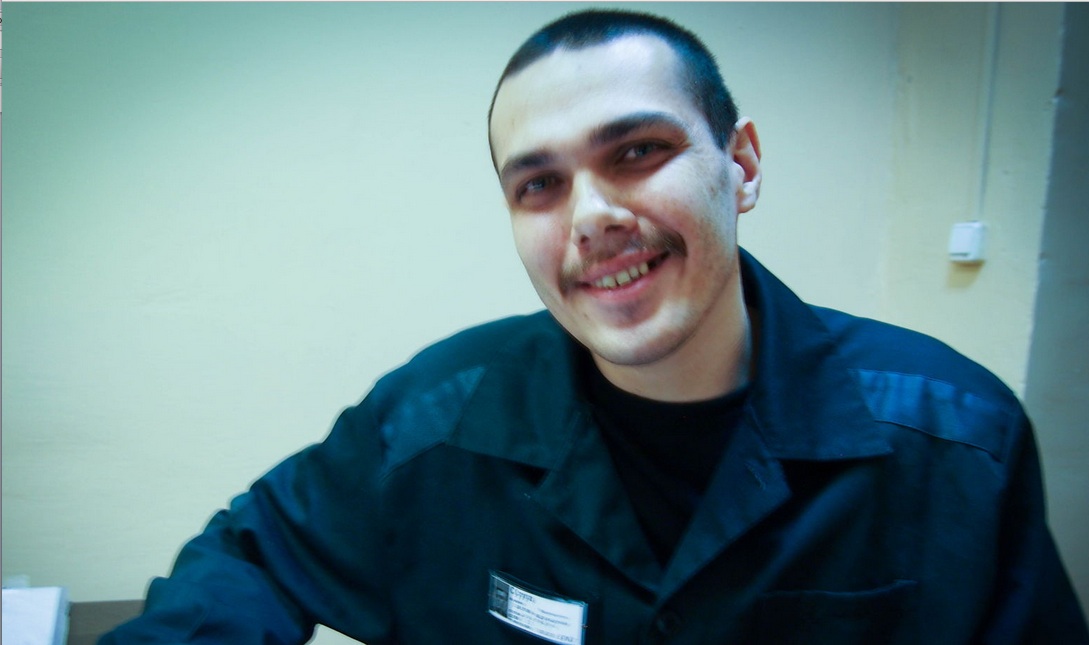
Alexei Sutuga, December 10, 2015. Photo courtesy of Svyatoslav Khromenkov
PERSCECUTION No medical treatment, no letters, no visits. A political prisoner’s life in a penal colony. Zoya Svetova and Alexei Glukhov investigated the conditions of antifascist Alexei Sutuga’s imprisonment
December 14, 2015 Open Russia
29-year-old Muscovite Alexei Sutuga is an antifascist activist known among antifa by the nickname Socrates. On September 30, 2014, the Zamoskorechye District Court in Moscow sentenced Sutuga to three years and one month in prison for disorderly conduct for his alleged involvement in a fight at a Sbarro restaurant in the city. Sutuga’s defenders believe the criminal case was revenge on the part of Center “E” officers who had already tried to put Sutuga behind bars for his alleged involvement in a fight at the Moscow nightclub Vozdukh, for which he had been amnestied.
The Memorial Human Rights Centre has declared Alexei Sutuga a political prisoner.
In March 2015, the antifascist was sent to Correctional Colony No. 14, a medium-security facility, to serve his sentence. He was soon put in solitary confinement, and two months later he was sentenced to a new type of punishment, a year’s imprisonment in a single-space cell. Now Sutuga is serving his sentence at Correctional Colony No. 2 in Angarsk, Irkutsk Region.
Olga Sutuga, Alexei’s mom, explained to Zoya Svetova how and why her son is being pressured in the colony.
Solitary confinement and single-space cells are forms of penitentiary repression. Is this improvisation on the part of local wardens or are there orders from above? Is there a plan to break your son?
It began in Moscow, when the FSB wanted Alexei to cooperate with them. They came to him while he was still in the remand prison and suggested he collaborate. They said he would serve his sentence in far from the best conditions, in a colony far from Moscow Region. That is what happened: he was sent to Siberia. And there, in the remand prison, he was again visited by two Center “E” officers who suggested he collaborate and promised that in exchange he would do his time in the Irkutsk Remand Prison and get parole. But he did not agree to these proposals.
What exactly do they want from him? To snitch on anarchists?
Apparently, yes, because he knows a lot of people, is a fairly authoritative person in that world, and has his own opinion. Not only anarchists but also other activists listened to him. He is a very inconvenient person for the secret services. He always spoke the truth, and they decided it was vital to break him and force him to cooperate with them.
How do you keep in touch with your son? He is not allowed visits, letters, and telephone calls. How do you find out what is happening with him in the penal colony?
Only through his lawyer. When his lawyer battles his ways through to see him, he finds out that Alexei has not been getting letters from his wife, from me or from his friends. On November 30 he was released from solitary confinement, where he had spent ten days. Now he is in a single-space cell in Correctional Colony No. 2 in Angarsk, Irkutsk Region. He is supposed to spend a year there—until May 2016.
Is he considered a repeat offender of prison rules?
Here are some of the violations he has been charged with: not making his bed, having his nametag torn from his clothing, and sleeping during the daytime while sitting on a stool. For all these things he was deemed a repeat offender. When in late May he was transferred for a year to the single-space cell, the warden of the single-space cell facility told him he would not be getting out of there, that he would be spending the rest of his sentence in the “jug,” that he would not be returning to the medium-security facility, although by the verdict of the court he should be serving his sentence in a medium-security penal colony.
Is Alexei in solitary?
No, there are four people in there.
How can we help him?
He has asked that people do not stop paying attention to the whole situation, because if they do not write and talk about it, the prison wardens will see they can do anything they like and will use even more repressive methods against him.
How long does he have till the end of his sentence?
One year and five months.
Do members of the Public Monitoring Commission (PNC) visit him?
Employees of the PNC come to see him every two or three months. They constantly file complaints about violations of his rights with the Federal Penitentiary Service. But it does not help: no one pays any mind to the complaints.
Those violations of the rules in the remand prison for which he has been punished, were they real or contrived?
It is impossible to comply with all the rules there one hundred percent. Maybe the nametag really was torn off his clothing. But Alexei definitely did not have a shiv, because when he was transferred from the remand prison to the penal colony, six people searched him, and the trip from the prison to the colony takes half an hour. [Angarsk is forty kilometers away from Irkutsk — Open Russia.] So it is completely unclear how he could have got hold of a shiv if he was in a paddy wagon with guards the entire half hour.
When is your next visit with him?
I was authorized to visit him in October but I was unable to go. I will go in late December. I wanted to get to see him during the January holidays. But I am not sure it will work out. When the lawyer went to see the head warden of the colony and find out whether I might be able to get this visit, the warden replied there would be no visits due to the fact that Sutuga was socially dangerous.
Is that even legal?
No, of course not. By law I have the right to visit him. I wrote to the head warden of the colony asking him to give me a visit. If he does not respond to me within fifteen days, then we will file another complaint. Unfortunately, though, complaints have no impact. We write to the Federal Penitentiary Service, the prosecutor’s office, and the court.
How does Alexei spend his time? Is it true he has no books and is unable to get periodicals?
The prison does not accept books sent to him, and it also does not give him the periodicals we subscribed to for him. I wrote to the warden and asked what happened to the periodicals that were sent by mail in my son’s name to the penal colony. After all, we had paid money for the subscriptions. It smacks of petty theft.
What is his mood?
When attorney Svetlana Sidorkina went to see him in October, she said that Alexei was very depressed, sick, and his knees were swollen and painful. He was diagnosed with acute arthritis and tossed out of the infirmary back into the cell. He receives no medical treatment or medical examinations. Sidorkina brought him letters from me and from his friends. That supported him. The local lawyer, who visited him the other day, says that Alexei’s mood has improved. Generally, he is a very active person, and if he has no opportunity to do anything he gets depressed. But now, apparently, he has realized we are fighting for him, his friends wrote that he has not been forgotten, and so his mood has been normal and he is holding up. He will turn thirty on January 24. It’s a big birthday.
How Alexei Sutuga Was Made a Repeat Offender
After his trial in Moscow, Alexei was sent to the Irkutsk Remand Prison. When the prison staff confiscated his personal belongings and letters, Sutuga protested by declaring a hunger strike and demanding to be transferred to a penal colony. Three days later, Sutuga was transferred to Correctional Colony No. 14 in the city of Angarsk, Irkutsk Region.
However, as soon as Alexei arrived at the colony, a shiv was found on him. Sidorkina believes prison colony staff planted the shiv on him.
Before his transfer from the remand prison, Sutuga was undressed completely, all his personal belongings were examined, and the procedure was filmed on a video recorder. No forbidden items were found. The paddy wagon in which he was transported in the company of three guards was also inspected.
At the penal colony, Sutuga was immediately taken to the search room, where in the presence of ten colony staff he was again forced to strip and put all his things on a table. As Sutuga was undressing and simultaneously replying to the questions of penal colony staff, one of them suddenly discovered a sharpened metal object in Sutuga’s cap. Sutuga claimed he had nothing to do with the shiv.
Sutuga was placed in solitary confinement for seven days.
Over the next month, Sutuga received three more disciplinary reprimands: for not wearing a badge, for not reporting to the on-duty guard, and for not cleaning his room.
Due to these clearly fabricated violations, Sutuga was declared a repeat offender of prison rules and was first transferred to a high-security cell, then to a single-space cell.
What Is a Single-Space Cell?
Sutuga is now imprisoned in a single-space cell [edinoye pomeshchenie kamernogo tipa or EPKT] at Correctional Colony No. 2 in Irkutsk Region.
Single-space cells were instituted in penal colonies after July 1997. Previous to this, each penal colony had contained an “internal prison”—a cell-like space [pomeshchenie kamernogo tipa or PKT]. Now single-space cells have been devised that are no longer managed by the particular correctional facility, but by the regional office of the Federal Penitentiary Service. Prisoners placed in single-space cells are often in the process of transfer to another city and sometimes another region. But Alexei Sutuga has been left in the very same city, in Angarsk.
Members of the Irkutsk Public Monitoring Commission reported what they saw at Correctional Colony No. 2 in June 2015.
“There were heaps of construction debris in the yard in front of the entrance to the space. The cells were dimly lit, there was no ventilation, and the radio was not working. The tables were ninety by fifty centimeters, and there were benches ninety by twenty centimeter benches on each side. They were in the middle of the room, so it was problematic for four people to fit in the room at the same time. There was also very little space to move around. The drinking water was poured from the tap into tanks in the rooms.”
Top brass at the Irkutsk Regional Office of the Federal Penitentiary Service reacted to the remarks, but as of October 2015 the construction debris had not been removed. In conclusion, the PMC wrote:
“Slag mixed with ash that is loosened up every day is scattered near the entrance to the building and around the entire perimeter of the room. It is not only that the slag exudes harmful substances (sulfates, phenol, etc.) but also that the dust from the slag and ash gets into the air and from there, through the windows, into the cells and exercise yards, harming the health both of convicts and staff.”
Alexei Sutuga Does Not Receive Medical Treatment in Prison
The antifascist has several ailments that require treatment.
“In October, the public monitors established that Alexei was not being given packages with medicaments: they were being sent back. Staff at the facility explained that they do not let packages through if the permitted number of them is exceeded. And yet they do not look inside to determine whether they contain medicaments or not, but just send them back. They say the sender has to personally come to the facility and submit the package through the infirmary,” recounts Irkutsk human rights defender Svyatoslav Khromenkov.
In the presence of members of the PMC, Sutuga was prescribed an x-ray. At the time of the visit Sutuga was in the facility’s medical solitary confinement cell with a foot injury. According to him, he had an old sports injury, which had flared up after he had struck his foot against a nightstand. Sutuga also complained about lung problems: he said he was having trouble breathing. He believed he had pneumonia.
Lawyer Denis Ivanets says the trauma specialist in the infirmary at Correctional Colony No. 6 diagnosed Sutuga with first- and second-degree severe arthritis in both knee joints. This is a chronic illness. Civilian trauma specialists told the lawyer that, given such a diagnosis, medication was insufficient. Sutuga would also need physiotherapy, including massage, as well as special orthopedic aids.
On December 10, 2015, the public monitors once again visited the antifascist. He said he had been given the package of medicaments that had been brought to the prison personally by his comrades. Sutuga was very happy that he had finally got the pills. According to Sutuga, a doctor, who had told him there was no need for an immediate operation, had examined him and it could wait until his release.
Lawyers and Public Monitors Are Often Not Allowed to See Alexei Sutuga
During the course of the calendar week (five working days) beginning November 25, 2015, lawyer Denis Ivanets and human rights defenders constantly attempted to visit the political prisoner.
Every time the visitors appeared at the headquarters of Correctional Colony No. 2, the Federal Penitentiary Service officers found a pretext to turn them away. Either the warden of the facility, who had to sign the lawyer’s request to visit the convict, was not there (although, as later transpired, he had been in his office having an intercom meeting with the head office), or the warden of the single-room cell facility was gone all day, and he was allegedly the only staff member who could escort the lawyer to the premises behind the barbed wire (although the warden of Correctional Colony No. 2 had signed off on the paperwork for visiting the convict).
Now members of the Irkutsk PMC are appealing in court Correctional Colony No. 2’s ban on holding a personal conversation with Alexei Sutuga under conditions of acoustic isolation from penal colony staff. The law “On Public Monitoring” directly stipulates this right.
Letters and Newspapers Are Not Delivered to Sutuga
According to lawyer Denis Ivanets, “Alexei’s mom says her son does not reply to letters from his spouse, parents, and friends. When I talked to him about it, it turned out that more than two thirds of the letters had simply not got to him! These letters had been sent to Alexei over a month ago.”
According to Article 91.2 of the Russian Federal Correctional Code, letters, postcards, and telegrams sent and received by convicts are censored by the wardens of the correctional facility, after which they must be given to the convicts.
In addition, Sutuga’s relatives took out subscriptions to several newspapers and magazines (Kommersant, Novaya Gazeta, Rossiiskaya Gazeta, GEO,Vokrugsveta), but Sutuga had not been receiving them. Staff in the warden’s office at Correctional Colony No. 2 could not give the lawyer an intelligible answer as to why this had been happening. According to the Article 95.1 of the Russian Federal Correctional Code, convicts are permitted to receive stationery supplies in parcels and packages, purchase literature through retail distributors, and subscribe to newspapers and magazines without limitation at their own expense.
Socrates Has Not Surrendered
Alexei Sutuga was placed in solitary confinement from November 20 to November 30 for his latest “rules violation.” As his lawyers report, the number of reprimands grows with each passing month, and this will make it impossible for him to be paroled.
On December 10, 2015, the members of the PMC were able to chat with Sutuga, who sent greetings to everyone, especially his loved ones, his mom, wife, and child. Sutuga asked for new photographs of them, as well as books on psychology, sociology, and political science.
“I had begun to feel I was born in prison and just had been released for a short time” Alexei Polikhovich talks about spending three years behind bars for the right to think freely
Ekaterina Fomina
November 5, 2015 Novaya Gazeta
Alexei Polikhovich after his release from prison. Photo: Ekaterina Fomina/Novaya Gazeta
Alexei Polikhovich, one of the few defendants in the Bolotnaya Square case who had actually been politically active before the ill-fated protest rally of May 6, 2012, has been released from prison. (We now understand this was the reason people were jailed: on suspicion of having vigorous civic stances.) Before Bolotnaya Square, Polikhovich, for example, had defended the Tsagovsky Forest and been involved in the antifascist movement. Some of those now spending their fourth year in prison after being convicted in the case had ended up on Bolotnaya Square by accident, but Polikhovich had chosen this way of life, a life of open struggle, consciously. It is a dangerous way of life to lead in our country, even if the way you fight your cause is ten times within the law. But Polikhovich consciously chose this way of thinking, and marched to Bolotnaya Square in the antifascist column.
However, on Bolotnaya Square on May 6, 2012, Polikhovich caught hell just as randomly as other protesters. Police pulled them from the crowd in the heat of the moment without looking .
Polikhovich insisted on his innocence at his court hearings. He knew he was being tried for his convictions.
Three years in prison were supposed to reform what? Polikhovich’s beliefs? He remained, however, true to his beliefs throughout his imprisonment. If reform meant betraying them, then Polikhovich has not been reformed, as he himself says. But he still learned something.
After his release, Polikhovich talked about the lessons he learned in prison.
__________
I have not seen people in color for three years. I have forgotten what it was like to have women and children around. Simple things seem new right now. After being in the penal colony, I think Moscow is quite beautiful.
When I got to Petrovka [38, Moscow police HQ], I did not understand how serious things were. I took everything as an excursion, a rough excursion, but an excursion nonetheless.
The wording “actively involved in destructive youth organizations” was included in my arrest sheet. The Center “E” officers [“anti-extremist” police] did not have a clear opinion about me, whether I was a rightist or leftist. What group should they assign me to? What mattered was that it should sound terrible.
The police investigators found us interesting. They had been used to dealing with Islamists and neo-Nazis. But leftists, social democrats, and liberals, everyone who had been arrested on trumped-up political charges, were something unfamiliar to them. The investigators enjoyed chatting with us. I remember one such conversation. A crowd of investigators was standing before me, and I was telling them why I was in jail. I explained I had not wanted to hit anyone, that had not been the objective. Well, I expressed it simply.
They immediately tensed.
“What was the objective? Who set the objective?” they asked. They think crudely.
Other inmates knew about our case, and I never encountered flagrantly negative attitudes towards us in this connection. On the contrary, sometimes they would see articles about us and come running with the newspaper: “Oh, it’s about our rock star.” I also encountered not very well-educated people who thought that since I had been jailed for a protest rally that meant I was a nationalist. Several times, I quite seriously cussed people out for saying this: it offended me.
I had expected remand prison would involve total isolation, but it was like a rural village in there: everyone was connected with everyone else. It was its own society. In Butyrka remand prison, they explained to me how to “spur the horses.” In prison, “the horses” is the rope that connects cells and works like an intercom. Books were soaked with narcotics and passed on to those who needed them. Because of this, by the way, the flow of regular books into the prison slowed down. According to the internal code of inmates, formal channels for getting groceries and cigarettes into the prison should not be compromised.
The penal colony, where you are not locked up in eight square meters, seems like the regular world compared to the remand prison. You can see the sky. You can spot newcomers to the colony immediately: we all arrived looking pale. We had almost turned into mushrooms after two years of hearings and trials. I drank up the sunshine with my skin. I got a dark tan right away.
At one point, I even thought I had been born in prison. It was just that I had been let out. I had quickly found myself friends, a wife, and parents. I had screwed up somehow and gone back to prison.
Alexei Polikhovich and his parents. Photo from family archive
In the colony, you can learn to be a tailor, a lathe operator, an electrician or an auto mechanic. The phrase “Labor liberates” is written on the gates of the manufacturing zone. I studied sewing for six months, then I studied to be a lathe operator while also working as a sewing machine operator. Convicts sew sheets, pillowcases, suits, blankets, and bags. In anticipation of my release, I sewed a rucksack for myself and Tanya, my wife. I had also sent her an apron and some bags.
In prison, people have no way of filtering incoming information. They mainly read bad newspapers. They also would take out the [philosophical and] literary journal Logos, which has no pictures, have a gander at it and be amazed. If you put convicts on a diet of [the national newspapers] Novaya Gazeta, Vedomosti and even Moskovsky Komsomolets for a month, they would catch on to something. But they would watch TV constantly, then would come to me and dump on me about how bad things were in Ukraine and what a trooper Putin was. They particularly liked all the trash on REN TV about reptilians and conspiracy theories.
Few people read good books in prison. They mainly read fluffy stuff, detective novels and bad sci-fi. Books from the outside are rarely “reeled in.” Falanster bookstore and I organized a book fair of sorts: beginning with my time in the remand prison, they sent me an endless stream of books. They sent so many books I would have had to serve another sentence just to finish reading them! When I was released, I took only a single rucksack with me, containing only books and letters. When you leave prison, you have to leave as much behind as possible. Not everyone in there has two pairs of warm socks. I took the books I was certain would interest no one: William Zinsser’s On Writing Well and [Ditmar] Rosenthal’s Russian language textbook. I thought I should finally learn Russian properly, so I would not be ashamed to print what I wrote. I also brought out an anthology of lectures from the Priamukhino Readings.
These three years have happened. I cannot cut them off or cross them out. I probably would not have wanted to spend them in prison, but I spent them there. This foundation, this experience on which I now stand, I cannot push it out from under my own feet. Not because I would fall, but because I just cannot do it physically. It is difficult. It is a rock.
Am I angry at anyone? I did not suffer catastrophically over these three years. I can be angry at the system on behalf of my loved ones. They certainly did not deserve it and are not guilty of anything.
I probably have become angrier over the last three years. And a little weary.
Translated by the Russian Reader. Thanks to Gabriel Levy for the suggestion
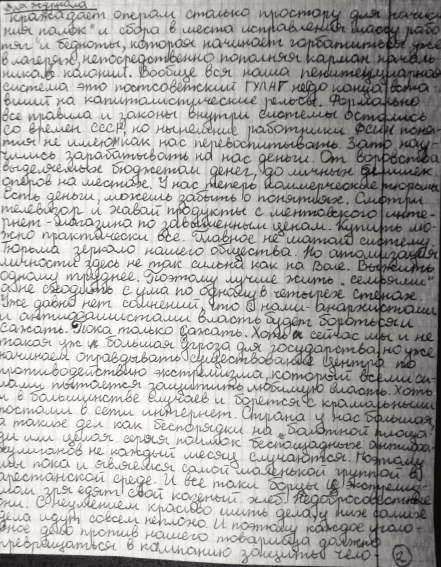
You can imprison us but you can never break us. We are not neo-Nazis who when they find themselves in prison try to slash their wrists, hang themselves, and swallow razor blades right off the bat. And who in the camps quickly join the “goats” (kozlyatnya), the prison household work brigades. We can be part of the general prison population. We don’t have to fear that our fingers will be beaten off with a hammer or we will be whacked upside the head with a slipper, because we haven’t done anything “gross.” We don’t judge people by ethnicity, color, and creed. Here in prison we are all “wogs” and “bandits” in the eyes of the law, because we valued honor and truth more than liberty. We are not Moscow chumps who imagined they were Aryan Vikings, but who as soon they went into the system realized they were not fascists but were like everyone else here. No, in Russia there will never be an Aryan Brotherhood like in the US. In our prisons there is a friendship of peoples.
Alexei Sutuga
Moscow Babylon has seduced, hoodwinked, and punished all the poor fellows from all over the Soviet Union. Now we all hate those greasy pushers in suits flashing IDs, the stupid cops who have involuntarily become polizei, and we laugh at each other when we tell the stories of how we ended up here. Now, as in the years of the Soviet-era Great Terror, there are entire social groups getting run through the system for the same crimes. This is no fight against crime. It is a war with competitors for control of business and against their own (potential) poverty. The law enforcement agencies are doing business when they jail businessmen and officials for fraud (Article 159 of the Criminal Code). They nick their businesses from them and get rid of competitors who got caught with their hands in the till and did not cut them in on the action. Since the entire Russian business world is built on financial scams and fraudulent schemes, there is no shortage of new criminal cases.
The same is true in drugs trafficking. The terrible Criminal Code Article 228, Parts 3 and 4 (drug dealing), introduced by the president, has made it possible to populate the prisons and camps with Central Asian nationals, which has done nothing at all to disrupt the well-regulated flow of drugs, but justifies the work of the Russian Federal Drug Control Service and the entire Russian Federal Penitentiary Service. And such a time-honored crime among prisoners as theft (Article 158) gives police investigators wide berth for padding solved cases stats and packing the penitentiaries with mobs of working stiffs and poor folk, who bust their humps in the prison colonies, thus directly lining the pockets of the wardens.
Our entire penitentiary system is a post-Soviet Gulag that has not fully embarked on the capitalist path. Formally, all the system’s rules and regulations have remained as they were in Soviet times, but the current Federal Penitentiary Service employees has no clue how to rehabilitate us. On the other hand, they have learned how to make money off us, from embezzling allocated funds to the personal deals made by criminal investigators at the local level. Russia now has commercial prisons. If you have money, you can forget about the unwritten “understandings” that once reigned. Watch TV and tuck into groceries ordered from the cops’ online store at inflated prices. Almost anything can be bought. Just don’t rock the system.
Prison is a mirror of our society. But the atomization of the individual is not as forceful as it is on the outside. It is harder to survive alone. That is why it is better to live in “families” than to go crazy alone between four walls. For a long time there has been no doubt that the regime plans to combat and jail us anarchists and anti-fascists. For the time being they are only jailing us. Though now we are not such a big threat to the state, we justifiy the existence of the Center for Extremism Prevention (Center “E”), which does everything it can to defend its beloved regime. Although in most cases this amounts to combating seditious posts on the Internet.
Manuscript of Sutuga’s letter
Our country is big, and things like the riots on Bolotnaya Square or the capture of ruthless antifa hooligan do not happen every months. So for the time we are the smallest group in the prison community. And yet the anti-extremism police eat their government-issued bread for nothing. They are unscrupulous. Although they are clumsy at fabricating cases, they are doing quite well for themselves. And so every criminal case against a comrade of ours must be turned into a campaign to defend the individual from the state’s power over him or her. All the punitive institutions of the state should be subjected to attack. We and the people are on one side, and this leviathan with legs and dressed in a uniform is on the other.
Thanks to Vladimir Akimenkov for the heads-up. If you follow this last link you will find information, in Russian, about Sutuga’s address at the prison colony in Angarsk where he is currently serving his sentence, where and how to send letters to him, and how you can help him and his family financially.
Alexei Sutuga is an anti-fascist and member of the Autonomous Action anarchist movement. In April 2012, he was arrested on suspicion that on December 4, 2011, he and a group of anti-fascists had assaulted a group of young nationalists, and that on December 17, 2011, he and his friend the anti-fascist Alexei Olesinov had assaulted security guards at the Vozdukh Club in Moscow. The accused and people who had been attending a concert at the club testified that the security guards had themselves provoked the fight and used weapons. In 2013, police investigators admitted that Sutuga had had nothing to do with the incident on December 4, 2011. In the summer of 2013, he was released on bail from remand prison, and in January 2014 the case against him was closed as part of an amnesty. Afterwards, according to Sutuga, Center “E” officers threatened him with “problems.”
In April 2014, Sutuga was detained by Center “E” operatives after an anti-fascist concert in Moscow’s Izmailovo district. According to a report by the For Human Rights Movement, ten other people were detained besides Sutuga. The pretext was a crime committed by a person unknown in the vicinity of the concert, but according to the human rights activists, therewere no grounds for suspecting the anti-fascists. Sutuga was asked about a trip to Maidan as he was being detained. All the other detainees were soon released, but a disorderly conduct report was filed against Sutuga and he was kept at the police station. He was later charged with having delivered multiple blows with a chair, his feet, and an improvised hammer to several people during a fight at a Sbarro chain restaurant outlet on January 2, 2014. Sutuga himself claimed that he had been trying to separate the people involved in the fight, which, according to him, had taken place between a group of right-wing youth and another group of young people, and that in the process of pulling them apart he had struck someone once. On October 1, 2014, Sutuga was sentenced to three years and one month in a medium-security penal colony. On December 17, 2014, an appeals court upheld the judgment.
In April of this year, Antti Rautiainen reported the following to Infoshop News (which I have summarized).
Sutuga has been transferred to the Irkutsk Region. He has refused to do household work in prison (which could reduce his sentence), unlike neo-Nazis Maxim Martsinkevich and Roman Zheleznov, as this form of collaborating with prison wardens is impossible for an anarchist.
Sutuga is twenty-nine years old. His sentence will end in May 2017.
On March 17, Sutuga went on hunger strike, demanding that his confiscated letters and books be returned to him and that he be transferred from the remand prison in Irkutsk, where he was incarcerated, to a prison colony.
On March 22, Sutuga was transferred to Prison Colony No.14 in Angarsk.
The Memorial Human Rights Center declared Sutuga a political prisoner on March 20.
Sutuga has a wife and child who live in Ukraine. His spouse is studying for a PhD and raising their child.
The cost of a two-way flight to Angarsk for his wife and son is about 60,000 rubles (approx. 1,200 euros). Only one long-term conjugal/family visit is permitted every three months. Alexei’s family needs money for sending parcels of food and other necessities to the prison colony.
A New Round in the Crackdown against Adygean Environmentalist Valery Brinikh Adygea Supreme Court Upholds Decision Declaring Article “The Silence of the Lambs” Extremist
March 22, 2015 Environmental Watch on North Caucasus
On March 20, 2015, the Supreme Court of the Republic of Adygea heard an appeal filed by Valery Brinikh, chair of the Adygean branch of the All-Russian Society for Nature Conversation (VOOP), against a December 17, 2014, decision by the Maykop City Court in which Judge Irina Ramazanova had ruled Brinikh’s article “The Silence of the Lambs” extremist. The Supreme Court rejected Brinikh’s appeal.
Valery Brinikh
The article, published in August of last year, dealt with the environmental problems caused by Kievo-Zhuraki JSC, a pig-breeding facility located in Adygea’s Teuchezhsky District. Vyacheslav Derev, who represents Karachay-Cherkessia in the Federation Council, Russia’s upper house of parliament, founded Kievo-Zhuraki JSC. The publication of “The Silence of the Lambs” served as a spurious pretext for launching a crackdown against Valery Brinikh and stopping his environmental work by any means possible. All of the republic’s law enforcement agencies, working in concert, as if on orders and following a unified plan, started a campaign of persecution against Brinikh. The republic’s FSB office and the Russian Interior Ministry’s Extremism Prevention Department (Center “E”) in Adygea led the investigation. The Adygean Prosecutor’s Office filed the lawsuit requesting that the article be ruled extremist, while the Investigation Department of the Russian Investigative Committee in the Republic of Adygea filed extremism charges against Brinikh under Article 282 of the Russian Federal Criminal Code. Only the timely intervention of the Presidential Human Rights Council and its chair, Mikhail Fedotov, who made a special trip for the purpose to Maykop, helped alleviate the attack on Brinikh to some extent. However, the ruling made by the Adygean Supreme Court on March 20 shows that the authorities have decided to proceed with the criminal case against Brinikh.
Judge Vera Meister presided at the first hearing of Brinikh’s appeal on March 10. However, a decision was not rendered in the case. Brinikh managed to sow doubts as to the admissibility of the only piece of the evidence in the case, a certified linguistic analysis of the article “The Silence of the Lambs,” which was produced by the criminal investigation. Brinikh pointed out that according to Russian Federal Constitutional Court Decision No. 18-O, dated February 4, 1999(“On a Complaint by Citizens M.B. Nikolskaya and M.I. Sapronov That Their Constitutional Rights Had Been Violated by Individual Provisions of the Federal Law ‘On Criminal Investigations'”), the results of a criminal investigation cannot be admitted as evidence in court; they can only be admitted as such only after they have been secured through due process. The judge decided to postpone examination of the appeal for ten days, summoning the expert who conducted the linguistic analysis, Police Lieutenant Colonel Sergei Fedyayev, and questioning him in court. Judge Meister obviously crossed paths with forces that needed a fast and definite decision from the judge. Therefore, at the next hearing, on March 20, Brinikh’s appeal was heard by a new panel of judges. The presiding judge was Olga Kulinchenko, who is deputy chair of the Adygean Supreme Court and chair of the republic’s Council of Judges.
Despite this lofty status, Judge Kulinchenko violated procedural requirements from the outset of the hearing. The expert witness invited to give testimony was not removed from the courtroom prior to being questioned, and he was not made to sign an acknowledgement that he had been warned about criminal liability for perjury. During questioning, the chief expert from the Forensic Center of the Main Directorate of Internal Affairs in Krasnodar Krai was unable to explain why he had been assigned the analysis by the deputy head of the Federal Security Service (FSB) in the Republic of Adygea, and not by the head of the Forensic Center, as stipulated by the Law “On State Forensic Expertise in the Russian Federation.” To explain how the package containing the material for linguistic analysis had been delivered to him in Krasnodar by guarded courier post from Maykop in five minutes (a trip that takes between ninety minutes to two hours by car), Fedyayev claimed that his working day began at 7 a.m. (According to the certified linguistic analysis, the work on it was begun at 9:05 a.m. on March 15, on orders, dated March 15, from the deputy head of the Federal Security Service in the Republic of Adygea.) In keeping with this line of argument, when he signed the accompanying letter on March 15 in Maykop, the deputy head of the Federal Security Service’s office in Adygea would have had to have been at work in the wee hours of Monday morning, March 15, as would have his clerk, who registered the letter. Therefore, the method of the ultra-fast delivery from Maykop to Krasnodar of the package containing the publication remains a mystery. These discrepancies did not trouble Judge Kulinchenko, however. During closing arguments, she constantly interrupted Brinikh, preventing him from fully stating his case and hurrying to finish the spectacle, whose ending was predetermined. The two other judges on the panel were flagrantly bored, since, apparently, they knew in advance how it would all turn out.
And that is what happened. The hearing, a shameful episode for the Russian judicial community, ended with the judges rejecting Brinikh’s appeal against the lower court’s ruling. Thus, as of March 20, the article “The Silence of the Lambs” is officially deemed extremist.
Now we should expect an abrupt reactivation of the investigation into the charges filed against Valery Brinikh on December 11, 2014, under Article 282.1 of the Russian Federal Criminal Code (“incitement to hatred or hostility, and humiliation of human dignity on the basis of ethnicity”). The investigation can now base its conclusions on the Maykop City Court’s ruling, which is now final and legally binding, something that it previously had critically lacked to legitimize this critical case.
The purpose of all these actions is obvious: to railroad, through the combined efforts of the local offices of the FSB, the Interior Ministry’s Center “E,” the Investigative Committee, the prosecutor’s office, and the courts, one of Russia’s most active conservationists, a man who prevents corrupt officials and unscrupulous businessmen from living peacefully.
For more information, call +7 (918) 425-8435
____________________
“The silence of the lambs”: why the smell of manure must be endured
Elena Borovskaya
December 23, 2014 openrussia.org
How an Adygean environmentalist “fomented hatred” and “incited” locals “to action” in his fight against a Federation Council member’s pig farm
Criminal charges have been filed against Valery Brinikh, head of the Adygean branch of the All-Russian Society for Nature Conversation for an article he published on the Internet, “The Silence of the Lambs.” Brinikh has been accused of inciting hatred and calling for extremist actions under Article 282.1 of the Russian Federal Criminal Code. Observers have linked the persecution of the environmentalist to his long campaign against a pig farm owned by Russian Federation Council member Vyacheslav Derev, which has been polluting the surrounding area with manure.
The article “The Silence of the Lambs” was published on the website For Krasnodar! on September 8, 2014. Currently, the article has been deleted from the site and is available only in search engine caches. In the article, Brinikh describes his meetings with residents of the villages of Gabukay and Assokolay in the Teuchezhsky District, who had complained of the stench from the Kievo-Zhuraki JSC pig-breeding facility and other environmental problems. Local authorities made note of the trip there undertaken by Brinikh and his environmentalist colleagues. In Assokolay, they were greeted by prosecutors, policemen, and Center “E” officers instead of villagers. Sharing his impressions in the article, Brinikh criticizes the passivity of local residents in defending their rights and their “fear of tsars,” quoting aphorisms by Voltaire, and Russian and Adyghe proverbs in the process.
On November 20, the Adygea Prosecutor’s Office petitioned the court to rule the article “The Silence of the Lambs” extremist on the basis of an examination performed in conjunction with the local office of the Federal Security Service (FSB). According to the document, a linguistic analysis performed by the Main Directorate of Internal Affairs in Krasnodar Krai showed that the article contained statements “that could be understood on the basis of ethnicity [and] origin [sic] to promote the degradation of the human dignity” of a group of persons (the Adyghe), as well as statements “that could be understood to incite [the Adyghe] to take actions probably related to violence against a group of persons, [i.e.,] ‘representatives of the local authorities.'”
On December 17, the Maykop City Court satisfied the request by the Adygea Prosecutor’s Office and ruled the article “The Silence of the Lambs” extremist. At the previous court hearing, on December 12, Brinikh became ill and was taken by ambulance to the Republican Hospital. After he underwent medical procedures, Brinikh was taken into custody by police, who informed him he had been charged under Article 282 of the Russian Federal Criminal Code and took him to his residence to conduct a search. Brinikh was then questioned by the Investigation Department of the Russian Investigative Committee in Adygea and released on his own recognizance. However, investigators attempted to prevent lawyer Ludmila Alexandrova from seeing Brinikh, writes the website Environmental Watch on North Caucasus.
The same day, police investigators arrested Vitaly Isayenko, moderator of the website For Krasnodar! in Krasnodar and took him to Maykop for questioning in the “Silence of the Lambs” case. Lawyers did not know his whereabouts for a long time. According to activist Alexander Yesipyonok, investigators questioned Isayenko through the night, after which he was hospitalized in serious condition due to an aggravation of his diabetes.
Yesipyonok is convinced there are no statements in the article “The Silence of the Lambs” that could be construed as extremist or offensive.
“Rather than supporting Valery Brinikh in his fight to preserve a clean environment, the law enforcement authorities of the Republic of Adygea have organized his criminal prosecution by arbitrarily interpreting the laws, committing numerous procedural violations, and engaging in flagrant psychological pressure,” he wrote in a letter to the editors of Open Russia.
Observers have linked the criminal case against Brinikh to his fight against violations of environmental law by Kievo-Zhuraki Agribusiness JSC, an industrial pig-breeding facility owned by Vyacheslav Derev, Karachay-Cherkessia’s representative in the Federation Council. Brinikh’s confrontation with Kievo-Zhuraki has lasted for several years. According to environmentalists, the facility has caused a permanent stench in the surrounding villages, and discharges of manure have repeatedly killed off fish and seedlings in the fields. After a series of articles by Brinikh, Kievo-Zhuraki management filed a lawsuit to protect its commercial reputation, but the court sided with the environmentalist. In addition to environmental issues, Brinikh has written about corruption: about the ties between Derev and Adygean authorities, and abuses during construction of the pig-breeding facility.
The Presidential Human Rights Council has announced it will be monitoring the Brinikh case. Council chair Mikhail Fedotov and Greenpeace Russia’s executive director Sergei Tsyplenkov studied the situation when they visited Adygea during a field meeting of the council in Krasnodar Territory from December 15 to 17.
♦♦♦♦♦♦♦♦♦♦♦♦♦♦♦♦♦♦♦
In dealing since 2012 with the problems caused by the illegal operations of Kievo-Zhuraki Agribusiness JSC, I have often met with local residents who complained to me about the stench from the pig sheds. However, despite the increased activism of our organization in the Teuchezhsky District, at present there is not a single member of the All-Russian Society for Nature Conservation in this municipality. It has just so happened that the main core of our organization in the republic is made up of residents of Maykop and the Maykop District, while there are almost no members of the Society in Adygea’s ethnic districts.
To remedy this situation, I had asked my Adyghe friends to organize meetings with local residents in the villages of the Teuchezhsky District. We needed to look for assistants in our environmental work. The negative impact of Kievo-Zhuraki Agribusiness JSC’s pig-breeding facility on the environment and people’s health was a good occasion for such meetings. It would be interesting to hear directly from the people who lived next door to the pig-breeding facility whether they enjoyed having such a neighbor or not. It was also interesting to see whether we could count on the villagers of the Teuchezhsky District in our fight with the polluting pig producers, who had been violating Russian law and people’s right to a healthy environment.
From long years of personal experience I knew how hard it was encourage ordinary folk in our country to engage in more vigorous actions. Since Soviet times, our people have been used to letting off steam in the kitchen, in narrow circles of likeminded people, while in public they approve any moves made by the authorities, however idiotic. Still, I nourished a glimmer of hope that they had not all grown accustomed to the smell of pig manure, that not everyone was happy with the fact that fish were going belly up in the local ponds, and that the authorities would not lift a finger to improve the situation.
But the reality proved harsher, both to me and to my hopes. First, we stopped at Gabukay, which is located literally right next to the buildings of the pig farm. The village was not crowded on that quiet August evening. In the center, right on the square, about a dozen mainly elderly men were relaxing and playing chess on benches. Among them was the man whom my good friend Kasei Khachegogu had brought me to meet. After introducing myself, I asked the villagers how they liked living next to the pig farm. And immediately it was like something in those people exploded. It turned out they felt there was nothing good about having such a neighbor. But they smelled the stench from the fields and sensed the indifference of the authorities, both local and Adygean, in solving the problems of the village of Gabukay. For, as it transpired, the village had many other environmental problems. For example, back in the day the authorities had altered the course of the river Pshish, and now there were problems with the old riverbed. According to local residents, the authorities had skimped on reclamation works. To put it simply, they had stolen part of the funds allotted, so the work was done not to plan but catch-as-catch-can. Consequently, the old riverbed has become overgrown and has not been irrigated. It has thus become a breeding ground for snakes right on the outskirts of the village. And there is plenty of garbage in the vicinity of Gabukay, just as near any rural settlement in Adygea, because the only authorized solid waste landfills are outside of Maykop and Adygeisk.
After chatting with people and handing out application forms for joining the All-Russian Society for Nature Conversation, we hurried on to the village of Assokolay. Frankly, we were hoping we would find more people there. Especially because we had given the residents of Assokolay prior warning through fellow villagers that we would be coming to meet with the people and survey them about pressing environmental problems. However, as soon as they drove into the village, my comrades met a woman they knew hurrying home from the center. She told them that people were already waiting for us near the local House of Culture; only they were not village residents, but police and prosecutors from Adygeisk. And the people who had been there to meet us had simply been dispersed to their homes. The woman advised us not to go there, but to return to Maykop. It was all the same, she said, because we could not talk to anyone but law enforcement officers.
We decided to go all the way to the end: as they say, to drink the cup to the dregs. The square outside the club really was crowded. Waiting for us there were Lieutenant Colonel Ruslan Akhidjak, head of the Adygeisk intermunicipal police department, his deputy, and a dozen of his officers, including several patrol cars. Also in attendance were the Teuchezhsky interdistrict deputy prosecutor, an officer from the extremism prevention department, and several more “men in black.” The local residents were in the minority: around ten to fifteen people in all. As soon as we got out of our vehicles, we were immediately showered with reproaches. Why hadn’t we notified the authorities of our arrival? We tried to explain that we had not been planning any public events, but had only wanted to talk to the villagers, ask them about problems, and suggest that they join the All-Russian Society for Nature Conservation. The fact is that in this case our organization would have a greater chance of defending the rights and interests of local residents, including protecting them from the negative impacts of Kievo-Zhuraki Agribusiness JSC’s pig farm.
In the end, I insisted that, since we had come all the way from Maykop, we would talk to however many people showed up. That is just what we did: under the watchful eye of police officers and prosecutors, and with a female officer from the Adygeisk police department standing next to us with a tape recorder turned on. Basically, the conversation was a repeat of the conversation we had had in Gabukay. The only difference was that there were two elderly men present who had gone with me to the court hearings in Adygeisk when our organization had been in a lawsuit with Kievo-Zhuraki Agribusiness JSC last spring. Thus, the conversation was more heated. We were accused of not having scored any victories in our campaign against the law-breaking pig producers. I had to explain that we have won victories, albeit small ones, and that in conditions of total corruption it would be pointless to expect quick and easy victories in the fight against dirty businessmen. That it would be much easier for me if in the district as a whole and in every village and farm we had active assistance. It is one thing when two or three witnesses come to a court hearing and testify that it stinks where they live, and quite another if hundreds of people would gather in the square outside the court and demand that Kievo-Zhuraki Agribusiness JSC stop poisoning people’s lives. Perhaps the judge, even if he or she had been “inspired” by their superiors, would find it much more difficult morally to hand down an unjust ruling.
And I also said that Kievo-Zhuraki Agribusiness JSC had stocked up on all sorts of certificates and evaluations approving their operations, and that was all the officials who inspected them needed to see. In reality, nobody had really inspected the pig producers and punished them. I see all the violations; I know how to punish the guilty parties and, most importantly, how to remedy the situation. But I am a social activist, and I am not authorized to do this, while those who do have the authority do not wish to use it. The regime despises the people, and the people despise this regime. They despise it and fear it. It is a vicious circle. To paraphrase the famous saying, every people deserves the regime it tolerates.
I was saying all this while secretly mulling over the thought that the authorities in Adygea feared any independent opinion, any unauthorized sigh. Look, a whole flock of them had flown into Assokolay, not even begrudging going to work on a Friday evening, right before the weekend. Apparently, local law enforcement was under strict orders from the Adygean government to prevent the opposition (and all real social activists and environmentalists are always in opposition to any government) from meeting with the local population. I recalled the anti-corruption rallies that had not been held because of the authorities, and the rally we had wanted to hold on June 5, World Environment Day, which had been dispersed by police. They clearly know who butters their bread.
Speaking of fat, I have always wondered why it was decided to place the pigsties amid the Adyghe villages and not somewhere in the Russian-speaking region of Adygea. Why is Kievo-Zhuraki Agribusiness JSC planning to raise cows outside of Maykop while it breeds pigs in the Teuchezhsky District? You find yourself involuntarily wondering whether Adygea’s current authorities have not done this on purpose. Because in practical terms, excuse my use of jargon, the Muslim population has been “punked,” meaning it has been humiliated to the point where people have lost their self-esteem. Humiliated people are easier to manage: you can wrap them round your little finger. And that is what is done to them. As Khazret Bogus, a local farmer and born columnist from the village of Krasnoe, wrote, there is an Adyghe saying: If you have tackled shit, hold on tight, because you have been soiled all the same. The Holy Quran forbids the faithful from eating pork, except in cases when they are forced to eat it. But who or what has forced the Adyghe to breathe manure-polluted air and swim in ponds poisoned by sewage? Nothing but cowardice and a lack of self-esteem. How does living in filth differ from the consumption of pork? For, according to the Quran, the pig is considered a dirty animal, because it lives in filth. But the residents of the Teuchezhsky District also, as a matter of fact, live in filth. It turns out that the stench from Kievo-Zhuraki Agribusiness JSC’s pig farm poisons not only people’s bodies but also their souls.
People used to sing, “No one will grant us deliverance, / No god, no tsar, no hero. / We will win our liberation, / With our very own hands.” Now they sing completely different songs, songs tolerant of the powers that be and the shit they generously reward people for their obedience. And they themselves place their hope in God, fear the tsar, and hope a hero will save them. No hero will save you, my dear fellow countrymen, until you cease being afraid of tsars. And God will not help you until you roll up your sleeves. The Russians have a saying: “God helps those who help themselves.” And the great French thinker Voltaire argued that God helps those battalions that shoot best.
So when are we going to start shooting better, villagers?
Automotive Industry Checked for Extremism Center “E” Officers Detain Independent Trade Union Activists in Kaluga
Anatoly Karavayev and Daniil Lomakin
March 23, 2015 Gazeta.Ru
Kaluga police conducted a raid against independent trade union activists who had gathered to discuss layoffs at local car factories. Due to the decline of the auto market, 750 people might be fired in the very near future. After being detained on a technicality, the detainees talked to officers from Center “E”, the Center for Extremism Prevention. The trade union movement considers such actions a preventive measure by the authorities.
A scandal has erupted in Kaluga over the detention of fifteen activists from the Interregional Trade Union Workers Association (ITUWA). (Police claim that twelve activists were detained.) At the weekend, workers from local automotive factories had gathered at the offices of the ITUWA’s Kaluga local to discuss future personnel reductions in the region.
For example, there are plans to lay off 150 people at the local Volkswagen plant in the near future.
In addition, the Peugeot-Citroen plant in Kaluga could dismiss as many as 40% of its workers, around 600 people, without compensation after March 31. Unlike Volkswagen, the French automaker has not yet made an official announcement.
As the ITUWA local informed Gazeta.Ru, they are planning this week to negotiate with plant management. If an agreement to save jobs is not reached, the trade union intends to hold protest rallies and file a series of lawsuits.
The local security forces also took notice of the Kaluga trade union’s activism. Over the weekend, police conducted mass arrests of its members. Moreover, officers from Center “E”, which specializes in combating various forms of extremism, dealt with the activists.
As activists recounted, they had begun gathering for the meeting when police suddenly entered the ITUWA office in Kaluga and arrested everyone present. Ultimately, 15 people were taken to the police station. ITUWA local chair Dmitry Trudovoi is certain the detention of the activists was occasioned by the trade union’s increased activism.
“Layoffs are planned at Peugeot-Citroen and Volkswagen. All this has lead the trade union to ratchet things up. Strikes and all that are possible. Basically, this was an act of intimidation,” Trudovoi said of the incident.
“This was a ridiculous police provocation,” Dmitry Kozhnev, who was among the detainees, told Gazeta.Ru.
“First, a beat cop entered the office. He asked about two people who had committed a robbery nearby and had, allegedly, dashed into the building where the ITUWA meeting was taking place. Some time later, the ‘bigwigs’ arrived (around forty ranking officers), people in uniform and plainclothes who systematically arrested us and took us to the station.”
“At first, they told us that the arrests were linked, allegedly, to the robbery. But that doesn’t seem to be true, given that people were detained for an hour. Center “E” officers conducted the interrogations. They were trying to figure out what our organization was doing, what events were planned. But none of the detained ITUWA members answered their questions.”
According to Kozhnev, the ITUWA regarded the arrests as an attempt to intimidate members of the trade union.
“Center “E” officers told us we were agents of the West and wanted to destabilize the situation in the country,” said Kozhnev.
“But ultimately they didn’t achieve their objective; they only discredited themselves. On the contrary, the situation has united all ITUWA workers even more,” he added.
The Kaluga Region Interior Ministry office denied the arrests of the ITUWA members occurred during an investigation of their activity.
As Svetlana Somova, head of the press center at the regional Interior Ministry office told Gazeta.Ru that a robbery had occurred near where the trade unionists were meeting. Two unidentified men had attacked a third man and stolen his belongings.
“According to the victim, [the robbers] escaped into the building where the meeting was taking place,” explained Somova. “A group of people, some of whom had no documents, was in the room. They were unable to explain anything about the men who had entered the building. Therefore, they were taken to Police Precinct No. 2. And there it transpired that an out-of-town trade union movement leader was among them. Naturally, the desk sergeant summoned Counter-Extremism Center officers to avoid provocations.”
As Somova explained, no more than ten officers had been dispatched to the site where the ITUWA members were detained: an extra-departmental security squad, a patrol squad, and police investigators.
“There were no riot police, as has been previously reported in the media,” said the press spokesperson. “If citizens believe their rights have been violated, they can complain to the prosecutor about the police’s actions. ITUWA activists had earlier accused the police of illegal actions, but no violations were uncovered during the course of probes.”
According to the press service spokesperson, police did not suspect they were detaining trade union members because the building sported a large “Barbershop” sign.
“A signal had to be sent”
ITUWA chair and well-known trade unionist Alexei Etmanov deems the incident in Kaluga unacceptable.
“It’s an absolutely abnormal situation when workers gathered for a trade union meeting are raided by the police. These are the methods not even of the 1990s, but of the 1930s,” Etmanov told Gazeta.Ru.
According to Etmanov, the detainees had gathered on a weekend day at the Kaluga ITUWA office to discuss the situation at the region’s automotive plants.
“There were members from Volkswagen and Peugeot-Citroen and other plants,” said Etmanov. “A beat cop showed up under false pretenses, then a SWAT team. At the precinct, they tried to fingerprint people. Those who were more experienced were able to wriggle out of it, but some had their fingerprints taken. No one filed any charges, of course, but it was a very heavy hint about not fighting so vigorously for one’s rights. I am certain that 90% of this was at the behest of the regional government. There are many foreign-owned plants here. A clear signal had to be sent that there was no need to defend one’s rights too vigorously.”
According to Etmanov, the ITUWA plans to send a letter about the incident to Russian Federal Interior Minister Vladimir Kolokoltsev via the All-Russian Confederation of Labor (VKT).
In turn, the Kaluga Region media relations office told Gazeta.Ru it was planning no statements regarding the incident.
“If there are any questions, we are happy to answer them upon written request,” said Anastasia Davydkina, head of the office.
Layoffs at Auto Factories in Kaluga Region
As Kaluga ITUWA organizer Dmitry Kozhnev explained to Gazeta.Ru, around 40% of the workers at the Peugeot-Citroen are on fixed-term contracts that expire on March 31 and, according to the union’s information, will not be renewed.
“The problem with this arrangement existed long ago and was a ticking time bomb. A fixed-term contract allows the employer to fire a worker without paying out any compensation,” explained Kozhnev. “At the same time, it is illegal to hire workers on such conditions. A fixed-term contract may be concluded only when it is impossible to hire an employee under an open-end contract.
“But in the case of the Kaluga plant, there were no such obstacles. Moreover, we already have won favorable court rulings for several plant employees. The court ordered the plant to sign open-ended contracts with them.”
But employees will be offered to transfer to the Volkswagen engine plant, whose launch in Kaluga is planned for the second half of the year. Volkswagen does not rule out the possibility that a portion of the downsized workers might be dismissed by mutual consent. They would be offered a compensation package.
“The packages include financial compensation and medical insurance valid until the end of 2015. In addition, those employees who leave the company by mutual agreement will be the first to be asked to return to the factory when the car market starts to recover,” Volkswagen spokesperson Natalya Kostyukovich told Gazeta.Ru.
In February of this year, the Volvo truck factory in the Kaluga Region shut down completely. Due to the collapse of the auto market, demand for cars had slumped. About 200 people lost their jobs.
Today, Obshchestvennoe Mnenie journalist Sergei Vilkov, a member of the anti-fascist movement, was charged by the regional directorate of the Center for Extremism Prevention (Center “E”) under Article 20.3 of the Administrative Code (“Propaganda of Nazi symbols”). The charge was based on a November 2011 cartoon, featuring the logo of the ruling United Russian party and a swastika, that denounced links between the authorities and nationalist movements. The cartoon was posted on the VKontakte social network in connection with the fact that Saratov City Hall issued permission for a march by right-wing radicals on November 4th.
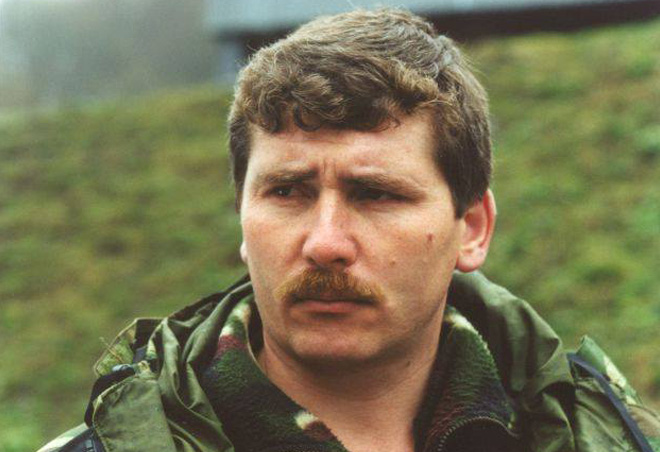
Saratov journalist and anti-fascist Sergei Vilkov
Charges were filed after Center “E” followed up on a public request by Alexander Lando, head of the Saratov Regional Public Chamber, to check the contents of Sergei Vilkov’s social network accounts.