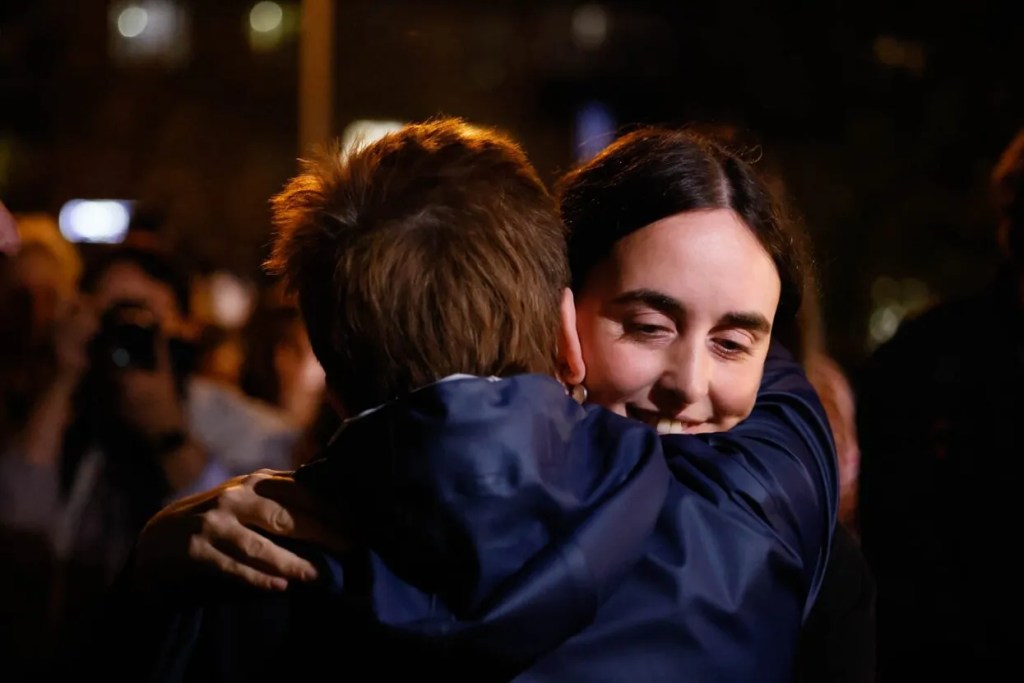
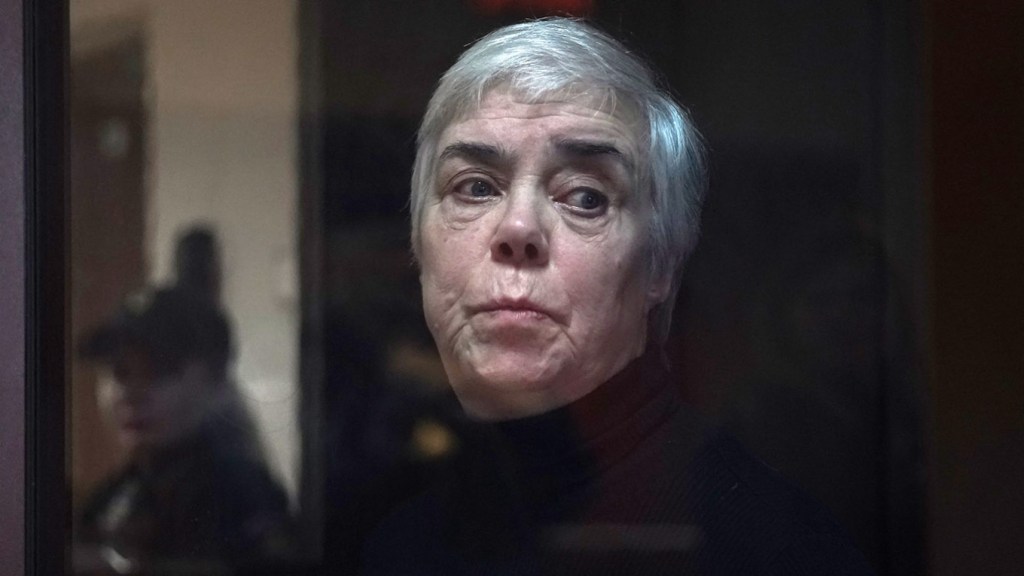
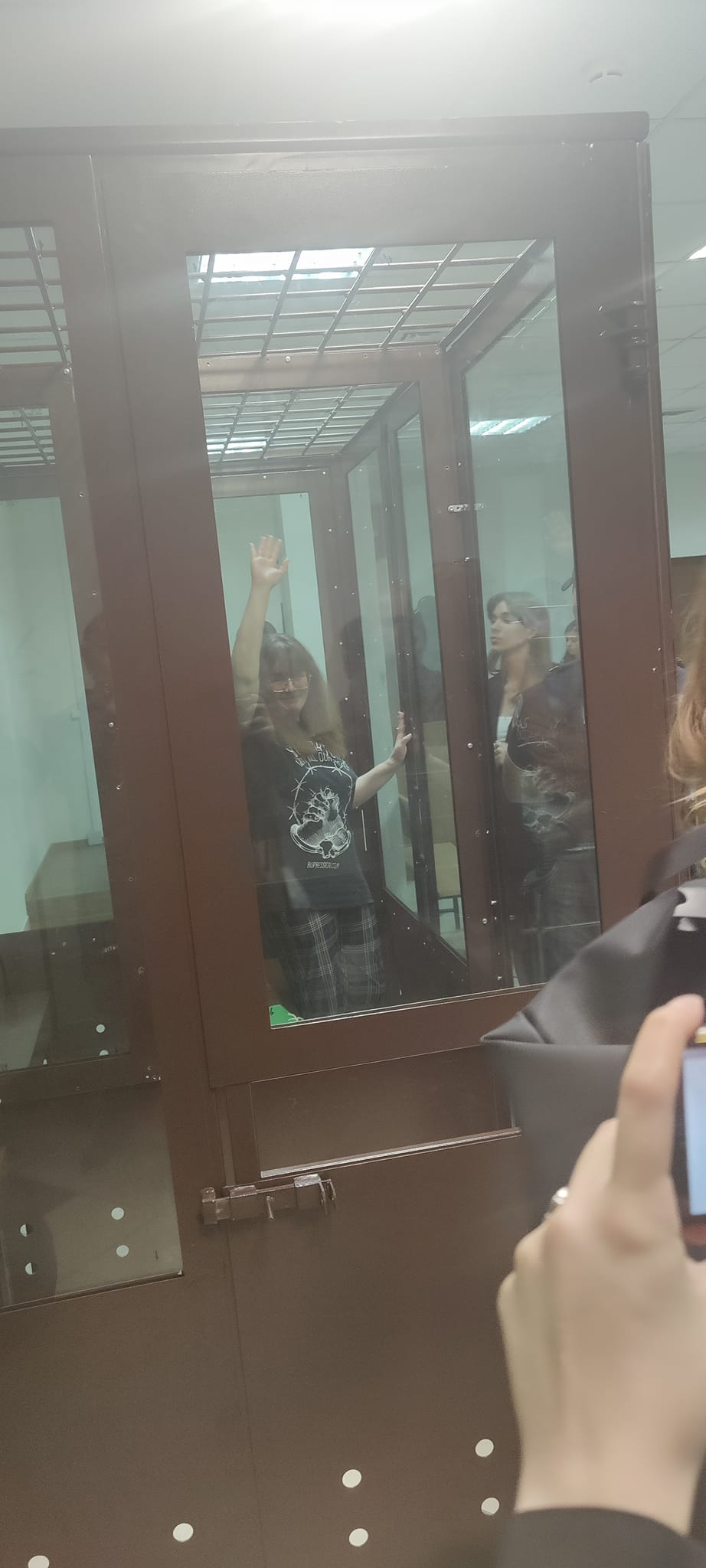
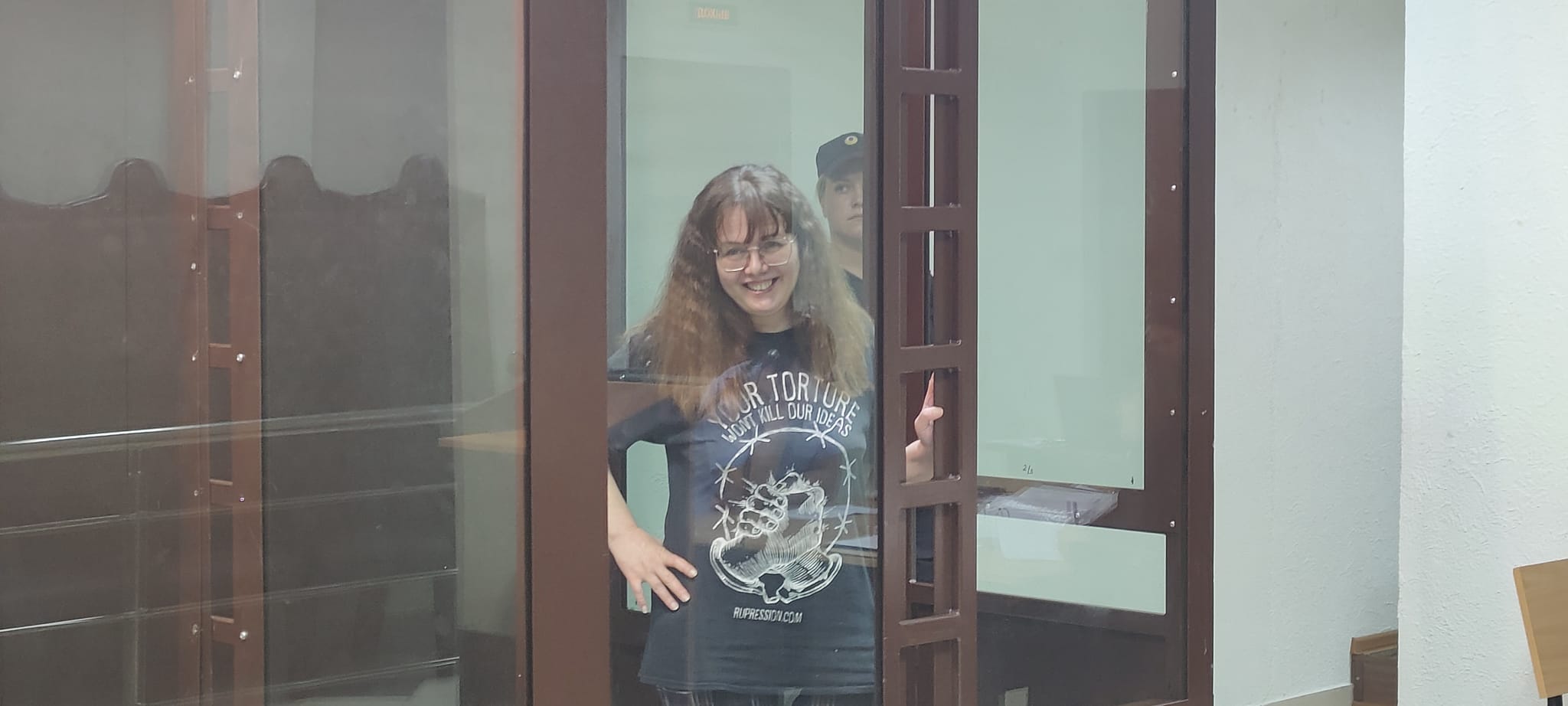
Olga Menshikh. Photo: Alexandra Astakhova/Mediazona
A panel of three Moscow City Court judges, chaired by Irina Vasina, upheld the verdict in the criminal case against anesthesia nurse Olga Menshikh on charges of disseminating “fake news” about the Russian army: eight years in prison for two posts on the Russian social media network VKontakte, per Article 207.3.2.e of the Criminal Code. This is the longest sentence on these charges handed down to a woman. The following is an abridged version of Menshikh’s statement at today’s court hearing.
You and I understand everything quite well: we are all adults here. You shall say that this is not a frame-up, that it’s the norm. Nevertheless, we understand that there is a more serious organisation* which has ordered this [verdict], and they do things as they see fit regardless of these frame-ups.
Here, for example, is a quotation from my case file: “Olga Sergeyevna Menshikh causes her fellow citizens to feel anxious, afraid and worried, to feel undefended by the state’. I cause that!? I am an absolute loner with a mum who is eighty-six years old, and I have no other interests in life. What can I say? These words in no way apply to me. I completely deny them and consider them slander.
But these words perfectly describe the well-known organisation, known as the FSB, which I have just outlined for you. […] Back in the day, serious conclusions were not drawn about the architecture of the seventy-year utopia, which murdered millions of its own citizens and citizens of other countries and collapsed during an attempt to repair it, but then suddenly rose up and went at it again. Crush what was not crushed earlier! ‘Crush them!’ is the watchword of the day.
Who should be crushed, I want to ask you, your honours? The peasants, whom you destroyed long ago? The hegemon [i.e., the proletariat], whom you long ago turned into a drunkard? Do you want to crush the intelligentsia? Do you want to crush business? How do you plan to live? What have I been observing in Detention Centre No. 6 right now? I just sat for four hours with the nicest businesswoman. You have been clamping down on businesspeople of all stripes.
I have seen all kinds of people here. Lawyers and doctors serving long sentences, mothers with many children, with three or four children, incarcerated here without verdicts. And just now I came in from the corridor, where a disabled woman in a wheelchair was being sent off to a penal colony. Pensioners and young people are held here on completely trumped-up charges. Do you want to crush them, to trample on their lives so as to make others afraid? Is that what you want to do? You want to crush them so that everyone is afraid because you were ordered to do it? Have them be afraid, have them sit in prison.
Well, this is what I want to tell you calmly. A society sick with fear cannot create, cannot be happy, cannot live, cannot love to the fullest, cannot reproduce. You consider it quite necessary for us to reproduce. But [society] cannot reproduce amid this fear. A wild goose never laid a tame egg. This fig tree will die out, you shall kill it off.
This entire fear machine has only one aim: destroying all of us. So many people, so many civilised people were destroyed, that I cannot list their names. I will only quote a great novel. Having worked in the medical field myself, as someone who took patients quite seriously, I will quote the great novel Doctor Zhivago, about Doctor Yuri Andreyevich Zhivago. By the way, he dies before he reaches the age of forty.
Here is what the great diagnostician Yuri Zhivago says: “Microscopic forms of cardiac hemorrhages have become very frequent in recent years. […] It’s a typical modern disease. I think its causes are of a moral order. The great majority of us are required to live a life of constant, systematic duplicity. Your health is bound to be affected if, day after day, you say the opposite of what you feel, if you grovel before what you dislike and rejoice at what brings you nothing but misfortune.”**
Yuri Andreyevich uttered these words exactly a hundred years ago. And so, concerning this organisation, which we all know quite well: a dead man coming back to life cannot make anyone happy. Even when he was alive, he brought happiness to no one. He turned a lot of folk into dead people, and now he is raising another generation suffering from PTSD, post-traumatic stress disorder, which is quite hard to treat.
What can I say? I am sorry. I feel sorry for you, I feel sorry for me. I feel sorry for the people in this detention centre. I feel sorry for the women, for the children. Dear honourable judges and prosecutors, we are all in the same boat. I rest my case.
* In the first part of her statement, Menshikh talks about how she believes the FSB was behind her criminal case from the beginning — Mediazona.
** Translated by Max Hayward and Manya Harari — TRR.
A court in Moscow on Thursday sentenced a 59-year-old nurse to eight years in prison for social media posts opposing Russia’s invasion of Ukraine.
Olga Menshikh was accused of spreading “fake” information about the military with two VKontakte posts that condemned Russian strikes on Vinnytsia, Ukraine, that killed 28 people in July 2022 and Russian troops’ mass atrocities against civilians in the Kyiv suburb of Bucha.
Menshikh denied her guilt, with Mediazona reporting she had 15 followers and that her account may have been breached.
Moscow’s Dorogimolovsky District Court found Menshikh guilty of spreading “fake news” about the Russian military’s actions abroad and handed her an eight-year sentence in a prison colony.
Menshikh was an anesthetic nurse at the Pirogov National and Medical Surgical Center, where Mediazona said she had treated Russian soldiers wounded in Ukraine.
The outlet said Menshikh had faced several administrative arrests and fines for anti-war social media posts and her support for the late Kremlin critic Alexei Navalny.
Russia has cracked down on anti-war protests, the independent press and social media platforms since launching what it calls its “special military operation” in Ukraine in 2022.
Lawyer Dmitry Talantov has been sentenced to seven years in a penal colony on charges of disseminating “fake news” about the Russian army and inciting hatred in connection with several social media posts about the war. Talantov had been on the defense team of journalist Ivan Safronov, who was sentenced to twenty-two years in a penal colony for high treason. Talantov had also served for many years as the head of the Udmurtia bar association, so it is likely that both the judge who sentenced Talantov and the prosecutor who petitioned the judge to sentence the respected 64-year-old defense lawyer to twelve years in prison knew him personally.
Talantov delivered a memorable closing statement today in court.
Dmitry Talantov, sentenced to seven years’ imprisonment for antiwar social media posts:
Brodsky once said that “prison is a lack of space counterbalanced by a surplus of time.” I didn’t completely understand this phrase. I didn’t get it. I’m certain that none of you totally understands it, because it is the surplus of time which is frightening about this situation, not the lack of space. It is the time during which you suffer, and the time that tries to kill you. Every minute tries to kill you, and every minute in there [in prison] is equal to an hour.
[…]
People often ask for forgiveness during their closing statement. I also want to ask for it. I’m saying this to my wife. Forgive me, Olga. I love you. If this is overdoing it emotionally, then I’ll put it this way. Olya, if you’re ever sent to prison for twelve years for some reason, I’ll wait for you to get out. Take it easy.
Sasha Skochilenko, the Petersburg artist and musician sentenced to seven years’ imprisonment for posting antiwar price tags in a supermarket and released as part of a prisoner swap in August 2024:
Alexei Gorinov, the Moscow municipal district council member who was initially sentenced to seven years in prison for “disseminating fake news” during an argument about whether it was appropriate to hold celebrations for children during a war, and who is now on trial a second time for allegedly “condoning terrorism” in conversations with cellmates:
I was also a municipal council member during the August 1991 coup. I stood with other defenders outside the Russian Supreme Soviet, the so-called White House. We were defending our freedom, our right to live freely and, thus, to speak freely, voice our thoughts, gather information, and share it. If they had told me then that thirty years later I would be tried by a criminal court for my words, for my opinion, I wouldn’t have believed them.
Nadezhda Buyanova, a pediatrician, was sentenced to five and a half years in prison for “disseminating fake news,” after she was denounced by the widow of an army officer killed in Ukraine: the doctor had allegedly said to the woman’s seven-year-old son that his father had been a “legitimate target”:
If there used to were doctors and patients, nowadays there are providers and clients. That’s what we were told at the planning meetings: “Humiliate yourself. And us.” We medics can be slandered, we can be insulted, we can be called every name in the book. We can’t defend ourselves, our explanations are not heard by our superiors, and conflicts are not resolved.
There was no interrogation and the child had nothing to say. “At the end of the appointment, he walked out of the office.” You cannot believe such a tale. You cannot lie like that: it’s a disgrace. How can you accuse a person without evidence, on the basis of a false accusation? Where is the logic? Where is the justice? Earlier, in ancient times, there were wise men. They would have said: “Well, what do you expect from a person without proof?”
Roman Ivanov, a journalist for RusNews, was sentenced to seven years in prison for three social media posts. During his closing statement in court, he knelt down to apologize to Ukrainians:
What can we do in this situation? I honestly don’t even know anymore. But I want to ask for forgiveness from all the citizens of Ukraine, to whom our country has brought grief, whom our country has robbed of their relatives, their loved ones, and their friends, who will never come back.
And [I ask for forgiveness] not for the whole country, but for me personally, for Roman Viktorovich Ivanov, a citizen of the Russian Federation. I would like to get down on my knees before the relatives of the people who were murdered in Bucha, although I don’t know who murdered them. But they are the consequences of what our country has become.
The politician Alexei Navalny was repeatedly tried on trumped-up charges before he was murdered in a penal colony on 16 February 2024. Perhaps it was Navalny, during his endless trials, who revived the closing statement in court as a literary genre. Here is an excerpt from his speech at his trial for “extremism” in July 2023:
Former Moscow politician Alexei Gorinov, the first known Russian to be imprisoned for denouncing the invasion of Ukraine, was sentenced to three more years on Friday on charges of “justifying terrorism” that he says he was framed for.
Ahead of his sentencing, he read the following statement to the court and the press:
Imprisoned Kremlin critic Alexei Gorinov, sits in a cage of the courtroom as his second trial for criticizing Russia’s actions in Ukraine swiftly nears its conclusion in Vladimir, Russia, Friday, Nov. 29, 2024. Photo: Dmitry Serebryakov/AP
“All my life I have been an opponent of aggression, violence and war, and devoted myself exclusively to peaceful activities: science, teaching, education, governance and public activities as a deputy, human rights activist, member of election commissions and controller of the electoral process. I never thought that I would live to see such a level of degradation of my country’s political system and its foreign policy, when ordinary citizens who favor peace and are against war, who number in the thousands, would be accused of slandering the Armed Forces and justifying terrorism, and would be put on trial.
“The third year of the war is coming to an end. The third year of casualties and destruction on European territory, of deprivation and suffering of millions of people on a level unprecedented since World War II. We cannot remain silent about this.
“Back in late April, our former defense minister announced the losses of the Ukrainian side in the armed conflict – 500,000 people. Think about this number! And what losses have been suffered by Russia, which, according to official information, is constantly successfully advancing along the entire front? We still do not know. And who will be responsible for this? What is all this for?
“Our authorities and those who support them in their militaristic aspirations wanted this war so much — and now it has come to our land.
“I would like to ask them: has our life become better? Is this how you understand the well-being and security of our country and its population? Or did you not envision these developments in your calculations?
“But for now we have to answer not to those who organized the war, continue to kill, propagandize the war and engage in mercenarism. Rather, we ordinary citizens of Russia, who raise our voices against war and for peace, have to answer, paying with our freedom and, for some, with our lives.
“I belong to the outgoing generation of people whose parents took part in World War II or survived it with all its hardships. The generation that has already passed away entrusted us with preserving peace with all our might as the most precious thing on Earth for all its inhabitants. But we have neglected these principles and devalued our memory of these people and the victims of that war.
“My guilt is that I, as a citizen of my country, allowed this war to happen and failed to stop it. And I ask you to note this in the verdict. But I would like my guilt and responsibility to be shared with me by the organizers, participants and supporters of the war, as well as the persecutors of those who advocate peace.
“I continue to live with the hope that someday it will be so. In the meantime, I ask the people of Ukraine and my fellow citizens affected by the war to forgive me.
“Within the framework of the case in which I was accused and tried for my opinion that we need to seek an end to the war, I have expressed my attitude fully to this abominable human endeavor. I can only say that violence and aggression breed nothing but reciprocal violence. This is the true cause of our troubles, our suffering, our senseless sacrifices, the destruction of civilian and industrial infrastructure and our homes.
“Let us stop this bloody, needless slaughter — neither for us nor the inhabitants of Ukraine. Isn’t it time to leave our neighbors alone and deal with our own snowballing domestic problems? Long ago we proved to the world how brave, resilient and peace-loving we are. So, maybe enough is enough?
“Lev Nikolaevich Tolstoy — from a letter to his son (1904): ‘For me, the madness and criminality of war is so clear that I can see nothing in it except for this madness and criminality.’
“I too join and subscribe to these words of our great compatriot.
“You can join too!”
SOTAVision reported that Judge Vladimirov interrupted Gorinov when he started to talk about losses in the war in Ukraine and called a 15-minute break so Gorinov could “think over his speech again.”
Nadezhda Buyanova. Photo: Tatyana Makeyeva/AFP, via Moscow Times
A pediatrician has been imprisoned on the strength of a denunciation by her patient’s mother. The pediatrician allegedly insulted the boy’s father, who had been killed in the war. There were no witnesses to the conversation, and it seems that the decisive factor in the verdict was the pediatrician’s birthplace — Lviv. Only recently I published the file of the criminal case against my great-uncle, who had allegedly spread rumors about the fall of Soviet regime among children at an orphanage. There, too, the accused’s background was an important point of the accusation: the arrested man’s father had once been a prosperous peasant. It was obvious to the investigators (and this was explicitly stated in the verdict) that the status of “kulak’s son” was in itself proof that the charges were true.
Lo and behold we’re back where we started: a person born in Lviv is guilty of course and must have said what they have been accused of saying.
I don’t know why we should measure things off in terms of milestones on the road to a familiar hell, but this is certainly a milestone.
A Moscow court on Tuesday sentenced a pediatrician to five and a half years in prison for criticizing the war in Ukraine during a patient visit earlier this year.
Nadezhda Buyanova, 68, was found guilty of spreading “fake” information on the Russian army under wartime laws used to silence dissent.
“I believe this is absurd,” she said in court Tuesday, moments before Judge Olga Fedina announced her sentence.
Buyanova was arrested in February after the ex-wife of a soldier who was killed in Ukraine, Anastasia Akinshina, said she had criticized Russia’s role in the conflict during an appointment.
Several of Buyanova’s supporters, mostly medical professionals, shouted “Shame on you!” in the court as the sentence was announced.
“We must empathize with one another and love others,” Buyanova said in court. “But there is no paradise on earth, there is no peace on earth.”
She protested her innocence throughout the trial.
“I am a pediatrician. I do not regret a single day,” Buyanova said.
Buyanova was prosecuted despite there being no public evidence that she criticized the war. Akinshina’s seven-year-old son testified against Buyanova in court.
Monday, 18 November, 6 p.m. “Political prisoners in Russia and the Occupied Territories of Ukraine”.
Panel discussion with Sergei Davidis (Memorial), Evgeny Zakharov (Kharkhiv Human Rights Protection Group), Bill Bowring (Birkbeck, University of London) and Judith Pallot (Gulag Echoes research project / University of Oxford).
At: Montague Lecture Centre, Graduate Centre, Queen Mary University of London, 327 Mile End Road, London E1 4NS. Also on line, via Zoom.
All welcome. Event organised by the Queen Mary University, London, Centre for Eurasian, Russian and East European Studies. Register on Eventbrite here.
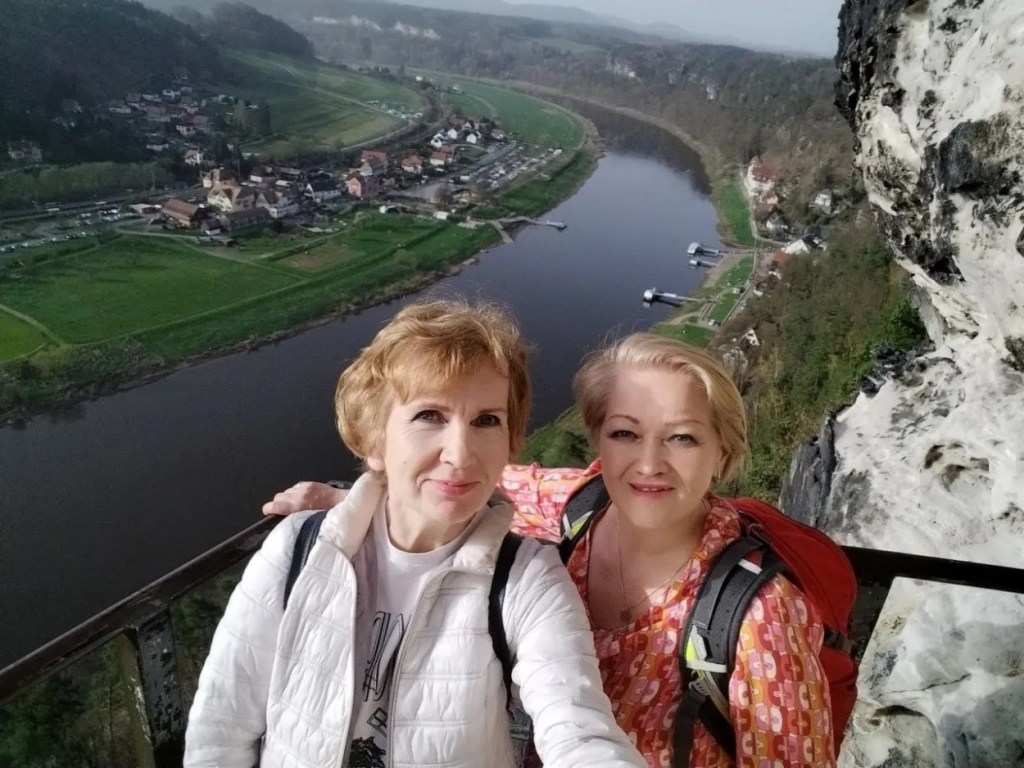
Pensioners Irina Nippolainen and Anna Trusova, friends and residents of the small Karelian town of Segezha, fled Russia in the spring of 2023 after the FSB came to search their homes. Anna and Irina were forced to make a long trek to Azerbaijan via Belarus before making their way to Germany, where they now have residence permits and social housing, and where they hope to find work. Meanwhile, back in their home country their relatives have been summoned for questioning in the criminal investigation against them. Journalists at the website Okno tell the story of the two women, who chose forced emigration over unfreedom.
ESCAPE
On 20 March 2023, 60-year-old Irina and 58-year-old Anna said goodbye after taken a stroll and went home. A few minutes later, Irina called Anna and told her that the FSB had come to see her. Anna rushed to her house after Irina’s call.
“As soon as I rang Irina’s doorbell, I immediately turned on the video on my phone to put the squeeze on them: Who the hell are you guys? The FSB guys saw that I was filming on my phone and immediately called someone, saying, ‘She’s here, come over.’ Anyway, it transpired that they had come for both of us.”
During the search, the FSB officers confiscated their phones and computers from the two pensioners. The search warrant stated that the searches were part of a criminal investigation into “public calls to engage in activity threatening state security.” Anna and Irina guessed that the case had been triggered by a denunciation. They both had written many posts on their VKontakte pages about their opposition to war, and in response had received a “barrage of hatred” from those who had read the posts.
“It was stressful. I lost eight kilograms during that time: I was so worried, I didn’t eat, and I didn’t know what would happen. I knew that people in Russia are sent to pretrial detention centers at any age even for sneezing at the authorities, and I did not know what exactly the law enforcers would find in the devices they confiscated and how they would interpret what they found. As soon as we were searched, my children immediately got involved in the problem, checking out everything they could: internet sites, their acquaintances, and then their acquaintances who had left the country. They decided how we should proceed—where and how to get asylum or other options. After analyzing everything, they decided that a humanitarian visa was the best option. We had to decide where to go, where to stay, and what to take with us,” says Irina.
They considered fleeing to two countries—Finland and Germany—but decided on the latter because it was easier to get a visa there.
But first Irina and Anna went to St. Petersburg, because they had to get papers for Anna’s dog Ramona. They stayed with an acquaintance of Anna’s, but the woman was very afraid that she would be “prosecuted for her connection” with the fugitive opposition activists, so they had to move out.
Irina, Ramona, and Anna
“Our children, who were assisting us, gave us the contact information for a man who did not know us at all but who wrote, ‘Come and stay as long as you want’. He helped us out and fed us, and we spent all that time while we were taking care of business at his house,” they explain.
Anna and Irina stayed in St. Petersburg for a week before departing for Azerbaijan.
They did not travel to Baku directly. For security reasons, they got themselves new cell phones, discussed the route, decided not to buy plane tickets in Russia, but to do it in Belarus, and went to Belarus by cab, paying 20,000 rubles [approx. 200 euros] for the fare.
“We took everything into account because we didn’t know how quickly they would come for us. In fact, we were very surprised that they didn’t nab us right away. We also chose Belarus because the dog was with us, and we felt bad about putting her in the luggage hold. Belavia is one of the few airlines that allow passengers to transport small animals in a carrier on a seat in the passenger cabin,” says Irina.
Irina and Anna flying from Minsk to Baku
After taking a cab to Minsk, they immediately went to the airport, bought tickets, and flew to Azerbaijan at night. In Baku, Irina and Anna initially settled in a small hotel.
“I was in such a state that my hair stood on end. For Anna, it was like an adventure, but for me it was like a misfortune, because I had left my home, my husband, and my pets. I didn’t want to leave my home or my country. That’s why I was very anxious. I even reached out to a psychologist from an aid organization, but she didn’t help me much,” Irina says.
Anna’s mood was a little different.
“I’m generally a traveler, but I hadn’t been able to travel lately. First there was the pandemic, then this whole thing happened. Not that I was freaking out about it, of course; I was freaking out for other reasons. But when it happened, I put three bathing suits in my suitcase—Ira makes fun of me—and went to the airport. I assumed I might have difficulties in Russia due to my intemperate tongue: I supposed that I would have to leave. I have a daughter in the Czech Republic, but the Czech Republic has a very bad attitude towards Russians, and they wouldn’t give me a visa. I thought that I would go to India, it’s quiet and peaceful there. My suitcase was initially packed with summer clothes. Of course, I was a bit nervous about the dangers. But basically, I always try to stay positive and hope for the best,” says Anna.
Anna, Ramona and Irina on the beach in Baku
Irina and Anna ultimately stayed in Baku for four months. They submitted the paperwork for humanitarian visas to Germany quite quickly, and had been approved by early June. But due to the local and the German bureaucracies they had to wait a long time for their papers. During this time, the pensioners already had their own circle of contacts—their landlady, their neighbors, and other refugees from Russia.
“And while there was uncertainty as to whether we would be granted a visa or not, we were already considering Azerbaijan as a place to live, because we could have lived there on our pensions. We had already found some channels for cashing money there, because our bank cards didn’t work there anyway. But still, we didn’t consider ourselves safe there,” Irina explains.
“GOD, HOW DID YOU BEAR IT ALL?”
In July, all their papers were in hand, so Irina and Anna began packing for Germany. They decided to make their way to Georgia first, since it was cheaper to fly to Germany from Tbilisi than from Baku. They went to Georgio by bus, stayed in Tbilisi for a couple of days before flying to Germany.
“When we arrived in Germany, I was already on VKontakte recounting all our adventures. And people wrote, “God, how did you bear it all?” Because there were a lot of hard moments. Personally, I was constantly stressed out, but it had become a way of life, you know. Anya is fine, she’s easygoing, but I can’t improvise when it comes to serious matters, I have to prepare and think things over. If I hadn’t followed all those rules, maybe we could have flown to Germany more easily, who knows. I’m a thorough person, I don’t want to lose money and end up stranded at the airport not knowing what to do. That is, I was preparing, I was checking out all the chat rooms and websites, seeing what papers we needed to get and where to go. There was a lot of preparation just for the dog. Without the dog, we would have done it all ten times easier, if not more. Because in different countries there are particular papers and certain vaccinations you have to have, and the airlines have certain requirements for the carrier. Ramona is a basically a ‘homeowner’—she had three portable houses,” Irina says.
“The atmosphere is cool”
“For the first time in her life, probably, when leaving Baku, Irina took sedatives because the dog in its carrier had to be placed in the trunk of the bus. And I was so worked up that even I took them too,” Anna remarks.
Anna and Irina flew to Frankfurt, where they were met by a friend of Irina’s who had lived in Germany for a long time. They had to get to their initial placement site, the town of Suhl in Thuringia, which is a three-hour drive from Frankfurt.
“But when we arrived there, we were told that pets were not permitted. Ukrainians used to bring pets there with them, but since now there are few Ukrainians in this camp and mostly Muslims, who have a bad attitude to dogs and are afraid of them, it is prohibited. So we urgently began looking for help on the chat rooms. A Ukrainian family agreed to take Ramona in for a while. They lived right next to the camp, and so we would go to their house to walk the dog. But then this young woman found out she had allergies, so Ana’s daughter quickly came from the Czech Republic and took Ramona away,” Irina explains.
A room in a German dormitory for refugees
The refugee camp where the pensioners were initially placed was a complex of five buildings, mostly inhabited by people from Arab countries.
“It was a bit scary to live in such an unfamiliar environment, given that the doors to the room in which we were put were unlocked. The police even came once because of a conflict in the building. We also had our passports taken from us and there was a risk that we would be processed in a different status—as refugees, even though we had ‘humanitarian visa’ stamped on our papers. We wrote everywhere, because they said that if we were registered as refugees, we could change this status only through the courts, and the courts could take years. That was scary. I said that we could not even return to Russia without a passport. Basically, it was a massive problem. I’d only recently been released, and I had put on two or three kilograms, because one thing or another was causing stress, but there was no getting around it,” Irina recounts.
Everything worked out well, ultimately. After a week, they were moved to the town of Greiz, a two-hour drive from Suhl. There they were allocated a social apartment, started to receive an allowance, were insured, and were issued social security numbers. By October, Anna and Irina had received residence permits for three years. During all this time, however, the pensioners had to confront the famous German bureaucracy more than once.
“They have an algorithm, as it were. But the human factor often gets in the way. People who work in this system, they do not know all the laws, or often they do things just to check off the boxes. But our case was quite peculiar for them: we are Russian pensioners, we have humanitarian visas, and they probably have a million other refugees here. Things were difficult, but when you look back, you think, What was there to worry about?” said Anna and Irina.
After the paperwork was completed, the friends moved again, but not far—to the city of Gera, thirty kilometers from Greiz. Each of them found rented accommodation there, which is paid for by the municipality. The apartments there are rented empty, with no furniture or appliances.
“When we moved from one place to another, they stopped paying us in the old place, but here they hadn’t started paying us yet, and it took two months to process the registration. So for two months we were without money or furniture,” Irina explains.
Since she had not yet been discharged from social housing, they could still live there together legally for some time and work on furnishing their new homes.
“The Ukrainians who live here have set up a help chat room and chat rooms for selling different things. I bought a bed and a chest of drawers from Ukrainians. I got some things for free. Germans often sell things they don’t need for very cheap. For example, I bought a complete kitchen set for only 100 euros, which is practically nothing. Now I’m looking for a bigger refrigerator,” Irina says.
Irina’s apartment after she furnished it
Anna, on the other hand, found an app similar to the Russian website Avito, where used furniture was sold, and bought almost everything she needed at wholesale prices.
“The only thing I was left without was a kitchen. I didn’t have a stove, but I got a microwave, and I could survive with a microwave. I bought a kettle. And that’s how I lived for the first few months,” she said.
The pensioners were at pains to point out that no one refused to help them. People who had also immigrated to Germany, some twenty years earlier and others two years earlier, offered them bedding, dishes, and household supplies. When Irina and Anna had settled in, they passed some of these things on to a family from Ukraine.
Expiring products are given to immigrants for next to nothing
People who have been granted humanitarian visas in Germany can choose not to work and live on benefits. But they can try to find a job if they want. Before they retired, Anna was involved in marketing cosmetics, while Irina helped animals. After ten years at the official municipal animal shelter, she ran a mini-shelter for five dogs, one of which she ultimately adopted. Finding a job in Germany is still difficult for them.
“We don’t speak German, so the opportunities to find work are few and far between for the time being. I am registered at the job center, while Irina is now registered with the Sozialamt, and she can live on her pension in peace, but I will only go on 31 July to test the level of my German. God willing, I will test out at A1, since I almost got A’s in German back in school. After taking this test, I do not know when I will be able to take German-language classes. Many emigrants take these courses two or three times. Then again, I’m old, so things don’t stick in my head nowadays. Of course, I would like somehow to learn the language faster and integrate faster,” Anna says, laughing.
Irina says that she has not been assigned to an integration course, so for the time being she is also living without knowledge of the German language and therefore jobless. While she was still living in Greiz, she worked a two-hour trial day as a seamstress in a local factory . Irina liked it very much. When she moved to Gera, she also wrote to one of the factories there, but was told that German was required. Getting a job is likewise important to Irina because she wants to invite her husband, who stayed behind Russia, to join her in Germany, which is impossible to do if she is unemployed. Irina’s husband would also need to know German, but how and where he can learn it and pass the test for the simplest level is still unclear. Irina herself attends German language courses, but they are run by volunteers and thus unofficial.
Anna and Irina say that even without jobs they have enough to do—they have traveled all over the area.
“We have been traveling a lot since day one. While we didn’t have papers, we used to walk, and then we got the chance to buy transit passes that enable us to travel by rail, buses, trams, and subways,” says Irina, who has also been to travel to Finland to visit her children, and to Stockholm and Copenhagen to meet friends.
Anna has bought a sewing machine and begun sewing.
“I used to do needlework, but in recent years things had not been coming together. Now I have started knitting curtains, and I will start weaving; I want to do a lot of things. I knitted myself a sweater. I bought brushes and paints and started drawing a bit, but have given it up for the time being. Mostly, I want to walk more. We are from Karelia and have a tradition of walking as the first thing one needs to do. And I had a dog then. Here I bought a bicycle as soon as I got the furniture: I jumped on the bike and went riding. You have to see everything around you. It takes a lot of time to see everything, to photograph it, to edit it, to upload it to the internet. So there is not enough time,” she explains.
By the way, both pensioners are each on their third VKontakte page: their previous pages had been blocked by the Russian authorities.
“DID THEY WRITE ABOUT BUCHA?”
Karelian law enforcement never forgot Irina and Anna.
In April 2024, it transpired that a criminal case had been opened against the two émigrés on charges of disseminating “fake news” about the Russian army. They found out about it because Irina’s husband was summoned to testify, for some reason, in the criminal investigation against Anna. Only when he met with the investigator, it transpired that Irina was also being prosecuted on the same charge. The husband refused to answer the investigator’s questions, invoking Article 51 of the Constitution (which permits an individual not to testify against themself or their spouse). Anna’s sister was then summoned for questioning in the same investigation. A little later, it transpired that both Anna and Irina had been put on the federal wanted list. And shortly before this interview, a person unknoiwn, who introduced himself as a policeman, wrote to Anna via WhatsApp and asked her where she was.
How many criminal “fake news” cases have been launched in Russia
In March 2022, after invading Ukraine, Russia adopted laws that criminalized disseminating “fake news” about the Russian army and “discrediting:” its actions. As of February 2024, 402 such cases had been brought. Dozens of Russians have been sentenced to lengthy prison terms for allegedly violating the law. According to human rights activists, this is tantamount to military censorship.
It is still unknown why the criminal case was launched. The relatives were asked during questioning what Irina and Anna had written on their first VKontakte pages. They made a special point of asking, “Did they write about Bucha?”
“It’s no fun feeling like a criminal. Although we all know what it means now in this [sic] country. In short, the crackdown continues: you are on the right side, and they are on the wrong side. They have to do something: there’s probably no one left in Karelia to sink their claws into anymore, but they need fulfill quotas. It’s a crackdown for its own sake. I feared for my relatives, because way back in 1938 there were so-called enemies of the people, and children, wives, and husbands of enemies of the people. I’m afraid lest it come to this,” Irina says.
The human rights activists consulted by Anna and Irina have advised them not to return to Russia before the regime changes, otherwise they will be sentenced to hard time in prison.
“FOR THREE DAYS I BAWLED LIKE A BELUGA”
Both émigrés follow the news from Russia closely. They argue that the country is “hurtling into an abyss.”
“What is happening is simply absurd. It feels like the country exists in a kind of distorted reality in which good is evil, and black is white. They are engaged in such insanity, frankly, and you don’t understand how it is possible to support all of this. And then there are the people who have gone crazy on a nationwide scale and who think everything is fine there, that it’s the way it should be. I worked at a polling place for many years and I used to say all the time that when we socialize only with our own kind, we don’t see what the rest of the people are like, but I saw all kinds of people at the polling station. I know that might sound kind of arrogant, but I saw how massively ignorant people were. I’ve always been skeptical of the claim that the Soviet Union had the best education system. I don’t know how it was the best if it didn’t teach people to think, and if people blindly trust the authorities. The authorities are king and god to them, as this whole situation has shown. Basically, you get the feeling that all people have come down with insanity, and some are immune. The analogy with Hitler’s Germany immediately comes to mind, where the people were fooled in the same way, gulled by propaganda. Maybe there is still hope that if the regime changes and they tell folks on TV how it really was, then…. We are now like spectators looking at Russia from the outside, and it’s scary to watch what is happening there,” Irina says.
When asked how they reacted to the news of politician Alexei Navalny’s death, Anna is unable to reply. She immediately starts crying.
“That’s how we reacted,” Irina explains, crying too.
“It’s good that my daughter was here that day: we went to Munich with her. I spent the whole day with them. But in the evening they went to a concert, and I got on the Munich chat rooms and found out that there would be a rally on Freedom Square and went there,” says Anna.
Alexei Navalny’s Death
The news of Alexei Navalny’s death came on 16 February 2024. He had been serving a nineteen-year sentence for “extremism,” after being convicted on seven criminal charges, including “creating an extremist community.” During his imprisonment, he was sent to a punishment cell twenty-seven times, spending almost 300 days there. After the politician’s death, pickets to mourn his passing were held in Russian cities, and the picketers were detained by the police en masse. The authorities refused to hand over his body to his relatives for a long time, demanding that they bury him in secret. Navalny’s associates argue that he was murdered and blame President Vladimir Putin for his death.
“I bawled like a beluga for three days. I still can’t even look at the photos of him calmly,” Irina adds.
“In the past, Ira, you used to say, ‘Navalny will be released and I’ll go home,'” her friend remarks.
Irina doesn’t make any predictions now that she has emigrated.
“I don’t make any predictions and I don’t listen to them. My motto now is: do what must be done and what will be will be. And I would also add: do what you have to do and what you are able to do. What matters most is saving yourself and your loved ones. We don’t know how long this will last. Analyzing things even as they stand now, I can confidently say that nothing good is going to happen…. Well, how should I put it? Nothing good is going to happen quickly. But I’m not ruling out either possibility: that I’ll stay here, or that I’ll go back there. I’ll go home as soon as I can. If nothing changes there, I’ll stay here.”
Anna, however, says that she has almost no one left in Russia: her daughter emigrated to the Czech Republic back in 2016, and she hardly communicates with her relatives who stayed behind in Russia.
“I will be better off here anyway. As long as they don’t kick me out, I’ll stay here,” she adds.
The pensioners nevertheless try to keep involved in Russian politics. They traveled to Leipzig to sign a petition supporting Boris Nadezhdin’s presidential candidacy and then to Berlin to vote in the presidential election.
Irina signing a petition in support of Boris Nadezhdin’s presidential bid
“There was such a huge queue. Because we were afraid of missing the train, we cut the queue a bit. A lot of people could not vote because, I think, only two polling stations were open in Germany—in Berlin and in Bonn. There were a lot of people who wanted to vote. We stood in line there with Yulia Navalnaya. And I talked to Mikhail Khodorkovsky, and we had our pictures taken with Ekaterina Schulmann. There were so many celebrities, and the queue itself was very cool. There were a lot of young people, all chanting “Russia without Putin.” But there were also a few pro-Putin people who have lived in Germany for twenty years and go vote for Putin, and we trolled them a little bit. But this is life, this is reality,” says Irina.
Irina Navalnaya, Kira Yarmysh, and Mikhail Khodorkovsky
What do Anna and Irina dream of?
“Grandchildren!” Anna answers immediately. “And first of all, of course, that the war end!”
“The first thing I wish for is that the war end. And the second is for me to go home,” says Irina.
During his closing statement in court today the documentary filmmaker Vsevolod Korolev read a poem by Grigori Dashevsky:
1.
Across the river they’re making chocolate.
Out there the river-ice is breaking up.
And upriver we’re waiting, but for now
no bus comes, only its vacant ghost,
a desolate fleshless light flying ahead
to the engine’s howl
and the clatter of
the ad-slates changing.
We’re not cold, we bide our time.
The sky a deeper blue, the burning streetlights.
2.
To wait for each new minute as for a ghost,
to put on stage-paint for him alone,
to powder your face with light––and poorly it sticks,
but without it there’s nothing
to tell you apart: not from the many
faces—multitudes—
but from the lived-through years
which, like a star, are distant and weightless as smoke.
3.
But from the sweet smoke, the glory of heaven,
look up for a moment,
tear your eyes away as from a book:
As much as a star has its shining
or a factory its smoke,
all things have
their limit: a book’s gilded edges
or a band of cloud.
4.
And turned from weddings not my own, and graves,
not waiting for the end, I rose
and saw an enormous room, a hall,
walls, walls, Moscow, and I asked:
where is the light that lit these pages,
where is the wind that rustled them like leaves?
5.
It’s late to be asking: each person is lit bright,
thrown open to the right dream
for the minutes, like pupils widened,
unscathed, like smoke or sleep:
they fly in, gleam, collect a promise:
Remember, remember (take leave of) me.
“I don’t intend to speak for very long. Your Honor, I am in some sense a colleague of yours, since I’ve worked as a third-tier soccer referee; I understand that you’re in a tough situation, it’s hard to envy someone stuck in the middle of this whole business. But nevertheless I have always believed in people and will continue to do so, even when it makes absolutely no sense. In any case I know this is really hard for you, but I think you’ll figure it out.” (Vsevolod Korolev)
“To ask for ten years when the maximum is ten and given the absence of aggravating circumstances and the evidence of mitigating ones—this goes against the fundamental norms of the criminal code. And this demonstrates for the umpteenth time the invalidity and baselessness of the prosecution’s case.” ([Korolev’s defense] lawyer Maria Zyrianova)
Discourse journalist and documentary filmmaker Vsevolod Korolev has been sentenced to a three-year prison term on charges of “disseminating fake news” about the army.
During the trial on March 18 defense lawyer Maria Zyrianova noted that the case file did not indicate what information in Korolev’s posts had been determined to be knowingly false. Korolev is accused of making two posts on [the Russian social media network] Vkontakte about the mass murders of civilians in the Ukrainian cities of Bucha and Borodianka, as well as about the shelling of Donetsk.
The prosecution requested a nine-year prison sentence for Korolev. This, notedDiscourse, was the longest prison term ever requested by state prosecutors for the charge of disseminating “fake news” about the Russian army.
During the court hearing on March 20, bailiffs at St. Petersburg’s Vyborg District Court recorded the names of those who came to support Korolev, SOTA reports. Earlier, SOTA published a recording of a telephone conversation between the bailiffs, in which they announced their intention to provide the lists of those who came to the trial to Center “E” [the “counter-extremism” police].
The Case of Vsevolod Korolev
Vsevolod Korolev is a documentary filmmaker and poet. He worked as a correspondent for the culture magazine Discourse and made films on social themes — about children with disabilities and political prisoners.

Korolev was detained in July 2022. During the search, his electronic devices were confiscated.
The prosecutors argued that Korolev’s documentaries about the political prisoners Maria Ponomarenko and Alexandra Skochilenko should be deemed an aggravating circumstance.
Linguistic expertise in the case was provided by linguist Alla Teplyashina and political scientist Olga Safonova from the Center for Expertise at St. Petersburg State University.
One of the prosecution’s witnesses later recanted their testimony.
In his closing statement at the trial, Korolev quoted a poem by Grigori Dashevsky: “It’s late to be asking: each person is lit bright, / thrown open to the right dream / for the minutes, like pupils widened, / unscathed, like smoke or sleep: / they fly in, gleam, collect a promise: / Remember, remember (take leave of) me.“
Memorial has designated Korolev a political prisoner.
You can support Vsevolod Korolev by sending him a letter to the following address:
196655 St. Petersburg, Kolpino, Kolpinskaya Street, 9, FKU SIZO-1, Vsevolod Anatolyevich Korolev (born 1987)
Source: “Discourse journalist Vsevolod Korolev sentenced to three years for ‘fakes’ about the army,” DOXA, 20 March 2024. Translated by the Fabulous AM and the Russian Reader. People living outside of Russia will find it difficult or impossible to send letters to Russian prisons via regular mail or using online prison correspondence services such as FSIN-Pismo. In many cases, however, you can send letters (which must be written in Russian or translated into Russian) to Russian political prisoners via the free, volunteer-run service RosUznik. You can also write to me (avvakum@pm.me) for assistance and advice in sending such letters.||| TRR
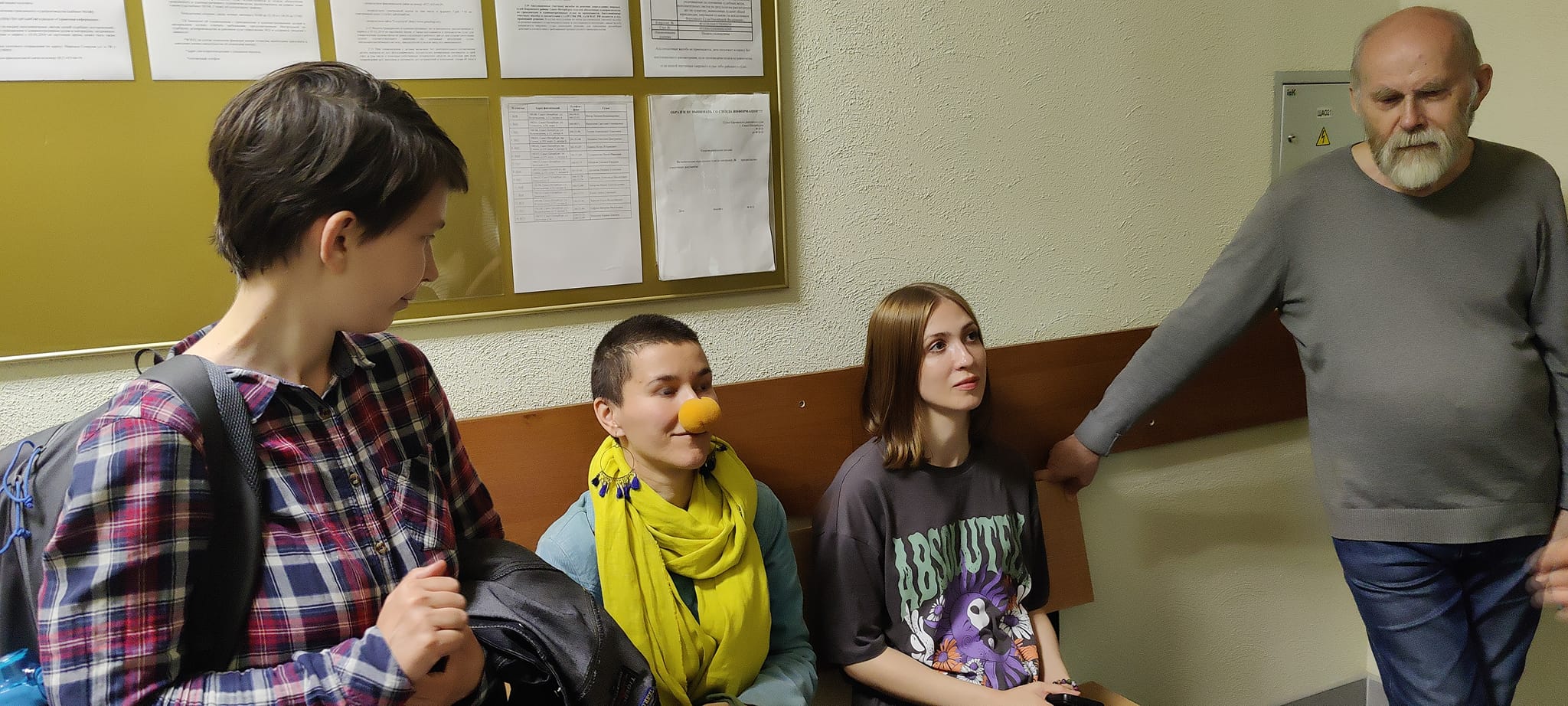
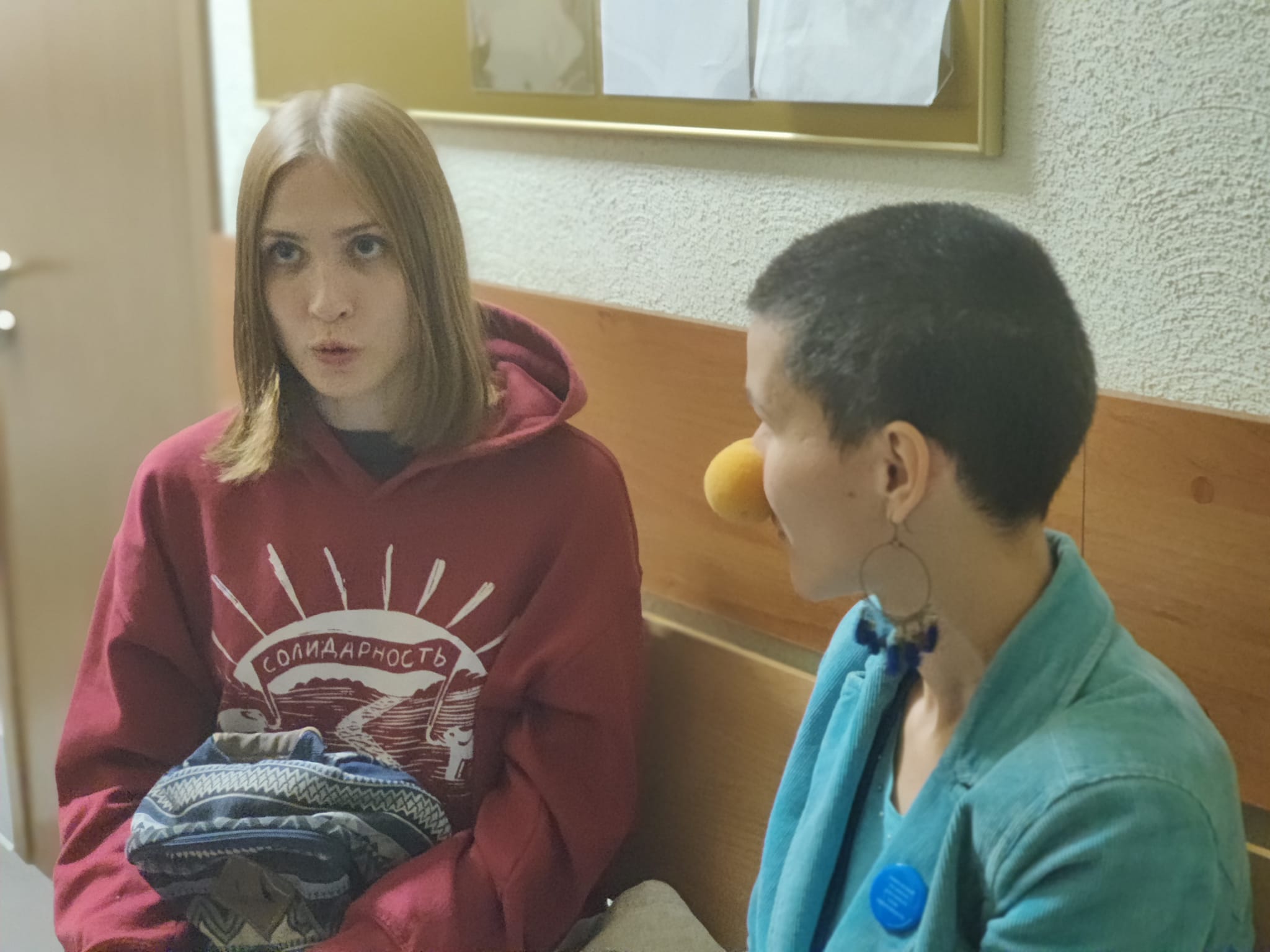
Sonya, the girlfriend of Sasha Skochilenko, came to today’s hearing in the trial of anti-war activist Olga Borisovna Smirnova. Sonya wore a sweatshirt embossed with the word “SOLIDARITY.” It was quite nice to see that there is reciprocity among the support groups of political prisoners.
Sergei Troshin told people about the evening gatherings to write letters to political prisoners that are held at the Yabloko Party’s Petersburg offices.
There were twenty [members of the public] in total, all the seats were taken. The trial was again held in the jury room on the ground floor, into which the guards can bring the accused from the courtyard and thus avoid walking them down the corridor amid shouts of support.
The hearing itself left more questions than answers. The judge has obviously begun to hurry in order to finish the trial as quickly as possible. Does she want to wrap things up before her holiday? The hearing itself thus ended around seven in the evening, despite the lawyer’s request to postpone it. The judge behaved nervously, on the verge of rudeness.
The bulk of the hearing was devoted to cross-examining Lebedev, an officer of Center “E” [the “anti-extremism” police]. He came dressed in camouflage, combat boots, a beret, and dark glasses, and he had a beard (which looked fake).
It was [Lebedev] who located and documented the pieces of evidence on which the accusation is based, and also determined them to be “fakes” by comparing them with the websites of the Defense Ministry and the Foreign Ministry and, for some reason, Maria Zakharova’s Telegram channel, “as that of an official authoritative statesman expressing the position of the Foreign Ministry.” He searched for information by dates: if there was something in a post by Olga that was not found on the websites of the relevant authorities, he deemed it a “fake.” He also prepared a search memo stating that there were no special perpetrators [sic] in [Smirnova’s] apartment, and was present during the search.
The cross-examination lasted three hours. It was clear that [Lebedev] considers Olga a “blatant criminal” who disseminates such things “while our boys are getting killed.”
When asked about information from the website of the Israeli Foreign Ministry about Babi Yar, Lebedev replied, “Fortunately, our country has its own independent policy and does not consider it necessary to take into account and react to statements made by the Jewish Foreign Ministry at the slightest pretext.”
He also believes that the information given by Russian officials and state bodies cannot be questioned and is the absolute truth.
To Olga’s question about why he had chosen precisely these entries from her social media page, he replied, “It would be impossible to document everything from the time of Jesus Christ’s birth.”
When asked why the witnesses who inspected the web pages containing the [offending] posts were recruited so far from his place of work, he replied that it is not so easy to find people who agree to serve as witnesses.
“I am sure that these people sitting behind me would have never agreed to come and document Smirnova’s criminal actions as witnesses,” he said.
After the recess, a disk with telephone connections that suddenly appeared in the case file was examined.
Olga has been holding up well: she smiled a lot and thanked people for their support. The next hearing is scheduled for Monday, August 7, at twelve noon. It was announced that oral arguments would be heard then, although, in my opinion, the defense has not yet finished examining the evidence.
Despite the fact that people in the support group joked a lot, the overall feeling from the trial is quite depressing. It feels as if the judge has already made up her mind, and we are present at a poorly staged theatrical performance. It’s just that the finale is up to ten years in prison…
Source: Alexei Sergeyev (Facebook), 31 July 2023. All photos, above, by Mr. Sergeyev. Translated by the Russian Reader. You can send letters— written in Russian or translated into Russian (if you don’t know a competent translator, you can use an online machine translator such as Google Translate)—to Olga Smirnova and other Russian political prisoners via the free, volunteer-run service RosUznik. You may ask me (avvakum@pm.me) for assistance and advice in sending such letters.
Sasha Skochilenko (center) at her criminal trial in Petersburg, 25 May 2023. Photo: Nadezhda Skochilenko
At today’s hearing [in Sasha Skochilenko’s criminal trial on charges of disseminating knowingly false information about the Russian army], Sasha’s defense lawyers and Svetlana Drugoveyko-Dolzhanskaya, a linguist who conducted an independent forensic examination and found no knowingly false information in Sasha’s messages, were able to question one of the authors of the linguistic forensic examination [commissioned by the prosecution].
Olga Safonova, a specialist in political science (!), was enlisted to contribute to the linguistic forensic examination. But, as she was instructed to do by a staff member at the forensics expertise center, she evaluated whether what was written [on the anti-war “price tags” that Ms. Skochilenko is alleged to have posted in a Petersburg supermarket] was in line with the Russian Defense Ministry’s position, not whether it was truthful.
[Safonova] admitted that her analysis of one of the messages was “slightly misleading.” She was “at a loss” when asked to respond to the assertion that Sasha faces up to ten years in prison on the basis of such misleading conclusions, among other things.
After a recess (due to her heart problems, Sasha found it difficult to endure the stuffiness and lack of water), the examination of the witness was continued by Drugoveyko-Dolzhanskaya. Safonova was forced to admit that among the sources against which she checked Sasha’s messages, only the Defense Ministry’s website corresponded to her own definition of an official source — unlike the website Life.ru and anonymous Telegram channels. She also could not answer a school curriculum-level question about impersonal sentences, although their erroneous definition in the forensic examination is one of the “proofs” of Sasha’s guilt.
In addition to pointing out the errors in the forensic examination and its noncompliance with government standards, Drugoveyko-Dolzhanskaya recalled that, according to the Justice Ministry’s methodological recommendations, when an expert strays beyond their area of professional competence, it is a procedural error and is inadmissible [as evidence in court]. Safonova was forced to agree. Drugoveyko-Dolzhanskaya followed this up by asking a direct question: “Can you, as an expert, prove conclusively that Skochilenko knowingly falsified information?”
Safonova replied that she could not.
The new prosecutor abruptly interrupted her and requested that the hearing be postponed.
You can come out and support Sasha at 11:30 a.m on June 13. Many thanks to everyone who continues to attend the trial, shares information about the case, and donates money to pay the lawyers and buy food and medicine care packages! You can help Sasha financially here:
+79627117055
(Sofia S., Sberbank)
5469550065976075
(Sberbank)
Source: Nadezhda Skochilenko (Facebook), 25 May 2023. Translated by the Russian Reader. The details for donating money to Ms. Skochilenko’s defense fund are only for people based in Russia.
[…]
Olga Safonova. Photo courtesy of The Village
In the late 1990s, St. Petersburg State University, for reasons unknown, gave away one of its dormitories on Vasilievsky Island — 10 Bering Street — with a two-story attic built on. Later, one of the university’s vice-rectors regretfully claimed that if the building had not been given away, the university would have had room to house over 500 students. Today, the building houses apartments (a three-bedroom flat there will run you 20 million rubles) and offices. It is owned by the Bering-10 Condominium Association, whose chair is Olga Diomidovna Safonova. She has the exact same name as an associate professor in the Faculty of Political Science at St. Petersburg State University.
Safonova has been involved as an expert witness in the criminal cases against [Petersburg anti-war protesters]Victoria Petrova, Sasha Skochilenko, and Vsevolod Korolev. They face up to ten years in prison if convicted. These are quotations from the expert analysis in the case against Victoria Petrova:
“Objective facts indicate that the war crimes against the civilian population of Ukraine have not been committed by the Armed Forces of the Russian Federation, but by the Kiev regime and the armed formations controlled by it.”
“The practical intent and purpose of the statements under examination [i.e., Victoria Petrova’s posts] consists in generating false ideas among readers (listeners) that the actions of the Russian federal leadership are condemned by society, as manifested by the threat of the use of nuclear weapons against Ukraine and against European countries.[…]In the materials submitted for examination, the negative assessment of the policy of Russian federal state bodies vis-a-vis their deployment of Russian federal armed forces to protect the interests of the Russian Federation and its citizens and maintain international peace and security, is not supported by arguments and evidence.”
Safonova graduated first from St. Petersburg State University’s law faculty, then from its philology faculty. In 2005, she defended her dissertation in political science. Here is a quote from the abstract: “Social deprivation has become a characteristic feature of the lifestyle of a significant portion of the Russian populace. A drop in the level of real monetary income has entailed increased competition for survival, thereby generating an increase in the stratum of people whose intentions have become criminal, i.e., unlawful.”
At least until the mid-2010s, Safonova led an active social life. The Village found the academic’s picture in a dozen photo reportages from different parties, as published by Sobaka.ru and Geometria. Here she is at a presentation by the jewelry house Freywille; here, at the (now-closed) restaurant Gusto’s birthday party; and here, at the opening of XXXX Baltika Brew.
The Village spoke about Safonova with graduates of various faculties at St. Petersburg State University: their assessments of her were contradictory. Journalist Anastasia Romanova, who took Safonova’s lecture course on political science, remembered her as “the toughest teacher, whose pass-fail exam was very hard to pass.” “She honestly read the whole class the riot act,” said Romanova. “It was very scary to go to her.” Emile, a graduate of the political science faculty, where Safonova taught a course on law, recalls, on the contrary, that “the course was a formality,” and “at some point that woman just disappeared.” It was one of the easiest subjects to pass,” he said.
In 2012, commenting to Delovoi Peterburg on the newly adopted law on foreign agents, Safonova said, “There are many organizations that, under plausible pretexts, are engaged in near-subversive activities. We as a state should be concerned about this, and it’s good that this issue has been addressed.”
“I remember that Safonova gave what I thought were absurd descriptions of the political regimes in other countries. She said there was no democracy anywhere. It seems to me that most students found her unpleasant both as a teacher and as an apologist for the regime. A couple of days ago, a classmate sent me an article in Rotunda about her involvement in the expert analysis [in the case of Victoria Petrova]. I wasn’t surprised,” says Emile. Romanova adds, “She didn’t give the impression of being a stupid person. Arrogant, yes. I think she understands perfectly well what is happening now.”
On March 29, Oleg Belousov was the first person in St. Petersburg to be convicted on charges of disseminating “fake news” about the Russian army. Judge Eva Gunter sentenced him to five and a half years in a medium-security penal colony.
Formally, Belousov was charged for comments he made on the community social media page “St. Petersburg Diggers.” The case was launched after Belousov was denounced to the authorities by Sergei Chmyhun, another person involved in the community page. The court handed down a guilty verdict despite the fact that Belousov has a third-class disability and a disabled son as a dependent.
Bumaga wrote to Oleg. We have published his slightly abridged reply below. Oleg writes about his health problems, his love for his son, and his gratitude to the people who supported him.
Oleg Belousov, amateur archaeologist, member of the MIA searchers movement, and political prisoner. Photo by Andrei Bok for Bumaga
Thank you so much for informing readers and following my case as it unfolded. As many people as possible should find out about this regime’s mendaciousness, about phrases taken out of context, and the trumped-up case. Before my arrest, I still had some doubts about whether I had been mistaken about something, whether I was wrong. But after seeing all the dirt and lies, my doubts were dispelled!
For health reasons. I received ointment for dermatitis of the eyelids: my sister looked for one [kind?], and a young woman from the support group (unfortunately, I don’t know her name) looked for the other one. The medical worker muttered [my] last name and asked, “Who sent it?” I replied that I was a political prisoner and anyone could have sent it, not only relatives. I get letters from all over Russia, and not only from Russia.
Would that I [had received the ointment] right away, but I had to suffer for three months—you won’t get medical help in here. My sister also sent two bottles of [eye]drops, but to get them, you have to go through a whole quest. To begin with, you get an appointment with a doctor, then the doctor has to make a note in your medical record and file an application to be allowed to send it, and then there’s the sending and receiving…
Due to numbness in my right arm and left leg, I do exercises for the cervical spine and the joints. It’s all based on the body’s internal forces, there is no osteopath in her.
Everything is alright, I can’t be broken. I’m more worried about my son. There were a lot of things that I hadn’t done for him yet, that I didn’t teach him to do. He is a disabled child: he suffers from a residual organic lesion of the central nervous system. He certainly lacks my help. He has problems with work too: it’s no so easy for him to find a job. My sister, my niece, and her husband also have health problems. So I’m more worried about them. But me, I’ll get stronger, I’ll toughen up. I’m not afraid of challenges. They won’t shut my mouth, I have a right to my own opinion.
Since I’ve been behind bars, I’ve seen my son only at the court hearings. He worries, of course. When I was arrested, he hugged me and said, “How am I going to live without you?” I will never leave him, of course, and when I get out, I will help him as long as I live.
I now see how many good, honest, decent people there are in Russia who are not afraid to express their opinions. I feel their support, and it gives me strength.
As for the verdict, it was expected, so I took it calmly. How else [could the case have ended]? You can’t expect anything else from liars. It would be smarter for them not to instigate such cases, not to disgrace themselves before the whole world, but they think with a different part of their bodies.
About the provocateur/informer. I had thought earlier that he was a fool, a narrow-minded man. After his denunciation — well, the bastard turned out to be a repeat of 1937. But for every scoundrel, there are thousands of people in Russia who are responsive and ready to help. So what can I say about my feelings for this [person]? It’s like stepping in shit. It’s better not to meet such “people.”
Thanks so much to everyone who writes letters, sends food parcels, and worries about me, my son, and my loved ones! Don’t be afraid to speak the truth, to voice your stance publicly! What kind of freedom is it if you are forced to remain silent? All my cellmates and all the prison employees see and understand the whole situation and what is happening.
Nothing’s gone to change me. I have been an honest, decent person, and I will come out one too! Be kind! May the skies above your head be peaceful!
“Fun times” today at the trial of Olga Borisovna Smirnova. The escort guard pushed the defense lawyer, Zyryanova, and ripped a phone from her hands, injuring her fingers. As soon as the ambulance arrived, the doctors took Olga’s defense attorney downstairs to the vehicle and drove her away.
At the trial itself, the prosecutor read out a bunch of papers for three hours regarding the searches of the homes of Olga’s associates. In each instance the investigator wrote that none of this evidence was entered into the case file, whereas earlier she herself had insisted on urgent searches without a court order, which were carried out.
The only variety in these boilerplate search and inspection reports was provided by the descriptions of apartments and rooms. And, for some reason, the prosecutor always says “kitCHEN table,” with the stress on the second syllable.
But there is nothing [“incriminating” in these reports?] except literature in Ukrainian (the prosecutor reads the title in Ukrainian and then the Russian translation, as supplied by Yandex Translate) and placards whose slogans the prosecutor was occasionally ashamed to read aloud, claiming that the slogan “Free political prisoners” was “obscene,” and the slogan “Putin resign” was “illegible.” What sort of sharp practice is it to fill the criminal case file, under the guise of evidence, with stuff that has nothing to do with the case and even according to the investigator is not evidence? Is the prosecutor trying to generate an overall fogginess?
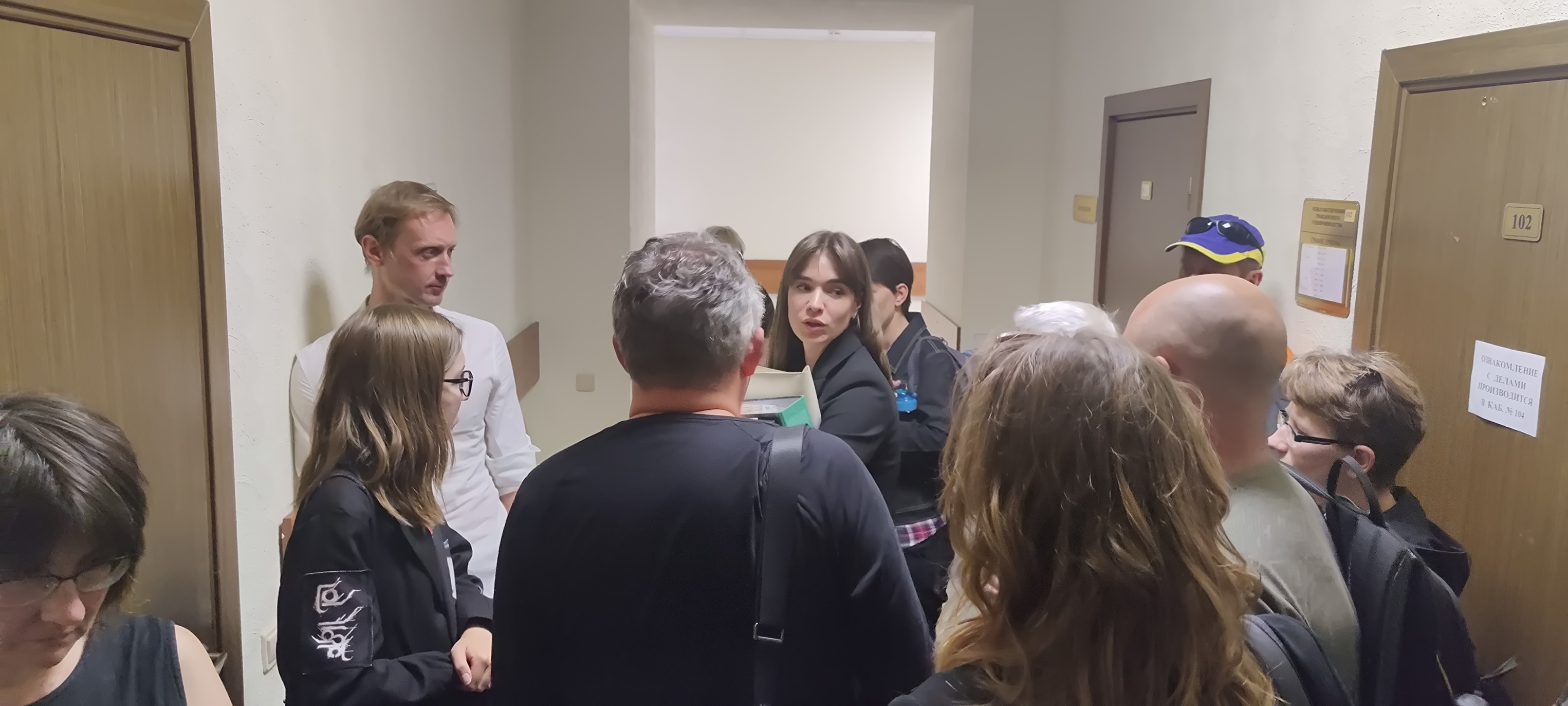
While there is a break in the trial, people wait in the hallway. More than twenty people have come to hearing, including a group of supporters and journalists.
When Olga is escorted out now, the bailiffs close the door to the stairs, where people are standing, apparently so that they won’t be able to shout out words of support to her.
As our correspondent reports, at the latest hearing in the trial of activist Olga Smirnova, in the Kirovsky District Court, the prosecution made public the contents of the nine posts on VKontakte which occasioned criminal charges of disseminating “fake news” about the Russian army.
The posts listed by the prosecution were made on the public social media page of the movement Democratic Petersburg.
A post with a link to a video titled “We will never be brothers,” in which it is reported that the Russian army is “reducing Ukrainian cities to ruins.”
A post with a link to a video that concludes with the words [in Ukrainian], “Glory to Ukraine, glory to the defenders, death to the enemy.”
A post with a link to a video titled “We show Russians photos from Ukraine. The reaction of Russians to the war in Ukraine.” In the video, “the assertion is made” that the photos show Ukrainian cities destroyed by Russian shelling.
A post featuring a photo of a placard on which “the assertion is made” that the Babyn Yar Holocaust Memorial Center was damaged by Russian bombing.
A link to a video titled “No war with Ukraine.”
A post titled “Chronicles of the war, March 9,” in which it is reported that over 1,300 civilians were killed in Mariupol, most of whom were Russian-speaking.
A post titled “Chronicles of the war, March 9, continued,” which reports that Russian troops continue to bomb Kharkiv’s civilian infrastructure facilities.
A post which”sarcastically” reports on a battle between Kadyrovites and Ukrainian National Guardsmen on the premises of the Zaporizhzhia nuclear power plant, claiming that goal of the Kadyrovites is to seize the nuclear power plant in order to “blackmail the whole of Europe with radioactive contamination.”
A post titled “Anti-war pickets: greetings and glory to Ukraine,” which reports that supporters of peaceful resistance in Petersburg came out to protest against the criminal war which Russia is waging against Ukraine.
Due to the absence of witnesses, the prosecution moved to postpone the trial until March and the court granted the motion.
Olga Smirnova is a grassroots activist. She is one of the founders of Strategy 18, an ongoing campaign in support of the Crimean Tatars. She is also a a member of the Petersburg movement Peaceful Resistance, which, according to its own description, “spreads the truth about the Russian Federation’s large-scale criminal war against Ukraine.”
Until 2014, Smirnova worked as an architect, but after Crimea was occupied, she devoted herself to grassroots activism. In 2021, her home was searched due to Strategy 18’s protest campaign, as part of a criminal investigation into “condoning the activities of a terrorist organization banned in Russia.”
The Petersburger faces up to ten years in prison if convicted. You can write to Olga Smirnova in jail: Bumagaexplains how to do it.
Source: Bumaga, “What posts by Petersburger Olga Smirnova does the prosecution consider ‘fakes’ about the Russian army?” 20 February 2023. Translated by the Russian Reader. You can send letters — written in or translated into Russian (if you don’t know a competent translator, you can use a free online translation service such as Google Translate) — to Olga Smirnova and other Russian political prisoners via the free, volunteer-run service RosUznik. You may ask me (avvakum@pm.me) for assistance and advice in sending such letters.
“Donetsk People’s Republic. For your and our freedom!” Berlin-Friedrichshain, 6 February 2023. Photo by the Russian Reader
State Duma deputy Andrei Kolesnik proposes reinstating the death penalty for treason
A proposal has been made in the Russian State Duma to revive the death penalty for those who have left the country and commenced criticizing the Russian authorities. The initiative was launched by deputy Andrei Kolesnik.
In an interview with Moscow Region Today [see translation below], the parliamentarian noted that an exception could be made for those who have simply left the country. According to him, traitors are those who have left and at the same time are waging an information war against Russia.
Security Council deputy chair Dmitry Medvedev said that Russians who fled the country and wish its destruction should be treated in accordance with the law, but the rules of wartime should also be remembered.
Following Nevzorov, Belotserkovskaya has been sentenced in absentia to nine years in prison for spreading fake news. State Duma deputy Andrei Kolesnik commented on this practice of “absentee sentences.”
“Okay, some people merely fled Russia. There are a lot of yellow bellies. They can stay there and work. But when a person works against Russia, it is called an information war. It’s more serious than a weapon, sometimes. Evil tongues are scarier than a gun,” the deputy said in an interview with Moscow Region Today.
However, Kolesnik stressed that the “traitors to the Motherland” had been punished according to the law: there is evidence, i.e., publications. But the deputy noted that he himself would have dealt with them more harshly.
“This is my personal opinion, although maybe I will voice it in parliament. If a person has committed serious crimes against Russia, then the sentence might be different. And this sentence could be enforced in the place where he (“traitor to the Motherland” — ed.) is located. Combat is currently underway. So, they should behave more carefully,” the deputy said.
When our correspondent asked whether he was talking about the death penalty, Kolesnik replied as follows.
“The [death penalty] can be employed for treason. We currently have a moratorium on the death penalty, although it exists in our laws. The decision to lift the moratorium is made not by the State Duma, but by the court. Although many people in the State Duma are leaning in this direction,” the deputy said.
Earlier, State Duma deputy [Maxim Ivanov] said that the unemployed could be sent to the SMO zone.