All modern entertainment that “undermines” traditional values should be banned in Russia, conservative philosopher and “Russian World” ideologue Alexander Dugin has said.
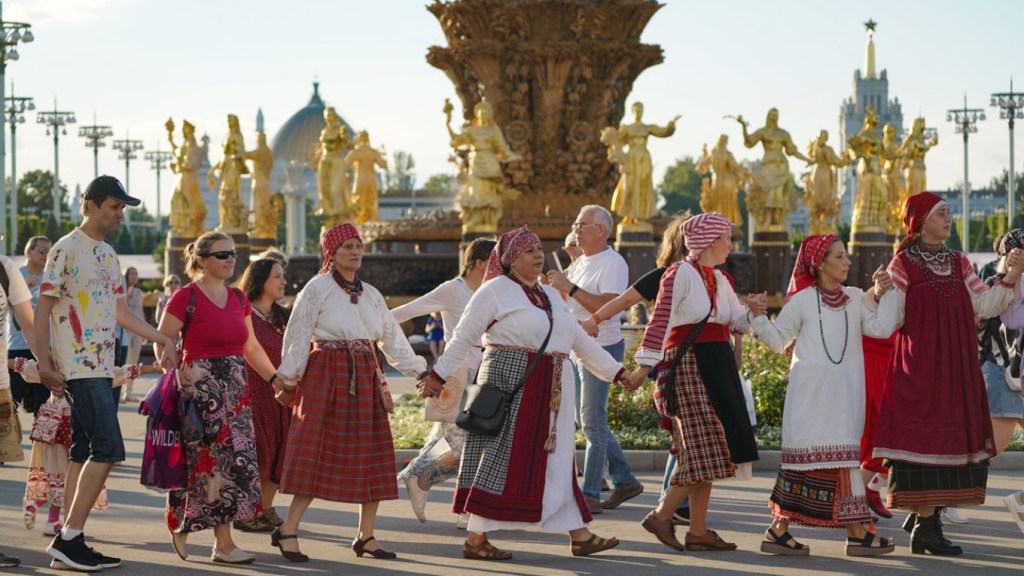
“Only morally healthy entertainment should be allowed — first of all, round dances and traveling around one’s native land, and even better, pilgrimages to holy places. Everything else should be banned,” Dugin wrote on his Telegram channel.
According to Dugin, a healthy nation should have wholesome leisure activities, “and not all of that stuff.” As a negative example of entertainment, he cited KVN, which has become, he claims, “a poisonous matrix of degeneration.”
“The sinister nature of this pernicious phenomenon is now clearly visible. [Ukrainian President Volodymyr] Zelensky, [comedian Maxim] Galkin, and all the rest,” Dugin said.*
Earlier, the philosopher claimed that the West regards Russia as its principal foe because Russian President Vladimir Putin has been reviving traditional values and liberating the country from global influence. This, in his opinion, is what provoked the disgust of Western “progressive elites” with Putin.
Dugin has also argued that Russia has neither a parliament nor democracy, but a de facto monarchy headed by Putin, who can do whatever he wants. The philosopher noted the irrelevance of certain laws in Russia, as well as the people who propose or support them. In his opinion, all of this is “boyars dancing for the time being,” that is, until the sovereign pays attention to the antics of these “selfish and thieving bastards.”
Dugin has argued that Russia itself is the Katechon — the last bulwark against the Antichrist, who today reigns in a West “totally perverted” by LGBT+, postmodernism, relativism, and transhumanism.
The philosopher has dubbed the war in Ukraine “the most important event in history.” In his opinion, it is being waged on behalf of a multipolar world, with many superpowers. Consequently, according to Dugin, Russia will free other countries of the world from Western liberal imperialism, in whose grip they are trapped. And yet, Dugin acknowledged that Russia would lose a great many people in the course of the war.
* Zelensky was captain of the Kryvyi Rih KVN team Kvartal 95 from 1998 to 2003.
Enter Thoughts of Days to Come, dressed to the nines in khaki blouses. They are lugging atom bombs, ICBMs, a launching pad. O, how they reel, dance, and caper: “We are warriors and carousers! Russians and Germans will fall together; for example, at Stalingrad.” And like old widow Matryona, cyclotrons are dumbly howling. In the Ministry of Defense a nest of crows is loudly cawing. Look at the pillow. What do you know! Shiny medals all in a row.
“Where there’s a will, there’s a way.” “A pint of vodka, they say, Soon’ll be a ruble a pop.” “Mom, I really don’t love Pop.”
Enter a certain Orthodox, saying: “These days I’m number one. I’m pining for the sovereign, and in my soul the Firebird flares. Soon Igor will reunite with Yaroslavna and have his fun. Let me make the benediction or else I’ll box you on the ears. Worse than evil eye or herpes is the plague of Western thinking. Sing, accordion, and drown out the saxophone, jazz’s vile offspring.” On the icons they plant a kiss, Sobbing victims of circumcis—
I was at an interview on TV Rain last week. We were supposedly going to discuss the Oscars, but suddenly we touched on what is an important topic, I think — how to behave appropriately during the war and amid everything else that is happening now.
I often read comments about how I smile all the time, but there is a war going on. About how I joke on the air, but now is not the time for jokes — Navalny is in prison. Why did I post this or that photo? It’s too glamorous and frivolous. Now is not the time for such things.
The complaints are understandable, but I totally reject the point they’re trying to make. It seems to me that the most destructive, the most incorrect thing we can do now is to don dark clothes, wring our hands and publicly suffer in front of our audience. By no means am I saying that there is no point in suffering in this situation. There is. The war is the most terrible event that has ever happened to us. It is absolutely incomprehensible how to go on living when your country has attacked and is destroying innocent people and destroying their lives forever as the scumbags on Russian national TV hoot and holler for joy. Everyone who is reading this post has experienced all this, I am sure, and of course you have been suffering. And those whom Putin came up with the idea of bombing with missiles and killing have been suffering even more.
Only one thing remains to us: to take all these terrible emotions, all these experiences, and turn them into concrete actions. Not cry on camera, not get hysterical, but to try and stop this horror as soon as possible. Today is better than tomorrow. Tomorrow is better than the day after tomorrow, etc. Each of us knows best of all what we ourselves are capable of doing and how to do it. The main thing is not to give in to despair. Despondency, despair and indifference are exactly what Putin wants from us. Don’t give him that.
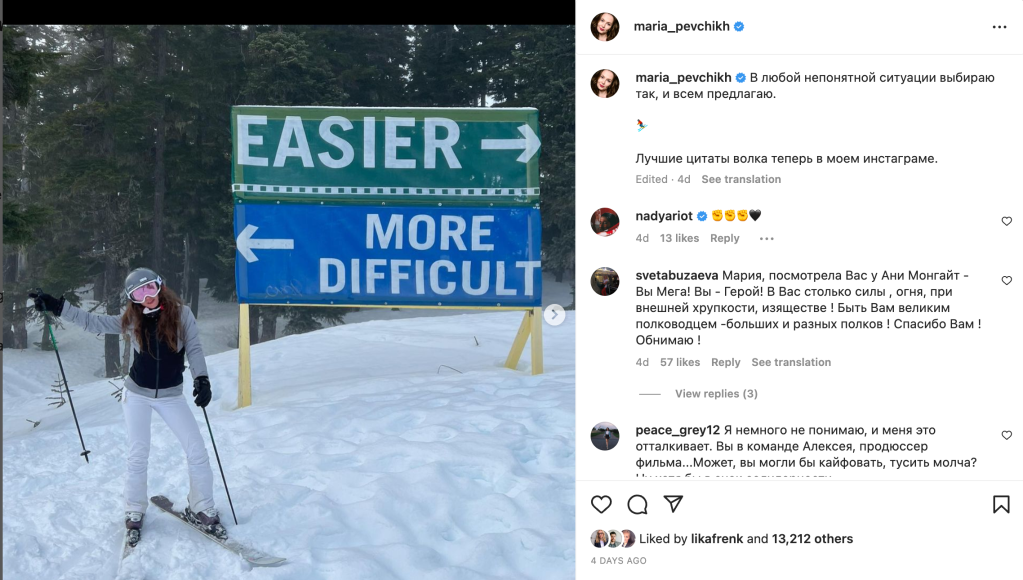
I’ve attached a bit of the interview. And a frivolous photo to boot.
Source: Maria Pevchikh, Instagram, 31 January 2023. Translated by the Russian Reader
[…]
And where you find a hero, you always find tragedy. The hero is always a vehicle for suffering, pain, rupture and tragedy. There are no happy heroes: all heroes are necessarily unhappy. The hero equals misfortune.
Why? Because being both eternal and temporary, dispassionate and suffering, heavenly and earthly is the most unbearable experience for any being. It is a condition that you wouldn’t wish on your enemy.
Ascetics, martyrs, and saints took the place of heroes in Christianity. There are likewise no happy monks or happy saints. All of them are profoundly unhappy as individuals. But according to another heavenly account, they are blessed. Just as those who weep, those who are exiled, those who suffer slander, and those who hunger and thirst are blessed in the Sermon on the Mount. Blessed are the unhappy.
A person is made a hero made by an idea aimed skyward that crashes to the ground. A person is made a hero by suffering and misfortune, which tear him apart, which torment, torture, and harden him, and it has always been thus. This can happen during war or an agonizing death, but it can also happen without war, and without death.
The hero looks for his own war, and if he does not find it, he goes into a monk’s cell, to live as a hermit, and fights there with the real enemy. Because true warfare is spiritual warfare. Arthur Rimbaud wrote about this in Illuminations: “Spiritual combat is as brutal as battle between men.” (Le combat spirituel est aussi brutal que la bataille d’hommes.) He knew what he was talking about.
One hero, as the Neoplatonist Proclus says, is equal to a hundred or even thousands of ordinary souls. He is greater than a human soul because he makes every soul live vertically. This is the heroic dimension to the origins of the theater and, in fact, the ethics of our faith. It is the most important thing, which we should not lose, which we should cherish in others and nurture in ourselves.
Our job is to become deeply, fundamentally and irreversibly unhappy, no matter how scary that sounds. It is the only way we can find salvation.
Source: Alexander Dugin, “The Hero: The Metaphysics of Unhappiness,”Katehon, 3 February 2023. Translated by An Unhappy Translator. Thanks to Pavel Pryanikov for the heads-up
Maria Pevchikh: “In any puzzling situation this is what I choose and suggest that everyone else choose.” Source: Instagram
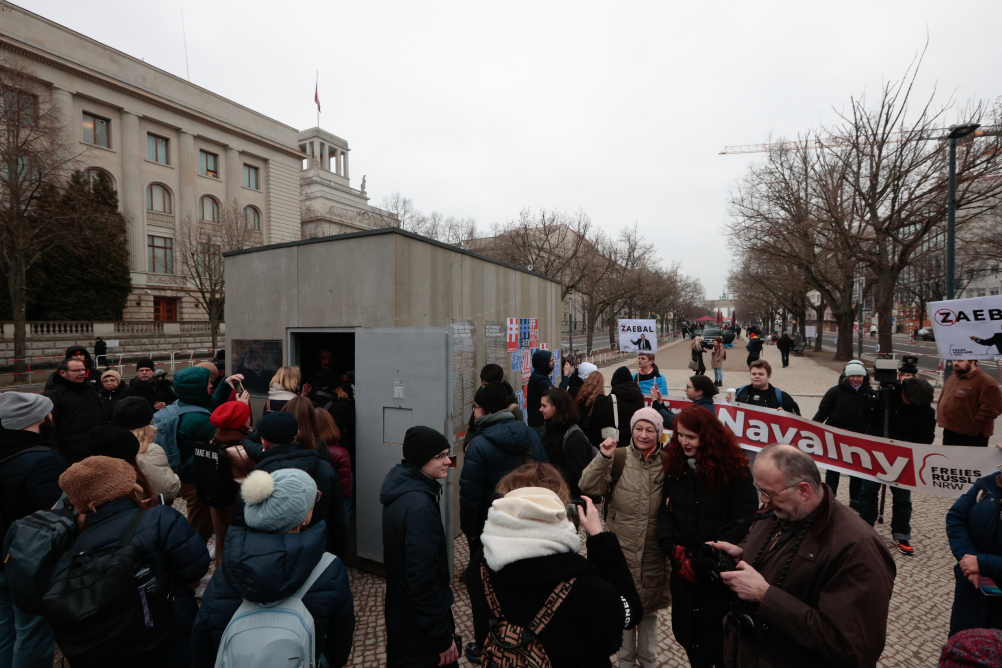
Now every employee of the Russian embassy in Germany has to think about Navalny on their way to work because they will see a replica of the solitary confinement cell where Alexei has been confined for the eleventh time.
Not only embassy employees see this solitary confinement cell. It is seen by Berlin residents, tourists and journalists. It is seen by readers of the world’s major media outlets. Millions of people see it — and thus learn about the torture chamber in which Navalny is being held. Some will tell their friends about the project, others will join the Free Navalny campaign, while still others will put pressure on local politicians contemplating compromise with Putin. Circles radiate all over the world from this one site.
It is in your power to make these circles spread even wider. Help us achieve freedom for Navalny and for the whole of Russia — support our campaign at acf.international/#donate.
Free Navalny!
Thank you for being on our side!
The Navalny Team
“Navalny has now been in prison for 745 days.”
Source: FBK (Anti-Corruption Foundation) email newsletter, 2 February 2023. Translated by the Russian Reader
Maria Pevchikh is an investigator and associate of Alexei Navalny.
0:00 Let’s go! 0:37 Why we met in London 5:13 How the film Navalny is saving Navalny’s life 9:36 Dud in the Internet’s homeland 13:03 How to turn a photo of a hallway into an investigation 16:17 What is going on with Navalny now? 20:26 The second largest house in the UK is owned by a Russian oligarch 25:30 But why can’t a Russian oligarch buy a house in London? 29:48 The UK is fighting Putin but harboring thieves: is that normal? 37:22 Who are you and where are you from? 42:31 Where did you get the money to study in London? 44:02 What’s wrong with Moscow State University’s sociology faculty 47:19 What did your father do for a living? 48:41 A crash course about British universities (eight lectures a week) 53:16 Alexander Dugin was Maria’s thesis advisor: how did that come about? 1:00:03 Does Putin listen to Dugin? 1:03:05 What Medvedev was like thirteen years ago 1:05:20 “My cat was hit by a car, please sort it out”: what British MPs do 1:08:22 Gadaffi’s son was at university with you 1:14:35 Where did you work before becoming an investigator? 1:16:32 Do you have a flat in London? 1:17:47 How did you meet Navalny? 1:22:50 Why didn’t you mention Skabeyeva and Popov’s mortgage? 1:27:28 How are drones able to fly over Putin’s and Medvedev’s residences? (A question from Nikolai Solodnikov) 1:33:14 Where did you get the conductor Gergiev’s bank statements? 1:36:32 Is it okay to pay a bribe to avoid mobilization? 1:40:54 What is your beef with Fridman? 1:48:13 Is Galitsky an accomplice of the regime? 1:57:18 Can we detest someone for being afraid? 1:58:26 Why does Popular Politics have such sensational headlines? 2:04:08 Is it okay to call a program guest a “fat beast”? 2:08:21 The rude tweet about Durov 2:10:21 Does radicalism prevent the Anti-Corruption Foundation from becoming popular? 2:16:09 Roman Abramovich is a master of reinventing himself 2:24:13 How soft power works 2:29:52 If Abramovich had ended the war would you have forgiven him? 2:31:38The “List of the 6,000”2:33:59 Why have you called for sanctions against Sobchak? 2:35:35 Why have you called for sanctions against Venediktov? 2:44:00 What did Oleg Kashin do wrong? 2:46:34 Why were the designers of a facial recognition system removed from the “List of the 6,000”? 2:51:01 Is your father an accomplice of the regime? 2:55:49 How do you do your work without Navalny? 2:57:18 Why were your supporters’ data hacked? 3:05:38 “Carry out a mission in the fight against Putin and get points”: what is that about?! 3:07:53 How do people who work for the regime change sides? 3:15:51 Do you see yourself as a politician? 3:19:44 Do you have a plan for Russia’s future? 3:25:09 Won’t the dictatorship in Russia survive without Putin? 3:30:20 Do you have a UK passport? 3:35:51 What exactly have you done over the past year to overthrow Putin? 3:41:21 “Compromisers” 3:52:07 Russia without Putin 3:56:58 What does it mean to be strong?
Source: vDud (YouTube). Annotation translated by the Russian Reader. Thanks to Tiina Pasanen for bringing this remarkable video to my attention and persuading me to watch it despite my initial misgivings. When I assembled the first part of this mash-up, a few days ago, I had no idea that Pevchikh and Dugin were so closely connected in real life. For another perspective on the sociology faculty at Moscow State University during roughly the same period as Pevchikh describes, see Oleg Zhuravlyov and Danail Kondov, “Towards a History of the Conflict in the Moscow State University Sociology Department” (2008). ||| TRR
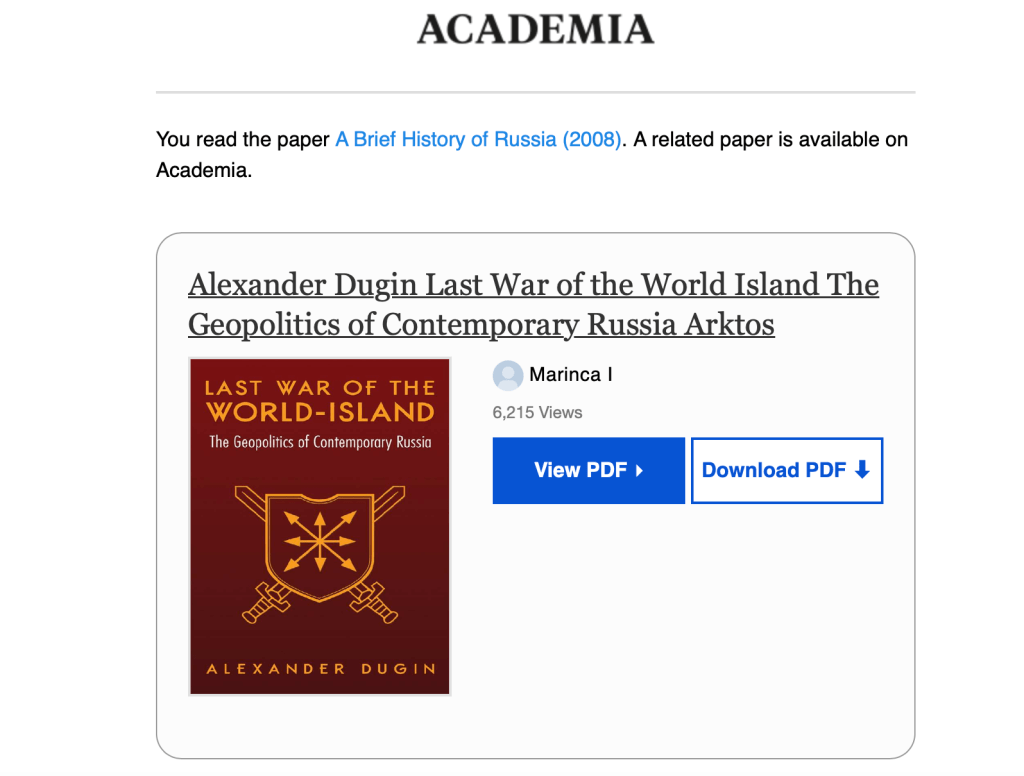
So much for the idea of not giving a platform to out-and-out fascists like Alexander Dugin, whose “academic” credentials are borne out by serious-sounding nonsense like the following, as found in Last War of the World-Island and translated by John Bryant:
In all the principal parameters, the Russian Federation is the geopolitical heir to the preceding historical, political, and social forms that took shape around the territory of the Russian plain: Kievan Rus, the Golden Horde, the Muscovite Czardom, the Russian Empire, and the Soviet Union. This continuity is not only territorial, but also historical, social, spiritual, political, and ethnic. From ancient times, the Russian government began to form in the Heartland, gradually expanding, until it occupied the entire Heartland and the zones adjoining it. The spatial expansion of Russian control over Eurasian territories was accompanied by a parallel sociological process: the strengthening in Russian society of “land-based” social arrangements, characteristic of a civilization of the continental type. The fundamental features of this civilization are:
• conservatism; • holism; • collective anthropology (the narod is more important than the individual);
• sacrifice; • an idealistic orientation; • the values of faithfulness, asceticism, honor, and loyalty.
Sociology, following Sombart, calls this a “heroic civilization.” According to the sociologist Pitirim Sorokin, it is the ideal sociocultural system. This sociological trait was expressed in various political forms, which had a common denominator: the constant reproduction of civilizational constants and basic values, historically expressed in different ways. The political system of Kievan Rus differs qualitatively from the politics of the Horde, and that, in turn, from the Muscovite Czardom. After Peter I, the political system sharply changed again, and the October Revolution of 1917 also led to the emergence of a radically new type of statehood. After the collapse of the USSR there arose on the territory of the Heartland another government, again differing from the previous ones: today’s Russian Federation.
But throughout Russian political history, all these political forms, which have qualitative differences and are founded on different and sometimes directly contradictory ideological principles, had a set of common traits. Everywhere, we see the political expression of the social arrangements characteristic of a society of the continental, “land-based,” heroic type. These sociological peculiarities emerged in politics through the phenomenon that the philosopher-Eurasianists of the 1920s called “ideocracy.” The ideational model in the sociocultural sphere, as a general trait of Russian society throughout its history, was expressed in politics as ideocracy, which also had different ideological forms, but preserved a vertical, hierarchical, “messianic” structure of government.
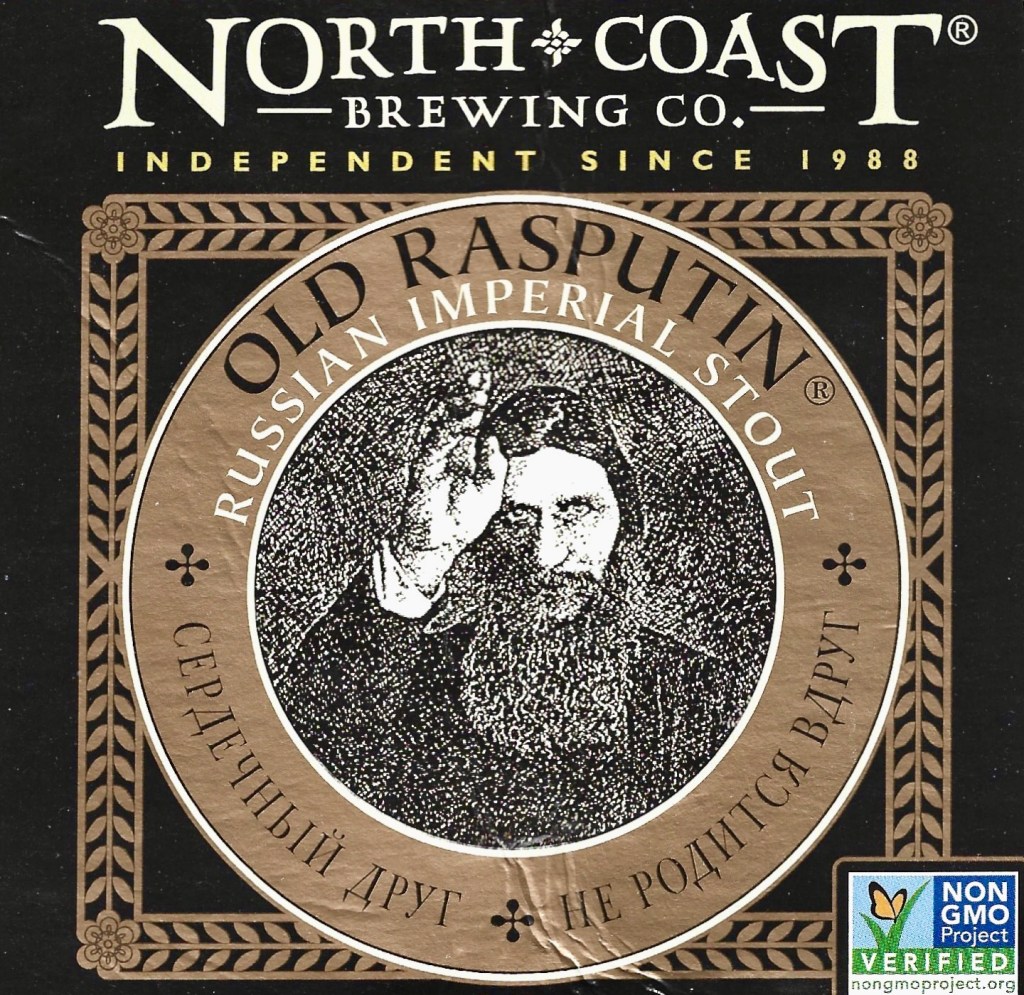
“Bosom buddies aren’t born overnight,” declares the label of North Coast Brewing’s Russian imperial stout, Old Rasputin. I don’t know whether that sentiment is true, but the beer is excellent. Scan of the carton by the Russian Reader
Fans of anti-thalassocrat and accomplished obscurantist Alexander Dugin will appreciate this portrait of the man by journalist Andrey Loshak, which I translated the other day for e-flux Notes. Here’s a sneak preview:
I remember accidentally attending a lecture by Dugin on “angelic entities” in the late nineties. It was an absolutely unbearable exercise in transcendental sophistry, dealing mainly with the image of Lucifer (the Fallen Angel) and featuring extensive quotations from Aleister Crowley. There were about twenty people of indeterminate age and gender in the auditorium. I thought at the time that perhaps they, too, were fallen angelic entities who had come to listen to a lecture about themselves. In the mid-noughties, I ran into Dugin at a Current 93 gig at the Ikra Club. He dearly loved English apocalyptic folk music for its commitment to Nazi Satanism.
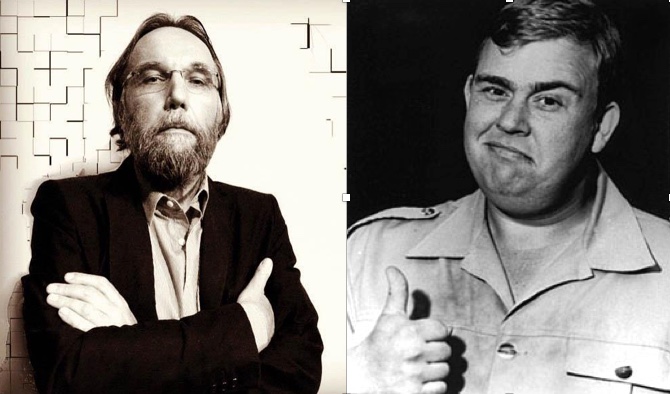
Alexander Dugin and John Candy: Not Separated at Birth
Eurasianist leader and self-confessed fascist Alexander Dugin had something he wanted to say to you about Donald Trump and the US presidential elections.
Dugin and his voiceover artists’ delivery and (unintentional) self-parody reminded me of the Second City Television (SCTV) episode in which the lowly Melonville station’s signal is temporarily blocked and taken over by “CCCP1, Russian Television.”
But that was meant to be funny. And it was also meant to parody not so much the actual Soviet Union (although it did a little of that, too, especially in its prescient “vilification” of “Uzbeks”) as it did North American Cold War attitudes and stereotypes of the Soviet Union.
Now what begun as high farce has returned as . . . I wanted to say tragedy, but it’s really the most vulgar of comedies. It’s definitely not funny anymore, though, whatever the real or imagined connections between the Fascist Pig in the Poke and the Kremlin.
Thanks to Comrade Maximum for the heads-up on the Dugin video. This post was updated on 27 February 2023 because the original video featuring Dugin sounding off about Trump has disappeared from YouTube, alas. ||| TRR
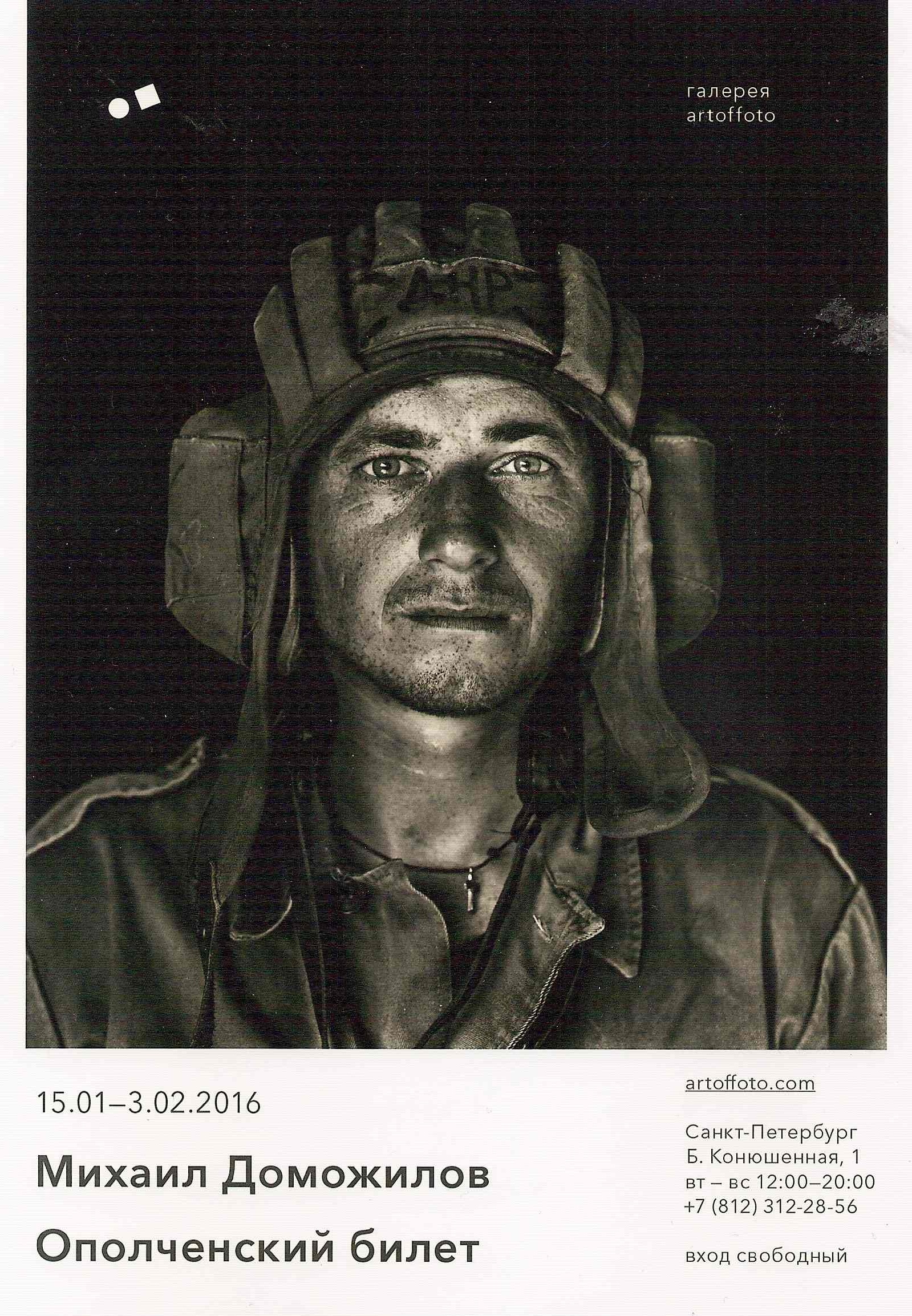
Promo flyer for the exhibition Mikhail Domozhilov, Militiaman’s Pass, ARTOFFOTO Gallery, Saint Petersburg, January 15-February 3, 2016. Courtesy of the gallery
This morning I got an urgent message from a friend, alerting me to the fact a funny sounding exhibition of photographs was underway at a downtown photo gallery I had never heard of.
It was true, as my friend pointed out, that the announcement for the show, an exhibition of portraits of Eastern Ukrainian pro-Russian separatist fighters (opolchentsy), taken by Petersburg photographer Mikhail Domozhilov, sounded quite dicey politically, as posted on the website of the exhibiting gallery, ARTOFFOTO.
It sounded a little less outwardly partisan when translated into English and printed on the flyers I would later find lying on a windowsill in the gallery:
“The self-proclaimed and still unrecognized state [of the] Donetsk People’s Republic appeared as a result of a civil war in Ukraine in April, 2014. The Donbass People’s Militia became the driving force of the new republic. In the year that passed after the declaration of the DPR, its militia transformed from an anarchic group of super activists [sic] divided into small groups and willing to go weaponless and die for an idea into a regular army with all its necessary attributes—[a] code [of military conduct], subdivisions [sic] and their chiefs, headquarters and machinery.
“This episode is about transition and transformation, about a shaky equilibrium between belonging to one country and to another, utopic in its essence. And also about the self-identification of the participants throughout the conflict. In several months former miners, builders, mechanics have become professional warriors, and a new, extreme reality has replaced the ordinary one. With major destruction[], artillery shelling and [a] non-continuous front, these people suddenly found themselves in the middle of historical events and news reports.
“This episode includes several close-up portraits of militia members in mobile studios at military and training bases, as well as on [the] frontlines.”
(English-language flyer for the exhibition Mikhail Domozhilov, Militiaman’s Pass [Opolchenskii Bilet], ARTOFFOTO Gallery, Bolshaya Konyushennaya, 1, Saint Petersburg, January 15–February 3, 2016)
It was also true that the photographer, Mr. Domozhilov, had shown a penchant in his career for subjects that might be characterized as rightist, such as this fascinating series on the ultras for Petersburg’s Russian Premier League side, FC Zenit.
The ultras series featured virtuosic albeit historically and aesthetically coded works such as this.
Mikhail Domozhilov, From the series Ultras, 2010. Courtesy of the photographer’s website
On the other hand, Mr. Domozhilov’s tearsheets included portraits, just as compelling, of pro-Ukrainian fighters on the Maidan in Kyiv.
But I did not think it fair to pronounce judgement on the work on the basis of a couple of websites, so I set off into the winter wonderland that Petrograd has become in the last week to see the show for myself.
I have been banned on Facebook by Mark Sleboda, and for the most innocuous of comments. For those of you who don’t know this guy, he is an American who voluntarily came to Russia to work with Alexander Dugin, the conservative “Eurasianist” imperialist/traditionalist circus clown who went from hanging out, in the nineties, with the likes of politically dicey counter-culturalists like musician Sergei Kuryokhin and writer Eduard Limonov (with whom he co-founded the National Bolshevik party) to being a “respected” media commentator, “academic,” and Putin loyalist, in the noughties.
I’m writing in English in order to warn my Anglophone friends. There is a whole network of expats in Russia working on the “ideological front” defending Putin, frequently portraying him as an anti-Atlanticist battling NATO and EU hegemony. Many of these people pose as “leftists.” Basically, they are bought-and-paid petty ideologists, no better than our own homegrown Russian journalists and Kremlin think tankers. However, many of them, like Sleboda, sincerely believe Dugin’s “theories” and willingly support the Kremlin propaganda machine. What they offer is propaganda pure and simple: that is why I was banned for modestly questioning Sleboda’s position on Euromaidan. Different views are not tolerated, because the purpose of propaganda is to overwhelm a person with a stream of repeated buzzwords, not to discover the truth.
However, I am writing not just to warn you about the work of guys like Sleboda. Some political considerations are in order.
Apparently, the Putin regime’s “external” propaganda makes Putin out to be a “leftist” somehow. There are three key points in this portrayal. First, geopolitically, Russia is presented as an alternative to NATO and the EU. Second, politically, Russia is said to be against the neoliberalism imposed by the Atlanticist bloc. Third, culturally, Russia is combating “decadent perversions” such as the LGBT movement (which, again, has been imposed by the west).
In some respects, this is different from what we get here in Russia. Our “internal” propaganda does not focus on Putin’s alleged anti-neoliberalism, since very few people here are receptive to such “leftist” claims. Not so in the west: many people there sincerely believe that Putin is an anti-neoliberal.
What I want to do here is to refute all three points of the Kremlin’s “external” propaganda.
First, geopolitically, Russia is weak and only masquerades as an enemy of the west. It constitutes no regional bloc against western imperialism, as Latin America does. To be a genuine counter-power, you need to have an alternative set of values and an alternative model of the future. Putin’s Russia is far from possessing any real ideological commitments. It engages only in pure opportunism.
Second, politically, Russia is neoliberal through and through. There are neoliberal reforms in the public sector underway, Prime Minister Medvedev’s “technocratic” government is planning more privatizations (!), and not a single person within the government’s financial/economic bloc is an anti-neoliberal, even a moderate one. They are all neoliberal experts trained in the Chicago school of economics.
Third, culturally, Russia might be against “decadent perversions,” but such “perversions” are not what defines the west culturally. LGBT rights are the result of a brave struggle over many generations, not an organic part of western culture. However, if we can speak of “western culture” at all (which is very doubtful), we might very cautiously say that consumerism, a private sphere inhabited by atomized individuals, and the degradation of public virtues (in short, Guy Debord’s “spectacle”) are what define western capitalism. All these things are prevalent here in Russia, even more than in the west itself. Russia is more immersed in private life, and more consumerist than many western countries, and Putin fully supports that. So culturally speaking, he offers no opposition to capital’s creeping influence, and that is the most important thing.
Don’t get into bed with Putin, comrades!
Okay, now that this has been said, should a western observer be a Russophobe, like the notorious blogger La Russophobe, who frequently writes for conservative US media outlets? No. The point is not to attack Russia as such, not to express solidarity with the Russian “people” against the Russia “government.” That is an empty formula used by the likes of John McCain. The point is to educate yourself about alternative political and social forces here in Russia—social movements, independent unions, leftist groups, and the opposition movement as a whole (in all its complexity, with its neoliberal and anti-neoliberal currents). As a leftist, I feel responsible for refuting the crazy idea that Putin is somehow a leftist. However, I also feel responsible for fighting against one-sided Russophobia, which essentially supports the US and EU agendas. Solidarity is very much needed here in Russia, but it should be solidarity coupled with political awareness. It should be against Putin, against neoliberalism and imperialism, but for genuine solidarity with the international left and with social movements across the globe. That is what I was wanted to explain here.
Ilya Matveev is an editor of OpenLeft.Ru, a member of the PS Lab research group, a lecturer in political theory at the North-West Institute of Management (Petersburg), a PhD student at the European University (Petersburg), and a member of the central council of the University Solidarity trade union.