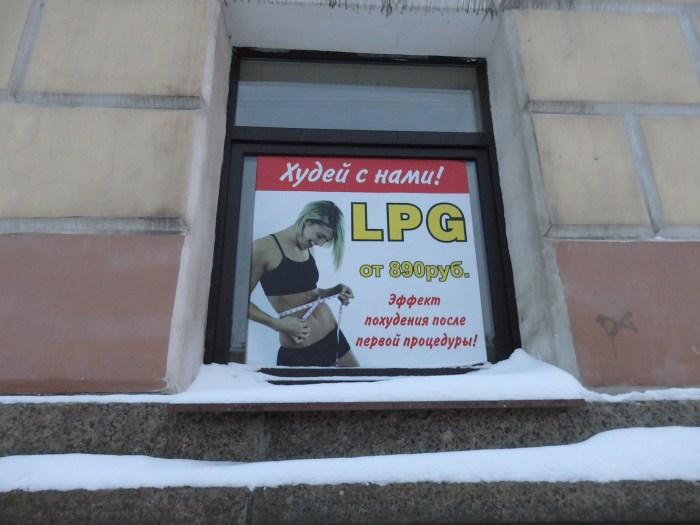
“Lose weight with us! LPG from 890 rubles. You’ll feel thinner after the first procedure.” Photo by the Russian Reader
Raw Materials, Grain, and Transport The Russian economy has been shrinking and devolving
Pavel Aptekar Vedomosti
November 9, 2016
As many experts had predicted, the inertia of economic policy has led to an ever-increasing shrinkage of the economy and devolution of its structure. In the last two years, the role of primary industries and the cargo haulage they generate has grown even more.
In the latest issue of Commentaries on the State and Business, Nikolay Kondrashov of the Higher School of Economics has calculated that, in the third quarter of 2016, agricultural output grew in comparison with the annual averages for 2014 by 6.6%, mining by 3.6%, and cargo haulage by 3.4%. During the same period, the volume of retail trade has decreased by 14.7%, construction by 12.8%, and manufacturing by 7.2%. According to Rosstat, real wages decreased by 13% from the third quarter of 2014 to the third quarter of 2016. This has reduced domestic demand, purchasing power and, consequently, the production of a number of consumer goods and the tempo of new construction. Sales of domestic products have increased relative to banned or seriously inflated imported goods, but overall food consumption has fallen. The contribution of manufacturing, construction, and trade to GDP has decreased, while, on the contrary, the role of extractive industries, agriculture, and the cargo turnover they generate has grown.
It is extremely difficult to break away from a resource economy and get on the path of growth. It is impossible to radically restructure the economy without major investments. They are currently at a low level and, according Vladimir Nazarov, director of the Finance Ministry’s Finance Research Institute, they are unlikely to increase. Stronger guarantees of property rights are needed, at least, for investments to start flowing.
We can take satisfaction in the growth of agriculture, which has received a good deal of government subsidies and import-substitution preferences, but it is unlikely to provide a robust multiplier effect: the agricultural sector is heavily monopolized, and it requires less and less manpower. Agricultural equipment manufacturers may still profit, but they face serious competition from the Belarusians. Given low economic growth, the best we can look forward towithin the current framework is a slight downtick in the primary industries due to an increase in retail sales and construction, notes Nazarov.
Some growth in the manufacturing sector can be attained through defense contrats, whose impact on demand and economic growth is generally quite small. Russia can produce a limited number of products that are popular not only in the domestic market but also foreign markets, but we should not expect them to be the source of structural improvements.
The Russia economy’s structural focus on extractive industries was also typical during the fat years, but then it was mixed with windfall profits from oil sales. Nowadays, there is no hope that oil will generate growth. During a crisis, we need freedom of entrepreneurship and the development of new sectors from the bottom up, thus increasing the demand for human capital, more than ever. Otherwise, human capital degrades as well. It does not take a lot of smarts to maintain pipelines and a small number of latifundia.
Translated by Death of a Salesman. Thanks to Gabriel Levy for the heads-up
Nearly Half of All Russians Have Switched to Subsistence Farming
Natalya Novopashina RBC
October 21, 2016
The percentage of Russians who grow food in their gardens has increased to 46%. At the same, food sales in stores have decreased, according to GfK Russia.
In two years, the percentage of Russians growing vegetables and fruits in their own gardens has increased from 39% to 46%. Moreover, production of their own vegetables is the main source of nutrition for the 15% of “active” gardeners, GfK Russia CEO Alexander Demidov told RBC.
“We have noticed a fairly big burst. People have been switching to growing their own produce. It is definitely a crisis,” he said, adding that the percentage of Russians engaged in subsistence farm not as a hobby, but to feed themselves, will only grow.
Irina Koziy, general director of industry news website FruitNews, confirms the trend, noting that it is most visible in medium-sized towns for now.
“Besides, there are a number of programs in the regions under which needy and large families are supplied with seed potatoes for planting in the spring. Such programs operate in Buryatia, Kuzbass, and a number of other regions,” said Koziy.
In April 2016, 53% of respondents reported the crisis had had a direct impact on their lives. In July 2016, this figure was 46%.
And yet, in reality, the actual financial circumstances of Russians have not improved. They have simply adapted to the crisis and regard the current economic reality more calmly.
“The effect of adjusting to the situation has kicked in, because people don’t believe the crisis will be resolved soon,” said Demidov. “So crisis consumerist strategies are still in effect.”
According to GfK, the vast majority of respondents (75%) said they were willing to give up purchasing certain goods. In particular, according to the company, the greatness number of Russians (17% of respondents) have been saving money by cutting out trips to beauty salons. Other expenditures that had been cut included purchases of household appliances (16%) and cosmetics (15%).
The sales of most foods have also decreased. According to GfK, during the year beginning July 2015 and ending July 2016, sales of dairy products and meat decreased in physical terms by 0.5% and 0.8%, respectively. Most of all, consumers scrimped on sweets and snacks (a 3% decrease), bread products (a 7% decrease), and fish and seafood (a 7.4% decrease). A slight increase occurred in sales of frozen products (1.1%), eggs (1.4%), fresh fruits and vegetables (1.5%), and baby food (2.2%).
During the same period, the volume in terms of price of goods purchased through promotions grew by 45%. And the share of promotions throughout the fast-moving consumer goods sector increased from 12.2% to 14.1%, according to GfK’s calculations.
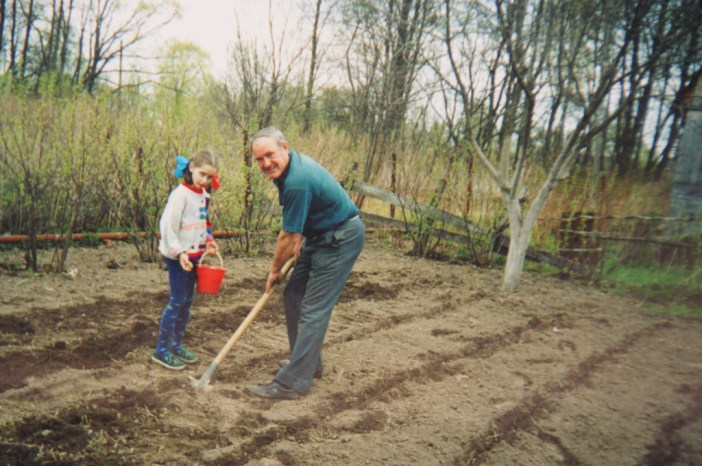
Translated by the Russian Reader. Photo courtesy of russiannotes.com
Kuban Farmer Shoots Himself over Illegal Seizure of Land
Gella Litvintseva Proved.rf
October 1, 2016
A farmer in Krasnodar Territory has committed suicide because he was unable to get back a thousand hectares of land that had been illegally seized from him, according to Alexei Volchenko, organizer of the August 2016 tractor convoy and a farmer from the Kalininskaya Distrist.
“Nikolai Gorban, a farmer in the Timashyovsk District, shot himself. It happened three days ago. A thousand hectares of land were confiscated from him by court order. The man wrote a suicide note in which he named the people he blamed for his death. Prior to this, gangsters came to his place, threatening him and promising to do away with his family. His loved ones are now preparing for the funeral,” says Volchenko, head of the Kalininskaya District Peasant Farm Enterprise.
According to Volchenko, the victim received the land plot after buying the shares from the land’s owners. After the court ruled the land confiscated, he tried to get it back, but failed.
“The farmer had his own land. He had bought it from other shareholders, like himself, and had it marked off and registered. But later the meeting of shareholders [at which they had decided to sell the land to Gorban — TRR] was declared null and void by the courts, and the land was returned to the collective farm, which Oleg Makarevich has been trying to get his hands on. The farmer went to see Natalya Kostenko, of the Russian People’s Front [a pro-Putin astroturfed “civil society” organization — TRR], to ask for help. He went personally to see her twice, and he called her. He went to see Andrei Korobka, deputy governor of Krasnodar Territory, and asked him for help. He met with me. He said, ‘I’ve lost everything. I’m going to put a bullet in my head.’ I told him not to do anything, that all was not lost, that in the end it wasn’t worth his life. I told him we would tough it out, we would beat them come what may. But he said, ‘I don’t want to live.’ I tried to dissuade him, but now we’ve found out it’s all over,” recounts Volchenko.
On September 23, convoy participants were in Moscow. Scheduled meetings with the president and the agriculture minister did not take place. They only managed to have a small get-together with Kuban officials. At the beginning of the week, Volchenko announced the farmers would be meeting with a presidential envoy in Yeysk on September 28, but ultimately this meeting did not take place, either.
“We got ready and went to Yeysk. I went into the hotel where the event was going to take place. They looked at me like I was an idiot. ‘Young man, are you smoking something or popping pills? What presidential envoy? What journalists? We have nothing scheduled.’ I went outside and saw cars with tinted windows, FSB officers walking around, and Vyacheslav Legkodukh (the Krasnodar governor’s envoy for farmer relations) sitting in a cafe and eating. I got the picture. I went to the farmers and said, ‘This is a setup. Let’s leave for home on the sly.’ They wanted us to gather outside the hotel so they could arrest us again for holding an unauthorized assembly,” recounts Volchenko.
Earlier, the protesting farmers met with Alexander Chernov, chair of the Krasnodar Territorial Court, who promised he would review all the cases the farmers requested. For now, he is their only hope.
“All the judges say Chernov is a very decent man, and keeps his word. Currently, farmers have won some of the cases that were before the courts. There are positive results, but it’s not clear whether this will be enough, because right now several farmers are under tremendous pressure, Nikolai Maslov, for example. Certain media outlets have been writing that he is a raider, that he has been trying to grab land from Shestopalov and his honest Dmitriyevskoye Agricultural Enterprise. But people just want to mark off and purchase their own land, 200 bloody hectares. Tremendous pressure has been exerted through the press. Andrei Koshik, a Kuban journalist, went to Novaya Gazeta newspaper in Moscow and tried to get the journalists to publish this garbage. They refused and wrote about it on Facebook,” says Volchenko.
The problems of Kuban’s farmers became widely known in the spring, when they decided to travel to Moscow by tractor to tell the president about illegal land seizures in Krasnodar Territory and about corruption in the local courts and district councils. To capture the president’s attention, over the course of seven months the farmers released doves with messages for him, held several rallies in a field, set off for Moscow in tractors, and wrote to the president’s public relations office. Their tractor convoy in August ended on day two in Rostov-on-Don, when the farmers were jailed and fined. Subsequently, convoy participants have been subjected to continual pressure from local authorities and law enforcement agencies.
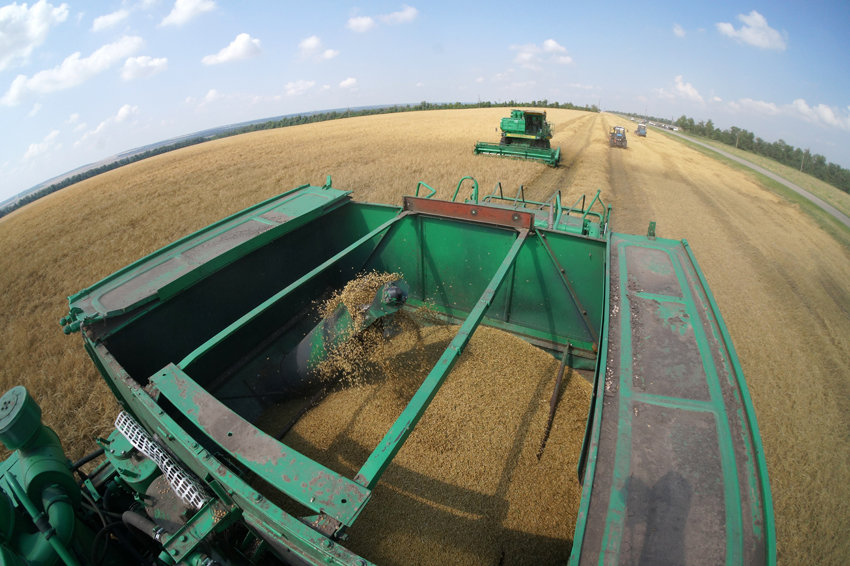
Translated by the Russian Reader. Thanks to Comrade Anatrrra for the heads-up. Photo courtesy of Viktor Pogontsev and Rossiyskaya Gazeta, where the caption to the photo reads, tellingly, “Record grain harvests in the Kuban region in recent years have bothered certain local farmers. They have been demanding a new redivision of the land.” Rossiyskaya Gazeta is the Russian government’s daily newspaper of record.
Khvoyny is located south of Krasnoye Selo, an outlying suburb of St. Petersburg
A Town’s Story
Irina Tumakova Fontanka.ru
September 14, 2016
This is Saint Petersburg too, but there is no medical clinic, no pharmacy, no legally operating shops, and no eateries here. The roofs are hastily under repair in time for the elections, but the trash is not hauled away. Fontanka.ru took a look at how this Petersburg gets along.
The letter was an invitation to journey, as the old rubric in the newspapers used to be called. Fontanka.ru got a call from a woman who introduced herself, requested we tell no one she had called, and complained about her unbearable life. She said her life and the lives of her two and a half thousand neighbors were unbearable.
“Just don’t tell anyone I called you,” she repeated, switching to a whisper.
We will honor Nina Petrovna’s request, although I never did figure out whom she was hiding from. (Nina Petrovna is not her real name.) When I came to visit her, when she gave me a tour of her town’s horrors, we were gradually joined by neighbors and even a former municipal councilman who had a roll of glossy paper tucked under his arm. I would nod, rustle my notepad, and feel like a high commission, registering people’s complaints. The procession would expand, and every passerby who did not join it would happily greet us. That is right, they would say, spell them all out in the newspaper. “They” were the authorities who had reduced the whole town to misery. Towards the end, everyone asked me in unison not to identify them. They had secrecy down pat here. This was not surprising: Khvoyny is the former military garrison town L-237. So Nina Petrovna is a composite character.
Nowadays, the place is an exclave of Petersburg known as Khvoyny (“Coniferous”). Formally part of Petersburg’s outlying Krasnoye Selo district, all the local residents are registered as residents of Petersburg. In practical terms, this village of two and a half thousand residents is stuck between two districts of the surrounding Leningrad Region, Gatchina and Lomonosov. Khvoyny has ceased being a military town, but has still not become a civilian one.
“No one needs us!” Nina Petrovna bitterly informs me. She has spelled out what the trouble is in four words.
Nearly all of Khvoyny’s residents are retired army officers, officers’ wives, and officers’ children. In the early 1960s, they were allocated flats in this spot, which was considered a paradise. There are coniferous trees here, but even more hardwoods. The three-story brick residential buildings are almost in the midst the woods. I arrived here from downtown Petersburg and almost suffered oxygen shock. Here and there, you need to take a forest path to get from one building to another. Since construction of the town was completed in the 1960s, many of the buildings are Stalin-era houses with three-meter-high ceilings. On the upper floors, the ceilings have cracked in places and are covered in mold, because the roofs have not been repaired since the sixties, apparently. But now metallic structures tower next to the buildings: the roofs are rapidly undergoing major repairs.
“Oh, yes,” Nina Petrovna nods. “It was a miracle we were put on the capital renovations program. We have been promised our roofs will be fixed by September 18 [Russian election day this year—TRR].”
Previously, the only way to get into L-237 was through a checkpoint at the invitation of a local resident, but all that remains of the checkpoint are iron gates always left open. Before Nina Petrovna can tell me about the town’s hardships, I notice evenly laid asphalt in the passages between the houses, and cheerful flowerbeds and neat playgrounds in the courtyards. There are even public exercise machines next to the school. So my first impression of Khvoyny is that only profoundly ungrateful and picky people could complain about it.
“You’ve got to be kidding!” says Nina Petrovna, waving her hand. “We planted the flowers ourselves. And our municipal councilman pushed through the playgrounds and the asphalt. What he managed to do when he was on the council is left. But then someone from Krasnoye Selo was elected instead of him. No one deals with our problems anymore.”
We won’t be coming back to how the former municipal councilman “pushed” those things through. The story looks shady, and the so-called ex-councilman absolutely refused to share the paperwork with us. The problem is that, formally speaking, everything in Khvoyny, including the land, still belongs to the Defense Ministry, and it is not quite clear on what grounds the municipal powers that be were trying to build a garden town, complete with asphalt and exercise machines. But the residents of the former L-237 are terribly worried that the asphalt and the playgrounds and the exercise machines and even the half-repaired roofs will all be taken away. Just as the swimming pool, the bathhouse, the cafeteria, the clinic, the pharmacy, and the shops have already been taken away. Khvoyny once had all these amenities.
“The swimming pool is still there,” Nina Petrovna corrects me. “I don’t know what is in there now, but the military garrison has put it under guard, and someone stops by there from time to time.”
The medical clinic is also still standing. I am led there as if it were a local landmark.
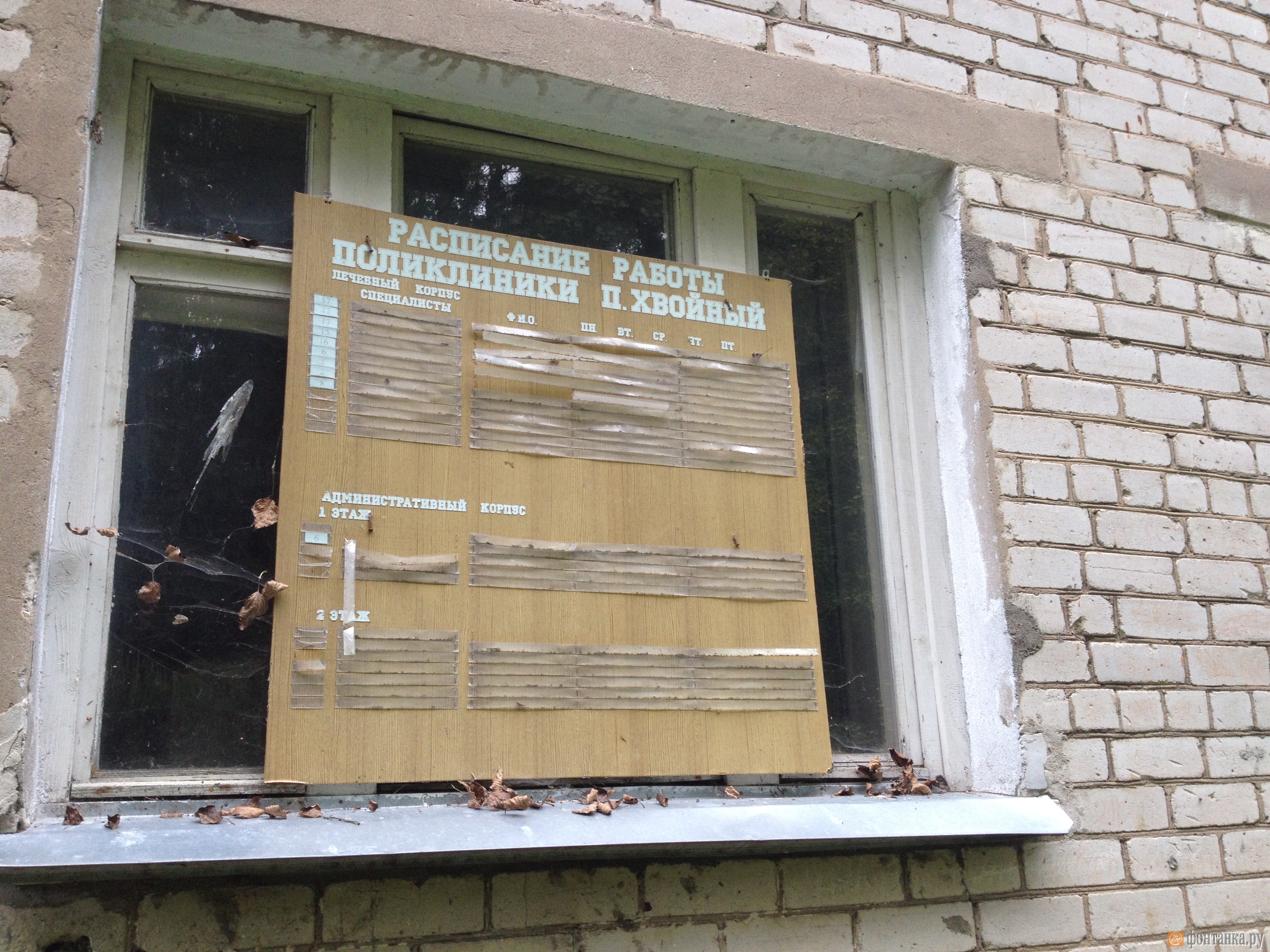
The sign reads, “Working Hours of the Khvoyny Village Medical Clinic.”
“It used to be a hospital branch,” Nina Petrovna says. “It had everything: an X-ray machine, a lab, and complete staff of doctors. You could undergo physiotherapy here.”
The door has been wide open for many years, and you can walk in. Chair legs covered with a layer of dust lie in the hallways. Books are strewn about, and computer debris crunches underfoot. When the military moved out, it looks as if they did all they could to make sure the enemy would not get their hands on these precious things. The stench testifies to the fact the building is now used as a public toilet.
Their Krasnoye Selo residence permits mean the residents of Khvoinyi are assigned to the Krasnoye Selo Medical Clinic. But, says Nina Petrovna, it takes something like an hour to get there on the minibus. But to say that the residents of Khvoyny have been left without medical care would be shamelessly slandering the authorities.
“The outpatient clinic and the district doctor come three times a week,” Nina Petrovna admits.
The “outpatient clinic” is a minivan. The doctors sees patients right in the van. The patients queue up outside the van.
“If it’s raining, we stand under umbrellas,” sighs Nina Petrovna. “Can you imagine what it’s like in winter?”
Once, she tells me, a neighbor summoned an ambulance from Krasnoye Selo. It arrived the next day.
Another building the residents of Khvoyny like to show off is the former cafeteria. The military, apparently, retreated from this building in keeping with all the regulations, trashing everything they could not take with them. The cafeteria’s doors are securely locked, so visitors get in by climbing through a shattered window.
A wise man once conversed with the people via a TV screen. A old man complained to him about awful roads, roads on which it was impossible to drive a car. The wise man’s reply was reasonable. Why, he said, do you need a car if there are no roads? It is the same thing with the residents of Khvoyny. They don’t have a pharmacy, but why do they need a pharmacy if they don’t have a medical clinic, either?
“People who have cars are alright,” sighs Nina Petrovna. “But it’s so much trouble going by bus every time to buy medications.”
But residents have to take the bus in any case because neither are there any shops in Khvoyny. There is a building in town. The sign on it says, “Store.” The windows are boarded up.
“People from one of the big retailers came here, either Pyatyorochka or Magnit,” Nina Petrovna repeats a rumor. “The military demanded such high rent they left as soon as they arrived!”
“Store”
This story of how the military “demanded” high rent conceals, apparently, the reason why there no shops and no pharmacy in Khvoyny. All the buildings are still the property of the Defense Ministry. Local residents assure me the process of transferring them to the city has been going on for fifteen years or so. The ex-councilman, mentioned earlier, knows something about this, but once again he does not want to show me the paperwork. He says the problem will be resolved quite soon.
For now, though, anyone who wants to open a shop or pharmacy in Khvoyny has to contact the military about the rent. Apparently, such people do reach out to them. And certain people seemingly manage to luck out and agree on the rent. Products are sold in a cubbyhole in the boarded-up store. In a kiosk on the next street over, an enterprising fellow sells milk, bread, vodka, sausages, and other edibles that he ships in from Petersburg. An old woman bakes him pasties to sell. So the kiosk doubles, as it were, as a “branch” of the former cafeteria. All these businesses seem to have settled with the military on terms that are not suitable for large retail chains and even less so for pharmacies. But quality control of the products is as reliable as can be. It is implemented not by some consumer watchdog agency, but by the consumers themselves. If push comes to shove, they can beat up the retailers.
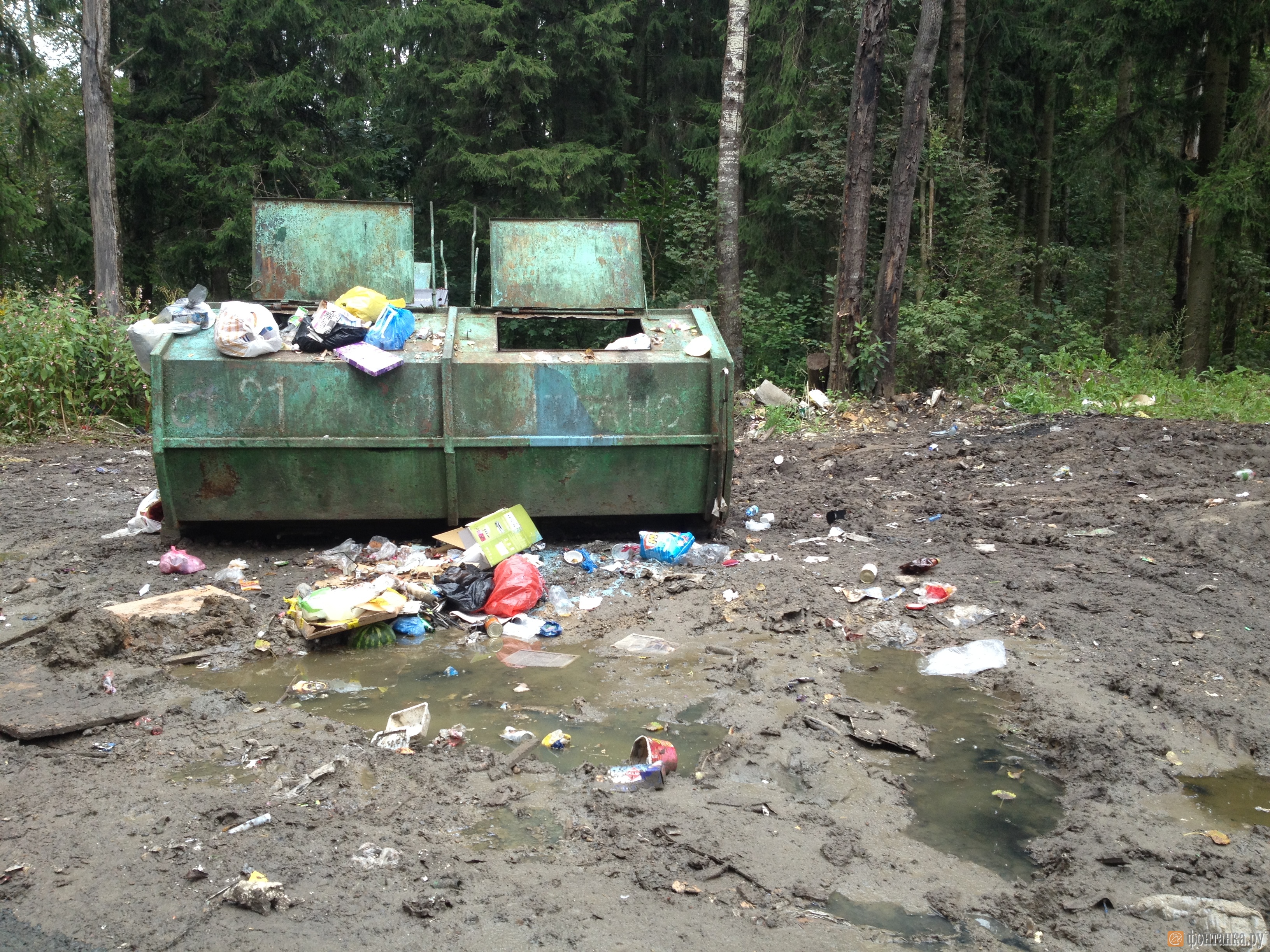
Another sight to see in Khvoyny is the rubbish dump on the outskirts of town. There used to be a path here that people took when going shopping in the neighboring village of Taitsy. When the dump appeared, they had to alter their route, because the dumpsters are hauled away, at best, on the eve of big holidays, and the perpetual puddle near the dump is so large that, at all other times, residents have to toss their rubbish into dumpster from a distance of three meters. You can see, however, that accuracy is not the principal virtue of Khvoyny’s residents.
If you think the military are so ruthless only to the civilian population, think again. This accusation completely falls away when you see their own dormitory. It is inhabited by those in Khvoyny who do not have their own flats. The garrison continues to operate, and despite the peacetime conversion I have described, the garrison’s current headquarters is still located in the town. Soldiers and officers assigned to the garrison are housed in the dormitory as well. If you are lucky, the ceiling in your room will leak only in one spot. At most, you will need to put two buckets on the floor to catch the water. And it is not so terrible there is one toilet per floor. As we recall, the former medical clinic functions as a public toilet.
My tour of Khvoyny lasted three hours. During those three hours, the hard lives of Khvoyny’s residents and the total neglect they suffer at the hands of the powers that be filled me with compassion for them. We said our goodbyes next to an imported car with a plush toy dog in the back window. A St. George’s Ribbon was tied round the doggy’s neck. Before leaving, I decided to have a look at the glossy scroll the ex-councilman had been carrying throughout my tour. It turned out to be a campaign poster for country’s main political party. He had to hang it on wall to do his part for the campaign. I asked the residents of Khvoyny whether they were going to vote for this party.
“Of course!” said Nina Petrovna firmly, her lips pursed. “I don’t see an alternative. Otherwise, there will be war. The country will divided up, and the Americans will grab all our riches.”
I left town with a feeling of joy. It was a good thing, after all, the residents of Khvoyny would be hanging on to their riches.
All photos by Irina Tumakova. Map images courtesy of OpenStreetMap and Google Maps. Translated by the Russian Reader. Thanks to Comrade VZ for the heads-up
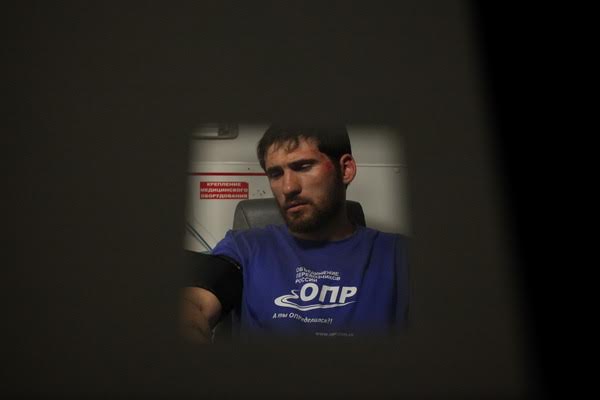
Rustam Mallamagomedov in an ambulance after being beaten. Village of Dorozhnyi, August 22, 2016. Photo by Anna Artemieva
Arrest Dagestani Trucker Refuses to Report to Jail Voluntarily
Dmitry Rebrov Novaya Gazeta
September 16, 2016
The Rostov Regional Court ordered the arrest of a Dagestani trucker who took part in the tractor convoy of Krasnodar farmers, but law enforcement officials “forgot” to detain him.
On September 16, the court considered Dagestani trucker Rustam Mallamagomedov’s appeal of an August 26, 2016, ruling by the Aksay District Court. The court had found the activist guilty of violation of Article 20.2.6.1 of the Russian Misdemeanors Code (involvement in an illegal political rally) and arrested him in absentia for ten days.
The regional court judge confirmed the district court’s ruling, despite the fact that, by law, a ruling of this kind can be issued only in the defendant’s presence. Mallamagomedov was not present at either hearing. According to his attorney, Valentin Pyshkin, this is the source of the conflict. The police “forgot” to detain the trucker preliminarily, so in spite of the administrative arrest issued against him, Mallamagomedov continues to remain at liberty to roam the streets [sic], and has no intention of voluntarily “correcting” the mistake made by law enforcement officers.
“The thing is there no standard procedure as to what the police should do now. An administrative arrest cannot be issued in absentia. This is nonsense. For an individual to be put under administrative arrest he has to be present in the courtroom. At any rate, he is not obliged to report to jail himself. He bears no responsibility for failing to report to jail. Moreover, he cannot be detained and sent there forcibly, either, since this is not stipulated by Russian law,” said Pyshkin.
“Only arrest on criminal charges can be ordered in absentia,” the lawyer stressed.
In this case, the court can issue a detention order before the defendant is detained, Pyshkin explained. But this principle is not valid in the case of administrative [misdemeanor] violations. The lawyer was hard pressed to say what law enforcement officers would do now. In his opinion, it would be easier just to abolish the questionable ruling. That, however, is not what has happened.
“The Rostov Regional Court did not listen to our arguments, nor, when the case was heard on the merits, did it want to examine any of the witnesses we had brought to the hearing. And all our motions were rejected,” said Pyshkin.
When our correspondent asked about the trucker’s current whereabouts, the attorney declined to answer, saying that the telephones could be bugged. He did confirm, however, that Mallamagomedov was currently not in Rostov Region.
Beaten by the police when the tractor convoy was dispersed, the trucker himself does not admit his guilt.
“Aside from the fact we didn’t organize any political rally, it was the police who didn’t let the farmers and us leave our camp. I was elsewhere the day our other comrades were arrested,” Mallamagomedov explained to Novaya Gazeta by telephone.
“On August 22, the day before the convoy was dispersed, I was beaten by the police guarding the camp. After that, I went to the hospital and the Investigative Committee, where I stayed until the evening of August 23. On the morning of the 24th, I went to the police station to find out how the guys were doing. I was detained there, but police did not draw up an arrest sheet. I felt sick while I was sitting there and left again in an ambulance,” he added.
Nevertheless, during his time at the precinct, police officers confiscated the driver’s internal passport without explanation. Apparently, it was then they drew up the charge sheet that was the basis for the Aksay District Court’s August 26 ruling to arrest the missing activist. After receiving medical treatment, the trucker had no intention of returning to the police station voluntarily, since he had been held there without processing of the proper papers, that is, illegally. He could not attend the August 26 hearing, either, because he was undergoing outpatient treatment.
When it is a matter of arrest, the individual is usually detained first, and then taken before a judge. Then he is sent from the courtroom to jail for ten days. The court’s administrative ruling is thus implemented. The majority of truckers and farmers detained during the tractor convoy were taken to the police station and sentenced to jail terms ranging from five to ten days, in that order. They have served their sentences and returned home long ago.
Translated by the Russian Reader. Thanks to Comrade Anatrrrafor the heads-up
According to Jim Jarmusch, director of the film by this name: “Down by law, at the time in the mid-80s, was kind of in use on the streets as meaning a very close connection with somebody. If somebody was down by law, they were close to you or you would protect them. I know that, earlier, in prison slang, if somebody was down by law, and they got out before you, they would contact your family or look after people outside if you needed them to. So it meant something very close or a code. I really liked the contradiction of that, being something that sounds like being oppressed by the law, which of course under that condition is where the slang came from. So, I liked that contradiction of it. And I liked it also in terms of the film being contradictory in that they are oppressed by the law but they also become down by law with each other.”
In Moscow, Farmers Talk about Latest Arrests, Beatings
Anna Bessarabova Novaya Gazeta
September 14, 2016
Nina Karpenko, a farmer from Krasnodar Territory’s Kanevskaya District, told our correspondent that late last week, during the maize harvest, seven men attacked her workers and the assistants of a court-appointed manager. A combine driver, who had earlier spent three days in jail for involvement in the thwarted tractor convoy to Moscow, has now been hospitalized. One of the men attempted to record the attack on a video camera, but he was thrown to the ground, his equipment was broken, and the recording was erased, said Karpenko.
On September 13, Kuban law enforcement officers blocked the car of Alexei Volchenko, leader of the farmers’ protest movement, as he drove to Ryazan to take part in the All-Russian Congress of Farmers and Cargo Haulers.
“They said they wouldn’t let him leave the region, held him up for a while, but then stopped pestering him. But Lyubov Nikishova, head of a farm in the Novokubansk District, has been put under house arrest. She has been charged under Article 119 of the Russian Federal Criminal Code (threat of murder),” explains another outraged farmer, Nikolai Maslov. “You saw her during the tractor convoy: she’s small and thin. She told the deputy presidential envoy in the Southern Federal District about the machinations of Rosreestr (Russian Federal Registration Service) and the attack on her farm. This summer, two palookas entered her house and beat her up, but when she grabbed an ax to defend herself, they photographed it and went to the police. No, she didn’t hurt anyone. It was a set-up.”
Nikiskova herself claims that immediately after the incident she filed a complaint with the Territorial Directorate of the Interior Ministry.
“It was sixteen pages long, and the medical examiner’s report was appended (there were visible traces of the assault on my body), as well as documents about the seizure of land shares and illegal fiddling with the land. 172 pages in all. It is still lying around somewhere. Unlike those marauders, they will put me away, despite the fact I am taking care of my sick mother. She has cancer, but that doesn’t bother anyone. As a criminal, they won’t let me out of the house. They’re afraid I won’t settle down and will go higher up the chain of command.”
According to Elena Dryukova, a farmer from the Kavkazsky District, Krasnodar Territory Governor Veniamin Kondratiev said recently that Kuban’s peasants had no problems, and that the tractor convoy, an attempt by the farmers to make themselves heard to the President of Russia, was an election campaign show.
Translated by the Russian Reader. Thanks toComrade Anatrra for the heads-up. Image courtesy of newsru.com
“They Have Really Gone After Us” After returning to Krasnodar Territory, participants of tractor convoy feel the heat from the very people against whom they complained
Anna Bessarabova Novaya Gazeta
August 28, 2016
The farmers after their tractor convoy was dispersed. They have been sentenced to three to ten days in jail. Not a single independent human rights activist came to their court hearings in the village of Kazanskaya. Photo courtesy of Anna Artemieva/Novaya Gazeta
The farmers were threatened during the convoy. We will stage a second Novocherkassk massacre for you and dice you like cattle in a slaughterhouse, they were told by security officers, who after the protest was dispersed have been zealously carrying out checks of their homes and farms.
Around thirty FSB officers raided Nikolai Borodin’s farm in the village of Kazanskaya, which they turned upside down. The tax inspectorate has been looking into property owned by the relatives of protest leader Alexei Volchenko. Other men have been interrogated by the prosecutor’s office. Nina Karpenko escorted her driver Seryozha Gerasimenko, a young fellow with three small children, to the detention center. He has been jailed for three days. The other men were also issued misdemeanor charge sheets: the authorities even went to the trouble of delivering the documents to their homes. The hearings took place on the weekend (Saturday) in the Kavkazsky District. Sergei Gorbachev was jailed for five days, Slava Petrovsky, for four days, Andrei Penzin and Semyon Smykov, for three. The rest of the protesters are waiting their turn.
“Nearly everyone in the villages has been paid visits by prosecutors and police,” farmer Ludmila Kushnaryova told Novaya Gazeta. No one knows what they are looking for. Or what the charges will be, either. The pressure has not stopped.”
“I cannot believe this is happening to us, in our country. We had no idea it would be so frightening,” said Nina Karpenko. “They have really gone after us. The deputy chief of the district traffic police escorted my tractor drivers and me to the hearings. He followed us for 250 kilometers. Whatever for? There were two people working in the courthouse on Saturday: the judge and the chairman. Didn’t they have anything else to do?”
Nikolai Maslov and Oleg Petrov, two convoy participants jailed for ten days, have been transferred to Novocherkassk.
“Dad called early this morning. He said everything was alright. But who knows. Maybe he just didn’t want to scare us?” said Igor Maslov, worried about his father. “We still haven’t found lawyers for them. How much do you think they’ll gouge us?”
Alexei Volchenko’s colleagues and friends have been looking for him. He has not been answering calls to any of his phones. He is not to be found in his home village. He has disappeared. The last thing the farmers heard was that Volchenko had been fined in Rostov Region. He made it back to Kuban, where he was detained again and sentenced to ten days in jail in Ust-Labinsk. The authorities are now, allegedly, preparing to charge him with extremism.
The Russian government, the Prosecutor General’s Office, and the Russian Investigative Committee have been pretending nothing is happening in Kuban. The official TV channels have been airing election campaign spots about the ruling party’s ability to listen to people, but they have not aired any stories about the events in Krasnodar Territory. They have maintained their silence for a week.
Alexander Popkov, a lawyer with the Agora International Human Rights Group, Boris Titov, federal commissioner for the rights of entrepreneurs, former Federation Council member Ivan Starikov, and Russian Federal Public Chamber chair Georgy Fyodorov have promised to help the participants of the tractor convoy.
“Obviously, the farmers have committed no offenses, and the wild imitation of law enforcement involving riot police and arrests for a ‘rally’ in a cafe are aimed at suppressing a peaceful and reasonable protest campaign,” said lawyer Alexander Popkov. “The first thing we are going to do is file appeals, and then we are going to see whether there is any point in beating our heads against the courts in Russia or whether we should immediately file a class-action complaint with the European Court of Human Rights.”
“I have been in contact with the farmers, their wives, and their children. They are drafting an appeal, and next week we plan to hold a big press conference in Moscow,” Ivan Starikov informed Novaya Gazeta. “Their problem needs to be solved systemically. People’s land shares are being confiscated, and there are around 300,000 victims of this practice nationwide.”
According to Valentin Pyshkin, attorney for convoy participants Nikolai Maslov, Oleg Petrov, and Sergei Vladimirov, the farmers have filed an appealed against the court decisions that sentenced them to ten days in jail.
“But we won’t get an answer earlier than Monday,” the lawyer explained. “On August 26, I was not admitted to the Novocherkassk detention center and allowed to talk with my clients, because, you see, according to their internal regulations, prisoners are entitled to representation by a lawyer only from two to four in the afternoon. It is an odd rule. But at four o’clock I had a court hearing in Aksai. Rustam Mallamagomedov from the Association of Russian Carriers (OPR) was on trial. On August 24, he had gone to the police station on his own to find out what had happened to the detainees, and the police didn’t let him back out of the station.”
Truckers Ready to Fight for Farmers
Andrei Bazhutin, chair, Russian Association of Carriers (OPR):
“We arrived from Petersburg to Moscow, where we were getting ready for a car convoy through Siberia. We learned about the arrest of the tractor convoy on the morning of August 23 and changed our plans. We went to support the tractor drivers. We were stopped by police for eight hours on the Moscow Ring Road, and eight hours in Voronezh Region. Along the way, we were written up for violating Article 20.2 of the Misdemeanors Code [“Violation of the established rules for organizing or holding an assembly, rally, demonstration, march or picket” — Novaya Gazeta], but they did not stop us from traveling further.
“By the time we got to Rostov, two of our activists [who had been with the tractor convoy from the beginning — Novaya Gazeta] had been sentenced to ten days in jail, while another two had been fined 10,000 rubles. Now we are here in Rostov: we have four big rigs and some cars. We are working with the lawyers and human rights activists and trying to help the guys out. We think it is necessary to gather journalists and advance on Krasnodar Territory to draw attention to these court hearings. Center ‘E’ [the Interior Ministry’s Center for Extremism Prevention — TRR] has intimidated everyone here.
“We have also contacted the miners on hunger strike in Gukov and agreed to support each other. Our demands will be voiced at their next picket too.”
Translated by the Russian Reader. Read my previous postings about the protest by Krasnodar farmers and the regime’s crackdown against it.
The Kavkazsky District Court in Krasnodar Territory has ordered the jailing of Alexei Volchenko, leader of the Polite Farmers movement, and eleven other participants of a planned tractor convoy to Moscow. Quoting Olga Golubyatnikova, a member of the Krasnodar Territory Public Oversight Committee, the news website Caucasian Knot reported the arrests on Sunday, August 28.
Volchenko will spend ten days in jail for not authorizing the convoy with Krasnodar Territory authorities. The other farmers will spend between five and ten days in jail. According to Golubyatnikova, the leader of the Polite Farmers admitted his guilt “due to pressure from the police.” According to her, Volchenko said at his court hearing that a policeman had threatened to charge him with extremism.
Golubyatnikov also reported that Volchenko would be serving his administrative arrest in the Ust-Labinsk detention center.
On August 24, the Rostov Regional Prosecutor’s Office organized an inquiry into the legality of the farmers’ protest.
The Krasnodar farmers’s convoy set off on August 21. Fifty people in seventeen tractors and several passenger vehicles left the village of Kazanskaya in Krasnodar Territory’s Kavkazsky District and headed towards Moscow. They had planned to ask Russian President Vladimir Putin to solve the problem of the courts, which, in their view, issued unjust rulings [sic]. On August 22, the activists were invited to meet with Kuban authorities and temporarily halted the procession. On August 23, they were detained by police officers.
Translated by the Russian Reader
See my previous dispatches on the ill-fated Krasnodar tractor convoy:
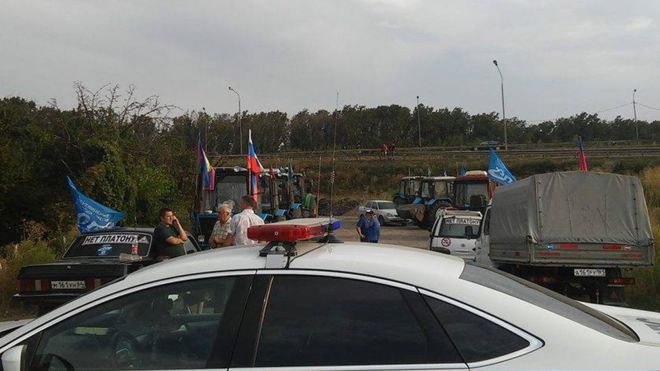
Police stop protesting Krasnodar farmers near Rostov-on-Don. Photo courtesy of BBC Russian Service
Krasnodar Farmers Say Convoy to Moscow Blocked
Grigory Naberezhnov and Dmitry Nosonov RBC
August 22, 2016
The Farmers told RBC that over a hundred police had blocked the tractor convoy from Kuban to Moscow near Rostov-on-Don. The farmers had complained of “large agricultural holdings taking away land from farmers.”
Police have halted a tractor convoy of Krasnodar farmers headed for Moscow, according to rally organizer Alexei Volchenko.
According to Volchenko, the farmers “were blocked every which way,” and “probably half the Rostov police force had been sent out.”
A total of seventeen tractors, two heavy truckers, and a number of passenger vehicles have been trapped in the road block. According to Volchenko, twenty patrol cars and 150 police officers were involved in the road block.
“The officers did not inform us of the reason for the stop,” Volchenko added. “I tried to figure out why a tractor cannot travel freely through the Russian Federation. They couldn’t give us an explanation.”
Ekaterina Vasiltsova, duty officer at the press service of the Interior Ministry’s Rostov office, told RBC they were “verifying information” about the incident.
The tractor drivers had been stopped in the village of Dorozhny near Rostov-on-Don, Volchenko told the BBC.
The farmers now plan “to travel to Krasnodar and have a chat with our governor,” he told RBC.
According to Volchenko, the president’s envoy to the region had promised them that if authorities were unable to reach an agreement with the farmers, “the road to Moscow would be open to them.”
If the road is not opened, “then I will publicly declare him a liar,” said Volchenko.
“In Krasnodar Territory alone, they stopped us seven or eight times for long stretches of between forty and fifty minutes. They would sometimes take two hours to check our papers and write up tickets,” he said.
Volchenko has told the Peasant Gazette (Krestyanski Vedomosti) that a “vicious practice” had taken root in Krasnodar Territory in recent years.
“Local authorities have refused to allocate their legal [land] shares to land owners, illegally leased them to third parties, usually large agricultural holding companies or they have violated their property rights altogether,” he told the paper.
“The large agricultural holding companies take land away from farmers and shareholders, and basically bring [the rural areas] to their knees, because the villages live on the money farmers spend, while the agricultural holdings are all registered as offshore companies in Cyprus and so on,” Volchenko told RBC in an interview.
The principal demand of the protesters was to “restore order through the courts.”
“She persuaded us to abandon the protest,” Volchenko told the Peasant Gazette. “[She] promised to speak with regional leaders about restoring order in land relations. [However,] six months have gone by, and basically nothing has changed.”
Translated by the Russian Reader
More proof, as if more proof were needed, that President Putin could care less about his wholly fictitious “base” in the wholly fictitious “Russian heartlands.” These tropes have been used by journalists and “experts” too willfully blind (?) to see the Putin regime was in fact an authoritarian smash-and-grab police state junta that was quickly switching to autopilot. It had no need then of real popular support, and it has much less need now. It does, however, generate the illusion of popular support through sham elections, self-fulfilling opinions polls, wars, and relentless mainstream and social media propaganda. But my experience in talking to lots of different people and my intuition tell me it is actually deeply unpopular among the folk who are supposedly its biggest supporters, like these farmers from the Kuban region. The regime’s real support comes from the officials and businessmen who have made out like bandits these past 17 years. They are its real base. TRR
Krasnodar Farmers Head to Moscow in Tractor Convoy
Olga Nadykto RBC
August 21, 2018
Farmers from Krasnodar Territory have set off on tractors to Moscow. The total number of tractors in the convoy is seventeen. This is the second attempt by the farmers of Kuban to organize a “tractor march” on Moscow
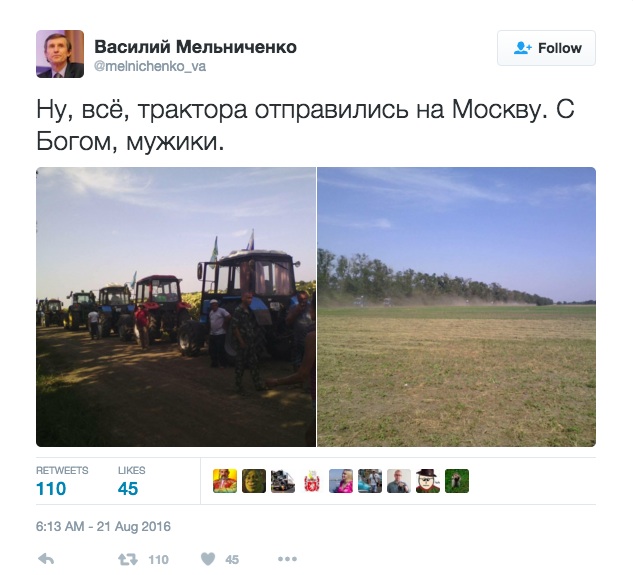
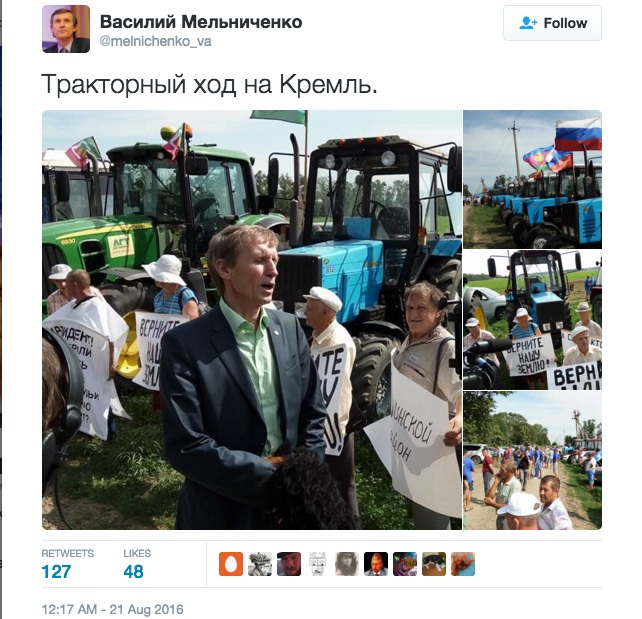
The Krasnodar farmers’ tractor convoy has left for Moscow, Vasily Melnichenko, one of the protesters, reported on his Twitter account.
Before the convoy set off, the farmers held a rally in the village of Kazanskaya in the Kavkazsky District of Krasnodar Territory. As reported by Novaya Gazeta, after the rally was over, a convoy of seventeen tractors and a few dozen cars headed for the neighboring Rostov Region on the federal highway. The newspaper reported that protesters intend to meet with federal authorities in Moscow.
As a co-organizer of the tractor convoy, Alexei Volchenko, earlier toldKrestyanskie Vedomosti (Peasant Gazette), the protest has been coordinated with the traffic police.
“There was moaning and groaning, and nerves were on edge, but we got the traffic police to sign off on the tractor convoy. They promised an escort, as the rules says they should,” said Volchenko.
According to Volchenko, the farmers are protesting the violation of their property rights and transfer of land to major agricultural holding companies.
The farmers of Kuban had initially tried to carry out a tractor convoy to Moscow in March of this year. Around a hundred farmers from nine districts in Krasnodar Territory announced plans to drive their tractors to Moscow, where they intended to deliver a petition to Russian President Vladimir Putin. However, the farmers later declined to carry out the protest.