Uneven and Combined Development

On this bright Saturday evening, when the sun has finally come out in the former capital of All the Russias after a week of nonstop rain, I want to offer you two tales of two completely different modern Russias, situated unhappily side by side, but God only knows for how long and at what cost.

Both stories have their fictional and literary precedents, as is often the case in this overly verbalized country.

The hero of the first tale, Valery Slesarev, will remind you of the characters and real-life heroes and victims in nineteenth-century writer and human rights activist Vladimir Korolenko’s fictional sketches and muckracking newspaper articles, while the nearly unbelievable promises and high-powered wheeler dealers in the second tale will conjure up Ilf and Petrov’s world of con men and grifters during the NEP period. TRR

____________________

Smack Them Upside the Head
Tired of waiting for a promised natural gas tie-in pipeline from local authorities, the Yegorevsk Urban District in the Moscow Region asked Obama for gas
Ekaterina Fomina
Novaya Gazeta
June 5, 2016


Valery Slesarev. Photo by Ekaterina Fomina

After collecting 531 signatures in support of his effort, pensioner Valery Slesarev called the US Embassy and asked a specific question.

“How can I get a hold of Barack Obama?”

The embassy promised him to call him back and make an appointment.

Lots of people in Yegorevsk know Valery Slesarev. First, he has tuned and fixed TV sets his whole life, and that is deemed a vital service. Second, he has an artificial skull.

As a child, Slesarev was involved in Pavel Popovich’s Young Cosmonauts Club. One of the activities at the club was parachute jumping from towers. During one such jump, the carabiner from a pull rope slammed Slesarev hard in the head. A year later, a tumor was discovered in his brain, and it was decided to operate. Popovich himself got involved by asking for help from America, where an artificial bone was grown personally for the sixteen-year-old boy. The doctors told his mother he would not survive, but the bone up and took hold.

As the years passed, it transpired that, along with the bone, the doctors had implanted something Soviet people were not supposed to have: a faith in justice and the strength to fight for it.

Initially, the life of the young cosmonaut with the artificial skull rolled down different tracks than it might have, like in a small town in West Virginia: steady, nothing out of the ordinary.

“Maybe the Lord in fact saved me then. Eighty percent of my group at the Young Cosmonauts Club died in Afghanistan. We were all combat ready, you see, and those boys were sent straight to the front,” he says today.

Slesarev studied to be a radio technician, but went to work as a TV repairman. The celestial expanses no longer appealed to him, and he had enough to do down on earth as it was. He drove from village to village fixing TV sets and occasionally chopping firewood for old women.

In the nineties, the business where Slesarev worked fell apart, and he started a small business of his own, a tire repair shop. He called it Autocupola, and indeed the blue, two-storey building housing his shop is crowned by conical metal cupolas. The cupolas, he explains, are in honor of his artificial skull. He is proud of the black swans, carved from tires, out in front of the shop and a gingerbread boy with a painted mug.

Slesarev lives in amazing house, also topped with cupolas, only they are in the shape of little bulbs. The local council has even hung a sign on the house designating it a cultural landmark.

For a time, then, Slesarev was an amusing local landmark. In 2005, however, the Moscow Region began installing natural gas mains in the villages of Yegorevsk. The mains were quickly installed in all public buildings, but ordinary people, those selfsame old women for whose sake the whole program was undertaken, were left without gas. Slesarev says he simply could not look at old women swinging wood mauls anymore. Thus began his fight.

Vladychino
Only twenty-eight people are officially registered in Vladychino, a village in the Yegorevsk Urban District, but around a hundred people live there permanently, most of them people the natives have contemptuously dubbed “summerfolk.” Slesarev is one of the summerfolk too. He has land there, inherited from forebear, and his grandmother’s house, which he has managed to restore and preserve. The entire village stopped by to admire it.

As in the neighboring villages, people in Vladychino buy natural gas in cylinders. A fifty-liter cylinder, which costs a thousand rubles to refill, lasts a month. Arranging privately to have a gas line connected to your house costs at least 500,000 rubles [approx. 7,000 euros].

A spontaneous assembly of local residents has been taking place on the bench in front of Slesarev’s house. You might say he mobilized them.

Grandma Valentina, Grandpa Nikolai, Kolya, who has no front teeth and wears a leather jacket, Nikolai Alexandrovich, and Tatyana have formed a semi-circle. They occasionally get sidetracked and swat a mosquito. It is the height of the season.

“Please forgive my appearance. I came from the garden,” says Tatyana, apologizing as it were for her apron.

“TV Rain came to film, and we all dressed like peasants,” says Valentina, dangling her rubber-slippered feet by way of proof.

“Why are we appealing to Obama? We hope that, if not Obama, some other president will respond,” says Valentina.

“I’ll tell you why,” says Nikolai Alexandrovich, who steps forward, dressed in builder’s overalls. “He is a winner of the Nobel Peace Price, and he is on his way out of office in any case. Let him do one good deed at the end of his term by getting gas installed for us.”

The locals gossip. The village of Rakhmanovo got gas when an MP from the Moscow Regional Duma and a member of the Yegorevsk Board of Deputies moved there. Actually, according to the paperwork, gas lines have been laid to Vladychino and all the other villages too: 300 million rubles [approx. 4 million euros at current exchange rates] from the regional budget was spent on the program. A presidential commission even came looking for the gas, but they did not find it.  To be hooked up to gas lines under the regional program, a village must have no less than one hundred residents, so Vladychino was lumped together with neighboring Parykino. Now, according to the schedule for gasification, Vladychino and Parykino should get gas lines no later than 2018. But no one believes it will happen, because dates for gasification of the villages have been postponed annually since 2005. Last year, the residents of Vladychino wrote a letter to Putin, but half has many people signed it as did the letter to the US president.

“He’s not going to help. His term is never going to end. He’s president for life,” says Nikolai Alexandrovich.

“God willing he will be president for life!” responds Valentina. “He lifted the country up! As for gas, well, we need it. Maybe he just has not been told about us. Our board of deputies should be the ones helping us, but they don’t do anything for us. This year, they didn’t even spray the bushes for ticks.”

“This writing to Obama thing is all a joke, a way of getting us riled up and forcing us to think,” explained Nikolai Alexandrovich. “But what do you think? Is America Russia’s enemy? I knew you’d say that! I’m not going to try and educate you or persuade you. Who is threatened by Russia? The Americans, however, are already in Estonia. Those are facts, Katya, facts!”

By local standards, Nikolai Alexandrovich is also one of the summerfolk, although he has lived in Vladychino for four years, since retiring. He worked for twenty-six years in security at the Kremlin. Nowadays, he is an elder at Nativity of Christ Church.

“They’ll never unleash a war on us, but they are trying to squeeze us economically on the sly,” concluded Kolya, who worked as a plumber at Slavyanka, Ltd., during the heyday of Yevgenia Vasilyeva, but has now retired.

“That is war,” continues Nikolai Alexandrovich. “Was it necessary to drop the bombs on Japan? This is a continuation, just as today’s Russia is a continuation of Soviet life in many ways. Your colleagues from TV Rain were spooked. They were worried lest we go to jail for what we said. We won’t go to jail: we speak the truth!”

“The mosquitoes have already devoured us,” a bored Valentina chips in.

“It’s time for me to milk the cows,” says Kolya.

“Why was she caterwauling yesterday from lunchtime on? She was probably thirsty?”

“She has been yelling because of the bull. I haven’t been putting the pull in with her. He’s been laid low. I called the vet, and he told me over the phone to give the bull vodka. I gave him vodka. Then he told me to give it sunflower oil. I did it: same damn nonsense! Now he tells me to go and buy lactic acid.”


Slesarev outside his Autocupola tire repair shop. Photo by Ekaterina Fomina

“Sufferings, Trials, and Humiliations”
Since 2005, when Valery Slesarev began his fight to have the villages gasified, he has kept a list entitled “My Sufferings, Trials, and Humiliations.” It includes such entries as “Arrest, searches of homes and shops. Bombing of Autocupola. Arson at Autocupola.”

In 2010, unknown men in masks armed with crowbars broke into his tire shop. They methodically and cold-bloodedly beat up Slesarev and his daughter. A criminal case was opened, of course, but to no avail. The police wrote off the incident as a “workplace fight.”

Slesarev wrote to Vladimir Zhirinovsky that he was being prevented from doing business. Zhirinovsky promised to look into the case. Apparently, he is still looking.

Moscow Region Governor Boris Gromov once visited Yegorevsk. Slesarev was going to the meeting when he was pulled over by traffic cops, allegedly, for driving with dirty license plates. He spent the whole day in the detention center and was released without having to pay any fines.

Governors have come and gone, but the story has not changed. Slesarev had to fight his way into a meeting with current Moscow Region Governor Andrei Vorobyov at the House of Culture. In the auditorium, he was surrounded by police officers in plain clothes.

“When I stood up to ask a question, they made me sit down. They actually grabbed me by the pants and pulled me down, and everyone was laughing,” Slesarev recalls.

Governor Vorobyov noticed the strange man and asked to speak with him personally after the meeting. As Slesarev tells it now, the governor was so outraged that he promised to dismiss the head of the district the very next day. And he did, in fact, dismiss him. Only, at the next elections, Mikhail Lavrov, ex-head of the district, was elected chair of the Yegorevsk Board of Deputies, a position he occupies to this day.

“Vorobyov left, and the bathhouse we guys in the village had built for the gals burnt down. There was a criminal investigation, of course. But they didn’t catch anyone.”

“The Gas Has Come”
This time, it was the head of the Yegorevsk District and his deputies who were meeting with constituents. Slesarev did not know about the meeting, and so we arrive in the village of Yurtsovo a bit late: the event has ended. But we do find Nina Morsh, head of Yurtsovo Area, surrounded by female assistants, next to the Soviet war memorial. Slesarev knows everyone by sight, all the more so because Morsh was previously head of the Yurtsovo Rural Settlement. But late last year, all the municipalities were abolished when when the Yegorevsky District was redesignated as an urban district. The now-abolished Yurtsovo Rural Settlement included thirty-eight villages. Last year, only four of them had gas mains.

Morsh’s assistants immediately cut us off.

“You’re a little late. The head of the district was at the meeting, and he answered everyone’s questions. Residents who wanted to ask questions got definitive answers. You can ask them yourselves.”

Dressed in a suit with a rose on the chest, Morsh drags me along with her.

“Since 2005, a lot of work has been done on gasification,” she tells me, as if she were reading a report. “First, the central village of Yurtsovo and the main municipal institutions, then, in 2010, the entire residential sector.”

She speaks of natural gas affectionately.

“The gas has come,” she says.

The gas has come to Pochinki, Barsuki, Leonovo, and Polbino. And so it will arrive in Vladychino and Parykino, too, Morsh reassures me. The design plans and specifications are already being drafted.

“You cannot jump higher than the budget lets you,” says Morsh by way of explaining why gasification has taken so long. “This has been explained repeatedly to that man, who doesn’t even live in our area. Whatever emotions he may or may not be experiencing, the program has been well implemented. Just look at our governor.”

It is clear as day the village needs gas, but people have been living without it, getting by with cylinders. Some people even stoke wood stoves. Ninety-year-old Grandma Panya, another resident of Vladychino, signed the petition to Obama, but she is afraid of gas.

“That one woman of ours in Moscow, the one who left to be with her lover, was home alone once, but forget to turn off the gas. She died from carbon monoxide poisoning!”

If it had not been for Slesarev, no one would have the heard the voice of the people of Yegorevsk. But that is how his brain operates under his American skull. If the law says people are supposed to have gas piped into their homes, then that is the way it should be, even it means his having to fight hopelessly for it on his lonesome. Slesarev has lived his whole life this way.

Translated by the Russian Reader

___________________

Will Russia Be First to Build Elon Musk’s Hyperloop?
Peter Hobson
The Moscow Times
July 6, 2016

In mid June, Shervin Pishevar, co-founder of Hyperloop One, sat under the high, decorated ceiling of a palace in St. Petersburg.

Men in suits lined the large, rectangular table.

“Eighteen heads of sovereign [wealth] funds and President [Vladimir] Putin. $10 trillion in the room,” Pishevar wrote alongside a photo posted on Facebook. “Then Putin called on me.”

So Pishevar, a burly, bearded Silicon Valley entrepreneur, began to speak. He talked about the Hyperloop trains his company plans to build: Transportation pods levitated by magnets inside an airless tube that could travel at speeds 300 kilometers per hour faster than a passenger aircraft, thanks to the low air resistance. Pods that could whisk goods through Russia from China to Europe in the space of hours, or turn St. Petersburg into a suburb of Moscow.

Putin listened attentively. Then, according to Pishevar, he said, “Hyperloop will fundamentally change the global economy.”

By the time Pishevar left Russia, Hyperloop One had signed its first deal with a foreign government, a partnership with Moscow’s City Hall. It had also been asked by Russia’s transport minister to design a 70-kilometer Hyperloop track in the Russian Far East.

With that kind of support, perhaps the first Hyperloop won’t be built in California, but in Russia.

Dreaming of Innovation

At first sight, all that seems strange. Russia, after all, is suffering its deepest economic crisis for nearly two decades. Much of its infrastructure is hopelessly backward. It is a country in which passengers in slippers shuffle between bunk beds in overnight trains that travel at average speeds of just over 50 kilometers an hour. Freight trains, meanwhile, move at a little over 10 kilometers per hour.

But there are a few things working in Hyperloop’s favor.

First, innovation has once again become a buzzword in government. Officials are, at least in theory, keen to diversify away from the oil and gas industry on which the country currently relies. And they are paranoid that Russia could fall so far behind the technological innovation happening elsewhere that it will never catch up.

That fear has sprouted strategic plans for major infrastructure investment and research into the technology of the future. These plans think big: On the agenda are things like quantum computing, neural interfaces and teleportation. Hyperloop, with its science-fiction-movie tube trains, fits perfectly into that vision.

From Moscow to St. Petersburg in 1.5 Hours

Source: Hyperloop One. View in higher resolution here.

Second, Hyperloop has a powerful Russian investor lobbying its interests, a Dagestani tycoon called Ziyavudin Magomedov.

Tall, handsome and worth $900 million, Magomedov is a true techie. According to Forbes, for his 47th birthday party last year, he hosted a robot-themed ball and gifted each guest a book about Elon Musk, the billionaire inventor who in 2013 launched the Hyperloop concept.

Like Putin, he is emphatically excited about the idea.

“It will kill truck and air transportation at a minimum,” he told Forbes.

Magomedov is also supremely well connected. His investment company, Summa Group, spans businesses from real estate to logistics and has handled orders from state companies worth billions of dollars. He has advised the president and allegedly paid for Putin’s press secretary to honeymoon last year on a super yacht in the Mediterranean. One of Russia’s deputy prime minsters, Arkady Dvorkovich, is an old university friend and, conveniently, oversees the country’s policy on transport, innovation and industry policy, though the two deny any favoritism.

Magomedov invested in Hyperloop One through his $300 million venture capital fund, Caspian VC Partners, and set about bringing it to Russia. Bill Shor, the Russian-speaking American who runs Caspian for him, describes him as “very hands on.”

Magomedov has played the role of Hyperloop One’s deal broker. His Summa Group was a co-signatory on the agreement between Hyperloop One and the Moscow Government, which will create a working group aimed at fitting Hyperloop technology into Moscow’s transport system.

He likely also played a major role in pushing for a Hyperloop to span the 70 kilometers between the Chinese industrial center of Jilin and Zarubino, south of Russia’s Vladivostok, where Summa is investing in port facilities.

Both projects have been billed as revolutionary. In heavily congested Moscow, which is currently ploughing huge sums into expanding its transport infrastructure, Hyperloop One says its technology could potentially “give capital region commuters weeks of their lives back.”

The link with Jilin, meanwhile, would carry 10 million tons of cargo a year, zipping containers to port in minutes, says Russian Transport Minister Maxim Sokolov. He wants Hyperloop One to present a design for the track at an investment forum in Vladivostok in September.

Tapping Into China

The third thing playing in Hyperloop’s favor in Russia is that it could unlock vast amounts of Chinese investment.

The Jilin-Zarubino spur is just the beginning. In the longer term, Hyperloop could create “the heart of the transport infrastructure for the Eurasian landmass,” says Shor. The technology will likely be used for freight before it begins to transport passengers. And the route between China and Europe is one of the world’s busiest trade arteries.

The distance between China’s eastern edge and Central Europe is some 7,000 kilometers. Freight currently navigates that distance by train in around three weeks and by sea in roughly two months. In theory, a Hyperloop could span it in six hours.

Beijing has committed tens of billions of dollars to its “One Belt-One Road” plan to create new infrastructure between it and Europe. Russian authorities have their eyes on some of that money.

“It’s like a tube with an air-hockey table. It’s just a low-pressure tube, with a pod in it that runs on air bearings […] I swear it’s not that hard,” said Elon Musk in 2015. Photo: Patricj T. Fallon / Reuters

Sokolov says he will discuss the Jilin Hyperloop with China’s transport minister at a meeting in August and hopes “we’ll take the next step [in this project] together with our Chinese partners.”

Also, the Russian Direct Investment Fund (RDIF), a $10 billion state-backed investment vehicle, invested in Hyperloop One earlier this year. The amount was “very modest,” according to its chief, Kirill Dmitriev. But the RDIF also happens to run a joint investment fund with China worth $2 billion.

China is already helping to pay for a planned trans-Siberian high-speed rail line that could cost more than $200 billion. Hyperloop’s advocates say their technology be cheaper. According to Sokolov, the Jilin-Zarubino line will cost around 30 billion rubles ($450 million)—almost one-third less than a high-speed rail equivalent.

“We must be serious about this idea,” he insists.

Where’s the Money?

But for all the enthusiasm, few in Russia are prepared to put down real investment just yet.

Hyperloop One is working “very closely” with the Transport Ministry, as well as local governments and “some of the largest Russian corporates,” says Shor. These reportedly include Russian Railways and Gazprom, two giant state corporations. But these partners are contributing expertise and access, not money. All the cash is coming from Hyperloop One and Magomedov’s Summa, which Shor says has “invested quite a bit of resources, financial and otherwise.”

Even Putin, who in St. Petersburg promised support to Hyperloop One, wasn’t talking about financial support, his spokesman later clarified.

The problem is that while the Hyperloop concept is compelling, no one has yet worked out how to build one. Russia seems content to wait for the technology to prove itself with other people’s money.

The Local Contender

It might come as a surprise to discover that one of those working on the technology is Russian. Indeed, it turns out that Russian scientists were on to Hyperloop long before Elon Musk.

A century ago, before it was derailed by World War I, scientists in Siberia began working on a similar scheme, says Sokolov. Now, at St. Petersburg’s University of Transport and Communications, the project has been reborn.

Anatoly Zaitsev is an engineer who was briefly transport minister in the 1990s. At his lab on the Baltic coast, his team of around 20 people have equipment that can levitate transport containers. He says he could “absolutely” build a levitation track to Moscow, 650 kilometers away, if you give him $12-13 billion—significantly less than the cost of high-speed rail.

The only part of Musk’s plan Zaitsev says he hasn’t figured out is how to put his levitating pods in a tube. But that’s the simple part, he insists, “like dressing [the train] in a dinner jacket.”

Zaitsev thinks his technology is more developed than that of his rivals, whose plans remain mostly on paper. Both Shor and Sokolov praise his work. But despite that, Zaitsev is largely ignored by the ministers and local governments now courting Hyperloop One.

The reason why ultimately comes down to money. Hyperloop One has raised more than $100 million to fund research, pilot projects and investor outreach.

Another California company, Hyperloop Transportation Technologies, is also rubbing shoulders with big investors. One of its executives has said it is talking with a Russian private investor and is looking at Hyperloop projects in Russia. Its chief, Dirk Ahlborn, also met Putin in St. Petersburg in June.

Elon Musk proposed the Hyperloop concept in 2013 as a mode of transportation between Los Angeles and San Francisco, California.

These companies can fund relentless global expansion, and they benefit from Silicon Valley’s sheen of success. Russian officials can engage with them at no cost to themselves. No wonder, Zaitsev laughs, that “when a foreigner shows up in Russia at the invitation of a resident billionaire, the music and dances start.”

“The Americans are better at getting money,” he says. “I tip my hat to Musk and his followers who so boldly and aggressively offer the world unfinished technology.” By contrast, Zaitsev has enough money to keep his lab operational, and not much more. If Hyperloop is eventually built, it is unlikely to be Russian-made.

Revolution?

But if Hyperloop really is the future of transport, and Putin jumps on board early, it could be a visionary move.

“Russia has a very good chance [of being the first place to develop Hyperloop],” says Shor. If the government acts quickly on regulation, he says it could happen in the next few years. That could put the country at the forefront of a transport revolution.

On the other hand, the whole thing could be a pipe dream. No one knows if the technology can be made cheaply enough to implement.

Russia, meanwhile, still lacks both money and many basics of a modern transport system, says Mikhail Blinkin, head of the transport institute at Moscow’s Higher School of Economics and an advisor to the Transport Ministry.

Fifteen years discussing high-speed rail has led to a single line between Moscow and St. Petersburg that travels less than 200 kilometers per hour. The country has only 5,000 kilometers of modern expressways, says Blinkin—less than tiny South Korea and not even enough to span Russia from east to west.

The government should focus more on practical improvements to the transport infrastructure and less on visions of Hyperloop tubes criss-crossing the country, says Blinkin. Otherwise, he adds, the officials cheerleading Hyperloop are just the latest versions of Marie Antoinette, the aristocrat who saw French peasants without bread, and supposedly said, “Let them eat cake.”
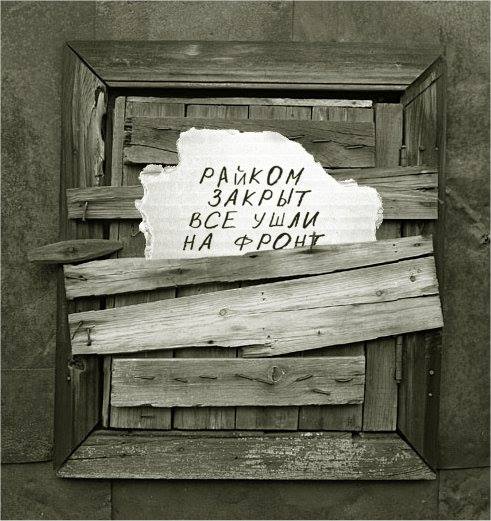
Valery Brinikh: The District Council Has Left for the Front

"The district committee is closed. Everyone has gone to the front." Image courtesy of Valery Brinikh
“The district committee is closed. Everyone has left for the front.” Image courtesy of Valery Brinikh

Valery Brinikh
Facebook
July 5, 2016

Hello!

Yesterday, the latest hearing in my court case took place. It began at 2:15 p.m.

First, Judge Vitaly Galagan read out the findings of the forensic handwriting analysis of signatures made, allegedly, by Mugdin Guchetl, a prosecution witness from the village of Gabukay, who testified at the hearing before last that he had not signed the written record of the testimony he gave to the police investigator. Instead, at the investigator’s request, he had signed blank sheets of paper in the right places. As expected, the signatures were deemed authentic, although there had been the possibility the investigator had forged not only the interrogation records but also the signatures of witnesses.

The judge then returned to my deferred motion to rule the Teuchezhsky District Council an illegitimate injured party. We had requested the prosecution present written grounds for its legal position, as the prosecutors had objected to granting my motion, arguing that the Teuchezhsky District Council was a legitimate injured party.

The prosecution outdid itself, submitting in writing not only its own objections to granting the motion but also those of the so-called injured party. Surprisingly, the arguments made by district council head Khachmamuk and state prosecutors Shvetsov and Orlova were identical down to the details. Someone probably guided their hands from on high as they scribbled away. But, as the saying goes, paper cannot blush.

The point of their objections was so simple and straightforward that it was completely untethered from the case, leading the reader off into the boundless expanses of the fight against terrorism and extremism.

It transpires that “the leading role in the fighting terrorism and extremism has been assigned to the district council,” while my article “has provoked extremist sentiments in society and has had a negative impact on the work of the Teuchezhsky District Council in preventing extremism.”

Talk about the perpetrator blaming the victim, and without establishing any causal link between my article “The Silence of the Lambs” and the work of the Teuchezhsky District Council in preventing terrorism and extremism!

Attempting to demonstrate the absence of logic and common sense in the objections raised by the injured party and the prosecutors, I reminded the court that the case files contained the January 22, 2015, ruling by the Maykop City Court, which has entered into force, rejecting the Teuchezhsky District Council’s lawsuit against me, in my capacity as author of the article “The Silence of the Lambs,” by way of defending its professional reputation. I also pointed out that the article contains no criticism of the Teuchezhsky District Council’s work in general (it is not even mentioned in the article) nor, in particular, of its work in the field of extremism prevention.

In addition, the district council’s authority extends only to events that have occurred within the district itself, while the article was published on the World Wide Web. The events covered in the article (the actions of the Kievo-Zhuraki Agrobusiness hog breeding facility, the inaction of authorities at all levels in dealing with the Teuchezhsky District’s environmental problems, and my meetings with local residents) in no way touch on the Teuchezhsky District Council’s authority in combating terrorism and extremism.

After hearing all this, Judge Vitaly Galagan smiled cutely and retired to chambers at 2:50 p.m. As it turned out, he spent two and a half long hours in there. What could he have been doing all that time? It would be one thing if at least he had been consulting with smart folk on how to reasonably reject my motion. I realize it is illegal, but rehashing arguments that have nothing whatsoever to do with our case as grounds for rejecting my motion is not only illegal but also stupid. Basically, as they say in such instances, the mountain has brought forth a mouse.

According to the prosecution and Judge Galagan, who concurred with their arguments, the article “The Silence of the Lambs,” which I wrote in Maykop and published on the Internet, somehow diminished the vigilant work of the Teuchezhsky District Council in preventing extremism in the Teuchezhsky District, thus damaging the council’s professional reputation. In such cases, the saying goes, children are awfully sensitive. The district’s principle extremism preventer has been turned into a crybaby. Or, on the contrary, has the prosecution designated it the crybaby given the lack of actual injured parties?

As I listened to the prosecution’s counterarguments, I realized why our local councils take such bad care of local residents, why they take such bad care of roads, hot and cold running water, medical care and education, why everything is so bad: because our local authorities have bigger fish to fry. They have all left for the front to combat terrorism and extremism, and until they defeat the hydra of counter-revolution, the people will just have to suffer. And anyone who moans and groans and criticizes the authorities can be charged with violating Article 282 of the Russian Federal Criminal Code.

I want to give one more piece of sage advice to Russian judges. Lubricate the hinges of the doors to your chambers. Otherwise, the damn things squeak, and those of us sitting in the courtroom get all kinds of funny ideas about the secrecy of judicial deliberations being violated. Is their secrecy being violated, or is it just a draught of wind playing tricks with the door?

The next round in this exercise in umpiring is scheduled for today, July 5, at 10:00 a.m.

Translated by the Russian Reader. Read all my previous posts on Valery Brinikh’s extremism case.

Valery Brinikh: A Surprise Witness

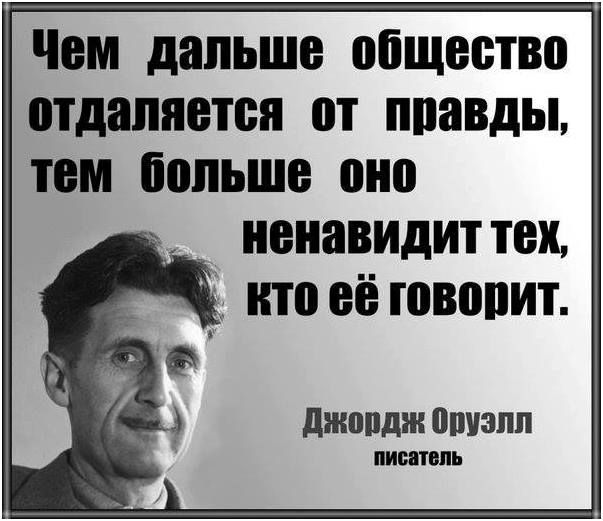
George Orwell, writer: "The further a society drifts from the truth the more it will hate those who speak it."
“George Orwell, writer: ‘The further a society drifts from the truth the more it will hate those who speak it.'” Image from Valery Brinikh’s Facebook page

Valery Brinikh
Facebook
June 25, 2016

Hello!

The latest hearing in my criminal trial took place on June 24, but it was no run-of-the-mill hearing. When, last week, the court turned down defense attorney Andrei Sabinin’s motion to examine a linguistics expert from the beautiful beyond via videoconferencing (although, literally right before this, two prosecution witnesses from Krasnodar had been examined in this manner), neither the prosecutors nor the judge suspected that soon they would have the honor of gazing at this linguistics expert in person. We provided them with this pleasure.

The linguistics expert smashed the so-called findings of official state expert Sergei Fedyayev to smithereens. She immediately pointed out that Fedyayev had violated the fundamental methodological principles of forensic examinations for identifying signs of extremism. First, such forensic examinations should be comprehensive, involving not only a linguist but also a psychologist and, better yet, a sociologist or political scientist (if social groups are at issue). By definition, a linguist cannot cope with all these tasks alone. Nor did linguistic expert Fedyayev cope with his task. His analysis of the article “The Silence of the Lambs” skids on the sharp turns like a Volga car. Hence the large number of mistakes and simple linguistic blunders he made, producing findings that were not only at odds with the principles of linguistics but also with common sense.

During her testimony, our expert pointed to a number of instances where Fedyayev clearly went beyond his competence as a linguist by giving legal evaluations of individual passages in “The Silence of the Lambs” and thus infringing on the court’s realm of responsibility. In addition, his findings contain a definition of the concept of a “group,” something only a sociologist or political scientist is competent to define. The Russian Supreme Court has directly ruled it is inadmissible to define the authorities (state officials) as a “social group.” But what does the Russian Supreme Court mean to Fedyayev when the Adygea Supreme Court is dealing the cards? Fedyayev’s analysis also contains probabilistic conclusions (i.e., dealing with the realm of possibility), which are inadmissible in a linguistic forensic examination.

Apologizing to the judge for infringing on legal issues, our expert noted that the article does not oppose one group to another, one nation to another, and that there is no evidence of incitement to enmity and hatred on ethnic and other grounds in the text.

Our expert also testified that lexical-semantic and lexical-stylistic methods should be used in analyzing the text, while the huge number of other methods listed by Fedyayev either were not employed or were superfluous. In particular, by not using conceptual analysis, Fedyayev was led to erroneous conclusions.

The overall conclusion of the linguistics expert we called to the stand in Maykop City Court yesterday was that the article “The Silence of the Lambs” was highly critical and chockablock with negative assessments of the authorities and the hog breeding business, but there was nothing in the article that could interpreted as inciting enmity and hatred. In particular, she pointed out to the court that the words “Adyghe” and “Adygean” are encountered in different contexts in the article, testifying to the fact that the author distinguishes between the notions, using them in the article to denote different things. While the word “Adyghe” clearly refers to an ethnicity, “Adygean” has several meanings, one of them being a resident of Adygea, without reference to his or her ethnicity, as in krasnodarets, sochinets, stavropolets, and so on. [That is, the Russian terms for residents of Krasnodar, Sochi, and Stavropol, respectively.—TRR.]

What mattered to me was our expert’s answer to the question of whether it was possible, having received an unfamiliar text in the morning, to carry out a forensic examination of it by the evening of the same day and discover grounds for suspecting the text of extremism by using linguistic methods. My question was prompted by the fact that on September 15, 2014, Fedyayev, at the request of the FSB’s regional office in the Republic of Adygea, conducted a linguistic examination of the article “The Silence of the Lambs” in ten hours, and his memorandum to this effect (not even an expert opinion) was the grounds for the Maykop City Court (Judge Irina Ramazanova, presiding) ruling that the article was extremist. Later, on the basis of the very same memorandum, whipped up in a single workday, the very same Fedyayev wrote up the expert findings that served as the basis for my indictment on criminal charges.

The conclusion of the expert we called to the stand was unequivocal: it would be impossible. Sometimes, explained the expert, who is a past master at linguistic and comprehensive forensic examinations, analysis of a single sentence might take three hours. So, personally, she takes two weeks to perform such examinations.

In general, the testimony or, rather, the lecture by the linguistics expert we called to the stand was so thorough that neither the judge nor the prosecutors could think of anything substantive to ask her. Thus, by presenting critical reviews of Fedyayev’s forensic examination, we have drawn a thick line under it, making it completely impossible for it to be used as evidence for the prosecution in the criminal case against me.

The next hearing has been scheduled for 2:15 p.m. on July 4. Most likely, we will file a motion to have the forensic examination redone, asking this time for a comprehensive, rather than linguistic, examination.

Translated by the Russian Reader. Please read my previous posts on the extremism case against Adygean environmentalist Valery Brinikh.

Image courtesy of Twitter

Valery Brinikh: Report from His Extremism Trial

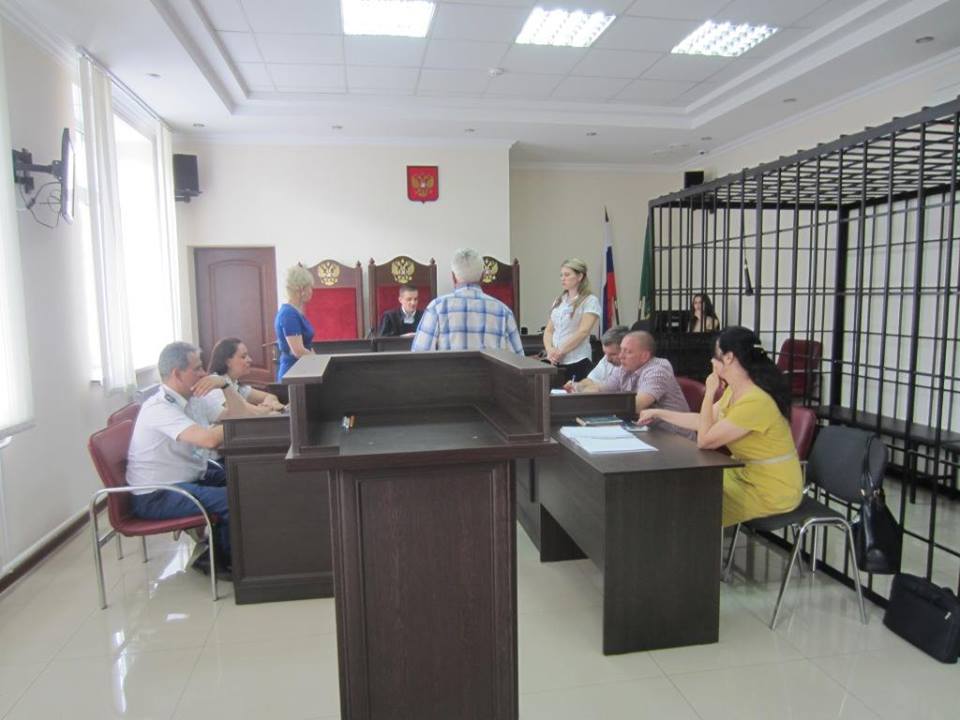
The extremism trial against environmentalist Valery Brinikh in session. Maykop City Court, June 17, 2016

Valery Brinikh
Facebook
June 18, 2016

Hello!

The latest hearing in my criminal case took place in Maykop from 11 a.m. to 4 p.m. on June 17 of this year. This time, the prosecution’s last two witnesses were finally questioned, albeit by a videoconference link with the Soviet District Court in Krasnodar. Vyacheslav Potapov and Vitaly Isayenko were supposed to answer questions about the operations of the website For Krasnodar, on which the article “The Silence of the Lambs” was posted.

It seemed to me that Sergei Shvetsov, senior deputy prosecutor of the Republic of Adygea, was not prepared to examine the witnesses today and the questions he asked them sounded like childish prattle. Even the judge noted this and advised the public prosecutor to concentrate. Ultimately, however, the second public prosecutor, Inessa Orlova from the Maykop City Prosecutor’s Office, took the microphone from Shvetsov and asked the witnesses specific questions.

I was personally interested in Isayenko’s responses to two sets of questions, first, about the circumstances of his interrogation on December 12, 2014. On that day, after the search [at his house], he was brought from Krasnodar to Maykop and interrogated until evening. It was night when they sent him back home to Krasnodar. As Isayenko, who suffers from Type 1 Diabetes, explained, he spent almost half a day at the Republic of Adygea Investigation Department with no food and, much more dangerously, with no insulin. They gave him only water. And yet they interrogated him intensively, trying to squeeze testimony against me and Vyacheslav Potapov, editor of the website For Krasnodar, from him. I was being interrogated in the next room, and I could hear Senior Investigator Kirill Kustov screaming at him. The stress he underwent and the long period he endured without food and insulin landed Vitaly Isayenko in the hospital the day after his return from Maykop. His diabetes flared up and he suffered from other ailments.

I was also interested in Isayenko’s comments, as a computer specialist, on certain statements in the inspection report on the computers seized at Isayenko’s house, an inspection carried out by Senior Investigator Kustov on the night of December 12, 2014. In particular, the report states that three processors were discovered in one of the computers. Isayenko explained there had been only one processor in the computer. He did not know nothing about any other processors.

In general, the witnesses said nothing new. They only confirmed what was already contained in the minutes of their interrogations.

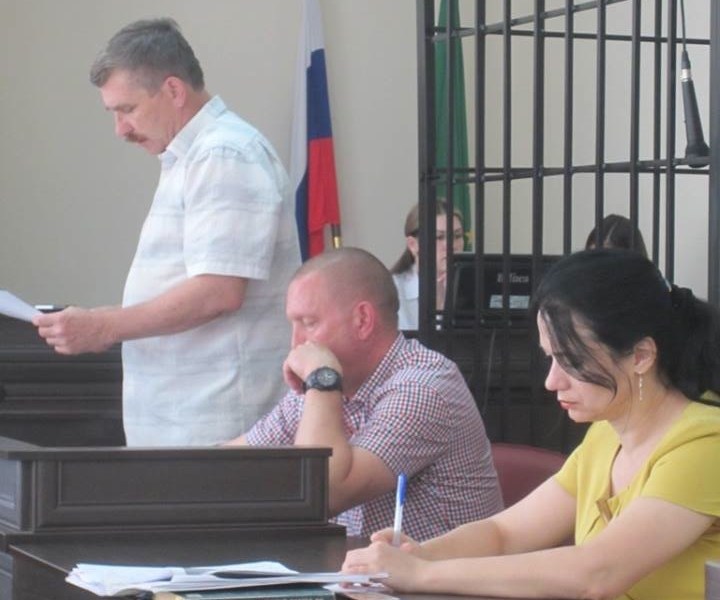
Valery Brinink (left) and his attorney,
Valery Brinink (left) and his attorney, Andrei Sabinin. Maykop City Court, June 17, 2016

After the witnesses were examined, my attorney, Andrei Sabinin, attempted to request that Elizaveta Koltunova, a linguist from Nizhny Novgorod, be examined via videoconference, but the prosecutors objected, and Judge Vitaly Galagan did their bidding. Our request to examine the linguist by videoconferencing was rejected. According to the defense, this stance on the part of the prosecution and the court contradicts the adversarial nature of judicial proceedings and the principle of the equality of arms.

Much more unexpected and even amusing was the procedural action, which took place after lunch, of obtaining handwriting samples and a signature from prosecution witness Mugdin Mossovich Guchetl, a resident of the village of Gabukay. Everything would have been alright if the witness had simply produced his signature in silence, but instead he recalled another circumstance that I think gave the prosecutors a slight shock. Guchetl recalled that in February of last year, when Investigator A.S. Rudenko of the Investigative Department of the Republican Investigative Committee’s Teuchezsky District office took Guchetl’s written testimony, he asked him to sign blank sheets of paper, because, as Rudenko explained, allegedly, he would later type out Guchetl’s handwritten testimony on the computer, but he needed the signatures right away so he would not have to make a return trip to Adygeisk.

The investigator thus clearly violated the procedure for processing interrogation reports, a procedure strictly regulated by criminal procedural laws. At the same time, the investigator committed forgery by inserting things Guchetl did not say into the report. Today, after reading the interrogation report, which is part of the criminal case file, Guchetl categorically stated he did not say to the investigator what was written in the penultimate paragraph of his printed testimony, which reads as follows: “I want to clarify that I strongly disagree with the contents of the article entitled ‘The Silence of the Lambs,’ because I think the article has defamed my honor and dignity as an Adyghe, as well as insulting all Muslims. The article compares us to pigs and cowards, and claims we have no sense of self-esteem.”

Basically, it was for the sake of this passage that the investigator obtained Guchetl’s testimony. In fact, the investigator could have written something even rougher on Guchetl’s behalf, because he already his signatures on blank interrogation report forms.

Finally, I made a motion to rule the Teuchezhsky District Council an illegitimate injured party in my case, since it did not satisfy the grounds set out in Article 42 of the Russian Federal Criminal Procedure Code. When the prosecutors objected as usual, spouting platitudes about the proper recognition of the local authorities as an injured party, we demanded the prosecution present legal grounds for its stance. We were quite curious to find out how exactly the district council had been injured, if, as they themselves have said, the article had caused moral injury to the residents of the Teuchezhsky District.

The prosecutors drew a blank and requested a time-out until the next hearing, at which they promised to provide a written justification for their objection. That suited us just fine, as it did the judge, who postponed consideration of our motion until next time.

The next court hearing is scheduled for June 24.

Translated by the Russian Reader. Photos courtesy of Valery Brinikh. Please read my previous posts on his case.

Gleb Astafiev: Trampled by the Madding Herd

Gleb Astafiev
Gleb Astafiev

Trampled by the Madding Herd
Darina Shevchenko
16-year-old Gleb Astafiev is being tortured in a psychiatric hospital because of his picket in support of Pyotr Pavlensky
Radio Svoboda
June 11, 2016

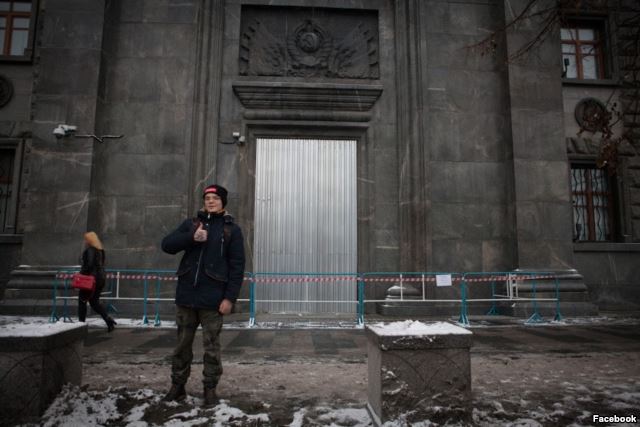
In late May, Gleb Astafiev, a 16-year-old resident of the village of Ketovo in Kurgan Region, held a solo picket in defense of artist Pyotr Pavlensky,  then on trial in Moscow for setting fire to the doors of FSB headquarters. The young man sewed his mouth shut, grabbed a placard on which he had written the inscription “Pyotr Pavlensky’s action was a replay of Varg Vikernes‘s famous gesture,” and stood next to a store in downtown Kurgan. This was a reference to Pyotr Pavlensky’s first action, Seam (July 23, 2012), in which the artist sewed his mouth shut and took to the streets of Petersburg with a placard that read, “Pussy Riot’s action was a replay of the famous action by Jesus Christ.”

Astafiev was taken to a police station, and then sent to the Kurgan Regional Neuropsychiatric Hospital.

On the day Pavlensky was released, Astafiev was able to access the Internet for the first time during the thirteen days of his incarceration at the mental hospital and contact the outside world. He told Radio Svoboda how he had wound up in the hospital and what was happening to him.

Gleb, who sent you to the psychiatric hospital?

After the police detained me when the picket was over, my mother talked for two hours with them. I think they did a number on Mom, because she came back for me accompanied by an ambulance crew, and I was hauled off to the looney bin. My mom thinks I am crazy. She is convinced that normal people don’t sew their mouths shut and take to the streets bearing placards. Mom is a simple woman, and she doesn’t understand my action was an artistic metaphor. The closed mouth is a symbol of the absence of freedom of speech in Russia. My mom watches TV too much, so her mind has been warped by propaganda. It’s very hard to explain the message of my action to her. Mother did not support my creative experiments, but after the action she got angry at me. She doesn’t even bring food to the hospital. Grandmother, on the contrary, has been treating me better since the action. Now she sympathizes with me. The relatives are not planning to spring me from the nuthouse for the time being. The doctors have not said anything to me about the subject.

You sound very calm and confident. How do you feel? Have you been forced to take meds?

They tried to vegetate me with pills, but I spit them out. The first five days I was held in the special supervision ward. They tossed me in with the worst crazies, but I was forbidden to leave the ward. I was in there with eight oldsters. Three of them rarely showed any signs of life. The other five screamed at night, beat the floor with their fists, and raved. They tried to force me to kowtow: to wash the floor and clean up. I refused. I am currently under routine supervision, but I cannot leave the wing.

Do you know that Pyotr Pavlensky has been released? Do you regret you wound up in the mental hospital because of your action in support of the artist?

Of course not. I am very glad for Pavlensky! Maybe it was thanks to the support of different people, including me, that he was released. The regime really doesn’t like people like Pavlensky, because a real actionist is a free spirit and openly declares it. I think I did my bit for free speech with my action, which was, of course, a reference to Pavlensky’s actions.

What were your feelings when you were standing there alone holding a placard, surrounded by strangers who were probably aggressive to you? Did anyone support you during the action?

I thought up and did the whole thing myself. My action was entitled F.P.P. (an abbreviation for “Free Peter Pavlensky”). Passersby reacted differently. Mainly, people were surprised. There were lots of riffraff there. One creep swore at me at the top of his lungs for twenty minutes. Some people came up to me and had their pictures taken. There was an old couple who stood next to me the whole time. Once, the old woman came up to me and said, “You’re a fool. One man does not make an army.” The old man periodically yelled loudly, “Look, people! He is holding opposition placards!” I ignored all of it.

Around thirty minutes after I started the action, two grown louts in black vests (security guards, apparently) came out of the Pushkin Shopping and Entertainment Center. One of them jumped me and tried to grab the placard. I wouldn’t give it up. A dude who was around twenty saw the scene from the window of his car. The fellow jumped out of his ride and told the guard to leave me alone. It’s a pity that many people don’t understand the difference between art and hooliganism and madness. Actionism is lovely! I really love actionism, especially Viennese actionism.

Why are you able to see the difference?

Hard to say. I’m an ordinary schoolboy from a simple family. I read a lot, especially science fiction. I think a lot about what’s going on with my own head. I want to have a vivid, interesting life, not a life like the majority’s: home, work, and television. I can’t talk anymore. I see the medical staff coming.

Gleb Astafiev standing next to the door at FSB headquarters that Pyotr Pavlensky set on fire

Gleb Astafiev’s action has sparked a fierce debate among Kurgan Region residents on social media. Some Internet users have admired the young actionist’s audacity and honesty. Others have written that Astafiev is as abnormal as Pavlensky. Astafiev has said he is uninterested in the negative feedback of philistines. He is suffering from a lack of communication most of all now. A girlfriend has been visiting Gleb at the hospital. She asked that her name not be printed, because she did not want to attract any public attention.

“That hospital is a hellish place: closed, stuffy, and miserable. Gleb is now all alone there. He is very depressed: almost no one comes to visit him. He doesn’t even have anything to read. Gleb asked me to buy him science fiction books. Gleb’s pupils are dilated: apparently, they are medicating him. I don’t know Gleb that well. Before his incarceration in the hospital, we had seen each other only five times. We met by chance at a concert by a local band. He wanted to have his picture taken with me and my ex-boyfriend. Then Gleb seemed like a cheerful, carefree, very dear and open boy, a young idealist with a dream. He and my ex-boyfriend then traveled to a Krovostok concert. A bit later, I realized that Gleb was very independent and intelligent, and had a very strong spirit for his age. Even today at the hospital he didn’t complain and didn’t ask for anything special except a couple of books and a bit of food. I know nothing about Pavlensky, but Gleb had the right to support him. I am surprised his mother sent Gleb to the hospital, but he is definitely not a whacko, as the majority thinks. The opinion of the herd is often wrong.”

Pyotr Pavlensky is not the only artist whom Astafiev has tried to support. In November of last year, the team at the news website Mediazona shot a documentary film about Astafiev. The reporters there were touched by the story of a young man who had borrowed money to travel from his village to the trial of the band Krovostok. In November 2015, Yaroslavl Regional Court considered rescinding a district court’s decision to ban the group’s songs and block its website. The trial resembled a comedy with a happy ending: the court took the side of the musicians. The members of Krovostok liked Astafiev so much that when the trial was over they took him along with them to Moscow for a big concert.

Margarita Filippova, photo and video editor, Mediazona:

“We were making a series of documentaries about the Krovostok trial. I noticed a long commentary by Gleb on Instagram. He wanted to know when the next hearing was and whether he could come to Yaroslavl to get the autographs of the guys in Krovostok. The photographs in Instagram initially made him look too eccentric. But when we saw him at the train station, we realized he was a very modest, friendly guy. That was when it occurred to me to show this absurd trial through the eyes of a touching 16-year-old boy who made the long trip from Kurgan to support his idols. Gleb is like a kid from another world, a world distant from our reality where we lazily follow insane trials on our iPhones, sighing and voicing our dissent, at best, on Twitter.

“Gleb sees the world like an artist, but at the same time he has a very rational attitude to reality. He has a good sense of the country in which he lives, and he really wants to change his life. I’m sure it will work out for him. Gleb feels responsible and concerned about other people. When I was sixteen I wasn’t worried about protesting artists, and I sure didn’t know what a court trial was.”

Zarina Kodzayeva, camera woman, Mediazona:

“Gleb is a very independent and open person. It seemed to me that Gleb didn’t have a drop of the infantilism you would expect from a teenager. He argues things sensibly and behaves like an adult. He and I chatted a lot when we were shooting the film. I found it very interesting to listen to him. Gleb writes things himself. When he speaks, you can tell he loves the Russian language. I got the sense this kid believed in the power of deeds. It really was important to him to support Krovostok and Pavlensky. One of the most important questions in documentary filmmaking is who can be a main character, the hero, and who cannot. Aside from the context, which might turn into a story, there is always an intuitive understanding that probably has to do with a person’s energy. I think Gleb is an absolute hero. And now he continues to prove it with his actions.”

Translated by the Russian Reader. Thanks to Comrade AM for the heads-up. Photos courtesy of Radio Svoboda

Police Officers Are a “Social Group” in Russia

Activist Tsvetkova Sentenced to Year of Corrective Labor for Leaflet about Police 
Grani.ru
May 31, 2016

Elizaveta Tsvetkova. Photo on her personal page on Vkontakte
Elizaveta Tsvetkova. Photo from her personal page on Vkontakte

Taganrog City Court Judge Georgy Serebryanikov sentenced 31-year-old local resident Elizaveta Tsvetkova to a year of corrective labor for disseminating leaflets criticizing the police, reports Caucasian Knot. As published on the court’s website, the verdict stipulates that fifteen percent of Tsvetkova’s wages will be docked by the state for a year. The activist has also been charged 6,000 rubles in court costs.

Serebryanikov found the defendant guilty under Criminal Code Article 281.2 (incitement of hatred or enmity toward the social group “police officers”), which stipulates a maximum punishment of four years in a penal colony.

During closing arguments on May 16, Taganrog Deputy Chief Prosecutor Vadim Dikaryov asked that Tsetkova be sentenced to one year in a work-release colony. Serebryanikov thus imposed a lighter sentence than was requested by the prosecution.

The activist, however, pleaded not guilty. During her closing statement, on May 27, she stressed she had protested the illegal actions of law enforcement officers. She reminded Judge Serebryanikov of high-profile criminal cases against policemen, including the cases of Major Denis Yevsyukov and the Dalny police station in Kazan.

Lawyer Yuri Chupilkin had also asked the court to acquit his client.

Initially, the reading of the verdict in Tsvetkova’s trial had been scheduled for May 30. However, an hour before the scheduled hearing, the activist was called and informed it would be postponed. The reasons for the delay were not explained to the defendant.

It is unclear whether Tsvetkova would appeal the verdict.

Charges were filed against the activist in January 2015. According to investigators, Tsvetkova downloaded a leaflet criticizing the police from the Vkontakte social network, printed it out, and the day before Law Enforcement Officers Day, in November 2014, posted it at public transport stops and on street lamps.

The investigation was completed in August 2015. However, in September, the acting Taganrog city prosecutor uncovered numerous legal violations in the investigation, refused to confirm the indictment, and sent the case back to the Russian Investigative Committee. The indictment was confirmed the second time round, in November.

However, investigators ignored a sociological forensic study, carried out by Professor Vladimir Kozyrkov at Nizhny Novgorod University. Professor Kozyrkov rejected claims that police officers constitute a social group.

At preliminary hearings in December, Chupilkin insisted on striking a number of pieces of evidence from consideration, in particular, studies done by the regional interior ministry. Judge Serebryanikov, however, rejected the defense’s motions.

The hearing on the merits began on January 15, 2016. During the April 20 hearing, Viktor Chernous, a sociology professor at Southern Federal University in Rostov-on-Don, subpoenaed as an expert witness, also testified that police officers were not a social group, and consequently there had been nothing criminally culpable in the actions imputed to the defendant.

In turn, Elizaveta Koltunova, an assistant professor of linguistics at Nizhny Novgorod University, who was subpoenaed as an expert witness, noted that she could find nothing extremist about the leaflet that had led to the charges filed against Tsvetkova.

Rosfinmonitoring has included Tsvetkova in its list of terrorists and extremists and blocked her bank account.

* * *

An excerpt from the closing statement of activist Elizaveta Tsvetkova (Taganrog) at her trial on charges of extremism, May 27, 2016:

I still think that escapades like my own, the case in Stavropol involving the [alleged] offense to the feelings of religious believers, and other cases, have caused no real harm, but the outcome is that our law enforcement system acquires the image of a satrap for some reason. In addition, people are distracted from real dangers such as identifying terrorists. Perhaps I am an overly sensitive person, but it seems to me that one cannot remain indifferent after such high-profile cases as that of Major Yevsyukov, who gunned down civilians in a supermarket, and the case of torture at the Dalny police station, where a man died. These cases would cause anyone to have a negative attitude towards the illegal actions of police officers. I remain convinced that cases of bribery, torture, and murder must be stopped. People should not be afraid of police officers who break the law and engage in rough justice, but should put a stop to their actions, report their illegal activists, and publicly criticize police officers. Only then we will live in a country under the rule of law and be able to improve life in Russia. Cliquishness and special privileges are always abnormal and generally unfair, especially when it comes to such questions. A divided society cannot function normally. We must realize that if people are be unable to stand up for their rights in any area, if they are forced to put up with lawlessness in policing, housing, and health care, we will never live in a civilized, well-developed country.

Translated by the Russian Reader

Burning Down the House

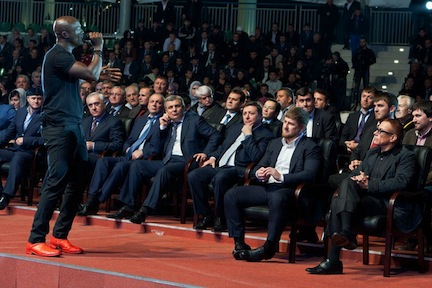
Pop singer Seal performs for Ramzan Kadyrov, Jean-Claude Van Damme, and other VIP guests at
Pop singer Seal performs for Chechen leader Ramzan Kadyrov, Jean-Claude Van Damme, and other VIP guests during a ceremony to mark Kadyrov’s 35th birthday and City Day celebrations in Grozny, Chechnya, October 5, 2011.

“Chernovik”: Man Who Complained to Putin about Kadyrov Has House Burned Down in Chechen Village of Kenkhi
Mediazona
May 13, 2016

According to Chernovik, the house of local resident Ramazan Dzhalaldinov, who had complained to Vladimir Putin about the Chechen authorities, had his house burnt down late on the night of May 12 in the village of Kenkhi, in Chechnya’s Sharoy District.

As Dzhalaldinov’s wife told Chernovik, around midnight, masked men entered the house. They said they had come to rescue them. The women and three daughters were put in a car, but later were thrown out under a bridge.

“And the house was set on fire. Residents of the village have been forbidden to say anything on the topic under threat of their houses being set on fire,” she said.

A few weeks ago, Ramazan Dzhalaldinov recorded a video appeal to President Vladimir Putin in which he spoke about the poor living conditions in the villages, the houses left destroyed after the two military campaigns of 1994-1996 and 1999, and the corruption of local officials. After posting the video, Dzhalaldinov left the republic.

In late April, the other villagers corroborated Dzhalaldinov’s complaints to a correspondent for TV Rain. Afterwards, villagers who had spoken with the reporter were detained by Chechen security forces.

On May 6, Ramzan Kadyrov, acting head of Chechnya, visited the village of Kenkhi and spoke with several residents, who once again confirmed what Dzhalaldinov had related in his video message.

Kadyrov promised to repair roads and tower complexes in three months, supply the village with natural gas lines, and build mosques in the Sharoy District.

After Kadyrov’s visit, Grozny TV aired a report in which it was claimed that “residents of the village publicly condemned the conduct of [their] countryman” Ramazan Dzhalaldinov.

Village of Kinkhi, Sharoy District, Chechnya

Translated by the Russian Reader. Photos courtesy of Human Rights Foundation and Panoramio.

Don’t Mess with Irina Iskorneva

Irina Iskorneva, editor of the newspaper Pechenga

There Are Still Real Women in the Russian Villages
bloger51.com
March 8, 2016

A court has overturned the dismissal of Irina Iskorneva, editor-in-chief of the newspaper Pechenga

A magician friend once told me a joke about his trade. During a performance, an illusionist is doing the trick where he saws a woman in two. Halfway through the trick, someone in the hushed auditorium comments, “Think about what you’re doing, dude. You’re about to make two problems out of one.”

Why have I told his story? Because right around the new year, the Pechenga District administration fired Irina Iskorneva, editor of the local newspaper.

Last year, as regular parishioners of our little blog will recall, Iskorneva wiped the floor with Ivan Tsipilyov, mayor of Zapolyarny. She informed readers about road repairs near Tsipilyov’s house, which went right to his front door.

Tsipilyov found this outrageous. Deeming himself personally insulted and humiliated, he went to court, where he got a kick in the ass. A month later, he got another kick in the ass, this time in the regional court.

The Pechenga District Court confirmed Iskorneva’s version of events.

As the court also pointed out, “Criticism of authorities is an inalienable right of citizens, and every politician agrees to become a target of criticism.”

The court explained in detail how the parties could resolve their conflict.

“In case of disagreement, the criticized party has the right to respond in the very same mass media.”

In November of last year, Irina Iskorneva strongly opposed a 9.3% increase in utilities rates for 2016. (The regional authorities have been using deputies on local councils to set rates higher than the ceiling established by Moscow.)

According to Iskorneva, this was the reason she was dismissed as editor right before the New Year, on December 29.

“Don’t awaken the beast in me. Well, and if you are asking for it be prepared to defend yourself. I will show no mercy,” reads the motto on her profile page on the VKontakte social network.

And so it happened. In mid January, she uncovered the amounts of the bonuses the district’s top official had paid themselves. According to Iskorneva, they had ranged from 70,000 to 200,000 rubles. [That is,  from approximately 900 to 2,600 euros—TRR.]

Two court hearings took place in Pechenga District Court on March 2 of this year.

In the first, Iskorneva was listed as the defendant. The district administration was trying to recover damages allegedly caused by Iskorneva in the performance of her duties. The court rejected the suit, thus indicating that the charges were groundless.

Consequently, Iskorneva’s dismissal from her position was also illegal.The court ruled that Iskorneva should be restored to her position as of March 3, 2016, should be compensated for wages forfeited during her forced absence, and should be financially compensated for pain and suffering.

Irina Iskorneva: “Don’t awaken the beast in me. Well, and if you are asking for it be prepared to defend yourself. I will show no mercy,”

When the editor of a municipal newspaper forces two local administrations to bend four times in the last six months, it is cause for respect, at least.

Translated by the Russian Reader. Photos courtesy of Blogger51 and  Barents Observer. Thanks to Comrade VZ for the heads-up

Prosecution Witness in Brinikh Case Recants

Valery Brinikh

Prosecution Witness in Brinikh Case Recants
Grani.ru
March 24, 2016

77-year-old Mugdin Guchetl, a witness for the prosecution in the extremist case against environmentalist Valery Brinikh, recanted from the testimony identified as his in the case file during a court hearing in Maykop City Court in Adygea, as reported by the international human rights group Agora, who cited Brinikh’s defense attorney Alexander Popkov.

In testimony signed “Guchetl,” given during the investigation, it states that Brinikh has insulted not only the witness but the entire Adyghe people with his article “The Silence of the Lambs.” During the trial, however, the witness said he had not read the article, that he had not been in Adygeisk for around five years (although according to the interrogation report he was questioned in Adygeisk), that he had not given testimony to a police investigator, and that he had not signed the interrogation report.

Presiding Judge Vitaly Galagan pressed Guchetl, telling him that if he did not acknowledge his own signature, he would be summoned to court again. The defense protested the judge’s actions and filed a motion for a handwriting analysis to be performed.

The article “The Silence of the Lambs” was published on the website For Krasnodar! in September 2014. It recounts the environmental problems caused by Kievo-Zhuraki Agribusiness JSC, a large pig-breeding facility in Adygea’s Teuchezhsk District. The company was founded by Vyacheslav Derev, Karachay-Cherkessia’s representative in the Federation Council.

The article contains the following passage: “But who or what has forced the Adyghe to breathe manure-polluted air and swim in ponds poisoned by sewage? Nothing but cowardice and a lack of self-esteem.”

On December 17, 2014, Maykop City Court ruled that “The Silence of the Lambs” was extremist. On March 20, 2015, the Adygea Supreme Court reaffirmed the lower court’s decision. In their rulings, the courts claimed the author of the article had insulted ethnic Adyghe, accusing them of cowardice. On January 12, 2016, Brinikh submitted a written petition to Maykop City Court asking it to reexamine its ruling in the light of new circumstances, but on January 21, Judge Irina Ramazanov refused to consider the petition.

The environmentalist had been charged under Articles 33.5 and 282.1 of the Criminal Code (complicity in inciting hatred and enmity) as he was accused of having help to disseminate the article. Subsequently, Major Konstantin Kustov, senior major case investigator at the regional headquarters of the Russian Federal Investigative Committee, recharged the environmentalist, removing Article 33.5 from the charges and accusing the biologist of having authored “The Silence of the Lambs.”

Defense attorney Popkov has noted that over the past year the Investigative Committee has ordered five forensic examinations in the case. However, the lawyer stressed that data from a wiretap of Brinikh’s telephone, conducted by the Federal Security Service (FSB) a few months before “The Silence of the Lambs” was published, has been subjected to a phonological forensic analysis.

Hearing of the case on the merits began on January 26, 2016. Popkov had insisted on sending the case back to the prosecutor’s office, pointing out that a number of pieces of evidence had been falsified, but Judge Galagan rejected his appeal.

During the February 9 hearing of the case, one of the ethnic Adyghes who was questioned refuted the charges against the defendant.

“The environmentalist’s article caused no enmity,” he said. “On the contrary, Brinikh has help the Adyghes fight for the environment.”

Translated by the Russian Reader. Photo courtesy of 8772.ru. See my previous posts on Valery Brinikh and the case against him.

The Moldova Story

In 1994, my friend Nikolai, a retired agronomist from Moldova adrift in a large American city, dictated the following story to me in Russian.

1.

In Moldova in the month of April the weather is warm and rainy. Spring is coming.

The peasants all together set about the spring fieldwork. Nature is waking up. Gardens are blooming.

After the warm days and showers on the fields the first shoots of the field crops appear all at once.

2.

The best season of the year is summer. In this season the days are hot. Fruits, berries, early vegetables, and different kinds of table grapes appear on the vine.

The water in the river Dniester and the lakes becomes warm, and people swim and sunbathe.

3.

Three million people live in Moldova. Moldavians make up the indigenous population, but other nationalities live there as well: Russians, Ukrainians, Georgians, Romanians, and Jews.

Moldova is an independent nation at the present time.

__________

Pic of recent massive demonstration outside Moldovan Parliament

Moldova: A mouse roaring a truth
Paul Canning
February 24, 2016

This story might appear obscure but it reflects a bigger issue: about how Russian revanchism is reported back through democratic Europe’s free media. The issues it describes have also often been the story in Ukraine. How solid, liberal ideas like ‘balance’ and reporting ‘both sides’ can become a failure to tell the truth. How inserted reporters don’t pay attention to the locals. How the messy ‘European ideal’ needs much closer reporting if we’re to truly live up to any democratic ideal.

In the 1959 British comedy The Mouse That Roared a tiny, obscure European country ends up through comedic slight-of-hand being feted by both sides in the Cold War. In comedy, it showed how much of Europe is to the British ‘Ruritania‘, an inexplicable country whose peoples and cultures all mess into one. As the article explains this approach lives on with today’s lens of geopolitics and ideas of ‘colour revolution’ (via Russian infowar) muddying the coverage yet more.

 Read the rest of the story on oDR.