Environmental Movement 42 (Is a “Foreign Agent”)

Hi!

It’s the 7X7 team on the line. Today we’re going talk about the environmental movement 42 and why it suddenly became a “foreign agent.”

Approximate reading time: 4 minutes.

Some people look forward to Friday to go drinking after the work week, but we look forward to Friday to learn the names of the new “foreign agents,” as designated by the Russian Justice Ministry. Their updates to the registry of “foreign agents” are like a new episode of a TV series, the release of a long-awaited game, or a new song by a favorite artist. Russian officials know how to put on a show, you can’t take that away from them.

This week, The Bell, ex-What? Where? When? contestant Rovshan Askerov, TV Rain journalist Mikhail Fishman, philosopher Ruben Apresyan, and the Environmental Movement 42 were added to the registry. We’re going to tell you about 42, an eco-movement based in Arkhangelsk.

What does 42 do?

Article 42 of the Russian Constitution states: “Everyone has the right to a favorable environment.” The movement named itself after this article. 42’s activists run online seminars on eco-education, talk on social media about the Arkhangelsk Region’s unique sites, and organize subbotniks.

Everyone can lead an eco-friendly lifestyle. You can start by sorting and recycling garbage. So, the 42 team, together with the Ecomobile project, accepts glass, plastic, metal, and paper for recycling. And for convenience, once a month a real ecomobile drives around Arkhangelsk, staffed with activists to whom residents can hand over their recyclables.

“Foreign agent”

42 is this environmental organization’s second incarnation. They used to be called Aetas, but in 2017 the Justice Ministry designated the organization a “foreign agent.” The reason they were put on the registry was their cooperation with the Norwegian activist group Natur og Ungdom, which financed some of Aetas’s events, including free children’s camps, expeditions, and Ecobattle, an annual championship for collecting recyclables.

After they were put on the foreign agents registry, the activists founded a new movement, 42, in February 2018. But it was also designated a “foreign agent” this past Friday, December 9. Will there be a third incarnation and a second reincarnation? We’ll see.

Organizations and individuals are place on the “foreign agents” registry for a reason. You have to consistently and vigorously mess with the state’s attempts to generate tyranny and speak out against it. But how did people trying to organized segregated waste collection deserve the new designation? One can never say for sure, but there is speculation that the reason they were placed on the registry is that they have called for locals to participate in public discussions about the construction of a new waste sorting complex in the village of Kholmogory.

Friends in misery

Someone may think that the title of “foreign agent” is a seal of excellence. Perhaps this is partly true, but it is also a heavy burden for any organization, especially if it is located in Russia. Foreign agents have to submit additional reports, indicate their foreign agent status on any public platforms, and cannot receive state grants.

In 2022, the Russian government has been pressuring activists from environmental protest groups more vigorously than usual, but most often not for environmentalism, but for anti-war statements. On December 9, Elena Kalinina, one of the participants of the protests in Shiyes, was ordered by a court to refrain from certain activities due to her alleged “repeated discrediting of the army.” Ivan Ivanov, chairman of the Pechora Rescue Committee, was fined by a court in June for appealing to Putin to stop the war. And Arshak Makichyan of Fridays for Future and his family members were stripped of their Russian passports altogether: officials claimed that they had suppled false information when they applied for them in the early noughties after moving from Armenia.

Life goes on

Fines, bans, and denaturalization. But is there any good news? Of course there is! And we at 7×7 are just the people to find it for you.

Greenpeace opened its first branch in the USSR in 1992 [sic: the Soviet Union dissolved in December 1991]. The money for opening this branch was raised from the sales of a charity album called Greenpeace Breakthrough. Songs for the album were recorded by U2, Sting, Talking Heads, Dire Straits, and others.

Thirty years later, a collection called Greenpeace Breakthrough 3.0 has been released in Russian. The songs on it were recorded by Samsara, Electrophoresis, Neschatsnyi Sluchai, Nogu Svelo, and other Russian-speaking artists. The artists will transfer the money received from the auditions to environmental organizations in Russia.

In its group description on VK, 42 writes: “We are safeguarding nature in Russia until better times.” Indeed, garbage recycling and subbotniks may seem unimportant now, but this is not the case. The war will end, and the country and its nature will still be a concern for inhabitants of the regions.

Take care of yourself. Thank you for sticking with us.

Source: “Focus” email newsletter, 7X7, 12 December 2022. Translated by the Russian Reader


THIS IS THE LAST POST

Today, the Russian Justice Ministry placed the Environmental Movement 42 on its registry of foreign agents. It should be noted that the persons listed as members of an association are not deemed “individual foreign agents.” This bit of misinformation has been widely repeated. 😡

❗About the law

The Law on Foreign Agents has been in force in Russia since 2012. At that time, you to had to engage in political activity and receive foreign funding to earn a spot on the registry. Despite the fact that “activities for the protection of flora and fauna” are excluded from the law as forms of political activity, thirty-four environmental organizations have been placed on the registry to date. Ten years later, on December 1, a new law on foreign influence went into force. Its implications are unclear. You are probably reading this post on a smartphone manufactured somewhere other than Russia. You listen to foreign music, watch foreign movies, and go on holiday to Turkey. Under the new law all these things can be deemed “foreign influences.”

❗Our opinion

Naturally, we do not agree with our inclusion on this registry. If we are “agents,” we are only agents of nature. Our families have lived in the Arkhangelsk Region for several generations. We are rooted to this land, and so our principal mission is safeguarding nature and the well-being of future generations. This is reflected in our name: 42 is the number of the article in the Russian Constitution that states that everyone has the right to a favorable environment. We doubt that the people who put us on this registry have the same love for our region and our people as we do, that they understand the connection between environmental mistakes and people’s health and safety.

We are not surprised by this turn of events. Unfortunately, this is the trend — to drown out the public’s voice. Why do you think we were included in the registry? Just a few days ago, we published information about public hearings on the proposed construction in Kholmogory of a municipal solid waste processing facility with a capacity of 275 thousand tons. There was clearly an attempt by the authorities to hold the hearings quietly and unnoticed; even local council members didn’t know about them. Due to the attention they attracted, the administration has had to hold a second round of hearings, which now will be going on until January 7. But again, the project documentation has not been made available, although it is topic of discussion. Why all these secrets? Why the pressure on us?

❗What’s next?

We do not know what we’ll do next, because the law is quite harsh and imposes numerous burdens, including financial ones, which we simply cannot afford. We are consulting with lawyers about this. It is very easy to break the “rules,” the fines are large, and there is a risk of criminal liability for us. The safety of the people who selflessly protect nature under 42’s auspices is important to us.

We will be glad of any support on your part. You can also like, comment, and share information here as before (the lawyers explained that it is safe). This is our last post without the ugly boilerplate [indicating “foreign agent” status], which from tomorrow we will be obliged to put in all our informational materials. 🤕

* The photo, above, shows members of 42 after they arrived in Shiyes for a week-long vigil on the eve of 8 March 2019.

Source: Environmental Movement 42, VK, 9 December 2022. Translated by the Russian Reader


The Arkhangelsk-based Ecological Movement “42” is one of the first to be listed after Russia on December 1 drastically expanded the oppressive foreign agent legislation. The eco-group was started after Aetas environmental organization in 2017 was declared foreign agents and shut down.

“The only agents we are, are agents of nature,” the group wrote at its site on VKontakte when it became known that the Ministry of Justice in Moscow declared them so-called foreign agents.

“Naturally, we do not agree with the inclusion of us in the register.”

The foreign agent law itself was adopted in 2012 and said that registered organizations could be listed if they conducted political activities and got funding from abroad.

Later, successive amendments in 2017 and 2019 expanded the law to include media, individuals and non-registered associations.

The latest expansion of the law, adopted in July and entering force on December 1, says individuals, organizations, legal entities, or groups without official registration, receiving foreign support, or are “under foreign influence” and conduct activities that authorities would deem to be political would be listed as foreign agents.

The definition of “foreign influence” and “political” could be endlessly broad.

In Arkhangelsk, the Ecological Movement “42” says they don’t know for what reasons it is included on the list.

“Preservation of nature, and hence the preservation of the well-being of future generations, is our main goal and task.”

42 points to the article in the Russian Constitution stating that everyone has the right to a favorable environment.

“We doubt that those people who included us in the register have the same love for our region, for our people, understand the connection of errors with the health and safety of people,” the group says.

The eco-group has over the last years worked actively worked to stop the plans to establish a huge dump field for household waste from Moscow in Shiyes, far north in the taiga forest in the borderland between Arkhangelsk Oblast and the Komi Republic.

Ecological Movement “42” was started by former members of Aetas, another youth eco-group that in 2017 had to shut down after being labeled as “foreign agents.”

The group is only for members under the age of 30. It is member of the Russian Social Ecological Union, the Climate Action Network and the Stop Shiyes Coalition.

Since 2012, 34 environmental organizations in Russia have been included in the foreign agent register.

The foreign agent law was also used to shut down the human rights group Memorial that last weekend was given the Nobel Peace Price for 2022 in Oslo.

The “foreign agents” designation, which carries negative Soviet-era connotations, burdens subjects with strict labeling and auditing requirements.

Many independent journalists, activists and civil society figures have been added to the registry in recent years amid a sweeping crackdown on non-Kremlin-aligned voices.

Source: Thomas Nilsen, “Rebranded ecological youth group declared foreign agent,” Barents Observer, 12 December 2022

Erkhuu Khoto: Songs of Buryats from Irkutsk

83rd release from Antonovka Records

Erkhuu Khoto is the Buryat name for the city of Irkutsk, in which khoto means “city.” Buryats are the indigenous people of this area.

The Ayanga Ensemble (ayanga means “melody” in Buryat) was founded in 1998, the leader is Tsybigmit Damdinzhapova.

The band performs mainly songs of the Irkutsk Buryats, some of which were directly inherited from their ancestors. For example, Evgenia Baldynova learned song 4 from her grandfather. And song 5 was passed on to Petr Saganov from his grandmother Lilia Zhebadaeva, who, in turn, learned it from her grandfather Danchi Nikolaev, born in 1875. And Evgenia and Peter are the oldest (86 years old) and the youngest (27 years old) members of Ayanga respectively.

Some of the ensemble participants moved to Irkutsk from Buryatia and Transbaikal, so particular songs come from there. For example, Onon is a river in Transbaikal Territory.

Ayanga Ensemble (from left to right on the album cover photo):
1. Oyuna Chimitova — vocals
2. Khanda Bazarova — vocals
3. Valentina Bardakhanova — vocals
4. Petr Saganov — vocals, solo vocals (5, 13)
5. Rinchin-Khanda Lubsanova — vocals, solo vocals (12, 16), vocals in duo (9)
6. Olga Radnaeva — vocals, solo vocals (10)
7. Tatyana Turmakova — vocals, solo vocals (7)
8. Eduard Khalzanov — vocals, vocals in duo (6)
9. Tsybigmit Mitupovna Damdinzhapova — vocals, solo vocals (11, 14, 17), vocals in duo (9)
10. Evgenia Baldynova — vocals, solo vocals (15)
11. Zinaida Egnaeva — vocals, vocals in duo (6)
12. Alla Dmitrieva – vocals
13. Svetlana Inchizhinova – vocals

The calligraphic inscription on the cover is the name of the ensemble written in Old Mongolian script by Rinchin-Khanda Lubsanova.

The Buryat song titles are written as given by the performers and may differ slightly from the literary version.

Recorded in Irkutsk on July 3, 2022.

Thanks to Tsybigmit and the ensemble, Sergey Shotkinov, Lyudmila Gerda, Natalya Dmitrieva.

Source: Antonovka Records, Facebook, 11 December 2022

Ivan Kudryashov: An Anti-War Street Artist in Tver

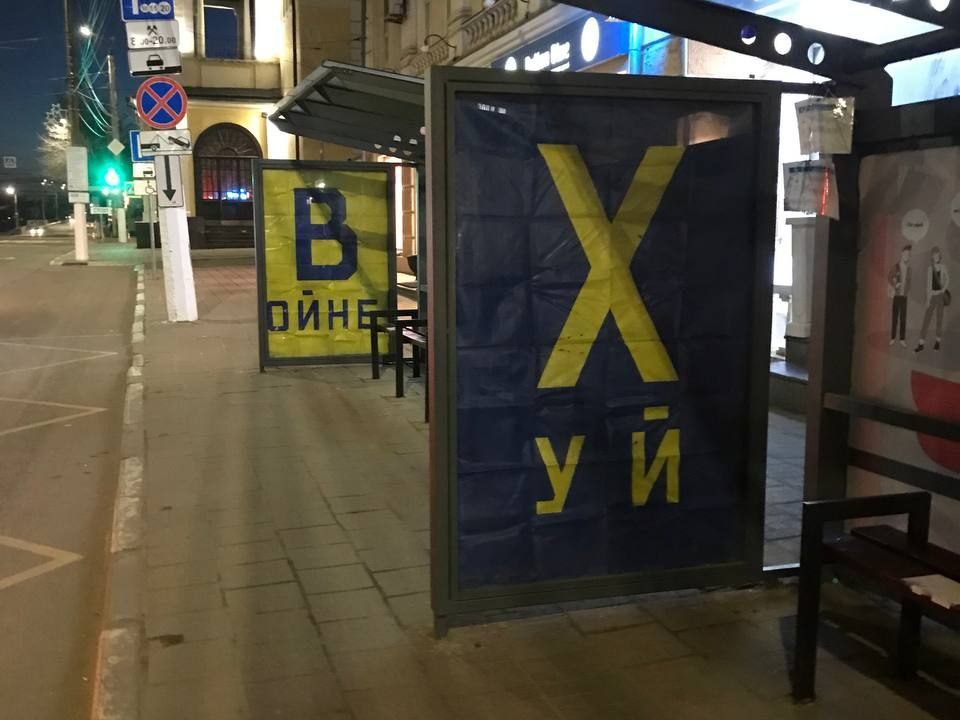
“Fuck the War”: a street art piece attributed to Ivan Kudryashov, photographed in Tver on 1 May 2022. Photo courtesy of Solidarity Zone

Ivan Kudryashov: Tver resident accused of planning arson of military enlistment office

The Telegram channel Stasia and Letters reports that Tver activist Ivan Kudryashov is in a pretrial detention center, charged with planning to set fire to a military enlistment office.

It is reported that Kudryashov repeatedly carried out anti-war protests in Tver. He was arrested on September 30 and charging with “preparing to commit a terrorist act” (per Article 30.1 and Article 205 of the Russian Federal Criminal Code). If found guilty, he faces a maximum prison sentence of eleven years and three months.

Kudryashov is, possibly, the author of the resonant “Fuck the War” street art pieces at bus stops in Tver. In any case, the VK page “Ivan Kudryashov” contains an entry about them, dated September 22.

Stasia and Letters quotes a letter from Andrei Trofimov, accused of making anti-war statements, who was held in the same cell as Kudryashov for three weeks:

“[Ivan Kudryashov] was born in the city of Bologoye and grew up in an orphanage and, later, with a foster family in Torzhok, Tver Region. He graduated from an eleven-year school. After school, he enrolled in the economics department at Tver State University. In the second year, he dropped out of university and did his obligatory military service in the Armed Forces of the Russian Federation. After that he lived in Tver and worked as a fitter at a train carriage factory. At school, he liked mathematics and was a checkers champion. He is fond of contemporary music, and is also a fan of the British TV series Sherlock.”

It is reported that Ivan Kudryashov is now in solitary confinement, which means it is especially important to write to him.

✉️📦 Address for letters and parcels:

Kudryashov Ivan Valeryevich (born 1996)

141 Vagazhanov Street

Pretriel Detention Center No. 1

Tver 170010 Russian Federation

(It is possible to send letters via the FSIN-Pismo service.)

#prisoners#solidarity #nowar#writing letters

Source: Solidarity Zone, 5 December 2022. Translated by the Russian Reader. People living outside Russia will not be able to use the Russian Federal Penitentiary Service’s FSIN-Pismo service. It is also probably impossible or nearly impossible to send parcels to Russian detention facilities from abroad. In many cases, however, you can send letters (which must written in or translated into Russian) via the free, volunteer-run service RosUznik, but as of this writing Mr. Kudryashov has not appeared on their list of addressees. You can also ask me (avvakum@pm.me) for assistance and advice in sending letters.

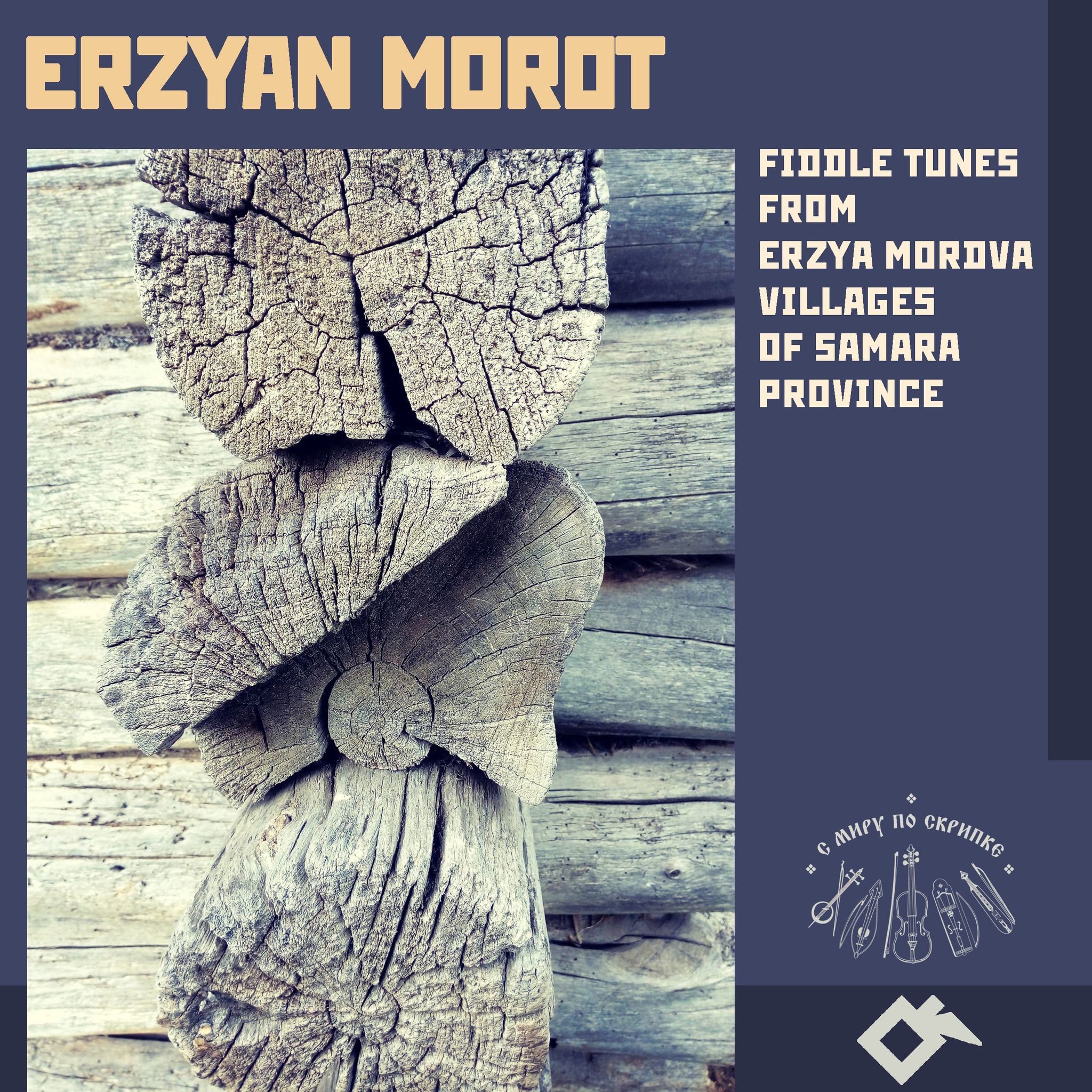
Erzyan Morot: Fiddle Tunes from Erzya Mordva Villages of Samara Province

78th release from Antonovka Records

Armas Otto Väisänen (1890-1969) was a famous Finnish ethnomusicologist and ethnographer.

In 1914, when his native Finland was still part of the Russian Empire, he traveled around Samara province and recorded music of traditional fiddlers from local Erzya Mordva villages on wax cylinders. These recordings have been preserved in the Finnish archives.

The album Erzyan Morot (“Erzyan Melodies”) presents those tunes played by modern Russian fiddlers as close to the original as possible .

The number in the brackets after each melody is its number in the collection Mordwinische Melodien (“Mordovian Melodies”, Helsinki, 1948) compiled by Väisänen.

Performers:
Sofia Balueva (tracks 1-4), recorded August 14, 2021 in St. Petersburg
Sofia Fayzrakhmanova (tracks 5-10), recorded at the same place
Tatyana Yamberdova (track 11), recorded on October 23, 2021 in the town of Velikiye Luki

The idea of ​​the project by Ksenia Goncharova and Andrey Davydov.

Source: Antonovka Records, Facebook, 25 November 2022

___________

Armas Otto Aapo Väisänen (9 April 1890 – 18 July 1969) was an eminent Finnish scholar of folk music, an ethnographer and ethnomusicologist.

Väisänen was born in Savonranta. In the early twentieth century he documented, in recordings and photographs, traditional Finnish music and musicians. With a scholarship from the Finno-Ugrian Society Väisänen traveled to Russia in 1914 to collect Finnish folk melodies. He made field trips to Mordovia, Ingria, Veps, Russian Karelia. His activities also marked the a new stage in the history of collecting Seto folk songs in Southern Estonia. After the first trip in 1912 he made 6 field trips to Estonia between 1912 and 1923.

A. O. Väisänen’s dissertation was presented in 1939 on Ob-Ugrian folk music in German: Untersuchungen über die Ob-ugrischen Melodien: eine vergleichende Studien nebst methodischer Einleitung.

Between 1926 and 1957 Väisänen hold the position of the head of the folk music department at the Sibelius Academy, Helsinki, Finland. He was the professor of musicology at University of Helsinki from 1956 to 1959. He died in Helsinki, aged 79.

Source: Wikipedia

Vladlen Menshikov: A Real Russian Hero

Vladlen Menshikov. Photo courtesy of Solidarity Zone

We have begun supporting Vladlen Menshikov, accused of anti-war sabotage on the railways.

On September 30, pro-government media reported the arrest of 29-year-old Vladlen Menshikov by the FSB in the Sverdlovsk Region. Investigators claim that Menshikov installed short-circuiting devices on the railway at the eightieth kilometer of the stretch between Rezh and Striganovo, along which trains carrying Russian military equipment run.

During an interrogation, which FSB field agents recorded on video, Menshikov said that he opposes the war and supports overthrowing the current government. He also discusses methods of sabotaging the Russian army’s railway supply lines.

Solidarity Zone was able to establish Menshikov’s identity and locate the pretrial detention center in which he is detained. When we contacted him and offered our support, he responded positively. He asked for legal assistance, and also said he would be glad to receive letters.

We are currently working to start providing full-fledged legal assistance to Menshikov.

We would note that Vladlen is currently being held in solitary confinement, so letters are especially important for him.

✉️📦 Address for letters and parcels:

Menshikov Vladlen Alexeyevich (born 1993)

4 Repin Street

Pretrial Detention Center No. 1

Ekaterinburg 620019 Russian Federation

(It is possible to send letters through the FSIN-Pismo service and Zonatelecom, as well as through RosUznik, a volunteer-run resource.)

💰 To support Solidarity Zone financially, so that we can continue to pay lawyers, send parcels to prisoners, and help cover other expenses, you can use the follow payment methods:

💳 Sberbank card

4276 7201 3618 1221 (Darya T.)

🪙 PayPal: solidarity_zone@riseup.net

🥷 Cryptocurrency:

Bitcoin: bc1qfzhfkd27ckz76dqf67t0jwm4gvrcug49e7fhry

Monero: 86565hecMGW7n2T1ap7wdo4wQ7kefaqXVPS8h2k2wQVhDHyYbADmDWZTuxpUMZPjZhSLpLp2SZZ8cLKdJkRchVWJBppbgBK

Ethereum: 0xD89Cf5e0B04b1a546e869500Fe96463E9986ADA3

Other altcoins: https://nowpayments.io/donation/solidarityzone

Source: Solidarity Zone, Facebook, 21 November 2022. Translated by the Russian Reader. People living outside Russia will not be able to use the Russian Federal Penitentiary Service’s FSIN-Pismo service or the privately run Zonatelecom. It is also probably impossible or nearly impossible to send parcels to Russian detention facilities from abroad. But you can send letters — translated into Russian (if you don’t know a competent translator, you can use a free online translation service such as Google Translate) — to Vladlen Menshikov (and many other Russian political prisoners) via RosUznik. You can also ask me (avvakum@pm.me) for assistance and advice in sending letters.

The Distance Between Krasnoobsk and Moscow Is 3,420 Kilometers

Five persons unknown abducted and tortured Dmitry Karimov, a 22-year-old resident of Krasnoobsk (Novosibirsk Region), in order to get him to confess to burning a banner in support of the Special Military Operation. The young man told the Telegram channel “Caution, News” [which has 1,443,493 subscribers] about the incident.

According to Karimov, on the morning of October 14, five men in mufti attacked him and pushed him into a vehicle. “I was screaming, calling for help, and they used a cattle prod on me,” he said, adding that they immediately accused him of setting fire to the banner, a crime which he did not commit.

Then, according to Karimov, the men took him to the forest, handcuffed him, strangled him, threatened to shoot him, and offered to convey to his parents his last words if he did not confess to the arson. Karimov confessed under duress. He was taken home, where a search took place, during which the security forces seized electronic devices and a jacket.

The detainee was then taken to the police station. Karimov said that during the interrogation he tried to tell the truth, but he was threatened with being sent to the war in Ukraine, and due to fear and coercion, he confessed.

The detainee’s mother Ekaterina Mikhasyonok said that her son is a third-category disabled person: he has been diagnosed with an organic lesion of the central nervous system, and has hearing and speech problems. She added that when her son did not return from school, she began looking for him. At about nine in the evening, she went to the police station, where she was told that Karimov was there.

Karimov was charged with “intentional destruction or damage to property by arson” (per Article 167.2 of the Criminal Code) and released on his own recognizance.

Source: “Novosibirsk Region resident says he was tortured into confessing to torching pro-SMO banner,” OVD Info, 16 November 2022. Thanks to Jenya Kulakova for the heads-up. Translated by the Russian Reader


Russian President Vladimir Putin on Thursday named several supporters of the war in Ukraine to the presidential Human Rights Council in a shake-up of the body which appeared to purge members who have publicly expressed doubts about the war. 

War correspondent Alexander Kots and two other prominent supporters of the war were added to the council, while 10 members, including the well-known television host Nikolai Svanidze, found themselves removed from the body. 

Kots, a journalist for the Komsomolskaya Pravda tabloid who also runs the popular Telegram channel Kotsnews, has risen to prominence during Russia’s invasion of Ukraine as he has been embedded with Russian forces throughout the war. 

While he has reported on Ukraine since 2014, he has faced repeated accusations of being a mouthpiece for the Kremlin since the start of Russia’s 2022 invasion, most notably for his claim that the massacre of Ukrainian civilians in the town of Bucha was staged by Kyiv.

Also added to the body on Thursday were Yulia Belekhova of the All-Russian People’s Front, an organization that raises money to support pro-Kremlin separatist forces in Ukraine’s Donbas region, as well as Elena Shishkina, a member of the Free Donbas party in the self-proclaimed Donetsk People’s Republic. 

The 10 members removed from the body include Svanidze, who has increasingly voiced his concerns over Russia’s invasion and who called for curbs on the death penalty in the Donetsk region in an open letter to Putin in August.

Prominent rights activist Igor Kalyapin and leading anti-xenophobia researcher Alexander Verkhovsky were also removed from the council in Thursday’s shake-up.

Russia’s Human Rights Council, which was established by presidential decree in 2004 to guarantee and protect human rights in Russia, has been criticized for failing to challenge Putin as members have been ousted and replaced with more Kremlin-friendly figures over the years.

The council has been chaired by journalist and war supporter Valery Fadeyev since 2019.

Source: “Putin Names War Supporters to Russia’s Human Rights Council,” Moscow Times, 17 November 2022

You Don’t Speak for Us

A Statement by the Free Nations League

Regarding the Convocation of a Congress of People’s Deputies of the Russian Federation in Poland

From open sources, we have learned about an undertaking to convene a Congress of People’s Deputies in the town of Jabłonna, Poland (November 4–7, 2022). The delegates to the Congress are parliamentary deputies of different years and different levels who were elected in internationally recognized elections. Rejection of the war between Russia and Ukraine that began in 2014 and a willingness to change the socio-political system established in the Russian Federation are their common platform. The event’s organizers have announced that they will adopt a “Declaration on the Constitutional Principles of a Free Russia after the Putin regime’s overthrow,” a “list of priority decisions by the post-Putin Russian government,” etc.

In the light of this news:

🔹 We cannot but note the fact that [free and fair] elections in the Russian Federation disappeared long before 2014. Ethno-national political parties were banned thirteen years before Ukrainian region of Crimea was annexed. Thus, despite the fact that the Russian Federation, according to its own constitution, is a federation, and most of the ethno-national republics within the Russian Federation are nation-states with their own constitutions, parliaments, and governments, we have been deprived of the opportunity to represent and defend our interests in representative bodies for decades.
🔹 We acknowledge that the Russian Federation as a state has gone too far both in its ethno-national policy (extolling the Russian nation as chosen and endowing it with a special status in the Russian Federal Constitution) and in its foreign policy, thus completely destroying the legal space of the federation. The Russian Federation currently has no clear and legitimate borders, nor does it have legitimate representative bodies, since there are “deputies” and “senators” seated in the Federal Assembly who were, allegedly, delegated by illegally annexed foreign territories.

In light of the above considerations, we, representatives of the ethno-national and regionalist movements united in the Free Nations League, declare the following:

1. We do not recognize any political forces and hubs that would justify maintaining the Russian Federation in its current form. We have no need of arbitrators from Moscow, neither from the authorities nor from the opposition. We are open to dialogue and contact only with those who publicly support the right of enslaved peoples to establish independent States.

2. The Russian Federation cannot be re-established by cutting off what was seized by force and holding new elections. It is not elections that are at issue, but the very nature of Russian statehood: it is imperialist and exudes aggression towards its neighbors. This means that we, representatives of ethno-national republics and regions, have the right to shape our own destiny. If there is a discussion of independence for certain lands, let the people themselves hold this discussion, let them decide which confederations or unions to join, free from the intervention of federal forces, be they the government or the opposition. Any attempts at “peacekeeping,” attempts to teach us how to exercise our right to self-determination, will be rejected by us, and if they are intrusive, they will be met with a forceful response.

3. The process of forming a new Russian state should be voluntary and undertaken exclusively by those federal subjects whose legislative bodies vote to join a new federation. All federal parties currently represented among the federal authorities should be banned since they profess a misanthropic ideology that has produced thousands of victims and millions of refugees. The legislative bodies of the former federal subjects must be re-elected democratically, by open and secret ballot, with the involvement of ethno-national and regional political parties. There can be no automatic entry into the “renewed” Russia, no joining it “by inheritance.”

This appeal has been signed by representatives of the following national movements:

Bashkir

Ruslan Gabbasov, head of the Bashkir National Political Center (BNPC)

Ilshat Kinzyabayev, member of the BNPC

Buryat

Radjana Dugar-DePonte, representative of the Erhatan Buryat Democratic Movement in the USA

Cossack

Vyacheslav Demin, elder of the Cossack National Liberation Movement

Oirat-Kalmyk

Arslang Sanjiyev, chair of the Oirat-Kalmyk People’s Congress

Erentsen Dolyayev, deputy chair of the Oirat-Kalmyk People’s Congress

Batyr Boromannayev, deputy chair of the Oirat-Kalmyk People’s Congress

Vladimir Dovdanov, deputy chair of the Oirat-Kalmyk People’s Congress

Albert Sharapov

Tatar

Rafis Kashapov, deputy prime minister of the Government of Independent Tatarstan in Exile, co-founder of the Free Idel-Ural Movement

Farit Zakiyev, chair of the Tatar Public Center

Nafis Kashapov, deputy prime minister of the Government of Independent Tatarstan in Exile

Irshat Khabi

Chechen

Khamzat Grozny, a political exile in France from the Chechen Republic of Ichkeria

Erzya

Bolyayen Syres

Vitaly Romashkin

Ozhomason Kirdya

Source: Free Nations League, Facebook, 31 October 2022. Thanks to Sergey Ogurtsov for the heads-up. Translated by the Russian Reader


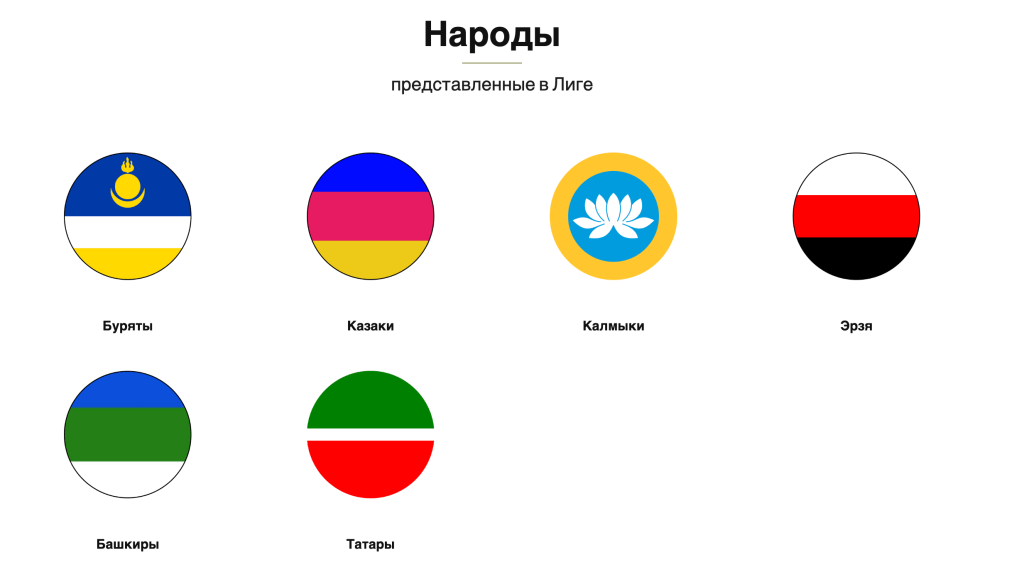
“Nations represented in the League: Buryats, Cossacks, Kalmyks, Erzya, Bashkirs, Tatars”

The FNL’s Principles

1

The Russian Federation is an empire that keeps its colonies in servitude by force. It is impossible to liberate them by holding a referendum, just as a referendum on the observance of human rights is impossible under conditions of state terror.

2

The peoples of the Russian Federation should be able to exercise their right to self-determination. Further federations or confederations can be established only a voluntary basis, not by diktat of the former federal center.

3

We declare the principle of the presumption of identity and agency [sub’ektnost’]. Accordingly, with the collapse of the current political regime in the Russian Federation, the regions have no need to appeal to anything to endow themselves with sovereignty. By definition, all regions acquire complete sovereignty and full independence from Moscow, and only then, as free territories, do they decide their future: whether they want to maintain independence, unite with other regions and republics, or create a confederation of states.

4

All subjects of the Russian Federation have the right to independently determine their future.

Source: “About Us,” Free Nations League. Translated by the Russian Reader

The Story of Igor Paskar, Who Threw a Molotov Cocktail at the FSB’s Offices in Krasnodar

Igor Paskar. Photo courtesy of Vot Tak (Belsat)

On October 28, the trial of Igor Paskar began in the Southern District Military Court in Rostov-on-Don. He is accused of throwing a Molotov cocktail at the FSB’s offices in Krasnodar, and also of setting fire to a [pro-war] “Z” banner. Paskar explains his actions as a protest against the war: after the alleged attempted arson at the FSB, he painted his face in the colors of the Ukrainian flag of Ukraine. The FSB has classified the protest as “terrorism,” and the burning of the banner as “vandalism.” Paskar faces ten to fifteen years in prison if convicted.

To Moscow and Back

Igor Paskar was born and lived until the age of thirty-five in a workers settlement in the Volgograd Region. He came of age in the 1990s, turning eighteen in 1994. After school, he enrolled in the administrative and industrial buildings maintenance program at the Volgograd Institute of Architecture and Civil Engineering, but had to quit his studies in his first year after he was drafted into the army. After two years in a construction battalion, Paskar returned to his native village and immediately began working odd jobs — on construction sites, as a loader, and as a courier.

In 1998, when Paskar was twenty-two, he was first sentenced to five years probation on charges related to drug trafficking. In 2001, he received two years of actual prison time for theft and possession of hashish. He was last convicted of a criminal offense — one and a half years probation for possession of marijuana — in 2006. The last ten years, Paskar told Vot Tak, he has been clean — he completely gave up using light drugs.

In 2013, Paskar moved to Moscow. At various times in the capital, he worked as a courier at Samokat, as a loader, and as a furniture assembler. He also sold rare items on Amazon.

He became interested in politics in 2018 — as his case investigator would later write, he became an “adherent of radical liberal opposition ideas.” In 2021, Paskar was detained in Moscow for taking part in a protest rally called by Team Navalny after the politician’s arrest.

In the summer of 2021, the activist returned to Volgograd, where he got a job as a courier. During one of the interrogations about this period, he said: “I was still interested in the work of the Anti-Corruption Foundation, and I supported Alexei Navalny. I publicly voiced my opinions among people I know, including at work, and I posted my opinions in messengers and chats.”

The FSB on Fire

In February of this year, before the start of the Russian invasion, Paskar responded to an ad and took in a lost dachshund. According to the activist, stray dogs tried to attack the pooch several times, so he bought a flare gun to scare them away. He soon left his village in the Volgograd Region with his dog for work: he had found an unusual vacancy on the internet — picking strawberries in Adygea. Paskar was unable to start the job, however. There was a conflict in the workers’ accommodations over the dachshund, and he fired the flare gun at the ceiling. Paskar himself called the police, and the court sentenced him to five days in jail. After his release from a special detention center, Paskar left for Krasnodar.

In a letter, he describes this period as follows: “I have had a whole series of failures in life over the last three months. When the special operation began, I was unable to transfer money from abroad after the SWIFT system was switched off. I had an Amazon account on which I traded rare items. After the start of the special operation, I lost my earnings. I could not get a job in Volgograd and decided to go to Krasnodar for seasonal work, but there were a number of failures. I was angry at my plight and decided to sacrifice myself for what I believe in — peace.”

Paskar held his first anti-war protest in downtown Krasnodar on June 12, Russia Day. It was then that he threw a lighted bottle of gasoline at a banner featuring the letter Z and the slogan “We do not abandon our own.” No one paid attention to his actions, the banner quickly went out, and Paskar was not detained.

Paskar then decided to carry out a protest action at the FSB’s Krasnodar offices. He did not plan to go into hiding and prepared for his arrest by selling his phone and packing a bag for the pretrial detention center. “My criminal experience has left its mark on me. When a person has [this experience], they are no longer afraid to go to prison. They already know that you can live there too — not very well, but you can do it. It is not hell. This has an impact not so much on radical decisions as on accepting one’s fate,” Paskar noted in a letter to your correspondent.

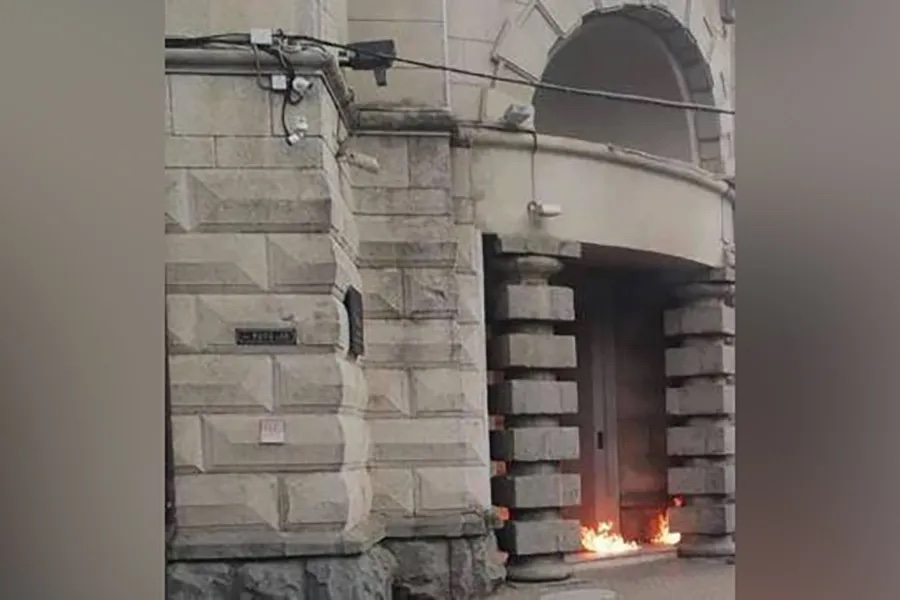
On June 14, Paskar went to the FSB’s offices on ulitsa Mira [“Peace Street”] in Krasnodar. A Molotov cocktail flew [sic] onto the building’s stone porch. The activist then painted his cheeks yellow and blue and waited for passersby to react and for the authorities to detain him. He hoped that someone would record the protest on their phone and post the video on the internet. Passersby avoided the scene, however. FSB officers came out of the building after a few minutes and detained the activist.

The moment when the fire flared on the porch of the FSB offices in Krasnodar: Source: Baza. Courtesy of Vot Tak (Belsat)

A Burnt Rug

Paskar calls his protest symbolic, emphasizing that his actions could not have caused serious damage — only a rug was burned on the stone porch. Despite this, a criminal case was immediately launched against Paskar under Article 205 (“Terrorism”) of the Russian Federal Criminal Code, which stipulates a penalty of ten to fifteen years in prison.

On October 28, the Southern District Military Court began considering the case — according to the amendments to the law adopted in 2014, only four district military courts [in Russia] can try terrorism cases. The court extended Paskar’s term in the pretrial detention center for six months, and ruled that the trial would be open to the public. The first hearing on the merits in the case was scheduled for November 10.

In 2016, for setting fire to the door of the FSB headquarters in Lubyanka Square [in Moscow], the performance artist Pyotr Pavlensky was sentenced to pay a fine of 500 thousand rubles under Article 243 of the Russian Federal Criminal Code (“Destruction or damage to objects of cultural heritage or cultural artefacts”). And yet, at the trial, the artist demanded that his actions be reclassified as terrorism.

Earlier, the [exiled opposition] politician Gennady Gudkov said that Paskar’s actions could be deemed disorderly conduct: “In any civilized country, such a thing is regarded as disorderly conduct and is punished with a warning or a fine.” And gallery owner Marat Guelman called Paskar’s act activism.

Paskar is being aided by the human rights initiative Solidarity Zone, which previously announced a fundraiser to pay for Paskar’s lawyer.

Source: Ivan Astashin, “‘He became an adherent of radical liberal ideas’: the story of Igor Paskar, who threw a Molotov cocktail building at an FSB building,” Vot Tak (Belsat), 31 October 2022. Translated by the Russian Reader


Vot Tak has published an article about Igor Paskar, who is accused of throwing a Molotov cocktail at the FSB offices in Krasnodar and setting fire to a “Z” banner. He did this to drawn attention to the war and voice support for the people of Ukraine.

On October 28, the Southern District Military Court began trying Paskar’s case.

Solidarity Zone has been providing comprehensive assistance to Paskar.

We are now raising funds to pay for Igor’s lawyer.

Fundraiser details:

💳 Sberbank card

4276 5500 2065 1710 (Zlatislava)

🪙 PayPal: solidarity_zone@riseup.net (marked “for Paskar”).

🥷 Cryptocurrency (be sure to email us at solidarity_zone@riseup.net if you transfer cryptocurrency to support Igor Paskar)

bitcoin: bc1qfzhfkd27ckz76dqf67t0jwm4gvrcug49e7fhry

monero: 86565hecMGW7n2T1ap7wdo4wQ7kefaqXVPS8h2k2wQVhDHyYbADmDWZTuxpUMZPjZhSLpLp2SZZ8cLKdJkRchVWJBppbgBK

ethereum: 0xD89Cf5e0B04b1a546e869500Fe96463E9986ADA3

other altcoins:

https://nowpayments.io/donation/solidarityzone

#solidarity#nowar#prisoners

Source: Solidarity Zone, Facebook, 31 October 2022. Translated by the Russian Reader

Life’s Rich Pageant: The Case of Yan Sidorov

Yan Sidorov. Photo courtesy of Memorial Human Rights Center

Minus one:Yan Sidorov, a former political prisoner in the Rostov Case, has volunteered for the war.

Sidorov served four years in prison in the Rostov Case, in which the court decided that two posters and thirty leaflets were evidence of “attempted organization of mass disturbances.” The Memorial Human Rights Center recognized him as a political prisoner.

Yan was released from prison a year ago, and he had planned to work in human rights protection. There were no vacancies in human rights organizations, however, and so he had to get a job as a food delivery courier.

Yan socialized with many leftist and liberal activists, but he also maintained relations with the red-brown National Bolsheviks.

Apparently, the latter were nicer to him. Several mutual friends have informed me that Yan Sidorov has joined the ranks of Eduard Limonov’s Other Russia and gone to the front.

I still don’t get how the National Bolsheviks degenerated from a flamboyant opposition party into the vanguard of the Kremlin regime. The late Limonov was always an imperialist, however.

But how — how?! — former political prisoners become defenders of Putin’s dictatorship, no one seems to understand. As one of my cellmates used to say, “Everyone has gone off their fucking gourd!”

Well, before he starts shooting, it’s not too late for him to change his mind. Maybe he will shake himself free of this delusion after all.

Source: Ivan Astashin, Facebook, 27 October 2022. Translated by the Russian Reader


Russian human rights activist Yan Sidorov is facing the prospect of three years under harsh probation conditions, when he is released next week from the penal colony where he has spent the last two years, Amnesty International said today.

Yan Sidorov is a prisoner of conscience, whose attempts to hold a peaceful protest in 2017 resulted in an imprisonment at a Dimitrovgrad penal colony after he had spent two years in pre-trial detention. He is set to be released on 3 November, but on 29 October Dimitrovgrad City Court will hear a request by the authorities to impose a severely restrictive probation period.

“Russian authorities are sending a clear signal to all young activists that participation in peaceful protests can come at huge personal cost. Yan Sidorov has already served four years in prison; he may now have to spend three more under strict police surveillance, forbidden to go out after 10 pm and banned from travelling outside the Krasnodar region,” said Natalia Zviagina, Amnesty International’s Moscow Office Director.

“The Russian penitentiary authorities must immediately withdraw their request to impose additional arbitrary restrictions on Yan Sidorov and release him unconditionally. Yan Sidorov has done nothing but exercise his rights to freedom of expression and peaceful assembly, and this outrageous campaign of punishment must end.”

Background

Two weeks ahead of Yan Sidorov’s release from penal colony IK-10 in Dimitrovgrad (Central Russia), the penitentiary administration requested that the court impose a three-year probation period on him. Conditions include obligatory biweekly registration at the local police station and a curfew between 10 pm and 6 am; Sidorov would also be banned from leaving his native Krasnodar region, and banned from attending or participating in any mass events. The Dimitrovgrad City Court will hear this case on 29 October. On 15 October, the penal colony authorities accused Yan Sidorov of violation of the prison regime regulations – allegedly for not attending morning workout – and placed him in a punishment cell for seven days.

In October 2019, Yan Sidorov and his friend Vladislav Mordasov, who spent almost two years in pre-trial detention, were found guilty of “attempted organization of mass disturbances”, and each sentenced to more than six years imprisonment for organizing a peaceful protest in November 2017. The protest was in support of dozens of people in Rostov-on-Don (Southern Russia) who had lost their homes in mass fires. Their sentences were subsequently reduced to four years on cassation. Vladislav Mordasov serving his sentence in IK-9 penal colony in Shakhty (Rostov-on-Don region) is due to be released on 3 November as well.

Source: “Russia: Prisoner of conscience Yan Sidorov faces further restrictions after release,” Amnesty International, 28 October 2021

Albina Sentyakova: “No Means No”

Albina Sentyakova

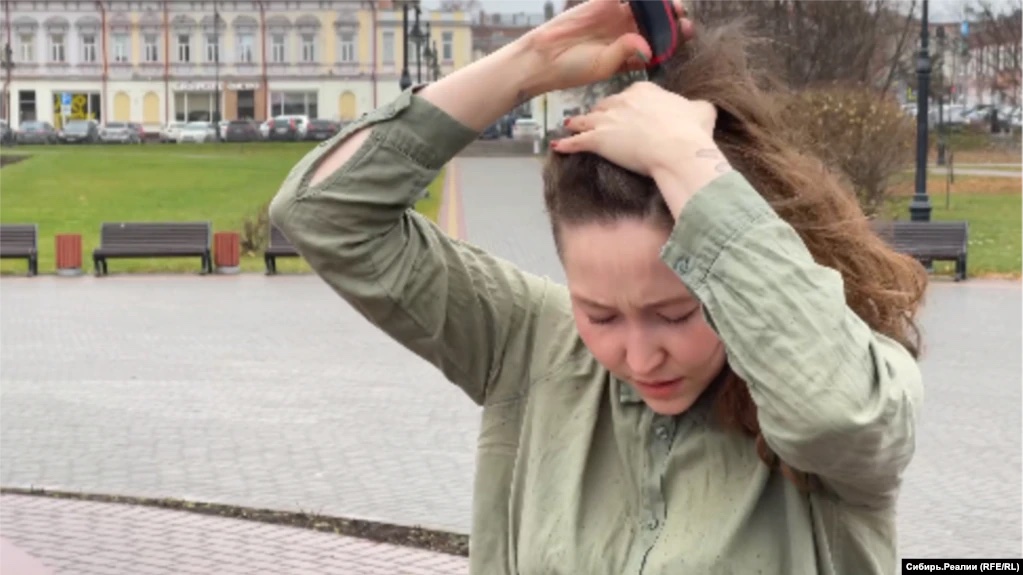
Tomsk resident Albina Sentyakova protested [the war] by shaving her hair off on the city’s Novosobornaya Square on Wednesday, October 19. She placed the hair in a box, and then held it aloft, thus displaying the slogan “No means no,” Sibir.Realii’s correspondent reports.

The protester was not detained, as the police were not in the vicinity.

“I cannot remain silent about what is happening in the world and in our country. It’s quite painful and unbearable. I cannot be silent. All the men in my family have a military specialty and silently accept the fact that they will have to go (to the front — SR),” Sentyakova said.

Source: “Tomsk resident shaves her head in anti-war protest,” Sibir.Realii (Radio Svoboda), 19 October 2022. Translated by the Russian Reader