Blessed Are the (Un)Happy

I was at an interview on TV Rain last week. We were supposedly going to discuss the Oscars, but suddenly we touched on what is an important topic, I think — how to behave appropriately during the war and amid everything else that is happening now.

I often read comments about how I smile all the time, but there is a war going on. About how I joke on the air, but now is not the time for jokes — Navalny is in prison. Why did I post this or that photo? It’s too glamorous and frivolous. Now is not the time for such things.

The complaints are understandable, but I totally reject the point they’re trying to make. It seems to me that the most destructive, the most incorrect thing we can do now is to don dark clothes, wring our hands and publicly suffer in front of our audience. By no means am I saying that there is no point in suffering in this situation. There is. The war is the most terrible event that has ever happened to us. It is absolutely incomprehensible how to go on living when your country has attacked and is destroying innocent people and destroying their lives forever as the scumbags on Russian national TV hoot and holler for joy. Everyone who is reading this post has experienced all this, I am sure, and of course you have been suffering. And those whom Putin came up with the idea of bombing with missiles and killing have been suffering even more.

Only one thing remains to us: to take all these terrible emotions, all these experiences, and turn them into concrete actions. Not cry on camera, not get hysterical, but to try and stop this horror as soon as possible. Today is better than tomorrow. Tomorrow is better than the day after tomorrow, etc. Each of us knows best of all what we ourselves are capable of doing and how to do it. The main thing is not to give in to despair. Despondency, despair and indifference are exactly what Putin wants from us. Don’t give him that.

I’ve attached a bit of the interview. And a frivolous photo to boot.

Source: Maria Pevchikh, Instagram, 31 January 2023. Translated by the Russian Reader


[…]

And where you find a hero, you always find tragedy. The hero is always a vehicle for suffering, pain, rupture and tragedy. There are no happy heroes: all heroes are necessarily unhappy. The hero equals misfortune.

Why? Because being both eternal and temporary, dispassionate and suffering, heavenly and earthly is the most unbearable experience for any being. It is a condition that you wouldn’t wish on your enemy.

Ascetics, martyrs, and saints took the place of heroes in Christianity. There are likewise no happy monks or happy saints. All of them are profoundly unhappy as individuals. But according to another heavenly account, they are blessed. Just as those who weep, those who are exiled, those who suffer slander, and those who hunger and thirst are blessed in the Sermon on the Mount. Blessed are the unhappy.

A person is made a hero made by an idea aimed skyward that crashes to the ground. A person is made a hero by suffering and misfortune, which tear him apart, which torment, torture, and harden him, and it has always been thus. This can happen during war or an agonizing death, but it can also happen without war, and without death.

The hero looks for his own war, and if he does not find it, he goes into a monk’s cell, to live as a hermit, and fights there with the real enemy. Because true warfare is spiritual warfare. Arthur Rimbaud wrote about this in Illuminations: “Spiritual combat is as brutal as battle between men.” (Le combat spirituel est aussi brutal que la bataille d’hommes.) He knew what he was talking about.

One hero, as the Neoplatonist Proclus says, is equal to a hundred or even thousands of ordinary souls. He is greater than a human soul because he makes every soul live vertically. This is the heroic dimension to the origins of the theater and, in fact, the ethics of our faith. It is the most important thing, which we should not lose, which we should cherish in others and nurture in ourselves.

Our job is to become deeply, fundamentally and irreversibly unhappy, no matter how scary that sounds. It is the only way we can find salvation.

Source: Alexander Dugin, “The Hero: The Metaphysics of Unhappiness,” Katehon, 3 February 2023. Translated by An Unhappy Translator. Thanks to Pavel Pryanikov for the heads-up
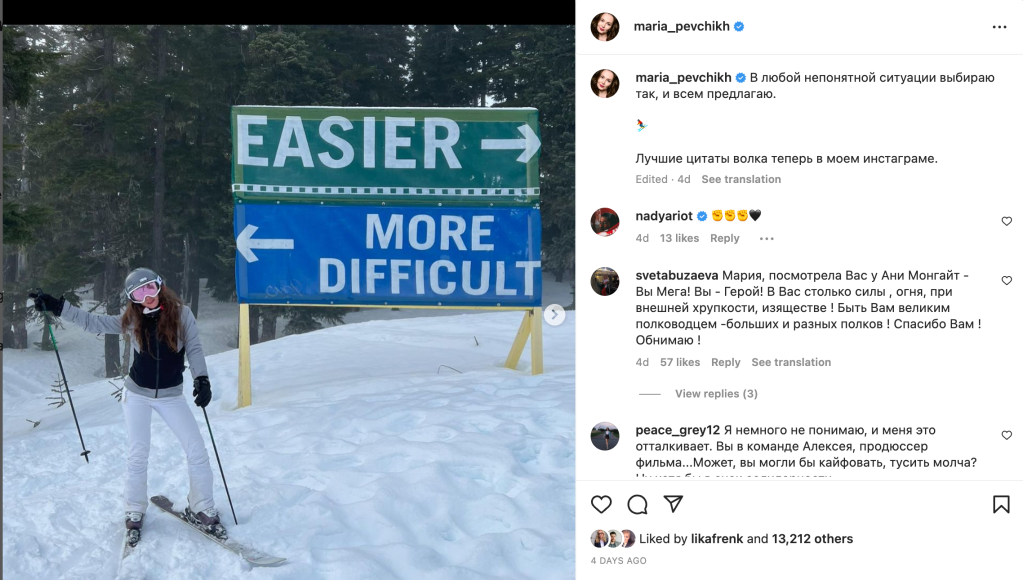

Maria Pevchikh: “In any puzzling situation this is what I choose and suggest that everyone else choose.” Source: Instagram

Now every employee of the Russian embassy in Germany has to think about Navalny on their way to work because they will see a replica of the solitary confinement cell where Alexei has been confined for the eleventh time.
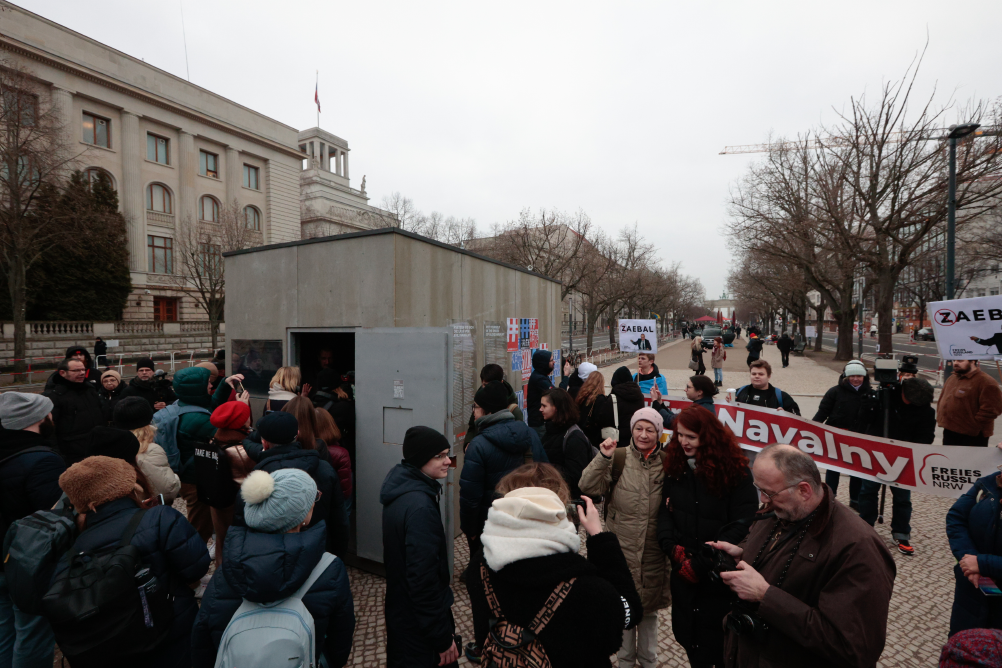
Not only embassy employees see this solitary confinement cell. It is seen by Berlin residents, tourists and journalists. It is seen by readers of the world’s major media outlets. Millions of people see it — and thus learn about the torture chamber in which Navalny is being held. Some will tell their friends about the project, others will join the Free Navalny campaign, while still others will put pressure on local politicians contemplating compromise with Putin. Circles radiate all over the world from this one site.

It is in your power to make these circles spread even wider. Help us achieve freedom for Navalny and for the whole of Russia — support our campaign at acf.international/#donate.

Free Navalny!

Thank you for being on our side! 

The Navalny Team

“Navalny has now been in prison for 745 days.”

Source: FBK (Anti-Corruption Foundation) email newsletter, 2 February 2023. Translated by the Russian Reader


Pevchikh: What Corruption Has Done to Russia / vDud
6,370,703 views • Feb 5, 2023
(In Russian, without subtitles in English — for the time being, I imagine)

Maria Pevchikh is an investigator and associate of Alexei Navalny.

0:00 Let’s go! 0:37 Why we met in London 5:13 How the film Navalny is saving Navalny’s life 9:36 Dud in the Internet’s homeland 13:03 How to turn a photo of a hallway into an investigation 16:17 What is going on with Navalny now? 20:26 The second largest house in the UK is owned by a Russian oligarch 25:30 But why can’t a Russian oligarch buy a house in London? 29:48 The UK is fighting Putin but harboring thieves: is that normal? 37:22 Who are you and where are you from? 42:31 Where did you get the money to study in London? 44:02 What’s wrong with Moscow State University’s sociology faculty 47:19 What did your father do for a living? 48:41 A crash course about British universities (eight lectures a week) 53:16 Alexander Dugin was Maria’s thesis advisor: how did that come about? 1:00:03 Does Putin listen to Dugin? 1:03:05 What Medvedev was like thirteen years ago 1:05:20 “My cat was hit by a car, please sort it out”: what British MPs do 1:08:22 Gadaffi’s son was at university with you 1:14:35 Where did you work before becoming an investigator? 1:16:32 Do you have a flat in London? 1:17:47 How did you meet Navalny? 1:22:50 Why didn’t you mention Skabeyeva and Popov’s mortgage? 1:27:28 How are drones able to fly over Putin’s and Medvedev’s residences? (A question from Nikolai Solodnikov) 1:33:14 Where did you get the conductor Gergiev’s bank statements? 1:36:32 Is it okay to pay a bribe to avoid mobilization? 1:40:54 What is your beef with Fridman? 1:48:13 Is Galitsky an accomplice of the regime? 1:57:18 Can we detest someone for being afraid? 1:58:26 Why does Popular Politics have such sensational headlines? 2:04:08 Is it okay to call a program guest a “fat beast”? 2:08:21 The rude tweet about Durov 2:10:21 Does radicalism prevent the Anti-Corruption Foundation from becoming popular? 2:16:09 Roman Abramovich is a master of reinventing himself 2:24:13 How soft power works 2:29:52 If Abramovich had ended the war would you have forgiven him? 2:31:38 The “List of the 6,000” 2:33:59 Why have you called for sanctions against Sobchak? 2:35:35 Why have you called for sanctions against Venediktov? 2:44:00 What did Oleg Kashin do wrong? 2:46:34 Why were the designers of a facial recognition system removed from the “List of the 6,000”? 2:51:01 Is your father an accomplice of the regime? 2:55:49 How do you do your work without Navalny? 2:57:18 Why were your supporters’ data hacked? 3:05:38 “Carry out a mission in the fight against Putin and get points”: what is that about?! 3:07:53 How do people who work for the regime change sides? 3:15:51 Do you see yourself as a politician? 3:19:44 Do you have a plan for Russia’s future? 3:25:09 Won’t the dictatorship in Russia survive without Putin? 3:30:20 Do you have a UK passport? 3:35:51 What exactly have you done over the past year to overthrow Putin? 3:41:21 “Compromisers” 3:52:07 Russia without Putin 3:56:58 What does it mean to be strong?

Source: vDud (YouTube). Annotation translated by the Russian Reader. Thanks to Tiina Pasanen for bringing this remarkable video to my attention and persuading me to watch it despite my initial misgivings. When I assembled the first part of this mash-up, a few days ago, I had no idea that Pevchikh and Dugin were so closely connected in real life. For another perspective on the sociology faculty at Moscow State University during roughly the same period as Pevchikh describes, see Oleg Zhuravlyov and Danail Kondov, “Towards a History of the Conflict in the Moscow State University Sociology Department” (2008). ||| TRR

Mikhail Lobanov: Why Police Raided My Home

Mikhail Lobanov in August 2021. Photo by Kirill Medvedev

Why did the police raid my home?

The formal reason — as follows from the court ruling and what people from pro-Kremlin media have heard — is a fictitious “connection” between me and ex-State Duma deputy Ilya Ponomarev. This is a product of the meager imagination of the security forces. I have not interacted with Ponomarev in any way, either in 2022 or in previous years, neither personally, nor through other people.

Why did the authorities have to intimidate me? I have two possible explanations.

The first and most likely explanation is that Moscow City Hall was behind the raid.

The following facts speak in favor of this explanation.

1) PR support. [The Telegram channel] Kremlin Laundress, which published posts containing threats and attempts to denigrate me (including a week before the raid), is a “drain tank” for the mayor’s office. The secretary of the Communist Party City Committee told me about this more than a year ago: they had been watching [the channel] for a long time and had come to this conclusion.

2) There was no investigator present during the raid. The field agents who were on hand, having unenthusiastically asked me two questions at the outset — whether I was connected with Ponomarev, and whether I had delegated [Vladimir] Zalishchak and [Sergei] Tsukasov to some congress — did not return to this topic during the six hours we spent together. But they did spend a great deal of time trying to persuade me that I should not be involved in politics by making threats (while drawing parallels with [Ilya] Yashin and [Yulia] Galyamina) and giving me “friendly” advice.

3) The mayor [of Moscow, Sergei Sobyanin] will run for re-election later this year, and his “victory” may further delegitimize the regime. In 2021–2022, my name was inextricably linked with the most successful opposition election campaigns in Moscow. Teams of like-minded people formed around me during both the municipal and the parliamentary elections. By mobilizing the enthusiasm of thousands of dynamic people, we defeated United Russia and corporate candidates. Political spin doctors and administrative resources were powerless against us. By accumulating the support of ordinary people, we achieved greater results than did candidates with exponentially larger campaign coffers.

Yes, our victories were stolen [through rigging] online voting. But even today, unbowed people can together find a way to use the mayor’s re-election campaign to organize themselves and make his “re-election” problematic.

For some reason, the Kremlin’s foreign policy “successes” in 2022 have not had the effect that the people who allocate tens of billions to state propaganda wanted. If the protest-minded segment of the electorate is mobilized in a minimal way, the construction business and ruling class candidate will enjoy only a Pyrrhic victory, one based on flagrant vote rigging.

A second possible explanation is that the raid on my home and my arrest are part of preparations to transfer power to puppet ultra-right revanchists.

In this case, what is happening to me reflects the fear of people with a consistent democratic anti-war stance on the part of officials, siloviki, and the oligarchs who have fused with them. We are trying to develop real trade unions and push the topic of blatant economic inequality onto the agenda.

After the ruling group’s collapse, the far-right revanchists will try to play the card of virtual “angry patriots” and maintain the existing system of domination. If they succeed, there will be a new dictator, increased crackdowns, a new round of spending on “security,” funded by a shrinking budget and, in the medium term, another senseless war.

But I believe that there are many dynamic people in Russian society who will be able to formulate a convincing left-democratic alternative and inspire tens of millions of other people. I look to the future with hope.

Source: Mikhail Lobanov, Facebook, 9 January 2023. Thanks to Simon Pirani for encouraging me to share this piece with my readers. Translated by the Russian Reader, who is much less hopeful about Russia’s future than is Mr. Lobanov. But more power to him!

How to Win Friends and Influence People

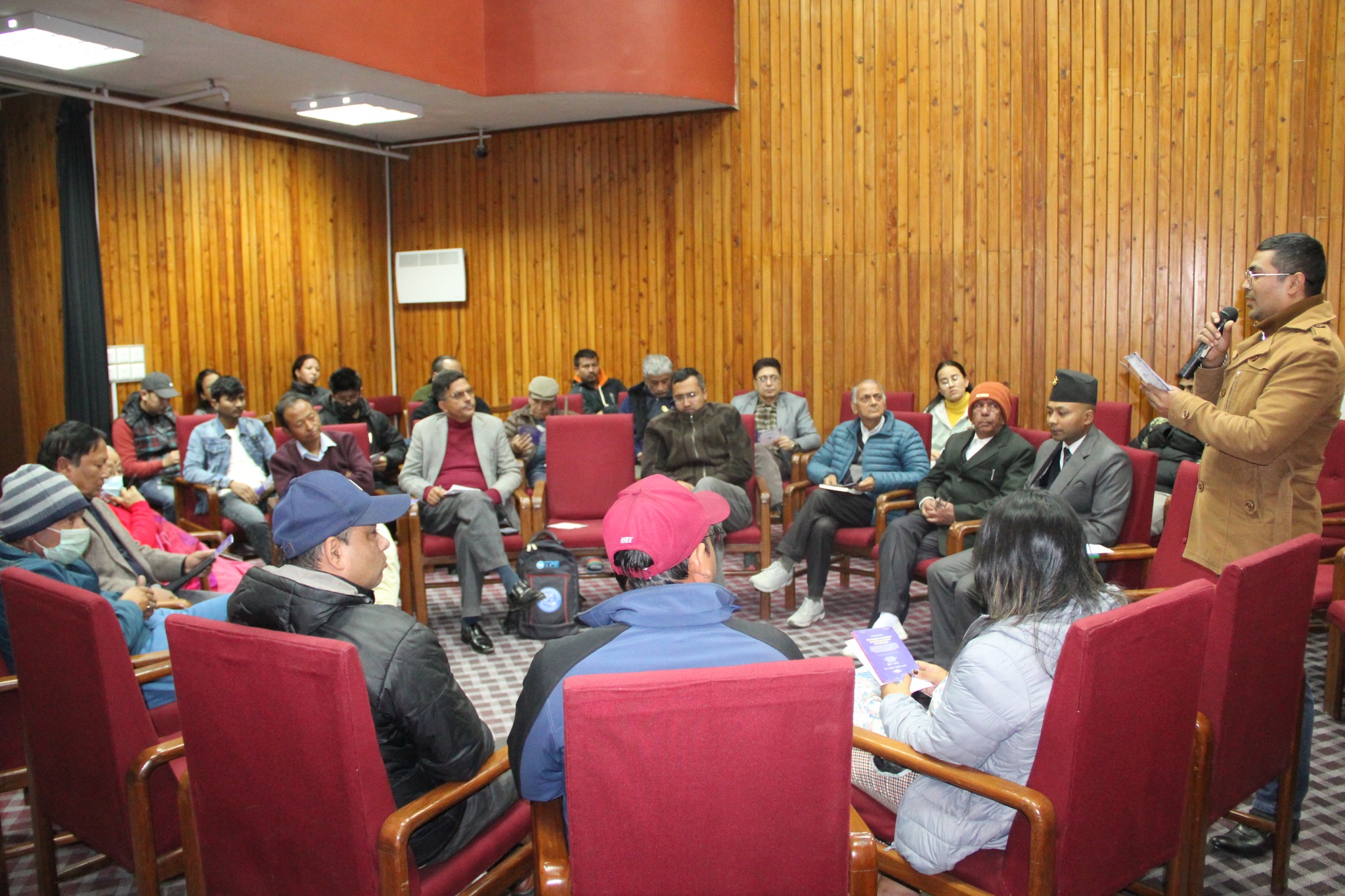
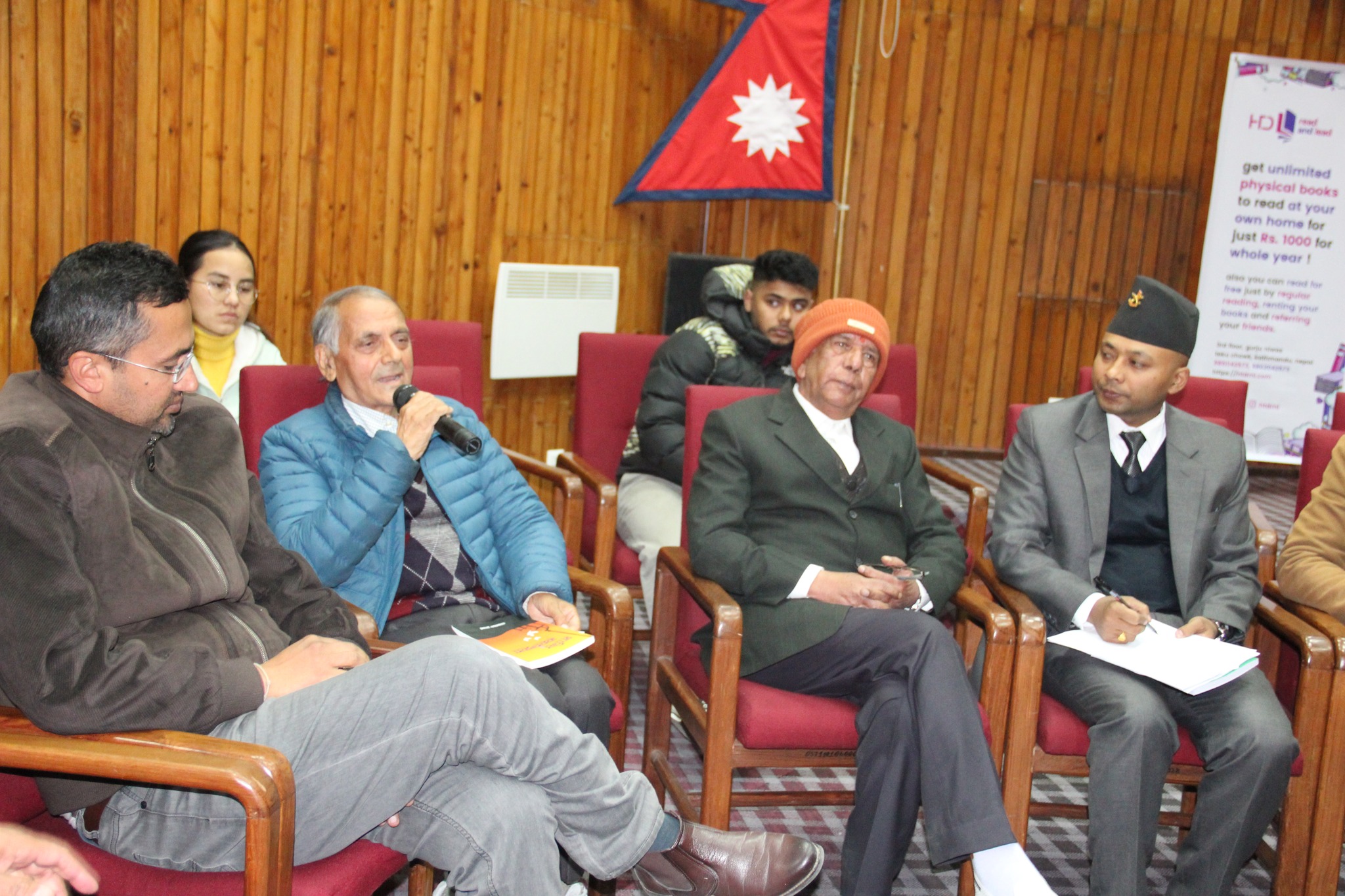
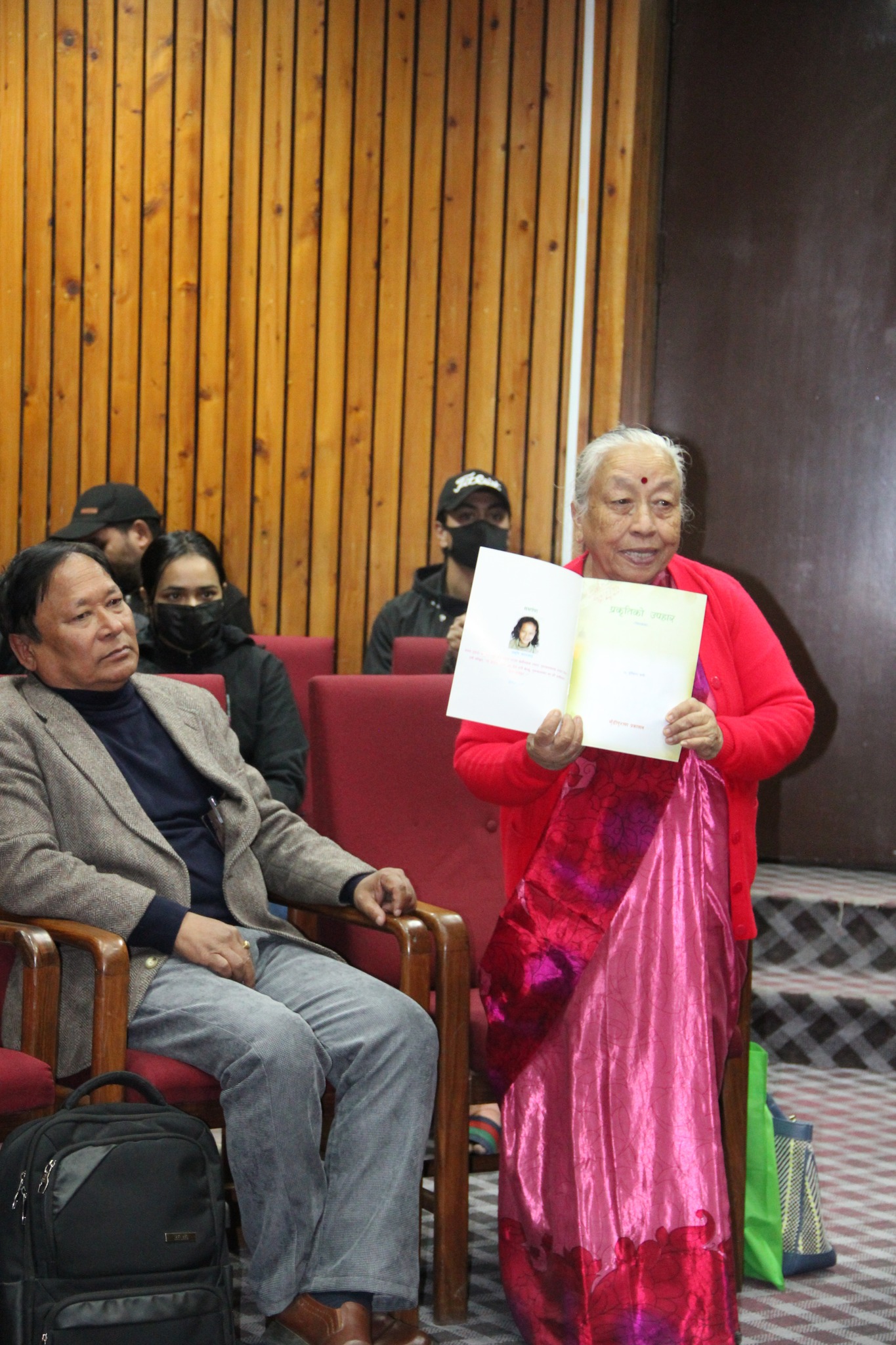
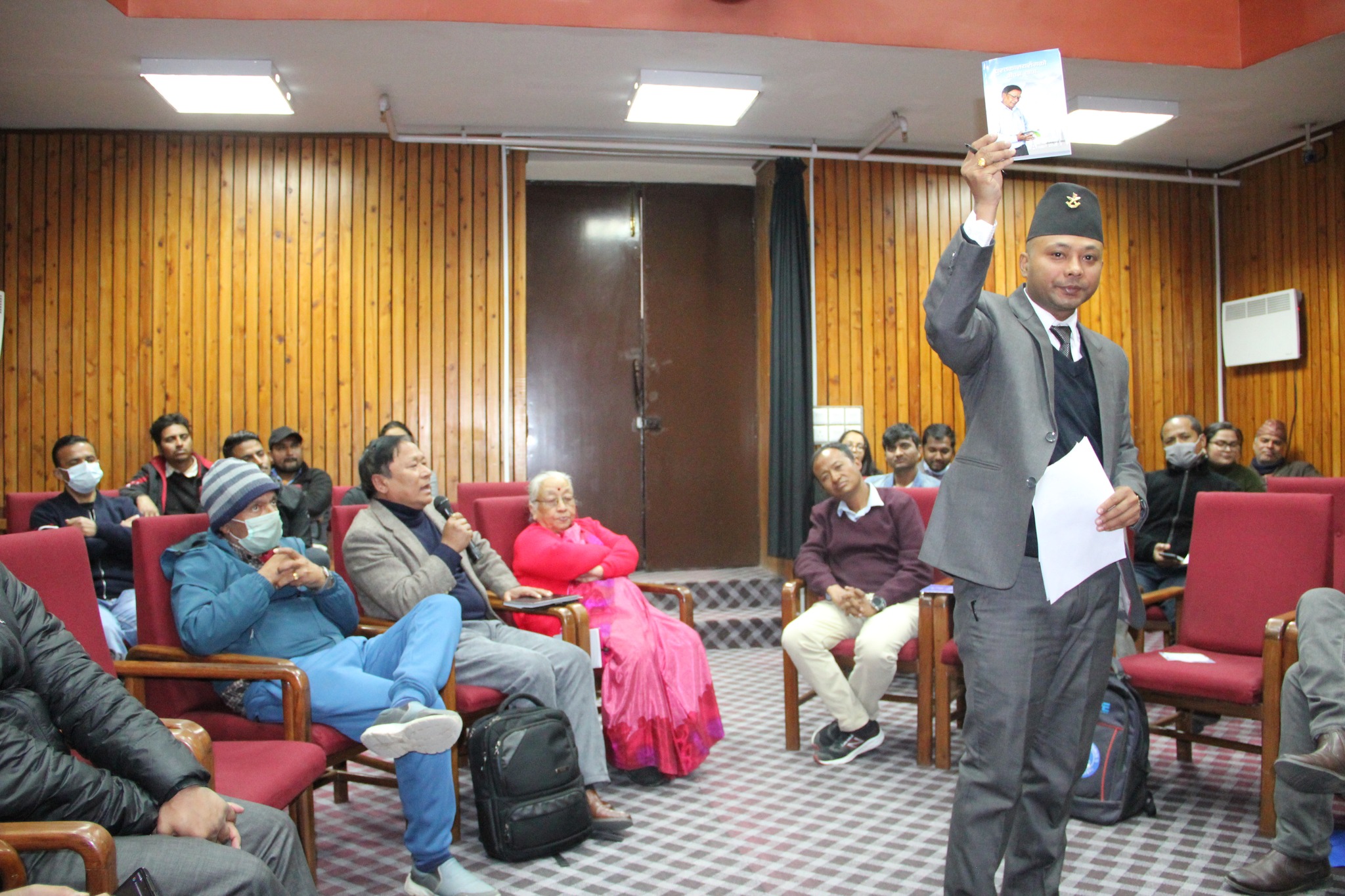
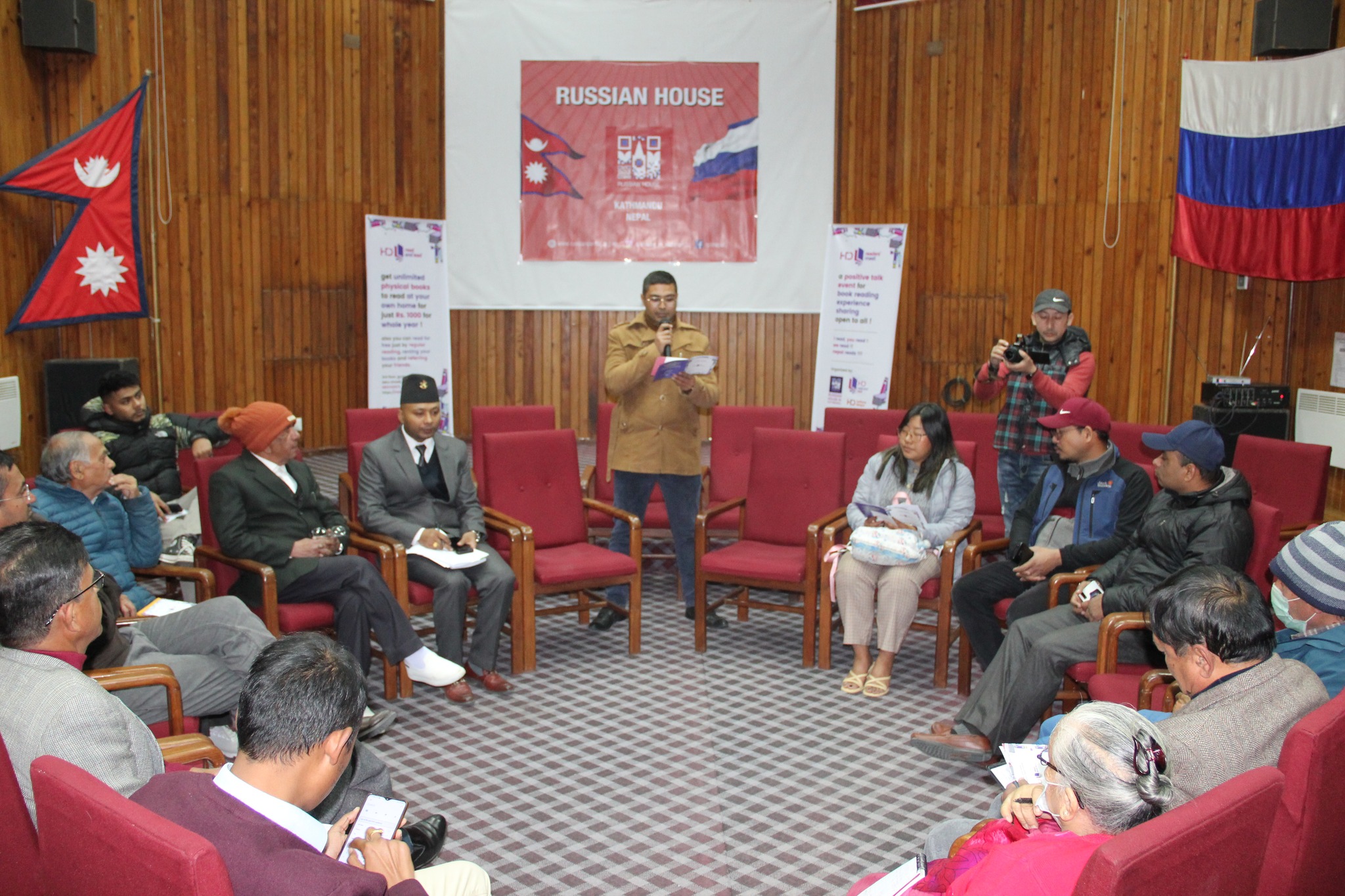
Book reading and experience sharing program at Russian House

On December 29 Russian House in Kathmandu conducted a book reading and experience sharing program in collaboration with Half Tone Design Private Limited.

The event featured an interactive group discussion program with a brief introduction of the Russian library, books, authors, quotes, and poem recitation. There were over 40 people: authors, students, poets, and professors. The main purpose of the program is to build reading habits and share experiences. In the program, many of the audience suggested their favorite books, which are as follows:

1. How to win friends and influence people — Dale Carnegie, and Bhagwat Gita by Mr. Indra Prasad Adhikari.

2. Ramcharitra Manas. By Mr. Rudra Dulal.

3. Jeevan Yatra by Mr. Bhola Shrestha.

4. Muna Madan, Aamai and Paheli by Mrs. Goma Banjade.

5. Mother – Maxim Gorky by Ms. Mira Pokherel.

6. Guna Ratna Mala by Mr. Narayan Thapa.

Source: Russian House in Kathmandu, Facebook, 29 December 2022


Ukrainian officials said that over 120 Russian missiles had been launched at the country’s cities. Explosions were heard in the capital Kyiv, Kharkiv, Lviv, Odessa and Zhytomyr. The mayor of Kyiv said that three people had been taken to hospital, and that 16 missiles were destroyed in flight by the city’s air defences. On the southern front Ukrainian officials urged residents of Kherson, which they liberated just six weeks ago, to evacuate their city as Russian forces escalated mortar and artillery attacks.

Source: The Economist, “The World in Brief” email newsletter, 29 December 2022


Mikhail [Lobanov] telephoned. He says that he has been charged under Article 19.3 of the Administrative Offenses Code.*

Mikhail managed to convey that during the search he was beaten in the face and chest. There was blood on the floor of the apartment.

* “Disobeying the lawful order of a police officer, a serviceman, an officer of the Federal Security Service, an officer of state security bodies, an officer of bodies exercising federal state control (oversight) in the field of migration, or an officer of a body or institution of the penal enforcement system, or an officer of the Russian Federal National Guard,” as amended on 19 December 2022.

Source: Mikhail Lobanov, Facebook, 29 December 2022. Translated by TRR


The home of Mikhail Lobanov was searched today. Mikhail’s [legal] status and the article of the criminal code [which he is being charged with or suspected of violating] are not yet known.

Mikhail was taken to the Ramenka police department.

During the search, the investigator mentioned the name Ponomarev (probably referring to Ilya Ponomarev), with whom Lobanov is not acquainted and is not connected in any way. All electronic devices were removed from the home.

The security forces quickly sawed down the door and talked with Lobanov in the apartment for more than three hours. They did not allow him to contact a lawyer, demanded that he sign some papers, and behaved heavy-handedly, Mikhail’s wife Alexandra Zapolskaya reports.

Source: Mikhail Lobanov, Facebook, 29 December 2022. Translated by TRR

In Izhevsk

A [billboard] advertising the delivery of “Cargo 200” has gone up in Izhevsk.

It’s a timely service with good prospects.

Source: Andrei Pivovarov, Facebook, 28 December 2022. Earlier this years, Mr. Pivovarov, a well-known Russian opposition politician, was sentenced to four years in prison for “leading an undesirable organization,” i.e., Open Russia.


Prominent opposition politician Ilya Yashin has been transferred to a detention facility some 1,000 kilometers from Moscow even though his sentence must still be approved by an upper court, his lawyer said Tuesday.

A Moscow court sentenced Yashin, 39, to [eight and a half years in a penal colony] earlier in December after he was charged with spreading “false” information about the Russian military for comments he made during a YouTube stream about the civilian massacre carried out by the Russian army in the Kyiv suburb of Bucha this spring.

The Moscow city councilor’s whereabouts were unknown when the city’s prison monitoring commission reported on Monday that Yashin had been moved to “a different region.”

Lawyer Maria Eismont said that Yashin was transferred to a pre-trial detention facility in the city of Izhevsk, the capital of the republic of Udmurtia, some 1,000 kilometers east of Moscow.

Yashin’s prison sentence has not yet taken effect, as an upper court must still reject his appeal and confirm his sentence, which means he must remain in pre-trial detention rather than being sent to a penal colony.

Eismont ironically called Yashin’s transfer an “early New Year’s gift” from the authorities, noting that his mother had been scheduled to visit him in Moscow later this week.

Source: “Jailed Kremlin Critic Yashin Transferred to Prison Outside [sic] Moscow,” Moscow Times, 28 December 2022

Ilya Yashin: Closing Statement in Court

This is a translated excerpt from Russian opposition politician Ilya Yashin’s closing statement, which he delivered at his show trial in Moscow earlier today. Charged with “spreading false information about the Russian military,” Yashin faces up to ten years in prison if convicted, which he almost certainly will be. ||| TRR


Ilya Yashin

Taking advantage of this podium, I would also like to address Russian President Vladimir Putin, the person who is responsible for this massacre, who signed the law on military censorship, and by whose will I am in prison.

Vladimir Vladimirovich!

Seeing the consequences of this monstrous war, you have probably already understand yourself what a grave mistake you made on February 24. Our army has not been greeted with flowers. We are called executioners and occupiers.

The words “death” and “destruction” are now firmly associated with your name.

You have brought terrible misfortune to the Ukrainian people, who will probably never forgive us. But you are waging war not only against Ukrainians, but also against your compatriots.

You have sent hundreds of thousands of Russians into the inferno of battle. Many of them will never return home, turned into dust. Many will be crippled and go crazy from what they have seen and experienced. For you, they are just casualty statistics, numbers in columns. But many families the face unbearable pain of losing husbands, fathers and sons.

You have deprived Russians of their home.

Hundreds of thousands of our fellow citizens have left their homeland because they do not want to kill and be killed. People are running away from you, Mr. President. Haven’t you noticed that?

You have undermined the foundations of our economic security. By putting industry on a war footing, you have sent our country back in the wrong direction. Tanks and guns are again a priority, and poverty and disenfranchisement are again our realities. Have you forgotten that such a policy has already led our country to collapse before?

Although my words might sound like a voice crying in the wilderness, I urge you, Vladimir Vladimirovich, to stop this madness immediately. You must acknowledge that the policy towards Ukraine has been mistaken, withdraw troops from its territory, and proceed to settle the conflict diplomatically.

Remember that every new day of war means new victims. Enough is enough.

Source: Ilya Yashin, Facebook, 5 December 2022. Photo by Zlata Milyavskaya. Translated by the Russian Reader

Down in the Hole

Oleg Grigoriev
Pit

Digging a pit? 
I was.
Fell in the pit?
 I fell.
Down in the pit? 
I am.
Need a ladder? 
I do.
Wet in the pit? 
It's wet.
How's the head? 
Intact.
So you are safe?
I'm safe.
Well, okay then, I'm off!

Original text. Translated by the Russian Reader


Putin last week took part in a meeting with the mothers of soldiers killed in the war in Ukraine. The title “soldiers’ mother” carries a lot of influence in Russia — and Putin was famously humiliated by a group of soldiers’ relatives in his early years as president. Unsurprisingly, Friday’s meeting included only those trusted to meet Putin and the gathering passed off without awkward questions. Putin — who now rarely communicates with anyone outside of his inner circle — once again demonstrated a complete detachment from reality.

  • The Russian authorities have been nervous of organizations of soldiers’ mothers since the mid-1990s. During the first Chechen war (1994-1996), in which the Russian army was humiliated, the Committee of Soldiers’ Mothers was one of the country’s leading anti-war forces and held the state and the military to account.
  • For Putin personally, any encounter with soldiers’ mothers stirs unhappy memories of one of the most dramatic incidents of his first year in the Kremlin. In August 2000, the inexperienced president was subjected to a grilling by the wives and mothers of sailors who died in the Kursk submarine disaster. The transcript of the meeting immediately appeared in the press and a recording was played on Channel One, which was then owned by Kremlin eminence grise Boris Berezovsky. Presenter Sergei Dorenko subsequently claimed that, after the broadcast, Putin called the channel and yelled that the widows were not genuine and that Berezovsky’s colleagues “hired whores for $10.” Ever since that encounter, the Russian president has avoided in-person meetings, favoring stage-managed gatherings with hand-picked members of the public.
  • This time, of course, there were no surprises. The Kremlin carefully selected the soldiers’ mothers who were invited to attend. At least half of those at the meeting turned out to be activists from the ruling United Russia party and members of pro-Kremlin organizations. 
  • The most striking speech at the event was close to parody. It was given by Nina Pshenichkina, a woman from Ukraine’s Luhansk Region whose son was killed in 2019. Pshenchkina later became a member of the Public Chamber of the so-called Luhansk People’s Republic and has attended almost every official funeral and official celebration. She told Putin that her son’s last words were: “Let’s go, lads, let’s crop some dill” (in this context, “dill” is an insulting nickname for Ukrainians).
  • Putin’s speech was also striking. First, he told the assembled mothers that Ukrainians were Nazis because they kill mobilized Russians soldiers who did not wish to serve on the front line. Then he embarked on a long, strange discussion about why we should be proud of the dead. “We are all mortal, we all live beneath God and at some point we will all leave this world. It’s inevitable. The question is how we live… after all, how some people live or don’t live, it’s not clear. How they get away from vodka, or something. And then they got away and lived, or did not live, imperceptibly. But your son lived. And he achieved something. This means he did not live his life in vain,” he said to one of the mothers.

Why the world should care

It would be an error to assume that Putin has completely abandoned rational thought. However, it is instructive to watch him at meetings like this, which provide a window onto the sort of information he consumes. At this meeting with fake soldiers’ mothers he quoted fake reports from his Defense Ministry and, seemingly, took it all seriously.

Source: The Bell & The Moscow Times email newsletter, 28 November 2022. Written by Peter Mironenko, translated by Andy Potts, and edited by Howard Amos. Photo, above, by the Russian Reader

Alexander Zamyatin: Emigration Is Reactionary, Not Revolutionary

At first glance, massive emigration reduces the potential for political change, because it mechanically subtracts from society the part of society that is critical of the authorities. To a large extent, of course, this is true, but we shouldn’t overestimate this factor.

My subjective observations tell me that one of the leading motives for emigration (let’s put the existential threat of mobilization aside for now) has been the loss of hope for a “normal” life. People have been fleeing because they felt things would only get worse, and that their former relatively prosperous (and sometimes quite lovely and promising) lives were collapsing, along with all their plans.

If you think about it, there is no potential for political change in this worldview. You can’t be a gravedigger of the old regime at the same time as you grieve for the opportunities lost in it.

Let’s take a hypothetical employee of the progressive wing of the Moscow Department of Transport (or any other corporation, bank, etc.) with liberal views, who remembers what a cool project he worked on in 2018 (or even in 2022), but now is leaving the country, because such projects will definitely not happen in the future. He went to protest rallies, voted for the opposition, watched [Maxim] Katz’s YouTube channel, and donated to OVD Info, so his departure is a loss for the opposition. But it’s not a loss for the revolution, because “I want everything to be the way it was before, only with no war and crackdowns, but with fair courts and honest elections” is essentially a reactionary demand. It’s about preserving things, not changing them..

It would be a mistake to think that revolution leaves us along with the emigration: resentment over the supposedly lost prospect of a prosperous Russia, which was stolen from us, is unsuitable fuel for revolution. The political emigration has no political program, because there is no bridge to the “normality” that supposedly existed before 2022 (or 2020, 2018, 2014, 2011, etc.). The emigration’s picture of the world completely excludes the social, economic and political contradictions that have brought us to the present moment and are leading us further, so now it contains nothing but shock, fear, and individual salvation.

Revolution cannot emerge from the failure of an evolutionary project. It will emerge as an alternative to the brutal dictatorship at a fatal crossroads in the country’s history, prompted by the need to radically solve the pressing issues of our coexistence. But the remnants of failed evolutionary trends will surely still play their own reactionary role.

Source: Alexander Zamyatin, Facebook, 29 September 2022. Mr. Zamyatin is a popularly elected member of the Zyuzino Municipal District Council in Moscow and the editor-in-chief of the website Zerkalo. Translated by the Russian Reader

Why They Fight

I’m writing once more about the Donbas and our true goals in carrying out the SMO. Everyone should know this, given that there are still many Russians wondering what it was all for. This category of people should know that the events in Donbas did not arise in a vacuum.

We are fighting not only for the liberation of peaceful people from years of Nazi tyranny. We are fighting for the future of our country, Russia — for our traditions and identity, for spiritual and moral values, for religion and the triumph of justice.

If we have been saying for many, many years that NATO’s force should not threaten us and prance at Russia’s borders, it only meant that we would not sit still and watch them place the sword of Damocles over us.

If we kept saying for a long time, patiently, discreetly, but intelligibly, that they shouldn’t torture and exterminate the Russian-speaking population of Donbas, it simply meant that they should be treated equally, respectfully, without prejudice.

Further, if we said that the Crimea is ours, [and] that this is the choice of Crimeans themselves, then it was not worth regularly and monotonously repeating that you would invade this area at the first opportunity.

Finally, if we persistently repeated that you could cherish and lust after your faceless LGBT masses as much as you wanted, but don’t impose it on us, it just meant that we wouldn’t allow it at home. We do not understand or accept it. But even in this case, sanctions were imposed on Russia — just for rejecting LGBT values.

Listen to the combat general, Hero of Russia, and commander of the Akhmad special forces battalion Apti Alaudinov. He uses accessible, simple words, and speaks reasonably and intelligibly. Everything he says is very clear and precise!

Source: Kadyrov_95 (Ramzan Kadyrov), Telegram, 10 September 2022. Translated by the Russian Reader


The apparent collapse of the Russian forces has caused shock waves in Moscow. The leader of the Chechen republic, Ramzan Kadyrov, who sent his own fighters to Ukraine, said if there are not immediate changes in Russia’s conduct of the invasion, “he would have to contact the leadership of the country to explain to them the real situation on the ground.”

Source: Steve Hendrix, Serhii Korolchuk and Robyn Dixon, “Amid Ukraine’s startling gains, liberated villages describe Russian troops dropping rifles and fleeing,” Washington Post, 11 September 2022


Communist Party leader Gennady Zyuganov, speaking in the State Duma on Tuesday, September 13, dubbed the “special operation in Ukraine” a war and called for a nationwide mobilization in Russia.

“How does a special military operation differ from a war? You can stop a military operation at any time. You cannot stop a war: it ends either with victory or defeat. I’m suggesting to you that there is a war going on, and we have no right to lose it. We must not panic now. We need a full mobilization of the country; we need completely different laws,” the online publication Sota quotes Zyuganov as saying.

Gennady Zyuganov, chair of the Central Committee of the Communist Party of Russian Federation (KPRF):
“Today, Russia’s fate depends on victory in Donbas. We need a total mobilization of the country.
We need completely different laws.” Source: Sota

Earlier, Communist Party MP Mikhail Matveyev suggested that governors and MPs volunteer for the front. For his part, Mikhail Degtyarev, the governor of Khabarovsk Territory, said a few days ago that he would like to go to Ukraine as a volunteer, but he could not, because he had no right to resign his post. Residents of the region launched a petition proposing to “help the governor realize his dream to go to fight in Donbas.” It has been signed by several tens of thousands of people.

Later, the press service of the Communist Party commented on the party leader’s statement. Zyuganov had spoken primarily about mobilizing Russia’s economy, political system and resources in the face of the impending threat, said Communist Party press secretary Alexander Yushchenko. He claimed that [Zyugannov’s statement] had nothing to do with the military. “Some groups are engaged in outright provocations, like the people who have spread this news. I would would say that such people should generally be executed,” Yushchenko said.

[…]

Source: Sergei Romashenko, “Zyuganov says a war, not a special operation, underway in Ukraine,” DW, 13 September 2022. Translated by the Russian Reader

Ilya Yashin: Life Is Everywhere

I spent almost a month in Pretrial Detention Center No. 7 in Kapotnya. But on Sunday the order came down to transfer me, and I was met by the legendary Butyrka Prison. What an interesting place this is, friends! Oak gates, ancient walls, every brick here is steeped in history. A genuine Russian prison with its own unique flavor.

Ilya Yashin in happier times. This was the photo included in his original post on Facebook.

Moving here from Kapotnya, where a “red” regime is strictly observed, you feel the strong contrast. A “black” flag flies over Butyrka, and its units have their own rules.

Life comes to a standstill in Pretrial Detention Center No. 7 after lights out. One of my cellmates was sent to solitary for getting out of bed at night and making himself tea. In Butyrka, life is just beginning when darkness comes. “The roads” — a communication system of ropes connecting the windows — run between the cells. Information is exchanged instantly. The senior inmates in the wings give instructions and bring their juniors “up to speed.” Prisoners make entries in a house book, recording the movement of people around the prison. Prisoners locate acquaintances, exchange malyava [letters and notes] sweets, and cigarettes, and get the news. “The roads” function like a social network.

Butyrka has its own currency — cigarettes. For a pack of Parliament you can get a good pillow or a plate of cottage cheese for breakfast. For four packs — a soft new mattress. Almost everyone smokes, and a thick tobacco smog is found in most cells.

The prison is overcrowded and simply teeming with people: the “overload” amounts to about a thousand people. Thirty prisoners share twenty beds in the large cells. I wound up a small cell in the special unit: four prisoners are crammed into nine square meters. Some time ago, the prosecutor’s office decided to restore order and launched an inspection of Butyrka after getting complaints about the conditions. On the eve of the prosecutors’ visit, several hundred prisoners were promptly scattered to other Moscow detention facilities. As soon as the inspection was over, everyone was brought back to Butyrka.

The most amazing thing in Butyrka Prison is the cats. There are a lot of them here, and they feel like the real proprietors of the place. They calmly stroll the corridors, lounge on the duffel bags of prisoners awaiting assignment at the assembly point, and solicit food with an absolutely imperturbable look.

If the duty guard leaves the food hatch in your cell open, the cats can then jump through it freely and pay you a visit.

Imagine my surprise when, waking up in the morning, I found a purring lump at my feet. It stretched out, asked me to scratch it behind the ear and went to the table, wondering what we were having for breakfast that day.

Life is everywhere.

Source: Ilya Yashin, Facebook, 17 August 2022. Translated by the Russian Reader

Ilya Yashin Is Standing His Ground

Ilya Yashin (center), at a recent court hearing. Photo: Alexandra Astakhova

Every morning, Radio Russia turns on in my cell at the temporary detention center. At 6 a.m., the national anthem plays, and then the brainwashing begins.

The news items don’t differ much from one another. Russian troops have inflicted another “surgically precise strike” on the positions of the Armed Forces of Ukraine, destroying more than three hundred “nationalists” and about a hundred pieces of military equipment. The Ukrainian butchers responded by once again shelling residential neighborhoods in the DPR with American (emphasis on “American”) weapons. A rocket hit a kindergarten. Miraculously, there were no casualties.

Audio letters to the editor then come on the air. “Maria from Saratov” or “Elena Nikolayevna from Kirov” read out their original poems dedicated to our heroes who, fighting in Ukraine, have put themselves on a par with the “veterans of the Great Victory.” For dessert, there are “songs of the Russian spring” — amateur ensembles twanging about Mariupol’s return to its “home port” or about the crimes of the Maidan.

And so on — wash, rinse, repeat — every single day. Sometimes I feel like the character in the movie A Clockwork Orange who is seated in front of a screen, his eyes held wide open with clamps. It seems to me that the UN should deems forced listening to such broadcasts a form of torture.

But seriously, my observations suggest that fewer and fewer people are taking this brainwashing at face value. Surprisingly, despite the aggressive war propaganda, I haven’t encountered any manifestations of hatred on this side of the bars at all. Quite the opposite. A detainee escort guard, snapping the handcuffs on me, whispers “Hang in there, Ilya.” The woman on duty at the temporary detention center gives me an extra blanket, “so that at least you can sleep more comfortably.” A bailiff in court thanks me for my video about Kadyrov. Such moments reinforce one’s sense of being morally right.

Even now, sitting in a cell facing the threat of a ten-year prison sentence, I understand that my decision to stay in Russia was the right one, although it was a very difficult decision. Because it knocks out Putin’s main trump card about the opposition’s foreign affiliations and that we would all flee at the first sign of danger. But now people see that we are not fleeing, that we are standing our ground and sharing our country’s fate. This makes our words weightier and our arguments stronger. But the bottom line is that it leaves us a chance to get back our homeland.

After all, the winner is not the person who is stronger right now, but the person who is willing to go all the way to the end.

Source: Ilya Yashin, Facebook, 26 July 2022. Translated by the Russian Reader


“Opposing Putin but Staying in Russia”
Yuri Dud’s interview with Ilya Yashin was posted on YouTube on 16 June 2022. With English subtitles.
As of today (26 July 2022), the video has been viewed over 8.5 million times.

Russian authorities have launched a criminal case against Ilya Yashin, one of the last [prominent] opposition figures remaining in the country, for allegedly spreading false information about the army, his lawyer said Tuesday.

“I got a call from an investigator — they are beginning to search his home,” lawyer Vadim Prokhorov said on Facebook.

Prokhorov was later quoted by Russian news agencies as saying the probe was launched because his client spoke of “the murder of civilians in Bucha” on his YouTube channel on April 7.

Russian forces have been accused of committing war crimes in the Kyiv suburb after civilian bodies were discovered there following their withdrawal.

Another of Yashin’s lawyers, Mikhail Biriukov, said a search had been carried out at his home and that Yashin was taken out of prison to attend.

In June, Yashin, who is a Moscow [municipal district] councillor, was sentenced to 15 days in jail for disobeying police. He was set to be released in the early hours of Wednesday. 

Yashin has been a prominent opposition figure in Russia since the mass protests against President Vladimir Putin in 2011-2012. He has denounced Russia’s offensive in Ukraine.

He is an ally of jailed opposition leader Alexei Navalny and was close to Boris Nemtsov, an opposition politician assassinated near the Kremlin in 2015.

After Putin sent troops to Ukraine on Feb. 24, Russia introduced legislation imposing prison sentences of up to 15 years for spreading information about the military deemed false by the Russian government.

Writing on social media earlier Tuesday, Yashin, who turned 39 in jail, said he was supposed to be released at 1:20 a.m. Wednesday (22:20 GMT Tuesday).

“Maybe they will let me out. Maybe not,” he said. “What do you think?”

[…]

Source: Moscow Times (AFP), “Russia Opens Criminal Case Against Activist Yashin,” 13 July 2022