The band’s manager, Marina Kosukhina,confirmed the news on their socials, writing, “Nikolai is no longer with us”.
Shortparis was formed in Saint Petersburg in 2012, with Komyagin becoming its vocalist, keyboardist, and ideological engine. Their first album, ‘Docheri’, was released in 2013, followed by ‘Paskha’ in 2017. They opened for The Kooks in 2015 and alt-J in 2017 in Saint Petersburg. Even then, their shows became known for their provocative, performance-art approach.
Despite moderate popularity among intellectuals and music lovers, the band gained mainstream recognition only after the release of the politically charged music video‘Strashno’ in 2018. After that, Shortparis quickly became one of the most prominent opposition-minded bands in Russia and also started drawing interest abroad. In 2019, they embarked on their first UK tour, performing at Liverpool Sound City and The Great Escape Festival.
Shortparis in a still from their 2018 video “Scary” (see below)
Clashspoke with the band in 2020 at the peak of their popularity, calling them a five-piece that “artfully meld stomping skinhead aggro with Dostoyevskian angry-young-man intellectualism”. In our interview, Komyagin described their approach to making music this way: “Deconstruction of any normal-sounding instrument, or widely-known harmonic movement or chord, allows us to rethink music clichés, update and clean them”.
Komyagin was also known as a highly intelligent lad with a background in art history and experience working as a school teacher. He gave lectures on art and often provoked journalists during interviews, trying to turn them into performances. On top of that, he appeared in two Kirill Serebrennikov films, Leto and Limonov: The Ballad of Eddie, and played the iconic Russian poet Vladimir Mayakovsky in the TV series Karamora.
As of 2026, the band continued to remain in Russia, making that decision part of their political stance, even though they were effectively barred from performing there, with all concerts cancelled. Refusing to comply with state policies, they toured outside their homeland in recent years, playing in the UK, Germany, Portugal, Italy, the US, and many other countries, including a 2025 tour of China.
Nikolai Komyagin has died at the age of 39. No cause of death has been given. However, according to astatement from Ksenia Sobchak, an influential yet controversial figure in Russian politics and journalism, Komyagin had heart problems, and “he felt unwell after a boxing training session and his heart gave out”.
In memory of the brilliant Nikolai Komyagin—[Shortparis’s] music video “Apple Orchard,” filmed immediately after the start of the war and performed in a wintry field with a veterans choir. A requiem for Russia. A requiem, as it transpired, for Nikolai himself: in the finale, apples are thrown into the grave.
He died at the age of thirty-nine from heart failure on a February day as cold as the day in 2015 when Nemtsov was killed, as cold as the day in 2022 when the great war began, as cold as the day in 2024 when Navalny was killed, as cold as today. A perennial Russian February.
Nikolai Komyagin, the singer and keyboardist for Shortparis, has died aged 39.
The musician and actor was best recognised as the frontman for the Russian experimental band, forming the group in 2012 alongside Alexander Ionin and Pavel Lesnikov.
His death was announced today (Friday February 20) by the band’s manager, Marina Kosukhina. Taking to Instagram Stories, she stated: “Nikolai is no longer with us”.
At time of writing, no cause of death has been announced, although a local Russian outlet has speculated that it may be related to “heart problems” that the singer experienced “after boxing training”.
After forming in Saint Petersburg in 2012, the band went on to share their debut album, ‘Docheri’, in 2013, before following it up in 2017 with an album called ‘Paskha’. Shortparis went on to become recognised for the distinctive blend of post-punk, avant-garde rock, pop, folk and electronica.
They also gained traction for their provocative performance art, with tracks like 2018’s ‘Strashno’ (“Scary”) tackling themes of neo-Nazism, fear, and social anxieties in Russia.
Since news of Komyagin’s passing, fans have been taking to social media to pay their respects to “one of the most talented and honest Russian musicians”.
“Their art tore at the fabric of reality, and with its piercing lyrics, it fought the Darkness. Hope you’re in a brighter place, Nikolai,” one fan wrote on X/Twitter.
Another added: “Even though their name may sound new to many, Shortparis have been among the most important protagonists of St. Petersburg’s music scene and Russian alternative culture over the past decade”, while a third explained how they first discovered his music.
“After I moved to Piter, this was the first band I randomly bought tickets for, and for two hours afterward I couldn’t come down from the sound, colour, and energy,” they wrote.
Shortparis went on to land a slot opening for The Kooks in 2015, and also supported Alt-J during the latter’s 2017 tour.
In 2019, the band went out on their first UK tour, which included a slot at The Great Escape Festival, and last year also went on tour in China for the first time.
As well as his time with the band, Komyagin also took on various acting roles, including spots in two Kirill Serebrennikov films: Leto and Limonov: The Ballad of Eddie.
One of his biggest roles was playing Russian poet Vladimir Mayakovsky in the 2022 television series Karamora, and he and his Shortparis bandmates also got involved in the filming of another of Serebrennikov’s films, Summer [sic].
Shortparis always honestly, and even recklessly, attempted to reflect what was happening around them and to find an adequate artistic expression for it. To a certain extent, they also sought to aestheticize it—to find a felicitous (and impossible, of course) point inside and outside at the same time. It is no coincidence that Nikolai—a quiet, cultured, handsome man in real life, a Petersburg art historian—possessed such a complex charm on stage, and was a bit like Plumbum. This was not an easy task, and most importantly, it was harmful to his health, like working in a factory. Like practicing synchronized swimming in acid.
Because there was violence everywhere, and there still is. It consumed Nikolai.
You can’t handle it But they don’t like it Knowing in advance Who won’t make it And the women put on makeup And the children hide Join the dance No one lies
You don’t like it And they don’t like it The sons are asleep The family is silent You stare naively And plans are being made I’m responsible for who my wife sleeps with
You can’t handle it And they can’t handle it The ice won’t save you The major is coming And the women put on makeup And the children hide Join the dance No one lies (yes)
You can’t handle it And they can’t handle it The ice won’t save you Whoever doesn’t make it through And the women put on makeup And the children hide Join the dance The major is coming (yes)
You can’t handle it And they can’t handle it The ice won’t save you Whoever doesn’t make it through And women put on makeup And children hide Join the dance The major is coming (yes)
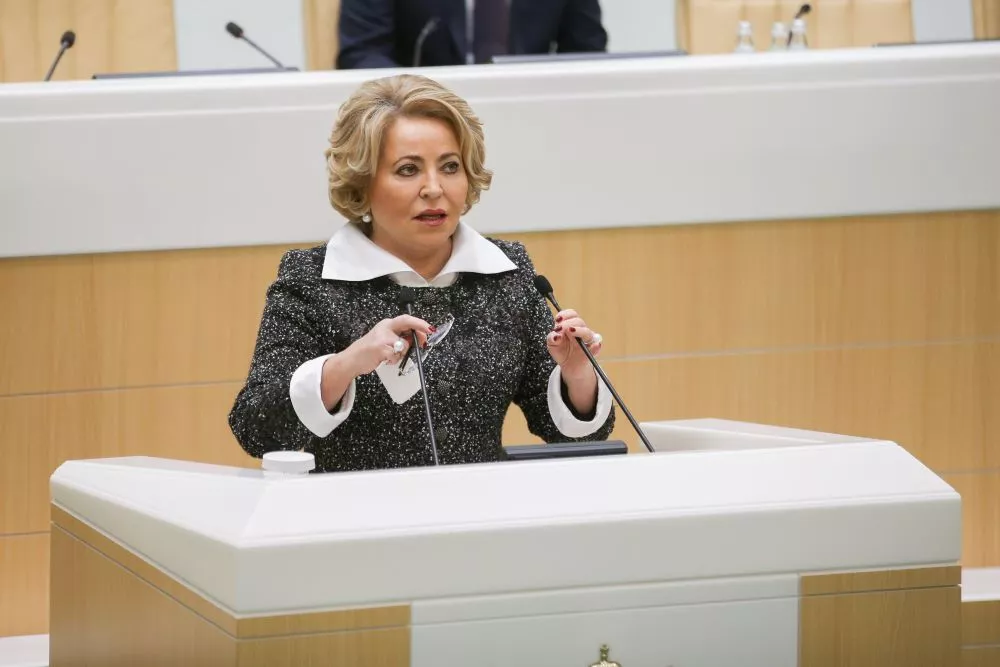
Federation Council Speaker Valentina Matviyenko has promised that the Soviet-era law criminalizing “social parasitism” would not be revived.
And yet, the politician argues that certain categories of unemployed people should at least make contributions to the compulsory medical insurance system. The Federation Council speaker spoke about this in an interview with Moskovsky Komsomolets:
I am talking about those unemployed people who drive Mercedes, have considerable hidden incomes, and yet do not pay taxes or make contributions to the compulsory medical insurance system. Or those, for example, who let their flats in downtown Moscow for 200,000 rubles a month [approx. 2,200 euros], but “on paper” claim that they rent it out for 10,000 rubles a month [approx. 110 euros]…. The tax service should identify such unscrupulous citizens and flush them out of the shadow economy and shadow incomes…. Workers, teachers, and doctors should not have to pay for young, healthy people who are under no obligation to society.
According to Matviyenko, forcing such citizens to be involved in the compulsory medical insurance system is fair because it is impossible to live in society and be free from it. She noted that teachers, doctors, workers, and others should not have to pay for healthy citizens without fixed employment.
This is not the first time Matviyenko has voiced the idea of collecting health insurance contributions from the unemployed: she has said that paying 45,000 rubles a year [approx. 500 euros] is quite affordable.
Surveys show that most Russians oppose a tax on social parasitism.
“Social parasitism” was a criminal offense in the USSR from 1961 to 1991. People who were unemployed without a valid reason could be sentenced to corrective labor, exile, or imprisonment. Citizens engaged in shadow private business were often prosecuted on this charge. The poet Joseph Brodsky was also convicted of “social parasitism.”
In 1964, when Joseph Brodsky was 24, he was brought to trial for “social parasitism.” In the view of the state, the young poet was a freeloader. His employment history was spotty at best: he was out of work for six months after losing his first factory job, and then for another four months after returning from a geological expedition. (Being a writer didn’t count as a job, and certainly not if you’d hardly published anything.) In response to the charge, Brodsky leveled a straightforward defense: he’d been thinking about stuff, and writing. But there was a new order to build, and if you weren’t actively contributing to society you were screwing it up.
Over the course of the trial he stated his case repeatedly, insistently, with a guilelessness that annoyed the officials:
BRODSKY: I did work during the intervals. I did just what I am doing now. I wrote poems. JUDGE: That is, you wrote your so-called poems? What was the purpose of your changing your place of work so often? BRODSKY: I began working when I was fifteen. I found it all interesting. I changed work because I wanted to learn as much as possible about life and about people. JUDGE: How were you useful to the motherland? BRODSKY: I wrote poems. That’s my work. I’m convinced … I believe that what I’ve written will be of use to people not only now, but also to future generations. A VOICE FROM THE PUBLIC: Listen to that! What an imagination! ANOTHER VOICE: He’s a poet. He has to think like that. JUDGE: That is, you think that your so-called poems are of use to people? BRODSKY: Why do you say my poems are “so-called” poems? JUDGE: We refer to your poems as “so-called” because we have no other impression of them.
Brodsky and the judge were (to put it mildly) talking past one another: Brodsky felt his calling had a value beyond political expediency, while the judge was tasked with reminding him that the state needn’t subsidize his hobby if he wasn’t going to say anything useful. But the incommensurability of these points of view runs much deeper than this one case.
Flowers laid at the site where the antifascist Timur Kacharava was murdered: a photoreportage by Bumaga
Twenty years ago, neo-Nazis assaulted Timur and his friend Maxim Zgibay outside the Bukvoyed bookstore on Vosstaniya Square. Today [13 November 2025] a spontaneous memorial arose there once more.
The murder: On 13 November 2005, Kacharava received six stab wounds to the neck and died on the spot. Zgibay was hospitalized in critical condition. Alexei Shabalin, found guilty of Timur’s murder, was sentenced to twelve years in a penal colony. Four of the assailants were sentenced to terms of imprisonment ranging from two to twelve years, while the other three were given suspended sentences.
The plaque: Nearly every year, the inscription “TIMUR, WE WILL ALWAYS REMEMBER YOU” appears on the wall of the building next to the murder site. Today, Yabloko party chair Nikolai Rybakov sent an appeal to [St. Petersburg] Governor Alexander Beglov, urging him to install a permanent memorial plaque marking the spot of Kacharava’s violent death.
The film: Leftist organization RevKomsomol – RKSM(b) has released the trailer of an upcoming film with the working title Antifascists by Calling. The film is being produced with the support of the creative association RevKino, RKP(i), and the nonprofit initiative Food Not Bombs.
Leningrad, 1987. Donald Trump and his first wife, Ivana Zelníčková.
The businessman visited the USSR with his wife hoping to make real estate deals, but was confronted by Soviet laws which did not permit foreigners to own more than a 49% stake in a business venture.
So, no deals were made, and Trump was left disappointed by the Soviet system. But he was impressed by the architecture.
Tomorrow, the current U.S. president and Vladimir Putin will meet in Alaska, formerly Russian territory.
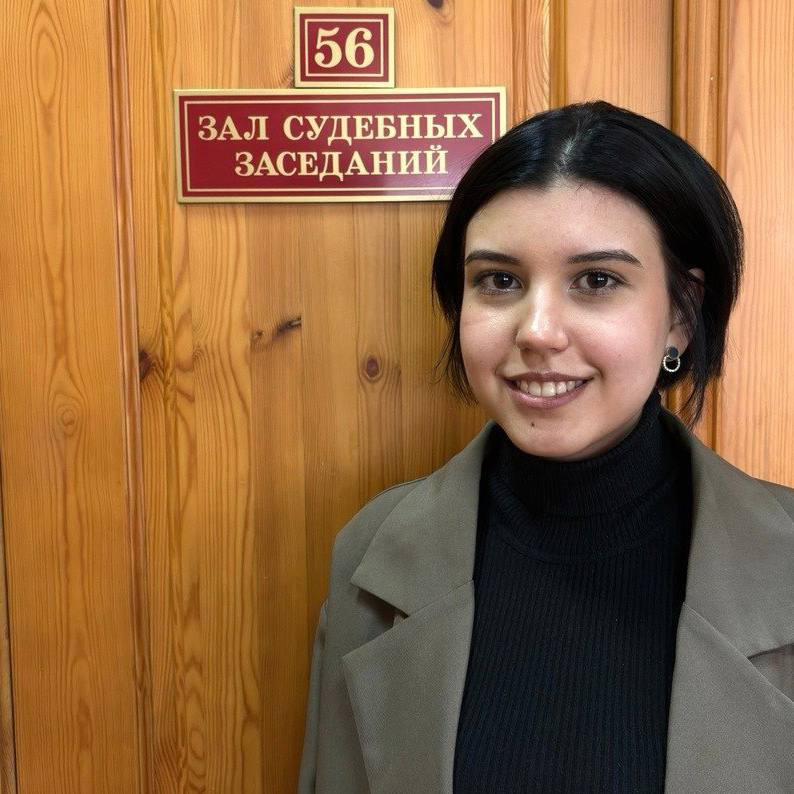
Twenty-two-year-old Yulia Moskovskaya (née Joban) was detained in Petersburg in mid-June. She is suspected of attempting to carry out a terrorist attack against a drone design company employee. She failed to plant an explosive device [sic], according to the press service of the Petersburg municipal courts.
Moskovskaya was remanded in custody to a pretrial detention center. Investigators say that she “espouses a pro-Ukrainian ideology and is hostile to the current Russian government,” and claim that the young woman tried to “impact decision-making” by means of a terrorist attack. Criminal terrorist cases are opened every month, but usually they do not involve harm to specific people. In 2024, seventy-five people, including ten women, were convicted in Russia for carrying out terrorist attacks.
Bumaga has learned that Moskovskaya is not speaking with her family, and that a female friend of her has become her spokesperson. We chatted with this young woman about how the suspect behaved before her arrest, how she got into debt, and when she moved to Petersburg.
The detainee’s family: “Yulia changed her surname: she didn’t want anything to remind her of her kin”
Yulia and I are quite close friends. Her lawyer informed me of her arrest. I was shocked when he contacted me. At first I thought it was some kind of prank. I still can’t believe it has really happened.
I have known Yulia since 2017. We are from different cities and met online in a fan group for our favorite singer. At first, we were pen pals, but then we took our relationship offline and saw each other in person many times.
Yulia wasn’t in touch with many people, so she must have given the lawyer my contact info. She didn’t have many friends. Yulia didn’t speak with her relatives. She has a mother and a younger brother [who live in Moscow], as well as her grandparents, who live in some other city.
Yulia has always had bad relations with her mother. Her mother had a live-in boyfriend who always treated Yulia badly and beat her. Her mother took the boyfriend’s side and didn’t stand up for her daughter.
Yulia Moskovskaya. Source: social media
Yulia’s father died in 2020, and Yulia didn’t have a close relationship with him either. He drank heavily. He regularly brought his drinking buddies home and would get so drunk that he couldn’t stand up. Yulia often escaped to the neighbors when her father, out of his mind, tried to beat her. When we talked on the phone, I could hear her father getting into a fighting mood; he would be saying something to Yulia, and she would scream and run off. The neighbors would even call the police, but they could calm him down only for a while, and only once did take him to the slammer. Yulia essentially had no one to whom she could turn. In difficult situations, she would call the mental health hotline.
As an adult, Yulia changed her surname [from Joban to Moskovskaya]: according to her, she didn’t want anything to remind her of her kin. She sought treatment from psychologists. In the beginning, she had hope that they would help her, but then she just went to them to get things off her chest.
Debts and the move from Moscow to Petersburg: “Creative work was her only stable hobby”
Three times, Yulia enrolled in different [institutions of higher learning]. But she wouldn’t like something about them and would drop out. For a while, she was studying to be a designer. I don’t remember what her other two majors were.
A few years ago, Yulia moved for the first time from Moscow to Petersburg: she had always liked the city. You could say that she flitted between the two capitals.
Yulia originally had her own place to live. After his death, her father left his children an inheritance. Yulia and her brother sold her father’s flat in Moscow and split the money, so she was able to buy her own place in Petersburg. She lived there for a few months, but got bored and bought a flat in another neighborhood. After a while, she went back [to Moscow], buying a flat in the Moscow Region. Soon afterwards she sold her last home and went back to Petersburg, where she lived in a rented flat.
Yulia often changed jobs. The first place she worked was McDonald’s, before it left Russia. She stayed at that job for several years. After that she worked as a courier, then as a consultant in a store. Almost every month she would change jobs if she wasn’t satisfied with something. She didn’t regard any of her jobs as permanent. She said that she would soon leave [Russia] and that she only needed temporary, part-time work.
Yulia Moskovskaya. Source: social media
I know that Yulia had outstanding loans and that she didn’t have enough money to live on. She said that she had been sued by debt collectors. (In May 2025, a Moscow court ruled in favor of debt collectors trying to recover debts from Moskovskaya under a loan agreement — Bumaga.) She had spent the money on surgery [not covered under free public healthcare], and on braces.
Yeah, she’s not a very steady person. She gets bored with things quickly. Creative work was her only stable hobby. (On social media, Moskovskaya followed a lot of literature and Silver Age poetry groups — Bumaga.) She drew and wrote poems. Recently, she had been making her own jewelry and trying to sell it.
Moskovskaya’s views and her abandoned cat: “Before her arrest, she said she wanted to go to the war”
When the war broke out, Yulia immediately supported Ukraine. She said that she didn’t like the regime in Russia. She had a very firm stance. But I wouldn’t say she was always interested in politics. Before the war, I hadn’t noticed that she followed the news. I was surprised when she suddenly became politicized. Moreover, she has no Ukrainian relatives.
Before her arrest — since last summer — she had been saying that she wanted to go to the war. She mentioned that she had visited military enlistment offices and contacted people who could help her get to Ukraine, but everyone, according to her, had turned her down. I tried to warn her about the consequences: what if she died or something? She replied that she didn’t care, that this was her purpose in life and that such a death would be an act of heroism.
All last month, she kept saying that she would be leaving Petersburg for Ukraine and that some people would help her do this.
When Yulia was detained, I was allowed to speak with her for literally several seconds. The only thing she said was that I should go get her cat, which had been temporarily placed in a shelter.
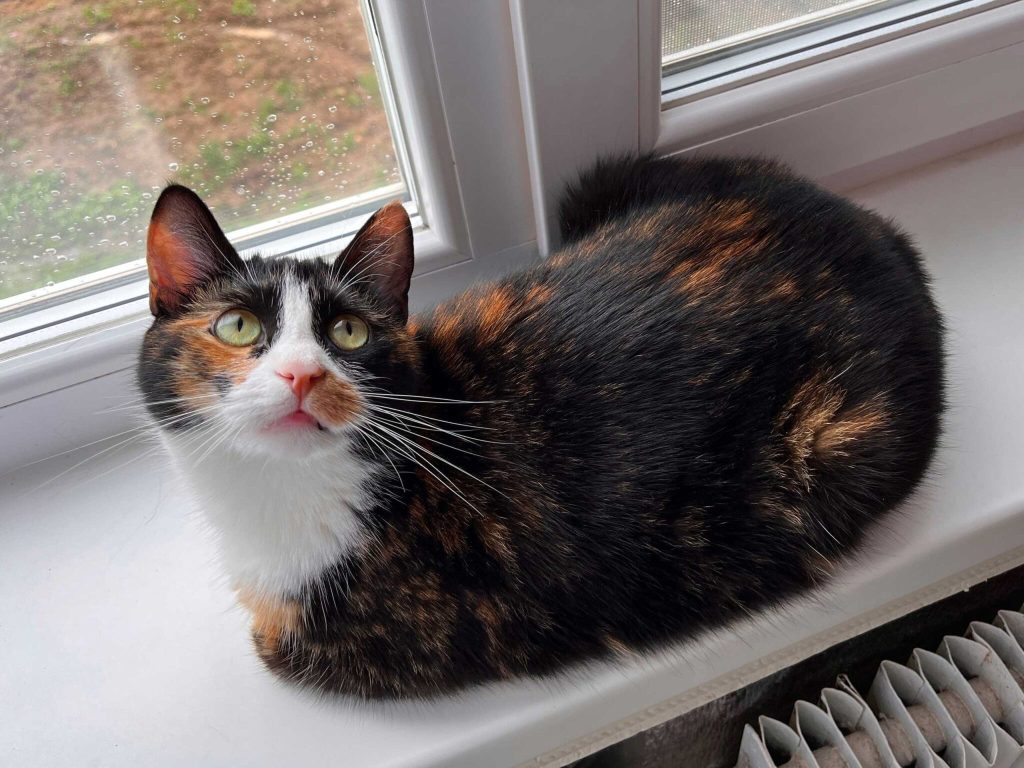
Yulia Moskovskaya’s cat. Source: social media
I had imagined that Yulia would be hysterical, panicked. According to her lawyer, however, she is surprisingly calm.
The European University at St. Petersburg has purchased and dispatched a UAZ vehicle to the war in Ukraine “for transporting the wounded in the combat zone,” the university’s press service has reported.
It notes that the vehicle was sent to Military Unit No. 11076, which was formed from mobilized residents of St. Petersburg, the Leningrad, Murmansk, and Arkhangelsk regions, and the Komi Republic.
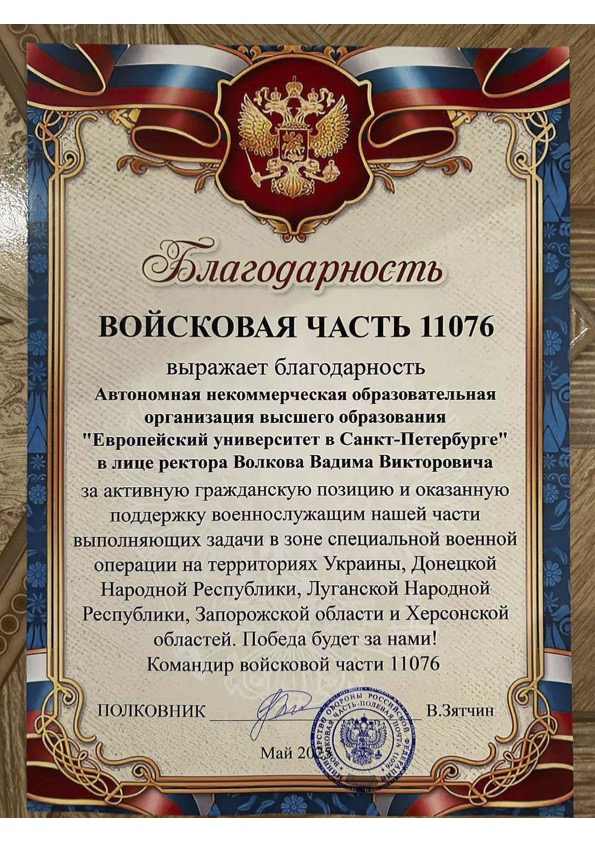
The university’s press service posted a commendation to university rector Vadim Volkov from the unit’s commander, who praised Volkov for his “social activism” and support of the military “as it carries out missions in the special military operation zone in Ukraine, the Donetsk People’s Republic, the Luhansk People’s Republic, the Zaporizhzhia region, and the Kherson region.”
“Military Unit No. 11076 expresses gratitude to the autonomous noncommercial higher education organization ‘European University at St. Petersburg’ in the person of Vadim Viktorovich Volkov for social activism and support rendered to the soldiers of our unit as they carry out missions in the special military operation zone in Ukraine, the Donetsk People’s Republic, the Luhansk People’s Republic, Zaporizhzhia Region, and Kherson Region. Victory will be ours! Military Unit No. 11076’s commander, Colonel V. Zyatchin, May 2025.”
The European University is a private university founded in St. Petersburg in 1994. The university was funded by grants from American and European NGOs. In 2016, the university was stripped of its accreditation for a year after an audit undertaken by the Prosecutor’s Office and Rosobrnadzor [the Russian federal education watchdog], after which such audits became routine.
In 2023, the Russian authorities audited the European University “for extremism,” and the university was also fined over books in its library published by “undesirable” organizations. Rector Volkov reported in an interview with RBC on June 24 that the prosecutor’s office had audited ninety-eight programs at the university and twelve master’s theses, after which the university had amended the programs and made changes to its academic advising process based on the recommendations of the authorities.
In March 2024, the European University fired Ivan Kurilla, an Americanist who taught in its political science and sociology departments. Kurilla opposed the Russian invasion of Ukraine and was among the signatories of an open letter against the war by Russian academics and science journalists.
Where are you from? And where are you now? Doing what?
I am from Aarhus, Denmark, and have lived in Kyiv for almost 20 years. I own a software company, Livatek, which works with clients in Northern Europe.
As a foreigner working and living in Ukraine for many years, what is the best and the worst thing about Ukraine?
The worst thing about Ukraine is that nothing is possible. The best about Ukraine is that everything in the end is possible.
How has the war changed your life? Has the war changed you personally?
With the start of the war, my brother Morten and I reactivated a Danish initiative called “Biler til Ukraine” – “Cars for Ukraine”—which had already helped a Ukrainian NGO bring SUVs to the front for medical evacuation during the war in Donbas. Within a week of the full-scale invasion in 2022, we were back in Ukraine with the first three cars.
Since then, we have scaled up tremendously and delivered more than 400 vehicles to the Ukrainian military for logistics and tactical purposes, including 75 buses for personnel transports. These days, we are managing more than one car per day. All in all, as a rough estimate, the value of these cars is somewhere close to $2 million. The money comes from absolutely average, normal Danes and private companies. I am often surprised by people’s generosity. They often donate their car and even drive it with us to Ukraine!
Growing a business has become more difficult with the war. With “Cars for Ukraine,” I have found another outlet for my professional energy to defend Ukraine. It has allowed me to work with some unique people in Denmark and Ukraine. Their strength and dedication inspire me.
What has surprised you most about Ukrainians these past couple of years? Good or bad?
I was not surprised to see the tenacity of the Ukrainians as they resisted Russia’s efforts to eradicate their culture. On the negative side—and here I am probably a bit naïve—I can still be disappointed by corruption. I know it is good news that corruption and the people who commit it are discovered and prosecuted, but I would prefer things to be nipped in the bud instead of cracked down afterward.
What are your plans?
I think I am like most Ukrainians in that “the future” does not exist anymore. We have a war to fight and win—after that, there is a future—and it is bright and open.
How do you see the war ending and Ukraine returning to a normal life?
Forces at play now do not point to a happy-end scenario for Ukraine. The dynamics need to change. Specifically, more political leaders of the West must do “a Macron” — to understand that Ukraine is fighting for every country of the liberal, Western world. (French President Emmanuel Macron underwent a radical change in his view on Russia’s war from dovish to hawkish and insisting on Russia’s defeat.) Because, honestly, for Ukraine to have a normal future, Russia not only needs to be beaten back to within its borders. It needs such an educational wacking that it will give up on its aggressive ways – and never again even consider attacking Ukraine or other states.
Tell us one thing people abroad do not know about Ukraine but they really should.
For too many centuries, Russian culture has defined itself as being unique, and outside rules and measures apply only to other countries. The mere existence of an independent Ukraine is a challenge to that myth. And, when Russia is attacking its neighbor, it is fighting its own demons and inferiority complexes.
You can learn more about the work of “Cars for Ukraine” (in Danish “Biler til Ukraine”) here.
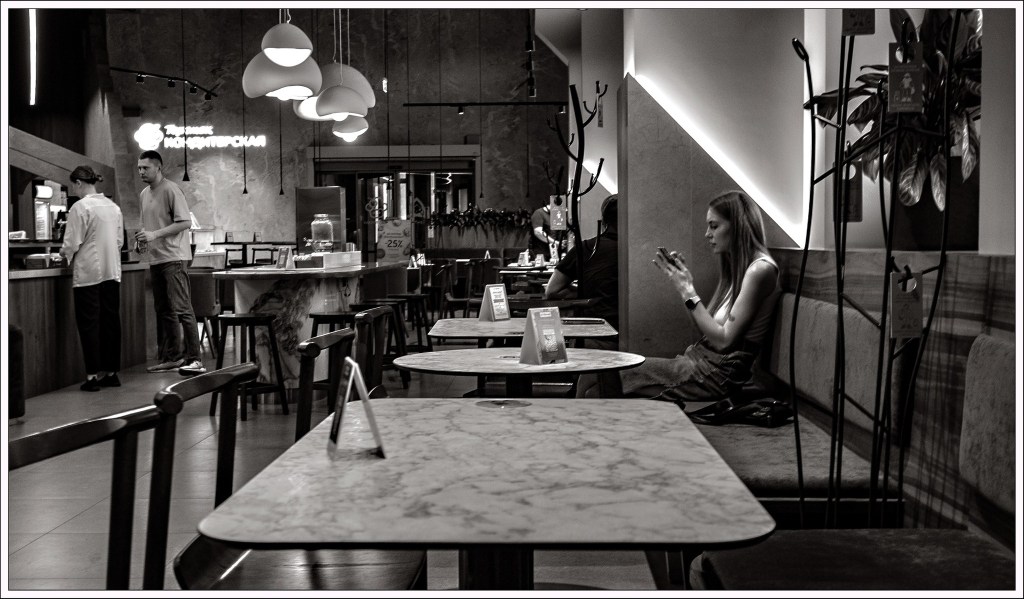
Sergei Podgorkov, A Cafe on Vasillievsky Island (St. Petersburg). Source: Facebook
[…]
Living their best life
And here, the reader will stop for a second and most likely ask the question — but what about Russians, don’t they want the war to stop?
And the answer is most likely no.
Recently, I fell into a rabbit hole, watching videos posted by ordinary Russians on Instagram. It all started when on Twitter (X), people began discussing a post by a Russian blogger who wrote that Moscow is beautiful, sprinkling it with hate speech.
The blogger, who clearly was working with the local government to promote Moscow, basically said that the Russian capital is the best city in the world because it’s clean, everyone is happy, and there are no homeless people and “LGBTQ+ propaganda.”
Displaying a rainbow flag is a criminal offense in Russia.
I went to his page and looked at the videos he was posting. And then some more videos from people living in Moscow.
For a person living in Kyiv, bombarded on a nearly daily basis, this was a very interesting dive. Watching those videos, you would never think that their country is at war.
Moscow has experienced a few waves of transformation since 2022.
Before the start of the all-out war, Moscow was thought to be the most liberal Russian city. The Russian capital harbored people with higher education and better income. Opposition activists were living their lives in Moscow cafes. Late opposition leader Alexei Navalny even once ran in the city’s mayoral election and gained a substantial number of votes.
As soon as the all-out war started, there were even some protests in Moscow, and some members of the local art and culture scene, those who traveled abroad and saw the world, were not supportive of their country’s slide into totalitarianism.
Still, Moscow was far away from the war. Cafes were still packed and people’s day to day, if they weren’t in active opposition, only changed insignificantly.
In late 2022, this changed. When Russia faced one military defeat after another, the local government was instructed to make the war felt in Moscow.
Moscow Mayor Sergey Sobyanin, who at first deliberately distanced himself from the war effort, was now traveling to the Russian-occupied regions of Ukraine, and banners depicting Russian soldiers appeared on the city’s streets.
The 2022 Russian forced mobilization campaign saw police grab people from Moscow’s streets and send them to fight in Ukraine.
Hundreds of thousands of Russians, most of them from major cities such as Moscow, left the country. Some of them for good.
Soon after that, Moscow changed once again. Since late 2023, Russia has been on the offensive. Those who were against the war or actively opposed it are no longer in the country. The Kremlin also has enough troops and hardware to continue the fight indefinitely. It doesn’t need to rely on forced mobilization — instead, it uses high wages to lure volunteers.
It doesn’t need to shove the war in the face of Moscow residents, especially those who do not care. The government is now deliberately shielding the residents of its most important metropolis from the hardships that a war can bring.
Bars, cafes, concerts, new metro stations, international football stars visiting the city, and playing friendlies with the local players who are banned from international competitions. People are living their best lives, while their compatriots, friends or even relatives are murdering civilians in Ukraine.
Watching the videos from 2025 Moscow is a surreal experience. I can’t stop thinking that it must be similar to what life was like in Berlin in 1941 for those who didn’t care about the atrocities their country was committing.
Source: Oleksiy Sorokin, WTF is wrong with Russia? newsletter (Kyiv Independent), 17 July 2025. This post is dedicated to Nan Kim, who has supported this website with a monthly donation for the last two years. I would like to apologize to her for posting so infrequently in the past few months. The work-at-home jobs which over the last eighteen years also afforded me the time and space to produce this website have dried up or disappeared altogether (along with all other donations to this website), so I have had to take work that keeps me away from home most of the day nearly every day. This extreme slowdown in producing this blog is not necessarily a bad thing for me personally. Among other things, it keeps me from asking the question Oleksiy Sorokin asks at the top of this entry: don’t Russians want the war to stop? \\\ TRR
On Friday, May ninth, Treptow Park was perhaps the most heavily guarded place in Berlin. Hundreds of police officers kept the peace at Germany’s most famous memorial to Soviet soldiers on the day Russia marked the eightieth anniversary of the end of the Second World War in Europe, known as the Great Patriotic War in the Soviet tradition. Because Russia has employed symbols of that earlier war in its current war against Ukraine, visitors were banned from displaying or wearing Soviet and Russian flags, military uniforms, and St George’s ribbons at the Berlin memorial this year. An exception was made for veterans and diplomats.
Soviet May ninth traditions and German pacifists
At about half past ten in the morning, a wreath was laid at the monument to the Soviet soldier by Russia’s ambassador to Germany, Sergei Nechayev. The day before, when Germany remembered the Wehrmacht’s surrender and the end of the war, Nechayev and the Belarusian ambassador were not invited to the memorial event at the Bundestag. In his speech, German President Frank-Walter Steinmeier thanked the Allies for liberating his country and recalled the Red Army’s sacrifices, but harshly criticized Russian attempts to justify the war in Ukraine in terms of the fight against the Nazis in the Second World War.
The flood of people in Treptow Park seemed endless: hundreds were there at any one time, and thousands came and went over the course of the day. Many brought scarlet carnations, while some bore wreaths. Russian and German were heard. Most of the visitors were elderly—immigrants from the former USSR living in Germany and Germans. There were also many leftist and ultra-leftist German political activists brandishing placards opposing NATO and calling for “peace with Russia.”
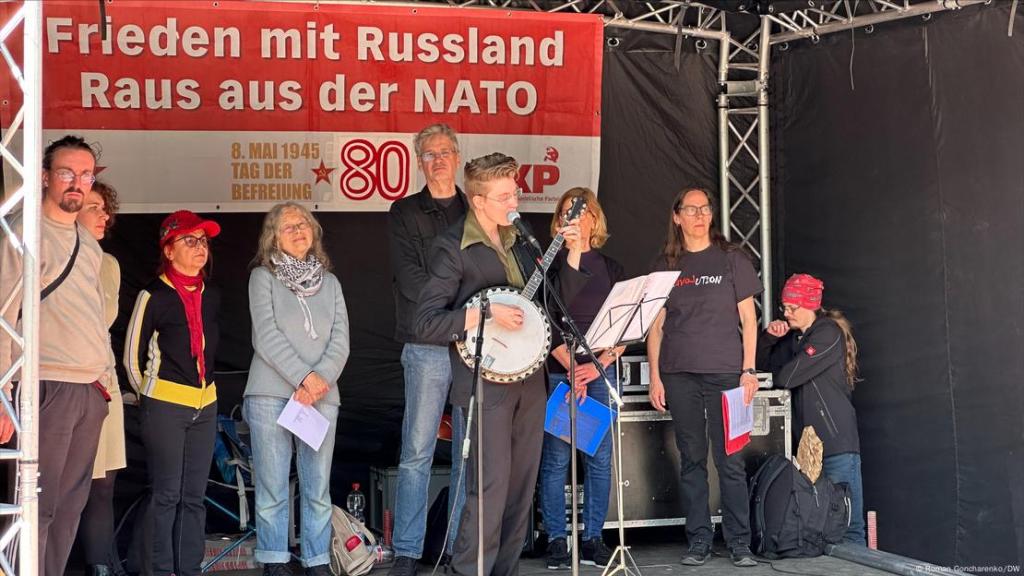
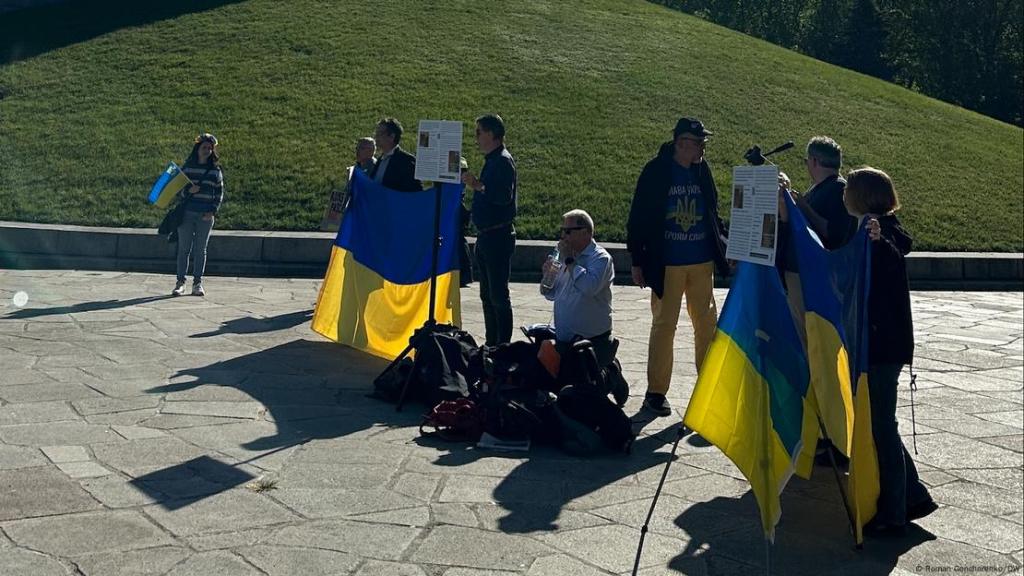
German ultra-leftists rally for “peace with Russia” and Germany’s exit from NATO, 9 May 2025. Photo: Roman Goncharenko/Deutsche Welle
Against this backdrop, the scene resembled a mixture of a traditional Russian May ninth celebration and a political protest by German pacifists, many of whom had clearly lived most of their lives in the GDR.
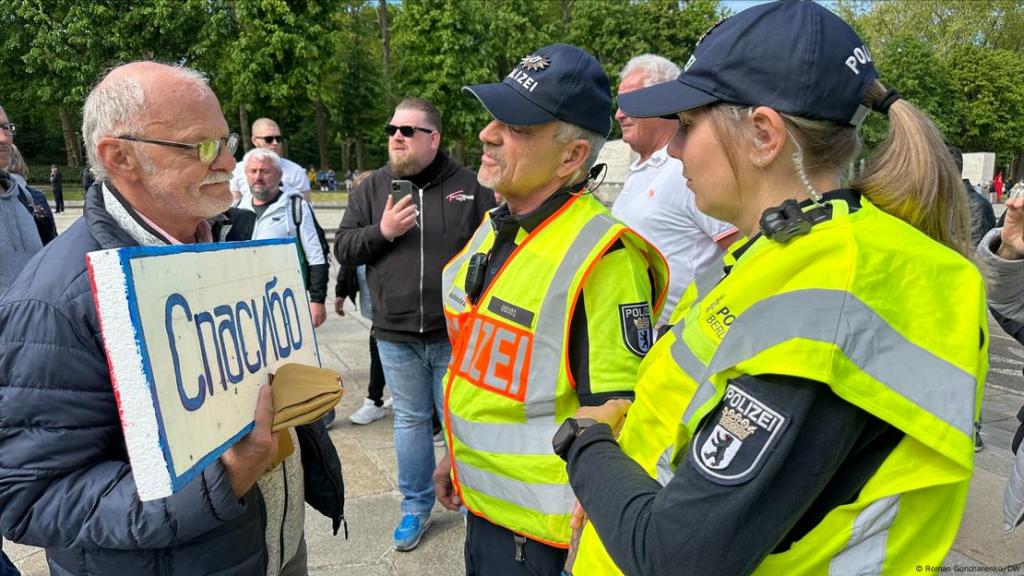
“I was a policeman in the GDR,” said a man in his sixties who held a placard that read “Thank you” in Russian. The policemen asked him to doff his Soviet cap, which sported a red star and a St. George’s ribbon.
“All people want peace, so the politicians should don their own military uniforms and crawl into the trenches,’ the man said.
Soviet wartime songs sounded from loudspeakers and were played live. One man, aged forty-five, climbed atop a mound to get a better view, but a policeman asked him to get off the lawn, explaining, “This is a grave.” The man cursed in Russian but climbed off the mound.
Another man played played “Arise, Great Country” on his clarinet. When he began quietly playing the melody of the Soviet and Russian national anthem, the police literally took him aside, after which he returned to the group of people who had gathered. They were outraged at the restrictions that had been adopted. From time to time, someone chanted “Russia, Russia!” and many other people would join in.
An ex-East German police office (holding a sign that says “Thanks!” in Russian): “All people want peace.” Photo: Roman Goncharenko/Deutsche Welle
Bikers in Treptow Park
Your correspondent saw men and a woman in leather jackets who looked like bikers from the Russian motorcycle gang Night Wolves. They were in small groups and were escorted by a large number of police officers. They posed for pictures in front of the wreaths and left. They could have been someone from a local “support group.” The Berlin press had written that only a small group of bikers made the trip to Berlin to visit the Soviet memorials this year. No incidents had been reported as this article went to press.
Treptow Park, 9 May 2025. The crimson and gold banners at the back of the crowd are inscribed with the names of the various “fronts” in the Red Army’s campaign against the Wehrmacht. Photo: Roman Goncharenko/Deutsche Welle
For the first half of the day, at least, things seemed relatively calm. Your correspondent had the impression that most people had come to Treptow Park not for political reasons, but to commemorate the war. And yet the atmosphere was tense. To the right and left of the monument to the Soviet warrior stood a dozen and a half activists holding placards and the flags of Ukraine and NATO.
Activists with placards and Ukrainian flags at the monument to Soviet soldiers in Treptow Park, 9 May 2025. Photo: Roman Goncharenko/Deutsche Welle
They said they wanted to draw attention to the Ukrainian Red Army soldiers who had perished in the Second World War, as well as to Russia’s war against Ukraine.
“I am here to prevent this event from being turned into a Russian propaganda stunt,” said a woman, aged thirty-five. According to her, insults had been hurled at her and the pro-Ukrainian activists.
“Some people regard our presence here as a provocation,” said the woman. “We are not here to change anyone’s mind, but to make Ukraine visible.”
One of their posters read: “Russia has usurped the memory of May eighth and ninth. But it was not Russia who liberated us from the yoke of National Socialism eighty years ago in Berlin. It was the Red Army, in whose ranks many Ukrainians served.”
The poster tells the story of Ukrainian soldier Fyodor Karpenko, who left his name on the walls of the destroyed Reichstag building in May 1945.
Since the Maidan uprising and Russia’s illegal annexation of Crimea in 2014, Kremlin propaganda has consistently portrayed Ukrainian leaders as Nazis or fascists. Russia also accused the Ukrainian authorities of “genocide” of the population of Donbass. On 24 February 2022, while announcing the full-scale invasion, the “denazification” of Ukraine was presented as the primary goal of the war, which is itself portrayed merely as a continuation of the Great Patriotic War: a conflict embedded in a cyclical conception of time in which Russia, eternally under threat from a Western enemy, fights for its very survival — on Ukrainian soil.
On the ground, there is no evidence to support Moscow’s accusations: nobody has ever documented a “genocide” against ethnic Russians or Russian speakers, whether in Ukraine or elsewhere. As for the Ukrainian far-right, its political influence remains minimal: in the 2019 parliamentary elections, the main ultra-nationalist parties, running together on a joint list, received just over 2% of the vote, well below the threshold required to enter Parliament. In short, the image of a “Nazi regime” in Kyiv is based on a glaring mismatch between rhetoric and reality.
So why do the Russian authorities repeatedly invoke references to the Second World War — or, in Russian parlance, the “Great Patriotic War” — when speaking about Ukraine? Understanding this memory dynamic is essential to grasp the power of a rhetoric that, despite lacking any factual basis, continues to shape the official Russian worldview.
The Soviet and Russian insistence on using the term “Great Patriotic War” to refer exclusively to the period from 1941 to 1945 erases the twenty-one months that preceded Nazi Germany’s invasion of the USSR. Between the Molotov–Ribbentrop Pact of August 23, 1939, and Operation Barbarossa on June 22, 1941, Moscow and Berlin were de facto allies: they engaged in extensive economic cooperation, diplomatic coordination, jointly invaded and partitioned Poland in September 1939, and the Soviet Union proceeded to annex the Baltic countries and wage war against Finland. By reducing the war to the period 1941–1945, the USSR and Russia could deny any responsibility in the outbreak of the Second World War and present itself solely as the victim of Nazi aggression and the primary liberator of Europe.
The Great Patriotic War — and especially the victory in 1945 — became the founding event of Soviet history and the cornerstone of collective memory. Yet this memory, often portrayed as monolithic and universally shared, is anything but uniform. A Ukrainian from the west, who endured two successive occupations between 1939 and 1944, remembers a war very different from that of an eastern Ukrainian, whose experience was shaped primarily by Nazi destruction. The memory of a Russian bears little resemblance to that of a Crimean Tatar, who was deported along with his entire community and denied the right of return for decades. As for Soviet Jews, whose families and communities were annihilated in the Holocaust, they were long forced to remain silent — official narratives left no room for the specificity of their suffering.
The collective experience of the war and the official discourse surrounding it deeply reshaped the Soviet population’s understanding of “fascism” and “antifascism.” Rather than referring to a specific political doctrine of the inter-war period, the term “fascism” had become a catch-all label for the ultimate enemy. Trotsky or the British Conservatives could just as easily be branded as “fascists,” as well as domestic and international opponents after 1945 — including even the Chinese Communists. The word “Nazi” itself was rarely used. In everyday life, calling someone a “fascist” served more as the gravest possible insult rather than as a statement of ideological substance.
Under Vladimir Putin, the cult of the Great Patriotic War has been revived. Following the pro-democracy protests of 2011 and Putin’s bid for a third presidential term in 2012, the regime instituted a deliberate policy of historical narrative construction, aimed at grounding its legitimacy in a vision of the nation as under siege. The glorification of the 1945 victory also allowed the regime to purge collective memory of its specifically socialist elements: by retaining only the narrative of national triumph, the Soviet period could be seamlessly integrated into a continuous national history without any revolutionary rupture. At the same time, the rehabilitation of Joseph Stalin as a legitimate victor served to validate autocracy. The mass repressions and genocidal policies that claimed millions of lives were reframed as a tragic but necessary step: they had made the USSR a global superpower, capable of defending civilization against the “brown plague.”
The Kremlin has multiplied its legal instruments to enforce this narrative. Since 2020, the Russian Constitution mandates “respect for the memory of the defenders of the Fatherland” and prohibits “diminishing the importance of the heroism” of the Soviet people. In April 2021, Putin signed a law increasing penalties for “insults” or “false claims” about the Second World War and its veterans. In December 2019, Putin himself gathered some leaders of post-Soviet states around a pile of archival documents that he said proved historical truths long ignored in the West — selectively quoting them to justify, in retrospect, the USSR’s annexation of Poland and the Baltic states. In this way, Putin has weaponized history, which has become inseparable from national interest. To challenge his interpretation is tantamount to treason.
Every year on May 9, Russians march in the Immortal Regiment carrying portraits of relatives who fought between 1941 and 1945. Increasingly, the faces of those who fought — or died — in the war against Ukraine are added to these ranks, as though both wars were part of a single, endless struggle. Past and present warfare are merged, and the victory of 1945 becomes the lens through which all events — past, present, and future — are interpreted in a continuous historical timeline. This symbolic fusion also explains the surreal images of Russian occupation forces who, in recent weeks, have placed propaganda banners in destroyed Ukrainian cities. An uninhabitable Bakhmut was transformed into a stage for celebrating the 80th anniversary of Russia’s victory in the “Great Patriotic War.”
The cult of victory is not only a central element of the Putinist imaginary — it functions as an operating system for both domestic governance and external aggression, with all of Russia’s actions on the international stage framed as part of an eternal war against fascism. A telling example of this is the installation of a giant screen on the Estonian border, broadcasting Victory Day celebrations in a loop — an attempt to remind Estonians, as well as Latvians and Lithuanians, that the Soviet victory represents an unassailable moral superiority. In the Russian collective imagination, the word “fascism” has lost all connection with a specific political ideology and now refers only to an abstract, absolute threat: the desire to destroy Russia. It has become synonymous with “enemy” or “Russophobe,” always denoting the Other, never a historically defined movement. This separation between word and meaning allows the regime to simultaneously glorify the antifascist victory and openly promote xenophobic, homophobic, or ultraconservative rhetoric, without any perceived contradiction.
The word “denazification,” used by Vladimir Putin on February 24, 2022, to justify the invasion, initially puzzled many Russians, most of whom were unfamiliar with the term in this context. Shortly afterwards, the state news agency RIA Novosti published an article by Timofey Sergeytsev — “What Russia Should Do with Ukraine”— aimed at clarifying its meaning: “denazification” was described as a “total cleansing,” targeting not only alleged Nazi leaders but also “the popular masses who are passive Nazis,” deemed guilty of having supported the “Nazi government.” According to Sergeytsev, modern Ukraine is able to hide its Nazism behind aspirations for “independence” and “European development.” To destroy this Nazism, he argues, is to “de-Europeanise” Ukraine. In this logic, denazification becomes synonymous with eliminating all Western influence from Ukraine and dismantling the country’s existence as a nation-state and a distinct society. Incubated on official state platforms, this narrative reveals the true scope of “denazification”: a large-scale project aimed at erasing any trace of Ukrainian singularity, a blueprint for the genocide.
The article recently published on the official website of the Russian Foreign Intelligence Service (SVR), entitled “Eurofascism, Today as 80 Years Ago, Is a Common Enemy of Moscow and Washington,” strikingly illustrates the expansion of the “denazification” discourse far beyond Ukraine. The accompanying image depicts a grotesque hybrid monster: its body is shaped like a black swastika with the EU’s circle of stars in the centre, while its head is a caricature of Ursula von der Leyen. The creature, with its blood-stained claws outstretched, is caught between two bayonets — one American, the other Russian/Soviet. This grotesque image is not merely a provocation: it reflects a narrative deeply entrenched in Russian state propaganda, where “Eurofascism” becomes an operational concept encompassing all European societies.
“Eurofascism, Today as 80 Years Ago, Is a Common Enemy of Moscow and Washington.” Screenshot courtesy of Meduza
The 2022 tipping point revealed these discourses for what they truly are: the ideological foundation of a large-scale invasion, long prepared within the informational sphere. Today, part of European society — particularly elements of the pacifist left — is falling into the same trap: underestimating or ignoring the ongoing propaganda dynamic. But the machine is already in motion. The language of fascism is being broadened daily to include new designated enemies, and the ideological war is shifting: it is no longer stopping at Ukraine — it is now targeting all of Europe. In the face of this brutal reconfiguration of the official Russian narrative, complacency or passivity have themselves become forms of strategic blindness.
Russia’s consolidated military registration registry website, Reestrpovestok.rf, is fully operational. On Friday, 9 May 2025, the human rights project Get Lost, which helps Russians avoid conscription into the army, reported that the notifications that it was operating in test mode had disappeared from the website, and the online resource appeared to have been fully launched.
Upon arrival on the website, users can log in to their personal accounts, check summonses, and obtain copies of records. Earlier, the website indicated that it was functioning in beta mode only in three regions—Sakhalin, Ryazan, and the Republic of Mari El. This notification has now disappeared.
“So far no one who has received a summons through this site or faced automatic restrictions has contacted us,” the human rights activists added. The registry’s launch has not been officially announced.
Recipients of summonses to face restrictions if they fail to report to military recruitment center
The law establishing a consolidated registry of persons subject to conscription and introducing electronic summonses was signed by Russian President Vladimir Putin in April 2023. The text of the document, in particular, states that conscripts who do not report to a military enlistment office within twenty days of receiving a summons may be prohibited from registering as an individual entrepreneur, registering vehicles and real estate, driving a vehicle, and getting a bank loan. In addition, they will not be able to leave Russia until they report to a military enlistment office.
A screenshot of the military enlistment summons website, outlining the penalties imposed on Russians who fail to respond.
The full-fledged launch of the electronic summonses registry was planned for last autumn, but was subsequently postponed.
The registry contains data on all Russian nationals who are already registered and are subject to military registration, as well as those who are not yet registered but are obliged to do so. Lawyers stress that the law and the decree apply to the delivery of any summonses, both for compulsory service and to clarify military registration status, and as part of the wartime mobilization, which Putin has not yet signed a decree to end.
This data will be collected from military enlistment offices. The decree digitizing their databases was signed by Putin back in November 2022. As Defense Ministry officials told the Federation Council, various databases are used for this purpose, including those of the Interior Ministry, the Federal Tax Service, civil registries, and pension funds.
In the wee hours of Sunday, 4 May, Russian security forces raided concerts in St. Petersburg and Yekaterinburg, at which, among other things, they asked attendees about their attitude to the war, local media have reported.
In Yekaterinburg, law enforcement officers interrupted a concert at the club Syndrome. As the musicians were performing, people in uniform came on stage, halted the concert, and asked the concert organizers to turn on the lights, concertgoers told the Telegram channel Svet. Ekaterinburg.
“People were ordered to stand facing the walls and told that there would be a document check. [The police] checked everyone’s documents, tattoos, and elbows, asked about their attitudes to left-wing radical movements and to the SMO (the war in Ukraine—ed.), and they checked the messenger apps on their phones. After the check, people were taken outside and ordered to scram,” said one of the guests.
Another clubgoers told the news website E1.RU that police locked him in a paddy wagon, confiscated his phone, and checked his contents. Police insulted the detainee and refused to explain the reasons for the check. According to eyewitnesses, police and Russian National Guard officers took part in the raid. Those agencies declined to comment on this report.
Regular raids by law enforcers in Russia
In St. Petersburg, law enforcers raided a rave party at the [underground] club Kontrkult. A source close to the police told Ren TV that the reason for the raid was that the event had not been “sanctioned.” According to the news website 78.ru, partygoers had their documents checked and were searched for banned substances. The publication adds that the event’s organizers were detained. This has not been officially confirmed.
Footage of the raid on Kontrkult, as posted on the Telegram channel SHOT
Similar raids on various establishments have happened regularly in Russia in recent months. Law enforcers have carried out several raids on fitness centers, in which people were issued military conscription board summonses. Similar raids have been carried out against migrant workers, who also had their documents checked and summonses handed to them, along with members of the LGBT community, who have been declared “extremists” in Russia.
💬 Student from Nizhny Tagil fined 120,000₽ in criminal “defaming” case
In Nizhny Tagil, 21-year-old student Yekaterina Sergeyenko has been sentenced for “defaming” [the Russian army]: she was fined 120,000 roubles [approx. 1,280 euros]. According to the news agency Mezhdu Strok (“Between the Lines”), criminal charges were filed over the young woman’s comments in the “Incident Nizhny Tagil” group on the social network VKontakte.
Vechernye Vedomosti reports that at the time she posted the comments, Sergeyenko had a prior administrative conviction for painting sixteen pacifist slogans on buildings in the city. This fact influenced the decision to file criminal rather than administrative charges against her.
Judge Oksana Belkina of the Tagilstroy District Court found Sergeyenko guilty. Although the verdict has not yet entered into legal force, the fine, according to Mezhdu Strok, has already been paid.
“We love and miss Berlin so much that we decided not to wait until we find ourselves there again . . .” Samotechnaya Square, Moscow, April 2025. Photo: anatrrra (used with their permission)
Despite being hit with unprecedented Western sanctions, the war with Ukraine has been accompanied by a noticeable increase in the well-being of Russians. A new study has revealed the extent of the domestic feel-good factor, with economists at the Bank of Finland Institute for Emerging Economics (BOFIT) finding the level of Russians’ satisfaction with their household and personal circumstances has hit its highest in a decade.
To understand how the restructuring of Russia’s economy during wartime affected Russians, economists Sinikka Parviainen (BOFIT) and William Pyle (Middlebury College, USA) used data from the Russian Longitudinal Monitoring Service (RLMS), which has been conducted by the Higher School of Economics almost every year since the 1990s. This research tracks the economic well-being of Russian households and individuals with a sample size of around 6,000-8,000 households and 17,000-21,000 people.
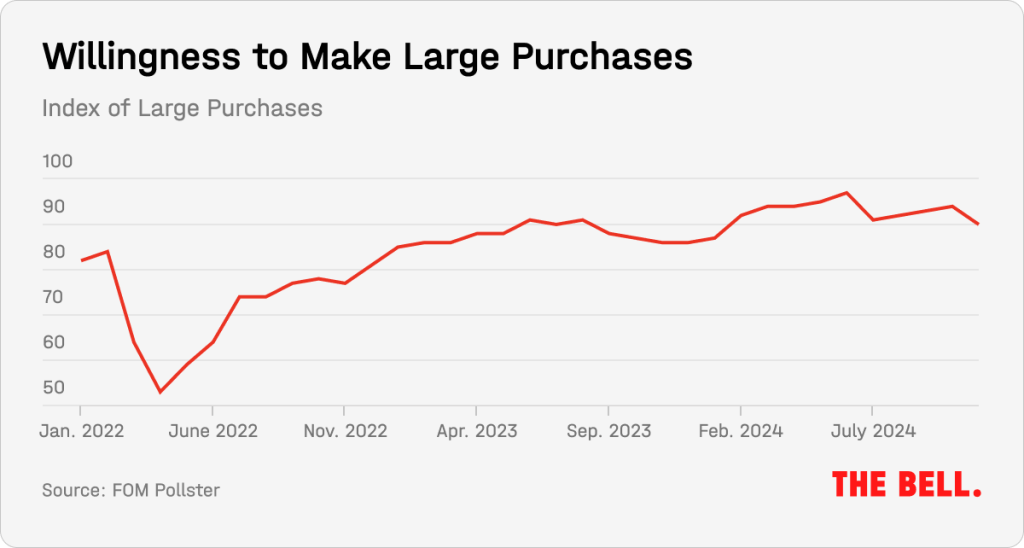
The economists looked at RLMS data from 2013-2023, scrutinising responses to the questions: “how satisfied with life are you right now?” and “how satisfied with your financial circumstances are you right now?”. They also looked at whether households had made large purchases over the past year, how much they spent on cultural events and how long they could maintain their current lifestyle if they lost their main source of income.
They concluded that the first two years of Russia’s invasion — 2022 and 2023 — saw the highest levels of general satisfaction, and specific financial satisfaction had also returned to 2014 levels for the first time. That year is seen as a benchmark before Russia was plunged into an economic crisis following the annexation of Crimea, imposition of Western sanctions and an oil price crash.
Large purchases fell to a minimum in 2022 but demand for non-food goods has since increased faster than inflation and wages, in line with The Bell’s earlier calculations. There was also a sharp rise in the proportion of households spending money on entertainment: in 2023 this reached 2018 levels, the researchers noted. The number of respondents who said they would be able to last more than a few months on their savings reached a 10-year high.
These findings correspond with Russia’s official statistics which also point to improved financial circumstances since the start of the war. In 2023, real incomes in Russia not only returned to 2013 levels after a decade of lost living standards, but surpassed the pre-Crimea level by 5%, the researchers highlighted.
There are no surprises as to the cause — a huge increase in state spending on the invasion and the military-industrial complex that has driven record labor shortages and pushed wages up across the economy. The high salaries offered by the state to people sent to work at the front, as well as those paid to soldiers (from 200,000 rubles a month) have played a big part, and the main winners have been residents of Russia’s poorest regions, which have recorded an unusually sudden increase in bank deposits.
Why the world should care
Putin’s regime is unlikely to face any internal threat as long as Russians’ well-being and overall happiness is on the rise.
KVS, “SouthTown: The Olympic Quarters” (YouTube, 8 June 2021)
Today’s developers pay no less attention to creating comfortable residential environments in their projects than they do to configuring apartments, for example, and sometimes they pay even more attention to this.
In recent years, the concept of beautifying the area around residential buildings has been transformed from elementary landscaping of yards and equipping playgrounds to creating theme parks within residential complexes, divided into different activity zones, as well as designing additional spaces where residents of the neighborhood can gather, get acquainted, relax, play sports, and organize their own or their children’s leisure activities.
The role of such spaces is most often played by neighborhood centers, and planning these centers has recently become a real trend among developers.
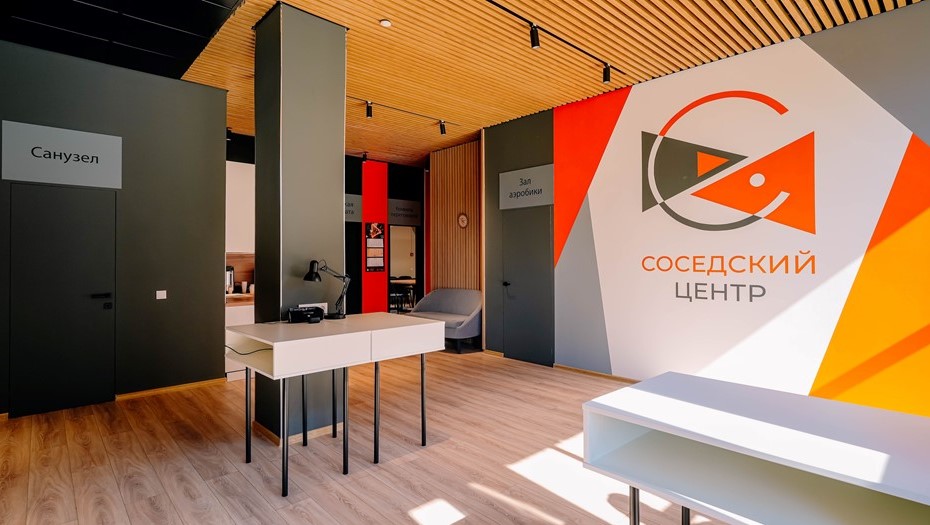
The neighborhood center at the SouthTown development, designed by Anton Rudnik. Photo: KVS Group, via Delovoi Peterburg
The reasons
Residents of apartment buildings have always needed to socialize and spend time together. Back in Soviet times, people would often gather in courtyards to play dominoes, bingo, and table tennis. At some point the tradition was lost, but after the restrictions imposed during the Covid-19 pandemic were lifted, it literally sparkled with new colors.
In their article [sic: no link in the original] on communities, neighborhoods, and neighborliness, researchers from the Higher School of Economics noted that the first contemporary attempts to unite people living near each other into groups were especially noticeable after 2015, when people all over Russia began celebrating Neighbors Day. From a holiday in the classic sense of the word, Neighbors Day has quickly evolved into a multifaceted know-how for working with residents and getting them involved in such community work as spring cleanups and decorating yards for the New Year’s holidays.
With the emergence of urban agglomerations and the integrated development of new estates by developers, the need for communication among the people living there has increased. There is a logical explanation for this. In her time, Birgit Krantz, a Swedish sociologist, architect, and expert on neighborhood relations, argued that the ideal apartment complex contains between fifty to eighty apartments. If a complex has more apartments, it is difficult to manage it and maintain good neighborly relations.
There are many more apartments in new large residential projects, however, even if they are low-rise developments. This is where neighborhood centers come to the rescue. Consequently, they have become an integral part of people’s everyday lives in entire neighborhoods, functioning, per the American sociologist Ray Oldenburg, as “third places” (between home and work or school), as social anchors which facilitate creative interactions among individuals.
A clear demand
Today, the neighborhood centers running in new residential neighborhoods are literally bustling with life, and they are usually open seven days a week from early morning to late evening.
Delovoi Peterburg talked to residents at the KVS Group’s SouthTown development, where such a neighborhood center has been up and running for over six months. The center offers sports classes; clubs for children, including preschool prep; nanny services; rooms for business meetings and negotiations; and movie screenings. A puppet theater also periodically comes to the center on tour, and a planetarium was once even recreated in the space.
According to Anzhelika Alshayeva, director general of the KVS Real Estate Agency, all activities were free of charge for residents during the center’s first three months of operation; the tab was picked up by the developer. Now, the cost of classes is only 200 rubles, and the interest of residents continues to grow. With this in mind, the decision was made to launch the second stage of the neighborhood center — a teen club, which will be equipped with ping-pong and billiards tables, which will undoubtedly appeal to local youngsters.
The teen club at the neighborhood center in the SouthTown development, designed by Anton Rudnik. Photo: KVS Group, via Delovoi Peterburg
An important social role
Most importantly, such neighborhood centers, in addition to creating stable communities of around particular interests and hobbies, offer residents various opportunities for professional and personal growth. As practice shows, neighborhood residents themselves provide professional services, working as nannies, coaches, and teachers. Thus, another important issue for the neighborhood as a whole — job creation — is solved. And the concept of the 15-minute city is implemented in the particular housing complex: without leaving home, a person can comfortably take advantage of the full range of social services and work in the same place.
In this sense, co-working spaces can be an important component of neighborhood centers, serving not only as a pleasant but also as a useful feature for buyers and future residents. In addition, a co-working space can potentially generate revenue, thus covering the costs of its own upkeep.
And it does not necessarily have to be a classic room with computers and a coffee machine. For example, in the aforementioned neighborhood center, in the amphitheater of Olympic Hopes Park, the developer decided to create a beauty co-working space — a space with work areas which can be leased by beauty industry professionals. The project promises to be an important element of the neighborhood’s infrastructure, contributing to the growth of small business and strengthening the local community. This comprehensive approach to neighborhood development and neighborly relations was also recognized by Delovoi Peterburg, which awarded it the newspaper’s award for Residential Environment Project of the Year in Creating Versatile and Comfortable Neighborly Infrastructure.
The beauty co-working space at the neighborhood center in the SouthTown development, designed by Olga Fedotova. Photo: KVS Group, via Delovoi Peterburg
When speaking about the importance of neighborhood centers for residential developments, the experts interviewed by Delovoi Peterburg generally voiced confidence that adding such facilities to residential developments does not make projects much more expensive, but it can increase an an apartment’s per meter cost, as well as make a developer stand out from the competition. The experts recognized that the trend toward neighborliness, according to psychologists, will continue to grow, especially among residents of new neighborhoods.



 Leningrad, 1987. Donald Trump and his first wife, Ivana Zelníčková.