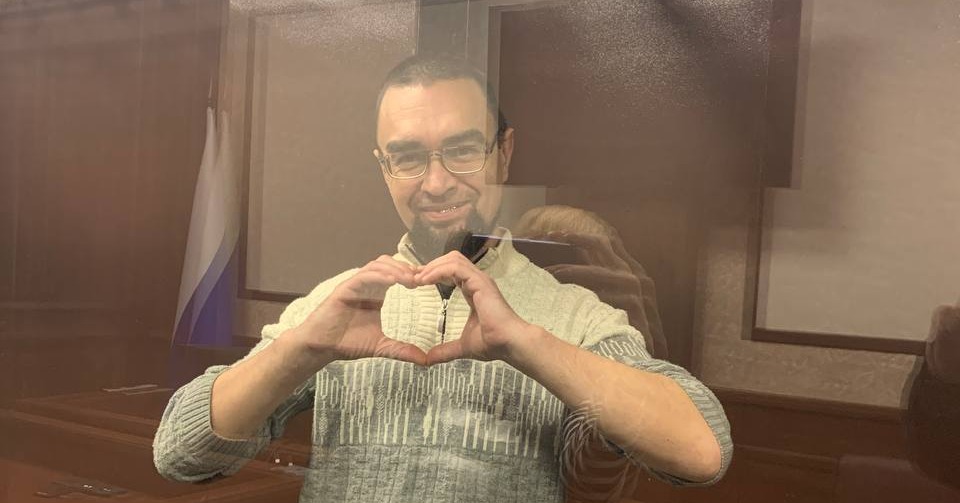
The number of Russians who find themselves behind bars for opposing the authorities who launched the war with Ukraine grows by the day. There are hundreds of political prisoners in the country. We try to remind our readers about these people every chance we get. Today, Mediazona’s David Frenkel tells the story of Alexander Skobov, 67, a historian from St Petersburg, a defendant in the last criminal case against ‘anti-Soviet agitation and propaganda’ in Soviet history, a convinced Marxist, and a veteran of the dissident movement, who after decades has found himself on a very familiar path: searches, arrest, psychiatric ward, jail.
Alexander Skobov is one of the most experienced political prisoners in Russia. In the 1970s and 1980s, he was twice sent to a psychiatric hospital for compulsory treatment: the first time as an editor of samizdat, the second time for slogans in favour of political prisoners, which Skobov wrote on the walls of Leningrad houses.
Almost half a century later, in April 2024, the authorities came after him again. Skobov was accused of ‘justifying terrorism’ because of his post about the explosion on the Crimean Bridge and sent to a pre-trial detention centre. In protest, he refused to take his glasses and medication with him. Later, an article on participation in a ‘terrorist community’ was added to the charge, and Skobov was transferred from St Petersburg to Syktyvkar.
“We were left alone for a long time. The reasoning being: we’ll die out on our own. Or we’ll leave and live out the rest of our lives off the once acquired (quite deservedly) political and moral capital. The blow came to other people, most of them much younger,” he wrote from the pre-trial detention centre.
Skobov maintains an active correspondence in pre-trial detention. He discusses philosophical and political topics, his letters are even published in historical journals. Write to Alexander, argue with him, disagree with him, I’m sure it would be valuable to him. The only thing is that his wife asks that the letters to him be written in 18-point Sans Serif font. Skobov can’t even see his own texts well: he first drafts them on the back of used sheets of paper and then blindly transfers the texts to the reply form.
Address:
167028, г. Сыктывкар, поселок Верхний Чов, д. 99 , ФКУ СИЗО-1 УФСИН России по Республике Коми. Скобову Александру Валерьевичу 1957 года рождения
Please write letters in Russian, otherwise the prison censors won’t let them through. You can send letters online via a special services called PrisonMail.
You can also write in English, using the websites Letters Across Borders and Lifeline, two projects by OVD Info, a media outlet and human rights defense group.
Lawyer Dmitry Talantov has been sentenced to seven years in a penal colony on charges of disseminating “fake news” about the Russian army and inciting hatred in connection with several social media posts about the war. Talantov had been on the defense team of journalist Ivan Safronov, who was sentenced to twenty-two years in a penal colony for high treason. Talantov had also served for many years as the head of the Udmurtia bar association, so it is likely that both the judge who sentenced Talantov and the prosecutor who petitioned the judge to sentence the respected 64-year-old defense lawyer to twelve years in prison knew him personally.
Talantov delivered a memorable closing statement today in court.
Dmitry Talantov, sentenced to seven years’ imprisonment for antiwar social media posts:
Brodsky once said that “prison is a lack of space counterbalanced by a surplus of time.” I didn’t completely understand this phrase. I didn’t get it. I’m certain that none of you totally understands it, because it is the surplus of time which is frightening about this situation, not the lack of space. It is the time during which you suffer, and the time that tries to kill you. Every minute tries to kill you, and every minute in there [in prison] is equal to an hour.
[…]
People often ask for forgiveness during their closing statement. I also want to ask for it. I’m saying this to my wife. Forgive me, Olga. I love you. If this is overdoing it emotionally, then I’ll put it this way. Olya, if you’re ever sent to prison for twelve years for some reason, I’ll wait for you to get out. Take it easy.
Sasha Skochilenko, the Petersburg artist and musician sentenced to seven years’ imprisonment for posting antiwar price tags in a supermarket and released as part of a prisoner swap in August 2024:
Alexei Gorinov, the Moscow municipal district council member who was initially sentenced to seven years in prison for “disseminating fake news” during an argument about whether it was appropriate to hold celebrations for children during a war, and who is now on trial a second time for allegedly “condoning terrorism” in conversations with cellmates:
I was also a municipal council member during the August 1991 coup. I stood with other defenders outside the Russian Supreme Soviet, the so-called White House. We were defending our freedom, our right to live freely and, thus, to speak freely, voice our thoughts, gather information, and share it. If they had told me then that thirty years later I would be tried by a criminal court for my words, for my opinion, I wouldn’t have believed them.
Nadezhda Buyanova, a pediatrician, was sentenced to five and a half years in prison for “disseminating fake news,” after she was denounced by the widow of an army officer killed in Ukraine: the doctor had allegedly said to the woman’s seven-year-old son that his father had been a “legitimate target”:
If there used to were doctors and patients, nowadays there are providers and clients. That’s what we were told at the planning meetings: “Humiliate yourself. And us.” We medics can be slandered, we can be insulted, we can be called every name in the book. We can’t defend ourselves, our explanations are not heard by our superiors, and conflicts are not resolved.
There was no interrogation and the child had nothing to say. “At the end of the appointment, he walked out of the office.” You cannot believe such a tale. You cannot lie like that: it’s a disgrace. How can you accuse a person without evidence, on the basis of a false accusation? Where is the logic? Where is the justice? Earlier, in ancient times, there were wise men. They would have said: “Well, what do you expect from a person without proof?”
Roman Ivanov, a journalist for RusNews, was sentenced to seven years in prison for three social media posts. During his closing statement in court, he knelt down to apologize to Ukrainians:
What can we do in this situation? I honestly don’t even know anymore. But I want to ask for forgiveness from all the citizens of Ukraine, to whom our country has brought grief, whom our country has robbed of their relatives, their loved ones, and their friends, who will never come back.
And [I ask for forgiveness] not for the whole country, but for me personally, for Roman Viktorovich Ivanov, a citizen of the Russian Federation. I would like to get down on my knees before the relatives of the people who were murdered in Bucha, although I don’t know who murdered them. But they are the consequences of what our country has become.
The politician Alexei Navalny was repeatedly tried on trumped-up charges before he was murdered in a penal colony on 16 February 2024. Perhaps it was Navalny, during his endless trials, who revived the closing statement in court as a literary genre. Here is an excerpt from his speech at his trial for “extremism” in July 2023:
Former Moscow politician Alexei Gorinov, the first known Russian to be imprisoned for denouncing the invasion of Ukraine, was sentenced to three more years on Friday on charges of “justifying terrorism” that he says he was framed for.
Ahead of his sentencing, he read the following statement to the court and the press:
Imprisoned Kremlin critic Alexei Gorinov, sits in a cage of the courtroom as his second trial for criticizing Russia’s actions in Ukraine swiftly nears its conclusion in Vladimir, Russia, Friday, Nov. 29, 2024. Photo: Dmitry Serebryakov/AP
“All my life I have been an opponent of aggression, violence and war, and devoted myself exclusively to peaceful activities: science, teaching, education, governance and public activities as a deputy, human rights activist, member of election commissions and controller of the electoral process. I never thought that I would live to see such a level of degradation of my country’s political system and its foreign policy, when ordinary citizens who favor peace and are against war, who number in the thousands, would be accused of slandering the Armed Forces and justifying terrorism, and would be put on trial.
“The third year of the war is coming to an end. The third year of casualties and destruction on European territory, of deprivation and suffering of millions of people on a level unprecedented since World War II. We cannot remain silent about this.
“Back in late April, our former defense minister announced the losses of the Ukrainian side in the armed conflict – 500,000 people. Think about this number! And what losses have been suffered by Russia, which, according to official information, is constantly successfully advancing along the entire front? We still do not know. And who will be responsible for this? What is all this for?
“Our authorities and those who support them in their militaristic aspirations wanted this war so much — and now it has come to our land.
“I would like to ask them: has our life become better? Is this how you understand the well-being and security of our country and its population? Or did you not envision these developments in your calculations?
“But for now we have to answer not to those who organized the war, continue to kill, propagandize the war and engage in mercenarism. Rather, we ordinary citizens of Russia, who raise our voices against war and for peace, have to answer, paying with our freedom and, for some, with our lives.
“I belong to the outgoing generation of people whose parents took part in World War II or survived it with all its hardships. The generation that has already passed away entrusted us with preserving peace with all our might as the most precious thing on Earth for all its inhabitants. But we have neglected these principles and devalued our memory of these people and the victims of that war.
“My guilt is that I, as a citizen of my country, allowed this war to happen and failed to stop it. And I ask you to note this in the verdict. But I would like my guilt and responsibility to be shared with me by the organizers, participants and supporters of the war, as well as the persecutors of those who advocate peace.
“I continue to live with the hope that someday it will be so. In the meantime, I ask the people of Ukraine and my fellow citizens affected by the war to forgive me.
“Within the framework of the case in which I was accused and tried for my opinion that we need to seek an end to the war, I have expressed my attitude fully to this abominable human endeavor. I can only say that violence and aggression breed nothing but reciprocal violence. This is the true cause of our troubles, our suffering, our senseless sacrifices, the destruction of civilian and industrial infrastructure and our homes.
“Let us stop this bloody, needless slaughter — neither for us nor the inhabitants of Ukraine. Isn’t it time to leave our neighbors alone and deal with our own snowballing domestic problems? Long ago we proved to the world how brave, resilient and peace-loving we are. So, maybe enough is enough?
“Lev Nikolaevich Tolstoy — from a letter to his son (1904): ‘For me, the madness and criminality of war is so clear that I can see nothing in it except for this madness and criminality.’
“I too join and subscribe to these words of our great compatriot.
“You can join too!”
SOTAVision reported that Judge Vladimirov interrupted Gorinov when he started to talk about losses in the war in Ukraine and called a 15-minute break so Gorinov could “think over his speech again.”
Igor Paskar has been sentenced to eight-and-a-half years’ imprisonment for two anti-war actions. In June 2022, in the centre of Krasnodar, Igor set fire to a “Z” banner [a symbol of support for the Russian military]. Two days later, he protested at the local office of the Federal Security Service (FSB), by throwing a Molotov cocktail at the stone porch of the building, while his face was painted with the colours of the Ukrainian flag. The FSB and the courts defined this as “vandalism” and an “act of terrorism.”
Igor Paskar
Igor Paskar was born in Nikolaevsky village, a working-class community in the northern part of Volgograd Region. He went to school there. After doing national service on building sites in Samara, he worked as a courier, and for haulage and construction companies.
Paskar had three previous convictions. The first time he went to court, at the age of 22, was for possession of a few grams of cannabis: he was given a five-year suspended sentence. “In the milieu in which I grew up, half of the people I knew – if not more than half – smoked cannabis. It was not considered to be asocial or objectionable. But the motherland has decided that, in contrast to drinking alcohol, that’s serious criminal behaviour,” Igor said. Three years later, Paskar was in court again, and this time was sentenced to two years in prison for the theft of, and possession of, drugs. He points out that, from the moment of his first time in court, the police searched him regularly, and said quite openly that they were looking for weed. Igor’s third time in court was in 2006, when he received a one-and-a-half year suspended sentence for possession of narcotics. “That’s how I came to the attention of our law enforcement agencies. And from then on, I didn’t have a life,” he recalled. Given these circumstances, in 2013 Igor moved to Moscow.
In the capital, Igor continued working in various jobs, and helping his mother, until she died in 2017. This was around the time his social conscience took shape.
“As far back as I remember, even when I was very young, I was always concerned about what was happening in our country. Our motherland, in the guise of the Russian state, always seemed like a stepmother to me, not a real mother. I was never indifferent to the pressure that the state brought to bear on those who dissented or disagreed,” Igor said in court.
In 2020 Igor went to the Belarusian embassy to express solidarity with those who protested after the blatant falsification of the results of the presidential election, in which Belarusian president Alyaksandr Lukashenko gave himself 93% of the votes. “That summer and autumn, in 2020, when Belarus’s tinpot dictator was pushing his people around, I was still hoping that here in Russia we would avoid that kind of thing,” Igor says.
In 2021 Igor participated in a big protest staged after the arrest of Alexei Navalny. He was detained, brought to court and fined 10,000 rubles.
The all-out Russian invasion of Ukraine in 2022 decided things for Igor once and for all. He decided to undertake a symbolic anti-war action, to support people in Ukraine. On 12 June 2022, the Russia Day national holiday, Igor set fire to a pro-war banner displaying the letter “Z” and the militarist slogan “We don’t abandon our own.” However, the action did not attract the attention Igor had hoped it would.
He decided on a second protest. On 14 June he threw an improvised Molotov cocktail at the stone porch of the FSB offices in Krasnodar. It set fire only to a plastic mat. As Igor later stated in court, his action was entirely symbolic and posed no threat to anyone’s life. For Paskar, the action was an expression of solidarity with people in Ukraine, and a signal to those in Russia who did not support the war that they were not alone. “My action was peaceful, and aimed to show all who opposed this monstrous war that they were not isolated, and to show our Ukrainian neighbours, that we [in Russia] have not all been turned in to zombies by state propaganda,” he said in court.
Igor was arrested a few minutes after throwing the Molotov cocktail at the FSB building. “I stood outside the building and waited for them. I made no attempt to hide or to evade arrest,” Igor recalled in court. The police arrived, asked if it was him who had started the fire, and, when he confirmed that it was, they put him in handcuffs and took him in to the FSB premises.
“There were people in uniform, perhaps six to eight of them,” Igor said. “They snapped a photo of me on a phone: that picture is in the case file, and it shows that I had no injuries. Then they asked me what I wanted, why I did that. I answered that I wanted to make use of Article 51 of the Constitution, that gives you the right not to incriminate yourself. They obviously found that funny, because a split-second later a sack was put over my head. The next few hours were among the very worst of my life.”
There are about 600,000 Kazakhs living in Russia, and they are the tenth [largest ethnic group in] the country in terms of population. Most of the Russian Kazakhs are indigenous to the regions located along the Russia-Kazakhstan border. This border is the second longest in the world after the US-Canada border.
In the Adamovsky District of the Orenburg Region, Kazakhs make up a third of the total population. “Young Flowers” is a translation of “Zhas Gulem” (“Jas Gülim” in correct modern Kazakh Latin), the name of an ensemble from the district center led by Amanzhol Ismukhambetov. The group and other local musicians mainly interpret common Kazakh folk songs.
Performers (on the album cover photo from top to bottom left to right): Amanzhol Ismukhambetov (apart from the ensemble) — tracks 7, 8, 10 Turebek Makashev (Belopolye village) — 5, 11–14 Mukhtar Tulkubaev — 10 Raziya Zhakupova — 1 Zhas Gulem Ensemble — 4, 6, 9 Kusem Village Choir — 2, 3
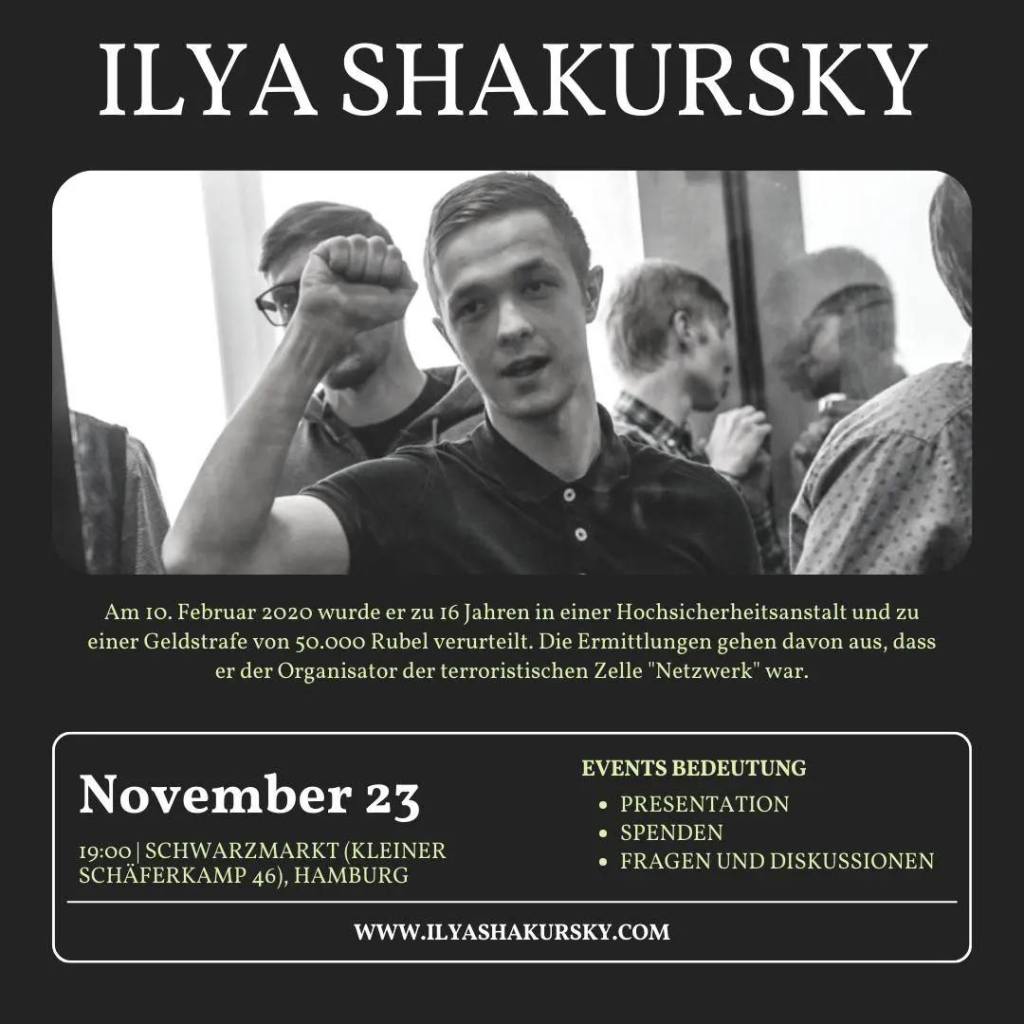
This Saturday, 23 November, at 7 p.m., the last presentation about and fundraiser for Ilya Shakursky will take place at Schwarzmarkt in Hamburg (Kleiner Schäferkamp 46). After the new year, a big update is in store for the project, but in the meantime we look forward to seeing the local public and thank everyone who has supported us this year!
Este sábado 23 de noviembre será la última presentación sobre Ilya Shakursky con posibilidad de donaciones en Hamburg im Schwarzmarkt (Kleiner Schäferkamp 46), después del año nuevo el proyecto espera una gran actualización, pero mientras tanto esperamos al público local y ¡gracias a todos los que nos han apoyado este año!
A charity concert has been held in Paris in tribute to the pianist Pavel Kushnir, who died in detention in Russia. The funds raised were donated to the Paris-based Atelier des artistes en exil (Agency of Artists in Exile), which aids artists who have fled their countries due to war, persecution, and discrimination.
The concert was held at Salle Cortot in Paris. World-renowned pianists Grigory Sokolov and Sergei Babayan performed a program of pieces by Frederic Chopin, Robert Schumann, Franz Schubert, Franz Liszt, and Sergei Rachmaninoff. Tickets for the concert were sold out almost instantly.
“As musicians, we want to voice our support for artists around the world who are persecuted and sometimes forced to leave their native country. Pavel Kushnir chose internal emigration and bravely and unreservedly spoke out against the war. He paid for this with his life. We wholeheartedly support Grigory Sokolov and Sergei Babayan’s November 18 concert in Paris and join them in paying tribute to Pavel, as well as in voicing our solidarity with all artists who are suffering from repression today,” reads a letter in support of the concert, which was signed by Martha Argerich, Daniel Barenboim, Gidon Kremer, Anne-Sophie Mutter, Semyon Bychkov, Paavo Järvi, and many other famous musicians of our time.
“Music can be used for good as well as for ill. Pavel Kushnir always used it for good. Let us honor his memory and follow his example,” says pianist Evgeny Kissin, who also signed the letter.
“I am honored to pay tribute to the memory of a young artist who gave his life for the truth. Pavel Kushnir clearly understood that there can be no happiness and, in fact, no real art when one country causes another country untold suffering, and the truth about this crime is not heard. The deeply inhuman nature of the regime responsible for his death is underscored by the fact that he, a young artist living far from the capital, posed no danger to the continuation of its criminal rule. He made a beautiful recording of Rachmaninoff’s Preludes, and for that reason I wanted to play Rachmaninoff for him. I would have loved to have met Pavel, who was undoubtedly a beautiful, exceptionally sincere young soul. My thoughts are with Pavel Kushnir, his family, and all the victims of the enemies of freedom and truth,” said Sergei Babayan, explaining his involvement in the concert and the works selected for it.
The proceeds from the concert, as well as the donations raised, will be given to the Paris-based Atelier des artistes en exil, which has aided many hundreds of artists during the seven years of its existence.
“When we left Russia, we had heard nothing about Atelier, and it was not clear where we would put down roots,” says composer Dmitry Kurlyandsky, who turned down Russia’s Golden Mask national theater prize, which he was awarded for the music he wrote for Perm-based Theater-Theater’s production of the play Katerina Izmailova. He called the award “antics on the part of a system which is destroying the theater.”
“But on the second day,” Kurlyandsky says, “I had already found out about Atelier. We called them and they invited us to a meeting. It was the very beginning of the wave of emigration from Russia, and Atelier had more capacity to accommodate refugees. We lucked out. Thanks to Atelier we stayed for eight months for free in a hotel in downtown Paris, and during this time we were able to get our papers sorted and find a place to live.”
Judith Depaule
Judith Depaule, founder and head of Atelier des artistes en exil, sat down for an interview with Radio Svoboda.
— How did you find out about Pavel Kushnir’s tragic story?
— From Russian acquaintances. I also read about it in the French press. There wasn’t that much coverage of Kushnir’s plight, but there were some articles nevertheless. Many artists at Atelier talked about it.
It’s all quite frightening, of course. I have been studying the history of theater in the Gulag for a long time. I see Kushnir’s tragedy as a repetition of what already happened, of things with which we are all very familiar. I’m always amazed at how much history can repeat itself. I wonder why it repeats itself, despite everything we know about our past. How is it that people are dying again just for freely expressing themselves! I find it scary, because the right to freedom of expression is what matters most.
— You said that you said that you studied theater in the Gulag. Tell us a little more about that.
— It so happened that as part of my studies I researched the work of the Futurist theater director Igor Terentiev, who was arrested and sent to work on the White Sea Canal. We know a lot about his life on the White Sea Canal because he was photographed by the legendary Alexander Rodchenko. It was a shock to me that the theater could exist in the Gulag. I researched the topic. I went to the Memorial Society, and I was able to interview many former prisoners. I even traveled to Magadan and Vorkuta. So I am an expert on the history of the theater in the Gulag.
— Whose idea was Pavel Kushnir memorial concert? Why were Grigory Sokolov and Sergei Babayan involved in it?
— It was the artists at Atelier who took the initiative. To make the event respectable, they decided to invite famous musicians. We approached Sokolov and Babayan, and they immediately agreed.
— Yes, Sokolov and Babayan are certainly musicians of the highest order. Babayan is also a renowned teacher. Was the concert program solely Sokolov’s and Babayan’s choice? Or did they discuss it with you as well?
— No, they decided themselves what to play in memory of Kushnir. It was their own choice; we didn’t discuss it with them. It was important to us that the program included pieces which they loved and were willing to perform.
— I think any classical music lover would dream of going to such a concert. It’s just a pity that the occasion is so tragic. There was also a letter in support of the concert, signed by a plethora of classical music stars. The letter claimed that Pavel Kushnir had chosen internal emigration, internal exile. Do you agree with this? If so, how do you understand this term?
— I would imagine that Pavel did not want to be the center of attention, but simply wanted to feel freer. This did not work out for him, alas. I think that, while living under a dictatorship, Pavel was trying to find a place where he could at least breathe freely and do what he loved doing. Because Russia is so vast, you could say that it really was internal exile. This again takes us back to the past. When people tried to disappear from the Kremlin’s sight, they left the major cities to feel at least a little bit freer.
— Atelier des Artistes en Exile deals with a wide range of creative genres, not just music or theater, for example. How did you decide to take on such a serious challenge?
— I founded Atelier in 2017 as a response to the migration crisis in Europe, which peaked in September 2015. There were so many Syrian migrants in Paris. I was working in a small cultural center at the time. We just decided to shelter migrants; it wasn’t about artists at the time. Gradually we began helping immigrants and put together a festival that was dedicated to Syria. I often talked to exiled artists, and they always said the same thing: “We were professional artists before we left. We had a profession. What are we supposed to do now? We don’t understand how French society works, we don’t understand its cultural traditions.” And so on. I decided that something had to be done to help performers and artists in exile. Gradually, this idea began to develop, and I set up this agency in early 2017. At the time there was no talk at all about Russian artists and performers, back then it was mostly Sudan and Syria. Atelier has grown because it helps everyone who leaves their country, whatever the reason, whether dictatorship or discrimination. The world is now in a state in which there are wars, dictatorships, and illegal imprisonment everywhere. So performers and artists have started arriving in France much more often.
— What kind of assistance do you provide? Do you help with accommodation, visas, and jobs, or do you support cultural projects?
— For those who are still in their home countries but want to come to France, we help them get visas and explain how to get here. When people are already in France, we help them with long-term visas and residence permits, so that they are staying in France legally. We help them with social services — medical insurance and so on. We provide a place to work, because that is super important. If you don’t have a place to work, you are no longer an artist or a performer. We offer French language courses, and we have put together a program for artists to learn French through art. We help them understand how French society is organized and learn the peculiarities of French culture. We explain to them what rights they have, what benefits they can claim, how they should fill out their income tax declarations, and so on. We also organize cultural events.
— Who supports Atelier des artistes en exil itself?
— It is supported by the French Ministry of Culture, which sponsors various programs. Private foundations also help out. We are constantly looking for resources. The Pavel Kushnir memorial concert also includes a fundraising campaign to support the Atelier. This involves the money from ticket sales and donations, which we need very much, as we have a large team helping hundreds of people — 350-400 people a year.
— How can people who decide to come to you for help prove that they are artists?
— You have to show us what you have done up to this point: a portfolio, internet links, an account of your past work. It is not difficult to check whether a person is actually an actor, musician, or artist. It is immediately clear what kind of experience they have, where they studied, with whom they worked. Then we decide whether or not to work with them.
— Given that there is a full-scale war on in Ukraine, do you prioritize Ukrainian artists who have fled the hostilities when you’re choosing whom to help?
— Because there are many ongoing wars in the world, we don’t prioritize anyone. We just assist people who find themselves in a dangerous situation. If we talk about relevance, we are most often contacted by people from Gaza and Lebanon, who can be killed at any moment and who ask us how they can leave and what they need to do to leave. We are always watching what is happening in the world. It was not that everything was fine in the world when we started, but there were not so many conflicts. After the pandemic, there were immediate problems in Myanmar and Afghanistan, there was the war in Ukraine, there was the brutal crackdown against the women’s rights movement in Iran. And so on and so forth. More and more performers and visual artists have been turning to us because they don’t know how to go on living.
— Has the number of Russians who seek your assistance increased recently?
— It has been a constant flow which doesn’t stop. The current wave of émigrés from Russia is even greater than the very first one, whom we call White Russian émigrés.
— Let us return to the fate of Pavel Kushnir. I have read that famous musicians who learned about this tragedy and then listened to Pavel’s recordings and read what he wrote, voiced regret that they had not known about him or his talent earlier. Do you think there are many such unknown talents in the world? If so, how can we help the world learn about them not only after their tragic deaths, as happened with Kushnir?
— Pavel’s fate mirrors the history of art in many ways. Many great talents have been discovered after their death. There are so many musicians, actors, and artists for whom creating and making art is what matters most, not being famous. It doesn’t matter to them that they are not in the public eye. We can’t know about everyone, of course. I can’t suggest any way of remedying ths; it’s just the way the world works. There are people who will always be in the limelight, and there are people who will go on modestly pursuing what they love. Sometimes they are more talented than the artists we know well. When we discover a great talent after their death, sometimes a hundred years later, we ask ourselves how come we hadn’t heard anything about them until now, how we had missed them. But there’s hardly anything we can do about it.
Lev Schlosberg’s lengthy interview with Ksenia Sobchak, released last week, predictably kicks off with a discussion of his condemnation of his former allies. In August of this year, Lev Schlosberg lashed out on Facebook at the emigrant liberals who had welcomed the Ukrainian army’s offensive in the Kursk Region, calling writer Dmitry Bykov, journalist Sergei Parkhomenko, and politician Garry Kasparov comrades in the “someone else’s blood” party. His post sparked a freewheeling discussion, demonstrating once again to both onlookers and participants how far apart they were, even though they are still citizens of the same country. While the outcome of the Russian-Ukrainian military conflict will supposedly be determined by the newly re-elected Donald Trump, the Kremlin has long since won the war on the invisible front.
Caution: Sobchak, “Lev Schlosberg: Why is it important for a politician to stay in Russia?” (in Russian; no subtitles)
It was beyond the strength of the majority to resist the Kremlin’s propaganda. How fortunate for the minority, who had honestly declared before the war that they had no soul, only a paycheck.
Three months later, Schlosberg felt the need to continue the conversation, choosing as his interlocutor Ksenia Sobchak, about whose views on war and peace there can be no two opinions: what Vladimir Putin finds ambiguous also seems ambiguous to the breeding bulls in his herd. But the question is why the veteran democrat Schlosberg decided to hang a huge bell around his neck next to the “foreign agent” disclaimer. Was it vanity or fear? As becomes clear in the first half hour of the high-minded conversation, however, the cause, as always, is run-of-the-mill stupidity. Schlosberg really thinks what he says. It is even sadder to watch his rantings than it is to watch the criminal proceedings against him.
Explaining his stance as a compassionate fellow traveler (which, as we remember, can be summarized in Akhmatova’s famous line about one’s own people, on whose side one should be both in happy times and during the Special Military Operation), Schlosberg recalls Leo Tolstoy’s famous essay “Bethink Yourselves!,” published in 1904 after the outbreak of the Russo-Japanese War. According to Shlosberg, love for a fragile peace distinguishes the authentic Russian writer from the fake one. For this reason, Shlosberg has no hesitation in ejecting Dmitry Bykov from the company of engineers of Russian souls, and, it seems, from the human race altogether. A similar fate befalls the other participants of the Free Russia Forum. Typically, Sobchak, an experienced investigator-slash-provocateur, cajoles Lev Markovich into making public his entire list of traitors to the Motherland (probably to check it against the firing squad list, lest there be an extrajudicial error).
It is worth nothing that all the ideological opponents mentioned by Schlosberg* did not differ much from the great elder from Yasnaya Polyana in their appeals to the silent audience. Since then, however, much water (demagoguery) has flowed under the bridge, along with the lives of millions of people. No wonder that the cardboard humanism of the captive Yabloko Party now looks, if not ridiculous, then simply ugly. Schlosberg and Yavlinsky suggest that we still eat from the fruit of the tree of knowledge, which was chosen as the symbol of their so-called political association. And it seems to have been known for a long time that this fruit is a pure stage prop, a fruit plate from a Moscow Art Theater performance, but its contents continue to rot and to reek, frankly.
“Myth: that Ukraine remains a victim doesn’t fit the historical facts”: Lev Schlosberg, as featured on Ksenia Sobchak’s YouTube program (via Republic)
We are all victims of this war, Schlosberg claims. Vladimir Putin and Volodymyr Zelensky, the United States and Europe had the same opportunities to prevent the war. “But the mincemeat of history cannot be cranked backwards,” he continues, indulging in inventive parallels, “the cutlet will not turn back into the cow.” Yes, of course, the “Russian World” will never be the same again, but only because thinkers like Schlosberg, as Circe did to Odysseus’s companions, have been turning Russians into ungulates with their pseudo-Christian speeches. It is other people, of course, who have been leading them to the slaughter, but the Yabloko Party, alas, bears a considerable share of the blame.
Dubbing himself “the people,” Schlosberg wants to escort the popular masses on a journey to the end of the night, i.e., he suggests that they wander together until they are blue in the face in the pitch darkness and sprinkle the ashes of their ideals on each other’s heads, even though they should sprinkle “mother earth” on their heads. Schlosberg imagines collective euthanasia as a therapy in which there is no room for hatred. What’s the difference between dying with calls to love one another on your lips and dying while calling for violence? There is a difference, Schlosberg contends. In the first case, our church cemetery will finally become a true “brotherly” [i.e., mass] grave.
There used to be a Three Hierarchs Street in Kyiv. It was renamed after the October Revolution, of course. In 1919, it was called Victims of the Revolution Street in memory of the Bolsheviks who had been led down it to their executions. The street bore this tragic name until 1955, when someone competent finally showed up at city hall and explained to them how the name was ambiguous. City hall agreed and renamed it Heroes of the Revolution Street. But you can’t fool the people, and so the name “Victims of the Heroes of the Revolution” stuck to the street like glue. Old-timers still referred to it as they had in the old Soviet days. “Can you tell me how to get to the outpatient clinic?” “Go straight down Victims of the Revolution….” In the early 1990s, when the powers that be were getting rid of abominable “Red” place names, the street was given back its old name, Three Hierarchs Street.
I was reminded of this by the recent incident involving Lev Schlosberg, who explained in an interview with Ksenia Sobchak that Ukraine cannot be considered a “victim” [zhertva]. This has happened in the context of the Yabloko Party’s now-familiar cry “Both of you stop immediately!” Here is what Schlosberg said, verbatim:
Ukraine is resisting. State and individuals are victims [zhertva] until the minute, until the second they start resisting. Ukraine started resisting on the morning of February 24 [2022]. It is a resistance supported by dozens of foreign countries with their money, their equipment, their specialists, with everything they have. This had led to the fact that Ukraine has equalized the situation. Today, the military forces — the combined military forces of Ukraine (taking into account the allies, their weapons and their money) and the combined military forces of Russia — are roughly equal. Whoever resists is not a victim [zhertva]. A victim [zhertva] does not resist. A victim [zhertva] allows itself to be killed. The myth that Ukraine is a victim does not fit the historical facts. If Ukraine were a victim, Ukraine would not exist now. It would simply not exist.
Of course, we could go on at length about Shlosberg and the Yabloko applesauce* in his head, but he has gotten enough pushback. He has talked a load of nonsense and still goes on, so God be his judge. “Why do we listen to him? Let’s eat him.” I’m in favor of not listening to anyone at all, since there came a point when everyone started talking in commonplaces. Schlosberg is no exception: his leitmotif is well rehearsed and has long been familiar. But this paragraph about victims and non-victims is peculiar. Not politically peculiar (not at all), but it is quite peculiar as a mirror reflection of illiteracy.
Lev Markovich managed to cram a lot of nonsense into one paragraph, both about equalizing the situation and about western assistance. But that’s not what I have in mind. What I have in mind is the fact that even the well-spoken Schlosberg has no linguistic sense at all, as it turns out. And he’s not alone in having this handicap, although it is not remotely acceptable for him as a politician to have it.
The whole passage about the victim, I think, meant the opposite of what its author was been lambasted. He was rightly lambasted, generally, but he didn’t mean to strip Ukraine of its status as a victim of aggression. “Victim of aggression” and “sacrificial victim” are different things. The concept of the sacrificial victim is as old as sacrifice itself and is widely employed in the Old Testament as an inalienable part of the love for God. The Old Testament is chockablock with sacrifice, beginning with Abraham’s sacrifice of his son Isaac.
It would be odd, of course, to assume that Schlosberg was talking about biblical connotations in his conversation with Sobchak (and it is doubtful the interviewer has ever thoughtfully read the Bible), but it is almost certain that this was the notion of zhertva which he had in mind. A sheep to the slaughter is apparently Lev Markovich’s idea of a textbook victim. The sheep does not resist: that’s a fact. Ukraine has been resisting, and that’s also a fact. From Schlosberg’s point of view, it all makes sense. If he had said that Ukraine was not a victim of aggression, then he would have become a deserving punching bag forever. But he wanted to make a graceful compliment to Ukraine while not deviating from Yabloko Party’s twee “peace and good will to all — just stop shooting!” In the Old Testament sense of the word, Ukraine is truly not a victim: it is a heroic scrapper, a country as hard as nails. But what Schlosberg said was understood as it should have been understood.
A politician should know the value of words and the cost of his linguistic blunders. The Schlosberg incident is such an obvious example of linguistic deafness that it should be included in political rhetoric textbooks — someday, of course, not now. A politician should realize that words addressed to the public are always heard as they are commonly understood, and that few people will use zhertva [“victim”] in the Old Testament sense [of “sacrifice”].
Once upon a time, a rookie journalist was brought on at the newspaper where I worked. His first article was about a theater event that had turned out to be a chummy gathering at which only the in-crowd got the jokes. The article ended with the following sentence: “The result was an event only for those who could get to it through the box office window.” I immediately pictured a man trying to Winnie-the-Pooh his way through a tiny window. When the journalist noticed that I was editing the sentence, he was indignant.“Why?! It’s clear as it is,” he said, “it’s about the people who managed to get their hands on complimentary tickets.” “Yes,” I replied, “it is clear. But not immediately clear, like it should be.” The guy held a grudge against me for a long time, not understanding the point of my objection.
The feeling for language is an innate thing, like a sense of pitch. But if it is weak, it must be trained, just like the sense of pitch. Andrei Mironov, who sang countless songs on screen and on stage, had no ear for music, but he worked until the point of exhaustion, singing the same lines a hundred thousand times until he could hit the notes. Only the people close to him and the directors who worked with him knew that he lacked a sense of pitch.
When I hear an advertisement for “tonal cream” [foundation cream], I am amazed at how one could fail to anticipate that every other person would hear “anal cream.” We can attribute this to a common lack of linguistic pitch, of which there are countless examples. It is essentially a habitual neglect of language, of its purity. “Anal cream” is a harmless example. “Phyto tea for women with hog uterus” [i.e., Orthilia secunda, or wintergreen, whose common name is matkaborovaya] is basically harmless, too, just like most of the complete misunderstandings of “how our words will be heard” which we encounter at every turn.
The Schlosberg incident is a quintessential example of the damage which carelessness can do to a public figure. Lev Markovich already has a catastrophically dwindling number of allies, given his inappropriate Leopold the Cat-like appeals and dubious patriotic outbursts. After his latest musings, this number has precipitously plunged. “Alas, they didn’t understand me,” the annoyed Schlosberg must say, playing the victim.
* Although the Yabloko Party‘s name was derived from the surnames of its three founders (Grigory Yavlensky, Yuri Boldyrev, and Vladimir Lukin), the word thus formed, yabloko, means “apple” in Russian.|||TRR
It is a tradition in Petersburg to visit the improvised memorial to Timur Kacharava outside the Bukvoyed bookstore on Vosstaniya Street every year on the evening of November 13. Candles and portraits of the antifascist, who was murdered at this spot nineteen years ago, are brought there by his mother and a changing roster of first-time visitors. Last year the memorial was torn down by far-right activists.
Eight people were convicted of the knife attack on the twenty-year-old Timur and his friend Maxim Zgibay (who was wounded but survived the assault), and five of them were sentenced to prison. All of them have been released (the killer was paroled in 2016) and disappeared from the limelight.
Bumaga asked Irina Kacharava about the people she has seen at the memorials over the past nineteen years, how she feels about the release of Timur and Maxim’s assailants, and what life choices her son would have made in today’s Russia.
— How do you usually spend November thirteenth?
— The day before, I always wish it wasn’t happening. I wish it was the twelfth or the fourteenth. I wish I could just forget it, erase it, and be done with it. But I cannot. The thirteenth comes. I spend it at work or at home. Between five and six-thirty my husband and I go to the wall [at the Bukvoyed bookstore] on Vosstaniya Square. We go to the cemetery the day before, of course. We make sure to leave Timur’s favorite flowers, irises, [at his grave].
We hate this day, and we don’t want it to happen. For some reason it’s easy to go to the cemetery, but it’s very hard to go to the wall. But we gave our word that as long as we are alive, as long as we are able, we will go, no matter how hard it is.
We are always surprised that we are not the only ones there. Each year we think that this time round no one will come for sure. People come, and I’m surprised that all of them are young people. I ask them how they even heard about Timur, since they weren’t even alive when it happened. Nineteen years have passed. They say they heard [about Timur] from their moms and dads, and some from their brothers and sisters. That’s surprising.
We dislike this day very much, but we go to the wall, and then we try to start living again.
— Do you meet Timur’s friends? Do you communicate with them on other days?
— For a long time, ten years at least, we kept in very close contact with all of Timur’s friends. We would even get together. That has been winding down now, but it’s normal, I think. So many years have passed, and some have families, while others have left the country.
Mostly strangers or people who have been going for years come to the wall — for example, adults [sic] from the former Memorial.
— Over the years, it has been suggested that a memorial plaque be erected or a street be named in Timur’s honor. Do you think it is still possible?
— MP Nikolai Rybakov(who is the national leader of the Yabloko Party but not an MP — Bumaga) launched the campaign to put up a plaque. He personally approached us at the wall: he said he had made a request to the authorities, and that he was waiting for response. Time has passed, but nothing has happened.
— Would you like it to happen?
— I don’t know: I never thought about it. I don’t believe anyone will ever do it. And I don’t think it could happen at all given the current situation [in Russia].
By the way, there were fewer lads of conscription age [at the yearly memorial] when all these sad events [the war] began. At the beginning of the [military] mobilization, they were afraid to come. Law enforcement agencies are always present there to prevent mayhem.
— How did you react when one of the people involved in the attack, Alexander Zenin, who had been in hiding for twelve years, was detained in 2018?
— I laughed. He had been living in Pesochny the whole time. During that time he had managed to have two children, but the police had been unable to catch him. The trial was hard for me; my husband went to it. The police investigator called us and told us that the case would start to kick off again, that we would have to go to the court hearings again. He said that if we signed a paper that the case could proceed without our presence, then it would be wrapped up in one hearing. So we signed it. It turned out that he just wanted to tick a box and close the case quickly, and so there was no investigation as such. But it didn’t matter by and large. Whether he was caught or not, I wish him well and hope that his children grow up, for God’s sake.
— In 2007, you said about the attackers: “I have no vengeful feelings.” You haven’t had any since then?
— No, it’s not rational to seek revenge.
— Did they try to contact you, to apologize?
— What apologies could there be after I attended the court hearings?! I was alone there without my husband, and our lawyer was away at the time. I was alone against the seven defendants, their parents, and their lawyers. Twenty-one people tried to bite me (figuratively speaking), cut me, and kill me. I had started going to the court hearings to defend Timur. The parents of the defendants felt so angry with me that Timur had crossed their paths and caused their children to suffer.
Zenin sent us fifty thousand rubles in 201. He was apologizing, as it were, so that he would get a big plus [in his character testimony] in court. But I didn’t take the money. I asked the investigator how I could inform the court that I had not taken the money. He told me: “It was the good will of the defendant — he sent the money. Nobody cares whether you took it or not.” (Alexander Zenin was sentenced in 2018 to one and a half years in a medium security penal colony for inciting hatred and enmity.)
— You are employed as a teacher. Do you observe political activism among young children? Have their views been radicalized? Or are their attitudes apolitical?
— I’ll talk about their parents, because everything comes from the family. The parents are completely susceptible to propaganda. Of course, there are children who voice their opinions, but I do not get into these conversations with them due to professional ethics.
There are children who repeat what the TV says, what their parents say. Although there were some pupils whose parents were of the same opinion as me, and, accordingly, their children also think differently. I didn’t discuss things with them, but I was pleased to hear that not everyone was marching in lockstep. Although young people are chewed out, they are decent folk; there are all kinds of different people [among them], just like we were, just like you are. There are always pros and cons. It’s just that now the propaganda is so heavy that it is difficult to analyze the situation and have an opinion.
I can tell you this about the younger children. Whereas before [the war] they played cops and robbers, and no one wanted to be a cop, and everyone wanted to be a robber, now they play terrorists. And for some reason both sides are terrorists.
— What would Timur be doing in Russia in 2024?
— I think he would have left by 2022. He would have gone to Europe: he had his own people there. I would not say that he would have left for political reasons. The most important thing for him was music. He expressed his views through music. That’s where he would have gone. The politics would have been secondary.
— Is life in Russia more dangerous now than it was in 2005?
— Of course. There is no comparison. Despite what happened to our family in 2005, it’s not even up for discussion.
— Would you have been happy if he had left the country, but was safe and doing creative things?
— When children leave home or leave the country, it’s always sad, I guess. I’ve been trying to fool myself all these years (as psychologists have counseled me to do) that he’s alive but has just left the country. But it doesn’t work for me.
Would I have welcomed his leaving? I think it would have been his choice. His father and I would have had to accept that choice. It wouldn’t have mattered much whether we liked it or didn’t like it, whether we were sad or not. And who’s to say he would have been safe there? We don’t know what he would have done there. We would just have had to accept his choices, like we accepted his life choices in 2005.
I was reproached at the trial for not forbidding him from doing all those things. Doing what? Rescuing animals from the streets and feeding homeless people? (Timur Kacharava was a vegan and fed homeless people at Food Not Bombs events — Bumaga.) What were we supposed to forbid him from doing do? I just didn’t realize at the time that it would prove to be so dangerous. We would have just accepted his choice, because he would have had the right to it, as well as the right to make it a reality.
So, it is better that he lived a short, tragic life that was his own life rather than than the long, boring life which we would have dreamt up for him. Of course I would have been sad [had he left]. How could I not have been sad?
“Last night, I stood for a while next to the memorial to Timur outside the Bukvoyed store on Vosstaniya. Suddenly three antifa showed up, one of them sporting a mohawk. They told me that a bonehead [a neo-Nazi skinhead] had just shot at them with a trauma pistol. He had been going to attack one of the antifa, but when he noticed that there were three of them he ran away and fired a parting shot. That’s what they said. E. saw young boneheads at Avtovo that evening. Considering that they now often attack couriers and janitors [i.e., Central Asian migrant workers] in particular, there is partly the same disturbing feeling as before [i.e., during the intense wave of neo-Nazi attacks on ethnic minorities, immigrants, and antifascists in Petersburg in the late 2000s]. That’s on top of everything else.”
“Not until I went into the churches of America and heard her pulpits flame with righteousness did I understand the secret of her genius and power. America is great because she is good, and if America ever ceases to be good, she will cease to be great.” – Alexis de Tocqueville
In the Soviet Union, where I grew up, any expression of faith was met with ridicule and harassment under anti-religion propaganda. This experience deepened my appreciation for the freedom to worship and inspired DEO FAVENTE wine—a tribute to God’s grace and providence.
As we approach Thanksgiving, let us reflect on the foundation of America’s greatness: her faith in God. It is through that faith and the values rooted in His word that our nation remains a true Land of Promise, guided by His hand.
Source: Land of Promise emailing, 14 November 2024
“We chose the name Terra de Promissio, latin for the Land of Promise. because as farmers, the land is about the “promise”. The promise that every new season brings the possibility AND the hope of a bountiful harvest.”
“and as we were both born, have lived and worked overseas, It is the promise of AMERICA, one nation under god AND the American Dream. We very much appreciate what this country represents. America is truly the land of promise and we are grateful for the freedom, liberty and opportunities that these united states offers to all of us.”
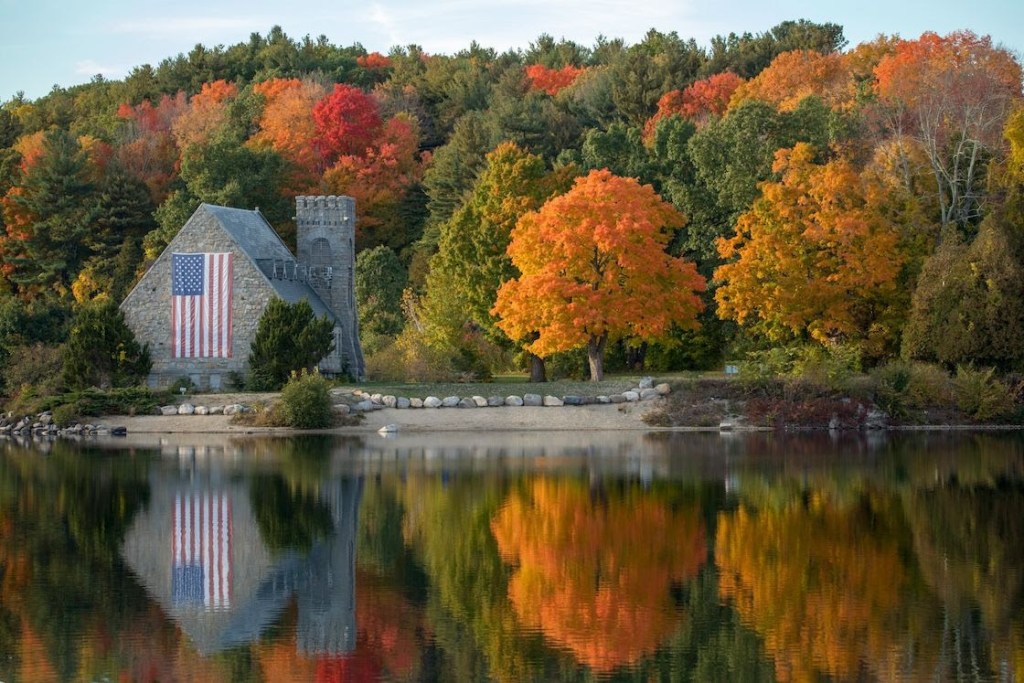
Charles and Diana bought a former dairy ranch in 1999 and then over the next 3 years, oversaw the planting of 33,000 vines. During the summer of 2002, they bought a used trailer to live in and then brought Diana’s Dad and sister Alina from Russia to help manage the vineyard. We welcomed Diana’s Family to the USA with an American Flag. And from that day on, the American Flag has proudly flown every day here at the vineyard. Terra de Promissio had its first harvest in 2005 and sold to 3 wineries. In 2007, after renting a house in Petaluma, they converted a barn into a home and moved to the vineyard full time. In 2012 and 2013, they planted an additional 18,000 vines to bring the total planted acreage of Terra de Promissio to 50 acres.
[…]
Diana KARREN
Diana was born in the Soviet Union. She was a Young Pioneer in the Communist System. But in the 1980s as the Soviet Union began to collapse, she put herself thru college and at the same time, worked for western companies that were investing in the now Former Soviet Union. Her hard work and great grades paid off and she was accepted to the University of Pennsylvania’s Wharton School of Business, where she graduated with a Masters of Business Administration in 2003.
During a two year period (2001-2003) Diana single-handily designed, gained government approvals and oversaw the planting of Terra de Promissio, while being pregnant and giving birth to Christian and doing it as a full time MBA Ivy-League student. In 2005, Diana oversaw the first harvest to Siduri, Flowers and Lynmar. In the ensuring years, as the grape production ramped up, Diana added multiple wineries including Kistler, Kosta-Browne and Willams Selyem. In 2011, Kosta Browne received the Wine Spectator’s Wine of the Year for the 2009 Sonoma Coast, which was primarily using grapes from Terra de Promissio.
Since day one, every row and block is custom farmed per each of the winemakers specific instructions. Because of this attention to detail by Diana, Terra de Promissio is now the most vineyard designated pinot noir in Sonoma County with over 10 wineries using the TdP name on their label. Beginning with the 2013 harvest, Diana began overseeing the winemaking process for Land of Promise. She now makes 4 Land of Promise Pinots and one Rosé. For more info, please click here or the link below.
In addition to managing the vineyard and the winery, Diana spends her Sunday mornings at Calvary Chapel Petaluma where she volunteers watching the babies and toddlers during the busy first service, so their parents can enjoy and listen to the sermons.
Just one week has passed since Donald Trump’s electoral triumph, and already Russian President Vladimir Putin—one of the strongman leaders Trump admires most—is messing with his head.
First, Putin waited two days before congratulating Trump on his victory. One can imagine Trump receiving phone calls from kowtowing leaders the world over—Ukraine’s Volodymyr Zelensky, Israel’s Benjamin Netanyahu, the Palestinian Authority’s Mahmoud Abbas, the chief of NATO, the European heads of state—all the while wondering about the man whom he’s admired publicly and privately for the past eight years: When is Vladimir going to call?
Then, in response to Trump’s claim that during their phone call, he asked—in some accounts, warned—Putin not to escalate the war in Ukraine, a Kremlin spokesman denied that the two had spoken on the phone at all. (Putin issued his belated congratulations at a news conference.)
I don’t know who’s telling the truth, a practice for which neither man has a sterling reputation. But either way, in the next few weeks, when Putin orders 50,000 fresh recruits (including 10,000 imported North Korean soldiers) to go on the next rampage—ousting Ukrainian soldiers from the thin slice of Russian territory they hold, then retaking soil across the border in Donbas province—he can tell a complaining Trump that he doesn’t recall any such conversation. If Trump thinks Putin actually will refrain from stepping up attacks on Ukraine as a friendly favor … well, maybe our once-and-future president will learn a lesson about the limits of personal relations in the face of perceived national interests early in his second term.
The final twist of this saga came on Monday, when Nikolai Patrushev, an aide to Putin who was previously director of Russia’s Federal Security Service, made the following comment in an interview with the Moscow newspaper Kommersant:
The election campaign is over. To achieve success in the election, Donald Trump relied on certain forces to which he has corresponding obligations. As a responsible person, he will be obliged to fulfill them.
This is a mind-blowing bit of psychological warfare! The Russians are basically telling Trump: We put you in office. Now it’s time for you to pay us back.
When you woke up yesterday the idea that Pete Hegseth—a philandering morning TV host who has never run anything bigger than a frozen banana stand—could serve as the secretary of defense was the most preposterous idea in the history of the federal government.
By the dinner time Trump issued two nominations that made Hegseth look like Bobby Gates.
The Matt Gaetz appointment is getting most of the attention because of the irony. The DoJ being controlled by a man who was recently investigated by the same department for having an alleged sexual relationship with a 17-year-old girl, whom he (allegedly) paid to travel with him? It’s too good.
Also, in the near term, the attorney general can a lot of damage to America. The AG has the power both to turn the state against its citizens and to shield wrongdoers from accountability.
But it’s the appointment of Tulsi Gabbard as director of national intelligence that worries me more. Because for a decade Gabbard has looked and behaved like a Russian asset.
In four terms as a congresswoman her most notable actions were ongoing defenses of two war criminals: Bashar al-Assad and Vladimir Putin.