Azat Miftakhov: “It’s Like They’re Telling Us, It’s No Trouble for Us to Put Anyone Away”

Azat Miftakhov in court. Photo: OVD Info

Anarchist and mathematician Azat Miftakhov has been sentenced to four years in a maximum security facility on criminal charges of “condoning terrorism.” The young man will spend the first two and a half years of his sentence in a closed prison. Miftakhov was detained in September 2023 as he was leaving the penal colony from which he had been released after completing his sentence on charges related to the breaking of a window at a United Russia party office. The next day he was remanded in custody in a pretrial detention center. According to the security forces, while watching TV with other inmates Miftakhov had spoken approvingly of the actions of Mikhail Zhlobitsky, who bombed the FSB’s Arkhangelsk offices [in 2018].

Why do I need to know this? Miftakhov’s wife, Yelena Gorban, argues that this criminal case was launched by members of the security forces who wanted to “extend Azat’s sentence for his past political activity.” In her statement to the court, she said that her husband was aware of the dangers of wiretapping in the penal colony, and so he had avoided discussing political topics in the company of inmates. “The conspicuousness and brazenness with which they fake evidence doesn’t embarrass them. It even plays into their hands. It’s like they’re telling us, ‘It’s no trouble for us to put anyone away,'” the anarchist himself said in [his closing statement at the trial].

Source: It’s Been That Kind of Week newsletter (OVD Info), 30 March 2024. Translated by the Russian Reader


A video and audio recording of Azat Miftakhov’s closing statement at his trial and his sentencing, 28 March 2024, Yekaterinburg. Source: FreeAzat (Telegram), 31 March 2024

During the years I was imprisoned on the charges in previous criminal case, I failed to fall head over heels in love with the state, and now I again find myself in the dock. I am now on trial for what the security forces have deigned to call “condoning terrorism” by faking the evidence, as they did five years ago. The conspicuousness and brazenness with which they fake evidence doesn’t embarrass them. It even plays into their hands. It’s like they’re telling us, “It’s no trouble for us to put anyone away.”

We see the same brazenness in the numerous incidents of barbarous torture perpetrated by the regime’s guardians, the FSB. These guardians don’t care that their shameful deeds are made public. On the contrary, these deeds are flaunted as a source of pride. In this way, the state shows its terrorist nature, as anarchists pointed out before the previous presidential election by taking to the streets with the slogan “The FSB are the main terrorists.”

What we were saying back then has now become obvious not only in our country but all over the world. We how see how the [Russian] state’s entire foreign and domestic policy has become a conveyor belt of murder and intimidation. While fake witnesses attempt to prove the charges that I “condoned terrorism,” national TV channels broadcast calls for the mass murder of people who disagree with state policy. We see that the state, while paying lip service to combating terrorism, in fact seeks to maintain its monopoly on terror.

No matter how the Chekists try to intimidate civil society, we see even in these dark times people who find the courage to resist the terror that has spilled over the state’s borders. Risking their freedom and their lives, their actions awaken our society’s conscience, whose lack we now feel so acutely, and their steadfastness to the bitter end stands as an example for us all.

One such example for me was my friend and comrade Dmitry Petrov (aka Dima the Ecologist), who died defending Bakhmut from soldiers who had become tools of imperialism. I knew him as a fiery anarchist who, amidst a dictatorship, did everything he could to lead us to a society based on the principles of mutual aid and direct democracy.

As a graduate of the history program at Moscow State University and a PhD in history, he was well versed in the structure of society and was able to argue his position well, something I had always lacked. And yet he was not limited to theorizing but was also heavily involved in organizing the guerrilla movement, which did not escape the FSB’s notice. Because of this, he was forced to continue his work as an anarchist in Ukraine.

When the grim events of the last two years kicked off, he could not stay on the sidelines. An enterprising comrade, he sought to create an association of libertarian-minded people who would fight for the freedom of the peoples of Ukraine and Russia. Unfortunately, no war is without casualties, and Dima was one of them. It would be unjustifiably selfish of me to admire the selflessness of strangers alone and not to acknowledge the sacrifice of those who are personally dear to me. I am well aware of this, despite my regret that all my fellowship with him is now irrevocably a thing of the past.

And yet I find it hard to accept this loss. Knowing that he was one of the best of us, and wanting to do my best to ensure his sacrifice was not in vain, I have to recognize that my contribution will be insignificant compared to what he was capable of.

What I’ve just said was perhaps unexpected for some people. I cannot rule out that some of my supporters could be disappointed, as I find it difficult, to my own regret, to speak out publicly. Perhaps someone will disagree with my beliefs, which are at odds with pacifism.

Striving to be rational about everything, however, I reject a belief in things whose existence has not been proven. Among other things, I do not believe in the world’s justice. I do not believe that all evil will be punished as a matter of course. That’s why I support vigorously resisting evil and fighting for a better world for all of us.

But even if some of my supporters do not share all of my beliefs, I am still grateful for all of their help.

I am grateful to everyone who has written me letters full of warmth and good wishes. Even amidst the desolation of the penal colony, I received stacks of them almost every week. I am certain that such great attention to me was borne in mind by the people who set out to make me submissive. I find it quite pleasant and touching that people share a part of their lives with me, whether the experiences are joyful or sad. Every letter is very dear to my heart, and I read every single one of them.

Many thanks to all those who have supported me financially. Thanks to them I have never lacked anything during all the years of my imprisonment. There have been times when I have run out of money to support me, but as soon as I put out a call for help, within a few days people who cared about me brought my budget back to a comfortable level. This is very pleasant and impossible to forget. Special thanks to Vladimir Akimenkov, who for more than ten years has been organizing fundraisers to support political prisoners, including me.

I am extremely grateful to the activists in the FreeAzat and Solidarité FreeAzat collectives, who have organized campaigns and events in solidarity with me on a scale which boggles my mind. Your recent “1001 Letters” campaign was one of them. After reading all those letters, I was pleasantly surprised to find out that people in dozens of different countries are concerned about me. Thank you very much to everyone who was involved in this campaign, thus showing me how much you support me.

I am extremely grateful to mathematicians all over the world, and specifically to the Azat Miftakhov Committee, for supporting me on behalf of the mathematical community. I am very touched that people to whom I look up, whose scholarly prowess I dream of achieving someday, know about me and voice their solidarity.

Thank you very much to everyone who has spoken publicly about me. And special thanks to Mikhail Lobanov, who was forced to emigrate to France for vigorously supporting me. But even there, despite all the difficulties of exile, his solidarity with me has been as strong as ever.

Many thanks to the Russian activists, including those who don’t belong to collectives mentioned above, who have risked their comfort by showing solidarity with me while living under a dictatorship. I am very grateful to all who came to support me with their presence by attending the trial. Some of you traveled hundreds of kilometers for this purpose, and some of you did it more than once and more than twice. I was once again pleasantly surprised by such a huge attention to me.

Many thanks to all the honest members of the press who, through their work, have been helping the public to follow my trial.

I thank my defense counsel, Svetlana Sidorkina, for her dedication in defending me at my trials. I never cease to admire her professionalism and I am convinced that I am very lucky to have her. Finally, I would like to thank Lena, my main support in my tribulations. She has helped me through her dedication to overcoming all the difficulties of my imprisonment. On top of that, I am blessed to be in love with her.

As I finish my acknowledgements, I am left with the feeling that someone may have been overlooked. This is a consequence of the tremendous, steady support I have received since the moment of my arrest. I am pleased to see I am not the only one who has been the object of your support—that, despite the dark events of recent years, your solidarity knows no territorial boundaries. This is what gives me hope for a bright future for all of us.

Source: “Azat Miftakhov’s Closing Statement in Court: Yekaterinburg, 28 March 2024,” Telegra.ph. The emphasis is in the original. Translated by the Russian Reader. Thanks to the Fabulous AM for the heads-up.
In Plain Sight

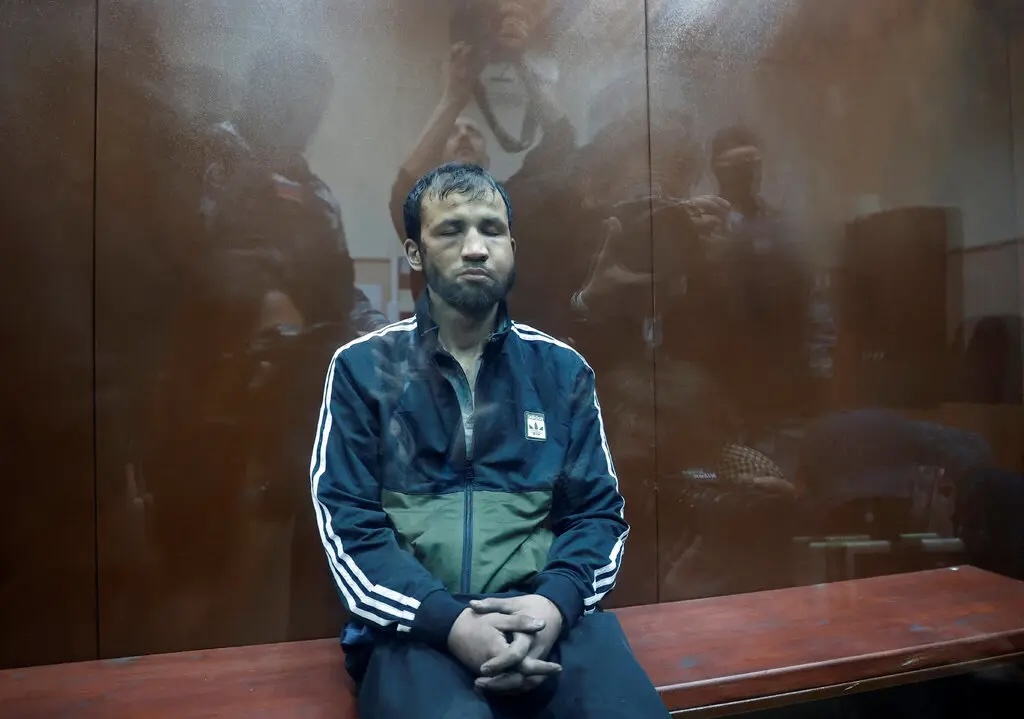
Accused terrorist Shamsidin Fariduni, with bruising on his face, inside a Moscow courtroom.
Photo: Yulia Morozova/Reuters via the New York Times

It seems that one of the consequences of this tragedy [i.e., the terrorist attack on the concert hall in suburban Moscow] has been the legalization, or legitimization, of torture. Torture existed before, but it was concealed and formally condemned. Now torture is openly praised and flaunted, and state institutions, including courts, do not react in any way. Another step towards fascization.

Source: Sergey Abashin (Facebook), 25 March 2024. Translated by the Russian Reader


Warning: this newsletter contains numerous descriptions of violence and torture.

People are tortured every day in Russia. For a long time we have been hearing about torture in penal colonies and police departments from victims and human rights activists. Mops and electric shockers have been mentioned in reports in the independent media and in the accounts of people who were subjected to violence, but the Federal Penitentiary Service (FSIN) and the police themselves have usually denied the accusations. Even in today’s Russia, however, the courts have periodically tried to imprison law enforcers who have tortured people, such as those implicated in the Karelian penal colony case, the Yaroslavl case, and the Saratov prison hospital case.

The terrorist attack in suburban Moscow has changed everything.

On 22 March, gunmen killed at least 137 people at the Crocus City Hall concert venue outside Moscow. They set fire to the building and left before the police arrived. Law enforcers have already detained suspects, and the Z bloggers have been salivating over the photos and videos of their abuse at the hands of the authorities. Never before have we had such flagrant acknowledgement of torture.

“The law enforcers have often covered their tracks by sweeping stories of torture under the rug, and we were told that there was no torture, that the reports were nonsense,” Sergei Babinets, head of the Crew Against Torture, said in an interview with Mediazona. “But since yesterday it seems as if there is a path to making torture a little more public.”

Dalerdzhon Mirzoyev (whom propagandist Margarita Simonyan dubbed the “ringleader” of the terrorists) was brought to his arraignment hearing with bruises on his face and remnants of a bag around his neck. He had no bruises at the time of his arrest, and the bag could have been used by law enforcers to strangle Mirzoyev. When the judge announced the pretrial restraint measures (Mirzoyev was remanded in custody to a pretrial detention center) Mirzoyev could not stand up. Instead, he leaned against the wall of the “fish tank” in the courtroom.

Saidakrami Murodali Rachabalizoda was brought to the hearing with his head bandaged. A law enforcer had cut off his ear when he was detained and tried to make him eat it. Neo-Nazi Yevgeny “TopaZ” Rasskazov of the nationalist subversive group Rusich announced an auction for the knife that was allegedly used to cut off Rachabalizoda’s ear.

The third detainee, Shamsidin Fariduni, was also apparently tortured. Telegram channels associated with law enforcement circulated a photo of Fariduni lying on the ground with his pants pulled down and law enforcement officers standing over him. There are wires from a field telephone attached to his groin. Such wires are used to electrocute detainees. (They have been used, for example, on detained Ukrainians in the occupied territories.) And someone is also stepping on Fariduni with a foot shod in an army tactical boot. Fariduni arrived in court with a swollen and beaten face.

Muhammadsobir Faizov. Photo: Alexandra Astakhova/Mediazona

Finally, the fourth detainee, Muhammadsobir Faizov, came to the court from the intensive care unit in a wheelchair. He could barely speak, and was hooked up to a catheter and a urinal. One of his eyes was injured. For the duration of the hearing, his doctors—two women in ambulance corps uniforms who had arrived with Faizov—were asked to leave the courtroom.

Why is this happening? Sergei Babinets argues that law enforcers could have been affected by the absence of major terrorist attacks in recent years.

“Many people were simply not ready for it—not ready emotionally, not ready psychologically, not ready on various fronts. And people may have started to lose their nerve due to this. That’s why there have been calls to reinstate the death penalty, to locate all the guilty parties and execute them, for example,” he said.

Аccording to Babinеts, Russian aggression in Ukraine has also played a role.

“The normalization of violence may have aggravated the situation with torture. We can see that law enforcement officers are really starting to let themselves go more,” he said.

Babinets adds, however, that there is no point to this violence.

“Torture most often leads to the torturer obtaining the information he wanted to obtain initially,” he said. “If they want a person to confess that they had been working, for example, for the Ukrainian army, they can be tortured until they confess. It is impossible to effectively investigate crimes in this way.”

Source: “Torture has gone public,” WTF? newsletter (Mediazona), 25 March 2024. Translated by the Russian Reader


It’s more than two decades since I read the late Stanley Cohen’s ground-breaking States of Denial: Knowing About Atrocities and Suffering (2001). In the introduction, Cohen recalls his own experiences growing up in apartheid South Africa, when he asked himself why his own outrage at the injustice he observed all around was not reflected in the society around him:

Why did others, even those raised in similar families, school and neighbourhoods, who read the same papers, walked the same streets, apparently not “see” what we saw. Could they be living in another perceptual universe — where the horrors of apartheid were invisible and the physical presence of black people often slipped from awareness? Or perhaps they saw exactly what we saw, but just didn’t care or didn’t see anything wrong.

Cohen went on to become a sociologist and a lifelong human rights activist. States of Denial was a valiant attempt to bring his discipline to bear on the subject of why people become become ‘everyday bystanders’ of atrocities who ‘block out, shut off or repress’ troubling or disturbing information to the point when they ‘react as if they do not know what they know.’

Some of these observations related to Israel, where Cohen moved in 1980. A Zionist in his youth, Cohen opposed the military occupation of the West Bank and Gaza, and became a strong critic of Israeli repression of the Palestinians. In his book, he describes his work with the Israeli human rights group B’Ttselem on the torture of Palestinian detainees and the obstacles it encountered:

Our evidence of the routine use of violent and illegal methods of interrogation was to be confirmed by numerous other sources. But we were immediately thrown into the politics of denial. The official and mainstream response was venomous: outright denial (it doesn’t happen); discrediting (the organization was biased, manipulated or gullible); renaming (yes, something does happen, but it is not torture); and justification (anyway ‘it’ was morally justified). Liberals were uneasy and concerned. Yet there was no outrage.

Cohen returned to the UK in 1996, and died in 2013, but were he alive today, I suspect he would have recognized the ongoing devastation of Gaza as a textbook example of the ‘politics of denial’. According to the latest figures from the United Nations Office for the Coordination of Humanitarian Affairs, the IDF has killed more than 31,988 people, most of whom are women and children, with another 7,000 buried in the rubble, and wounded 74,188. To put these figures in perspective, this February civilian casualties in Ukraine were estimated at 10,582 dead and 19,875 injured since the Russian invasion began on 24 February 2022.

So in just under six months, Israel has killed more civilians in Gaza than Russia has killed in two years. It has destroyed or damaged more than 60 percent of Gaza’s housing stock, 3 churches, 224 mosques, 155 health centres, 126 ambulances. Nearly 2.3 million Palestinians have been displaced, and 1.1 million people are facing ‘catastrophic levels of food insecurity,’ which threatens to become a famine.

All this has been done with the indirect support or direct collusion of the United States government, the European Union, and the British government. Despite the outpouring of rage and horror on the streets of so many cities across the world, liberal democracies that claim to uphold an international order based on human rights and universal moral norms have ‘known and not known’ what has been taking place in front of their eyes.

Many of these governments once railed against ‘dictators killing their own people’, and used atrocities and human rights abuses as a moral lubricant for liberal ‘interventions’ and ‘ humanitarian’ wars to prevent ‘massacres’ and ‘bloodbaths.’ Apart from a few tepid words of condemnation, when the obscenity of what is unfolding became too much to ignore, these same governments have enabled Israel to inflict incredible carnage on a mostly unarmed and defenceless population.

None of is taking place in secret. In February, Amnesty claimed that ‘Fresh evidence of deadly unlawful attacks in the occupied Gaza Strip…demonstrates how Israeli forces continue to flout international humanitarian law, obliterating entire families with total impunity.’ Israeli soldiers routinely post tweets and TikTok videos of themselves gleefully blowing up Palestinian homes, wearing Palestinian lingerie and women’s dresses, humiliating Palestinian prisoners made to strip down to their underwear, and generally exulting in the destruction.

[…]

Source: Matt Carr, “In Plain Sight: Atrocity Denialism and the Destruction of Gaza,” Matt Carr’s Infernal Machine, 26 March 2024

Article of the Week

Article of the week

Each Wednesday we tell you what material has been the most interesting for one of the residents [sic] of the Delovoi Peterburg Experts Club, a reader, or one of our employees.

Today, Zurab Pliyev, first deputy director general of Northern Capital LLC, shared an article with us.

“Putin’s final result in the presidential election was 87.28%”

During the recent Russian presidential election, we were honored to be part of the team that ensured the smooth operation of 248 polling stations in St. Petersburg. Our company was responsible for their catering for all three days.

We catered hot meals for all polling station employees, election commission members, observers, and representatives of law enforcement agencies free of charge.

And we read this article in Delovoi Peterburg with a sense of pride that we had also made a contribution to the way those three days came off.

Article of the week:

Putin’s final result in the presidential election was 87.28%

Read the article

Source: Delovoi Peterburg “Article of the Week” email newsletter, 27 March 2024. Translated by the Russian Reader


Vladimir Putin won the Russian presidential election with 87.28% of the vote. The final vote count was announced by the head of the Central Election Commission, Ella Pamfilova.

76,277,708 people voted for Putin.

After all the votes were tabulated, the candidate from the Communist Party Nikolai Kharitonov garnered 4.31%, the leader of the LDPR Leonid Slutsky received 3.2%, and the candidate from New People, Vladislav Davankov, got 3.85%, Pamfilova said.

Earlier, the CEC had announced a record-high turnout in the history of presidential elections in [post-Soviet] Russia.

The 2024 presidential election also was the first multi-day campaign in the history of [post-Soviet] Russia. It was possible to vote for the new [sic] head of state on March 15, 16 and 17.

The regions of the Northwestern Federal District were among the worst in terms of turnout in the Russian Federation. The lowest turnout for the presidential election was in the Komi Republic, at 58.52%. Karelia, where 60.08% voted in the election, was also among the five regions with the lowest turnout.

Source: “Putin’s final result in the presidential election was 87.28%,” Delovoi Peterburg, 21 March 2024. Translated by the Russian Reader


Northern Capital LLC’s cabbage pasties are only 75 rubles a pop. Photo courtesy of Delovoi Peterburg

The presidential election was held, a decisive event not only for the future of the country, but also for every Russian citizen. Over the course of three days, Russian citizens chose a worthy candidate for the post of the head of state, and, according to experts, the turnout at polling stations was the highest in the history of [post-Soviet] Russia.

The catering service Northern Capital LLC also compiled its own statistics for the three days of elections. The snack bars at the 248 polling stations were supplied with the most relevant and necessary items. Current and future voters enjoyed pancakes, pastries, pies, and drinks. For the Central District alone, Northern Capital produced 23,679 baked goods. Polling station workers, election commissioners, law enforcers, and election observers did not go hungry either. At the behest of Zurab Pliyev, first deputy director general of Northern Capital LLC, they were provided with free hot lunches and beverages.

“We consider it our duty to continue and support the tradition of snack bars at polling stations, which has passed from generation to generation. We want to maintain that special election atmosphere that makes the celebration a family affair. The snack bar is the second largest component of the process. That is why we made sure that there was a wide variety of high-quality and tasty food not only for voters, but also for those who directly implement the electoral process,” said Zurab Izrailovich Pliyev, first deputy director general of Northern Capital LLC.

Source: “Northern Capital catering service carefully preserves the tradition of buffets at the elections,” Delovoi Peterburg, 22 March 2024. Translated by the Russian Reader

The War on Terror

This is not the first time the editors of our local newspaper have “platformed” the lies of the mendacious and violent fascist butcher Vladimir Putin.

1. US warns that Russia will invade Ukraine. General disbelief, daily Russian mockery. (December 3 2021-February 24 2022)

2.  Russia invades Ukraine, kills tens of thousands of people, kidnaps tens of thousands of children, commits other ongoing war crimes (February 24 2022-present)

3.  Russia blames US for Russia’s invasion of Ukraine (March 2022-present)

4. US warns of terror attack in Moscow. Putin denies any risk and mocks the United States. (March 7 and March 19 2024).

5.  Terror attack near Moscow, ISIS takes responsibility, Russia meanwhile kills Ukrainian citizens with drones and missiles as it has for more than two years. (today, March 22 2024)

6.  Russia’s security apparatus, focused on bringing carnage to Ukraine, has failed in Moscow.  Russia’s leaders, focused on demonizing the US, did not protect Russians. What next? Where to direct the blame?

7.  It would not be very surprising if the Kremlin blames Ukraine and the United States for terror in Moscow and uses the Moscow attack to justify continuing and future atrocities in Ukraine.

Source: Timothy Snyder, “Moscow Terror: A Chronology That Might Predict,” Thinking about…, 22 March 2024


This past Friday, 22 March, a horrifying terrorist attack took place in Crocus City Hall in the outskirts of Moscow.  Islamic State plausibly claimed responsibility.

Earlier that day, Russian authorities had designated international LGBT organizations as “terrorist.” Also earlier that day, Russia had carried out massive terror attacks on Ukrainian cities. Those actions reveal the enemies Putin has chosen. As the attack on Crocus City Hall demonstrated, his choices have nothing to do with actual threats facing Russians.

Russia and the Islamic State have long been engaged in conflict.  Russia has been bombing Syria since 2015.  Russia and the Islamic State compete for territory and resources in Africa.  Islamic State attacked the Russian embassy in Kabul.  This is the relevant context for the attack outside Moscow. The horror at Crocus City Hall obviously has nothing to do with gays or Ukrainians or any other of Putin’s enemies of choice.

Putin had publicly dismissed the real threat. The United States had warned Russia of a coming attack by Islamic State.  The United States operates under a “duty to warn,” which means that summaries of intelligence about coming terrorist attacks are passed on, even to states considered hostile, including (to take recent examples) Iran and Russia.  Putin chose to mock the United States in public three days before the attack. 

People reasonably ask how a terror attack could succeed in Russia, which is a police state.  Regimes like Russia’s devote their energy to defining and combating fake threats.  When a real threat emerges, the fake threats must be emphasized.  Predictably (and as predicted), Putin sought to blame Ukraine for Crocus City Hall.

What if Russians realize that Putin’s designations of threats are self-serving and dangerous?  What if they understand that there are real threats to Russians ignored by Putin?  He has devoted the security apparatus to the project [of] destroying the Ukrainian nation and state.  What if Putin’s obsession with Ukraine has only made life worse for Russians, including by opening [t]he way to actors who are in fact threats to Russian life, such as Islamic State? 

These are the questions Putin must head off. It is not easy, however, to blame Ukraine for Islamic State terrorism.  Putin’s first media appearance, nearly a day after the attack, was far from convincing.  The specifics he offered were nonsensical.  He claimed that the suspects in the terrorist act were heading for an open “window” on the Russian-Ukrainian border.

The term “window” is KGB jargon for a spot where the border has been cleared for a covert crossing.  That the leader of the Russian Federation uses this term in a public address is a reminder of his own career inside the KGB.  Yet Putin had obviously not thought this claim through, since a “window” must involve a clear space on both sides of the border.  For escaping terrorists, it would be the Russian side that opened the window.  By speaking of a “window” Putin indicated that the terrorists had Russian confederates preparing their exit, which he presumably did not mean.  It seems that Putin was hastily making things up.

Setting aside the “window” business, though, the whole idea that escaping terrorists would head for Ukraine is daft.  Russia has 20,000 miles of border.  The Russian-Ukrainian part of it is covered with Russian soldiers and security forces. On the Ukrainian side it is heavily mined.  It is a site of active combat.  It is the last place an escaping terrorist would choose. 

And there is no evidence that this is what happened.  Russia claims that it has apprehended suspects in Bryansk, and claimed that this means that they were headed for Ukraine.  (Western media have unfortunately repeated this part of the claim.)  Regardless of whether anything about these claims is true, Bryansk would suggest flight in the direction of Belarus.  Indeed, the first version of the story involved Belarus, before someone had a “better” idea.

In moments of stress, Russian propaganda tries out various ways to spin the story in the direction preferred by the Kremlin.  The reputed suspects are being tortured, presumably with the goal of “finding” some connection to Ukraine.  The Kremlin has instructed Russian media to emphasize any possible Ukrainian elements in the story.  Russian television propaganda published a fake video implicating a Ukrainian official.  The idea is to release a junk into the media, including the international media, and to see if anything works. 

Amidst the flotsam and jetsam are those who spread Russian propaganda abroad, who try out versions more extreme than Putin’s.  Putin does not directly deny that Islamic State was the perpetrator — he simply wants to direct attention towards Ukraine.  But actors outside Russia can simply claim that Ukraine was at fault.  Such actors push the discussion further than the Kremlin, and thereby allow Russia to test what might work abroad.

As a result, we have a bizarre discussion that leads to a harmful place.  Islamic State claims responsibility for Crocus City Hall.  The Islamic State publishes dreadful video footage.  Russia cannot directly deny this but seeks help anyway in somehow pushing Ukraine into the picture.  Those providing that help open a “debate” by denying that Islamic State was involved and making far more direct claims about Ukraine than the Kremlin does.  (This brazen lying leads others to share [a] Islamic State perpetration video (don’t share it; don’t watch it).  So the senseless “debate” helps Islamic State, since the reason it publishes perpetration videos is to recruit future killers.)

Meanwhile, Russia’s senseless war of aggression against Ukraine continues.  In its occupied zones, Russia continues to kidnap Ukrainian children for assimilation and continues to torture Ukrainians and place them in concentration camps.  It continues to send glider bombs, drones, cruise missiles and rockets at Ukrainian towns and cities. 

On the same day as the attack at Crocus City Hall, Russia carried out its single largest attack to date on the Ukrainian energy grid, leaving more than a million people without power.  Among other things it fired eight cruise missiles at the largest Ukrainian dam. Russia attacked the city of Zaporizhzhia (the consequences are in the four photos) and other cities throughout Ukraine.

On Friday Russia fired, in all, eighty-eight missiles and sixty-three explosive drones into Ukraine. And that represents just a single day (if an unusually bad one) of a Russian war of terror in Ukraine that has gone on for more than two years.

Putin is responsible for his mistakes inside Russia. And he is at fault for the war in Ukraine.  He is trying to turn two wrongs into a right: into his own right to define reality however he likes, which means his right to kill whomever he chooses. 

Source: Timothy Snyder, “Moscow Terror (2): The Claim and the Blame,” Thinking about…, 24 March 2024


It is obvious that the terrorist attack at Crocus City Hall on the evening of 22 March 2024, during which 133 people were killed, according to the official count, has clear goals and objectives. A week before Putin’s “election” I wrote that, after receiving a “mandate from the people,” Putin would unleash a mass terror campaign. But for this, of course, he needs a decent and obvious excuse. The exemplary terrorist attack in broad daylight in politically unreliable Moscow is intended to convince society that “decisive action” is what it needs now.

Why would Putin do that? It’s simple logic. Come hell or high water he has to win the war he has unleashed. This is obvious, for it is a matter of self-preservation. If Putin does not win, he is a weakling, a lowlife, and at the same time the person to blame for hundreds of thousands of deaths not only of Ukrainians, but also of Russians. It is clear that he will not last long in this state. Not to mention such a trifle as his sick, wounded ego, repeatedly insulted by Ukraine. But victory would wipe everything out, because victors are not judged, Putin is convinced, taking his cue from his idol Catherine the Great.

So, Putin has to have victory at any cost. But two things have long prevented him from achieving it: 1) his numerous domestic enemies, and 2) a lack of “manpower” in the ranks of the army.

Putin intends to solve problem number one by means of a mass terror campaign against malcontents, especially since he has long been urged to do so by a well-rehearsed chorus of heralds, from Dmitry Medvedev and General Gurulyov to a host of other, lower-ranking epigones of contemporary Russian fascism. Guessing the mood of their Führer, they demand that, at very least, he restore the death penalty; at most, that he carry out “total executions of the terrorists and crackdowns against their families” (per the latest quotable quote from Medvedev).

We can only guess at this point whether Putin’s forthcoming terror will exceed Stalin’s body count or whether the current ruler in the Kremlin will limit himself to “merely” increasing the number of prison sentences meted out to dissidents by a factor of two and carrying out demonstrative executions of dozens or hundreds of his fellow citizens. But there is no doubt that a serious expansion of such tactics is on his agenda.

Putin will solve problem number two through a mass mobilization. This is nothing new either. Piling hundreds of thousands of soldiers into the enemy’s trenches is a time-honored tactic practiced by both the Russian and Soviet military, and, as Putin has seen, it has worked well in the “meat assaults” on Avdiivka, Bakhmut, Severodonetsk, and many other small Ukrainian towns. But these towns are nothing compared to the million-strong cities of Kharkiv, Dnipro, Zaporizhzhia, and Odesa, not to mention the three-million-strong Kyiv. So there must be massively more cannon fodder. The second problem is directly related to the first.

Combined with large-scale crackdowns, the mobilization is sure to proceed more vigorously this time round.

As a bonus for the Kremlin, this terrorist attack diverts public attention (at least for a while) from such things as Russia’s largest-ever strike on Ukraine, involving a hundred and fifty missiles and drones, which happened just a day before the events at Crocus City Hall.

I’d now like to talk about other explanations of this terrorist attack. Looking through the news related to it, I honestly could not help but marvel at the comments of certain respected colleagues, opposition Russian analysts, who easily took the bait about IS, Islamist terrorists, and the other nonsense that the FSB obligingly leaked to the public in the first hours after the attack through the Russian media and Telegram channels.

To clarify, certain people of “non-Slavic ethnicity” were chosen to directly perpetrate this heinous crime. There are hundreds of thousands of Tajik, Uzbek, and Kyrgyz migrant workers in Russia, EVERY ONE of whom is literally turned inside out by the Russian Interior Ministry upon arriving in Russia, including with regard to their attitudes to radical Islam and similar things. The Russian secret services thus have the broadest selection of perpetrators available for such a terrorist attack.

Let us ask ourselves an elementary question: how could Islamist radicals purchase not only assault rifles and pistols but also the flamethrower with which the terrorists torched the unfortunate audience members at Crocus City Hall without the knowledge and support of Russian “law enforcement”? Is such a thing possible in today’s Russia, and in Moscow to boot? If someone thinks that it is possible, I would simply remind them that when members of Eduard Limonov’s National Bolshevik Party tried to buy weapons somewhere in the Altai Territory back in the 2000s, their plan was instantly exposed. The idea of Tajiks buying assault rifles and flamethrowers in today’s militarized Russia, which is chockablock with surveillance cameras and special services, is a bad joke.

Let me also remind you that the initial semi-official Russian explanation was that the terrorist attack at Crocus City Hall was revenge on Russia for its actions in Syria and Chechnya. Seriously? So, it matters not a whit that the Russian army and its air force have not conducted any active operations in Syria for two years now? If you have not been paying attention during this time, let me just remind you that the Kremlin is certainly not concerned with Syria right now. For the last two years all Russian armed forces, including those operating from military bases in Syria and in Armenia, have been deployed in destroying Ukraine. There have been no large-scale military operations in Chechnya for almost twenty years.

However, as it turned out, all this argumentation was completely superfluous, because my gullible colleagues were made to eat their lunch by Putin himself and his favorite propagandist, Margarita Simonyan. As a shadow of her “boss” (as she herself dubs Putin), Simonyan naturally cannot afford to indulge in improvisations not vetted by him, and especially at such a crucial moment. On her Telegram channel, she bluntly pointed out who, in her (and therefore her boss’s) opinion, had organized and perpetrated the terrorist attack: “It wasn’t IS. It was the Khokhols.”

The “boss” himself, who was supposed to address the nation in the early hours after the terrorist attack, unexpectedly postponed his address by twenty-four hours. The delay appears to have been caused by technical blunders. Obviously, organizing the details of a terrorist attack is not Putin’s pay grade. It is clear that in such cases the relevant special services are simply given the go-ahead from the top brass. They are told to do their job. The operation was entrusted, of course, to professional hatchet men. As usual, they made a miserable mess of it. You need a large-scale terrorist attack? The Russian security services always have two or three dozen Tajiks on hand for this purpose, who can be hastily given their marching orders, paid, and… And that’s basically it. The Tajik passport found in a car allegedly belonging to the terrorists is, of course, a masterpiece. It is clear that no terrorist, as he sets off to carry out an attack, ever forgets to take his passport with him. It was meant as a helpful hint to law enforcers, and also so decent folk would know whom to hate. It is strange that the business card of the already half-forgotten Dmytro Yarosh was not found in the car as well.

But the point is that this special operation were certainly not meant to spoil relations with the Islamic world. Russia’s allies—Iran, Hezbollah, Hamas—might take offense.

In addition to the domestic agenda we mentioned above, the terrorist attack was meant to firmly link the globally condemned villains of IS with Ukraine in world public opinion.

This was why Putin’s speech on the terrorist attack was postponed for almost twenty-four hours. The dictator’s dodgy mind was deciding how to clean up the mess made by his numbskulls and tie up the loose ends. That is, to tie IS (or any other Islamists) to Ukraine. And he probably thinks he has figured out how to do it. As he put it, [the terrorists were trying to escape through] “a window prepared for them on the Ukrainian side of the border.”

All these tricks of Putin’s are painfully obvious to people capable of thinking, but he doesn’t care about that. Moreover, having sensed a change in the mood of his American “partners” (remember the reports that the U.S. has been pressuring Ukraine to stop hitting Russian oil refineries, and the fact that for almost two months no American aid has arrived in Ukraine and it is not known whether it will arrive in the future), Putin makes a high-pitched appeal to all countries to unite against this inhuman evil—that is, against Ukraine + Daesh.

Another very important point from Putin’s speech, indicating that he is paving the way for a mass terror campaign at home, is that he called the shooting of civilians at Crocus City Hall nothing more or less than “a blow to Russia, to our people.” He, his propagandists, and the Russian media have already established the link between Islamist terrorists and Ukraine. The next logical step is to claim that those Russians who support Ukraine are direct and immediate supporters of the terrorists who struck “a blow to Russia, to our people”—that is, that they are enemies of the people.

To be honest, all of this is as monstrous as it is predictable. I will repeat what I have said many times before: as long as Putin is alive and in power, things will get even worse and even scarier.

Source: Alexander Zhelenin, “The terrorist attack at Crocus City: who benefits from it and what will happen next,” Republic, 23 March 2024. Translated by the Russian Reader

On Her Knees

This security footage of apparent ballot stuffing at a polling station in Petersburg was released by the Petersburg [Elections] Observers movement on their Telegram channel on 20 March. The polling station was later identified as No. 5, housed in School No. 260 in the city’s Admiralty District. The women shown doing their patriotic duty to prolong Russia’s current fascist regime were identified by another source as school teachers.

Vladimir Putin was re-elected as Russian president. Officially it’s his fifth term in the Kremlin — although in practice it’s six if we include his stint pulling the strings as prime minister. The official results have Putin polling even higher than predicted, taking 87% of the vote. That figure looks utterly implausible and places Putin among the likes of Asian, Middle Eastern and Central Asian autocrats. The election itself went ahead against a tense background, with Ukrainian shelling and attempted incursions into Russia’s border regions along with on-going drone attacks on Russian oil refineries.

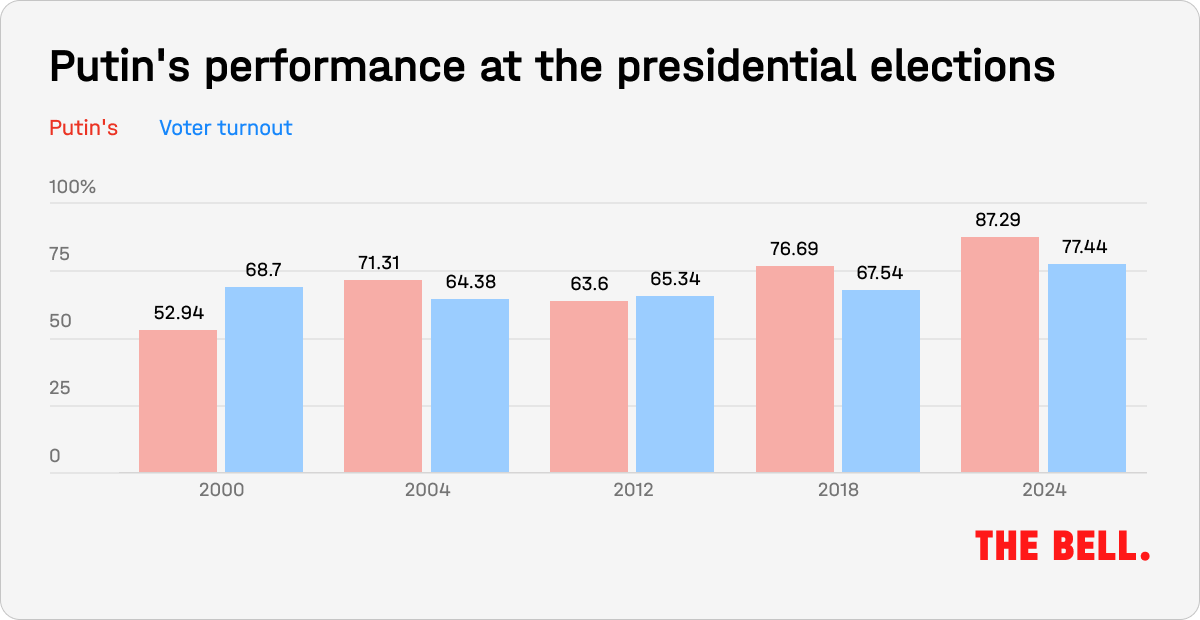
The official election result is already out — Vladimir Putin secured 87.28% on a turnout of 77.44%. Both those numbers are record highs since the collapse of the Soviet Union. And both are about 10 percentage points up on 2018 (when Putin polled 76.8% on a 67% turnout). This suggests that the Kremlin’s political managers were tasked with delivering a significant increase in Putin’s popularity. That in itself is not surprising: in the current circumstances an autocrat needs to demonstrate how his people have rallied around the flag.

Initial research by journalists and independent experts suggests the vote could have been the most heavily falsified in the history of post-Soviet Russia. Analysis by IStories and Ivan Shukshin, a researcher and activist with the Golos vote monitoring NGO, estimated that around 22 million of the 76.3 million votes cast for Putin were “anomalous.” In other words, almost a third of Putin’s official tally could have been false. 

Their methodology is based on analyzing the turnout and vote shares at individual polling stations, using the central election commission’s official data. Districts with higher turnouts also have larger vote shares for Putin — a fact which suggests ballot-stuffing since the two shouldn’t be strongly correlated. IStories and Shukshin didn’t include results in Moscow, where online voting makes the analysis trickier. A third report by Novaya Gazeta Europe said as many as 31.6 million votes — almost half of Putin’s total — could have been fake.

Many experienced observers of Russian politics (1,2) believe that election organizers in provincial Russia “overdid it” this time round. Most pre-election leaks of the Kremlin’s vote strategy featured more modest targets. In spring 2023, for instance, RBC wrote that the Kremlin wanted to secure 75% of the vote on a 70% turnout. A few months later, Meduza wrote that regional authorities were advised that they should secure at least 80% of the vote for Putin. The final pre-election opinion polls conducted by state pollster VTsIOM (which also represent indirect instructions to regional election officials for polling day) showed Putin’s result was at the initial target level of 75%.

The record result places Putin firmly among his fellow autocrats. In free democratic elections, it’s a rare anomaly for a candidate to poll even at 60-70%. Only once, in extreme circumstances, have we seen more than 80% in a democratic country — a huge protest vote that gave France’s Jacques Chirac 82% in a presidential run-off against Jean-Marie le Pen in 2002, the BBC reported. In Russian history, Putin still has something to aim for if we look back to Soviet times. The turnout in 2024 was slightly higher than when Boris Yeltsin was voted president of the Russian Soviet Federative Socialist Republic in 1991, but there is still some way to go to match the Stalin era of 100% turnout in votes to appoint new deputies.

Since Putin was re-elected in 2018, voting in Russia has become even less transparent, and offered greater opportunities for fraud. Remote electronic voting was conducted in 29 Russian regions. Some 70% of the 4.7 million voters registered to vote online apparently cast their votes on the first of the three-day poll. Monitoring violations at physical polling stations is an almost impossible task. The Central Electoral Commission stopped broadcasting live footage from monitoring cameras in polling stations after the pictures from 2018 had depicted numerous violations and led observers to conclude that the scale of ballot stuffing was so great that the real result could not be determined in at least 11 regions. 

The 2024 poll also differed from Putin’s two most recent victories in the selection of candidates who ran against the Kremlin leader. In 2012, political strategists allowed businessman Mikhail Prokhorov to stand, proposing that Russia’s marginal liberal opposition would consolidate around him. And in 2018, that same role went to TV presenter Ksenia Sobchak. But this time round there was no acceptable liberal candidate. Even the little-known politician Boris Nadezhdin, who timidly spoke out against the war in Ukraine, was denied registration. On the ballot were only Putin’s “rivals” from the systemic opposition parties. All of them have been equally supportive of Russia’s repressive turn, backing various crackdown measures that have come before the State Duma in recent years.

The extras in the 2024 race — Communist Nikolai Kharitonov, Vladislav Davankov of New People, and Leonid Slutsky of the LDPR — polled less than 12% combined. That’s slightly less than communist candidate Pavel Grudinin managed on his own in 2018. The 75-year-old Kharitonov’s 4.3% was better than the youthful Davankov’s 3.8%, while Slutsky, the unsuccessful heir to charismatic populist Vladimir Zhirinovsky, trailed in last with 3.2%.

Source: “‘Record’ victory cements Putin’s autocrat status,” The Bell, 19 March 2024


Despite intimidation by the authorities, many Russians went to polling stations across the country and abroad at noon on 17 March as part of the Noon Against Putin protest, which was conceived as one of the few safe ways for Russians to voice their dissent. After all, it is hard to punish people for going to a polling station on election day and queueing.

The protest was the brainchild of Maxim Reznik, a former member of St. Petersburg’s legislative assembly, and it was endorsed by Alexei Navalny. After the opposition politician was murdered in a Russian penal colony, his supporters and other Kremlin opponents urged Russians to take part in Midday Against Putin.

This time round the last day of the election fell on the end of Shrovetide, and the powers that be tried to take advantage of it. For example, in Tomsk, they organized Shrovetide festivities at one of the polling stations to generate “hustle and bustle.” In Arkhangelsk, local restaurants were forced to cook pancakes for free distribution at the polling stations. Festivities were also organized, for example, in Moscow Region, Perm, Chuvashia, Murmansk Region, and Kamchatka.

Investigative journalist Andrei Zakharov quoted an anonymous agitator who, along with his colleagues, was tasked with “inviting people to a Shrovetide party in a park while also suggesting they take their [internal] passports with them in order to vote. It’s not far to the polling station.”

Those who decided to take part in the noonday protest were intimidated by fake mailings. As early as 13 March, some users in Russia received messages purporting to be from Navalny supporters postponing the Noon Against Putin protest to late Sunday. On Saturday, some Muscovites got messages accusing them of supporting “extremist ideas” and demands to vote “without waiting in line.”

There was also intimidation from actual law enforcers. The Moscow Prosecutor’s Office issued three warnings about the danger of the protest and possible criminal chargers against the protesters.

In spite of this, people in Russia and around the world came to the polling stations at noon on 17 March.

The huge queues abroad attracted a lot of media attention. Just look at the number of people at [Russia’s] diplomatic missions in Almaty and Bishkek. In European countries, people stood in line for many hours.

The long waits at polling stations abroad were sometimes caused by the deliberately slow work of the election commissions. For example, in Riga, voters were let in two at a time, although there were six voting booths and four polling station officials available. Voting was also delayed because many embassies and consulates banned cell phones, searched voters as they entered, and made them temporarily surrender their belongings.

In Russia, people were also searched in many polling places after dozens of incidents of attempted arson and spoiling ballot boxes with paint (the handiwork of phone scammers) took place. “First, two policemen search the bags [of voters] very thoroughly outside. I even had to show them my deodorant stick,” a reader of Dmitry Kolezev’s Telegram channel from Moscow wrote.

Due to the [long] queues in Riga, Vienna and Yerevan, for example, the polls were kept open for at least another hour [after they were to have been closed]. But in Berlin, the embassy was immediately closed, prompting the people gathered there to stage an impromptu protest. One of the staffers at the diplomatic mission danced a little jig as they shouted “Shame!”

But the principal queues were in Russia.

The first lines formed at precincts in Siberia and the Urals — for example, in Perm and Yekaterinburg, Novosibirsk and Akademgorodok. In the last place, by the way, Putin lost to [Vladislav] Davankov, a rare case for electoral precincts in Russia itself.

The queues were de facto protest rallies. People lined up outside polling stations in Moscow, St. Petersburg, Arkhangelsk, and Sochi. Officials tried to persuade them to cast their votes on electronic terminals — it is easier to rig the vote that way — but people took paper ballots and either voted for someone other than Putin or defaced them by writing on them such things as “Love is stronger than hate,” or “You have the blood of Ukrainians on your hands, scumbag” (the latter remark was addressed to Vladimir Putin).

As it turned out, nobody interfered with the queues; the police were not violent and did not detain anyone. Most of the detentions that did occur were of independent observers and members of elections commissions who had tried to prevent violations. According to OVD Info, 17 March was “relatively calm.”

The election’s outcome surprised no one in a country where wartime censorship has virtually been introduced. Vladimir Putin took more than 87% of the vote according to the official count — a result almost like that of Central Asian dictators, and greater than that of [Belarusian dictator Alexander] Lukashenko.

The main outcome was that many Russians took advantage of the procedure as one of the few remaining opportunities to safely speak out against Putin and his policies. And they saw that they were not alone.

Source: “What the Noon Against Putin queues showed,” WTF? newsletter (Mediazona), 18 March 2024. Translated by the Russian Reader


In a third video, another man detained by law enforcement agents identified himself as Rajab Alizadeh.

A man off camera asked him: “When you fled from Moscow, you had weapons. Where did you throw them? There or here?”

Alizadeh, whose face and shirt were covered in blood and whose head was wrapped in medical gauze, said “somewhere along the road,” but could not recall exactly where he and his accomplices left their weapons.

An unverified graphic video shared online showed what was said to be Alizadeh lying face down on the ground as Russian law enforcement agents cut off his ear, which, if confirmed, could explain why the man’s head was wrapped in bandages in the interrogation video. 

Source: “Russian State Media Release Interrogation Videos of Concert Attack Suspects,” Moscow Times, 23 March 2024

“Across the River They’re Making Chocolate”: Vsevolod Korolev’s Closing Statement in Court

<Vsevolod Korolev

During his closing statement in court today the documentary filmmaker Vsevolod Korolev read a poem by Grigori Dashevsky:

1.

Across the river they’re making chocolate.

Out there the river-ice is breaking up.

And upriver we’re waiting, but for now

no bus comes, only its vacant ghost,

a desolate fleshless light flying ahead

to the engine’s howl

and the clatter of

the ad-slates changing.

We’re not cold, we bide our time.

The sky a deeper blue, the burning streetlights.


2.

To wait for each new minute as for a ghost,

to put on stage-paint for him alone,

to powder your face with light––and poorly it sticks,

but without it there’s nothing

to tell you apart: not from the many

faces—multitudes—

but from the lived-through years

which, like a star, are distant and weightless as smoke.


3.

But from the sweet smoke, the glory of heaven,

look up for a moment,

tear your eyes away
as from a book:

As much as a star has its shining

or a factory its smoke,

all things have

their limit: a book’s gilded edges

or a band of cloud.


4.

And turned from weddings not my own, and graves,

not waiting for the end, I rose

and saw an enormous room, a hall,

walls, walls, Moscow, and I asked:

where is the light that lit these pages,

where is the wind that rustled them like leaves?


5.

It’s late to be asking: each person is lit bright,

thrown open to the right dream

for the minutes, like pupils widened,

unscathed, like smoke or sleep:

they fly in, gleam, collect a promise:

Remember, remember (take leave of) me.


“I don’t intend to speak for very long. Your Honor, I am in some sense a colleague of yours, since I’ve worked as a third-tier soccer referee; I understand that you’re in a tough situation, it’s hard to envy someone stuck in the middle of this whole business. But nevertheless I have always believed in people and will continue to do so, even when it makes absolutely no sense. In any case I know this is really hard for you, but I think you’ll figure it out.” (Vsevolod Korolev)

“To ask for ten years when the maximum is ten and given the absence of aggravating circumstances and the evidence of mitigating ones—this goes against the fundamental norms of the criminal code. And this demonstrates for the umpteenth time the invalidity and baselessness of the prosecution’s case.” ([Korolev’s defense] lawyer Maria Zyrianova)

Source: Irina Kravtsova (Facebook), 18 March 2024. Translated by the Fabulous AM. Grigori Dashevsky, “Across the river they’re making chocolate,” trans. Ainsley Morse and Timmy Straw, The Hopkins Review 16.2 (Spring 2023): 18–19. Translation © 2023 Ainsley Morse and Timmy Straw, reproduced here courtesy of the translators.


Discourse journalist and documentary filmmaker Vsevolod Korolev has been sentenced to a three-year prison term on charges of “disseminating fake news” about the army.

During the trial on March 18 defense lawyer Maria Zyrianova noted that the case file did not indicate what information in Korolev’s posts had been determined to be knowingly false. Korolev is accused of making two posts on [the Russian social media network] Vkontakte about the mass murders of civilians in the Ukrainian cities of Bucha and Borodianka, as well as about the shelling of Donetsk.

The prosecution requested a nine-year prison sentence for Korolev. This, noted Discourse, was the longest prison term ever requested by state prosecutors for the charge of disseminating “fake news” about the Russian army.

During the court hearing on March 20, bailiffs at St. Petersburg’s Vyborg District Court recorded the names of those who came to support Korolev, SOTA reports. Earlier, SOTA published a recording of a telephone conversation between the bailiffs, in which they announced their intention to provide the lists of those who came to the trial to Center “E” [the “counter-extremism” police].

The Case of Vsevolod Korolev

  • Vsevolod Korolev is a documentary filmmaker and poet. He worked as a correspondent for the culture magazine Discourse and made films on social themes — about children with disabilities and political prisoners.
  • Korolev was detained in July 2022. During the search, his electronic devices were confiscated.
  • The prosecutors argued that Korolev’s documentaries about the political prisoners Maria Ponomarenko and Alexandra Skochilenko should be deemed an aggravating circumstance.
  • Linguistic expertise in the case was provided by linguist Alla Teplyashina and political scientist Olga Safonova from the Center for Expertise at St. Petersburg State University.
  • One of the prosecution’s witnesses later recanted their testimony.
  • In his closing statement at the trial, Korolev quoted a poem by Grigori Dashevsky: “It’s late to be asking: each person is lit bright, / thrown open to the right dream / for the minutes, like pupils widened, / unscathed, like smoke or sleep: / they fly in, gleam, collect a promise: / Remember, remember (take leave of) me.
  • Memorial has designated Korolev a political prisoner.

You can support Vsevolod Korolev by sending him a letter to the following address:

196655 St. Petersburg, Kolpino, Kolpinskaya Street, 9, FKU SIZO-1, Vsevolod Anatolyevich Korolev (born 1987)

You can also use the service FSIN-Pismo.

Source: Discourse journalist Vsevolod Korolev sentenced to three years for ‘fakes’ about the army,” DOXA, 20 March 2024. Translated by the Fabulous AM and the Russian Reader. People living outside of Russia will find it difficult or impossible to send letters to Russian prisons via regular mail or using online prison correspondence services such as FSIN-Pismo. In many cases, however, you can send letters (which must be written in Russian or translated into Russian) to Russian political prisoners via the free, volunteer-run service RosUznik. You can also write to me (avvakum@pm.me) for assistance and advice in sending such letters.||| TRR

This Russian Life: Alexandra Karaseva’s Election Day Molotov Cocktail

Alexandra Karaseva. Photo from social media account via Bumaga

During the three days of the [presidential] election in Russia, the Interior Ministry reports, twenty-one criminal cases were launched over attempts to set fires at polling stations or spoil ballots with brilliant green dye solution. Twenty-one-year-old student Alexandra Karaseva was remanded in custody to a pretrial detention centre after being arraigned on just such charges.

According to police investigators, on 15 March, Karaseva threw a Molotov cocktail at a polling station poster on the porch of School No. 358. No one was injured.

Bumaga explored what we know about Alexandra Karaseva, why she might have committed the arson attack, and what defendants charged with obstructing the work of polling places face.

In St. Petersburg, 21-year-old Alexandra Karaseva was remanded in custody to a pretrial detention centre. Investigators allege that she threw a Molotov cocktail at a polling station

Around three p.m. on the first day of voting, 15 March, a young woman ran up to the porch of School No. 358, in Petersburg’s Moscow District, and threw a Molotov cocktail at the wall, as seen in surveillance footage.

The school housed two election precincts—No. 1395 and No. 1396. The attempted arson only left traces of soot on the upper part of the information sign bearing the elections logo and on the wall of the school. No one was injured and the operation of the polling station was unaffected.

The aftermath of the 15 March arson attempt on the porch of School No. 358 in Petersburg. Photo courtesy of Bumaga

The young woman tried to run away but was immediately detained by one of the witnesses. After the incident, the media and the municipal courts press service revealed the suspect’s identity: 21-year-old Alexandra Karaseva. According to the media, the young woman told the police that she had been promised payment for the arson, and that she had received the assignment from a certain “Ukrainian Telegram channel.”

Karaseva was charged with “obstructing the exercise of voting rights” and faces up to five years in prison if convicted. According to police investigators, unidentified persons had inveigled Karaseva “into a criminal plan” over the telephone. The arson attack’s goal was to disrupt the work of polling stations, the investigators claim.

The next day, 16 March, Petersburg’s Moscow District Court remanded Karaseva in custody to a pretrial detention centre. The young woman had pleaded guilty, but asked to be placed under house arrest.

She danced, wasn’t interested in politics, and had financial troubles: how Alexandra Karaseva is described by her acquaintances

Karaseva moved to Petersburg from the Amur Region about four years ago, according to her social media accounts. In 2020, she graduated from school in Blagoveshchensk and enrolled in the computer science and applied mathematics program at Saint Petersburg State University of Economics.

Karaseva had been dancing from the age of five, and at the university she was actively involved in extracurricular activities, her acquaintances told Bumaga. In the autumn of 2023, [the university’s website] mentioned her as a fourth-year student who was a choreographer for the university’s dance team. She worked on a performance celebrating the fifth anniversary of the National Guard department at the Military Institute’s Logistics Academy.

“We worked together on a student talent show. She was responsible for staging the team’s dance numbers. She led a very active lifestyle and was involved in extracurricular activities. She cared about people who needed help. She used to work as a choreographer for children’s dance groups,” said Alisa, a female university acquaintance of Karaseva’s.

While studying at the University of Economics, Karaseva lived at the Inter-University Student Campus (ISC) near the Park Pobedy metro station and competed in the 2023 Miss and Mister ISC contest. According to another university acquaintance of Karaseva’s (who wished to remain anonymous), Karaseva was often short of money, so she took various part-time jobs.

“Frankly, this situation has been a huge shock to me,” said the acquaintance. “Never in my life would I have believed that Sasha could do such a thing. As long as I have known her, she never raised the topic of politics. I’m pretty sure she didn’t do it out of choice. It was probably out of desperation. She was either conned or had money problems.

A few months ago, Karaseva had transferred to the Herzen Russian State Pedagogical University, according to Channel 78. One of Karaseva’s acquaintances also told Bumaga that Karaseva was no longer enrolled at the University of Economics. Officials at the Herzen told Fontanka.ru that a young woman with the same name had recently been expelled from the pedagogical university for skipping classes.

Karaseva’s immediate family members ignored our requests to comment on the story.

Over three day, twenty-one criminal cases were launched in Russia for arson attempts and the pouring of brilliant green dye solution on ballots at polling stations. Some suspects report they were promised payment

Sixty-one criminal cases relating to the presidential election were launched in Russia over the three days of voting, First Deputy Interior Minister Alexander Gorovoy reported on the evening of 17 March. Twenty-one of these cases involved arson attempts at polling stations and attempts to spoil ballot boxes with brilliant green dye solution: they were charged as “obstruction of voting rights.”

In addition to Karaseva, people in other regions of Russia also brought Molotov cocktails and brilliant green dye solution to polling stations. Most cases were recorded on the first day of voting. Here are just a few of them:

  • A criminal case was launched against a 58-year-old resident of Kogalym who set fire to her ballot and ballot box at a polling station.
  • Charges were filed against a resident of Volzhsky, in the Volgograd Region, who poured brilliant green dye solution on a ballot box and the ballots in it. The woman herself said that she had been offered a “monetary reward of thirty [thousand rubles]” for spoiling the ballot box.
  • 20-year-old Alina Nevmyanova, who poured green paint into a ballot box at a polling station in Moscow on 15 March 15, was remanded in custody to a pretrial detention centre. According to Baza, the young woman “had received instructions from someone over the phone.”
  • A Moscow pensioner by the name of Petrukhina, who suffers from cancer and who, according to Mediazona, set fire to voting booths, was placed under house arrest.

In most cases, the suspects in these criminal cases have repented and admitted their guilt. In some cases, they reported that they did it for the money, while eyewitnesses claim that the defendants were allegedly instructed by phone before attempting arson or spoiling ballots with brilliant green dye solution. The details in many of the incidents are still emerging, however.

No Ukrainian organizations have claimed responsibility for the incidents that took place during the Russian elections.

Since the beginning of the full-scale war in Ukraine, acts of sabotage in Russia have been widespread, and they are often committed for payment or after conversations with phone scammers. In Petersburg, they most often have involved arson attacks on military infrastructures, such as military enlistment offices and railroad relay boxes. According to police investigators, the relay box arsonists have usually been hired by persons unknown through Telegram channels for job seekers. For example, the first person convicted of sabotage in Petersburg, Vyacheslav Zaitsev, who was eighteen at the time of his arrest, agreed to destroy a relay box on the railroad in return for ten thousand rubles [approx. 100 euros]. He was sentenced to eight years in prison.

Zhumagul Kurbanova, a 66-year-old employee of a Pyaterochka convenience store in Petersburg, told police officers that she had received a phone call from a certain “Alexander Fyodorovich,” who convinced her to set fire to the door of the military enlistment office on English Avenue, as there were allegedly fraudsters operating there. Kurbanova was sentenced to ten years in prison.

The State Duma has proposed increasing the punishment for attempts to disrupt elections to eight years in prison. Currently, people who torch and vandalize ballot boxes face a maximum of five years in prison

Shortly after a dozen cases of inept “sabotage” at polling stations were recored in Russia on the first day of the election, State Duma deputies proposed toughening the punishment for attempting to disrupt elections by “generally dangerous means” by up to eight years’ imprisonment. Yana Lantratova (A Just Russia–For Truth), a member of the Duma committee investigating foreign interference in Russia’s internal affairs, reported that a bill to this effect was being drafted.

Currently, Article 141.2 of the Russian Federal Criminal Code—”obstructing the exercise of voting rights or the work of election commissions by conspiring to influence the outcome of the vote”—carries a maximum sentence of five years’ imprisonment. Attempts to set fire to polling stations or pour brilliant green dye solution on ballot boxes most often triggered charges of violating this particular article.

Source: “Desperate, deceived, and hard up for money: 21-year-old Alexandra Karaseva threw a Molotov cocktail at a school on election day—now she faces up to five years in prison,” Bumaga, 19 March 2024. Translated by the Russian Reader

Degenerate Art

The FSB has opened a criminal case on charges of “high treason” against artist and former Mediazona publisher Pyotr Verzilov. The details of the case are not yet known, but as part of their investigation, law enforcers raided the homes of a number of artists and activists across Russia. Many of those whom the law enforcers raided are not personally acquainted with Verzilov.

In the early hours of Tuesday morning, people identifying themselves as FSB officers searched the home of Petersburg artist Katrin Nenasheva and her girlfriend Natasha Chetverio. Nenasheva was taken away for questioning, while Chetverio was released, but both had their electronic devices confiscated. The homes of artist Sasha Blot, Party of the Dead activist Kristina Bubentsova, illustrator Vladlena Milkina, and architect Alexandra Kachko were also searched in St. Petersburg.

Law enforcers simultaneously raided the apartments of Verzilov’s mother Yelena, members of the art group Yav, actionist Anastasia Mikhailova (an associate of the artist Pavel Krisevich), and Pussy Riot members Rita Flores, Olga Pakhtusova, and Olga Kuracheva. The latter two were involved in the action “The Policemen Enters the Game”: along with Verzilov, they ran out onto the field of a Moscow stadium during a World Cup match there.

In Moscow, a female acquaintance of the artist Philippenzo (who is now in exile) was taken from her flat. The Yekaterinburg artist Ilya Mozgi and the Ulyanovsk artist Ilya Kholtov were both taken away for questioning after their homes were searched. Nizhny Novgorod artists Artem Filatov and Andrei Olenev were questioned. Samara artist Denis Mustafin’s home was searched. Although he was not at home, his mother’s computer was confiscated.

Some of these have already been released from interrogation (Nenasheva and Kholtov, for example), while others are still being questioned. It is known that most of them have now been designated as “witnesses” in the case against Verzilov. Many of them were asked about their connection to Verzilov: many did not know him personally and had never had much contact with him. Kristina Gorlanova, the former director of the Urals branch of the Pushkin State Museum of Fine Arts, located in Ekaterinburg, whose home was also searched, said that she had “heard nothing” about the “artist” who occasioned the search.

It is still unclear what gave rise to the criminal case. Under new legislation, however, switching to the enemy’s side during a war can be considered “state treason” can be considered as switching to the enemy’s side during a war. In an interview with Yuri Dud last year, Verzilov admitted that he had originally traveled to Ukraine as a documentary filmmaker, but now he was at the front “as a military man.”

“Verzilov: Inside [the] War,” vDud, 5 October 2023. In Russian, with English subtitles

Many of the artists whose homes were raided may never have been involved in Verzilov’s activities, but they themselves have produced works about current events in Russia and Ukraine. We wrote last year about the works of Yav and Philippenzo. Mustafin was fined for flying a a Russian flag inscribed with the phrase “Today is not my day” outside the Ministry of Defense in Moscow on 12 June 2022. Milkina made a public art piece about “people who are scared” on a Petersburg square and T-shirts with the word “Peace” on them.

Source: “Law enforcers raid homes of artists and actionists on eve of elections,” WTF? newsletter (Mediazona), 12 March 2024. Translated by the Russian Reader


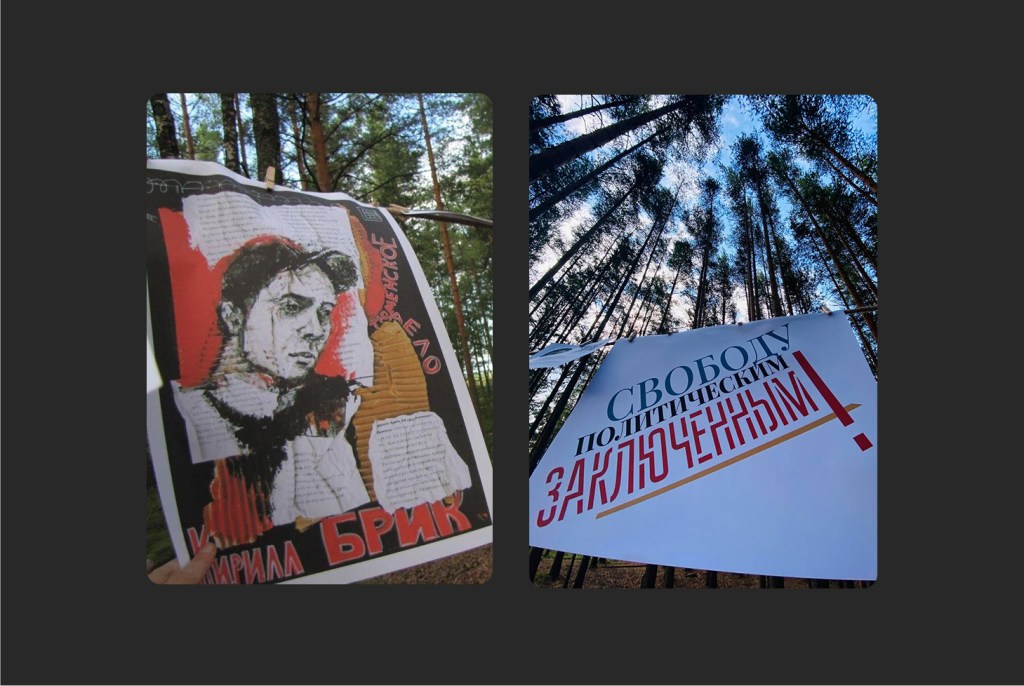
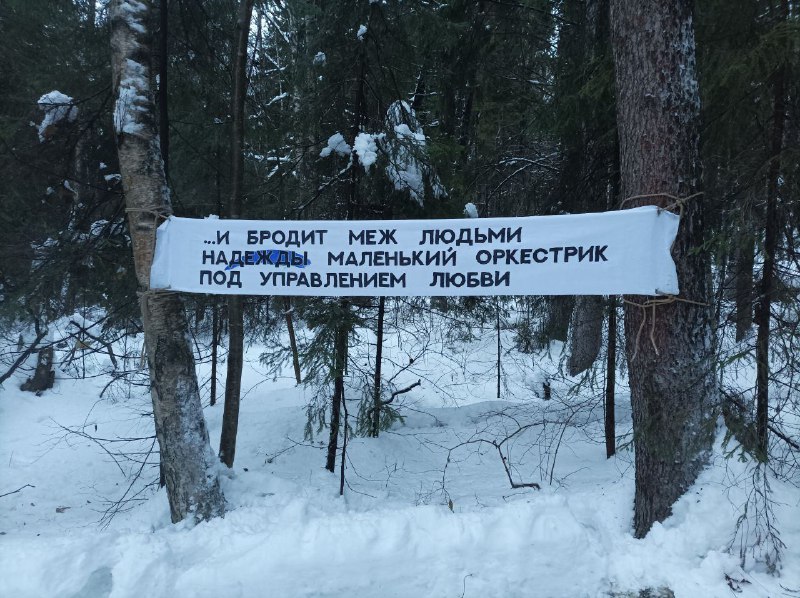
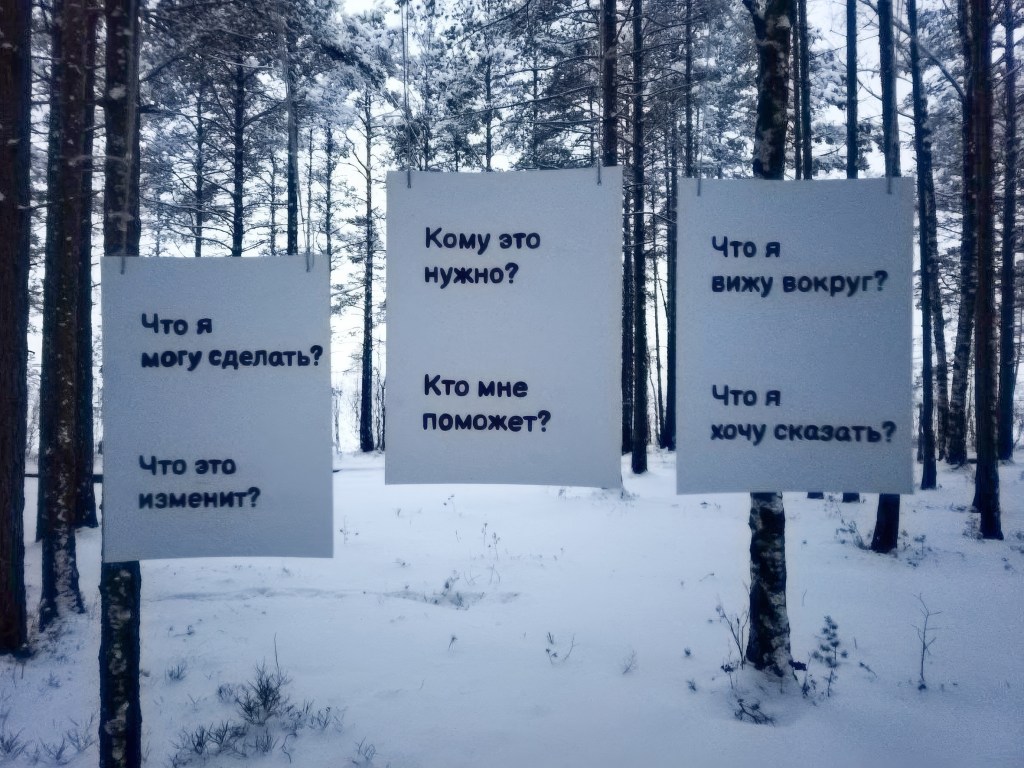
Petersburg artists find ways to get their messages across even amidst strict censorship. They mount underground apartment exhibitions, “tiny pickets” on city streets, and exhibitions and performances in the woods. It all smacks of the Soviet guerrilla art and actionism from which the international stars of post-Soviet conceptualism later emerged.

Bumaga explores how street art shows have gained popularity in Russia, how guerrilla art has changed in recent decades, and how today’s actionists resemble the organizers of the notorious Bulldozer Exhibition.

“I’m for peace!” Photo: Tiny Picket (Instagram)

Street exhibitions have been around since the 1960s. One of the first such projects was dubbed “the Soviet Woodstock”

Guerrilla street exhibitions in Russia date back to the so-called unofficial art scene of the 1960s and 1970s. Pursuing the idea of coupling art and ideology, the authorities forced undesirable artists out of public art life.

In 1962, Nikita Khrushchev cracked down on the exhibition 30 Years of the Moscow Union of Artists, at the Moscow Manege. The Soviet premier wanted to expel all of its participants from the CPSU and the Union of Artists, although almost none of them were Party or Union members. Artists and connoisseurs reacted to political censorship in the USSR by forming an artistic underground, meaning that the most progressive art was exhibited at apartment exhibitions and in salons.

The 1970s witnessed open confrontation between the art and the world authorities. The most flamboyant members of the artistic underground were the Lianozovo school, who gathered and held exhibitions in a barrack in Moscow’s Lianozovo neighborhood. The leader of the group, Oscar Rabin, organized one of the most infamous guerrilla street exhibitions in the history of Russian art, which later became known as the Bulldozer Exhibition. On 15 September 1974, the artists staged a show of paintings in a vacant lot in Moscow’s Belyayevo Forest. The authorities sicked police on the participants and attendees and destroyed the show with bulldozers.

This crackdown on artistic expression triggered an international uproar, and the Soviet authorities made concessions. Two weeks later, the artists were allowed to hold an officially sanctioned exhibition featuring an expanded list of participants in Moscow’s Izmailovo Park.

This time the police were tolerant towards the artists and their guests: no one was detained. The exhibition lasted for several hours and, thanks to the beautiful weather, it turned into a big picnic. Western journalists dubbed the event “the Soviet Woodstock.”

Soviet unofficial artists continued this tradition, and one art group published 14 volumes documenting their activities

However, the underground’s victory at the Bulldozer Exhibition was not unequivocal. Unofficial art continued to defend its right to exist at an exhibition in the Beekeeping Pavilion at VDNKh (February 1975), at the Preliminary Apartment Previews for the All-Union Exhibition (spring 1975), and at an exhibition in the House of Culture Pavilion at VDNKh (September 1975).

These exhibitions were sanctioned, but the authorities still created a number of organizational obstacles for the artists. For example, only those artists who had a Moscow residence permit were allowed to show their work at the House of Culture. In addition, the authorities made the condition in which the artists worked unbearable: during the mounting of the show, the temperature in the pavilion topped forty degrees Celsius. Thirty-eight works were banned by the censorship commission. It is not known how many works were exhibited, ultimately, but a total of 145 artists participated in the show.

After the scandals provoked by the “unofficial” artists’ public appearances, the authorities began pursuing a policy of legalizing alternative art. In May 1976, the Painting Section of the Graphic Artists Committee was established, primarily to monitor and control the ideologically dangerous underground.

We should keep in mind that we do not have information about every single Soviet-era guerrilla exhibition. Many were held without leaving any trace in contemporary newspapers and other documents.

Collective Actions, a group led by Andrei Monastyrsky, did a huge amount of work in this sense. The artists compiled fourteen volumes documenting their Trips to the Countryside — actions during which various events took place in particular landscapes, including installations, performances, and minimalist interventions in nature. By going outdoors, the artists showed that art could be implicated in the space outside galleries and museums. Another important feature of the performances was the inclusion of viewers in the works: their participation and reactions were part and parcel of the conceptual actions. The way the actions were staged encouraged the spectators to focus on the processes of anticipating and comprehending the happenings. That is, the spectacle itself was an occasion for reflection, a statement meant to spark a dialogue.

In [1977], for example, Collective Actions simply hung a red banner between trees in the woods. The banner read: “I HAVE NO COMPLAINTS AND I LIKE EVERYTHING, ALTHOUGH I’VE NEVER BEEN HERE AND KNOW NOTHING ABOUT THESE PARTS.”

Collective Actions, Slogan (1977). Photo courtesy of New East Digital Archive via Bumaga

Guerrilla exhibitions are still organized nowadays, many of them dedicated to political prisoners

As a rule, guerrilla exhibitions and actions have a political agenda, so their organizers can be punished quite severely, even by Russian standards.

Nevertheless, there is activity in this field. For example, on 5 August 2023, Petersburg activists mounted an open-air exhibition on the Sestroretsk Ecotrail on the Day of Remembrance of the Victims of Sandarmokh [sic], a tract in the forests of Karelia where victims of the Great Terror were shot and buried in mass graves. Fifty works hung in the open air for a record time — almost an entire day.

Placards in support of Tyumen Case defendant Kirill Brik (left) and the release of political prisoners (right) at 2023 guerrilla exhibition in suburban Petersburg. Photos courtesy of 123ru.net via Bumaga

Several placards were also hung in the woods outside Petersburg this winter — for example, on December 10, Human Rights Day, the work I Dissent, Therefore I Am. And in January, an installation featuring a quotation from the Bulat Okudzhava song “Hope’s Little Band” was mounted outside the city.

“…and wandering amongst people / is hope’s little band, / conducted by love.” Photo: Bumaga reader
“What can I do? What would it change? Who would care? Who would help me? What do I see when I look around? What do I mean?” Part of the installation I Dissent, Therefore I Am. Photo: a Bumaga reader

In 2022, Petersburg hosted Carte Blanche, an international guerrilla street art festival. In addition to street works, a stationary exhibition at the abandoned Sailors Palace of Culture on Vindavskaya Street attracted great attention; it featured over twenty artists, including Vladimir Abikh, Maxim Ima, and Slava PTRK. That same autumn, Petersburg hosted the underground exhibition Continuity, dedicated to political prisoners of the past and present, including the victims of the Great Terror and those caught up in the Network Case. Some of the works were made by political prisoners themselves using improvised means and materials while they were incarcerated in pretrial detention centers and penal colonies.

Contemporary street exhibitions continue the Soviet tradition, but the state’s reaction to them has become tougher

Today’s guerrilla exhibitions in many ways are a continuation of the Soviet and post-Soviet tradition. The Bulldozer Exhibition can hardly be called an artistic event also. It was also a political event. It was a challenge to a repressive regime, “the first and most significant collective performance,” as art historian Yevgeny Barabanov wrote.

Since 2022, such exhibitions also have not only aesthetic but also political goals. Although in the Soviet and post-Soviet years, “unofficial” exhibitions, albeit with certain restrictions, could be legitimated [sic], since 2022, the state does not even attempt to compromise with artists.

Moreover, crackdowns against artists who voice alternative opinions have reached a new level. In 1991, the Moscow actionist Anatoly Osmolovsky and his group E.T.I. used their bodies to spell an indecent word for the phallus [khui] on Red Square. After the action, Osmolovsky was detained and threatened with charges of “malicious disorderly conduct.” However, thanks to the petitions submitted to the authorities by his art world colleagues and the Memorial Society, Osmolovsky was soon released.

Nowadays, petitions and statements of support are not enough to get artists acquitted. Sasha Skochilenko was sentenced to seven years in prison on charges of disseminating “fake news” about the Russian army. The young woman replaced price tags at a Perekrestok chain grocery store with anti-war messages.

Source: “Placards in the woods and art shows in flats: how this differs from Soviet guerrilla art,” Bumaga, 12 March 2024. Translated by the Russian Reader

Time of Heroes

In his state of the nation speech, President Vladimir Putin announced the launch of the national project “Time of Heroes” for veterans and current participants of the special operation by Russian troops in Ukraine.

Статья на медиа «Просто работа»
Photo: Pixabay courtesy of Rabota.ru

Servicemen with university degrees, managerial experience, and no criminal records can apply to the personnel program. The head of state called such people the country’s “true elite” and argued that they should “lead regions, enterprises, and the largest public projects.”

The program will kick off on March 1. Veterans will be trained per the standards of the School of Governors and the Leaders of Russia competition, and ministers and heads of enterprises will act as their mentors.

Currently, all participants of the special military operation also enjoy priority hiring, and their employers also receive benefits.

Source: Andrei Gorelikov, “SMO veterans will participate in the Time of Heroes’ personnel programme: According to the President, they should take up ‘elite’ positions,” Just Work (Rabota.ru), 29 February 2024. Translated by the Russian Reader


News from the territories occupied by Russia:  

Ukrainian journalist and former editor abducted from Russian-occupied Henichesk  (Kharkiv Human Rights Protection GroupMarch 8th)

Russia sentences Ukrainian marine to 20 years for defending Mariupol  (Kharkiv Human Rights Protection GroupMarch 8th)

‘It wasn’t like this before Russia came’ The state of healthcare in Ukraine’s occupied territories after two years of war (Meduza, March 7th)

‘When I was evacuated, I only had a pair of trousers, shoes, a jacket and my documents’ (Kharkiv Human Rights Protection GroupMarch 6th)

Another wave of searches and detentions of Crimean Tatars (Crimea SOS and others, 6 March)

Crimean Solidarity journalist and activists arrested, their families terrorized, in new Russian offensive against Crimean Tatars  (Kharkiv Human Rights Protection GroupMarch 6th)

Ominous denials a month after Crimean Tatar father abducted by Russian FSB  (Kharkiv Human Rights Protection GroupMarch 6th)

Russia’s abuses against civilians in the occupied territories of Ukraine: event during the UN Human Rights Council  (ZminaMarch 6th)

Absence of law and international control (Kharkiv Human Rights Protection GroupMarch 6th)

UN records 104 cases of pro-Ukrainian Crimeans abducted in past 10 years  (Ukrainska Pravda, March 5th)

Reshat Ametov and 10 years of Russia’s systematic torture, abductions and killings of civilians for supporting Ukraine  (Kharkiv Human Rights Protection GroupMarch 4th)

Russia passes huge conveyor belt sentences against Ukrainians tortured for propaganda videos (Kharkiv Human Rights Protection GroupMarch 4th)

All’s fair in art and war: Russia’s plunder of Ukrainian museums (The Insider, February 29th)

Source: News from Ukraine Bulletin no. 88, 11 March 2024

Don’t Stomp on the Ants, Sweetheart

KING CITY, Calif. — A group of men in masks opened fire at an outdoor party in central California, killing four people and injuring three others Sunday evening, police said.

Police responded to a reported shooting around 6 p.m. in King City and found three men with gunshot wounds who were pronounced dead in a front yard, the King City Police Department said in a statement.

Four other people sustained gunshot wounds, including a woman who died after being transported to Mee Memorial Hospital in King City, about 106 miles (170 kilometers) south of San Jose.

The three injured men were transported to Natividad Hospital in Salinas, police said.

Several people were at the party outside a residence when three men with dark masks and clothes got out of a silver car and fired at the group. The suspects, who were not immediately identified, then fled the scene in the car.

The investigation is ongoing, police said.

On Monday French lawmakers will vote on whether to enshrine in the country’s constitution a “guarantee” of women’s “freedom” to have an abortion. They will meet at a joint session of the lower and upper houses of parliament in Versailles, a rarely convened body known as the Congress. A constitutional revision requires three-fifths of the votes. 

Such cross-party support is widely expected. Last Wednesday the French senate, which is controlled by the opposition centre-right, voted overwhelmingly in favour of the bill. The revision also enjoys backing from the governing centre and the opposition left. Emmanuel Macron, the president, wants women’s freedom to have an abortion to be made “irreversible”. French politicians of all stripes have worried about the potential for a future rolling-back of such guarantees—especially since America’s [sic] Supreme Court overturned the ruling that protected abortion rights there in 2022.

Sources: Spanishdict.com daily newsletter, 4 March 2024; Monterey Herald, 4 March 2024; Time, 4 March 2024; The Economist daily newsletter, 4 March 2024; the YouTube channels of The Insider (“Navalny’s Last Rally”) and Novaya Gazeta (“The Most Emotional Statements of People Who Came to Say Goodbye to Alexei Navalny”), with thanks to Tiina Pasanen; Andrei Bok (Facebook), 2 March 2024; Duolingo; random internet stock image.