Russia’s Trash Flashpoint

Landfills Become a Problem for the Kremlin
Environmental Protests Move from Local to Federal Level
Yelena Mukhametshina and Yekaterina Bryzgalova
Vedomosti
April 1, 2018
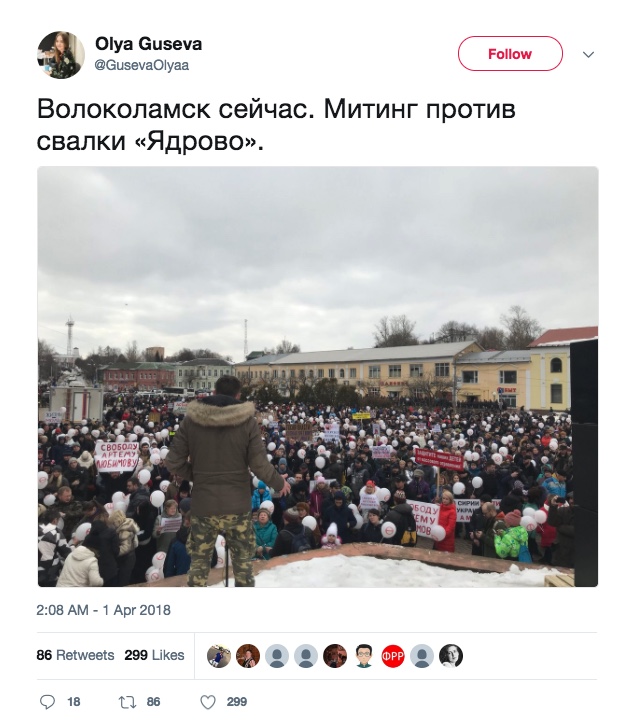
guseva“Volokolamsk right now. Protest rally against the Yadrovo Landfill.” Screenshot of Olya Guseva’s Twitter page. Courtesy of Meduza

According to various estimates, 6,500 to 7,000 people attended this past Sunday’s protest rally in Volokololamsk against the Yadrovo Landfill. This was more than the number of people who attended the rallies on March 3 (approx. 5,000) and March 29 (6,000). (Volokolamsk’s official population is less than 21,000.)

Among the demands made at Sunday’s rally were the closure of the Yadrovo Landfill, the declaration of an emergency, the resignations of Moscow Region Governor Andrei Vorobyov and Andrei Vikharev, acting head of Volokolamsk District, and the release of activist Artyom Lyubimov, who was detained by police a day before the rally.

Protesters at the rally held up placards addressed to President Putin, including ones  bearing the message, “Putin, Help!”

On March 21, a strong release of landfill gas took place in Volokolamsk, causing schoolchildren to say they felt sick. Fifty-seven children were hospitalized in the Volokolamsk Central Hospital. Subsequently, Governor Vorobyov fired the head of Volokolamsk District.

Volokolamsk has not been the only town in Moscow Region protesting landfills. During the past year, people have taken to the streets in such towns as Balashikha (after the local Kupchino Landfill was closed there on direct orders from the president, the garbage that used to be transported to the landfill was redirected to Yadrovo), Kolomna, Klin, Sergiev Posad, Tuchkov, and Serpukhov.

A former federal official explained why garbage has recently become a hot-button issue.

“New laws were passed obliging the regions to adopt local waste handling schemes and select regional contractors. A market is emerging. There are different disposal strategies: incineration versus separate collection of recyclables. Different strategies require building different processing facilities, and the stakeholders backing the different strategies are also different, from the federal to the municipal level,” he said.

The stakeholders are in conflict with each other and with the regions. This is especially true of Moscow and Russia’s other major cities, he claimed.

Last week, it transpired that Tver Region Governor Igor Rudenya had warned all heads of municipalities in his region that if the regional authorities found garbage from other regions in local landfills, the municipal heads responsible for this would have problems with law enforcement and Governor Rudenya’s administration.

“You will not import garbage from other Russian regions for any amount of money at all,” said Governor Rudenya, as quoted by Tverigrad.ru.

The president’s retinue is to blame for the flare-up in Volokolamsk. When they were getting ready for his annual Direct Line program, they insisted on underscoring the subject of landfills by way of speeding up the construction of processing facilities. It was then the president ordered the closure of the landfill in Balashikha, argues a source close to the Kremlin.

“The landfill was closed. The garbage from there was shipped to nearby landfills, and the flow of garbage to these landfills increased manifold. First it was necessary to put the infrastructure in place, and then close the landfills,” he said.

Environmental protests by people concerned with specific issues are a considerable risk to the system’s stability, and the regime is very concerned about them, saif another source close to the Kremlin.

“The president pays great attention to the environment. Last year, he personally telephoned activists in Chelyabinsk to show he supported them. This is quite important, especially in circumstances when environmental measures are given short shrift to save money.”

Last year was officially the Year of the Environment in Russia. During the presidential campaign, Putin held meetings in Krasnoyarsk on improving the ecological situation and  reducing the emission of pollutants into the atmosphere.

Political scientist Andrei Kolyadin argues the issue of landfills cannot be solved quickly. Several years would be needed to do that.

“This abscess has long been ripening, and now it threatens people’s lives. As the risks to people’s live increase, the risks to the regime increase as well.”

A final decision on the future of Governor Vorobyov, who faces elections in the autumn, has not yet been made, said Kolyadin.

“If the protests balloon, he could be made their scapegoat. He has been doing his best to wiggle his way out of the subject politically, but he has not been able to do this economically. If the elections are handled by the authorities, he will not have complications, but if they are run more or less honestly, the districts in which anti-landfill protests have been taking place will not turn out to vote for him.”

Political scientist Mikhail Vinogradov argues such protests ordinarily wane quickly. In this case, however, the boiling point has not yet been reached. Various grievances, such as Governor Vorobyov’s less-than-happy appointment of a new head of Volokolamsk District, have been building up.

“I get the feeling there will be a new wave [of protests] that will help solve the problems that have accumulated. People feel they are in the right, and it gives them a strong impetus to protest,” he said.

Given current conditions, in which protests have been de facto banned, any socio-economic protest takes on political overtones, Vinogradov concludes.

Translated by the Russian Reader
Karelian Historian Yuri Dmitriev Acquitted of Trumped-Up Charges

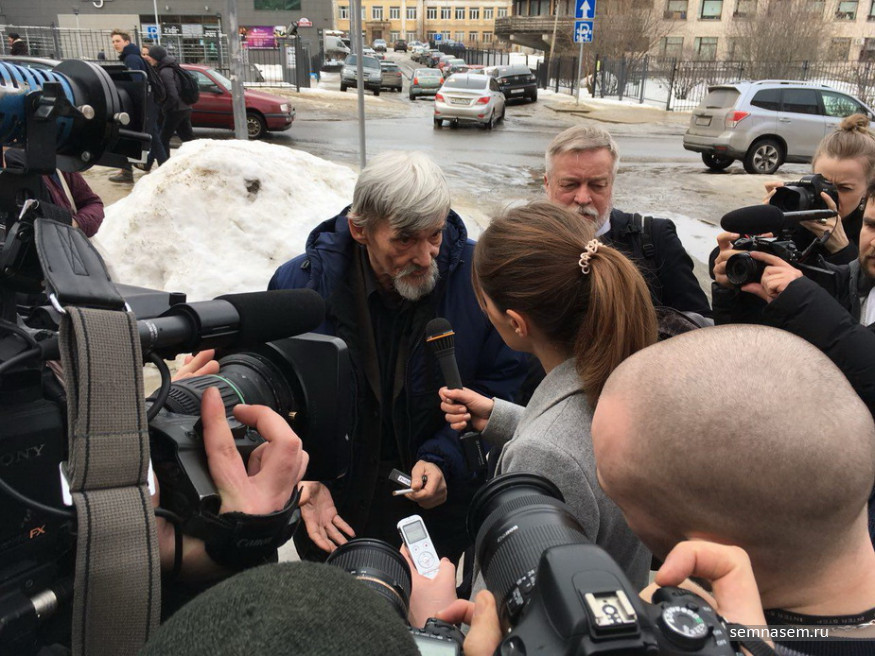
333Yuri Dmitriev. Photo by Gleb Yarovoi. Courtesy of 7X7
Court Acquits Karelian Historian Yuri Dmitriev of Pornography Charges
Anna Yarovaya
7X7
March 5, 2018

In Petrozavodsk, Judge Marina Nosova acquitted Yuri Dmitriev, head of Memorial Karelia and a historian of the Great Terror, of charges he had produced pornography involving images of minors.

The judge acquitted Mr. Dmitriev on the charges of manufacturing pornographic matter depicting minors and committing nonviolent acts of sexual abuse. On the charge of illegal possession of a firearm, the judge sentenced Mr. Dmitriev to two years and six months of police supervision. Deducting the time Mr. Dmitriev already spent in the Petrozavodsk Remand Prison, he will be under police supervision for three months. During this time, he will have to report to a parole officer periodically.

Defense attorney Viktor Anufriev commented on the court’s decision.

“Yesterday, the media quoted the president’s statement that judges who failed to uphold the law should look for other jobs. Today’s verdict is confirmation the president’s statement was heeded. Yuri Alexeyevich has been acquitted on nearly all counts. The court awarded him the right to vindication and compensation for pain and suffering. He was convicted of possessing part of a smoothbore gun and sentenced to two years and six months of police supervision, meaning he must report to the parole inspector twice a month. He spent one year, one month, and fifteen days in police custody. One day in custody is equal to two days of community service, meaning he has already served two years and three months of his sentence,” said Mr. Anufriev.

Yan Rachinsky, chair of the International Memorial Society, came to Petrozavodsk for the reading of the verdict.

“It’s a completely outrageous case. When a man like this, the champion of a cause, is accused of god knows what, the accusation cannot be real. My natural reaction is to do what I can to voice my solidarity. Solidarity takes various shapes. But today is the day of the verdict. I have been more worried about the plight of a specific person than how it has affected Memorial. This is much more important. But yes, of course, various contemptible means of mass disinformation have glommed onto the story. What can you do? You cannot force anyone to be honest,” said Mr. Rachinsky.

Like the entire trial, the verdict was announced in closed chambers. [Verdicts must be read out in open court according to Russian law—TRR.] Before the hearing, court bailiffs blocked the hallway, and reporters, friends, and Mr. Dmitriev’s supporters were unable to approach the courtroom doors the entire time.

Mr. Dmitriev was detained on December 13, 2016. According to police investigators, he had photographed his foster daughter while she was naked. The historian’s defense counsel claimed the photos were part of a diary, charting the girl’s health, that Mr. Dmitriev kept for children’s protection services because his foster daughter was abnormally thin. Court-appointed experts corroborated these claims.

Mr. Dmitriev’s trial in Petrozavodsk City Court commenced on June 1, 2017. The case was heard in closed chambers. Mr. Dmitriev was charged under three articles of the Russian Federal Criminal Code: Article 242.2 (production of pornographic matter depicting minors), Article 135 (nonviolent sexual abuse), and Article 222 (illegal possession of a firearm).

During the investigation, the photographs in question were subjected to two forensic examinations. The first examination deemed the photographs pornographic. The second examination, on the contrary, found no traces of pornography in them.

On January 22, 2018, the Serbsky Institute performed a psychiatric examination of Mr. Dmitriev, for which purpose the historian was transported under armed guard to Moscow. On February 27, 2018, the court announced Mr. Dmitriev had been deemed mentally healthy.

On January 27, 2018, Mr. Dmitriev was released from remand prison on his own recognizance. In the first interview he granted after his release, he spoke of life in prison and his plans to finish a book.

On March 20, 2018, Petrozavodsk City Prosecutor Yelena Askerova asked the court to sentence Mr. Dmitriev to nine years in a maximum security penal colony. On March 22, 2018, Mr. Anufriev said the Dmitriev case was a mockery of the historian’s foster daughter. A series of solo pickets in support of Mr. Dmitriev took place in Petrozavodsk on March 25 and March 26, 2018.

Translated by the Russian Reader. Read my previous coverage of the Dmitriev case.


Putin’s Alleged Popularity

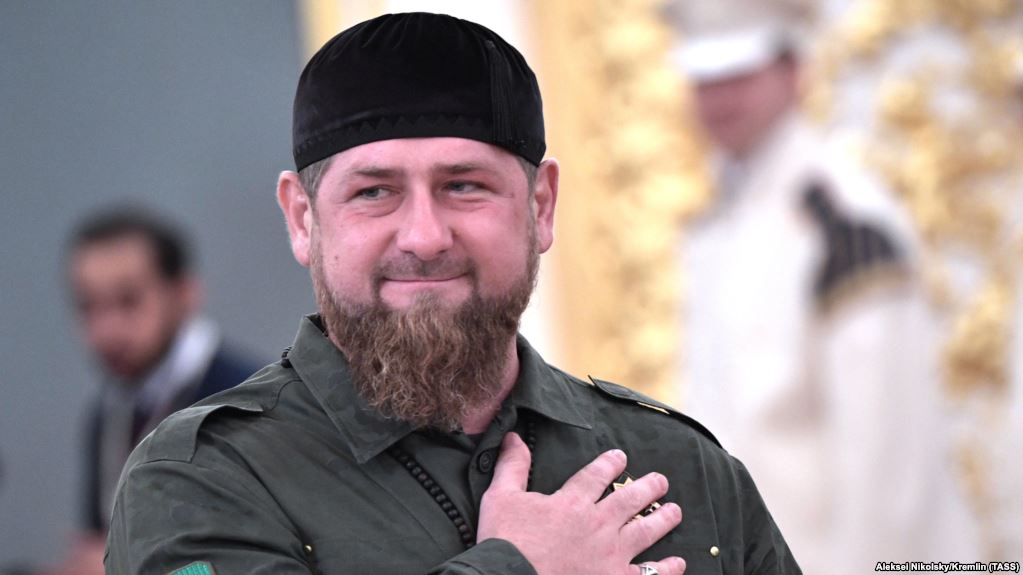
FE9FD947-5946-4532-AB21-04C649F35EC1_w1023_r1_s.jpgIf you’re a sucker for rigged elections and skewed opinion polls, like most western journalists, you would have to admit that Chechen strongman Ramzan Kadyrov is Russia’s most popular politician, not Vladimir Putin. Photo courtesy of RFE/RL
Putin’s Unique Popularity (Spoiler: It Doesn’t Exist)
Alexei Navalny
April 5, 2018

This special video is for you, dear whingers. I find it impossible to read, three weeks running, articles discussing the unique way Putin picked up 76% of the total vote at the March 18 presidential election and see the mobs of people agonizing in the commentaries to these articles.

“Lord, how terrible! 76%. What horrible people Russians are! 76% voted for their own poverty and slavery. The only way out is emigration. It’s time to make a run for it,” etc.

Here is what I have to say about Putin’s alleged “largest percentage of votes ever” and his status as the “most popular politician.”

We simply have to get one thing through our heads. At this stage in our authoritarian country’s evolution, any moron who stands for election on behalf of the regime gets 80% of the vote. Literally. But this percentage means nothing at all.

Are you horrified by Putin’s huge vote total? Then why aren’t you groaning and moaning about the vote totals the regional governors have won in elections? Did you know you would have to try very hard to find a governor who got a smaller percentage of the vote the last time he was elected than Putin did this time round?

You don’t believe me? Here is a chart showing the percentage of votes the country’s regional leaders got the last time each of them stood for election. See whether you can find our so-called national leader, allegedly, the country’s champion when it comes to popular support.

Ranking Name Region Total Votes (%)
1 Ramzan Kadyrov Chechnya 97.9
2 Aman Tuleyev Kemerovo 96.7
3 Rustam Minnikhanov Tatarstan 94.4
4 Nikolai Merkushkin Samara 91.4
5 Vladimir Volkov Mordovia 89.2
6 Vadim Potomsky Oryol 89.2
7 Alexei Gordeyev Voronezh 88.8
8 Andrei Bocharov Volgograd 88.5
9 Alexander Yevstifeyev Mari El 88.3
10 Alexander Tsydenkov Buryatia 87.4
11 Valery Shantsev Nizhny Novgorod 86.9
12 Vladimur Yakushev Tyumen 86.6
13 Boris Dubrovsky Chelyabinsk 86.4
14 Ivan Belozertsev Penza 86
15 Sholban Kara-ool Tyva (Tuva) 85.7
16 Alexander Nikitin Tambov 85.5
17 Alexander Kokorin Kurgan 84.9
18 Vladimir Vladimirov Stavropol 84.2
19 Alexei Dyumin Tula 84.2
20 Veniamin Kondratiev Krasnodar 83.6
21 Alexei Orlov Kalmykia 82.9
22 Alexander Drozdenko Leningrad Region 82.1
23 Maxim Reshetnikov Perm 82.1
24 Oleg Korolyov Lipetsk 81.8
25 Rustem Khamitov Bashkortostan 81.7
26 Anton Alikhanov Kaliningrad 81.1
27 Pavel Konkov Ivanovo 80.3
28 Yuri Berg Orenburg 80.3
29 Nikolai Lyubimov Ryazan 80.2
30 Roman Kopin Chukotka 79.8
31 Georgy Poltavchenko St. Petersburg 79.3
32 Dmitry Mironov Yaroslavl 79.3
33 Andrei Vorobyov Moscow Region 78.9
34 Andrei Turchak Pskov 78.4
35 Alexander Brechalov Udmurtia 78.2
36 Vasily Golubev Rostov 78.2
37 Alexander Bogomaz Bryansk 78
38 Vladimir Miklushevsky Maritime Territory 77.4
39 Vladimir Putin Russian Federation 76.7
40 Igor Koshin Nenetsk 76.7
41 Vladimir Ilyukhin Kamchatka 75.5
42 Alexander Levintal Jewish Autonomous Region 75.4
43 Alexander Zhilkin Astrakhan 75.3
44 Valery Radayev Saratov 74.6
45 Svetlana Orlova Vladimir 74.3
46 Vladimir Pechony Magadan 73.1
47 Alexander Karlin Altai 72.9
48 Igor Rudenya Tver 72.1
49 Anatoly Artamonov Kaluga 71.3
50 Dmitry Ovsyannikov Sevastopol 71.1

If I asked you what the 89% vote tally for Vadim Potomsky, ex-governor of Oryol Region (who claimed Ivan the Terrible had visited St. Petersburg), meant, you would replay without hesitating, “Nothing. It doesn’t mean a thing.”

“He had no support,” you would say, laughing.

Then why does the alleged support for Putin scare you? Do you think that, in his case, the powers that be have employed other methods for generating support?

Of course, they haven’t. They have used the very same methods. Real rivals are not allowed to stand for elections. The public is smothered with lies and propaganda. Officials rig the vote, stuff the ballot boxes, and falsify the final tallies.

These are the three factors for turning political bosses in Russia into wildly popular politicians. Remove any of them from office and they will end up in the same place where all the former champions of the ballot boxes have now ended up, whether we are talking about Shantsev, Merkushkin or Tuleyev. As soon as they are removed from office, a wave of the magic wand turns their popularity into a pumpkin.

Tuleyev had almost unanimous “support” the last time he was elected: nearly 97% of all votes cast. How many of those people took to the streets to support him when he resigned? No one did.

The new governor of Kemerovo Region, Sergei Tsivilyov, is the new proprietor of that 97%.

Under this system, if Putin were placed tomorrow with his most unpopular underling—say, Dmitry Medevedev or Dmitry Rogozin—his replacement would get the same “record-breaking” 76% of the vote if an election were called.

So, there is no reason to worry and snivel.

Dig in your heels. Get involved in political debates. Expose official lies. Tell and disseminate the truth. Fight for your country and your future.

Translated by the Russian Reader


How to Be a Useful Idiot

DSCN5264

1.  Jump on the “Putin is genuinely popular” bandwagon.

“Putin will eventually leave power, but it is not Washington’s place to facilitate this, nor is it an inherently desirable outcome. No one knows what will follow in Putin’s wake, or who could fill his role after nearly two decades and counting in the Kremlin. And no one doubts that Putin is genuinely popular, although support for him in the capital and among younger educated Russians has slipped.”

Putin is not genuinely popular. As in other pseudo-populist dictatorships and autocracies, the alleged popularity of Russia’s president for life is the product of a thoroughgoing war against all dissenters, dissidents, and free thinkers, and an ever-evolving personality cult, produced by carpet bombing the populace with TV, radio, social media, and print propaganda twenty-four hours a day seven days a week.

The mental carpet bombing is periodically punctuated by two rituals, designed to confer “popular legitimacy” on the rampantly undemocratic regime: massively rigged, unfair “elections,” and plainly hokey and methodologically unreliable “public opinion polls.”

Nor is there any empirical evidence that “young educated Russians” are more critical of Putin than cranky old ladies in Petrozavodsk and Perm. My educated guess would be that, in fact, the opposite is true.

Finally, it is sheer insanity to argue that Putin’s departure is not an “inherently desirable outcome.” Every day Putin is in power is a decisive step backwards in the country’s political and social progress.

Not even the most milquetoast progressive reforms have been possible while Putin and his clique have been in power (i.e., the last eighteen years), and there is every sign that, during his next term, things will go from very bad to incomparably worse.

By the way, why is the writer so certain “Putin will eventually leave power”? If he means Putin is a mere mortal, like the rest of us, and will die sooner or later, this is a factually correct but politically vacuous claim. If the writer means Putin is planning to leave office in the foreseeable future, he must have psychic gifts that most of us do not have. There is no evidence whatsoever Putin is planning to go anywhere in the next twenty years.

But it is easy to engage in free verse exercises like this one when you live and work in Brooklyn. You just make up the facts as you go along, because you will never have to face the consequences of your irresponsible, shambolic analysis.

2. Blame the US government for everything that has gone sour or wrong in Russia, the world’s largest country, a land blessed with natural resources and human resources beyond measure, and thus certainly capable of making its own fortunes and forging its own destiny, which nothing whatsoever prevents from being democratic and progressive except the current regime and its mostly pliable satraps and timeservers. “Genuine popular support” for Putin would vanish in a second if his regime were ever challenged by a strong, broad-based, grassroots democratic movement determined to remove him from office and steer the country towards a different path.

“Putin will eventually leave power, but it is not Washington’s place to facilitate this, nor is it an inherently desirable outcome. No one knows what will follow in Putin’s wake, or who could fill his role after nearly two decades and counting in the Kremlin. And no one doubts that Putin is genuinely popular, although support for him in the capital and among younger educated Russians has slipped.

“The United States should not ignore human-rights abuses in Russia. But principled criticism is only undermined by the perception that civil-society groups in Russia serve as fronts for US intelligence, and Russia has become increasingly hostile to such groups. The next administration should make clear that the United States is not trying to bring Putin down, and that its support for human rights is genuine. It should be wary of directly supporting opposition figures, who are easily tarred as American puppets. And it should lead by example and hold its allies accountable for their human-rights abuses and elite corruption as well.

“Ultimately, the best way the United States can help civil society in Russia is by normalizing relations enough that private civil-society groups from the United States and other countries can more effectively work in tandem with Russian counterparts. It is hard to argue that the US-Russia tensions following the failure of Obama’s reset have done Russian civil society any favors.”

What real evidence is there that civil society groups in Russia serve as “fronts for US intelligence”?

None.

Who has actually been working day and night to generate this “perception”?

The Putin regime and its media propaganda outlets.

Why has “Russia” become “increasingly hostile to such groups”?

Because the Kremlin perceives them as direct threats to its authoritarian rule. It has thus declared them “enemies,” “national traitors,” “foreign agents,” and “undesirables,” and gone to war against them. This blog has published numerous articles detailing this “cold civil war” between Moscow and Russian civil society.

What evidence is there that any US administration has “[tried] to bring Putin down”?

There is no such evidence.

What Russian opposition figures have US administrations “directly supported”?

None.

Aren’t civil society groups “private” by definition?

Yes.

Was Obama’s so-called reset the only or even the primary reason that tensions between the US and Russia increased?

No. Even before Putin went ballistic, invading Crimea, Eastern Ukraine, and Syria, shooting down passenger planes (e.g., Flight MH17) and gunning down opposition leaders right outside the Kremlin (i.e., Boris Nemtsov), his minions were harassing the then-US ambassador to Moscow, Michael McFaul, the co-author of the miserable “reset,” whose purpose was to decrease tensions with Russia, not stoke them. There was no chance of this happening, however, when the Kremlin had long ago made rabid anti-Americanism the centerpiece of its public foreign policy.

Why do I call it “public” foreign policy? Because nearly everyone in the Russian ruling elite has made numerous junkets and trips to the US and other western countries over the years and has lots of personal and business connections to their boon enemies. They have extensive real estate holdings in the west. They educate their children in the west. They park their ill-gotten lucre in the west. In some cases, their families live in the west permanently, while they shuttle between the west and Moscow like some less fortunate people commute between Gary, Indiana, and Chicago.

The Russian elite’s anti-Americanism and anti-westernism, therefore, is a put-on, a hypocritical pose mostly meant for public consumption.

Has the Putin regime done Russian civil society “any favors”?

No, it has done its utmost best to destroy independent Russian civil society and co-opt the remnants it has not killed off. If you want some of the particulars, read what I’ve been posting on this blog for the last six years and, before that, on Chtodelat News, for five years.

Why did the guy who wrote the passage quoted above write what he did?

It is hard to say. The article is a very clever whitewash job for the Putin regime, all of whose high crimes and misdemeanors against the Russian Constitution and the Russian people are passed off as understandable reactions to the alleged predations of the US government against the Putin regime.

Where was this article published?

In The Nation, of course. Who else would print such crypto-Putininst tripe with a straight face?

Why all the needless hyphens, e.g. “civil-society groups,” “human-rights abuse”?

Sheer snobbery, meant to intimate to the magazine’s hapless readers they are dealing with real smart cookies, not tiresome neo-Stalinist windbags.

3. Publish wholly misleading articles about Russia, like the one quoted above. If you cannot manage that (because your readership would notice), publish wholly misleading headlines. They are even more effective than longwinded articles in The Nation, a pro-Putin magazine no one in their right mind has read in the last ten years or so.

People scan headlines, however. It is much easier than reading the fine print.

“US Drastically Reduces Visa Services in Russia after St. Petersburg Consulate’s Closure”

This is exactly the headline Russian Foreign Minister Sergei Lavrov would want to appear in the Moscow Times, because it places the onus for his government action’s and his own actions on the US government.

How could visa services not be drastically reduced if the Russian Foreign Ministry closed the US consulate in Petersburg and gutted the staff at the US embassy in Moscow once again?

But let us by all means imply, because this IS the message the Putinist tyranny wants its own people to hear, that the US did everything on its own as a way of punishing ordinary Russians. Sadly, a fair number of Russians will believe this.

4. Join a so-called leftist group in the west. Most of them behave as if the Comintern still existed and they were taking their orders from the Kremlin.

Most western so-called leftists these days are boring, uneducated morons. The most boring thing about them is their unshakeable reverence for the Soviet Union, a country about which they do not have the slightest clue, and for its woebegone “successor,” the Russian Federation, which has literally nothing in common with the long-dead Soviet Union.

So, they are just as defensive of Putin’s shambolic hypercapitalist despotism as they are of the country that killed off socialism once and for all by going on a murderous rampage in the 1930s.

The really hilarious thing is that most of them manage to maintain these cultish attitudes without ever having set foot in either country and without speaking a word of Russian. Star Wars fans have a more down-to-earth and coherent ideology than the post-Stalinists who pop up to crush you with their Anand Sheela-like rhetorical flourishes (i.e., truckloads of vehement slander and furious personal insults) if you so much as mention as their imaginary Motherland in a slightly untoward light.

I want to live long enough to see the influence of these dead-enders on progressive, anti-capitalist, anti-imperialist politics die off altogether. That would make me really happy, if not genuinely popular, like Vladimir Putin. ||| TRR

Photo by the Russian Reader

Vladislav Inozemtsev: Russia Has Stopped Making Sense

DSCN5158The west would do as well to try and engage these inebriated young Russians in meaningful dialogue as their erratic, spiteful government.

Vladislav Inozemtsev
Sanctions Forever
Snob
March 30, 2018

The recent simultaneous expulsion of 139 Russian diplomats from 24 countries is an extraordinary event, especially if you consider it was undertaken not in response to provocations against these countries themselves, but as a token of solidarity with Great Britain, which has accused Russia of attempting to murder the former intelligence agent Sergei Skripal on English soil with a chemical weapon.

The current fad is to describe what is happening as a new cold war. I noted long ago that Russia’s changed attitude to the world fit this definition well. However, events might have gone even farther or, to be more precise, in a different direction.

The west was extremely concerned about what happened in Ukraine in 2014–2015. Along with Putin’s speeches in Munich and Bucharest in 2007 and 2008, the five-day war in Georgia, Moscow’s attempts to strengthen its authority in the former Soviet Union and cultivate friendships with certain Central European leaders, Russia’s aggressive actions jibed well with previous views. The responses proposed seemed clear as well: containment, aid to allies, competition and rivalry on the global periphery. Putin was routinely described as someone who understood only zero-sum games. One side’s loss was always a win for the other side.

However, since the mid 2010s, the circumstances have changed dramatically, although it was hard to notice it immediately. Russia’s meddling in the US presidential election (no matter whether it impacted the outcome or not), its flirtation with European ultra-righwingers, its open support of war criminals like Assad, and the state terror unleashed against opponents of the regime and people whom Putin and his retinue have deemed “traitors” are all indications not only of the fact that the Kremlin has ceased to play by any rules whatsoever. More important, Moscow has seemingly ceased to take its own good into account when it makes certain moves.

What did the Kremlin gain by sullying the 2016 US presidential election? If we speak of Russia per se, nothing was gained whatsoever. Whoever had won the election without our meddling, the relations between our countries would certainly not be worse than they are now. The only consequences have been a supercharging of American politics and aggravation of internecine battles within the Washington establishment. What has Moscow gained by financing and supporting anti-European forces? Apparently, a similar destabilization. It is telltale that if this destabilization does become a reality, Russia will gain nothing from it. The EU will not crumble, but it will become less functional, and pro-European forces will only find it is easier to prove their argument that the countries of Europe must rally less for some particular purpose and more against a particular enemy. Even if pro-Putin forces achieve local victories here and there, it will not alter the overall picture. The greater part of Europe will become increasingly anti-Russian. What has Putin gained by murdering, apparently, over a dozen of his personal enemies in the UK, people who had long ago been stripped of any opportunity to harm Russia? He has turned our country into an international outcast, which no one wants.

The west’s reaction, as exemplified by the expulsion of Russian diplomats, points to a new reality, consisting primarily in the fact that Russia has finally stopped making sense to the world, nor should it surprise anyone. It really is unclear what Putin wants right now. Does he want to become dictator of his own country, wiping out even the semblance of democracy? The west would not prevent him from doing this in any way. Does he want to resurrect the Soviet Union? Go crazy, only it is far from a fact the khans and beys of Central Asia want the same thing, given that Moscow has so far not been terribly successful at achieving genuine integration with these countries. (Ukraine is a special case, but even here it would make more sense to negotiate with the Ukrainian people, not with Brussels and Washington.) Does he want to launder the money stolen in Russia in Europe and various offshore companies? I have not heard anything in the news about Russian funds and property being seized by foreign authorities. Since Russia has stopped making sense, the west has sent signals and hints Putin should settle down. They do not necessarily want him to become less anti-western, only more rational. They want him come down to earth and engage in lawlessness, if possible, only at home.

The Kremlin has feigned it cannot make sense of these signals. It prefers to act in keeping with the tactic of symmetrical response. However, what was normal during the real Cold War strikes observers as abnormal nowadays. In the 1970s, members of the Central Committee did not own villas in the south of France and did not stash their money in banks registered in Luxembourg and Delaware. Soviet enterprises were not owned by companies up to their necks in debt in the west. By hook or by crook, Soviet home industry supplied the populace with nearly all the bare necessities, and what it could not supply was obtained from the Soviet Union’s Eastern European satellities. Everything has changed since then. Russia is much more vulnerable to European economic sanctions than US nuclear missiles.

Symmetrical responses were productive when the parties were motivated by clearly defined interests. When one side is motivated by garden-variety resentment, such responses are counterproductive. Moscow assumes its bluff has been called, although the west’s signal contains a different message: there is nothing to discuss with the Kremlin. Moreover, the process no longer seems like fun to anyone. Given the circumstances, what is the point of having embassies in hostile countries that outnumber the diplomatic missions of their most trusted friends?

As for the parallels that suggest themselves when we contemplate the Kremlin’s latest steps, they do not resemble the actions of Khrushchev and Brezhnev. They are more reminiscent of the Stalin era’s experiments. The Soviet secret services eliminated the revolution’s enemies abroad, while the Kremlin categorically demanded the German communists not form a coalition with the Social Democrats in the face of the Nazi threat.  The Kremlin imagined maximum destablization of the democratic countries would cause them to collapse and help establish the universal reign of the proletariat. History, however, proved this policy was erroneous. No one suffered more from the collapse of the Weimar Republic than the Soviet Union. If European integration fails, Russia is not likely to benefit, either. Were we not thrilled about the Brexit vote not so long ago? Did we not believe a more independent Great Britain would deal a blow to the Eurocrats? The only problem is that for now it is rather more obvious the UK’s increased independence has strengthened its resolve to deal with Moscow, while Europe (and not only Europe) has been inclined to support the supposed renegade.

Summing up, I can only repeat my longstanding assumption that the sanctions against Russia are virtually permanent. Instead of contemplating events in a rational manner, weighing the pros and cons, and taking decisions aimed at reducing tension, Russia has continued to engage in provocations, lies, and dodges. (In Soviet times, the Party’s leaders had the good sense to maintain dialogue with the west on economic and other issues even at the height of the arms race.) The west finds it difficult to respond with force, nor does anyone want to respond with force, so the tokens of growing contempt will keep manifesting themselves over and over again. Russia should be ready for this. Or it should begin to change, although, apparently, it is pointless to expect this.

Thanks to Alexander Morozov for the heads-up. Translation and photo by the Russian Reader