Igor Averkiev: Elections That Kill Democracy

photoIgor Averkiev

There Are Elections That Build Democracy, and Elections That Kill It: The Tricks Is Not to Confuse Them
Igor Averkiev
igor-averkiev.com
March 13, 2018

1. If you relate to elections solely as a value, you will never grasp their essence. You will never tame them.

2. In the modern world, the presence of elections per se in a particular country is neither an achievement nor a value, except for liberal democratic fundamentalists. In the modern world, it is the political outcome of elections that is an achievement and value. In some countries, elections build democracy, while in other countries they kill democracy. In Russia, they kill democracy.

3. There are about two hundred countries in the modern world. The vast majority of them (around one hundred and eighty) hold elections more or less regularly. Around fifty countries in this vast majority are more or less classic democracies. There are another forty countries that hold elections and are more or less classic authoritarian regimes. The other hundredsome countries that hold elections are ruled by a variety of transitional, semi-authoritarian, and hybrid regimes. Meaning that elections per se do not vouchsafe democracy at all. Morever, in most of the world’s countries, people voting in elections does not produce democracy.

4. Elections are merely a social know-how that can be used by anyone for any purpose.  Know-how is a simple thing: if you wield it, you can profit from it in keeping with your interests. An axe is similar in this respect. It matters who wields it: a carpenter or a killer. In the hands of some people, elections produce a democratic regime, while in the hands of others they produce an authoritarian regime. Democracy is not programmed into electoral know-how itself. Democratic elections thus coexist on our planet with authoritarian elections: everything is decided by the person who presides over the elections. If you want elections in Russia to produce democracy, first you have to gain control of them. Elections serve democracy only when they are monitored at all phases by political forces with a stake in democracy. Nor is it only a matter of monitoring the tallying of votes.

5. Elections serve democracy only when the question of power has already been resolved to the benefit of pro-democratic forces or during an unstable transition period in which an authoritarian regime is still in power, but can longer dismiss pro-democratic forces out of hand. Therefore, in order to use elections to advance democratic interests, they must first be taken away from the old authoritarian boss. Or he must be so scared he has to take the interests of pro-democratic forces into account when elections are held. There is no other way. This is how things are done the world over, but millions of freedom-loving Russians for some reason still believe that regularly going to vote in elections presided over by someone else will in itself hasten democracy’s victory in Russia.

6. What is democracy? I won’t go into high-flown arguments, but the democracy that freedom-loving Russians like so much gels only when the country is run by politicians who have no desire to restrict political competition. They are willing, if push comes to shove, to lose elections; moreover, they are willing to accept defeat until the next elections. That’s all there is to it. That is why there is no democracy in Russia: because the people in power restrict political competition and have no intention of losing elections under any circumstances, much less accepting defeat. They are assisted in their restriction of political competition by the selfsame democratic know-how and institutions. It is just that without democratic politicians inhabiting them, this know-how and these institutions are only formally democratic, not democratic in fact.

7. The pro-democratic forces include not only the liberal democratic parties but also all political and civic organizations—leftist, nationalist, imperialist, religious, environmentalist, alternative leftist, alternative rightist, etc.—whose political interests are not bound up with Vladimir Putin’s personalist regime, who have no plans to limit political competition in Russia, and are willing, depending on the outcomes of elections, not only to come to power but also to cede power. Putin’s authoritarian regime can be opposed only by a broad pro-democracy coalition, without necessarily becoming a formal coalition. The trial version of this broad pro-democracy coalition presented itself to the country during the nationwide protest movement that kicked off in December 2011. We should not expect extremely well-coordinated joint actions from a broad pro-democracy coalition. (The “Decembrists” overplayed their hand in this respect.) It is enough to head in the same direction along more or less parallel routes, coordinating actions at certain critical points.

8. An electoral authoritarian regime, such as Russia’s, is organized quite simply. All the democratic know-how a modern country is supposed to have—elections, representation, separation of powers—functions smoothly, but not all comers have access to it. It is even simpler than that. An authoritarian regime simply does not allow potential competitors, that is, leaders and organizations, to get on their feet politically and grow organizationally to the extent they would be able to surpass the two- or three-percent minimumthreshold of votes needed for admission to the political arena. It does this by refusing to register parties, intimidating leaders, limiting freedom of speech and freedom of assembly in a pinpoint fashion, etc. If, despite everything, they nevertheless grow and thrive, they are simply not admitted to elections, as I have mentioned. In Russia, therefore, democratic procedures do not serve democracy. The soul of democracy is not know-how, procedures, and institutions, but people willing to use them in a particular way. In Russia, politicians interested in democracy simply do not make it into formal democratic politics. Thanks to the political regime built by Vladimir Putin, year after year only pro-authoritarian political forces make it into Russia’s formally democratic politics, and year after year they limit the involvement of pro-democratic forces in democratic procedures. It is a vicious circle. There is democracy, and there is no democracy at the same. Putin’s authoritarian regime is even elegant after a fashion.

9. Elections in authoritarian countries do not increase the supply of democracy, nor do they prepare the way for it, since they do not facilitate competition, do not put the opposition through its paces, and do not put rank-and-file voters in circumstances where the country’s fortunes depend on the choices they make. In authoritarian countries, elections function as a full-fledged authoritarian institution for legitimizing the regime. In authoritarian countries, elections are required only as a source of power, nothing more. Everyone involved in these elections is involved solely in legitimizing the regime. They are doing nothing else.

10. In authoritarian and hybrid countries, including modern Russia, elections have another vital political function. Elections are also an outlet for the liberal public, a valve, installed by the regime, for releasing oppositional steam and keeping opposition politicians busy somehow. The Putin regime has used elections to satisfy the need many freedom-loving Russians have to “fight for democracy” in a safe, comfortable way, a way that lets them feel like decent dissidents honestly doing their duty. Everyone comes out on top. The liberal public engages in self-actualization, and the regime does not find it frightening.

11. If the liberal democratic opposition’s sole aim is symbolic involvement in election campaigns within the authoritarian regime, but year after year the regime does not permit it to grow politically and organizationally, and does not allow it to run in elections, the opposition will gradually wither and become marginalized. This, in fact, is the kind of opposition we have nowadays. If we realize, however, that elections serve democracy only after the question of power has been decided to the benefit of pro-democratic forces, it means we need a different opposition altogether, one radically different from the opposition that has filled the niche the past fifteen years. We need a liberal democratic opposition that is not hung up on being involved in meaningless elections governed by someone else’s hostile rules. We need an opposition focused on vigorous, direct political action and a propaganda duel (a fight over values) with the regime in order to command the attention and respect of the so-called Putinist majority, those very same “ordinary people” who, when a window of opportunity opens, would at least not oppose the new, free-minded political alternative. There is a big problem with the word “new,” however.

12. The creation of a new, free-minded opposition is encumbered by the liberal democratic fundamentalism that holds sway in the minds of Russia’s freedom-loving public. One manifestation of this fundamentalism is, in fact, the irrational cult of elections: all elections are good, regardless of their political essence and their consequences. Two other burdens are the extreme political impracticality and even archaicism of today’s liberal democratic platform. Currently, we have nothing to offer people from the standpoint of a future regime. Here is a simple question. What can we offer the average Russian family, something they would really need and value, that the Putin regime either cannot give them or promise them? The keywords in this case are “really need and value.” Moreover, in the obviously adverse conditions of a post-Putin Russia, the current liberal democratic prescriptions would necessarily lead the country into new crises the very first year they were implemented and, consequently, to new outbursts of the conservative revolution. It is ridiculous to discuss this with educated people, but thinking outside the box is now more important than doing things. At very least, it is more important than running off to vote in Putin’s elections.

13. For free-minded Russians and Russian politicians, the issue today is not how to win Putin’s authoritarian elections, but how to behave and build a reputation in society today in order to win future democratic elections in which the former so-called Putinist majority would be among the voters. If you want to facilitate the collapse of the Putin regime, you need to work less with the Putinist state and more with the Putinist majority.

14. The main problem freedom-loving Russians face in the impending presidential election is not what choice to make, whether to vote or not, and certainly not who they should vote for. The main problem is that whatever choice each of us makes—to vote or not vote, to vote for Yavlinsky or Sobchak—it will have no impact whatsoever on the fortunes of Vladimir Putin and his political regime. Any electoral action we take will change nothing about the election or the regime. Judging by various opinion polls [sic], there are between ten and fifteen million of us in Russia. Even if we assume the incredible—that all of us would act in concert in this election, and thanks to our monitoring the elections themselves would be extraordinarily fair—we cannot have a significant impact on the outcome of the election, even if each of us to the last man boycotted it or we all voted for Ksenia Sobchak or Grigory Yavlinsky.

15. Everything is seemingly quite simple. In Putin’s Russia, elections have nothing to do with building democracy and vanquishing the Putin regime. Why, however, does something so evident not get through to many advocates of liberty and diversity in Russia? How did the perverted cult of mandatory involvement in all elections take hold among such a considerable segment of the Russian liberal public? There are explanations. First, many opposition politicians, speakers, opinion leader, and experts have a professional stake in Putin’s elections. Some of them try and run in these elections (the simplest way of being an opposition politician in an authoritarian regimes), while others assist the elections professionally, serve as polling station monitors, analyze the whole megillah or write about it. This entire mob would simply be out of a job, in the broad sense of the word, if the opposition-minded public did not vote in authoritarian elections. Thus, in the opposition milieu, they are the principal propagandists and agitators for the idea of voting in these demonstrative non-elections. Since, as a rule, they are the most intelligent, energetic, and authoritative people in opposition-minded communities, their opinion is quite important. Second, as I have mentioned, above, involvement in authoritarian elections (“but they are elections all the same”) has served a considerable segment of the liberal public as a safe, comfortable way to “fight for democracy,” a way that lets them feel like decent dissidents honestly doing their duty. The notion that it is foolish and nasty for an advocate of democracy to vote in authoritarian elections immediately nullifies the opposition’s semantic space, the space of election enthusiasts, plunging them into the “desert of the real.” Everything is so painful and disturbing in that desert. You have to acquire a new civic faithfulness to yourself, redefine yourself in terms of the meanings and tools of your opposition, what normal risks are, who your supporters and opponents are within the opposition, and so on. “No, it’s better to vote in Putin’s elections.”

16. On the other hand, if nothing really depends on us in Putin’s elections, is it worth persuading our allies not to vote in them? Why hassle people? Why prevent them from doing what they deem important? Because things won’t get any worse for us if they do vote in the election anyway, right? I think it is still worth pestering them. Politics, after all, depends on political sentiments and emotions, and thoughts are tangible things even when they are not true. If millions of people who hunger so much for freedom and diversity in Russia think, “How can I vote in authoritarian elections the right way, so that it benefits the opposition’s cause?” that is one kind of opposition. But if millions of people who hunger so much for freedom and diversity in Russia think, “What else, besides voting in authoritarian elections, can I do to dismantle the Putin regime and bring about the victory of freedom and democracy in Russia?” that is a completely different opposition.

Igor Averkiev is the chair of the Perm Civic Chamber. Photo courtesy of Igor Averkiev. Thanks to Comrade Koganzon for the heads-up. Translated by the Russian Reader
Sonnet 12

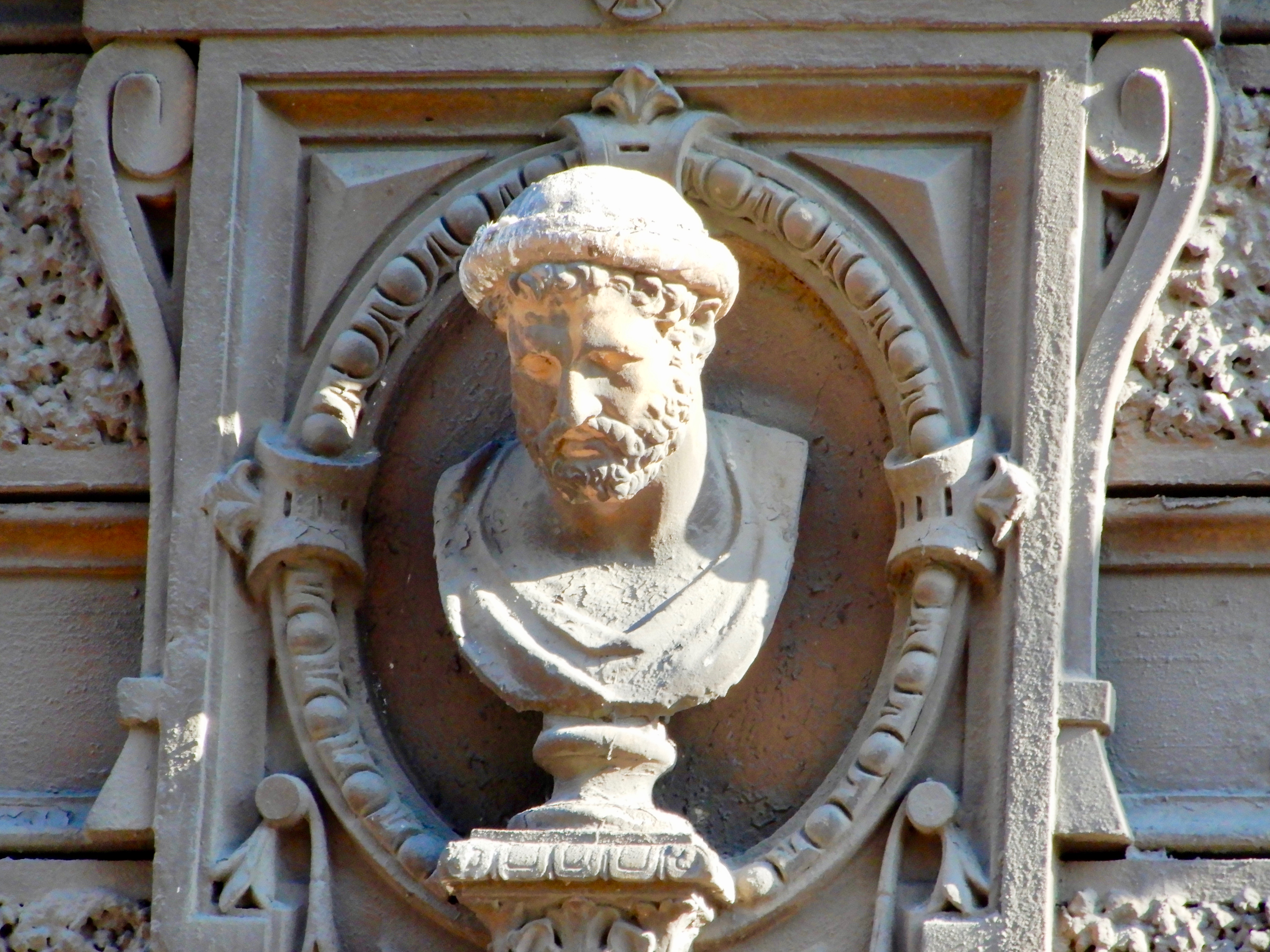
DSCN4868

When I do count the clock that tells the time,
And see the brave day sunk in hideous night;
When I behold the violet past prime,
And sable curls all silver’d o’er with white;
When lofty trees I see barren of leaves
Which erst from heat did canopy the herd,
And summer’s green all girded up in sheaves
Borne on the bier with white and bristly beard,
Then of thy beauty do I question make,
That thou among the wastes of time must go,
Since sweets and beauties do themselves forsake
And die as fast as they see others grow;
And nothing ‘gainst Time’s scythe can make defence
Save breed, to brave him when he takes thee hence.

Source: Poetry Foundation. Photo by the Russian Reader

For Sobchak

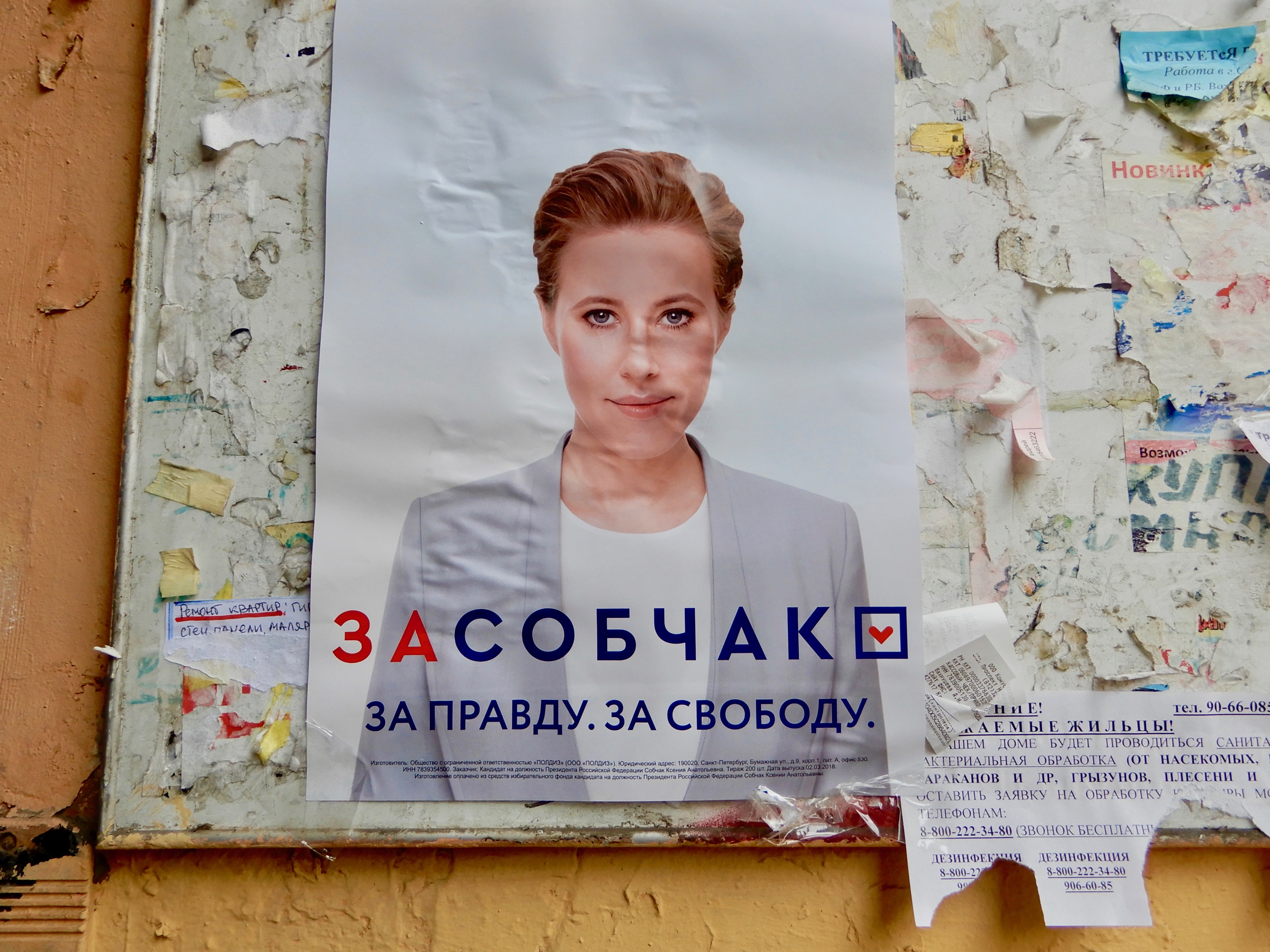
sobchak poster

This is literally the only Ksenia Sobchak campaign poster I have seen in Petersburg since the Russian presidential campaign officially kicked off.

The poster, which reads, “For Sobchak. For Truth. For Freedom,” was half hidden in the gateway of a residential building on a street in my neighborhood when I photographed it a week ago today.

I imagine the people working in the city’s housing maintenance and street cleaning services have standing orders to tear down any and all “visual agitation” on behalf of the other so-called candidates (each and every one of them vetted and approved by the Kremlin) running in the so-called Russian presidential election, an utterly rigged farce scheduled for this Sunday, March 18.

The world’s largest country should be ashamed to conduct important national business in such a creepy, petty fashion, but until the self-declared heir apparent to the Romanov throne and his gang of crooks and thieves are chased out of town, there can be no movement on that front, alas.

Or any other front, for their matter, even though I have lots of friends on the left here who think the country is pullulating with “social movements” unfairly ignored by the general populace. To their mind, the rank-and-file Ivans and Natashas currently gumming up the future socialist works should magically learn about these nearly invisible social movements and just as magically support them, without my friends the leftists having to build and deploy anything that resembles even the shadow of an effective grassroots political organization that could reach out to the allegedly benighted Russian rank and file, enlighten it, and give it a doable road map to a better future.

One of the few people in Russia who understands something about political organization and tactics, Alexei Navalny, has been leading a boycott of the presidential election or what he calls a Voters Strike. For their pains, the election boycott activists, most of them young Russians, have been increasingly targeted in a crackdown by Russian security services and police. The plan seems to be to put as many of them as possible in jail on trumped-up charges and keep them there until after March 18, at the least.

My friends on the left, who claim not to like Navalny for his nationalist views, but really resent him because he knows a thing or two about national grassroots political organizing, while they seemingly know next to nothing about it, although they talk about it incessantly, are in no hurry to express their solidarity with the mostly “liberal” activists who have been mowed down by the Kremlin’s dragnet. (In Russia, “liberal” is a powerful swear word employed by leftists and rightists alike.) Their sense of solidarity extends only to those people who more or less share their political views and their lifestyles.

The most shameful thing is how many seemingly intelligent Russians are sanguine about this desperate state of affairs and think talking seriously about domestic politics (although they are often, on the contrary, extraordinarly keen to talk about politics in other countries) is like holding forth in great detail at a swanky dinner party about your daily bowel movements. TRR

Svyatoslav Rechkalov: “They Proceeded to Pull Down My Trousers, Threatening to Shock Me in the Groin”

“They Proceeded to Pull Down My Trousers, Threatening to Shock Me in the Groin”: Anarchist Svyatoslav Rechkalov Relateds How He Was Tortured and Beaten after Police Detained Him in Moscow
Mediazona
March 15, 2015

Anarchist Svyatoslav Rechkalov, apprehended by police on March 14, has told Yevgeny Yenikeyev and Kogershyn Sagiyeva, members of the Moscow Public Monitoring Commission (PMC), how he was tortured with electric shocks and beaten in police custody. To corroborate his statement, he showed the members of the PMC the traces left by the electric shocker: “[D]ifferently sized red dots on the outside of the hips and the knee.” The injuries were recorded by a paramedic at the Temporary Detention Center where Rechkalov is currently incarcerated. He and several other people were detained as part of the investigation of an attack in January on a United Russia party office in the Moscow neighborhood of Khovrino. Persons unknown shattered a window in the office and tossed a smoke grendade [sic: Grani.ru has reported it was a lighted flare] into the premises. Yelena Gorban and Alexei Kobaidze were detained on charges of vandalism, but were later released on their own recognizance. Below, we have published a transcript of Rechkalov’s handwritten statement. Yevgeny Yenikeyev posted a scan of the statement on his blog.

* * * * * * * * * *

At seven a.m. on March 14, 2018, police officers came to the flat where I live, at [address deleted], to search it. They knocked down the door, and then the search took place. Around twelve noon, I was taken from the building. I was blindfold with black adhesive tape, my hands were tied, and I was put in a minivan. I was driven around the city for several hours, and then placed in a GAZelle van containing police officers. My flatmates E. Sergeyeva and Yevgeny Popov were also in the van. Before I was placed in the van, the tape was removed from my eyes and my hands were untied.

After some time, I was put back in the minivan. A plastic bag was put over my head and I was handcuffed. In the minivan, two men whom I did not know asked me questions about the anarchist movement Popular Self-Defense (Narodnaya samooborona) and different people. How had I ended up in the movement? What did I have to do with it? What protests had I been involved in? What were the same people they had asked me up to? When I would refuse to answer or give an unsatisfactory reply, I was shocked with electrical current on the outside of my hips and the vicinity my knee (above and below the knee). They mostly shocked me in the left leg. At the moment, traces of the shocks are visible on my legs in the form of red dots.

From time to time, my interlocutors would get out of the minivan, and then two or three men would punch me in the body and legs, and shock my legs. The punches were mainly aimed at my lower back and were not hard. The electric shocks were their main method of working me over. The duration and intensity of the shocks increased. The men demanded I answer all their questions.

When they proceeded to pull down my trousers, threatening to shock me in the groin, I made up mind to incriminate myself in the vein in which the men were demanding I do. I confessed I was admin of Popular Self-Defense’s VK page, and a leader and organizer of the movement. If I refused to testify [later] to the investigator or went public with the fact I had been tortured and beaten, the men threatened to take me on a second trip with the electric shocker, a longer and more harrowing trip, and they promised to charge me in The Network case [meaning the so-called terrorist community The Network. The FSB has detained several anarchists in Penza and Petersburg in the case, and many of them have claimed they were tortured—Mediazona] and make the conditions of my stay in the Temporary Detention Center and Remand Prison difficult. My sense is I spent around an hour in the minivan.

Svyatoslav Rechkalov

I was then taken to a police precinct near the Tulskaya subway station, but maybe it was the Moscow police’s investigative department; I don’t know for sure. Around four p.m. I was taken into a room where Center “E” (Extremism Prevention Center) officers were seated. There, in the presence of Investigator Kostin, I repeated what the men in the minivan had demanded I say. One of the Center “E” officers in the room had been at my place during the search in the morning.

I was then taken off to be interrogated as a witness in the investigation of the case of vandalism against the United Russia party office. Aside from the investigator, whose surname I cannot remember, there were men in plain clothes in the room, including Center “E” officers. I testified in the vein in which I had been asked to testify, identifying myself as an admin of Popular Self-Defense’s VK page and an organizer of the movement. The men demanded I incriminate other people, which I refused to do. In the presence of the investigator, the men in plain clothes in the room threatened to take me on another trip in the minivan, after which I refused to give any more testimony. As a result of threats and coercion, I signed a transcript of my earlier testimony to the effect that I was a leader, organizer, and admin of Popular Self-Defense. That testimony was obtained through torture and threats of further torture.

My interrogation as a witness ended at approximately six p.m., after which I was kept at the police precinct until around nine-thirty p.m. Before this, I had demanded to call a lawyer of my choice, but I was not allowed to do this and was provided with a state-appointed lawyer. During my interrogation as a suspect, I repeated the testimony I had given earlier as a witness. I testifed because I was afraid they would torture me again and because I had given the same testimony as a witness. The interrogation ended at eleven p.m.

I spent the next eight hours in the police precinct until I was taken to the Temporary Detention Center by armed guards at around seven in the morning on March 15.

I am afraid the torture and pressure will continue, that my testimony, obtained through torture, will be entered into the case file, and that the threats to implicate me in The Network case will be carried out.

Thanks to Comrade TR for the heads-up. Translated by the Russian Reader
If you haven’t heard about the Penza-Petersburg “terrorism” case and the related crackdown against Russian grassroots and political activists on the eve of the March 18 Russian presidential election, you need to read the following articles and spread the word.

They Jump on Anything That Moves, Part 3: The Case of the New Greatness Movement

Arrests Made in the New Greatness Case in Moscow
Grani.ru
March 15, 2018

Arrests and searches have been made in Moscow in the investigation of the New Greatness movement. The first source to report the news was Kremlin Washerwoman, a Telegram channel associated with the security services. More detailed information was soon published by OVD Info.

The detainees included the movement’s leader, Ruslan Kostylenkov, and two female activists, Maria Lapina and a juvenile whose name has not been disclosed. They were taken to the Kuntsevo Interdistrict Office of the Russian Investigative Committee. The female juvenile detainee was escorted by her father.

It is reported that during one of the searches a list containing the names of ten members of the movement was confiscated. According to uncorroborated reports, FSB investigators were present during the search.

There is information the juvenile detainee had earlier been subjected to pressure from Center “E” (Center for Extremism Prevention), after which her employer demanded she quit her job.

Photos of the search, as published on Kremlin Washerwoman, show campaign material for the so-called Voters’ Strike, a leaflet printed with New Greatness’s platform, and a t-shirt emblazoned with anarchist symbols.

Screenshot from the Telegram channel Kremlin Washerwomen. “Searches taking place at the home of supports of an obscure organization by the name of New Greatness. The guys drink a lot and cannot pin down their views.”

After lunch, Kremlin Washerwoman posted a video showing Kostylenkov’s confession. Out of breath, Kostylenkov recites a memorized text, mentioning in particular plans for “organizing a tribunal for members of the ruling elite” and “practice in shooting and throwing Molotov cocktails.”

Screenshot of Ruslan Kostylenkov’s alleged confession. Courtesy of Grani.ru’s Twitter account

The movement’s website contains only a home page featuring a notification that the site would be launched on March 15, that is, today. It also contains a brief, two-paragraph description of the movement’s objectives.

“We are the ones who will awake a sense of their own self-worth in people and help the nations of Russian acquire the energy for reviving the spirit of victors,” reads the text. “Only together can we build a strong country the rest of the world will respect and take into account.”

At the same time, both “pro-regime” and “opposition” forces are criticized for “divvying up spheres of influence,” while “ordinary people vegetate in poverty and dishonor, having forgotten the plight of the Motherland in which they live is in their hands.”

Screenshot of the homepage of New Greatness’s website

New Greatness began posting on its VK page on December 30 of last year. In late January, the movement encouraged people to take part in a rally demanding the preservation of trolleybus service in Moscow. The capital’s mayor has gradually been replacing trolleybus lines with bus line, which has sparked protests by environmentalists.

In February, New Greatness launched a large-scale campaign to paste anti-Putin leaflets around Moscow. The movement signaled it was in favor of boycotting the presidental election. On February 25, its activists were involved in the Boris Nemtsov Memorial March in Moscow.

On February 26, a pinned post was published on the movement’s VK page that read as follows: “Our young, ambitious, and quickly growing organization needs your help. If you are finally ready for the fight and willing to sacrifice your time and strength for the sake of our Motherland’s future by working in strong team led by an energetic leader, then join us. To do that, you must live in Moscow or Moscow Region and write to the message inbox on this page. If you cannnot help out physically, help us financially!”

The message is followed by an electronic address for transferring money.

On the evening of March 14, the Telegram canal A Copper Spills posted a message that opened as follows: “Evidence that an extremist organization has been established has been uncovered.”

The post’s author claimed Center “E” investigators in Moscow’s Southeastern District had discovered that “unidentified persons” had established “a group accessible to all [VK] users, which posted information about the creation of an informal political association whose main activity is involvement in popular insurrections, revolutionary actions, and clashes with the authorities.”

“The evidence is there, but for now we’ll keep quiet about everything else. When the times comes, we will tell all,” the author of the post concludes.

Kuntsevo is located in Moscow’s Western District, not in the Southeastern District. Besides, none of New Greatness’s posts contain calls for clashes with the authorities. In this connection, it is difficult to give an unequivocal answer to the question of whether the post on A Copper Spills had anything to do with the recent searches.

Thanks to Comrade Sammakko for the heads-up. Translated by the Russian Reader

P.S. Not that anyone much cares (I’m not trying to be smug: I really don’t get the sense there are huge numbers of people either in my reading audience, Russia or the great wide world who genuinely care about any of this), but I think we can extract three takeway lessons rom the war the Russian security services and police have unleased against grassroots activists in recent months.

1. When the director of the FSB or Putin (I forget who) said the other day the FSB had “prevented” fifty or a hundred or six thousand “terrorist attacks” last year, what they really had in mind is juvenile operations and investigations like the one described in the article above. That is, perfectly harmless young people with “funny ideas” and “informal” lifestyles are turned into “terrorist groups” with a little ultraviolence from the so-called security services.

The key is to scare, threaten or torture the harmless non-terrorists into confessing their non-guilt and signing confessions before letting them see a lawyer. Then their gooses are cooked for good, because cases concerning “terrorism” and “public safety” more generally have been removed from the remit of jurors in Russia, meaning they are tried by judges who know in advance what verdicts they are supposed to hand down.

A jury of more or less intelligent people would look at the flimsy evidence and the forced confessions and be tempted to acquit the defendants. If the Bolotnaya Square defendants, for example, had been tried by juries of their peers, I have no doubt most if not all of them would have been acquitted.

2. It has become extraordinarily dangerous to call for a boycott of the March 18 presidential election. Activists who have been calling for a boycott have painted big targets on their backs, and the authorities have spent the last few months shooting at them with increasing ferociousness. Depending on their ideological leanings, the activists have been sentenced to more or less long jail sentences or branded “terrorists,” as seems to be the case with the unfortunates described in the Grani.ru article, above.

I could be wrong, but this “minor terror” alone should be enough to discredit the election in the eyes of anyone with a conscience. By voting on Sunday, you will be saying to the authorities they can terrorize with impunity anyone who criticizes elections in Russia too vigorously and loudly, although that is exactly what needs to happen.

3. The only way to beat this racket is broad-based solidarity, but as we have seen with the accused in the Penza-Petersburg “terrorism” case and even with many of Navalny’s nominal supporters sent off to jail or beaten up for god knows what reason, people occupying different political camps are not too eager to show their solidarity.

The poor folks from the utterly harmless and helpless New Greatness movement, I am nearly certain, will elicit no solidarity or support from anyone whatsoever, except maybe the lawyers from Agora or Public Verdict, if they are lucky.

This points up the biggest flaw in the Russian grassroots democratic movement (if such a thing exists): its clannish, extremely partisan notions of solidarity. There are very few political activists who cross party lines to show their solidarity with their nominal opponents, and this is a huge, crippling problem for the anti-Putin, pro-democracy movement if it wants ever to move forward for real.

When it comes to folks like the New Greatness movement, it likely means they will be railroaded and sent off to a penal colony for ten years or twenty years without so much as anyone but their loved ones even noticing it happened.

After all, even silly, harmless people have human rights, such as the right to an attorney, the right to a proper investigation, and the right to a fair trial. TRR

The Horrorshow Continues: Svyatoslav Rechkalov Tortured in Moscow

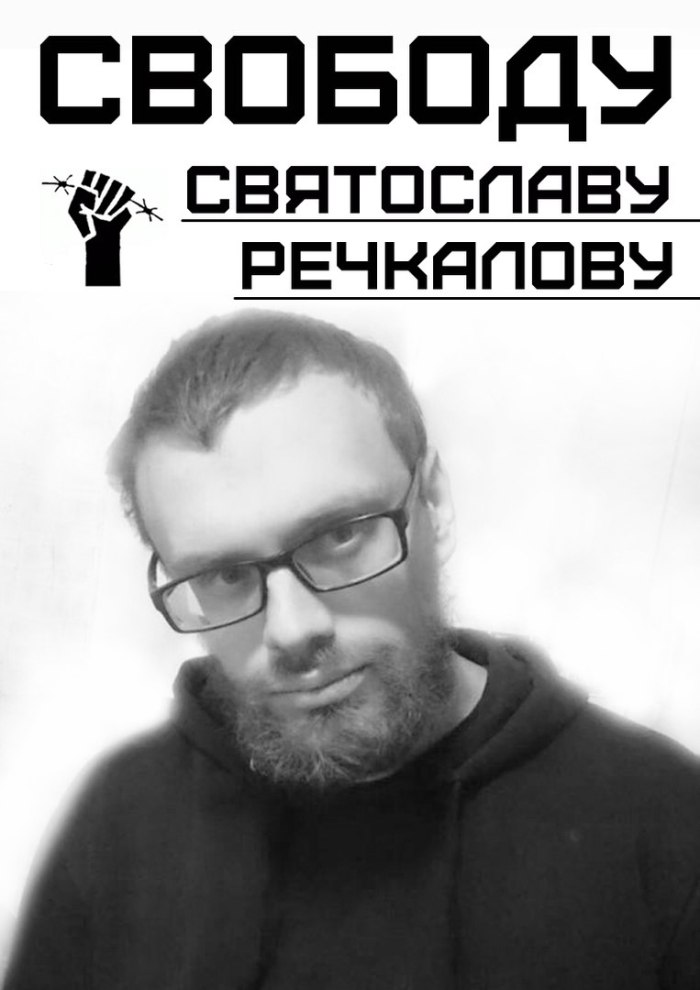
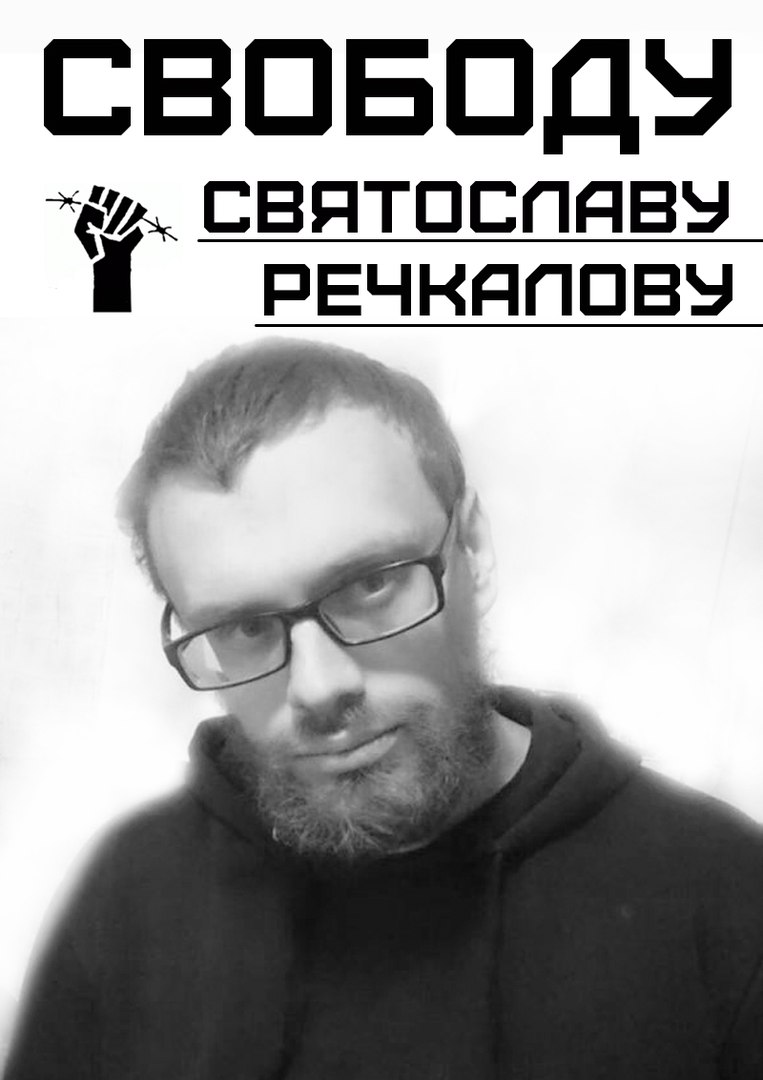
Tg4rFSHWUeY“Free Svyatoslav Rechkalov.” Photo courtesy of the VK page Popular Self-Defense
Anarchist Rechkalov Detained in Investigation of Attack on United Russia Campaign HQ, Tortured
Grani.ru
March 15, 2018

Anarchist Svyatoslav Rechkalov, detained yesterday as part of an investigation of the attack on the United Russia party campaign headquarters in the Moscow district of Khovrino, has been remanded in custody to the Temporary Detention Center, as reported in the early hours of Thursday by OVD Info, who cited Yevgenia, a friend of Rechkalov’s who was detained at Rechkalov’s flat along with him and another person whose name has not been ascertained. It cannot be ruled out the person in question was an anarchist named Andrei, who as of Wednesday evening had also not been released from police custody.

Rechkalov informed his comrades that,when he was in the Moscow police’s investigation department, police officers had tortured him, demanding he confess his involvement in the attack. They put a plastic bag over Rechkalov’s head and administered electrical shocks to his legs.

It has not been ascertained whether Rechkalov confessed or not. Yevgenia maintains he had nothing to do with the attack on the United Russia headquarters.

Yevgenia and the unidentifed third detainee were released last night, but on Thursday they were summoned to the investigative department for questioning as witnesses.

On Thursday morning, lawyer Mikhail Biryukov reported he was going to the investigative department to obtain permission to see Rechkalov.

Yesterday, we reported that Left Bloc activist Vladimir Zhuravlov and an anarchist named Artyom had been questioned as witnesses in the case. Both men said they had no information about the attack.

In addition, security services officers searched the Left Bloc’s headquarters, confiscating all the equipment they found there and cracking open a safe. The three activists present the headquarters—Vadim Timergalin, Grigory Sineglazov, and Denis Avdeyev—were detained and taken to a police precinct. They were later released without charge.

The Left Bloc’s VK page reports officers at the precinct had “conversations” with the activists during which they repeatedly threatened them, demanding they testify against their Left Bloc comrades.

It was also noted that, during the search, a lawyer [sic] received messages from unknown accounts, messages supposedly written by the activists. They informed him they did not need his help.

Left Bloc linked the search of their headquarters and the interrogation of Zhuravlov with the ongoing campaign to boycott the upcoming Russian predisdental election. In particular, they mentioned a protest opposite the Nikulin Circus on Tsvetnoy Boulevard during which a banner emblazoned with the slogan “March 18: Tricks and Clowns” had been unfurled.

We assume that, as the presidential election approaches, the police and FSB want to intimidate everyone who has been calling for a boycott. They are justifiably afraid a low voter turnout is a danger to the political farce wrongly called an “election.” All activists involved in the election boycott are now in danger. We concede the outrageous instances of coercion could continue. However, no crackdown can force us to abandon the fight. Boycott the election! We cannot be intimidated! We cannot be forbidden! 

—Excerpt from a pinned post on the Left Bloc’s VK page

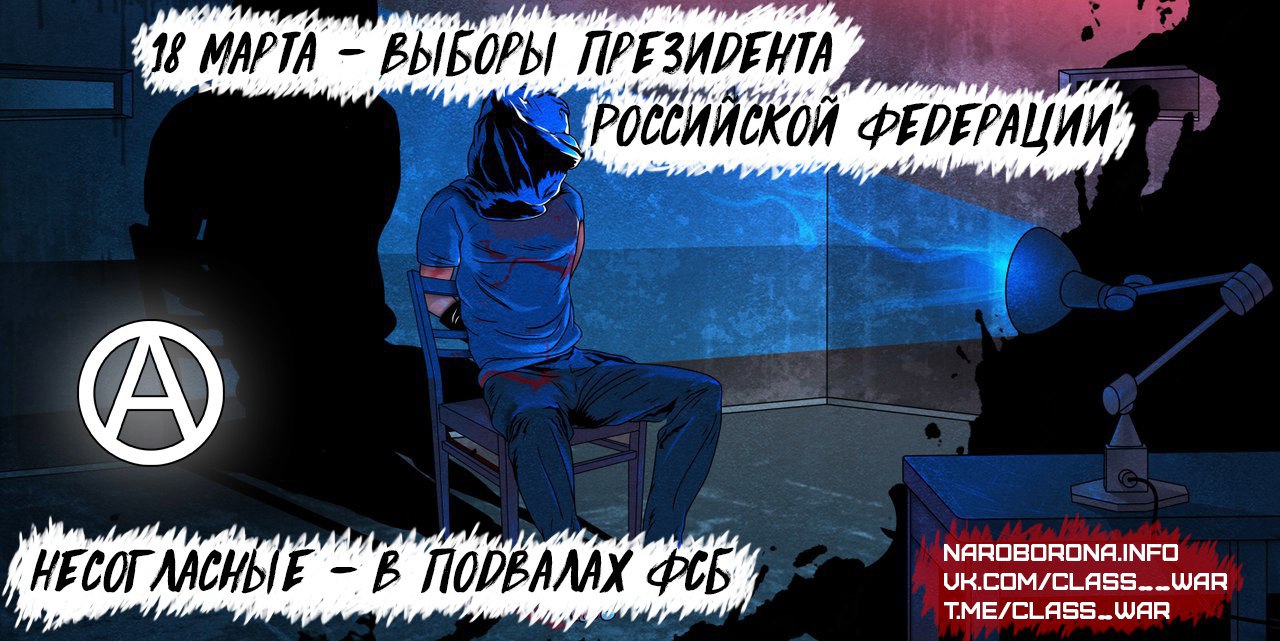
“March 18: Russian presidential election. Dissenters in the cellars of the FSB.” Image from the VK page Popular Self-Defense

The attack on United Russia’s campaign headquarters in Khvorino occurred late on the evening of January 30. Three people, including a young woman, took part in the attack. The attackers broke a window in the office and tossed a lighted flare inside. One of attackers filmed the attack on video.

Antifascists Yelena Gorban and Alexei Kobaidze were detained in the case on February 13, charged with vandalism under Article 214 Part 1 of the Russian Federal Criminal Code. The crime entails a maximum punishment of three months in jail and, consequently, does not stipulate that people accused of the crime be remanded in police custody until a verdict has been reached, according to Article 108 Part 1 of the Russian Federal Criminal Procedural Code, which covers incarceration. Nevertheless, both Gorban and Kobaidze were sent to the Temporary Detention Center, as Rechkalov has been now.

However, forty-eight hours after they were apprehended, Gorban and Kobaidze were released on their own recognizance. Gorban had confessed her guilt, while it was reported Kobaidze had refused to testify, invoking his right not to incriminate himself under Article 51 of the Russian Constitution.

Thanks to Comrades AR and ZV for the heads-up. Translated by the Russian Reader

“The Rowdies Have to Be Apprehended Legally, So We Can Have a Celebration in the City on March 18, not Bedlam”

8792CD92-EE28-452C-859C-77B15F02744B_w1023_r1_sThe political performance “Clanking Chains,” March 11, 2018, Petersburg. Photo by Tatyana Voltskaya. Courtesy of RFE/RL

Petersburg Puts Oppositionists on Pause: Eight More Activists Detained
Maria Karpenko, Kseniya Mironova and Anna Pushkarskaya
Kommersant
March 13, 2018 (updated March 14, 2018)

The arrests of opposition activists continue in St. Petersburg. In the last two days, police have apprehended eight activists, three of whom ended up in police custody at the courthouse, where they had gone to support their comrades. The court has already remanded eight people in custody for their alleged involvement in a protest rally that took place a month and a half ago. At Petersburg city hall, Kommersant was told, “The rowdies have to be apprehended legally, so we can have a celebration in the city on March 18, not bedlam.”

On Tuesday, Smolny District Court in St. Petersburg sentenced three opposition activists—Viktor Cherkassov, Yekaterina Shlikhta, and Ilya Gantvarg (son of Mikhail Gantvarg, ex-rector of the St. Petersburg Conservatory and Russian Federation People’s Artist)—to ten days in jail. Police had apprehended them on Monday for involvement in the so-called Voters Strike, a protest rally held on January 28 by supporters by Alexei Navalny. Yegor Ryabchenko, who was also apprehended, was only fined.

On Tuesday, police apprehended another three activists—Vladimir Kazachenko, Alexander Kirpichov, and Darya Mursalimova, who had come to support their comrades—right in the courthouse. Mursalimova and activist Sergei Belyaev, also apprehended on Tuesday, were sentenced by the same court around 11 p.m. in the evening. Mursalimova was given fifteen days in jail for repeated involvement in an unsanctioned rally, while Belyaev was sentenced to seven days in jail and twenty hours of correctional labor.

Kazachenko and Kirpichov’s court hearing was scheduled for Wednesday.

The new wave of arrests was prefaced by a flash mob [sic], entitled “Clanking Chains,” during which ten activists marched down Nevsky Prospect in chains and prisoners’ outfits. The [performance], which took place on March 11, was held in support of oppositionists who had already been jailed.

The defense attorneys of all of the activists jailed on Tuesday plan to file appeals in St. Petersburg City Court. If the appeals are unsuccessful, the activists will be released only after the presidential election on March 18, just like the three oppositionists already in police custody on the same grounds.

In early march, the court sentenced Alexei Pivovarov, Open Russia’s regional coordinator, Denis Mikhailov, head of Alexei Navalny’s Petersburg headquarters, and Artyom Goncharenko, an activist with the Vesna (“Spring”) Movement, to twenty-five days in jail for their involvement in the Voters’ Strike.

Moreover, Mr. Mikhailov had just served thirty days in jail for organizing the same event, while Mr. Goncharenko had not attended the rally at all. He had merely displayed an inflatable yellow duck in the window of his apartment building, past which the protesters marched. St. Petersburg City Court rejected an appeal to overturn their jail sentences, despite arguments made by the defense that the “deferred punishment” for violating the rules on rallies was “politically motivated.”

The January 28 protest rally was peaceful. Police detained around twenty people, which was very few compared with previous unauthorized protests in Petersburg. Except for Denis Mikhailov, all of the detainees were released from police precincts after police had so-called preventive conversations with them. They were not even written up for administrative violations.

Our source at Petersburg city hall explained what was happening.

“The rowdies have to be apprehended legally, so we can have a celebration in the city on March 18, not bedlam.”

Thanks to Comrade NN for the heads-up. Translated by the Russian Reader

Lev Schlosberg: Why Russian Democrats Should Vote on March 18

OLYMPUS DIGITAL CAMERA“They want a turnout for Putin that is as huge, wild, and unnatural as a giant hogweed plant.”
Voter Turnouts: Who the Russian Authorities Want to See at the Polls and Who They Do Not Want to See
Lev Schlosberg
Pskovskaya Guberniya Online
March 12, 2018

On March 18, Vladimir Putin plans to become president of Russia once again. The unnatural political system created under his rule is not meant to produce any other outcome.  Realizing this, many people do not want to vote in an election whose outcome is a foregone conclusion. The anger and desperation of these people can be understood and explained. Nevertheless, we must take part in the procedure [sic] scheduled for March 18. We must take part because the tally makes a difference. You can lose on points, but you cannot lose by a knockout, because life could depend on those points.

Amidst increasing stagnation, only the numbers of dissenting citizens whose votes were officially recorded by election commissions, albeit in a dishonest election, can protect dissenters from such things as physical harassment and destruction.

It is all too obvious and extremely dangerous.

Putin will never change. He will not become kinder or smarter. He will not repent for his misdeeds. He will not become a believer in democracy. He will not begin defending the rights and liberties of his fellow Russian citizens.

Putin is a cynic. Like all cynics, he understands only thing: strength. In elections, this strength consists, in the most literal sense, in numbers, in votes.

Russia is tired of Putin. Putin himself is tired of Russia and, in this sense, he is particularly dangerous. He does not inspire people. Votes for Putin are votes cast not enthusiastically, but votes cast in despair. “If not Putin, who else?” people wonder aloud. But no one else in Russia gets round-the-clock press coverage.

In order to protect himself from all risks, Putin has purged the political arena and poured it over with concrete. Any living thing that pushes it way up through the concrete lives despite the system Putin has built. But these living things cannot grow to their full height. Democracy is impossible without the sunlight of liberty. It exists in the old Soviet national anthem, but not in real life in Russia. Putin and freedom are incompatible, because he is a product of unfreedom.

Putin’s likely victory in the upcoming election is as tedious as the man himself, who has long contributed nothing new to Russia and the world except flagrant military threats.

The government’s desperate campaign to get out the vote in the presidential election is founded on the understandable, humdrum intentions of officials, which are in full keeping with the big boss’s desire to paint a ballot, whose outcome was announced before the election, as the result of sincere grassroots enthusiasm.

People forced to watch and listen to this bacchanalia might imagine that voter turnout in this election is the most important objective pursued by officials.

“Our” Voter for “Our” President
Does this mean the Russian authorities want all voters to turn out on March 18, whatever their political preferences? No, it does not mean that at all. The Russian authorities desperately want Vladimir Putin’s voters to show up for this election and no one else. They want a turnout for Putin that is as huge, wild, and unnatural as a giant hogweed plant. Everyone who prevents them obtaining this unnatural percentage of votes are superfluous when it comes to the election. The authorities do not want to see them at polling stations. They will tolerate only the convinced supporters of the other registered candidates, whom they cannot stop from voting.

The omnipresent official election advertisements and the propaganda message that you can vote wherever you want on March 18 are bound to nauseate all decent, self-respecting people. They are a carefully planned and professionally implemented tactic on the part of the authorities. They are like a missile with multiple warheads.

This dull and simultaneously aggressive advertising is meant to help the authorities drag voters obedient to Putin out of their houses on March 18. Such people really do wait for the authorities to tell them what to do, where to go, and what box into which to drop their ballot papers. Programmed by the lies and violence of total propaganda, they reflexively execute direct instructions. So, the authorities have a single objective: to reach out to these votes whatever the cost, through all the windows, doors, attics, cellars, and cracks state propaganda is able to penetrate. This means directly zombifying people whose antennas, so to speak, are tuned to the regime’s transmitter. The authorites send a command to people capable of picking up simple, repetitive signals: go and vote.

Likewise, the deliberate promotion of the election in this digusting manner is meant to turn off people from voting who are independent, self-sufficient, and critical of the regime. Unfortunately, it really does prevent them from voting. Such people do not like being shepherded anywhere, much less to polling stations.

The regime thus kills two birds with one stone. It gets the electoral partisans loyal to Putin out to vote and radically reduces the turnout of democratic voters.

We encourage our people to vote and discourage their people from voting. This is the recipe for so-called victory.

It is sad to see millions of energetic people, sensitive to insincerity and fraud, falling into this primitive psychological trap.

It is sad to see democratic politicians, who will be the first to succumb to the hardly virtual mudslide generated by the absence of democratic politics in Russia, vehemently campaigning for a so-called voters’ strike, which absolutely satisfies the authories. It as if these democratic politicians had lost the capacity to understand events and their consequences, because they are calling for democratic voters to sit out the election, rather than people planning to vote for Putin, Zhirinovsky or Grudinin. This is a self-inflicted wound, a provocative call for democrats to eliminate themselves.

It is unacceptable to let the authorities exploit you as a useful idiot, as the Bolsheviks cynically did with the intelligentsia back in the day.

If democrats sit out elections, they are absent from politics as well.

You Don’t Want a Second Round?
State-driven polling in Russia has become part of the system of state propaganda and popular deception. It is the loyalist “public opinion” polls that have forecast a turnout of 81% of eligible voters, Putin’s share of the tally reaching the desired 70% threshold, and the votes cast for all his opponents squashed into a gamut that runs from 0.1% to 7%.

In reality, as borne out by other public opinion polls whose results are not made public, the voter turnout in many regions of Russia will barely crawl above the 50% mark, which should be expected amidst public apathy and socio-economic crisis, while Putin’s share of the tally will not be much higher than 50%, and a second round-like scenario has been predicted in many cities, meaning Putin will receive less than 50% of the vote there. Even the loyalist pollsters at VTsIOM have reflected this turn of events. Putin’s support rating has been falling throughout the election campaign and will keep on falling, because the public manifestation of alternative political views undermines Putin’s monopoly. Things are getting serious.

What should the democratic voter do in these circumstances? Go vote and support a democratic candidate, thus reducing the share of votes cast for Putin and increasing the number and percentage of votes cast for democrats and democracy.

No one know the numbers of democratically minded citizens there are currently in Russia. Only general elections can show how many there are, but the majority of democratic voters have rejected voting in general elections a long time ago. They continue to refuse to vote nowadays, thus throwing in the towel and relieving themselves of all responsibility for what happens to all of us.

Not only that, but it also makes makes the chances of democratic politicians extremely low in elections. We thus find ourselves in a classic vicious circle: no voters > no results > no voters.

As D’Artagnan said, a thousand devils. How can this be incomprehensible to educated, informed people? But, as we can see, it is incomprehensible.

I cannot fail to remind readers that democrats have learned how to win Russian elections such as they are now. The know-how that was on display in Karelia, Petersburg, Pskov, Yekaterinburg, Yaroslavl, and Moscow has shown that when a large amount of hard work is invested, voters are energetic, and voting is strictly monitored, democrats can win elections. Yes, it is hard. But we do want to win, don’t we?

Does Putin have a plan for Russia?

Yes, he does. On March first, he laid out his plan to the entire world. His plan is as simple as an old grammar school primer: guns instead of butter, and grief to dissenters. Grief to consenters, too, however. It is just that they have not figured it out yet. Putin is the president of war.

Is there anything that can stop or at least limit Putin in his maniacal willingness to sacrifice not only our country but also the entire world to his virtual reality?

There is only one thing: the votes of Russian citizens who disagree with him.

Operation Fiasco
If democratic voters do not turn out to the polls on March 18, the consequences will be  enormous. Not subject to any political restrictions, dependent on the bureaucracy and the security services, listening only the counsel of imperialists and Stalinists on the back of the election results, Putin will cross the line, perhaps more blatantly than he himself intends to right now.

If there is a fiasco on the democratic political flank as the result of the presidential ballot, everything will be caught up in it, both those who voted and those who did not vote. There will be a single political pit for everyone, a mass grave for soldiers killed in war.

In conditions of unfreedom, all that people who do not want violence can do is vote for freedom while the possibility still exists.

Because if it transpires that next to no one wants freedom, the changes that occurr in Russia will be extreme, sending us in a free fall towards the unforgettable Soviet Union, which perished in political and economic paralysis only twenty-six years ago, but which is currently undergoing a political reincarnation.

Will the March 2018 election be honest at least when it comes to tallying the votes? On the whole, no, but the percentage of rigged votes is fairly well known. In approximately fifteen regions of Russia, the so-called electoral sultanates, election results have nothing to do with how citizens vote. In those regions, the final official tallies are simply fabricated, giving the authorities around 10% of the votes of all voters on the rolls nationwide.

In other regions, however, the results do depend on how people vote to a greater or lesser degree. After massive civic outrage over the results of the 2011 parliamentary elections, vote rigging has become much harder, thanks in part to tougher laws.

Who achieved all this? The Russians who went to protest rallies in defense of their votes. The 2011–2012 protests were primarily a civic protest of voters whose votes had been stolen. That is why the authorities took it seriously [sic], and it lead to reforms in the voting system. Criminal penalties for so-called carousel voting were adopted after the protests.

What can supporters of the voters’ strike defend at a protest rally? Nothing. They did not vote. What impact can they make by not voting? None at all. They do not have any arguments, because they have no votes or, rather, they gave up their votes.

Who will notice the 10% of voters who do not go to the polls on Sunday? No one. The numbers will not be recorded anywhere. But it would be impossible not to notice the 10% of votes cast by democratic voters, since they will be recorded in the official final vote tallies. The ballot paper is the citizen’s main weapon.

No one will take into account the people involved in the voters’ strike. But it will be impossible to ignore the votes of four, five or six million people.

Russian democrats have one main objective in the 2018 presidential election: to show that we exist, that we do not agree with Putin’s politics, and that we see Russia’s future differently. This means defending ourselves, our loved ones, friends, and comrades, giving ourselves and the entire country the chance for a normal future, a chance that war will not break out, a chance for peace, a chance to save the lives of people who are still alive.

Elections are a public action, an expression and movement of the popular will. They are the only peaceable means of regime change. Often, things do not work out in single step. But we cannot stand in place. We have to keep moving.

The Russian regime will not change on March 18, 2018, unfortunately. But on that day millions of democratic voters in Russia can save the country’s and their own chance for freedom.

Translated by the Russian Reader. Photo courtesy of the Norfolk Wildlife Trust

P.S. Sometimes it’s useful to carefully rehearse and examine arguments that strike you as just plain wrong—in this case, the argument that “Russian democrats” (whoever they are) will surrender their place in Russian “politics” (as if there is politics in Russia) if they boycott the presidential ballot scheduled for this Sunday.

This argument is made by one of Russia’s smartest cookies and bravest democratic politicians, Lev Schlosberg, in his latest column for Pskovskaya Guberniya Online.

Unfortunately, Mr. Schlosberg is reduced to such a queer combination of sophistry and outright bullying that one recalls the remark Tolstoy supposedly made about the writer Leonid Andreyev: “He tries to scare us, but I’m not frightened.”

This is not to say that the political conjuncture in Russia is not objectively frightening. But Mr. Schlosberg’s argument that the “ballot paper is the citizen’s main weapon” rings hollow when even he admits the extent to which vote rigging and coercion will be big factors in Sunday’s vote.

Finally, Mr. Schlosberg urges Russian democrats (let’s assume they really exist) to vote for “democrats” in the presidential election, which immediately begs the question, What democrats does he mean? Grigory Yavlinsky, the de facto leader of Mr. Schlosberg’s own Yabloko party since its founding in 1993 and a man who has run for president so many times I’ve lost count? Or does he mean Ksenia Sobchak, Vladimir Putin’s real-life god-daughter? She talks the good talk once in awhile, but under what real democratic “procedures” were she and the perennial Mr. Yavlinsky nominated to run for president? Meaning by what democratic majorities?

And this is the real problem. There is no democracy in Russia not because of the villainy of Putin and his satraps, although of course they really have done everything in their power over the last eighteen years to make Russian undemocratic.

The real problem is so-called Russian democrats either have no idea what democracy really entails or they’re all too willing to sell the farm for a penny so they can get the chance to run, with the Kremlin’s approval and vetting, of course, in rigged elections whose outcomes are foregone conclusions.

Can a serious man like Mr. Schlosberg really imagine that a few more percentage points here or there for Ms. Sobchak and Mr. Yavlinsky will genuinly serve as a bulwark against the hell that will be unleashed after March 18, when Putin imagines he is invincible and has yet another six years to do as he likes?

What a naive if not utterly specious argument. TRR

Ilya Kapustin: “When the Stamp Thudded in My Passport, It Was Like a Huge Weight Had Been Lifted from My Shoulders”


iljasuomessa1_ulRussian activist Ilya Kapustin has fled to Finland, where he is currently seeking asylum. Photo by Pasi Liesimaa. Courtesy of Iltalehti

Russian Activist Ilya Kapustin, Seeking Asylum in Finland: “When the Stamp Thudded in My Passport, It Was Like a Huge Weight Had Been Lifted from My Shoulders”
Nina Järvenkylä
Iltalehti
March 10, 2018

A familiar looking man sits opposite me. We have met earlier via video link, but now there are coffee cups between us.

“I now feel considerably better than in Russia,” says Ilya Kapustin, 25, but he grasps for words when I ask how things are going.

Iltalehti interviewed Kapustin in early February, just a few days after Russia’s security service, the FSB, most likely abducted and tortured him. At the time, Kapustin was still in Petersburg, and the interview was conducted via video link. Kapustin is currently in Finland. He has applied for asylum.

Kapustin is still the same quiet and slightly nervous man as when we spoke the last time.

“I feel a bit shakey. I still sleep badly and cannot get to sleep. But the situation in Russia was even worse,” Kapustin says at first.

He says he also feels sad.

“I may never return to Russia.”

“More importantly, however, there is no threat to my freedom,” he continues.

Kapustin said earlier he was not terribly politically active. Now he can speak more freely because he has left Russia. The connections with terrorism, alleged by the FSB, are absurd. Kapustin has been involved in politics, however. He has been involved in activities opposed to Putin’s regime and the dominant power structures in Russia.

Due to the trumped-charges against them, his fellow activists in Russia could be facing as many as dozens of years in prison.

Escape to Finland
Kapustin decided to escape from Russia to Finland, like many other Russian dissidents and members of minorities have done in recent times.

In an interview with Yle, Esko Repo, head of the Finnish Migration Service’s asylum, said that as a whole it was a matter of hundreds of Russians who had applied for asylum in Finland. In 2016, the number was 192, and last year it was over 400. Repo told Yle there had been 73 applications since the beginning of the year.

Last year, 21 Russians had their applications approved, and 12 of these were asylum seekers.

Kapustin traveled to Finland in a quite ordinary  way. He bought a ticket for one of the minibuses that circulate often between Finland and Russia. The mode of travel was humdrum albeit nerve-wracking in Kapustin’s circumstances.

“At the border, one man was questioned for fifteen minutes,” Kapustin recounts how things went on the Russian side of the frontier.

He was afraid that he, too, would end up being grilled by officials. Luck was on his side, however.

“I noticed a second queue had been opened at the border checkpoint. I quickly moved over to it.”

“When the stamp thudded in my passport and the trip continued on the Finnish side, it was like a huge weight had been lifted from my shoulders,” Kapustin says.

Ilja Kapustin yrittää nyt järjestellä elämänsä Suomeen.Ilya Kapustin is now trying to put his life together in Finland. Photo by Pasi Liesimaa. Courtesy of Iltalehti 

“My Mind Was Playing Tricks on Me”
Just a day before his escape, their minds had been playing tricks on Kapustin and his loved ones.

Kapustin fled to Finland as soon as his visa was ready. The last night at his sister’s home had been excruciating, however. Kapustin can now smile at what happened, but that night nearly a month ago was as frightening living through a nightmare.

A minivan with dark-tinted windows was parked on the street in front of his sister’s flat. His sister and her husband did not recognize the vehicle, but it was quite reminiscent of the one in which Kapustin had been kidnapped and tortured in January.

“I was really afraid. I immediately packed my belongings and left their place in the morning,” Kapustin recounts.

It later transpired the vehicle parked in the street was owned by his sister’s neighbor.

“He had bought a new vehicle,” Kapustin laughs.

“My mind, however, was playing tricks on me, because I was really afraid at the time. Until I arrived in Finland I wondered who was in the vehicle lest they do anything to my sister’s family.”

Kapustin’s loved ones are under surveillance in Russia. For example, his brother-in-law’s VK social network page has been hacked. He had posted several articles about Kapustin’s case on his page.

“The [hackers] posted only a single link on the page. It led to the site of a well-known reality TV show,” Kapustin says.

In the event, the ludicrous part was that the reality TV show in question, Dom 2, had been hosted by TV presenter and Russian presidential candidate Ksenia Sobchak. Kapustin regards the hack as bad police humor.

“They wanted to show us they can do whatever they like.”

Life in Finland
Kapustin’s parents and his sister and her family still live in Petersburg. The family urged Kapustin to flee after he had been abducted and tortured. Nevertheless, Kapustin told them about his escape only after he had arrived in Finland.

“Mom ordered me to leave, but I didn’t tell them ahead of time [when I was leaving] just in case.”

His parents and sister know about the events that led to the escape, but Kapustin did not tell them all the details. He believes the authorities will not go after his family.

“I’m not so interesting to them (the FSB),” he conjectures.

His life is in Finland now. Kapustin worked as an industrial climber in Russia and hopes he can find similar work in Finland.

“I worked in high places. We installed things, cleared snow from rooftops, and washed windows,” Kapustin recounts.

He understands the training he received in Russia is not necessarily valid in Finland and is prepared to study and do other work.

And how will he deal emotionally with the waiting, with going through the asylum application process, and coming to grips with the ways of a new society?

“I’m trying to think of it as an adventure so I can move forward. It is an episode in my life I’ll remember, and now I can remember it as a free man and not in prison,” Kapustin reflects.

Translated, from the Finnish, by the Russian Reader. Thanks to Comrade AR for the heads-up.

If you haven’t heard yet about the Penza-Petersburg “terrorism” case, you need to read the following articles and spread the word.