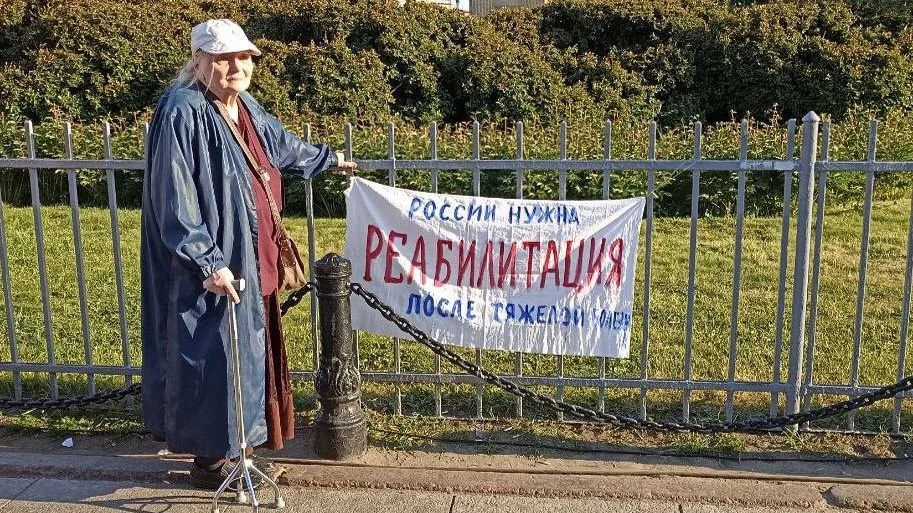
“Russian needs rehabilitation after a serious illness”: Artist Yelena Osipova picketing on Nevsky Prospekt in Petersburg on 12 June 2023. Photo courtesy of mr7.ru
A reader has informed mr7.ru that today on Nevsky Prospekt, near the Kazan Cathedral, Petersburg artist Yelena Osipova stood with a poster for a short time. On Russia Day, she asked for “rehabilitation” for the whole country. She was not detained by police.
Osipova has been staging solo protest pickets in the city center for over twenty years. She has been repeatedly detained by the police, although recently they have more often simply asked her to shut down her pickets and taken her home.
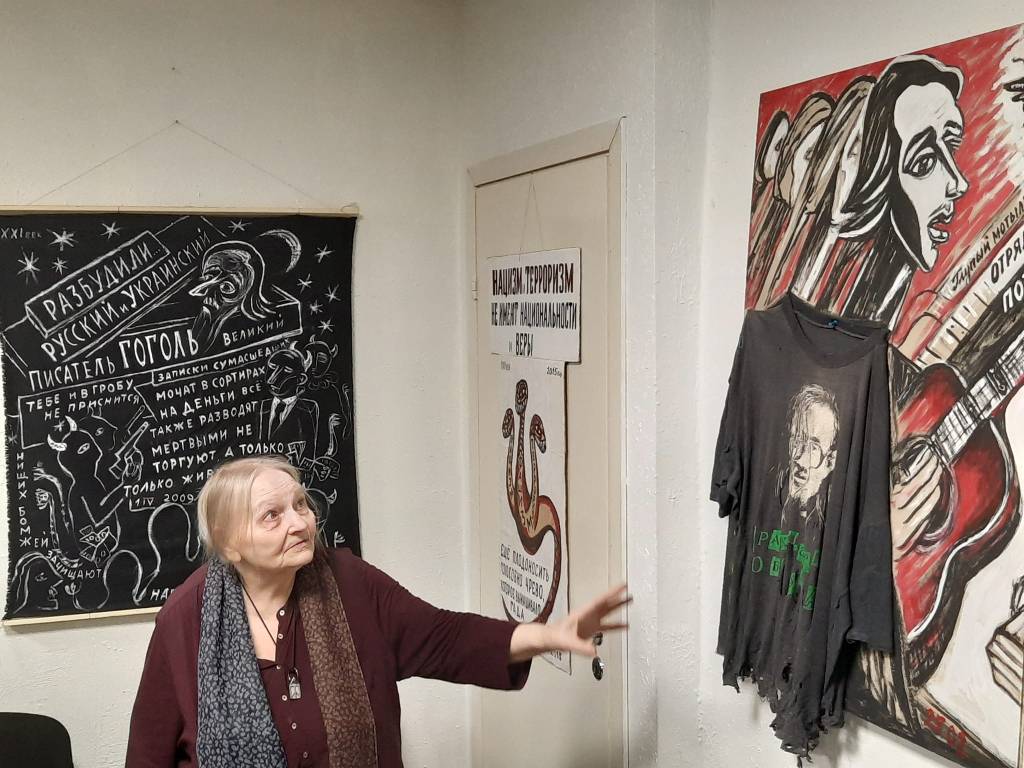
On January 31, an exhibition of the artist’s works opened in the offices of the Yabloko Party on Shpalernaya Street. The next day, however, the police came to the offices and seized the posters and paintings on display. An investigation into them was launched, whose findings were later submitted to the Investigative Committee. The works have not yet been returned to the artist.
This past spring, Osipova became ill and needed hospitalization: she suffered a stroke. The artist returned home only two weeks ago. Today she left the house for the first time since her illness.
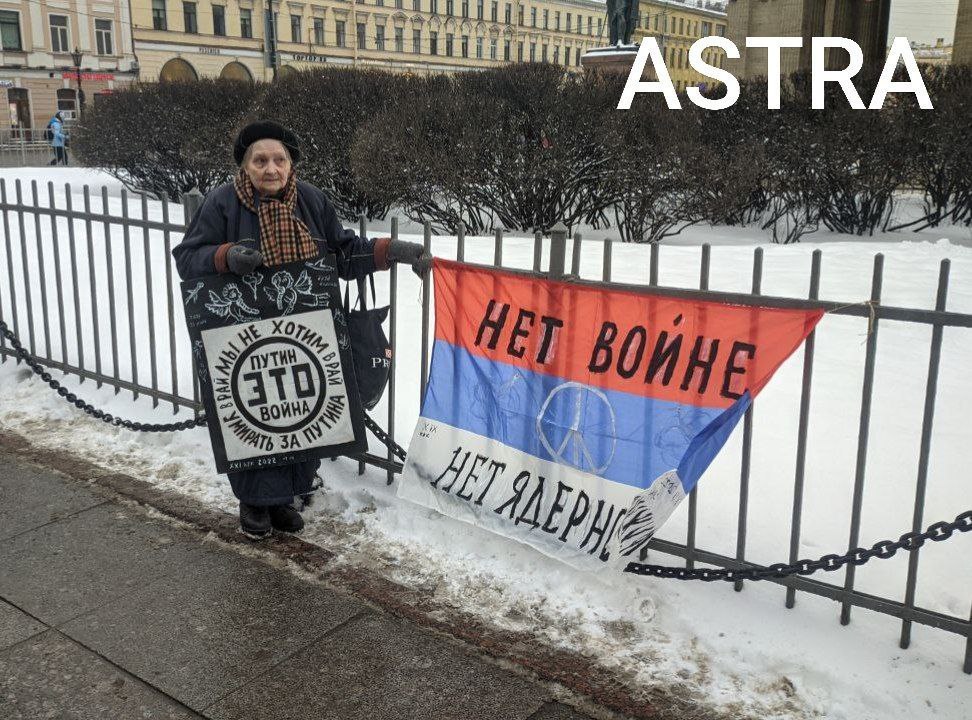
Artist and activist Yelena Osipova holding a handmade placard that reads, “PUTIN IS WAR. WE DON’T WANT TO GO TO HEAVEN/WE DON’T WANT TO DIE FOR PUTIN,” and standing next to a Russian flag emblazoned with the slogan “NO WAR.” Ms. Osipova is standing outside Our Lady of Kazan Cathedral in downtown Petersburg, but it is unclear when, exactly, this photo was taken. Photo courtesy of Astra and the St. Petersburg Aid to Detainees Group.
The St. Petersburg Aid to Detainees Group reports:
“The elderly artist and activist Yelena Osipova was detained in Petersburg after taking to the streets with anti-war posters. The police promise to take her home, while stopping along the way at the police department to ‘sign papers.'”
Meanwhile, in other news, one of Petersburg’s most well-known “opposition” political scientists reported earlier today that personally he was having a fantastic day today (which is the first anniversary of his country’s full-scale invasion of Ukraine for no other reason than it could) because one of his grad students has had an article accepted for publication in a prestigious academic journal.
That’s everything you need to know about the Russian liberal intelligentsia today: they’re continuing to live their best lives (at home, and abroad) while social “losers” and nobodies like Yelena Osipova fight the good fight. ||| TRR
DDT frontman Yuri Shevchuk has released the video “Motherland, Come Home.” In the new single, he calls on his country to stop the war and go about its own business. The video was shot by Shevchuk in collaboration with producer and composer Dmitry Yemelyanov.
Yuri Shevchuk wrote the poem “Motherland, Come Home” in the summer of 2022, a few months after Russia had launched its invasion of Ukraine. In the run-up to the invasion’s anniversary, the rocker set it to music and recorded the song. “Don’t go crazy, this is not your war,” Shevchuk urges listeners.
Yuri Shevchuk & Dmitry Yemelyanov, “Motherland, Come Home”
Shevchuk has repeatedly spoken out against the war in Ukraine. He has consistently taken a pacifist stance and opposed all wars, including the military operations in Chechnya, South Ossetia, and anywhere else in the world.
In 2022, Shevchuk was fined fifty thousand rubles after he was found guilty of “discrediting” the actions of the Russian army. The occasion for the fine was an anti-war statement he made in May at a concert in Ufa. After the outbreak of the war in Ukraine, concerts by his band, DDT, in Russia have often been postponed or canceled “due to technical difficulties.”
In the summer of 2022, the media reported the existence of a list of “banned” Russian artists who had opposed the war in Ukraine, including the bands DDT, B2, Aquarium, and Pornofilms, the rappers Face and Oxxxymiron, and the solo performers Zemfira, Monetochka, and Vasya Oblomov. There were more than fifty names on the list. Many of the musicians have already faced the cancellation of concerts, and some have been designated “foreign agents” by the Russian Justice Ministry.
Никотиновый вдох, Распальцованный взгляд, Я ещё не подох, Ещё мои шланги горят.
A nicotine breath, A swaggering look, I’m not dead yet, My hoses are still on fire.
Этой лютой весной Суета с тишиной Пульс неровный несут. Пульс неровный несут Моё сердце на суд.
This fierce spring Helter-skelter and silence, The pulse is uneven. The pulse is uneven My heart is on trial.
Опустело село, Пьёт Рязань из Днепра, От венков расцвело, В рыжей глине – дыра.
The village is deserted, Ryazan drinks from the Dnieper, The wreaths have burst into blossom, There is a hole in the red clay.
Маята, как сорняк Телевизор в печи, У державы стояк. У державы стояк, Воют бабы в ночи.
The torment is like a weed The TV’s like a furnace, The empire has a boner. The empire has a boner, Women howl in the night.
Тёмен век мой. Господи, как всё случилось? Рваный лик твой – Укололась и забылась. Не сходи с ума, Это не твоя война. Ждут грачи в полях весной. Родина, вернись домой!
My age is dark. My God, how did it happen? Your ragged face, Pricked and forgotten. Don’t go crazy, This is not your war. Rooks wait in the fields in spring. Motherland, come home!
Безнадёги иной Я не переживал, Коллективной виной – Сделал шаг и пропал.
Other doom and gloom Didn’t bother me, But with collective guilt I took a step and went MIA.
Давит воздух густой, Но тебя не забыть, Мертвецов напоить. Мертвецов напоить Родниковой водой.
The air is thick, But I can’t forget you, Get the dead drunk. Get the dead drunk On spring water.
Голоса белены Тянут мысль одну: Ты вернёшься с войны, Вновь попасть на войну.
Voices are faded white They dredge up one thought: You’ll come back from the war To go to war again.
И летят облака, Разбиваясь в дали, О крутые бока Нашей плоской Земли.
And the clouds are flying, Crashing in the distance On the craggy sides Of our flat Earth.
Тёмен век мой. Господи, как всё случилось? Рваный лик твой – Укололась и забылась. Не сходи с ума, Это не твоя война. Ждут грачи в полях весной. Родина, вернись домой!
My age is dark. My God, how did it happen? Your ragged face, Pricked and forgotten. Don’t go crazy, This is not your war. Rooks wait in the fields in spring. Motherland, come home!
Source: Yuri Shevchuk & DDT, “Motherland, Come Home,” Reproduktor. Translated by the Russian Reader
Found archival photo of a Young Pioneer on Mozhaiskaya Street in Leningrad, 1982. Thanks to VG for posting this find on their now-locked Facebook page
“A Calendar of Revolutionary Names. April: Arlen (“Army of Lenin”), Vilenin (“V.I. Lenin”), Viulen (“V.I. Ulyanov-Lenin”), Lublen (“Love Lenin”), Marenlenst (“Marx, Engels, Lenin, Stalin”), Motvil (“We’re from V.I. Lenin”), etc.
VICE News (YouTube), “Nationalism or Nothing: Life in Modern Russia,” 10 Feburary 2023: “President Vladimir Putin’s ongoing invasion of Ukraine, has led to a tightening of dictatorial powers within Russia. Free-speech is virtually non-existent and the public realm is now dominated by outspoken nationalists, who want more war, not less.” Thanks to Marxmail for the heads-up
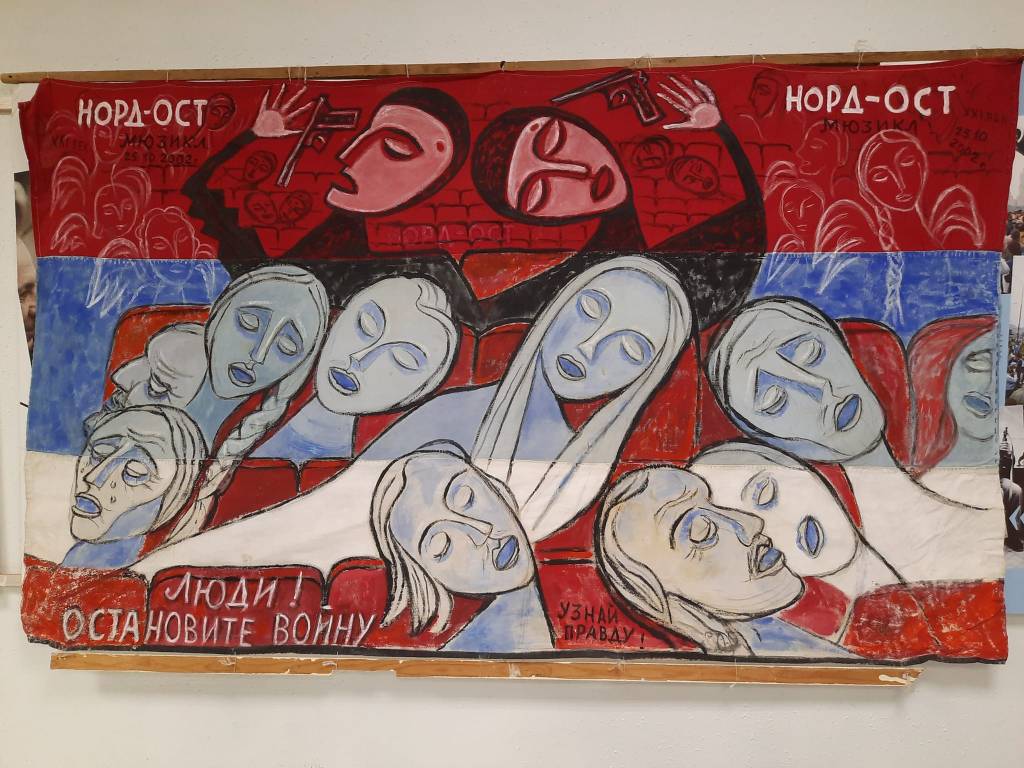
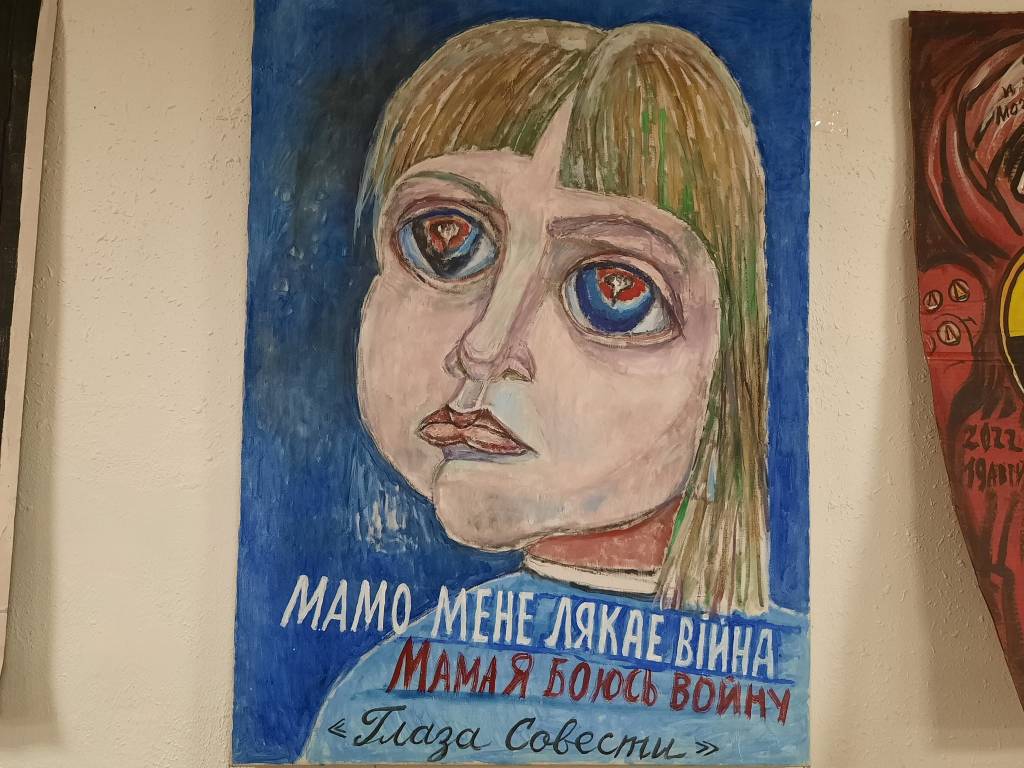
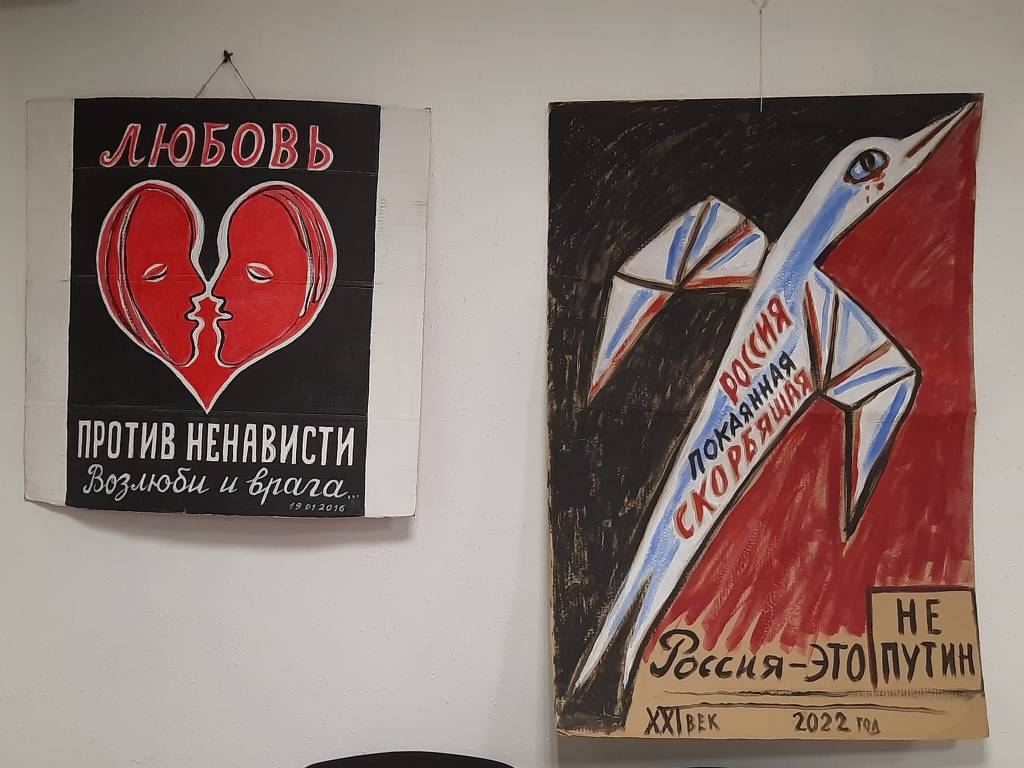
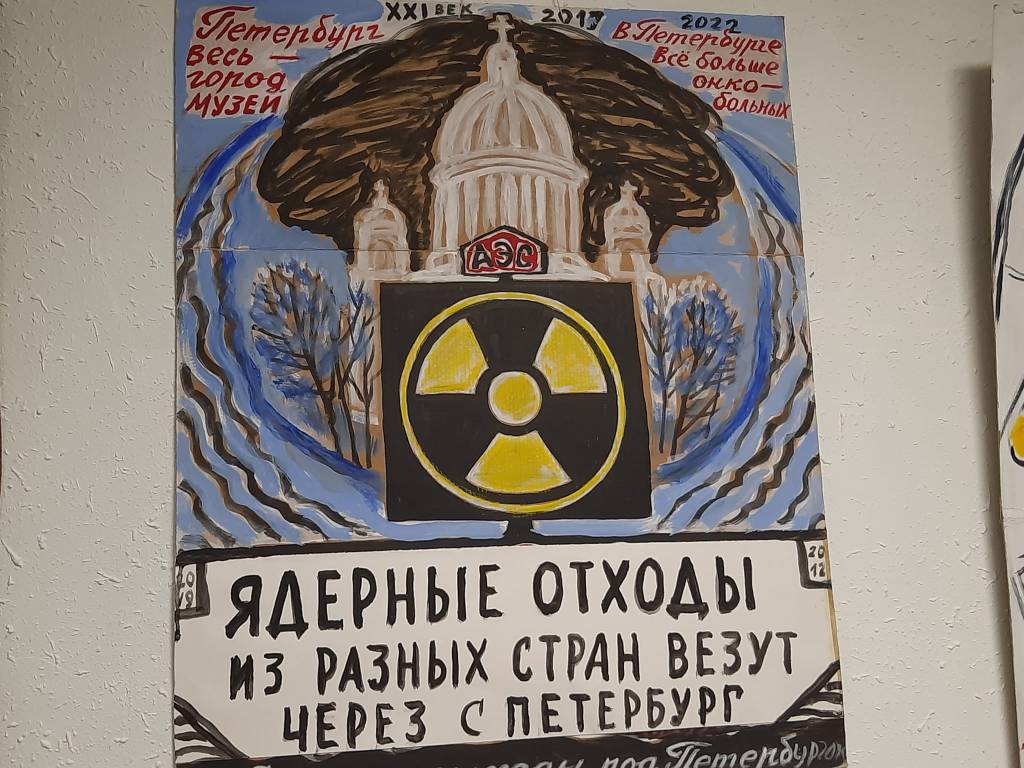
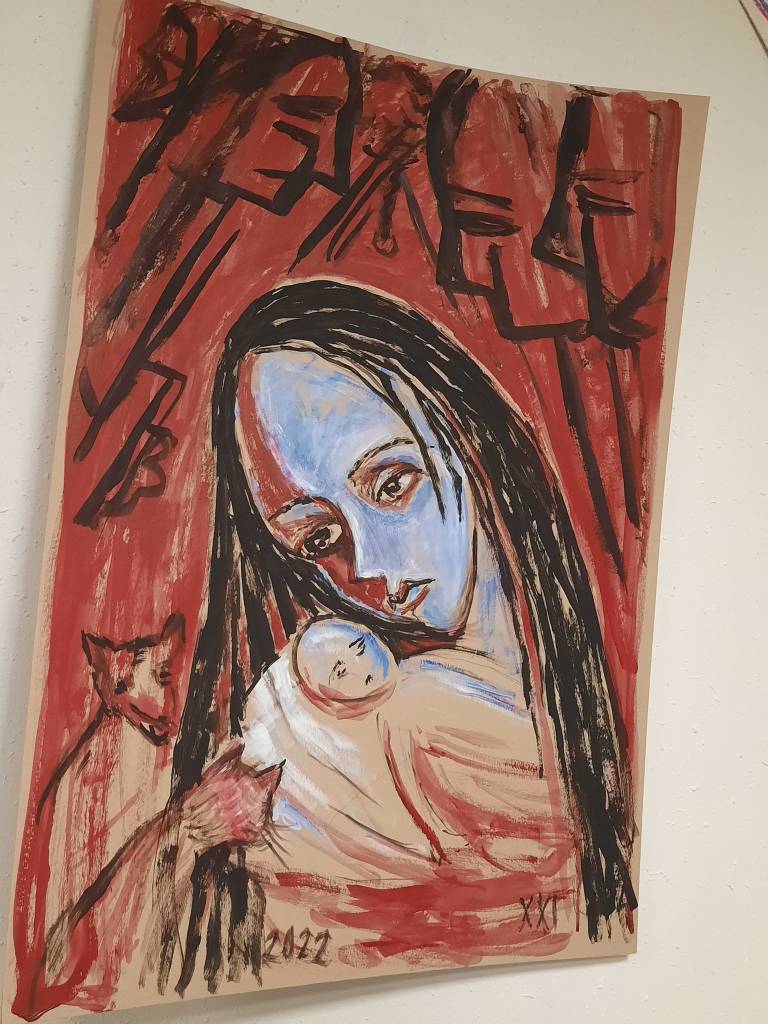
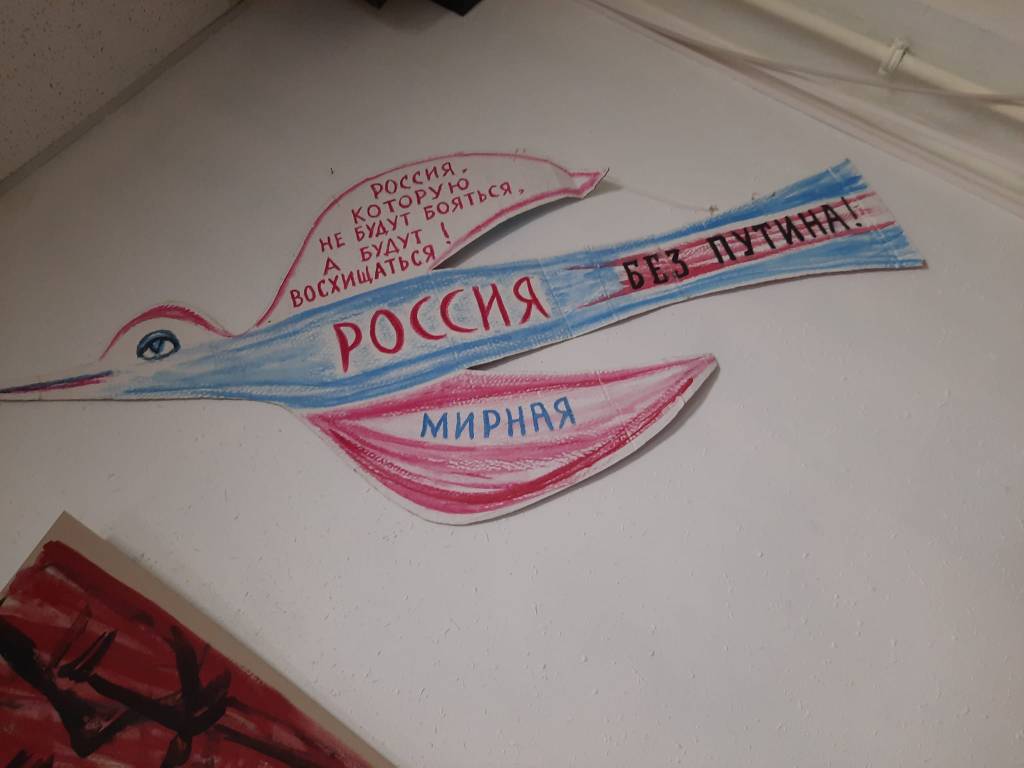
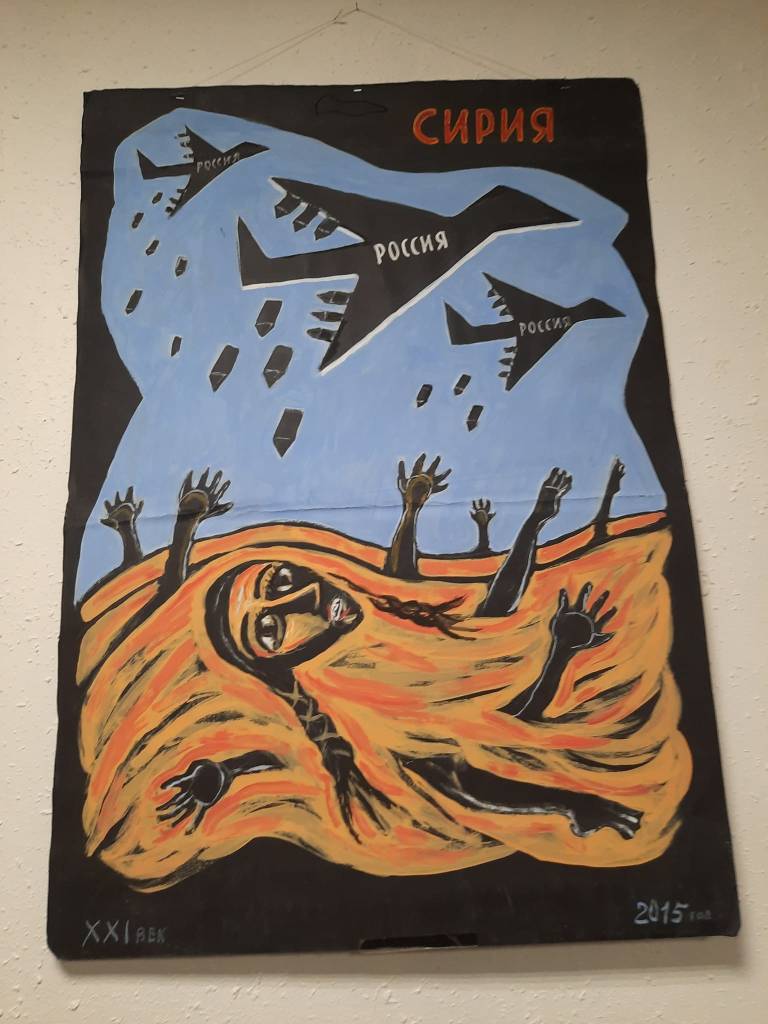
Yelena Osipova“Nord-Ost: People, Stop the War!”“Eyes of Conscience: ‘Mama, I’m Afraid of War'”“Love vs. Hate: Love Your Enemy Too”“Nuclear Waste from Various Countries Is Transported through St. Petersburg”Yelena Osipova with her works at the Yabloko party’s offices in Petersburg“A Russia Without Putin: A Russia That Won’t Be Feared, But Admired! A Peaceful Russia”“Syria. Russia”
Source: Galina Artemenko (Facebook), 31 January 2023. Captions by TRR. Yesterday (1 February 2023), Ms. Artemenko wrote that the security forces were removing Ms. Osipova’s posters from the Petersburg offices of the opposition Yabloko party. So, her exhibition there lasted all of one day. ||| TRR
Police seized anti-war paintings by 77-year-old artist Yelena Osipova from an exhibition that had opened the night before at the offices of the Yabloko party. Interior Ministry officers came allegedly because they had received a call that a bomb had been planted in the building, and as a result they took all Osipova’s work. The ministry wants to check whether the posters discredit the Russian army. The artist herself is very upset and is afraid that her paintings will not be returned.
The Petersburg artist and activist Yelena Osipova created a placard for this past weekend’s Crimson Sails celebrations (for newly minted high school graduates/school leavers) and stood with it on Malaya Sadovaya, a pedestrian street in downtown Petersburg. Her placard read, “May your sails be white, not red with blood. Make the world good!” Photos courtesy of Irina Bogdanovskaya, as posted on the public Facebook page Yelena Andreyeevna Osipova. Artist. Citizen.
On 22 June 1941, Nazi Germany invaded the Soviet Union. On 22 June 2022, artist Yelena Osipova held a solo anti-war picket on Nevsky Prospect in Petersburg. On 22 June 2022, Rossiiskaya Gazeta, the official Russian government newspaper, published a lengthy interview with Mikhail Piotrovsky, the longtime director of Petersburg’s Hermitage Museum,, in which he justified Russia’s invasion of Ukraine as part of his country’s greater historical and cultural “mission.” Ms. Osipova and Mr. Piotrovsky were born a mere eleven months apart, in November 1945 and December 1944, respectively. If Ms. Osipova’s bravery doesn’t bring honor on her hometown, it’s not for her want of trying. Despite having much greater resources at his disposal and a bigger bully pulpit, Mr. Piotrovsky has definitely brought shame on his city. As long it is run by people like him, Russia’s great “cultural capital” has no future. In any case, Ms. Osipova’s barely audible message makes a jarring juxtaposition with Mr. Piotrovsky’s arrogant, “learned” apology for Russian fascism. ||| TRR
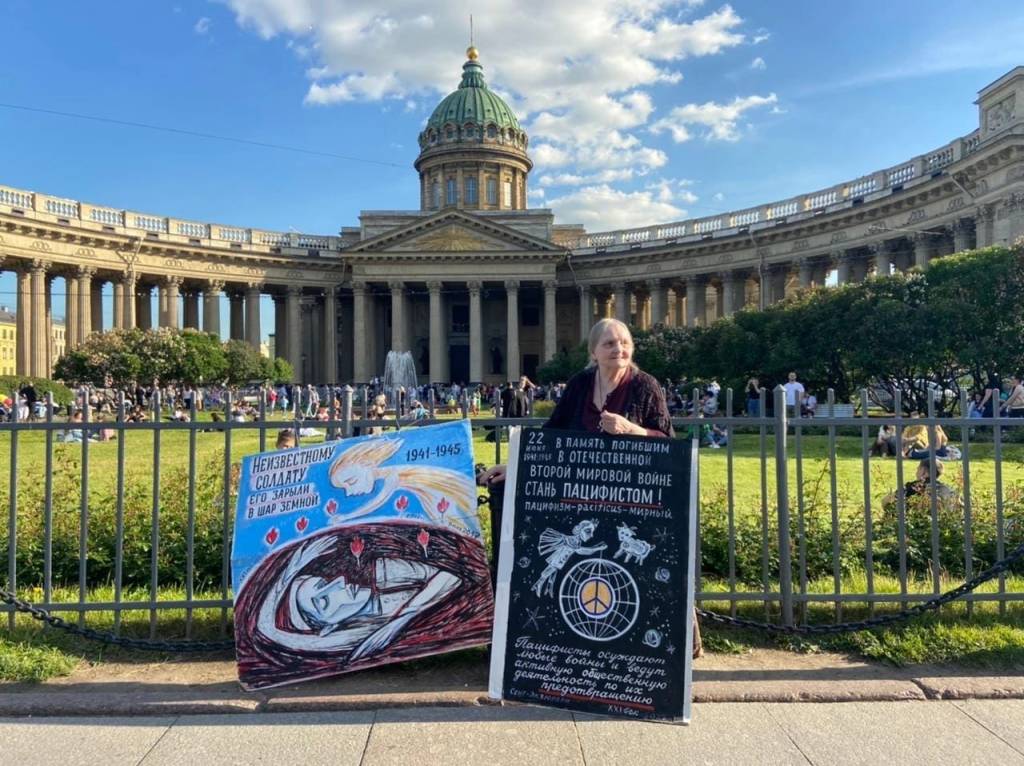
Yelena Osipova, photographed in front of Our Lady of Kazan Cathedral on Nevsky Prospekt in downtown Petersburg on 22 June 2022. Photo courtesy of Irina Bogdanovskaya, as posted on the public Facebook page Yelena Andreyeevna Osipova. Artist. Citizen. Thanks to Maria Mila for the heads-up. The placard on the left reads, “To the unknown soldier, 1941–1945. He was buried in the earth.” The placard on the right reads, “22 June 1941–1945. In memory of the Patriotic/Second World War. Become a pacifist! Pacifism – pacificus – peaceable. Pacifists condemn all wars and campaign vigorously and publicly to prevent them.” On 22 June 1941, Nazi Germany launched Operation Barbarossa, a massive invasion of the Soviet Union. Ms. Osipova was born on 11 November 1945, that is, six months after the end of the Great Patriotic War.
Mikhail Piotrovsky. Photo: RIA Novosti via Rossiiskaya Gazeta
[…]
[Elena Yakovleva]: We have all been shocked by the fighting not only on the fronts of the special operation, but also on the cultural front, by all the attempts to cancel Tchaikovsky and Rachmaninoff concerts, and the Russian language. What is behind “cancel culture”? Having ourselves escaped from the dictates of ideology, are we now witnessing its return in the West?
Mikhail Piotrovsky: The attack on us in the realm of culture is, of course, a semblance of what we had in Soviet times, when all connections were cut off by command, at a moment’s notice, at the snap of someone’s fingers. I have the sense that the Soviet Union, with its ideological dictates, has spread to the West. I did not expect that I would read in liberal Western newspapers such things as “The Hermitage is an imperial museum that preaches imperial ideology. It should not be allowed anywhere! The Hermitage’s [planned branch] in Barcelona should not be opened under any circumstances!”
I have been inundated with ultimatums. How dare you not speak out against the special operation in Ukraine?! Go out and protest immediately! Why are there no protests in your country?
But in this case we should understand that we have been subjected to such a powerful attack in the field of culture because culture is an area in which we are absolutely competitive.
We have the initiative here. We are trendsetters.
Are we an exporting country?
Mikhail Piotrovsky: Yes, and our cultural exports are more important than imports.
Our recent exhibitions abroad are a powerful cultural offensive, a kind of “special operation,” if you wish. Which many people don’t like, but we are advancing. No one can be allowed to thwart our offensive.
In response to calls to cancel Tchaikovsky, smart people in Russia have been saying, “We won’t cancel anything. On the contrary, we will continue to love the Europe that we learned about while studying at universities.” Is the asymmetry fundamentally important in this case?
Mikhail Piotrovsky: Of course. Given our cultural advantage, we don’t have to loudly announce that we are reneging on one cultural agreement or another in response to their bans. They can do it unilaterally. There is definitely no need for bilateralism — precisely because we are winning.
I think that under no circumstances should we succumb (and we shall not succumb) to the seductions of “cancel culture.” I believe we are immune to it because we have already been “canceled” six ways to Sunday. First, the entire culture of Tsarist Russia was canceled, and then Soviet culture was canceled. Monuments were demolished dozens of times. But we also know something else: monuments come back, everything is restored. The knowledge that memory and culture come back is in our blood. That is why we are not eager to overdo it when it comes to “cancelations.” Besides, you can’t cancel Tchaikovsky, except, perhaps, performances of Tchaikovsky by Russian orchestras. But this is just unfair competition.
Why is the West so passionate about “cancel culture”? And about the dictates of “public opinion”?
Mikhail Piotrovsky: I would not exaggerate the difference between the dictates of Soviet ideology and “public opinion.” Public opinion is bound up with governments or regulated by them.
As for “cancel culture” in the West, it is part of a large wave that was born amidst BLM, and linked to the culture of guilt and repentance for guilt. It suddenly surged: they began pulling down monuments and not standing for the American flag. They think that Voltaire is bad, and this guy, and that other guy. It’s a little ridiculous. How much can you repent for the terrors of colonialism, which in fact was so entirely categorical? Or for the unfortunate slave trade, which after all began not in Europe, but in Africa?
They seemingly had already begun to sense that this road leads nowhere, but then Russia turned up by chance. So let’s “cancel” Russia, they said. Although the glee with which they have rushed to condemn us, to tear us up and expel us, again speaks to the fact that we are strong in culture.
When the Bizot group boycotts Russian museums, it’s just ridiculous. I was one of the people who founded the group, and I know that we actually created it to help museums do cultural exchanges unencumbered by politics. But now it’s apparently been ideologized on the Soviet model. If this Soviet-style infection has gone so far, let them be sick alone. We don’t need to be sick too. We have historical immunity against this. I think we will spread it to others.
[…]
Since it hasn’t succumbed to the hype of cancellations, has the Hermitage keep its exhibitions abroad going?
Mikhail Piotrovsky: Not only the Hermitage. When the special operation in Ukraine began, exhibitions by Russian museums were everywhere. We have a Morozov [Collection] exhibition in Paris and exhibitions in Italy. Our most controversial exhibition, a Fabergé show, was in London. The Russian Museum had an exhibition in Spain.
This was our “special operation,” if you like, a great cultural offensive.
As soon as all the ideological sirens were turned on due to the special operation in Ukraine, we initially announced that we were pulling everything out immediately. But then we thought it over and said that we had been given guarantees. The organizers were quick to confirm them. We organized the Morozov exhibition in Paris in cooperation with the Louis Vuitton Foundation, and suddenly realized that this global commercial company was a much better partner in today’s “Soviet” Europe than government entities were. Having no freedom of maneuver, they were “ordered” to break off relations with us, while the business people who made promises to us did EVERYTHING to fulfill them. It was a matter of honor for them: they promised us that [they would send] everything back on time.
But then people in Russia started yelling, “Why did you take our treasures there? They’re worth so much money!” And all hell broke loss on the other side: “Since they’re worth ‘that much’ money, let’s impound them!” People with tormented mercantilist mindsets could not really understand the essence of the matter, so very provocative things were shouted on both sides. I must say that the provocation by the press was the main complication in this whole special operation. Yesterday, I was sent a copy of the FT featuring a discussion by journalists in their art (!) department on the topic of whether Russian paintings should have been impounded. It was due to such journalistic caterwauling that pieces from our museums were detained at the Finnish border. It was the weekend, and Finnish customs officers had read their fill of newspaper articles about how everything should be confiscated from the Russians. Although before and after that, ten of our truck caravans passed through their border post.
From our side, it was the bloggers shouted more. The journalists have been schooled by you.
Mikhail Piotrovsky: Only there are few real journalists left and just a couple of newspapers. Everyone is like a blogger now. And bloggers don’t understand that this is a cultural offensive, that the Shchukin and Morozov exhibition in Paris is like the Russian flag flying over the Bois de Boulogne. Do you know how everyone appreciated it in Italy? They said, “If the Hermitage can leave its paintings with us at a time like this, it means that they know what they are doing over there in Russia.”
It is also very important that the protagonists of our exhibitions were [Sergei] Shchukin and [Ivan] Morozov, Russian businessmen from the Old Believers community who largely defined the evolution of European culture. Matisse was once asked if he would have painted Dance had it not been for Shchukin. “And for whom would I have painted it?” Matisse said. Shchukin suggested things, commissioned things, was capricious, and great works were born. I was recently awarded the Demidov Prize, and it was an occasion to recall how Nikolai Demidov and the great French jeweler Pierre Thomire created this Russian style of malachite with bronze. They had such fights! Thomire said they should do things one way, Demidov said no, it must be done another way. But consequently, there is the Malachite Canopy in the Hermitage.
Does a producer [sic] have the right to interfere in an artist’s plans like that?
Mikhail Piotrovsky: He absolutely has the right. Yes, sometimes such interventions can be bad. But sometimes they can be good. In the case of Shchukin and Morozov, it was a good thing. They were the RIGHT customers.
Let’s not forget that it was the Old Believers who revealed to us the beauty of the old Russian icons. They were the first to clean them and preserve them. And Shchukin brought Russian icons to Matisse, in particular, to reverse the influence of Persian miniatures on him.
At the Morozov exhibition, we presented Russian paintings collected by him and showed art through the collector’s eye. Morozov collected Manet and [Valentin] Serov, and I would hear people say when they were leaving the exhibition, “You look [at their paintings] and you realize that Serov is no worse than Manet.”
The Fabergé exhibition made a very big splash. That is another Russian phenomenon that influenced the West.
So, we in fact did undertake a big cultural offensive. And we came out of it, having done everything we had planned to do.
[…]
Europe has long been a cultural model for us. The “RG” had a conversation with the writer Eugene Vodolazkin about attitudes to Europe. With reference to Dostoevsky, we talked about the fact it is almost dearer to us than to the Europeans.
Mikhail Piotrovsky: We recently held a round table at the Council of the History of World Culture at the Academy of Sciences, which we were going to call “Is Russia Europe?” but instead called “Is Russia Europe? Is Europe the EU?” The general sense of our debate was this: we are Europe, as much a part of it as France or Germany, and maybe more than the United States. If Europe were not us, Gogol would not have written Dead Souls while living in Italy. We recently held another round table on visual art, at which we recalled that Dostoevsky wrote about the Sistine Madonna.
This is our long-standing choice: we are inseparable from European culture and from Europe itself. The special military operation in Ukraine does not change anything. There have been plenty of disagreements and wars within Europe, from the Thirty Years’ War to the First World War. We are Europe and at some moments more Europe than many of its classic [sic] countries. And certainly more than the EU, which is now turning into the Soviet Union.
Of course, we also have an Asian aspect. But Peter the Great already knew how to balance all this wonderfully. We at the Hermitage understand this like no one else, because our main theme is world culture in the Russian context. I constantly talk about our right to be Europe, because in the south of Russia we have a Classical heritage — Chersonesus, Kerch, Taman. And whoever has a Classical heritage is Europe. In Norway, for example, there is no Classical heritage; there were neither Greek colonies nor Roman legions.
Therefore, it is all ours. We must dispose of it as our own, and not think that we are opposing Europe. Do we have different values? But they all have different values. Do we have special Orthodox values? But there are Orthodox values in Europe as well. In many ways they are consonant with Catholic values and not consonant with various secular ones. As an absolutely full-fledged and equal part of Europe, we will never be isolated. It’s just our sense of self. And the Hermitage is a symbol of this self-awareness. I keep repeating that the Hermitage is an encyclopedia of world culture written in Russian. The Hermitage’s Rembrandts, which have been in Russia for three hundred years, are Russian Rembrandts. The Russian Shakespeare is impossible without [Grigori] Kozintsev and [Innokenty] Smoktunovsky. Other doors — to Asia — are always open. But this does not cancel our presence in Europe.
Since people who value Russian culture have not yet gained the upper hand in Europe, must we now form a European model for ourselves?
Mikhail Piotrovsky: We must form this model now. And we are forming it.
Although there seem to be no Shchukins and Morozovs in Russia nowadays.
Mikhail Piotrovsky: Shchukin and Morozov shaped tastes. But now we are shaping, for example, international law. For many years, we have been carefully fashioning guarantees for the return of our paintings by changing international laws and creating immunity from impoundment. All this was first elaborated for Soviet exhibitions, and later, already in my own time, we constantly worked on developing it. The descendants of Shchukin and Morozov tried to sue us, so I urgently got the pictures out of Rome by plane. But every year we have strengthened our legal safeguards. We said, “Do you want our exhibitions? Then give us real guarantees. Spell it out in the contract: the exhibition will be returned on time even in case of lawsuits.” Europe accepted all these terms. The Americans didn’t, so we haven’t had any exchanges with the Americans for ten years. Although people who wanted to host exhibitions from Russia introduced a new law in the United States that enabled the government to give us guarantees and immunity. But it was too late; now it’s not enough. But with Europe, all the guarantees worked. In particular, when paintings from our Italian exhibitions were detained at the Finnish border, our diplomats and Italian businessmen helped us. They immediately sent all the paperwork to the Finnish government: “We gave guarantees, how can you not trust them?!”
At the last moment — even amidst the sanctions — our Western partners introduced a clause stating that prohibited luxury items do not include items that are in exhibitions of Russian museums abroad. It was even stipulated that Russian transport companies have the right to transport exhibitions throughout the EU. We didn’t take the risk — we transported [the exhibitions] in foreign vehicles — but this point was specially inserted. So, we not only look at Europe as a model, but also try and shape the international rules ourselves. This is quite important, especially now, when there are disputes about every [piece of art] in the world over who it actually belongs to.
[…]
Has the attitude towards the Hermitage changed among its Western fans?
Mikhail Piotrovsky: We’ve been getting stabbed in the back a lot lately. Outside the country, the Khodorkovskys of the world have been slinging mud at us, while here at home, as always, certain people have been calling for draconian audits. On the other hand, we have gotten a better sense of who our friends are and who are our enemies. The “society of friends of the Hermitage” have proved their mettle. In Israel, for example, they comported themselves brilliantly. They immediately spoke out. “How can we be friends of the Hermitage, using this honorary title, and then suddenly severe ties [with the museum]?”
We can see everything now. We see that there are people who break off their relationship [with us], but it makes them suffer and cry. But there are also those who happily took advantage of this opportunity. Apparently, they were friends solely due to the political conjuncture. Now we have a good “blacklist” of journalists and politicians This is very important. The world is not uniform.
Has your “blacklist” gotten a lot longer?
Mikhail Piotrovsky: It changed a lot. But besides those who have been writing maliciously about us, unexpected friends have appeared — for example, those French and Italian businessmen I mentioned.
What should we be doing in the field of culture?
Mikhail Piotrovsky: I think we have to do everything in such a way that we are seen, but we don’t have to travel anywhere at all to do this. After becoming director of the Hermitage, I announced a moratorium on exhibitions inside Russia because it was dangerous to transport things then: there were thieves everywhere, there was no money, no real insurance, either. So we didn’t send exhibitions around Russia for ten years. But now we are announcing a moratorium on exhibitions abroad.
I urge everyone now to look back at the experience of the Siege of Leningrad — at the know-how for saving things in an organized manner that was acquired then, at the understanding that when guns speak, the muses should not be silent. On the contrary, they should speak loudly. The experience of the Siege also taught us to address the world beyond the encirclement. During the Great Patriotic War, the Nizami and Nava’i exhibitions and evenings at the Hermitage were examples of this appeal. They showed the whole Soviet Union and the whole world that we remembered the great poets even in the midst of famine and war. Therefore, we are now, as part of the “Great Hermitage” program, going to be doing everything to make the whole world see us and, roughly speaking, envy us.
Now, for example, we are opening an exhibition of works by one of the most famous Danish artists, [Vigilius] Eriksen. He painted Catherine the Great and her court, and for the tricentennial of his birth he earned an exhibition at the Hermitage. We requested pieces from Denmark for the exhibition, but they were not given to us. Well, we have more of Eriksen’s works than they have in Denmark. So, an excellent exhibition is now opening in the Nicholas Hall featuring huge portraits of Catherine and the Orlov Brothers, accompanied by the amazing stories of how they were created, how they were repainted and the medals on the uniforms were altered. The exhibition is on the internet, including a lecture in English. We are broadcasting a message to Denmark: look, a small but very important piece of European culture is the great portrait painter Eriksen in the Hermitage.
[…]
What do you say to those who demand that you repent for Russian policy?
Mikhail Piotrovsky: Our country has now shifted into another time. The first period of the Scythian War is over. We retreated and retreated, now we are not retreating. A pivot has been made. And it is already clear that it’s the final one. Everything began in 2014 in Crimea. Crimea created a situation in which there was no other way, in which we had to pivot.
Our country is making great, comprehensive transformations. And we, respectively, are part of them and with her. Working calmly and normally is our stance.
The Hermitage has done exhibitions about war many times. What can you say about how it’s perceived? For example, a totally pacifist reaction is not something I find congenial. Apparently, I’m a militarist.
Mikhail Piotrovsky: We are all militarists and imperialists. (laughs)
First and most important, it is my country, and I must stand with it. I sometimes repeat the jingoistic formula: this is my country, such as it is. There are situations when it is absolutely clear that a person must stand with his country. In the West they understand that these are all substantive things — that we stand with our country. When a very serious issue is being resolved, there are no options.
I am currently reading Alexei Varlamov’s wonderful book about [Vasily] Rozanov, and [there is a section in it] about 1914 and his hyper-patriotic sentiments. This patriotism at the beginning of the 1914 war is [a phenomenon] known to everyone, but it has not been explained very well. We are somehow dismissive of it, but it was a quite important thing in fact. We, people of culture, must now understand our involvement in everything that is happening. A person involved in history, first of all, must do well what it is that he does [as a vocation], in keeping with the principle that when guns speak, the muses should also speak. And in keeping with the realization that culture, which for us stands above politics and everything else, will later ask us to account for what we did for it. As we were asked after the war, after the Siege: what did you do — on your own?
For me, the attitude to war is established by the great Pushkin in A Journey to Arzrum. Where is he rushing the entire book? To see the demoted Decembrists and then go into battle?
Mikhail Piotrovsky: Arzrum was also the only foreign land Pushkin visited. It expanded the world for him. There is nothing wrong with the fact that a person wants to have the most complete set of sensations. This is especially true when he wants to embody his deep feelings in something, to see and do something new. If he has grounds for it, he throws himself into it. It is an element of self-esteem. I always say that Russian patriotism is a sense of one’s own historical dignity. An individual understands that he must go to war, while another person understands that he must do something else, but which is no less important. Behind this is a sense of one’s own historical dignity, the desire to live up to one’s history and the mission of one’s country. It sounds quite dramatic, but we understand our country’s historical mission. This feeling that our country is changing world history, and that you are involved in it, is crucial now.
Nor are things so simple when it comes to attitudes towards armed hostilities. On the one hand, war is blood and murder, but on the other, it is a means for people, for a nation, to assert themselves. Everyone wants to assert themselves, and in their stances on the war, they undoubtedly assert themselves. We have all been brought up in the imperial tradition, and an empire unites many peoples. It unites people by finding things that are common and important to everyone. It’s very tempting, but it’s one of the good temptations, let’s say. Although we don’t have to succumb to it, ultimately, and we must be able to regulate it within ourselves. Nor should we forget the principle that a person should do what he must do, come what may. For museums, “doing what we must” means preserving and promoting culture. And keeping in mind all the time what is beyond the besieged territory. And speaking not only to people inside it, but also “outside” it.
Source: Elena Yakovleva, “Mikhail Piotrovsky explains why you have to stand with your country when it makes a historical pivot and choice,”Rossiiskaya Gazeta, 22 June 2022 (No. 33/8781). Translated by the Russian Reader, who omitted only the brief introduction and section headings, as printed in the original text. Mr. Piotrovsky, the longtime director of the State Hermitage Museum in Petersburg, located a short walk down the Nevsky from where Ms. Osipova held her anti-war picket on Wednesday, was born on 9 December 1944, that is, five months before the end of the Great Patriotic War.
Unknown assailants attacked 76-year-old artist Yelena Osipova in Petersburg. They snatched anti-war placards from her hands
Two young men attacked the Petersburg artist and protest fixture Yelena Osipova right at her front door. At about three o’clock, she left the house, carrying two anti-war placards, to go picket on Nevsky Prospekt, videographer Nikita Adishchev told Rotunda. (He happened to be nearby because he was shooting a documentary about Osipova.) The young men were waiting for her at the exit from her building. According to Adishchev, they snatched the placards from the artist and ran away.
Ms. Osipova is not the only Petersburg woman who was prevented from holding an anti-war protest on Victory Day. A few days before May 9, police detained three activists from the Vesna Movement on criminal charges for calling on Russians to go to Immortal Regiment marches and voice pacifist slogans. Several more activists — including feminists from the Eve’s Ribs project — were detained on suspicion that they had been involved in telephone calls falsely reporting that bombs had been planted in buildings. But even pro-government media admitted that the criminal investigation into telephone terrorism was only a pretext. In fact, as some publications reported with reference to sources in law enforcement agencies, their field agents “had thwarted plans to organize provocative protest actions on May 9.”
Source: Rotunda, 9 May 2022. Thanks to Imaginary Island for the heads-up. Photo courtesy of Radio Svoboda. Translated by the Russian Reader
Police detain Yelena Osipova during a protest in Petersburg in March 2022. The placards she is holding call for the elimination of nuclear weapons throughout the world. Photo: Yelena Lukyanova/Novaya Gazeta
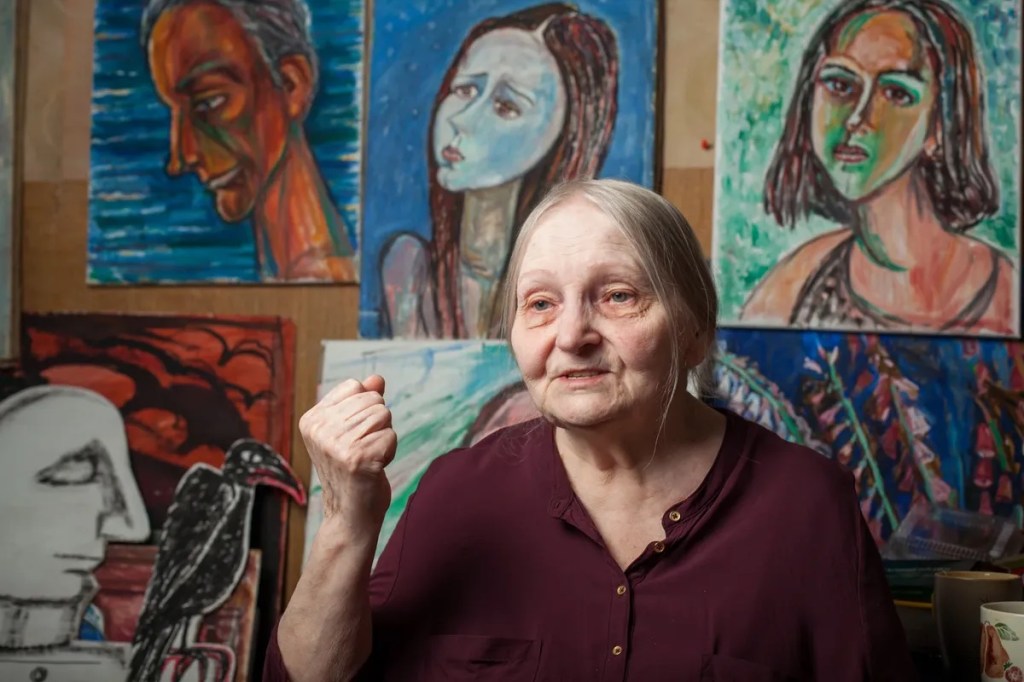
“President, Change Course!” Yelena Osipova, a 77-year-old artist, has been taking to the streets of St. Petersburg for twenty years with her painted placards on the day’s most burning issues
Some call her the city’s conscience, while others call her the city’s disgrace — just as some consider the “special operation” a humanitarian disaster, while others regard it a liberation campaign. But Yelena Andreyevna Osipova is more afraid of people who are indifferent than of her opponents.
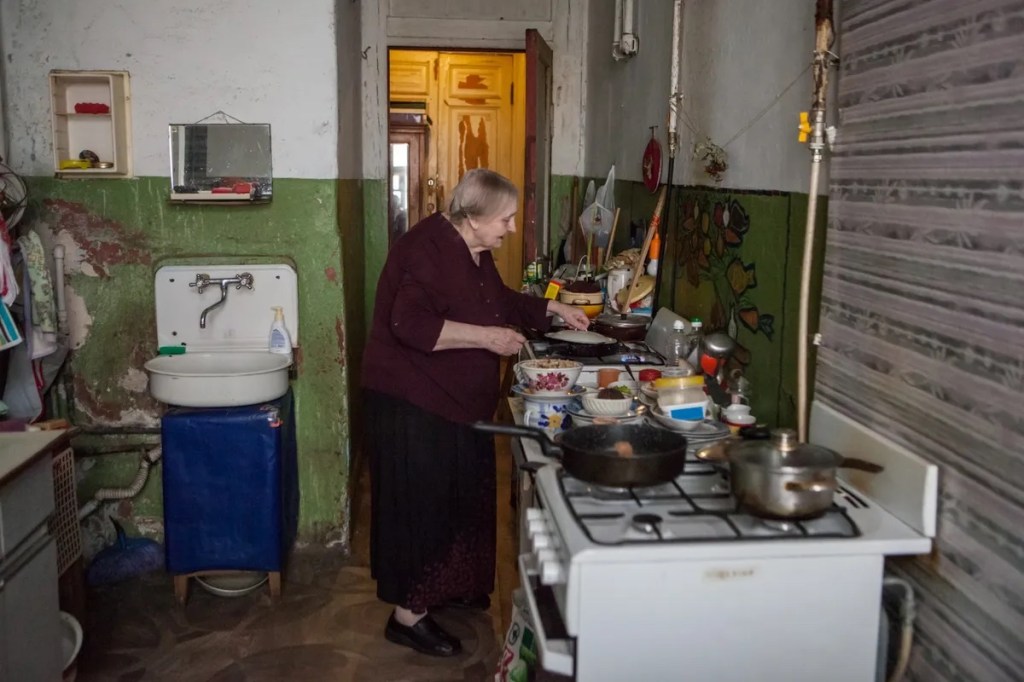
There have never been major renovations in the late nineteenth-century residential building where Yelena Andreyevna lives. Her communal flat is chockablock with furniture that was purchased at least half a century ago. When her guests arrive, the artist takes out a new small white towel embroidered with New Year’s tree toys. Yelena Andreyevna treats us to rice and vegetables. When she puts it on our plates, she says, “It’s delicious, there’s even meat in it.” She is glad that she has a pack of tea in her pantry. She opens it, explaining that the other day that the social security department bought her a grocery care package since she is officially poor.
Yelena Osipova in the kitchen of her communal flat. Photo: Yelena Lukyanova/Novaya Gazeta
All her life, Osipova, who graduated from art school, taught fine art in the schools. But she retired thirteen years ago.
“You have to smile at children,” she says, “but after the death of my only son [in 2009], I couldn’t smile anymore.”
Yelena Andreyevna’s pension is six thousand rubles a month [approx. 56 euros]. She receives another one and a half thousand rubles as a low-income allowance.
“Last month they added a little more — it came to about nine thousand. And the maintenance bill is five thousand. Pay, lie down and die?” the pensioner asks rhetorically. “Of course, I don’t pay for anything. I spend money only on food. My landline telephone was cut off for non-payment. I haven’t been fined [for detentions during street protests] because I have no money to pay them.”
Yelena Osipova. Photo: Yelena Lukyanova/Novaya Gazeta
“Sometimes unkind people reproach me, claiming that I am paid, that I protest for money, and so on. What money?” the artist asks, perplexed. “All my placards are at my house, I haven’t sold a single one in twenty years. Other people photograph them, make copies and sell them. But I can’t be responsible for that anymore. Sometimes people on the street try to give me money, they sincerely want to help, I see that. But I can’t take their money. If I took even a single ruble, it would negate everything I do. I’m not doing it for the money, but out of conviction. I don’t peddle my convictions.”
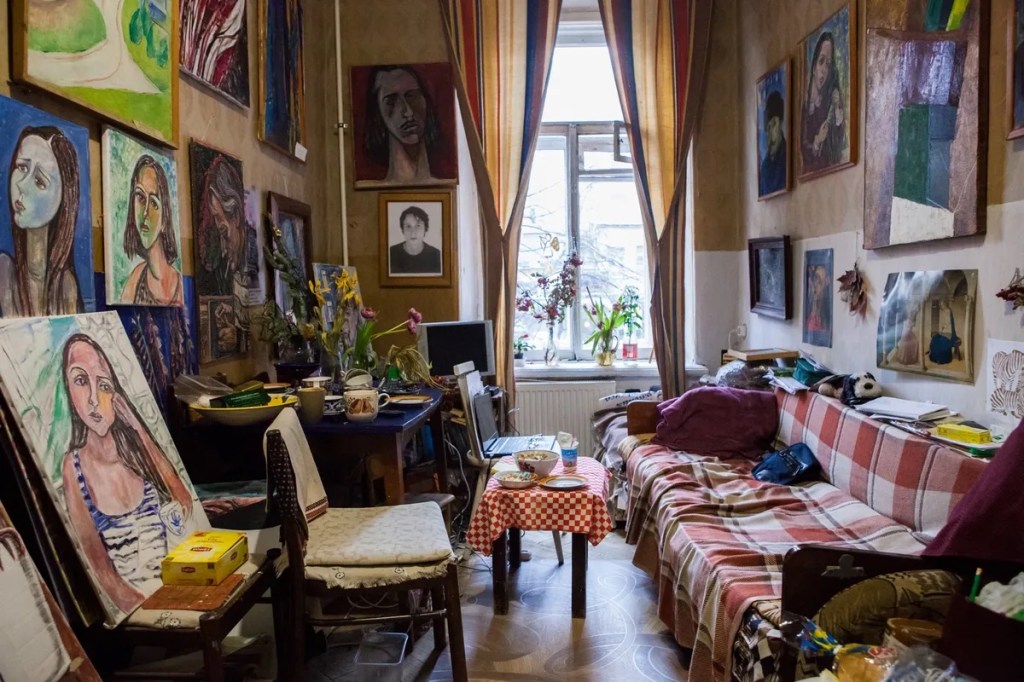
Yelena Osipova’s room in a communal flat in Petersburg’s Central District. Photo: Yelena Lukyanova/Novaya Gazeta
Several years ago, Petersburgers raised five thousand rubles so that the artist could pay a fine for involvement in a protest rally. But she sent the money to the men who were convicted in the Bolotnaya Square case.
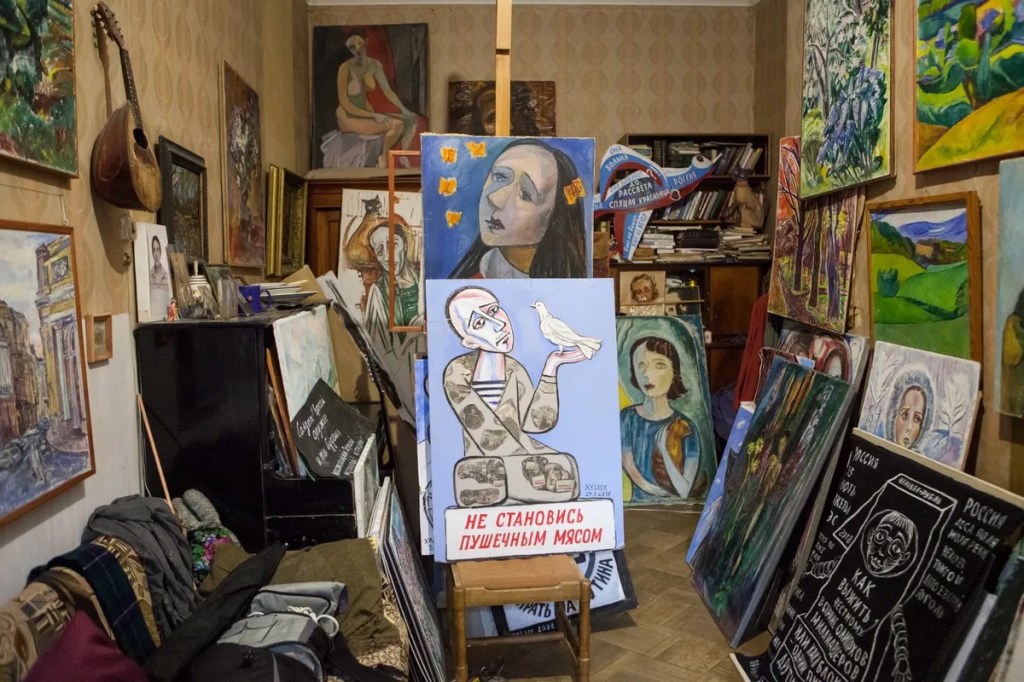
Yelena Andreyevna began voicing her views and beliefs publicly — by picketing with handmade placards in the street — in 2002, after the Nord-Ost siege. She has not stopped since, despite intimidation and prohibitions from the authorities. The artist’s works, her placards and paintings, fill her room in a communal flat from floor to ceiling, as well as a closet and a corridor.
“On the night when the Dubrovka Theater was stormed, I was working at home. I was painting a picture, sitting on the sofa in front of the TV,” she recalls. “The events at the Dubrovka were shown live. Everyone was waiting for the finale, me among them, and I witnessed that horror. I saw a girl with a huge braid being carried out like firewood, and her braid was dangling behind. I saw buses filled with people with their heads thrown back. And then, a few days later, the news showed Putin arriving at a hospital, holding out his hand, and people who had been almost gassed to death, who had lost their loved ones, shook his hand.”
Yelena Osipova. Photo: Yelena Lukyanova/Novaya Gazeta
Yelena Andreyevna could not stand it. She took a piece of drawing paper and a brush and wrote, “Mr. President, change course now!” For the first time, she went to the St. Petersburg Legislative Assembly on St. Isaac’s Square bearing the placard. She spent the whole day on the steps waiting for allies or at least some interest in her message, but it was in vain. In the autumn of 2002, the police detained no one for solo pickets and no cannibalistic laws on protesting had yet been adopted. No one seemed to notice the artist, however: legislative assembly members deliberately avoided looking in her direction, while passersby walked by her without stopping.
“Russians stomached the Nord-Ost siege,” says Yelena Andreyevna. “No one protested publicly. The Beslan school siege happened as a consequence. Society bit the bullet on that too. Only the parents of the dead children took to the streets with homemade placards. But the country was asleep. People have been putting up the whole time. So we now we have lived to see [war] with Ukraine, to see the whole world turning away from Russia. How could the country of Pushkin, Tolstoy, and Dostoevsky have come to this?”
“Don’t become cannon fodder.” Photo: Yelena Lukyanova/Novaya Gazeta
“At first I was shocked that a good number of Russians supported the ‘special operation,'” Osipova admits. “When it started and I found out about it early in the morning, I took to the streets with a placard. I was in a completely suicidal mood, but people saved me. That day I saw that many people, young and not so young, shared my views. They came up to me and said thank you. One elderly man even asked me, crying, “How can I help? How can we help Ukraine?” The first time, right after the ‘special operation’ started, I stood with a placard on Nevsky Prospekt, near the monument to Catherine the Great, with the [Alexandrinsky] Theater in the background. It was a convenient place to hang up my placards, because it was already hard for me to hold them. Then I managed to picket for a long time, because I didn’t go to Gostiny Dvor [site of the main anti-war protests, a block from the Catherine the Great monument on Nevsky Prospekt]. There were policemen there, and of course they would have grabbed me right away. The young people came up with a new form of protest that day: they ran in groups up and down Nevsky Prospekt and shouted anti-war slogans. It was such a protest for peace. They didn’t have placards. But all of them were shouting. I didn’t expect this. It resurrected me.”
Yelena Osipova. Photo: Yelena Lukyanova/Novaya Gazeta
“There are also people who argue with me, scold me, attack me,” the artist says. “Recently, ladies like the ones who used to work in district Party committees, well-groomed and well-off, attacked me outside the subway. They called the police, and I was taken away. And a week ago outside the Chernyshevskaya subway station [in central Petersburg, near Osipova’s house] I was attacked by about ten titushky, men and women. They did not let me unfold my placard; they tried to take it away and even tore it. I asked passersby to dial 02 so that the police would come and protect me. It is hard for me to judge whether there are more people who attack and condemn me, or more who support me. But for sure the majority of people are indifferent, the ones who walk by without stopping or looking. They don’t want to think about the future or about their children. The main problem is that this whole thing will be left to our children. They will have to clean up everything after we’re gone. A society that doesn’t think about the future has no right to exist.”
The past twenty years have not improved Osipova’s health. It is now difficult for her to stand if she has nothing to lean against — her back hurts, her legs ache. It is hard for her to hold up placards for long. She has to be carried into the police paddy wagon not because she resists, but because she just can’t get into it under her own power. However, the artist categorically insists that she feels neither fatigue, nor disappointment, nor apathy, nor powerlessness.
“On the contrary,” she claims, “I don’t know where I get the strength from. Physically, after the pandemic and due to age, I feel quite bad. I could die at any moment; only the medication keeps me going. But the strength comes from somewhere, and I go out in public to say something important while I still have the time.”
Slogan on black background: “For the preservation of St. Petersburg: our city was built by Russians, Italians, Frenchmen, and Germans.” Slogan on white background: “A Russia that won’t be feared but admired!” Photo: Yelena Lukyanova/Novaya Gazeta
Yelena Andreyevna’s main message is still for the president: it’s never too late to change course.
“Even now,” the artist argues, “this situation, which is insanely tragic, can be turned to good, so that those who died on both sides will not have died in vain, a treaty on the non-use of nuclear weapons all over the world should be adopted immediately. It would be quite right if Putin did this. He is at an age when it is time to think about repenting for the harm that he has caused people during his life.”
Source: Nina Petlyanova, Novaya Gazeta, 28 March 2022. Translated by the Russian Reader
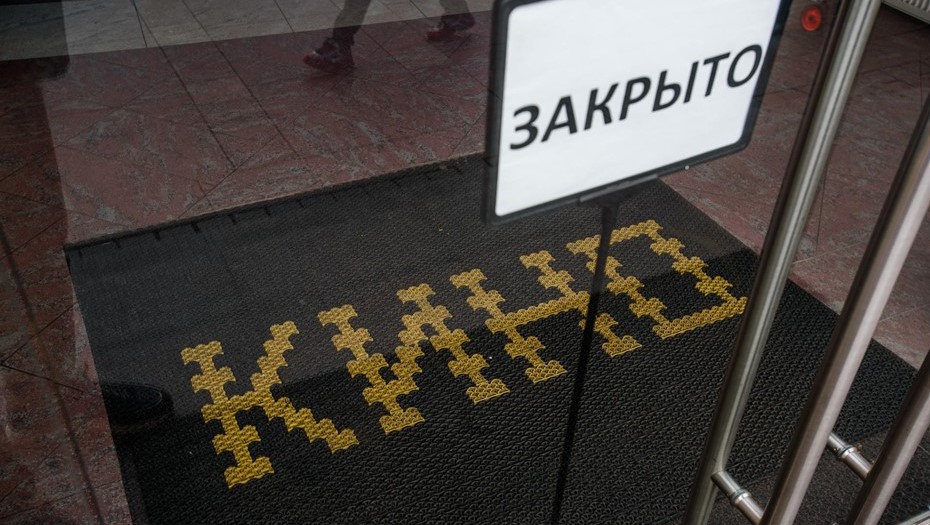
“Cinema. Closed.” Photo by Sergei Yermokhin for Delovoi Peterburg
Due to the cancellation of premieres of foreign films, Petersburg cinemas may lose half of their customers. The business will suffer huge losses, because such pictures account for about 70% of their revenue.
Disney, Warner Bros., and Sony Pictures have decided to temporarily stop releasing films for distribution in Russia. This was reported by the media yesterday The Luxor theater chain told DP that, for now, it could officially confirm the cancellation of The Batman and the animated film Blush whose premieres were to take place in early March. Sony Pictures has removed the film Morbius from its scheduled release date for Russian distribution.
“Even the distribution companies cannot say whether the release dates will be postponed or the films will not be released in Russia ultimately, and how long the restrictions will last,” the cinema chain reported.
Mirage Cinema reported that, at the moment, the only information they had about the cancellation of releases was from the media. “We have no official letters from film distribution companies about the cancellation of premieres,” they said. The KARO chain’s press office laconically replied that they would work with what they had.
The Luxor chain noted that moviegoers choose different content at different venues. For example, in one of the the chain’s cinemas, they chose The Batman, and in another, Blush.
“Hollywood blockbusters garner most of the box office, especially family films. Viewers choose popular artists and trust the quality of the content produced by the film studios. Of course, multimillion-dollar production and advertising costs imply high traffic,” the company noted.
The network is confident that now the Petersburg film industry [sic] will return to the period of October–November 2020, when there were restrictions related to the coronavirus and blockbuster premieres were postponed. Attendance will be affected not only by the cancellation of films, but also by the general emotional and economic backdrop. The Russian film business [sic] will suffer significant losses, but it is difficult to predict further actions in the market now.
Disney and Sony Pictures are the world’s leading filmmakers. Warner Bros. ranked fourth in the 2021 global rating of film studios, behind Universal in third place. Ivan Samoilenko, managing partner of the communications agency B&C, noted that the Russian film distribution market was losing most premieres of western films, which were the main draw for Russian moviegoers. Last year, foreign films in Russia earned 30.3 billion rubles (106 million tickets were sold), while domestic projects had a total box office of 10.4 billion rubles (39.7 million tickets).
Samoilenko pointed out that out of the top ten highest–grossing films last year, eight were foreign (Hollywood) productions and two were domestic. “So we can say that in the absence of western cinema, traffic in Russian cinemas may decrease by 30-50%. This will especially affect the capital and St. Petersburg, which are national leaders in terms of numbers of cinemas, numbers of moviegoers, and turnover,” Samoylenko stressed.
In 2021, analysts at the consulting company JLL noted that traditional entertainment formats, including cinemas, had been experiencing the greatest difficulties in Petersburg’s shopping centers. Over the past year, the cinemas at the Pik shopping center and Ligov shopping mall [in central Petersburg] have closed.
Source: Darya Zaitseva, Delovoi Petersburg, 2 March 2022. Translated by the Russian Reader
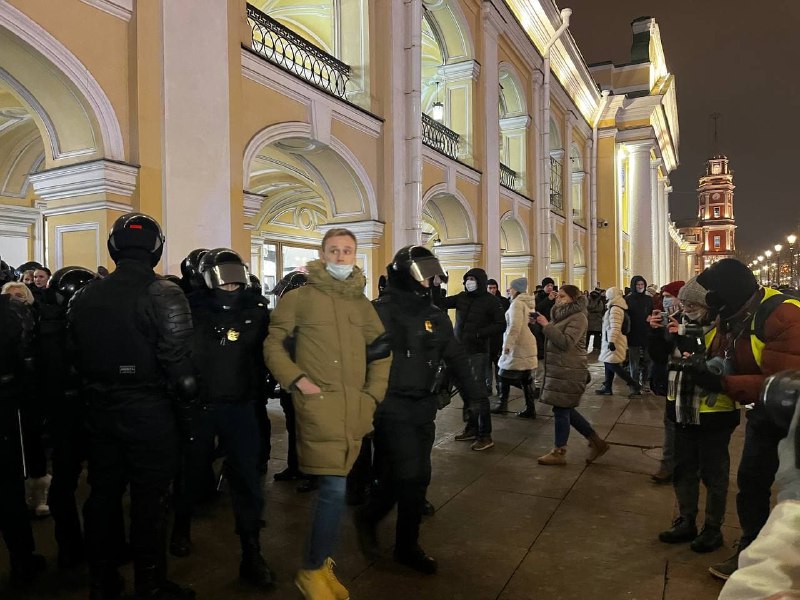
The seventh protest rally in a week has been taking place in downtown Petersburg. The protesters oppose the military special operation for the demilitarization and denazification of Ukraine.
On the evening of March 2, protesters gathered again at Gostiny Dvor on Nevsky Prospekt. According to Kommersant Petersburg’s Telegram channel, initially the protesters declined to chant anti-war slogans, but after some time the situation changed.
Police officers have already begun to detain the protesters: participants of the unauthorized rally have been snatched from the crowd and taken to a bus for detainees. The Petersburg artist Yelena Osipova was sighted among the protesters. She always comes to such events with placards that she makes herself. She has also been detained.
It has also known that the pedestrian underpass next to Gostiny Dvor has been blocked. The regional Interior Ministry office and the Russian National Guard have not released official information about the unauthorized protest.
As DP reported earlier, almost 150 administrative hearings were conducted by the district city courts after one of the previous anti-war rallies. As a result, forty-nine participants of the unauthorized protest were jailed for a period of 5 to 10 days. Some protesters were fined and sentenced to community service.
On the afternoon of March 2, a rally in support of Russia’s actions in the Donbas [sic] was held next to the Bronze Horseman monument [in downtown Petersburg]. RIA Novosti has published video footage from the scene.
Source: Delovoi Peterburg, 2 March 2022. Translated by the Russian Reader
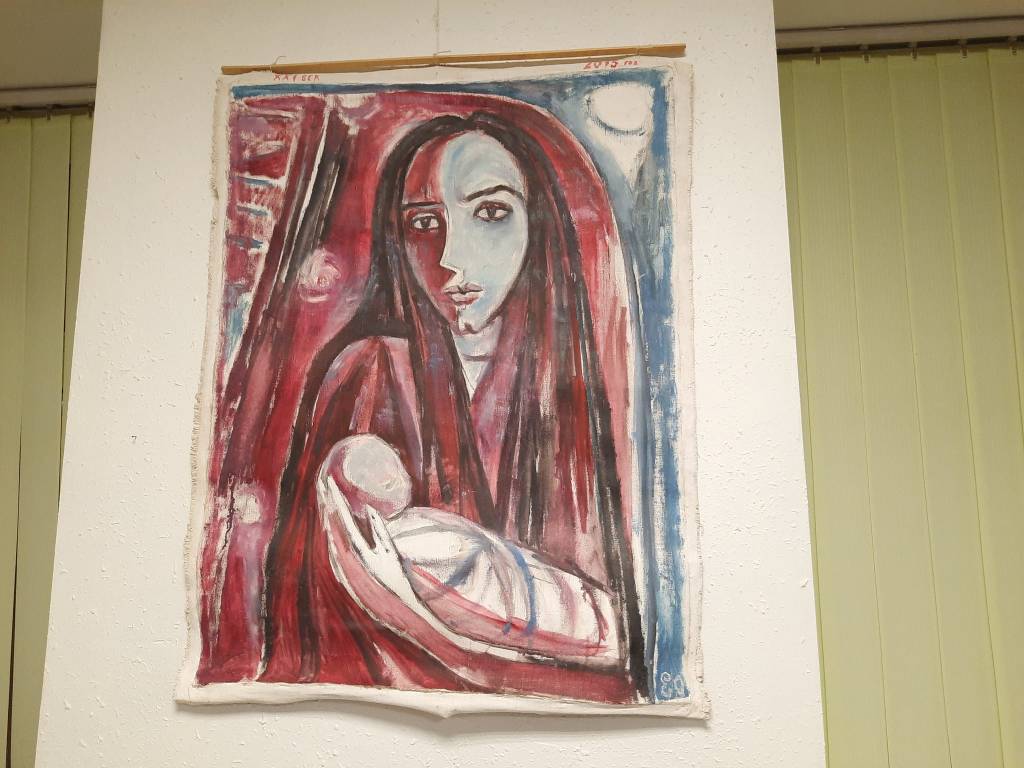
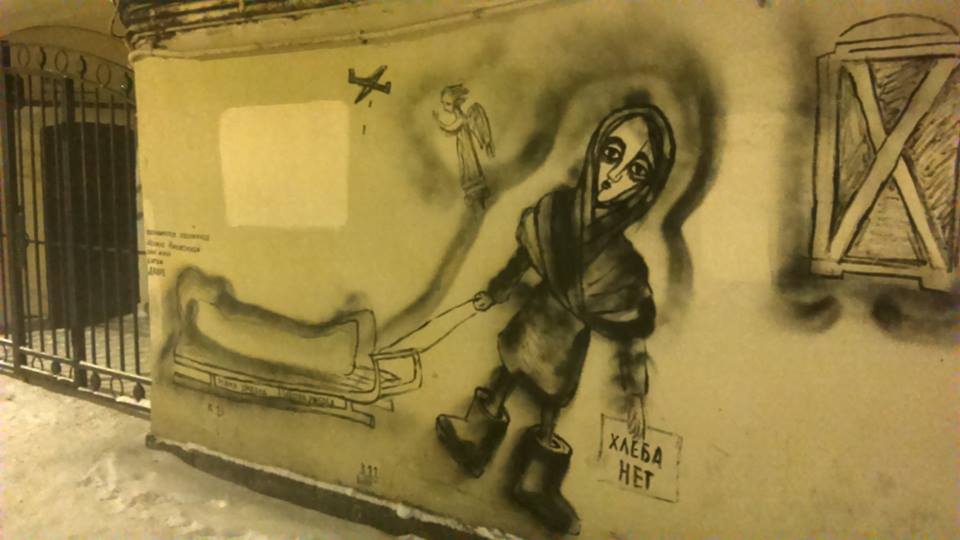
The inspiring Petersburg artist and political activist Yelena Osipova has drawn this graffiti to commemorate the 75th anniversary of the lifting of the Siege of Leningrad during the Second World War.
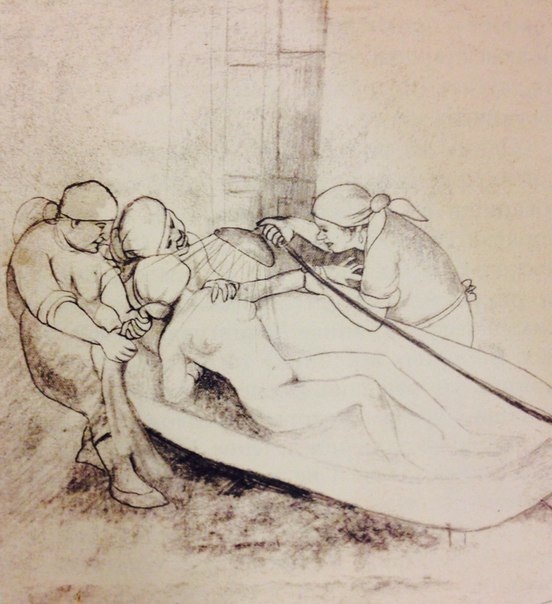
The piece is dedicated to her late friend Lenina Nikitina, another wonderful artist, who lived in the building on whose walls Osipova drew her work.
Nikitina lost her entire family during the Siege, which lasted nearly 900 days, from September 8, 1941 to January 27, 1944.
Lenina Nikitina, Cold Bath. Pencil on paper. Courtesy of ArtGuide and the Museum of Nonconformist Art, St. Petersburg
As many as a million civilians are believe to have died during the Siege.
The other evening, an arts program on one of the regional German channels broadcast a segment about Daniil Granin and Ales Adamovich’s Blokadnaya kniga (Book of the Siege), which has recently been translated into German by Helmut Ettinger and Ruprecht Willnow, and published as Blockadebuch: Leningrad 1941–1944.
If you don’t have time to read Blokadnaya kniga or any of the other hundreds of books about the Siege, please watch Jessica Gorter’s stunning 2011 documentary film 900 Days. {TRR}
_________________________________________
The Siege of Leningrad Ended 75 Years Ago Today: Here Are Nine Films and Books about the Siege Worth Watching and Reading
Anton Dolin and Galina Yuzefovich Meduza
January 27, 2019
[…]
Once There Was a Girl
Viktor Eismont, 1944
Eismont began shooting this unique picture while the Siege was still underway. It premiered a year to the day after the Siege was lifted. The Siege is shown through the eyes of two children, five-year-old Katenka and seven-year-old Nastenka. Natalya Zashchipina, who played Katenka, would go on to star in children’s films such as The Elephant and the Rope and First-Grader in the late 1940s, while Nina Ivanova, who played Nastenka, would star in Spring on Zarechnaya Street in 1956.
Baltic Skies
Vladimir Vengerov, 1960
The best film about wartime Leningrad and Leningrad during the Siege, when Baltic Skies premiered, it outraged Nikolai Chukovsky, whose novel inspired the film and who is credited as the screenwriter. The movies features a star-studded cast, including Pyotr Glevov, Mikhail Ulyanov, Mikhail Kozakov, and Rolan Bykov. The film’s young lovers were played by Oleg Borisov and Liudmila Gurchenko, who would later act in Alexei German’s war films. German considered Vengerov one of his teachers.
We Looked Death in the Face
Naum Birman, 1980
A picture about the founding of the Frontline Youth Ensemble. In one of his final roles, Oleg Dahl played the former choreographer. The film features poems by Olga Bergholz and music by Dmitri Shostakovich.
A documentary film consisting of footage shot by cameramen during the Siege, it features rare scenes, including the execution of Germans. Loznitsa added a soundtrack to the film, bringing viewers closer to the events.
Less a film and more an impressive project by Sokurov, We Read the Book of the Blockade shows Petersburgers both famous and unknown reading aloud Daniil Granin and Ales Adamovich’s book, a compilation of eyewitness accounts of the Siege. The readers include actors Vladimir Retsepter and Leonid Mozgovoi, and Sokurov himself.
Celebration
Alexei Krasovsky, 2019
[Posted on January 2, 2019, by Alexei Krasovsky. “Attention! This film was made without state financing or grants. The filmmakers paid for its production themselves. Please do not show Celebration without listing the information about how you can donate money to us. It is the only we can cover the costs of this film and start working on a new one. Thank you.
Don’t forget to mark your contribution as a “donation” so that we’ll have any easier time making films in the future.
Happy New Year!
Screenwriter and director: Alexei Krasovsky
Cinematographer: Sergei Astakhov
Starring: Alyona Babenko, Yan Tsapnik, Timofei Tribuntsev, Anfisa Chernykh, Pavel Tabakov, and Asya Chistyakov
Executive producer: Yuliya Krishtofovich
Art director: Yevdokia Zamakhina
Sound: Nelly Ivanovna and Anastasia Anosova
Assistant director: Zhanna Boykova
Editing: Vladimir Zimin and Alexei Krasovsky
The song ‘Field, O My Field’ was written by Iosif Kovner in 1937 and first recorded in 1941.”]
Filmmaker Alexei Krasovsky shot this controversial, intimate, tragicomic film at his own expense and uploaded it to YouTube during the New Year holidays. The picture deals with the privileged classes during the Siege and contains transparent illusions to the present. Starring Alyona Babenko, Yan Tsapnik, and Pavel Tabakov.
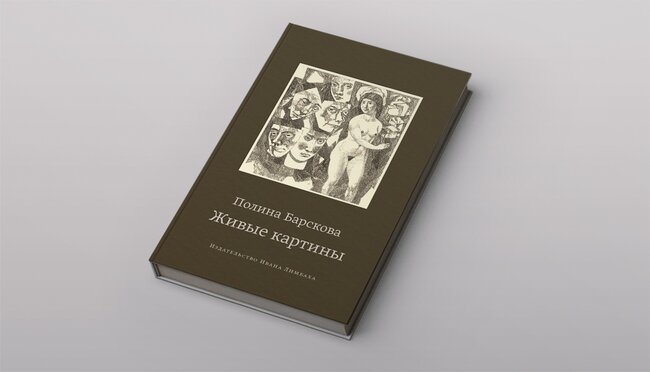
Polina Barskova, Zhivye kartiny [Living pictures], St. Petersburg: Ivan Limbakh, 2014
Written by poet and academic Polina Barskova, this book is a miscellany of strange, heterogeneous, and genre-bending texts (several stories and essays on the verge of poetry, capped off with a short, semi-absurd play) that interweave the author’s own experiences as a researcher and human being with the real stories of people during the Siege.
Significant historical figures who survived the Siege (poet and literary scholar Dmitry Maximov, writer Vitaly Bianchi, playwright Yevgeny Schwartz) meet on the the pages of Living Pictures with other, unknown shades, such as the art historian Totya and the artist Moses, who made the mistake of falling for each other on the eve of the war, or six-year-old Katya, who plays a gloomy game of bouts-rimés with her mother, composing a poem about people stricken by hunger-induced dystrophy. The famous, the nameless, Barskova’s other characters, and Barskova, some of whom did not experience the Siege themselves, ring the changes on the book’s main point, as voiced by one of the characters: the Siege was a peculiar civilization with all the qualities of other human communities. This civilization did not disappear without a trace. It has germinated anew in subsequent generations, who continue to feel its icy breath.
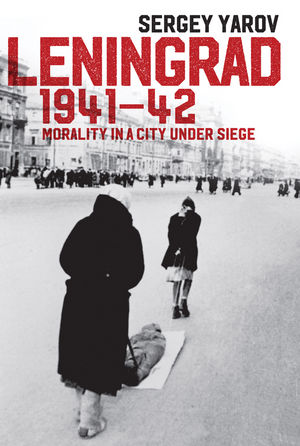
“The ethic of sympathy demands the gaze not linger on mournful scenes of human agony,” writes historian Sergey Yarov in his book, seemingly ruthlessly violating this ethic. Instead of charitably averting his gaze from the most horrific aspects of the Siege of Leningrad, Yarov peruses as keenly and closely as possible theft and deception, monstrous, incurable physical deformities and people’s aversion to them, assaults on children (it was easier to take food from them since they were weaker), indifference to the suffering and deaths of other people, willingness to endure any humiliation, the collapse of community, and cannibalism.
As he plunges into the abyss of diaries, memories, and official records, uncovering truly unimaginable things, Yarov nevertheless hits upon an impeccable tone for discussing them, managing to maintain in each episode the perfect balance between scholarly scrupulousness and supreme humaneness.
Olga Lavrentieva, Survilo, St. Petersburg: Boomkniga, 2019
This graphic novel by the young artist Olga Lavrentieva is a laconic, black-and-white account of the life of her grandmother, Valentina Survilo. Survilo’s happy Leningrad childhood ended in 1937 with her father’s arrest. She was exiled to a village in Bashkiria, where her mother died, before making a long-awaited return to her beloved Leningrad. This was followed by the most important and terrible chapter in her biography, the Siege, which the still very young Survilo endured in a prison hospital, the only place willing to employ the daughter of an “enemy of the people.”
The relentless hunger, cold, bombings and artillery attacks, treachery of friends, and rare, miraculous instances of kindness left a deep wound in Survilo’s heart, causing her to suffer nightmares and be constantly anxious about family members during the relatively prosperous postwar years. Lavrentiev uses the rather typically tragic story of one Leningrad woman as a lens through which she and her readers can look at the history of her hometown and the entire country.
Survilo will be published in March 2019.
Thanks to Giuliano Vivaldi for the heads-up. Translated by the Russian Reader. I have replaced the trailers used in the original article with full-length public-access videos of the films themselves (except for Sergei Loznitsa’s Blockade, which can and should be viewed on MUBI). Please take note of filmmaker Alexei Krasovsky’s appeal for donations. If you watch Celebration, please consider making a donation to him and his crew via Sberbank, PayPal, Yandex Money or Etherium.









 Lenina Nikitina, Cold Bath. Pencil on paper. Courtesy of