Petersburgers have lately been up in arms over a decision, by the municipal toponymic commission, to name a newish bridge over the Duderhof Canal, amid the new estates in the city’s far southwest, the Akhmat Kadyrov Bridge. The decision was recently confirmed by the city’s governor, Georgy Poltavchenko.
Little do Petersburgers suspect (or, rather, care) that for almost the past one hundred years they have been living cheek by jowl with a munitions plant named in memory of German socialist and anti-militarist Karl Liebknecht. TRR
____________________
[Modern militarism] wants neither more nor less than the squaring of the circle; it arms the people against the people itself; it is insolent enough to force the workers . . . to become oppressors, enemies and murderers of their own class comrades and friends, of their parents, brothers, sisters and children, murderers of their own past and future. It wants to be at the same time democratic and despotic, enlightened and machine-like, at the same time to serve the nation and to be its enemy.
—Karl Liebknecht
Karl Liebknecht Leningrad Mechanical Plant JSC. Photo by the Russian Reader
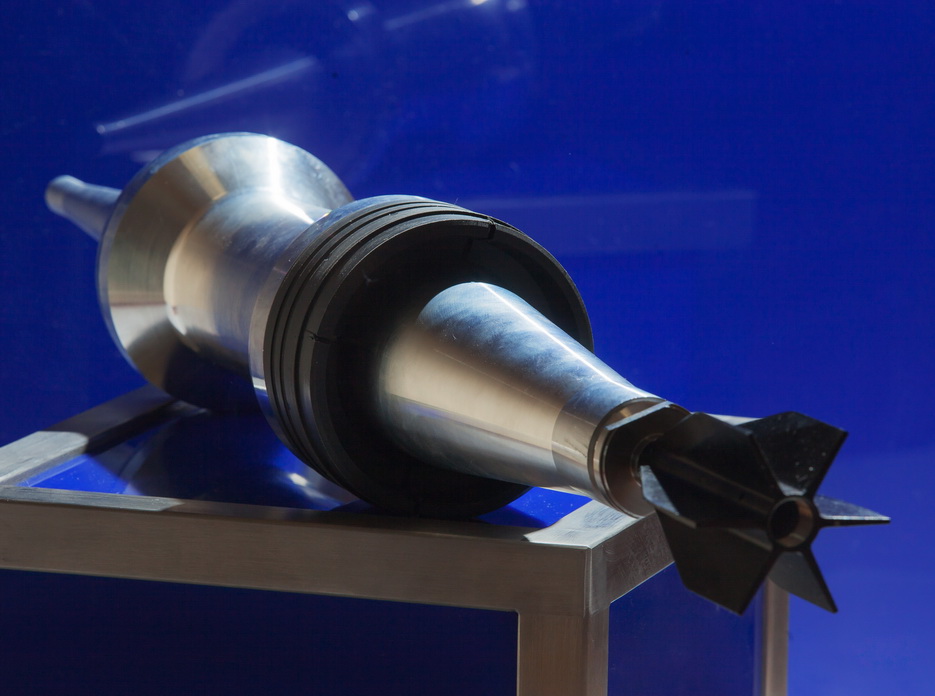
Karl Liebknecht Leningrad Mechanical Plant JSC is a leading machine-building enterprise of the military-industrial complex, supplying the army’s demand for empty armor-piercing tank ammunition shell casings.
The company manufactures advanced products for military use, popular on the international arms market, works on state defense orders and in cooperation with other plants, and produces non-military products and consumer goods.
The Karl Liebknecht Leningrad Mechanical Plant is the only company in Northwest Russia specializing in the production of artillery shell casings.
We successfully execute important state commissions and make a significant contribution to the defensive power of our country and friendly nations.
Russia is interesting from this point of view. The high state of tension in its international position has forced it to introduce universal military service, while as an Asiatic-Despotic state it is faced with an unequalled internal conflict. The internal enemy of Tsarism is not only the proletariat, but also the great mass of the peasantry and bourgeoisie, even indeed a large part of the nobility. Ninety-nine per cent of Russian soldiers are by class position bitter enemies of Tsarist despotism. A low level of culture, national and religious conflicts, and also contradictions in economic and social interests, together with the more or less subtle pressure exercised by the extensive bureaucratic apparatus as well as the unfavourable local organization, the inadequately developed transport system and other things: all these represent an important check on the development of class-consciousness. There exists a much attacked system of elite troops, who are provided with every facility: the gendarmerie, for example, and especially the Cossacks, which effectively constitute a special social class on account of their good pay and other material provision, of their extensive political privileges, and of the arrangement by which they live in a semi-socialist community; they are thus closely bound in an artificial way to the ruling classes. In this way Tsarism tries to secure a sufficient number of loyal supporters to offset the ferment which has penetrated deep into the ranks of the army. And to all this, to these “watchdogs” of Tsarism, there must be added the Circassians, and other barbarian peoples living in the empire of the fist, who were loosed over the land like a pack of wolves in the Baltic counter-revolution, together with all the other numberless parasites on Tsarism, the police and their accomplices, and the hooligans and black hundreds.
But if in the bourgeois-capitalist states the army based on universal military service and designed as a weapon against the proletariat represents a frightful and bizarre contradiction, the army based on the same system under the despotic Tsarist system of government is a weapon which is necessarily turned more and more with crushing weight against the Tsarist despotism itself. The experiences of the anti-militarist movement in Russia can therefore only be applied to the bourgeois-capitalist states with the greatest of care. And if the efforts of the ruling classes of capitalism in the bourgeois-capitalist states to bribe the people to fight against itself—to a great extent indeed with money actually taken from the people—are finally doomed to failure, we already see before our very eyes how the desperate and pitiable attempts of Tsarism to buy off the revolution by bribery are suffering a rapid and wretched fiasco in the tragic world of Russian finance, in spite of all the attempts of unscrupulous international capital to save the régime. The question of financial loans is certainly an important one, at least for the tempo of the revolution. But if the revolutions cannot easily be made, it is even less easy to buy them off, even with the means available to the big capitalists of the world.
Our Company
When it was founded on October 15, 1911, Karl Liebknecht Leningrad Mechanical Plant JSC was called the Parviainen Russian Society for the Manufacture of Shells and Military Supplies. Subsequently, it had a number of other names featuring the phrase “Karl Liebknecht Mechanical Plant.” By decree of the Council of People’s Commissars, the company was nationalized on June 28, 1918. In different periods of its history, the plant has been part of the Soviet Ministry of Machine Building (First Chief Directorate), the Department of Munitions and Special Chemicals at the Ministry of Industry, the Committee on the Russian Defense Industry, and the Russian Ministry of Defense Industries (from 1992), the Russian Federal Economics Ministry (from 1997), the Russian Munitions Agency (from 2000), and the Department of Munitions and Special Chemicals at the Russian Industrial Agency of the Ministry of Industry and Energy. From August 2008 to the present, the company has been been overseen by the Department of the Conventional Weapons, Ammunition, and Special Chemicals Industry in the Ministry of Industry and Trade.
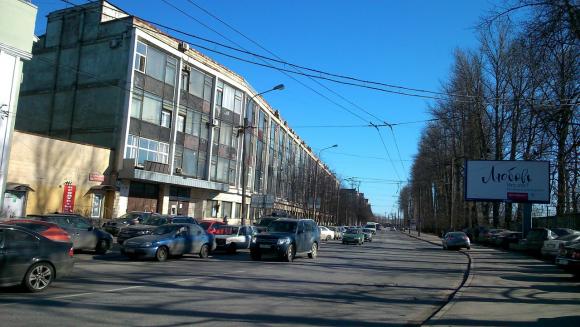
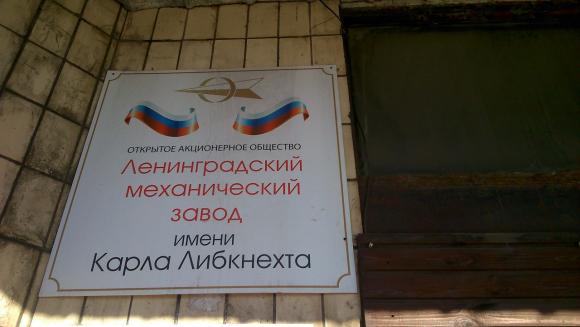
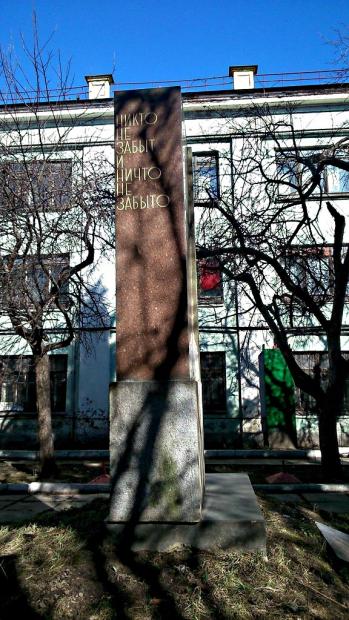
Modern-day street view of the Karl Liebknecht Leningrad Mechanical Plant. Courtesy of Citywalls.ru“Karl Liebknecht Leningrad Mechanical Plant JSC.” Sign at the plant’s main entrance. Courtesy of Citywalls.ru“No one is forgotten, and nothing is forgotten.” Part of a memorial to plant workers killed during WWII, in the plant’s courtyard. Courtesy of Citywalls.ru“Another monument, without a legend [sic], (perhaps the founder of the factory),” writes “liubliupiter,” the user who shot and posted these photos of the plant and its premises. Courtesy of Citywalls.ruIronically, the brother and sister-in-law of the plant’s founder, I. Parviainen, Peter and Anna Parviainen, sheltered Vladimir Lenin at their house in the village of Jalkala, near the resort town of Terijoki, just across the then Russian-Finnish border, in August 1917, when the Provisional Government put out a warrant for Lenin’s arrest. Likely as not, however, this is probably not a monument to Peter Parviainen’s industrialist brother, but to Karl Liebknecht, of course. Courtesy of Citywalls.ruAn illustration of a revamped Karl Liebknecht Plant of the future. Courtesy of Wikimedia
____________________
Resolution Adopted by an Assembly of Workers at the Old Parviainen Plant, April 13, 1917
We, the 2,500 workers of the Old Parviainen Plant, having gathered on April 13 for a general plant assembly and discussed the current situation, have resolved as follows:
1) We demand the removal of the Provisional Government, which acts only as a brake on the revolutionary cause, and hand over power to the Soviets [sic] of Workers’ and Soldiers’ Deputies;
2) Relying on the revolutionary proletariat, the Soviet [sic] of Workers’ and Soldiers’ Deputies must put an end to this war [my emphasis], which has benefited only the capitalists and landlords and weakened the forces of the revolutionary people;
3) We demand the Provisional Government immediately publish the secret military agreements entered into by the previous government with the Allies;
4) That a Red Guard be organized and all the people armed;
5) We protest the issuing of the so-called Liberty Loan, which actually serves to subjugate rather than liberate;
6) That the printing presses of all the bourgeois newspapers leading the campaign of hatred against the Soviet of Workers’ and Soldiers’ Deputies and the workers’ press be requisitioned and handed over for use by workers’ newspapers;
7) Pending the requisition of the printing presses, the following newspapers should be boycotted: The Russian Will, The New Times, The Evening Times, Speech, The Day, The Little Newspaper, The Kopeck, The Living Word, The Modern Word, The Petrograd Gazette, The Petrograd Leaflet, The Petrograd Newspaper, and Unity;
8) We protest against England’s interference in our domestic affairs and the detention of emigrants;
9) That all food products be requisitioned for the needs of the masses, and fixed prices be set for all consumer goods;
10) That peasant committees immediately seize manorial, demesne, imperial, and monastic lands, and the tools of productions be handed over to the workers;
11) We protest the withdrawal of revolutionary troops from Petrograd;
12) That it be recognized the Provisional Government can in no way arrange for the issuing of pensions to former ministers and their families, indigenous enemies of the people.
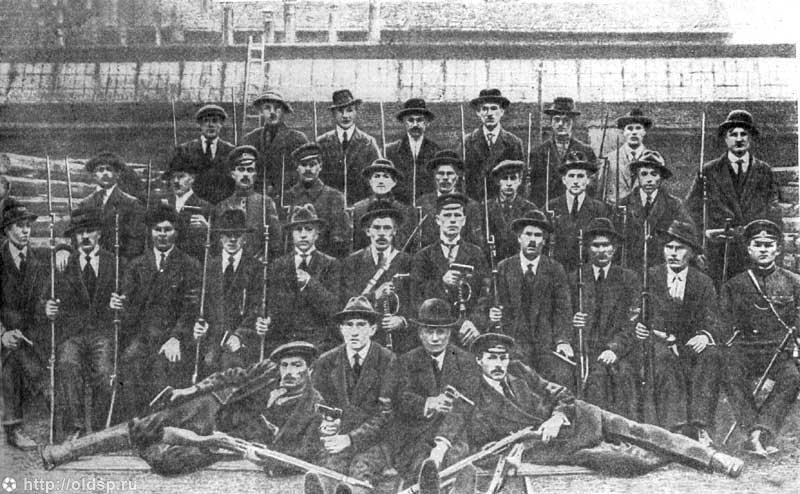
The so-called Old Parviainen Plant was located on the Vyborg Embankment. Correspondingly, the so-called New Parviainen Plant, the current Karl Liebknecht Leningrad Mechanical Plant, was located on Chugunnaya Street, roughly two kilometers to the east. TRR
The Red Guard of the Old Parviainen Factory, circa 1917. Courtesy of Fotografii starogo Sankt-Peterburga (Photographs of Old Saint Petersburg)
______________________
Landwehr Canal, Berlin
The canal where they drowned Rosa
L., like a stubbed out papirosa,
Has almost virtually gone wild.
So many roses have moldered since that time,
It is no mean feat to stun the tourists.
The wall, concrete forerunner of Christo,
Runs from city to calf and cow
Through fields blood has scoured.
A factory smokes like a cigar.
And the outlander pulls up the native gal’s
Frock not like a conqueror,
But like a finicky sculptor,
Getting ready to unveil
A statue fated to live a while
Longer than the reflection in the canal
Where Rosa was canned.
Source: Radio Svoboda. Translated by the Russian Reader
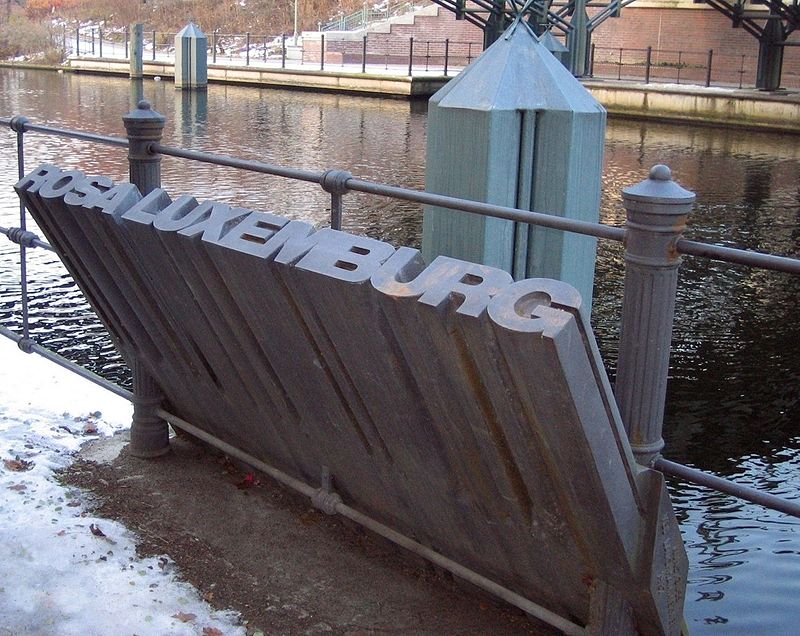
Rosa Luxemburg memorial at the site where she was thrown—either dead or alive—into the Landwehr Canal, Berlin. Courtesy of Wikipedia
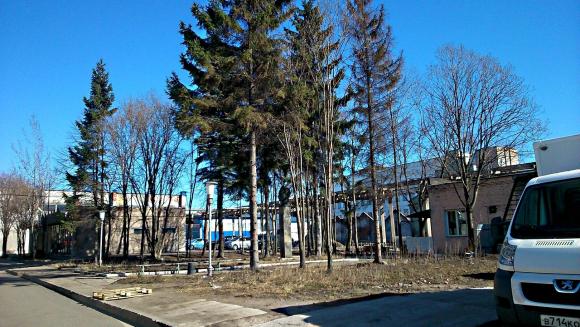
Factory wall, Krasnoye Selo, October 25, 2015. Photo by the Russian Reader
Alexander Reznik Back to the Future: Why Putin Criticizes Lenin RBC
January 26, 2016
Vladimir Putin has condemned Lenin for ideas that, in the president’s opinion, led to the collapse of the Soviet Union. In fact, the ideas were those of Stalin, whom the head of state has avoided criticizing.
The Flow of Thought
On January 21, 2016, Vladimir Putin gave rise to another round of quasi-historical debate. Summarizing a discussion on reforming the Russian Academy of Sciences at a session of the Council for Science and Education, the president reacted to an excerpt from a poem by Pasternak, as quoted by the head of the Kurchatov Institute: “He managed the flow of thought[s] and, only thus, the country.”
Pasternak was writing about Lenin, and the president ventured his opinion of Lenin, too.
“It is right to manage the flow of thought. Only it is important that the thought leads to the desired result, not as it did in the case of Vladimir Ilyich. But the idea itself is correct. Ultimately, the idea led to the Soviet Union’s collapse, that is what. There were many such thoughts: autonomization and so on. They planted an atomic bomb under the edifice known as Russia. It did, in fact, blow up later. And we had no need of world revolution.”
Thus, consciously or not, the president marked the anniversary of the death of the Soviet Union’s founder. Many observers were quick to detect a hidden message in his remarks and once again raised the question of burying Lenin’s body. (Dmitry Peskov, the president’s press secretary, had to quickly announce that this issue “was not on the agenda.”) It is more likely that the remarks, delivered as the curtain was falling on a boring meeting, were made on the spur of the moment.
Putin had obviously specially prepared for his speech at the January 25 interregional forum of the Russian Popular Front in order to smooth over the impression made by his previous remarks. Replying to a question about Lenin’s reburial, he outlined his views on socialism in more detail. He admitted he had always “liked communist and socialist ideas,” and he compared the Moral Code of the Builder of Communism to the Bible. Later, the president mentioned mass repressions, including the “most egregious example,” the execution of the tsar and his family, the “breakdown of the front” during the First World War, and the inefficiency of the planned economy. Finally, Putin separately addressed the question of why, from his viewpoint, Lenin had been wrong in his dispute with Stalin over the nationalities question: Lenin had wanted “full equality, with the right to secede from the Soviet Union” for the republics.
“And that [was like] a time bomb under the edifice of our state,” said Putin, literally repeating what he had said in an 1991 interview. To strengthen the effect, he mentioned the transfer of Donbass to Ukraine.
Who Planted the Bomb and What Kind of Bomb Was It
Historians will find it difficult to ignore that in the first instance Putin has mistakenly attributed to Lenin the idea of autonomization, which meant the inclusion of territorial entities in the Russian Soviet Federative Socialist Republic. In reality, on December 30 and 31, 1922, Lenin dictated a few notes, which were included in the leader’s so-called political testament.
“I suppose I have been very remiss with respect to the workers of Russia for not having intervened energetically and decisively enough in the notorious question of autonomization, which, it appears, is officially called the question of the Soviet socialist republics,” wrote Lenin.
His secretaries called these notes a “bomb,” so evident was their explosive effect, since they were directed against the general secretary of the Central Committee of the Russian Communist Party (Bolsheviks), Joseph Stalin, who was accused of a “Great-Russian nationalist campaign.” As a centralist principle, Lenin wrote, autonomization was “radically wrong and badly timed.” It was necessary to “maintain and strengthen the union of socialist republics” and be more sensitive to the nationalism of “oppressed peoples.” The union’s republics were granted the constitutional right to secede from the Soviet Union.
Formally, Lenin’s policy was approved, and thanks to the policy of indigenization, which historian Terry Martin has christened “affirmative action,” the 1920s were the heyday of national cultures. But by bypassing the Constitution and Party Congress resolutions, Stalin’s project gradually emerged victorious. By the late 1980s, the federal principles of Soviet power had been discredited as a screen concealing Moscow’s omnipotence as the center. So it is, at least, naive to believe that the presence of the constitutional right to secede from the Soviet Union (and Lenin’s responsibility for it) played a crucial role in the disintegration of the Soviet state.
At the Russian Popular Front forum, Putin clarified that, from the outset, he “had in mind the discussion between Stalin and Lenin about how to build a new state, the Soviet Union.” His speech showed that Putin’s attitude towards Lenin’s revolutionary project as a whole was not very different from that of establishment experts and commentators. Liberals, conservatives, members of the opposition, and “patriots” can forge a bond in their rejection of socialism, radicalism, and similar -isms. It suffices to carefully examine the responses to Putin’s speech to notice that dislike of Lenin is quite sincere and sometimes jealously competitive. Setting aside conservative fetishists of all things Soviet, sympathy for Lenin, on the other hand, remains the bailiwick of leftist intellectuals.
Putin’s activist dislike of Lenin is noteworthy, given his demonstrative neutrality towards Stalin. In Putin’s view, although Stalin was a dictator guilty of mass repressions, he de facto rejected Lenin’s revolutionary maximalism. We cannot rule out that the president has taken into account the growth of public sympathy for Stalin, warmed by the economic crisis and political developments in Syria and Ukraine.
Interest in the topic of the Soviet Union’s collapse may well be regarded as the hint of a veiled threat to today’s Russia that at some point can be used as the ideological basis, for example, of a public mobilization against “enemies.”
A Revolution for New Needs
The excitement generated by the statements of leading politicians about the distant past casts a negative light on Russia’s intellectual and political culture. The centennial of the 1917 Revolution is approaching. We can hardly expect success from the government’s project of reconciling the Whites, Reds, and Greens, as proposed by the culture minister, Vladimir Medinsky. Rather, the symbolic resources of the Russian Civil War will be exploited for the production of more and more new conflicts, as was the case with the Great Patriotic War. On the lines of the Banderites, it will be easy to construct new imaginary enemies of Russia. The president has discovered one such group of national traitors, revolutionaries and especially Bolsheviks. It will be harder to find heroes, but here the market, which previously has been successful in selling the image of Admiral Kolchak, will lend a helping hand.
In these memory wars, academic scholarship, which cultivates the specific language of dialogue and therefore seldom provides simple and definitive answers to debatable issues, will hardly be heard. Thus, Pasternak’s line about “managing the flow of thoughts,” which flustered Vladimir Putin, takes on a particularly alarming ring.
Alexander Reznik is a senior researcher at Perm State University and a member of the Free Historical Society. Translated by the Russian Reader
I spoke recently with a radio journalist from Cologne. A pleasant woman, she was one of those western leftists who try and “understand” Russia. She just could not believe that the Putin regime’s ideology was anti-communist and was based on condemnation of all revolutions, whether the October Revolution or the French Revolution.
“How can that be? We are walking here on Insurrection Square. Monuments to Lenin are not demolished in Russia as they are in Ukraine. And you tell me the regime is anti-communist?” she said.
I hope that after Putin’s remarks that Lenin planted an atomic bomb under Russia and was responsible for the Soviet Union’s collapse, my companion will see the light. I no longer have such hopes for Russian liberals who believe that under Putin we are living through a new edition of the Soviet Union.
In fact, Putin has been very consistent albeit historically ignorant. The 1917 Revolution is as hateful to him as the collapse of the Soviet Union, as hateful as any other subversion of Power with a capital p, which in the eyes of the people should remain sacred if only because it is Power, and all power comes from God. From the viewpoint of legitimists like Putin, the destruction of monuments to Lenin or the renaming of streets is a break with the mystical continuity of Power and thus almost a revolutionary gesture.
In Putin’s eyes, Lenin and the Bolsheviks really were devils incarnate, for they radically asserted the right of the masses to revolt and abolished continuity with the past, thus demolishing the mystique around the notion of the state.
During the Stalinist period, however, the Bolshevik Revolution itself was incorporated into the national myth. It is in this bronzed, mythologized form that attempts have been made to adapt all things Soviet to the needs of the new oligarchy, who have imagined themselves the successors of the Rurikids, the Romanovs, Stalin, Yeltsin, and all manner of saviors of the Fatherland and guardians of stability. Fortunately, this stunt does not work with Lenin and never will.
Ivan Ovsyannikov is an activist with the Interregional Trade Union Workers Association (ITUWA/MPRA) and the Russian Socialist Movement (RSD). Translated by the Russian Reader. See my previous post on this topic, “Crumbling Down.”
Some people ain’t no damn good You can’t trust ’em, you can’t love ’em No good deed goes unpunished And I don’t mind being their whipping boy
I’ve had that pleasure for years and years No no, I never was a sinner, tell me what else can I do Second best is what you get till you learn to bend the rules And time respects no person and what you lift up must fall They’re waiting outside to claim my tumbling walls
Saw my picture in the paper Read the news around my face And some people don’t want to Treat me the same
When the walls come tumbling down When the walls come crumbling, crumbling When the walls come tumbling, tumbling down
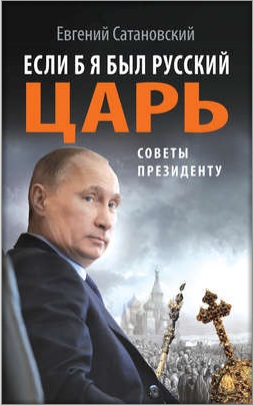
Cover of Yevgeny Satanovsky, If I Were the Russian Tsar: Advice to the President. Image courtesy of LitRes
Yesterday was a rough day for the anti-imperialist pro-Putin western left (which is basically all that is left of the western left). First, there was the publication of Sir Robert Owen’s report on his inquiry into the death of Alexander Litvinenko, in which Owen concluded that Putin “probably” approved Litvinenko’s murder in 2006.
Then the day got rougher.
Vladimir Putin publicly blamed Vladimir Lenin for the collapse of the Soviet Union.
President Vladimir Putin on Thursday blamed Bolshevik revolutionary Vladimir Lenin for planting the ideas that led to the collapse of the Soviet Union, the Interfax news agency reported.
During a meeting of the Presidential Council for Science and Education, one of the attendees quoted a poem by Boris Pasternak describing Lenin as someone who had managed the flow of his thoughts to rule the country.
“Letting your rule be guided by thoughts is right, but only when that idea leads to the right results, not like it did with Vladimir Ilich,” Putin quipped in reply. “In the end that idea led to the fall of the Soviet Union,” he added.
“There were many such ideas as providing regions with autonomy, and so on. They planted an atomic bomb under the building that is called Russia which later exploded. We did not need a global revolution,” he said.
Putin has in the past famously described the fall of the Soviet Union as the “greatest geopolitical catastrophe of the twentieth century.”
Oh my, it turns out Lenin planted the “bomb under the building known as Russia,” and what he had in mind was the collapse of the Soviet Union as a consequence of “ethnic autonomization”! So said the leader!
There are a few curious points in this statement.
First, the leader has equated Russia with the Soviet Union. Meaning that he has dubbed Central Asia, for example, a part of Russia. But he probably did not even notice it.
Second, the leader clearly indicated that the ideal is the Russian Empire, where, apparently, there were no problems, and which fell apart, apparently, as a result of the revolution and not the imperial elite’s wrongheaded policies.
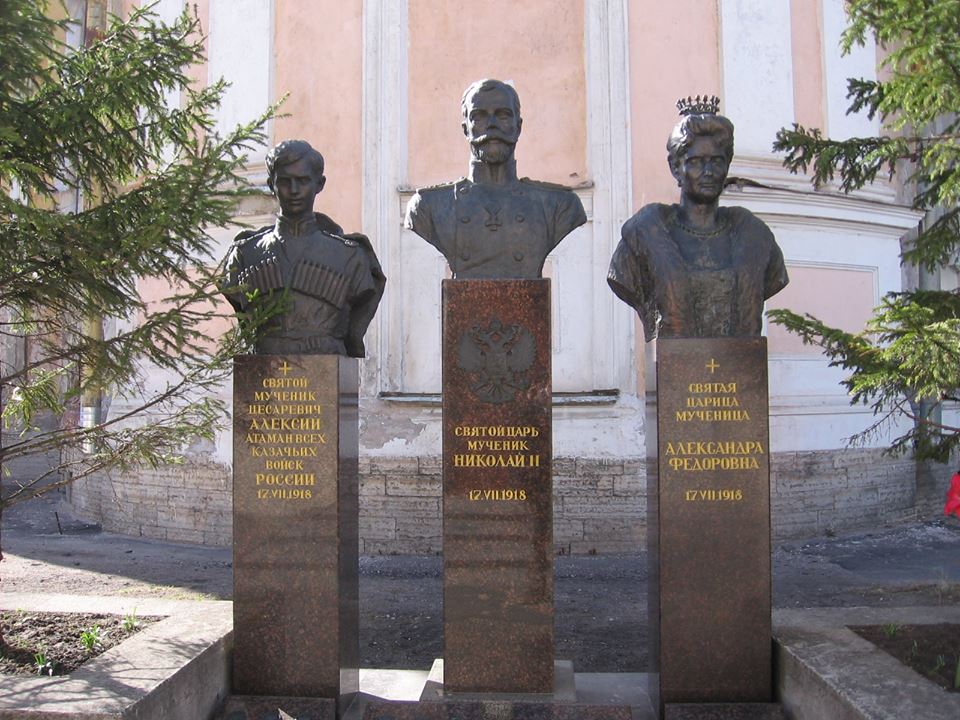
Busts of the Tsesarevich Alexei, Emperor Nicholas II, and Empress Alexandra, all identified as “holy martyrs,” outside the Theotokos of Tikhvin (Tikhvin Icon of the Mother of God) Church. Petrograd, April 25, 2015. Photo by the Russian ReaderOutdoor display case describing the “Russian economic miracle” that was, allegedly, swept away by the October Revolution. Theotokos of Tikhvin Church, Petrograd, April 25, 2015. Photo by the Russian Reader
The leader has clearly ignored the fact that Lenin, whatever you might think of him, attempted to reassemble the lands of the former empire, which by that time had virtually collapsed. And he was able to do this (reassemble the former empire) only by making certain compromises with the ethnic elites, by granting them “autonomy.”
Third, the leader’s rhetoric is obvious preparation for the 100th anniversary of the revolution, which is likely to be depicted as a tragedy, imposed [on the country] from the outside.
Sergey Abashin is British Petroleum Professor of Migration Studies at the European University in Saint Petersburg. His most recent book is Sovetskii kishlak: Mezhdu kolonializmom i modernizatsiei [The Soviet Central Asian village: between colonialism and modernization], Moscow: Novoe literaturnoe obozrenie, 2015. Translated by the Russian Reader
“In the manner of Arkady Rylov, Difficult Journey. Oil on Canvas. Pargas Local History Museum. [Vladimir Lenin] was one of the ‘living suitcases’ of Finnish smugglers. Lenin fled to Finland just before Christmas 1907 after an unsuccessful attempt to begin a revolution in Saint Petersburg. Before continuing to Sweden, he spent a couple of nights hiding in Parainen, in the Kirjala manor. He introduced himself as ‘Doktor Müller,’ a German geologist. The Pargas Local History Museum received this work for its Lenin memorial room in 1969 from the Finland-Soviet Peace and Friendship Society.” The painting is currently on view at the South Karelia Art Museum in Lappeenranta, Finland, as part of the exhibition Barefoot: 10 Lives in the Karelian Isthmus, which runs until January 2016. Photo by Comrade VZ. Quoted text, above, reproduced from the exhibition signage
“V.I. Lenin spoke at a conference of Russian social democrats in this building in August 1907.” Kotka Concert Hall, August 2015. Photo by Comrade VZ
“This building, designed by Eliel Saarinen, was completed in 1907. It was destroyed in a bombing raid on July 6, 1941, and rebuilt in 1954.” Kotka Concert Hall, August 2015. Photo by Comrade VZ
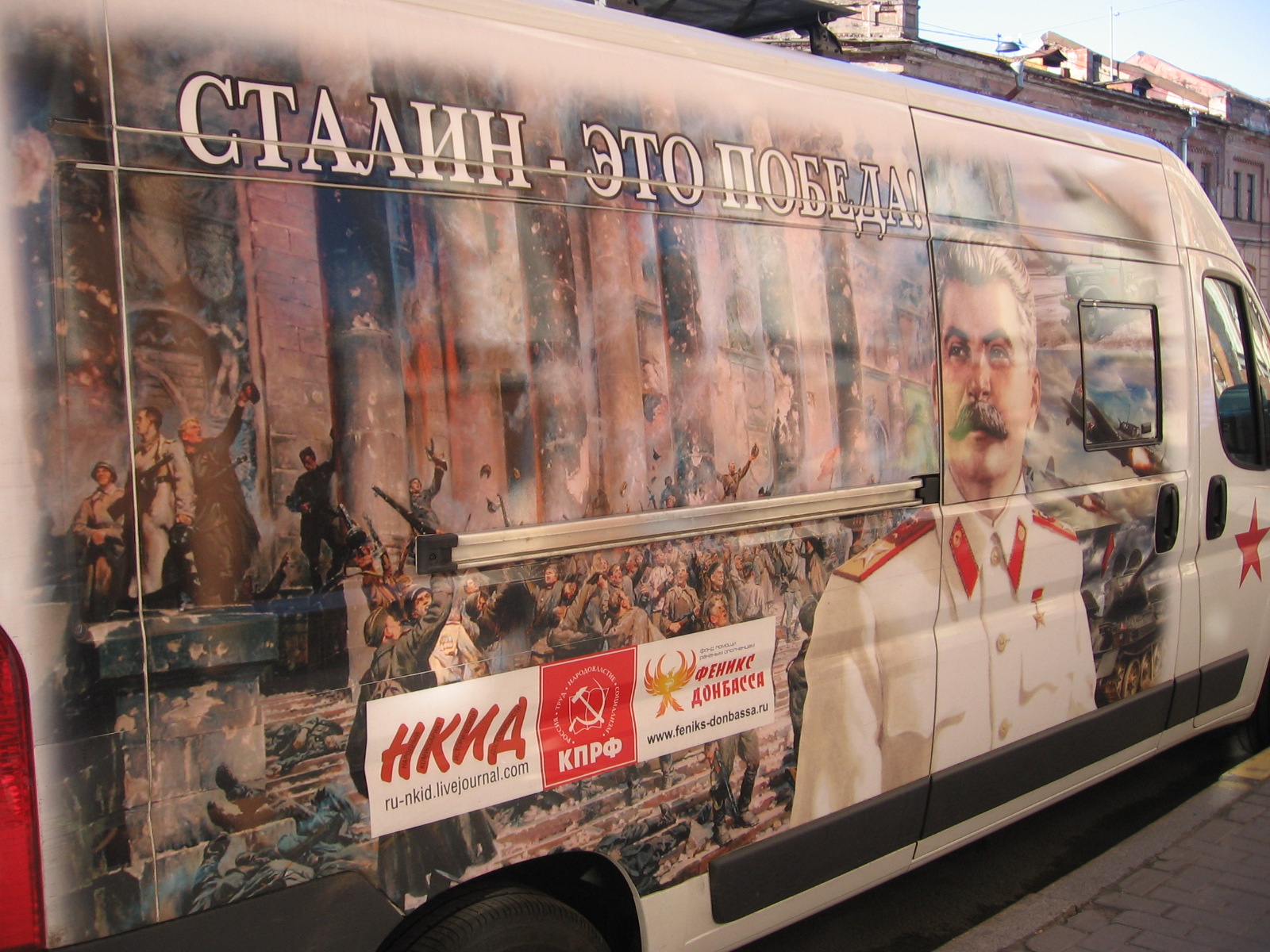
Descents into the past and appeals to history have been symptomatic of recent Russian politics, which is literally obsessed with re-enactments. It has recreated the “Soviet imperial,” the “pre-Revolutionary imperial,” the “Orthodox,” and the “patriarchal” visual and rhetorical discourses. As has been recently pointed out, President Putin has become a genuine performance artist himself. He has piloted a hang glider, flying alongside rare birds; retrieved an ancient Greek amphora from depths of the Black Sea; and shown off his physically fit body. Moreover, he has transformed reality by means of mass media.[1] This political constructivism resembles an artwork. Costumed characters that should have been relegated to historical museums—Cossacks, Orthodox priests, members of the Black Hundreds, cartoonish Stalinists—have suddenly taken to streets of Russian cities in the twenty-first century.
“Stalin means victory,” Petersburg, June 8, 2015. Photo by The Russian Reader
At the same time, the authorities have been making efforts to erase the historical memory of revolution, which no longer conforms to the official conservative state ideology. Unfortunately, the political opposition has also denounced its historical connection with the tradition of the revolution, once victorious in Russia, and has been losing the battle for both the past and the future. While historical exhibitions dedicated to tsarist dynasties have been drawing crowds, Soviet revolutionary museums—former ideological altars that once legitimized the “violence of the oppressed”—have become non-places, potential lots for redevelopment or real estate properties for sale.
The recent transition in post-Soviet society from the political apathy of past years to aggressive intolerance and a nationalist mobilization raises anew the question of the role of artists in society and their engagement in politics.[2] But if the answer to Russian society’s political apathy in the 2000s was radical actionism, such as the art group Voina’s performances, the answer to the current ultra-conservative turn in Russian politics and its uncritical “re-enactments” of the past may be an art that engages with the historical memory of revolution and analytically revises its legacy.
But would the simple presentation of an alternative historical narrative be a sufficient response? What strategies for reflecting history should art have in its arsenal? How can art speak not merely about the political past but also speak about the past politically? While preparing the project A Revolutionary Museum after Ideology, which I produced in collaboration with artist Natasha Kraevskaya in 2014, we faced these questions, too. In this short article, I would like to enlarge on whether we managed to answer these questions and how we elaborated them during the artistic research for the project.
***
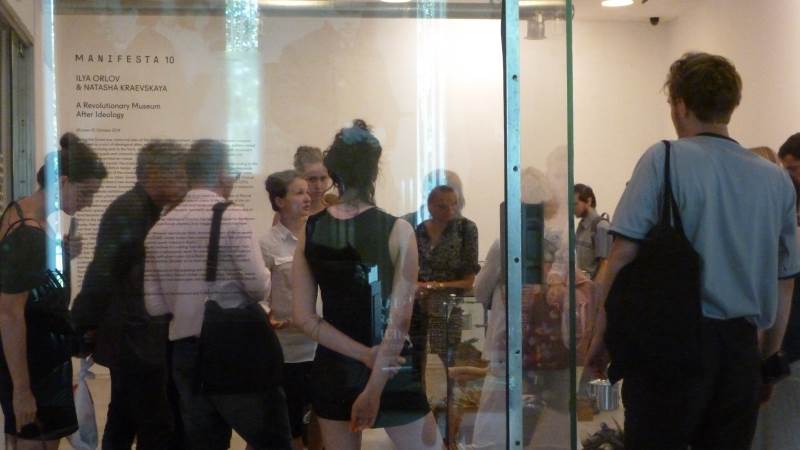
We did the project A Revolutionary Museum after Ideology in a museum complex located in the Petersburg suburb of Sestroretsk and Razliv. The Manifesta 10 Public Program, as curated by Joanna Warsza, commissioned the work.
Two site-specific exhibitions, supplemented by a series of lecture tours and discussions, were held at the Razliv museum complex, which consists of two small Soviet revolutionary memorial museums at two sites, the Shed Museum and the Hut Museum. Both locations were originally ordinary suburban places, and both were turned into memorial museums during Soviet times. They dealt with the episode in the 1917 revolution known as Lenin’s last underground period and the site known as “Lenin’s final hiding place.” Vladimir Lenin and his comrade-in-arms Grigory Zinoviev hid there during the summer of 1917 to avoid arrest and prosecution by the Provisional Government.
The Shed Museum (in Russian, Sarai) is a real former shed where Lenin and Zinoviev hid for several days in July 1917. The shed is covered with a glass casing, and today there is still a Soviet-era permanent exhibition that recreates the interior of this shed as it looked in 1917.
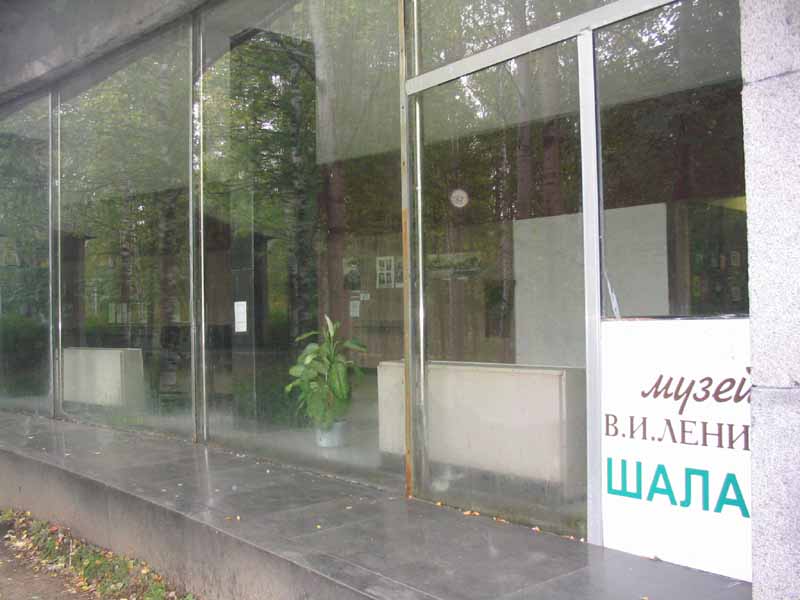
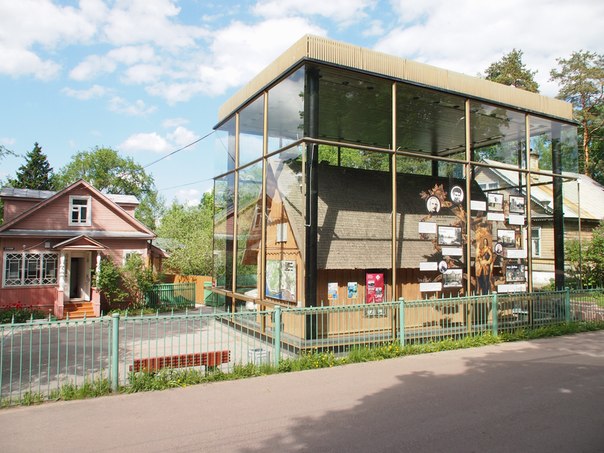
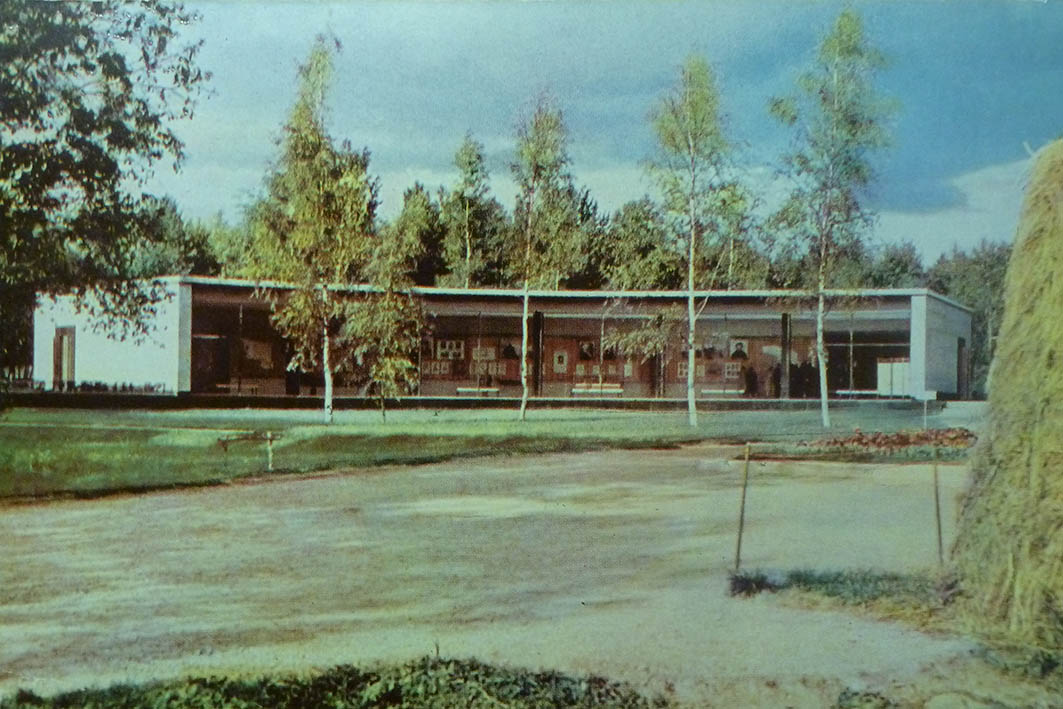
The Hut Museum (in Russian, Shalash) is a quite large pavilion built in the mid 1960s at the rural site where Lenin and Zinoviev also lived in July 1917 in a hut fashioned from branches and hay.
***
Razliv means “flood” in English. The village of Razliv is part of the suburb of Sestroretsk, and is located on the shores of Razliv Lake. In fact, the lake is artificial. It was an unintended byproduct of Peter the Great’s modernization of Russia. In the 1720s, a large munitions factory was built on the shore of the Sestra River. A levee was also built to supply the plant with mechanical energy, which was generated by a water mill. The river flooded and formed the artificial lake now known as Razliv. So we might say the landscape was shaped by modernization.
From the late nineteenth century, Sestroretsk, as an industrial center, was also a hotbed of the workers’ movement. It is important to keep in mind that the munitions plant workers were not former peasants, as had often been the case during the pre-Revolutionary period in Russia, but were already second-generation proletarians. Therefore, many Sestroretsk workers had been involved in the first Russian Revolution of 1905; many were anarchists and social democrats. It should come as no surprise that the Bolsheviks found support among such people. At the same time, there was a fashionable bourgeois resort and a popular dacha village located near this industrial settlement. Many members of the Russian intelligentsia—writers, poets, actors, and artists—used to live or summer there.
The February Revolution was the first of two revolutions in Russia in 1917, although some historians consider them parts of a single revolutionary process. After spontaneous bread riots, mass strikes and demonstrations in Petrograd, then the capital of the Russian Empire, soldiers from the city’s garrison sided with the protesters. The revolution forced the abdication of Tsar Nicholas II. The Provisional Government came to power. Its members, mostly liberals and conservatives, were drawn from the State Duma, the former monarchy’s parliament. At the same time, local socialists formed an alternative authority, the Petrograd Soviet, which ruled alongside the Provisional Government. There were thus two centers of power, both plagued by problems of legitimacy. It was a very unstable situation, which Lenin defined later as a diarchy (dvoevlastie).
Both the Provisional Government and the socialists from the Petrograd Soviet supported the imperialist war effort. Lenin, who arrived in Petrograd from Zürich in April 1917, immediately began to undermine the situation, issuing his so-called April Theses. He insisted on an anti-war agenda and the slogan “All Power to the Soviets.” In fact, during this period, as the war between the imperialist powers raged on, Lenin was the only political figure that took a strong anti-war stance. Initially, neither Lenin nor his ideas enjoyed widespread support, not even among his fellow Bolsheviks.
By the way, this point was very important for us in terms of last summer’s political context—the beginning of the Russian-Ukrainian war—and it is still on the agenda today.
The next big event, the so-called July Days, was a failed attempt at a new revolution by anarchists with the involvement of Bolsheviks in early July 1917. It was the first time in 1917 when the military forces of the Provisional Government attacked a demonstration (albeit one that was not entirely peaceable). Consequently, the government pursued Lenin as a German agent and ordered the arrests of other leftist oppositionists, especially Bolsheviks. Lenin and Zinoviev were forced to go underground.
Since the Bolsheviks had well-developed networks among the workers of Sestroretsk and Razliv, Lenin and Zinoviev soon found a place to hide. The person who aided them was a worker at the Sestroretsk armaments plant, Bolshevik Nikolai Emelianov. Lenin and Zinoviev lived in his shed in Razliv for a few days. When it was too dangerous to stay there any longer, Emelianov ferried them to the other side of the lake, and built a hut in a field for them. Lenin and Zinoviev lived there, disguised as Finnish peasants, for three weeks.
According to the so-called Leniniana—the informal corpus of popular Soviet biographies and myths about Lenin, during his time in hiding—Lenin remained in contact with the Party in Petrograd through networks of liaisons, read newspapers, which were delivered hot from the presses by comrades, and wrote articles.
Moreover, as Soviet legend has it, it was in Razliv where Lenin elaborated his theory of revolution, his doctrine of armed rebellion, and finished one of his most subversive and prominent works, The State and Revolution.
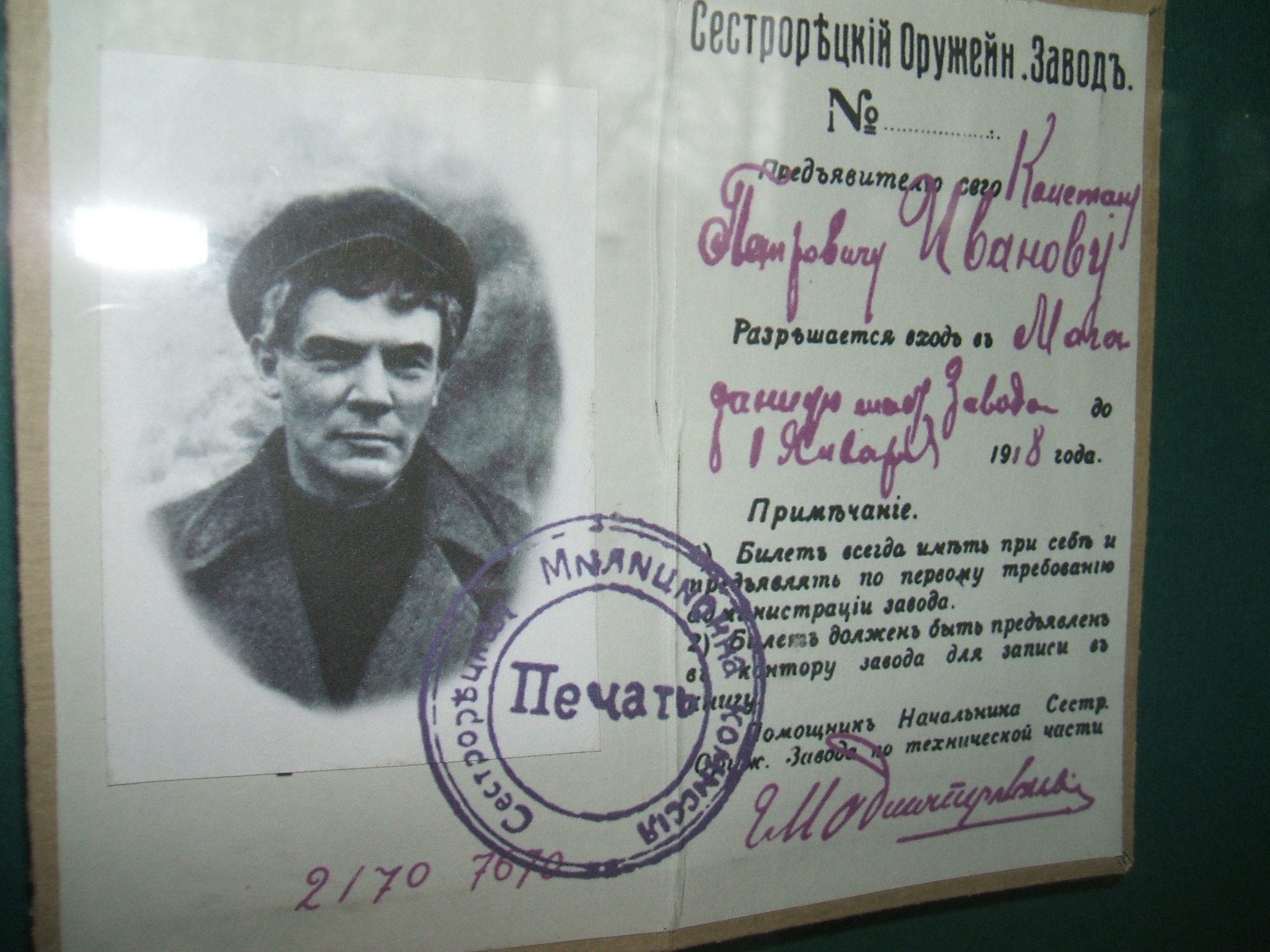
Lenin hid in Razliv for three weeks, until the end of July 1917. Emelianov then fabricated papers for him, a false passport under the name of worker Konstantin Ivanov. Lenin illegally traveled to Finland, where he continued with his theoretical and coordinating work in preparation for a rebellion in Petrograd. When the rebellion was crowned with success in October 1917, Lenin moved to the Smolny and headed the new Bolshevik government.[3]
After Lenin’s death in 1924, there ensued what American Slavists later defined as the Lenin cult or even the “deification of Lenin.”[4] Memorial sites, museums, and monuments were constructed throughout the Soviet Union in huge numbers.
The Museum in Razliv was among the first. It opened in 1925. Emelianov’s shed was turned into a sightseeing attraction, with its humble cabin interior on permanent display. In 1928, a monument designed by architect Alexander Gegello in the form of the hut, albeit with a touch of constructivism, was built in the field on the other side of the lake, at the site where, as the legend goes, Lenin lived in his branch and hay shelter.
During the Stalinist period, despite the erection of a monumental granite mausoleum for the late Bolshevik leader on Red Square, Stalin overshadowed Lenin’s figure.
The renaissance of the Lenin cult in the 1960s was the partly unintentional aftermath of de-Stalinization. Along the way, the authorities were forced to rename streets that had previously been named in honor of Stalin. And indeed they were renamed—in memory of Lenin, of course. Monuments of Stalin were also replaced—by monuments of Lenin, of course.
On the occasion of the fiftieth anniversary of Revolution, in 1967, there was almost nothing left to name after Lenin. Thus, by the mid 1960s, the Lenin cult had gone a little over the top. But there was more to come. In 1970, during the centenary celebration of Lenin’s birth, there was a new wave of renaming and mass commemorations. It was the year that Emelianov’s shed was covered with a glass casing. By this period, the Lenin cult was reduced to the point of absurdity. There were plenty of funny stories about this naming and renaming of all and sundry—factories, mills, workers’ clubs, streets, ships, etc.—in memory of Lenin in the late 1960s, but the facts speak for themselves: it was then that the Leningrad (!) subway was even named after Lenin (!) and awarded the Order of Lenin (!) [5]
Meanwhile, during this period, memorial sites of the revolutionary movement, and Lenin memorial sites and museums were transformed into ideological altars of sorts. The same was true of the Lenin museums in Razliv. Both sites were visited by hundreds of thousands people annually. The museums were known worldwide and were visited by numerous international delegations. Young people were sworn into the Young Pioneer youth movement there. This was the main ideological ritual for Soviet youth, a mode of political initiation, and a commemoration of Lenin and the Revolution as well. Schoolchildren and university students were also taken to such places on class trips. Guidebooks and postcards featuring the museums were printed in huge quantities.
In 1964, a new exhibition pavilion was built near the Hut Monument to hold and display the museum’s collection. It is an elegant minimalist building, made of concrete and glass, designed by architect V.D. Kirkhoglani. In the 1960s, most of the museums dedicated to Lenin and his hideouts were decked out in keeping with the latest trends in exhibition design, featuring genuinely modern exhibits created by leading museum curators. The same was true of the Museum in Razliv, whose exhibition and design were excellent. Unfortunately, this permanent exhibition was dismantled and lost in 2006.
After perestroika, the Museum in Razliv shared the same fate as other Lenin and revolution museums. The buildings fell into disrepair, and the permanent exhibitions were on the verge of closing. As for the museums that have survived, their main strategy in the 2000s and beyond has been to try and organize new permanent exhibitions, which have been self-described as “de-ideologized” and have tended to implement the doctrine of the so-called restoration of historical justice.
The Museum in Razliv is a good example of such de-ideologization. In fact, after the Soviet-era exhibition was dismantled in 2006, with support from a local businessman, the owner of a nearby restaurant, the museum’s curators organized a new permanent exhibition that combined, on the one hand, an attempt to function as a local ethnographic museum, and, on the other, a slightly veiled narrative of the “fatal role” played by the (imagined) conspiracy of Bolsheviks and Germans in the October Revolution of 1917.
Thus, a popular post-Soviet cultural doctrine and the discourse of the “restoration of historical justice” proved to be a euphemism for the counter-revolutionary conservative ideology that, under the Putin regime, has replaced Soviet dogmatism and the deification of Lenin and the Bolshevik Party. Such were the conditions in which we worked while doing our project for Manifesta in Razliv.
***
The starting point and main inspiration for our artistic research were photos and postcards we had found in the museum’s archive. Primarily, these were photographs of the museum and its visitors from the 1960s and 1970s. On the one hand, we can see in these photos a quite international, advanced, genuinely progressive exhibition design, resembling a European museum exhibition during the same period.
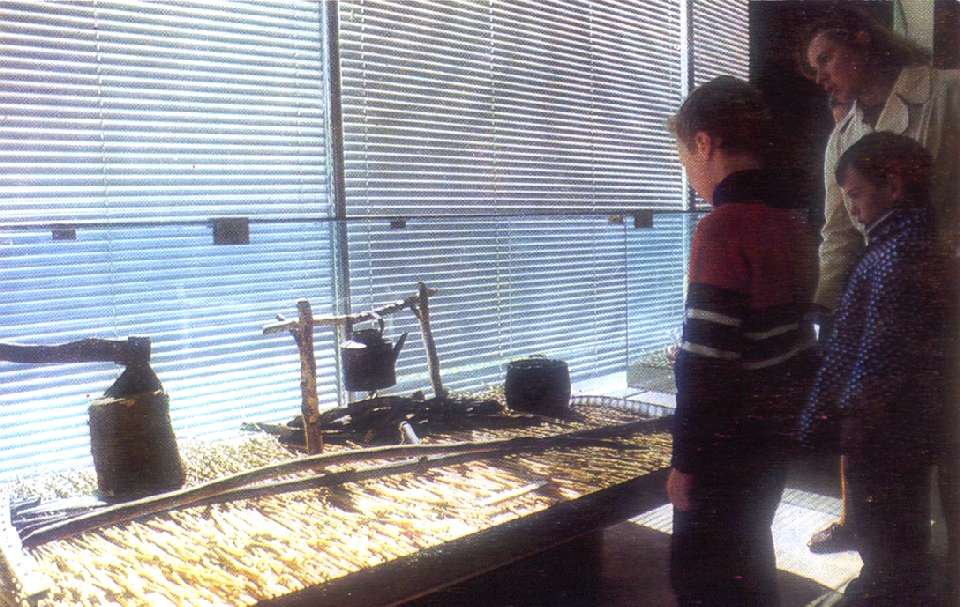
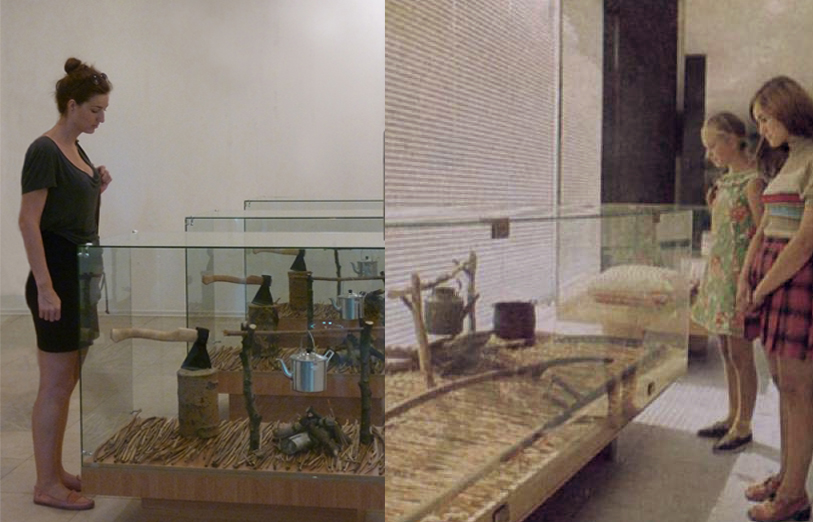
On the other hand, there is the interesting reaction on part of visitors. We discovered that these archival photographs of the museum’s exhibitions from the late 1960s were surprisingly similar to photos taken at European biennales. Soviet tourists examined an old tin teapot and bundle of wood in the Hut Museum or an ordinary tree stump in Lenin’s “outdoor office,” the so-called Green Study, much as European audiences of the 1970s stared in fascination at objects they were equally unaccustomed to seeing in museums.
Here are some examples: pictures of Harald Szeeman’s curatorial project When Attitudes Become Form, in 1969 at Kunsthalle Bern, contrasted with photos from the Museum in Razliv from the same year.
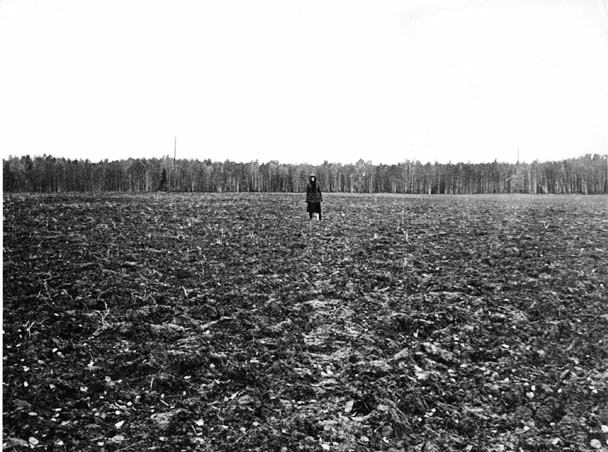
Another discovery, as well as an important source for further research, was photographs and postcards of so-called Lenin’s places, his secret hideouts or places he was known to have frequented. We were especially interested in postcards printed in the 1960s in large editions. If it were not for the captions on the verso of these postcards, identifying them as Lenin’s places, they could have been taken for ordinary rural views or banal suburban landscapes, pictures of fields, forests or lakeshores. It is remarkable that there is almost nothing picturesque, no intentional “beauty” in these pictures. They seem deliberately discreet and artless.
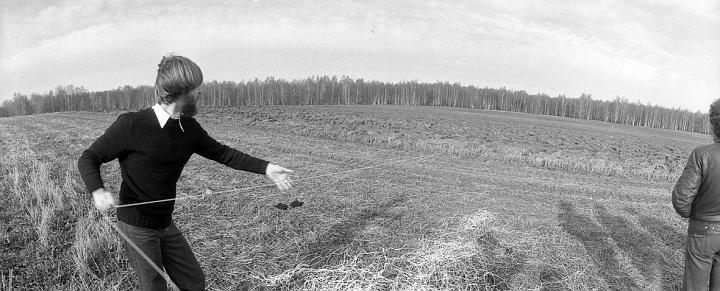
The captions on the verso of these pictures and postcards turn an ordinary forest into Lenin’s forest, an ordinary field into Lenin’s field, a plain hut into a sacred place of memory. In this way, the banality of these views and the artlessness of these photographs lend them the quality of truly conceptual images. Soviet underground art of the 1970s, such as Sots Art or Moscow conceptualism, could probably spoof this manner of depiction vis-à-vis their ironical, mildly iconoclastic subversion of Soviet ideology. But the ideology has been already dethroned, revealed, discredited, and dishonored. So we have applied other methods and have found something out in the process: namely, a parallel with conceptualism itself. The postcards of Lenin’s places bear a strong resemblance to the documentary photographs of performances by the art group Collective Actions,[6] whose underground secret happenings in the Moscow countryside during the 1970s turned run-of-the-mill rural landscapes into special, ritualistic spaces by means of similar mental and discursive operations, which could be defined as conceptual nominalism.
Thus, during our research in the museum’s archive, we discovered unexpected parallels between the function of ideology in Soviet museum commemorations and contemporary art practices, which gave us a clue about how we should proceed with our own project.
***
Given that the contemporary art exhibition is not such an up-to-date concept itself, it always needs elements or approaches that undermine or at least question it from within. A possible method of undermining involves blurring the boundaries of the art exhibition genre, for example, by means of mixing two different exhibition practices: a temporary thematic display in a historical museum and an exhibition of contemporary art.
This was just what we did. For the project, we worked out our own rules. We decided to make an exhibition bereft of any manifestly “authorial” artworks, without resorting to artistic self-expression. Rather, we would re-conceptualize photographs and objects from the museum’s collections, recreate items that had been lost, and restore the Soviet minimalist exhibition design of the 1970s. This naturally implied our employing a strategy of subtle shifts that would supplement the exhibition by rearranging elements and thus provoke viewers to reflect on and question the current status and significance of the revolutionary museum.
Our slide installation at the Shed Museum was based on postcards from the late 1960s, which depict the mass rituals of political commemoration that took place at Razliv during the Soviet period.
One of Lenin’s favorite songs, “The Workers’ Marseillaise,” provided the soundtrack. But we assembled this recording in a particular way. We removed the consonants from the choir’s vocal performance. By In doing this, we removed an element that supported the form of the song’s words, leaving only the sublime, inspiring, and solemn pathos of the vowels. We did this in order to s achieve the effect of the disappearance of the song’s original sense and also to show the loss of revolutionary ideas in such ideological museum practices, both in Soviet times and nowadays. For us, it was a self-referential metaphor for the function of ideology.
“The Workers’ Marsellaise,” as performed by the Chamber Choir of the N.K. Krupskaya Leningrad State Institute of Culture
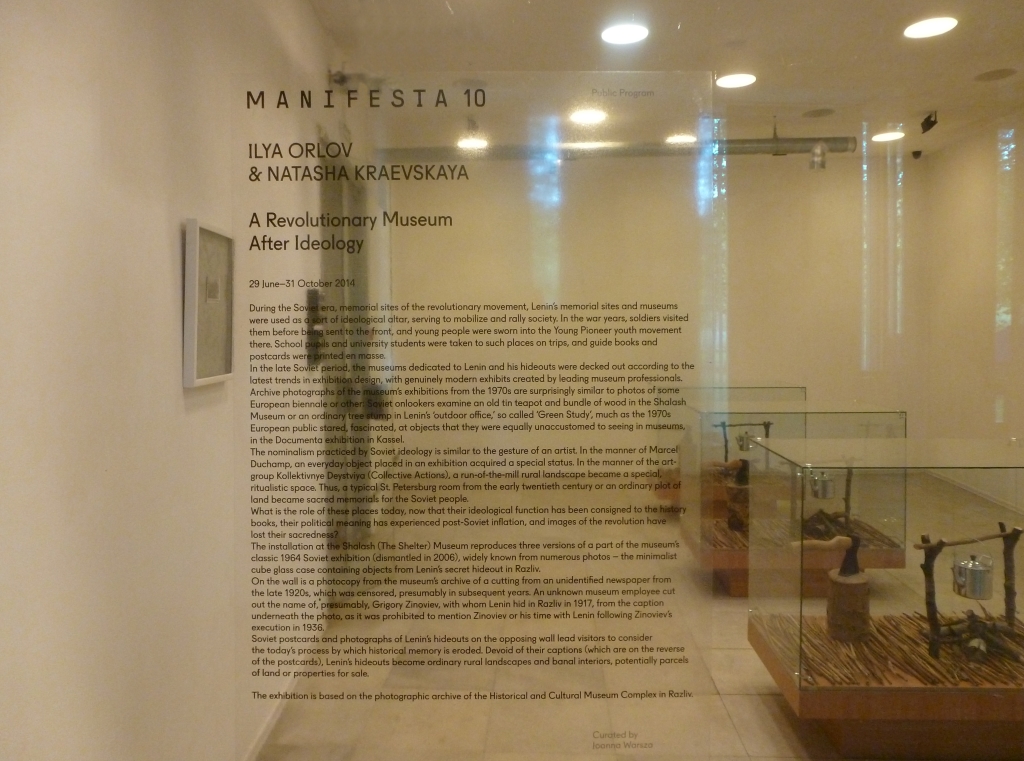
At the Hut Museum, we recreated the most famous part of the museum’s classic 1964 Soviet exhibition, dismantled in 2006 but widely known from numerous photos: the minimalist glass cube showcase containing objects from Lenin’s secret hideout in Razliv. We did not simply recreate this showcase; we reproduced three identical versions of the same thing.
This was not a mere restoration and thus similar to a re-enactment, but rather a conceptual restoration or deconstruction, since this reproduction was supplemented by the strategy of the shift. The shift in question here was repetition, the restoration of an object in three exactly identical versions. In the slides, you can see that we actually reproduced not only the glass showcases of 1964 but also re-enacted in a different way the very situation of visiting the exhibition in the mid 1960s. We thus made it possible to compare Soviet tourists with Manifesta 10 visitors.
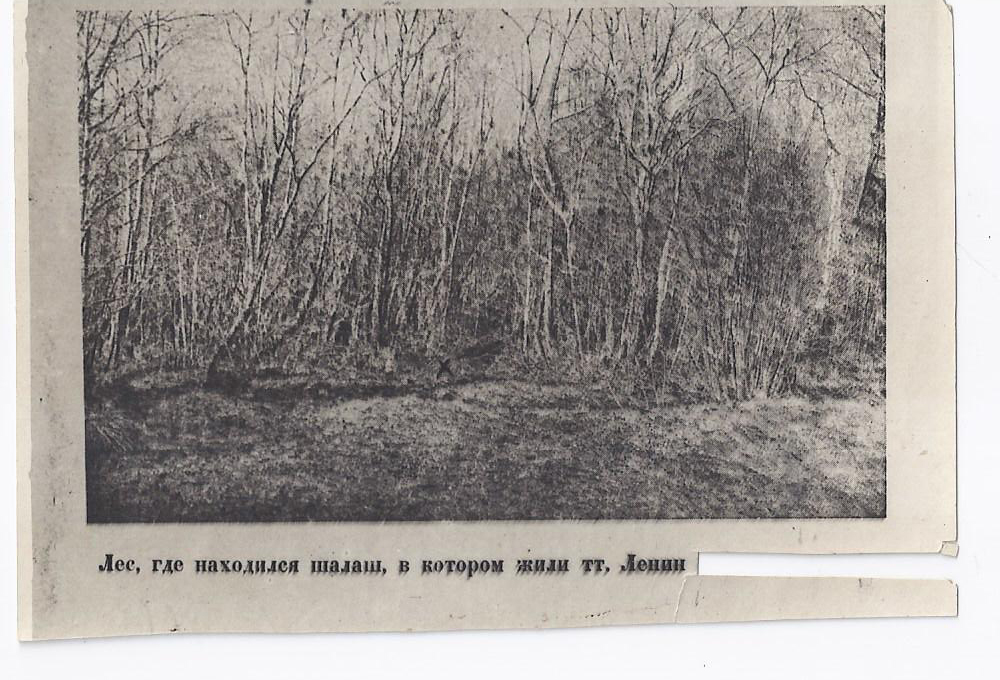
The next part of the exhibition dealt with ideological practices of erasing historical memory. On the wall was a photocopy from the museum’s archive of a cutting from an unidentified newspaper, published in the late 1920s, which was censored, presumably in latter years. An unknown museum employee had cut out the name, presumably, of Grigory Zinoviev, with whom Lenin had hid in Razliv in 1917. He had cut out it from the caption underneath the photo, as it was prohibited to mention Zinoviev or his time with Lenin following Zinoviev’s execution in 1936 during the Stalinist purges.[7]
The caption reads, “The forest in which the hut was located where comrades [sic] Lenin [blank] lived.”
The following section—Soviet postcards and photographs of Lenin’s hideouts on the opposite wall—led visitors to consider the current process by which historical memory is eroded. Devoid of their captions, which are on the reverse side of the postcards, Lenin’s hideouts become ordinary rural landscapes and banal interiors, potential parcels of land or properties for sale.
A series of lecture tours from the Hermitage Museum to the Lenin museums in Razliv were an intrinsic part of the project. During Manifesta 10, we organized several such tours and discussions.
The first tour opened with a lecture by historian Ilya Budraitskis, “De-Ideologization: Revolutionary Museums and Their Place in the Present.” We also organized a lecture by Alexander Semyonov, a local professor of history, and the co-founder and co-editor of the international scholarly journal Ab Imperio, who provided a very interesting comparison of the crises of 1917 and 2014 in their complex historical combination of imperial background and revolution.
A further tour to Razliv was entitled “Mimesis and Revolution.” The point there was the interesting parallels between the conspiratorial practices of professional revolutionaries and certain artistic strategies. There are ample legends, well known from the extensive Soviet biographies of Lenin, about his fantastic impersonations during the period when he was hiding from the Provisional Government, stories involving wigs, greasepaint, and actors from the Finnish workers’ theater who taught and helped him to impersonate peasants and workers. In connection with this, I discussed not only plasticity as a quality of revolution but also the mimetic nature of revolution itself, the mechanism of repetition at work in revolutions throughout history.
***
In conclusion, I return to a point I mentioned at the beginning: the question of possible methods of artistic reflection on historical memory and the history of revolution in particular.
It appears that in the project I have described we were guided not only by intuition. I think the methods we have applied, as well as the methods of artistic research on history and memory in general, are not so distant from the methods of the social sciences and historiography. Thus, the tradition of social sciences would be very important to artists who engage with material such as we have. One of its main origins was the French intellectual scene of the 1930s, when historical studies had been given new impetus by the sociology of Émile Durkheim. I am referring primarily to the Annales School, a highly influential tradition and intellectual platform that formulated and proposed modern methods of historical research. Its co-founders historians Lucien Febvre and Marc Bloch, when discussing how to work with historical sources, taught their disciples to peruse “the human facts which [sociologists] condemn as the most superficial and capricious of all,”[8] which also means perusing the seemingly trivial and insignificant, perusing the margins. This resonated in a certain way with the methods of psychoanalysis, which was evolving increasingly in the same period and influenced the social sciences as well. Thus, as regards our own project, a well-known text of Soviet ideology and mass culture was given a new reading and conceptualization. It was especially tempting for us, since both intellectual traditions, the sociology of Durkheim and Freudianism, had been almost completely rejected and ignored by Soviet academia.
Febvre and Bloch insisted as well on being critical towards facts, on questioning the equation of facts with truth. Febvre argued that the historian creates facts on his own, by discovering them, and he constructs his own narrative with them. He also emphasized the point that researchers should first develop their own theories, the conceptual frames for their further research.[9]
Another important theoretical background for an artistic reflection on history is certainly the concept of so-called history and memory, or memory studies. In the 1980s, historical studies experienced a crisis and revised their conceptions of scholarly rigor. Therefore, an interest in what had previously not engaged historians—memory and memories—emerged. The Collective Memory (1950), a posthumous book by sociologist Maurice Halbwachs, who had been a disciple of Émile Durkheim, was the key influence. It was republished in the early 1980s, giving a boost to the new methodological turn in historical studies. French historian Pierre Nora elaborated Halbwachs’s ideas and reshaped his approach to history and memory in his own concepts of commemoration and “places of memory.” Historians and researchers now examine not only historical events but also memories of historical events. Memory and commemoration have become key notions.
It is true we could not have avoided these theoretical approaches in our project, either. When dealing with a Lenin museum and Lenin’s underground period of 1917, we paid attention to things that were somewhat peripheral and, at the same time, trivial: postcards featuring exhibition views and commemorations in the museum during the 1960s, and amateur snapshots of the museum made during Soviet times. It was certainly deliberate on our part that, when speaking of Lenin and 1917, we approached, first of all, the history of commemoration, in the way current historians would have done. In all fairness, it is extremely difficult today to reflect such a figure as Lenin in art, since his image has been turned into a mass culture icon and has been subversively used many times in pop art, as well as in its Soviet underground versions, the Sots Arts and Moscow conceptualism of the 1970s and 1980s, and especially in perestroika-era kitsch art. That is why we chose the opposite method and strategies. We used the optics of contemporary conceptualism or, as it were, post-conceptualism, as well as strategies of engaging the audience by means of a series of lecture tours to the museum, talks, and discussions.
Finally, this artistic reflection on history makes a difference only if it is done politically. Lenin’s renewed significance was proven in the spring of 2014. Ukrainians had begun demolishing Soviet monuments to Lenin (for a lack of monuments to Stalin to destroy, as someone aptly remarked), and they are still engaged in this process of wholesale demolition today. But in fact, Lenin was the only major political figure in 1917, in the midst of a full-scale war among the imperial powers, who insisted on a radical, uncompromising anti-war agenda. Lenin’s stance was the immediate cause of his prosecution by the Provisional Government, and the reason he took refuge in Razliv.
We intended our project to shed light on a historical period when this anti-war stance was in the underground, on the periphery of public politics, as it is today. It was important for us not simply to represent an alternative historical narrative but also to approach history in a way opposed to current official cultural policy, to critically revise rather than re-enact, to deconstruct rather than recreate.
[2] The situation has been exacerbated by new crackdowns on political freedoms and freedom of speech, and by the shrinking of space for public discussion. As artist and activist Victoria Lomasko said in a recent interview, “My work Cannibal State, in support of political prisoners, today could be regarded as insulting state symbols. [The work entitled] Liberate Russia from Putin clearly rocks the boat; it’s a call for rebellion, for revolution, and this is ‘extremism.’ […] It is impossible to know about the new laws and not think about the consequences if you make a work about something that really concerns you. [If] I were to draw something [in a satirical way, about fascists], I could be accused of spreading fascist ideas. And if I put it on the Web, everyone who reposts the picture automatically becomes my accomplice.”
[3] See, for example, V.I. Startsev, Ot Razliva do Smolnogo [From Razliv to Smolny], Moscow, 1977; V.T. Loginov, Neizvestnyi Lenin [The unknown Lenin], Moscow, 2010.
[4] See, for example, Nina Tumarkin, Lenin Lives! The Lenin Cult in Soviet Russia, Cambridge, Mass., 1997.
[5] I.e., the V.I. Lenin Order of Lenin Leningrad Metro. See Tumarkin, op. cit. See also a recent article by anthropologist Alexei Yurchak in which he considers the practice of preserving of Lenin’s body (and the Lenin cult) as an instance of “neotraditional sovereignty” within the Soviet political system. Alexei Yurchak, “Bodies of Lenin: The Hidden Science of Communist Sovereignty,” Representations 129 (Winter 2015): 116–57.
[7] Not only Zinoviev but also worker Bolshevik Nikolai Emelianov, who had concealed Lenin and Zinoviev in his shed, was prosecuted in the 1930s as counter-revolutionary. Emelianov was jailed for ten years and then exiled to Kazakhstan. He was released and allowed to come back home to Razliv only in 1954, after Stalin’s death.
[8] Marc Bloch, The Historian’s Craft, Manchester, 2004, p. 17.
[9] Lucien Febvre, A New Kind of History: From the Writings of Febvre, ed. Peter Burke, trans. K. Folca, London, 1973
***
Editor’s Note. I would like to express my gratitude to Ilya Orlov for allowing me to reproduce his essay here. He also kindly provided me with all the images for this publication except as otherwise noted.
About the Place: Portlandia is a new project in the convenience store format.
Project creators: Natalia Davydova and Julia Zenka
The idea to create Portlandia* sprang from a love of fellowship, food, the art of cooking, and shared experiences, as well as an acute shortage of quality products (in the broad sense) in St. Petersburg.
It is very important that our customers are always satisfied with not only the quality of the goods but also the range, which boils down to the basics, but things sufficient for comfort: farm-fresh produce, popular high-end products, household goods, and kitchen utensils.
The first thing we care about is the location of the store. Since many neighborhoods in the city center suffer from a lack of hypermarkets, and there are not enough grocery stores with high quality products, we decided to take up residence in apartment buildings.
* Portland is a city in the state of Oregon in the United States. It is considered the undeclared capital of foodies and hipsters. Authentic and incredible gastro festivals and lots of interesting things happen there. Young creative people bent on healthy eating and self-realization live there. They are always coming up with strange pastimes for themselves and are proud of the result. That, in short, is Portland.
In 2011, the American TV series “Portlandia”, which we could not help but fall in love with, premiered. This series, in fact, is our whole life in a nutshell: para-gastronomical insanity, awe over the topic of bars, as well as sketches about the creativity of the silly Portland hipsters with their passion for music festivals, DJ-ing, and all the things that we in Russia (especially in St. Petersburg) are just beginning to go crazy over.
Founding date: November 11, 2014
It sounded odd but potentially interesting, only the address put me on my guard.
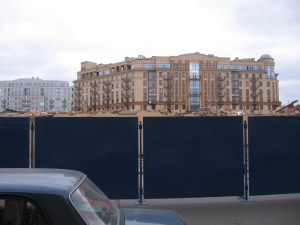
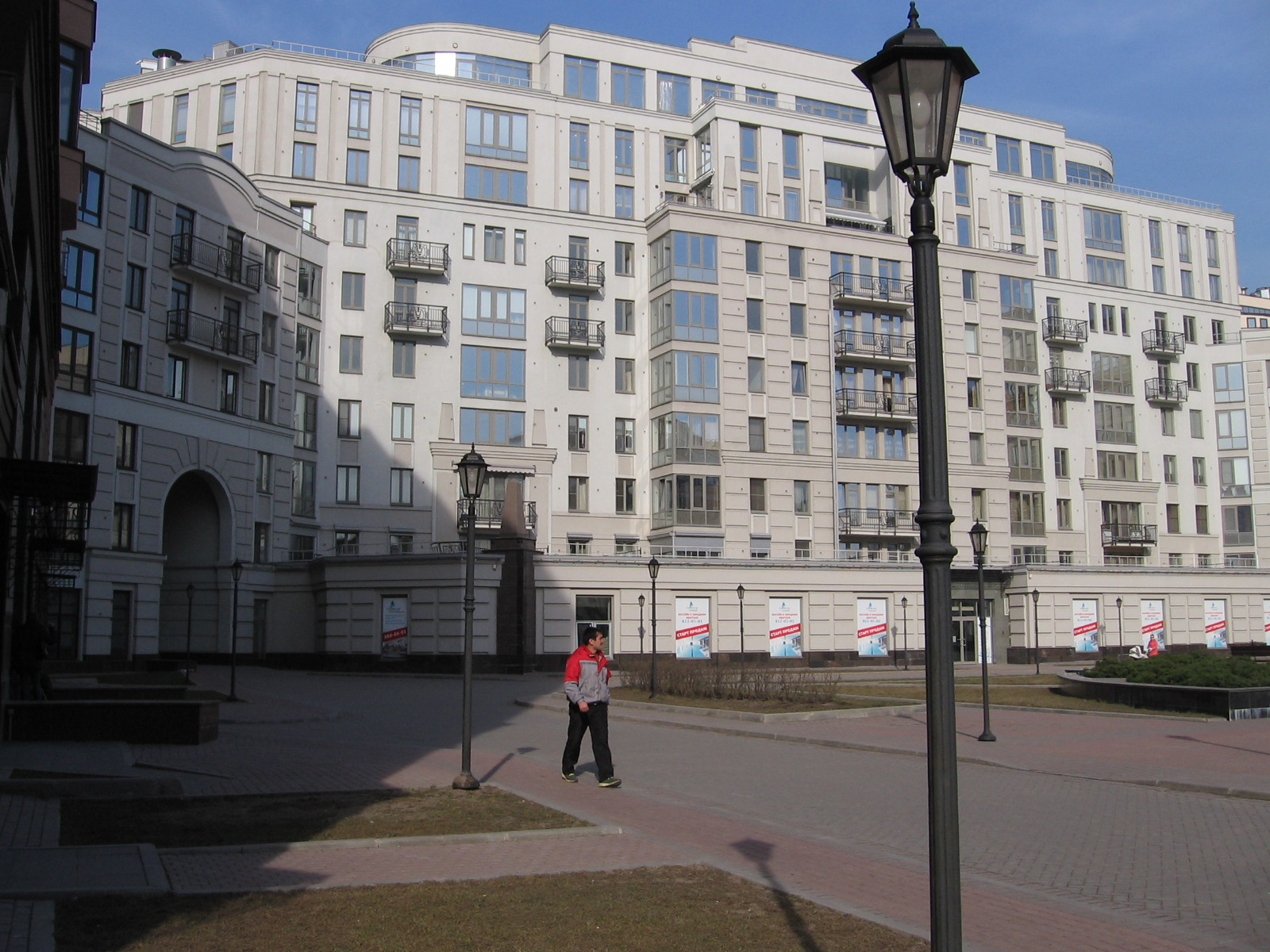
That address (Ulitsa Paradnaya 3/Vilensky Pereulok 35) suggested this “hipster’s paradise” was at the heart of a newish high-rise housing estate, Paradny Kvartal, that had been erected a few years ago on the bones of another old neighborhood that should have been wholly protected by city and federal preservation laws and the city’s status as an UNESCO Heritage Site. But this is what went down instead, as reported at the time by Sergey Chernov of the now-defunct St. Petersburg Times, with a little assistance from the now equally defunct Chtodelat News (whose better intentions live on in this blog).
Legality of Demolition of Historic Barracks Contested By Sergey Chernov The St. Petersburg Times May 11, 2011
Another planning controversy is developing in the city, as more historic buildings in the center were demolished last week to make way for luxury apartment and office buildings.
Built by architect Fyodor Volkov in the early 19th century, the demolished buildings on the corner of Paradnaya Ulitsa and Vilensky Pereulok are known as the Preobrazhensky Regiment’s Barracks and used to house one of the Russian army’s oldest regiments, formed by Peter the Great in the late 17th century.
Following a public outcry, Governor Valentina Matviyenko ordered an internal investigation into the legality of a construction permit issued by the St. Petersburg State Construction Supervision and Expertise Service (Gosstroinadzor). The agency is subordinated directly to Matviyenko.
Matviyenko’s orders were based on a memorandum sent to her by City Hall’s Heritage Protection Committee (KGIOP) after the last building was demolished on May 3.
Yulia Minutina, a coordinator of preservationist group Living City, said that Gosstroinadzor issued the construction permit that contradicted the protected zones law.
The local press suggested that the investigation may result in the dismissal of Gosstroinadzor’s head Alexander Ort. Preservationists and public figures such as film director Alexander Sokurov asked Matviyenko to dismiss Ort in a petition in January.
The developer failed to show the demolition permit, according to Minutina.
“Demolition is a separate type of work that requires a separate permit,” Minutina said Tuesday.
“Nevertheless, it was not presented to us, nor have they seen it at the KGIOP and I’m not sure it ever existed. Of course this is a violation.”
“Besides, buildings in the center can only be demolished if they are in a poor condition, but we haven’t seen any document stating that the building was in a poor state and impossible to restore either.”
Minutina said the demolition was one of the issues the preservationists are planning to raise during a planned meeting with Matviyenko on Thursday.
While the last building was being destroyed during the May Day holidays, the authorities did not react to the appeals of concerned residents. At the same time, police reportedly harassed activists who picketed the demolition site, rather than checking whether the developer had the necessary permits.
“We waited for two hours for the police to arrive,” Living City’s Pyotr Zabirokhin said.
“But instead of stopping the demolition, they started checking our passports, copying our placards into their notebooks and threatening to disperse us if we didn’t go away.”
St. Petersburg Legislative Assembly Deputy Sergei Malkov has written a complaint regarding the police actions to the St. Petersburg police chief Vladislav Piotrovsky.
The tactic of demolishing historic buildings during public holidays was recently used when a large portion of the 19th-century Literary House was destroyed on Nevsky Prospekt during the Russian Christmas holidays in January, Zabirokhin pointed out.
“It has turned into a bad tradition that not entirely legal cases of demolition start during or just before holidays, when people are not ready to get mobilized quickly, and while officials are on holiday and nobody can be reached,” he said.
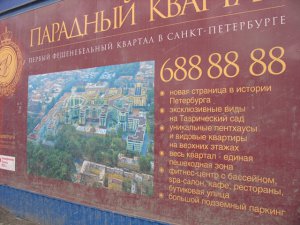
According to the project’s web site, the area previously occupied by the Preobrazhensky Regiment Barracks will be home to an “exclusive” Paradny Kvartal, an isolated “mini city” of 16 office and residential buildings.
Call Now!
“The true adornment of the quarter’s center will be a square with a fountain, comparable in size with that in front of the Kazan Cathedral,” the web site said.
However, apparently as a result of the controversy, the site was no longer available on Tuesday, redirecting to the web site of the developer, Vozrozhdeniye Peterburga. The original site can be viewed as files cached in Google.
Anna Mironovskaya, the marketing director of Vozrozhdeniye Peterburga, a subsidiary of the LSR Group, said Tuesday her company was only a sub-investor and was not in charge of legal matters and permits, citing the Ministry of Defense as the project’s developer and the Pyotr Veliky Construction Company as the commissioner.
One of the main advantages of Paradny Kvartal is the social homogeneity of [one’s neighbors]. Our buyers are people of high social status. That is why we will be able to create “our own world” in which it will be pleasant and comfortable to live.
[…]
— What does the phrase “noblesse oblige,” which is frequently applied to Paradny Kvartal, mean?
The well-known phrase has rightly become not just the slogan but the authentic motto of Paradny Kvartal. It translates as “[one’s] station obliges [one].” For in Paradny Kvartal each detail underscores the project’s elitism, its exclusivity.
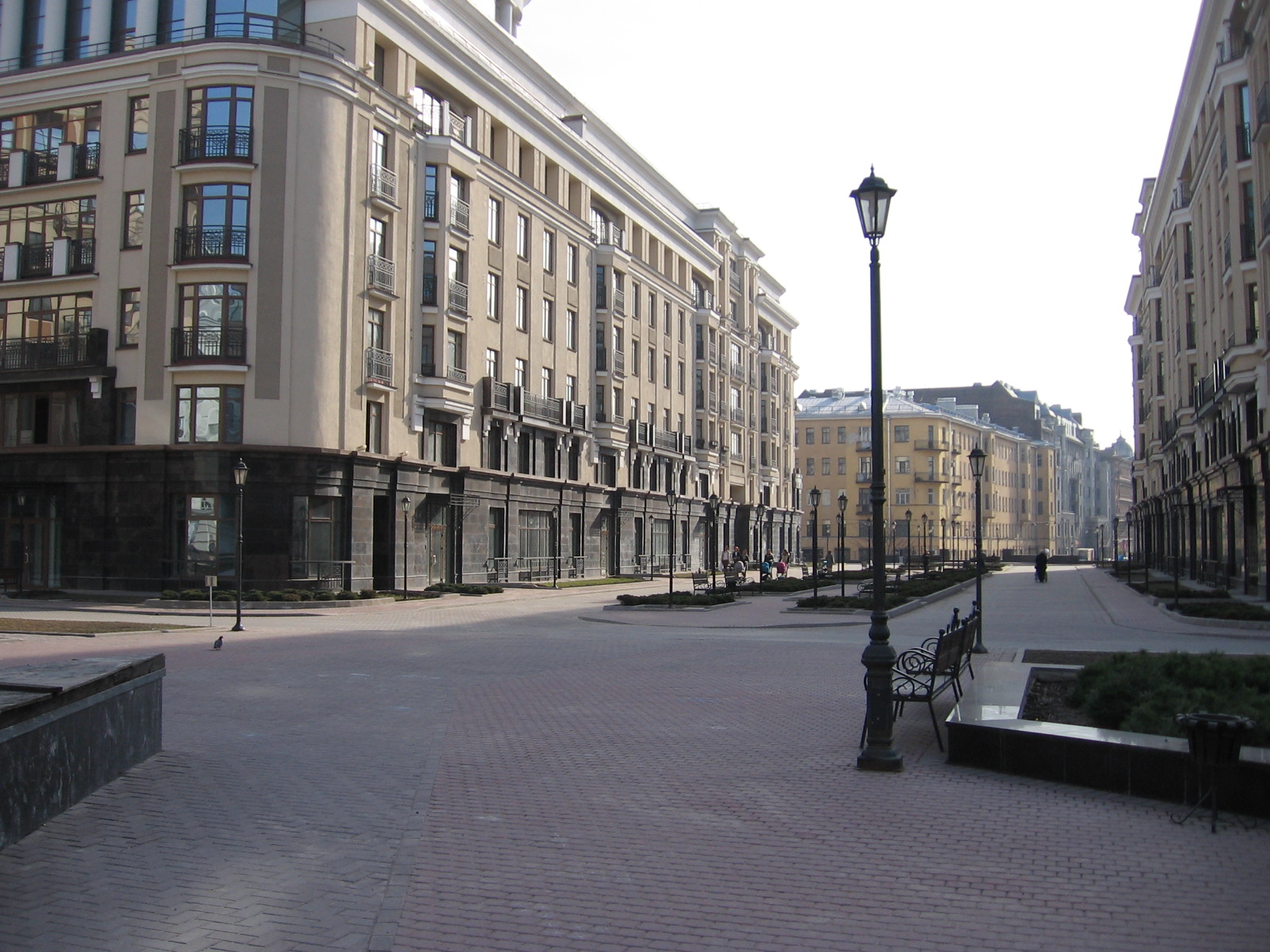
I had not been back to that site of class warfare camouflaged as “redevelopment” since that grey unpleasant day in May four years ago, although whenever I was in the vicinity it had been hard to avoid catching sight of Paradny Kvartal towering on the horizon over its older neighbors. Not only had the elitist high-rises probably been built in violation of the height regulations for the historic center, but the whole estate, I disovered when I revisited it a few weeks ago, has been erected on a one-storey-high pile of landfill, probably to accommodate lots of subterranean parking.
Hipster convenience store Portlandia proved quite hard to find amid the vast pseudo-Petersburgian, semi-ghost town that is Paradny Kvartal.
Part of the problem was a lack of sensible signage and maps, but mostly it was hard to find anything when many of the first-floor commercial spaces were still awaiting occupants.
This, by the way, seems to be the “square with a fountain, comparable in size with that in front of the Kazan Cathedral,” mentioned above.
Since the dubious reign of Valentina Matviyenko, who presided over the destruction of the Preobrazhensky Barracks, as well as much else of architectural merit, the city has been fountanized to the point of bursting, with two of its major Lenin monuments also having been juvenilized as water fun parks of a perverse sort. But Paradny Kvartal’s (perhaps non-functioning) fountain had been wisely boxed up for the winter.
I finally found Portlandia the hipster convenience store. I can say that the picture from the prospectus, above, does it justice. It is as empty and pointless as the picture suggests, and “convenient” only if you have been locked inside this mini city and desperately want to buy local craft beer and designer aprons at a heavy mark-up. That is, if you want stuff readily available elsewhere, probably just outside the gates of this noblesseobligeville, but for many fewer rubles.
Even at its most gentrified, the real Portland, Oregon, is a delightful, gritty socialist paradise compared to the soulless, Putinesque anti-Petersburg on display inside Paradny Kvartal.
And the connection with Portlandia the TV show I just don’t get at all. Portlandia is often mildly funny and at least slightly in touch with the city it sends up and where it is filmed. I cannot even imagine a comparable program dealing with Petersburg’s foibles and sillinesses being made here nowadays, in this dark-as-pitch and utterly humorless period, although there were such programs in the “lawless” nineties (e.g., Gorodok and Ostorozhno, modern!).
It’s frightening to think that much greater swathes of the inner city would look like Paradny Kvartal now were it not for the spunkiness of the tiny, embattled, and nowadays almost totally extinguished gradozashchitniki (city defenders) movement, which only six or seven years ago set the entire country on its ear by defeating Gazprom and its planned skyscraper.
But the city’s real salvation, such that it has been, has come from timely economic crises and sheer bureaucratic corruption and incompetence.
And yet Putinism in architecture and city planning has managed to do a lot of damage to this fine city, while signally failing to fix almost any real problems, of which there are almost too many to count.
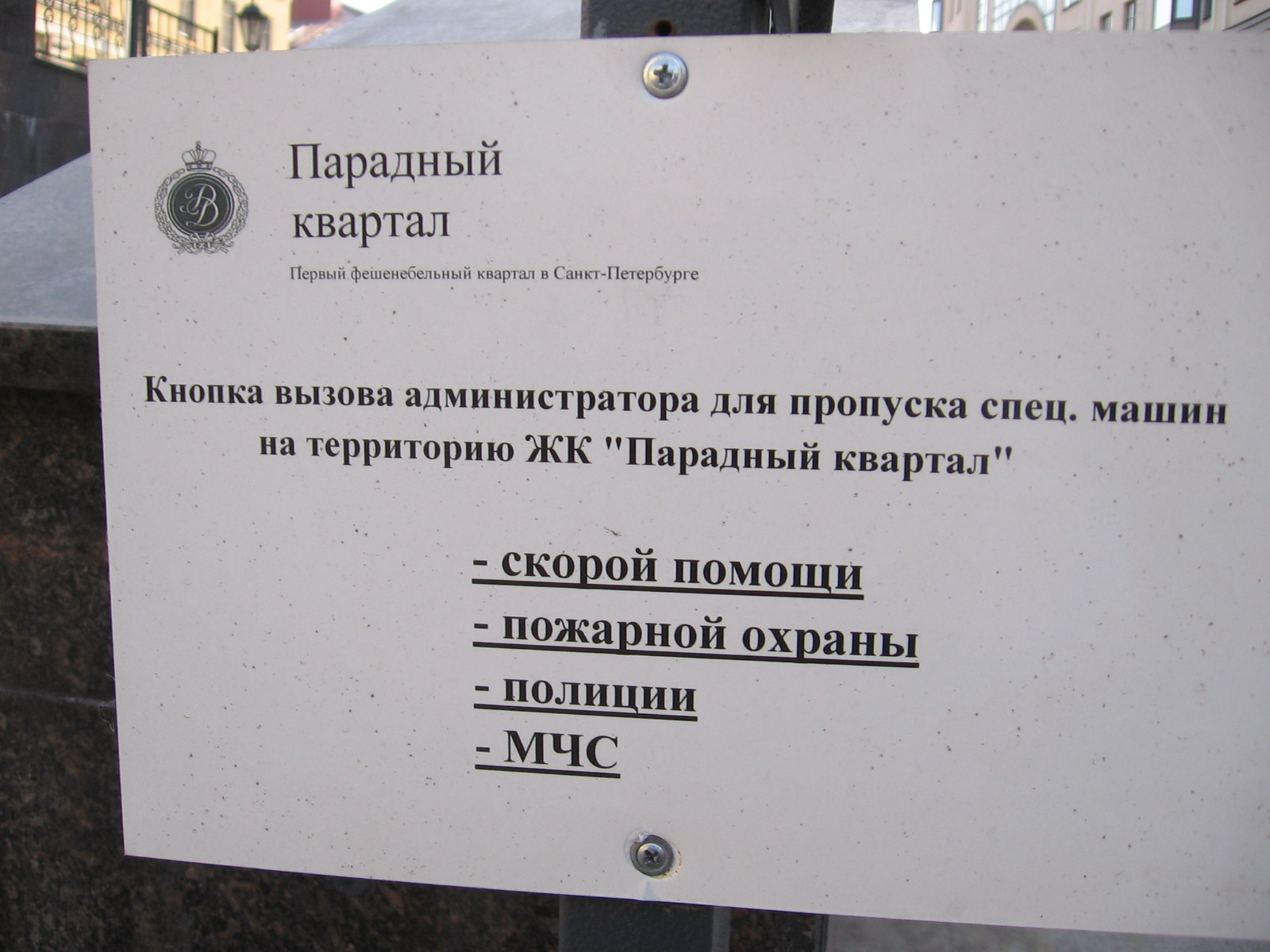
As I happily exited Paradny Kvartal, a sign reminded me I was leaving the “first fashionable quarter in Saint Petersburg.”
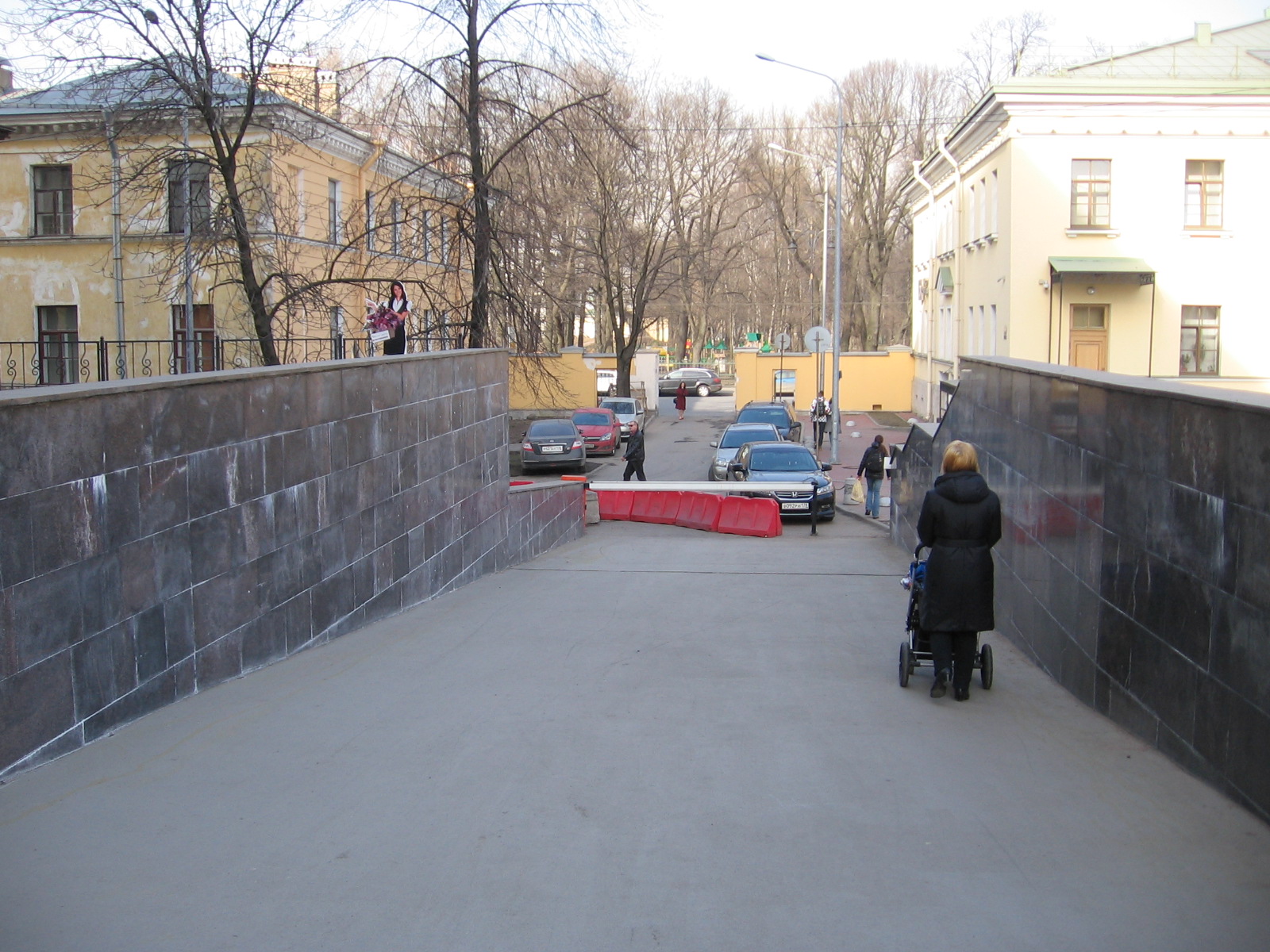
As I dashed down the ramp into the “unfashionable” Petersburg, it was like returning to life after a longish period in cryogenic refrigeration.
One of the first things I saw there in the real city, warts and all, was a memorial plaque, reminding me that once upon a time people in this city had big ideas, and had dreamt of and fought for better futures.
Vladimir Ilyich Lenin lived in this house from August 31 to early October 1893. The period marked the beginning of his efforts to establish a revolutionary Marxist Party in Russia.
Of course, we can argue the merits of different political ideas and the methods of realizing them. But places like Paradny Kvartal are idealess vacuums, pure embodiments of the blackest political reaction and the lack of any vision of the future on the part of Russia’s wildly corrupt ruling classes.
Even the sometimes justly maligned Russian hipster deserves better than Portlandia the inconvenience store and its airless environs.
With a little elbow grease and imagination, the old Preobrazhensky Regiment Barracks could have been transformed into a real hipster’s paradise, into a little village of low-income housing and affordable shops and cafes. Minus the hipsterism, it almost was like that back in the “wild” nineties. At any rate, it was at least as shabbily livable as any other part of the central city back then. Which despite its shabbiness was a hundred times more beautiful than it is now.







 Kotka Concert Hall. Image courtesy of