The Intensifying Crackdown in Russia

Varvara Volkova

“My friends died at the hands of Russian soldiers. Why can’t I talk about it?” 

This question will cost Varvara Volkova 7 years in a Russian penal colony. Here’s her story.

Varvara was a flight attendant, not an impassioned political activist. In a neighbourhood chat, she stated the obvious: Russian forces are killing civilians in Ukraine. The prosecution framed it as “fake news” motivated by hatred toward the armed forces, and the court accepted it.

The mechanism used to go after her relies on a Soviet-style culture of snitching: a Russian tank driver complained about her comments, then a professional informer, who intentionally hunts dissidents, amplified the case and demanded she be jailed.

In fact, there’s a whole network of these informers — they call themselves “SMERSH.” For those who don’t know Russian history, it is a reference to Stalin’s WWII counter-intelligence service. It means “Death to Spies” — a direct revival of the terror methods of the 1930s. They published screenshots of her messages everywhere trying to ruin her life; claimed she called the soldier a “fascist”; said she offered to make tea for Ukrainian soldiers if they reached the Moscow region. For words spoken in anger, the system decided to smash her life to pieces.

There is a grim irony in this tragedy: the regime destroyed Varvara to protect the “honor” of the military and her accuser. But the tank driver who reported her is already dead: he was killed in the war earlier this March. 

Observers abroad often underestimate the price of resistance in today’s Russia. It is not just a fine anymore, but years and years of one’s life. Varvara Volkova shows us the true bill — and it is devastating. 

I track the consequences of speech in modern-day Russia, make sure to follow for more updates.

Source: Khodorkovsky Communications Center (Facebook), 25 November 2025


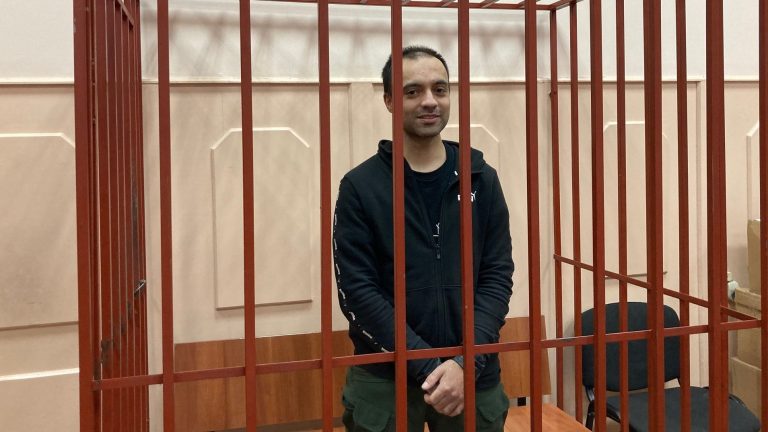
Preface by the Editorial Board: Below we publish the translation of an article of our Russian comrades about state repression in their country. The article reports, among others, about the situation of comrade Felix Eliseev. He has been in prison for 2.5 years as part of a 14-year prison term. Felix was sentenced for “treason” as he was accused of making propaganda against Putin’s imperialist war against Ukraine and sending money to Ukraine to buy weapons. While the prison authorities do everything to break him, Felix does not lose his spirit and endures his imprisonment stoically. (See https://www.thecommunists.net/rcit/felix-eliseev-a-revolutionary-communist-in-russian-prison/)

We call readers to support Felix by spreading this information about a communist and anti-fascist serving an unjust sentence!

You can also support Felix financially at www.paypal.me/irinablackbook, with the note “for Felix”.

* * * * *

According to the human rights organization Memorial, there are currently over 1,000 political prisoners in Russia, while other groups estimate the number could be as high as 2,500. This number is three times higher than in 2020, more than twice as high as in 2022, and continues to grow. In 2025, there was a sharp increase in criminal cases under articles on “justification of terrorism,” “sponsoring terrorist activity,” and “treason.” This is not due to increased terrorism, but to the fact that the security forces, having perfected their repression mechanisms, have begun to intensify their crackdown on “sponsorship” cases, such as those of the FBK (Anti-Corruption Foundation, recognized as an extremist organization in Russia) or cases related to money transfers to the Ukrainian army, which occurred back in 2022. The term “terrorism” itself has become so vague that even the average person doesn’t always understand what it actually means.

Among political prisoners are many individuals with progressive leftist views, serving time for anti-war activities or “inaccurate” public statements online. The “Foundation for Support of Left-Wing Political Prisoners” provides support to at least some of these individuals. Among them are: defendants in the “Tyumen Case”; defendants in the “Chita Case”; Anton Orlov, a trade union and leftist activist, coordinator of the independent medical workers’ union “Action” in Bashkortostan; Daria Kozyreva, an activist from St. Petersburg known for her anti-war protests and criticism of the Russian army; Gagik Grigoryan, a young activist imprisoned in 2023 at the age of 17; Azat Miftakhov is a Russian mathematician and anarchist, sentenced in 2021 to six years in prison for allegedly setting fire to the United Russia office in 2018. After serving this sentence, he was arrested again in 2023 on charges of “justifying terrorism” in a private conversation with a prison cellmate and sentenced to four years in prison; defendants in the “Kansk teenagers case”; defendants in the “Network case”; Boris Kagarlitsky is a left-wing publicist known in many parts of the world; Ruslan Ushakov is the author of articles published on opposition Telegram channels, sentenced to eight years in prison for posts in a public chat.

The case of the communist Felix Eliseev

Another political prisoner is Felix Eliseev, a Russian communist, blogger, and administrator of the Telegram channels “She Fell Apart” and “Kolkhoznoye Madness.” He was arrested in December 2022 and charged with justifying terrorism. According to investigators, Eliseev posted two anti-war posts on his Telegram channel, one of which endorsed a Ukrainian Armed Forces helicopter strike on an oil depot in Belgorod. The charges were later upgraded, and Eliseev was charged with “treason”. The court alleges that he transferred funds through a cryptocurrency account to a “curator,” who used the funds to purchase equipment and weapons for Ukrainian Armed Forces soldiers.

Felix, like many other political prisoners convicted of “terrorist and extremist” offenses, is serving his sentence under intense pressure from the prison administration. He is regularly placed in solitary confinement cells, where they do everything they can to break him mentally and physically.

However, political repression in Russia involves more than just horrific criminal cases of “terrorism,” “treason,” and other “betrayals of the nation.” It also includes the persecution of undesirable and dissenting youth who dare publicly speak out against the war and the ruling elite, thereby gathering many other concerned young people around them.

The “Stop Time” case

One example of such government abuse is the “Stop Time” case. The “Stop Time” case concerns the persecution by Russian authorities of members of the St. Petersburg street music group “Stop Time” – Diana Loginova (pseudonym Naoko), Alexander Orlov, and Vladislav Leontyev – for their participation in impromptu concerts, including one near the Ploshchad Vosstaniya metro station, where they performed anti-war songs by artists designated by the authorities as “foreign agents.” On October 16, 2025, Loginova was arrested and sentenced to 13 days of administrative arrest for performing a song by an artist unpopular with the authorities. The other members of the band were also arrested and sentenced to 12-13 days. These events resonated in the media (both pro-government and opposition) and society, becoming a topic of discussion in the context of artistic freedom and the tightening of censorship in modern Russia.

On October 29-30, the musicians received another 12-13 days of arrest, and on November 11, two of them were arrested for another 13 days. On November 23, the musicians were released from arrest. The lead singer and one of the band members left Russia that same day.

In many Russian cities, street bands followed “Stop Time’s” example and performed opposition songs by artists-foreign agents to large audiences in public squares. They also faced pressure from the authorities and harassment from Z-Neanderthals.

Also, recently, spiders in a jar have started eating each other. Criminal cases have been brought against several well-known military Z-bloggers for discrediting the army! More than two years after Strelkov’s imprisonment and Prigozhin’s murder, a new steamroller of repression is purging those loyalists who are too undesirable.

All of the above demonstrates that Russian society has no legal means to publicly express its attitude toward the events unfolding around it. For any word “against,” the sword of Damocles of Russian justice hangs over every citizen. Despite this, concerned Russians, especially young people, are finding ways to rally together and show the world that not all is lost in this country.

Meanwhile, cowardly security officials and government officials tremble at the mere thought that the masses will sooner or later awaken from their slumber and rise to deliver justice to the imperialist oppressors in the Kremlin. In Russia, literal punishments are being introduced for thought crimes. Thus, in September of this year, an administrative law punishing “searching for extremist materials” came into force. This law allows the FSB to view any citizen’s internet search history, and if it contains views of materials deemed extremist or terrorist, the user faces a visit from masked officers and a fine. The first cases under this law have already been filed.

Furthermore, the country is introducing a so-called “white list” for the internet—only those websites approved by Roskomnadzor are permitted to be accessed; others are inaccessible, and VPNs cannot be connected. So far, in the spirit of Russian tradition, this system is poorly functioning and flawed, but the day is not far off when Russian society will find itself locked in a “cheburnet.” (*)

Freedom for political prisoners!

For freedom of speech, conscience, and the internet!

Down with political repression!

Radical democratization of the country, not the fascist regime of a dictator!

All power to the working class and the working masses, not to a handful of oligarchic monopolists!

(*) Cheburnet is a mixture of two words: Чебурашка (Cheburashka) and internet. Cheburashka is a character from Soviet cartoon for children. Despite it is kind and helpful, in modern mass consciousness it is associated with Soviet censorship. So cheburnet basicaly means internet under the censorship of Russian government and intelligence agencies.
Source: Communist Tendency (RCIT Section in Russia), “Political Repression in Russia,” Revolutionary Communist International Tendency, 25 November 2025


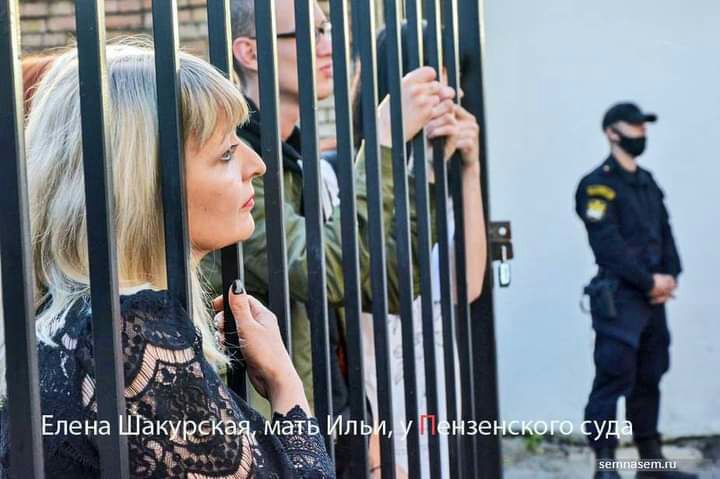
An appeal from Elena, mother of Ilya Shakursky:

My name is Elena Nikolaevna Bogatova, and I am the mother of political prisoner Ilya Alexandrovich Shakursky. I am crying out for help to save my son so that he does not rot away in solitary confinement.

They took my only son away when he was twenty-one years old. He is now twenty-nine. He has been tortured. He has serious health problems that we still cannot solve. He still has eight years to serve, and they could turn him into a disabled person. I cannot help him on my own, so I am asking all caring people to help us.

It is impossible for a mother to know that her child is being destroyed, and that she cannot save him!

Although he committed no crime, he is in prison under the harsh Article 205 [of the Russian Criminal Code; Article 205 proscribes “terrorist acts”], enduring all the hardships of prison life, without ever receiving any encouragement; we cannot even hope for parole. Right now, [the prison authorities] want to turn him into repeat offender so that he cannot have any visits, phone calls, letters, or packages. They want to take everything away from him.

I ask you to write an appeal. I understand that there are many of us now, and everyone is exhausted. But we must stand together for the sake of our loved ones, for the sake of the younger generation, which is currently being destroyed. Hear the cry of a mother who cannot bear the pain for her son and for all those behind bars. If we push with our shoulders, the walls will collapse….

https://t.me/ilyashakursky

Source: Elena Shakurskaya (Facebook), 28 November 2025. Translated by the Russian Reader


OVD-Info Faces a Critical Situation: We Have Lost All Our Ruble Donations

26.11.2025

Russian payment services have refused to continue working with us, without providing any explanation, and have cut off our ability to accept one-time and recurring donations. This has severed our connection to our main source of support—the 12,000 individuals who regularly transfer money to OVD-Info.

The services’ refusal to cooperate with us is one of the many manifestations of state pressure on human rights organizations and independent media. Some of them even had to close due to the loss of donations in rubles.

This is a severe blow to our work. With these donations we were able to pay for the work of defense lawyers and legal experts, travel to the regions, maintain our free hotline, and help those who are politically persecuted in Russia. Furthermore, regular donations allowed us to plan our long-term work and development.

We do not plan to close or reduce the scope of our work, because repression is not diminishing. Any political activity, expressing a view against the invasion of Ukraine, or criticism of Putin instantly becomes grounds for persecution. We simply cannot abandon Russians to face this brutal, repressive system alone. We are defending over 90 defendants in criminal cases, almost every day we send lawyers to police stations, courts, searches, penal colonies, and pre-trial detention centers. We answer dozens of messages and calls daily—and we want to continue doing this.

However, now everything depends on whether we can find another 12,000 people who will regularly support OVD-Info.

You can support us here.

Source: OVD Info


Yulia Lemeshchenko. Photo from the Memorial website

The Second Western Military District court in Moscow last week sentenced Yulia Lemeshchenko to 19 years’ imprisonment for high treason, sabotage, and preparing and training for an act of terrorism.

Yulia, 42, is a Russian citizen, born in Staryi Oskol, in Belgorod region. She lived in Voronezh in southern Russia, until 2014. Then she moved to Kharkiv, Ukraine, with her son and her husband, who had found work there. Later on the couple separated.

Yulia took up powerlifting and in 2021 was named Ukrainian women’s champion.

In 2024 Yulia did military training in Kyiv – firearms, explosives and flying drones – and returned to Russia, via a third country. She sabotaged power transmission infrastructure near St Petersburg, and in Voronezh conducted surveillance on Aleksei Lobodoi, an air force commander responsible for bombing Kharkiv.

Yulia was arrested in January this year. She did not deny the facts outlined in the prosecution case, but told the court that “from a moral standpoint” she considered herself not guilty. This is a translation of her final statement to the court, published by Mediazona.

=

Ukrainian Champion in a Russian Court: Yulia Lemeshchenko’s Final Statement

As you see, I don’t have any sheets of paper and I haven’t especially prepared, but I think I will improvise. I will now probably say a few things that were already said during this hearing, but let this be a sort of summing-up, in a monologue.

So I already spoke here about the fact that, in any war, two sides clash, and each side insists that it is right and that its cause is just. I took one of these sides. I am not a citizen of the country for which I decided to fight, but, all the same, for me, Ukraine is home. I love that country. And I love Kharkiv, with all my heart.

There is a district in Kharkiv called Severnaya Saltovka. About 500,000 people lived there. Half a million. A few people I knew lived there. My hairdresser lived there. After the Russian shelling and bombing, not a single house in that district was left undamaged. Not a single one. And I am not just talking about a few broken windows. I am talking about whole blocks of flats in ruins.

Right next to the block where I lived, there were explosions. In my block, on the ground floor, my neighbour Anya lived with her four-year-old son Nikita. A shell exploded right under their window. Their apartment was completely destroyed. What has happened to Anya and her son I don’t know. I don’t know whether they are still alive.

Friends of mine have died in this war, one relative – my second cousin – and colleagues of mine. War is monstrous. I could not stand aside. When war comes, people who are affected can either try somehow to fight, or they can flee. People flee – I don’t know – maybe because they are cowardly or weak. I don’t consider myself to be a cowardly or weak person. So I decided to fight back – to fight against Russian military aggression.

It is possible that, by saying these things, I am getting myself still deeper into trouble. But my honour, and my conscience, are important to me. I did what I believed to be necessary. I did what I could. To regret, to repent – who knows, maybe I will do that on my deathbed. But for now, what will be, will be. I have nothing further to say.

=

When the court hearing began, Mediazona reported that the judge, Vadim Krasnov, read out evidence that Yulia gave after being arrested in January. After the all-out Russian invasion of Ukraine in 2022, Yulia at first moved to Germany. In 2023 she returned to Ukraine and made contact with the “Free Russia” legion, but did not join.

In 2024, when she did her military training, the instructors – who did not answer questions about which part of the armed forces they served in – said that, by way of payment for her work, she could receive Ukrainian citizenship.

The judge asked if she had done so, to which she replied, with a smile, “not yet”.

During the hearing, Judge Krasnov asked Yulia why she had chosen such a radical method of struggle, rather than, for example, providing medical help to the wounded.

“I can only answer that question with another, rhetorical question”, she replied. “Why did Russia decide to use violent methods to destroy Ukrainian cities? A war had started. Do you understand?”

The judge responded that, by 2022, the war had already been underway for eight years. Yes, but it had become frozen, Lemeshchenko said. After the invasion, she wanted to help Ukraine however she could, and was invited to become a saboteur.

“How far were you prepared to go?” asked the judge. “I did not want to do anything that would take human lives”, Lemeshchenko replied. “They accepted that point. On that we had an agreement.”

The judge said that the sabotage Lemeshchenko carried out near St Petersburg left hospitals without electric light. She replied that the aim had been to paralyse a drone factory, that she was sincerely sorry if anyone in Petersburg had suffered. And that she and her son had many times sat in their apartment, without light, when Kharkiv was being bombed.

Lemeshchenko also told the court that, during interrogation, agents of the federal security service (FSB) had threatened to murder her, and pushed her head against a wall. She had tried to tell them the truth. She said that she did not retract her evidence – and nor would she complain about her treatment, as she did not believe that those responsible would be punished.

□ Here is Yulia’s statement in court, recorded with English interpretation. Yulia is recognised as a political prisoner by Memorial, and her case was reported by the Kharkiv Human Rights Protection Group.

□ The last word in court by Anton Khozhaev, a trainee officer accused of desertion to the Ukrainian side, and more on Russian anti-war protesters

□ Voices Against Putin’s War, just published by Resistance Books, includes 12 statements by anti-war protesters and associated material. The livestream of a launch event is here27 November 2025.

Source: “‘I decided to fight back. Ukraine is my home.’ Yulia Lemeshchenko’s final word in court,” People and Nature, 27 November 2025

Ukraine

Some of Ukraine’s youngest defenders (clockwise from upper lefthand corner): Serhiy Dodurov, Oleksandr Romanuk, Deniz, Ivanna Tsimerman, and Sofiya Yanchevska

As Russia’s full-scale war enters its fourth year, a generation raised under air-raid sirens is now old enough to fight. Despite not yet being subject to conscription, these young Ukrainians are voluntarily joining the military, trading lecture halls for dugouts, or trying to balance both worlds.

Their decision comes at a time when Ukraine is facing mounting pressure to address critical manpower shortages. In 2024, the government lowered the mobilization age from 27 to 25 and later introduced one-year “special contracts” aimed at 18 to 24 year-olds, with Hr 1 million ($24,000) pay and free higher education.

Meanwhile, many young Ukrainians are making another choice — to leave the country — heightening fears of a looming demographic crisis.

The Kyiv Independent spoke to five young Ukrainians about why they enlisted, how they balance study and service, and what they hope for after the war.

Continue reading “Ukraine”

Free People of Voronezh

Alexander Zheltukhin

On 22 April 2025, Voronezh police raided the homes of activists believed by Center “E” [Russia’s “anti-extremism” police] to be connected to the Telegram channel Free People of Voronezh. The searches also involved severe beatings and threats, and some of the activists were forced to record videos supporting Putin and the war in Ukraine. Almost all the activists had previously been prosecuted on political charges, but now they feel so intimidated that they are afraid to file a torture complaint against the police.

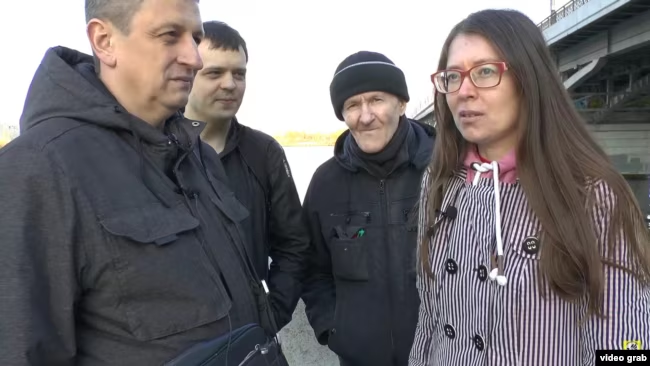
A 38-minute video was posted on the Free People of Voronezh channel on 16 April 2025. The video itself was viewed by less than three hundred people. In the video, four activists—Grigory Severin, Nadezhda Belova, Yuri Avsenyev, and Alexander Zheltukhin—discuss the news before jogging along an embankment of the Voronezh River. The genre is the “coffee klatch”: using the news as a springboard, the friends talk about the problem of alcoholism, apathy in society, increasing drug use, and the overall sense of doom and gloom.

Activists of the Telegram channel Free People of Voronezh:
Grigory Severin, Alexander Zheltukhin, Yuri Avsenyev, and Nadezhda Belova

Nadezhda Belova sums up the video’s content at the very beginning.

“To cut it short, everything is bad, but it will get worse. To put it in a nutshell, the situation in this place is at the terminal stage,” she says.

She argues that Russia is inevitably moving in the direction “North Korea”—toward a mothballed, rotten dictatorship, because Russians “somehow still support it and want to live in it.” Belova has reason to be pessimistic: even before the war, the state had charged her with “condoning terrorism” for comments she had made on social media in the wake of Mikhail Zhlobitsky‘s [suicide] bombing of the Arkhangelsk FSB. in 2020, a military court sentenced Belova to pay a fine of 400,000 rubles. She was on Rosfinmonitoring’s list of “terrorists and extremists” for several years, and her family had to leave their home village and rent a flat in Voronezh, as their fellow villagers did not support Belova in her fight against the unjust charges.

The video posted on the Telegram channel Free People of Voronezh on 16 April 2025

“Again, the whole of Voronezh is covered with drug adverts. The law enforcement agencies run protection for [the illegal drug trade], and if they didn’t run protection for it, there wouldn’t be these adverts. At my neighborhood Pyaterka [convenience store], right at the entrance, there is a graffito painted in color on the doorstep: ‘Buying a stash is like going out for bread,'” says Alexander Zheltukhin. In previous years, Zheltukhin was fined for picketing against Belova’s persecution and arrested for protesting in support of Navalny. “And if it was not protected, I would argue, by the selfsame FSB, who probably take a percentage from it—”

“Watch out! You are discrediting the FSB,” Belova says, interrupting him. “I don’t agree! It cannot be!”

Caveats and omissions run through the entire conversation. The activists know that any free speech is potentially dangerous in today’s Russia, and they try to cover their bases whenever possible. (Spoiler: it didn’t work).

“They say it’s impossible not to confess”

A few days later, on 22 April, police raided the homes of all four people involved in the run, as well as those of other Voronezh activists. Searches were done at eight locations, allegedly connected with Free People of Voronezh. In most cases, the law enforcers acted extremely harshly. They used handcuffs and stun guns, beat people, intimidated the activists and their families, and emotionally abused them.

A photo posted by Nadezhda Belova

All the members of Belova’s family were shot with a stun gun. Belova later posted photos of her own bruises and the bloody marks on the bodies of her husband and son on Facebook. The police confiscated all their electronic devices and turned upside down their rented flat, which the landlady demanded that the Belovs vacate immediately after the search. The police threatened to send the son, a university student, to the war, and after the search, a policeman recorded a repentant video featuring Belova.

“Off camera, the [policeman beating Belova’s husband] says, ‘Do you support the [special military operation]?’ I say, ‘Yes.’ He says, ‘Do you support Putin?’ I say, ‘Yes.’ It’s light fare, but disgusting, especially when I saw a stun gun pressed against my son’s leg,” Belova told Okno.

The police recorded similar video “confessions” by several other people [caught up in the raids].

After the searches, Zheltukhin ended up in hospital with five broken ribs and several damaged vertebrae. He told OVD Info that he had tried to escape from the “punitive operation” and fell from the roof of a village house: “I broke my ribs when I fell, apparently, and they hit me [on those ribs]: it hurts a lot.” The police put a bag over his head and shocked him with a stun gun. His friends later photographed Zheltukin at hospital: his face was covered with bruises.

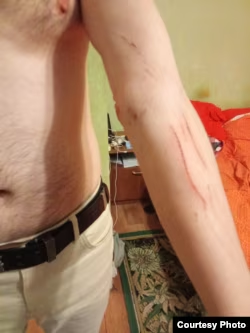
Fyodor Orlov, 36, was also beaten; after the experience, he says that he “did it all to himself.” He inflicted all the bruises and abrasions on himself, blindfolded himself with a scarf and sat like that for two hours, and fell into a briar bush on his own; there are photos of his back, entirely covered with flecks of blood. “Then someone—that is, I—drew a sex organ on my bald head just for fun,” he told OVD Info. The law enforcers also threatened to cut off one of his fingers, leaving behind telltale scratches.

Fyodor Orlov’s finger

“It was quite rough. As rough as possible, to the point that they say that now they understand why people confess to crimes they did not commit. Because, they say, it’s impossible not to confess. Orlov has several hundred stun gun marks [on his body]. Several hundred! They drove him into the woods. He thought they were taking him there to kill him,’” says Pavel Sychev, 38.

Sychev is a Voronezh activist and political consultant. He knows the administrators of the Free People of Voronezh channel from his past work as an activist: they crossed paths at pickets, but do not keep in close contact. Sychev’s home was also searched on 22 April, but there was no violence.

[The police] search my home, as a rule, without breaking the law, and they never use force against me or my family. They have been coming to my home every year since 2022. These are just routine searches. I have always been searched as a witness in criminal cases to which I don’t even have an indirect connection,” says Sychev. “There is a federal case [for example, the case against Grigory Melkonyants and other activists of the Golos movement—Okno], and they do a series of searches all over the country, and they come and search my house for good measure.”

“Evil loves silence”

It is unlikely that the new series of searches was occasioned by the latest video posted on the Telegram channel. Our sources suggest, rather, that the reason for the raids was that Free People of Voronezh constantly writes and speaks about people convicted on charges of high treason and terrorism (for sabotaging railroad switch boxes, cell towers, etc.). The channel admins treat these people as anti-war resisters. For law enforcers, on the contrary, they are criminals convicted of violent crimes.

The formal pretext for the series of searches on 22 April was the criminal case, on charges of repeated discrediting of the army, brought against Grigory Severin. As follows from the indictment, while serving his sentence in a penal colony [he had been sentenced to two and half years in prison for “publicly calling for extremism”; he served his time and was released last autumn—Okno], Severin discredited the Russian armed forces. After the search, he was detained and placed under arrest.

Sychev believes that this criminal case was “canned.”

“You see, in Russia we have the practice of ‘desk drawer cases.’ Meaning you already have a criminal case against you: the entire case file is ready in advance, and it is lying in a desk drawer, waiting for its day to come. In the case of Severin, his first case was also ‘in a desk drawer.’ When he was arrested, it transpired that the entire case file had been readied a year earlier.”

It is not known what prompted the police to pull the case file from the drawer right now. But the fact that Severin faces prosecution does not surprise Sychev in itself.

“Everyone who knows Grigory, even in passing, realizes that he is a man who will not stay quiet. If anyone asks him directly how he feels about this or that situation, he will answer directly, even if the answer risks criminal charges. He is a man who will always try to prove to everyone the viewpoint which he espouses and defends. As far as I know, the first ‘discrediting of the armed forces’ case against him came from his explaining his philosophy of life to traffic police officers who had pulled him over. The second charge came from telling his cellmates about his stance. This in the order of things for him: he does not keep silent; he speaks openly, directly. So it was a matter of time. When a person speaks openly about a very dangerous and sensitive topic—and in our country the ‘special military operation’ is a sensitive topic—there are many chances that sooner or later they will be prosecuted.”

On the same day, a criminal case was opened against 65-year-old activist Yury Avsenyev, another person involved in the run along the Voronezh River embankment. His home was also searched on 22 April, but he was released on his own recognizance. Avsenyev is suspected of “publicly calling for extremism.”

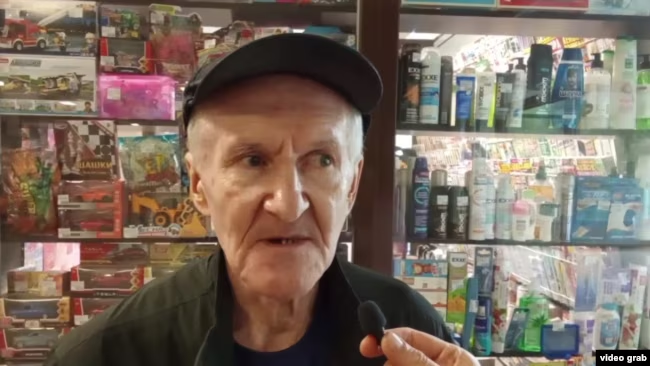
Yuri Avsenyev

The Voronezh activists who fell victim to the police brutality have not yet worked up the courage to file complaints, and they fear excessive publicity.

“They are really spooked,” says Pavel Sychev. “The information I have now is that they will not file torture complaints, but I don’t know, maybe someone will persuade them to do it. They are very much afraid that if they do it, the law enforcers won’t be reprimanded in any way, but will just come and take revenge on them. They are all convinced that they will be killed. I told them that evil loves silence, and if you don’t react now, there is a greater chance of a repeat than if you do. But they said it’s very easy to judge from the outside when you haven’t been tortured. ‘We are afraid that they might do something to us,’ [they say].”

Our sources note that such official lawlessness had not previously occurred in Voronezh. Usually, searches at the homes of political activists and arrests were carried out by the book, without violence. The only widely known case of official lawlessness ended in criminal charges against the police officers involved and monetary compensation for the victims. In May 2018, criminal investigators Sergei Kosyanenko and Oleg Sokolovsky tortured university students Maxim Grebenyuk and Sergei Troyansky, hoping to force them to confess that they had stolen a mobile phone. The students were held at Police Station No. 4 in Voronezh’s Comintern District for six hours in handcuffs and strangled with a plastic bag. They refused to incriminate themselves, and afterwards they documented their injuries and filed a torture complaint with the Investigative Committee. In 2021, Grebenyuk was awarded one million rubles, and Troyansky, 500,000 rubles, in compensation for their suffering.

The Voronezh police’s current brutality may be due to the proximity of the front, suggests a source who requested anonymity. The fact is that, since the start of the full-scale invasion, Voronezh law enforcers have regularly been seconded to the so-called new territories, the occupied Donetsk and Luhansk regions.

“There are quite big problems with the law in those ‘new territories.’ And the practices that are used there are inhuman, I think. When they come back here, to their native land, they simply do not reconfigure themselves,” says our source, who is not connected with the Free People of Voronezh Telegram channel. “They consider themselves above the law. They think that they are involved in a good cause, and they can torture bad people for the sake of the good cause. When a person has tried their hand at it once, when they realize that they can get away with it absolutely scot-free, then it is quite difficult to put the brakes on, and it will grow.”

Source: “‘Terminal stage’: Voronezh law enforcers brutally beat activists during searches,” Okno, 29 April 2025. Translated by the Russian Reader

Ruslan Siddiqi: “You Could Call Me a Partisan”

A Russian and Italian citizen, an electrician from [the Russian city of] Ryazan, an industrial tourist, a bike traveller, an anarchist and a partisan — all this can be said about 36-year-old Ruslan Siddiqi. In the summer of 2023, he dispatched four drones with explosives to attack the Diaghilev military airfield near Ryazan, and in the autumn, he decided to act “from the ground” — damaging railway lines with two bombs and derailing 19 freight train wagons. Siddiqi is currently awaiting trial in a Moscow pretrial detention centre, with the prospect of a life sentence hanging over him. In these letters to Mediazona, he explained why he decided to “take up explosives”, how a fox spoiled his first sabotage, and how torture by field telephones (known as “tapiki” in slang) differs from torture by tasers. (The security forces used both against him.)

The letters were published by Mediazona in Russian, and translated by Giuliano Vivaldi. Please copy and repost.

Attacking a military airfield: “I took four drones with explosives to the field on a bicycle”

The hum of the Tupolev Tu-22 and Tu-95 aircraft outside my window coincided with the strikes on Ukraine, and this determined my choice of target: Diaghilev military airfield, just ten kilometres from home. I lived with my 80-year-old grandmother and understood how hard it was for the elderly and sick without heat and light in winter. As I filled a tub with hot water, I thought about those deprived of basic amenities a thousand kilometres away, because of someone’s geopolitical ambitions. Yet at the same time they talk about “fraternal nations” and say that “Russia is not at war with civilians”.

Ruslan Siddiqi in court. Photo: Solidarity Zone
Continue reading “Ruslan Siddiqi: “You Could Call Me a Partisan””

Victims Too

For years, survivors of Assad and Russia’s chemical attacks in Syria were silenced. Today, we uncovered shocking evidence that many of these witnesses were forcibly taken to Moscow and pressured to lie – part of an extensive cover-up by the Russian state.

Now, with Assad no longer in power, these survivors are free to speak. In this video, they reveal the horrific reality of the chemical attacks – scenes of unimaginable suffering, children foaming at the mouth, and entire families wiped out.

As someone living in Ukraine, I’ve witnessed Russia’s war crimes firsthand – from white phosphorus to targeted civilian attacks. The patterns of brutality are clear, stretching from Syria to Ukraine.

This story exposes the disinformation campaign that echoed globally, amplified by figures like Aaron Maté and platforms like RT. But the truth matters now more than ever.

Watch as the survivors share their experiences and shed light on the true scale of Russia’s actions – crimes that continue to affect lives across multiple continents.

Source: Caolan Robertson (YouTube), 5 January 2025. Thanks to Michael Karidjis for the heads-up.


“Muskovites [sic] celebrating the New Year on Teatralnaya Square.” Photo: Yevgeny Messman/TASS (via Moscow Times)

Victimhood can be a tricky thing. Nobody doubts that ordinary Ukrainians are victims of this war. Russia’s political opposition, in exile, prison or dead, are also viewed as victims. But what of the country’s silent majority? What of the millions who stayed in Russia, kept their heads down and focused on living their ordinary lives, rather than the war and the online space it occupied?

Many things have changed in Russia since 2022. But one of the main constants has been the average Russian citizen’s desire for peace and ending the war. The majority have not been militantly opposed to or cheering the war effort on. Instead, they have been focused on living in the present, trying to salvage what remains of normality and longing for its imminent return – what some are calling the silent majority.

They are not happy with the war or satisfied with the current situation and have few ways of expressing that. Many do feel guilt on a certain (very private) level.

One thing hard not to notice in Russia throughout the conflict is how that silent majority has simply hunkered down and carried on. The war is very much in the background now. When I leave my building every morning, the same middle-aged man is defrosting his car, mothers are walking with strollers and children are heading to the local school.

When you eavesdrop on their conversations or stop to say hello, they sound normal – not like indoctrinated quasi-fascists, as some scholars are suggesting. They sound like any other school child whose teacher is just trying to get through the copious material thrown at them by the school director. The mothers just want their children to grow up in safety and comfort. Cheering on an expensive war pushing up the price of baby food is hardly a means of achieving that.

The war may come to an end in 2025. Negotiations are likelier than at any point since early 2022. And make no mistake, a peace agreement is inevitable. When the war ends, however, on whatever terms, Russia and its population of 146 million will still be there. It will not disappear or suddenly go away. The man defrosting his car as I write these words is not likely to have a huge epiphany when it does. His life has hardly changed since 2022. The increased number of women publicly wearing hijabs in our city is not doing so as a passive sign of resistance.

By living here, watching life unfold how it does, the more one cannot help but think something that many in the West will find unpopular. The war is not their fault. Tens of millions of innocent Russians are victims too. Their freedoms have been curtailed, their movements and opportunities restricted. Did they deserve that by virtue of where they were born? A classic liberal would argue not.

Like millions across the world, the average Russian is just trying to feed and raise their families, and get through the month. Many colleagues in academia have questioned from the comforts of the West, their tenured positions and with nothing to lose why many Russians do nothing to oppose the regime. What they neglect when arguing from their moral high ground is that those people I spoke of earlier do have a lot to lose being critical online. They have about as much power to topple the regime and change its course on the war, as the average Westerner does.

There will be blame to go around. Russian officials and the security apparatus, who carried out the decisions to invade Ukraine and suppress its own population, are obvious contenders. On the Ukrainian side, President Volodymyr Zelensky and his generals will have to answer for decisions they made. Kyiv’s Western allies clearly could have done more to support Ukraine, yet did not. 

Russia’s silent majority will not want to be blamed and they must not be. They personally did not harm anybody or choose the war. Unlike routine acts of everyday life, the war was not their personal fault or responsibility. Collective guilt is too controversial; thousands protested, millions left and staying silent was, in its own way, an act of defiance by refusing to enter the discourse. Guilt by association is also not a tenable position. Not every Soviet citizen was responsible for the Stalinist Terror. Not every Russian citizen can be responsible for the war, especially not on the basis that they refused to cheer on Ukraine and their own country’s defeat.

Blaming those who are faultless will only cause resentment where there was none to begin with. In the long term, it will not make the world safer or more peaceful. Then comes one of liberal democracy’s sore spots that Ukraine, Georgia and even Moldova will have to reckon with on its European journeys: those people in the silent majority will still have a right to have an opinion – as will the pro-Russian segments of their populations. Dismissing these views or people will not make them, nor those in power, more rational.

If the West were serious, it would try to reach out to Russia’s silent majority, who can be won over. The Russian population at large do not hold the same positions as those in and around the Kremlin currently. Most of the population wants Russia to be an open, peaceful country, especially to the West. Make no mistake, westerners, their companies, money and popular culture will be welcomed back with open arms one day. Moreover, this part of Russian society will want to be welcomed back, too. Not doing so only will push the Kremlin into a closer alliance with the likes of China and North Korea.  

Moreover, it is absolutely naive to assume that Russia’s social and economic problems will be fixed automatically by the sudden absence of Putin and the return of democracy. Although it stands a much better chance, we have been here before and there is no guarantee of success. Democracy will need to involve this silent majority beyond Moscow and the big cities – felt on the local level – seen to be actually working and fixing the people’s problems. If not, that silent majority will simply resign themselves, remaining disillusioned and ambivalent.

Gleb Pavlovsky once predicted what the end of the Putin regime would look like: it would collapse in a day and be replaced by something exactly the same. He may be proven right. If he is, that is the fault of those in power, not Russian society.

Source: Anonymous, “Russia’s Silent Majority Are Victims Too,” Moscow Times, 1 January 2025. This is not a parody, apparently, although it reads like one. ||| TRR


Pretrial Detention Center No. 2 in Taganrog (Rostov Region) was a place where, until 2022, minors, women, and mothers with children were detained. After the outbreak of full-scale war in Ukraine, Russian security forces cleared the detention center to make room for Ukrainian army soldiers and other prisoners of war, including the defenders of the Azovstal steel plant.

Pretrial Detention Center No. 2 gained a reputation as a gruesome torture camp for Ukrainian detainees. Many POWs in other detention centers are threatened with being sent to Taganrog and so forced not to oppose the prosecution. Few people have come forward to talk about the torture.

The story of Ukrainian Dmytro Lisovets was one of the first indications that the detention center in Taganrog had been turned into a torture camp. Lisovets had tried to flee with his family from occupied Mariupol, but failed to get through a filtration point in the Rostov Region. A former member of Ukrainian volunteer units, Lisovets was sent to the Taganrog detention center without being assigned any procedural status.

Lisovets’s lawyer told Mediazona that the Russian authorities “don’t pull any punches with the Ukrainians in this detention center”: “They burst into the cells in masks and beat everyone indiscriminately.” His client was also beaten and tortured in order to force him to admit that he had been involved in the hostilities. Consequently, Lisovets was sentenced to sixteen years in prison.

Once they were detained at Taganrog pretrial detention center, the Ukrainians were completely cut off from the outside world. According to one of the lawyers defending the prisoners, they were not allowed to talk to their clients in private, only in the presence of a police investigator. Moreover, the detention center staff forced the detainees to sign papers waiving their right to communicate with their defense lawyers.

The detainees were able to talk about the torture only after they had been transferred to other pretrial detention facilities.

“We were thrown from the back of KamAZ trucks—our hands tied and eyes blindfolded—and forced to line up against the wall under a hail of blows, where the beatings continued with hands, feet, batons and electric shockers,” one of the captured Ukrainians told his lawyers.

He also said that “at the offices” (that is, during interrogations) he would be bound with a leather belt, placed on the floor, and have a sandbag placed on his chest to make it harder for him to breathe. He would then be beaten with a rubber truncheon and tortured with a stun gun. “It was during such ‘procedures’ that [the Russians] extracted confessions of ‘war crimes,'” the Ukrainian wrote.

There were also mass beatings, including during rare walks outside in the yard. “At every turn of the walking route, a special forces soldier was stationed and was obliged to hit [the prisoners] with a stick,” said one of the convicts. Some officers were “humane” and did not beat wounded prisoners ands prisoners ofter fifty. “The attitude toward us in captivity depended on who was on duty in the prison. There were wardens who would beat all the prisoners,” said Yuriy Hulchuk, an Ukrainiian marine who spent time in Pretrial Detention Center No. 2.

There was no decent food in the detention center either. One of the defense lawyers of the Ukrainian prisoners, speaking on condition of anonymity, said that once a day the wardens “would feed them cabbage broth and quarters of black or white bread.” Ukrainian military officer Artem Serednyak was detained at the Taganrog detention center from September 2022 to the summer of 2023, during which time he lost twenty-two kilograms.

One of the prisoners calls Pretrial Detention Center No. 2 “hell with all its demons,” where it is scary to return: “Even the definition of ‘concentration camp’ would be too mild for Pretrial Detention Center No. 2,” he said. Human rights activists say that there was also sexualized violence against prisoners at the detention center: for example, prisoners had rubber truncheons shoved up their anus.

It was not only military personnel who were locked up in the detention center. For example, Ukrainian journalist Victoria Roshchyna, who was detained by the Russians in the occupied part of Donetsk Region, was sent to the Taganrog pretrial detention center for a year. She died last year: presumably, she was about to be exchanged for Russian prisoners. She did not have time to provide details about her life in the detention center. It is only known that Roshchyna was held in solitary confinement from May to September 2024.

The Russian authorities have not reacted in any way to the reports of torture. Russian human rights commissioner Tatyana Moskalkova visited the pretrial detention facilities where Ukrainian prisoners are held, but she did not report poor detention conditions either. Human rights activists say that the administrators of the detention centers would get ready for such inspections. “[T]hey prepared for this day: everyone was given new clothes, the grass was painted, the lawns were trimmed, and so on. They even gave them [the Ukrainian prisoners] biscuits, which they were extremely happy about, because the usual diet was very meagre,” [Irina Soboleva], one of the lawyers defending Ukrainian prisoners, says.

Source: “There is a torture prison for Ukrainians in Taganrog,” WTF? newsletter (Mediazona), 9 January 2025. Translated by the Russian Reader


In the age of forever war, the use of mercenaries, paramilitary forces, and irregular troops have become increasingly common on the battlefield. But now Russia is resorting to luring unwitting civilians from Yemen and other countries across Asia with little to no military experience to fight alongside its troops in the war in Ukraine.

As reported by Ali Younes, a recruitment network run by a high-ranking Yemeni political and military official with ties to the Houthi government is tricking young Yemeni men desperate for jobs into signing employment contracts for work in Russia, only for them to find once they arrive that they cannot leave and are forced into military training camps and sent to the frontlines.

As the war in Ukraine approaches its fourth year with no end in sight, Russia has turned to recruiting unwitting young men from Yemen and other Arab countries to fight alongside its troops on the front lines. The men are lured under false pretenses, they tell Drop Site News, with promises of lucrative jobs and opportunities for migration, unaware that they are being forcibly recruited as mercenaries to fight in a foreign war despite having little to no military experience.

Two men who fell victim to the scheme told Drop Site they found out they were being sent to fight with the Russian army in the Ukraine war only once they had landed in Russia. Drop Site obtained a copy of an employment contract, corroborating photos and video, and spoke with a human rights organization that has documented the practice.

Mohamad, a Yemeni national who declined to give his last name for security reasons, said he was working in a restaurant in Oman in July when he was approached by Abdul Wali Al Jabri, a high-ranking Yemeni political and military official. Mohamad said they told him about job opportunities in Russia with a good salary and a hefty signing bonus and that he would be working for a civilian company according to his skills. He was eventually convinced to sign up through a company that recruits laborers in Yemen and Oman owned by Al Jabri, who is a general in the Yemeni armed forces of the Houthi government and a member of parliament in Sanaa.

Mohamad said the agreement between the Yemeni recruits and Al Jabri was a monthly salary of $2,500 with a signing bonus of $20,000. A copy of an employment contract written in both Arabic and English obtained by Drop Site lists the Al Jabri General Trading & Investment Co. SPC and Abdul Wali Al Jabri as the company representative. The contract outlines the company’s role in arranging for jobs in Russia “in the military, security, or civil field, based on…qualifications, experience, and capabilities” and says the contract ends after the signee “obtains Russian citizenship.” Mohamad said he was never told that he would be sent to fight for the Russian army in Ukraine and there is no indication in the contract.

Al Jabri has a fee built into the contract, whereby the signee is obliged to pay him $3,000 upon getting employed in Russia. Al-Jabri did not respond to repeated messages of inquiry from Drop Site for this story. However, Al Jabri did respond to questions posed by Tawfik Alhamidi, a Yemeni lawyer and human rights defender based in Geneva, Switzerland who runs the SAM Organization for Rights and Freedoms, and has documented the forced recruitment of poor young Yemeni men into Russia’s war with Ukraine.

Al-Jabri defended the practice to Alhamidi, saying he owns a “travel company” and that people in Yemen have asked him to “arrange for them to travel to Russia and join the army in order to obtain Russian citizenship and earn money to spend on their families back in Yemen.”

He dismissed criticism, adding that “he obtained a Russian approval for the Yemeni men to travel to Russia with good salaries but some political parties in Yemen who are currently fighting Ansar Allah [the Houthis] became worried that they might lose their soldiers to go fight with Russia and therefore created a social media storm over this issue.”

In September, Mohamad traveled to the Russian city of Nizhny [sic] via Dubai. He shared a video of himself with Drop Site on the plane, holding his boarding passes. He and a group of around 20 Yemeni men stayed in Nizhny for 24 hours before being shipped to the city of Rostov, a command base for the Russian army near the frontlines with Ukraine. They also discovered that their salaries were just $300 a month with a meager signing bonus.

Mohamad said that in both Nizhny and Rostov the Yemeni men were met by Russian soldiers. Mohamad said that they were forced to sign another contract, written in Russian, that obliged them to serve in the Russian military. “We were forced to sign contracts in the Russian language that we didn’t understand to serve in the Russian military,” Mohamad said. “We were very afraid.”

He said that in Rostov his group protested to the Russian officers that they didn’t want to fight in the war and demanded to go back to Yemen but they were prevented and ended up being forced to stay in Russia for months where they were forced into military training camps. Mohamed also shared a photo of a Yemeni recruit in full military fatigues and combat gear holding an assault rifle and another of a dog tag written in Cyrillic.

“We were trained by an Arabic-speaking Egyptian Russian military officer who told us that we are in Russia to fight for the Russian army and that we will be deployed to the front lines and not working as civilians,” Mohamad said. He said in the camp he met many men from Iraq, Syria, and Sudan and elsewhere receiving military training. Mohamed was finally able to return to Yemen at the end of October and he spoke to Drop Site from Sanaa.

Another video shared by Mohamed [sic] with Drop Site shows a group of about 10 Yemeni men inside a tent with wooden bunk beds in Nizhny. In the video, one man says, “We came from the sultanate of Oman for civilian work, everyone according their skills,” pointing to each one in turn, he adds, “This man is a metalworker, this man works with hydraulics, this man is an electrician, this man is a driver, this man works with electrical equipment. We are all civilians who work civilian jobs.” He goes on to say they were taken from the airport to Nizhny and they were “terrorized by armed soldiers and forced to sign contracts.” Pointing to a pile of camo backpacks on the floor, he says they were being taken to a training camp. “We are civilians and we know nothing of this,” he says in the video and calls on the Yemeni government to help them. “We are sons of Yemen and we fell into a trap.”

Drop Site also communicated via WhatsApp messages with Jalal, another Yemeni man recruited by the same network who is currently deployed as a soldier fighting for Russia in Ukraine. He told Drop Site he was lured into coming to Russia to escape poverty with the promise of a large salary and signing bonus as well as Russian citizenship. He said he ultimately decided to stay and fight in the war in the hope that he could earn enough money to be able to return to Yemen with savings as well as to possibly obtain Russian citizenship.

Alhamidi characterizes the recruitment practice as exploitative and a human rights violation.

“Dire poverty conditions in Yemen enabled human trafficking and recruitment networks to proliferate and lure young men to go to Russia under false promises of civilian work and high salaries,” Alhamidi told Drop Site, adding that Yemen’s laws contain many loopholes that [allow] Yemeni nationals to join foreign armies as mercenaries without being criminalized. “This has enabled powerful men in Yemen with connections to the Houthi government and Russia to mislead hundreds of young men into traveling to Russia to fight in Ukraine.”

report by SAM published in November based on interviews with several Yemeni nationals who who were recruited by Al-Jabri and traveled to Russia titled, “With False Promises of Jobs and Attractive Salaries: Recruitment Networks Force Yemeni Youth into the Russia-Ukraine War,” found that: “The forced recruitment of Yemeni youth into the Russian-Ukrainian war through coercive networks constitutes a clear violation of international humanitarian law and human rights and rises to the level of human trafficking… The organization reported that once recruits arrive in Russia, they are subjected to severe abuses, including being forced to fight under harsh and inhumane conditions, being deprived of food and medical care, and suffering injuries or death from indiscriminate shelling on the battlefronts.”

According to Alhamidi, Al Jabri has traveled to Russia numerous times and has obtained visas to Russia for thousands of Yemenis to lure them into traveling there and forcing them into military training camps, though it is unclear how many have actually made the trip.

Similar recruitment networks in other countries have lured unwitting civilians to Russia with promises of work or other opportunities and then forced them to serve in the Russian army. One human trafficking network in India sent dozens of Indian nationals to Russia for combat training before being deployed to the front. Citizens of Nepal and Sri Lanka have also been illegally recruited in similar ways to fight for Russia in Ukraine.

Source: Ali Younes, “Russia is luring unwitting Yemeni civilians to fight in Ukraine,” Drop Site, 10 January 2025

Igor Paskar: The Case File

Igor Paskar has been sentenced to eight-and-a-half years’ imprisonment for two anti-war actions. In June 2022, in the centre of Krasnodar, Igor set fire to a “Z” banner [a symbol of support for the Russian military]. Two days later, he protested at the local office of the Federal Security Service (FSB), by throwing a Molotov cocktail at the stone porch of the building, while his face was painted with the colours of the Ukrainian flag. The FSB and the courts defined this as “vandalism” and an “act of terrorism.”

Igor Paskar

Igor Paskar was born in Nikolaevsky village, a working-class community in the northern part of Volgograd Region. He went to school there. After doing national service on building sites in Samara, he worked as a courier, and for haulage and construction companies.

Paskar had three previous convictions. The first time he went to court, at the age of 22, was for possession of a few grams of cannabis: he was given a five-year suspended sentence. “In the milieu in which I grew up, half of the people I knew – if not more than half – smoked cannabis. It was not considered to be asocial or objectionable. But the motherland has decided that, in contrast to drinking alcohol, that’s serious criminal behaviour,” Igor said. Three years later, Paskar was in court again, and this time was sentenced to two years in prison for the theft of, and possession of, drugs. He points out that, from the moment of his first time in court, the police searched him regularly, and said quite openly that they were looking for weed. Igor’s third time in court was in 2006, when he received a one-and-a-half year suspended sentence for possession of narcotics. “That’s how I came to the attention of our law enforcement agencies. And from then on, I didn’t have a life,” he recalled. Given these circumstances, in 2013 Igor moved to Moscow.

In the capital, Igor continued working in various jobs, and helping his mother, until she died in 2017. This was around the time his social conscience took shape.

“As far back as I remember, even when I was very young, I was always concerned about what was happening in our country. Our motherland, in the guise of the Russian state, always seemed like a stepmother to me, not a real mother. I was never indifferent to the pressure that the state brought to bear on those who dissented or disagreed,” Igor said in court.

In 2020 Igor went to the Belarusian embassy to express solidarity with those who protested after the blatant falsification of the results of the presidential election, in which Belarusian president Alyaksandr Lukashenko gave himself 93% of the votes. “That summer and autumn, in 2020, when Belarus’s tinpot dictator was pushing his people around, I was still hoping that here in Russia we would avoid that kind of thing,” Igor says.

In 2021 Igor participated in a big protest staged after the arrest of Alexei Navalny. He was detained, brought to court and fined 10,000 rubles.

The all-out Russian invasion of Ukraine in 2022 decided things for Igor once and for all. He decided to undertake a symbolic anti-war action, to support people in Ukraine. On 12 June 2022, the Russia Day national holiday, Igor set fire to a pro-war banner displaying the letter “Z” and the militarist slogan “We don’t abandon our own.” However, the action did not attract the attention Igor had hoped it would.

He decided on a second protest. On 14 June he threw an improvised Molotov cocktail at the stone porch of the FSB offices in Krasnodar. It set fire only to a plastic mat. As Igor later stated in court, his action was entirely symbolic and posed no threat to anyone’s life. For Paskar, the action was an expression of solidarity with people in Ukraine, and a signal to those in Russia who did not support the war that they were not alone. My action was peaceful, and aimed to show all who opposed this monstrous war that they were not isolated, and to show our Ukrainian neighbours, that we [in Russia] have not all been turned in to zombies by state propaganda,” he said in court.

Igor was arrested a few minutes after throwing the Molotov cocktail at the FSB building. “I stood outside the building and waited for them. I made no attempt to hide or to evade arrest,” Igor recalled in court. The police arrived, asked if it was him who had started the fire, and, when he confirmed that it was, they put him in handcuffs and took him in to the FSB premises.

“There were people in uniform, perhaps six to eight of them,” Igor said. “They snapped a photo of me on a phone: that picture is in the case file, and it shows that I had no injuries. Then they asked me what I wanted, why I did that. I answered that I wanted to make use of Article 51 of the Constitution, that gives you the right not to incriminate yourself. They obviously found that funny, because a split-second later a sack was put over my head. The next few hours were among the very worst of my life.”

Continue reading “Igor Paskar: The Case File”

In Plain Sight

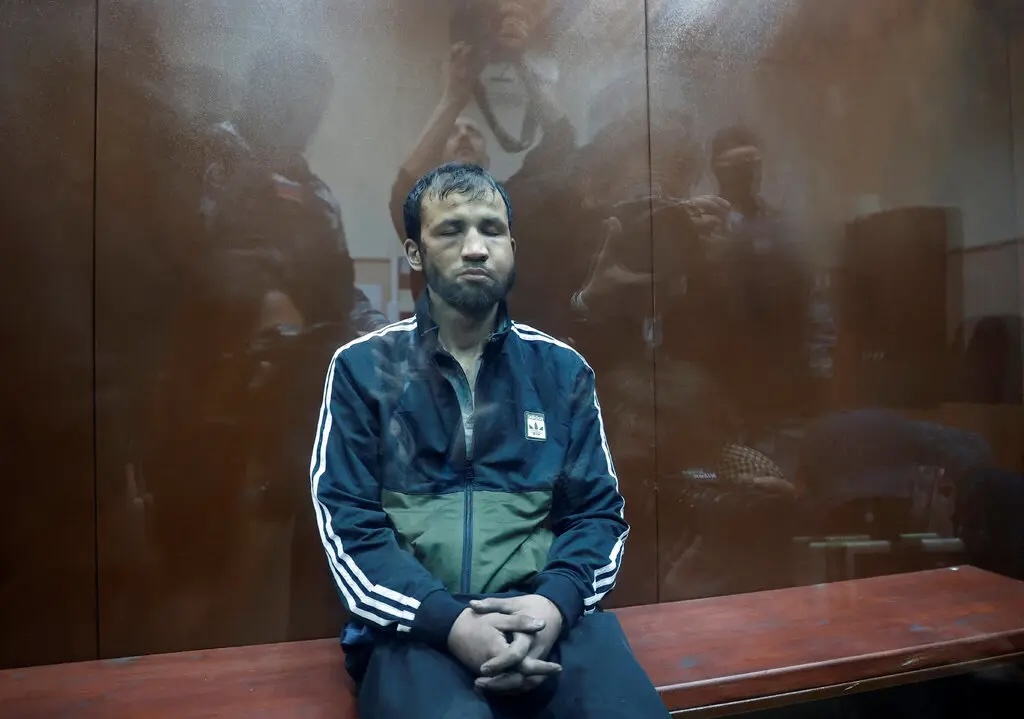
Accused terrorist Shamsidin Fariduni, with bruising on his face, inside a Moscow courtroom.
Photo: Yulia Morozova/Reuters via the New York Times

It seems that one of the consequences of this tragedy [i.e., the terrorist attack on the concert hall in suburban Moscow] has been the legalization, or legitimization, of torture. Torture existed before, but it was concealed and formally condemned. Now torture is openly praised and flaunted, and state institutions, including courts, do not react in any way. Another step towards fascization.

Source: Sergey Abashin (Facebook), 25 March 2024. Translated by the Russian Reader


Warning: this newsletter contains numerous descriptions of violence and torture.

People are tortured every day in Russia. For a long time we have been hearing about torture in penal colonies and police departments from victims and human rights activists. Mops and electric shockers have been mentioned in reports in the independent media and in the accounts of people who were subjected to violence, but the Federal Penitentiary Service (FSIN) and the police themselves have usually denied the accusations. Even in today’s Russia, however, the courts have periodically tried to imprison law enforcers who have tortured people, such as those implicated in the Karelian penal colony case, the Yaroslavl case, and the Saratov prison hospital case.

The terrorist attack in suburban Moscow has changed everything.

On 22 March, gunmen killed at least 137 people at the Crocus City Hall concert venue outside Moscow. They set fire to the building and left before the police arrived. Law enforcers have already detained suspects, and the Z bloggers have been salivating over the photos and videos of their abuse at the hands of the authorities. Never before have we had such flagrant acknowledgement of torture.

“The law enforcers have often covered their tracks by sweeping stories of torture under the rug, and we were told that there was no torture, that the reports were nonsense,” Sergei Babinets, head of the Crew Against Torture, said in an interview with Mediazona. “But since yesterday it seems as if there is a path to making torture a little more public.”

Dalerdzhon Mirzoyev (whom propagandist Margarita Simonyan dubbed the “ringleader” of the terrorists) was brought to his arraignment hearing with bruises on his face and remnants of a bag around his neck. He had no bruises at the time of his arrest, and the bag could have been used by law enforcers to strangle Mirzoyev. When the judge announced the pretrial restraint measures (Mirzoyev was remanded in custody to a pretrial detention center) Mirzoyev could not stand up. Instead, he leaned against the wall of the “fish tank” in the courtroom.

Saidakrami Murodali Rachabalizoda was brought to the hearing with his head bandaged. A law enforcer had cut off his ear when he was detained and tried to make him eat it. Neo-Nazi Yevgeny “TopaZ” Rasskazov of the nationalist subversive group Rusich announced an auction for the knife that was allegedly used to cut off Rachabalizoda’s ear.

The third detainee, Shamsidin Fariduni, was also apparently tortured. Telegram channels associated with law enforcement circulated a photo of Fariduni lying on the ground with his pants pulled down and law enforcement officers standing over him. There are wires from a field telephone attached to his groin. Such wires are used to electrocute detainees. (They have been used, for example, on detained Ukrainians in the occupied territories.) And someone is also stepping on Fariduni with a foot shod in an army tactical boot. Fariduni arrived in court with a swollen and beaten face.

Muhammadsobir Faizov. Photo: Alexandra Astakhova/Mediazona

Finally, the fourth detainee, Muhammadsobir Faizov, came to the court from the intensive care unit in a wheelchair. He could barely speak, and was hooked up to a catheter and a urinal. One of his eyes was injured. For the duration of the hearing, his doctors—two women in ambulance corps uniforms who had arrived with Faizov—were asked to leave the courtroom.

Why is this happening? Sergei Babinets argues that law enforcers could have been affected by the absence of major terrorist attacks in recent years.

“Many people were simply not ready for it—not ready emotionally, not ready psychologically, not ready on various fronts. And people may have started to lose their nerve due to this. That’s why there have been calls to reinstate the death penalty, to locate all the guilty parties and execute them, for example,” he said.

Аccording to Babinеts, Russian aggression in Ukraine has also played a role.

“The normalization of violence may have aggravated the situation with torture. We can see that law enforcement officers are really starting to let themselves go more,” he said.

Babinets adds, however, that there is no point to this violence.

“Torture most often leads to the torturer obtaining the information he wanted to obtain initially,” he said. “If they want a person to confess that they had been working, for example, for the Ukrainian army, they can be tortured until they confess. It is impossible to effectively investigate crimes in this way.”

Source: “Torture has gone public,” WTF? newsletter (Mediazona), 25 March 2024. Translated by the Russian Reader


It’s more than two decades since I read the late Stanley Cohen’s ground-breaking States of Denial: Knowing About Atrocities and Suffering (2001). In the introduction, Cohen recalls his own experiences growing up in apartheid South Africa, when he asked himself why his own outrage at the injustice he observed all around was not reflected in the society around him:

Why did others, even those raised in similar families, school and neighbourhoods, who read the same papers, walked the same streets, apparently not “see” what we saw. Could they be living in another perceptual universe — where the horrors of apartheid were invisible and the physical presence of black people often slipped from awareness? Or perhaps they saw exactly what we saw, but just didn’t care or didn’t see anything wrong.

Cohen went on to become a sociologist and a lifelong human rights activist. States of Denial was a valiant attempt to bring his discipline to bear on the subject of why people become become ‘everyday bystanders’ of atrocities who ‘block out, shut off or repress’ troubling or disturbing information to the point when they ‘react as if they do not know what they know.’

Some of these observations related to Israel, where Cohen moved in 1980. A Zionist in his youth, Cohen opposed the military occupation of the West Bank and Gaza, and became a strong critic of Israeli repression of the Palestinians. In his book, he describes his work with the Israeli human rights group B’Ttselem on the torture of Palestinian detainees and the obstacles it encountered:

Our evidence of the routine use of violent and illegal methods of interrogation was to be confirmed by numerous other sources. But we were immediately thrown into the politics of denial. The official and mainstream response was venomous: outright denial (it doesn’t happen); discrediting (the organization was biased, manipulated or gullible); renaming (yes, something does happen, but it is not torture); and justification (anyway ‘it’ was morally justified). Liberals were uneasy and concerned. Yet there was no outrage.

Cohen returned to the UK in 1996, and died in 2013, but were he alive today, I suspect he would have recognized the ongoing devastation of Gaza as a textbook example of the ‘politics of denial’. According to the latest figures from the United Nations Office for the Coordination of Humanitarian Affairs, the IDF has killed more than 31,988 people, most of whom are women and children, with another 7,000 buried in the rubble, and wounded 74,188. To put these figures in perspective, this February civilian casualties in Ukraine were estimated at 10,582 dead and 19,875 injured since the Russian invasion began on 24 February 2022.

So in just under six months, Israel has killed more civilians in Gaza than Russia has killed in two years. It has destroyed or damaged more than 60 percent of Gaza’s housing stock, 3 churches, 224 mosques, 155 health centres, 126 ambulances. Nearly 2.3 million Palestinians have been displaced, and 1.1 million people are facing ‘catastrophic levels of food insecurity,’ which threatens to become a famine.

All this has been done with the indirect support or direct collusion of the United States government, the European Union, and the British government. Despite the outpouring of rage and horror on the streets of so many cities across the world, liberal democracies that claim to uphold an international order based on human rights and universal moral norms have ‘known and not known’ what has been taking place in front of their eyes.

Many of these governments once railed against ‘dictators killing their own people’, and used atrocities and human rights abuses as a moral lubricant for liberal ‘interventions’ and ‘ humanitarian’ wars to prevent ‘massacres’ and ‘bloodbaths.’ Apart from a few tepid words of condemnation, when the obscenity of what is unfolding became too much to ignore, these same governments have enabled Israel to inflict incredible carnage on a mostly unarmed and defenceless population.

None of is taking place in secret. In February, Amnesty claimed that ‘Fresh evidence of deadly unlawful attacks in the occupied Gaza Strip…demonstrates how Israeli forces continue to flout international humanitarian law, obliterating entire families with total impunity.’ Israeli soldiers routinely post tweets and TikTok videos of themselves gleefully blowing up Palestinian homes, wearing Palestinian lingerie and women’s dresses, humiliating Palestinian prisoners made to strip down to their underwear, and generally exulting in the destruction.

[…]

Source: Matt Carr, “In Plain Sight: Atrocity Denialism and the Destruction of Gaza,” Matt Carr’s Infernal Machine, 26 March 2024

GOOP

Veterans of the special military operation and combat veterans will be able to teach the new subject “Fundamentals of the Security and Defense of the Motherland” in schools after undergoing retraining at the State University of Education (GOOP), according to Education Minister Sergei Kravtsov, who was speaking at a plenary session during the Russian national pedagogical forum “Memory Is Sacred.”

“A center for retraining veterans of the special military operation and combat veterans as teachers was created this year at GOOP to implement a new subject area with a priority on practical training in the new subject ‘Fundamentals of the Security and Defense of the Motherland,'” Kravtsov said.

The official logo of the State University of Education (GOOP)

According to the minister, the basic military training module would be enhanced in this subject, which is being implemented as part of the “Fundamentals of Health and Safety” curriculum. The new subject would be trialed this year, and it would be taught in schools beginning in the next academic year, he added.

On June 30, Kravtsov said that, as part of the subject, schoolchildren would gain knowledge of the “role the defense of the country plays in its peaceful socio-economic development and the current complexion of our our Armed Forces.” Schoolchildren would be introduced to concepts such as “military duty” and “military service.” The minister emphasized that the load on schoolchildren would not increase—the number of classroom hours would remain the same.

GOOP’s acting rector Irina Kokoyeva told Vedomosti that the Apex Center for Military-Patriotic Education had been operating at the university since September 1. One of the center’s focus areas is the professional development and retraining of special operation veterans as coordinators of military-patriotic clubs and teachers of the subject “Fundamentals of the Security and Defense of the Motherland.” “We plan to recruit a pilot group in this focus area. Information about the conditions and criteria for recruitment will be posted on the university’s official website in the near future,” she added.

Tuition for veterans of the special operation will be free, Olga Kazakova, head of the State Duma’s education committee, told Vedomosti. According to her, the program at the training center will help veterans who don’t have the requisite knowledge in the fields of child psychology or pedagogy. The deputy also recalled that it was the education committee’s initiative to establish the center. “Together with the State Duma’s defense committee, we are forming a working group on the teaching of this subject. And, of course, we will be directly involved in the process of preparing the curriculum, teachers, and the facilities and resources for these lessons,” she added.

All people, regardless of whether they were involved in the special operation, must undergo special psychological tests to be cleared to work with children, says clinical psychologist Ilya Gavin. “It is good practice to check any category of people working with children. People come in all shapes and sizes, including those with PTSD [post-traumatic stress disorder],” the expert said.

Per the Health Ministry’s standing order No. 342n, all teaching staff are required, as of 1 September 2022, to undergo a psychiatric examination to be cleared to work with children. Previously, teachers were only required to undergo an annual medical examination, as well as an examination when applying for a job. Prior to 2022, employees of educational institutions underwent psychiatric examination at least once every five years.

According to Gavin, the time it takes to recover from PTSD and return to everyday life directly depends on the severity of the disorder, because it can also be accompanied by the emergence of addictions. “The rehabilitation period can vary from three months to a year. The PTSD treatment protocol also includes ten to fifteen sessions of work with a psychologist once a week,” Gavin concluded.

Source: Anastasia Mayer, “Duma readying retraining program for special operation veterans to teach in schools: soldiers will gain knowledge in child psychology and pedagogy,” Vedomosti, 7 September 2023. Translated by the Russian Reader


GENEVA, June 15 (Reuters) – A group of U.N. experts said on Thursday they had written to Moscow raising concerns about the use of torture by Russian military forces on Ukrainian civilians and prisoners of war.

The U.N. experts said in a statement the torture included electric shocks, hoodings and mock executions and had been carried out to extract intelligence, force confessions or in response to alleged support for Ukraine’s forces.

It had resulted in damage to internal organs, cracked bones and fractures, strokes and psychological traumas, they said.

A spokesperson for Russia’s diplomatic mission in Geneva did not immediately respond to a request for comment. Moscow has previously denied torturing or mistreating prisoners of war and says it does not deliberately target civilians in Ukraine.

While torture allegations have previously been levelled against both sides in the 15-month conflict, the team of U.N. independent experts said Russian forces’ methods may be “state-endorsed”.

The consistency and methods of alleged torture suggested “a level of coordination, planning and organisation, as well as the direct authorisation, deliberate policy or official tolerance from superior authorities”, according to U.N. Special Rapporteur on Torture Alice Jill Edwards, who sent the letter on 12 June alongside several other independent experts.

“Obeying a superior order or policy direction cannot be invoked as justification for torture, and any individual involved should be promptly investigated and prosecuted by independent authorities,” she said.

Under the U.N. system, a government has 60 days to give a formal response.

Source: “UN experts raise ‘widespread’ torture concerns with Russia,” Reuters, 15 June 2023

Pickleball, Octopus, Political Prisoner, Putin, Prigozhin, Pretty Girls


The Hustle, “The Economics of Pickleball and the Sport’s Sound Problems”

MBARI, “Scientists solve mystery of why thousands of octopus migrate to deep-sea thermal springs”

Sergei Okrushko

Solidarity Zone has begun supporting Sergei Okrushko

On July 28, an explosion occurred at the Kuibyshev Oil Refinery in Samara. The same day, 42-year-old Sergei Okrushko, who was born in Ukraine and worked as an electrician at the refinery, was detained at the border with Kazakhstan whilst trying to leave Russia. The FSB charged him with “sabotage” (per Article 281 of the Russian Federal Criminal Code of the Russian Federation “Sabotage”, and a court in Samara remanded him in custody to a pretrial detention center.

Okrushko confessed, and at his bail hearing he said that he held anti-war views and committed the action for political reasons.

It also transpired that Okrushko had earlier tried to enter Ukraine, but he was not admitted because of his Russian passport. During his stay in Moldova, he had repeatedly participated in anti-war protests.

No one was injured during the explosion at the refinery. According to the investigation, more than 30 million rubles in physical damage was caused, however.

The Kuibyshev Oil Refinery is the largest enterprise in the Samara Region, processing about seven million tons of oil per year. The plant specializes in the production of fuel for all types of transport from automobiles to ships.

On August 3, Okrushko refused the services of Solidarity Zone-affiliated lawyer Zakhar Lebedev, whom he had agreed to let defend him two days earlier. While Okrushko was writing the waiver of counsel, the lawyer noticed fresh injuries on Okrushko’s body: “I noticed that his left arm, namely most of his shoulder and forearm, was purple. It was clear that these were hematomas, which hadn’t been there on August 1 when I visited him at the pretrial detention center. When I asked Sergei where he had got such bruises, he said, without hesitating, “When they arrested me.” When I asked why they had not been there when I’d visited him at the pretrial detention center, Sergei hesitantly said that they’d shown up only now.”

We believe that the fresh bruises and his sudden and unmotivated waiver of counsel testify to the fact that Sergei Okrushko was tortured between August 1 and August 3.

Subsequently, the authorities stopped admitting any lawyers into the pretrial detention center, except for the court-appointed lawyer Vyacheslav Pavelkin. Later, it transpired that Okrushko was taken to the FSB several times without a lawyer.

Unfortunately, at this stage we have been unable to provide Sergei with defense counsel. But at the very outset of his ordeal, we sent him a care package and books, placed an order at the online Federal Penitentiary Service store, and transferred money to his personal account at the pretrial detention center. We recently learned that Sergei received all these things, which means that we were able to provide him with at least minimal humanitarian support. In the coming days, we will put together another care package for Sergei and continue to support him as much as possible.

Solidarity Zone’s mission is to support people imprisoned for anti-war direct-action protests and not let them face the system alone. We cannot always provide full-fledged support due to interference from the security forces, but we consider any reduction in the harm caused by the actions of the Russian state to be a decent outcome.

If you want to support us, you can find our details here.

💌📦 Address for letters and parcels:

Okrushko Sergei Aleksandrovich (born 01.03.1981)
22 Sadovyi proyezd, SIZO-1
Samara 443021 Russian Federation

You can also send letters via Zonatelecom.

#politicalprisoners #ukrainians #crackdown #torture #fsb #fsblawlessness #solidarity #nowar #wewriteletters #samara

Source: Solidarity Zone (Facebook), 24 August 2023. Translated by the Russian Reader. People living outside of Russia will find it difficult or impossible to send letters to Russian prisons via Zonatelecom or regular mail. In many cases, however, you can send letters (which must be written in Russian or translated into Russian) via the free, volunteer-run service RosUznik. Mr. Okrushko has not yet appeared on their list of supported addressees, however. You can write to me (avvakum@pm.me) for assistance and advice in sending letters to her and other Russian political prisoners.


Putin


Prigozhin


Recommended for ages 16 and up. This production contains sexually suggestive language, references to suicide, and depictions of drug use, extreme physical violence towards humans and animals, and self harm. This production also contains the use of herbal cigarettes, haze, and a brief flash of light.

The Distance Between Krasnoobsk and Moscow Is 3,420 Kilometers

Five persons unknown abducted and tortured Dmitry Karimov, a 22-year-old resident of Krasnoobsk (Novosibirsk Region), in order to get him to confess to burning a banner in support of the Special Military Operation. The young man told the Telegram channel “Caution, News” [which has 1,443,493 subscribers] about the incident.

According to Karimov, on the morning of October 14, five men in mufti attacked him and pushed him into a vehicle. “I was screaming, calling for help, and they used a cattle prod on me,” he said, adding that they immediately accused him of setting fire to the banner, a crime which he did not commit.

Then, according to Karimov, the men took him to the forest, handcuffed him, strangled him, threatened to shoot him, and offered to convey to his parents his last words if he did not confess to the arson. Karimov confessed under duress. He was taken home, where a search took place, during which the security forces seized electronic devices and a jacket.

The detainee was then taken to the police station. Karimov said that during the interrogation he tried to tell the truth, but he was threatened with being sent to the war in Ukraine, and due to fear and coercion, he confessed.

The detainee’s mother Ekaterina Mikhasyonok said that her son is a third-category disabled person: he has been diagnosed with an organic lesion of the central nervous system, and has hearing and speech problems. She added that when her son did not return from school, she began looking for him. At about nine in the evening, she went to the police station, where she was told that Karimov was there.

Karimov was charged with “intentional destruction or damage to property by arson” (per Article 167.2 of the Criminal Code) and released on his own recognizance.

Source: “Novosibirsk Region resident says he was tortured into confessing to torching pro-SMO banner,” OVD Info, 16 November 2022. Thanks to Jenya Kulakova for the heads-up. Translated by the Russian Reader


Russian President Vladimir Putin on Thursday named several supporters of the war in Ukraine to the presidential Human Rights Council in a shake-up of the body which appeared to purge members who have publicly expressed doubts about the war. 

War correspondent Alexander Kots and two other prominent supporters of the war were added to the council, while 10 members, including the well-known television host Nikolai Svanidze, found themselves removed from the body. 

Kots, a journalist for the Komsomolskaya Pravda tabloid who also runs the popular Telegram channel Kotsnews, has risen to prominence during Russia’s invasion of Ukraine as he has been embedded with Russian forces throughout the war. 

While he has reported on Ukraine since 2014, he has faced repeated accusations of being a mouthpiece for the Kremlin since the start of Russia’s 2022 invasion, most notably for his claim that the massacre of Ukrainian civilians in the town of Bucha was staged by Kyiv.

Also added to the body on Thursday were Yulia Belekhova of the All-Russian People’s Front, an organization that raises money to support pro-Kremlin separatist forces in Ukraine’s Donbas region, as well as Elena Shishkina, a member of the Free Donbas party in the self-proclaimed Donetsk People’s Republic. 

The 10 members removed from the body include Svanidze, who has increasingly voiced his concerns over Russia’s invasion and who called for curbs on the death penalty in the Donetsk region in an open letter to Putin in August.

Prominent rights activist Igor Kalyapin and leading anti-xenophobia researcher Alexander Verkhovsky were also removed from the council in Thursday’s shake-up.

Russia’s Human Rights Council, which was established by presidential decree in 2004 to guarantee and protect human rights in Russia, has been criticized for failing to challenge Putin as members have been ousted and replaced with more Kremlin-friendly figures over the years.

The council has been chaired by journalist and war supporter Valery Fadeyev since 2019.

Source: “Putin Names War Supporters to Russia’s Human Rights Council,” Moscow Times, 17 November 2022