Armogedon Dasha

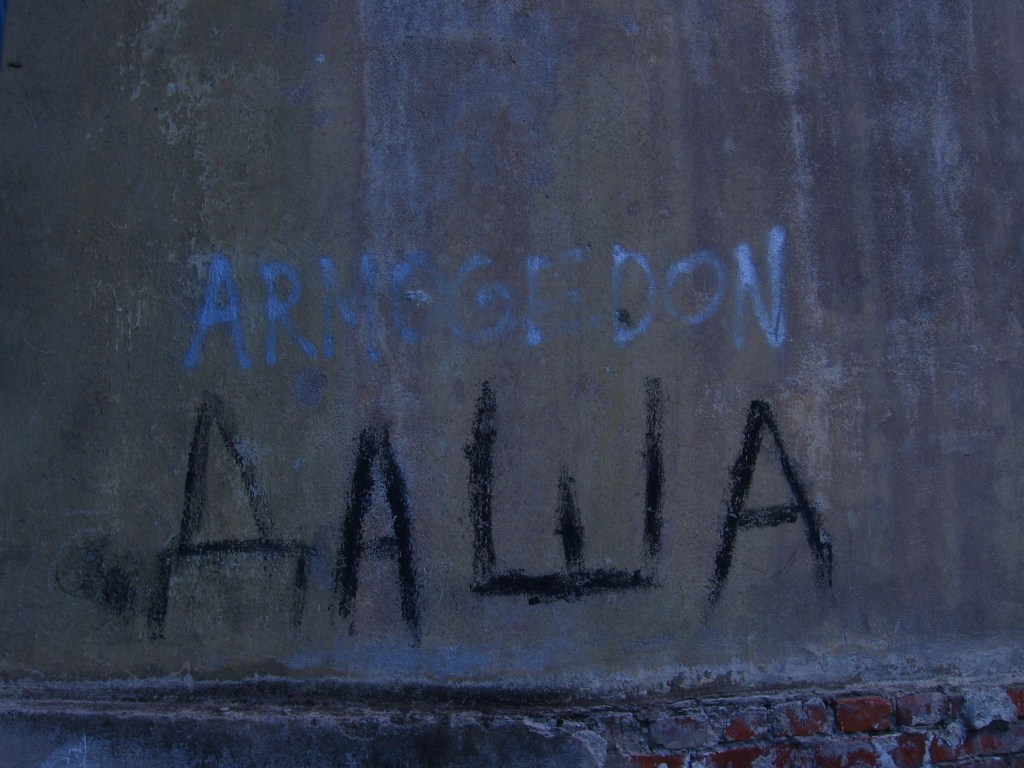
“Armogedon Dasha,” Kronstadt, Russia, summer 2006. Photo by the Russian Reader

If one starts from the premise that the United States was engaged in a peace process, then what we saw Americans do yesterday makes no sense. The same goes if we begin from the assumption that present American leadership is concerned about peace generally, or cares about American interests as such. But it is not hard to see another logic in which yesterday’s outrages do come into focus.

It would go like this: It has been the policy of Musk-Trump from the beginning to build an alliance with Russia. The notion that there should be a peace process regarding Ukraine was simply a pretext to begin relations with Russia. That would be consistent with all of the publicly available facts. Blaming Ukraine for the failure of a process that never existed then becomes the pretext to extend the American relationship with Russia. The Trump administration, in other words, ukrainewashed a rapprochement with Russia that was always its main goal. It climbed over the backs of a bloodied but hopeful people to reach the man that ordered their suffering. Yelling at the Ukrainian president was most likely the theatrical climax to a Putinist maneuver that was in the works all along.

This, of course, might also seem illogical, and at an even higher level. The current American alliance system is based upon eighty years of trust and a network of reliable relationships, including friendships. Supporting Russia against Ukraine is an element of trading those alliances for an alliance with Russia. The main way that Russia engages the United States is through constant attempts to destabilize American society, for example through unceasing cyberwar. (It is telling that yesterday the news also broke that the United States has lowered its guard against Russian cyber attacks.) Russian television is full of fantasies of the destruction of the United States. Why would one turn friends into rivals and pretend that a rival is a friend? The economies of American’s present allies are at least twenty times larger than the Russian economy. And Russian trade was never very important to the United States. Why would one fight trade wars with the prosperous friends in exchange for access to an essentially irrelevant market? The answer might be that the alliance with Russia is preferred for reasons that have nothing to do with American interests.

In the White House yesterday, those who wished to be seen as strong tried to intimidate those they regarded as weak. Human courage in defense of freedom was demeaned in the service of a Russian fascist regime. American state power was shifted from the defense of the victim to the support of the aggressor. All of this took place in a climate of unreason, in which actual people and their experiences were cast aside, in favor of a world in which he who attacks is always right. Knowledge of war was replaced by internet tropes, internalized to the point that they feel like knowledge, a feeling that has to be reinforced by yelling at those who have actually lived a life beyond social media. A friendship between Donald Trump and Vladimir Putin, a masculine bond of insecurity arising from things that never happened, became more important than the lives of Ukrainians or the stature of America.

There was a logic to what happened yesterday, but it was the logic of throwing away all reason, yielding to all impulse, betraying all decency, and embracing the worst in oneself on order to bring out the worst in the world. Perhaps Musk, Trump, and Vance will personally feel better amidst American decline, Russian violence, and global chaos. Perhaps they will find it profitable. This is not much consolation for the rest of us.

Excerpted from: Timothy Snyder, “The War Trump Chooses,” Thinking about…, 1 March 2025


⚡️ Foreign Ministry Spokeswoman Maria Zakharova’s comment on Zelensky’s voyage to Washington, D.C. (March 1, 2025)

💬 Leader of the neo-Nazi regime Zelensky’s visit to Washington D.C. on February 28 is an epic political and diplomatic failure of the Kiev regime.

The Russian Side has repeatedly made it clear at all levels that Zelensky is a corrupt individual who lost his grip on reality and is unable to reach and honour agreements.

❗️ The Kiev regime refused to continue talks on a political and diplomatic settlement in the spring of 2022, using lies and fake claims to justify continued hostilities and keep receiving Western military and financial aid.

With his outrageously rude behaviour during his stay in Washington, Zelensky re-affirmed his status of the most dangerous threat to the international community as an irresponsible figure that can stir up a big war. It must be clear to everyone that this kind of attacks coming from a terrorist leader are quite unambiguous.

This cynical individual will stoop to anything in pursuit of his goals and is obsessed with preserving the power he has usurped. That is why he:

🔻 has destroyed the opposition,

🔻 built a totalitarian state,

🔻 ruthlessly sending millions of his fellow citizens to death.

Under the increasingly deteriorating political situation, this figure is unable to show a sense of responsibility and is therefore obsessed with continuing the war and rejects peace, which means death to him.

Unprecedented in history of international politics and diplomacy, a dressing down given to Zelensky by the US president in the White House is also indicative of the political weakness and extreme moral degradation of the European leaders who continue to support the maniac head of the Nazi regime who has lost touch with reality.

As before, we continue to operate on the premise that a truly just and durable peace is not possible unless the root causes of the Ukraine crisis are completely eliminated.

The main ones among them include:

🔻 the West breaking its promises not to expand NATO and the alliance’s absorption of Europe’s entire geopolitical space all the way up to Russia’s borders,

🔻 the Kiev regime’s systematic elimination of everything about Russia, including language, culture, and church, just like the German Nazis did in the past.

The demilitarisation and denazification of Ukraine, as well as recognition of existing realities on the ground remain Russia’s unchanged objectives.

☝️ The sooner Kiev and the European capitals come to realise this, the closer to a peaceful settlement of the Ukraine crisis we will be.

Source: Russian Foreign Ministry (Facebook), 1 March 2025


Rick Wilson: “And I truly believe that Donald Trump will very soon offer military aid to Russia. I believe this in my heart of hearts. I want every single one of you people who think, ‘Oh, this was such a brave moment of diplomacy,’ when Donald Trump starts offering Russia intelligence, and weapons, and support, and protection, I want you to tell me if you think you still live in the America you voted for.”

Source: The Lincoln Project, “Trump and Vance ATTACK Zelenskyy in Oval Office and Align U.S. with PUTIN,” YouTube, 28 February 2025. Thanks to Mark Teeter for encouraging me to re-watch this video and note its stark conclusion.

The Betrayal of Ukraine: Week 2

No, we don’t.

Tomorrow in Ukraine, Russian soldiers will attack Ukrainians. Russian drones and bombs and rockets will target Ukrainian homes. A criminal war of aggression will continue.

Tomorrow in Saudi Arabia, Russian officials will discuss the future of Ukraine with a handful of Americans, delegated by a president who sympathizes with the Russian view of the war. The Russians will have the luxury of talking about Ukraine without the presence of Ukrainians.

The headlines are about “peace negotiations.” But what is really going on? How should we think about this unusual encounter in Saudi Arabia?

Here are ten suggestions, drawn from years on working on relations among the three countries, and from some recent personal observations at the Munich Security Conference.

1. Be critical of the words on offer. Question the word “peace.” The term used in the media is “peace negotiations.” The United States and Russia are not at war. Russia is at war with Ukraine, but Ukraine is not invited to these talks. Russian authorities, for their part, do not generally speak of peace. They present the talks with the United States as a geopolitical coup, which is not the same thing. The highest Russian officials have repeatedly stated that their war aims in Ukraine are maximalist, including the destruction of the country. Informed observers generally take for granted that Russia would use a ceasefire to distract the United States and Europe, demobilize Ukraine, and attack again. This is not a plan that the Russians are working very hard to disguise. It is a simple point, but always worth making: there could indeed be peace tomorrow in Ukraine, if Russia simply removed its invasion force.

Continue reading “The Betrayal of Ukraine: Week 2”

Professors

Fredric Jameson

In 2006, [Fredric] Jameson spoke at a conference in Moscow and then visited Petersburg for a few days. [Elena] Petrovskaya asked me to show him around the city. Jameson stayed at the apartment of Artemy Magun, who was out of town but left the key. The program was the most predictably capitalist, with opera-schmopera, Malevich-schmalevich, the fountains of Peterhof and other logic of cultural consumption. On the third day I got tired of it and invited Jameson to a birthday party for little Tasya Zaslavskaya in [the painter Anatoly Zaslavsky’s] studio, which was chockablock with preschoolers, cakes, Fanta and balloons. There was also Foma [Thomas] Campbell and dancing. I should re-read Brecht and Method. RIP.

Source: Alexander Skidan (Facebook), 23 September 2024. Translated by Thomas “Foma” Campbell. Photo, above, courtesy of Duke Today.


[Arlie Russell] Hochschild gets a lot right. Still, as an investigative journalist who covers the MAGA movement, her portrayal of Trump’s America sometimes felt incomplete to me. She mentions how a pastor was radicalized by the QAnon conspiracy theory on the Telegram app, but such online worlds, which can become realer for their believers than the physical world, aren’t captured here with the same concrete specificity as what’s happening on the dusty back roads of small-town Kentucky. And her portrayals of the wounded masculine pride and white nationalism that she suggests drive some Trump voters can feel chilly, distanced by sociological and psychological analysis; in person, such emotions are palpably volcanic.

I finished “Stolen Pride” nagged by the sense that she wasn’t giving us the full picture — most of all, of her own place in it as a retired professor from the University of California, Berkeley embedding in Pikeville to explain its residents to themselves and the nation. It’s a position that I suspect triggered at least some stereotypes that conservatives have about liberals thinking they know better. And yet her ethnography is frictionless. There is none of the grinding of opposing viewpoints so common during this contentious political time. There is little sense of what they thought of her and her project.

Instead, Hochschild has produced a seamless election-season-ready explanation of conservatism that might be just a little too neat. What, I kept wondering, would her subjects say was her “deep story”? And would including that viewpoint in her book have destabilized its carefully engineered explanations? If America is increasingly divided into two countries, one liberal and one conservative, what would it have meant to compare their two deep stories in one narrative rather than have one side tell the other how it is?

Source: Doug Bock Clark, “What Makes the Far Right Tick?” New York Times, 10 September 2024


We can all agree that Vladimir Putin is a bloodthirsty brute, whose invasion of Ukraine was a shameful act of aggression. Having said that, I personally would wish this horrible war to end as soon as possible, which will almost certainly mean with some degree of compromise. When Snyder writes that, for America to remain “the land of the free” half a century from now, “Ukraine must win its war against Russia,” does he really believe that’s possible? Does “winning” mean a Russian capitulation comparable to the German generals’ unconditional surrender in May 1945? The only way anything of the kind could conceivably happen would be following a coup to overthrow Putin, a most desirable outcome but improbable at present.

And when [Timothy] Snyder writes that if Ukraine’s “allies fail it, tyrants will be encouraged around the world, and other such wars will follow,” some of us are old enough to feel that we’ve seen this movie before. It was called the domino theory, and it was invoked to justify the Vietnam War — fought in the name of freedom, but bringing much unfreedom in its wake.

This may seem a gloomy and unhelpful way to end a review of a stimulating and well-intentioned book. Of course Snyder is right, in the sense that his heart’s in the right place. I share his horror at crimes past and present. I only wish I could share his optimism about the future.

Source: Geoffrey Wheatcroft, “Can Americans Have Democracy, Freedom and Other Nice Things?” New York Times, 19 September 2024


Danila Davydov

I see the beetle’s quiet race
and how the dragon-fly doth hover.
the vileness of late-soviet life
cannot be grasped by those who’re younger.

the star that shines is not for you
and not for you the tomcat's purring.
just utter murk and drudgery
no matter what yurchak might claim.

and nowadays? while nature peers
into itself, we seek in vain
to comprehend the somersaults
of active and yet vacant things.

Данила Давыдов

я вижу тихий бег жука
и зависание стрекоз.
всю мерзость позднего совка
ты не поймешь, коль позже взрос.

не для тебя горит звезда
и кот не для тебя урчал.
там только мрак и маета,
что б ни рассказывал юрчак.

а ныне что? природа зрит
в саму себя, и мы вотще
постичь пытаемся кульбит
активных, но пустых вещей.

Source: Ainsley Morse (Facebook), 12 October 2024. Danila Davydov (born 1977) is a poet, critic, and editor. His poem and her translation of it are reprinted here with Professor Morse’s kind permission.

Safe Terrain

Today is my 55th birthday, and my friends at United 24 and my fellow ambassador Mark Hamill have prepared a special gift: the chance to help lead Safe Terrain.

This is a new campaign, starting right now, to help save Ukrainian lives during this terrible war by funding robots that can clear mines.

Mines are one of the most insidious killers in this war. Russians have strewn millions of mines on Ukrainian territory.  Even in places that Ukraine has deoccupied, such as the parts of Kherson region I visited last summer, sappers and others have to risk their lives to remove these mines.  Otherwise the mines will maim and kill civilians years or even decades into the future. 

In Kherson I watched sappers move carefully through the fields under the hot sun. And in Kyiv I visited people in a rehabilitation center who had lost limbs.

Here technology can help.  Robots can do this work.  In Safe Terrain, Mark Hamill and I are enlisting you to help raise $441,000 to fund thirty demining robots.  These will clear Ukrainian lands of explosive ordnance, reducing risks for sappers, and allowing people to return to their businesses, their farms, and their lives

I am spending this 55th birthday on my family’s farm.  Whenever I am here, I think of the farmers in southern and eastern Ukraine who have to struggle with the aftermath of occupation: all of the mines in their fields. These are fields that, in good times, can feed half a billion people — fields on which hundreds of millions of Asians and Africans as well as tens of millions of Ukrainians depend for their food.

I won’t be asking for any other presents today: if you want to wish me well, please make a contribution today to Safe Terrain.  The Safe Terrain fundraiser begins today at 11:00am Eastern on August 18th, right as I am posting this note.  Thank you!

Contribute to Safe Terrain

PS: If you want me to know about your contribution to Safe Terrain, feel free to mention it below, or to write me on timothysnyder13100@gmail.com.

PPS: And please share this message with friends of Ukraine who might also want to help.

Source: Timothy Snyder, “Safe Terrain,” Thinking about…, 18 August 2024

The War on Terror

This is not the first time the editors of our local newspaper have “platformed” the lies of the mendacious and violent fascist butcher Vladimir Putin.

1. US warns that Russia will invade Ukraine. General disbelief, daily Russian mockery. (December 3 2021-February 24 2022)

2.  Russia invades Ukraine, kills tens of thousands of people, kidnaps tens of thousands of children, commits other ongoing war crimes (February 24 2022-present)

3.  Russia blames US for Russia’s invasion of Ukraine (March 2022-present)

4. US warns of terror attack in Moscow. Putin denies any risk and mocks the United States. (March 7 and March 19 2024).

5.  Terror attack near Moscow, ISIS takes responsibility, Russia meanwhile kills Ukrainian citizens with drones and missiles as it has for more than two years. (today, March 22 2024)

6.  Russia’s security apparatus, focused on bringing carnage to Ukraine, has failed in Moscow.  Russia’s leaders, focused on demonizing the US, did not protect Russians. What next? Where to direct the blame?

7.  It would not be very surprising if the Kremlin blames Ukraine and the United States for terror in Moscow and uses the Moscow attack to justify continuing and future atrocities in Ukraine.

Source: Timothy Snyder, “Moscow Terror: A Chronology That Might Predict,” Thinking about…, 22 March 2024


This past Friday, 22 March, a horrifying terrorist attack took place in Crocus City Hall in the outskirts of Moscow.  Islamic State plausibly claimed responsibility.

Earlier that day, Russian authorities had designated international LGBT organizations as “terrorist.” Also earlier that day, Russia had carried out massive terror attacks on Ukrainian cities. Those actions reveal the enemies Putin has chosen. As the attack on Crocus City Hall demonstrated, his choices have nothing to do with actual threats facing Russians.

Russia and the Islamic State have long been engaged in conflict.  Russia has been bombing Syria since 2015.  Russia and the Islamic State compete for territory and resources in Africa.  Islamic State attacked the Russian embassy in Kabul.  This is the relevant context for the attack outside Moscow. The horror at Crocus City Hall obviously has nothing to do with gays or Ukrainians or any other of Putin’s enemies of choice.

Putin had publicly dismissed the real threat. The United States had warned Russia of a coming attack by Islamic State.  The United States operates under a “duty to warn,” which means that summaries of intelligence about coming terrorist attacks are passed on, even to states considered hostile, including (to take recent examples) Iran and Russia.  Putin chose to mock the United States in public three days before the attack. 

People reasonably ask how a terror attack could succeed in Russia, which is a police state.  Regimes like Russia’s devote their energy to defining and combating fake threats.  When a real threat emerges, the fake threats must be emphasized.  Predictably (and as predicted), Putin sought to blame Ukraine for Crocus City Hall.

What if Russians realize that Putin’s designations of threats are self-serving and dangerous?  What if they understand that there are real threats to Russians ignored by Putin?  He has devoted the security apparatus to the project [of] destroying the Ukrainian nation and state.  What if Putin’s obsession with Ukraine has only made life worse for Russians, including by opening [t]he way to actors who are in fact threats to Russian life, such as Islamic State? 

These are the questions Putin must head off. It is not easy, however, to blame Ukraine for Islamic State terrorism.  Putin’s first media appearance, nearly a day after the attack, was far from convincing.  The specifics he offered were nonsensical.  He claimed that the suspects in the terrorist act were heading for an open “window” on the Russian-Ukrainian border.

The term “window” is KGB jargon for a spot where the border has been cleared for a covert crossing.  That the leader of the Russian Federation uses this term in a public address is a reminder of his own career inside the KGB.  Yet Putin had obviously not thought this claim through, since a “window” must involve a clear space on both sides of the border.  For escaping terrorists, it would be the Russian side that opened the window.  By speaking of a “window” Putin indicated that the terrorists had Russian confederates preparing their exit, which he presumably did not mean.  It seems that Putin was hastily making things up.

Setting aside the “window” business, though, the whole idea that escaping terrorists would head for Ukraine is daft.  Russia has 20,000 miles of border.  The Russian-Ukrainian part of it is covered with Russian soldiers and security forces. On the Ukrainian side it is heavily mined.  It is a site of active combat.  It is the last place an escaping terrorist would choose. 

And there is no evidence that this is what happened.  Russia claims that it has apprehended suspects in Bryansk, and claimed that this means that they were headed for Ukraine.  (Western media have unfortunately repeated this part of the claim.)  Regardless of whether anything about these claims is true, Bryansk would suggest flight in the direction of Belarus.  Indeed, the first version of the story involved Belarus, before someone had a “better” idea.

In moments of stress, Russian propaganda tries out various ways to spin the story in the direction preferred by the Kremlin.  The reputed suspects are being tortured, presumably with the goal of “finding” some connection to Ukraine.  The Kremlin has instructed Russian media to emphasize any possible Ukrainian elements in the story.  Russian television propaganda published a fake video implicating a Ukrainian official.  The idea is to release a junk into the media, including the international media, and to see if anything works. 

Amidst the flotsam and jetsam are those who spread Russian propaganda abroad, who try out versions more extreme than Putin’s.  Putin does not directly deny that Islamic State was the perpetrator — he simply wants to direct attention towards Ukraine.  But actors outside Russia can simply claim that Ukraine was at fault.  Such actors push the discussion further than the Kremlin, and thereby allow Russia to test what might work abroad.

As a result, we have a bizarre discussion that leads to a harmful place.  Islamic State claims responsibility for Crocus City Hall.  The Islamic State publishes dreadful video footage.  Russia cannot directly deny this but seeks help anyway in somehow pushing Ukraine into the picture.  Those providing that help open a “debate” by denying that Islamic State was involved and making far more direct claims about Ukraine than the Kremlin does.  (This brazen lying leads others to share [a] Islamic State perpetration video (don’t share it; don’t watch it).  So the senseless “debate” helps Islamic State, since the reason it publishes perpetration videos is to recruit future killers.)

Meanwhile, Russia’s senseless war of aggression against Ukraine continues.  In its occupied zones, Russia continues to kidnap Ukrainian children for assimilation and continues to torture Ukrainians and place them in concentration camps.  It continues to send glider bombs, drones, cruise missiles and rockets at Ukrainian towns and cities. 

On the same day as the attack at Crocus City Hall, Russia carried out its single largest attack to date on the Ukrainian energy grid, leaving more than a million people without power.  Among other things it fired eight cruise missiles at the largest Ukrainian dam. Russia attacked the city of Zaporizhzhia (the consequences are in the four photos) and other cities throughout Ukraine.

On Friday Russia fired, in all, eighty-eight missiles and sixty-three explosive drones into Ukraine. And that represents just a single day (if an unusually bad one) of a Russian war of terror in Ukraine that has gone on for more than two years.

Putin is responsible for his mistakes inside Russia. And he is at fault for the war in Ukraine.  He is trying to turn two wrongs into a right: into his own right to define reality however he likes, which means his right to kill whomever he chooses. 

Source: Timothy Snyder, “Moscow Terror (2): The Claim and the Blame,” Thinking about…, 24 March 2024


It is obvious that the terrorist attack at Crocus City Hall on the evening of 22 March 2024, during which 133 people were killed, according to the official count, has clear goals and objectives. A week before Putin’s “election” I wrote that, after receiving a “mandate from the people,” Putin would unleash a mass terror campaign. But for this, of course, he needs a decent and obvious excuse. The exemplary terrorist attack in broad daylight in politically unreliable Moscow is intended to convince society that “decisive action” is what it needs now.

Why would Putin do that? It’s simple logic. Come hell or high water he has to win the war he has unleashed. This is obvious, for it is a matter of self-preservation. If Putin does not win, he is a weakling, a lowlife, and at the same time the person to blame for hundreds of thousands of deaths not only of Ukrainians, but also of Russians. It is clear that he will not last long in this state. Not to mention such a trifle as his sick, wounded ego, repeatedly insulted by Ukraine. But victory would wipe everything out, because victors are not judged, Putin is convinced, taking his cue from his idol Catherine the Great.

So, Putin has to have victory at any cost. But two things have long prevented him from achieving it: 1) his numerous domestic enemies, and 2) a lack of “manpower” in the ranks of the army.

Putin intends to solve problem number one by means of a mass terror campaign against malcontents, especially since he has long been urged to do so by a well-rehearsed chorus of heralds, from Dmitry Medvedev and General Gurulyov to a host of other, lower-ranking epigones of contemporary Russian fascism. Guessing the mood of their Führer, they demand that, at very least, he restore the death penalty; at most, that he carry out “total executions of the terrorists and crackdowns against their families” (per the latest quotable quote from Medvedev).

We can only guess at this point whether Putin’s forthcoming terror will exceed Stalin’s body count or whether the current ruler in the Kremlin will limit himself to “merely” increasing the number of prison sentences meted out to dissidents by a factor of two and carrying out demonstrative executions of dozens or hundreds of his fellow citizens. But there is no doubt that a serious expansion of such tactics is on his agenda.

Putin will solve problem number two through a mass mobilization. This is nothing new either. Piling hundreds of thousands of soldiers into the enemy’s trenches is a time-honored tactic practiced by both the Russian and Soviet military, and, as Putin has seen, it has worked well in the “meat assaults” on Avdiivka, Bakhmut, Severodonetsk, and many other small Ukrainian towns. But these towns are nothing compared to the million-strong cities of Kharkiv, Dnipro, Zaporizhzhia, and Odesa, not to mention the three-million-strong Kyiv. So there must be massively more cannon fodder. The second problem is directly related to the first.

Combined with large-scale crackdowns, the mobilization is sure to proceed more vigorously this time round.

As a bonus for the Kremlin, this terrorist attack diverts public attention (at least for a while) from such things as Russia’s largest-ever strike on Ukraine, involving a hundred and fifty missiles and drones, which happened just a day before the events at Crocus City Hall.

I’d now like to talk about other explanations of this terrorist attack. Looking through the news related to it, I honestly could not help but marvel at the comments of certain respected colleagues, opposition Russian analysts, who easily took the bait about IS, Islamist terrorists, and the other nonsense that the FSB obligingly leaked to the public in the first hours after the attack through the Russian media and Telegram channels.

To clarify, certain people of “non-Slavic ethnicity” were chosen to directly perpetrate this heinous crime. There are hundreds of thousands of Tajik, Uzbek, and Kyrgyz migrant workers in Russia, EVERY ONE of whom is literally turned inside out by the Russian Interior Ministry upon arriving in Russia, including with regard to their attitudes to radical Islam and similar things. The Russian secret services thus have the broadest selection of perpetrators available for such a terrorist attack.

Let us ask ourselves an elementary question: how could Islamist radicals purchase not only assault rifles and pistols but also the flamethrower with which the terrorists torched the unfortunate audience members at Crocus City Hall without the knowledge and support of Russian “law enforcement”? Is such a thing possible in today’s Russia, and in Moscow to boot? If someone thinks that it is possible, I would simply remind them that when members of Eduard Limonov’s National Bolshevik Party tried to buy weapons somewhere in the Altai Territory back in the 2000s, their plan was instantly exposed. The idea of Tajiks buying assault rifles and flamethrowers in today’s militarized Russia, which is chockablock with surveillance cameras and special services, is a bad joke.

Let me also remind you that the initial semi-official Russian explanation was that the terrorist attack at Crocus City Hall was revenge on Russia for its actions in Syria and Chechnya. Seriously? So, it matters not a whit that the Russian army and its air force have not conducted any active operations in Syria for two years now? If you have not been paying attention during this time, let me just remind you that the Kremlin is certainly not concerned with Syria right now. For the last two years all Russian armed forces, including those operating from military bases in Syria and in Armenia, have been deployed in destroying Ukraine. There have been no large-scale military operations in Chechnya for almost twenty years.

However, as it turned out, all this argumentation was completely superfluous, because my gullible colleagues were made to eat their lunch by Putin himself and his favorite propagandist, Margarita Simonyan. As a shadow of her “boss” (as she herself dubs Putin), Simonyan naturally cannot afford to indulge in improvisations not vetted by him, and especially at such a crucial moment. On her Telegram channel, she bluntly pointed out who, in her (and therefore her boss’s) opinion, had organized and perpetrated the terrorist attack: “It wasn’t IS. It was the Khokhols.”

The “boss” himself, who was supposed to address the nation in the early hours after the terrorist attack, unexpectedly postponed his address by twenty-four hours. The delay appears to have been caused by technical blunders. Obviously, organizing the details of a terrorist attack is not Putin’s pay grade. It is clear that in such cases the relevant special services are simply given the go-ahead from the top brass. They are told to do their job. The operation was entrusted, of course, to professional hatchet men. As usual, they made a miserable mess of it. You need a large-scale terrorist attack? The Russian security services always have two or three dozen Tajiks on hand for this purpose, who can be hastily given their marching orders, paid, and… And that’s basically it. The Tajik passport found in a car allegedly belonging to the terrorists is, of course, a masterpiece. It is clear that no terrorist, as he sets off to carry out an attack, ever forgets to take his passport with him. It was meant as a helpful hint to law enforcers, and also so decent folk would know whom to hate. It is strange that the business card of the already half-forgotten Dmytro Yarosh was not found in the car as well.

But the point is that this special operation were certainly not meant to spoil relations with the Islamic world. Russia’s allies—Iran, Hezbollah, Hamas—might take offense.

In addition to the domestic agenda we mentioned above, the terrorist attack was meant to firmly link the globally condemned villains of IS with Ukraine in world public opinion.

This was why Putin’s speech on the terrorist attack was postponed for almost twenty-four hours. The dictator’s dodgy mind was deciding how to clean up the mess made by his numbskulls and tie up the loose ends. That is, to tie IS (or any other Islamists) to Ukraine. And he probably thinks he has figured out how to do it. As he put it, [the terrorists were trying to escape through] “a window prepared for them on the Ukrainian side of the border.”

All these tricks of Putin’s are painfully obvious to people capable of thinking, but he doesn’t care about that. Moreover, having sensed a change in the mood of his American “partners” (remember the reports that the U.S. has been pressuring Ukraine to stop hitting Russian oil refineries, and the fact that for almost two months no American aid has arrived in Ukraine and it is not known whether it will arrive in the future), Putin makes a high-pitched appeal to all countries to unite against this inhuman evil—that is, against Ukraine + Daesh.

Another very important point from Putin’s speech, indicating that he is paving the way for a mass terror campaign at home, is that he called the shooting of civilians at Crocus City Hall nothing more or less than “a blow to Russia, to our people.” He, his propagandists, and the Russian media have already established the link between Islamist terrorists and Ukraine. The next logical step is to claim that those Russians who support Ukraine are direct and immediate supporters of the terrorists who struck “a blow to Russia, to our people”—that is, that they are enemies of the people.

To be honest, all of this is as monstrous as it is predictable. I will repeat what I have said many times before: as long as Putin is alive and in power, things will get even worse and even scarier.

Source: Alexander Zhelenin, “The terrorist attack at Crocus City: who benefits from it and what will happen next,” Republic, 23 March 2024. Translated by the Russian Reader

Letters from Two Americans

Today President Zelens’kyi is in Washington to ask Congress for support.

It is right to stand by Ukraine in this war.  It is a situation of unusual moral simplicity.

Ukraine was attacked in violation of international law, and is defending itself.

Russian occupiers in Ukraine commit war crimes, which cease only when territory is liberated.

Russian propagandists say the goal [is] the elimination of the Ukrainian nation as such. 

And America has done well by supporting Ukraine.  It is a situation of unusual strategic gain.

Ukrainians are fulfilling the entire NATO mission by themselves, absorbing and halting a full-scale Russian attack.

Ukrainians are deterring a Chinese offensive in the Pacific by demonstrating how difficult such an operation would be.

Ukrainians are defending the notion of an international order with rules, making war elsewhere less likely.

And there is an important way that doing right and doing well come together.

Ukraine was attacked as a democracy, and is defending itself as a democracy.  It is historically unusual for a dictatorship to try to destroy a democracy by force. 

That Putin’s Russia is trying to do so reminds us that we are [at] a historical turning point.  On one side of the scale are Russia’s ruthlessness and resources.  On the other side are Ukrainians’ sacrifice and our support.  Their sacrifice will be enough, if our assistance will be enough.

Historians will look back at these two years of war and marvel at how much the Ukrainians did for their allies.  I expect they will describe this turning point for what it was, including in its moral dimension.  

What I can’t predict is which way matters will turn, since that depends upon us, and what we do in the next few days.  We have an unusual chance to do well by doing right.  Will we take it?

Source: Timothy Snyder, “Doing well by doing right: American support for Ukraine,” Thinking about…, 12 December 2023


As is sometimes the case in American politics, a bill that many people are likely not paying a great deal of attention to is likely to have enormous impact on the nation’s future. 

That $110.5 billion national security supplemental package was designed to provide additional funding for Ukraine in its war to fight off Russia’s invasion; security assistance to Israel, primarily for missile defense systems; humanitarian assistance to citizens in Gaza and the West Bank, Ukraine, and elsewhere; funding to replenish U.S. weapon stockpiles; assistance to regional partners in the Indo-Pacific; investments in efforts to stop illegal fentanyl from coming into the U.S. and to dismantle international drug cartels; and investment in U.S. Customs and Border Protection to enhance border security and speed up migrant processing. 

President Joe Biden asked for the supplemental funding in late October. Such a package is broadly popular among lawmakers of both parties who like that Ukraine is holding back Russian expansion that would threaten countries that make up the North Atlantic Treaty Organization (NATO). If Russia attacks a NATO country, all NATO members, including the U.S., are required to respond. 

Since supplying Ukraine with weapons to maintain its fight essentially means sending Ukraine outdated weapons while paying U.S. workers to build new ones, creating jobs largely in Republican-dominated states, and since Ukraine is weakening Russia for about 5% of the U.S. defense budget, it would seem to be a program both parties would want to maintain. Today, even Trump’s former Secretary of State Mike Pompeo said: “If Ukraine loses, the cost to America will be far greater than the aid we have given Ukraine. The least costly way to move forward is to provide Ukraine with the weapons needed to win and end the war.”

But now that former president Trump has made immigration a leading part of his campaign and a Trump loyalist, Mike Johnson (R-LA), is House speaker, Republican extremists are demanding their own immigration policies be added to the package. 

Those demands amount to a so-called poison pill for the measure. The House Republicans’ own immigration bill significantly narrows the right to apply for asylum in the U.S.—which is a right recognized in both domestic and international law—and prevents the federal government from permitting blanket asylum in emergency cases, such as for Afghan and Ukrainian refugees. It ends the asylum program that permits people to enter the U.S. with a sponsor, a program that has reduced illegal entry by up to 95%. 

It requires the government to build Trump’s wall and allows the seizure of private land to do it. 

When the House passed its immigration measure in May 2023, the administration responded that it “strongly supports productive efforts to reform the Nation’s immigration system” but opposed this measure, “which makes elements of our immigration system worse.”

And yet House Republicans are so determined to force the country to accept their extreme anti-immigration policies, they are willing to kill the aid to Ukraine that even their own lawmakers want, leaving that country undersupplied as it goes into the winter. 

When he brought the supplemental bill up last week, Senate majority leader Chuck Schumer (D-NY) promised the Republicans that he would let them make whatever immigration amendments they wanted to the bill to be voted on, if only they would let the bill get to the floor. But all Senate Republicans refused, essentially threatening to use the filibuster to keep the measure from the floor until it includes the House Republicans’ demands.

This unwillingness to fund a crucial partner in its fight against Russia has resurrected concerns that the Trump-supporting MAGA Republicans are working not for the United States but for Russian president Vladimir Putin, who badly needs the U.S. to abandon Ukraine in order to help him win his war. 

Media outlets in Moscow reinforced this sense when they celebrated the Senate vote, gloating that Ukraine is now in “agony” and that it was “difficult to imagine a bigger humiliation.” One analyst said: “The downfall of Ukraine means the downfall of Biden! Two birds with one stone!” Another: “Well done, Republicans! They’re standing firm! That’s good for us.”

Today, allies of Hungary’s far-right prime minister Viktor Orbán were in Washington, D.C., where they are participating in an effort to derail further military support for Ukraine (an effort that in itself suggests Putin is concerned about how the war is going). Flora Garamvolgyi and David Smith of The Guardian explained that the right-wing Heritage Foundation think tank, which leads Project 2025—the far-right blueprint for a MAGA administration—and which strongly opposes aid to Ukraine, is hosting a two-day event about the war and about “transatlantic culture wars.”

This conference appears explicitly to tie the themes of the far right to an attack on Ukraine aid. Orbán has dismantled democracy in his own country, charging that the equality before the law established in democracies weakens a nation both by allowing immigration and by accepting that women, people of color, and LGBTQ+ people should have the same rights as heterosexual white men, principles that he maintains undermine Christianity. In Hungary, Orbán has cracked down on immigration, LGBTQ+ rights, and women’s rights while gathering power into his own hands. 

In the U.S. the Conservative Political Action Conference (CPAC) and its allies—including former Fox News Channel personality Tucker Carlson and Arizona representative Paul Gosar—openly admire Orbán’s Hungary as a model for the U.S. Indeed, some of the anti-LGBTQ+ laws Florida governor Ron DeSantis has pushed through the Florida legislature appear to have been patterned directly on Hungarian laws.

Orbán—a close ally of Russia’s president Vladimir Putin, who embraces the same “illiberal democracy” or “Christian democracy” Orbán does—is currently working to stop the European Union from funding Ukraine. Now Orbán’s allies are openly urging their right-wing counterparts in the U.S. to join him in backing Putin. A diplomatic source close to the Hungarian embassy told Garamvolgyi and Smith: “Orbán is confident that the Ukraine aid will not pass in Congress. That is why he is trying to block assistance from the EU as well.”

Former U.S. ambassador to Russia Michael McFaul today noted that even the delay in funding has hurt the U.S. “Delaying a vote on aid to Ukraine, Israel, and Taiwan will do great damage to America’s reputation as a reliable global leader in a very dangerous world. Delay is a gift to Putin, Xi, and the mullahs in Iran,” he wrote. “The stakes are very high.” 

Republican determination to push their own immigration plan seems in part to be an attempt to come up with an issue to compete with abortion as the central concern of the 2024 election. As soon as he took office, Biden asked for funding to increase border security and process asylum seekers, and he has repeatedly said he wants to modernize the immigration system. To pass the national security supplemental appropriation, he has emphasized that he is willing to compromise on immigration, but the Republicans are insisting instead on a policy that echoes Trump’s extreme policies.

Immigration, on which Orbán rose to power, has the potential to outweigh abortion, which is hurting Republicans quite badly.

We’ll see. The story out of Texas, where 31-year-old Kate Cox has been unable to get an abortion despite the fact that the fetus she is carrying has a fatal condition and the pregnancy is endangering her health and her ability to carry another child in the future, illuminates just how dangerous the Republicans’ abortion bans are. Under Texas’s abortion ban, doctors would not perform an abortion, so Cox went to a state court for permission to obtain one. 

The state court ruled in Cox’s favor, but Texas attorney general Ken Paxton immediately  threatened any doctor who performed the abortion, and appealed to the Texas Supreme Court to block the lower court’s order, saying that allowing Cox to obtain an abortion would irreparably harm the people of Texas. All nine of the justices on the state supreme court are Republicans. 

Late Friday night the Texas Supreme Court blocked the lower court’s order, pending review, and today, Cox’s lawyers said she had left the state to obtain urgently needed health care. This evening the Texas Supreme Court ruled against Cox, saying she was not entitled to a medical exception from the state’s abortion ban. 

The image of a woman forced by the state to carry a fetus with a fatal condition at the risk of her own health and future fertility until finally she has to flee her state for medical care is one that will not be erased easily.

Meanwhile, Russian opposition leader Alexei Navalny has disappeared. His lawyer says he was told Navalny was “no longer listed” in the files of the prison where he was being held, and Navalny’s associates have not been able to contact him for six days. 

Source: Heather Cox Richardson, Letters from an American, 11 December 2023

An Environmental War

Here we should recall Bruno Latour’s last public statement. He left us in October 2022, but managed to formulate in his final text, “Is Europe’s soil changing beneath our feet?” that this war is not only political, but also energy-related, and therefore environmental. I’ll drop the link in the comments below.

It is clear that this is not the war’s main cause of the war. It has many causes, and it is difficult to say whether there is a main cause among them.

Did the war start because the Russian leadership, fed up with earthly pleasures, wants to go down in history? Yes.

Is it a continuation of Russia’s imperialist policies as whole? Yes.

Is it a continuation of the Cold War? Yes.

Is it a consequence of the excessive buildup of aggression, resentment, and indignation in Russia itself? Yes.

But is it also a campaign against the modern world, not only in a cultural sense, but also in the sense of a fight on behalf of the old energy world, on behalf of coal and oil and gas? Yes again. And it is a fight against those “made-up” environmental and climate problems of ours.

This does not mean that the Russians who blew up the Kakhovka hydroelectric power plant had such motives, that they thought, “Fuck you, environmentalists! Suck on this, Greta Thunberg!”as they did what they did. I think they had the simplest of motives — to hold back the Ukrainian army offensive in this area.

But it is the effect wrought by a savage who shows up in a reputable joint and doesn’t understand why he should use a fork, cannot blow his nose on the curtain, and has to wipe his ass. That is, it is the effect wrought by a subject who completely fails to grasp the entire problem of modernity. He does not even try and is unable to understand it, and thus doesn’t regard his actions and their consequences in this way as a matter of principle. He just doesn’t give a fuck. Such a thing as caring for nature has never occurred to him: the savage is hopelessly behind the times.

And Latour writes in his essay that, unfortunately, the problem of savages with dirty asses (well, he doesn’t put that way: the man was cultured after all; I’m conveying the gist of his remarks) is not confined to Russia.

“In order to convince ourselves of this, we only have to identify those we would have to learn to fight if we were serious about getting rid of Putin’s gas and oil. Perhaps they reside on our street, fill the tank of our car, or increase our stock portfolio…”

Source: Dmytro Rayevsky (Facebook), 8 June 2023. Mr. Rayevsky is an editor at Babel.ua, a Ukrainian news and analysis website that ceased publishing its Russian edition after Russia’s February 2022 invasion of Ukraine. It has continued, however, to publish stories in Ukrainian and English translation. Translated, from the Russian, by the Russian Reader


Friends,

After Russia’s destruction of the dam at Nova Kakhovka, Ukrainians face a manmade catastrophe in the Kherson region, amidst all the other horrors of Russia’s invasion.  Ukrainians are hard at work, essentially by themselves, rescuing their fellow citizens from the high waters, often braving Russian artillery and sniper fire.  We can help those volunteers.  Here are ten ways.

1.  Ukraïner have a small group on the scene who have been evacuating people right from the beginning.  Your donation would mean a lot to them.  You can support them on Paypal from abroad via tymoshenkoyulia99@gmail.com or follow this link.

2.  Rescue Now UA is a Ukrainian evacuation organization founded when this invasion began now active in Kherson.  They are constituted as a US 501(c)3 so donations by Americans are tax-deductible.  You can send money by PayPal here or consult the donation link here.

Ukrainian volunteers just doing what needs to be done. But they could use our support.

3.  The Ukrainian Firefighters Foundation is raising money to buy pumps for the Kherson Emergency Services.  You can help via Paypal via bimbirayte@gmail.com or by going to this page and hitting the Paypal button.

4.  Vostok SOS is a Ukrainian evacuation organization working in the flooded Kherson region now to move people with limited mobility, children, and animals.  You can support them through Paypal on nfo@vostok-sos.org or use this donation link.

5.  The Prytula Foundation is an established Ukrainian NGO specializing in matching equipment to local needs.  They are already delivering boats and other gear.  You can support them via Paypal on serhiy.prytula.kyiv@gmail.com (specify goal) or follow this donation link.

6.  UAnimals has been evacuating and caring for animals throughout the war and is raising funds to do so now in Kherson region.  As you might have noticed Ukraine is a country that cares for its land and its animals.  Donation link is here.

7.  Razom is an American NGO that cooperates with local Ukrainian NGOs.  If you donate to Razom, they will make sure your support is appropriately directed.  It is a US 501(c)3.  You can donate here.

8.  World Central Kitchen is an international NGO that has done extraordinary work in Ukraine during this war.  They are providing excellent nutritious food in Kherson region right now.  You can support them here.

9.  United24 is President Volodymyr Zelens’kyi’s official fundraising platform (I am an ambassador).  Their “Lifeboat Ukraine” project is raising money for gear for rescue operations.  Follow this link and look for the Help button.

10.  ComeBackAlive is a trusted NGO that supports Ukrainian soldiers. Ukrainian soldiers are now evacuating disabled people and the elderly. They are also using their drones to deliver water to people stranded on rooftops.  Beyond that: rescue operations are hindered by Russian artillery and snipers.  Only Ukrainian soldiers can get them out of range.  Here’s a link.

Please help.  A catastrophic manmade flood as part of a war of atrocity is no everyday calamity.  Ukrainians are on the scene doing what they can with remarkable calm.  We should so what we can to support them.  A few moments at a keyboard right now can save lives, and help good people feel like they are not alone.

P.S.  And please share this!

Source: Timothy Snyder, “How to help Ukrainians during the flood,” Thinking about…, 8 June 2023


Russia’s war on Ukraine has also been another war of fossil fuel capitalism on the environment, but June 6 marked a new turning point in ecocide when the Kakhovka Hydroelectric Power Plant was blown up in an act of horrifying brutality, an egregious violation of international humanitarian law, and a war crime that shakes the very pillars of global food and environmental security.

While Tucker Carlson dedicates the pilot episode of his new show on his sociopathic accomplice Elon Musk(ovich)’s platform to conspiracy theories as to how Ukraine is to blame for the destruction of the dam (and essentially everything, up to phantasmagoric “persecution of Christians”), and his far-right minions readily spread them, the reality is that the Kakhovka HPP was controlled by the Russian occupation troops, that the Z-propagandists (including that infamous “Tatarsky” guy who was blown up by a statuette of himself) had repeatedly called to destroy the dam, and that their first reaction was boasting about its destruction. (In addition, the Russian government had just canceled investigations of accidents and terrorist attacks at hydraulic structures until 2028).

As a result of the dam’s destruction, countless lives and homes have been devastated. Dozens of settlements, home to tens of thousands of people, are now in peril from catastrophic flooding. The evacuation process has commenced, but the harm inflicted extends far beyond human suffering. In the Kazkova Dibrova Zoo alone, hundreds of animals have perished, and thousands more, both domestic and wild, face a similar destiny in the affected areas. The environmental impact is alarming. Vast stretches of agricultural land have been damaged, and the loss of the Kakhovka Reservoir puts the water supply of numerous regions, cities, and villages (as well as the Zaporizhzhia Nuclear Power Plant’s cooling system) in jeopardy. The potential for outbreaks of botulism looms, following the dumping of large amounts of fish onto the land. Far-reaching ecological consequences would be even worse, with the aridification and desertification of the nearby steppes haunting future generations.

The Social Movement argues that while Russian occupation forces remain in Ukraine, the safety of its residents is perpetually at risk, living under the constant shadow of potential terror attacks. At this moment, the most effective aid we can offer is supporting local volunteers and organizations directly involved in disaster response. We implore local activists and trade unions to rally together, harnessing every possible resource to aid those impacted by this tragedy.

This devastating situation again underscores the vital importance of a welfare-oriented approach to the needs of Ukrainian citizens, one that enables a systemic response to such significant challenges. To overcome the catastrophe with the current neoliberal practices that only exacerbate such crises makes the task of overcoming these disaster impacts an even greater challenge for our nation’s future.

You can donate to organizations that are already providing aid on the ground like Vostok SOS or UAnimals. You can find others here: https://t.me/VolunteerCountry/4129

Source: Denys Pilash (Facebook), 7 June 2023. I edited this text slightly to make it more readable. ||| TRR


The first time I spoke with Olga Shpak, I made the mistake of beginning as I often do when interviewing researchers: by asking for some basic biographical information. “I used to be a scientist,” she said, not sounding bitter, only a bit nostalgic. Now, she clarified, she’s a war volunteer.

Shpak built a storied career studying Arctic and sub-Arctic marine mammals as a researcher at Moscow’s prestigious A.N. Severtsov Institute of Ecology and Evolution of the Russian Academy of Sciences. Her work inspired some of Russia’s most significant whale conservation measures over the last decade, including protections for bowheads in the Sea of Okhotsk, an Alaska-sized body of water on the country’s Pacific coast. But in February last year, just as Vladimir Putin prepared to invade her home country of Ukraine, Shpak abruptly left, ultimately saying goodbye to her life in Russia—and the whales.

“There were relatively very few projects in Russia aimed at actually protecting marine mammals, rather than exploiting them,” Phil Clapham, a retired biologist and a leading expert on large whales, told me. “And with Olga’s loss to the war, they lost one of the absolute—probably the best one of all.”

Today, Shpak is working near the front lines of the war, helping nonprofit aid groups supply civilians and soldiers with everything from underwear and tourniquets to drones, wood-burning stoves, and pickup trucks. When we spoke, bomb sirens blared in the background, a numbingly routine occurrence for Shpak, who told me her focus had been entirely consumed by the war effort. “To do science you have to concentrate,” she said. “You have to kind of put your brain in a certain mode. And that switch is broken.”

[…]

As for Shpak, she’s not sure she’ll ever return to studying marine mammals. People are her priority now. “I became a biologist thinking that ‘I hate people, so I will work with animals,’” she told me. “But now I understand how it’s important and satisfying to help the community survive—I understand the importance of the word ‘community.’”

Source: Jackie Flynn Mogensen, “She Was on the Front Lines of Whale Conservation. Now She’s on the Front Lines of War,” Mother Jones, July/August 2023


The destruction of Ukraine’s Kakhovska dam, likely to have been the work of Russian forces, highlights a problem with capitalist society: not being able to see the whole picture.

Capitalism fragments information and knowledge into separate categories: climate breakdown, Russia’s war on Ukraine, legacies of colonialism.

These categories compartmentalise different acts of violence, making them separate. Take a look at the “climate” sections of major news outlets and you can see that Russia’s invasion of Ukraine is not part of these conversations.

But in reality, the global climate emergency and Russian imperialism are deeply entangled – and it’s time to see them as such.

In the past year, major environmental organisations such as Greenpeace have taken a stance against fossil fuel extraction and petrocapitalism, which have allowed Russia to maintain and expand its empire for years. But that’s not enough today.

The destruction of the Kakhovska dam has caused massive damage, flooding homes and habitats, killing animals, plants and insects en masse. It has contaminated water, washed away landmines and other explosive weapons, and posed a new threat to the Zaporizhzhia nuclear power plant. So far, evidence points strongly in favour of an explosion conducted by Russia.

The flooding has also impacted protected areas that are part of the transnational Emerald Network, including several national nature parks: Velykyi Luh (which remains illegally occupied by Russia), Kam’ianska Sich and Nyzhniodniprovskyi.

This will severely damage biodiversity in Ukraine and contribute to the sixth mass extinction of species globally.

Russia is guilty of ecocide

The destruction in the Kherson region joins a growing number of incidents of deliberate or negligent environmental destruction by Russian forces, which are currently under investigation by Ukrainian prosecutors under the charge of ecocide.

The Rome Statute of the International Criminal Court does not list ecocide as an international crime, but it is part of Ukraine’s criminal code – and Ukraine can set an international precedent by holding Russia accountable for environmental harm.

Other examples of ecocide include another incident in the Kherson region: in March 2002, almost four million birds died at a poultry farm in Chornobayivka that came under massive Russian shelling. That same month, there was a Russian missile attack on an oil depot in the Rivne region.

Beyond the environmental destruction at Kakhovska, Russia has prevented or obstructed the evacuation of civilians from the Russian-occupied southern bank of the Dnipro river (Ukraine controls the northern bank). Ukraine-controlled territory has been attacked by Russian missiles, as rescue teams and volunteers try to evacuate people and animals from the flood zone. Some rescuers have been attacked and killed.

Repeated warnings

Ukraine previously warned the international community about the risk of the destruction of the Kakhovska dam. On 20 October 2022, president Volodymyr Zelenskyi addressed the European Council. “If Russian terrorists blow up this dam,” he said, “more than 80 settlements, including Kherson, will be in the zone of rapid flooding. Hundreds, hundreds of thousands of people may be affected.”

Ukraine has also sent repeated warnings about the risk of an explosion at the Zaporizhzhia nuclear plant, which has been under Russian occupation since March 2022. Last month, the head of the International Atomic Energy Agency, the UN’s nuclear watchdog, warned that the plant’s situation is “potentially dangerous”.

Russia continues to target hazardous infrastructure. Just last week, it repeatedly shelled an ammonia pipeline (the world’s longest), which would cause severe environmental damage if any ammonia was released.

It is important that the world listens to these warnings and takes them seriously. Ukrainians are not speaking from a space of abstraction. These warnings come from lived experience, including the memory of the Chornobyl nuclear disaster in 1986.

Russia has clearly indicated its intention to kill Ukrainians and destroy Ukrainian habitats by any means, including ecocide.

Environmental organisations globally must take urgent action in support of Ukraine and against Russian colonial violence. It is not enough to just lobby against fossil fuel extraction; we must recognise that the end of Russian imperialism is key to the struggle for climate justice. Ukrainian environmental activists have spoken about the increase in CO2 emissions caused by the Russian invasion.

If climate emergency initiatives only remember Ukraine in relation to the global food crisis and crop shortages (the destruction of the Kakhovska dam has further damaged the country’s agricultural sector) or the impact the war has had on the global fossil fuel economy, but remain silent and inactive when Ukrainians are killed by flooding and shelling, they are complicit in Russia’s invasion.

Environmental organisations should be more proactive. They should stand in solidarity with Ukraine by protesting, demanding full support from their governments and international organisations, demanding that rescue teams are sent, and organising donation drives. Today is already too late; there is really no time left.

Source: Darya Tsymbalyuk, “Kakhovska dam destruction is part of the climate emergency,” openDemocracy, 12 June 2023

Expert in a Dying Field

The Beths, “Expert in a Dying Field” (2022)

[…]

On the first episode of his Twitter show, Tucker Carlson concluded that Ukraine was most likely the culprit.

“If this was intentional, it was not a military tactic. It was an act of terrorism,” he said. The dam was “built by the Russian government, and it currently sits in Russian-controlled territory. The dam’s reservoir supplies water to Crimea which has been, for the last 240 years, home of the Russian Black Sea fleet. Blowing up the dam may be bad for Ukraine, but it hurts Russia more. And for precisely that reason, the Ukrainian government has considered destroying it. In December, The Washington Post quoted a Ukrainian general saying his men had fired American-made rockets at the dam’s floodgate as a test strike.”

“So really, once the facts start coming, it becomes much less of a mystery what might have happened to the dam,” Carlson said. “Any fair person would conclude that the Ukrainians probably blew it up. Just as you would assume they blew up Nord Stream… and in fact, they did do that. As we now know.” But the American media has wasted no time “in accusing the Russians of sabotaging their own infrastructure.”

[…]

Source: Isaac Saul, “The Ukraine counteroffensive (and the dam attack),” Tangle, 7 June 2023


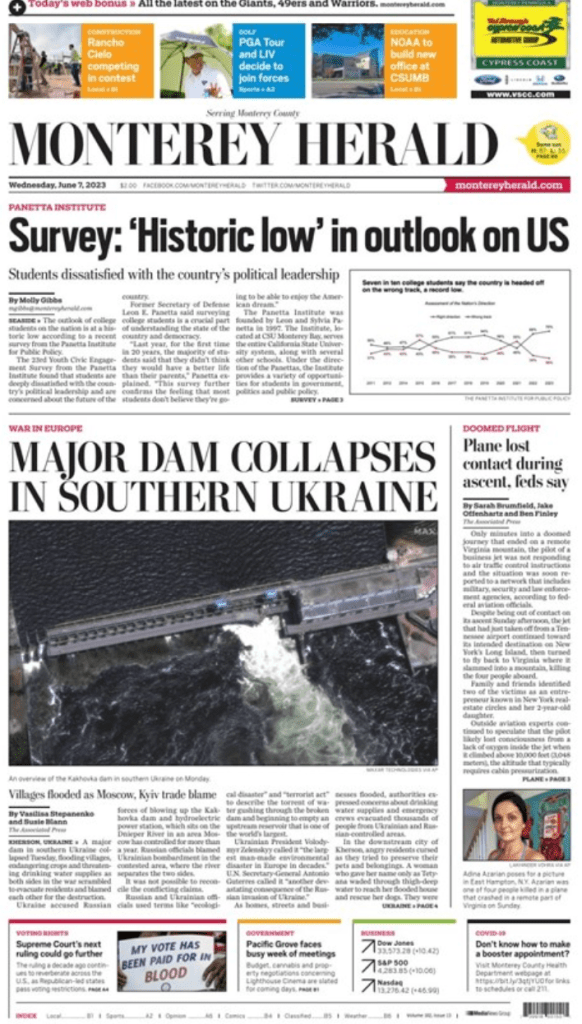
“Villages flooded as Moscow, Kyiv trade blame.”
A screenshot of the front page of the 7 June 2023 Monterey Herald, as sent to this subscriber

The Nova Kakhovka Dam in Ukraine, controlled by Russia, has been destroyed. One consequence is a humanitarian disaster that, had it not taken place within a war zone, would already have drawn enormous international assistance. Thousands of houses are flooded and tens of thousands of people are in flight or waiting for rescue. Another consequence is ecological mayhem, among other things the loss of wetland and other habitats. A third is the destruction of Ukrainian farmland and other elements of the Ukrainian economy. So much is happening at once that the story is hard to follow. Here are a few thoughts about writing responsibly about the event.

1.  Avoid the temptation to begin the story of this manmade humanitarian and ecological catastrophe by bothsidesing it.  That’s not journalism. 

2.  Russian spokespersons claiming that Ukraine did something (in this case, blow a dam) is not part of a story of an actual event in the real world.  It is part of different story: one about all the outrageous claims Russia has made about Ukraine since the first invasion, in 2014.  If Russian claims about Ukrainian actions are to be mentioned, it has to be in that context.

3.  Citing Russian claims next to Ukrainian claims is unfair to the Ukrainians.  In this war, what Russian spokespersons have said has almost always been untrue, whereas what Ukrainian spokespersons have said has largely been reliable.  The juxtaposition suggests an equality that makes it impossible for the reader to understand that important difference.

4.  If a Russian spokesman (e.g. Dmitri Peskov) must be cited, it must be mentioned that this specific figure has lied about every aspect of this war since it began.  This is context.  Readers picking up the story in the middle need to know such background. 

5.  If Russian propaganda for external consumption is cited, it can help to also cite Russian propaganda for internal consumption.  It is interesting that Russian propagandists have been long arguing that Ukrainian dams should be blown, and that a Russian parliamentarian takes for granted that Russia blew the dam and rejoices in the death and destruction that followed.

6.  When a story begins with bothsidesing, readers are being implicitly instructed that an object in the physical world (like a dam) is really just an element of narrative.  They are being guided into the wrong genre (literature) right at the moment when analysis is needed.  This does their minds a disservice.

7.  Dams are physical objects.  Whether or how they can be destroyed is a subject for people who know what they are talking about.  Although this valuable NYT story exhibits the above flaws, it has the great merit of treating dams as physical rather than narrative objects.  When this exercise is performed, it seems clear that the dam could only have been destroyed by an explosion from the inside.

8.  Russia was in control of the relevant part of the dam when it exploded.  This is an elemental part of the context.  It comes before what anyone says.  When a murder is investigated, detectives think about means.  Russia had the means. Ukraine did not. 

9.  The story doesn’t start at the moment the dam explodes.  Readers need to know that for the last fifteen months Russia has been killing Ukrainian civilians and destroying Ukrainian civilian infrastructure, whereas Ukraine has been trying to protect its people and the structures that keep them alive.

10.  The setting also includes history.  Military history offers an elemental point.  Armies that are attacking do not blow dams to block their own path of advance.  Armies that are retreating do blow dams to slow the advance of the other side.  At the relevant moment, Ukraine was advancing, and Russia was retreating.

The pursuit of objectivity does not mean treating every event as a coin flip, a fifty-fifty chance between two different public statements.  Objectivity demands thinking about all the objects — physical objects, physical placement of people — that must be in the story, as well as all of the settings — contemporary and historical — that a reader would need in order to come away from the story with greater understanding.

Source: Timothy Snyder, “The Nova Kakhovka Dam in Ukraine: Ten guidelines for writing about catastrophe,” Thinking about…, 7 June 2023. Thanks to Mark Teeter for the heads-up


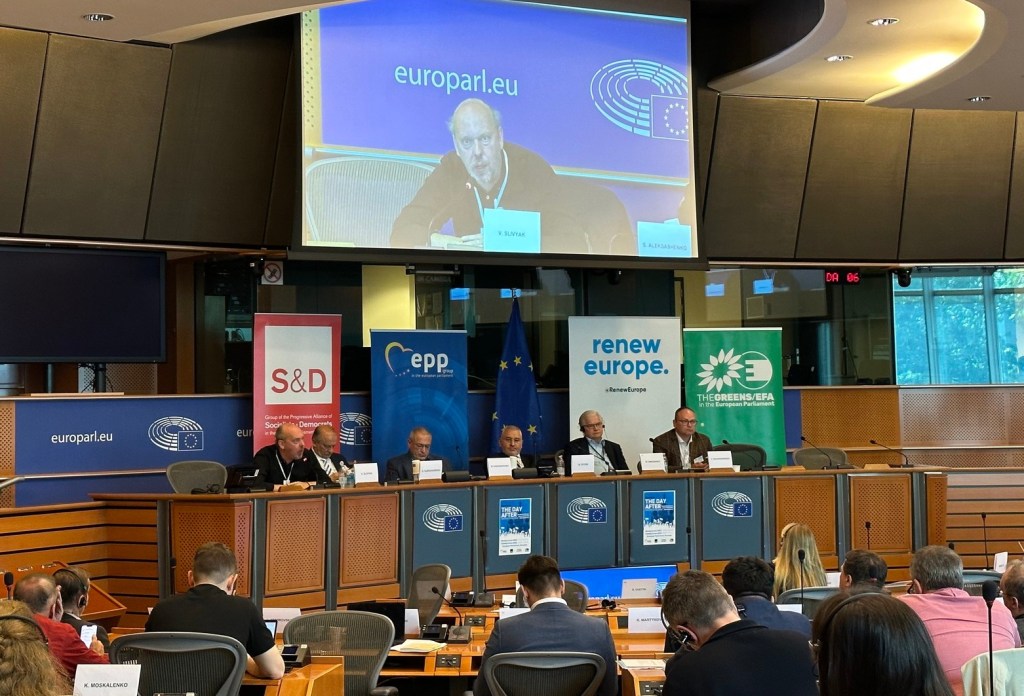
Vladimir Slivyak (far left and on screen), speaking at the European Parliament earlier this week. Mikhail Khodorkhovsky, who made his fortune selling oil and gas, is seated the second to Mr. Slivyak’s left. Photo courtesy of his Facebook page

At the beginning of the week, an important conference, “The Day After,” was held at the European Parliament. I would not call it a “congress” of the Russian opposition, but rather something like a big meeting of Russian civil society. Some of the participants were those who are termed “opposition politicians” and their support groups. There were also human rights activists, women’s rights activists, LGBT+ rights activists, and many others. Environmentalists were extremely poorly represented (three out of the approximately 250 people in attendance). At the dozen or so panel discussions, in which more than fifty people took part, only one person addressed environmental issues—me.

Despite the fact that, as I observed, there were fewer politicians in attendance than non-politicians, the panel discussions were dominated by the topics that only the politicians talk about. Very rarely did anything different get talked about, but when it did the audience was usually quite supportive. I have no quarrel with the gist of what the opposition politicians said. Almost everyone spoke about supporting Ukraine, democratizing Russia, and the horror of the war, which must be stopped and all Russian troops withdrawn. There was a lot of discussion about what the political system of the new Russia should be, how to prevent a repeat of the dictatorship. This is all well and good, and I don’t think anyone in the audience disagreed with the main arguments. The big problem was something else. The vast majority of the speeches seemed to merge into a single digested mass: it was difficult to distinguish among people who, one after another, talked about the same thing in similar terms. If the audience expected just this, then that’s fine. But the audience were definitely expecting more. And they didn’t get it.

On the second day, the wonderful Karina Moskalenko organized a protest for women’s rights, threatening to leave the auditorium if the middle-aged white men in suits continued to dominate the panel discussions. Periodically, women did appear among the participants of the discussions, but not always. I fully supported the protest because the gripe was warranted: those who dominated the discussions (who had been involved in organizing the conference, of course) objectively had no desire to take into account the interests of other groups. This was the reaction of only one of the movements represented at the conference, but similar emotions (about the ignoring of all other interests) were also manifested by representatives of the other groups. Often one had the impression that there were the bearers of the truth, whose important cause everyone else should follow, while all other interests would be dealt with later (maybe). Someone said, How does this differ from Putin? No one else’s interests matter to him either.

There is no doubt that the opposition talked about important things, and I don’t think anyone at the conference questioned this. The topic of unifying the opposition was broached repeatedly. But it’s just that uniting people who don’t feel that their interests are taken into account won’t work. This is the answer to those who are always wondering why the opposition is fragmented. If you want someone to stand beside you, you have to make room for them.

On the morning of the second day, I spoke on the same panel with Mikhail Khodorkovsky, Sergei Aleksashenko, Mark Feygin, Fyodor Krashennikov, and one of the European MPs. It was all per usual until my turn came. Briefly put, I argued that climate policy and the transition to green energy were extremely important, and that it was necessary to deal with this now if you were thinking about how to set up a new democratic Russia: you couldn’t get by without it, because for any civilized country today it was one of the priorities and its importance would only grow. No one would ever take Russia seriously if it was run by politicians who did not understand climate issues. The demand for fossil fuels would decline, and this would become a big economic problem; it would not be possible to employ the previous economic model (which enabled Putin to save money for the war). Also, the opposition needed the support of voters and, most importantly, young people, because it was they who would have to vouchsafe democracy in the future and prevent a new dictatorship. It was young people who would have to face much more terrible manifestations of climate change than those we were witnessing today. So, young people needed politicians to understand the climate agenda and work on it. If you wanted young people to vote for you in the future, you wouldn’t get anywhere with them without it. Nothing would ever happen if you put it off for later. In the USSR and post-Soviet Russia, dealing with environmental issues was always postponed.

Despite the fact that the audience applauded my remarks loudly and more than once, the moderator, Feygin, could not hold himself in check no way no how. He made a brief comment to the effect that of course it’s important, but it’s not important. He went out of his way to show his disrespect for the opinion of the people in the audience who obviously supported my arguments, let alone the climate and environmental agenda. Well, okay, we’ve seen worse things in our lives. But what really struck me was how many people (not a few, but dozens) came up to me during the day to thank me for my speech and say that it was important. About half of those who approached me mentioned how the reaction from the other panelists (I think they meant Feygin) had been ugly.

My conclusion in the light of all this is simple: there is nothing wrong with people, but there is something wrong with the leadership. It is vital to learn to feel what your target audience wants. If you are a politician who, albeit sometime in the future, not now, wants to build a democratic Russia and get people’s support, you not only have to talk about what you stand for. You also need to hear people and respect their interests. It’s not a one-way street. And this is not only my opinion (among the participants of the conference). Within Russian civil society there is an enormous desire to work to change Russia and a huge potential for unification. We can’t let this moment slip.

Source: Vladimir Slivyak (Facebook), 7 June 2023. Translated by the Russian Reader. See Tomsk TV2’s recent interview with Mr. Slivyak, as part of its project Eyewitnesses.


The offices of a subsidiary of Russian oil giant Lukoil on Kurfürstendamm in Berlin, 7 June 2019
Photo by the Russian Reader

There is a phenomenon that, by the way, unites us Ukrainians with Russians—a burning irrational hatred for Greta Thunberg. I can’t understand this phenomenon. Basically, she’s never wronged anyone. But yesterday, social media was just bursting at the seams with hatred for her, including from people who went to her Twitter account to tell her that she was a “juvenile slut.” The conservative momma’s boys at Tyzhden (The Ukrainian Week) even knocked off a column about it.

They don’t hate Tucker Carlson, who yesterday released a video claiming that Ukraine bombed the hydroelectric power station itself. They don’t hate Elon Musk, who reposted it. They don’t hate fucking Ben Shapiro or the Trumpists, who have been stumping against Ukraine from the get-go and at the same time are readily published here in Ukraine, in translation by Our Format, because “we must respect different opinions.” No, for some reason, the hatred is reserved for Greta Thunberg.

The irony here is also that the RePlanet movement, which she represents, just yesterday quite promptly condemned Russia for the situation with the hydroelectric power plant and once again called for the withdrawal of Russian troops from Ukraine’s sovereign territory. But who cares? Greta Thunberg, bitch, you’re going to answer for everything.

Source: Dmytro Rayevsky (Facebook), 7 June 2023. Translated by the Russian Reader

Terry Burke: Russiagate, Syria, and the Left

dezaOnce again, years of experience and research have been poured into an article challenging entrenched narratives on the anglophone institutional left, and once again, fear of retaliation from the purveyors of these entrenched narratives has made this challenge unpalatable even to left and liberal publishers with an obvious interest in countering them.

So, once again, the Antidote Writers Collective is pleased to participate in a decentralized effort to bring this challenge out into the open.

The following was initially published on CounterVortex with the understanding that the website’s publisher would be backed up by cross-posts from sympathetic websites in order to reduce the authoritarian left’s ability to target one vulnerable person with their classic arsenal of trolling, threats, abuse, and lawsuits.

Comrade of the zine Terry Burke has been a dedicated peace activist her entire life and has already heard the worst of it even from former comrades who have unthinkingly taken on Putinist narratives and allowed themselves to be played against the emergence of effective opposition to rising fascism in the United States. We salute her years of persistence and are proud to have her back. Enjoy.
Antidote Zine

Russiagate, Syria, and the Left
Terry Burke
CounterVortex
June 27, 2019

The last major national protest in the US was “Families Belong Together” in June 2018. Hundreds of thousands of people across the country demonstrated against the Trump administration’s policy of separating children and families at the border. People who had never protested before brought their families. It’s now a year later and the situation for immigrant families has only gotten worse. Where is the outrage?

Plans for an ICE raid targeting millions of immigrants. Initiating a military strike on Iran and then canceling it. Environmental policies that disregard climate change. Pulling the US out of treaties. Rising alt-right and nationalism around the world. Ignoring congressional subpoenas. Corrupt, incompetent people heading every federal agency. The list of destructive Trump policies seems endless.

Trump’s recent visit to London brought tens of thousands of protesters into the streets. Where are the protests in the US? Where are the coalitions in the US organizing against Trump’s anti-democratic, inhumane policies? Where is the left?

Part of the problem is the enormous amount of disinformation that has been specifically directed at the left, disinformation that most people don’t recognize. The disinfo uses anti-imperialist language and is posted on “left” and “progressive” sites that usually have nominally accurate stories on Palestine, Israel, climate change, corporate corruption, and other progressive issues. In addition to the disinfo media sites, respected left authors have confused their readers by dismissing Russiagate as a hoax, claiming that Russian interference in the US elections has been greatly exaggerated to provide the Democrats an excuse for Clinton’s loss.

Eight years of steady disinformation on Syria have created a split in the peace movement. The enormous amount of time and energy spent debating Syria could have gone to building the peace movement instead of dividing it. The doubts raised repeatedly about Russian interference and Mueller’s investigation have weakened the opposition to Trump. Some people don’t know which news sources they can trust. Others restrict themselves only to sources that support their ideological line.

Steve Bannon famously said, “The Democrats don’t matter. The real opposition is the media. And the way to deal with them is to flood the zone with shit.” That is exactly what has happened. There are thousands of new and unaccountable media organizations on the internet.

As Syria solidarity activists, we have been struggling against extensive, sophisticated disinformation regarding Syria for years—and it’s largely not from the US mainstream media. Syria is not Iraq, where the New York Times helped Bush lead us into war with fake information about WMDs. Syria is not Kuwait, where there were false stories planted about babies in incubators.

The mainstream media articles “demonizing” Assad are fundamentally true: his regime is one of the world’s most repressive, with a police and prison torture system of historic proportions. Unlike Iraq and Iran, and contrary to the propaganda claims, the CIA did not instigate a serious covert regime change operation in Syria. The US efforts in Syria are well documented in Shane Bauer’s recent two-part article for Mother Jones. He writes, “American involvement in Syria has been as fragmented and volatile as the conflict itself.” In this groundbreaking article, he documents how the US has spent billions, initially aiding the Free Syrian Army, but ultimately focused on combating ISIS, forbidding US-backed groups from fighting Assad’s forces.

His article corroborates the stories of anti-Assad Syrians of a genuine uprising against a brutal dictator evolving into a proxy war; of Assad bombing and starving civilians. The Syrian people were caught up in the fervor of the Arab Spring and surprised themselves (and the CIA) by going to the streets in the hundreds of thousands, demonstrating for democracy, overcoming their deep fears of reprisal.

However, most of the peace movement still doesn’t recognize the legitimacy of the Syrian people’s eight-year struggle against the Assad dictatorship. There have been so many articles in “progressive” media promoting Assad’s narrative of another US regime change effort that they have buried the voices of Syrians.

The voices of Syrian communists, anarchists, democracy activists, writers, artists, intellectuals, and nonviolence activists have rarely been represented in “progressive” media. The majority of these media’s articles on Syria have been written by non-Syrians and they usually promote Assad’s line that he is protecting his sovereign country from US-backed terrorists.

Research from the University of Washington has shown how dominant the pro-Assad political messaging is from an “echo system” of sites that follow Russian, Iranian, and Syrian government-funded media. Researchers examined Twitter conversations about the White Helmets (a Syrian volunteer rescue group) in the summer of 2017. There were four times as many tweets from the echo system as there were from other media sources. Articles from the echo system claimed the White Helmets were a “propaganda construct,” “crisis actors” who staged events, and “they worked with or were themselves terrorists.”

The UW study noted that this echo system of sites claiming to be “independent” and “alternative” shared the same stories and writers. A few of these sites are Global ResearchRTMint Press NewsSputnik NewsFree Thought ProjectThe Anti-Media21st Century WireVeterans TodayZero Hedge, and many others.

For Syria activists, the UW research wasn’t a surprise. It confirmed our experiences over the last six years, that our struggle to get the truth out was up against a substantial, coordinated disinformation effort. We were familiar with this “echo-system” well before the UW study. While they claim to be “independent,” their political line was almost always the same on Syria, Crimea, Putin, and Trump. They played a role in electing Trump by bashing Clinton, equating Clinton and Trump, going easy on Trump, and disparaging voting.

While the sites claim to be funded by their readers and ads, they actually have very few ads and do not disclose information on their funding sources. In 2013, a former writer at Mint Press News, Joey LeMay, told BuzzFeed News, “It was incredibly secretive.” The article goes on to say there were “barely any ads on the website, and whenever LeMay asked about where they got their money, ‘it was brushed off as a non-issue. I would go home feeling not squeaky clean,’ he said.”

The sites in this echo system have all also posted numerous Russiagate articles. It’s understandable that progressives would question how extensive and effective Russian propaganda was in the 2016 elections. The mainstream media hasn’t examined Russian propaganda that targets the left. The UW research has not been mentioned in mainstream or progressive media. But it’s not an either/or proposition: we can criticize Clinton’s campaign and still acknowledge that Russian interference helped Trump win in an election where Clinton won the popular vote by a substantial margin.

The claim that a few Facebook ads bought with Russian rubles could have influenced the 2016 election may have seemed preposterous back in 2016. However, since then, there have been numerous exposés of Russia’s sophisticated use of social media and information warfare—something we had thought was mainly the province of our CIA.

While Russian disinformation is a new concern for Americans, not so for Europeans. In June 2017 the Washington Post reported that “across the [European] continent, counterintelligence officials, legislators, researchers, and journalists have devoted years—in some cases, decades—to the development of ways to counter Russian disinformation, hacking and trolling.” There have been numerous articles on how Swedenthe Baltic statesFinlandGermany, France, Italy, and others are dealing with Russian cyber attempts to influence elections and sway popular opinion.

When well-known left writers like Glenn GreenwaldMatt TaibbiKatrina vanden HeuvelNorman Solomon, and Max Blumenthal immediately denounced the evidence of Russian interference back in 2016, it had a silencing effect. After that, few well-known left writers pursued the serious possibility of effective Russian involvement. In the two and a half years since Trump’s election, there have continued to be new articles and research on Russian bots, trolls, Twitter campaigns, fake accounts, and continued Russian interference in the EU, but the Russiagate authors have ignored this information. Dark Money author Jane Mayer has also written on how Russia helped elect Trump.

After the release of the highly biased Barr summary which seemed to vindicate them, Chris HedgesGlenn GreenwaldStephen CohenMatt TaibbiAaron MatePaul Street in Counterpunch, and Katie Halper from FAIR castigated the US press for its extensive coverage of the Russia/Trump allegations.

However, they wrote nothing revising their Russiagate-is-a-hoax position after the subsequent release of the redacted Mueller report in April and Mueller’s public statement in May. The Mueller report explicitly documents extensive Russian interference in the 2016 elections, but they have refused to acknowledge this.

Greenwald wrote on April 18 that “the actions in which Trump engaged were simply not enough for Mueller to conclude that he was guilty of criminal obstruction.” After Mueller clearly stated on May 29 that he would not exonerate the president for obstruction of justice, Greenwald wrote a series of articles on Brazil and wrote nothing to correct his earlier misstatements about obstruction.

It is critical to understand that the Russiagate narrative is Trump’s narrative. By insisting for over two years that Russian interference was overblown, these authors have been defending the worst president in US history.

The UW-identified echo system of “alternative” media sites has also had numerous articles promoting Russiagate skepticism and Barr’s disingenuous summary of the Mueller Report. Global ResearchMint Press NewsFree Thought ProjectThe Anti-MediaZero Hedge21st Century WireActivist Post, and others have also continued to argue for the Russiagate conspiracy thesis, despite Mueller’s statement and all the information on Russian cyberwarfare.

Even Fox News occasionally departs from supporting Trump’s position on Russian interference, as summed up in a May 2019 Newsweek headline: “Fox News Legal Analyst Says Mueller Evidence Against Trump ‘Remarkably Similar’ to Nixon, Clinton Impeachment Charges.” But the left’s Russiagate skeptics have not conceded anything. Stephen Cohen recently wrote that Russiagate “is the worst and […] the most fraudulent political scandal in American history.”

The echo system and the Russiagate authors have published very little criticism of Putin’s Russia. They have many articles criticizing the US mainstream media, the corporate ownership of US media, “censorship” by Facebook and YouTube, but nothing on the new law in Russia whereby people can be jailed for fifteen days for “disrespecting” the Russian government online. An open internet in the US means there are thousands of sites with articles criticizing the US, but even one site with critical articles in Russia could result in fines and jail time. The difference is dramatic, and there have been no articles from the Russiagate skeptics on this oppressive law.

It’s rarely mentioned that Hedges has had a weekly show on RT (formerly Russia Today) since June 2016, which is funded by the Russian government. He’s scathing in his criticism of the US, but it’s hard to find his criticisms of Russia. After the Barr summary, he chastised the US press for “one of the most shameful periods in modern American journalism” and somehow never mentions the Russian restrictions on “disrespecting” the Russian government online.

Rania Khalek is also paid by the Russian government. Her site In the Now is one of three that were recently exposed as being owned by RT. Facebook briefly took them down until a small mention of RT’s involvement was placed on the page – a mention most people will never notice.

It is difficult to determine the motivation of the Russiagate writers and the echo system. Kate Starbird at the University of Washington writes about the echo system that “[their] efforts […] consist of diverse individuals and organizations who are driven by a variety of different motivations (including political, financial, and ideological).”

There is a certain amount of hyperbole to the Russiagate articles. The investigation is blamed for “Manufacturing War with Russia,” for “Endangering American Security,” for “Media Malpractice,” for being “This Generation’s WMD,” for “Target[ing] Any Dissent in US,” and so forth. When examining these authors’ lists of articles, one would prefer they had spent as much analysis on the dangers of a Trump presidency as they have spent on promoting their Russiagate thesis.

Stephen Cohen talks about the origins of the allegation that Trump was an agent of the Kremlin. Was it “begun somewhere high up in America by people who didn’t want a pro-détente president?” He suggests that “this originated with Brennan and the CIA.” It is all speculation, with no corroborating evidence.

For a starkly different perspective, consult authoritarianism scholars Sarah Kendzior or Timothy Snyder’s interviews, writings, and videos for detailed documentation of Trump’s dealings with Russia. They have been warning for the last three years about the dangers of the US sliding into autocracy under Trump. They have researched Trump’s ties to Russia in the decades before the 2016 elections and have tried to warn us about what is coming.

Contrast Cohen’s speculation with Snyder’s detailed factual information. Snyder is a Yale historian who wrote The Road to Unfreedom about Russia’s return to an authoritarian government under Putin and the rise of nationalism in Europe and America. He has put together a series of videos to explain what is happening here and internationally. In a concise Twitter thread, he documents fifty very specific reasons (with citations) why Trump owes a debt to Putin. He discusses the people in Trump’s campaign and in the Trump administration: “It is astounding how many of them are more directly connected to the Russian Federation than to the US.”

Kendzior lived in Uzbekistan during its transition from democracy to autocratic rule. When she started covering the Trump campaign in 2016, it reminded her of what she’d seen from the regime in Uzbekistan. Her website and podcast Gaslit Nation, which she presents together with journalist Andrea Chalupa, is an unparalleled source of information about Trump and his Russian connections and crimes. Kendzior and Chalupa advocate impeachment hearings so that the rest of the country can learn about these crimes.

Snyder and Kendzior have no doubts about the Trump-Russia collusion. There are other independent authors and researchers who are documenting and exposing what’s happening. Even without the Mueller report, there is an enormous amount of public information about Trump’s ties to the Kremlin, Russian interference, and the loss of our democracy.

When Syria solidarity activists first read the November 2016 Washington Post article about Russian propaganda influencing the 2016 elections, we were relieved. Finally, the Russian propaganda we had struggled against for years was being exposed! We assumed the propaganda on Syria would also be exposed. We thought the propaganda sites on the internet would be discredited.

We didn’t anticipate that prominent left writers would immediately denounce the Russian propaganda story as the “new McCarthyism” and Russiagate and that they would still be defending this narrative two and a half years later, in the face of so much evidence.

We didn’t understand how difficult it would be for the techies at Facebook, YouTube, and Twitter to discern propaganda from the truth and how clumsy they would be in taking down sites, usually with almost no explanation, and occasionally taking down legitimate sites at the same time.

From our viewpoint as Syria solidarity activists, we are still in the same position now as we were in November 2016. Disinformation still dominates the internet. Syrian and Russian planes have been bombing civilians in Idlib for the last month, initially bombing twenty-five hospitals. While Physicians for Human Rights and Amnesty International have condemned the strikes on hospitals, sounding the alarm, there is no international pressure on Russia and Syria to end them. The echo system of media sites is distracting the left with disinformation about Assad’s 2018 chemical attack on civilians in Douma being supposedly “staged” by the rebels.

The persistent Russiagate articles from prominent left writers have many progressives feeling unsure what to believe. It has put us in the strange position of claiming that a former FBI director is more trustworthy than Chris Hedges or Stephen Cohen. But there is much more information validating what Mueller has reported than there is for the Russiagate skeptics and Trump.

There is no easy solution to the problem of massive disinformation on the internet. Certainly, we should be listening to the voices of progressive Syrians, Venezuelans, Palestinians, Ukrainians, Sudanese, not media pages that follow Putin’s line. Information about who is funding web pages would be one step towards transparency. Independent university research labs could evaluate the accuracy of media sites.

Another voice we should be listening to now is the authoritarianism scholar based in St. Louis. Sarah Kendzior says the Trump administration is a transnational crime syndicate masquerading as a government and he should be impeached. It’s time for us to be in the streets.

Terry Burke is an activist with the Committee in Solidarity with the People of Syria (CISPOS) in Minneapolis. Thanks to Comrade Ed Sutton and Antidote Zine for the heads-up. The article has been edited slightly to meet this website’s unwritten standards. Photograph by the Russian Reader, December 15, 2018, Ligovsky Prospect, Petersburg. In Russian slang, the word deza means “disinformation.”