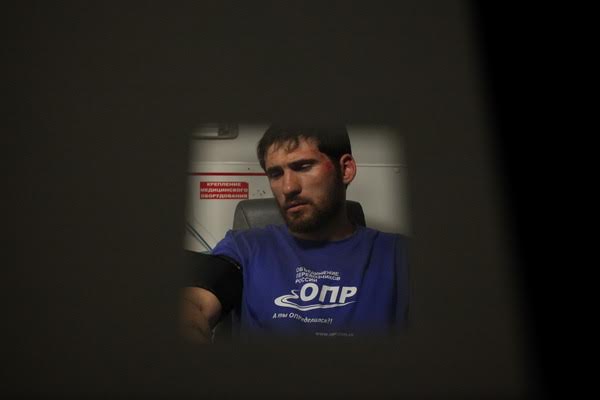
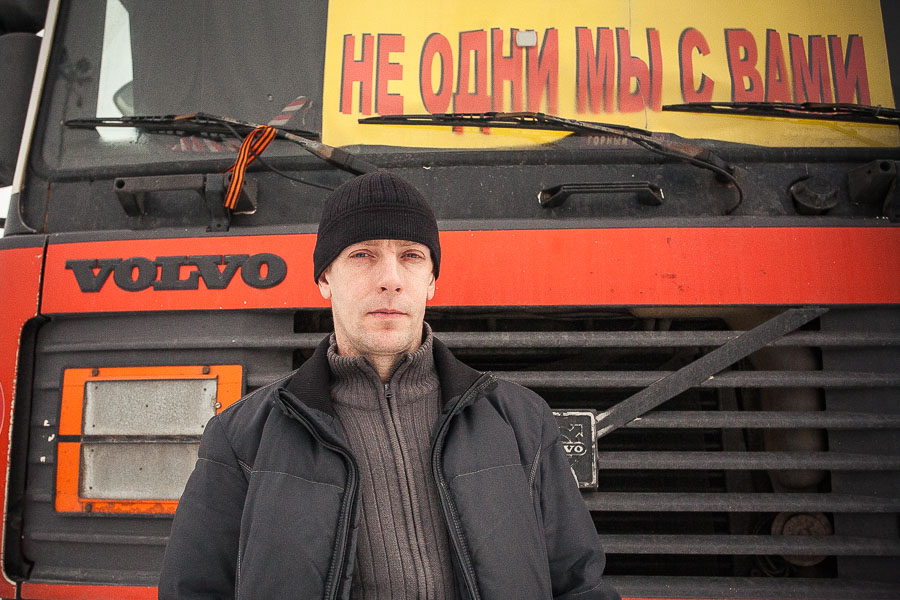
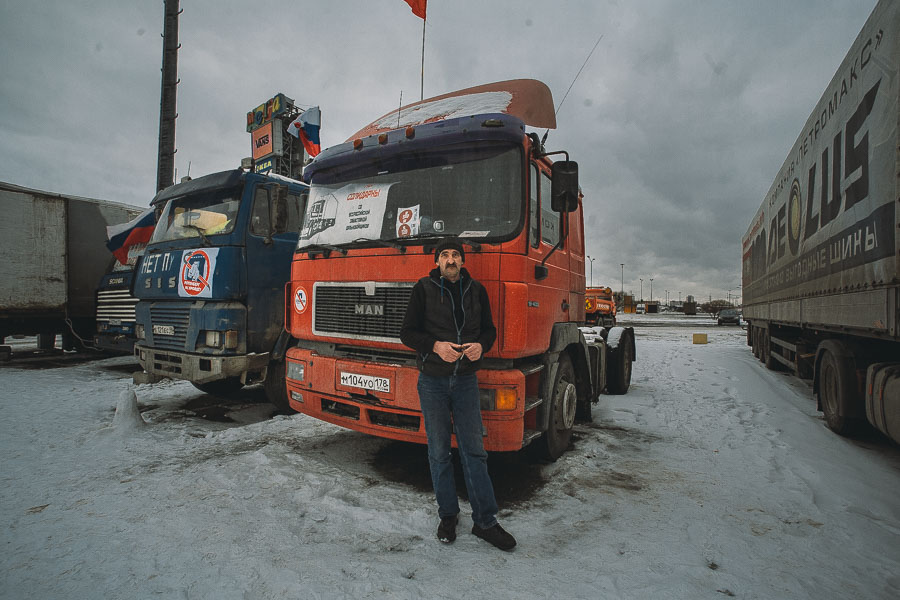
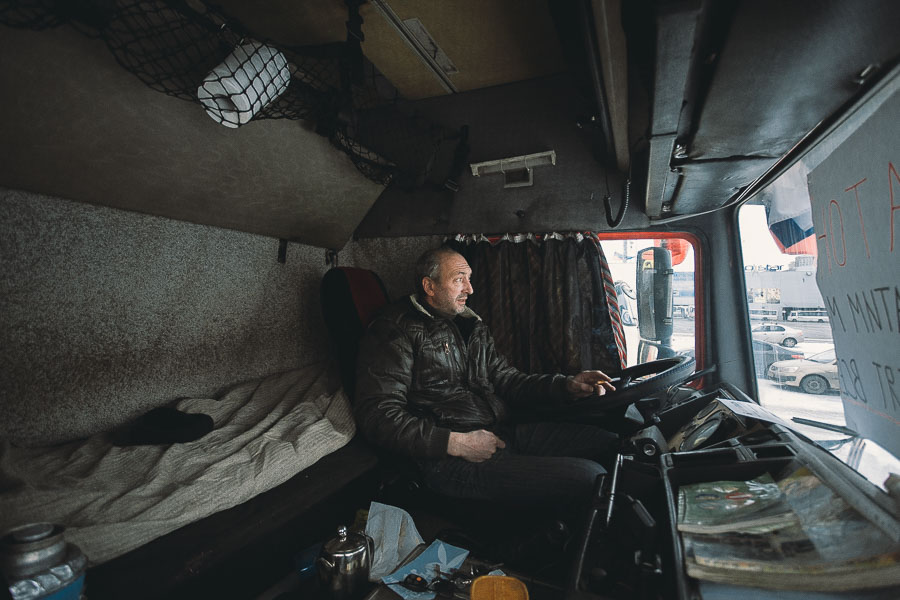
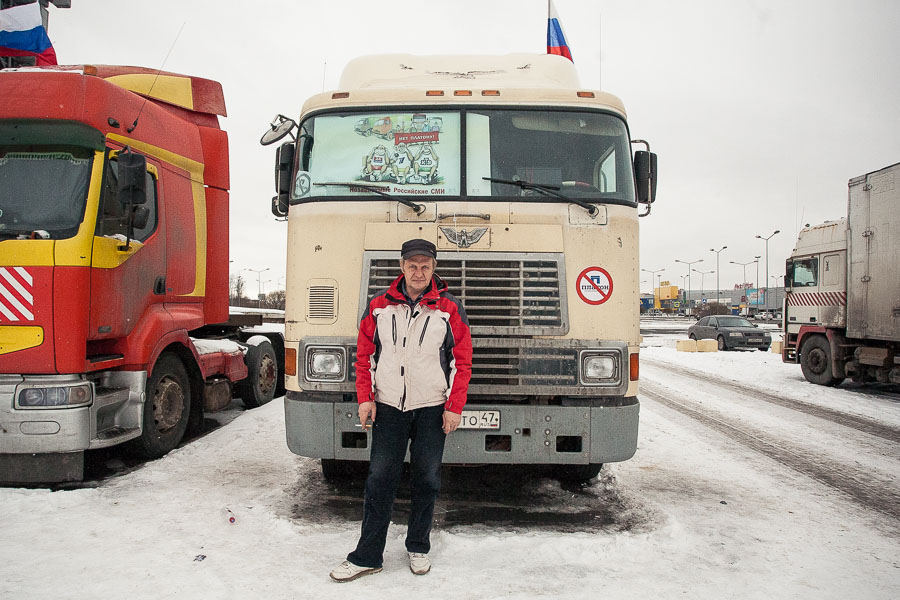
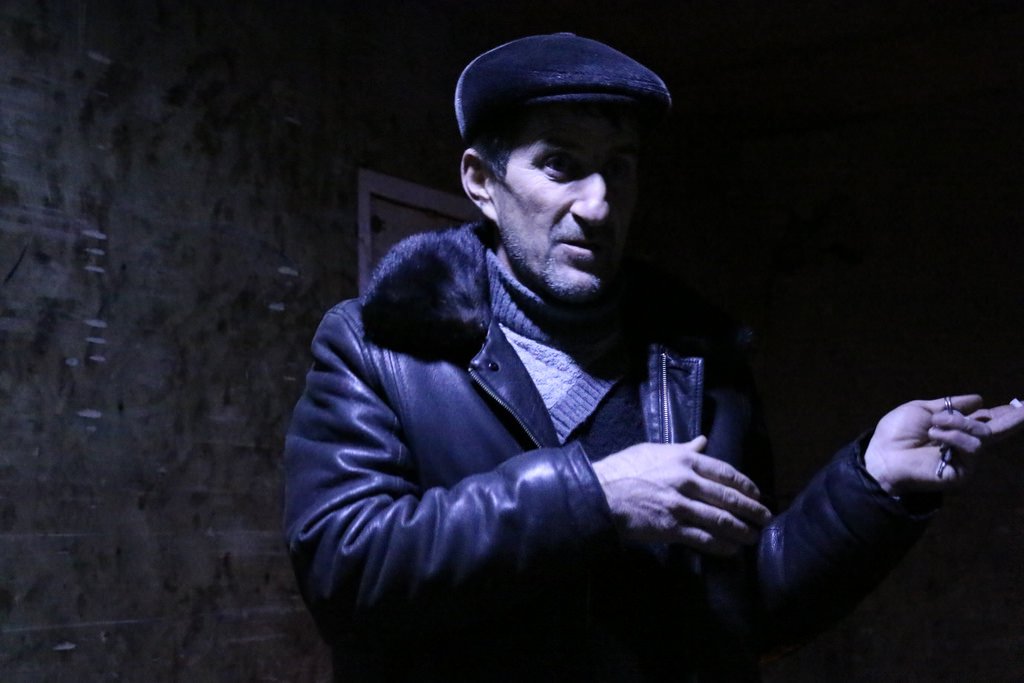
Rustam Mallamagomedov in an ambulance after being beaten. Village of Dorozhnyi, August 22, 2016. Photo by Anna Artemieva
Arrest Dagestani Trucker Refuses to Report to Jail Voluntarily
Dmitry Rebrov Novaya Gazeta
September 16, 2016
The Rostov Regional Court ordered the arrest of a Dagestani trucker who took part in the tractor convoy of Krasnodar farmers, but law enforcement officials “forgot” to detain him.
On September 16, the court considered Dagestani trucker Rustam Mallamagomedov’s appeal of an August 26, 2016, ruling by the Aksay District Court. The court had found the activist guilty of violation of Article 20.2.6.1 of the Russian Misdemeanors Code (involvement in an illegal political rally) and arrested him in absentia for ten days.
The regional court judge confirmed the district court’s ruling, despite the fact that, by law, a ruling of this kind can be issued only in the defendant’s presence. Mallamagomedov was not present at either hearing. According to his attorney, Valentin Pyshkin, this is the source of the conflict. The police “forgot” to detain the trucker preliminarily, so in spite of the administrative arrest issued against him, Mallamagomedov continues to remain at liberty to roam the streets [sic], and has no intention of voluntarily “correcting” the mistake made by law enforcement officers.
“The thing is there no standard procedure as to what the police should do now. An administrative arrest cannot be issued in absentia. This is nonsense. For an individual to be put under administrative arrest he has to be present in the courtroom. At any rate, he is not obliged to report to jail himself. He bears no responsibility for failing to report to jail. Moreover, he cannot be detained and sent there forcibly, either, since this is not stipulated by Russian law,” said Pyshkin.
“Only arrest on criminal charges can be ordered in absentia,” the lawyer stressed.
In this case, the court can issue a detention order before the defendant is detained, Pyshkin explained. But this principle is not valid in the case of administrative [misdemeanor] violations. The lawyer was hard pressed to say what law enforcement officers would do now. In his opinion, it would be easier just to abolish the questionable ruling. That, however, is not what has happened.
“The Rostov Regional Court did not listen to our arguments, nor, when the case was heard on the merits, did it want to examine any of the witnesses we had brought to the hearing. And all our motions were rejected,” said Pyshkin.
When our correspondent asked about the trucker’s current whereabouts, the attorney declined to answer, saying that the telephones could be bugged. He did confirm, however, that Mallamagomedov was currently not in Rostov Region.
Beaten by the police when the tractor convoy was dispersed, the trucker himself does not admit his guilt.
“Aside from the fact we didn’t organize any political rally, it was the police who didn’t let the farmers and us leave our camp. I was elsewhere the day our other comrades were arrested,” Mallamagomedov explained to Novaya Gazeta by telephone.
“On August 22, the day before the convoy was dispersed, I was beaten by the police guarding the camp. After that, I went to the hospital and the Investigative Committee, where I stayed until the evening of August 23. On the morning of the 24th, I went to the police station to find out how the guys were doing. I was detained there, but police did not draw up an arrest sheet. I felt sick while I was sitting there and left again in an ambulance,” he added.
Nevertheless, during his time at the precinct, police officers confiscated the driver’s internal passport without explanation. Apparently, it was then they drew up the charge sheet that was the basis for the Aksay District Court’s August 26 ruling to arrest the missing activist. After receiving medical treatment, the trucker had no intention of returning to the police station voluntarily, since he had been held there without processing of the proper papers, that is, illegally. He could not attend the August 26 hearing, either, because he was undergoing outpatient treatment.
When it is a matter of arrest, the individual is usually detained first, and then taken before a judge. Then he is sent from the courtroom to jail for ten days. The court’s administrative ruling is thus implemented. The majority of truckers and farmers detained during the tractor convoy were taken to the police station and sentenced to jail terms ranging from five to ten days, in that order. They have served their sentences and returned home long ago.
Translated by the Russian Reader. Thanks to Comrade Anatrrrafor the heads-up
According to Jim Jarmusch, director of the film by this name: “Down by law, at the time in the mid-80s, was kind of in use on the streets as meaning a very close connection with somebody. If somebody was down by law, they were close to you or you would protect them. I know that, earlier, in prison slang, if somebody was down by law, and they got out before you, they would contact your family or look after people outside if you needed them to. So it meant something very close or a code. I really liked the contradiction of that, being something that sounds like being oppressed by the law, which of course under that condition is where the slang came from. So, I liked that contradiction of it. And I liked it also in terms of the film being contradictory in that they are oppressed by the law but they also become down by law with each other.”
In Moscow, Farmers Talk about Latest Arrests, Beatings
Anna Bessarabova Novaya Gazeta
September 14, 2016
Nina Karpenko, a farmer from Krasnodar Territory’s Kanevskaya District, told our correspondent that late last week, during the maize harvest, seven men attacked her workers and the assistants of a court-appointed manager. A combine driver, who had earlier spent three days in jail for involvement in the thwarted tractor convoy to Moscow, has now been hospitalized. One of the men attempted to record the attack on a video camera, but he was thrown to the ground, his equipment was broken, and the recording was erased, said Karpenko.
On September 13, Kuban law enforcement officers blocked the car of Alexei Volchenko, leader of the farmers’ protest movement, as he drove to Ryazan to take part in the All-Russian Congress of Farmers and Cargo Haulers.
“They said they wouldn’t let him leave the region, held him up for a while, but then stopped pestering him. But Lyubov Nikishova, head of a farm in the Novokubansk District, has been put under house arrest. She has been charged under Article 119 of the Russian Federal Criminal Code (threat of murder),” explains another outraged farmer, Nikolai Maslov. “You saw her during the tractor convoy: she’s small and thin. She told the deputy presidential envoy in the Southern Federal District about the machinations of Rosreestr (Russian Federal Registration Service) and the attack on her farm. This summer, two palookas entered her house and beat her up, but when she grabbed an ax to defend herself, they photographed it and went to the police. No, she didn’t hurt anyone. It was a set-up.”
Nikiskova herself claims that immediately after the incident she filed a complaint with the Territorial Directorate of the Interior Ministry.
“It was sixteen pages long, and the medical examiner’s report was appended (there were visible traces of the assault on my body), as well as documents about the seizure of land shares and illegal fiddling with the land. 172 pages in all. It is still lying around somewhere. Unlike those marauders, they will put me away, despite the fact I am taking care of my sick mother. She has cancer, but that doesn’t bother anyone. As a criminal, they won’t let me out of the house. They’re afraid I won’t settle down and will go higher up the chain of command.”
According to Elena Dryukova, a farmer from the Kavkazsky District, Krasnodar Territory Governor Veniamin Kondratiev said recently that Kuban’s peasants had no problems, and that the tractor convoy, an attempt by the farmers to make themselves heard to the President of Russia, was an election campaign show.
Translated by the Russian Reader. Thanks toComrade Anatrra for the heads-up. Image courtesy of newsru.com
They Got Out of Their Tractors
Why the so-called common people are increasingly joining the ranks of the so-called fifth column Gazeta.ru
August 29, 2016
A fifth column of tractors? Photo courtesy of @melnichenko_va/Twitter
The arrest of the people involved in the tractor convoy, as well as new protest rallies in Togliatti after Nikolai Merkushin, governor of Samara Region announced wage arrears would “never” be paid off, are vivid examples of the top brass’s new style of communicating with people. After flirting only four or five years ago with the common people, as opposed to the creacles from the so-called fifth column, the authorities have, in the midst of a crisis, been less and less likely to pretend they care about the needs of rank-and-file Russians. Moreover, any reminders of problems at the bottom provokes irritation and an increasingly repressive reaction at the top.
Previously, top officials, especially in the run-up to elections, preferred to mollify discontent at the local level by promising people something, and from year to year, the president would even personally solve people’s specific problems, both during his televised town hall meetings (during which, for example, he dealt with problems ranging from the water supply in a Stavropol village to the payment of wages to workers at a fish factory on Shikotan) and during personal visits, as was the case in Pikalyovo, where chemical plant workers also blocked a federal highway. Nowadays, on the contrary, the authorities have seemingly stopped pretending that helping the common people is a priority for them.
The people have made no political demands in these cases. Moreover, the main players in these stories almost certainly belong to the hypothetical loyal majority.
The people who took part in the tractor convoy against forcible land seizures even adopted the name Polite Farmers, apparently by analogy with the patriotic meme “polite people,” which gained popularity in Russia after the annexation of Crimea.
In 2011–2012, the authorities used approximately the same people to intimidate street protesters sporting political slogans. That was when the whole country heard of Uralvagonzavod, a tank manufacturer whose workers promised to travel to Moscow to teach the creacles a lesson. Subsequently, the company’s head engineer, Igor Kholmanskih, was unexpectedly appointed presidential envoy to the Urals Federal Distrtict.
Back then, the cultivation of a political standoff between working people from the provinces and slackers, “State Department agents,” and self-indulgent intellectuals from the capitals seemed pivotal, but in the aftermath of Crimea and a protracted crisis, it has almost been nullified.
The people are still important for generating good ratings [via wildly dubious opinion polls — TRR], but it would seem that even rhetorically they have ceased to be an object of unconditional concern on the part of the government.
Nowadays, the authorities regard the requests and especially the demands of the so-called common people nearly as harshly as they once treated the Bolotnaya Square protests.
The government does not have the money to placate the common people, so people have to be forced to love the leadership unselfishly, in the name of stability and the supreme interests of the state. Since politics has finally defeated the economy in Russia, instead of getting down to brass tacks and solving problems with employment and wage arrears, the regime generously feeds people stories about war with the West. During a war, it quite unpatriotic to demand payment of back wages or ask for pension increase. Only internal enemies would behave this way.
“We are not slaves!” Coal Miners on Hunger Strike in Gukovo. Published on August 25, 2016, by Novaya Gazeta. Miners in Gukovo have refused a “handout” from the governor of Rostov Region and continued their hunger strike over unpaid wages. Video by Elena Kostyuchenko. Edited by Gleb Limansky.
So the coal miners in Rostov, who have continued their hunger strike under the slogan “We are not slaves,” have suddenly proven to be enemies, along with the farmers of Krasnodar, who wanted to tell the president about forcible land seizures, and the activists defending Torfyanka Park in Moscow, who were detained in the early hours of Monday morning for, allegedly, attempting to break Orthodox crosses, and the people defending the capital’s Dubki Park, slated for redevelopment despite the opinion of local residents, and the people who protested against the extortionate Plato system for calculating the mileage tolls paid by truckers, and just about anyone who is unhappy with something and plans to make the authorities aware of their dissatisfaction.
Grassroots initiatives, especially if they involve protests against the actions or inaction of the authorities, are not only unwelcome now, but are regarded as downright dangerous, almost as actions against the state. This hypothesis is borne out by the silence of the parliamentary opposition parties. In the midst of an election campaign, they have not even attempted to channel popular discontent in certain regions and make it work to their advantage at the ballot box.
The distinction between the so-called fifth column and the other four has blurred.
Nowadays, the fifth column can be a woman who asks a governor about back wages. Someone who defends a city park. Farmers. Coal miners. Even the workers of Uralvagonzavod, which in recent years has been on the verge of bankruptcy. The contracts the state had been throwing the company’s way have not helped, apparently.
If the authorities, especially local authorities simply afraid to show federal authorities they are incapable of coping with problems, continue to operate only through a policy of intimidation, they might soon be the fifth column themselves, if only because, sooner or later, they will find themselves in the minority.
Translated by the Russian Reader. Thanks to Sean Guillory for the heads-up
________
A surprisingly frank and dead-on editorial from Gazeta.ru, who usually have not struck me as wild-eyed radicals, about how the Russian authorities have increasingly come to behave as if nearly the entire Russian population, including the so-called common people, is a gigantic fifth column arrayed against them.
The reason they have sunk into this black pit of reaction is that the current regime is simply incapable of solving the country’s numerous political, social, and economic crises, because it has directly or indirectly generated nearly all of them, including the utter lawlessness in Krasnodar Territory that was finally too much for a group of farmers who climbed into their tractors and set out for Moscow several days ago. But because even allegedly simple farmers can become a fifth column as soon as they draw attention to their sorry plight and the role of the authorities in it, they got only as far the neighboring Rostov Region on their tractors before the police shut them down.
This editorial is also valuable for its catalogue of similar conflicts, most of which you probably have never heard of because they are not well covered or covered at all by the western press and only marginally better by Russian print and online media. Russian mainstream TV outlets mainly avoid them altogether, as do most of the opposition parties currently contending for seats in the Russian State Duma and regional legislatures, as the editorialists point out.
So the hunger-striking miners in Gukov and their wives are left to their own devices when dealing with their creepy regional governor, no doubt a KGB vet, who all but accuses them of acting on behalf of the CIA, although they just want to get paid for their hard, thankless work.
The only grain of salt one should chew while reading this editorial is the fact that these local grassroots campaigns have been going in rather large numbers across Russia throughout Putin’s 17-year reign. And in many cases the altogether uncommon common people who fought these battles were fifth-columnized (through beatings, murders, and jail time) as badly as the current grassroots campaigners mentioned by the editorialists. During the fat years of the noughties, however, times were much better economically in the Russian capitals for a lot of people than they had been just a few years earlier, so they preferred not to notice too hard what was going on in their midst, much less some part of their country they would never dream of visiting even.
The Putinist state has been waging a cold civil war against the people of Russia for seventeen years whether the media has noticed it or not. But a lot of the common people have noticed. TRR
In No Mood for Songs and Dialogues OVD Info
July 2, 2016
Hello. We continue to raise money for the work of our monitoring group. Watch the following video, in which Artyom Loskutov, co-founder of the annual Monstrations, talks about what champs we are.
You can donate money to us by heading to this page.
Last week, Moscow courts left two suspects in the Bolotnaya Square case, Dmitry Buchenkov and Maxim Panfilov, in police custody, along with Petersburg architect Sergei Akhmetov, accused of tearing epaulettes from a policeman’s uniform during a gathering in support of Alexei Navalny and Pyotr Ofitserov. Curiously, police investigators have been unable to produce convincing evidence that Buchenkov and Akhmetov were actually at the scene of the crimes of which they have been accused.
Maxim Panfilov. Courtesy of OVD Info
Other Criminal Prosecutions
No less predictable was the rejection of Oleg Navalny’s petition for parole, especially considering the fact that, a week before his court hearing, he received three reprimands for poor conduct at the penal colony where he has been imprisoned.
Totally unpredictable, however, was the return to Moscow of Ildar Dadin, sentenced to two and a half years in a prison colony for “repeated violations” at public protests. Dadin had been held for over two months in a Petersburg remand prison, and it was anticipated that sooner or later he would be transferred to a penal colony. For some reason, however, this has not happened.
News came of the first criminal charges filed for “willful refusal” to obey the law on “foreign agents.” Charges were filed against Valentina Cherevatenko, chair of Women of the Don Foundation.
Shapi Biyakiyev, a Petersburg trucker involved in the recent nationwide protests by truckers against the new Plato toll system, was charged with using violence against a police officer.
In Hurzuf, Crimea, residents upset that a local beach had been transferred to the Artek Young Pioneers Camp were detained by police. Meanwhile, in Moscow, tempers flared around construction of the so-called Northeast Chord highway. First, a cyclist was detained for protesting the felling of trees in Kuskovo Park, and then people opposed to the felling of trees on Krasny Kazanets Street in Veshnyaki were detained.
“Murder of 200-Year-Old Oak in Kuskovo Park,” posted July 2, 2016, by Ecowalker First
Moscow police also detained people in a hunger strike organized by the Moscow Queue Waiters [i.e., ocheredniki, people on a waiting list for affordable housing—TRR] twice in a single day outside the constituent reception offices of the ruling United Russia party. When the detainees were released from a police station after the first detention, they went back to the reception offices and were rearrested. But Makhachkala outdid everyone: around eighty believers were detained after Friday prayers outside a Salafist mosque. Meanwhile, Dagestan public figure and parliamentary candidate Rasul Ismailov was detained in Khasavyurt.
Daniil Alexandrov, a freelance correspondent for online newspaper Meduza, was ticketed for working without accreditation in Karelia, where he gone to cover the story of the children who died on Lake Syamozero.
FSB agents raided the Mayakovsky Library in Petersburg in connection with the fact that it served as the venue for Dialogues, monthly public discussions of political topics. The project’s founder, Nikolai Solodnikov, resigned his post at the library, which will no longer host the events.
In Krasnodar, people involved in solo pickets against the policies of current Mayor Vladimir Yevlanov and in support of Communist Party MP Sergei Obukhov were assaulted, while in Kemerovo, local opposition activist Stanislav Kaliniсhenko was detained, taken to a police station, and, allegedly, beaten up by police.
Opposition activist Stanislav Kalinichenko after his alleged beating by police in Kemerovo. Courtesy of his blog
Karelian village council member Vladimir Zavarkin, sentenced to a fine for calling for a referendum to decide whether the republic should secede from Russia, was stripped of his mandate.
Protesting Truckers Found Grassroots Association as Alternative to Trade Unions
Elizaveta Antonova RBC
April 30, 2016
Russian truckers, who have been protesting against the Plato system of mileage tolls for the past six months, have founded the Association of Russian Carriers [Ob’edinenie perevozchikov Rossii, or OPR]. The grassroots organization will defend the interests of truck drivers and fight to have Plato abolished.
On Saturday, the Association of Russian Carriers (OPR), established by protesting long-haul truckers, held its founding congress at the Lenin State Farm in suburban Moscow.
Shortly before the congress opened, law enforcement stopped letting delegates park their cars in the farm’s parking lot. When RBC asked what the grounds were for not letting the cars into the parking lots, a traffic policeman said he was concerned for the safety of “people strolling and children.”
According to the event’s organizers, the congress brought together around three hundred drivers from thirty-one regions. Delegates from at least forty-three regions of the country have joined the OPR.
Many of the regional drivers who came to the congress expressed a desire to speak their minds. Most of them said establishing an organization to defend their interests and uniting “into a might fist” had been long overdue.
“Plato was the trigger. It provoked us, but it had long been time to unite. You can break twigs individually, but that won’t work on a broom,” said one of the drivers who spoke at the congress.
“The number of people living below the poverty line has been increasing. We live in poverty in the most resource-rich country in the world while the people in power stuff their pockets with money,” complained Maria Pazukhina of Murmansk. “The transport sector is the economy’s circulatory system. The welfare of the entire country depends on it.”
Congress delegates adopted a charter for the grassroots organization and chose a chair, Petersburg truck driver Andrei Bazhutin, a leader of the protest camp in Khimki and a coordinator of the movement against the Plato toll system.
The OPR’s main objectives are ensuring the development and prosperity of the road haulage business, generating favorable work conditions for its members, defending their rights, and representing the common interests of members in governmental, non-governmental, and international institutions.
The extant professional drivers’ associations did not solve the real problems of truckers, Bazhutin told RBC as he explained the idea of founding their own grassroots organization.
According to another OPR organizer, Rustam Mallamagomedov, the drivers had decided to found a grassroots organization because many of the truckers were self-employed and a trade union did not suit them.
No one is going to march on Moscow with pitchforks: the OPR will act within the law, said Bazhutin. In particular, according to him, the association of carriers will be looking for legal inconsistencies in the Plato system.
The OPR will be guided by principles of independence from political parties, and decisions will be taken collectively. It will establish a system for coordinating with the authorities and providing legal aid to carriers. The truckers also plan to build a common transport and logistics system.
After the congress, the founders of the grassroots organization will submit registration papers.
The truckers applied with the Moscow mayor’s office to hold a rally of up to a thousand people on May 1, but were turned down all three times, Bazhutin told RBC.
Moscow authorities rejected the first application on the grounds it had been submitted too early. The second and third times, the mayor’s office explained its rejection of the appliccation by the fact that many events had already been scheduled for May 1 in Moscow as it was. The truckers were supported by the Presidential Council for Human Rights. Its chair, Mikhail Fedotov, asked Moscow Mayor Sergei Sobyanin not to turn down the truckers’ application to hold a rally. The support of the Human Rights Council, however, did not succeed in helping the drivers get permission from the authorities.
The truckers are now planning to join one of the trade unions at the May Day march, Mallamagomedov noted. He refused to specify whom the big rig drivers would be joining so the authorities could not prevent them from doing so.
What the Truckers Have Achieved
The Plato toll collection system for trucks over twelve tons driving on federal highways was launched on November 15, 2015. Its introduction provoked numerous protests by truck drivers in various regions of the country, including Moscow Region.
Since the protests kicked off, drivers have succeeded in winning a number of concessions from the authorities. In particular, the president signed a decree in December that considerably reduced fines for non-payment of truck tolls on federal highways. The fine for the first violation is now 5,000 rubles [approx. 66 euros]; for repeat violations, 10,000 rubles. Previously, the fines for non-payment of road tolls were 450,000 rubles for the first violation, and a million rubles for repeat violations [approx. 6,000 euros and 13,000 euros, respectively].
In February, the government extended the discounted rate for truck travel in the Plato system. It was assumed that from March 1, 2016, to December 31, 2018, the rate would be 3.06 rubles a kilometer, but later it was decided to extend the discounted rate, which is currently 1.53 rubles a kilometer. The discounted rate will be valid until a special decision is made. In addition, the rate will not be indexed to the rate of inflation until July 1, 2017.
In April, the government approved the draft law “On Amendments to the Tax Code,” which, if enacted, would deduct the sum of payments already made for heavy freight haulers registered in the Platon system from the transport tax paid by their owners. The government will soon send the bill down to the State Duma.
Translated by the Russian Reader. Thanks toVictoria Lomaskofor the heads-up. Photo courtesy of anatrrra. Please read my numerous previous posts on the months-long protests by Russian truckers.
“I’m Very Tired of the Sense of Insecurity”: How the Truckers’ Protest Has Gone Indefinite
Olga Rodionova paperpaper.ru
March 3, 2016
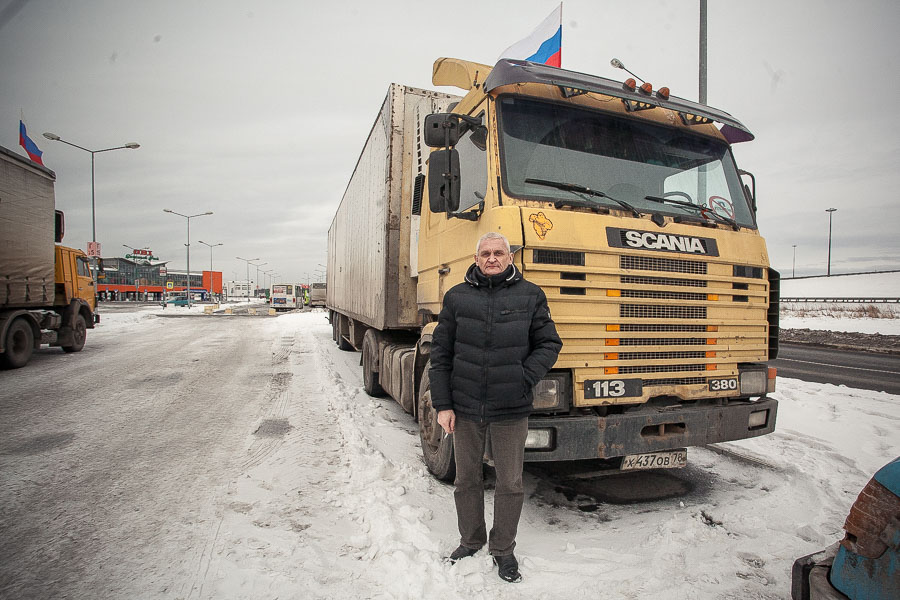
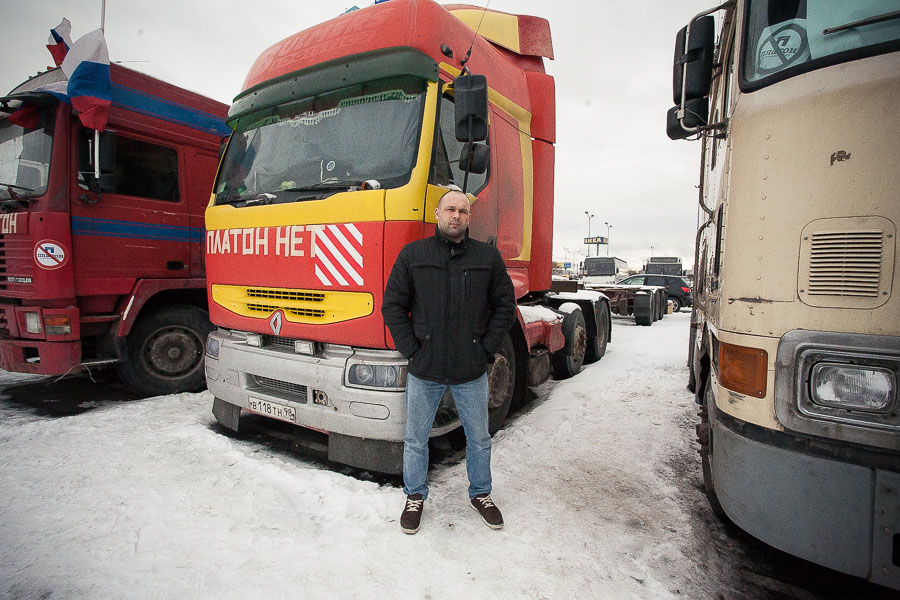
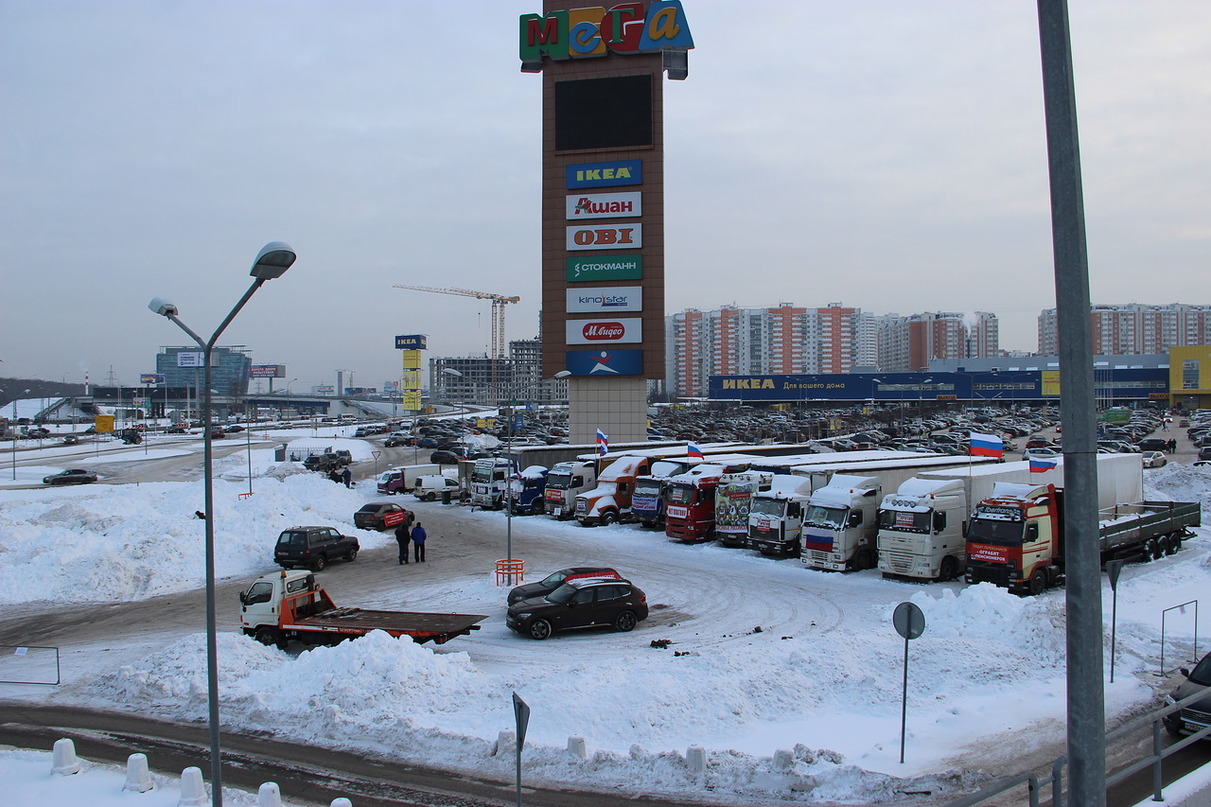
The nationwide strike by Russian truckers officially wrapped up on March 1, but Petersburg drivers have continued to maintain their makeshift protest camp outside the MEGA Dybenko shopping center [in the city’s far southeast]. They have declared their campaign against the new Plato mileage tolls system indefinite.
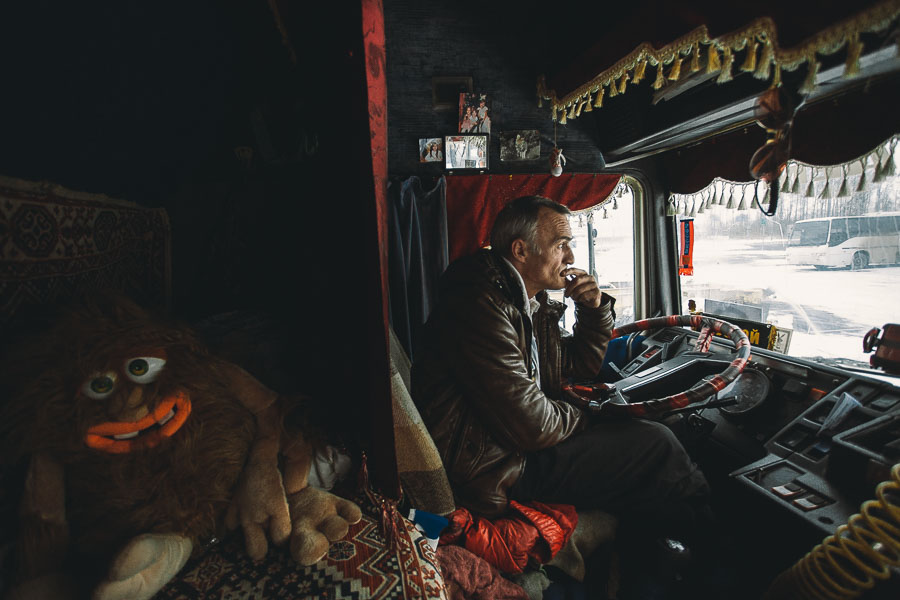
Nearly all of the drivers who have driven their trucks to MEGA Dybenko are individual entrepreneurs. After the innovations wrought by the Rotenbergs, business has become unprofitable for the truckers. Why have those who work for themselves decided to go on protesting instead of hauling freight? Olga Rodionova put together the following portfolio of photographs of truckers and their statements for paperpaper.ru.
Dmitry, 42, individual entrepreneur. Has been hauling freight since 1997. The past five years has been hauling containers around the city, but sometimes takes loads to Karelia. Married with a 16-year-old daughter.
“Have you seen the roads in this country? I have been paying taxes for many years, the roads have not got better, but now I have to pay even more? One wheel costs me 20,000 rubles [approx. 250 euros]. Have you seen how many wheels I have on my truck? If I pop a tire in a pothole, whom can I blame? Nobody! No one has ever got any compensation from the highway services or the government for breakdowns caused by the poor state of the roads. We just pay and pay. I have sometimes left at five in the morning to avoid traffic jams. While I picked up the load, got it unloaded, and then returned the container, it was already eleven in the evening. Sometimes there is no point going back, and I’m away from home for three days at a time. Many of our guys say there is no point in striking, that nothing will change, but I’m very tired of the sense of insecurity in all parts of life. It’s important to me to be here.”
Arkady, 54. Owns his own truck. Has worked in heavy freight haulage since 1983. Is a teetotaler. Has driven round the entire country: the farthest he has ever driven was Blagoveshchensk. Hauled “Cargo 200” loads during the war in Afghanistan.
“Where are the ruts deepest on multi-lane highways? In the left lanes! But we are obliged to drive in the right lanes. The roads in Russia are bad, because funds for road construction are embezzled and roads are not built to technical specss. But they put the blame on us, saying the trucks are to blame for everything. [Answers his telephone.] Hello. Yeah, we are doing a bit of striking. You come with Dima. He can climb around on the rigs.”
Vadim, 45. Owns his own truck, a 2000 Volvo. Previously drove a KamAZ. After his house was destroyed by fire, rebuilt it with his own hands. Married with two daughters.
“Plato has only one office in Petersburg where I can get a mileage recorder installed, but they don’t have them in stock! Meaning I couldn’t use Plato even if I wanted to. The mileage recorders were doled out to the major companies, while we, the midsize companies and individual entrepreneurs, are being squeezed out. To be able to get onto the road and work without paying a fine, I have to travel hell knows where to a computer terminal on Fermskoye Highway [in the far northwest of the city] and waste time and money. But there is no guarantee the terminal won’t freeze or just won’t be working. There is no point in talking with the people who work there: they are clerks who don’t decide anything. It’s like trying to agree with a highway patrol inspector about changing the traffic rules.”
Valery, 49, individual entrepreneur. Has driven his own MAN truck since 2008. Has been driving since 1987. Got behind the wheel in the army, then worked in the motor pool of a port. Did his army service in Poland, and in 1988 worked as a driver near Chernobyl. Married with two grown children and a 4-year-old granddaughter.
“Cargo haulage rates have not changed for seven or eight years. During that time, only the price of fuel and taxes have gone up. If you work it out, I pay threefold. First, I pay all my taxes. Then, due to them, I end up with less and less money. Finally, I pay again as a consumer at the stores: everything has become more expensive. The Plato system is not the whole matter here. They are just muscling out small business. Before, when there was no Plato, we never gave a it a second’s thought. We drove and drove. There was work, and thank God. I am fifty years old. Who is going to hire me? It is a long way to retirement, and I do not want to sit on my butt working as a watchman.”
Dmitry, 30. Works with an individual entrepreneur as a crew member. Has driven since he was 18. Got his semi-trailer license at 21 and has been driving big rigs ever since. Married with two children.
“Before the crisis of 2007, I had three trucks. I had to sell all of them to pay the mortgage: I was afraid of winding up homeless. I myself am from Ufa. I came here with a load and stayed to support the protest. The wife chews me out, of course, saying I should come home already. But if everyone thinks it doesn’t concern them, then nothing is going to change.”
Vladimir, 49. Has lived and worked in Petersburg since 1997. After his wife’s death, has had to raise his 5-year-old daughter alone. Used to work a three-days-on, three-days-off schedule, driving garbage to a penal colony for recycling. But with a young child to raise, had to change his schedule and in recent years has done intracity freight hauls.
“I don’t expect anything good to happen. I would be thankful if they wouldn’t prevent me from working. The less the government worries about me, the better it is for me. It’s scary, of course. I’m 49. Where am I going to find a job?”
Alexander, 45, individual entrepreneur, owns his own truck. Moved to Petersburg from the Urals in 2013. Married. Has raised six children, four of them his own and two adopted.
“I have an illegal fine against me in the database. I proved in court the fine was illegal, but it is still listed there. The highway patrol tried to keep me from getting here to the camp. I only broke through thanks to a truck driver who helped out. I got him up on the radio, and he covered me from the highway patrol. I have been behind the wheel my whole life. I was even born in a car, in my dad’s Pobeda. I pay taxes and duties. I don’t work under the table. I just want to work in peace.”
Vladimir, 32, individual entrepreneur. Has worked as a heavy-duty freight driver for 10 years, the last three on his own rig. Married with child.
“I was involved in the first protest, too. I met some of the guys there, and some of them here. What do I want? The other guys have said it already. If things don’t work out, I will close my individual enterprise and register for unemployment. They have put so many obstacles in our way we cannot get out on the highway at all. There are no mileage recorders in stock, the Plato computer terminal doesn’t work, and if a trip isn’t registered on Plato, the fine is higher than the money you would make on the load. It is just a legal means of driving us from the market, you see? It’s not even a matter of extortion. We simply cannot work.”
Oleg, 37. Has lived in Petersburg since 2001. Used to drive himself, but around 10 years ago,, registered an individual enterprise and hired a driver to run his rig. Married with two children. Was among those detained by police on the first day of the protest.
“You know, my lawyer told me not to wag my tongue here especially.”
Sergei, 48. Drives a rented truck and works for a limited liability company founded by his wife. Has worked as a driver since 1991. The occupation runs in the family: his stepfather was a driver, and his uncle, a long-haul trucker. Mainly works for three regular clients, hauling furniture, household goods, and construction mixes. Worked for a long time with the Saint Petersburg Theater of Ice, traveling half the country with the company.
“Plato is not the end; it is only the beginning. People say we should raise rates or let the customers pay the tolls. But fuel has again gone up, and spare parts for trucks have gotten a lot more expensive. As a consumer, I suffer from this, too. The wife chews me out, of course. We have no money, the tank is empty. But as a man, I would feel ashamed towards the other guys, so that is why I am parked here. Or rather, that is why I live here. The wife says I should just live here then.”
Truck Drivers in Russia Urgently Need Your Solidarity
Striking Truckers’ Camp in Khimki. Courtesy of antiplaton.info
In Russia, despite crackdowns against independent labour union activists, a group of truck drivers organized themselves in mid-November of last year to defend their labor rights and livelihoods. Their goal is to found a nationwide union of truckers that would be run on a non-hierarchical basis by its members. For the last three months, these truckers have been on strike against a draconian new system of cargo haulage tolls that would make it almost impossible for workers like themselves to earn a living.
On December 3, 2015, truck drivers organized a protest camp in Khimki, a suburb of Moscow, that has served as a coordinating center for all striking truckers. At the moment, around ten thousand drivers are taking part in a nationwide strike, and since February 20 of this year, more than ten other protest camps have been set up in different regions of the country.
The truckers would like to keep striking until the so-called Plato system has been abolished. The Plato system has introduced a new set of tolls for long-haul trucks, and it directly benefits the corrupt businessmen and officials who have profited the most from fifteen years of misrule by Vladimir Putin and his cronies.
Russia has not seen such widespread and serious labor protests since the 1990s. The striking drivers are supported by many other downtrodden groups in Russia. In the course of the protests, new networks have emerged through which the truck drivers have issued other demands such as reforming housing policies and reinstating benefits for pensioners as well as abolishing the transport tax. In addition, many wage earners and other precarious groups have been inspired to join the new union of transport workers or form their own new associations or labor unions.
Despite broad support from the Russian public, the Khimki camp is now in dire straits in terms of resources. Above all, the strikers need financial support for publicizing the strike and providing for their families, as they have no sources of income at the moment.
Therefore, we are asking for any kind of solidarity (media, material or other kinds of support) from the international anticapitalist movement, and labor and trade unions around the world.
Striking Dagestani trucker. Photo by and courtesy of anatrrra
Since February 20, Russian truckers have been carrying out a nationwide strike against the newly introduced Plato mileage tolls system, a strike scheduled to end tomorrow, March 1.
Yet another truckers’ protest camp has been set up, this time in the Tyoply Stan district of southwest Moscow.
More than forty regions of the country have been involved in the strike, but Dagestan has been leading the way. The wave of protests started there, and this was no coincidence. Conditions in Dagestan are very difficult for truckers. There are too many taxes, the shipping rates are too low, corrupt officials at different levels demand tribute payments, and so the strike is simply a matter of survival for Dagestani truckers.
The media blackout that has affected all the striking truckers has taken on more rigid forms in Dagestan than in other regions of Russia. As far back as this past autumn, a local TV channel was forced off the air for two weeks after it broadcast a story about the protesting drivers.
Truckers were working themselves ragged as it was, but the Plato tolls system will completely ravage the incomes of their families.
As one trucker remarked, “It’s not our trucks that ruin the roads, but the roads that ruin our trucks.”
And in fact, a good part of the money truckers earn is spent on spare parts and repair.
The truckers need support, and they are open to dialogue. Would you like to ask them a question? Don’t be shy! There are big rigs parked outside the MEGA Centers in Khimki and Tyoply Stan, and you can go there and talk with the truckers any time of day. It is certainly a hundred times more informative and pleasant than watching TV.
P.S. A telltale incident occurred on the subway yesterday as a friend and I were traveling to Tyoply Stan to meet with the striking Dagestani truckers. I was telling my friend about them, and I was not whispering, of course. We were standing next to the doors. Suddenly, we heard the disgruntled shout of an irritated lady, around fifty-five years in age, sitting next to us. She demanded I shut up. I was talking loudly, sure. So noise can be tolerated but not conversation?
—anatrrra
__________
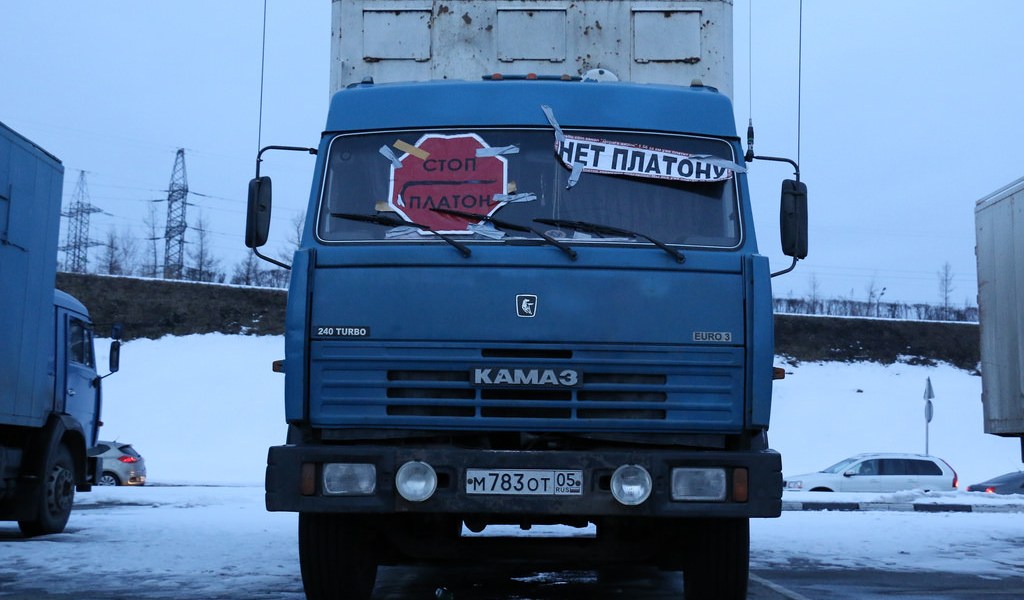
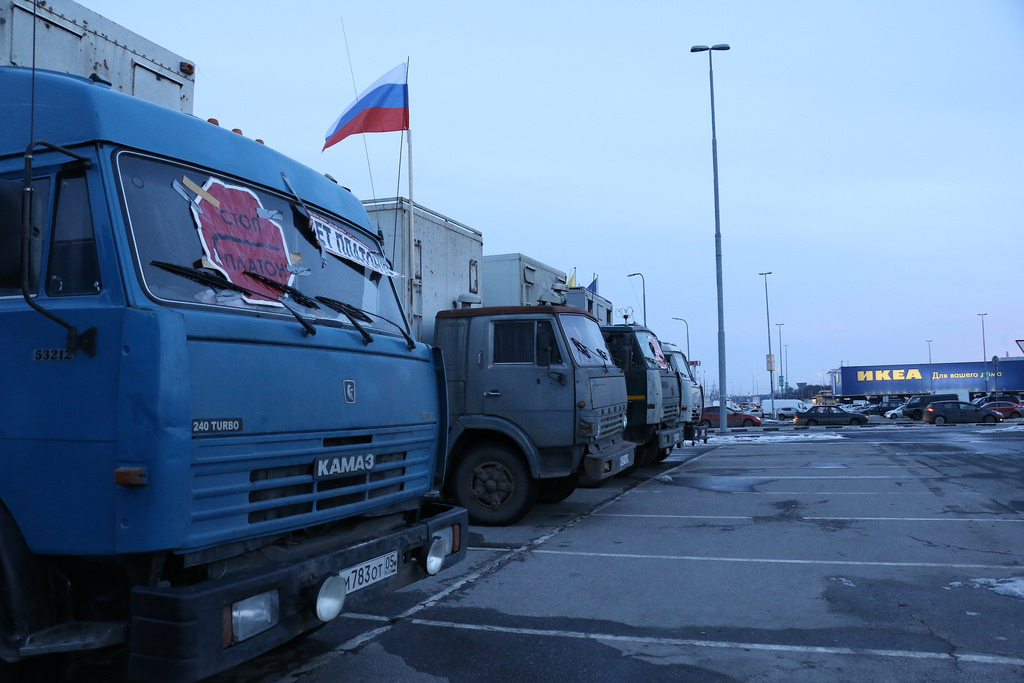
Striking truckers’ camp in Tyoply Stan, Moscow. Photo by and courtesy of anatrraStriking Dagestani trucker in front of his rig. The placard on the windshield reads, “Plato, put it into reverse before it kicks off.” Photo by and courtesy of anatrrraStriking truckers chatting with a visitor to their camp in Tyoply Stan. Photo by and courtesy of anatrrra
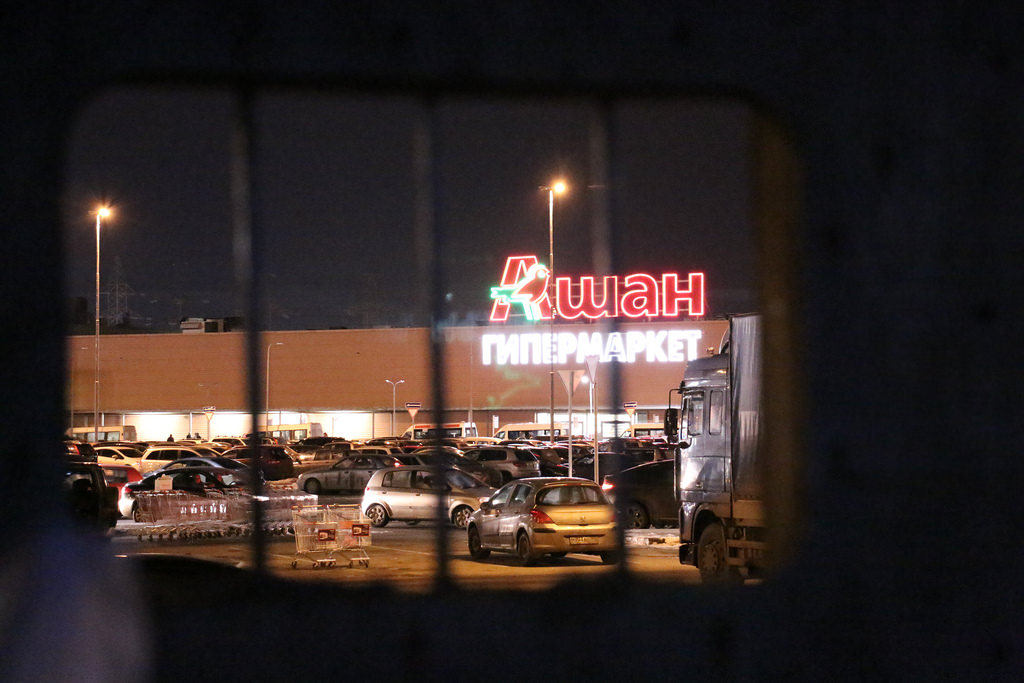
An Auchan hypermarket, visible from striking truckers’ camp in Tyoply Stan. Photo by and courtesy of anatrrra
My thanks to anatrrra for letting me translate the preface to their photo reportage and permitting me to reprint several of the photos on this website. The rest of anatrrra’s visit to the striking truckers’ camp in Tyoply Stan can be viewed here. You should also read all my previous posts on the draconian Plato haulage tolls system and Russian truckers’ protests against it. TRR
Victoria Lomasko Chronicle of a Troubled Time The Khimki Truckers’ Camp Readies Itself for Nationwide Strike
Truckers’ camp in Khimki
Sergei Vladimirov, a coordinator at the Khimki truckers’ camp: “In the early days, we pushed everybody away and were suspicious of each other. We didn’t know each other yet.”
Andrei Bazhutin, another coordinator at the camp: “In the early days, chaos prevailed, but now the guys are like soldiers. We have figured out what ‘newsworthy’ means and how to give interviews, but the demand on us has been such it is like we’ve been doing this for several years.”
Over the past two and a half months, the truckers have also learned to hold rallies, organize alliances, and produce visual propaganda.
Truckers have been coming from other cities to see the camp firsthand. Two truckers from Kursk were impressed.
“In Russia, people always look up to the big cities. We’re going to tell our people back home, ‘Boys, the whole country is rising!’”
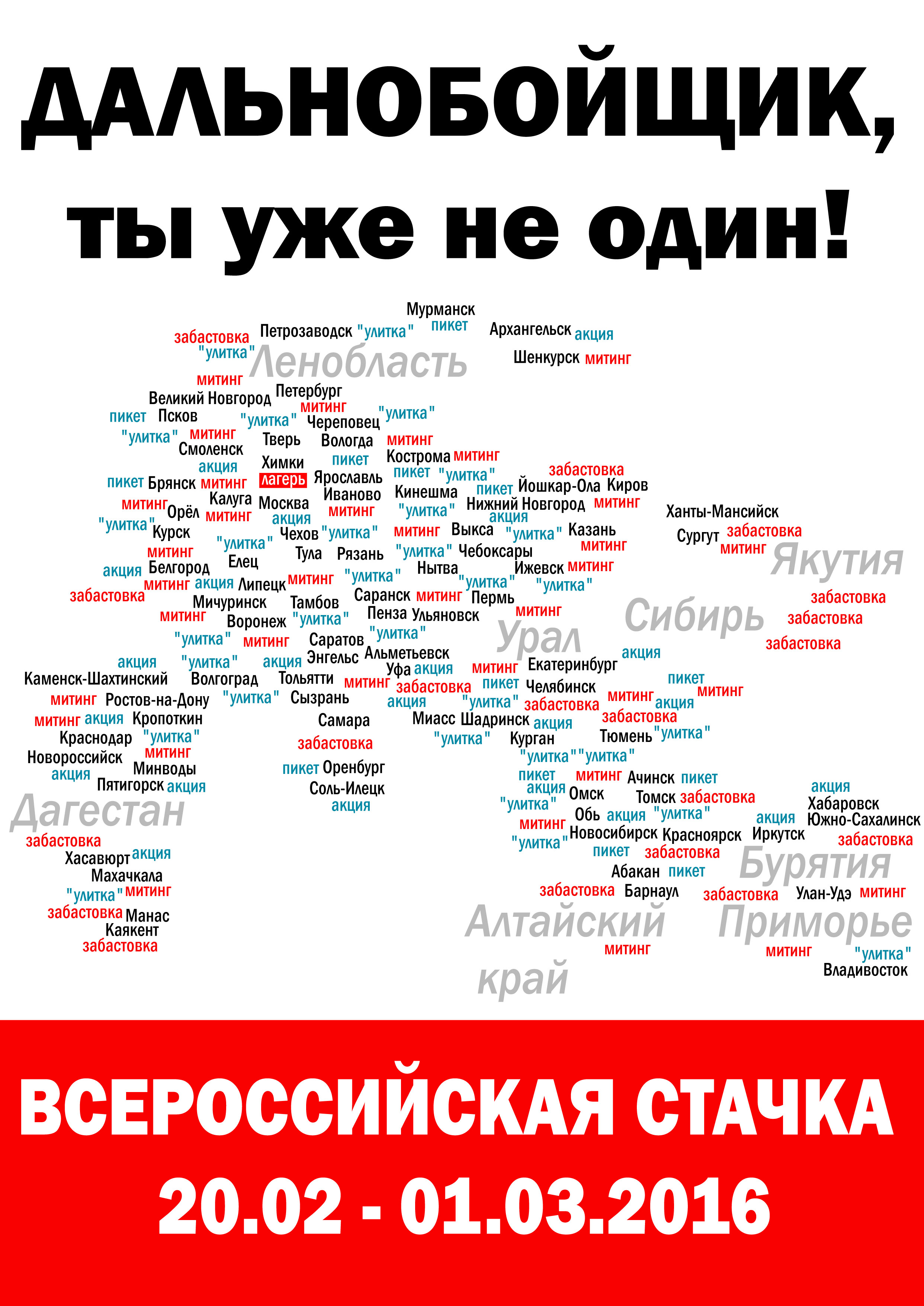
“The days the big rigs stop running: February 20 to . . .”
Russian truckers will hold a nationwide strike from February 20 to March 1.
The protesting truckers are convinced that toll roads for trucks are just the tip of the iceberg. The new tariff will disrupt the cargo transportation system as it now exists, leaving it to the monopolists.
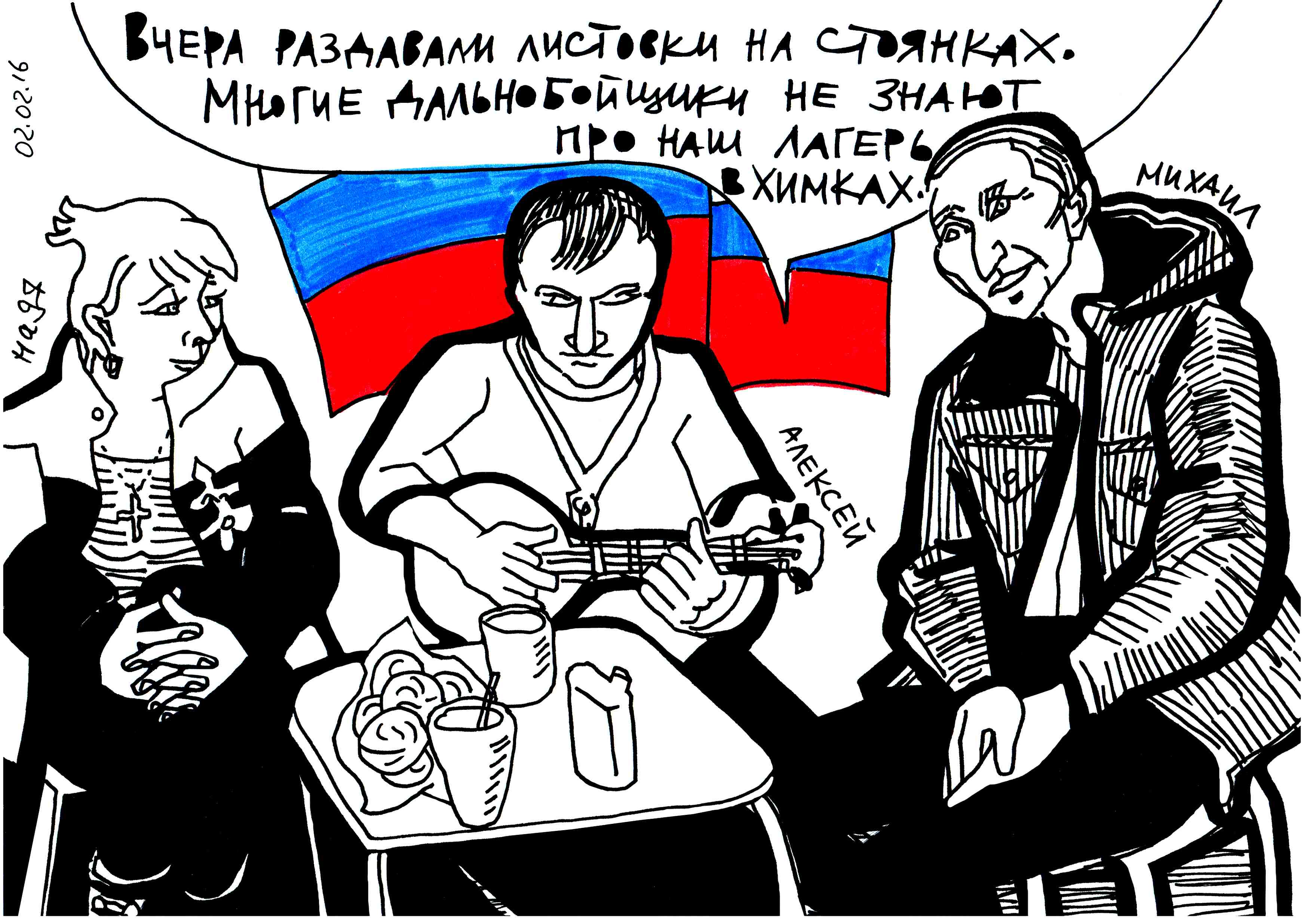
Nadya, Alexei, and Mikhail. Alexei: “Yesterday we leafleted the truck stops. Many truckers don’t know about the camp in Khimki.”
Many drivers have first heard about the truckers’ protest and the fact they could join it from the Khimki activists. They rarely use the Internet and don’t know any reliable news websites, while the protest has not covered by TV news channels.
Those who have not visited the camp believe the truckers’ protest will peter out. But how can it be expanded if the truckers are unable to appear on TV regularly? The truckers have given us an example of how not to be afraid of speaking out against lawless decisions by the authorities. Don’t they deserve our help publicizing their cause?
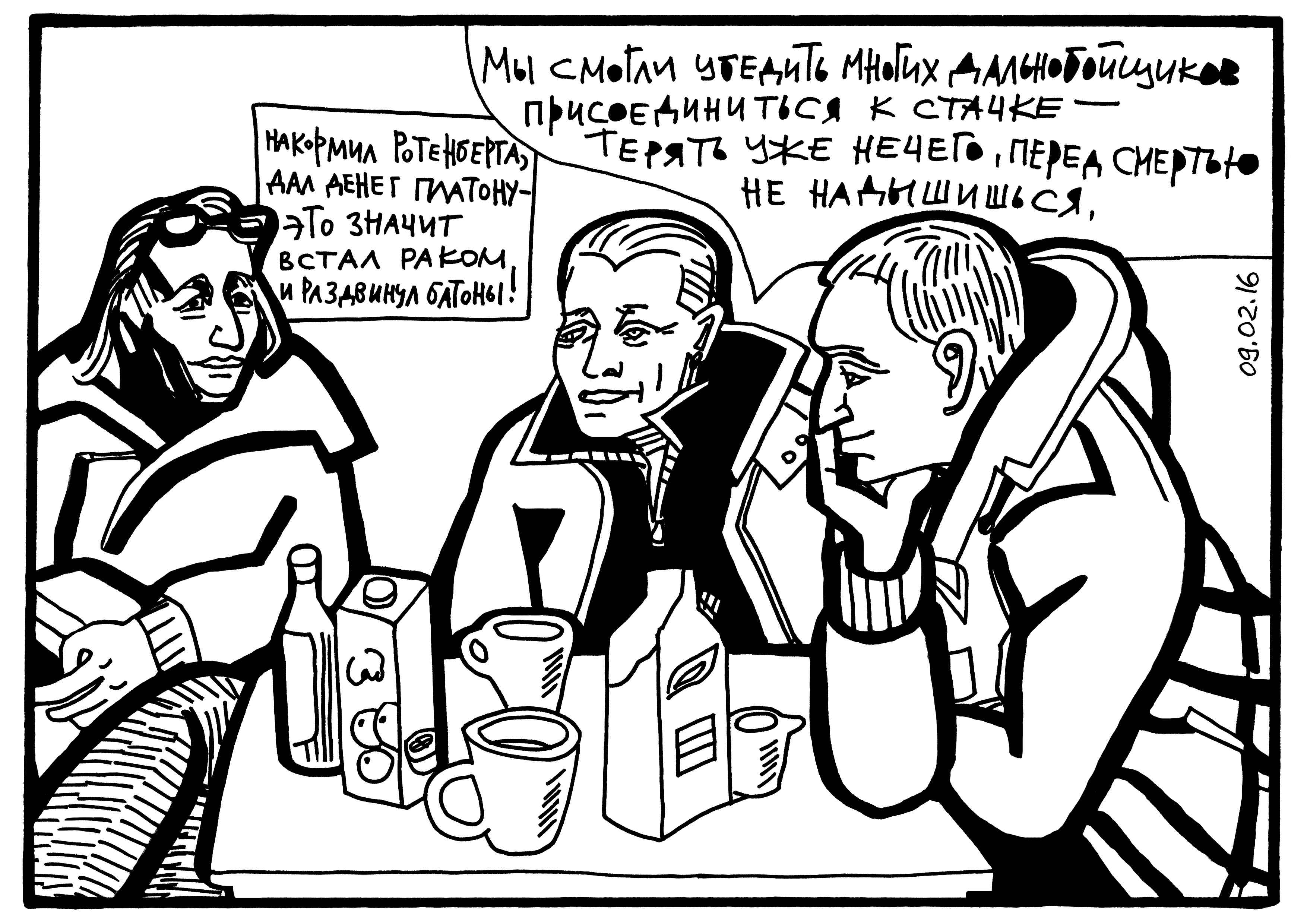
Activist: “We’ve been able to convince many truckers to join the strike. There is nothing to lose now: there is no point in breathing in a lungful of air before you die.” Poem on wall behind activists: “He gave a bone to Rotenberg, / And gave money to Plato: / Meaning he bent over like a doggie, / And spread his butt cheeks.”
Activists from the Khimki camp have held meetings in many cities at which they shared their self-organizational know-how.
“In the regions, they want to see truckers from Khimki, because they trust us,” say the activists.
Money is needed for additional organizing trips. If you are able to support this important cause, you can find the details of the activists’ bank account here.
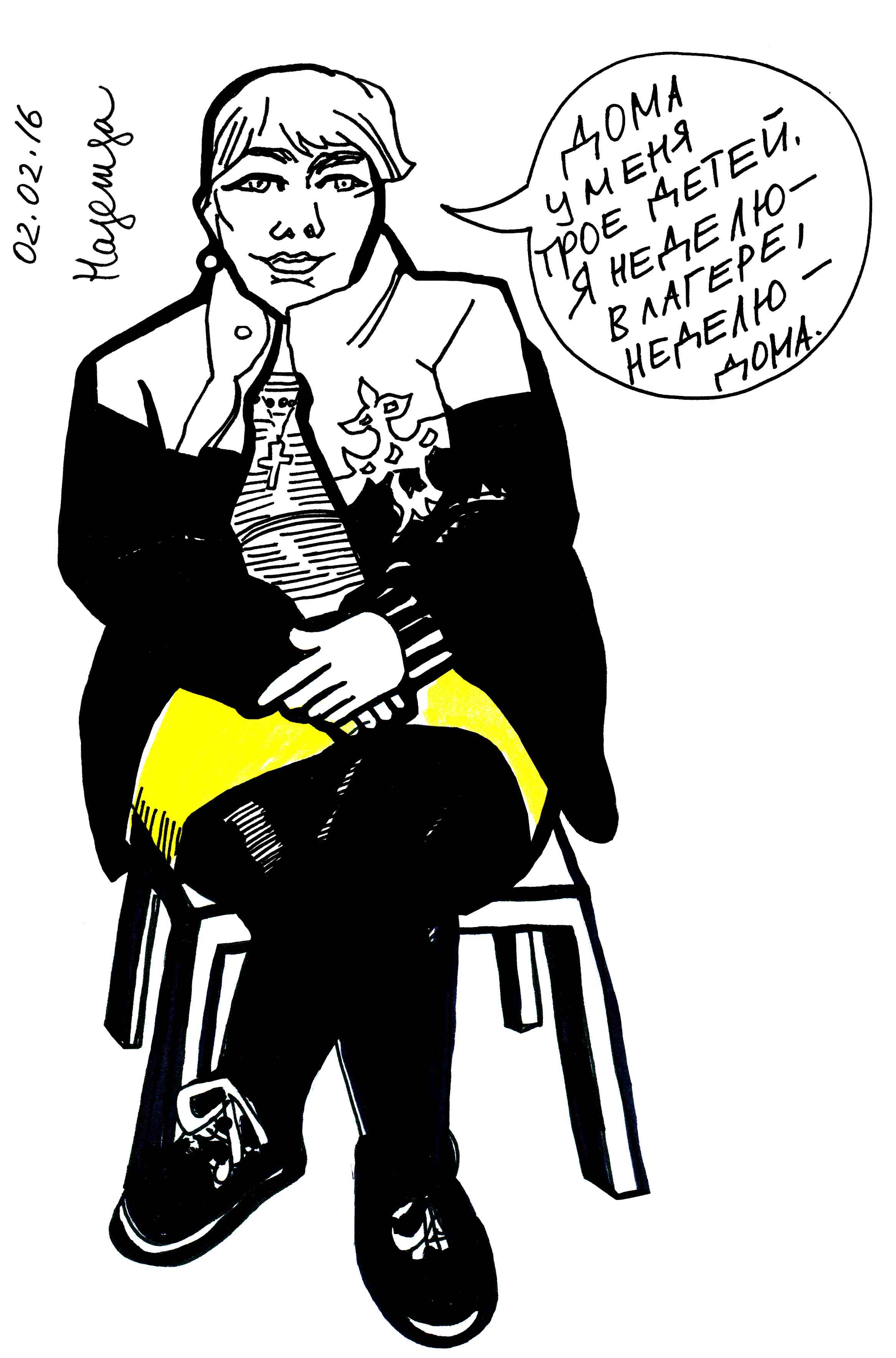
Nadezhda: “I have three kids at home. I spend a week at the camp and a week at home.”
Nadezhda, who is from the Vologda Region, used to work as a manager in the housing management system, but left “because the whole business is dishonest.” She owns two trucks. She has been at the camp since day one.
“I’m grateful to Plato for helping me meet such a variety of people here,” says Nadezhda.
Rustam: “After the meeting of all Dagestan’s districts, where we elected our own representatives, the police made calls on all of them at home.”
Rustam Mallamagomedov became the interim head of the Union of Dagestan Truckers. Truckers’ unions are now being formed in many Russian regions.
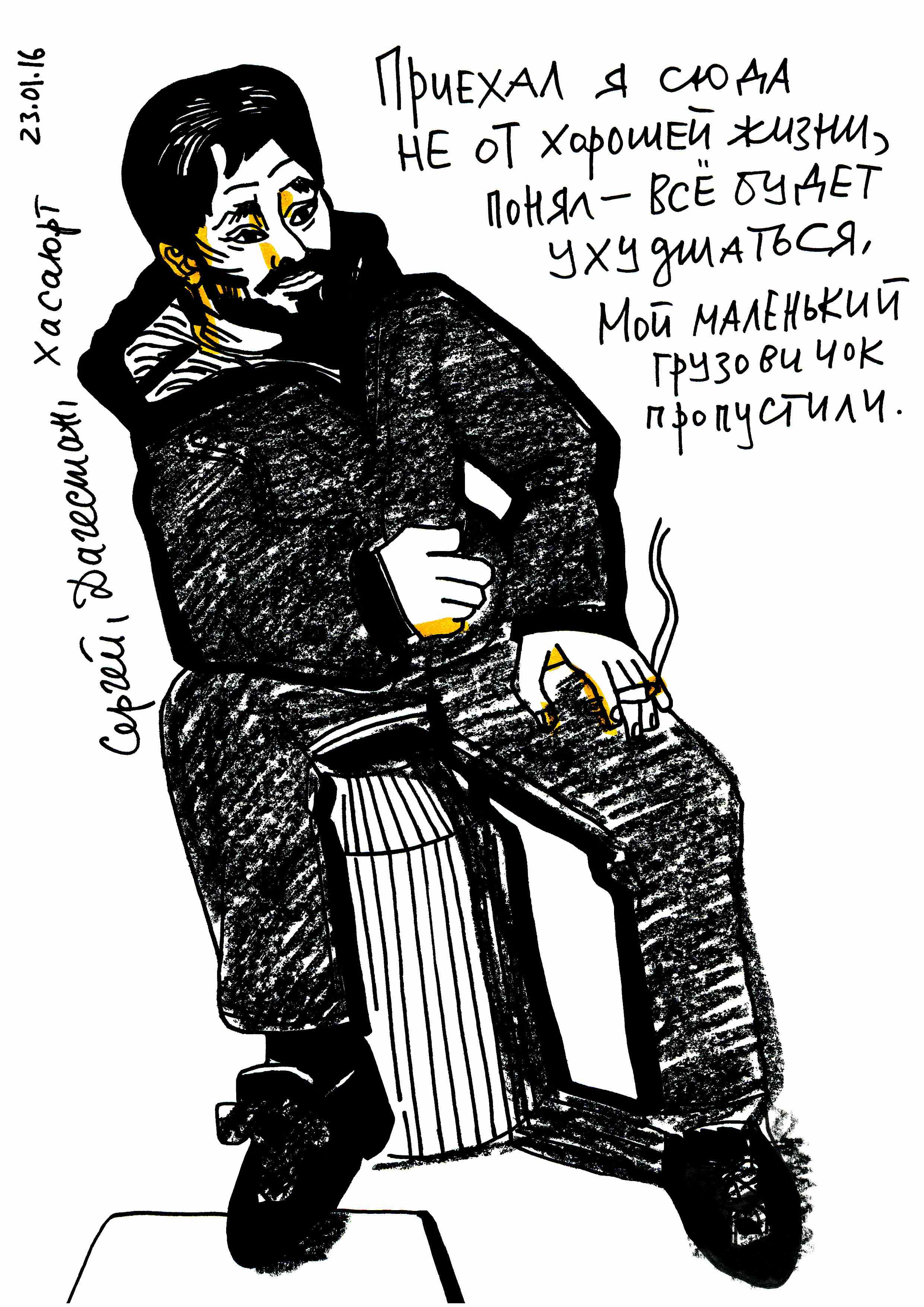
Sergei (Khasavyurt, Dagestan): “I did not come because life was a bed of roses. I realized things would only get worse. The police let my tiny truck through.”
Sergei, a trucker from Dagestan, told me this story in late January. I met him again the other at the Khimki camp. He was cheerless.
“My boss is selling the truck tomorrow. It’s become unprofitable. The Internet is awash with ads for trucks for sale.”
Sergei doesn’t know how he’ll survive. The country is in the midst of an economic crisis and there are no jobs to be had.
Visitors to the camp
The camp gets visitors every day. Some folks bring the activists hot food, while others bring them diesel for their trucks. Still other people give lectures and stage improvised concerts. Khimki residents invite the protesters to their houses to take showers and wash their clothes. The majority of those who come to meet the truckers later become regular visitors.
How do you feel about the truckers’ protest? It would be interesting to know your opinion. If you support them, then how do you show your support? If you don’t support them, then why not? What would have to change for you to support them? And what could inspire you to travel to the Khimki camp and meet the truckers?
“Trucker, You’re Not Alone! Nationwide Strike, February 20-March 1, 2016.” Designed by Victoria Lomasko, the poster is a stylized map of Russia specifying the kinds of strike and protest actions planned by truckers in particular locales.
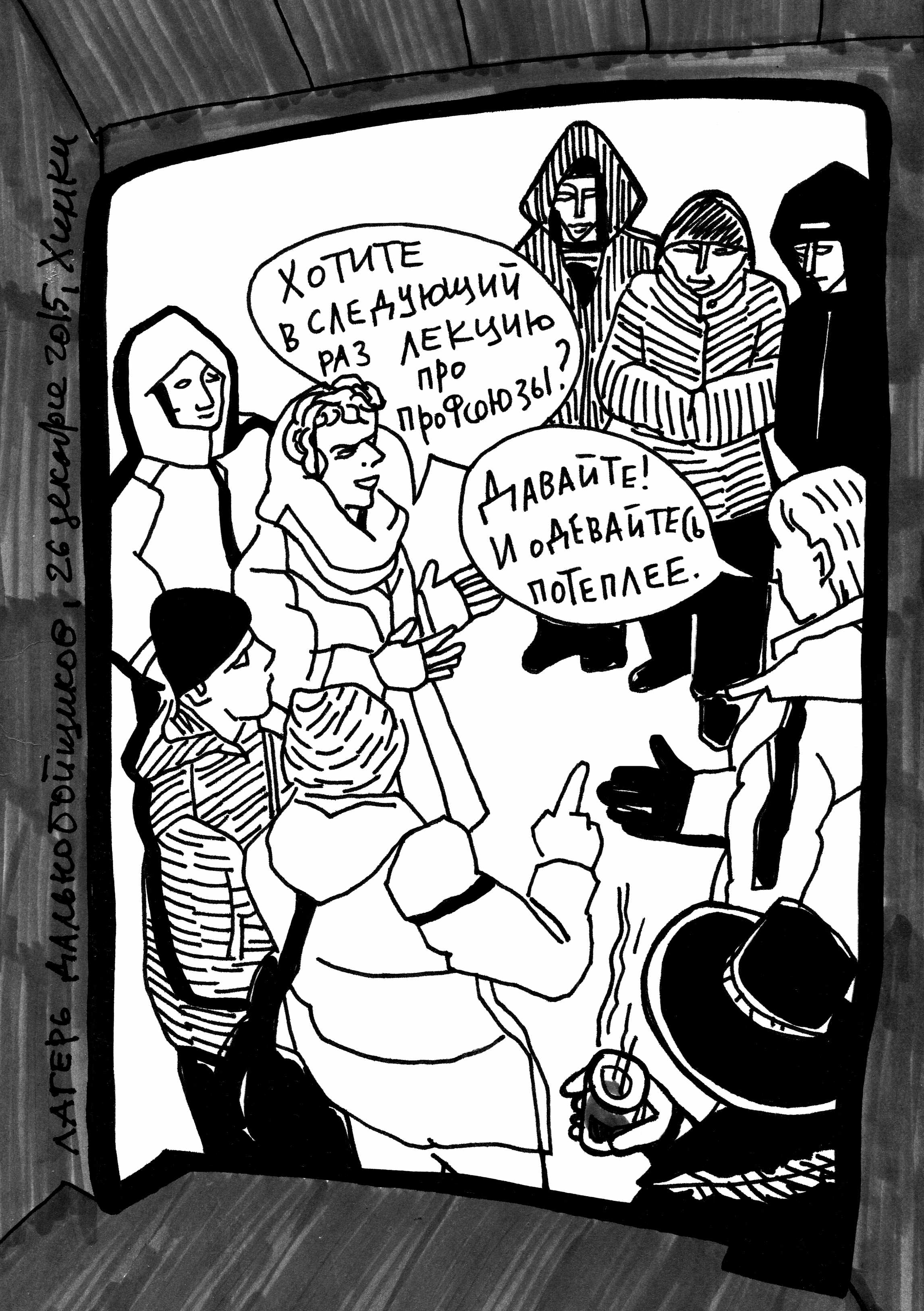
Tamara Eidelman How I Gave a Lecture to Truckers echo.msk.ru
December 26, 2015
When I informed my near and dear that I had been asked to give truckers a lecture on civil disobedience, their reactions were basically the same.
“They won’t understand a thing.”
“They support Putin and won’t give you the time of day.”
“Update your vocabulary,” someone even said to me.
“Haven’t they left yet?” asked a woman who knows her way around politics quite well.
All these statements were not very encouraging, and in any case I was badly dithering. I knew I was capable of giving interesting lectures, just not to truckers. I pictured burly men who yawned as they listened to my arguments and might even, for all I knew, shout, “Why are we listening to this? We are not interested.”
But it turned out they were interested.
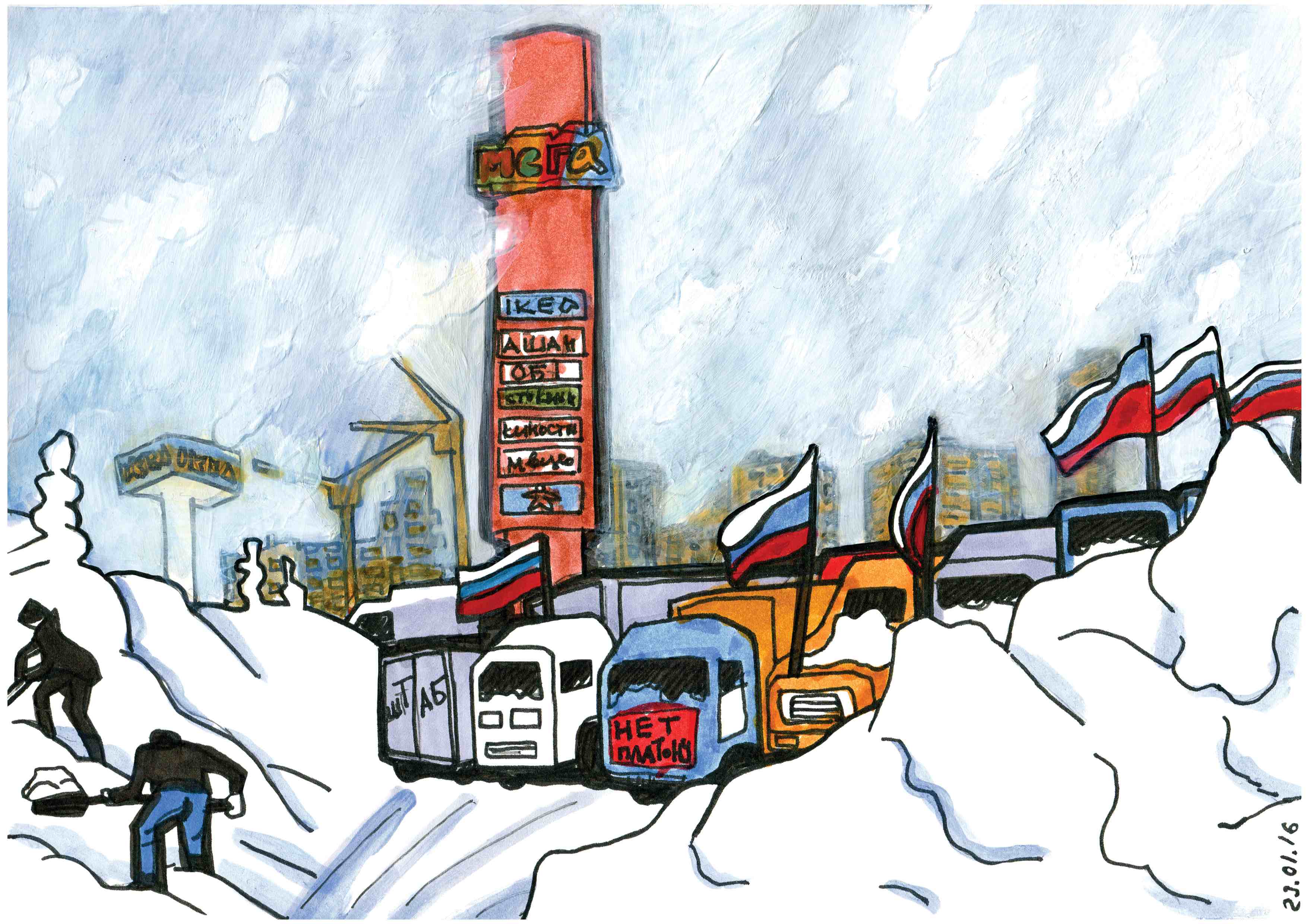
My friend, who had dreamed up this whole thing, and I slowly and painfully made our way to Khimki. The shuttle bus dropped us off on the wrong side of the Mega shopping center, so we had to walk through it. Holiday lights were shining, people were hurrying to do their New Year’s shopping, but no one wondered about the big rigs parked in the parking lot.
And we still had to find the parking lot. We walked a long way through enormous spaces crammed with the cars of happy Mega and Ikea customers. Finally we saw the trucks: the word “lonely” came to mind. They were parked in the back of beyond. True, they had to be visible from the road, not far from the anti-tank obstacles, but who would see them there?
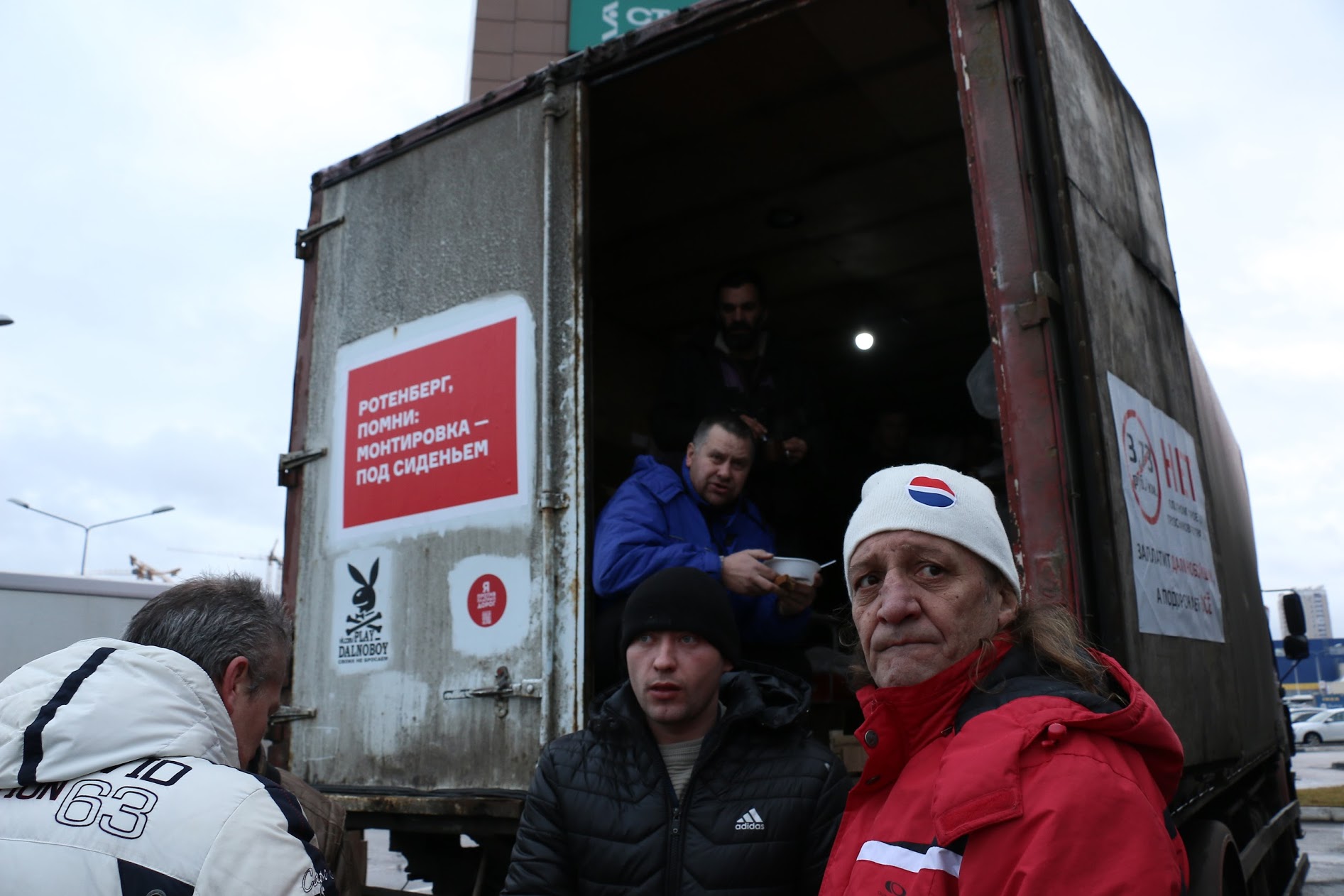
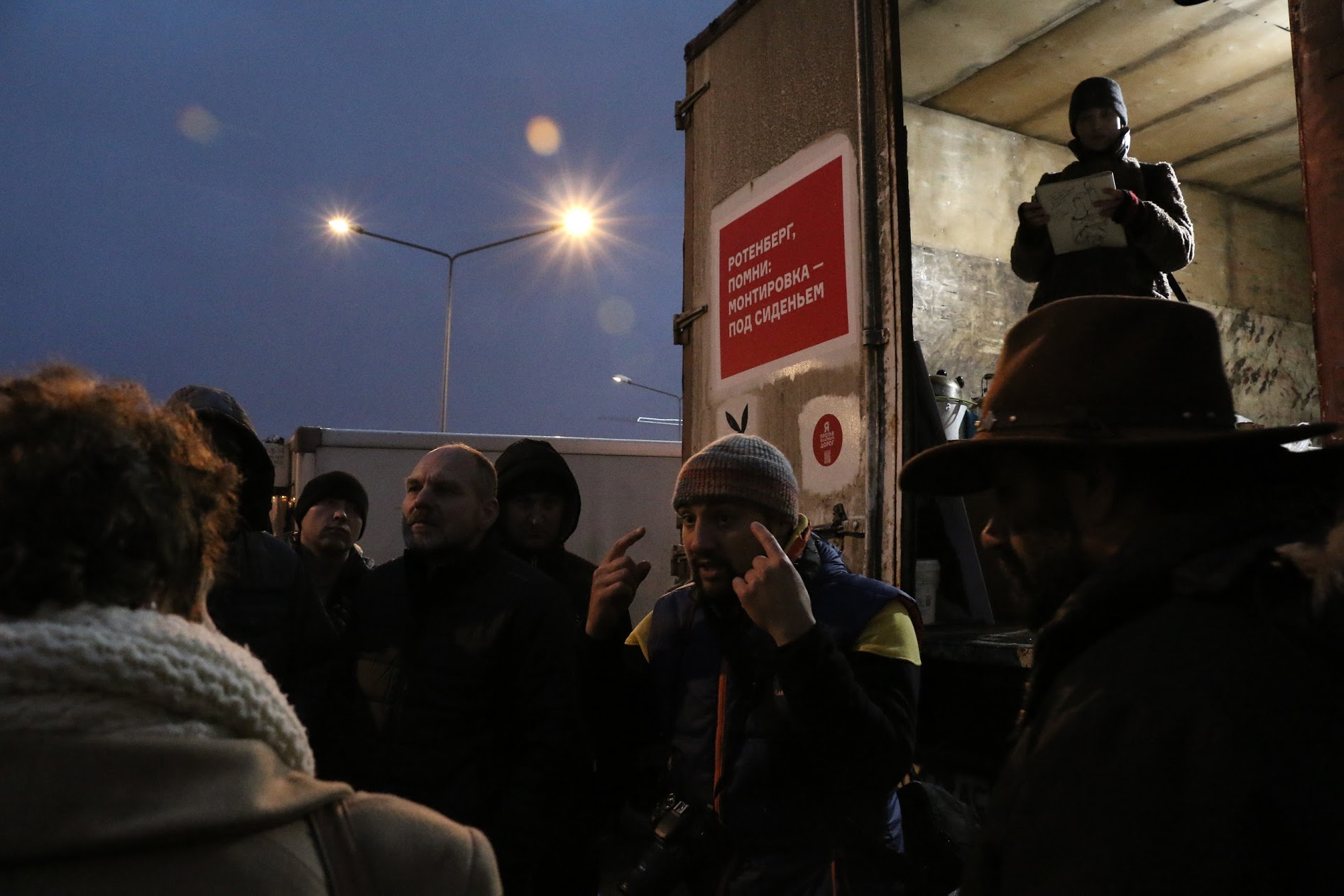
The trucks sported homemade placards reminding Rotenberg that the tire iron was under the seat. There was a New Year’s fir tree with only a few decorations on it. We were looking for Viktor with whom we had arranged the lecture. We were told Viktor was in the “cafeteria.” Oh, they had a cafeteria? The cafeteria was yet another truck, where you could have tea. We discovered only two or three fellows there. The rest had gone off to have lunch, obviously, to a more suitable place for such things. Were they really going into Mega? What did they think about the happily occupied shoppers, who had arrived as it were from another world?
We stood and chatted. It transpired we were not the only guests there. There was a bus driver who had brought a load of passengers to Mega and in the meantime had stopped by to see how things were going. It seemed it was not his first visit. He talked about how much money people who drive buses had to shell out for no reason at all.
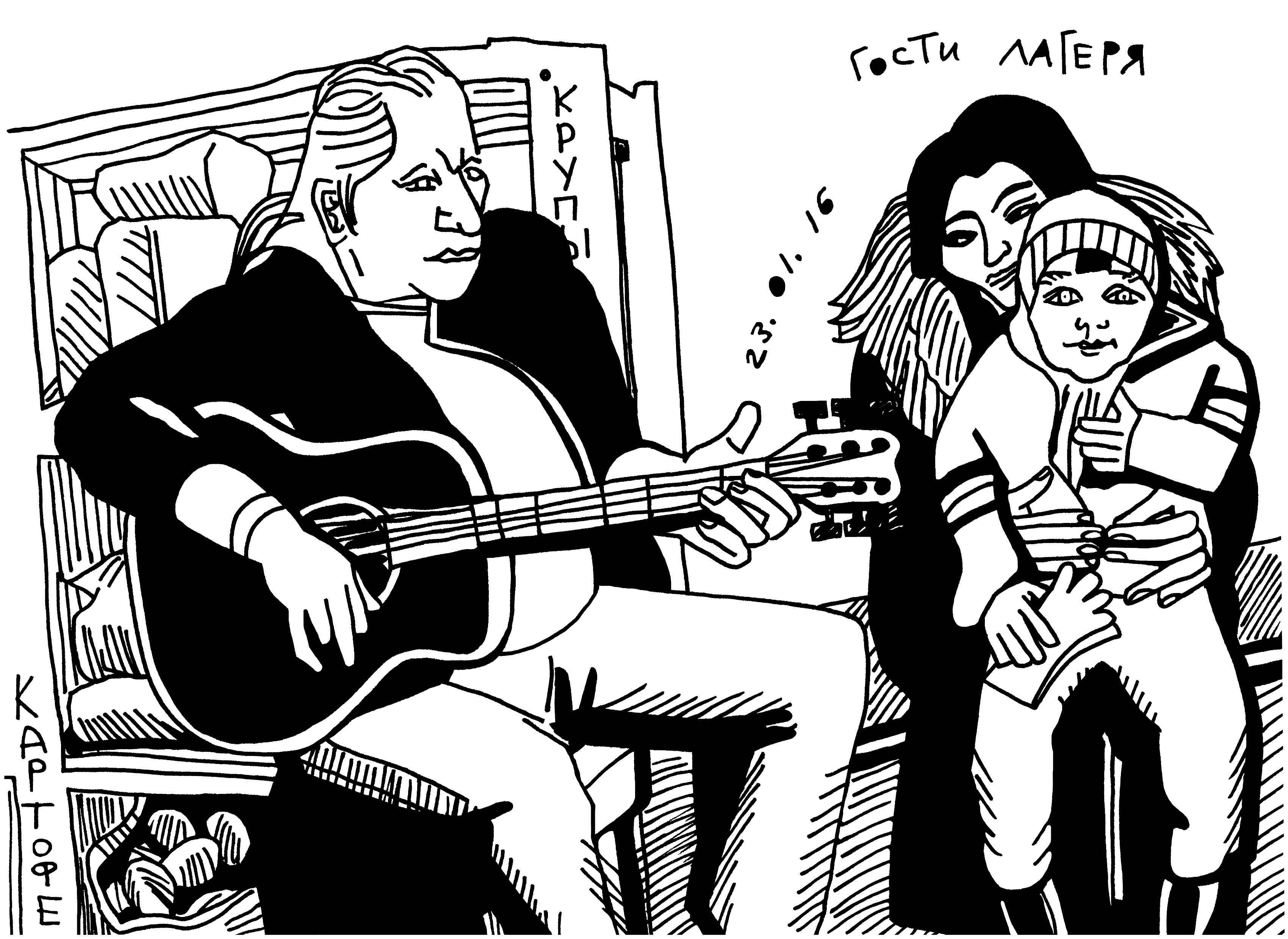
Young women who wanted to draw what was happening at the truckers’ camp and post the drawings on Facebook showed up, as well as a woman with a camera. They said it was not their first visit, either, and that there were even old women who brought the lads borscht.
Meanwhile, the guys had started to gather. They really were big and strapping, and I found it hard to picture them listening to the lecture. But as soon as Viktor said the lecturer had arrived, they immediately happily formed a circle round me and listened.
I told them about Parnell and the first boycott in the world, against Captain Boycott, about how the landlords in Ireland had pitilessly raised the rents and complaining was useless.
“It conjures up certain associations,” commented one of the listeners. “Only there is no point in boycotting Rotenberg.”
“Hang on and let us listen. This is interesting,” the others said, stopping him short.
I looked around and could see they really were interested.
I saw I was surrounded not by ferocious wild men, but by attentive listeners with intelligent faces. I continued.
We moved on to Gandhi. The interest grew. The slogan “fill the prisons” provoked healthy mirth. One of the men was told he would be their Gandhi and would go to prison first. Another man asked whether there was not a difference between Russia and India: in Russia, where so many people had perished in Stalin’s camps, it would hardly be possible to fill the prisons. He was told that no one was forcing him to go to prison: he was just being told how things had been in the past. Someone immediately said they did not have to repeat what had already been done, but could come up with something of their own.
We had an intense discussion of what exactly they could come up with. This was the problem. So far they had not come up with anything than blocking the road to Moscow, and even then far from everyone agreed with this plan. The drivers gathered in Khimki were supposedly supported by their comrades in dozens of regions, but the majority was inclined to “wait and see.”
Discussions broke out after almost every sentence. Meanwhile, Shamil, an intelligent-looking Dagestani, and Sergei, a short, energetic man, had joined us. Everyone had his or her say. Someone said it was a pity that his schoolteacher, Raisa Demyanovna, had not talked about things as emotionally as I was.
The conversation became more and more relaxed. When I said that Gandhi had called on his supporters to refrain from sex, everyone gleefully hooted that I was talking about them, that they had long refrained from sex. All of them had very unhappy wives waiting at home, some of whom had threatened divorce. They had no money and their husbands were away from home, so of course you could understand them. Some of the men had gone home, while others said they could not, because “what would the guys say.”
We segued to Martin Luther King. The story of the busy boycott by Montgomery’s Negro population elicited cheers of approval.
“That’s great! They hit them in their wallets!”
Sergei commenced on a fairly coherent account of Gandhi, but he was interrupted and told the “speaker” had just told them about Gandhi.
The questions rained down one after the other. Of course they mainly boiled down to the famous “What is to be done?” We tried to discuss how to break through the media blackout. Some said we had to establish a public television channel.
Everyone unanimously chewed out Channel One. Everyone wanted more lectures. Everyone was interested.
An hour later we said goodbye. We were asked to come back again, and we promised to do it.
We headed back home, our emotions overflowing. What a joy it had been to converse with completely sane, intelligent, energetic people, to establish a rapport with them, to see the look in their eyes, and hear their questions.
I would love for them to get an answer to the question “What is to be done?” I would love it if as many people as possible went to see them, if they did not feel worthless and abandoned on New Year’s Day, if they won.
By the by, as for the issue of “updating my vocabulary,” not a single truck driver swore even once when I was there.
And the man who asked about Stalin’s camps also asked me why I thought that, unlike in Europe, each new Russian regime wanted to “bend” us. I said there was a really long answer, but I would give the short answer: because we put up with it. Everyone applauded.
Tamara Eidelman is an Honored Teacher of the Russian Federation and a historian.
Yura, Mikhail, Anatoly, Andrei, and Vitya are all truckers and arrived in Moscow from different cities almost a month ago. After an unsuccessful attempt to paralyze the Moscow Ring Road, they are stuck in a parking lot in Khimki. They can leave if they like, but the police will not let them back. In Khimki, almost all the protesters against the Plato toll payment system are individual entrepreneurs. After making all the various deductions, their take-home income is around 20,000 rubles a month [approx. 250 euros]. If they earn even less, they won’t have enough to feed their families, and some of them have three or even four children. This is their first large-scale protest and coordinating with their brother and sister drivers has not been so easy, because it is a big country and very few of them know each other personally. There were many provocateurs at the beginning, and the know-how of cooperating accumulates only gradually in a new protest arena. “The economy must be changed” is a phrase that you hear them saying along with disappointed remarks about the government and those commentators who depict them as savages. In fact, it is very pleasant and interesting to converse with the truckers in Khimki. They are interested in lots of things and are open to communication. And they need support. In addition to information support they mainly need diesel fuel, 300 liters a day. One Moscow activist showed up with his own canister. Everyone can do this: you don’t have to have your own car. So let’s support the truckers both emotionally and materially!
“Plato came online and the price of bread went up.”
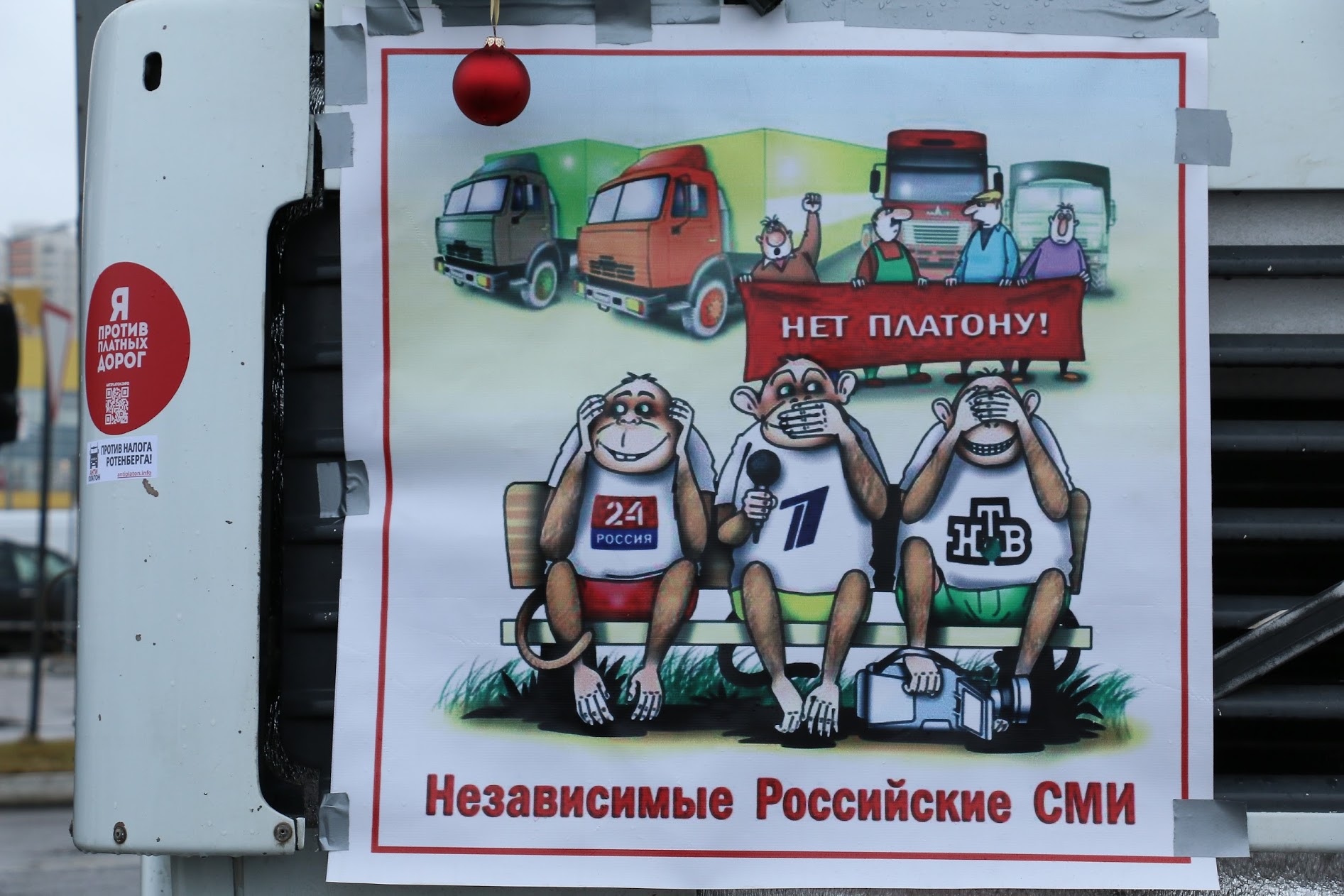
“Russia’s independent media: Russia 24, Channel One, NTV” / Truckers with placard: “No to Plato!”“Remember, Rotenberg: the tire iron is under the seat.”Tamara Eidelman (center; see her account, above) in discussion with the truckers in Khimki, December 26, 2015.Victoria Lomasko (top right), producing a graphic reportage of the proceedings (see below), Khimki, December 26, 2015.
Compared to A Chronicle of Resistance, which I compiled in 2011-2012, this is a more modest series. I have neither the drive nor the resources to regularly document protests, nor are there inspiring scenes of rallies attended by hundreds of thousands of people, but there are certain kinds of pressure groups I still want to sketch.
What do they have in common?
The people involved are self-organized and there is a lack of obvious leaders.
The people involved constantly emphasize they are “normal, ordinary people, remote from politics.”
They have specific social demands, caused by a violation of their rights.
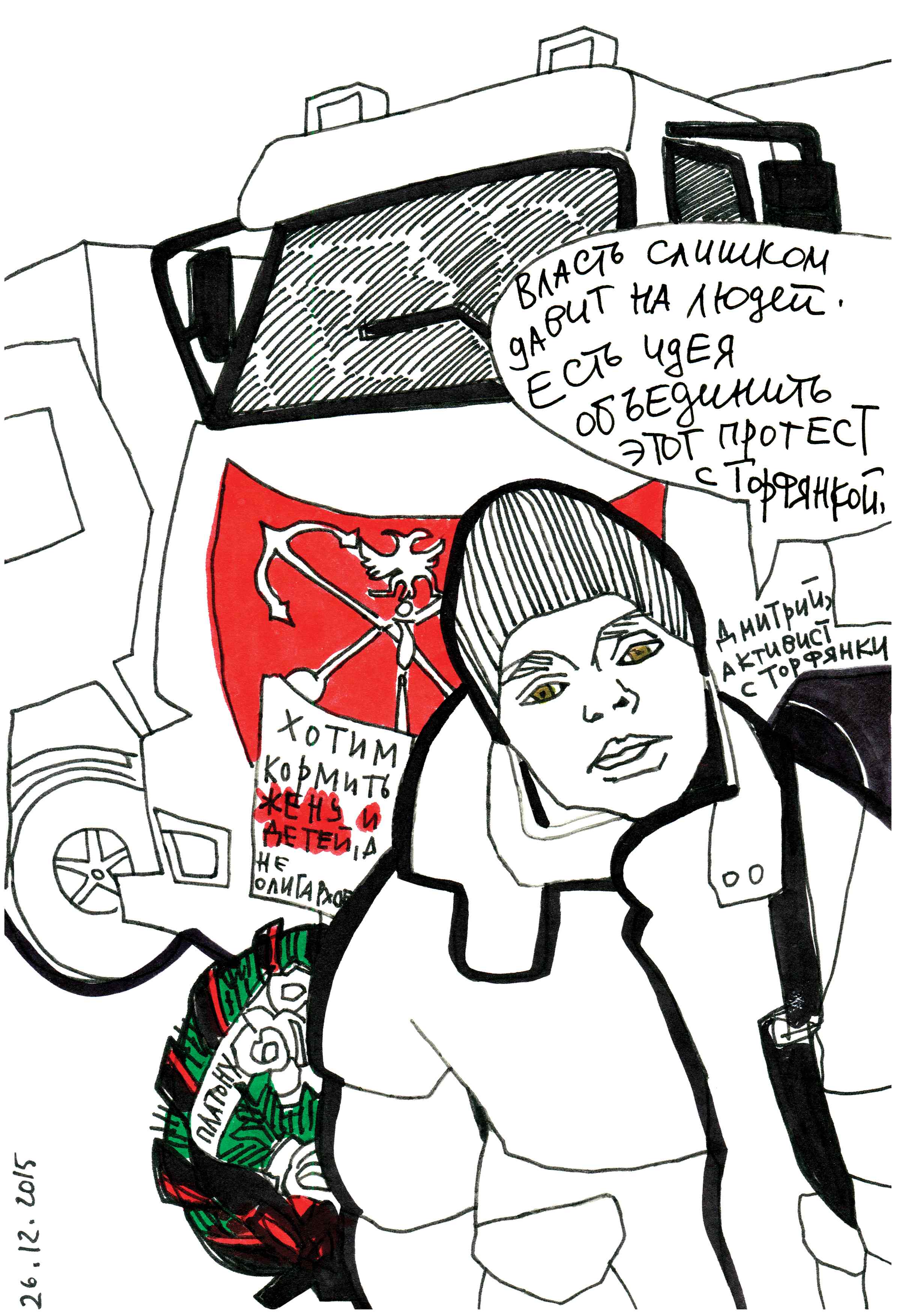
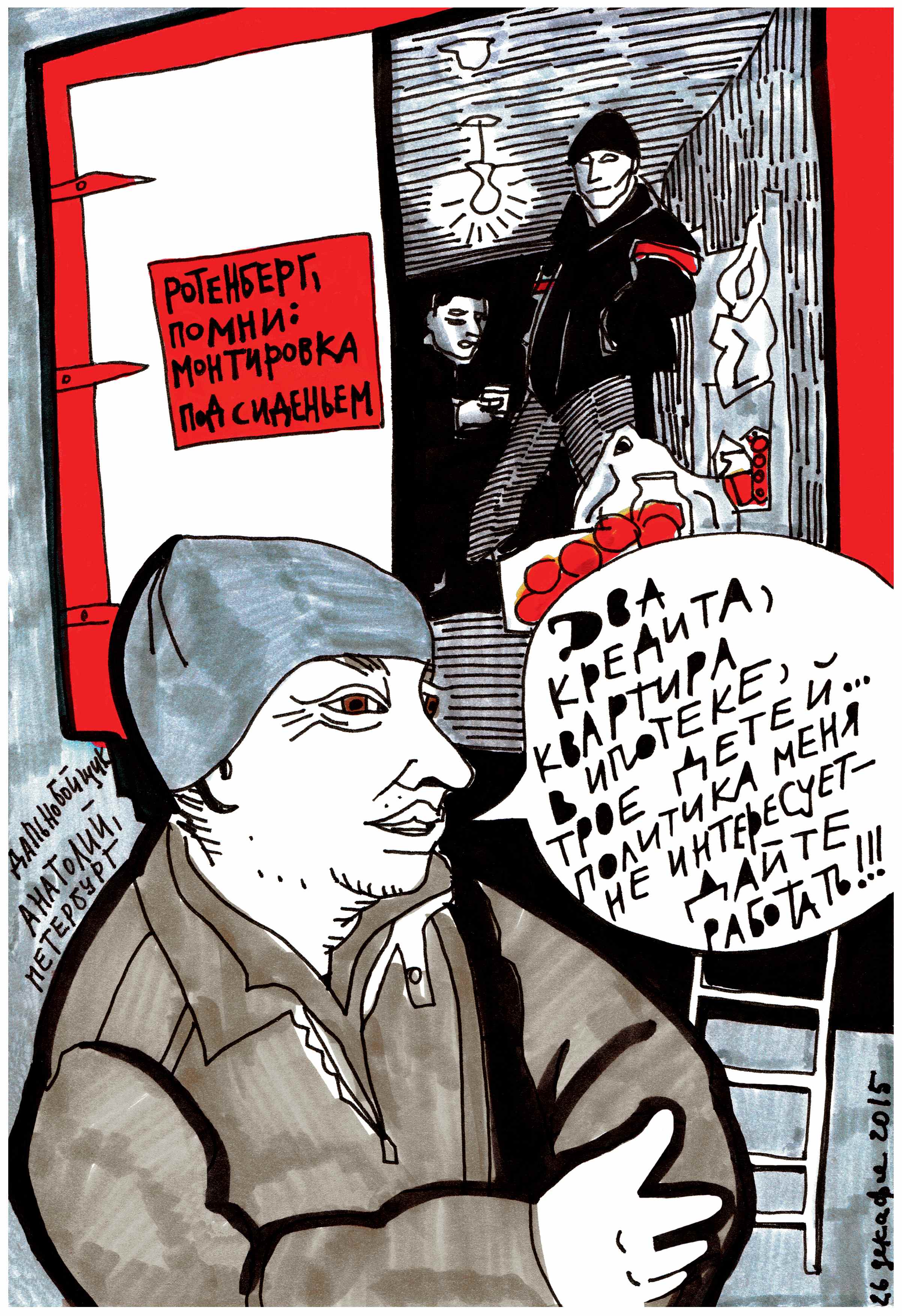
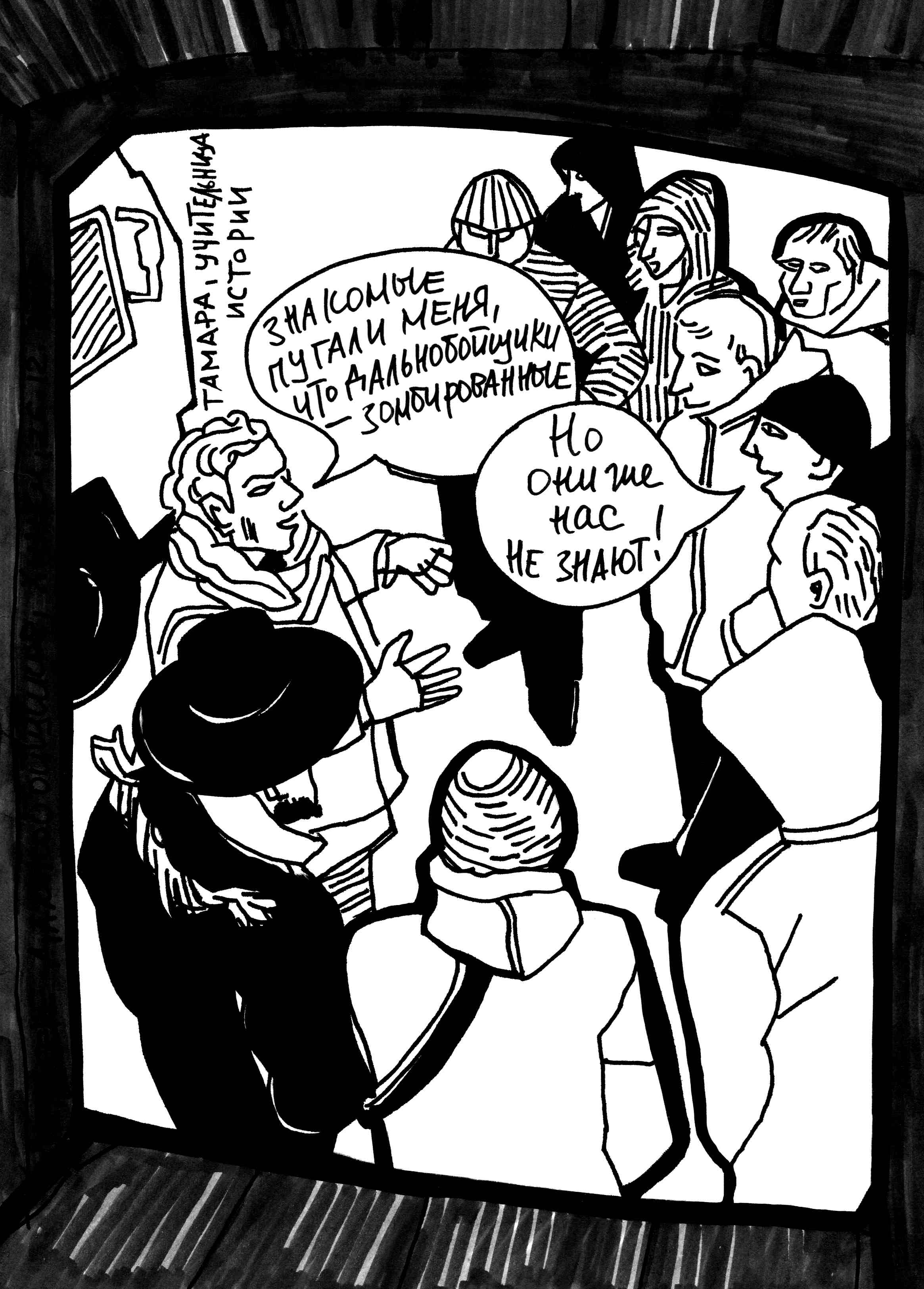
Andrei, a trucker from Petersburg: “After the New Year everyone will wake up, but the truckers in Khimki will be gone. We need support now.” Placards on truck: “No to Plato” and “I’m against toll roads.”Dmitry, an activist from Torfyanka: “The authorities are put too much pressure on people. There is an idea of linking this protest with the one in Torfyanka.” Placard on truck: “I want to feed the wife and kids, not oligarchs.”Anatoly, a trucker from Petersburg: “I have two loans, the apartment is mortgaged, and three kids . . . I am not interested in politics: let me work!!!” Placard on back of truck: “Remember, Rotenberg: the tire iron is under the seat.”Tamara, a teacher and historian (left): “My acquaintances tried to scare me that truckers were zombies.” Man in black hat (right): “They don’t even know us.” Tamara (left): “Would you like me to lecture about trade unions next time?” Man in white coat (right): “Sure! And dress warmer.” Truckers’ camp, Khimki, December 26, 2015.
Translated by the Russian Reader. Thanks to Anatrrra and Victoria Lomasko for their kind permission to reproduce their work here.