When the Soul Can’t Keep Silent

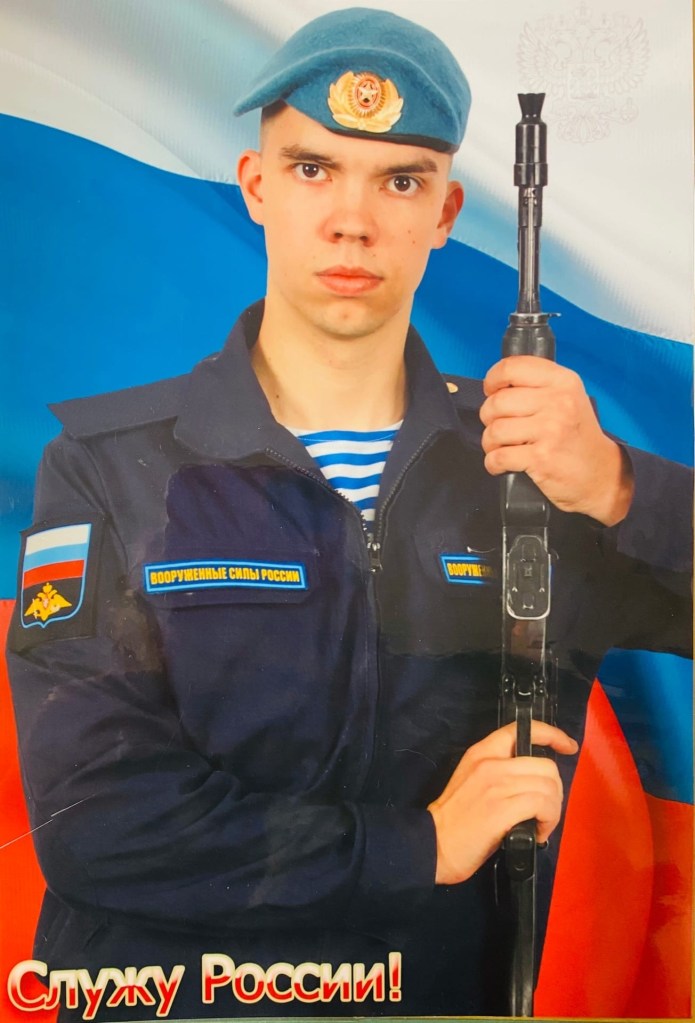
Aydyn Zhamidulov. Photo: Russian Defense Ministry via Kommersant

Kommersant has learned that a military court has begun hearing the criminal case against Senior Lieutenant Aydyn Zhamidulov, a platoon commander in the Airborne Troops, and his subordinate, Private Alexei Dorozhkin. The Russian Investigative Committee alleges that the men kidnapped a young woman who had threatened the officer that she would tell his wife about their relationship and took her to their unit’s temporary deployment point as a Ukrainian spy. There, they stabbed the victim to death and blew up her body in an attempt to conceal their crime. Zhamidulov gained renown for writing patriotic poems during his combat training and was shown reciting them on Telegram channels.

The criminal case against Senior Lieutenant Zhamidulov and Private Dorozhkin was submitted to the Southern District Military Court, sitting in Rostov-on-Don. The men are accused of the kidnapping and brutal murder of a resident of the Luhansk People’s Republic per articles 126.1, 105.2, 30.3, 33.4, and 244.2 of the Russian Criminal Code.

In the file of the case, as investigated by military investigation units at the Russian Investigative Committee, it is reported that Zhamidulov is twenty-eight years old, a native of Kazakhstan, and lived in the Pskov Region. He has a higher education, is married, and was raising two daughters.

In January 2022, Zhamidulov signed a contract with the Defense Ministry and, in the rank of senior lieutenant, served as commander of a parachute platoon in an airborne assault regiment of the famous 76th Airborne Division.

In late 2022, a video was widely circulated in social networks and the media in which Lieutenant Zhamidulov recited a poem of his own about the those involved in the special military operation. At the end of the recital, the officer stated that his family was proud of him and was waiting for him to come home.

Dorozhkin was mobilized on 1 January 2023. Ranked as a private, he served as a senior scout in the Airborne Troops.

According to investigators, at about eight p.m. on 13 January 2023, Zhamidulov and other military men, including Dorozhkin, were drinking hard alcoholic beverages at the Rainbow Cafe in Luhansk. About half an hour later, local resident Valentina Davronova, with whom Zhamidulov had previously been in an intimate relationship, entered the cafe.

A row broke out between the senior lieutenant and the twenty-three-year-old woman. Fearing that Ms. Davronova would report their relationship to his wife, Zhamidulov decided to deal with the young woman, the case file says. He told his subordinates that he would take Ms. Davronova to her current boyfriend.

The young woman was put in the back of a KamAZ truck, and when the truck arrived at the unit, Zhamidulov tied her hands with duct tape. Dorozhkin, who went with them, was ordered by the senior lieutenant to tape Valentina’s eyes, which he did.

To avoid questions from his subordinates and make his actions look legitimate, the investigators note, Zhamidulov told them that Ms. Davronova had served in the Ukrainian army from 2018 to 2021 and had tattoos featuring Ukrainian symbols on her body. He also alleged that she was engaged in intelligence on behalf of the Ukrainian armed forces.

The young woman was taken to a soldier’s bathhouse, where Zhamidulov stabbed her about two dozen times in different parts of her body. At that time, the commander of a reconnaissance platoon combat vehicle, Sergeant Roman Pleshcheyev, entered the bathhouse (his case will be tried separately). Zhamidulov ordered him to finish off the victim. Not wanting to kill her, but fearing negative consequences on the part of the senior lieutenant, Plescheyev stabbed Ms. Davronova with his knife in the area of her left shoulder and right leg.

At 12:20 a.m., Dorozhkin entered the bathhouse, and Zhamidulov instructed him to finish what he had started. Pleshcheyev left the room and Dorozhkin killed the victim by stabbing her in the area of her heart.

Having made sure that the young woman was dead, Zhamidulov ordered his subordinates to take the body outside the temporary deployment point and detonate it with three F-1 grenades so that the deceased could not be identified and the cause of her death could not be determined.

Nevertheless, the crime was solved literally while the trail was still hot. All three defendants were detained and then remanded in custday by a military court.

The case is now in preliminary hearings, and is expected to be considered on the merits this summer. Zhamidulov’s lawyer Natalia Kokhan refused to comment on the case without vetting her answers with her client.

Source: Kristina Fedichkin, “Paratrooper poet accused of murder,” Kommersant, 29 May 2024. Translated by the Russian Reader


[…]

WHEN THE SOUL CAN’T KEEP SILENT
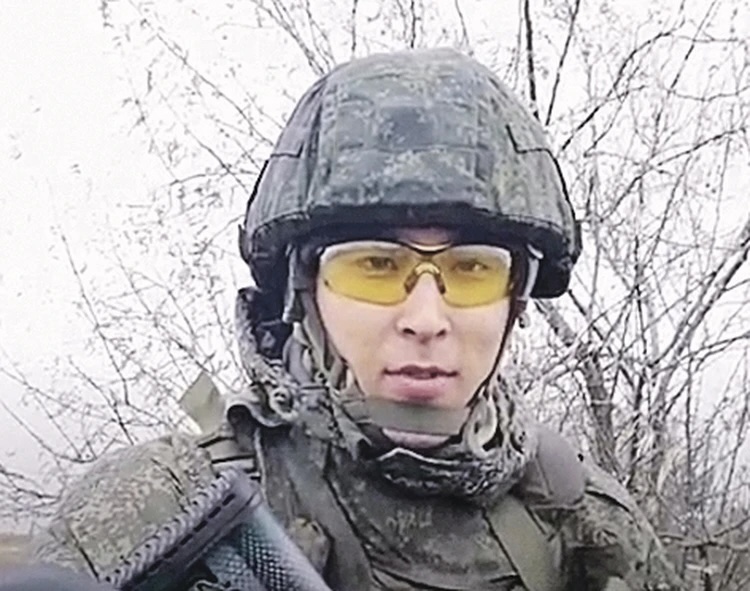
Aydyn Zhamidulov. Photo: Komsomolskaya Pravda

Aydyn Zhamidulov was mobilized from the Orenburg Region. As a civilian he worked as a welder, but now he serves in an Airborne Troops reconnaissance unit. He has a wife, two daughters, and his parents waiting for him at home.

“I was retrained in my specialty. In the short period of mobilization combat training, everything — camouflage, identifying the enemy, working with topographic maps, artillery fire — is very easy to learn,” Zhamidulov said.

All of the things he saw and his interactions with his fellow soldiers inspired Aydyn to write poems. They are plain but honest and poignant, straight from the heart.

Always our ancestors fought evil.
They wrote history with blood, with the pen.
They weren’t afraid to go all the way.
They removed shackles, they united hearts.
Now, our brothers, it’s our turn
To defend our country, our home, and our people.
To do justice, to open their eyes.
The enemy is in deep,
like a needle under the skin.
Let us strike down the puppeteers,
the servants of evil,
Who pull the strings
Of bewildered people,
Of gray-haired mothers
shedding tears
For them, the lives of people
are just a game.
We must put a stop to this
once and for all!

Source: Yulia Reutova, “Victory will be ours! Komsomolka found out what the mobilized are talking about,” Komsomolskaya Pravda, 15 December 2022. Translated by the Russian Reader. Thanks to The Insider for the link.
The Late Photographer Dmitry Markov’s Final Instagram Post

Photographer Dmitry Markov’s final post on Instagram, filed from the town of Alexandrov in Russia’s Vladimir Region

We met Andrei when we were walking in Alexandrov’s bedroom district. He had gone out to get a bottle of vodka from a taxi driver and bumped into us on the narrow snow-covered path at the entrance to his two-storey apartment building.

“You should stop digging for drug stashes here, there’s nothing to find.”

We explained that we were tourists and asked whether we could visit his house. It transpired that Andrei had come home from the special military operation but was planning to go back. He was a drinker. He offered us buckwheat, sausages and tea and told us we couldn’t say no. First he took care of us. He heated the food, boiled water, and served us a simple lunch. Only then did he sit down, open the bottle, and pour himself some vodka.

“Aren’t you scared of dying?” I asked him.

He was silent for a long time before replying.

“I’m scared of watching people die.”

And then he wept.

Source: Dmitry Markov (Instagram), 6 February 2024. Translated by the Russian Reader

Small Acts of Defiance

Image courtesy of Civic Council

The town’s coroner and mortician, Dr. Ivan Malinin, a Russian immigrant who barely spoke English, performed the autopsy on Williams at the Tyree Funeral House. Malinin found hemorrhages in the heart and neck and pronounced the cause of death as “insufficiency of [the] right ventricle of [the] heart.” Malinin also found that, apparently unrelated to his death, Williams had also been severely kicked in the groin during a fight in a Montgomery bar a few days earlier in which he had also injured his left arm, which had been subsequently bandaged. That evening, when the announcer at Canton announced Williams’s death to the gathered crowd, they started laughing, thinking that it was just another excuse. After Hawkshaw Hawkins and other performers started singing “I Saw the Light” as a tribute to Williams, the crowd, now realizing that he was indeed dead, followed them.

Source: “Death of Hank Williams,” Wikipedia


Hyvästi Suomi!

This can be translated as “Goodbye, Finland,” or it can be translated as “Adieu, Finland.” The correct translation will depend on our neighbors.

Source: “News Roundup” email newsletter (Delovoi Peterburg), 24 November 2023. Translated by the Russian Reader


Finland has temporarily closed all but one of its eight passenger crossings to Russia in response to an unusually high inflow of migrants for which the Nordic country accuses Moscow.More than 700 migrants from nations such as Yemen, Afghanistan, Kenya, Morocco, Pakistan, Somalia and Syria, have in the past couple of weeks entered Finland via Russia. Helsinki says Russia is funneling migrants to the border, a charge the Kremlin has denied.

Having last week closed four border stations, Finland overnight closed all remaining passenger crossings except its northernmost one, Raja-Jooseppi located high north in the Arctic region, for a month.

Raja-Jooseppi opened its gates for traffic this morning and will continue to accept asylum applications during its four daily opening hours, the Finnish Border Guard said.

No migrants arrived overnight outside opening hours, it added.

The Border Guard is stepping up patrolling along the length of its 833-mile frontier with Russia.

It will get additional resources for the task from the European Union’s border agency Frontex, which said on Thursday it would deploy 50 border guard officers and other staff to Finland along with equipment such as patrol cars to bolster control activities.

Source: “Finland closes passenger border crossings with Russia,” NBC News, 24 November 2023


What are the benefits for Russia?

HS: Russia wants to create an image of a hostile West that is of benefit to the Russian leadership. Finland has not fit this image in the past, but now they are trying to build it. Relations between Finland and Russia are at a turning point. The Russians have realised that they do not know Finland after all. They want to see who Finland cooperates with and at the same time try to stir up discord within Finnish society. Building a new relationship will be a long-term process.

JS: Russia can create a fortress mindset due to a perceived ‘threat’ from the West. Finland’s eastern border is becoming a useful confrontational narrative for the Kremlin. When the same narrative is repeated, a kind of protection mechanism kicks in and even sceptics will start to believe it.

Source: “What is Russia hoping to achieve with hybrid tactics on the Finnish border?” Yle News, 21 November 2023


The Front Lawn, “Claude Rains” (1989)


Claude Rains in Casablanca

He was the French Police Inspector

A functionary through and through

A small man

Remember at the end out on the airstrip

He could have tried to stop them

Ingrid Bergman and her friend from the French Resistance

But he pretended not to see

It was a small act of defiance

As the storm broke in the distance

He was on their side after all.

Claude Rains gave the order to collect the usual suspects

And the camera came in close up on his face

He watched as the plane left the airstrip

Like hope leaves a dying man

But he hung on to the choice he’d made

Claude Rains

Claude Rains

Claude Rains

Claude Rains

I saw a new film the other day

And it was set at the start of a nuclear war

The actors weren’t as good as Claude Rains

But then there was nothing that they could do

All of their small acts could count for nothing

As the storm broke in the distance

Not much to make a film about

Source: “Claude Rains,” The Front Lawn: Lyrics


Civic Council named “undesirable organization” in the Russian Federation

The Prosecutor General’s Office added us to this list on November 3, exactly one year after we announced the creation of our Mobilization Center. We have openly stated that we are working to ensure that the Russian Federation in its current form, with its current government and all that this government calls the state, ceases to exist.

Today it is the Russian state that is criminal, and armed struggle against it is legitimate and necessary. So the Prosecutor’s Office and the Justice Ministry are formally correct: we are their enemies.

In fact, our status as an undesirable organization has not changed anything. Supporting the Civic Council within Russia was also a criminal offense before we were give this status, just like all other independent political and civic activities. The Russian authorities hand down approximately the same prison sentences for making [anti-war] comments on social media and engaging in armed resistance. So, we propose fighting effectively, rather than commenting in vain.

We have to resist intelligently, so we suggest that our supporters inside Russia observe the rules of information security and be vigilant.

We do not accept donations payable to Russian bank cards and do not have accounts in Russian banks.

We are not urging you to attend protest rallies right now. The time to go to the public squares will come later.

We invite those who are ready to take up arms to fight, fully aware of the consequences.

For those who do not want to stay on the sidelines but cannot fight for various reasons, there are other ways to support our cause:

  • donating money, including anonymously through crypto wallets (including Monero)
  • providing information to our OSINT service
  • disseminating information about the opportunity to volunteer

To volunteer for the Siberian Battalion, fill out this form.

Anyone who wants to make a donation should go here. All options are a help to us.

Anyone who wants to help with information or other work inside the Russian Federation should write to us at civic_council@proton.me.

Sincerely yours,

Civic Council, an undesirable organization in the Russian Federation

@obserwujący

P.S. We suggesting giving us the special status of “an organization readying the overthrow of the Putin regime.”

Source: Civic Council (Facebook), 23 November 2023. Translated by the Russian Reader


Foreign luxury brands are closing their flagship stores on Nevsky Prospect, but they could be replaced by Russian fashion retailers, say market participants.

Analysts expect a reduction in rental rates on Nevsky Prospect.

According to sources cited by Kommersant-SPb and NF Group, Breitling, Fendi, Omega, Rolex, and Salvatore Ferragamo have already vacated their spaces in downtown Petersburg. Louis Vuitton has the same plans. Market participants ascribed the mass exodus of luxury sellers to political pressure in the brands’ home countries and logistical and supply chain challenges.

“Luxury retailers initially took a wait-and-see attitude, but now it has become clear that there are no prospects for stabilizing the economic situation in the medium term,” said a source who spoke to Kommersant-SPb.

KNRU development director Polina Fiofilova noted that western brands that have been operating in the fashionable part of Nevsky Prospect for years have driven rents “sky-high” and inflated the expectations of landlords.

In the first half of 2023, the rates per square meter in this locale ranged from 2,600 to 6,700 rubles per month (VAT included), while in the adjacent Telezhny Lane they amounted to 2,500 to 5,200 rubles per square meter per month. Local fashion retailers simply would not be able to afford such rents, analysts said.

Nevsky Prospect is still empty. Despite a reduction in vacancies compared to the peak period, their level remains quite high, thus generating pressure on rental costs, added Mikhail Burmistrov, CEO of the agency Infoline Analytics.

As Delovoi Peterburg wrote earlier, despite the departure of a number of foreign brands, fashion retail sales increased by nine percent, a nineteen percent increase compared to the same period last year. But the average receipt remained at the level of last year or even decreased.

In period from July to September, ten international brand stores opened in Petersburg shopping centers. Most of the new boutiques belong to the fashion segment.

Three new Turkish clothing brand stores opened in Petersburg, along with Quiksilver (Australia), Mark Formelle (Belorussia), Woolrich (USA), Yamaguchi (Japan), Liu Jo (Italy) and two Stockmann’s stores (Finland).

We reported in October that the Italian clothing brand OVS would return to Petersburg after a ten-year hiatus.

Source: “Western luxury brands close Nevsky Prospekt boutiques en masse,” Delovoi Peterburg, 20 November 2023. Translated by the Russian Reader


Rosstat reports that the retail price of bananas increased to 143 rubles per kilo for the first time since it has been tracking their price. Compared to October last year, the cost of bananas increased by 47 percent, which was the biggest single-month increase since 2000. Oranges led the price growth among fruits: in October, they rose in price to 209 rubles per kilo, or by almost 80% year on year. Fruit prices were affected by the weakening of the ruble, which led to an increase in suppliers’ purchase prices and a rise in the cost of logistics, according to market participants. Albina Koryagina, a partner at NEO, a consulting company, says that last year the Russian authorities controlled the growth of retail prices for socially significant products, including bananas (aka “the poor people’s fruit”), as much as they were able, but this year retailers can no longer afford to hold down prices “even when pressured.”

Source: Moscow Times Russian Service, daily news roundup, 24 November 2023. Translated by the Russian Reader


4,121 criminal absence without leave [AWOL] cases have been delivered to Russia’s military courts since the start of the military mobilization in September 2022, as reported on Friday, November 24, by Mediazona, which studied information available on the websites of the military courts.

The courts have already made rulings in 3,470 of the cases. “Most AWOL cases result in suspended sentences. The percentage of such rulings is sixty-three for volunteer soldiers, while for mobilized [conscripted] soldiers, it is slightly lower—fifty-six percent,” the article says. A suspended sentence, it notes, makes it possible to return a serviceman to the front.

In addition to criminal AWOL cases, Mediazona found 317 cases of disobeying orders, 96 cases of desertion, 54 cases of assaulting a commanding officer, and 42 cases for other offenses on which the authorities have doubled down during the mobilization.

According to the infographic published by Mediazona, the most cases were launched in the Moscow Region (309), the Rostov Region (224), and the Maritime Territory (181). 123 cases were launched in Moscow, and 116 in St. Petersburg.

Source: Jan Roffe, “More than 4,000 criminal AWOL cases launched in Russia,” Deutsche Welle, 24 November 2023. Translated by the Russian Reader

The News from Petersburg

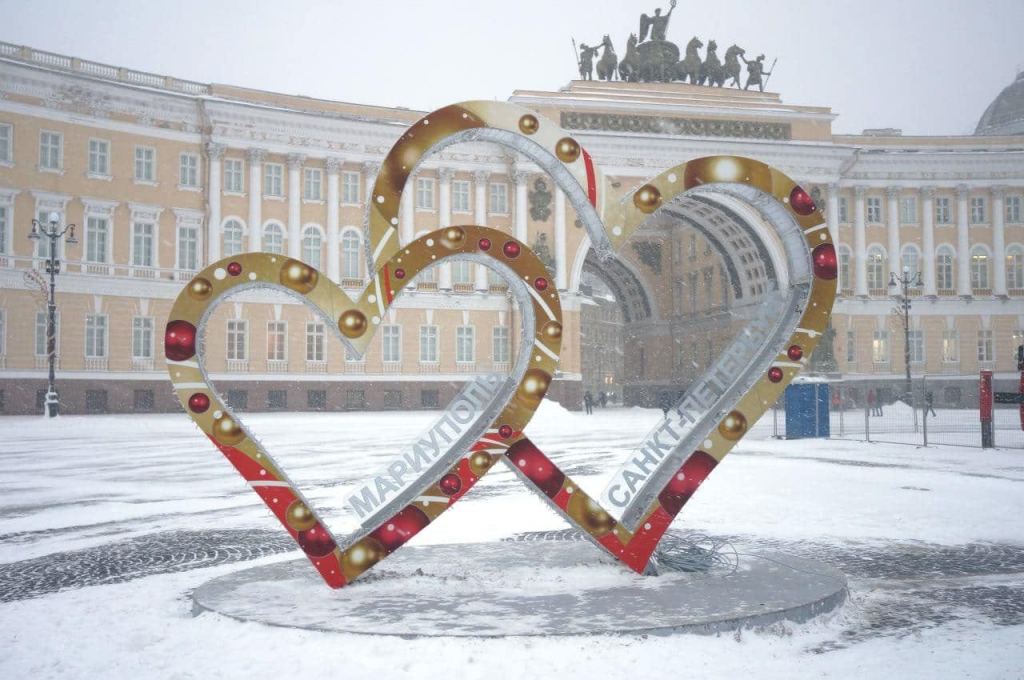
“Mariupol. Saint Petersburg.” A snapshot purportedly taken earlier today by Tatyana Razumovskaya (see her Facebook post, below).

The LED composition “Double Hearts” has been installed on Palace Square in honor of the sister city relationship between Petersburg and Mariupol, as reported on the city’s VK page.

The “Double Hearts” project was approved by Governor Alexander Beglov. Earlier, the installation was on display in a Mariupol city park. It symbolizes the unity, friendship, and love between people living in the sister cities.

Earlier, 78.ru reported that Petersburg authorities would hold a “Wish Tree” event for children from Mariupol.

Source: “Installation honoring sister city relationship between Mariupol and St. Petersburg appears on Palace Square,” 78.ru, 12 December 2022. Translated by the Russian Reader


A NIGHTMARISH IMAGE

Palace Square right now. It’s a three-minute walk from here to the house where I grew up and the school where I studied. Right there is the Hermitage, where I used to work.

I wish this were a dream and I could wake up.

Source: Tatyana Razumovskaya, Facebook, 13 December 2022. Thanks to VG for the heads-up. Translated by the Russian Reader


Alexander Andreyev from St. Petersburg has been killed in the military operations in Ukraine. In 2020, he graduated from School No. 368 in the city’s Frunzensky District. The school administration reported the news on its VK page.

During his school years, Andreyev was the captain of the 368 Superheroes volunteer group, and “from the very beginning he was eager to defend his Motherland,” reports the school’s VK page. In the summer, the young man went to serve and was enlisted in the 76th Pskov Airborne Division, the page reports. Later, he signed a contact, and in early October he was sent to the war zone, the post says.

Alexander was killed on October 18, according to the school administration, when the observation post where the soldier was located came under mortar attack. Andreyev was awarded the Order of Courage and buried in the Avenue of Heroes at Babigon Cemetery, the message says.

This is at least the fourth known death of a Petersburger in the war in Ukraine. Earlier, a school teacher from Petersburg, physical education teacher Vadim Sedov, was killed there. In addition, in the first week of October, Andrei Nikiforov, a member of the Nevsky Bar Association, was killed near Lisichansk. In mid-November, news arrived of the death in Mariupol of Konstantin Simonov, a Petersburger who volunteered to fight in March.

Source: “Another Petersburger dies in the war in Ukraine — he volunteered in the summer,” Bumaga, 11 December 2022. Translated by the Russian Reader


The Smolny [Petersburg city hall] is considering three options for special parking permits for residents of the Admiralty District [rayon], Fontanka.ru writes. On November 1, paid parking was introduced there, and locals were given the option to park their cars in their municipal precinct [okrug] for 1,800 rubles a year, the online media outlet reported.

Petersburgers recalled that residents of the Central District use similar permits throughout its territory, and not only in their own [smaller] municipal precincts, Fontanka.ru reports.

As the media outlet’s journalists have written without specifying their source, there are now three possible options for how paid parking will work for Admiralty District residents:

— everything will remain as it is: supporters of this proposal say that permits are needed so that a person can park outside their house for free, while trips around the district only increase traffic, which is what the reform is meant to combat

— the validity of permits will extend to the entire district: proponents of this idea believe that such innovations will soften the public outcry

— residents of the Admiralty District will be able to choose another district in which their permits are valid, giving them the opportunity to travel around nearby districts without worrying about paying for parking.

According to the media outlet, the Smolny will make a choice in the coming days.

Paid parking was introduced in the Admiralty District on November 1. Now those who want to park their car here have to pay 39 or 100 rubles per hour, depending on the type of vehicle, or buy an expensive monthly or annual pass.

But for those who live in the district, the authorities have introduced special annual parking permits that cost 1,800 rubles a year, but are valid only in the municipal precinct in which the motorist owns property or is registered to live. To park a car in any other municipal precinct, one has to pay the standard fare.

Source: “Petersburgers are dissatisfied with the new parking system in the city center. Here are three options for the authorities to solve this problem,” Bumaga, 11 December 2022. Translated by the Russian Reader


“I serve Russia!”

🎖On December 9, our country celebrates Day of Heroes of the Fatherland. On this day, Heroes of the Soviet Union, Heroes of the Russian Federation, and recipients of the Order of St. George and the Order of Glory are honored.

And on this day we want to tell you about a hero of our time, Alexander Igorevich Andreyev, a graduate of our school.

🎖ALEXANDER IGOREVICH ANDREYEV

During his school years, Sasha was the team captain of the 368 Superheroes volunteer movement.

From the very beginning of the SMO, he sought to defend the Motherland. In the summer he went to serve and was able to enlist in the legendary Pskov 76th Airborne Division.

He signed a contract [as a volunteer] and just recently, in early October, was deployed in the special military operation.

On October 17, his unit was involved in heavy combat. When a comrade’s machine gun jammed, Alexander covered him before he himself attacked the enemy’s positions, thus contributing to the further advance of the paratroopers. By the end of the day, an enemy fortification had been captured. The next day, October 18, Alexander was at an observation post when the enemy opened fire with a mortar. He was hit by a shell and fatally wounded.

He died at his combat post. He was twenty years old.

By decree of the President of the Russian Federation, Alexander Andreyev has been awarded the Order of Courage.

Alexander is buried at the Babigon Cemetery on the Avenue of Heroes.

🕯May the memory of this Russian Hero, friend and faithful comrade live forever.

We will never forget you!

Source: Secondary School No. 368 Frunzensky District of St. Petersburg, VK, 9 December 2022. Image of Alexander Andreyev courtesy of School No. 368. Translated by the Russian Reader


Petersburg is all gussied up in sparkling joyful lights. The holiday is coming to our town.

I have just read a letter from an acquaintance in a neighboring country:

“There has been no electricity in my city for almost a month. Previously, it was on for four hours a day, then for two, and then for one to two hours every few days. The last time the electricity was on was Friday for two hours. There are no schedules: it can be turned on at three a.m. when everyone is asleep and you just miss it. Along with electricity, there is also no water and heating, although it’s winter outside. Since electricity is provided for one to two hours every few days, it is only at this time that the cellphone tower begins to send out a signal. The rest of the time there is no mobile connection or internet. We have been plunged into the nineteenth century and life has come to a grinding halt.”

Source: Sergey Abashin, Facebook, 13 December 2022. Photo, above, by the author. Translated by the Russian Reader

Down in the Hole

Oleg Grigoriev
Pit

Digging a pit? 
I was.
Fell in the pit?
 I fell.
Down in the pit? 
I am.
Need a ladder? 
I do.
Wet in the pit? 
It's wet.
How's the head? 
Intact.
So you are safe?
I'm safe.
Well, okay then, I'm off!

Original text. Translated by the Russian Reader


Putin last week took part in a meeting with the mothers of soldiers killed in the war in Ukraine. The title “soldiers’ mother” carries a lot of influence in Russia — and Putin was famously humiliated by a group of soldiers’ relatives in his early years as president. Unsurprisingly, Friday’s meeting included only those trusted to meet Putin and the gathering passed off without awkward questions. Putin — who now rarely communicates with anyone outside of his inner circle — once again demonstrated a complete detachment from reality.

  • The Russian authorities have been nervous of organizations of soldiers’ mothers since the mid-1990s. During the first Chechen war (1994-1996), in which the Russian army was humiliated, the Committee of Soldiers’ Mothers was one of the country’s leading anti-war forces and held the state and the military to account.
  • For Putin personally, any encounter with soldiers’ mothers stirs unhappy memories of one of the most dramatic incidents of his first year in the Kremlin. In August 2000, the inexperienced president was subjected to a grilling by the wives and mothers of sailors who died in the Kursk submarine disaster. The transcript of the meeting immediately appeared in the press and a recording was played on Channel One, which was then owned by Kremlin eminence grise Boris Berezovsky. Presenter Sergei Dorenko subsequently claimed that, after the broadcast, Putin called the channel and yelled that the widows were not genuine and that Berezovsky’s colleagues “hired whores for $10.” Ever since that encounter, the Russian president has avoided in-person meetings, favoring stage-managed gatherings with hand-picked members of the public.
  • This time, of course, there were no surprises. The Kremlin carefully selected the soldiers’ mothers who were invited to attend. At least half of those at the meeting turned out to be activists from the ruling United Russia party and members of pro-Kremlin organizations. 
  • The most striking speech at the event was close to parody. It was given by Nina Pshenichkina, a woman from Ukraine’s Luhansk Region whose son was killed in 2019. Pshenchkina later became a member of the Public Chamber of the so-called Luhansk People’s Republic and has attended almost every official funeral and official celebration. She told Putin that her son’s last words were: “Let’s go, lads, let’s crop some dill” (in this context, “dill” is an insulting nickname for Ukrainians).
  • Putin’s speech was also striking. First, he told the assembled mothers that Ukrainians were Nazis because they kill mobilized Russians soldiers who did not wish to serve on the front line. Then he embarked on a long, strange discussion about why we should be proud of the dead. “We are all mortal, we all live beneath God and at some point we will all leave this world. It’s inevitable. The question is how we live… after all, how some people live or don’t live, it’s not clear. How they get away from vodka, or something. And then they got away and lived, or did not live, imperceptibly. But your son lived. And he achieved something. This means he did not live his life in vain,” he said to one of the mothers.

Why the world should care

It would be an error to assume that Putin has completely abandoned rational thought. However, it is instructive to watch him at meetings like this, which provide a window onto the sort of information he consumes. At this meeting with fake soldiers’ mothers he quoted fake reports from his Defense Ministry and, seemingly, took it all seriously.

Source: The Bell & The Moscow Times email newsletter, 28 November 2022. Written by Peter Mironenko, translated by Andy Potts, and edited by Howard Amos. Photo, above, by the Russian Reader

The People You Meet

Prison camp acquaintances, of course, slightly tweak the picture that can take shape when you read only anti-war media.

I talked to a friend from Krasnoyarsk today. He is currently doing time in a camp in Mari El (he was transferred there from Krasnoyarsk). He says, “A lot of people have left Mari El [for the war].” “Voluntarily?” I ask. “Voluntarily. And why not, the money is good, so they go. Plus there’s looting: they drag things back from there too.” In response to my remark that they might come back home in a coffin, he tries to explain, although he himself does not approve of their actions. “Well, a one-way ticket… People have been pushed to the limit. There’s nothing to live on. But there you can make decent money.”

Basically, you can’t argue with the material attractiveness of going to fight in the war. Here, in the countryside, some earn 20 thousand rubles a month [approx. 300 euros], but there they are promised 200 thousand [approx. 3,000 euros]. Plus looting. And there is seemingly nothing you can do about it. If they are paid, they will go. Especially because it has become harder to survive.

Source: privately posted social media entry whose author is afraid that it could be grounds for charging them with violating Russian Criminal Code Article 207.3. (‘”Public dissemination of knowingly false information about the use of the Armed Forces of the Russian Federation.” The new law provides for a prison sentence of up to 15 years for knowingly disseminating false information about the Russian Armed Forces.’) Photo and translation by the Russian Reader

Becoming Animal

To become wolf, wild boar,
badger or marten,
dig a hole secretly at dawn,
lie all the way down,
eat ravenously, and praise
the lumps of red loam.
The sun shall rise and say,
Tarry there,
Russian soldier.
Those the butchery has belched out
are not welcome anywhere.
Give a thought to your daughters:
don’t drag a scoundrel of a father
back home.
Become newt, wood snake, hare.

To become whelk, walleye,
seahorse, sturgeon,
sink into the Black Sea
far beyond the buoy.
The sun shall rise and say, Oh!
Well done, soldier, lesson learned.
You were a mediocre monster,
but now it’s the reverse:
you’re a magenta medusa,
a winsome bottlenose dolphin.

To be pelican, oriole,
wood grouse, seagull,
you don’t need to do anything at all:
you can just jump and yell.
You can flock together in a beautiful V,
sing in unison in a shambolic choir,
dwell among oak and snowball trees,
mountains and springs,
fly over what was recently a town,
but is only ashes and blood now.
The sun has risen long ago:
turn into hawks and loons.

There’s no need to return home.
Why would we want a murderer in the house?
Start squirming, crawling,
growling, chirping, branching,
pollinating lime trees and chestnuts,
gobbling mice,
bellowing outside the window in April
so that someone barefoot runs out into April
and gets cross
that they were woken.

Dana Sideros, 4 April 2022

Source: Michael Basin, Facebook, 5 April 2022. Thanks to Leonid Gegen for the link. Originally posted on VK by Dana Sideros on 5 April 2022. Meta deleted a post containing the poem from Sideros’s Facebook page. Various attempts to get them to restore the post have failed, apparently. Translation and photo by the Russian Reader.

Ballad of a Soldier

Igor Ivkin, 19, was killed in heavy fighting outside Kharkiv. Family photo, courtesy of the Moscow Times

IT JUST BREAKS YOUR HEART… This is hard to read. And it should be.

“Born Under Putin, Dead Under Putin: Russia’s Teenage Soldiers Dying in Ukraine”

Different people will react in different ways, of course, but for me two things stand out in the story of 19 year old Igor Ivkin of Pskov. First, I could’ve taught this kid. Others actually *did* teach him, but he reminded me of more than a few Russian students I taught English and History to over the years: good kids, salt of the earth, with their whole lives ahead of them. Now, just like that — and for no good reason — he’s gone.

Secondly, the beginning of Igor’s exchange with wife Yulia, as recorded here — when he says “I promise to come back” — cannot help but remind people of my generation (and older) of another Russian 19 year old soldier who doesn’t come home alive: Alyosha Skvortsov, the hero of Grigorii Chukrai’s classic film “Ballad of a Soldier” (1959), who tells his mother near the movie’s end “Mama, I’ll come back.”

The movie is set up as a retro-narrative, so the audience already *knows* he doesn’t make it back home; and that is part of what makes it an enormously effective cinematic moment in a film that is manipulative in both good and bad senses. The short version of a viewer’s reaction, in any case, is as predictable as it is earned: if you are unmoved when Alyosha makes his promise to his mother, you need to check your wrist for a pulse.

Finally, and hardest of all to take, is a third thought born of the first two: Alyosha Skvortsov died for a good cause, one that everyone remembers; Igor Ivkin did not have that honor, dying for a cynical parody-version of Alyosha’s cause that his country’s leaders keep advancing but can never justify.

These evil people somehow succeeded in making a fine young man, Igor Ivkin, husband and father, one of the Bad Guys in Europe’s first new-millennium war-as-morality story. He didn’t deserve that.

It is important to hold the people responsible for this accountable — and even more important to do whatever we can to end the Russian leadership’s war against Ukraine, a tragedy beyond any telling of it, as soon as humanly possible.

Source: Mark H. Teeter, Facebook, 8 April 2022. Thanks for his kind permission to reprint his remarks here.


Yulia Ivkina would have preferred her husband to become a carpenter, not a soldier. 

But as the coronavirus pandemic dented the Russian labor market and the newlyweds from the western city of Pskov tried for a baby, 18-year-old Igor Ivkin reasoned a short-term contract in the army was the best option to safeguard his family’s future. 

Igor enlisted in February 2021, shortly before Yulia realized she was pregnant. A little over a year later, he was killed in heavy fighting outside Kharkiv amid Russia’s invasion of Ukraine. He was seven months short of his 20th birthday.  

“People from the draft board told me about his death, they came to me with a death notice on March 25. He was buried on March 30 in the village of Vorontsovo where he was born,” Ivkina, 24, told The Moscow Times. 

Igor Ivkin is one of at least 25 teenage Russian soldiers to have died fighting in Ukraine, according to a review of official statements and social media posts by The Moscow Times.

Source: James Beardsworth, Yanina Sorokina, and Irina Shcherbakova, “Born Under Putin, Dead Under Putin: Russia’s Teenage Soldiers Dying in Ukraine,” Moscow Times, 8 April 2022. Read the rest of the article by clicking on the link.


Grigorii Chukrai’s “Ballada” is the movie that probably best represents how Russia’s Greatest Generation saw World War II — or wanted to see it, rather, at a decade’s remove. The film is an undisputed classic of postwar Soviet cinema, combining a multi-dimensional, wide-angle depiction of Soviet soldiers & civilians during the war w/ the extraordinarily successful close-up manipulation (largely in a positive sense) of its sympathetic young hero (wonderfully played by Vl. Ivashov) and his 2 nearest and dearest (Zhanna Prokhorenko, Antonina Maksimova).

How was “Ballada” perceived outside the USSR? In an era when Soviet propaganda, actual and historical, was routinely dismissed in the West, Chukrai’s film was a revelation to American critics and audiences, producing an emotional reaction many art-house and festival viewers found overwhelming: as Time magazine’s awed critic put it, the movie “brings back the kind of catch in the throat that Hollywood movies used to achieve on occasion.” And indeed, if you find yourself unmoved as the teenage Private Alyosha Skvortsov tells his mother at the end of his odyssey through war-torn Russia, “Mama, I’ll come back” (“Mама, я вернусь”), you need to check your wrist for a pulse.

Some of the crew who made “Ballada” were unhappy w/ parts of the film during production, apparently, and some day an enterprising dissertation writer will tell us why. What emerged on the screen, in any case, became the most decorated Soviet-produced World War II film ever made, taking home something over a hundred international and domestic awards altogether (including an Oscar nomination).

Tune in and see what so impressed the world in the early 1960s about this groundbreaking Mosfilm effort — and then decide for yourself just how true its message rings two decades into the new millennium, when Moscow gears up to commemorate the next anniversary of what official Russia will always call the “Great Patriotic War.”

Source: Mark H. Teeter, Facebook, 8 April 2022. Thanks to him for his kind permission to reprint his review here.

Soldiers Who Refused to Go to Donbass Sentenced to Prison

Maykop Contract Soldiers Who Refused to Go to Donbass Sentenced to Prison
Yevgeny Titov
October 13, 2015
Novaya Gazeta

Contract solders from Military Unit No. 22179, located in Maykop, have been sentenced to prison terms. Anatoly Kudrin has been sentenced to six months in an open penal settlement, while Alexander Yevenko, Ivan Shevkunov, Alexander Yenenko, and Pavel Tynchenko received one year each. Alexander Yenenko, who communicated most actively with the press, got the longest sentence [sic].

“It is disgusting,” says Svetlana Kimnatnaya, Ivan Shevkunov’s mother. “All the character references were positive, tons of peoples vouched for my son, and many people from the unit supported him. We had been hoping for probation.”

In autumn 2014, soldiers from Military Unit No. 22179 in Maykop were transferred to the Kadamovsky Firing Range in Rostov Region [eighty kilometers from the Ukrainian border]. Subsequently, contract soldiers left the range in large numbers. Many filed letters of resignation, which were not given due consideration by the unit’s commanding officers. The contract soldiers complained of poor living conditions and feared they would be sent to fight in Ukraine.

Regarding the conditions of their military service, the contract soldiers said they had been forced to sleep on boards, and there had often been no electricity and proper food. The topic of Ukraine had surfaced because separatists from the Donetsk People’s Republic were encamped near the Kadamovsky Firing Range. According to the soldiers’ parents, the separatists had agitated among the soldiers, offering them money to go fight in Donbass.

Subsequently, a group of soldiers was charged under Article 337.4 of the Russian Federal Criminal Code (absence without leave for over a month). It later transpired that among other things they had not been paid the money due to them for temporary duty travel. One of the men, Alexander Yevenko, a veteran of the conflict in Chechnya, was ultimately paid thirty thousand rubles.

Alexander Yevenko
Alexander Yevenko

During the course of the investigation, another soldier, Alexander Yenenko, repeatedly informed Novaya Gazeta about illegal investigative methods, the use of psychological coercion, and threats. To verify this information, Novaya Gazeta sent a request to the Chief Military Investigation Department of the Russian Federal Investigative Committee. According to their reply, they cannot comment on the matter.

Alexander Yanenko
Alexander Yanenko

Alexander Yevenko (not to be confused with Alexander Yenenko) has said he intends to appeal the decision of the Maykop Garrison Military Court. The appeals hearing in his case will take place October 22 in the North Caucasus District Military Court in Rostov-on-Don.

Translated by the Russian Reader. Photos by Yevgeny Titov. See his previous article on this conflict, “Why Are Maykop Contract Soldiers Resigning?” from the July 15, 2015, issue of Novaya Gazeta (in Russian). See also “Prison terms for Russian contract soldiers who refused to fight in Donbas,” Belsat TV, October 14, 2015 (in English).