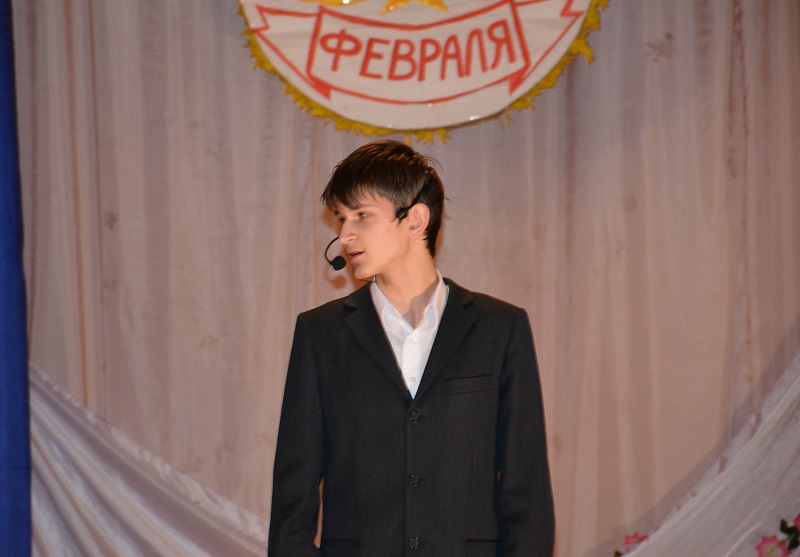
Ruslan Zinin is a real Russian hero, but you won’t find many Russians talking about his heroism or his current plight for the simple reason that they’ve convinced themselves that there is nothing more to be said or done about their country’s dreadful criminal invasion of Ukraine. It is now up to Ukrainians and the “collective West” to stop Putin, whatever the cost. The vast majority of Russians have better things to do, apparently. In the last few days alone, I’ve seen smart Russian friends of mine, people I definitely consider to be among the country’s best and brightest and even (in other circumstances) the most courageous, writing angrily about alleged government bank bailouts in the US and the supposed tendency of US “taxpayers” to vote for conservative politicians, or how they can’t talk about the things that matter to them on social media due to the war (about which they emphatically don’t want to write because enough has been said about it already), or wondering aloud why it took so long for “them” (i.e., the “international community”) to issue an arrest warrant for Putin.||| TRR
Ruslan Zinin
Ruslan Zinin transferred to solitary confinement
Ruslan Zinin’s mother Marina Zinina has reported that on March 21 [her son] was transferred to a solitary confinement cell without explanation.
“They came and took him away, saying, ‘Let’s go to another place.’ They put him in the basement in a solitary confinement cell. […] The conditions are terrible. It’s damp and cold and reeks of sewage, and rats are running around, and there’s nothing in the cell at all, except for a cot. There’s nowhere to store food, nowhere to get water, there’s no kettle, there’s nothing.”
Marina Zinina also said that Ruslan has not received any letters for two weeks, despite the fact that FSIN-Pismo [the Russian penitentiary system’s electronic correspondence service] has been sending people notifications that their letters had been vetted by the censor and handed over to Ruslan.
Solitary confinement is one of two forms of punishment for violating the rules in a pretrial detention center. (The second is a reprimand.) The warden of the pretrial detention center or his deputy can impose these penalties. But before imposing a penalty, the prisoner is given the opportunity to write an explanation about their alleged violation, and they must be notified of the penalty in writing.
Zinin was not charged with violating the rules of the pretrial detention center, and was not informed of any such decisions on the part of the warden.
We consider Zinin’s transfer to solitary confinement to be an escalation of pressure on the prisoner, an attempt to silence him and get him to consent to unfounded accusations of “terrorism.”
A logging truck driver from Ust-Ilimsk (Irkutsk Region), Zinin fired several shots from a sawn-off shotgun at the local military commissar in the midst of the mobilization announced in September of last year. He was incited to do this by the draft notice that had arrived for his brother. The military commissar survived the attack.
In early March, Zinin was charged with committing a “terrorist act” (per Article 205.2.b of the Russian Federal Criminal Code).
Despite the fact that letters are not being handed on to Ruslan at the moment, they remain an important support tool. A large flow of letters shows the wardens at the pretrial detention center that a lot of people are concerned about Ruslan’s plight. An even greater flow of letters and complaints in connection with their non-receipt has repeatedly been shown to be capable of breaking through the information blockade that the authorities impose on political prisoners.
Address for letters and parcels to Ruslan:
Zinin Ruslan Alexandrovich (born 1997)
63 ul. Barrikad, SIZO-1
Irkutsk 664019 Russian Federation
You can send letters electronically from anywhere in the world via the FSIN-Pismo service (subject to payment with a Russian-issued bank card) or the free, volunteer-run resource RosUznik (which allows you to remain anonymous).
❗️ If in the last two weeks FSIN-Pismo has sent you a notification of delivery, write to the service’s support team that your letter was not passed on to Ruslan. (You can say that you found about this in the media.)
You will also find sample complaints about non-receipt of letters on our Telegram channel.
Solidarity Zone has been providing comprehensive assistance to Ruslan Zinin and his family.
Source: Solidarity Zone (Facebook), 22 March 2023. Translated by the Russian Reader. People living outside Russia will find it difficult, if not impossible, to use the Russian Federal Penitentiary Service’s FSIN-Pismo service. It is also probably impossible or nearly impossible to send parcels to Russian detention facilities from abroad. But you can send letters — translated into Russian (if you don’t know a competent translator, you can use a free online translation service such as Google Translate) — to Ruslan Zinin (and many other Russian political prisoners) via RosUznik, as mentioned above. You can also ask me (avvakum@pm.me) for assistance and advice in sending letters.
Logging truck driver Ruslan Zinin grabbed a sawed-off shotgun when, in the wake of the “partial” mobilization’s annoucement, a summons arrived for his brother. On September 26, Zinin went to the military enlistment office in Ust-Ilimsk (Irkutsk Region). Military commissar Alexander Yeliseyev was giving a speech as he dispatched dozens of people to the slaughter. His disdainful attitude towards the mobilized men, as well as his remarks that they themselves were to blame, that they had “piled up loans” and “had heaps of children,” outraged Zinin to the depths of his soul. At that moment, someone in the room asked, “Where are we going?” “We’re all going home now!” Zinin shouted back and fired twice at the military commissar.
Consequently, Zinin’s brother was not mobilized (and, perhaps, the mobilization was temporarily suspended in the district), and military commissar Yeliseyev spent a month and a half in the hospital.
Zinin himself was remanded in custody and charged with “encroachment on the life of a law enforcement officer” (per Article 317 of the Russian Federal Criminal Code of the Russian Federation).
The charge was incommensurate with Zinin’s actions [and the circumstances]: the military commissar is not a law enforcement officer and was not performing tasks to protect public order.
However, police investigators went even further and reclassified the charge to “commission of a terrorist act” (per Article 205.2.b of the Criminal Code).
Formally speaking, this is a lesser charge since it does not stipulate life imprisonment, unlike the previous one. However, there cannot be a jury trial for those charged with “terrorism,” judges cannot impose sentences below the statutory minimum, and part of the sentence must be served in a closed prison [as opposed to a penal colony, in which inmates live together in open-plan barracks]. This is not to mention the mass of smaller infringements on the rights of a person convicted as a “terrorist.” Person convicted under this article must be sentenced to between twelve and twenty years in prison.
Currently, we do not know Zinin’s opinion on the matter, nor the specifics of the indictment, because the defense lawyer was forced to sign a non-disclosure agreement. However, the Solidarity Zone team in any case considers the accusation unfounded, regarding it as nothing other than lawlessness on the part of law enforcement agencies and an attempt to intimidate society. One of the main points of the criminal code article on “terrorism” is to terrorize the populace. In this case it is not Zinin’s actions that constitute “terrorism,” but, on the contrary, the actions of the authorities.
As before, you can support Ruslan by sending him a letter or parcel. If your letters are not passed by the censor or you do not receive a reply from Ruslan, let us know and file a complaint. Templates for complaints can be found on our Telegram channel.
Address for letters and parcels:
Zinin Ruslan Alexandrovich (born 1997)
63 ul. Barrikad, SIZO-1
Irkutsk 664019 Russian Federation
You can send letters electronically from anywhere in the world via the FSIN-Pismo service (subject to payment with a Russian-issued bank card) or the free, volunteer-run resource RosUznik (which allows you to remain anonymous).
Solidarity Zone is providing comprehensive assistance to Ruslan Zinin and his family.
Source: Solidarity Zone (Facebook), 9 March 2023. Translated by the Russian Reader. People living outside Russia will find it difficult, if not impossible, to use the Russian Federal Penitentiary Service’s FSIN-Pismo service. It is also probably impossible or nearly impossible to send parcels to Russian detention facilities from abroad. But you can send letters — translated into Russian (if you don’t know a competent translator, you can use a free online translation service such as Google Translate) — to Ruslan Zinin (and many other Russian political prisoners) via RosUznik, as mentioned above. You can also ask me (avvakum@pm.me) for assistance and advice in sending letters.
Yesterday, during a dinner conversation, I was asked why I’d been silent, why I hadn’t been writing anything about the war. Was it because I was afraid of going to jail, or was it something else? These questions were posed point blank albeit sympathetically.
I’ve been asking myself this question for many months. On the one hand, it’s stupid to deny that watching as my acquaintances are given devastating prison sentences does not affect me in any way. It makes an impression, of course.
On the other hand, I wonder what would I write or say now if the level of state terror had remained at least at pre-war levels. I realize that I would still write or say nothing. I can hardly squeeze this text out of myself. I’m just explaining myself because yesterday was not the first time I’ve been asked why I haven’t been writing anything about the war.
I feel that words have lost their meaning.
One of the ideologues of the war, who constantly makes allegations about the “genocide of the Russian language,” writes bezpilotnik, obezpechenie, na primer, and ne obezsud’te. [Instead of the correct spellings bespilotnik, obespechenie, naprimer, and ne obessud’te — meaning, respectively, “drone,” “provisions,” “for example,” and “don’t take it amiss.”] No one corrected him for a year. Compared to him, I’m a total expert on the Russian literary language, but I don’t have the words to stop cruise missiles or send soldiers home, while his bezpilotnik turns residential buildings into ruins in a second.
I do not know what words to find for a mother who, conversing with her POW son, regularly interjects “bitch” and “fuck.” Or for a mother who, as she sees off her son, smiles at the camera and says what actually matters is that she didn’t raise him to be a faggot, and basically, if push comes to shove, she has another child. Moreover, the supplies of such people are really endless.
Now, sadly, only the Ukrainian Armed Forces can “explain” anything. I am not trained in military affairs. So I am silent.
Separately on Friday, police briefly detained Yevgeny Levkovich, a reporter for Radio Svoboda, RFE/RL’s Russian service, at his home in Moscow, and charged him with “discrediting the army,” according to newsreports and Facebookposts by Levkovich.
[…]
In Moscow, police detained Levkovich for about five hours at the Teply Stan police station and charged him under Article 20.3.3 of the Administrative code for allegedly discrediting the army; convictions for that offense can carry a fine of up to 50,000 rubles (US$613).
Levkovich wrote on Facebook that his trial was scheduled for Monday, but he did not plan to attend because he did not “see the point” in contesting the charge.
Radio Svoboda wrote that the charge was likely related to Levkovich’s posts on social media, but did not say whether authorities had specified any posts prompting the charge. On his personal Facebook page, where he has about 36,000 followers, Levkovich recently wrote about Russia’s war on Ukraine.
These are the numbers. I want to do something so that people don’t get caught, and even more actively support those who do get caught. But in the first case, it is unclear what these people are reading, and where the safety recommendations should be published so that they are accessible to such people. And we are already working on the second case, but we lack the human resources.
Those arrested for radical anti-war protest are heroes, although sometimes the charges are completely trumped-up. In any case, all of them deserve support. Solidarity Zone regularly writes about such political prisoners, publishes addresses where you can send them letters, and raises funds to pay their lawyers. Sign up to get news of what is happening to these people and, if possible, get involved in supporting them.
112 people are being prosecuted on charges of carrying out or planning radical anti-war acts.
Solidarity Zone counted how many people have been criminally charged with setting fire to military enlistment offices, sabotaging the railroads and other militant anti-war actions, or planning them, in the year following [Russia’s] full-scale invasion of Ukraine.
What police investigators allege these people have done to warrant criminal prosecution:
1 — “other”
7 — torched vehicles marked with the letter Z
17 — planned arsons of military enlistment or other government offices
36 — sabotaged the railways
51 — torched military enlistment or other government offices
Articles of the Russian criminal code under which these people have been charged:
36 — Article 205: Terrorist Act
31 — Article 167: Destruction of Property
15 — Article 281: Sabotage
14 — Unknown
12 — Article 213: Disorderly Conduct
4 — Other Criminal Code Articles
Of these people:
78 are being held pretrial detention centers (remand prisons).
5 have been sentenced to parole.
4 are serving prison sentences.
1 is under house arrest.
1 has been released on their own recognizance pending trial.
There is no information about 23 of them.
Our statistics are incomplete because the Russian authorities do not always report new criminal cases. Sometimes we only get reports that people have been detained, with no mention of their names or the charges against them, and these reports are thus extremely hard to verify.
Our statistics do not include people who were killed by the security forces during arrest or people prosecuted on administrative charges.
Source: Solidarity Zone (Facebook), 24 February 2023. Translated by the Russian Reader. Here, by way of comparison, are OVD Info’s statistics for numbers of people criminally (as opposed to administratively) prosecuted for “non-radical” anti-war actions since 24 February 2022:
Total defendants: 465 in 77 regions (we include occupied Crimea and Sevastopol in our data because we monitor activities of repressive Russian government authorities that operate there).
Women among the defendants: 90 (19%)
Minors among the defendants: 6 (1%)
(Section 3, Article 207.3 of the Criminal Code) Prosecuted for “spreading fakes about the Russian army” (ie talking about the war in an unsanctioned manner): 141 (30%)
(Section 3, Article 280.3 of the Criminal Code) Prosecuted for “discrediting the Russian army”: 54 (12%)
Convicted: 119 (26%)
Imprisoned upon conviction: 26 people
In pre-trial detention: 108 people
Under house arrest: 17 people
Convicted and given a non-custodial sentence: 62 people
It thus follows that a total of 577 Russians have faced criminal prosecution for anti-war actions of all kinds (violent and nonviolent) since the start of their country’s invasion of Ukraine. As Ivan Astashin, a former political prisoner himself, argues, above, all these people are, indeed, heroes. It’s another matter that they constitute a statistically insignificant segment of the world’s ninth most populous country. Again, by way of (invidious) comparison, at least 1,003 Americans have been charged with crimes for their alleged involvement in the 6 January 2020 riot at the US capitol.
I would argue that those who were forced to leave Russia due to Putin’s unleashing of illegal aggression against Ukraine could file a class action lawsuit against the Russian Federation or the ruling elite of the Russian Federation demanding compensation for the moral anguish and economic harm suffered as a result of these events. The Russian federal authorities must fully compensate them for expenses incurred by forced relocation, such as the cost of airplane and other tickets, accommodation in hotels and rented accommodation abroad, and other expenses. Compensation could also include the irreparable losses suffered by citizens within the country due to forced relocation — for example, the loss of a job or a business. Compensation for emotional suffering is a separate issue.
Payments could be made from the Russian federal budget, through the sale of the property of officials directly responsible for unleashing the war, or at the expense of business income from entrepreneurs who have directly supported the illegal aggression. Naturally, compensation for this damage is possible only after full payment of the reparations necessary to restore Ukraine’s economy and civil infrastructure. What do you think about this? #nowar#netvoine
[two selected comments + one response by the author]
Zmey Gurevich A difficult question. It’s true that the monstrous war forced me to leave Russia. But to my incredible surprise, I have have become happy here [in emigration]. Perhaps it’s immoral to be happy when rivers of blood overflow their banks. It’s been eating at me. But the painful departure has led me a new happiness. Some vital knots have been untied… No, I have nothing to bill [the Russian authorities] for. My friends empathize with me and ask me how things are going here. I can’t tell them the truth. I am ashamed. But my departure has turned into a happy time for me. I don’t know what will happen next.
Vlad Shipitcyn Zhenya! Did you go to at least one protest rally against Putin in Russia over [the last] 22 years? No, you didn’t. Did you ever stand on the stand on the street holding a [protest] placard? No. So no one owes you anything, not a kopeck. You too are responsible for both the regime and the war. You let them happen. So calm down.
Evgeny Krupitsky Hi! Yes, I am responsible for this war: it happened due to my connivance, indifference and cowardice. And I said it right away: https://www.youtube.com/watch?v=GsAFChc2HSI And my protest was that on March 6, exactly a year ago, I left the Russian Federation having abandoned everything, because I felt sick and ashamed. Okay, maybe it’s not such a big deal in terms of significance and courage, but I am proud of my little protest. I know you went to the rallies long before the start of the war, that you were detained, beaten and fined, and I respect and admire you for that! But someone will say that they suffered more than you did, that they did more to prevent this war, etc. We need to consolidate, rather than argue about who is more to blame!
Evgeny Krupitsky, “My take on what’s happening (2 April 2022) #nowar #netvoine”
Some people in Russia are living a normal life, but they feel the lack of real normality, and this causes them discomfort. Others live with a sense of catastrophe, but they feel the absence of a real catastrophe, and this also causes discomfort. Consequently, everyone is on edge. The sensible approach is to live normally with a sense of disaster. But this useful attitude is hard to achieve, and if you don’t have it, then I do not even advise you to start. When it takes shape, it will no longer be relevant.
The four members of this “countryside hub” are among hundreds of Russian opposition activists of various political leanings who have fled their country to Georgia throughout the past year. Some left in the months prior to Moscow’s invasion of Ukraine last February as repression grew to unprecedented levels in the Putin era. Others came after the war began, realizing that with their dissenting opinions, they could no longer live in what they deem a fascist totalitarian state.
In Tbilisi, they have created or joined new anti-war resistance organizations, which operate on Western grants and employ hundreds of volunteers. Working around the clock, these groups offer services in real time to Ukrainians refugees as well as Russian activists and military deserters fleeing their respective countries. The help comes in the form of evacuation routes, therapeutic services, legal guidance, shelters and resettlement plans.
[…]
From her volunteering as an election monitor in Russia’s 2011 elections to offering pro-bono legal support to activists arrested during protests in subsequent years, Burakova’s career followed a linear trajectory. Degrees in political science and law equipped her with the legal know-how to aid political opponents, and now exiles, over how to wrestle with and escape an authoritarian system that often invents new laws to persecute citizens. As of 2022, “discrediting the Russian army” is now an offense that has landed countless people in prison for sharing anti-war posts on social media.
[…]
“To conduct these types of congresses and host mock parliamentary votes on Russia’s future while in exile just looks a bit cringe-ova,” Burakova tells me, using the popular English word that has been appropriated into the Russian language. Her husband Egor Kuroptev shares the sentiment.
M., one of my smartest interlocutors, arrived from Moscow Time. “Well, what is your final conclusion? Why?” he asked me. I told him that now I see three points that we simply missed, that ended up in our blind spot. The first point is that of course everyone worked hard during these years, enthusiastically; everyone had an articulated mission in life, etc. But it was seemingly taken as a natural given that each of us was the client of someone a few floors above us. Now everyone looks back and discovers that their mission has been burned for a long time, and their belonging to one or another Moscow (or regional) clan shines forth in their biography. For some reason, it was automatically believed that, in the nineties, we operated in a world in which, when difficulties arose, we should turn to “the man from Kemerovo” (in the words of Grebenshchikov’s song). In the noughties, however, all this was allegedly vanquished. In reality, nothing was “vanquished”: it was simply transformed into large-scale state clans. That is why now everyone who was engaged in charity, book publishing, media development, etc., has suddenly shifted the emphasis in their reflections on life: wait a second, I worked for Abramovich (or Gusinsky, or Potanin, etc.). The system consisted entirely of a network of clients.
The second point: the language of pragmatic communication. It was a completely abusive language. The smash-mouth jargon permeated everything. Roughly speaking, the country was governed in the language of American rappers (i.e., the Solntsevo mob). All communications! Not only the special communications among those in power, but also all communications in the liberal, academic realm, in civil society. The cynical jargon of abuse reigned everywhere, and it was absolutely acceptable even in highly cultured milieux. And we did not see what consequences this would have.
The third point: “populism.” The automatic perception of the “common people” [narod], which had its origins in the late-Soviet and perestroika periods, was a colossal mistake. It was tacitly assumed, first, that there was a “common people”; second, that the “common people” would determine their own fate; and third, that the “common people” naturally triumph over evil because they themselves are good. It was this “populism” that served as the basis for the compromise with the state when it began to take institutional shape in Yeltsin’s wake.
All three of these points were “organic” in some sense. They were a part of ontology: they were taken for granted without any reflection and criticism. And all three played a fatal role in the process of “slowly boiling the frog alive.”
I had problems,
I had gone way too far.
The lower depths of the deepest hell
Didn't seem so deep to me.
I called my mom,
And Mom was right.
She said, "Straightaway you've got to call
The man from Kemerovo."

He is a man of few words, like de Niro.
Only a wacko would argue with him.
You can't pull one over on him,
He knows all the insides and outs.
The sky could crash to the ground,
The grass could stop growing,
He would come and silently fix everything,
The man from Kemerovo.

Adam became a refugee,
Abel got on a mobile connection,
Noah didn't finish what he was building,
Got drunk and fell face down in the mud.
The history of humankind
Wouldn't be so crooked,
If they had thought to get in touch
With the man from Kemerovo.

I got a call from Kyiv,
I got a call from Kathmandu,
I got a call from the opening of the plenum —
I told them I would not come.
You have to drink two liters of water at night,
To have a fresh head in the morning.
After all, today I'm going to drink
With the man from Kemerovo.
Only one conclusion follows from Stalin’s death: woe is the country where tyrants die natural deaths while still in power.
Source: Roman Osminkin (Twitter), 5 March 2023. Translated by the Russian Reader. Mr. Osminkin’s remarks were occasioned by the social media commemoration of the anniversary of Stalin’s death, yesterday, which often as not consisted of replicating the meme “That one croaked, and this one will croak too.” This means, apparently, that the entire “plan” of the “Russian anti-war movement” and the “anti-Putin opposition” consists in waiting for the current Russian tyrant to die a natural death. It’s a frank admission to be sure. ||| TRR
I have been in police custody since April of last year. I was formally charged in early June, and since then I have been an “accused” man. I see this word in paperwork, I sign statements containing it, and that is how the prison authorities address me. “Accused” has been my new social status for the past nine months.
A criminal change can be a serious burden. I have met people in prison, albeit a few, who are plagued by a sense of guilt for what they have done. In this sense, though, my case is simple. All the accusations against me are ridiculous and absurd, and the article [in the criminal code] under which I am being tried should not exist, basically. I find it easy and pleasant to take a consistent stance and to tell the truth. I have always adhered to this principle both in public life and in personal matters.
The investigation, whilst trying to accuse me of spreading “fakes,” has constructed one giant fake. Literally the entire indictment, from the first word to the last, is at odds with reality. I subscribe to every word I wrote a year ago. All my emotional assessments have retained their force, and all factual claims have been borne out many times. So there can be no question of any sense of guilt on my part in terms of the present case.
Life, though, is much more complicated than a trumped-up criminal case. A year ago, events happened that shocked the world. In a matter of days, the foundations of life, which had seemed to us unshakable, were destroyed. The most terrible pictures stepped off the pages of history textbooks, reviving the nightmares of bygone years and wars whose fury had long ago been stilled. Unable to stop this ongoing tragedy, tens of millions of Russians have come face to face with an oppressive sense of guilt. It is a normal reaction to the monstrously abnormal situation in which all of us find ourselves.
If you feel guilty, it means that you have a conscience. It means that you cannot see the suffering of innocent people without feeling pain in your heart, that you are able to empathize with someone else’s grief. What is more, a sense of guilt for the actions of one’s country is impossible without a sense of belonging. It means that no matter where you are now, you maintain an emotional connection with your homeland, you realize that you are a citizen of Russia and worry about its fate. You — we — are real patriots of Russia in the true sense of the word! We love our country, and so we are especially hurt and ashamed that this inhuman war is waged on its behalf.
It is vital to remember that the guilt that we cannot help but feel is irrational per see. After all, we are not actually to blame for what is happening. The blame is on those who unleashed and wage this war, on those who issue and carry out criminal orders, on those who commit outrages on foreign soil, as well as on those who condone these crimes by cracking down on their own people and generating an atmosphere of fear and intolerance.
On the contrary, we want to live in a free and peaceful country. We want a better future for ourselves and our neighbors. In order for our hopes to come true, we must move away from a passive sense of guilt, focused on the past, and strive to realize our own civic responsibility. We must move away from regrets about what has happened to solving existing problems and making plans for the future. Yes, right now we are unable to stop the war, but this does not mean that we are powerless. I want each of you to think about what you can do personally. The answer “nothing” is not acceptable. First, if you are not on the side of the scoundrels, if you have remained true to yourself, have kept your wits about you, and have not fallen into despair, if you are listening to me now or reading this text, this is much more than nothing. And second, even I can do something and am doing something. I keep talking, communicating the truth about events to people. I have been using this trial as a platform for public anti-war statements. To the best of my ability, I have been helping those who, due to their civic stance, have found themselves on the same side of the bars as me. You have many more opportunities to act today for the sake of our common better tomorrow.
Our problem is the inability to take the initiative and find allies. We are used to following leaders and waiting for instructions. Don’t wait — act! Become volunteers, help refugees, support political prisoners, form horizontal ties. Get to know your neighbors, colleagues and classmates, set common goals and achieve them together. When someone needs your help, don’t ignore them. Make this world a better place for us and for our children.
We like to repeat, like a mantra, the words “Russia will be free!” But Russia is us, and what it will be depends only on us. The war will inevitably end, and then the regime that unleashed it will cease to exist. This is the law of history. We have a lot of work ahead of us, work which we must start now. This work of ours, I am sure, is bound to succeed. Russia will be free — because we will make it so.
Source: Darya Kornilova (Facebook), 1 March 2023. Thanks to Elena Zaharova for the heads-up. Originally published on the website of the movement For Human Rights. Translated by the Russian Reader. The verdict in Mr. Ivanov’s case is scheduled to be announced on March 7. The prosecutor has asked the court to find him guilty as charged and sentence him to nine years in prison. See my translation of Mediazona‘s detailed account of the case and trial against Mr. Ivanov, below.
Russian lawmakers on Thursday voted in favor of a bill that would make it a criminal offense to “discredit” anyone fighting on Russia’s side in the war in Ukraine, not just the Russian military.
The legislation aims to expand current laws criminalizing the discrediting of the Russian Armed Forces to include mercenaries serving in the ranks of Russia’s growing number of private military companies, such as the Wagner Group.
The bill was unexpectedly introduced by State Duma deputies Wednesday in the form of amendments to two largely unrelated bills that were already due to be voted on in the lower chamber of the Russian parliament.
If signed into law, the amendments would introduce sentences of up to seven years in prison for “public acts aimed at discrediting volunteer formations, organizations or individuals” that are aiding the work of the Russian Armed Forces.
The proposed amendments also increase the maximum punishment for violating the existing law against spreading “false” information about the army.
Those found guilty of “spreading fake information” about the army or a volunteer military formation would then face up to five years in prison instead of the three years outlined in the current law.
The new law would also raise the maximum fine from 700,000 rubles ($9,250) to 1.5 million rubles ($19,830).
In cases in which the dissemination of “false information” is deemed to have had “grave consequences,” violators could face up to 15 years in prison, under the new legislation.
The bill must now pass its third reading in the State Duma on March 14 before going to the upper house of parliament for approval and then finally to the president for his signature.
The trial of Dmitry Ivanov, a mathematics student and creator of the Telegram channel “MSU Protesting,” is nearing completion in Moscow’s Timiryazevsky District Court. Ivanov is accused of disseminating “fake news” about the army. (The investigators claim that reports of war crimes, the killing of civilians and the destruction of Ukraine’s civilian infrastructure are “fake news,” as well as Ivanov’s refusal to call the war a “special operation.”) Today, Prosecutor Yulia Pravosud asked the court to sentence Ivanov to nine years in prison. Mediazona examines the grounds for the case against the activist and how investigators have tried to prove his guilt.
Dmitry Ivanov in the “fish tank” at court. Photo: Alexandra Astakhova/Mediazona
“Don’t betray the Motherland, Dima” was the message painted on 16 March 2022 on the door of the Moscow flat in which the Moscow State University student Dmitry Ivanov had lived all twenty-two years of his life. The message was embellished with three huge Z’s. At the time, Ivanov joked: “We have already washed off the door — a simple Soviet acetone helped us make short work of the paint.” The Telegram channel “MSU Protesting,” which he had created and ran, continued to write about the war and anti-war protests inside Russia, until its author was detained on April 28 as he was leaving the university. He has not been released since.
On April 29, the Nikulinsky District Court jailed Ivanov for ten days for “organizing a rally” — this is how the security forces deemed one of the posts in his channel. He served his jail sentence in the Sakharovo Temporary Detention Center for Foreign Nationals outside of Moscow, but on May 9 he was detained as he was leaving the facility and sentenced again under the same article of the Administrative Offenses Code — this time for twenty-five days. The student missed the state exams and was unable to submit his honor’s thesis. After serving the new sentence, he was immediately detained again on June 2, this time on a criminal charges. He was taken from the detention center to the Investigative Committee for questioning.
Ivanov managed to transfer the admin of “MSU Protesting” to his friend Nikita Zaitsev. Ivanov’s friends later created a separate channel in his support, “Prison MSU.”
“From the very beginning of my imprisonment, I have lucked out in terms of symbolic dates. I was tried on Victory Day and on the day the mobilization began, and I was transferred to the pretrial detention center on Russia Day. Another hearing will be held on the anniversary of Navalny’s return to Russia. Back then it seemed that all the masks had been doffed and there was nothing more that could shock us. If only we had known what would happen a year later,” Ivanov wrote in a letter to our correspondent.
What Dmitry Ivanov is accused of
The case against Ivanov was handled by the Investigative Committee’s First Major Case Department. Like most cases investigated under the article on “fakes about the military,” it was launched on the basis of “law enforcement intelligence.” Еhe report on the student was written by Lieutenant Colonel A.L. Kapustin, a field officer in the FSB’s Moscow and Moscow Region directorate.
Kapustin copied several posts from “MSU Protesting,” and Captain K.A. Myagkov, a major case investigator, concluded that they were sufficient to launch a criminal case.
The prosecution argues that the activist, “motivated by political hatred” and “foreseeing the inevitability of socially dangerous consequences in the form of undermining and discrediting the current state authorities,” is alleged to have disseminated the following claims on Telegram between 4 March and 4 April 2022:
— the Russian army attacked the Zaporizhzhia nuclear power plant;
— The Russian armed forces have been destroying cities and civilian infrastructure and killing civilians in Ukraine;
— Russia is waging a real war, not a “special military operation”;
— Russian aviation has suffered significant losses in the war;
— Russian soldiers committed war crimes in the towns of Bucha and Irpen.
Most of the posts that investigators attributed to Ivanov were reposts of allegations made by other people, including politician Alexei Navalny, Ukrainian president Vladimir Zelensky, BBC journalist Ilya Barabanov, blogger Maxim Katz, and the writers on social media news page Lentach.
From a broken phone to a canceled thesis defense: how field officers and MSU officials persecuted an undesirable student
In 2018, Ivanov was a student majoring in computational mathematics and cybernetics. Along with dozens of other students and lecturers, he protested against construction of a World Cup fan zone outside Moscow State University’s main building. The inhabitants of the building complained that the construction work prevented them from working during the day and sleeping at night, and that the crowds of fans would make their lives unbearable.
It was then that Ivanov launched the initially anonymous Telegram channel “MSU Protesting,” in which he described in detail the struggle of students and lecturers against developers. He would go on to write about other protest actions. On 16 December 2018, Ivanov was detained at a rally outside the FSB building in Moscow: the infamous Center “E” officer Alexei Okopny did not like the fact that the student had photographed him.
The very next day, Ivanov’s channel ceased to be anonymous. “Hi, my name is Dima, I’m 19, I study at Moscow State University, and today I became a victim of torture,” the student wrote. He said that after his arrest the security forces had demanded that he give them the password to his phone; when he refused, they beat him and threatened to rape him with a police baton. Having failed to achieve their goal, they simply broke the phone, and access to “MSU Protesting” was lost. Ivanov created a new channel with the same name and recounted his experiences in detail in his inaugural post.
Ivanov thus became one of the well-known activists whom the security forces snatched from the crowd first during protests. On 2 February 2021, he was detained at a rally in support of Alexei Navalny, who had returned to Russia after recovering from poisoning. It was then that, for the first time, the Meshchansky District Court sent the student to the Temporary Detention Center for Foreign Nationals in Sakharovo for thirty days. At this center for migrants facing deportation, where Moscow opposition activists were taken to serve their administrative sentences that winter, a second charge sheet was drawn up against Ivanov because he argued with the guards. Ten more days were added to the thirty days he had got for attending the rally.
Ivanov’s friends estimated that he spent a total of 101 days under administrative arrest.
Ivanov was scheduled to defend his honor’s thesis on 1 June 2022. The student was supposed to be released from the detention center on the second of June. Ivanov’s defense team asked the court to shorten the term of arrest by at least one day and requested a postponement from the examination commission, but to no avail. In July, Ivanov was expelled from Moscow State University for not having passed the state final certification.
“I got out of the subway, saw a building with paddy wagons, and decided to give evidence”: the prosecution’s witnesses
The investigation into the Ivanov case was completed in two months. During this time, several witnesses were questioned at the Investigative Committee. Only one of them, Yuliaslava Korolevich, a school friend of the activist, testified in his defense. The security forces searched the home of Korolevich and her mother, and then brought the young woman in for questioning. She said only that she knows Dmitry “as a person who can listen and help out in difficult times, and who is intelligent, rational and logical by nature.”
The other witnesses in the case did not have their homes searched. All of them unfailingly identified themselves as “patriots” during questioning, and the wording of their testimony against Ivanov overlaps almost verbatim. All of them described the arrested student “negatively as an anti-Russian fascist,” and his posts in the Telegram channel as “not corresponding to the position of the Defense Ministry of the Russian Federation.”
The most verbose among the witnesses was the former dean of the Faculty of Fundamental Physical and Chemical Engineering at Moscow State University Lyudmila Grigorieva, infamous for her confrontation with student activists. In 2021, she was forced to resign after she called the Initiative Group at the university “western liberasts” who “grunt, crawl and shit constantly for scraps.”
During questioning, Grigorieva labeled herself “a patriot and a person who loves her country very much, and also stands for kindness, state power, unity, and public order.” She thus considered it her duty to testify against a student who, in her opinion, is a “fascist” and “belongs to a political sect.”
“Ivanov hates people who do not share his liberal views, and defends all the dregs of society,” she said.
Later, at the trial, Grigorieva voiced the hope that not only Ivanov, but also another opposition mathematician from Moscow State University, associate professor Mikhail Lobanov, would pay for “anti-Russian activities.”
Three more prosecution witnesses are Grigorieva’s former subordinates Alexander Krasilnikov, Daniil Afanasyev, and her former graduate student Kirill Borisevich. In court, none of them (like the ex-dean herself) could explain how they had ended up in the investigator’s office and had decided to testify against Ivanov.
“I was walking from the subway, I had got out of the subway. I saw a building with paddy wagons, and decided to give evidence,” Krasilnikov said uncertainly. Each of the three repeated verbatim Grigorieva’s epithets for the student, and in court they read their testimony from a phone or a piece of paper.
What connects the unemployed man Ivan Lyamin and Kolomna Philharmonic musician Mikhail Zhuravlev with the case of Ivanov is not at all clear. In court, Lyamin explained that he had “accidentally stumbled upon” the Telegram channel “MSU Protesting.” He would sometimes read it. He then told an acquaintance about it, who advised him to contact the Investigative Committee.
Zhuravlev claimed that he had decided to testify so that justice would prevail.
“Because freedom of speech has become too much,” he said.
During questioning, Zhuravlev said that Ivanov “is trying to disorient his readers about the events in Ukraine and impose a sense of guilt for the conduct of the special operation not only on Russian citizens, but on all ethnic Russians. He is also trying to shape public opinion among citizens of the Russian Federation about the need to stop the actions of the Armed Forces of the Russian Federation in Ukraine in order to preserve the power of the nationalists.”
The witness could not repeat such a long statement from memory, so in court the prosecutor had to read out his written testimony .
The evidence and witnesses for the defense
The prosecution argues that, since the posts on the Telegram channel “MSU Protesting” diverged from the official reports of the Defense Ministry, meaning that they were “deliberately false,” this is sufficient proof of Ivanov’s guilt. This conclusion was reached by linguists from the FSB, who testified in court.
Defense counsel Maria Eismont asked psychologist Veronika Konstantinova and linguist Igor Zharkov to prepare an independent expert analysis of the activist’s posts. They concluded that, at the time of their publication, the information in Ivanov’s posts was not “knowingly false” from his point of view. The prosecutor retorted that the experts were only “trying to discredit the actions of the investigation.”
In addition to the expert analysis, the defense presented the testimony of seven people in court. Unlike the prosecution witnesses, all of them were personally acquainted with Ivanov. Andrei Stroganov taught Ivanov computer science at school. Ivanov worked on his honor’s thesis with Alexei Borodin, a senior researcher at the Institute of System Programming. Ivan Shmatin, a fifth-year student at Moscow State University is not only friends with the defendant, but also knows Lyudmila Grigorieva, whom he called “a person hyper-concentrated on people who espouse democratic values.”
All of them described the accused as an honest individual and a talented mathematician. This was said by activists Irina Yakutenko and Konstantin Kotov, with whom Ivanov had been involved in solidarity campaigns for political prisoners — the mathematician Azat Miftakhov and the defendants in the New Greatness Case.
Mathematician and leftist politician Mikhail Lobanov, for whose election campaign to the State Duma Ivanov had worked, was also summoned to court. He talked about defendant’s involvement in the life of the university. According to Lobanov, “Uniquely, Dima was not embittered, even as he was being persecuted for his views.”
Grigory Mikhnov-Voytenko, a bishop of the Apostolic Orthodox Church and a human rights activist, helps Ukrainian refugees who find themselves in Russia. Their accounts fully confirm the veracity of Ivanov’s posts, the clergyman said in court.
A billy club and a dog in court, summonses to the Foreign Ministry and the Defense Ministry
On January 19, Ivanov was beaten by a guard. The reason was that the defendant did not immediately exit the “fish tank” after the court hearing, but stayed to find out from Maria Eismont when she would visit him in the pretrial detention center. It later transpired that the escort guard’s name was Alexei Nikolayevich Zhalnin.
Without giving the defendant a chance to talk to his lawyer, Zhalnin dragged Ivanov into the escort guard room. The next day, Ivanov told Eismont that the escort had taken him downstairs, turned off his body cam, and kicked him in the head and ribs and beaten him with a billy club. Zhalnin tried to put Ivanov’s head into the toilet and threatened that he would “insert a stick in his anus.” The second escort guard “watched” this and “did nothing.” The bruises suffered by the activist were documented at the detention center’s medical unit.
Dmitry Ivanov and Alexei Zhalnin, the escort guard who beat him, allegedly, on 19 January 2023. Photo courtesy of SOTA via “Prison MSU” (Telegram)
The defense has filed complaints about Zhalnin’s actions to numerous authorities, but so far to no avail. At the subsequent hearings, however, Ivanov was escorted by emphatically polite guards, and Judge Daria Pugacheva asked whether he had any complaints about the escort. Meanwhile, bailiffs stopped letting members of the public who could not recall the judge’s surname into the courthouse. Previously it had been enough to name the defendant’s last name at the entrance. A continuously whining service dog appeared in the courtroom.
Coincidentally, all these security measures were introduced when Eismont persuaded the court to call as witnesses Defense Ministry spokesman Igor Konashenkov, Foreign Minister Sergei Lavrov, and Russia’s UN ambassador Vasily Nebenzya.
“Ivanov is charged with a serious crime based on a comparison of his texts with statements made by Nebenzya, Lavrov, and Konashenkov. This means that these people are essentially witnesses for the prosecution, and so he has the right to question them in court,” the lawyer argued.
Eismont had attempted to use this trick before, at the trial of the politician Ilya Yashin, but the court did not even issue summonses to the high-ranking officials then. In the Ivanov case, the summons reached their addressees, but the witnesses ignored them.
What else Ivanov was asked in court
Before oral arguments were made, Ivanov was himself put on the witness stand. While answering the questions posed by Prosecutor Yulia Pravosud, he explained why, as a student, he had written about pension reform, how he had checked his sources of information for reliability, and which media outlets he trusted. The prosecutor then tried to get Ivanov to talk about allegations that the Russian language has been banned in Ukraine.
“Do you know anything about Zelensky’s attitude toward the Russian language?” she asked.
“It’s his native language, basically. He’s completely fluent in it,” Ivanov replied.
“Is the Russian language banned or not banned [in Ukraine]?”
“I had not heard that the Russian language was banned in Ukraine. As far as I know, many regions used it as the primary one. The Mariupol City Hall maintained all its social media and websites in Russian even after 2014.”
“I see, and what about Zelensky’s position? Does he allow [Ukrainians] to communicate [in Russian]?”
“Probably, if he forbade communication in Russian, the mayor of Mariupol would not have spoken publicly in Russian, and would not have maintained online resources in Russian.”
Prosecutor Pravosud then read aloud a post from “MSU Protesting” in which Ivanov admitted that he could face criminal charges for his statements about the Russian army’s actions in Ukraine.
“Why did you, knowing of the criminal liability, still write on your Telegram channel?” she asked Ivanov.
“‘Freedom is the freedom to say that two plus two make four. If that is granted, all else follows.’ That’s a quote from George Orwell,” he said. “Should I explain it to you?”
Vsevolod Korolev in the dock at Vyborg District Court in Petersburg. Photo by Valentin Nikitchenko
An unexpected twist in the Vsevolod Korolev case
On January 12, Peterburg’s Vyborg District Court held a hearing on the merits of the criminal case against Petersburg documentary filmmaker Vsevolod Korolev. At today’s hearing, the complainant and prosecution witness Mikhail Baranov was cross-examined. It was Baranov who had requested that law enforcement agencies file criminal charges against Korolev.
Baranov unexpectedly changed his initial testimony, telling the court that he considered the posts by the accused “an expression of free speech,” and that he himself had “liked” Korolev’s posts to give them more publicity. The prosecution witness also said that the police had come to his home, and that he had been questioned at the police department about that very same “like.” It was only after this interaction that Baranov had filed the complaint, asking the authorities to determine whether Korolev’s posts constituted “disseminating fake news about the army.”
However, the interrogation record in the case file paints a different picture: according to it, Baranov had gone to the police himself. Korolev’s posts had, allegedly, angered him. Today, at the trial, Baranov said that he could not remember what his emotions were at the time, and that his opinion could have changed.
Vsevolod Korolev, a St. Petersburg poet and documentary filmmaker remanded in custody on charges of spreading ‘fake news’ about the Russian army, is a political prisoner. Until his arrest, Vsevolod Korolev supported people subjected to repression for anti-war statements: he made a documentary about those prosecuted and he called the war a war
The human rights project, ‘Political Prisoners. Memorial,’ considers Vsevolod Korolev a political prisoner in line with international standards. He is being prosecuted for posts on social networks. Korolev’s criminal prosecution violates his constitutional right to freedom of expression. His prosecution is intended to silence voices in Russia that oppose the war against Ukraine and to intimidate civil society.
We demand the immediate release of Vsevolod Korolev and the termination of all criminal prosecutions under the unconstitutional Article 207.3 of the Russian Criminal Code.
Who is Vsevolod Korolev and what are the charges against him?
Vsevolod Korolev, 34, is from St. Petersburg and in recent years he has been active in the city’s volunteer movement and engaged in civic activism. Korolev has worked as a volunteer with the Perspectives Charitable Foundation and the St. Petersburg Observers movement (which organizes independent election observation).
After the start of the full-scale Russian invasion of Ukraine in February 2022, Korolev became very active in the anti-war movement. On his social media pages he wrote about the crimes of the Russian military, attended the trials of those arrested on charges related to the war, collected donations of food and other necessities for those held on remand, and made documentary films about what was happening. For example, he made films about the prosecutions for ‘anti-war’ activities of the artist Sasha Skochilenko and the journalist Maria Ponomarenko.
On 11 July 2022, a criminal case was opened against Vsevolod Korolev on suspicion of disseminating information known to be false about the use of the Russian armed forces. The next day his apartment was searched and he was detained.
Korolev is accused of making posts in March and April 2022 on the VK social media site about the crimes of the Russian military in Bucha and Borodyanka near Kiev and about the shelling of Donetsk. Korolev subsequently confirmed he had made posts about the war in Ukraine, but maintained they contained no lies.
Korolev understood the risks of speaking out freely. ‘I refuse to not say the truth about things,’ he wrote on his social networks.
On 13 July, a St. Petersburg court remanded Korolev in custody, even though he has had his thyroid removed and needs regular medical examinations.
Korolev faces up to 10 years in prison if convicted.
Why do we consider Vsevolod Korolev a political prisoner?
Article 207.3 of the Russian Criminal Code criminalising dissemination of information known to be false about the actions of the Russian army contradicts the Russian Constitution, Russia’s international obligations and fundamental principles of law.
In particular, Article 19 of the International Covenant on Civil and Political Rights states: ‘Everyone shall have the right to freedom of expression.’ Restrictions on the exercise of these rights ‘shall only be such as are provided by law and are necessary: (a) For respect of the rights or reputations of others; (b) For the protection of national security or of public order (ordre public), or of public health or morals.’ Such norms are also contained in Article 29 of the Russian Constitution. The restrictions on freedom of expression introduced by Article 207.3 of the Russian Criminal Code serve none of these purposes and are a form of censorship. This is all the more so given that, in the course of an armed conflict, it is not always possible to establish the accuracy of statements made by the parties to the conflict, and the Russian authorities hold simply that official reports by the Russian Ministry of Defence should be considered reliable.
Article 207.3 of the Russian Criminal Code was specifically created as an instrument for the prosecution of critics of the Russian authorities and criminalises any statements about the use of the Russian armed forces abroad. This has already been confirmed in practice. Under this article, people are more often prosecuted not even for statements of fact but for expressing their opinions and personal attitudes. At the same time, the prosecuting authorities ascribe to many of those prosecuted, like Vsevolod Korolev, the subjective motive of ‘political hatred,’ which significantly increases the potential penalty.
A more detailed description of this case and the position of the Human Rights Project can be found on our Telegram channel.
A full list of political prisoners in Russia can be found on our temporary website.
Recognition of an individual as a political prisoner does not imply the ‘Political Prisoners. Memorial’ project agrees with, or approves of, their views, statements, or actions.
How can you help?
You can send letters to the following address:
In Russian: 196655, г. Санкт-Петербург, г. Колпино, ул. Колпинская, д. 9, ФКУ СИЗО-1 УФСИН России по СПб и ЛО, Королёву Всеволоду Анатольевичу 1987 г. р.
In English: Vsevolod Anatolievich Korolev (dob 1987), Remand Prison No. 1 of the Federal Penitentiary Service of Russia for St. Petersburg and Leningrad Region, 9 Kolpinskaya Street, Kolpino, St. Petersburg, 196655, Russia.
Source: “‘Political Prisoners. Memorial’: St. Petersburg poet and documentary filmmaker Vsevolod Korolev is a political prisoner,”Rights in Russia, 10 October 2022. As I have pointed out in previous posts on Russian anti-war protesters and political prisoners, Russian remand prisons and penal colonies only accept letters written in Russian, and the federal penitentiary service’s FSIN-Pismo service and Zonatelekom are only accessible to residents of the Russian Federation. It’s also almost a certainty that YooMoney, another Russia-based service, will not accept money from non-Russian bank cards. ||| TRR
Darya Polyudova, holding a placard that reads, “Ukraine, we’re with you.” Photo courtesy of The Insider
The founder of the Left Resistance movement, Darya Polyudova, has been sentenced to nine years in a penal colony on charges of “creating an extremist community.” Polyudova was already serving time on another charge, and had three years left to go in her sentence.
The Second Western District Military Court has handed down the new sentence to the activist. It agreed with the prosecution’s arguments that the Left Resistance, as created by Polyudova, was an “extremist community.” And yet, at the moment there is no such organization listed in the Russian Justice Ministry’s registry of “extremist organizations.”
In addition to “creating an extremist community” (Article 282.1.1 of the Russian Federal Criminal Code), the court found the activist guilty on two counts of “condoning terrorism” (Article 205.2.2 of the Russian Federal Criminal Code) over posts published on the movement’s social media page.
The sentence took into account Polyudova’s previous sentence of six years, which she received in 2021, writes Mediazona.
Polyudova was the first person in Russia charged under the criminal code article outlawing “calls for separatism” (Article 280.1). This accusation was brought against her in 2014 for trying to hold a “March for the Federalization of the Kuban” in Krasnodar.
One charge after another
Polyudova began her career as a political activist in Novorossiysk, where she organized Strategy 31 protests. Due to constant arrests and dismissals from work, Polyudova was forced to move to Krasnodar, and later to Moscow.
In 2017, Polyudova was released from a work-release penal colony where she spent two years on charges of calling for separatism, and founded the Left Resistance. The description of the movement on its VK page stated that it “stands against the oppressor capitalists and for all the oppressed and the power of the working people.” The movement’s members attended protest pickets and distributed leaflets.
In January 2020, Polyudova was arrested again on charges of calling for separatism — this time for a solo picket where the activist stood holding a placard that read, “Kuriles, stop feeding Moscow! Long live the Far Eastern Republic!”
She was also charged with publicly condoning terrorism over a repost of a message about the Chechen field commander Shamil Basayev.
The calling for separatism charge against Polyudova was eventually dropped due to the liberalization of Article 280.1 of the Russian Federal Criminal Code. However, in September 2020, the activist, who by that time had been in remand prison for more than six months, was charged with a new offense.
The FSB regarded her statements about Yevgeny Manyurov, who opened fire at the FSB headquarters on the Lubyanka in December 2019, as grounds for charging Polyudova with “condoning terrorism.” Later, this charge was reduced to a charge of calling for separatism.
In May 2021, Polyudova was sentenced to six years in a penal colony on charges of publicly condoning terrorism and calling for extremism.
Polyudova was presented with new charges of “creating an extremist community” in December 2021, while she was in remand prison awaiting an appeal against the previous sentence.
Left Resistance founder Darya Polyudova has been sentenced to nine years in a penal colony, while Left Resistance activist Kirill Kotov has been sentenced to three years probation, the Telegram channel Free Kirill Zhukov reports.
Polyudova’s sentence incorporates the previous verdict against her and will run from January 2020, when the young woman was remanded to a pretrial detention center in a previous criminal case, her lawyer Leonid Solovyov told OVD Info.
The prosecution had requested just this sentence for Polyudova, but had asked that Kotov be sentenced to three years in a penal colony.
Polyudova was accused of “creating an extremist community” (per Article 282.1.1 of the Criminal Code), while Kotov was accused of involvement in an “extremist community.” Polyudova was also charged on two counts of public calls for terrorism or “condoning terrorism” (per Article 205.2.2 of the Criminal Code).
According to the FSB, Polyudova created the Left Resistance to “plan and commit crimes, […] namely, public vindication of terrorism and public calls for extremist activity.” Investigators argued that the “extremist community” engaged in holding pickets and making posts on social media.
In addition to Kotov, four other activists have been charged with involvement in the extremist community: Sergei Kirsanov, Alyona Krylova, Igor Kuznetsov, and Andrei Romanov.
On 18 November 2021, the FSB searched two addresses as part of the case against the Left Resistance, including the house where Kotov used to live. The criminal charges against the movement were made public on 3 December 2021. Tomsk opposition activist and RusNews journalist Igor Kuznetsov was already in remand prison in connection with the case of the Telegram channel Chto-Delat! Andrei Romanov and Alyona Krylova were not in Russia, while Sergei Kirsanov and Kirill Kotov were released on their own recognizance. By this time, Polyudova had already been sentenced to six years in a penal colony in a previous case.
Polyudova was charged under the article criminalizing calls for terrorism over posts made in 2019 on the Left Resistance’s social media page, including a post entitled “Execute the traitor Putler for treason!” Forensic experts detected “calls for the violent seizure of power” and “use of violence against the security forces” in these posts. Another criminal count was based on posts made on anniversary of the annexation of Crimea and pickets in support of defendants charged with involvement in Hizb ut-Tahrir.
[…]
Polyudova founded the Left Resistance movement in 2017. Its activists said that the new left-wing organization’s purpose was to replace the “opportunistic Communist Party” and “defend genuine communist ideas.”
In May 2021, the court sentenced Polyudova to six years in a penal colony. She was found guilty on two counts: “condoning terrorism” (per Article 205.2.2 of the Criminal Code) in connection with a repost on VK, and “calling for extremist activity” (per Article 280.1 of the Criminal Code) for statements about the actions of the shooter outside the FSB headquarters building on the Lubyanka.
In 2014–2015, Polyudova was accused of calling for extremism and separatism. She was then sentenced to two years in a work-release (i.e., minimum security) penal colony.
Vladlen Menshikov. Photo courtesy of Solidarity Zone
We have begun supporting Vladlen Menshikov, accused of anti-war sabotage on the railways.
On September 30, pro-government mediareported the arrest of 29-year-old Vladlen Menshikov by the FSB in the Sverdlovsk Region. Investigators claim that Menshikov installed short-circuiting devices on the railway at the eightieth kilometer of the stretch between Rezh and Striganovo, along which trains carrying Russian military equipment run.
During an interrogation, which FSB field agents recorded on video, Menshikov said that he opposes the war and supports overthrowing the current government. He also discusses methods of sabotaging the Russian army’s railway supply lines.
Solidarity Zone was able to establish Menshikov’s identity and locate the pretrial detention center in which he is detained. When we contacted him and offered our support, he responded positively. He asked for legal assistance, and also said he would be glad to receive letters.
We are currently working to start providing full-fledged legal assistance to Menshikov.
We would note that Vladlen is currently being held in solitary confinement, so letters are especially important for him.
Address for letters and parcels:
Menshikov Vladlen Alexeyevich (born 1993)
4 Repin Street
Pretrial Detention Center No. 1
Ekaterinburg 620019 Russian Federation
(It is possible to send letters through the FSIN-Pismo service and Zonatelecom, as well as throughRosUznik, a volunteer-run resource.)
To support Solidarity Zone financially, so that we can continue to pay lawyers, send parcels to prisoners, and help cover other expenses, you can use the follow payment methods:
Source: Solidarity Zone, Facebook, 21 November 2022. Translated by the Russian Reader. People living outside Russia will not be able to use the Russian Federal Penitentiary Service’s FSIN-Pismo service or the privately run Zonatelecom. It is also probably impossible or nearly impossible to send parcels to Russian detention facilities from abroad. But you can send letters — translated into Russian (if you don’t know a competent translator, you can use a free online translation service such as Google Translate) — to Vladlen Menshikov (and many other Russian political prisoners) via RosUznik. You can also ask me (avvakum@pm.me) for assistance and advice in sending letters.
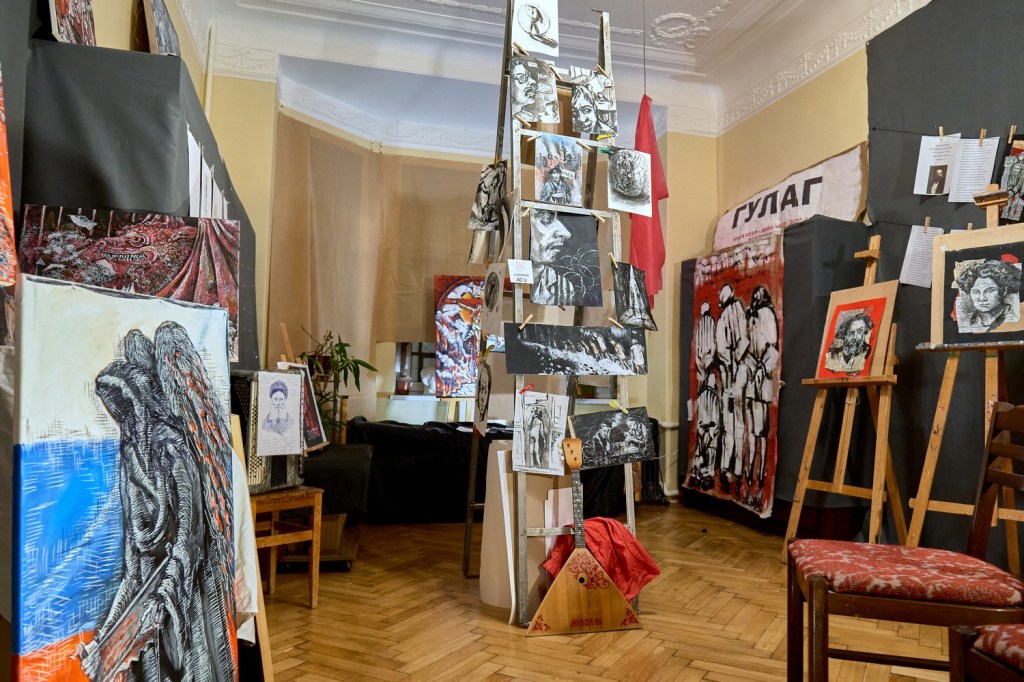
The “underground” exhibition Continuity [Sviaz’ vremen] has been underway in Petersburg since September. The parents of Yuli Boyarshinov, who was convicted in the Network Case, were involved in organizing it.
The exhibition is dedicated to political prisoners. They produced some of the works on display themselves using improvised means while in pretrial detention centers and penal colonies. Poetry readings and art therapy sessions at which postcards for political prisoners are produced also held in the space.
Bumaga visited Continuity and shows here how the exhibition is organized.
The “underground” exhibition opened in September in a private space. The organizers have already planned to close it several times, but people keep coming. “We didn’t think it would last that long. There is even a poetry reading scheduled for Saturday,” Nikolai Boyarshinov, Yuli Boyarshinov’s father, told Bumaga.
Photo: Andrei Bok
The exhibition features works by current political prisoners, including those involved in the Network Case. Some of the works are dedicated to the victims of the Great Terror.
Photo: Andrei Bok
The living room — the main exhibition space — contains paintings by the artist Ad’u. She says that exhibition spaces are reluctant to take her work. “They say, ‘Well, you know,'” she shares with us.
Photo: Andrei Bok
A portrait of Karelian historian Yuri Dmitriev and maps of Sandarmokh hang under the ceiling. Dmitriev was convicted of “sexual violence” against his adopted daughter. He was scheduled to be released in 2020, but the court toughened his sentence from three and a half years in a medium security facility to thirteen years in a maximum security penal colony.
Photo: Andrei Bok
There are paintings dedicated to Alexei Navalny. A protest action with flashlights, which took place in Russian cities on February 14, 2021, is depicted as a flashlight shining into the sky and signaling for help.
Photo: Andrei Bok
One of the paintings alludes to a protest action by Pavel Krisevich: a man on a cross, under whose feet dossiers of political cases burn. Next to it are drawings by Krisevich himself, which he made while in a pretrial detention center, using pieces of a sheet, improvised materials and homemade paints. In October, Krisevich, who had previously spent a year in pretrial detention, was sentenced to five years in a penal colony.
Photo: Andrei Bok
On the walls of the corridor outside the living room there are portraits of the young men convicted in the Network Case and their stories. Drawings by the men themselves are also presented. Nikolai Boyarshinov says that each of the convicts “has begun to draw to one degree or another.”
Photo: Andrei Bok
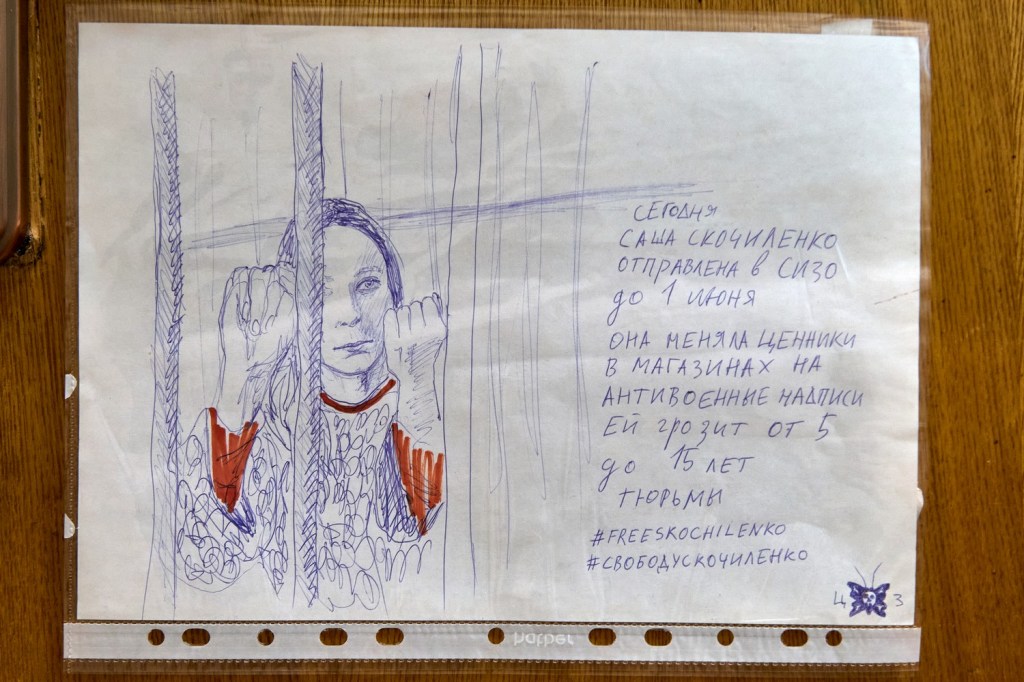
In a closet in the hallway there are drawings by the artist cyanide the angry [tsianid zloi]. Since February, he has been producing one image every day about the war and political crackdown. On the closet doors and inside it there are portraits of Sasha Skochilenko and Seva Korolev, who are charged with “discrediting” the Russian army, Kansk Teenagers Case defendant Nikita Uvarov, and scenes of Navalny in a cell.
“Today, Sasha Skochilenko was remanded in custody until June 1. She replaced price tags in shops [sic] with anti-war messages. She faces 5 to 15 years in prison. #FreeSashaSkochilenko,” Photo: Andrei Bok
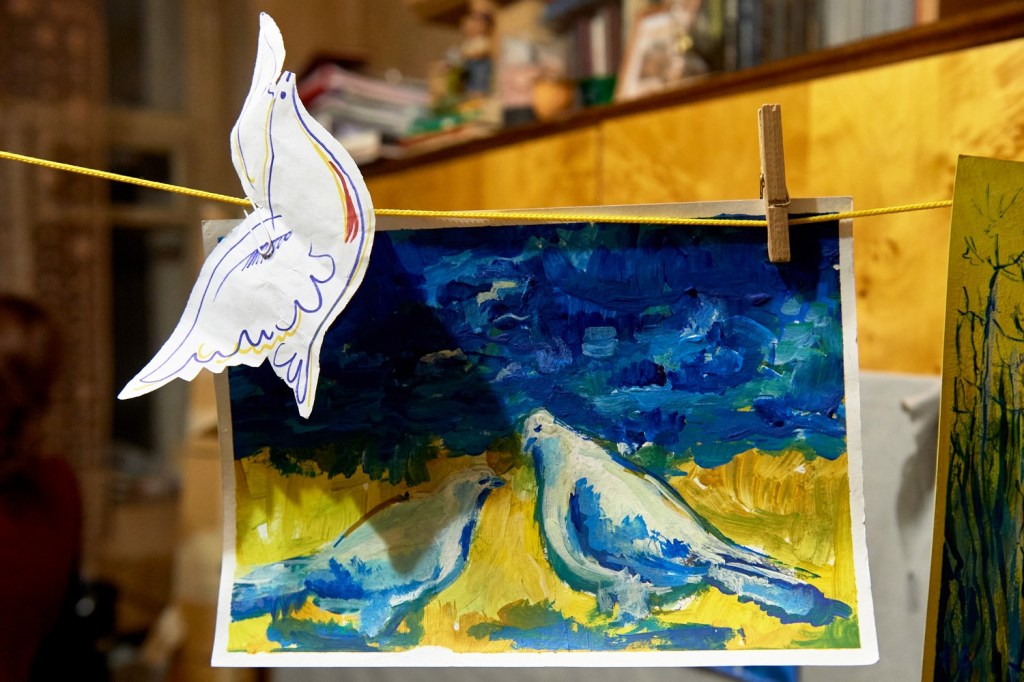
There are also anti-war drawings in the exhibition. They are painted in yellow and blue colors. They were created by Ad’u, who, along with other artists, was detained during a protest rally in April 2022, when she was painting riot police against the backdrop of St. Isaac’s Cathedral.
Photo: Andrei Bok
There is an art therapy group in the space, which has been led by Nikolai Boyarshinov’s wife Tatiana since May. The group’s members make postcards to fight burnout, stress and fear. They then send postcards to political prisoners.
On October 28, the trial of Igor Paskar began in the Southern District Military Court in Rostov-on-Don. He is accused of throwing a Molotov cocktail at the FSB’s offices in Krasnodar, and also of setting fire to a [pro-war] “Z” banner. Paskar explains his actions as a protest against the war: after the alleged attempted arson at the FSB, he painted his face in the colors of the Ukrainian flag of Ukraine. The FSB has classified the protest as “terrorism,” and the burning of the banner as “vandalism.” Paskar faces ten to fifteen years in prison if convicted.
To Moscow and Back
Igor Paskar was born and lived until the age of thirty-five in a workers settlement in the Volgograd Region. He came of age in the 1990s, turning eighteen in 1994. After school, he enrolled in the administrative and industrial buildings maintenance program at the Volgograd Institute of Architecture and Civil Engineering, but had to quit his studies in his first year after he was drafted into the army. After two years in a construction battalion, Paskar returned to his native village and immediately began working odd jobs — on construction sites, as a loader, and as a courier.
In 1998, when Paskar was twenty-two, he was first sentenced to five years probation on charges related to drug trafficking. In 2001, he received two years of actual prison time for theft and possession of hashish. He was last convicted of a criminal offense — one and a half years probation for possession of marijuana — in 2006. The last ten years, Paskar told Vot Tak, he has been clean — he completely gave up using light drugs.
In 2013, Paskar moved to Moscow. At various times in the capital, he worked as a courier at Samokat, as a loader, and as a furniture assembler. He also sold rare items on Amazon.
He became interested in politics in 2018 — as his case investigator would later write, he became an “adherent of radical liberal opposition ideas.” In 2021, Paskar was detained in Moscow for taking part in a protest rally called by Team Navalny after the politician’s arrest.
In the summer of 2021, the activist returned to Volgograd, where he got a job as a courier. During one of the interrogations about this period, he said: “I was still interested in the work of the Anti-Corruption Foundation, and I supported Alexei Navalny. I publicly voiced my opinions among people I know, including at work, and I posted my opinions in messengers and chats.”
The FSB on Fire
In February of this year, before the start of the Russian invasion, Paskar responded to an ad and took in a lost dachshund. According to the activist, stray dogs tried to attack the pooch several times, so he bought a flare gun to scare them away. He soon left his village in the Volgograd Region with his dog for work: he had found an unusual vacancy on the internet — picking strawberries in Adygea. Paskar was unable to start the job, however. There was a conflict in the workers’ accommodations over the dachshund, and he fired the flare gun at the ceiling. Paskar himself called the police, and the court sentenced him to five days in jail. After his release from a special detention center, Paskar left for Krasnodar.
In a letter, he describes this period as follows: “I have had a whole series of failures in life over the last three months. When the special operation began, I was unable to transfer money from abroad after the SWIFT system was switched off. I had an Amazon account on which I traded rare items. After the start of the special operation, I lost my earnings. I could not get a job in Volgograd and decided to go to Krasnodar for seasonal work, but there were a number of failures. I was angry at my plight and decided to sacrifice myself for what I believe in — peace.”
Paskar held his first anti-war protest in downtown Krasnodar on June 12, Russia Day. It was then that he threw a lighted bottle of gasoline at a banner featuring the letter Z and the slogan “We do not abandon our own.” No one paid attention to his actions, the banner quickly went out, and Paskar was not detained.
Paskar then decided to carry out a protest action at the FSB’s Krasnodar offices. He did not plan to go into hiding and prepared for his arrest by selling his phone and packing a bag for the pretrial detention center. “My criminal experience has left its mark on me. When a person has [this experience], they are no longer afraid to go to prison. They already know that you can live there too — not very well, but you can do it. It is not hell. This has an impact not so much on radical decisions as on accepting one’s fate,” Paskar noted in a letter to your correspondent.
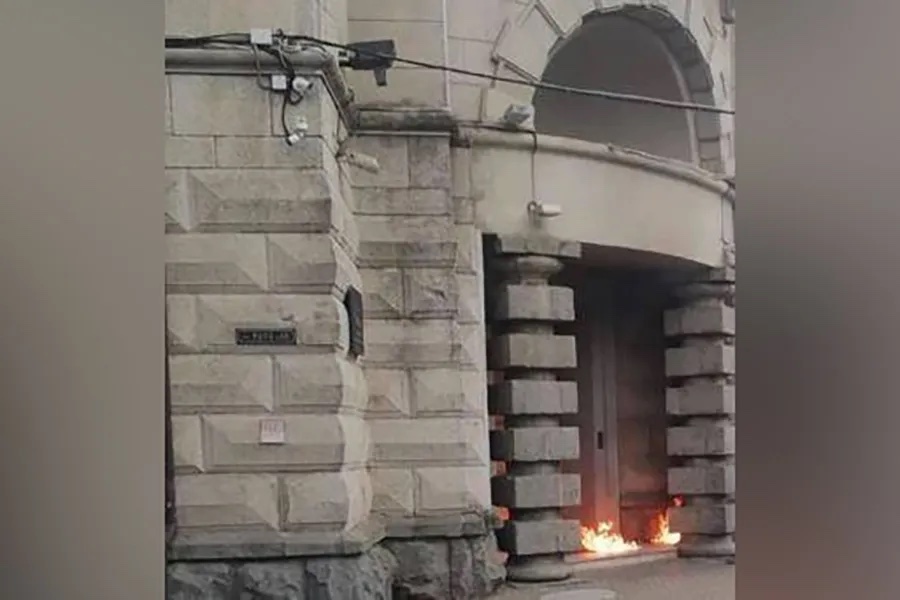
On June 14, Paskar went to the FSB’s offices on ulitsa Mira [“Peace Street”] in Krasnodar. A Molotov cocktail flew [sic] onto the building’s stone porch. The activist then painted his cheeks yellow and blue and waited for passersby to react and for the authorities to detain him. He hoped that someone would record the protest on their phone and post the video on the internet. Passersby avoided the scene, however. FSB officers came out of the building after a few minutes and detained the activist.
The moment when the fire flared on the porch of the FSB offices in Krasnodar: Source: Baza. Courtesy of Vot Tak (Belsat)
A Burnt Rug
Paskar calls his protest symbolic, emphasizing that his actions could not have caused serious damage — only a rug was burned on the stone porch. Despite this, a criminal case was immediately launched against Paskar under Article 205 (“Terrorism”) of the Russian Federal Criminal Code, which stipulates a penalty of ten to fifteen years in prison.
On October 28, the Southern District Military Court began considering the case — according to the amendments to the law adopted in 2014, only four district military courts [in Russia] can try terrorism cases. The court extended Paskar’s term in the pretrial detention center for six months, and ruled that the trial would be open to the public. The first hearing on the merits in the case was scheduled for November 10.
In 2016, for setting fire to the door of the FSB headquarters in Lubyanka Square [in Moscow], the performance artist Pyotr Pavlensky was sentenced to pay a fine of 500 thousand rubles under Article 243 of the Russian Federal Criminal Code (“Destruction or damage to objects of cultural heritage or cultural artefacts”). And yet, at the trial, the artist demanded that his actions be reclassified as terrorism.
Earlier, the [exiled opposition] politician Gennady Gudkov said that Paskar’s actions could be deemed disorderly conduct: “In any civilized country, such a thing is regarded as disorderly conduct and is punished with a warning or a fine.” And gallery owner Marat Guelman called Paskar’s act activism.
Paskar is being aided by the human rights initiative Solidarity Zone, which previously announced a fundraiser to pay for Paskar’s lawyer.
Vot Tak has published an article about Igor Paskar, who is accused of throwing a Molotov cocktail at the FSB offices in Krasnodar and setting fire to a “Z” banner. He did this to drawn attention to the war and voice support for the people of Ukraine.
On October 28, the Southern District Military Court began trying Paskar’s case.
Solidarity Zone has been providing comprehensive assistance to Paskar.
We are now raising funds to pay for Igor’s lawyer.
Minus one:Yan Sidorov, a former political prisoner in the Rostov Case, has volunteered for the war.
Sidorov served four years in prison in the Rostov Case, in which the court decided that two posters and thirty leaflets were evidence of “attempted organization of mass disturbances.” The Memorial Human Rights Center recognized him as a political prisoner.
Yan was released from prison a year ago, and he had planned to work in human rights protection. There were no vacancies in human rights organizations, however, and so he had to get a job as a food delivery courier.
Yan socialized with many leftist and liberal activists, but he also maintained relations with the red-brown National Bolsheviks.
Apparently, the latter were nicer to him. Several mutual friends have informed me that Yan Sidorov has joined the ranks of Eduard Limonov’s Other Russia and gone to the front.
I still don’t get how the National Bolsheviks degenerated from a flamboyant opposition party into the vanguard of the Kremlin regime. The late Limonov was always an imperialist, however.
But how — how?! — former political prisoners become defenders of Putin’s dictatorship, no one seems to understand. As one of my cellmates used to say, “Everyone has gone off their fucking gourd!”
Well, before he starts shooting, it’s not too late for him to change his mind. Maybe he will shake himself free of this delusion after all.
Russian human rights activist Yan Sidorov is facing the prospect of three years under harsh probation conditions, when he is released next week from the penal colony where he has spent the last two years, Amnesty International said today.
Yan Sidorov is a prisoner of conscience, whose attempts to hold a peaceful protest in 2017 resulted in an imprisonment at a Dimitrovgrad penal colony after he had spent two years in pre-trial detention. He is set to be released on 3 November, but on 29 October Dimitrovgrad City Court will hear a request by the authorities to impose a severely restrictive probation period.
“Russian authorities are sending a clear signal to all young activists that participation in peaceful protests can come at huge personal cost. Yan Sidorov has already served four years in prison; he may now have to spend three more under strict police surveillance, forbidden to go out after 10 pm and banned from travelling outside the Krasnodar region,” said Natalia Zviagina, Amnesty International’s Moscow Office Director.
“The Russian penitentiary authorities must immediately withdraw their request to impose additional arbitrary restrictions on Yan Sidorov and release him unconditionally. Yan Sidorov has done nothing but exercise his rights to freedom of expression and peaceful assembly, and this outrageous campaign of punishment must end.”
Background
Two weeks ahead of Yan Sidorov’s release from penal colony IK-10 in Dimitrovgrad (Central Russia), the penitentiary administration requested that the court impose a three-year probation period on him. Conditions include obligatory biweekly registration at the local police station and a curfew between 10 pm and 6 am; Sidorov would also be banned from leaving his native Krasnodar region, and banned from attending or participating in any mass events. The Dimitrovgrad City Court will hear this case on 29 October. On 15 October, the penal colony authorities accused Yan Sidorov of violation of the prison regime regulations – allegedly for not attending morning workout – and placed him in a punishment cell for seven days.
In October 2019, Yan Sidorov and his friend Vladislav Mordasov, who spent almost two years in pre-trial detention, were found guilty of “attempted organization of mass disturbances”, and each sentenced to more than six years imprisonment for organizing a peaceful protest in November 2017. The protest was in support of dozens of people in Rostov-on-Don (Southern Russia) who had lost their homes in mass fires. Their sentences were subsequently reduced to four years on cassation. Vladislav Mordasov serving his sentence in IK-9 penal colony in Shakhty (Rostov-on-Don region) is due to be released on 3 November as well.

 Ruslan Zinin transferred to solitary confinement
 Address for letters and parcels to Ruslan:
 You can send letters electronically from anywhere in the world via the FSIN-Pismo service (subject to payment with a Russian-issued bank card) or the free, volunteer-run resource RosUznik (which allows you to remain anonymous).
 Ruslan Zinin charged with terrorism
 As before, you can support Ruslan by sending him a letter or parcel. If your letters are not passed by the censor or you do not receive a reply from Ruslan, let us know and file a complaint. Templates for complaints can be found on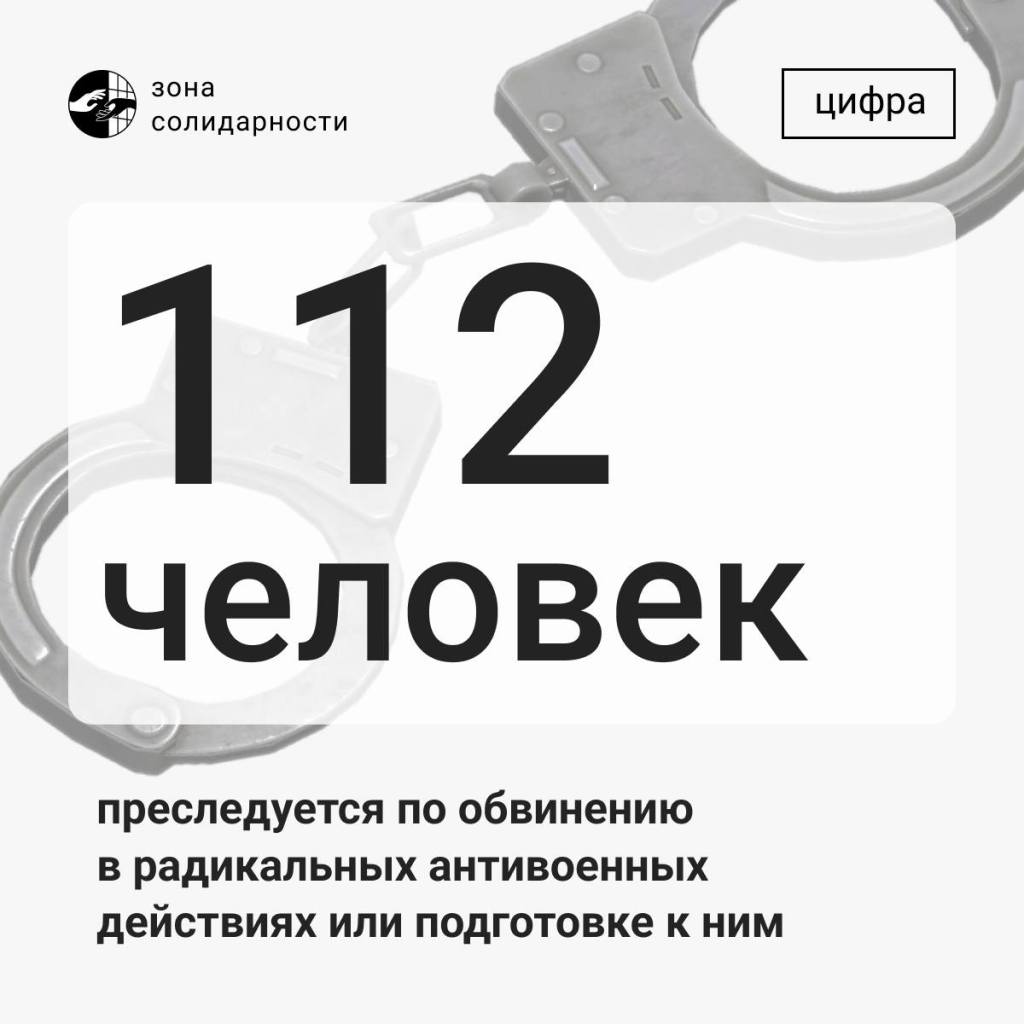


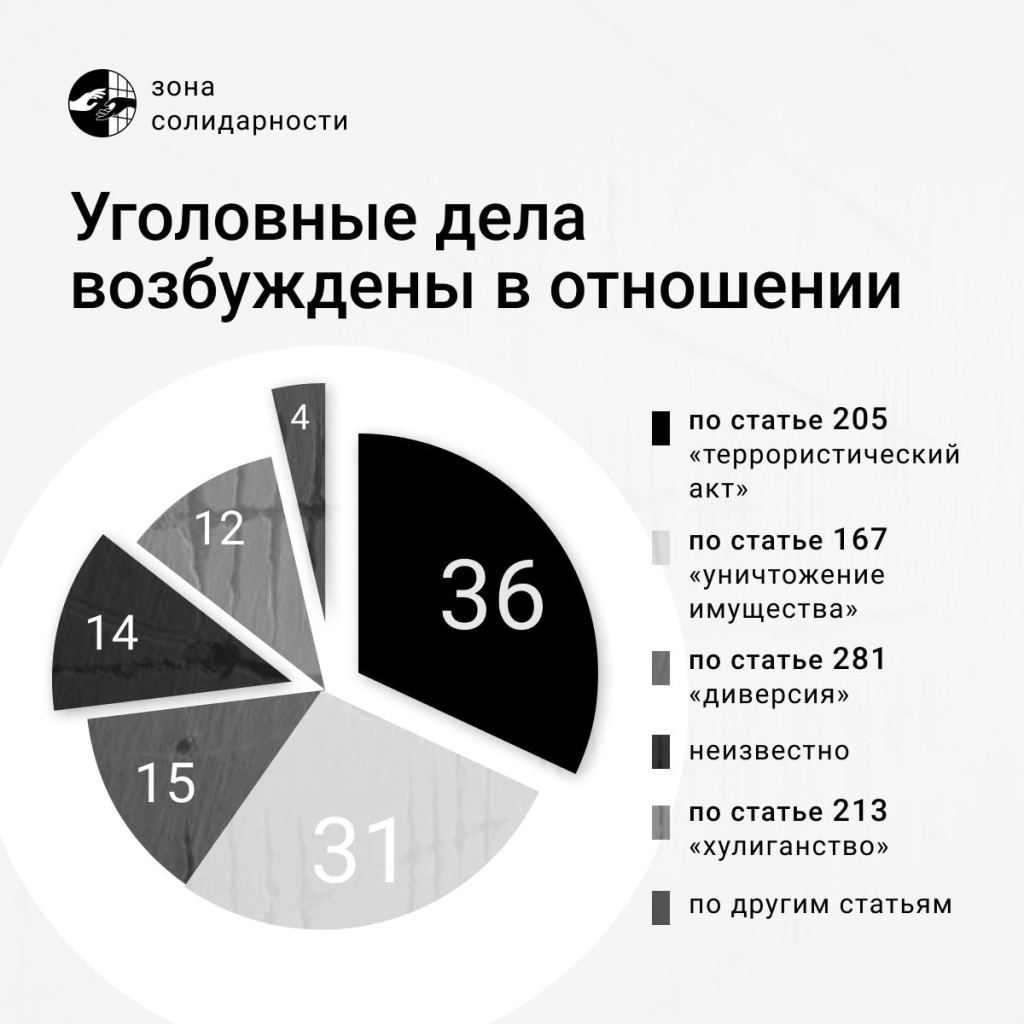
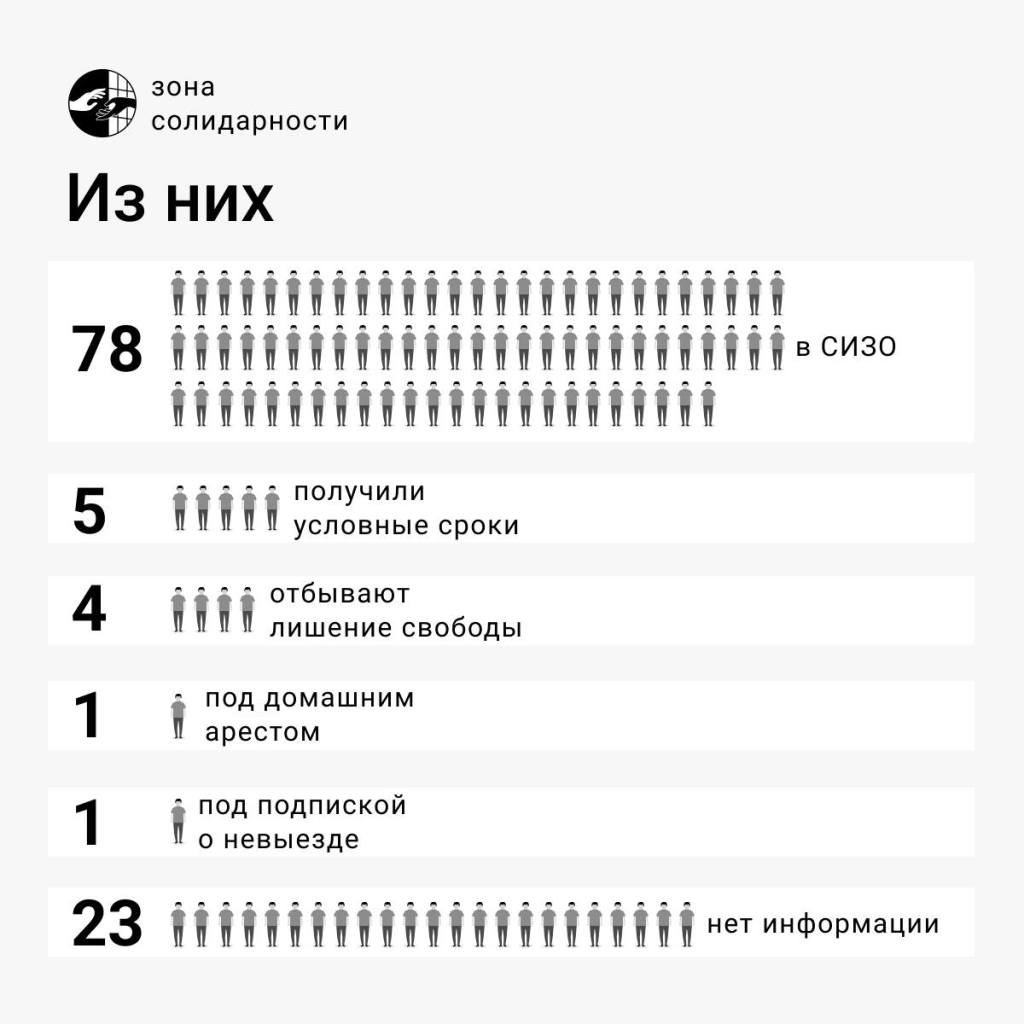


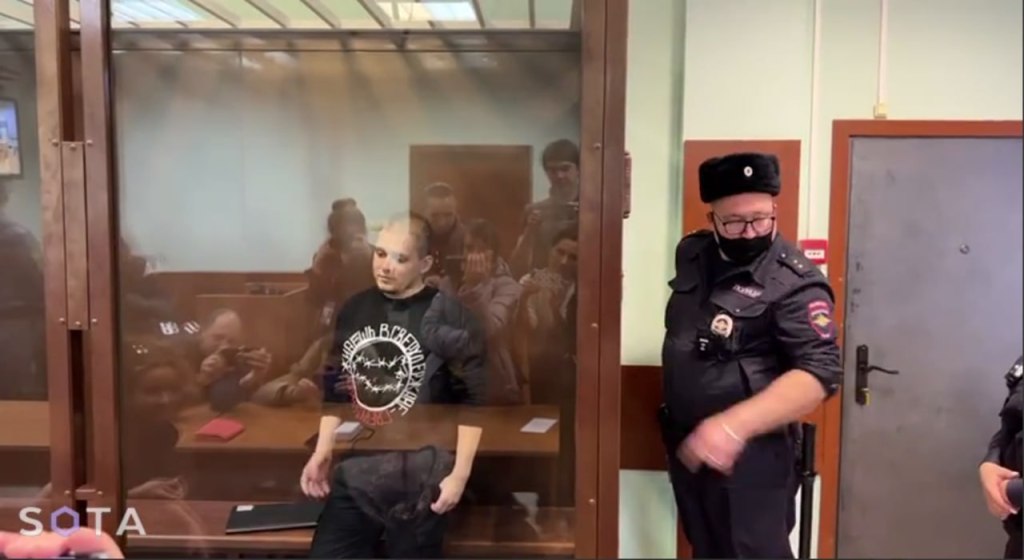


 To support Solidarity Zone financially, so that we can continue to pay lawyers, send parcels to prisoners, and help cover other expenses, you can use the follow payment methods:
 Sberbank card
 PayPal: solidarity_zone@riseup.net
 Cryptocurrency: